
Article

Integral-Type Event-Triggered Average Consensus over Jointly Connected Topologies

1
School of Information and Electronic Engineering, Shandong Technology and Business University, Yantai 264005, China
2
Key Laboratory of Sensing Technology and Control in Universities of Shandong, Shandong Technology and Business University, Yantai 264005, China
Modelling 2026, 7(4), 129; https://doi.org/10.3390/modelling7040129
Submission received: 15 May 2026 / Revised: 18 June 2026 / Accepted: 27 June 2026 / Published: 29 June 2026

Abstract

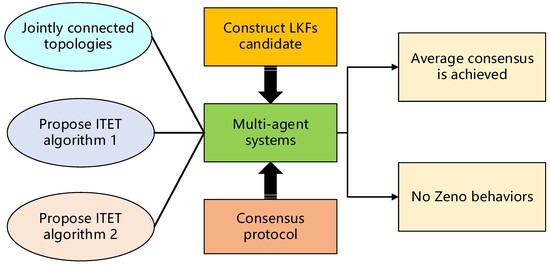
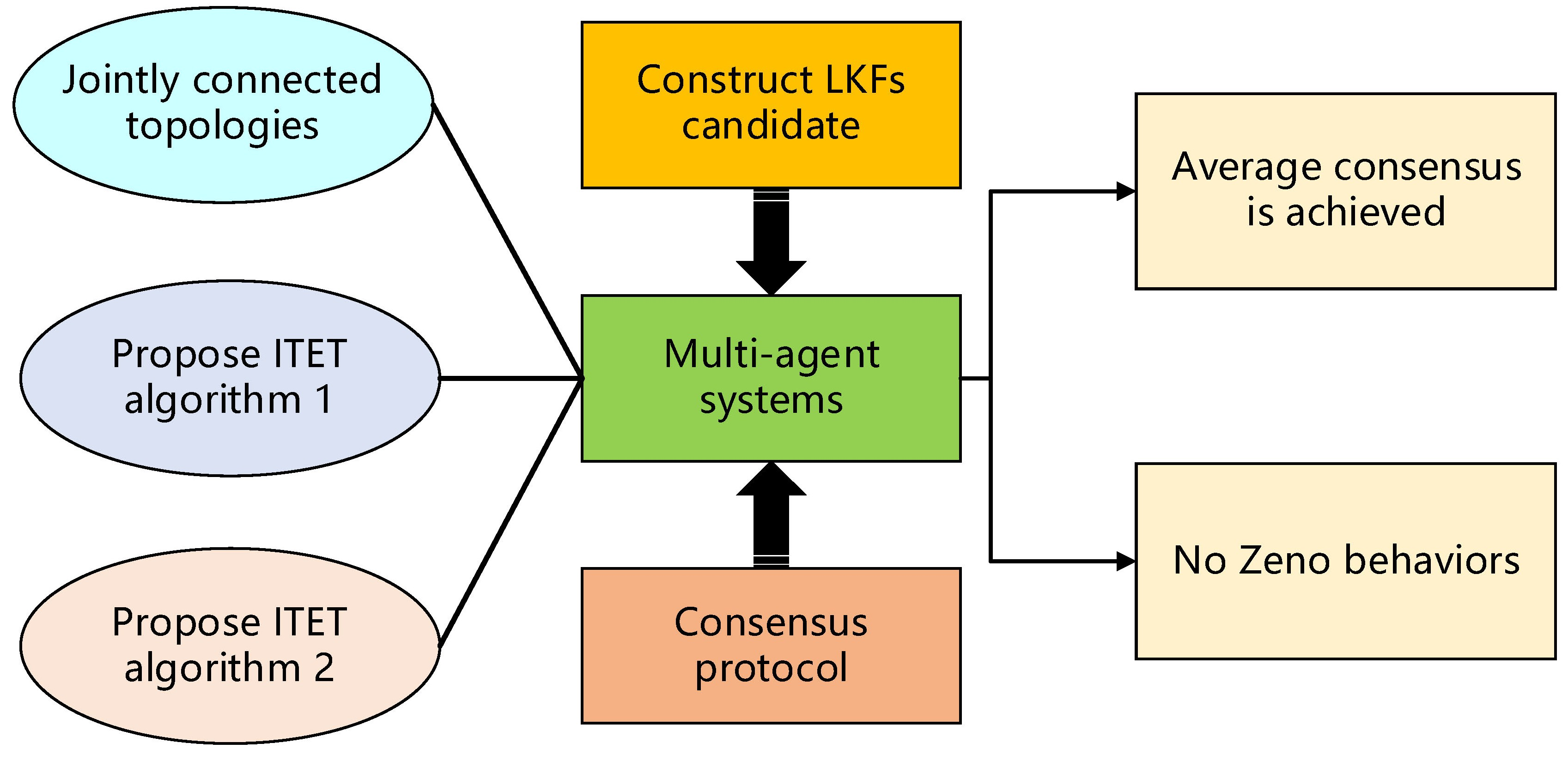
In this paper, a class of distributed event-triggered (ET) control strategy is proposed to address the average consensus problem for multi-agent systems (MAS). Compared with the existing ET control methods with fixed connected communication links, underlying topology considered here is jointly connected, which is more adaptable to the needs of practicality. In order to save communication energy resources among agents, an improved integral-type event-triggered (ITET) strategy is chosen to guarantee that the entire system reaches an agreement on the desired state and no Zeno behavior occurs. Finally, two simulation examples are given to investigate the effectiveness of the proposed control strategy.

Graphical Abstract

1. Introduction

Cooperation control has received growing attraction in the past decade due to its wide applications; see [1,2,3,4,5,6,7,8,9] and the references therein. Consensus problem, where a set of agents are required to agree on certain quantities of interest, has been extensively researched and applied to many important academic fields. In particular, the consensus problem of continuous dynamics with time delay and switching topology is discussed in [10] and fundamental consensusability of discrete-time dynamics over undirected topology is investigated in [11]. Further, the dynamic average consensus problem of first-order nonlinear dynamics over directed balanced links is researched in [12], and distributed average tracking problem of physical second-order heterogenous nonlinear dynamics under undirected network is addressed in [13]. For linear dynamics, the distributed average tracking problem is discussed by a fixed-time control algorithm in [14]. In addition, the distributed average tracking problem of higher-order Lipschitz-type nonlinear dynamics is solved in [15].
As is well known, communication between the neighbors in the above-mentioned literatures is continuous where it wastes a vast amount of energy resources. To handle this issue, periodic sampling technology and zero-order hold circuit are proposed to deal with the consensus problem of first-order MAS in [16] where it mitigates the resource constraints effectively. However, there is an obvious drawback in periodic transmission mechanism where updates among the agents are synchronous. Then, ET strategy, as a desirable alternative to time-triggered strategy, is first introduced in [17]. Followed by this idea, many fruitful results emerge in the recent literatures involving the average consensus problem of first-order dynamics [18,19] and that of second-order dynamics [20]. In [21], a distributed dynamic event-triggered scheme is developed to investigate the dynamic average consensus problem. In addition, some other important achievements are shown in [22,23,24,25,26,27].
In many realistic network dynamics, the communication topology among agents may be switching with certain rule or jointly connected in a certain amount of time resulted from various unpredictable interferences and disturbances. In view of this, it is of importance to research consensus problem of MAS over switching topologies. Particularly, reference [28] studies the consensus problem of first-order nonlinear dynamics under switching topologies as well as that of second-order nonlinear dynamics, and [29] resolves the consensus problem of general higher-order dynamics under dynamically changing directed topologies. In addition, the event-based consensus problem of first-order systems under time-varying digraphs is discussed in [30] and event-based tracking problem of second-order systems under switching graphs is presented in [31]. Moreover, the ET leader-following consensus problems of MAS under switching topologies are respectively investigated in [32,33]. Furthermore, the ET consensus problem of heterogeneous MAS systems with jointly connected topologies is addressed concretely in [34].
The ITET consensus problem has been considered in [26,27]; however, the communication topology among agents is fixed. Despite these achievements, there exist little results on ITET average consensus problem of MAS over switching topologies. In light of this, it is interesting to discuss the ITET consensus problem over switching topologies. Motivated by the above-mentioned observation, the ITET average consensus problems of MAS over jointly connected topologies is investigated in this paper. The main contributions are presented as follows. First, compared with the ET conditions in [18,19,20,22,23,24,25], a class of novel ITET control strategy is proposed to deal with the average consensus problem. Second, we extend the average consensus problem over fixed topology in [25] to that of jointly connected topologies with the ITET idea. Third, contrary to the results in [24] where the average consensus problem is addressed over fixed topology, this paper discusses the ITET-based average consensus problem of MAS over jointly connected topologies. Moreover, Zeno behaviors are excluded at any finite time.
The reminder of this paper is organized as follows. In Section 2, algebraic graph theory and preliminary lemmas are introduced. In Section 3, specific analysis of the ITET-based average consensus problem of MAS under jointly connected topologies is discussed. Two examples are provided to demonstrate the effectiveness of the obtained theoretical results in Section 4. Finally, Section 5 concludes the paper.
Notations: Throughout this paper, the superscript T represents the matrix transposition, and the symbol R n is n-dimensional column vector. · stands for 2-norm of vectors or induced 2-norm of matrices, and I n denotes an identity matrix, whose dimension is n. R m × n is the set of m × n real matrix. In addition, an n dimension column vector with all the elements being 1 ( 0 ) is denoted as 1 n ( 0 n ) . Given real symmetric matrix X and Y, X > Y ( X Y ) implies that the expression X Y is positive definite (positive semi-definite).

2. Preliminaries

2.1. Graph Description

The following concepts of graph theory can be found in [35]. Assuming that there exist N agents, we let G = V , E denote the communication topology, where V = { 1 , 2 , , N } is the node set. We denote adjacency matrix by A = [ a i j ] R N × N with a i i = 0 , a i j = 1 if ( j , i ) E , and a i j = 0 otherwise. Furthermore, if ( i , j ) E , j is an out-neighbor of i and if ( j , i ) E , j is an in-neighbor of i. N i is called the set of neighbors of node i. The diagonal degree matrix is defined as D = d i a g d i where d i = j N i a i j and the Laplacian matrix is denoted as L = D A . Furthermore, a undirected graph is connected if there exists at least one path between any two agents. Moreover, for an undirected connected graph, L has exactly one eigenvalue equal to zero and all its nonzero eigenvalues are positive and the eigenvalues are denoted as λ 1 ( L ) < λ 2 ( L ) λ 3 ( L ) λ N ( L ) with λ 1 ( L ) = 0 .
In addition, the communication considered here is switching. We let { G p p P } be all possible topologies, and the switching signal is defined as σ ( t ) : 0 , P to represent which topology is activated at time t. Clearly, σ ( t ) is a piece-wise function and L σ ( t ) varies with time as well as D σ ( t ) . For further analysis, we give an infinite sequence of bounded, non-overlapping and continuous time intervals T m , T m + 1 , ( m = 0 , 1 , 2 , ) , and T 0 = 0 . We let T m + 1 T m β m with β m > 0 . Given a sequence of non-overlapping, continuous subintervals exists for interval T m , T m + 1 .
T m 0 , T m 1 , , T m i , T m i + 1 , , T m s m 1 , T m s m
with T m = T m 0 and T m + 1 = T m s m for positive integer s m . We assume that there exists a dwell time τ ˜ > 0 satisfying T m i + 1 T m i τ ˜ , m = 0 , 1 , 2 , , and i = 0 , 1 , , s m 1 . Only at the instants { T 0 0 , T 0 1 , , T m i , T m i + 1 , } , communication network switches, obviously, communication network does not vary in each time subinterval T m i , T m i + 1 . Here, each graph G σ ( t ) is not connected.

2.2. Useful Definition and Lemmas

First, some important definitions and lemmas are respectively given.
Definition 1 
([33]). Assume the union t t 1 , t 2 G σ ( t ) is connected for given interval t 1 , t 2 , then the graph G ( t ) is called jointly connected over time interval t 1 , t 2 . Note that the union t t 1 , t 2 G σ ( t ) means that the union of all nodes and edges of the activated graphs.
Definition 2 
([10]). Suppose that the underlying graph G is connected. If all agents’ states converge to a common point, called the “agreement point”, which coincides with the average ( 1 ( 1 N ) N ) i = 1 N z i ( 0 ) of the initial states, then average consensus is achieved.
Lemma 1 
([25]). Assume a graph G is undirected connected, then the Laplacian matrix L is positive semi-definite. Furthermore, it is derived that 0 λ 2 ( L ) H N L with H N = I N 1 N 1 N 1 N T .
Lemma 2 
([36]). Given x , y R and any ω > 0 , the following inequality holds:
x y ω 2 x 2 + 1 2 ω y 2 .
Lemma 3 
([34]). (Cauchy’s convergence criterion) The sequence Y ( T m ) , m = 0 , 1 , 2 , converges if and only if for ε > 0 , M ε Z + satisfying m > M ε , Y ( T m + 1 ) Y ( T m ) < ε .
Lemma 4 
([37]). (Barbalat lemma) Let ρ : R R be a uniformly continuous function on [ 0 , ) . Suppose that lim t 0 t ρ ( τ ) d τ exists and is finite. Then, ρ ( t ) 0 as t .

3. Distributed Integral-Type Event-Triggered Design

In this section, the distributed ITET average consensus problems of MAS over jointly connected topologies are investigated by two developed algorithms.
z ˙ i ( t ) = u i ( t ) , i = 1 , 2 , , N ,
where z i ( t ) R and u i ( t ) R are the state and control input for agent i, respectively.
Motivated by [18], we propose an ET control protocol as follows:
u i ( t ) = j N i a i j σ ( t ) ( z ^ i ( t ) z ^ j ( t ) ) .
For simplicity, we let z ( t ) = z 1 ( t ) , , z n ( t ) T , z ^ i ( t ) = z i ( t k i ) , z ^ ( t ) = z ^ 1 ( t ) , , z ^ n ( t ) T , h i ( t ) = z ^ i ( t ) z i ( t ) , and h ( t ) = h 1 ( t ) , , h n ( t ) T = z ^ ( t ) z ( t ) . Moreover, i z i ( t ) is used to substitute for i = 1 N z i ( t ) , i V . The average of all agents’ states is represented by z ¯ ( t ) = ( 1 ( 1 N N ) i z i ( t ) . In [23,25], one has z ¯ ( t ) = z ¯ ( 0 ) = ( 1 1 N N ) i z i ( 0 ) , t 0 .
Remark 1. 
Different from the consensus protocol u i ( t ) = j N i a i j ( z i ( t ) z j ( t ) ) in [10] whose communication is continuous, the ET protocol (2) is aimed to solve the consensus problem of MAS where the communication among agents is intermittent and the network topologies are jointly connected. Furthermore, it reduces energy consumption greatly.

3.1. Proposed ITET Algorithm 1

Theorem 1. 
Consider the MAS (1)–(2). Assume that the communication network is undirected and jointly connected during every time interval T m , T m + 1 , ( m = 0 , 1 , 2 , ) . Under the following triggering function and triggering instants
f i ( t ) = t k i t ( h i ( τ ) 2 δ i 2 L i i σ ( t ) p ^ i ( τ ) ) d τ ,
t k + 1 i = inf t [ t k i , ) | f i ( t ) 0 , k = 0 , 1 , ,
with δ i ( 0 , 1 ) and p ^ i ( t ) defined in the subsequent proof. Then, (i) all agents achieve the average consensus, and (ii) no Zeno behavior occurs.
Proof. 
(i) First, we prove that the average consensus is achieved. We construct a Lyapunov function as follows:
Y 1 ( t ) = 1 2 z T ( t ) H N z ( t ) ,
during t [ t k i , t k + 1 i ) , two cases are considered. Note that
Y 1 ( t ) = 1 2 z T ( t ) H N z ( t ) = 1 2 i ( z i ( t ) z ¯ ( 0 ) ) 2 .
Case A: If the topology does not switch during [ t k i , t k + 1 i ) , we assume that the subgraph p P is activated at a time t. Then, calculating time derivation of Y 1 ( t ) yields
Y ˙ 1 ( t ) = i [ z i ( t ) z ¯ ( 0 ) ] z ˙ i ( t ) = i z i ( t ) j L i j σ ( t ) z ^ j ( t ) = i ( z ^ i ( t ) h i ( t ) ) j L i j σ ( t ) z ^ j ( t ) = i p ^ i ( t ) i j h i ( t ) L i j σ ( t ) z ^ j ( t ) = i j , j i h i ( t ) L i j σ ( t ) ( z ^ j ( t ) z ^ i ( t ) ) i p ^ i ( t ) ,
where p ^ i ( t ) = 1 2 j L i j σ ( t ) ( z ^ j ( t ) z ^ i ( t ) ) 2 0 and i p ^ i ( t ) = 1 2 i j L i j σ ( t ) ( z ^ j ( t ) z ^ i ( t ) ) 2 = z ^ T ( t ) L σ ( t ) z ^ ( t ) .
Further, by using Lemma 2, it is derived that
Y ˙ 1 ( t ) i p ^ i ( t ) i j , j i L i j σ ( t ) h i 2 ( t ) 1 4 i j , j i L i j σ ( t ) ( z ^ j ( t ) z ^ i ( t ) ) 2 = 1 2 i p ^ i ( t ) + i L i i σ ( t ) h i 2 ( t ) .
We integrate the Formula (7) and derive that
0 t Y ˙ 1 ( z ( τ ) ) d τ 0 t ( 1 2 i p ^ i ( τ ) + i L i i σ ( t ) h i 2 ( τ ) ) d τ .
By applying the ITET conditions (3) and (4), it yields from inequality (8)
Y 1 ( z ( t ) ) Y 1 ( z ( 0 ) ) 1 2 i 0 t p ^ i ( τ ) d τ + i L i i σ ( t ) 0 t h i 2 ( τ ) d τ 1 2 ( 1 δ max ) 0 t z ^ T ( τ ) L σ ( t ) z ^ ( τ ) d τ 0 ,
where δ max = max { δ 1 , , δ N } < 1 . Noting that
z T ( t ) L σ ( t ) z ( t ) = ( z ^ ( t ) + h ( t ) ) T L σ ( t ) ( z ^ ( t ) + h ( t ) ) 2 z ^ T ( t ) L σ ( t ) z ^ ( t ) + 2 h T ( t ) L σ ( t ) h ( t ) 2 z ^ T ( t ) L σ ( t ) z ^ ( t ) + 2 L σ ( t ) h ( t ) 2 2 z ^ T ( t ) L σ ( t ) z ^ ( t ) + L σ ( t ) δ max min i L i i σ ( t ) i p ^ i ( t ) = ( 2 + L σ ( t ) δ max min i L i i σ ( t ) ) z ^ T ( t ) L σ ( t ) z ^ ( t ) ,
then, it is derived that
Y 1 ( z ( t ) ) Y 1 ( z ( 0 ) ) 1 2 ( 1 δ max ) 0 t z ^ T ( τ ) L σ ( t ) z ^ ( τ ) d τ ( 1 δ max ) min i L i i σ ( t ) 4 min i L i i σ ( t ) + 2 L σ ( t ) δ max 0 t z T ( τ ) L σ ( t ) z ( τ ) d τ η 0 t Y 1 ( t ) d τ ,
where η = ( 1 δ max ) min i L i i σ ( t ) 2 min i L i i σ ( t ) + L σ ( t ) δ max λ 2 ( L σ ( t ) ) > 0 .
Thus, Y 1 ( t ) is a decreasing function of t. Due to Y 1 ( z ( t ) ) 0 , we have 0 t Y 1 ( t ) d τ Y 1 ( z ( 0 ) ) η , thus 0 t Y 1 ( t ) d τ is bounded due to above-mentioned discussion and d 2 d t 2 0 t Y 1 ( t ) d τ = Y ˙ 1 ( t ) is finite. By making use of Barbalat’s Lemma, it is obtained that lim t d d t 0 t Y 1 ( t ) d τ = lim t Y 1 ( t ) = 0 , then z i ( t ) z ¯ ( 0 ) , hence the average consensus is achieved.
Case B: If the topology switches at T m i , where T m i [ t k i , t k + 1 i ) , and keeps fixed during [ t k i , T m i ) and [ T m i , t k + 1 i ) , then the corresponding topologies are G p and G p + 1 . The topology switches before the next event triggering time, then two cases may emerge.
(a) “Synchronous switching and event triggering”, event-triggered condition is violated resulting from switching of the topology, then the event is triggered, and also this switching time instant will be a new event time, namely t k + 1 i = T m i , then it changes into case A. Furthermore, analysis is similar if the topology switches finite times during [ t k i , t k + 1 i ) .
(b) “Asynchronous switching and event triggering”, when the topology switches from G p to G p + 1 , event-triggered condition is not violated, so it does not need further action. In this case, Y ˙ 1 ( t ) is researched at time interval [ t k i , T m i ) and [ T m i , t k + 1 i ) , respectively. Clearly, Y ˙ 1 ( t ) 0 holds when t [ t k i , T m i ) and t [ T m i , t k + 1 i ) .
From the mentioned-above analysis, Y ˙ 1 ( t ) 0 and Y 1 ( z ( t ) ) 0 , so Y 1 ( t ) is nonincreasing and lower bounded, then Y 1 ( t ) exists for t . Through the Cauchy’s convergence criteria, there exists Y 1 ( T m + 1 ) Y 1 ( T m ) < ε for ε > 0 with condition T m > T ( ε ) > 0 . Namely,
T m T m + 1 Y ˙ 1 ( τ ) d τ > ε ,
and in interval T m , T m + 1 , we expand the Formula (11) as
T m 0 T m 1 Y ˙ 1 ( τ ) d τ + T m 1 T m 2 Y ˙ 1 ( τ ) d τ + + T m s m 1 T m s m Y ˙ 1 ( τ ) d τ > ε ,
thus, T m i T m i + 1 Y ˙ 1 ( τ ) d τ > ε because of the finiteness of s m .
In light of the ITET condition (3) of Theorem 1, it is derived by additivity of integration during time interval T m i , T m i + 1
ε < T m i T m i + 1 Y ˙ 1 ( τ ) d τ < 1 2 ( 1 δ max ) T m i T m i + 1 0 τ z ^ T ( s ) L σ ( T m i ) z ^ ( s ) d s d τ < 1 2 ( 1 δ max ) T m i T m i + τ ˜ 0 τ z ^ T ( s ) L σ ( T m i ) z ^ ( s ) d s d τ , i = 0 , 1 , , s m 1 .
Or
lim t t t + τ ˜ 1 2 ( 1 δ max ) 0 τ z ^ T ( s ) L σ ( T m i ) z ^ ( s ) d s d τ = 0 , i = 1 , , s m 1 .
Further, expanding the equality above, one has
lim t t t + τ ˜ 1 2 ( 1 δ max ) 0 τ z ^ T ( s ) L σ ( T m 0 ) z ^ ( s ) d s d τ   + lim t t t + τ ˜ 1 2 ( 1 δ max ) 0 τ z ^ T ( s ) L σ ( T m 1 ) z ^ ( s ) d s d τ + + + lim t t t + τ ˜ 1 2 ( 1 δ max ) 0 τ z ^ T ( s ) L σ ( T m s m 1 ) z ^ ( s ) d s d τ = 0 .
Because of the jointly connected topologies, during T m , T m + 1 for m = 0 , 1 , 2 , , we can have
L σ ( T m 0 ) + L σ ( T m 1 ) + + L σ ( T m s m 1 ) 0 .
Thus
0 = 1 2 lim t t t + τ ˜ ( 1 δ max ) 0 τ z ^ T ( s ) L σ ( T m 0 s m 1 ) z ^ ( s ) d s d τ η 0 t Y 1 ( t ) d τ 0 .
According to the fact that lim t + Y 1 ( t ) exists, z ( t ) and its derivative are bounded. Thus, we have lim t + Y 1 ( t ) = lim t 1 2 i [ z i ( t ) z ¯ ( 0 ) ] 2 = 0 , so z i ( t ) z ¯ ( 0 ) for t , thus average consensus is achieved.
(ii) Next, we prove that no Zeno behavior occurs. When j N L i j σ ( t ) z ^ j ( t k i ) = 0 , then h i ( t ) = 0 and no trigger occurs. When j N L i j σ ( t ) z ^ j ( t k i ) 0 , then p ^ i ( t ) = p ^ i ( t k i ) 0 , and form (3) it yields ( t k + 1 i t k i ) 2 ( j N L i j σ ( t ) z ^ j ( t k i ) ) 2 δ i 2 L i i σ ( t ) p ^ i ( t k i ) = 0 . We let τ k i denote a lower bound of t k + 1 i t k i and it derives that
τ k i = δ i j i N L i j σ ( t ) ( z ^ j ( t k i ) z ^ i ( t k i ) ) 2 4 L i i σ ( t ) ( j i N L i j σ ( t ) ( z ^ j ( t k i ) z ^ i ( t k i ) ) ) 2 δ i j i N L i j σ ( t ) ( z ^ j ( t k i ) z ^ i ( t k i ) ) 2 4 L i i σ ( t ) j i N L i j σ ( t ) j i N L i j σ ( t ) ( z ^ j ( t k i ) z ^ i ( t k i ) ) 2 = δ i 2 L i i σ ( t )
and it yields τ k i > 0 ; thus, Zeno behavior is excluded.
In addition, due to the fact that the switching topology may result in event triggering, there is no lower bound for event intervals. However, it is also concluded that there is no Zeno behavior because of the switching dwell time of topology τ ˜ > 0 . □
Remark 2. 
In triggering law (3), the agent’s control action only requires its own state information and those of its neighbors, then the triggering law is distributed without depending on any global parameters. From [23], it is obtained that triggering law (3) is sufficient to rule out Zeno behavior. After the average consensus is achieved, frequent triggering actions may occur if only if p ^ i ( t ) = 0 .

3.2. Proposed ITET Algorithm 2

An improved of ET strategy is developed to solve the average consensus problem by introducing a combined candidate Lyapunov function in [24]. Motivated by the above-mentioned idea, we propose a new ITET strategy as follows:
f i ( t ) = t k i t h i ( τ ) 2 d τ g δ i 4 d i t k i t j N i a i j σ ( t ) ( z ^ i ( τ ) z ^ j ( τ ) ) 2 d τ 2 δ i ( 1 g ) k i q i r i ( q i + r i ) d i t k i t j N i a i j σ ( t ) ( z ^ i ( τ ) z ^ j ( τ ) ) 2 d τ ,
with g [ 0 , 1 ] , δ i ( 0 , 1 ) , q i , r i < 1 d i and k i = 1 d i q i 2 j N i a i j σ ( t ) r i 2 , and triggering instants of agent i is denoted by
t k + 1 i = inf t [ t k i , ) | f i ( t ) > 0 , k = 0 , 1 , .
Theorem 2. 
Consider the MAS (1)–(2). Assume that the communication network is undirected and jointly connected during every time interval T m , T m + 1 , ( m = 0 , 1 , 2 , ) . Under the given triggering conditions (13) and (14), all agents achieve the average consensus and no Zeno behavior occurs.
Proof. 
We construct a combined Lyapunov candidate from [24]:
Y 4 ( t ) = g Y 2 ( t ) + ( 1 g ) Y 3 ( t ) ,
where Y 2 ( t ) = 1 2 ( z ( t ) z ¯ ( 0 ) ) T ( z ( t ) z ¯ ( 0 ) ) and Y 3 ( t ) = 1 2 z ( t ) T L σ ( t ) T z ( t ) .
Calculating time derivation of Y 2 ( t ) yields
Y ˙ 2 ( t ) = z T ( t ) z ˙ ( t ) z ¯ T ( 0 ) z ˙ ( t ) = z T ( t ) L σ ( t ) z ^ ( t ) = i j N i ( 1 2 a i j σ ( t ) ( z ^ i ( t ) z ^ j ( t ) ) 2 h i a i j σ ( t ) ( z ^ i ( t ) z ^ j ( t ) ) ,
by applying Lemma 2, we obtain
Y ˙ 2 ( t ) i j N i a i j σ ( t ) ( ( 1 w i ) ( z ^ i ( t ) z ^ j ( t ) ) 2 h i 2 ( t ) w i ) .
Further, calculating time derivation of Y 3 ( t ) yields
Y ˙ 3 ( t ) = z ^ T ( t ) L σ ( t ) T z ˙ ( t ) h T ( t ) L σ ( t ) T z ˙ ( t ) = i [ j N i a i j σ ( t ) ( z ^ i ( t ) z ^ j ( t ) ) u i ( t ) j N i a i j σ ( t ) ( h i ( t ) h j ( t ) ) u i ( t ) ] = i ( u i 2 ( t ) d i h i ( t ) u i ( t ) + j N i a i j σ ( t ) h j ( t ) u i ( t ) ) ,
by applying Lemma 2, we obtain
Y ˙ 3 ( t ) i ( u i 2 ( t ) + d i h i 2 ( t ) 2 q i + d i q i u i 2 ( t ) 2 d i h i 2 ( t ) 2 r i + j N i a i j σ ( t ) r i 2 u i 2 ( t ) ) = i [ ( 1 d i q i 2 j N i a i j σ ( t ) r i 2 ) u i 2 ( t ) ( d i 2 q i + d i 2 r i ) h i 2 ( t ) ] = i ( k i u i 2 ( t ) ( d i 2 q i + d i 2 r i ) h i 2 ( t ) ) ,
where k i defined in (13). To ensure k i > 0 , it is required that q i , r i < 1 d i .
From (15), one has Y ˙ 4 ( t ) = g Y ˙ 2 ( t ) + ( 1 g ) Y ˙ 3 ( t ) . By combining (16) with (17), one has
Y ˙ 4 ( t ) i [ 1 2 g j N i a i j σ ( t ) ( ( 1 w i ) ( z ^ i ( t ) z ^ j ( t ) ) 2 h i 2 ( t ) w i ) + ( 1 g ) ( k i u i 2 ( t ) ( d i 2 q i + d i 2 r i ) h i 2 ( t ) ) ] .
Integrating the inequality (18), we have
0 t Y ˙ 4 ( z ( τ ) ) d τ 0 t i [ 1 2 g j N i a i j σ ( t ) ( ( 1 w i ) ( z ^ i ( τ ) z ^ j ( τ ) ) 2 h i 2 ( τ ) w i ) + ( 1 g ) ( k i u i 2 ( τ ) ( d i 2 q i + d i 2 r i ) h i 2 ( τ ) ) ] d τ ,
where w i = 0.5 is a chosen parameter which affects how flexible the triggering is. Like the process in Theorem 1, one has that all agents converge to the average of their initial states, namely lim t z i ( t ) z ¯ ( 0 ) . In addition, Zeno behavior is excluded due to the switching dwell time of topology τ ˜ > 0 . Note that detailed procedures are omitted since the results can be derived similar to the proof of Theorem 1. □
Remark 3. 
Compared to the event-triggered condition in [18,24], our method has less event-triggered numbers since the proposed ITET conditions allow increase in Lyapunov function in some interval within two consecutive triggering instants. Furthermore, when nonlinear MAS z ˙ i ( t ) = u i ( t ) + p ( t , z i ) is considered and the nonlinear function p i ( t , z ) is assumed to satisfy the Lipschitz condition with a constant l, that is p i ( t , z ) p i ( t , y ) l z y , then the results also hold for above-mentioned nonlinear MAS.
Remark 4. 
In [30,31], the ET consensus problems of first-order MAS and second-order MAS over switching topologies are discussed. Further, the ET leader-following consensus problems of general linear MAS over jointly connected topologies are dressed in [33,34]. However, two kinds of significant improvements are made in this paper. First, an ITET control method is proposed to handle the average consensus problem. Second, in comparison of the papers [18,19,20,22,23,24,25] which focus on the ET average consensus problem over fixed topology, we extend the results on ITET average consensus problem over fixed topology to those over jointly connected topologies, in which less event triggering numbers takes compared with the above-mentioned references.

4. Simulation Results

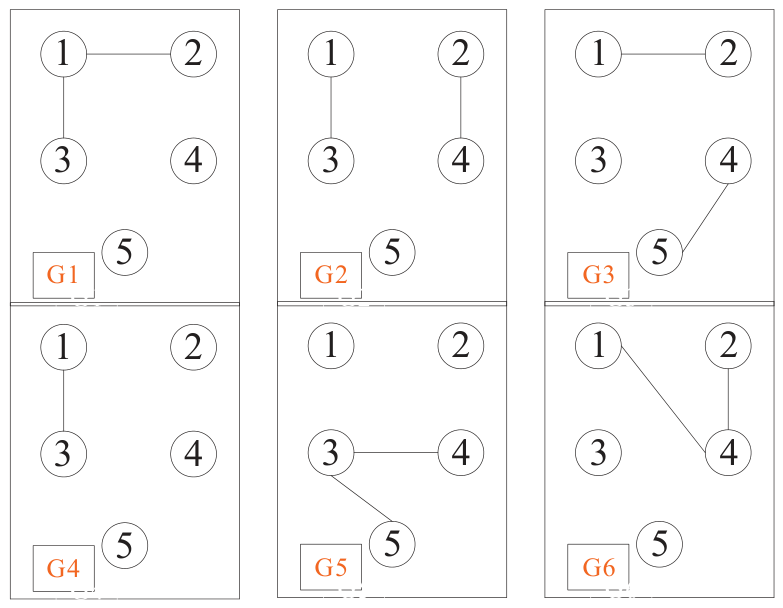
Two examples are provided to demonstrate the theoretical results. In Figure 1, a set of communication networks of five agents are considered. The topology switches as G 1 G 2 G 3 G 4 G 5 G 6 G 1 , with dwelling time τ ˜ = 0.1 s and G 1 G 2 G 3 and G 4 G 5 G 6 are jointly connected, respectively.
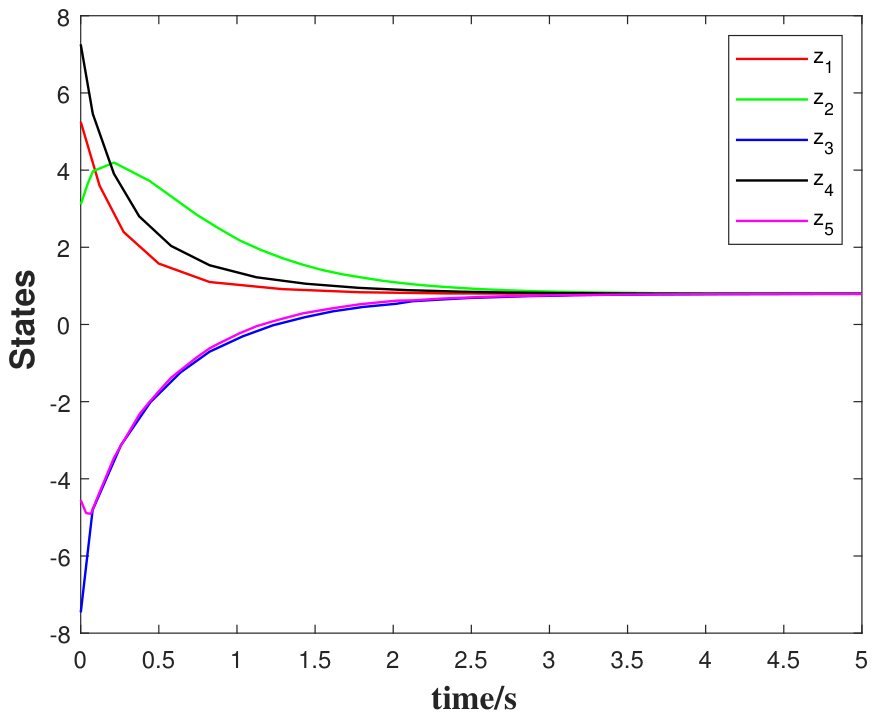
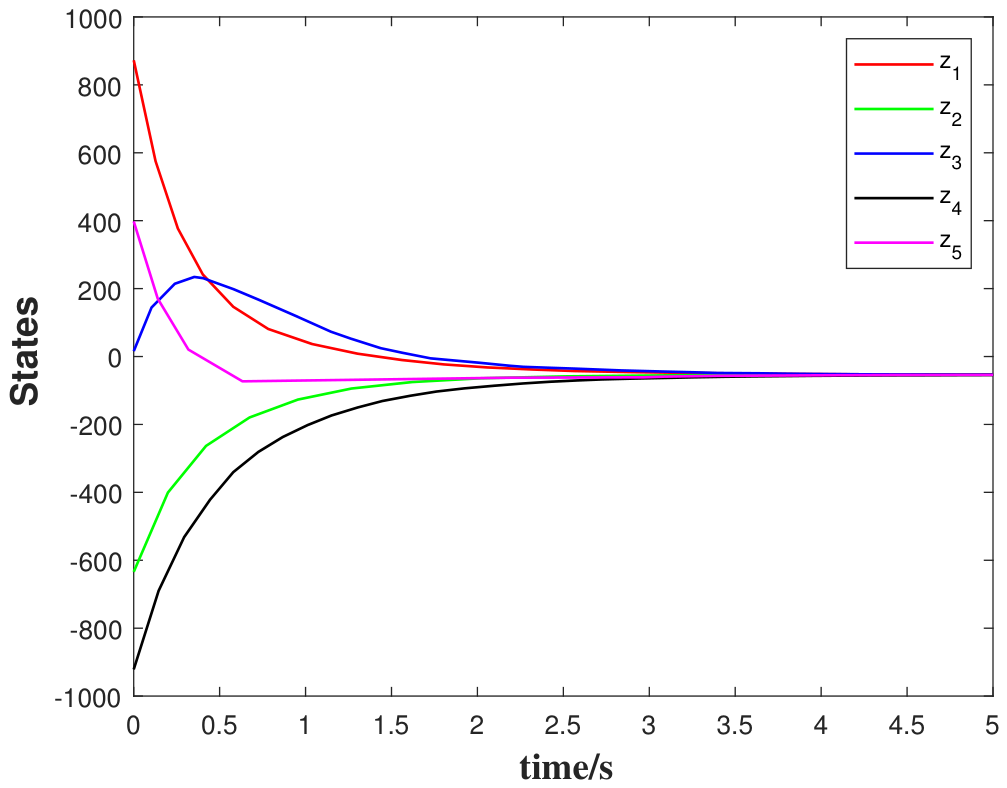
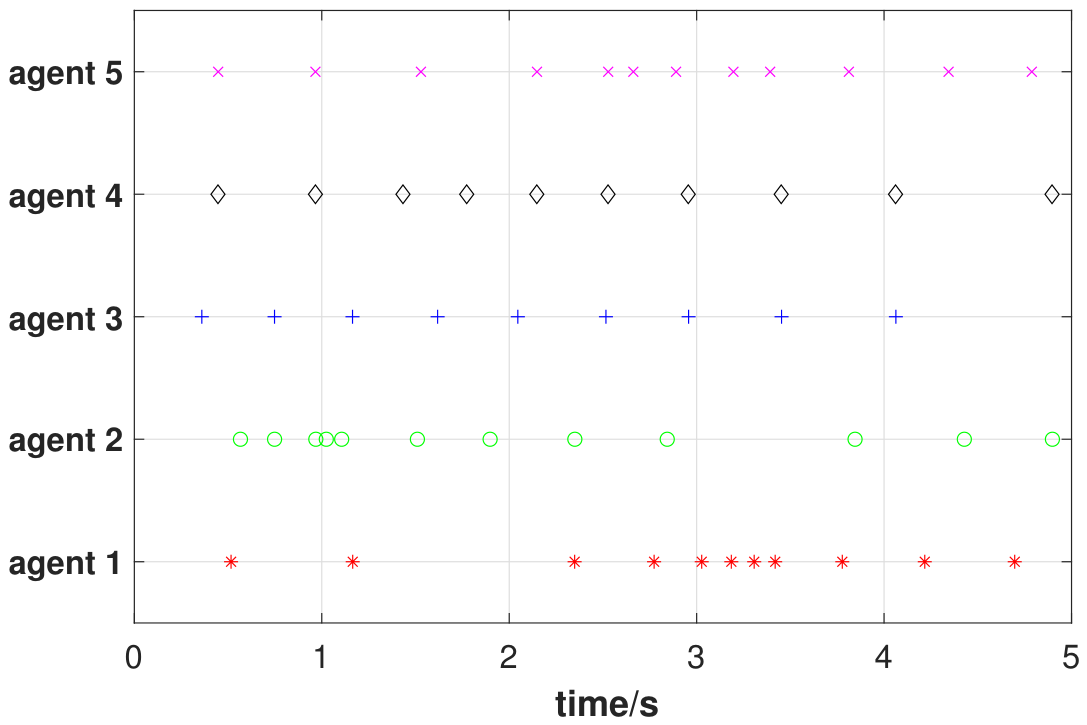
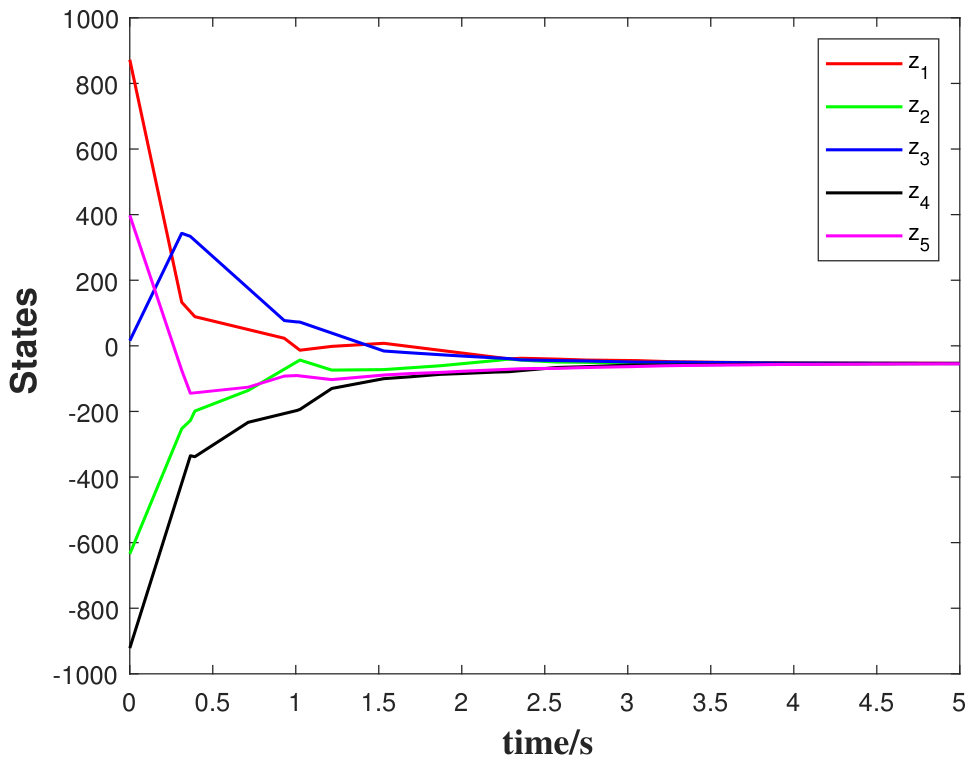
Example 1: This example is presented to illustrate the effectiveness of Theorem 1. The initial states are chosen as z ( 0 ) = [ 5.25 , 3.11 , 7.46 , 7.26 , 4.55 ] . Figure 2 shows the state evolutions of MAS (1)–(2) with δ i = 0.9 in Theorem 1, and Figure 3 and Figure 4 show triggering instants in both Theorem 1 and [18]. Clearly, the average consensus problem is achieved in Figure 2 and Zeno behavior is excluded in Figure 3. Obviously, we can see that the ET numbers for agents in Theorem 1 are less than that of [18]. Furthermore, to better demonstrate the robustness of the proposed integral-type controller, other initial states with high variance are set as z ( 0 ) = [ 872.53 , 634.21 , 15.87 , 921.44 , 398.06 ] and the state evolutions with δ i = 0.9 are presented in Figure 5.
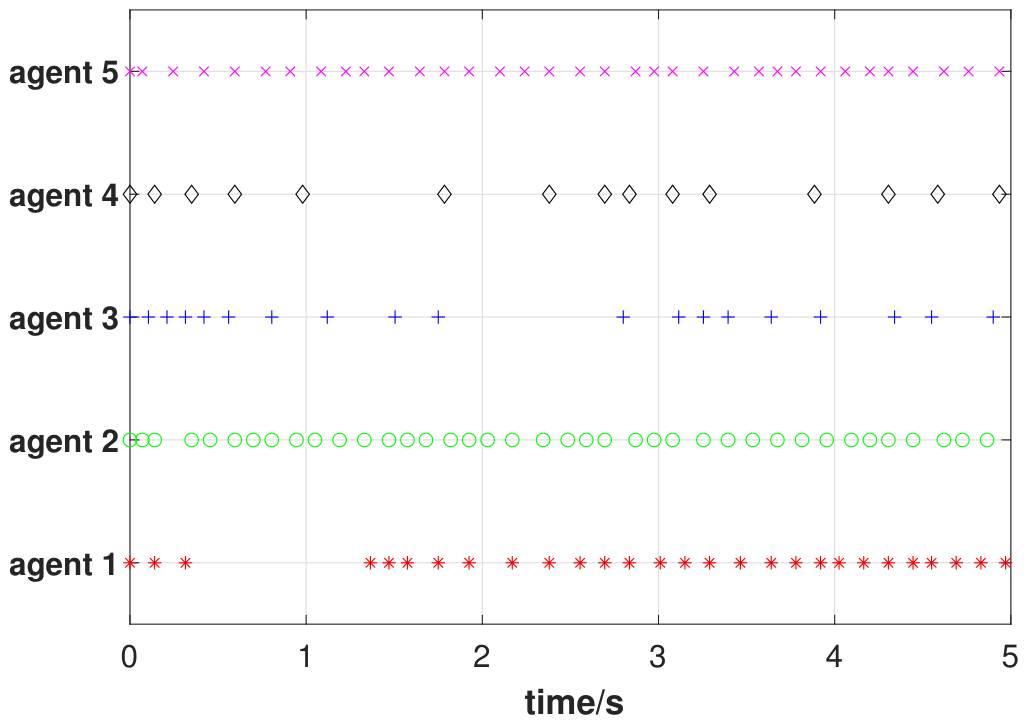
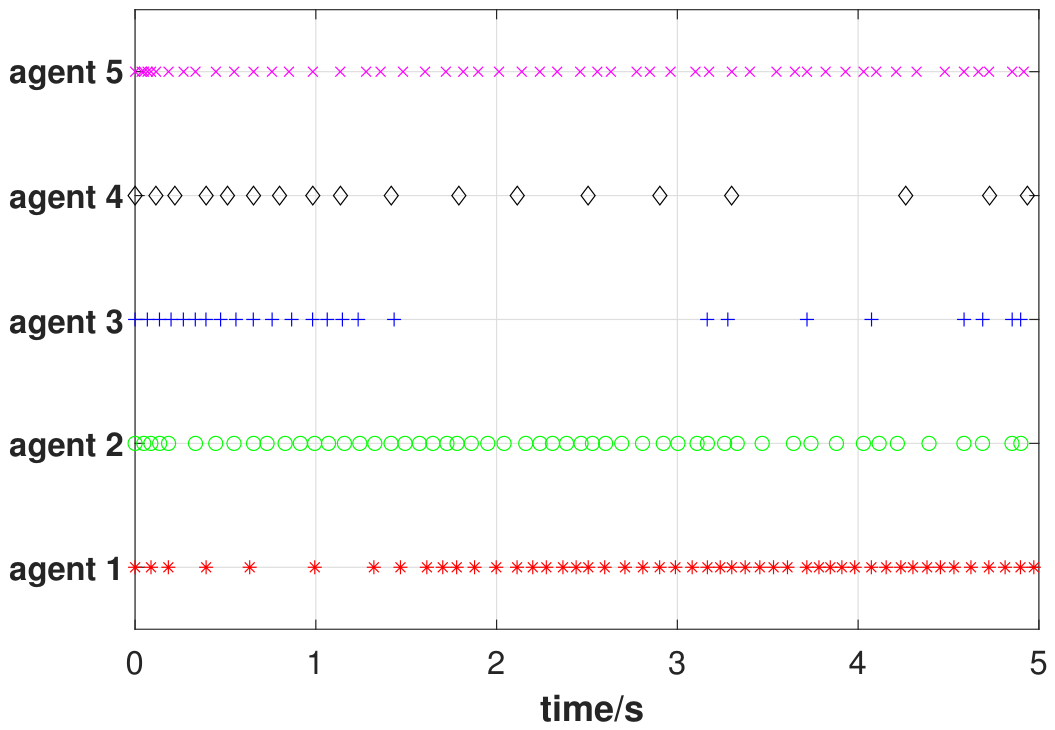
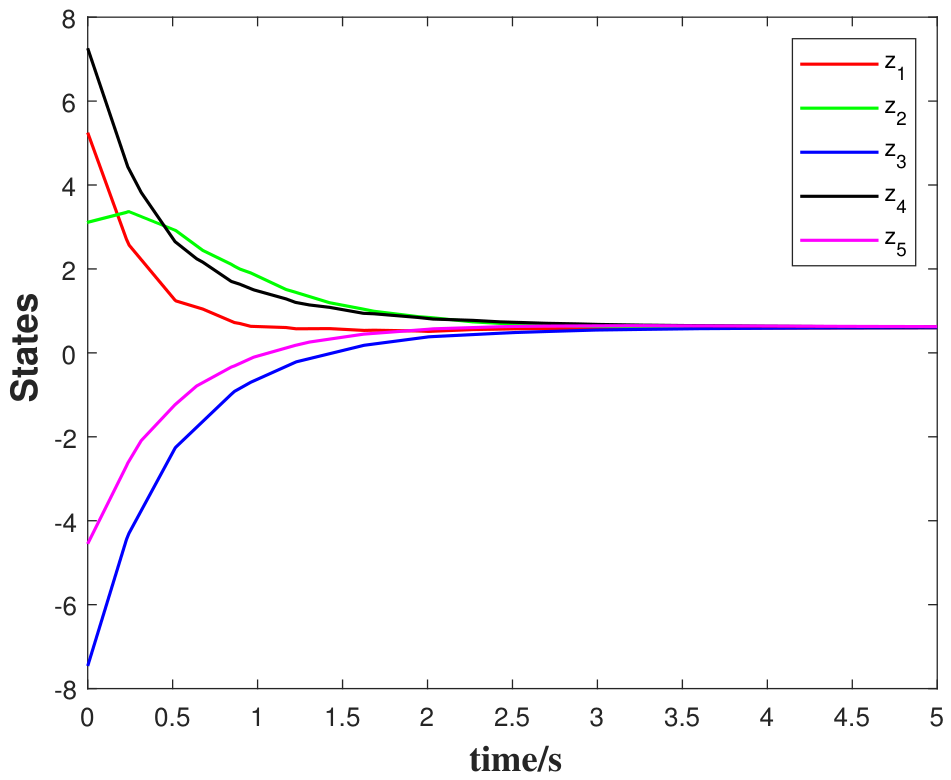
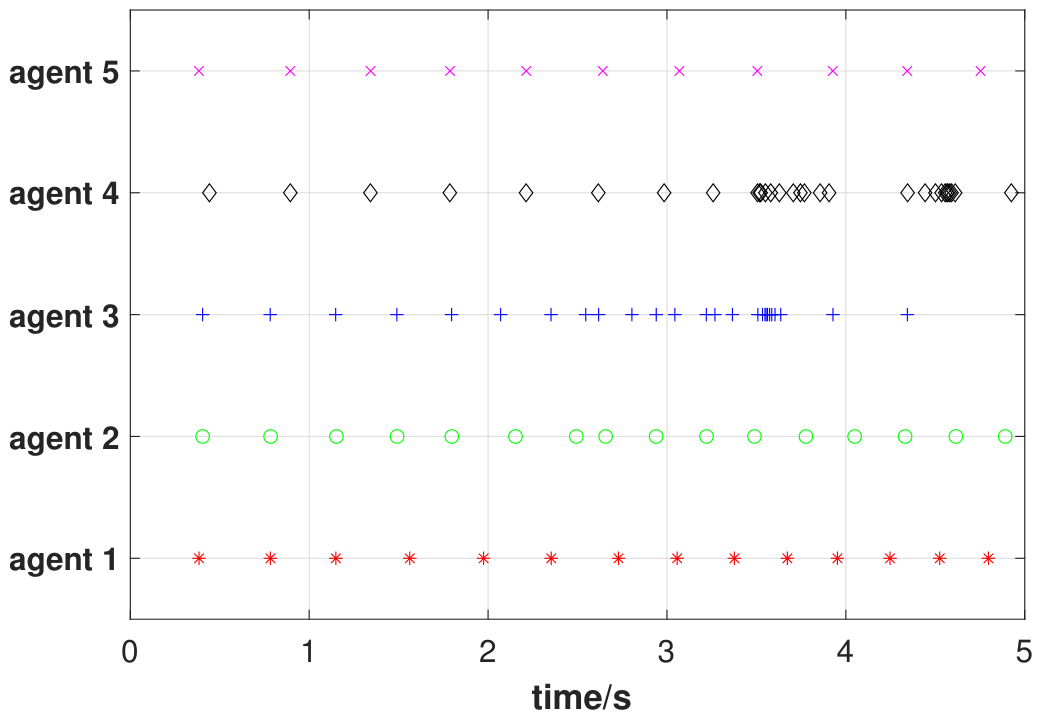
Example 2: This example is presented to illustrate the effectiveness of the improved ITET control strategy in Theorem 2. The initial states are chosen as z ( 0 ) = [ 5.25 , 3.11 , 7.46 , 7.26 , 4.55 ] . We set δ i = 0.9 , g = 0.5 and q i = r i = 0.5 , and Figure 6 shows the state evolutions of MAS (1)–(2) in Theorem 2. Figure 7 and Figure 8 show the triggering instants in both Theorem 2 and [24]. In 5 s, it is easily obtained that the triggered numbers of Agents 1–5 are, respectively, 11, 12, 9, 10 and 12 in Figure 7, and those in Figure 8 they are, respectively, 14, 16, 24, 29 and 11. Clearly, the ITET control algorithm increases the inter-event intervals and has advantage over the ET method in [24]. Obviously, the average consensus problem is solved and Zeno behavior is excluded. Moreover, to better demonstrate the robustness of the proposed integral-type controller, other initial states with high variance are set as z ( 0 ) = [ 872.53 , 634.21 , 15.87 , 921.44 , 398.06 ] and the state evolutions with δ i = 0.9 are presented in Figure 9.

5. Conclusions

In this paper, two distributed ITET control algorithms are developed. When the communication network is jointly connected, the ITET-based average consensus problems are achieved, respectively, where the number of triggering instants is much less than that of the comparable ET control method. Furthermore, Zeno behaviors are excluded in both cases. In addition, a future aim is to investigate the distributed ITET average consensus problem of high-order nonlinear MAS over switching topologies.

Funding

This work was supported by the Key Research and Development Program of Shandong Province under Grant 2024CXGC010704, the Yantai Science and Technology Innovation Development Plan under Grant 2024YT06000226 and the Shandong Provincial Natural Science Foundation under Grant ZR2024QF255.

Data Availability Statement

No new data were created or analyzed in this study. Data sharing is not applicable to this article.

Conflicts of Interest

The author declares no conflicts of interest in this paper.

References

  1. Zhu, Z.; Jiang, Y.; Liu, Z.; Wang, F. Fuzzy adaptive group formation-containment tracking control of nonlinear multiagent systems with intermittent actuator faults. IEEE Trans. Fuzzy Syst. 2025, 33, 1455–1465. [Google Scholar] [CrossRef]
  2. Liu, G.; Sun, Q.; Su, H.; Wang, M. Adaptive cooperative fault-tolerant control for output-constrained nonlinear multi-agent systems under stochastic FDI attacks. IEEE Trans. Circuits Syst. I Regul. Pap. 2025, 72, 6025–6036. [Google Scholar] [CrossRef]
  3. Zhou, T.; Liu, C.; Wang, W. Nonfragile robust H containment control for multi-agent systems with a time-varying delay. J. Frankl. Inst. 2024, 361, 106732. [Google Scholar] [CrossRef]
  4. Zhang, D.; Chen, H.; Lu, Q.; Deng, C.; Feng, G. Finite-time cooperative output regulation of heterogeneous nonlinear multi-agent systems under switching DoS attacks. Automatica 2025, 173, 112062. [Google Scholar] [CrossRef]
  5. Wang, J.; Wang, J.; Ren, S.; Li, R.; Huang, T. Dynamic event-triggered control for lag bipartite consensus of multiagent systems with signed directed topology. IEEE Trans. Syst. Man Cybern. Syst. 2025, 55, 7617–7628. [Google Scholar] [CrossRef]
  6. Zhang, Y.; Zhong, W.; Zhou, G.; Xie, L.; Xie, S. Predefined-time dynamic self-triggered approximate optimal control of autonomous surface vehicles with disturbances. IEEE Trans. Cybern. 2026, 56, 2312–2325. [Google Scholar] [CrossRef] [PubMed]
  7. Wang, J.; Wang, J.; Li, X.; Huang, T. Adaptive event-triggered lag consensus for nonlinear multiagent systems with or without external disturbances. IEEE Trans. Syst. Man Cybern. Syst. 2026, 56, 3433–3444. [Google Scholar] [CrossRef]
  8. Zhang, K.; Zhou, B.; Fan, C.; Lam, J. Global prescribed-time control of a class of uncertain nonholonomic systems by smooth time-varying feedback. Automatica 2025, 181, 112503. [Google Scholar] [CrossRef]
  9. Zhou, T. H containment control of multi-agent systems with mixed time-varying delays and exogenous disturbances via observer-based output feedback. Asian J. Control. [CrossRef]
  10. Saber, R.O.; Murray, R.M. Consensus problems in networks of agents with switching topology and time-delays. IEEE Trans. Autom. Control 2004, 49, 1520–1533. [Google Scholar] [CrossRef]
  11. You, K.; Xie, L. Network topology and communication data rate for consensusability of discrete-time multi-agent systems. IEEE Trans. Autom. Control 2011, 56, 2262–2275. [Google Scholar] [CrossRef]
  12. Nosrati, S.; Shafiee, M.; Menhaj, B. Dynamic average consensus via nonlinear protocols. Automatica 2012, 48, 2262–2270. [Google Scholar] [CrossRef]
  13. Ghapani, S.; Rahili, S.; Ren, W. Distributed average tracking of physical second-order agents with heterogeneous unknown nonlinear dynamics without constraint on input signals. IEEE Trans. Autom. Control 2019, 64, 1178–1184. [Google Scholar] [CrossRef]
  14. Wen, G.; Yu, X.; Fu, J.; Wang, H.; Yu, W. Fast distributed average tracking in multiagent networks: The case with general linear agent dynamics. IEEE Trans. Control Netw. Syst. 2021, 8, 997–1009. [Google Scholar] [CrossRef]
  15. Zhao, Y.; Liu, Y.; Wen, G.; Yu, X.; Chen, G. Distributed average tracking for Lipschitz-type of nonlinear dynamical systems. IEEE Trans. Cybern. 2019, 49, 4140–4152. [Google Scholar] [CrossRef] [PubMed]
  16. Xie, G.; Liu, H.; Wang, L.; Jia, Y. Consensus in networked multi-agent systems via sampled control: Fixed topology case. In 2009 American Control Conference; IEEE: New York, NY, USA, 2009; pp. 3902–3907. [Google Scholar]
  17. Tabuada, P. Event-triggered real-time scheduling of stabilizing control tasks. IEEE Trans. Autom. Control 2007, 52, 1680–1685. [Google Scholar] [CrossRef]
  18. Dimarogonas, D.V.; Frazzoli, E.; Johansson, K.H. Distributed event-triggered control for multi-agent systems. IEEE Trans. Autom. Control 2012, 57, 1291–1297. [Google Scholar] [CrossRef]
  19. Wu, Z.; Xu, Y.; Pan, Y.; Su, H.; Tang, Y. Event-triggered control for consensus problem in multi-agent systems with quantized relative state measurements and external disturbance. IEEE Trans. Circuits Syst. I Regul. Pap. 2018, 65, 2232–2242. [Google Scholar] [CrossRef]
  20. Seyboth, G.; Dimarogonas, D.V.; Johansson, K.H. Event-based broadcasting for multi-agent average consensus. IEEE Trans. Control Netw. Syst. 2013, 49, 245–252. [Google Scholar] [CrossRef]
  21. Xu, T.; Duan, Z.; Wen, G.; Sun, Z. A novel dynamic event-triggered mechanism for dynamic average consensus. Automatica 2024, 161, 111495. [Google Scholar] [CrossRef]
  22. Meng, X.; Chen, T. Event based agreement protocols for multiagent networks. Automatica 2013, 49, 2125–2132. [Google Scholar] [CrossRef]
  23. Nowzari, C.; Cortés, J. Distributed event-triggered coordination for average consensus on weight-balanced digraphs. Automatica 2016, 68, 237–244. [Google Scholar] [CrossRef]
  24. Xu, P.; Nowzari, C.; Tian, Z. A class of distributed event-triggered average consensus algorithms for multi-agent systems. Int. J. Control 2022, 95, 502–515. [Google Scholar]
  25. Yi, X.; Liu, K.; Dimarogonas, D.V.; Johansson, K.H. Dynamic event-triggered and self-triggered control for multi-agent systems. IEEE Trans. Autom. Control 2019, 64, 3300–3307. [Google Scholar] [CrossRef]
  26. Ghodrat, M.; Marquez, H. An integral based event triggered control scheme of distributed network systems. In 2015 European Control Conference (ECC); IEEE: New York, NY, USA, 2015; pp. 1724–1729. [Google Scholar]
  27. Zhang, Z.; Lunze, J.; Wang, L. Integral-based event-triggered control for multi-agent systems with general linear dynamics. Int. J. Control 2020, 93, 1005–1014. [Google Scholar] [CrossRef]
  28. Liu, K.; Xie, G.; Ren, W.; Wang, L. Consensus for multi-agent systems with inherent nonlinear dynamics under directed topologies. Syst. Control Lett. 2013, 62, 152–162. [Google Scholar] [CrossRef]
  29. Su, S.; Lin, Z. Distributed consensus control of multi-agent systems with higher order agent dynamics and dynamically changing directed interaction topologies. IEEE Trans. Autom. Control 2015, 61, 515–519. [Google Scholar] [CrossRef]
  30. Jia, Q.; Tang, W.K.S. Consensus of multi-agents with event-based nonlinear coupling over time-varying digraphs. IEEE Trans. Circuits Syst. II Express Briefs 2018, 65, 1969–1973. [Google Scholar] [CrossRef]
  31. Duan, P.; Liu, K.; Huang, N.; Duan, Z. Event-based distributed tracking control for second-order multiagent systems with switching networks. IEEE Trans. Syst. Man Cybern. Syst. 2020, 50, 3220–3230. [Google Scholar] [CrossRef]
  32. Cheng, T.; Kan, Z.; Klotz, J.; Shea, J.; Dixon, W. Event-triggered control of multiagent systems for fixed and time-varying network topologies. IEEE Trans. Autom. Control 2017, 62, 5365–5371. [Google Scholar] [CrossRef]
  33. Xu, W.; Ho, D.; Li, L.; Cao, J. Event-triggered schemes on leader-following consensus of general linear multiagent systems under different topologies. IEEE Trans. Cybern. 2017, 47, 212–223. [Google Scholar] [CrossRef] [PubMed]
  34. Cheng, B.; Wang, X.; Li, Z. Event-triggered consensus of homogeneous and heterogeneous multiagent systems with jointly connected switching topologies. IEEE Trans. Cybern. 2018, 49, 4421–4430. [Google Scholar] [CrossRef] [PubMed]
  35. Mesbahi, M.; Egerstedt, M. Graph Theoretic Methods in Multiagent Networks; Princeton University Press: Princeton, NJ, USA, 2010. [Google Scholar]
  36. Godsil, G.; Littlewood, J.; Polya, G. Inequalities; Cambridge University Press: Cambridge, UK, 1952. [Google Scholar]
  37. Khalil, H. Nonlinear Systems; Prentice hall: Upper Saddle River, NJ, USA, 2002. [Google Scholar]
Figure 1. Switching topologies.
Modelling 07 00129 g001
Figure 2. State evolutions of agents in Theorem 1 with z ( 0 ) = [ 5.25 , 3.11 , 7.46 , 7.26 , 4.55 ] .
Modelling 07 00129 g002
Figure 3. Triggering instants in Theorem 1.
Modelling 07 00129 g003
Figure 4. Triggering instants in [18].
Modelling 07 00129 g004
Figure 5. State evolutions of agents in Theorem 1 with z ( 0 ) = [ 872.53 , 634.21 , 15.87 , 921.44 , 398.06 ] .
Modelling 07 00129 g005
Figure 6. State evolutions of agents in Theorem 2 with z ( 0 ) = [ 5.25 , 3.11 , 7.46 , 7.26 , 4.55 ] .
Modelling 07 00129 g006
Figure 7. Triggering instants in Theorem 2.
Modelling 07 00129 g007
Figure 8. Triggering instants in [24].
Modelling 07 00129 g008
Figure 9. State evolutions of agents in Theorem 2 with z ( 0 ) = [ 872.53 , 634.21 , 15.87 , 921.44 , 398.06 ] .
Modelling 07 00129 g009
Disclaimer/Publisher’s Note: The statements, opinions and data contained in all publications are solely those of the individual author(s) and contributor(s) and not of MDPI and/or the editor(s). MDPI and/or the editor(s) disclaim responsibility for any injury to people or property resulting from any ideas, methods, instructions or products referred to in the content.