Article

Modelling the Dynamic Response of Clay Nanoparticle-Modified Concrete Beams Resting on Two-Parameter Elastic Foundations


1
Laboratoire des Structures et Matériaux Avancés dans le Génie Civil et Travaux Publics, Djillali Liabes University, Sidi Bel-Abbes 22000, Algeria
2
Civil Engineering Department, University of Sidi Bel Abbes, BP 89 City Ben M’Hidi, Sidi Bel-Abbes 22000, Algeria
3
Department of Public Works, University Mouloud Mammeri, Tizi Ouzou 15000, Algeria
4
Faculty of Civil Engineering and Architecture Osijek, Josip Juraj Strossmayer University of Osijek, Vladimir Prelog St. 3, 31000 Osijek, Croatia
5
Department of Civil Engineering, Bitlis Eren University, Bitlis 13100, Turkey
*
Author to whom correspondence should be addressed.
Modelling 2026, 7(2), 64; https://doi.org/10.3390/modelling7020064
Submission received: 27 January 2026 / Revised: 13 March 2026 / Accepted: 23 March 2026 / Published: 25 March 2026
(This article belongs to the Section Modelling in Engineering Structures)

Abstract

This study presents an analytical investigation of the dynamic behavior of concrete beams reinforced with different types of nano-clay (NC) particles and resting on a Winkler–Pasternak elastic foundation. The equivalent elastic properties of the nanocomposite were determined using an Eshelby-based homogenization model. An improved quasi-three-dimensional beam theory was applied to formulate the governing equations of motion, which were subsequently then analytically solved using Navier’s method. The analysis shows that NC reinforcement systematically elevates the natural frequencies of the beam, with the magnitude of improvement varying by particle type and concentration. Increasing the NC volume fraction to 30% leads to a significant rise in the fundamental frequency, reaching about 30% for hectorite (SHca-1) compared with the unreinforced beam, whereas montmorillonite (SWy-1) produces a more moderate increase of approximately 13%. This reinforcing effect remains consistent across different span-to-depth ratios, indicating that the influence of nano-clay content on the dynamic response is largely independent of beam slenderness. Furthermore, increasing the Winkler foundation stiffness results in an almost linear rise in frequency of approximately 18–22%, whereas the Pasternak shear parameter produces a stronger effect, reaching around 25% enhancement depending on the reinforcement type. These results indicate that incorporating nano-clay platelets can be an effective strategy for enhancing the vibrational stiffness of concrete beams and improving their dynamic performance when interacting with supporting soil media.

1. Introduction

Reinforced concrete structures are typically made with service lifespan from 75 to 120 years, as specified in ACI 365.1R-17 [1]. However, in reality, an increasing number of infrastructures degrade sooner than anticipated, reducing their ability to function as a consequence of severe environmental exposure or the combined impact of several problems [2]. Authorities face the need to invest significant financial resources for repair, maintenance, or reconstruction rather than infrastructure expansion due to this premature deterioration [3].
Researchers are increasingly utilizing nanotechnology to enhance the overall efficiency and durability of concrete in order to address these issues [4,5,6,7]. It has been proven that incorporating nanoparticles to concrete improves its mechanical strength [8], decreases its susceptibility to environmental deterioration [9], and prolongs the existence of essential structures [10]. These improvements reduce the recurring maintenance expenses associated with traditional concrete along with decreasing degradation [11].
For the purpose of enhancing the mechanical and durability properties of the cement matrix, nanoparticle-reinforced concrete incorporates extremely fine particles, typically less than 100 nanometers. A comparatively recent but quickly developing field of study that attempts to produce stronger and more sustainable building materials is the application of nanoparticles in cement-based materials. The impact of various nanoparticle types and concentrations on stiffness, strength, and resistance to deterioration have been the subject of many research investigations: nano-silica [12,13], nano-titanium [14,15], nano-zinc [16,17], nano-iron [18,19], and nano-clay [20,21,22]. Among these, nano-clay has shown considerable promise as a cementitious system choice [23]. Research has demonstrated that when it comes to improving mechanical strength and resistance to chloride ion penetration, nano-clay performs more effectively than nano-CaCO3 and nano-Al2O3 [24,25]. Given that it can be manufactured in already-existing large-scale production facilities and its primary material, clay, is easily accessible, it is also affordable [26]. Several families of clay minerals, such as kaolinite, montmorillonite, halloysite, attapulgite, and bentonite, can be characterized based on their composition and structure [27,28,29,30]. Furthermore, calcination (dehydroxylation) at controlled temperatures may improve the pozzolanic reactivity of nano-clay, leading to significant improvements in the mechanical performance of cement-based composites [31,32].
Analytical modeling is still underutilized despite its numerous advantages, even though experimental research has shed substantial illumination on the function of nanoparticles in concrete. Systematic parametric analysis is possible through theoretical methods without the considerable expense and limitation of testing in laboratories. As an example, Azmi et al. [33] explored agglomeration effects in their dynamic analysis of SiO2 nanoparticle-reinforced concrete columns depending on dynamic loads. According to their findings, agglomeration amplified dynamic displacements and diminished stiffness. Similarly, Zamanian et al. [34] investigated the buckling behavior of concrete columns reinforced with SiO2 nanoparticles and observed that agglomeration reduced the critical buckling stresses. The buckling response of ZnO nanoparticle-reinforced concrete beams was investigated by Shokravi [35], who found that the buckling capacity was enhanced by both a negative voltage and greater nanoparticle concentrations. When viscoelastically coupled double-layered graphene sheet systems were exposed to a magnetic field, Arani et al. [36] investigated their vibration and found that the field increased the system’s inherent frequencies. Alijani and Bidgoli [37] investigated the vibration of agglomerated SiO2 nano-RC foundations using HSDT. They noticed that agglomeration decreased frequency whereas increasing nanoparticle concentration increased it. In the same vein, Jassas et al. [38] investigated forced vibration in concrete slabs containing SiO2 nanoparticles and found that while the maximum dynamic deflection decreased, the natural frequency increased with increasing nanoparticle volumes.
The influence of elastic foundations on concrete structures reinforced with nanoparticles continues to be poorly understood, despite recent developments. According to recent research, foundation parameters may possess significant effects on the behavior of structures. Utilizing the Voigt model to take into consideration nanoparticle agglomeration, Chatbi et al. [39] carried out an analytical investigation on nano-silica-reinforced concrete slabs supported by a Kerr-type elastic foundation. After studying the buckling and dynamics of nanoparticle-reinforced beams resting on Kerr’s foundations, Dine Elhennani et al. [40] ultimately arrived at the conclusion that the type of foundation has a significant impact on the flexural behavior and that optimal nanoparticle amounts enhance mechanical responsiveness. In an additional contribution, Kecir et al. [41] reported a 60% improvement in elastic characteristics with thirty percent of the weight of iron nanoparticles in Fe2O3 nanoparticle-reinforced concrete slabs supported by a two-parameter Kerr foundation. The thermo-mechanical bending of nano-Fe2O3-reinforced concrete plates sitting on viscoelastic foundations was examined more recently by Harrat et al. [42], who concluded that such systems perform efficiently under combined mechanical and thermal loads.
Despite its recognized potential as an effective reinforcement material, no analytical research on the dynamic behavior of concrete containing clay nanoparticles has yet been reported. The current work expands on the previous study of Chatbi et al. [43], which investigated the bending behavior of nano-clay-reinforced beams by incorporating nano-clay platelets into the dynamic analysis framework. Beam-type structural elements are widely used in civil engineering applications such as bridge girders, industrial floor systems, railway sleepers, foundation beams, and pavement slabs. In many of these structures, the structural elements interact directly with the supporting soil, which can be effectively represented using elastic foundation models such as the Winkler–Pasternak formulation. Understanding their vibration characteristics is therefore essential to avoid resonance with dynamic excitations originating from traffic, machinery, or environmental loads. In this context, an analytical model for concrete beams reinforced with different types of clay nanoparticles is developed in this study. A quasi-three-dimensional beam theory combined with Eshelby’s homogenization model is adopted, and the governing equations derived from the virtual work principle are solved using Navier’s method. The investigation focuses on evaluating how the dynamic performance of the beam is influenced by geometrical ratios, soil–structure interaction parameters, and nanoparticle content.

2. Effect of Nano-Clay on Cementitious Materials

Nano-clay has emerged as a promising additive in concrete due to its ability to enhance mechanical strength, refine microstructure, and improve durability. Its properties as a hydrophilic, highly reactive pozzolanic material provide nucleation sites that promote hydration, reduce water permeability, and increase chemical resistance. Incorporating nano-clay also improves cohesion, homogeneity, and overall performance of concrete, while minimizing segregation and bleeding, making it particularly effective for high-performance concrete applications.

2.1. Hydration

Nano-clay (NC) has been widely reported to enhance the hydration process of cementitious materials due to its high surface area and pozzolanic activity. Several studies indicated that the incorporation of NC accelerates the hydration reaction and promotes the formation of additional calcium silicate hydrate (C–S–H) gel, which is responsible for the strength development of cement-based materials. During hydration, nano-clay reacts with calcium ions released from cement hydration, leading to the formation of additional C–S–H while reducing the calcium hydroxide (CH) content in the matrix [44,45]. Experimental observations have shown that the CH content of NC-modified cement paste can decrease by approximately 6.7% compared with ordinary cement paste, while the C–S–H phase increases correspondingly [46]. This process results in a denser and more homogeneous microstructure. Furthermore, nano-clay provides additional nucleation sites that accelerate the precipitation of hydration products and shorten the induction period of cement hydration [47].

2.2. Workability

Despite the mechanical advantages associated with nano-clay incorporation, its presence generally reduces the workability of cementitious mixtures. The high specific surface area and layered structure of nano-clay particles increase water demand, which leads to a reduction in slump and fluidity of fresh concrete mixtures. Studies have shown that increasing the nano-clay content significantly decreases the workability of concrete and ultra-high-performance concrete mixtures. For example, the slump of concrete mixtures was reported to decrease by approximately 15.7% when 9% nano-clay was incorporated [48]. This reduction in workability is mainly attributed to the strong water absorption capacity of nano-clay particles and the formation of flocculated network structures within the mixture [49,50]. Consequently, careful control of nano-clay dosage is necessary to maintain adequate workability.

2.3. Compressive Strength

The incorporation of nano-clay has been shown to significantly enhance the compressive strength of cementitious materials. Numerous experimental studies have reported considerable improvements in compressive strength when optimal amounts of nano-clay are incorporated into cement paste, mortar, and concrete mixtures. Strength increases ranging from approximately 8% to more than 60% have been reported depending on the nano-clay content and the water-to-binder ratio [51]. The enhancement in compressive strength is primarily attributed to several mechanisms, including the filler effect, accelerated hydration, and improved microstructural density. However, excessive nano-clay content may lead to agglomeration of nanoparticles, which can hinder the hydration process and weaken the interfacial transition zone (ITZ) between aggregates and cement paste. This phenomenon may eventually reduce compressive strength when the nano-clay content exceeds the optimum level [52,53,54,55].

2.4. Flexural and Splitting Tensile Strength

In addition to compressive strength, nano-clay has also been found to improve the flexural and splitting tensile strengths of cementitious materials. Experimental studies reported that the addition of nano-clay can significantly enhance flexural strength, with improvements ranging from approximately 14% to 36% in cement paste mixtures and even higher values in mortar systems [56]. Similarly, the splitting tensile strength of concrete has been observed to increase due to the refined pore structure and improved bonding within the cement matrix. The presence of nano-clay leads to a denser microstructure and improved interfacial bonding between hydration products, which enhances resistance to tensile stresses and crack development [57,58,59].

2.5. Filling Effect

One of the primary mechanisms responsible for the improvement in mechanical properties of nano-clay-modified cementitious materials is the filler effect. Due to their extremely small particle size, nano-clay particles can effectively fill micro-voids and capillary pores within the cement matrix. Since nano-clay particles are significantly smaller than cement particles, they occupy spaces between larger particles and reduce the overall porosity of the material [60]. This filling action results in a more compact microstructure and improves the interfacial transition zone between aggregates and the cement paste. Scanning electron microscopy observations confirm that mixtures containing nano-clay exhibit fewer pores and a denser microstructure compared with conventional cementitious materials [61].

2.6. Nucleation Effect

Another important mechanism associated with nano-clay incorporation is the nucleation effect. Nano-clay particles act as nucleation centers that facilitate the precipitation and growth of hydration products from the pore solution. Their high surface energy provides favorable conditions for the formation of C–S–H gel, which accelerates the hydration of clinker phases [62]. As a result, hydration products can form not only on cement particle surfaces but also within the pore spaces, contributing to the development of a more uniform and denser microstructure. This nucleation effect is particularly beneficial during the early stages of hydration, as it accelerates strength development and improves the microstructural characteristics of cement-based materials [63,64].

2.7. Bridging Effect

Nano-clay particles can also contribute to the mechanical performance of cementitious materials through a bridging mechanism. Due to their nanoscale dimensions and platelet-like morphology, nano-clay particles can form connections between hydration products and act as micro-reinforcements within the cement matrix. These particles bridge microcracks and restrict crack propagation, thereby improving the toughness and tensile resistance of the material [65,66]. SEM observations have shown that nano-clay particles can create microstructural bridges between hydration products, which enhance stress transfer and improve resistance to crack growth [67]. Consequently, the bridging effect plays a crucial role in improving the durability and fracture resistance of nano-clay-modified cementitious composites.

2.8. Resistance to Sulfate Attack

Concrete durability in sulfate environments is controlled by porosity, which affects water and ion transport. Sulfates from soil, seawater, or groundwater react with cement phases, forming ettringite and gypsum, generating internal stresses that cause cracking, expansion, and strength loss [68]. Magnesium sulfate is especially damaging, converting C–S–H to weaker phases and reducing alkalinity, accelerating deterioration. Incorporating nano-clay enhances durability by densifying the matrix, refining the pores, and reducing calcium hydroxide, limiting sulfate ingress. This improves strength, density, and fracture toughness. Self-compacting concretes with higher nano-clay content show reduced water penetration and increased resistance to sulfate attack [69,70].

3. Homogenization

One of the widely recognized analytical methods for determining the effective properties of matrix with nanoscale inclusions is the Eshelby homogenization model. For materials with oblate or prolate spheroidal inclusions, this model yields precise predictions, especially at reinforcement volume fractions < 30% [71]. It is assumed that the nanoparticles in this study have a disc-like geometry.
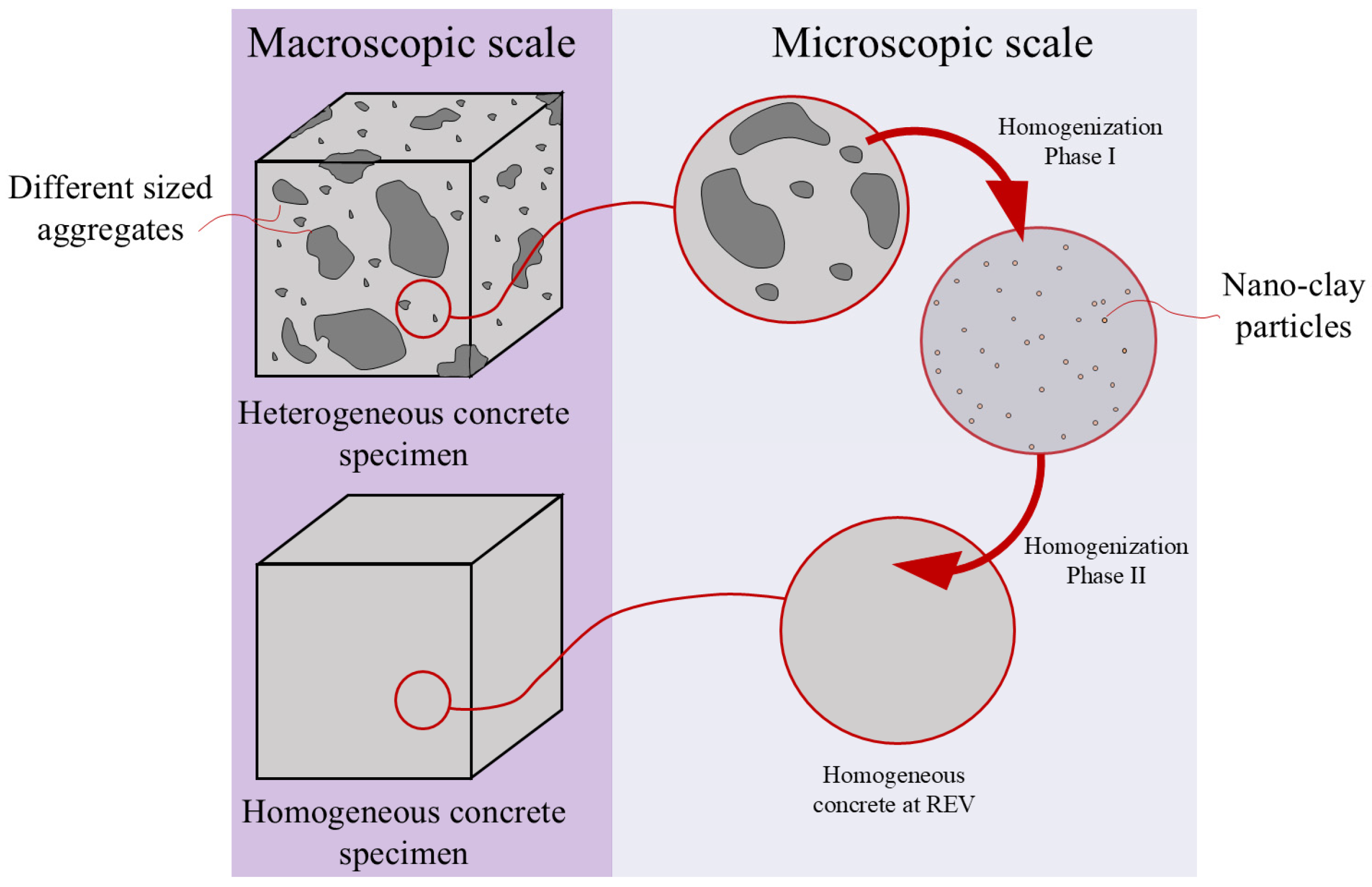
The present study employed a two-phase Eshelby-based homogenization framework to represent the mechanical behavior of concrete beams reinforced with platelet-shaped NC particles. The process for homogenizing the biphasic material, consisting of ordinary concrete and nano-clay, is illustrated in Figure 1. The key assumptions and justifications are as follows:
  • Phase I—Homogeneous concrete matrix: The concrete is treated as a continuous, isotropic material representing conventional unreinforced concrete. This baseline phase allows the evaluation of the reinforcement effect of nano-clay on the overall stiffness and dynamic response.
  • Phase II—Bi-phasic composite material: Upon the introduction of NC particles, the medium is considered a two-phase composite consisting of the concrete matrix and dispersed nano-clay platelets. The volume fraction of NC varies from 0% to 30%, capturing the influence of different reinforcement levels on flexural rigidity and natural frequencies.
To accurately capture the behavior of the NC-reinforced composite, the following physical and modeling assumptions are adopted:
  • Platelet morphology of inclusions—Nano-clay particles are idealized as thin, disk-like platelets. This shape is consistent with their experimental morphology and enables accurate estimation of their reinforcing effect using Eshelby’s solution for ellipsoidal inclusions.
  • Random orientation and distribution—The platelets are assumed to be randomly oriented and dispersed within the concrete matrix. This ensures an approximately isotropic macroscopic behavior despite the anisotropic shape of the individual platelets, simplifying the homogenization while remaining physically realistic.
  • Isotropic effective properties—Although individual platelets are anisotropic, the random orientation allows the composite to be treated as isotropic at the macroscale. This facilitates analytical tractability while capturing the averaged influence of the reinforcement.
  • Scale separation—The characteristic size of nano-clay platelets is much smaller than the beam dimensions, justifying the use of continuum homogenization. Interfacial effects and localized stress concentrations at the nanoscale are not explicitly modeled but are effectively incorporated in the resulting effective stiffness tensor.
The effective stiffness tensor of the nano-clay reinforced composite is then estimated using the Eshelby-based homogenization framework, which links the elastic properties and geometry of the platelets to the macroscopic beam response. This approach provides a physically consistent yet computationally efficient means to capture the influence of nano-clay reinforcement on dynamic behavior. Consequently, the resulting nanocomposite’s stiffness tensor CT can be written as follows:
C T = C m 1 V r C r C m S V r S I + C m 1 C r C m C m 1 1
where I denotes the identity tensor, and Cm and Cr represent the stiffness tensors of the concrete matrix and the nano-reinforcement, respectively. The corresponding volume fractions are designated Vm and Vr. The Eshelby tensor S, which is a function of the Poisson’s ratio of the nanoparticles, characterizes the mechanical interaction between the inclusions and the surrounding matrix. For isotropic materials, the stiffness tensors can be expressed as follows:
C 11 = C 22 = 1 υ E 1 + υ 1 2 υ C 12 = υ E 1 + υ 1 2 υ     C 44 = C 55 = C 66 = E 1 + υ
In this expression, E denotes the Young’s modulus and υ the Poisson’s ratio for either the concrete matrix or the nanoparticle reinforcement. Indices 1, 2, and 3 represent the three orthogonal directions (x, y, and z) of the Cartesian coordinate system. The components of the Eshelby tensor S are given by the following [72]:
S = S 1111 S 1122 S 1133 S 1123 S 1113 S 1112 S 2211 S 2222 S 2233 S 2223 S 2213 S 2212 S 3311 S 3322 S 3333 S 3323 S 3313 S 3312 S 2311 S 2322 S 2333 S 2323 S 2313 S 2312 S 1311 S 1322 S 1333 S 1323 S 1313 S 1312 S 1211 S 1222 S 1233 S 1123 S 1213 S 1212
where
S 1111 = S 2222 = 0   ;   S 3333 = 1 S 1122 = S 1133 = S 2233 = S 2211 = 0   ;   S 3311 = S 3322 = υ r 1 υ r S 1212 = 0   ;   S 1313 = S 2323 = 1 2
For all others
S i j k l = 0
where υr denotes the Poisson’s ratio of the nanoplatelets.
By using the simple rule of mixture, the density of the equivalent system can be calculated as follows:
ρ T = ρ m V m + ρ r V r

4. Mathematical Modeling

4.1. Kinematics

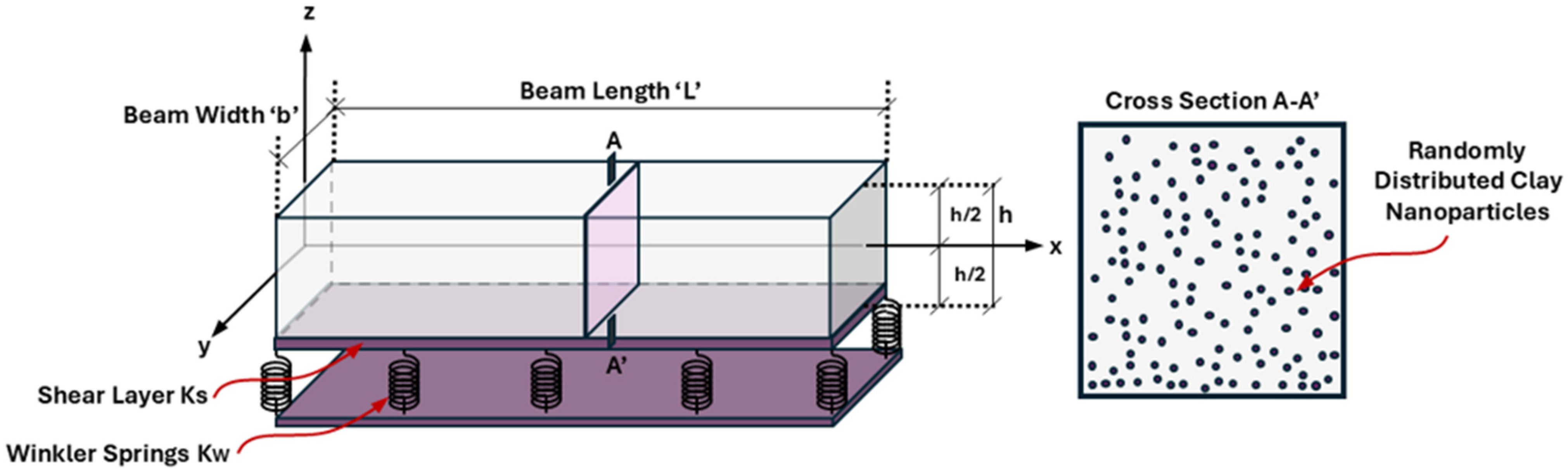
A simply supported reinforced concrete beam with a length ‘L’, width ‘b’, and total thickness ‘h’ is considered in this study [73].
The coordinate system (x, y, z) is established with the z-axis oriented along the mid-plane of the beam, and the elastic foundation is assumed to act along the bottom surface of the beam at z = h / 2 , as indicated in Figure 2.
0 x < L ;     0 y < b ;   h / 2 z < h / 2
To incorporate the thickness-stretching effect in the bending analysis of a nano-reinforced concrete beam, the total transverse displacement u3 is considered as the sum of three components: bending (wb), shear (ws), and thickness stretching (wz) [74]. Consequently, within the framework of the RQ3D theory, the transverse displacement u3 and the in-plane axial displacement u1 of a material point at coordinates (x, y, z) are expressed as follows:
u 1 ( x , z , t ) = u 0 ( x , t ) z w b ( x , t ) x f ( z ) w s ( x , t ) x u 3 ( x , z , t ) = w b x , t + w s x , t + g ( z ) w z ( x , t )
Here, u0 and v0 represent the mid-plane displacement functions of the beam. The function f (z) represents an odd shape function, as proposed by Akavci et al. [75], which outlines how shear strains are distributed along the thickness of the beam. It is defined as follows:
f z = 3 π 2 z s e c h 2 1 2 + 3 π 2 h t a n h z h ;       g z = 1 f ( z ) z
The formula that follows the expression for the linear strain components corresponding to the quasi-3D displacement equations is the following:
ε x = u 1 x = ε x 0 + z k x b + f z k x s ε z = u 3 z = g z z w z ( x ) γ x z = u 3 x + u 1 z = 1 f ( z ) z γ x z s = g ( z ) γ x z s
where
ε x 0 = u 0 x ;   k x b = 2 w b x 2 ;   k x s = 2 w s x 2 ;   γ x z s = w s x ;   g ( z ) = 1 f ( z ) z
The constitutive relations governing the normal and shear stresses in the nano-reinforced concrete beam are given by the following:
σ x σ z τ x z = C 11 T C 13 T 0 C 13 T C 33 T 0 0 0 C 11 T ε x ε z γ x z
Herein, C i j T represents the reduced elastic constants of the equivalent concrete–reinforcement composite system, which are determined using Eshelby’s homogenization model.

4.2. Motion’s Equations

In this analysis, the principle of virtual work is employed to derive the equations of motion for the beam:
t 1 t 2 δ U b + δ W k δ K t = 0
where δUb and δWk are the virtual variation of the internal strain energy of the beam and the elastic foundation, respectively, while, δK is the virtual kinetic energy.
The expression of the virtual strain energy exerted by the beam can be depicted as follows:
δ U b = 0 L h / 2 h / 2 σ x δ ε x + σ z δ ε z + τ x z δ γ x z d A d z
Submitting Equation (8) into Equation (11), the internal strain energy gives the following:
δ U b = 0 L N δ u 0 x M b 2 δ w b 2 x M s 2 δ w s 2 x + Q δ w s x R z δ w z d x
where
N = h / 2 h / 2 σ x b d z
M b = h / 2 h / 2 z σ x b d z
M s = h / 2 h / 2 f ( z ) σ x b d z
Q = h / 2 h / 2 g ( z ) τ x z b d z
R z = h / 2 h / 2 g ( z ) z σ z b d z
Substitution of Equation (8) into (9) and then into Equation (13) yields the stress resultants expressed as functions of the material stiffness coefficients and displacement components, as follows:
N = A u 0 x B 2 w b x 2 B s 2 w s x 2 + L z w z
M b = B u 0 x D 2 w b x 2 D s 2 w s x 2 + Y z b w z
M s = B s u 0 x D s 2 w b x 2 H s 2 w s x 2 + Y z s w z
Q = A s w s x + w z x
R z = L z u 0 x Y z b 2 w b x 2 Y z s 2 w s x 2 + Z 33 w z
In which the beam stiffness is defined below:
A , B , D , B s , D s , H s = h / 2 h / 2 1 , z , z 2 , f z , z f z , f ( z ) 2 C i j T b d z
A s = h / 2 h / 2 g ( z ) 2 C i j T b d z
L z , Y z b , Y z s , Z 33 = h / 2 h / 2 g ( z ) z 1 , z , f ( z ) , g ( z ) z C i j T b d z
Furthermore, the load–displacement relationship between the concrete beam and the supporting foundation is formulated by introducing the parameters Kw and Ks of the Winkler–Pasternak foundation model, as follows:
δ W k = L K w w b + w s K s 2 w b x 2 + 2 w s x 2 d x
Here, δ W k represents the strain energy associated with the response of the elastic support over a unit surface. The parameters Ks and Kw denote the shear layer stiffness and the vertical stiffness of the Winkler–Pasternak foundation model, respectively. By varying the non-dimensional parameters K w and K s , the model can be reduced to represent three distinct physical scenarios: (i) a beam without foundation ( K w = K s = 0 ), (ii) a beam on a Winkler (spring-only) foundation ( K s = 0 ), and (iii) the complete Pasternak model ( K w 0 ,   K s 0 ). This versatility allows for the verification of the structural response across different soil categories.
The first variation of the beam’s kinetic energy is expressed as follows:
δ K = 0 L 0 b h / 2 h / 2 u 1 ˙ δ u 1 ˙ + u 3 ˙ δ u 3 ˙ ρ T d z d y d x
On which
δ K = 0 L I 0 u 0 ˙ δ u 0 ˙ + ( w b ˙ + w s ˙ δ w b ˙ + δ w s ˙ I 1 u 0 ˙ δ w b ˙ x + δ u 0 ˙ w b ˙ x + I 2 w b ˙ x δ w b ˙ x + J 0 w b ˙ δ w z ˙ + w s ˙ δ w z ˙ + w z ˙ δ w b ˙ + w z ˙ δ w s ˙ J 1 u 0 ˙ δ w s ˙ x + δ u 0 ˙ w s ˙ x + J 2 w b ˙ x δ w s ˙ x + w s ˙ x δ w b ˙ x + K 0 w z ˙ δ w z ˙ + K 2 w s ˙ x δ w s ˙ x
Here, the dot-superscript convention refers to the differentiation with respect to the time variable t; and ρ T is the effective mass density of the nano-composite beam determined from Equation (5).
Where (Ii, Ji, Ki) are the mass moments of inertia expressed as follows:
I 0 , I 1 , I 2 = h / 2 h / 2 1 , z , z 2 ρ T b d z
J 0 , J 1 , J 2 = h / 2 h / 2 g , f , z f ρ T b d z
K 0 , K 2 = h / 2 h / 2 g 2 , f 2 ρ T b d z
Using Equations (12), (16), and (17) in Equation (10), then, integrating by parts and carrying out the coefficients of δu0, δwb, δws, and δwz, the following equations of motion associated with the Quasi-3D beam theory are obtained:
δ u 0   :   N x = I 0 u ¨ I 1 w b ¨ x J 1 w s ¨ x
δ w b   :   2 M b x 2 K w w b + w z + g w z K s 2 w b + w z + g w z x 2 = I 0 w b ¨ + w s ¨ + J 0 w z ¨ + I 1 u ¨ x I 2 2 w b ¨ x 2 J 2 2 w s ¨ x 2
δ w s   :   2 M s x 2 + Q x K w w b + w z + g w z K s 2 w b + w z + g w z x 2 = I 0 w b ¨ + w s ¨ + J 0 w z ¨ + J 1 u ¨ x J 2 2 w b ¨ x 2 K 2 2 w s ¨ x 2
δ w z   :   Q x R z = J 0 w b ¨ + w s ¨ + K 0 w z ¨
where
A 2 u 0 x 2 B 3 w b x 3 B s 3 w s x 3 + L z w z z = I 0 u ¨ I 1 w b ¨ x J 1 w s ¨ x
B 3 u 0 x 3 D 4 w b x 4 D s 4 w s x 4 + Y z b 2 w z x 2 + Q K w w b + w z + g w z K s 2 w b + w z + g w z x 2 = I 0 w b ¨ + w s ¨ + J 0 w z ¨ + I 1 u ¨ x I 2 2 w b ¨ x 2 J 2 2 w s ¨ x 2
B s 3 u 0 x 3 D s 4 w b x 4 H s 4 w s x 4 + A s 2 w s x 2 + 2 w z x 2 + Y z s 2 w z x 2 + Q K w w b + w z + g w z K s 2 w b + w z + g w z x 2 = I 0 w b ¨ + w s ¨ + J 0 w z ¨ + J 1 u ¨ x J 2 2 w b ¨ x 2 K 2 2 w s ¨ x 2
L z u 0 x + A s 2 w s x 2 + 2 w z x 2 + Y z b 2 w z x 2 + Y z s 2 w z x 2 Z 33 w z + Y z s 2 w z x 2 + g z q = J 0 w b ¨ + w s ¨ + K 0 w z ¨

4.3. Navier’s Technique

Navier’s method of admissible displacement functions is employed, utilizing trigonometric series expansions appropriate for a simply supported boundary condition, to find the governing equations of the motion’s solution:
u 0 ( x , t ) = n = 1 U n c o s λ x e i ω t
w b ( x , t ) = n = 1 W b n s i n λ x e i ω t
w s ( x , t ) = n = 1 W s n s i n λ x e i ω t
w z ( x , t ) = n = 1 W z n s i n λ x e i ω t
where λ = m π / a , and ( U n , W b n , W s n , W z n ) are free parameters to be identified.
Finally, to obtain the analytical solutions, the resulting expressions from the substitutions are organized into the following matrix form:
S 11 S 12 S 13 S 14 S 12 S 22 S 23 S 24 S 13 S 23 S 33 S 34 S 14 S 24 S 34 S 44 ω 2 m 11 m 12 m 13 m 14 m 12 m 22 m 23 m 24 m 13 m 23 m 33 m 34 m 14 m 24 m 34 m 44 U n W b n W s n W z n = 0 0 0 0
where
S 11 = A λ 2 ;   S 12 = B λ 3   ;   S 13 = B s λ 3   ;   S 14 = L λ S 22 = D λ 4 K w K s λ 2   ;   S 23 = D s λ 4 K w K s λ 2   ;   S 24 = Y z b λ 2 g z K w + K s S 33 = H s λ 4 A s λ 2 K w K s λ 2   ; S 34 = A s λ 2 Y z s λ 2 g z K w + K s S 44 = A s λ 2 Z 33
and
m 11 = I 0   ;   m 12 = I 1 λ   ;   m 13 = J 1 λ ;   m 14 = 0 m 21 = m 12 ;   m 22 = I 0 + I 2 λ 2   ;   m 23 = I 0 + J 2 λ 2   ;   m 24 = J 0 m 31 = m 13   ;   m 32 = m 23   ;   m 33 = I 0 + K 2 λ 2   ;   m 34 = J 0 m 41 = m 14   ;   m 42 = m 24   ;   m 43 = m 34   ;   m 44 = I 0 + K 2 λ 2

5. Results and Discussion

The analytical findings concerning the free-vibration response of concrete beams reinforced with distinct types and volume fractions of clay nanoplatelets are shown in this section. The revised quasi-three-dimensional beam theory is used to determine the natural frequency ( ω ¯ ). The following dimensionless parameter is used to present the obtained results in numerical and graphical illustrations:
ω ¯ = ω 0 L 2 h E m ρ m
This dimensionless frequency is well-established in the literature for beam vibration analyses. It is obtained by normalizing the dimensional frequency, ω 0 , with respect to the beam length L , thickness h , and the mechanical properties of the concrete matrix (Young’s modulus E m and density ρ m ). Using a non-dimensional form allows the results to be compared across different beam geometries and reinforcement levels.
The non-dimensional coefficients corresponding to the two-parameter elastic foundation model are defined as follows:
k ¯ w = L 4 D m K w   ;   k ¯ s = L 2 D m K s   ;   D m = E m h 3 12 1 υ m 2
In this investigation disk-shaped, nanoscale clay platelets with various chemical compositions and elastic qualities are taken into consideration as reinforcing agents in the concrete matrix. The elastic properties of these reinforcements are given by Wang et al. [76] (See Table 1).
For the nano-clay platelets, the approximate Young’s modulus E p is calculated from the bulk modulus K p and Poisson’s ratio ν p using the standard isotropic material relation:
E p = 3 K p 1 2 υ p
This approach converts available elastic constants of the reinforcing platelets into a form compatible with the Eshelby-based homogenization and the quasi-three-dimensional beam analysis, ensuring consistent integration of nanoscale reinforcement properties into the macroscopic model.
To form a nano-composite matrix, these nanoplatelets are incorporated in a concrete mixture that has an elastic modulus of Em = 20 GPa, a Poisson’s ratio υm = 0.3, and a density ρm = 2400 Kg/m3. The elastic properties of the final material are then predicted by using Eshelby’s homogenization approach.

5.1. Validation of the Model

The accuracy of the chosen revised quasi-3D beam model in forecasting the natural frequency range of beams was required to be confirmed before the dynamic analysis could be carried out. The validation was conducted using the material and geometric properties reported by Thuc Vo and his colleagues [73] for functionally graded (FG) sandwich beams because there are currently presently no numerical findings available for the vibration behavior of concrete beams reinforced with clay nanoplatelets. This comparison made it possible to assess the present analytical formulation’s reliability. In Table 2, the appropriate non-dimensional natural frequencies ( ω ¯ ) of the FG beams are computed and summarized.
For a simply supported (S-S) functionally graded (FG) sandwich beam, the outcomes in Table 2 demonstrate that the present findings align excellently with those obtained by Thuc Vo et al. [73], as both Quasi-3D theories predicted nearly identical natural frequencies ( ω ¯ ) for all power law indexes. Hence, it confirms the precision of the adopted model. However, for the hyperbolic beam theory (HSBT) [77], the natural frequencies ( ω ¯ ) are slightly lower than those predicted by the Quasi-3D beam theories. This is mainly due to the inclusion of thickness-stretching effects in the Quasi-3D beam theory ( ε z 0 ).

5.2. Simply Supported Concrete Beams Reinforced with Clay Nanoplatelets (NCs)

With the analytical model successfully validated, the next step involves analyzing the dynamic behavior of a simply supported concrete beam reinforced with different volume fractions of clay nanoparticles.
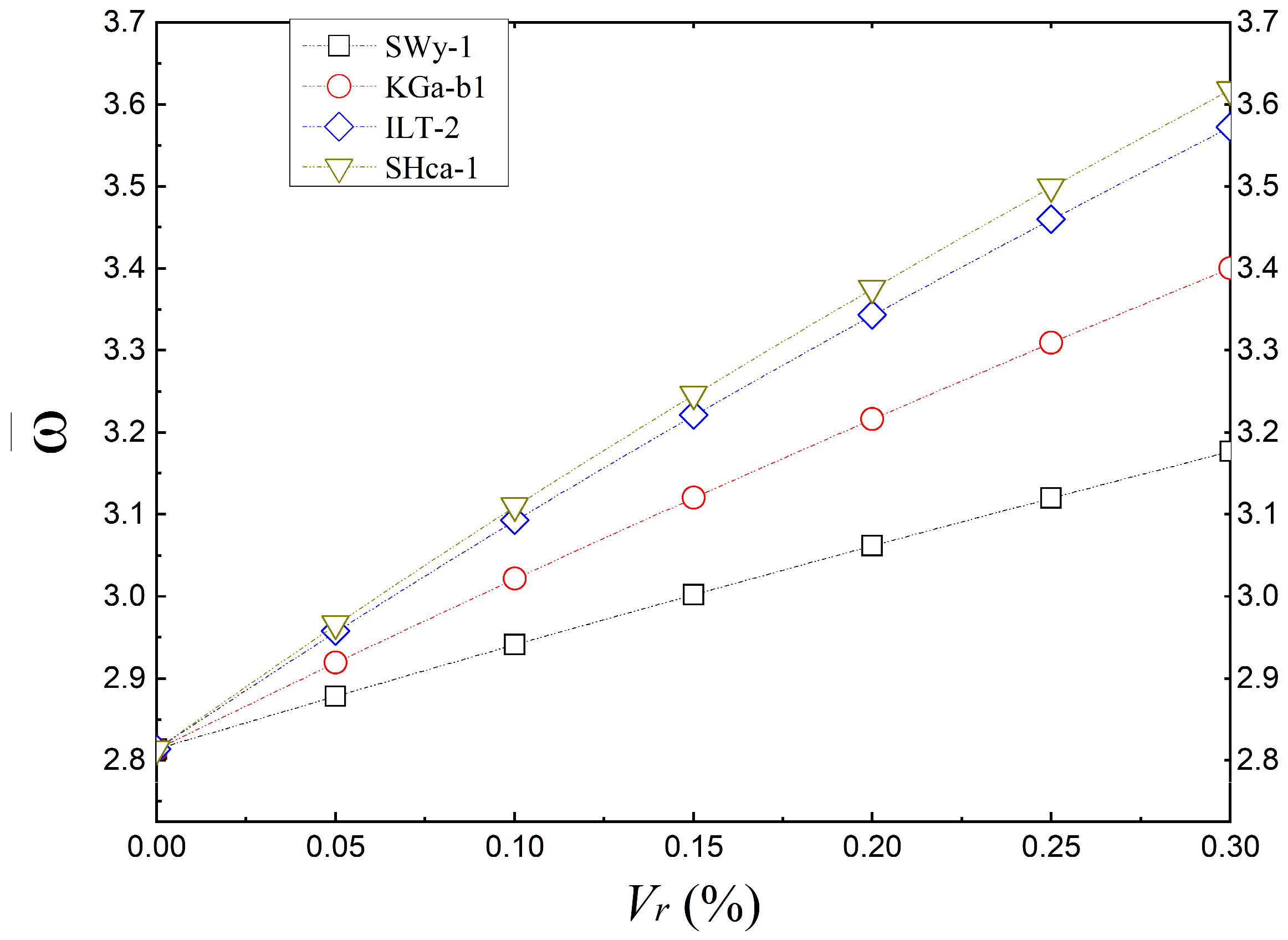
Figure 3 quantifies the influence of clay nanoplatelet volume fraction on the non-dimensional fundamental frequency ω ¯ of simply supported concrete beams (L/h = 4, k ¯ w = k ¯ s = 0). For all nanoplatelet types, ω ¯ increases monotonically with increasing reinforcement content, indicating a systematic enhancement of the effective bending stiffness of the composite beam. For the hectorite (SHca-1) reinforcement, the non-dimensional frequency increases from 2.81 for the unreinforced beam (Vr = 0%) to approximately 3.62 at Vr = 30%, corresponding to an improvement of about 29%. In contrast, montmorillonite (SWy-1) produces a lower increase of approximately 17–20% over the same volume fraction range, while kaolinite (KGa-1b) and illite (ILT-2) exhibit intermediate performance. This behavior is primarily attributed to the elevated elastic modulus of SHca-1 nanoplatelets (Ep ≈ 69.2 GPa), which leads to a larger effective stiffness of the homogenized composite material as predicted by Eshelby’s model. The results confirm that the dynamic response of the beam is more sensitive to the stiffness of the reinforcement phase than to its density alone.
To further ensure the physical consistency of the developed model, two limiting ‘sanity checks’ were performed. First, as the nano-clay volume fraction Vr approaches zero, the model’s predictions for the fundamental frequency converge exactly to those of a pure concrete beam ( ω ¯ = 2.81 for L/h = 4), confirming that the Eshelby-based homogenization correctly identifies the matrix phase. Second, when foundation parameters are nullified ( k ¯ w = k ¯ s = 0 ), the system yields the natural frequencies of a simply supported beam.
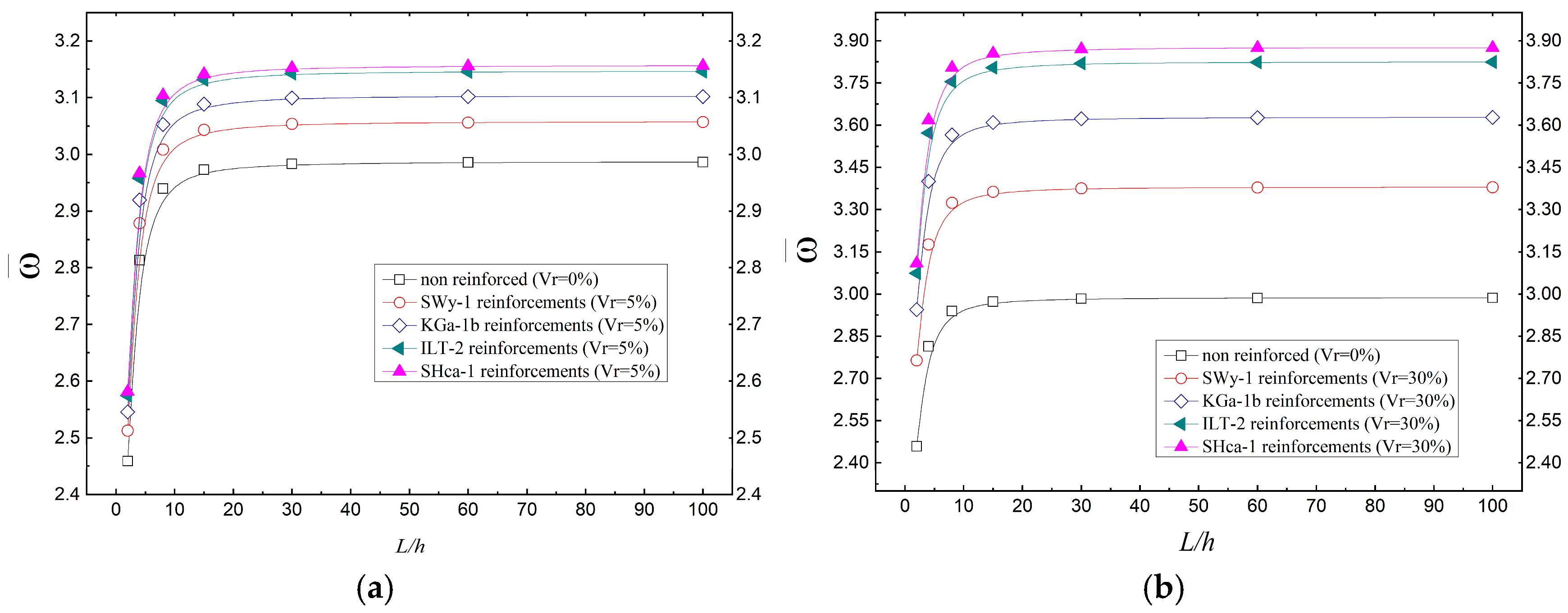
Figure 4 illustrates the combined effect of the span-to-depth ratio (L/h) and nanoplatelet volume fraction on the dimensionless natural frequency of nano-RC beams. For all reinforcement types, increasing L/h leads to a systematic reduction in ω ¯ , reflecting the well-known decrease in global bending stiffness for slender beams. At a fixed volume fraction (Vr = 10% in Figure 4a), beams reinforced with SHca-1 consistently exhibit the highest frequencies, followed by ILT-2, KGa-1b, and SWy-1. When the reinforcement content is increased to Vr = 30% (Figure 4b), the frequency values rise by approximately 20–30% compared to Vr = 10%, depending on the nanoplatelet type. The superiority of SHca-1 remains evident for all L/h ratios, confirming that the mechanical efficiency of the reinforcement dominates over geometric effects. These results demonstrate that both structural slenderness and nanoparticle stiffness must be jointly considered when optimizing the dynamic performance of nano-modified concrete beams.
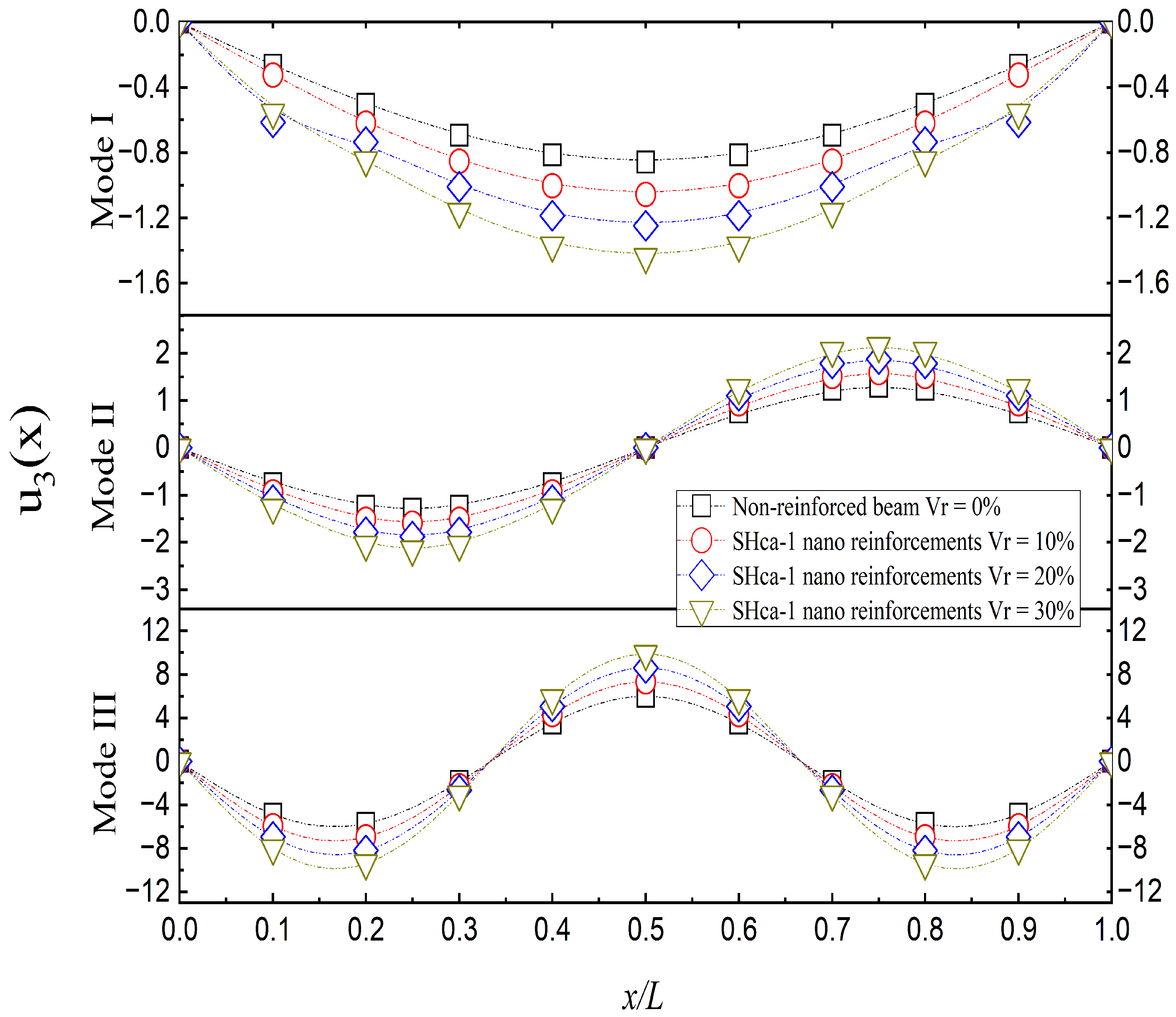
Figure 5 presents the first three vibration mode shapes of simply supported concrete beams reinforced with SHca-1 nanoplatelets at different volume fractions (Vr = 10%, 20%, and 30%) compared with the unreinforced beam. The mode shapes preserve the classical sinusoidal patterns associated with simply supported boundary conditions, indicating that the introduction of nanoplatelets does not alter the modal topology. However, increasing the nanoplatelet content leads to a noticeable reduction in modal amplitudes for the same excitation level, reflecting the increase in global stiffness of the beam. The vibration modes remain triply coupled, involving axial, shear, and bending deformations, due to the quasi-3D formulation which accounts for thickness-stretching effects. This confirms that nano-reinforcement primarily affects the magnitude of the dynamic response rather than the qualitative form of the mode shapes.

5.3. The Elastic Foundation Effect

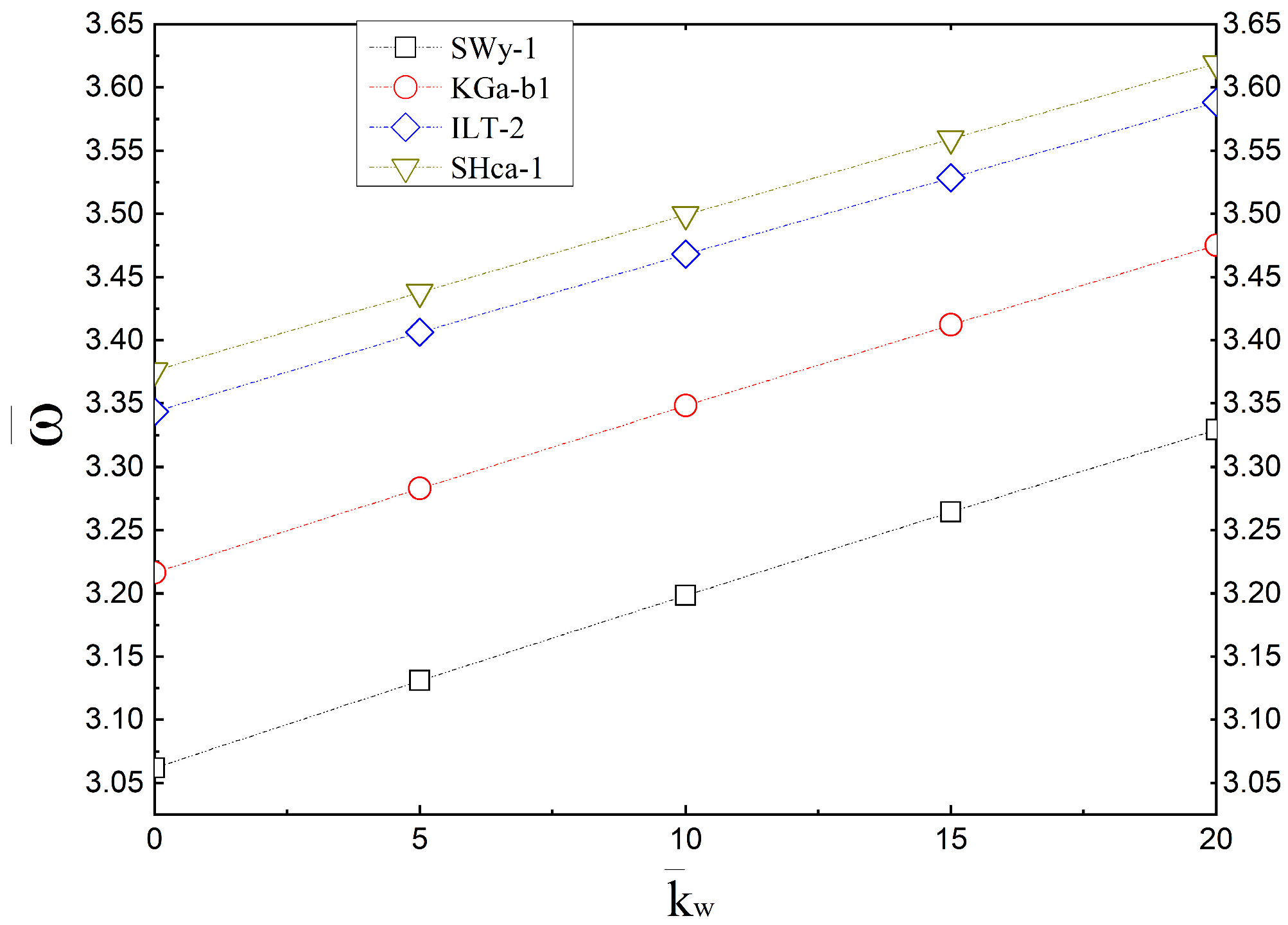
Figure 6 shows the effect of the Winkler foundation stiffness parameter k ¯ w on the non-dimensional natural frequency of concrete beams reinforced with different clay nanoplatelets (L/h = 4, k ¯ s = 0 ). For all reinforcement types, ω ¯ increases almost linearly with increasing k ¯ w , indicating a direct contribution of the foundation springs to the overall system stiffness. For instance, when k ¯ w increases from 0 to 10, the natural frequency of the SHca-1 reinforced beam rises by approximately 18–22%, whereas the corresponding increase for SWy-1 reinforced beams is limited to about 12–15%. This difference highlights the synergistic effect between the elastic foundation and high-stiffness nanoplatelets. These results confirm that the dynamic response of nano-reinforced beams is governed by a coupled interaction between material reinforcement and soil–structure stiffness parameters.
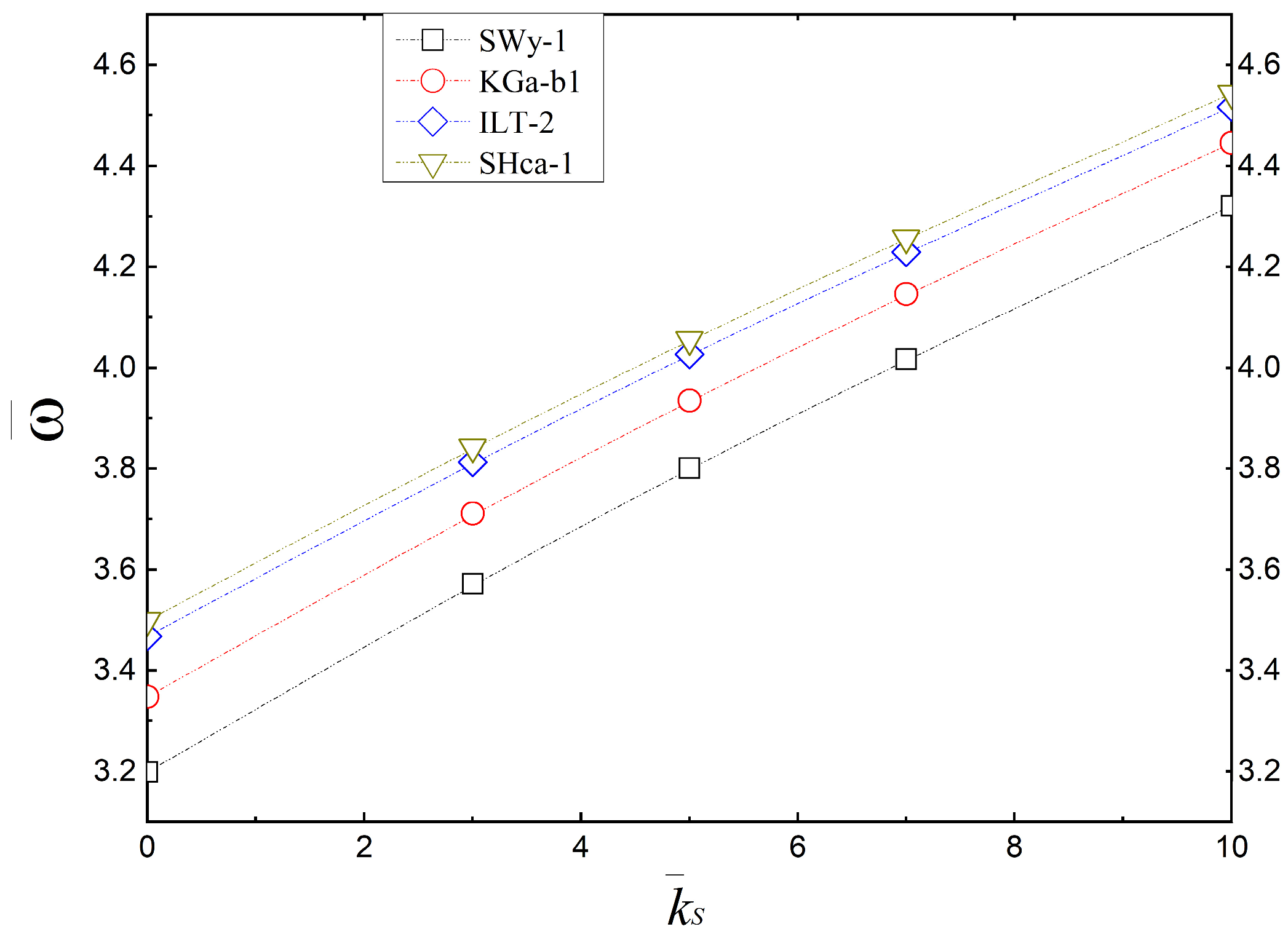
Figure 7 investigates the influence of k ¯ s on the non-dimensional natural frequency of nano-clay RC beams for a fixed Winkler stiffness k ¯ w = 10 and reinforcement volume fraction Vr = 20%. The results show that increasing k ¯ s produces a more pronounced rise in ω ¯ compared with the Winkler parameter alone. This behavior is associated with the shear interaction between the beam and the elastic foundation, which provides additional resistance to transverse deformation. For SHca-1 reinforced beams, an increase of k ¯ s from 0 to 10 leads to an enhancement in frequency of approximately 25%, whereas the increase remains below 18% for SWy-1 reinforced beams. Moreover, the ranking of reinforcement efficiency remains unchanged, with SHca-1 exhibiting the highest frequencies, followed by ILT-2, KGa-1b, and SWy-1. This indicates that both foundation shear stiffness and nanoparticle elastic properties play dominant and complementary roles in controlling the vibrational behavior.
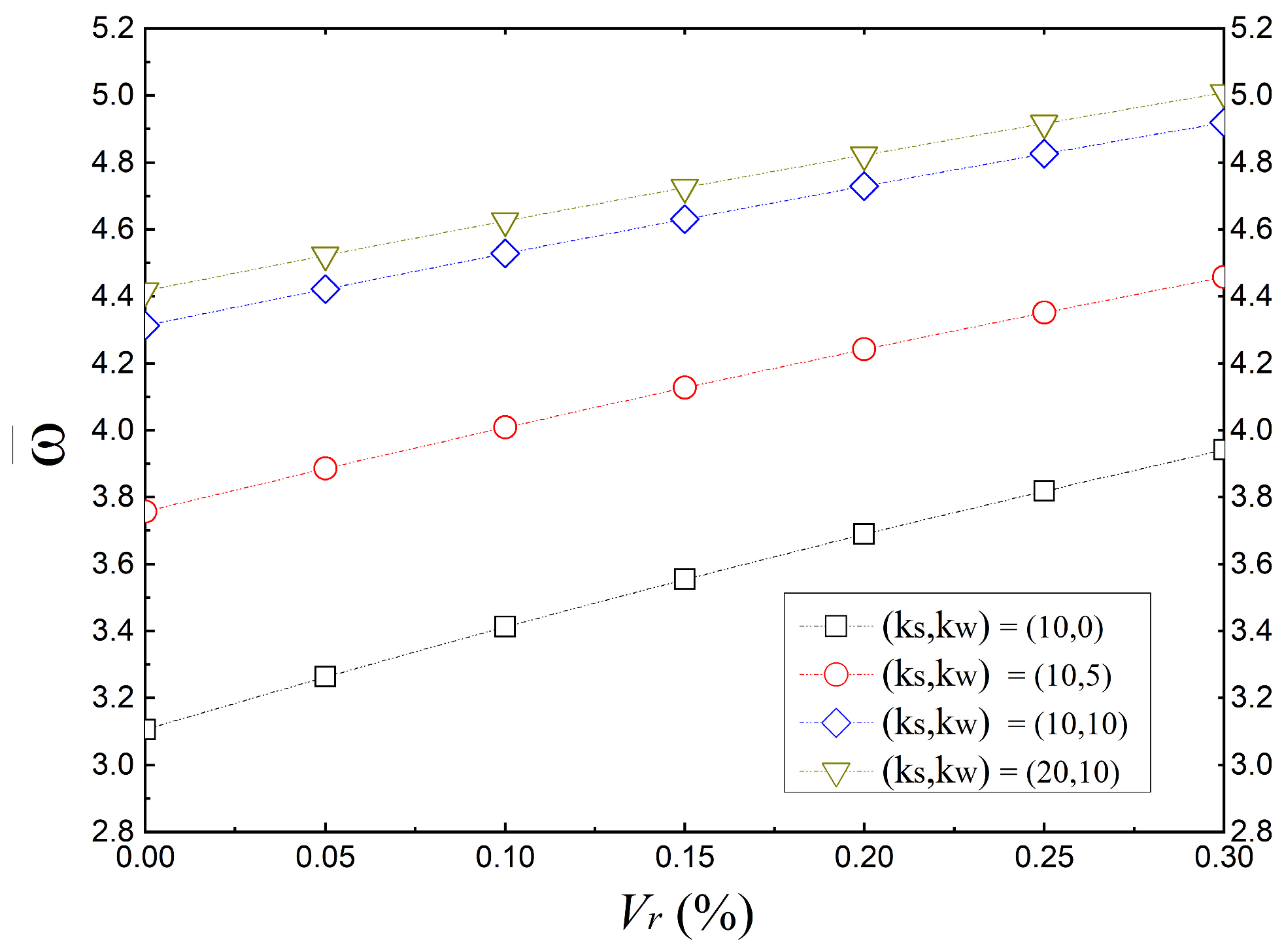
Figure 8 depicts the combined influence of the Winkler–Pasternak foundation parameters and the hectorite (SHca-1) volume fraction on the non-dimensional natural frequency for L/h = 10. For all foundation stiffness levels, increasing the nanoplatelet content results in a consistent and nearly linear rise in ω ¯ . When both k ¯ w and k ¯ s are increased simultaneously, the frequency enhancement becomes more pronounced, demonstrating a strong coupling between material stiffening and foundation support. For example, at Vr = 30%, the non-dimensional frequency increases by more than 35% compared with the unreinforced beam resting on a rigid-free foundation. These results confirm that optimal vibration performance can be achieved through a combined strategy involving high-stiffness nano-clay reinforcement and properly designed elastic foundation parameters.
The sensitivity of the natural frequency to foundation parameters observed in Figure 6, Figure 7 and Figure 8 aligns with the practical considerations raised by Golewski [78] regarding the importance of proper foundation execution. Just as pocket foundation detailing affects load transfer capacity, the stiffness parameters of the Winkler–Pasternak foundation significantly influence the vibrational characteristics of nano-reinforced beams. Furthermore, the potential for cost optimization demonstrated by Luevanos-Rojas et al. [79] for elliptical footings suggests that similar optimization strategies could be developed for nano-modified concrete elements, where the trade-off between enhanced material properties and increased material costs must be carefully balanced.

6. Conclusions

This study utilized a Quasi-3D kinematic framework and Eshelby-based homogenization to model the dynamic response of concrete beams modified with various nano-clay particles. The following conclusions were drawn from the numerical analysis:
  • The addition of nano-clay particles increases the natural frequency of concrete beams. Based on the mechanical properties modeled, hectorite (SHca-1) provides the highest frequency enhancement, followed by illite, kaolinite, and montmorillonite.
  • For beams reinforced with nano-clay platelets, the Quasi-3D theory yields more accurate predictions of natural frequencies for thick beams (L/h < 10) by incorporating thickness-stretching effects, which are particularly significant in assessing the dynamic behavior of nano-reinforced concrete.
  • The Pasternak shear parameter ( k ¯ s ) has a greater influence on the fundamental frequency of the system than the Winkler parameter ( k ¯ w ).
From a practical engineering perspective, these findings provide a technical method for adjusting the fundamental frequency of structural components, such as industrial floors or bridge decks, to avoid resonance with specific environmental or mechanical vibration frequencies without changing the beam’s dimensions. The established correlations between NC volume fractions and foundation stiffness allow for the optimization of concrete slab thickness according to the supporting soil conditions, contributing to material efficiency in foundation engineering.
However, it should be noted that the current analytical results are based on the assumptions of uniform nanoparticle distribution and a perfect interfacial bond. Practical implementation must consider the potential for nanoparticle agglomeration at volume fractions exceeding 10% and the influence of material damping. These factors remain essential areas for future experimental research to further refine the predicted dynamic responses of NC-modified concrete structures.

Author Contributions

Conceptualization, Z.R.H. and A.A.; methodology, A.A. and M.C.; software, Z.R.H. and E.I.; validation, A.A. and M.H.-N.; formal analysis, A.A. and M.C.; investigation, Z.R.H. and M.H.-N.; resources, Z.R.H. and E.I.; writing—original draft preparation, Z.R.H. and A.A.; writing—review and editing, M.C., M.H.-N. and E.I.; visualization, Z.R.H.; supervision, A.A. and M.H.-N.; project administration, M.C. and E.I. All authors have read and agreed to the published version of the manuscript.

Funding

This research received no external funding.

Institutional Review Board Statement

Not applicable.

Informed Consent Statement

Not applicable.

Data Availability Statement

The data presented in this study are fully within the article.

Conflicts of Interest

The authors declare no conflicts of interest.

References

  1. American Concrete Institute. ACI 365.1R-17 Report on Service Life Prediction; American Concrete Institute: Farmington Hills, MI, USA, 2017; 8p. [Google Scholar]
  2. Ishfaque, M.; Khan, S.U.R.; Lou, Y.L. Towards efficient dam inspection: Crack detection via chirplet transform feature and a pruned VGG16 architecture. Memetic Comp. 2026, 18, 9. [Google Scholar] [CrossRef]
  3. Zhu, H.; Huang, M.; Ji, P.; Xiao, F.; Zhang, Q.B. Transforming the maintenance of underground infrastructure through Digital Twins: State of the art and outlook. Tunn. Undergr. Space Technol. 2025, 161, 106508. [Google Scholar] [CrossRef]
  4. Chatbi, M.; Lozančić, S.; Harrat, Z.R.; Hadzima-Nyarko, M. Computational Models for the Vibration and Modal Analysis of Silica Nanoparticle-Reinforced Concrete Slabs with Elastic and Viscoelastic Foundation Effects. Modelling 2026, 7, 8. [Google Scholar] [CrossRef]
  5. Wang, L.; Xu, W.; Albaijan, I.; Almujibah, H.; Marzouki, R.; Toghroli, S. Application of nanotechnology in cementitious materials for enhanced concrete construction through carbon incorporation. Carb. Let. 2025, 35, 539–552. [Google Scholar] [CrossRef]
  6. Barbhuiya, S.; Das, B.B.; Adak, D.; Katare, V. Advancements in nano-engineering of cement and concrete: A comprehensive review. Emergent Mater. 2025, 8, 5843–5882. [Google Scholar] [CrossRef]
  7. Zhao, C.; Dong, W.; Liu, J.; Peng, S.; Li, W. Toward smart buildings and civil infrastructure: A review on multifunctional conductive concrete materials through nanotechnology. Cem. Conc. Comp. 2025, 163, 106165. [Google Scholar] [CrossRef]
  8. Nisar, N.; Rahman, I.; Paruthi, S.; Khan, A.H.; Sabi, E.; Alyaseen, A. Enhancing concrete properties with nano-SiO2 and nano-TiO2: A review. J. Struct. Integr. Maint. 2025, 10, 2496613. [Google Scholar] [CrossRef]
  9. Sarogan, S.; Neeraja, V.S.; Gayathri, V.; Kalyanasundaram, S.P. The eco-environment with the effect of geopolymer concrete using nano particles & fibers-A review. AIP Conf. Proc. 2025, 3237, 070002. [Google Scholar] [CrossRef]
  10. Vignesh, J.; Ramesh, B.; Xavier, J.R. Recent advances in nano-engineered cement composites for sustainable and smart infrastructure. Nanotechnol. Environ. Eng. 2025, 10, 81. [Google Scholar] [CrossRef]
  11. Ahmad, M.A.; Yi, X.; Munir, Q.; Kärki, T.; Wang, J.; Deng, X. Nano-engineered Self-Healing Concrete: Application, Mechanism, Challenge and Prospect. J. Buil. Eng. 2025, 113, 114179. [Google Scholar] [CrossRef]
  12. Verma, P.; Shukla, S.; Pal, P. Potential application of nano-silica in concrete pavement: A bibliographic analysis and comprehensive review. Mater. Today Sust. 2025, 29, 101079. [Google Scholar] [CrossRef]
  13. Su, T.; Yu, X.; Jin, H.; Chen, L.; Tan, Z.; Ngo, T. Macro-mechanical properties and freeze thaw evaluation of innovative nano-silica modified concrete reinforced by recycled carpet fibers. Const. Build. Mater. 2025, 492, 142894. [Google Scholar] [CrossRef]
  14. Sharma, J.; Chaturvedy, G.K.; Pandey, U.K. Sustainable rubberized concrete: The role of nano-titanium dioxide in enhancing mechanical and durability properties. Front. Struct. Civ. Eng. 2025, 19, 1418–1439. [Google Scholar] [CrossRef]
  15. Javan, H.; Honarbakhsh, A.; Movahedifar, S.M.; Nobahari, M.; Zhiani, R. The use of dendritic fibrous nano-titanium to enhance the initial characteristics and durability of lightweight concrete. Sci. Rep. 2025, 15, 11811. [Google Scholar] [CrossRef]
  16. Song, J.; Pu, Z.; Horri, A. Energy harvesting in smart nano-engineered concrete: Bridging experimental innovations and numerical modeling for sustainable infrastructure. Const. Build. Mater. 2025, 487, 142105. [Google Scholar] [CrossRef]
  17. Mostafa, F.E.-Z.M.; Smarzewski, P.; El Hafez, G.M.A.; Farghali, A.A.; Morsi, W.M.; Faried, A.S.; Tawfik, T.A. Analyzing the Effects of Nano-Titanium Dioxide and Nano-Zinc Oxide Nanoparticles on the Mechanical and Durability Properties of Self-Cleaning Concrete. Materials 2023, 16, 6909. [Google Scholar] [CrossRef] [PubMed]
  18. Mustafa Mohamed, A.; Tayeh, B.A.; Ahmed, T.I.; Bashir, M.O.; Tobbala, D.E. Influence of nano-silica and nano-ferrite particles on mechanical and durability of sustainable concrete: A review. Nanotechnol. Rev. 2025, 14, 20250151. [Google Scholar] [CrossRef]
  19. Gharieb, M.; Ramadan, W.; Abd El-Gawad, W.M. Outstanding effect of cost-saving heavy nano-ferrites on the physico-mechanical properties, morphology, and gamma radiation shielding of hardened cement pastes. Constr. Build. Mater. 2025, 409, 134064. [Google Scholar] [CrossRef]
  20. Zeyad, A.M.; Amin, M.; Selim, S.; Aldahdooh, M.A.; Shaban, W.M.; Agwa, I.S. Sustainable high-performance geopolymer concrete incorporating nano clay and rice husk ash. Constr. Build. Mater. 2025, 495, 143472. [Google Scholar] [CrossRef]
  21. Hassan, M.M.; Elyamany, M.A.; Khalil, A.E.R.R.; Megahed, S.Y. Effect of High Elevated Temperature on the Behavior of Concrete Containing Slag and Nano Clay. Civ. Eng. Archit. 2025, 13, 2687–2702. [Google Scholar] [CrossRef]
  22. Khattak, N.U.; Irfan, M.; Hoy, M.; Khan, A. Effects of synergistic combined Bakelite and Nano clay modification on asphalt mixture performance properties. Road Mater. Pavement Des. 2025, 26, 2414–2430. [Google Scholar] [CrossRef]
  23. Rezaie, M.; Majedi Asl, M.; Ghahvechi Kajabad, B. Enhancement of concrete performance through zeolite and nanoclay incorporation: An experimental study on mechanical properties, water permeability, and microstructure. Constr. Build. Mater. 2025, 495, 143650. [Google Scholar] [CrossRef]
  24. Hosseini, P.; Hosseinpourpia, R.; Pajum, A.; Khodavirdi, M.M.; Izadi, H.; Vaezi, A. Effect of Nano-Particles and Aminosilane Interaction on the Performances of Cement-Based Composites: An Experimental Study. Constr. Build. Mater. 2014, 66, 113–124. [Google Scholar] [CrossRef]
  25. He, X.; Shi, X. Chloride Permeability and Microstructure of Portland Cement Mortars Incorporating Nanomaterials. Transp. Res. Rec. J. Transp. Res. Board 2008, 2070, 13–21. [Google Scholar] [CrossRef]
  26. Gupta, P.; Sharma, V.; Nagpal, G. A comprehensive review of nano clay: From development and applications to research opportunities. Environ. Prog. Sustain. Energy 2025, 44, e70055. [Google Scholar] [CrossRef]
  27. Zhang, D.; Zhou, C.H.; Lin, C.X.; Tong, D.S.; Yu, W.H. Synthesis of Clay Minerals. Appl. Clay Sci. 2010, 50, 1–11. [Google Scholar] [CrossRef]
  28. de Paiva, L.B.; Morales, A.R.; Valenzuela Díaz, F.R. Organoclays: Properties, Preparation and Applications. Appl. Clay Sci. 2008, 42, 8–24. [Google Scholar] [CrossRef]
  29. Panda, B.; Ruan, S.; Unluer, C.; Tan, M.J. Improving the 3D Printability of High Volume Fly Ash Mixtures via the Use of Nano Attapulgite Clay. Compos. Part B Eng. 2019, 165, 75–83. [Google Scholar] [CrossRef]
  30. Nehdi, M.L. Clay in Cement-Based Materials: Critical Overview of State-of-the-Art. Constr. Build. Mater. 2014, 51, 372–382. [Google Scholar] [CrossRef]
  31. Niu, Z.; Zhou, X.; Hou, P.; Liu, M.; Liang, S.; Sun, Y.; Zhao, Y.; Wang, J. Nano CaCO3 seeding for improving properties of limestone calcined clay cement through in-situ carbonation. Cem. Concr. Compos. 2026, 169, 106554. [Google Scholar] [CrossRef]
  32. Usanga, I.N.; Ikeagwuani, C.C.; Okafor, F.O.; Ambrose, E.E. Exploration of calcined clays and nanoclays as a potential construction material for sustainable development: A comprehensive and state-of-the-art review. Road Mater. Pavement Des. 2025, 26, 887–920. [Google Scholar] [CrossRef]
  33. Azmi, M.; Kolahchi, R.; Bidgoli, M.R. Dynamic Analysis of Concrete Column Reinforced with SiO2 Nanoparticles Subjected to Blast Load. Adv. Concr. Constr. 2019, 7, 51–63. [Google Scholar] [CrossRef]
  34. Zamanian, M.; Kolahchi, R.; Bidgoli, M.R. Agglomeration Effects on the Buckling Behaviour of Embedded Concrete Columns Reinforced with SiO2 Nano-Particles. Wind Struct. 2017, 24, 43–57. [Google Scholar] [CrossRef]
  35. Shokravi, M. Buckling Control of Concrete Beams Reinforced with Smart Nanoparticles Using Numerical Methods. Eur. J. Environ. Civ. Eng. 2019, 25, 1349–1363. [Google Scholar] [CrossRef]
  36. Arani, A.G.; Kolahchi, R.; Barzoki, A.A.M.; Mozdianfard, M.R.; Farahani, S.M.N. Elastic Foundation Effect on Nonlinear Thermo-Vibration of Embedded Double-Layered Orthotropic Graphene Sheets Using Differential Quadrature Method. Proc. Inst. Mech. Eng. Part C J. Mech. Eng. Sci. 2013, 227, 862–879. [Google Scholar] [CrossRef]
  37. Alijani, M.; Bidgoli, M.R. Agglomerated SiO2 Nanoparticles Reinforced-Concrete Foundations Based on Higher Order Shear Deformation Theory: Vibration Analysis. Adv. Concr. Constr. 2018, 6, 585–610. [Google Scholar] [CrossRef]
  38. Jassas, M.R.; Bidgoli, M.R.; Kolahchi, R. Forced Vibration Analysis of Concrete Slabs Reinforced by Agglomerated SiO2 Nanoparticles Based on Numerical Methods. Constr. Build. Mater. 2019, 211, 796–806. [Google Scholar] [CrossRef]
  39. Chatbi, M.; Krour, B.; Benatta, M.A.; Harrat, Z.R.; Amziane, S.; Bachir Bouiadjra, M. Bending Analysis of Nano-SiO2 Reinforced Concrete Slabs Resting on Elastic Foundation. Struct. Eng. Mech. 2022, 84, 685. [Google Scholar] [CrossRef]
  40. Dine Elhennani, S.; Harrat, Z.R.; Chatbi, M.; Belbachir, A.; Krour, B.; Işık, E.; Harirchian, E.; Bouremana, M.; Bachir Bouiadjra, M. Buckling and Free Vibration Analyses of Various Nanoparticle Reinforced Concrete Beams Resting on Multi-Parameter Elastic Foundations. Materials 2023, 16, 5865. [Google Scholar] [CrossRef]
  41. Kecir, A.; Chatbi, M.; Harrat, Z.R.; Bachir Bouiadjra, M.; Bouremana, M.; Krour, B. Enhancing the Mechanical Performance of Concrete Slabs through the Incorporation of Nano-Sized Iron Oxide Particles (Fe2O3): Non-Local Bending Analysis. Period. Polytech. Civ. Eng. 2024, 68, 842–858. [Google Scholar] [CrossRef]
  42. Harrat, Z.R.; Chatbi, M.; Krour, B.; Amziane, S.; Bachir Bouiadjra, M.; Hadzima-Nyarko, M.; Radu, D.; Işık, E. Bending Analysis of Nano-Fe2O3 Reinforced Concrete Slabs Exposed to Temperature Fields and Supported by Viscoelastic Foundation. Adv. Concr. Constr. 2024, 17, 111–126. [Google Scholar] [CrossRef]
  43. Chatbi, M.; Harrat, Z.R.; Benatta, M.A.; Krour, B.; Hadzima-Nyarko, M.; Işık, E.; Czarnecki, S.; Bouiadjra, M.B. Nano-Clay Platelet Integration for Enhanced Bending Performance of Concrete Beams Resting on Elastic Foundation: An Analytical Investigation. Mater. 2023, 16, 5040. [Google Scholar] [CrossRef]
  44. Li, X.F.; Chen, H.Q. The influence of nano-kaolin to cement performance. Appl. Mech. Mater. 2012, 174–177, 1208–1213. [Google Scholar] [CrossRef]
  45. Shoukry, H.; Kotkata, M.F.; Abo-El-Enein, S.A.; Morsy, M.S.; Shebl, S.S. Enhanced physical, mechanical and microstructural properties of lightweight vermiculite cement composites modified with nano metakaolin. Constr. Build. Mater. 2016, 112, 276–283. [Google Scholar] [CrossRef]
  46. Shoukry, H.; Kotkata, M.F.; Abo-El-Enein, S.A.; Morsy, M.S. Flexural strength and physical properties of fiber reinforced nano metakaolin cementitious surface compound. Constr. Build. Mater. 2013, 43, 453–460. [Google Scholar] [CrossRef]
  47. Zhan, P.-M.; He, Z.-H.; Ma, Z.-M.; Liang, C.-F.; Zhang, X.-X.; Abreham, A.A.; Shi, J.-Y. Utilization of nano-metakaolin in concrete: A review. J. Build. Eng. 2020, 30, 101259. [Google Scholar] [CrossRef]
  48. Norhasri, M.S.M.; Hamidah, M.S.; Fadzil, A.M. Inclusion of nano metaclay as additive in ultra high performance concrete (UHPC). Constr. Build. Mater. 2019, 201, 590–598. [Google Scholar] [CrossRef]
  49. Amin, M.; Abu El-Hassan, K. Effect of using different types of nano materials on mechanical properties of high strength concrete. Constr. Build. Mater. 2015, 80, 116–124. [Google Scholar] [CrossRef]
  50. Knop, Y.; Peled, A. Setting behavior of blended cement with limestone: Influence of particle size and content. Mater. Struct. 2016, 49, 439–452. [Google Scholar] [CrossRef]
  51. Shoukry, H. Development of nano modified eco-friendly green binders for sustainable construction applications. Nano Hybrids Compos. 2019, 24, 25–36. [Google Scholar] [CrossRef]
  52. Ghazy, M.F.; Elaty, M.A.A.; Elkhoriby, R.S. Performance of blended cement mortars incorporating nano-metakaolin particles at elevated temperatures. In Proceedings of the International Conference on Advances in Structural and Geotechnical Engineering, Hurghada, Egypt, 25–28 March 2015. [Google Scholar]
  53. Liao, K.-Y.; Chang, P.-K.; Peng, Y.-N.; Yang, C.-C. A study on characteristics of interfacial transition zone in concrete. Cem. Concr. Res. 2004, 34, 977–989. [Google Scholar] [CrossRef]
  54. Abdel Gawwad, H.A.; Abd El-Aleem, S.; Faried, A.S. Influence of nano-silica and metakaolin on the hydration characteristics and microstructure of air-cooled slag-blended cement mortar. Geosyst. Eng. 2017, 20, 276–285. [Google Scholar] [CrossRef]
  55. Nadeem, A.; Memon, S.A.; Lo, T.Y. The performance of fly ash and metakaolin concrete at elevated temperatures. Constr. Build. Mater. 2014, 62, 67–76. [Google Scholar] [CrossRef]
  56. Al-Salami, A.E.; Morsy, M.S.; Taha, S.; Shoukry, H. Physico-mechanical characteristics of blended white cement pastes containing thermally activated ultrafine nano clays. Constr. Build. Mater. 2013, 47, 138–145. [Google Scholar] [CrossRef]
  57. Morsy, M.; Shoukry, H.; Mokhtar, M.; Ali, A.M.; El-Khodary, S. Facile production of nano-scale metakaolin: An investigation into its effect on compressive strength, pore structure and microstructural characteristics of mortar. Constr. Build. Mater. 2018, 172, 243–250. [Google Scholar] [CrossRef]
  58. Mirgozar Langaroudi, M.A.; Mohammadi, Y. Effect of nano-clay on workability, mechanical, and durability properties of self-consolidating concrete containing mineral admixtures. Constr. Build. Mater. 2018, 191, 619–634. [Google Scholar] [CrossRef]
  59. Noori, A.; Lu, Y.; Saffari, P.; Zhang, Y.; Wang, M. The optimum percentage of nano clay (NC) in both direct-additive and sonicated modes to improve the mechanical properties of self-compacting concrete (SCC). Case Stud. Constr. Mater. 2022, 17, e01493. [Google Scholar] [CrossRef]
  60. El Nagar, A.M.; Khater, H.M. Development of high thermal stability geopolymer composites enhanced by nano metakaolin. J. Build. Mater. Struct. 2019, 6, 10–19. [Google Scholar] [CrossRef]
  61. Morsy, M.S.; Aglan, H.A. Development and characterization of nanostructured-perlite cementitious surface compounds. J. Mater. Sci. 2007, 42, 10188–10195. [Google Scholar] [CrossRef]
  62. Kurhade, S.; Autade, P.; Walvekar, P.; Gunaware, P.; Sathe, R.; Kamble, A. Hybrid Nano Clay–CNT Concrete: Experimental and Machine Learning-Based Evaluation of Strength and Durability. Iran. J. Sci. Technol. Trans. Civ. Eng. 2026; in press. [Google Scholar] [CrossRef]
  63. Siddique, R.; Klaus, J. Influence of metakaolin on the properties of mortar and concrete: A review. Appl. Clay Sci. 2009, 43, 392–400. [Google Scholar] [CrossRef]
  64. Wu, H.; Chen, C.; Zhang, W.; Wang, R.; Zhang, W. Effect of Nano-Clay Dispersion on Pore Structure and Distribution of Hardened Cement Paste. Buildings 2023, 13, 2753. [Google Scholar] [CrossRef]
  65. Srinivasan, K.; Vivek, S.; Mujiburrahman, K. Investigation of microstructural properties of nano-modified concrete for sustainable environment. J. Environ. Nanotechnol. 2024, 13, 41–47. [Google Scholar] [CrossRef]
  66. Abuzeid, M.A.; Bassuoni, M.T.; Sakr, M.R. Effect of Polymer/Nano-Clay Coatings on the Performance of Concrete with High-Content Supplementary Cementitious Materials under Harsh Exposures. Materials 2024, 17, 1030. [Google Scholar] [CrossRef]
  67. Xu, L.; Wang, X.; Qi, Y.; Yuan, C.; Ding, Z.; Xu, R. Strength Model for Cement-Stabilized Marine Clay: SEM Image Analysis and Microstructural Insights. J. Mar. Sci. Eng. 2025, 13, 388. [Google Scholar] [CrossRef]
  68. Hilal, N.; Alani, A.A.; Alabdulhady, M.Y.; Harrat, Z.R.; Al-Maqate, F.G. Compared effect of nano date pits and nano sunflower seed shells on properties of green cement mortar. Iran. J. Sci. Technol. Trans. Civ. Eng. 2025, 49, 4673–4689. [Google Scholar] [CrossRef]
  69. Hendi, A.; Behravan, A.; Mostofinejad, D.; Akhavan Kharazian, H.; Sedaghatdoost, A. Performance of two types of concrete containing waste silica sources under MgSO4 attack evaluated by durability index. Constr. Build. Mater. 2020, 241, 118140. [Google Scholar] [CrossRef]
  70. Guo, Z.; Li, X.; Wang, Y.; Chen, J.; Zhang, L. Comparison study on the sulfate attack resistivity of cement-based materials modified with nanoSiO2 and conventional SCMs: Mechanical strength and volume stability. Constr. Build. Mater. 2019, 211, 556–570. [Google Scholar] [CrossRef]
  71. Hull, D.; Clyne, T.W. An Introduction to Composite Materials, 2nd ed.; Cambridge University Press: London, UK, 1996. [Google Scholar]
  72. Binns, D.B.; Clyne, T.W. Some physical properties of two-phase crystal-glass solids. Sci. Ceram. 1962, 1, 315–334. [Google Scholar]
  73. Vo, T.P.; Thai, H.-T.; Nguyen, T.-K.; Inam, F.; Lee, J. Static behaviour of functionally graded sandwich beams using a quasi-3D theory. Compos. B Eng. 2015, 68, 59–74. [Google Scholar] [CrossRef]
  74. Thai, H.T.; Choi, D.H. Improved refined plate theory accounting for effect of thickness stretching in functionally graded plates. Compos. B Eng. 2014, 56, 705–716. [Google Scholar] [CrossRef]
  75. Akavci, S.S.; Tanrikulu, A.H. Buckling and Free Vibration Analyses of Laminated Composite Plates by Using Two New Hyperbolic Shear-Deformation Theories. Mech. Compos. Mater. 2008, 44, 145–154. [Google Scholar] [CrossRef]
  76. Wang, Z.; Wang, H.; Cates, M.E. Effective elastic properties of solid clays. Geophysics 2001, 66, 428–440. [Google Scholar] [CrossRef]
  77. Thai, H.T.; Vo, T.P.; Bui, T.Q.; Nguyen, T.K. A Quasi-3D Hyperbolic Shear Deformation Theory for Functionally Graded Plates. Acta Mech. 2014, 225, 951–964. [Google Scholar] [CrossRef]
  78. Golewski, G.L. The Specificity of Shaping and Execution of Monolithic Pocket Foundations (PF) in Hall Buildings. Buildings 2022, 12, 192. [Google Scholar] [CrossRef]
  79. Santiago-Hurtado, G.; Luévanos-Rojas, A.; Moreno-Landeros, V.M.; Diaz-Gurrola, E.R.; Narayanasamy, R.; Cortés-Martínez, F.; López-León, L.D. Mathematical Development for the Minimum Cost of Elliptical Combined Footings. Buildings 2025, 15, 3633. [Google Scholar] [CrossRef]
Figure 1. Processes for homogenizing a biphasic substance (ordinary concrete + nano-clay).
Modelling 07 00064 g001
Figure 2. Structural layout of an S-S concrete beam incorporating clay nanoplatelet reinforcement.
Modelling 07 00064 g002
Figure 3. Dimensionless natural frequency ( ω ¯ ) of concrete beams reinforced with various ratios of clay nanoplatelets (L/h = 4, k ¯ w = 0, k ¯ s = 0).
Modelling 07 00064 g003
Figure 4. Effect of L/h ratio on the non-dimensional natural frequencies of nano-reinforced concrete beams ( k ¯ w = 0, k ¯ s = 0). (a) 5% Clay reinforcements; (b) 30% Clay reinforcements.
Modelling 07 00064 g004
Figure 5. The first three modes of S-S concrete beam reinforced with SHca-1 ( k ¯ w = 0, k ¯ s = 0).
Modelling 07 00064 g005
Figure 6. The effect of k ¯ w on the non-dimensional natural frequencies of nano-clay RC beams (L/h = 4, k ¯ s = 0).
Modelling 07 00064 g006
Figure 7. The effect of k ¯ s on the non-dimensional natural frequencies of nano-clay RC beams (L/h = 4, k ¯ w = 10).
Modelling 07 00064 g007
Figure 8. The impact of the elastic foundation on the non-dimensional natural frequency of concrete beam incorporating different reinforcement ratios of hectorite (SHca-1) nanoplatelets (L/h = 10).
Modelling 07 00064 g008
Table 1. Elastic characteristics of used clay nanoplatelets.
NameDescriptionDensity
ρ r
(Kg/m3)
Bulk Modulus ‘Kp’ (GPa)Shear Modulus ‘Gp’ (GPa)Poisson’s Ratios ‘υpApprox. Elastic Modulus ‘Ep’ (GPa)
SWy-1Montmorillonite260029.716.40.26741.5206
KGa-1bKaolinite, well crystallized244447.919.70.31952.0194
ILT-2Illite270660.125.30.31566.711
SHca-1Hectorite,
a Mg-rich montmorillonite
266763.426.20.31869.2328
Table 2. Assessment of the current model with other vibrational analysis theories found in the literature.
SchemeL/hTheoryPower Index « p »
00.512510
I-2-I5Quasi-3D Present4.09963.84393.71653.61123.55123.5417
Quasi-3D [73]4.09963.84383.71723.61193.55133.5413
HSBT [77]4.06913.79763.66363.55303.49143.4830
20Quasi-3D Present4.27134.01463.89163.79953.77023.7826
Quasi-3D [73]4.27114.01433.89233.80033.77083.7831
HSBT [77]4.24453.96953.83873.74023.70813.7214
Disclaimer/Publisher’s Note: The statements, opinions and data contained in all publications are solely those of the individual author(s) and contributor(s) and not of MDPI and/or the editor(s). MDPI and/or the editor(s) disclaim responsibility for any injury to people or property resulting from any ideas, methods, instructions or products referred to in the content.