1. Introduction
The global transition toward low-carbon and energy-efficient infrastructures has placed unprecedented pressure on energy-intensive transportation and industrial systems to improve operational efficiency while reducing greenhouse gas emissions. In the maritime sector, this transition has recently entered a new regulatory phase. In 2023, the International Maritime Organization (IMO) adopted a revised strategy on reducing greenhouse gas (GHG) emissions from ships, establishing indicative targets toward net-zero emissions from international shipping by around 2050 [
1]. Building on this strategy, the IMO Marine Environment Protection Committee further approved a legally binding Net-Zero Framework in 2025, introducing mandatory fuel intensity standards, strengthened emissions reporting requirements, and compliance mechanisms for large ocean-going vessels, with implementation expected from 2027 onward [
2]. These policy developments are driving modern energy systems toward higher electrification levels, tighter operational constraints, and increasing reliance on data-driven monitoring and decision-support technologies.
Within this regulatory and technological context, accurate state prediction has become a critical capability for complex energy systems operating under dynamic and non-stationary conditions, particularly in shipboard and other tightly coupled electrical infrastructures [
3]. The growing integration of power electronic converters, energy storage systems, and heterogeneous energy sources has significantly increased system nonlinearity, coupling strength, and transient behavior. Data-driven modelling approaches, particularly deep learning architectures such as convolutional neural networks (CNNs) and recurrent neural networks (RNNs), have demonstrated strong performance in capturing temporal dependencies and nonlinear relationships from operational data, and have been widely applied to energy-related prediction tasks, including load forecasting, state-of-charge estimation, and system condition monitoring [
4,
5]. However, when subjected to abrupt operating condition changes or limited training data coverage, purely data-driven models often generate predictions that violate fundamental physical relationships, such as power balance or voltage–current consistency, thereby limiting their reliability in safety-critical energy applications [
6,
7,
8].
To address these limitations, physics-informed and physics-constrained learning paradigms have emerged as a promising direction for improving the robustness and interpretability of data-driven models. By embedding known physical relationships into the learning process, such approaches restrict predictions to physically admissible regions while preserving the flexibility of data-driven inference. Representative studies, including physics-informed neural networks (PINNs), have demonstrated improved generalization performance in energy systems by incorporating governing equations or physical constraints into neural network training [
9,
10,
11]. Nevertheless, most existing approaches focus on enforcing isolated or static constraints, and their effectiveness may degrade in strongly coupled, multi-state systems operating under rapid transient conditions [
12]. Practical energy systems—such as shipboard power systems (SPS) and other tightly coupled electrical infrastructures—therefore motivate the development of hybrid modelling frameworks that can simultaneously capture temporal dynamics, enforce coupled physical constraints, and maintain predictive accuracy under transient operating regimes.
To overcome these limitations, this paper adopts a physics-constrained learning strategy based on a Physics-Constrained Loss (PCL) formulation, in which multiple coupled physical relationships—such as power balance, voltage conversion, and SOC dynamics—are integrated into the training process in a unified and flexible manner. This formulation enables the model to capture temporal dynamics while simultaneously enforcing multi-constraint physical consistency, making it particularly suitable for complex systems such as shipboard power systems (SPS) operating under transient conditions.
Recent studies on state prediction in complex energy systems can be broadly classified into physics-based, data-driven, and physics-informed approaches. Physics-based models derived from first-principles equations provide high interpretability and physical fidelity. For example, Zhang et al. improved dynamic modelling accuracy in power electronic–dominated energy systems by refining component-level representations and parameter calibration, enabling more reliable prediction under nominal operating conditions [
13]. However, such models typically rely on accurate system parameters and involve high computational complexity, which limits their adaptability and real-time performance under rapidly changing or transient conditions [
14]. To reduce modelling complexity, data-driven approaches based on deep learning have been widely explored. Kong et al. showed that LSTM-based models can significantly enhance short-term load forecasting accuracy by capturing long-range temporal dependencies, while Zhao et al. applied CNN–LSTM architectures to battery state-of-charge estimation and achieved improved robustness compared to traditional regression methods [
4,
5]. Despite their effectiveness in learning nonlinear temporal patterns from data, these methods do not explicitly enforce physical relationships, which may lead to physically inconsistent predictions under unseen operating regimes or abrupt transients [
15]. To improve physical consistency, physics-informed learning frameworks have gained increasing attention. Karniadakis et al. systematically formulated physics-informed neural networks (PINNs) by embedding governing equations into neural network training [
9], and Iliadis et al. further demonstrated reduced prediction errors in power system state estimation using physical constraints [
16]. Nevertheless, most existing approaches focus on isolated or static constraints and do not explicitly address the coupled evolution of multiple system states, limiting their applicability to strongly coupled energy systems operating under frequent transient conditions, including shipboard power systems [
17].
The proposed model is validated through experiments on both charging and discharging processes of a laboratory-scale SPS. Real operational data are combined with high-resolution simulation data generated in Simulink to ensure coverage of steady-state and transient conditions. In the charging experiment, a short charging-stop event at t = 500 s is intentionally introduced to evaluate the model’s dynamic response capability under non-stationary conditions. During discharging, natural load fluctuations are used to assess the model’s robustness against dynamic operational changes. Comparative analysis with baseline CNN–BiLSTM, CNN–BiLSTM + WRC model and CNN–BiLSTM + PCL demonstrates that the proposed hybrid approach achieves the lowest prediction error and the fastest recovery, with over 80% improvement in SOC estimation accuracy and 50% improvement in current prediction compared with conventional methods.
The observed improvements are attributed to the synergy between data-driven and physics-informed components. The CNN–BiLSTM backbone provides strong feature learning capability, while the WRC ensures efficient temporal information flow. The PCL introduces an internal correction mechanism that guides the network to maintain physically consistent relationships among voltage, current, and SOC even during abrupt operating changes. Consequently, the model effectively suppresses non-physical oscillations and prediction drift, achieving superior accuracy and dynamic stability. These characteristics are crucial for SPS applications, where power balance and transient stability directly affect the reliability of predictions.
In the context of intelligent shipboard energy systems, this paper contributes to the transition from purely data-driven prediction toward physics-guided modelling approaches. By embedding physical constraints into deep learning architectures, the proposed method balances numerical accuracy with physical interpretability, improving the reliability of multi-state prediction under transient operating conditions. Rather than relying on purely empirical correlations, the framework provides a modelling foundation for integrating data-driven prediction with physics-consistent system representations. This capability supports the development of digital twin-oriented monitoring and forecasting applications in marine power systems [
18,
19,
20]. Moreover, the proposed approach facilitates the implementation of robust, interpretable, and computationally efficient prediction models, offering practical support for intelligent condition monitoring in next-generation shipboard systems.
The main contributions of this paper are summarized as follows:
(1) A dual-source data integration strategy is developed by combining real sensor measurements with high-resolution simulation data, enhancing the diversity of operating conditions and improving the robustness of state prediction in SPS.
(2) A deep learning-based temporal modelling framework is constructed to effectively capture both low-level electrical characteristics and long-term dynamic dependencies under transient operating conditions, improving prediction performance during rapid system variations.
(3) A physics-constrained learning mechanism is incorporated into the training process to enforce physical consistency among voltage, current, and state-of-charge predictions, thereby suppressing non-physical behavior and enhancing the stability and reliability of multi-state prediction results.
These innovations enhance the suitability of the proposed approach for practical SPS applications, particularly for digital twin-oriented monitoring and real-time state prediction tasks.
The remainder of this paper is organized as follows.
Section 2 introduces the overall physics-constrained hybrid prediction model, including the data sources, platform configuration, data processing and fusion workflow, and the design of the deep learning model.
Section 3 presents the formulation of the physics-constrained loss function and the corresponding optimization strategy.
Section 4 reports the experimental setup and performance evaluation under different operating conditions.
Section 5 discusses the results and implications, and concludes the paper with final remarks and future work.
2. System Architecture
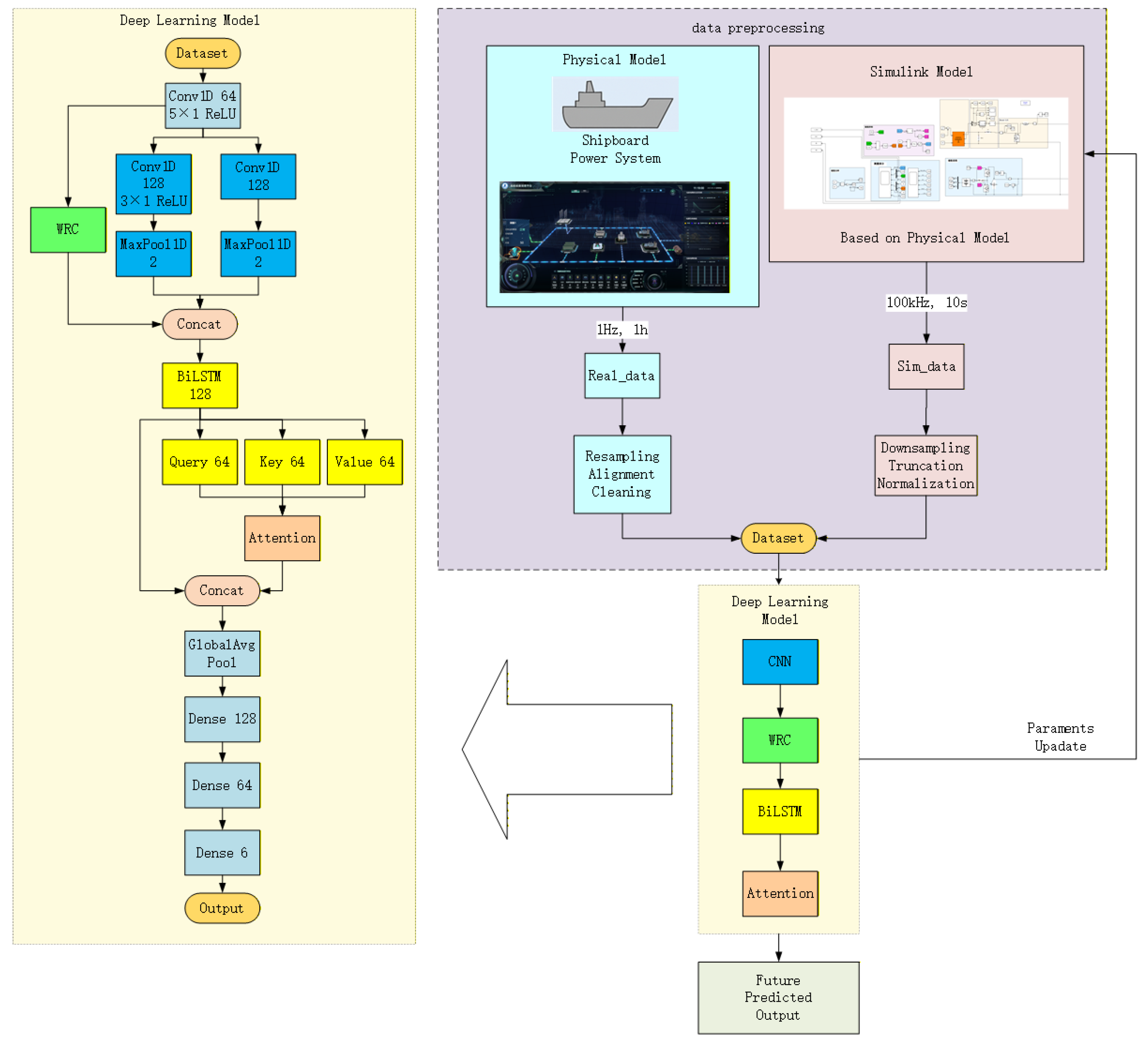
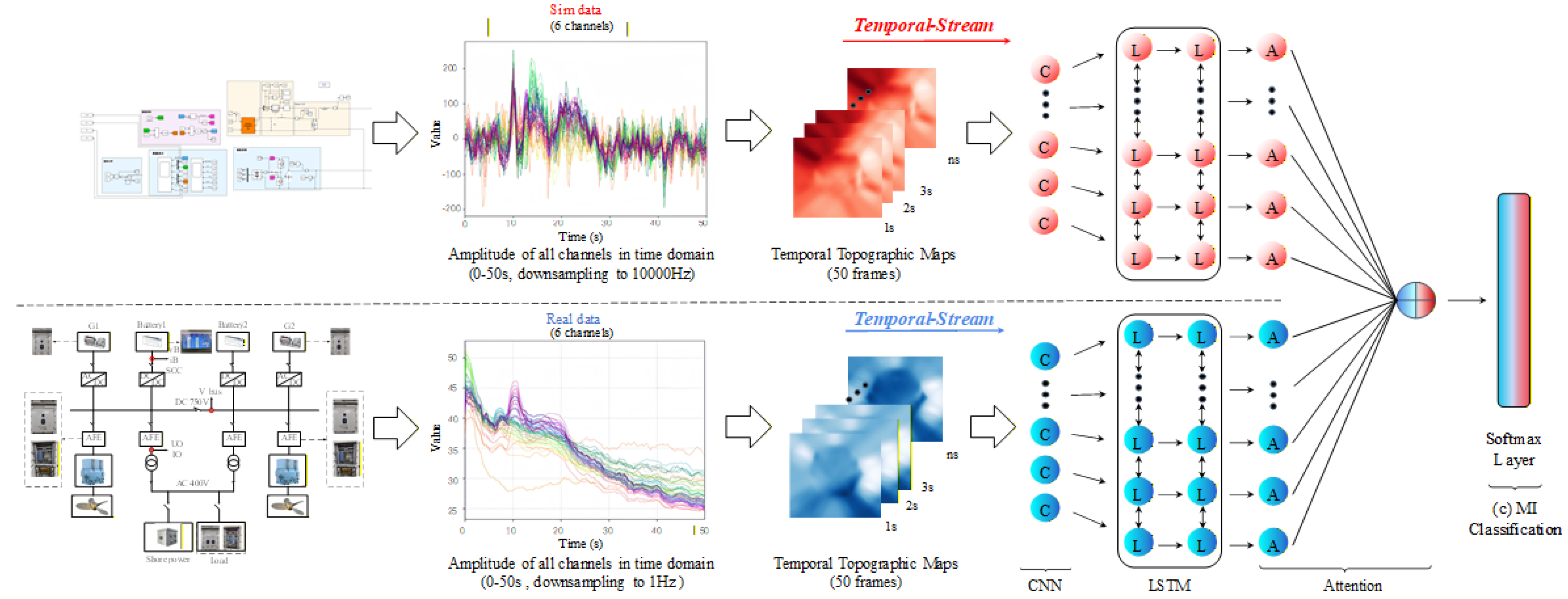
Figure 1 presents the overall hybrid prediction framework. Based on this framework, the detailed network architecture of the proposed model is illustrated in 2.3.
The hybrid prediction model proposed in this paper integrates physics-based modelling with deep learning, and its overall operating principle is illustrated in
Figure 1. The framework integrates real operational data and high-resolution simulation data. High-resolution simulated data from the physical model and real operational data from the experimental platform used to ensure physical consistency. After preprocessing, the two data types are jointly fed into the deep learning network, enabling integrated modelling of both real operational data and high-resolution simulation data.
During operation, the deep learning model can not only perform multi-variable prediction for the next hour but also adjust the parameters of the Simulink model in real time, thereby maintaining consistency with the actual system’s dynamics. As a result, the framework ensures numerical accuracy and physical consistency, making it highly appropriate for real-time prediction and fault diagnosis in a digital twin environment.
The sources of experimental data and the platform configuration, the workflow for data processing and fusion, and the design and optimization of the deep learning architecture are systematically presented below.
2.1. Data Sources and Experimental Platform
To enhance the generalization ability and reliability of the model, this paper employs two data sources: real operational data and high-resolution simulation data. The real operational data are derived from the operational records of the shipboard power system (SPS) during charging and discharging cycles, with a sampling frequency of 1 Hz. Although the experimental platform can collect additional signals, this paper selects only six features—bus voltage (v_bus), converter input voltage (UO), converter input current (IO), battery voltage (vB), battery current (iB), and SOC—as the core modelling objects. The reasons are as follows.
(1) These features form the minimal constraint loop of energy conservation in the power system and battery dynamics, enabling a complete description of the system’s essential physical behavior.
(2) All six features are conventional measurement points that can be acquired stably and reliably, thus avoiding the noise and complexity introduced by additional sensors.
(3) These features capture key physical constraints to support physical consistency and accuracy of predictions.
The simulation data are generated from a Simulink-based shipboard power system model. With a sampling frequency of 10 kHz, the simulation can reproduce transient dynamic processes with high fidelity. This dual-source data approach not only alleviates the limitation of scarce real data but also ensures that the model can adapt to diverse operating modes. In this way, the selection achieves a reasonable balance between theoretical completeness and engineering feasibility.
2.2. Data Preprocessing and Fusion Function
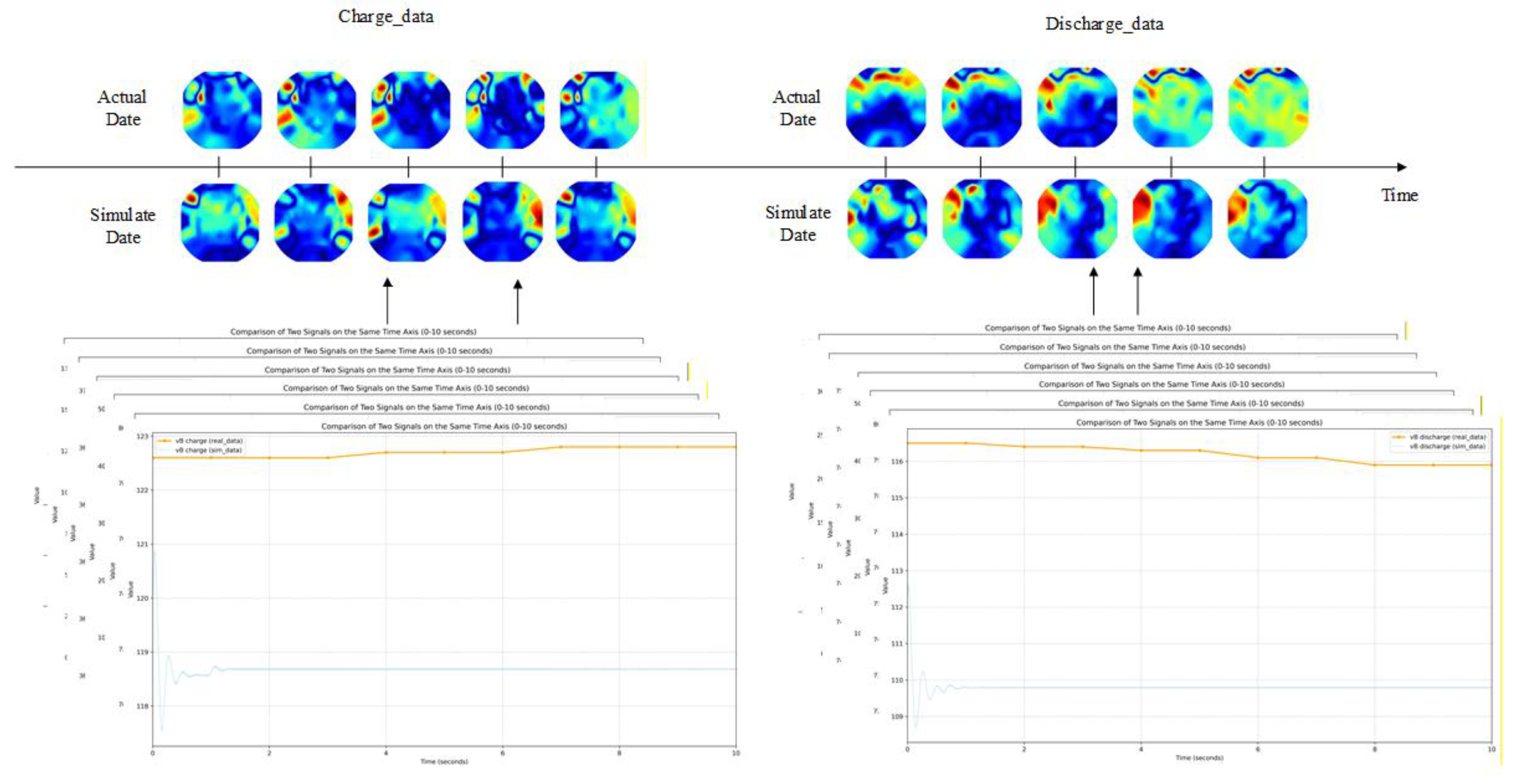
To enable effective use of both real and simulation data, this paper proposes a systematic processing and fusion strategy. First, dual-source independent training is conducted, with real operational data (1 Hz) and simulation data (10 kHz) fed into the model separately to preserve their respective temporal resolutions. Second, differential feature construction is performed by computing the difference between real and simulated data (Real–Sim) at the model level, explicitly characterizing their deviation patterns. Subsequently, normalization is applied to standardize all variables, ensuring that different features share a consistent numerical scale and mitigating imbalance caused by dimensional disparities. The schematic of the training process is shown in
Figure 2.
Next, a sliding-window slicing strategy is applied to each dataset, using a 30-s window to generate input samples. Each window contains 18 features (six real features, six simulated features, and six differential features) to capture the system’s temporal dependencies, as shown in
Figure 3. Finally, the result layer combines simulated features to produce a one-hour-ahead prediction. Differential analysis is conducted by comparing the predicted and real features. The approach preserves numerical accuracy while ensuring physical consistency.
Through this way, the model can leverage simulation data to cover extreme operating modes while real operational data are utilized for error correction and model parameter updates. This ensures the robustness and reliability of the final prediction results.
2.3. Overall Architecture Design
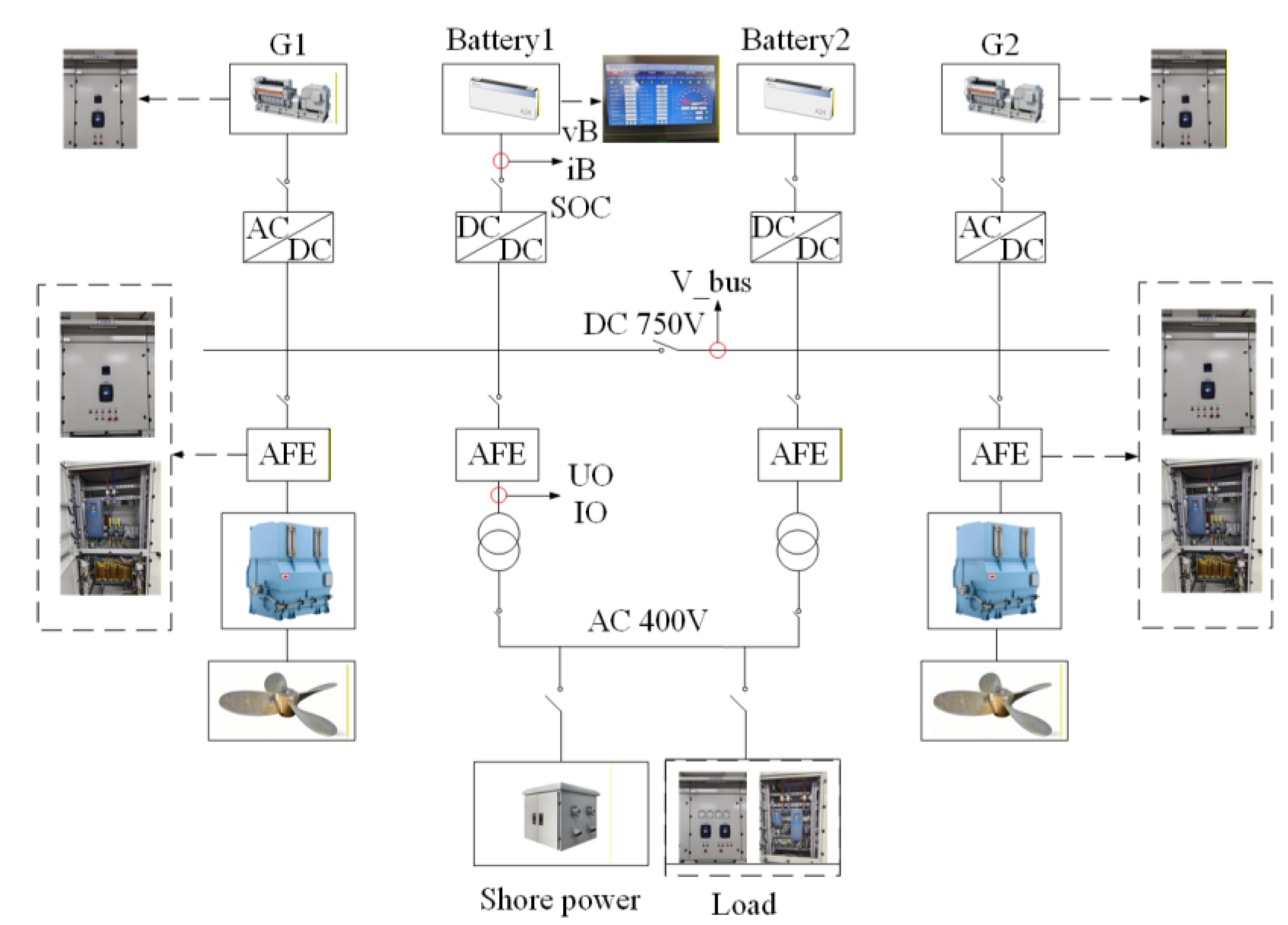
Figure 4 illustrates the configuration of the laboratory-scale SPS. The dashed arrow indicates the physical device in the laboratory. It collects fundamental information from both equipment and simulation model outputs. The experimental data were collected through sensors installed in the laboratory-scale system and transmitted to a MySQL database for storage and processing. The measurement accuracy of the sensors is 0.1, ensuring reliable data acquisition for model training and validation. During the charging phase, shore power is connected to the system; during the discharging phase, shore power is disconnected. The proposed model consists of three main modules, as follows: First, the Convolutional Feature Extraction Module employs one-dimensional convolutional layers to capture local temporal patterns and short-term dynamic features, facilitating the extraction of key structural information from input signals. A BiLSTM network is then employed to capture both short-term and long-term temporal dependencies. At the same time, an attention mechanism dynamically weights the importance of different time steps, achieving comprehensive fusion and optimization of deep features. Finally, the Physics-Constrained Loss Optimization Module incorporates power balance constraints and battery SOC boundary constraints into the loss function. This ensures that the prediction results comply with the physical laws of the power system and effectively prevent physically inconsistent outputs under extreme operating modes. The overall architecture achieves a balance between numerical accuracy and physical consistency, enabling the model to adapt to the complex, dynamic conditions of SPS. It is particularly suitable for digital twin applications and real-time prediction tasks.
2.4. Deep Learning Architecture Based on CNN-BiLSTM with Wide Residual Connection and Attention Mechanism
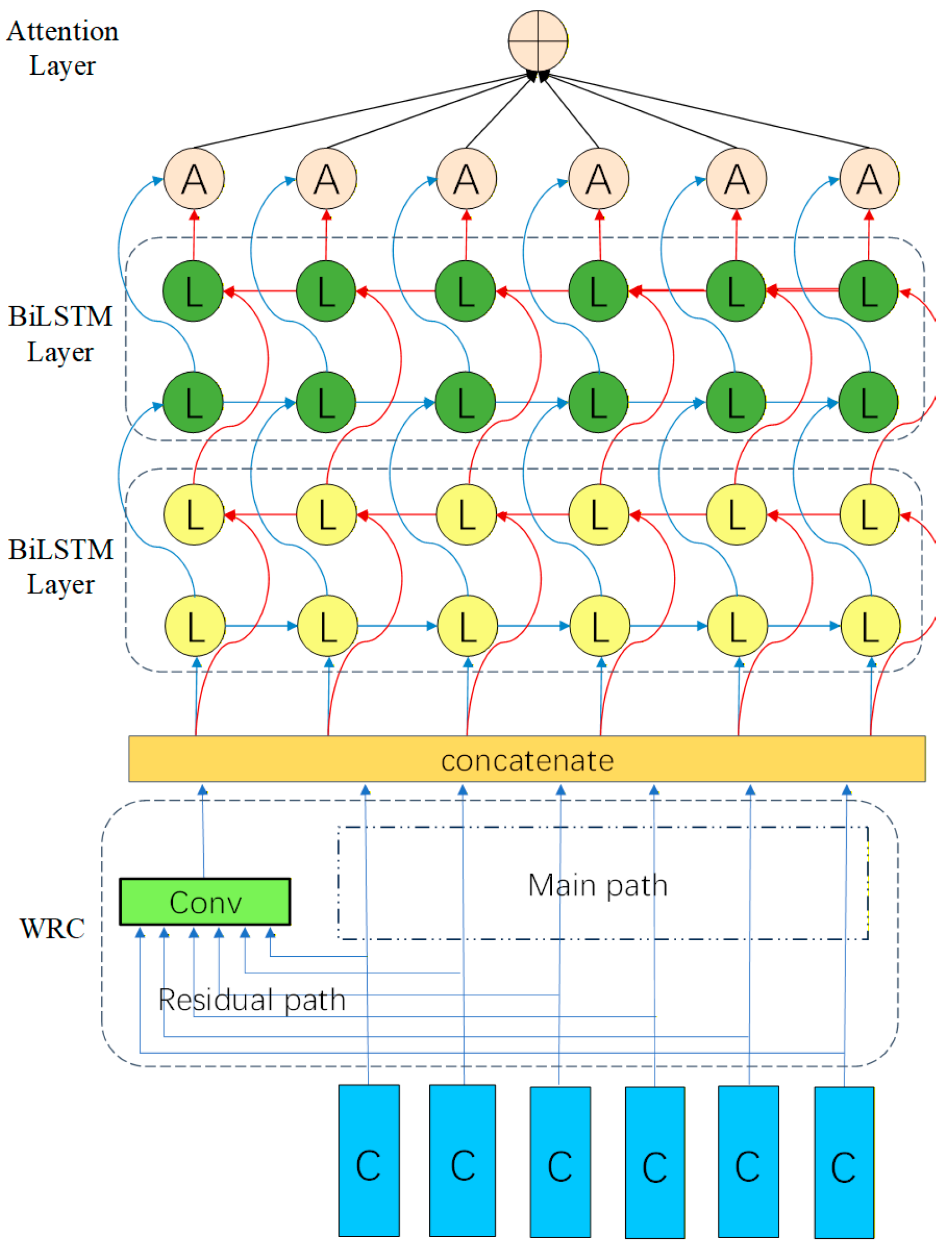
SPS exhibits strong nonlinear characteristics and complex temporal dependencies. To capture these behaviors effectively, this paper develops a hybrid neural network architecture. This paper develops a hybrid neural network architecture that integrates multi-scale convolution, WRC, BiLSTM, and an attention mechanism to enhance feature extraction and temporal modelling capabilities. The overall framework is illustrated in
Figure 5, the arrows indicate the direction of data transmission. And the detailed module design is described as follows:
(a) Convolutional Feature Extraction Layer
The input sequence first passes through two Conv1D layers. The first has 64 filters, and the second has 128 filters. Both convolutional layers use a kernel size of 3 to capture dynamic patterns within local temporal windows. This progressive convolutional process enables the model to extract temporal features at multiple scales. In particular, it captures short-term fluctuations in key signals such as voltage and current. Batch Normalization is applied after each convolutional layer to reduce internal covariate shift, improve training stability, and accelerate convergence. In addition, a ReLU activation function is applied after the convolutional layers to enhance the model’s ability to represent nonlinear relationships.
(b) Wide Residual Connections (WRC)
Traditional residual networks perform feature fusion through element-wise addition, which may lead to the cancellation of partial low-level information during propagation. In deep modelling of SPS, key features, such as voltage sags and current spikes, are often attenuated. To address this problem, a WRC-based feature enhancement mechanism is proposed. The WRC preserves these critical features through channel concatenation, which strengthens feature transmission and prevents information loss during propagation.
where
represents the high-level features obtained after the convolutional transformation, and
denotes the input features. This mechanism preserves feature information across different frequency components. It improves the model’s sensitivity to abnormal transients and subtle disturbances. In addition, it enhances the model’s robustness against noise. Particularly in the presence of sensor noise and high-frequency switching interference, WRC ensures stable and reliable feature transmission.
(c) BiLSTM Temporal Modelling
The feature sequences obtained after convolution and WRC fusion are fed into a BiLSTM network with 128 units. Compared with a unidirectional LSTM, the BiLSTM can model both forward and backward temporal dependencies, thereby capturing the dynamic evolution of the shipboard power system’s operational state more comprehensively. When abnormal current transients or the SOC change rapidly, the BiLSTM leverages both past and future information to better model non-stationary temporal dynamics.
(d) Attention Mechanism
An attention layer is applied on top of the BiLSTM output. It learns the importance distribution across time steps and adaptively assigns higher weights to critical moments. This mechanism enables the model to actively focus on key transient events such as abrupt current transients, SOC turning points, and bus voltage sags. Thereby it can improve both prediction accuracy and physical consistency. Moreover, the attention distribution serves as the basis for interpretability analysis. It helps reveal how the model allocates importance across time steps and feature dimensions. This enables a deeper understanding of the model’s decision-making process.
(e) Output Layer
After temporal modelling and attention weighting, the feature vectors are passed through a Global Average Pooling (GAP) layer. This operation reduces the temporal dimension while preserving the global information distribution across features. It also helps prevent overfitting by summarizing the sequence representation in a compact form. Subsequently, two fully connected layers with 128 and 64 units are sequentially employed, with Dropout layers (rates of 0.3 and 0.4, respectively) inserted between them to mitigate overfitting. The final output layer employs a linear activation function to predict six key features: v_bus, UO, IO, vB, iB, and SOC.
In summary, the proposed approach achieves robust feature extraction by combining convolutional and WRC layers, and performs deep temporal modelling with dynamic weight allocation via BiLSTM and attention mechanisms. At the output stage, it ensures the reliability and stability of the prediction results. The overall design balances prediction accuracy and physical consistency, making it particularly suitable for real-time prediction and digital twin applications in complex and dynamic shipboard power system environments.
2.5. Physics-Constrained Loss Function
Physics-informed neural networks (PINNs) typically incorporate governing equations of physical systems directly into the training loss to constrain neural network predictions. In power and energy system applications, PINN-based approaches have been applied to battery state estimation, power flow modeling, and system identification by embedding differential equations into neural network optimization. However, most existing PINN frameworks focus on enforcing a limited set of physical equations and are typically developed for continuous-time physical models. In contrast, the proposed method differs in two key aspects. Instead of relying on a single governing equation, the proposed framework incorporates multiple coupled physical constraints, including power balance, voltage conversion relationships, and SOC dynamic equations, which together describe the operational characteristics of shipboard power systems. The proposed method integrates these physical constraints within a hybrid deep learning architecture (CNN–BiLSTM with Wide Residual Connections) designed specifically for temporal feature extraction in dynamic SPS environments. Therefore, the contribution of this work lies not only in the use of physics-constrained learning but also in the joint integration of a temporal deep learning architecture and multi-constraint physical consistency enforcement.
The Physics-Constrained Loss (PCL) is incorporated into the training process as an additional penalty term that guides the optimization of the neural network. During training, the model first predicts key system variables such as voltage, current, and SOC based on input signals. These predicted variables are then used to evaluate a set of physical constraints, including power balance, voltage relationships, and SOC dynamics. The deviations from these physical relationships are quantified as penalty terms and integrated into the overall loss function. Through backpropagation, the PCL influences the parameter update process by penalizing physically inconsistent predictions. As a result, the model is encouraged to learn solutions that not only fit the data but also satisfy the underlying physical laws, leading to improved stability and robustness, particularly under dynamic operating conditions.
To prevent physically unreasonable outputs during the deep learning model’s prediction process (e.g., negative current or SOC values outside the 0–100% range), this paper designs a Physics-Constrained Loss function based on the conventional Mean Squared Error (MSE). The loss function is defined as
where
is a weighting factor used to balance numerical accuracy and physical consistency, and
(physics penalty) consists of multiple physical constraint terms, which are described in detail below [
6,
9].
The weighting factor is introduced to balance the prediction error and the physics constraint penalty. In practice, is typically selected within the range of 0.1–2 in physics-informed learning applications. In this paper, = 0.5 was selected based on empirical tuning, which provides a good trade-off between prediction accuracy and physical consistency.
In this paper, the six features are not independent but are constrained by energy conservation, circuit laws, and the electrochemical characteristics of the battery. Their coupling relationships can be analyzed from the following perspectives.
2.5.1. Physical Relationship Modelling
(a) Voltage Transformation Relationship
UO is connected to the bus via a transformer. The bus voltage is not necessarily equal to the UO voltage; instead, it depends on the converter topology and operating point. Under steady-state conditions, this relationship can be expressed as
where
denotes the converter duty ratio or control command, and params include parameters such as the conversion ratio, voltage conversion ratio and filter components parameters [
14]. To simplify the expression used in the training loss, a linearized or parameterized approximation can be adopted
Alternatively, a first-order approximation function
can be fitted more generally. The coefficients
and
can be estimated offline using Simulink simulations or historical data and applied via lookup tables or interpolation [
14].
(b) Power Balance
The power balance constraint keeps the predicted power flow consistent with physical laws. It does not describe energy saving or optimization. Instead, it ensures that the input power from the converter equals the power delivered to the load plus system losses. This rule keeps the prediction physically reasonable and prevents unrealistic power values.
The balance can be written as:
where
is the converter output power,
is the bus power, and
is the total loss in cables and converters. During charging and discharging, the direction of power changes, but this equality still holds. The model uses this rule to keep all predictions consistent with actual system operation [
14].
(c) Dynamic Equation Between SOC and Battery Current
The continuous-time relationship of the battery’s state of charge (SOC) over time can be expressed as
In discrete form with a time step of
where
is determined by the operating mode: +1 for discharging and −1 for charging. Note that
represents the absolute current magnitude, while its direction is indicated by
[
12].
(d) Nonlinear Static Relationship Between Battery Voltage and SOC
The open-circuit voltage
of the battery has an inherent relationship with the state of charge (SOC), typically shown in the charge–discharge curve. The terminal voltage also includes the internal resistance voltage drop, expressed as:
where
can be represented using a lookup table or an empirical model, and
denotes the internal resistance, which varies with SOC, temperature, and other factors. Therefore, the predicted
should be consistent with the predicted SOC and current [
10,
12].
(e) Mapping Between Current Magnitude and Operating mode
The model outputs the current as an absolute (non-negative) value, while the operating mode signal determines its direction.
Specifically: During charging, : the battery absorbs energy and SOC increases;
During discharging, : the battery releases energy and SOC decreases.
2.5.2. Physics Penalty
(a) Power Balance Penalty
The residual between the predicted net power supply and the load is defined as:
The corresponding penalty is defined as:
Here,
denotes the tolerance (allowing for small measurement or modelling errors). The
function limits a value within a given range. If the input is lower than the minimum, it is set to the minimum. If it is higher than the maximum, it is set to the maximum. In this paper,
keeps only positive values and sets all negative values to zero. It is used to ignore small deviations and penalize only the values that exceed the tolerance threshold. Using the
function helps prevent over-penalizing minor deviations. The load power
cannot be directly measured, it can be approximated by the bus voltage and the estimated load impedance as
. This approximation assumes a quasi-resistive load and is reasonable for short-term dynamic analysis, where the bus voltage varies faster than the impedance characteristics [
9].
(b) Converter Voltage Penalty
Based on the converter mapping
(which can be linearized):
The corresponding penalty is defined as:
The converter mapping can be defined as a linear form , or as a more accurate mapping obtained through simulation or calibration-based lookup tables.
represents the allowable voltage deviation, accounting for converter voltage drops and measurement noise.
(c) SOC Dynamics Penalty
The discretized SOC dynamic error is defined as:
Compared with the theoretical variation derived from the current:
The corresponding penalty is defined as:
This term ensures that the temporal evolution of the SOC is consistent with the input current.
(d) SOC Boundary Penalty
A quadratic penalty is applied to any out-of-bound SOC values:
The SOC is expressed as a percentage, the corresponding boundaries should be adjusted accordingly [
10].
(e) SOC Rate Limit Penalty
The system has a maximum allowable charge/discharge rate (expressed in %/s or %/h):
(f) Voltage/Current Non-Negativity and Limit Penalty
The current is output as an absolute value, it is constrained to be non-negative:
A penalty is applied when the values exceed the equipment’s safety limits (e.g., voltage upper limit
and current upper limit
):
(g) Overall Physics Penalty
The above penalty terms are linearly combined as follows:
Each weight
is used to balance the relative importance of different penalty terms and is typically tuned through cross-validation or Bayesian optimization [
6,
9].
The proposed loss function combines statistical optimization with physical constraints. The Mean Squared Error (MSE) term drives numerical accuracy, while the constraint terms prevent physically infeasible predictions such as negative current or SOC violations. Together, they enable the model to achieve a balance between numerical precision and physical consistency. This formulation aims to enhance model robustness and reduce prediction error by enforcing physical consistency during training.
The physics-constrained model is developed by analyzing the relationships among six key SPS features (voltage, current, and SOC). Several constraint terms are defined based on these physical relationships, representing power balance, converter voltage limits, and battery charge–discharge consistency. These constraints are incorporated into the loss function, which consists of two parts: MSE for accuracy and physics-constrained terms for physical validity. During training, the model minimizes both terms at the same time. This process keeps the learning results within physically reasonable limits. The constraints prevent wrong predictions, such as negative current and SOC overflow. They help the model follow energy balance and electrochemical laws. This makes the output stable, accurate, and physically consistent. The proposed model connects data learning with physical principles. It provides a solid base for hybrid modelling and digital twin applications in SPS. Unlike purely data-driven models, the proposed model integrates physical constraints into both the feature construction and the optimization process.
The proposed model relies on several simplifying assumptions. First, the converter voltage relationship is approximated using a linear mapping, which may introduce modeling errors under highly nonlinear operating conditions. Second, the battery parameters such as capacity and internal resistance are assumed to remain constant, while in practice they may vary with temperature and aging. Third, the load power is approximated using an equivalent impedance model, which may not fully represent complex shipboard loads. In addition, measurement noise and communication delays are not explicitly modeled in the current framework. These assumptions may lead to small deviations between predicted and measured values during real-time deployment.
3. Experiments and Results Analysis
3.1. Experimental Setup
To systematically evaluate the performance of the proposed model under both charging and discharging conditions, a comparative experiment was conducted involving four distinct models. A brief overview of the four models is provided below:
(1) CNN-BiLSTM Model: purely data-driven learning without any structural enhancement or physical constraints;
(2) CNN-BiLSTM + WRC Model: integrates WRC to improve feature extraction and temporal representation capabilities;
(3) CNN-BiLSTM + PCL Model: integrates PCL to improve feature extraction and temporal representation capabilities;
(4) Proposed Hybrid Model: combines the WRC structure with a global PCL to embed physical consistency during training.
To evaluate model performance under dynamic and non-stationary operating conditions, two operating scenarios were designed. During the charging process, a transient charging interruption event was intentionally introduced at around t = 500 s. This event simulates a short-term disruption in the control or communication process, leading to a temporary drop in battery voltage (vB) and battery current (iB) to zero, alongside a brief surge in bus voltage (v_bus). The purpose of this design is to test how each model responds to sudden operating disturbances and how effectively it maintains prediction stability.
During the discharging process, no artificial disturbance was applied because the system naturally exhibited load fluctuations. This condition was used to examine the models’ robustness under real-time dynamic variations. These experiments are intended to assess the influence of network structure and physical constraints on prediction performance. Specifically, they aim to analyze how the introduction of WRC and PCL affects model accuracy, stability, and physical consistency under complex operating conditions. The comparative results and detailed analysis are presented in the following section.
Both real operational data and high-resolution simulation data were used to evaluate the proposed hybrid prediction model. The experimental data were obtained from a laboratory-scale SPS operating through complete charging and discharging cycles. Measured variables included the v_bus, UO and IO, vB and iB, and SOC, with a sampling frequency of 1 Hz. The SOC ranges from 30% to 89%, which aligns with the typical operating window of marine battery systems.
To complement the experimental data, a high-fidelity simulation model of the shipboard power system was developed in Simulink with a 10 kHz sampling rate. It enables controlled reproduction of dynamic operating scenarios, such as load fluctuations and transient switching behaviors, which are difficult to isolate in laboratory experiments.
The combined dataset allows systematic evaluation of model performance under both steady-state and transient conditions. Simulation-based prediction results over a one-hour period were compared with experimental measurements using differential analysis to assess accuracy, stability, and physical consistency. This experimental framework ensures that the evaluation reflects realistic operating characteristics of SPS and provides a reliable foundation for analyzing the impact of each modelling innovation.
3.2. Model Configuration and Training Strategy
In this paper, the model input is constructed via a 30-s sliding window, with each sample containing 18 features: six real operational features, six simulated features, and six differential features. This feature set is designed to capture complex temporal dependencies inherent in SPS operations. The network architecture consists of two one-dimensional convolutional (Conv1D) layers (with 64 and 128 filters, respectively) integrated with WRC, followed by a BiLSTM layer with 128 units and an attention mechanism to dynamically focus on critical temporal features. Finally, two fully connected layers with 128 and 64 units are applied sequentially. Dropout rates of 0.3 and 0.4 are used, respectively, to prevent overfitting and improve model generalization. The network produces six output features: v_bus, UO, IO, vB, iB, and SOC.
A multi-stage training strategy was adopted to improve model convergence and stability. First, the convolutional layers are frozen and pre-trained to ensure stable feature extraction; subsequently, the entire network is unfrozen and fine-tuned with a gradually decreasing learning rate; finally, convergence is achieved under a low learning rate by integrating early stopping and adaptive learning rate scheduling, thereby ensuring stable optimization. Regarding the loss function, all models adopt mean squared error (MSE) as the objective. In contrast, the Proposed Hybrid Model introduces a physics-constrained composite loss function, designed to simultaneously achieve numerical accuracy and physical consistency.
3.3. Results in the Charging Stage
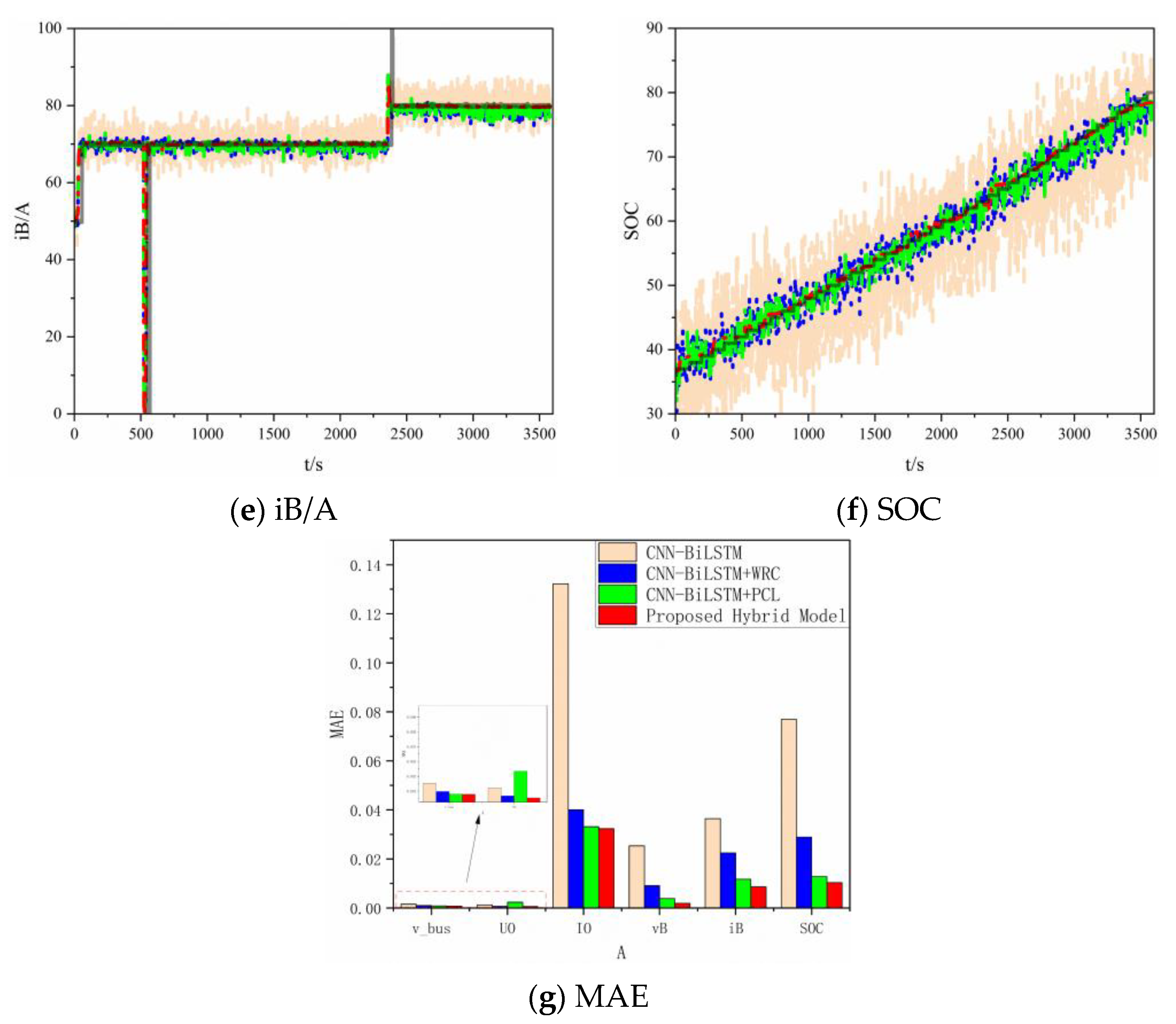
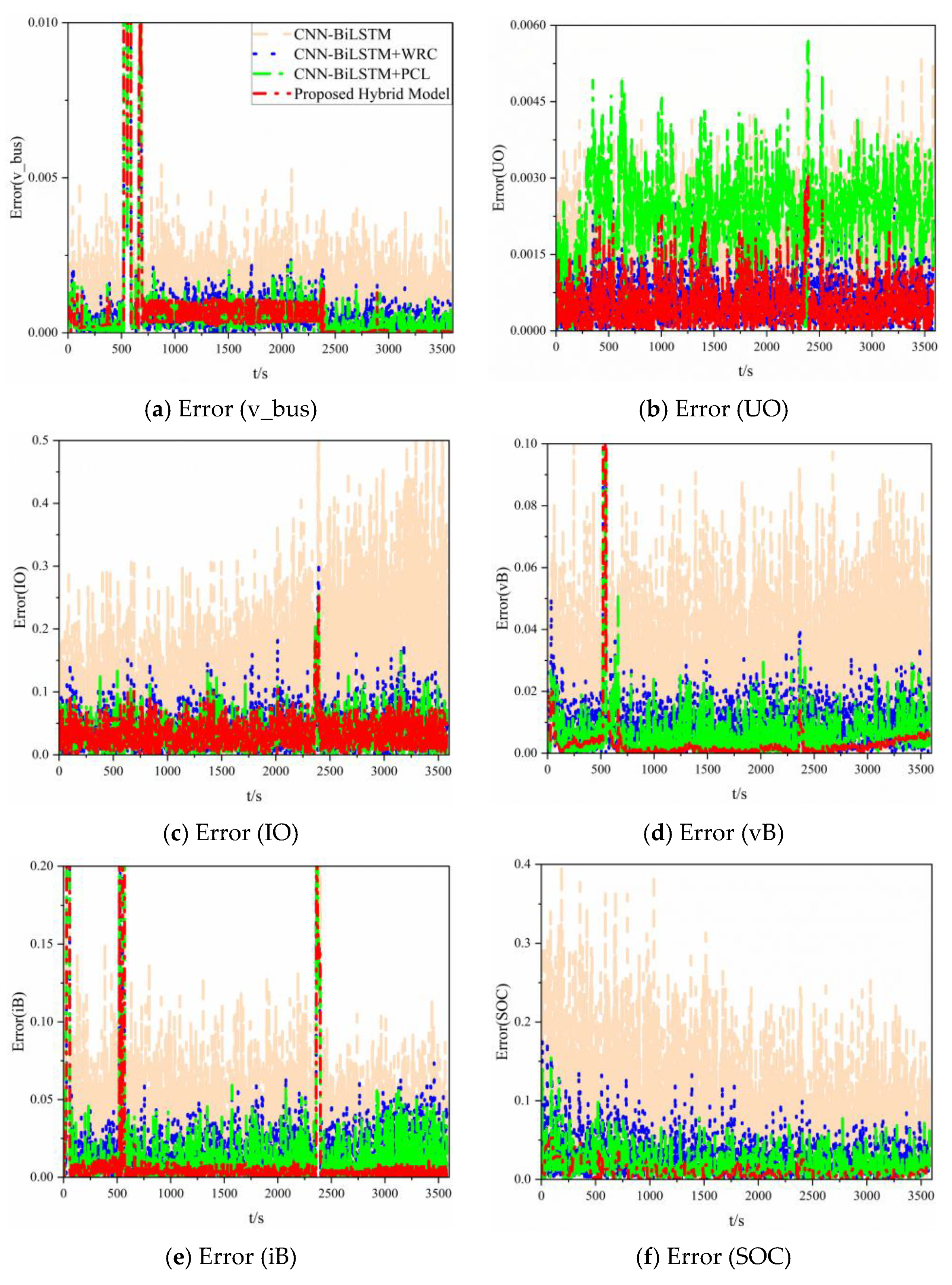
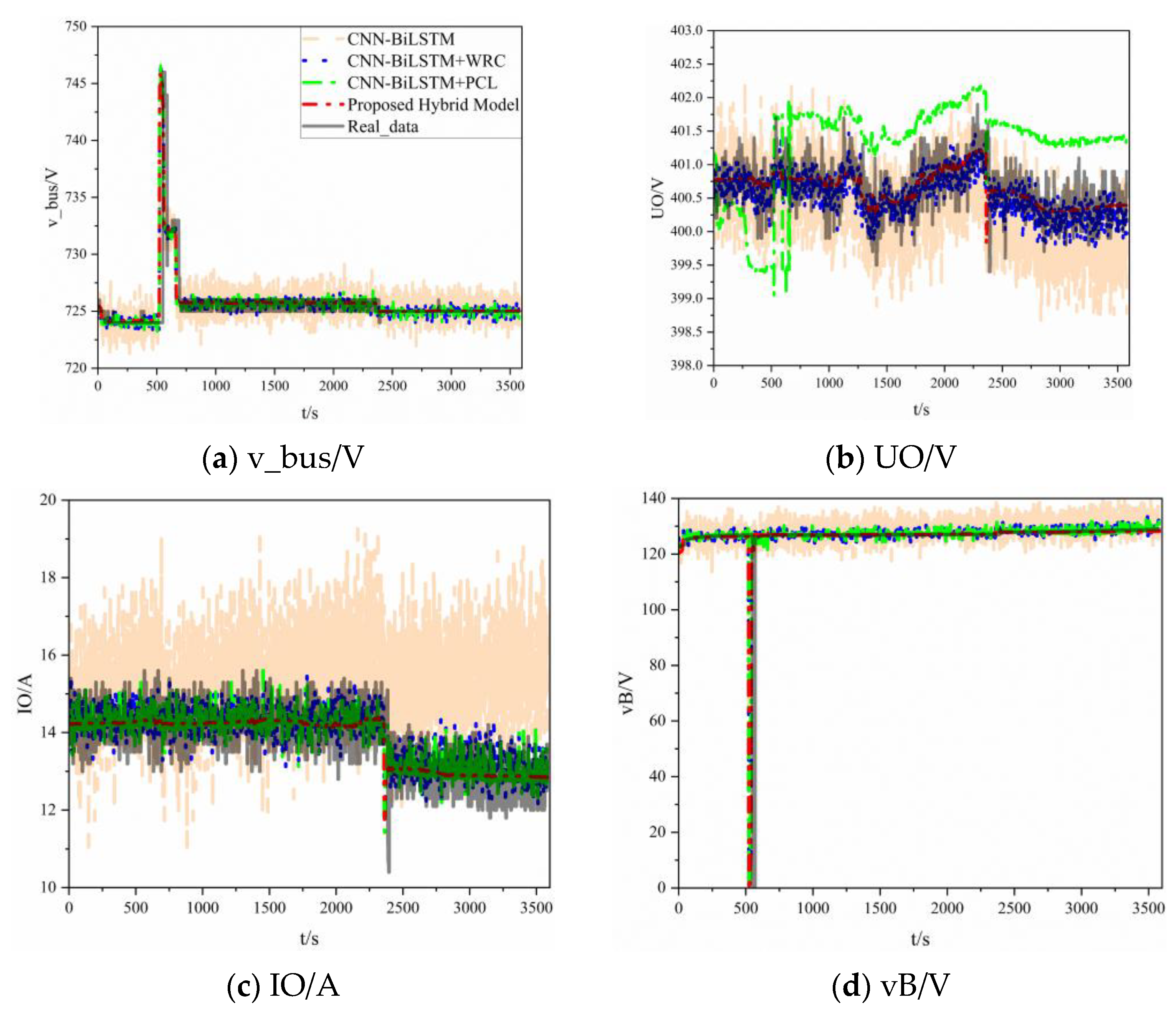
Figure 6a–f illustrate the prediction results and corresponding error evolution of the four models during the charging process. As shown in the figures, all four models performed satisfactorily under normal charging conditions, maintaining low and stable prediction errors prior to t = 500 s. At around t = 500 s, a short-term charging interruption was intentionally introduced to simulate a temporary control or communication fault. During this interruption, vB and iB rapidly drop to zero, while v_bus experiences a brief rise due to the sudden load disconnection. This disturbance was designed to evaluate the models’ dynamic response capability and their stability during transient non-stationary conditions.
Distinct differences in performance emerged among the four models following the interruption. The CNN–BiLSTM Model exhibited significant oscillations and delayed recovery, indicating poor adaptability to abrupt nonlinear disturbances. Its purely data-driven structure lacks physical guidance, resulting in large prediction errors in vB and iB when the charging state changes suddenly. The CNN–BiLSTM + WRC model achieves moderate improvement, as the Wide Residual Connection enhances feature propagation and captures short-term temporal dependencies. However, it still fails to maintain the inherent physical relationships among voltage, current, and power during transient recovery, resulting in residual prediction drift.
In addition, the CNN–BiLSTM + PCL model demonstrates significantly improved convergence behavior due to the introduction of physics-constrained learning. By enforcing physical consistency among voltage, current, and SOC, the model effectively suppresses large oscillations and accelerates recovery after the disturbance. As a result, the predicted trajectories exhibit smoother transitions and remain closer to the true system dynamics. However, although the physical constraints improve stability and convergence, the model may still exhibit minor accuracy degradation under small data fluctuations. Since the physics-constrained loss prioritizes maintaining physically consistent relationships, slight variations in input data may lead to local prediction imbalance, resulting in small deviations from the measured signals. This indicates that while physical constraints enhance robustness and physical plausibility, purely physics-constrained models may still be limited in capturing subtle data-driven variations.
In contrast, the proposed hybrid model (CNN–BiLSTM + WRC + PCL) produces the lowest prediction error and the fastest recovery after t = 500 s. This superior performance originates from the Physics-Constrained Loss, which embeds energy balance and charge conservation principles into the training process. These physical constraints act as an internal correction mechanism, ensuring that the predicted electrical variables remain consistent with real system dynamics even when external disturbances occur. The combination of WRC and physics-constrained learning enables the model to capture both high-frequency transient features and low-frequency physical consistency, leading to smoother and more realistic prediction trajectories.
Figure 6g also compares the MAE for key features predicted by the four models during charging. The MAE of the Proposed Hybrid Model is the lowest among the four models, further validating its superior predictive accuracy.
Figure 6 demonstrates that the combined use of WRC and the PCL significantly improves prediction performance. WRC enhances feature propagation and preserves transient electrical characteristics, while PCL enforces physical consistency among voltage, current, and SOC. Together, they enable the model to suppress non-physical deviations and maintain stable and accurate predictions during the charging process.
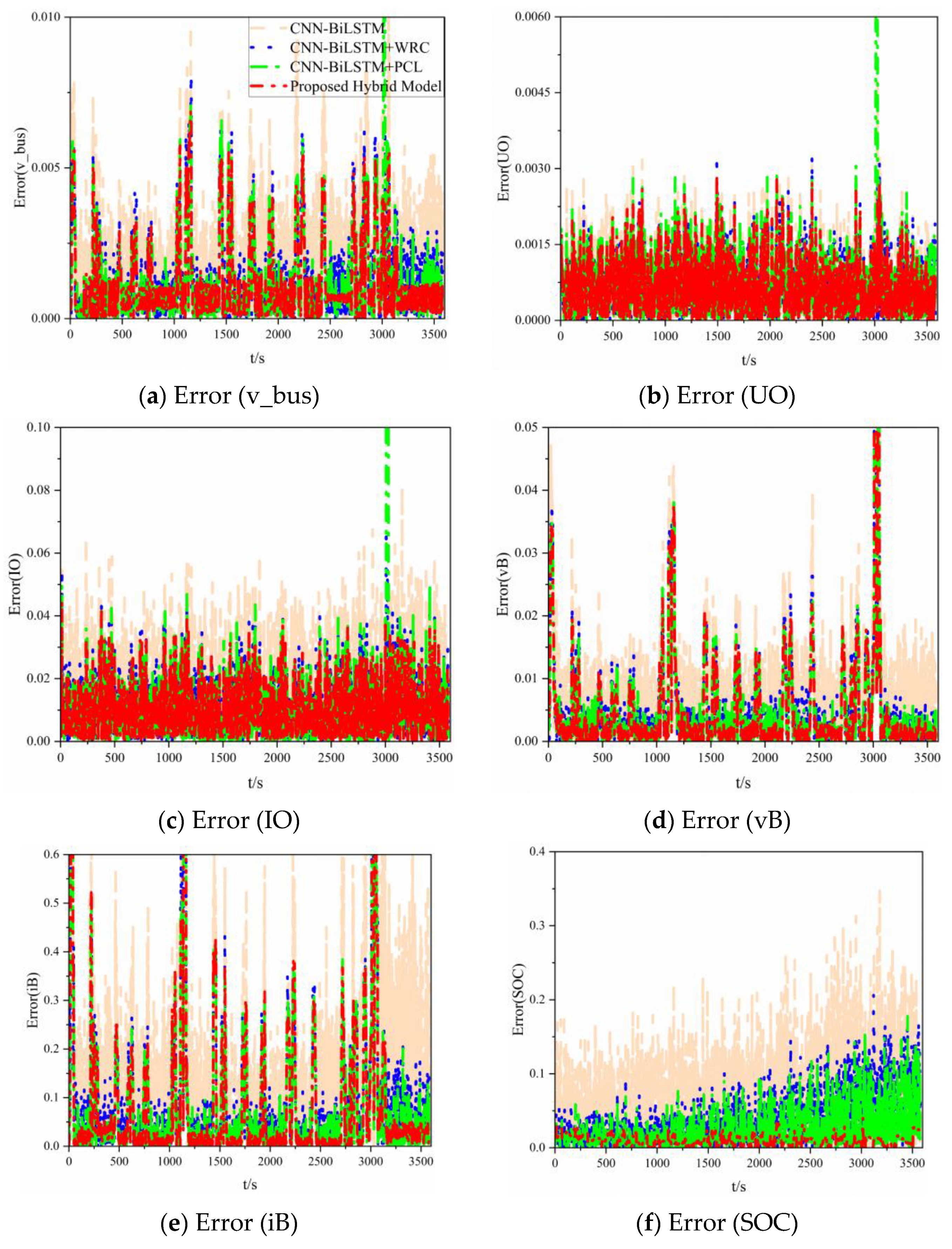
As shown in
Figure 7, during the transient charging interruption around 500 s, all four models exhibited a noticeable increase in prediction error, indicating that this non-stationary condition posed a significant challenge to their dynamic prediction capability. However, compared with the other three models, the CNN-BiLSTM + WRC+ PCL model demonstrated a much faster error decay and recovery to the steady-state level after the interruption. This rapid stabilization implies that the inclusion of physical constraints effectively enhanced the model’s dynamic robustness and self-recovery capability, allowing it to re-align its predictions with the system’s true behavior shortly after the disturbance. The improvement results from the inclusion of physical constraints that enforce energy balance and charge conservation during the charging interruption. These constraints guide the model to produce consistent voltage–current responses when the operating condition changes abruptly, leading to smoother transient behavior and enhanced prediction stability.
3.4. Results in the Discharging Stage
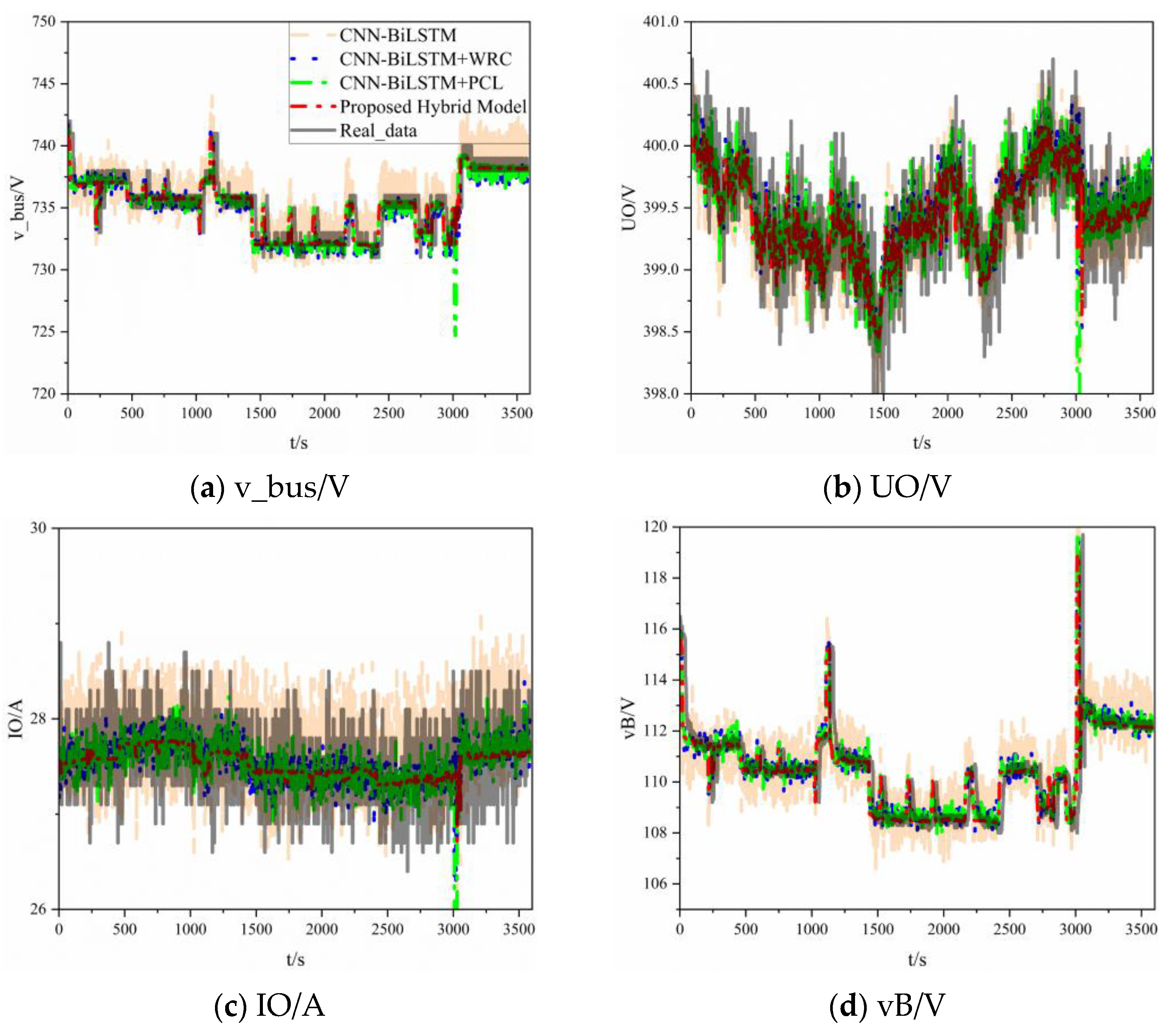
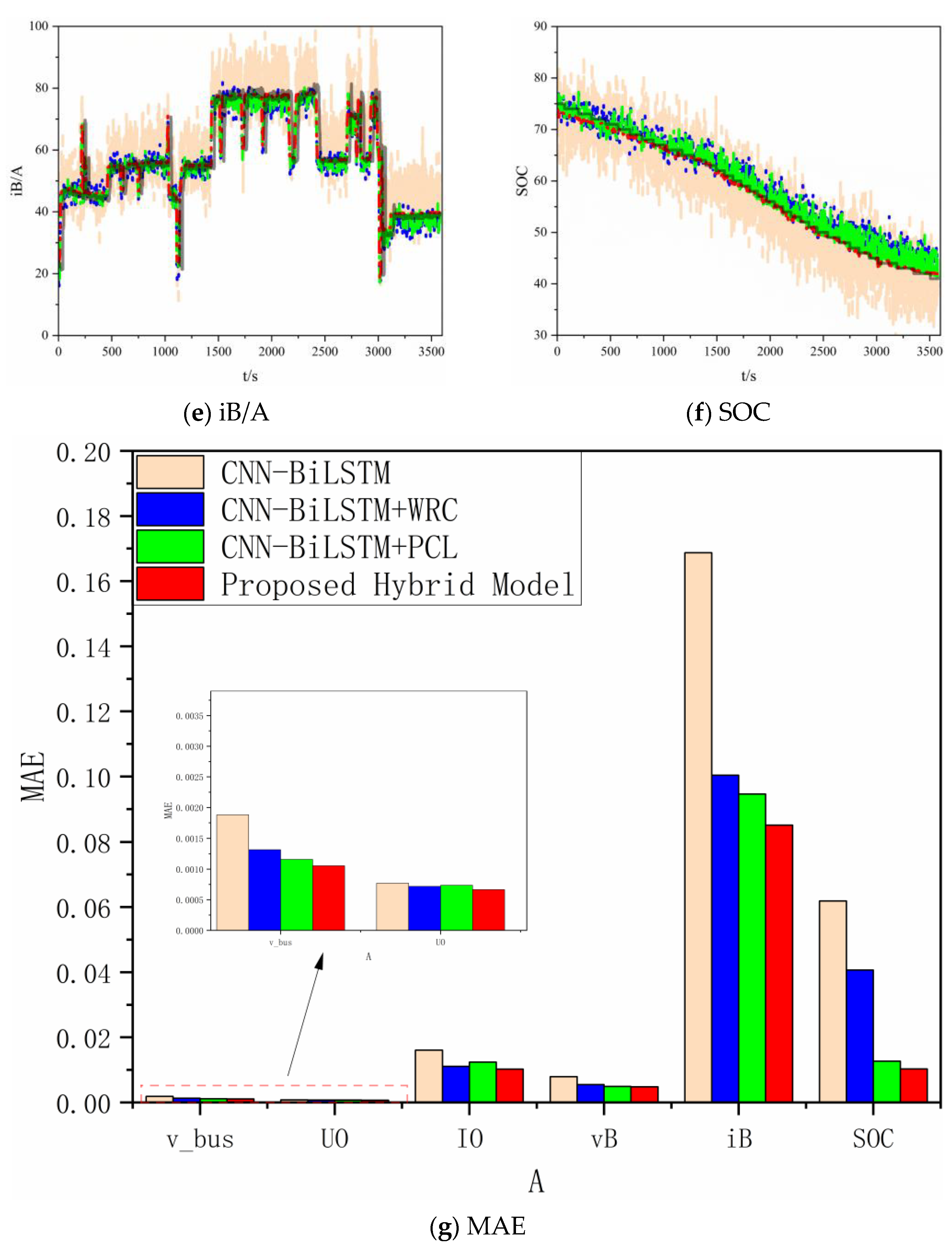
Figure 8a–f present the prediction performance of the four models during the discharging process. In this stage, the system supplies power from the battery to the AC bus while compensating for dynamic load fluctuations. No artificial disturbance was introduced, as natural load variations already provided sufficient dynamic behavior to test model robustness. The purpose of this condition was to evaluate each model’s ability to maintain power balance and voltage stability during continuous energy delivery.
As shown in the figure, the CNN–BiLSTM model exhibited large prediction deviations when the load fluctuates rapidly. Relying solely on data correlations, it failed to effectively capture the nonlinear coupling between battery output and bus voltage regulation. The CNN–BiLSTM + WRC model demonstrates improved short-term prediction performance due to its enhanced temporal feature extraction capability. However, it still produces mismatched current and voltage responses under strong load transients, leading to minor instability in predicted energy flow.
The CNN–BiLSTM + PCL model further improves prediction stability by introducing physical constraints that enforce power balance and SOC dynamics. As a result, the predicted trajectories become smoother and more consistent with the underlying physical behavior of the system. However, because the model prioritizes maintaining physical consistency, small fluctuations in the input data may still lead to slight deviations in prediction accuracy under rapidly varying load conditions.
The proposed hybrid model (CNN–BiLSTM + WRC + PCL) achieves the smallest prediction error and the smoothest transition across all load changes. The improvement arises from the embedded Physics-Constrained Loss, which enforces real-time power balance among the DC bus, converter, and battery branches. This constraint prevents the generation of non-physical current oscillations and ensures that the predicted energy flow remains dynamically consistent with the actual system state.
At the same time, the WRC module strengthens the model’s ability to track rapid feature changes in vB and iB, enabling an accurate response to fast load dynamics. The PCL improves prediction stability, particularly under transient operating conditions. Through this synergy, the hybrid model achieves both temporal adaptability and physical consistency, resulting in stable and realistic predictions throughout the discharging process.
Figure 8 also compares the MAE for key features predicted by different models during discharging. The performance of the Proposed Hybrid Model is still the best in complex discharge processes.
To further evaluate the predictive performance of different models during the discharging phase, the error distributions over various time intervals were compared, as illustrated in
Figure 9. As shown in the figure, during the steady-state discharging stage, all four models exhibit small errors and highly consistent prediction results. However, during the dynamic load disturbance period, significant fluctuations occur in the system’s current and voltage, leading to a noticeable increase in prediction errors for all models.
During those transient periods, the CNN-BiLSTM model exhibited the largest error fluctuations and a clear response lag. The CNN-BiLSTM + WRC model demonstrates slightly improved dynamic performance but still exhibits deviations under strong disturbances. The CNN-BiLSTM + PCL enables the predictions to remain closer to the true values, but its response to rapid load variations is relatively weaker. In contrast, the CNN-BiLSTM + WRC+ PCL model achieves the lowest error peak and the fastest recovery to steady-state accuracy. These results indicate that the introduction of physical constraints effectively enhances the model’s stability under dynamic disturbances, enabling predictions that are more physically consistent and robust.
4. Discussion
This paper developed a physics-constrained hybrid prediction model for shipboard power systems (SPS) by integrating a CNN–BiLSTM architecture with wide residual connections (WRC) and a physics-constrained loss function. By combining real operational measurement data with high-resolution simulation data, the proposed model achieves a balance between numerical accuracy and physical consistency under dynamic operating conditions. Comparative experiments conducted during charging and discharging processes demonstrate that the proposed model outperforms conventional data-driven models in prediction accuracy, dynamic stability, and recovery performance following transient disturbances.
The observed results are consistent with prior studies showing that CNN–LSTM and CNN–BiLSTM architectures are effective in modelling nonlinear temporal dependencies in energy systems, including marine power and battery-related applications [
4,
5]. However, as widely reported in the literature, purely data-driven models often fail to preserve physical consistency when exposed to unseen disturbances or operating regimes [
6,
7,
8]. Compared with existing physics-informed approaches, the present work advances the state-of-the-art by simultaneously enforcing multiple coupled physical constraints—including power balance, voltage conversion relationships, and battery SOC dynamics—within a unified loss formulation [
9,
10,
11]. In addition, the introduction of WRC enhances the preservation of low-level transient features during deep temporal modelling, an aspect that has received limited attention in prior SPS prediction studies [
15]. These combined design choices provide a mechanistic explanation for the superior performance of the proposed model under transient and non-stationary operating conditions.
It is worth noting that architectural enhancements alone, such as the incorporation of WRC, are insufficient to guarantee physically consistent predictions. Although the CNN–BiLSTM + WRC model improves temporal feature extraction, it remains susceptible to prediction drift during abrupt operating changes. This behavior is consistent with observations reported in previous deep learning-based energy prediction studies [
6,
15] and highlights the inherent limitation of structural modifications in enforcing physical plausibility. The PCL improves the model robustness under unseen operating conditions by enforcing physical consistency, which helps mitigate the impact of distribution shifts compared to purely data-driven models. In contrast, the proposed model exhibits faster error attenuation following disturbances, indicating that the physics-constrained loss acts as an active correction mechanism rather than a passive regularization term [
9,
10]. This finding underscores the critical role of explicit physical constraints in stabilizing predictions under transient conditions, which is essential for safety-critical SPS applications [
16,
17].
From a theoretical perspective, the results support the growing consensus that a hybrid modelling approach combining data-driven learning with physical principles is necessary for complex cyber–physical energy systems [
6,
7,
12]. Treating physical consistency as an explicit learning objective aligns deep neural networks more closely with first-principles modelling while retaining data-driven flexibility. In the context of digital twin development for shipboard power systems, the proposed model enhances interpretability and prediction reliability, which are key requirements for real-time monitoring and predictive control in maritime applications [
18,
19,
20].
Although the proposed model is validated on a laboratory-scale shipboard power system, the framework can be extended to practical applications. The input variables used in this study, including voltage, current, and battery SOC, are commonly available in real shipboard monitoring systems such as SCADA, EMS, and BMS. Therefore, the proposed CNN–BiLSTM model can be trained using operational data collected from real ships. Moreover, the physics-constrained loss helps maintain physically consistent predictions, improving reliability when applied to larger and more complex shipboard power systems.
Several limitations of this study should be acknowledged. First, validation was conducted on a laboratory-scale platform, which may not fully reflect the complexity of full-scale shipboard power systems characterized by larger network topologies, stronger component coupling, and harsher operating environments [
17]. Second, the physical parameters used in the constraint terms were assumed to be time-invariant, whereas real systems may experience parameter drift due to aging, temperature variation, and environmental effects [
10,
15]. Third, the introduction of physics-based constraints increases computational complexity, which may affect real-time deployment in digital twin settings [
18,
19]. In addition, the proposed model assumes accurate measurements, simplified physical constraints, and consistent operating conditions. In practical applications, sensor noise, parameter variations, and unseen operating scenarios may introduce prediction errors. Future work will therefore focus on large-scale system validation, adaptive identification of time-varying physical parameters, and computational optimization to support real-time digital twin applications.