Next Article in Journal
Modelling the Dynamic Response of Clay Nanoparticle-Modified Concrete Beams Resting on Two-Parameter Elastic Foundations
Previous Article in Journal
Evaluation of Waste-to-Hydrogen Infrastructure in Oman: A Mixed-Integer Programming Approach for Circular Economy Integration
 
 
Due to scheduled maintenance work on our servers, there may be short service disruptions on this website between 11:00 and 12:00 CEST on March 28th.
Review

Lean Management, Discrete Event Simulation, and Virtual Reality in Hemodialysis Units: A Scoping Literature Review and Evidence Gap Analysis


1
Institut Catholique de Lille, Junia, Université Catholique de Lille, Laboratoire Interdisci-Plinaire des Transitions de Lille, F-59000 Lille, France
2
SyCoIA—Systèmes Complexes et Intelligence Artificielle, IMT Mines Ales, 6 Avenue de Clavières, 30100 Alès, France
3
School of Administrative Studies, York University, Toronto, ON M3J 1P3, Canada
4
Production Engineering Laboratory (LGP), Tarbes University of Technology (UTTOP), 65000 Tarbes, France
*
Author to whom correspondence should be addressed.
Modelling 2026, 7(2), 63; https://doi.org/10.3390/modelling7020063 (registering DOI)
Submission received: 13 January 2026 / Revised: 19 March 2026 / Accepted: 22 March 2026 / Published: 25 March 2026

Abstract

The rising global incidence of kidney failure is increasing pressure on hemodialysis unit operations, with operational vulnerabilities further exposed by the COVID-19 pandemic. This scoping review mapped evidence on Lean management, discrete event simulation (DES), and virtual reality (VR) in hemodialysis units; compared reported outcome domains and performance indicators; identified barriers to Lean implementation; and assessed the empirical basis for a combined Lean–DES–VR framework. English-language peer-reviewed articles, conference papers, and book chapters addressing Lean, DES, VR, or their combination in dialysis settings were searched in Scopus, PubMed, SpringerLink, IEEE Xplore, ACM Digital Library, and Google Scholar to 30 June 2024; grey literature and opinion pieces were excluded. Structured data extraction and thematic narrative synthesis were applied. Twenty-seven studies were included (Lean n = 4, DES n = 9, VR n = 13, DES + VR n = 1). DES studies mainly reported operational outcomes, whereas VR studies focused predominantly on patient-centered rehabilitation and experience. Most studies examined methods in isolation, and integrated Lean–DES–VR applications were almost entirely absent. The literature suggests complementarity among these approaches but provides no robust empirical basis for a fully integrated framework. No protocol was prospectively registered.

1. Introduction

Worldwide, the incidence of kidney failure necessitating dialysis is on the rise, presenting a challenge that surpasses the capacity for kidney replacement therapy (KRT) [1]. End-stage kidney disease (ESKD) is influenced by diverse factors such as genetics, environment, lifestyle, and socio-demographics in each country. The approach to managing ESKD, particularly in terms of KRT, is shaped by local disease burden, cultural norms, and socio-economic conditions. An analysis spanning 2003–2016 [2] reveals relatively stable incidence rates of treated ESKD in higher-income nations, contrasted by a substantial rise, notably in East and Southeast Asia. Throughout this paper, the terms end-stage kidney disease (ESKD) and end-stage renal disease (ESRD) are used interchangeably as they appear across the cited literature; kidney replacement therapy (KRT) serves as the umbrella term encompassing hemodialysis, peritoneal dialysis, and transplantation.
The effective management of hemodialysis unit operations is critical for providing optimal care to patients with end-stage renal disease. The COVID-19 pandemic has brought to light significant organizational challenges within these units, impacting both staff and medical personnel. The resulting strain on healthcare systems magnified existing weaknesses in hemodialysis unit operations: patient care was disrupted, staff stress intensified, and safety measures were compromised.
Within the landscape of hemodialysis units, the implementation of Lean management principles emerges as a prospective solution to address the prevalent issues of disorganization. Lean management methodology emphasizes the efficient allocation of resources, streamlined processes, and a culture of continuous improvement. Integrating Lean principles allows hemodialysis facilities to pinpoint workflow inefficiencies, optimize staff deployment, and enhance operational efficacy. Lean strategies also encourage proactive problem-solving and empower frontline staff to contribute ideas, fostering ownership and engagement [3,4,5].
Despite its potential benefits, implementing Lean management in healthcare environments such as hemodialysis units encounters numerous barriers, particularly operational obstacles that can lead to financial challenges [6]. These hurdles often stem from resistance to change among staff accustomed to traditional practices, insufficient training and resources for effective implementation, and difficulties aligning Lean methodologies with regulatory requirements. The intricate, ever-evolving nature of healthcare systems and the unique demands of patient care further complicate implementation. Recognizing and overcoming these barriers is therefore essential for healthcare organizations seeking to realize Lean’s full potential [7].
Combining Discrete Event Simulation (DES) with Virtual Reality (VR) may provide an interactive environment for exploring process improvement and training scenarios in healthcare. In principle, staff could use such environments to rehearse redesigned workflows in a risk-free setting, which may help reduce uncertainty and support adoption of process changes. However, the extent to which this approach improves hemodialysis-unit efficiency remains underexplored, and empirical evidence in dialysis settings is currently limited. This review therefore evaluates the existing evidence base and clarifies what is established versus still hypothetical.
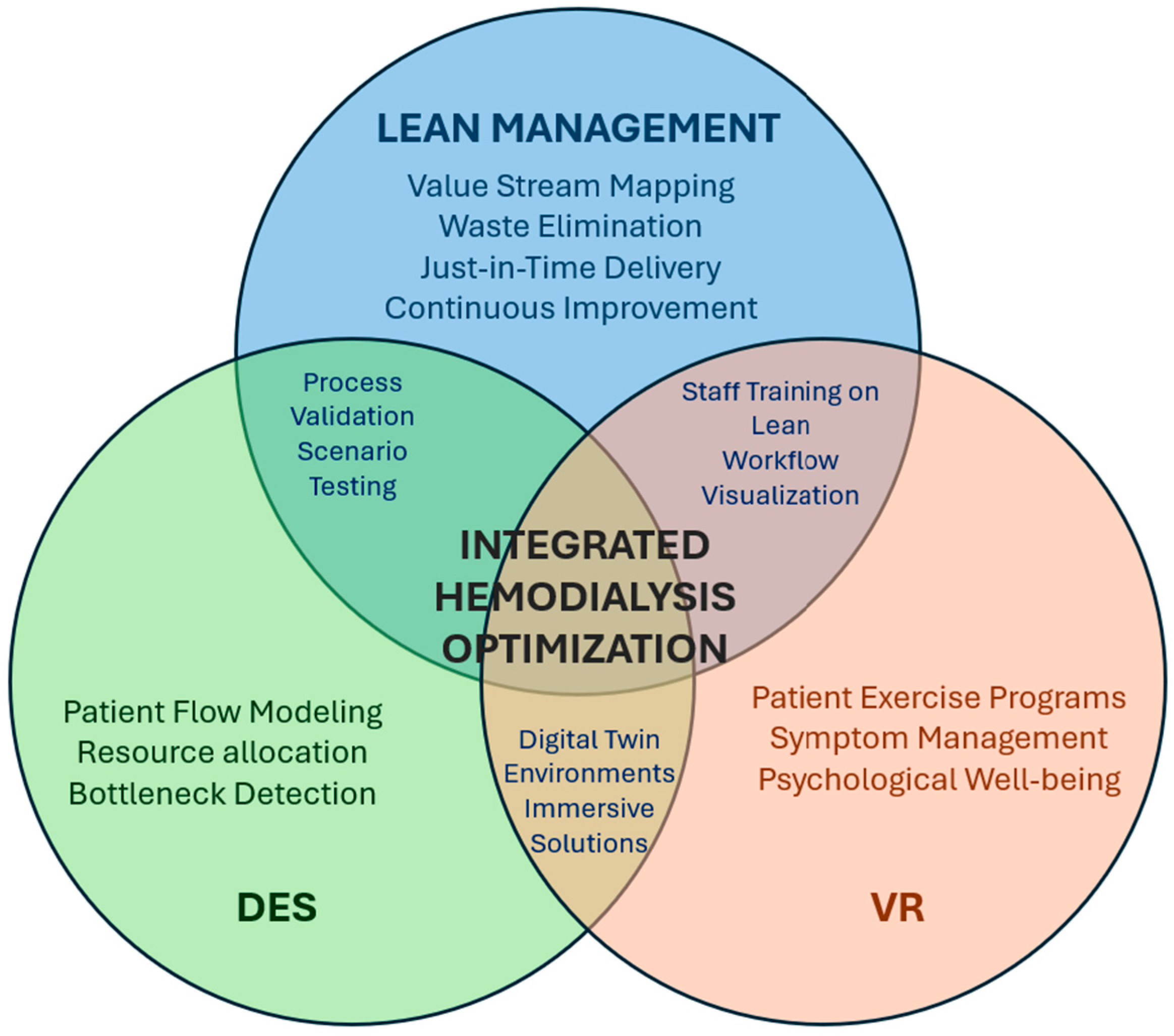
The theoretical rationale for combining DES and VR with Lean management rests on three complementary mechanisms. First, DES addresses the validation gap inherent in Lean initiatives: while Lean tools like value stream mapping identify inefficiencies, they cannot predict how proposed changes will perform under varying conditions. DES enables stakeholders to test process modifications virtually, quantifying expected improvements in patient flow, resource utilization, and wait times before committing resources to implementation. Second, VR tackles the training and adoption gap: resistance to change often stems from staff uncertainty about new workflows. Immersive VR environments allow personnel to practice Lean-optimized procedures in realistic yet risk-free settings, building confidence and competence prior to real-world deployment. Third, the integration of DES outputs into VR creates a feedback loop wherein simulation-derived insights inform training scenarios, and human performance data from VR sessions can refine simulation parameters. This synergistic framework offers a more comprehensive approach to Lean implementation than any single methodology alone.
The literature lacks a comprehensive review of the potential application of Lean management, DES, and VR within hemodialysis units, despite individual explorations of these methodologies in healthcare. This paper aims to address this gap by offering a scoping literature review of the use of Lean management, DES, and VR in hemodialysis units. It seeks to address the following research questions:
  • RQ1. How have Lean management, DES, and VR been applied in the context of a hemodialysis unit, and at what analytical level (organizational improvement, operational modeling, or training/patient support)?
  • RQ2. What outcome domains and performance indicators are reported across studies on Lean, DES, and VR in hemodialysis care, and where do important gaps in outcome assessment remain?
  • RQ3. What barriers have been identified in the implementation of Lean management in hemodialysis or closely related clinical settings?
  • RQ4. What is the theoretical rationale and current empirical basis for integrating Lean management, DES, and VR in hemodialysis operations, and what gaps must be addressed for this integration to be realized?
Several reviews have examined simulation techniques in broader healthcare operations, including hospital process improvement and patient-flow optimization [8,9]. The present review differs in three important respects. First, it focuses specifically on hemodialysis units, which constitute a structurally distinct service environment characterized by recurrent scheduled treatments, relatively fixed session durations, resource constraints linked to chairs and staffing, and a medically complex patient population requiring repeated long-term care [10,11,12]. These characteristics limit the direct transferability of findings from more general outpatient, inpatient, or emergency-department simulation studies. Second, while existing reviews typically examine individual methodological streams, to our knowledge, no prior review has jointly synthesized Lean management, DES, and VR in hemodialysis settings. Third, by foregrounding evidence gaps rather than confirming established effectiveness, this review serves a different function from effectiveness-oriented reviews: it maps what remains untested across methodological approaches and identifies where future integration work is most needed.
This review was conducted as a scoping literature review, following the framework established by Arksey and O’Malley [13] and refined by Levac et al. [14], and reported in accordance with the PRISMA-ScR (Preferred Reporting Items for Systematic reviews and Meta-Analyses extension for Scoping Reviews) guidance proposed by Tricco et al. [15]. A scoping review was selected rather than a systematic review because the primary aim was to map the extent, range, and nature of the evidence across three distinct methodological domains (Lean management, DES, VR), rather than to synthesize outcomes from homogeneous interventions. This design is appropriate given the nascent, heterogeneous, and fragmented nature of the evidence base. Consistent with the exploratory purpose of this scoping review, no prospective protocol was registered prior to conducting the review. The Arksey and O’Malley framework, as refined by Levac et al., guided the procedural decisions related to study identification, selection, charting, and synthesis.
Conceptual Framework. Before describing the search strategy, it is important to clarify the analytical levels at which the three focal approaches operate, as treating them as equivalent would introduce conceptual inconsistency. Lean management is an operational philosophy and continuous improvement mindset originating in manufacturing and adapted to healthcare. DES is a quantitative modeling and analysis methodology used to represent and analyze complex processes over time. VR is a technology platform or interface that enables immersive, interactive environments. These three approaches are neither parallel nor interchangeable; rather, they are potentially complementary across different dimensions of operational improvement. This review, therefore, does not claim that their integration has been validated, but instead maps how each has been applied and where convergences have been attempted. A secondary objective is to conduct a structured evidence gap analysis, systematically identifying domains where evidence is absent, limited to single studies, or methodologically insufficient to support practice recommendations, thereby establishing a clear research agenda for each approach and for their integration.
Search Strategy. Articles were initially identified through targeted search strings focusing on hemodialysis units and each of the three focal approaches.
  • (Hemodialysis OR Dialysis) AND (Lean Management OR Lean Principles OR Lean Methodology OR Lean Thinking)
  • (Hemodialysis OR Dialysis) AND (Barriers) AND (Lean Management OR Lean Principles OR Lean Methodology OR Lean Thinking)
  • (Hemodialysis OR Dialysis) AND (Discrete Event Simulation OR DES)
  • (Hemodialysis OR Dialysis) AND (Virtual Reality OR VR)
  • (Hemodialysis OR Dialysis) AND (Discrete Event Simulation OR DES) AND (Virtual Reality OR VR)
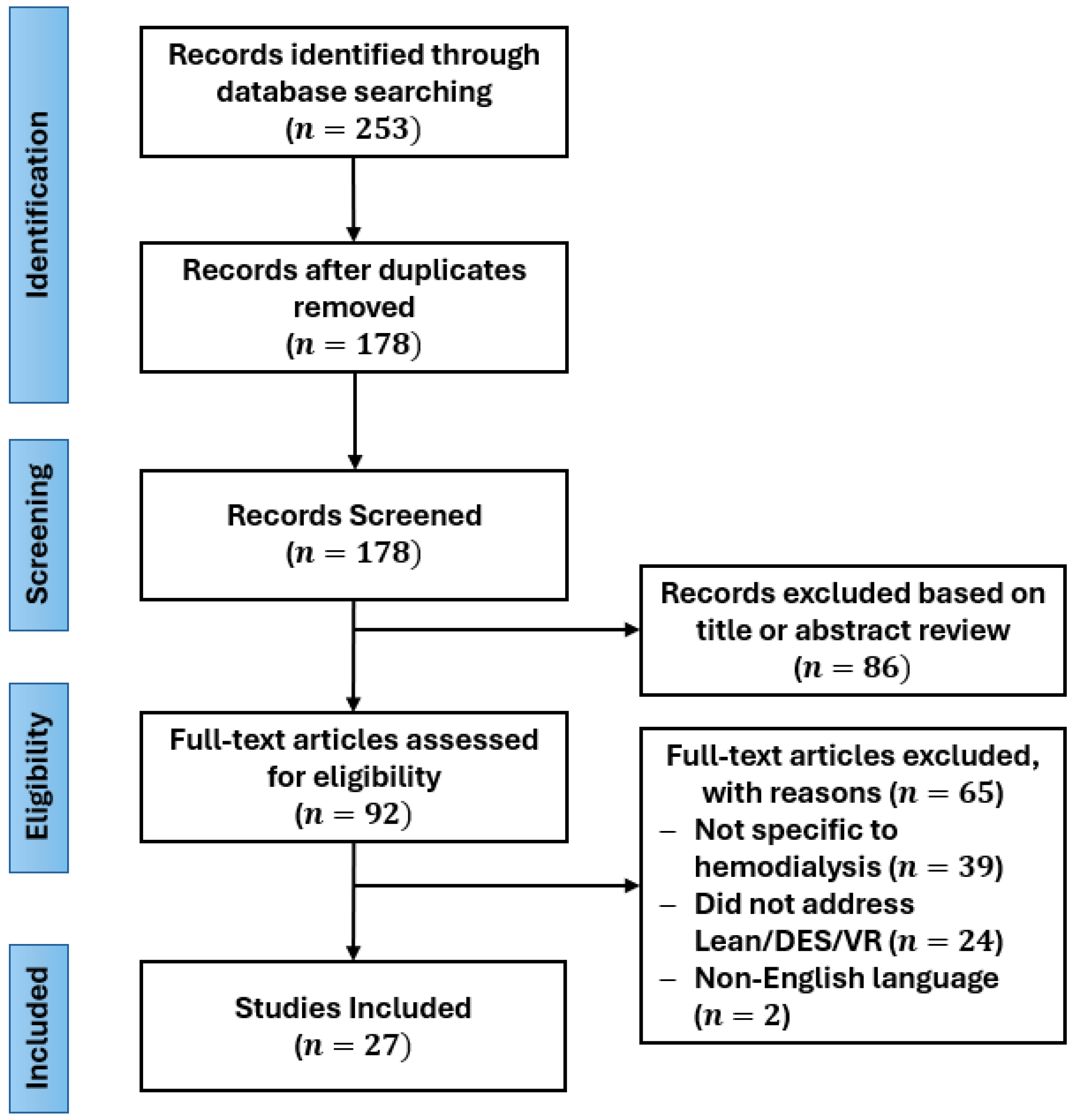
The search utilized a variety of online resources, including digital libraries such as SpringerLink, IEEE Xplore, and ACM Digital Library, indexing databases such as Scopus and PubMed, and Google Scholar, with a final search date of 30 June 2024. Title/abstract screening and full-text screening were conducted by the first author using the predefined eligibility criteria (Table 1), with decisions and extracted information subsequently checked against the full text and reviewed during manuscript preparation by co-authors. Reasons for exclusion at the full-text stage were recorded and grouped into the categories reported in Figure 1.
Inclusion and Exclusion Criteria. Table 1 provides the explicit inclusion and exclusion criteria applied at each stage of screening.
Data Extraction. For each included study, the following information was extracted: (1) author(s) and year; (2) study design; (3) primary approach (Lean, DES, VR, or combined); (4) setting and country; (5) reported operational or patient outcomes; (6) key findings relevant to the RQs. Data extraction was performed using a standardized extraction template and verified against the full text of each included article.
Synthesis Approach. Given the heterogeneity of study designs and outcomes, a thematic narrative synthesis was employed. Studies were grouped by primary approach, and within each group, findings were analyzed for recurring themes, outcome patterns, and reported limitations. No formal meta-analysis was conducted, as the diversity of outcome measures and study contexts precluded quantitative pooling. Study quality was not formally appraised using a standardized tool (e.g., CASP, GRADE), as is consistent with scoping review norms; however, methodological limitations of individual studies are noted where relevant in the narrative.
For the RQ-driven synthesis in Section 3, extracted findings were additionally coded by analytical level, primary outcome domain (operational, patient-centered, staff-related/workforce, economic, and safety/training), and evidence status (recurrent, dominant, limited, or absent), enabling cross-study comparison across methodological approaches while remaining consistent with scoping review methodology.
Duplicate records retrieved from multiple sources were removed prior to screening using a combination of reference-manager matching and manual verification.
Figure 1 depicts the search and selection process in a PRISMA-ScR flow diagram.
Excluded Studies: At the full-text stage, 65 studies were excluded. Exclusion reasons were recorded and grouped into three categories as shown in Figure 1: not specific to hemodialysis (n = 39), did not address Lean, DES, or VR (n = 24), and non-English language (n = 2).
Table 2 provides an overview of the studies categorized by their primary application areas within hemodialysis units.
The remainder of this article is organized as follows: Section 2 offers a literature overview, covering topics such as the application of Lean management, DES, and VR in hemodialysis units. Section 3 highlights the results, and Section 4 outlines the conclusions drawn and identifies research opportunities.

2. Literature Review

In this section, we delve into the diverse strategies for implementing Lean management within hemodialysis units. We examine the challenges encountered during Lean implementation and explore potential solutions, particularly focusing on the utilization of DES and VR technologies. Furthermore, we explore the specific applications of DES and VR within the context of hemodialysis units.

2.1. Lean Management

2.1.1. Applications of Lean Management in Healthcare

The adoption of Lean methodologies fosters a culture of continuous improvement within healthcare settings [3]. By encouraging iterative problem-solving and empowering frontline staff to contribute to process optimization, Lean practices pave the way for sustained enhancements in quality of care and operational performance [4,16]. In essence, the convergence of team engagement, innovative methodologies such as business games and DES, and a commitment to Lean principles exemplifies a comprehensive approach to driving positive change in healthcare delivery [17]. Through ongoing dedication to improvement initiatives, healthcare organizations can aspire to achieve even greater levels of efficiency, effectiveness, and patient satisfaction [18,19].

2.1.2. Applications of Lean Management in Hemodialysis Units

Lean principles have been adopted across various hemodialysis contexts to streamline operations, reduce waste, and ultimately enhance both patient outcomes and staff satisfaction. Benfield et al. [20] and Hingwala et al. [10] both leverage Lean principles to enhance efficiency in hemodialysis settings. Benfield et al. [20] focus on continuous renal replacement therapy (CRRT), identifying and mitigating medication waste through the integration of Lean principles. The implementation results in reduced waste, cost savings, and improved staff satisfaction. A manual audit revealed significant waste in unused CRRT solution bags, prompting the use of value stream mapping to identify inefficiencies in the CRRT preparation workflow. To address these gaps, the team shifted reordering responsibilities from ICU nurses to pharmacy technicians, aligning with the principle of just-in-time delivery. They also introduced an educational program that fostered direct communication between nursing and pharmacy staff regarding changes in patients’ conditions or CRRT orders. As a result, the average number of CRRT solution bags dispensed per CRRT day dropped notably, and both overall and component-specific satisfaction scores for the solution preparation process improved. Nurses and pharmacy staff reported reduced workloads, and projected annual cost savings exceeded $70,000 due to decreased solution waste. Ultimately, this intervention significantly enhanced the efficiency and effectiveness of CRRT workflows.
Hingwala et al. [10], on the other hand, address the global variability in dialysis provider efficacy, proposing strategies such as balanced scorecards, process mapping, and Lean principles to enhance efficiency and quality in facility-based hemodialysis units. These initiatives typically begin with stakeholders documenting each step of the process and identifying waste, i.e., resources used without adding direct value to patient care. Key Lean tools, such as process and value stream mapping and the concept of takt time, guide the identification and removal of non-value-adding activities. For instance, one dialysis unit adopted more predictable start and end times, implemented staggered scheduling to reduce patient clustering, aligned nurse tasks with appropriate roles, and improved staff engagement, all of which helped shorten waiting periods and raised overall satisfaction among both patients and staff. Moreover, by standardizing operating procedures and delegating clerical and logistical tasks to lower-cost personnel rather than specialized nursing staff, the unit further streamlined operations and optimized resource utilization.
In Cruz et al. [11] the COVID-19 crisis prompted a specific application of Lean principles within a hemodialysis unit, as presented in a contingency plan. An integrated information system was established to ensure orders were processed promptly and appropriately, striving for optimal product quality in the shortest time at the lowest cost. This approach prioritized a balanced workload to alleviate staff stress, complemented by a continuous flow of information that enabled immediate responses. From the patient’s perspective, “not infected” and “no contact” were defined as key value measures. To achieve these objectives, exclusive task roles were eliminated, and team members used shared Excel and Word documents accessible via VPN, creating a simple yet dynamic platform for real-time consultations and a comprehensive overview of unit operations. This setup minimized classification errors and helped sustain uniform unit management, even as several healthcare personnel were on sick leave, ultimately limiting virus spread among patients.
In Tombocon et al. [12], a Lean-thinking transformation framework guided a system-wide redesign project to increase home-based dialysis therapy rates by centering on patient needs, engaging healthcare workers, and adopting an incremental continuous improvement philosophy. Three multidisciplinary groups led the redesign and implementation, aiming to enhance value for patients by minimizing waste and errors. After evaluating the existing state, a “future” state pathway was established, coupled with a nurse-led outreach service to deliver prompt, consistent, and frequent education and patient support. A new, innovative “Hybrid Self-Care” model addressed patients historically deemed “unsuitable” for home therapies. This initiative successfully achieved a >30% prevalence of home-based therapies (mainly peritoneal dialysis) within two years, rising to 35% by the third year and remaining stable at eight years. The time from nephrologist referral to initial patient contact consistently stayed under seven days, and patients were referred earlier in their disease progression. As uptake of peritoneal dialysis (PD) grew and access to catheter insertion improved, more than 50% of new dialysis patients chose PD as their initial modality. Ultimately, the redesigned model of care became standard practice, underscoring the framework’s effectiveness in delivering sustainable improvements. Table 3 provides an overview of the Lean principles identified in the reviewed hemodialysis studies, illustrating how each principle is applied.
Despite varying focal points, ranging from CRRT supply management to home-based dialysis expansions, these studies share core Lean tenets: mapping out current processes, targeting waste and inefficiencies, centering improvements on patient needs, and engaging multidisciplinary teams. Whether the emphasis is on just-in-time delivery of CRRT solutions, streamlined scheduling in in-center hemodialysis, or expansion of home-based therapies, each example demonstrates how Lean-driven initiatives can yield tangible benefits: reduced costs, improved patient outcomes, heightened staff satisfaction, and greater operational resilience. Collectively, these findings reinforce Lean management’s adaptability and potential for transformative impact across different hemodialysis environments.

2.2. Lean Barriers

2.2.1. Lean Barriers in Healthcare

Lean barriers in healthcare, as documented in several studies [8,21,22,23], present significant challenges for its adoption in specialized settings like hemodialysis units. Broadly, these challenges can be categorized into four themes: mobilizing employees, guiding change efforts, methods, and local context [24]. Issues under mobilizing employees include insufficient staff empowerment and engagement due to overreliance on Lean experts and top-down leadership, while guiding change is hampered by limited resource allocation and inadequate commitment from leaders. Methodological challenges encompass the deceptively simple nature of Lean tools that nonetheless demand intense effort and lack sufficient follow-up, and local context barriers arise from scarce organizational resources to invest in Lean initiatives. Leite et al. [25] elaborate on these obstacles by classifying them into technical aspects, such as processes, technology, training, and resources, and cultural factors, including strategy, leadership, and behavior, emphasizing that Lean is a journey requiring patience and behavioral change, as shown in Table 4. Additionally, de Souza and Pidd [26] provide a comparative analysis that reveals the slower pace of Lean implementation in healthcare relative to manufacturing, underscoring the need for adaptation to the unique challenges faced in clinical settings. In sum, while Lean methodologies hold promise for transformative improvements, their effective implementation in healthcare demands targeted strategies to overcome both technical and cultural barriers.

2.2.2. Lean Barriers in Hemodialysis Units

While extensive literature exists on barriers to Lean management in healthcare broadly, no study has investigated Lean barriers specifically within hemodialysis units as its primary focus. The content of this section, therefore represents inferred barriers, extrapolated from incidental reporting within the four Lean-application studies reviewed in Section 2.1.2 (Benfield et al. [20]; Hingwala et al. [10]; Cruz et al. [11]; Tombocon et al. [12]). These papers were not designed as barrier-analysis studies; the challenges they describe emerged as secondary observations within their respective intervention contexts. Readers should interpret the barriers discussed here as exploratory and hypothesis-generating rather than as a systematic evidence base. This gap, the complete absence of hemodialysis-specific Lean barrier research, is itself a significant finding of this review and a priority area for future investigation.
Implementing Lean management in hemodialysis units faces a range of barriers that span operational, technological, and systemic challenges. In this section, we review the diverse obstacles identified across multiple studies, from labor-intensive data collection processes and variable workflow conditions to broader issues such as misaligned incentives, resource constraints, and the difficulties of transitioning from conventional models to innovative care strategies.
In Benfield et al. [20], a key challenge during data collection was the labor-intensive process of manually tracking unused CRRT solution bags, compounded by missing data when many bags were discarded at the bedside instead of being returned to the pharmacy. Additionally, there were concerns that redistributing the workload could overwhelm pharmacy technicians following the intervention; however, this potential issue did not materialize, as satisfaction in that group even increased. Stakeholders also explored increasing the number of available CRRT solution concentrations to minimize additive use and subsequent waste caused by the 12-h post-manipulation expiry but ultimately rejected this idea due to patient safety concerns linked to the absence of commercially available phosphate-containing CRRT solutions in the United States, given that hypophosphatemia is a known complication. The study further acknowledges that the lack of barcode-assisted medication administration limited data collection to distribution figures, using them as a surrogate for actual usage and waste.
Hingwala et al. [10] discusses general challenges to enhancing efficiency and quality in dialysis units, emphasizing significant variability in the implementation of established interventions. The study attributes this variation to factors such as nephrologist preferences, differing incentives and reimbursement structures, and limited availability of expertise, which all contribute to disparities in continuous quality improvement efforts, setting quality indicators, data monitoring, and incorporating performance targets in reimbursement. Within individual dialysis units, fluctuating patient demands, variable treatment times, and changes in staff availability further complicate scheduling and patient flow. The source also warns that if new systems, like cycled treatment steps, create an assembly-line approach to care, patient experience may suffer; therefore, incorporating patient input is critical. Additionally, the report highlights the importance of aligning nursing skills with appropriate tasks and avoiding the misallocation of nurses to clerical or logistical duties that could be managed by less specialized staff, thereby preventing resource waste.
In Cruz et al. [11], the source highlights how limited resources and disrupted information exchange during the COVID-19 crisis necessitated the application of Lean principles to streamline processes within the hemodialysis unit. A significant barrier was the high absenteeism rate among healthcare personnel, 23.6% on sick leave, which severely challenged the unit’s ability to maintain consistent management. Furthermore, the rapidly evolving pandemic and accompanying recommendations required swift operational adjustments, compounding these difficulties.
In Tombocon et al. [12], the authors emphasize the challenges of transitioning from traditional in-centre or satellite hemodialysis models to home-based therapies, noting that longstanding preferences within Australasian health networks act as barriers to a “Home before Hospital” approach. Their review of the current patient pathway revealed inconsistent and minimal patient education throughout CKD progression, a critical gap that must be addressed to promote home-based care. Specific hurdles for home hemodialysis include patient anxiety over self-cannulation, uncertainty about accessing medical support, fears of making errors, and concerns about imposing a burden on caregivers. Additionally, potential disruptions to existing funding models for satellite dialysis care present further obstacles to sustaining the Hybrid Self-Care model. Finally, the authors highlight the absence of systematically collected patient-reported outcomes, such as quality of life and satisfaction with care decisions, in current registries and KPIs, which complicates the full evaluation of these changes from the patient perspective.
While Lean initiatives hold promise for improving efficiency and patient outcomes in hemodialysis settings, significant barriers persist as outlined in Table 5. Challenges such as manual data tracking limitations, fluctuating workloads, staffing issues, and resistance to operational change underscore the complexity of applying Lean principles in real-world healthcare environments. Moreover, factors like inconsistent patient education, concerns over resource reallocation, and the lack of systematic patient-reported outcomes further complicate implementation. Addressing these barriers will require targeted strategies, including enhanced technology integration, continuous stakeholder engagement, and robust performance monitoring, to ensure that Lean practices are both effective and sustainable in the evolving context of hemodialysis care.
While the barriers synthesized in Table 5 provide a useful preliminary framework, it must be emphasized that they are inferred from a small set of studies not designed to investigate barriers as a primary outcome. The transferability of these findings across different hemodialysis unit contexts, which vary considerably in size, staffing model, funding structure, and regulatory environment, remains unvalidated. A dedicated, primary qualitative or mixed-methods study investigating Lean barriers specifically in hemodialysis units is a necessary next step for the field.

2.3. Discrete Event Simulation

2.3.1. Applications of Discrete Event Simulation in Healthcare

DES holds significant importance in healthcare, offering a valuable tool for optimizing operations and improving patient care [27,28]. By modeling the complex processes involved in healthcare procedures, DES allows researchers and healthcare professionals to simulate various scenarios and assess the potential impact of process changes or interventions [8]. This enables the identification of bottlenecks, inefficiencies, and resource constraints within healthcare units, facilitating informed decision-making for process improvement initiatives. Additionally, DES can help in capacity planning, resource allocation, and scheduling optimization, thereby enhancing the overall efficiency and effectiveness of hemodialysis unit operations [29]. Furthermore, DES provides a platform for evaluating the potential effects of policy changes, technology implementations, or workflow modifications, enabling stakeholders to anticipate and mitigate potential risks before implementation [9,30]. In essence, DES serves as a powerful tool for enhancing operational performance, resource utilization, and patient outcomes in hemodialysis units, contributing to the advancement of healthcare delivery in this critical domain [31,32].

2.3.2. Applications of Discrete Event Simulation in Hemodialysis Units

In this review, ‘hemodialysis context’ includes studies conducted in hemodialysis units as well as closely related renal service-system studies (e.g., dialysis access, scheduling, capacity planning, and renal replacement service delivery) where findings are operationally relevant to hemodialysis unit operations. Studies outside this scope were excluded.
Two studies employ DES models to address aspects of kidney transplantation systems, emphasizing organ generation, allocation, and the impact on waiting lists. Shoaib et al. [33] focus on the kidney transplantation system in Rajasthan, India, utilizing simulation optimization to determine optimal transplantation center locations. Their model extends beyond allocation policies to tackle logistical challenges, providing insights into patient transplant probabilities and the influence of organ arrival rates. Significant findings reveal lower transplant probabilities for AB group patients and increased unallocated organs with higher arrival rates. The study emphasizes the importance of such models in India’s evolving transplantation infrastructure, highlighting the critical need for public awareness programs to boost organ donation rates. Abellan et al. [31], on the other hand, investigate the renal transplant waiting list in Pais Valencia, Spain. Their model integrates patient arrivals and donation processes, employing Bayesian inference to address uncertainties in key parameters. The study predicts a reduction in the waiting list size in the short and medium term. Additionally, comparative analysis underscores the importance of considering output variance in expected simulations. Both studies contribute valuable insights into optimizing kidney transplantation systems through simulation modeling, with Shoaib et al. [33] focusing on logistical challenges and optimization methods in India, while Abellan et al. [31] address parameter uncertainties and waiting list dynamics in Spain.
Various studies explore diverse methodologies for modeling and simulating healthcare systems, with a common focus on addressing the complexities inherent in-patient treatment and healthcare planning. Snowsill [32] introduces a novel health economic modeling framework based on moment-generating functions (MGFs), emphasizing efficiency in calculating discounted life years while accommodating various health states and competing risks. In contrast, Davies & Davies [34] emphasize the utility of DES models for patient flow analysis, highlighting their ability to capture individualized patient attributes and resource interactions, especially in systems with constraints. They acknowledge the trade-off of increased time consumption but emphasize the flexibility of DES models in large-scale healthcare systems. Davies [35] advocates for DES as the most suitable technique for modeling patient treatment systems, criticizing existing models for their limited subsystem scope and lack of robustness. The paper underscores the importance of accurately defining system boundaries and selecting an appropriate modeling technique, emphasizing characteristics such as user credibility, robustness, and ease of use. While Snowsill’s MGF method [32] and Davies & Davies’ DES approach [34] cater to different aspects of healthcare modeling, both emphasize the need for advanced techniques to address the complexities of healthcare systems, albeit from different perspectives.
Both Tofighi et al. [36] and Allen et al. [37] address the impact of the COVID-19 pandemic on hemodialysis patients, utilizing DES models to analyze and optimize healthcare operations. Tofighi et al. [36] employ a combination of DES and agent-based simulation models to assess the spread of SARS-CoV-2 in dialysis units, specifically focusing on contact matrices and outbreak scenarios. Their micro-scale approach reveals diverse contact patterns among agents during a workday, providing crucial insights for virus transmission dynamics and workflow optimization. Allen et al. [37] introduce two simulation modeling tools aimed at organizing hemodialysis unit operations during the pandemic, stress-testing plans for the worst-case spread of COVID-19. Their DES models evaluate the impact on outpatient and inpatient workloads, emphasizing the need for patient reallocation and potential overflow to secondary sites. Both studies highlight the importance of DES in addressing the unique challenges posed by the pandemic in dialysis settings, offering insights into disease transmission dynamics, resource allocation, and patient transport services. While Tofighi et al. [36] specifically focus on micro-scale contact matrices, Allen et al. [37] emphasize the broader organizational challenges and stress-testing of healthcare systems during the pandemic.
A broad spectrum of applications of DES in hemodialysis and related healthcare scenarios can be identified in the literature, as illustrated in Table 6. For instance, Glorie et al. [38] embed a Markov model within a DES framework to assess outcomes of kidney exchange programs (KEPs), underscoring the potential health gains of altruistic donation. Jridi et al. [39] focus on end-stage renal failure (ESRF) patients, using a DES approach to highlight an annual increase in the number of individuals requiring hemodialysis, peritoneal dialysis, or kidney transplantation. Addressing workflow inefficiencies at a more localized level, Sinaki [40] demonstrates that targeted enhancements to Winnipeg’s hemodialysis processes can yield up to a 31% improvement in key performance indicators. Meanwhile, Drew et al. [41] use decision analysis (rather than pure DES) to evaluate vascular access strategies, considering variables such as cost and patient mortality, concluding that an arteriovenous fistula attempt strategy can be optimal depending on patient characteristics. In a broader systems-engineering context, Kopach-Konrad et al. [42] discuss how these tools (including DES) may transform healthcare environments, including dialysis facilities, whereas Davies [43] and Davies [44] show how DES can forecast demand and address unmet treatment needs for irreversible kidney failure. Collectively, these studies support the position that DES is a powerful and adaptable tool for health-services modeling and decision-making, with common focal points on system improvement, patient outcomes, and resource optimization.
Despite the promise of these diverse DES applications, multiple gaps remain. While national-level demand projections have been conducted [43] and local unit efficiency analyzed [40], which have advanced the field, there is relatively little work that integrates high-level projections with day-to-day operational modeling in smaller dialysis units, where population size and treatment variability may introduce significant uncertainties. Moreover, only a handful of studies explicitly investigate the interaction between vascular access type (e.g., fistula, graft, catheter) and operational considerations within DES frameworks, even though vascular access decisions substantially influence unit workflows and patient outcomes. Drew et al. [41] highlight the potential value of simulating different access pathways, but a full-scale DES analysis capturing these complexities is missing.
In addition, although patient age and comorbidities are often recognized in national demand models [43], the literature provides limited examples of granular simulations linking individual patient characteristics to hemodialysis duration, nursing needs, and resource utilization, a point partially addressed by Sinaki [40] regarding patient variability and the absence of a needs-based classification system. The reliability of existing DES forecasts also depends heavily on assumptions about patient arrivals and transitions, which can be highly variable in real-world contexts [43]. Many models either underestimate capacity constraints or assume unlimited facility availability, thus oversimplifying actual bottlenecks. Localized case studies such as those of Tunisian [39] and Canadian [40] dialysis units offer valuable insights but are not yet generalized for broader, system-wide adoption.
Finally, the integration of cost-effectiveness analysis, particularly using metrics like Quality-Adjusted Life Years (QALYs), into DES models of hemodialysis unit operations appears limited in the reviewed literature, with the exception of its application in kidney exchange programs [38]. Incorporating health-economics outcomes alongside DES models would help decision-makers evaluate not only operational performance but also the broader value and sustainability of different hemodialysis unit operations’ configurations.
Synthesizing across DES studies, the operational performance metrics reported include patient wait times (Sinaki [40]), resource utilization and capacity constraints (Davies [43,44]), patient throughput and volume projections (Jridi [39]), transmission and outbreak probability (Tofighi et al. [36]; Allen et al. [37]), and health-economic outcomes such as QALYs (Glorie et al. [38]). Notably absent from most studies are simultaneous reporting of multiple performance dimensions, such as combining wait times with staff workload and chair utilization in a single model, which would more fully characterize unit efficiency. This gap limits the ability to draw generalizable conclusions about optimal configurations for hemodialysis units.

2.4. Virtual Reality

2.4.1. Applications of Virtual Reality in Healthcare

VR emerges as a pivotal tool in healthcare, offering innovative solutions to address various challenges and enhance patient care [45]. It is being explored and implemented across various domains, including surgical procedures [46] (such as remote surgery or telepresence, augmented or enhanced surgery, and pre-surgical procedure planning and simulation), medical therapy, preventive medicine and patient education, medical education and training, visualization of extensive medical databases, skill enhancement and rehabilitation, as well as architectural design for healthcare facilities [47]. Thus far, these applications have demonstrated enhancements in healthcare quality, with future projections indicating substantial cost reductions. Ongoing efforts focus on refining existing tools and developing new ones to meet the evolving needs of virtual environment systems [48].
VR applications include communication interfaces with presence and avatar features, medical education through training simulations, and surgical simulations across various fields such as neurosurgery, laparoscopic and endoscopic procedures. Additionally, VR is used in simulators for training purposes and in therapeutic settings [49,50].
VR is extensively used in psychiatry for various purposes [51]. In the realm of anxiety disorders, VR is employed for both assessment and treatment, including real-time monitoring of bio-signals during exposure therapy. It is effective in addressing phobias such as aerophobia, arachnophobia, driving phobia, and claustrophobia, as well as social anxiety disorders through VR-based cognitive-behavioral therapy (CBT). VR is also beneficial for individuals with panic disorder and agoraphobia, obsessive–compulsive disorder, and generalized anxiety disorder. In the context of post-traumatic stress disorder, VR is utilized to assist soldiers who have experienced war and survivors of terrorism. Additionally, VR aids in the analysis of psychotic symptoms, neurocognitive evaluation, and assessment of daily activities in individuals with psychosis. In child and adolescent psychiatry, VR is employed for attention training, social skills training, cognitive rehabilitation, and education among non-clinical groups, including those with attention deficit/hyperactivity disorder (ADHD) and autism spectrum disorder (ASD). Furthermore, VR-based cue exposure therapy proves beneficial for individuals with addiction and eating disorders.
VR plays a significant role in healthcare with applications including VR exposure therapy (VRET) and VR distraction therapy (VRDT) [52]. It is also utilized in cognitive and physical rehabilitation, surgical planning and performance, as well as a diagnostic tool for various medical purposes.
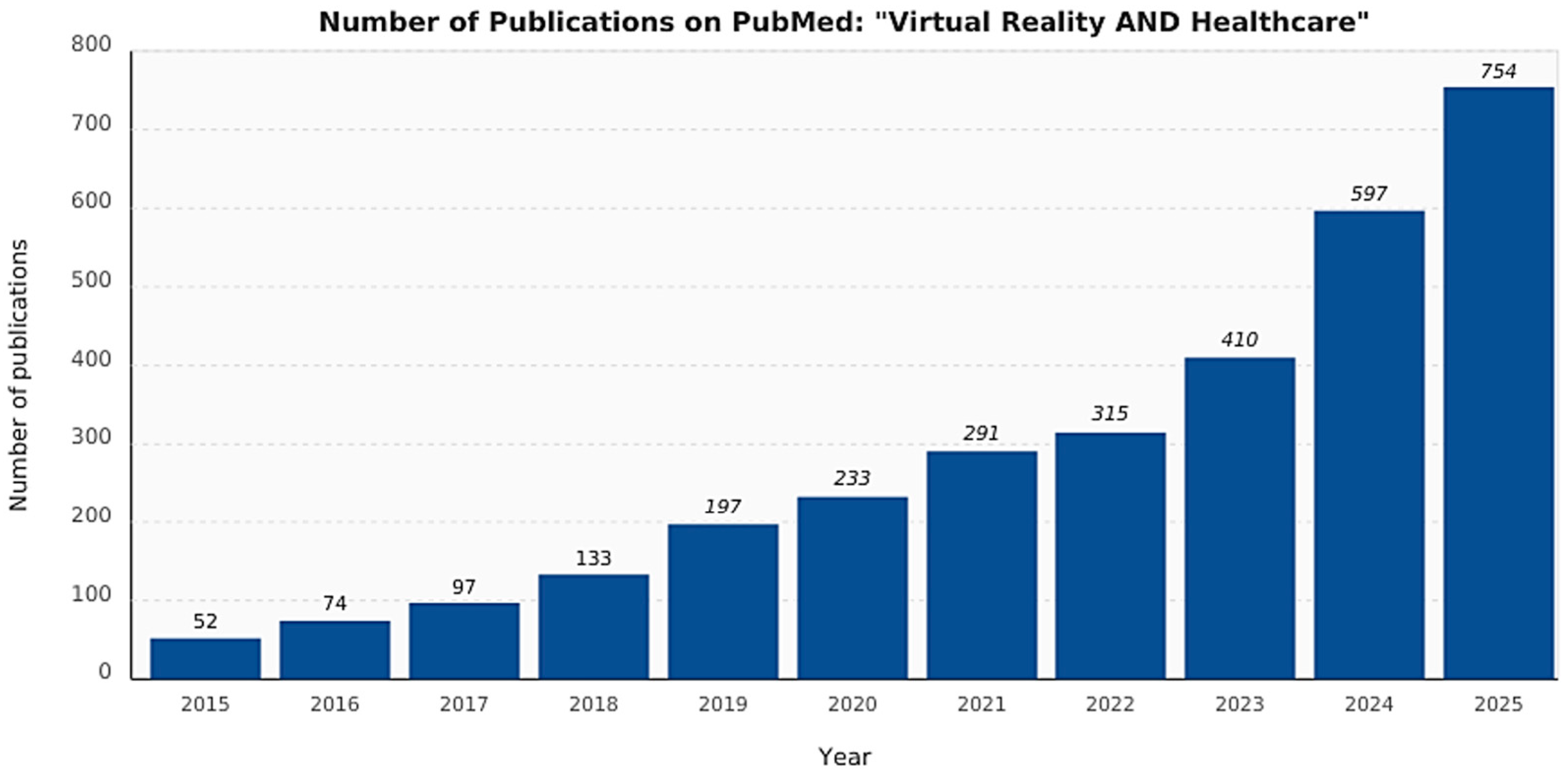
VR has also been implemented in hospital design projects [53]. It can influence the design outcome of a hospital building, depending on the phase of the design process in which it is employed. Earlier phases predominantly involve macro changes related to building structure, while later phases address micro changes concerning non-structural elements like logistical workflow and the placement of medical equipment. Between 2015 and 2025, a PubMed search for the term “Virtual Reality AND Healthcare” showed a marked increase in the number of indexed publications (Figure 2). This figure is included as contextual background on the broader growth of VR in healthcare literature and not as evidence of VR effectiveness in hemodialysis unit operations.

2.4.2. Applications of Virtual Reality in Hemodialysis Units

Healthcare for patients with chronic renal disease (CKD) has been associated with high levels of direct and indirect resource consumption at 2–3 times higher than control patients without CKD, and at up to 40 times higher for HD patients [54]. Studies have shown that patients with ESKD, which has a high incidence and prevalence among patients getting renal replacement therapy (RRT), have higher morbidity and mortality rates than the general population [55]. Furthermore, patients with CKD had higher mortality rates while physically inactive and may live longer if they engage in more physical activity [56].
This section provides a comprehensive overview of seminal studies investigating the application of VR in hemodialysis, each offering unique insights into the potential benefits and challenges associated with this technology.
Before reviewing the literature, it is important to draw a conceptual distinction that shapes the interpretation of the findings. Within this review, VR applications in hemodialysis span two distinct purposes: (1) patient-centered VR, used to enhance the patient experience during dialysis sessions through distraction, exercise, meditation, or rehabilitation, and targeting clinical or psychological outcomes such as fatigue, depression, quality of life, and frailty; and (2) operational/training VR, used to model or simulate hemodialysis unit workflows, staff training environments, or system configurations for operational improvement. The vast majority of identified studies fall into the first category. This distinction is significant because patient-centered VR, while clinically valuable, does not directly address the operational improvement objectives associated with Lean management or DES. The VR evidence in this review, therefore, demonstrates feasibility and patient acceptance in dialysis settings, but does not yet substantiate VR as an operational or training tool in the same sense as DES. Such studies were retained because this scoping review maps the full dialysis-context VR evidence base while explicitly distinguishing patient-centered applications from operational/training uses.
In their pioneering work, Burrows et al. [57] delve into the immersive realm of VR, introducing a Simulator Sickness Questionnaire to gauge the degree of sickness before and after VR experiences. The study, conducted through a single-arm pre-post pilot, unveils that a fully immersive VR program, focused on meditation, enhances patient experiences without exacerbating symptoms. Patients reported a notable decrease in symptoms after just a 20-min VR session, advocating for the safety and efficacy of immersive VR interventions. Francisco et al. [58] contribute to this narrative through a crossover randomized controlled trial, exploring non-immersive VR interventions. Their study introduces a range of physical performance tests, including gait speed, balance assessments, and walking tests. The findings underscore the potential of non-immersive VR exercise programs to improve patient physical function during hemodialysis sessions, shedding light on the broader implications for hemodialysis patients. Zhou et al. [59] take a nuanced approach by conducting a secondary analysis of a clinical trial, focusing on the impact of non-immersive, virtually supervised intradialytic exergames. Addressing depression symptoms, the study introduces a feasible alternative to nurse-supervised exercises, reducing the burden on dialysis clinics while maintaining effectiveness. This research pioneers the integration of technology to address mental health aspects during routine hemodialysis. In a quasi-experimental study, Chou et al. [60] explore the application of a non-immersive VR program using Nintendo® Wii Fit. Their novel Fatigue Scale for Hemodialysis assesses various fatigue domains, revealing no significant differences in overall fatigue between experimental and control groups. This study contributes valuable insights into the impact of VR-based exercise training on fatigue among ESRD patients, expanding our understanding of the potential benefits.
Maynard et al. [61] shift the focus to non-immersive VR combined with physical exercises in a randomized controlled study. Investigating functional capacity, quality of life, and depressive symptoms, the study spans 12 weeks, illustrating that this combined approach improves multiple domains of hemodialysis patients’ lives. The findings highlight the holistic benefits of integrating VR into physical training interventions during hemodialysis sessions. Garcia-Testal et al. [62] present a pilot sub-study of a clinical trial, investigating hemodynamic control during exercise with non-immersive VR. The study records blood pressure, heart rate, and intradialytic hypotensive events, concluding that exercising with VR during the last 30 min of hemodialysis is safe and does not induce hemodynamic instability. This is a critical insight, broadening the scope for encouraging patients to exercise during hemodialysis sessions. Segura-Orti and García-Testal [63] and Hernandez et al. [64] introduce immersive VR interventions with an emphasis on specific programs, such as a Treasure Hunt game and the Joviality VR program, respectively. While Segura-Ortí and García-Testal [63] showcase improvements in physical activity levels, health-related quality of life, and safety during acute VR exercise sessions, Hernandez et al. [64] emphasize the reduction in symptoms without adverse effects, underlining the potential safety of VR platforms for dialysis patients.
Caballer et al. [65] extend the exploration to frailty mitigation, utilizing a non-immersive VR video game adapted to dialysis sessions. The ongoing study aims to assess the impact of VR exercise programs on frailty in the hemodialysis population. This opens a new frontier in understanding how VR can contribute to managing frailty-related challenges in hemodialysis patients. Building on the economic perspective, Segura-Orti et al. [66] conduct a cross-randomized controlled trial to evaluate the impact of non-immersive VR exercise programs on resource consumption and costs. This study provides essential insights into the potential cost reductions associated with VR interventions, shedding light on the economic viability of incorporating VR into routine hemodialysis care. Cho and Sohng [67] and Hsieh et al. [68] contribute to the discourse through their studies focusing on non-immersive and immersive VR, respectively. Cho and Sohng [67] report positive effects on physical fitness, body composition, and fatigue in HD patients through a non-immersive VR program. Hsieh et al. [68] explore the use of immersive VR headsets to watch nature videos, unveiling the positive psychological responses among dialysis patients.
Detailed information about the use of VR in hemodialysis units, including sample size, VR type, settings, outcome measures, and findings, can be found in Table 7.

2.4.3. Comparative Analysis of Virtual Reality in Hemodialysis Studies

The reviewed studies on the application of VR in hemodialysis units share common objectives of improving patient outcomes and addressing the challenges associated with the dialysis experience. Despite differences in VR types (immersive vs. non-immersive), sample sizes, and methodologies, there are noticeable trends in the findings and implications of these studies. Of the 13 included VR studies, five employed randomized or cross-randomized controlled designs [58,61,63,65,66], three were pilot or single-arm proof-of-concept studies [57,62,64], two were secondary analyses of clinical trials [59,69], and three used quasi-experimental or preliminary designs [60,67,68]; all were conducted at a single site. Regarding immersiveness, three studies used fully immersive VR [57,64,68], while ten employed non-immersive platforms [58,59,60,61,62,63,65,66,67,69].
Consistent findings highlight the positive impact on patient well-being, as shown in studies by Burrows et al. [57], Francisco et al. [58], and Maynard et al. [61]; the use of VR, whether immersive or non-immersive, contributes to decreased symptoms, improved physical function, and enhanced quality of life during and after hemodialysis sessions. The studies highlight the viability and safety of VR interventions within hemodialysis settings, exemplified by García -Testal et al. [62,69] and Segura-Ortí and García-Testal [63], affirming the safety of exercising with VR during hemodialysis. Additionally, explorations into frailty mitigation, exemplified by Caballer et al. [65] and Segura-Orti et al. [66], demonstrate the potential of VR exercise programs in managing frailty-related challenges. Moreover, the gamified nature of VR appears to boost engagement and adherence relative to standard exercise protocols, which often face barriers like limited on-site physiotherapist availability and patient fatigue.
The broad utilization of VR types, spanning from immersive experiences [57,68] to non-immersive interventions [59,67], introduces a nuanced aspect that affects both patient experience and the practicality of interventions. Various outcome measures, from symptom reduction to targeted assessments like depression symptoms [59], physical activity levels and health-related quality of life (HRQoL) [63], and fatigue, nausea, lightheadedness, and headaches [64], showcase the diverse effects of VR on hemodialysis patients. Differences in duration and adherence to VR interventions emerge, with structured programs like Cho and Sohng’s [67] 8-week intervention contrasting with shorter, three-week approaches such as Hsieh et al.’s [68]. Meanwhile, cost assessments by García -Testal et al. [69] reveal the potential economic advantages of VR adoption, including decreases in healthcare resource use.
Despite promising results, many studies suffer from small sample sizes, short intervention durations, or a lack of control groups. The long-term sustainability and effectiveness of VR interventions in HD patients remain insufficiently understood. Future efforts would benefit from larger, multicenter randomized controlled trials that vary VR content, measure cost-effectiveness more rigorously, and assess patient adherence over extended periods. Such research could refine best practices for integrating VR into HD care, ultimately improving the health and quality of life of this vulnerable patient population.
In summary, these findings indicate that VR, especially non-immersive VR exercise, holds significant promise as a safe, feasible, and potentially cost-effective addition to standard hemodialysis care. By improving physical function, fostering psychological well-being, and increasing adherence to exercise protocols, VR-based interventions have the potential to make a meaningful impact on patient outcomes. Still, more robust investigations are needed to optimize VR programs and validate their long-term efficacy and economic advantages.

2.5. Integration of DES and VR in Hemodialysis Units

Digital twins in healthcare aid in predictive analytics and personalized treatment. Their integration facilitates real-time monitoring for improved patient outcomes [70].
Possik et al. [71] propose the implementation of a distributed digital twin to monitor and evaluate the spread of the Omicron variant of COVID-19 within a hemodialysis unit in the Toronto General Hospital (TGH). They integrated an agent-based/discrete event simulator with a virtual reality environment to offer nephrology/hemodialysis staff an immersive experience, including predictive analytics during simulation runs utilizing the IEEE HLA distributed simulation standard [72] to address the heterogeneity of components involved. This approach enables professionals to monitor the statuses of various agents, encompassing exposed, symptomatic, asymptomatic, recovered, and deceased categories. The developed system provides medical staff with predictive analytics and visual models, enhancing efficacy, safety, and quality in highly contagious disease environments within the hemodialysis unit. Possik et al. [73] had also developed an integrated distributed simulation approach in the Intensive Care Unit situated within TGH.
Jabbour et al. [74] acknowledge the growing importance of distributed simulation across various applications and highlight the need to harness VR and DES capabilities as simulation platforms. Their study focuses on leveraging VR and DES in distributed simulation, aiming to address challenges observed in previous approaches [71], such as redundant environmental design efforts, resource allocation concerns, and extended development timelines in the context of a hemodialysis unit.

3. Review Results, Evidence Gap Analysis, and Discussion

This review explored the application of Lean management, DES, and VR within the context of hemodialysis units, addressing four primary research questions. The literature on integrating these three methodologies in dialysis settings is relatively sparse. Nevertheless, the findings indicate meaningful promise for improving both operational efficiency and patient care.
Within Lean management, the most common activities described in dialysis contexts center on mapping existing processes, identifying non–value-added steps, and standardizing workflows. This focus on clarifying roles, reorganizing tasks, and reducing wasted time underlies the positive outcomes reported in a handful of studies: reductions in unnecessary supply usage and modest improvements in patient flow. However, most Lean-centered projects relied heavily on small-scale process changes or single interventions, leaving open questions about whether more comprehensive Lean transformations could achieve broader impact.
DES models, by contrast, offer quantitative insights that support decision-making in hemodialysis units. Several investigations used DES to simulate scenarios ranging from patient scheduling and resource allocation to pandemic outbreak planning. These models showed it is feasible to predict bottlenecks and assess patient wait times. Proposed process changes could be tested virtually, without disrupting clinical operations. Many modeling studies reported success in pinpointing inefficiencies, though the scope of interventions varied widely: some addressed high-level demands, including forecasting future patient volumes, while others focused on narrower targets, such as patient transport or nursing labor. The relatively short follow-up periods in many DES applications limit understanding of how system changes perform over time.
VR research in hemodialysis has grown more visible, encompassing patient rehabilitation, intradialytic exercise programs, and psychological well-being. Numerous examples document the use of non-immersive VR games during dialysis sessions to improve patients’ physical function and reduce treatment-related fatigue or mood disturbances. Immersive VR headsets have also been explored to address symptoms like anxiety through brief, meditative sessions. These programs frequently show encouraging results such as enhanced patient engagement and reduced discomfort. However, most are pilot trials with small cohorts, offering only preliminary evidence. How best to integrate VR alongside other continuous improvement measures remains unclear.
Synthesizing these strands of literature reveals that most studies examine Lean management, DES, or VR in relative isolation, with no publication explicitly combining all three approaches in a single dialysis setting. There is, moreover, no direct discussion of Lean-specific barriers in hemodialysis units, even though the broader healthcare literature recognizes that staff acceptance, leadership style, and resource constraints often complicate efforts to embed Lean principles. The absence of detailed barrier analysis in dialysis contexts and the infrequent integration of DES or VR with Lean projects suggest that deeper, more expansive collaborations are needed.
To operationalize the evidence-gap analysis, Table 8 serves as the review’s structured evidence-gap matrix, mapping methodological approaches against hemodialysis-relevant domains, including patient flow, infection control, staff training, and organizational resilience, and indicating whether the available empirical support in each area is recurrent, limited, or absent.
The evidence-gap matrix reveals a clear asymmetry across operational domains. DES provides the most operationally grounded evidence, with moderate support across patient flow, resource utilization, and demand forecasting domains. Lean management contributes meaningfully to process standardization but with limited quantitative outcome documentation. VR’s strongest evidence lies in the patient experience domain rather than in operational or training applications. Most strikingly, the staff training and workflow adoption domain, which is the most directly relevant to Lean implementation support, has very low evidence across all three approaches, and the evidence map confirms that coordinated multi-method deployment remains underdeveloped: DES + VR appears only at prototype level, while no empirical study combining Lean, DES, and VR was identified.
Addressing RQ1: Lean, DES, and VR have each been applied primarily as stand-alone approaches within hemodialysis contexts, and their analytical levels differ substantially. Across the 27 included studies, 26 apply a single methodological approach in isolation; one study reports a prototype-level DES–VR implementation; one further contribution proposes a broader integration framework; and no study reports a fully integrated empirical Lean–DES–VR deployment in a hemodialysis setting. Lean projects focus on process mapping, waste reduction, and workflow standardization. DES studies model quantitative operational scenarios, from patient scheduling to pandemic stress-testing, providing decision-support analytics. VR initiatives, predominantly patient-centered in this literature, address patient experience, intradialytic exercise, and psychological wellbeing; operational/training use is absent from the standalone VR literature and appears only at prototype level in the single DES + VR study.
The asymmetry in analytical levels documented above is mirrored in the outcome domains each methodological strand reports. Table 9 provides the full cross-study synthesis.
Table 9. Cross-study synthesis of reported outcome domains and performance indicators across the included literature.
Outcome DomainLean (n = 4)DES (n = 9)VR (n = 13)DES + VR (n = 1)Main Gap Revealed
Patient flow, scheduling, and wait timesReported in workflow redesign and referral-pathway improvement [10,12]Recurrent: wait times, bottlenecks, arrivals, transitions, and demand projections [39,40,43,44]Not reported as a unit-level operational outcomePrototype-level integration only [71]No shared cross-method benchmark for patient-flow improvement
Resource utilization, capacity, and workload distributionReported through waste reduction, role redistribution, balanced workload, and resource optimization [10,11,20]Recurrent: capacity constraints, resource utilization, outpatient/inpatient workload, and overflow planning [37,44]Absent as a standalone operational outcomePrototype only [71]Capacity and workload indicators remain fragmented across methodological streams
Economic/cost outcomesLimited: waste-related cost savings [20]Present: QALYs, cost per strategy, and value-focused evaluation [38,41]Present but sparse: healthcare resource expenditure/cost reduction [69]AbsentEconomic evaluation remains uneven and non-standardized across approaches
Staff-related/workforce outcomesReported: staff satisfaction, workload redistribution, and balanced workload [10,11,20]Rarely reported directly as a primary outcome familyNot reportedAbsentWorkforce outcomes are weakly integrated into operational modelling and absent from VR
Patient-centered clinical/experiential outcomesPresent but limited: patient satisfaction, earlier contact, and patient-centered pathway redesign [10,12]Not a primary outcome familyDominant outcome family: symptom relief, physical function, fatigue, HRQoL, depression, frailty, feasibility, and acceptance [57,58,59,60,61,62,63,64,65,66,67,68] (Ref. [69] reports economic outcomes and is classified separately in Table 10).AbsentPatient outcomes and operational outcomes are rarely assessed together
Safety/infection-control outcomesLimited: COVID contingency value measures and operational resilience [11]Recurrent in pandemic and risk-oriented models: contact matrices, outbreak probability, reallocation planning [36,37]Present in safety/feasibility studies: hemodynamic stability and tolerability [62,63,64]Limited: Omicron-related digital-twin prototype [71]No integrated safety-plus-operations assessment framework
Staff training/workflow adoptionDiscussed indirectly as an implementation need, not measured as a standalone outcomeAbsentNo standalone operational training evidence in dialysis VR literaturePrototype only [71]Training-oriented integration remains largely untested
Note: This table synthesizes what is reported across the included literature rather than implying direct comparability of instruments or pooled effect sizes. The dominant pattern is asymmetrical: Lean contributes process and workforce improvements, DES contributes operational modelling indicators, and VR contributes predominantly patient-centered outcomes.
Table 10. Analytical classification of DES and VR studies in the included sample.
Panel A. DES studies
DES categoryStudiesDominant analytical levelTypical indicators
Local workflow optimization[40]Unit levelWait times, bottlenecks, KPI improvement
Demand and capacity forecasting[39,43,44]Service/system levelPatient volume, arrivals, transitions, unmet demand, resource utilization
Pandemic preparedness and infection-control planning[36,37]Unit/service levelContact matrices, outbreak probability, workload, patient reallocation
Health-economic/clinical decision support[38,41]Strategy/patient-pathway levelQALYs, cost, mortality
Conceptual systems-engineering framing[42]Conceptual/system levelPerformance-measure selection, model choice, design decision-making
Panel B. VR studies
VR categoryStudiesPrimary purposeTypical indicators
Symptom relief/psychological wellbeing/acceptance[57,59,68], [64] 1Patient-centeredSymptom change, depressive symptoms, tolerability, psychological response, feasibility
Exercise/rehabilitation/physical function[58,60,61,65,66,67], [63] 1Patient-centeredPhysical function, fatigue, HRQoL, frailty, physical activity
Safety/feasibility studies[62], [63] 1, [64] 1Patient-centeredHemodynamic stability, adverse effects, feasibility
Economic/resource expenditure evaluation[69]Patient-centered secondary economic evaluationResource consumption, healthcare costs
Operational/training uses in dialysisNone in standalone VR dialysis literature; prototype-only combined study [71]Operational/trainingNo established standalone evidence
1 Studies appearing in more than one category assess outcomes relevant to multiple domains within the same intervention. Ref. [63] Segura-Ortí and García-Testal is listed under both exercise/rehabilitation and safety/feasibility because it simultaneously assesses physical activity outcomes and hemodynamic stability. Ref. [64] Hernandez et al. is listed under both symptom relief/psychological wellbeing and safety/feasibility because it simultaneously reports symptom reduction and absence of adverse effects as assessed by the Simulator Sickness Questionnaire.
Having distinguished the methodological roles of Lean, DES, and VR, the next question is how these approaches differ in the outcomes they actually measure and report.
Addressing RQ2: Table 9 provides a cross-study synthesis of the outcome domains and performance indicators reported across the included literature. A marked asymmetry is evident. Across the reviewed corpus, operational outcomes are reported mainly in Lean and DES studies, whereas VR studies report predominantly patient-centered outcomes, with almost no standalone operational- or training-focused evidence in dialysis settings. Lean studies report process redesign gains, waste reduction, workload redistribution, and selected patient-flow improvements, but only limited quantified follow-up across multiple domains. DES studies most frequently report operational performance indicators, including wait times, bottlenecks, capacity constraints, demand forecasting, disease transmission and outbreak probability, and, in a smaller number of cases, economic or mortality outcomes. VR studies report predominantly patient-centered outcomes, especially physical function, fatigue, depressive symptoms, quality of life, symptom relief, feasibility, and hemodynamic safety, with only limited economic reporting and almost no operational unit-level indicators. Across the full evidence base, workforce outcomes, economic outcomes, training-related outcomes, and multidimensional cross-method assessment frameworks remain fragmented. No empirically integrated Lean–DES–VR study was identified that evaluates a shared outcome framework spanning operational, staff-related, and patient-centered domains.
Because these outcome patterns say little about implementation difficulty, the next step is to examine what the literature does and does not reveal about barriers to Lean adoption in hemodialysis contexts.
Addressing RQ3: No study directly investigated Lean-specific barriers in hemodialysis units. Evidence on barriers is extrapolated from Lean applications in adjacent clinical contexts (Section 2.2). Recurring barrier themes include staff resistance to change, top-down leadership without frontline empowerment, insufficient training, resource constraints, and workflow variability specific to dialysis treatment schedules. The absence of hemodialysis-specific barrier analysis is itself a gap the field must address.
Addressing RQ4: The theoretical case for integrating Lean, DES, and VR is coherent: DES could provide data-driven validation for Lean process redesign decisions, while VR could support staff training in newly designed workflows. However, the empirical basis for this integration is negligible in the hemodialysis literature. The few indications available suggest coordination could produce additive effects, but this remains a research hypothesis rather than a documented finding. Claims of integration benefit must therefore be framed as prospective and requiring rigorous empirical validation.
Three features of the mapped literature likely explain why empirical integration remains rare. First, the three approaches operate at different analytical levels: Lean is an organizational improvement philosophy, DES is an operational modelling method, and VR in the identified dialysis literature is predominantly a patient-facing intervention rather than a unit-management tool. Second, these evidence streams have developed in parallel rather than around shared outcome frameworks, so operational, workforce, and patient-centered endpoints are rarely assessed together. Third, the hemodialysis-specific barrier literature for Lean remains absent, leaving organizational adoption challenges insufficiently specified for integrated intervention design. The present gap therefore reflects not only missing studies, but also fragmentation in purpose, measurement, and implementation focus.

4. Conclusions and Future Directions

In relation to RQ1, the included literature shows that Lean, DES, and VR have been applied at different analytical levels rather than as interchangeable improvement tools: Lean at the level of process redesign and organizational change, DES at the level of operational modelling and decision support, and VR mainly at the level of patient-facing rehabilitation, symptom support, and wellbeing, with operational/training use absent from the standalone VR literature and present only at prototype level in the single DES + VR study.
In relation to RQ2, reported outcomes are unevenly distributed across methodological traditions. DES provides the most recurrent operational indicators, Lean contributes process and workforce improvements with limited long-term multidimensional quantification, and VR contributes predominantly patient-centered outcomes with little direct evidence on unit-level operational performance.
In relation to RQ3, no primary study investigated Lean barriers specifically in hemodialysis; the barrier evidence, therefore, remains indirect, inferred, and hypothesis-generating.
In relation to RQ4, the theoretical complementarity of Lean, DES, and VR is plausible, but the empirical basis for integrated deployment remains negligible. The central finding of this review is therefore not an established integrated model, but a structured evidence gap: multidimensional, empirically evaluated Lean–DES–VR interventions in hemodialysis have not yet been demonstrated.
Future work should prioritize purpose-built, multi-site intervention studies that deliberately combine these approaches, predefine shared operational, workforce, and patient-centered benchmarks, and evaluate sustained impact over clinically meaningful timeframes.
This review has several limitations inherent to the scoping methodology and the evidence base mapped. The restriction to English-language, peer-reviewed sources is standard practice for reproducibility but may underrepresent research from non-Anglophone settings where hemodialysis burden is high. The exclusion of grey literature, while necessary to ensure methodological extractability, means that practice-based innovations not yet formally published are not captured. The heterogeneity of study designs across the three focal approaches—spanning RCTs, simulation models, and quality improvement reports—is both a reflection of the fragmented evidence base this review set out to characterize and a reason why quantitative synthesis is not appropriate. Finally, the search cutoff of 30 June 2024 is a fixed temporal boundary; given the rapid growth of VR and simulation research in healthcare, subsequent studies may further develop the evidence base mapped here.
Where integration is pursued, it is important to conceptualize it as a staged pathway rather than a simultaneous deployment. In the first stage, DES can be used to model and validate proposed Lean process changes before implementation; for instance, simulating the effects of staggered scheduling or revised staff role allocation on patient wait times and chair utilization, thereby providing data-driven support for Lean decisions. In the second stage, VR environments informed by DES outputs could serve as training platforms, enabling staff to experience and rehearse redesigned workflows in an immersive, risk-free setting before live adoption. This staged logic is theoretically sound and finds partial support in the distributed simulation prototype described by Possik et al. [71] and Jabbour et al. [74]. However, a critical caveat must be clearly stated: the existing VR evidence in hemodialysis is almost entirely patient-facing, targeting intradialytic exercise, symptom relief, and psychological wellbeing, and does not yet demonstrate VR as an operational or staff-training tool in this context. The staged integration pathway, therefore, remains a research agenda requiring purpose-built studies before its operational effectiveness can be claimed.
Another key gap concerns the nature of Lean barriers in hemodialysis units. Although research in healthcare more broadly acknowledges that staff resistance, inadequate managerial support, and insufficient training are frequent challenges, few studies unpack how these dynamics operate specifically in dialysis contexts. Closer attention to the human and organizational dimensions is likely crucial for ensuring successful transformations that endure over time.
Figure 3 synthesizes the findings of this review by illustrating how Lean management, DES, and VR intersect within hemodialysis unit optimization. Each methodology addresses distinct operational challenges: Lean focuses on waste elimination and process standardization, DES enables predictive modeling and bottleneck identification, and VR supports patient rehabilitation and staff training. The overlapping regions represent synergistic applications; for instance, DES can validate Lean-proposed workflow changes before implementation, while VR can facilitate training on Lean-optimized procedures. Notably, the central intersection, representing fully integrated approaches combining all three methodologies, remains empirically unpopulated in the identified hemodialysis literature. The only direct combined implementation identified was a DES + VR study [71], which does not constitute full three-way integration. In sum, while the literature affirms that Lean management, DES, and VR can each strengthen different aspects of hemodialysis operations, there remains significant work to unify them into coherent frameworks. By pursuing integrated strategies that address both technical and cultural dimensions, stakeholders may achieve more robust, patient-centered approaches to dialysis care. Future studies should test these underexamined synergies using purpose-built, multi-site designs and predefined operational benchmarks before practice recommendations are made.

Author Contributions

Conceptualization, J.J. and J.P.; methodology, J.J.; formal analysis, J.J.; investigation, J.J. and J.P.; writing—original draft preparation, J.J.; writing—review and editing, J.P., A.O.S., C.Y., S.N.A. and G.Z.; supervision, G.Z. and A.O.S. All authors have read and agreed to the published version of the manuscript.

Funding

This research was funded by INES (Appel à projets recherche sur l’éthique et l’écologie Intégrale, les transitions Numériques, l’Enfance et le vieillissement, et la Sécurité) project of the Université Catholique de Lille. The funders had no role in the design of the study, the collection or analysis of data, the interpretation of results, or the decision to submit the manuscript for publication.

Data Availability Statement

No new data were generated in this study. The data supporting the findings of this review are derived from the published studies cited in the reference list, which are publicly accessible through their respective sources. The inclusion/exclusion criteria and data extraction framework used in this review are presented in Table 1 and are available from the corresponding author upon reasonable request.

Conflicts of Interest

The authors declare no conflicts of interest. The funders had no role in the design of the study; in the collection, analysis, or interpretation of data; in the writing of the manuscript; or in the decision to publish the results.

References

  1. CDC Surveillance System: Trends in Prevalence of CKD Among U.S. Adults. Available online: https://nccd.cdc.gov/CKD/detail.aspx?Qnum=Q9&topic=1#refreshPosition (accessed on 3 April 2024).
  2. Thurlow, J.S.; Joshi, M.; Yan, G.; Norris, K.C.; Agodoa, L.Y.; Yuan, C.M.; Nee, R. Global Epidemiology of End-Stage Kidney Disease and Disparities in Kidney Replacement Therapy. Am. J. Nephrol. 2021, 52, 98–107. [Google Scholar] [CrossRef] [PubMed]
  3. Parkhi, S.S. Lean management practices in healthcare sector: A literature review. Benchmark. Int. J. 2019, 26, 1275–1289. [Google Scholar] [CrossRef]
  4. Prado-Prado, J.C.; García-Arca, J.; Fernández-González, A.J.; Mosteiro-Añón, M. Increasing Competitiveness through the Implementation of Lean Management in Healthcare. Int. J. Environ. Res. Public Health 2020, 17, 4981. [Google Scholar] [CrossRef]
  5. Danese, P.; Romano, P.; Medina Suni, H.A. Implementing lean management in hospitals: A survey on social and technical outcomes of kaizen initiatives. Int. J. Prod. Res. 2024, 62, 8745–8765. [Google Scholar] [CrossRef]
  6. Harrison, M.I.; Paez, K.; Carman, K.L.; Stephens, J.; Smeeding, L.; Devers, K.J.; Garfinkel, S. Effects of organizational context on Lean implementation in five hospital systems. Health Care Manag. Rev. 2016, 41, 127–144. [Google Scholar] [CrossRef]
  7. Menachemi, N.; Tinsley, T.; Johnston, A.; Schulhof, A. Implementation of Lean in a Health System: Lessons Learned From a Meta-Analysis of Rapid Improvement Events, 2013–2017. J. Healthc. Manag. Am. Coll. Healthc. Exec. 2020, 65, 407–417. [Google Scholar] [CrossRef]
  8. Vázquez-Serrano, J.I.; Peimbert-García, R.E.; Cárdenas-Barrón, L.E. Discrete-Event Simulation Modeling in Healthcare: A Comprehensive Review. Int. J. Environ. Res. Public Health 2021, 18, 12262. [Google Scholar] [CrossRef]
  9. Günal, M.M.; Pidd, M. Discrete event simulation for performance modelling in health care: A review of the literature. J. Simul. 2010, 4, 42–51. [Google Scholar] [CrossRef]
  10. Hingwala, J.; Tangri, N.; Rigatto, C.; Komenda, P. Improving the Quality and Efficiency of Conventional In-center Hemodialysis. Semin. Dial. 2015, 28, 169–175. [Google Scholar] [CrossRef] [PubMed]
  11. COVID-19 Crisis: Applying the Principles of Lean Manufacture Within a Hemodialysis Unit. Available online: https://www.revistanefrologia.com/en-pdf-S2013251421000882 (accessed on 5 February 2024).
  12. Tombocon, O.; Tregaskis, P.; Reid, C.; Chiappetta, D.; Fallon, K.; Jackson, S.; Frawley, F.; Peart, D.; Weston, A.; Wong, K.; et al. Home before Hospital: A whole of system re-design project to improve rates of home-based dialysis therapy: Experience and outcomes over 8 years. Int. J. Qual. Health Care 2021, 33, mzab108. [Google Scholar] [CrossRef]
  13. Arksey, H.; O’Malley, L. Scoping studies: Towards a methodological framework. Int. J. Soc. Res. Methodol. 2005, 8, 19–32. [Google Scholar] [CrossRef]
  14. Levac, D.; Colquhoun, H.; O’Brien, K.K. Scoping studies: Advancing the methodology. Implement. Sci. 2010, 5, 69. [Google Scholar] [CrossRef]
  15. Tricco, A.C.; Lillie, E.; Zarin, W.; O’Brien, K.K.; Colquhoun, H.; Levac, D.; Moher, D.; Peters, M.D.J.; Horsley, T.; Weeks, L.; et al. PRISMA Extension for Scoping Reviews (PRISMA-ScR): Checklist and Explanation. Ann. Intern. Med. 2018, 169, 467–473. [Google Scholar] [CrossRef]
  16. Ilangakoon, T.; Weerabahu, S.; Wickramarachchi, R. Combining Industry 4.0 with Lean Healthcare to Optimize Operational Performance of Sri Lankan Healthcare Industry. In Proceedings of the 2018 International Conference on Production and Operations Management Society (POMS), Kandy, Sri Lanka, 14–16 December 2018; pp. 1–8. [Google Scholar]
  17. Uriarte, A.G.; Ng, A.H.C.; Moris, M.U. Bringing together Lean and simulation: A comprehensive review. Int. J. Prod. Res. 2020, 58, 87–117. [Google Scholar] [CrossRef]
  18. Mahmoud, Z.; Angelé-Halgand, N.; Churruca, K.; Ellis, L.A.; Braithwaite, J. The impact of lean management on frontline healthcare professionals: A scoping review of the literature. BMC Health Serv. Res. 2021, 21, 383. [Google Scholar] [CrossRef] [PubMed]
  19. Henrique, D.B.; Filho, M.G.; Marodin, G.; Jabbour, A.B.L.d.S.; Jabbour, C.J.C. A framework to assess sustaining continuous improvement in lean healthcare. Int. J. Prod. Res. 2021, 59, 2885–2904. [Google Scholar] [CrossRef]
  20. Brett Benfield, C.; Brummond, P.; Lucarotti, A.; Villarreal, M.; Goodwin, A.; Wonnacott, R.; Talley, C.; Heung, M. Applying lean principles to continuous renal replacement therapy processes. Am. J. Health. Syst. Pharm. 2015, 72, 218–223. [Google Scholar] [CrossRef]
  21. Bal, A.; Ceylan, C.; Taçoğlu, C. Using value stream mapping and discrete event simulation to improve efficiency of emergency departments. Int. J. Healthc. Manag. 2017, 10, 196–206. [Google Scholar] [CrossRef]
  22. Baril, C.; Gascon, V.; Miller, J.; Côté, N. Use of a discrete-event simulation in a Kaizen event: A case study in healthcare. Eur. J. Oper. Res. 2016, 249, 327–339. [Google Scholar] [CrossRef]
  23. Robinson, S.; Radnor, Z.J.; Burgess, N.; Worthington, C. SimLean: Utilising simulation in the implementation of lean in healthcare. Eur. J. Oper. Res. 2012, 219, 188–197. [Google Scholar] [CrossRef]
  24. Kunnen, Y.S.; Roemeling, O.P.; Smailhodzic, E. What are barriers and facilitators in sustaining lean management in healthcare? A qualitative literature review. BMC Health Serv. Res. 2023, 23, 958. [Google Scholar] [CrossRef]
  25. Leite, H.; Bateman, N.; Radnor, Z.J. A classification model of the lean barriers and enablers: A case from Brazilian healthcare. Paper presented at the 23rd EurOMA Conference, Trondheim, Norway, 17–22 June 2016. [Google Scholar]
  26. de Souza, L.B.; Pidd, M. Exploring the barriers to lean health care implementation. Public Money Manag. 2011, 31, 59–66. [Google Scholar] [CrossRef]
  27. Brailsford, S.C.; Desai, S.M.; Viana, J. Towards the holy grail: Combining system dynamics and discrete-event simulation in healthcare. In Proceedings of the 2010 Winter Simulation Conference, Baltimore, MD, USA, 5–8 December 2010; pp. 2293–2303. [Google Scholar]
  28. Dosi, C.; Iori, M.; Kramer, A.; Vignoli, M. Successful implementation of discrete event simulation: Integrating design thinking and simulation approach in an emergency department. Prod. Plan. Control 2023, 34, 1233–1247. [Google Scholar] [CrossRef]
  29. Shakoor, M.; Qureshi, M.R.; Jadayil, W.A.; Jaber, N.; Al-Nasra, M. Application of discrete event simulation for performance evaluation in private healthcare: The case of a radiology department. Int. J. Healthc. Manag. 2021, 14, 1303–1310. [Google Scholar] [CrossRef]
  30. Monks, T.; Harper, A. Computer model and code sharing practices in healthcare discrete-event simulation: A systematic scoping review. J. Simul. 2023, 19, 108–123. [Google Scholar] [CrossRef]
  31. Abellan, J.J.; Armero, C.; Conesa, D.; Perez-Panades, J.; Martinez-Beneito, M.A.; Zurriaga, O.; Garcia-Blasco, M.J.; Vanaclocha, H. Predicting the behaviour of the renal transplant waiting list in the Pais Valencia (Spain) using simulation modeling. In Proceedings of the 2004 Winter Simulation Conference, Washington, DC, USA, 5–8 December; Volume 2, pp. 1969–1974.
  32. Snowsill, T. A New Method for Model-Based Health Economic Evaluation Utilizing and Extending Moment-Generating Functions. Med. Decis. Mak. 2019, 39, 523–539. [Google Scholar] [CrossRef]
  33. Shoaib, M.; Prabhakar, U.; Mahlawat, S.; Ramamohan, V. A discrete-event simulation model of the kidney transplantation system in Rajasthan, India. Health Syst. 2022, 11, 30–47. [Google Scholar] [CrossRef]
  34. Davies, R.; Davies, H. Modelling patient flows and resource provision in health systems. Omega 1994, 22, 123–131. [Google Scholar] [CrossRef]
  35. Davies, R. An Assessment of Models of a Health System. J. Oper. Res. Soc. 1985, 36, 679–687. [Google Scholar] [CrossRef]
  36. Tofighi, M.; Asgary, A.; Merchant, A.A.; Shafiee, M.A.; Najafabadi, M.M.; Nadri, N.; Aarabi, M.; Heffernan, J.; Wu, J. Modelling COVID-19 transmission in a hemodialysis centre using simulation generated contacts matrices. PLoS ONE 2021, 16, e0259970. [Google Scholar] [CrossRef]
  37. Allen, M.; Bhanji, A.; Willemsen, J.; Dudfield, S.; Logan, S.; Monks, T. A simulation modelling toolkit for organising outpatient dialysis services during the COVID-19 pandemic. PLoS ONE 2020, 15, e0237628. [Google Scholar] [CrossRef]
  38. Glorie, K.; Xiao, G.; van de Klundert, J. The Health Value of Kidney Exchange and Altruistic Donation. Value Health 2022, 25, 84–90. [Google Scholar] [CrossRef] [PubMed]
  39. Jridi, I.; Jerbi, B.; Kamoun, H. Modeling and Simulation in Dialysis Center of Hedi Chaker Hospital. In Operations Research and Simulation in Healthcare; Masmoudi, M., Jarboui, B., Siarry, P., Eds.; Springer International Publishing: Cham, Switzerland, 2021; pp. 103–121. [Google Scholar] [CrossRef]
  40. Sinaki, F.Y. Improvement of Operation Efficiency in Winnipeg Regional Health Authority (WRHA) Hemodialysis (HD) Units Using Discrete-Event Simulation Modeling. Master’s Thesis, University of Manitoba, Winnipeg, MB, Canada, 2018. [Google Scholar]
  41. Drew, D.A.; Lok, C.E.; Cohen, J.T.; Wagner, M.; Tangri, N.; Weiner, D.E. Vascular Access Choice in Incident Hemodialysis Patients: A Decision Analysis. J. Am. Soc. Nephrol. 2015, 26, 183–191. [Google Scholar] [CrossRef]
  42. Kopach-Konrad, R.; Lawley, M.; Criswell, M.; Hasan, I.; Chakraborty, S.; Pekny, J.; Doebbeling, B.N. Applying Systems Engineering Principles in Improving Health Care Delivery. J. Gen. Intern. Med. 2007, 22, 431–437. [Google Scholar] [CrossRef] [PubMed]
  43. Davies, R. Use of Simulation to Determine Resource Requirements for End-Stage Renal Failure. In Proceedings of the 2006 Winter Simulation Conference, Monterey, CA, USA, 3–6 December 2006; pp. 473–477. [Google Scholar]
  44. Davies, R.M. An Interactive Simulation in the Health Service. J. Oper. Res. Soc. 1985, 36, 597–606. [Google Scholar] [CrossRef]
  45. Pillai, A.S.; Mathew, P.S. Impact of Virtual Reality in Healthcare: A Review. In Virtual and Augmented Reality in Mental Health Treatment; IGI Global: Hershey, PA, USA, 2019; pp. 17–31. [Google Scholar] [CrossRef]
  46. Chengoden, R.; Victor, N.; Huynh-The, T.; Yenduri, G.; Jhaveri, R.H.; Alazab, M.; Bhattacharya, S.; Hegde, P.; Maddikunta, P.K.R.; Gadekallu, T.R. Metaverse for Healthcare: A Survey on Potential Applications, Challenges and Future Directions. IEEE Access 2023, 11, 12765–12795. [Google Scholar] [CrossRef]
  47. Moline, J. Virtual Reality for Health Care: A survey. In Virtual Reality in Neuro-Psycho-Physiology; IOS Press: Amsterdam, The Netherlands, 1997; pp. 3–34. [Google Scholar] [CrossRef]
  48. Kouijzer, M.M.T.E.; Kip, H.; Bouman, Y.H.A.; Kelders, S.M. Implementation of virtual reality in healthcare: A scoping review on the implementation process of virtual reality in various healthcare settings. Implement. Sci. Commun. 2023, 4, 67. [Google Scholar] [CrossRef] [PubMed]
  49. Riva, G. Applications of Virtual Environments in Medicine. Methods Inf. Med. 2003, 42, 524–534. [Google Scholar] [CrossRef]
  50. Claudio, P.; Maddalena, P. Overview: Virtual Reality in Medicine. Virtual Real. Med. 2014, 7, 1–33. [Google Scholar]
  51. Kim, S.; Kim, E. The Use of Virtual Reality in Psychiatry: A Review. J. Korean Acad. Child Adolesc. Psychiatry 2020, 31, 26–32. [Google Scholar] [CrossRef]
  52. Aziz, H.A. Virtual Reality Programs Applications in Healthcare. J. Health Med. Inform. 2018, 9, 1000305. [Google Scholar] [CrossRef]
  53. Sateei, S.; Eriksson, J.; Roupé, M.; Johansson, M.; Lindahl, G. How Virtual Reality is used when involving healthcare staff in the design process. In Proceedings of the 38th CIB W78 Conference on Information Technology for Construction, Luxembourg, 13–15 October 2021; pp. 419–428. [Google Scholar]
  54. Eriksson, J.K.; Neovius, M.; Jacobson, S.H.; Elinder, C.-G.; Hylander, B. Healthcare costs in chronic kidney disease and renal replacement therapy: A population-based cohort study in Sweden. BMJ Open 2016, 6, e012062. [Google Scholar] [CrossRef]
  55. Ortiz, A.; Covic, A.; Fliser, D.; Fouque, D.; Goldsmith, D.; Kanbay, M.; Mallamaci, F.; Massy, Z.A.; Rossignol, P.; Vanholder, R.; et al. Epidemiology, contributors to, and clinical trials of mortality risk in chronic kidney failure. Lancet 2014, 383, 1831–1843. [Google Scholar] [CrossRef]
  56. Beddhu, S.; Baird, B.C.; Zitterkoph, J.; Neilson, J.; Greene, T. Physical Activity and Mortality in Chronic Kidney Disease (NHANES III). Clin. J. Am. Soc. Nephrol. 2009, 4, 1901. [Google Scholar] [CrossRef]
  57. Burrows, L.M.B.; Wilund, K.; Hernandez, R. Fully Immersive Virtual Reality for Hemodialysis Patients: Is It Safe? Blood Purif. 2020, 49, 232–253. [Google Scholar] [CrossRef]
  58. Martínez-Olmos, F.J.; Gómez-Conesa, A.A.; García-Testal, A.; Ortega-Pérez-de-Villar, L.; Valtueña-Gimeno, N.; Gil-Gómez, J.A.; Garcia-Maset, R.; Segura-Ortí, E. An intradialytic non-immersive virtual reality exercise programme: A crossover randomized controlled trial. Nephrol. Dial. Transplant. 2022, 37, 1366–1374. [Google Scholar] [CrossRef] [PubMed]
  59. Zhou, H.; Al-Ali, F.; Kang, G.E.; Hamad, A.I.; Ibrahim, R.A.; Talal, T.K.; Najafi, B. Application of Wearables to Facilitate Virtually Supervised Intradialytic Exercise for Reducing Depression Symptoms. Sensors 2020, 20, 1571. [Google Scholar] [CrossRef] [PubMed]
  60. Chou, H.-Y.; Chen, S.-C.; Yen, T.-H.; Han, H.-M. Effect of a Virtual Reality-Based Exercise Program on Fatigue in Hospitalized Taiwanese End-Stage Renal Disease Patients Undergoing Hemodialysis. Clin. Nurs. Res. 2020, 29, 368–374. [Google Scholar] [CrossRef]
  61. Maynard, L.G.; de Menezes, D.L.; Lião, N.S.; de Jesus, E.M.; Andrade, N.L.S.; Santos, J.C.D.; da Silva Júnior, W.M.; Bastos, K.d.A.; Barreto Filho, J.A.S. Effects of Exercise Training Combined with Virtual Reality in Functionality and Health-Related Quality of Life of Patients on Hemodialysis. Games Health J. 2019, 8, 339–348. [Google Scholar] [CrossRef]
  62. García-Testal, A.; Martínez-Olmos, F.J.; Gil-Gómez, J.A.; López-Tercero, V.; Lahoz-Cano, L.; Hervás-Marín, D.; Cana-Poyatos, A.; García-Maset, R.; Royo-Maicas, P.; Segura-Ortí, E. Hemodynamic Tolerance of Virtual Reality Intradialysis Exercise Performed during the Last 30 Minutes versus the Beginning of the Hemodialysis Session. Healthcare 2022, 11, 79. [Google Scholar] [CrossRef]
  63. Segura-Ortí, E.; García-Testal, A. Intradialytic virtual reality exercise: Increasing physical activity through technology. Semin. Dial. 2019, 32, 331–335. [Google Scholar] [CrossRef] [PubMed]
  64. Hernandez, R.; Burrows, B.; Browning, M.H.E.M.; Solai, K.; Fast, D.; Litbarg, N.O.; Wilund, K.R.; Moskowitz, J.T. Mindfulness-based Virtual Reality Intervention in Hemodialysis Patients: A Pilot Study on End-user Perceptions and Safety. Kidney360 2021, 2, 435. [Google Scholar] [CrossRef]
  65. Caballer, V.; García-Testal, A.; Martinez-Olmos, F.J.; Valtueña-Gimeno, N.; Correa, M.; Garcia-Maset, R.; Royo-Maicas, P.; Rico-Salvador, I.; Narbona, V.; Gil-Gomez, J.-A.; et al. MO597: An Intradialytic Virtual Reality Exercise Intervention to Reduce Frailty in a Hemodialysis Population: Revid Study. Nephrol. Dial. Transplant. 2022, 37, gfac075.010. [Google Scholar] [CrossRef]
  66. Segura-Orti, E.; Martínez-Olmos, F.J.; Ortega-Perez, L.; Gómez-Conesa, A.; Amer-Cuenca, J.J.; Valtueña-Gimeno, N.; Meléndez-Oliva, E.; Martínez-Gramage, J.; García-Testal, A.; Montañez-Aguilera, J.; et al. SP421 virtual reality exercise during hemodialysis to improve health related quality of life: Randomized controlled trial. Nephrol. Dial. Transplant. 2019, 34, gfz103.SP421. [Google Scholar] [CrossRef]
  67. Cho, H.; Sohng, K.-Y. The Effect of a Virtual Reality Exercise Program on Physical Fitness, Body Composition, and Fatigue in Hemodialysis Patients. J. Phys. Ther. Sci. 2014, 26, 1661–1665. [Google Scholar] [CrossRef]
  68. Hsieh, C.-H.; Li, D. Understanding how virtual reality forest experience promote physiological and psychological health for patients undergoing hemodialysis. Front. Psychiatry 2022, 13, 1007396. [Google Scholar] [CrossRef]
  69. García-Testal, A.; Martínez-Olmos, F.J.; Gil-Gómez, J.A.; Villalón-Coca, J.; Ortiz-Ramón, R.; Cana-Poyatos, A.; García-Maset, R.; Segura-Ortí, E. Impact of an intradialysis virtual-reality-based exercise program on healthcare resources expenditure: A micro-costing analysis. BMC Nephrol. 2022, 23, 230. [Google Scholar] [CrossRef]
  70. Manocha, A.; Sood, S.K.; Bhatia, M. IoT-Dew Computing-Inspired Real-Time Monitoring of Indoor Environment for Irregular Health Prediction. IEEE Trans. Eng. Manag. 2024, 71, 1669–1682. [Google Scholar] [CrossRef]
  71. Possik, J.; Azar, D.; Solis, A.O.; Asgary, A.; Zacharewicz, G.; Karami, A.; Tofighi, M.; Najafabadi, M.; Shafiee, M.A.; Merchant, A.A.; et al. A distributed digital twin implementation of a hemodialysis unit aimed at helping prevent the spread of the Omicron COVID-19 variant. In Proceedings of the 2022 IEEE/ACM 26th International Symposium on Distributed Simulation and Real Time Applications (DS-RT), Alès, France, 26–28 September 2022; IEEE: Alès, France, 2022; pp. 168–174. [Google Scholar] [CrossRef]
  72. IEEE Standard for Modeling and Simulation (M&S) High Level Architecture (HLA)–Framework and Rules. Available online: https://ieeexplore.ieee.org/document/STD96061 (accessed on 10 September 2023).
  73. Possik, J.; Asgary, A.; Solis, A.O.; Zacharewicz, G.; Shafiee, M.A.; Najafabadi, M.M.; Nadri, N.; Guimaraes, A.; Iranfar, H.; Ma, P.; et al. An Agent-Based Modeling and Virtual Reality Application Using Distributed Simulation: Case of a COVID-19 Intensive Care Unit. IEEE Trans. Eng. Manag. 2023, 70, 2931–2943. [Google Scholar] [CrossRef]
  74. Jabbour, J.; Possik, J.; Yaacoub, C.; Solis, A.O.; Kieken, D.; Sobanski, T.; Zacharewicz, G. Synergistic Fusion of Simulation and Virtual Reality: A Proposed New Approach for Collaborative Integration. In Proceedings of THE 22nd International Conference on Modeling and Applied Simulation; CAL-TEK srl: Rende, Italy, 2023. [Google Scholar]
Figure 1. Search and Selection Process (PRISMA-ScR).
Modelling 07 00063 g001
Figure 2. Number of publications on PubMed related to the application of VR in Healthcare (2015–2025).
Modelling 07 00063 g002
Figure 3. Conceptual complementarity of Lean, DES, and VR in hemodialysis optimization and the empirical evidence gap at their three-way intersection.
Modelling 07 00063 g003
Table 1. Inclusion and exclusion criteria.
CriterionInclusionExclusion
Population/SettingStudies involving hemodialysis or dialysis units or patientsStudies focused on non-renal conditions with no dialysis relevance
Intervention/TopicLean management, DES, VR, or their combination in dialysis contextsStudies addressing none of these three approaches
OutcomeOperational, clinical, educational, or patient-experience outcomesStudies with no extractable outcome related to dialysis unit function or patient care
LanguageEnglishNon-English publications
Study typePeer-reviewed journal articles, conference papers, and book chaptersOpinion pieces, editorials, or grey literature without extractable methods
DateNo lower bound; upper bound June 2024
Table 2. Overview of included studies by focus area within hemodialysis units.
Areas of ApplicationNumber of Papers
Lean management in Hemodialysis Units4
DES in Hemodialysis Units9
VR in Hemodialysis Units13
DES and VR in Hemodialysis Units1
Total27
Table 3. Lean principles and practical implementations in hemodialysis.
Lean PrincipleApplication in HemodialysisExamples
Identifying and Eliminating WasteRemoves non–value-added activities (e.g., unused materials, redundant steps, idle time).
-
Manual audits of CRRT solution bags (Benfield et al. [20]) revealed significant waste, prompting targeted interventions.
Value Stream MappingVisualizes entire workflow (e.g., CRRT prep, dialysis treatment) to pinpoint inefficiencies.
-
Mapped out CRRT steps to identify bottlenecks (Benfield et al. [20]).
-
Employed process mapping to streamline facility-based HD processes (Hingwala et al. [10]).
Just-in-Time (JIT) DeliveryProvides resources/services exactly when needed to avoid excess inventory.
-
Shifted reordering workflow from ICU nurses to pharmacy technicians (Benfield et al. [20]), reducing solution stock and waste.
Process Improvement & StandardizationSimplifies and streamlines operations, reducing variability and clarifying staff roles.
-
Developed standard operating procedures for tasks in facility-based HD (Hingwala et al. [10]).
-
Established a “future” state pathway for home-based dialysis (Tombocon et al. [12]).
Continuous Flow & Workload BalancingEnsures a steady workflow, matching staff capacity with patient demand.
-
Implemented staggered start times and predictable schedules, reducing patient clustering and wait times (Hingwala et al. [10]).
Takt TimeAligns the rate of care processes with patient demand, maintaining an ideal “rhythm”.
-
Incorporated takt time into scheduling in facility-based HD to coordinate start/end times and reduce waiting periods (Hingwala et al. [10]).
Information Centralization & CommunicationMakes data readily available to reduce errors and speed decision-making.
-
Created shared Excel and Word documents accessible via VPN, ensuring rapid responses during COVID-19 (Cruz et al. [11]).
Patient Focus & Defining ValueAligns improvements with patient needs and outcomes.
-
Classified “not infected” and “no contact” as critical value points during COVID-19 (Cruz et al. [11]).
-
Designed a new “Hybrid Self-Care” model to aid home-based therapy (Tombocon et al. [12]).
Engaging StakeholdersInvolves all staff levels (nursing, pharmacy, management) and patients in problem-solving.
-
Fostered cross-departmental communication for CRRT changes (Benfield et al. [20]).
-
Emphasized staff involvement in scheduling reorganization (Hingwala et al. [10]).
-
Adopted a nurse-led outreach for home dialysis (Tombocon et al. [12]).
Table 4. Classification model of barriers to lean in healthcare (Source: Leite et al. (2016) [25]).
Classification Model of Barriers to Lean in Healthcare
Organizational ElementsDescriptionBarriers
ProcessProcess is concerned with the essential activities of the business, how they are carried out, and how the partners are managed.Uncertainty of demand
Characteristics of supply chain
Weak performance of supplier
Technical Aspects
Technology and ToolsTo achieve Lean sustainably, there are several particular tools and technologies required.Absence of experience in Lean
Terminology of Lean
Shortage of consultants in the field
TrainingOrganizations that lack the technical knowledge and the appropriate skills to guide Lean implementation will face limitations in implementing and sustaining the Lean system.Inadequate perception of Lean
Insufficient focus on personnel growth and development
Lack of implementation skills in workforce
ResourcesThe resources needed for the Lean journey are mostly financial and human resources. The correct resources must be made available to support the implementation of Lean and reap its benefits.Insufficient human resources
Limitations of financial resources
Insufficient time
Strategy and AlignmentFailure to provide the proper strategy and alignment will result in barriers that will prevent the implementation of Lean.Inadequate communication
Insufficient strategic perspective
Perception of Lean as a passing trend
Cultural Aspects
LeadershipThe organizational factor that drives the Lean transformation throughout the company is leadership.Lack of leadership team involvement
Lack of employees’ empowerment
Managerial style
Behavior and EngagementTo foresee issues and remove barriers, it is crucial to consider employee behavior and organizational culture.Lack of engagement
Resistance to change
Organizational culture and structure
Table 5. Barriers to the implementation of Lean principles in hemodialysis units.
Barrier TypeDescriptionExamples
Operational BarriersChallenges related to process inefficiencies, variable scheduling, and inconsistent patient education that impede workflow standardization.
-
Manual tracking of unused CRRT solution bags and missing data due to bedside disposal (Benfield et al. [20]).
-
Fluctuating patient demands and variable treatment times complicating scheduling (Hingwala et al. [10]).
-
Inconsistent patient education throughout CKD progression (Tombocon et al. [12]).
Technological BarriersLimitations stem from inadequate technology, which restricts the efficient monitoring, data collection, and automation of processes.
-
Absence of barcode-assisted medication administration limiting quantitative tracking of CRRT solution waste (Benfield et al. [20]).
Systemic
Barriers
Variability caused by divergent stakeholder preferences, reimbursement structures, and expertise, resulting in inconsistent quality improvement efforts.
-
Differences in nephrologist preferences, incentives, and availability of expertise impacting continuous quality improvement and the use of performance targets (Hingwala et al. [10]).
Staffing &
Communication Barriers
Challenges related to workforce issues, including high absenteeism, workload redistribution, and insufficient interdepartmental communication.
-
Concerns about shifting additional workload to pharmacy technicians, though satisfaction eventually increased (Benfield et al. [20]).
-
A 23.6% absenteeism rate among healthcare personnel during COVID-19, complicating consistent management (Cruz et al. [11]).
Patient-Related BarriersChallenges specific to the patient experience, including anxiety about self-care, uncertainty regarding support, and the lack of systematically collected patient-reported outcomes.
-
Barriers to home hemodialysis adoption, such as anxiety over self-cannulation, fear of making errors, caregiver burden, and insufficient quality of life/satisfaction data (Tombocon et al. [12]).
Table 6. DES applications in hemodialysis units.
StudyFocusMethodologyKey Operational Metrics ReportedFindings
(Glorie et al., 2022) [38]Kidney exchange programs (KEPs), health value perspectiveMarkov model embedded in DES, innovative allocation policyQALYs; transplant efficacy rateDutch KEP efficacy without altruistic donation increases expected discounted QALYs by 3.23. Proposed policy achieves 69% of potential efficacy gain, emphasizing health outcomes and encouraging altruistic donation.
(Jridi et al., 2021) [39]Patient volume forecasting in a renal unitDES demand model for ESRF patientsPatient volume; treatment demand projectionsContinuous rise in patients requiring hemodialysis, peritoneal dialysis, or kidney transplant, indicating escalating resource demand.
(Sinaki, 2018) [40]Workflow bottlenecks in hemodialysis unitsDES process model proposing alternative workflowsWait time; KPI improvement (up to 31%)Targeted enhancements to hemodialysis care processes yielded up to 31% improvement in key performance indicators.
(Drew et al., 2015) [41]Vascular access strategy selectionDecision analysis using a decision tree modelMortality rate; cost per access strategyAV fistula attempt strategy is superior in mortality and cost for younger men without diabetes; optimal choice varies with patient characteristics.
(Kopach-Konrad et al., 2007) [42]Systems engineering in healthcare reformQualitative review of systems engineering concepts applied to hemodialysisSystem performance measures (conceptual framework)Systems engineering process encompasses performance measure selection, modeling tool choice, model analysis, and design decision-making.
(Davies, 2006) [43]Forecasting future treatment demandsDES forecasting model for patient arrivals and transitionsPatient arrivals; treatment transition ratesSimpler modeling methods valuable for forecasting future treatment demands, particularly in smaller populations with high transition variability.
(Davies, 1985) [44]Modeling irreversible kidney failure treatment systemsInteractive DES for resource utilizationResource utilization; unmet demandModel demonstrates the implications of addressing unmet demand for kidney failure treatment, with notable ease of use and robustness across diverse data and policy scenarios.
Tofighi et al. (2021) [36]COVID-19 transmission in a hemodialysis centerDES combined with agent-based simulationContact matrices; outbreak probabilityMicro-scale contact patterns among agents during a workday reveal critical insights for virus transmission dynamics and workflow optimization.
Allen et al. (2020) [37]Organizing hemodialysis unit operations during COVID-19DES planning model for stress-testing outpatient and inpatient servicesOutpatient/inpatient workload; patient reallocation capacitySimulation tools enable stress-testing of worst-case pandemic scenarios, highlighting the need for patient reallocation strategies and overflow to secondary sites.
Note: DES studies in this review span operational modelling, health-economic evaluation, and clinical decision support, with operational indicators being the most recurrent outcome family.
Table 7. Virtual reality in uemodialysis units.
PaperSampleVR TypeSettingsOutcome MeasuresFindings
(Burrows et al., 2020) [57] n = 20
Mean age is 55.3 (±13.1) years; 80% male; 60% African American
Immersive VRSingle-arm pre-post pilot study.
A VR session on two 20 min separate HD treatments.
Degree of sickness before and immediately after VR experience using the Simulator Sickness Questionnaire. Participants’ feedback on our VR program was collected post.The fully immersive VR program showed no aggravation of symptoms, with significant relief observed after a single 20-min meditation session, suggesting its safe and effective use for HD patients.
(Francisco et al., 2022) [58] n = 56 Non-Immersive VRCrossover randomized controlled trial.
Two 12-week periods.
Gait speed test, Short Physical Performance Battery, timed up-and-go test, one-legged stance test for balance, sit-to-stand 10 and sit-to-stand 60 tests and 6-min walking test An intradialytic non-immersive VR exercise program improves patient physical function.
(Zhou et al., 2020) [59] n = 73
age = 64.5 ± 8.7 years, BMI = 31.6 ± 7.6 kg/m2
Non-Immersive VRSecondary analysis of a clinical trial.
4 weeks, with three 30 min sessions per week during hemodialysis treatment.
Depression symptoms were assessed at baseline and the fourth week using the Center for Epidemiologic Studies Depression ScaleVirtual supervision for low-intensity intradialytic exergames is feasible and as effective as nurse-supervised exercise in reducing depression symptoms, lessening dialysis clinic burdens.
(Chou et al., 2020) [60] n = 64
experimental (n = 32) age = 58 ± 15.75 training, control (n = 32) age = 60.61 ± 10.71
Non-Immersive VR program Nintendo® Wii FitQuasi-experimental study.
Ward A: 4 weeks of game-based training 3 times a week, for 30 min per session. Ward B: routine care.
Novel Fatigue Scale for Hemodialysis evaluates five fatigue aspects: reduction in vigor and motivation, reduction in physical ability, reduction in mental ability, reduction in daily activities, and distress and loss of control in mood.No variances observed in fatigue levels between HD-treated ESRD patients in experimental and control groups. Four weeks of VRT-based exercise training showed no significant impact on fatigue levels in ESRD patients.
(Maynard et al., 2019) [61] n = 40 control group ( n   =   20 ) intervention group ( n   =   20 ) Non-Immersive VR, WiiÔ Sports and Wii FitÔ PlusRandomized controlled study.
12-week, 30–60 min sessions 3 times weekly, within first 2 h.
Functional capacity, quality of life, and depressive symptoms were assessed by an investigator blinded to the study groups.VR-enhanced physical training enhanced functional capacity and certain quality-of-life aspects in hemodialysis patients.
(Garcia-Testal et al., 2022) [62] n = 36 mean age 68 years (median 73). Female 18.Non-Immersive VR, adapted version of the Treasure Hunt game.Pilot sub-study of a clinical trial
The first HD session at rest, the second with exercise during the first two hours, and the third with exercise during the last 30 min of dialysis.
Hemodynamic parameters: blood pressure (systolic and diastolic), heart rate, alongside intradialytic hypotensive incidents: episodes necessitating interventions like saline infusion, adjustment of ultrafiltration rate (UF), or blood flow reduction.Exercising with VR in the last 30 min of hemodialysis shows no association with hemodynamic instability, signifying safety and ongoing stability. This finding is clinically important, enabling HD unit staff to encourage patient exercise.
(García-Testal et al., 2022) [69]n = 31, All Caucasian, 22 male/9 female. VR—Control: n = 18,
Control—VR: n = 15.
Participants randomly allocated.
Non-immersive VR, from the game “Treasure Hunt”. Standard desktop computer and monitor screen with a Microsoft Kinect® movement-detection camera.A secondary analysis of a clinical trial, a randomized, crossover, controlled trial.
Duration: 3 months, with a 5-min warmup preceding a VR exercise session lasting up to 30 min during the first two hours of hemodialysis.
Before and after a 12-month exercise program, variables including resource consumption and costs across medical services such as tests, pharmacy items, outpatient visits, emergency care, and hospitalization were monitored. Costs were assessed using micro-costing and an ABC-based in-house allocation model.Intradialysis exercise programs reduced healthcare resource expenditure. Further research could explore whether longer interventions yield greater cost reductions.
(Segura-Ortí et al., 2019) [63] n = 4 Non-immersive VR, Treasure Hunt game.Randomized controlled trial.
12-week program with 5-min warm-up at the start and end. System adjusts difficulty based on participant performance. Feedback provided after each session on target achievements.
Monitored hemodynamic and clinical stability during acute VR exercise in last 30 min of HD, including mean systolic and diastolic blood pressure, and heart rate.VR exercise during HD enhances physical activity, physical function, and HRQoL, safely feasible towards session’s end. Significant improvement noted in VR group vs. control in physical function tests, activity questionnaire, and HRQoL. VR offers advantages over traditional exercise, fostering patient adherence and acceptance by patients and staff. Additionally, VR exercise proves safe at dialysis start or even in last 30 min.
(Hernandez et al., 2021) [64] n = 20
Mean age 55.3 years; 80% male; 60% Black; and mean dialysis vintage 3.56 years.
Joviality Immersive VR program, mindfulness training and guided meditation.
Oculus Rift.
Pilot trial, phase 1 single-arm proof-of-concept trial.
Participants experienced the 25-min program on two separate occasions.
Before and immediately after exposure, participants recorded motion-related symptoms and related discomfort on the Simulator Sickness Questionnaire.Hemodialysis patients commonly experience symptoms like fatigue, nausea, lightheadedness, and headaches during sessions. Joviality VR program effectively reduced symptom severity without negative side effects.
(Caballer et al., 2022) [65]n = 23 median age 70, 5 years; 11 males, 0/23 robust, 8/23 pre-frail and 15/23 frailNon-immersive VR video game adapted to the dialysis session. Patients catch treasures while avoiding bombs by moving their lower extremities.Ongoing randomized trial. Between June and September 2021 at Hospital de Manises (Valencia, SPAIN).
A progressive duration of 25–45 min.
All participants underwent assessment using the five Fried frailty criteria, each scored as either 0 (not frail) or 1 (frail). Participants were then categorized based on their scores: 0/5 for robust, 1–2/5 for pre-frail, and 3–5/5 for frail.An intradialytic exercise program, utilizing a non-immersive VR video, is beneficial in addressing frailty among hemodialysis patients. Out of 23 participants, 17 ended the program in a pre-frail state (with 9 transitioning from frail to pre-frail), and no worsening in frailty was observed among participants.
(Segura-Orti et al., 2019) [66] n = 47 Control-RV group (CVR)—22 subjects (median age 73.5 years; 13 males) or RV-control group (VRC) 25 subjects (median age 72 years, 15 males).Treasure hunting non-immersive VR gameCross-randomized controlled trial, Spain.
Exercise sessions lasted 20–40 min. Two 12-week periods: one control, one exercise. CVR group started with control, then exercise; VRC group vice versa.
The SF36 medical survey assessed HRQoL at four intervals: baseline, 12, 24, and 36 weeks.This study indicates that using a non-immersive VR video game during dialysis sessions can help address frailty in hemodialysis patients.
(Cho et al., 2014) [67]n = 46. Exercise (n = 23)/16 male average age 60.8 and control groups (n = 23)/13 male average age 57.7Non-Immersive VR, Nintendo’s Wii Fit PlusNonequivalent control group pretest-posttest design. May 2013 to August 2013. Dialysis clinic in Kyeonggi Province, South Korea.
40 min, 3 times a week for 8 weeks while waiting for dialysis at the on-site gym.
Baseline and post-intervention assessments included body composition (skeletal muscle mass, body fat rate, arm and leg muscle mass), along with fatigue levels.The findings indicate that VREP enhances physical fitness, body composition, and reduces fatigue in HD patients. Consequently, integrating VREPs into health promotion programs for HD patients is recommended.
(Hsieh et al., 2022) [68] n = 24
mean age of 65.11
Immersive VR Preliminary clinical trial experiment.
Spring of 2021, Fu Jen Catholic University Hospital, New Taipei City, Taiwan.
Three 6-min 360-degree nature videos over 3 weeks. Selecting environments on participants’ preferences.
Measurements comprised Pleasure-Arousal-Dominance emotional state model questionnaires, psychological surveys, HRV heart rate (HR), and data from continuous electrocardiographic (ECG) monitoring and participants interviews.Using VR headsets for indoor viewing of 6-min nature videos can improve positive psychological responses in dialysis and bedridden patients.
Note: VR studies in this review primarily report patient-centered outcomes, with additional safety/feasibility and occasional economic endpoints, but almost no standalone operational workflow or operational/training applications.
Table 8. Evidence-gap matrix across methodological approaches and hemodialysis-relevant domains.
Operational DomainLeanDESVR (Patient-Facing)VR (Operational/Training)Combined (DES + VR)Evidence Strength
Patient flow and schedulingModerate (4 studies; qualitative/QI designs)Strong (7 studies; simulation models with KPIs)AbsentAbsentLimited (1 study, prototype)Moderate overall
Resource utilization and costLimited (2 studies; cost savings reported)Moderate (3 studies; QALYs, access cost, unmet demand)Limited (1 study; healthcare cost reduction)AbsentAbsentLow–Moderate
Infection control and pandemic resilienceLimited (1 study; COVID-19 Lean contingency)Moderate (2 studies; COVID-19 DES models)AbsentAbsentLimited (1 study; Omicron digital twin)Low–Moderate
Staff training and workflow adoptionLimited (indirect; described conceptually)AbsentAbsentVery limited (1 prototype study)Limited (1 prototype study)Very Low
Patient experience and wellbeingAbsentAbsentStrong (13 studies; RCTs and pilots)AbsentAbsentModerate–Strong (patient outcomes only)
Demand forecastingAbsentModerate (3 studies; forecasting models)AbsentAbsentAbsentModerate
Lean-DES-VR integrationAbsent (no empirical hemodialysis study combining all three)Absent
Disclaimer/Publisher’s Note: The statements, opinions and data contained in all publications are solely those of the individual author(s) and contributor(s) and not of MDPI and/or the editor(s). MDPI and/or the editor(s) disclaim responsibility for any injury to people or property resulting from any ideas, methods, instructions or products referred to in the content.