
A Queuing-Network-Based Optimization Model for EV Charging Station Configuration in Highway Service Areas



Abstract
1. Introduction
- (1)
- It proposes an EV route choice behavior model that considers driver range anxiety psychology, explicitly incorporating psychological costs into traffic equilibrium analysis, thereby enhancing the realism of behavioral modeling.
- (2)
- It develops an integrated highway queuing network combining road segments and service areas, providing a unified characterization of the dynamic interaction between vehicle movement and energy replenishment processes and offering a new framework for system performance analysis.
- (3)
- It establishes a bi-level optimization model for the collaborative configuration of fixed and mobile charging facilities, achieving multi-level coupled optimization of facility planning, operation dispatching, and user behavior.
- (4)
- It designs an SPSA solution algorithm suitable for high-dimensional nonlinear simulation optimization problems and validates the feasibility and superiority of the model and algorithm through a practical case study.
2. Literature Review
2.1. Mixed Traffic Flow Equilibrium
2.2. Charging Facility Configuration and Optimization
2.2.1. Configuration Optimization of Fixed Charging Facilities
2.2.2. Configuration Optimization of Mobile Charging Facilities
- (1)
- Mobile Charging Vehicles
- (2)
- Mobile Charging Piles
- (3)
- Wireless Charging Technology
3. Problem Statement, Definitions, and Modeling Preparation
3.1. Queuing System for the Highway Service Network
3.1.1. Topology of the Queuing-Theory-Based Model
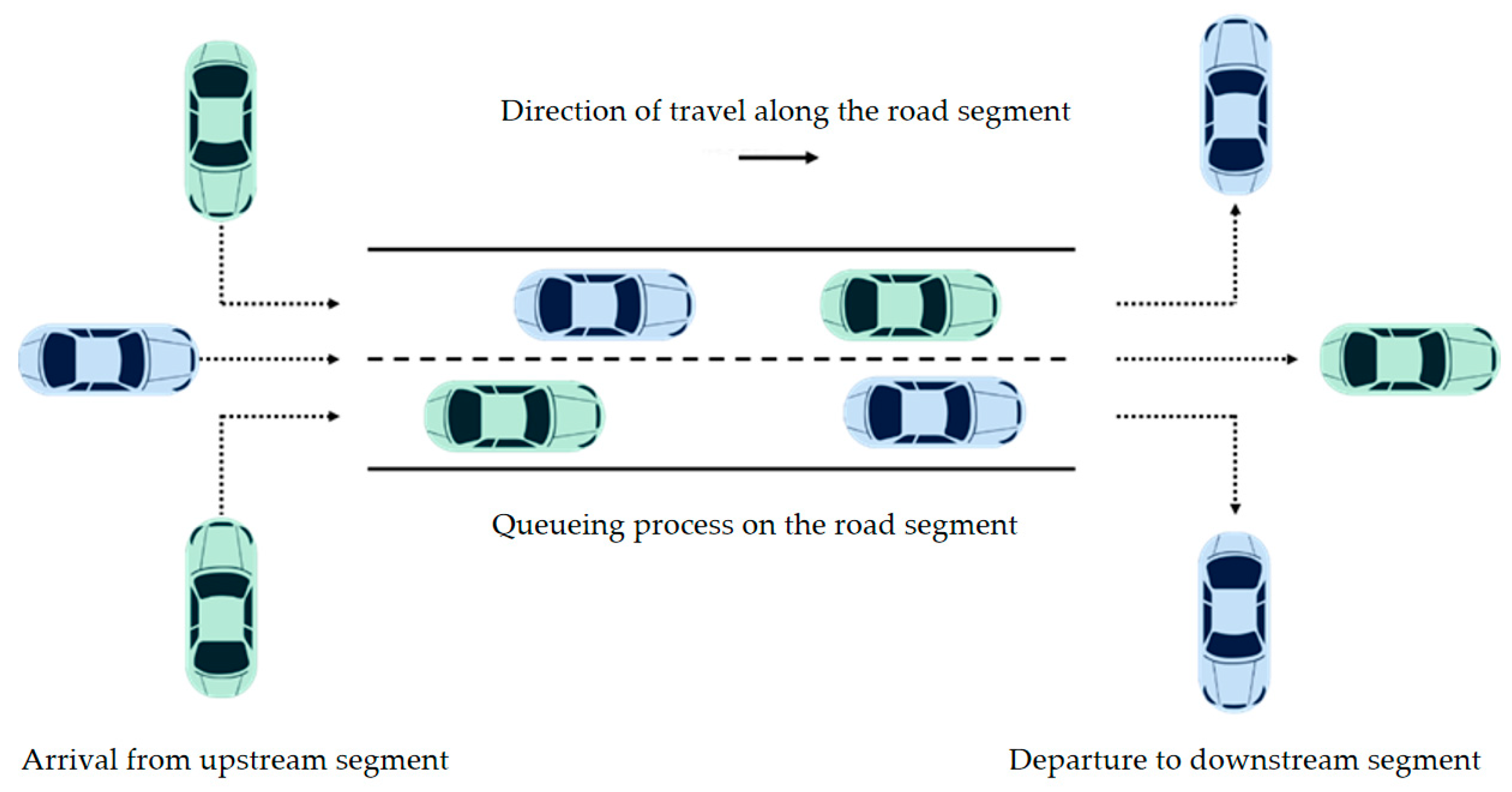
- Road Segment Queuing Subsystem: It realizes the spatial displacement of vehicles. A highway segment can be modeled as an M(t)/G(x)/C/C feedback queuing system with time-varying arrival rates, state-dependent service rates, and finite capacity.
- Service Area Queuing Subsystem: It provides energy replenishment services for vehicles. A highway service area can be modeled as an M(t)/G(x)/K/C feedback queuing system with time-varying arrival rates, deterministic service rates, and finite capacity.
3.1.2. System State Equations with Node–Segment Coupling
- (1)
- System state and unified evolution equation
- (2)
- Traffic flow divergence and convergence mechanisms
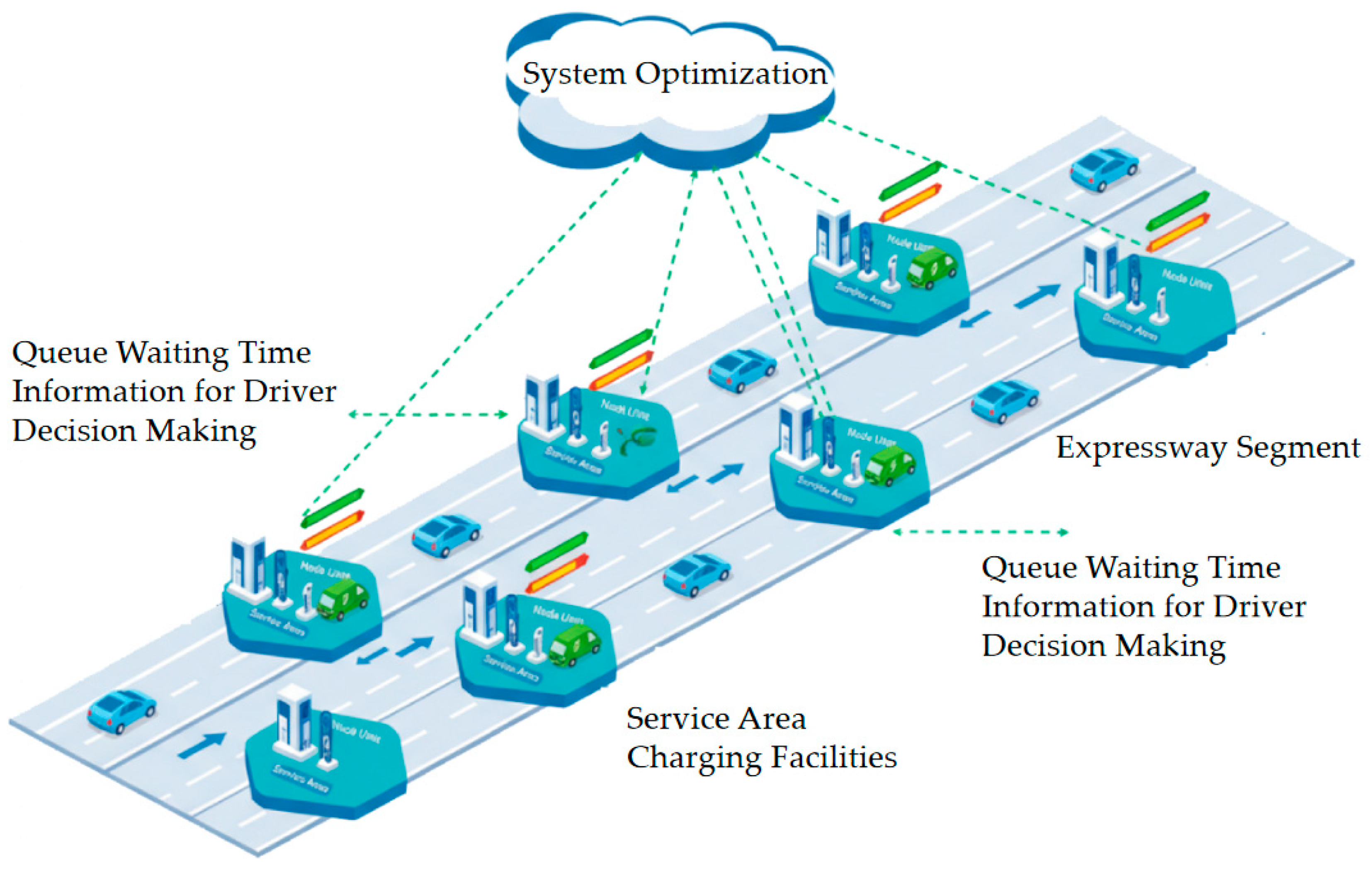
- Physical feedback (congestion propagation): When a service area node reaches its saturation capacity , it generates a blocking probability . This inversely suppresses the vehicle inflow from upstream segments, causing queue formation on the mainline, reflecting the physical bottleneck effect of the facility.
- Informational feedback (demand regulation): The queuing waiting time at service areas is fed back in real time to drivers in upstream segments via information release systems, influencing their route choice decisions (by modifying the generalized travel cost), thereby dynamically adjusting the network-wide traffic flow distribution. This reflects behavioral responses guided by information.
3.2. Definitions
3.3. Modeling Preparation
- (1)
- Service homogeneity: Although mobile charging vehicles offer flexibility, when performing charging services, they are assumed to have the same rated power as fixed charging piles, i.e., providing a homogeneous charging service rate .
- (2)
- Intra-zone dispatching for mobile facilities: Mobile charging vehicles are affiliated with specific service areas or service area clusters during the planning horizon. They are dispatched for use only during peak charging demand periods and are parked at standby stations within the service areas during idle periods.
- (3)
- Rigid budget constraint: The total investment cost for charging facility construction is subject to a strict budget cap, which is predetermined by the planner.
4. Model and Algorithm
4.1. Upper-Level Model
4.1.1. Decision Variables
- Number of fixed charging piles: .
- Number of mobile charging vehicles (MCVs): .
4.1.2. Objective Function
- (1)
- Facility investment cost ()
- (2)
- System operation and dispatching cost ()
- (3)
- User generalized travel cost ()
- (1)
- Time cost: is the state-dependent queuing waiting time derived from the fluid queuing model, and is the average charging service time. Specifically, is endogenously calculated based on Little’s Law, which characterizes the relationship between vehicle accumulation and expected delay following the validated methodologies in existing research [62,63].
- (2)
- Psychological anxiety cost: is the cumulative range anxiety of vehicles before arriving at service area , obtained by integrating the anxiety function along the travel path. It reflects the impact of facility layout on drivers’ psychological burden. In the upper-level objective function, the total anxiety cost serves as a social welfare metric, representing the aggregate psychological burden of all drivers that the planner aims to minimize through facility configuration. This ensures that the system-level optimization targets the overall resilience and user satisfaction of the energy replenishment network.
- (3)
- Service failure penalty cost: is the real-time blocking probability at service area . This probability increases sharply when vehicle accumulation approaches capacity, representing the severe consequences of “service denial” (e.g., the risk of vehicle breakdown). It is determined by a fitting formula derived from the queuing characteristics of highway service systems as specified in existing methodologies [63].
4.1.3. Constraints
- (4)
- Investment budget constraint
- (5)
- Facility-scale coordination ratio constraint
- (6)
- Dynamic service level constraint
- (7)
- Non-negative integer decision variables
4.1.4. Upper-Level Model Summary
4.2. Lower-Level Model
4.2.1. Decision Variables
- Split decision variable (): The proportion of vehicles arriving at the decision point of service area at time that choose to enter for charging.
- Instantaneous flow rate vector (): The effective arrival rates at all nodes (service areas and segments) in the network.
- System state vector (): It includes the vehicle backlog at each service area and the state of each segment, which are endogenously determined by the lower-level dynamic equations.
4.2.2. Objective Function
- Queuing time cost : Calculated from the queuing model, it depends on the current backlog and the service capacity determined by the facility configuration .
- Psychological anxiety costs : It invokes the range anxiety function, which depends on the vehicle’s remaining range and the expected waiting time and blocking probability at the target service area.
- Service failure risk cost : It reflects the risk of needing to detour or facing a breakdown due to service area saturation.
4.2.3. Constraints
- (1)
- Flow conservation and topological constraints
- (2)
- Random choice behavior constraint based on the logit model
- (3)
- System dynamics evolution constraint
- (4)
- Boundary and non-negativity constraint
4.3. Solution Algorithm
4.3.1. Simultaneous Perturbation Stochastic Approximation (SPSA)
- (1)
- Random perturbation vector generation
- (2)
- Two-sided evaluation and gradient estimation
- Set the perturbation step size , and apply positive and negative perturbations to the current solution .
- Invoke the evaluation operator to compute the corresponding objective function values:
- The estimated gradient for the -th component of the gradient vector is:
4.3.2. Iteration and Constraint Handling
- (1)
- Iterative update: The decision variables are updated as follows:
- (2)
- Feasible region projection: Since the decision variables must satisfy integer, budget, ratio, and other constraints, the continuous solution is
4.3.3. Algorithm Implementation Steps
- (1)
- Initialization: Set the initial configuration and algorithm parameters.
- (2)
- Iterative Loop (for ):a. Generate the random perturbation vector .b. Perform two-sided simulation evaluations to compute and .c. Estimate the stochastic gradient.d. Update the solution and obtain the feasible integer solution via the projection operator.
- (3)
- Convergence criterion: Stop the iteration when the relative change in the objective function value is or the maximum number of iterations is reached. Output the optimal configuration .
5. Numerical Experiments
5.1. Study Object and Background
5.2. Traffic Demand Analysis
5.3. Model Parameter Settings
5.3.1. Cost Parameters
- Regarding the unit construction cost of fixed charging piles, since highway service areas primarily deploy DC fast-charging piles, the cost per pile (including equipment, power capacity expansion, and construction) typically ranges between 150,000 and 200,000 CNY, as reported by the China Electric Vehicle Charging Infrastructure Promotion Alliance (EVCIPA) and industry research. This study adopts the median value of 175,000 CNY per pile as the unit construction cost for fixed charging piles.
- As for the unit procurement cost of mobile charging vehicles, it mainly comprises an electric truck chassis, a high-capacity battery pack, an onboard charging unit, and an integrated control system. Referring to the market prices of medium-sized pure electric logistics vehicles (such as the BYD T5 series, priced around 300,000–400,000 CNY) and the additional cost of a mobile energy storage and charging system with a rated capacity of over 200 kWh (market price of approximately 300,000–400,000 CNY), this study adopts a comprehensive value of 700,000 CNY per vehicle.
- The user time value coefficient reflects the monetary valuation of a driver’s unit travel time. Based on per capita disposable income data released by the National Bureau of Statistics, this study sets the time value coefficient for highway travel scenarios at 25 CNY per hour. This value is slightly higher than the national average hourly wage to reflect the typically higher time sensitivity of medium- and long-distance travelers.
- The user anxiety cost coefficient quantifies the economic cost corresponding to the psychological burden induced by range anxiety. Since anxiety is a subjective psychological state, direct monetization is challenging. This study assumes that drivers are willing to pay an additional cost to alleviate anxiety, which exceeds the pure time cost. Therefore, the anxiety cost coefficient is set to 1.5 times the time value coefficient, i.e., 37.5 CNY per anxiety unit per hour.
- The service failure penalty coefficient aims to simulate the extreme negative experience and economic loss caused by an inability to access a fully occupied service area or vehicle battery depletion. In the optimization model, this coefficient must be assigned a sufficiently large value to guide the algorithm in prioritizing the avoidance of such high-risk situations. With reference to emergency rescue costs and significant time loss expenses, this study sets it to 500 CNY per occurrence.
- The mobile charging vehicle dispatching cost coefficient covers the unit-distance energy consumption, depreciation, and labor costs incurred during dispatch tasks. Based on typical operational cost data for electric logistics vehicles, this coefficient is set to 3 CNY per kilometer.
- The social discount rate is used to convert future costs and benefits into present value for life-cycle economic comparisons. Following the recommendations for transportation projects in the “Methods and Parameters for Economic Evaluation of Construction Projects” issued by the National Development and Reform Commission, this study adopts 8% as the social discount rate.
- Regarding the service life of the facilities, fixed charging piles and mobile charging vehicles differ in economic lifespan due to their technical characteristics and usage intensity. Based on industry experience, the design service life of fixed charging piles is set to 8 years, while mobile charging vehicles, equipped with power batteries and frequently operated on the move, are assigned an effective economic lifespan of 5 years.
- For the total investment budget constraint, to effectively reflect resource limitations and test the configuration capability of the optimization model in the case study, the total investment available for charging facility construction is assumed to be 10 million CNY. This constraint will make the cost–benefit differences among various configuration schemes more pronounced.
5.3.2. Service System Parameters
5.3.3. Algorithm Parameters
5.3.4. Electric Vehicle Behavior Parameters
5.4. Result Analysis and Discussion
- (1)
- Cost–Benefit Analysis: Although the average daily construction cost of the optimized scheme proposed in this study increased by 55.1% due to the introduction of MCVs, its average daily operation cost decreased by 7.0%. More importantly, the user anxiety cost decreased significantly by 24.1%. This resulted in the average daily total system cost ultimately decreasing slightly by 1.8%, achieving essentially the same total cost level.
- (2)
- Service Efficiency Improvement: Under the optimized scheme, the average waiting time for charging vehicles was significantly reduced by 25.1%, from 7.32 min to 5.48 min. This directly enhances the user charging experience and facility service efficiency.
- (3)
- Model Advantages Demonstrated: The results indicate that the proposed collaborative configuration model can significantly improve service levels (reducing waiting times) and effectively alleviate user range anxiety through a flexible configuration strategy of “fixed facilities as the mainstay, supplemented by mobile facilities,” all while strictly controlling the total budget and system-wide cost. This verifies the model’s effectiveness in balancing multi-dimensional objectives of investment, operation, and user psychology.
5.5. Synthesis and Comparison
6. Conclusions and Future Work
6.1. Conclusions
- (1)
- Driver range anxiety is a key psychological factor influencing EV travel and energy replenishment decisions. The generalized travel impedance function incorporating range anxiety cost constructed in this study can more realistically characterize the route and service area choice behavior of EV drivers. This provides a more realistic psychobehavioral model foundation for user equilibrium-based traffic assignment.
- (2)
- The integrated “road segment–service area” queuing network is an effective analytical framework for characterizing the dynamics of highway systems. By abstracting both vehicle movement and replenishment services as queuing processes, this framework seamlessly integrates the physical conservation of traffic flow with the queuing effects of service facilities. It clearly elucidates the dynamic coupling and feedback mechanisms among “traffic demand, facility supply, and queuing status,” providing a powerful tool for system performance analysis.
- (3)
- The synergistic configuration of fixed and mobile charging facilities can significantly enhance system economy and service levels. The constructed bi-level optimization model, aiming to minimize the generalized total social cost, demonstrates that compared with static methods relying solely on fixed facilities, a coordinated strategy of “fixed facilities ensuring the base load, mobile resources responding to peak demands” involves higher initial construction investment. However, it can significantly reduce user waiting times and anxiety costs through flexible operational scheduling. Under the condition of essentially maintaining the overall social cost, it substantially improves the user travel experience and service reliability. The case study of the Nei-Yi Expressway validates the effectiveness and superiority of the proposed model and solution algorithm.
- (4)
- The SPSA algorithm is an effective tool for solving high-dimensional nonlinear simulation optimization problems. To address the characteristics of the model, which lacks an explicit analytical form and high computational cost, the simultaneous perturbation stochastic approximation (SPSA) algorithm was employed. It enables gradient estimation and decision optimization with only a limited number of simulation evaluations, providing an efficient and practical computational approach to solving such complex “planning-operation-behavior” coupled problems.
6.2. Future Work
- (1)
- Further Relaxation of Model Assumptions and Incorporation of Real-World Complexity: Future research could consider incorporating more real-world factors, such as heterogeneity of charging facilities (different power levels), the impact of dynamic electricity pricing mechanisms on demand, power grid capacity constraints, more complex road network topologies (involving multiple route choices and network effects), and more detailed behavioral models of interactions between fuel vehicles and EVs.
- (2)
- Refined Modeling of Operational Strategies: This study employed a relatively simplified cost function for dispatching mobile charging vehicles. Future work could delve deeper into their dynamic dispatching strategies (e.g., real-time responsive dispatching and predictive dispatching), coordination rules with fixed facilities (e.g., reservation mechanisms and priority service rules), and the energy management of the mobile facilities themselves (e.g., when and where to recharge), among other operational-level optimization problems.
- (3)
- Integration with Emerging Transportation Technologies: With the rapid development of vehicle-to-everything (V2X) communication and autonomous driving technologies, future charging infrastructure planning should fully consider the transformations brought by these technologies, for instance, researching optimal energy replenishment strategies under conditions of complete information sharing or coordination of autonomous vehicle fleets or exploring the planning of advanced infrastructure forms based on dynamic wireless charging lanes.
- (4)
- Further Enhancement and Comparison of Algorithm Performance: Exploring the hybridization of the SPSA algorithm with other metaheuristic algorithms (e.g., improved genetic algorithms and simulation optimization) or conducting comparative studies could further enhance solution efficiency and stability for large-scale complex networks. Simultaneously, developing more efficient equilibrium simulation algorithms for the lower-level problem is also key to improving overall computational performance.
- (5)
- Multi-Objective and Uncertainty Optimization: This study focused on a single cost minimization objective. Future work could expand to a multi-objective optimization framework, simultaneously balancing economic cost, environmental benefits, social equity, etc. Furthermore, considering the uncertainty of key parameters such as traffic demand, EV penetration rate, and renewable energy output and introducing robust optimization or stochastic programming methods could enhance the robustness of configuration schemes.
Author Contributions
Funding
Data Availability Statement
Acknowledgments
Conflicts of Interest
References
- Tilly, N.; Yigitcanlar, T.; Degirmenci, K.; Paz, A. How Sustainable Is Electric Vehicle Adoption? Insights from a PRISMA Review. Sustain. Cities Soc. 2024, 117, 105950. [Google Scholar] [CrossRef]
- Singh, A.R.; Vishnuram, P.; Alagarsamy, S.; Bajaj, M.; Blazek, V.; Damaj, I.; Rathore, R.S.; Al-Wesabi, F.N.; Othman, K.M. Electric Vehicle Charging Technologies, Infrastructure Expansion, Grid Integration Strategies, and Their Role in Promoting Sustainable e-Mobility. Alex. Eng. J. 2024, 105, 300–330. [Google Scholar] [CrossRef]
- Zhao, X.; Li, X.; Jiao, D.; Mao, Y.; Sun, J.; Liu, G. Policy Incentives and Electric Vehicle Adoption in China: From a Perspective of Policy Mixes. Transp. Res. Part A Policy Pract. 2024, 190, 104235. [Google Scholar] [CrossRef]
- Huo, H.; Wang, M. Modeling Future Vehicle Sales and Stock in China. Energy Policy 2012, 43, 17–29. [Google Scholar] [CrossRef]
- Daly, H.E.; Gallachóir, B.P.Ó. Modelling Future Private Car Energy Demand in Ireland. Energy Policy 2011, 39, 7815–7824. [Google Scholar] [CrossRef]
- Qadir, S.A.; Ahmad, F.; Al-Wahedi, A.M.A.B.; Iqbal, A.; Ali, A. Navigating the Complex Realities of Electric Vehicle Adoption: A Comprehensive Study of Government Strategies, Policies, and Incentives. Energy Strategy Rev. 2024, 53, 101379. [Google Scholar] [CrossRef]
- Alanazi, F. Electric Vehicles: Benefits, Challenges, and Potential Solutions for Widespread Adaptation. Appl. Sci. 2023, 13, 6016. [Google Scholar] [CrossRef]
- Bayram, I.S.; Michailidis, G.; Devetsikiotis, M.; Granelli, F. Electric Power Allocation in a Network of Fast Charging Stations. IEEE J. Sel. Areas Commun. 2013, 31, 1235–1246. [Google Scholar] [CrossRef]
- Suarez, C.; Martinez, W. Fast and Ultra-Fast Charging for Battery Electric Vehicles—A Review. In Proceedings of the 2019 IEEE Energy Conversion Congress and Exposition (ECCE), Baltimore, MD, USA, 29 September–3 October 2019; pp. 569–575. [Google Scholar]
- Zhou, J.; Xiang, Y.; Zhang, X.; Sun, Z.; Liu, X.; Liu, J. Optimal Self-Consumption Scheduling of Highway Electric Vehicle Charging Station Based on Multi-Agent Deep Reinforcement Learning. Renew. Energy 2025, 238, 121982. [Google Scholar] [CrossRef]
- Hammam, A.H.; Nayel, M.A.; Mohamed, M.A. Optimal Design of Sizing and Allocations for Highway Electric Vehicle Charging Stations Based on a PV System. Appl. Energy 2024, 376, 124284. [Google Scholar] [CrossRef]
- Wang, Y.; Shi, J.; Wang, R.; Liu, Z.; Wang, L. Siting and Sizing of Fast Charging Stations in Highway Network with Budget Constraint. Appl. Energy 2018, 228, 1255–1271. [Google Scholar] [CrossRef]
- Wang, C.; Lin, X.; He, F.; Shen, M.Z.; Li, M. Hybrid of Fixed and Mobile Charging Systems for Electric Vehicles: System Design and Analysis. Transp. Res. Part C Emerg. Technol. 2021, 126, 103068. [Google Scholar] [CrossRef]
- Zhang, X.; Cao, Y.; Peng, L.; Li, J.; Ahmad, N.; Yu, S. Mobile Charging as a Service: A Reservation-Based Approach. IEEE Trans. Autom. Sci. Eng. 2020, 17, 1976–1988. [Google Scholar] [CrossRef]
- He, L.; Kong, L.; Gu, Y.; Pan, J.; Zhu, T. Evaluating the On-Demand Mobile Charging in Wireless Sensor Networks. IEEE Trans. Mob. Comput. 2015, 14, 1861–1875. [Google Scholar] [CrossRef]
- Jawad, S.; Liu, J. Electrical Vehicle Charging Services Planning and Operation with Interdependent Power Networks and Transportation Networks: A Review of the Current Scenario and Future Trends. Energies 2020, 13, 3371. [Google Scholar] [CrossRef]
- Yang, Y.; Yao, E.; Yang, Z.; Zhang, R. Modeling the Charging and Route Choice Behavior of BEV Drivers. Transp. Res. Part C Emerg. Technol. 2016, 65, 190–204. [Google Scholar] [CrossRef]
- Wang, Z.; Yao, E.; Yang, Y. An Analysis of EV Charging and Route Choice Behavior Considering the Effects of Planning Ability, Risk Aversion and Confidence in Battery in Long-Distance Travel. Transp. Res. Part F Traffic Psychol. Behav. 2024, 104, 186–200. [Google Scholar] [CrossRef]
- Ashkrof, P.; de Almeida Correia, G.H.; Van Arem, B. Analysis of the Effect of Charging Needs on Battery Electric Vehicle Drivers’ Route Choice Behaviour: A Case Study in the Netherlands. Transp. Res. Part D Transp. Environ. 2020, 78, 102206. [Google Scholar] [CrossRef]
- Deb, S.; Tammi, K.; Kalita, K.; Mahanta, P. Review of Recent Trends in Charging Infrastructure Planning for Electric Vehicles. Wiley Interdiscip. Rev. Energy Environ. 2018, 7, e306. [Google Scholar] [CrossRef]
- Bian, H.; Ren, Q.; Guo, Z.; Zhou, C.; Zhang, Z.; Wang, X. Predictive Model for EV Charging Load Incorporating Multimodal Travel Behavior and Microscopic Traffic Simulation. Energies 2024, 17, 2606. [Google Scholar] [CrossRef]
- Mamarikas, S.; Doulgeris, S.; Samaras, Z.; Ntziachristos, L. Traffic Impacts on Energy Consumption of Electric and Conventional Vehicles. Transp. Res. Part D Transp. Environ. 2022, 105, 103231. [Google Scholar] [CrossRef]
- Beckmann, M.; McGuire, C.B.; Winsten, C.B. Studies in the Economics of Transportation; Yale University Press: New Haven, CT, USA, 1956. [Google Scholar]
- Maher, M.; Stewart, K.; Rosa, A. Stochastic Social Optimum Traffic Assignment. Transp. Res. Part B Methodol. 2005, 39, 753–767. [Google Scholar] [CrossRef]
- Gartner, N.H. Optimal Traffic Assignment with Elastic Demands: A Review Part Ii. Algorithmic Approaches. Transp. Sci. 1980, 14, 192–208. [Google Scholar] [CrossRef]
- Aashtiani, H.Z.; Magnanti, T.L. Equilibria on a Congested Transportation Network. SIAM J. Algebr. Discret. Methods 1981, 2, 213–226. [Google Scholar] [CrossRef]
- Jiang, N.; Xie, C.; Waller, S.T. Path-Constrained Traffic Assignment: Model and Algorithm. Transp. Res. Rec. 2012, 2283, 25–33. [Google Scholar] [CrossRef]
- Wang, T.-G.; Xie, C.; Xie, J.; Waller, T. Path-Constrained Traffic Assignment: A Trip Chain Analysis under Range Anxiety. Transp. Res. Part C Emerg. Technol. 2016, 68, 447–461. [Google Scholar] [CrossRef]
- Jiang, N.; Xie, C. Computing and Analyzing Mixed Equilibrium Network Flows with Gasoline and Electric Vehicles. Comput.-Aided Civ. Infrastruct. Eng. 2014, 29, 626–641. [Google Scholar] [CrossRef]
- Jiang, N.; Xie, C.; Duthie, J.C.; Waller, S.T. A Network Equilibrium Analysis on Destination, Route and Parking Choices with Mixed Gasoline and Electric Vehicular Flows. EURO J. Transp. Logist. 2014, 3, 55–92. [Google Scholar] [CrossRef]
- He, F.; Yin, Y.; Lawphongpanich, S. Network Equilibrium Models with Battery Electric Vehicles. Transp. Res. Part B Methodol. 2014, 67, 306–319. [Google Scholar] [CrossRef]
- Hodgson, M.J. A Flow-Capturing Location-Allocation Model. Geogr. Anal. 1990, 22, 270–279. [Google Scholar] [CrossRef]
- Wang, C.; He, F.; Lin, X.; Shen, Z.; Li, M. Designing Locations and Capacities for Charging Stations to Support Intercity Travel of Electric Vehicles: An Expanded Network Approach. Transp. Res. Part C Emerg. Technol. 2019, 102, 210–232. [Google Scholar] [CrossRef]
- Kuby, M.; Lim, S. The Flow-Refueling Location Problem for Alternative-Fuel Vehicles. Socioecon. Plan. Sci. 2005, 39, 125–145. [Google Scholar] [CrossRef]
- Kuby, M.; Lines, L.; Schultz, R.; Xie, Z.; Kim, J.G.; Lim, S. Optimization of Hydrogen Stations in Florida Using the Flow-Refueling Location Model. Int. J. Hydrogen Energy 2009, 34, 6045–6064. [Google Scholar] [CrossRef]
- Capar, I.; Kuby, M.; Leon, V.J.; Tsai, Y.J. An Arc Cover–Path-Cover Formulation and Strategic Analysis of Alternative-Fuel Station Locations. Eur. J. Oper. Res. 2013, 227, 142–151. [Google Scholar] [CrossRef]
- Lin, Z.; Ogden, J.; Fan, Y.; Chen, C.W. The Fuel-Travel-Back Approach to Hydrogen Station Siting. Int. J. Hydrogen Energy 2008, 33, 3096–3101. [Google Scholar] [CrossRef]
- Upchurch, C.; Kuby, M.; Lim, S. A Model for Location of Capacitated Alternative-Fuel Stations. Geogr. Anal. 2009, 41, 85–106. [Google Scholar] [CrossRef]
- Ghamami, M.; Zockaie, A.; Nie, Y.M. A General Corridor Model for Designing Plug-in Electric Vehicle Charging Infrastructure to Support Intercity Travel. Transp. Res. Part C Emerg. Technol. 2016, 68, 389–402. [Google Scholar] [CrossRef]
- Erdoan, S.; Apar, S.; Apar, B.; Nejad, M.M. Establishing a Statewide Electric Vehicle Charging Station Network in Maryland: A Corridor-Based Station Location Problem. Socioecon. Plan. Sci. 2022, 79, 101127. [Google Scholar] [CrossRef]
- Chen, R.; Qian, X.; Miao, L.; Ukkusuri, S.V. Optimal Charging Facility Location and Capacity for Electric Vehicles Considering Route Choice and Charging Time Equilibrium. Comput. Oper. Res. 2020, 113, 104776. [Google Scholar] [CrossRef]
- Cui, Q.; Weng, Y.; Tan, C.W. Electric Vehicle Charging Station Placement Method for Urban Areas. IEEE Trans. Smart Grid 2019, 10, 6552–6565. [Google Scholar] [CrossRef]
- Sadeghi-Barzani, P.; Rajabi-Ghahnavieh, A.; Kazemi-Karegar, H. Optimal Fast Charging Station Placing and Sizing. Appl. Energy 2014, 125, 289–299. [Google Scholar] [CrossRef]
- Andrenacci, N.; Ragona, R.; Valenti, G. A Demand-Side Approach to the Optimal Deployment of Electric Vehicle Charging Stations in Metropolitan Areas. Appl. Energy 2016, 182, 39–46. [Google Scholar] [CrossRef]
- Tang, P.; He, F.; Lin, X.; Li, M. Online-to-Offline Mobile Charging System for Electric Vehicles: Strategic Planning and Online Operation. Transp. Res. Part D Transp. Environ. 2020, 87, 102522. [Google Scholar] [CrossRef]
- Huang, S.; He, L.; Gu, Y.; Wood, K.; Benjaafar, S. Design of a Mobile Charging Service for Electric Vehicles in an Urban Environment. IEEE Trans. Intell. Transp. Syst. 2014, 16, 787–798. [Google Scholar] [CrossRef]
- Cui, S.; Zhao, H.; Chen, H.; Zhang, C. The Mobile Charging Vehicle Routing Problem with Time Windows and Recharging Services. Comput. Intell. Neurosci. 2018, 2018, 5075916. [Google Scholar] [CrossRef]
- Atmaja, T.D.; Mirdanies, M. Electric Vehicle Mobile Charging Station Dispatch Algorithm. Energy Procedia 2015, 68, 326–335. [Google Scholar] [CrossRef]
- Cui, S.; Zhao, H.; Zhang, C. Multiple Types of Plug-In Charging Facilities’ Location-Routing Problem with Time Windows for Mobile Charging Vehicles. Sustainability 2018, 10, 2855. [Google Scholar] [CrossRef]
- Cui, S.; Yao, B.; Chen, G.; Zhu, C.; Yu, B. The Multi-Mode Mobile Charging Service Based on Electric Vehicle Spatiotemporal Distribution. Energy 2020, 198, 117302. [Google Scholar] [CrossRef]
- Raeesi, R.; Zografos, K.G. The Electric Vehicle Routing Problem with Time Windows and Synchronised Mobile Battery Swapping. Transp. Res. Part B Methodol. 2020, 140, 101–129. [Google Scholar] [CrossRef]
- Qin, W.; Shi, Z.; Li, W.; Li, K.; Zhang, T.; Wang, R. Multiobjective Routing Optimization of Mobile Charging Vehicles for UAV Power Supply Guarantees. Comput. Ind. Eng. 2021, 162, 107714. [Google Scholar] [CrossRef]
- Yang, S.-N.; Wang, H.-W.; Gan, C.-H.; Lin, Y.-B. Mobile Charging Information Management for Smart Grid Networks. Int. J. Inf. Manag. 2013, 33, 245–251. [Google Scholar] [CrossRef]
- Li, Z.; Sahinoglu, Z.; Tao, Z.; Teo, K.H. Electric Vehicles Network with Nomadic Portable Charging Stations. In Proceedings of the 2010 IEEE 72nd Vehicular Technology Conference—Fall, Ottawa, ON, Canada, 6–9 September 2010; IEEE: Piscataway, NJ, USA, 2010; pp. 1–5. [Google Scholar]
- Zhang, Y.; Liu, X.; Wei, W.; Peng, T.; Hong, G.; Meng, C. Mobile Charging: A Novel Charging System for Electric Vehicles in Urban Areas. Appl. Energy 2020, 278, 115648. [Google Scholar] [CrossRef]
- Chauhan, V.; Gupta, A. Scheduling Mobile Charging Stations for Electric Vehicle Charging. In Proceedings of the 2018 14th International Conference on Wireless and Mobile Computing, Networking and Communications (WiMob), Limassol, Cyprus, 15–17 October 2018; IEEE: Piscataway, NJ, USA, 2018; pp. 131–136. [Google Scholar]
- Lee, S.-H.; Lorenz, R.D. Development and Validation of Model for 95%-Efficiency 220-W Wireless Power Transfer Over a 30-cm Air Gap. IEEE Trans. Ind. Appl. 2011, 47, 2495–2504. [Google Scholar] [CrossRef]
- Zhang, Y.; Pan, W.; Wang, H.; Shen, Z.; Wu, Y.; Dong, J.; Mao, X. Misalignment-Tolerant Dual-Transmitter Electric Vehicle Wireless Charging System With Reconfigurable Topologies. IEEE Trans. Power Electron. 2022, 37, 8816–8819. [Google Scholar] [CrossRef]
- Hwang, I.; Jang, Y.J.; Ko, Y.D.; Lee, M.S. System Optimization for Dynamic Wireless Charging Electric Vehicles Operating in a Multiple-Route Environment. IEEE Trans. Intell. Transp. Syst. 2018, 19, 1709–1726. [Google Scholar] [CrossRef]
- Zhang, Y.; Zhou, S.; Rao, X.; Zhou, Y. EV-Road-Grid: Enabling Optimal Electric Vehicle Charging Path Considering Wireless Charging and Dynamic Energy Consumption. In Proceedings of the 2021 IEEE 94th Vehicular Technology Conference (VTC2021-Fall), Norman, OK, USA, 27–30 September 2021; IEEE: Piscataway, NJ, USA, 2021; pp. 1–5. [Google Scholar]
- Tran, C.Q.; Keyvan-Ekbatani, M.; Ngoduy, D.; Watling, D. Dynamic Wireless Charging Lanes Location Model in Urban Networks Considering Route Choices. Transp. Res. Part C Emerg. Technol. 2022, 139, 103652. [Google Scholar] [CrossRef]
- Li, H.; Jiang, Y.; Zhao, B. Signal Timing Optimization Method for Intersections Under Mixed Traffic Conditions. Algorithms 2026, 19, 71. [Google Scholar] [CrossRef]
- Hu, L.; Zhao, B.; Zhu, J.; Jiang, Y. Two Time-Varying and State-Dependent Fluid Queuing Models for Traffic Circulation Systems. Eur. J. Oper. Res. 2019, 275, 997–1019. [Google Scholar] [CrossRef]
- Xu, K.; Tipmongkonsilp, S.; Tipper, D.; Krishnamurthy, P.; Qian, Y. A Time Dependent Performance Model for Multihop Wireless Networks with CBR Traffic. In Proceedings of the International Performance Computing and Communications Conference, Albuquerque, NM, USA, 9–11 December 2010; pp. 271–280. [Google Scholar]
- Xu, K.; Tipper, D.; Qian, Y.; Krishnamurthy, P. Time-Dependent Performance Analysis of IEEE 802.11p Vehicular Networks. IEEE Trans. Veh. Technol. 2016, 65, 5637–5651. [Google Scholar] [CrossRef]
- Loaiza Quintana, C.; Climent, L.; Arbelaez, A. Iterated Local Search for the eBuses Charging Location Problem. In Parallel Problem Solving from Nature—PPSN XVII; Rudolph, G., Kononova, A.V., Aguirre, H., Kerschke, P., Ochoa, G., Tušar, T., Eds.; Lecture Notes in Computer Science; Springer International Publishing: Cham, Switzerland, 2022; Volume 13399, pp. 338–351. ISBN 978-3-031-14720-3. [Google Scholar]
- Loaiza Quintana, C.; Arbelaez, A.; Climent, L. Robust eBuses Charging Location Problem. IEEE Open J. Intell. Transp. Syst. 2022, 3, 856–871. [Google Scholar] [CrossRef]
- Spall, J.C. Implementation of the Simultaneous Perturbation Algorithm for Stochastic Optimization. IEEE Trans. Aerosp. Electron. Syst. 1998, 34, 817–823. [Google Scholar] [CrossRef]
- Cipriani, E.; Gori, S.; Petrelli, M. Transit Network Design: A Procedure and an Application to a Large Urban Area. Transp. Res. Part C Emerg. Technol. 2012, 20, 3–14. [Google Scholar] [CrossRef]
- Tympakianaki, A.; Koutsopoulos, H.N.; Jenelius, E. C-SPSA: Cluster-Wise Simultaneous Perturbation Stochastic Approximation Algorithm for Dynamic Origin-Destination Demand Estimation. Transp. Res. Part C Emerg. Technol. 2015, 55, 192–205. [Google Scholar] [CrossRef]
- Hasan, K.N.; Preece, R.; Milanović, J.V. Probabilistic Modelling of Electric Vehicle Charging Demand Based on Charging Station Data. In Proceedings of the 2022 17th International Conference on Probabilistic Methods Applied to Power Systems (PMAPS), Manchester, UK, 12–15 June 2022; pp. 1–6. [Google Scholar]
- Bae, S.; Kwasinski, A. Spatial and Temporal Model of Electric Vehicle Charging Demand. IEEE Trans. Smart Grid 2012, 3, 394–403. [Google Scholar] [CrossRef]
- Xiao, D.; An, S.; Cai, H.; Wang, J.; Cai, H. An Optimization Model for Electric Vehicle Charging Infrastructure Planning Considering Queuing Behavior with Finite Queue Length. J. Energy Storage 2020, 29, 101317. [Google Scholar] [CrossRef]
- Pourvaziri, H.; Sarhadi, H.; Azad, N.; Afshari, H.; Taghavi, M. Planning of Electric Vehicle Charging Stations: An Integrated Deep Learning and Queueing Theory Approach. Transp. Res. Part E Logist. Transp. Rev. 2024, 186, 103568. [Google Scholar] [CrossRef]
- Zhou, Z.; Liu, Z.; Su, H.; Zhang, L. Planning of Static and Dynamic Charging Facilities for Electric Vehicles in Electrified Transportation Networks. Energy 2023, 263, 126073. [Google Scholar] [CrossRef]
- Kong, C.; Jovanovic, R.; Bayram, I.; Devetsikiotis, M. A Hierarchical Optimization Model for a Network of Electric Vehicle Charging Stations. Energies 2017, 10, 675. [Google Scholar] [CrossRef]
- Li, H.; He, Y.; Fu, W.; Li, X. Bi-Level Planning of Electric Vehicle Charging Station in Coupled Distribution-Transportation Networks. Electr. Power Syst. Res. 2024, 232, 110442. [Google Scholar] [CrossRef]
- Wang, W.; Liu, Y.; Wei, W.; Wu, L. A Bilevel EV Charging Station and DC Fast Charger Planning Model for Highway Network Considering Dynamic Traffic Demand and User Equilibrium. IEEE Trans. Smart Grid 2024, 15, 714–728. [Google Scholar] [CrossRef]
- Graf, L.; Harks, T.; Palkar, P. Dynamic Traffic Assignment for Electric Vehicles. SSRN Electron. J. 2022, 195, 103207. [Google Scholar] [CrossRef]



| Type | Symbol | Description |
|---|---|---|
| Sets | Set of highway service areas to be planned, | |
| Set of discrete time intervals within the planning horizon, | ||
| Decision Variables | Number of fixed charging piles to be deployed at service area (integer) | |
| Number of mobile charging vehicles to be deployed at service area (integer) | ||
| State Variables | Number of vehicles present in service area at time , endogenously determined by the underlying queuing model | |
| Effective charging demand flow rate entering service area at time | ||
| Parameters | , | Procurement/construction cost per fixed charging pile and mobile charging vehicle |
| , | Operational and maintenance cost per unit time for fixed charging piles and mobile charging vehicles (Yuan/hour) | |
| Dispatching cost coefficient per unit distance for mobile charging vehicles (Yuan/km) | ||
| Coefficients representing the user value of time, range anxiety cost, and penalty cost, respectively |
| Zone ID | TAZ Description | Location (City) | Distance (km) |
|---|---|---|---|
| 1 | Sujiaqiao Interchange | Neijiang City | 0.000 |
| 2 | Baima Toll Station | Neijiang City | 4.549 |
| 3 | Baima Junction | Neijiang City | 7.212 |
| 4 | Yong’an Huanghe Lake Toll Station | Neijiang City | 12.715 |
| 5 | Wanjiaqiao Junction | Zigong City | 25.674 |
| 6 | Zigong Dashanpu Toll Station | Zigong City | 29.864 |
| 7 | Zigong East Toll Station | Zigong City | 31.471 |
| 8 | Yong’an Junction | Zigong City | 37.841 |
| 9 | Jinyinhu Toll Station | Zigong City | 39.82 |
| 10 | Banqiao Toll Station | Zigong City | 52.435 |
| 11 | Jinqiu Lake (Qiuchang) Toll Station | Yibin City | 69.033 |
| 12 | Xiangbi Toll Station | Yibin City | 82.485 |
| 13 | Xiangbi Junction | Yibin City | 85.539 |
| 14 | Yibin North Toll Station | Yibin City | 92.249 |
| 15 | Yibin South Toll Station | Yibin City | 96.537 |
| 16 | Xuzhou Toll Station | Yibin City | 103.097 |
| 17 | Xinglong Toll Station | Yibin City | 114.885 |
| 18 | Guanying Toll Station | Yibin City | 135.000 |
| ID | 1 | 2 | 3 | 4 | 5 | 6 | 7 | 8 | 9 | 10 | 11 | 12 | 13 | 14 | 15 | 16 | 17 | 18 |
| 1 | 0 | 32 | 31 | 23 | 28 | 37 | 27 | 18 | 15 | 25 | 23 | 30 | 35 | 31 | 37 | 25 | 29 | 62 |
| 2 | 0 | 0 | 6 | 9 | 5 | 11 | 7 | 16 | 11 | 11 | 5 | 9 | 21 | 18 | 15 | 9 | 8 | 17 |
| 3 | 0 | 0 | 0 | 8 | 11 | 7 | 5 | 6 | 9 | 10 | 7 | 11 | 10 | 12 | 11 | 6 | 8 | 13 |
| 4 | 0 | 0 | 0 | 0 | 14 | 6 | 5 | 3 | 9 | 8 | 4 | 6 | 5 | 10 | 10 | 15 | 7 | 12 |
| 5 | 0 | 0 | 0 | 0 | 0 | 3 | 11 | 5 | 11 | 7 | 4 | 5 | 4 | 9 | 15 | 11 | 9 | 10 |
| 6 | 0 | 0 | 0 | 0 | 0 | 0 | 5 | 4 | 9 | 6 | 5 | 9 | 6 | 5 | 7 | 5 | 4 | 7 |
| 7 | 0 | 0 | 0 | 0 | 0 | 0 | 0 | 3 | 5 | 8 | 5 | 5 | 3 | 7 | 5 | 5 | 3 | 8 |
| 8 | 0 | 0 | 0 | 0 | 0 | 0 | 0 | 0 | 2 | 3 | 7 | 9 | 10 | 5 | 3 | 4 | 6 | 5 |
| 9 | 0 | 0 | 0 | 0 | 0 | 0 | 0 | 0 | 0 | 5 | 8 | 5 | 10 | 11 | 7 | 8 | 5 | 6 |
| 10 | 0 | 0 | 0 | 0 | 0 | 0 | 0 | 0 | 0 | 0 | 3 | 7 | 11 | 5 | 13 | 3 | 5 | 7 |
| 11 | 0 | 0 | 0 | 0 | 0 | 0 | 0 | 0 | 0 | 0 | 0 | 5 | 4 | 9 | 6 | 5 | 11 | 5 |
| 12 | 0 | 0 | 0 | 0 | 0 | 0 | 0 | 0 | 0 | 0 | 0 | 0 | 3 | 6 | 4 | 9 | 12 | 17 |
| 13 | 0 | 0 | 0 | 0 | 0 | 0 | 0 | 0 | 0 | 0 | 0 | 0 | 0 | 8 | 5 | 7 | 10 | 14 |
| 14 | 0 | 0 | 0 | 0 | 0 | 0 | 0 | 0 | 0 | 0 | 0 | 0 | 0 | 0 | 3 | 7 | 11 | 9 |
| 15 | 0 | 0 | 0 | 0 | 0 | 0 | 0 | 0 | 0 | 0 | 0 | 0 | 0 | 0 | 0 | 8 | 7 | 11 |
| 16 | 0 | 0 | 0 | 0 | 0 | 0 | 0 | 0 | 0 | 0 | 0 | 0 | 0 | 0 | 0 | 0 | 10 | 7 |
| 17 | 0 | 0 | 0 | 0 | 0 | 0 | 0 | 0 | 0 | 0 | 0 | 0 | 0 | 0 | 0 | 0 | 0 | 17 |
| 18 | 0 | 0 | 0 | 0 | 0 | 0 | 0 | 0 | 0 | 0 | 0 | 0 | 0 | 0 | 0 | 0 | 0 | 0 |
| Symbol | Parameter Meaning | Value | Unit |
|---|---|---|---|
| Unit construction cost of a fixed charging pile | 17.5 | 10k CNY/pile | |
| Unit procurement cost of a mobile charging vehicle (MCV) | 70 | 10k CNY/vehicle | |
| Daily operation and maintenance cost per fixed charging pile | 40 | CNY/pile·day | |
| Daily operation and maintenance cost per MCV | 150 | CNY/vehicle·day | |
| User value of time coefficient | 25 | CNY/hour | |
| User anxiety cost coefficient | 37.5 | CNY/anxiety unit·hour | |
| Service failure penalty coefficient | 500 | CNY/occurrence | |
| MCV dispatching cost coefficient | 3 | CNY/km | |
| Social discount rate | 8% | 1/year | |
| Service life of fixed charging piles | 8 | years | |
| Service life of MCVs | 5 | years | |
| Total investment budget constraint | 1000 | 10k CNY | |
| Penetration rate | 0.3 | 10k CNY/pile |
| Service Area/Parking Area | Configuration Results of This Study’s Optimization Model | Configuration Results of the Peak Demand Proportional Method |
|---|---|---|
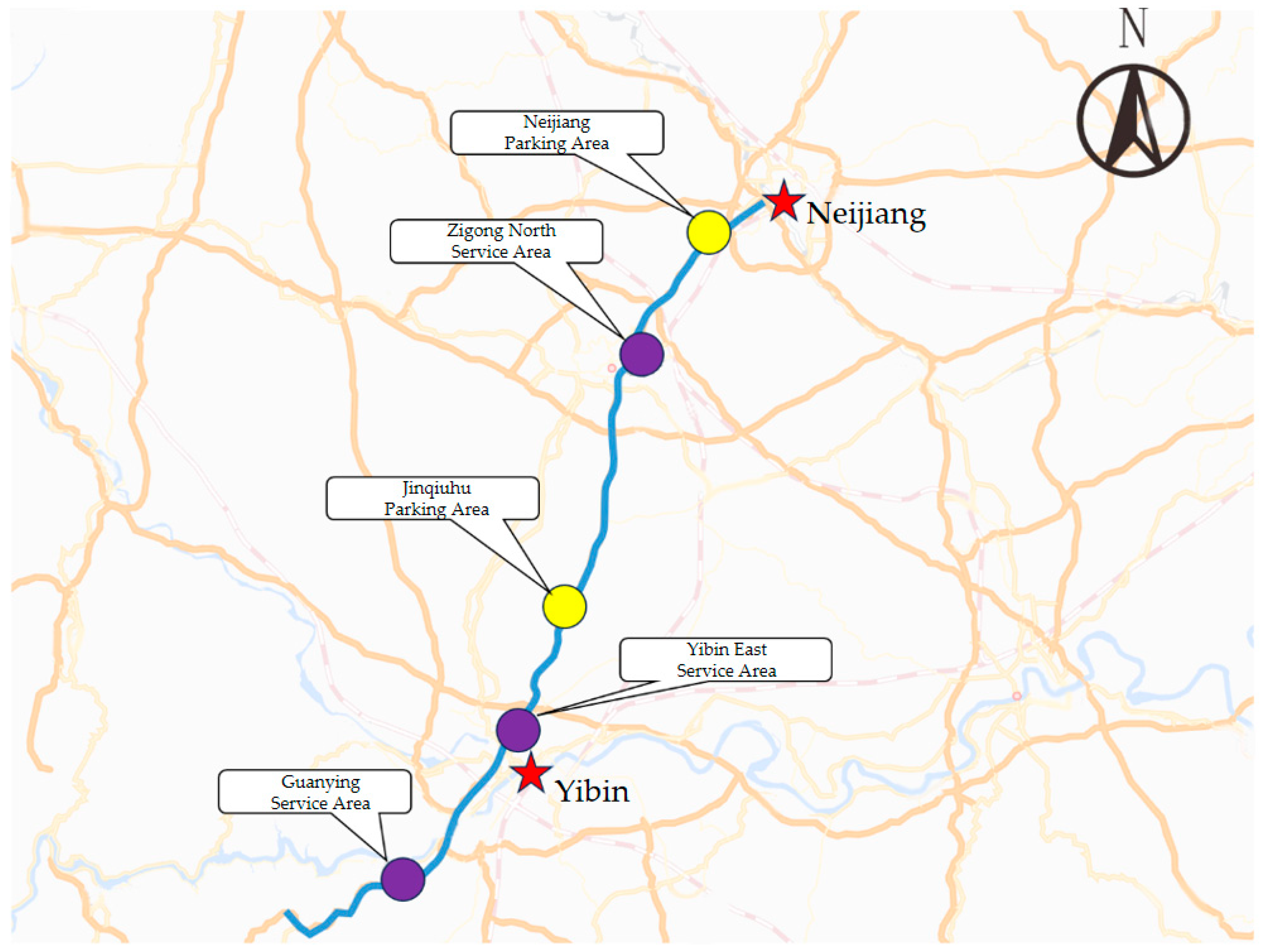
| Neijiang Parking Area | Fixed Piles: 6; MCVs: 0 | Fixed Piles: 7 |
| Zigong North Service Area | Fixed Piles: 8; MCVs: 1 | Fixed Piles: 9 |
| Jinqiu Lake Parking Area | Fixed Piles: 8; MCVs: 1 | Fixed Piles: 7 |
| Yibin East Service Area | Fixed Piles: 10; MCVs: 2 | Fixed Piles: 11 |
| Guanying Service Area | Fixed Piles: 7; MCVs: 0 | Fixed Piles: 6 |
| Indicator | Optimization Model | Peak Demand Proportional Method | Change |
|---|---|---|---|
| Average Daily Construction Cost (CNY) | 5175.15 | 3337.27 | +55.1% |
| Average Daily Operation Cost (CNY) | 1860.00 | 2000.00 | −7.0% |
| Average Daily User Anxiety Cost (CNY) | 6096.18 | 8035.19 | −24.1% |
| Average Daily Total System Cost (CNY) | 13,131.32 | 13,372.46 | −1.8% |
| Average Waiting Time for Charging Vehicles (min) | 5.48 | 7.32 | −25.1% |
Disclaimer/Publisher’s Note: The statements, opinions and data contained in all publications are solely those of the individual author(s) and contributor(s) and not of MDPI and/or the editor(s). MDPI and/or the editor(s) disclaim responsibility for any injury to people or property resulting from any ideas, methods, instructions or products referred to in the content. |
© 2026 by the authors. Licensee MDPI, Basel, Switzerland. This article is an open access article distributed under the terms and conditions of the Creative Commons Attribution (CC BY) license.
Share and Cite
Li, H.; Zhao, B.; Yao, Z.; Jiang, Y. A Queuing-Network-Based Optimization Model for EV Charging Station Configuration in Highway Service Areas. Modelling 2026, 7, 46. https://doi.org/10.3390/modelling7020046
Li H, Zhao B, Yao Z, Jiang Y. A Queuing-Network-Based Optimization Model for EV Charging Station Configuration in Highway Service Areas. Modelling. 2026; 7(2):46. https://doi.org/10.3390/modelling7020046
Chicago/Turabian StyleLi, Hongwu, Bin Zhao, Zhihong Yao, and Yangsheng Jiang. 2026. "A Queuing-Network-Based Optimization Model for EV Charging Station Configuration in Highway Service Areas" Modelling 7, no. 2: 46. https://doi.org/10.3390/modelling7020046
APA StyleLi, H., Zhao, B., Yao, Z., & Jiang, Y. (2026). A Queuing-Network-Based Optimization Model for EV Charging Station Configuration in Highway Service Areas. Modelling, 7(2), 46. https://doi.org/10.3390/modelling7020046