


Abstract
This paper investigates an Organic Rankine Cycle (ORC) system for low-to-medium temperature heat recovery using comparative thermodynamic, exergoeconomic and economic modelling. A working-fluid study considering environmental and thermodynamic perspectives is conducted. A 20 kW ORC unit is tested and used as a feasibility and trend-consistency reference to support the modelling assumptions and practical operating bounds. A parametric study then examines the effects of evaporator pressure, condensation temperature, superheat, subcooling and heat-exchanger pinch-point temperature differences on net power output, first- and second-law efficiencies, total product cost and total capital investment under prescribed boundary conditions. Multi-objective optimization is applied to identify Pareto-optimal trade-offs and representative compromise solutions. Results show an intermediate evaporator pressure maximizes net power output, while lower condensation temperature generally improves efficiency; superheat has limited efficiency impact but should ensure safe operation, and a small subcooling margin (around 3 °C) mitigates cavitation risk. The best overall performance is obtained with an evaporator pinch of 3 °C and a condenser pinch of 5–9 °C; tightening pinch constraints increases required heat-transfer area and makes heat exchangers the main cost bottleneck for high-efficiency solutions.
1. Introduction
The rapid development of the global economy and industry has raised serious concerns about energy issues. Traditional fossil fuels continue to dominate energy consumption, causing significant environmental problems [1,2,3]. Reducing their use is crucial for achieving climate goals [4]. However, the demand for energy in social production remains substantial. According to the International Energy Outlook 2013, global energy consumption is projected to increase by 56% from 2010 to 2040 [5]. As a result, the substantial geothermal energy reserves within the Earth’s crust, estimated at approximately 3.6 × GWh in the upper 10 km [6], are gaining attention. Efficient utilization of geothermal energy is becoming a global priority. Its relatively low temperature and large flow rate make it particularly suitable for medium- and low-temperature systems like the Organic Rankine Cycle (ORC) [7], which employs low-boiling-point organic fluids instead of steam [8,9,10].
Research on geothermal ORC has primarily focused on working-fluid selection and parameter optimization, with recent studies incorporating multi-objective optimization of thermodynamic, economic, and environmental performance [11]. Zhang et al. [12] studied working-fluid selection for subcritical ORC systems in low-temperature (80–100 °C) geothermal power generation, finding that R123 achieved the highest thermal and exergy efficiencies. They emphasized that optimal operating parameters vary depending on the criteria and cannot be solely determined by the first or second law of thermodynamics. Toffolo et al. [13] developed a method for selecting working fluids by considering cycle configuration, design parameters, economic factors, and off-design performance. For geothermal temperatures of 130–180 °C, their study showed that Isobutane performed best in a subcritical cycle, while R134a was optimal in a supercritical cycle. Both fluids had similar specific investment costs and levelized costs of electricity (LCOE), providing valuable design guidance for ORC systems.
Beyond thermodynamic and economic performance, the environmental impact of the working fluids has also become a consideration. Chitgar et al. [14] compared the net power output, global warming potential (GWP), and ozone depletion potential (ODP) of various fluids at different temperatures. Their findings indicate that for geothermal ORC systems, the selection of working fluids is crucial and highly dependent on the geothermal source conditions, particularly concerning environmental impacts.
Despite the varying performance and economic viability of different organic fluids in ORC systems, consistent trends have been observed. Consequently, parameter optimization has become a key research focus in geothermal ORC systems. Dai et al. [15] compared the performance of ten working fluids at a geothermal temperature of 145 °C. They found that, except for water and ammonia, the net power output of organic fluids decreased significantly with higher turbine expander inlet temperatures. Additionally, the net power output initially increased and then decreased with rising turbine expander inlet pressure, indicating an optimal evaporator pressure for maximizing net power output at a specific temperature. Wang et al. [16] investigated the influence of key thermodynamic design parameters on net power output and total heat transfer area in ORC systems. They showed that an optimal turbine inlet pressure maximizes net power output, while larger pinch-point and terminal temperature differences negatively impact both net power output and total heat transfer area.
Quoilin et al. [17] compared the thermodynamic and thermo-economic performance of several working fluids for medium- and low-temperature ORC systems, finding an optimal evaporation temperature significantly lower than the heat source temperature. The thermo-economic analysis recommended a higher evaporation temperature to increase the density of high-pressure steam and reduce the costs of the expander and evaporator. However, potential conflicts were noted between optimizing thermodynamic and thermo-economic performance. Zare [18] examined the thermodynamic and economic aspects of three ORC binary geothermal power plant configurations. He found that evaporator pressure, turbine inlet superheat, and condensation temperature significantly impact both thermodynamic and economic performance, highlighting the conflict between optimizing for thermodynamic and economic performance.
In ORC systems, single-objective optimization often leads to divergent design conclusions, prompting recent shifts towards multi-objective optimization. Wang et al. [19] used the Non-dominated Sorting Genetic Algorithm II (NSGA-II) for multi-objective optimization of an ORC system with R134a, optimizing for exergy efficiency and total capital cost. Le et al. [20] investigated the multi-objective optimization of subcritical ORC systems using pure and zeotropic mixtures as working fluids, aiming to maximize exergy efficiency and minimize LCOE. Wang et al. [21] proposed a bi-level multi-objective optimization framework for subcritical ORC systems, finding that evaporator pressure and condensation temperature impact system performance differently depending on the performance indicator.
Despite these advances, the above literature also indicates that conclusions can be indicator-dependent and sometimes even conflicting when thermodynamic and economic criteria are considered simultaneously. Meanwhile, working-fluid selection, parametric trend analysis, and multi-objective optimization are often reported as separate analyses or under different objectives and constraints, which makes it difficult to extract consistent and decision-relevant guidance for a given geothermal boundary condition. Therefore, a more systematic study that links working-fluid selection, parameter analysis, and multi-objective optimization within a consistent modelling basis is needed to clarify trade-offs and to identify feasible operating/design ranges. In addition, many studies do not explicitly communicate the feasibility envelope imposed by practical constraints (e.g., pinch-point limits, superheat/subcooling requirements, and expansion-end conditions), which may result in Pareto solutions that are numerically admissible but operationally fragile.
Motivated by the above need, this work presents a systematic investigation of geothermal-driven ORC performance by linking working-fluid selection, parametric analysis, and multi-objective optimization while considering thermodynamic and economic indicators in a consistent manner. The study aims to clarify how key design/operating parameters influence different performance indicators and to reveal the trade-offs among conflicting objectives through Pareto-optimal solutions and feasible operating ranges. A 20 kW small-scale ORC experimental setup is used as a feasibility and trend-consistency reference to support the modelling assumptions and the selected operating bounds, helping exclude non-operable parameter combinations within the investigated envelope.
The main contributions of this work are summarized as follows:
- (1)
- This study links working-fluid selection, parametric analysis, and multi-objective optimization within a consistent modelling basis for geothermal-driven ORC assessment.
- (2)
- Explicit feasibility constraints (e.g., pinch-point, superheat/subcooling and operational limits) are incorporated to identify feasible operating/design ranges and to avoid non-physical solutions.
- (3)
- A 20 kW small-scale ORC experiment is used as a feasibility and trend-consistency reference to support physically operable ranges relevant to the modelling assumptions.
- (4)
- A component-level thermo-economic and exergoeconomic perspective is used to interpret trade-offs and to identify dominant contributors affecting Pareto-optimal designs; in particular, the heat-exchanger area requirement under tight pinch constraints is highlighted as a primary cost bottleneck for high-efficiency solutions.
The remainder of the paper is organized as follows: Section 2 describes the system configuration; Section 3 presents the thermodynamic and economic models; Section 4, Section 5 and Section 6 report working-fluid selection, experimental reference, and the parametric and multi-objective optimization results; and Section 7 concludes the main findings.
2. System Description
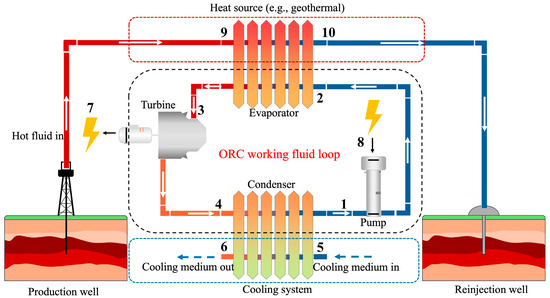
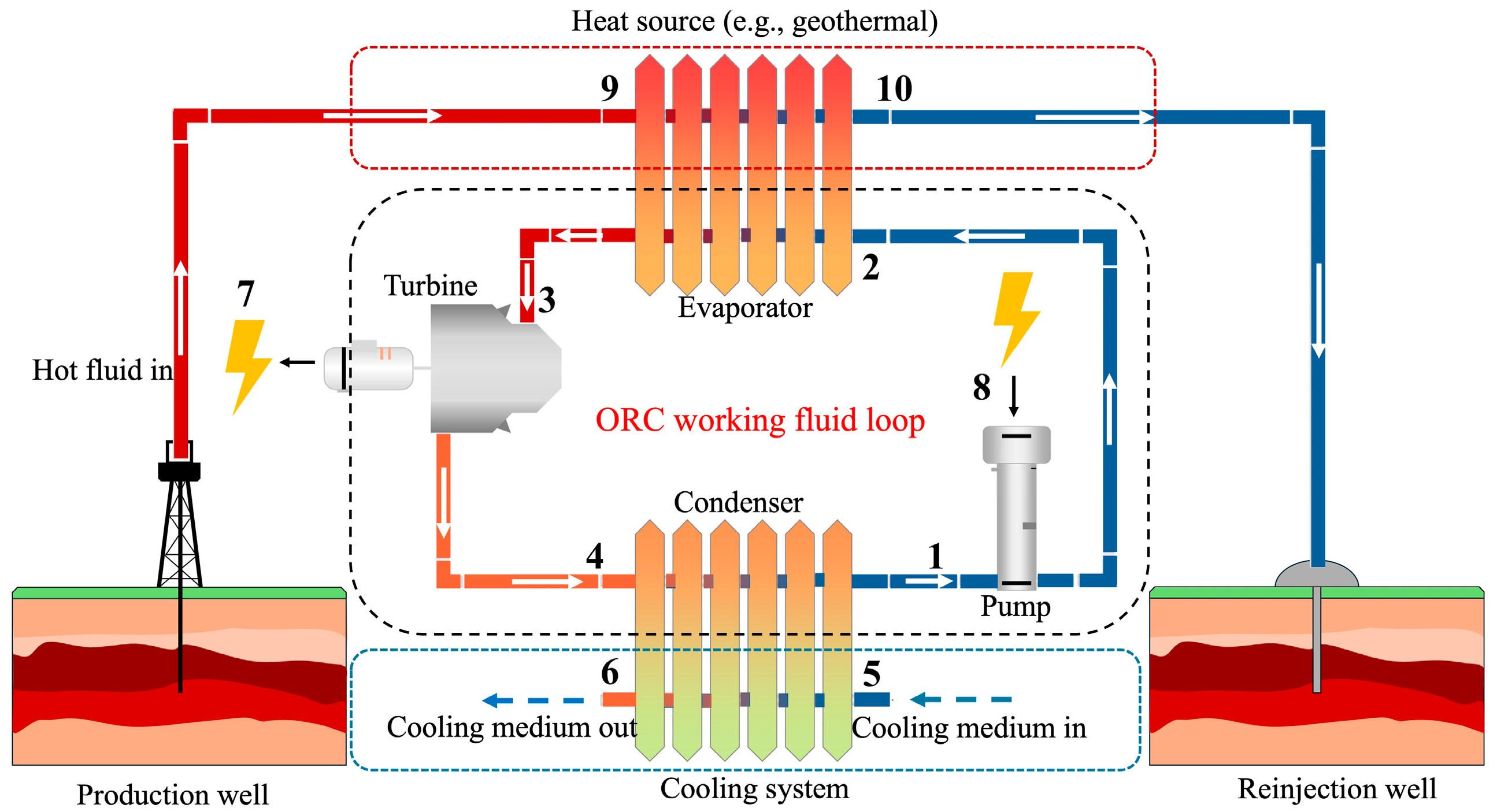
The geothermal ORC configuration considered in this study is shown in Figure 1. A subcritical ORC layout is adopted, consisting of a working-fluid pump, an evaporator, a turbine expander (coupled to a generator), and a condenser. The geothermal brine is treated as an external heat-source stream under steady-flow conditions at a specified pressure; it enters the evaporator, transfers heat to the organic working fluid and is subsequently reinjected. In the evaporator, the organic working fluid is heated and vaporized to a (slightly) superheated state before entering the turbine to produce power. The turbine exhaust is condensed in the condenser, and the liquid working fluid is then pressurized by the pump back to the evaporator pressure, completing the cycle.
Figure 1.
Schematic of the ORC system and its coupling to external heat-source and heat-sink loops (geothermal brine shown as an example heat source). The evaporator acts as the coupling heat exchanger between the ORC working-fluid loop and the geothermal loop, while the condenser rejects heat to the external cooling loop. Arrows indicate flow directions and numbers denote the state points used in the thermodynamic calculations.
To avoid ambiguity in system scale, this study considers two distinct but connected cases. Case I is a 20 kW laboratory-scale ORC used as a supplementary reference to check model consistency and to inform feasible operating/constraint ranges within the tested configuration. Case II is a conceptual geothermal-ORC plant case used for the parametric study and multi-objective optimization under specified geothermal boundary conditions. The purpose of Case I is not full-scale demonstration; rather, it supports the modelling workflow and helps exclude non-operable solutions, while the optimization conclusions are drawn from Case II within the stated assumptions and applicability range.
The following assumptions are made in the system analysis:
- The system operates under steady-state conditions.
- Changes in kinetic and potential energy are neglected.
- Pressure drops in the evaporator and condenser are considered. Pressure losses along interconnecting pipelines are neglected in this configuration-level study because they are layout-dependent and require plant-specific piping information beyond the present scope. Where needed, their effect can be included as a lumped pressure-drop term applied to the high- and low-pressure sides.
- The geothermal production stream is assumed to be saturated liquid water at the wellhead.
- The pumps and turbine are characterized by their isentropic efficiencies.
For consistency, working-fluid screening, parametric analysis and multi-objective optimization are performed using the same thermodynamic and economic modelling framework and identical boundary conditions, ensuring comparability across fluids and operating points. In this regard, Case I is used to support physically realistic operating/constraint ranges and to check model consistency, whereas Case II is used to derive decision-relevant trends and Pareto-optimal solutions within the stated assumptions.
3. System Model
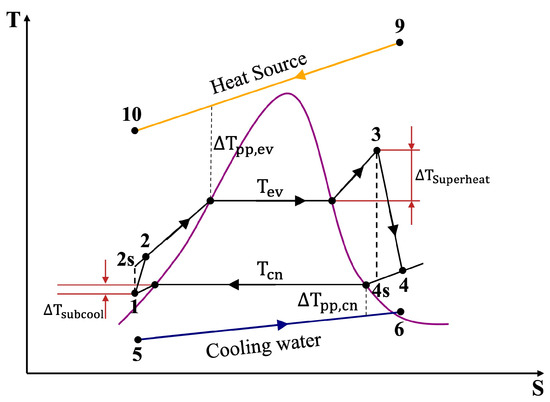
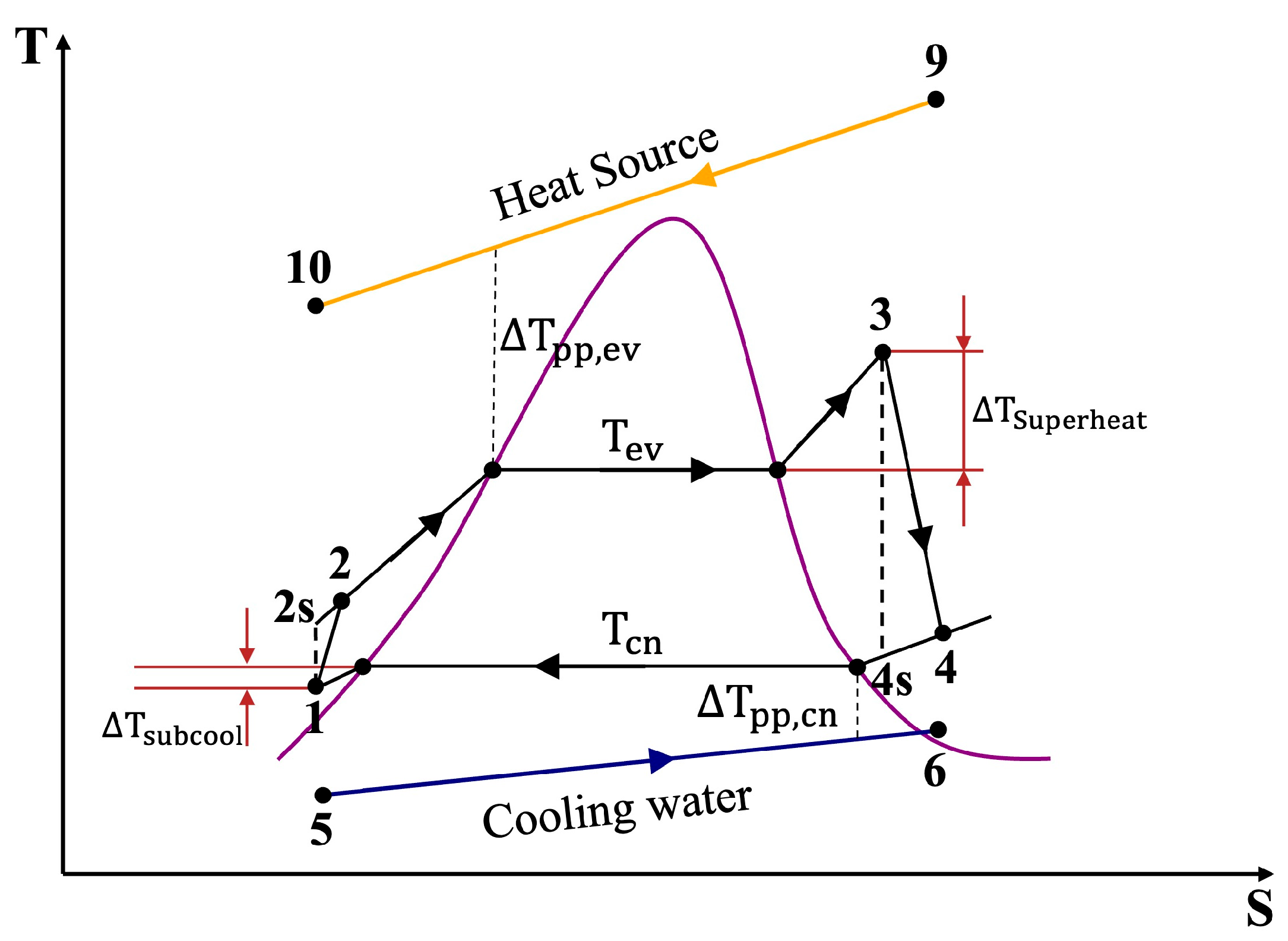
The ORC system in this study is modelled based on component-wise mass and energy conservation, incorporating both the first and second laws of thermodynamics. For the parametric study and multi-objective optimization, the geothermal water stream is treated as an external heat-source boundary condition with prescribed inlet temperature and pressure. The cycle performance is evaluated under these specified source conditions, with the thermodynamic processes illustrated in Figure 2. For brevity, detailed derivations, auxiliary equations, and adopted correlation parameters are provided in the Supplementary Materials (Section S2), while the main text focuses on the modelling workflow, boundary conditions, and decision-relevant outputs.
Figure 2.
T–s diagram of the subcritical ORC showing state points and key temperature constraints (pinch-point differences, superheating, and subcooling).
To clarify the scope and decision-oriented outputs of this study relative to the representative geothermal ORC optimization literature, Table 1 provides a high-level comparison using concise keywords. The present work emphasizes a transparent, constraint-aware workflow that yields operable Pareto sets and decision-relevant feasible operating ranges, rather than a single optimum point.
Table 1.
Positioning of the present work relative to representative geothermal ORC/CHP optimization studies.
To enhance transparency of model provenance, the proposed framework integrates first-principles component modelling with established thermophysical and economic inputs. Mass and energy balances and the associated performance metrics are formulated using control-volume conservation principles. Feasibility and operability constraints—such as minimum pinch-point temperature differences and superheat/subcooling margins to avoid wet expansion and mitigate cavitation risk—are explicitly enforced during simulation and optimization. State-point evaluations rely on an external thermophysical property database to ensure consistent comparison across candidate working fluids (see Supplementary Material, Section S1). Economic and exergoeconomic assessments follow standard cost-rate accounting and established component cost correlations, which are described in the corresponding subsections.
Multi-objective optimization is performed using NSGA-II, with objectives and constraints defined to generate Pareto-optimal solution sets. Additional details on numerical implementation, property evaluation, and the rationale for the chosen computational tools are provided in the Supplementary Material (Section S1) to support reproducibility while keeping the main text focused on the modelling methodology.
3.1. First Law Model
The system simulation and calculation of state-point parameters are based on the specified heat-source inlet condition (temperature and mass flow rate ). For the evaporator and condenser, the pinch-point temperature differences and are imposed as feasibility constraints, which affect the reinjection temperature and the cooling water outlet temperature . In addition, for certain working fluids the turbine outlet (Point 4) may enter a liquid region; therefore, superheating at the turbine inlet is considered to mitigate wet expansion, while subcooling is included to prevent cavitation at the pump inlet. The governing energy-balance relations for the evaporator and condenser are written in terms of the working-fluid and source/sink enthalpy changes, and the turbine performance is characterized using the isentropic efficiency definition. Accordingly, the key first-law relations used in the subsequent analysis are:
3.2. Second Law Model
Compared to the first law analysis, which only considers energy conversion efficiency, the second law analysis, which considers the efficiency of available energy utilization, usually receives more attention for low-temperature heat source utilization systems like ORC [24,25]. Complete exergy calculation includes physical exergy, chemical exergy, kinetic exergy, and potential exergy [26]. Given that there are no chemical changes in the ORC system and changes in kinetic and potential energy are negligible, the second law analysis only considers the physical exergy of each stream:
The exergy balance for an open thermodynamic system can be expressed as:
The exergy loss for each component is given by the following equation:
3.3. Exergoeconomic Model
In addition to thermodynamic performance, the economic performance of ORC systems is crucial. Common indicators such as specific investment cost (SIC), payback period (PBP), and levelized cost of electricity (LCOE) are often used [11]. However, these indicators may not fully capture the characteristics of ORC systems, which often exhibit relatively low efficiencies. Exergoeconomic analysis is therefore adopted, as it combines exergy and economic analyses to evaluate each component’s contribution to system cost formation. The methodology used in this study is based on Specific Exergy Costing (SPECO), where fuel and product costs are defined for all components based on their exergy streams. For brevity, the component-level cost balance relations, auxiliary equations, and the annualization procedure (including CRF) are provided in the Supplementary Material.
The system total product cost used in the subsequent analyses is calculated as:
where denotes the system total product cost rate, the fuel cost rate, and the total component-related cost rate including capital investment (CI) and operation and maintenance (OM).
3.4. Economic Model
Accurate component cost functions are crucial for the economic and exergoeconomic evaluation. In this study, the purchased equipment cost (PEC) of the main components is estimated using empirical correlations reported in the open literature. Specifically, the PEC of the pumps and turbine is expressed as a function of the corresponding power, whereas the PEC of the evaporator and condenser is expressed as a function of the heat-transfer area; all costs are reported in US dollars. The detailed PEC correlations, together with their original sources and applicability ranges, are provided in the Supplementary Materials.
Because the adopted correlations originate from different literature sources, the benchmark year of the reported costs is not always stated explicitly. To ensure transparency, the benchmark year information (when available) is listed in the Supplementary Material. When benchmark years are available, costs can be escalated/deflated to a common reporting year using a standard cost-index approach (e.g., CEPCI-based escalation commonly used in ORC thermo-economic studies) [11]; when benchmark years are not explicitly stated, the correlations are used as reported and this limitation is documented. Accordingly, and given the screening-level nature of the present costing framework (without project-specific inputs such as procurement strategy, layout, local labour rates and detailed drilling design), the economic indicators are intended primarily for relative comparison and trade-off interpretation among candidate working fluids and operating points under identical boundary conditions, rather than absolute project cost estimation.
Unlike surface equipment costs, geothermal well drilling cost is highly site-specific and depends strongly on drilling depth, geological conditions, drilling method and achievable flow rate. Because such site-specific information is typically unavailable at the configuration-assessment stage, the well cost is incorporated here as a conceptual (screening-level) term and approximated as a fraction of the total capital investment (TCI) to preserve comparability across designs. Reported geothermal subsurface/drilling investment can constitute a substantial fraction of total project investment (often on the order of tens of percent), and its relative burden can become higher for lower-temperature resources [27]. Following thermo-economic literature practice, representative fractions are adopted here [28], and the drilling cost is expressed as:
This simplified treatment is used with acceptance at the conceptual level and should not be interpreted as a bankable estimate. For project-specific assessment, the well cost term should be replaced by a site- and depth-dependent drilling cost model when the relevant data are available.
Finally, the total capital investment (TCI) is estimated using a factor method based on PEC, i.e., [29]. The operating and maintenance expenses, , are assumed as 20% of PEC [28,29]. These factors are applied consistently across all cases to quantify economic trade-offs on a comparable basis under the same modelling premises.
3.5. Heat Exchangers Model
The heat-exchanger parameters adopted in this study are provided in the Supplementary Materials (Table S1). The evaporator and condenser are assumed to be titanium heat exchangers operated in counter-flow, and the heat-transfer process is evaluated using the log-mean temperature difference (LMTD) method. The heat duty of each heat exchanger is expressed as
where and are the overall heat-transfer coefficient and heat-transfer area, respectively, and the subscript denotes the evaporator or condenser. The LMTD definitions used in this work are
Neglecting fouling, the overall heat-transfer coefficient is evaluated by the thermal-resistance form
where and are the convective heat-transfer coefficients on the working-fluid side and the secondary-loop water side, respectively; and are the plate thickness and thermal conductivity of the heat-exchanger plate. The correlations used to evaluate convective coefficients and pressure drops on both sides are provided in the Supplementary Material.
3.6. Multi-Objective Optimization Model
Multi-objective optimization models are used to solve decision-making problems that involve multiple criteria, allowing for the simultaneous maximization of several objective variables. Unlike single-objective optimization, which results in a single solution, multi-objective optimization yields multiple solutions, referred to as Pareto optimal solutions. Mathematically, the optimization function and constraints can be formulated as follows:
In the present study, the admissible solutions are restricted to a feasibility envelope defined by the bounds in Equation (18) together with the thermodynamic/operational constraints in Equations (16) and (17). This treatment prevents numerically admissible but physically unrealistic solutions and allows the resulting Pareto front to be interpreted as feasible operating/design ranges rather than isolated numerical optima.
In this study, the optimization objectives are:
- Maximizing the first law efficiency .
- Maximizing the second law efficiency .
- Maximizing the net power output .
- Minimizing the total product cost .
- Minimizing the total capital investment (TCI).
The decision variables and their bounds are provided in Section 6.
3.7. Model Validation
To verify the accuracy of the proposed model, data from the literature were used for comparison. The results are shown in Table 2.
Table 2.
Validation of developed model.
The derived model shows a maximum deviation of no more than 3.5% compared to the data from the literature. Therefore, the model can be considered reliable.
In the subsequent simulations of this study, the given parameters are listed in Table 3 below:
Table 3.
Simulation parameters.
4. Fluid Selection
The main factors influencing ORC performance are the temperature range between the heat source and the heat sink, and the properties of the organic working fluid. Geothermal energy typically ranges from 70 °C to 180 °C, making it difficult to improve ORC performance by increasing the temperature range. Thus, the key factor affecting geothermal ORC performance is the properties of the working fluid. Due to significant differences in the properties of various working fluids, their impact on ORC performance also varies. Therefore, selecting the appropriate working fluid is crucial in ORC research.
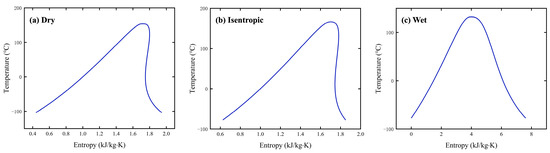
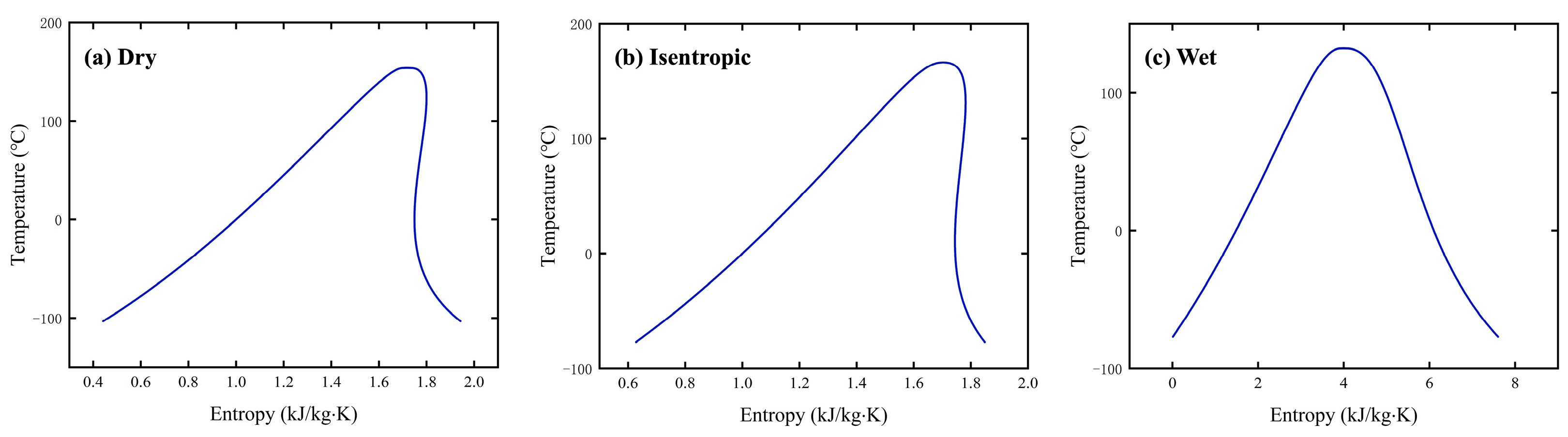
The primary consideration for working-fluid selection is the shape of the saturation boundary in the temperature–entropy (T–s) diagram, because it governs how an approximately isentropic turbine expansion intersects the two-phase region and thus affects turbine outlet conditions, operability margins, and efficiency. As illustrated in Figure 3, organic working fluids are commonly grouped into wet, dry, and isentropic types according to the saturation boundary shape on the T–s diagram. For wet fluids, the saturated vapour line exhibits a negative slope; therefore, an isentropic expansion from a saturated or slightly superheated inlet state tends to enter the two-phase dome, leading to wetness (liquid droplet formation) at the turbine outlet and associated erosion and efficiency penalties. By contrast, dry fluids (positive slope) and isentropic fluids (approximately vertical slope) are more likely to remain on the superheated side after expansion, which reduces turbine wetness and can lessen the inlet superheat margin required for safe operation. Therefore, from the expansion-route viewpoint, dry and isentropic fluids are often preferred for subcritical ORC systems.
Figure 3.
Classification of working fluids on a T–s diagram (schematic). Wet, dry and isentropic fluids are distinguished by the slope of the saturated vapour line in the temperature–entropy plane, which determines whether an approximately isentropic expansion tends to enter the two-phase region. Wet fluids exhibit a negative slope and may develop wetness during expansion, whereas dry fluids (positive slope) and isentropic fluids (approximately vertical slope) tend to remain on the superheated side after expansion.
Past research has rarely distinguished between different scenarios for working fluid use. In geothermal ORC systems, evaporator pressure is usually positively correlated with the heat source temperature. Therefore, this study considers the matching of selected working fluids with the heat source temperature.
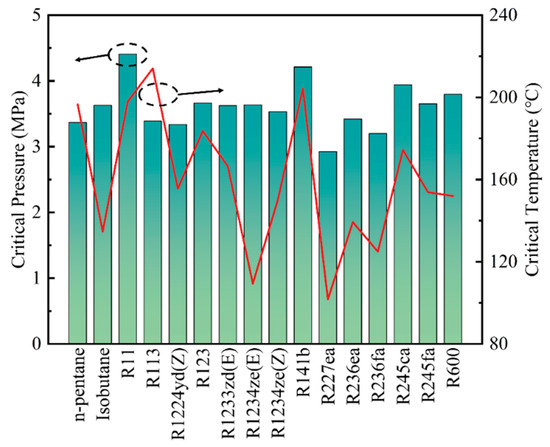
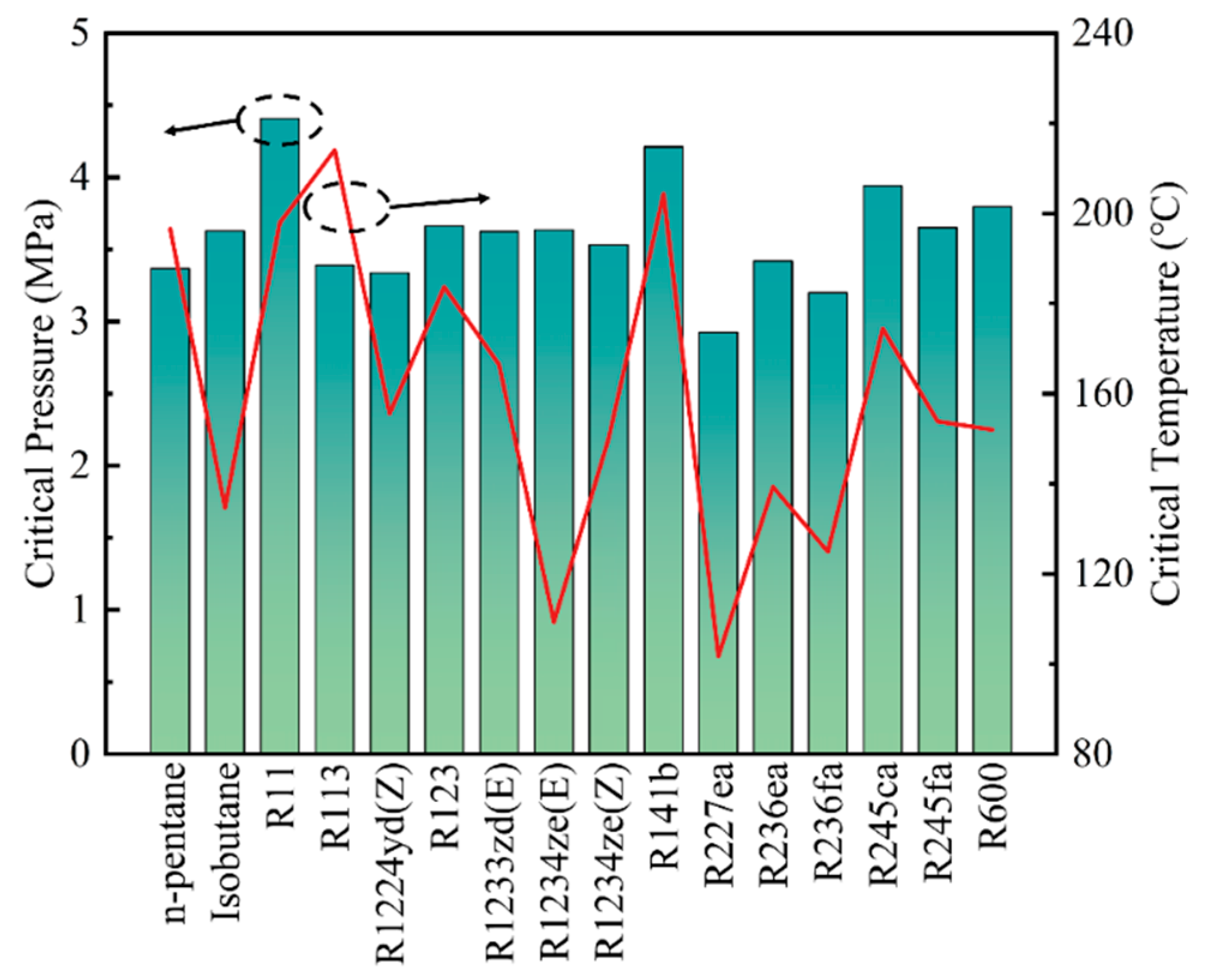
This study examined the working fluids used in the referenced literature and considered them as candidates. The corresponding candidate list is provided in the Supplementary Materials (Table S5), and the final selected working fluids are summarized in Figure 4.
Figure 4.
Critical parameters of candidate working fluids.
By studying the thermophysical properties and environmental impacts of each candidate working fluid on the ORC system, all candidates were simulated under the conditions in Table 4, resulting in five candidates. The first law efficiency and turbine output power were considered as thermodynamic indicators, while GWP and ODP were used as environmental indicators.
Table 4.
Simulation input for working-fluid selection.
Due to the different properties of each working fluid, the corresponding evaporator pressure for each fluid varies at a given geothermal water temperature. Therefore, this study determines the optimal evaporator pressure for each fluid at four different geothermal water temperatures. The optimal evaporator pressure is defined as the pressure that maximizes the net power output and the first law efficiency based on the cycle parameters given in Table 4.
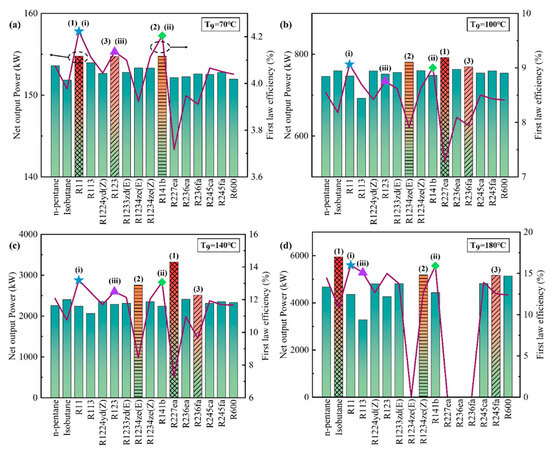
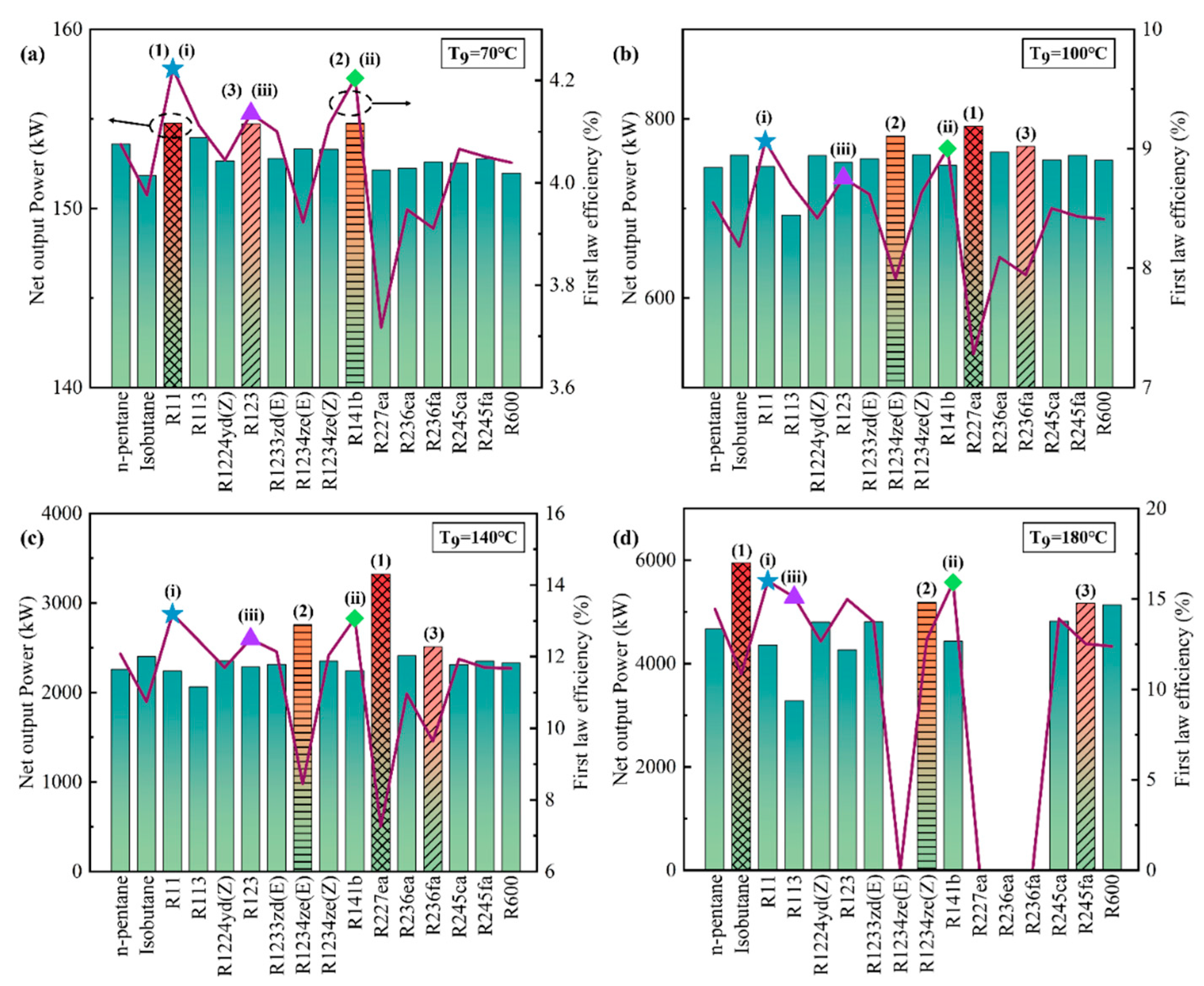
In terms of net power output, as shown in Figure 5a, R11, R141b, and R123 achieved the top three rankings at a heat source temperature of 70 °C. As the heat source temperature increased to 100 °C and 140 °C, Figure 5b,c, show that R227ea, R1234ze(E), and R236fa performed the best in terms of net power output. However, when the heat source temperature reached 180 °C, as shown in Figure 5d, due to critical temperature limitations, R1234ze(E), R227ea, R236ea, and R236fa were no longer suitable as ORC working fluids. At this temperature, Isobutane performed outstandingly, achieving the highest net power output, with R1234ze(Z) and R245fa ranking second and third, respectively.
Figure 5.
Preliminary screening of candidate working fluids under different geothermal source temperatures: (a) 70 °C, (b) 100 °C, (c) 140 °C, and (d) 180 °C. Bars show net power output, and the solid line shows first-law efficiency. The highlighted fluids indicate the top-ranked candidates at each temperature level.
In terms of first law efficiency, as shown in Figure 5a–c, within the temperature range of 70 °C to 140 °C, the performance of the various working fluids is consistent, with R11, R141b, and R123 achieving the top three rankings, respectively. However, at a heat source temperature of 180 °C, as shown in Figure 5d, R113 replaced R141b to secure the second position, while R141b dropped to third.
Under low-temperature conditions (70 °C), the work capacity of various working fluids is almost equal, so environmental factors are primarily considered. R11 is excluded due to its extremely high GWP of 4750, causing significant environmental damage. R141b has a GWP of 725, lower than R11 but higher than R123’s GWP of 77. Additionally, R123 has an ODP of only 0.01. Therefore, at a heat source temperature of 70 °C, R123 is the preferred working fluid.
In the medium temperature range (100 °C to 140 °C), although R227ea performs well in terms of net power output, its first law efficiency is below average, and it has a high GWP, making it less recommended. R1234ze(E), despite lower energy conversion efficiency, exhibits high output power and extremely low GWP and ODP values. Considering work capacity, energy conversion efficiency, and environmental impact, R123 and R1234ze(E) are selected as the candidate working fluids.
Under high-temperature conditions (180 °C), Isobutane performs excellently in terms of net power output and energy conversion efficiency, with minimal environmental impact. Although R1234ze(Z) and R245fa exhibit similar performance in net power output and first law efficiency, R1234ze(Z) is more suitable due to R245fa’s higher GWP.
Overall, R141b shows robust performance in net power output and first-law efficiency across the investigated temperature conditions. Accordingly, the candidate working fluids selected for further analysis are R123, R1234ze(E), R1234ze(Z), Isobutane, and R141b, and their operating conditions are listed in Table 5. In the subsequent parametric study and multi-objective optimization, R141b is adopted as a representative working fluid to illustrate the trade-off mechanisms under consistent modelling assumptions. It should be noted, however, that R141b has non-zero ozone depletion potential and is subject to environmental regulations and usage restrictions in many jurisdictions; the same framework and trade-off trends can be directly transferred to compliant alternatives (e.g., R1234ze(E), R1234ze(Z), or other eligible fluids) under the same geothermal boundary conditions.
Table 5.
Recommended working fluid for geothermal.
For clarity, the laboratory-scale ORC experiment reported in Section 5 is conducted using R245fa, whereas the subsequent parametric study and multi-objective optimization are presented using the representative working fluid selected above. The experiment is used as a feasibility and trend-consistency reference to support the modelling workflow and the selected operating bounds, thereby helping exclude non-operable parameter combinations within the investigated envelope.
5. Experiment Description
5.1. Experimental Setup
To provide supplementary evidence for the modelling workflow and to help define feasible operating/constraint ranges used in the subsequent parametric study and multi-objective optimization, a laboratory-scale ORC experiment was conducted. The experiment is intended as a consistency reference and feasibility check within the tested 20 kW configuration, rather than as a full-scale demonstration of geothermal performance or a dedicated validation campaign for the optimized working fluid. Therefore, the test rig is operated with R245fa as the working fluid.
A laboratory-scale ORC test rig was established, and the boundary conditions were selected with reference to a geothermal source in Fuzhou, Fujian Province, China (Table 6).
Table 6.
Geothermal parameters.
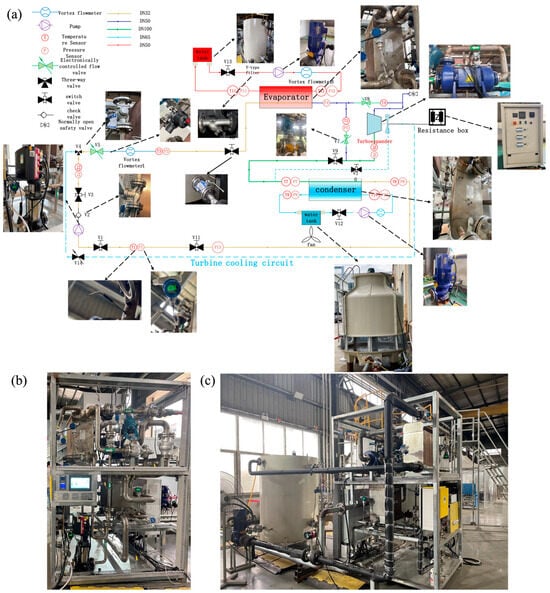
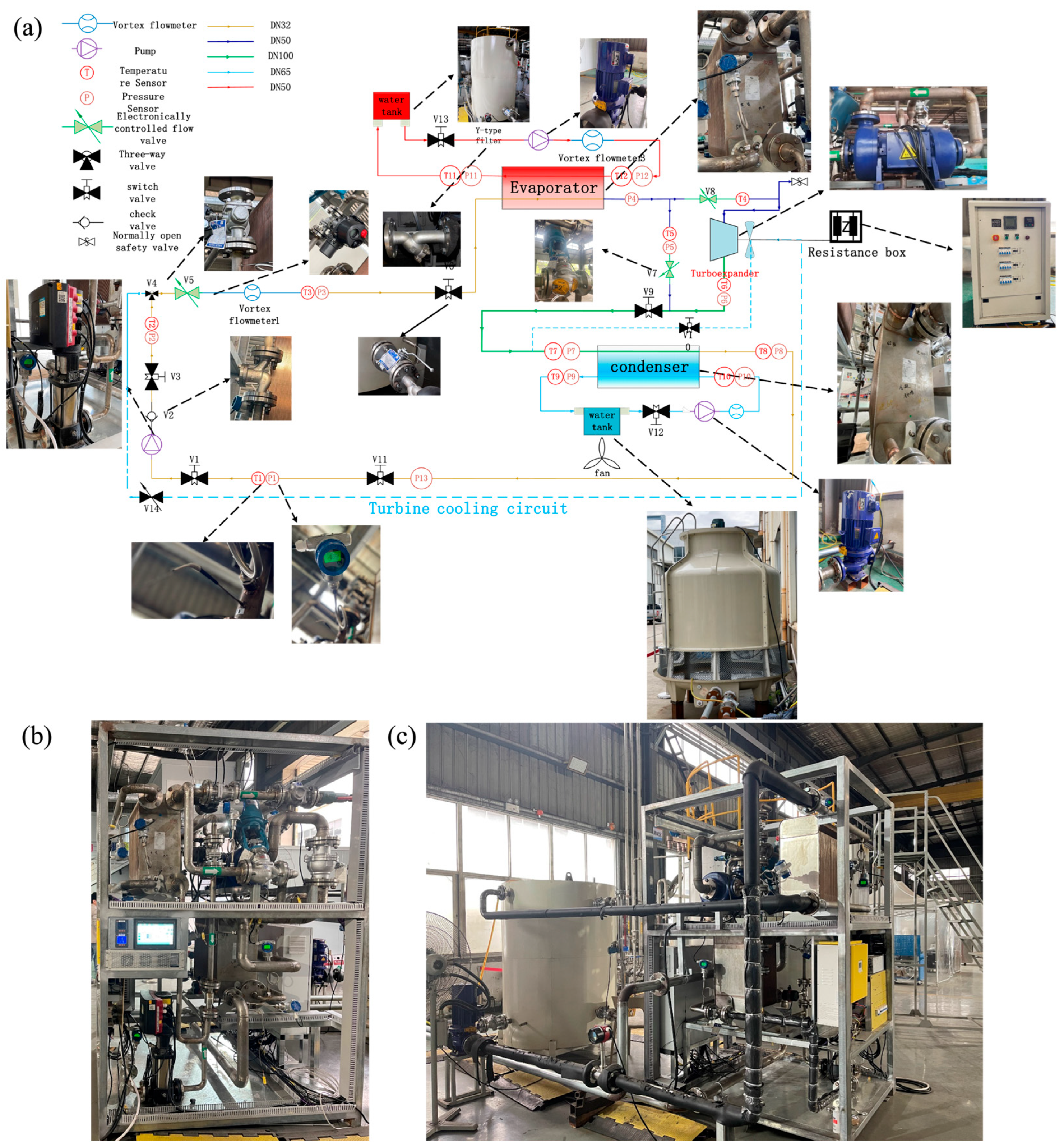
The ORC experimental setup consists of an evapourator, a working-fluid pump, a turbine expander, a condenser, and R245fa as the working fluid. The expander and generator are integrated as a customized centrifugal expander–generator unit (rated 20 kW), and a stepwise adjustable resistive load bank (rated 30 kW) is connected downstream of the generator to control the operating point (speed/power) under different load levels. SWEP brazed plate heat exchangers are employed as the evaporator and condenser. Municipal tap water heated by a boiler provides the heat-source stream (typically 70–100 °C at the evaporator inlet), while municipal tap water is also used as the cooling medium on the condenser side. Liquid R245fa is pressurized by the pump and evaporated/superheated in the evaporator before entering the expander to produce power; the low-temperature liquid working fluid is additionally used for turbine bearing cooling. After expansion, the R245fa vapor is condensed in the condenser and pumped back to the evaporator to complete the cycle. To ensure safe operation, a superheat monitoring branch is installed at the expander inlet: when the measured superheat degree falls below a safety margin, a diverter valve redirects the working fluid through a throttling path (expansion valve) before it merges back into the main loop upstream of the condenser, thereby avoiding potentially wet expansion at the expander inlet. The schematic of the test loop and representative photographs of the experimental facility are shown in Figure 6, where the main flow paths and measurement locations are indicated.
Figure 6.
Laboratory-scale ORC experimental facility and instrumentation: (a) schematic diagram of the test loop with key components and measurement points; (b) front view of the experimental rig; (c) overall view of the experimental platform.
The measurement equipment used in this setup, along with their accuracy, is listed in Table 7.
Table 7.
Measuring equipment and accuracy.
Following the instrument accuracies reported in Table 7, the impact of measurement uncertainties on the reported experimental results is assessed using standard error propagation. For a calculated quantity , the combined uncertainty is evaluated by the root-sum-square (RSS) method:
In this study, the net power output is obtained from the measured electrical output of the expander–generator unit, while the first-law efficiency is calculated as , where is determined from the measured heat-source mass flow rate and inlet/outlet temperatures. Accordingly, the uncertainty in is directly inherited from the electrical measurement, and the uncertainty in reflects the combined uncertainties in , , , and through the RSS propagation above. This assessment clarifies how measurement errors are reflected in the calculated net power and efficiency and supports the robustness of the experimental trends used as supplementary reference in this work.
5.2. Experimental Design
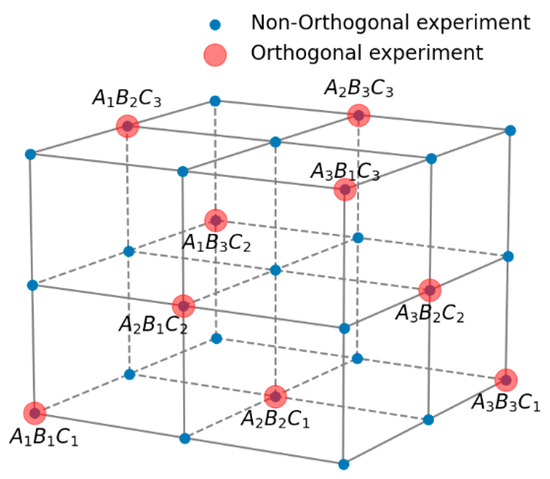
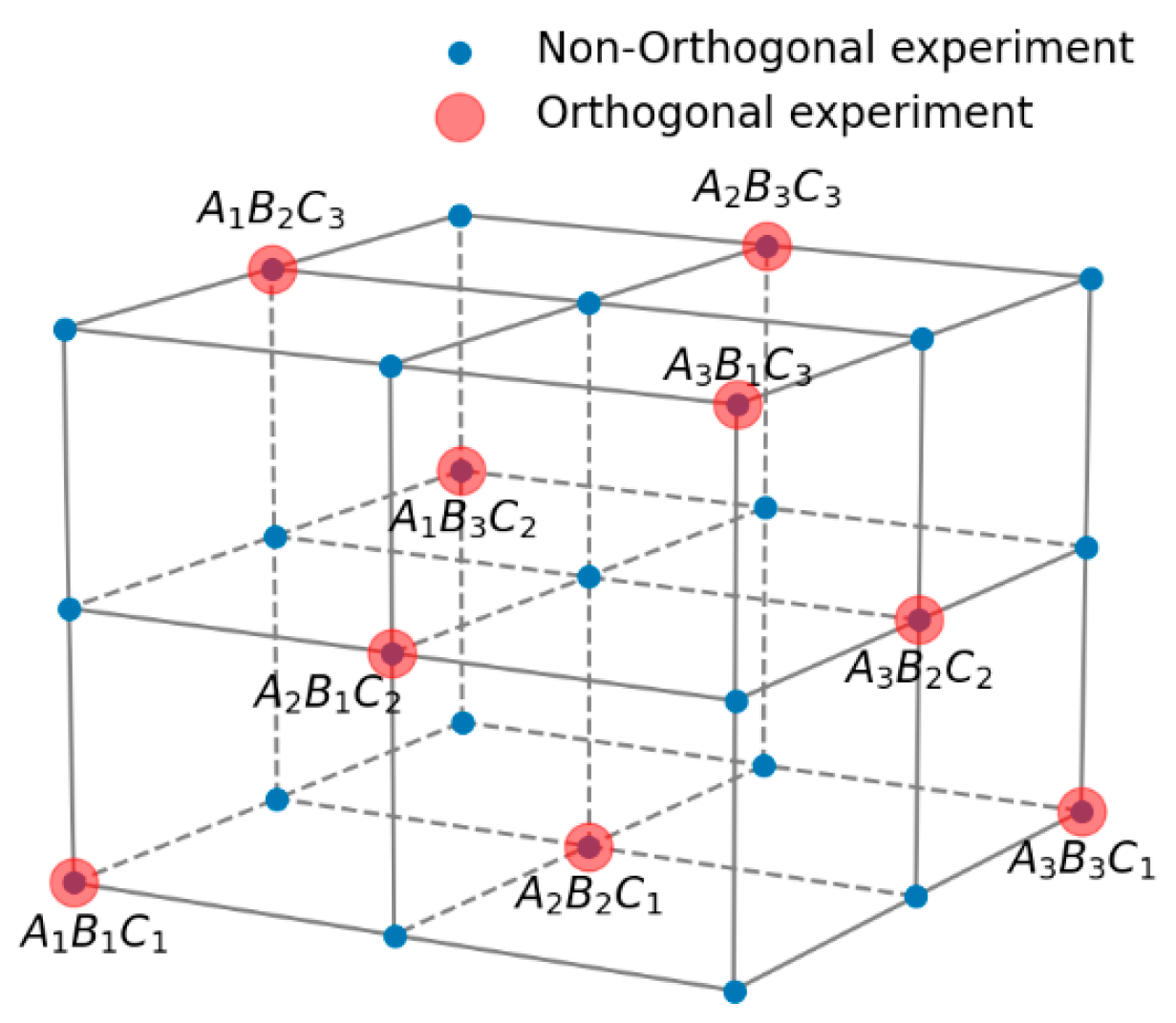
To demonstrate the impact of different parameters on ORC performance, experiments need to cover the range of controllable variables. Conventional experimental design methods would result in a large number of experiments. To reduce the number, orthogonal experimental design is employed, using Latin hypercube sampling to divide the range of controllable variables. Orthogonal design significantly reduces the number of experiments in multi-factorial studies while ensuring coverage of the experimental range [30,31]. For example, for a 3-factor, 3-level experimental design, orthogonal design reduces the number of experiments from 27 to 9, as shown in Figure 7.
Figure 7.
Orthogonal experimental design.
The direct control variables considered in this experiment are shown in Table 8. The experiments are designed using a standard orthogonal array. For the variable “Connected load,” a 3 kW⋅10 resistance box is used to simulate the connected load. To avoid turbine overspeed and ensure safety, the load must be limited to above 20 kW, resulting in only 4 levels. Therefore, quasi-level treatment is applied. Although the treated experimental design does not strictly maintain orthogonality, it still adequately covers the entire range.
Table 8.
Variables in the experiment.
The experiments conducted in this study are summarized in the Supplementary Materials (Table S6).
In this work, the 20 kW experimental system (Case I) is used to support operability and to benchmark trend consistency of the numerical parametric analysis within the tested envelope. The orthogonal design in Table 8 spans the practically controllable operating envelope, and in particular the tested heat-source and sink inlet temperatures (80–110 °C and 20–40 °C, respectively) provide empirical support for the operability of the investigated low-temperature boundary condition and the adopted parameter bounds. Specifically, the experimentally covered ranges include the working-fluid mass flow rate, the heat-source/sink loop flow rates, and the connected-load levels reported in Table 8; these bounds are therefore taken as physically operable ranges when defining the parameter space investigated in Section 6. A combined assessment of experimental observations and numerical trends, together with a dominance ranking of key variables, is presented in Section 6 to support subsequent decision-variable selection and feasibility screening.
6. Result and Discussion
6.1. Parametric Study Discussion
This study selected evaporator pressure, condensation temperature, superheat degree, subcooling degree, and heat-exchanger pinch-point temperature difference as control variables, and evaluated net power output, first-law efficiency, second-law efficiency, product cost rate, and total investment.
These parameters mainly affect the cycle through two mechanisms: (i) changing the effective temperature match and irreversibility in the heat exchangers (e.g., via condensation temperature and pinch-point constraints), and (ii) shaping the expansion/pumping process and operability margins (e.g., via pressure level and superheat/subcooling requirements). Therefore, the parametric trends reflect not only thermodynamic trade-offs but also feasibility and cost penalties associated with heat-transfer area and safe operation.
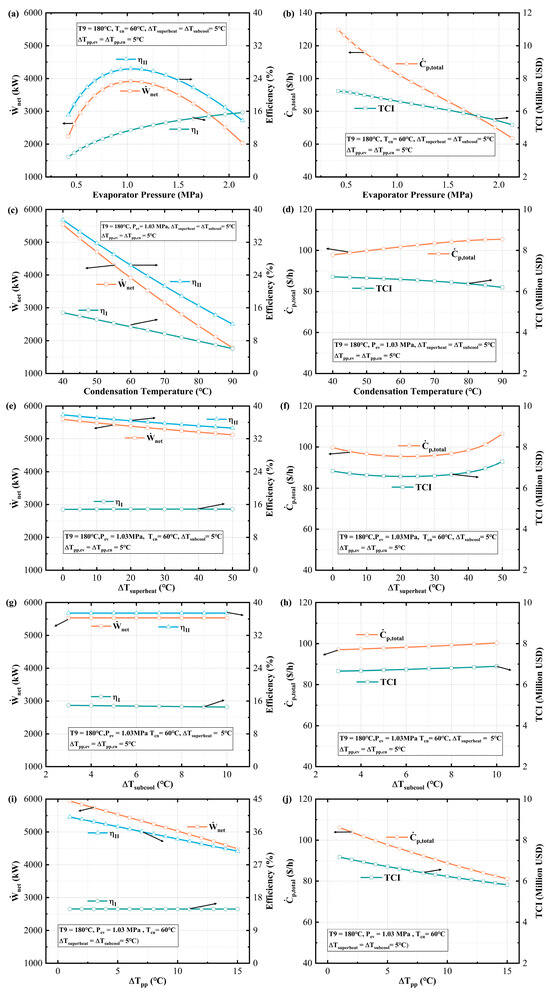
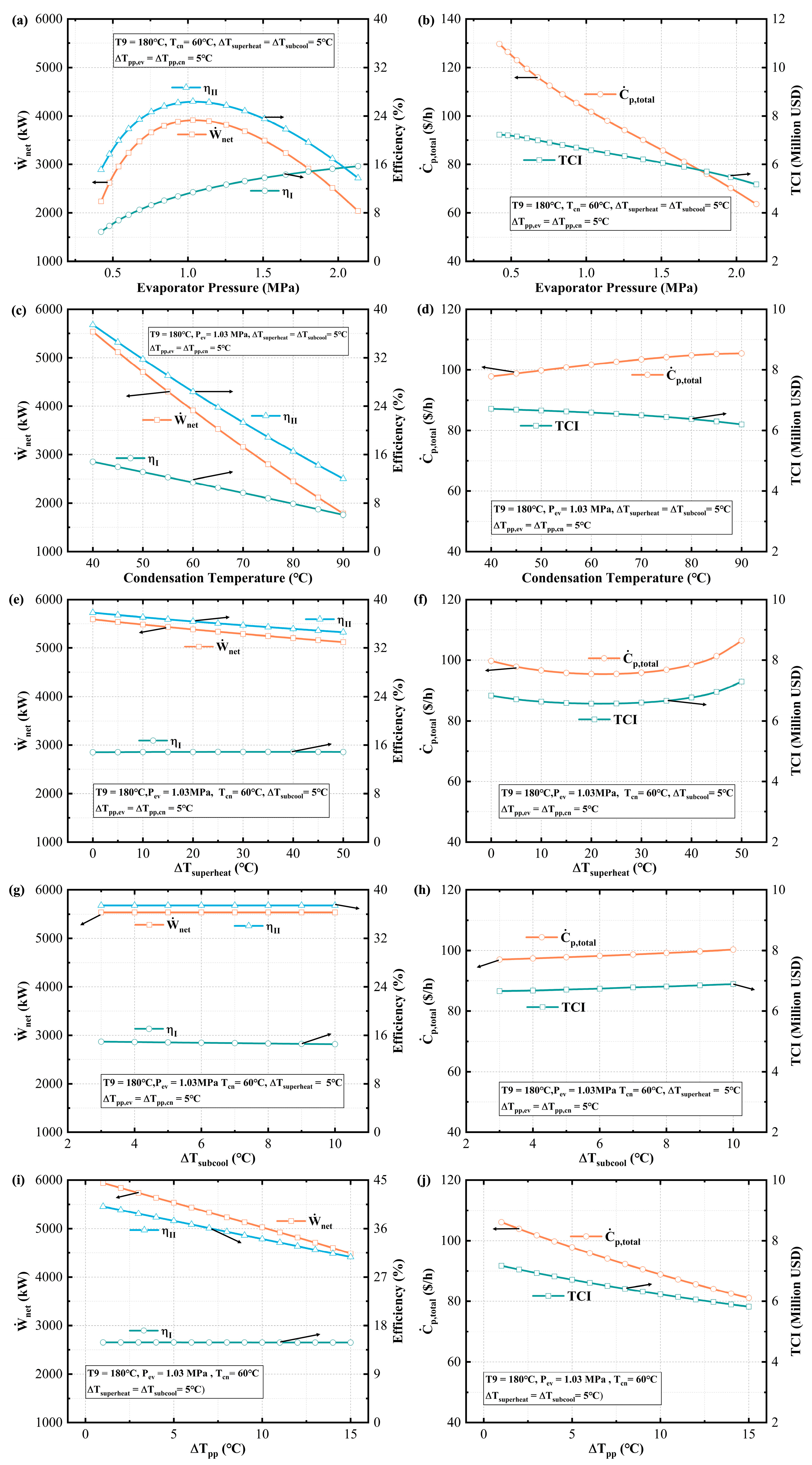
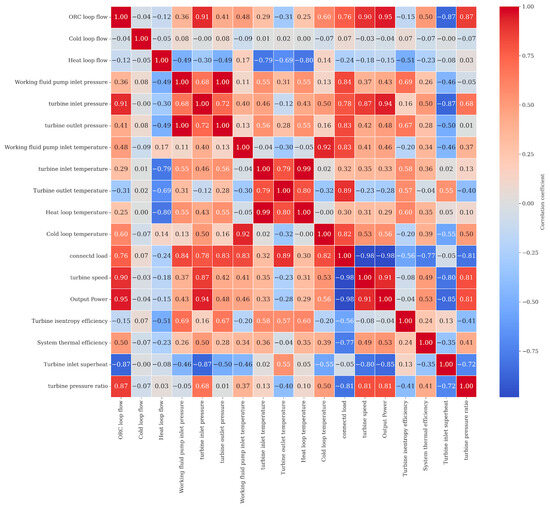
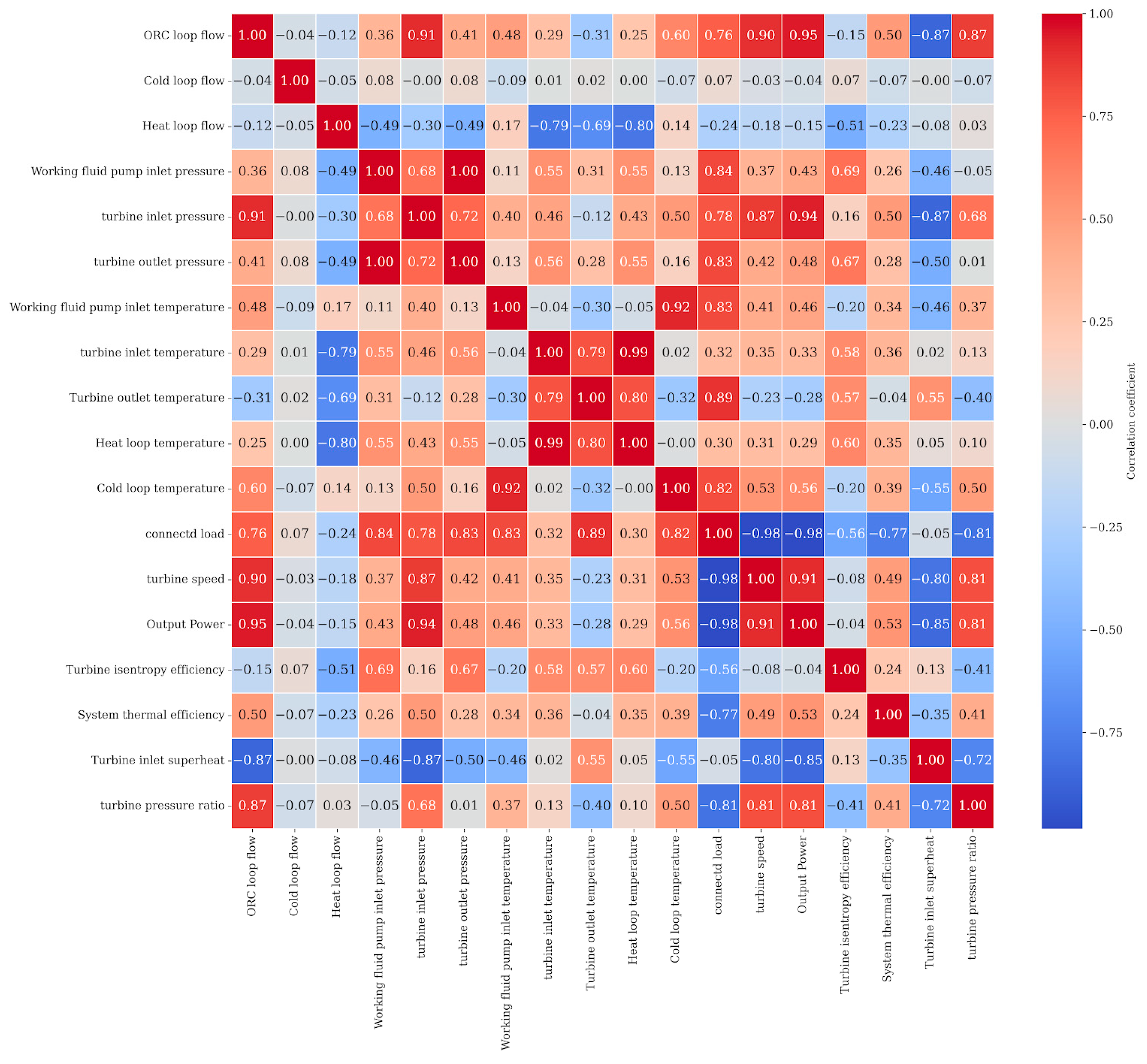
Figure 8 summarizes the parametric trends under the same boundary conditions: panels (a, c, e, g, i) report the thermodynamic indicators, while panels (b, d, f, h, j) present the corresponding economic responses. The feasibility of the investigated low-temperature envelope and the dominance ranking of key variables are further supported by the experimental operating ranges and the mutual-sensitivity heatmap in Figure 9.
Figure 8.
Parametric effects of key internal variables on ORC performance. (a,b) Evaporator pressure, (c,d) condensation temperature, (e,f) superheat degree, (g,h) subcooling degree, and (i,j) heat-exchanger pinch-point temperature difference. Panels (a,c,e,g,i) report thermodynamic indicators , while panels (b,d,f,h,j) report economic indicators . Unless otherwise stated in the insets, the remaining parameters are fixed at the baseline conditions.
Figure 9.
Mutual-sensitivity (correlation) heatmap among key operating variables and performance indicators of the ORC system, where the cell values denote correlation coefficients (−1 to 1) and the colour indicates the sign and magnitude of the coupling.
Evaporator pressure: As the evaporator pressure increases, net power output first rises and then falls, indicating an optimum pressure for maximum output power (Figure 8a). A similar tendency is observed for the second-law efficiency, whereas the first-law efficiency continues to increase within the investigated range. For open ORC systems, net power output is therefore a more suitable optimization indicator. Economically, both total product cost and total investment decrease with increasing evaporator pressure (Figure 8b), suggesting improved financial performance at higher pressures.
Condensation temperature: Increasing the condensation temperature leads to an approximately linear deterioration in the thermodynamic indicators (Figure 8c). Consistent with Carnot’s principle, a lower condensation temperature is thermodynamically preferable. However, lower condensation temperatures require larger heat-exchanger areas and thus increase the total capital investment, while reducing total product cost due to lower heat losses (Figure 8d). Overall, a lower condensation temperature remains more favourable when thermodynamic and economic performance are considered together.
Superheat degree: Varying the superheat degree has a limited influence on first-law efficiency, while net power output and second-law efficiency slightly decrease as superheat increases (Figure 8e). A certain superheat margin is nevertheless beneficial for safe operation. From an economic perspective, total product cost and total investment initially decrease and then increase, especially when the superheat degree exceeds about 40 °C (Figure 8f). Hence, the superheat degree should primarily be determined by economic performance while ensuring adequate operational safety.
Subcooling degree: Subcooling, introduced at the condenser outlet, has almost no influence on the thermodynamic indicators (Figure 8g). In practice, a minimum subcooling at the pump inlet is required to avoid cavitation. The economic indicators increase with higher subcooling degrees because larger heat-exchanger areas are required (Figure 8h). Therefore, a minimal subcooling level (e.g., 3 °C) is preferred to maintain safe operation without unnecessary costs.
Pinch-point temperature difference: The pinch-point temperature difference has little effect on first-law efficiency but significantly affects net power output and second-law efficiency (Figure 8i). A larger pinch-point temperature difference reduces heat-transfer effectiveness, leading to more waste heat and lower performance. Although reducing the pinch-point temperature difference is thermodynamically beneficial, it requires more stringent heat-exchanger performance and increases both total product cost and total investment (Figure 8j). As the pinch-point temperature difference approaches 0 °C, the required heat-exchanger area increases sharply, resulting in high economic penalties.
The mutual-sensitivity analysis combining the experimental observations and the numerical parametric results is presented in Figure 9. The heatmap provides an intuitive overview of the direction and relative strength of the coupling between key operating variables and performance indicators, which helps interpret the parametric trends and identify dominant factors for subsequent decision-variable selection. Consistent with the experimental operating envelope, the heatmap indicates that variables governing the circulation level and expansion driving potential dominate the output-related indicators within the investigated range, supporting the feasibility and trend-consistency assumptions adopted for the subsequent optimization.
Overall, the output-related indicators are mainly associated with variables governing the circulation level and expansion driving potential, whereas the connected electrical load and the turbine-inlet superheat show opposite tendencies with respect to the output, reflecting their strong coupling with the operating point in the present system. In addition, several pressure-related variables exhibit apparent collinearity, implying that they are not fully independent in this configuration; therefore, a reduced set of representative variables is preferred in the multi-objective optimization.
6.2. Multi-Objective Optimization Discussion
In multi-objective optimization, the net power output , the first-law efficiency , and the second-law efficiency represent the thermodynamic performance of the ORC system. From a thermo-/exergoeconomic perspective, the total product cost reflects the combined effects of second-law performance and economic cost formation, while the total capital investment (TCI) represents the overall economic investment level. Because these indicators respond differently to the same operating/design variables, they are generally conflicting and therefore require a multi-objective optimization framework to reveal trade-offs and feasible compromises. For consistency, the working-fluid screening, parametric analysis and multi-objective optimization in this study are conducted under the same modelling framework, feasibility constraints and boundary conditions, so that the Pareto fronts obtained for different objective combinations and source temperature cases are directly comparable. The decision variables and their bounds used in the optimization are listed in Table 9:
Table 9.
Multi-objective optimization input parameters.
The optimization uses the Pymoo multi-objective optimization package in Python (Apache 2.0) [32], with the Non-dominated Sorting Genetic Algorithm II (NSGA-II) chosen. Details of the iterations are provided in Table 10.
Table 10.
Details of genetic algorithm.
Since NSGA-II is stochastic, a practical convergence check was performed using a stagnation criterion: the non-dominated set in the final iterations showed negligible changes in objective values and front shape, and the selected compromise solutions remained unchanged. All bounds, settings, and termination information are specified in Table 9 and Table 10, enabling the Pareto sets to be reproduced by re-running the same workflow.
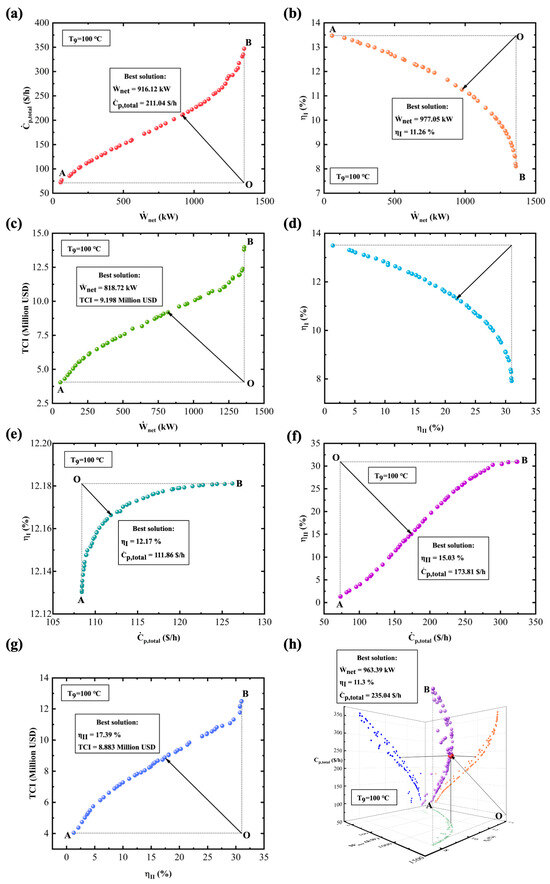
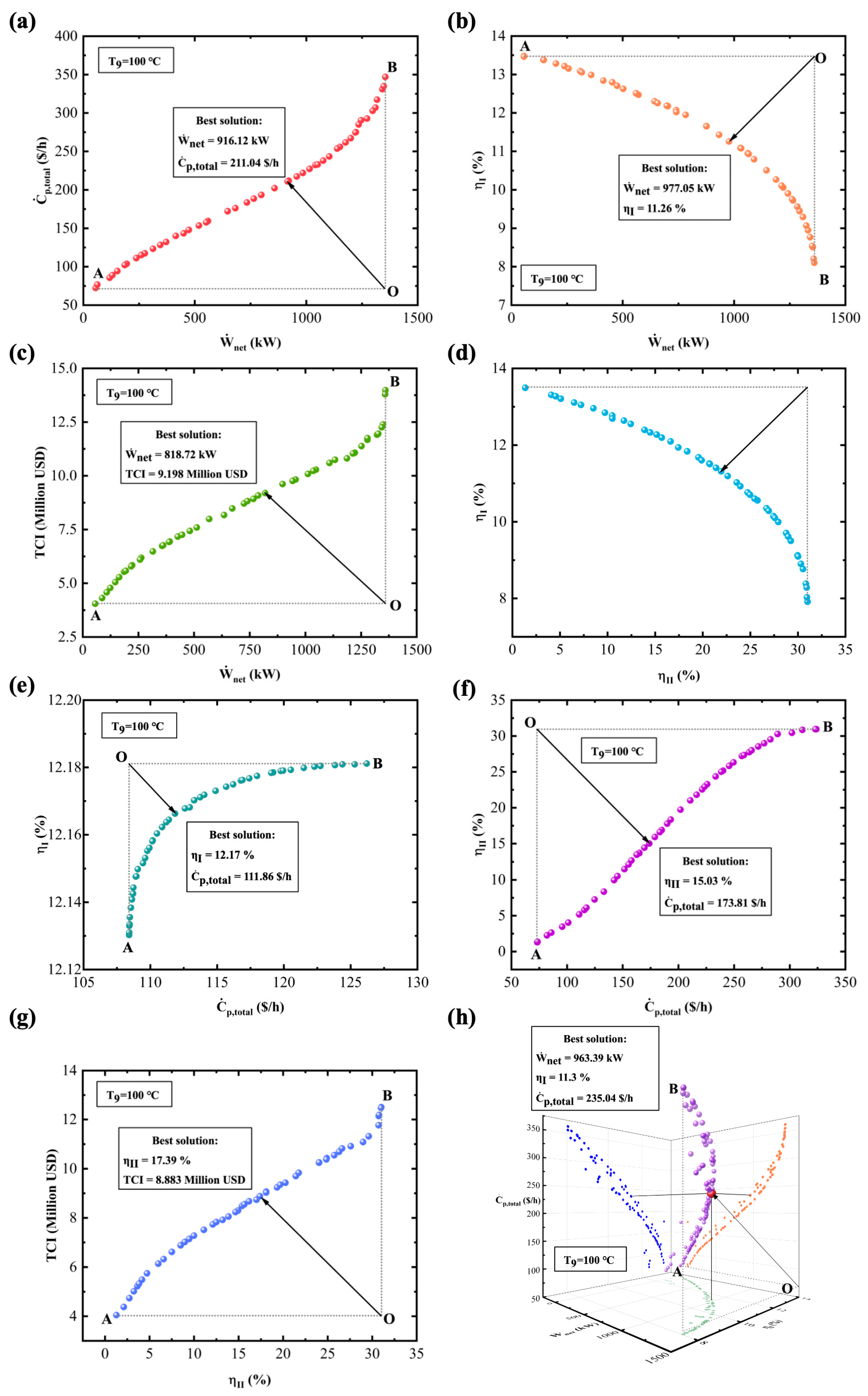
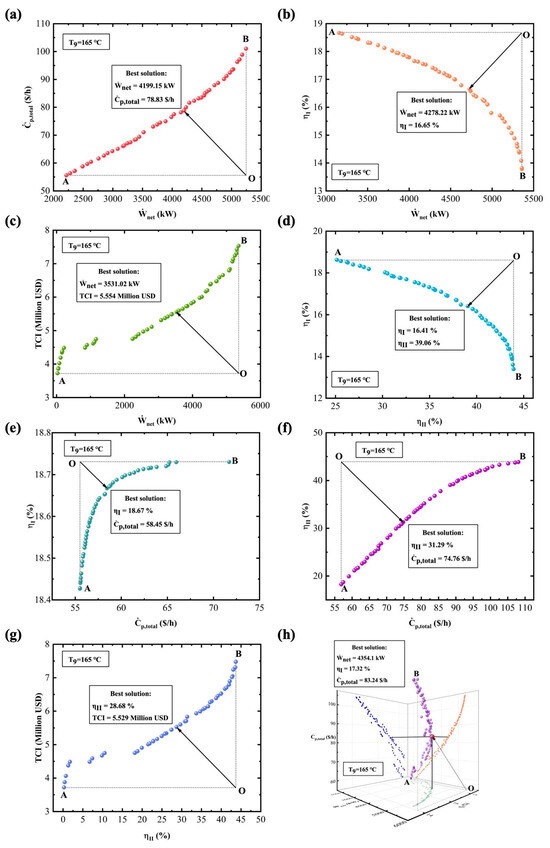
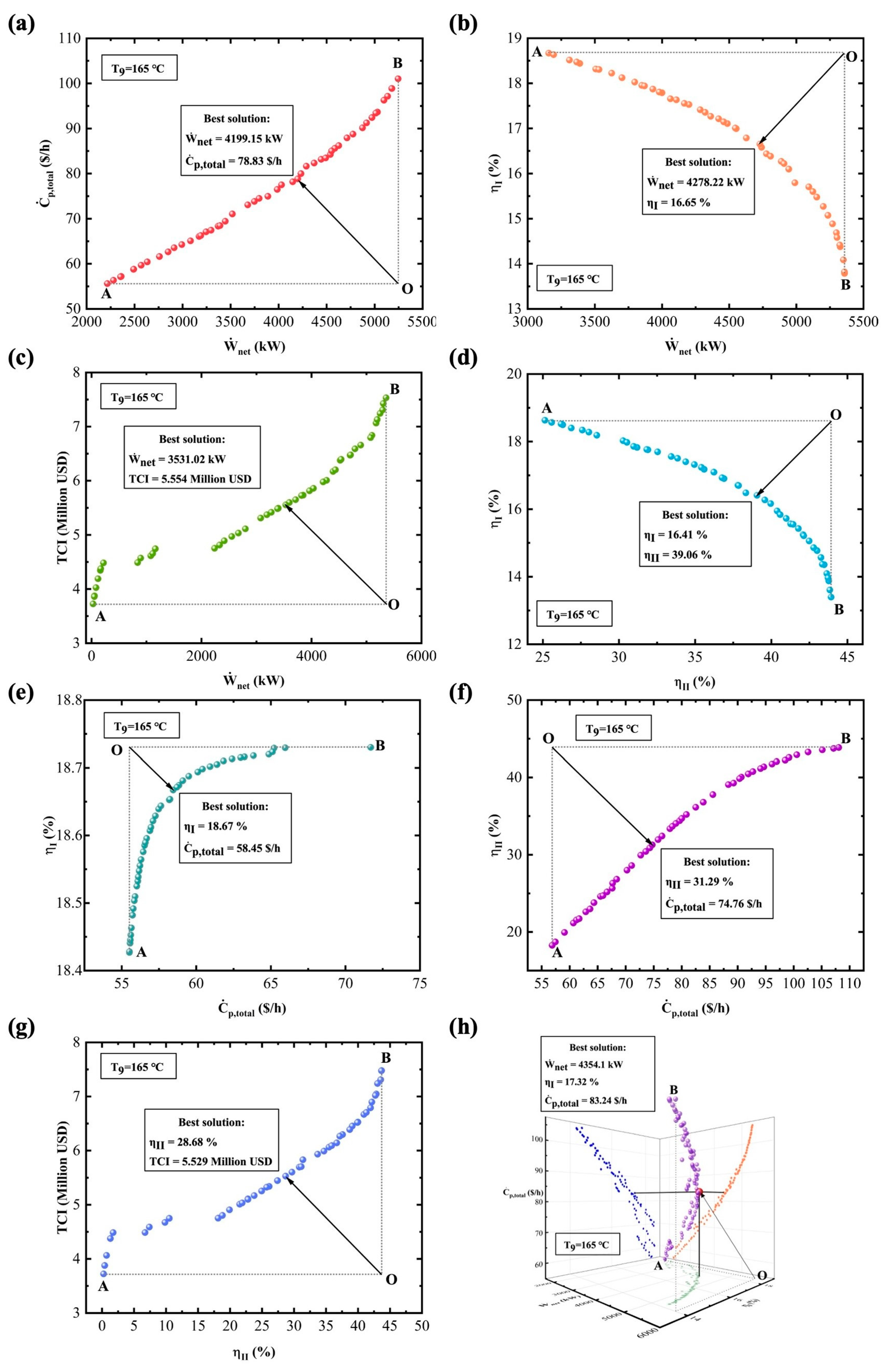
Figure 10 and Figure 11 provide an overview of the multi-objective optimization results for the two geothermal source temperature cases (100 °C and 165 °C). For each objective combination, the corresponding panels in Figure 10 (low-temperature case) and Figure 11 (high-temperature case) enable a direct comparison of trade-offs under identical modelling assumptions and constraints. In the bi-objective optimizations, each marker denotes a non-dominated solution on the Pareto front, and points A and B indicate the two extreme solutions. When a single representative design is required, a distance-based decision-making criterion (Ref. [33]) is used to select the compromise solution closest to the ideal point defined by the best values of the objectives. The tri-objective results are summarized in panel (h) of each figure. For brevity, the corresponding decision-variable settings are summarized in Table 11.
Figure 10.
Multi-objective optimization results for the low-temperature geothermal case (). Panels (a–g) show the bi-objective Pareto-optimal solutions for: (a) net power output vs. total product cost, (b) net power output vs. first-law efficiency, (c) net power output vs. total capital investment, (d) second-law efficiency vs. first-law efficiency, (e) total product cost vs. first-law efficiency, (f) total product cost vs. second-law efficiency, and (g) second-law efficiency vs. total capital investment. Panel (h) presents the tri-objective optimization results for net power output, first-law efficiency, and total product cost. Each marker denotes a non-dominated solution obtained by NSGA-II.
Figure 11.
Multi-objective optimization results for the high-temperature geothermal case (). Panels (a–h) correspond to the same objective combinations as in Figure 10. This enables a direct comparison between the two geothermal source temperature cases under identical modelling assumptions and constraints.
To interpret the trade-offs observed in Figure 10 and Figure 11 beyond reporting Pareto points, a component-level thermo-/exergoeconomic perspective is adopted. In general, the Pareto behaviour is governed by a limited number of components rather than the whole cycle uniformly. In particular, the evaporator and condenser tend to dominate the capital-related contribution because tighter temperature approaches (e.g., smaller pinch-point constraints within the feasibility envelope) require larger heat-transfer areas, which increases equipment cost while reducing irreversibility. Meanwhile, turbine-related constraints (e.g., isentropic efficiency and feasible outlet state) limit the achievable expansion ratio and therefore bound the attainable net power output and exergy efficiency. Consequently, moving towards higher-efficiency solutions typically requires increased heat-exchanger investment and/or tighter feasibility margins, which explains the conflicts between thermodynamic objectives () and cost-related objectives (, TCI) along the Pareto front.
This dominance can be made more explicit from the adopted cost formulation (Section 3.4). The heat exchangers (evaporator and condenser) are costed through area-based PEC correlations; therefore, their contribution typically governs the capital-related component of both TCI and , especially when solutions approach small pinch-point temperature differences or tighter temperature matching. In contrast, the turbine and pumps are costed through power-based PEC correlations, so their relative importance increases mainly in high-throughput solutions that target larger . Overall, within the present optimization framework, the primary economic bottleneck for high-efficiency designs is the rapid increase in required heat-exchanger area as feasibility constraints become tight, which escalates investment-related metrics and shifts the Pareto front against cost-oriented objectives.
Building on the above interpretation, the following sub-sections summarize the Pareto trade-offs for each objective pair and report the corresponding compromise solutions. For each case, a brief implication is provided to link the observed Pareto trend to the underlying thermo-/exergoeconomic mechanisms.
Trade-off between net power output and total product cost:
Figure 10a and Figure 11a show the trade-off between net power output and total product cost at 100 °C and 165 °C. The selected compromise solution yields 916.12 kW/211.04 $·h−1 at 100 °C and 4199.15 kW/78.83 $·h−1 at 165 °C. Consistent with the above component-level interpretation, this trade-off indicates that achieving higher generally requires increased heat-transfer duty and/or larger component sizing, which raises the cost rate, whereas designs with lower typically accept reduced capacity and less aggressive operating conditions.
Trade-off between net power output and first-law efficiency:
Figure 10b and Figure 11b present the trade-off between net power output and first-law efficiency. The compromise solution gives 977.05 kW/11.26% at 100 °C and 4728.22 kW/16.65% at 165 °C. Accordingly, maximizing tends to push the cycle towards reduced irreversibility and tighter temperature matching, while maximizing favours operating points that increase heat absorption and throughput; the mismatch between these requirements leads to a Pareto trade-off.
Trade-off between net power output and total capital investment:
Figure 10c and Figure 11c present the Pareto trade-off between net power output and total capital investment. The compromise solution yields 818.72 kW/9.198 million USD at 100 °C and 3531.02 kW/5.554 million USD at 165 °C. In line with the feasibility-envelope constraints, higher power levels are typically associated with larger heat-exchanger areas and/or larger turbomachinery capacity, which increases TCI, whereas lower-TCI solutions usually correspond to reduced capacity and more conservative temperature approaches.
Trade-off between second-law efficiency and first-law efficiency:
Figure 10d and Figure 11d show the trade-off between second-law efficiency and first-law efficiency. The compromise solution yields 21.93%/11.32% at 100 °C and 39.06%/16.41% at 165 °C. This indicates that although both efficiencies benefit from reducing irreversibility, is more directly influenced by exergy destruction in heat transfer, while reflects overall energy conversion; therefore, their optima do not necessarily coincide under the same operating constraints.
Trade-off between total product cost and first-law efficiency:
Figure 10e and Figure 11e present the trade-off between total product cost and first-law efficiency. The compromise solution yields 111.86 $·h−1/12.17% at 100 °C and 58.45 $·h−1/18.67% at 165 °C. Accordingly, moving towards higher generally requires tighter temperature approaches and thus larger heat-transfer areas, increasing the capital-related part of ; conversely, cost-minimized solutions tend to relax heat-exchanger sizing and accept lower efficiency.
Trade-off between total product cost and second-law efficiency:
Figure 10f and Figure 11f show the trade-off between total product cost and second-law efficiency. The compromise solution yields 173.81 $·h−1/15.03% at 100 °C and 74.76 $·h−1/31.29% at 165 °C. In other words, improving requires reducing exergy destruction—especially in the heat exchangers—which typically demands larger area and higher investment, raising ; lower-cost designs accept larger irreversibility and thus lower .
Trade-off between second-law efficiency and total capital investment:
Figure 10g and Figure 11g present the trade-off between second-law efficiency and total capital investment. The compromise solution yields 17.39%/8.883 million USD at 100 °C and 28.68%/5.529 million USD at 165 °C. Consistent with the above mechanism, higher is generally achieved by reducing temperature differences and exergy destruction through increased heat-transfer area, which in turn increases TCI.
Tri-objective optimization—net power output, first-law efficiency, and total product cost:
Figure 10h and Figure 11h summarize the tri-objective optimization results for net power output, first-law efficiency, and total product cost. The selected compromise solution yields 963.39 kW/11.30%/235.04 $·h−1 at 100 °C and 4354.10 kW/17.32%/83.24 $·h−1 at 165 °C. Overall, the tri-objective compromise avoids extreme solutions and provides a balanced design that better reflects practical decision-making where power, efficiency and cost must be considered simultaneously within the same feasibility envelope.
7. Conclusions
This study introduced a geothermal heat recovery-based ORC framework and identified suitable working fluids for different heat-source temperature levels. Multi-objective optimization was applied to quantify thermodynamic–economic trade-offs and to obtain decision-relevant feasible operating ranges under prescribed boundary conditions. The 20 kW ORC test (Case I) was used as a supplementary feasibility and trend-consistency reference to support the modelling workflow and the selected parameter bounds, rather than as a point-to-point validation of the conceptual plant case; therefore, the results should be interpreted within the stated assumptions and boundary conditions. The main conclusions are as follows:
- R123, R1234ze(E), R1234ze(Z), Isobutane, and R141b are identified as preferred working fluids for geothermal ORC over the investigated temperature range. R141b shows robust performance across a wide range of conditions, whereas Isobutane is more competitive at higher source temperatures (above ~140 °C).
- Within the investigated range, an intermediate evaporator pressure maximizes net power output due to the balance between increased turbine specific work and reduced recoverable heat under finite temperature-approach constraints. Cost-related indicators generally favour higher evaporator pressure until component/heat-transfer constraints become limiting.
- Lower condensation temperatures improve thermodynamic performance by reducing turbine back pressure; however, the preferred region should be selected considering the associated condenser duty and practical cooling conditions.
- The superheat degree has limited influence on the first-law efficiency within the studied range but can reduce net power output and increase heat rejection; therefore, superheating should primarily be set to ensure safe expansion while avoiding excessive thermal margins.
- Subcooling is required to mitigate cavitation risk at the pump inlet; in the present study, a small subcooling margin (around 3 °C) is sufficient for safe operation within the tested envelope.
- Pinch-point temperature differences govern the feasibility of heat recovery and the thermodynamic irreversibility of heat transfer. A balanced selection is recommended, with a small evaporator pinch (≈3 °C) and a moderate condenser pinch (≈5–9 °C) under the investigated conditions. From an economic/exergoeconomic viewpoint, tightening pinch-point constraints drives a rapid increase in the required heat-transfer area, making the evaporator and condenser the primary cost bottleneck for high-efficiency designs and shifting Pareto-optimal solutions against cost-oriented objectives.
- For the high-temperature case (165 °C), the bi-objective and tri-objective optimizations provide operable Pareto trade-offs and representative compromise solutions that balance power, efficiency, and cost.
Finally, the above findings should be interpreted within the validity envelope defined by the system boundary and assumptions in Section 2: the optimization results target configuration-level trade-offs and feasible operating ranges of a subcritical ORC under prescribed geothermal source/sink boundary conditions (Case II), while the 20 kW rig (Case I) provides feasibility evidence and trend-consistency support for the investigated parameter bounds within the tested operating envelope. Effects not explicitly modelled—such as site-specific piping pressure losses, detailed component geometry, and transient/control behaviour—may affect absolute values but are not expected to change the qualitative trends and trade-offs reported here.
Supplementary Materials
The following supporting information can be downloaded at: https://www.mdpi.com/article/10.3390/modelling7020044/s1. Additional methodological details, extended results, and supporting analyses are provided therein, with related references [34,35,36,37,38,39,40,41,42].
Author Contributions
Conceptualization, Y.L.; Methodology, H.H.; Software, H.H.; Formal analysis, K.X. and H.H.; Writing—original draft, K.X.; Writing—review & editing, H.H.; Visualization, K.X.; Funding acquisition, Y.L. All authors have read and agreed to the published version of the manuscript.
Funding
This work was supported by the Key Technological Innovation and Industrialization Project of Fujian Province of China under Grant No. 2022G005.
Institutional Review Board Statement
Not applicable.
Informed Consent Statement
Not applicable.
Data Availability Statement
The data presented in this study are available on request from the corresponding author.
Conflicts of Interest
The authors declare no conflict of interest.
Nomenclature
| Roman symbols | Greek symbols | ||
| A | Heat transfer area | convective heat-transfer coefficient | |
| Bo | Bond number | thickness | |
| cost rate | first-law efficiency | ||
| specific exergy cost | second-law efficiency | ||
| specific heat capacity | pump isentropic efficiency | ||
| CRF | capital recovery factor | turbine/expander isentropic efficiency | |
| specific heat capacity | dynamic viscosity | ||
| equivalent diameter | kinematic viscosity | ||
| exergy rate | density | ||
| riction factor in pressure-drop correlation | surface tension | ||
| gravitational acceleration | pressure drop | ||
| Grashof number | |||
| specific enthalpy | Subscripts and abbreviations | ||
| interest rate | 0 | ambient | |
| thermal conductivity | 1–10 | state points | |
| characteristic length/heat-transfer length | c | cold loop | |
| mass flow rate | h | hot loop | |
| Nusselt number | w | water | |
| pressure | wf | working fluid | |
| purchased equipment cost | ev | evaporator | |
| Prandtl number | cn | condenser | |
| heat-transfer rate | hex | heat exchanger | |
| Reynolds number | orc | ORC loop | |
| specific entropy | p | pump | |
| temperature | turbine/ | ||
| total capital investment | ph | physical | |
| velocity | s | isentropic process | |
| power | l | liquid | |
| plate width | pp | pinch-point; pay back period | |
| X | annual plant operation hours | ||
References
- Hosseinzadeh-Bandbafha, H.; Tabatabaei, M.; Aghbashlo, M.; Khanali, M.; Demirbas, A. A comprehensive review on the environmental impacts of diesel/biodiesel additives. Energy Convers. Manag. 2018, 174, 579–614. [Google Scholar] [CrossRef] [Scilit]
- International Energy Agency. World Energy Outlook 2013; IEA: Paris, France, 2013; Available online: https://www.iea.org/reports/world-energy-outlook-2013 (accessed on 15 May 2025).
- Leonard, M.D.; Michaelides, E.E.; Michaelides, D.N. Substitution of coal power plants with renewable energy sources—Shift of the power demand and energy storage. Energy Convers. Manag. 2018, 164, 27–35. [Google Scholar] [CrossRef] [Scilit]
- Arslan, O. Ann-based determination of optimum working conditions of residential combustors with respect to optimum insulation. Energy Sources Part A Recovery Util. Environ. Eff. 2014, 36, 2603–2612. [Google Scholar] [CrossRef] [Scilit]
- U.S. Briefing. International Energy Outlook 2013; US Energy Information Administration: Washington, DC, USA, 2013; Volume 506, p. 507.
- Hou, J.; Cao, M.; Liu, P. Development and utilization of geothermal energy in china: Current practices and future strategies. Renew. Energy 2018, 125, 401–412. [Google Scholar] [CrossRef] [Scilit]
- Mehrpooya, M.; Mousavi, S.A. Advanced exergoeconomic assessment of a solardriven kalina cycle. Energy Convers. Manag. 2018, 178, 78–91. [Google Scholar] [CrossRef] [Scilit]
- Liang, Y.; Yu, Z. Experimental investigation of an organic rankine cycle system using an oil-free scroll expander for low grade heat recovery. Int. J. Green Energy 2021, 18, 812–821. [Google Scholar] [CrossRef] [Scilit]
- Chen, H.; Goswami, D.Y.; Stefanakos, E.K. A review of thermodynamic cycles and working fluids for the conversion of low-grade heat. Renew. Sustain. Energy Rev. 2010, 14, 3059–3067. [Google Scholar] [CrossRef] [Scilit]
- Li, W.; Bu, S.; Yang, X.; Huang, F.; Tang, M.; Ji, Z.; Dai, W.; Su, C.; Liu, X. Thermal performance analysis of a novel geothermal organic rankine cycle-bypass flash system based on the latent heat proportion of working fluids. Energy Rep. 2021, 7, 6806–6819. [Google Scholar] [CrossRef] [Scilit]
- Hu, S.; Yang, Z.; Li, J.; Duan, Y. A review of multi-objective optimization in organic rankine cycle (orc) system design. Energies 2021, 14, 6492. [Google Scholar] [CrossRef] [Scilit]
- Zhang, S.; Wang, H.; Guo, T. Performance comparison and parametric optimization of subcritical organic rankine cycle (orc) and transcritical power cycle system for low-temperature geothermal power generation. Appl. Energy 2011, 88, 2740–2754. [Google Scholar] [CrossRef] [Scilit]
- Toffolo, A.; Lazzaretto, A.; Manente, G.; Paci, M. A multi-criteria approach for the optimal selection of working fluid and design parameters in organic rankine cycle systems. Appl. Energy 2014, 121, 219–232. [Google Scholar] [CrossRef] [Scilit]
- Chitgar, N.; Hemmati, A.; Sadrzadeh, M. A comparative performance analysis, working fluid selection, and machine learning optimization of orc systems driven by geothermal energy. Energy Convers. Manag. 2023, 286, 117072. [Google Scholar] [CrossRef] [Scilit]
- Dai, Y.; Wang, J.; Gao, L. Parametric optimization and comparative study of organic rankine cycle (orc) for low grade waste heat recovery. Energy Convers. Manag. 2009, 50, 576–582. [Google Scholar] [CrossRef] [Scilit]
- Wang, J.; Yan, Z.; Wang, M.; Ma, S.; Dai, Y. Thermodynamic analysis and optimization of an (organic rankine cycle) orc using low grade heat source. Energy 2013, 49, 356–365. [Google Scholar] [CrossRef] [Scilit]
- Quoilin, S.; Declaye, S.; Tchanche, B.F.; Lemort, V. Thermoeconomic optimization of waste heat recovery organic rankine cycles. Appl. Therm. Eng. 2011, 31, 2885–2893. [Google Scholar] [CrossRef] [Scilit]
- Zare, V. A comparative exergoeconomic analysis of different orc configurations for binary geothermal power plants. Energy Convers. Manag. 2015, 105, 127–138. [Google Scholar] [CrossRef] [Scilit]
- Wang, J.; Yan, Z.; Wang, M.; Li, M.; Dai, Y. Multi-objective optimization of an organic rankine cycle (orc) for low grade waste heat recovery using evolutionary algorithm. Energy Convers. Manag. 2013, 71, 146–158. [Google Scholar] [CrossRef] [Scilit]
- Le, V.L.; Kheiri, A.; Feidt, M.; Pelloux-Prayer, S. Thermodynamic and economic optimizations of a waste heat to power plant driven by a subcritical orc (organic rankine cycle) using pure or zeotropic working fluid. Energy 2014, 78, 622–638. [Google Scholar] [CrossRef] [Scilit]
- Wang, S.; Liu, C.; Zhang, S.; Li, Q.; Huo, E. Multi-objective optimization and fluid selection of organic rankine cycle (orc) system based on economicenvironmental-sustainable analysis. Energy Convers. Manag. 2022, 254, 115238. [Google Scholar] [CrossRef] [Scilit]
- Habka, M.; Ajib, S. Investigation of novel, hybrid, geothermal-energized cogeneration plants based on organic Rankine cycle. Energy 2014, 70, 212–222. [Google Scholar] [CrossRef] [Scilit]
- Van Erdeweghe, S.; Van Bael, J.; Laenen, B.; D’haeseleer, W. Optimal combined heat-and-power plant for a low-temperature geothermal source. Energy 2018, 150, 396–409. [Google Scholar] [CrossRef] [Scilit]
- Somayaji, C.; Mago, P.J.; Chamra, L.M. Second law analysis and optimization of organic Rankine cycle ASME power conference. In ASME Power Conference; ASME: New York, NY, USA, 2006; Volume 42053. [Google Scholar] [CrossRef] [Scilit]
- Sun, W.; Yue, X.; Wang, Y. Exergy efficiency analysis of orc (organic rankine cycle) and orc-based combined cycles driven by low-temperature waste heat. Energy Convers. Manag. 2017, 135, 63–73. [Google Scholar] [CrossRef] [Scilit]
- Dincer, I.; Rosen, M.A. Chapter 2—Exergy and energy analyses. In Exergy, 3rd ed.; Dincer, I., Rosen, M.A., Eds.; Elsevier: Amsterdam, The Netherlands, 2021; pp. 23–35. Available online: https://www.sciencedirect.com/science/article/pii/B9780128243725000026 (accessed on 15 May 2025).
- Stefánsson, V. Investment cost for geothermal power plants. Geothermics 2002, 31, 263–272. [Google Scholar] [CrossRef] [Scilit]
- El-Emam, R.S.; Dincer, I. Exergy and exergoeconomic analyses and optimization of geothermal organic rankine cycle. Appl. Therm. Eng. 2013, 59, 435–444. [Google Scholar] [CrossRef] [Scilit]
- Bejan, A.; Tsatsaronis, G.; Moran, M.J. Thermal Design and Optimization; John Wiley & Sons: Hoboken, NJ, USA, 1995. [Google Scholar]
- Wu, C.J.; Hamada, M.S. Experiments: Planning, Analysis, and Optimization; John Wiley & Sons: Hoboken, NJ, USA, 2011. [Google Scholar]
- Helton, J.C.; Davis, F.J. Latin hypercube sampling and the propagation of uncertainty in analyses of complex systems. Reliab. Eng. Syst. Saf. 2003, 81, 23–69. [Google Scholar] [CrossRef] [Scilit]
- Blank, J.; Deb, K. pymoo: Multi-objective optimization in python. IEEE Access 2020, 8, 89497–89509. [Google Scholar] [CrossRef] [Scilit]
- Wang, M.; Wang, J.; Zhao, P.; Dai, Y. Multi-objective optimization of a combined cooling, heating and power system driven by solar energy. Energy Convers. Manag. 2015, 89, 289–297. [Google Scholar] [CrossRef] [Scilit]
- Lemmon, E.W.; Bell, I.H.; Huber, M.L.; McLinden, M.O. NIST Standard Reference Database 23: Reference Fluid Thermodynamic and Transport Properties- REFPROP, Version 10.0; National Institute of Standards and Technology: Gaithersburg, MD, USA, 2018. [CrossRef]
- Li, W.; Mckeown, A.; Yu, Z. Correction of cavitation with thermodynamic effect for a diaphragm pump in organic rankine cycle systems. Energy Rep. 2020, 6, 2956–2972. [Google Scholar] [CrossRef] [Scilit]
- Lazzaretto, A.; Tsatsaronis, G. Speco: A systematic and general methodology for calculating efficiencies and costs in thermal systems. Energy 2006, 31, 1257–1289. [Google Scholar] [CrossRef] [Scilit]
- Zare, V.; Mahmoudi, S.; Yari, M. On the exergoeconomic assessment of employing kalina cycle for gt-mhr waste heat utilization. Energy Convers. Manag. 2015, 90, 364–374. [Google Scholar] [CrossRef] [Scilit]
- Hance, C.N. Factors Affecting Costs of Geothermal Power Development; Geothermal Energy Association: Washington, DC, USA, 2005. [Google Scholar]
- Hettiarachchi, H.M.; Golubovic, M.; Worek, W.M.; Ikegami, Y. Optimum design criteria for an organic rankine cycle using lowtemperature geothermal heat sources. Energy 2007, 32, 1698–1706. [Google Scholar] [CrossRef] [Scilit]
- Uehara, H.; Stuhltra, E.; Miyara, A.; Murakami, H.; Miyazaki, K. Heat Transfer and Flow Resistance of a Shell and Plate-Type Evaporator. J. Sol. Energy Eng. 1997, 119, 160–164. [Google Scholar] [CrossRef] [Scilit]
- Uehara, H.; Nakaoka, T.; Nakashima, S. Heat transfer coefficients for a vertical fluted-plate condenser with r113 and 114. Int. J. Refrig. 1985, 8, 22–28. [Google Scholar] [CrossRef] [Scilit]
- Nakaoka, T.; Uehara, H. Performance test of a shell-and-plate-type condenser for otec. Exp. Therm. Fluid Sci. 1988, 1, 275–281. [Google Scholar] [CrossRef] [Scilit]

Disclaimer/Publisher’s Note: The statements, opinions and data contained in all publications are solely those of the individual author(s) and contributor(s) and not of MDPI and/or the editor(s). MDPI and/or the editor(s) disclaim responsibility for any injury to people or property resulting from any ideas, methods, instructions or products referred to in the content. |
© 2026 by the authors. Licensee MDPI, Basel, Switzerland. This article is an open access article distributed under the terms and conditions of the Creative Commons Attribution (CC BY) license.