Review

Glucagon-like Peptide-1 Receptor Agonists and Endometrial Cancer: Potential Future in Fertility-Sparing Treatment


by
Sonia Kotanidou
1,*,
Roxani Dampali
2,
Omer Devaja
2,
Stephen Attard-Montalto
2,
Michelle Godfrey
2,
Andreas John Papadopoulos
2,
Angelos Daniilidis
3,
Nikolaos Nikolettos
4 and
Konstantinos Nikolettos
2
1
Department of Obstetrics and Gynaecology, Democritus University of Thrace, 68100 Alexandroupolis, Greece
2
Department of Gynaecological Oncology, Maidstone and Tunbridge Wells NHS Trust, Maidstone ME16 9QQ, UK
3
1st University Department in Obstetrics and Gynaecology, Papageorgiou General Hospital, School of Medicine, Aristotle University of Thessaloniki, 54643 Thessaloniki, Greece
4
Laboratory of Reproductive Physiology—IVF Unit, Democritus University of Thrace, 68100 Alexandroupolis, Greece
*
Author to whom correspondence should be addressed.
Reprod. Med. 2026, 7(3), 34; https://doi.org/10.3390/reprodmed7030034
Submission received: 21 June 2026 / Revised: 15 July 2026 / Accepted: 15 July 2026 / Published: 18 July 2026

Abstract

Background: Endometrial cancer (EC) is one of the most prevalent cancers in women globally, which has recently gained attention as an increase has been noted among premenopausal women. Improving fertility-sparing treatments is crucial to assist women in completing their family planning. Methods: This study aims to explore the current evidence on the mechanisms of action and correlation between Glucagon-like Peptide-1 (GLP-1) and its agonists with EC, as well as the potential application in the conservative therapy for early-stage EC. A narrative review of the worldwide literature was conducted according to Scale for the Assessment of Narrative Review Articles (SANRA) principles, intending to analyze the correlation of GLP-1 receptor agonists (GLP-1RAs) with EC and their precise effect in the fertility-sparing treatment in women with atypical endometrial hyperplasia (AEH) or early-stage EC. Results: Preclinical studies indicate that GLP-1 receptor (GLP-1R) expression on healthy and malignant endometrial tissues of models regulates apoptosis via the AMPK-mTOR pathway. Observational and early clinical studies conclude that their role in the improvement of metabolic and hormonal imbalance increases the risk for the development of EC, as well as anti-tumour and anti-inflammatory effects. Conclusions: GLP-1RAs represent a potentially promising addition to the conservative management of AEH and early-stage EC in premenopausal women; however, further extensive clinical trials are required to ensure their safety and efficacy in future treatment algorithms and preconception exposure.

1. Introduction

Endometrial cancer (EC) is the most common cancer of the female reproductive tract in developed countries and the sixth most common cancer in women worldwide [1]. Predominantly, EC affects postmenopausal women with a median age of 64 years at diagnosis; however, in recent decades, there has been a notable increase among premenopausal women, with a rising trend line of 2.2% for women below 50 years old [1]. This finding led to the adoption of conservative treatment until the family is complete. Gene mutations and comorbidities like obesity, diabetes, and hypertension are considered risk factors for the development of EC [2,3]. Obesity and polycystic ovarian syndrome (PCOS) play a crucial role in the development of insulin resistance and type 2 diabetes mellitus (T2DM), which elevates the risk of cancer, indicating a synergistic effect in addition to elevated estrogen levels [4,5].
The definitive treatment for atypical endometrial hyperplasia (AEH) or early-stage EC is surgical, involving total hysterectomy with bilateral salpingo-oophorectomy and sentinel lymph node biopsy or total pelvic lymphadenectomy [6]. However, as premenopausal women who have not completed their family planning are increasingly diagnosed, it is essential to identify effective fertility-sparing treatment options. Currently, intrauterine releasing devices (IUDs) with or without additional oral progestins are utilized as a first-line conservative treatment option for women wishing to complete their family planning [7].
Glucagon-like peptide-1 receptor agonists (GLP-1RAs) have garnered significant attention due to their potential to reduce the risk of EC through the modulation of molecular and metabolic pathways [8,9]. GLP-1 is a hormonal peptide, also called incretin, which has been associated with insulin secretion since 1987 [10,11]. It contains 30 or 31 amino acids, binds to the G protein-coupled receptor (GLP-1R), and plays a key role in glucose homeostasis [12]. It is secreted by the distal small intestine, the pancreas, and the nervous system, while its receptor is expressed in the lungs, pancreas, stomach, intestine, kidney, heart, and brain [13,14]. GLP-1 has a half-life of 1–2 min as it undergoes rapid degradation by dipeptidyl peptidase-4 (DPP-4) metabolites [15]. It regulates glucagon release from the pancreatic α-cells and enhances insulin secretion by acting on pancreatic β-cells [13]. GLP-1RAs have been approved for the treatment of type 2 diabetes mellitus (T2DM) since 2005 and for obesity since 2021 [10,16].
Considering that elevated estrogen levels are linked to EC, it is essential to consider weight loss as an adjunct to reduce tumour development. A study found that losing more than 10% of total body weight can enhance outcomes, diminishing hormonal and inflammatory factors that promote endometrial proliferation [17,18,19]. In parallel, multiple studies demonstrated the expression of GLP-1R across malignant and non-malignant cells and in many cell lines of the endometrium representing the endometrioid (Ishikawa, KLE) and serous (Hec50) types [20,21,22]. GLP-1RAs specifically increase the expression of nuclear progesterone receptors (PRs) and synergically inhibit the proliferation of EC cells when administered with progestins [23,24,25]. Another in vitro research conducted a few years later confirmed that the combination of GLP-1RA with progestins improves the therapeutic approaches for AEH and EC, as shown in EC cell lines and patient-derived organoids (PDOs) [21]. Additionally, GLP-1RAs exhibit anti-tumour effects, suppressing inflammatory processes that are crucial for the progression of various malignancies and inducing autophagy through specific pathways [9,20].
This review presents the global literature on the correlation of GLP-1 and its analogues with EC and investigates how its metabolic and potential direct anti-tumour effects could shape future fertility-sparing management strategies.

2. Materials and Methods

This narrative review was conducted according to the Scale for the Assessment of Narrative Review Articles (SANRA) principles to ensure an accurate evaluation of the literature. The aim was to analyze the correlation between GLP-1RAs and endometrial pathologies and to investigate the effects of GLP-1RAs on cancer, particularly on their role in the conservative management of women with AEH or early-stage EC.
Utilizing MEDLINE/PubMed and Cochrane databases, we identified all the papers published until November 2025 about fertility-sparing treatment for AEH/EC using GLP-1RAs. We used combinations of the following keywords and Medical Subject Headings (MeSH) for the search: ‘endometrial hyperplasia’, ‘endometrial cancer’, ‘glp-1’, ‘semaglutide’, ‘liraglutide’, and ‘exenatide’.
The review includes articles focusing mainly on the role of GLP-1RAs in AEH/EC and fertility-sparing treatment. Preclinical studies on cell lines and animals, clinical and observational epidemiological studies, and recent early clinical trials were included. Non-English-language publications and irrelevant studies were excluded, and references were searched for additional publications that were included in the study.

3. Results

3.1. Correlation of GLP-1 with EC

3.1.1. GLP-1R Expression in Endometrial Cells

In 2015, a study revealed that normal endometrial tissue and EC cells express GLP-1R [23] while Kanda et al. found that 93.51% of malignant endometrial tissue samples had a wide range of GLP-1R expression in endometrial cells [20]. In later years, Li et al. compared the expression of GLP-1R in cancerous and non-cancerous cells and revealed that cancerous endometrial cells predominantly express GLP-1R on their membrane. Specifically, among five EC cells, RL95-2, HEC-1A, KLE, Ishikawa, and AN3CA, the GLP-1R mRNA and protein expression were elevated particularly in AN3CA cells [26].

3.1.2. Anti-Tumour Action of GLP-1RAs

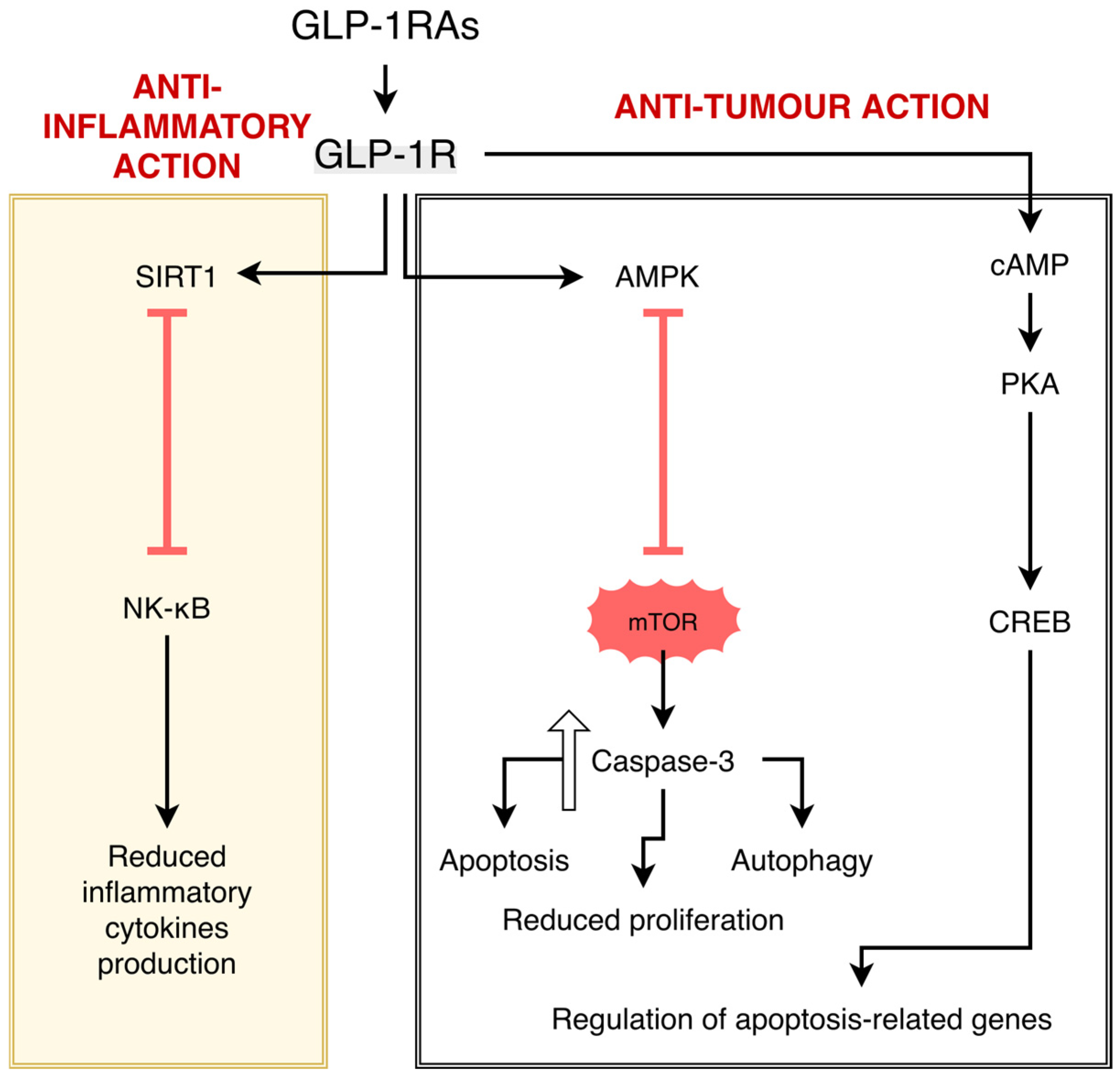
A group of researchers in China was the first to study the effect of GLP-1RAs on endometrial cancer cells. Exenatide, a GLP-1RA, demonstrated control of the AMPK-mTOR (AMP-activated protein kinase–mechanistic target of rapamycin) pathway that regulates apoptosis, thereby influencing tumourigenesis and progression [23]. AMPK is crucial in a series of complex molecular events, mediating its effects on cell growth by inhibiting the mammalian target of rapamycin (mTOR) [27]. The mTOR signalling pathway reduces the expression of the apoptosis-related protein caspase-3, influencing tumour occurrence and development. During the in vitro study, exenatide was found to phosphorylate AMPK, resulting in the decreased phosphorylation of mTOR, which subsequently led to apoptosis and elimination of tumor growth. Furthermore, treatment with exenatide in combination with AICAR, an AMPK activator, resulted in increased cell apoptosis and elevated expression of cleaved caspase-3 compared to the exenatide-only group [23].
Some years later, Kanda et al. [20] conducted a study that examined the effect of the GLP-1RA liraglutide in endometrial malignant cells. Liraglutide reportedly increased the GLP-1R expression in Ishikawa cells and inhibited the tumour growth in a dose-dependent manner, promoting autophagy and apoptosis via the AMPK pathway. Combining liraglutide with AICAR further increased autophagy when compared to liraglutide alone, confirming the function of the AMPK pathway, a finding that is consistent with the study that examined exenatide [20].
Another study used two EC cells (Ishikawa and RL95-2) to prove the inhibition of EC growth by activation of the cyclic adenosine monophosphate/protein kinase A (cAMP/PKA) signalling pathway in vitro and in vivo by GLP-1RAs [28]. G protein-coupled receptors like GLP-1R activate the cAMP/PKA cellular cascade by primarily producing cAMP and subsequently activating PKA. This protein kinase phosphorylates the cAMP response element-binding (CREB) protein, which plays a key role in the activation of genes responsible for the survival and proliferation of tumours. The overexpression of GLP-1R on EC cells resulted in the inhibition of proliferation, migration, and invasion of EC cells, while knockdown of PKA reversed the results of the cancerous cells by increasing the tumour volume [28]. The molecular pathways are presented in the figure below (Figure 1).

3.1.3. Anti-Inflammatory Action of GLP-1RAs

GLP-1RAs demonstrate anti-tumor activity by also suppressing inflammatory mechanisms, as several malignancies are associated with chronic inflammation. Production of pro-inflammatory cytokines such as tumour necrosis factor-alpha (TNF-α), interleukin-6 (IL-6), and interleukin-1β (IL-1β) is inhibited by the suppression of the nuclear factor kappa B (NF-κB) pathway [29,30,31]. Liraglutide enhances the production of Sirtuin 1 (SIRT1) and inhibits the NF-κB pathway, influencing critical cellular biological processes such as the cell cycle and apoptosis [31,32]. Also, administration of GLP-1RA in a single-blinded trial revealed a decrease in reactive oxygen species (ROS) produced by mononuclear cells [33]. To acknowledge the significant anti-inflammatory effects of GLP-1RA, Chaudhuri et al. provided evidence with patients receiving exogenous GLP-1RA who maintained constant weight, indicating that the anti-inflammatory effects were a result of GLP-1RA [33].

3.2. Controlling Factors Relevant to EC

3.2.1. Obesity

Multiple epidemiological studies in the worldwide literature have proven a correlation between obesity and carcinogenesis, indicating that obesity is a significant risk factor in the development of EC, increasing the risk threefold [34]. The International Agency for Research on Cancer (IARC) concluded in 2016 that there is sufficient evidence to establish a link between obesity and 13 types of cancers, referred to as obesity-associated cancers (OAC), including EC [35]. A comprehensive systematic review and meta-analysis was conducted by Zhang et al., demonstrating the positive correlation of obesity and risk of EC that strengthens with increasing BMI [36]; notably, even a 5 kg/m2 increase in BMI elevates the risk of EC incidence [37]. On the contrary, the intentional loss of weight after undergoing bariatric surgery diminishes the risk of EC, and a 5% behavioural reduction in body weight over three years is associated with an important decrease of 39% in the risk of developing EC [38,39]. Three biological mechanisms associated with obesity contribute to the development of EC: insulin resistance, chronic inflammation and continuous estrogen production [40].
A study discovered that the administration of semaglutide (GLP-1RA) resulted in a mean weight reduction of around 16–18%, reaching the weight loss obtained with bariatric surgery [16]. GLP-1RAs provide a therapeutic option for obese persons seeking body weight reductions of 5–10%, thereby improving complications of obesity with weight loss [41]. Weight loss results in reduced circulating levels of pro-inflammatory cytokines that are considered indicators of increased endometrial proliferation and inflammation associated with obesity [42]. Furthermore, a reduction in adipose tissue, achieved through behavioural or pharmacological methods or bariatric surgery, reduces estrogen levels by eliminating the aromatase conversion of androgens, contributing to reductions in EC risk [42].
Insulin Resistance (IR)
Pro-inflammatory adipokines linked to obesity, including TNF-α, IL-6, and leptin, prevent normal insulin signalling, resulting in insulin resistance (IR). IR is a condition present in T2DM along with hyperglycemia and high levels of insulin and insulin-like growth factor I (IGF-I). Estrogen-regulated target genes within the uterus include IGF-I, and their cyclic expression plays a key role in the regulation of endometrial cyclic activity, while elevated expression activates the phosphoinositide-3-kinase pathway and Akt, consequently enhancing cell survival by inhibiting apoptotic pathways. Biopsy results of the hyperplastic endometrium and EC exhibited a significant increase in the expression of the IGF-I receptor (IGF-IR), suggesting the contribution of IGF-I in EC [43]. Comparing EC patients with controls, higher levels of insulin were found, implying that hyperinsulinemia is associated with higher EC risk [44]. Moreover, chronically elevated levels of glucose in the bloodstream epigenetically affect oncogenic pathways and have an effect on cell proliferation, migration, and invasion and inhibit the apoptosis of tumour cells [45]. GLP-1RAs improve insulin sensitivity, and their use in comparison to insulin for the management of T2DM is associated with greater risk reduction for the development of EC [24]. Several studies exhibited evidence of improvement in insulin sensitivity with the administration of GLP-1RAs in overweight patients, reducing adipose tissue [46,47].
Chronic Inflammation
Obesity is linked to systemic inflammation, resulting in the production of pro-inflammatory cytokines linked to obesity that promote angiogenesis and proliferation, induce DNA damage, and contribute to cancer development [48]. Adipose tissue releases inflammatory cytokines into the bloodstream that play a significant role in the pathogenesis of EC [48]. In one study, elevated levels of TNF-α and its soluble receptors (sTNFR1 and sTNFR2) in plasma were found to be associated with an increased risk of EC [49]. A case–control study demonstrated that IL-6 and NF-κB are highly expressed in most endometrial cancer tumours; they activate the synthesis of prostaglandin E2, which seems to play a role in the transformation of the normal endometrium into malignant tissue [50]. Furthermore, researchers examined the link between C-Reactive Protein (CRP), IL-6, and IL1Ra with EC before diagnosis and discovered that elevated levels of these cytokines were associated with the patients’ adipose tissue [50]. The risk for EC is significantly associated with chronic inflammation and obesity by increasing insulin resistance (IR) and estrogen levels, but also independently through cytokine actions [50]. Lastly, chronic inflammation results in localized hypoxia, leading to tissue necrosis and macrophage infiltration through pro-inflammatory signalling pathways in adipocytes [51]. A group of researchers assessed the levels of high-sensitivity CRP (hsCRP) of individuals treated with GLP-1RAs and concluded that these agonists reduce inflammation directly and also via the anti-inflammatory action of weight loss [52], a finding that aligns with other studies, which used GLP-1RAs to treat people with obesity or T2DM [53].
Continuous Estrogen Production
Estrogen is a key factor for normal endometrial proliferation during the menstrual cycle, which is produced by the developing follicle. The excessive production of estrogen or the unopposed estrogen signalling is considered a risk factor for the development of AEH/EC, stimulating endometrial proliferation [54]. Obesity is strongly linked to these conditions, since adipose tissue expresses aromatase that converts androgens to estrogens, which is stimulated by IL-6, with anovulatory cycles resulting in unopposed estrogen signalling [50,55]. Unopposed endometrial exposure to estrogens is linked to elevated pro-inflammatory responses, which further contribute to hormone imbalance and carcinogenesis [56].
Additionally, insulin dysregulates ovarian function, secreting more androgens and reducing the sex hormone-binding protein (SHBG) production by the liver. These actions result in higher levels of free testosterone in plasma and higher conversion to estrogen by the fat tissue. On the other hand, obese women have higher rates of anovulatory cycles and consequently lower levels of progesterone, leading to unopposed estrogen action on the endometrium with proliferation/hyperplasia [47]. Treatment with GLP-1RAs contributes to the elimination of estrogen production via the aromatization of androgens in the decreased adipose tissue [47] and contributes to reductions in the overall risk for EC via body weight loss [42,57].

3.2.2. Synergistical Effect with Progestins

Progesterone receptors (PRs) play a critical role in the regression of EC, as progesterone inhibits the proliferation and invasion of the tumour. In contrast to non-malignant tissues, PRs diminish during the development of EC, enhancing the progression of the tumour [58]. Progestin administration is considered the first line of fertility-sparing treatment for young women who want to preserve fertility temporarily, but the response to the therapy depends on the PR sensitivity [25]. Patients with low or absent PR expression have a significantly lower complete response to progesterone therapy, thereby highlighting the action of GLP-1RAs [59].
Preclinical research investigated the effects of the combined treatment of semaglutide and levonorgestrel on EC cell lines and patient-derived organoids (PDOs). The addition of GLP-1RA on PDO resulted in a greater expression of PRs, synergistically reducing the cell viability. Even cases exhibiting low PR levels demonstrate a better response to the combined treatment in comparison to progestin-only therapy, indicating that GLP-1RAs may augment fertility-sparing treatment with progestin only, even in tumours less responsive to hormonal therapy [21]. Earlier, a group of researchers in China also found that the combined treatment with liraglutide and medroxyprogesterone acetate on EC cell lines Ishikawa and HEC-1B had a superior antiproliferative effect compared to treatment with either agent alone, thereby indicating the synergistic action of these drugs [25]. An ongoing phase 2 clinical trial is examining the likelihood of uterine preservation with a levonorgestrel intrauterine device (LNG-IUD) and semaglutide and assessing whether GLP-1RAs alter the response to progestins, in comparison to LNG-IUD alone in women with AEH (NCT05829460).

3.3. GLP-1RA Studies

3.3.1. GLP-1RA Preclinical Studies

One of the first studies was conducted in 2015 and examined the action of exenatide (exendid-4), a GLP-1RA, on Ishikawa EC cells of xenograft mice. Exenatide exhibited anti-tumour action, reducing the weight and volume of the tumour [23]. Another group of researchers obtained findings on the application of GLP-1RA liraglutide on human Ishikawa EC cells, exhibiting an increase in GLP-1R expression in these tissues along with tumour growth restriction linked with time and dosage. Also, biopsies from women diagnosed with EC showed a significant correlation of elevated GLP-1R expression with longer progression time and better progression-free survival rates [20]. Li et al. investigated the GLP-1R expression in two EC cell lines (Ishikawa and RL95-2) and found that an increase in GLP-1R expression enhanced apoptosis, thereby diminishing tumour proliferation and invasion [28]. Tirzepatide, a combined GLP-1RA and gastric inhibitory polypeptide (GIP) agonist, was also examined in a mouse model during a preclinical study. The anti-tumourigenic mechanism differed between obese and non-obese mice, but regardless of body weight, it decreased tumour weight [60].

3.3.2. Observational Studies

A multicenter retrospective cohort study conducted in the United States (US) compared the treatment of patients with T2DM without a cancer diagnosis, using GLP-1RAs versus metformin/insulin. Patients who received GLP-1RAs had a lower risk for 13 types of OAC, including EC, after 15 years of follow-up, in comparison to those who were treated with insulin [24]. These findings align with multiple studies that indicate that the use of GLP-1RAs is associated with a significantly lower risk of EC [61,62]. Obesity and PCOS, conditions also characterized by IR, predispose individuals to endometrial hyperplasia and a higher risk of EC, while GLP-1RAs appear to significantly eliminate this risk by reducing weight, decreasing chronic inflammation, and enhancing insulin sensitivity [4].

3.3.3. Clinical Studies

Preclinical and clinical research on the use of GLP-1RAs demonstrates their effectiveness through multiple pathways for weight loss and improvement in fertility rates, as mentioned. Also, these agonists exhibit synergistic effects with progestins for the regression of endometrial hyperplasia or metaplasia, positioning them as an appealing option for the fertility-sparing treatment. Current clinical trials in phase 2 examine the administration of GLP-1RAs as a supplementary method in fertility-sparing treatment, examining their safety and efficacy.
A protocol for a randomized clinical trial regarding the evaluation of the combination of various agents used for fertility preservation therapy in early-stage EC was the first to be published. Precisely, obese patients are categorized into three groups: one receiving treatment only with LNG-IUD, another receiving LNG-IUD and metformin, and the third receiving LNG-IUD, metformin, and liraglutide. This study emphasizes the necessity to combine weight loss treatment with AEH/EC therapy in fertility-sparing cases to increase the elimination of the pathology [9].
Presently, a group of researchers is investigating the effectiveness of GLP-1RAs in combination with LNG-IUD in patients with a BMI of 30 Kg/m2 or greater and endometrioid EC (NCT07107334). The aim of the study is to assess the response of endometrial pathology to 6- and 12-month treatments and the time required for clearance and a potential pregnancy afterwards. Another phase 2 clinical study is being conducted to assess the safety and efficacy of GLP-1RA usage in fertility-sparing treatment of AEH/EC in combination with LNG-IUD, as well as the response rate in comparison to progestin-only therapy (NCT06073184). The elimination of AEH and EC with the administration of semaglutide in combination with LNG-IUD for uterine preservation in obese women with endometrial hyperplasia is also undergoing a phase 2 clinical trial, aiming to examine the response to the treatment (NCT05829460). A pilot prospective randomized controlled study recruited patients to examine the response of the LNG-IUD alone or in combination with a GLP-1RA (Loxenatide) in obese women with AEH desiring uterine preservation (NCT05172999). The aforementioned clinical trials are planned but not yet completed; as a result, oncologic efficacy and, more specifically, fertility-sparing outcomes have not yet been published.
Clinical studies that include obese patients with PCOS and infertility have been reported in relation to fertility. The first involved patients treated for a short time period with metformin alone or with added liraglutide, which revealed that the combined treatment had higher pregnancy rates per embryo transfer (ET) during in vitro fertilization (IVF). Specifically, the pregnancy rate for the combination treatment group was 69.2%, while the monotherapy group had a rate of 35.4%. The weight reduction observed in both groups indicated that fertility was improved due to increased insulin sensitivity [63]. Another study also included overweight or obese patients with PCOS and assessed the efficacy of treatment with exenatide or metformin alone. The pregnancy rates were 43.6% for the exenatide group and 18.7% for the metformin group [64]. Considering these studies, GLP-1RAs exhibit potential in the treatment of infertility when administered during the preconception period, as no safety issues were noted during clinical trials.

3.4. Possible Effects of GLP-1RAs in Fertility-Sparing Treatment

Fertility-sparing treatment is considered for women diagnosed with AEH or early-stage EC, with an initial assessment of reproductive potential. Women diagnosed with endometrioid EC, with no evidence of myometrial invasion or metastatic disease, are typically considered suitable candidates for fertility preservation. Fertility-sparing treatment is based on continuous oral progestin administration alone or in combination with LNG-IUD, following hysteroscopic resection of the neoplastic lesion. Pregnancy is recommended after 6–12 months of hormonal therapy, accompanied by regular endometrial sampling every 3–6 months and two consecutive biopsies that demonstrate a complete response [7].
Considering all the reviews and experimental studies so far, GLP-1RAs seem to play a potential role in the fertility preservation of young women during the treatment of EC. Initially, the combination of these agonists with progestins that are considered the first-line option for fertility-sparing treatment exhibits a synergistic action on the endometrium, which expresses GLP-1Rs and shows enhanced expression of PR with the administration of GLP-1RAs [21]. The response of the progression of EC to progestin therapy depends on PR expression; therefore, GLP-1RAs can possibly improve the treatment [25]. Also, higher levels of GLP-1R expression on the endometrium are associated with greater progression-free survival [20]. Regarding the fertility point, administration of GLP-1RAs in combination with metformin during the preconception period in women diagnosed with PCOS is associated with greater IVF pregnancy rates in comparison to treatment with metformin alone [65]. While the impact of GLP-1RAs on human fertility has not yet been studied in depth, research involving female rats has shown that GLP-1RAs restore fertility, increase the number of mature follicles, and lead to higher live birth rates. Further investigation is required to elucidate these findings [66].

3.5. Pregnancy Safety

The administration of GLP-1RAs is contraindicated in pregnancy, and the discontinuation of the therapy is associated with a higher risk for greater weight gain in pregnant women, as well as increased risk for gestational diabetes, preterm delivery, and hypertensive disorders of pregnancy [67]. A large cohort study included 50.000 pregnancies exposed to GLP-1RAs during preconception was published, presenting no elevated risk for significant congenital malformations, as more individuals are being prescribed GLP-1RAs for the treatment of obesity or T2DM [68]. Regarding the exposure to GLP-1RAs in early pregnancy, a group of researchers conducted a prospective multicenter observational study that also showed no major congenital malformations to the embryo [69].

4. Discussion

The administration of GLP-1RAs in preclinical and observational studies proved their direct anti-tumour and anti-inflammatory action, which prevents the progression of EC but also reveals their direct action on GLP-1Rs expressed on the endometrium of healthy and malignant tissues. Behavioural or surgical weight loss interventions eliminate cancer progression, diminish mortality risk, and are associated with greater progression-free survival rates in comparison to women with EC and elevated BMI. Studies indicate that the addition of GLP-1RAs in fertility-sparing treatment appears to generate a synergistic action by weight loss and direct anti-tumour activity, especially in women with higher BMI due to increased insulin sensitivity [21,25,70]. Furthermore, GLP-1RAs have the ability to enhance the expression of PR on the endometrium, thereby improving the rates of fertility-sparing treatment with progestins, as the survival rate depends on PR sensitivity [25].
The female reproductive axis is under the influence of hormonal balance, and conditions like obesity and PCOS that are characterized by IR and disruption of metabolic homeostasis are strongly associated with ovulation disruption. Reductions in body weight by 10–15%, regardless of PCOS status, in addition to the advantages of anti-tumour effects as discussed, improve ovulation and are associated with an increased rate of pregnancy by 5.2% in the following years [71]. Intentional weight loss before conception is strongly associated with better fertility rates and diminished pregnancy complications, whereas obesity is associated with increased miscarriage rates in comparison to women with normal BMI [72]. Clinical trials compared GLP-1RAs as a monotherapy or in combination with metformin and concluded that the agonists result in enhanced fertility by improving menstrual regularity and ovulation rate in obese women [73]. This potential addition to the standard treatment may improve patient health by decreasing body weight, improving insulin sensitivity, and consequently regulating the metabolic syndrome. These factors may enhance female fertility by inducing ovulation in patients with PCOS and non-invasively improving IVF pregnancy rates [65].
Although initial results appear promising regarding the use of GLP-1RAs in premenopausal women with AEH/EC who are willing to preserve their fertility, the number of clinical trials is small, and the follow-up periods are short. In particular, the administration of these agonists preconceptionally has not been thoroughly examined, and safety evidence in pregnancy is limited. It is necessary to develop protocols for randomized clinical studies to compare regression rates and pregnancy rates following regression in premenopausal women diagnosed with early-stage EC treated with GLP-1RAs in conjunction with progestin therapy and progestin therapy alone. Furthermore, preclinical studies are essential for elucidating the pathways by which GLP-1RAs act on AEH and EC regression, distinguishing between direct anti-tumour action and weight-dependent actions. Prospective studies with longer follow-ups are needed to evaluate the long-term outcomes after EC treatment. The assessment of newer agonists may also be included, and a definitive dosage and treatment period can be determined for oncologic benefit.

5. Conclusions

GLP-1RAs exhibit a promising action in the conservative management of AEH and early-stage EC in women who want to preserve fertility until family planning is completed. Several publications demonstrated the ability of GLP-RAs to induce apoptosis and reduce the chronic inflammation that augments the risk for EC, underlining the anti-tumour and anti-inflammatory effects that minimize the risk for the development of EC, indicating that reduced EC progression is not solely due to weight loss. Furthermore, their synergistic action with progestins and the enhancement of PR expression on the endometrium during the combined therapy present a promising therapy for young women who want to preserve fertility.
It is important to form protocols and investigate the safety and efficacy of GLP-1RA administration as an adjuvant conservative treatment for EC, specifically their safety for administration during the preconception period.

Author Contributions

K.N. conceptualized and designed the review; S.K. performed the literature search and conducted the literature review; R.D. collected relevant articles and outlined the article draft; S.A.-M., M.G., A.J.P., A.D., N.N. and O.D. corrected the manuscript; K.N. and O.D. supervised the work, guided the review, and approved the final version. All authors have read and agreed to the published version of the manuscript.

Funding

This research received no external funding.

Institutional Review Board Statement

Not applicable.

Informed Consent Statement

Not applicable.

Data Availability Statement

No new data were created or analyzed in this study. Data sharing is not applicable to this article.

Conflicts of Interest

The authors declare no conflicts of interest.

Abbreviations

The following abbreviations are used in this manuscript:
ECEndometrial cancer
PCOSPolycystic ovarian syndrome
GLP-1Glucagon-like peptide-1
SANRAScale for the Assessment of Narrative Review Articles
GLP-1RAsGLP-1 receptor agonists
AEHAtypical endometrial hyperplasia
GLP-1RGLP-1 receptor
T2DMType 2 diabetes mellitus
BMIBody mass index
MPAMedroxyprogesterone acetate
PRProgesterone receptors
PDOsPatient-derived organoids
mTORMammalian target of rapamycin
cAMP/PKACyclic adenosine monophosphate/protein kinase A
CREBcAMP response element binding
TNF-αTumour necrosis factor-alpha
IL-6Interleukin-6
IL-1βInterleukin-1β
SIRT1Sirtuin 1
ROSReactive oxygen species
OACObesity-associated cancers
IGF-IInsulin-like growth factor I
IGF-IRInsulin-like growth factor I receptor
sTNFRSoluble receptors of TNF-α
CRPC-Reactive Protein
IRInsulin resistance
HsCRPHigh-sensitivity CRP
SHBGSex hormone-binding protein
LNG-IUDLevonorgestrel intrauterine device
GIPGastric inhibitory polypeptide
IVFIn vitro fertilization

References

  1. The Website of the National Cancer Institute. Available online: https://www.cancer.gov (accessed on 23 November 2025).
  2. Forte, M.; Cecere, S.C.; Di Napoli, M.; Ventriglia, J.; Tambaro, R.; Rossetti, S.; Passarelli, A.; Casartelli, C.; Rauso, M.; Alberico, G.; et al. Endometrial cancer in the elderly: Characteristics, prognostic and risk factors, and treatment options. Crit. Rev. Oncol. Hematol. 2024, 204, 104533. [Google Scholar] [CrossRef] [Scilit] [PubMed]
  3. Carugno, J.; Marbin, S.J.; Laganà, A.S.; Vitale, S.G.; Alonso, L.; Di Spiezio Sardo, A.; Haimovich, S. New development on hysteroscopy for endometrial cancer diagnosis: State of the art. Minerva Med. 2021, 112, 12–19. [Google Scholar] [CrossRef] [Scilit] [PubMed]
  4. Violette, C.J.; Agarwal, R.; Mandelbaum, R.S.; González, J.L.; Hong, K.M.; Roman, L.D.; Klar, M.; Wright, J.D.; Paulson, R.J.; Obermair, A.; et al. The potential role of GLP-1 receptor agonist targeting in fertility-sparing treatment in obese patients with endometrial malignant pathology: A call for research. Expert Rev. Anticancer Ther. 2023, 23, 385–395. [Google Scholar] [CrossRef] [Scilit] [PubMed]
  5. Bourou, M.Z.; Matsas, A.; Valsamakis, G.; Vlahos, N.; Panoskaltsis, T. The Potential Role of Glucagon-like Peptide-1 (GLP-1) Receptor Agonists as a Type of Conservative Treatment of Endometrial Cancer in Women of Reproductive Age: A Review of the Literature and a Call for Study. Cureus 2024, 16, e69678. [Google Scholar] [CrossRef] [Scilit] [PubMed]
  6. Kopatsaris, S.; Tsakiridis, I.; Kapetanios, G.; Zachomitros, F.; Michos, G.; Papanikolaou, E.; Athanasiadis, A.; Dagklis, T.; Kalogiannidis, I. Management of Endometrial Cancer: A Comparative Review of Guidelines. Cancers 2024, 16, 3582. [Google Scholar] [CrossRef] [Scilit] [PubMed]
  7. Rodolakis, A.; Scambia, G.; Planchamp, F.; Acien, M.; Di Spiezio Sardo, A.; Farrugia, M.; Grynberg, M.; Pakiz, M.; Pavlakis, K.; Vermeulen, N.; et al. ESGO/ESHRE/ESGE Guidelines for the fertility-sparing treatment of patients with endometrial carcinoma. Hum. Reprod. Open 2022, 2023, hoac057. [Google Scholar] [CrossRef]
  8. Guo, C.; Huang, T.; Chen, A.; Chen, X.; Wang, L.; Shen, F.; Gu, X. Glucagon-like peptide 1 improves insulin resistance in vitro through anti-inflammation of macrophages. Braz. J. Med. Biol. Res. 2016, 49, e5826. [Google Scholar] [CrossRef] [Scilit] [PubMed]
  9. Leipold, G.; Tóth, R.; Hársfalvi, P.; Lőczi, L.; Török, M.; Keszthelyi, A.; Ács, N.; Lintner, B.; Várbíró, S.; Keszthelyi, M. Comprehensive Evaluation of a Levonorgestrel Intrauterine Device (LNG-IUD), Metformin, and Liraglutide for Fertility Preservation in Endometrial Cancer: Protocol for a Randomized Clinical Trial. Life 2024, 14, 835. [Google Scholar] [CrossRef] [Scilit] [PubMed]
  10. Liu, Q.K. Mechanisms of action and therapeutic applications of GLP-1 and dual GIP/GLP-1 receptor agonists. Front. Endocrinol. 2024, 15, 1431292. [Google Scholar] [CrossRef] [Scilit]
  11. Mojsov, S.; Weir, G.C.; Habener, J.F. Insulinotropin: Glucagon-like peptide I (7-37) co-encoded in the glucagon gene is a potent stimulator of insulin release in the perfused rat pancreas. J. Clin. Investig. 1987, 79, 616–619. [Google Scholar] [CrossRef] [Scilit] [PubMed]
  12. Almutairi, M.; Al Batran, R.; Ussher, J.R. Glucagon-like peptide-1 receptor action in the vasculature. Peptides 2019, 111, 26–32. [Google Scholar] [CrossRef] [Scilit] [PubMed]
  13. Kieffer, T.J.; Habener, J.F. The glucagon-like peptides. Endocr. Rev. 1999, 20, 876–913. [Google Scholar] [CrossRef] [PubMed]
  14. Holst, J.J.; Ørskov, C.; Vagn Nielsen, O.; Schwartz, T.W. Truncated glucagon-like peptide I, an insulin-releasing hormone from the distal gut. FEBS Lett. 1987, 211, 169–174. [Google Scholar] [CrossRef] [Scilit] [PubMed]
  15. Deacon, C.F.; Nauck, M.A.; Toft-Nielsen, M.; Pridal, L.; Willms, B.; Holst, J.J. Both subcutaneously and intravenously administered glucagon-like peptide I are rapidly degraded from the NH2-terminus in type II diabetic patients and in healthy subjects. Diabetes 1995, 44, 1126–1131. [Google Scholar] [CrossRef] [Scilit] [PubMed]
  16. Madsbad, S.; Holst, J.J. The promise of glucagon-like peptide 1 receptor agonists (GLP-1RA) for the treatment of obesity: A look at phase 2 and 3 pipelines. Expert Opin. Investig. Drugs 2025, 34, 197–215. [Google Scholar] [CrossRef] [Scilit] [PubMed]
  17. Chen, J.; Cao, D.; Yang, J.; Yu, M.; Zhou, H.; Cheng, N.; Wang, J.; Zhang, Y.; Peng, P.; Shen, K. Fertility-Sparing Treatment for Endometrial Cancer or Atypical Endometrial Hyperplasia Patients With Obesity. Front. Oncol. 2022, 12, 812346. [Google Scholar] [CrossRef] [Scilit] [PubMed]
  18. Park, J.Y.; Seong, S.J.; Kim, T.J.; Kim, J.W.; Bae, D.S.; Nam, J.H. Significance of body weight change during fertility-sparing progestin therapy in young women with early endometrial cancer. Gynecol. Oncol. 2017, 146, 39–43. [Google Scholar] [CrossRef] [Scilit] [PubMed]
  19. Barr, C.E.; Ryan, N.A.J.; Derbyshire, A.E.; Wan, Y.L.; MacKintosh, M.L.; McVey, R.J.; Bolton, J.; Fitzgerald, C.; Awad, D.; Slade, R.J.; et al. Weight Loss During Intrauterine Progestin Treatment for Obesity-associated Atypical Hyperplasia and Early-Stage Cancer of The Endometrium. Cancer Prev. Res. 2021, 14, 1041–1050. [Google Scholar] [CrossRef] [Scilit]
  20. Kanda, R.; Hiraike, H.; Wada-Hiraike, O.; Ichinose, T.; Nagasaka, K.; Sasajima, Y.; Ryo, E.; Fujii, T.; Osuga, Y.; Ayabe, T. Expression of the glucagon-like peptide-1 receptor and its role in regulating autophagy in endometrial cancer. BMC Cancer 2018, 18, 657. [Google Scholar] [CrossRef] [Scilit] [PubMed]
  21. Hagemann, A.R.; Hagemann, I.S.; Mutch, D.G.; Devor, E.J.; Malmrose, P.K.; Zhang, Y.; Morrison, A.M.; Thiel, K.W.; Leslie, K.K. Enhancing Progestin Therapy with a Glucagon-like Peptide 1 Agonist for the Conservative Management of Endometrial Cancer. Cancers 2025, 17, 598. [Google Scholar] [CrossRef] [Scilit] [PubMed]
  22. Devor, E.J.; Gonzalez-Bosquet, J.; Thiel, K.W.; Leslie, K.K. Genomic characterization of five commonly used endometrial cancer cell lines. Int. J. Oncol. 2020, 57, 1348–1357. [Google Scholar] [CrossRef] [Scilit] [PubMed]
  23. Zhang, Y.; Xu, F.; Liang, H.; Cai, M.; Wen, X.; Li, X.; Weng, J. Exenatide inhibits the growth of endometrial cancer Ishikawa xenografts in nude mice. Oncol. Rep. 2016, 35, 1340–1348. [Google Scholar] [PubMed]
  24. Wang, L.; Xu, R.; Kaelber, D.C.; Berger, N.A. Glucagon-like Peptide 1 Receptor Agonists and 13 Obesity-Associated Cancers in Patients With Type 2 Diabetes. JAMA Netw. Open 2024, 7, e2421305. [Google Scholar] [CrossRef] [Scilit] [PubMed]
  25. Zhu, X.X.; Feng, Z.H.; Liu, L.Z.; Zhang, Y. Liraglutide suppresses the proliferation of endometrial cancer cells through the adenosine 5′-monophosphate (AMP)-activated protein kinase signaling pathway. Chin. Med. J. 2021, 134, 576–578. [Google Scholar] [CrossRef] [Scilit] [PubMed]
  26. Li, W.; Lyu, W.; Liu, S.; Ruan, F.; Zhang, X. GLP1R boosts survival, migration and invasion of endometrial cancer cells and protects against ferroptotic cell death. J. Obstet. Gynaecol. 2024, 44, 2301324. [Google Scholar] [CrossRef] [Scilit] [PubMed]
  27. Hardie, D.G. AMPK: A key regulator of energy balance in the single cell and the whole organism. Int. J. Obes. 2008, 32, S7–S12. [Google Scholar] [CrossRef] [Scilit]
  28. Li, W.; Gu, Y.; Liu, S.; Ruan, F.; Lv, W. GLP1R inhibits the progression of endometrial carcinoma through activation of CAMP/PKA pathway. J. Clin. Lab. Anal. 2022, 36, e24604. [Google Scholar] [CrossRef] [Scilit] [PubMed]
  29. Lee, Y.S.; Park, M.S.; Choung, J.S.; Kim, S.S.; Oh, H.H.; Choi, C.S.; Ha, S.Y.; Kang, Y.; Kim, Y.; Jun, H.S. Glucagon-like peptide-1 inhibits adipose tissue macrophage infiltration and inflammation in an obese mouse model of diabetes. Diabetologia 2012, 55, 2456–2468. [Google Scholar] [CrossRef] [Scilit] [PubMed]
  30. Helmstädter, J.; Keppeler, K.; Aust, F.; Küster, L.; Frenis, K.; Filippou, K.; Vujacic-Mirski, K.; Tsohataridis, S.; Kalinovic, S.; Kröller-Schön, S.; et al. GLP-1 Analog Liraglutide Improves Vascular Function in Polymicrobial Sepsis by Reduction of Oxidative Stress and Inflammation. Antioxidants 2021, 10, 1175. [Google Scholar] [CrossRef] [Scilit] [PubMed]
  31. Mehdi, S.F.; Pusapati, S.; Anwar, M.S.; Lohana, D.; Kumar, P.; Nandula, S.A.; Nawaz, F.K.; Tracey, K.; Yang, H.; LeRoith, D.; et al. Glucagon-like peptide-1: A multi-faceted anti-inflammatory agent. Front. Immunol. 2023, 14, 1148209. [Google Scholar] [CrossRef] [Scilit] [PubMed]
  32. Savchenko, L.G.; Digtiar, N.I.; Selikhova, L.G.; Kaidasheva, E.I.; Shlykova, O.A.; Vesnina, L.E.; Kaidashev, I.P. Liraglutide exerts an anti-inflammatory action in obese patients with type 2 diabetes. Rom. J. Intern. Med. 2019, 57, 233–240. [Google Scholar] [CrossRef] [Scilit] [PubMed]
  33. Chaudhuri, A.; Ghanim, H.; Vora, M.; Sia, C.L.; Korzeniewski, K.; Dhindsa, S.; Makdissi, A.; Dandona, P. Exenatide exerts a potent antiinflammatory effect. J. Clin. Endocrinol. Metab. 2012, 97, 198–207. [Google Scholar] [CrossRef] [Scilit] [PubMed]
  34. Reeves, G.K.; Pirie, K.; Beral, V.; Green, J.; Spencer, E.; Bull, D. Cancer incidence and mortality in relation to body mass index in the Million Women Study: Cohort study. BMJ 2007, 335, 1134. [Google Scholar] [CrossRef] [Scilit] [PubMed]
  35. Lauby-Secretan, B.; Scoccianti, C.; Loomis, D.; Grosse, Y.; Bianchini, F.; Straif, K. Body Fatness and Cancer—Viewpoint of the IARC Working Group. N. Engl. J. Med. 2016, 375, 794–798. [Google Scholar] [CrossRef] [Scilit] [PubMed]
  36. Zhang, Y.; Liu, H.; Yang, S.; Zhang, J.; Qian, L.; Chen, X. Overweight, Obesity and Endometrial Cancer Risk: Results from a Systematic Review and Meta-Analysis. Int. J. Biol. Markers 2014, 29, e21–e29. [Google Scholar] [CrossRef] [Scilit] [PubMed]
  37. Renehan, A.G.; Tyson, M.; Egger, M.; Heller, R.F.; Zwahlen, M. Body-mass index and incidence of cancer: A systematic review and meta-analysis of prospective observational studies. Lancet 2008, 371, 569–578. [Google Scholar] [CrossRef] [Scilit] [PubMed]
  38. Zhang, X.; Rhoades, J.; Caan, B.J.; Cohn, D.E.; Salani, R.; Noria, S.; Suarez, A.A.; Paskett, E.D.; Felix, A.S. Intentional weight loss, weight cycling, and endometrial cancer risk: A systematic review and meta-analysis. Int. J. Gynecol. Cancer Off. J. Int. Gynecol. Cancer Soc. 2019, 29, 1361–1371. [Google Scholar] [CrossRef] [Scilit]
  39. Luo, J.; Chlebowski, R.T.; Hendryx, M.; Rohan, T.; Wactawski-Wende, J.; Thomson, C.A.; Felix, A.S.; Chen, C.; Barrington, W.; Coday, M.; et al. Intentional Weight Loss and Endometrial Cancer Risk. J. Clin. Oncol. Off. J. Am. Soc. Clin. Oncol. 2017, 35, 1189–1193. [Google Scholar] [CrossRef] [Scilit]
  40. Agnew, H.; Kitson, S.; Crosbie, E.J. Interventions for weight reduction in obesity to improve survival in women with endometrial cancer. Cochrane Database Syst. Rev. 2023, 3, CD012513. [Google Scholar] [CrossRef] [Scilit] [PubMed]
  41. Ard, J.; Fitch, A.; Fruh, S.; Herman, L. Weight Loss and Maintenance Related to the Mechanism of Action of Glucagon-like Peptide 1 Receptor Agonists. Adv. Ther. 2021, 38, 2821–2839. [Google Scholar] [CrossRef] [Scilit] [PubMed]
  42. Clontz, A.D.; Gan, E.; Hursting, S.D.; Bae-Jump, V.L. Effects of Weight Loss on Key Obesity-Related Biomarkers Linked to the Risk of Endometrial Cancer: A Systematic Review and Meta-Analysis. Cancers 2024, 16, 2197. [Google Scholar] [CrossRef] [Scilit] [PubMed]
  43. McCampbell, A.S.; Broaddus, R.R.; Loose, D.S.; Davies, P.J.A. Overexpression of the Insulin-like Growth Factor I Receptor and Activation of the AKT Pathway in Hyperplastic Endometrium. Clin. Cancer Res. 2006, 12, 6373–6378. [Google Scholar] [CrossRef] [Scilit] [PubMed]
  44. Wang, Y.; Hua, S.; Tian, W.; Zhang, L.; Zhao, J.; Zhang, H.; Zhang, W.; Xue, F. Mitogenic and anti-apoptotic effects of insulin in endometrial cancer are phosphatidylinositol 3-kinase/Akt dependent. Gynecol. Oncol. 2012, 125, 734–741. [Google Scholar] [CrossRef] [Scilit] [PubMed]
  45. Ryu, T.Y.; Park, J.; Scherer, P.E. Hyperglycemia as a Risk Factor for Cancer Progression. Diabetes Metab. J. 2014, 38, 330. [Google Scholar] [CrossRef] [Scilit] [PubMed]
  46. Ma, R.; Ding, X.; Wang, Y.; Deng, Y.; Sun, A. The therapeutic effects of glucagon-like peptide-1 receptor agonists and metformin on polycystic ovary syndrome: A protocol for systematic review and meta-analysis. Medicine 2021, 100, e26295. [Google Scholar] [CrossRef] [Scilit] [PubMed]
  47. Bednarz, K.; Kowalczyk, K.; Cwynar, M.; Czapla, D.; Czarkowski, W.; Kmita, D.; Nowak, A.; Madej, P. The Role of Glp-1 Receptor Agonists in Insulin Resistance with Concomitant Obesity Treatment in Polycystic Ovary Syndrome. Int. J. Mol. Sci. 2022, 23, 4334. [Google Scholar] [CrossRef] [Scilit] [PubMed]
  48. Borghi, C.; Indraccolo, U.; Scutiero, G.; Iannone, P.; Martinello, R.; Greco, P.; Nappi, L. Biomolecular basis related to inflammation in the pathogenesis of endometrial cancer. Eur. Rev. Med. Pharmacol. Sci. 2018, 22, 6294–6299. [Google Scholar] [PubMed]
  49. Dossus, L.; Becker, S.; Rinaldi, S.; Lukanova, A.; Tjønneland, A.; Olsen, A.; Overvad, K.; Chabbert-Buffet, N.; Boutron-Ruault, M.C.; Clavel-Chapelon, F.; et al. Tumor necrosis factor (TNF)-α, soluble TNF receptors and endometrial cancer risk: The EPIC study. Int. J. Cancer 2011, 129, 2032–2037. [Google Scholar] [CrossRef] [Scilit] [PubMed]
  50. Dossus, L.; Rinaldi, S.; Becker, S.; Lukanova, A.; Tjonneland, A.; Olsen, A.; Olsen, A.; Stegger, J.; Overvad, K.; Chabbert-Buffet, N.; et al. Obesity, inflammatory markers, and endometrial cancer risk: A prospective case-control study. Endocr. Relat. Cancer 2010, 17, 1007–1019. [Google Scholar] [CrossRef] [Scilit] [PubMed]
  51. Marin, A.G.; Filipescu, A.; Petca, A. The Role of Obesity in the Etiology and Carcinogenesis of Endometrial Cancer. Cureus 2024, 16, e59219. [Google Scholar] [CrossRef] [Scilit] [PubMed]
  52. Sandsdal, R.M.; Juhl, C.R.; Jensen, S.B.K.; Lundgren, J.R.; Janus, C.; Blond, M.B.; Rosenkilde, M.; Bogh, A.F.; Gliemann, L.; Jensen, J.B.; et al. Combination of exercise and GLP-1 receptor agonist treatment reduces severity of metabolic syndrome, abdominal obesity, and inflammation: A randomized controlled trial. Cardiovasc. Diabetol. 2023, 22, 41. [Google Scholar] [CrossRef] [Scilit] [PubMed]
  53. Drucker, D.J. Mechanisms of Action and Therapeutic Application of Glucagon-like Peptide-1. Cell Metab. 2018, 27, 740–756. [Google Scholar] [CrossRef] [Scilit] [PubMed]
  54. Zhao, J.; Hu, Y.; Zhao, Y.; Chen, D.; Fang, T.; Ding, M. Risk factors of endometrial cancer in patients with endometrial hyperplasia: Implication for clinical treatments. BMC Women’s Health 2021, 21, 312. [Google Scholar] [CrossRef] [Scilit] [PubMed]
  55. Rodriguez, A.C.; Blanchard, Z.; Maurer, K.A.; Gertz, J. Estrogen Signaling in Endometrial Cancer: A Key Oncogenic Pathway with Several Open Questions. Horm. Cancer 2019, 10, 51–63. [Google Scholar] [CrossRef] [Scilit] [PubMed]
  56. Modugno, F.; Ness, R.B.; Chen, C.; Weiss, N.S. Inflammation and Endometrial Cancer: A Hypothesis. Cancer Epidemiol. Biomark. Prev. 2005, 14, 2840–2847. [Google Scholar] [CrossRef] [Scilit]
  57. Lathigara, D.; Kaushal, D.; Wilson, R.B. Molecular Mechanisms of Western Diet-Induced Obesity and Obesity-Related Carcinogenesis-A Narrative Review. Metabolites 2023, 13, 675. [Google Scholar] [CrossRef] [Scilit] [PubMed]
  58. Yang, S.; Jia, Y.; Liu, X.; Winters, C.; Wang, X.; Zhang, Y.; Devor, E.J.; Hovey, A.M.; Reyes, H.D.; Xiao, X.; et al. Systematic dissection of the mechanisms underlying progesterone receptor downregulation in endometrial cancer. Oncotarget 2014, 5, 9783–9797. [Google Scholar] [CrossRef] [Scilit] [PubMed]
  59. Yang, L.; Nie, Y.; Guo, H. Comprehensive Genomic and Immunohistochemical Profiling to Predict Prognosis and Recurrence in Fertility-Sparing Therapy Based on Progesterone for Endometrial Carcinoma. Technol. Cancer Res. Treat. 2025, 24, 15330338251349972. [Google Scholar] [CrossRef] [Scilit] [PubMed]
  60. Kong, W.; Deng, B.; Shen, X.; John, C.; Haag, J.; Sinha, N.; Lee, D.; Sun, W.; Chen, S.; Zhang, H.; et al. Tirzepatide as an innovative treatment strategy in a pre-clinical model of obesity-driven endometrial cancer. Gynecol. Oncol. 2024, 191, 116–123. [Google Scholar] [CrossRef] [Scilit] [PubMed]
  61. Dai, H.; Li, Y.; Lee, Y.A.; Lu, Y.; George, T.J.; Donahoo, W.T.; Lee, K.P.; Nakshatri, H.; Allen, J.; Guo, Y.; et al. GLP-1 Receptor Agonists and Cancer Risk in Adults with Obesity. JAMA Oncol. 2025, 11, 1186–1193. [Google Scholar] [CrossRef] [Scilit] [PubMed]
  62. Silverii, G.A.; Marinelli, C.; Bettarini, C.; Del Vescovo, G.G.; Monami, M.; Mannucci, E. GLP -1 receptor agonists and the risk for cancer: A meta-analysis of randomized controlled trials. Diabetes Obes. Metab. 2025, 27, 4454–4468. [Google Scholar] [CrossRef] [Scilit] [PubMed]
  63. Salamun, V.; Jensterle, M.; Janez, A.; Vrtacnik Bokal, E. Liraglutide increases IVF pregnancy rates in obese PCOS women with poor response to first-line reproductive treatments: A pilot randomized study. Eur. J. Endocrinol. 2018, 179, 1–11. [Google Scholar] [CrossRef] [Scilit] [PubMed]
  64. Liu, X.; Zhang, Y.; Zheng, S.; Lin, R.; Xie, Y.; Chen, H.; Zheng, Y.X.; Liu, E.; Chen, L.; Yan, J.H.; et al. Efficacy of exenatide on weight loss, metabolic parameters and pregnancy in overweight/obese polycystic ovary syndrome. Clin. Endocrinol. 2017, 87, 767–774. [Google Scholar] [CrossRef] [Scilit]
  65. Cena, H.; Chiovato, L.; Nappi, R.E. Obesity, Polycystic Ovary Syndrome, and Infertility: A New Avenue for GLP-1 Receptor Agonists. J. Clin. Endocrinol. Metab. 2020, 105, e2695–e2709. [Google Scholar] [CrossRef] [Scilit] [PubMed]
  66. Sola-Leyva, A.; Pathare, A.D.S.; Apostolov, A.; Aleksejeva, E.; Kask, K.; Tammiste, T.; Ruiz-Durán, S.; Risal, S.; Acharya, G.; Salumets, A. The hidden impact of GLP -1 receptor agonists on endometrial receptivity and implantation. Acta Obstet. Gynecol. Scand. 2025, 104, 258–266. [Google Scholar] [CrossRef] [Scilit] [PubMed]
  67. Maya, J.; Pant, D.; Fu, Y.; James, K.; Batlle, C.; Hsu, S.; Soria-Contreras, D.C.; Shook, L.L.; Mow, C.; Hivert, M.F.; et al. Gestational Weight Gain and Pregnancy Outcomes After GLP-1 Receptor Agonist Discontinuation. JAMA 2025, 334, 2186–2196. [Google Scholar] [CrossRef] [Scilit] [PubMed]
  68. Cesta, C.E.; Rotem, R.; Bateman, B.T.; Chodick, G.; Cohen, J.M.; Furu, K.; Gissler, M.; Huybrechts, K.F.; Kjerpeseth, L.J.; Leinonen, M.K.; et al. Safety of GLP-1 Receptor Agonists and Other Second-Line Antidiabetics in Early Pregnancy. JAMA Intern. Med. 2024, 184, 144. [Google Scholar] [CrossRef] [Scilit] [PubMed]
  69. Dao, K.; Shechtman, S.; Weber-Schoendorfer, C.; Diav-Citrin, O.; Murad, R.H.; Berlin, M.; Hazan, A.; Richardson, J.L.; Eleftheriou, G.; Rousson, V.; et al. Use of GLP1 receptor agonists in early pregnancy and reproductive safety: A multicentre, observational, prospective cohort study based on the databases of six Teratology Information Services. BMJ Open 2024, 14, e083550. [Google Scholar] [CrossRef] [Scilit] [PubMed]
  70. Riedinger, C.J.; Sakach, J.; Maples, J.M.; Fulton, J.; Chippior, J.; O’Donnell, B.; O’Malley, D.M.; Chambers, L.M. Glucagon-like peptide-1 (GLP-1) receptor agonists for weight management: A review for the gynecologic oncologist. Gynecol. Oncol. 2024, 190, 1–10. [Google Scholar] [CrossRef] [Scilit] [PubMed]
  71. Verfürden, M.L.; Schnecke, V.; Winning Lehmann, E.; Rendón Guillén, A.; Balen, A.H. Association between weight loss and reproductive outcomes among women with overweight or obesity: A cohort study using UK real-world data. Hum. Reprod. Oxf. Engl. 2025, 40, 1753–1761. [Google Scholar] [CrossRef] [Scilit]
  72. Metwally, M.; Tuckerman, E.M.; Laird, S.M.; Ledger, W.L.; Li, T.C. Impact of high body mass index on endometrial morphology and function in the peri-implantation period in women with recurrent miscarriage. Reprod. Biomed. Online 2007, 14, 328–334. [Google Scholar] [CrossRef] [Scilit] [PubMed]
  73. Szczesnowicz, A.; Szeliga, A.; Niwczyk, O.; Bala, G.; Meczekalski, B. Do GLP-1 Analogs Have a Place in the Treatment of PCOS? New Insights and Promising Therapies. J. Clin. Med. 2023, 12, 5915. [Google Scholar] [CrossRef] [Scilit] [PubMed]
Figure 1. Molecular pathways after GLP-1R activation affecting EC.
Reprodmed 07 00034 g001
Disclaimer/Publisher’s Note: The statements, opinions and data contained in all publications are solely those of the individual author(s) and contributor(s) and not of MDPI and/or the editor(s). MDPI and/or the editor(s) disclaim responsibility for any injury to people or property resulting from any ideas, methods, instructions or products referred to in the content.