
Article

NT-proBNP Discriminates Severe Systolic Dysfunction and Is Associated with Mortality in Advanced Duchenne Muscular Dystrophy: A Retrospective Cohort Study


by
Marcello Marcì
1,
Francesca Macaione
2 and
Grazia Crescimanno
3,*
1
Department of Cardiology, Villa Sofia-Cervello Hospital, 90146 Palermo, Italy
2
Department of Cardiology, University Hospital Paolo Giaccone, 90127 Palermo, Italy
3
Institute for Biomedical Research and Innovation, National Research Council, 90146 Palermo, Italy
*
Author to whom correspondence should be addressed.
Hearts 2026, 7(2), 13; https://doi.org/10.3390/hearts7020013
Submission received: 10 March 2026 / Revised: 7 April 2026 / Accepted: 10 April 2026 / Published: 20 April 2026

Abstract

Background: Cardiomyopathy is a major cause of morbidity and mortality in Duchenne muscular dystrophy (DMD). We evaluated whether N-terminal pro–brain natriuretic peptide (NT-proBNP) identifies severe systolic dysfunction and assessed its diagnostic performance. Methods: Male patients with genetically confirmed DMD and established cardiomyopathy were included if NT-proBNP measurement and echocardiographic ejection fraction (EF) were available within one month. Severe systolic dysfunction was defined as EF < 40%. Clinical, cardiac, and respiratory variables were analysed. ROC analysis with bootstrap validation and exploratory logistic regressions was performed. Results: NT-proBNP levels were significantly higher in patients with EF < 40% (median 843 vs. 81 pg/mL). A cut-off >200 pg/mL identified severe systolic dysfunction with 90.5% sensitivity and 90.9% specificity (AUC 0.96, 95% CI 0.88–1.00). During 24 months of follow-up, five deaths occurred. NT-proBNP showed moderate discrimination for mortality (AUC 0.79) and was associated with mortality in exploratory analysis. Conclusions: NT-proBNP was associated with severe systolic dysfunction in Duchenne cardiomyopathy and may complement imaging. Prospective validation is warranted.

1. Introduction

Duchenne muscular dystrophy (DMD) is a progressive X-linked neuromuscular disorder caused by mutations in the dystrophin gene and characterized by skeletal muscle degeneration and cardiomyopathy. Cardiac involvement, most commonly dilated cardiomyopathy with progressive left ventricular dysfunction, represents a major determinant of morbidity and mortality in this population [1].
Early detection and longitudinal monitoring of cardiac deterioration are essential to optimize treatment strategies and improve outcomes. Echocardiography and cardiac magnetic resonance imaging (CMR) are the standard methods for assessing cardiac function and myocardial fibrosis in patients with DMD [2]. However, repeated imaging may become challenging in advanced disease stages, when severe muscular weakness, respiratory dependence, and limited mobility restrict access to hospital-based evaluations.
Recent pharmacological advances in heart failure therapy, including sodium–glucose cotransporter-2 inhibitors and neprilysin inhibition, have demonstrated benefits in slowing cardiac deterioration across different patient populations. These developments emphasize the importance of timely identification of worsening cardiac function and appropriate escalation of treatment [3]. Serial assessment of cardiac biomarkers may help identify optimal therapeutic windows, whereas the absence of reliable monitoring tools may lead to underestimation of disease progression and suboptimal management [4,5]
Circulating cardiac biomarkers, particularly N-terminal pro–brain natriuretic peptide (NT-proBNP), are widely used as non-invasive indicators of ventricular wall stress and heart failure severity in the general population [6]. However, evidence regarding their role in Duchenne cardiomyopathy remains limited, especially in patients with established cardiac involvement.
In this study, we conducted a retrospective analysis of NT-proBNP levels and left ventricular ejection fraction (EF) in patients with DMD and established cardiomyopathy. The primary objectives were: (1) to determine whether NT-proBNP levels differ between patients with severe systolic dysfunction and those without severe systolic dysfunction; (2) to evaluate the diagnostic performance of NT-proBNP for identifying EF < 40%; and (3) to explore the association between NT-proBNP and mortality.

2. Methods

2.1. Study Setting, Population and Design

This was a retrospective study of male patients with genetically confirmed DMD and established cardiomyopathy followed at the Centre for Diagnosis and Therapy of Neuromuscular Disease, Polyclinic of Palermo, between 2022 and 2024. Patients were included if they had: (1) a recent NT-proBNP measurement and (2) an EF assessment by echocardiography within 1 month of NT-proBNP measurement. Patients with acute illnesses, systemic conditions affecting NT-proBNP, or incomplete records were excluded. NT-proBNP was measured using an electrochemiluminescence immunoassay (Elecsys proBNP II, Roche Diagnostics, Mannheim, Germany; Cat. No. 09315284190) according to the manufacturer’s instructions [7]. Established cardiomyopathy was defined as documented cardiac involvement in the clinical setting of DMD, with echocardiographic evidence of systolic dysfunction (EF < 55%).

2.2. Data Collection

NT-proBNP measurements and echocardiographic EF values were retrieved retrospectively from clinical records. Left ventricular end-diastolic diameter (LVEDD) and left ventricular end-systolic diameter (LVESD) were recorded for all included patients. Simpson biplane EF was used when reported; otherwise, EF was visually estimated in a minority of cases [8]. A sensitivity analysis excluding visually estimated EF values was performed. Mortality was recorded from medical records.
Additional data included age, weight, height, body mass index (BMI), NIV use (number of patients), hours of NIV, and the most recent respiratory function tests (FVC, MIP, MEP, SNIP).
The study was conducted in accordance with the Declaration of Helsinki and was approved by the local ethics committee (CEPALERMO1 No. 252024). All patients provided written informed consent.

2.3. Outcome Definitions

The primary outcome was left ventricular systolic function categorized as EF < 40% (severe) or ≥40%. The secondary outcome was the discriminatory performance of NT-proBNP for detecting EF < 40% using ROC analysis. Mortality was evaluated as an exploratory outcome.

3. Statistical Analysis

Continuous variables are reported as mean ± standard deviation or median [interquartile range], as appropriate. Categorical variables are reported as numbers (%). Between-group comparisons were performed using Student’s t-test or Mann–Whitney U test for continuous variables and Fisher’s exact test for categorical variables. Correlations were assessed using Spearman’s rank correlation coefficient. Diagnostic performance was evaluated using receiver operating characteristic (ROC) curve analysis. Logistic regression analyses were performed to evaluate the association between log-transformed NT-proBNP and severe systolic dysfunction and between log-transformed NT-proBNP and mortality. For logistic regression, the outcome was coded as preserved systolic function (EF ≥ 40%); therefore, odds ratios <1 indicate a higher probability of EF < 40%. For ROC analysis, NT-proBNP was evaluated for identifying EF < 40%. Bonferroni correction for multiple testing was applied, with a corrected significance threshold of p < 0.0025. Statistical analyses were performed using SPSS version 30.0 (IBM Corp., Armonk, NY, USA) and MedCalc version 23.0.8 (MedCalc software Ltd., Ostend, Belgium)

4. Results

A total of 31 patients were included: 11 with EF < 40%, 12 with EF 40–49%, and 8 with EF ≥ 50%. NT-proBNP levels differed significantly across EF categories (Kruskal–Wallis p = 0.00017). Post hoc analysis showed higher NT-proBNP levels in patients with EF < 40% compared with both EF 40–49% (p = 0.0002) and EF ≥ 50% (p = 0.001), whereas no difference was observed between EF 40–49% and EF ≥ 50% (p = 1.00). Age did not differ significantly across EF categories (31.0 ± 7.1, 35.6 ± 8.7, and 27.3 ± 7.9 years for EF < 40%, 40–49%, and ≥50%, respectively; p = 0.11). Given the absence of differences between EF 40–49% and EF ≥ 50%, and the clear separation from EF < 40%, patients with EF ≥ 40% were grouped together for subsequent analyses. Characteristics of the study population are shown in Table 1.
No patients were obese or showed signs of renal failure as assessed by cystatin C. All were non-ambulant and had severe respiratory impairment. Table 2 shows that NT-proBNP levels were significantly higher in patients with EF < 40%.
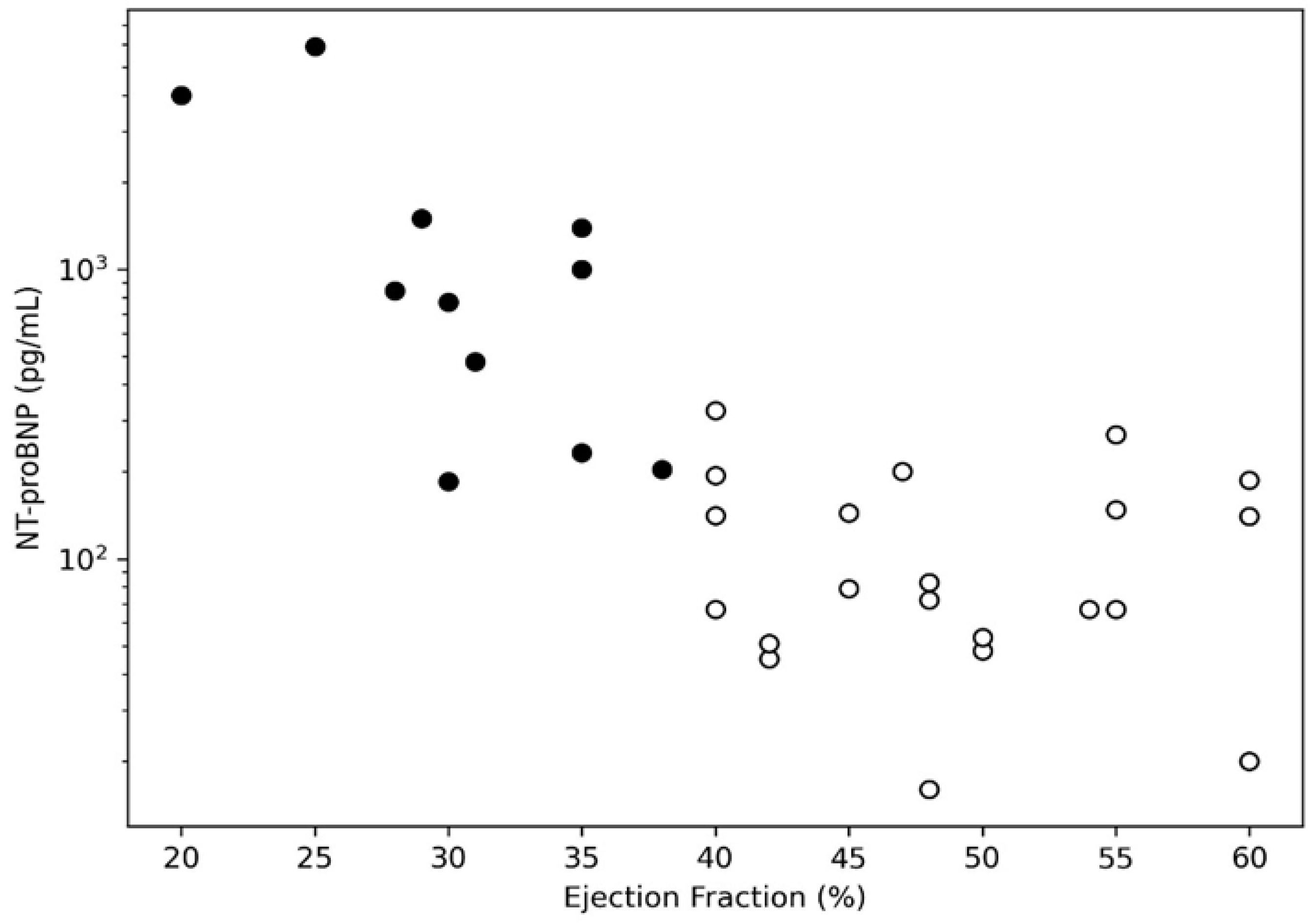
NT-proBNP was inversely correlated with EF (rho = −0.74, p < 0.001; Figure 1).
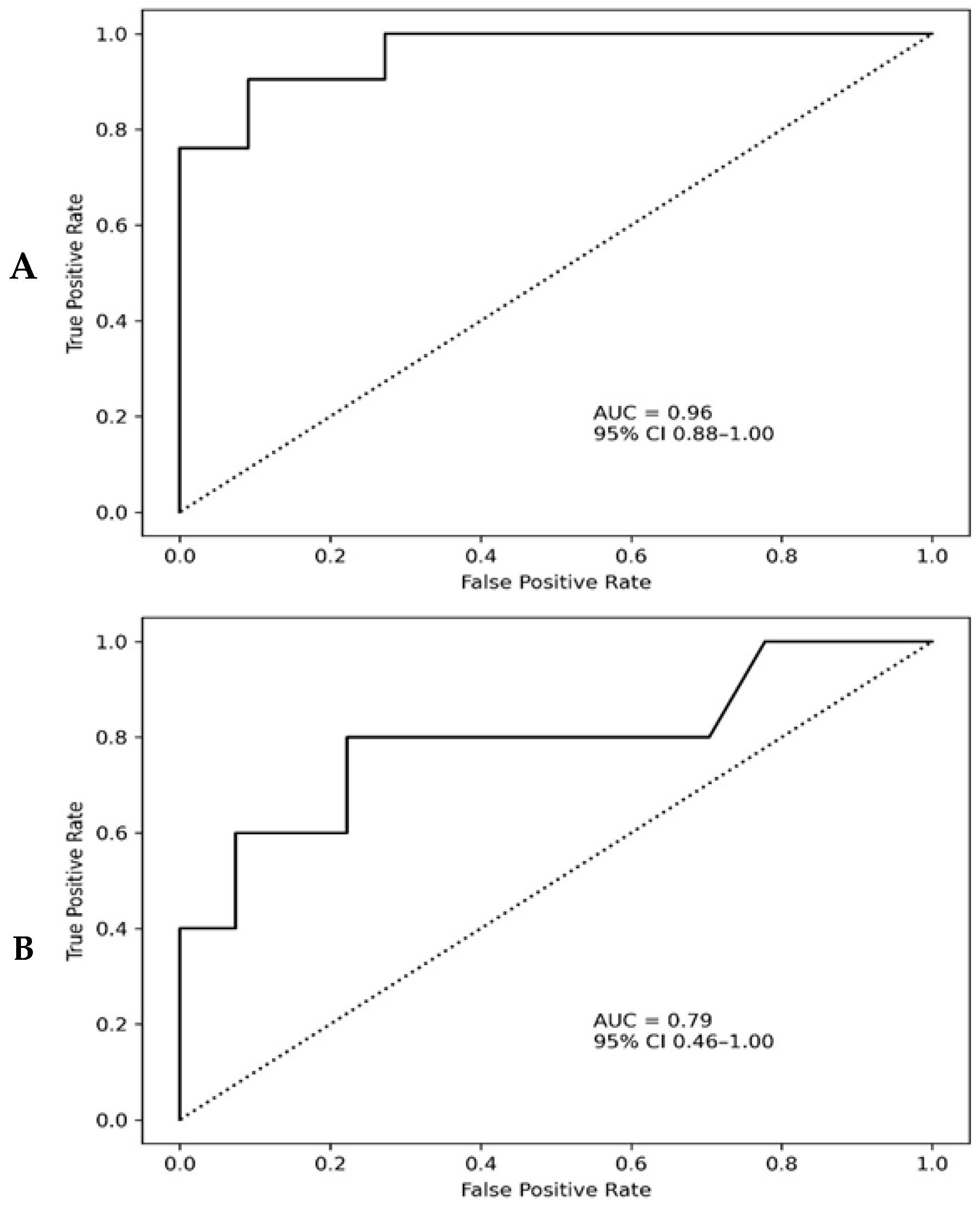
EF was inversely correlated with LVEDD and LVESD (rho = −0.45, p = 0.01 and rho = −0.48, p = 0.02, respectively). No significant associations were observed between respiratory function parameters and either NT-proBNP or EF. Specifically, FVC% (p = 0.72), MIP% (p = 0.32), SNIP% (p = 0.40), and MEP% (p = 0.53) did not differ across groups. Similarly, NIV hours were not correlated with NT-proBNP (rho = −0.10, p = 0.58) or EF (rho = 0.06, p = 0.72). Figure 2 shows the ROC analysis, which demonstrated excellent discrimination for EF < 40% (AUC 0.96, 95% CI 0.88–1.00), with similar results in internal bootstrap validation. The optimal NT-proBNP cut-off was >200 pg/mL, yielding 90.5% sensitivity and 90.9% specificity (Figure 2A). Sensitivity analysis excluding the visually estimated EFs of five patients showed similar performance (Supplementary File). During a median follow-up of 24 months, five deaths occurred. NT-proBNP levels were significantly higher in patients who died compared with survivors (median 1002 vs. 144 pg/mL, p = 0.043). NT-proBNP showed moderate discrimination for mortality (AUC 0.79, 95% CI 0.46–1.00) as shown in Figure 2B.
An exploratory cut-off >268 pg/mL yielded 80.0% sensitivity and 77.8% specificity. In exploratory logistic regression, log-transformed NT-proBNP was significantly associated with mortality (p = 0.025), as shown in Table 3.
Given the limited number of deaths, this analysis should be considered exploratory. An exploratory multivariable logistic regression was performed to evaluate the association between log-transformed NT-proBNP and systolic function, adjusted for SGLT2 inhibitor use (Table 4). Log (NT-proBNP) remained independently associated with EF < 40%, whereas SGLT2 inhibitor use was not statistically significant.

5. Discussion

In this retrospective cohort of patients with DMD and established cardiomyopathy, NT-proBNP levels were significantly higher in those with EF < 40% and showed good discriminatory performance for identifying severe systolic dysfunction. NT-proBNP also correlated with EF and ventricular dimensions and remained associated with severe systolic dysfunction in exploratory multivariable analysis. Taken together, these findings suggest that NT-proBNP may be clinically informative in patients with advanced Duchenne cardiomyopathy, particularly when the burden of myocardial dysfunction is substantial.
This interpretation is relevant in light of the inconsistent previous literature. Earlier studies suggested that natriuretic peptides may have limited value in dystrophinopathies [9,10,11].
For example, van Westrum et al. reported that NT-proBNP did not distinguish patients with and without dilated cardiomyopathy in Duchenne/Becker muscular dystrophy [12], and Sheybani et al. found no consistent correlation between BNP/NT-proBNP and cardiac function in a relatively large asymptomatic DMD cohort [13].
These weaker findings likely reflect the inclusion of younger patients with earlier cardiac involvement, when biomarker release may still be limited despite evolving myocardial injury.
By contrast, studies focused on late-stage DMD suggest a different picture.
Cha et al. reported that in advanced DMD, BNP levels were associated with adverse outcomes irrespective of LVEF [14], while Soslow et al. found that NT-proBNP was associated with all-cause mortality and identified it among the cardiovascular measures most relevant to disease progression [15]. Likewise, a recent study has suggested that NT-proBNP, along with imaging, may be useful for monitoring cardiomyopathy in patients with Duchenne muscular dystrophy [16]. Our results are more closely aligned with these late-stage observations and support the concept that natriuretic peptides may become more informative as disease advances and ventricular stress increases.
The EF threshold also deserves comment. In DMD, early cardiac involvement may be recognised at EF values below 55% [17], and recent cardiac care recommendations suggest managing patients with LVEF < 50% according to heart failure frameworks [5].
In the present study, however, we selected EF < 40% to capture a more advanced and clinically meaningful stage of systolic dysfunction. This choice was pragmatic, as EF < 40% identifies patients with clearly reduced systolic function, a greater likelihood of treatment escalation, and a more advanced clinical status, consistent with conventional heart failure classification.
Our findings also have practical relevance because cardiac assessment in advanced DMD is often challenging. Late-stage Duchenne muscular dystrophy is characterized by immobility, chest wall deformities, and respiratory failure, which may obscure symptoms of heart failure and limit imaging feasibility. A circulating biomarker may therefore be useful as an adjunct when repeated echocardiography or cardiac magnetic resonance imaging is difficult to obtain. Importantly, current adult DMD guidelines and consensus recommendations do not support routine use of cardiac biomarkers for disease monitoring, largely due to limited and heterogeneous evidence [18].
Our findings provide real-world data suggesting that NT-proBNP may reflect the severity of systolic dysfunction in advanced disease, although prospective validation is required.
The threshold identified in our cohort (>200 pg/mL) should be interpreted cautiously. In chronic heart failure, natriuretic peptide thresholds in the non-acute setting are generally lower than those used for acute decompensation [19]. However, direct comparison with DMD is imperfect because patients with advanced Duchenne muscular dystrophy differ substantially from general heart failure populations in age, body composition, respiratory impairment, and chronic ventilatory support. These disease-specific features may partly explain why natriuretic peptides behave differently in DMD and why cohort-specific thresholds may be needed. For this reason, our cut-off should be viewed as hypothesis-generating and not directly transferable to other DMD populations without external validation.
The exploratory mortality signal in our study is also consistent with prior work. Although based on only five events, NT-proBNP levels were higher in non-survivors, in line with the known prognostic role of natriuretic peptides in heart failure and with observations in advanced DMD cohorts [20,21].
However, the small number of events requires cautious interpretation, and these findings should be considered supportive rather than definitive.
This study has several limitations. First, the retrospective single-centre design and relatively small sample size limit generalizability. However, cohorts of patients with advanced Duchenne cardiomyopathy are inherently difficult to assemble because of the rarity of this disease stage and survival limitations, and real-world data in this population remain scarce. Second, echocardiographic acquisition was not standardized, and EF was visually estimated in a minority of cases due to suboptimal acoustic windows. In advanced DMD, thoracic deformities, scoliosis, and limited mobility frequently impair endocardial border definition, making volumetric measurements challenging. Although sensitivity analysis excluding visually estimated EF yielded similar results, measurement variability cannot be completely excluded.
Third, the NT-proBNP cut-off was derived and evaluated within the same cohort, potentially leading to overestimation of diagnostic performance. The proposed threshold should therefore be considered hypothesis-generating and requires external validation in independent DMD populations, ideally including patients at different disease stages. Fourth, the mortality analysis was exploratory and based on a limited number of events, leading to wide confidence intervals and potential instability in effect estimates.
Fifth, potential confounding by treatment allocation must be acknowledged. Contemporary heart failure therapies, including SGLT2 inhibitors and neprilysin inhibitors, were used preferentially in patients with more severe systolic dysfunction. Although these therapies are known to reduce natriuretic peptide levels [22], NT-proBNP remained higher in patients with EF < 40%, suggesting that biomarker elevation primarily reflected myocardial dysfunction. Nonetheless, residual confounding cannot be excluded.
Finally, all patients had advanced respiratory impairment, and many were receiving long-term NIV. While we did not observe an association between respiratory parameters and NT-proBNP, limited variability in respiratory severity may have reduced the ability to detect such relationships, and generalizability to earlier disease stages is limited [23].
Despite these limitations, this study provides clinically relevant information. NT-proBNP may provide complementary information and help identify patients with severe systolic dysfunction. Measurement is widely available, non-invasive, and easily repeatable, which may facilitate longitudinal monitoring, particularly when repeated echocardiography or cardiac magnetic resonance imaging is difficult to perform.

6. Conclusions

NT-proBNP was associated with severe systolic dysfunction and showed good discriminatory performance in patients with advanced Duchenne cardiomyopathy. These findings support a potential role for NT-proBNP as an adjunct to imaging rather than a replacement. Exploratory results also suggest a possible association with mortality, although this requires confirmation.
Prospective multicentre studies across different disease stages are needed to validate optimal thresholds and clarify the clinical role of NT-proBNP in Duchenne cardiomyopathy.

Supplementary Materials

The following supporting information can be downloaded at: https://www.mdpi.com/article/10.3390/hearts7020013/s1, Figure S1: Scatter plot showing the relationship between NT-proBNP and EF in the sensitivity cohort (excluding visually estimated EF values). NT-proBNP is displayed on a logarithmic scale; Figure S2: Receiver Operating Characteristic (ROC) curve of NT-proBNP for identifying EF < 40% in the sensitivity cohort.

Author Contributions

Conceptualization: G.C. and M.M.; data collection: F.M.; writing—original draft preparation: G.C.; writing—review and editing: M.M. and G.C. All authors have read and agreed to the published version of the manuscript.

Funding

This research received no external funding.

Institutional Review Board Statement

The study was conducted in accordance with the Declaration of Helsinki and was approved by the local ethics committee (CEPALERMO1 No. 252024, approval date: 25 February 2025).

Informed Consent Statement

All patients provided written informed consent.

Data Availability Statement

Anonymized data are available upon reasonable request from the corresponding author, subject to institutional approval.

Conflicts of Interest

The authors declare no conflicts of interest.

References

  1. Lechner, A.; Herzig, J.J.; Kientsch, J.G.; Kohler, M.; Bloch, K.E.; Ulrich, S.; Schwarz, E.I. Cardiomyopathy as cause of death in Duchenne muscular dystrophy: A longitudinal observational study. ERJ Open Res. 2023, 9, 00176–02023. [Google Scholar] [CrossRef]
  2. Landfeldt, E.; Alemán, A.; Abner, S.; Zhang, R.; Werner, C.; Tomazos, I.; Lochmüller, H.; Quinlivan, R.M.; Wahbi, K. Predictors of cardiac disease in Duchenne muscular dystrophy: A systematic review and evidence grading. Orphanet. J. Rare Dis. 2024, 19, 359. [Google Scholar] [CrossRef]
  3. Heidenreich, P.A.; Bozkurt, B.; Aguilar, D.; Allen, L.A.; Byun, J.J.; Colvin, M.M.; Deswal, A.; Drazner, M.H.; Dunlay, S.M.; Evers, L.R.; et al. 2022 AHA/ACC/HFSA guideline for the management of heart failure. J. Am. Coll. Cardiol. 2022, 79, e263–e421. [Google Scholar] [CrossRef] [PubMed]
  4. Karachunski, P.; Townsend, D. Systemic undertreatment of heart disease in patients with Duchenne muscular dystrophy. Neuromuscul. Disord. 2023, 33, 776–781. [Google Scholar] [CrossRef] [PubMed]
  5. Esteso, P.; Auerbach, S.R.; Bansal, N.; Harris, R.; Soslow, J.H.; Birnbaum, B.F.; Conway, J.; Cripe, L.H.; Nandi, D.; Hayes, E.; et al. Cardiac treatment for Duchenne muscular dystrophy: Consensus recommendations from the ACTION muscular dystrophy committee. Cardiol. Young 2025, 35, 770–775. [Google Scholar] [CrossRef] [PubMed]
  6. Bayes-Genis, A.; Docherty, K.F.; Petrie, M.C.; Januzzi, J.L.; Mueller, C.; Anderson, L.; Bozkurt, B.; Butler, J.; Chioncel, O.; Cleland, J.G.F.; et al. Practical algorithms for early diagnosis of heart failure and heart stress using NT-proBNP. Eur. J. Heart Fail. 2023, 25, 1891–1898. [Google Scholar] [CrossRef]
  7. Collinson, P.O.; Barnes, S.C.; Gaze, D.C.; Galasko, G.; Lahiri, A.; Senior, R. Analytical performance of the N terminal pro B type natriuretic peptide (NT-proBNP) assay on the Elecsys 1010 and 2010 analysers. Eur. J. Heart Fail. 2004, 6, 365–368. [Google Scholar] [CrossRef]
  8. Gudmundsson, P.; Rydberg, E.; Winter, R.; Willenheimer, R. Visually estimated left ventricular ejection fraction by echocardiography. Int. J. Cardiol. 2005, 101, 209–212. [Google Scholar] [CrossRef]
  9. Mohyuddin, T.; Jacobs, I.B.; Bahler, R.C. B-type natriuretic peptide and cardiac dysfunction in Duchenne muscular dystrophy. Int. J. Cardiol. 2007, 119, 389–391. [Google Scholar] [CrossRef]
  10. Demachi, J.; Kagaya, Y.; Watanabe, J.; Sakuma, M.; Ikeda, J.; Kakuta, Y.; Motoyoshi, I.; Kohnosu, T.; Sakuma, H.; Shimazaki, S.; et al. Characteristics of the increase in plasma brain natriuretic peptide level in left ventricular systolic dysfunction, associated with muscular dystrophy in comparison with idiopathic dilated cardiomyopathy. Neuromuscul. Disord. 2004, 14, 732–739. [Google Scholar] [CrossRef]
  11. Mori, K.; Manabe, T.; Nii, M.; Hayabuchi, Y.; Kuroda, Y.; Tatara, K. Plasma natriuretic peptides and echocardiographic parameters in Duchenne muscular dystrophy. Pediatr. Cardiol. 2002, 23, 160–166. [Google Scholar] [CrossRef] [PubMed]
  12. Schade van Westrum, S.; Dekker, L.; de Haan, R.; Endert, E.; Ginjaar, I.; de Visser, M.; van der Kooi, A. Brain natriuretic peptide is not predictive of dilated cardiomyopathy. BMC Neurol. 2013, 13, 88. [Google Scholar] [CrossRef] [PubMed]
  13. Sheybani, A.; Crum, K.; Raucci, F.J.; Burnette, W.B.; Markham, L.W.; Soslow, J.H. Duchenne muscular dystrophy patients: Troponin leak in asymptomatic and implications for drug toxicity studies. Pediatr. Res. 2022, 92, 1613–1620. [Google Scholar] [CrossRef] [PubMed]
  14. Cha, J.J.; Kim, I.S.; Kim, J.Y.; Choi, E.Y.; Min, P.K.; Yoon, Y.W.; Lee, B.K.; Hong, B.-K.; Kwon, H.M.; Cho, H.E.; et al. The association between cardiac involvement and long-term clinical outcomes in patients with Duchenne muscular dystrophy. ESC Heart Fail. 2022, 9, 2199–2206. [Google Scholar] [CrossRef]
  15. Soslow, J.H.; Xu, M.; Slaughter, J.C.; Crum, K.; Kaslow, J.A.; George-Durrett, K.; Raucci, F.J.; Wilkinson, J.D.; Cripe, L.H.; Hor, K.N.; et al. Cardiovascular measures of mortality in Duchenne muscular dystrophy. Circ. Heart Fail. 2023, 16, e010040. [Google Scholar] [CrossRef]
  16. Meng, P.; Nguyen, L.S.; Jabbour, F.; Ogna, A.; Clair, B.; Orlikowski, D.; Annane, D.; Lofaso, F.; Fayssoil, A. Accuracy of B-natriuretic peptide for the diagnosis of decompensated heart failure in muscular dystrophies patients with chronic respiratory failure. Neurol. Int. 2018, 10, 7917. [Google Scholar] [CrossRef]
  17. James, K.A.; Gralla, J.; Ridall, L.A.; Do, T.N.; Czaja, A.S.; Mourani, P.M.; Ciafaloni, E.; Cunniff, C.; Donnelly, J.; Oleszek, J.; et al. Left ventricular dysfunction in Duchenne muscular dystrophy. Cardiol. Young 2020, 30, 171–176. [Google Scholar] [CrossRef]
  18. Quinlivan, R.; Messer, B.; Murphy, P.; Astin, R.; Mukherjee, R.; Khan, J.; Emmanuel, A.; Wong, S.C.; Kulshresha, R.; Willis, T.; et al. Adult North Star Network consensus guideline for adults with Duchenne muscular dystrophy. J. Neuromuscul. Dis. 2021, 8, 899–926. [Google Scholar] [CrossRef]
  19. Welsh, P.; Campbell, R.T.; Mooney, L.; Kameni, D.M.; Hayward, C.; Campbell, A.; Porteous, D.; Mills, N.L.; Lang, N.N.; Petrie, M.C.; et al. Reference Ranges for NT-proBNP (N-Terminal Pro-B-Type Natriuretic Peptide) and Risk Factors for Higher NT-proBNP Concentrations in a Large General Population Cohort. Circ. Heart Fail. 2022, 15, e009427. [Google Scholar] [CrossRef]
  20. Cheerán, D.; Khan, S.; Khera, R.; Bhatt, A.; Garg, S.; Grodin, J.L.; Morlend, R.; Araj, F.G.; Amin, A.A.; Thibodeau, J.T.; et al. Predictors of death in adults with Duchenne cardiomyopathy. J. Am. Heart Assoc. 2017, 6, e006340. [Google Scholar] [CrossRef]
  21. Misumi, I.; Nishida, Y.; Honda, T.; Kurokawa, H.; Yasuda, H.; Kaikita, K.; Hokimoto, S.; Ogawa, H. Markedly High B-type Natriuretic Peptide Level in a Patient with Duchenne Muscular Dystrophy and Left Ventricular Non-Compaction. Intern. Med. 2015, 54, 2197–2200. [Google Scholar] [CrossRef] [PubMed][Green Version]
  22. Chen, J.; Jiang, C.; Guo, M.; Zeng, Y.; Jiang, Z.; Zhang, D.; Tu, M.; Tan, X.; Yan, P.; Xu, X.; et al. Effects of SGLT2 inhibitors on cardiac function and health in chronic heart failure: A systematic review and meta-analysis. Cardiovasc. Diabetol. 2024, 23, 2. [Google Scholar] [CrossRef]
  23. Finsterer, J.; Stollberger, C. Non-invasive ventilation and cardiac function in Duchenne muscular dystrophy. Cardiol. Young 2020, 30, 1215–1216. [Google Scholar] [CrossRef]
Figure 1. Relationship between left ventricular ejection fraction (EF) and NT-proBNP levels. NT-proBNP is displayed on a logarithmic scale. Dark points represent patients with EF < 40%, and white points represent patients with EF ≥ 40%.
Hearts 07 00013 g001
Figure 2. ROC analysis. Panel (A) (upper): Receiver operating characteristic (ROC) curve of NT-proBNP for identifying severe systolic dysfunction (EF < 40%); Panel (B) (lower): ROC curve of NT-proBNP for mortality during follow-up. NT-proBNP showed moderate discriminatory performance (AUC 0.79, 95% CI 0.46–1.00).
Hearts 07 00013 g002
Table 1. Demographic, genetic, cardiorespiratory, and pharmacological characteristics.
VariableValue
Age (years)31.8 ± 8.4
BMI (kg/m2)20.4 ± 4.6
Wheelchair users, n (%)31 (100%)
NIV use, n (%)20 (64.5%)
Hours of NIV20.3 ± 5.4
Cystatin C (mg/L)0.81 ± 0.2
Comorbidities1 patient with diabetes
Deletion, n/N (%)15/22 (68.1%)
Duplication, n/N (%)4/22 (18.1%)
Other mutations, n/N (%)3/22 (13.6%)
FVC (%)10.0 [5.0–18.2]
MIP (cmH2O)8.0 [6.7–13.2]
MIP (%)10.0 ± 7.0
SNIP (cmH2O)12.0 [10.0–14.0]
SNIP (%)9.8 ± 6.4
MEP (cmH2O)8.0 [7.0–13.7]
MEP (%)7.1 ± 4.2
EF (%)41.9 ± 10.4
NT-proBNP (pg/mL)185 [68.2–440.7]
LVEDD (mm)50.4 ± 11.8
LVESD (mm)35.0 ± 8.6
ACE inhibitors/ARBs, n (%)28 (90.3%)
Neprilysin inhibitors, n (%)3 (9.6%)
Beta-blockers, n (%)31 (100%)
Mineralocorticoid receptor antagonists, n (%)31 (100%)
SGLT2 inhibitors, n (%)11 (35.4%)
Corticosteroids, n (%)2 (6.4%)
NIV, non-invasive ventilation; FVC, forced vital capacity; MIP, maximum inspiratory pressure; SNIP, sniff nasal pressure; MEP, maximum expiratory pressure; EF%, ejection fraction; NT-proBNP, N-terminal pro-B-type natriuretic peptide; LVEDD, left ventricular end-diastolic diameter; LVESD, left ventricular end-systolic diameter.
Table 2. Comparison between patients with EF < 40% and EF ≥ 40%.
VariableEF < 40% (n = 11)EF ≥ 40% (n = 20)p Value
Age (years)31.0 ± 7.032.3 ± 9.20.68
BMI (kg/m2)22.0 [16.8–24.0]21.6 [17.6–24.2]0.79
Wheelchair users, n (%)11 (100%)20 (100%)
NIV use, n (%)7/11 (63.6%)13/20 (65.0%)0.93
Hours of NIV19.5 ± 6.020.8 ± 5.30.60
Cystatin C (mg/L)0.81 ± 0.10.80 ± 0.10.88
Comorbidities01 diabetes
Deletion, n (%)8 (72.7%)16 (76.1%)0.80
Duplication, n (%)2 (18.1%)2 (9.5%)0.49
Other mutations, n (%)1 (9.0%)3 (14.2%)0.72
FVC (%)10.0 [5.7–12.7]8.5 [5.0–20.0]0.82
MIP (cmH2O)8.0 [6.0–12.7]9.0 [7.0–14.0]0.49
MIP (%)9.1 ± 4.910.6 ± 8.10.57
SNIP (cmH2O)12.0 [7.7–13.0]12.0 [11.0–14.0]0.46
SNIP (%)9.0 ± 5.010.3 ± 7.10.61
MEP (cmH2O)8.0 [7.0–14.7]8.0 [7.0–13.0]0.89
MEP (%)6.0 ± 3.17.2 ± 4.70.78
EF (%)30.5 ± 5.148.2 ± 6.5<0.001
NT-proBNP (pg/mL)843.0 [294.5–1472.2]81.0 [60.3–167.5]<0.001
LVEDD (mm)62.6 ± 9.743.9 ± 6.5<0.001
LVESD (mm)44.0 ± 5.830.6 ± 5.9<0.001
ACE inhibitors/ARBs, n (%)8/11 (72.7%)20/20 (100%)0.01
Neprilysin inhibitors, n (%)3/11 (27.2%)00.01
Beta-blockers, n (%)11/11 (100%)20/20 (100%)
Mineralocorticoid receptor antagonists, n (%)11/11 (100%)20/20 (100%)
SGLT2 inhibitors, n (%)11/11 (100%)0
Corticosteroids, n (%)2 (18.1%)1 (5.0%)0.08
NIV, non-invasive ventilation; FVC, forced vital capacity; MIP, maximum inspiratory pressure; SNIP, sniff nasal pressure; MEP, maximum expiratory pressure; EF%, ejection fraction; NT-proBNP, N-terminal pro-B-type natriuretic peptide; LVEDD, left ventricular end-diastolic diameter; LVESD, left ventricular end-systolic diameter.
Table 3. Exploratory logistic regression model assessing the association between log-transformed NT-proBNP and mortality.
VariableβSEOR95% CIp Value
Intercept−7.130.007
Log (NT-proBNP)0.940.422.561.13–5.790.025
NT-proBNP was log-transformed due to skewed distribution. Each 1-unit increase in log(NT-proBNP) was associated with a 2.56-fold increase in the odds of mortality (95% CI 1.13–5.79, p = 0.025).
Table 4. Exploratory multivariable logistic regression analysis evaluating the association between log-transformed NT-proBNP and severe systolic dysfunction, adjusted for SGLT2 inhibitor use.
VariableβSEOR95% CIp Value
Intercept18.538.040.021
log(NT-proBNP)−3.201.490.040.002–0.750.032
SGLT2 inhibitor−1.571.470.210.01–3.730.286
Odds ratios (ORs) with 95% confidence intervals (CIs) are reported. The model was coded using preserved systolic function (EF ≥ 40%) as the reference outcome; therefore, an OR < 1 for log (NT-proBNP) indicates a lower probability of preserved systolic function and, consequently, a higher probability of EF < 40%.
Disclaimer/Publisher’s Note: The statements, opinions and data contained in all publications are solely those of the individual author(s) and contributor(s) and not of MDPI and/or the editor(s). MDPI and/or the editor(s) disclaim responsibility for any injury to people or property resulting from any ideas, methods, instructions or products referred to in the content.