1. Introduction
Heart failure is a leading cause of morbidity and mortality worldwide [
1]. Advanced HF represents a critical stage where conventional therapies often fail. Left ventricular assist devices have emerged as a life-saving option for these patients—either as a bridge to transplant, a bridge to recovery, or as destination therapy for those ineligible for transplant. Modern continuous-flow LVADs significantly improve hemodynamics, survival rates, and quality of life in patients with end-stage HF [
2].
However, the implantation of LVADs introduces new challenges, particularly in managing arrhythmias and the use of CIEDs in these patients. Patients with end-stage HF frequently have pre-existing implantable cardioverter defibrillators or cardiac resynchronization therapy devices by the time they undergo LVAD implantation, consistent with standard indications for device therapy in low ejection fraction HF [
2].
In a multicenter study, 87% of LVAD recipients already had a CIED in place at the time of LVAD surgery [
3]. These devices are usually kept active after LVAD implantation, reflecting the historical importance of ICDs in reducing the risk of SCD. Nevertheless, the benefits of CIEDs in the context of mechanical circulatory support remain unclear. Continuous-flow LVADs can maintain perfusion during many arrhythmias that would otherwise be fatal, prompting critical questions: “Do ICDs still confer a survival benefit when an LVAD is providing circulatory support? Does CRT offer meaningful hemodynamic or clinical improvement in a continuously unloaded left ventricle? How do we weigh the potential benefits of these devices against the risks of infection, lead complications, and device–device interference in LVAD patients?”.
This review aims to provide an up-to-date and comprehensive overview of CIED therapy in patients supported by LVADs. We will characterize the arrhythmia burden in LVAD patients and the underlying pathophysiological mechanisms, assess the clinical impact of ICD therapy in this population, including evidence for and against its continued use, examine the role of CRT after LVAD implantation and whether it offers additional benefit, highlight device-related complications (lead failure, infection, interference, inappropriate shocks) unique to patients with both LVADs and CIEDs, discuss current guideline recommendations and areas of consensus or controversy, outline future directions and research needs, including technological innovations and patient-centered considerations. By consolidating available data and expert guidance, we aim to assist clinicians in navigating the complex decision-making process for ICD and CRT use in LVAD recipients, while also identifying research priorities for this evolving field.
2. Ventricular Arrhythmias After LVAD and the Role of ICD Therapy
2.1. Arrhythmia Burden and Pathophysiology in LVAD Patients
While LVAD support effectively unloads the left ventricle and improves systemic perfusion, it does not eliminate the underlying arrhythmogenic substrate present in advanced HF. Ventricular arrhythmias (VAs) remain prevalent after LVAD implantation, with reported incidences ranging from 20 to 35% of patients, particularly in the early post-operative months [
4]. Several mechanisms contribute to the persistence of arrhythmias in this context. First, the preexisting myocardial scar and fibrosis play a crucial role. Many LVAD candidates have ischemic cardiomyopathy or previous myocardial infarctions, resulting in scar tissue that acts as a substrate for reentrant ventricular tachycardia (VT) circuits. Even after LVAD implantation, these preexisting scars continue to predispose patients to VT and ventricular fibrillation (VF). Second, the electrical remodeling and autonomic changes. Chronic HF and the unloading effect of LVADs can alter the heart’s electrophysiological properties. Patients with LVADs often experience changes in autonomic tone and neurohormonal activation that can trigger Vas [
2]. For instance, reduced pulsatility and continuous flow may affect baroreceptor responses and repolarization dynamics.
Additionally, right ventricular strain is essential. While LVADs support the left ventricle, they do not give support to the right ventricle, leaving it vulnerable to volume and pressure overload. This is especially true if the LVAD speed is suboptimal or if there is a shift in the interventricular septum. Strain and dysfunction of the right ventricle can lead to VAs originating from the right ventricle or septum. Finally, the mechanical induction of VAs caused by suction events and LVAD inlet cannula contact with the myocardial wall. Intermittent “suction events” may occur when the LVAD inflow exceeds LV filling, causing the ventricular wall to contact the inflow cannula. These events can induce mechanical irritation and regional ischemia, potentially triggering ventricular ectopy or VT. Abnormal contact between the inflow cannula and the endocardium can similarly provoke arrhythmias [
5].
In summary, LVADs enhance circulatory stability but do not eliminate the arrhythmogenic milieu associated with advanced HF. VAs in LVAD patients may not immediately lead to hemodynamic collapse because the pump maintains some degree of flow. However, they can still impair overall cardiac output by reducing LV filling. This scenario may precipitate right heart failure and contribute to increased morbidity due to device shocks or hospitalizations. The persistent risk of arrhythmias raises important questions regarding the continuation of ICD therapy in LVAD recipients.
2.2. ICD Therapy: Rationale and Evidence in LVAD Patients
ICD therapy is a cornerstone in the management of systolic HF with low ejection fraction, and numerous clinical trials have shown that ICDs significantly reduce SCD in these patients [
6]. The rationale of this therapy is straightforward: an ICD can promptly terminate life-threatening VT or VF, thereby improving survival [
7,
8]. In patients supported by LVAD, the rationale for using ICDs remains compelling. LVADs provide circulatory support but cannot terminate malignant arrhythmias independently. During untreated VF effective device support may be impaired by insufficient preload from the right ventricle, resulting in low systemic flow.
However, recent observational studies have shown mixed results. Initial experiences with LVADs, particularly early-generation pulsatile pumps, suggested that ICD therapy might indeed improve survival rates during LVAD support [
9,
10]. The PCHF-VAD was a large European registry that reported that patients with an LVAD and an ICD/CRT-D had significantly better survival during follow-up than those without. Specifically, in this study, which enrolled 448 patients with continuous-flow LVAD, active ICD/CRT-D therapy was associated with a 36% reduction in all-cause mortality compared to no ICD therapy [
11]. In contrast, an analysis of the U.S. INTERMACS registry found no significant difference in mortality between LVAD patients with and without ICDs. Among over 4400 propensity-matched LVAD recipients (2209 with ICD vs. 2209 without), the presence of an ICD did not lead to lower overall mortality; intriguingly, those with ICDs appear to have a slightly higher risk of death (HR ~ 1.20) and a higher incidence of SCD and hospitalization [
12]. This discrepancy is particularly noteworthy given that deaths from non-arrhythmic causes, such as pump failure, stroke, and infection, were prevalent in that cohort. This suggests that these other significant risks may dilute the potential protective benefits of ICDs. These conflicting findings highlight that the survival benefit of ICD therapy in LVAD patients is not universally applicable. LVADs themselves significantly reduce the risk of sudden hemodynamic collapse from VAs, and many arrhythmias can either self-terminate or be hemodynamically tolerated, such as slower VT. It appears that arrhythmic deaths constitute a smaller proportion of overall mortality in LVAD recipients compared to non-LVAD HF patients. Therefore, the number-needed-to-treat with ICDs to save one life is likely higher in the LVAD population, suggesting that while some LVAD patients may receive minimal additional benefit from an ICD, others—particularly those with frequent VAs or with a prior history of cardiac arrest—could still receive protection from SCD [
13]. In summary, current data do not provide consistent evidence supporting a mortality benefit of routine de novo ICD implantation following LVAD surgery.
2.3. ICD Shocks: Impact and ICD Programming in LVAD Patients
ICD shocks—both appropriate and inappropriate—are a significant concern for patients with LVAD. On one hand, an appropriate shock for sustained VF can be lifesaving. On the other hand, frequent or inappropriate shocks may indicate advanced disease or can cause direct harm. A retrospective series of 421 LVAD patients with ICDs found that 33.9% experienced at least one ICD shock in the post-LVAD period. Among these shocks, approximately 77% were appropriate (VT/VF), while 23% were inappropriate [
14]. Most inappropriate shocks were due to supraventricular tachycardia, such as atrial fibrillation with rapid ventricular response, while only a small number were due to electromagnetic interference (EMI) from the LVAD or oversensing of device noise. Notably, patients who experienced multiple ICD shocks tended to have worse outcomes, including higher mortality rates and increased hospitalizations due to pump failure [
15]. This suggests that recurrent shocks may reflect a more severe underlying substrate or advanced illness rather than a benefit conferred by the ICD. Psychologically, even appropriate ICD shocks can be traumatic for patients, potentially reducing their quality of life and leading to anxiety or depression in this already vulnerable population [
16]. To minimize unnecessary shocks, experts advocate conservative ICD programming tailored explicitly for LVAD patients. This approach involves raising rate cutoffs and prolonging VT/VF detection duration, as well as maximizing the use of anti-tachycardia pacing (ATP) before resorting to shocks. For instance, instead of treating any ventricular tachyarrhythmia > 170 bpm after 2.5 s, an LVAD-adapted strategy might deliver therapy only at rates > 200 bpm or require a longer duration (5–10 s) before charging the capacitor [
17]. This programming allows benign or self-terminating arrhythmias to resolve and uses painless pacing therapies for monomorphic VT when possible. Evidence suggests that implementing these changes can significantly reduce the rate of inappropriate shocks in LVAD patients. Short detection intervals and absence of ATP were strongly associated with inappropriate shocks, while patients with longer detection delays and those enabled with ATP experienced far fewer inappropriate shocks [
14].
Table 1 summarizes key aspects of ICD programming in patients with LVAD.
A small prospective trial specifically evaluated “ultra-conservative” ICD programming compared to standard programming in LVAD patients [
18]. In this study, 83 patients were randomized after LVAD implantation. The ultra-conservative protocol, which included maximally delayed detection and high-rate cutoffs, did not significantly reduce the incidence of ICD shocks over 6 months compared with standard settings. Approximately 16% of patients in the ultra-conservative group experienced at least one shock, compared to 21% in the control arm (
p = 0.66). Additionally, there were no differences in mortality or hospitalizations between the groups. It is noteworthy that many of the “standard” programming settings in the study were already relatively non-aggressive, reflecting the evolving clinical practice. This trial suggests that there may be a limit to the extent of shock reduction achievable through programming alone once a reasonable strategy (such as high-rate detection, long delay, and the use of ATP) is implemented. Nonetheless, these findings confirm that overly aggressive settings are unnecessary and emphasize the importance of individualization approaches. In current practice, ICD programming for LVAD patients often follows principles similar to those established in the MADIT-RIT trial [
19] for non-LVAD patients, specifically using high-rate therapy at 180–200 bpm with prolonged detection times. In some cases, these settings may even be more permissive. The 2019 AHA Scientific Statement on LVAD management recommends extended detection intervals and encourages the liberal use of ATP for LVAD patients, even suggesting that lower-rate VT zones may be deactivated altogether if the arrhythmias are well-tolerated hemodynamically [
2]. This patient-tailored approach aims to balance the need to protect against rapid VT or VF while minimizing unnecessary shocks for slower or self-limiting arrhythmias that the LVAD can manage effectively.
2.4. ICD Deactivation or Explantation Considerations
Given the uncertain benefits and non-trivial risks associated with ICDs in LVAD patients, there are clinical scenarios where ICD therapy may be minimized or withdrawn. Routine explantation of existing ICDs during LVAD surgery is not recommended unless there is a compelling reason. However, ICD deactivation can be considered in specific contexts, such as end-of-life or palliative care transitions, electrical storm, device-related infections, or lead failures. In a patient with LVAD support who is approaching the end of life due to multi-organ failure, refractory HF, or another terminal condition, it may be ethically reasonable to deactivate the ICD to avoid painful shocks. Such a decision should be centered on the patient’s preferences and guided by ethical considerations, and should involve consultations with the patient, if capable, and relatives. In the event of an ES, frequent ICD shocks can significantly impair the patient’s quality of life, despite optimal reprogramming and adjunctive therapies. If these shocks are mostly inappropriate or do not contribute to meaningful survival, deactivation may be considered. Alternatively, temporarily suspending therapies with careful monitoring can help determine whether the arrhythmic burden truly necessitates shocks [
20]. Finally, if a device-related infection or lead failure occurs, device and lead extraction are indicated. Unless a clear indication for defibrillator therapy remains, some clinicians may opt not to re-implant an ICD after the infection is cleared, particularly if the patient is assessed as at low risk for arrhythmias or has a limited life expectancy [
21].
It is essential to highlight that decisions about deactivating ICD therapy in LVAD patients are highly individualized and should involve input from a multidisciplinary team. Many LVAD patients are suitable candidates for a heart transplant or have a reasonable expected lifespan, making the continuation of ICD function generally recommended. On the other hand, for destination-therapy patients whose overall condition is worsening, disabling the ICD can be a sensible choice to prioritize comfort once the goals of care shift away from prolonging life. Shared decision-making with the patient and their family is crucial in these circumstances.
3. CRT Therapy in LVAD Patients
3.1. Background: CRT Benefits in Conventional Heart Failure
CRT offers well-established benefits for patients with severe HF with reduced LVEF and electrical dyssynchrony. In several clinical trials [
22,
23,
24], CRT has been shown to improve symptoms, increase LVEF, reduce hospitalizations, and improve survival among eligible patients with prolonged QRS duration [
25]. Many patients receiving LVADs have undergone CRT implantation during their pre-LVAD HF management. This raises the question: once a continuous-flow LVAD supports the circulation, does ongoing biventricular pacing provide any additional advantage?
3.2. Physiological Considerations Post-LVAD
There are several reasons why CRT might have reduced effects in LVAD-supported hearts. The hemodynamic importance of dyssynchrony is theoretically less when LVADs provide continuous flow and unload the left ventricle, often decreasing native stroke volume. The mechanical advantage of resynchronizing LV contraction is likely less significant when the LV is partially bypassed by the pump. Essentially, the LVAD supports cardiac output, so whether the weakened ventricle contracts more synchronously or not may not substantially affect systemic output. Conversely, an area where CRT could still be relevant is in maintaining interventricular synchrony to support the right ventricle. By pacing both ventricles, CRT may slightly enhance septal position or indirectly reduce RV afterload. If a patient has significant RV dysfunction, a paced rhythm that optimizes RV–LV timing could, in theory, help the RV fill the LV and thereby improve LVAD flow. This potential benefit is indirect and not definitively proven [
26]. Given these points, it is not surprising that the added benefit of CRT in LVAD patients has been challenging to establish. The LVAD’s continuous mechanical support largely supersedes the immediate hemodynamic gains that CRT offers in non-LVAD HF patients.
3.3. Clinical Evidence and Outcomes with CRT
Studies evaluating the role of CRT in LVAD recipients have yielded mixed, generally neutral results. No randomized trial has specifically examined the benefits of continuing versus discontinuing CRT in this population. Only observational analyses and post hoc studies offer insights. The main findings of these studies can be summarized as showing no clear benefits on survival or freedom from HF hospitalizations, and a possible reduction in VAs.
A multicenter retrospective study of nearly 300 LVAD patients with pre-existing CRT devices found no significant difference in mortality between those who had CRT turned “on” versus those who had the LV pacing turned “off” after LVAD implantation [
27]. There were also no differences in heart transplant rates or HF readmissions. These findings suggest that routine biventricular pacing may not influence long-term outcomes in LVAD patients. Interestingly, some analyses have indicated that CRT could reduce the VAs’ burden. In the above-mentioned ICD programming trial, among patients with CRT-D devices, those randomized to CRT “on” had a lower incidence of ICD shocks (10% vs. 38% in CRT “off” over 6 months). However, this difference did not reach statistical significance (
p = 0.08). Similarly, a small single-center study has reported fewer VAs in patients with active CRT pacing, possibly due to more stable electrical activation patterns [
28]. Given the lack of robust evidence, current practice varies. Many centers leave CRT “on” by default in patients who already have a CRT device, with possible subtle benefits, such as preventing loss of atrioventricular synchrony in pacemaker-dependent patients and potentially optimizing RV-LV timing. The downside of continuing biventricular pacing is the need for more frequent CRT generator changes. On the other hand, routine CRT implantation after LVAD placement is not common, and only in select cases, such as newly developing wide QRS with severe RV failure, might a CRT upgrade be contemplated.
Overall, the role of CRT in LVAD patients remains uncertain. Current guidelines do not mandate CRT implantation, and the decision should be tailored according to the needs. If the patient’s native heart still contributes significantly and shows dyssynchrony, continuing CRT could be appropriate; if the native EF is very low with minimal pulsatility, turning off the LV lead probably has no adverse effect and may extend device life.
4. Device-Related Complications and Special Considerations in LVAD Patients
The clinical management of patients with both an LVAD and a CIED presents unique challenges due to the coexistence of multiple hardware systems. This section reviews common complications and management considerations, including device–device interactions, procedural risks during device interventions, catheter ablation strategies, and infection control.
4.1. Device Interactions and Coexistence Issues
Modern continuous-flow LVADs are well-shielded, and direct electromagnetic interference (EMI)-induced inappropriate ICD shocks are quite rare. In a comprehensive review of ICD shocks following LVAD implantation, true LVAD-induced oversensing accounted for only about 0.3% of inappropriate shocks [
14]. Nonetheless, device interrogation after LVAD implantation is advisable to check for any EMI noise on the ICD leads. If EMI noise is detected, adjustments such as reducing sensitivity can help mitigate oversensing. Patients should continue to follow standard precautions regarding strong electromagnetic fields (e.g., MRI or large magnets), as these can affect both devices [
29]. It is important to note that subcutaneous ICDs (S-ICDs) are more susceptible to LVAD-related EMI than transvenous ICDs. Reports have documented cases of HeartMate 3 LVADs causing oversensing in S-ICDs, which sometimes require deactivation of the S-ICD [
30,
31]. Careful screening and programming, using dedicated LVAD-specific filter algorithms, are essential when an S-ICD is used in a patient with an LVAD. Continuous-flow LVADs provide continuous blood flow, reducing arterial pulse pressure. This change can affect certain algorithms used in rate-responsive pacemakers, especially those that rely on impedance or accelerometry. It may complicate the detection of supraventricular rhythms based on hemodynamic surrogate [
32]. Usually, LVAD patients receive beta-blockers and tend to be less active, leading to the common practice of turning off rate-responsive pacing to prevent inappropriate pacing driven by the sensors [
33]. Furthermore, after LVAD implantation, the heart’s position and size often change (with a smaller left ventricular chamber), which can affect the amplitude of intracardiac signals. As a result, the device’s sensing parameters may occasionally need to be reprogrammed to ensure the ICD accurately detects VT or VF without mistaking the low-flow state. For example, T-wave oversensing can occur if the electrical signal’s morphology changes. Regular device follow-up is crucial for calibrating sensing thresholds in LVAD patients, maintaining optimal function and precise detection [
34].
An ICD shock delivers a high-voltage current that could theoretically affect the LVAD system. Clinically, an ICD shock may cause a temporary artifact in the LVAD controller readings, leading to momentary alarms. Patients and caregivers have reported that the LVAD controller “buzzes” or alarms immediately after an ICD shock, likely due to a brief disturbance in flow or electrical telemetry [
35]. Fortunately, there is no evidence that ICD shocks damage LVAD hardware or impair long-term pump function [
36]. The LVAD usually continues to operate normally during and after the shock. However, multiple consecutive shocks, such as those experienced during an ES, could increase catecholamine levels or lead to suction events by stunning the myocardium, thereby indirectly affecting pump flow [
37]. Therefore, it is advisable to avoid unnecessary shocks—through careful programming and additional therapy—not only for patient comfort but also to preserve optimal pump function.
Complex scenarios can arise in which LVAD and CIED therapies appear to conflict. For example, if a patient develops incessant VT that is hemodynamically tolerated thanks to the LVAD maintaining cardiac output, the ICD may repeatedly deliver shocks. In such cases, it is preferable to manage the arrhythmia by increasing antiarrhythmic medications or performing catheter ablation rather than allowing the ICD to continue shocking the patient. When treating LVAD patients with recurrent or refractory VAs causing frequent ICD therapies, it is essential to consider whether upgrading the overall treatment plan—such as urgent listing for a transplant or considering a total artificial heart—would provide greater benefit than enduring frequent shocks or pursuing high-risk ablation procedures. To manage refractory arrhythmias effectively, a multidisciplinary approach is essential. This should involve collaboration among the HF, LVAD, and electrophysiology teams. Together, they should plan various strategies, such as adjusting pump settings, optimizing medical therapy, performing ablation, or deactivating ICD therapies. The patient’s overall condition and preferences should guide the level of intervention, balancing treatment aggressiveness with comfort. In summary, while most CIEDs and LVADs coexist without direct interference, careful device management remains necessary. Regular device checks, thoughtful ICD programming, and close coordination between the LVAD and electrophysiology teams can prevent most device-related issues. The 2024 EHRA/HFA consensus strongly advocates for personalized programming and multidisciplinary follow-up for LVAD patients with CIEDs [
38].
4.2. Procedural Risks of CIED Interventions in LVAD Patients
Performing CIED-related procedures, such as generator changes, device or lead revisions, new device implants, or lead extractions, in patients with an LVAD involves risks specific to this population. The presence of an LVAD, combined with the patient’s comorbidities and the need for anticoagulation, complicates these procedures.
Patients with LVADs are typically managed with oral anticoagulants like warfarin, often combined with antiplatelet therapy, to prevent pump thrombosis. Despite careful management around procedures—such as withholding antiplatelets or reducing INR levels—these patients face a higher risk of bleeding. Reported rates of pocket hematomas in LVAD patients after CIED surgery range from approximately 13% to 16%, which is significantly higher than in non-LVAD populations (usually less than 5%) [
39]. A single-center study at Duke University found that 13.2% of LVAD patients who underwent a device procedure developed a clinically relevant hematoma [
40]. These hematomas often require extended hospital stays, transfusions, or even re-operation for evacuation. Furthermore, there is a strong association between hematoma and subsequent infection, with many patients who developed a CIED infection having first experienced a pocket hematoma. This aligns with broader device literature showing that hematomas significantly increase the risk of infection [
41]. In addition to careful hemostasis and compression at the pocket site, operators use topical hemostatic agents or fibrin sealants, as well as absorbable antibiotic envelopes with hemostatic properties, such as TYRX™. However, specific data on their use in LVAD patients are limited.
New CIED-related infections, including pocket infections or endocarditis, occur in about 3 to 9% of LVAD patients after device procedures [
40,
41,
42]. These figures are notably higher than the infection rates in standard conditions, which are below 2% in device patients. Infections in LVAD patients can have serious outcomes, as bacteria may infect the LVAD pump or driveline, resulting in persistent bacteremia that is highly difficult to treat. Therefore, preventive strategies are crucial. To lower the risk of infection, broad-spectrum antibiotics are typically given perioperatively, and strict sterility must be maintained, often involving collaboration between two physicians—an electrophysiologist for the device procedure and an LVAD surgeon to manage the driveline and pump console—to ensure sterility throughout the procedure. Additionally, antibiotic-impregnated envelopes may be considered. If an infection occurs, complete removal of the system is usually necessary, which is a high-risk procedure for this patient group. CIED implantation in an LVAD patient is performed similarly to that in other patients, with some modifications. If the left pectoral site is chosen, awareness of the LVAD outflow graft is essential; it usually runs from the left ventricular apex to the ascending aorta along the left side of the chest internally. Access to the axillary or subclavian vein under fluoroscopic guidance is recommended to avoid accidental injury to the graft or heart. Some centers prefer to place new implants on the right pectoral side to keep them farther from the LVAD hardware [
43]. Active-fixation leads are preferred to ensure stability in a heart that may shrink or shift position due to unloading.
Given the risks involved, the indication for any elective CIED procedure in an LVAD patient must be carefully considered. If an ICD/CRT generator reaches the end-of-life, the 15–20% risk of complications such as hematoma or infection from replacement should be weighed against the benefit of maintaining ICD/CRT protection. If the patient is stable on LVAD support with long-term therapy planned—for example, a younger destination-therapy patient expected to live for years or a bridge-to-transplant patient with an indeterminate wait—replacing the battery to sustain ICD function is often justified. Conversely, if the patient is close to a heart transplant or has limited survival due to other comorbidities, it may be preferable not to replace the generator and instead deactivate therapies when the battery depletes. Black-Maier et al. reported a one-year mortality after post-LVAD device surgery of 20% [
40], reflecting both the underlying illness and the added risk of complications. This underscores that any invasive procedure in these patients is significant and should offer a clear expected benefit. Ultimately, these decisions should be personalized and ideally made by a multidisciplinary Heart Team in collaboration with the patient’s preferences. In summary, procedures involving CIEDs in patients with LVADs carry increased risks of bleeding and infection. Meticulous surgical techniques and proactive preventive measures are essential to minimize these risks. When complications occur, prompt management can sometimes prevent a serious progression. Nonetheless, the high complication rates underscore the importance of carefully selecting patients for device interventions and considering less-invasive alternatives whenever feasible. This area warrants further research—for instance, to develop standardized protocols for peri-procedural anticoagulation or to investigate whether newer technologies could help reduce complication rates.
5. Current Guidelines and Recommendations
Due to limited and inconclusive evidence, professional society guidelines advise a cautious approach regarding ICD/CRT therapy for patients with LVADs. Although there is no guideline specifically addressing this topic, relevant recommendations can be found in broader HF and device therapy guidelines and in expert consensus statements.
5.1. American Heart Association Scientific Statement (2019)
The AHA statement on device therapy in LVAD recipients provides a comprehensive review and largely reflects expert consensus [
2]. It highlights that arrhythmias, both atrial and ventricular, are common in patients with LVAD. However, there is no definitive agreement on the optimal practices for managing these arrhythmias. Regarding ICDs, the statement acknowledges conflicting data on survival benefits after LVAD implantation, indicating that decisions about whether to implant a new ICD should be personalized for each patient. The statement clearly confirms that patients who already have an ICD or CRT-D at the time of LVAD implantation will usually continue to have active device therapy afterwards, given the difficulty in predicting who might need shock therapy. However, it does not recommend routine placement of new ICDs following LVAD. Regarding CRT, it may be continued in select cases, although its benefits in this setting remain unproven, and further research is warranted. Additionally, the statement emphasizes the importance of optimizing ICD programming—such as employing longer detection intervals—and advocates for proactive discussions about ICD deactivation during end-of-life care for LVAD patients.
5.2. ACC/AHA/HFSA Heart Failure Guidelines (2022)
The latest American HF guidelines highlight device therapy before LVAD implantation. They still recommend ICDs for patients with LVEF ≤ 35% who meet standard criteria (Class I), which includes many patients who eventually receive LVADs. In practice, this means most LVAD candidates should have had an ICD implanted during their HF course if appropriate. However, the guideline does not specify whether to implant a new ICD after LVAD surgery if one was not already in place, recognizing the lack of evidence in that scenario. Regarding CRT, the HF guidelines similarly recommend CRT for eligible patients (LVEF ≤ 35%, wide QRS) before LVAD but do not advise on whether to continue or stop CRT after LVAD implantation, leaving that decision to clinical judgment [
7].
5.3. European Society of Cardiology (ESC 2021 HF Guidelines)
The ESC HF guidelines align with the ACC/AHA stance, recommending ICD and CRT according to standard indications in advanced HF patients (Stage D) who may also receive LVADs. Once an LVAD is in place, the guidelines note that the benefit of continued ICD therapy is uncertain. They suggest that in patients who did not have an ICD prior, an individualized approach is needed—ICD “may be considered” in an LVAD patient with significant ventricular arrhythmias or as a bridge to transplant, but routine prophylactic implantation is not mandated. The ESC emphasizes the role of the multidisciplinary Heart Team in making such decisions on a case-by-case basis [
1].
5.4. HRS/ISHLT/EHRA/HFSA Consensus Statements
Several relevant consensus documents supplement the formal guidelines. The 2017 HRS consensus on CIED lead management emphasizes that infected CIEDs in LVAD patients should be fully extracted [
39]. The International Society for Heart & Lung Transplantation (ISHLT) guidelines on mechanical circulatory support (2023) note that ICDs already in place should generally be left intact during LVAD implantation, unless infected, and managed thereafter [
36]. However, they do not recommend placing a new ICD after LVAD, except under standard indications. More recently, a 2024 EHRA/HFA consensus specifically on arrhythmias in LVAD patients suggests considering ICD implantation in LVAD recipients experiencing sustained VTs or VF post-LVAD, particularly if symptomatic [
38]. This is to be interpreted as a Class IIa recommendation for ICDs in LVAD patients with a significant arrhythmia burden, recognizing that the evidence supporting this is limited. The same consensus also states that there is no proven indication for adding CRT after LVAD beyond individual patient scenarios.
Across these guidelines and consensus statements, a few common themes emerge:
- (1)
Maintaining pre-existing devices—patients who already had an ICD or CRT before LVAD typically continue to have them active afterwards, as long as they do not cause problems.
- (2)
No routine de novo ICD implantation following LVAD–prophylactic ICD implantation after LVAD is not mandatory, reflecting the lack of proven mortality benefit; instead, new ICD decisions are made on a case-by-case basis.
- (3)
CRT optional—there is no requirement to either continue or discontinue CRT in LVAD patients; many clinicians leave CRT on if already in place, but new CRT is not typically initiated just for an LVAD.
- (4)
Programming optimization—all sources agree that ICD programming should be adjusted to minimize inappropriate therapies in LVAD patients.
- (5)
End-of-life planning—guidelines encourage physicians to discuss ICD deactivation when appropriate, especially for patients on destination-therapy LVADs who may transition to comfort care.
The guidelines highlight the importance of ongoing reassessment. A patient’s condition with LVAD can change over time. In a patient without an ICD before LVAD who develops multiple sustained VAs after LVAD, the need for ICD implantation may become stronger and warrant device placement at that point. Conversely, if a patient with an ICD remains shock-free and stable for years on LVAD, and is now approaching transplant, it could be reasonable to deactivate therapies around the heart transplant to prevent unnecessary shocks during the peri-operative period. In all cases, the Heart Team should collaborate and involve the patient in decision-making. Current guidelines endorse an individualized approach. The lack of randomized trial data leaves many decisions to the clinician’s judgment. The main principle is to continue protecting patients from arrhythmic risk when possible, but to avoid reflexively exposing them to device-related risks if the benefit is unclear. Multidisciplinary Heart Teams are emphasized to determine the best treatment plan for each individual case.
6. Future Directions
Advancement in Novel Technologies: Given that CIED complications are a major clinical concern, research into novel hardware is essential.
The S-ICD is theoretically attractive as it eliminates transvenous leads, a primary source of infection and failure. However, its use is currently limited by a high risk of electromagnetic interference (EMI) from the LVAD motor, leading to oversensing and inappropriate shocks. Future research must focus on developing and validating improved, LVAD-specific sensing algorithms and filters to make S-ICDs a safe and viable option for this population.
Leadless pacemakers represent another promising frontier, offering pacing support without the associated lead risks. Studies are needed to evaluate their feasibility, safety, and potential for EMI in LVAD patients.
Advanced programming algorithms are needed to better tailor ICD therapy. Future studies should move beyond simple high-rate cutoffs and explore dynamic algorithms that can more accurately distinguish hemodynamically tolerated arrhythmias (which the LVAD can support) from those that are truly life-threatening and require a shock.
Future investigations must incorporate patient-centered outcomes, not just mortality. The significant psychological distress, anxiety, and depression caused by ICD shocks can severely impact quality of life. Research is needed to develop standardized protocols for shared decision-making, particularly concerning the ethical considerations of ICD deactivation in destination-therapy patients transitioning to end-of-life care.
7. Conclusions
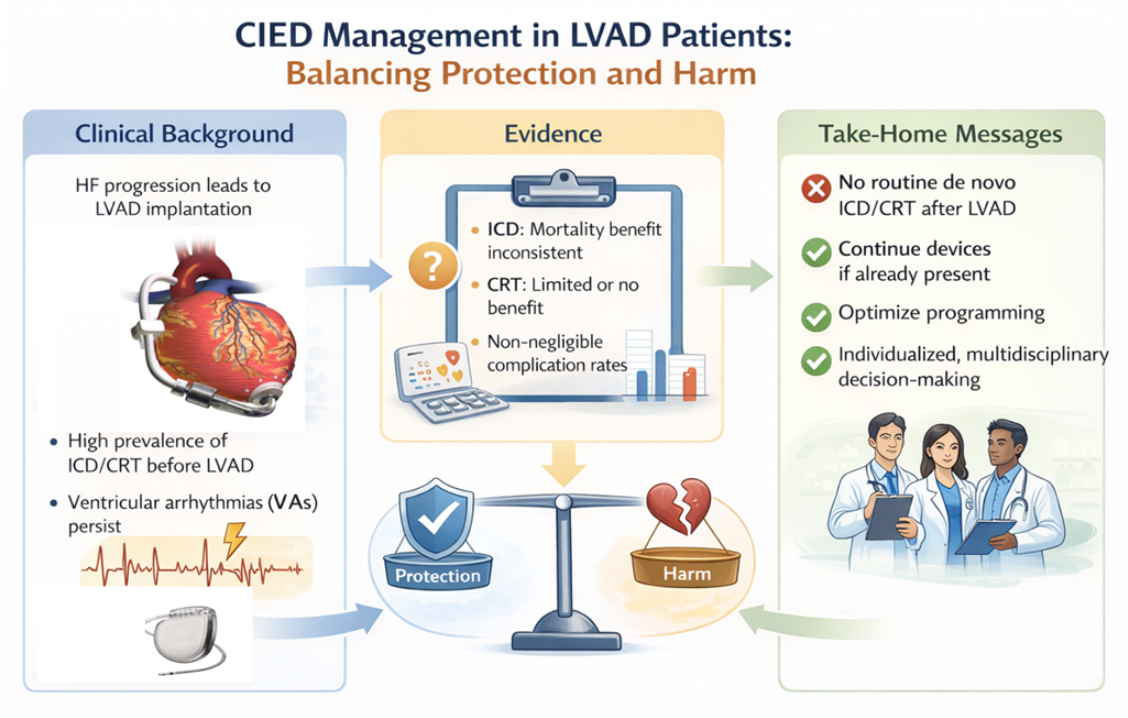
Managing CIEDs in patients supported by an LVAD requires a careful, individualized approach due to the complex relationship between mechanical support and electrical therapies. ICDs are important for terminating life-threatening VAs in LVAD patients, but their effect on overall survival in this population has not been definitively established. Many LVAD patients may not need an ICD shock even when experiencing VAs, as the LVAD can maintain cardiac output during these episodes. However, active ICD therapy carries an increased risk of developing complications, including infections, device malfunctions, and inappropriate shocks that can lead to significant morbidity. As a result, the current practice is to continue ICD therapy for those who already have it, given the potential life-saving benefits it may offer to certain individuals. Nevertheless, de novo implantation of ICDs in patients after receiving an LVAD is not routinely recommended unless there is a strong indication, such as sustained or recurrent/refractory VF.
For CRT, the general consensus is that it offers only modest benefits once an LVAD is in use. Continuous-flow LVADs provide a type of circulatory support that reduces the importance of synchronous biventricular contraction. In line with this, clinical studies have not shown that CRT improves survival or functional outcomes for patients with LVADs. While CRT may help decrease VAs in some cases and can be continued, particularly if the patient has previously responded to CRT, it is also acceptable to turn it off in non-dependent patients if it is deemed unnecessary. Consequently, guidelines do not provide recommendations for the continuation or discontinuation of CRT. Many Centers maintain CRT “on” by default, making appropriate adjustments, since the risk associated with doing so is low. However, they typically do not pursue new CRT implants if one was not already in place.
Current international guidelines consistently emphasize the importance of individualized, multidisciplinary care. In conclusion, decisions regarding the initiation, continuation, or discontinuation of ICD/CRT therapy for a patient with an LVAD should involve the heart failure cardiologist, electrophysiologist, cardiothoracic surgeon, and, importantly, the patient and their family. The discussion should address the unclear benefits and known risks linked to the therapy.
Author Contributions
Conceptualization, G.S., F.C. and S.C.; methodology, S.C., F.S. and D.R.; validation, L.P., D.G. and P.F.; investigation, G.M., D.R. and F.C.; data curation, L.P., D.R. and G.S.; writing—original draft preparation, G.S., F.C. and D.G.; writing—review and editing, S.C., L.P. and G.M.; supervision, P.F. and F.S.; Visualization, D.R. and F.C. All authors have read and agreed to the published version of the manuscript.
Funding
This research received no external funding.
Institutional Review Board Statement
Not applicable.
Informed Consent Statement
Not applicable.
Data Availability Statement
No new data were created or analyzed in this study.
Conflicts of Interest
The authors declare no conflicts of interest.
Abbreviations
The following abbreviations are used in this manuscript:
| ATP | Anti-Tachycardia Pacing |
| CIEDs | Cardiac Implantable Electronic Devices |
| CRT | Cardiac Resynchronization Therapy |
| EHRA | European Heart Rhythm Association |
| EMI | Electromagnetic Interference |
| HF | Heart Failure |
| HFA | Heart Failure Association |
| ICDs | Implantable Cardioverter-Defibrillators |
| ISHLT | International Society for Heart & Lung Transplantation |
| LVADs | Left Ventricular Assist Devices |
| MRI | Magnetic Resonance Imaging |
| S-ICDs | subcutaneous ICDs |
| SCD | Sudden Cardiac Death |
| VAs | Ventricular Arrhythmias |
| VF | Ventricular Fibrillation |
| VT | Ventricular Tachycardia |
References
- McDonagh, T.A.; Metra, M.; Adamo, M.; Gardner, R.S.; Baumbach, A.; Böhm, M.; Burri, H.; Butler, J.; Čelutkienė, J.; Chioncel, O.; et al. 2021 ESC Guidelines for the diagnosis and treatment of acute and chronic heart failure. Eur. Heart J. 2021, 42, 3599–3726. [Google Scholar] [CrossRef] [PubMed]
- Gopinathannair, R.; Cornwell, W.K.; Dukes, J.W.; Ellis, C.R.; Hickey, K.T.; Joglar, J.A.; Pagani, F.D.; Roukoz, H.; Slaughter, M.S.; Patton, K.K.; et al. Device Therapy and Arrhythmia Management in Left Ventricular Assist Device Recipients: A Scientific Statement from the American Heart Association. Circulation 2019, 139, e967–e989. [Google Scholar] [CrossRef] [PubMed]
- Riaz, T.; Nienaber, J.J.C.; Baddour, L.M.; Walker, R.C.; Park, S.J.; Sohail, M.R. Cardiovascular Implantable Electronic Device Infections in Left Ventricular Assist Device Recipients. Pacing Clin. Electrophysiol. 2014, 37, 225–230. [Google Scholar] [CrossRef] [PubMed]
- Galand, V.; Flécher, E.; Auffret, V.; Boulé, S.; Vincentelli, A.; Dambrin, C.; Mondoly, P.; Sacher, F.; Nubret, K.; Kindo, M.; et al. Predictors and Clinical Impact of Late Ventricular Arrhythmias in Patients with Continuous-Flow Left Ventricular Assist Devices. JACC Clin. Electrophysiol. 2018, 4, 1166–1175. [Google Scholar] [CrossRef]
- Chen, C.; Du, J.; Wang, X.; Zou, L. Management of incessant ventricular arrhythmias in a patient with left ventricular assist device: A case report. J. Cardiothorac. Surg. 2024, 19, 167. [Google Scholar] [CrossRef]
- Moss, A.J.; Zareba, W.; Hall, W.J.; Klein, H.; Wilber, D.J.; Cannom, D.S.; Daubert, J.P.; Higgins, S.L.; Brown, M.W.; Andrews, M.L. Prophylactic Implantation of a Defibrillator in Patients with Myocardial Infarction and Reduced Ejection Fraction. N. Engl. J. Med. 2002, 346, 877–883. [Google Scholar] [CrossRef]
- Heidenreich, P.A.; Bozkurt, B.; Aguilar, D.; Allen, L.A.; Byun, J.J.; Colvin, M.M.; Deswal, A.; Drazner, M.H.; Dunlay, S.M.; Evers, L.R.; et al. 2022 AHA/ACC/HFSA Guideline for the Management of Heart Failure: A Report of the American College of Cardiology/American Heart Association Joint Committee on Clinical Practice Guidelines. Circulation 2022, 145, E895–E1032. [Google Scholar] [CrossRef]
- Al-Khatib, S.M.; Stevenson, W.G.; Ackerman, M.J.; Bryant, W.J.; Callans, D.J.; Curtis, A.B.; Deal, B.J.; Dickfeld, T.; Field, M.E.; Fonarow, G.C.; et al. 2017 AHA/ACC/HRS Guideline for Management of Patients with Ventricular Arrhythmias and the Prevention of Sudden Cardiac Death: Executive Summary. J. Am. Coll. Cardiol. 2017, 72, 1677–1749. [Google Scholar] [CrossRef]
- Refaat, M.M.; Tanaka, T.; Kormos, R.L.; Mcnamara, D.; Teuteberg, J.; Winowich, S.; London, B.; Simon, M.A. Survival Benefit of Implantable Cardioverter-Defibrillators in Left Ventricular Assist Device–Supported Heart Failure Patients. J. Card. Fail. 2011, 18, 140–145. [Google Scholar] [CrossRef]
- Cantillon, D.J.; Tarakji, K.G.; Kumbhani, D.J.; Smedira, N.G.; Starling, R.C.; Wilkoff, B.L. Improved survival among ventricular assist device recipients with a concomitant implantable cardioverter-defibrillator. Heart Rhythm 2009, 7, 466–471. [Google Scholar] [CrossRef]
- Cikes, M.; Jakus, N.; Claggett, B.; Brugts, J.J.; Timmermans, P.; Pouleur, A.; Rubis, P.; Van Craenenbroeck, E.M.; Gaizauskas, E.; Grundmann, S.; et al. Cardiac implantable electronic devices with a defibrillator component and all-cause mortality in left ventricular assist device carriers: Results from the PCHF-VAD registry. Eur. J. Heart Fail. 2019, 21, 1129–1141. [Google Scholar] [CrossRef]
- Clerkin, K.J.; Topkara, V.K.; Demmer, R.T.; Dizon, J.M.; Yuzefpolskaya, M.; Fried, J.A.; Mai, X.; Mancini, D.M.; Takeda, K.; Takayama, H.; et al. Implantable Cardioverter-Defibrillators in Patients with a Continuous-Flow Left Ventricular Assist Device. JACC Heart Fail. 2017, 5, 916–926. [Google Scholar] [CrossRef] [PubMed]
- Garan, A.R.; Yuzefpolskaya, M.; Colombo, P.C.; Morrow, J.P.; Te-Frey, R.; Dano, D.; Takayama, H.; Naka, Y.; Garan, H.; Jorde, U.P.; et al. Ventricular Arrhythmias and Implantable Cardioverter-Defibrillator Therapy in Patients with Continuous-Flow Left Ventricular Assist Devices. J. Am. Coll. Cardiol. 2013, 61, 2542–2550. [Google Scholar] [CrossRef] [PubMed]
- Andreae, A.; Black-Maier, E.; Arps, K.; Kobe, E.; Johnson, T.; Shrader, P.; Holmes, D.; Towery, E.; Sun, A.; Friedman, D.J.; et al. Appropriate and inappropriate ICD shocks in patients with LVADs: Prevalence, associated factors, and etiologies. Heart Rhythm 2024, 22, 394–402. [Google Scholar] [CrossRef] [PubMed]
- Załucka, L.; Świerżyńska, E.; Orczykowski, M.; Dutkowski, K.; Szymański, J.; Kuriata, J.; Dąbrowski, R.; Kołsut, P.; Szumowski, Ł.; Sterliński, M. Ventricular Arrhythmias in Left Ventricular Assist Device Patients—Current Diagnostic and Therapeutic Considerations. Sensors 2024, 24, 1124. [Google Scholar] [CrossRef]
- Ghezzi, E.S.; Sharman, R.L.S.; Selvanayagam, J.B.; Psaltis, P.J.; Sanders, P.; Astley, J.M.; Knayfati, S.; Batra, V.; Keage, H.A.D. Burden of mood symptoms and disorders in implantable cardioverter defibrillator patients: A systematic review and meta-analysis of 39 954 patients. Europace 2023, 25, euad130. [Google Scholar] [CrossRef]
- Richardson, T.D.; Hale, L.; Arteaga, C.; Xu, M.; Keebler, M.; Schlendorf, K.; Danter, M.; Shah, A.; Lindenfeld, J.; Ellis, C.R. Prospective Randomized Evaluation of Implantable Cardioverter-Defibrillator Programming in Patients with a Left Ventricular Assist Device. J. Am. Heart Assoc. 2018, 7, e007748. [Google Scholar] [CrossRef]
- Robinson, A.; Parikh, V.; Jazayeri, M.; Pierpoline, M.; Reddy, Y.M.; Emert, M.; Pimentel, R.; Dendi, R.; Berenbom, L.; Noheria, A.; et al. Impact of ultra-conservative ICD programming in patients with LVADs: Avoiding potentially unnecessary tachy-therapies. Pacing Clin. Electrophysiol. 2022, 45, 204–211. [Google Scholar] [CrossRef]
- Ruwald, A.-C.; Schuger, C.; Moss, A.J.; Kutyifa, V.; Olshansky, B.; Greenberg, H.; Cannom, D.S.; Estes, N.A.M.; Ruwald, M.H.; Huang, D.T.; et al. Mortality Reduction in Relation to Implantable Cardioverter Defibrillator Programming in the Multicenter Automatic Defibrillator Implantation Trial-Reduce Inappropriate Therapy (MADIT-RIT). Circ. Arrhythmia Electrophysiol. 2014, 7, 785–792. [Google Scholar] [CrossRef]
- Höijer, C.J.; Johnson, M.J. Deactivation of implantable defibrillators at the end of life—A register-based study of ICD-deactivation at home and the impact of palliative care. Int. J. Cardiol. 2023, 386, 91–94. [Google Scholar] [CrossRef]
- Kapur, S.; Tadros, T.M.; Maytin, M. Transvenous Lead Extraction in the Left Ventricular Assist Device Patient. Card. Electrophysiol. Clin. 2024, 16, 125–132. [Google Scholar] [CrossRef]
- Tang, A.S.L.; Wells, G.A.; Talajic, M.; Arnold, M.O.; Sheldon, R.; Connolly, S.; Hohnloser, S.H.; Nichol, G.; Birnie, D.H.; Sapp, J.L.; et al. Cardiac-Resynchronization Therapy for Mild-to-Moderate Heart Failure. N. Engl. J. Med. 2010, 363, 2385–2395. [Google Scholar] [CrossRef]
- Cleland, J.G.F.; Daubert, J.-C.; Erdmann, E.; Freemantle, N.; Gras, D.; Kappenberger, L.; Tavazzi, L. The Effect of Cardiac Resynchronization on Morbidity and Mortality in Heart Failure. N. Engl. J. Med. 2005, 352, 1539–1549. [Google Scholar] [CrossRef] [PubMed]
- Bristow, M.R.; Saxon, L.A.; Boehmer, J.; Krueger, S.; Kass, D.A.; De Marco, T.; Carson, P.; DiCarlo, L.; DeMets, D.; White, B.G.; et al. Cardiac-Resynchronization Therapy with or without an Implantable Defibrillator in Advanced Chronic Heart Failure. N. Engl. J. Med. 2004, 350, 2140–2150. [Google Scholar] [CrossRef] [PubMed]
- Sapp, J.L.; Sivakumaran, S.; Redpath, C.J.; Khan, H.; Parkash, R.; Exner, D.V.; Healey, J.S.; Thibault, B.; Sterns, L.D.; Lam, N.H.N.; et al. Long-Term Outcomes of Resynchronization–Defibrillation for Heart Failure. N. Engl. J. Med. 2024, 390, 212–220. [Google Scholar] [CrossRef] [PubMed]
- Tomashitis, B.; Baicu, C.F.; Butschek, R.A.; Jackson, G.R.; Winterfield, J.; Tedford, R.J.; Zile, M.R.; Gold, M.R.; Houston, B.A. Acute Hemodynamic Effects of Cardiac Resynchronization Therapy Versus Alternative Pacing Strategies in Patients with Left Ventricular Assist Devices. J. Am. Heart Assoc. 2021, 10, e018127. [Google Scholar] [CrossRef]
- Roukoz, H.; Bhan, A.; Ravichandran, A.; Ahmed, M.M.; Bhat, G.; Cowger, J.; Abdullah, M.; Dhawan, R.; Trivedi, J.R.; Slaughter, M.S.; et al. Continued versus Suspended Cardiac Resynchronization Therapy after Left Ventricular Assist Device Implantation. Sci. Rep. 2020, 10, 2573. [Google Scholar] [CrossRef]
- Chung, B.B.; Grinstein, J.S.; Imamura, T.; Kruse, E.; Nguyen, A.B.; Narang, N.; Holzhauser, L.H.; Burkhoff, D.; Lang, R.M.; Sayer, G.T.; et al. Biventricular Pacing Versus Right Ventricular Pacing in Patients Supported With LVAD. JACC Clin. Electrophysiol. 2021, 7, 1003–1009. [Google Scholar] [CrossRef]
- Sheldon, S.H.; Jazayeri, M.; Pierpoline, M.; Mohammed, M.; Parikh, V.; Robinson, A.; Noheria, A.; Haglund, N.; Sauer, A.J.; Reddy, Y.M. Electromagnetic interference from left ventricular assist devices detected in patients with implantable cardioverter-defibrillators. J. Cardiovasc. Electrophysiol. 2022, 33, 93–101. [Google Scholar] [CrossRef]
- Nusbickel, A.J.; Petty, S.A.; Ross, S.J.; Parker, A.; Vilaro, J.; Ahmed, M.M. Left ventricular assist device implantation outcomes in patients with subcutaneous implantable cardioverter-defibrillators: A case series. Am. Heart J. Plus Cardiol. Res. Pract. 2024, 45, 100426. [Google Scholar] [CrossRef]
- Khetarpal, B.K.; Javaid, A.; Lee, J.Z.; Kusumoto, F.; Mulpuru, S.K.; Sorajja, D.; Cha, Y.; Srivathsan, K. Subcutaneous implantable cardioverter-defibrillator noise following left ventricular assist device implantation. J. Arrhythmia 2023, 39, 198–206. [Google Scholar] [CrossRef] [PubMed]
- Castagna, F.; Stöhr, E.J.; Pinsino, A.; Cockcroft, J.R.; Willey, J.; Garan, A.R.; Topkara, V.K.; Colombo, P.C.; Yuzefpolskaya, M.; McDonnell, B.J. The Unique Blood Pressures and Pulsatility of LVAD Patients: Current Challenges and Future Opportunities. Curr. Hypertens. Rep. 2017, 19, 85. [Google Scholar] [CrossRef] [PubMed]
- Fresiello, L.; Jacobs, S.; Timmermans, P.; Buys, R.; Hornikx, M.; Goetschalckx, K.; Droogne, W.; Meyns, B. Limiting factors of peak and submaximal exercise capacity in LVAD patients. PLoS ONE 2020, 15, e0235684. [Google Scholar] [CrossRef] [PubMed]
- Misiri, J.; Kusumoto, F.; Goldschlager, N. Electromagnetic Interference and Implanted Cardiac Devices: The Medical Environment (Part II). Clin. Cardiol. 2012, 35, 321–328. [Google Scholar] [CrossRef]
- Tanawuttiwat, T.; Das, M.K.; Miller, J.M.; Guglin, M.E. Device–device interaction between cardiac implantable electronic devices and continuous-flow left ventricular assist devices. Heart Rhythm 2023, 20, 918–926. [Google Scholar] [CrossRef]
- Saeed, D.; Feldman, D.; Banayosy, A.E.; Birks, E.; Blume, E.; Cowger, J.; Hayward, C.; Jorde, U.; Kremer, J.; MacGowan, G.; et al. The 2023 International Society for Heart and Lung Transplantation Guidelines for Mechanical Circulatory Support: A 10- Year Update. J. Heart Lung Transplant. 2023, 42, e1–e222. [Google Scholar] [CrossRef]
- Soni, B.; Gopinathannair, R. Managing ventricular arrhythmias and implantable cardiac defibrillator shocks after left ventricular assist device implantation. J. Cardiovasc. Electrophysiol. 2024, 35, 592–600. [Google Scholar] [CrossRef]
- Tzeis, S.; Gerstenfeld, E.P.; Kalman, J.; Saad, E.B.; Shamloo, A.S.; Andrade, J.G.; Barbhaiya, C.R.; Baykaner, T.; Boveda, S.; Calkins, H.; et al. 2024 European Heart Rhythm Association/Heart Rhythm Society/Asia Pacific Heart Rhythm Society/Latin American Heart Rhythm Society expert consensus statement on catheter and surgical ablation of atrial fibrillation. Europace 2024, 26, euae043. [Google Scholar] [CrossRef]
- Kusumoto, F.M.; Schoenfeld, M.H.; Wilkoff, B.L.; Berul, C.I.; Birgersdotter-Green, U.M.; Carrillo, R.; Cha, Y.-M.; Clancy, J.; Deharo, J.-C.; Ellenbogen, K.A.; et al. 2017 HRS expert consensus statement on cardiovascular implantable electronic device lead management and extraction. Heart Rhythm 2017, 14, e503–e551. [Google Scholar] [CrossRef]
- Black-Maier, E.; Lewis, R.K.; Loungani, R.; Rehorn, M.; Friedman, D.J.; Bishawi, M.; Schroder, J.N.; Milano, C.A.; Katz, J.N.; Patel, C.B.; et al. Cardiovascular Implantable Electronic Device Surgery Following Left Ventricular Assist Device Implantation. JACC Clin. Electrophysiol. 2020, 6, 1131–1139. [Google Scholar] [CrossRef]
- Blomström-Lundqvist, C.; Traykov, V.; Erba, P.A.; Burri, H.; Nielsen, J.C.; Bongiorni, M.G.; Poole, J.; Boriani, G.; Costa, R.; Deharo, J.-C.; et al. European Heart Rhythm Association (EHRA) international consensus document on how to prevent, diagnose, and treat cardiac implantable electronic device infections—Endorsed by the Heart Rhythm Society (HRS), the Asia Pacific Heart Rhythm Society (APHRS), the Latin American Heart Rhythm Society (LAHRS), International Society for Cardiovascular Infectious Diseases (ISCVID) and the European Society of Clinical Microbiology and Infectious Diseases (ESCMID) in collaboration with the European Association for Cardio-Thoracic Surgery (EACTS). EP Europace 2020, 22, 515–549. [Google Scholar] [CrossRef]
- Krishnamoorthy, A.; Pokorney, S.D.; Lewis, R.K.; Daubert, J.P.; Greenfield, R.A.; Hegland, D.D.; Milano, C.A.; Rogers, J.G.; Schroder, J.N.; Patel, C.B.; et al. Cardiac Implantable Electronic Device Removal in Patients with Left Ventricular Assist Device Associated Infections. J. Cardiovasc. Electrophysiol. 2014, 25, 1199–1205. [Google Scholar] [CrossRef]
- Gilge, J.L.; Sbircea, N.; Tong, M.Z.; Bauza, K.; Cantillon, D.J.; Srivastava, A.; Khedraki, R.; Sheikh, F.H.; Ahmed, S.; Herr, J.; et al. Incidence of Cardiac Implantable Electronic Device Complications in Patients with Left Ventricular Assist Devices. JACC Clin. Electrophysiol. 2021, 7, 494–501. [Google Scholar] [CrossRef]
Table 1.
Practical ICD programming recommendations for LVAD recipients.
Table 1.
Practical ICD programming recommendations for LVAD recipients.
| Domain | Suggested Approach | Rationale/Notes |
|---|
| VT zones | Prefer a single high-rate VT zone (≥180–200 bpm); consider disabling lower-rate VT zones if well-tolerated | Reduces therapies for slower/self-limited VT |
| Detection | Prolonged detection (e.g., 5–10 s) and higher NID | Allows spontaneous termination; reduces inappropriate shocks |
| ATP | Enable burst/ramp ATP with multiple attempts before shock | Painless therapy; effective in scar-related VT |
| SVT discrimination | Aggressive discriminators in gray zones; concurrent AF management | AF with RVR is the leading cause of inappropriate shocks |
| Sensing | Reassess for T-wave/double counting; adjust sensitivity/vectors post-LVAD | Signal morphology shifts after unloading |
| Disclaimer/Publisher’s Note: The statements, opinions and data contained in all publications are solely those of the individual author(s) and contributor(s) and not of MDPI and/or the editor(s). MDPI and/or the editor(s) disclaim responsibility for any injury to people or property resulting from any ideas, methods, instructions or products referred to in the content. |




 ,
,