Case Report

Biventricular Takotsubo Cardiomyopathy Complicated with Cardiogenic Shock: A Postoperative Complication Following Non-Cardiac Surgery


University of Michigan Health-Sparrow Hospital, Michigan State University, Lansing, MI 48912, USA
*
Author to whom correspondence should be addressed.
Hearts 2026, 7(1), 5; https://doi.org/10.3390/hearts7010005 (registering DOI)
Submission received: 31 October 2025 / Revised: 20 December 2025 / Accepted: 8 January 2026 / Published: 11 January 2026

Abstract

Biventricular Takotsubo cardiomyopathy (TCM) is a rare variant characterized by involvement of both the left and right ventricles. This variant is associated with greater hemodynamic instability and longer hospital stays compared to the isolated left ventricular-only variant. We report the case of a 67-year-old female patient who underwent elective resection of a left adrenal adenoma. While her preoperative and intraoperative courses were uneventful, she developed cardiogenic shock postoperatively, necessitating prolonged intensive care unit (ICU) management and vasopressor support. Further evaluation revealed elevated high-sensitivity troponin levels and reduced ejection fraction on echocardiography (30–35%). Hypokinesis was noted in the apical and mid-ventricular segments of both ventricles. A coronary angiogram performed two months prior to admission showed no significant coronary artery disease. Based on these findings, a diagnosis of biventricular TCM was established. The patient was managed supportively and discharged in stable condition with ongoing therapy, including beta-blockers, renin–angiotensin–aldosterone system inhibitors (RAASis), and statins. Follow-up echocardiography showed resolution of regional wall motion abnormalities. Although rare, biventricular TCM is associated with increased severity and a higher risk of complications. Early recognition and timely management are essential to improve outcomes in affected patients.

1. Introduction

Takotsubo cardiomyopathy (TCM), also known as stress-induced cardiomyopathy or broken heart syndrome, is characterized by transient and reversible regional systolic dysfunction of the left ventricle, mimicking an acute coronary event despite the absence of obstructive coronary artery disease (CAD) [1]. TCM is believed to result from a surge of catecholamines, which causes myocardial damage following acute physical or emotional stress [2]. While the typical presentation involves apical involvement, atypical variants, including biventricular TCM, have been reported. Biventricular TCM is a rare subtype, and evidence on its presentation as a perioperative complication remains limited. Complications associated with TCM, such as cardiogenic shock, left ventricular outflow tract (LVOT) obstruction, and arrhythmias, are well-documented; however, no specific treatment guidelines currently exist, and management remains primarily supportive.
We present a case of biventricular TCM, complicated by cardiogenic shock, occurring as a postoperative complication following elective resection of an adrenal adenoma.

2. Clinical Presentation

2.1. Case History and Examination/Investigations

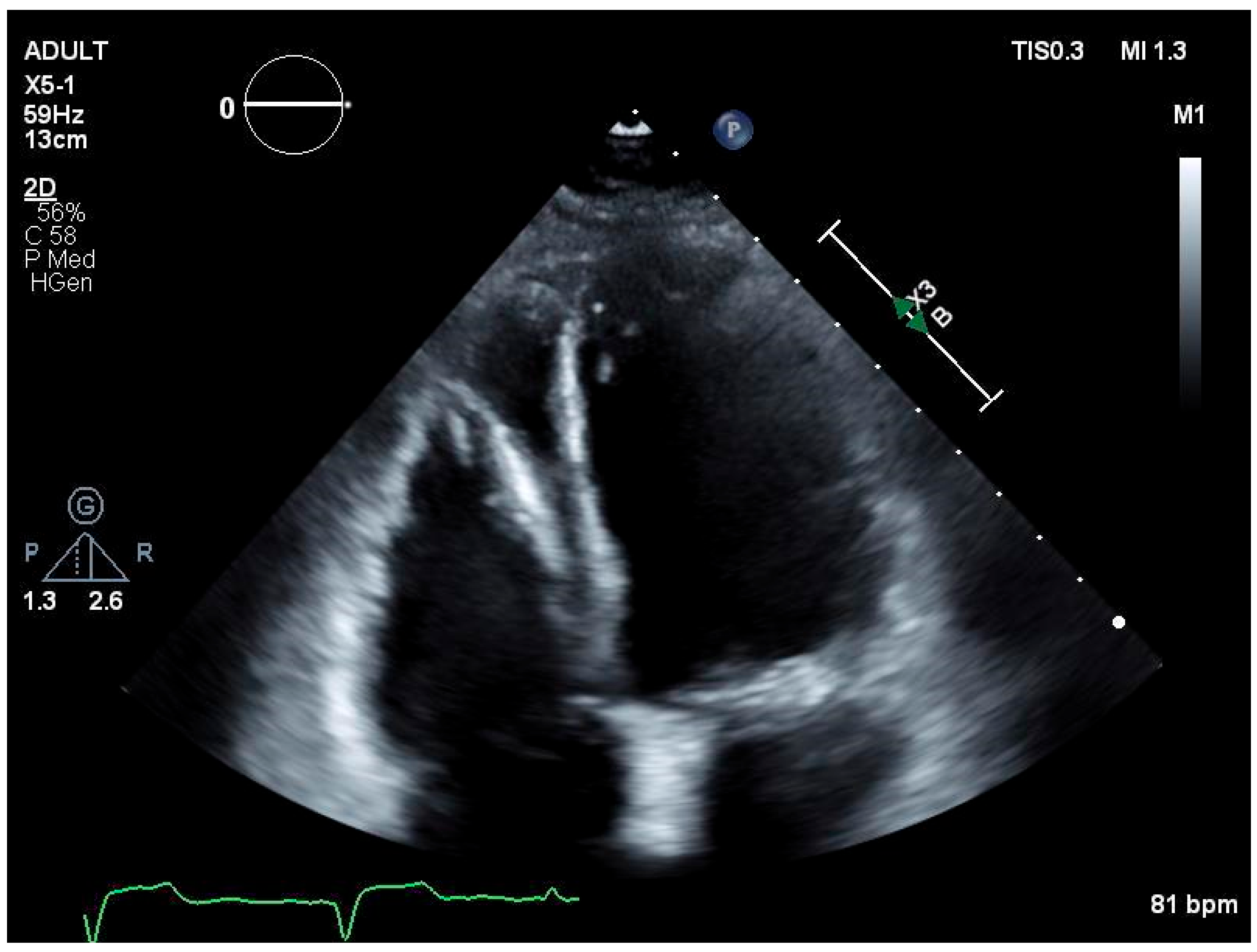
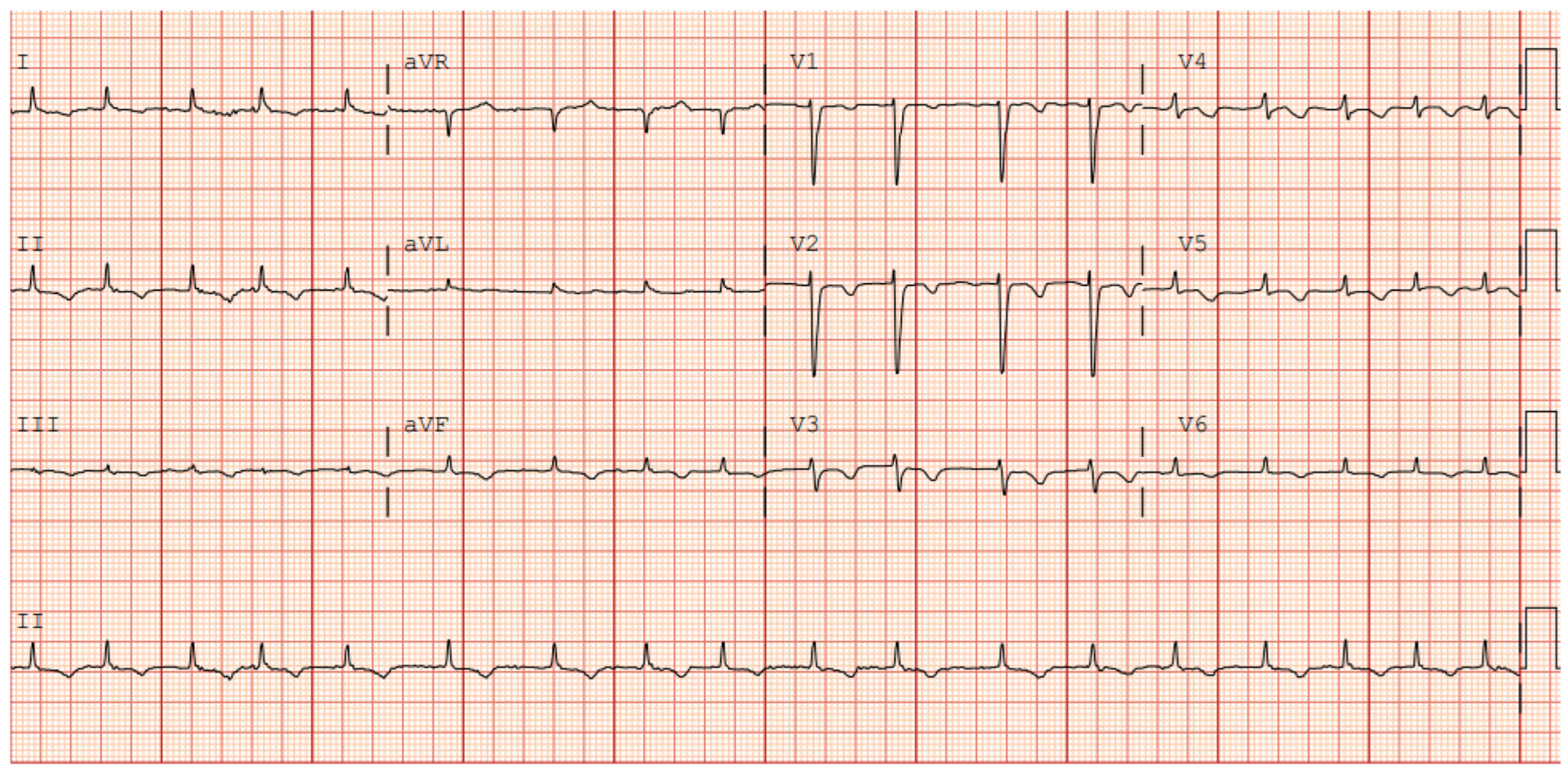
A 67-year-old female with a complex cardiac history, including permanent atrial fibrillation, non-ischemic cardiomyopathy (EF: 45–50%), and polymorphic ventricular tachycardia (status post-dual-chamber ICD placement), presented for elective adrenal gland surgery to resect an adenoma. She had a successful resection without preoperative or intraoperative complications. In the postoperative period, she required ICU care due to increasing vasopressor requirements despite adequate intravenous fluid resuscitation. Electrocardiography showed T-wave inversions in multiple leads (Figure 1), and laboratory studies indicated elevated high-sensitivity troponin (778 ng/L) and BNP (700 pg/L). A transthoracic echocardiogram (TTE) revealed a decreased EF of 30–35%, with regional wall motion abnormalities (RWMAs), relative preservation of basal function versus mid-apical hypokinesis of both the ventricles, basal septal prominence with a comparatively thinner mid-wall, and a relatively attenuated apical myocardium (Figure 2, Video S1). Urgent right heart catheterization demonstrated elevated pulmonary capillary wedge pressure (26 mmHg). Notably, coronary angiography performed two months prior showed no significant obstructive coronary artery disease. Histopathology of the adrenal adenoma confirmed a benign cortical adenoma. Adrenal insufficiency was ruled out with a negative cosyntropin test.

2.2. Treatment

The patient was diagnosed with biventricular Takotsubo cardiomyopathy (TCM) complicated by cardiogenic shock based on RWMAs, reduced EF, acute physical stress (surgery), ECG changes, and elevated troponin levels. She was managed with inotropic/vasopressor support, including milrinone and norepinephrine, and diuresis. A Swan-Ganz catheter was placed for hemodynamic monitoring.

2.3. Outcomes and Follow-Up

By day seven, the patient was weaned off vasopressors. Repeat echocardiography showed improved EF, returning to her baseline of 45–50%. She was discharged in stable condition on diuretics, digoxin, and metoprolol. Guideline-directed medical therapy (GDMT) was optimized during follow-up, and the patient continued to do well.

3. Discussion

TCM, also known as stress-induced cardiomyopathy, accounts for 1–3% of patients presenting with acute coronary syndrome (ACS). It is characterized by transient, reversible regional wall motion abnormalities that mimic an acute coronary event, despite the absence of obstructive coronary artery disease [1]. While apical ballooning is the classic presentation, atypical variants such as mid-ventricular, basal, biventricular, and right-ventricular forms have also been documented. Perioperative TCM (pTCM) has been reported as a complication, though data on the biventricular variant in the context of non-cardiac surgery remains limited.
The pathogenesis of TCM is not fully understood, but the adrenergic hypothesis is widely accepted as the primary explanation. According to this theory, acute physical or emotional stress triggers a surge in catecholamine release, leading to microvascular dysfunction and intracellular calcium overload, which ultimately causes myocardial damage [2]. In the perioperative setting, various factors can contribute to catecholamine-related injury, including inadequate anesthesia, tracheal manipulation during intubation, catecholamine administration, and the physiological stress of surgery [3]. A study by El-Battrawy et al. previously showed that biventricular TCM is more strongly associated with physical stressors than emotional ones and is linked to higher rates of complications, such as cardiogenic shock [4]. The case became more of a diagnostic challenge, especially for patients with the existing heart failure with EF of 45–50%, this can obscure the diagnosis of TCM, as clinicians may focus on managing acute decompensation rather than recognizing the underlying syndrome. Consequently, the biventricular variant is often associated with prolonged hospital stays and hemodynamic instability often requiring aggressive treatment measures in comparison to typical TCM.
TCM diagnosis is based on the revised Mayo Clinic diagnostic criteria, which include: (a) transient dyskinesis of the left ventricular (LV) mid-segments; (b) regional wall motion abnormalities extending beyond a single epicardial vascular distribution; (c) absence of obstructive coronary artery disease or acute plaque rupture; and (d) new electrocardiographic changes or modest troponin elevation, along with the exclusion of pheochromocytoma and myocarditis [5]. Imaging plays a key role in evaluating TCM. Echocardiography is particularly useful for assessing the location, severity, and extent of wall motion abnormalities, as well as for identifying complications such as LV outflow tract obstruction (LVOTO). Notably, approximately 15% of TCM patients may have concurrent coronary artery disease (CAD) [6,7]. In such cases, careful correlation of regional wall motion abnormalities with the vascular territories involved can guide the diagnosis. When diagnostic uncertainty persists, cardiac MRI can be valuable for differentiating TCM by identifying areas of fibrosis, which are typically absent in this condition [8]. Optical coherence tomography (OCT) or intravascular ultrasound may also be used to assess for plaque rupture, another feature not associated with TCM [9].
Emerging evidence indicates that Takotsubo cardiomyopathy involves not only transient functional impairment but also pre-existing regional differences in myocardial thickness, with basal septal prominence and relative thinning of the mid-apical myocardium, supporting the distribution of wall motion abnormalities seen in our case [10].
Management of TCM primarily involves supportive care to address complications and prevent recurrence, while monitoring for the development of comorbidities and CAD risk factors. For patients with cardiogenic shock, the use of inotropes depends on the presence of LVOTO. In cases of LVOTO, inotropes are generally avoided, with management focusing on beta blockers, intravenous fluids and vasopressors, and extracorporeal membrane oxygenation (ECMO) in severe cases. Conversely, in patients without LVOTO, inotropes, vasopressors, and left ventricular assist devices may be employed [11]. The use of Levosimendan, a non-catecholaminergic inotrope, over catecholamines has also been favored in previously reported literature; however, there are no current guidelines regarding the same. Among catecholamines, the use of norepinephrine can be preferred over epinephrine and dobutamine given its stimulant effect on both alpha and beta-adrenergic receptors leading to a concurrent increase in both preload and afterload. Over the years, evidence supporting the safety and efficacy of mechanical support devices, including ECMO, intra-aortic balloon pumps (IABPs), and Impella, has grown, though further studies are needed to refine their indications and use [12].
Follow-up care includes monitoring for the resolution of regional wall motion abnormalities through repeat echocardiography or cardiac MRI when indicated, as well as mitigating the risk of thromboembolic events, which occurs in approximately 7.1% of patients within 30 days of hospitalization [5]. Anticoagulation should be considered for patients with extensive regional wall motion abnormalities [11]. Additionally β-blockers are commonly used due to their ability to blunt catecholamine-mediated myocardial injury and have been associated with reduced long-term mortality, particularly in patients with physical stress triggers or cardiogenic shock; however, they have not consistently reduced recurrence rates. Renin–angiotensin–aldosterone system inhibitors (RAASis), including ACE inhibitors and ARBs, have shown a more consistent association with improved survival and favorable ventricular remodeling, and may offer additional benefit during myocardial recovery.
Given the rising incidence of TCM, its potential for reversibility, and the risks of complications such as LVOTO and cardiogenic shock, early recognition and timely intervention are crucial. Recognizing TCM as a perioperative complication allows surgeons to make informed decisions about proceeding with surgery or adjusting anesthesia as indicated in cases where TCM is diagnosed preoperatively and to implement aggressive management strategies when TCM arises postoperatively.

4. Conclusions

We present a case of biventricular Takotsubo cardiomyopathy (TCM) as a postoperative complication following non-cardiac surgery. Biventricular involvement in TCM significantly impacts hemodynamics, influencing the patient’s prognosis, morbidity, and overall outcomes. Early recognition of this complication is essential, as it enables physicians to implement timely and targeted treatment strategies, which are crucial for achieving favorable outcomes in these patients.

Supplementary Materials

The following supporting information can be downloaded at: https://www.mdpi.com/article/10.3390/hearts7010005/s1, Video S1: Transthoracic echocardiography—contrast-enhanced view showing hypokinesis of apical and middle biventricular segments with hyperkinetic basal segments consistent with a biventricular variant of takotsubo cardiomyopathy.

Author Contributions

Conceptualization, K.R. and F.P.; methodology, K.R.; software, F.P.; validation, K.R. and M.K.; formal analysis, K.R. and F.P.; investigation, A.B.; resources, S.R.; data curation, K.R.; writing—original draft preparation K.R.; writing—review and editing, K.R.; visualization, M.K.; supervision, A.B.; project administration, S.R.; funding acquisition, S.R. All authors have read and agreed to the published version of the manuscript.

Funding

This research received no external funding.

Institutional Review Board Statement

Ethics Committee/Institutional Review Board approval was not required for this study, as it represents a single-patient case report and does not constitute human subjects research. In accordance with U.S. federal regulations (45 CFR 46), case reports describing individual patients are exempt from IRB review https://www.hhs.gov/ohrp/regulations-and-policy/requests-for-comments/draft-guidance-scholarly-and-journalistic-activities-deemed-not-to-be-research/index.html (accessed on 23 December 2025).

Informed Consent Statement

Written informed consent form for participation was distributed to all participants and signed.

Data Availability Statement

The original contributions presented in this study are included in the article/Supplementary Material. Further inquiries can be directed to the corresponding author.

Conflicts of Interest

The authors declare no conflicts of interest.

References

  1. Lyon, A.R.; Bossone, E.; Schneider, B.; Sechtem, U.; Citro, R.; Underwood, S.R.; Sheppard, M.N.; Figtree, G.A.; Parodi, G.; Akashi, Y.J.; et al. Current state of knowledge on Takotsubo syndrome: A Position Statement from the Taskforce on Takotsubo Syndrome of the Heart Failure Association of the European Society of Cardiology. Eur. J. Heart Fail. 2016, 18, 8–27. [Google Scholar] [CrossRef] [PubMed]
  2. Amin, H.Z.; Amin, L.Z.; Pradipta, A. Takotsubo Cardiomyopathy: A Brief Review. J. Med. Life 2020, 13, 3–7. [Google Scholar] [CrossRef] [PubMed]
  3. Padoan, L.; Sforna, S.; Parise, A.; Barengo, A.; Torlone, F.; Coiro, S.; Riccini, C.; Del Pinto, M.; Cavallini, C. 558 biventricular perioperative takotsubo cardiomiopathy. Eur. Heart J. Suppl. 2022, 24, suac121.568. [Google Scholar] [CrossRef]
  4. El-Battrawy, I.; Santoro, F.; Stiermaier, T.; Möller, C.; Guastafierro, F.; Novo, G.; Novo, S.; Mariano, E.; Romeo, F.; Romeo, F.; et al. Incidence and Clinical Impact of Right Ventricular Involvement (Biventricular Ballooning) in Takotsubo Syndrome. Chest 2021, 160, 1433–1441. [Google Scholar] [CrossRef] [PubMed]
  5. de Chazal, H.M.; Del Buono, M.G.; Keyser-Marcus, L.; Ma, L.; Moeller, F.G.; Berrocal, D.; Abbate, A. Stress Cardiomyopathy Diagnosis and Treatment. JACC 2018, 72, 1955–1971. [Google Scholar] [CrossRef] [PubMed]
  6. Uribarri, A.; Núñez-Gil, I.J.; Conty, D.A.; Vedia, O.; Almendro-Delia, M.; Cambra, A.D.; Martin-Garcia, A.C.; Barrionuevo-Sánchez, M.; Martínez-Sellés, M.; Raposeiras-Roubín, S.; et al. Short- and Long-Term Prognosis of Patients With Takotsubo Syndrome Based on Different Triggers: Importance of the Physical Nature. J. Am. Heart Assoc. 2019, 8, e013701. [Google Scholar] [CrossRef] [PubMed]
  7. Redfors, B.; Jha, S.; Thorleifsson, S.; Jernberg, T.; Angerås, O.; Frobert, O.; Petursson, P.; Tornvall, P.; Sarno, G.; Ekenbäck, C.; et al. Short- and Long-Term Clinical Outcomes for Patients With Takotsubo Syndrome and Patients With Myocardial Infarction: A Report From the Swedish Coronary Angiography and Angioplasty Registry. J. Am. Heart Assoc. 2021, 10, e017290. [Google Scholar] [CrossRef] [PubMed]
  8. Agewall, S.; Beltrame, J.F.; Reynolds, H.R.; Niessner, A.; Rosano, G.; Caforio, A.L.P.; De Caterina, R.; Zimarino, M.; Roffi, M.; Kjeldsen, K.; et al. ESC working group position paper on myocardial infarction with non-obstructive coronary arteries. Eur. Heart J. 2016, 38, ehw149–153. [Google Scholar] [CrossRef] [PubMed]
  9. Gerbaud, E.; Arabucki, F.; Nivet, H.; Barbey, C.; Cetran, L.; Chassaing, S.; Seguy, B.; Lesimple, A.; Cochet, H.; Montaudon, M.; et al. OCT and CMR for the Diagnosis of Patients Presenting With MINOCA and Suspected Epicardial Causes. JACC: Cardiovasc. Imaging 2020, 13, 2619–2631. [Google Scholar] [CrossRef] [PubMed]
  10. Yalçin, F.; Cagatay, B.; Abraham, M.R.; Garcia, M.J. Stress Septal Sign (Triple S) Preexists in Hypertensive Hearts and Clarifies Critical Diagnostic Strategies. J. Clin. Med. 2025, 14, 6143. [Google Scholar] [CrossRef] [PubMed]
  11. Boyd, B.M.; Solh, T.M. Takotsubo cardiomyopathy. J. Am. Acad. Physician Assist. 2020, 33, 24–29. [Google Scholar] [CrossRef] [PubMed]
  12. Pillitteri, M.; Brogi, E.; Piagnani, C.; Bozzetti, G.; Forfori, F. Perioperative management of Takotsubo cardiomyopathy: An overview. J. Anesth. Analg. Crit. Care 2024, 4, 1–15. [Google Scholar] [CrossRef] [PubMed]
Figure 1. Electrocardiogram showing Diffuse T-wave changes representing ischemia.
Hearts 07 00005 g001
Figure 2. Transthoracic echocardiography—four-chamber view showing hypokinesis of apical and middle biventricular segments with hyperkinetic basal segments consistent with a biventricular variant of takotsubo cardiomyopathy.
Hearts 07 00005 g002
Disclaimer/Publisher’s Note: The statements, opinions and data contained in all publications are solely those of the individual author(s) and contributor(s) and not of MDPI and/or the editor(s). MDPI and/or the editor(s) disclaim responsibility for any injury to people or property resulting from any ideas, methods, instructions or products referred to in the content.