
TiO2-Doped Hydrochar Derived from Phoenix dactylifera: Synthesis and Electrocatalytic Performance for Alkaline Hydrogen Production
 , , and
Abstract
1. Introduction
2. Materials and Methods
2.1. Chemicals and Reagents
2.2. Preparation and Doping of Hydrochar
2.3. Electrode Preparation
2.4. Electrochemical Characterization
3. Results and Discussion
3.1. Structural and Chemical Characterization
3.2. Electrochemical Analysis
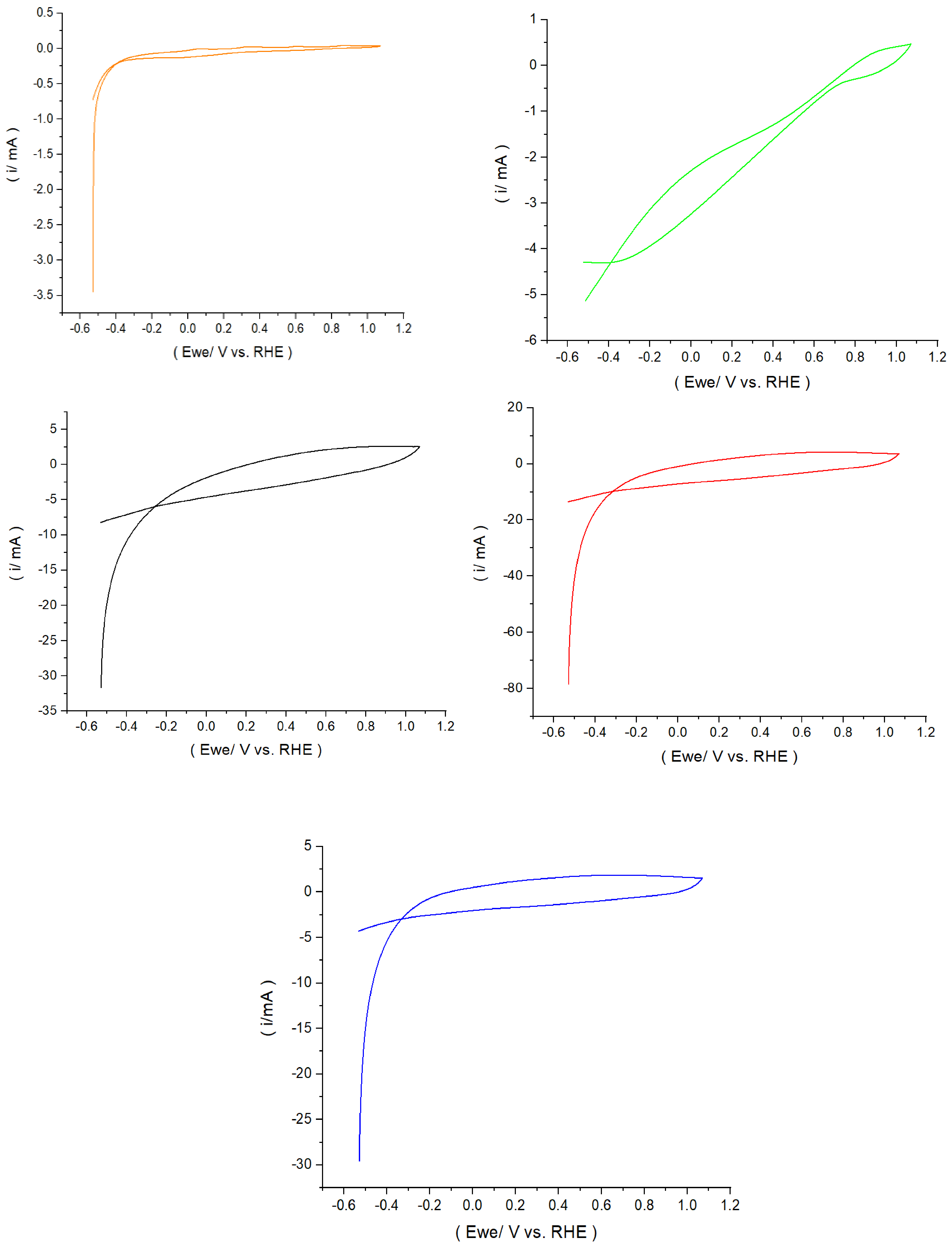
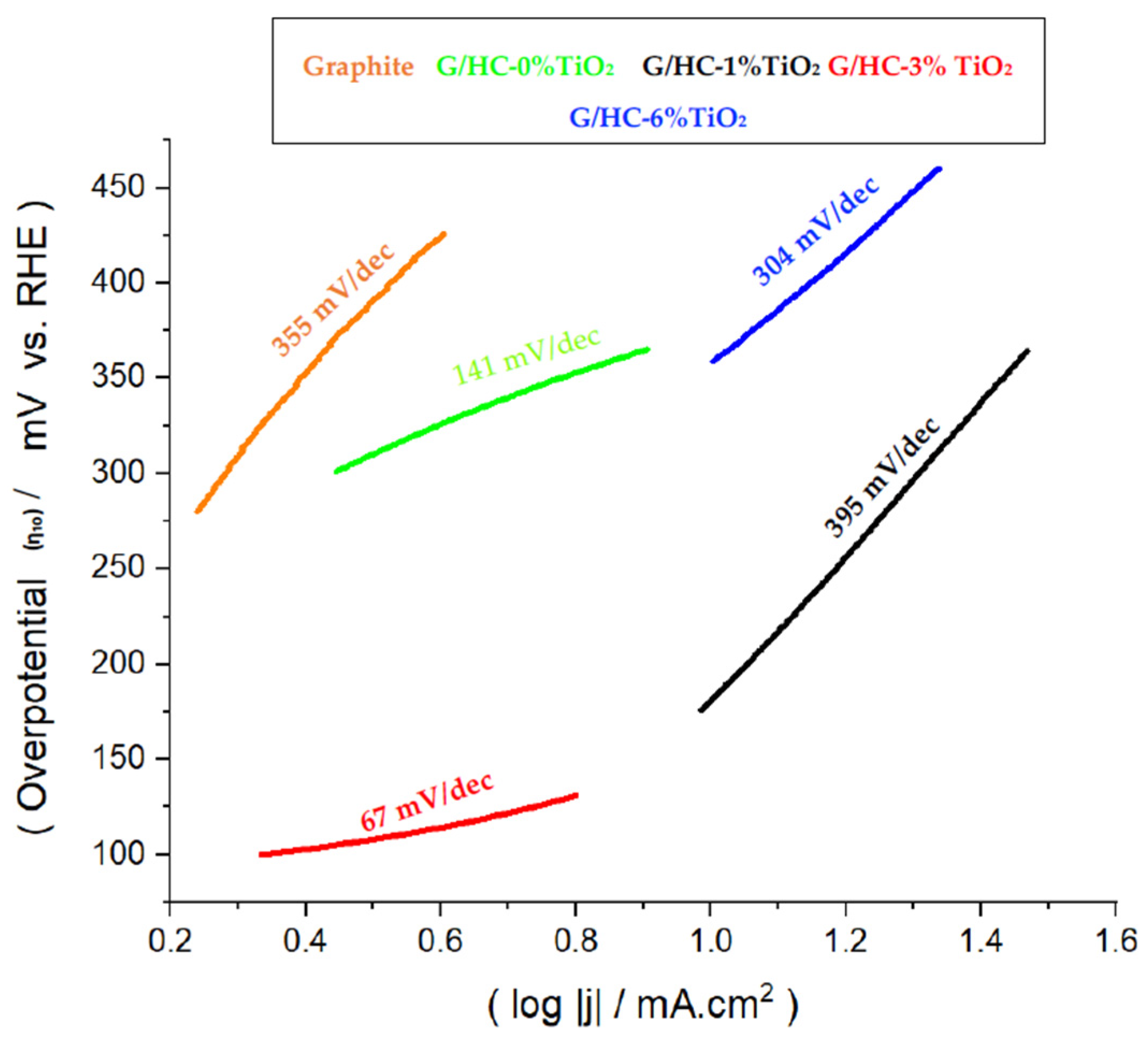
- b ≃ 120 mV·dec−1 indicates Volmer-limited kinetics.
- b ≃ 40 mV·dec−1 reflects Tafel recombination control.
- Intermediate values near 40–120 mV·dec−1 are consistent with the Heyrovsky limitation.
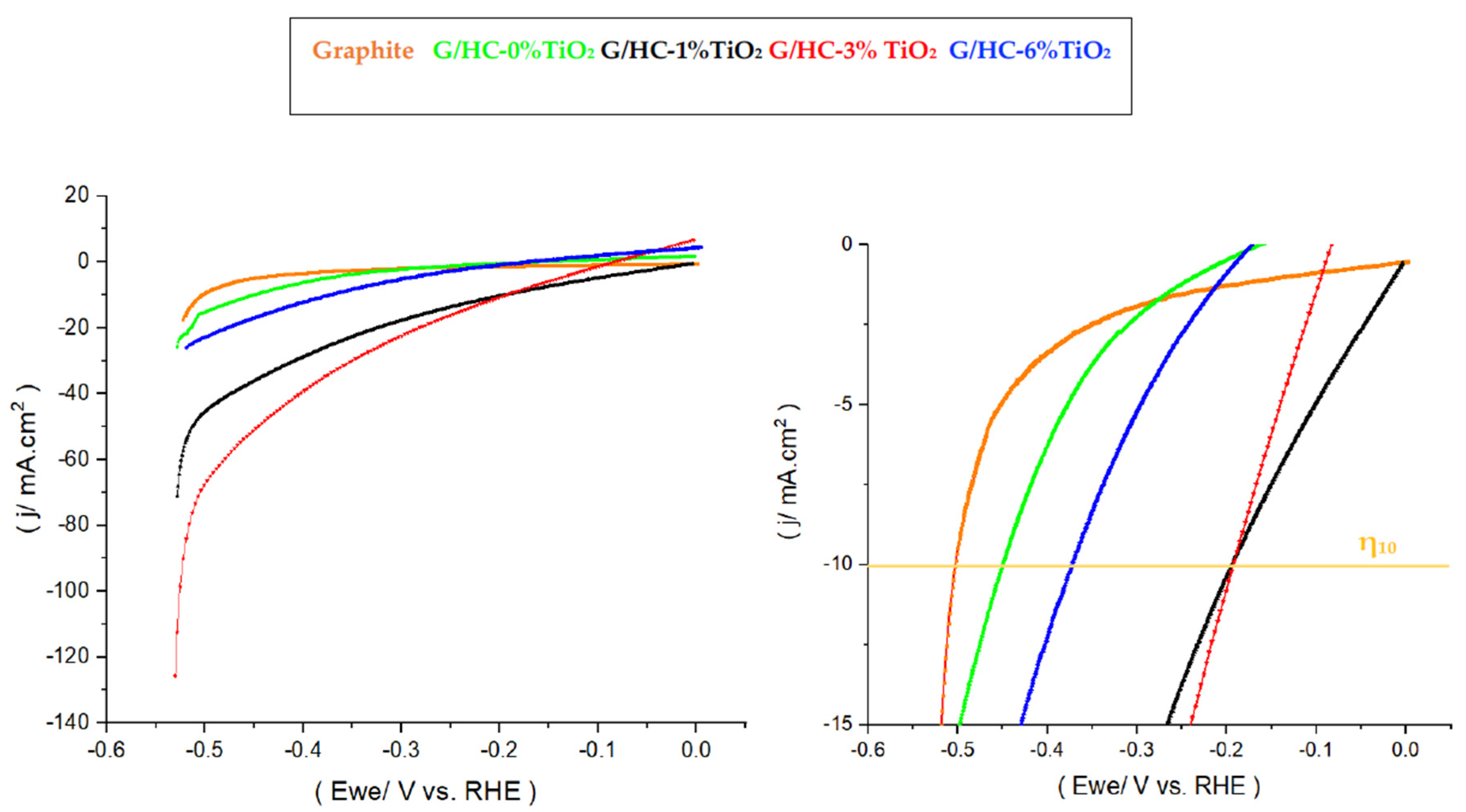
- As a catalytic site, it lowers the energy required to break the O–H bond.
- As a surface modifier, its hydrophilic character improves electrode wetting and the local concentration of OH−, maximizing interfacial chemistry and facilitating gas bubble removal.
4. Conclusions
Author Contributions
Funding
Data Availability Statement
Conflicts of Interest
References
- Weidner, T.; Tulus, V.; Guillén-Gosálbez, G. Environmental sustainability assessment of large-scale hydrogen production using prospective life cycle analysis. Int. J. Hydrogen Energy 2023, 48, 8310–8327. [Google Scholar] [CrossRef]
- Hammi, Z.; Labjar, N.; Dalimi, M.; El Hamdouni, Y.; Lotfi, E.M.; El Hajjaji, S. Green hydrogen: A holistic review covering life cycle assessment, environmental impacts, and color analysis. Int. J. Hydrogen Energy 2024, 80, 1030–1045. [Google Scholar] [CrossRef]
- Dash, S.; Singh, A.; Jose, S.; Wilson, V.H.; Surapraraju, S.K.; Natarajan, S.K. International Journal of Hydrogen Energy Advances in green hydrogen production through alkaline water electrolysis: A comprehensive review. Int. J. Hydrogen Energy 2024, 83, 614–629. [Google Scholar] [CrossRef]
- Cho, H.H.; Strezov, V.; Evans, T.J. A review on global warming potential, challenges and opportunities of renewable hydrogen production technologies. Sustain. Mater. Technol. 2023, 35, e00567. [Google Scholar] [CrossRef]
- Singh, V.; Aishwarya, V.M.; Sriprasath, V.J.; Pranavi, M.; Rao, N.K.; Singh, T. Green hydrogen value chain challenges and global readiness for a sustainable energy future. iScience 2025, 28, 112900. [Google Scholar] [CrossRef] [PubMed]
- Jamesha, M.I.; Hua, D.; Wangb, J.; Naza, F.; Fenga, J.; Yua, L.; Caib, Z.; Colmenaresc, J.C.; Leed, D.J.; Chue, P.K.; et al. Recent advances in noble metal-free electrocatalysts to achieve efficient alkaline water splitting. J. Mater. Chem. A 2024, 12, 11771–11820. [Google Scholar] [CrossRef]
- Wang, S.; Lu, A.; Zhong, C.J. Hydrogen production from water electrolysis: Role of catalysts. Nano Converg. 2021, 8, 4. [Google Scholar] [CrossRef]
- Alamiery, A. Advancements in materials for hydrogen production: A review of cutting-edge technologies. ChemPhysMater 2024, 3, 64–73. [Google Scholar] [CrossRef]
- Li, S.; Kang, Q.; Baeyens, J.; Zhang, H.L.; Deng, Y.M. Hydrogen Production: State of Technology. IOP Conf. Ser. Earth Environ. Sci. 2020, 544, 012011. [Google Scholar] [CrossRef]
- Ahmed, K.; Hameed, S.; Patchigolla, K.; Dawood, N.; Ghouri, Z.K. Carbon-based electrocatalysts for hydrogen evolution reaction. Energy Convers. Manag. X 2025, 26, 100892. [Google Scholar] [CrossRef]
- Lu, J.; Yin, S.; Shen, P.K. Carbon-Encapsulated Electrocatalysts for the Hydrogen Evolution Reaction. Electrochem. Energy Rev. 2019, 2, 105–127. [Google Scholar] [CrossRef]
- Haq, I.U.; Qaisar, K.; Nawaz, A.; Akram, F.; Mukhtar, H.; Zohu, X.; Xu, Y.; Mumtaz, M.W.; Rashid, U.; Ghani, W.A.W.A.K.; et al. Advances in valorization of lignocellulosic biomass towards energy generation. Catalysts 2021, 11, 309. [Google Scholar] [CrossRef]
- Velvizhi, G.; Goswami, C.; Shetti, N.P.; Ahmad, E.; Kishore Pant, K.; Aminabhavi, T.M. Valorisation of lignocellulosic biomass to value-added products: Paving the pathway towards low-carbon footprint. Fuel 2022, 313, 122678. [Google Scholar] [CrossRef]
- Roy, S.; Dikshit, P.K.; Sherpa, K.C.; Singh, A.; Jacob, S.; Chandra Rajak, R. Recent nanobiotechnological advancements in lignocellulosic biomass valorization: A review. J. Environ. Manag. 2021, 297, 113422. [Google Scholar] [CrossRef]
- Yu, H.; Wu, L.; Ni, B.; Chen, T. Research Progress on Porous Carbon-Based Non-Precious Metal Electrocatalysts. Materials 2023, 16, 3283. [Google Scholar] [CrossRef]
- Tan, Z.H.; Kong, X.Y.; Ng, B.J.; Sen Soo, H.; Mohamed, A.R.; Chai, S.P. Recent Advances in Defect-Engineered Transition Metal Dichalcogenides for Enhanced Electrocatalytic Hydrogen Evolution: Perfecting Imperfections. ACS Omega 2023, 8, 1851–1863. [Google Scholar] [CrossRef]
- Jawhari, A.H.; Hasan, N. Nanocomposite Electrocatalysts for Hydrogen Evolution Reactions (HERs) for Sustainable and Efficient Hydrogen Energy—Future Prospects. Materials 2023, 16, 3760. [Google Scholar] [CrossRef]
- Zhai, Q.; Huang, H.; Lawson, T.; Xia, Z.; Giusto, P.; Antonietti, M.; Jaroniec, M.; Chhowalla, M.; Baek, J.B.; Liu, Y.; et al. Recent Advances on Carbon-Based Metal-Free Electrocatalysts for Energy and Chemical Conversions. Adv. Mater. 2024, 36, e2405664. [Google Scholar] [CrossRef] [PubMed]
- Samanta, S.; Pradhan, A. Metal-free carbon-based porous materials, promising electrocatalysts for hydrogen fuel production. Chem. Commun. 2025, 61, 8108–8119. [Google Scholar] [CrossRef]
- Wang, C.; Tian, W.; Kang, S.; Zhong, B.; Qin, C.; Wang, H. Hydrothermal Preparation of TiO2/Graphite Nanosheets Composites and Its Effect on Electrothermal Behavior. Coatings 2023, 13, 226. [Google Scholar] [CrossRef]
- Zhai, Q.; Huang, H.; Lawson, T.; Xia, Z.; Giusto, P.; Antonietti, M.; Jaroniec, M.; Chhowalla, M.; Baek, J.B.; Liu, Y.; et al. Recent advances in Biomass-Derived hydrochar for photocatalytic and electrocatalytic applications. Chem. Eng. Sci. 2025, 309, 121435. [Google Scholar] [CrossRef]
- Onwubiko, V.; Matsushita, Y.; Elshehy, E.A.; El-Khouly, M.E. Facile synthesis of TiO2-carbon composite doped nitrogen for efficient photodegradation of noxious methylene blue dye. RSC Adv. 2024, 14, 34298–34310. [Google Scholar] [CrossRef] [PubMed]
- Bendany, M.; Brahim, K.A.B.; Hamdouni, Y.E.; Oumoussa, H.; Hammi, Z.; Gadda, N.; Labjar, N.; Dahrouch, A.; Hajjaji, S.E. Phoenix Dactylifera Hydrochar as a Green Modification Material Based on Glassy Carbon Electrodes for the Detection of Methylene Blue. J. Turk. Chem. Soc. Sect. A Chem. 2024, 11, 1397–1406. [Google Scholar] [CrossRef]
- Abbi, K.; Hermouche, L.; Hamdouni, Y.E.; Rahmani, M.; Benhsina, E.; Labjar, N.; Skalli, A.; Mahi, M.E.; Lotfi, E.M.; Dalimi, M.; et al. A novel carbon paste electrode modified with Argan oil cake waste/zinc oxide nanoparticles composite for methylene blue detection. Int. J. Environ. Anal. Chem. 2022, 104, 1291–1306. [Google Scholar] [CrossRef]
- Dolle, C.; Neha, N.; Coutanceau, C.; Dolle, C.; Neha, N.; Coutanceau, C. Electrochemical hydrogen production from biomass. Curr. Opin. Electrochem. 2022, 31, 100841. Available online: https://cnrs.hal.science/hal-03771511 (accessed on 5 January 2026). [CrossRef]
- Dhanabalan, K.; Baby, N.; Murugan, N.; Sriram, G. An electrocatalyst for HER and OER bifunctional applications based on a CoS2-MoO2 composite decorated on carbon. Inorg. Chem. Commun. 2025, 179, 114853. [Google Scholar] [CrossRef]
- Comendador, J.; Llanos, J.; Ram, A.; Ester, L. Turning Polluted Biomass Waste into Sustainable Carbon-Based Catalysts for Hydrogen Production via Water Electrolysis; ACS Publications: Washington, DC, USA, 2025. [Google Scholar]
- Sim, G.; Larsson, S.H.; De Oliveira, H.P. Sustainable Biomass Activated Carbons as Electrodes for Battery and Supercapacitors—A Mini-Review. Nanomaterials 2020, 10, 1398. [Google Scholar] [CrossRef]
- Taurbekov, A.; Abdisattar, A.; Atamanov, M.; Yeleuov, M.; Daulbayev, C.; Askaruly, K.; Kaidar, B.; Mansurov, Z.; Castro-Gutierrez, J.; Celzard, A.; et al. Biomass Derived High Porous Carbon via CO 2 Activation for Supercapacitor Electrodes. J. Compos. Sci. 2023, 7, 444. [Google Scholar] [CrossRef]
- Kaur, J.; Kumar, A.; Gupta, R.K. Nanostructured carbon materials derived from biomass waste for electrocatalytic hydrogen production. Int. J. Hydrogen Energy 2025, 137, 1191–1203. [Google Scholar] [CrossRef]
- Cosenza, A.; Roiron, C.; Ferro, G.; Atanassov, P. Nitrogen-doped carbon supports for Pt-based fuel cell electrocatalysts. Chem. Eng. J. 2025, 512, 162816. [Google Scholar] [CrossRef]
- Li, K.; Guo, C.; Ma, X.; Wu, J.; Yu, J.; Qi, Y. N-Doped Biomass-Derived Molybdenum Carbide Hybrids: Mo/C Stoichiometry-Engineered Electrocatalysts for Synergistic HER-OER Water Splitting. Int. J. Hydrogen Energy 2025, 170, 151242. [Google Scholar] [CrossRef]
- Manfo, T.A.; Laaksonen, H. A review of carbon-based hybrid materials for supercapacitors. New Carbon Mater. 2025, 40, 81–110. [Google Scholar] [CrossRef]
- Anantharaj, S.; Ed, S.R.; Karthick, K.; Karthik, P.E.; Sankar, S.S.; Sangeeth, K.; Kundu, S. Environmental Science Precision and correctness in the evaluation of electrocatalytic water splitting: Revisiting activity parameters with a critical assessment. Energy Environ. Sci. 2018, 11, 744–771. [Google Scholar] [CrossRef]
- Zhu, S.L.X.; Zeng, Y.; Zhao, X.; Liu, D.; Lei, W. Biomass-Derived Carbon and Their Composites for Supercapacitor Applications: Sources, Functions, and Mechanisms. Eco Energy 2025, 3, 39. [Google Scholar] [CrossRef]
- Peugeot, A. Oxygen Evolution Reaction Catalysis for Energy Efficient CO2 Reduction Devices; Sorbonne Université Ecole: Paris, France, 2022. [Google Scholar]
- Jaramillo, T.F.; McCrory, C.C.; Jung, S.; Ferrer, I.M.; Chatman, S.M.; Peters, J.C. Benchmarking HER and OER Electrocatalysts for Solar Water Splitting Devices. J. Am. Chem. Soc. 2015, 137, 4347–4357. [Google Scholar]
- Baek, J.; Son, H.; Lee, E.; Yoo, S.J.; Kim, M.; Lee, G. Hierarchically Porous Co-N-C Electrocatalysts with Enhanced Mass Transport and Cobalt Utilization Efficiency for Oxygen Reduction Reaction in High-Performance PEMFCs. R. Soc. Chem. 2025, 5754, 11445–11457. [Google Scholar] [CrossRef]
- Simon, P.; Gogotsi, Y.; Simon, P.; Gogotsi, Y. Perspectives for electrochemical capacitors and related devices. Nat. Mater. 2020, 19, 1151–1163. [Google Scholar] [CrossRef]
- Vlad, A.; Singh, N.; Rolland, J.; Melinte, S.; Ajayan, P.M. Hybrid supercapacitor-battery materials for fast electrochemical charge storage. Sci. Rep. 2014, 4, 4315. [Google Scholar] [CrossRef] [PubMed]
- Ahasan, T.; Edirisooriya, E.M.N.T.; Senanayake, P.S.; Xu, P.; Wang, H. Advanced TiO2-Based Photocatalytic Systems for Water Splitting: Comprehensive Review from Fundamentals to Manufacturing. Molecules 2025, 30, 1127. [Google Scholar] [CrossRef]
- Shi, Z.; Mao, C.; Zhong, L.; Peng, J.; Liu, M.; Li, H. Mo-doped Ni3S4 nanosheets grown on carbonized wood as highly efficient and durable electrocatalysts for water splitting. Appl. Catal. B Environ. 2023, 339, 123123. [Google Scholar] [CrossRef]
- Zou, Y.; Xiao, B.; Shi, J.W.; Hao, H.; Ma, D.; Lv, Y.; Sun, G.; Li, J.; Cheng, Y. 3D hierarchical heterostructure assembled by NiFe LDH(NiFe) Sx on biomass-derived hollow carbon microtubes as bifunctional electrocatalysts for overall water splitting. Electrochim. Acta J. 2020, 348, 136339. [Google Scholar] [CrossRef]
- Hong, S.; Song, N.; Jiang, E.; Sun, J.; Chen, G.; Li, C.; Liu, Y.; Dong, H. Nickel supported on Nitrogen-doped biomass carbon fiber fabricated via in-situ template technology for pH-universal electrocatalytic hydrogen evolution. J. Colloid Interface Sci. 2022, 608, 1441–1448. [Google Scholar] [CrossRef]
- Surendran, S.; Ji, S.; Kim, D.; Chae, Y.; Kim, J.; Je, M.; Han, M.K.; Choe, W.S.; Choi, C.H.; Choi, H.; et al. A sulfur self-doped multifunctional biochar catalyst for overall water splitting and a supercapacitor from Camellia japonica fowers. Carbon Energy 2022, 4, 491–505. [Google Scholar] [CrossRef]
- Wang, Q.; Guo, R.; Wang, Z.; Shen, D.; Yu, R.; Luo, K.H.; Wud, C.; Gu, S. Progress in carbon-based electrocatalyst derived from biomass for the hydrogen evolution reaction. Fuel 2021, 293, 120440. [Google Scholar] [CrossRef]
- Chen, X.; Sun, J.; Guo, T.; Zhao, R.; Liu, L.; Liu, B.; Wang, Y.; Li, J.; Du, J. Biomass-derived carbon nanosheets coupled with MoO2/Mo2C electrocatalyst for hydrogen evolution reaction reaction. Int. J. Hydrogen Energy 2021, 7, 30959–30969. [Google Scholar] [CrossRef]
- Molina-muriel, M.; Zignani, S.C.; Goberna-ferr, S.; Ribera, A.; Arico, A.S.; Garc, H. Efficient NiFe-Layered Double Hydroxide Electrocatalyst Synthesized via a Solvent-Free Mechanochemical Method for Oxygen Evolution Reaction. ACS Omega 2025, 10, 22671–22678. [Google Scholar] [CrossRef] [PubMed]
- Sekar, S.; Yun, J.S.; Park, S.; Kim, D.Y.; Lee, Y.; Lee, S. Excellent bifunctional water electrolysis activities of α-MoO3/AC nanocomposites. Int. J. Energy Res. 2024, 2024, 3167699. [Google Scholar] [CrossRef]
- Martin, J.; Melke, J.; Njel, C.; Schökel, A.; Büttner, J. Electrochemical Stability of Platinum Nanoparticles Supported on N-Doped Hydrothermal Carbon Aerogels as Electrocatalysts for the Oxygen Reduction Reaction. ChemElectroChem 2021, 8, 4835–4847. [Google Scholar] [CrossRef]
- Li, W.; Liu, Y.; Wu, M.; Feng, X.; Redfern, S.A.T.; Shang, Y.; Yong, X.; Feng, T.; Wu, K.; Liu, Z.; et al. Carbon-Quantum-Dots-Loaded Ruthenium Nanoparticles as an Efficient Electrocatalyst for Hydrogen Production in Alkaline Media. Adv. Mater. 2018, 30, e1800676. [Google Scholar] [CrossRef]





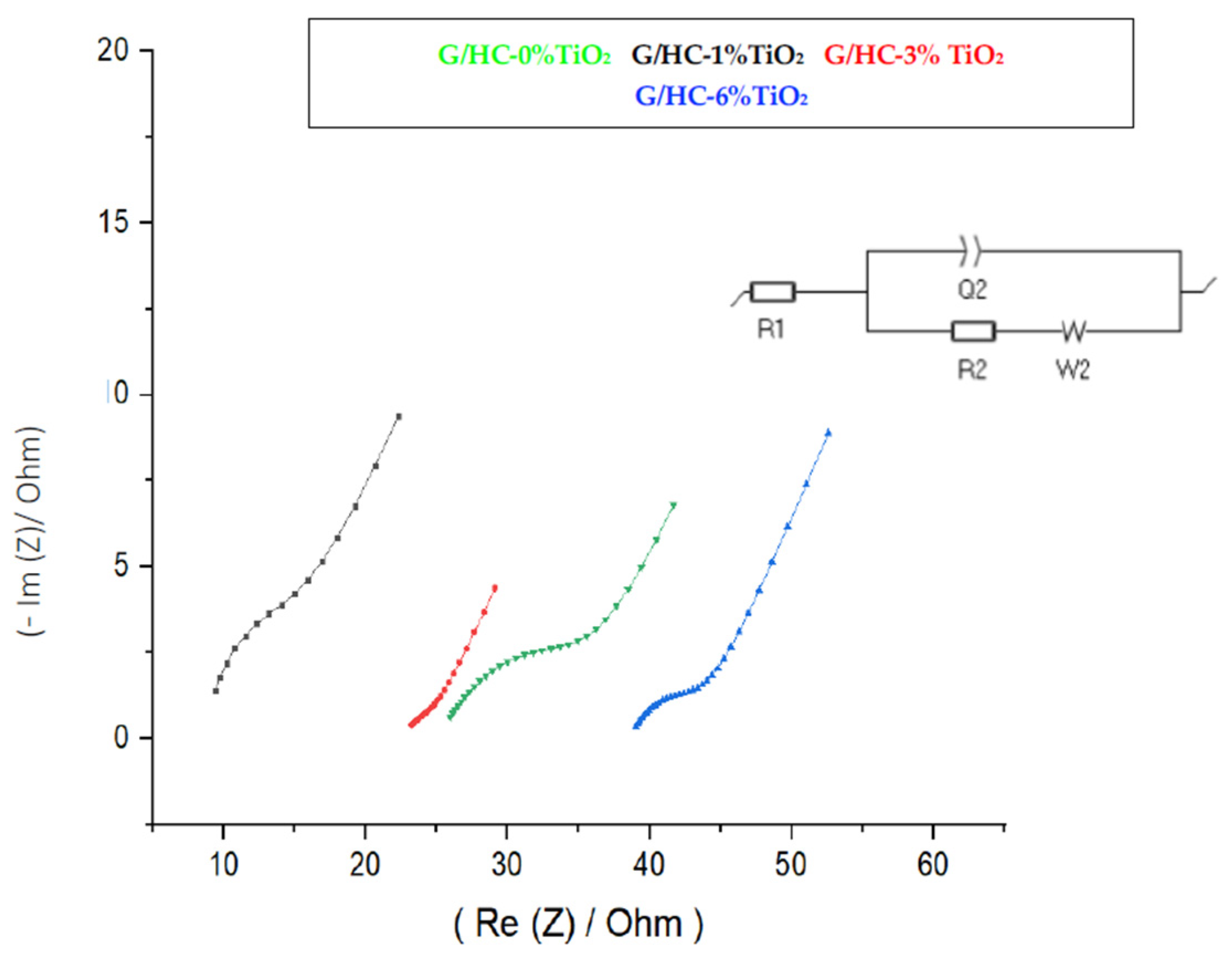
| Sample Name | TiO2 in Composite (wt%) | Composite in Electrode (wt%) | Actual TiO2 in Electrode (wt%) |
|---|---|---|---|
| G/HC-5% TiO2 | 5% | 20% | 1% |
| G/HC-15% TiO2 | 15% | 20% | 3% |
| G/HC-30% TiO2 | 30% | 20% | 6% |
| Parameters | Biomass | Raw Hydrochar | Activated Hydrochar |
|---|---|---|---|
| Specific Surface Area (m2/g) | |||
| Single-Point Surface Area | 0.2146 | 33.0493 | 232.7693 |
| BET Surface Area | 0.2208 | 33.0497 | 254.2808 |
| Langmuir Surface Area | 0.4177 | 52.5552 | 807.4454 |
| t-Plot Micropore Area | - | 15.3367 | 60.8747 |
| t-Plot External Surface Area | 0.2492 | 17.7131 | 193.4981 |
| BJH Adsorption Cumulative Surface Area | - | 6.4499 | 782.4208 |
| Pore Volume (cm3/g) | |||
| t-Plot Micropore Volume | −0.000005 | 0.008573 | 0.03193 |
| BJH Adsorption Cumulative Volume | - | 0.004034 | 0.521714 |
| Pore Size (nm) | |||
| BJH Adsorption Average Pore Diameter | - | 2.5016 | 2.8672 |
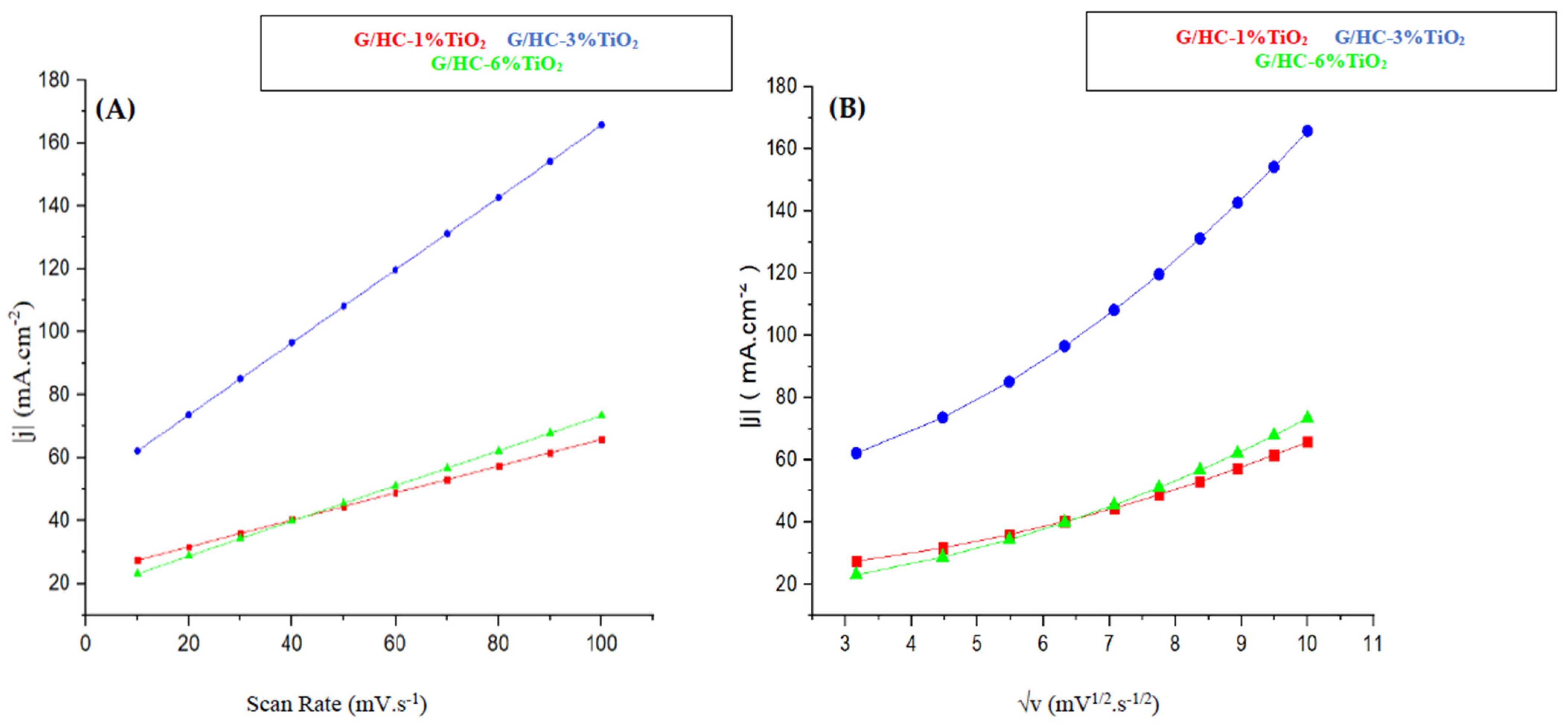
| Electrode | R2 (i vs. ν) | R2 (i vs. √ν) | Dominant Behavior |
|---|---|---|---|
| G/HC–1% TiO2 | 0.990 | 0.978 | Mainly capacitive |
| G/HC–3% TiO2 | 1.000 | 0.978 | Perfectly capacitive |
| G/HC–6% TiO2 | 1.000 | 0.979 | Perfectly capacitive |
| Catalyst/Electrode | Biomass Source/Structure | Modification | η10 (mV) | Tafel Slope (mV·dec−1) | References |
|---|---|---|---|---|---|
| Biomass-derived and non-noble catalysts | |||||
| G/HC–3% TiO2 | Graphite + hydrochar | TiO2 dispersion (n wt%) + calcination 300 °C | 194 | 67 | |
| Wood residue | Carbonized wood | Ni3S4/CW | 280 | 122 | [42] |
| Willow catkins | Biomass fiber | NiFe LDH/(NiFe)Sx/CMT | 169 | 105 | [43] |
| Willow catkins | Biomass fiber | NiFe LDH/CMT | 333 | 140 | [43] |
| Willow catkins | Biomass fiber | NiFeSx/CMT | 266 | 139 | [43] |
| Cattail spike | Plant fiber | Ni/NBCF-1-H2 | 47 | 58 | [44] |
| Sulfur self-doped | Camella japonica flowers | 154 | 89 | [45] | |
| NiP/Poplar wood | Poplar wood | Phosphorization | 83 | 73 | [46] |
| Mo2C@SNC | Sunflower seeds | Porous carbon doped with Mo | 60 | 71 | [47] |
| NiFe LDH | Synthetic | NiFe layered double hydroxide | 100–200 | 80–120 | [48] |
| MoO3/AC | Human hair | 353 | 124 | [49] | |
| Noble metal catalysts (for benchmarking) | |||||
| Pt/C | Carbon black | Pt nanoparticles | ~30 | 30–40 | [50] |
| Ru@CQDs | Carbon quantum dots | Ru nanoparticles | 10–65 | 47–63 | [51] |
Disclaimer/Publisher’s Note: The statements, opinions and data contained in all publications are solely those of the individual author(s) and contributor(s) and not of MDPI and/or the editor(s). MDPI and/or the editor(s) disclaim responsibility for any injury to people or property resulting from any ideas, methods, instructions or products referred to in the content. |
© 2026 by the authors. Licensee MDPI, Basel, Switzerland. This article is an open access article distributed under the terms and conditions of the Creative Commons Attribution (CC BY) license.
Share and Cite
Hammi, Z.; Benhadria, E.H.; Lakhloufi, S.; Koumaiti, M.A.; Merbouh, L.; Labjar, N.; Lotfi, E.M.; Nasrellah, H.; Cherrat, A.; El Hajjaji, S. TiO2-Doped Hydrochar Derived from Phoenix dactylifera: Synthesis and Electrocatalytic Performance for Alkaline Hydrogen Production. Electrochem 2026, 7, 12. https://doi.org/10.3390/electrochem7020012
Hammi Z, Benhadria EH, Lakhloufi S, Koumaiti MA, Merbouh L, Labjar N, Lotfi EM, Nasrellah H, Cherrat A, El Hajjaji S. TiO2-Doped Hydrochar Derived from Phoenix dactylifera: Synthesis and Electrocatalytic Performance for Alkaline Hydrogen Production. Electrochem. 2026; 7(2):12. https://doi.org/10.3390/electrochem7020012
Chicago/Turabian StyleHammi, Zineb, El Houceine Benhadria, Soraya Lakhloufi, Mohamed Amine Koumaiti, Lamyaa Merbouh, Najoua Labjar, El Mostapha Lotfi, Hamid Nasrellah, Ayoub Cherrat, and Souad El Hajjaji. 2026. "TiO2-Doped Hydrochar Derived from Phoenix dactylifera: Synthesis and Electrocatalytic Performance for Alkaline Hydrogen Production" Electrochem 7, no. 2: 12. https://doi.org/10.3390/electrochem7020012
APA StyleHammi, Z., Benhadria, E. H., Lakhloufi, S., Koumaiti, M. A., Merbouh, L., Labjar, N., Lotfi, E. M., Nasrellah, H., Cherrat, A., & El Hajjaji, S. (2026). TiO2-Doped Hydrochar Derived from Phoenix dactylifera: Synthesis and Electrocatalytic Performance for Alkaline Hydrogen Production. Electrochem, 7(2), 12. https://doi.org/10.3390/electrochem7020012