1. Introduction
Large language models (LLMs) increasingly serve as decision-making components in simulations where autonomous agents observe an environment, retain histories, and act through natural language. Generative-agent environments have shown that LLM-backed agents can coordinate social activities and respond to events without step-by-step instruction [
1]. Frameworks such as Concordia and AgentScope support shared environments, communication, and structured agent workflows, making repeated interactions easier to construct and audit [
2,
3]. These systems allow researchers to study behavioral patterns that arise as agents observe one another and respond to common institutional signals, rather than examining model outputs in isolation.
The information available to agents is a central feature of these systems. Agents may rely on private histories, observe market-wide outcomes, exchange natural language messages with peers, or receive several channels together. Each arrangement changes what can inform later decisions. In artificial-agent markets, LLM pricing agents are sensitive to instruction framing, and seller communication is associated with stronger collusive tendencies in double auctions [
4,
5]. Communication and transparency are therefore part of the experimental environment, not neutral interfaces layered over fixed strategies.
The present study examines these features in a hidden-quality market. Sellers choose the condition of a used item and the condition represented publicly, while buyers cannot observe source quality before purchase. Akerlof’s analysis of markets with quality uncertainty shows how this asymmetry can produce adverse selection and weaken exchange [
6]. Evidence from adjacent credence-goods experiments further indicates that liability, verifiability, and reputation can shape conduct when sellers possess information unavailable to buyers [
7]. In our setting, a seller can lower the cost of a completed sale by supplying a lower-quality item while obtaining a higher fixed price through a better public listing condition. This creates a direct, auditable discrepancy between the quality supplied and the quality represented to buyers.
Recent studies of LLM agent markets report exploitative provider behavior and strategic quality inflation when institutional constraints are weak or buyers rely on advertised claims [
8,
9]. Targeted evaluations also show that LLM agents can suppress or misrepresent relevant information under pressure [
10]. Prior work thus establishes that hidden information, incentives, and communication can each matter, but it does not show how distinct information channels relate to an objective seller-misrepresentation measure in a repeated market.
The unresolved question is how seller-only communication and market-wide public history relate to the prevalence and form of quality overstatement among agents not assigned such behavior, and how these conditions relate to trade and buyer welfare. Widespread overstatement need not produce an equal number of harmful purchases, while transparency may reduce harmful purchases partly by suppressing trade. Seller conduct, buyer exposure, and market performance must therefore be measured separately.
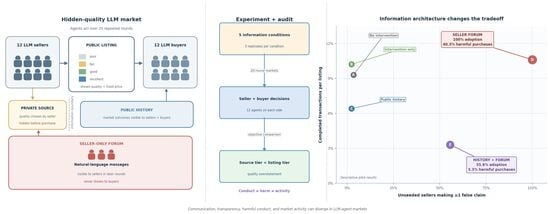
We study this question in a 20-round e-commerce simulation with 12 seller and 12 buyer agents. The submitted pilot compared a market without intervention sellers, an intervention-only market, market-wide public history, a seller-only forum, and public history combined with the forum. A fresh primary-wording replication batch repeated these five conditions with 20 replicates per condition. The primary research question is: How do seller-only communication and market-wide public history affect the prevalence and form of objectively measured deceptive selling by unseeded LLM agents, and how are these information conditions associated with trade and buyer welfare? We operationalize deceptive selling solely as quality overstatement, defined by a public listing tier above the source-quality tier, without inferring intent. The primary outcome, unseeded-seller prevalence, is the fraction of unseeded sellers making at least one such claim. The platform records the source-to-listed quality gap directly. We use this deterministic measure to compare the two information architectures and to distinguish overstatement from completed harmful purchases, transaction activity, and buyer welfare. We analyze the submitted pilot and fresh primary-wording replication batch separately. Because the API did not expose a model-sampling seed, their seed-indexed contrasts align deterministic environment inputs but are not paired counterfactual estimates.
3. Methods
3.1. Simulation Environment
We implement a minimal e-commerce platform in which seller agents and buyer agents interact over T repeated market rounds. Each replicate uses and . The product category is held fixed as used wireless headphones so that seller communication concerns one shared market rather than semantically different product categories.
Each round has four phases. In communication-enabled conditions, sellers first post short forum messages. The messages are logged immediately but become visible to other sellers only in later rounds. All sellers then simultaneously choose the source quality of the item they would supply if the listing is sold and the quality tier shown publicly. Next, all buyers simultaneously choose one seller from the listing board or abstain. Finally, the environment resolves purchases, updates private memories and public histories, makes the round’s forum messages available in future seller context, and writes event logs. If multiple buyers choose the same seller, one buyer is selected uniformly at random and the remaining bids lapse.
The four quality tiers are poor, fair, good, and excellent. Unlike a model in which item quality is drawn exogenously, source quality is an endogenous seller choice in the current implementation. The prompt therefore asks each seller to make a joint source-and-list decision: lower source quality reduces the cost of a completed sale, while higher listing quality receives a higher fixed platform price. Buyers observe only the public listing quality, description, price, seller reputation, and permitted market context; they do not observe source quality before purchase. The platform records source quality, listing quality, price, sale outcome, buyer welfare, seller profit, reputation, prompts, raw LLM outputs, and latency for auditability.
A false quality claim is any listing whose declared quality tier exceeds its source quality tier. The paper uses deceptive selling as an umbrella concept and operationalizes it solely as this platform-defined quality overstatement. The measure neither assigns a subjective moral state nor infers seller intent, and it requires no separate human or model-based deception judge.
The implemented payoff schedule is reported in
Table 1.
For a completed sale with source quality s and listing quality ℓ, seller profit is and buyer welfare is . The schedule is linear and deliberately stylized: an honest fair listing yields seller profit and buyer welfare , while a fair item claimed as good yields seller profit and buyer welfare . Quality overstatement can therefore be locally profitable if purchased, but it creates negative buyer welfare and future reputation risk when discovered. The schedule models a stylized short-run temptation in a hidden-quality market; it does not make honesty privately dominant. Accordingly, raw false-claim adoption is insufficient on its own; the analysis emphasizes prevalence relative to the no-intervention and intervention-only references. Source quality represents the item supplied conditional on sale; unsold listings incur no modeled sourcing or inventory cost. The seller cash ledger records gross sale revenue, whereas the reported profit measure separately deducts sourcing cost. Seller cash is neither shown to sellers nor used to constrain their listing decisions and is not analyzed as an economic outcome.
Moving a listing up by one public tier increases the fixed claim price by exactly USD 20; moving the sourced item down by one tier reduces the completed-sale sourcing cost by exactly USD 12.50. These incentives can materially affect when quality overstatement is attractive. We did not vary the payoff schedule in the fresh primary-wording replication batch, so all behavioral conclusions are conditional on this schedule and do not establish generality across price or cost structures.
3.2. Agent Design
The submitted pilot and fresh primary-wording replication batch use the configured model alias
gpt-4o-mini [
19] through the OpenAI Responses API, with sampling temperature 0.7 and strict JSON-schema outputs. The submitted run did not record a dated provider-side snapshot. The provider response model recorded for the fresh primary-wording replication batch was
gpt-4o-mini-2024-07-18. The implementation abstracts the LLM provider and model string in the JSON configuration; OpenAI and OpenRouter providers are supported by the codebase. Agents receive their context as structured natural language prompts and return structured JSON responses. Prompts, raw model responses, and per-call latency are written to disk for every run.
Seller agents are assigned either to the intervention or to the unseeded group. During round 0, intervention sellers are forced to source fair headphones and list them in good condition. The intervention neither tells intervention sellers to recommend this tactic nor labels their listing as false in text shown to other agents. In communication conditions, every seller receives the same open-ended forum prompt in every round. Forum and listing calls are stateless: a listing call does not observe the seller’s newly generated forum message. The treatment exposes sellers in later rounds to messages from other sellers generated under a prompt naming prices, demand, reputation, and public listing quality. After round 0, intervention sellers use the same listing process as other sellers. Unseeded sellers do not receive the forced listing intervention. Their prompt instructs them to consider expected profit, sale probability, buyer trust, and reputation risk when choosing source and public listing quality. The primary outcome is therefore quality overstatement by unseeded sellers, not violation of an explicit honesty prohibition.
The seller-forum generation prompt and seller-listing prompt are issued as separate stateless API calls. The listing call receives peer-message text through its visible context but never receives the forum-generation instruction itself or hidden state from the forum call. This rules out direct within-call priming by the forum-generation instruction, but it does not identify a separate message contribution: the peer messages remain outputs conditioned on that instruction. We therefore describe the forum condition as a bundled information treatment and do not separate message exposure from the prompt that generated the messages.
For seller-listing prompt robustness, we specified two semantically matched alternatives before any new API call. Paraphrase A reordered the role and objective and used synonymous prose; paraphrase B used compact bullet-style decision instructions. Both retained the primary objective, action set, economics, visible context, numerical decision block, and structured response schema. The three complete prompt definitions appear in the Agent Economy repository.
Seller output per round:
{ "source_quality": "poor|fair|good|excellent",
"listing_quality": "poor|fair|good|excellent",
"description": "..." }
The environment normalizes the displayed listing description so that it matches the public listing condition.
Buyer agents observe the full set of active listings each round and select one seller to purchase from or abstain. In public-history conditions, buyers also receive the same public market-history strings that sellers receive. In private and communication-only conditions, buyers receive only their own private memory and the current listing board. Seller-forum messages are seller-only and are never shown to buyers. Buyer output per round:
{ "buy": true|false,
"selected_seller_id": 0..N_s-1|null,
"reason": "..." }
3.3. Reputation Mechanism
After each completed sale, the platform draws whether the buyer learns the item’s source quality with probability
. In the pilot run,
. The event log records the deterministic review score
for every completed sale, but the score affects reputation and becomes visible to agents only when the outcome is revealed. It is defined from the quality gap
:
A listing with no overstatement receives a score of 5; each additional tier of overstatement costs one point, so the largest possible overstatement (listing a poor item as excellent) scores 2. Understatements are not rewarded above 5. The seller’s public reputation is an exponential moving average (EMA) of revealed review scores:
The primary experiment uses reputation-update weight . Low produces high inertia: a seller who has accumulated a strong reputation can absorb one false claim before their EMA score drops visibly. When a sale outcome is revealed, public history and private memories also include a short qualitative buyer note: item matched listing, item worse than listed, or item better than listed. This changes only the information visible to agents; it does not add refunds, suspension, or any additional payoff penalty.
3.4. Experimental Conditions
Five conditions vary the active information channels and the presence of intervention sellers (
Table 2). Both the submitted pilot and fresh primary-wording replication batch contain conditions A–E. Condition A contains no intervention sellers; conditions B–E contain three.
Each agent retains a private memory of its own outcomes. A seller’s records are excluded from peer and public context but not from private memory. Condition A describes spontaneous false claims under private information. Condition B is the intervention-only reference: unseeded sellers observe their own trade outcomes but cannot observe the intervention imposed on other sellers. Condition C adds recent public market-history items summarizing sales and no-sale listings: seller id, listed quality, price, public reputation, visible review status and qualitative buyer note when revealed, and whether the outcome was strong or weak for the seller. Source quality, false-claim status, and intervention-seller identity are not included in the public text shown to agents, although they are retained in logs for analysis. Buyers see this public market history in conditions C and E. Condition D activates seller communication without public market history: all sellers post messages, and recent messages from other sellers are visible to sellers in later rounds. Seller-forum messages are never visible to buyers. Condition E activates both public market history and seller communication. Conditions C and E therefore change the information available to buyers and sellers jointly; they are not seller-only transparency treatments.
In both batches, D minus B is the controlled contrast for enabling the seller forum while holding the round-0 intervention and private history fixed. E minus C is the corresponding controlled contrast with market-wide public history held fixed, and E minus D describes the difference associated with adding market-wide public history to a communicating market. Because every seller-forum condition contains intervention sellers, these forum contrasts are conditional on intervention presence. The design does not estimate how the forum contrast changes when intervention sellers are absent or identify message transmission specifically from intervention sellers. Because buyers and sellers both see public history, all public-history contrasts combine responses from both sides of the market.
3.5. Replicates, Estimands, and Sensitivity Checks
The submitted pilot has five replicates per condition with common environment-seed indices 7–11. We did not regard five replicates as sufficient for precise estimates. The fresh primary-wording replication batch has 20 replicates per condition with indices 101–120. Two seller-listing prompt-robustness batches each have ten replicates of conditions B and D with indices 101–110 (
Table 3). The submitted pilot and fresh batches were executed in different API periods and are never pooled.
Environment-seed indices determine intervention assignment, buyer tie-breaking, and review-reveal events through separate keyed random streams. Condition order is randomized deterministically for each environment seed. The API does not expose a model-sampling seed, so conditions with the same environment index still contain independent LLM draws and may diverge immediately. Seed-indexed contrasts therefore align deterministic environment inputs but are not paired counterfactual replays. The same limitation applies to comparisons between prompt wordings: they assess whether a pattern is robust across fresh batches, not an isolated wording contrast under identical model draws. The provider response model recorded for the fresh primary-wording replication batch was snapshot gpt-4o-mini-2024-07-18.
All summaries use the market replicate as the statistical unit. For every submitted or fresh batch, we report all replicate values, the mean, standard deviation, Monte Carlo standard error, and a descriptive 95% Student-t interval. We also report deterministic 10,000-resample replicate-level percentile-bootstrap intervals and the range of leave-one-environment-seed-out means. Contrast intervals are calculated from the replicate-indexed contrasts. These summaries quantify Monte Carlo variation in the completed runs; they are not inferential guarantees for a model population. We did not add null-hypothesis tests or pool batches.
The shared settings are three intervention sellers where enabled, reputation-update weight , reveal probability 0.5, and a final visible-context limit of 16 items. The Agent Economy repository specifies how private memory, public history, and forum messages enter that limit and supplies the exact prompts, batch design, metric definitions, and round algorithm.
One-factor robustness checks vary sampling temperature over
, the reputation-update weight over
, and the number of intervention sellers over
. Each completed setting contains five replicates. These planned one-factor checks are descriptive; the three intervention-size settings do not estimate a continuous dose–response relationship (
Table 4).
3.6. Outcomes and Context Coding
The primary outcome is unseeded-seller prevalence: the fraction of unseeded sellers in a replicate that make at least one false claim during 20 rounds. Condition A provides a separate reference for spontaneous adoption. The submitted-pilot contrasts subtract B from C, D, and E; the fresh controlled forum contrasts are D minus B under private history and E minus C under market-wide public history. Throughout this paper, adoption is a descriptive timing label for an unseeded seller’s first observed overstatement; it does not imply imitation or transmission. Repeated adoption counts unseeded sellers with false claims in at least two rounds. We also record the first adoption round and the source-to-listed quality pair for every unseeded false claim.
Market outcomes separate listing conduct from realized buyer outcomes. Transaction rate is completed transactions divided by 240 listing opportunities per replicate. Market inactivity is the fraction of rounds without a completed transaction. Purchased unseeded false claims count overstatements by unseeded sellers that result in a sale. Buyer welfare is source value minus the price paid; total buyer welfare sums this quantity over completed purchases. Market-level welfare and bad-purchase outcomes include transactions with intervention and unseeded sellers. The bad-purchase rate is the fraction of completed purchases with negative welfare. Under the implemented payoff schedule, every purchased overstatement has negative buyer welfare; the bad-purchase rate therefore equals the realized purchased-overstatement rate across all sellers.
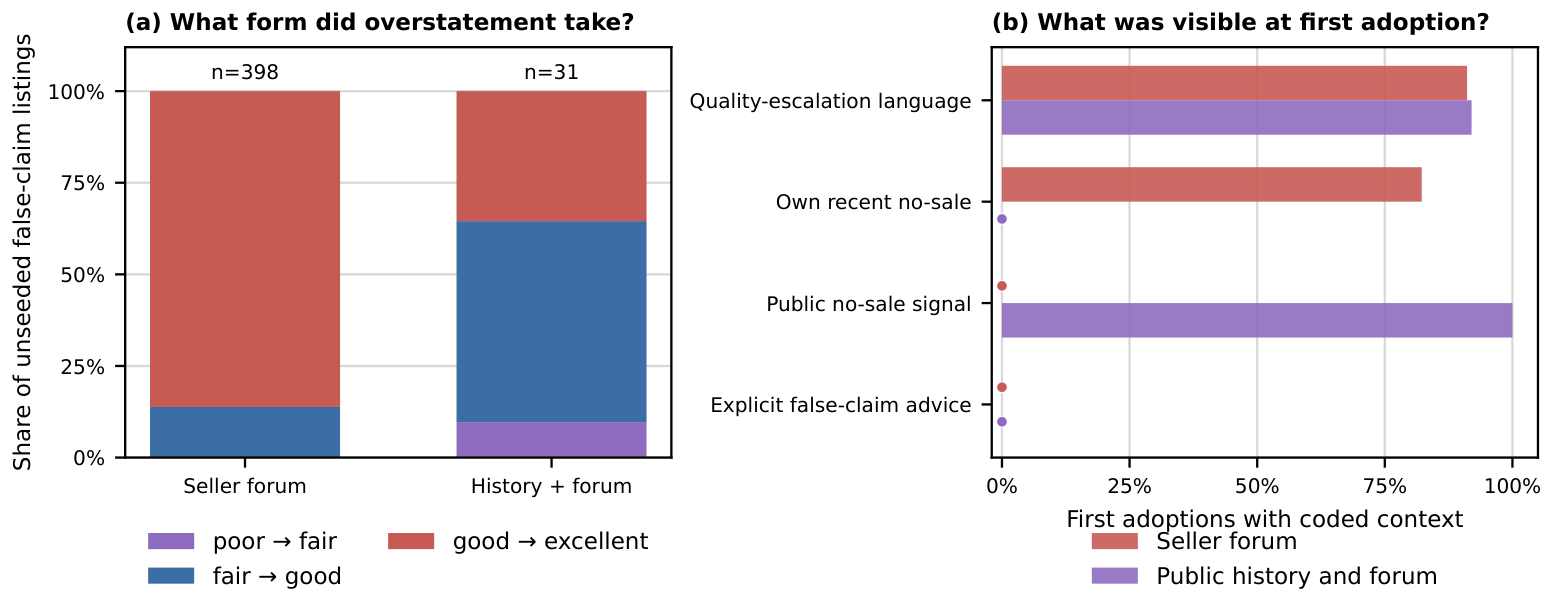
For the revision, every retained first-adoption context from the submitted pilot and fresh primary-wording replication batch was exported (343 items), assigned an opaque identifier, and stripped of condition, replicate, seller, outcome, and automated-code fields. Two AI-assisted semantic annotation passes applied a fixed multi-label codebook covering explicit false-claim advice, quality escalation, price/profit pressure, reputation/trust, no-sale/demand pressure, and honesty/accuracy. The first-pass semantic labels are used for the manuscript counts and
Figure 1; the second pass is reported as an annotation-sensitivity check, not as independent-human inter-rater reliability. Automated keyword rules are evaluated against the first-pass labels. Forum, public history, and private-context provenance is derived from structured event fields, with a condition-and-round fallback for legacy logs rather than from semantic keywords. Labels may overlap, were never shown to agents, and cannot explain why a seller adopted.
The Agent Economy repository provides the prompt templates, primary configuration, metric definitions, round sequence, initialization, memory formatting, output validation, and randomization. The archived event fields organic_false_claim and spread_rate correspond to the manuscript’s unseeded-false-claim indicator and unseeded-seller prevalence. The submitted pilot recorded the alias gpt-4o-mini without an exact provider-side snapshot; the provider response model recorded for the fresh primary-wording replication batch was gpt-4o-mini-2024-07-18.
4. Results
4.1. Submitted Five-Replicate Pilot
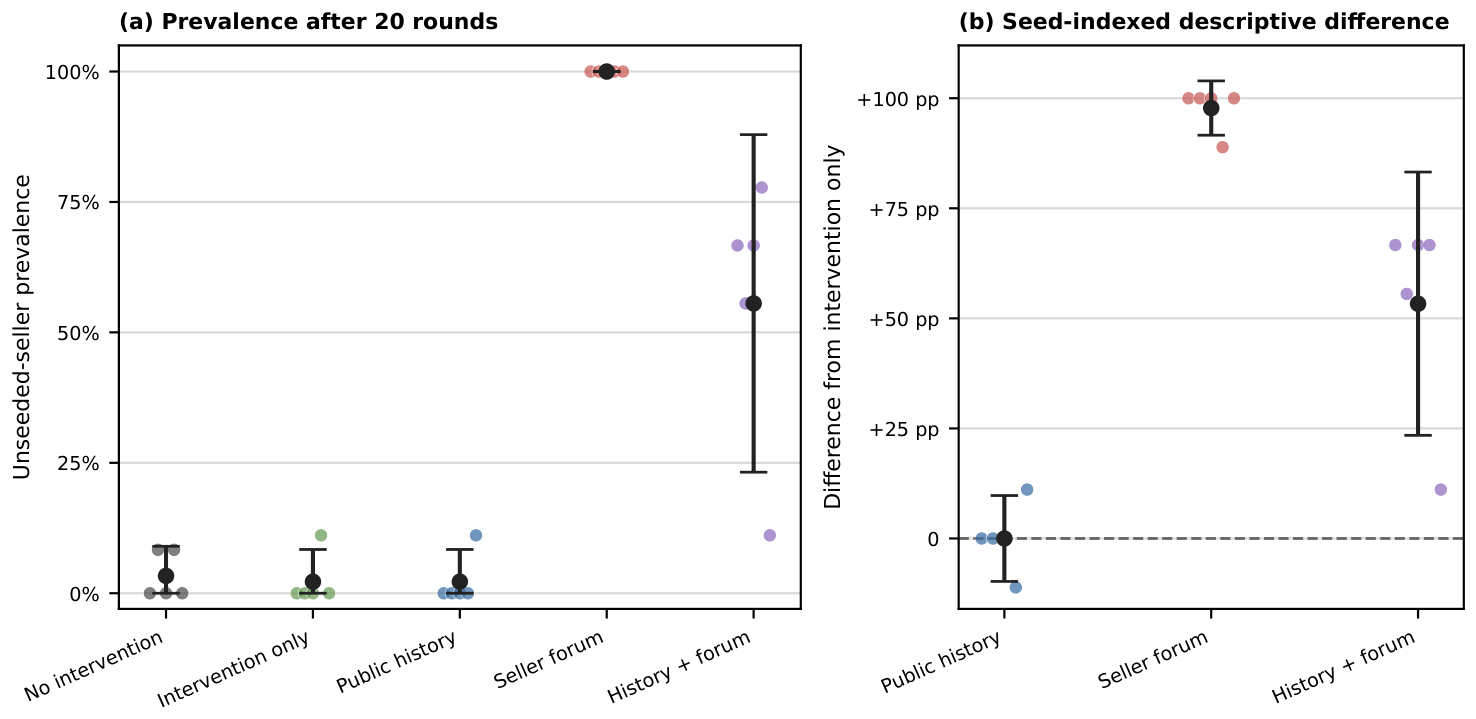
The submitted pilot is reported separately from every fresh Reviewer 2 batch. Across its five replicates, false claims by unseeded sellers are rare in the three conditions without seller communication. Mean unseeded-seller prevalence is 0.033 in condition A, 0.022 in condition B, and 0.022 in condition C (
Table 5). Across these conditions, four unseeded sellers adopt out of 150 seller-replicate observations. In condition B, the round-0 intervention is accompanied by one unseeded adopter across 45 seller-replicate observations.
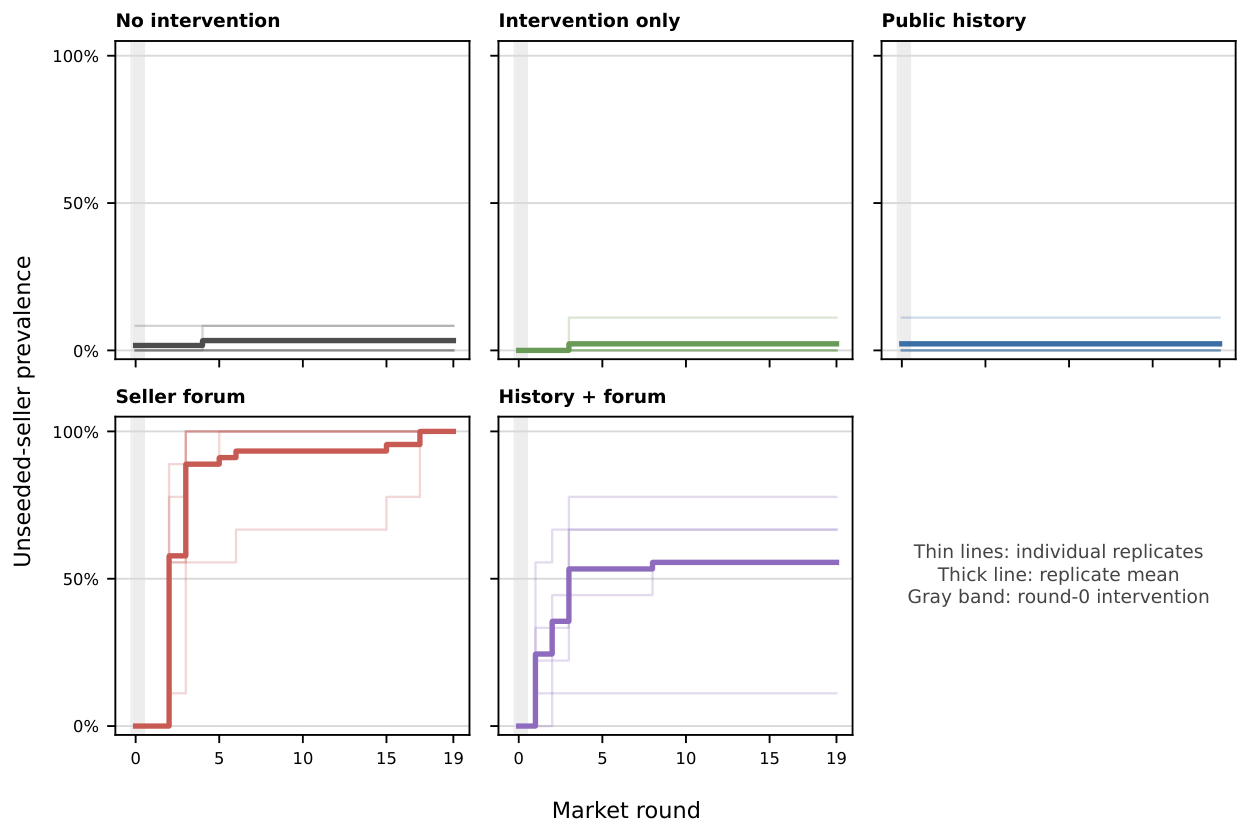
In condition D, all nine unseeded sellers make at least one false claim in each replicate, giving a mean prevalence of 1.000 and a mean seed-indexed descriptive difference of 0.978 from condition B (
Figure 2). Every adopter makes false claims in more than one round, and the mean number of unseeded false claims is 79.6 per replicate.
In condition E, mean prevalence is 0.556, corresponding to five of nine unseeded sellers per replicate on average. The seed-indexed descriptive difference from condition B is positive for all five common starting seeds and ranges from 0.111 to 0.667. Observed prevalence in condition E is lower than in condition D in these replicates. These seed-indexed differences summarize aligned starting seeds but are not paired counterfactual estimates.
First observed overstatements occur early in the two forum conditions (
Figure 3). In condition D, mean cumulative first-overstatement prevalence exceeds 0.5 by round 3 and approaches 0.9 by round 5. In condition E, it rises over the same rounds and then remains near 0.55. Mean cumulative first-overstatement prevalence in the three non-forum conditions remains close to zero throughout the 20 rounds.
4.2. Fresh Primary-Wording Replication Batch
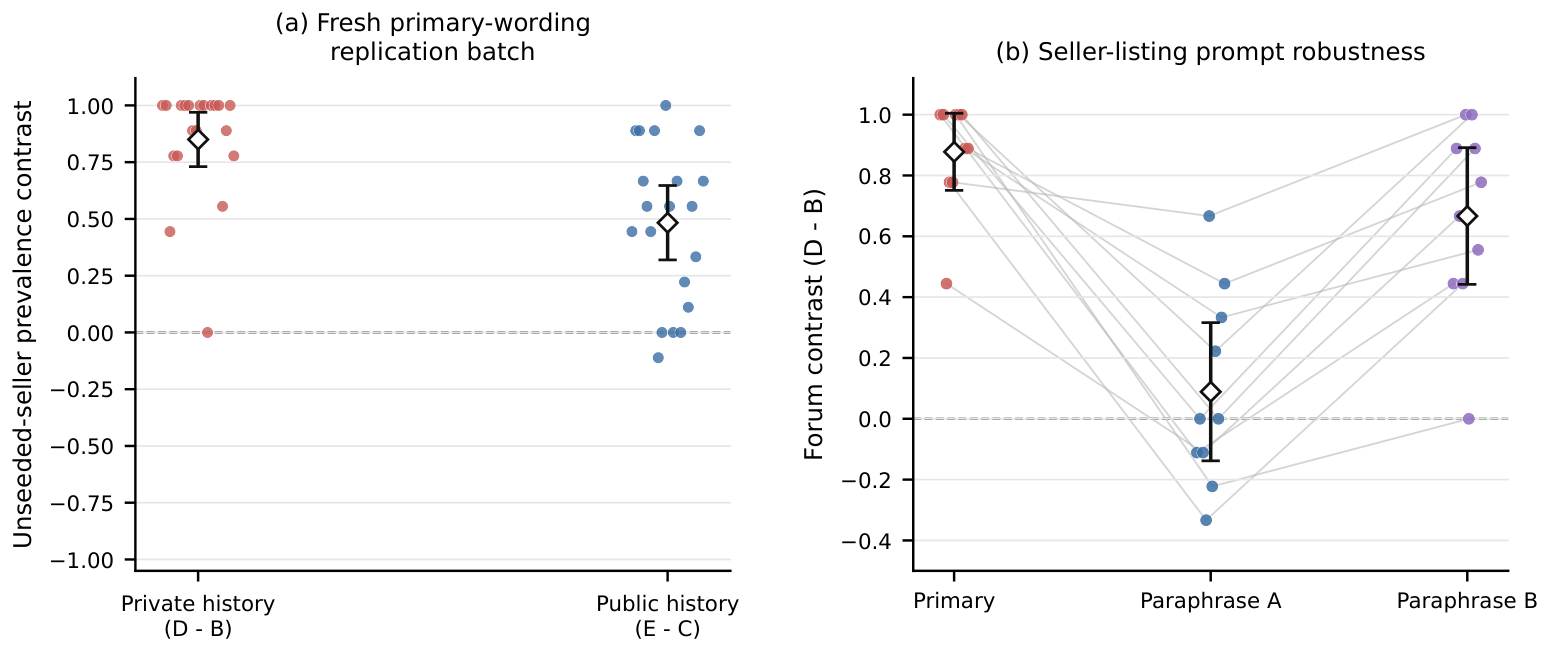
The fresh primary-wording replication batch contains 20 replicates per condition and is not pooled with the submitted pilot. Under the primary seller-listing wording, mean unseeded-seller prevalence is 0.004 in A, 0.000 in B, 0.078 in C, 0.850 in D, and 0.561 in E. The mean forum-associated prevalence difference is 0.850 under private history
and 0.483 under market-wide public history
(
Table 6). In each comparison, intervention presence and the other information channels are held fixed. These descriptive differences therefore apply to the tested intervention-present configurations.
These fresh runs cannot determine whether either forum contrast persists without intervention sellers, whether intervention presence moderates its magnitude, or whether behavior was transmitted specifically from intervention sellers. Buyers and sellers receive public history together, so the C–E comparison also cannot identify which side of the market drives any public history-mediated response. Complete replicate values and condition summaries, including market outcomes, are provided in the Agent Economy repository.
4.3. Seller-Listing Prompt Robustness
The private-history forum contrast is not invariant to seller-listing wording (
Table 7;
Figure 4). Over environment-seed indices 101–110, its mean is 0.878 under the primary wording, 0.089 under paraphrase A, and 0.667 under paraphrase B. Relative to the primary batch, the matched-index contrast difference is
for paraphrase A and
for paraphrase B. All replicate values were retained; no wording was selected or rerun based on its result.
Because the API provides no model-sampling seed and the prompt batches were executed separately, these are descriptive robustness comparisons rather than identical-draw prompt counterfactuals. The primary pattern did not remain stable across all three semantically matched wordings. We treat this seller-prompt fragility as an observed limitation and restrict the forum result to the tested prompt definitions.
4.4. Form and Context of First Adoption
The source-to-listed quality pairs vary rather than reproducing the forced fair-to-good intervention literally. In condition D, 343 of 398 unseeded false claims involve a good item listed as excellent; the remaining 55 are fair-to-good claims. Condition E has 17 fair-to-good claims, 11 good-to-excellent claims, and three poor-to-fair claims.
Every first adoption in the seller-forum and combined conditions follows exposure to forum messages, based on structured channel provenance. In the first-pass semantic labels, quality-escalation language appears in 14 of 45 seller-forum contexts and 14 of 25 combined contexts. Price/profit and reputation/trust language appears in every context in both conditions; no-sale/demand pressure appears in 37 of 45 and 25 of 25 contexts, respectively. Honesty/accuracy language appears in 16 of 45 and 2 of 25 contexts. No first-pass first-adoption context contains explicit advice to make a false claim.
The automated rules perform unevenly against the first-pass labels (
Table 8). They recover quality-escalation language with recall 0.992 but precision 0.426, and they recover honesty/accuracy language with precision 0.930 but recall 0.616. The rules match the first-pass labels for price/profit, reputation/trust, and no-sale/demand pressure in this corpus. The explicit-advice rule produces one false positive and no true positives. The two initial annotation passes differ only for quality escalation (raw agreement 0.866, Cohen’s
, positive agreement 0.832, negative agreement 0.888); their agreement is 1.000 for every other label. Cohen’s
is undefined for explicit advice because both passes assign zero positives.
These counts describe what sellers could read before acting. They do not separate the contribution of messages, the forum prompt, sellers’ sales histories, or other market changes. The labels overlap and cannot identify why a seller adopted.
Figure 1 therefore reports descriptive prevalence rather than mutually exclusive or causal explanations.
4.5. Trade and Buyer Outcomes
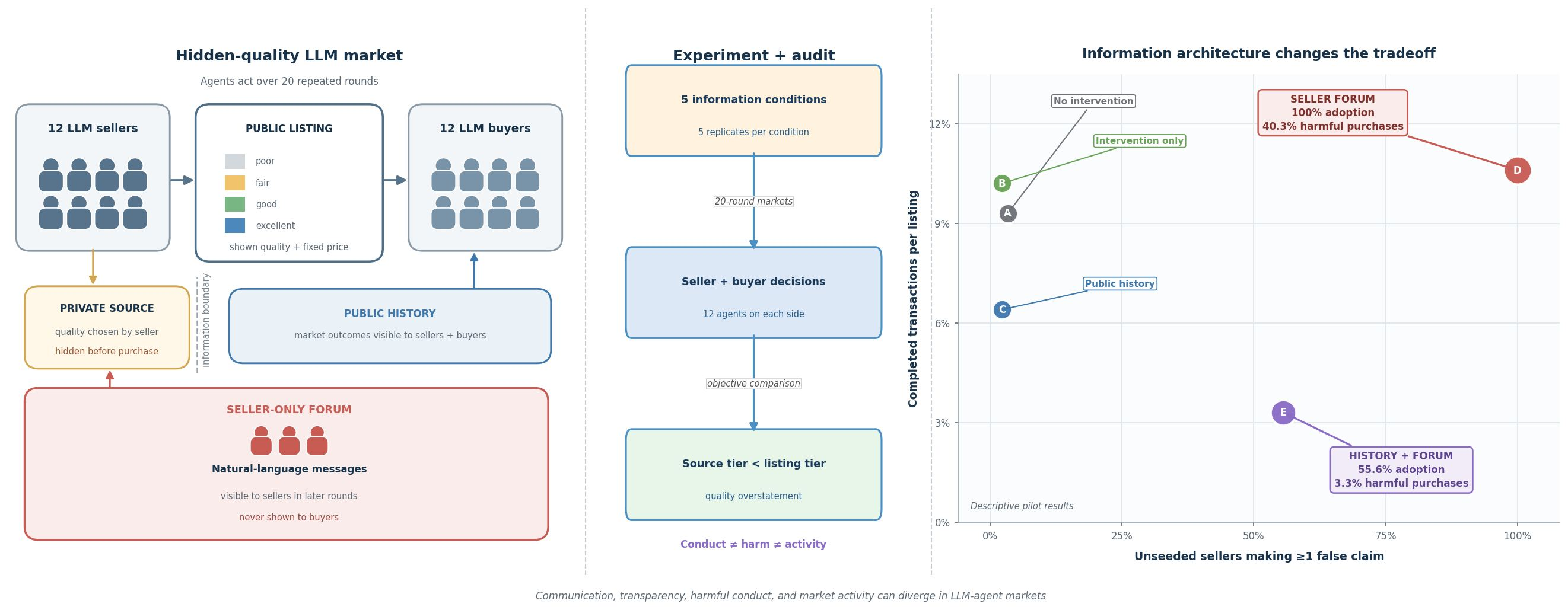
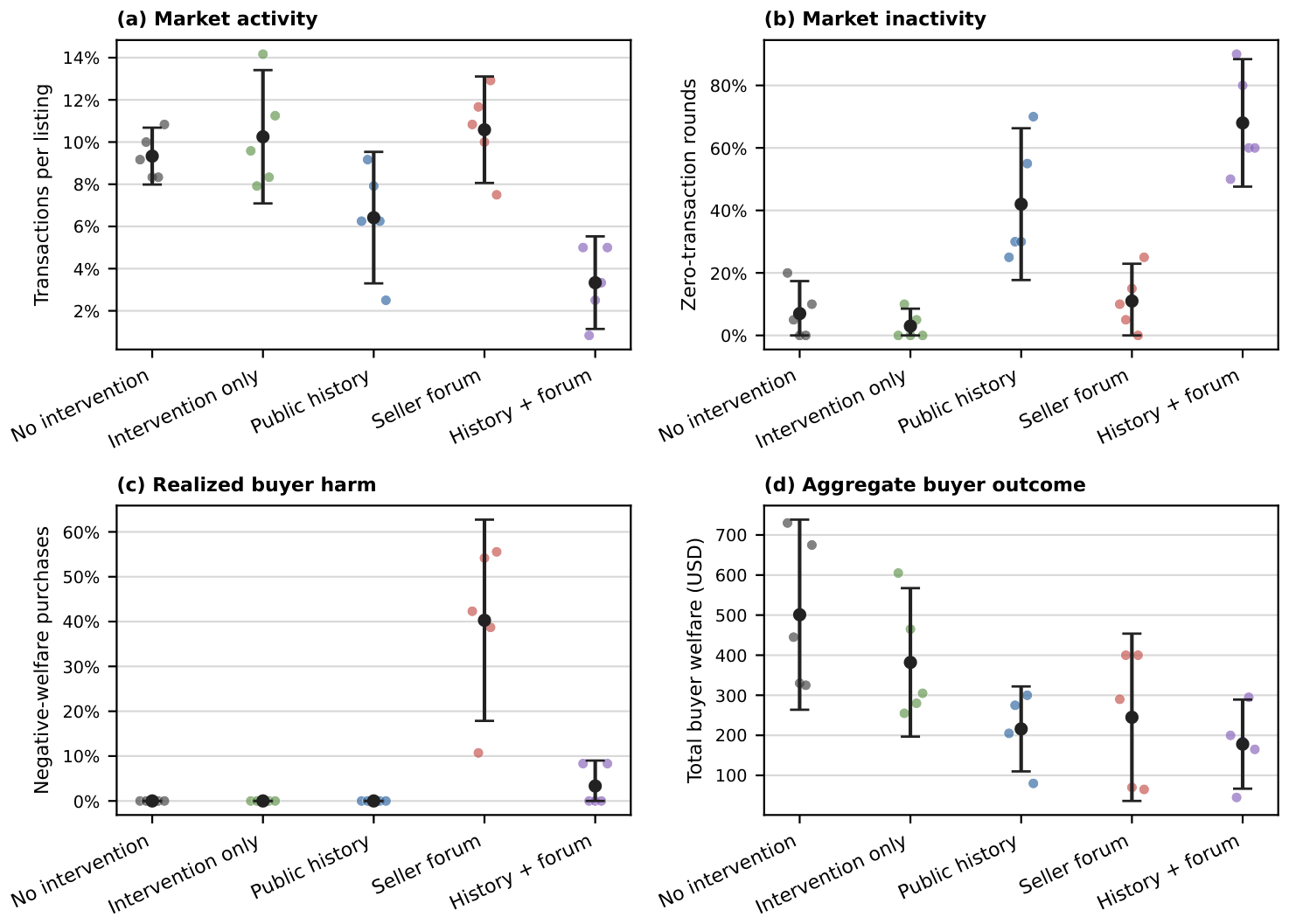
The two public-history conditions have the lowest observed market activity (
Figure 5). Completed transactions per listing average 0.093 in condition A, 0.102 in B, 0.064 in C, 0.106 in D, and 0.033 in E. The mean fraction of rounds without a transaction is 0.030 in condition B, 0.420 in C, and 0.680 in E.
Mean total buyer welfare over 20 rounds is 501, 382, 216, 245, and 178 dollars in conditions A through E. Because total welfare sums outcomes only over completed purchases, it reflects both the number of transactions and their realized welfare. Public history is shown to buyers and sellers, so the observed condition differences cannot be assigned to either side of the market. Total welfare and bad-purchase rates include purchases from intervention and unseeded sellers. Mean welfare per completed purchase, averaged at the replicate level, is 22.1, 15.7, 14.2, 9.0, and 24.1 dollars in conditions A through E, respectively.
Condition D has the highest observed mean bad-purchase rate, 0.403, compared with 0.033 in condition E. Most unseeded false claims remain unsold: condition D averages 75.8 unpurchased and 3.8 purchased unseeded false claims per replicate, while condition E averages 6.0 and 0.2, respectively. The number of sellers making false claims and the number of false claims resulting in completed purchases are distinct quantities. Under the implemented payoff schedule, every purchased overstatement has negative buyer welfare, so the bad-purchase rate is also the realized purchased-overstatement rate across all sellers. Across the five replicates, condition D contains 49 purchased overstatements: 30 from intervention sellers and 19 from unseeded sellers. Condition E contains two, one from each seller group.
4.6. Submitted-Pilot One-Factor Checks
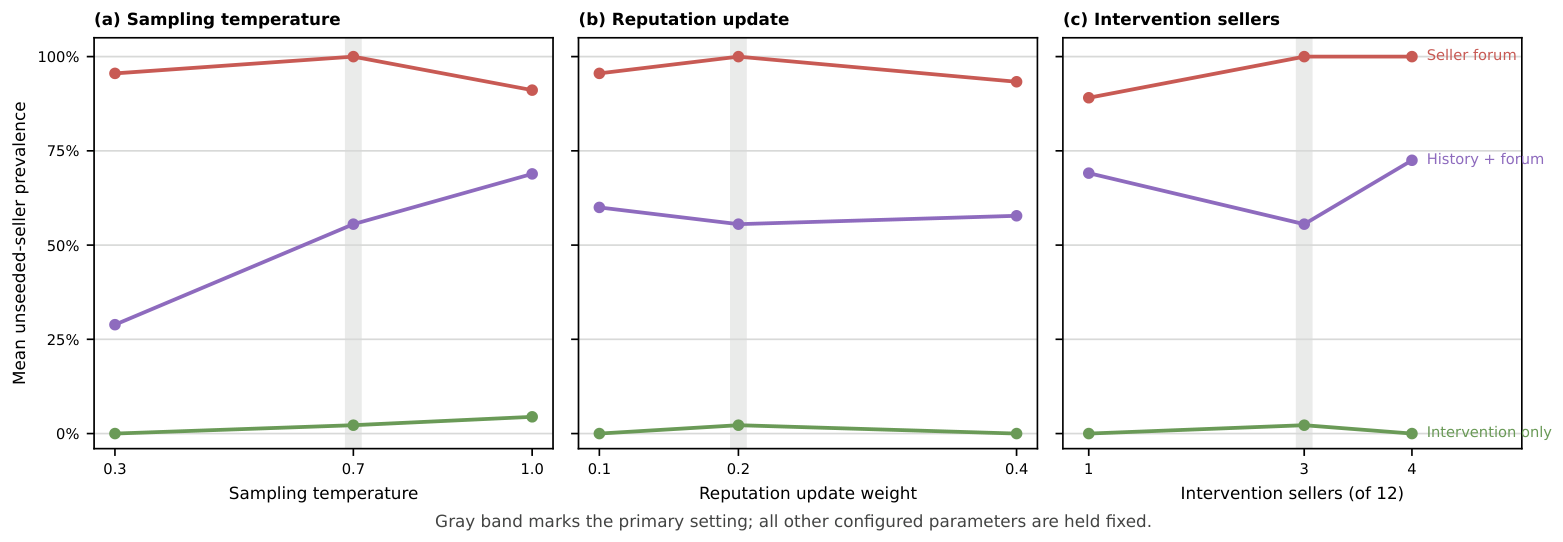
These five-replicate one-factor checks belong to the submitted API period and are not pooled with the fresh primary-wording replication batch or the prompt-robustness batches. Across the completed temperature settings (
Figure 6), raw descriptive mean prevalence in condition D is 0.956 at 0.3, 1.000 at 0.7, and 0.911 at 1.0. The corresponding condition E means are 0.289, 0.556, and 0.689.
At reputation-update weights , 0.2, and 0.4, mean prevalence in condition D is 0.956, 1.000, and 0.933; the corresponding condition E means are 0.600, 0.556, and 0.578. With one, three, and four intervention sellers, mean prevalence in condition D is 0.891, 1.000, and 1.000; the corresponding condition E means are 0.691, 0.556, and 0.725. These one-factor checks report raw condition levels and are descriptive; the intervention size pattern is not monotonic.
5. Discussion
5.1. Main Findings
The seller-forum condition had the largest observed prevalence difference in the submitted pilot, and the fresh primary-wording replication batch showed the same direction. With intervention sellers held fixed, the mean forum-associated prevalence difference was 0.850 under private history (descriptive 95% Student-t interval ) and 0.483 under market-wide public history (). Both are controlled contrasts between intervention-present configurations. Because we did not include a forum condition without intervention sellers, the experiment cannot show whether intervention presence changes the forum contrast or whether behavior was transmitted specifically from the intervention sellers.
The magnitude was also sensitive to semantically matched seller-listing prompt wording. Across the first ten primary-wording seed indices, the primary wording produced a mean D–B contrast of 0.878. The corresponding contrasts were 0.089 under paraphrase A and 0.667 under paraphrase B. Because the batches were generated in separate API periods without a model-sampling seed, the differences are descriptive robustness results, not isolated causal estimates of wording. The results rule out invariance across the tested paraphrases.
Market behavior differed across the two information channels. In the fresh primary-wording replication batch, public history alone had mean prevalence of 0.078, while the corresponding forum condition had mean prevalence of 0.561; the forum condition under private history reached 0.850. In the submitted pilot, the public-history conditions also had the lowest transaction rates and the highest inactivity. Because buyers and sellers received public history together, those market differences cannot be assigned to either side of the market.
Most unseeded false claims in condition D were good-to-excellent, not the fair-to-good pair imposed in round 0. Of the mean 79.6 unseeded false claims per replicate, 75.8 remained unsold. The population-wide reporting difference therefore did not yield a comparable number of harmful transactions. Condition D nevertheless had the highest observed bad-purchase rate, 0.403, compared with 0.033 in the combined condition. Seller conduct, realized buyer harm, and market activity did not move together.
5.2. Interpretation and Market Implications
Repeated exposure to seller-only language may influence how agents use the platform’s quality scale, but the present treatment does not identify that mechanism. Forum-generation and listing calls are stateless and separate: a seller’s listing call does not receive the forum-generation prompt or its own newly generated message. The design thus excludes direct within-call priming by that prompt text. However, the messages shown to sellers were generated from the forum prompt. Message exposure and message generation therefore remain bundled in the treatment.
The experiment also does not establish literal imitation, contagion, or adaptation. Unseeded sellers could observe neither source quality nor intervention identity, and the dominant claim in the submitted pilot differed from the forced intervention. The blinded context analysis records the textual cues available before first adoption, not how an agent reasoned about them. The categories are contextual descriptions; they do not show that any one cue changed a decision.
Public history may instead discipline the market through caution or abstention. In the combined condition, fewer bad purchases coincided with lower prevalence and sharply reduced trade. The data cannot distinguish buyer caution from seller adaptation. Condition E had the lowest total buyer welfare but the highest mean welfare per completed purchase, showing why aggregate welfare and transaction quality should be read separately. Evaluations of agentic-market governance should therefore consider reporting conduct, realized harm, and market activity together. Transaction monitoring alone would miss widespread unsold overstatements; listing monitoring alone would miss buyer rejection.
5.3. Connection to Existing Work
Prior work shows that communication can increase collusive tendencies among LLM sellers in double auctions and that instruction changes can shift LLM pricing outcomes [
4,
5]. Our setting concerns hidden-quality reporting rather than pricing. Under the primary wording, seller-only communication coincided with a large change in the gap between supplied and listed quality. The result for paraphrase A shows why prompt wording must be tested and separated from message exposure.
The findings also connect classical information-asymmetry theory with recent LLM agent market experiments. Hidden quality can undermine exchange, while liability, verifiability, and reputation shape conduct in credence-goods markets [
6,
7]. LLM agent studies likewise report exploitation and quality inflation under weak constraints [
8,
9]. By comparing seller-only communication with market-wide history, this study shifts attention from whether LLM agents exploit hidden quality to how information channels relate to that conduct. Direct measurement of the source-to-listed gap also shows why prevalent false listings need not become prevalent bad purchases.
The population-level result can be compared with research on conventions and interaction in LLM communities [
17,
18], but it does not demonstrate a committed-minority or contagion mechanism. The study also complements work on strategically misleading LLM behavior [
10,
14] by measuring conduct rather than inferring intent. Because the platform observes source and listed quality directly, the measure does not depend on a human or model-based deception judge. This clarity also narrows the claim to quality overstatement, not a subjective intention to deceive.
5.4. Limitations and Future Work
The submitted pilot used five replicates; the fresh primary-wording replication batch used 20, and each alternative prompt batch used 10. The larger batches characterize Monte Carlo variation more fully, but the evidence remains descriptive and limited to one model, one product, and a 20-round horizon. The API did not expose a model-sampling seed, so an environment seed aligns keyed simulation events but not the model’s sampled responses; seed-indexed contrasts are not exact paired counterfactuals. The submitted and fresh API periods were therefore reported separately and never pooled.
Because the design does not include a seller-forum condition without intervention sellers, the forum contrast is estimated only within intervention-present markets. It cannot identify intervention-by-forum moderation or support generalization to markets without intervention sellers. This does not affect the within-configuration D–B and E–C comparisons.
The forum treatment combines exposure to peer messages with the process and prompt that generated those messages. Public history is also deliberately market-wide: buyers and sellers receive the same channel, preventing side-specific mechanism attribution. Separating these mechanisms will require orthogonal manipulations of message exposure and the generation prompt, together with separate buyer-visible and seller-visible public-history conditions.
The payoff schedule was held fixed. A one-tier increase in a seller’s public quality claim raises the posted price by $20, while moving one tier from fair to good or from good to excellent raises sourcing cost by $12.50. This study therefore does not show that overstatement emerges under other price premia, cost gradients, or demand conditions. A future factorial experiment should vary the payoff schedule; until then, all behavioral conclusions remain conditional on the tested schedule.
Whether these patterns persist across other model families, product domains, market institutions, larger replicate sets, or longer-running agent populations remains an open empirical question.
Future research should extend this design from quality overstatement to reproducible causal studies of harmful behavior in multi-agent systems, including misrepresentation, collusion, manipulation, herding, loss of strategy diversity, and corruption of an agent’s mandate. Factorial experiments could vary communication, observation, memory, incentives, interaction topology, and intervention size independently. Paired or statistically matched counterfactuals could then distinguish network propagation from common prompt influence and parallel responses to the environment. Larger populations, additional model families, and longer horizons would test which patterns persist across scales and domains.
Controlled simulation should remain the basis for intervention and causal attribution, while real-world data grounds and evaluates the resulting environments. Operational traces could calibrate interaction structures, decision frequencies, resource constraints, and baseline behavior, then test whether conclusions from controlled environments transfer to realistic settings. Where suitable data and infrastructure become available, held-out trace evaluation could precede monitored or shadow deployment. This sequence preserves experimental control while testing whether the measured dynamics arise in deployed systems.
A complementary objective is behavior-agnostic observability: detecting changes in coordination, information flow, strategy diversity, and mandate adherence without a predefined deception label. Such tools should identify the agents, messages, or network paths that precede collective failure and support comparisons of communication controls, provenance signals, oversight, and selective containment. Evaluations must measure both safety and utility so that stopping useful activity does not count as success. The present pilot and fresh batches motivate this broader program by associating information architecture with population-level differences in conduct under some prompt wordings, but they do not establish seed-to-peer transmission or generalization beyond the tested market.
6. Conclusions
Seller-only communication and market-wide public history were associated with distinct reporting patterns among unseeded LLM sellers. With intervention sellers held fixed, the controlled forum contrasts in the fresh primary-wording replication batch were 0.850 under private history and 0.483 under market-wide public history. Because the design does not include a forum condition without intervention sellers, it cannot determine moderation by intervention status or isolate transmission specifically from intervention sellers.
The private-history forum contrast was prompt-sensitive. Its mean was 0.878 for the primary prompt, 0.089 for paraphrase A, and 0.667 for paraphrase B across the ten-seed robustness batches. Model sampling was not seedable, and the batches occurred in separate API periods; the differences are therefore descriptive robustness comparisons. The contrast was not invariant across the tested seller-prompt wordings.
Most unseeded false claims in the seller-forum condition involved good items listed as excellent, rather than reproducing the fair-to-good intervention. Most false listings went unsold, so population-wide adoption did not yield a comparable number of harmful transactions. The seller-forum condition nevertheless had the highest observed bad-purchase rate, while the public-history conditions showed lower market activity. Seller conduct, realized buyer harm, and market participation are therefore distinct safety outcomes.
This study directly documents differences in seller conduct, buyer harm, and market participation within the tested conditions and prompt wordings. Further experiments are needed to determine whether information architecture jointly shapes safety and utility.
This study does not identify a mechanism or establish transmission from intervention sellers because message exposure was not separated from prompt framing and the design lacks a forum condition without intervention sellers. It also does not infer intent or generalize beyond one model, market, and payoff schedule.
Future studies should separate message exposure from prompt framing, vary buyer-visible and seller-visible history independently, and test broader models, domains, incentives, and interaction structures.
The practical implication is that multi-agent information architecture should be evaluated for both safety and system utility.