1. Introduction
Visual Question Answering (VQA) evaluates how models answer natural language questions about visual content [
1,
2]. Traditional VQA generally assumes that the relevant visual input is already available. Embodied Question Answering (EQA) instead places an agent in a 3D environment and may require it to act in order to gather the evidence needed to answer a question [
3,
4,
5]. This setting connects multimodal reasoning with perception, navigation, interaction, and state retention.
Potential applications include assistive home robots answering questions about object locations [
6], wearable systems responding to episodic memory queries [
7], and agents operating in urban environments [
8]. These applications require answers to be grounded in observations collected by an embodied system and, in multi-agent settings, communicated across agents [
9].
Several concerns recur in the reviewed literature. Simulation is used in multiple evaluations, and the reviewed examples include few physical robot demonstrations [
10]. Performance can decline in unfamiliar or degraded environments, as examined by OpenEQA [
7] and the DarkQA arXiv preprint [
11]. Evaluation protocols, including LLM-based judging, also raise reproducibility and bias concerns [
12]. We therefore ask how embodied agents can coordinate perception, memory, reasoning, and action when answering questions in previously unseen environments. PMRA provides the vocabulary used to organize this analysis.
Motivation and Scope
Three developments define the scope of this review. The first is the expansion of EQA benchmarks toward open-vocabulary evaluation [
7]. The second is the use of Large Language Models (LLMs), Vision–Language Models (VLMs), and Vision–Language–Action models (VLAs) [
13,
14,
15]. The third is the increasing overlap among VQA, VideoQA, egocentric vision, 3D understanding, and robotics [
16]. We also consider dual-process accounts of fast and slow reasoning as a hypothesis for future memory-centric designs, not as an established foundation for PMRA.
Recent work introduces agent-based and tool-augmented systems with structured memory interfaces [
17,
18,
19]. Other studies examine confidence- or uncertainty-aware exploration [
20,
21,
22], persistent 3D-scene memory [
23,
24], and Sequential-EQA [
25]. The reviewed long-horizon exploration benchmarks include ExploraQA, an ICLR 2026 OpenReview submission that was not peer reviewed at the review cutoff [
26]. We group systems whose defining mechanism is iterative use of inspectable tools, APIs, or external state into the fourth architectural stage.
Methodological positioning. This survey adopts a
semi-systematic methodology, combining systematic search and screening (
Section 2.1) with narrative synthesis and critical analysis.
Unifying framework. We introduce PMRA (Perception–Memory–Reasoning–Action) as an author-developed analytical framework for organizing and comparing the reviewed embodied-QA systems. Its categories and coding assignments are interpretive choices rather than objective or uniquely determined classifications of the field. PMRA is not presented as a new robot-control or cognitive architecture. Rather, it makes memory explicit and uses the four functions to compare how embodied-QA systems acquire evidence, retain it, infer an answer, and select actions under partial observability.
Contributions. The main contributions of this survey are as follows:
A PMRA analytical framework and three-level taxonomy that decomposes embodied QA into four functional modules (Perception–Memory–Reasoning–Action). The taxonomy organizes the field by task formulations, method architectures, and capability dimensions, providing a structured lens for comparison across a 72-paper core corpus and a separate targeted qualitative update of 28 additional records.
A descriptive synthesis of publication-year distributions within the core corpus and characteristics of the selected datasets, supported by the accompanying corpus index and dataset extraction sheet, together with a comparison based on four architectural ideal types and four recurring limitation categories for foundation-model approaches. Claims based on qualitative coding are identified as descriptive judgments rather than performance estimates.
Critical gap analysis and nine future research directions organized across model architecture, learning paradigm, and deployment toward 2030, addressing the sim-to-real gap, evaluation fragmentation, and limited safety evaluation.
Organization. The remainder of this paper is organized as follows.
Section 2.1 describes the literature search methodology.
Section 3 presents the PMRA framework.
Section 4 develops the three-level taxonomy.
Section 5 reviews the research landscape in detail.
Section 6 analyzes research methodology.
Section 7 presents empirical analysis and key inferences.
Section 8 examines hotspots and debates.
Section 9 identifies gaps and future directions.
Section 10 concludes.
2. Materials and Methods
2.1. Literature Search and Screening
Search strategy. We searched IEEE Xplore, ACM Digital Library, arXiv, and Google Scholar for work dated January 2015–March 2026 using the following query groups:
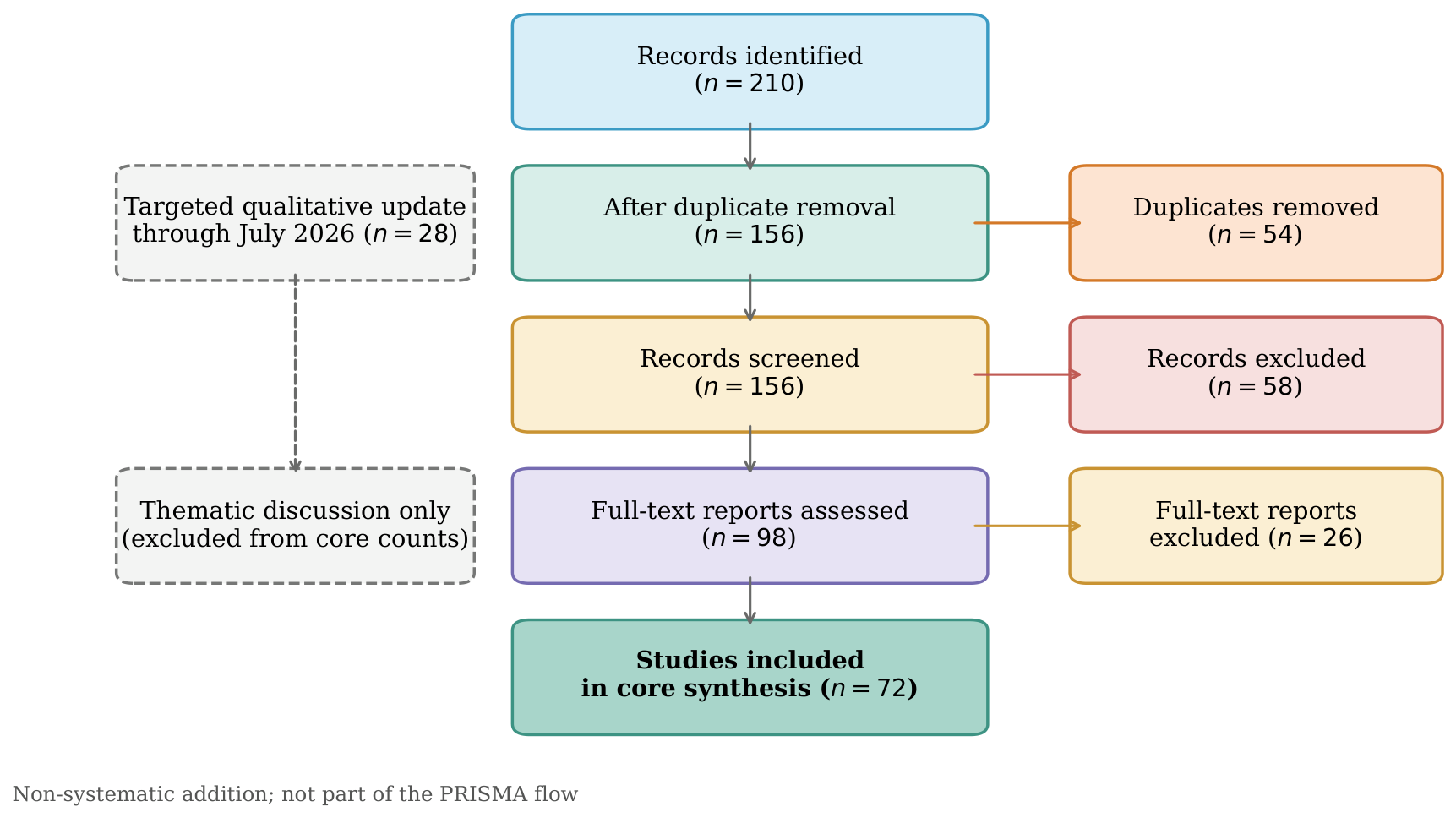
Papers were included if they (1) were peer-reviewed papers or preprints with a complete method and empirical evaluation, (2) addressed VQA in embodied, egocentric, video, or 3D settings, (3) were written in English, and (4) reported an empirical evaluation or introduced a benchmark. We excluded duplicate records, papers under three pages or without empirical content, work limited to static image VQA without an embodied, video, or 3D component, and records outside the review scope. The retained project files do not contain per-database hit counts or the exact execution date of each query; this limits independent reconstruction of the initial search. The retained corpus index and dataset extraction sheet allow the reported publication year and dataset counts to be recomputed, but they do not permit full reconstruction of the original database searches. As shown in
Figure 1, 54 duplicates were removed from 210 records, leaving 156 for screening. Title and abstract screening excluded 58 records, and full-text assessment excluded 26 more (18 for insufficient relevance, 5 for lacking empirical results, and 3 during extraction), yielding a core corpus of
72 papers.
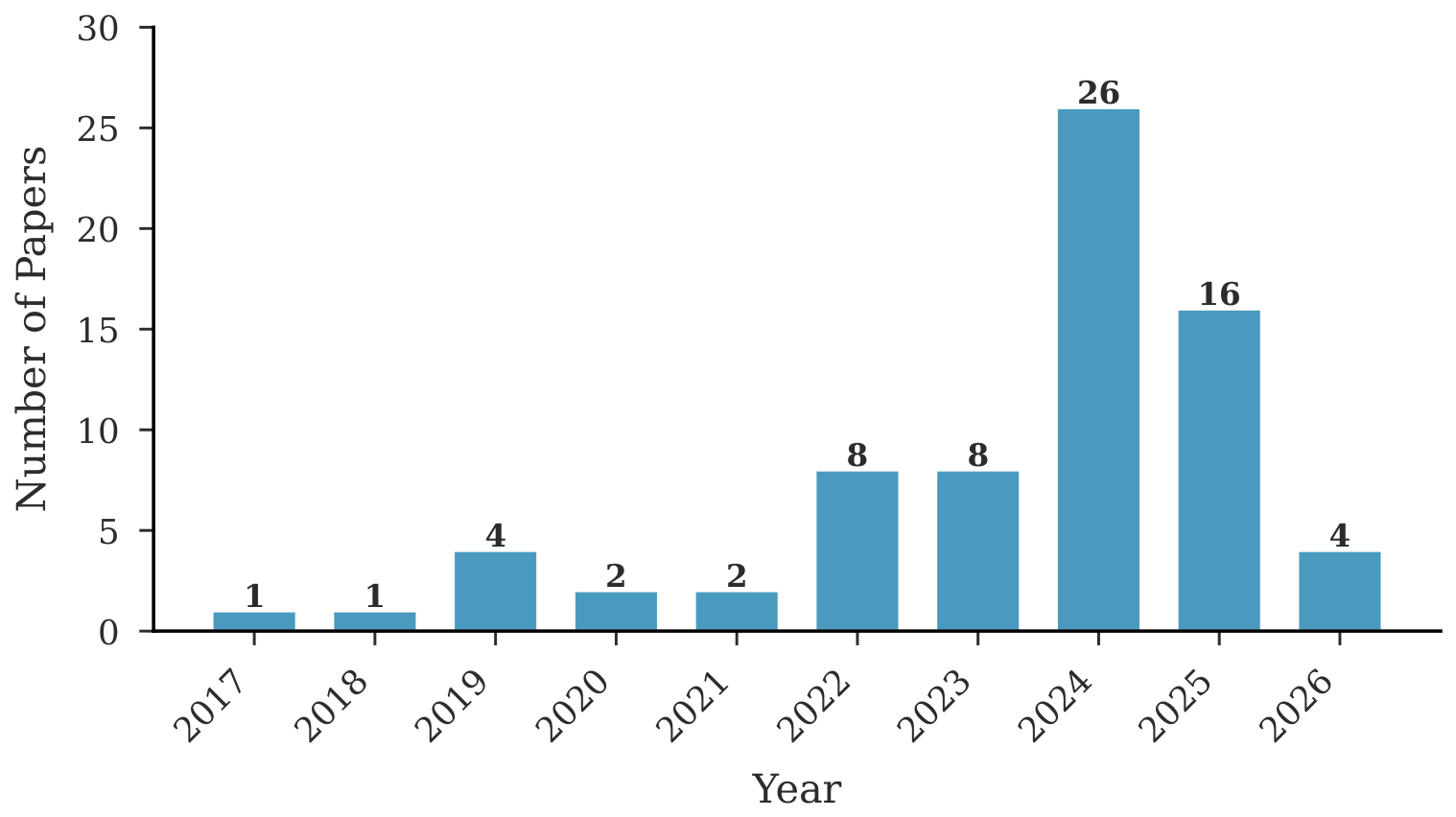
Figure 2 shows its publication-year distribution.
We also conducted a targeted qualitative update through July 2026. The accompanying inventory identifies 28 additional records in this update. This follow-up was not conducted as a second systematic search, and no separate candidate-flow counts were retained. Accordingly, these records are used only in the thematic discussion and are excluded from the PRISMA counts and year histogram. Numerical statements therefore report a local denominator, such as the 20 selected datasets, rather than treating every analysis as if it covered the 72-paper core.
2.2. Data Extraction and Qualitative Coding
For each bibliography record, the extraction sheet records the citation key, title, author, year, venue, persistent identifier, and membership in either the 72-paper core or the qualitative update. A separate dataset sheet records observation mode, navigation, and physical-interaction requirements. Bibliographic metadata and publication status were checked against arXiv, OpenReview, conference proceedings, publisher pages, or DOI records. Submissions and preprints are distinguished from peer-reviewed publications.
PMRA coding uses three values for each function. A value of 2 (primary) indicates that the function is an explicit method contribution or receives a separate experiment or ablation. A value of 1 (secondary) indicates that the function is necessary but reused, fixed, or not evaluated independently. A value of 0 indicates that the function lies outside the evaluated system scope.
Table 1 reports these judgments as symbols for a purposively selected, non-exhaustive set of papers. The 16 entries were retained as a maximum-variation illustration spanning active EQA, episodic memory QA, situated 3D QA, and video QA, while also covering modular, foundation-model, memory-centric, and agent/tool-oriented designs. This was not a random or statistically representative sample, and it was not selected to estimate prevalence. The
Supplementary File TABLE1_PMRA_AUDIT.md preserves the paper-level labels, selection role, source locations, and coding rationales for these 16 entries. Stage assignment follows the architectural definitions in
Section 4, not publication year. Ambiguous cases are resolved from the stated primary contribution. Stage 4 takes precedence only when iterative calls to inspectable tools, APIs, or externally maintained state are central to the method. One author performed the coding, and no independent second coder or inter-rater agreement statistic was available. The retained PMRA labels are therefore single-coder descriptive judgments. In contrast, the original sheet needed to reproduce the former 64-paper and corpus-wide PMRA percentages was not retained; we therefore removed those aggregate percentages, H/M/L ratings, and radar scores.
2.3. Use of Generative AI-Assisted Tools
ChatGPT (GPT-5.6 Sol, model identifier: gpt-5.6-sol; OpenAI, San Francisco, CA, USA; accessed in August 2026) was used for language polishing and to assist in generating the Python 3.12.8 code, executed with Matplotlib 3.10.6, used to produce the figures in this review. The authors executed and inspected the generated code and manually verified all graphical elements, labels, numerical values, relationships, and scientific information presented in the figures. The literature search, reference selection, taxonomy development, scientific interpretation, and conclusions were performed by the authors. All AI-assisted outputs were critically reviewed and edited by the authors, who take full responsibility for the final content.
3. PMRA as an Analytical Framework
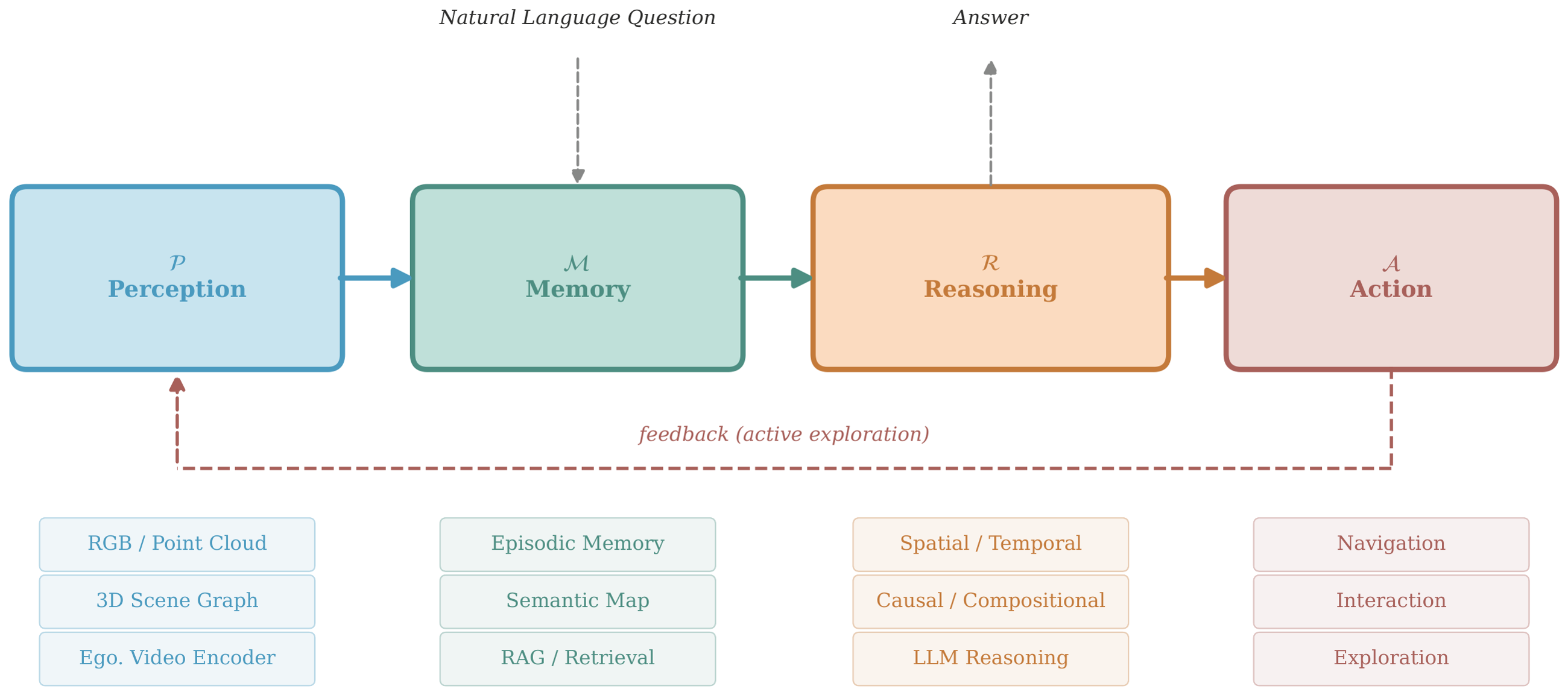
For comparative purposes, embodied QA systems can be described through four recurring functions.
Figure 3 illustrates the author-developed analytical framework and the information flow among modules, including the feedback loop from Action to Perception that distinguishes embodied QA from static VQA.
Relationship to prior architectures. The constituent ideas are longstanding. Classical robotics organized autonomy around sense–plan–act loops, while reactive subsumption architectures challenged a single deliberative pipeline [
27]. Cognitive architectures likewise separated perceptual–motor, goal, and declarative memory functions and studied how they interact [
28,
29]. PMRA therefore does not claim novelty for this decomposition. Its narrower contribution is to adapt these traditions to the evidence-acquisition structure of embodied QA. First, PMRA separates persistent memory from perception and reasoning, because an agent may be queried after observations disappear. Second, it treats answer production and question-conditioned inference within reasoning. Third, it treats action as information acquisition as well as motor execution. The framework is thus a comparison vocabulary, not a computational model or a claim that the four functions are independent. Memory can inform both reasoning (what has been seen) and action (where to explore next), while action changes subsequent perception and memory.
Perception (
) encompasses visual encoding: RGB images [
4], point clouds [
30], 3D scene graphs [
10], and egocentric video encoding [
31,
32].
Memory (
) stores and organizes perceived information: episodic memory [
6,
33], 3D semantic maps [
10], scene-graph memory [
34], and retrieval-augmented systems [
35]. It becomes explicit when an answer depends on observations that are no longer directly available.
Reasoning (
) performs inference: spatial reasoning [
30,
36], temporal/causal reasoning [
37,
38], compositional multi-hop reasoning [
39], and LLM-based reasoning [
7,
40].
Action (
) covers physical actions: navigation [
4,
41], object interaction [
3,
42], and strategic exploration [
12,
43].
Table 1 shows the purposive, non-exhaustive mapping described in
Section 2.1. A primary mark is assigned only when a function is an explicit method contribution or a separately evaluated component. A secondary mark indicates that the function is necessary to the system but is reused, fixed, or not evaluated independently. Empty cells indicate that the function is outside the evaluated scope, not that the deployed system could operate without it. The mapping was produced by one coder from the method and ablation descriptions and is used for qualitative comparison only; paper-level evidence anchors and rationales are supplied in
Supplementary Materials TABLE1_PMRA_AUDIT.md.
Table 1.
Single-coder PMRA mapping of 16 purposively selected papers from the 72-paper core corpus under the author-developed analytical framework (✓ = explicit or separately evaluated contribution; ∘ = necessary but reused, fixed, or not separately evaluated; empty cells indicate that the function is outside the evaluated scope of that paper).
Table 1.
Single-coder PMRA mapping of 16 purposively selected papers from the 72-paper core corpus under the author-developed analytical framework (✓ = explicit or separately evaluated contribution; ∘ = necessary but reused, fixed, or not separately evaluated; empty cells indicate that the function is outside the evaluated scope of that paper).
| Work | | | | | Innovation |
|---|
| IQA [3] | ∘ | ∘ | ∘ | ✓ | Interactive QA |
| EQA-PC [4] | ✓ | | ∘ | ✓ | Point cloud nav. |
| K-EQA [34] | ∘ | ✓ | ✓ | ∘ | Knowledge graph |
| EQA-MX [44] | ✓ | | ✓ | | Multimodal expr. |
| OpenEQA [7] | ∘ | ✓ | ✓ | ∘ | Open-vocab bench. |
| GraphEQA [10] | ✓ | ✓ | ∘ | ✓ | 3D scene graph |
| Mem-EQA [33] | ∘ | ✓ | ∘ | ✓ | Memory-centric |
| R-EQA [35] | ∘ | ✓ | ∘ | | RAG for EQA |
| PaLM-E [13] | ✓ | | ✓ | ✓ | 562B embod. LM |
| RT-2 [14] | ✓ | | ∘ | ✓ | Actions as tokens |
| 3D-LLM [45] | ✓ | | ✓ | | 3D input to LLM |
| ScanQA [30] | ✓ | | ✓ | | 3D spatial QA |
| SQA3D [36] | ✓ | | ✓ | | Situated 3D QA |
| VideoAgent [40] | ∘ | ∘ | ✓ | | LLM agent |
| FAST-EQA [43] | ∘ | ∘ | ∘ | ✓ | Efficient explore |
| CityEQA [8] | ∘ | ∘ | ✓ | ✓ | Urban-scale |
4. Three-Level Taxonomy
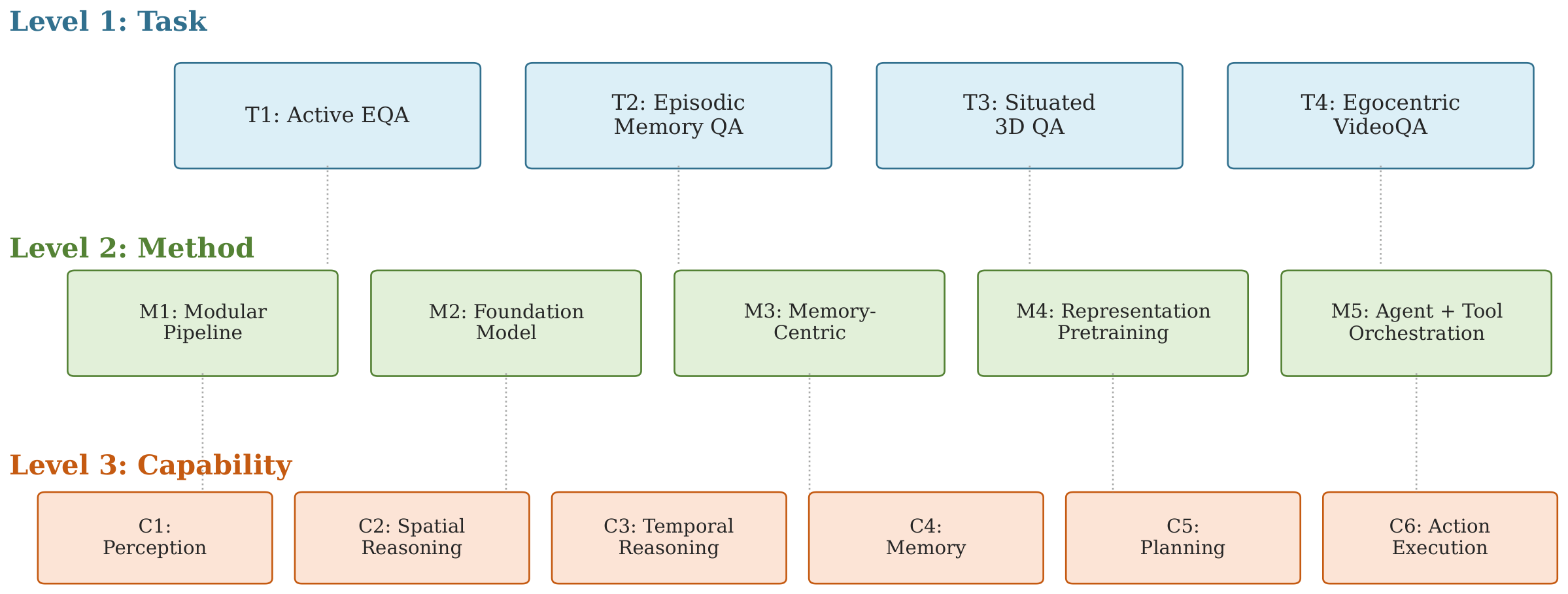
We organize the reviewed literature using an author-developed three-level taxonomy (
Figure 4). This hierarchical structure separates
what problems are addressed (task level),
how they are solved (method level), and
what capabilities are required (capability level). It thereby supports systematic comparison across methods that target different tasks but share architectural or capability requirements.
Level 1: Task formulations. (T1) Active EQA: agent navigates and interacts [
3,
4,
10,
43]; (T2) Episodic memory QA: agent answers from stored history [
6,
7,
35]; (T3) Situated 3D QA: answers based on 3D understanding [
30,
36,
45]; (T4) Egocentric VideoQA: first-person video QA [
38,
46,
47].
Level 2: Method architectures. (M1) Modular pipeline [
3,
4,
48]; (M2) foundation model-based [
13,
14,
45,
49]; (M3) memory-centric [
6,
33,
34,
35]; (M4) representation pretraining [
31,
32,
50,
51]; and (M5) Agent + Tool orchestration [
17,
40]. These Level 2 labels are non-exclusive method tags: for example, a system may be both memory-centric and Agent + Tool. By contrast, the four stages below assign one primary architectural ideal type using explicit precedence rules. This distinction resolves the earlier ambiguity in which Agent + Tool was discussed as a paradigm without a place in the method taxonomy.
Level 3: Capability dimensions. (C1) Perception, (C2) spatial reasoning, (C3) temporal reasoning, (C4) memory, (C5) planning, and (C6) action execution. We use these dimensions as comparison prompts rather than assigning 1–10 scores: no common benchmark supports interval-scale capability ratings across heterogeneous task families, and a numerical radar plot would therefore imply unsupported precision.
Four Architecture-Based Ideal Types
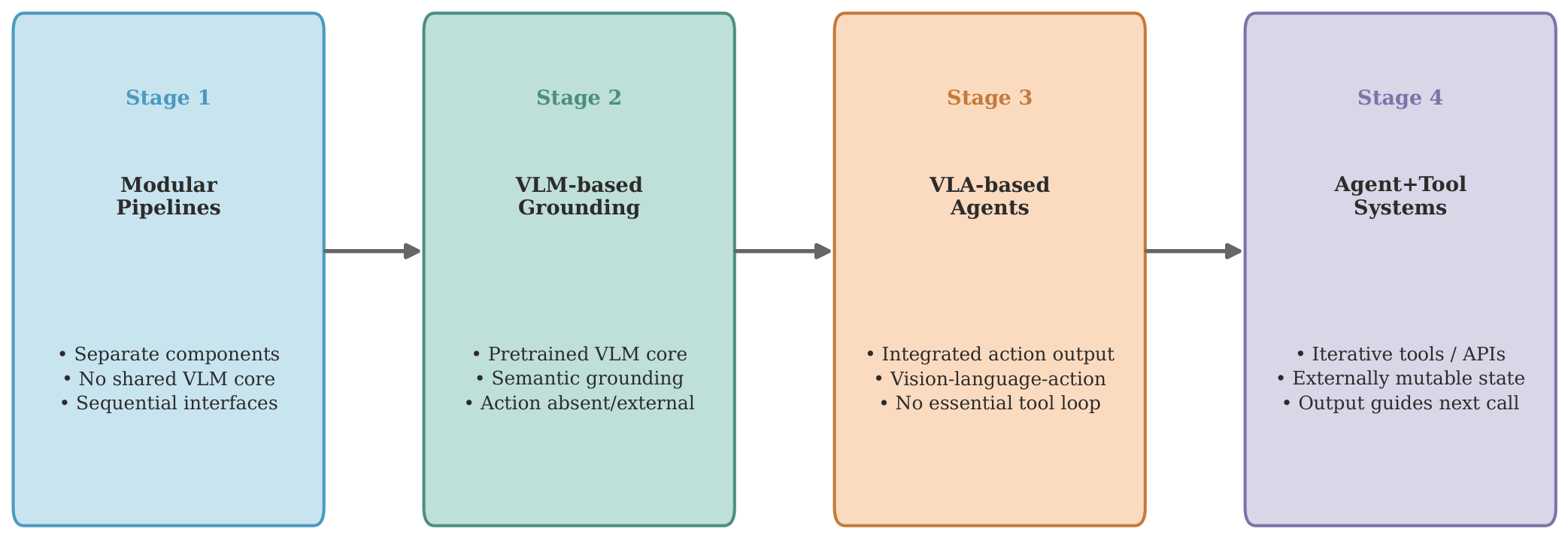
We use four architectural ideal types to compare recurring system designs (
Figure 5). They are not publication periods: assignment depends on a paper’s primary system contribution rather than its year. The numbering does not imply that every system follows this sequence over time, and Stage 4 is not assumed to be universally superior to Stages 1–3. When a system satisfies more than one definition, the following precedence rule is applied only when the higher-level mechanism is central to the contribution: Agent + Tool, VLA agent, VLM grounding, and modular pipeline. Dates appear only in the chronological timeline (
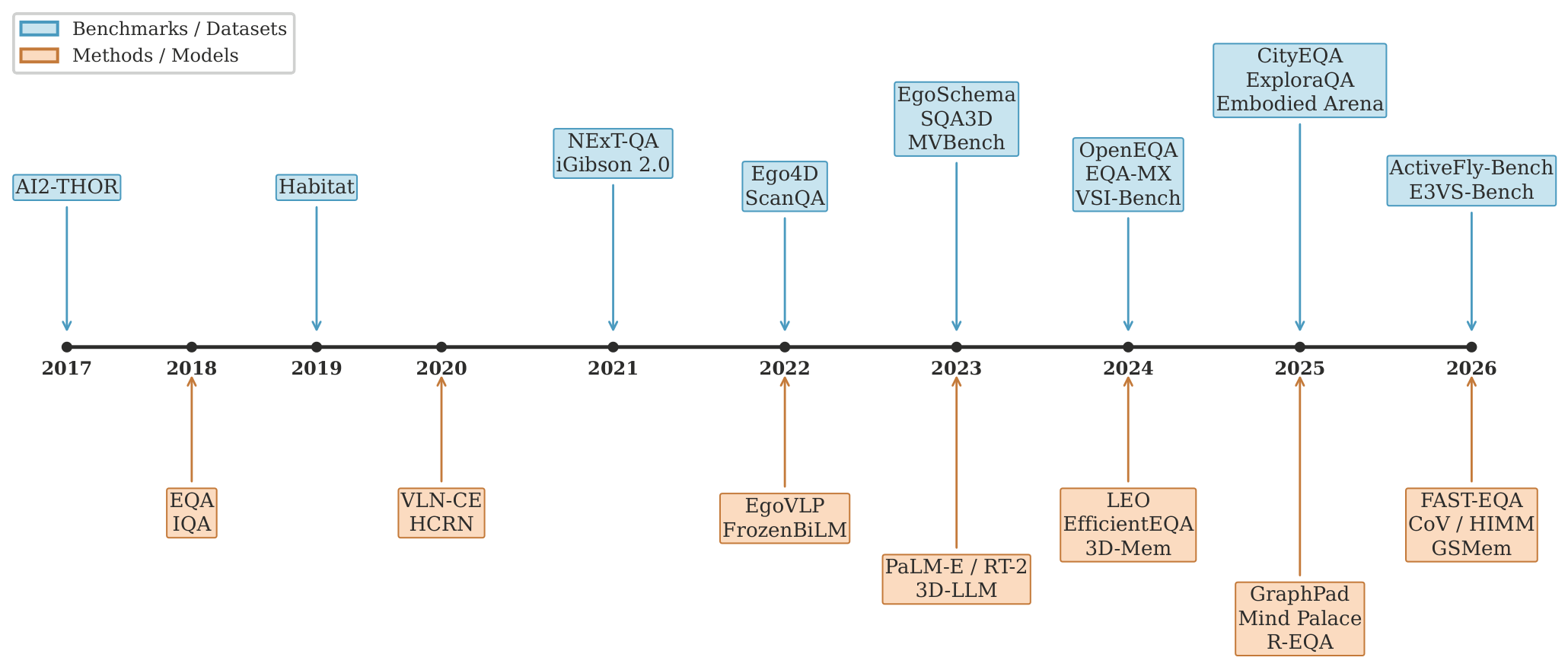
Figure 6).
Stage 1: Modular Pipelines. Assignment requires separately engineered or trained perception, navigation, and answering components without a shared pretrained vision–language model as the central interface [
3,
4,
34]. PMRA functions are loosely coupled. RL and imitation learning often implement
.
Limitation: error propagation between modules.
Stage 2: VLM-based Grounding. Assignment requires a pretrained vision–language model to provide the central semantic representation or reasoning interface, while action is absent or controlled by a separate downstream module [
13,
45,
51]. Video-language pretraining [
31,
50] provides strong egocentric representations.
Limitation: remains weak or external.
Stage 3: VLA-based Agents. Assignment requires action representations or control outputs to be predicted within, or tightly coupled to, the multimodal model; invoking an inspectable external tool set is not the primary contribution [
14,
15,
49]. Multi-agent [
9] and city-scale [
8] settings expand scope.
Limitation: action tokenization, compute cost, and absent safety guarantees.
Several limitations provide an architectural rationale for the systems grouped as Stage 4. Large VLA models can be expensive to deploy; ActionEQA reports weaknesses in mid-level action understanding and in grounding compositional language in 3D geometry [
52]; and end-to-end models often expose limited intermediate state for inspection. Stage 4 systems address these concerns by introducing explicit tools, APIs, or external states that can be queried and updated during inference.
Stage 4: Agent + Tool Systems. Assignment requires a controller to make iterative calls to inspectable tools or APIs, or to read and modify an externally maintained state whose output affects subsequent decisions. The external interface, rather than the mere presence of a memory representation, must be central to the contribution. GraphPad [
17], for example, exposes mutable scene memory through language-callable functions. VideoAgent [
40] uses iterative tool calls for long-form video QA, while systems such as EfficientEQA [
20] and Explore-until-Confident [
21] use explicit decision interfaces for exploration and stopping. Persistent-memory methods such as 3D-Mem [
23], GSMem [
24], and HIMM [
18] are tagged M3 unless an iterative external interface is also a defining contribution. A 2025 paper therefore belongs to Stage 3 when integrated VLA prediction defines the method, and to Stage 4 only when tool orchestration or an externally inspectable state is central.
Architectural interpretation: Stage 1 uses sequential interfaces; Stage 2 more tightly couples and ; Stage 3 integrates action prediction; and Stage 4 exposes tools, APIs, or external states for iterative control. This is a descriptive ordering, not temporal or performance ranking.
The method categories expose trade-offs that should be measured on matched tasks rather than compressed into H/M/L ratings. Modular systems provide inspectable intermediate states but can propagate errors. Foundation-model systems can transfer across tasks but may require substantial data and compute. Memory-centric systems target long-horizon retention while introducing storage and retrieval decisions, and Agent + Tool systems add inspection points together with orchestration overhead. Because the surveyed papers use different datasets and metrics, we do not rank these properties on a common ordinal scale.
5. Research Landscape
This section is organized by technical subfield and problem setting rather than by repeating the three taxonomy levels in sequence. Foundational and agent-based EQA primarily illustrate Level 1 active EQA (T1); the egocentric and long-form discussion covers episodic memory QA (T2) and egocentric VideoQA (T4); and the 3D sections cover situated 3D QA (T3). Within each subsection, the Level 2 method tags and Level 3 capability prompts are used to compare architectures and requirements. Because several systems span more than one task or method tag, this mapping is a reading guide rather than a partition of the literature.
Figure 6 places selected benchmarks and methods in chronological order. The displayed milestones cluster around 2022–2023, where the selected examples include large egocentric datasets and vision–language models, and around 2025–2026, where they include agent-based systems and exploration-oriented benchmarks. Because the figure is selective, it illustrates these developments rather than estimating their prevalence or growth rate.
5.1. Foundational EQA (2017–2021)
The EQA paradigm established a common pipeline: vision → navigation → answering. Wijmans and others [
4] extended EQA to photorealistic Matterport3D with point-cloud perception and reported that simple baselines (forward-only and random navigation) were competitive, thereby exposing limitations in the evaluation design.
Subsequent work extended this paradigm in several directions. Gordon et al. [
3] introduced Interactive QA (IQA), extending
beyond navigation by requiring object interaction through factorized controllers at multiple temporal abstraction levels on AI2-THOR [
53]. VideoNavQA [
5] decoupled navigation from QA by providing near-ideal trajectories, thereby isolating reasoning errors from navigation errors. Tan et al. [
34] introduced Knowledge-based EQA, combining external knowledge graphs with 3D scene graphs for questions that require information beyond object recognition.
Simulation platforms offer different capabilities: AI2-THOR (2017) [
53] supports interactive objects, Habitat (2019) [
54] emphasizes high-throughput simulation at thousands of frames per second, and iGibson 2.0 (2021) [
42] provides object states and a VR interface. These examples illustrate differences in visual fidelity, interaction richness, and semantic grounding without establishing a single progression across all platforms.
Summary. Early EQA methods established the modular pipeline and exposed the sensitivity of end-to-end results to navigation and evaluation design. Competitive simple-navigation baselines and diagnostic trajectories motivate separate evaluation of information acquisition and answer generation; they do not establish that action is universally more important than reasoning.
PMRA perspective: The reviewed Stage 1 examples implement PMRA functions as separate components with limited cross-module feedback. Perception relies on CNN features, memory is represented as a transient navigation state rather than a persistent store, and reasoning operates on representations supplied by preceding modules. The competitive performance of simple navigation baselines [
4] motivates separate measurement of information acquisition and reasoning. The next section examines egocentric and long-form QA systems in which retention and retrieval are explicit design elements.
5.2. Egocentric and Long-Form Grounded QA
5.2.1. Dataset-Driven Evolution
Ego4D [
55] introduced a large-scale egocentric dataset (3670 h, 931 wearers, 74 locations). EgoTaskQA [
46] targeted task understanding with descriptive, predictive, explanatory, and counterfactual questions, while EgoTextVQA [
47] addressed scene text in egocentric videos. EgoQuestions, an ICLR 2026 OpenReview submission that was not peer reviewed at the review cutoff [
56], argued that existing benchmarks include questions that do not reliably probe egocentric reasoning. Several 2026 benchmarks extend this evaluation agenda: SuperMemory-VQA [
57] targets longitudinal memory for wearable assistants, EgoSAT [
58] tests online understanding of streaming interactions, and EgoProceVQA [
59] focuses on key-step procedural reasoning rather than generic event recognition.
5.2.2. Temporal and Multi-Hop Reasoning
EgoSchema [
38] introduced “temporal certificate sets,” finding its clips require 5.7× longer temporal reasoning than nearest competitors, with even billion-parameter models achieving <33% vs. 76% human accuracy. Building on this challenge, Grounded QA [
60] integrated temporal grounding and answering in a unified model. Multi-Hop VideoQA [
39] extended this approach to multiple evidence intervals through the GeLM architecture. MoReVQA [
48] decomposed VideoQA into training-free event parsing, grounding, and reasoning stages, while DMC
3 [
61] addressed spurious correlations through counterfactual contrastive learning.
5.2.3. Memory-Centric Approaches
Memory is particularly relevant to egocentric QA because a model must retain and retrieve information from extended visual experience. In prerecorded or streaming video, the model cannot choose to revisit an earlier observation and must instead rely on retained information. This creates a trade-off between coverage and storage or retrieval cost: retaining every frame may be impractical, whereas aggressive compression can discard evidence needed by a later question. The following studies address this trade-off through different architectures.
EMQA [
6] requires models to maintain
constant-sized representations of video input, addressing storage constraints in wearable settings. Its QAEGO4D dataset contains long-form videos for episodic memory evaluation.
R-EQA [
35] applied Retrieval-Augmented Generation to EQA and reported a 10% improvement from selective, question-relevant retrieval over episodic memory. This result supports evaluating retrieval quality in addition to the amount of visual input processed. Recent systems explore related designs: VL-MemKnG [
19] combines visual–language memory with a spatio-temporal knowledge graph, Graph-it-first [
62] converts long egocentric streams into scene graphs before reasoning, and Imprint [
63] treats memory formation as online interaction-centric compression.
Memory-Centric EQA [
33] proposed structured entity memory to avoid redundant exploration. Its key insight is that
should directly inform
: the agent’s memory of previously observed entities determines where
not to explore, preventing wasteful revisits. HIMM [
18] further disentangles episodic recall from reusable semantic rules, while HUMEMBR [
64] extends long-term memory toward learning human routines for predictive navigation. Sequential-EQA analysis [
25] in turn shows that success under independently reset episodes can conceal architectural bottlenecks that emerge when memory must persist across a sequence of questions.
HCQA [
65] reported 75% on EgoSchema using a three-stage hierarchical comprehension scheme (fine-grained captioning → summarization → inference-guided answering). This result provides paper-specific evidence for hierarchical processing in long-form reasoning.
Comparative insight: These approaches implement different memory trade-offs. EMQA uses fixed-size compression, whereas R-EQA retrieves selected items from a larger episodic store. GraphPad [
17] exposes structured memory through update and query functions, while 3D-Mem [
23] incrementally constructs and retrieves visual scene snapshots. The reviewed studies do not provide a matched comparison that would establish one design as uniformly preferable.
5.2.4. First-Person Reasoning Evaluation
EgoThink [
66] evaluated first-person “thinking” across six core dimensions and twelve sub-dimensions, while VidEgoThink [
67] extended this evaluation to video through four interrelated tasks: video QA, hierarchy planning, visual grounding, and reward modeling. Both studies reported poor performance for all the VLMs, including GPT-4V, that they evaluated on their egocentric reasoning tasks.
These results suggest that limitations observed in first-person evaluations may also affect embodied systems that use the same VLMs. Egocentric-specific pretraining [
31,
32] and architectural adaptation are therefore relevant alternatives to exclusive reliance on general-purpose VLMs.
Summary of Section 5.2. Egocentric QA includes dataset development (Ego4D), temporal-reasoning benchmarks (EgoSchema), memory-centric methods (R-EQA and Memory-EQA), and diagnostic evaluation (EgoThink). Across these examples, temporal reasoning and memory efficiency recur as evaluation targets associated with
and
.
PMRA perspective: Long-duration egocentric video requires compressed or selective retention, while perception must handle first-person motion and occlusion. Action is outside the model’s control in passive video settings because the camera wearer’s movement is prerecorded. These task properties explain why the reviewed egocentric methods often emphasize and ; active egocentric settings additionally require .
5.3. 3D Scene Understanding for QA
ScanQA [
30] proposed 3D-QA on RGB-D scans (41 K+ pairs, 800 scenes), and SQA3D [
36] extended this to situated QA where agent position and orientation are critical. On the modeling side, 3D-LLM [
45] injected 3D understanding into LLMs via point cloud features (300 K+ samples), while LEO [
49] unified all PMRA modules through 3D vision–language–action instruction tuning. GraphEQA [
10] further demonstrated
real-world deployment using real-time 3D scene graphs for hierarchical planning.
Several recent 3D models address representation details relevant to downstream action quality. Occ-VLM [
68] grounds language in occupancy while retaining a unified 2D visual encoder, and PAR3D [
69] introduces part-aware representations for interaction-relevant geometry. Embodied3DBench [
70] reports that the VLMs it evaluates are substantially weaker on affordances, grasp points, and trajectories than on high-level object relations.
Observability distinction: ScanQA and SQA3D provide preconstructed scene observations, whereas GraphEQA and LEO include partially observable settings in which the agent may need to acquire additional evidence. Results across these settings are not directly comparable.
Summary. The reviewed 3D scene-QA work spans scan-based tasks (ScanQA and SQA3D) and partially observable agent settings (GraphEQA and LEO). Explicit 3D representations provide geometric information but can add data collection and computational costs. The balance between 3D detail and scalable visual processing remains an open question; a survey of 3D SQA [
71] provides a more detailed treatment of this subfield.
PMRA perspective: 3D QA methods address through point-cloud encoding or scene-graph construction and through spatial and relational inference. Partial observability adds action selection because the agent must decide where to gather evidence, and it adds memory updates as observations arrive. These requirements are absent when the complete scan is provided as input.
5.4. Advanced 3D Spatial Reasoning
Recent work extends 3D spatial understanding from object-level QA to geometric and relational reasoning. Whereas the preceding subsection included methods operating on preconstructed 3D representations, the approaches reviewed here construct, maintain, or query spatial memory incrementally for partially observable environments.
3D-Mem [
23] represents explored regions with multi-view memory snapshots and unexplored regions with frontier snapshots. It supports frontier-based exploration, incremental construction, and memory retrieval. Its image-based snapshots retain visual context that may be lost in object-centric scene graphs. However, the reviewed paper does not provide a matched comparison establishing that this representation is uniformly denser or more efficient than GraphEQA’s metric-semantic scene graphs [
10].
A related representation is used by GSMem [
24], which employs 3D Gaussian Splatting as persistent memory and can render previously unseen viewpoints for post hoc spatial recollection. CoV [
72] and ViewMind3D [
73] perform training-free view-aware inference, whereas XVR [
74] and DR-MV3D [
75] explicitly train cross-view relations or provide dense map- and view-level rewards. E3VS-Bench [
76] examines another aspect of this problem by requiring five-degree-of-freedom viewpoint control to reveal evidence that is invisible from standard camera poses.
Thinking in Space [
77] investigates visual-spatial reasoning from video observations through VSI-Bench (5000+ QA pairs). Its results identify substantial errors in spatial reasoning by the evaluated MLLMs. This paper-specific finding motivates further evaluation of spatial grounding in embodied QA.
Representation comparison: ScanQA uses scan-level input, SQA3D adds an explicit situated viewpoint, 3D-Mem constructs visual scene snapshots, and Thinking in Space evaluates implicit spatial representations derived from video. These systems illustrate different representation choices rather than a single performance ordering.
5.5. Agent-Based and Tool-Augmented EQA
Recent embodied-QA systems use explicit tool interfaces, structured memory APIs, and compositional planning. We classify a system as Stage 4 only when iterative interaction with an inspectable tool, API, or external state is central to its contribution.
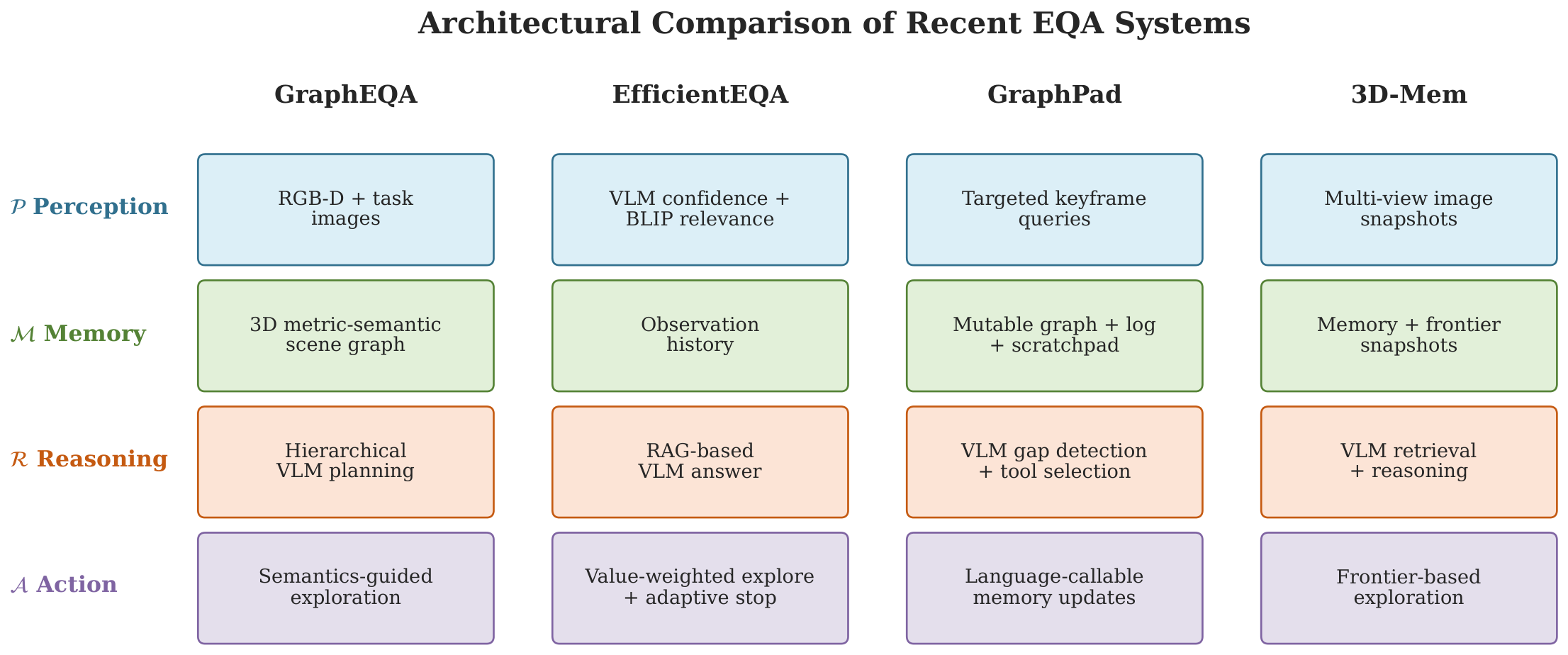
Figure 7 compares four representative systems across the PMRA functions; the figure is descriptive and does not assign capability scores.
GraphPad [
17] introduces a
modifiable structured memory that agents can tailor through API calls during inference. It comprises a mutable scene graph, a navigation log, and a scratchpad. Unlike static representations built in advance, GraphPad enables the agent to add, modify, and query scene graph entries as task requirements evolve. This directly addresses the limitation that pre-built scene graphs may miss objects or relationships relevant to new questions.
EfficientEQA [
20] combines semantic-value-weighted frontier exploration, open-vocabulary answer generation, and an adaptive stopping mechanism. The paper reports more than 15% higher answer accuracy and more than 20% fewer exploration steps than its evaluated baselines. These results are specific to the reported experimental setting and do not establish a general ranking over agent architectures.
Explore-until-Confident [
21] uses calibrated VLM confidence to decide when the agent has gathered sufficient evidence. Miscalibration can cause premature stopping or unnecessary exploration, making the result dependent on confidence quality.
Mind Palace [
78] studies
Long-term Active EQA (LA-EQA), in which robots operate over days or weeks and answer temporally grounded questions from past experience and current observations. The setting extends memory evaluation beyond independently reset episodes.
The same architecture pattern is now being adapted to harder deployment regimes. DIVRR [
79] couples selective memory admission with view refinement in dynamic, human-populated scenes; Remember with Confidence [
22] attaches probabilistic reliability estimates to spatio-temporal memory; and Semantic Flip [
80] trains agents to refuse questions unsupported by their visual memory. CommCP [
81] calibrates natural language messages in cooperative multi-agent EQA, while ScoutVLA [
82] and ActiveFly-Bench [
83] connect high-level question answering to viewpoint planning and low-level UAV control.
Comparative analysis. Table 2 summarizes the mechanisms and reported limitations of these systems. GraphPad provides modifiable memory through API calls; EfficientEQA emphasizes selective exploration; Explore-until-Confident depends on calibrated stopping; and Mind Palace studies memory over longer operating periods. Because these systems use different settings and metrics, the table does not rank their performance.
Summary. Agent-based EQA makes evidence acquisition and state management explicit parts of the answering process. The reviewed systems expose memory updates, exploration, stopping, or tool selection as inspectable mechanisms.
PMRA perspective: In the Stage 4 ideal type, externally maintained state can inform reasoning and subsequent tool or exploration actions. Action may therefore depend on both what the system has retained and what evidence the current question requires. The defining criterion is the iterative, inspectable interface, not a claim that memory universally drives action or determines performance.
5.6. Foundation Model-Based EQA
Foundation models allow several PMRA functions to be implemented within a shared multimodal model rather than a sequence of separately trained components. This integration also introduces trade-offs in computation, grounding, memory access, and inspection.
5.6.1. Embodied Multimodal LMs
PaLM-E [
13] integrated vision, language, and control in a single model (up to 562 B parameters) by incorporating continuous sensor data as input tokens alongside text. In the reported experiments, training on diverse embodied tasks produced
positive transfer across the evaluated tasks, including standard vision–language benchmarks. An open question is whether this result reflects multimodal fusion or a late-fusion design in which scale compensates for architectural simplicity. Ablations reported in that study indicate consistent gains from increased scale, although the transfer mechanisms remain unclear.
RT-2 [
14] expresses robotic actions as text tokens and is co-fine-tuned on robotic trajectories and web-scale vision–language data. The reported evaluations include generalization to novel objects and semantic instructions. Action tokenization nevertheless raises an open question about how well discrete outputs represent continuous, physics-constrained manipulation.
3D-LLM [
45] and LEO [
49] process 3D features rather than relying only on rendered 2D images. 3D-LLM aligns 3D features with language-model representations using more than 300 K training samples, while LEO uses 3D vision–language–action instruction tuning. Their results are reported on different tasks from PaLM-E, so they support a comparison of input representations rather than a general claim of superior spatial reasoning.
5.6.2. VLA Models: Critical Assessment
The VLA survey [
15] provides a comprehensive taxonomy organized into three lines: component design, low-level action prediction, and high-level task planning. Two broader surveys [
84,
85] and the world models survey [
86] offer complementary perspectives. VQA surveys [
1,
2] and the VideoQA survey [
87] provide broader context on the foundations underlying embodied QA.
Across the reviewed studies, four limitations recur in foundation-model-based systems. We organize them using PMRA, while recognizing that the supporting evidence comes from different models and benchmarks. The categories are therefore diagnostic themes rather than estimates of prevalence or proof that every foundation model exhibits each limitation.
(F1) Data and benchmark bias. Training and evaluation data cover environments and object distributions unevenly. CityEQA [
8] broadens evaluation to urban-scale scenarios, while EgoQuestions [
56] argues that some nominally egocentric questions do not require recorder-centric reasoning. Together, these studies show that dataset composition and question construction can affect what a benchmark measures. The reviewed EQA papers provide limited systematic analysis of mitigation strategies.
(F2) Errors in physical reasoning. ActionEQA and VidEgoThink report physically inconsistent answers and weaknesses in mid-level action understanding [
52,
67]. ActionEQA further distinguishes retrospective action recognition from prediction of future outcomes. World-model research [
86] motivates learned forward simulation, while explicit 3D representations such as 3D-Mem [
23] provide geometric context. The reviewed evidence does not yet establish how much either approach reduces manipulation-level errors under matched conditions.
(F3) Retention under embodied fine-tuning. PaLM-E reports positive transfer when trained across embodied and general vision–language tasks [
13], making retention of prior capabilities an explicit evaluation concern. Parameter-efficient methods such as adapters or LoRA are possible design choices, but the reviewed EQA corpus does not provide a systematic comparison of their effect on forgetting. The evidence is therefore insufficient to attribute retention to model scale alone.
(F4) Evaluation–deployment mismatch. Static image sequences do not reproduce live sensing; curated questions omit some forms of real-world noise [
88]; and answer-only metrics omit exploration cost [
12]. DarkQA [
11] reports degradation under controlled low-light and sensor-noise conditions. EXPRESS-Bench [
12] jointly scores answer quality and exploration efficiency, while DarkQA and NoisyEQA [
88] use controlled perturbations. No single reviewed protocol combines all of these deployment factors.
The reviewed evaluations show continuing weaknesses in active perception and physical interaction. These tasks require a model to decide what evidence to acquire, where to move, or how to interact rather than reasoning only over a provided visual input. Agent-based approaches in
Section 5.5 make some of these decisions explicit, but the available studies do not establish a single dominant bottleneck for the field.
PMRA perspective: Foundation models often implement perception and reasoning within a shared representation, while memory and action interfaces may remain implicit or difficult to inspect. The four themes above can be described in PMRA terms. F1 concerns perceptual data bias; F2 concerns the connection between reasoning and physical action; F3 concerns retention under task-specific fine-tuning; and F4 concerns the evaluation of embodied action and deployment conditions. This mapping is interpretive rather than causal.
5.7. Modern Benchmarks and Emerging Frontiers
OpenEQA [
7] provides a modern benchmark with more than 1600 questions, more than 180 real environments, and LLM-based evaluation. NoisyEQA [
88] and DarkQA [
11] test robustness under noisy and low-light conditions; CityEQA [
8] extends evaluation to urban settings; and EQA-MX [
44] introduces multimodal expression at scale (more than 8 M samples). EXPRESS-Bench [
12] combines answer quality with exploration efficiency, ActionEQA [
52] probes the semantic-to-physical action gap, and FAST-EQA [
43] addresses computational efficiency. EQA-Decision [
89] broadens the target from perception to action-level decisions, ERQA-Plus [
90] diagnoses controlled reasoning dependencies, and IndustryAssetEQA [
91] demonstrates neurosymbolic, provenance-aware QA for industrial maintenance. MA-EgoQA [
9], CommCP [
81], and Habitat 3.0 [
92] contribute to multi-agent research, while Embodied Arena [
93] aggregates multiple benchmarks and models.
ExploraQA [
26] contains 12,436 open-ended questions across seven categories and evaluates
long-horizon proactive exploration. Whereas OpenEQA can be used with stored episodic observations, ExploraQA requires multi-step exploration and provides viewpoint annotations. We treat it as an OpenReview submission included in the 72-paper core corpus rather than as peer-reviewed evidence.
5.8. VideoQA Foundations
Early VideoQA methods used heterogeneous memory [
94] and hierarchical relation networks [
95]. Later work included automated data generation in HowToVQA69M (69 M triplets) [
96], causal reasoning in NExT-QA [
37], and efficient zero-shot VideoQA with frozen bidirectional LMs in FrozenBiLM [
51]. The reviewed literature also includes egocentric pretraining through EgoVLP [
31], EgoVLPv2 [
32], and LaViLa [
50], as well as large-scale video understanding through Video-ChatGPT [
97], Video-LLaVA [
98], MVBench [
99], VideoAgent [
40], and InternVL [
100]. VLN-CE [
41] connects VideoQA with continuous-environment navigation.
Summary. VideoQA work includes attention-based architectures (HetMem [
94], HCRN [
95]), automated data generation (HowToVQA69M [
96]), and foundation-model systems (Video-ChatGPT [
97], VideoAgent [
40]). Long-form temporal reasoning and evidence selection remain recurring evaluation targets, but results across these model families are not directly comparable.
PMRA perspective: VideoQA primarily operates on the - axis: extracts frame-level or clip-level features, and performs temporal reasoning over them. becomes relevant only for long-form videos (e.g., EgoSchema’s 3-minute clips), where selective retention is necessary. is entirely absent, as the video is pre-recorded. This makes VideoQA a useful testbed for the + components of embodied QA, but its conclusions do not directly transfer to active settings where and real-time are essential.
Table 3 compares representative methods using the five non-exclusive method tags defined in Level 2 of the taxonomy. The table records each paper’s reported strength and limitation but does not rank categories across heterogeneous benchmarks. A method may therefore receive more than one tag; for example, a system can be both memory-centric (M3) and Agent + Tool (M5).
6. Methodology Analysis
6.1. Experimental Design
The literature uses four recurring experimental designs: benchmark evaluation on fixed observations, simulation-based embodied evaluation, physical or recorded real-world evaluation, and automatically generated data or questions. Simulation is used in several reviewed interactive-EQA studies, whereas the reviewed examples include few physical robot validations. Because the original extraction files did not retain a paper-level audit trail for the previously reported aggregate counts, we do not report corpus-wide percentages for these design categories. This prevents the descriptive synthesis from implying a precision that cannot be independently reconstructed.
6.2. Dataset Taxonomy
Table 4 classifies selected datasets by domain, scale, data source, observation mode, answer format, navigation, and physical interaction. Most rows describe passive QA, including many egocentric and 3D datasets, whereas only one requires physical object interaction. The table therefore covers active evidence acquisition and manipulation unevenly; it is not intended as an exhaustive inventory of all embodied-AI datasets.
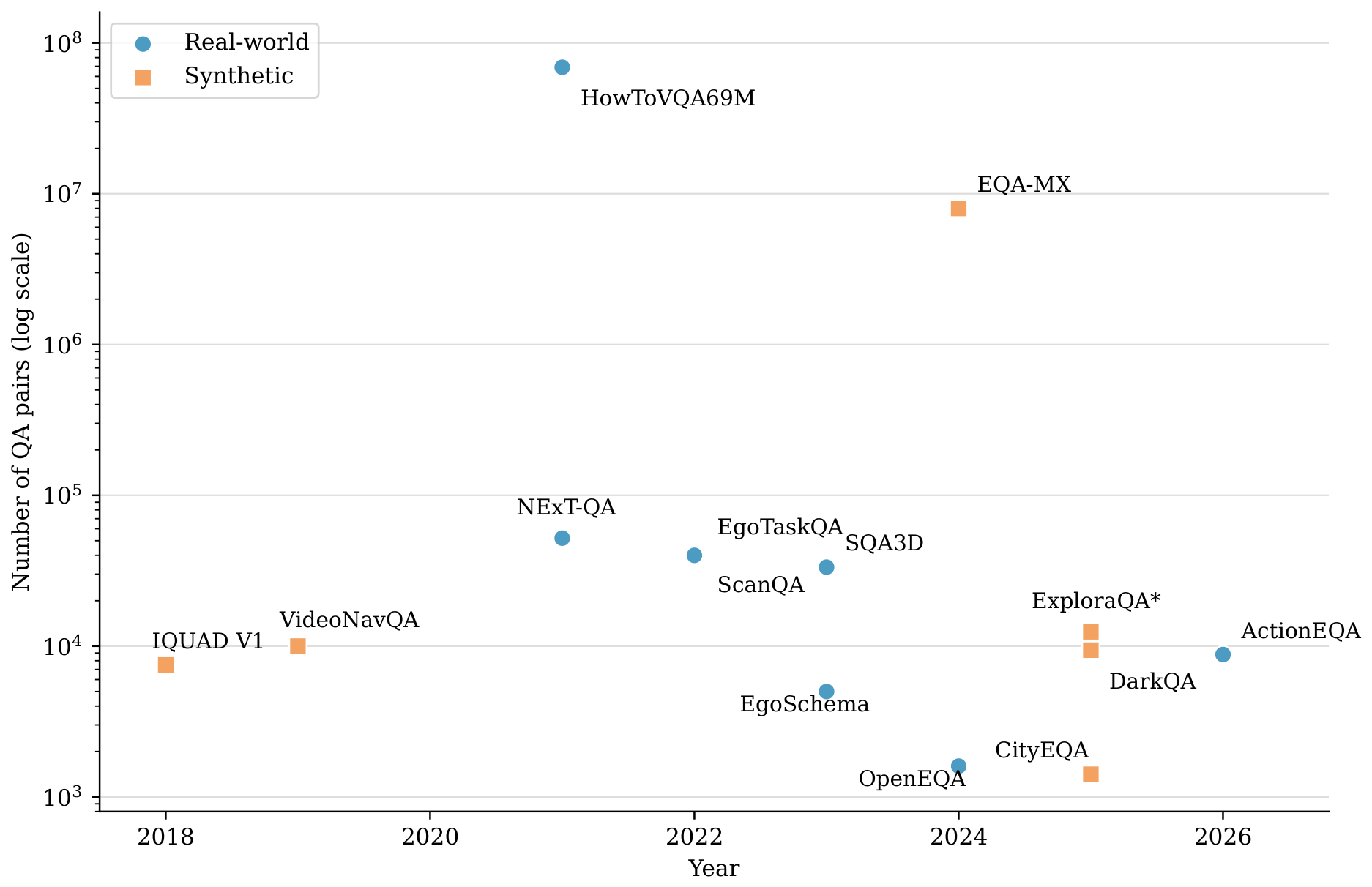
The selected datasets vary widely in reported scale (
Figure 8). The denominator in this analysis is the 20 rows in
Table 4: four are coded active and one both, so five of 20 (25%) permit or require active exploration. Only IQUAD V1 is coded as requiring physical object interaction (one of 20; 5%). These counts describe the selected dataset table, not the full 72-paper corpus. The resulting coverage limits evaluation of the active perception and manipulation capabilities central to embodied QA.
6.3. Evaluation: A Critical Assessment
Accuracy-based evaluation is straightforward for multiple-choice questions but constrains the answer space.
Text-generation metrics such as ROUGE, BLEU, and METEOR are convenient but can miss semantic equivalence.
LLM-based evaluation, as used by OpenEQA [
7], can correlate with human judgments but introduces judge bias, prompt sensitivity, version drift, and closed-source dependencies.
Embodied-specific evaluation adds success rate, path efficiency, exploration coverage, or stopping quality; EXPRESS-Bench [
12], for example, combines answer and exploration quality. We avoid corpus percentages here because the underlying per-paper metric coding was not retained.
A survey of the “LLM-as-a-Judge” paradigm [
102] catalogs position bias, verbosity preference, and self-enhancement bias. Human evaluation remains relevant for questions involving first-person plausibility, such as whether an object was within reach, although it introduces its own cost and reproducibility constraints. A hybrid protocol could use LLM-based metrics for initial screening and targeted human evaluation for questions requiring experiential judgment. Reproducibility would also benefit from reporting model versions, prompts, and calibration data.
7. Empirical Analysis and Inference
Beyond cataloging existing work, we use PMRA for a qualitative synthesis of recurring architectural changes. This section deliberately separates observations supported by individual papers from corpus frequency claims.
7.1. PMRA Contribution Analysis
The purposive mapping in
Table 1 supports a limited architectural contrast. Some modular and passive-video systems treat memory as a transient hidden state and action as navigation supplied by a separate policy. Other systems make persistent memory or question-conditioned exploration an explicit method component. This is a descriptive ordering, not a temporal or performance ranking. It also does not quantify how many papers make each contribution. We removed the earlier phase percentages and stacked-area plot because their corpus-wide paper-level coding provenance could not be reconstructed from the retained files.
7.2. Key Inferences
Observation 1: Information-acquisition strategies can improve the efficiency–accuracy trade-off.
EfficientEQA [
20] reports fewer exploration steps while maintaining answer accuracy, and Explore-until-Confident [
21] studies calibrated stopping. Earlier work also found that simple navigation baselines could be competitive [
4]. Together these results motivate closer evaluation of
where to look, but they do not establish that action is universally more important than reasoning or that it is the field’s single dominant bottleneck.
Observation 2: Several recent EQA systems expose structured memory as an explicit design element.
The contrast among fixed-size compressed memory (EMQA [
6]), retrieval-augmented memory (R-EQA [
35]), API-based mutable memory (GraphPad [
17]), persistent 3D memory (3D-Mem [
23]), and long-term episodic memory (Mind Palace [
78]) illustrates alternative degrees and forms of interface explicitness. This is a descriptive ordering, not a temporal or performance ranking. These examples do not prove that reasoning has plateaued or that memory is the primary source of performance. They instead identify testable design questions: which representation should be retained, when should it be updated, and how should uncertainty propagate into action selection? This pattern has a suggestive—but presently conceptual—parallel in cognitive science:
Kahneman’s dual-process theory [
103] distinguishes between fast, memory-driven responses (System 1) and slow, deliberate reasoning (System 2). API-queryable memory in Agent + Tool systems may support cached or habitual responses, while deliberate planning handles novel cases. SwiftSage [
104] demonstrated a dual-process architecture for text-based tasks; whether the analogy transfers to embodied QA remains an open hypothesis rather than an established explanation.
8. Research Hotspots and Frontiers
8.1. Selected Research Themes
Foundation models for embodied AI appear in several reviewed systems. The selected examples integrate LLMs, VLMs, or VLAs in different roles [
13,
14,
15]; this qualitative evidence does not establish their prevalence or rate of adoption across the field.
Egocentric understanding has expanded around the Ego4D ecosystem [
55] and AR/VR motivations. However, the non-peer-reviewed EgoQuestions submission [
56] argues that many “egocentric” benchmarks do not necessarily test recorder-centric reasoning; we treat this as a recent methodological proposal, not settled evidence.
3D scene understanding includes scan-based QA (ScanQA), situated QA (SQA3D), and scene memory approaches such as 3D-Mem. These examples differ in observability and representation and are discussed qualitatively rather than as a corpus percentage.
Agent-based and tool-augmented EQA appears across the 72-paper core corpus and the separate 28-record qualitative update. GraphPad [
17], EfficientEQA [
20], Mind Palace [
78], HIMM [
18], and HGR [
105] introduce explicit memory, exploration, or correction mechanisms. Because the qualitative update is non-systematic, we do not estimate the prevalence or growth rate of this theme.
8.2. Cross-Paradigm Analysis
The five non-exclusive method categories raise several trade-offs, but the evidence comes from different benchmarks and should not be read as a controlled category-level comparison:
Accuracy vs. efficiency. Foundation-model methods can require substantial computation, while agent-based systems may reduce the number of observations processed. EfficientEQA [
20], for example, reports more than 15% higher answer accuracy and more than 20% fewer exploration steps than its evaluated baselines. This paper-specific result motivates matched evaluations of answer quality, exploration cost, and inference cost.
Transfer vs. task-specific state. Representation pretraining methods (M4) support zero-shot transfer on the benchmarks evaluated by FrozenBiLM [
51], whereas memory-centric methods (M3) explicitly represent task history [
33]. Their relative performance cannot be inferred without a shared active-EQA benchmark.
Inspectable state vs. integration. Modular approaches [
10,
48] expose intermediate outputs such as scene graphs and exploration plans. End-to-end foundation models [
13] integrate more functions within a shared model but expose fewer explicit intermediate states. Stage 4 interfaces provide inspection points, although their performance and latency must be evaluated on matched tasks.
Agent + Tool flexibility vs. orchestration cost. Iterative tool calls can add inference latency and create additional failure points in tool selection, sequencing, and recovery. End-to-end VLAs avoid repeated orchestration but expose less intermediate state. The appropriate architecture therefore depends on task requirements and must be compared using reported end-to-end latency, action quality, and failure recovery under the same deployment conditions.
8.3. Key Debates
(1) End-to-end vs. modular. End-to-end models [
13] permit joint optimization, whereas modular approaches [
10,
48] expose intermediate representations but can propagate errors across interfaces. PMRA can describe hybrid designs that retain conceptual modules while allowing joint training. Stage 4 systems [
17] provide another design point by connecting components through inspectable APIs.
(2) Active exploration vs. episodic memory. R-EQA [
35] evaluates retrieval from stored observations for episodic questions. EXPRESS-Bench [
12], ExploraQA [
26], and CoV [
72] instead evaluate exploration or viewpoint adjustment when evidence may be occluded or viewpoint dependent. DIVRR [
79] combines selective memory with verification actions. These settings indicate that the relative role of
and
depends on whether stored evidence is sufficient and current.
(3) Evaluation adequacy. LLM-based evaluation broadens the assessment of open-ended answers but introduces judge bias, prompt sensitivity, and model-version dependence [
7]. Evaluation protocols remain inconsistent, and papers using ostensibly the same “GPT-4 evaluation” may not be comparable when prompts or model versions differ. ExploraQA’s viewpoint annotations [
26] and EXPRESS-Bench’s multiplicative scoring [
12] illustrate alternative attempts to evaluate more than answer correctness alone.
9. Research Gaps and Future Directions
9.1. Current Limitations
The reviewed literature highlights five recurring concerns, although the present coding does not support estimates of their corpus-wide prevalence. (1) A
sim-to-real gap remains: physical-robot evaluation is uncommon among the reviewed examples despite the capabilities of simulation platforms [
53,
54,
92]. (2) For
computational efficiency, the reviewed studies provide limited evidence about real-time EQA on edge devices. (3)
Interaction is limited within the tabulated sample: only one of the 20 datasets in
Table 4 requires physical object interaction. (4)
Evaluation fragmentation complicates cross-method comparison because benchmark protocols differ. (5)
Safety evaluation remains underdeveloped: the surveyed EQA literature provides little standardized evidence about safe operation around people.
9.2. Future Directions Toward 2030
We organize future directions into three categories:
Model Architecture. (1) World model-integrated EQA. Integrating world models [
86] for predictive reasoning about unseen regions based on physical priors, connecting
with generative forward simulation.
(2) Neuro-symbolic reasoning. Combining neural perception with symbolic manipulation of spatial and causal relations to address the compositional reasoning gap identified by ActionEQA [
52].
(3) Tool-augmented agents. Building on GraphPad [
17] and Mind Palace [
78], future work could evaluate standardized interfaces for external tools and memory services. Such studies should compare tool selection, orchestration cost, and failure recovery with end-to-end alternatives.
Learning Paradigm. (4) Self-supervised exploration. Learning exploration strategies without task-specific supervision, enabling general-purpose spatial competence transferable across QA tasks.
(5) Continual learning with memory APIs. Extending episodic memory [
6] toward persistent, queryable memory systems with standardized read/write APIs, as explored by 3D-Mem [
23], GraphPad [
17], HIMM [
18], and GSMem [
24]. Sequential-EQA results [
25] motivate evaluation protocols that do not reset memory between episodes and that assess growth, consolidation, uncertainty tracking, and principled forgetting over a robot’s operational lifetime.
(6) Multi-agent collaborative EQA. Building on MA-EgoQA [
9] and CommCP [
81], developing communication protocols that let multiple agents share calibrated, non-redundant evidence to answer questions that no single agent can resolve alone.
Deployment and Safety. (7) Sim-to-real transfer strategies. Simulation-trained methods can fail under real-world conditions; DarkQA [
11], for example, reports marked degradation as illumination and sensor noise worsen. Three transfer strategies merit systematic investigation. (a)
Domain randomization trains agents across randomized visual appearances, including textures, lighting, and object placements, to build invariance to superficial domain differences. (b)
Meta-learning can support adaptation to novel environments with limited real-world data. (c)
Sensor noise modeling injects realistic noise distributions, including depth-sensor errors, motion blur, and exposure variations during training. The cited embodied-AI survey discusses these techniques in navigation and manipulation [
84], whereas their use in the reviewed EQA examples is limited. Standardized sim-to-real benchmarks that pair simulated training environments with real-world test scenarios would make such comparisons more reproducible.
(8) Efficient EQA for edge deployment. EfficientEQA [
20] and FAST-EQA [
43] study efficiency, while model compression and hardware-aware optimization remain open topics for robotic platforms.
(9) Safety certification. Formal verification for safe agent behavior in human environments—collision avoidance, privacy protection, and graceful handling of uncertainty.
10. Conclusions
This semi-systematic survey reviewed a core corpus of 72 papers spanning 2017–March 2026 and integrated a separate targeted qualitative update comprising 28 additional records identified through July 2026. The 28 additional records inform the qualitative discussion and are excluded from the core corpus screening counts and publication year distribution. We used our author-developed PMRA (Perception–Memory–Reasoning–Action) analytical framework and organized the comparison with a three-level taxonomy. We then compared four architecture-based ideal types, from loosely coupled modular pipelines to compositional agent-based systems equipped with structured tool APIs and memory interfaces. This is a descriptive ordering, not a temporal or performance ranking.
Several reviewed systems make where to look and what to remember explicit evaluation targets alongside how to reason. These systems expose persistent memory, stopping criteria, scene-graph updates, or exploration policies as inspectable components. This architectural pattern motivates controlled ablations, but it does not establish the prevalence of these designs or prove that memory or action contributes more to performance than perception or reasoning.
The reviewed literature still contains limited physical-robot validation, and only one of the 20 tabulated datasets requires physical interaction. Evaluation protocols differ across benchmarks, and the surveyed EQA papers provide little standardized evidence about safety in human environments. These observations are descriptive and are not corpus-wide performance estimates.
Limitations: The 72-paper core is curated rather than exhaustive, and the separate 28-record targeted update through July 2026 is non-systematic and excluded from core corpus counts. The original database searches cannot be fully reconstructed from the retained records. One author performed the purposively selected
Table 1 coding using the stated decision rules; no independent second coder or inter-rater statistic was available. Consequently, the mapping is a single-coder descriptive judgment, and we do not report corpus-wide PMRA frequencies, H/M/L capability ratings, or 1–10 radar scores. The
Supplementary Materials file TABLE1_PMRA_AUDIT.md preserves evidence anchors for the 16 displayed examples but does not reconstruct the missing corpus-wide sheet. Dataset counts are restricted to the 20 explicitly listed rows and can be recomputed from the accompanying extraction sheet. Publication status is reported as of 29 August 2026: preprints and OpenReview submissions are labeled as non-peer-reviewed, while a conference or journal is named only when acceptance or publication was verified.
Embodied question answering connects computer vision, natural language processing, and robotics. PMRA offers a common vocabulary for comparing how systems acquire, retain, interpret, and act on evidence while keeping the limits of cross-paper comparison explicit.
Supplementary Materials
The following supporting information can be downloaded at
https://www.mdpi.com/article/10.3390/ai7090367/s1:
CODING_MANUAL.md, PMRA coding definitions and decision rules;
corpus_master.csv, the 72-paper core corpus, 28-record qualitative update, and five contextual records;
datasets_master.csv, extraction data for the 20 selected datasets;
reference_manual_verification.csv, bibliography-verification records; and
TABLE1_PMRA_AUDIT.md, evidence anchors for the 16 examples in
Table 1. The corpus entry not previously cited in the main text is now cited in the Introduction [
16].
Author Contributions
Conceptualization, Y.L.; methodology, W.S. and Y.L.; literature search, W.S.; formal analysis, W.S.; visualization, W.S.; writing—original draft preparation, W.S.; writing—review and editing, Y.L.; supervision, Y.L. All authors have read and agreed to the published version of the manuscript.
Funding
This research received no external funding.
Institutional Review Board Statement
Not applicable.
Informed Consent Statement
Not applicable.
Data Availability Statement
The bibliography audit, 72-paper corpus index, dataset extraction sheet, coding decision rules, and paper-level audit for the 16 entries in
Table 1 are provided with the revised manuscript as
Supplementary Materials. No new experimental data were generated. Bibliographic status was checked through 29 August 2026, after the July 2026 thematic-search cutoff. In the text and bibliography, “arXiv preprint” and “OpenReview submission” denote non-peer-reviewed records as of that date. DarkQA [
11], DIVRR [
79], GSMem [
24], and HGR [
105] are treated as arXiv preprints; EgoQuestions [
56] and ExploraQA [
26] are treated as ICLR 2026 OpenReview submissions rather than accepted papers. HIMM [
18] is recorded as IROS 2026 and EgoSAT [
58] as ECCV 2026 on the basis of their verified author-supplied publication records. The
Supplementary Materials corpus inventory records the status used for every bibliography entry; later status changes do not alter the review’s evidence cutoff.
Acknowledgments
During the preparation of this manuscript, the authors used ChatGPT (GPT-5.6 Sol, model identifier: gpt-5.6-sol; OpenAI, San Francisco, CA, USA; accessed in August 2026) for language polishing and to assist in generating the Python 3.12.8 code, executed with Matplotlib 3.10.6, used to produce all figures. The authors reviewed and edited all outputs and take full responsibility for the content of this publication. No individuals are named in this section.
Conflicts of Interest
The authors declare no conflicts of interest.
Abbreviations
The following abbreviations are used in this manuscript:
| EQA | Embodied Question Answering |
| LLM | Large Language Model |
| PMRA | Perception–Memory–Reasoning–Action |
| VLA | Vision–Language–Action |
| VLM | Vision–Language Model |
| VQA | Visual Question Answering |
References
- Kabir, R.; Haque, N.; Islam, M.S.; Marium-E-Jannat. A comprehensive survey on VQA datasets and algorithms. arXiv 2024, arXiv:2411.11150. [Google Scholar]
- Kim, B.S.; Kim, J.; Lee, D.; Jang, B. Visual question answering: A survey of methods, datasets, evaluation, and challenges. ACM Comput. Surv. 2025, 57, 249. [Google Scholar] [CrossRef] [Scilit]
- Gordon, D.; Kembhavi, A.; Rastegari, M.; Redmon, J.; Fox, D.; Farhadi, A. IQA: Visual question answering in interactive environments. In Proceedings of the IEEE/CVF Conference on Computer Vision and Pattern Recognition (CVPR), Salt Lake City, UT, USA, 18–23 June 2018. [Google Scholar]
- Wijmans, E.; Datta, S.; Maksymets, O.; Das, A.; Gkioxari, G.; Lee, S.; Essa, I.; Parikh, D.; Batra, D. Embodied question answering in photorealistic environments with point cloud perception. In Proceedings of the IEEE/CVF Conference on Computer Vision and Pattern Recognition (CVPR), Long Beach, CA, USA, 15–20 June 2019. [Google Scholar]
- Cangea, C.; Belilovsky, E.; Liò, P.; Courville, A. VideoNavQA: Bridging the Gap between Visual and Embodied Question Answering. In Proceedings of the British Machine Vision Conference, Cardiff, UK, 9–12 September 2019. [Google Scholar]
- Bärmann, L.; Waibel, A. Where did I leave my keys?—Episodic-memory-based QA on egocentric videos. In Proceedings of the IEEE/CVF Conference on Computer Vision and Pattern Recognition Workshops (CVPRW), New Orleans, LA, USA, 19–20 June 2022; pp. 1560–1568. [Google Scholar] [CrossRef] [Scilit]
- Majumdar, A.; Ajay, A.; Zhang, X.; Putta, P.; Yenamandra, S.; Henaff, M.; Silwal, S.; Mcvay, P.; Maksymets, O.; Arnaud, S.; et al. OpenEQA: Embodied question answering in the era of foundation models. In Proceedings of the IEEE/CVF Conference on Computer Vision and Pattern Recognition (CVPR), Seattle, WA, USA, 16–22 June 2024. [Google Scholar]
- Zhao, Y.; Xu, K.; Zhu, Z.; Hu, Y.; Zheng, Z.; Chen, Y.; Ji, Y.; Gao, C.; Li, Y.; Huang, J. CityEQA: A hierarchical LLM agent on embodied QA in city space. In Proceedings of the 2025 Conference on Empirical Methods in Natural Language Processing (EMNLP), Suzhou, China, 4–9 November 2025; pp. 12465–12480. [Google Scholar] [CrossRef] [Scilit]
- Kim, K.; Yang, Y.; Kim, S.; Yeo, W.; Lee, Y.; Ren, M.; Hwang, S.J. MA-EgoQA: Question Answering over Egocentric Videos from Multiple Embodied Agents. arXiv 2026, arXiv:2603.09827. [Google Scholar]
- Saxena, S.; Buchanan, B.; Paxton, C.; Liu, P.; Chen, B.; Vaskevicius, N.; Palmieri, L.; Francis, J.; Kroemer, O. GraphEQA: Using 3D semantic scene graphs for real-time embodied question answering. In Proceedings of the 9th Conference on Robot Learning; Proceedings of Machine Learning Research (PMLR): Cambridge, MA, USA, 2025; Volume 305, pp. 2714–2742. [Google Scholar]
- Park, Y.; Ha, H.; Jo, W.; Oh, T.H. DarkQA: Benchmarking Vision-Language Models on Visual-Primitive Question Answering in Low-Light Indoor Scenes. arXiv 2025, arXiv:2512.24985. [Google Scholar]
- Jiang, K.; Liu, Y.; Chen, W.; Luo, J.; Chen, Z.; Pan, L.; Li, G.; Lin, L. Beyond the destination: A novel benchmark for exploration-aware embodied question answering. In Proceedings of the IEEE/CVF International Conference on Computer Vision (ICCV), Honolulu, HI, USA, 19–23 October 2025; pp. 9091–9101. [Google Scholar]
- Driess, D.; Xia, F.; Sajjadi, M.S.M.; Lynch, C.; Chowdhery, A.; Ichter, B.; Wahid, A.; Tompson, J.; Vuong, Q.; Yu, T.; et al. PaLM-E: An embodied multimodal language model. In Proceedings of the 40th International Conference on Machine Learning (ICML); JMLR.org: New York, NY, USA, 2023; Volume 202, pp. 8469–8488. [Google Scholar]
- Brohan, A.; Brown, N.; Carbajal, J.; Chebotar, Y.; Chen, X.; Choromanski, K.; Ding, T.; Driess, D.; Dubey, A.; Finn, C.; et al. RT-2: Vision-language-action models transfer web knowledge to robotic control. arXiv 2023, arXiv:2307.15818. [Google Scholar]
- Ma, Y.; Song, Z.; Zhuang, Y.; Hao, J.; King, I. A survey on vision-language-action models for embodied AI. arXiv 2024, arXiv:2405.14093. [Google Scholar]
- Patel, A.; Chitalia, V.; Yang, Y. Advancing egocentric video question answering with multimodal large language models. arXiv 2025, arXiv:2504.04550. [Google Scholar]
- Ali, M.Q.; Nair, S.; Wong, A.; Cui, Y.; Chen, Y. GraphPad: Inference-time 3D scene graph updates for embodied question answering. arXiv 2025, arXiv:2506.01174. [Google Scholar]
- Li, J.; Wang, B.; Xia, J.; Li, M.; Hu, S. HIMM: Human-Inspired Long-Term Memory Modeling for Embodied Exploration and Question Answering. In Proceedings of the IEEE/RSJ International Conference on Intelligent Robots and Systems (IROS), Pittsburgh, PA, USA, 27 September–1 October 2026. [Google Scholar]
- Lukina, S.; Al Mdfaa, M.; Haro, G.; Zagoruyko, S.; Ferrer, G. VL-MemKnG: Hybrid Memory with a Spatio-Temporal Knowledge Graph for Question Answering over Long Egocentric Navigation Trajectories. arXiv 2026, arXiv:2606.17183. [Google Scholar]
- Cheng, K.; Li, Z.; Sun, X.; Min, B.-C.; Bedi, A.S.; Bera, A. EfficientEQA: An efficient approach to open-vocabulary embodied question answering. arXiv 2024, arXiv:2410.20263. [Google Scholar]
- Ren, A.Z.; Clark, J.; Dixit, A.; Itkina, M.; Majumdar, A.; Sadigh, D. Explore until Confident: Efficient Exploration for Embodied Question Answering. In Proceedings of the Robotics: Science and Systems (RSS), Delft, The Netherlands, 15–19 July 2024. [Google Scholar]
- Zhang, H.; Gorlo, N.; Carlone, L. Remember with Confidence: Uncertainty Quantification for Spatio-temporal Memory with Probabilistic Guarantees. arXiv 2026, arXiv:2606.08277. [Google Scholar]
- Yang, Y.; Yang, H.; Zhou, J.; Chen, P.; Zhang, H.; Du, Y.; Gan, C. 3D-Mem: 3D scene memory for embodied exploration and reasoning. arXiv 2024, arXiv:2411.17735. [Google Scholar]
- Lu, Y.; Du, Y.; Liu, D.; Zhou, Y.; Wang, C.; Yin, Y. GSMem: 3D Gaussian Splatting as Persistent Spatial Memory for Zero-Shot Embodied Exploration and Reasoning. arXiv 2026, arXiv:2603.19137. [Google Scholar]
- Cai, Z.; Janga, K.; Dao, T.D.; Lee, S.; Dass, S.; Seo, M.; Yue, K.; Kang, M.; Pillai, N.; Hoover, M.; et al. Beyond Episodic Evaluation: Memory Architectural Bottlenecks in Sequential Embodied Question Answering. arXiv 2026, arXiv:2607.21571. [Google Scholar]
- Kwan, H.; Chen, J.; Gao, C.; Zhang, S.; Zhou, X.; Liu, S. ExploraQA: Embodied Question Answering with Long-Horizon Proactive Exploration. OpenReview, 2025; preprint. Available online: https://openreview.net/forum?id=MhYqm6v0yw (accessed on 29 August 2026).
- Brooks, R.A. A Robust Layered Control System for a Mobile Robot. IEEE J. Robot. Autom. 1986, 2, 14–23. [Google Scholar] [CrossRef] [Scilit]
- Newell, A. Unified Theories of Cognition; Harvard University Press: Cambridge, MA, USA, 1990. [Google Scholar]
- Anderson, J.R.; Bothell, D.; Byrne, M.D.; Douglass, S.; Lebiere, C.; Qin, Y. An Integrated Theory of the Mind. Psychol. Rev. 2004, 111, 1036–1060. [Google Scholar] [CrossRef] [Scilit] [PubMed]
- Azuma, D.; Miyanishi, T.; Kurita, S.; Kawanabe, M. ScanQA: 3D question answering for spatial scene understanding. In Proceedings of the IEEE/CVF Conference on Computer Vision and Pattern Recognition (CVPR), New Orleans, LA, USA, 19–24 June 2022. [Google Scholar] [CrossRef] [Scilit]
- Lin, K.Q.; Wang, J.; Soldan, M.; Wray, M.; Yan, R.; Xu, E.Z.; Gao, D.; Tu, R.-C.; Zhao, W.; Kong, W.; et al. Egocentric video-language pretraining. In Proceedings of the European Conference on Computer Vision (ECCV), Tel Aviv, Israel, 23–27 October 2022. [Google Scholar]
- Pramanick, S.; Song, Y.; Nag, S.; Lin, K.Q.; Shah, H.; Shou, M.Z.; Chellappa, R.; Zhang, P. EgoVLPv2: Egocentric video-language pre-training with fusion in the backbone. In Proceedings of the IEEE/CVF Conference on Computer Vision and Pattern Recognition (CVPR), Vancouver, BC, Canada, 17–24 June 2023. [Google Scholar]
- Zhai, M.; Gao, Z.; Wu, Y.; Jia, Y. Memory-centric embodied question answering. arXiv 2025, arXiv:2505.13948. [Google Scholar]
- Tan, S.; Ge, M.; Guo, D.; Liu, H.; Sun, F. Knowledge-based embodied question answering. IEEE Trans. Cogn. Dev. Syst. 2022, 14, 1542–1554. [Google Scholar]
- Ong, H.; Jang, M. R-EQA: Retrieval-augmented generation for embodied QA. In Proceedings of the CVPR 2025 Embodied AI Workshop, Nashville, TN, USA, 12 June 2025. [Google Scholar]
- Ma, X.; Yong, S.; Zheng, Z.; Li, Q.; Liang, Y.; Zhu, S.; Huang, S. SQA3D: Situated question answering in 3D scenes. In Proceedings of the International Conference on Learning Representations (ICLR), Kigali, Rwanda, 1–5 May 2023. [Google Scholar]
- Xiao, J.; Shang, X.; Yao, A.; Chua, T.S. NExT-QA: Next phase of question-answering to explaining temporal actions. In Proceedings of the IEEE/CVF Conference on Computer Vision and Pattern Recognition (CVPR), Nashville, TN, USA, 20–25 June 2021. [Google Scholar] [CrossRef] [Scilit]
- Mangalam, K.; Akshkulakov, R.; Malik, J. EgoSchema: A diagnostic benchmark for very long-form video language understanding. In Advances in Neural Information Processing Systems; NeurIPS: Atlanta, GA, USA, 2023. [Google Scholar]
- Chen, Q.; Di, S.; Xie, W. Grounded multi-hop VideoQA in long-form egocentric videos. In Proceedings of the AAAI Conference on Artificial Intelligence, Philadelphia, PA, USA, 25 February–4 March 2025. [Google Scholar]
- Wang, X.; Zhang, Y.; Zohar, O.; Yeung-Levy, S. VideoAgent: Long-form video understanding with LLM as agent. In Proceedings of the Computer Vision—ECCV 2024, Milan, Italy, 29 September–4 October 2024; pp. 58–76. [Google Scholar] [CrossRef] [Scilit]
- Krantz, J.; Wijmans, E.; Majumdar, A.; Batra, D.; Lee, S. Beyond the nav-graph: Vision-and-language navigation in continuous environments. In Proceedings of the European Conference on Computer Vision (ECCV), Glasgow, UK, 23–28 August 2020. [Google Scholar]
- Li, C.; Xia, F.; Martín-Martín, R.; Lingelbach, M.; Srivastava, S.; Shen, B.; Vainio, K.; Gokmen, C.; Dharan, G.; Jain, T.; et al. iGibson 2.0: Object-Centric Simulation for Robot Learning of Everyday Household Tasks. In Proceedings of the 5th Conference on Robot Learning; Proceedings of Machine Learning Research: Cambridge, MA, USA, 2022; Volume 164, pp. 455–465. [Google Scholar]
- Zhang, H.; Savaliya, N.; Siddiqui, F.; Sachdeva, E. FAST-EQA: Efficient embodied QA with global and local region relevancy. arXiv 2026, arXiv:2602.15813. [Google Scholar]
- Islam, M.M.; Gladstone, A.; Islam, R.; Iqbal, T. EQA-MX: Embodied question answering using multimodal expression. In Proceedings of the International Conference on Learning Representations, Vienna, Austria, 7–11 May 2024. [Google Scholar]
- Hong, Y.; Zhen, H.; Chen, P.; Zheng, S.; Du, Y.; Chen, Z.; Gan, C. 3D-LLM: Injecting the 3D world into large language models. In Advances in Neural Information Processing Systems; NeurIPS: Atlanta, GA, USA, 2023. [Google Scholar]
- Jia, B.; Lei, T.; Zhu, S.C.; Huang, S. EgoTaskQA: Understanding human tasks in egocentric videos. In Advances in Neural Information Processing Systems; NeurIPS: Atlanta, GA, USA, 2022. [Google Scholar]
- Zhou, S.; Xiao, J.; Li, Q.; Li, Y.; Yang, X.; Guo, D.; Wang, M.; Chua, T.-S.; Yao, A. EgoTextVQA: Towards egocentric scene-text aware video QA. In Proceedings of the IEEE/CVF Conference on Computer Vision and Pattern Recognition (CVPR), Nashville, TN, USA, 11–15 June 2025; pp. 3363–3373. [Google Scholar] [CrossRef] [Scilit]
- Min, J.; Buch, S.; Nagrani, A.; Cho, M.; Schmid, C. MoReVQA: Exploring modular reasoning models for video QA. In Proceedings of the IEEE/CVF Conference on Computer Vision and Pattern Recognition (CVPR), Seattle, WA, USA, 16–22 June 2024; pp. 13235–13245. [Google Scholar] [CrossRef] [Scilit]
- Huang, J.; Yong, S.; Ma, X.; Linghu, X.; Li, P.; Wang, Y.; Li, Q.; Zhu, S.; Jia, B.; Huang, S. An embodied generalist agent in 3D world (LEO). In Proceedings of the 41st International Conference on Machine Learning (ICML), Vienna, Austria, 21–27 July 2024; pp. 20413–20451. [Google Scholar]
- Zhao, Y.; Misra, I.; Krähenbühl, P.; Girdhar, R. Learning video representations from large language models. In Proceedings of the IEEE/CVF Conference on Computer Vision and Pattern Recognition (CVPR), Vancouver, BC, Canada, 17–24 June 2023. [Google Scholar]
- Yang, A.; Miech, A.; Sivic, J.; Laptev, I.; Schmid, C. Zero-shot video question answering via frozen bidirectional language models. In Advances in Neural Information Processing Systems; NeurIPS: Atlanta, GA, USA, 2022; Volume 35. [Google Scholar]
- Bao, T.; Wang, Q.; Wang, K.; Deng, M.; Liu, G.; Mao, J.; Birnbaum, L.; Hu, Z.; Xing, E.P.; Wang, Z.; et al. ActionEQA: Action Interface for Embodied Question Answering. Trans. Mach. Learn. Res. 2026. Available online: https://openreview.net/forum?id=HY2ruqdMt4 (accessed on 29 August 2026).
- Kolve, E.; Mottaghi, R.; Han, W.; VanderBilt, E.; Weihs, L.; Herrasti, A.; Deitke, M.; Ehsani, K.; Gordon, D.; Zhu, Y.; et al. AI2-THOR: An interactive 3D environment for visual AI. arXiv 2017, arXiv:1712.05474. [Google Scholar]
- Savva, M.; Kadian, A.; Maksymets, O.; Zhao, Y.; Wijmans, E.; Jain, B.; Straub, J.; Liu, J.; Koltun, V.; Malik, J.; et al. Habitat: A platform for embodied AI research. In Proceedings of the IEEE/CVF International Conference on Computer Vision (ICCV), Seoul, Republic of Korea, 27 October–2 November 2019. [Google Scholar] [CrossRef] [Scilit]
- Grauman, K.; Westbury, A.; Byrne, E.; Chavis, Z.; Furnari, A.; Girdhar, R.; Hamburger, J.; Jiang, H.; Liu, M.; Liu, X.; et al. Ego4D: Around the world in 3,000 hours of egocentric video. In Proceedings of the IEEE/CVF Conference on Computer Vision and Pattern Recognition (CVPR), New Orleans, LA, USA, 18–24 June 2022. [Google Scholar] [CrossRef] [Scilit]
- Dong, X.; Zhang, F.L.; Guo, M.H. EgoQuestions: Crafting Egocentric Questions for Egocentric Video Question Answering. OpenReview, 2025; preprint. Available online: https://openreview.net/forum?id=ym7L1by6iO (accessed on 29 August 2026).
- Alam, S.; Siam, S.I.; Proulx, M.J.; Fort, J.; Newcombe, R.; Kim, H.J.; Zhang, M. SuperMemory-VQA: An Egocentric Visual Question-Answering Benchmark for Long-Horizon Memory. arXiv 2026, arXiv:2606.00825. [Google Scholar]
- Lei, Y.; Li, J.; Zhang, Y.; Hua, J.; Li, Y.; Liu, M. EgoSAT: A Comprehensive Benchmark of Egocentric Streaming Interaction Understanding. In Proceedings of the European Conference on Computer Vision (ECCV), Malmö, Sweden, 8–12 September 2026. [Google Scholar]
- Li, J.; Li, J.; Yang, Y.; Zou, W.; Chau, L.P.; Wang, Y. EgoProceVQA: A Novel Egocentric Procedural Understanding Task with Self-Skill-Exploration Agent. arXiv 2026, arXiv:2607.13792. [Google Scholar]
- Di, S.; Xie, W. Grounded question-answering in long egocentric videos. In Proceedings of the IEEE/CVF Conference on Computer Vision and Pattern Recognition (CVPR), Seattle, WA, USA, 16–22 June 2024. [Google Scholar]
- Zou, J.; Chen, C.; Bao, B.K.; Xu, C. DMC3: Dual-modal counterfactual contrastive construction for egocentric video QA. arXiv 2025, arXiv:2510.20285. [Google Scholar]
- Taluzzi, A.; Santambrogio, R.; Mentasti, S.; Plizzari, C.; Matteucci, M. Graph it First! Enabling Reasoning on Long-Form Egocentric Videos through Scene Graphs. arXiv 2026, arXiv:2606.25842. [Google Scholar]
- Das, K.; Roy, D. Imprint: Online Memory Compression for Long-Horizon Egocentric QA. arXiv 2026, arXiv:2607.00696. [Google Scholar]
- Huber, S.; Pelzer, K.; Nguyen, D.M.; Xiao, X.; Pirk, S. HUMEMBR: Learning Human Routines for Predictive Embodied Navigation. In Proceedings of the IEEE/RSJ International Conference on Intelligent Robots and Systems (IROS), Pittsburgh, PA, USA, 27 September–1 October 2026. [Google Scholar]
- Zhang, H.; Xie, Y.; Feng, Y.; Li, Z.; Liu, M.; Nie, L. HCQA @ Ego4D EgoSchema Challenge 2024. arXiv 2024, arXiv:2406.15771. [Google Scholar]
- Cheng, S.; Guo, Z.; Wu, J.; Fang, K.; Li, P.; Liu, H.; Liu, Y. EgoThink: Evaluating first-person perspective thinking capability of VLMs. In Proceedings of the IEEE/CVF Conference on Computer Vision and Pattern Recognition (CVPR), Seattle, WA, USA, 16–22 June 2024; pp. 14291–14302. [Google Scholar] [CrossRef] [Scilit]
- Cheng, S.; Fang, K.; Yu, Y.; Zhou, S.; Li, B.; Tian, Y.; Li, T.; Han, L.; Liu, Y. VidEgoThink: Assessing egocentric video understanding for embodied AI. arXiv 2024, arXiv:2410.11623. [Google Scholar]
- Li, J.; Fang, Z.; Liu, Y.; Du, L. Occ-VLM: Occupancy Grounded Vision Language Model for Indoor Scene Understanding. arXiv 2026, arXiv:2606.19776. [Google Scholar]
- Dai, S.; Qu, Y.; Shen, Y.; Zhang, S.; Cao, L. PAR3D: A Unified 3D-MLLM with Part-Aware Representation for Scene Understanding. arXiv 2026, arXiv:2606.06485. [Google Scholar]
- Zhang, J.; Zhang, M.; Peng, Y.; Liu, H.; Wang, C.; Long, Y.; Huang, H.; Li, D.; Duan, N.; Shen, H.; et al. Embodied3DBench: Benchmarking Low-Level Embodied Spatial Intelligence of Vision Language Models. arXiv 2026, arXiv:2605.29074. [Google Scholar]
- Li, Z.; Yu, H.; Ding, Y.; Li, Y.; He, Y.; Akhtar, N. Embodied intelligence for 3D understanding: A survey on 3D scene question answering. Inf. Fusion 2025, 120, 103167. [Google Scholar] [CrossRef] [Scilit]
- Zhao, H.; Liu, A.; Zhang, Z.; Wang, W.; Chen, F.; Zhu, R.; Haffari, G.; Zhuang, B. CoV: Chain-of-View Prompting for Spatial Reasoning. arXiv 2026, arXiv:2601.05172. [Google Scholar]
- Chiang, P.K.; Wu, K.R.; Li, P.; Chinchali, S.; Topcu, U.; Tseng, Y.C. ViewMind3D: Modular View-Aware Inference for Training-Free 3D-QA. arXiv 2026, arXiv:2607.28442. [Google Scholar]
- Jeong, S.; Song, J.; Lee, H.; Kim, H.; Kim, J.; Lee, D.; Shin, D.K.; Kim, C.; Hahm, D.; Jin, W.; et al. Learning Multi-View Spatial Reasoning from Cross-View Relations. In Proceedings of the IEEE/CVF Conference on Computer Vision and Pattern Recognition (CVPR), Denver, CO, USA, 5–7 June 2026. [Google Scholar]
- Choi, J.; Lee, S.; Park, S.; Shim, H. Dense Reward for Multi-View 3D Reasoning with Global Maps and Local Views. In Proceedings of the European Conference on Computer Vision (ECCV), Malmö, Sweden, 8–12 September 2026. [Google Scholar]
- Sakamoto, K.; Miyanishi, T.; Azuma, D.; Kurita, S.; Morikuni, S.; Chiba, N.; Kawanabe, M.; Iwasawa, Y.; Matsuo, Y. E3VS-Bench: A Benchmark for Viewpoint-Dependent Active Perception in 3D Gaussian Splatting Scenes. arXiv 2026, arXiv:2604.17969. [Google Scholar]
- Yang, J.; Yang, S.; Gupta, A.W.; Han, R.; Fei-Fei, L.; Xie, S. Thinking in Space: How multimodal large language models see, remember, and recall spaces. arXiv 2024, arXiv:2412.14171. [Google Scholar]
- Ginting, M.F.; Kim, D.K.; Meng, X.; Reinke, A.; Krishna, B.J.; Kayhani, N.; Peltzer, O.; Fan, D.D.; Shaban, A.; Kim, S.K.; et al. Enter the Mind Palace: Reasoning and Planning for Long-term Active Embodied Question Answering. arXiv 2025, arXiv:2507.12846. [Google Scholar]
- Lu, X.; Li, R.; Huang, X.; Li, W.; Zhuang, C.; Li, J.; Lu, Z.; Xiao, J.; Wang, Y. Memory-Guided View Refinement for Dynamic Human-in-the-loop EQA. arXiv 2026, arXiv:2603.09541. [Google Scholar]
- Na, D.; Kim, C.; Choi, G.; Hong, D. Semantic Flip: Synthetic OOD Generation for Robust Refusal in Embodied Question Answering and Spatial Localization. arXiv 2026, arXiv:2606.16898. [Google Scholar]
- Zhang, X.; Wang, Z.; Li, Z.; Yao, J.; Li, J. CommCP: Efficient Multi-Agent Coordination via LLM-Based Communication with Conformal Prediction. In Proceedings of the IEEE International Conference on Robotics and Automation (ICRA), Vienna, Austria, 1–5 June 2026. [Google Scholar]
- Lu, W.; Zhu, Z.; Wang, X.; Zhang, X.; Ji, Y.; Zhao, Y.; Hu, Y.; Nie, Y.; Zhu, J.; Zhu, Z. ScoutVLA: UAV-Centric Active Perception via a Dual-Expert VLA Model for Open-World Embodied Question Answering. arXiv 2026, arXiv:2606.14772. [Google Scholar]
- Zhang, W.; Yu, S.; Zhu, Y.; Tang, P.; Ji, S.; Deng, Z.; Lyu, T.; Wang, H.; Zeng, X.; Gao, C.; et al. ActiveFly-Bench: Aligning Embodied Question Answering with Vision-Language-Action for Aerial Embodied Perception. arXiv 2026, arXiv:2607.10180. [Google Scholar]
- Liu, Y.; Chen, W.; Bai, Y.; Liang, X.; Li, G.; Gao, W.; Lin, L. Aligning cyber space with physical world: A comprehensive survey on embodied AI. IEEE/ASME Trans. Mechatron. 2024, 30, 7253–7274. [Google Scholar] [CrossRef] [Scilit]
- Xu, Z.; Wu, K.; Wen, J.; Li, J.; Liu, N.; Che, Z.; Tang, J. A survey on robotics with foundation models: Toward embodied AI. arXiv 2024, arXiv:2402.02385. [Google Scholar]
- Li, X.; He, X.; Zhang, L.; Wu, M.; Li, X.; Liu, Y. A comprehensive survey on world models for embodied AI. arXiv 2025, arXiv:2510.16732. [Google Scholar]
- Jeshmol, P.J.; Kovoor, B.C. Video question answering: A survey of the state-of-the-art. J. Vis. Commun. Image Represent. 2024, 105, 104320. [Google Scholar] [CrossRef] [Scilit]
- Wu, T.; Zhou, C.; Wong, Y.H.; Gu, L.; Yang, J. NoisyEQA: Benchmarking embodied QA against noisy queries. arXiv 2024, arXiv:2412.10726. [Google Scholar]
- Gong, X.; Li, Q.; Xu, P.; Mu, Y. Extending Embodied Question Answering from Perception to Decision. arXiv 2026, arXiv:2605.25813. [Google Scholar]
- Yang, H.; Fernando, B. ERQA-Plus: A Diagnostic Benchmark for Reasoning in Embodied AI. arXiv 2026, arXiv:2606.17639. [Google Scholar]
- Shyalika, C.; Patel, D.; Sheth, A. IndustryAssetEQA: A Neurosymbolic Operational Intelligence System for Embodied Question Answering in Industrial Asset Maintenance. In Proceedings of the Annual Meeting of the Association for Computational Linguistics (ACL), Industry Track, San Diego, CA, USA, 2–7 July 2026. [Google Scholar]
- Puig, X.; Undersander, E.; Szot, A.; Cote, M.D.; Yang, T.-Y.; Partsey, R.; Desai, R.; Clegg, A.W.; Hlavac, M.; Min, S.Y.; et al. Habitat 3.0: A co-habitat for humans, avatars and robots. In Proceedings of the International Conference on Learning Representations (ICLR), Vienna, Austria, 7–11 May 2024. [Google Scholar]
- Ni, F.; Zhang, M.; Li, P.; Yuan, Y.; Zhang, L.; Liu, Y.; Han, P.; Kou, L.; Ma, S.; Qiao, J.; et al. Embodied Arena: A comprehensive, unified, and evolving evaluation platform for embodied AI. arXiv 2025, arXiv:2509.15273. [Google Scholar]
- Fan, C.; Zhang, X.; Zhang, S.; Wang, W.; Zhang, C.; Huang, H. Heterogeneous memory enhanced multimodal attention model for video QA. In Proceedings of the IEEE/CVF Conference on Computer Vision and Pattern Recognition (CVPR), Long Beach, CA, USA, 15–20 June 2019; pp. 1999–2007. [Google Scholar] [CrossRef] [Scilit]
- Le, T.M.; Le, V.; Venkatesh, S.; Tran, T. Hierarchical conditional relation networks for video QA. In Proceedings of the IEEE/CVF Conference on Computer Vision and Pattern Recognition (CVPR), Seattle, WA, USA, 13–19 June 2020; pp. 9972–9981. [Google Scholar] [CrossRef] [Scilit]
- Yang, A.; Miech, A.; Sivic, J.; Laptev, I.; Schmid, C. Just ask: Learning to answer questions from millions of narrated videos. In Proceedings of the IEEE/CVF International Conference on Computer Vision (ICCV), Montreal, QC, Canada, 10–17 October 2021. [Google Scholar]
- Maaz, M.; Rasheed, H.; Khan, S.; Khan, F.S. Video-ChatGPT: Towards detailed video understanding via large vision and language models. In Proceedings of the Annual Meeting of the Association for Computational Linguistics (ACL), Bangkok, Thailand, 11–16 August 2024. [Google Scholar]
- Lin, B.; Ye, Y.; Zhu, B.; Cui, J.; Ning, M.; Jin, P.; Yuan, L. Video-LLaVA: Learning united visual representation by alignment before projection. In Proceedings of the Conference on Empirical Methods in Natural Language Processing (EMNLP), Miami, FL, USA, 12–16 November 2024. [Google Scholar]
- Li, K.; Wang, Y.; He, Y.; Li, Y.; Wang, Y.; Liu, Y.; Wang, Z.; Xu, J.; Chen, G.; Luo, P.; et al. MVBench: A comprehensive multi-modal video understanding benchmark. In Proceedings of the IEEE/CVF Conference on Computer Vision and Pattern Recognition (CVPR), Seattle, WA, USA, 16–22 June 2024. [Google Scholar]
- Chen, Z.; Wu, J.; Wang, W.; Su, W.; Chen, G.; Xing, S.; Zhong, M.; Zhang, Q.; Zhu, X.; Lu, L.; et al. InternVL: Scaling up vision foundation models and aligning for generic visual-linguistic tasks. In Proceedings of the IEEE/CVF Conference on Computer Vision and Pattern Recognition (CVPR), Seattle, WA, USA, 16–22 June 2024. [Google Scholar]
- Yu, S.; Cho, J.; Yadav, P.; Bansal, M. Self-chained image-language model for video localization and QA. In Advances in Neural Information Processing Systems; NeurIPS: Atlanta, GA, USA, 2023; Volume 36. [Google Scholar]
- Gu, J.; Jiang, X.; Shi, H.; Tan, S.; Zhai, Z.; Xu, R.; Jiang, Y.; Xue, Q.; You, J.; Lyu, M.; et al. A Survey on LLM-as-a-Judge. arXiv 2024, arXiv:2411.15594. [Google Scholar]
- Kahneman, D. Thinking, Fast and Slow; Farrar, Straus and Giroux: New York, NY, USA, 2011. [Google Scholar]
- Lin, B.Y.; Fu, Y.; Yang, K.; Brahman, F.; Huang, S.; Bhagavatula, C.; Ammanabrolu, P.; Choi, Y.; Ren, X. SwiftSage: A generative agent with fast and slow thinking for complex interactive tasks. In Advances in Neural Information Processing Systems; NeurIPS: Atlanta, GA, USA, 2023. [Google Scholar]
- Chen, P.; Zhang, G.; Ma, J.; Li, Q. Hypothesis Graph Refinement: Hypothesis-Driven Exploration with Cascade Error Correction for Embodied Navigation. arXiv 2026, arXiv:2604.04108. [Google Scholar]
Figure 1.
PRISMA-style flow diagram of the literature screening process, reducing 210 initial records to 72 included studies. Solid vertical arrows trace the core screening flow, horizontal arrows lead to exclusions, and the dashed branch reports a separate targeted qualitative update (), which was excluded from the PRISMA and core corpus counts. Box colors are used for visual differentiation only.
Figure 1.
PRISMA-style flow diagram of the literature screening process, reducing 210 initial records to 72 included studies. Solid vertical arrows trace the core screening flow, horizontal arrows lead to exclusions, and the dashed branch reports a separate targeted qualitative update (), which was excluded from the PRISMA and core corpus counts. Box colors are used for visual differentiation only.
Figure 2.
Publication year distribution of the core corpus (), recomputed from the accompanying bibliography index. Papers dated 2023–2026 account for 54 of 72 records (75%). The 28 additional qualitative-update records are excluded.
Figure 2.
Publication year distribution of the core corpus (), recomputed from the accompanying bibliography index. Papers dated 2023–2026 account for 54 of 72 records (75%). The 28 additional qualitative-update records are excluded.
Figure 3.
The author-developed PMRA analytical framework for embodied QA. Each function is decomposed into representative sub-components. Solid colored arrows show the forward flow from Perception to Memory, Reasoning, and Action; gray dashed arrows show question input and answer output; and the red dashed feedback loop from Action to Perception represents active exploration. The four colors identify the four PMRA functions. PMRA adapts, rather than replaces, earlier sense–plan–act and cognitive-architecture decompositions.
Figure 3.
The author-developed PMRA analytical framework for embodied QA. Each function is decomposed into representative sub-components. Solid colored arrows show the forward flow from Perception to Memory, Reasoning, and Action; gray dashed arrows show question input and answer output; and the red dashed feedback loop from Action to Perception represents active exploration. The four colors identify the four PMRA functions. PMRA adapts, rather than replaces, earlier sense–plan–act and cognitive-architecture decompositions.
Figure 4.
Author-developed three-level taxonomy for organizing the reviewed embodied visual QA literature. Level 1 defines task formulations; Level 2 classifies method architectures, illustrated by representative modular [
7], foundation-model [
13], memory-centric [
23], embodied-agent [
14], and Agent + Tool [
17,
40] systems; and Level 3 specifies capability dimensions. Blue, green, and orange boxes distinguish the three taxonomy levels, while gray connecting lines indicate the hierarchical organization rather than one-to-one mappings.
Figure 4.
Author-developed three-level taxonomy for organizing the reviewed embodied visual QA literature. Level 1 defines task formulations; Level 2 classifies method architectures, illustrated by representative modular [
7], foundation-model [
13], memory-centric [
23], embodied-agent [
14], and Agent + Tool [
17,
40] systems; and Level 3 specifies capability dimensions. Blue, green, and orange boxes distinguish the three taxonomy levels, while gray connecting lines indicate the hierarchical organization rather than one-to-one mappings.
Figure 5.
Conceptual comparison of four author-defined architecture-based ideal types for embodied QA: loosely coupled pipelines (Stage 1), VLM grounding (Stage 2), VLA agents (Stage 3), and compositional Agent + Tool systems (Stage 4). Stage membership is determined by the defining system mechanism rather than publication year. This is descriptive ordering, not temporal or performance ranking.
Figure 5.
Conceptual comparison of four author-defined architecture-based ideal types for embodied QA: loosely coupled pipelines (Stage 1), VLM grounding (Stage 2), VLA agents (Stage 3), and compositional Agent + Tool systems (Stage 4). Stage membership is determined by the defining system mechanism rather than publication year. This is descriptive ordering, not temporal or performance ranking.
Figure 6.
Timeline of selected milestones from the 72-paper core corpus and the separate 28-record qualitative update in embodied visual QA (2017–2026). ActiveFly-Bench, E3VS-Bench, CoV, HIMM, and GSMem belong to the qualitative update; the other displayed milestones belong to the core corpus. This selective timeline does not represent publication frequencies. Blue boxes indicate benchmarks/datasets; orange boxes indicate methods/models.
Figure 6.
Timeline of selected milestones from the 72-paper core corpus and the separate 28-record qualitative update in embodied visual QA (2017–2026). ActiveFly-Bench, E3VS-Bench, CoV, HIMM, and GSMem belong to the qualitative update; the other displayed milestones belong to the core corpus. This selective timeline does not represent publication frequencies. Blue boxes indicate benchmarks/datasets; orange boxes indicate methods/models.
Figure 7.
Architectural comparison of four representative EQA systems selected from the 72-paper core corpus using the author-developed PMRA framework: GraphEQA [
10], EfficientEQA [
20], GraphPad [
17], and 3D-Mem [
23]. Each row corresponds to a PMRA module, showing how different systems implement each capability.
Figure 7.
Architectural comparison of four representative EQA systems selected from the 72-paper core corpus using the author-developed PMRA framework: GraphEQA [
10], EfficientEQA [
20], GraphPad [
17], and 3D-Mem [
23]. Each row corresponds to a PMRA module, showing how different systems implement each capability.
Figure 8.
Number of QA pairs and release year for a subset of the 20 selected datasets in
Table 4, drawn from the 72-paper core corpus (logarithmic y-axis). Blue circles denote real-world sources and orange squares synthetic sources. The asterisk marks ExploraQA as an OpenReview submission that was not peer reviewed at the review cutoff.
Figure 8.
Number of QA pairs and release year for a subset of the 20 selected datasets in
Table 4, drawn from the 72-paper core corpus (logarithmic y-axis). Blue circles denote real-world sources and orange squares synthetic sources. The asterisk marks ExploraQA as an OpenReview submission that was not peer reviewed at the review cutoff.
Table 2.
Comparison of four agent-based EQA systems selected from the 72-Paper core corpus.
Table 2.
Comparison of four agent-based EQA systems selected from the 72-Paper core corpus.
| Method | Core | | | Limit. |
|---|
| GraphPad [17] | API-based memory | Mutable graph | Task-driven | Complex orchestr. |
| EfficientEQA [20] | Semantic value | Frontier map | Value-weighted | Cluttered scenes |
| Explore-Conf. [21] | Calibrated confidence | VLM states | Confidence stop | Calibration quality |
| Mind Palace [78] | Long-term memory | Episodic lifetime | Temporal planning | Memory scalability |
Table 3.
Comparison of 21 selected papers from the 72-paper core corpus across five non-exclusive method categories (mon-exhaustive).
Table 3.
Comparison of 21 selected papers from the 72-paper core corpus across five non-exclusive method categories (mon-exhaustive).
| Method | Year | Method Tag(s) | Benchmark | Reported Strength | Reported Limitation |
|---|
| IQA [3] | 2018 | M1: Modular | IQUAD V1 | Object interaction | Small-scale, synthetic |
| EQA-PC [4] | 2019 | M1: Modular | MP3D-EQA | 3D point cloud input | Simple baselines competitive |
| K-EQA [34] | 2021 | M3: Memory | Custom | External knowledge | Limited question diversity |
| GraphEQA [10] | 2025 | M1 + M3 | OpenEQA | Real-world deploy, 3DSG | Compute-heavy scene graphs |
| FrozenBiLM [51] | 2022 | M4: Pretrain. | Multiple | Zero-shot, efficient | No video-specific training |
| EgoVLP [31] | 2022 | M4: Pretrain. | Ego4D | Ego-aware contrastive | Ego-specific, limited transfer |
| LaViLa [50] | 2023 | M4: Pretrain. | EPIC/Ego4D | Auto narration, scalable | LLM dependency |
| SeViLA [101] | 2023 | M4: Pretrain. | Multiple | Self-chained localization | Frame-level, no 3D |
| PaLM-E [13] | 2023 | M2: Found. | Multiple | 562B, positive transfer | Massive compute required |
| RT-2 [14] | 2023 | M2: Found. | Robot eval | Actions as tokens | Discrete action space |
| 3D-LLM [45] | 2023 | M2: Found. | ScanQA | 3D point cloud to LLM | Limited real-world data |
| LEO [49] | 2024 | M2: Found. | Multiple | Unified 3D VLA agent | Sim-to-real gap |
| VideoAgent [40] | 2024 | M2 + M5 | EgoSchema | 54.1% using 8.4 frames | API-dependent |
| EMQA [6] | 2022 | M3: Memory | QAEGO4D | Constant-size memory | Limited reasoning depth |
| R-EQA [35] | 2025 | M3: Memory | OpenEQA | RAG + 10% over baseline | Small-scale evaluation |
| Mem-EQA [33] | 2025 | M3: Memory | OpenEQA | Entity tracking, no re-visit | Indoor-only |
| Recent memory- and interface-centric methods |
| EfficientEQA [20] | 2024 | M5: Agent + Tool | OpenEQA | Semantic frontier, open-vocab | Cluttered scene errors |
| Explore-Conf. [21] | 2024 | M5: Agent + Tool | OpenEQA | Calibrated confidence stop | Calibration sensitivity |
| GraphPad [17] | 2025 | M3 + M5 | OpenEQA | Mutable scene graph API | Complex orchestration |
| 3D-Mem [23] | 2024 | M3: Memory | Multiple | Memory/frontier snapshots | Memory-management cost |
| Mind Palace [78] | 2025 | M3: Memory | Custom | Long-term episodic (days+) | Memory scalability |
Table 4.
Taxonomy of 20 selected datasets described in the 72-paper core corpus: dataset percentages use these 20 Rows as the denominator.
Table 4.
Taxonomy of 20 selected datasets described in the 72-paper core corpus: dataset percentages use these 20 Rows as the denominator.
| Dataset | Domain | Scale | Year | R/S | Act./ | Open/ | Nav | Int. |
|---|
| Pass. | MCQ |
|---|
| IQUAD V1 [3] | Indoor EQA | ∼7.5 K | 2018 | S | Act. | Open | Y | Y |
| VideoNavQA [5] | Embodied QA | ∼10 K | 2019 | S | Pass. | MCQ | N | N |
| Ego4D [55] | Egocentric | 3670 h | 2022 | R | Pass. | Mixed | N | N |
| ScanQA [30] | 3D QA | 41 K | 2022 | R | Pass. | Open | N | N |
| SQA3D [36] | Situated 3D | 33.4 K | 2023 | R | Pass. | Open | N | N |
| QAEGO4D [6] | Ego. Memory | ∼1.2 K | 2022 | R | Pass. | Open | N | N |
| EgoTaskQA [46] | Ego. Task | 40 K+ | 2022 | R | Pass. | MCQ | N | N |
| NExT-QA [37] | VideoQA | 52 K | 2021 | R | Pass. | MCQ + O | N | N |
| HowToVQA69M [96] | VideoQA | 69 M | 2021 | R | Pass. | Open | N | N |
| EgoSchema [38] | Ego. Long | 5 K | 2023 | R | Pass. | MCQ | N | N |
| EQA-MX [44] | Multimodal | 8 M+ | 2024 | S | Act. | Open | Y | N |
| OpenEQA [7] | Embodied QA | 1.6 K+ | 2024 | R | Both | Open | Y* | N |
| CityEQA-EC [8] | Urban EQA | 1412 | 2025 | S | Act. | Open | Y | N |
| ActionEQA [52] | Action EQA | 8795 | 2026 | R | Pass. | MCQ | N | N |
| DarkQA [11] | Low-light | 9.4 K | 2025 | S | Pass. | Open | N | N |
| NoisyEQA [88] | Robust EQA | 1 K+ | 2024 | S | Pass. | Open | N | N |
| EgoTextVQA [47] | Ego. Text | 6 K+ | 2025 | R | Pass. | Open | N | N |
| MVBench [99] | Video Und. | 4 K+ | 2023 | R | Pass. | MCQ | N | N |
| ExploraQA † [26] | Long-hor. | 12.4 K | 2025 | S | Act. | Open | Y | N |
| VSI-Bench [77] | Spatial Int. | 5 K+ | 2024 | R | Pass. | Open | N | N |
| Disclaimer/Publisher’s Note: The statements, opinions and data contained in all publications are solely those of the individual author(s) and contributor(s) and not of MDPI and/or the editor(s). MDPI and/or the editor(s) disclaim responsibility for any injury to people or property resulting from any ideas, methods, instructions or products referred to in the content. |