
Enabling Autonomous Vehicles: Gaps in Research and Education Infrastructure



 , and
, and 
Abstract
1. Introduction
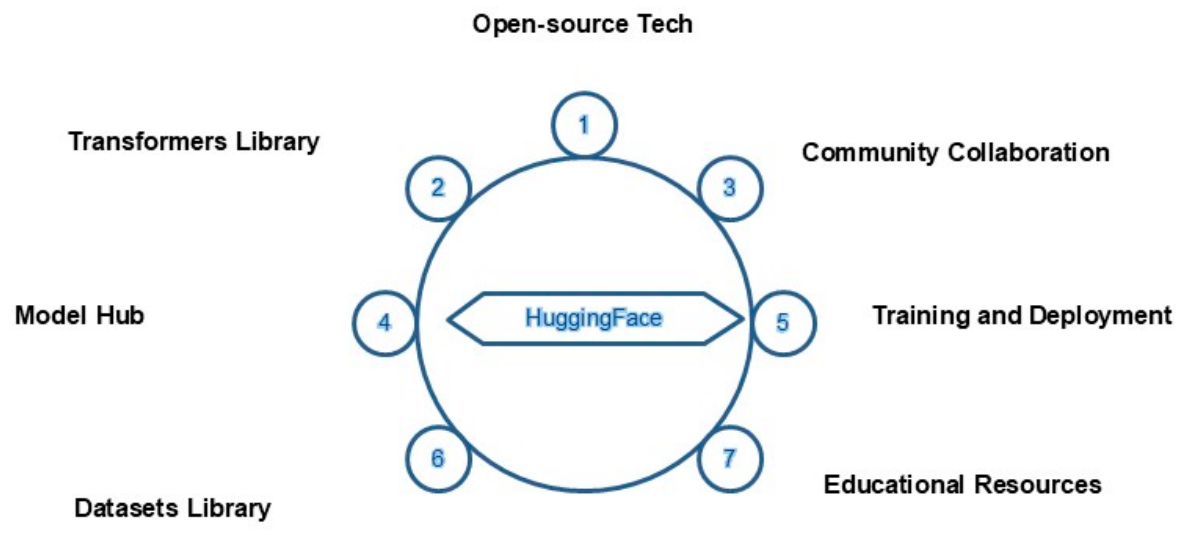
- Open-source Technology: Hugging Face’s open-source approach makes NLP tools and libraries accessible to everyone, fostering a collaborative environment that accelerates advancements in AI.
- Transformers Library: The core of Hugging Face, offering thousands of pre-trained models that simplify the implementation and fine-tuning of NLP models without starting from scratch.
- Community Collaboration: A thriving ecosystem where users can share models, datasets, and code, enabling rapid innovation in AI and NLP.
- Model Hub: A central repository of pre-trained models for various NLP tasks, simplifying the process of finding and deploying suitable models.
- Training and Deployment: Tools for efficient training and deploying NLP models, with a user-friendly interface that makes model training accessible even to those with limited ML experience.
- Datasets Library: A vast collection of datasets for NLP tasks, ensuring users can easily find the data they need to train their models effectively.
- Educational Resources: Numerous tutorials, guides, and courses that help users of all levels understand and implement NLP models and techniques.
2. AV Research Infrastructure
2.1. Hardware Research Infrastructure
- Very High: Open hardware specifications (or open ISA), open firmware, open drivers, open SDKs, open APIs, permissive licensing, unrestricted development.
- High: Proprietary hardware but open SDKs, Linux support, documented APIs, third-party toolchains, minimal restrictions.
- Medium: Proprietary hardware with documented SDKs and APIs; some proprietary compilers, firmware, or runtime libraries required.
- Low: Mostly proprietary hardware and software; limited APIs; restricted SDKs; NDA components common.
- Very Low: Closed hardware and software stack; little documentation; vendor-controlled development environment.
- Very Strong: Native support for ROS2, PyTorch, TensorFlow, ONNX, Docker, Kubernetes, OpenCV, simulation frameworks, active GitHub community, extensive tutorials.
- Strong: Supports most major AI frameworks and robotics middleware with active community examples.
- Moderate: Supports common Linux AI frameworks and some ROS integration, but ecosystem is incomplete.
- Limited: Limited framework support; proprietary SDK dominates development.
- Minimal: Little meaningful integration with open-source software; primarily vendor tools.
- Very High: Fully open-source platform with permissive licensing, public development, complete source code, and unrestricted modification and redistribution.
- High: Mostly open-source platform with minor proprietary components, well-documented APIs, and active community contributions.
- Medium: Platform provides public SDKs and APIs but retains significant proprietary components or licensing restrictions.
- Low: Platform is primarily proprietary with restricted APIs, documentation, or development tools that limit external contributions.
- Very Low: Platform is almost entirely closed, providing little or no access to source code, development tools, or internal interfaces.
- Very Strong: Natively supports major open-source frameworks and middleware with a large, active developer community and extensive third-party resources.
- Strong: Supports most widely adopted open-source tools with mature documentation and an active ecosystem of users and contributors.
- Moderate: Provides compatibility with common open-source frameworks but requires additional integration effort or has limited community support.
- Low: Supports only a small subset of open-source tools and relies primarily on vendor-specific software and development environments.
- Very Low: Offers little meaningful integration with the broader open-source software ecosystem.
2.2. Data and World-Model Infrastructure
2.3. Simulation, Testing, and Validation Infrastructure
2.4. Digital Environment Reconstruction and World Models
3. Education Infrastructure for AV
4. Gaps and Challenges
5. Opportunities and Recommendations
- Open, Modular “Academic Autonomy Stack”: A key opportunity in AV research infrastructure is the development of a standardized, open, end-to-end autonomy stack that integrates hardware, software, and validation tools into a cohesive framework. Today’s research efforts are often fragmented, requiring significant integration work across sensors, compute platforms, middleware, and autonomy algorithms. An open, modular stack—built on widely adopted components such as ROS2, Autoware, and standardized sensor/compute interfaces—would enable interoperability and reuse across institutions. Much like open frameworks transformed Digital AI, such a stack would provide a common baseline for experimentation, benchmarking, and collaboration, allowing researchers to focus on innovation rather than system assembly. A key aspect would be to build an easily executable set of AV benchmarks. Similar to Digital AI, private industry, typically through the formation of a non-profit, would be the natural place to build such a stack.
- Shared AV Testbeds (Real + Hybrid): Another major opportunity lies in the creation of shared, remotely accessible AV testbeds that combine real-world systems with digital twins. These testbeds could include instrumented campuses, controlled urban environments, or robotic labs where researchers can deploy and evaluate autonomy algorithms under consistent conditions. By integrating real vehicles or robots with simulation overlays, hybrid environments enable both realistic validation and scalable experimentation. Importantly, shared access would democratize the use of expensive infrastructure, allowing smaller institutions and global collaborators to participate in cutting-edge research while ensuring repeatability and comparability of results. Example investments include ZalaZone where large capital investments can be made by government. This contrasts with each university getting a small car or using local resources.
- Open Scenario & Edge-Case Databases: Advancing safety in AV requires moving beyond traditional datasets toward structured scenario databases that capture rare and safety-critical events. While existing datasets support perception and prediction, they often lack systematic coverage of edge cases such as unusual human behavior, emergency interventions, or complex multi-agent interactions. Open, standardized scenario repositories—building on efforts like OpenSCENARIO and Safety Pool—would allow researchers to define, share, and reuse challenging test cases. This would enable coverage-driven validation, improve benchmarking of safety performance, and support a more rigorous, community-driven approach to understanding long-tail risks. The nature of edge-case data is that this ability needs to be available to the broader research community and even the general public.
- Integrated Simulation + Validation Pipelines: A critical infrastructure opportunity is the development of integrated pipelines that unify data, simulation, scenario generation, and formal validation into a closed-loop system. Today, these components are often disconnected, leading to inefficiencies and gaps in safety assurance. By linking real-world datasets with simulation platforms (e.g., CARLA, Omniverse), scenario generation tools (e.g., Scenic), and formal verification methods, researchers can create workflows that systematically explore and validate system behavior. Such pipelines enable continuous validation, where models are iteratively tested against increasingly diverse and challenging conditions, bridging the gap between development and deployment. Traditionally, these capabilities grow from universities and then build a following with an industry sponsored consortium.
- Low-Cost, Scalable Research Platforms for Education: Finally, there is a strong opportunity to develop affordable, scalable AV platforms that support both education and early-stage research. These platforms could include small autonomous vehicles, modular sensor kits, and pre-integrated software stacks that allow students and researchers to experiment with real-world autonomy at low cost. By lowering barriers to entry, these platforms would expand participation in AV, create a broader talent pipeline, and enable universities worldwide to contribute to research and innovation in a practical, system-level manner. Traditionally, consortia have not been employed in pedagogy, but complex problems such as AV require ‘crowd-sourcing’ of ideas in concepts such as FRODO [78]. University consortiums are the natural place for this work.
- Consortiums and Standards: Consortiums and standards bodies play a critical role in enabling productivity within complex ecosystems like AV by providing a shared foundation for interoperability, collaboration, and reuse. In environments where multiple organizations develop hardware, software, data, and validation tools independently, the absence of common standards leads to fragmentation, duplication of effort, and high integration costs. Consortium-driven standards—such as those developed by groups like ASAM—establish common data formats, interfaces, and scenario definitions that allow components from different vendors and research groups to work together seamlessly. This not only accelerates development by reducing the need for custom integration, but also enables reproducibility and comparability of results across institutions, which is essential for scientific progress. Overall, the work of development of interesting interface standards is quite challenging and develops over time. Organizations such as ASAM, SAE, or IEEE are naturally built for this work based on industry input.
6. Conclusions
Author Contributions
Funding
Institutional Review Board Statement
Informed Consent Statement
Data Availability Statement
Acknowledgments
Conflicts of Interest
References
- Huang, D.; Yan, C.; Li, Q.; Peng, X. From Large Language Models to Large Multimodal Models: A Literature Review. Appl. Sci. 2024, 14, 5068. [Google Scholar] [CrossRef] [Scilit]
- Wolf, T.; Debut, L.; Sanh, V.; Chaumond, J.; Delangue, C.; Moi, A.; Cistac, P.; Rault, T.; Louf, R.; Funtowicz, M.; et al. Transformers: State-of-the-Art Natural Language Processing. In Proceedings of the 2020 Conference on Empirical Methods in Natural Language Processing: System Demonstrations; Association for Computational Linguistics: Stroudsburg, PA, USA, 2020; pp. 38–45. [Google Scholar] [CrossRef] [Scilit]
- Meta AI. Introducing LLaMA: A Foundational, 65-Billion-Parameter Large Language Model; Meta AI: Menlo Park, CA, USA, 2023; Available online: https://ai.meta.com/blog/large-language-model-llama-meta-ai/ (accessed on 20 May 2026).
- Qwen Team. Qwen2.5 Technical Report. arXiv 2024, arXiv:2412.15115. Available online: https://arxiv.org/abs/2412.15115 (accessed on 20 May 2026).
- Mistral AI. Introducing Mistral 3. 2 December 2025. Available online: https://mistral.ai/news/mistral-3 (accessed on 1 July 2026).
- Common Crawl Foundation. Common Crawl Overview. Available online: https://commoncrawl.org/overview (accessed on 20 May 2026).
- Paszke, A.; Gross, S.; Massa, F.; Lerer, A.; Bradbury, J.; Chanan, G.; Killeen, T.; Lin, Z.; Gimelshein, N.; Antiga, L.; et al. PyTorch: An Imperative Style, High-Performance Deep Learning Library. Adv. Neural Inf. Process. Syst. 2019, 32, 8026–8037. [Google Scholar] [CrossRef] [Scilit]
- Rasley, J.; Rajbhandari, S.; Ruwase, O.; He, Y. DeepSpeed: System optimizations enable training deep learning models with over 100 billion parameters. In Proceedings of the 26th ACM SIGKDD International Conference on Knowledge Discovery & Data Mining, Virtual Event, 23–27 August 2020; pp. 3505–3506. [Google Scholar] [CrossRef] [Scilit]
- Shoeybi, M.; Patwary, M.; Puri, R.; LeGresley, P.; Casper, J.; Catanzaro, B. Megatron-LM: Training Multi-Billion Parameter Language Models Using Model Parallelism. arXiv 2019, arXiv:1909.08053. [Google Scholar] [CrossRef] [Scilit]
- LangChain. LangChain: Build Agents Faster, Your Way. 2025. Available online: https://www.langchain.com/langchain (accessed on 20 May 2026).
- LlamaIndex. AI Agents for Document OCR + Workflows. Available online: https://www.llamaindex.ai/ (accessed on 20 May 2026).
- DeepLearning.AI. DeepLearning.AI: Start or Advance Your Career in AI; DeepLearning.AI: Palo Alto, CA, USA, 2025; Available online: https://www.deeplearning.ai/ (accessed on 20 May 2026).
- Boxold, J.; Taylor, J.W.; Watts, R.; Ralston, G.; Neef, D.; Mayor, P.; Razdan, R. Unsettled Topics Concerning Automated Driving Systems and the Transportation Ecosystem; SAE Technical Paper EPR2019005; SAE International: Warrendale, PA, USA, 2019. [Google Scholar]
- Razdan, R. Product Assurance in the Age of Artificial Intelligence; SAE Technical Paper EPR2025011; SAE International: Warrendale, PA, USA, 2025. [Google Scholar] [CrossRef] [Scilit]
- Montrose, M.I. EMC and the Printed Circuit Board: Design, Theory, and Layout Made Simple; Wiley-IEEE Press: New York, NY, USA, 1999. [Google Scholar]
- Bellone, M.; Ismailogullari, A.; Müür, J.; Nissin, O.; Sell, R.; Soe, R.M. Autonomous driving in the real-world: The weather challenge in the Sohjoa Baltic project. In Towards Connected and Autonomous Vehicle Highway: Technical, Security and Ethical Challenges; EAI/Springer Innovations in Communications and Computing; Springer: Cham, Switzerland, 2020. [Google Scholar]
- Othman, K. Impact of Autonomous Vehicles on the Physical Infrastructure: Changes and Challenges. Designs 2021, 5, 40. [Google Scholar] [CrossRef] [Scilit]
- Razdan, R. Unsettled Topics Concerning Human and Autonomous Vehicle Interaction; SAE Research Report EPR2020025; SAE International: Warrendale, PA, USA, 2020. [Google Scholar] [CrossRef] [Scilit]
- Mehlhorn, M.A.; Richter, A.; Shardt, Y.A.W. Ruling the operational boundaries: A survey on operational design domains of autonomous driving systems. IFAC-PapersOnLine 2023, 56, 2202–2213. [Google Scholar] [CrossRef] [Scilit]
- Shakeri, A. Formalization of operational domain and operational design domain for automated vehicles. In Proceedings of the 2024 IEEE 24th International Conference on Software Quality, Reliability, and Security Companion (QRS-C); IEEE: New York, NY, USA, 2024. [Google Scholar] [CrossRef] [Scilit]
- Brill, S.; Payre, W.; Debnath, A.; Horan, B.; Birrell, S. External Human–Machine Interfaces for Automated Vehicles in Shared Spaces: A Review of the Human–Computer Interaction Literature. Sensors 2023, 23, 4454. [Google Scholar] [CrossRef] [Scilit] [PubMed]
- Dey, D.; Matviienko, A.; Berger, M.; Pfleging, B.; Martens, M.H.; Terken, J.M.B. Communicating the intention of an automated vehicle to pedestrians: The contributions of eHMI and vehicle behavior. IT Inf. Technol. 2021, 63, 123–141. [Google Scholar] [CrossRef] [Scilit]
- Habibovic, A.; Lundgren, V.M.; Andersson, J.; Klingegård, M.; Lagström, T.; Sirkka, A.; Fagerlönn, J.; Edgren, C.; Fredriksson, R.; Krupenia, S.; et al. Communicating intent of automated vehicles to pedestrians. Front. Psychol. 2018, 9, 1336. [Google Scholar] [CrossRef] [Scilit] [PubMed]
- Kalda, K.; Pizzagalli, S.-L.; Soe, R.-M.; Sell, R.; Bellone, M. Language of driving for autonomous vehicles. Appl. Sci. 2022, 12, 5406. [Google Scholar] [CrossRef] [Scilit]
- Mercedes-Benz Group AG. Automated Driving in Germany: Approved to Test Special Marker Lights. 5 March 2025. Available online: https://group.mercedes-benz.com/technology/autonomous-driving/driving/drive-pilot-marker-lights.html (accessed on 1 July 2026).
- NVIDIA. NVIDIA Introduces DRIVE AGX Orin—Advanced, Software-Defined Platform for Autonomous Machines; NVIDIA Newsroom: Santa Clara, CA, USA, 2019; Available online: https://nvidianews.nvidia.com/news/nvidia-introduces-drive-agx-orin-advanced-software-defined-platform-for-autonomous-machines (accessed on 20 May 2026).
- NVIDIA. NVIDIA Unveils DRIVE Thor—Centralized Car Computer Unifying Cluster, Infotainment, Automated Driving, and Parking in a Single, Cost-Saving System; NVIDIA Newsroom: Santa Clara, CA, USA, 2022; Available online: https://nvidianews.nvidia.com/news/nvidia-unveils-drive-thor-centralized-car-computer-unifying-cluster-infotainment-automated-driving-and-parking-in-a-single-cost-saving-system (accessed on 20 May 2026).
- NVIDIA. Jetson AGX Orin; NVIDIA Developer: Santa Clara, CA, USA, 2026; Available online: https://www.nvidia.com/en-us/autonomous-machines/embedded-systems/jetson-orin/ (accessed on 18 May 2026).
- NVIDIA. Jetson Xavier NX; NVIDIA Developer: Santa Clara, CA, USA, 2026; Available online: https://developer.nvidia.com/embedded/learn/get-started-jetson-xavier-nx-devkit (accessed on 18 May 2026).
- Qualcomm Technologies, Inc. Qualcomm Accelerates Autonomous Driving with New Platform–Qualcomm Snapdragon Ride. Qualcomm. 5 January 2020. Available online: https://www.qualcomm.com/news/releases/2020/01/qualcomm-accelerates-autonomous-driving-new-platform-qualcomm-snapdragon (accessed on 20 May 2026).
- Mobileye. EyeQ™. Mobileye: Jerusalem, Israel. Available online: https://www.mobileye.com/technology/eyeq-chip (accessed on 18 May 2026).
- Texas Instruments. TDA4VH-Q1, TDA4AH-Q1, TDA4VP-Q1, TDA4AP-Q1 Jacinto™ Processors Datasheet; Rev. C.; Texas Instruments: Dallas, TX, USA, 2025; Available online: https://www.ti.com/product/TDA4VP-Q1 (accessed on 20 May 2026).
- NXP Semiconductors Automotive High Performance Compute. 2022. Available online: https://www.nxp.com/applications/AUTOMOTIVE-COMPUTE (accessed on 20 May 2026).
- Renesas Electronics Corporation. R-Car Automotive System-on-Chips (SoCs). Available online: https://www.renesas.com/en/products/automotive-products/automotive-system-chips-socs (accessed on 20 May 2026).
- Ambarella. CVflow® Vision AI SoCs and Development Platforms; Ambarella: Santa Clara, CA, USA, 2026; Available online: https://www.ambarella.com/ (accessed on 20 May 2026).
- NVIDIA Developer NVIDIA Corporation. NVIDIA DriveOS SDK. Available online: https://developer.nvidia.com/driveworks (accessed on 20 May 2026).
- Autoware Foundation. Autoware: Open-Source Software for Autonomous Driving. Available online: https://autoware.org/ (accessed on 18 May 2026).
- Apollo Auto. Apollo: Open-Source Autonomous Driving Platform; Baidu: Beijing, China, 2026; Available online: https://apollo.auto/ (accessed on 20 May 2026).
- Comma.ai. Openpilot. 2026. Available online: https://comma.ai/openpilot (accessed on 20 May 2026).
- Caesar, H.; Bankiti, V.; Lang, A.H.; Vora, S.; Liong, V.E.; Xu, Q.; Krishnan, A.; Pan, Y.; Baldan, G.; Beijbom, O. nuScenes: A multimodal dataset for autonomous driving. In Proceedings of the IEEE/CVF Conference on Computer Vision and Pattern Recognition (CVPR), Seattle, WA, USA, 13–19 June 2020; pp. 11618–11628. [Google Scholar] [CrossRef] [Scilit]
- Waymo LLC. Waymo Open Dataset. Available online: https://waymo.com/open/ (accessed on 20 May 2026).
- Geiger, A.; Lenz, P.; Urtasun, R. Are We Ready for Autonomous Driving? The KITTI Vision Benchmark Suite. In Proceedings of the 2012 IEEE Conference on Computer Vision and Pattern Recognition (CVPR), Providence, RI, USA, 16–21 June 2012; pp. 3354–3361. [Google Scholar] [CrossRef] [Scilit]
- Wilson, B.; Qi, W.; Agarwal, T.; Lambert, J.; Singh, J.; Khandelwal, S.; Pan, B.; Kumar, R.; Hartnett, A.; Pontes, J.K.; et al. Argoverse 2: Next generation datasets for self-driving perception and forecasting. arXiv 2023, arXiv:2301.00493. [Google Scholar] [CrossRef] [Scilit]
- Yu, F.; Chen, H.; Wang, X.; Xian, W.; Chen, Y.; Liu, F.; Madhavan, V.; Darrell, T. BDD100K: A Diverse Driving Dataset for Heterogeneous Multitask Learning. In Proceedings of the IEEE/CVF Conference on Computer Vision and Pattern Recognition (CVPR), Seattle, WA, USA, 13–19 June 2020; pp. 2636–2645. [Google Scholar] [CrossRef] [Scilit]
- Huang, X.; Wang, P.; Cheng, X.; Zhou, D.; Geng, Q.; Yang, R. The ApolloScape open dataset for autonomous driving and its application. IEEE Trans. Pattern Anal. Mach. Intell. 2020, 42, 2702–2719. [Google Scholar] [CrossRef] [Scilit] [PubMed]
- WMG; University of Warwick & Deepen AI. Safety Pool™ Scenario Database. 2021. Available online: https://www.safetypool.ai/database (accessed on 1 July 2026).
- Sell, R.; Leier, M.; Rassõlkin, A.; Ernits, J.-P. Autonomous Last Mile Shuttle ISEAUTO for Education and Research. Int. J. Artif. Intell. Mach. Learn. 2020, 10, 13–27. [Google Scholar] [CrossRef] [Scilit]
- Dosovitskiy, A.; Ros, G.; Codevilla, F.; López, A.M.; Koltun, V. CARLA: An Open Urban Driving Simulator. In Proceedings of the 1st Annual Conference on Robot Learning (CoRL), Mountain View, CA, USA, 13–15 November 2017; pp. 1–16. Available online: https://proceedings.mlr.press/v78/dosovitskiy17a.html (accessed on 20 May 2026).
- NVIDIA. DRIVE Sim. Available online: https://developer.nvidia.com/drive/drive-sim (accessed on 20 May 2026).
- German Aerospace Center (DLR). SUMO—Simulation of Urban Mobility. Available online: https://sumo.dlr.de/ (accessed on 1 July 2026).
- Siemens. PreScan Commercial Simulation Software; Siemens Digital Industries Software: Plano, TX, USA, 2026; Available online: https://www.siemens.com/en-us/products/simcenter/autonomous-vehicle-solutions/prescan/ (accessed on 20 May 2026).
- dSPACE GmbH. ASM Combustion Engine. Available online: https://www.dspace.com/en/inc/home/products/sw/automotive_simulation_models/produkte_asm/asm_engine_models.cfm (accessed on 20 May 2026).
- IPG Automotive GmbH. CarMaker. Available online: https://www.ipg-automotive.com/solutions/product-portfolio/carmaker (accessed on 20 May 2026).
- Fremont, D.J.; Kim, E.; Dreossi, T.; Ghosh, S.; Yue, X.; Sangiovanni-Vincentelli, A.L.; Seshia, S.A. Scenic: A language for scenario specification and data generation. Mach. Learn. 2023, 112, 3805–3849. [Google Scholar] [CrossRef] [Scilit]
- Association for Standardization of Automation and Measuring Systems. ASAM OpenSCENARIO® (Version 2.0.0). ASAM e.V. 2022. Available online: https://www.asam.net/standards/detail/openscenario/v200/ (accessed on 20 May 2026).
- Razdan, R.; Akbaş, M.İ.; Sell, R.; Bellone, M.; Menase, M.; Malayjerdi, M. PolyVerif: An Open-Source Environment for Autonomous Vehicle Validation and Verification Research Acceleration. IEEE Access 2023, 11, 28343–28354. [Google Scholar] [CrossRef] [Scilit]
- Association for Standardization of Automation and Measuring Systems. ASAM. Available online: https://www.asam.net/ (accessed on 20 May 2026).
- Association for Standardization of Automation and Measuring Systems. ASAM OpenDRIVE® (Version 1.8.1). ASAM e.V. 2024. Available online: https://www.asam.net/standards/detail/opendrive/ (accessed on 20 May 2026).
- ASAM. ASAM OpenCRG®; Version 2.0.1; ASAM OpenCRG: Höhenkirchen, Germany, 2026. [Google Scholar]
- Remondino, F.; El-Hakim, S. Image-based 3D modelling: A review. Photogramm. Rec. 2006, 21, 269–291. [Google Scholar] [CrossRef] [Scilit]
- Zhang, J.; Singh, S. LOAM: Lidar odometry and mapping in real-time. Robot. Sci. Syst. (RSS) 2014, 2, 1–9. [Google Scholar] [CrossRef] [Scilit]
- Chahine, G.; Vaidis, M.; Pomerleau, F.; Pradalier, C. Mapping in unstructured natural environment: A sensor fusion framework for wearable sensor suites. SN Appl. Sci. 2021, 3, 571. [Google Scholar] [CrossRef] [Scilit]
- Bastani, F.; He, S.; Abbar, S.; Alizadeh, M.; Balakrishnan, H.; Chawla, S.; Madden, S.; DeWitt, D. RoadTracer: Automatic Extraction of Road Networks from Aerial Images. In Proceedings of the IEEE/CVF Conference on Computer Vision and Pattern Recognition (CVPR), Salt Lake City, UT, USA, 18–22 June 2018; pp. 4720–4728. [Google Scholar] [CrossRef] [Scilit]
- Mildenhall, B.; Srinivasan, P.P.; Tancik, M.; Barron, J.T.; Ramamoorthi, R.; Ng, R. NeRF: Representing scenes as neural radiance fields for view synthesis. In Computer Vision–ECCV 2020; Vedaldi, A., Bischof, H., Brox, T., Frahm, J.-M., Eds.; Lecture Notes in Computer Science; Springer: Cham, Switzerland, 2020; pp. 405–421. [Google Scholar] [CrossRef] [Scilit]
- Kerbl, B.; Kopanas, G.; Leimkühler, T.; Drettakis, G. 3D Gaussian splatting for real-time radiance field rendering. ACM Trans. Graph. 2023, 42, 139. [Google Scholar] [CrossRef] [Scilit]
- Müller, P.; Wonka, P.; Haegler, S.; Ulmer, A.; Van Gool, L. Procedural Modeling of Buildings. ACM Trans. Graph. 2006, 25, 614–623. [Google Scholar] [CrossRef] [Scilit]
- Rasheed, A.; San, O.; Kvamsdal, T. Digital twin: Values, challenges and enablers from a modeling perspective. IEEE Access 2020, 8, 21980–22012. [Google Scholar] [CrossRef] [Scilit]
- Massachusetts Institute of Technology. Beaver Works Summer Institute (BWSI). MIT Beaver Works. Available online: https://beaverworks.ll.mit.edu/CMS/bw/bwsi (accessed on 20 May 2026).
- F1TENTH. F1/10 Autonomous Racing Platform. GRASP Laboratory, University of Pennsylvania. Available online: https://f1tenth.org/ (accessed on 20 May 2026).
- Paull, L.; Tani, J.; Ahn, H.; Alonso-Mora, J.; Carlone, L.; Cap, M.; Chen, Y.-F.; Choi, C.; Dusek, A.; Fang, Y.; et al. Duckietown: An open, inexpensive and flexible platform for autonomy education and research. In Proceedings of the 2017 IEEE International Conference on Robotics and Automation (ICRA); IEEE: Singapore, 2017; pp. 1497–1504. [Google Scholar] [CrossRef] [Scilit]
- Quigley, M.; Conley, K.; Gerkey, B.; Faust, J.; Foote, T.; Leibs, J.; Wheeler, R.; Ng, A.Y. ROS: An open-source Robot Operating System. In ICRA Workshop on Open-Source Software; IEEE: Piscataway, NJ, USA, 2009; Volume 3, p. 5. [Google Scholar]
- Koenig, N.; Howard, A. Design and Use Paradigms for Gazebo, an Open-Source Multi-Robot Simulator. In Proceedings of the IEEE/RSJ International Conference on Intelligent Robots and Systems (IROS), Sendai, Japan, 28 September–2 October 2004; pp. 2149–2154. [Google Scholar] [CrossRef] [Scilit]
- Fuchs, L.; Cuevas-Garcia, C.; Bombaerts, G. The societal role of universities and their alliances: The case of the EuroTeQ Engineering University. Tert. Educ. Manag. 2023, 29, 263–277. [Google Scholar] [CrossRef] [Scilit]
- ZalaZone. ZalaZone. Available online: https://zalazone.hu/en/ (accessed on 19 May 2026).
- Tallinn University of Technology. Self-Driving Shuttle—ISEAUTO. Robotics and Autonomous Vehicles Research Group. Available online: https://autolab.taltech.ee/projects/iseauto/ (accessed on 20 May 2026).
- Razdan, R.; Sell, R.; Akbas, M.I.; Menase, M. Perspectives on Safety for Autonomous Vehicles. Electronics 2025, 14, 4500. [Google Scholar] [CrossRef] [Scilit]
- SafeAV Consortium. R2.1: Analysing Existing Initiatives; No. 2024-1-EE01-KA220-HED-000245441; Erasmus+ Project: Harmonizations of Autonomous Vehicle Safety Validation and Verification for Higher Education Tallinn, Estonia, 2024. Available online: https://jkk-web.sze.hu/projektek/safeav/ (accessed on 24 May 2026).
- Razdan, R.; Polanco, R.; Razdan, D.; Weingarten, Z. FRODO: An Open-Source Architecture for Instruction IP. In Proceedings of the 2019 IEEE Integrated STEM Education Conference (ISEC), Princeton, NJ, USA, 16 March 2019; pp. 332–337. [Google Scholar] [CrossRef] [Scilit]


| Platform | Vendor | Type | Typical Form Factor | Openness—HW/SW | Open-Source Ecosystem Support |
|---|---|---|---|---|---|
| DRIVE AGX (Orin/Thor) [26,27] | NVIDIA | Full AV compute platform | In-vehicle computer + dev kits | Medium, closed HW, semi-open SW | Strong, CUDA, ROS, Omniverse, open Models |
| Jetson (Orin/Xavier) [28,29] | NVIDIA | Edge AI/robotics | Dev kits (small form factor) | Medium-High | Very strong, ROS/ROS2, Isaac, PyTorch |
| Snapdragon Ride [30] | Qualcomm | Automotive SoC platform | ECU/dev platforms | Medium | Moderate, Linux, some ROS integration |
| EyeQ (Mobileye) [31] | Mobileye (Intel) | Integrated ADAS SoC | Embedded automotive | Low | Limited, closed stack, APIs only |
| TDA4/Jacinto [32] | Texas Instruments | Embedded ADAS processor | EVM boards | Medium-High | Good, TI SDKs, Linux, ROS support |
| S32/BlueBox [33] | NXP | Automotive compute platform | Dev boards/ECUs | Medium-High | Good, AUTOSAR, Linux, ROS bridges |
| R-Car [34] | Renesas | Automotive SoC | Starter kits | Medium | Moderate, Linux, limited AI frameworks |
| Cvflow [35] | Ambarella | Vision AI SoC | Dev kits | Medium | Moderate, vision pipelines, limited ROS |
| Platform | Type | Stack Coverage | Openness | Open-Source Ecosystem | Key Strengths | Research Suitability |
|---|---|---|---|---|---|---|
| NVIDIA DRIVE [36] | Commercial, with open components | Full stack, perception, planning, control + simulation | Medium, closed core, open APIs/tools | Strong, CUDA, ROS, Omniverse, AI frameworks | Tight HW/SW integration, high performance, production-grade | strong but semi-closed |
| Autoware [37] | Fully open-source | Full stack (LiDAR-first perception, localization, planning, control) | High | Very strong, ROS/ROS2-native | Modular, academic-friendly, transparent algorithms | top academic platform |
| Apollo [38] | Open-source, with enterprise extensions | Full stack + HD maps + cloud integration | Medium-High | Strong, ROS-like middleware, tools | Scalable architecture, strong perception + mapping | research + industry bridge |
| openpilot [39] | Open-source, ADAS-focused | Partial stack, driver assistance: perception + control | High | Moderate, Python/C++, community-driven | Real-world deployment, lightweight, low-cost | good for applied/edge research |
| Function | NVIDIA DRIVE | Autoware | Apollo | Openpilot |
|---|---|---|---|---|
| Perception | Yes, multi-sensor AI | Yes, LiDAR-heavy | Yes, multi-modal | Partly, camera-centric |
| Localization | Yes | Yes, GNSS + LiDAR SLAM | Yes, HD maps + GNSS | Limited |
| Planning | Yes | Yes | Yes | Partly, lane-following focus |
| Control | Yes | Yes | Yes | Yes |
| Simulation Integration | Yes, omniverse | Yes, CARLA, LGSVL | Yes, Cyber RT + sim tools | Limited |
| Cloud/Data Loop | Strong | Limited | Yes, strong | Minimal |
| Dataset | Organization | Sensor Modalities | Scale/Focus | Openness | Key Use Cases |
|---|---|---|---|---|---|
| nuScenes [40] | Aptiv | Camera, LiDAR, radar | 1M+ frames, urban driving | High | Perception, tracking, sensor fusion |
| Waymo Open Dataset [41] | Waymo | Camera, LiDAR | Very large-scale, diverse environments | High | End-to-end autonomy, behavior |
| KITTI [42] | Karlsruhe Institute of Technology | Camera, LiDAR | Benchmark dataset | High | SLAM, detection, stereo vision |
| Argoverse 2 [43] | Argo AI | Camera, LiDAR, HD maps | Urban + motion forecasting | High | Prediction, mapping |
| BDD100K [44] | UC Berkeley | Camera (video) | 100K videos, diverse conditions | High | Vision, weather/edge cases |
| ApolloScape [45] | Baidu | Camera, LiDAR | Large annotated dataset | High | Segmentation, 3D understanding |
| Safety Pool [46] | University of Warwick | Scenario-based (derived from real + synthetic data) | Edge cases, safety-critical scenarios | Medium-High (research access) | Scenario testing, safety validation, coverage analysis |
| ISEAUTO [47] | TalTech | Camera, LiDAR from Shuttle | Training | High | Shuttle Use Case |
| Platform | Organization | Type | Openness | Core Capability | Integration with Stacks | Research Role |
|---|---|---|---|---|---|---|
| CARLA [48] | Intel Labs + University of Barcelona | Open simulator | High | Photorealistic simulation, sensor modeling | Strong, Autoware, ROS, custom stacks | Benchmarking, closed-loop testing |
| NVIDIA DRIVE Sim/Omniverse [49] | NVIDIA | Digital twin/ simulation | Medium | High-fidelity rendering, synthetic data | Very strong, NVIDIA DRIVE, ROS bridges | Scalable Synthetic testing |
| SUMO (Simulation of Urban Mobility) [50] | DLR | Traffic simulation | High | Large-scale traffic flow modeling | Moderate, via APIs, ROS bridges | Scenario generation, traffic behavior |
| PreScan [51] | Siemens | Commercial simulation | Low | Sensor modeling, ADAS validation | Strong, MATLAB/Simulink | Industrial validation |
| dSPACE ASM/VEOS [52] | dSPACE | HIL/SIL simulation | Low | Real-time simulation + hardware-in-loop | Strong, AUTOSAR, ECUs | Safety validation, embedded testing |
| IPG CarMaker [53] | IPG Automotive | Vehicle simulation | Low | High-fidelity vehicle dynamics | Strong, industry toolchains | Vehicle-level validation |
| Scenic (with simulators) [54] | UC Berkeley | Scenario generation | High | Probabilistic Scenario specification | Strong, CARLA, others | Test generation, edge-case discovery |
| Open SCENARIO [55] | ASAM | Scenario standards | High | Standardized scenario + map definitions | Broad, industry + simulators | Interoperability, reproducibility |
| PolyVerif [56] | Florida Polytechnic University + TalTech + Embry-Riddle Aeronautical University | Formal verification/testing | Medium | Coverage-driven testing, formal validation | Moderate, integrates with sim + logs | Safety assurance, edge-case validation |
| Method | Input Data | Core Technique | Output Representation | Key Tools/Platforms | Openness | Research Role |
|---|---|---|---|---|---|---|
| Photogrammetry (SfM/MVS) [60] | Camera (RGB images, video) | Structure-from-Motion + Multi-View Stereo | Dense 3D point clouds/meshes | COLMAP, OpenMVG, Meshroom | High | Urban reconstruction, mapping |
| LiDAR Mapping (SLAM/HD Maps) [61] | LiDAR + IMU (+GNSS) | LiDAR SLAM, scan matching | Point clouds, HD maps (lanes, objects) | LOAM, Cartographer, Autoware | High | Localization, map building |
| Sensor Fusion Mapping [62] | Camera + LiDAR + GNSS | Multi-modal fusion (deep learning + geometric methods) | Semantic HD maps, labeled environments | Apollo, Autoware, NVIDIA DRIVE | Partly | High-fidelity autonomy maps |
| Satellite-Based Reconstruction [63] | Satellite Imagery | Remote sensing + photogrammetry + GIS | Large-scale terrain + road networks | Google Earth Engine, QGIS | Medium-High | Regional/ global context |
| Neural Radiance Fields (NeRF) [64] | Camera (multi-view images) | Neural implicit scene representation | Continuous 3D scene (view synthesis) | Instant-NGP, Nerfstudio | High | High-fidelity rendering, sim |
| Gaussian Splatting [65] | Camera (+optional depth/LiDAR) | Real-time neural rendering | Dense, photorealistic 3D scenes | 3D Gaussian Splatting frameworks | High | Real-time digital twins |
| Procedural World Generation [66] | Maps + rules (OpenDRIVE, GIS) | Rule-based synthesis | Structured road networks, traffic scenes | CARLA, SUMO, OpenDRIVE tools | High | Scenario generation |
| Hybrid Digital Twin (Data + Simulation) [67] | Real data + synthetic Augmentation | Fusion of real-world capture + simulation engines | Interactive, physics-enabled environments | NVIDIA Omniverse, CARLA, Unreal Engine | Partly | Closed-loop testing, scaling |
| Platform | Hardware (CPU & Sensor Support) | AV Software Platform | Simulation | Data/World Infrastructure | Open Educational Resources |
|---|---|---|---|---|---|
| MIT Beaver Works (RACECAR) | NVIDIA Jetson Nano (earlier) or Raspberry Pi 4 (Neo); RGB camera, 2D LiDAR, IMU, wheel encoders | Custom ROS/ROS 2 educational stack; limited support for industrial AV platforms | Unity RACECAR Simulator; limited Gazebo support | Student-generated maps and ROS bags; no direct integration with KITTI, nuScenes, or Waymo Open Dataset | Limited—RACECAR software and documentation are open-source, but the complete Beaver Works curriculum is not fully open. |
| F1TENTH (GRASP) | NVIDIA Jetson Nano/Xavier/Orin; 2D LiDAR, RGB camera, IMU, wheel encoders | Modular ROS/ROS 2 research stack; supports Autoware and custom research frameworks | F1TENTH Gym, Gazebo, RViz | ROS bags, SLAM maps, racetrack maps; compatible with robotics datasets but not directly coupled to major AV benchmark datasets | Strong—Hardware, software, labs, tutorials, and course materials are openly available. |
| Duckietown | Raspberry Pi; monocular camera, wheel encoders (optional IMU/ToF sensors) | Custom ROS/ROS 2 educational stack focused on Duckietown ecosystem | Duckietown Simulator (Gym-compatible) | Synthetic Duckietown environments, lane maps, AprilTag infrastructure, educational datasets | Strong—Software, documentation, labs, and educational resources are openly available. |
Disclaimer/Publisher’s Note: The statements, opinions and data contained in all publications are solely those of the individual author(s) and contributor(s) and not of MDPI and/or the editor(s). MDPI and/or the editor(s) disclaim responsibility for any injury to people or property resulting from any ideas, methods, instructions or products referred to in the content. |
© 2026 by the authors. Licensee MDPI, Basel, Switzerland. This article is an open access article distributed under the terms and conditions of the Creative Commons Attribution (CC BY) license.
Share and Cite
Razdan, R.; Mironov, D.; Leoste, J.; Malayjerdi, M.; Bellone, M.; Sell, R. Enabling Autonomous Vehicles: Gaps in Research and Education Infrastructure. AI 2026, 7, 275. https://doi.org/10.3390/ai7080275
Razdan R, Mironov D, Leoste J, Malayjerdi M, Bellone M, Sell R. Enabling Autonomous Vehicles: Gaps in Research and Education Infrastructure. AI. 2026; 7(8):275. https://doi.org/10.3390/ai7080275
Chicago/Turabian StyleRazdan, Rahul, Dmitri Mironov, Janika Leoste, Mohsen Malayjerdi, Mauro Bellone, and Raivo Sell. 2026. "Enabling Autonomous Vehicles: Gaps in Research and Education Infrastructure" AI 7, no. 8: 275. https://doi.org/10.3390/ai7080275
APA StyleRazdan, R., Mironov, D., Leoste, J., Malayjerdi, M., Bellone, M., & Sell, R. (2026). Enabling Autonomous Vehicles: Gaps in Research and Education Infrastructure. AI, 7(8), 275. https://doi.org/10.3390/ai7080275