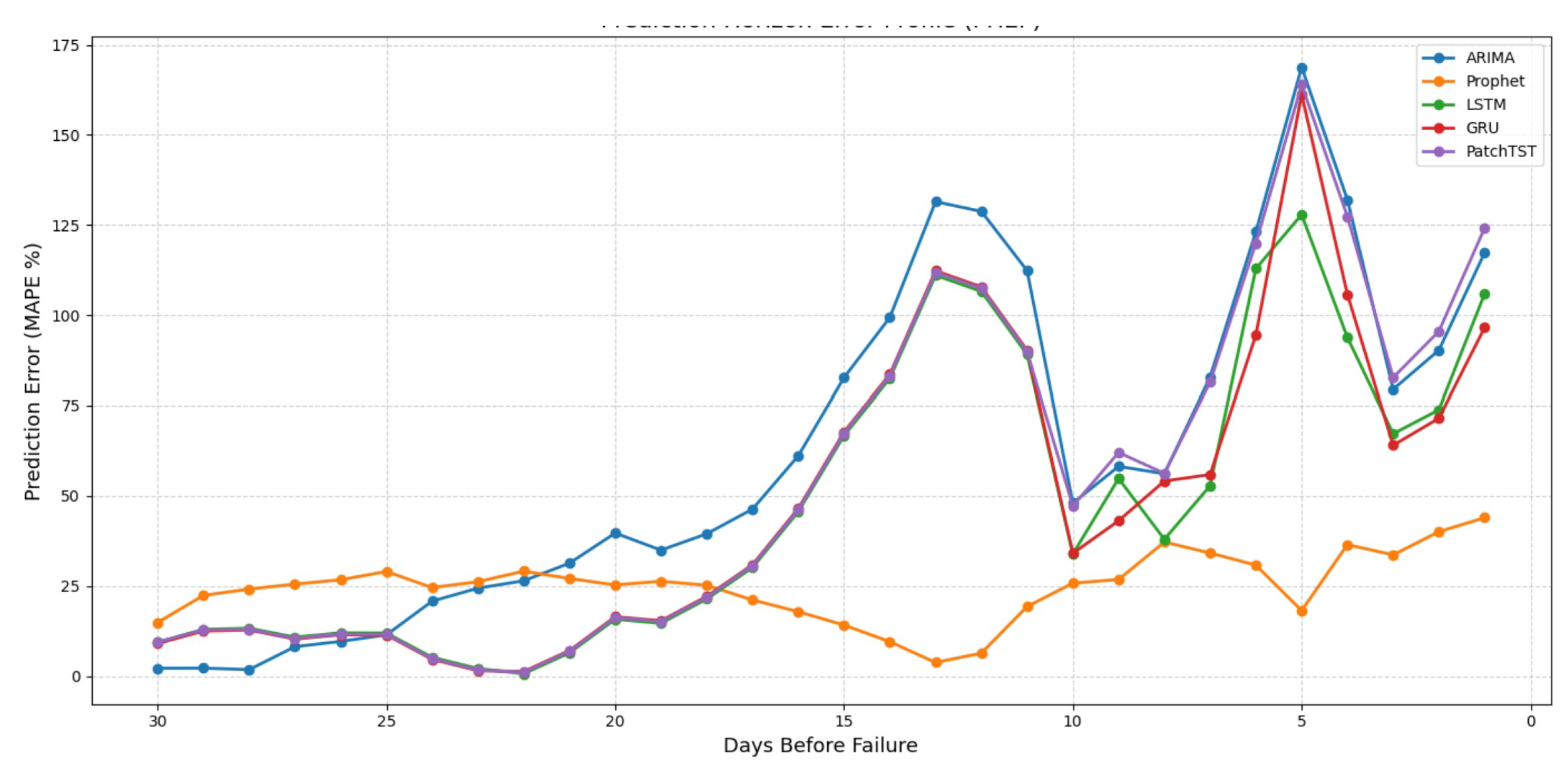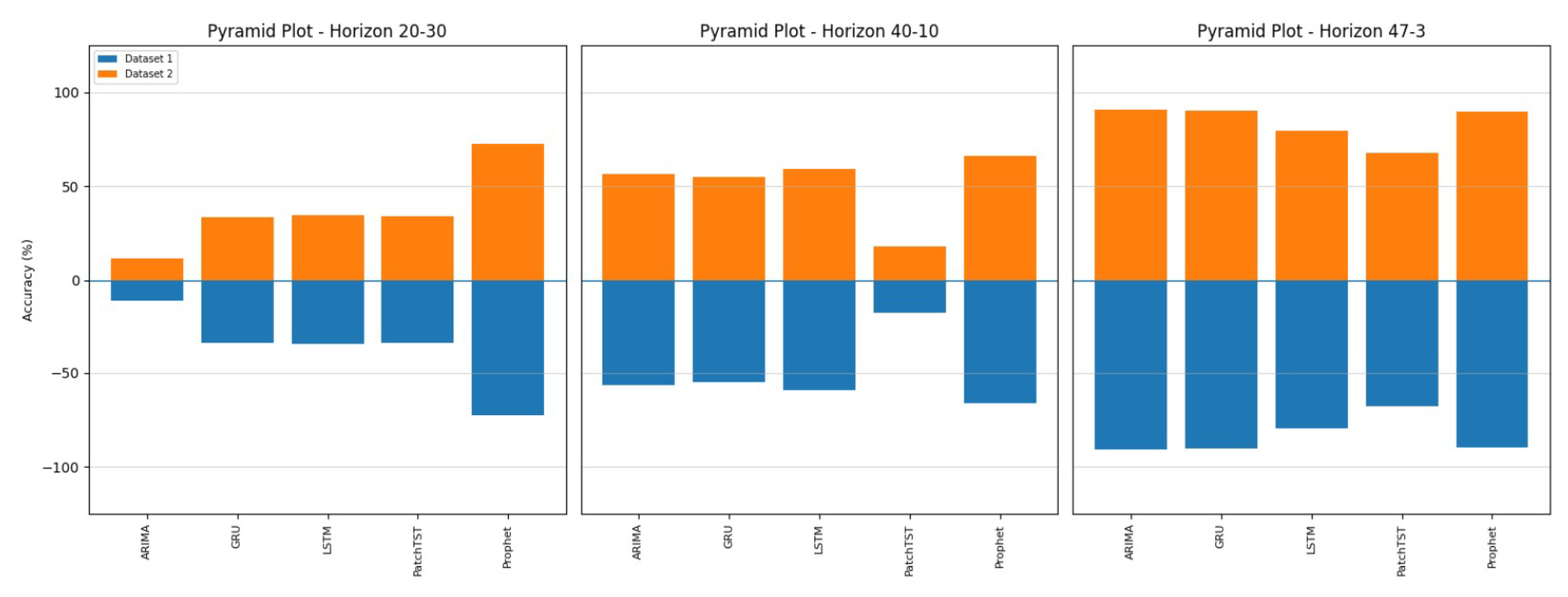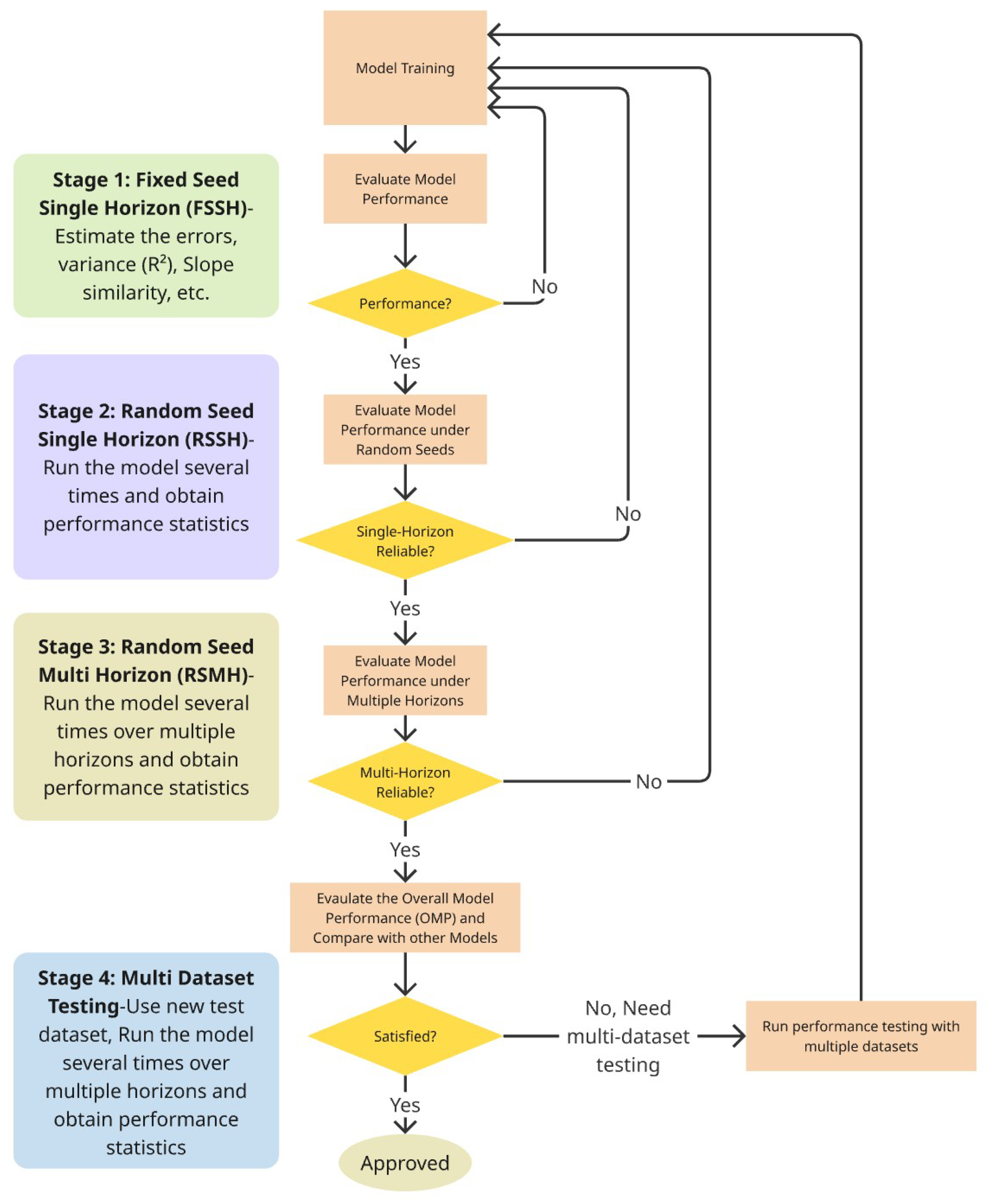


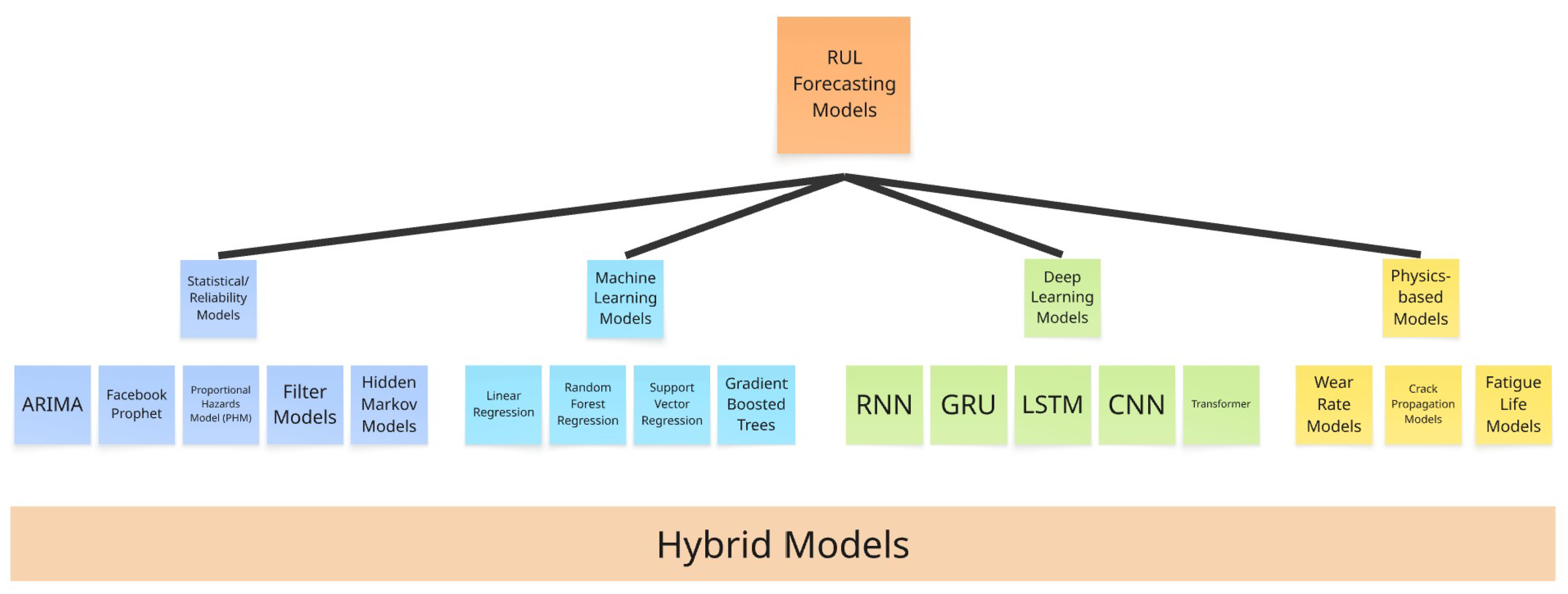
Evaluating RUL Predictive Models: A Risk-Based Predictive Maintenance Approach


Abstract
1. Introduction
2. Methods and Materials
2.1. RUL Prediction Models
2.2. Evaluation Metrics for RUL Forecasting
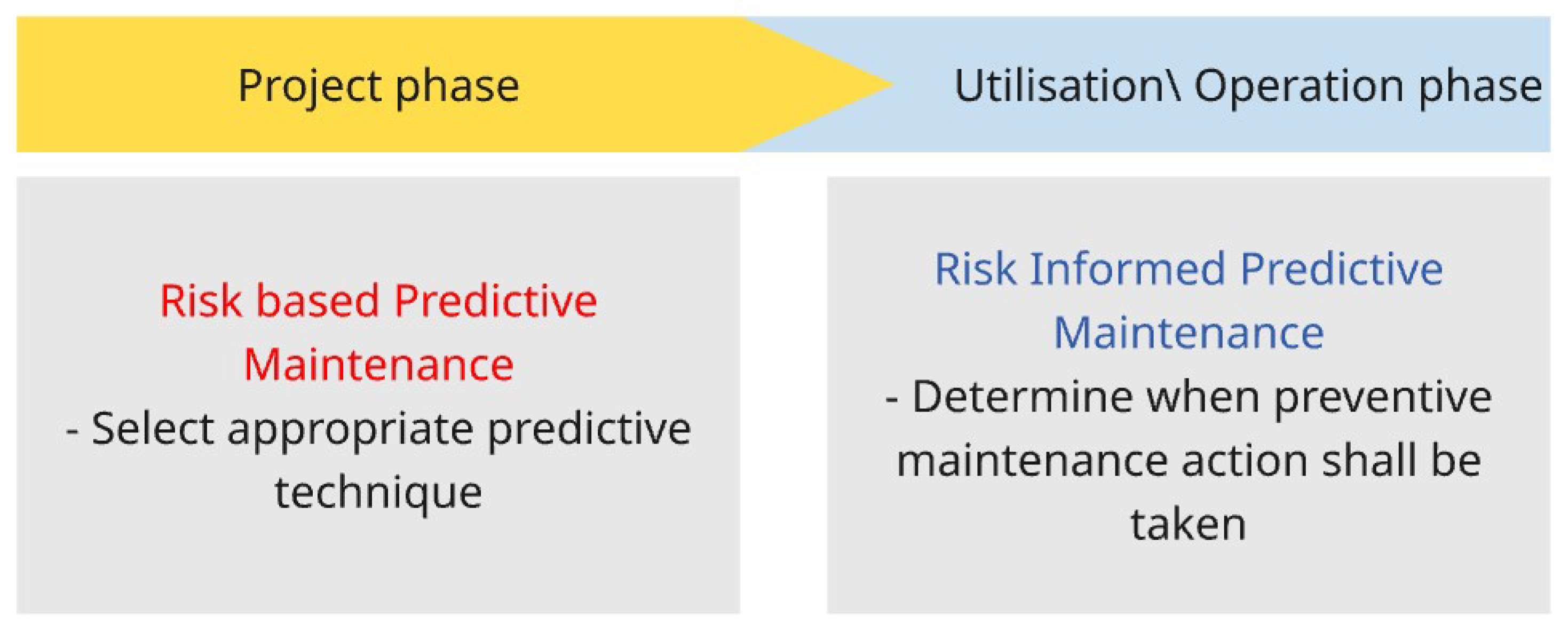
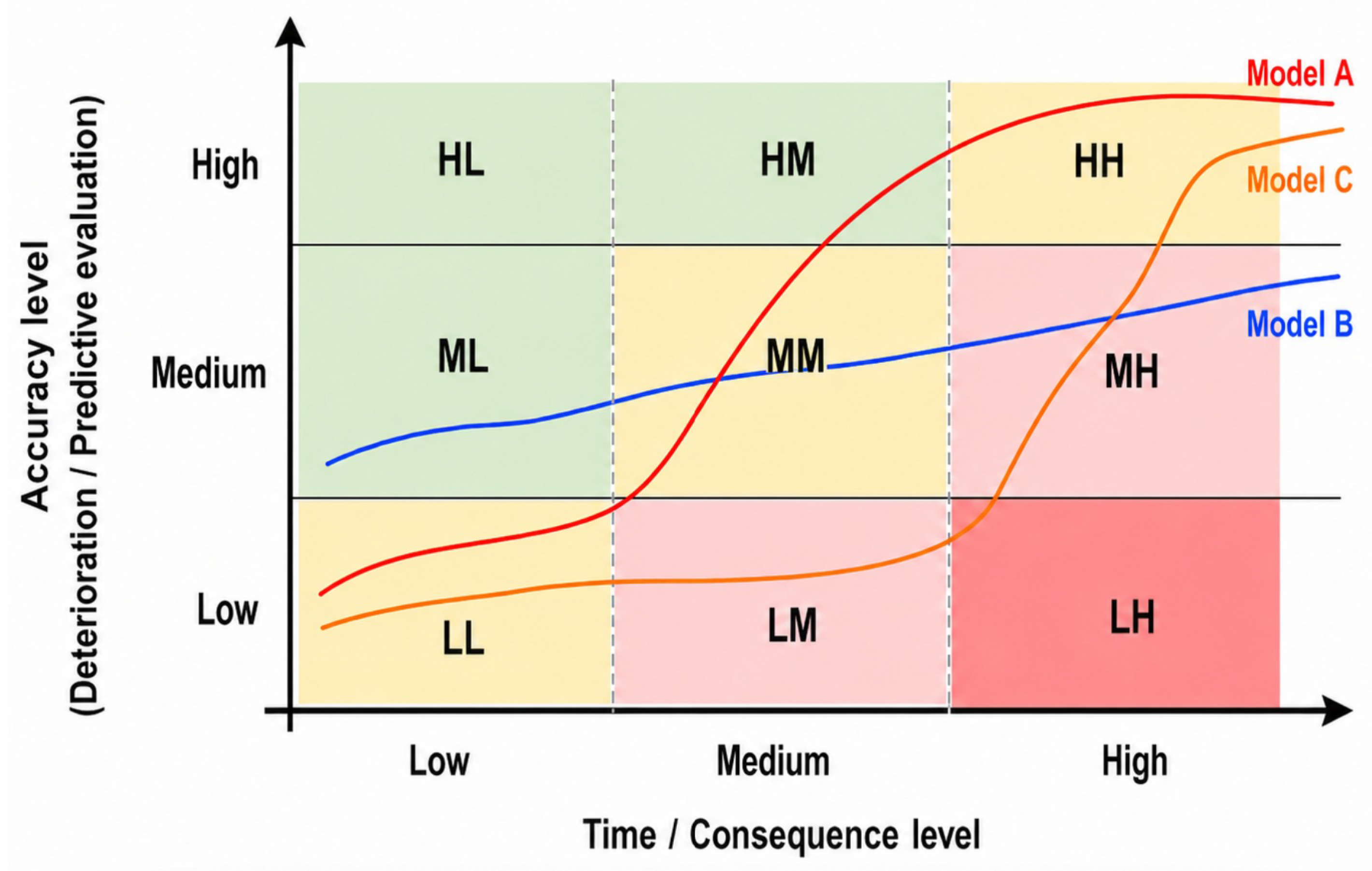
2.3. Risk-Based Predictive Maintenance
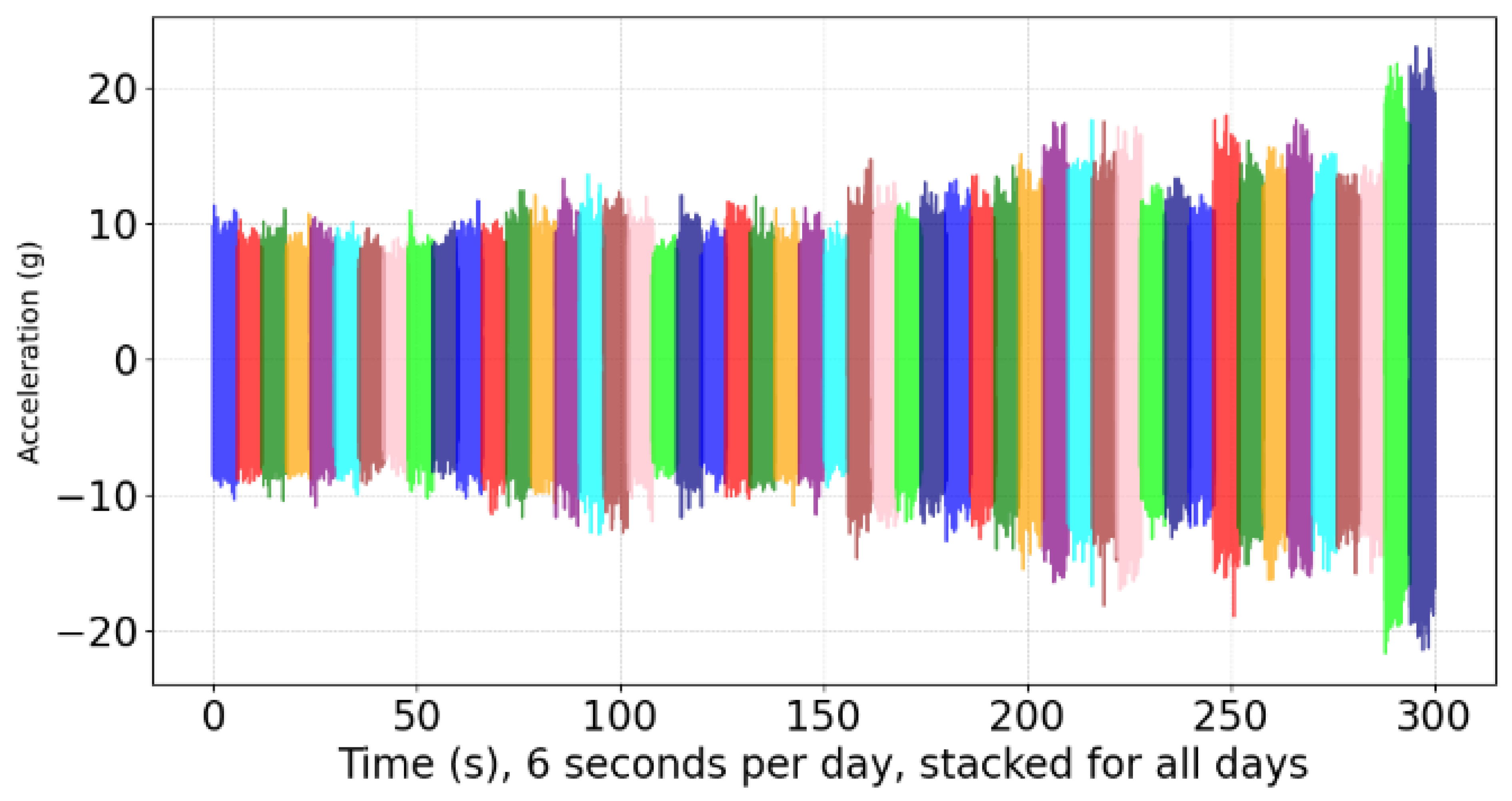
2.4. Demonstration Case
3. Results and Discussion
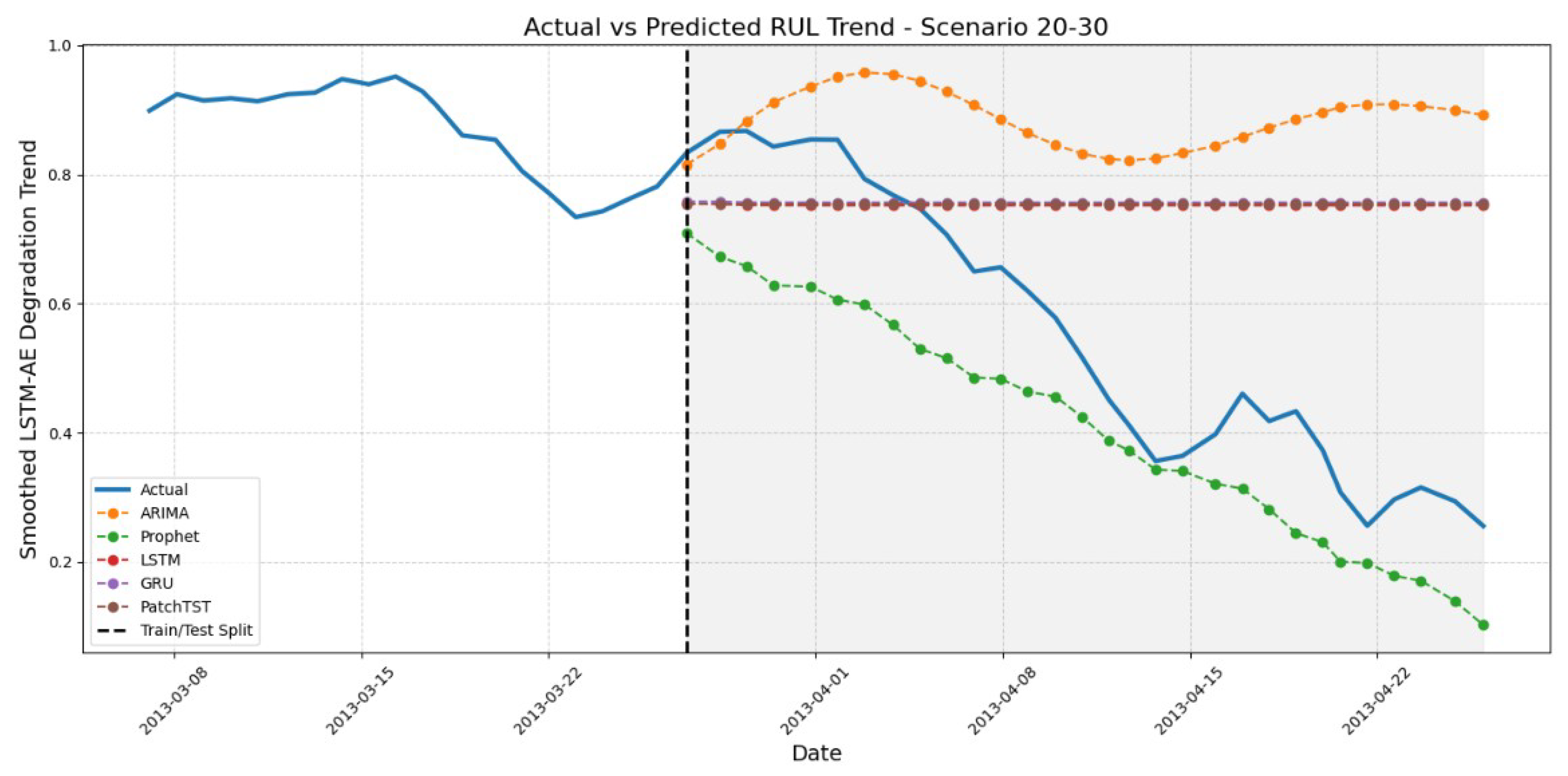
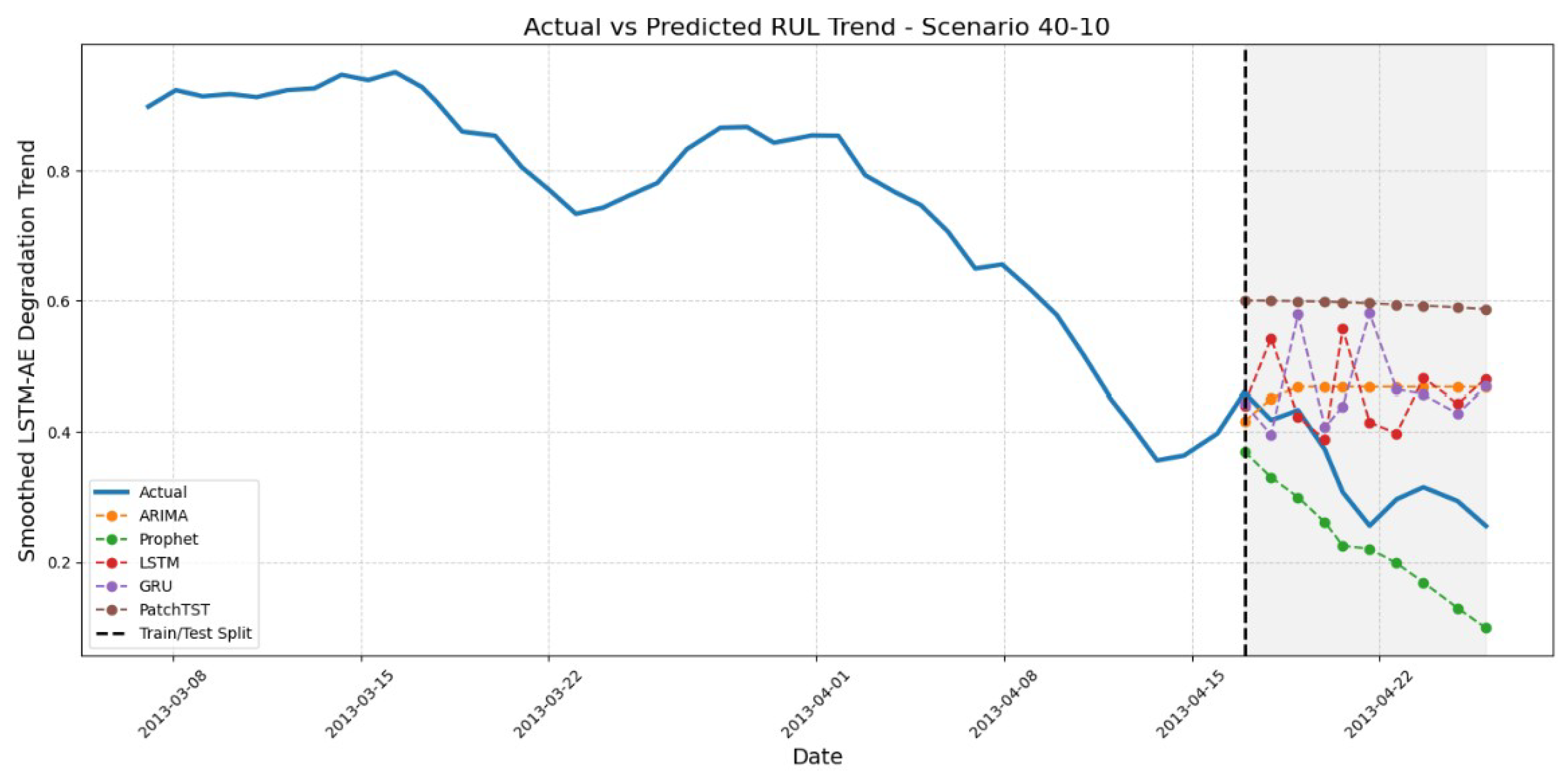
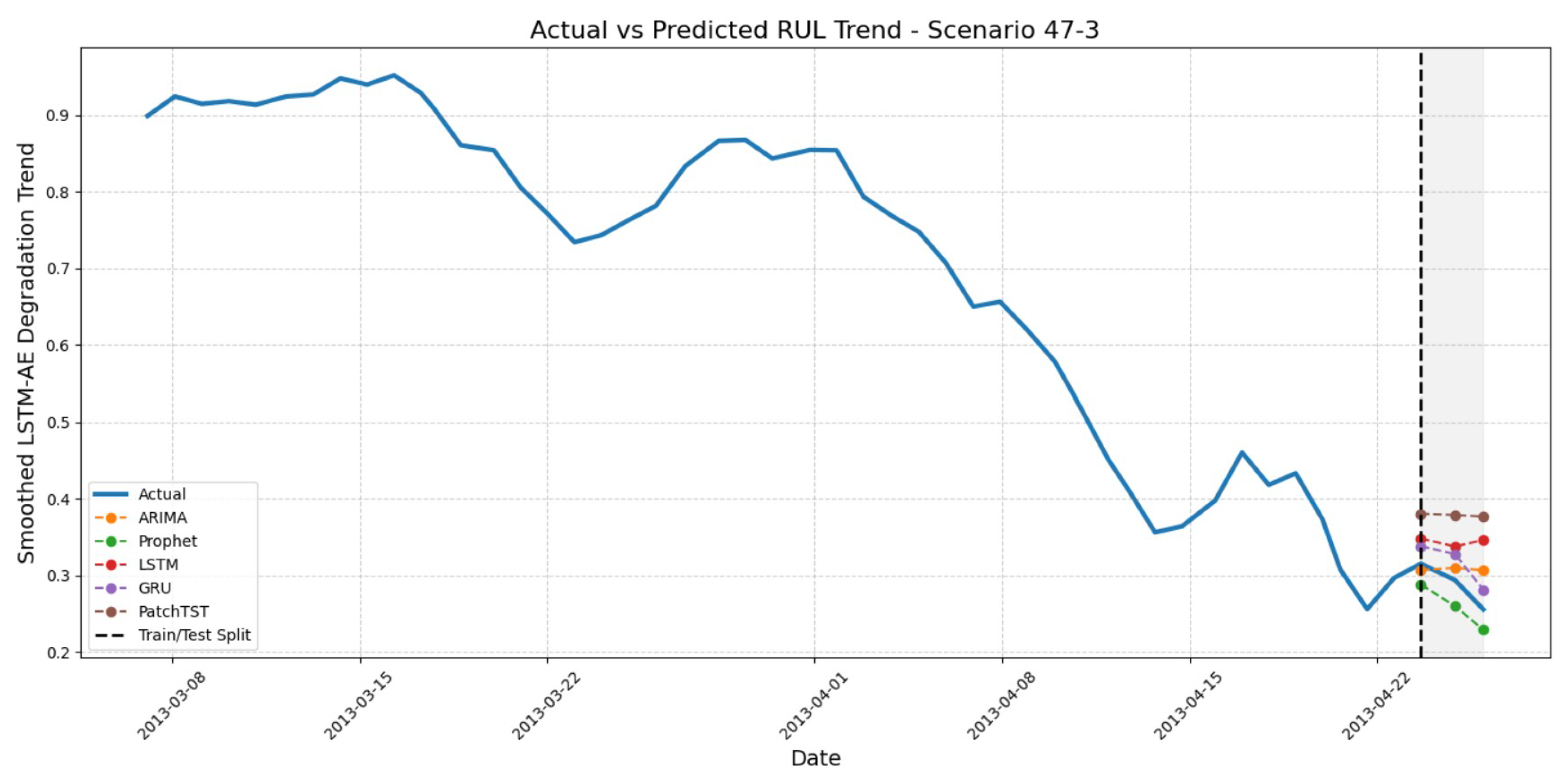
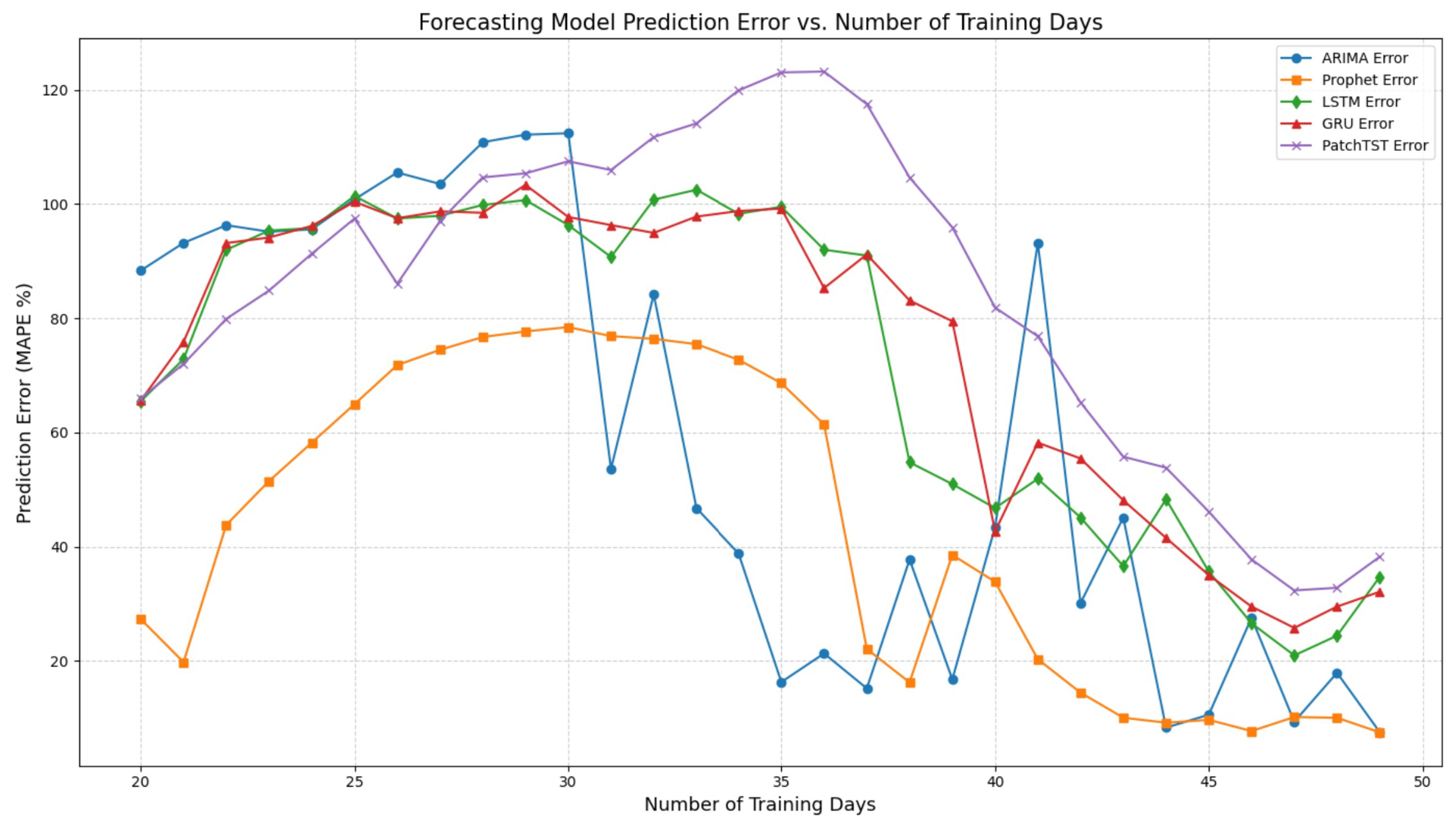
3.1. Accuracy over Multi Predictive Horizons
3.2. RUL Predictive Adequacy
3.3. RUL Predictive Adequacy Needs More Metrics
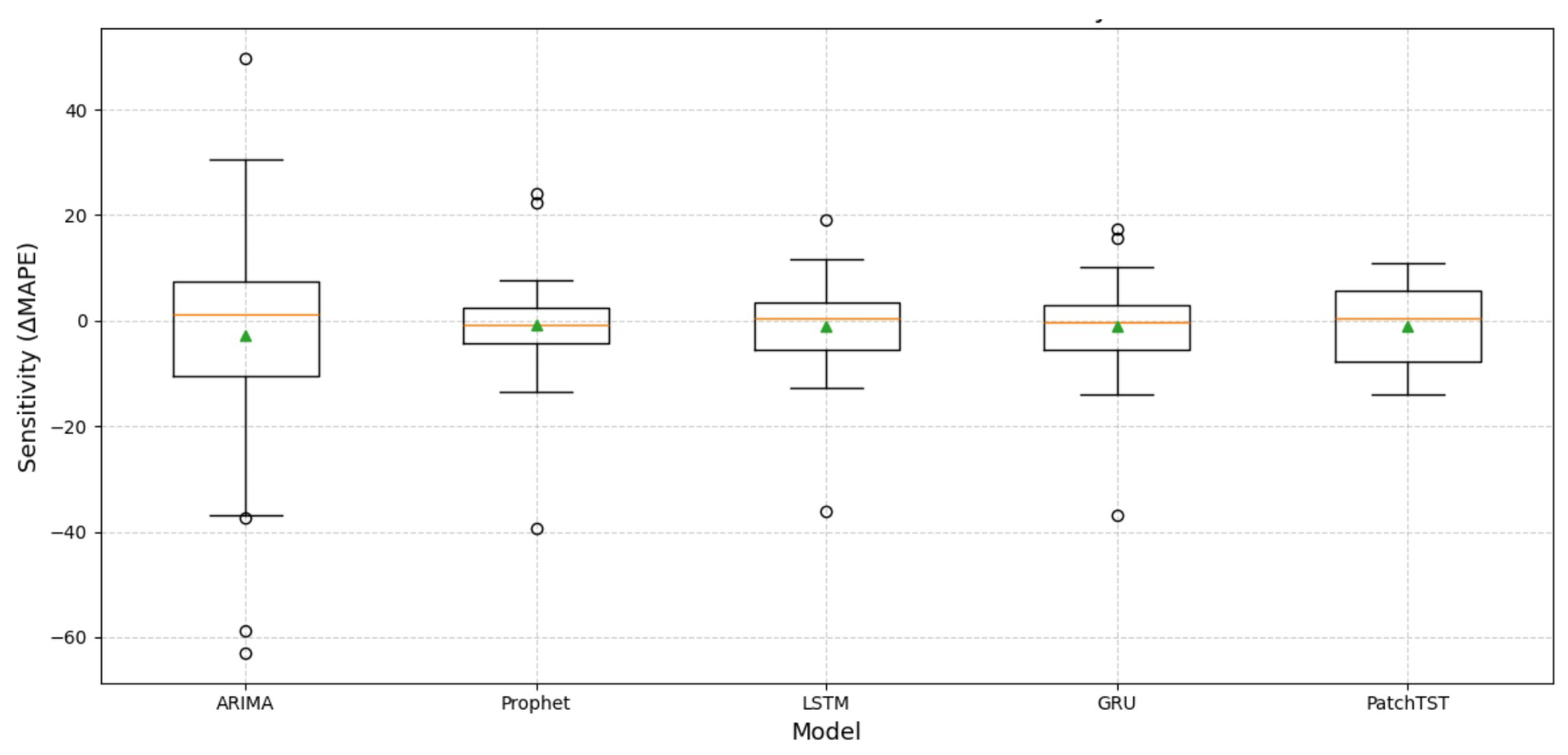
3.4. Sensitivity of RUL Prediction
3.5. Risk-Based Predictive Maintenance
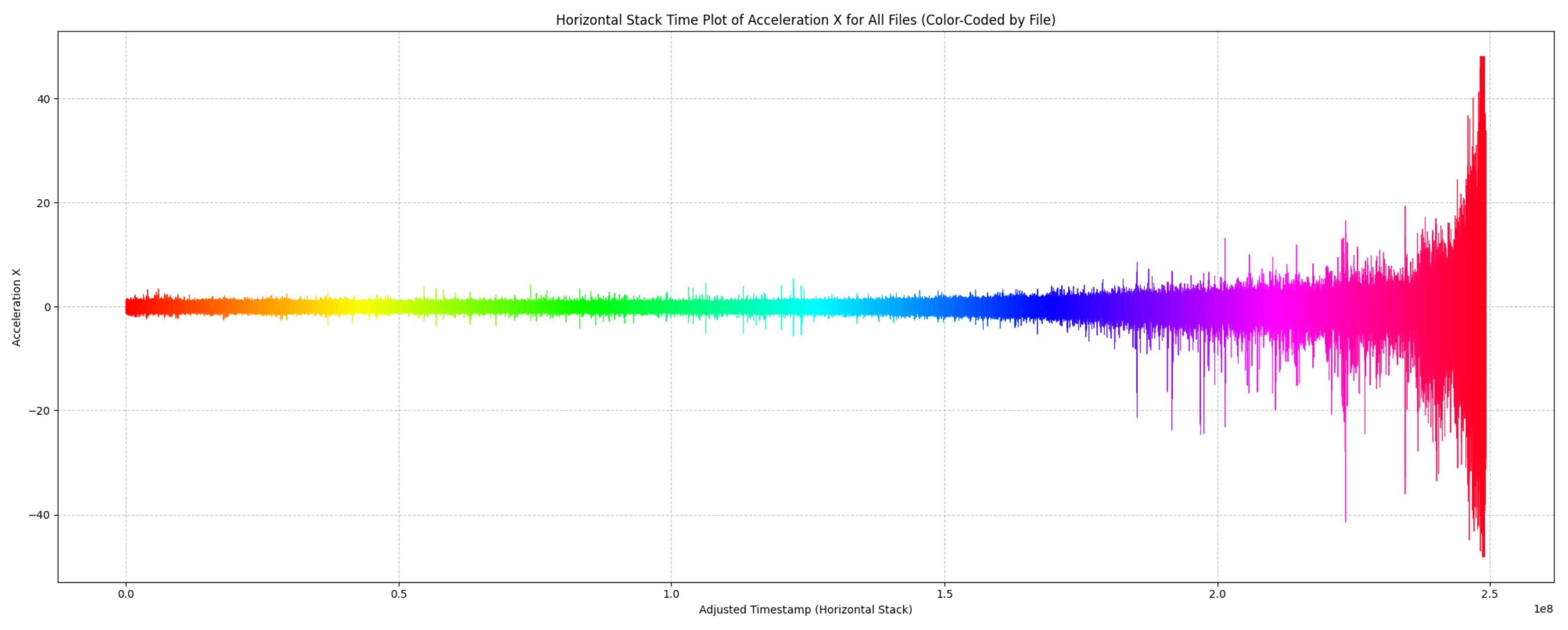
3.6. Multiple Dataset Testing
4. Conclusions
Author Contributions
Funding
Institutional Review Board Statement
Informed Consent Statement
Data Availability Statement
Conflicts of Interest
References
- Xu, T.; Tang, T.; Wang, H.; Yuan, T. Risk-Based Predictive Maintenance for Safety-Critical Systems by Using Probabilistic Inference. Math. Probl. Eng. 2013, 2013, 947104. [Google Scholar] [CrossRef]
- Agarwal, V.; Manjunatha, K.A.; Gribok, A.V.; Mortenson, T.J.; Bao, H.; Reese, R.D.; Ulrich, T.A.; Palas, H. Scalable Technologies Achieving Risk-Informed Condition-Based Predictive Maintenance Enhancing the Economic Performance of Operating Nuclear Power Plants; Technical Report; Idaho National Laboratory (INL): Idaho Falls, ID, USA, 2021. [Google Scholar]
- Walker, C.M.; Agarwal, V.; Appiah, R. Development of a Scalable Risk-Informed Predictive Maintenance Cloud-Based Strategy at Nuclear Power Plants; Technical Report; Idaho National Laboratory (INL): Idaho Falls, ID, USA, 2023. [Google Scholar]
- Liao, R.; He, Y.; Feng, T.; Yang, X.; Dai, W.; Zhang, W. Mission reliability-driven risk-based predictive maintenance approach of multistate manufacturing system. Reliab. Eng. Syst. Saf. 2023, 236, 109273. [Google Scholar] [CrossRef]
- Fingerhut, F.; Tsiporkova, E.; Boeva, V. Interpretable Data-Driven Risk Assessment in Support of Predictive Maintenance of a Large Portfolio of Industrial Vehicles. In Proceedings of the 2024 IEEE International Conference on Big Data (BigData), Washington, DC, USA, 15–18 December 2024; pp. 2870–2879. [Google Scholar] [CrossRef]
- El-Thalji, I. Predictive maintenance (PdM) analysis matrix: A tool to determine technical specifications for PdM ready-equipment. IOP Conf. Ser. Mater. Sci. Eng. 2019, 700, 012033. [Google Scholar] [CrossRef]
- Nordal, H.; El-Thalji, I. Assessing the Technical Specifications of Predictive Maintenance: A Case Study of Centrifugal Compressor. Appl. Sci. 2021, 11, 1527. [Google Scholar] [CrossRef]
- El-Thalji, I. Emerging Practices in Risk-Based Maintenance Management Driven by Industrial Transitions: Multi-Case Studies and Reflections. Appl. Sci. 2025, 15, 1159. [Google Scholar] [CrossRef]
- Nordal, H.; El-Thalji, I. Lifetime Benefit Analysis of Intelligent Maintenance: Simulation Modeling Approach and Industrial Case Study. Appl. Sci. 2021, 11, 3487. [Google Scholar] [CrossRef]
- Ferreira, C.; Gonçalves, G. Remaining Useful Life prediction and challenges: A literature review on the use of Machine Learning Methods. J. Manuf. Syst. 2022, 63, 550–562. [Google Scholar] [CrossRef]
- Kumar, S.; Raj, K.K.; Cirrincione, M.; Cirrincione, G.; Franzitta, V.; Kumar, R.R. A Comprehensive Review of Remaining Useful Life Estimation Approaches for Rotating Machinery. Energies 2024, 17, 5538. [Google Scholar] [CrossRef]
- Li, H.; Zhang, Z.; Li, T.; Si, X. A review on physics-informed data-driven remaining useful life prediction: Challenges and opportunities. Mech. Syst. Signal Process. 2024, 209, 111120. [Google Scholar] [CrossRef]
- Qiao, X.; Jauw, V.L.; Seong, L.C.; Banda, T. Advances and Limitations in Machine Learning Approaches Applied to Remaining Useful Life Predictions: A Critical Review. Int. J. Adv. Manuf. Technol. 2024, 133, 4059–4076. [Google Scholar] [CrossRef]
- Deutsch, J.; He, M.; He, D. Using Deep Learning-Based Approach to Predict Remaining Useful Life of Rotating Components. IEEE Trans. Syst. Man Cybern. Syst. 2018, 48, 11–20. [Google Scholar] [CrossRef]
- Kong, Z.; Cui, Y.; Xia, Z.; Lv, H. Convolution and Long Short-Term Memory Hybrid Deep Neural Networks for Remaining Useful Life Prognostics. Appl. Sci. 2019, 9, 4156. [Google Scholar] [CrossRef]
- Wang, B.; Lei, Y.; Yan, T.; Li, N. Multi-Scale Remaining Useful Life Prediction Using Long Short-Term Memory. Sustainability 2022, 14, 15667. [Google Scholar] [CrossRef]
- Nie, L.; Xu, S.; Zhang, L.; Yin, Y. Multi-Head Attention Network with Adaptive Feature Selection for RUL Predictions of Gradually Degrading Equipment. Actuators 2023, 12, 158. [Google Scholar] [CrossRef]
- Ensarioğlu, K.; İnkaya, T.; Emel, E. Remaining Useful Life Estimation of Turbofan Engines with Deep Learning Using Change-Point Detection Based Labeling and Feature Engineering. Appl. Sci. 2023, 13, 11893. [Google Scholar] [CrossRef]
- Xie, Z.; Du, S.; Lv, J.; Deng, Y.; Jia, S. A Hybrid Prognostics Deep Learning Model for Remaining Useful Life Prediction. Electronics 2020, 10, 39. [Google Scholar] [CrossRef]
- Wang, H.; Peng, M.; Miao, Z.; Liu, Y.; Ayodeji, A.; Hao, C. Remaining Useful Life Prediction for Aero-Engines Using a Time-Enhanced Multi-Head Self-Attention Model. Aerospace 2023, 10, 80. [Google Scholar] [CrossRef]
- Wang, J.; Yan, J.; Li, C.; Gao, R.X.; Zhao, R. Utilizing Multiple Inputs Autoregressive Models for Bearing Remaining Useful Life Prediction. arXiv 2023, arXiv:2311.16192. [Google Scholar] [CrossRef]
- Xiong, J.; Fink, O.; Zhou, J.; Ma, Y. Controlled physics-informed data generation for deep learning-based remaining useful life prediction under unseen operation conditions. Mech. Syst. Signal Process. 2023, 197, 110359. [Google Scholar] [CrossRef]
- Narang, A.; Anakiya, A.; Singh, K.; Kiran, M.B.; Gaur, H.; Thakur, S. Remaining Useful Life Prediction of Ball Bearings Using Deep Learning Techniques. In Proceedings of the 2024 14th International Conference on Cloud Computing, Data Science & Engineering (Confluence), Noida, India, 18–19 January 2024; pp. 908–913. [Google Scholar] [CrossRef]
- Ratre, S.; Jayaraj, J. Sales Prediction Using ARIMA, Facebook’s Prophet and XGBoost Model of Machine Learning. In Proceedings of the Machine Learning, Image Processing, Network Security and Data Sciences; Doriya, R., Soni, B., Shukla, A., Gao, X., Eds.; Springer: Singapore, 2023; pp. 101–111. [Google Scholar]
- Andersen, P.K. Fifty years with the Cox proportional hazards model: History, influence, and future. J. R. Stat. Soc. Ser. Stat. Soc. 2023, 187, 578–579. [Google Scholar] [CrossRef]
- Mor, B.; Garhwal, S.; Kumar, A. A Systematic Review of Hidden Markov Models and Their Applications. Arch. Comput. Methods Eng. 2021, 28, 1429–1448. [Google Scholar] [CrossRef]
- Zhao, Y.; Liu, Z.; Zhang, H.; Han, Q.; Liu, Y.; Wang, X. On-line condition monitoring for rotor systems based on nonlinear data-driven modelling and model frequency analysis. Nonlinear Dyn. 2024, 112, 5229–5245. [Google Scholar] [CrossRef]
- Raissi, M.; Karniadakis, G.E. Hidden physics models: Machine learning of nonlinear partial differential equations. J. Comput. Phys. 2018, 357, 125–141. [Google Scholar] [CrossRef]
- Agarwal, V.; Singh, M.; Kumar, K.P. A Comprehensive Review of Linear Regression, Random Forest, XGBoost, and SVR: Integrating Machine Learning and Actuarial Science for Health Insurance Pricing. In Proceedings of the Data Science and Security; Shukla, S., Sayama, H., Kureethara, J.V., Mishra, D.K., Eds.; Springer: Singapore, 2024; pp. 355–367. [Google Scholar]
- Esfahani, Z.; Salahshoor, K.; Farsi, B.; Eicker, U. A New Hybrid Model for RUL Prediction through Machine Learning. J. Fail. Anal. Prev. 2021, 21, 1596–1604. [Google Scholar] [CrossRef]
- Das, S.; Tariq, A.; Santos, T.; Kantareddy, S.S.; Banerjee, I. Recurrent Neural Networks (RNNs): Architectures, Training Tricks, and Introduction to Influential Research. In Machine Learning for Brain Disorders; Colliot, O., Ed.; Springer: New York, NY, USA, 2023; pp. 117–138. [Google Scholar] [CrossRef]
- Alzubaidi, L.; Zhang, J.; Humaidi, A.J.; Al-Dujaili, A.; Duan, Y.; Al-Shamma, O.; Santamaría, J.; Fadhel, M.A.; Al-Amidie, M.; Farhan, L. Review of Deep Learning: Concepts, CNN Architectures, Challenges, Applications, Future Directions. J. Big Data 2021, 8, 53. [Google Scholar] [CrossRef] [PubMed]
- Lara-Benítez, P.; Gallego-Ledesma, L.; Carranza-García, M.; Luna-Romera, J.M. Evaluation of the Transformer Architecture for Univariate Time Series Forecasting. In Proceedings of the Advances in Artificial Intelligence; Alba, E., Luque, G., Chicano, F., Cotta, C., Camacho, D., Ojeda-Aciego, M., Montes, S., Troncoso, A., Riquelme, J., Gil-Merino, R., Eds.; Springer: Cham, Switzerland, 2021; pp. 106–115. [Google Scholar]
- Vaswani, A.; Shazeer, N.; Parmar, N.; Uszkoreit, J.; Jones, L.; Gomez, A.; Kaiser, L.; Polosukhin, I. Attention Is All You Need. arXiv 2023, arXiv:1706.03762. [Google Scholar]
- Forootani, A.; Khosravi, M. Synthetic Time Series Forecasting with Transformer Architectures: Extensive Simulation Benchmarks. arXiv 2025, arXiv:2505.20048. [Google Scholar] [CrossRef]
- Dintén, R.; Zorrilla, M.; Veloso, B.; Gama, J. Building of transformer-based RUL predictors supported by explainability techniques: Application on real industrial datasets. Inf. Fusion 2026, 127, 103892. [Google Scholar] [CrossRef]
- Saleem, U.; Liu, W.; Riaz, S.; Li, W.; Hussain, G.A.; Rashid, Z.; Arfeen, Z.A. TransRUL: A Transformer-Based Multihead Attention Model for Enhanced Prediction of Battery Remaining Useful Life. Energies 2024, 17, 3976. [Google Scholar] [CrossRef]
- Wen, K.; Dang, X.; Lyu, K. RNNs are not Transformers (Yet): The Key Bottleneck on In-context Retrieval. arXiv 2024, arXiv:2402.18510. [Google Scholar] [CrossRef]
- Garcia, J.; Rios-Colque, L.; Peña, A.; Rojas, L. Condition Monitoring and Predictive Maintenance in Industrial Equipment: An NLP-Assisted Review of Signal Processing, Hybrid Models, and Implementation Challenges. Appl. Sci. 2025, 15, 5465. [Google Scholar] [CrossRef]
- Wang, H.; Shi, A. Remaining Useful Life Prediction of Rolling Bearings Based on an Improved U-Net and a Multi-Dimensional Hybrid Gated Attention Mechanism. Appl. Sci. 2025, 15, 7166. [Google Scholar] [CrossRef]
- Hao, Z.; Liu, S.; Zhang, Y.; Ying, C.; Feng, Y.; Su, H.; Zhu, J. Physics-Informed Machine Learning: A Survey on Problems, Methods and Applications. arXiv 2023, arXiv:2211.08064. [Google Scholar] [CrossRef]
- Popović, S.; Viduka, D.; Bašić, A.; Dimić, V.; Djukic, D.; Nikolić, V.; Stokić, A. Optimization of Artificial Intelligence Algorithm Selection: PIPRECIA-S Model and Multi-Criteria Analysis. Electronics 2025, 14, 562. [Google Scholar] [CrossRef]
- Khalifa, M.; Khan, F.; Thorp, J. Risk-based maintenance and remaining life assessment for gas turbines. J. Qual. Maint. Eng. 2015, 21, 100–111. [Google Scholar] [CrossRef]
- NORSOK Z-008; Risk Based Maintenance and Consequence Classification. NORSOK: Tingvoll, Norway, 2017.
- ISO 13381-1:2025; Condition Monitoring and Diagnostics of Machine Systems—Prognostics—Part 1: General Guidelines and Requirements. International Organization for Standardization: Geneva, Switzerland, 2025. Available online: https://www.iso.org/standard/88029.html (accessed on 14 February 2026).
- MathWorks. Wind Turbine High-Speed Bearing Prognosis Data Repository. Available online: https://www.mathworks.com/help/predmaint/ug/wind-turbine-high-speed-bearing-prognosis.html (accessed on 17 February 2025).
- Lee, J.; Qiu, H.; Yu, G.; Lin, J.; Services, R.T. Bearing Data Set. 2007. Available online: www.kaggle.com/datasets/vinayak123tyagi/bearing-dataset/data (accessed on 17 February 2026).
- Bechhoefer, E.; van Hecke, B.; He, D. Processing for improved spectral analysis. In Proceedings of the Annual Conference of the Prognostics and Health Management Society, New Orleans, LA, USA, 14–17 October 2013; pp. 1–6. [Google Scholar]
- Bichri, H.; Chergui, A.; Hain, M. Investigating the Impact of Train/Test Split Ratio on the Performance of Pre-Trained Models with Custom Datasets. Int. J. Adv. Comput. Sci. Appl. 2024, 15, 331–339. [Google Scholar] [CrossRef]
- Sivakumar, M.; Parthasarathy, S.; Padmapriya, T. Trade-off between training and testing ratio in machine learning for medical image processing. PeerJ Comput. Sci. 2024, 10, e2245. [Google Scholar] [CrossRef]
- Radočaj, D.; Jurišić, M.; Plaščak, I.; Galić, L. Randomness in Data Partitioning and Its Impact on Digital Soil Mapping Accuracy: A Comparison of Cross-Validation and Split-Sample Approaches. Agronomy 2025, 15, 2495. [Google Scholar] [CrossRef]





| Model | Parameter | Optimization Range | Selected Value |
|---|---|---|---|
| LSTM | Sequence Length | user-defined | 2 |
| LSTM Units | [8, 16, 32] | 16 | |
| Dropout | [0.0–0.5] | 0.1 | |
| Dense Hidden Units | [8, 16, 32] | 16 | |
| Epochs/Batch Size | [100–300]/[2, 4] | 300/4 or 2 | |
| GRU | Sequence Length | user-defined | 2 |
| GRU Units | [8, 16, 32] | 16 | |
| Dropout | [0.0–0.5] | 0.1 | |
| Dense Hidden Units | [8, 16, 32] | 16 | |
| Epochs/Batch Size | [100–300]/[2, 4] | 300/4 or 2 | |
| ARIMA | Best AIC-based order | ||
| Prophet | Daily/Weekly/Yearly Seasonality | {False, True} | False/True/False |
| Changepoint Prior Scale | [0.01–0.5] | 0.05 | |
| Seasonality Prior Scale | [1–20] | 10.0 | |
| Added Weekly Seasonality | Fourier order [1–10] | period = 7, order = 3 | |
| PatchTST-inspired | Sequence Length | user-defined | 2 |
| Attention Heads | [1–8] | 2 | |
| Key Dimension | [2–64] | 4 | |
| Feedforward Units | [8–128] | 16 | |
| Dense Hidden Units | [8, 16, 32] | 16 | |
| Epochs/Batch Size | [100–300]/[2, 4] | 300/4 or 2 |
| Model | Long Horizon (Low Consequence) | Medium Horizon (Medium Consequence) | Short Horizon (High Consequence) |
|---|---|---|---|
| ARIMA | 11.64 | 56.56 | 90.63 |
| Prophet | 72.67 | 66.12 | 89.81 |
| LSTM | 34.46 | 59.04 | 79.72 |
| GRU | 33.77 | 54.77 | 90.39 |
| PatchTST | 33.99 | 18.13 | 67.64 |
| Model | MAE | MSE | RMSE | R2 Score | MAPE (%) | Accuracy (%) |
|---|---|---|---|---|---|---|
| ARIMA | 0.0252 | 0.0010 | 0.0313 | −0.5988 | 9.3651 | 90.63 |
| Prophet | 0.0292 | 0.0009 | 0.0294 | −0.4160 | 10.1910 | 89.81 |
| LSTM | 0.0558 | 0.0037 | 0.0612 | −5.1204 | 20.2753 | 79.72 |
| GRU | 0.0275 | 0.0008 | 0.0279 | −0.2698 | 9.6050 | 90.39 |
| PatchTST | 0.0905 | 0.0087 | 0.0935 | −13.2818 | 32.3619 | 67.64 |
| Model | Long Predictive Horizon 20–30 | Medium Predictive Horizon 40–10 | Short Predictive Horizon 47–3 |
|---|---|---|---|
| ARIMA | 0.3846 | 0.7464 | 0.5636 |
| GRU | 0.5307 | 0.5147 | 0.1024 |
| LSTM | 0.5323 | 0.4746 | 0.5999 |
| PatchTST | 0.5959 | 0.3228 | 0.0540 |
| Prophet | 0.1015 | 0.1734 | 0.0681 |
| Train Days | ARIMA | Prophet | LSTM | GRU | PatchTST |
|---|---|---|---|---|---|
| 20 | 88.36 | 27.33 | 65.49 | 65.60 | 66.01 |
| 21 | 93.19 | 19.80 | 72.85 | 75.87 | 72.00 |
| 22 | 96.29 | 43.83 | 91.98 | 93.16 | 79.90 |
| 23 | 95.15 | 51.50 | 95.35 | 94.13 | 84.85 |
| 24 | 95.56 | 58.22 | 95.77 | 96.16 | 91.29 |
| 25 | 100.81 | 64.96 | 101.41 | 100.39 | 97.46 |
| 26 | 105.52 | 71.80 | 97.46 | 97.51 | 86.05 |
| 27 | 103.51 | 74.48 | 97.94 | 98.71 | 97.02 |
| 28 | 110.82 | 76.72 | 99.83 | 98.47 | 104.66 |
| 29 | 112.14 | 77.69 | 100.69 | 103.35 | 105.36 |
| 30 | 112.39 | 78.45 | 96.31 | 97.73 | 107.47 |
| 31 | 53.63 | 76.88 | 90.73 | 96.31 | 105.95 |
| 32 | 84.16 | 76.40 | 100.76 | 94.94 | 111.72 |
| 33 | 46.76 | 75.46 | 102.50 | 97.80 | 114.12 |
| 34 | 38.81 | 72.74 | 98.29 | 98.76 | 119.89 |
| 35 | 16.32 | 68.64 | 99.51 | 99.20 | 123.04 |
| 36 | 21.32 | 61.42 | 92.00 | 85.28 | 123.18 |
| 37 | 15.21 | 22.10 | 90.98 | 91.17 | 117.48 |
| 38 | 37.77 | 16.27 | 54.79 | 83.11 | 104.64 |
| 39 | 16.80 | 38.57 | 50.97 | 79.48 | 95.92 |
| 40 | 43.44 | 33.88 | 46.78 | 42.70 | 81.87 |
| 41 | 93.18 | 20.32 | 51.90 | 58.23 | 76.85 |
| 42 | 30.14 | 14.46 | 45.12 | 55.45 | 65.27 |
| 43 | 45.12 | 10.08 | 36.60 | 48.14 | 55.76 |
| 44 | 8.35 | 9.20 | 48.31 | 41.55 | 53.85 |
| 45 | 10.60 | 9.70 | 35.67 | 35.05 | 46.16 |
| 46 | 27.56 | 7.75 | 26.60 | 29.54 | 37.78 |
| 47 | 9.37 | 10.19 | 20.99 | 25.80 | 32.36 |
| 48 | 17.94 | 10.06 | 24.44 | 29.53 | 32.82 |
| 49 | 7.54 | 7.52 | 34.75 | 32.13 | 38.26 |
| Model | Long Predictive Horizon 25 Days (±3) | Medium Predictive Horizon 40 Days (±3) | Short Predictive Horizon 45 Days (±3) |
|---|---|---|---|
| ARIMA | 95.15–110.82 | 15.21–93.18 | 8.35–45.12 |
| Prophet | 43.83–76.72 | 10.08–38.57 | 7.75–14.46 |
| LSTM | 91.98–101.41 | 36.60–90.98 | 20.99–48.31 |
| GRU | 93.16–100.39 | 42.70–91.17 | 25.80–55.45 |
| PatchTST | 79.90–104.66 | 55.76–117.48 | 32.36–65.27 |
| Accuracy Rate | Low Consequence (30 Days) | Medium Consequence (10 Days) | High Consequence (3 Days) |
|---|---|---|---|
| High Accuracy (>95) | – | – | – |
| Medium Accuracy (80–95) | – | – | ARIMA (90.63%), GRU (90.39%), Prophet (89.81%) |
| Low Accuracy (<80) | ARIMA (11.64%), GRU (33.77%), LSTM (34.46%), PatchTST (33.99%), Prophet (72.67%) | ARIMA (56.56%), GRU (54.77%), LSTM (59.04%), PatchTST (18.13%), Prophet (66.12%) | LSTM (79.72%), PatchTST (67.64%) |
| Model | Dataset 1 | Dataset 2 | ||||
|---|---|---|---|---|---|---|
| 20–30 | 40–10 | 47–3 | 20–30 | 40–10 | 47–3 | |
| ARIMA | 11.64 | 56.56 | 90.63 | 77.35 | 82.04 | 98.25 |
| GRU | 33.77 | 54.77 | 90.39 | 76.56 | 73.21 | 95.18 |
| LSTM | 34.46 | 59.04 | 79.72 | 84.86 | 70.72 | 95.14 |
| PatchTST | 33.99 | 18.13 | 67.64 | 46.12 | 33.79 | 30.29 |
| Prophet | 72.67 | 66.12 | 89.81 | 86.62 | 81.03 | 96.76 |
| Accuracy Rate | Low Consequence (30 Days) | Medium Consequence (10 Days) | High Consequence (3 Days) |
|---|---|---|---|
| High Accuracy (>95) | – | – | ARIMA (98.25%), GRU (95.18%), LSTM (95.14%), Facebook Prophet (96.76%) |
| Medium Accuracy (80–95) | LSTM (84.86%), Facebook Prophet (86.62%) | ARIMA (82.04%), Facebook Prophet (81.03%) | — |
| Low Accuracy (<80) | ARIMA (77.35%), GRU (76.56%), PatchTST (46.12%) | GRU (73.21%), LSTM (70.72%), PatchTST (33.79%) | PatchTST (30.29%) |
Disclaimer/Publisher’s Note: The statements, opinions and data contained in all publications are solely those of the individual author(s) and contributor(s) and not of MDPI and/or the editor(s). MDPI and/or the editor(s) disclaim responsibility for any injury to people or property resulting from any ideas, methods, instructions or products referred to in the content. |
© 2026 by the authors. Licensee MDPI, Basel, Switzerland. This article is an open access article distributed under the terms and conditions of the Creative Commons Attribution (CC BY) license.
Share and Cite
El-Thalji, I.; Usman, A.; Ali, W. Evaluating RUL Predictive Models: A Risk-Based Predictive Maintenance Approach. AI 2026, 7, 169. https://doi.org/10.3390/ai7050169
El-Thalji I, Usman A, Ali W. Evaluating RUL Predictive Models: A Risk-Based Predictive Maintenance Approach. AI. 2026; 7(5):169. https://doi.org/10.3390/ai7050169
Chicago/Turabian StyleEl-Thalji, Idriss, Ali Usman, and Waqar Ali. 2026. "Evaluating RUL Predictive Models: A Risk-Based Predictive Maintenance Approach" AI 7, no. 5: 169. https://doi.org/10.3390/ai7050169
APA StyleEl-Thalji, I., Usman, A., & Ali, W. (2026). Evaluating RUL Predictive Models: A Risk-Based Predictive Maintenance Approach. AI, 7(5), 169. https://doi.org/10.3390/ai7050169