1. Introduction
The development of prognostics and health management (PHM) technologies has significantly advanced the understanding of equipment reliability and maintenance cost control and has been widely adopted in industrial applications [
1]. Remaining useful life (RUL) prediction is one of the core tasks in PHM and is commonly defined as the remaining operational time before failure. Accurate RUL prediction not only provides an essential basis for equipment health condition assessment but also serves as a key prerequisite for implementing scientific maintenance [
2]. As one of the most critical fundamental components in rotating machinery, rolling bearings strongly affect the overall performance and operating condition of equipment and are widely used in aerospace, energy systems, rail transportation, and other industrial applications. Therefore, accurate RUL prediction of rolling bearings is of great importance for ensuring mechanical system stability and improving equipment reliability [
3].
Existing RUL prediction methods can be broadly classified into two categories: model-driven methods and data-driven methods [
4]. Model-driven methods rely heavily on degradation mechanism modeling and prior assumptions, which imposes clear limitations in increasingly complex operating environments; in contrast, data-driven methods can directly learn deep feature representations from monitoring signals and thus offer greater flexibility and adaptability [
5]. With the rapid advances in sensing technology and artificial intelligence, data-driven deep learning methods have been widely adopted for RUL prediction. Convolutional neural networks [
6], recurrent neural networks [
7], and attention mechanisms [
8] have been extensively employed to learn complex nonlinear feature relationships from data through continuous parameter optimization, thereby improving the accuracy of RUL modeling and prediction [
9].
Although existing deep learning methods have achieved promising predictive performance, in real industrial scenarios, substantial variations in vibration characteristics and degradation patterns across operating conditions, together with inter-bearing differences in material properties, installation and manufacturing errors, and actual service conditions, often lead to distribution mismatch, thereby causing distribution shift and degrading model generalization [
10]. Ragab et al. [
11] proposed a contrastive adversarial domain adaptation method that incorporates contrastive loss into the adversarial adaptation framework, enabling the model to learn domain-invariant features while fully exploiting target-domain-specific information, thus effectively improving RUL prediction performance across operating conditions. Shi et al. [
12] proposed a domain generalization-based intelligent method that learns discriminative domain-invariant features through multi-source data augmentation, adversarial training, and a sample-adaptive selection and weighting strategy, thereby enhancing model generalization under unseen operating conditions. Methods such as domain adaptation and domain generalization have significantly improved model generalization. However, with the development of the Industrial Internet, operational data are often distributed across different devices and clients, and restrictions imposed by data privacy protection, security policies, and communication costs make centralized sharing of raw data difficult, thereby giving rise to the data island problem [
13]. Consequently, raw data cannot be effectively centralized, making it difficult to satisfy the ideal training conditions required by centralized deep learning methods.
In this context, federated learning enables collaborative model training across multiple nodes without sharing raw data, thus providing a new paradigm for addressing the data island problem [
14]. Chen et al. [
15] effectively integrated the global and local models through an adaptive local fusion strategy and proposed a personalized bearing RUL prediction method based on the Federated Averaging (FedAvg) algorithm. However, the conventional Federated Averaging strategy generally relies on the assumption that client data are independent and identically distributed so that the global model can achieve satisfactory aggregation performance. Since rolling bearing data often exhibit pronounced non-independent and identically distributed (non-IID) characteristics, the conventional FedAvg algorithm tends to induce inconsistent local update directions, thereby degrading global model performance [
16].
To address data heterogeneity in federated environments, existing studies have explored this issue from multiple perspectives. Chen et al. [
17] proposed the GHDR-FL method within a federated learning framework, integrating personalized client-side model architectures to enable RUL prediction in distributed data environments. By selecting clients with similar data distributions for aggregation, this method alleviates the adverse effects of non-IID data on global model performance to some extent; however, it remains limited by the requirement that clients with similar data distributions must still participate in training. To overcome the prediction challenges caused by discrepancies across multiple operating conditions, Kang et al. [
18] proposed a personalized federated learning method with dual-stage aggregation for life prediction. By combining multi-scale feature enhancement with a two-stage parameter aggregation mechanism based on model similarity, the method effectively mitigates negative transfer across operating conditions while preserving data privacy. Bai et al. [
19] proposed a lightweight federated learning-based RUL prediction method that achieves efficient and deployable prognostics by constructing an adaptive sparse self-attention graph convolutional GRU model and incorporating a dynamically weighted averaging aggregation strategy. Qin et al. [
20] proposed a dynamically weighted federated learning framework for RUL prediction, in which client models are adaptively aggregated through a maximum mean discrepancy-based dynamic weighting mechanism, thereby alleviating the adverse impact of data heterogeneity on federated training and improving prognostic performance in multi-client settings. At present, most federated learning-based life prediction methods mainly focus on alleviating the training bias caused by non-IID data through the allocation of inter-client aggregation weights, while paying insufficient attention to domain-invariant representation learning of degradation features within clients, making it difficult to mitigate the adverse impact of data heterogeneity on model performance at the feature level.
Although traditional cross-domain modeling methods can alleviate distribution shift to some extent and enable cross-domain life prediction, they rely on centralized training conditions and are therefore difficult to apply in scenarios where raw data cannot be shared because of data privacy constraints. In addition, most federated learning-based life prediction methods mainly attempt to alleviate inter-client discrepancies through aggregation weight design, while paying insufficient attention to the essential issues of domain-invariant degradation feature learning and aggregation. Therefore, under data privacy constraints and inter-client data heterogeneity, existing methods still have room for improvement.
This study focuses on mitigating the impact of data heterogeneity in federated environments on rolling bearing remaining useful life prediction from both the feature learning and model aggregation perspectives under privacy-preserving conditions and develops an FDG framework for rolling bearing remaining useful life prediction. By introducing a client-side domain-adversarial learning mechanism and a server-side distribution-aware dynamic aggregation strategy, the proposed method improves predictive performance and generalization capability without sharing raw data. The main research contents are as follows: (1) To address data privacy constraints, inter-client data heterogeneity, and the performance degradation caused by non-independent and identically distributed data in rolling bearing remaining useful life prediction, an FDG framework is established to clearly define the research task and the overall design concept; (2) A baseline RUL prediction model, CBL-LTA, is developed, in which CNN is used to extract local degradation features and a lightweight temporal attention mechanism is incorporated into the BiLSTM network to model the life evolution process, thereby providing a predictive foundation for federated learning; (3) A domain-adversarial training mechanism is introduced during client-side local training to learn domain-invariant degradation features and thereby mitigate the influence of distribution discrepancies across client data. In addition, by jointly considering client predictive performance and feature distribution discrepancies, a server-side distribution-aware dynamic aggregation strategy is designed to adaptively assign aggregation weights and alleviate the adverse effects of non-independent and identically distributed data on the federated model; (4) Federated scenario experiments are conducted on two full-life rolling bearing datasets involving different bearing types to validate the effectiveness of the proposed method, and comparative experiments further demonstrate its superior performance.
2. Problem Formulation
2.1. Data Distribution and Privacy Issues in Rolling Bearing RUL Prediction
Data-driven rolling bearing remaining useful life prediction is highly dependent on the scale, completeness, and operating-condition coverage of the training data, and high-performance models usually require support from multiple full-life-cycle datasets. However, in practical industrial environments, full-life-cycle monitoring data are extremely difficult to acquire, and such data are often distributed across different enterprises or equipment nodes with mutually independent sources, making it difficult to construct a unified large-scale training set. Data held by different entities often remain isolated for long periods, leading to the data island problem, which limits the shared utilization of data resources and makes it difficult for a single node to train a predictive model with strong generalization capability.
In this context, federated learning is introduced to address data privacy issues. Multiple clients are configured to hold different bearing lifetime datasets to simulate distributed data storage, and each client performs model training locally while updating the global model through parameter exchange. In the testing stage, the global model is used to predict unseen bearing data that were not involved in training, thereby evaluating model performance. The goal is to develop a federated RUL prediction model that preserves data privacy, adapts to distribution discrepancies across multiple operating conditions, and maintains stable predictive performance and strong generalization capability.
2.2. Analysis of Data Heterogeneity in Federated Learning
In federated RUL prediction scenarios, data often exhibit non-IID characteristics, which are mainly manifested in the following three aspects: (1) Cross-condition discrepancies: Bearing data collected under different operating conditions differ in vibration amplitude, frequency components, and degradation rates, resulting in discrepancies in input feature distributions and degradation mapping relationships. Such distribution shift can impair the collaborative learning effectiveness of the model across different clients: (2) Bearing-specific differences: Even under the same operating condition, differences in initial state, manufacturing error, and microscopic defects across bearings can lead to distinct degradation trajectories. If the model overly relies on specific bearing-dependent characteristics, its generalization performance may degrade during testing: (3) Imbalanced degradation stages: Bearing lifetime data typically consist of a long healthy stage and a relatively short failure stage, and such sample imbalance may cause the model to underemphasize critical degradation stages, thereby compromising prediction stability.
These heterogeneity issues can weaken the ability of conventional federated learning to model cross-domain shared features during aggregation. Therefore, this study focuses on how to combine domain-invariant feature extraction with adaptive model-parameter aggregation while keeping raw training data local, thereby mitigating the adverse effects of data heterogeneity on federated model performance and improving the predictive performance and generalization capability of rolling bearing remaining useful life prediction.
3. FDG-Based Rolling Bearing RUL Prediction Method
Motivated by data privacy and security concerns together with data distribution discrepancies in federated environments, this study develops a federated domain generalization framework for rolling bearing RUL prediction (FDG). The overall FDG framework mainly consists of two core modules: an RUL prediction model and a federated learning framework. First, a stable temporal prediction model is constructed to provide the predictive basis for the federated learning framework. Second, a domain-invariant feature learning mechanism is introduced during client-side training to mitigate feature distribution shifts caused by variations across bearing instances and operating conditions. Finally, a distribution-aware dynamic aggregation strategy is designed on the server side to adaptively assign aggregation weights according to client model performance and distribution discrepancies, thereby enhancing the stability and generalization capability of the global model. The resulting framework is intended to alleviate the adverse impact of domain discrepancies on predictive performance from both the feature learning and model aggregation levels, thereby enabling privacy-preserving rolling bearing RUL prediction.
3.1. Baseline Prediction Model
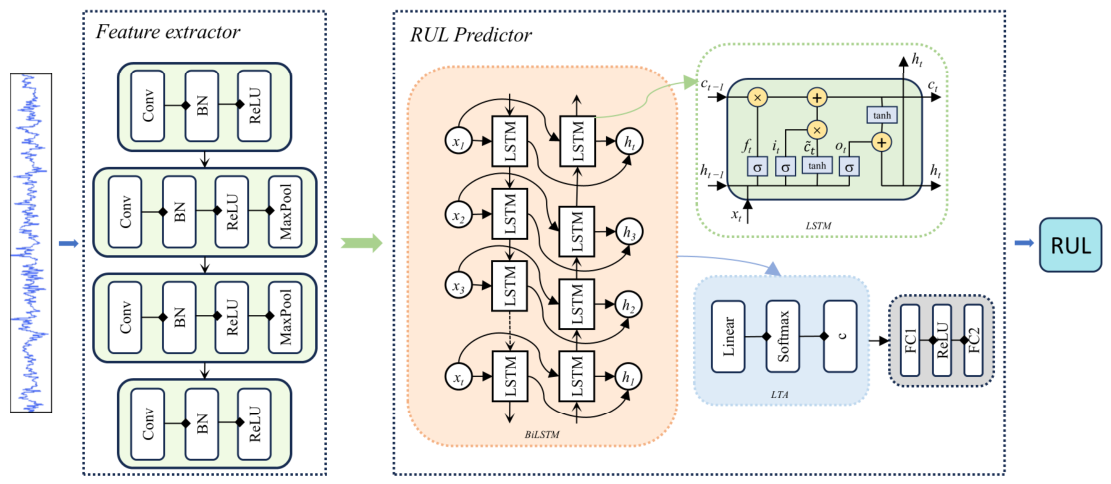
Rolling bearing vibration signals are typically characterized by strong noise, pronounced local impulsive components, and a degradation process that evolves progressively over time. To achieve accurate rolling bearing RUL prediction, a baseline prognostic model, CBL-LTA, is developed, which consists of a feature extractor and an RUL predictor, as shown in
Figure 1. The feature extractor is responsible for learning degradation-related representations from raw vibration signals. The RUL predictor models the degradation evolution process based on the extracted features. This architecture captures both local degradation patterns and long-term temporal dependencies, providing a stable basis for subsequent domain-invariant feature learning.
3.1.1. Feature Extraction Module
In rolling bearing vibration signals, degradation-related information is often manifested as local waveform patterns and variations in frequency band energy. Directly feeding raw sequences into a recurrent network is susceptible to noise interference and makes it difficult to efficiently extract local discriminative features. Therefore, a 1D convolutional neural network is introduced as the feature extraction module. Through local receptive fields and weight sharing, convolutional layers capture local temporal patterns and frequency-related characteristics in vibration signals, suppress noise interference, and enhance local degradation representations.
Let the input vibration signal sample be defined as:
Then, the convolutional feature extraction process can be formulated as:
where
represent the convolution kernel weights,
denotes the bias term,
represent the kernel length,
represents a local subsequence of length
starting at time step
,
denotes the nonlinear activation function, for which ReLU is used in this study, and
denotes the convolutional feature response at the
t-th temporal position.
By sliding the convolution kernels along the time axis, the model can automatically learn local degradation patterns and translation-invariant features from vibration signals, thereby improving its sensitivity to impulsive components and frequency band variations.
3.1.2. RUL Predictor Module
The bearing degradation process exhibits strong temporal dependence, and relying solely on local features makes it difficult to accurately characterize the evolution trend of bearing life. To capture the temporal dependencies in the degradation evolution process, a bidirectional long short-term memory network (BiLSTM) is employed to model the convolutional feature sequence.
The long short-term memory network regulates the input, retention, and output of information through the input, forget, and output gates. At time step
, let the input be
, the hidden state at the previous time step be
, and the cell state be
; then the LSTM computation can be formulated as:
where
denotes the forget gate,
denotes the input gate,
denotes the candidate cell state,
denotes the updated cell state,
denotes the output gate, and
denotes the output hidden state.
denotes the Sigmoid activation function,
denotes the hyperbolic tangent function, and
denotes element-wise multiplication.
BiLSTM consists of a forward LSTM and a backward LSTM, which propagate information along the temporal forward and backward directions, respectively, thereby capturing bidirectional dependencies in the time series. Its output is obtained by concatenating the hidden states of the two networks:
This structure can simultaneously exploit historical and future contextual information, enhance the model’s perception of global temporal features, and capture the latent temporal evolution patterns in rolling bearing degradation signals. However, conventional BiLSTM usually treats the hidden states at all time steps equally in the output stage, which may weaken the contribution of information from critical degradation stages.
To this end, a lightweight temporal attention (LTA) mechanism is introduced to improve the temporal information fusion scheme. Let the output hidden state of the BiLSTM at time step
be
and the sequence length be
; then the input to the LTA can be formulated as:
The importance score of each time step is computed through a learnable linear transformation:
where
and
denote the trainable weight and bias parameters, respectively.
To ensure the non-negativity and interpretability of the weight, the scores at all time steps are normalized by the Softmax function to obtain attention weights:
The final context vector is obtained as the weighted sum of the hidden states over all time steps:
This mechanism assigns importance weights to different time steps through a learnable linear transformation, highlights periods sensitive to RUL variation, and enables the model to focus on critical degradation intervals. It avoids the complex Query-Key-Value similarity computations and high-dimensional matrix operations required by conventional self-attention, thereby effectively reducing the parameter count and computational complexity.
By embedding the LTA into the hidden-state fusion process of the BiLSTM, the model can not only fully exploit bidirectional temporal information to characterize degradation evolution patterns but also emphasize the contribution of critical time steps in degradation progression to the prediction results, thereby improving the effectiveness of temporal modeling and prediction accuracy.
3.2. Client-Side Domain-Invariant Feature Learning
In federated learning scenarios, different clients usually correspond to different bearing instances or operating conditions, and the significant differences in their vibration signals lead to feature distribution shifts, making it difficult for the model to learn unified and stable degradation representations across clients. If only conventional supervised learning objectives are used, the model tends to overfit feature patterns associated with specific bearing instances or operating conditions, thereby resulting in a marked performance degradation on unseen bearing instances. Therefore, relying on conventional federated parameter aggregation is often insufficient to alleviate distribution heterogeneity, and feature representations must be constrained during client-side training so that the model focuses more on degradation patterns that are independent of data distribution.
Accordingly, a domain-adversarial learning mechanism is introduced on the client side. By incorporating a domain discriminator together with a gradient reversal strategy, the feature extraction network is encouraged to progressively remove domain-related information while optimizing RUL prediction accuracy, thereby yielding more stable and better-aligned degradation representations.
In the baseline prediction model, the output of the feature extractor
is formulated as:
where
denotes the i-th vibration signal sample and
denotes its corresponding feature representation.
If the extracted features still contain evident domain-specific information, the model may rely on such information for prediction rather than genuinely learning the underlying degradation evolution patterns. To this end, an additional domain discriminator
is constructed on the client side to predict the domain label
of each sample from the feature representation
The objective of the domain discriminator is to maximally distinguish feature distributions across different domains. If the feature representations exhibit strong domain-discriminative characteristics, the domain discriminator can achieve high classification accuracy. Conversely, if the features become domain-invariant, the domain classification performance will decrease significantly. In the FDG framework, the domain discriminator serves to quantify the residual domain information in the learned features and provides feedback signals for subsequent adversarial optimization.
To achieve domain-invariant feature learning, training the domain discriminator alone is insufficient; the feature extraction network must also be subjected to an adversarial constraint so that it actively suppresses domain-related information. A Gradient Reversal Layer (GRL) is introduced to implement the adversarial mechanism. During forward propagation, the GRL leaves the feature representation unchanged. During backpropagation, the gradient of the domain classification loss with respect to the features is multiplied by a negative coefficient, forcing the feature extraction network to update in a direction that confuses the domain discriminator. The corresponding gradient update can be formulated as:
where
denotes the adversarial strength coefficient used to balance prediction accuracy and domain invariance, and the negative sign indicates reversal of the gradient direction.
During client-side training, the overall optimization objective consists of two components: the RUL prediction loss
, which constrains prognostic accuracy, and the domain classification loss
, which measures domain discriminability. The overall loss function is defined as:
When is small, the model places greater emphasis on prediction accuracy; as increases, the model places more emphasis on domain-invariant regularization. By properly tuning the adversarial strength, the model can suppress domain-specific information in the learned features while maintaining RUL prediction accuracy.
As training proceeds, the feature distributions of different clients gradually move toward a shared representation space, thereby providing a more consistent feature basis for subsequent server-side federated aggregation. This strategy helps reduce the risk of negative transfer under non-IID conditions and provides support for improving generalization within the FDG framework.
3.3. Distribution-Aware Dynamic Aggregation Mechanism
Although the domain-adversarial mechanism has reduced feature-level distribution discrepancies within clients, differences may still persist among client models in terms of predictive capability and distribution alignment. Therefore, it is necessary to further introduce a distribution-aware dynamic aggregation strategy on the server side, which adaptively adjusts aggregation weights according to client model quality and distribution characteristics, thereby improving the robustness and generalization capability of the global model.
To improve the adaptability of the aggregation process to distribution heterogeneity, a server-side dynamic weighting strategy is introduced based on predictive performance and distribution discrepancy.
From the perspective of predictive performance, the average RUL prediction loss of each client after local training in the current round can reflect the quality of its model update. Let the average prediction loss of the k-th client after round be denoted by . A smaller loss indicates that the current local model better captures the degradation patterns in the client’s local data.
From the perspective of distribution consistency, the server computes the client feature distribution discrepancy measure
using the client-uploaded feature statistics
and
together with the current global feature statistics
and
, as formulated below:
where a smaller
indicates that the feature distribution of client k is more closely aligned with the current global shared feature space.
Since the numerical ranges of prediction loss and distribution discrepancy may differ, the server first normalizes
and
for each client separately to prevent any single factor from dominating the aggregation process. On this basis, the dynamic aggregation weight of client k is defined as:
where
and
denote the weighting coefficients of the predictive performance term and the distribution discrepancy term, respectively. Clients with smaller average RUL loss and feature distributions closer to the global statistics are assigned larger weights during aggregation.
The server then performs weighted aggregation of the model parameters uploaded by all clients according to the dynamic weights, yielding the global model parameters for the next round:
where
denotes the model parameters uploaded by the k-th client after local training in round t, and
denotes the aggregated global model parameters.
In this way, the server-side aggregation process does not rely solely on simple averaging, but instead jointly considers client predictive capability and feature distribution consistency to adaptively adjust each client’s contribution to the global model, thereby helping mitigate the adverse effects of heterogeneous data and improving the stability and generalization capability.
3.4. Architecture of the FDG Model
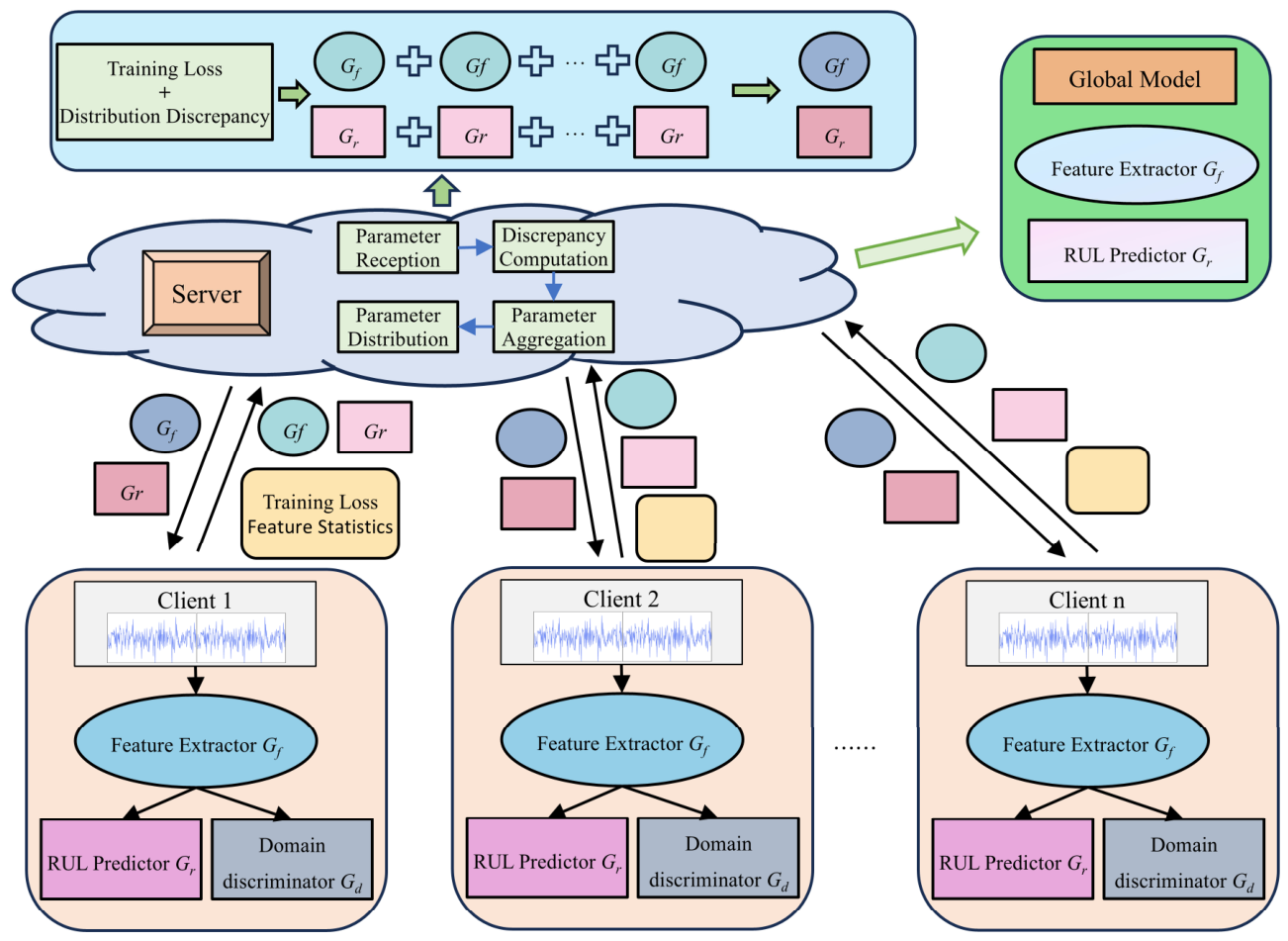
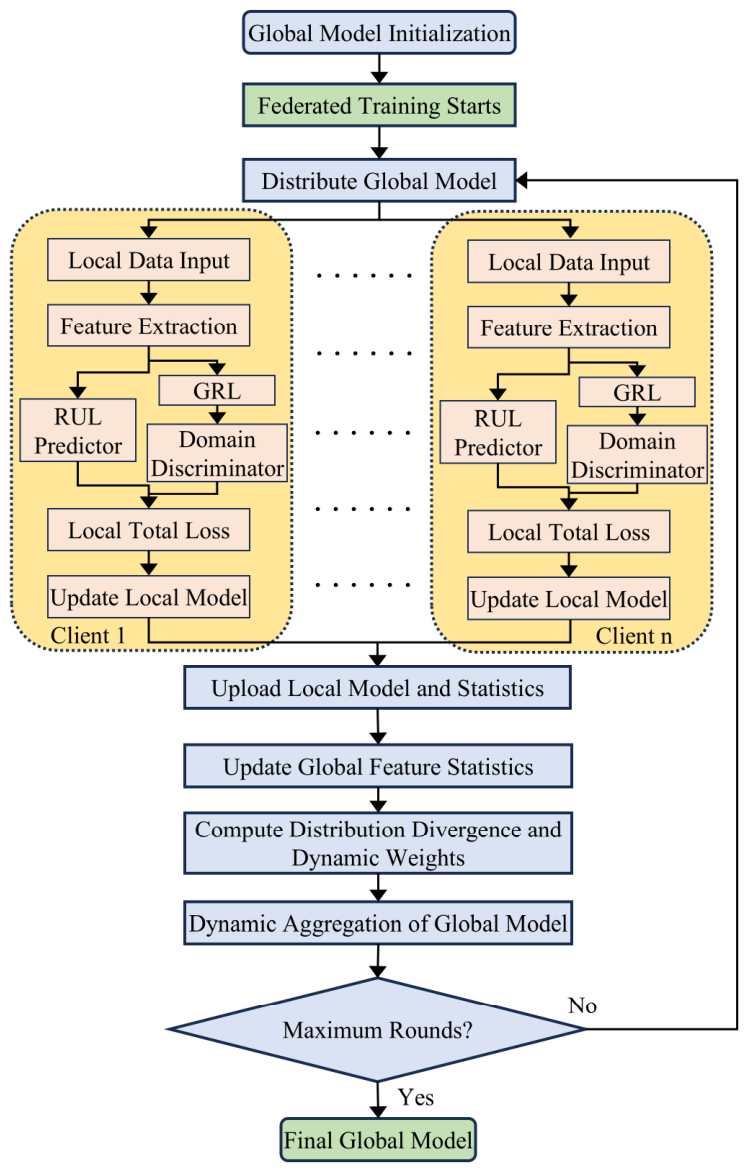
Based on the baseline prediction model, the client-side domain-adversarial learning mechanism, and the server-side distribution-aware dynamic aggregation strategy, a federated domain generalization framework for rolling bearing RUL prediction is constructed, as illustrated in
Figure 2.
5. Experimental Setup and Results Analysis
5.1. Dataset Description
- (1)
IEEE PHM 2012 rolling bearing dataset
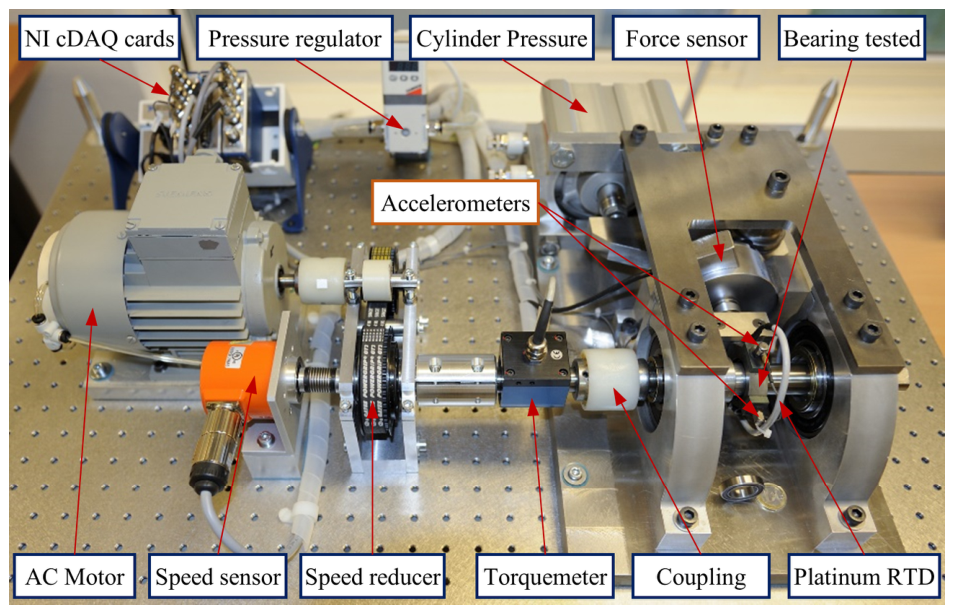
The experiments are validated on the PHM 2012 bearing accelerated degradation dataset, which was collected using the PRONOSTIA bearing degradation test platform. This dataset is characterized by complete data records, clear degradation trajectories, and well-defined operating conditions. The test rig consists of three core subsystems, namely the drive system, loading system, and monitoring system [
21], as illustrated in
Figure 4.
In this dataset, vibration signals are recorded at fixed time intervals, with a sampling frequency of 25.6 kHz, a sampling interval of 10 s, and a sampling duration of 0.1 s for each acquisition. The experiment covers three different operating conditions, and the condition information of the data used in this study is listed in
Table 1.
Considering that differences in loading direction may lead to different degradation sensitivities in vibration signals measured along different directions, the horizontal vibration signals, which contain richer degradation information, are selected to validate the proposed method, thereby ensuring the interpretability and stability of the prediction results.
- (2)
XJTU-SY rolling bearing dataset
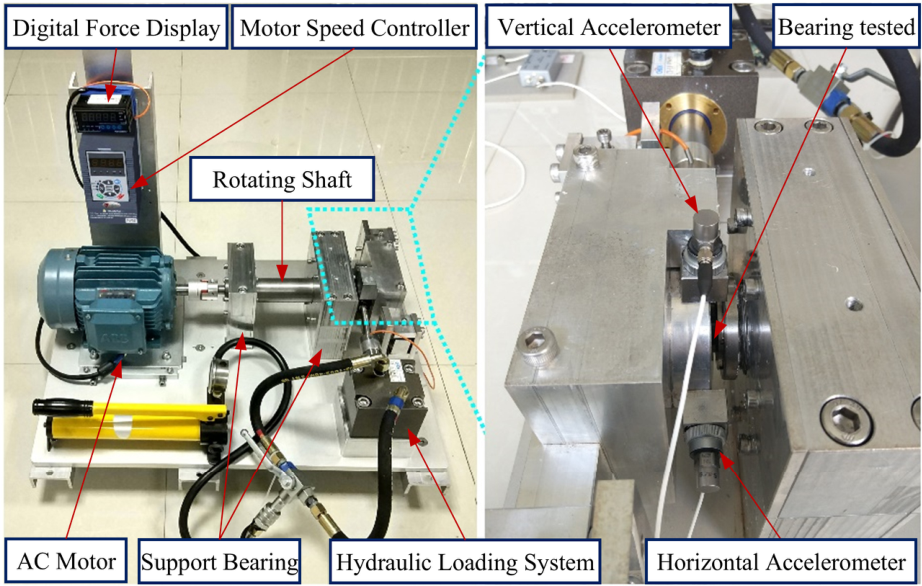
The XJTU-SY rolling bearing accelerated life test dataset was obtained from rolling bearing accelerated life tests conducted by Xi’an Jiaotong University and is a representative full-life bearing dataset for prognostics and health management research. The experimental platform consists of an AC motor, a motor speed controller, a shaft, support bearings, a hydraulic loading system, and test bearings [
22], as shown in
Figure 5.
This dataset contains vibration signals of rolling bearings operating to failure under three different operating conditions, and the data collected under Condition 1 are used in this study. The detailed operating-condition information is listed in
Table 2. In the XJTU-SY dataset, vibration signals are acquired using acceleration sensors at a sampling frequency of 25.6 kHz, with a sampling interval of 1 min and a sampling duration of 1.28 s for each acquisition. The sampled data are stored in chronological order, and the horizontal vibration signals are used in the experiments.
5.2. Experimental Setup
To validate the proposed method, experiments are conducted on two different datasets. The two datasets involve different bearing types and collectively cover four operating conditions, based on which a federated learning scenario is constructed to simulate collaborative training among four clients. Each client holds two complete sets of full-life bearing run-to-failure data for local model training. In addition, four complete sets of full-life bearing data that are not involved in training are used as the test set to evaluate the predictive performance of the model on unseen samples. The data allocation for each client is listed in
Table 3.
The model parameter settings and network architecture used in the experiments are listed in
Table 4. The key hyperparameters of the model are mainly determined according to the principle of balancing training stability, predictive performance, and generalization capability in heterogeneous federated scenarios. Among them, the domain-adversarial weight λ is used to regulate the relative strength between the life prediction objective and domain-invariant feature learning. When λ is too small, the domain-adversarial constraint becomes insufficient, making it difficult to learn domain-invariant features; when λ is too large, excessive emphasis is placed on domain confusion, which in turn compromises prediction accuracy. In the dynamic aggregation strategy, the weighting coefficients β and γ are used to control the contributions of the training loss term and the distribution discrepancy term to the aggregation weights, respectively. The selected values indicate that predictive performance is treated as the primary criterion during aggregation, while feature distribution discrepancies are incorporated as a moderate corrective factor, thereby improving the stability and generalization capability of global model updates.
5.3. Performance Evaluation Metrics
To objectively evaluate the performance of the proposed method in the rolling bearing RUL prediction task, mean absolute error (MAE) and root mean square error (RMSE) are used as evaluation metrics. The definitions of these metrics are given as follows:
where
denotes the true RUL value,
denotes the predicted RUL value, and
denotes the number of samples. MAE and RMSE directly quantify the deviation between the predicted and actual values; a larger prediction error results in larger values for both metrics.
5.4. Comparative Experimental Setup
To validate the effectiveness of the proposed method for rolling bearing RUL prediction, comparative experiments are conducted against several commonly used methods, as described below:
Baseline prediction model: In this method, the model is trained only on a single local training set, and each client independently trains its own prediction model using locally available data. No federated learning mechanism is involved, and there is no data exchange or parameter sharing among clients.
Centralized learning: In centralized learning, the training data from all clients are merged into a single dataset, without considering data privacy, and the prediction model is trained using all available data. This method is not affected by decentralized parameter updates or aggregation errors in federated learning and can fully exploit all training samples under ideal data-sharing conditions. In this study, the proposed prediction model is adopted as the backbone, and all training data are combined for centralized training as a comparative setting.
FedAvg: As the most classical parameter aggregation method in federated learning, the Federated Averaging algorithm treats all clients equally after local training and model upload, assuming that each client contributes equally to the global model. It updates the global model through simple averaging without considering data differences among clients.
FedDwa [
19]: The FedDwa method employs a dynamic weighted aggregation strategy, in which the training loss of each client is used to quantify its relative contribution to the global model, thereby determining dynamic aggregation weights for server-side aggregation.
Proposed method: While preserving data privacy, each client performs adversarial training using local data, and iterative optimization is achieved through dynamic aggregation based on both training performance and feature distribution discrepancies.
5.5. Experimental Results and Analysis
To visually compare the predictive performance of different methods on the test set, the trained shared models are evaluated on the test bearing data after model training is completed.
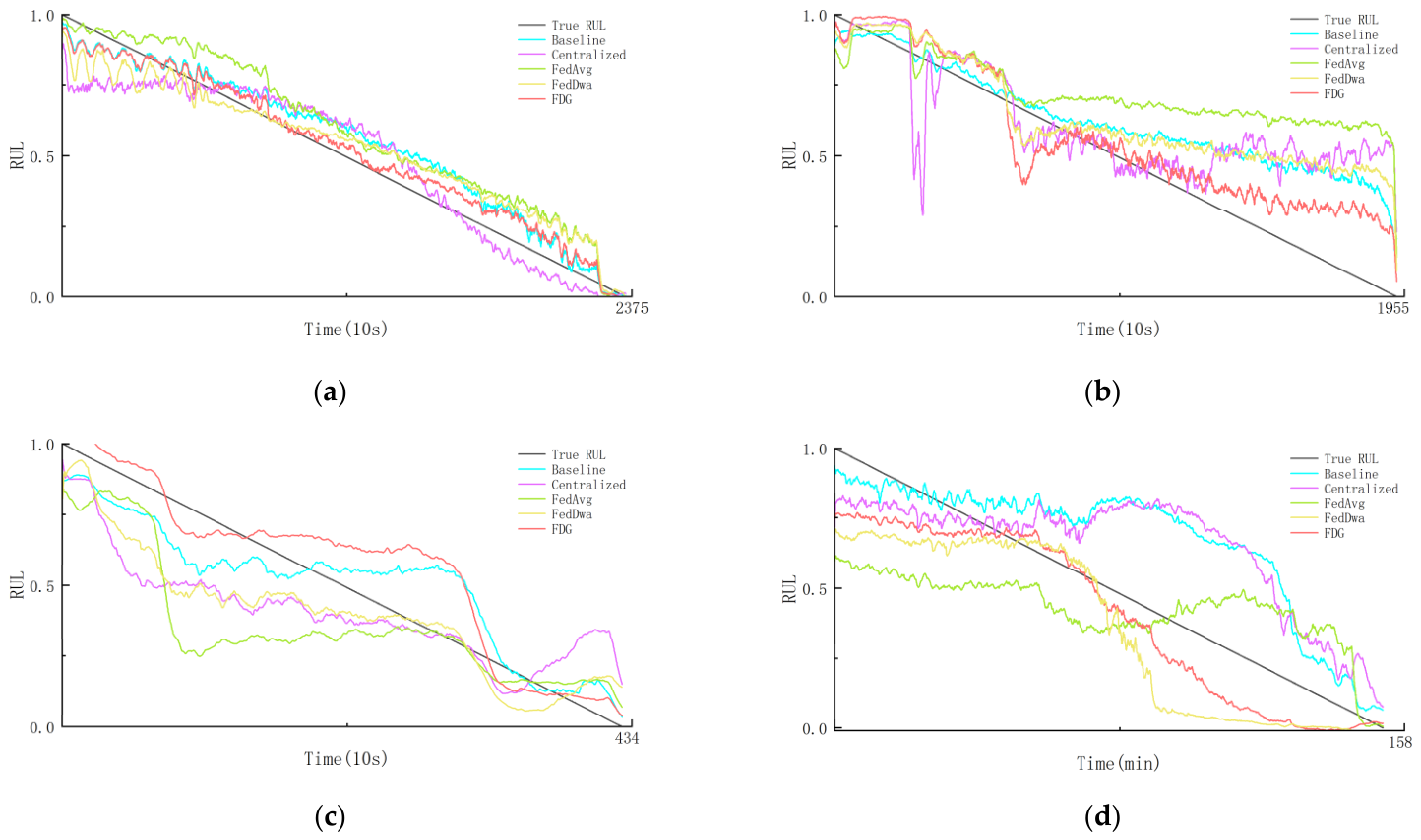
Figure 6 compares the prediction results of different methods on the same bearing, while
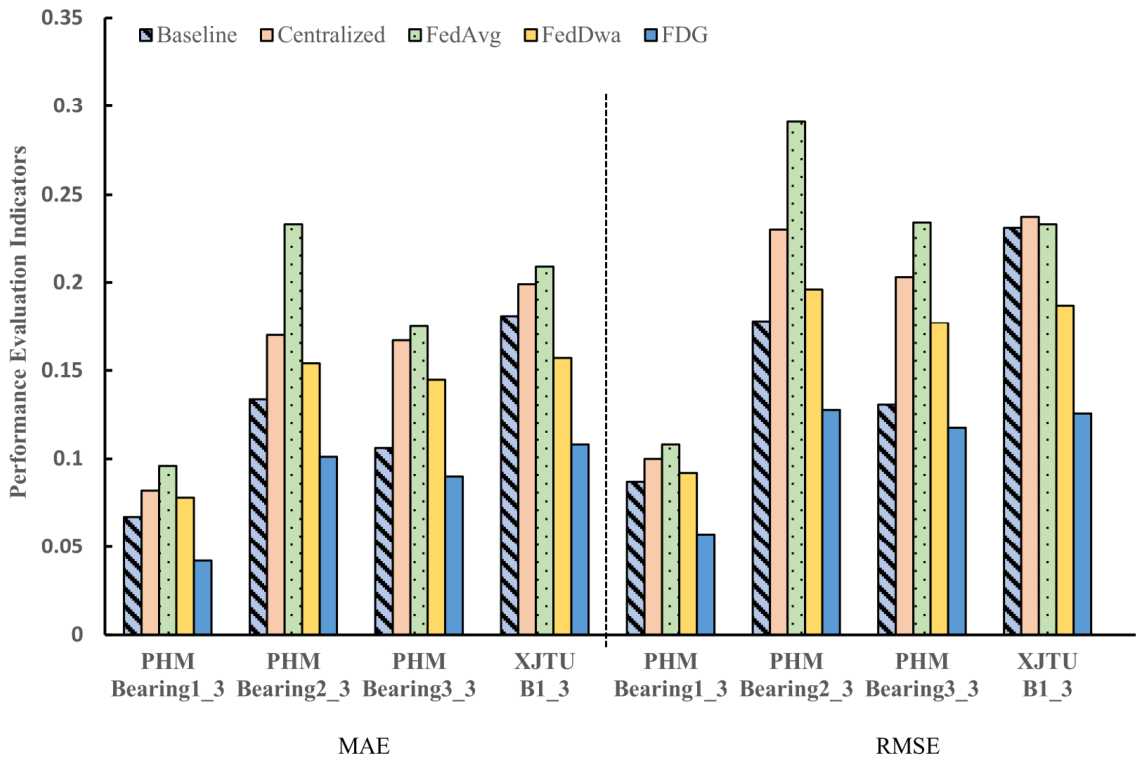
Table 5 and
Figure 7 present the quantitative performance metrics and the corresponding bar charts, respectively. To ensure the stability of the experimental results, all reported results are averaged over five runs under the same experimental conditions.
The prediction results show that, compared with the other methods, FDG shows predictions that are generally closer to the true RUL values on the four test bearings, exhibits better trend consistency, and can track the actual life degradation process more stably. FDG achieves MAE values of 0.042 ± 0.003, 0.101 ± 0.006, 0.090 ± 0.006, and 0.108 ± 0.009, along with RMSE values of 0.057 ± 0.005, 0.128 ± 0.009, 0.118 ± 0.007, and 0.126 ± 0.011 on the four test bearings, respectively, all of which are the lowest among the compared methods under the current setting. Moreover, the fluctuation range across repeated experiments remains within approximately 5–9%. To further assess the statistical robustness of the experimental results, the Wilcoxon signed-rank test was employed to examine whether the performance improvements of FDG over the comparison methods were statistically significant. The test results indicate that the observed performance improvements are statistically significant (p < 0.05), demonstrating that the proposed method exhibits good stability and reliability across repeated experiments.
Compared with the Baseline, FDG reduces the average MAE and average RMSE on the four test bearings by 29.3% and 29.5%, respectively. The Baseline results verify the predictive effectiveness of the proposed baseline model CBL-LTA, which can learn representative degradation patterns from local data and thereby provide a reliable predictive foundation for federated learning scenarios. Under the current experimental setting, FDG achieves lower average MAE and RMSE than the centralized baseline. The centralized training was implemented using the proposed prediction model as the backbone, with bearing data from different types and operating conditions directly combined for training. Because no explicit mechanism was introduced to handle distribution discrepancies across different data sources, the model tends to be biased toward the dominant data distribution, which adversely affects its performance. It should be noted, however, that this result only reflects the current model architecture and experimental configuration, and does not imply that the proposed method is universally superior to all centralized training approaches. Compared with FedAvg, FDG reduces the average MAE and average RMSE by 51.9% and 49.6%, respectively. This indicates that, in non-IID federated environments, conventional parameter averaging is insufficient to cope with pronounced inter-client data heterogeneity. When different clients correspond to datasets collected from different bearing types and operating conditions, parameter updates are prone to bias, which degrades model performance and may even lead to worse results than directly mixing all data for training. Compared with FedDwa, FDG further reduces the average MAE and average RMSE by approximately 37.4% and 34.6%, respectively. Although FedDwa already accounts for differences in client contribution during aggregation and thus achieves clear improvements over FedAvg, its main enhancement is still confined to server-side weight allocation and does not explicitly consider whether the features learned by different clients are aligned in a consistent representation space. In contrast, FDG not only learns domain-invariant degradation features through client-side adversarial training but also performs server-side dynamic aggregation by jointly considering training loss and feature distribution discrepancies. As a result, it can mitigate the adverse effects of non-IID data at both the feature level and the parameter level, which explains its superior performance.
The fundamental reason for the superior performance of FDG is that it effectively mitigates the performance degradation of federated learning under non-IID conditions through the synergistic effect of domain-invariant degradation feature learning and distribution-aware dynamic aggregation. Domain-invariant feature learning enables the model to focus more on degradation patterns shared across different clients, suppresses domain-specific information associated with bearing instances and operating conditions, and allows the feature extractor to learn deeper domain-irrelevant degradation features, thereby improving model generalization. The distribution-aware dynamic aggregation strategy, in turn, adaptively adjusts aggregation contributions according to client training quality and distribution discrepancies, thereby helping improve the predictive accuracy and generalization capability of the global model in complex industrial scenarios.
To simulate a federated learning scenario, an experimental setting was constructed using the PHM 2012 and XJTU-SY datasets, involving two different bearing types under multiple mixed operating conditions, thereby partially reflecting the data distribution patterns encountered in real industrial environments. Although this experiment is still conducted under controlled federated conditions and cannot fully capture the complexity of real industrial systems, it nevertheless reflects, to a certain extent, the predictive performance of the proposed method under heterogeneous data conditions.
6. Conclusions
To address data privacy constraints, pronounced inter-client data heterogeneity, and the performance degradation of federated learning models caused by non-IID data in rolling bearing remaining useful life prediction, an FDG-based framework is developed for rolling bearing remaining useful life prediction:
- (1)
A federated learning framework is established on the basis of CBL-LTA, and a client-side domain-adversarial learning mechanism is introduced. By incorporating a domain discriminator together with a gradient reversal strategy, the feature extractor is encouraged to learn more stable domain-invariant degradation representations while optimizing RUL prediction accuracy, thereby enhancing model generalization. On the server side, a distribution-aware dynamic aggregation strategy is designed to adaptively assign parameter aggregation weights by jointly considering client predictive performance and feature distribution discrepancies. In this way, the proposed framework works collaboratively at both the feature level and the parameter level, thereby helping alleviate data heterogeneity in federated environments and improving the predictive performance and generalization capability of the global model.
- (2)
The PHM 2012 and XJTU-SY datasets, involving two different bearing types, are used to simulate a federated training scenario. Experimental results show that, while keeping raw data local, the proposed method can help mitigate the adverse effects of data heterogeneity across multiple operating conditions and bearing instances on federated training, achieve desirable prediction results, and show strong predictive performance and practical potential under heterogeneous data conditions.
Although the current experimental setup constructs a federated learning scenario using multiple sets of bearing data from different bearing types and operating conditions, it remains, overall, a relatively controlled simulation setting. At present, the number of clients is limited, the client data partitioning scheme is predefined, and the datasets used are relatively complete and well curated. However, real industrial federated deployment usually involves a larger number of client nodes, more complex and dynamically evolving data distributions, incomplete monitoring data, heterogeneous local computing resources, and practical constraints such as communication latency, unstable connectivity, and limited bandwidth. Therefore, a gap still exists between the current experimental setup and real industrial deployment, leaving considerable room for further improvement.
Future work may consider constructing larger-scale federated learning scenarios that more closely resemble real industrial network structures, thereby enhancing the applicability of the method under multi-client settings and unstable communication conditions. It is also worthwhile investigating generalization strategies for completely unseen scenarios, such as improving the model’s ability to generalize to unknown bearing types and previously unseen equipment environments. In addition, model compression and communication optimization strategies can be integrated to further improve the practical potential of the method for online monitoring and edge deployment scenarios.