1. Introduction
In the rapidly evolving digital environment, artificial intelligence (AI) has become a consequential force shaping how people access, interpret, and process information. Research on AI as a communication medium has expanded rapidly in recent years, particularly with the diffusion of large language models such as ChatGPT-4. Scholars increasingly argue that such systems are perceived not only as functional tools but also as communicative agents with social presence, to which users attribute human-like qualities such as creativity, agency, and influence [
1,
2]. This perspective conceptualizes AI not merely as a technical interface but as an active participant in communication processes, shaping how information is framed, interpreted, and trusted. Yet, despite this growing body of work, less is known about who adopts AI for news and current information consumption and how these tools are integrated into everyday news practices.
The present study draws on the multi-level digital divide framework in communication and media studies, which conceptualizes the digital divide as unequal opportunities to access and benefit from information and communication technologies (ICTs). The result is persistent social and informational inequalities. Following van Dijk, access is understood as a multi-stage process encompassing physical access, skills, usage, and motivation [
3]. This framework has evolved from a focus on access gaps to a more nuanced understanding of inequalities in usage patterns and outcomes, often referred to as second- and third-level digital divides. From this perspective, differences in AI use are not expected to reflect only inequalities in access and skills, but also differences in motivation and perceived utility. This emphasis on motivation and perceived utility also resonates with technology acceptance research, which highlights perceived usefulness, ease of use, and trust as important factors in technology adoption [
4,
5,
6]. Thus, disadvantaged groups, including lower socioeconomic status, lower education, gender disparities, and older age, are consistently associated with lower digital confidence and a reduced capacity to benefit from advanced digital systems, shaping both AI experiences and attitudes toward AI [
7,
8,
9]. At the same time, AI tools may function as interpretive resources that assist users in navigating complex information environments by summarizing, explaining, and contextualizing news content [
10,
11,
12]. This suggests that individuals with fewer informational resources or lower levels of formal expertise may be especially motivated to rely on AI as a compensatory tool, particularly when AI is perceived as useful for simplifying, clarifying, or evaluating complex information [
3,
13,
14,
15].
This framework is particularly relevant in the AI era, as technological diffusion does not merely expand availability but also increases the complexity of media environments and the competencies required to evaluate credibility, bias, and influence in AI-mediated information flows. AI technologies may support digital inclusion through personalization, adaptive interfaces, and on-demand assistance, potentially benefiting underserved populations [
3,
16]. It is important to differentiate between “AI-access,” referring to the extent and forms of AI use for news and information consumption, and “AI-influence,” referring to how users perceive the influence of AI on their social and political perceptions.
Existing research has examined AI as a communication source, digital inequality in technology adoption, and the normative implications of AI literacy, yet limited empirical evidence indicates how different social groups report using AI for news-related purposes and how they perceive its influence within the same analytical framework. Existing work has often focused on general AI adoption, platform-based news exposure, or conceptual discussions of literacy, rather than on self-reported AI use for news and current information consumption as a socially differentiated practice. The present study addresses this gap by examining reported patterns of AI-based news use (“AI-access”) and perceived AI influence (“AI-influence”) among a diverse national sample in Israel. Given the cross-sectional, self-reported nature of the data, the study is intended as an exploratory and context-specific examination of associations rather than as a basis for broad behavioral or causal claims.
Against this backdrop, the current study examines patterns and trends in the use of AI tools for news and current information consumption among the population in Israel. Specifically, it investigates (a) the extent and forms of AI use for news-related purposes, including summarizing, explaining, verifying information, and identifying misinformation; (b) concerns regarding bias and perceived influence on social and political perceptions; and (c) whether these practices align with or diverge from established digital divide expectations across age, gender, education, and income.
To address these objectives, the study employs a quantitative design using an online survey administered to a nationally diverse sample of 515 participants. Given the self-reported and cross-sectional nature of the data, the findings should be interpreted as indicative of associations and patterns rather than as causal or generalizable relationships. By linking AI-mediated news practices to a multi-stage digital divide framework, the study contributes empirical observations from a single national context, offering exploratory insight into how AI use for news may relate to existing digital divide processes.
Consequently, the findings also address the growing need to update literacy frameworks. Existing digital literacy efforts often lag behind AI-enabled information practices and risks, leaving gaps in people’s ability to assess credibility, bias, and influence in AI-mediated environments [
12]. In this sense, the study offers an empirical basis for possible adaptations of AI and media literacy frameworks to evolving patterns of information use.
2. Literature Review
Patterns of News Consumption on Social Networks:
The digital era has brought about substantial transformations in news consumption habits, particularly in how people consume video-based news content. These shifts are reflected in the growing reliance on digital platforms, which offer users constant access to news across time and space. Furthermore, digital environments enable multitasking, allowing users to consume news content while engaging in other activities [
17,
18]. These trends are particularly pronounced among younger audiences, who tend to adopt new technologies at a faster pace than older generations. In addition, adolescents consume notably less video-based news content than adults, yet they demonstrate a higher tendency to access news via smartphones [
17].
Social media serve as a critical source for real-time updates and citizen-driven reporting, shaping public discourse in dynamic ways [
19]. Therefore, journalists and media professionals have increasingly engaged with social media platforms as part of their professional activity. This engagement serves multiple purposes: it enables them to expand their reach, facilitates direct interaction with audiences, and helps attract younger users who are less active in traditional media environments. Additionally, these platforms provide opportunities for journalists to construct personal brands and function as “influencers” [
20,
21]. However, this shift has also contributed to the erosion of journalistic objectivity. Within social media environments, objectivity appears to carry less normative weight, as journalists frequently express personal opinions and position themselves as ideological figures, often without the editorial filters associated with traditional news production [
20].
Social media platforms have become primary channels for news consumption, particularly among younger audiences. Users often encounter news incidentally, integrated within their social feeds alongside entertainment and personal content [
20,
22], blurring the boundaries between professional journalism and user-generated content [
21]. Taken together, these studies suggest that contemporary news consumption is increasingly fragmented, personalized, and embedded within algorithmically curated environments. The shift has prompted concerns about how information is tailored to individuals, leading to a diminished hierarchy in news and the parallel presence of editorial decisions, algorithm-driven selections, and socially influenced filtering [
22].
Social media platforms rely heavily on algorithmic systems to curate and prioritize the content users see in their feeds. These algorithms use a range of signals, such as user behavior, engagement metrics, and content type, to make real-time decisions about what to display, effectively acting as information gatekeepers [
23,
24]. As a result, the visibility of news content is shaped not by editorial judgment but by predictive modeling aimed at maximizing attention and engagement [
25]. This algorithmic logic can lead to the amplification of sensational or emotionally charged content and limit users’ exposure to diverse viewpoints [
25,
26,
27]. However, while these patterns are well documented in relation to social media platforms, less is known about how similar dynamics operate when users engage with AI-based tools for news consumption.
Communicative Artificial intelligence in media:
Artificial intelligence is an emerging field of study in media and communication sciences, focusing on the ways automated systems are becoming part of social communication [
28]. It refers to intelligent computers that imitate human intelligence, and it has become an integral component among groups connected to communication networks [
29]. Although earlier studies examined human–machine interaction, more recent communication research has mainly focused on computer-mediated communication, digital data, and the contexts of their use and application [
30,
31]. Communicative AI refers to automation technologies specifically designed for communication that are embedded in digital infrastructures, and inherently intertwined with human practices [
31]. In this sense, AI is increasingly conceptualized not only as a tool but as a communicative actor that can shape meaning-making processes and influence how users interpret information.
Since the integration of personal computers into newsrooms in the 1980s, the expansion of the internet in the 1990s, and the recent surge in social interaction within digital media [
32], scholars have increasingly recognized journalism’s potential to enhance collective intelligence through artificial intelligence [
33]. AI-driven algorithms are fundamentally reshaping both the structure of professional journalism and its academic inquiry [
34,
35]. AI technologies are now embedded in core journalistic processes such as automated news writing, content analysis, and tagging [
36].
At the same time, AI is transforming digital advertising by enabling hyper-targeted ad placement based on users’ digital identities, behavioral patterns, and online personas [
37,
38]. The boundaries between editorial content and commercial messaging are increasingly blurred as both production and monetization rely on algorithmic personalization models [
39]. This evolution reflects a broader shift in media logic, governed by predictive analytics and machine learning, which raises concerns about editorial independence, transparency, and ethical accountability [
40,
41]. Despite these advances, much of the existing research has focused on institutional and production-level transformations, with comparatively less attention to how audiences use AI tools in everyday news consumption contexts.
Artificial intelligence as a communication medium:
Research on AI as a communication medium has expanded rapidly in recent years, particularly with the rise of large language models such as ChatGPT. Scholars have examined how AI is increasingly perceived not only as a functional tool but also as a communicative agent with social presence, attributing human-like traits such as creativity, agency, and influence to tools like ChatGPT [
1,
2]. Key areas of inquiry include the psychological implications of interacting with AI as a communication source, the redefinition of concepts such as creativity in the context of AI-generated content, and the challenges posed by the limitations of AI-based writing tools. Emphasis has been placed on transparency and human oversight to reduce errors and mitigate algorithmic bias [
1].
While this body of work provides important insights into how users perceive and evaluate AI-generated communication, it remains less clear how these perceptions translate into concrete usage patterns, particularly in the domain of news and current information consumption.
Digital divide and artificial intelligence:
The digital divide, defined as disparities in access to and use of information and communication technologies, has evolved from a focus on physical access to a more complex, multi-dimensional framework of social and informational inequality. According to van Dijk [
3], access can be understood as a sequence of stages, including motivational, physical, skills, and usage access, through which inequalities may emerge. Contemporary scholarship extends this perspective by emphasizing that digital inequalities are not only determined by access to technologies, but also by how individuals engage with them and the benefits they derive from their use.
In particular, van Deursen and van Dijk [
13] demonstrate that differences in usage patterns reflect and reinforce broader socio-economic inequalities, highlighting the importance of the second-level digital divide. Beyond usage, research has also identified disparities in outcomes, suggesting that individuals vary in their ability to translate digital engagement into meaningful social and informational advantages. Helsper [
42] argues that digital inequalities are closely linked to offline social structures, as individuals’ economic, cultural, and social resources shape both their online participation and its consequences. Similarly, van Deursen and Helsper [
43] show that even when access and skills are comparable, more advantaged individuals are more likely to benefit from digital technologies, pointing to the significance of the third-level digital divide.
Taken together, prior research establishes that digital inequalities persist not only in access but also in patterns of use and outcomes. Recent research further suggests that these inequalities are shaped not only by individual access and skills, but also by broader structural conditions, including socioeconomic resources, digital literacy, and technological infrastructure [
13,
42,
44].
Recent research suggests that generative artificial intelligence is becoming an increasingly important intermediary in information-seeking processes, not only by providing access to information, but also by shaping how users interpret, clarify, and evaluate complex content. Emerging work on AI systems further suggests that their operation is inherently context-sensitive, relying on the selection of relevant information and the alignment between inputs and expected outputs, which positions AI as an interpretive layer in information processing [
11]. Cross-national evidence indicates that users already rely on generative AI for information search and often value its capacity to explain complicated issues in accessible language and to support follow-up questioning [
10]. At the same time, technology acceptance research, including the Technology Acceptance Model, shows that adoption is shaped not only by access or demographic characteristics, but also by perceived usefulness, perceived ease of use, trust, performance expectancy, and effort expectancy, pointing to the importance of motivational and evaluative dimensions in understanding AI use [
4,
5,
6]. This is particularly relevant in the context of digital inequality, as recent work identifies an emerging “artificial intelligence divide” in online news and entertainment environments, in which differences in AI-related knowledge, skills, and attitudes are unevenly distributed across social groups [
14]. In addition, evidence from related information contexts suggests that generative AI may function as a compensatory resource for users facing informational or functional barriers, while simultaneously reproducing new forms of inequality through uneven access to training, paid features, and digital support [
15]. Taken together, these studies reinforce the need to examine AI-based news consumption not only in terms of technological use but also as a socially differentiated process shaped by resources, skills, trust, and perceived usefulness. However, it remains unclear whether these dynamics apply in similar ways to emerging AI technologies, particularly in the context of news consumption, where issues of credibility, bias, and influence are central.
Media literacy:
Previous research has identified four recurring themes in media literacy: the dual potential of mass media to influence individuals both positively and negatively; the protective role of media literacy against harmful media effects; the necessity of lifelong development of literacy; and its multidimensional nature, encompassing cognitive, emotional, aesthetic, and moral dimensions [
45]. Potter further distinguishes between natural and structured interventions, noting that while some effectively mitigate negative media effects, others depend on context and implementation.
Building on this foundation, recent developments in artificial intelligence introduce new challenges for media literacy, particularly in equipping individuals with the tools to critically engage with AI-generated content. Research indicates that digital literacy frameworks have been slow to adapt to AI and its associated risks [
12]. In this context, recent studies caution against the uncritical adoption of AI systems, emphasizing the need to examine their societal integration and maintain distinctions between human and digital agents [
31,
46].
Despite growing recognition of these challenges, to date, limited empirical research has examined how different social groups navigate AI-mediated information environments in practice, particularly in relation to news consumption. This gap is especially relevant given the intersection between media literacy, digital inequality, and the increasing role of AI in shaping access to information.
3. Research Questions
Building on the literature reviewed above, this study examines AI-based news consumption as a socially differentiated practice. Digital divide research suggests that demographic characteristics such as age, gender, education, and income are associated with differences in access to, use of, and benefits from digital technologies [
3,
13]. However, AI-based systems differ from earlier digital media because they may also function as interpretive resources that summarize, explain, contextualize, and support the evaluation of information, including misinformation and fake news [
10,
12]. Therefore, demographic differences in AI-based news use may reflect not only conventional inequalities in access or skills, but also variation in how different groups engage with AI’s potential utility in complex information environments. In addition, because AI may shape how information is framed and interpreted, the study also examines perceived AI influence on social and political attitudes [
1,
5]. Accordingly, the study adopts an exploratory research-question approach rather than directional hypotheses, focusing on whether patterns of AI-access and AI-influence align with or diverge from conventional digital divide expectations.
Based on this framework, the study addresses the following research questions:
RQ1. How are demographic characteristics, including age, gender, education, and income, associated with self-reported use of AI tools for news and current information consumption?
RQ2. How are demographic characteristics associated with the use of AI tools for detecting fake news and misinformation?
RQ3. How are demographic characteristics associated with users’ perceived influence of AI tools on their political and social attitudes?
RQ4. To what extent do demographic predictors remain associated with AI-based news use, AI use for detecting fake news, and perceived AI influence when examined simultaneously in multivariable regression models, and do these patterns align with or diverge from conventional digital divide expectations?
4. Methodology
The study sample comprised 515 participants recruited via an online survey administered in October 2025. Sampling was conducted using stratified probability sampling through a nationally representative online panel operated by the professional survey institute iPanel (Israel), aligned with Israel Central Bureau of Statistics benchmarks, to ensure adequate representation across key demographic strata (sector Jewish/Arab, age, gender, region of residence, and education level). Within each stratum, participants were randomly selected. The study adhered to rigorous ethical guidelines. Prior to data collection, approval was secured from the Institutional Review Board (IRB) of the author’s affiliated university in Israel. This approval was granted under the oversight of the University Research Ethics Committee, ensuring that all research activities met the necessary ethical standards for conducting studies involving human participants (Approval No. AU-COM-TL-20250930). The resulting sample broadly reflected Israel’s population diversity: 78.6% identified as Jewish and 21.4% as Arab, consistent with national demographic proportions. The mean age was 42.36 years, with an approximately balanced gender distribution. Participants were geographically distributed nationwide, with the highest concentration in the central region and the Tel Aviv area. Educational attainment was predominantly post-secondary, including 37.7% with a bachelor’s degree. In terms of religious self-identification, secular respondents constituted the largest group, alongside representation across the full religious spectrum, including Muslims and Christians. Income levels were varied, with a slight skew toward lower income brackets, and employment spanned multiple sectors, notably the public and high-tech sectors. Overall, this sampling strategy yielded a diverse and broadly distributed sample that supports an exploratory examination of AI-related news practices within the Israeli context. Although the sample was stratified and broadly aligned with key demographic benchmarks, the online-panel design should be considered when interpreting the generalizability of the findings.
The study employed a bespoke online questionnaire developed specifically for this research. The survey opened with a brief introduction explaining the study objectives and assuring respondents of anonymity. The questionnaire comprised four sections: (1) general AI use, assessing the overall extent to which participants use AI tools; (2) AI use for information consumption, focusing on how participants use AI to access news and current information and to verify or identify fake news; (3) concerns about information bias and the influence of AI on social and political perceptions; and (4) demographic measures, including age, gender, education, and income.
The questionnaire included items designed to capture distinct dimensions of AI-related news practices and perceptions. The main study variables were measured as single-item indicators, with each item formulated to represent a specific dimension of AI-related engagement: general AI use, AI use for news and current information consumption, AI use for detecting fake news, perceived AI influence on political and social attitudes, and concern about political or social bias in AI-generated information. All items were measured on a six-point Likert scale ranging from 1 (“not at all”) to 6 (“to a very great extent”). Because the study relies on self-reported responses, these measures represent participants’ reported practices and perceptions regarding AI use in news and information contexts (see
Table 1).
The statistical analysis proceeded in several stages and was organized according to the research questions. First, descriptive statistics were calculated to characterize the sample and the distribution of the main study variables. Second, to address RQ1–RQ3, Pearson correlations and one-way ANOVAs were used to examine bivariate associations between demographic characteristics and AI-related news practices, including AI-based news use, AI use for detecting fake news, and perceived AI influence. Effect sizes were reported using Pearson correlations and eta-squared (η2) for one-way ANOVA models. Third, to address RQ4, multivariable linear regression models were estimated to examine whether age, gender, education, and income remained independently associated with AI-based news use, AI use for detecting fake news, and perceived AI influence when examined simultaneously. Regression results are reported using unstandardized coefficients, standard errors, standardized beta coefficients, p values, and model fit indices. Given the cross-sectional and self-reported nature of the data, all models are interpreted as estimating associations rather than causal effects.
5. Findings
This study examined associations between demographic characteristics and AI-related news practices among a representative sample of the Israeli population (N = 515). The findings are presented below in accordance with the research questions, beginning with bivariate associations and followed by multivariable regression models.
To address RQ1–RQ3, the associations between age and AI-related news practices and perceptions were examined using Pearson correlation analyses.
The findings reveal a nuanced pattern. Age was negatively and weakly, yet significantly, correlated with overall AI use (r = −0.155, p < 0.01), indicating that younger participants tend to use AI tools more frequently in general. In contrast, age was positively and weakly, yet significantly, correlated with AI use specifically for news consumption (r = 0.159, p < 0.01).
In addition, small but significant positive associations were observed between age and using AI to identify fake news (r = 0.088,
p < 0.05), and concerns regarding the influence of AI use on political and social positions (r = 0.113,
p < 0.05) (See
Table 2).
Overall, these results suggest a nuanced age-related pattern. While younger individuals reported higher general AI use, older individuals were more likely to report using AI specifically for news and current information and to express greater concern about its potential influence. This pattern indicates some divergence from conventional digital divide expectations, although the statistically significant associations were weak in magnitude, with correlation coefficients ranging from r = 0.088 to r = 0.159. This indicates small effect sizes and suggests limited substantive differences by age.
In relation to RQ1 and RQ2, the relationship between gender and AI-related news practices was examined.
The findings indicate a modest gender-related pattern. A weak but significant positive correlation was found between being female and using AI tools to consume news (r = 0.101,
p < 0.05), indicating that women are slightly more likely to use these tools for consuming news content. A similarly weak but significant association was observed between being female and using AI tools to identify fake news (r = 0.097,
p < 0.05) (see
Table 3).
However, no significant relationships were found between gender and overall AI use or other news-related AI practices. Taken together, these results suggest that gender differences in AI-related news practices are modest and context-specific, with women reporting slightly higher use of AI tools for news consumption and fake-news detection. The only statistically significant gender-related association was found for AI use in detecting fake news, r = 0.097, p = 0.028, indicating a small effect size.
In relation to RQ1–RQ3, one-way ANOVA was used to examine differences in AI-related news practices across income groups. The findings showed no significant income-based differences in AI-based news use, but significant differences were observed for AI use in detecting fake news and perceived AI influence. In the use of AI for identifying fake news, a significant difference was found (F(4, 510) = 2.863,
p < 0.05), with low-income individuals reporting the highest level of use (M = 2.15, SD = 1.35) and high-income individuals reporting the lowest level of use (M = 1.59, SD = 1.23). Finally, regarding concerns about the influence of AI on political and social attitudes, a significant difference was found (F(4, 510) = 4.527,
p < 0.01), with a greater impact on low-income individuals (M = 2.25, SD = 1.40) compared to high-income individuals (M = 1.78, SD = 1.16) (see
Table 4). These findings indicate that income-based differences were limited to specific AI-related practices and perceptions rather than to AI-based news use in general. Although significant income-based differences were found for AI use in detecting fake news, η
2 = 0.022, and perceived AI influence, η
2 = 0.034, the effect sizes were small. This indicates that income level explained only a limited proportion of the variance in these outcomes.
In relation to RQ1 and RQ2, differences across educational-attainment groups were examined using one-way ANOVA. The results indicated a significant difference between education groups in AI-based news use, F(4, 510) = 3.320, p = 0.011, η2 = 0.025. Individuals with secondary education reported the highest average use of AI tools for consuming news (M = 2.63, SD = 1.481), while those with a master’s degree or doctorate reported lower average use (M = 1.96, SD = 1.170).
A significant difference was also found for AI use in detecting fake news, F(4, 510) = 2.454,
p = 0.045, η
2 = 0.019. Individuals with post-secondary non-academic education reported the highest average use of AI tools for detecting fake news (M = 2.14, SD = 1.407), while those with no formal education reported the lowest average use (M = 1.50, SD = 0.837). Respondents with a master’s degree or doctorate also reported relatively low use (M = 1.66, SD = 1.124). The significant education-based differences were accompanied by small effect sizes: η
2 = 0.025 for AI-based news use and η
2 = 0.019 for AI use in detecting fake news. These findings indicate statistically significant but substantively limited differences across education groups (see
Table 5).
To address RQ4, multivariable linear regression models were estimated to examine which demographic characteristics remained independently associated with AI-based news use, AI use for detecting fake news, and perceived AI influence when examined simultaneously. The first model predicted AI-based news use. The overall model was statistically significant, F(5508) = 4.91,
p < 0.001, explaining 4.6% of the variance (R
2 = 0.046). Age was a positive and statistically significant predictor, indicating that older respondents reported slightly higher levels of AI-based news use. Gender was also significant, with women reporting higher levels than men. Education was negatively associated with AI use, suggesting that individuals with higher levels of education reported lower levels of AI-based news engagement. Income was not a significant predictor (see
Table 6).
Overall, the findings indicate weak but consistent demographic associations with AI-based news use, with age, gender, and education remaining significant independent predictors.
The second regression model, also addressing RQ4, examined the use of AI tools for detecting fake news.
The overall model was statistically significant, F(5508) = 4.35,
p < 0.001, explaining 4.1% of the variance (R
2 = 0.041). Age was a positive and statistically significant predictor, indicating that older respondents reported slightly higher use of AI tools for detecting misinformation. Gender was also significant, with women reporting slightly higher levels than men. Education was negatively associated with AI use, suggesting that individuals with higher levels of education reported lower engagement with AI tools for detecting fake news. Income was not a statistically significant predictor (see
Table 7).
These findings suggest a pattern similar to AI-based news use: age, gender, and education remained significant predictors, while income was not independently associated with the outcome. However, the overall explanatory power of the model remained limited.
The third regression model examined perceived AI influence on political and social attitudes as part of RQ4.
The overall model was statistically significant but weak, F(5508) = 2.24, p = 0.049, explaining 2.2% of the variance (R2 = 0.022). Age was the only statistically significant predictor, indicating that older respondents reported slightly higher perceived influence of AI on their attitudes.
Income showed a marginal negative association, suggesting a possible tendency for higher-income respondents to report lower perceived AI influence, although this relationship did not reach conventional levels of statistical significance. Gender and education were not statistically significant predictors (see
Table 8).
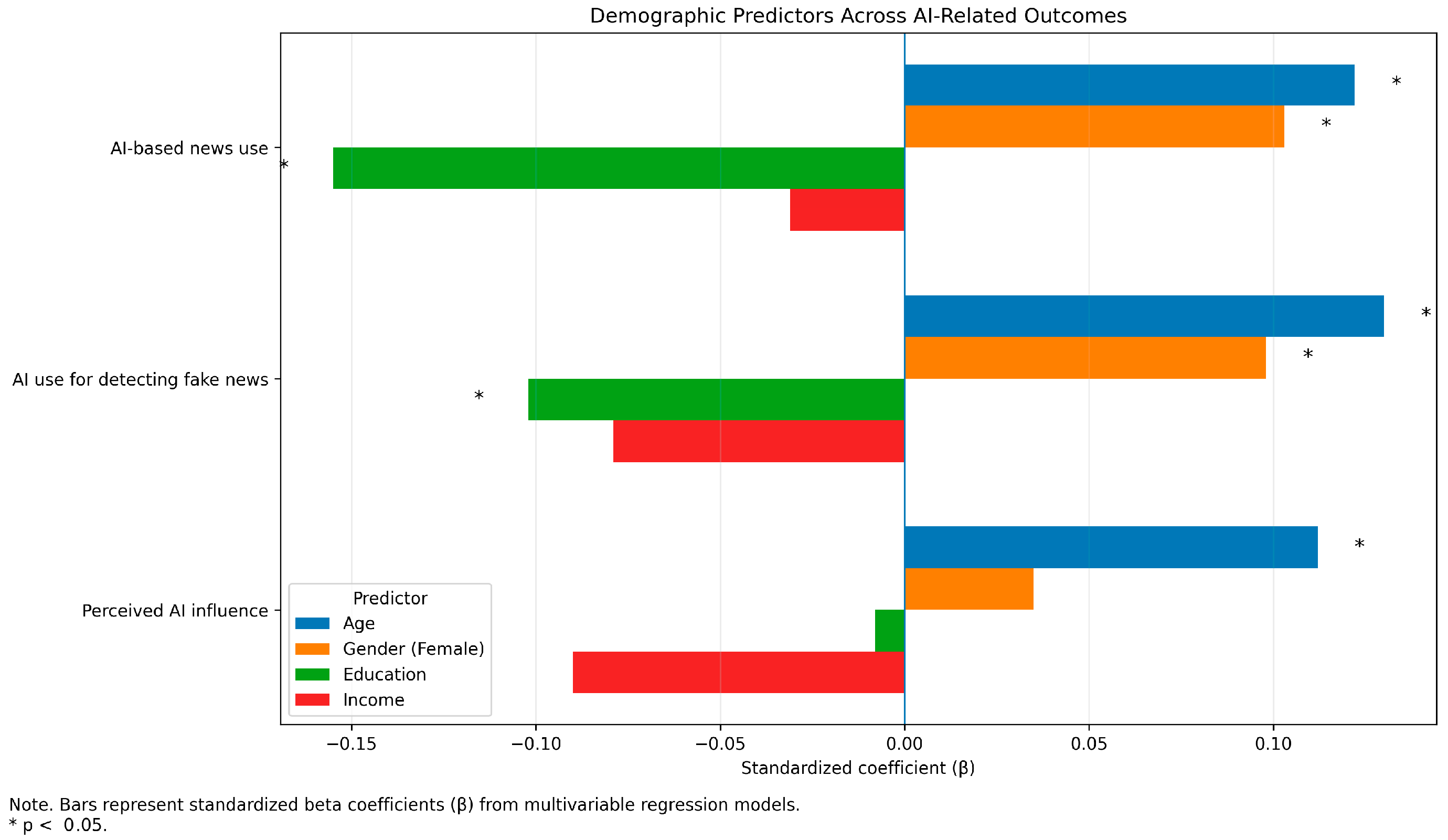
Figure 1 provides a visual summary of the standardized regression coefficients across the three multivariable models. As shown in the figure, age was positively associated with all three AI-related outcomes, whereas gender and education were significant only for AI-based news use and AI use for detecting fake news. Overall, the figure reinforces the modest and outcome-specific nature of the demographic associations identified in the regression analyses (see
Figure 1).
6. Discussion
This study examined patterns of AI use for news and information consumption among the Israeli population. In line with the exploratory research-question approach, the findings should be interpreted as evidence of associations and patterns rather than as confirmation of directional hypotheses.
The findings reveal a complex and context-dependent pattern that both aligns with and diverges from traditional digital divide expectations. Importantly, the multivariable regression analyses refine the bivariate findings by showing that only some demographic variables remain significant when examined simultaneously. Across the models, age, gender, and education were the most consistent predictors of AI-based news use and AI use for detecting fake news, whereas income was not a significant independent predictor. Rather than reflecting a simple extension of established digital inequalities, the results point to more nuanced dynamics that may be associated with the specific affordances of AI as an intermediary in information environments, as well as with possible differences in trust, perceived utility, and engagement with AI systems across social groups [
14,
28]. This pattern suggests that demographic variables alone cannot fully explain AI-related news practices, highlighting the need to examine perceived usefulness, ease of use, and trust in future research.
In line with prior research, younger individuals reported higher levels of general AI use. However, the findings indicate that older individuals are more likely to use AI tools specifically for news and current information consumption. This pattern remains evident in the multivariable models, where age positively predicts AI-based news use, AI use for detecting fake news, and perceived AI influence. One possible interpretation is that AI tools may be integrated into existing information practices as supportive resources for navigating complex or information-rich environments, particularly in contexts where AI tools are used for summarization, explanation, or interpretive support [
10,
12,
47]. However, given the small effect sizes and limited explanatory power of the models, this interpretation should be treated cautiously, as the findings indicate modest associations rather than vast age-based differences.
Similarly, the findings related to gender do not fully align with traditional digital divide expectations. While prior literature often suggests higher levels of technology use among men, the results indicate that women report slightly higher use of AI tools for specific news-related functions, such as consuming news and identifying misinformation. This pattern remains significant in the multivariable models for AI-based news use and fake-news detection, but not for perceived AI influence. This may suggest that the accessible and conversational nature of AI tools may reduce some of the barriers traditionally associated with digital engagement, potentially enabling patterns of use that are more context-specific than those captured by earlier models of technology adoption [
6,
10]. At the same time, the relatively weak associations indicate that gender differences in AI use may be limited or evolving.
The regression results also clarify the role of education. Education was negatively associated with AI-based news use and AI use for detecting fake news, suggesting that respondents with higher levels of formal education reported lower levels of use in these specific AI-related practices. This finding diverges from conventional digital divide expectations, which often associate higher education with greater engagement with advanced technologies. One possible interpretation is that AI tools may be more frequently used in contexts where users seek assistance in processing or simplifying information, particularly in situations that may involve complex or unfamiliar information [
10,
12]. However, this should not be interpreted as evidence that AI reduces educational inequalities, as the present study does not assess informational outcomes or knowledge gains.
The results concerning income should be interpreted more cautiously than the bivariate analyses alone would suggest. Although income differences appeared in some ANOVA results, income was not a significant independent predictor in the multivariable models for AI-based news use or fake-news detection. In the model predicting perceived AI influence, income showed only a marginal association. Therefore, income-related patterns should be understood as indicative trends rather than robust independent effects. These findings suggest that apparent income differences may reflect overlapping relationships with other demographic characteristics, such as age or education.
The findings also indicate that perceived AI influence on political and social attitudes is only weakly associated with demographic characteristics. In the regression model predicting perceived AI influence, age was the only significant predictor, while income showed a marginal association, and gender and education were not significant. Importantly, this reflects perceived susceptibility to influence rather than demonstrated attitudinal change. This suggests that increased engagement with AI tools may be associated with greater perceived awareness of their potential influence, rather than clear evidence of actual impact on attitudes.
Taken together, these findings suggest that the relationship between AI use and digital inequality does not follow a linear or uniform pattern. Instead, AI technologies introduce new affordances, such as real-time explanation, summarization, and interpretive support, that may contribute to differences in how groups engage with information [
10,
14,
48]. While these affordances may be particularly relevant for certain groups, the overall pattern remains modest and context dependent.
7. Conclusions
The findings of this study provide context-specific insight into how AI is used and perceived in relation to news and current information. Rather than confirming directional hypotheses, the study identifies exploratory patterns that show how AI-access and AI-influence may vary across demographic groups. By distinguishing between AI-access and AI-influence, this study extends existing survey-based approaches by capturing both patterns of use and perceived impact within a unified analytical framework.
The findings related to perceived AI influence suggest that users report perceptions regarding the potential impact of AI-generated information. While these findings should be interpreted cautiously, they may indicate that users engage with AI-generated content not only at the level of access, but also at the level of interpretation and evaluation, particularly in news-related contexts. In this sense, reported concerns may reflect broader considerations related to reliability, bias, and the role of AI in information environments [
1,
5].
Taken together, the findings suggest that AI may function as an emerging intermediary in information environments, potentially shaping how users access and engage with news without determining outcomes in a uniform way. In contrast to traditional forms of algorithmic curation, AI-based systems may combine access, interpretation, and evaluation within a single interface, thereby potentially contributing to differences in patterns of use and perceived influence [
14,
28].
From a theoretical perspective, the findings are consistent with a multi-level understanding of digital inequality, suggesting that differences in technology use may extend beyond access to include patterns of engagement and perceived influence [
3]. At the same time, the modest explanatory power of the models suggests that demographic variables alone may be insufficient on their own to explain AI-related practices. Future research should therefore examine technology acceptance factors, particularly perceived usefulness, perceived ease of use, and trust, alongside demographic variables.
Finally, several limitations should be acknowledged. The study relies on self-reported measures, which may be subject to reporting biases and do not capture actual behavior. In addition, the cross-sectional design limits the ability to draw causal inferences, and the focus on a single national context constrains generalizability. Accordingly, the findings should be interpreted as exploratory associations within the Israeli online-panel sample rather than as causal or broadly generalizable evidence.
Future research should incorporate additional explanatory factors, such as AI literacy, trust in AI, perceived usefulness, and digital skills, particularly to examine whether AI use reflects compensatory behavior, convenience, or differences in reliance on AI systems. Longitudinal, behavioral, and cross-national designs would further strengthen the understanding of AI-related information practices.