
Machine Learning Models for Predicting Post-Hepatectomy Liver Failure: A Systematic Review

 ,
,  , ,
, ,
Abstract
1. Introduction
1.1. Clinical Background and Limitations of Conventional Risk Stratification
1.2. Machine Learning as a Computational Approach to PHLF Risk Prediction
1.3. Rationale, Aim, and Key Research Questions
2. Materials and Methods
2.1. Study Design and Protocol Registration
2.2. Search Strategy and Information Sources
2.3. Eligibility Criteria and Study Selection
2.4. Data Extraction and Quality Assessment
2.5. Data Synthesis and Analysis
3. Results
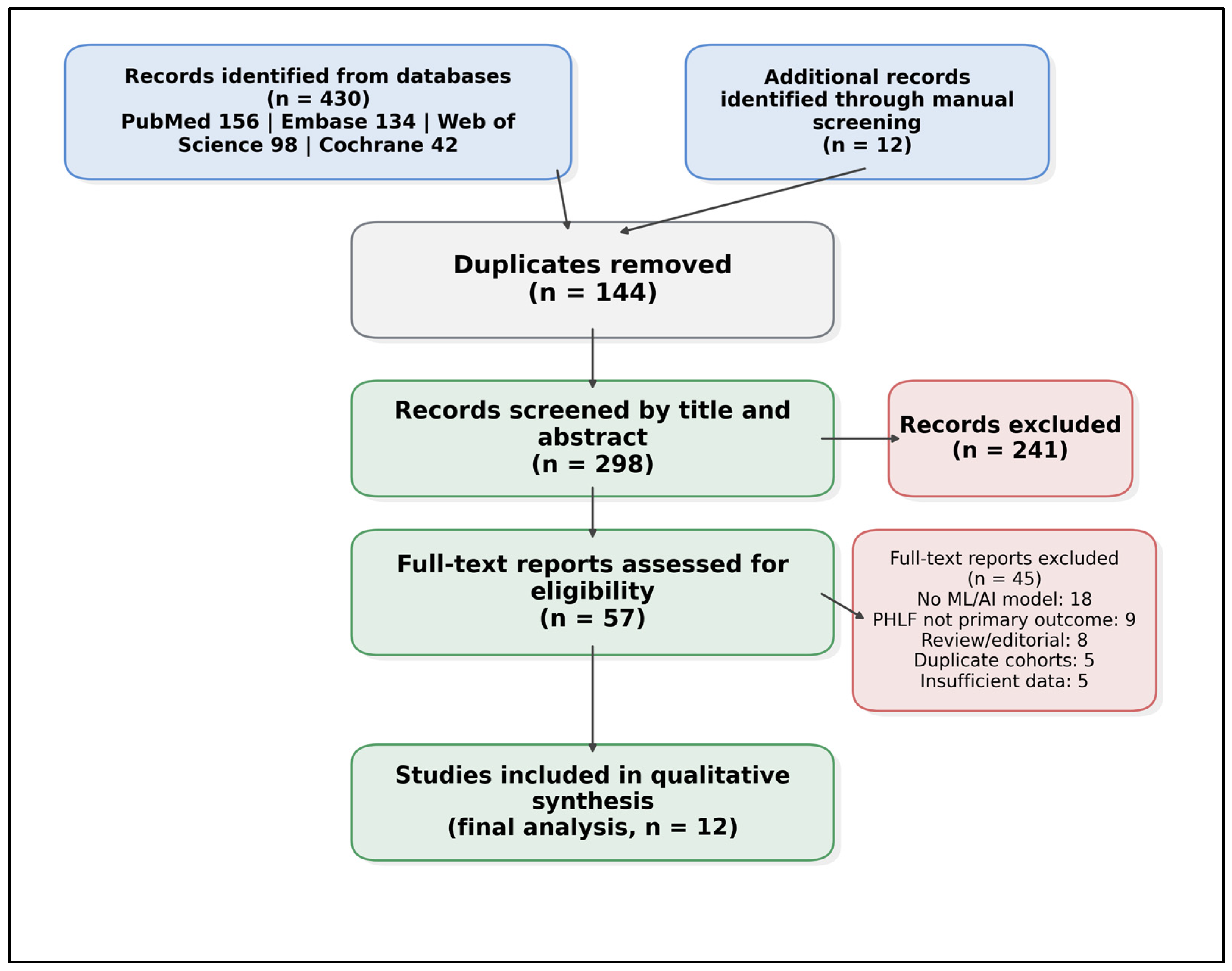
3.1. Study Selection and PRISMA Flow
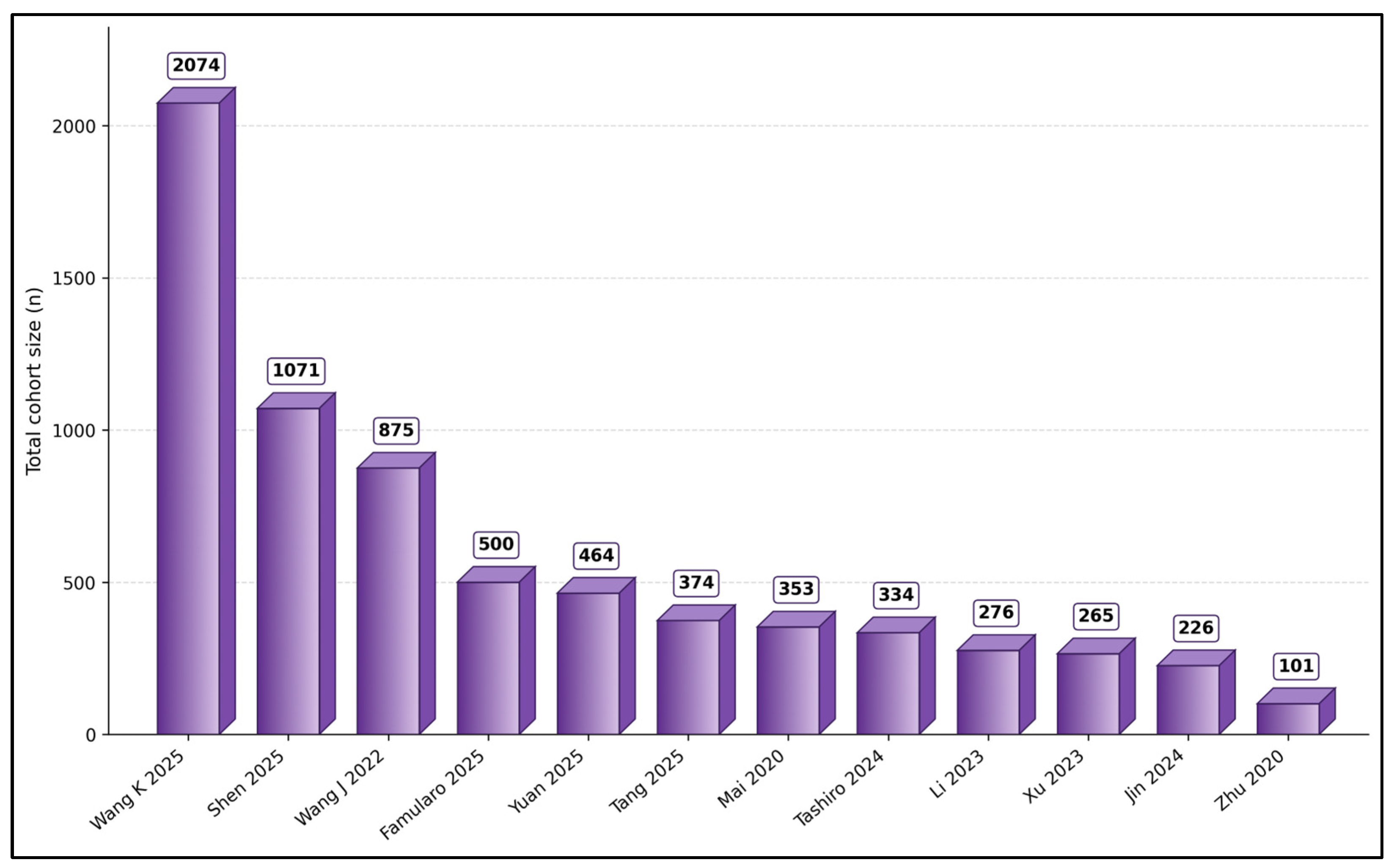
3.2. Baseline Characteristics and Outcome Definitions
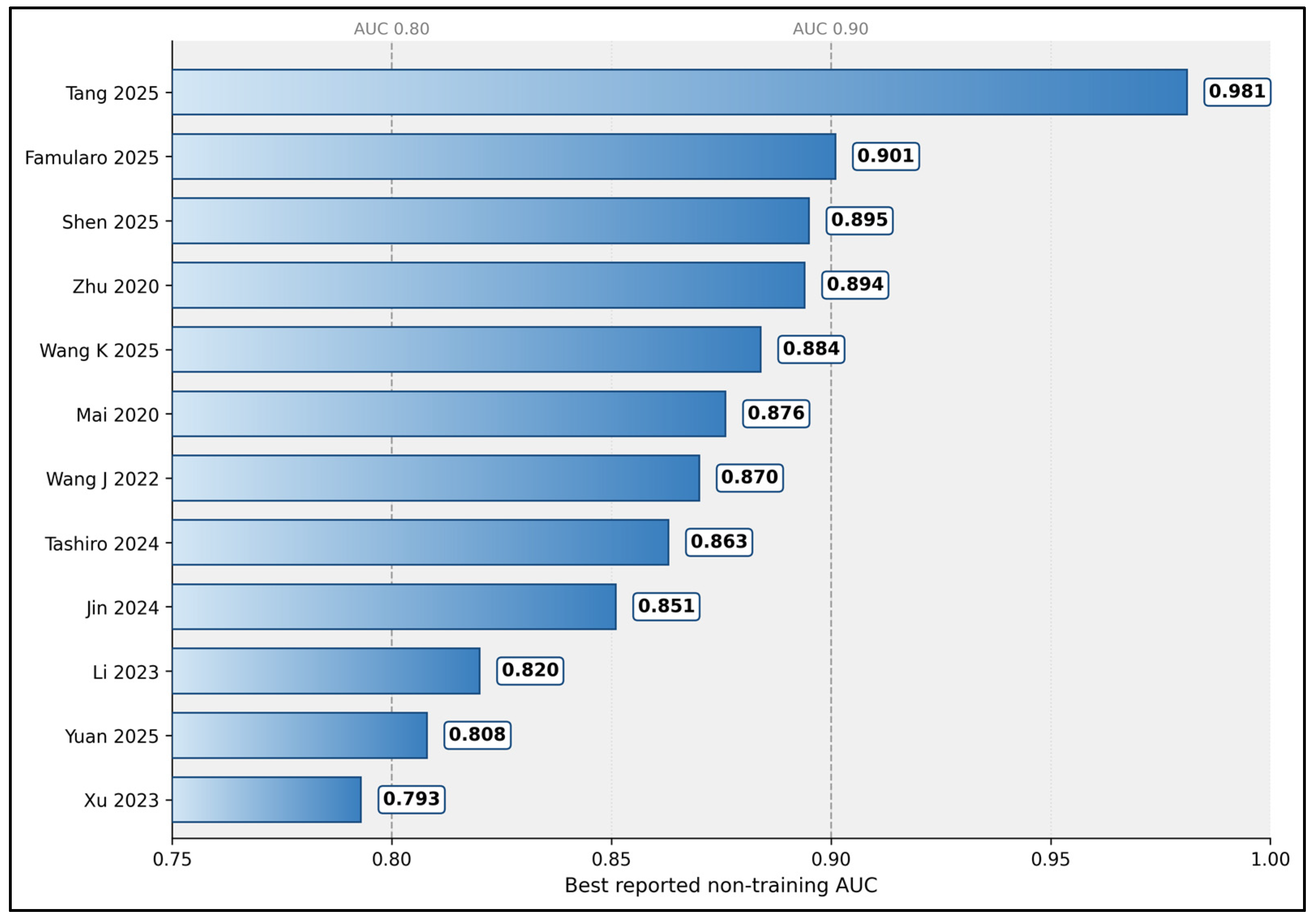
3.3. Machine Learning Algorithms, Predictors, and Discrimination Performance
3.4. Predictor Domains, Interpretability, and Comparison with Traditional Scoring Systems
4. Discussion
4.1. Analysis of Findings
4.2. Study Limitations
4.3. Identified Gaps in the Current Evidence Base
4.4. Recommendations and Future Clinical Perspectives
4.5. Methodological Contribution and Novelty Relative to Prior Reviews
5. Conclusions
Author Contributions
Funding
Institutional Review Board Statement
Informed Consent Statement
Data Availability Statement
Acknowledgments
Conflicts of Interest
References
- Clavien, P.A.; Petrowsky, H.; DeOliveira, M.L.; Graf, R. Strategies for safer liver surgery and partial liver transplantation. N. Engl. J. Med. 2007, 356, 1545–1559. [Google Scholar] [CrossRef] [PubMed]
- Jarnagin, W.R.; Gonen, M.; Fong, Y.; DeMatteo, R.P.; Ben-Porat, L.; Little, S.; Corvera, C.; Weber, S.; Blumgart, L.H. Improvement in perioperative outcome after hepatic resection: Analysis of 1803 consecutive cases over the past decade. Ann. Surg. 2002, 236, 397–406. [Google Scholar] [CrossRef]
- Rahbari, N.N.; Garden, O.J.; Padbury, R.; Brooke-Smith, M.; Crawford, M.; Adam, R.; Koch, M.; Makuuchi, M.; Dematteo, R.P.; Christophi, C.; et al. Posthepatectomy liver failure: A definition and grading by the International Study Group of Liver Surgery (ISGLS). Surgery 2011, 149, 713–724. [Google Scholar] [CrossRef] [PubMed]
- Morandi, A.; Risaliti, M.; Montori, M.; Buccianti, S.; Bartolini, I.; Moraldi, L. Predicting Post-Hepatectomy Liver Failure in HCC Patients: A Review of Liver Function Assessment Based on Laboratory Tests Scores. Medicina 2023, 59, 1099. [Google Scholar] [CrossRef]
- Balzan, S.; Belghiti, J.; Farges, O.; Ogata, S.; Sauvanet, A.; Delefosse, D.; Durand, F. The “50-50 criteria” on postoperative day 5: An accurate predictor of liver failure and death after hepatectomy. Ann. Surg. 2005, 242, 824–829. [Google Scholar] [CrossRef]
- Schindl, M.J.; Redhead, D.N.; Fearon, K.C.; Garden, O.J.; Wigmore, S.J. The value of residual liver volume as a predictor of hepatic dysfunction and infection after major liver resection. Gut 2005, 54, 289–296. [Google Scholar] [CrossRef] [PubMed]
- Kauffmann, R.; Fong, Y. Post-hepatectomy liver failure. Hepatobiliary Surg. Nutr. 2014, 3, 238–246. [Google Scholar]
- Cescon, M.; Colecchia, A.; Cucchetti, A.; Peri, E.; Montrone, L.; Ercolani, G.; Festi, D.; Pinna, A.D. Value of transient elastography measured with FibroScan in predicting the outcome of hepatic resection for hepatocellular carcinoma. Ann. Surg. 2012, 256, 706–713. [Google Scholar] [CrossRef]
- Bekheit, M.; Grundy, L.; Salih, A.K.A.; Bucur, P.; Vibert, E.; Ghazanfar, M. Post-hepatectomy liver failure: A timeline centered review. Hepatobiliary Pancreat. Dis. Int. 2023, 22, 554–569. [Google Scholar] [CrossRef]
- Shindoh, J.; Vauthey, J.N.; Zimmitti, G.; Curley, S.A.; Huang, S.Y.; Mahvash, A.; Gupta, S.; Wallace, M.J.; Aloia, T.A. Analysis of the efficacy of portal vein embolization for patients with extensive liver malignancy and very low future liver remnant volume. J. Am. Coll. Surg. 2013, 217, 126–133. [Google Scholar] [CrossRef]
- Pugh, R.N.; Murray-Lyon, I.M.; Dawson, J.L.; Pietroni, M.C.; Williams, R. Transection of the oesophagus for bleeding oesophageal varices. Br. J. Surg. 1973, 60, 646–649. [Google Scholar] [CrossRef]
- Kamath, P.S.; Wiesner, R.H.; Malinchoc, M.; Kremers, W.; Therneau, T.M.; Kosberg, C.L.; D’Amico, G.; Dickson, E.R.; Kim, W.R. A model to predict survival in patients with end-stage liver disease. Hepatology 2001, 33, 464–470. [Google Scholar] [CrossRef]
- Marasco, G.; Alemanni, L.V.; Colecchia, A.; Festi, D.; Bazzoli, F.; Mazzella, G.; Montagnani, M.; Azzaroli, F. Prognostic value of the albumin-bilirubin grade for the prediction of post-hepatectomy liver failure: A systematic review and meta-analysis. J. Clin. Med. 2021, 10, 2011. [Google Scholar] [CrossRef]
- Abdalla, E.K.; Denys, A.; Chevalier, P.; Nemr, R.A.; Vauthey, J.N. Total and segmental liver volume variations: Implications for liver surgery. Surgery 2004, 135, 404–410. [Google Scholar] [CrossRef]
- de Graaf, W.; van Lienden, K.P.; Dinant, S.; Roelofs, J.J.T.H.; Busch, O.R.C.; Gouma, D.J.; Bennink, R.J.; van Gulik, T.M. Assessment of future remnant liver function using hepatobiliary scintigraphy in patients undergoing major liver resection. J. Gastrointest. Surg. 2010, 14, 369–378. [Google Scholar] [CrossRef]
- Stockmann, M.; Lock, J.F.; Riecke, B.; Heyne, K.; Martus, P.; Fricke, M.; Lehmann, S.; Niehues, S.M.; Schwabe, M.; Lemke, A.-J.; et al. Prediction of postoperative outcome after hepatectomy with a new bedside test for maximal liver function capacity. Ann. Surg. 2009, 250, 119–125. [Google Scholar] [CrossRef] [PubMed]
- Makuuchi, M.; Kosuge, T.; Takayama, T.; Yamazaki, S.; Kakazu, T.; Miyagawa, S.; Kawasaki, S. Surgery for small liver cancers. Semin. Surg. Oncol. 1993, 9, 298–304. [Google Scholar] [CrossRef] [PubMed]
- Granieri, S.; Bracchetti, G.; Kersik, A.; Frassini, S.; Germini, A.; Bonomi, A.; Lomaglio, L.; Gjoni, E.; Frontali, A.; Bruno, F.; et al. Preoperative indocyanine green (ICG) clearance test for predicting post hepatectomy liver failure: A systematic review and meta-analysis. Photodiagnosis Photodyn. Ther. 2022, 40, 103170. [Google Scholar] [CrossRef] [PubMed]
- Serenari, M.; Bonatti, C.; Zanoni, L.; Peta, G.; Tabacchi, E.; Cucchetti, A.; Ravaioli, M.; Pettinato, C.; Bagni, A.; Siniscalchi, A.; et al. The role of hepatobiliary scintigraphy combined with SPECT/CT in predicting severity of liver failure before major hepatectomy. Updates Surg. 2021, 73, 197–208. [Google Scholar] [CrossRef]
- Soreide, J.A.; Deshpande, R. Post hepatectomy liver failure (PHLF)—Recent advances in prevention and clinical management. Eur. J. Surg. Oncol. 2021, 47, 216–224. [Google Scholar] [CrossRef]
- Rajkomar, A.; Dean, J.; Kohane, I. Machine learning in medicine. N. Engl. J. Med. 2019, 380, 1347–1358. [Google Scholar] [CrossRef]
- Topol, E.J. High-performance medicine: The convergence of human and artificial intelligence. Nat. Med. 2019, 25, 44–56. [Google Scholar] [CrossRef] [PubMed]
- Hashimoto, D.A.; Rosman, G.; Rus, D.; Meireles, O.R. Artificial intelligence in surgery: Promises and perils. Ann. Surg. 2018, 268, 70–76. [Google Scholar] [CrossRef] [PubMed]
- Veerankutty, F.H.; Jayan, G.; Yadav, M.K.; Manoj, K.S.; Yadav, A.; Nair, S.R.S.; Shabeerali, T.U.; Yeldho, V.; Sasidharan, M.; Rather, S.A. Artificial intelligence in hepatology, liver surgery and transplantation. World J. Hepatol. 2021, 13, 1977–1990. [Google Scholar] [CrossRef] [PubMed]
- Kang, C.M.; Ku, H.J.; Moon, H.H.; Kim, S.-E.; Jo, J.H.; Choi, Y.I.; Shin, D.H. Predicting Safe Liver Resection Volume for Major Hepatectomy Using Artificial Intelligence. J. Clin. Med. 2024, 13, 381. [Google Scholar] [CrossRef]
- Yoshino, K.; Yoh, T.; Taura, K.; Seo, S.; Ciria, R.; Briceno-Delgado, J. A systematic review of prediction models for post-hepatectomy liver failure. HPB 2021, 23, 1311–1320. [Google Scholar] [CrossRef]
- Collins, G.S.; Reitsma, J.B.; Altman, D.G.; Moons, K.G.M. Transparent reporting of a multivariable prediction model for individual prognosis or diagnosis (TRIPOD). Ann. Intern. Med. 2015, 162, 55–63; W1–W33. [Google Scholar]
- Wolff, R.F.; Moons, K.G.M.; Riley, R.D.; Whiting, P.F.; Westwood, M.; Collins, G.S.; Reitsma, J.B.; Kleijnen, J.; Mallett, S. PROBAST: A tool to assess the risk of bias and applicability of prediction model studies. Ann. Intern. Med. 2019, 170, 51–58. [Google Scholar] [CrossRef]
- Moher, D.; Liberati, A.; Tetzlaff, J.; Altman, D.G. Preferred reporting items for systematic reviews and meta-analyses: The PRISMA statement. PLoS Med. 2009, 6, e1000097. [Google Scholar] [CrossRef]
- Page, M.J.; McKenzie, J.E.; Bossuyt, P.M.; Boutron, I.; Hoffmann, T.C.; Mulrow, C.D.; Shamseer, L.; Tetzlaff, J.M.; Akl, E.A.; Brennan, S.E.; et al. The PRISMA 2020 statement: An updated guideline for reporting systematic reviews. BMJ 2021, 372, n71. [Google Scholar] [CrossRef]
- Mai, R.Y.; Lu, H.Z.; Bai, T.; Liang, R.; Lin, Y.; Ma, L.; Xiang, B.D.; Wu, G.B.; Li, L.Q.; Ye, J.Z. Artificial neural network model for preoperative prediction of severe liver failure after hemihepatectomy in patients with hepatocellular carcinoma. Surgery 2020, 168, 643–652. [Google Scholar] [CrossRef]
- Zhu, W.S.; Shi, S.Y.; Yang, Z.H.; Song, C.; Shen, J. Radiomics model based on preoperative gadoxetic acid-enhanced MRI for predicting liver failure. World J. Gastroenterol. 2020, 26, 1208–1220. [Google Scholar] [CrossRef]
- Wang, J.; Zheng, T.; Liao, Y.; Geng, S.; Li, J.; Zhang, Z.; Shang, D.; Liu, C.; Yu, P.; Huang, Y.; et al. Machine learning prediction model for post-hepatectomy liver failure in hepatocellular carcinoma: A multicenter study. Front. Oncol. 2022, 12, 986867. [Google Scholar] [CrossRef]
- Xu, X.; Xing, Z.; Xu, Z.; Tong, Y.; Wang, S.; Liu, X.; Ren, Y.; Liang, X.; Yu, Y.; Ying, H. A deep learning model for prediction of post hepatectomy liver failure after hemihepatectomy using preoperative contrast-enhanced computed tomography: A retrospective study. Front. Med. 2023, 10, 1154314. [Google Scholar] [CrossRef] [PubMed]
- Li, C.; Wang, Q.; Zou, M.; Cai, P.; Li, X.; Feng, K.; Zhang, L.; Sparrelid, E.; Brismar, T.B.; Ma, K. A radiomics model based on preoperative gadoxetic acid-enhanced magnetic resonance imaging for predicting post-hepatectomy liver failure in patients with hepatocellular carcinoma. Front. Oncol. 2023, 13, 1164739. [Google Scholar] [CrossRef] [PubMed]
- Tashiro, H.; Onoe, T.; Tanimine, N.; Tazuma, S.; Shibata, Y.; Sudo, T.; Sada, H.; Shimada, N.; Tazawa, H.; Suzuki, T.; et al. Utility of machine learning in the prediction of post-hepatectomy liver failure in liver cancer. J. Hepatocell. Carcinoma 2024, 11, 1323–1330. [Google Scholar] [CrossRef]
- Jin, Y.; Li, W.; Wu, Y.; Wang, Q.; Xiang, Z.; Long, Z.; Liang, H.; Zou, J.; Zhu, Z.; Dai, X. Online interpretable dynamic prediction models for clinically significant posthepatectomy liver failure based on machine learning algorithms: A retrospective cohort study. Int. J. Surg. 2024, 110, 7047–7057. [Google Scholar] [CrossRef] [PubMed]
- Famularo, S.; Maino, C.; Milana, F.; Ardito, F.; Rompianesi, G.; Ciulli, C.; Conci, S.; Gallotti, A.; La Barba, G.; Romano, M.; et al. Preoperative prediction of post hepatectomy liver failure after surgery for hepatocellular carcinoma on CT-scan by machine learning and radiomics analyses. Eur. J. Surg. Oncol. 2025, 51, 109462. [Google Scholar] [CrossRef]
- Tang, T.; Guo, T.; Zhu, B.; Tian, Q.; Wu, Y.; Liu, Y. Interpretable machine learning model for predicting post-hepatectomy liver failure in hepatocellular carcinoma. Sci. Rep. 2025, 15, 15469. [Google Scholar] [CrossRef]
- Yuan, J.; Zhang, R.Q.; Guo, Q.; Tuerganaili, A.; Shao, Y.M. Controlling nutritional status score predicts posthepatectomy liver failure: An online interpretable machine learning prediction model. Eur. J. Gastroenterol. Hepatol. 2025, 37, 875–884. [Google Scholar] [CrossRef]
- Wang, K.; Yang, Q.; Li, K.; Tang, S.; Zhang, B.; Liao, X.; Du, S.; Fu, W.; Li, Z.; Chen, H.; et al. Learning-based early detection of post-hepatectomy liver failure using temporal perioperative data: A nationwide multicenter retrospective study in China. EClinicalMedicine 2025, 83, 103220. [Google Scholar] [CrossRef]
- Shen, H.; Yuan, T.; Si, A.; Shen, Y.; Liu, J.; Jin, L.; Xie, Z.; Zhang, H.; Wei, W.; Dai, Y.; et al. Liver regeneration-associated machine learning architecture integrating time-phased predictions for post-hepatectomy liver failure. EClinicalMedicine 2025, 90, 103661. [Google Scholar] [CrossRef] [PubMed] [PubMed Central]
- Chen, T.; Guestrin, C. XGBoost: A scalable tree boosting system. In Proceedings of the 22nd ACM SIGKDD International Conference; Association for Computing Machinery: New York, NY, USA, 2016; pp. 785–794. [Google Scholar]
- Fagenson, A.M.; Gleeson, E.M.; Pitt, H.A.; Lau, K.N. Albumin-bilirubin score vs model for end-stage liver disease in predicting post-hepatectomy outcomes. J. Am. Coll. Surg. 2020, 230, 637–645. [Google Scholar] [CrossRef]
- Lundberg, S.M.; Lee, S.I. A unified approach to interpreting model predictions. Adv. Neural Inf. Process. Syst. 2017, 30, 4765–4774. [Google Scholar]
- Rudin, C. Stop explaining black box machine learning models for high stakes decisions and use interpretable models instead. Nat. Mach. Intell. 2019, 1, 206–215. [Google Scholar] [CrossRef] [PubMed]
- El-Serag, H.B. Hepatocellular carcinoma. N. Engl. J. Med. 2011, 365, 1118–1127. [Google Scholar] [CrossRef] [PubMed]
- Riley, R.D.; Ensor, J.; Snell, K.I.E.; Harrell, F.E., Jr.; Martin, G.P.; Reitsma, J.B.; Moons, K.G.M.; Collins, G.; van Smeden, M. Calculating the sample size required for developing a clinical prediction model. BMJ 2020, 368, m441. [Google Scholar] [CrossRef]
- Van Calster, B.; McLernon, D.J.; van Smeden, M.; Bottolo, L.; Steyerberg, E.W. Calibration: The Achilles heel of predictive analytics. BMC Med. 2019, 17, 230. [Google Scholar] [CrossRef]
- Sendak, M.P.; Gao, M.; Brajer, N.; Balu, S. Presenting machine learning model information to clinical end users with model facts labels. npj Digit. Med. 2020, 3, 41. [Google Scholar] [CrossRef]
- Rajkomar, A.; Oren, E.; Chen, K.; Dai, A.M.; Hajaj, N.; Hardt, M.; Liu, P.J.; Liu, X.; Marcus, J.; Sun, M.; et al. Scalable and accurate deep learning with electronic health records. npj Digit. Med. 2018, 1, 18. [Google Scholar] [CrossRef]
- Koch, M.; Garden, O.J.; Padbury, R.; Rahbari, N.N.; Adam, R.; Capussotti, L.; Fan, S.T.; Yokoyama, Y.; Crawford, M.; Makuuchi, M.; et al. Bile leakage after hepatobiliary and pancreatic surgery: A definition and grading of severity by the ISGLS. Surgery 2011, 149, 680–688. [Google Scholar] [CrossRef] [PubMed]
- Lambin, P.; Leijenaar, R.T.H.; Deist, T.M.; Peerlings, J.; de Jong, E.E.C.; van Timmeren, J.; Sanduleanu, S.; Larue, R.T.H.M.; Even, A.J.G.; Jochems, A.; et al. Radiomics: The bridge between medical imaging and personalized medicine. Nat. Rev. Clin. Oncol. 2017, 14, 749–762. [Google Scholar] [CrossRef] [PubMed]
- Ribeiro, M.T.; Singh, S.; Guestrin, C. “Why should I trust you?”: Explaining the predictions of any classifier. In Proceedings of the 22nd ACM SIGKDD International Conference; Association for Computing Machinery: New York, NY, USA, 2016; pp. 1135–1144. [Google Scholar]
- Steyerberg, E.W.; Vergouwe, Y. Towards better clinical prediction models: Seven steps for development and an ABCD for validation. Eur. Heart J. 2014, 35, 1925–1931. [Google Scholar] [CrossRef]
- Lee, J.; Kwon, H. Hybrid Ensemble Learning for Malicious URL Detection with BERT and Boosting Models. IEEE Access 2025, 14, 62045–62058. [Google Scholar] [CrossRef]
- Kasri, W.; Himeur, Y.; Alkhazaleh, H.A.; Tarapiah, S.; Atalla, S.; Mansoor, W.; Al-Ahmad, H. From Vulnerability to Defense: The Role of Large Language Models in Enhancing Cybersecurity. Computation 2025, 13, 30. [Google Scholar] [CrossRef]
- Kwon, H.; Kim, D.-J. Conformal Selective Prediction with Cost-Aware Deferral for Safe Clinical Triage under Distribution Shift. Sci. Rep. 2026, 16, 10016. [Google Scholar] [CrossRef]



| Study [Ref] | Year | Country | Design | Centers | Total N | PHLF Rate (%) | Indication | PHLF Definition |
|---|---|---|---|---|---|---|---|---|
| Mai et al. [31] | 2020 | China | Retro | Single | 353 | 24.9 (dev); 23.9 (val) | HCC hemihepatectomy | Severe PHLF |
| Zhu WS et al. [32] | 2020 | China | Retro | Single | 101 | NR | Cirrhotic HCC; major hepatectomy | Post-op liver failure |
| Wang J et al. [33] | 2022 | China | Retro | Multi (8) | 875 | NR | HCC | PHLF |
| Xu et al. [34] | 2023 | China | Retro | Single | 265 | NR | Mixed hemihepatectomy | ISGLS |
| Li et al. [35] | 2023 | China | Retro | Single | 276 | 24.0 | HCC | PHLF |
| Tashiro et al. [36] | 2024 | Japan | Retro | Single | 334 | 9.3 | Liver cancer (mixed) | PHLF |
| Jin et al. [37] | 2024 | China | Retro | Single | 226 | 10.2 | Mixed hepatectomy | Clinically significant PHLF |
| Famularo et al. [38] | 2025 | Italy/Europe | Retro | Multi (13) | 500 | 3.4 | HCC | PHLF |
| Tang et al. [39] | 2025 | China | Retro + Pro val | Single | 374 | NR | Resectable HCC | PHLF |
| Yuan et al. [40] | 2025 | China | Retro | Single | 464 | NR | HCC | PHLF |
| Wang K et al. [41] | 2025 | China + MIMIC | Retro | Multi (6 + ext) | 2074 | NR | Mixed hepatectomy | ISGLS |
| Shen et al. [42] | 2025 | China | Retro | Multi (3) | 1071 | NR | Major hepatectomy | PHLF |
| Study [Ref] | Best ML Algorithm | Reported AUC | Sensitivity | Specificity | Accuracy | Validation Type | No. Predictors | Comparator/Note |
|---|---|---|---|---|---|---|---|---|
| Mai [31] | ANN | 0.880 dev; 0.876 val | NR | NR | NR | Split-sample val | 5 | Outperformed LR/scores |
| Zhu [32] | Radiomics-based model | 0.894 | NR | NR | NR | Internal | ICG-R15 + 5 rad | Better than clin/rad alone |
| Wang [33] | LightGBM | 0.944 train; 0.870 val; 0.822 test | NR | NR | NR | Multi-cohort split | 11 | Higher than non-invasive models |
| Xu [34] | CNN (DL) | 0.7927 | NR | NR | 84.15% | 5-fold CV | CT image model | NR |
| Li [35] | Combined radiomics model | 0.84 train; 0.82 test | NR | NR | NR | Split-sample test | ALBI + ICG-R15 + 16 rad | Better than clin/rad alone |
| Tashiro [36] | XGBoost | 0.863 | 55.6% recall | 96.7% | 93.1% | Train/test split | 12 | Higher than ALBI/FIB-4 |
| Jin [37] | ANN | 0.766 pre; 0.851 post; 0.720/0.731 temporal | NR | NR | NR | 5-fold CV + temporal | 3 pre; 4 post | Higher than MELD/FIB-4/ALBI/APRI |
| Famularo [38] | Averaging ensemble | 0.901 test | 80.0% | 89.5% | 89.2% | Train/test split | 19 PCA + 5 clin | Better than RF/XGB alone |
| Tang [39] | XGBoost | 0.983 train; 0.981 val; 0.942 pros | NR | NR | NR | Internal + prospective | 3 | Higher than traditional models |
| Yuan [40] | LightGBM | 0.927 train; 0.703 test; 0.808 val | NR | NR | NR | Train/test/validation | CONUT-centered | Online model |
| Wang [41] | Temporal DL model | 0.952 internal; 0.884 ext; 0.654 MIMIC | NR | NR | NR | External + Western ext | Periop temporal data | Higher than competing algos |
| Shen [42] | PILOT architecture | 0.754–0.904 train; 0.740–0.895 val | NR | NR | NR | Two external cohorts | 10/15/20 phase-specific | Better than traditional models |
| Study | Lab | Img | Op | Dyn | Ctr | Int | Ext | Outcome | Comp | XAI | Strength | Limit |
|---|---|---|---|---|---|---|---|---|---|---|---|---|
| Mai [31] | Labs+FLR | No | Yes | No | 1 | Yes | No | sPHLF | LR score | Risk strata | Clear preop model | 1 center |
| Zhu [32] | ICG+labs | MRI rad | Yes | No | 1 | Yes | No | Liver fail. | Clinical | Nomogram | Image fusion | n = 101 |
| Wang [33] | Routine labs | No | Yes | No | Multi | Yes | No | PHLF | Scores | SHAP | Large cohort | No true external |
| Xu [34] | Minimal tab. | CT | No | No | 1 | Yes | No | PHLF | NR | DL workflow | Image-only | No external |
| Li [35] | ALBI+ICG | MRI rad | No | No | 1 | Yes | No | PHLF | Clin/Rad | Nomogram | Calibrated | 1 center |
| Tashiro [36] | ALB/PT/ICG | No | Res. vol. | No | 1 | Yes | No | PHLF | ALBI/FIB-4 | Feat. imp. | 15-model comparison | Low recall |
| Jin [37] | Cr/TBIL/CP | No | Extent | Yes | 1 | Yes | Yes | csPHLF | MELD/FIB-4 | SHAP+web | Temporal test | n = 226 |
| Famularo [38] | MELD+clin. | CT rad | Major | No | Multi | Yes | No | PHLF | RF/XGB/SVM | Ensemble | 13-center set | Low event rate |
| Tang [39] | TBIL/MELD/ICG | No | No | No | 1 | Yes | Yes | PHLF | Trad. mdl | SHAP | Prospective val. | 1 center |
| Yuan [40] | Count+labs | No | No | No | 1 | Yes | Yes | PHLF | NR | SHAP+online | Simple deploy | Small ext. set |
| Wang [41] | Periop labs | No | Yes | Yes | Multi | Yes | Yes | PHLF | Competing ML | SHAP+assist | China+MIMIC | MIMIC drop |
| Shen [42] | Labs+regen | No | Yes | Yes | Multi | Yes | Yes | PHLF | Trad. mdl | SHAP+phase | Biomarker ext. | Complex inputs |
Disclaimer/Publisher’s Note: The statements, opinions and data contained in all publications are solely those of the individual author(s) and contributor(s) and not of MDPI and/or the editor(s). MDPI and/or the editor(s) disclaim responsibility for any injury to people or property resulting from any ideas, methods, instructions or products referred to in the content. |
© 2026 by the authors. Licensee MDPI, Basel, Switzerland. This article is an open access article distributed under the terms and conditions of the Creative Commons Attribution (CC BY) license.
Share and Cite
Muntean, C.; Gaborean, V.; Vonica, R.C.; Stefaniga, S.A.; Faur, A.M.; Feier, C.V.I. Machine Learning Models for Predicting Post-Hepatectomy Liver Failure: A Systematic Review. AI 2026, 7, 166. https://doi.org/10.3390/ai7050166
Muntean C, Gaborean V, Vonica RC, Stefaniga SA, Faur AM, Feier CVI. Machine Learning Models for Predicting Post-Hepatectomy Liver Failure: A Systematic Review. AI. 2026; 7(5):166. https://doi.org/10.3390/ai7050166
Chicago/Turabian StyleMuntean, Calin, Vasile Gaborean, Razvan Constantin Vonica, Sebastian Aurelian Stefaniga, Alaviana Monique Faur, and Catalin Vladut Ionut Feier. 2026. "Machine Learning Models for Predicting Post-Hepatectomy Liver Failure: A Systematic Review" AI 7, no. 5: 166. https://doi.org/10.3390/ai7050166
APA StyleMuntean, C., Gaborean, V., Vonica, R. C., Stefaniga, S. A., Faur, A. M., & Feier, C. V. I. (2026). Machine Learning Models for Predicting Post-Hepatectomy Liver Failure: A Systematic Review. AI, 7(5), 166. https://doi.org/10.3390/ai7050166