1. Introduction
Large Language Models (LLMs) have become central to contemporary artificial intelligence (AI), enabling progress in natural language processing (NLP), reasoning, and multimodal understanding. Built on transformer-based architectures and trained on large-scale heterogeneous data, LLMs show strong generalization across tasks including text generation, question answering, code synthesis, summarization, and multimodal inference. These capabilities have driven adoption across domains such as scientific research, education, healthcare, creative workflows, and software engineering.
As LLMs evolve from experimental systems to widely deployed infrastructure, architectural and training design choices increasingly affect computational efficiency, reliability, safety, and regulatory compliance. Consequently, systematic and comparative analysis of LLM design decisions has become essential not only for advancing model development but also for enabling responsible and sustainable real-world deployment.
1.1. Historical Background: From GPT-2 to Modern Multimodal LLMs
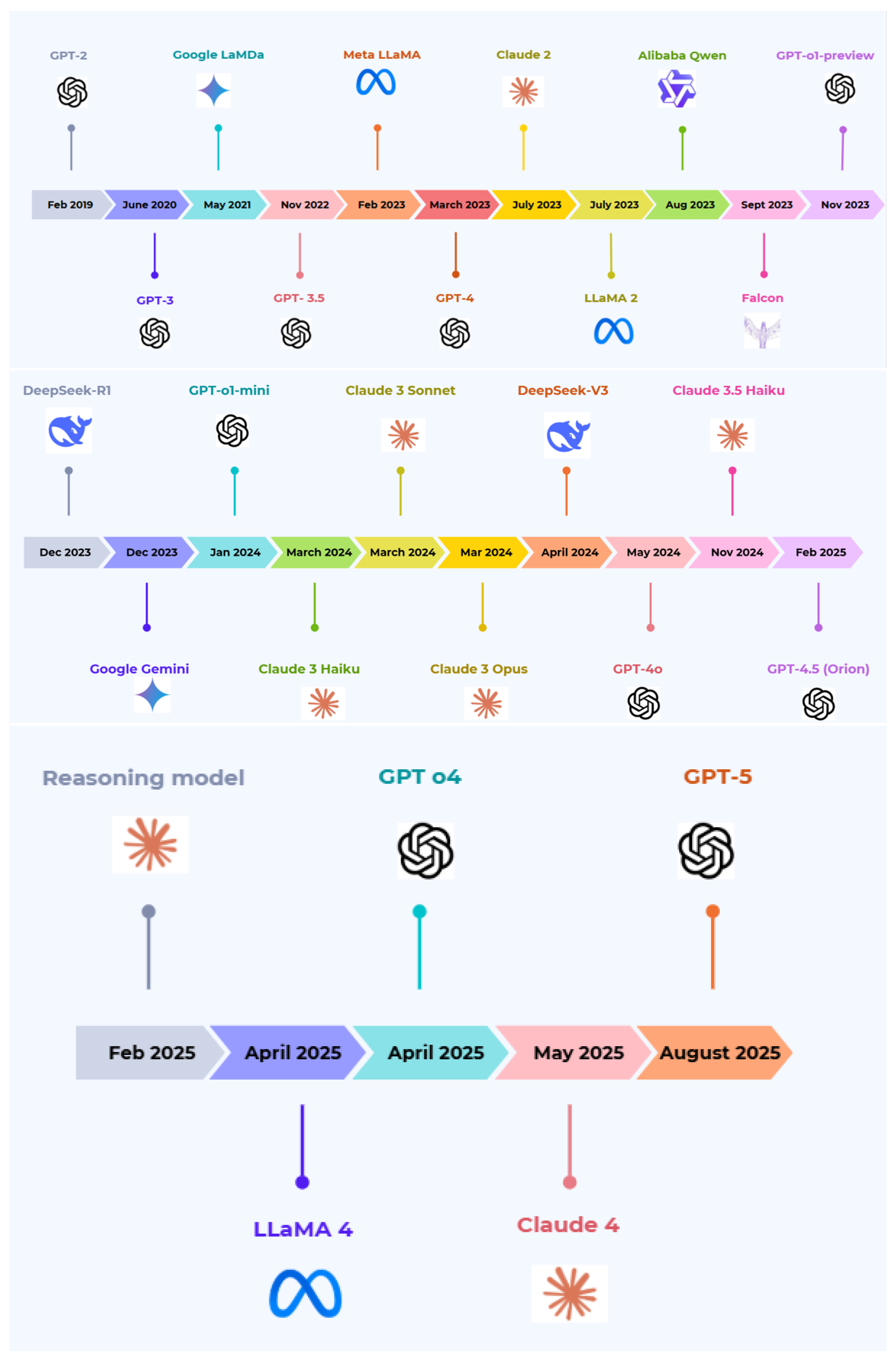
Modern LLMs emerged with GPT-2 in 2019, which showed that large-scale unsupervised pretraining could yield coherent language generation [
1]. GPT-3 (175B parameters) subsequently revealed emergent few-shot and zero-shot capabilities [
2]. Subsequent developments shifted emphasis from parameter scaling toward architectural refinement: LLaMA 2 emphasized accessible training strategies [
3], while Gemini and Claude introduced advances in long-context modeling, multimodal reasoning, and alignment [
4,
5]. Models including DeepSeek-V3, Qwen, and Falcon explored mixture-of-experts routing, optimized attention mechanisms, and instruction-following under computational constraints [
6,
7,
8,
9]. A defining recent trend is the transition toward multimodal architectures; models such as GPT-4o and Gemini 1.5 integrate text, vision, audio, and video within unified frameworks [
4,
10].
Figure 1 highlights major milestones from 2019 to 2025.
1.2. Goals and Contributions
This survey presents a comparative analysis of seven widely adopted LLM families: OpenAI’s GPT series, Meta’s LLaMA 2, Google’s Gemini, Anthropic’s Claude, DeepSeek, Qwen AI by Alibaba, and Falcon by the Technology Innovation Institute. Models are examined through a unified analytical framework covering architectural design, training pipelines, alignment strategies, multimodal capabilities, and reported performance. The main contributions are:
A systematic taxonomy of contemporary LLM architectures spanning proprietary and open-source ecosystems.
Reconstruction and comparative analysis of over 50 representative LLM architectures for consistent cross-model comparison.
Comparative analysis of attention mechanisms, normalization strategies, activation functions, and efficiency-oriented optimizations.
Examination of alignment methods including RLHF and Constitutional AI, with emphasis on instruction adherence and hallucination mitigation.
Identification of open challenges related to transparency, computational cost, data governance, and responsible deployment.
2. Related Work
Research on LLMs builds on prior advances in neural architectures, large-scale pretraining, and human-aligned learning. The Transformer [
11] established self-attention (SA) as a scalable mechanism, supporting early models such as GPT and GPT-2 [
1]. GPT-3 [
2] revealed emergent zero/few-shot capabilities, motivating further scaling work. GPT-4 [
12] incorporated alignment objectives and multimodal inputs. Open families such as LLaMA [
3], Gemini [
4], Claude [
13], DeepSeek [
14], and Falcon [
9] expanded the design space through innovations in attention, positional encoding, MoE routing, and multimodal integration.
Prior surveys by Bommasani et al. [
15], Zhao et al. [
16], Chang et al. [
17], and Li et al. [
18] each examine aspects such as training, evaluation, and alignment in isolation.
Table 1 summarizes their scope and limitations. Unlike these works, this survey provides a unified architectural taxonomy with an interactive exploration tool enabling systematic cross-family comparison.
3. Taxonomy of LLM Architectures
The rapid evolution of LLMs has produced a diverse design space. Rather than converging on a single canonical architecture, contemporary LLMs explore trade-offs among scalability, computational efficiency, long-context reasoning, multimodal integration, and safety. This section introduces a structured taxonomy organized around architectural evolution, core building blocks, and optimization strategies.
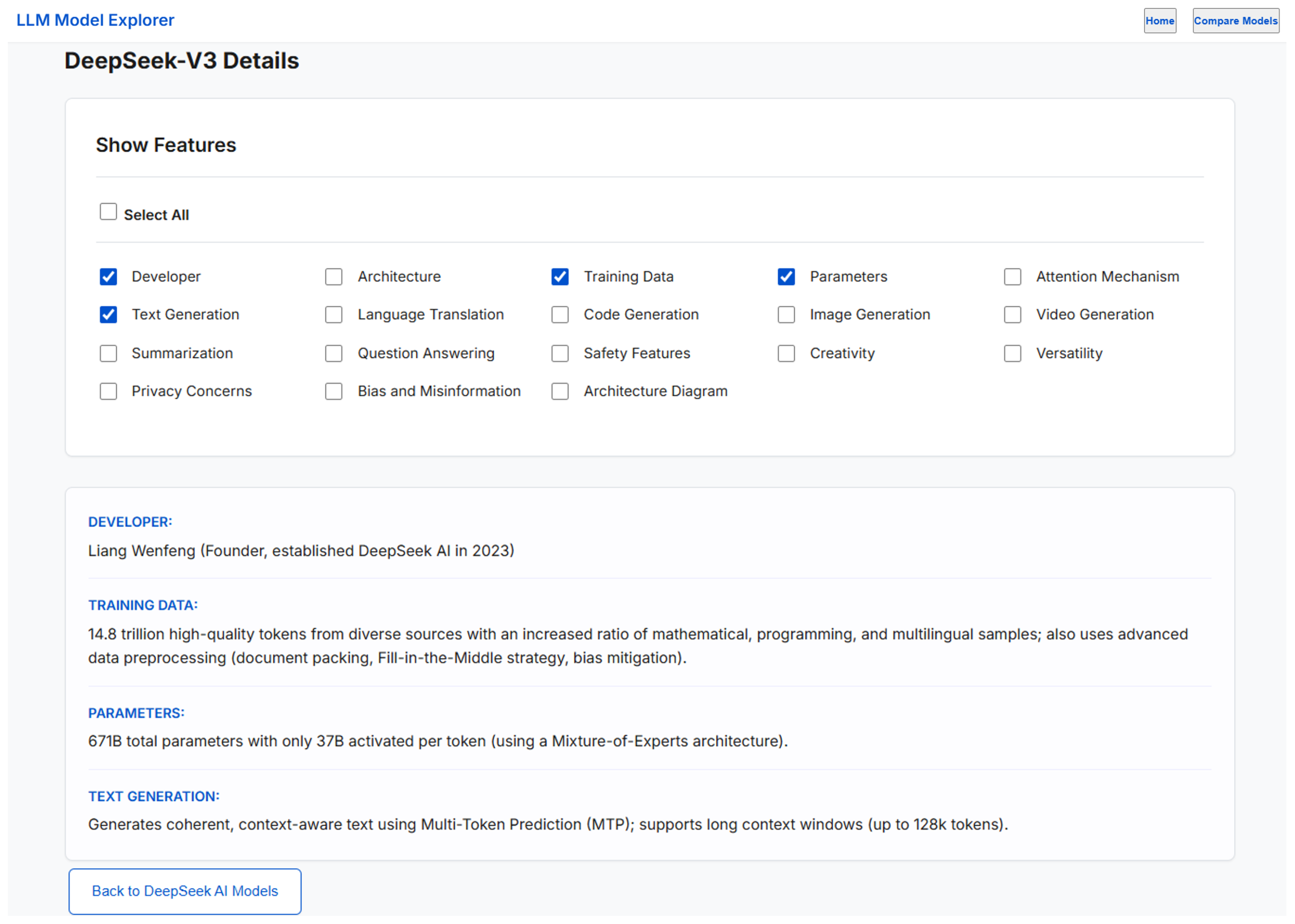
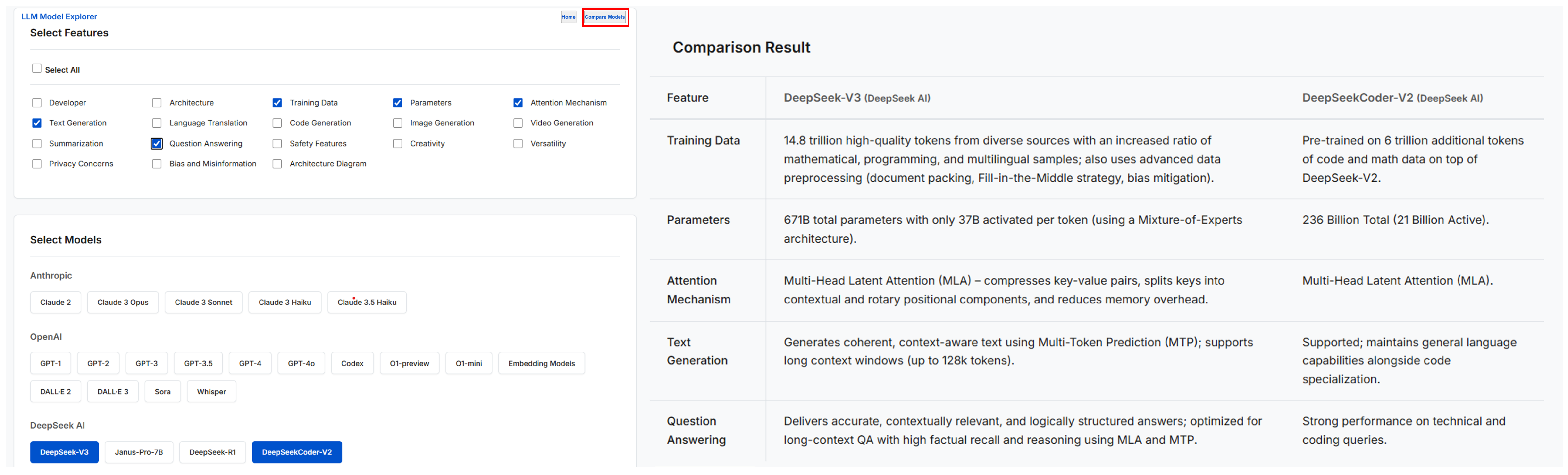
Architectural diagrams for all model families were reconstructed from publicly available technical reports and model cards, intentionally abstracted to emphasize high-level components, attention mechanisms, normalization strategies, expert routing, context-handling, and multimodal extensions, while omitting implementation-specific details. The accompanying interactive LLM Model Explorer (
Figure 2) operationalizes this taxonomy through feature-driven model inspection and side-by-side comparison (
Figure 3).
3.1. Methodology for Taxonomy Construction and Analysis
To ensure that the proposed taxonomy functions as an analytical framework rather than a purely descriptive categorization, we adopt a structured methodology for model reconstruction, feature assignment, and cross-family analysis.
Model Selection. We selected representative models from seven major LLM families (GPT, LLaMA 2, Gemini, Claude, DeepSeek, Falcon, and Qwen) based on (i) availability of technical documentation, (ii) architectural diversity, and (iii) relevance in both research and industrial deployment. This selection ensures coverage of both proprietary and open-weight paradigms.
Architecture Reconstruction. Model architectures were reconstructed from publicly available sources, including technical reports, system cards, and model documentation. Given the limited disclosure of implementation details in proprietary systems, we abstract each model to a consistent level of representation focusing on:
Attention mechanisms (e.g., MHA, GQA, MQA, MLA);
Normalization strategies (LayerNorm, RMSNorm);
Routing mechanisms (dense vs. mixture-of-experts);
Context handling and positional encoding;
Alignment and training pipelines.
Feature Encoding. Each model is encoded as a vector of categorical and numerical features derived from the taxonomy dimensions. Features are assigned based on explicit evidence from documentation; when ambiguity exists, conservative labeling is applied to avoid over-specification.
Cross-Family Analysis. To derive patterns, we analyze relationships across taxonomy dimensions by:
Comparing pairs of dimensions (e.g., alignment vs. efficiency, context length vs. routing);
Identifying consistent trends across multiple model families;
Validating patterns against reported benchmark results (
Table 2).
This process enables the identification of structural patterns that are not observable from individual model descriptions and supports both explanatory and predictive analysis.
3.2. Transformer Evolution and Architectural Enhancements
Nearly all contemporary LLMs are built on the Transformer [
11]. By replacing recurrence with SA, Transformers enable parallel computation and effective modeling of long-range dependencies. Representative architectural extensions include: Grouped Query Attention (GQA) (LLaMA 2 [
3]), which reduces inference cost by sharing key-value projections; MoE routing (Gemini [
4]), enabling sparse expert activation; Multiquery/Multigroup Attention (Falcon [
19]), lowering key-value cache requirements; and Multi-Head Latent Attention (MLA) (DeepSeek [
14]), applying low-rank compression to reduce computation and storage.
3.3. Core Architectural Components
Positional Encodings. Early models used fixed sinusoidal encodings. Most recent LLMs adopt Rotary Positional Embeddings (RoPE) [
20], which encode relative position within the attention mechanism. Gemini and DeepSeek extend this through interpolation-aware scaling for longer contexts.
Self-Attention Variants. Multiquery Attention (Falcon, Qwen) shares key–value projections across heads; GQA (LLaMA 2) balances efficiency and capacity; Cross-Modal Attention (Gemini) integrates text, visual, and audio inputs.
Activation Functions. Earlier models used ReLU or GELU. Modern LLMs favor gated variants: SwiGLU (LLaMA 2, Qwen AI) improves gradient flow and empirical stability in deep architectures.
Normalization. Earlier architectures used Post-LayerNorm; recent LLMs including LLaMA 2 and Claude favor RMSNorm with pre-normalization [
21], which reduces computational overhead and improves convergence at scale.
3.4. Optimization and Alignment Techniques
Training and deploying LLMs at scale relies on: AdamW optimization with cosine decay and linear warm-up [
22]; mixed-precision training (bfloat16 or FP8); gradient clipping and Z-loss regularization (Falcon-180B) [
19]; and instruction tuning and RLHF (GPT-4, Claude, DeepSeek) [
23].
While alignment mechanisms such as RLHF, Constitutional AI, and RLAIF have substantially improved safety behavior, they introduce important limitations. Reward-based optimization can incentivize reward hacking, and stronger alignment is often associated with over-refusal. RLHF depends on costly human annotation; RLAIF relies on AI feedback that may propagate model biases. Aligned models remain vulnerable to jailbreak and adversarial prompting, highlighting that alignment reduces but does not eliminate misuse risks.
These limitations have direct implications in real-world deployment. For example, over-refusal can hinder usability in safety-critical domains such as healthcare and legal decision support, where models may decline to provide necessary guidance. Reward hacking may lead to outputs that optimize for evaluation metrics rather than factual correctness, impacting reliability in production systems. Additionally, vulnerability to jailbreak attacks raises concerns for misuse in public-facing applications. The reliance on RLHF further introduces scalability challenges due to the high cost of human annotation.
3.5. Taxonomy-Derived Cross-Family Inferences
Beyond organizing model families, the proposed taxonomy enables cross-family inferences that are not visible from individual model analyses. Applying the taxonomy dimensions simultaneously across all seven families reveals three non-trivial structural patterns.
Pattern A: Alignment-Efficiency Divergence. Mapping models along two taxonomy axes simultaneously, alignment strategy (Constitutional AI/RLAIF vs. standard RLHF/rejection sampling) and attention efficiency (MLA/MQA/GQA vs. standard MHA)–reveals a consistent cross-family trade-off: models employing Constitutional AI or RLAIF (Claude 2, Claude 3) pair these mechanisms with less efficiency-optimized attention, while models prioritizing attention efficiency (DeepSeek with MLA, Falcon with multigroup attention, Gemini with Multi-Query Attention) rely on simpler alignment pipelines. No surveyed model simultaneously achieves state-of-the-art on both axes. This trade-off is not documented in any individual model report; it emerges from systematic cross-family comparison enabled by the unified taxonomy.
Pattern B: Context Length and Expert Routing Co-Adoption. Examining models along the context length and expert routing axes reveals a strong co-adoption pattern: every model in our survey supporting context windows exceeding 32K tokens also employs some form of sparse expert routing, either Mixture-of-Experts (Gemini 1.5, DeepSeek-V3/R1) or selective state-space layers (Falcon Mamba, Falcon 3 Mamba). Conversely, models without expert routing are typically limited to 4K–32K token contexts. This structural dependency suggests that long-context capability at scale requires modular computation to remain tractable, a constraint not evident from individual model analyses but revealed through the proposed taxonomy.
Pattern C: Open-Weight Architectural Convergence. Mapping models by openness (open-weight, partially open, closed) against the normalization and positional encoding dimensions of the taxonomy reveals that open-weight models (LLaMA 2, Falcon series, Qwen) cluster tightly around RMSNorm + RoPE, while closed proprietary models (GPT-4, Gemini) span a broader design space. This convergence likely reflects reproducibility and community verification pressures in open-weight development, which favor well-validated components over novel combinations. Proprietary models, freed from this constraint, explore more heterogeneous configurations. This pattern is a direct product of cross-family taxonomy analysis and is not derivable from any single model’s technical report.
Table 3 summarizes these three patterns, their taxonomy dimensions, and the families involved.
Predictive Use of the Taxonomy
Beyond identifying retrospective patterns, the taxonomy dimensions support forward-looking predictions about model behavior. A model’s position on the alignment strategy dimension predicts its likely refusal rate on borderline prompts: models employing Constitutional AI or RLAIF (Claude families) are predicted to exhibit higher refusal rates on ambiguous instructions than models using simpler RLHF or rejection sampling (DeepSeek, Falcon), a prediction consistent with published red-teaming and usability evaluations [
14,
24]. Similarly, a model’s position on the attention efficiency dimension predicts its inference throughput profile: models using MLA or MQA (DeepSeek-V3, Gemini 1.5, Falcon) are predicted to achieve higher tokens-per-second throughput at equivalent parameter counts than models using standard MHA, consistent with published latency benchmarks. These predictions are generated by the taxonomy framework and are testable by future work, establishing the taxonomy as a tool for hypothesis generation rather than only retrospective description.
3.6. Quantitative Performance Comparison
Table 2 summarizes reported performance across standard benchmarks. Values are drawn from official model reports and public leaderboards and are not strictly directly comparable due to differences in evaluation protocols, prompting strategies, and model versions.
Reported results are explicitly categorized as vendor-reported (from official technical reports, system cards, and model blogs) or independent benchmark evaluations (e.g., MMLU, GSM8K, SWE-bench, and MathVista leaderboards). Across the models surveyed, discrepancies between self-reported and independently replicated scores are non-trivial and directionally consistent: vendor-reported results tend to exceed independently obtained scores by approximately 2–8 percentage points on MMLU, with larger divergences (up to 10–15 points) observed on more recent and challenging benchmarks such as GPQA-Diamond and SWE-bench. For example, GPT-4o’s vendor-reported MMLU of 88.7% [
25] compares to independently reported figures in the 84–86% range across third-party evaluations. Similarly, DeepSeek-V3’s vendor-reported HumanEval-Mul Pass@1 of 82.6 has been broadly corroborated, while its GPQA-Diamond figures have shown greater variance across independent runs. These gaps likely reflect differences in prompting strategy (e.g., few-shot vs. zero-shot), evaluation harness implementation, model version, and potential evaluation set contamination. Readers should therefore treat
Table 2 as indicative of broad performance trends rather than precise, directly comparable values.
Table 4 provides a compact overview of all model families covered in this survey.
4. GPT Model Family
OpenAI’s GPT series exemplifies the progression from single-task language models to large-scale multimodal systems.
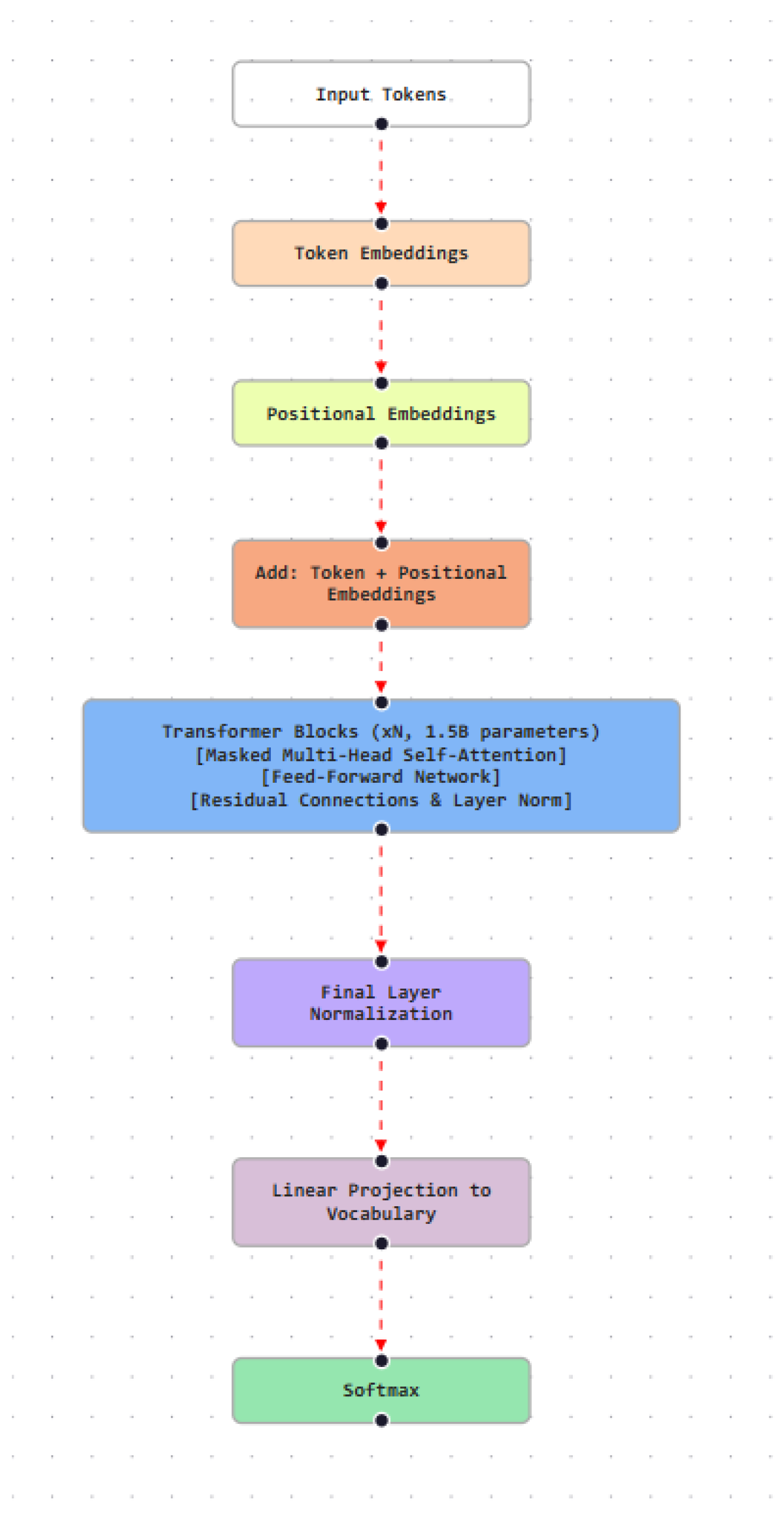
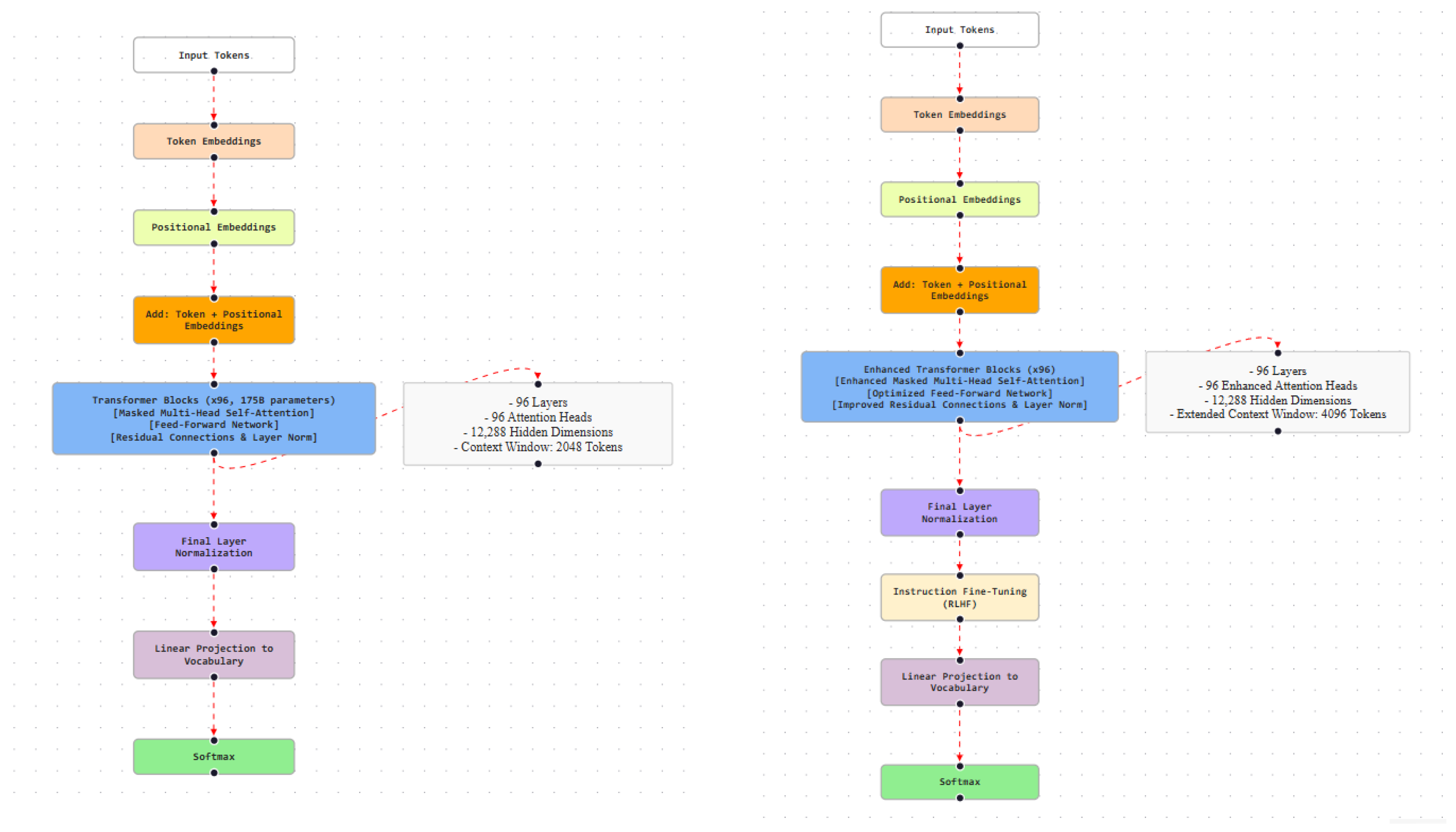
Figure 4 and
Figure 5 illustrate key architectural milestones.
GPT-2 [
1] established that large-scale unsupervised pretraining on web text (WebText, 40 GB) could yield strong zero/few-shot generalization using a decoder-only Transformer (up to 1.5B parameters, 1024-token context). Byte-level BPE tokenization and autoregressive next-token prediction remain foundational design choices adopted by successor models.
GPT-3 [
2] scaled to 175B parameters (96 layers, 2048-token context), demonstrating emergent zero-shot, one-shot, and few-shot capabilities without task-specific fine-tuning. Training on 300B tokens from filtered Common Crawl, Wikipedia, and Books corpora with quality-weighted upsampling established best practices for heterogeneous pretraining data.
GPT-3.5 refined the GPT-3 lineage through instruction tuning rather than architectural redesign [
26]. Variants such as
text-davinci-002/003 improved instruction adherence, response coherence, and controllability;
code-davinci-002 specialized in programming tasks. These gains demonstrate how alignment-oriented optimization substantially improves usability without increasing model scale.
GPT-4 [
12,
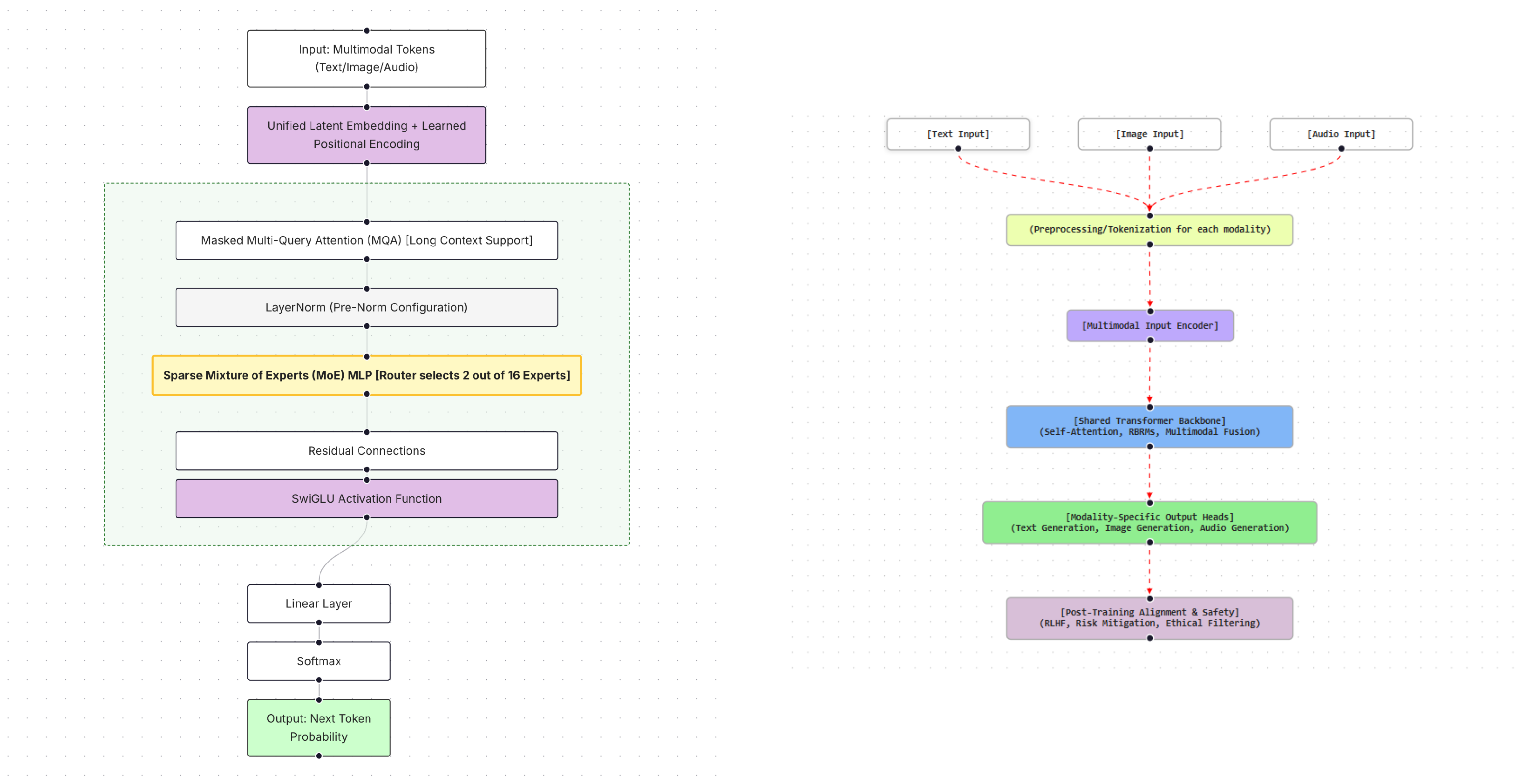
27] introduced multimodal input support (text + images), an expanded context window, and stronger reasoning on logical inference and mathematical tasks. Post-training alignment via RLHF uses human-ranked outputs to train a reward model, which is then optimized via Proximal Policy Optimization (PPO).
Figure 6 illustrates the GPT-4 and GPT-4o architectures.
GPT-4o [
25] extends multimodal integration to inputs and outputs across text, code, images, audio, and video. A multi-stage pipeline combines self-supervised pretraining on unlabeled multimodal data with RLHF fine-tuning. Automated content moderation and opt-out mechanisms for image data support responsible deployment.
GPT-O1 [
28] introduces chain-of-thought-style reasoning, enabling the model to represent intermediate steps before producing final outputs. Variants
O1-preview (high-demand reasoning) and
O1-mini (low-latency deployment) are trained via multi-stage RLHF with reinforcement learning throughout to encourage robust reasoning and adaptability.
5. LLaMA 2 Model
LLaMA 2, developed by Meta in collaboration with Microsoft, is a prominent open-access LLM designed for research and commercial use [
29]. The model emphasizes transparency through public disclosure of architectural choices, training procedures, and alignment methods.
5.1. Architecture and Innovations
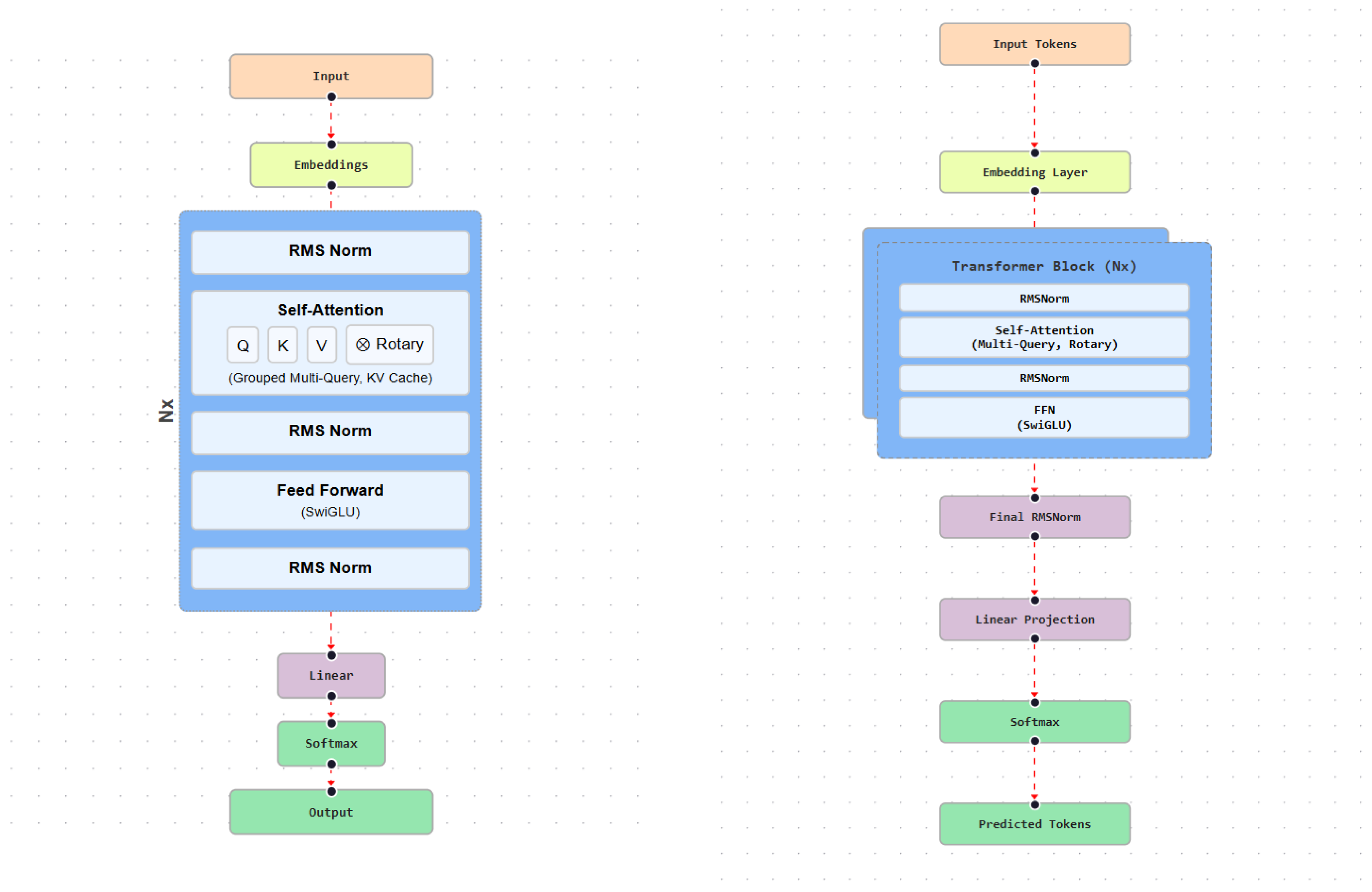
LLaMA 2 uses a decoder-only Transformer with RMSNorm pre-normalization, SwiGLU activations, RoPE positional embeddings, and GQA for efficient inference. Context length is extended to 4096 tokens. Models are released at 7B, 13B, and 70B parameters. The architectural progression from LLaMA to LLaMA 2 is shown in
Figure 7.
5.2. Training, Alignment, and Applications
LLaMA 2 is trained on 2 trillion tokens from publicly available sources (excluding Meta’s proprietary data) using AdamW (
,
, weight decay
) with cosine decay scheduling and FlashAttention-style kernels. Ghost Attention (GAtt) improves multi-turn instruction retention by assigning higher loss weight to later dialogue turns. RLHF with synthetic dialogues and safety reward models aligns outputs with human preferences while penalizing harmful content. Code LLaMA [
30] extends the family for code generation across multiple programming languages. Bias mitigation includes fairness-aware filtering and exclusion of personally identifiable information.
6. Google’s Gemini
Gemini is a multimodal LLM from Google DeepMind natively integrating text, image, audio, video, and code [
31].
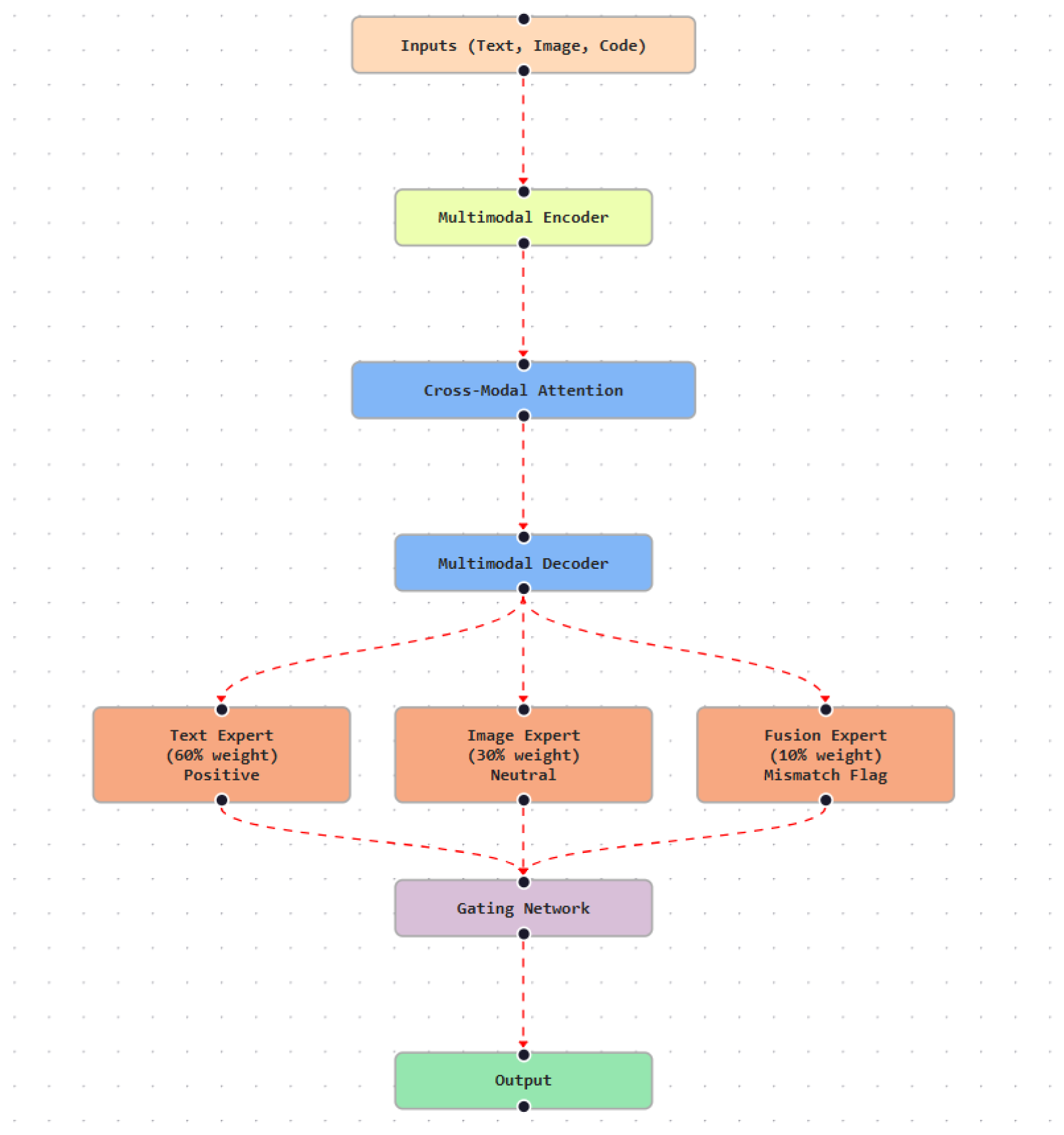
Figure 8 illustrates the overall architecture.
Gemini uses modality-specific encoders fused via cross-modal attention into a shared latent space, enabling joint reasoning across modalities. Gemini 1.5 adopts an MoE design with specialized Text, Image, and Fusion experts coordinated by a gating network that dynamically routes computation based on input composition. Multi-Query Attention, FlashAttention, and Flash Decoding reduce memory overhead and inference latency. Gemini 1.5 supports context windows up to 1 M tokens, reporting a HumanEval Pass@1 of 74.9% and multilingual coverage across 100+ languages [
32]. Lightweight Gemini Nano variants (1.8B and 3.25B parameters) target on-device inference. Layered safety measures include content moderation, response filtering, and prompt-level controls.
7. Claude
Claude, developed by Anthropic, emphasizes safety, alignment, and interpretability over raw performance [
33]. Models are deployed across Quora Poe, Notion, DuckDuckGo, and Anthropic’s developer API.
7.1. Architecture and Model Variants
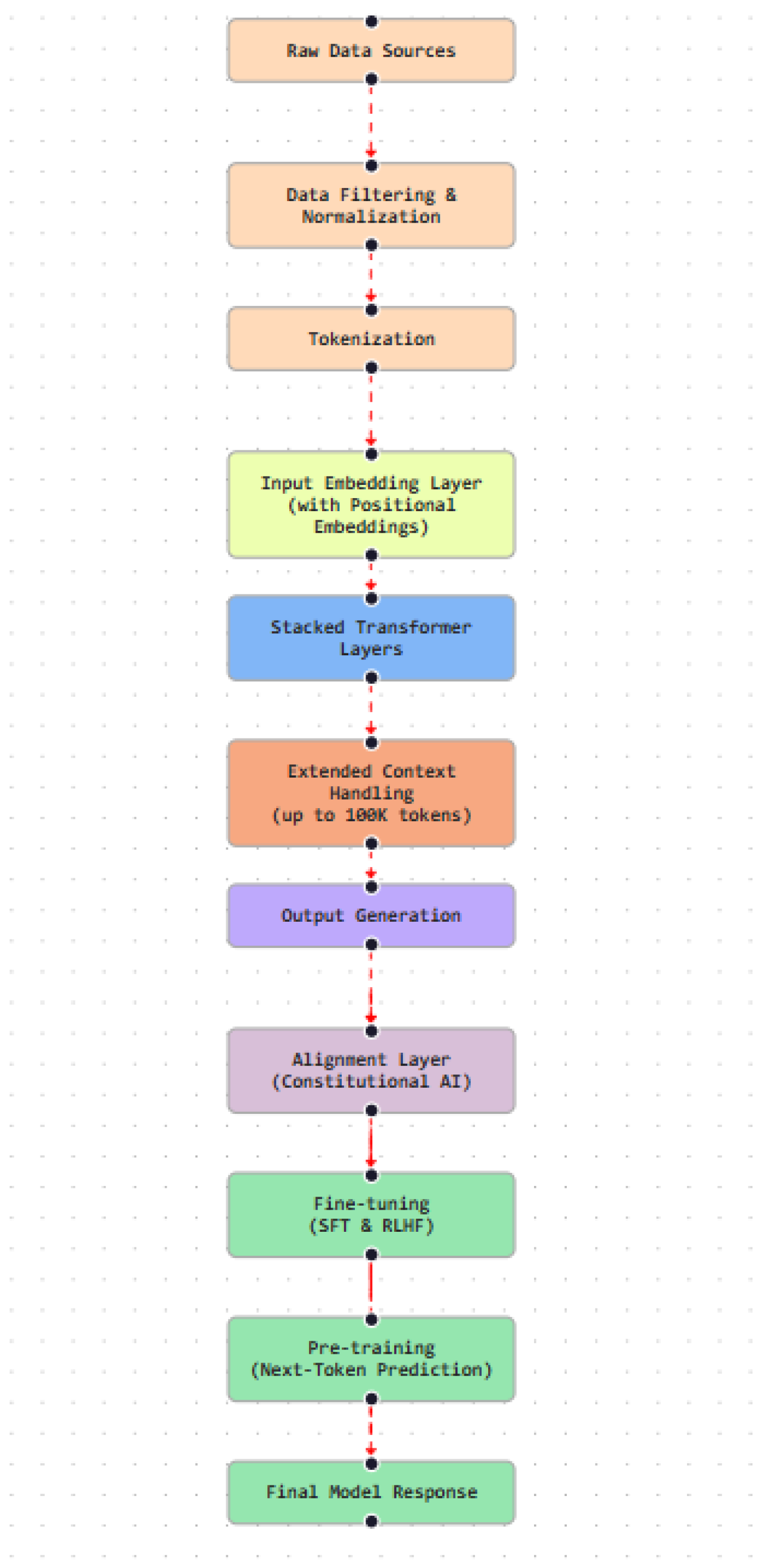
Claude 2 is a decoder-only Transformer with multi-head SA, positional embeddings, residual connections, and layer normalization, supporting up to 100,000-token contexts for long-document tasks.
Figure 9 shows the architecture.
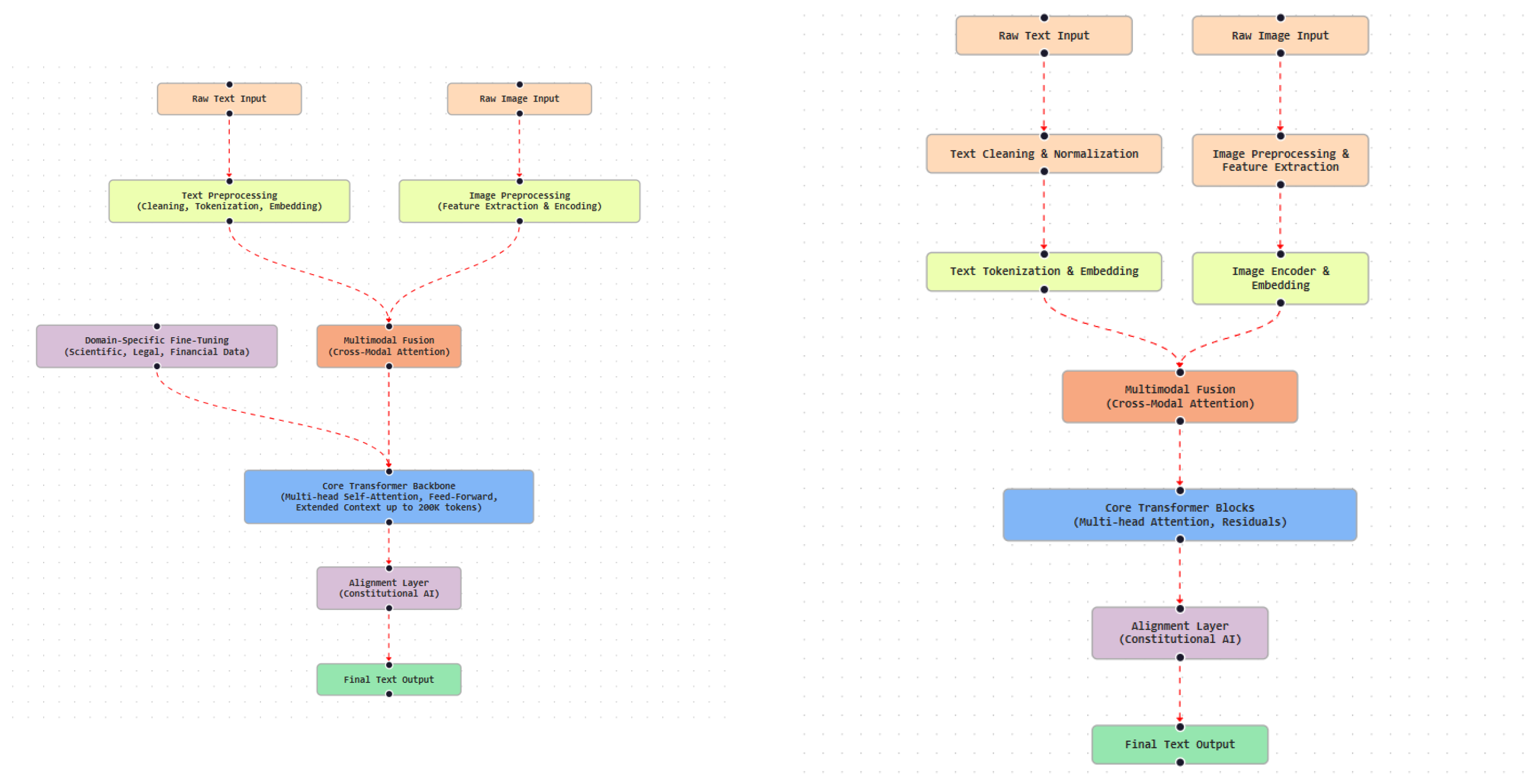
Claude 3 (Opus, Sonnet, Haiku) introduces multimodal embeddings for joint text–image representation with cross-modal attention and context lengths up to 200,000 tokens. Opus targets complex analytical tasks; Sonnet balances performance and speed; Haiku prioritizes low-latency deployment.
Figure 10 illustrates these variants.
Claude 3.5 extends the family with responsiveness and efficiency refinements. Claude 3.5 Haiku achieves 40.6% pass@1 on SWE-bench; Claude 3 Sonnet attains 49% on SWE-bench Verified with strong results on MathVista and ChartQA [
24].
7.2. Training and Alignment
Training follows autoregressive pretraining on a mixture of public, licensed, and curated internal sources, with BPE tokenization (approximately 10% non-English data for multilingual capability). Post-training alignment combines supervised fine-tuning, RLHF, and Anthropic’s Constitutional AI framework [
34], which enables self-correction based on predefined ethical principles, reducing reliance on extensive human annotation. RLAIF further refines alignment using AI-generated feedback. Additional safeguards include red-teaming, adversarial testing, content filtering, and self-evaluation mechanisms.
8. Falcon AI Model Family
Falcon AI, developed by the Technology Innovation Institute (TII) [
19], emphasizes open accessibility, efficient large-scale training, and competitive performance across a growing series of models.
8.1. Falcon-7B, 40B, and 180B
All three models share a causal decoder-only Transformer with RoPE, multiquery/multigroup attention, and parallelized attention–MLP execution within each block. Falcon-7B (1.5T tokens from RefinedWeb [
35]) and Falcon-40B (1T tokens) demonstrate that high-quality web data without upsampling is sufficient for competitive performance. Falcon-180B scales to 180B parameters on 3.5T tokens; large-scale z-loss regularization and gradient clipping stabilize optimization at this scale.
8.2. Falcon 2 Series
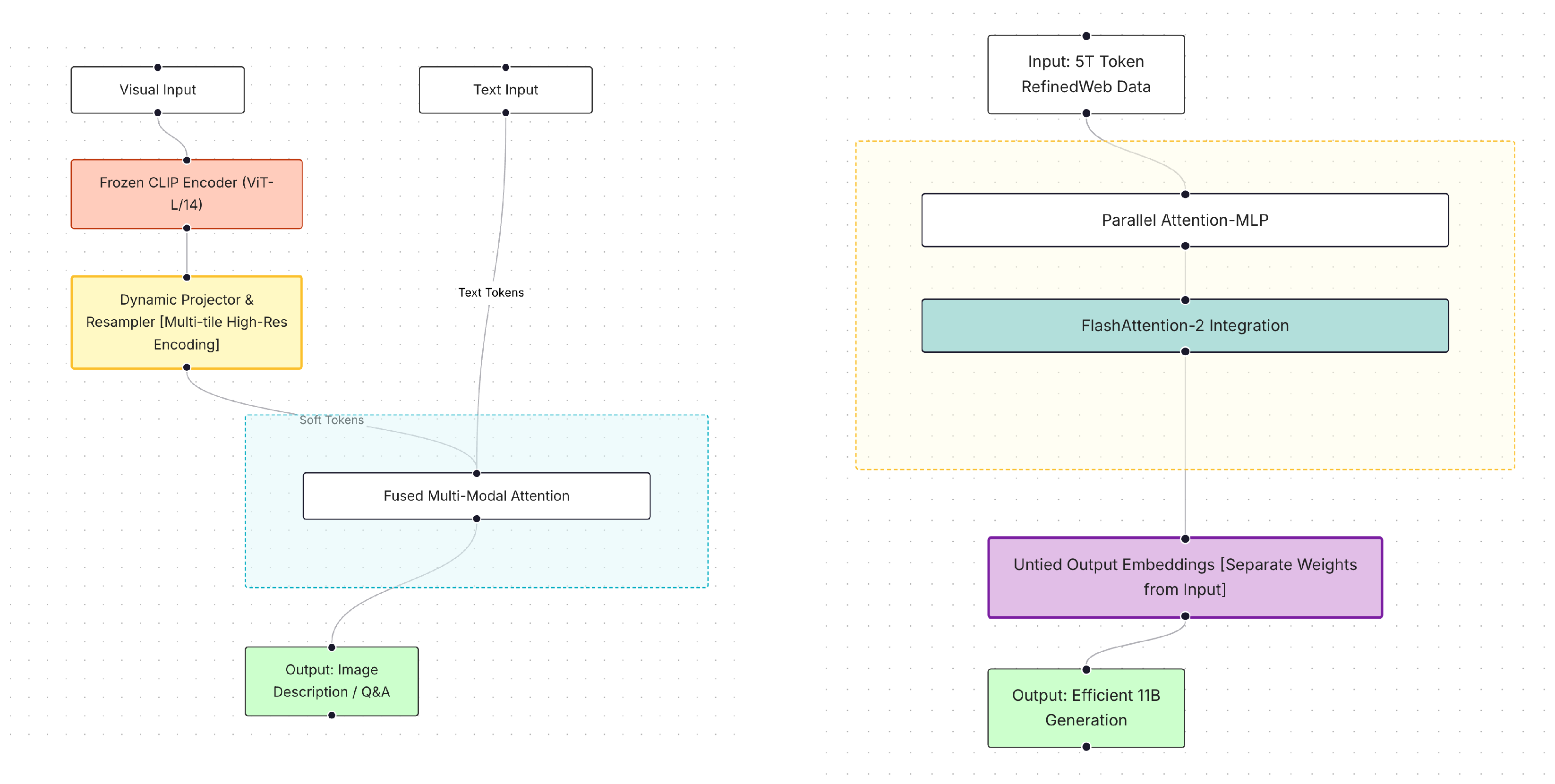
Falcon2-11B is a 60-layer decoder-only Transformer with GQA (8 key–value heads), FlashAttention-2, and modified RoPE scaling for 8192-token contexts, trained on 5T tokens through a four-stage curriculum.
Figure 11 shows its architecture. Falcon2-11B VLM extends the base model via a frozen CLIP ViT-L/14 encoder with a lightweight feed-forward projector, trained in two phases: projector-only alignment followed by joint optimization.
8.3. Falcon Mamba 7B and Falcon 3 Series
Falcon Mamba 7B departs from attention by replacing SA with a Mamba state-space model (SSM) [
36], enabling linear-time sequence processing with near-constant memory usage for long-context inference (64 layers, 7.27B parameters, trained on 5.8T tokens).
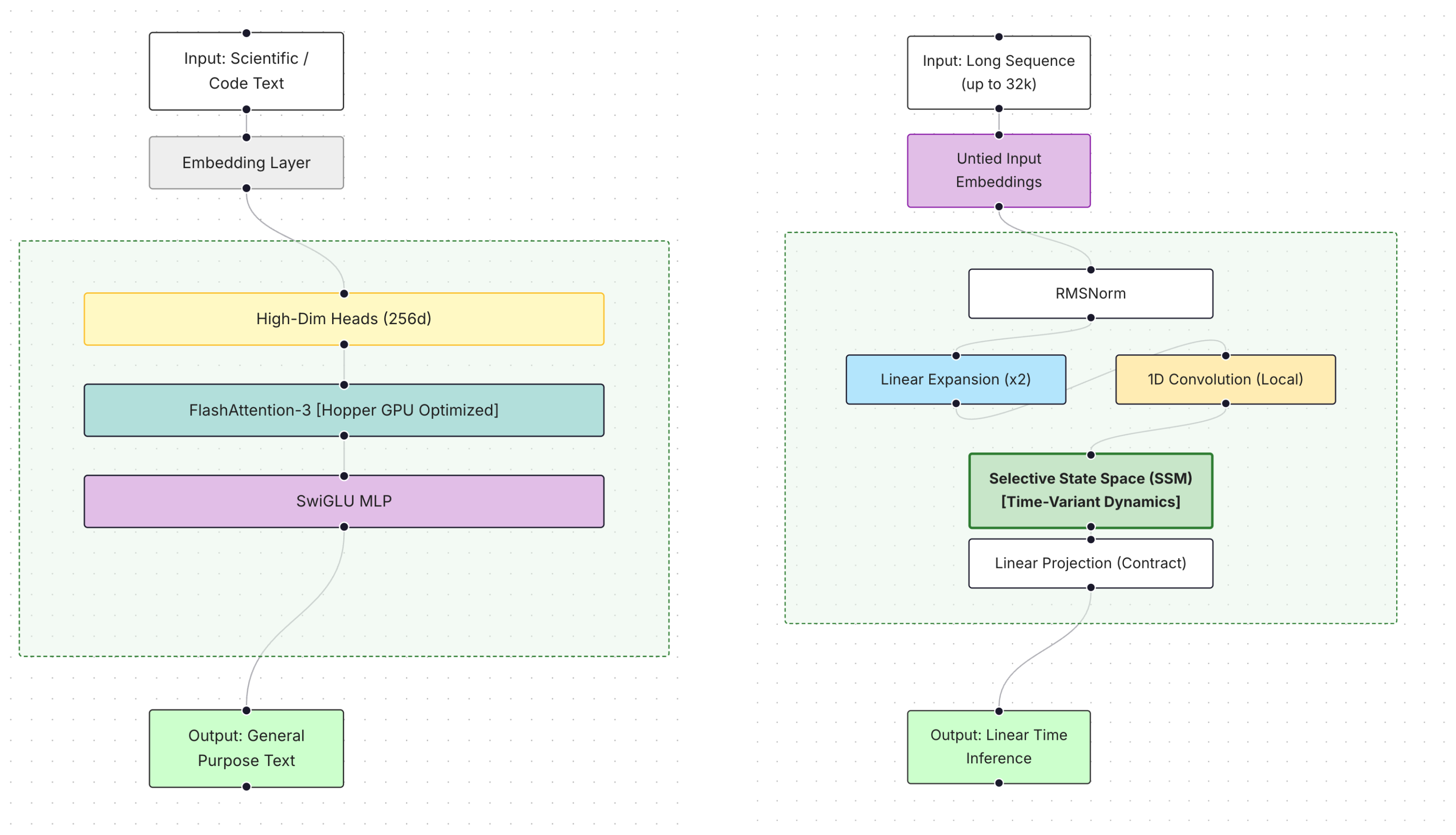
The Falcon 3 series [
37] covers a range from 1B to 10B parameters, combining Transformer and state-space designs. Falcon3-1B uses knowledge distillation from Falcon3-7B for efficiency; Falcon3-3B and 7B adopt GQA, SwiGLU, and FlashAttention-3; Falcon3-10B extends to 40 layers trained on 2 T tokens. Falcon3-Mamba-7B uses selective SSM layers for linear-time long-sequence modeling. Representative architectures are shown in
Figure 12. Deployment of all Falcon 3 variants incorporates encrypted data transfer, GDPR compliance, and access controls.
9. DeepSeek Model Family
DeepSeek AI, founded in 2023 by Liang Wenfeng, focuses on reasoning-centric performance and computational efficiency [
38,
39].
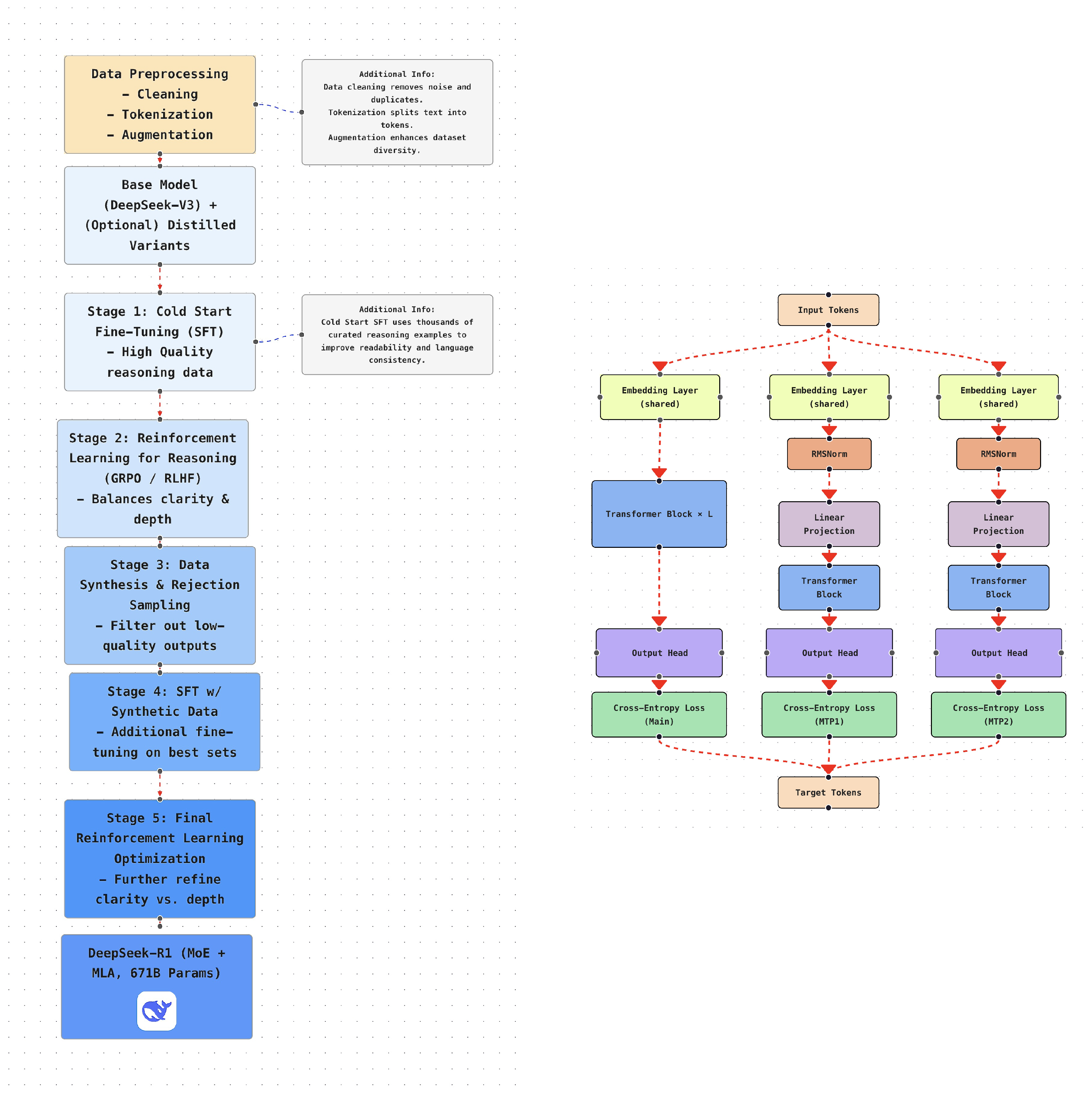
Figure 13 illustrates the two flagship models.
9.1. DeepSeek-R1
DeepSeek-R1 [
14] is optimized for advanced reasoning through a multi-stage pipeline. The base variant, DeepSeek-R1-Zero, is trained exclusively via Group Relative Policy Optimization (GRPO), yielding strong emergent reasoning but limited linguistic coherence. Subsequent stages introduce cold-start fine-tuning on curated reasoning examples, additional RL with correctness/conciseness rewards, rejection-sampled synthetic data for supervised fine-tuning, and a final RL phase for human preference alignment. The model employs a MoE architecture with 671B total and 37B active parameters per token, Multi-Head Latent Attention (MLA) compressing key–value representations, and a 128K-token context window.
9.2. DeepSeek-V3
DeepSeek-V3 [
38] integrates MLA for key–value compression, MoE routing without auxiliary load-balancing losses, and Multi-Token Prediction (MTP) for parallel generation. It is trained on 14.8T tokens using FP8 mixed-precision and DualPipe pipeline parallelism at a reported cost of
$5.576 M. Fine-tuning incorporates knowledge distillation from DeepSeek-R1, supervised instruction tuning, and RLHF via GRPO. DeepSeek-V3 achieves near state-of-the-art results across reasoning, code generation, and long-context QA, performing comparably to GPT-4o and Claude 3.5 Sonnet on MMLU-Redux and GPQA-Diamond with a HumanEval-Mul Pass@1 of 82.6.
10. Qwen AI
Qwen, developed by Alibaba Cloud, is a family of decoder-only Transformer LLMs supporting text generation, translation, code synthesis, and mathematical reasoning [
40].
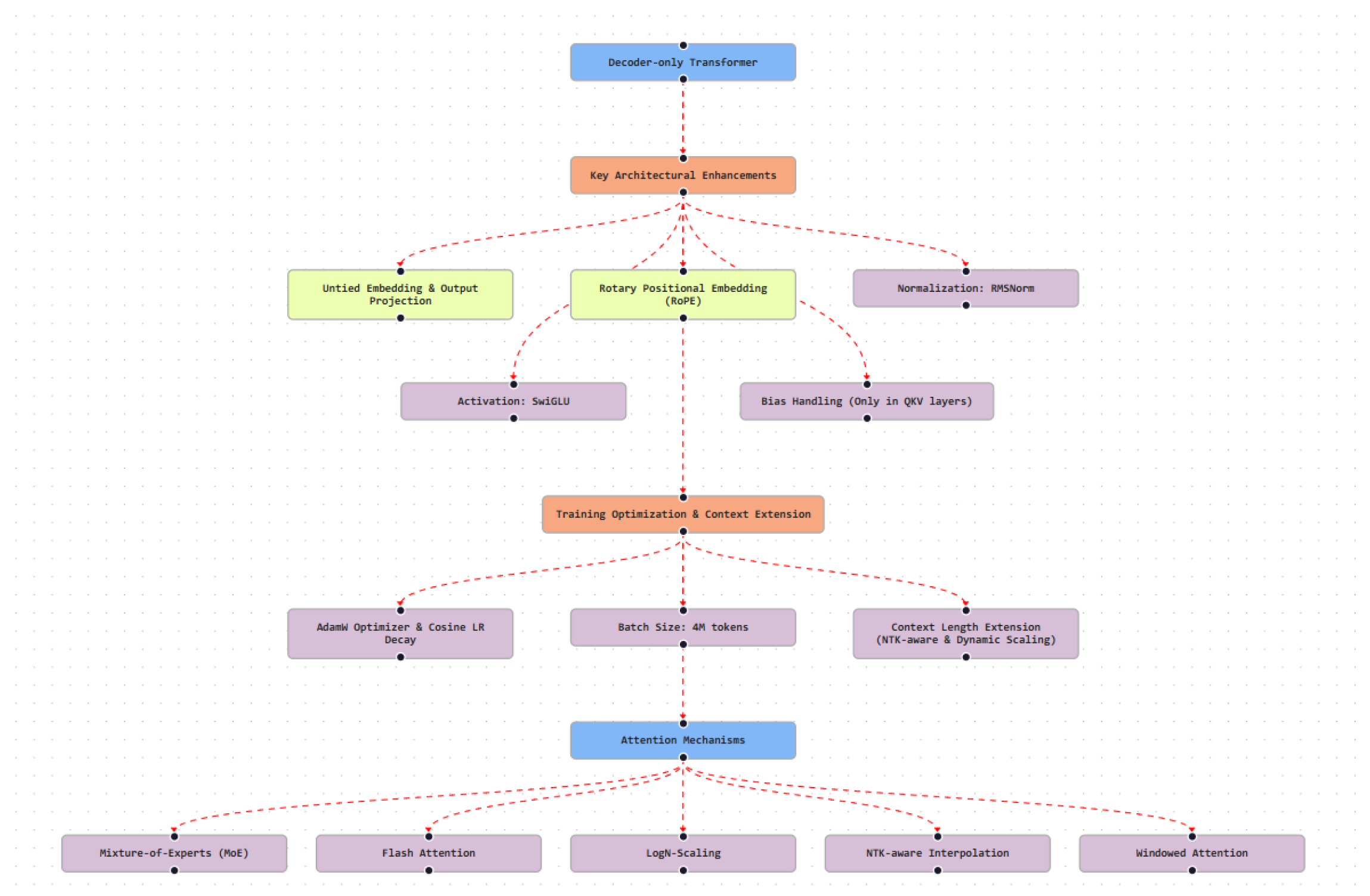
Figure 14 shows the architecture.
Qwen uses RoPE for positional encoding, RMSNorm for optimization stability, SwiGLU activations, and untied input/output embeddings. FlashAttention accelerates computation; LogN-scaled attention and NTK-aware interpolation support extrapolation beyond the training context length. Models are trained via AdamW with cosine scheduling on trillions of tokens from multilingual web, books, and code. Instruction-tuned variants (Qwen-Chat) use supervised fine-tuning and RLHF; domain-specialized models (Code-Qwen, Math-Qwen) target programming and mathematical tasks. Configurations span 1.8B, 7B, and 14B parameters. Code-Qwen achieves strong results on HumanEval and MBPP. Remaining challenges include susceptibility to prompt injection and residual multilingual bias.
11. Comparative Analysis
Table 5 synthesizes the architectural and methodological differences across model families. Supervised fine-tuning combined with RLHF has emerged as the common alignment baseline. Proprietary systems (GPT-4, Claude 3) extend this with PPO, Constitutional AI, and RLAIF; open and semi-open models (Falcon, DeepSeek) emphasize gradient clipping, z-loss regularization, rejection sampling, and distillation.
Context length is a major axis of differentiation: LLaMA 2 operates within 4K tokens; GPT-4o and DeepSeek extend to tens of thousands; Gemini 1.5 reaches 1M tokens through memory-efficient attention, expert routing, and hybrid tokenization. Multimodal capability further distinguishes the families: GPT-4o and Gemini provide unified text/image/audio/video processing; Claude 3 adds vision–language integration; Qwen and DeepSeek remain primarily text-centric with strong performance in multilingual QA, structured reasoning, and code.
Taxonomy-Driven Explanatory Analysis
The taxonomy enables not only description but explanatory analysis: by encoding each model as a vector of dimensional values, we can identify which combinations of architectural choices correlate with performance advantages on specific benchmark types.
Table 6 illustrates this for three representative benchmark contrasts drawn from
Table 2.
The 32.6-point GSM8K gap between DeepSeek-V3 (89.4%) and LLaMA 2 (56.8%) corresponds in the taxonomy to three simultaneous dimensional differences: attention mechanism (MLA vs. GQA), training objective (Multi-Token Prediction vs. standard next-token prediction), and alignment method (rejection-sampled RL vs. Ghost Attention RLHF). The 15.8-point SWE-bench gap between Claude 3.x (49.0%) and GPT-4o (33.2%) maps to two taxonomy dimensions: alignment depth (Constitutional AI + RLAIF vs. RLHF-PPO) and context length (200K vs. 128K tokens), both of which plausibly benefit multi-file code reasoning tasks. The 26.8-point HumanEval gap between Gemini 1.5 (74.9%) and LLaMA 2 (48.1%) traces to MoE routing enabling larger effective parameter counts at fixed activation cost. These analyses do not establish causality, but they demonstrate that the taxonomy enables structured explanatory hypotheses about performance differences—a form of analysis not possible from individual model descriptions alone.
12. Societal and Business Implications
12.1. Business and Industry
LLMs increasingly automate knowledge-intensive tasks, document drafting, code generation, data analysis, customer support, improving productivity by reducing routine cognitive work. However, over-reliance on automated outputs poses risks when models produce fluent but incorrect content or obscure uncertainty, potentially amplifying errors and reducing critical human oversight. Cost-performance trade-offs shape adoption: proprietary models offer stronger alignment and multimodal capability at higher operational cost, while open models provide transparency and flexibility but require additional engineering and safety effort.
12.2. Societal Impact
In education, LLMs offer personalized feedback and formative assessment while raising concerns about academic integrity and critical thinking if deployed without pedagogical safeguards. Broader information access risks include misinformation and authority bias, as users may over-attribute credibility to fluent outputs lacking explicit sourcing. Performance disparities persist across low-resource languages, dialects, and culturally specific contexts, underscoring the need for inclusive data practices and multilingual evaluation. These challenges highlight the importance of transparency mechanisms, citation-aware interfaces, and uncertainty-aware interaction design.
13. Discussion
13.1. Trends in Scaling, Architecture, and Safety
Recent LLM development is marked by sustained growth in scale and context length. Accommodating this has driven adoption of MoE routing, Multi-Head Latent Attention, FlashAttention, and GQA. Safety and alignment have become central design considerations: RLHF is now a standard pipeline component, complemented by Constitutional AI, reward modeling, and self-critique. Models such as Claude 3 and GPT-O1 embed alignment directly into training rather than relying on post-processing controls.
13.2. Trade-Offs: Complexity vs. Performance
High-capacity models (GPT-4, Claude Opus) achieve strong benchmark results but require extensive resources, limiting accessibility. Efficiency-oriented models (Qwen AI, Falcon 3, Claude Haiku) achieve competitive results in targeted tasks at lower cost, highlighting that model suitability is application-dependent and compact LLMs are essential for resource-constrained and on-device deployment.
13.3. Open-Source vs. Proprietary Paradigms
Proprietary models (GPT-4, Claude, Gemini) lead in multimodal capability and alignment sophistication but offer limited transparency. Open initiatives (LLaMA 2, Falcon, DeepSeek, Qwen AI) enable community-driven experimentation, independent safety assessment, and rapid downstream innovation, forming a complementary ecosystem that collectively advances capability, accessibility, and accountability.
13.4. Meta-Findings Enabled by the Taxonomy
The preceding cross-family analysis, enabled by the unified taxonomy, yields four meta-level findings that are not derivable from individual model analyses and represent the primary analytical contribution of the taxonomy framework.
Meta-Finding 1: Alignment depth and architectural efficiency are in systematic tension. Extending Pattern A (
Section 3.5) from observation to structural implication: across all seven families, no model achieves high scores on both Constitutional AI/RLAIF alignment depth and state-of-the-art attention efficiency (MLA/MQA).
The taxonomy reveals this as a structural constraint rather than an incidental gap: deeper alignment pipelines require more iterative inference-time generation (for self-critique and revision) that is incompatible with the throughput optimizations that MLA and MQA are designed to provide. This tension is a testable hypothesis for future architectural work.
Meta-Finding 2: Long-context capability is gated by expert routing. The taxonomy’s co-adoption pattern (Pattern B,
Section 3.5) suggests that sparse expert routing is currently a necessary condition for practical long-context modeling at scale. Dense Transformers appear to face a memory-computation wall beyond 32K tokens that MoE and SSM architectures circumvent. This finding points to expert routing as a foundational rather than optional design component for next-generation long-context systems.
Meta-Finding 3: Open-weight development has converged on a local optimum. The clustering of open-weight models around RMSNorm + RoPE (Pattern C,
Section 3.5) suggests that open-weight development may be converging on a local optimum shaped by community reproducibility norms rather than global architectural optima. Proprietary models exploring heterogeneous configurations may be discovering higher-performing regions of the design space that open-weight communities have not yet explored, in part because non-standard components are harder to validate and reproduce publicly.
Meta-Finding 4: Benchmark profiles are predictable from taxonomy position. The explanatory analysis in
Section 11 demonstrates that a model’s performance profile across benchmark types (mathematical reasoning, code generation, long-context QA) is largely predictable from its taxonomy dimensions, particularly training objective, attention mechanism, and alignment depth. This predictability supports the use of the taxonomy for model selection guidance: practitioners can estimate a model’s likely strengths from its architectural profile before running full benchmark evaluations.
Collectively, these meta-findings demonstrate that the taxonomy produces analytical value beyond documentation: it reveals structural constraints, enables explanatory hypotheses, and supports predictive reasoning about the LLM design space.
14. Limitations and Open Challenges
Despite rapid architectural and alignment progress, LLMs exhibit fundamental limitations:
Hallucination and factual inconsistency. Autoregressive generation with likelihood-based objectives produces plausible but incorrect content. RLHF prioritizes helpfulness and fluency without guaranteeing factual correctness. Concretely, GPT-4 was reported at approximately 59% on TruthfulQA in zero-shot settings [
12], compared to a human baseline of ∼94%, illustrating that factual unreliability remains a significant open problem even in frontier models. Models also remain vulnerable to jailbreak and adversarial prompting: documented red-teaming reports for GPT-4, Claude, and Gemini during 2023–2024 identified prompt injection strategies capable of bypassing safety constraints, confirming that post-training alignment reduces but does not eliminate misuse risks [
24,
25].
Inherited training data bias. LLMs reflect social, cultural, and linguistic biases from large-scale corpora. Alignment and safety filtering mitigate some behaviors but do not eliminate representational bias and may introduce additional distortions through selective reward shaping. Performance disparities are particularly pronounced across languages: LLaMA 2 and Falcon report substantially lower benchmark scores on non-English MMLU subsets [
3,
19], a gap that open-weight models have been slower to close relative to proprietary systems with more diverse pretraining mixtures.
Proprietary opacity. Proprietary models restrict access to weights, training data, and alignment procedures, limiting reproducibility and independent safety assessment. Open models enable greater inspection but may exhibit higher safety variability without extensive alignment.
Benchmark saturation. Performance improvements increasingly reflect saturation, contamination, or narrow optimization, potentially overestimating real-world generalization. Independent evaluations via BIG-Bench Hard and HELM have documented cases where leading models show anomalously high MMLU scores that do not consistently generalize to held-out reasoning tasks, suggesting that reported numbers may partly reflect dataset familiarity rather than genuine capability gains.
Distribution shift fragility. LLMs exhibit reduced robustness outside training distributions, including in specialized domains, low-resource languages, and novel interaction settings.
Ethical, Environmental, and Sustainability Considerations
Training and operating large-scale models incur substantial energy consumption and carbon emissions. MoE routing, distillation, quantization, and parameter-efficient fine-tuning aim to mitigate these costs but introduce additional complexity. Web-scale training corpora frequently lack transparent provenance, raising concerns about privacy, intellectual property, and representational fairness. Alignment failures and misuse risks, including harmful content generation and inappropriate automation of decision-making, remain persistent. Addressing these challenges requires stronger grounding, improved data governance, uncertainty-aware training, diversified evaluation benchmarks, and transparent reporting practices.
15. Future Directions
Key directions for next-generation LLM research include:
Transparent and standardized evaluation. Future work should prioritize reproducible frameworks assessing reasoning, safety, factual consistency, and multimodal understanding across long-context and multilingual settings. Benchmarks such as HELM, BIG-Bench, and MMLU require extension for these dimensions.
Cross-lingual generalization. Multilingual data augmentation, language-specific adapters, and community-driven dataset creation are needed to address persistent performance disparities across low-resource languages and culturally specific contexts.
Long-context reasoning and memory-augmented models. Although recent models exceed 100K-token contexts, substantial computational costs remain. Memory-augmented Transformers, state-space models, and hybrid attention–memory designs may enable efficient persistent reasoning over extended inputs.
Governance and responsible deployment. Developers and deployers should adopt standardized practices including Model Cards, Data Sheets, bias audits, and red-teaming. Coordinated regulatory frameworks addressing misuse, accountability, and equitable access are essential for trustworthy deployment.
16. Conclusions
This survey presented a comprehensive analysis of contemporary LLMs, synthesizing architectural design choices, training and alignment strategies, multimodal capabilities, and performance characteristics across GPT, Claude, LLaMA, Gemini, Falcon, DeepSeek, and Qwen AI. A unified taxonomy and comparative analysis demonstrate that while scaling remains relevant, the primary differentiators of modern LLMs increasingly lie in efficiency-oriented architectures, long-context modeling, multimodal integration, and alignment mechanisms.
Proprietary models lead in multimodal capability and alignment refinement; open and semi-open initiatives contribute transparency, reproducibility, and adaptability. Together these paradigms form an interdependent ecosystem accelerating technical progress while expanding accessibility. For researchers, this survey provides a structured framework for understanding architectural trade-offs and alignment methodologies. For practitioners, comparative insights support informed model selection. For policymakers, the findings underscore the growing importance of transparency, inclusivity, and accountability in large-scale AI development. Future progress will require a shift toward holistic approaches that prioritize interpretability, fairness, efficiency, and responsible governance alongside performance.