



LLM-Augmented Algorithmic Management: A Governance-Oriented Architecture for Explainable Organizational Decision Systems


Abstract
1. Introduction
1.1. From Algorithmic to Cognitive Management
1.2. Motivation: Governance Pressure in Research and Corporate Contexts
1.3. Research Questions, Research Gaps, and Contributions
- RQ1:
- How can LLM capabilities be integrated into algorithmic management systems to improve decision transparency without weakening accountability?
- RQ2:
- What verification and governance mechanisms are required to prevent ungrounded explanations, bias amplification, and automation dependence in LLM-augmented management?
- RQ3:
- How can a governance-oriented architecture support cross-domain deployment under emerging regulatory and standards-based requirements (e.g., EU AI Act, GDPR, ISO/IEC 42001 [19])?
- G1.
- Architectural integration gap: Existing studies often focus either on decision models or on explanation interfaces but provide limited governance-oriented architectures that explicitly separate decision authority, LLM-mediated explanation, and verifiable oversight.
- G2.
- Verification gap: Many LLM-enabled explainability approaches improve readability (linguistic transparency) but offer limited mechanisms for epistemic validity, including evidence grounding, constraint checking, provenance, and auditable approvals.
- G3.
- Deployment/governance gap: There is limited practical guidance on operationalising LLM-augmented decision support under organisational governance requirements (e.g., GDPR, EU AI Act, ISO/IEC 42001), including escalation paths and human-in-command workflows.
- G4.
- Trade-off design gap: The transparency benefits of LLM explanations are frequently discussed conceptually, but the operational trade-offs (e.g., latency, verification overhead, exception routing) that shape adoption remain underexplored.
- C1 (addresses G1): A governance-oriented three-layer architecture for LLM-augmented algorithmic management that separates an algorithmic decision core, an LLM cognitive interface, and a verification/governance layer.
- C2 (addresses G2): A conceptual distinction between linguistic transparency (readable rationales) and epistemic validity (verifiable grounding), establishing verification as the mediator of trustworthy explainability.
- C3 (addresses G3): A risk-to-control synthesis aligned with governance instruments and organisational practices, operationalised through constraints, provenance, logging, and oversight workflows.
- C4 (addresses G4): Cross-domain scenarios and a demonstrative simulation that illustrate architectural plausibility and transparency–latency trade-offs under verification controls.
- C5 (integrative contribution): A governance-first framing that positions LLMs as accountable explanatory interfaces rather than autonomous decision-makers, supporting safer deployment in organisational contexts.
2. Background and Related Work
2.1. Algorithmic Management: Origins, Concepts, and Critiques
2.2. Large Language Models: Capabilities and Organisational Relevance
2.3. AI Governance: Standards, Regulation, and Organisational Practice
2.4. Synthesis of Related Work and Implications for Architecture Design
3. Research Design and Methodology
3.1. Research Design and Assumptions
- A1.
- Existing decision core: An algorithmic decision component already exists (e.g., scoring, optimisation, scheduling, or rule-based allocation) and remains the primary source of decision computation.
- A2.
- Bounded LLM role: The LLM is used as a cognitive interface for explanation, dialogue, and policy interpretation support, but does not hold autonomous final decision authority.
- A3.
- Hybrid policy environment: Organisational constraints include both fully formal rules (machine-checkable) and semi-formal policies that require contextual interpretation and human judgment.
- A4.
- Risk-proportional governance: The intensity of verification and oversight should vary by decision risk, impact, and regulatory exposure.
- A5.
- Demonstrative simulation scope: Synthetic traces can illustrate architectural behaviour and trade-offs, but cannot establish real-world effectiveness, human acceptance, or compliance performance.
3.2. Methodological Pipeline
4. Governance-Oriented Architecture for LLM-Augmented Algorithmic Management
4.1. Design Principles and System Boundaries
4.2. Three-Layer Architecture
4.3. Verification and Auditability Mechanisms
4.4. Operational Decision and Explanation Cycle
4.5. Use Case Walkthrough: Policy-Constrained Decision with Escalation
- Step 1 (Decision core): The decision core produces a candidate action (e.g., approve a procurement request/allocate a resource/escalate a compliance issue) along with structured features (risk score, thresholds triggered, eligibility flags).
- Step 2 (Governance retrieval): The governance layer retrieves relevant policy clauses, contract terms, and prior decisions under access control, selecting authoritative sources by version and scope.
- Step 3 (LLM explanation): The LLM generates a rationale that explicitly references the retrieved sources, states assumptions, and highlights uncertainty where evidence is incomplete.
- Step 4 (Constraint checks): The governance layer evaluates machine-checkable rules (thresholds, segregation-of-duties, eligibility) and classifies the outcome as pass/conditional/fail/inconclusive.
- Step 5 (Escalation): If the outcome is failure or inconclusive (e.g., missing evidence, conflicting rules, or an exception clause), the case is routed to a human-in-command reviewer with a structured evidence bundle (sources, rule results, explanation, and override options).
- Step 6 (Audit artifacts): The system writes an audit record (decision ID, policy version, retrieved sources, rule evaluation results, reviewer decision, and rationale for approval/override).
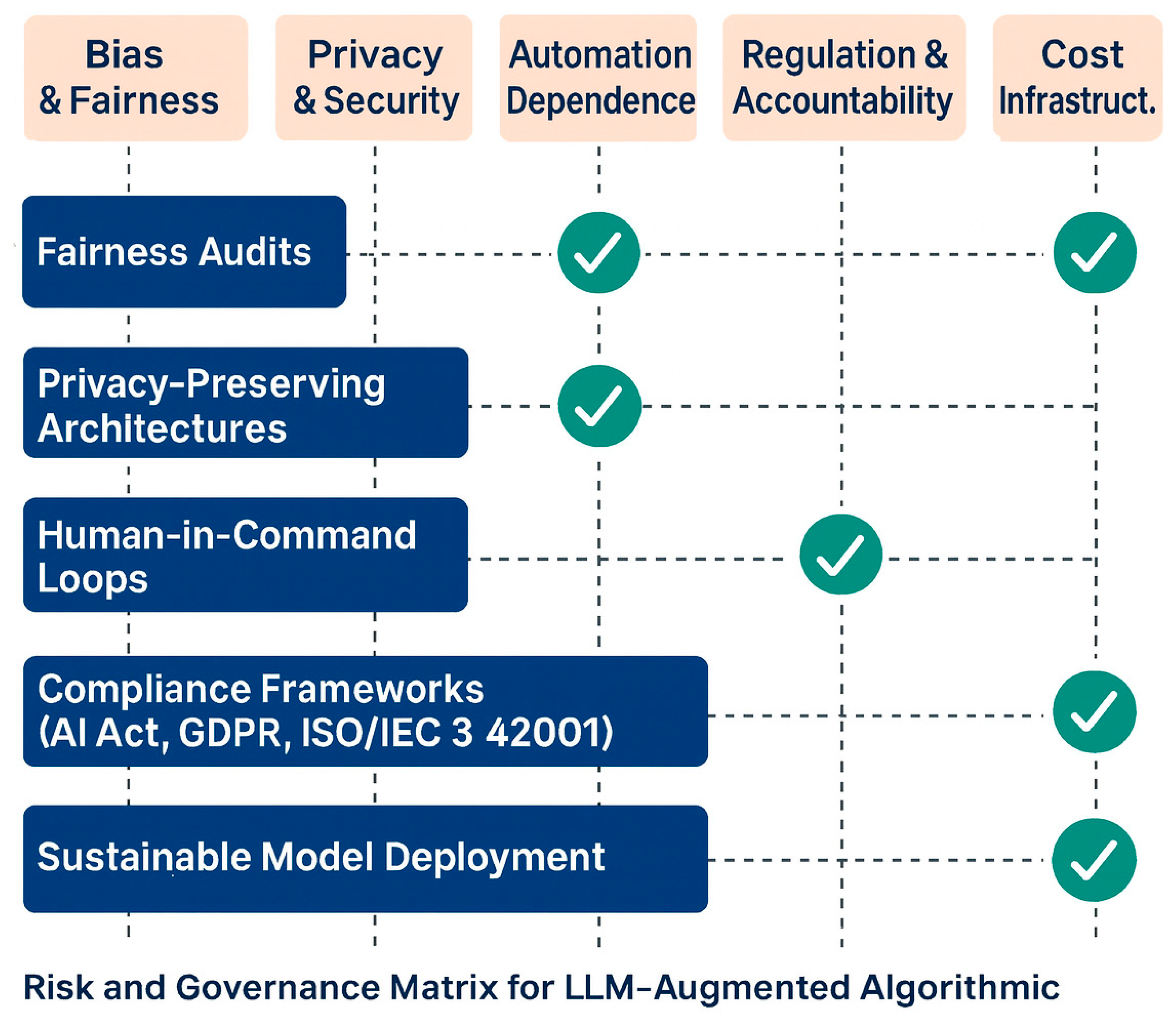
5. Risks and Governance Controls in LLM-Augmented Management
5.1. Bias, Fairness, and Accountability
5.2. Privacy, Security, and Data Integrity
5.3. Automation Dependence and Human Oversight
5.4. Regulation, Cost, and Sustainable Deployment
5.5. Risk-to-Control Synthesis
6. Demonstrative Simulation: Operational Plausibility and Trade-Offs
6.1. Simulation Setup
6.2. Metrics
- LLLM(i) represents explanation generation overhead;
- Lver(i) represents verification and governance processing overhead
6.3. Results
6.4. Latency–Validity Trade-Off
6.5. Interpretation for Governance Design
7. Illustrative Scenarios and Potential Applications
7.1. Scenario A: Requirements Consolidation in Multi-Stakeholder Projects
- Inputs: proposals, grant agreement clauses, meeting minutes, risk registers, and technical specifications.
- Decision core: prioritisation and dependency analysis (e.g., scheduling, resource allocation).
- LLM layer: generates consolidated requirements narratives and highlights conflicts or missing evidence.
7.2. Scenario B: Transparent Decision Pathways in Risk and Compliance Assessment
- Inputs: risk signals, control test results, policy documents, and incident reports.
- Decision core: risk scoring, threshold-based alerts, or prioritisation of mitigations.
- LLM layer: produces stakeholder-facing explanations (‘why this is high risk’) and suggests evidence-backed mitigation options.
7.3. Scenario C: Continuous Monitoring of Governance Standards
- Inputs: process logs, model cards, change requests, access logs, and audit evidence repositories.
- Decision core: detection of deviations from required processes (e.g., missing documentation, overdue reviews).
- LLM layer: summarises compliance status, generates audit-ready narratives, and drafts corrective action plans.
- Governance layer: restricts access to sensitive data, enforces retention rules, and records approvals and remediation actions.
7.4. Scenario D: Coordination and Knowledge Transfer in Distributed Teams
- Inputs: operational dashboards, project communications, standard operating procedures, and stakeholder feedback.
- Decision core: scheduling, prioritisation, or workload balancing decisions.
- LLM layer: generates role-specific briefings and answers ‘why’ questions using retrieved evidence.
8. Business and Industry Applications of Cognitive Governance
8.1. Supply Chains and Operations
8.2. Human Resources and People Analytics
8.3. Public Procurement and Regulated Decision Processes
8.4. Innovation Management and Strategic Planning
9. Discussion
9.1. From Linguistic Transparency to Epistemic Validity
9.2. Practical Implications: Designing for Governance Readiness
9.3. Limitations
9.4. Summary of Key Insights
10. Future Research Directions
10.1. Explainable and Verifiable LLM Governance
10.2. Human–AI Interaction and Organisational Outcomes
10.3. Longitudinal and Cross-Sector Studies
11. Conclusions
Author Contributions
Funding
Institutional Review Board Statement
Informed Consent Statement
Data Availability Statement
Conflicts of Interest
References
- Kellogg, K.C.; Valentine, M.A.; Christin, A. Algorithms at Work: The New Contested Terrain of Control. Acad. Manag. Ann. 2020, 14, 366–410. [Google Scholar] [CrossRef]
- Shestakofsky, B. Working Algorithms: Software Automation and the Future of Work. Work Occup. 2017, 44, 376–423. [Google Scholar] [CrossRef]
- Kaplan, A.; Haenlein, M. Rulers of the World, Unite! The Challenges and Opportunities of Artificial Intelligence. Bus. Horiz. 2020, 63, 37–50. [Google Scholar] [CrossRef]
- Brynjolfsson, E.; McAfee, A. The Second Machine Age: Work, Progress, and Prosperity in a Time of Brilliant Technologies; W.W. Norton & Company: New York, NY, USA, 2014. [Google Scholar]
- Ajunwa, I. The Paradox of Automation as Anti-Bias Intervention. Cardozo Law Rev. 2020, 41, 1671–1742. Available online: https://larc.cardozo.yu.edu/clr/vol41/iss5/2/ (accessed on 19 October 2025).
- Bommasani, R.; Hudson, D.A.; Adeli, E.; Altman, R.; Arora, S.; von Arx, S.; Bernstein, M.S.; Bohg, J.; Bosselut, A.; Brunskill, E.; et al. On the Opportunities and Risks of Foundation Models. arXiv 2021, arXiv:2108.07258. [Google Scholar] [CrossRef]
- Bubeck, S.; Chandrasekaran, V.; Eldan, R.; Gehrke, J.; Horvitz, E.; Kamar, E.; Lee, P.; Lee, Y.T.; Li, Y.; Lundberg, S.; et al. Sparks of Artificial General Intelligence: Early Experiments with GPT-4. arXiv 2023, arXiv:2303.12712. [Google Scholar] [CrossRef]
- OpenAI. GPT-4 System Card. OpenAI Technical Report. 2023. Available online: https://openai.com/index/gpt-4/ (accessed on 19 October 2025).
- Jarrahi, M.H. Artificial Intelligence and the Future of Work: Human–AI Symbiosis in Organizational Decision Making. Bus. Horiz. 2018, 61, 577–586. [Google Scholar] [CrossRef]
- Floridi, L.; Cowls, J. A Unified Framework of Five Principles for AI in Society. Harv. Data Sci. Rev. 2019, 1. Available online: https://hdsr.mitpress.mit.edu/pub/l0jsh9d1 (accessed on 19 October 2025).
- Pasquale, F. New Laws of Robotics: Defending Human Expertise in the Age of AI; The Belknap Press of Harvard University Press: Cambridge, MA, USA, 2020. [Google Scholar] [CrossRef]
- Grewal, D.; Satornino, C.B.; Davenport, T.; Guha, A. How Generative AI Is Shaping the Future of Marketing. J. Acad. Mark. Sci. 2025, 53, 702–722. [Google Scholar] [CrossRef]
- De Stefano, V. ‘Negotiating the Algorithm’: Automation, Artificial Intelligence and Labour Protection. Comp. Labor Law Policy J. 2019, 41, 1–32. [Google Scholar] [CrossRef]
- Mikalef, P.; Krogstie, J.; Pappas, I.O.; Pavlou, P. Exploring the Relationship between Big Data Analytics Capability and Competitive Performance: The Mediating Roles of Dynamic and Operational Capabilities. Inf. Manag. 2020, 57, 103169. [Google Scholar] [CrossRef]
- European Commission. Horizon Europe Programme Guide. European Commission. 2025. Available online: https://ec.europa.eu/info/funding-tenders/opportunities/docs/2021-2027/horizon/guidance/programme-guide_horizon_en.pdf (accessed on 19 October 2025).
- European Commission. Model Grant Agreement (MGA)—Horizon Europe. European Commission. 2024. Available online: https://ec.europa.eu/info/funding-tenders/opportunities/docs/2021-2027/horizon/agr-contr/unit-mga_he_v1.1_en.pdf (accessed on 19 October 2025).
- European Commission. PM2 Methodology—Guide v3.0: Project Management Methodology for the EU; Publications Office of the European Union: Luxembourg, 2021; Available online: https://pm2.europa.eu/index_en (accessed on 19 October 2025).
- European Parliament and the Council of the European Union. Directive 2014/24/EU on Public Procurement. 2014. Available online: https://eur-lex.europa.eu/eli/dir/2014/24/oj/eng (accessed on 19 October 2025).
- ISO/IEC 42001:2023; Information Technology—Artificial intelligence—Management system. International Organization for Standardization (ISO): Geneva, Switzerland, 2023. Available online: https://www.iso.org/standard/42001 (accessed on 19 October 2025).
- European Parliament and the Council of the European Union. Regulation (EU) 2016/679—General Data Protection Regulation (GDPR). 2016. Available online: https://gdpr-info.eu/ (accessed on 19 October 2025).
- European Parliament and the Council of the European Union. Regulation (EU) 2024/1689 on Artificial Intelligence (AI Act). 2024. Available online: https://eur-lex.europa.eu/eli/reg/2024/1689/oj/eng (accessed on 19 October 2025).
- Ferrag, M.A.; Tihanyi, N.; Hamouda, D.; Maglaras, L.; Lakas, A.; Debbah, M. From Prompt Injections to Protocol Exploits: Threats in LLM-Powered AI Agents Workflows. arXiv 2025, arXiv:2506.23260. [Google Scholar] [CrossRef]
- PRINCE2®. Managing Successful Projects with PRINCE2; 2017 Update; AXELOS: London, UK, 2017; Available online: https://www.prince2training.co.uk/bg/online-offers/prince2-certification-training-courses?utm_term=prince2%20project%20management&utm_campaign=%5BPrince2%5D%5BBulgaria%5D&utm_source=bing&utm_medium=ppc&hsa_acc=2264362047&hsa_cam=15702004989&hsa_grp=1331509883302753&hsa_ad=&hsa_src=o&hsa_tgt=kwd-83220210141202:loc-26&hsa_kw=prince2%20project%20management&hsa_mt=e&hsa_net=adwords&hsa_ver=3&msclkid=fca34bfbfe54182c45c122656b0fe5a6&utm_content=%5BPRINCE2%5D%5BProject%5D (accessed on 19 October 2025).
- Project Management Institute. A Guide to the Project Management Body of Knowledge (PMBOK® Guide), 7th ed.; Project Management Institute: Newtown Square, PA, USA, 2021; Available online: https://www.pmi.org/standards/pmbok (accessed on 19 October 2025).
- European Commission. Data Governance Act Explained. European Commission. 2023. Available online: https://digital-strategy.ec.europa.eu/en/policies/data-governance-act-explained (accessed on 19 October 2025).
- Ayibam, J.N. Artificial Intelligence in Public Procurement: Legal Frameworks, Ethical Challenges, and Policy Solutions for Transparent and Efficient Governance. Alkebulan J. West East Afr. Stud. 2025, 5, 54–69. [Google Scholar] [CrossRef]
- Vaast, E.; Kaganer, E. Social Media Affordances and Governance in the Workplace: An Examination of Organizational Policies. J. Comput.-Mediat. Commun. 2013, 19, 78–101. [Google Scholar] [CrossRef]
- Corvello, V. Generative AI and the Future of Innovation Management: A Human-Centered Perspective and an Agenda for Future Research. J. Open Innov. Technol. Mark. Complex. 2025, 11, 100456. [Google Scholar] [CrossRef]
- Breve, B.; Cimino, G.; Deufemia, V. Towards Explainable Security for ECA Rules. In Proceedings of the 3rd International Workshop on Empowering People in Dealing with Internet of Things Ecosystems, EMPATHY 2022, Frascati, Italy, 6 June 2022; CEUR Workshop Proceedings: Aachen, Germany, 2022; pp. 26–30. [Google Scholar]
- Bao, A.; Zeng, Y. Understanding the dilemma of explainable artificial intelligence: A proposal for a ritual dialog framework. Humanit. Soc. Sci. Commun. 2024, 11, 321. [Google Scholar] [CrossRef]
- Meng, Q.; Song, Y.; Mu, J.; Lv, Y.; Yang, J.; Xu, L.; Zhao, J.; Ma, J.; Yao, W.; Wang, R.; et al. Electric Power Audit Text Classification with Multi-Grained Pre-Trained Language Model. IEEE Access 2023, 11, 13510–13518. [Google Scholar] [CrossRef]
- Angelova, M.; Anguelov, K. Indicators for Evaluating the Effectiveness of Algorithmic Management in Mobile Teams of Power Distribution Companies. In Proceedings of the 2025 19th Conference on Electrical Machines, Drives and Power Systems (ELMA), Sofia, Bulgaria; IEEE: New York, NY, USA, 2025; pp. 1–4. [Google Scholar] [CrossRef]
- Angelova, M.; Anguelov, K. Methodology for Evaluation Effectiveness and Efficiency of Algorithmic Management in Emergency Response Teams. In Proceedings of the 2025 19th Conference on Electrical Machines, Drives and Power Systems (ELMA), Sofia, Bulgaria; IEEE: New York, NY, USA, 2025; pp. 1–5. [Google Scholar] [CrossRef]





| Output Type | Typical Human Role | Decision Logic | Primary Mechanism | Governance Risk Profile |
|---|---|---|---|---|
| Verbal or written guidance | Central decision-maker | Subjective, contextual | Human experience and negotiation | Contestable but traceable through human accountability |
| Metrics, dashboards, scores | Supervisor/controller | Quantitative, rule-based | Rules, models, optimisation algorithms | Opacity, limited contestability, accountability diffusion |
| Explainable, adaptive recommendations | Human-in-command collaborator | Hybrid (data + interpretation) | LLM-mediated explanation + constrained decision core | Narrative plausibility risk; requires verification and auditability |
| Parameter | Value |
|---|---|
| Number of decision events | 120 |
| Baseline latency distribution | Normal (100.1 ms, 5 ms) |
| LLM overhead factor | Normal (1.156, 0.008) |
| Explanation validity score | Normal (0.858, 0.03), clipped to [0.75, 0.95] |
| Constraint satisfaction rate | 113/120 (94.2%) |
| Evaluation focus | Latency and validity under verification |
| Dimension | Governance-Aware XAI (Typical) | RAG-Based Decision Support (Typical) | Human-in-Command Frameworks (Typical) | This Paper (Governance-Oriented 3-Layer) |
|---|---|---|---|---|
| Decision authority boundary | Often implicit | Often implicit | Explicit at policy level | Explicit: decision core ≠ explanation ≠ governance release |
| Verification placement | Often post hoc | Often partial (grounding only) | Procedure-centric | First-class layer: verification gates outputs before release |
| Evidence and provenance | Variable | Stronger evidence linking | Variable | Grounding + provenance + audit artifacts as required outputs |
| Constraint checking | Sometimes | Sometimes | Often human/process | Formal + hybrid: automated checks + escalation states |
| Failure handling | Often not formalized | Not always explicit | Escalation exists | Explicit states: approve/conditional/review/reject |
| Risk-proportional controls | Sometimes | Rarely explicit | Often qualitative | Configurable governance intensity by risk tier |
| Architectural Component/Mechanism | Governance Obligation (Examples) | Audit Artifacts (Examples) |
|---|---|---|
| Governance layer access control (P4) | Data minimization, least privilege, confidentiality | Access policies, role matrices, access logs |
| RAG grounding + citations (M1) | Traceability, justification, documentation | Retrieved source IDs, timestamps, source versions, citation spans |
| Constraint checking (M2) | Policy compliance, eligibility/procurement rules | Ruleset versions, evaluation results, exception reasons |
| Provenance and logging (M3) | Auditability, post hoc accountability | Prompt/tool-call logs, model versions, hashes, decision IDs |
| Oversight workflows (M4) | Human oversight, escalation, accountability | Approval records, reviewer IDs, override reasons, review timestamps |
| Dimension | Traditional Algorithmic Management | LLM-Augmented (Cognitive) Management | Governance Implication |
|---|---|---|---|
| Transparency | Low: scores and rules are often opaque to stakeholders | High linguistic transparency; explanations available | Verification is required to ensure explanations are grounded |
| Accountability | Diffuse across technical and managerial layers | Risk of shifting responsibility to model narratives | Maintain human-in-command roles and audit trails |
| Fairness | Bias can be embedded in data and models | Bias can be amplified through explanations and framing | Continuous fairness monitoring and documented controls |
| Compliance | Hard to map decisions to policies and evidence | Policy interpretation and documentation can be accelerated | Policy-as-code constraints + evidence retrieval reduce compliance risk |
| Operational cost | Lower per-decision latency/cost | Higher compute and latency due to LLM + verification | Use proportional governance and optimise inference (RAG, smaller models) |
Disclaimer/Publisher’s Note: The statements, opinions and data contained in all publications are solely those of the individual author(s) and contributor(s) and not of MDPI and/or the editor(s). MDPI and/or the editor(s) disclaim responsibility for any injury to people or property resulting from any ideas, methods, instructions or products referred to in the content. |
© 2026 by the authors. Licensee MDPI, Basel, Switzerland. This article is an open access article distributed under the terms and conditions of the Creative Commons Attribution (CC BY) license.
Share and Cite
Hinov, N.; Ivanova, M. LLM-Augmented Algorithmic Management: A Governance-Oriented Architecture for Explainable Organizational Decision Systems. AI 2026, 7, 102. https://doi.org/10.3390/ai7030102
Hinov N, Ivanova M. LLM-Augmented Algorithmic Management: A Governance-Oriented Architecture for Explainable Organizational Decision Systems. AI. 2026; 7(3):102. https://doi.org/10.3390/ai7030102
Chicago/Turabian StyleHinov, Nikolay, and Maria Ivanova. 2026. "LLM-Augmented Algorithmic Management: A Governance-Oriented Architecture for Explainable Organizational Decision Systems" AI 7, no. 3: 102. https://doi.org/10.3390/ai7030102
APA StyleHinov, N., & Ivanova, M. (2026). LLM-Augmented Algorithmic Management: A Governance-Oriented Architecture for Explainable Organizational Decision Systems. AI, 7(3), 102. https://doi.org/10.3390/ai7030102



