
An Interpretable Fuzzy Framework for Data-to-Text Generation Using Linguistic Contexts and Computational Perceptions: A Case Study on Photovoltaic Stations



Abstract
1. Introduction
- We introduce the concept of a computational perceptions network based on formal linguistic contexts, providing a structured and interpretable representation for data-to-text generation.
- We establish a formal correspondence between formal concept analysis and automatic linguistic descriptions of complex phenomena.
- We propose a method to transform numerical datasets into linguistic contexts, enabling the modeling of first-order perceptions using linguistic variables.
- We define novel mechanisms to derive second-order computational perceptions by aggregating first-order perceptions, and third-order computational perceptions by aggregating second-order ones, supporting hierarchical perception modeling.
- We integrate the proposed model into a software prototype and demonstrate its applicability through a real-world case study for photovoltaic generation facilities, formally analyzing data and generating linguistic descriptions.
2. Preliminary Concepts
2.1. Automatic Linguistic Description of Complex Phenomena
2.1.1. Computational Perception
- denotes the collection of linguistic statements that define the linguistic space of the complex phenomenon (CP). Each element corresponds to a potential linguistic characterization of the phenomenon. These statements may range from concise expressions, such as = “the consumption is low” or = “the consumption is medium”, to more elaborate formulations, for instance = “I am concerned that your energy consumption efficiency has declined over the past semester” and = “Well done, your energy consumption efficiency has improved over the past semester”.
- represents the set of confidence values associated with the linguistic statements in A, where each lies in the interval . These values quantify the degree to which a given statement is considered appropriate, combining aspects of its contextual relevance and its degree of truth.
2.1.2. Perception Mapping (PM)
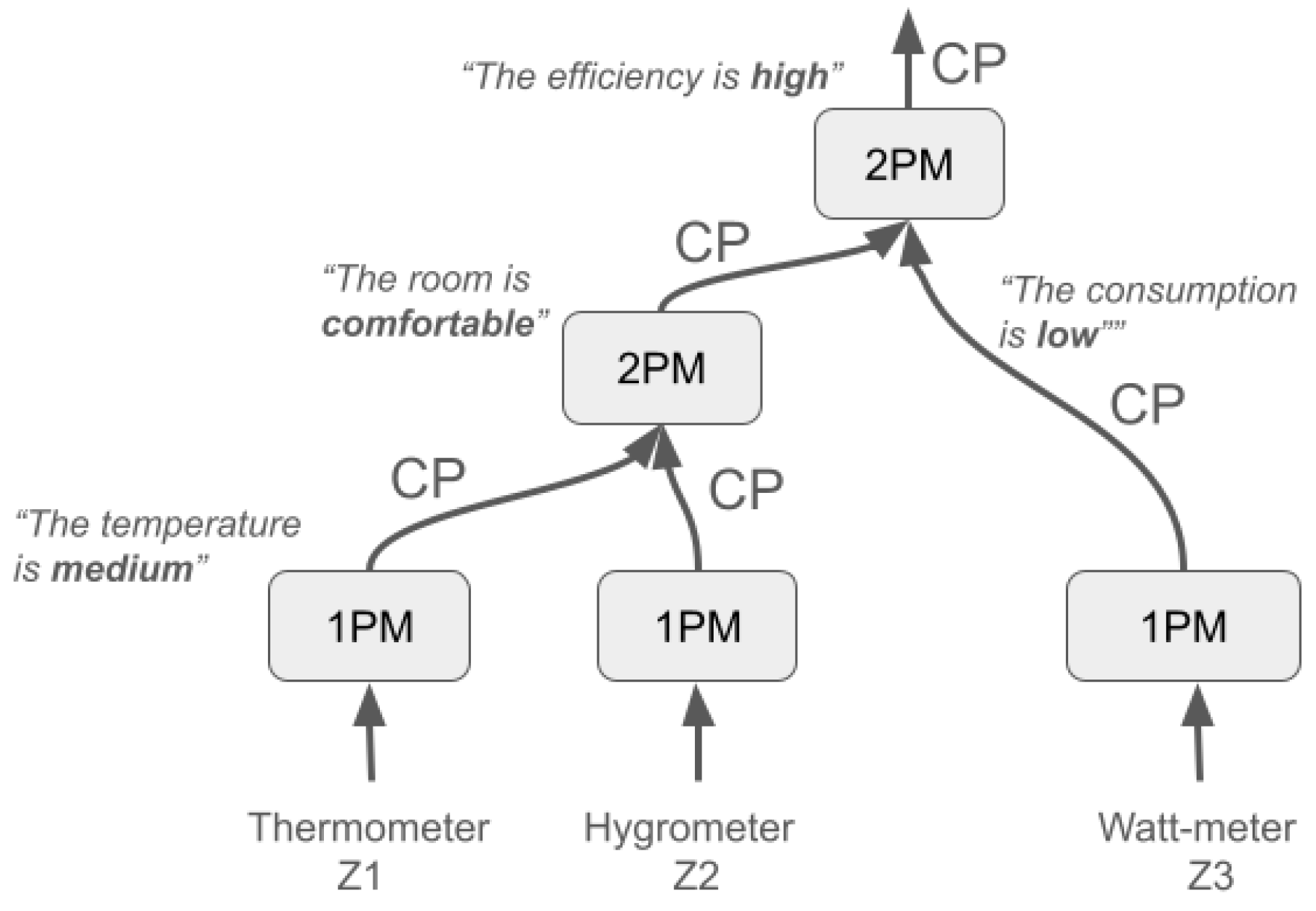
- is a set of input CP’s, where . In the special case of first order Perception Mapping (1PM), U is a variable defined in the input data domain, e.g., the value provided by a thermometer.
- y is the output CP, .
- g is the aggregation function where is a vector of degrees of validity assigned to each element in y and are the degrees of validity of the input perceptions. In fuzzy logic, many different types of aggregation functions have been developed. In case of 1PM, g consist in applying a set of membership functions to an input data z, obtaining the vector . Hence, is the vector of degrees of validity assigned to each and z is the input data.
- T is a text generation algorithm that allows generating the linguistic expressions in . T has associated a figure and uses the input data to choose the most suitable clauses to describe the current state of the monitored phenomenon. In simple cases, T can be implemented using a linguistic template, e.g., “The temperature in the room is [high|medium|low]”.
2.1.3. Computational Perception Network
2.2. Formal Concept Analysis
- is a complete lattice, where 0 and 1 denote the bottom and top elements, respectively.
- is a commutative monoid.
- The pair satisfies the adjointness (residuation) property; that is, for all ,
2.3. Transforming Datasets into Residuated Linguistic Contexts
3. Transforming Data into Linguistic Contexts Automatically
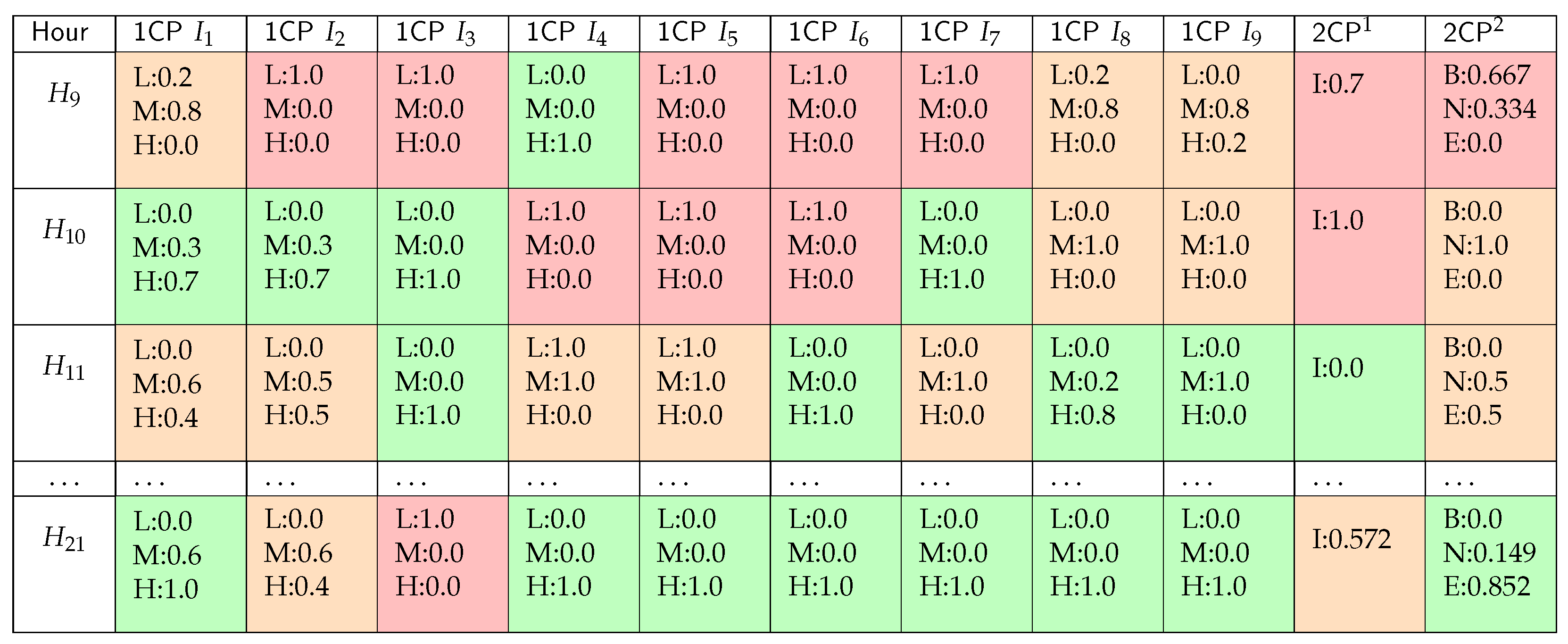
- The station is constituted by a set of inverters . In this work, we will manage a station with .
- Each month is formed by a set of days , where depending on the month and year under consideration.
- For each day , with , we have a list of hours , with , for which we obtain the record of the energy production of the inverter , with , denoted by .
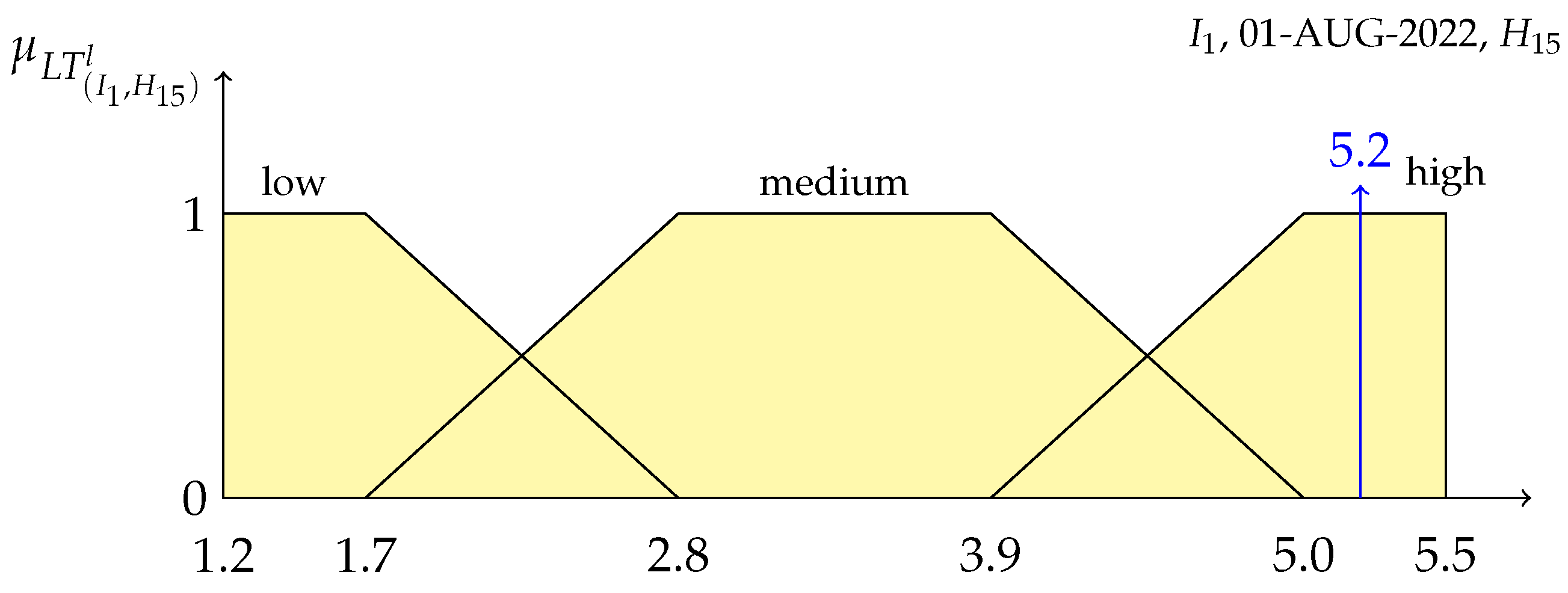
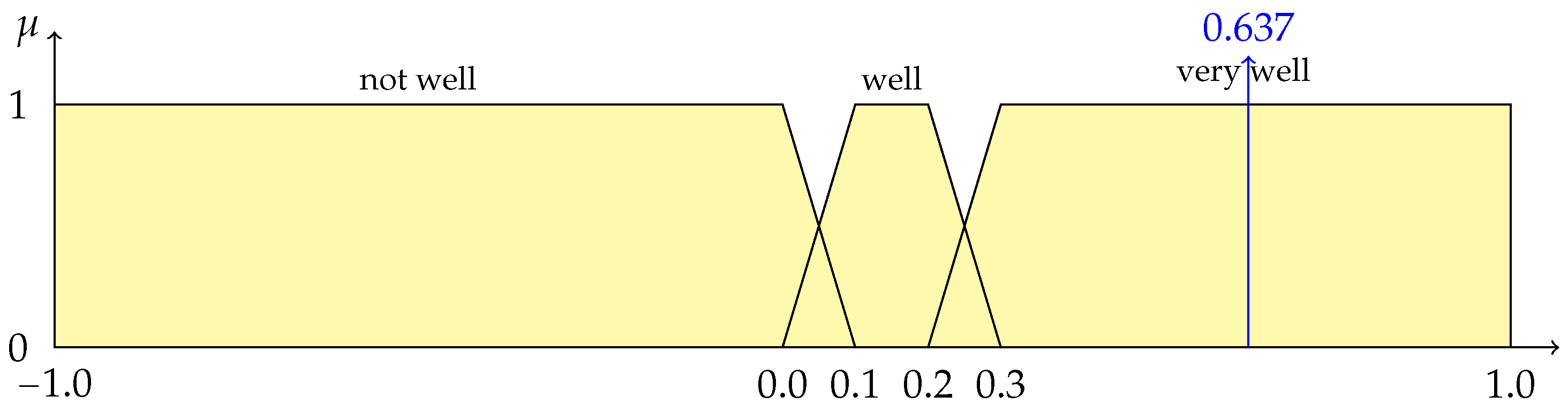
| Algorithm 1: Automatic computation of the linguistic variable from and . Algorithm 1 calculates the linguistic variables for each hour using a statistics table that includes the minimum, maximum, and average values for each hour. This statistics table (see Table 2) is derived from the hours-per-day table (see Table 1), wherein the hours are grouped by day. The table is computed using an input dataset that contains the hours and energy production for each day. |
 |
4. Computational Perception Network Based on Linguistic Contexts
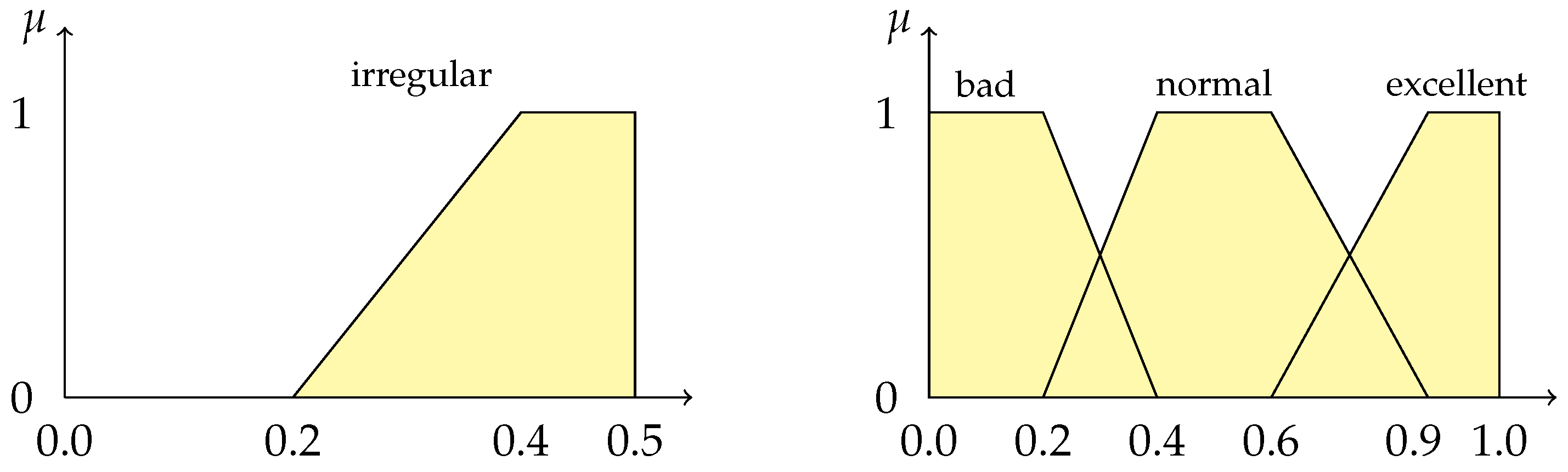
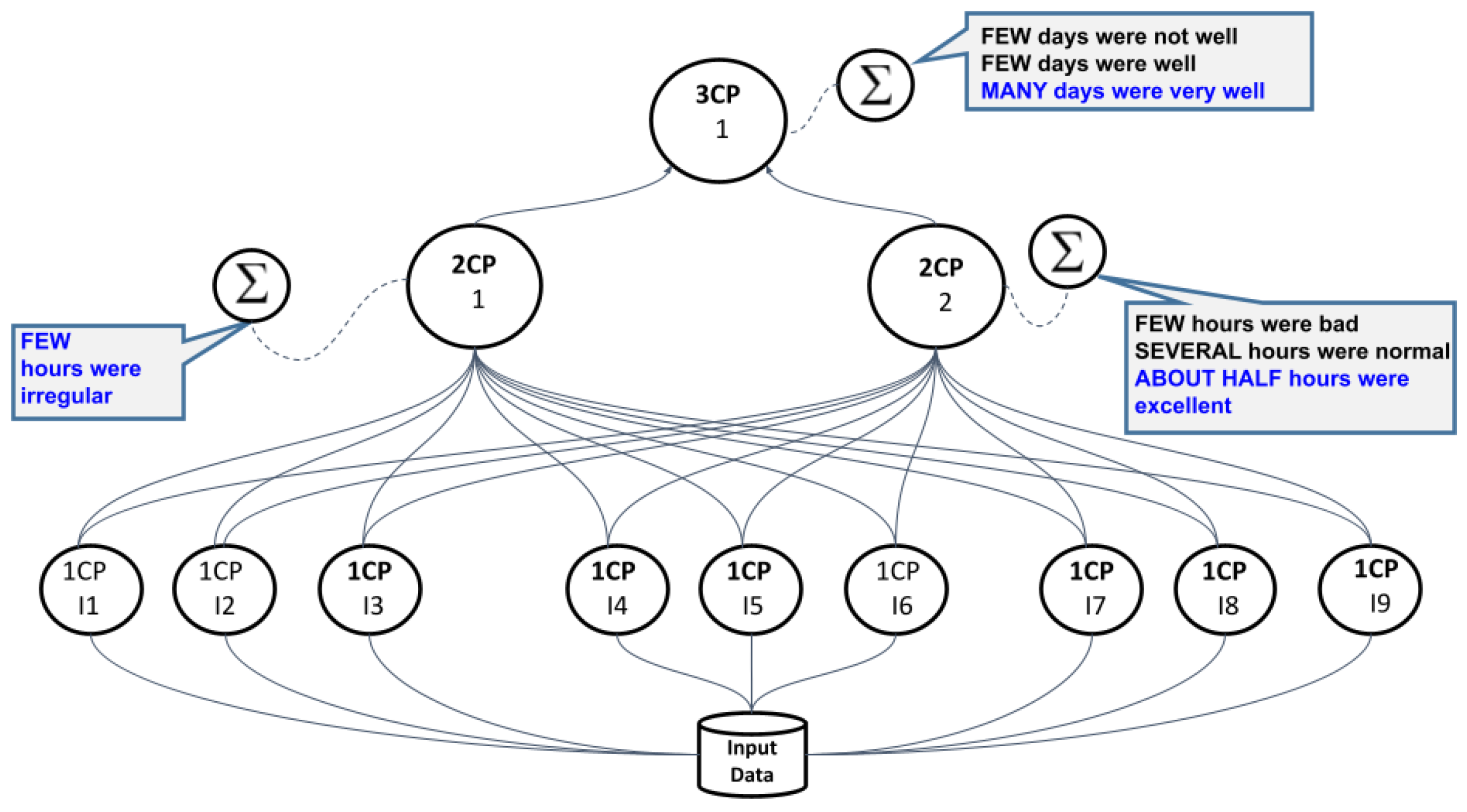
| Algorithm 2: Aggregation of first order computational perceptions. It algorithm (which contains Algorithm 3) aggregates the first-order computational perceptions for each hour and for each inverter of the facility. Note that, two types of 2CP are used, 2CP irregular on one side and 2CP (bad, normal, excellent) on the other. |
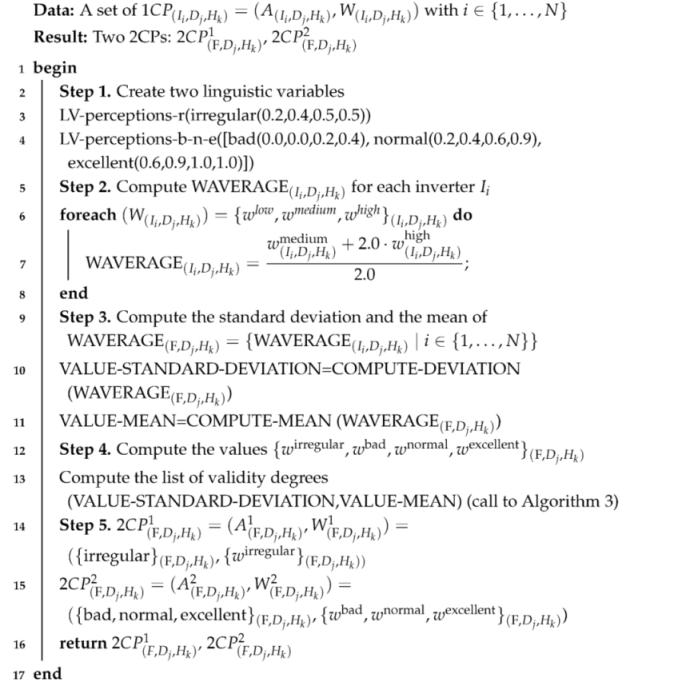 |
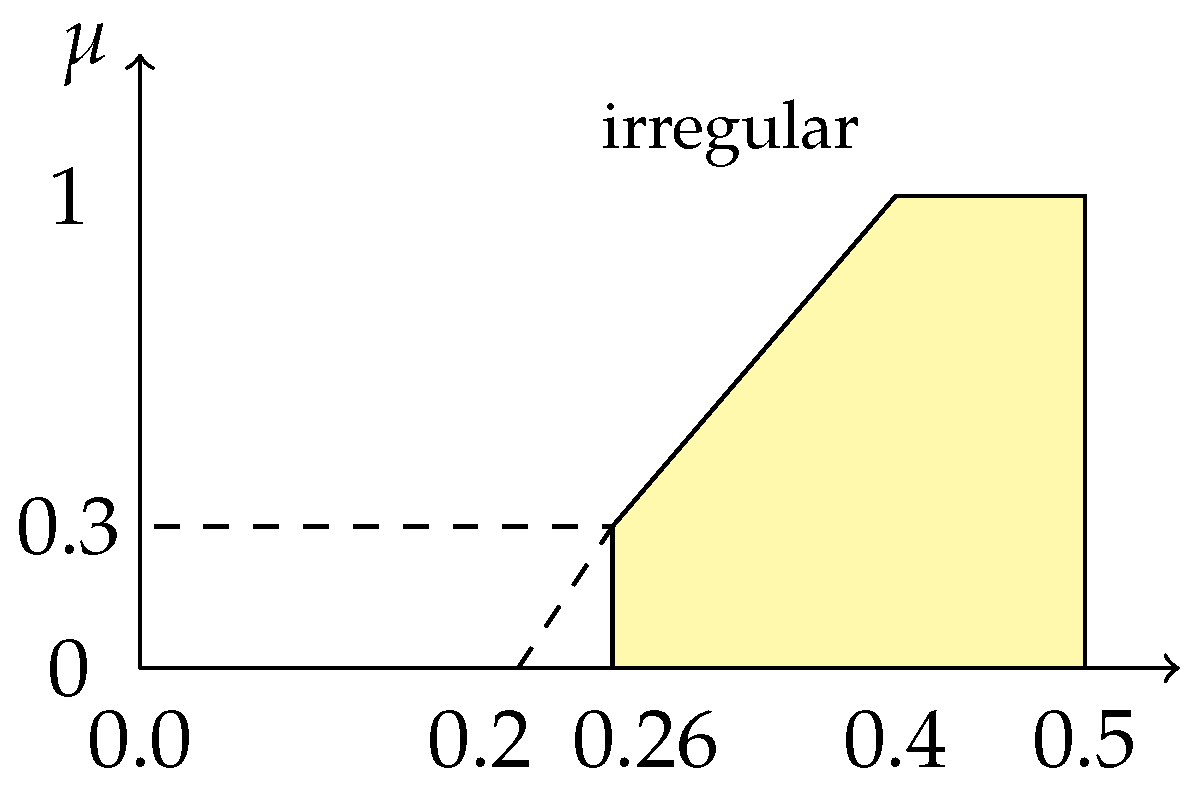
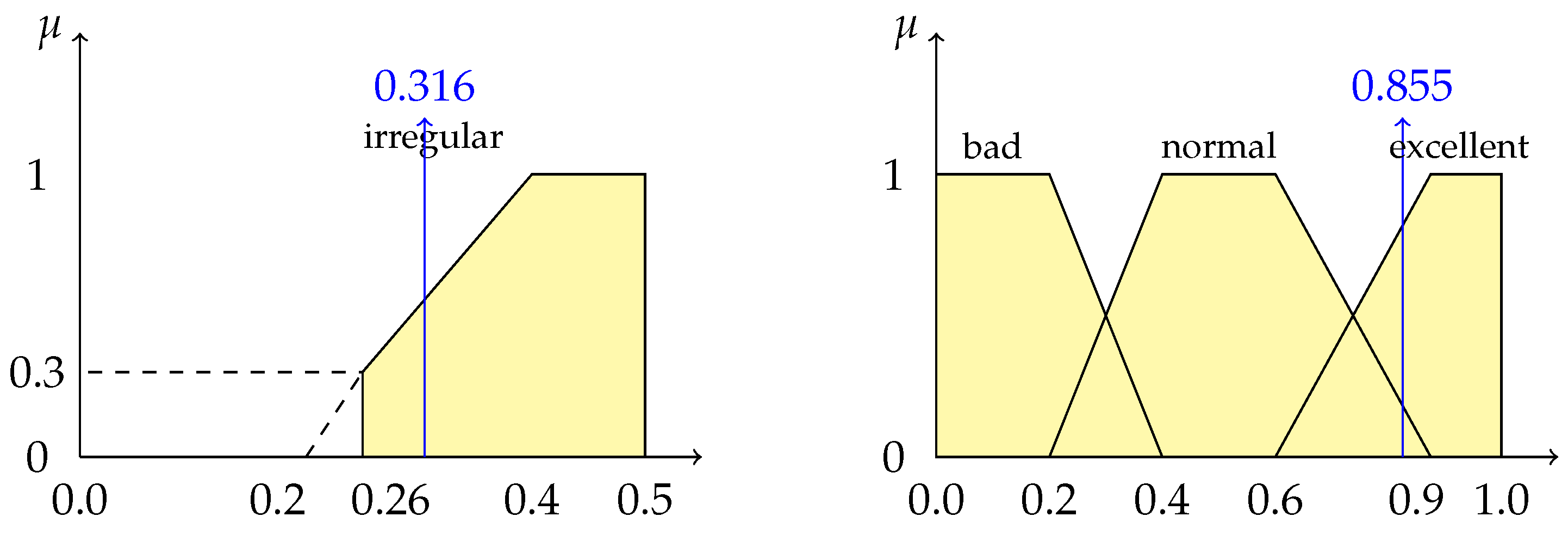
| Algorithm 3: Compute list of validity degrees from standard deviation. This algorithm is part of Algorithm 2 and is used to compute second-order computational perceptions based on the standard deviation and the mean. |
 |
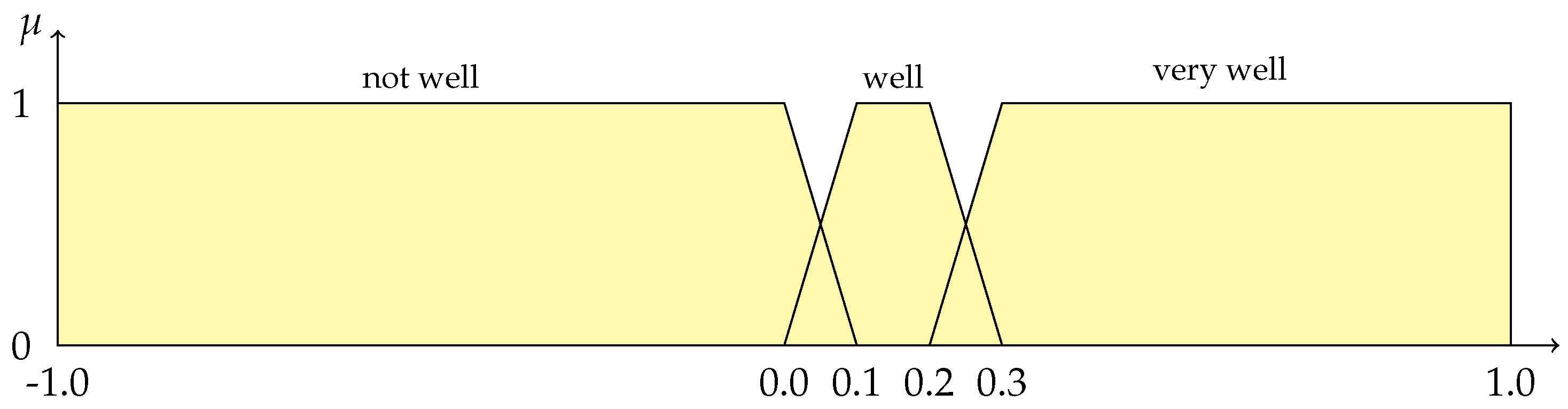
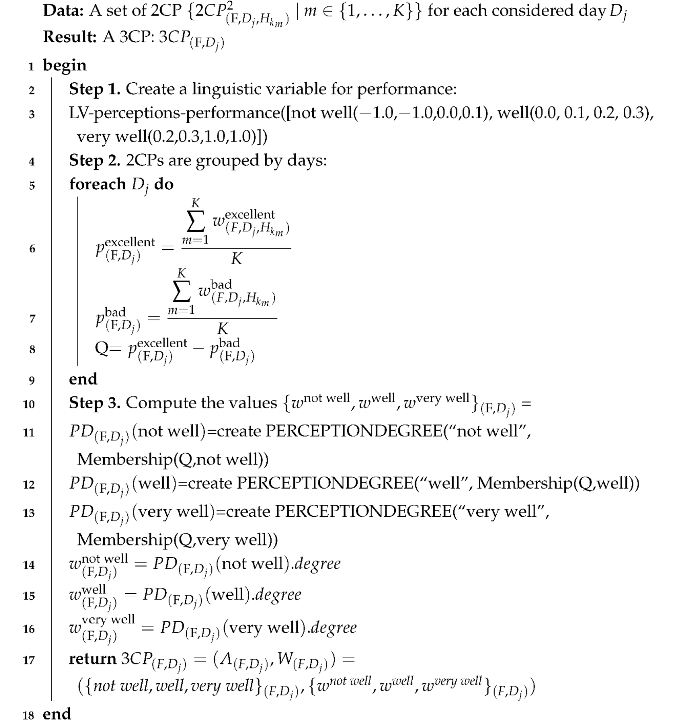
| Algorithm 4: Aggregation of second order computational perceptions. This algorithm is responsible for adding the second-order perceptions into a final computational perception that allows determining the facility’s performance for each day. All the excellent hours and all the bad hours are grouped together for each day, and the difference between them is calculated. This difference (Q) allows me to determine the station’s performance. |
 |
5. Linguistic Descriptions
- NONE when p is 0.
- FEW when .
- SEVERAL when .
- ABOUT HALF when .
- MANY when .
- THE MOST OF when .
- ALL when .
- FEW hours were low,
- SEVERAL hours were medium,
- ABOUT HALF hours were high
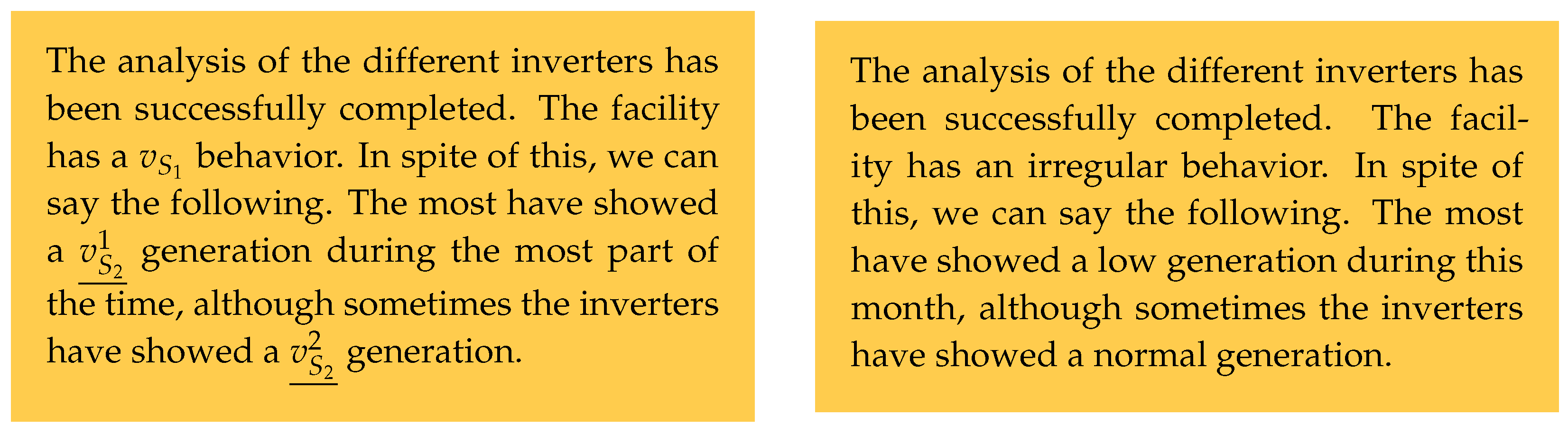
- FEW hours were irregular
- FEW hours were bad
- SEVERAL hours were normal
- ABOUT HALF hours were excellent
- FEW days were not well
- FEW days were well
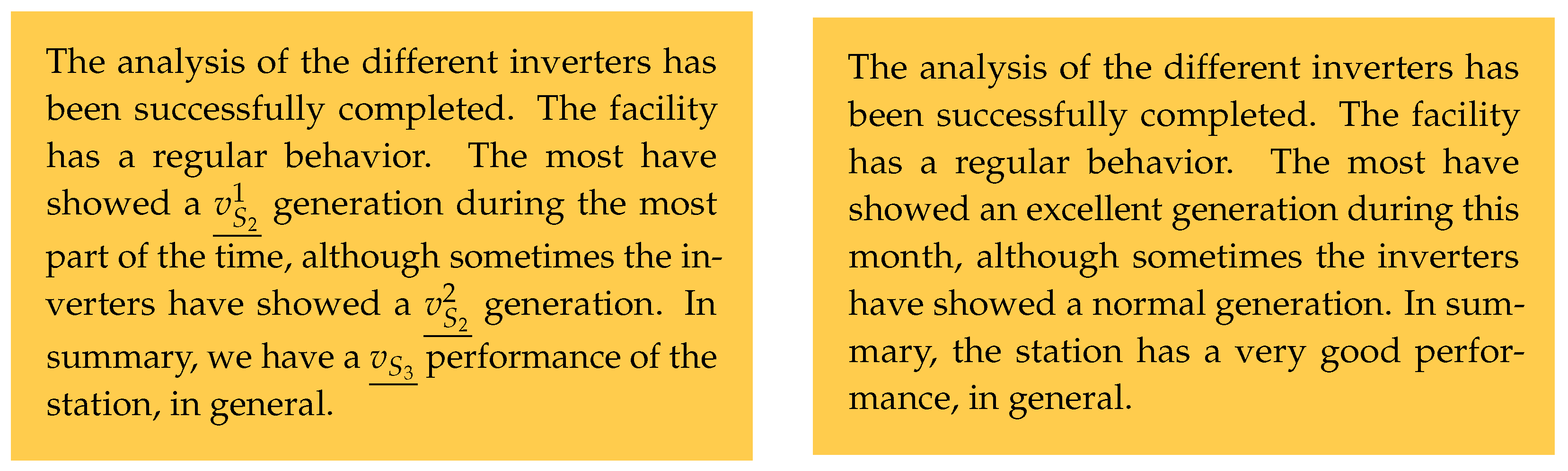
- MANY days were very well
6. Linguistic Descriptions of Data via Fuzzy Formal Concepts Generated by Computational Perceptions
- …were NOT , when is 0;
- …were ALMOST NOT , when ;
- …were MORE OR LESS , when ;
- …were RATHER , when ;
- …were , when is .
6.1. FCA from 1CP: Performance of the Inverter by Hours
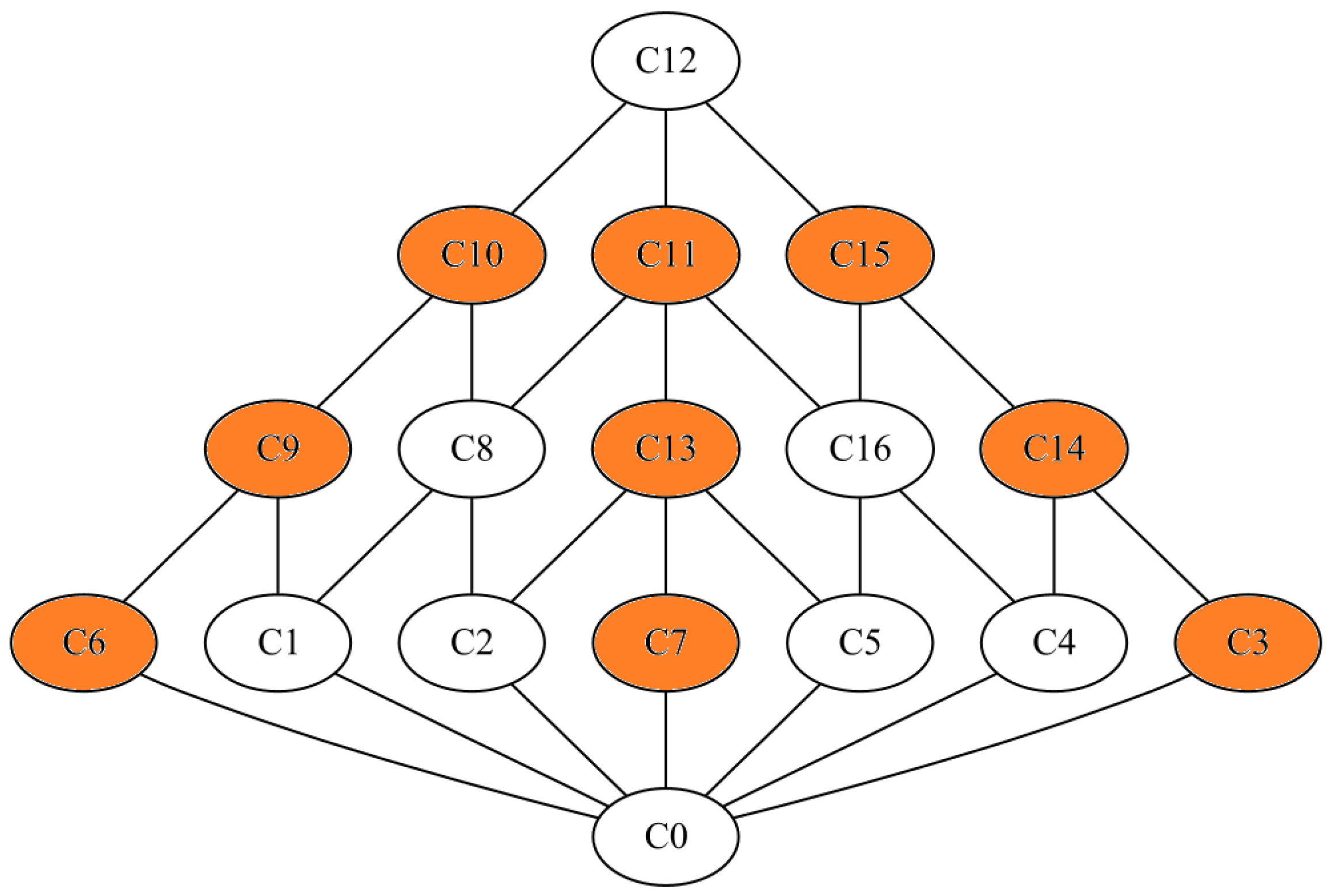
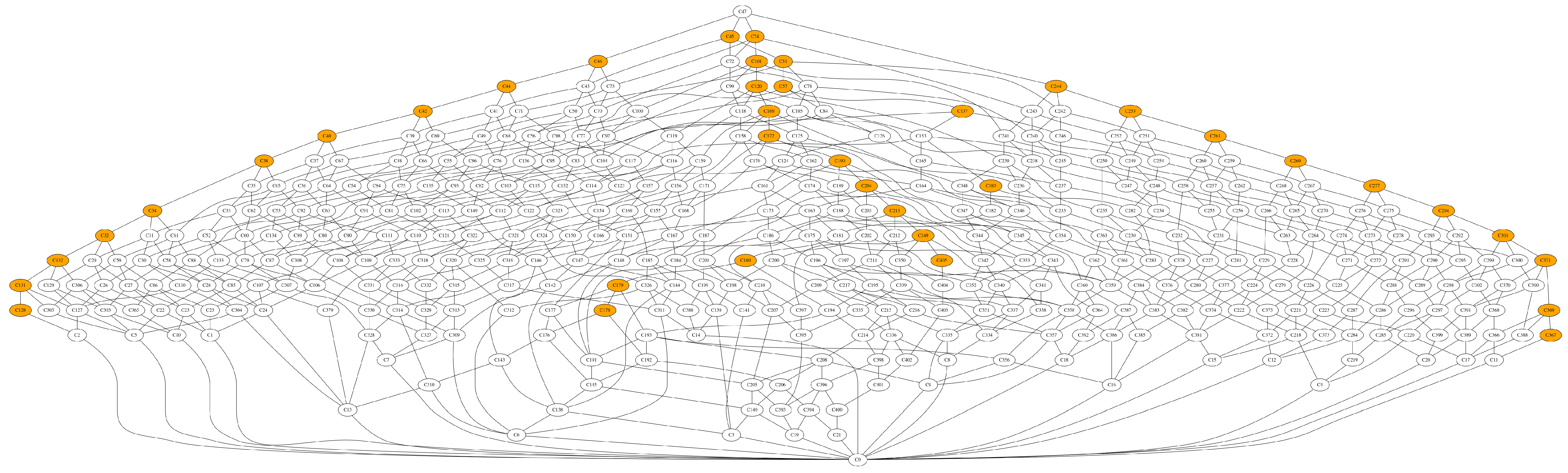
- ABOUT HALF hours were ALMOST NOT high
- SEVERAL hours were MORE OR LESS high
- FEW hours were low
- SEVERAL hours were medium
- SEVERAL hours were high
6.2. FCA from the 2CP2: Performance of the Facility by Hour
- SEVERAL hours were MORE OR LESS bad
- ABOUT HALF hours were MORE OR LESS normal
- ABOUT HALF hours were MORE OR LESS excellent
- FEW hours were MORE OR LESS bad
- SEVERAL hours were MORE OR LESS normal
- ABOUT HALF hours were MORE OR LESS excellent
- FEW hours were bad
- FEW hours were normal
- SEVERAL hours were excellent
6.3. FCA from 2CPs: Combining the Information in Both 2CPs
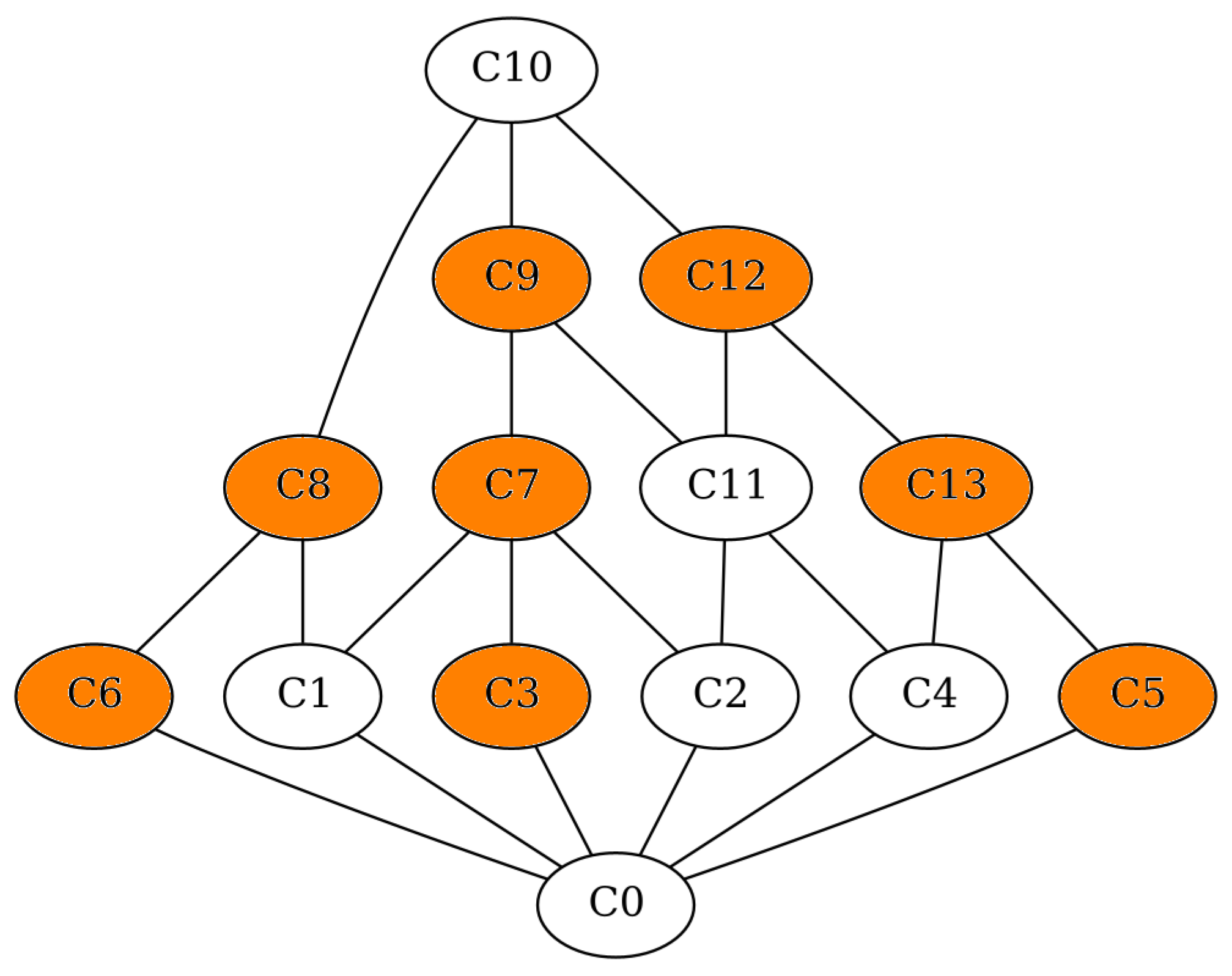
- FEW hours were ALMOST NOT normal AND RATHER irregular
- FEW hours were MORE OR LESS normal AND RATHER irregular
- FEW hours were MORE OR LESS normal AND RATHER irregular
- FEW hours were bad
- FEW hours were normal
- SEVERAL hours were excellent
- FEW hours were MORE OR LESS normal AND irregular
6.4. FCA from 3CP: Performance of the Facility per Day
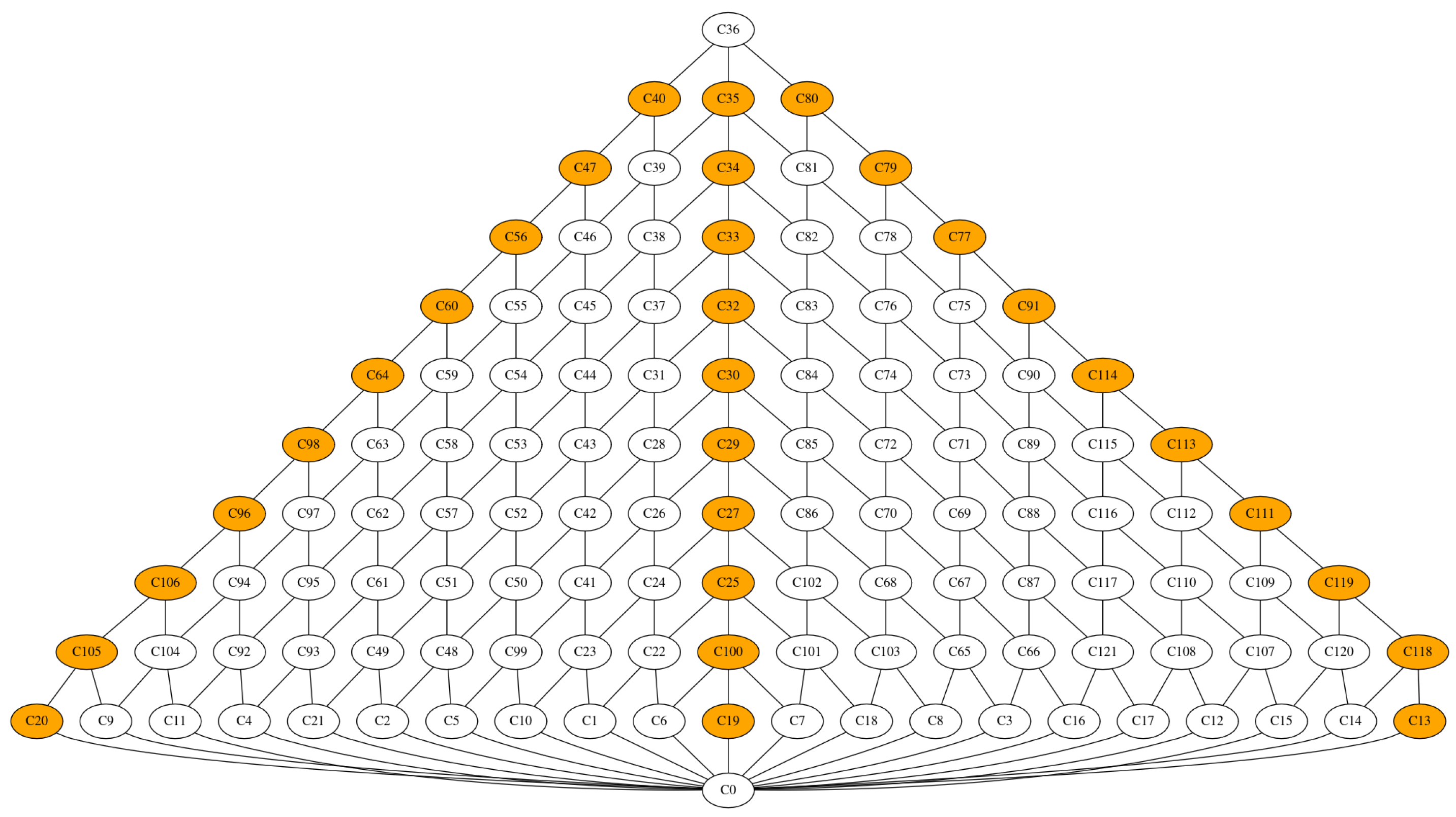
- MANY days were MORE OR LESS very well
- MANY days were very well
- FEW days were not well
- FEW days were well
7. Conclusions and Future Work
Author Contributions
Funding
Institutional Review Board Statement
Informed Consent Statement
Data Availability Statement
Acknowledgments
Conflicts of Interest
Appendix A. Dataset

| Period | |||||||||
|---|---|---|---|---|---|---|---|---|---|
| 01-August-2022, | NA | NA | NA | NA | NA | NA | NA | NA | NA |
| 01-August-2022, | NA | NA | NA | NA | NA | NA | NA | NA | NA |
| 01-August-2022, | NA | NA | NA | NA | NA | NA | NA | NA | NA |
| 01-August-2022, | NA | NA | NA | NA | NA | NA | NA | NA | NA |
| 01-August-2022, | NA | NA | NA | NA | NA | NA | NA | NA | NA |
| 01-August-2022, | NA | NA | NA | NA | NA | NA | NA | NA | NA |
| 01-August-2022, | NA | NA | NA | NA | NA | NA | NA | NA | NA |
| 01-August-2022, | NA | NA | NA | NA | NA | NA | NA | NA | NA |
| 01-August-2022, | NA | NA | NA | NA | NA | NA | NA | NA | NA |
| 01-August-2022, | 0.10 | 0.00 | 0.00 | 0.00 | 0.00 | 0.00 | 0.00 | 0.10 | 0.10 |
| 01-August-2022, | 0.40 | 0.30 | 0.00 | 0.00 | 0.00 | 0.00 | 1.00 | 0.40 | 0.40 |
| 01-August-2022, | 1.40 | 1.10 | 1.00 | 2.00 | 1.00 | 2.00 | 1.00 | 1.50 | 1.40 |
| 01-August-2022, | 2.90 | 2.30 | 2.00 | 3.00 | 2.00 | 2.00 | 3.00 | 2.80 | 2.60 |
| 01-August-2022, | 3.90 | 3.00 | 3.00 | 3.00 | 3.00 | 4.00 | 3.00 | 3.90 | 3.00 |
| 01-August-2022, | 4.70 | 3.50 | 3.00 | 5.00 | 3.00 | 5.00 | 5.00 | 4.60 | 4.20 |
| 01-August-2022, | 5.20 | 3.70 | 3.00 | 5.00 | 3.00 | 5.00 | 5.00 | 5.00 | 4.70 |
| 01-August-2022, | 5.20 | 3.70 | 4.00 | 5.00 | 3.00 | 5.00 | 4.00 | 5.10 | 4.30 |
| 01-August-2022, | 5.00 | 3.70 | 3.00 | 5.00 | 3.00 | 4.00 | 5.00 | 5.20 | 4.60 |
| 01-August-2022, | 4.70 | 3.40 | 3.00 | 5.00 | 4.00 | 5.00 | 4.00 | 4.40 | 4.20 |
| 01-August-2022, | 3.50 | 2.80 | 3.00 | 3.00 | 2.00 | 3.00 | 4.00 | 3.50 | 3.30 |
| 01-August-2022, | 2.20 | 1.70 | 2.00 | 2.00 | 2.00 | 2.00 | 2.00 | 2.20 | 2.20 |
| 01-August-2022, | 0.80 | 0.60 | 0.00 | 1.00 | 0.00 | 1.00 | 0.00 | 0.80 | 0.70 |
| 01-August-2022, | 0.10 | 0.10 | 0.00 | 0.00 | 0.00 | 0.00 | 0.00 | 0.10 | 0.00 |
| 01-August-2022, | NA | NA | NA | NA | NA | NA | NA | NA | NA |
Appendix B. Meet-Irreducible Concepts Given from 1CP (Section 6.1)
- SEVERAL hours were ALMOST NOT low
- ABOUT HALF hours were MORE OR LESS medium
- ABOUT HALF hours were ALMOST NOT high
- FEW hours were MORE OR LESS low
- SEVERAL hours were MORE OR LESS high
- FEW hours were low
- ABOUT HALF hours were RATHER medium
- SEVERAL hours were high
- SEVERAL hours were medium
Appendix C. Meet-Irreducible Concepts Given from 2CP (Section 6.2)
- SEVERAL hours were ALMOST NOT bad
- MANY hours were ALMOST NOT normal
- ABOUT HALF hours were ALMOST NOT excellent
- SEVERAL hours were ALMOST NOT bad
- ABOUT HALF hours were ALMOST NOT normal
- ABOUT HALF hours were ALMOST NOT excellent
- SEVERAL hours were MORE OR LESS bad
- ABOUT HALF hours were MORE OR LESS normal
- ABOUT HALF hours were MORE OR LESS excellent
- FEW hours were MORE OR LESS bad
- ABOUT HALF hours were MORE OR LESS normal
- ABOUT HALF hours were MORE OR LESS excellent
- FEW hours were MORE OR LESS bad
- SEVERAL hours were MORE OR LESS normal
- ABOUT HALF hours were MORE OR LESS excellent
- FEW hours were MORE OR LESS bad
- SEVERAL hours were MORE OR LESS normal
- ABOUT HALF hours were MORE OR LESS excellent
- FEW hours were RATHER bad
- SEVERAL hours were RATHER normal
- ABOUT HALF hours were RATHER excellent
- FEW hours were RATHER bad
- FEW hours were RATHER normal
- SEVERAL hours were RATHER excellent
- FEW hours were RATHER bad
- FEW hours were RATHER normal
- SEVERAL hours were RATHER excellent
- FEW hours were bad
- FEW hours were normal
- SEVERAL hours were excellent
Appendix D. Meet-Irreducible Concepts Given from 2CP (Section 6.3)
- SEVERAL hours were ALMOST NOT bad
- MANY hours were ALMOST NOT normal
- ABOUT HALF hours were ALMOST NOT excellent
- FEW hours were MORE OR LESS irregular
- SEVERAL hours were ALMOST NOT bad
- ABOUT HALF hours were ALMOST NOT normal
- ABOUT HALF hours were ALMOST NOT excellent
- SEVERAL hours were MORE OR LESS bad
- ABOUT HALF hours were MORE OR LESS normal
- ABOUT HALF hours were MORE OR LESS excellent
- FEW hours were MORE OR LESS bad
- ABOUT HALF hours were MORE OR LESS normal
- ABOUT HALF hours were MORE OR LESS excellent
- FEW hours were MORE OR LESS irregular
- FEW hours were MORE OR LESS bad
- SEVERAL hours were MORE OR LESS normal
- ABOUT HALF hours were MORE OR LESS excellent
- FEW hours were MORE OR LESS irregular
- FEW hours were MORE OR LESS bad
- SEVERAL hours were MORE OR LESS normal
- ABOUT HALF hours were MORE OR LESS excellent
- FEW hours were MORE OR LESS irregular
- FEW hours were RATHER bad
- SEVERAL hours were RATHER normal
- ABOUT HALF hours were RATHER excellent
- FEW hours were ALMOST NOT normal AND RATHER irregular
- FEW hours were RATHER bad
- FEW hours were RATHER normal
- SEVERAL hours were RATHER excellent
- FEW hours were MORE OR LESS normal AND RATHER irregular
- FEW hours were RATHER bad
- FEW hours were RATHER normal
- SEVERAL hours were RATHER excellent
- FEW hours were MORE OR LESS normal AND RATHER irregular
- FEW hours were bad
- FEW hours were normal
- SEVERAL hours were excellent
- FEW hours were MORE OR LESS normal AND irregular
Appendix E. Meet-Irreducible Concepts Given from 3CP (Section 6.4)

- FEW days were MORE OR LESS not well
- FEW days were MORE OR LESS well
- MANY days were MORE OR LESS very well
- FEW days were MORE OR LESS not well
- MANY days were very well
- FEW days were not well
- FEW days were RATHER well
- FEW days were well
References
- Reiter, E. An architecture for data-to-text systems. In Proceedings of the Eleventh European Workshop on Natural Language Generation, Schloss Dagstuhl, Germany, 17–20 June 2007; ENLG ’07. pp. 97–104. [Google Scholar]
- Reiter, E. Natural Language Generation; Springer: Cham, Switzerland, 2025. [Google Scholar] [CrossRef]
- Gkatzia, D. Content selection in data-to-text systems: A survey. arXiv 2016, arXiv:1610.08375. [Google Scholar]
- Zadeh, L. Fuzzy logic = computing with words. IEEE Trans. Fuzzy Syst. 1996, 4, 103–111. [Google Scholar] [CrossRef]
- Zadeh, L. A New Direction in AI: Toward a Computational Theory of Perceptions. AI Mag. 2001, 22, 73. [Google Scholar] [CrossRef]
- Trivino, G.; Sugeno, M. Towards linguistic descriptions of phenomena. Int. J. Approx. Reason. 2013, 54, 22–34. [Google Scholar] [CrossRef]
- Kacprzyk, J.; Yager, R.R. Linguistic summaries of data using fuzzy logic. Int. J. Gen. Syst. 2001, 30, 133–154. [Google Scholar] [CrossRef]
- Yager, R.R. A new approach to the summarization of data. Inf. Sci. 1982, 28, 69–86. [Google Scholar] [CrossRef]
- Zadeh, L. From computing with numbers to computing with words. From manipulation of measurements to manipulation of perceptions. IEEE Trans. Circuits Syst. I Fundam. Theory Appl. 1999, 46, 105–119. [Google Scholar] [CrossRef]
- Conde-Clemente, P.; Alonso, J.; Trivino, G. Toward automatic generation of linguistic advice for saving energy at home. Soft Comput. 2018, 22, 345–359. [Google Scholar] [CrossRef]
- Ramos-Soto, A.; Bugarin, A.J.; Barro, S.; Taboada, J. Linguistic Descriptions for Automatic Generation of Textual Short-Term Weather Forecasts on Real Prediction Data. IEEE Trans. Fuzzy Syst. 2015, 23, 44–57. [Google Scholar] [CrossRef]
- Reiter, E.; Dale, R. Building Applied Natural Language Generation Systems. Nat. Lang. Eng. 2002, 3, 57–87. [Google Scholar] [CrossRef]
- Ganter, B.; Wille, R. Formal Concept Analysis: Mathematical Foundation; Springer: Berlin/Heidelberg, Germany, 1999. [Google Scholar]
- Bělohlávek, R. Fuzzy Galois Connections. Math. Log. Q. 1999, 45, 497–504. [Google Scholar] [CrossRef]
- Burusco Juandeaburre, A.; Fuentes-González, R. The study of the L-fuzzy concept lattice. Mathw. Soft Comput. 1994, 1, 209–218. [Google Scholar]
- Krajči, S. A generalized concept lattice. Log. J. IGPL 2005, 13, 543–550. [Google Scholar] [CrossRef]
- International Renewable Energy Agency (IRENA). Renewable Capacity Statistics 2025. 2025. Available online: https://www.irena.org/Publications/2025/Mar/Renewable-capacity-statistics-2025 (accessed on 10 January 2026).
- Popper, K.R.; Eccles, J.C. The Self and Its Brain; Springer Science & Business Media: Berlin/Heidelberg, Germany, 1977. [Google Scholar]
- Butka, P.; Pócs, J. Generalization of One-Sided Concept Lattices. Comput. Inform. 2013, 32, 355–370. [Google Scholar]
- Butka, P.; Pócs, J.; Pósová, J. On equivalence of conceptual scaling and generalized one-sided concept lattices. Inf. Sci. 2014, 259, 57–70. [Google Scholar] [CrossRef]
- Zadeh, L. The concept of a linguistic variable and its application to approximate reasoning—I. Inf. Sci. 1975, 8, 199–249. [Google Scholar] [CrossRef]
- Davey, B.; Priestley, H. Introduction to Lattices and Order, 2nd ed.; Cambridge University Press: Cambridge, UK, 2002. [Google Scholar]
- Cornejo, M.E.; Medina, J.; Ramírez-Poussa, E. Characterizing reducts in multi-adjoint concept lattices. Inf. Sci. 2018, 422, 364–376. [Google Scholar] [CrossRef]
- Antoni, L.; Krajči, S.; Krídlo, O. On stability of fuzzy formal concepts over randomized one-sided formal context. Fuzzy Sets Syst. 2018, 333, 36–53. [Google Scholar] [CrossRef]


| Hour/Day | … | |||
|---|---|---|---|---|
| … | ||||
| … | ||||
| ⋮ | ⋮ | ⋮ | … | ⋮ |
| … |
| Hour | … | Average | Max | Min | |||
|---|---|---|---|---|---|---|---|
| … | |||||||
| … | |||||||
| ⋮ | ⋮ | ⋮ | … | ⋮ | ⋮ | ⋮ | ⋮ |
| … |
| … | ||||
|---|---|---|---|---|
| … | ||||
| … | ||||
| ⋮ | ⋮ | ⋮ | … | ⋮ |
| … |
| 01-August-2022, | |||
| 01-August-2022, | |||
| 01-August-2022, | |||
| 01-August-2022, | |||
| 01-August-2022, | |||
| 01-August-2022, | |||
| 01-August-2022, | |||
| 01-August-2022, | |||
| 01-August-2022, | |||
| 01-August-2022, | |||
| 01-August-2022, | |||
| 01-August-2022, | |||
| 01-August-2022, | |||
| 01-August-2022, |
| 9 | 0 | |
| 10 | 0 | 0 |
| 11 | 0 | |
| 12 | 0 | |
| 13 | 1 | 0 |
| 14 | 0 | |
| 15 | 0 | |
| 16 | 0 | |
| 17 | 1 | 0 |
| 18 | 0 | |
| 19 | 0 | |
| 20 | 0 | |
| 21 | 0 |
| Rates | Linguistic Descriptions | |||
|---|---|---|---|---|
| FEW hours were low, SEVERAL hours were medium, ABOUT HALF hours were high | ||||
| FEW hours were low, SEVERAL hours were medium, ABOUT HALF hours were high | ||||
| SEVERAL hours were low, ABOUT HALF hours were medium, SEVERAL hours were high | ||||
| FEW hours were low, ABOUT HALF hours were medium, SEVERAL hours were high | ||||
| FEW hours were low, ABOUT HALF hours were medium, SEVERAL hours were high | ||||
| FEW hours were low, ABOUT HALF hours were medium, SEVERAL hours were high | ||||
| FEW hours were low, ABOUT HALF hours were medium, ABOUT HALF hours were high | ||||
| SEVERAL hours were low, SEVERAL hours were medium,ABOUT HALF hours were high | ||||
| SEVERAL hours were low, SEVERAL hours were medium, ABOUT HALF hours were high | ||||
Disclaimer/Publisher’s Note: The statements, opinions and data contained in all publications are solely those of the individual author(s) and contributor(s) and not of MDPI and/or the editor(s). MDPI and/or the editor(s) disclaim responsibility for any injury to people or property resulting from any ideas, methods, instructions or products referred to in the content. |
© 2026 by the authors. Licensee MDPI, Basel, Switzerland. This article is an open access article distributed under the terms and conditions of the Creative Commons Attribution (CC BY) license.
Share and Cite
Aragón, R.G.; Chacón-Gómez, F.; Medina, J.; Rubio-Manzano, C. An Interpretable Fuzzy Framework for Data-to-Text Generation Using Linguistic Contexts and Computational Perceptions: A Case Study on Photovoltaic Stations. AI 2026, 7, 103. https://doi.org/10.3390/ai7030103
Aragón RG, Chacón-Gómez F, Medina J, Rubio-Manzano C. An Interpretable Fuzzy Framework for Data-to-Text Generation Using Linguistic Contexts and Computational Perceptions: A Case Study on Photovoltaic Stations. AI. 2026; 7(3):103. https://doi.org/10.3390/ai7030103
Chicago/Turabian StyleAragón, Roberto G., Fernando Chacón-Gómez, Jesús Medina, and Clemente Rubio-Manzano. 2026. "An Interpretable Fuzzy Framework for Data-to-Text Generation Using Linguistic Contexts and Computational Perceptions: A Case Study on Photovoltaic Stations" AI 7, no. 3: 103. https://doi.org/10.3390/ai7030103
APA StyleAragón, R. G., Chacón-Gómez, F., Medina, J., & Rubio-Manzano, C. (2026). An Interpretable Fuzzy Framework for Data-to-Text Generation Using Linguistic Contexts and Computational Perceptions: A Case Study on Photovoltaic Stations. AI, 7(3), 103. https://doi.org/10.3390/ai7030103