
Article

Balancing Accuracy and Efficiency in the Temporal Resampling of Met-Ocean Data

Centre for Marine Technology and Ocean Engineering (CENTEC), Instituto Superior Técnico, Universidade de Lisboa, Av. Rovisco Pais, 1049-001 Lisboa, Portugal
*
Author to whom correspondence should be addressed.
Oceans 2026, 7(2), 35; https://doi.org/10.3390/oceans7020035
Submission received: 26 February 2026 / Revised: 20 March 2026 / Accepted: 8 April 2026 / Published: 16 April 2026
(This article belongs to the Special Issue Offshore Renewable Energy and Related Environmental Science)

Abstract

Harmonising heterogeneous met-ocean time series to a common temporal resolution is a prerequisite for integrated marine renewable energy assessments. Such datasets often differ in their sampling frequency, statistical distribution, and non-stationarity, complicating joint analysis. This study presents a practical multi-criteria framework for selecting temporal interpolation strategies for met-ocean datasets, explicitly balancing prediction accuracy and computational efficiency. Six environmental variables relevant to offshore renewable energy—wind speed, significant wave height, energy period, peak period, global horizontal irradiance, and upper-ocean thermal gradients—are analysed using ten-year reanalysis datasets for the Madeira Archipelago. Six commonly used deterministic time-domain interpolation methods are evaluated within a unified validation framework combining training–test splits, k-fold cross-validation, and Monte Carlo resampling. Their performances are quantified using the relative root mean square error and computational time, integrated through a composite performance score. The results show that makima interpolation provides the most consistent compromise between accuracy and efficiency for most variables in dense, regularly sampled met-ocean datasets, while spline-based approaches perform better for highly skewed solar irradiance. Preprocessing steps, such as detrending and distribution normalisation, yield only marginal improvements for dense, regularly sampled datasets, and method rankings remain stable under moderate changes in accuracy–speed weightings. Rather than proposing a universal interpolator, this work delivers a reproducible decision-support workflow for temporal resampling of multi-variable met-ocean datasets, supporting early-stage marine renewable energy assessments.

1. Introduction

Understanding the variability in oceanic and climatic conditions is essential for supporting maritime operations, environmental management, and the development of marine renewable energy systems. Reliable information on waves, winds, currents, sea levels, and temperature underpins activities ranging from vessel routing and offshore safety to coastal planning and ecosystem monitoring [1,2,3,4,5,6,7,8,9,10,11]. In the context of marine energy, long-term met-ocean datasets are especially important for evaluating resource availability, optimising device performance, and ensuring operational reliability and survivability across technologies, such as wave, wind, tidal, OTEC, and offshore solar energy [12]. Specifically, the assessment of parameters like wave characteristics (height, period, and direction) is essential to optimise device performance and survivability in wave energy projects [13,14,15,16,17,18,19]. Similarly, offshore wind applications require precise knowledge of wind velocity and direction [20]; current energy harnessing depends on detailed analyses of current patterns; tidal energy projects must rely on historical tidal range data [21]; and thermal or salinity-driven energy technologies, like OTEC and salinity gradient power, demand careful study of temperature and salinity distributions in water columns [22]. Moreover, solar irradiance measurements are essential for evaluating offshore photovoltaic projects [23,24,25].
These datasets originate from diverse observational and modelling sources, each with different spatial and temporal characteristics [19,26]. Platforms such as the Copernicus Marine Environment Monitoring Service (CMEMS) provide broad access to multi-variable ocean and climate records with varying resolutions and update frequencies [27]. To use such heterogeneous information coherently—particularly during preliminary resource assessments—datasets must be harmonised to common spatial and temporal scales. Interpolation, therefore, becomes a central step, enabling the refinement, resampling, or alignment of data so that variables can be compared consistently.
Several studies have examined interpolation methods in environmental sciences [28,29,30,31,32,33,34]. A thorough examination of various temporal and spatial interpolation techniques and their applications in environmental and ocean science was performed by [35]. Nonetheless, work focused specifically on ocean-related variables is more limited. The existing research has addressed individual parameters, such as sea surface temperature [36], waves [37,38,39,40], tides and currents [38,41], and offshore wind [42,43]. Additionally, ref. [44] presented a collection of case studies demonstrating the application of interpolation techniques in the offshore energy sector. Yet, the research has generally been conducted in isolated contexts and often without regard for the needs of marine renewable energy applications. Moreover, previous studies have seldom evaluated interpolation techniques under a unified framework, where computational efficiency and prediction accuracy must be balanced for large, multi-variable ocean datasets [45].
The statistical assessment of interpolation performance has traditionally relied mainly on the root mean square error (RMSE), with complementary indicators such as the normalised root mean square error (NRMSE), mean absolute error (MAE), and mean bias error (MBE) used less consistently [37,46,47,48].
The technical guidelines for offshore renewable energy—wind [49,50,51], wave energy [52], tidal and marine currents [53], OTEC [54], and solar photovoltaic systems [55,56]—have emphasised the need for multi-year datasets standardised at consistent resolutions. However, few studies have systematically compared interpolation techniques for the explicit purpose of harmonising the multiple met-ocean variables relevant to early-stage marine energy exploration. This gap is particularly evident when the goal is to refine diverse datasets—wind, wave, solar, and thermal gradients—into a single, coherent temporal framework suitable for comparative resource analysis.
To address this need, the present study proposes a unified evaluation framework for temporal resampling of heterogeneous met-ocean datasets, tailored to the requirements of early-stage marine renewable energy assessments. Rather than focusing solely on the interpolation accuracy, the framework explicitly incorporates computational efficiency and validation robustness, recognising that exploratory resource analyses often involve large, multi-year datasets and iterative workflows where the processing time becomes a practical constraint.
Six deterministic time-domain interpolation methods—linear, cubic spline, B-spline, nearest neighbour, makima, and piecewise cubic Hermite (pchip)—are examined across multiple environmental variables, including wind, wave, solar, and thermal parameters. The methods are evaluated using an ensemble of validation approaches (training–test splits, k-fold cross-validation, and Monte Carlo resampling), and their performance is synthesised through a composite score that balances their relative error and execution time. In addition, the influence of basic preprocessing steps, such as detrending and distribution normalisation, is investigated to assess whether such treatments materially improve the resampling performance of dense environmental time series.
The Madeira Archipelago is adopted as a representative case study due to its diverse met-ocean conditions and relevance for offshore renewable energy planning. While the specific regional characteristics influence the absolute performance values, the emphasis of this work lies in demonstrating a transferable workflow for method selection rather than identifying a universally optimal interpolator. The proposed framework is intended to support harmonisation of multi-source environmental datasets during preliminary marine energy assessments, where consistent temporal resolution is required but full physics-based downscaling may be impractical.
By integrating accuracy, computational efficiency, preprocessing sensitivity, and validation robustness within a single methodological structure, this study advances beyond isolated comparisons of interpolation techniques and provides practical guidance for selecting resampling strategies for applied met-ocean analyses.
This manuscript is organised as follows: Section 2 details the input data, their geographical coverage, and the different interpolation techniques. Section 3 discusses the comparative results, and Section 4 highlights the principal conclusions drawn from the study.

2. Materials and Methods

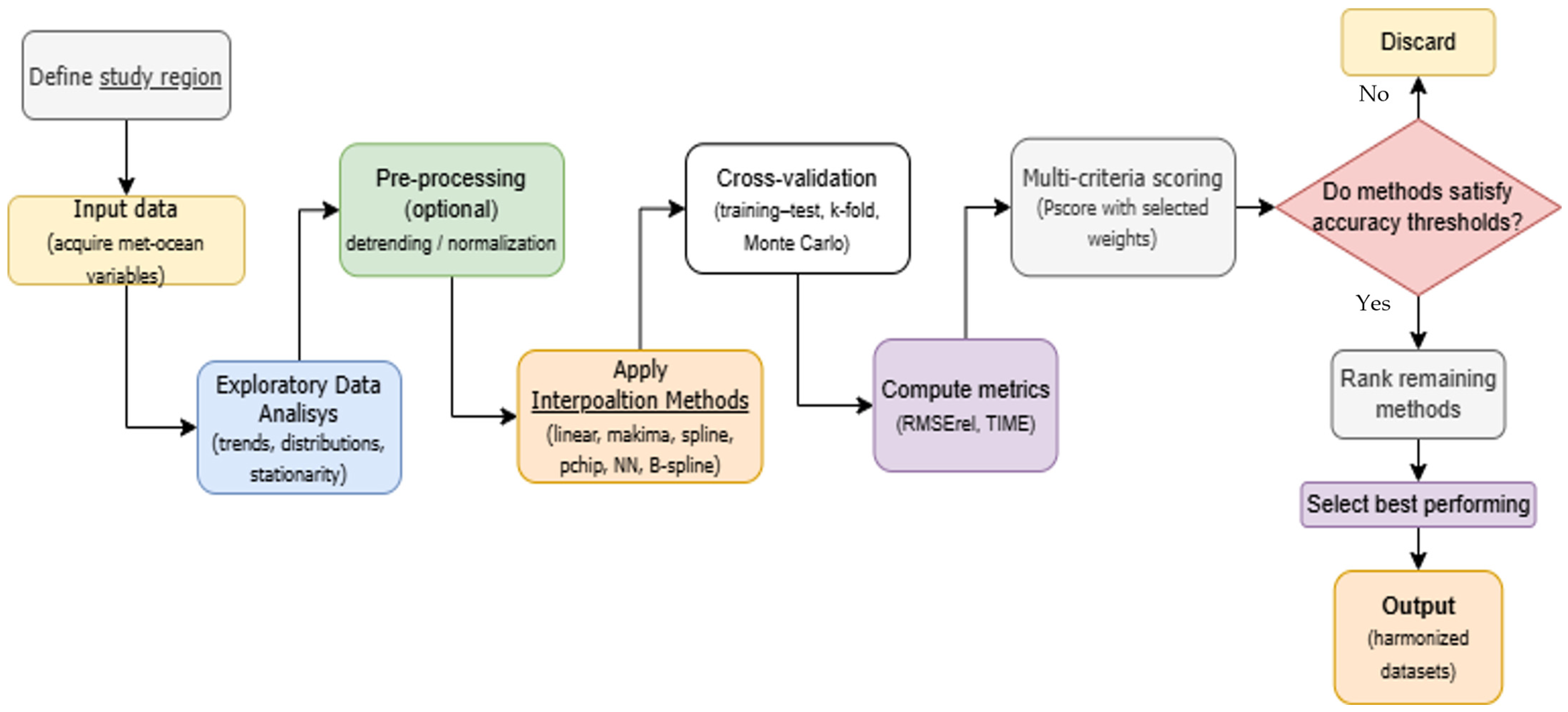
Sequential steps were followed to ensure an accurate and effective process of selecting the most adequate interpolation method (Figure 1): 1. Delineation of the region under analysis. 2. Input data characteristics. 3. Exploratory data analysis (EDA). 4. Test of interpolation methods, tracking of computational time and creation of a “computational time ranking” of performance. 5. Validation, computation of error statistics and creation of an “accuracy ranking” of performance. 6. Multi-criteria decision making to choose the best overall performing method as a balance between accuracy and computational speed.

2.1. Area of Application

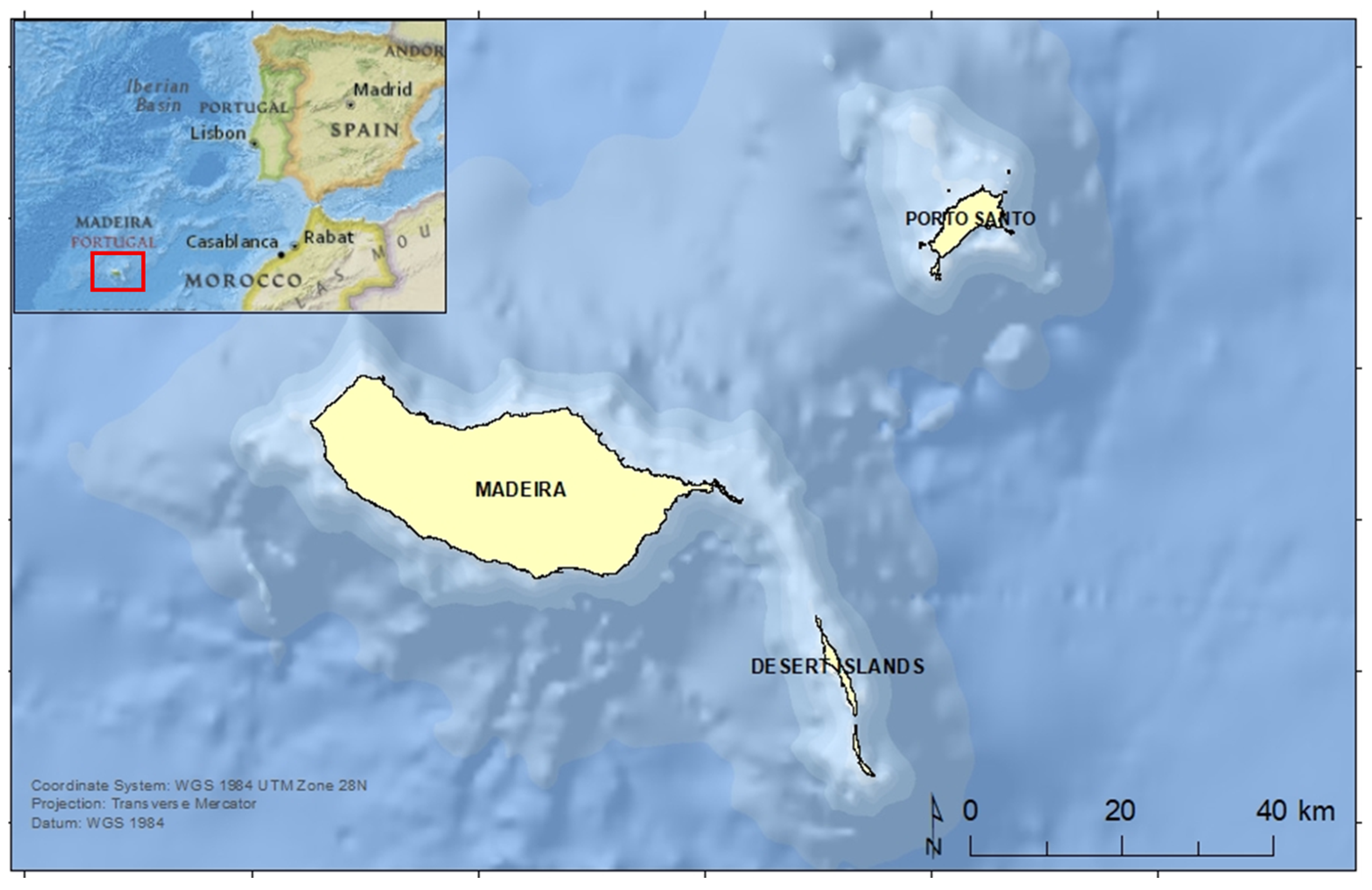
The Autonomous Region of Madeira comprises Madeira Island (the largest, covering 741 km2), Porto Santo Island (smaller, at 42.2 km2), and the Desert Islands (uninhabited, 15.5 km2). Designated as a European Outermost Region, it is situated southwest of mainland Portugal in the Atlantic Ocean (Figure 2). While tourism is the primary economic driver, small-scale fishing, agriculture, and winemaking also significantly contribute to the region’s economy.
The archipelago hosts around 245,000 inhabitants [57], yet this figure rises notably in the summer months due to seasonal tourism, leading to a sharp increase in electricity use. In 2024, the islands recorded a power consumption of nearly 440 GWh. Conventional energy sources—mainly diesel and gas-fired generation—met 61.4% of this demand. In comparison, the remaining 38.6% came from renewables, such as photovoltaic solar, onshore wind, waste-to-energy, and hydropower [58]. The islands’ persistent reliance on fossil fuels has driven regional authorities to adopt updated energy transition and climate policies to boost the renewable capacity. However, land availability for such developments remains constrained, as large inland zones are classified as protected areas due to their rich biodiversity.
Consequently, recent studies have focused on the potential integration of marine renewables into local power supplies. Although marine energy exploitation has not commenced in the region, preliminary assessments have analysed the feasibility of harnessing offshore wind and wave resources in the archipelago [17,20,59,60,61,62,63].

2.2. Input Data

Various datasets of meteorological and climatic variables were used as the inputs for the temporal resampling analysis. These datasets encompass wind (10 m height vector components—U10, V10), wave conditions (significant wave height—Hs; energy period—Te; and peak period—Tp), solar energy input (surface downward radiation—SDR), and ocean temperature (sea surface temperature—Tsurf; and temperature at 1000 m depth—T1000). The information, structured in three dimensions (longitude, latitude, and time), spans from 2011 to 2020 and pertains to the Madeira Archipelago, within the geographic bounds of longitude −18.875° to −14.875° and latitude 30.875° to 34.875°. These datasets were sourced from the reanalysis models listed in Table 1, available via the Copernicus Marine Service [27] and Climate Data Store Repositories [64].
Some of the initial parameters were further processed to derive the actual variables subjected to resampling. For the wind data, the speed components U10 (eastward) and V10 (northward) were used to calculate the wind speed modulus at a reference height of 10 m (Ws10). Further, the wind speed was also determined at an average offshore wind turbine hub height of 120 m (Wshub), as follows:
W s 10 = U 10 2 + V 10 2
W s h u b = W s 10 h h u b h r e f α
where α corresponds to the wind shear exponent. In the present study, a standard value of 0.1 was selected, representative of smooth environments such as open sea areas [65].
To derive the global horizontal irradiance (GHI), the downward surface solar radiation (SDR) values were processed by dividing them by the duration of each measurement interval (Δt), set at 3600 s to reflect the hourly data resolution:
G H I W m 2 = S D R J m 2 Δ t ( s )
The surface and 1000 m depth ocean temperature data were utilised to calculate the temperature difference across the upper 1 km of the water column (ΔT):
Δ T   ° C = a b s ( T s u r f T 1000 )
The wave parameters—significant wave height (Hs), energy period (Te), and peak period (Tp)—were directly used to assess the performance of interpolation methods.
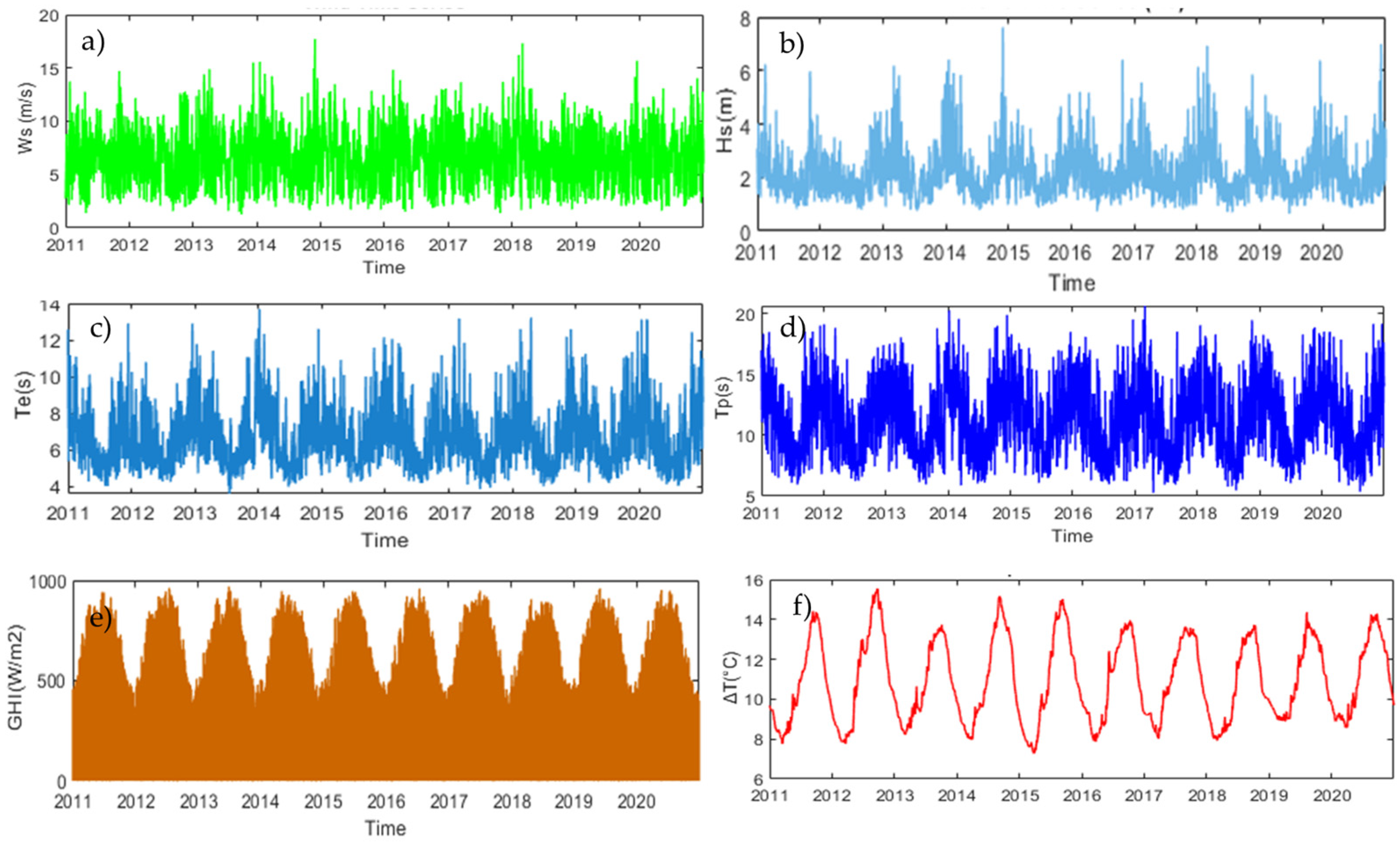
Given the three-dimensional structure of the original datasets, the average value of each variable across the entire spatial domain was computed to generate a one-dimensional dataset reflecting the mean climatic conditions of the study area. As a result, the temporal series of spatial averages—Ws, Hs, Te, Tp, GHI, and ΔT—served as the input for the temporal interpolation evaluation. Figure 3 illustrates these input time series, while Table 1 summarises their key attributes, including their initial temporal and spatial resolutions, along with the data sources.
Table 1. Properties of the input datasets employed in the temporal resampling assessment.
Climate FeatureInput
Parameters
Interpolated
Parameter(s)
UnitsSpatial
Resolution
Temporal
Resolution
Source
InputInputTarget
WindU10, V10Wshubm/s0.25° × 0.25°1 h *1 hGlobal Ocean Hourly Sea Surface Wind and Stress from Scatterometer and Model [66]
WaveHs, Tp, TeHs, Tp, Tem, s, s0.2° × 0.2° 3 h1 hGlobal Ocean Waves Reanalysis [67]
SolarSDRGHIJ/m2 (W/m2)0.25° × 0.25°1 h *1 hERA5 Hourly Data on Single Levels From 1940 to Present [64]
TemperatureTsurf, T1000ΔT°C0.083° × 0.083°1 day1 hGlobal Ocean Physics Reanalysis [68]
* Only data at 3 h time steps were used for interpolation tests, while remaining were later used for external validation.
Although Ws (t) and GHI (t) were originally provided at the target hourly frequency, the data sampled at a 3 h interval was selected for the interpolation tests to ensure consistency across the datasets. The remaining unsampled data points were retained for validation.

2.3. Exploratory Analysis

A preliminary review and assessment of the datasets was undertaken to analyse their temporal characteristics and prepare them for the interpolation procedure. This stage involved checking the data completeness, detecting the potential trends, patterns, central values, or anomalies that might influence the interpolation outcome. The key actions performed during this exploration phase are summarised below:
  • Data visualisation, stationarity and trend analysis
The time series of each variable was plotted to identify trends, cycles, and potential data gaps. Further, it was decomposed into its long-term, seasonal and linear background trend components to visualise the patterns. The Mann–Kendall test was also used to determine whether there was a significant monotonic trend in the data (positive Kendall’s tau values indicate an increasing trend, while negative values indicate a decreasing trend). The Kwiatkowski–Phillips–Schmidt–Shin (KPSS) test was applied to evaluate the stationarity of the time series. The null hypothesis of the KPSS test is that a time series is stationary around a deterministic trend. If the p-value is lower than the selected significance level (α = 0.05), the null hypothesis of stationarity is rejected, indicating that the series is non-stationary. Conversely, if the p-value is greater than or equal to the significance level, the null hypothesis cannot be rejected, and the series can be considered stationary. This test helps identify whether long-term trends or seasonal components may influence the interpolation performance.
Given that temporal patterns can influence the choice of interpolation techniques for time-varying data, and many interpolation methods assume the stationarity of the data, removing both the long-term and seasonal trends should be considered before performing temporal interpolation to improve accuracy. However, as the objective of this paper was to preserve seasonal patterns for potential further analysis, only the long-term background linear trend was removed before interpolation, while the seasonal trend was preserved.
  • Evaluate statistical distribution and central value of data
The descriptive statistics—including the mean, median, standard deviation (STD), variance, interquartile range (IQR), skewness, kurtosis, and outlier percentage—were computed for each variable to examine their statistical properties and deviations from normality. Histograms were generated to visualise these distributions, with special focus on possible temporal changes. The analysis aimed to detect anomalies or extreme values that might bias the interpolation outcomes. Where needed, data transformations were considered to reduce the influence of outliers on the results.
The choice of the most appropriate measure of central tendency for each time series was based on an analysis of its distribution form and characteristics. The mean is typically suitable for datasets with symmetric distributions and no significant outliers, as it accounts for all values but is highly sensitive to extremes. The median is a better choice for skewed datasets or those containing outliers, since it is less affected by extreme values and represents the middle value of the data. The mode is well suited for analysing datasets with frequent repeated values or multiple peaks, especially when identifying the most common occurrence is relevant. Although the IQR does not measure the central tendency, it is useful alongside the median to describe the spread of a dataset’s central half, particularly for skewed data. For datasets with moderate outliers but slight skewness, the trimmed mean—computed by excluding the highest and lowest values—provides a stable average.
In summary, the mean is generally sufficient for normal distributions, while the median or trimmed mean tends to yield more reliable results for data characterised by skewness or frequent outliers. Combining the median with the IQR is especially informative for strongly skewed datasets, effectively capturing both the central tendency and variability.
  • Temporal variability characterisation
To characterise the intrinsic temporal structure of the met-ocean variables prior to interpolation, diurnal and seasonal variability analyses were conducted for the met-ocean parameters. Hour-of-day and month-of-year boxplots were computed. These distributions provided a non-parametric description of short-term (diurnal) and longer-term (seasonal) variability, including the median values, interquartile ranges, and extreme events. This exploratory analysis served two purposes: (i) to identify the dominant temporal scales present in the datasets, and (ii) to motivate the adoption of local time-domain interpolation methods capable of preserving both the short-term variability and seasonal structure during temporal resampling.
  • Preprocessing of input data
To mitigate the non-stationarity and to adjust the statistical properties of the datasets toward normality, all the spatial input data were transformed and detrended before interpolation. Trend removal was performed using either linear detrending (LD) or moving average detrending (MAD), while normal score transformation (NST) was employed to modify the data distribution.
However, when dense, uniformly spaced datasets exhibit non-stationary behaviour, it may still be appropriate to apply deterministic interpolation methods directly to the raw data without prior adjustments. Therefore, both the untreated and preprocessed datasets were subjected to interpolation and cross-validation. The outliers (approximately 1–2% of samples) were retained to preserve the physically meaningful extremes and to assess the interpolation robustness under realistic conditions. This approach ensured that the performance metrics reflect realistic operating scenarios rather than artificially smoothed signals.

2.4. Evaluation, Validation and Comparison of Interpolation Methods Performance

Using cross-validation, the performance of six deterministic time-domain interpolation methods—linear, cubic spline, B-spline, makima, nearest neighbour (NN), and pchip—was evaluated for the temporal resampling of the datasets under analysis, both in their original format and after pretreatment (detrending and/or transformation). After interpolation, the removed trends were added back to the interpolated values.
Frequency-domain reconstruction techniques were not considered in the final analysis, as their global nature and periodicity assumptions make them conceptually distinct from local time-domain interpolation methods aimed at estimating missing values between neighbouring observations. Given that this study focused on short-interval temporal resampling of dense met-ocean time series, only time-domain interpolation approaches were retained. All interpolations were performed using MATLAB’s built-in functions.
A set of cross-validation methods—training–test split, k-fold cross-validation, and Monte Carlo resampling—were uniformly applied to all the datasets. In addition, for the W s ¯ and G H I ¯ datasets, where specific data points were deliberately withheld before the interpolation process, external validation was conducted as well to assess model performance on unseen data. The training datasets comprised 70% of the points, with the remaining 30% used for testing. The k-folds method was configured with 20 folds, and the Monte Carlo technique was run for 100 iterations. The error metrics for each validation technique were averaged to produce a single representative error metric value for each dataset.
To assess the robustness of the interpolation methods under realistic data availability conditions, a synthetic missing-data experiment was conducted. For each variable, random subsets of the original time series were removed at rates of 10%, 30%, and 50%, representing low, moderate, and severe data loss scenarios. The remaining data were then interpolated using the same validation framework, and the performance metrics were recomputed for each missing-rate level. This analysis aimed to evaluate the stability of method rankings and the sensitivity of interpolation accuracy to increasing data sparsity.
The interpolation performance was assessed using the RMSE and relative RMSE (RMSErel) as measures of accuracy. The RMSE quantifies the average magnitude of errors, while the RMSErel compares the RMSE to the standard deviation of the observed data, providing a dimensionless metric for accuracy assessment across datasets with different scales, as per Equations (5) and (6). Lower values for both metrics indicate higher model accuracy, reflecting predictions closer to the observed data. An accuracy ranking was established by prioritising the interpolation methods with lower RMSErel values, with the method yielding the smallest RMSErel ranked highest.
The computational time taken by the software to complete each interpolation and resampling run for each dataset (TIME) was recorded to evaluate performance. Execution times were measured on a workstation equipped with an Intel® Core™ i7-7700 CPU (Intel Corporation, Santa Clara, CA, USA), 32 GB RAM, and using MATLAB R2024a. Each interpolation routine was executed five times, and the reported runtime corresponds to the average execution time. Preprocessing operations, such as data loading, were excluded from the timing measurements to isolate the computational cost of the interpolation algorithms themselves. Although the runtime differences between methods are modest for single time series, these differences become more relevant when processing multi-year datasets or large spatial grids, which are common in met-ocean analyses. To balance accuracy with computational efficiency, an alternative ranking based on increasing TIME values was also created.
To determine whether faster but less accurate interpolation methods are preferable over slower, more accurate ones, a multi-criteria evaluation framework was developed. A composite performance metric (Pscore) was designed to combine accuracy and computational time using a weighted score approach, allowing for a balanced assessment of accuracy and efficiency. This metric was calculated as the weighted sum of normalised accuracy and normalised speed relative to the best-performing method, as per Equation (7). Higher Pscore values indicate better overall performance.
R M S E = 1 n i = 1 n ( y ^ i y i ) 2
R M S E r e l = R M S E i σ × 100
P s c o r e = w a c c u r a c y   N o r m a l i z e d   A c c u r a c y + w t i m e   N o r m a l i z e d   S p e e d
where:
N o r m a l i z e d   A c c u r a c y =   R M S E b e s t R M S E i
N o r m a l i z e d   S p e e d = T I M E f a s t e s t T I M E i
In this context, RMSEbest denotes the lowest root mean square error obtained by the top-performing interpolation method for a given dataset, whereas RMSEi denotes the RMSE of any other method (i-th) that delivers less accurate results (a higher RMSE) but a potentially faster computational performance. The symbol σ represents the standard deviation of the original dataset. Likewise, TIMEfastest indicates the execution time of the fastest method, while TIMEi refers to the computational time required by the other methods. The weights waccuracy and wspeed reflect the emphasis placed on accuracy and computational speed within the evaluation framework. In this exploratory study, both factors were treated equally, assigning a weight of 0.5 to each criterion (waccuracy = wspeed = 0.5).
A sensitivity analysis was also performed on the weighting of accuracy and computational efficiency within the composite performance score. In addition to the equal-weight case (waccuracy = wspeed = 0.5), two alternative scenarios were evaluated: accuracy prioritised (waccuracy = 0.7; wspeed = 0.3) and strongly accuracy driven (waccuracy = 0.9; wspeed = 0.1). This allowed for an assessment of ranking stability under different application priorities.
The methods achieving the best combination of normalised accuracy and speed were considered optimal. Nevertheless, specific thresholds were defined to determine whether an interpolation method is acceptable, irrespective of its ranking. Regarding the RMSErel, the threshold for satisfactory performance varies with the intended application [69]. For environmental and geospatial analyses, an RMSErel below 20% is generally suitable. In engineering and scientific contexts, stricter limits apply—typically below 10% for high-precision modelling, with 10–15% accepted for exploratory work. For climate-related datasets and time-series analyses, values between 10 and 20% are considered reasonable, particularly for extensive datasets where flawless accuracy is unrealistic. In high-stakes cases, such as risk assessments, an RMSErel under 5% might be required. For this analysis, conducted in an exploratory setting, the interpolation methods yielding an RMSErel lower than 20% were regarded as sufficiently accurate for practical purposes.
R M S E r e l < 20 %
Additionally, for the computational efficiency of any given i-th method to be deemed beneficial considering its potential reduction in accuracy, the increase in the RMSErel compared to the best-performing method should not exceed 10%, according to the following criterion:
R M S E d i f f = R M S E i R M S E b e s t σ   × 100 ;   R M S E d i f f < 10 %
After establishing the Pscore ranking, any methods that did not comply with the set constraints in Equations (10) and (11) were excluded from further consideration. From the remaining candidates, the “best-suited method” was selected based on these predefined criteria. The resulting high-resolution interpolated datasets were then visually compared with the original data.
Furthermore, statistical comparisons between the resampled and original datasets were carried out to evaluate how effectively the selected interpolation method reproduces key features, such as trends, variability, and value distributions. Descriptive statistics—including the mean, median, maximum, minimum, standard deviation, skewness, and kurtosis—were computed for both datasets and examined to verify that the key statistical characteristics of the original data remained consistent after interpolation.
The preservation of extreme values was also evaluated because extreme conditions are particularly relevant in met-ocean applications and marine renewable energy assessments. For this purpose, the maximum value of the interpolated time series was compared with the maximum value of the original dataset, and the relative peak difference (RPD) was calculated to quantify the potential peak attenuation introduced by interpolation. The relative peak difference was defined as per Equation (12).
R P D = | X m a x , o r i g i n a l X m a x , i n t e r p o l a t e d | X m a x , o r i g i n a l × 100

3. Results and Discussion

3.1. Exploratoty Analysis

  • Data visualisation, stationarity and temporal trends
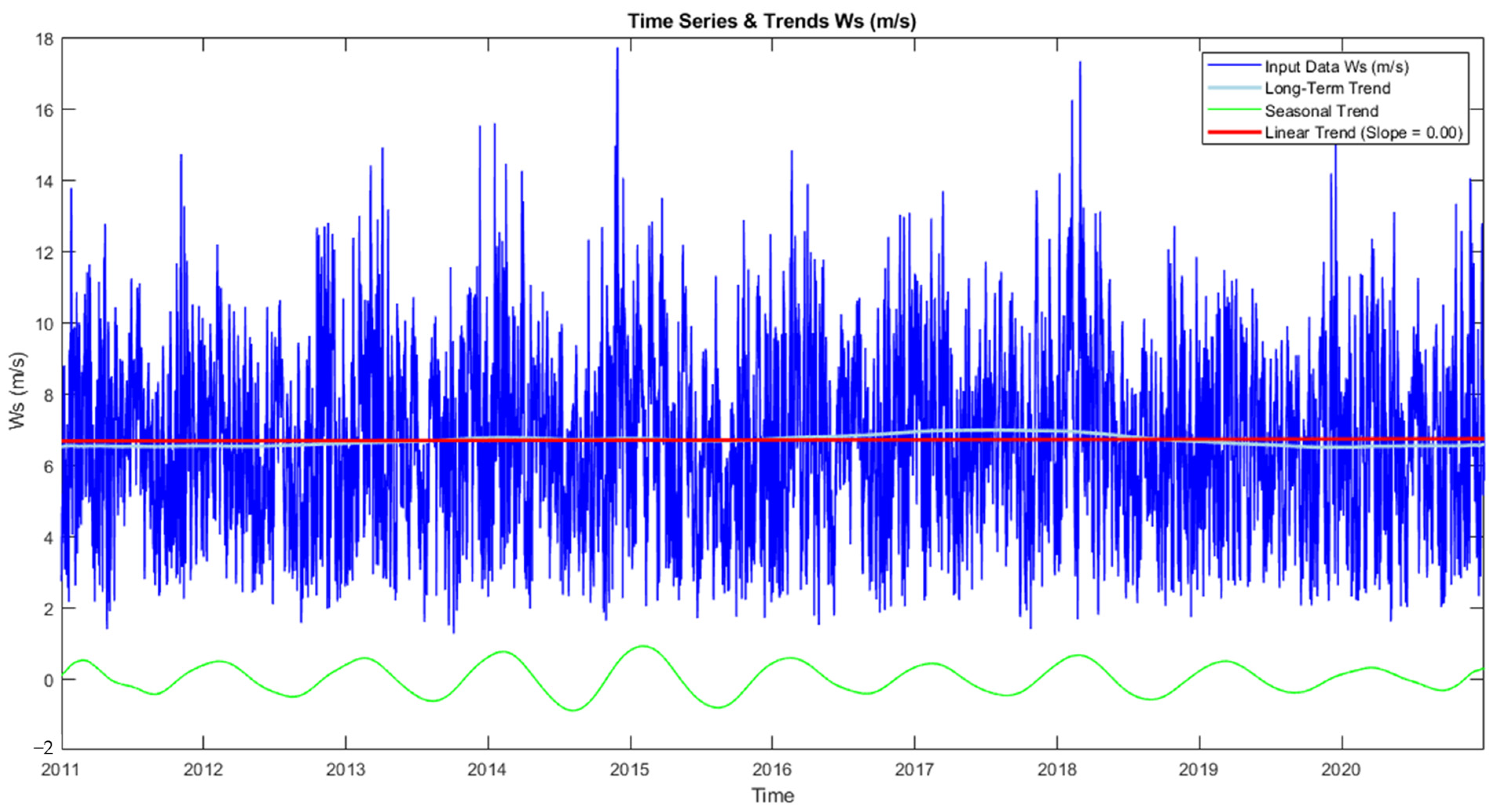
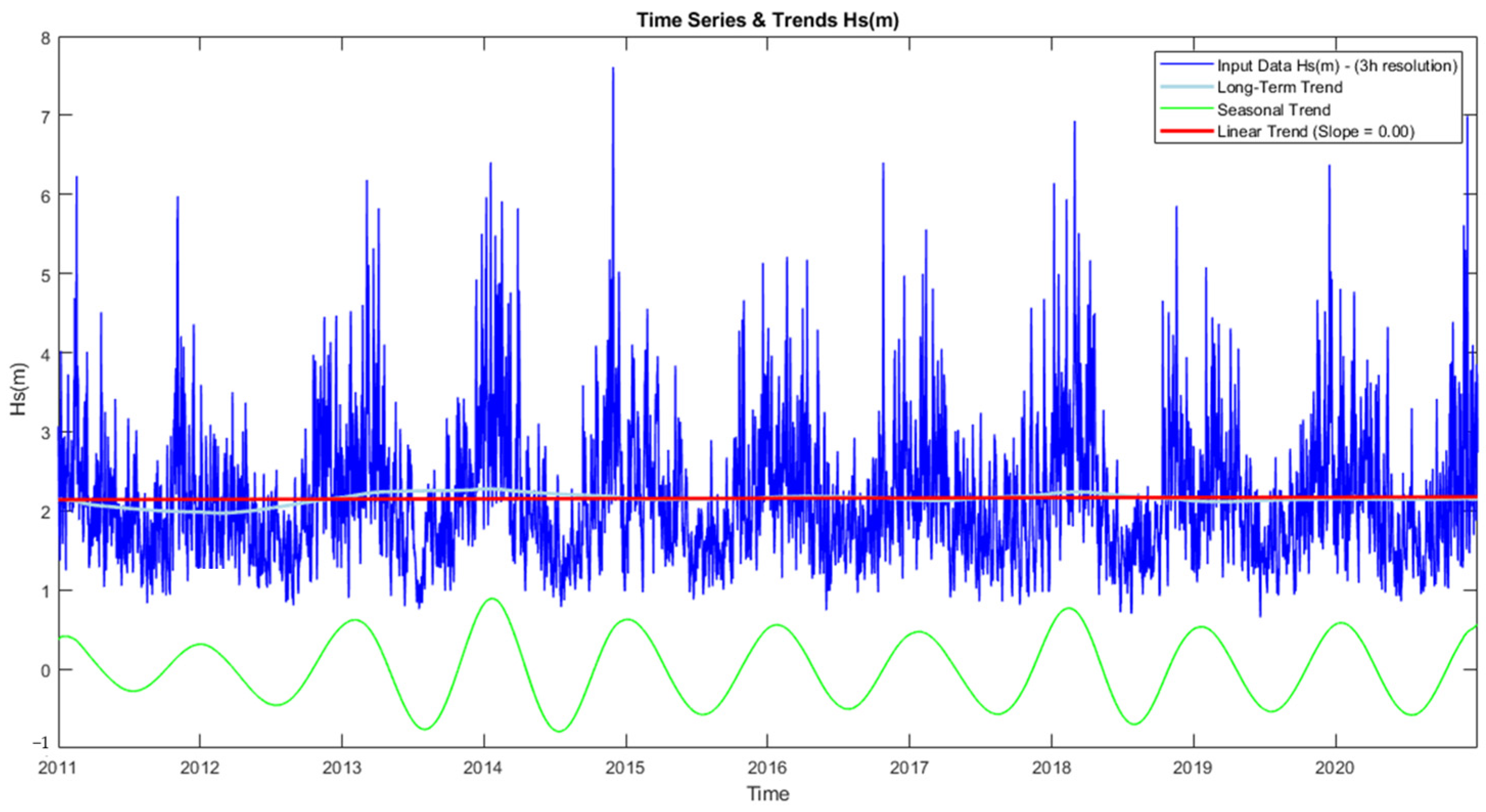
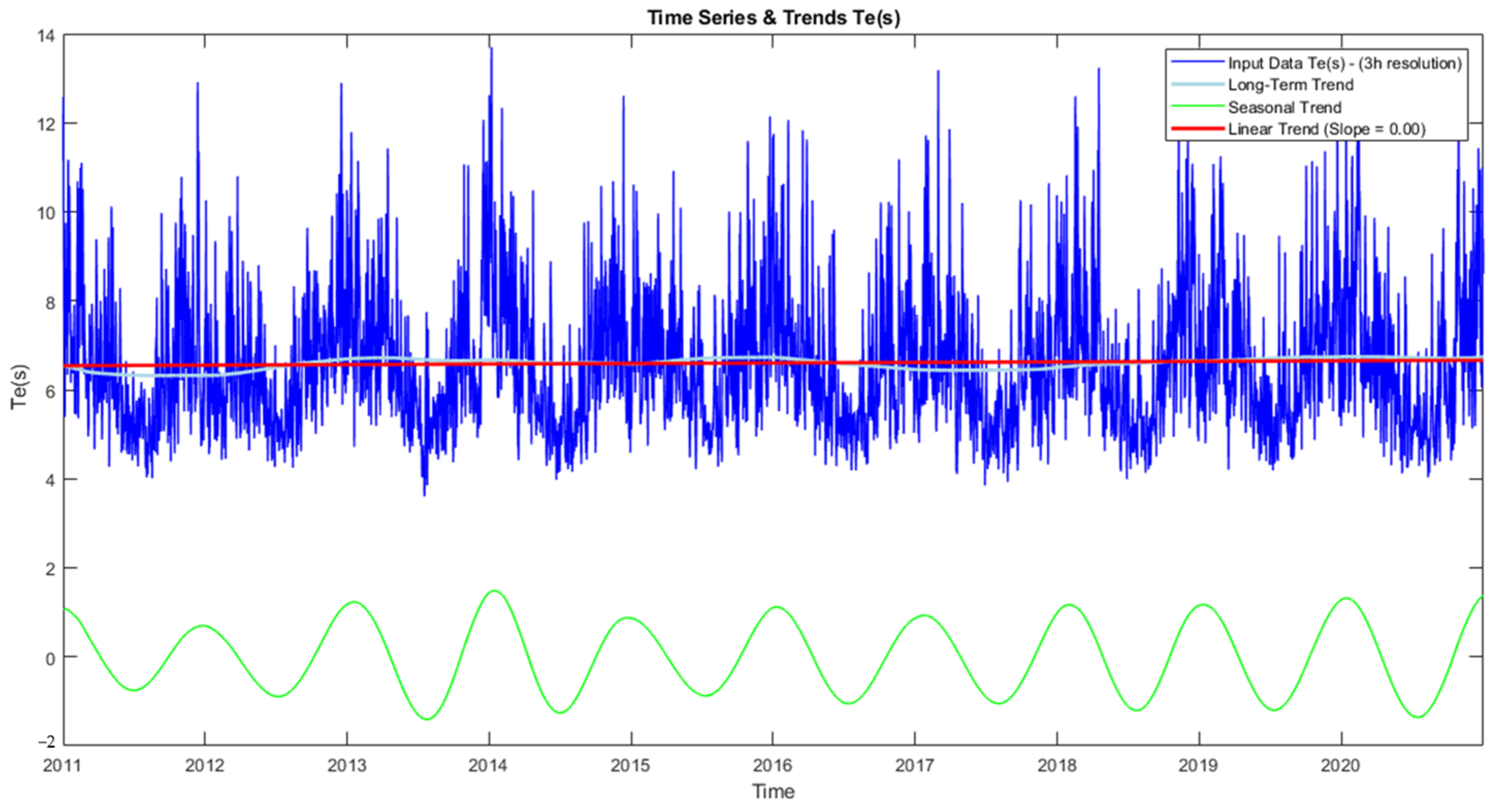
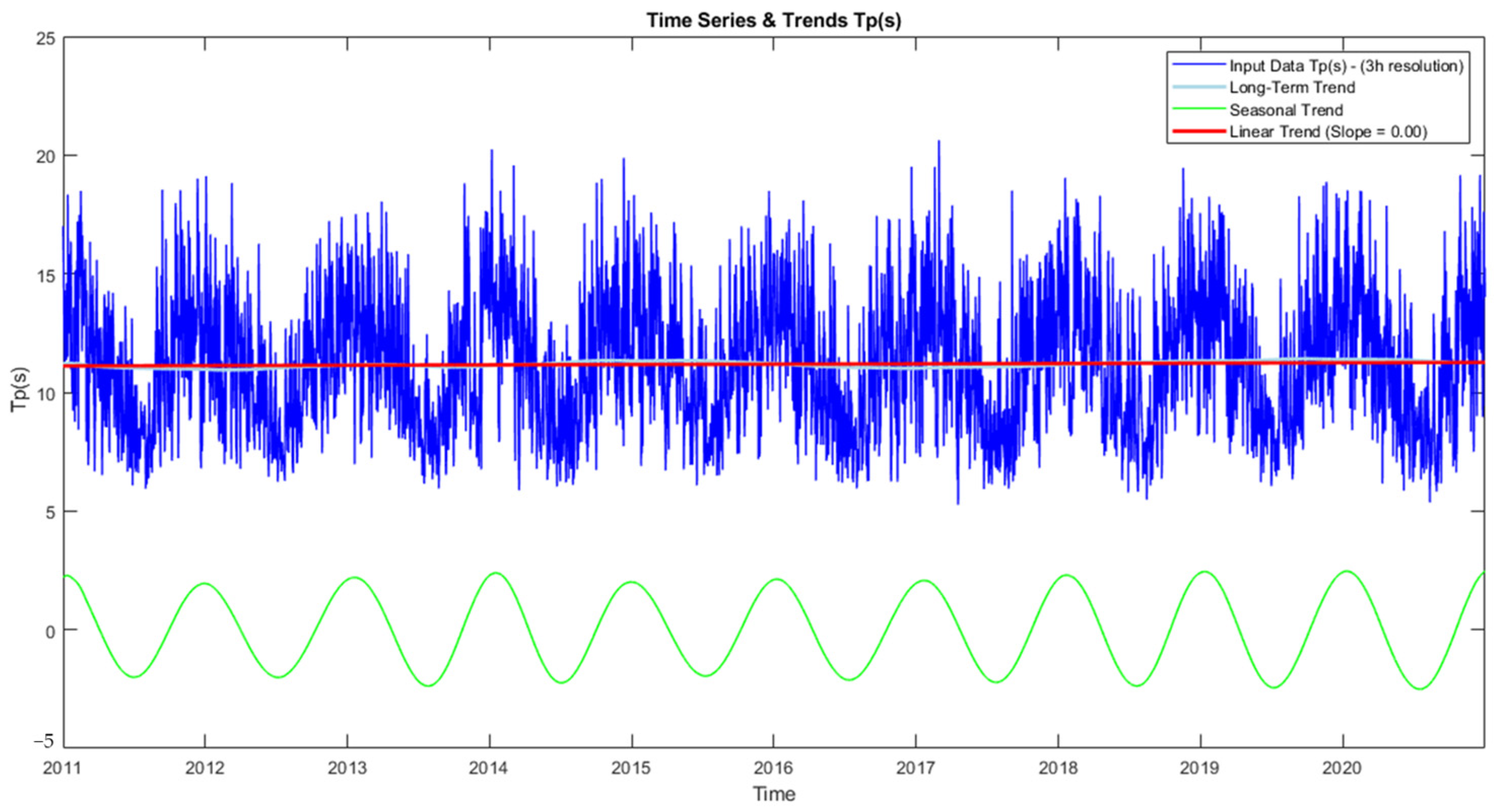
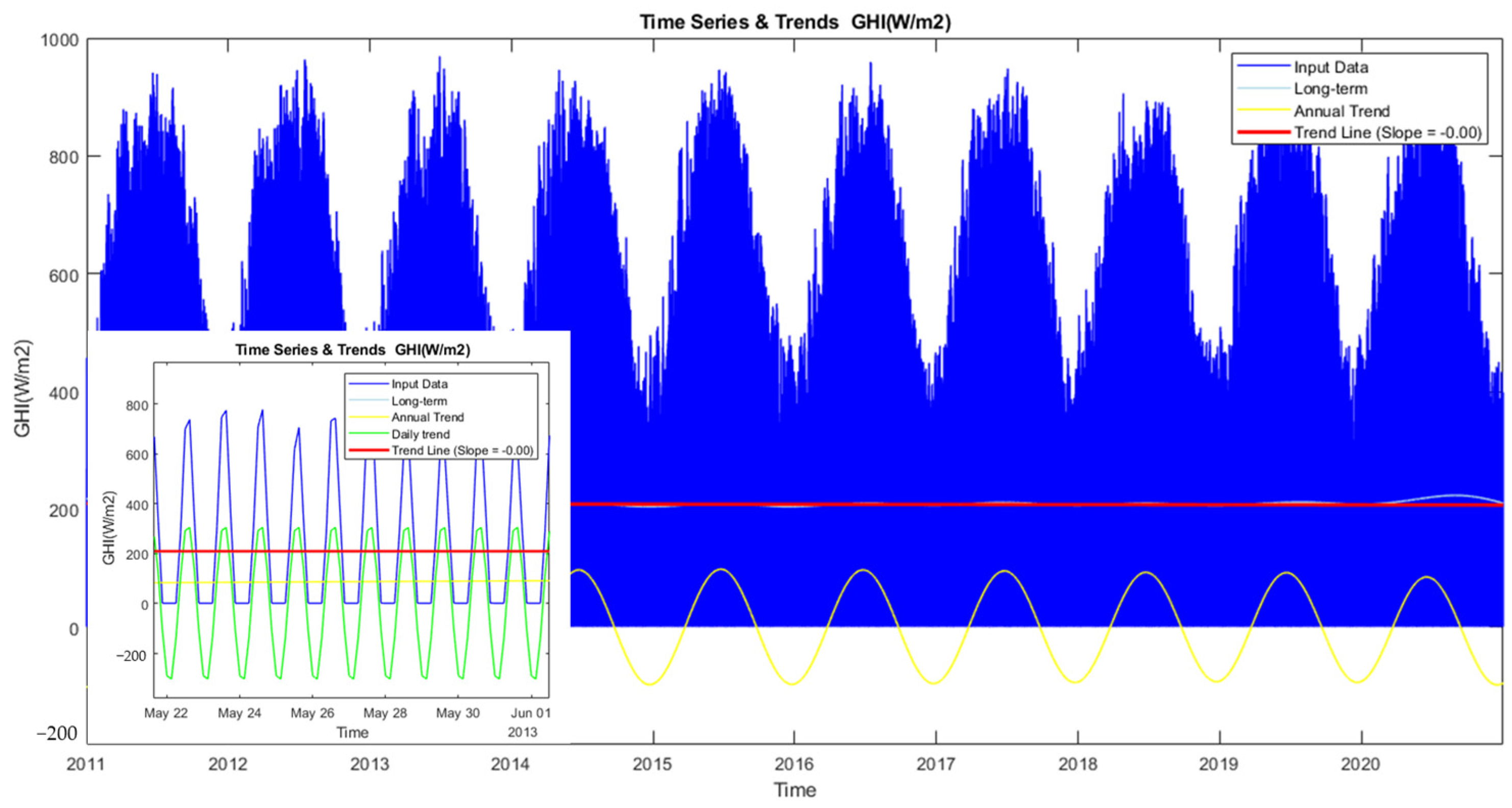
The background trends for each analysed variable (linear regression, long-term and short-term components) are shown in Figure 4, Figure 5, Figure 6, Figure 7, Figure 8 and Figure 9, along with the original time series over the full decade of interest. No significant data gaps were found throughout the datasets.
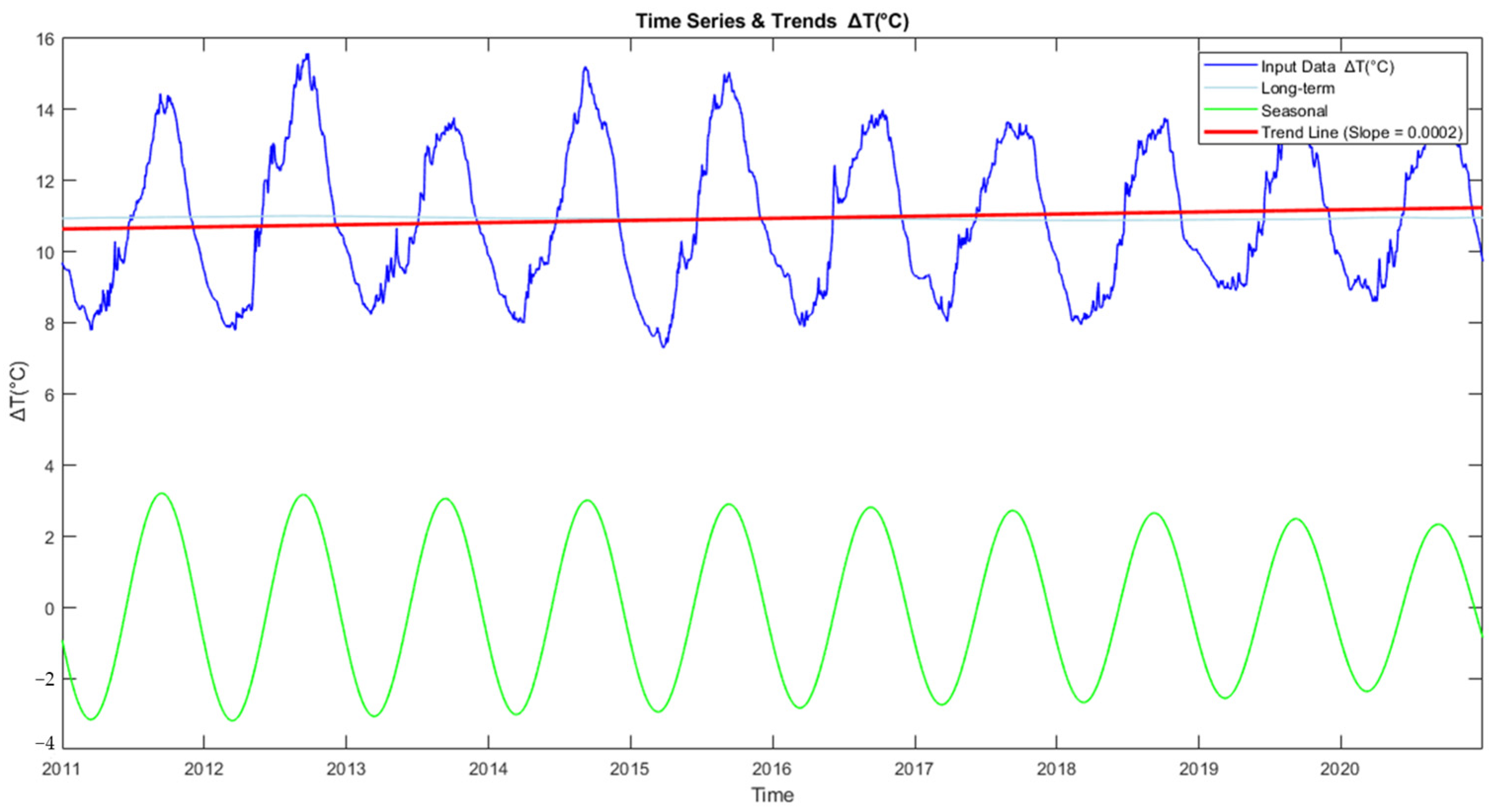
Most of the datasets (Ws, Hs, Te, Tp, GHI, and ΔT) are characterised by minimal long-term and linear regression trends, whose slopes fall close to 0. These almost negligible trends align with the low values of Mann–Kendall’s tau returned by the statistical test (Table 2). The ΔT dataset is characterised by a slightly more pronounced upward linear trend (slope = 0.0002), indicating a smooth overall increase in the values over the 10-year period of the dataset (Figure 9). All the datasets are characterised by a seasonal pattern captured by the short-term trend component. The wind speed intensity (Ws) and wave parameter datasets (Hs, Te, and Tp) describe an annual trend where the values are regularly higher during the winter months and lower during the summer months. Oppositely, the GHI and ΔT datasets are characterised by an annual trend with cycles of high radiation and temperature gradients in the summer and lower values in the winter. This is explained by the warmer and clearer sky conditions during the summer season, which allow more sunlight to penetrate the atmosphere and heat the ocean surface. The GHI time series is also decomposed into an expected daily trend where the radiation values are systematically higher during the day, peaking at about midday, and lower at night.
As seasonal trends are obvious in all the datasets, but background long-term trends are minimal, they represent trend-stationary processes (where the time series has a deterministic trend, but the fluctuations around the trend are almost stationary). These characteristics are consistent with the KPSS stationarity test results (Table 2), where p-values below the significance threshold indicate rejection of stationarity for several variables.
  • Statistic distribution and central value of data
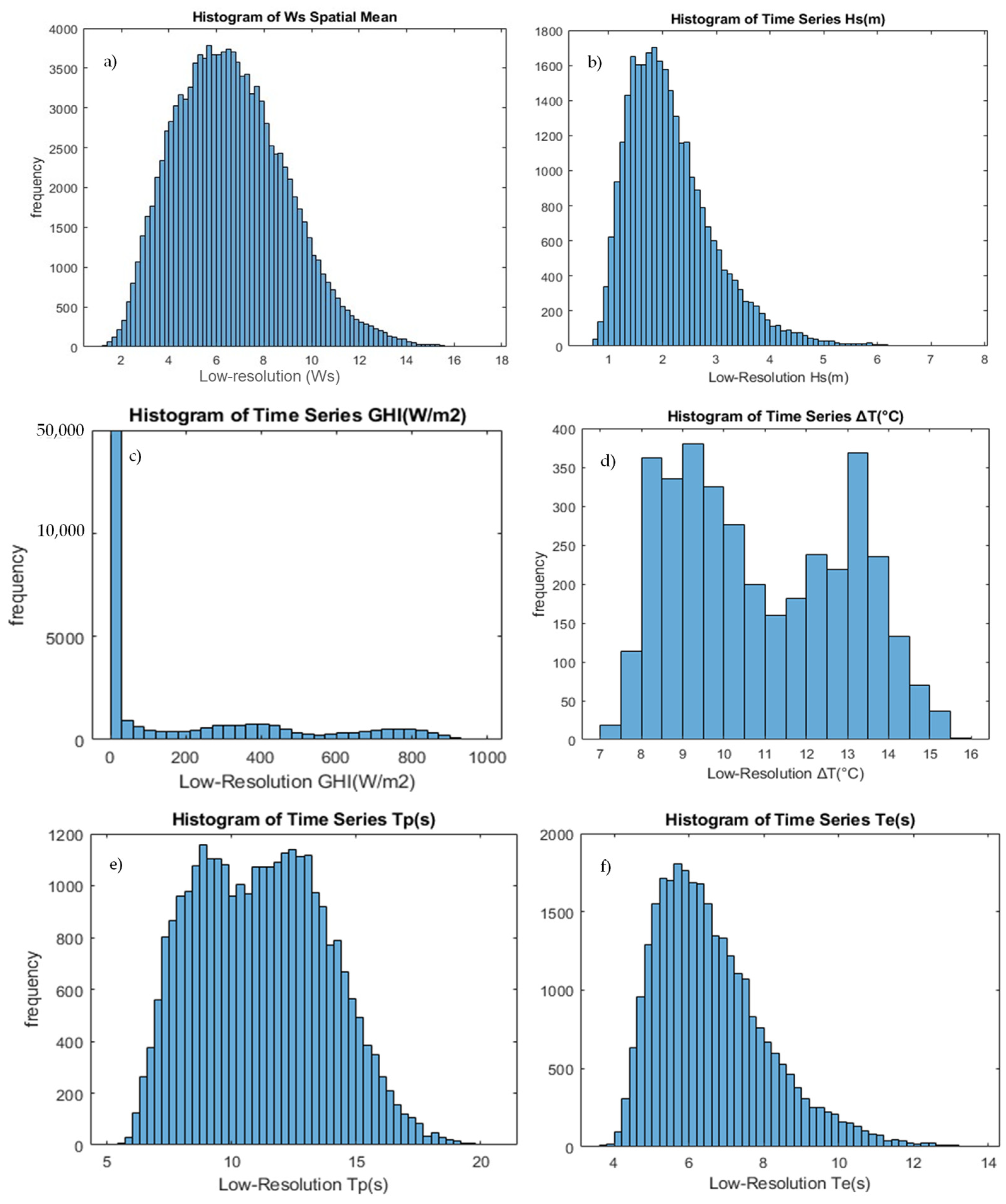
Table 3 summarises the temporal statistics of the six input datasets, while Figure 10 presents their histograms. Overall, the parameters exhibit low-to-moderate skewness, except for the GHI, which shows a strongly non-Gaussian distribution. A concise overview of the main distributional features is provided below.
Wind speed—Ws (t): It shows a near-normal distribution with a slight positive skew. Its values range from 1 to 18 m/s, with most observations clustered around the centre. Both the mean (6.62 m/s ± 2.32) and the median (6.60 m/s ± 3.32) represent the dataset well, as outliers account for only ~2%. Yet, the slight skewness makes the median marginally better to avoid the influence of extreme values.
Significant wave height—Hs (t): It is positively skewed (skewness = 1.24), dominated by lower values (1–3 m), with a tail extending to ~8 m. The median (2 m ± 1.01) is more representative than the mean, given the asymmetric distribution. This skewness may influence interpolation approaches that assume normally distributed errors.
Wave energy period—Te (t): It ranges from 4 to 14 s, with a peak around 6–8 s. The moderate positive skewness suggests that the median (6.33 s ± 1.94) is an appropriate measure of central tendency, as it mitigates the influence of the tail extending to higher values.
Peak period—Tp (t): It presents a near-symmetric, slightly bimodal distribution (5–20 s). Given its balanced shape and limited outliers (<2%), both the mean (11.19 s ± 2.62) and median (11.14 s ± 4.10) adequately describe the dataset.
Thermal gradient—ΔT (t): It spans 7–16 °C and displays a uniform, bimodal pattern linked to seasonal behaviour, with peaks around 9 °C (winter) and 13 °C (summer). With no extreme outliers or symmetry, the mean (10.91 °C ± 2.06) provides a reasonable summary, although no single central metric fully captures the bimodality. The lack of a pronounced peak or symmetry suggests that neither the mean nor the median alone may adequately represent the central tendency.
Across these five variables, deviations from normality are moderate. Preprocessing steps of detrending or transformation could reduce the skewness but are not strictly necessary.
Global horizontal irradiance—GHI (t): It exhibits a highly leptokurtic distribution: an extreme peak at zero (nighttime and heavily overcast periods) and a long tail reaching ~1000 W/m2. Because the mean is strongly biased by high-irradiance outliers, the median (8.77 W/m2 ± 385.24) is the most reliable central measure for the full dataset. If the analysis is restricted to daylight hours, separate statistics should be computed. Given its strong skewness and heavy tails, its transformation prior to interpolation is recommended to stabilise the variance and prevent extreme values from dominating the output.
  • Temporal variability in met-ocean variables
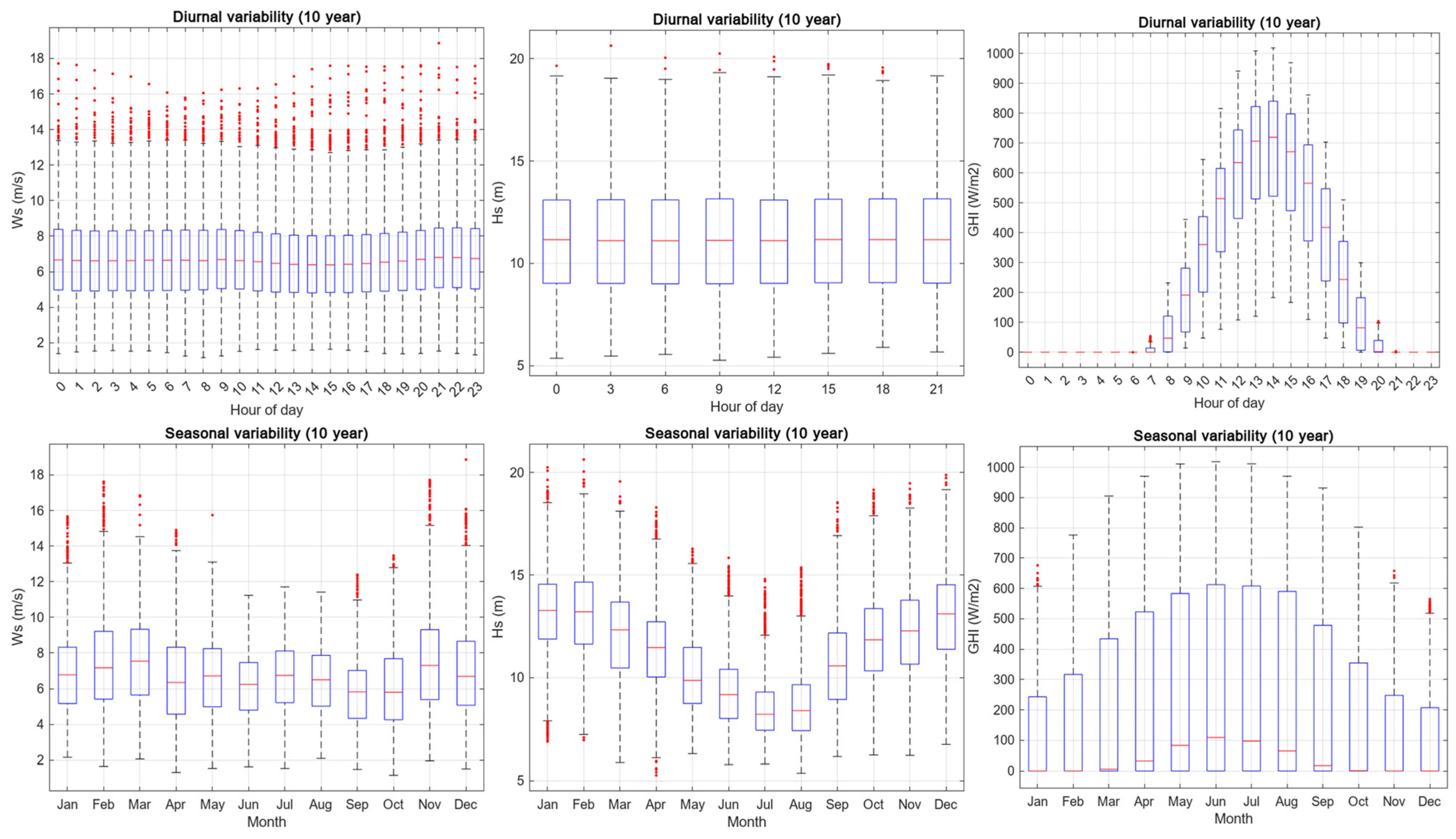
Figure 11 illustrates the diurnal and seasonal variability in the representative variables—Ws, Hs, and GHI—over the 10-year study period. The Ws exhibits modest diurnal modulation, with relatively stable median values throughout the day, while the seasonal statistics reveal enhanced variability and higher extremes during the winter months. The late-summer periods show reduced mean wind speeds and narrower distributions.
The Hs displays limited diurnal dependence but pronounced seasonal variability, characterised by elevated winter values and increased dispersion, reflecting the influence of storm-driven wave regimes. In contrast, the GHI presents a strong diurnal cycle driven by the solar day–night pattern and a clear seasonal signal, with higher values during summer months and reduced irradiance during winter.
These results confirm the presence of multi-scale temporal structure across the variables, spanning hourly-to-seasonal timescales. Such variability highlights the importance of interpolation schemes that operate locally in time and can preserve short-term fluctuations while respecting longer-term climatic patterns.

3.2. Comparative Evaluation of Interpolation Methods

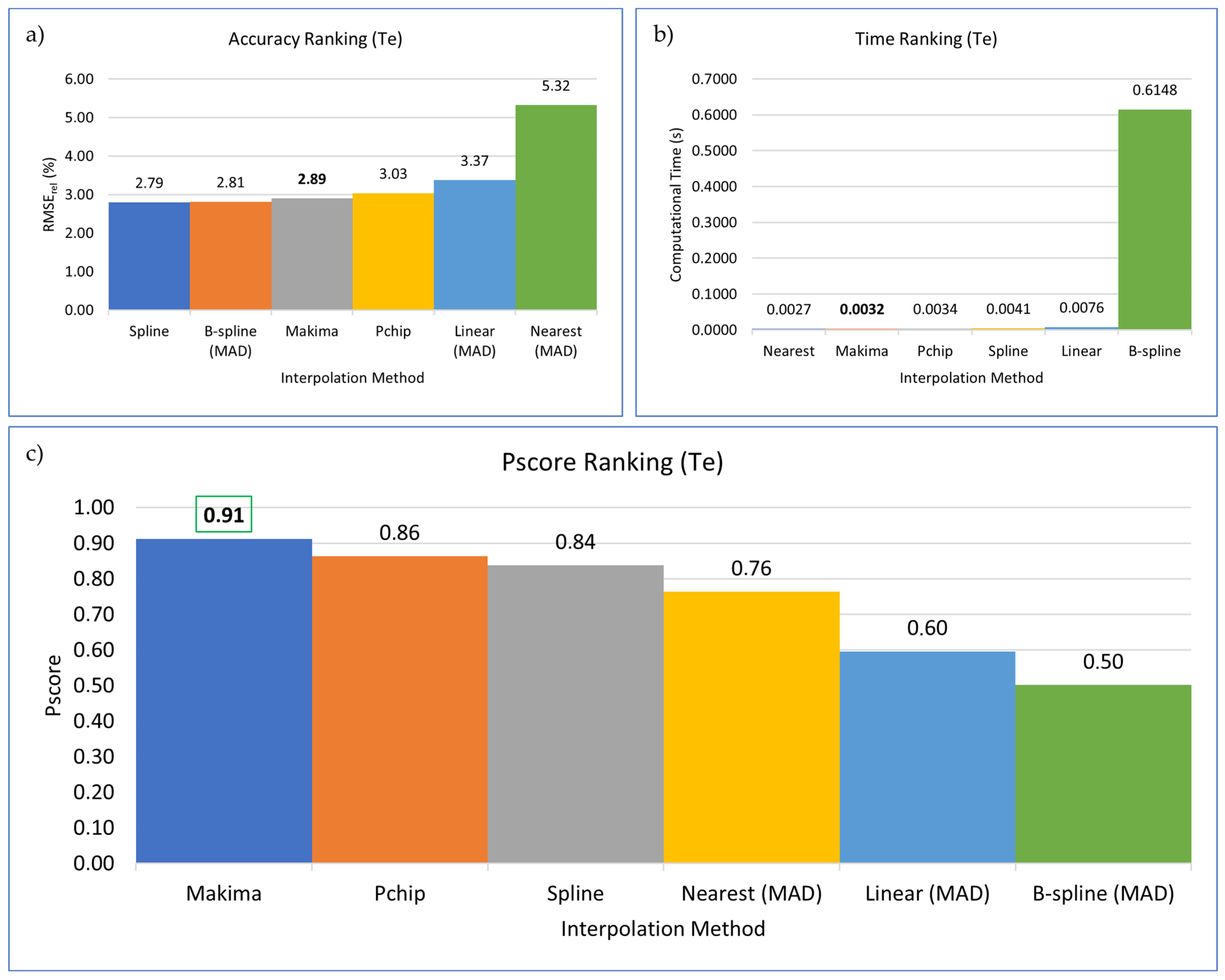
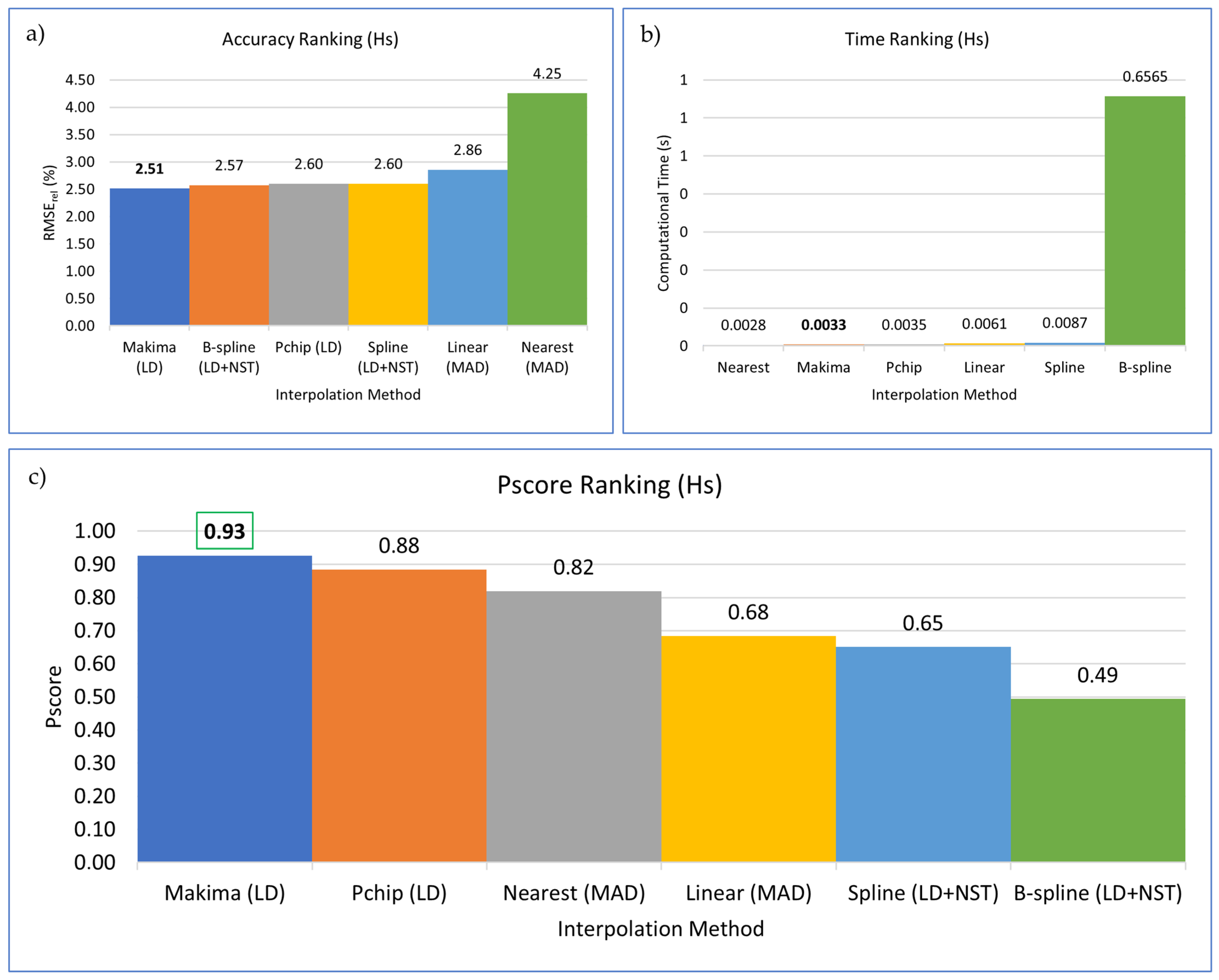
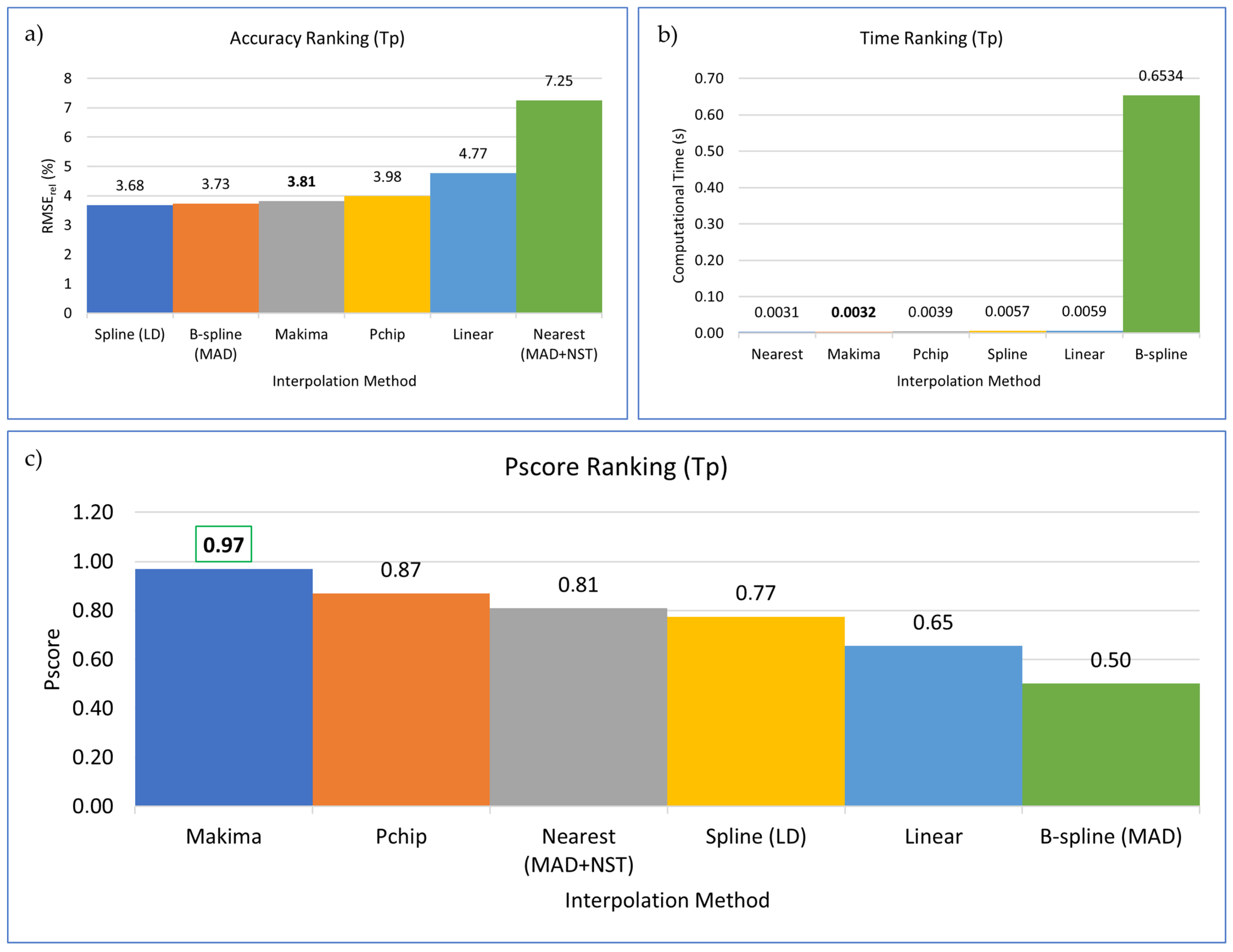
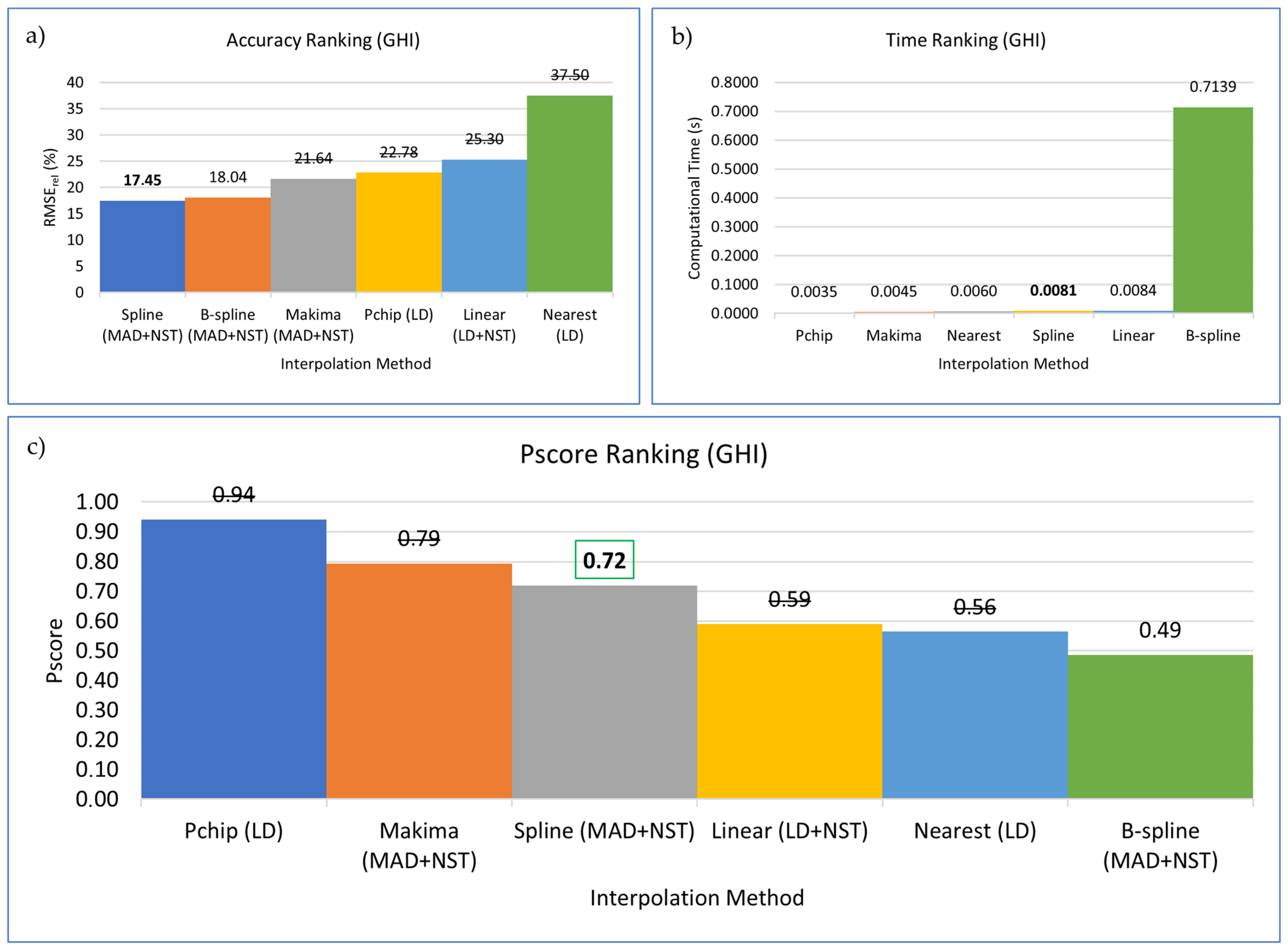
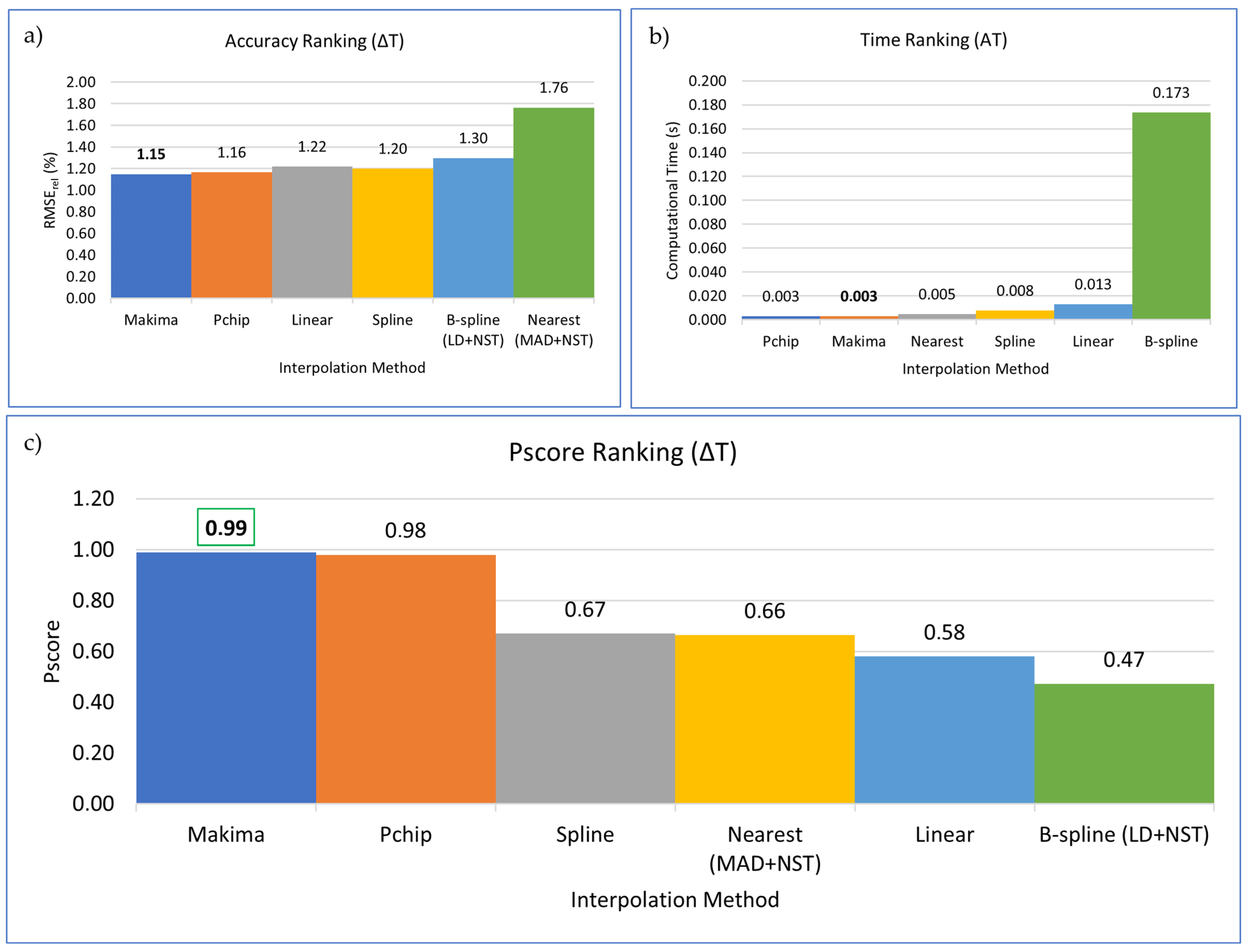
Table 4, Table 5, Table 6, Table 7, Table 8 and Table 9 present the accuracy and computational efficiency metrics (RMSE, RMSErel, RMSEdiff, TIME, and Pscore) for all the interpolation methods applied to both the original and pretreated datasets (LD, MAD, and NST). The RMSE values represent the mean outcomes across the training–test splits, k-fold cross-validation, and Monte Carlo validations. The best overall values for each metric among different methods appear in bold. The results that do not satisfy the RMSErel (>20%) or RMSEdiff (<10%) criteria are crossed out. In the tables, the interpolation methods are ordered from highest to lowest Pscore performance, displayed from left to right. Figure 12, Figure 13, Figure 14, Figure 15, Figure 16 and Figure 17 summarise the rankings for accuracy (panel a), computation time (panel b), and overall performance (panel c) through the Pscore indicator.
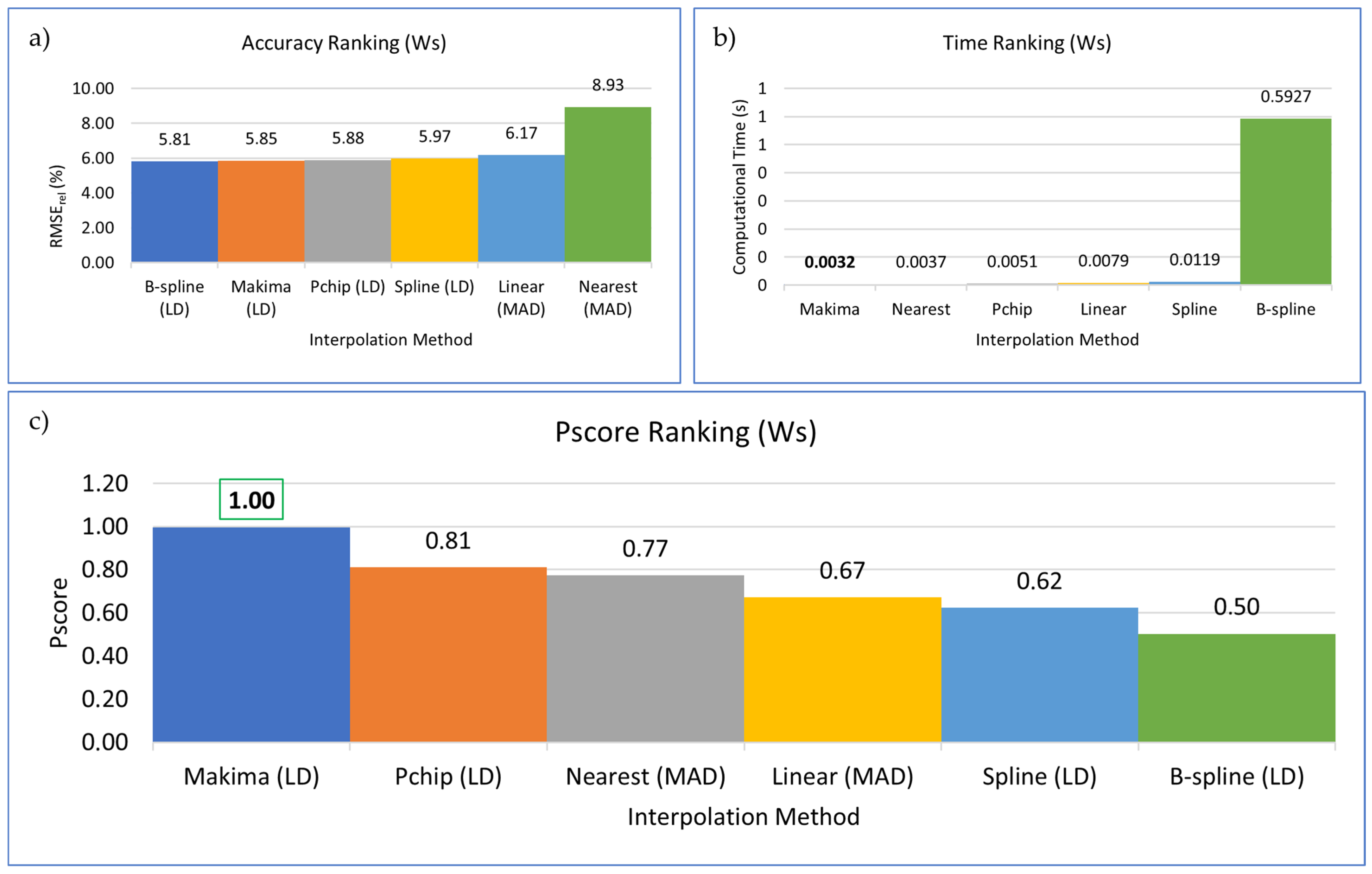
Wind speed—Ws (t): The B-spline, with linear detrending, achieves the lowest RMSE (0.1346; RMSErel = 5.81%), closely followed by the makima with linear detrending. The NN shows the lowest accuracy. All methods meet the error constraints. The makima and NN are the fastest (≈0.0032–0.0037 s), while the B-spline is substantially slower (0.5927 s). The makima achieved the highest Pscore (0.97), representing the best overall balance of accuracy and computational cost (Table 4, Figure 12).
Significant wave height—Hs (t): The makima with linear detrending produces the best accuracy (RMSE = 0.0206; RMSErel = 2.51%). From a computational speed perspective, the NN and makima are the fastest methods (ranging from 0.0028 s to 0.0033 s); the B-spline is the slowest (0.6565 s). The makima with LD also obtains the highest overall Pscore (0.93), emerging as the most suitable choice for spatial resampling of significant waves. All the methods meet the defined accuracy constraints, leaving them eligible for selection (Table 5, Figure 13).
Wave energy period—Te (t): The spline (no preprocessing) and B-spline (with MAD) produce the best accuracy (RMSE ≈ 0.042; RMSErel ≈ 2.8–2.9%). The NN is the least accurate. Regarding the computational speed, the NN is the fastest (0.0027 s), whereas the B-spline has the slowest computation time (0.6148 s). The makima achieves the highest Pscore (0.91), outperforming the accuracy leaders due to its significantly lower computational cost (Table 6, Figure 14).
Peak period—Tp (t): The spline and B-spline again deliver the highest accuracy (RMSErel ≈ 3.7%). In contrast, the NN has the lowest accuracy. The NN and makima are the most computationally efficient (ranging 0.0031 s and 0.0032 s); the B-spline is the slowest (0.6534 s per iteration). The makima obtains the highest Pscore (0.97), while the B-spline ranks last (Table 7, Figure 15).
Global horizontal irradiance—GHI (t): Given the GHI’s highly skewed and leptokurtic distribution, the spline provides the best accuracy (RMSE = 48.14; RMSErel = 21.64%) and is the only method—together with the B-spline—to meet the accuracy constraints. Although the pchip is the most computationally efficient (0.0035 s), most methods (pchip, makima, linear, and NN) exceed the RMSErel and RMSEdiff limits and are therefore disqualified. Therefore, the spline emerges as the most suitable method for GHI resampling, achieving the highest Pscore among the compliant methods (0.72) (Table 8, Figure 16).
Thermal gradient—ΔT (t): The makima delivers the best accuracy (RMSE = 0.0236; RMSErel = 1.15%). The makima and pchip are the fastest methods (<0.003 s). The highest overall performance is achieved by the makima method combined with linear detrending (Pscore = 0.99), which is identified as the most suitable resampling approach for the temperature gradient dataset. In contrast, the poorest results are obtained using the B-spline method with a moving average detrending and normal score transformation, yielding a Pscore of 0.49 (Table 9, Figure 17).
In general, the linear, makima, pchip, spline, and NN interpolations show limited sensitivity to preprocessing, with improvements typically confined to the third or fourth decimal place. Linear detrending marginally enhances the makima and pchip performances for mildly skewed variables, while distribution normalisation mainly benefits the strongly skewed datasets, such as global horizontal irradiance.
Overall, the makima emerges as the most consistent compromise between accuracy and computational efficiency across most of the datasets (Ws, Hs, Te, Tp, and ΔT). Although the spline and B-spline approaches occasionally achieve better or comparable accuracy, their higher computational cost penalises their overall performance, particularly for large multi-year datasets. For the GHI, the spline interpolation performs best due to the highly skewed distribution and abrupt diurnal transitions. In contrast, while the B-spline interpolation achieves good accuracy across the datasets, its computational expense consistently penalises its overall performance relative to the other methods, returning the poorest results in terms of computational Pscore across all datasets.
The synthetic missing-data experiments indicate that the makima, spline, and pchip methods maintain relatively stable performances of up to approximately 30% data loss, with the RMSErel increasing moderately while preserving the overall method rankings. At higher missing rates (50%), interpolation errors increase substantially for all methods, although the makima and spline remain comparatively more robust than the linear and nearest neighbour approaches. These results suggest that the proposed framework remains applicable under moderate data gaps, while severe sparsity requires more advanced reconstruction or model-based approaches.
A weight sensitivity analysis confirms the stability of the proposed framework across different application priorities. For both accuracy-prioritised (waccuracy = 0.7; wspeed = 0.3) and strongly accuracy-driven (waccuracy = 0.9; wspeed = 0.1) scenarios, the makima consistently ranks first for all analysed variables (Ws, Hs, Te, Tp, GHI, and ΔT), with Pscore values ranging between 0.93 and 1.00 and 0.98 and 1.00, respectively. The intermediate rankings exhibit moderate variability, with the pchip and spline methods typically occupying the second and third positions, while the B-spline improves under accuracy-heavy weighting due to its competitive RMSE despite its higher computational cost. The NN’s performance systematically decreases as the accuracy weight increases. For solar irradiance, the spline and pchip approach the makima under accuracy-focused settings, reflecting the distinct statistical characteristics of this variable. Overall, although the relative rankings among the secondary methods vary with the weighting, the leading method remains unchanged, demonstrating both the robustness of makima across variables and the practical flexibility of the proposed multi-criteria selection framework.
The descriptive statistics for each resampled result, obtained using the resampling method chosen as most adequate for each dataset, are presented in Table 10 alongside the statistics of the original dataset. The relative peak difference between the maximum value of the original and interpolated time series has also been added to Table 10. The RPD values are very small for all analysed parameters, remaining below 0.2%. In several cases (e.g., wind speed and peak period), the maximum values are identical in both datasets within the reported numerical precision, indicating that the interpolation process did not attenuate the observed extremes.
For the other variables, the interpolated series produced slightly higher maximum values than the original dataset, which result in very small RPD values. Overall, these results suggest that the selected interpolation methods preserve extreme conditions well and do not significantly smooth the peak values or high-energy events, which is particularly important for met-ocean applications and marine renewable energy assessments where extreme conditions influence device survivability.
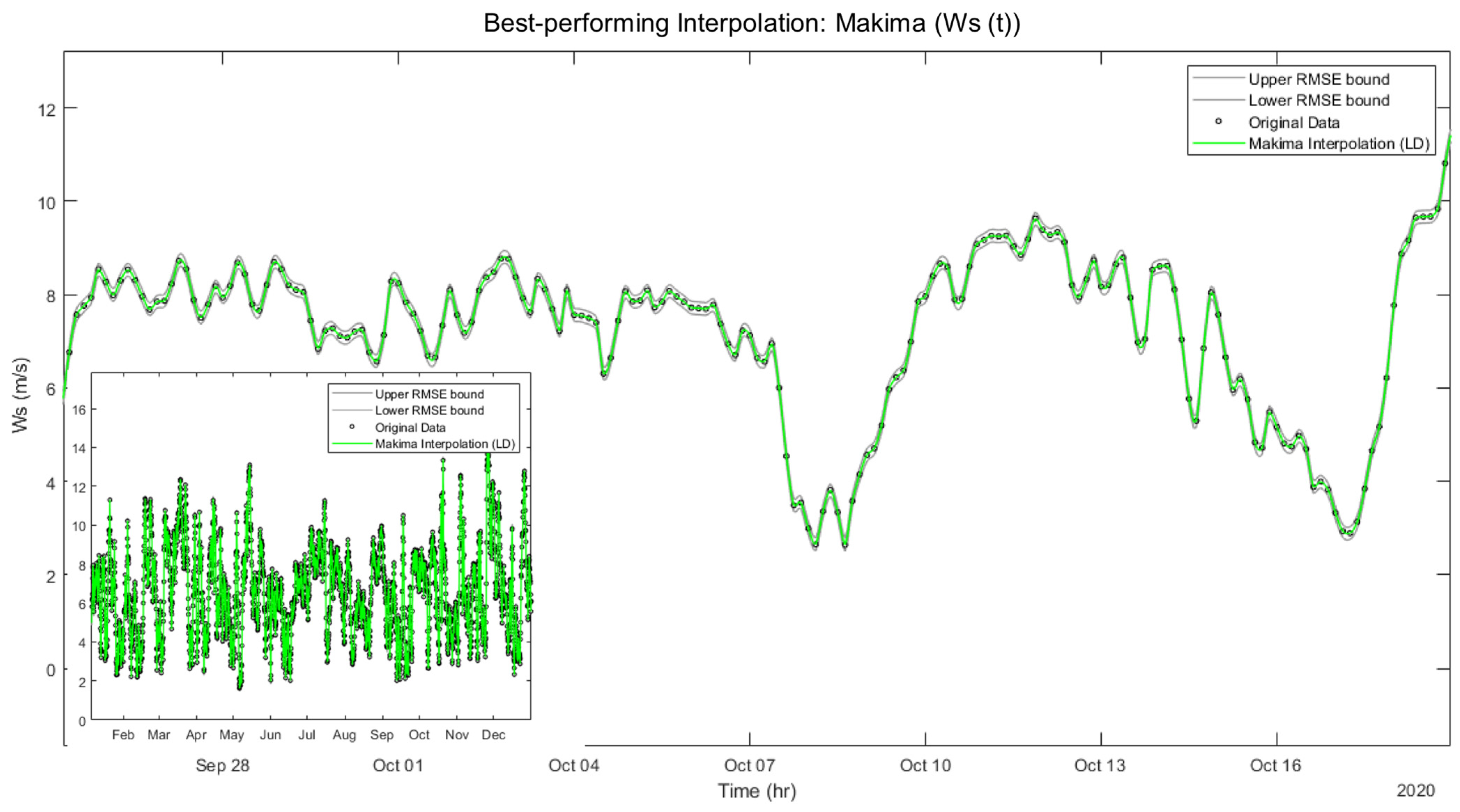
Figure 18 illustrates a representative reconstruction of the Ws dataset obtained using the best-performing interpolation method (makima), highlighting its ability to preserve short-term variability while maintaining smooth temporal continuity. Out of the 10-year dataset and for visualisation purposes, only data from the year 2020 and a selected subset corresponding to a few days in November of 2020 are displayed as representative examples of interpolation performance.
The synthetic missing-data experiments indicate that the makima, spline, and pchip methods maintain relatively stable performances of up to approximately 30% data loss, with the RMSErel increasing moderately but preserving method ranking. At higher missing rates (50%), the interpolation errors increase substantially for all methods, although the makima and spline remain comparatively more robust than the linear and nearest neighbour approaches. These results suggest that the proposed framework remains applicable under moderate data gaps, while severe sparsity requires more advanced reconstruction or model-based approaches.

3.3. Comparison with Related Studies and Methodological Context

Previous studies addressing the temporal interpolation and gap filling of environmental time series consistently emphasise the importance of local, shape-preserving interpolation schemes to avoid artificial oscillations and maintain physical variability (Table 11). Reviews of gap-filling methodologies identify linear and spline-family approaches as robust baselines for environmental applications, while more recent meteorological studies further advocate mean-preserving or monotonic spline formulations when handling averaged or irradiance-type variables.
Consistent with these findings, the makima and pchip (both shape-preserving cubic methods) systematically rank among the most accurate techniques across all evaluated variables in the present study, while also exhibiting low computational cost. The spline-based approaches achieve comparable accuracy in several cases but are generally disadvantaged by their higher processing times, resulting in lower overall performance scores.
Table 12 compares the representative RMSE values reported in previous studies with those obtained here. It is important to note that the literature values generally correspond to station-based validation, spatial interpolation, or forecast evaluation, including fields assessed against in situ observations. In contrast, the present study evaluates short-interval temporal resampling errors within a dense and internally consistent reanalysis time series. Consequently, the reported literature values provide contextual product uncertainty rather than a direct benchmark for interpolation accuracy, which explains the lower absolute RMSE values obtained in this work. Nevertheless, the relative ranking of interpolation methods aligns with previously reported preferences for shape-preserving and spline-based techniques.
For the ΔT between the surface–1000 m, the published uncertainty estimates are more commonly reported for the temperature fields themselves, typically evaluated against in situ observations, with RMSE values on the order of ~0.4–0.7 °C at surface and subsurface depths. The substantially smaller ΔT RMSE obtained here reflects the short-interval temporal resampling within an already dense and internally consistent reanalysis record, rather than independent observational validation.
Several limitations of the present study should be acknowledged. Firstly, the interpolation performance was primarily evaluated using spatially averaged time series derived from three-dimensional datasets. While this approach enabled consistent comparison among methods, it reduced the spatial variability and may have smoothed localised extremes, meaning that the interpolation performance at specific grid locations could differ from the domain-averaged results. In addition, the datasets analysed correspond to CMEMS reanalysis products, which are derived from numerical models and therefore exhibit smoother temporal variability than raw high-frequency observational data, such as buoy measurements. Consequently, the interpolation performance may differ when applied to noisier observational records. Furthermore, each met-ocean variable was interpolated independently to evaluate the interpolation performance at the level of individual time series, which may have introduced small inconsistencies into the physical relationships between variables (e.g., wind speed and wave height) at individual time steps. Finally, the framework was tested using datasets for the Madeira Archipelago, where ocean conditions are relatively regular compared with regions affected by highly energetic or strongly non-stationary weather systems. Therefore, the relative ranking of interpolation methods may vary under different met-ocean regimes, and further validation in regions with more extreme conditions would be a useful direction for future research.

4. Conclusions

This work assesses the effectiveness of multiple interpolation approaches for enhancing the temporal resolution of six climate and met-ocean datasets. Using the Madeira Islands as a case study, the evaluation highlights the need for carefully selecting interpolation methods that best suit each dataset—balancing precision and computational demand according to the intended application, data volume, and operational limitations.
Among the evaluated time-domain methods, the makima interpolation emerges as the most consistent compromise between accuracy and computational efficiency for uniformly sampled met-ocean datasets. The spline-based approaches provide comparable accuracy in several cases but are generally disadvantaged by higher computational demand.
However, except for the global horizontal irradiance parameter, none of the tested methods exceed the predefined acceptability thresholds across the remaining datasets. Thus, despite their relative rankings, most methods demonstrate acceptable performance across scenarios, emphasising their applicability unless more refined accuracy thresholds are needed.
The poorest interpolation accuracy for the GHI arises from its unique characteristics: daily zero values at nighttime, sharp transitions during sunrise/sunset, and a skewed highly non-Gaussian statistical distribution. These features challenge standard interpolation methods, which struggle with rapid changes. For that reason, applying normalisation to this dataset yields slightly better results than the original dataset. Other techniques, such as separating interpolation for daytime/nighttime, may still be applied to further improve accuracy.
Detrending the time series before interpolation improves the accuracy for some datasets, such as wind speed, wave height, and global horizontal irradiance. However, the improvement is often minimal, noticeable only at the third decimal place, suggesting that detrending has a limited impact on accuracy and may be omitted for simplicity and faster computation.
Although climate and met-ocean parameters vary by location, the findings of this analysis are expected to be broadly applicable to the resampling of datasets with similar temporal and statistical characteristics. This study focuses on the use of resampled datasets for comparative ocean resource assessments during exploratory stages, where equal weight is given to accuracy and computational efficiency for identifying the best iterative resampling method. An intrinsic sensitivity exists to potential variations in the importance given to each of these criteria, although it is not accounted for within the scope of this study.
For refined, project-scale analyses requiring higher accuracy—such as advanced-stage construction projects or analyses of highly localised regions—stricter accuracy constraints would need to be applied. Moreover, in such cases, common interpolation methods might not always be suitable, as they assume smooth variations between data points (which often fail to capture the complex variability in climate and ocean resources, where conditions may change rapidly over time). The use of parametrised hindcast or downscaling models is often recommended over postprocessing interpolation techniques as they incorporate physics-based processes and external forcing data, allowing them to provide more accurate and realistic representations of climate and ocean conditions. Therefore, when ocean and climate data are used for applications requiring high accuracy, it is preferable to rely on parametrised hindcast data or in situ measurements rather than interpolation. However, interpolation can be appropriate for early-stage evaluations, such as comparative analyses of ocean renewable energy resources, where highly accurate predictions are less critical. It is noteworthy that interpolation is particularly effective when the available time series datasets are dense and evenly distributed. Future work may extend this framework to spatially heterogeneous domains and irregular sampling scenarios, including the integration of physics-based downscaling models.

Author Contributions

Conceptualisation, S.R.-M.; methodology, S.R.-M.; software, S.R.-M.; validation, S.R.-M. and C.G.S.; formal analysis, S.R.-M.; investigation, S.R.-M.; resources, S.R.-M.; data curation, S.R.-M.; writing—original draft preparation, S.R.-M.; writing—review and editing, S.R.-M. and C.G.S.; visualisation, S.R.-M.; supervision, C.G.S.; project administration, C.G.S.; funding acquisition, C.G.S. All authors have read and agreed to the published version of the manuscript.

Funding

This research was carried out as part of the first author’s PhD thesis that received funding from the Portuguese Foundation for Science and Technology (Fundação para a Ciência e Tecnologia—FCT) through grant 2020.06618.BD. Additionally, the study supports the Strategic Research Plan of CENTEC—Centre for Marine Technology and Ocean Engineering, funded by the Portuguese Foundation for Science and Technology (FCT) under contract UID/00134/2025 (https://doi.org/10.54499/UID/00134/2025).

Institutional Review Board Statement

Not applicable.

Informed Consent Statement

Not applicable.

Data Availability Statement

The data presented in this study are available on request from the corresponding author. The data are not publicly available due to ongoing research and potential future use.

Acknowledgments

The authors are grateful to Dina Silva for providing the environmental datasets used in the study.

Conflicts of Interest

The authors declare no conflicts of interest.

References

  1. Camus, P.; Tomás, A.; Díaz-Hernández, G.; Rodríguez, B.; Izaguirre, C.; Losada, I.J. Probabilistic assessment of port operation downtimes under climate change. Coast. Eng. 2019, 147, 12–24. [Google Scholar] [CrossRef]
  2. Natskår, A.; Moan, T.; Alvær, P.Ø. Uncertainty in forecasted environmental conditions for reliability analyses of marine operations. Ocean. Eng. 2015, 108, 636–647. [Google Scholar] [CrossRef]
  3. Chang, T.-H.; Wang, H.-Y. Analysis and Exploration of the Impact of Average Sea Level Change on Navigational Safety in Ports. Water 2023, 15, 2570. [Google Scholar] [CrossRef]
  4. Cui, F.; Chen, F.; Yin, J.; Lei, Y.; Song, Y.; Li, Y.; Zhao, Z. Fuel Consumption Prediction Model Based on Segmentation of Ship’s Voyage Trajectory Data. In Proceedings of the 2023 IEEE 6th International Conference on Electronic Information and Communication Technology (ICEICT); IEEE: New York, NY, USA, 2023; pp. 1176–1179. [Google Scholar] [CrossRef]
  5. Bialystocki, N.; Konovessis, D. On the estimation of ship’s fuel consumption and speed curve: A statistical approach. J. Ocean. Eng. Sci. 2016, 1, 157–166. [Google Scholar] [CrossRef]
  6. Li, L.; Haver, S.; Berlin, N. Assessment of operational limits: Effects of uncertainties in sea state description. Mar. Struct. 2021, 77, 102975. [Google Scholar] [CrossRef]
  7. Niclasen, B.A.; Simonsen, K.; Magnusson, A.K. Wave forecasts and small-vessel safety: A review of operational warning parameters. Mar. Struct. 2010, 23, 1–21. [Google Scholar] [CrossRef]
  8. Guachamin-Acero, W.; Li, L. Methodology for assessment of operational limits including uncertainties in wave spectral energy distribution for safe execution of marine operations. Ocean. Eng. 2018, 165, 184–193. [Google Scholar] [CrossRef]
  9. Passeri, D.L.; Hagen, S.C.; Medeiros, S.C.; Bilskie, M.V.; Alizad, K.; Wang, D. The dynamic effects of sea level rise on low-gradient coastal landscapes: A review. Earths Future 2015, 3, 159–181. [Google Scholar] [CrossRef]
  10. Pethick, J. Coastal management and sea-level rise. Catena 2001, 42, 307–322. [Google Scholar] [CrossRef]
  11. Fouzia, H.; Larbi, B.R.; Amina, A.; Nacera, C.; El Islam, B.N. Introductory Chapter: Marine Monitoring Pollution. In Monitoring of Marine Pollution; Fouzia, H.B., Ed.; IntechOpen: Rijeka, Croatia, 2019. [Google Scholar] [CrossRef]
  12. Melikoglu, M. Current status and future of ocean energy sources: A global review. Ocean. Eng. 2018, 148, 563–573. [Google Scholar] [CrossRef]
  13. Jones, A. Demonstrating survivability of marine energy converters. In Proceedings of the Institution of Civil Engineers-Maritime Engineering; Thomas Telford Ltd.: London, UK, 2009; Volume 162, pp. 179–185. [Google Scholar] [CrossRef]
  14. Gonçalves, M.; Martinho, P.; Guedes Soares, C. Assessment of wave energy in the Canary Islands. Renew. Energy 2014, 68, 774–784. [Google Scholar] [CrossRef]
  15. Guillou, N.; Chapalain, G. Assessment of wave power variability and exploitation with a long-term hindcast database. Renew. Energy 2020, 154, 1272–1282. [Google Scholar] [CrossRef]
  16. Guillou, N.; Lavidas, G.; Chapalain, G. Wave energy resource assessment for exploitation-A review. J. Mar. Sci. Eng. 2020, 8, 705. [Google Scholar] [CrossRef]
  17. Ramos, S.; Díaz, H.; Guedes Soares, C.; Lavidas, G. Identifying compatible locations for wave energy exploration with different wave energy devices in Madeira Islands. In Developments in Renewable Energies Offshore; Soares, C.G., Ed.; Taylor & Francis Group: London, UK, 2020; pp. 111–122. [Google Scholar] [CrossRef]
  18. Ramos, S.; Gonçalves, M.; Guedes Soares, C. A method for identifying compatible locations for wave energy exploration with different WECS. In Proceedings of the ASME 2021 40th International Conference on Ocean, Offshore and Arctic Engineering; American Society of Mechanical Engineers: New York, NY, USA, 2021; pp. 1–10. [Google Scholar] [CrossRef]
  19. Ramos-Marin, S.; Guedes Soares, C. Review of Wave Energy Resource Characterisation, Metrics, and Global Assessments. J. Mar. Sci. Appl. 2025, 24, 53–75. [Google Scholar] [CrossRef]
  20. Ramos, S.; Diaz, H.; Silva, D.; Guedes Soares, C. Levelized cost of energy of offshore floating wind turbines in different case scenarios of the Madeira Islands. In Developments in Maritime Technology and Engineering; Guedes Soares, C., Santos, T.A., Eds.; Taylor & Francis Group: London, UK, 2021; pp. 627–637. [Google Scholar] [CrossRef]
  21. Draycott, S.; Sellar, B.; Davey, T.; Noble, D.R.; Venugopal, V.; Ingram, D.M. Capture and Simulation of the Ocean Environment for Offshore Renewable Energy. Renew. Sustain. Energy Rev. 2019, 104, 15–29. [Google Scholar] [CrossRef]
  22. Garduño-Ruiz, E.P.; Silva, R.; Rodríguez-Cueto, Y.; García-Huante, A.; Olmedo-González, J.; Martínez, M.L.; Wojtarowski, A.; Martell-Dubois, R.; Cerdeira-Estrada, S. Criteria for optimal site selection for ocean thermal energy conversion (OTEC) plants in Mexico. Energies 2021, 14, 2121. [Google Scholar] [CrossRef]
  23. Ramos, S.; Silva, D.; Guedes Soares, C. Optimal configuration of the hybrid electric system in Porto Santo Island. In Trends in Renewable Energies Offshore; Guedes Soares, C., Ed.; Taylor & Francis: London, UK, 2022; pp. 777–786. [Google Scholar] [CrossRef]
  24. Clemente, G.; Ramos-Marin, S.; Guedes Soares, C. Overview of the floating offshore photovoltaic energy potential. In Advances in Maritime Technology and Engineering; Guedes Soares, S., Ed.; Taylor & Francis: London, UK, 2024; pp. 417–425. [Google Scholar]
  25. Ramos-Marin, S.; Caio, A.; Guedes Soares, C. Optimization of a hybrid electricity system in the Canary Islands including marine renewable energies. In Proceedings of the 8th International Hybrid Power Plants & Systems Workshop (HYB 2024); IET Digital Library: Azores, Portugal, 2024; pp. 337–353. [Google Scholar] [CrossRef]
  26. Ramos-Marin, S.; Guedes Soares, C. Overview of the wave energy resources in Europe by regional seas and countries. In Advances in Maritime Technology and Engineering; Guedes Soares, C., Santos, T.A., Eds.; Taylor & Francis: London, UK, 2024; pp. 659–670. [Google Scholar] [CrossRef]
  27. Copernicus Marine Services. Copernicus Marine Data Store, E.U. Copernicus Marine Service Information (CMEMS). Marine Data Store (MDS). Available online: https://data.marine.copernicus.eu/product/WIND_GLO_PHY_L4_MY_012_006/description (accessed on 7 January 2025).
  28. Fruhwirth, R.; Müller, R.; Schmöller, R. Resampling in frequency domain, a method for interpolation of time series. In Proceedings of the Fifth International Conferention on Ground Penetrating Radar; European Association of Geoscientists & Engineers: Bunnik, The Netherlands, 1994. [Google Scholar] [CrossRef]
  29. Musial, J.P.; Verstraete, M.M.; Gobron, N. Technical Note: Comparing the effectiveness of recent algorithms to fill and smooth incomplete and noisy time series. Atmos. Chem. Phys. 2011, 11, 7905–7923. [Google Scholar] [CrossRef]
  30. Reschke, M.; Kunz, T.; Laepple, T. Comparing methods for analysing time scale dependent correlations in irregularly sampled time series data. Comput. Geosci. 2019, 123, 65–72. [Google Scholar] [CrossRef]
  31. Li, L.; Revesz, P. Interpolation methods for spatio-temporal geographic data. Comput. Environ. Urban Syst. 2004, 28, 201–227. [Google Scholar] [CrossRef]
  32. Esmaeilbeigi, M.; Chatrabgoun, O.; Hosseinian-Far, A.; Montasari, R.; Daneshkhah, A. A low cost and highly accurate technique for big data spatial-temporal interpolation. Appl. Numer. Math. 2020, 153, 492–502. [Google Scholar] [CrossRef]
  33. Carpentieri, A.; Folini, D.; Nerini, D.; Pulkkinen, S.; Wild, M.; Meyer, A. Intraday probabilistic forecasts of surface solar radiation with cloud scale-dependent autoregressive advection. Appl. Energy 2023, 351, 121775. [Google Scholar] [CrossRef]
  34. Jeong, D.I.; St-Hilaire, A.; Gratton, Y.; Bélanger, C.; Saad, C. A guideline to select an estimation model of daily global solar radiation between geostatistical interpolation and stochastic simulation approaches. Renew. Energy 2017, 103, 70–80. [Google Scholar] [CrossRef]
  35. Li, J.; Heap, A.D. Spatial interpolation methods applied in the environmental sciences: A review. Environ. Model. Softw. 2014, 53, 173–189. [Google Scholar] [CrossRef]
  36. Reynolds, R.W.; Smith, T.M. Improved global sea surface temperature analyses using optimum interpolation. J. Clim. 1994, 7, 929–948. [Google Scholar] [CrossRef]
  37. Gambarelli, L.; Pasta, E.; Giorgi, G. On spatial interpolation of ocean energy source variables: A comparative analysis. In Proceedings of the European Wave and Tidal Energy Conference; University of Southampton: Southampton, UK, 2023. [Google Scholar] [CrossRef]
  38. Hisaki, Y. Time interpolation of stationary and propagating surface disturbances for ocean modeling. Earth Space Sci. 2016, 3, 346–361. [Google Scholar] [CrossRef]
  39. Liu, J.; Xu, B.; Wang, J. Ensemble-based assimilation of wave model predictions: Contrasting the impact of assimilation in nearshore and offshore forecasting at different distances from assimilated data. Appl. Ocean. Res. 2023, 140, 103726. [Google Scholar] [CrossRef]
  40. Liu, X.; Xia, J.; Gunson, J.; Wright, G.; Arnold, L. Comparison of wave height interpolation with wavelet refined cubic spline and fractal methods. Ocean. Eng. 2014, 87, 136–150. [Google Scholar] [CrossRef]
  41. Knysh, A.; Drach, A.; Fredriksson, D.; Dewhurst, T.; Tsukrov, I. Methodology for multidimensional approximation of current velocity fields around offshore aquaculture installations. Aquac. Eng. 2022, 99, 102284. [Google Scholar] [CrossRef]
  42. Liu, X.; Lai, X.; Zou, J. A new MCP method of wind speed temporal interpolation and extrapolation considering wind speed mixed uncertainty. Energies 2017, 10, 1231. [Google Scholar] [CrossRef]
  43. Optis, M.; Bodini, N.; Debnath, M.; Doubrawa, P. New methods to improve the vertical extrapolation of near-surface offshore wind speeds. Wind Energy Sci. 2021, 6, 935–948. [Google Scholar] [CrossRef]
  44. Gambarelli, L.; Pasta, E.; Giorgi, G. Interpolation techniques: A possible way to bypass offshore resource assessment limitations? In Innovations in Renewable Energies Offshore; CRC Press/Balkema: Leiden, The Netherlands, 2024; pp. 19–26. [Google Scholar] [CrossRef]
  45. Challu, C.; Olivares, K.G.; Oreshkin, B.N.; Garza Ramirez, F.; Mergenthaler-Canseco, M.; Dubrawski, A. NHITS: Neural Hierarchical Interpolation for Time Series Forecasting. In Proceedings of the AAAI Conference on Artificial Intelligence; AAAI Press: Menlo Park, CA, USA, 2023. [Google Scholar]
  46. Waqas, U.; Ahmed, M.F.; Awan, F.G.; Hussain, Z. A Dimensionality Reduction-Based Approach to Select a Suitable Interpolator for the Mapping of Solar Irradiation Across Pakistan. Mapan-J. Metrol. Soc. India 2021, 36, 773–783. [Google Scholar] [CrossRef]
  47. Alsamamra, H.; Ruiz-Arias, J.A.; Pozo-Vázquez, D.; Tovar-Pescador, J. A comparative study of ordinary and residual kriging techniques for mapping global solar radiation over southern Spain. Agric. For. Meteorol. 2009, 149, 1343–1357. [Google Scholar] [CrossRef]
  48. Palmer, D.; Cole, I.; Betts, T.; Gottschalg, R. Interpolating and estimating horizontal diffuse solar irradiation to provide UK-wide coverage: Selection of the best performing models. Energies 2017, 10, 108. [Google Scholar] [CrossRef]
  49. DNV-ST-0437; Loads and Site Conditions for Wind Turbines. DNV: Oslo, Norway, 2016. Available online: http://www.dnvgl.com (accessed on 27 July 2025).
  50. DNV-OS-H101; Marine Operations. General. DNV: Oslo, Norway, 2011.
  51. IEC 61400-15-1 ED1; Wind Energy Generation Systems—Part 15-1: Site Suitability Input Conditions for Wind Power Plants. IEC: Geneva, Switzerland, 2017. Available online: https://webstore.iec.ch/en/publication/29169 (accessed on 27 July 2025).
  52. IEC Technical Specification 62600-101; Marine Energy—Wave, Tidal and Other Water Current Converters—Part 101: Wave Energy Resource Assessment and Characterization. IEC: Geneva, Switzerland, 2024. Available online: https://webstore.iec.ch/en/publication/66062 (accessed on 7 January 2025).
  53. IEC Technical Specification 62600-201; Marine Energy—Wave, Tidal and Other Water Current Converters—Part 201: Tidal Energy Resource Assessment and Characterization. IEC: Geneva, Switzerland, 2015. Available online: https://webstore.iec.ch/en/publication/22099 (accessed on 7 January 2025).
  54. IEC Technical Specification 62600-2; Marine Energy—Wave, Tidal and Other Water Current Converters—Part 2: Marine Energy Systems—Design Requirements. IEC: Geneva, Switzerland, 2019. Available online: https://webstore.iec.ch/en/publication/62399 (accessed on 7 January 2025).
  55. IEC 61724-1:2021; Photovoltaic System Performance—Part 1: Monitoring. IEC: Geneva, Switzerland, 2021. Available online: https://webstore.iec.ch/en/publication/65561 (accessed on 7 January 2025).
  56. IEC 61853-1:2011; Photovoltaic (PV) Module Performance Testing and Energy Rating—Part 1: Irradiance and Temperature Performance Measurements and Power Rating. IEC: Geneva, Switzerland, 2011. Available online: https://webstore.iec.ch/en/publication/6035 (accessed on 7 January 2025).
  57. INE. Resident Population per Region and Gender. Available online: https://www.ine.pt/xportal/xmain?xpid=INE&xpgid=ine_indicadores&indOcorrCod=0002193&contexto=bd&selTab=tab2&xlang=pt (accessed on 5 November 2024).
  58. APREN. Electricity Generation by Energy Sources in Mainland Portugal in 2024. 2024. Available online: https://www.apren.pt/en/renewable-energies/production (accessed on 5 January 2025).
  59. Rusu, E.; Guedes Soares, C. Wave energy pattern around the Madeira Islands. Energy 2012, 45, 771–785. [Google Scholar] [CrossRef]
  60. Pereira, F.S.; Silva, C.S. Offshore Wind Energy Resource Assessment from Satellite Data Observations and WRF in Porto Santo Island. Wind. Energy Sci. Discuss. 2020, 1–9. [Google Scholar] [CrossRef]
  61. Silva, D.; Guedes Soares, C. Assessment of the wave power resource at Madeira archipelago with the SWAN model. In Developments in Renewable Energies Offshore; Guedes Soares, C., Ed.; Taylor & Francis Group: London, UK, 2020. [Google Scholar]
  62. Diaz, H.; Fonseca, R.B.; Guedes Soares, C. Site selection process for floating offshore wind farms in Madeira Islands. In Advances in Renewable Energies Offshore; Guedes Soares, C., Ed.; Taylor & Francis: London, UK, 2019; pp. 729–737. [Google Scholar]
  63. PSOEM. Ordenamento do Espaço Marítimo Nacional. Plano de Situação. Volume III-M. Espacialização de Servidões, Usos e Atividades. MADEIRA. 2019. Available online: https://webgis.dgrm.mm.gov.pt/portal/sharing/rest/content/items/c2d2dd3a9ddf448e842a9ea7dfa15455/data (accessed on 20 July 2022).
  64. Copernicus Climate Change Service. ERA5 Hourly Data on Single Levels from 1940 to Present; Copernicus Climate Change Service; Climate Data Store (CCCS-CDS): Bologna, Italy, 2018. [Google Scholar] [CrossRef]
  65. Yan, B.W.; Li, Q.S.; Chan, P.W.; He, Y.C.; Shu, Z.R. Characterising wind shear exponents in the offshore area using Lidar measurements. Appl. Ocean. Res. 2022, 127, 103293. [Google Scholar] [CrossRef]
  66. Copernicus Marine Services. Global Ocean Hourly Sea Surface Wind and Stress from Scatterometer and Model; E.U. Copernicus Marine Service Information (CMEMS): Brest, France; Marine Data Store (MDS): Brest, France, 2024. [Google Scholar] [CrossRef]
  67. Copernicus Marine Services. Global Ocean Waves Reanalysis; E.U. Copernicus Marine Service Information (CMEMS): Brest, France; Marine Data Store (MDS): Brest, France, 2024. [Google Scholar] [CrossRef]
  68. Copernicus Marine Services. Global Ocean Physics Reanalysis; E.U. Copernicus Marine Service Information (CMEMS): Brest, France; Marine Data Store (MDS): Brest, France, 2023. [Google Scholar] [CrossRef]
  69. Padhma, A. Comprehensive Introduction to Evaluating Regression Models. 2024. Available online: https://www.analyticsvidhya.com/blog/2021/10/evaluation-metric-for-regression-models/ (accessed on 30 December 2024).
  70. Lepot, M.; Aubin, J.B.; Clemens, F.H.L.R. Interpolation in time series: An introductive overview of existing methods, their performance criteria and uncertainty assessment. Water 2017, 9, 796. [Google Scholar] [CrossRef]
  71. Aires, F.; Prigent, C.; Rossow, W.B. Temporal interpolation of global surface skin temperature diurnal cycle over land under clear and cloudy conditions. J. Geophys. Res. Atmos. 2004, 109, D04313. [Google Scholar] [CrossRef]
  72. Beck, H.E.; Van Dijk, A.I.J.M.; Larraondo, P.R.; McVicar, T.R.; Pan, M.; Dutra, E.; Miralles, D.G. Global 3-Hourly 0.1 Bias-Corrected Meteorological Data Including Near-Real-Time Updates and Forecast Ensembles. Bull. Am. Meteorol. Soc. 2022, 103, E710–E732. [Google Scholar] [CrossRef]
  73. Lai, L.O.; Kaplan, J.O. A Fast Mean-Preserving Spline for Interpolating Interval Data. J. Atmos. Ocean. Technol. 2022, 39, 503–512. [Google Scholar] [CrossRef]
  74. Bujak, D.; Bogovac, T.; Carević, D.; Miličević, H. Filling Missing and Extending Significant Wave Height Measurements Using Neural Networks and an Integrated Surface Database. Wind 2023, 3, 151–169. [Google Scholar] [CrossRef]
  75. Rahman, R.; Rahaman, H. Evaluation of sea surface temperature from ocean reanalysis products over the North Indian Ocean. Front. Mar. Sci. 2024, 11, 1461696. [Google Scholar] [CrossRef]
Figure 1. Workflow adopted for the temporal resampling of met-ocean datasets. The framework integrates an exploratory analysis, optional preprocessing, multi-method interpolation, ensemble validation, and multi-criteria scoring to identify the most suitable resampling strategy based on accuracy and computational efficiency.
Oceans 07 00035 g001
Figure 2. Madeira Islands, comprising Madeira, Porto Santo, and the Desert Islands.
Oceans 07 00035 g002
Figure 3. Time series of input parameters to be subjected to temporal interpolation for resampling: (a) wind speed (Ws (t)); (b) significant wave height (Hs (t)); (c) wave energy period (Te (t)); (d) wave peak period (Tp (t)); (e) global horizontal irradiance (GHI (t)); (f) temperature difference between ocean surface and deep water at 1000 m (ΔT (t)).
Oceans 07 00035 g003
Figure 4. Wind speed time series Ws (t) with 3-hourly time steps, along with the background linear, long-term and seasonal data trends (in m/s).
Oceans 07 00035 g004
Figure 5. Significant wave height time series Hs (t) with 3-hourly time steps, along with the background linear, long-term and seasonal data trends (in m).
Oceans 07 00035 g005
Figure 6. Energy period time series Te (t) with 3-hourly time steps, along with the background linear, long-term and seasonal data trends (in s).
Oceans 07 00035 g006
Figure 7. Peak period time series Tp (t) with 3-hourly time steps, along with the background linear, long-term and seasonal data trends (in s).
Oceans 07 00035 g007
Figure 8. Global horizontal irradiance dataset GHI (t) with 3-hourly time steps, along with the background linear, long-term and seasonal trends (in J/m2). The graph is zoomed in on a few days for daily trend visualisation.
Oceans 07 00035 g008
Figure 9. Temperature gradient time series ΔT (t) with daily time steps, along with the background linear, long-term and seasonal trends (in °C).
Oceans 07 00035 g009
Figure 10. Temporal histograms of all spatial ocean and climate datasets used as input for temporal resampling: (a) wind speed (Ws); (b) wave height (Hs); (c) wave energy period (Te); (d) wave peak period (Tp); (e) global horizontal irradiance (GHI); (f) temperature gradient (ΔT).
Oceans 07 00035 g010
Figure 11. Diurnal (top row) and seasonal (bottom row) variability in representative met-ocean variables over the 10-year study period: wind speed Ws (left), significant wave height Hs (centre), and global horizontal irradiance GHI (right). Boxplots show median (red line), interquartile range (blue boxes), whiskers extending to 1.5 × IQR, and outliers (red markers).
Oceans 07 00035 g011
Figure 12. Performance rankings of various interpolation techniques for the temporal resampling of Ws (t): (a) accuracy metrics, (b) computational time efficiency, and (c) overall performance combining accuracy and computational efficiency. The top-performing resampling method, based on the Pscore and adhering to all constraints, is highlighted in bold and enclosed in a green box.
Oceans 07 00035 g012
Figure 13. Performance rankings of various interpolation techniques for the temporal resampling of Hs (t): (a) accuracy metrics, (b) computational time efficiency, and (c) overall performance combining accuracy and computational efficiency. The top-performing resampling method, based on the Pscore and adhering to all constraints, is highlighted in bold and enclosed in a green box.
Oceans 07 00035 g013
Figure 14. Performance rankings of various interpolation techniques for the temporal resampling of Te (t): (a) accuracy metrics, (b) computational time efficiency, and (c) overall performance combining accuracy and computational efficiency. The top-performing resampling method, based on the Pscore and adhering to all constraints, is highlighted in bold and enclosed in a green box.
Oceans 07 00035 g014
Figure 15. Performance rankings of various interpolation techniques for the temporal resampling of Tp (t): (a) accuracy metrics, (b) computational time efficiency, and (c) overall performance combining accuracy and computational efficiency. The top-performing resampling method, based on the Pscore and adhering to all constraints, is highlighted in bold and enclosed in a green box.
Oceans 07 00035 g015
Figure 16. Performance rankings of various interpolation techniques for the temporal resampling of GHI (t): (a) accuracy metrics, (b) computational time efficiency, and (c) overall performance combining accuracy and computational efficiency. The methods with RMSErel and RMSEdiff values exceeding the accuracy constraints are crossed out. The top-performing resampling method, based on the Pscore and adhering to all constraints, is highlighted in bold and enclosed in a green box.
Oceans 07 00035 g016
Figure 17. Performance rankings of various interpolation techniques for the temporal resampling of ΔT (t): (a) accuracy metrics, (b) computational time efficiency, and (c) overall performance combining accuracy and computational efficiency. The top-performing resampling method, based on the Pscore and adhering to all constraints, is highlighted in bold and enclosed in a green box.
Oceans 07 00035 g017
Figure 18. Representative example of wind speed reconstruction using the best-performing interpolation method (makima). The black markers denote the original observations, the solid green line indicates the interpolated values, and the shaded envelopes are the ±RMSE uncertainty bounds.
Oceans 07 00035 g018
Table 2. Results of trend and stationarity tests results for each input dataset.
ParameterWs (t)Hs (t)Te (t)Tp (t)GHI (t)ΔT (t)
Mann–Kendall’s Tau0.00310.00370.01070.0106−0.00090.0653
KPSSRejects the null hypothesis. Data is non-stationary.Rejects the null hypothesis. Data is non-stationary.Rejects the null hypothesis. Data is non-stationary.Rejects the null hypothesis. Data is non-stationary.Rejects the null hypothesis. Data is non-stationary.Rejects the null hypothesis. Data is non-stationary.
Table 3. Statistics for input time series, background distribution and data stationarity.
ParameterWs (m/s)Hs (m)Te (s)Tp (s)GHI (W/m2)ΔT (°C)
Mean6.7002.1616.60311.189208.17110.911
CI_mean (95%)[6.674–6.727][2.149–2.168][6.585–6.620][11.158–11.219][205.0–211.3][10.845–10.978]
Median6.5962.0106.32811.1358.76610.521
CI_median (95%)[4.952–8.276][1.561–2.573][5.489–7.427][9.026–13.124] [0–385.2][9.103–12.850]
STD2.3180.8241.4912.625275.9362.060
Variance5.3720.6722.2226.888761404.233
IQR3.3241.0111.9384.098385.2383.746
Min1.2590.6533.6035.26707.282
Max17.7177.61013.70220.630969.23915.550
Skewness0.3681.2400.9750.2311.0640.223
Kurtosis2.9585.4103.9902.3502.7731.771
Outliers1.99%1.99%1.99%1.99%1%2.02%
DistributionNear normalPositive skewed, leptokurticPositive skewed, leptokurticBimodal, near symmetricalPositive skewed, highly leptokurticBimodal
Table 4. Temporal resampling performance of Ws (t) using different interpolation methods.
MetricData
Pretreatment
MakimaPchipNNLinearSplineB-Spline
RMSE (m/s)None0.13560.13780.23000.14430.13890.1350
LD0.13550.13630.22860.14290.13850.1346
MAD0.13710.13890.20690.14730.14280.1413
LD + NST0.13580.13800.23100.14450.13860.1370
MAD + NST0.19870.19840.27400.20220.21120.2078
RMSErel (%)Best RMSE5.855.888.936.175.985.81
RMSEdif (%)Best RMSE0.040.073.010.360.170.00
TIME (s)Best RMSE0.00320.00510.00370.00790.01190.5927
PscoreBest RMSE10.810.770.670.620.50
Table 5. Performance outcomes for the temporal resampling of Hs (t) using various interpolations.
MetricData
Pretreatment
MakimaPchipNNLinearSplineB-Spline
RMSE (m)None0.02110.02190.05270.02480.02200.0270
LD0.02060.02130.05230.02400.02140.0213
MAD0.02120.02180.03490.02340.02230.0216
LD + NST0.02070.02170.05260.02450.02130.0211
MAD + NST0.02300.02320.03600.02600.02800.0267
RMSErel (%)Best
RMSE
2.512.606.422.862.602.57
RMSEdif (%)Best
RMSE
0.000.091.590.270.070.04
TIME (s)Best
RMSE
0.00330.00350.00280.00610.00870.6565
PscoreBest
RMSE
0.930.880.820.680.650.49
Table 6. Performance outcomes for the temporal resampling of Te (t) using various interpolations.
MetricData
Pretreatment
MakimaPchipSplineNNLinearB-Spline
RMSE (s)None0.04310.04520.04160.10830.05290.0480
LD0.04390.04590.04250.10940.05380.0438
MAD0.04330.04530.04180.07930.05020.0419
LD + NST0.04510.04730.04210.10900.05470.0438
MAD + NST0.04950.05090.05180.08050.05780.0510
RMSErel (%)Best
RMSE
2.893.032.795.323.372.81
RMSEdif (%)Best
RMSE
0.100.240.002.520.570.01
TIME (s)Best
RMSE
0.00320.00340.00410.00270.00760.6148
PscoreBest
RMSE
0.9120.8630.8380.7630.5960.501
Table 7. Performance outcomes for the temporal resampling of Tp (t) using various interpolations.
MetricData
Pretreatment
MakimaPchipNNSplineLinearB-Spline
RMSE (s)None0.10010.10450.23040.09730.12520.1256
LD0.10240.10630.23330.09660.12860.1005
MAD0.10430.11060.19090.09770.12540.0980
LD + NST0.10210.10550.23460.09870.12690.0999
MAD + NST0.11740.12210.19020.12830.14010.1247
RMSErel (%)Best
performing
3.813.987.253.684.773.73
RMSEdif (%)Best
performing
0.110.272.780.001.060.01
TIME (s)Best
performing
0.00320.00390.00310.00570.00590.6534
PscoreBest
performing
0.970.870.810.780.660.50
Table 8. Performance outcomes for the temporal resampling of GHI (t) using various interpolations.
MetricData
Pretreatment
PchipMakimaSplineLinearNNB-Spline
RMSE (W/m2)None94.778792.389289.2983102.4378130.606989.9339
LD62.852060.440255.451771.2396103.478156.5108
MAD65.744862.111454.657375.6763113.062855.2599
LD + NST65.463860.843052.803269.8174103.817252.9148
MAD + NST65.406159.716248.148472.0388113.294949.7925
RMSErel (%)Best
RMSE
22.7821.6417.4525.3037.5018.04
RMSEdif (%)Best
RMSE
2.684.190.006.1717.400.60
TIME (s)Best
RMSE
0.00350.00450.00810.00840.00600.7139
PscoreBest
RMSE
0.940.790.720.590.560.49
Table 9. Performance outcomes for the temporal resampling of ΔT (t) using various interpolations.
MetricData
Pretreatment
MakimaPchipSplineNNLinearB-Spline
RMSE (°C)None0.02360.02390.02460.04330.02510.1016
LD0.02640.02680.02740.04420.02810.0310
MAD0.02590.02650.02810.03660.02790.0279
LD + NST0.02420.02470.02600.04270.02580.0267
MAD + NST0.02580.02620.02870.03630.02810.0280
RMSErel (%)Best
RMSE
1.151.161.201.761.221.30
RMSEdif (%)Best
RMSE
0.000.020.050.510.120.07
TIME (s)Best
RMSE
0.00290.00280.00750.00460.01290.1734
PscoreBest
RMSE
0.990.980.670.660.580.47
Table 10. Comparison between original dataset statistics and interpolated results using the best-performing method for each dataset.
ParameterMethod
(Pretreatment)
MeanRMSEMedianSTDMinMaxSkewnessKurtosisRPD (%)
Ws (m/s)
Original6.7004 -6.59622.31761.258317.71740.36802.95840.0000
Makima (LD)6.70040.13556.59542.31501.258317.71740.36922.9579
Hs (m)
Original2.1587 -2.01000.82400.65107.61171.24265.41020.0890
Makima (LD)2.15870.02062.00600.81970.65107.61851.24215.4059
Te (s)
Original6.6026 -6.32771.49083.602613.70150.97473.99000.0452
Makima6.60250.04316.32641.49033.600113.70760.97453.9887
Tp (s)
Original11.1886 -11.13522.62465.267220.62970.23072.35020.0000
Makima11.18850.100111.13602.62325.267220.62970.23022.3482
GHI (W/m2)
Original208.1706 -8.7657275.9356−0.0005969.23931.06412.77290.1782
Spline (MAD + NST)208.096548.14840.9949281.4736−0.1874970.96701.01452.5878
ΔT (°C)
Original10.9114 -10.52712.05757.280015.54920.22421.77510.0040
Makima (LD)10.91140.023610.52932.05717.279215.54980.22421.7749
Table 11. Representative studies addressing temporal interpolation or gap filling of dense environmental time series and corresponding method families.
Study Ref.Data TypeTaskMethods HighlightedRelevance to This Study
[70]Environmental time seriesGap fillingLinear, spline-family, shape-preserving methodsReviews gap-filling practice and highlights advantages of local interpolation methods for environmental data.
[71]3-hourly geophysical fieldsTemporal interpolationTemporal interpolation of coarse samplingDemonstrates necessity of resampling from 3 h to finer resolution in geophysical datasets.
[72]ERA5-based productsReanalysis resamplingNearest neighbour, linearIllustrates common baseline approaches for reanalysis of temporal harmonisation.
[73]Meteorological averaged dataInterpolationMean-preserving splineHighlights importance of shape preservation for meteorological time series.
[74]Significant wave heightMissing-data reconstructionNeural + statistical gap fillingExplicit missing-data experiments for Hs confirm sensitivity to interpolation strategy.
Table 12. Comparison of representative RMSE values reported in previous studies with best-performing temporal resampling results obtained in this work.
VariableLiterature RMSEThis Study (Best)Refs.
Ws0.7–2.0 m/s0.13 m/s[42,43]
Hs0.3–0.7 m0.02 m[38,40]
GHI60–150 W/m248 W/m2[34,48]
ΔT (surface–1000 m)~0.4–0.7 °C
(temperature RMSE at surface/depth)
0.024 °C (resampling RMSE)[22,68,75]
Disclaimer/Publisher’s Note: The statements, opinions and data contained in all publications are solely those of the individual author(s) and contributor(s) and not of MDPI and/or the editor(s). MDPI and/or the editor(s) disclaim responsibility for any injury to people or property resulting from any ideas, methods, instructions or products referred to in the content.