Article

The Alien Jellyfish Cassiopea andromeda in the Mediterranean Sea: Invasion Dynamics and Management Strategies


Unit for Conservation Management and Sustainable Use of Fish and Marine Resources, Department for the Monitoring and Protection of the Environment and for the Conservation of Biodiversity, Italian Institute for Environmental Protection and Research, Lungomare Cristoforo Colombo 4521 (Ex Complesso Roosevelt), Località Addaura, 90149 Palermo, Italy
*
Authors to whom correspondence should be addressed.
Oceans 2026, 7(2), 27; https://doi.org/10.3390/oceans7020027
Submission received: 14 December 2025 / Revised: 4 March 2026 / Accepted: 17 March 2026 / Published: 18 March 2026

Abstract

Cassiopea andromeda is an invasive alien jellyfish that is increasingly reported across the Mediterranean Sea, yet its invasion dynamics and ecological implications remain poorly understood. This study provides an updated assessment of its spatial and temporal distribution, evaluates its potential impacts on ecosystem services and biodiversity, and explores management options through the 8Rs framework. An aggregated dataset of georeferenced records (1886–2025) was compiled from scientific literature and citizen-science platforms. Spatio–temporal analyses—including kernel density, key spatial distribution characteristics, spatial autocorrelation, and local hotspot detection—were applied to identify invasion phases, aggregation patterns, and directional dispersion. Results reveal two distinct invasion stages: a century-long arrival phase confined to the Levantine Basin, followed by an accelerated expansion since 2008, with a persistent hotspot in the eastern Mediterranean Sea and a westward dispersal trajectory. Evidence of ecological impacts within the Mediterranean Sea remains limited, however studies from other regions indicate both potential benefits and localized negative interactions with marine organisms. Application of the 8Rs model highlights implemented, feasible and challenging coordinated basin-wide strategies to support adaptive management of this alien resource.

1. Introduction

The study of invasive alien species (IAS)—i.e., species that establish successfully and spread rapidly, harming native species and ecosystems, and often affecting the economy and human health—has become one of the most intensively debated topics in recent decades due to their rapid increase worldwide and their significant ecological, health, and economic implications to the extent that they are now considered one of the major threats to marine biodiversity [1,2]. The research on IAS has expanded considerably, from early detection and monitoring to management, but yet key questions remain unresolved.
Among the alien species that have invaded the Mediterranean Sea, 18 are jellyfish [3]. One of them, the upside-down jellyfish Cassiopea andromeda (Forskål, 1775) (Figure S1, Supplementary Materials) has recently attracted growing attention due to its discontinuous distribution in the Mediterranean which has raised questions about its dispersal mechanisms and its ability to colonize new areas that are geographically distant from one another [4].
C. andromeda inhabits mangrove habitats and other shallow-water environments in the Red Sea [5,6]. Native to the Red Sea, the species was first recorded in 1886 in the Suez Canal and later in Cyprus in 1903 [7]. Since then, it has been reported in other parts of the Mediterranean Sea until reaching its westernmost areas [4,8] as well as in the western Atlantic coast [9]. It has been observed in enclosed aquaculture facilities [9,10,11], bays and harbor areas [12,13,14,15,16], salt marshes [17], and other eutrophicated confined environments or canals [18]. Unlike other jellyfish, in the adult stage C. andromeda is predominantly sedentary and benthic, spending most of its time resting upside-down on the substrate, with its tentacles facing upwards. In this position, it receives nourishment through photosynthesis by its symbiotic zooxanthellae (Symbiodinium spp.), incorporated early in its life cycle, as well as from active predation [19] being considered a mixotrophic species [15]. The species shows a great adaptability in a wide range of different habitats in both its stages of medusa and polyps, largely due to its thermal tolerance [20,21,22,23] and is therefore considered a potential invader, meaning it has a high likelihood of colonizing and successfully establishing in new areas.
In the invaded Mediterranean Sea, significant knowledge gaps on the impact of C. andromeda persist although this matter is well studied in the Western Atlantic. Consequently, the understanding of the species’ ecology remains limited.
Studying pathways, hotspots, and invasion trends is crucial both for advancing ecological knowledge and for informing management strategies, as already demonstrated for IAS [24,25,26,27,28].
Therefore, this study investigates the updated spatial and temporal distribution of C. andromeda in the Mediterranean Sea and examines current evidence on its positive and negative impacts on biodiversity and ecosystem services. The 8Rs model, proposed by [29], has been used to: (i) interpret these dynamics; (ii) providing a comprehensive framework for managing the introduction and the spread of C. andromeda in the Mediterranean; (iii) proposing the basis for concrete options within a comprehensive management framework, including prevention, management, and sustainable mitigation.

2. Materials and Methods

2.1. Cassiopea andromeda Distribution, Aggregation Patterns, and Spatial Structure in the Mediterranean Sea

An extensive review on Cassiopea andromeda occurrences in the Mediterranean Sea and adjacent waters was conducted with the objective of assembling an aggregated dataset on its spatial and temporal distribution. Records were gathered through a literature review (searching on: scholar.google.com; researchgate.net; reference lists of retrieved publications), accessed through October 2025. Several combinations of keywords were used to identify the relevant literature, such as the following “Cassiopea andromeda”, “Medusa andromeda”, and “upside-down jellyfish”, as well as each keyword alone or in combination with “Mediterranean”, and “Suez”.
Citizen science platforms—particularly European Marine Observation and Data Network “emodnet.ec.europa.eu (accessed on 31 October 2025)”, iNaturalist “inaturalist.org (accessed on 31 October 2025)”, and the Global Biodiversity Information Facility “GBIF.org (accessed on 31 October 2025)”—were also consulted to retrieve georeferenced records and gray literature, thereby complementing the scientific literature and enhancing spatial coverage considering only the research-grade observations records. Some C. andromeda records used by Ramos-Pérez et al. [4] were recently (in October 2025) removed from EMODnet as doubtful and thus were not considered in the present analysis.
The data warehouse included the year of observation (or year of publication if the observation date was not available), location, country, geographic coordinates, and source. Records with ambiguous taxonomy, insufficient geographic detail, or uncertain identification or duplicate records were excluded to ensure data accuracy and reliability.
Spatial data were processed using ArcMap 10.3 (ESRI, Redlands, CA, USA). Only the first recorded occurrence in chronological order within each 0.05° latitude/longitude grid cell was considered, following the approach of Lipej et al. [30], to reduce the effects of preferential sampling. This filtered sub-dataset was used for all analyses, regardless of the number of specimens recorded at each grid cell.
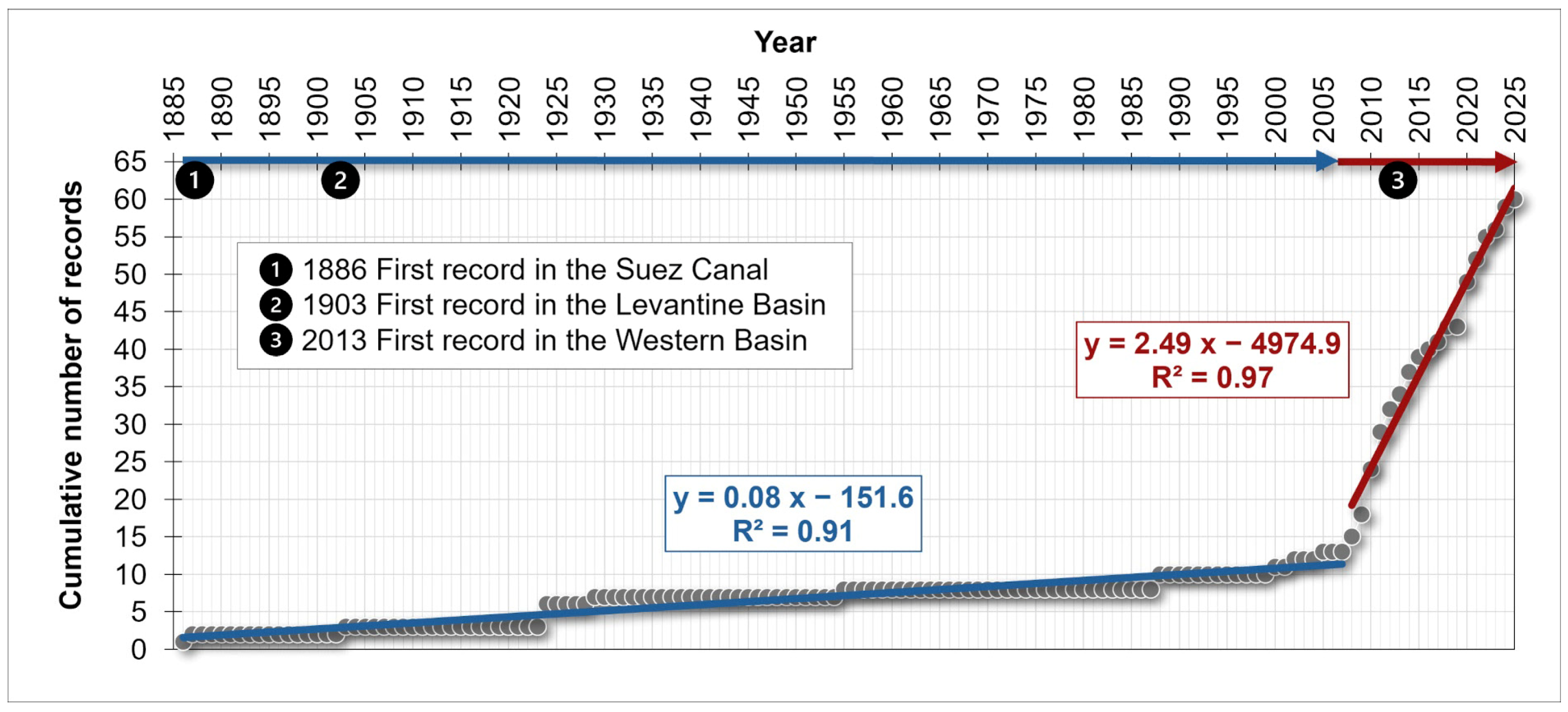
The rate of increase in occurrences over time of C. andromeda was identified through the analysis of the cumulative occurrence curve, which was divided into temporal intervals based on the most evident changes in slope, following the methodology of Perzia et al. [31]. For each interval, linear regression models were fitted using the least squares method, applied to the number of records per year. The values on the y-axis also represented the expansion areas of the species, measured as the cumulative number of 0.05° grid cells where the species was present [32].
To characterize the spatial distribution of C. andromeda in the Mediterranean Sea, both qualitative and quantitative analyses were carried out using the Spatial Analysis and Spatial Statistics toolboxes in ArcMap.
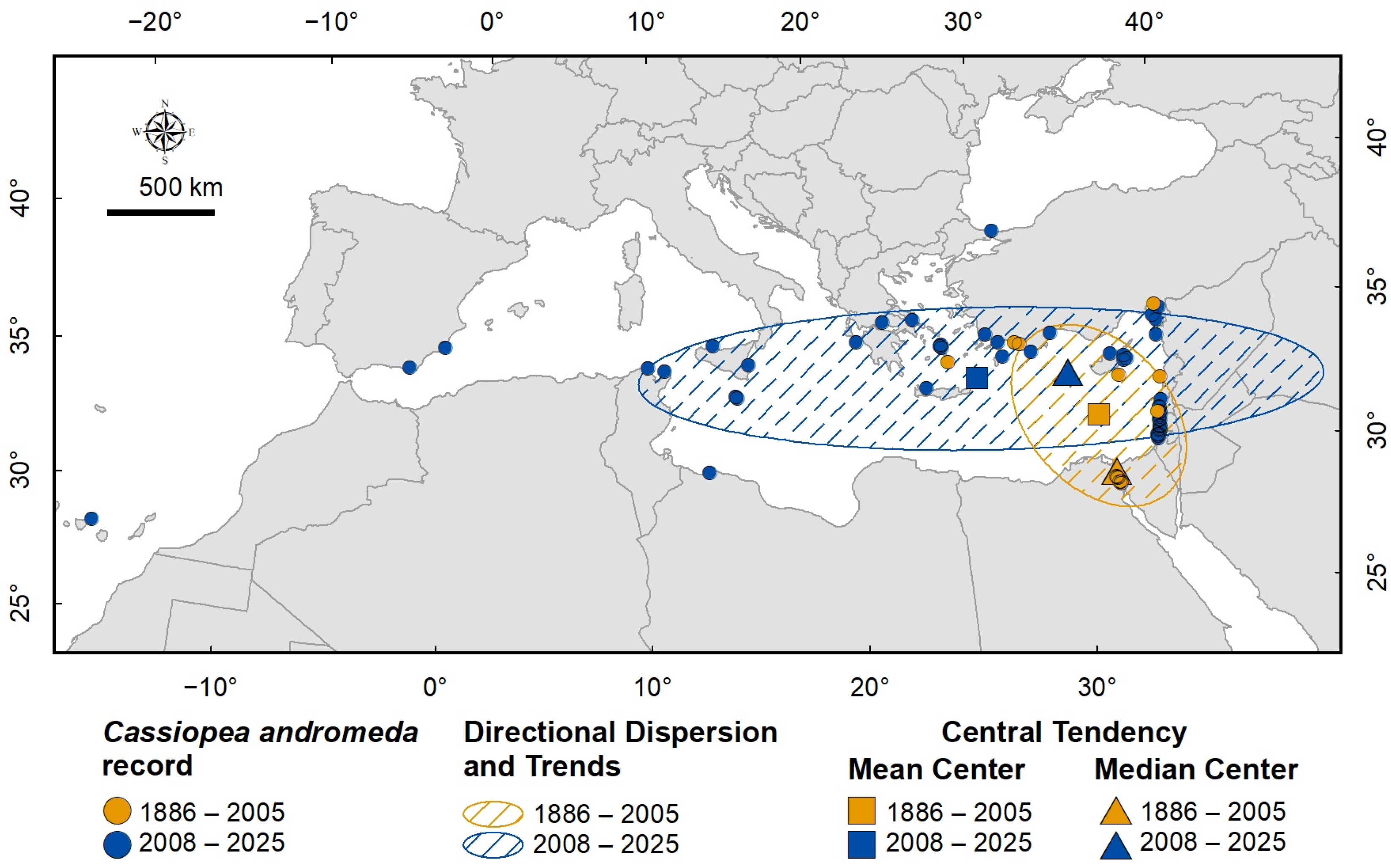
Key spatial distribution characteristics were calculated for each period, including central tendency, directional dispersion, and directional trends [27,31,33], to assess the spatiotemporal evolution of the species’ distribution.
Key spatial distribution characteristics describe how the species’ occurrences are arranged in space during each period: (i) central tendency—refers to the mean and median center of records distribution, indicating the central point around which the occurrences are distributed; (ii) directional dispersion along the east–west axis (XStdDist) and along the north–south axis (YStdDist)– measures how widely the records are spread around this center, providing an idea of the range or spatial variability; (iii) directional trends—identifies the main direction of the species’ expansion or movement over time, highlighting patterns in its spatial spread.
These indicators allowed tracking shifts in the center of gravity of distribution, measuring the extent of spread (i.e., the area or distance over which these species have dispersed from their initial introduction sites), and identifying dominant expansion directions (i.e., the main pathways or geographic directions along which the species spreads) [34,35,36]. Changes in the overall shape of the distribution (e.g., compact, dispersed, or elongated) were also examined to detect spatial patterns of expansion or contraction over time.
The Incremental Spatial Autocorrelation (ISA) tool, based on Global Moran’s I (GMI), was used to detect and quantify clustering or dispersion patterns over increasing distances, showing whether observations tend to occur close together or spread out. Statistically significant peaks in z-scores indicated the distances at which these spatial patterns were strongest [37,38]. The first peak was then used to determine the distance threshold for kernel density estimation (search radius), which highlights areas of high species concentration. The same peak was also used for hotspot/outlier detection (distance band), which identifies areas with unusually high or low occurrences, following the methodology described in Castriota et al. [32].
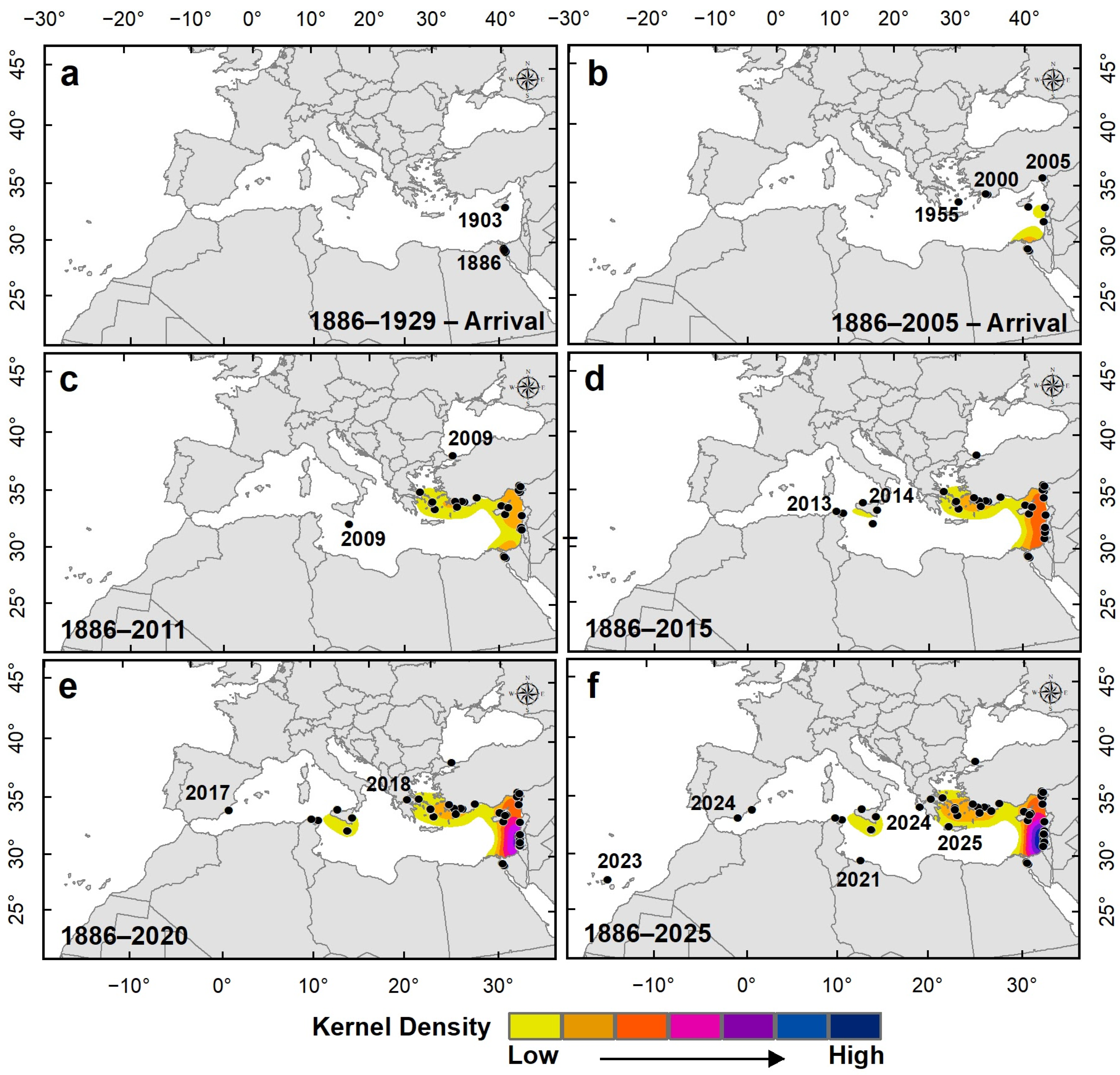
Cumulative kernel density analyses [39] were implemented for each invasion phase to: (i) create qualitative maps of occurrences density, (ii) compare density surfaces across time intervals, and (iii) identify expansion areas and zones of persistent high-density presence [27,31,33]. This approach is useful for highlighting areas with high concentrations of points (hot spots) and for identifying locations that have been repeatedly occupied or sampled, revealing persistent or long-term presence.
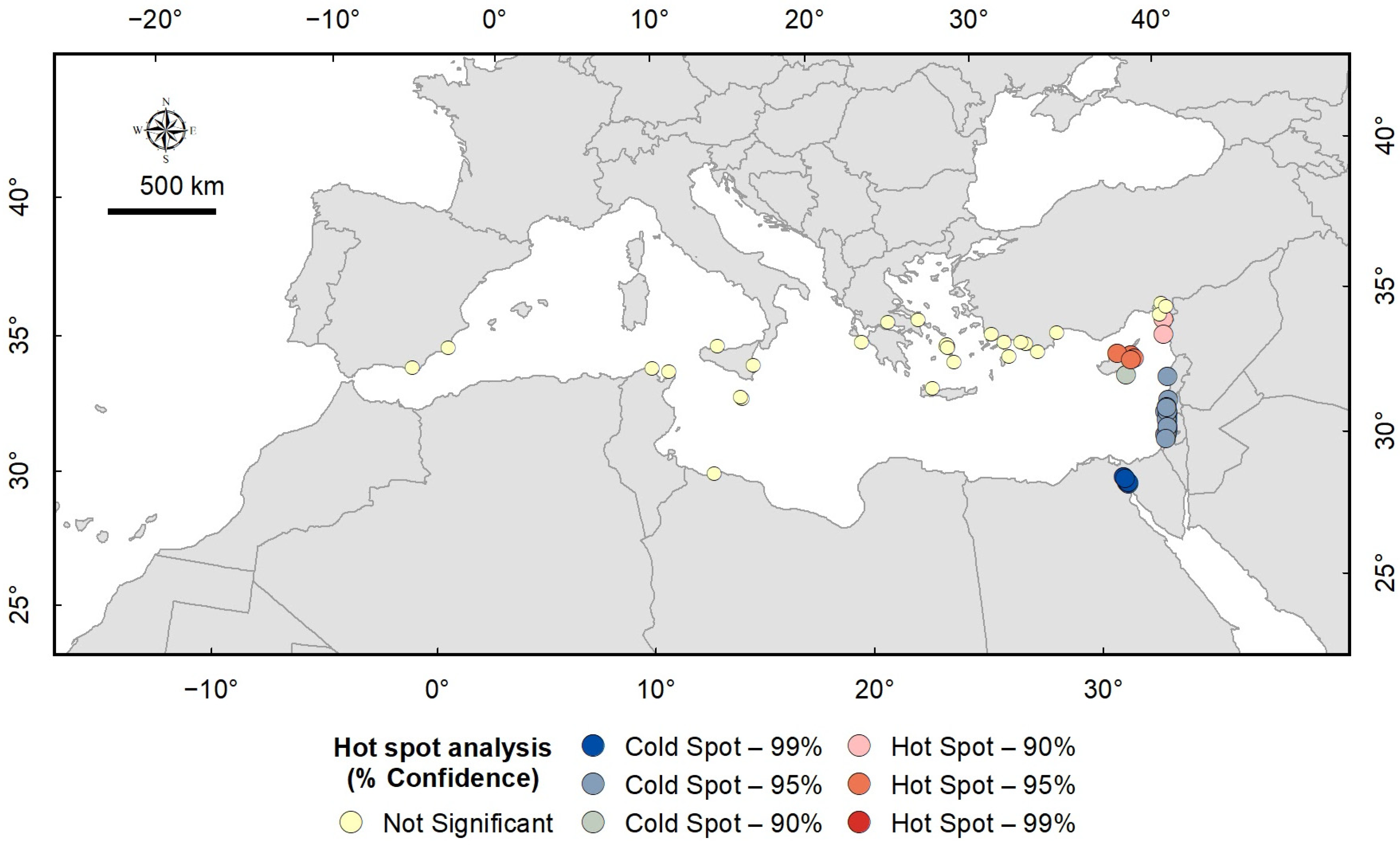
Two complementary local indicators of spatial association were also applied: the Getis–Ord Gi* (GOG*) statistic [40], and Anselin Local Moran’s I (AMI) [41]. The GOG* was used to detect statistically significant clusters of high (hotspots) and low (coldspots) values, to identify areas of species spatial concentrations and reveal both the initial and current directions of spread, as well as areas of dispersal and settlement [27,31,33]. The AMI was applied to assess the degree of spatial association between each observation and its neighbors, distinguishing clusters of similar values (High–High, Low–Low) from spatial outliers (High–Low, Low–High). Together, these analyses help identify key areas of invasion and local spatial patterns that are not evident from global metrics.
Table 1 summarizes the analytical tools, spatial and temporal scales, and ecological significance of the spatiotemporal indicators used in this study.

2.2. Positive and Negative Impacts of Cassiopea andromeda and Application of the 8Rs Framework

A peer-reviewed journal investigation on biological invasions was also carried out to retrieve studies on the ecological impacts of Cassiopea andromeda. The potential impacts of C. andromeda on marine ecosystem services and biodiversity were qualitatively assessed following the framework proposed by Katsanevakis et al. [42]. Marine and coastal ecosystem services were classified in the following categories: (i) Provisioning services (e.g., food provision, biotic materials and biofuels); (ii) Regulating and maintenance services (e.g., water purification and coastal protection); (iii) Cultural services (e.g., symbolic and esthetic values, recreation and tourism). Each identified interaction was scored based on the type of impact: potential negative or positive effect, no or uncertain effect. The information on species impacts was classified according to the type of supporting evidence [42]. For each evidence source, the geographical context of documentation was also indicated (i.e., in the Mediterranean Sea or in other areas).
Table 2 outlines the structure of the 8Rs framework, highlighting the aim of each component in relation to the management of non-indigenous species (NIS).
The strategies and actions of C. andromeda management measures were categorized as Implemented, Feasible, Challenging, or Not Applicable, based on their current implementation status and/or level of their applicability in the Mediterranean Sea:
  • Implemented Actions—Actions currently in place or successfully integrated within existing management frameworks.
  • Feasible Actions—Actions identified as technically and operationally achievable but not yet implemented.
  • Challenging Actions—Actions recognized as necessary but difficult to implement due to technical, logistical, or socio-economic constraints.
  • Not Applicable Actions—Actions considered irrelevant or unsuitable under current environmental or management conditions.

3. Results

3.1. Cassiopea andromeda Distribution, Aggregation Patterns, and Spatial Structure in the Mediterranean Sea

A total of 76 occurrences of Cassiopea andromeda were documented along the coasts of the Mediterranean Sea, within the Suez Canal, in the Black Sea, and on the Canary Islands (Eastern Atlantic Ocean). After data selection, the final dataset used for analysis consisted of 60 records. Figure 1 provides an overview of the species’ distribution across the Mediterranean, marking the earliest detection at the Suez Canal in 1886, the first presence in the Mediterranean Levantine Basin in 1903 (Cyprus), and the first one in the Mediterranean Western Basin in 2013 (Tunisia).
Figure 2 illustrates the cumulative increase in records over time, expressed as the number of grid cells affected by species’ occurrence. The curve shows two distinct slopes, corresponding to different rates of the invasion steps: the arrival phase (1886–2007), and an establishment/expansion step (2008–2025). The graph also includes the regression lines and their respective R2 values. The positive change in slope indicates an increasing rate of occurrences and a progressive expansion in the number of occupied grid cells over time. The cumulative curve displayed a prolonged plateau of approximately 121 years (arrival phase), during which only 13 records were documented (slope = 0.081 ± 0.002). In contrast, during the last seventeen years the invasion of C. andromeda exhibited an acceleration (slope = 2.49 ± 0.10).
Figure 3 presents the outcomes of the density hotspot analysis, highlighting spatial and temporal shifts in occurrence patterns, with a high-density cluster detected in the Levantine Basin (blue in Figure 3f). During the initial invasion phase (1886–2005; Figure 3a,b), only a few records were reported, restricted to the Suez Canal and scattered sites within the Levantine Basin. This was followed by an establishment/expansion stage of about 19 years, during which the species progressively colonized the Turkish coasts and the Aegean Sea (Figure 3c–f). In 2009, the species reached both the Black Sea and Malta (Figure 3c). Further records include its presence in Tunisia (2013) and Sicily (2014) (Figure 3d), along the Spanish coasts in 2017 (Figure 3e), in Libyan waters in 2021, and in the Canary Islands (Eastern Atlantic Ocean) in 2023, with the most recent observation from Crete in 2025 (Figure 3f). The increasing number of records in the Levantine Basin gave rise to an aggregation nucleus, which became particularly evident after 2011 and eventually consolidated into a persistent hotspot (Figure 3d–f).
Figure 4 summarizes the key distribution characteristics of C. andromeda distribution in the Mediterranean for two-time intervals (1886–2005, and 2008–2025). The metrics include the central tendency of distribution (mean center and median center), directional dispersion, and prevailing directional trends.
The analysis of key characteristics of distribution indicates significant changes in the spatial distribution of C. andromeda between the two examined periods. During the arrival phase (1886–2005), the mean center was in the central Levantine Basin, while the median center was positioned in the Suez Canal. The directional trend extended from the Suez Canal toward the Turkish coast, generating an ellipse of moderate elongation, suggestive of a limited and weakly directionally focused spread. In the second period (2008–2025), the central tendencies of distribution shifted northwestward, toward the central part of the Levantine Mediterranean region (mean center) and the Aegean Sea (median center). During this phase, the dispersion pattern changed markedly in both shape and orientation compared to the earlier period. Directional dispersion along the east–west axis increased markedly from 471 km to 1567 km, whereas dispersion along the north–south axis remained unchanged (325 km in the first period and 326 km in the second). The directional trend of species dispersion decreased from 141° to 92°, indicating a reorientation of the expansion axis from a southeast–northwest direction toward a more strictly east–west.
At the global scale, the ISA analysis identified a statistically significant peak at 525 km, representing the distance at which the spatial structure of the data was strongest (i.e., the degree of clustering of the records was statistically significant). Consistently, the Global Moran’s Index confirmed a low but significant clustering of species occurrences (expected GMI = −0.02; observed GMI = 0.12; z > 1.96; p < 0.05), showing that the distribution deviates from randomness and tends to form spatially aggregated patterns, although the resulting aggregations are weak.
At the local scale, the hot spot GOG* analysis (Figure 5) revealed a highly significant cold spot along the Suez Canal (99%), marking the initial direction of spread, and also along the Levantine coast (95%), in line with the early pathways of the species’ expansion. In contrast, significant hot spots (95% and 90%) were detected along the coasts of Cyprus and Syria. No statistically significant clustering was observed in the Aegean Sea or the Central Mediterranean Sea, and no spatial outliers, either high or low, were detected.

3.2. Impacts on Ecosystem Services and Biodiversity, and 8Rs Strategies for Cassiopea andromeda

The review of C. andromeda’s contribution to ecosystem services in the Mediterranean Sea showed that available studies are generally limited. Manipulative experiments evidenced a positive role in providing biotic material for non-food applications, such as biochemical compounds for pharmaceutical or cosmetic use, and in regulating service of water purification and ocean nourishment from regions outside the Mediterranean. C. andromeda may offer cultural and cognitive benefits, as the species may hold esthetic value in public awareness contexts and is used in research and educational settings. However, these contributions are not supported by quantitative assessments.
With regard to biodiversity, natural experiments and direct observations highlighted mainly positive impacts on single species. In contrast, at least in the Atlantic Ocean, key species and multiple species seem to be negatively affected by the presence of Cassiopea (Table 3).
All the results discussed are summarized in Table 3 including the references.
The application of the 8Rs framework highlights marked differences in the level of implementation and feasibility of management actions for C. andromeda. Actions under Recognize are the most advanced, with targeted monitoring programs and citizen-science-based early warning systems already adopted in several Mediterranean regions. In contrast, reduce measures—such as improving ballast water management or regulating aquaculture vectors—remain challenging, mainly due to the complexity and transboundary nature of introduction pathways. While reducing artificial habitats and structural barriers that promote the settlement and proliferation of polyps of Cassiopea andromeda (Replace) remains challenging—particularly in highly urbanized coastal areas—the biotechnological valorization of its biomass for nutraceutical, pharmaceutical, or biodegradable material production (Recycle) is considered feasible and represents a promising complementary pathway for management and resource recovery. Reuse action such as the educational or decorative use of C. andromeda in public aquaria and marine science centers is already implemented, whereas its application as a bioindicator is considered feasible. In contrast, actions under Recover/Restore remain challenging. Implementing restoration strategies in seagrass meadows and coral reef habitats, as well as assessing the species’ ecological impacts across multiple species and key functional groups, requires substantial ecological understanding, long-term monitoring, and resource-intensive interventions (Table 4).
Table 4 reports the potential management actions applicable to C. andromeda, categorized according to their current level of feasibility and implementation and related references.

4. Discussion

The invasion of Cassiopea andromeda in the Mediterranean Sea progressed from initial arrival to successful establishment, showing a limited expansion trend overall.
At the beginning of the invasion process, the species remained confined to scattered localities near its entry point, the Suez Canal, with no apparent ability to spread beyond the Levantine Basin. This is evidenced by the over a century-old plateau of the cumulative occurrence curve, characterized by very few records and extremely low density during the arrival phase. This lag time, typical of biological invasions, is generally explained as the period required for a species to reach a population density sufficient to ensure successful establishment and subsequent spread [61]. In the case of C. andromeda, its limited dispersal is largely due to its presence in confined habitats such as salt marshes, canals, bays, and harbors. Anthropogenic factors—particularly maritime traffic—may accelerate dispersion, by transferring larval stages with ballast water or as biofouling. This mechanism likely explains the considerable distances between Mediterranean records.
The shift from localized presence to successful establishment and further colonization of new localities occurred from 2008 onwards, when the cumulative curve steepened and occurrences increased, a pattern observed in other marine invaders such as the crabs Portunus segnis and Callinectes sapidus, and the mollusk Bursatella leachii [27,32,33]. However, unlike these species, C. andromeda exhibits a more uneven distribution, remaining primarily localized in the southernmost Mediterranean Sea. The northernmost record is from the Gulf of Korinthiakos, Greece (38.44° N), where the species arrived in 2018, although a record off the Istanbul Strait [62] suggests that a broader distribution is possible. Rising seawater temperatures have likely played a key role in shaping its distribution, as tropical and subtropical jellyfish benefit from warming trends in the Mediterranean Sea [22,63].
Kernel density and spatial autocorrelation analyses confirm that the Levantine Basin represents the invasion core, acting both as an initial hub and a persistent hotspot of distribution. The persistence of this nucleus, reinforced by new records, indicates that the eastern Mediterranean Sea continues to function as the primary source area for dispersal. Key characteristics of distribution reveal notable changes in the trajectory of spread during the most recent phase: initially modest and oriented from the Suez Canal toward Turkish coasts, dispersal later shifted along an east–west gradient, with substantial increases in spatial dispersion across the basin. This change reflects more effective longitudinal dispersal, consistent with the westward invasion trajectory observed in other Lessepsian species and even in non-Lessepsian introductions such as the Atlantic Enchelycore anatina [31]. Analyses at both global and local spatial scales support a non-random, aggregated distribution, with statistically significant hotspots indicative of both initial and ongoing spread. The Cyprus and Syria hotspots highlight their role as stepping-stones in the invasion process. Geographic spread toward the Aegean Sea, Central Mediterranean area, and Western Basin indicates enhanced dispersal capacity. However, the absence of significant clustering in these regions suggests colonization remains at an earlier stage. Records from Malta, Italy, Libya, and Spain confirm that the species is no longer confined to the Levantine Basin but has become a pan-Mediterranean concern with potential connectivity to the Atlantic. The occurrence of the species in the Canary Islands in 2023 may reflect dispersal from the Mediterranean Sea, although anthropogenic introduction from other seas cannot be excluded.
C. andromeda now poses ecological and management challenges at the basin-wide scale, reinforcing the need for coordinated monitoring and mitigation measures.

4.1. Ecological Functions, Potential Benefits, and Bioindicator Role

Jellyfish blooms are exhibiting a rising temporal frequency, with events now occurring persistently across all seasons [26,64,65]. Blooms of jellyfish impact on fisheries, tourism, industry and aquaculture [26,66,67,68,69,70,71,72,73,74]. In the Mediterranean, blooms or established populations of C. andromeda have been reported in Türkiye [74], northern Tunisia [75], Malta [17], Sicily [15,76] and Spain [60], but no impact assessment has been carried out. Therefore, in the Mediterranean Sea, the evaluation of this species’ ecological role remains largely theoretical. The only case studies suggesting ecological impacts come from the Atlantic Ocean, where researchers hypothesize competition between C. andromeda and seagrass for light and resources, with jellyfish potentially exerting a shading effect [56,58]. Spatial competition with sessile or low-mobility animals cannot be excluded, and interference with foraging behavior has been documented [55,56]. Additionally, nematocyst accumulation and cassiosome release in the water column may cause stings or mortality in fish and other marine organisms [56,57].
C. andromeda is not solely a harmful species; it plays several roles contributing within the marine trophic networks to ocean nourishment and water purification and serving as a source of biotic material and biofuels and as bioindicator. Besides its well-known endosymbiosis with dinoflagellates, it hosts a remarkable diversity of bacterial species and establishes commensal interactions with crustaceans and mollusks. It acts as both prey and predator for several marine organisms [21].
C. andromeda also plays a role in water mixing, a crucial process in marine habitats, that regulates processes such as nutrient transport and redistribution. In shallow coastal ecosystems, mixing is driven by wind and tidal currents, whereas sheltered environments experience reduced turbulence and limited vertical mixing [48]. Literature indicates that it contributes to water mixing by releasing interstitial (pore) water from sediments into the overlying water column, reintroducing nutrients such as ammonium and phosphates. Sediment beneath the medusae exhibits higher ammonium regeneration rates than adjacent bare areas [21,48,49,53,54]. As a result, the jellyfish is described as a “benthic–pelagic pump” in shallow-water habitats because it generates upward water currents, enhances near-bottom mixing, and can stimulate sediment oxygenation and biogeochemical cycling [47,48,49].
C. andromeda is a source of collagen [46], and multiple bioactive and antioxidants compounds [16,44,45,46], highlighting its potential for biotechnological applications.
It is also a potential bioindicator for assessing pollution, owing to its rapid physiological responses to elevated concentrations of metals and nutrients. Trace metals such as lithium, copper, manganese, and zinc have been detected in its tissues at concentrations up to 200-fold higher than those measured in the surrounding waters, indicating its effectiveness in reflecting the ecological status and contaminant load of its habitat [52]. Moreover, tolerance studies involving herbicides such as hexazinone and atrazine have underscored its applicability as a model organism for ecotoxicological research [50,51].

4.2. Limitations and Considerations

Despite these positive aspects, several limitations must be considered:
  • “Ocean nourishment” refers to large-scale processes that increase nutrient availability and stimulate biological productivity across broad areas. In contrast, most studies on C. andromeda have focused on shallow, low-energy coastal habitats characterized by calm waters and soft sediments, then its impact is mainly local, occurring within patches or aggregations of medusae.
  • Many effects of the jellyfish activity depend on season or environmental conditions; for example, the bell pulsation rate, which drives porewater release, varies with temperature and affects the rate of nutrient flux from sediment to water.
  • Nutrient releases into the environment do not always lead to increased organic production. In some cases, it may cause local eutrophication or ecosystem imbalance. Many studies often fail to distinguish between nutrients supporting primary production (e.g., phytoplankton growth) and those remaining in the benthic compartment or rapidly reabsorbed into the sediment.

4.3. Management Actions

Early detection and monitoring (Recognize) are critical first steps for effective management of emerging populations. Monitoring efforts should focus on high-risk areas such as bays, harbor areas, salt marshes and canals, where the upside-down jellyfish tends to establish itself. Cassiopea species are morphologically distinctive and relatively easy to detect, enabling the use of citizen science tools such as mobile apps and participatory monitoring [77]. Initiatives like the “Occhio alla Medusa: Jellywatch campaign” can play a pivotal role by providing georeferenced photographic records that complement scientific surveys [24,26]. These observations can integrate systematic surveys conducted under the Marine Strategy Framework Directive (MSFD; Directive 2008/56/EC) [78].
Although C. andromeda primarily entered the Mediterranean through the Suez Canal [79], additional introductions or spread may occur via maritime traffic or aquaculture activities [10]. The aquarium trade of unregulated live rock represents a confirmed translocation pathway for Cassiopea polyps, enabling their unintended introductions [80]. To minimize new introductions and local spread, proactive measures are essential. Preventive actions such as improved ballast water management, biofouling prevention, and aquaculture screening can “reduce” further dispersal [81,82]. Additionally, clear guidelines and safety regulations should be established to ensure safe handling, processing, and commercialization of jellyfish-derived products, including food traceability standards (Regulate).
Sensitive coastal areas should be prioritized for intervention. While eradication of jellyfish is unrealistic, targeted “removal” during bloom events—particularly in confined areas —can reduce local impacts and enable biomass reuse. Controlled removal, however, remains uncommon due to logistical challenges and regulatory constraints related to collection of organisms and biomass disposal. These operations require permits, institutional support, and clear protocols, which often redirect management efforts toward indirect strategies such as monitoring population dynamics, promoting early-warning systems, and engaging local stakeholders (e.g., fishers and citizens) in awareness and reporting initiatives. The feasibility of removal increases substantially when it is supported by an existing supply chain for jellyfish biomass use (Reuse).
Species-level replacement (e.g., biological control) is not applicable in this case but replacing artificial substrates that facilitate polyp settlement is a valid—though challenging—preventive measure (Replace). Bio-based antifouling coatings on port infrastructure represent a promising strategy and should be further explored and promoted, as proposed in EU-funded projects like BYEFOULING [83].
Biomass recycling offers an opportunity to transform a potential problem into an economic resource, in line with circular economy principles [29]. Experimental studies (e.g., Leone et al. [84]) have evaluated the nutritional and bioactive properties of Mediterranean jellyfish, highlighting their potential as novel food resources. C. andromeda contains bioactive compounds, including collagen and mucopolysaccharides, which can be extracted for applications in pharmaceutical, nutraceutical, and cosmetic sectors [45] (Recycle). Feasible uses also include educational and decorative applications in public aquaria and marine research centers (Reuse).
Recovery efforts should combine habitat restoration with measures that reduce environmental conditions favorable to C. andromeda. Key challenges include improving wastewater treatment and reducing nutrient inputs, enhancing water circulation in semi-enclosed basins to prevent stagnation, and restoring seagrass meadows to preserve native biodiversity, stabilize sediments, and improve water clarity.

5. Conclusions

The distribution of Cassiopea andromeda in the Mediterranean Sea follows a recognizable dispersion pathway. The persistence of a core hotspot in the Levantine Basin, followed by subsequent expansion along an east–west axis, indicates that the invasion is ongoing and requires structured, long-term monitoring.
Evidence of impacts on ecosystem services and biodiversity in the Mediterranean Sea remains limited and context-dependent, with effects ranging from localized benefits to potential negative interactions with key species.
The management framework of C. andromeda underscores the need for enhanced surveillance, targeted control of human-related vectors, and integrated research to assess ecological impacts. Early detection, supported by citizen science, is essential for identifying emerging populations. The valorization of jellyfish biomass as a resource offers opportunities aligned with circular economy principles, with potential applications in cosmetics and biotechnology, provided that appropriate safety and regulatory frameworks are established. In this context, the 8Rs model can evolve from a conceptual framework into a practical governance tool for Mediterranean coastal systems.

Supplementary Materials

The following supporting information can be downloaded at: https://www.mdpi.com/article/10.3390/oceans7020027/s1, Figure S1: Adult specimen of Cassiopea andromeda jellyfish from Palermo Cala Harbour (Italy). Photograph by Luca Castriota.

Author Contributions

Conceptualization, P.P.; methodology, P.P.; validation, P.P., S.Z. and L.C.; formal Analysis, P.P.; investigation, P.P., S.Z. and L.C.; data curation, P.P., S.Z. and L.C.; writing—original draft preparation, P.P., S.Z., T.M. and L.C.; writing—review & editing, P.P., S.Z., T.M., M.F. and L.C.; visualization, P.P.; supervision, L.C. All authors have read and agreed to the published version of the manuscript.

Funding

This research received no external funding.

Data Availability Statement

The original contributions presented in this study are included in the article and the Supplementary Material. Further inquiries can be directed to the corresponding author.

Conflicts of Interest

The authors declare no conflicts of interest.

References

  1. Roy, H.E.; Bacher, S.; Essl, F.; Adriaens, T.; Aldridge, D.C.; Bishop, J.D.; Blackburn, T.M.; Branquart, E.; Brodie, J.; Carboneras, C.; et al. Developing a list of invasive alien species likely to threaten biodiversity and ecosystems in the European Union. Glob. Change Biol. 2019, 25, 1032–1048. [Google Scholar] [CrossRef]
  2. Pyšek, P.; Hulme, P.E.; Simberloff, D.; Bacher, S.; Blackburn, T.M.; Carlton, J.T.; Dawson, W.; Essl, F.; Foxcroft, L.C.; Genovesi, P.; et al. Scientists’ warning on invasive alien species. Biol. Rev. 2020, 95, 1511–1534. [Google Scholar] [CrossRef]
  3. Badreddine, A.; Bitar, G. Cotylorhiza erythraea Stiasny, 1920 (Scyphozoa: Rhizostomeae: Cepheidae): A new Lessepsian jellyfish in Lebanese waters, the eastern Mediterranean Sea. J. Black Sea/Mediterr. Environ. 2020, 26, 321–328. [Google Scholar]
  4. Ramos-Perez, P.; Quispe-Becerra, J.I.; Oliver, J.A.; Marcos, C.; Perez-Ruzafa, A.; Fernandez-Alias, A. Colonization of the Mediterranean Sea by the Lessepsian invasive jellyfish Cassiopea andromeda—A systematic review. Mediterr. Mar. Sci. 2025, 26, 714–730. [Google Scholar] [CrossRef]
  5. Mergner, H.; Svoboda, A.H.W.M. Productivity and seasonal changes in selected reef areas in the Gulf of Aqaba (Red Sea). Helgoländer Wiss. Meeresunters. 1977, 30, 383–399. [Google Scholar] [CrossRef]
  6. Niggl, W.; Wild, C. Spatial distribution of the upside-down jellyfish Cassiopea sp. within fringing coral reef environments of the Northern Red Sea. Helgol. Mar. Res. 2010, 64, 281–287. [Google Scholar] [CrossRef]
  7. Maas, O. Die Scyphomedusen der Siboga Expedition; Biodiversity Heritage Library: Washington, DC, USA, 1903; Volume 11, pp. 1–91. [Google Scholar]
  8. Rubio, M. Una Medusa Tropical, Nueva Amenaza Para la Biodiversidad del Mar Menor. El Click Verde. 2017. Available online: https://elclickverde.com/reportajes/una-medusa-tropical-nueva-amenaza-para-la-biodiversidad-del-mar-menor (accessed on 30 November 2025).
  9. Morandini, A.C.; Stampar, S.N.; Maronna, M.M.; da Silveira, F.L. All non-indigenous species were introduced recently? The case study of Cassiopea in Brazilian waters. J. Mar. Biol. Assoc. U. K. 2017, 97, 321–328. [Google Scholar] [CrossRef]
  10. Thé, J.; de Sousa Barroso, H.; Mammone, M.; Viana, M.; Melo, C.S.B.; Mies, M.; de Oliveira Soares, M. Aquaculture facilities promote population stability and increased medusae size of the invasive jellyfish Cassiopea andromeda. Mar. Environ. Res. 2020, 162, 105161. [Google Scholar] [CrossRef]
  11. Gueroun, S.K.; Moura, C.J.; Almansa, E.; Escánez, A. Cassiopea andromeda in the subtropical eastern Atlantic. J. Mar. Biol. Assoc. U. K. 2024, 104, e92. [Google Scholar] [CrossRef]
  12. Galil, B.S.; Spanier, E.; Ferguson, W.W. The Scyphomedusae of the Mediterranean coast of Israel. Zool. Meded. 1990, 64, 95–105. [Google Scholar]
  13. Schembri, P.J.; Deidun, A.; Vella, P.J. First record of Cassiopea andromeda in the central Mediterranean Sea. Mar. Biodivers. Rec. 2010, 3, e6. [Google Scholar] [CrossRef]
  14. Cillari, T.; Andaloro, F.; Castriota, L. First documented record of Cassiopea cf. andromeda in Italian waters. Cah. Biol. Mar. 2018, 59, 193–195. [Google Scholar]
  15. Cillari, T.; Allegra, A.; Berto, D.; Bosch-Belmar, M.; Falautano, M.; Maggio, T.; Milisenda, G.; Perzia, P.; Rampazzo, F.; Sinopoli, M.; et al. Snapshot of the distribution and biology of alien jellyfish Cassiopea andromeda in a Mediterranean tourist harbour. Biology 2022, 11, 319. [Google Scholar] [CrossRef]
  16. De Rinaldis, G.; Leone, A.; De Domenico, S.; Bosch-Belmar, M.; Slizyte, R.; Milisenda, G.; Santucci, A.; Albano, C.; Piraino, S. Biochemical characterization of Cassiopea andromeda. Mar. Drugs 2021, 19, 498. [Google Scholar] [CrossRef]
  17. Deidun, A.; Gauci, A.; Sciberras, A.; Piraino, S. Back with a bang—Massive bloom of Cassiopea andromeda (Forsskal, 1775) in Maltese Islands, nine years after its first appearance. Bioinvasions Rec. 2018, 7, 399–404. [Google Scholar] [CrossRef]
  18. Çevik, C.; Erkol, I.L.; Toklu, B. A new record of Cassiopea andromeda from Turkey. Aquat. Invasions 2006, 1, 196–197. [Google Scholar] [CrossRef]
  19. Welsh, D.T.; Dunn, R.J.; Meziane, T. Oxygen and nutrient dynamics of the upside-down jellyfish. Hydrobiologia 2009, 635, 351–362. [Google Scholar] [CrossRef]
  20. Mammone, M.; Bosch-Belmar, M.; Milisenda, G.; Castriota, L.; Sinopoli, M.; Allegra, A.; Falautano, M.; Maggio, T.; Rossi, S.; Piraino, S. Reproductive cycle of Cassiopea andromeda in NW Sicily. PLoS ONE 2023, 18, e0281787. [Google Scholar] [CrossRef]
  21. Morejón-Arrojo, R.D.; Mammone, M.; López-Figueroa, N.B.; Stoner, E.W.; Rodríguez-Viera, L. Life upside-down: Ecological roles of Cassiopea. Discov. Ecol. 2025, 1, 7. [Google Scholar] [CrossRef]
  22. Fumarola, L.M.; Leoni, V.; Marchessaux, G.; Sarà, G.; Piraino, S.; Bosch-Belmar, M. Global warming and the spread of Cassiopea andromeda. Glob. Change Biol. 2025, 31, e70548. [Google Scholar] [CrossRef]
  23. Ling, M.K.; Yap, N.W.L.; Huang, D. Temperature does not affect nematocyst size in Cassiopea. J. Exp. Mar. Biol. Ecol. 2025, 592, 152126. [Google Scholar] [CrossRef]
  24. Boero, F.; Piraino, S.; Zampardi, S. Jellyfish Sightings Along the Italian Coastline (2009–2017); Marine Data Archive: Oostende, Belgium, 2019. [Google Scholar] [CrossRef]
  25. Maggio, T.; Perzia, P.; Falautano, M.; Visconti, G.; Castriota, L. From LEK to LAB: Portunus segnis in the Pelagie Islands MPA. Ocean Coast. Manag. 2022, 219, 106043. [Google Scholar] [CrossRef]
  26. Zampardi, S.; Licandro, P.; Milisenda, G.; Scannella, D.; Piraino, S.; Boero, F. Citizen science substantiates jellyfish occurrence. Sci. Rep. 2025, 15, 21641. [Google Scholar] [CrossRef]
  27. Castriota, L.; Falautano, M.; Maggio, T.; Perzia, P. The blue swimming crab Portunus segnis in the Mediterranean Sea. Biology 2022, 11, 1473. [Google Scholar] [CrossRef] [PubMed]
  28. Perzia, P.; Cillari, T.; Crociata, G.; Deidun, A.; Falautano, M.; Franzitta, G.; Galdies, J.; Maggio, T.; Vivona, P.; Castriota, L. Using LEK to search for non-native species in Natura 2000 sites. Biology 2023, 12, 1158. [Google Scholar] [CrossRef]
  29. Rotter, A.; Klun, K.; Francé, J.; Mozetič, P.; Orlando-Bonaca, M. Non-indigenous species in the Mediterranean Sea: The 8Rs model. Front. Mar. Sci. 2020, 7, 178. [Google Scholar] [CrossRef]
  30. Lipej, L.; Mavrič, B.; Paliska, D. Northernmost record of Sphoeroides pachygaster. Ann. Ser. Hist. Nat. 2013, 23, 103–114. [Google Scholar]
  31. Perzia, P.; Spinelli, A.; Interdonato, F.; Castriota, L. Ecological indicators for Enchelycore anatina distribution. Trans. GIS 2022, 26, 2802–2817. [Google Scholar] [CrossRef]
  32. Castriota, L.; Falautano, M.; Maggio, T.; Perzia, P. Spread and spatial dynamics of Bursatella leachii in the Mediterranean Sea. Biology 2025, 14, 133. [Google Scholar] [CrossRef]
  33. Castriota, L.; Falautano, M.; Perzia, P. When nature requires a resource to be used—The case of Callinectes sapidus. Biology 2024, 13, 279. [Google Scholar] [CrossRef] [PubMed]
  34. ESRI. Directional Distribution (Standard Deviational Ellipse). Available online: https://pro.arcgis.com/en/pro-app/latest/tool-reference/spatial-statistics/directional-distribution.htm (accessed on 30 November 2025).
  35. ESRI. Median Center. Available online: https://pro.arcgis.com/en/pro-app/latest/tool-reference/spatial-statistics/median-center.htm (accessed on 30 November 2025).
  36. ESRI. Mean Center. Available online: https://pro.arcgis.com/en/pro-app/latest/tool-reference/spatial-statistics/mean-center.htm (accessed on 30 November 2025).
  37. ESRI. Incremental Spatial Autocorrelation. Available online: https://pro.arcgis.com/en/pro-app/latest/tool-reference/spatial-statistics/incremental-spatial-autocorrelation.htm (accessed on 30 November 2025).
  38. ESRI. Spatial Autocorrelation (Global Moran’s I). Available online: https://pro.arcgis.com/en/pro-app/latest/tool-reference/spatial-statistics/spatial-autocorrelation.htm (accessed on 30 November 2025).
  39. ESRI. Kernel Density Analysis. Available online: https://pro.arcgis.com/en/pro-app/latest/tool-reference/spatial-analyst/kernel-density.htm (accessed on 30 November 2025).
  40. ESRI. Hot Spot Analysis (Getis–Ord Gi*). Available online: https://pro.arcgis.com/en/pro-app/latest/tool-reference/spatial-statistics/hot-spot-analysis.htm (accessed on 30 November 2025).
  41. ESRI. Cluster and Outlier Analysis (Anselin Local Moran’s I). Available online: https://pro.arcgis.com/en/pro-app/latest/tool-reference/spatial-statistics/cluster-and-outlier-analysis-anselin-local-moran-s.htm (accessed on 30 November 2025).
  42. Katsanevakis, S.; Wallentinus, I.; Zenetos, A.; Leppäkoski, E.; Çinar, M.E.; Oztürk, B.; Grabowski, M.; Golani, G.; Cardoso, A.C. Impacts of invasive alien marine species on ecosystem services and biodiversity: A pan-European review. Aquat. Invasions 2014, 9, 391–423. [Google Scholar] [CrossRef]
  43. ISO 3166-1:2020; Codes for the Representation of Names of Countries and Their Subdivisions—Part 1: Country Code. International Organization for Standardization: Geneva, Switzerland, 2020.
  44. De Domenico, S.; De Rinaldis, G.; Mammone, M.; Bosch-Belmar, M.; Piraino, S.; Leone, A. The zooxanthellate jellyfish holobiont Cassiopea andromeda, a source of soluble bioactive compounds. Mar. Drugs 2023, 21, 272. [Google Scholar] [CrossRef]
  45. De Domenico, S.; Toso, A.; De Rinaldis, G.; Mammone, M.; Fumarola, L.M.; Piraino, S.; Leone, A. Wild or Reared? Cassiopea andromeda Jellyfish as a Potential Biofactory. Mar. Drugs 2025, 23, 19. [Google Scholar] [CrossRef]
  46. Ballesteros, A.; Torres, R.; Pascual-Torner, M.; Revert-Ros, F.; Tena-Medialdea, J.; García-March, J.R.; Gili, J.M. Jellyfish Collagen in the Mediterranean Spotlight: Transforming Challenges into Opportunities. Mar. Drugs 2025, 23, 200. [Google Scholar] [CrossRef]
  47. Zarnoch, C.B.; Hossain, N.; Fusco, E.; Alldred, M.; Hoellein, T.J.; Perdikaris, S. Size and density of upside-down jellyfish, Cassiopea sp., and their impact on benthic fluxes in a Caribbean lagoon. Mar. Environ. Res. 2020, 154, 104845. [Google Scholar] [CrossRef]
  48. Durieux, D.M.; Du Clos, K.T.; Lewis, D.B.; Gemmell, B.J. Benthic jellyfish dominate water mixing in mangrove ecosystems. Proc. Natl. Acad. Sci. USA 2021, 118, e2025715118. [Google Scholar] [CrossRef] [PubMed]
  49. Durieux, D.M.; Scrogham, G.D.; Fender, C.; Lewis, D.B.; Deban, S.M.; Gemmell, B.J. Benthic jellyfish act as suction pumps to facilitate release of interstitial porewater. Sci. Rep. 2023, 13, 3770. [Google Scholar] [CrossRef] [PubMed]
  50. Klein, S.G.; Pitt, K.A.; Carroll, A.R. Reduced salinity increases susceptibility of zooxanthellate jellyfish to herbicide toxicity during a simulated rainfall event. Environ. Pollut. 2016, 209, 79–86. [Google Scholar] [CrossRef] [PubMed]
  51. McKenzie, M.R.; Templeman, M.A.; Kingsford, M.J. Detecting effects of herbicide runoff: The use of Cassiopea maremetens as a biomonitor to hexazinone. Aquat. Toxicol. 2020, 221, 105442. [Google Scholar] [CrossRef]
  52. Templeman, M.A.; Williams, C.D. Jellyfish: A Window into Pesticide Distribution and Risks on the Great Barrier Reef. In Oceanographic Processes of Coral Reefs; CRC Press: Boca Raton, FL, USA, 2024; pp. 151–164. [Google Scholar]
  53. Stoner, E.W.; Archer, S.K.; Layman, C.A. Increased nutrient availability correlates with increased growth of the benthic jellyfish Cassiopea spp. Food Webs 2022, 31, e00231. [Google Scholar] [CrossRef]
  54. Thé, J.; Mammone, M.; Piraino, S.; Pennetta, A.; De Benedetto, G.E.; Garcia, T.M.; Rossi, S. Understanding Cassiopea andromeda (Scyphozoa) invasiveness in different habitats: A multiple biomarker comparison. Water 2023, 15, 2599. [Google Scholar] [CrossRef]
  55. Stoner, E.W.; Layman, C.A.; Yeager, L.A.; Hassett, H.M. Effects of anthropogenic disturbance on the abundance and size of epibenthic jellyfish Cassiopea spp. Mar. Pollut. Bull. 2011, 62, 1109–1114. [Google Scholar] [CrossRef]
  56. Stoner, E.W.; Yeager, L.A.; Sweatman, J.L.; Sebilian, S.S.; Layman, C.A. Modification of a seagrass community by benthic jellyfish blooms and nutrient enrichment. J. Exp. Mar. Biol. Ecol. 2014, 461, 185–192. [Google Scholar] [CrossRef]
  57. Ames, C.L.; Klompen, A.M.; Badhiwala, K.; Muffett, K.; Reft, A.J.; Kumar, M.; Vora, G.J. Cassiosomes are stinging-cell structures in the mucus of the upside-down jellyfish Cassiopea xamachana. Commun. Biol. 2020, 3, 67. [Google Scholar] [CrossRef]
  58. Morejón-Arrojo, R.D.; Rodriguez-Viera, L. Characterization of the populations of upside-down jellyfish in Jardines de la Reina National Park, Cuba. PeerJ 2023, 11, e15254. [Google Scholar] [CrossRef]
  59. Edelist, D.; Canepa-Oneto, A.; Azzopardi, J.; Ballesteros, A.; Bellido, J.; Boero, F.; Angel, D.L. Citizen science-based jellyfish observation initiatives in the Mediterranean Sea. Hydrobiologia 2025, 852, 5313–5332. [Google Scholar] [CrossRef]
  60. Marambio, M.; Pascual-Torner, M.; Tilves, U.; Pérez, A.; Ballesteros, A.; Gili, J.M. The Westernmost Record of the Scyphomedusa Cassiopea andromeda in the Mediterranean: Marine Citizen Science Contributions. Environ. Manag. 2025, 75, 3721–3735. [Google Scholar] [CrossRef]
  61. Crooks, J.A. Lag times and exotic species: The ecology and management of biological invasions in slow-motion. Écoscience 2005, 12, 316–329. [Google Scholar] [CrossRef]
  62. Öztürk, B. Status of Alien Species in the Black and Mediterranean Seas; General Fisheries Commission for the Mediterranean—GFCM: Rome, Italy, 2010; Volume 87. [Google Scholar]
  63. Boero, F.; Bouillon, J.; Gravili, C.; Miglietta, M.P.; Parsons, T.; Piraino, S. Gelatinous plankton: Irregularities rule the world (sometimes). Mar. Ecol. Prog. Ser. 2009, 356, 299–310. [Google Scholar] [CrossRef]
  64. Marambio, M.; Canepa, A.; Lòpez, L.; Gauci, A.A.; Gueroun, S.K.; Zampardi, S.; Deidun, A. Unfolding jellyfish bloom dynamics along the Mediterranean basin by transnational citizen science initiatives. Diversity 2021, 13, 274. [Google Scholar] [CrossRef]
  65. Reyes Suárez, N.C.; Tirelli, V.; Ursella, L.; Ličer, M.; Celio, M.; Cardin, V. Multi-platform study of the extreme bloom of the barrel jellyfish Rhizostoma pulmo in the Gulf of Trieste. Ocean Sci. 2022, 18, 1321–1337. [Google Scholar] [CrossRef]
  66. Purcell, J.E.; Uye, S.I.; Lo, W.T. Anthropogenic causes of jellyfish blooms and their direct consequences for humans: A review. Mar. Ecol. Prog. Ser. 2007, 350, 153–174. [Google Scholar] [CrossRef]
  67. Doyle, T.K.; De Haas, H.; Cotton, D.; Dorschel, B.; Cummins, V.; Houghton, J.D.; Hays, G.C. Widespread occurrence of the jellyfish Pelagia noctiluca in Irish coastal and shelf waters. J. Plankton Res. 2008, 30, 963–968. [Google Scholar] [CrossRef]
  68. Baxter, E.J.; Albinyana, G.; Girons, A.; Isern, M.M.; García, A.B.; Lopez, M.; Fuentes, V. Jellyfish-inflicted gill damage in marine-farmed fish: An emerging problem for the Mediterranean. In XIII Congreso Nacional de Acuicultura; FOESA: Barcelona, Spain, 2011. [Google Scholar]
  69. Canepa, A.; Fuentes, V.L.; Sabatés, A.; Piraino, S.; Boero, F.; Gili, J.M.; Purcell, J.E. Pelagia noctiluca in the Mediterranean Sea. Mar. Biol. 2014, 161, 981–1000. [Google Scholar] [CrossRef]
  70. De Donno, A.; Idolo, A.; Bagordo, F.; Grassi, T.; Leomanni, A.; Serio, F.; Piraino, S. Impact of stinging jellyfish proliferations along south Italian coasts: Human health hazards, treatment and social costs. Int. J. Environ. Res. Public Health 2014, 11, 2488–2503. [Google Scholar] [CrossRef]
  71. Purcell, J.E.; Milisenda, G.; Rizzo, A.; Carrion, S.A.; Zampardi, S.; Airoldi, S.; Piraino, S. Digestion and predation rates of zooplankton by the hydrozoan Velella velella and widespread blooms in 2013–2014. J. Plankton Res. 2015, 37, 1056–1067. [Google Scholar] [CrossRef]
  72. Marcos-López, M.; Mitchell, S.O.; Rodger, H.D. Pathology and mortality associated with the mauve stinger Pelagia noctiluca in farmed Atlantic salmon. J. Fish Dis. 2016, 39, 111–115. [Google Scholar] [CrossRef]
  73. Bosch-Belmar, M.; Milisenda, G.; Basso, L.; Doyle, T.K.; Leone, A.; Piraino, S. Jellyfish impacts on marine aquaculture and fisheries. Rev. Fish. Sci. Aquac. 2021, 29, 242–259. [Google Scholar] [CrossRef]
  74. Özgür, E.; Öztürk, B. A population of the alien jellyfish, Cassiopea andromeda, in the Ölüdeniz Lagoon (Turkey). Aquat. Invasions 2008, 3, 423–428. [Google Scholar] [CrossRef]
  75. Amor, K.O.B.; Rifi, M.; Ghanem, R.; Draeif, I.; Zaouali, J.; Souissi, J.B. Update of alien fauna and new records from Tunisian marine waters. Mediterr. Mar. Sci. 2016, 17, 124–143. [Google Scholar] [CrossRef]
  76. Maggio, T.; Allegra, A.; Bosch-Belmar, M.; Cillari, T.; Cuttitta, A.; Falautano, M.; Milisenda, G.; Nicosia, A.; Perzia, P.; Sinopoli, M.; et al. Molecular identity of the non-indigenous Cassiopea sp. from Palermo Harbour. J. Mar. Biol. Assoc. U. K. 2019, 99, 1765–1773. [Google Scholar] [CrossRef]
  77. Giovos, I.; Kleitou, P.; Poursanidis, D.; Batjakas, I.; Bernardi, G.; Crocetta, F.; Doumpas, N.; Kalogirou, S.; Kampouris, T.E.; Keramidas, I.; et al. Citizen-Science for Monitoring Marine Invasions and Stimulating Public Engagement: A Case Project from the Eastern Mediterranean. Biol. Invasions 2019, 21, 3707–3721. [Google Scholar] [CrossRef]
  78. Tsiamis, K.; Palialexis, A.; Stefanova, K.; Gladan, Ž.N.; Skejić, S.; Despalatović, M.; Cvitković, I.; Dragičević, B.; Dulčić, J.; Vidjak, O.; et al. Non-Indigenous Species Refined National Baseline Inventories: A Synthesis in the Context of the European Union’s Marine Strategy Framework Directive. Mar. Pollut. Bull. 2019, 145, 429–435. [Google Scholar] [CrossRef]
  79. Galil, B.S.; Boero, F.; Campbell, M.L.; Carlton, J.T.; Cook, E.; Fraschetti, S.; Ojaveer, H. Double trouble: The expansion of the Suez Canal and marine bioinvasions. Biol. Invasions 2017, 17, 973–976. [Google Scholar] [CrossRef]
  80. Bolton, T.F.; Graham, W.M. Jellyfish on the rocks: Bioinvasion threat of the aquarium live rock trade. Biol. Invasions 2006, 8, 651–653. [Google Scholar] [CrossRef]
  81. International Maritime Organization (IMO). International Convention for the Control and Management of Ships’ Ballast Water and Sediments; IMO: London, UK, 2004. [Google Scholar]
  82. Katsanevakis, S.; Zenetos, A.; Belchior, C.; Cardoso, A.C. Invading European Seas: Assessing pathways of introduction of marine aliens. Ocean Coast. Manag. 2013, 76, 64–74. [Google Scholar] [CrossRef]
  83. Shiganova, T.A.; Legendre, L.; Kazmin, A.S.; Nival, P. Interactions between invasive ctenophores in the Black Sea. Mar. Ecol. Prog. Ser. 2014, 507, 111–123. [Google Scholar] [CrossRef]
  84. Leone, A.; Lecci, R.M.; Milisenda, G.; Piraino, S. Mediterranean jellyfish as novel food: Effects of thermal processing on antioxidant, phenolic and protein contents. Eur. Food Res. Technol. 2019, 245, 1611–1627. [Google Scholar] [CrossRef]
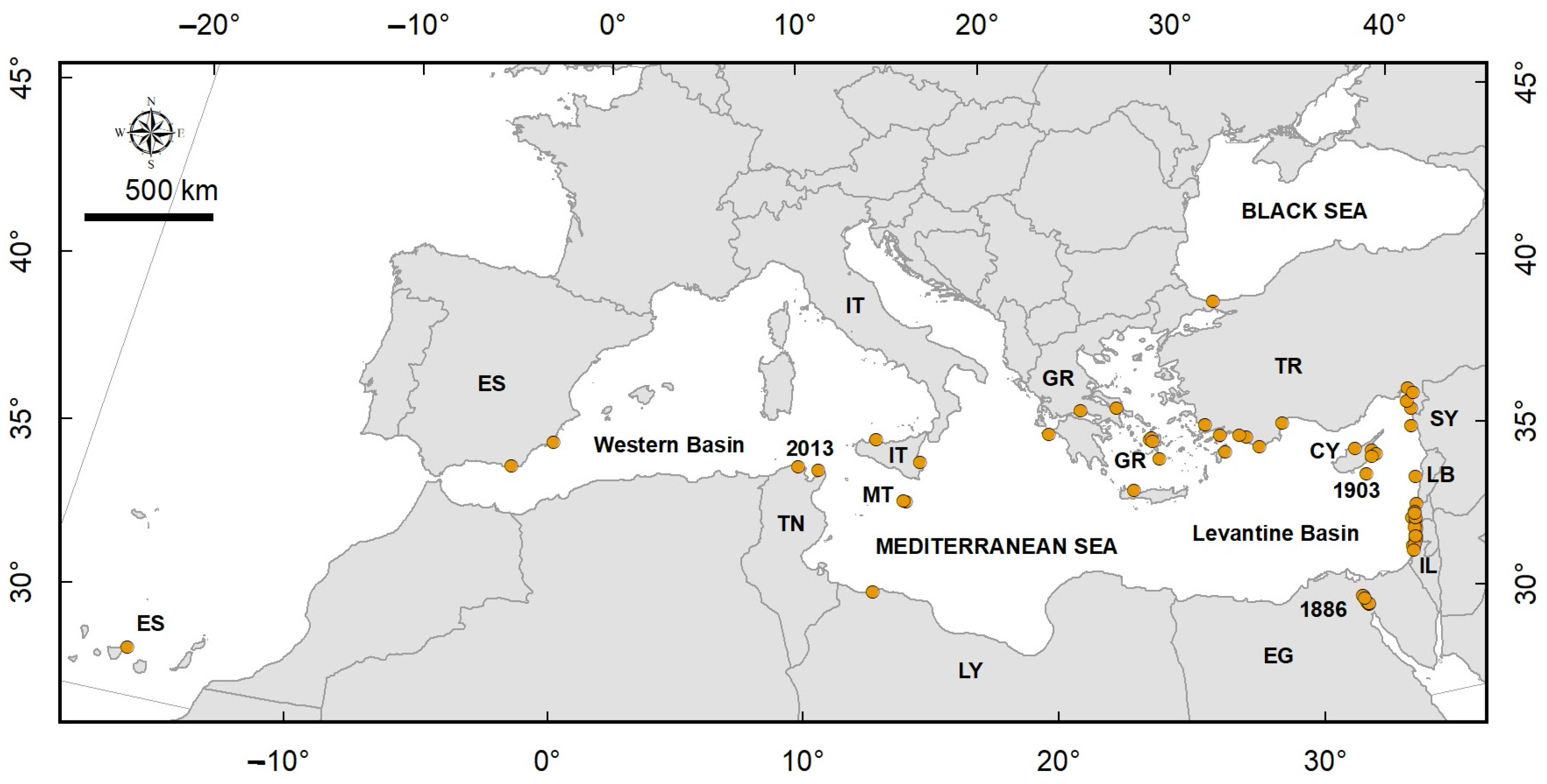
Figure 1. Overall distribution of Cassiopea andromeda in the Mediterranean Sea (yellow circles). The first record in the Suez Canal (1886), in the Mediterranean Levantine Basin (1903), and in the Mediterranean Western Basin (2013) are also indicated. ISO 3166 Country Codes [43] were used to indicate the countries in which C. andromeda occurs.
Oceans 07 00027 g001
Figure 2. Cumulative curve of C. andromeda occurrences in the Mediterranean Sea (circles), highlighting two invasion phases (blue arrow: 1886–2007; red arrow: 1967–2000) and their respective regression lines. The year of the first record in the Suez Canal (1886), Levantine Basin (1903), and Western Basin (2013) are also shown. The cumulative number of records matches the cumulative number of occupied grid cells.
Oceans 07 00027 g002
Figure 3. Cumulative spatio-temporal variation in C. andromeda occurrences in the Mediterranean Sea with kernel density maps. (a,b) 1886–1929 and 1886–2005: arrival phase of the species. (c) 1886–2011, (d) 1886–2015, (e) 1886–2020, (f) 1886–2025: subsequent establishment/expansion stage. Black circles represent occurrence records.
Oceans 07 00027 g003
Figure 4. Directional dispersion, directional trends, and central tendency (as mean and median center) of C. andromeda distribution in the Mediterranean Sea, for the periods 1886–2005 and 2008–2025. Yellow and blue circles represent occurrence records corresponding to the two periods.
Oceans 07 00027 g004
Figure 5. Results of the hot spot analysis (Getis–Ord Gi*) on records of C. andromeda in the Mediterranean Sea. Areas with statistically significant spatial clustering (cold spot—blue gradient circles; hot spot—red gradient circles) were mapped. Yellow circles indicate records with non-significant index values.
Oceans 07 00027 g005
Table 1. Analyses, spatial and temporal indicators, ecological interpretation, methods, and scales (modified from Perzia et al. [31]). For the analyses, only first records per 0.05° lat/long grid cell were considered.
Analysis/
Indicator Name
ToolsSpatial
Scale
Time
Scale
Ecological
Meaning
Temporal and spatial–temporal pattern
Occurrence
Increase rate
Evaluation of the slopes of the cumulative occurrence curve using the least squares methodGlobal1886–2007
2008–2025
Identification of the invasion dynamics; rate of specimen increases across space and time
Density hotspotsKernel density
Distance radius = 525 km
Global1886–1929
1886–2005
1886–2011
1886–2015
1886–2020
1886–2025
Expansion areas.
Nuclei of record aggregation; occurrence of persistent areas; space–time occurrence density increase; highest density areas
Key characteristics of distribution
Center of gravityCentral tendency
(mean and median center)
Global1886–2005
2008–2025
Species concentration center and its change over time
Directional
Dispersion
XStdDist, YStdDist; (km)
Standard deviational ellipse
(1 standard deviation)
GlobalSpecies distribution
in X and Y directions
Directional trendsRotation (°)
Standard deviational ellipse
(1 standard deviation)
GlobalDirectional trend of species dispersion
Aggregation patterns and spatial structure
Spatial autocorrelation for a series of increasing distancesIncremental spatial autocorrelation (ISA)
(based on Global Moran’s I)
Number of distance bands = 10
GlobalAll yearsThe distances where the clustering spatial processes are most pronounced.
Distribution pattern:
dispersion vs. random vs. clustering. Change in the spatial pattern over time
Statistically
significant hot spots and cold spots
Hot spot analysis
Getis–Ord Gi* (GOG*)
Distance band = 525 km
LocalAll yearsInitial and current direction of spread and identification of dispersion/settle areas
Spatial outliersOutlier analysis
Anselin local Moran’s I (AMI)
Distance band = 525 km
LocalAll yearsPresence of recent records within clusters of older records
(and vice versa)
Table 2. The 8Rs Model [29] with a summary of the eight complementary approaches and their main purposes.
MeasureRStrategies and ActionsPurpose
PreventionRecognizeEarly detection and monitoring of NIS distribution and abundance dynamics.Support timely response and informed management.
ReducePrevention of entry, spread minimization, and limitation of establishment.Contain invasions before they become widespread.
RegulatePolicy and legal measures supported by governance and long-term funding frameworks.Ensure long-term management and institutional support.
MitigationRemoveReduction in local densities, prevention of further expansion, eradication via control measures.Directly lower ecological and socio-economic impacts.
ReplaceSpecies or surface replacement with sustainable alternatives.Mitigate impacts by promoting less harmful practices.
RecycleValorize biomass as an economic resource through circular economy processes.Promote sustainability through resource recovery.
Recover/
Restore
Restoration of degraded ecosystem functions.Return invaded areas to their original ecological state.
ReuseUse of organisms for alternative purposes, including biomass valorization.Turn ecological problems into potential resources.
Table 3. Summary of the potential effects of C. andromeda on marine ecosystem services and biodiversity. Service classification based on Katsanevakis et al. [42]. Cell color code: green, potential positive effect; orange, potential negative effect; gray, no or uncertain effect. Type of evidence: M, manipulative experiments; N, natural experiments; O, direct observations; J, expert judgment. Documented: DM, in Mediterranean Sea; DO, in other areas.
Effect on
Ecosystem Services
Type of
Evidence
(Documented)
Mechanisms
Provisioning
Biotic materials and biofuelsM
(DM)
Provides biomass or biotic elements for non-food purposes, including medicinal [16,44,45,46].
Food provision
Water storage and provision
Regulating and maintenance
Water purificationM
(DO)
Enhances near-bottom mixing and stimulates sediment oxygenation and biogeochemical cycling [47,48,49]. It is a bioindicator for pollution for metal traces, herbicides and pesticides [50,51,52].
Ocean nourishmentM
(DO)
Releases interstitial (pore) water from sediments into the overlying water column, reintroducing nutrients [21,48,49,53,54].
Air quality regulation
Coastal protection
Climate regulation
Weather regulation
Lifecycle maintenance
Biological regulation
Cultural
Symbolic and esthetic valuesJ/OExaltation of senses and emotions by species.
Cognitive benefitsJ/O
(DM)
It is material for research and education; information and awareness [15].
Recreation and tourism
Effect on
biodiversity
Potential
contribution
(Documented)
Mechanisms
Single-species impactN/O
(DO)
Hosts a remarkable diversity of bacterial species; commensal interactions with crustaceans and mollusks; acts as both prey and predator for several marine organisms [21].
Multiple-species impactN/O
(DO)
Impacts on fish and other marine organisms through nematocysts stings or mortality; competes for space with sessile or low-mobility organisms [55,56,57].
Impact on keystones species or species of high conservation valueO
(DO)
Competes with jellyfish and seagrasses for light and resources [56,58]
Affects entire ecosystem processes/wider ecosystem functioning
Ecosystem engineer—creator of novel habitat
Table 4. Potential Application of the 8Rs Model [29] to Cassiopea andromeda invasion. Actions are classified by applicability as: Implemented (currently applied), Feasible (achievable but not yet applied), Challenging (difficult to implement), and Not Applicable (unsuitable under current conditions).
RStrategies and ActionsClassification
RecognizeApply targeted monitoring programs in bays, harbor areas, salt marshes and other eutrophicated confined environments or canals
Implement early warning systems through citizen science
to report jellyfish IAS
Implemented [4]
Implemented [26,59,60]
ReduceAdopt preventive measures to avoid further introductions, especially via improved ballast water management.
Control aquaculture practices and other potential vectors
in sensitive coastal areas
Challenging

Challenging
RegulateAdopt long term management measures with institutional supportNot Applicable
RemoveControl population by removing medusoid stages to contain spreadNot Applicable
ReplaceReduce artificial habitats and barriers for settlement and proliferationChallenging
RecycleUse in nutraceuticals, pharmaceuticals, or biodegradable materialsFeasible [45]
ReuseUse as educational or decorative in aquaria or marine science centers (i.e., Barcelona and Genoa Acquaria)
Use as bioindicator
Implemented (personal observation)
Feasible
Recover/
Restore
Apply restoration strategies in seagrass habitat and coral reef
Assess ecological impacts on multiple species and key species
Challenging
Challenging
Disclaimer/Publisher’s Note: The statements, opinions and data contained in all publications are solely those of the individual author(s) and contributor(s) and not of MDPI and/or the editor(s). MDPI and/or the editor(s) disclaim responsibility for any injury to people or property resulting from any ideas, methods, instructions or products referred to in the content.