
The Alien Jellyfish Cassiopea andromeda in the Mediterranean Sea: Invasion Dynamics and Management Strategies


Abstract
1. Introduction
2. Materials and Methods
2.1. Cassiopea andromeda Distribution, Aggregation Patterns, and Spatial Structure in the Mediterranean Sea
2.2. Positive and Negative Impacts of Cassiopea andromeda and Application of the 8Rs Framework
- Implemented Actions—Actions currently in place or successfully integrated within existing management frameworks.
- Feasible Actions—Actions identified as technically and operationally achievable but not yet implemented.
- Challenging Actions—Actions recognized as necessary but difficult to implement due to technical, logistical, or socio-economic constraints.
- Not Applicable Actions—Actions considered irrelevant or unsuitable under current environmental or management conditions.
3. Results
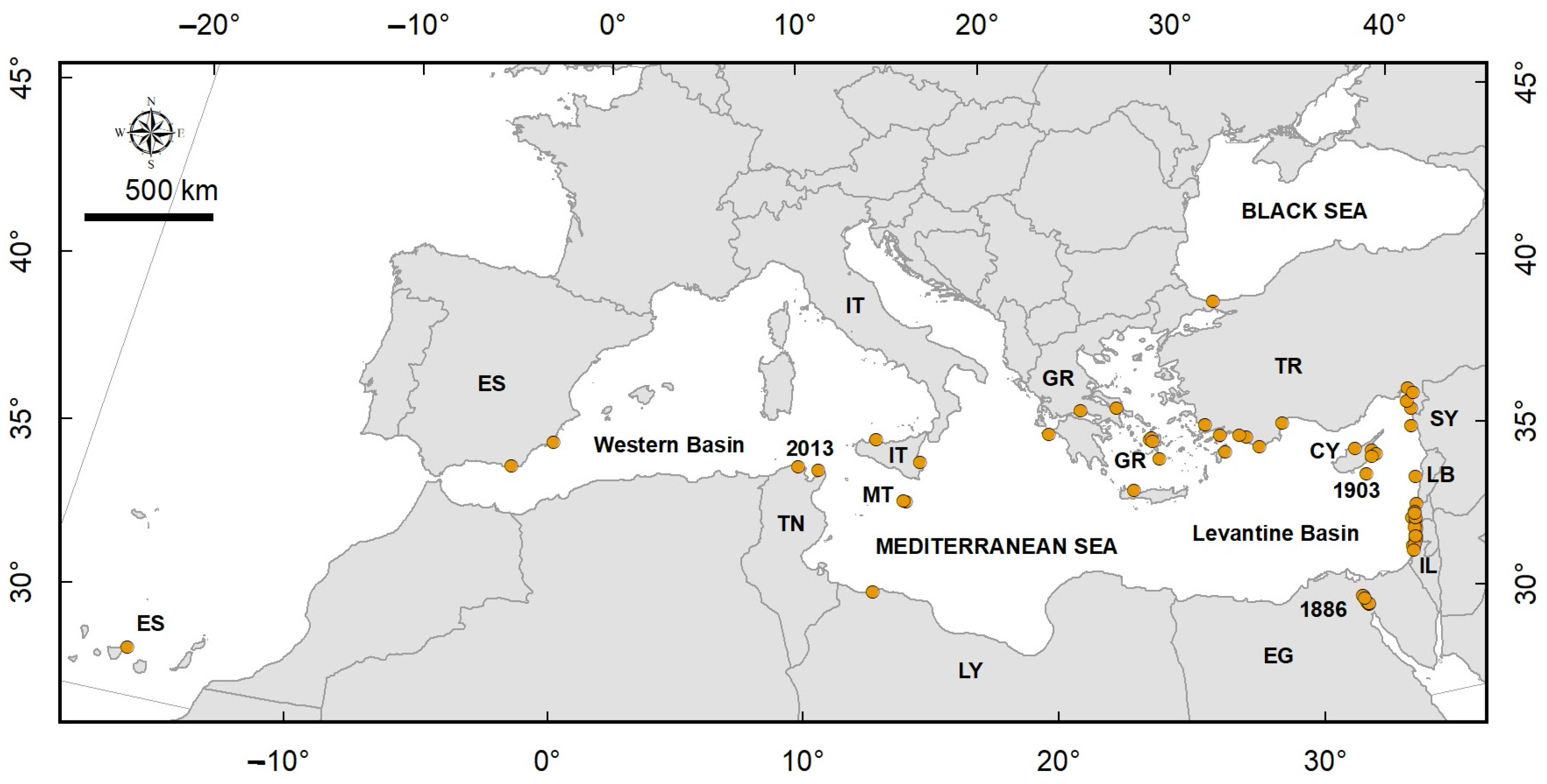
3.1. Cassiopea andromeda Distribution, Aggregation Patterns, and Spatial Structure in the Mediterranean Sea
3.2. Impacts on Ecosystem Services and Biodiversity, and 8Rs Strategies for Cassiopea andromeda
4. Discussion
4.1. Ecological Functions, Potential Benefits, and Bioindicator Role
4.2. Limitations and Considerations
- “Ocean nourishment” refers to large-scale processes that increase nutrient availability and stimulate biological productivity across broad areas. In contrast, most studies on C. andromeda have focused on shallow, low-energy coastal habitats characterized by calm waters and soft sediments, then its impact is mainly local, occurring within patches or aggregations of medusae.
- Many effects of the jellyfish activity depend on season or environmental conditions; for example, the bell pulsation rate, which drives porewater release, varies with temperature and affects the rate of nutrient flux from sediment to water.
- Nutrient releases into the environment do not always lead to increased organic production. In some cases, it may cause local eutrophication or ecosystem imbalance. Many studies often fail to distinguish between nutrients supporting primary production (e.g., phytoplankton growth) and those remaining in the benthic compartment or rapidly reabsorbed into the sediment.
4.3. Management Actions
5. Conclusions
Supplementary Materials
Author Contributions
Funding
Data Availability Statement
Conflicts of Interest
References
- Roy, H.E.; Bacher, S.; Essl, F.; Adriaens, T.; Aldridge, D.C.; Bishop, J.D.; Blackburn, T.M.; Branquart, E.; Brodie, J.; Carboneras, C.; et al. Developing a list of invasive alien species likely to threaten biodiversity and ecosystems in the European Union. Glob. Change Biol. 2019, 25, 1032–1048. [Google Scholar] [CrossRef]
- Pyšek, P.; Hulme, P.E.; Simberloff, D.; Bacher, S.; Blackburn, T.M.; Carlton, J.T.; Dawson, W.; Essl, F.; Foxcroft, L.C.; Genovesi, P.; et al. Scientists’ warning on invasive alien species. Biol. Rev. 2020, 95, 1511–1534. [Google Scholar] [CrossRef]
- Badreddine, A.; Bitar, G. Cotylorhiza erythraea Stiasny, 1920 (Scyphozoa: Rhizostomeae: Cepheidae): A new Lessepsian jellyfish in Lebanese waters, the eastern Mediterranean Sea. J. Black Sea/Mediterr. Environ. 2020, 26, 321–328. [Google Scholar]
- Ramos-Perez, P.; Quispe-Becerra, J.I.; Oliver, J.A.; Marcos, C.; Perez-Ruzafa, A.; Fernandez-Alias, A. Colonization of the Mediterranean Sea by the Lessepsian invasive jellyfish Cassiopea andromeda—A systematic review. Mediterr. Mar. Sci. 2025, 26, 714–730. [Google Scholar] [CrossRef]
- Mergner, H.; Svoboda, A.H.W.M. Productivity and seasonal changes in selected reef areas in the Gulf of Aqaba (Red Sea). Helgoländer Wiss. Meeresunters. 1977, 30, 383–399. [Google Scholar] [CrossRef]
- Niggl, W.; Wild, C. Spatial distribution of the upside-down jellyfish Cassiopea sp. within fringing coral reef environments of the Northern Red Sea. Helgol. Mar. Res. 2010, 64, 281–287. [Google Scholar] [CrossRef]
- Maas, O. Die Scyphomedusen der Siboga Expedition; Biodiversity Heritage Library: Washington, DC, USA, 1903; Volume 11, pp. 1–91. [Google Scholar]
- Rubio, M. Una Medusa Tropical, Nueva Amenaza Para la Biodiversidad del Mar Menor. El Click Verde. 2017. Available online: https://elclickverde.com/reportajes/una-medusa-tropical-nueva-amenaza-para-la-biodiversidad-del-mar-menor (accessed on 30 November 2025).
- Morandini, A.C.; Stampar, S.N.; Maronna, M.M.; da Silveira, F.L. All non-indigenous species were introduced recently? The case study of Cassiopea in Brazilian waters. J. Mar. Biol. Assoc. U. K. 2017, 97, 321–328. [Google Scholar] [CrossRef]
- Thé, J.; de Sousa Barroso, H.; Mammone, M.; Viana, M.; Melo, C.S.B.; Mies, M.; de Oliveira Soares, M. Aquaculture facilities promote population stability and increased medusae size of the invasive jellyfish Cassiopea andromeda. Mar. Environ. Res. 2020, 162, 105161. [Google Scholar] [CrossRef]
- Gueroun, S.K.; Moura, C.J.; Almansa, E.; Escánez, A. Cassiopea andromeda in the subtropical eastern Atlantic. J. Mar. Biol. Assoc. U. K. 2024, 104, e92. [Google Scholar] [CrossRef]
- Galil, B.S.; Spanier, E.; Ferguson, W.W. The Scyphomedusae of the Mediterranean coast of Israel. Zool. Meded. 1990, 64, 95–105. [Google Scholar]
- Schembri, P.J.; Deidun, A.; Vella, P.J. First record of Cassiopea andromeda in the central Mediterranean Sea. Mar. Biodivers. Rec. 2010, 3, e6. [Google Scholar] [CrossRef]
- Cillari, T.; Andaloro, F.; Castriota, L. First documented record of Cassiopea cf. andromeda in Italian waters. Cah. Biol. Mar. 2018, 59, 193–195. [Google Scholar]
- Cillari, T.; Allegra, A.; Berto, D.; Bosch-Belmar, M.; Falautano, M.; Maggio, T.; Milisenda, G.; Perzia, P.; Rampazzo, F.; Sinopoli, M.; et al. Snapshot of the distribution and biology of alien jellyfish Cassiopea andromeda in a Mediterranean tourist harbour. Biology 2022, 11, 319. [Google Scholar] [CrossRef]
- De Rinaldis, G.; Leone, A.; De Domenico, S.; Bosch-Belmar, M.; Slizyte, R.; Milisenda, G.; Santucci, A.; Albano, C.; Piraino, S. Biochemical characterization of Cassiopea andromeda. Mar. Drugs 2021, 19, 498. [Google Scholar] [CrossRef]
- Deidun, A.; Gauci, A.; Sciberras, A.; Piraino, S. Back with a bang—Massive bloom of Cassiopea andromeda (Forsskal, 1775) in Maltese Islands, nine years after its first appearance. Bioinvasions Rec. 2018, 7, 399–404. [Google Scholar] [CrossRef]
- Çevik, C.; Erkol, I.L.; Toklu, B. A new record of Cassiopea andromeda from Turkey. Aquat. Invasions 2006, 1, 196–197. [Google Scholar] [CrossRef]
- Welsh, D.T.; Dunn, R.J.; Meziane, T. Oxygen and nutrient dynamics of the upside-down jellyfish. Hydrobiologia 2009, 635, 351–362. [Google Scholar] [CrossRef]
- Mammone, M.; Bosch-Belmar, M.; Milisenda, G.; Castriota, L.; Sinopoli, M.; Allegra, A.; Falautano, M.; Maggio, T.; Rossi, S.; Piraino, S. Reproductive cycle of Cassiopea andromeda in NW Sicily. PLoS ONE 2023, 18, e0281787. [Google Scholar] [CrossRef]
- Morejón-Arrojo, R.D.; Mammone, M.; López-Figueroa, N.B.; Stoner, E.W.; Rodríguez-Viera, L. Life upside-down: Ecological roles of Cassiopea. Discov. Ecol. 2025, 1, 7. [Google Scholar] [CrossRef]
- Fumarola, L.M.; Leoni, V.; Marchessaux, G.; Sarà, G.; Piraino, S.; Bosch-Belmar, M. Global warming and the spread of Cassiopea andromeda. Glob. Change Biol. 2025, 31, e70548. [Google Scholar] [CrossRef]
- Ling, M.K.; Yap, N.W.L.; Huang, D. Temperature does not affect nematocyst size in Cassiopea. J. Exp. Mar. Biol. Ecol. 2025, 592, 152126. [Google Scholar] [CrossRef]
- Boero, F.; Piraino, S.; Zampardi, S. Jellyfish Sightings Along the Italian Coastline (2009–2017); Marine Data Archive: Oostende, Belgium, 2019. [Google Scholar] [CrossRef]
- Maggio, T.; Perzia, P.; Falautano, M.; Visconti, G.; Castriota, L. From LEK to LAB: Portunus segnis in the Pelagie Islands MPA. Ocean Coast. Manag. 2022, 219, 106043. [Google Scholar] [CrossRef]
- Zampardi, S.; Licandro, P.; Milisenda, G.; Scannella, D.; Piraino, S.; Boero, F. Citizen science substantiates jellyfish occurrence. Sci. Rep. 2025, 15, 21641. [Google Scholar] [CrossRef]
- Castriota, L.; Falautano, M.; Maggio, T.; Perzia, P. The blue swimming crab Portunus segnis in the Mediterranean Sea. Biology 2022, 11, 1473. [Google Scholar] [CrossRef] [PubMed]
- Perzia, P.; Cillari, T.; Crociata, G.; Deidun, A.; Falautano, M.; Franzitta, G.; Galdies, J.; Maggio, T.; Vivona, P.; Castriota, L. Using LEK to search for non-native species in Natura 2000 sites. Biology 2023, 12, 1158. [Google Scholar] [CrossRef]
- Rotter, A.; Klun, K.; Francé, J.; Mozetič, P.; Orlando-Bonaca, M. Non-indigenous species in the Mediterranean Sea: The 8Rs model. Front. Mar. Sci. 2020, 7, 178. [Google Scholar] [CrossRef]
- Lipej, L.; Mavrič, B.; Paliska, D. Northernmost record of Sphoeroides pachygaster. Ann. Ser. Hist. Nat. 2013, 23, 103–114. [Google Scholar]
- Perzia, P.; Spinelli, A.; Interdonato, F.; Castriota, L. Ecological indicators for Enchelycore anatina distribution. Trans. GIS 2022, 26, 2802–2817. [Google Scholar] [CrossRef]
- Castriota, L.; Falautano, M.; Maggio, T.; Perzia, P. Spread and spatial dynamics of Bursatella leachii in the Mediterranean Sea. Biology 2025, 14, 133. [Google Scholar] [CrossRef]
- Castriota, L.; Falautano, M.; Perzia, P. When nature requires a resource to be used—The case of Callinectes sapidus. Biology 2024, 13, 279. [Google Scholar] [CrossRef] [PubMed]
- ESRI. Directional Distribution (Standard Deviational Ellipse). Available online: https://pro.arcgis.com/en/pro-app/latest/tool-reference/spatial-statistics/directional-distribution.htm (accessed on 30 November 2025).
- ESRI. Median Center. Available online: https://pro.arcgis.com/en/pro-app/latest/tool-reference/spatial-statistics/median-center.htm (accessed on 30 November 2025).
- ESRI. Mean Center. Available online: https://pro.arcgis.com/en/pro-app/latest/tool-reference/spatial-statistics/mean-center.htm (accessed on 30 November 2025).
- ESRI. Incremental Spatial Autocorrelation. Available online: https://pro.arcgis.com/en/pro-app/latest/tool-reference/spatial-statistics/incremental-spatial-autocorrelation.htm (accessed on 30 November 2025).
- ESRI. Spatial Autocorrelation (Global Moran’s I). Available online: https://pro.arcgis.com/en/pro-app/latest/tool-reference/spatial-statistics/spatial-autocorrelation.htm (accessed on 30 November 2025).
- ESRI. Kernel Density Analysis. Available online: https://pro.arcgis.com/en/pro-app/latest/tool-reference/spatial-analyst/kernel-density.htm (accessed on 30 November 2025).
- ESRI. Hot Spot Analysis (Getis–Ord Gi*). Available online: https://pro.arcgis.com/en/pro-app/latest/tool-reference/spatial-statistics/hot-spot-analysis.htm (accessed on 30 November 2025).
- ESRI. Cluster and Outlier Analysis (Anselin Local Moran’s I). Available online: https://pro.arcgis.com/en/pro-app/latest/tool-reference/spatial-statistics/cluster-and-outlier-analysis-anselin-local-moran-s.htm (accessed on 30 November 2025).
- Katsanevakis, S.; Wallentinus, I.; Zenetos, A.; Leppäkoski, E.; Çinar, M.E.; Oztürk, B.; Grabowski, M.; Golani, G.; Cardoso, A.C. Impacts of invasive alien marine species on ecosystem services and biodiversity: A pan-European review. Aquat. Invasions 2014, 9, 391–423. [Google Scholar] [CrossRef]
- ISO 3166-1:2020; Codes for the Representation of Names of Countries and Their Subdivisions—Part 1: Country Code. International Organization for Standardization: Geneva, Switzerland, 2020.
- De Domenico, S.; De Rinaldis, G.; Mammone, M.; Bosch-Belmar, M.; Piraino, S.; Leone, A. The zooxanthellate jellyfish holobiont Cassiopea andromeda, a source of soluble bioactive compounds. Mar. Drugs 2023, 21, 272. [Google Scholar] [CrossRef]
- De Domenico, S.; Toso, A.; De Rinaldis, G.; Mammone, M.; Fumarola, L.M.; Piraino, S.; Leone, A. Wild or Reared? Cassiopea andromeda Jellyfish as a Potential Biofactory. Mar. Drugs 2025, 23, 19. [Google Scholar] [CrossRef]
- Ballesteros, A.; Torres, R.; Pascual-Torner, M.; Revert-Ros, F.; Tena-Medialdea, J.; García-March, J.R.; Gili, J.M. Jellyfish Collagen in the Mediterranean Spotlight: Transforming Challenges into Opportunities. Mar. Drugs 2025, 23, 200. [Google Scholar] [CrossRef]
- Zarnoch, C.B.; Hossain, N.; Fusco, E.; Alldred, M.; Hoellein, T.J.; Perdikaris, S. Size and density of upside-down jellyfish, Cassiopea sp., and their impact on benthic fluxes in a Caribbean lagoon. Mar. Environ. Res. 2020, 154, 104845. [Google Scholar] [CrossRef]
- Durieux, D.M.; Du Clos, K.T.; Lewis, D.B.; Gemmell, B.J. Benthic jellyfish dominate water mixing in mangrove ecosystems. Proc. Natl. Acad. Sci. USA 2021, 118, e2025715118. [Google Scholar] [CrossRef] [PubMed]
- Durieux, D.M.; Scrogham, G.D.; Fender, C.; Lewis, D.B.; Deban, S.M.; Gemmell, B.J. Benthic jellyfish act as suction pumps to facilitate release of interstitial porewater. Sci. Rep. 2023, 13, 3770. [Google Scholar] [CrossRef] [PubMed]
- Klein, S.G.; Pitt, K.A.; Carroll, A.R. Reduced salinity increases susceptibility of zooxanthellate jellyfish to herbicide toxicity during a simulated rainfall event. Environ. Pollut. 2016, 209, 79–86. [Google Scholar] [CrossRef] [PubMed]
- McKenzie, M.R.; Templeman, M.A.; Kingsford, M.J. Detecting effects of herbicide runoff: The use of Cassiopea maremetens as a biomonitor to hexazinone. Aquat. Toxicol. 2020, 221, 105442. [Google Scholar] [CrossRef]
- Templeman, M.A.; Williams, C.D. Jellyfish: A Window into Pesticide Distribution and Risks on the Great Barrier Reef. In Oceanographic Processes of Coral Reefs; CRC Press: Boca Raton, FL, USA, 2024; pp. 151–164. [Google Scholar]
- Stoner, E.W.; Archer, S.K.; Layman, C.A. Increased nutrient availability correlates with increased growth of the benthic jellyfish Cassiopea spp. Food Webs 2022, 31, e00231. [Google Scholar] [CrossRef]
- Thé, J.; Mammone, M.; Piraino, S.; Pennetta, A.; De Benedetto, G.E.; Garcia, T.M.; Rossi, S. Understanding Cassiopea andromeda (Scyphozoa) invasiveness in different habitats: A multiple biomarker comparison. Water 2023, 15, 2599. [Google Scholar] [CrossRef]
- Stoner, E.W.; Layman, C.A.; Yeager, L.A.; Hassett, H.M. Effects of anthropogenic disturbance on the abundance and size of epibenthic jellyfish Cassiopea spp. Mar. Pollut. Bull. 2011, 62, 1109–1114. [Google Scholar] [CrossRef]
- Stoner, E.W.; Yeager, L.A.; Sweatman, J.L.; Sebilian, S.S.; Layman, C.A. Modification of a seagrass community by benthic jellyfish blooms and nutrient enrichment. J. Exp. Mar. Biol. Ecol. 2014, 461, 185–192. [Google Scholar] [CrossRef]
- Ames, C.L.; Klompen, A.M.; Badhiwala, K.; Muffett, K.; Reft, A.J.; Kumar, M.; Vora, G.J. Cassiosomes are stinging-cell structures in the mucus of the upside-down jellyfish Cassiopea xamachana. Commun. Biol. 2020, 3, 67. [Google Scholar] [CrossRef]
- Morejón-Arrojo, R.D.; Rodriguez-Viera, L. Characterization of the populations of upside-down jellyfish in Jardines de la Reina National Park, Cuba. PeerJ 2023, 11, e15254. [Google Scholar] [CrossRef]
- Edelist, D.; Canepa-Oneto, A.; Azzopardi, J.; Ballesteros, A.; Bellido, J.; Boero, F.; Angel, D.L. Citizen science-based jellyfish observation initiatives in the Mediterranean Sea. Hydrobiologia 2025, 852, 5313–5332. [Google Scholar] [CrossRef]
- Marambio, M.; Pascual-Torner, M.; Tilves, U.; Pérez, A.; Ballesteros, A.; Gili, J.M. The Westernmost Record of the Scyphomedusa Cassiopea andromeda in the Mediterranean: Marine Citizen Science Contributions. Environ. Manag. 2025, 75, 3721–3735. [Google Scholar] [CrossRef]
- Crooks, J.A. Lag times and exotic species: The ecology and management of biological invasions in slow-motion. Écoscience 2005, 12, 316–329. [Google Scholar] [CrossRef]
- Öztürk, B. Status of Alien Species in the Black and Mediterranean Seas; General Fisheries Commission for the Mediterranean—GFCM: Rome, Italy, 2010; Volume 87. [Google Scholar]
- Boero, F.; Bouillon, J.; Gravili, C.; Miglietta, M.P.; Parsons, T.; Piraino, S. Gelatinous plankton: Irregularities rule the world (sometimes). Mar. Ecol. Prog. Ser. 2009, 356, 299–310. [Google Scholar] [CrossRef]
- Marambio, M.; Canepa, A.; Lòpez, L.; Gauci, A.A.; Gueroun, S.K.; Zampardi, S.; Deidun, A. Unfolding jellyfish bloom dynamics along the Mediterranean basin by transnational citizen science initiatives. Diversity 2021, 13, 274. [Google Scholar] [CrossRef]
- Reyes Suárez, N.C.; Tirelli, V.; Ursella, L.; Ličer, M.; Celio, M.; Cardin, V. Multi-platform study of the extreme bloom of the barrel jellyfish Rhizostoma pulmo in the Gulf of Trieste. Ocean Sci. 2022, 18, 1321–1337. [Google Scholar] [CrossRef]
- Purcell, J.E.; Uye, S.I.; Lo, W.T. Anthropogenic causes of jellyfish blooms and their direct consequences for humans: A review. Mar. Ecol. Prog. Ser. 2007, 350, 153–174. [Google Scholar] [CrossRef]
- Doyle, T.K.; De Haas, H.; Cotton, D.; Dorschel, B.; Cummins, V.; Houghton, J.D.; Hays, G.C. Widespread occurrence of the jellyfish Pelagia noctiluca in Irish coastal and shelf waters. J. Plankton Res. 2008, 30, 963–968. [Google Scholar] [CrossRef]
- Baxter, E.J.; Albinyana, G.; Girons, A.; Isern, M.M.; García, A.B.; Lopez, M.; Fuentes, V. Jellyfish-inflicted gill damage in marine-farmed fish: An emerging problem for the Mediterranean. In XIII Congreso Nacional de Acuicultura; FOESA: Barcelona, Spain, 2011. [Google Scholar]
- Canepa, A.; Fuentes, V.L.; Sabatés, A.; Piraino, S.; Boero, F.; Gili, J.M.; Purcell, J.E. Pelagia noctiluca in the Mediterranean Sea. Mar. Biol. 2014, 161, 981–1000. [Google Scholar] [CrossRef]
- De Donno, A.; Idolo, A.; Bagordo, F.; Grassi, T.; Leomanni, A.; Serio, F.; Piraino, S. Impact of stinging jellyfish proliferations along south Italian coasts: Human health hazards, treatment and social costs. Int. J. Environ. Res. Public Health 2014, 11, 2488–2503. [Google Scholar] [CrossRef]
- Purcell, J.E.; Milisenda, G.; Rizzo, A.; Carrion, S.A.; Zampardi, S.; Airoldi, S.; Piraino, S. Digestion and predation rates of zooplankton by the hydrozoan Velella velella and widespread blooms in 2013–2014. J. Plankton Res. 2015, 37, 1056–1067. [Google Scholar] [CrossRef]
- Marcos-López, M.; Mitchell, S.O.; Rodger, H.D. Pathology and mortality associated with the mauve stinger Pelagia noctiluca in farmed Atlantic salmon. J. Fish Dis. 2016, 39, 111–115. [Google Scholar] [CrossRef]
- Bosch-Belmar, M.; Milisenda, G.; Basso, L.; Doyle, T.K.; Leone, A.; Piraino, S. Jellyfish impacts on marine aquaculture and fisheries. Rev. Fish. Sci. Aquac. 2021, 29, 242–259. [Google Scholar] [CrossRef]
- Özgür, E.; Öztürk, B. A population of the alien jellyfish, Cassiopea andromeda, in the Ölüdeniz Lagoon (Turkey). Aquat. Invasions 2008, 3, 423–428. [Google Scholar] [CrossRef]
- Amor, K.O.B.; Rifi, M.; Ghanem, R.; Draeif, I.; Zaouali, J.; Souissi, J.B. Update of alien fauna and new records from Tunisian marine waters. Mediterr. Mar. Sci. 2016, 17, 124–143. [Google Scholar] [CrossRef]
- Maggio, T.; Allegra, A.; Bosch-Belmar, M.; Cillari, T.; Cuttitta, A.; Falautano, M.; Milisenda, G.; Nicosia, A.; Perzia, P.; Sinopoli, M.; et al. Molecular identity of the non-indigenous Cassiopea sp. from Palermo Harbour. J. Mar. Biol. Assoc. U. K. 2019, 99, 1765–1773. [Google Scholar] [CrossRef]
- Giovos, I.; Kleitou, P.; Poursanidis, D.; Batjakas, I.; Bernardi, G.; Crocetta, F.; Doumpas, N.; Kalogirou, S.; Kampouris, T.E.; Keramidas, I.; et al. Citizen-Science for Monitoring Marine Invasions and Stimulating Public Engagement: A Case Project from the Eastern Mediterranean. Biol. Invasions 2019, 21, 3707–3721. [Google Scholar] [CrossRef]
- Tsiamis, K.; Palialexis, A.; Stefanova, K.; Gladan, Ž.N.; Skejić, S.; Despalatović, M.; Cvitković, I.; Dragičević, B.; Dulčić, J.; Vidjak, O.; et al. Non-Indigenous Species Refined National Baseline Inventories: A Synthesis in the Context of the European Union’s Marine Strategy Framework Directive. Mar. Pollut. Bull. 2019, 145, 429–435. [Google Scholar] [CrossRef]
- Galil, B.S.; Boero, F.; Campbell, M.L.; Carlton, J.T.; Cook, E.; Fraschetti, S.; Ojaveer, H. Double trouble: The expansion of the Suez Canal and marine bioinvasions. Biol. Invasions 2017, 17, 973–976. [Google Scholar] [CrossRef]
- Bolton, T.F.; Graham, W.M. Jellyfish on the rocks: Bioinvasion threat of the aquarium live rock trade. Biol. Invasions 2006, 8, 651–653. [Google Scholar] [CrossRef]
- International Maritime Organization (IMO). International Convention for the Control and Management of Ships’ Ballast Water and Sediments; IMO: London, UK, 2004. [Google Scholar]
- Katsanevakis, S.; Zenetos, A.; Belchior, C.; Cardoso, A.C. Invading European Seas: Assessing pathways of introduction of marine aliens. Ocean Coast. Manag. 2013, 76, 64–74. [Google Scholar] [CrossRef]
- Shiganova, T.A.; Legendre, L.; Kazmin, A.S.; Nival, P. Interactions between invasive ctenophores in the Black Sea. Mar. Ecol. Prog. Ser. 2014, 507, 111–123. [Google Scholar] [CrossRef]
- Leone, A.; Lecci, R.M.; Milisenda, G.; Piraino, S. Mediterranean jellyfish as novel food: Effects of thermal processing on antioxidant, phenolic and protein contents. Eur. Food Res. Technol. 2019, 245, 1611–1627. [Google Scholar] [CrossRef]



| Analysis/ Indicator Name | Tools | Spatial Scale | Time Scale | Ecological Meaning |
|---|---|---|---|---|
| Temporal and spatial–temporal pattern | ||||
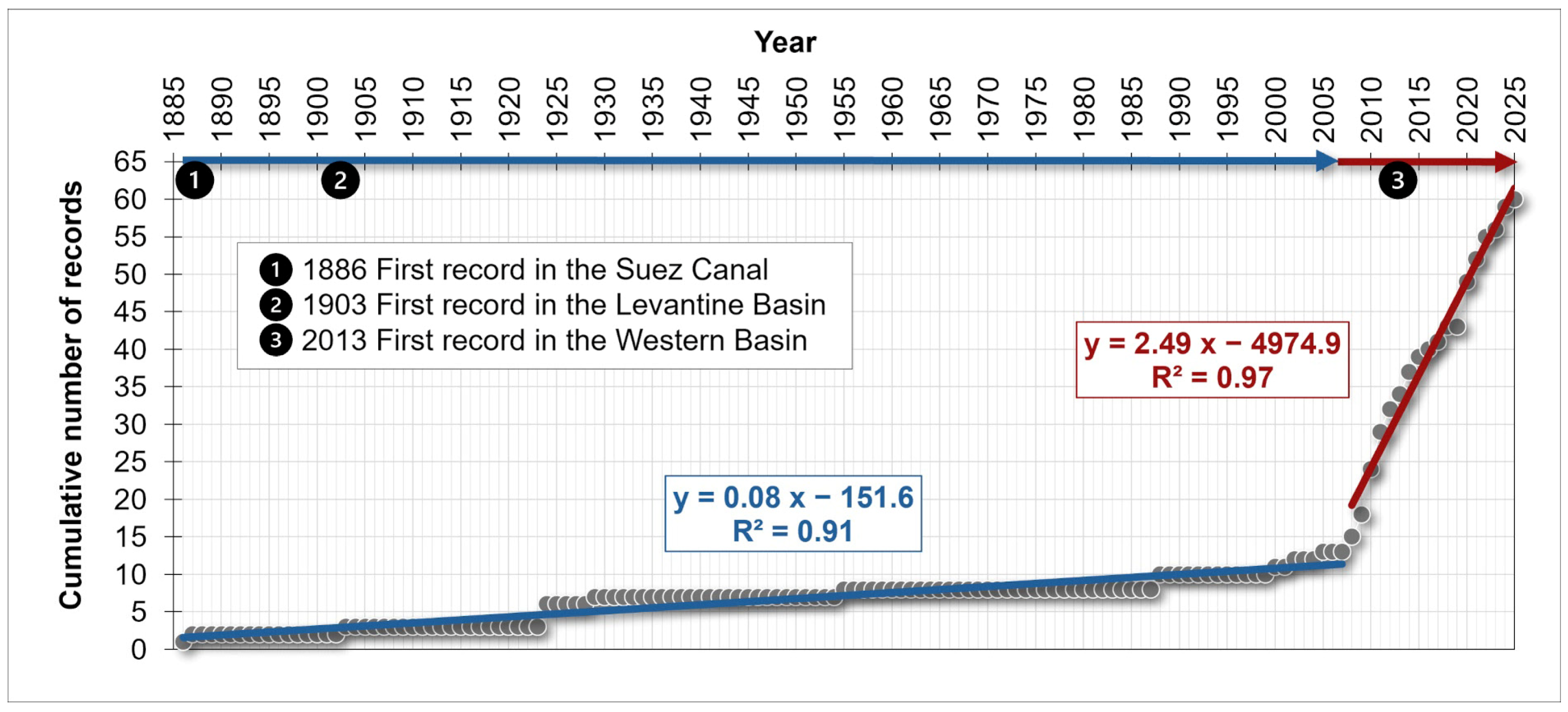
| Occurrence Increase rate | Evaluation of the slopes of the cumulative occurrence curve using the least squares method | Global | 1886–2007 2008–2025 | Identification of the invasion dynamics; rate of specimen increases across space and time |
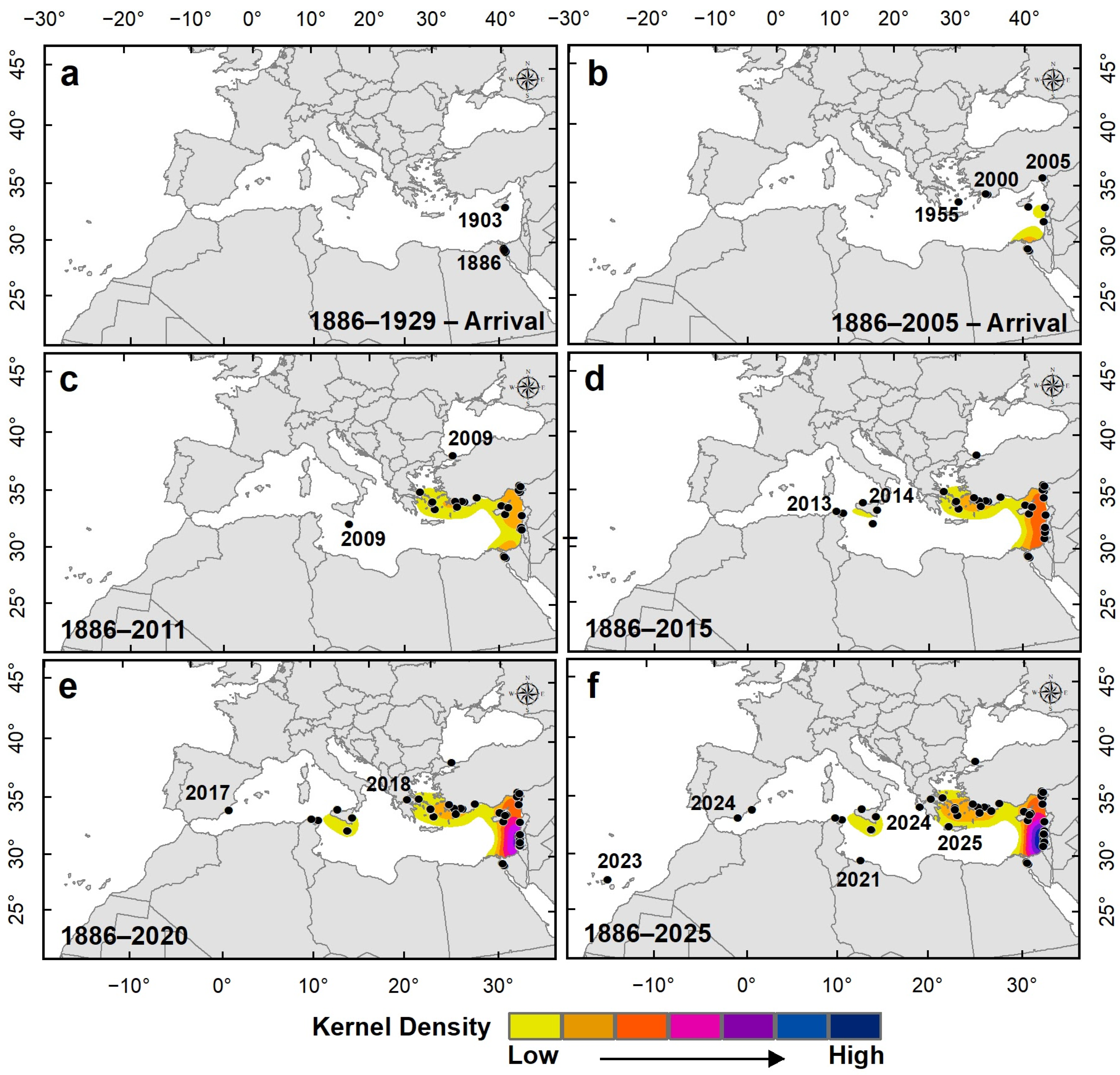
| Density hotspots | Kernel density Distance radius = 525 km | Global | 1886–1929 1886–2005 1886–2011 1886–2015 1886–2020 1886–2025 | Expansion areas. Nuclei of record aggregation; occurrence of persistent areas; space–time occurrence density increase; highest density areas |
| Key characteristics of distribution | ||||
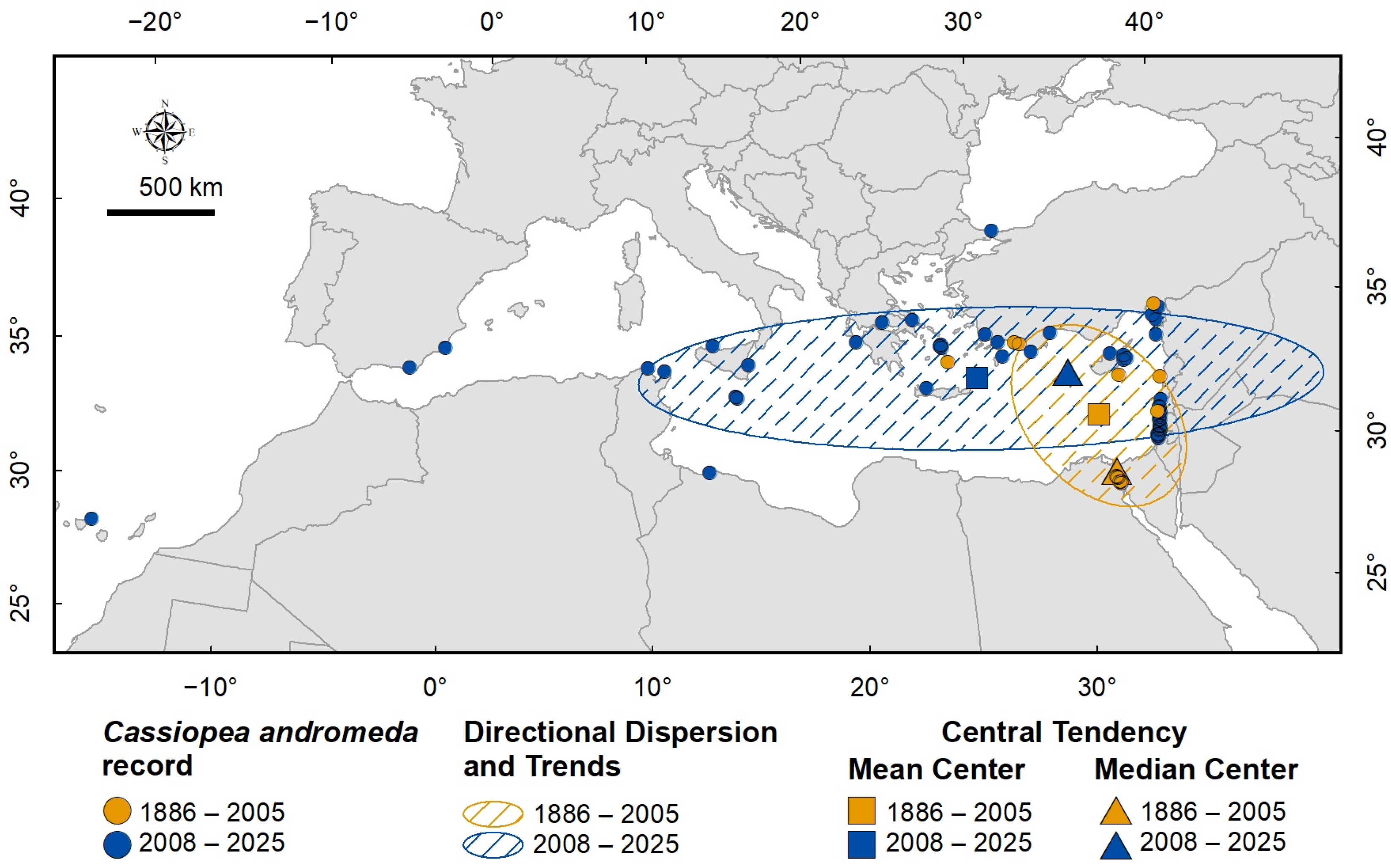
| Center of gravity | Central tendency (mean and median center) | Global | 1886–2005 2008–2025 | Species concentration center and its change over time |
| Directional Dispersion | XStdDist, YStdDist; (km) Standard deviational ellipse (1 standard deviation) | Global | Species distribution in X and Y directions | |
| Directional trends | Rotation (°) Standard deviational ellipse (1 standard deviation) | Global | Directional trend of species dispersion | |
| Aggregation patterns and spatial structure | ||||
| Spatial autocorrelation for a series of increasing distances | Incremental spatial autocorrelation (ISA) (based on Global Moran’s I) Number of distance bands = 10 | Global | All years | The distances where the clustering spatial processes are most pronounced. Distribution pattern: dispersion vs. random vs. clustering. Change in the spatial pattern over time |
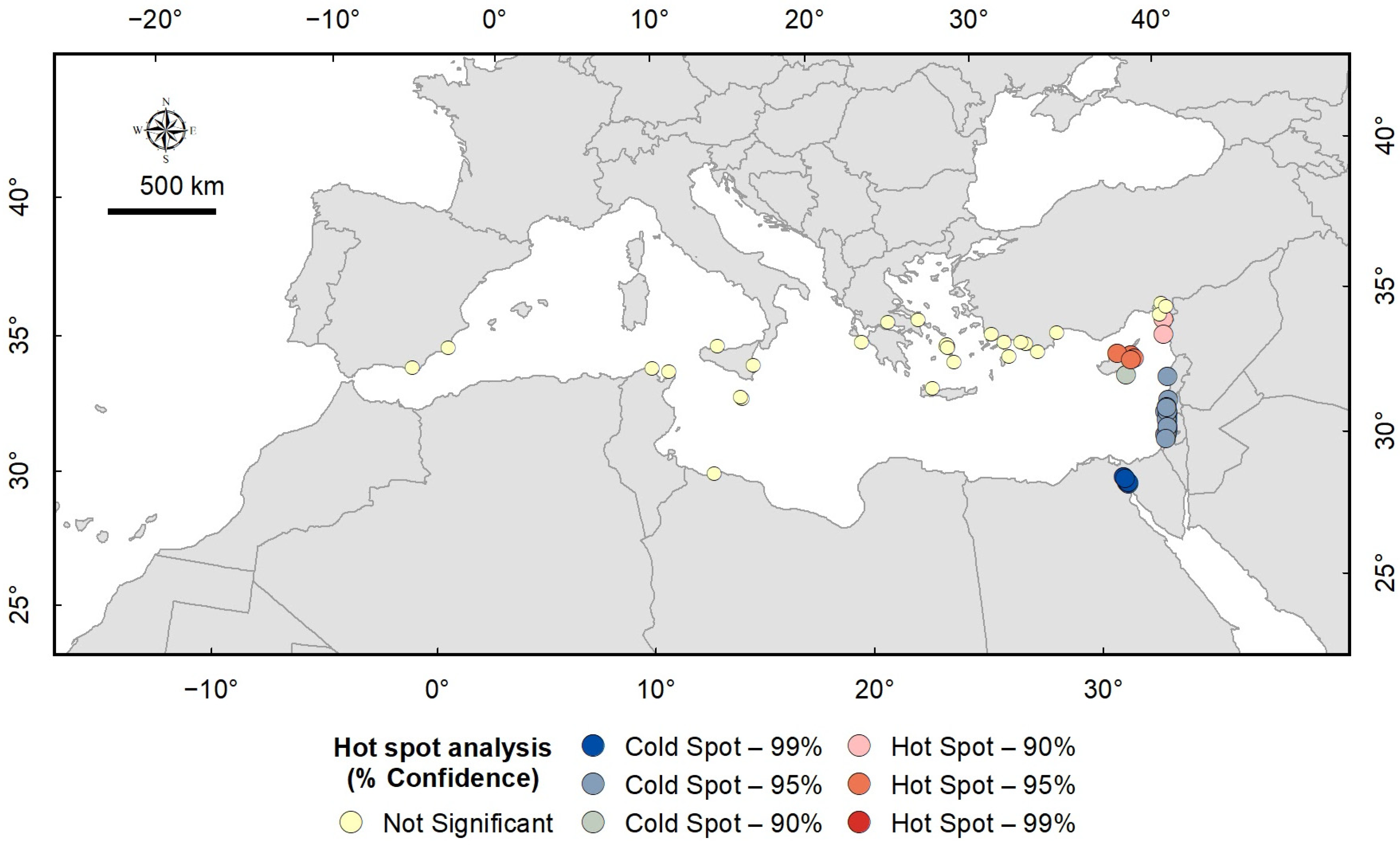
| Statistically significant hot spots and cold spots | Hot spot analysis Getis–Ord Gi* (GOG*) Distance band = 525 km | Local | All years | Initial and current direction of spread and identification of dispersion/settle areas |
| Spatial outliers | Outlier analysis Anselin local Moran’s I (AMI) Distance band = 525 km | Local | All years | Presence of recent records within clusters of older records (and vice versa) |
| Measure | R | Strategies and Actions | Purpose |
|---|---|---|---|
| Prevention | Recognize | Early detection and monitoring of NIS distribution and abundance dynamics. | Support timely response and informed management. |
| Reduce | Prevention of entry, spread minimization, and limitation of establishment. | Contain invasions before they become widespread. | |
| Regulate | Policy and legal measures supported by governance and long-term funding frameworks. | Ensure long-term management and institutional support. | |
| Mitigation | Remove | Reduction in local densities, prevention of further expansion, eradication via control measures. | Directly lower ecological and socio-economic impacts. |
| Replace | Species or surface replacement with sustainable alternatives. | Mitigate impacts by promoting less harmful practices. | |
| Recycle | Valorize biomass as an economic resource through circular economy processes. | Promote sustainability through resource recovery. | |
| Recover/ Restore | Restoration of degraded ecosystem functions. | Return invaded areas to their original ecological state. | |
| Reuse | Use of organisms for alternative purposes, including biomass valorization. | Turn ecological problems into potential resources. |
| Effect on Ecosystem Services | Type of Evidence (Documented) | Mechanisms |
|---|---|---|
| Provisioning | ||
| Biotic materials and biofuels | M (DM) | Provides biomass or biotic elements for non-food purposes, including medicinal [16,44,45,46]. |
| Food provision | ||
| Water storage and provision | ||
| Regulating and maintenance | ||
| Water purification | M (DO) | Enhances near-bottom mixing and stimulates sediment oxygenation and biogeochemical cycling [47,48,49]. It is a bioindicator for pollution for metal traces, herbicides and pesticides [50,51,52]. |
| Ocean nourishment | M (DO) | Releases interstitial (pore) water from sediments into the overlying water column, reintroducing nutrients [21,48,49,53,54]. |
| Air quality regulation | ||
| Coastal protection | ||
| Climate regulation | ||
| Weather regulation | ||
| Lifecycle maintenance | ||
| Biological regulation | ||
| Cultural | ||
| Symbolic and esthetic values | J/O | Exaltation of senses and emotions by species. |
| Cognitive benefits | J/O (DM) | It is material for research and education; information and awareness [15]. |
| Recreation and tourism | ||
| Effect on biodiversity | Potential contribution (Documented) | Mechanisms |
| Single-species impact | N/O (DO) | Hosts a remarkable diversity of bacterial species; commensal interactions with crustaceans and mollusks; acts as both prey and predator for several marine organisms [21]. |
| Multiple-species impact | N/O (DO) | Impacts on fish and other marine organisms through nematocysts stings or mortality; competes for space with sessile or low-mobility organisms [55,56,57]. |
| Impact on keystones species or species of high conservation value | O (DO) | Competes with jellyfish and seagrasses for light and resources [56,58] |
| Affects entire ecosystem processes/wider ecosystem functioning | ||
| Ecosystem engineer—creator of novel habitat | ||
| R | Strategies and Actions | Classification |
|---|---|---|
| Recognize | Apply targeted monitoring programs in bays, harbor areas, salt marshes and other eutrophicated confined environments or canals Implement early warning systems through citizen science to report jellyfish IAS | Implemented [4] Implemented [26,59,60] |
| Reduce | Adopt preventive measures to avoid further introductions, especially via improved ballast water management. Control aquaculture practices and other potential vectors in sensitive coastal areas | Challenging Challenging |
| Regulate | Adopt long term management measures with institutional support | Not Applicable |
| Remove | Control population by removing medusoid stages to contain spread | Not Applicable |
| Replace | Reduce artificial habitats and barriers for settlement and proliferation | Challenging |
| Recycle | Use in nutraceuticals, pharmaceuticals, or biodegradable materials | Feasible [45] |
| Reuse | Use as educational or decorative in aquaria or marine science centers (i.e., Barcelona and Genoa Acquaria) Use as bioindicator | Implemented (personal observation) Feasible |
| Recover/ Restore | Apply restoration strategies in seagrass habitat and coral reef Assess ecological impacts on multiple species and key species | Challenging Challenging |
Disclaimer/Publisher’s Note: The statements, opinions and data contained in all publications are solely those of the individual author(s) and contributor(s) and not of MDPI and/or the editor(s). MDPI and/or the editor(s) disclaim responsibility for any injury to people or property resulting from any ideas, methods, instructions or products referred to in the content. |
© 2026 by the authors. Licensee MDPI, Basel, Switzerland. This article is an open access article distributed under the terms and conditions of the Creative Commons Attribution (CC BY) license.
Share and Cite
Perzia, P.; Zampardi, S.; Maggio, T.; Falautano, M.; Castriota, L. The Alien Jellyfish Cassiopea andromeda in the Mediterranean Sea: Invasion Dynamics and Management Strategies. Oceans 2026, 7, 27. https://doi.org/10.3390/oceans7020027
Perzia P, Zampardi S, Maggio T, Falautano M, Castriota L. The Alien Jellyfish Cassiopea andromeda in the Mediterranean Sea: Invasion Dynamics and Management Strategies. Oceans. 2026; 7(2):27. https://doi.org/10.3390/oceans7020027
Chicago/Turabian StylePerzia, Patrizia, Serena Zampardi, Teresa Maggio, Manuela Falautano, and Luca Castriota. 2026. "The Alien Jellyfish Cassiopea andromeda in the Mediterranean Sea: Invasion Dynamics and Management Strategies" Oceans 7, no. 2: 27. https://doi.org/10.3390/oceans7020027
APA StylePerzia, P., Zampardi, S., Maggio, T., Falautano, M., & Castriota, L. (2026). The Alien Jellyfish Cassiopea andromeda in the Mediterranean Sea: Invasion Dynamics and Management Strategies. Oceans, 7(2), 27. https://doi.org/10.3390/oceans7020027