Custom-Made Acetabular Implants in Complex Revision Total Hip Arthroplasty: A Systematic Review (2000–2025)

Abstract
1. Introduction
2. Materials and Methods
2.1. Study Design and Reporting Standards
2.2. Search Strategy and Study Selection
2.3. Eligibility Criteria
2.4. Population
2.5. Surgical Intervention
2.6. Comparators
2.7. Outcomes of Interest
2.8. Study Selection and Data Extraction
2.9. Quality Assessment and Risk of Bias
2.10. Data Synthesis
3. Results
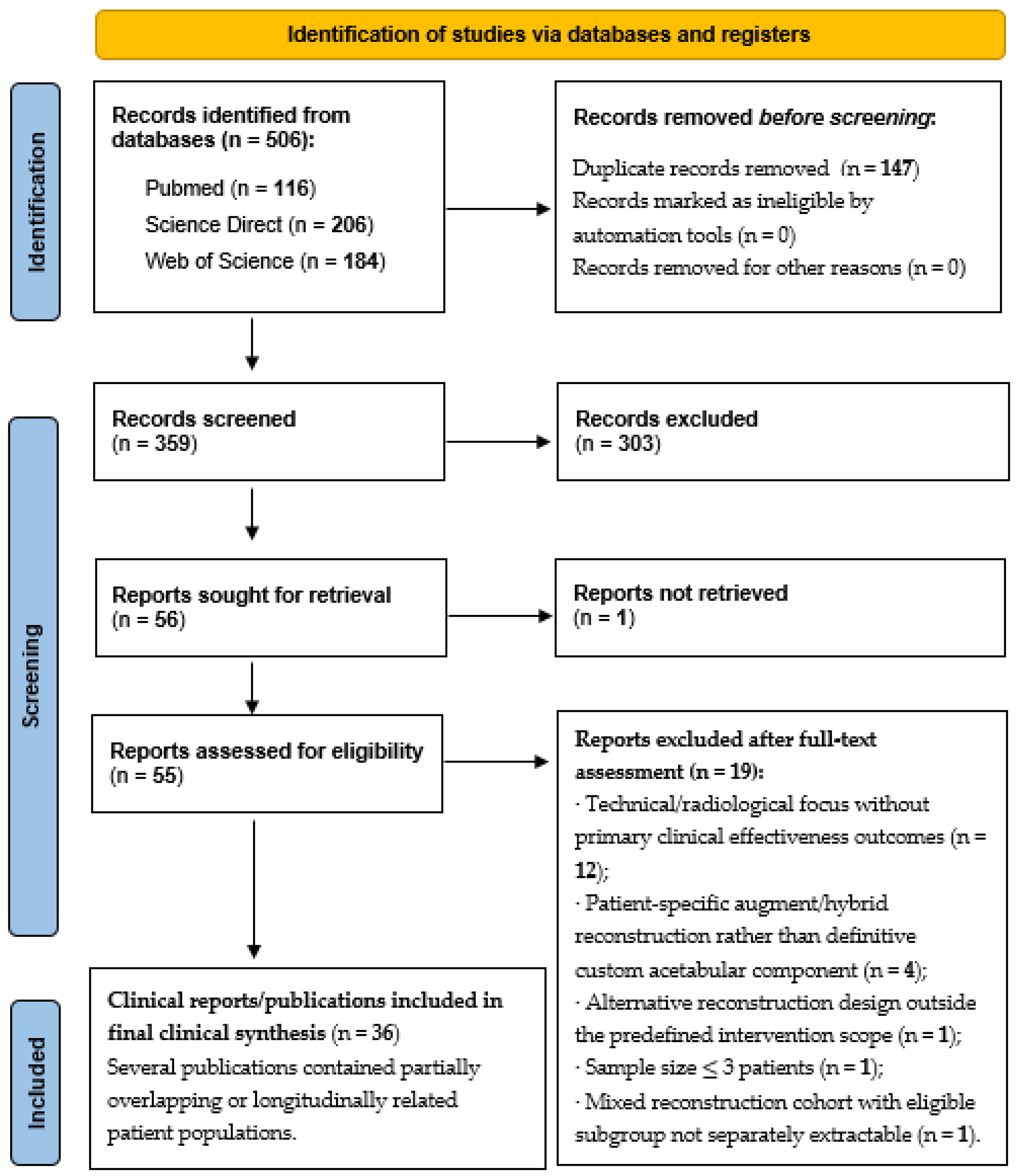
3.1. Study Selection
3.2. Study Characteristics
3.3. Indications and Acetabular Defect Characteristics
3.4. Types of Custom-Made Acetabular Implants
3.5. Follow-Up and Clinical Outcomes
3.6. Complications and Re-Revision
3.7. Technical and Radiological Findings
3.8. Risk of Bias and Study Quality
3.9. Summary of Key Findings
4. Discussion
4.1. Comparison with Current Literature
4.2. Advantages of Custom-Made Implants
4.3. Technological and Logistical Limitations
4.4. Limitations of Existing Evidence
4.5. Clinical Implications for Orthopedic Surgeons
4.6. Future Directions
5. Conclusions
Supplementary Materials
Author Contributions
Funding
Institutional Review Board Statement
Informed Consent Statement
Data Availability Statement
Conflicts of Interest
Abbreviations
| 3D | three-dimensional |
| CAD | computer-aided design |
| CAD/CAM | computer-aided design/computer-aided manufacturing |
| CT | computed tomography |
| HHS | Harris Hip Score |
| MINORS | methodological index for non-randomized studies |
| PRISMA | preferred reporting items for systematic reviews and meta-analyses |
| rTHA | revision total hip arthroplasty |
| THA | total hip arthroplasty |
References
- Learmonth, I.D.; Young, C.; Rorabeck, C. The Operation of the Century: Total Hip Replacement. Lancet 2007, 370, 1508–1519. [Google Scholar] [CrossRef] [Scilit] [PubMed]
- Bozic, K.J.; Kurtz, S.M.; Lau, E.; Ong, K.; Vail, T.P.; Berry, D.J. The Epidemiology of Revision Total Hip Arthroplasty in the United States. J. Bone Jt. Surg. Am. 2009, 91, 128–133. [Google Scholar] [CrossRef] [Scilit] [PubMed]
- Sanghavi, S.A.; Paprosky, W.G.; Sheth, N.P. Evaluation and Management of Acetabular Bone Loss in Revision Total Hip Arthroplasty: A 10-Year Update. J. Am. Acad. Orthop. Surg. 2024, 32, e466–e475. [Google Scholar] [CrossRef] [Scilit] [PubMed]
- Paprosky, W.G.; Perona, P.G.; Lawrence, J.M. Acetabular Defect Classification and Surgical Reconstruction in Revision Arthroplasty: A 6-Year Follow-Up Evaluation. J. Arthroplast. 1994, 9, 33–44. [Google Scholar] [CrossRef] [Scilit] [PubMed]
- De Martino, I.; Strigelli, V.; Cacciola, G.; Gu, A.; Bostrom, M.P.; Sculco, P.K. Survivorship and Clinical Outcomes of Custom Triflange Acetabular Components in Revision Total Hip Arthroplasty: A Systematic Review. J. Arthroplast. 2019, 34, 2511–2518. [Google Scholar] [CrossRef] [Scilit] [PubMed]
- Baauw, M.; van Hellemondt, G.G.; van Hooff, M.L.; Spruit, M. The Accuracy of Positioning of a Custom-Made Implant within a Large Acetabular Defect at Revision Arthroplasty of the Hip. Bone Jt. J. 2015, 97, 780–785. [Google Scholar] [CrossRef] [Scilit] [PubMed]
- Nees, T.A.; Hariri, M.; Müller, C.T.; Innmann, M.M.; Spranz, D.M.; Westhauser, F.; Walker, T.; Reiner, T. Implantation Accuracy of Custom-Made Acetabular Components with Iliac Stem Fixation for Large Bone Defects in Hip Revision Surgery. Orthop. Surg. 2025, 17, 3159–3168. [Google Scholar] [CrossRef] [Scilit] [PubMed]
- Christie, M.J.; Barrington, S.A.; Brinson, M.F.; Ruhling, M.E.; DeBoer, D.K. Bridging Massive Acetabular Defects with the Triflange Cup: 2- to 9-Year Results. Clin. Orthop. Relat. Res. 2001, 393, 216–227. [Google Scholar] [CrossRef] [Scilit] [PubMed]
- Özdemir, E.; de Lange, B.; Buckens, C.F.M.; Rijnen, W.H.C.; Visser, J. Bone Support of a Custom Triflange Acetabular Component over Time. Bone Jt. J. 2024, 106, 359–364. [Google Scholar] [CrossRef] [Scilit] [PubMed]
- Page, M.J.; McKenzie, J.E.; Bossuyt, P.M.; Boutron, I.; Hoffmann, T.C.; Mulrow, C.D.; Shamseer, L.; Tetzlaff, J.M.; Akl, E.A.; Brennan, S.E.; et al. The PRISMA 2020 Statement: An Updated Guideline for Reporting Systematic Reviews. BMJ 2021, 372, n71. [Google Scholar] [CrossRef] [Scilit] [PubMed]
- Slim, K.; Nini, E.; Forestier, D.; Kwiatkowski, F.; Panis, Y.; Chipponi, J. Methodological Index for Non-Randomized Studies (MINORS): Development and Validation of a New Instrument. ANZ J. Surg. 2003, 73, 712–716. [Google Scholar] [CrossRef] [Scilit] [PubMed]
- Joshi, A.B.; Lee, J.; Christensen, C. Results for a Custom Acetabular Component for Acetabular Deficiency. J. Arthroplast. 2002, 17, 643–648. [Google Scholar] [CrossRef] [Scilit] [PubMed]
- Dennis, D.A. Management of Massive Acetabular Defects in Revision Total Hip Arthroplasty. J. Arthroplast. 2003, 18, 121–125. [Google Scholar] [CrossRef] [Scilit] [PubMed]
- Holt, G.E.; Dennis, D.A. Use of Custom Triflanged Acetabular Components in Revision Total Hip Arthroplasty. Clin. Orthop. Relat. Res. 2004, 429, 209–214. [Google Scholar] [CrossRef] [Scilit] [PubMed]
- DeBoer, D.K.; Christie, M.J.; Brinson, M.F.; Morrison, J.C. Revision Total Hip Arthroplasty for Pelvic Discontinuity. J. Bone Jt. Surg. Am. 2007, 89, 835–840. [Google Scholar] [CrossRef] [Scilit] [PubMed]
- Taunton, M.J.; Fehring, T.K.; Edwards, P.; Bernasek, T.; Holt, G.E.; Christie, M.J. Pelvic Discontinuity Treated with Custom Triflange Component: A Reliable Option. Clin. Orthop. Relat. Res. 2012, 470, 428–434. [Google Scholar] [CrossRef] [Scilit] [PubMed]
- Wind, M.A., Jr.; Swank, M.L.; Sorger, J.I. Short-Term Results of a Custom Triflange Acetabular Component for Massive Acetabular Bone Loss in Revision THA. Orthopedics 2013, 36, e260–e265. [Google Scholar] [CrossRef] [Scilit] [PubMed]
- Friedrich, M.J.; Schmolders, J.; Michel, R.D.; Randau, T.M.; Wimmer, M.D.; Kohlhof, H.; Wirtz, D.C.; Gravius, S. Management of Severe Periacetabular Bone Loss Combined with Pelvic Discontinuity in Revision Hip Arthroplasty. Int. Orthop. 2014, 38, 2455–2461. [Google Scholar] [CrossRef] [Scilit] [PubMed]
- Berasi, C.C., IV; Berend, K.R.; Adams, J.B.; Ruh, E.L.; Lombardi, A.V., Jr. Are Custom Triflange Acetabular Components Effective for Reconstruction of Catastrophic Bone Loss? Clin. Orthop. Relat. Res. 2015, 473, 528–535. [Google Scholar] [CrossRef] [Scilit] [PubMed]
- Barlow, B.T.; Oi, K.K.; Lee, Y.-Y.; Carli, A.V.; Choi, D.S.; Bostrom, M.P. Outcomes of Custom Flange Acetabular Components in Revision Total Hip Arthroplasty and Predictors of Failure. J. Arthroplast. 2016, 31, 1057–1064. [Google Scholar] [CrossRef] [Scilit] [PubMed]
- Myncke, I.; van Schaik, D.; Scheerlinck, T. Custom-Made Triflanged Acetabular Components in the Treatment of Major Acetabular Defects: Short-Term Results and Clinical Experience. Acta Orthop. Belg. 2017, 83, 341–350. [Google Scholar] [PubMed]
- Berend, M.E.; Berend, K.R.; Lombardi, A.V., Jr.; Cates, H.; Faris, P. The Patient-Specific Triflange Acetabular Implant for Revision Total Hip Arthroplasty in Patients with Severe Acetabular Defects: Planning, Implantation, and Results. Bone Jt. J. 2018, 100, 50–54. [Google Scholar] [CrossRef] [Scilit] [PubMed]
- Citak, M.; Kochsiek, L.; Gehrke, T.; Haasper, C.; Suero, E.M.; Mau, H. Preliminary Results of a 3D-Printed Acetabular Component in the Management of Extensive Defects. Hip Int. 2018, 28, 266–271. [Google Scholar] [CrossRef] [Scilit] [PubMed]
- Gladnick, B.P.; Fehring, K.A.; Odum, S.M.; Christie, M.J.; DeBoer, D.K.; Fehring, T.K. Midterm Survivorship After Revision Total Hip Arthroplasty with a Custom Triflange Acetabular Component. J. Arthroplast. 2018, 33, 500–504. [Google Scholar] [CrossRef] [Scilit] [PubMed]
- Kieser, D.C.; Ailabouni, R.; Kieser, S.C.J.; Wyatt, M.C.; Armour, P.C.; Coates, M.H.; Hooper, G.J. The Use of an Ossis Custom 3D-Printed Tri-Flanged Acetabular Implant for Major Bone Loss: Minimum 2-Year Follow-Up. Hip Int. 2018, 28, 668–674. [Google Scholar] [CrossRef] [Scilit] [PubMed]
- Moore, K.D.; McClenny, M.D.; Wills, B.W. Custom Triflange Acetabular Components for Large Acetabular Defects: Minimum 10-Year Follow-Up. Orthopedics 2018, 41, e316–e320. [Google Scholar] [CrossRef] [Scilit] [PubMed]
- Aprato, A.; Giachino, M.; Bedino, P.; Mellano, D.; Piana, R.; Massè, A. Management of Paprosky Type Three B Acetabular Defects by Custom-Made Components: Early Results. Int. Orthop. 2019, 43, 117–122. [Google Scholar] [CrossRef] [Scilit] [PubMed]
- Burastero, G.; Cavagnaro, L.; Chiarlone, F.; Zanirato, A.; Mosconi, L.; Felli, L.; Da Rin de Lorenzo, F. Clinical Study of Outcomes After Revision Surgery Using Porous Titanium Custom-Made Implants for Severe Acetabular Septic Bone Defects. Int. Orthop. 2020, 44, 1957–1964. [Google Scholar] [CrossRef] [Scilit] [PubMed]
- Fröschen, F.S.; Randau, T.M.; Hischebeth, G.T.R.; Gravius, N.; Gravius, S.; Walter, S.G. Mid-Term Results After Revision Total Hip Arthroplasty with Custom-Made Acetabular Implants in Patients with Paprosky III Acetabular Bone Loss. Arch. Orthop. Trauma Surg. 2020, 140, 263–273. [Google Scholar] [CrossRef] [Scilit] [PubMed]
- Fröschen, F.S.; Randau, T.M.; Hischebeth, G.T.R.; Gravius, N.; Wirtz, D.C.; Gravius, S.; Walter, S.G. Outcome of Repeated Multi-Stage Arthroplasty with Custom-Made Acetabular Implants in Patients with Severe Acetabular Bone Loss: A Case Series. Hip Int. 2020, 30, 64–71. [Google Scholar] [CrossRef] [Scilit] [PubMed]
- Gruber, M.S.; Jesenko, M.; Burghuber, J.; Hochreiter, J.; Ritschl, P.; Ortmaier, R. Functional and Radiological Outcomes After Treatment with Custom-Made Acetabular Components in Patients with Paprosky Type 3 Acetabular Defects: Short-Term Results. BMC Musculoskelet. Disord. 2020, 21, 835. [Google Scholar] [CrossRef] [Scilit] [PubMed]
- Matar, H.E.; Selvaratnam, V.; Shah, N.; Wynn Jones, H. Custom Triflange Revision Acetabular Components for Significant Bone Defects and Pelvic Discontinuity: Early UK Experience. J. Orthop. 2020, 21, 25–30. [Google Scholar] [CrossRef] [Scilit] [PubMed]
- Walter, S.G.; Randau, T.M.; Gravius, N.; Gravius, S.; Fröschen, F.S. Monoflanged Custom-Made Acetabular Components Promote Biomechanical Restoration of Severe Acetabular Bone Defects by Metallic Defect Reconstruction. J. Arthroplast. 2020, 35, 831–835. [Google Scholar] [CrossRef] [Scilit] [PubMed]
- Kawalkar, A.C.; Kalanie, A.; Neil, M.J. Excellent Midterm Results of Triflange Patient Matched Implants for Extensive Acetabular Bone Defect. Hip Pelvis 2021, 33, 87–95. [Google Scholar] [CrossRef] [Scilit] [PubMed]
- Scharff-Baauw, M.; van Hooff, M.L.; van Hellemondt, G.G.; Jutte, P.C.; Bulstra, S.K.; Spruit, M. Good Results at 2-Year Follow-Up of a Custom-Made Triflange Acetabular Component for Large Acetabular Defects and Pelvic Discontinuity: A Prospective Case Series of 50 Hips. Acta Orthop. 2021, 92, 297–303. [Google Scholar] [CrossRef] [Scilit] [PubMed]
- Sershon, R.A.; McDonald, J.F., III; Nagda, S.; Hamilton, W.G.; Engh, C.A., Jr. Custom Triflange Cups: 20-Year Experience. J. Arthroplast. 2021, 36, 3264–3268. [Google Scholar] [CrossRef] [Scilit] [PubMed]
- Fröschen, F.S.; Randau, T.M.; Gravius, N.; Wirtz, D.C.; Gravius, S.; Walter, S.G. Risk Factors for Implant Failure of Custom-Made Acetabular Implants in Patients with Paprosky III Acetabular Bone Loss and Combined Pelvic Discontinuity. Technol. Health Care 2022, 30, 703–711. [Google Scholar] [CrossRef] [Scilit] [PubMed]
- Tikhilov, R.M.; Dzhavadov, A.A.; Kovalenko, A.N.; Bilyk, S.S.; Denisov, A.O.; Shubnyakov, I.I. Standard Versus Custom-Made Acetabular Implants in Revision Total Hip Arthroplasty. J. Arthroplast. 2022, 37, 119–125. [Google Scholar] [CrossRef] [Scilit] [PubMed]
- Winther, S.S.; Petersen, M.; Yilmaz, M.; Kaltoft, N.S.; Stürup, J.; Winther, N.S. Custom-Made Triflanged Implants in Reconstruction of Severe Acetabular Bone Loss with Pelvic Discontinuity After Total Hip Arthroplasty: Consecutive Cohort Study, Two to 11 Years of Follow-Up. Bone Jt. Open 2022, 3, 867–876. [Google Scholar] [CrossRef] [Scilit] [PubMed]
- Alexander, J.S.; Lombardi, A.V., Jr.; Berend, K.R.; Morris, M.J.; Adams, J.B.; Crawford, D.A. Custom Triflange Acetabular Components for Catastrophic Bone Loss: Minimum 5-Year Results. J. Arthroplast. 2023, 38, 1330–1334. [Google Scholar] [CrossRef] [Scilit] [PubMed]
- Christie, M.C.; DeBoer, D.K.; Morrison, J.C.; Brinson, M.F.; Christie, M.J. Bridging Massive Acetabular Defects with the Triflange Cup: 10- to 28-Year Results. J. Arthroplast. 2023, 38, 2423–2428. [Google Scholar] [CrossRef] [Scilit] [PubMed]
- Faraj, S.; de Windt, T.S.; van Hooff, M.L.; van Hellemondt, G.G.; Spruit, M. Custom-Made Acetabular Revision Arthroplasty for Pelvic Discontinuity: Can We Handle the Challenge? A Prospective Cohort Study. Bone Jt. Open 2023, 4, 53–61. [Google Scholar] [CrossRef] [Scilit] [PubMed]
- Meding, J.B.; Meding, L.K. Custom Triflange Acetabular Implants: Average 10-Year Follow-Up. J. Arthroplast. 2023, 38, S201–S205. [Google Scholar] [CrossRef] [Scilit] [PubMed]
- Álvarez Valdivielso, A.; Akkaya, M.; Mau, H.; Luo, T.D.; Gehrke, T.; Citak, M. Survival Analysis of 3D Printed Acetabular Implants in Revision Total Hip Arthroplasty Associated with Severe Pelvic Discontinuities. Technol. Health Care 2024, 32, 3783–3792. [Google Scholar] [CrossRef] [Scilit] [PubMed]
- Jawad, R.; Voordeckers, A.; Holsters, L.; Jansegers, E. Custom-Made aMace Acetabular Implants in Paprosky Type 3B Defects: A Case Series of 5 Patients with a Follow-Up of 6 to 10 Years. Acta Orthop. Belg. 2025, 91, 171–177. [Google Scholar] [CrossRef] [Scilit] [PubMed]
- Mika, A.P.; Wilson, J.M.; Christie, M.J.; Christie, M.C.; DeBoer, D.K.; Morrison, J.C.; Polkowski, G.G.; Martin, J.R. Primarily Constraining Custom Triflange Patients: Weighing the Risks of Instability Versus Fixation? J. Arthroplast. 2025, 40, S411–S417. [Google Scholar] [CrossRef] [Scilit]
- Baauw, M.; van Hellemondt, G.G.; Spruit, M. A Custom-Made Acetabular Implant for Paprosky Type 3 Defects. Orthopedics 2017, 40, e195–e198. [Google Scholar] [CrossRef] [Scilit] [PubMed]


| Author | Year | Journal | Patients (Hips) | Follow-Up | Defect Type | Implant Type | Functional Outcome | Survivorship | Major Complications |
|---|---|---|---|---|---|---|---|---|---|
| Christie † [8] | 2001 | Clinical Orthopaedics and Related Research | 76 patients (78 hips) | Mean 53 months (24–107) | 39 combined deficiencies; 39 pelvic discontinuities | Custom-designed triflange cup | 33.3 → 82.1 | 100% | 6 recurrent dislocations requiring reoperation (7.8%) |
| Joshi [12] | 2002 | Journal of Arthroplasty | 27 patients | Mean 58 months (48–72) | Complex major acetabular deficiency | Custom triflanged titanium cementless acetabular implant | All patients improved on modified Merle d’Aubigné–Postel score | 2/27 required further revision; ~92.6% unrevised at latest follow-up | 6/27 complications (22%) |
| Dennis [13] | 2003 | Journal of Arthroplasty | 24 cases | Mean 48 months (max 78) | Paprosky 3B massive periacetabular bone loss | Custom triflanged acetabular component | Clinical success reported in 21/24 | Clinical success in 21/24 cases (87.5%); formal implant survivorship NR | 3 fixation failures; failures associated with hemipelvic dissociation/severe osteopenia |
| Holt & Dennis [14] | 2004 | Clinical Orthopaedics and Related Research | 26 patients (26 hips) | Mean 54 months (24–85) | Paprosky 3B; AAOS III/IV | Custom triflanged acetabular component | HHS 39 → 78 | Clinical success in 23/26 cases (88.5%); 3 component failures | 3 failures from loss of ischial fixation |
| DeBoer † [15] | 2007 | Journal of Bone and Joint Surgery American Volume | 28 patients (30 hips) | Mean 10 years | Pelvic discontinuity | Custom-made porous-coated triflange acetabular prosthesis | 41 → 80 | 100% | 5 dislocations; 1 transient sciatic nerve palsy; 1 loose ischial screw |
| Taunton † [16] | 2012 | Clinical Orthopaedics and Related Research | 57 patients | Mean 65 months (24–215) | Pelvic discontinuity | Custom triflange acetabular component | 74.8 | 95% (free of triflange revision for any reason) | NR |
| Wind [17] | 2013 | Orthopedics | 19 patients (19 hips) | Mean 31 months (16–59) | Paprosky 3A/3B; AAOS III/IV | Custom triflange acetabular component | HHS 38 → 63; WOMAC 43 → 26 | 65% considered successful; 2/19 components removed for failure (11%) | 3/19 significant complications (16%); 2 component removals for failure |
| Friedrich § [18] | 2014 | International Orthopaedics | 18 consecutive patients | Mean 30 months (17–62) | Paprosky 3B with pelvic discontinuity | Custom-made acetabular component | HHS 28 ± 12 → 69 ± 13 | 16/18 radiographically stable (88.9%); formal implant survivorship NR | 2 periprosthetic joint infections requiring explantation; 3 recurrent dislocations |
| Berasi ‡ [19] | 2015 | Clinical Orthopaedics and Related Research | 26 patients (28 hips) | Mean 57 months (28–108) | Paprosky Type IIIB | Custom triflange acetabular component | 42 → 65 | 92.9% | 2 septic failures; 1 stem revision; 1 ORIF for periprosthetic femoral fracture; 2 minor complications |
| Barlow [20] | 2016 | Journal of Arthroplasty | 63 patients | Mean 4.32 years (± 2.94) | Paprosky IIIB defects | Custom triflange acetabular component (CTAC) | WOMAC function: 38.94 → 71.35 | 86.5% | CTAC failure rate 13.5% |
| Myncke [21] | 2017 | Acta Orthopaedica Belgica | 20 patient reviews; 22 surgical cases | Mean 25 months | Major acetabular defects | aMace custom-made triflange acetabular component | Mean postoperative HHS 68/100; high satisfaction; mostly no/mild pain | NR | Complications in 8/22 cases; 4 dislocations; technical problems in 8/22 |
| Berend ‡ [22] | 2018 | Bone & Joint Journal | 94 patients (95 hips) | Mean 3.5 years (1–11 years) | Paprosky 2C, 3A, 3B; pelvic discontinuity | Patient-specific triflange acetabular component | 46 → 75 | 94.7% | Overall complications 22%; dislocation 6%; infection 6%; femoral complications 2% |
| Citak [23] | 2018 | Hip International | 9 patients | NR | Paprosky defects; pelvic discontinuity included | 3D-printed patient-specific acetabular component | NR | 89% | Overall complication rate 56%; implant-associated complication 11% |
| Gladnick † [24] | 2018 | Journal of Arthroplasty | 73 patients | Mean 7.5 years (5–12 years) | Paprosky Type IIIB | Custom triflange acetabular component | HOOS-JR median 85 (IQR 73–100) | 79.5% | 6 revisions for instability (8%); 8 revisions for infection (11%); 12 reoperations without triflange failure (16%) |
| Kieser [25] | 2018 | HIP International | 46 consecutive; 36 in outcome analysis | Mean 38 months; minimum 24 | Paprosky 2A–3B; pelvic dissociation included | Ossis unilateral custom 3D-printed tri-flanged acetabular implant | OHS improved significantly; postoperative WOMAC 98; HHS 79 | No revision for aseptic loosening; overall implant survivorship NR | 1 deep infection revision; 7 lost to follow-up; 1 recurrent dislocation; 1 early migration later stabilised; 2 concerning for failed osteointegration |
| Moore ‡ [26] | 2018 | Orthopedics | 37 patients; 35 with ≥10-y follow-up | Minimum 10 years | Large acetabular defects; pelvic discontinuity included | Custom triflange acetabular component | HHS 28 → 90 | 32/35 unrevised and functioning (91%) | 2 components removed for infection; 1 late loosening; 1 ischial screw failure; no dislocations/fractures/nerve injuries |
| Aprato [27] | 2019 | International Orthopaedics | 8 patients | Early series (patients treated June 2016–August 2018); formal clinical follow-up duration NR | Paprosky 3B | Lima Promade custom-made acetabular device | No standardized patient functional score reported; surgeon questionnaire was favorable | No implant survivorship estimate reported | 2/8 postoperative dislocations; 1 superficial infected hematoma treated with drainage and antibiotics |
| Burastero [28] | 2020 | International Orthopaedics | 19 patients (19 hips) | Mean 42.3 ± 11.8 months | Paprosky IIC, IIIA/IIIB and pelvic discontinuity; septic bone loss | Non-flanged porous titanium custom-made acetabular component | HHS, OHS and VAS improved significantly from preoperative values (p < 0.01) | All implants radiographically osseointegrated; 1 septic failure; no loosening or malposition reported | 3/19 patients had complications (15.8%); 1 septic recurrence; 1 recurrent dislocation; 1 positive intraoperative culture; 1 reoperation for recurrent dislocation |
| Fröschen § [29] | 2020 | Archives of Orthopaedic and Trauma Surgery | 68 patients | Mean 43 months (1–120) | Paprosky IIIA/IIIB with/without pelvic discontinuity | CT-based custom-made acetabular implant | VAS 3.2 → 1.45; HHS 21.1 → 61 | 75% implant survival at last follow-up; KM 82.7% at 3 y, 77% at 5 y | 15 PJI (22%); 7 dislocations (10.2%); 2 aseptic loosenings (2.9%); overall revision 36.7% |
| Fröschen § [30] | 2020 | HIP International | 4 consecutive patients | At least 2 years for successful cases; variable overall | Paprosky IIIB/AAOS III-IV; failed prior CMAC due to PJI | Second custom-made acetabular component after failed first CMAC | Second-CMAC HHS range 45–58; VAS range 2–4 in successful cases | Treatment success 2/4 (50%) | 2/4 s CMACs explanted for recurrent PJI; high reoperation burden |
| Gruber [31] | 2020 | BMC Musculoskeletal Disorders | 9 patients (16 eligible) | Mean 12.2 months (10–18) | Paprosky 3A (1), 3B (8) | Materialise custom-made acetabular component | OHS 19.8 → 29.4; HHS 50.1 → 68.8 | 1 re-revision (11.1%) | 3 complications (33.3%) |
| Matar [32] | 2020 | Journal of Orthopaedics | 17 patients (17 hips) | Mean 3.6 years (2–7 years) | Paprosky 3A/3B; pelvic discontinuity in 88% | Custom triflange acetabular component | NR | 100% | 3 complications (17.6%): hematoma requiring washout; intraoperative ilium fracture; recurrent dislocation |
| Walter § [33] | 2020 | Journal of Arthroplasty | 54 patients; 58 implants | Mean 56.3 ± 28.7 months (24–120) | Severe acetabular bone defects | 21 triflanged + 37 monoflanged custom-made acetabular components | No significant HHS or VAS difference between mono- vs. triflanged groups | Overall survival 72.4% (42/58) | Reasons for revision/explantation: 12 periprosthetic joint infections and 2 aseptic loosenings |
| Kawalkar [34] | 2021 | Hip & Pelvis | 13 patients; 12 available at follow-up | Mean 50 months | Paprosky 3B; pelvic discontinuity in subset | Triflange patient-matched implant | HHS 41 → 82 | 11/12 well-fixed at follow-up; no further acetabular reconstruction | 1 persistent infection/loosening; 1 dislocation; 1 unrelated death |
| Scharff-Baauw ¶ [35] | 2021 | Acta Orthopaedica | 49 patients (50 hips) | 2 years | Large acetabular defects with/without pelvic discontinuity | Custom-made triflange acetabular component | mOHS 51 → 28.5 (lower score = better); other PROMs improved | 0 CTAC re-revisions at 2 y | 8 hips with complications; 3 persistent wound leakage, 3 pelvic fractures, 1 dislocation; 5 hips with screw loosening |
| Sershon [36] | 2021 | Journal of Arthroplasty | 50 patients; 94% with known outcome or ≥2-y follow-up | Minimum 2 years (study period 2000–2018) | Severe acetabular bone loss | Custom triflange acetabular component | 49 → 73 | 98% | 14 major complications (28%); dislocation 12%; 1 acute infection; 1 pulmonary thromboembolism; Trendelenburg gait in 46% |
| Fröschen § [37] | 2022 | Technology and Health Care | 70 patients | Mean 41.9 ± 34.8 months (1.5–120) | Paprosky III with pelvic discontinuity | CT-based custom-made acetabular implant | Functional score not primary focus | 53/70 implant survival (75.7%) | 17 explantations: 15 PJI, 2 aseptic loosening |
| Tikhilov [38] | 2022 | Journal of Arthroplasty | 106 revision THAs: 61 custom vs. 45 standard | CMAI: mean 3.1 years (1.0–4.9); SAI: mean 2.8 years (1.0–5.0) | Extensive uncontained acetabular bone loss; pelvic discontinuity subgroup | Custom-made acetabular implant vs. standard acetabular implant | Comparative study; functional outcome was not the principal reported endpoint | Aseptic loosening: 2.4% custom vs. 10.0% standard; pelvic-discontinuity subgroup: 0% vs. 60% | Comparative complication reporting focused primarily on aseptic loosening and re-revision |
| Winther [39] | 2022 | Bone & Joint Open | 38 patients (39 hips) | Mean 5.1 years (2–11) | Pelvic discontinuity | Custom-made triflange acetabular component | Mean HHS 80.5 (48–96) | 5- and 10-year KM implant survival 93.8%; 34/39 stable with healed discontinuity | 2 deep-infection revisions; 7 dislocations (5 constrained-liner revisions); 1 DAIR |
| Alexander ‡ [40] | 2023 | Journal of Arthroplasty | 64 patients (66 hips) implanted; 46 patients (47 hips) available for ≥5-year follow-up | Mean 8 years (5–16 years) | Paprosky 3B and 3C | Custom triflange acetabular component | 41 → 64 | 94.1% | 3 triflange revisions due to infection; 5 irrigation and debridement procedures; 1 ORIF; 2 stem revisions for periprosthetic fracture; 1 head revision |
| Christie † [41] | 2023 | Journal of Arthroplasty | 233 patients (241 hips) implanted; 84 patients (88 hips) included in the ≥10-year/failure analysis | Mean 15.2 years (10–28 years) | Paprosky IIIA, IIIB, IV | Custom triflange acetabular component | NR | 89% | 43 of 88 hips (49%) required additional surgery; 10 revisions for failure (11.4%) |
| Faraj ¶ [42] | 2023 | Bone & Joint Open | 18 patients; 22 CTACs | 2 years | Paprosky 3B with pelvic discontinuity | Custom-made triflange acetabular component | HOOS, mOHS, EQ-5D and VAS significantly improved; clinically important mOHS improvement in 73% | No mechanical-failure revision; overall revision/reoperation for any reason 3/22 (14%) | 6 screw loosening/breakage; 4 fractures; 3 non-healed PD; 1 sciatic paresthesia; 1 recurrent-dislocation revision; 2 DAIR |
| Meding [43] | 2023 | Journal of Arthroplasty | 41 patients (42 hips) implanted; 39 patients (40 hips) available for ≥5-year follow-up | Mean 10 years (6–13 years) | Paprosky 3A and 3B | Custom triflange acetabular implant | 74 (final follow-up) | 97.5% | 2 deep infections (5%); 4 dislocations in 3 hips (7.5%); 1 radiographically loose implant |
| Álvarez Valdivielso [44] | 2024 | Technology and Health Care | 23 patients | Mean 67.2 months (0.9–127 months) | Paprosky Type III defects with pelvic discontinuity | 3D-printed patient-specific acetabular implant (Mobelife) | NR | 87% at 1 year; 78.3% at 10 years | 4 revisions total; 3 PJI; 1 aseptic loosening |
| Jawad [45] | 2025 | Acta Orthopaedica Belgica | 5 patients | Mean 7.8 years (6.3–10.6) | Paprosky 3B | aMace custom-made acetabular implant | Mean HHS 85.6 (70.7–99.5); all patients satisfied | No implant failures reported at latest follow-up | No known adverse events; no radiographic loosening |
| Mika ‡ [46] | 2025 | Journal of Arthroplasty | 81 patients: 44 constrained liners, 37 standard liners | Median 4.2 years (IQR 2.6–6.7; range 2–15) | Severe acetabular bone loss | Custom triflange acetabular component with constrained vs. standard liner | Functional score not primary outcome | No significant difference in CTAC failure or dislocation-free survival between liner groups | Aseptic CTAC failure: 6.8% constrained vs. 5.4% standard; all-cause CTAC failure: 11.4% vs. 13.5% |
Disclaimer/Publisher’s Note: The statements, opinions and data contained in all publications are solely those of the individual author(s) and contributor(s) and not of MDPI and/or the editor(s). MDPI and/or the editor(s) disclaim responsibility for any injury to people or property resulting from any ideas, methods, instructions or products referred to in the content. |
© 2026 by the authors. Licensee MDPI, Basel, Switzerland. This article is an open access article distributed under the terms and conditions of the Creative Commons Attribution (CC BY) license.
Share and Cite
Gabara, I.-C.; Laptoiu, D.; Marinescu, R. Custom-Made Acetabular Implants in Complex Revision Total Hip Arthroplasty: A Systematic Review (2000–2025). Prosthesis 2026, 8, 92. https://doi.org/10.3390/prosthesis8090092
Gabara I-C, Laptoiu D, Marinescu R. Custom-Made Acetabular Implants in Complex Revision Total Hip Arthroplasty: A Systematic Review (2000–2025). Prosthesis. 2026; 8(9):92. https://doi.org/10.3390/prosthesis8090092
Chicago/Turabian StyleGabara, Ionut-Claudiu, Dan Laptoiu, and Rodica Marinescu. 2026. "Custom-Made Acetabular Implants in Complex Revision Total Hip Arthroplasty: A Systematic Review (2000–2025)" Prosthesis 8, no. 9: 92. https://doi.org/10.3390/prosthesis8090092
APA StyleGabara, I.-C., Laptoiu, D., & Marinescu, R. (2026). Custom-Made Acetabular Implants in Complex Revision Total Hip Arthroplasty: A Systematic Review (2000–2025). Prosthesis, 8(9), 92. https://doi.org/10.3390/prosthesis8090092