Article

Effect of Connector Size and Luting Protocols on the Fracture Resistance of 3D-Printed Resin-Based Fixed Dental Prostheses: An In Vitro Study


1
Department of Prosthodontics, University of Siena, 53100 Siena, Italy
2
Division of Gerodontology and Removable Prosthodontics, Clinics of Dental Medicine, University of Geneva, 1205 Geneva, Switzerland
*
Author to whom correspondence should be addressed.
Prosthesis 2026, 8(7), 64; https://doi.org/10.3390/prosthesis8070064 (registering DOI)
Submission received: 17 November 2025 / Revised: 11 June 2026 / Accepted: 18 June 2026 / Published: 23 June 2026
(This article belongs to the Section Prosthodontics)

Abstract

Objectives: Limited information is available on how connector size and luting protocols influence the fracture resistance of 3D-printed resin-based fixed dental prostheses (FDPs). This in vitro study evaluated the effect of connector size and luting agent type on fracture load. Methods: Eighty 3-unit posterior FDPs were 3D-printed (GC Temp PRINT, GC Corp.) and assigned to eight groups (n = 10) by connector size (GroupA 5 × 5 mm or Group B 3 × 3 mm) and luting protocol (1: no cement; 2: TempBond temporary cement; 3: Ketac Cem glass ionomer; 4: G-Cem One self-adhesive resin cement). Specimens were seated on standardized metal abutments and loaded to failure (Instron 5567, 1 mm/min). Data analyzed by Shapiro–Wilk normality test, Mann–Whitney U (connector size), ANOVA/Kruskal–Wallis (luting within size; α = 0.05). Results: Connector size significantly affected fracture resistance (Mann–Whitney U, p < 0.001): 5 × 5 mm groups showed ~3× higher loads (1468–1638 N) than 3 × 3 mm groups (266–384 N). In 5 × 5 mm groups, luting protocol had no significant effect (ANOVA, p > 0.05). In 3 × 3 mm groups, resin cement (343 N) and temporary cement (384 N) showed higher loads than no-cement controls (266 N; Kruskal–Wallis p = 0.022, exploratory U p < 0.05); glass ionomer showed no significant difference. Conclusions: Within the limitations of this in vitro study, larger connectors substantially increased 3D-printed FDP fracture resistance. Resin-based luting agents increased loads in smaller-connector FDPs.

1. Introduction

Fixed dental prostheses (FDPs) are widely used to restore missing teeth, providing patients with functional and esthetic rehabilitation [1,2,3]. Over the years, the development of new materials and fabrication technologies has considerably expanded the treatment options available in prosthodontics [4,5]. Traditional FDPs have primarily relied on metal–ceramic systems, zirconia, and conventionally processed or milled PMMA, all of which exhibit well-documented mechanical strength, long-term survival, and stable esthetic outcomes [6]. By contrast, 3D-printed resin composites represent a more recent category of polymer-based materials that enable rapid and cost-effective fabrication. Although their mechanical properties remain inferior to those of traditional ceramics and pre-polymerized PMMA blocks, their reduced production time and workflow efficiency support their increasing use for provisional or short-term FDPs [4,5,7]. Unlike subtractive techniques, 3D printing minimizes material waste and allows for more economical production [8,9,10,11,12]. Previous studies have shown that resin composites produced by additive manufacturing are more cost-effective in terms of both material consumption and equipment investment compared with milled PMMA disks [13,14]. Despite these advantages, 3D-printed resins still present drawbacks. Their mechanical performance, particularly flexural strength and fracture resistance, is often inferior to that of milled or conventionally processed materials [15,16], and the properties of printed restorations depend heavily on printing orientation, layer thickness, and post-curing procedures, which may lead to variable outcomes [17,18,19].
FDPs are subjected to complex intraoral stresses, including masticatory forces and parafunctional activities [20]. Among the mechanical properties that determine clinical performance, fracture resistance is particularly relevant, as it reflects the ability of the restoration to withstand functional loading without failure. The fracture resistance of FDPs depends not only on the intrinsic properties of the restorative material but also on the structural design of the framework [21,22]. Inadequate connector dimensions, such as in esthetically demanding anterior regions, areas with reduced interocclusal distance, or cases requiring concave gingival emergence profiles, can generate localized stress concentrations, leading to deformation and eventual fracture [23]. Several studies have demonstrated that connector geometry plays a decisive role in determining the mechanical behavior of FDPs. Reduced connector height or cross-sectional area increases tensile stress concentrations under occlusal loading, predisposing the restoration to early deformation, crack initiation, and eventual catastrophic failure [24]. These trends have been reported across ceramic, PMMA-based, and resin composite frameworks and appear even more pronounced in polymer-based materials with lower elastic moduli [25].
Accordingly, appropriate connector design represents a key structural parameter for improving the load-bearing capacity of 3D-printed FDPs [26]. Insufficient strength in this area may also contribute to micro-movements at the adhesive interface, which under cyclic loading can accelerate bond degradation and compromise longevity [27,28].
A previous investigation by the authors evaluated the influence of connector geometry on the fracture load of 3D-printed resin FDPs [27]. Building on those findings, the present study additionally examines the role of different luting agents, which has not yet been explored. The cement not only provides retention but also contributes to the distribution of functional loads between the restoration and the abutment [29]. Variations in cement type, including conventional, resin-based, or temporary formulations, may affect the ability of the prosthesis to resist fracture and maintain adhesion under cyclic stresses [30,31,32,33]. Conventional cements such as zinc phosphate and glass ionomer require relatively simple procedures but do not establish chemical adhesion to resin substrates, making them suitable mainly for restorations with sufficient mechanical retention [34]. In contrast, resin-based luting agents provide superior adhesion and more efficient load distribution, although they require specific surface conditioning and careful moisture control [35]. Understanding these differences is essential when selecting an appropriate luting strategy for polymer-based FDPs, particularly when structural constraints such as reduced connector dimensions are present.
Despite the recognized importance of luting procedures in conventional and CAD-CAM prostheses, little evidence is available regarding their role in 3D-printed resin-based FDPs. Most available studies on additive manufacturing have investigated printing parameters or material properties, whereas the combined influence of framework design and cementation strategies has been less explored [33]. Understanding how these factors interact is therefore essential to optimize the structural reliability and clinical applicability of 3D-printed FDPs.
Therefore, the aim of this in vitro study was to evaluate the influence of connector size and type of luting agent on the fracture load of 3D-printed resin-based FDPs. The null hypotheses tested were that (1) connector size would not affect the fracture load of the FDPs, and (2) the type of luting agent would not influence the fracture load of the FDPs.

2. Materials and Methods

The general workflow for FDP design and fabrication followed the same methodology described in our previous study [27], although all specimens, connector sizes, and experimental groups were newly created for the present investigation, particularly regarding the different luting protocols. A steel abutment model, as in the previous study [27], with two cylindrical abutments (7 mm diameter, shoulder preparation) positioned 16.5 mm apart was used to standardize testing. The model was scanned with an intraoral scanner (Trios 4, 3Shape, Copenhagen, Denmark), and two full-anatomic three-unit posterior FDPs were digitally designed (DentalCAD version 2.2, exocad GmbH, Darmstadt, Germany) with different connector sizes: Group A: 5 × 5 mm and Group B: 3 × 3 mm. Only the rectangular cuboid cross-section connector size changed between the two stl files as shown in Figure 1.
In total, 80 FDPs were 3D printed from composite resin (GC Temp PRINT, GC Corp.,Tokyo, Japan) using DLP technology (Asiga Max UV, wavelength = 385, pixel resolution = 62; NSW, Hawthorn, Australia). All the samples were printed with layer thickness set at 100 μm at 0 degrees orientation to the build platform. After printing, specimens were washed, light-cured for 40 min, finished, and measured with a digital caliper.
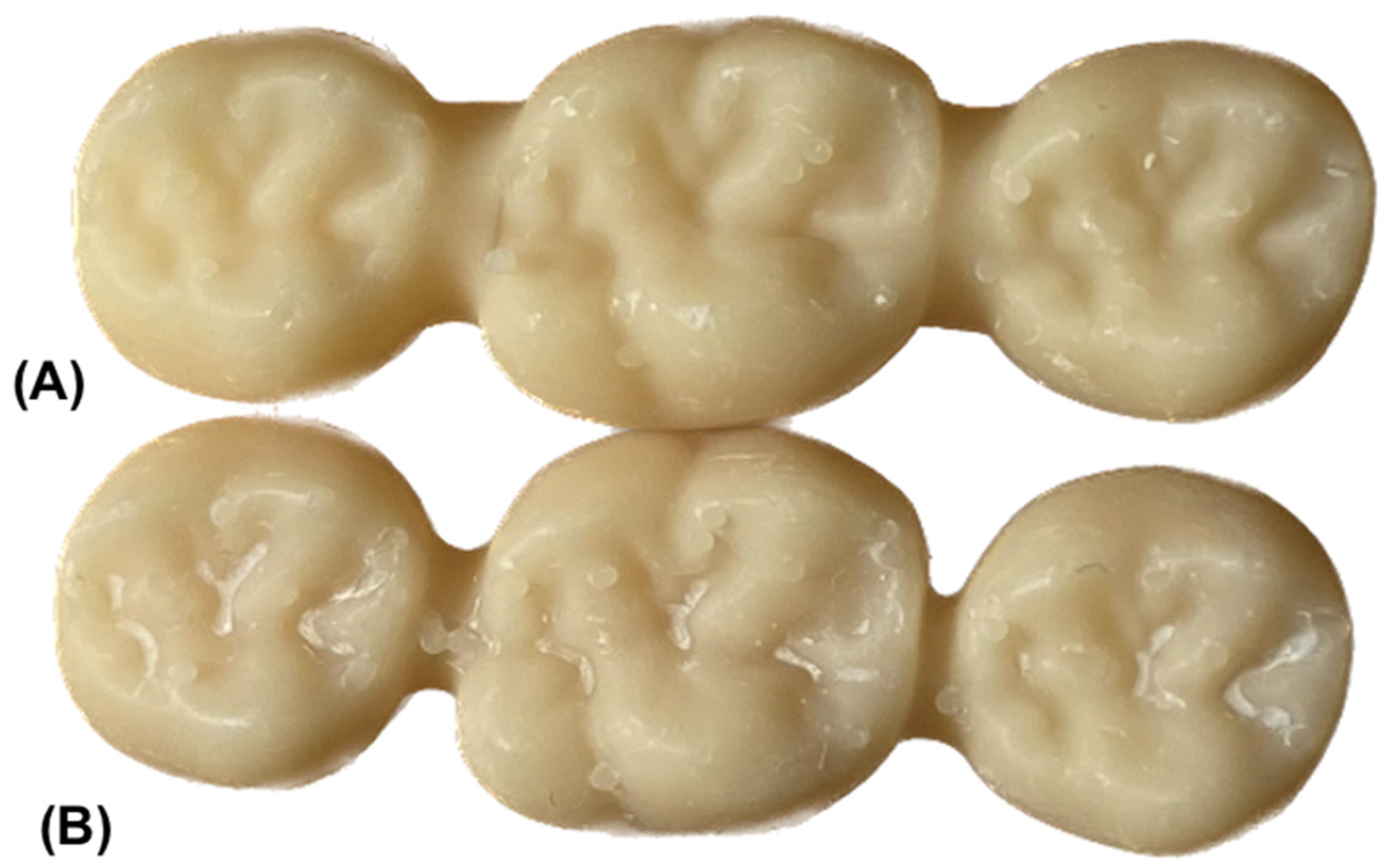
Eighty FDPs were divided into two main groups according to connector size: Group A (5 × 5 mm, n = 40) and Group B (3 × 3 mm, n = 40) as shown in Figure 2. Each group was further subdivided into four subgroups (n = 10 per subgroup) based on luting protocol (Table 1). Prior to cementation, intaglio surfaces of all FDPs and abutment surfaces were cleaned with 96% ethanol, air-dried, and inspected for debris. No mechanical (airborne-particle abrasion) or chemical (silanization, primers) surface treatment was applied to simulate simplified clinical workflows. Cementation was performed by a single operator (S.A.) at 23 ± 1 °C and 50 ± 10% relative humidity:
-
Groups A1, B1 (No cement). FDPs were dry-seated onto abutments using standardized finger pressure (~50 N, verified with digital gauge) and left uncemented as controls.
-
Groups A2, B2 (TempBond, Kerr Corporation, Orange, CA, USA). Base and catalyst mixed 1:1 by volume per manufacturer instructions. Cement applied evenly to intaglio surfaces (0.5 mm layer thickness), FDPs seated with finger pressure (~50 N × 30 s), excess removed with plastic scaler. Setting at 37 °C/100% humidity for 7 min.
-
Groups A3, B3 (Ketac Cem Radiopaque, 3M ESPE, Seefeld, Germany). Clicker capsule activated 10 s, applied to intaglio (0.5 mm), seated (~50 N × 30 s), excess removed. Chemical set 7 min at 37 °C/100% humidity.
-
Groups A4, B4 (G-Cem One Translucent, GC Corporation, Tokyo, Japan). Cement dispensed directly (no mixing), applied evenly to intaglio (0.5 mm), seated (~50 N × 30 s), excess removed with plastic scaler. Light-polymerized (Elipar S10 LED, 3M ESPE, 800 mW/cm2) 20 s each on buccal, lingual, mesial, and distal surfaces.
Excess cement removal was performed using hand instruments only. All cemented specimens were stored dry at 23 ± 1 °C for 24 h prior to mechanical testing to standardize initial set conditions.
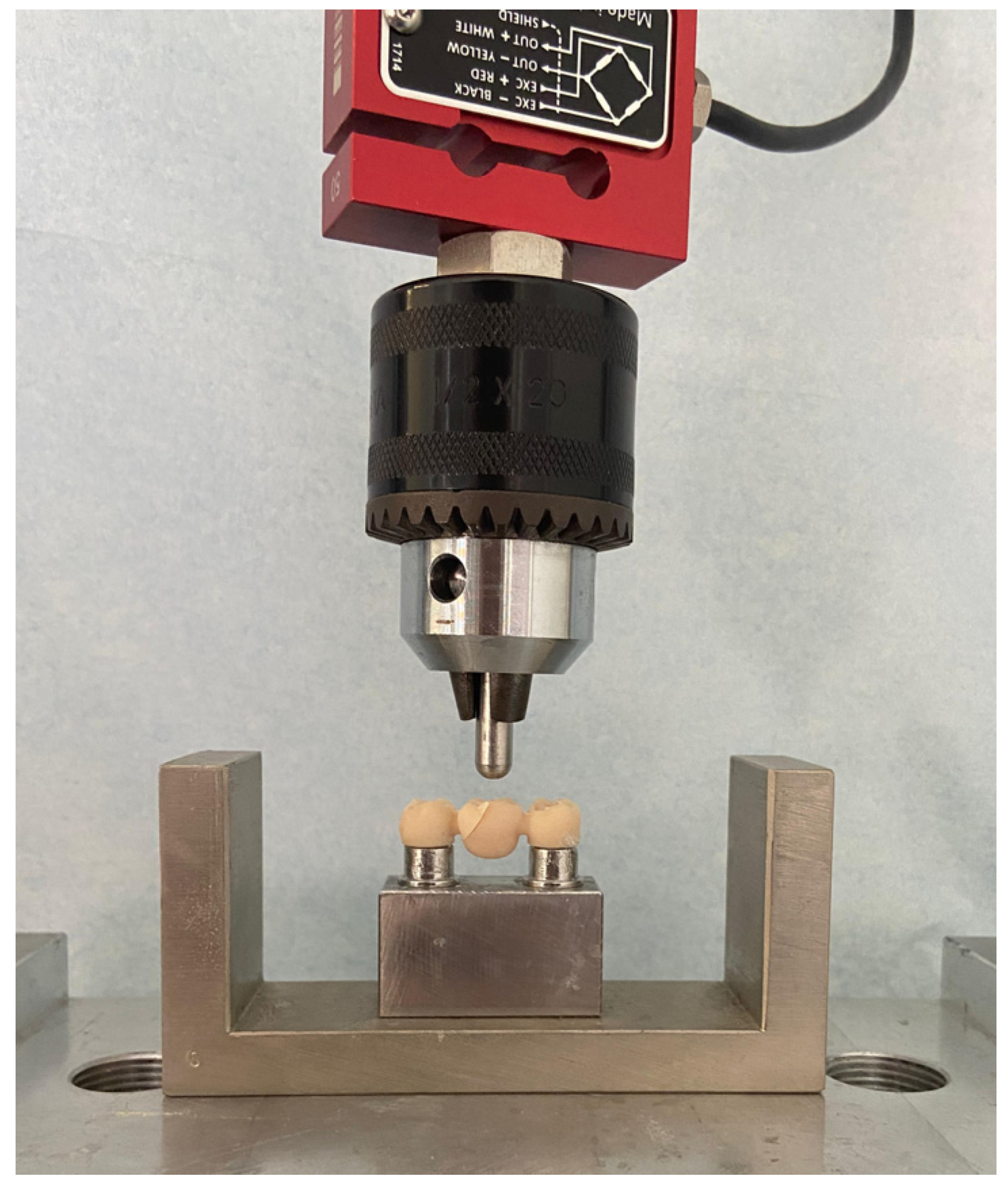
Sample size calculation indicated that 9 specimens per subgroup would provide 80% power (α = 0.05) to detect a 100 N difference in fracture load, assuming an estimated standard deviation of approximately 150 N derived from preliminary data and previous studies on similar 3D-printed resin-based FDPs. Therefore, 10 specimens were included per subgroup to increase reliability. Specimens were mounted in a universal testing machine (Instron 5567, Instron Corp., Norwood, MA, USA; 10 kN load cell) with abutments rigidly fixed in a custom stainless-steel jig (7 mm diameter cylindrical abutments, 16.5 mm span center-to-center). The loading direction was perpendicular to the occlusal plane, with a 3 mm diameter polished steel sphere contacting the pontic center until failure occurred as shown in Figure 3. The maximum fracture load was recorded in Newtons Statistical analysis was conducted using SPSS v.26 (IBM Corp., Armonk, NY, USA) with significance set at α = 0.05. The primary outcomes assessed were the effect of connector size on fracture load across all 80 specimens and the effect of luting protocol within each connector size group. Data normality was first evaluated separately for Group A (5 × 5 mm) and Group B (3 × 3 mm) using the Shapiro–Wilk test. For the primary comparison of connector size, a Mann–Whitney U test was applied to all specimens pooled by size, as this addressed the overall effect across luting protocols. Luting protocol effects were then examined within each connector size. For Group A (5 × 5 mm), normally distributed data permitted one-way ANOVA with Tukey HSD post hoc tests. For Group B (3 × 3 mm), non-normal data required Kruskal–Wallis testing, followed by exploratory Mann–Whitney U pairwise comparisons only when the omnibus test was significant. No Bonferroni correction was applied to post hoc tests, given the hierarchical focus on primary outcomes, though multiple-testing risks were considered in interpretation. Descriptive statistics are presented as mean ± standard deviation (SD) for all groups to facilitate comparison across experimental conditions. However, inferential analyses were selected according to data distribution, with parametric tests used for normally distributed data and non-parametric tests used when normality assumptions were not met. Effect sizes were reported where relevant.

3. Results

All specimens exhibited a cohesive fracture of the printed resin material, with crack initiation occurring predominantly at the connector region. Fractures propagated through the connector toward the pontic and/or retainer, leading to complete failure of the FDP. Similar failure patterns were observed regardless of connector size or luting protocol.
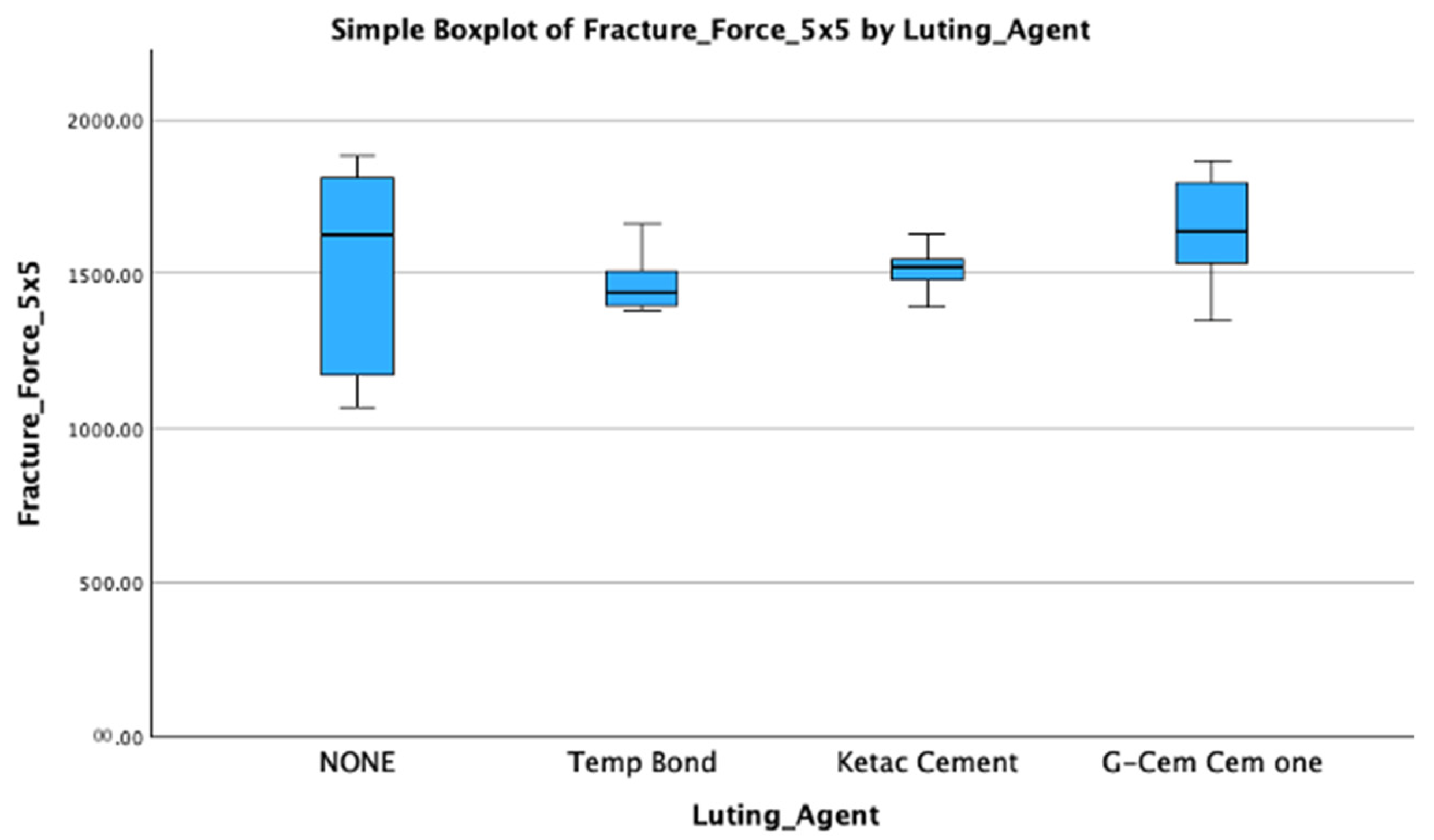
Table 2 reports the fracture load values for the FDPs with a connector size of 5 × 5 mm. Mean values ranged between 1468 ± 92 N (TempBond, A2) and 1638 ± 169 N (G-Cem One, A4), with the non-cemented control (A1) and Ketac Cem group (A3) showing intermediate values (1534 ± 321 N and 1522 ± 68 N, respectively). One-way ANOVA did not reveal statistically significant differences among these subgroups (p > 0.05), indicating that the type of luting agent did not significantly affect fracture resistance when a larger connector dimension was used as shown in Figure 4.
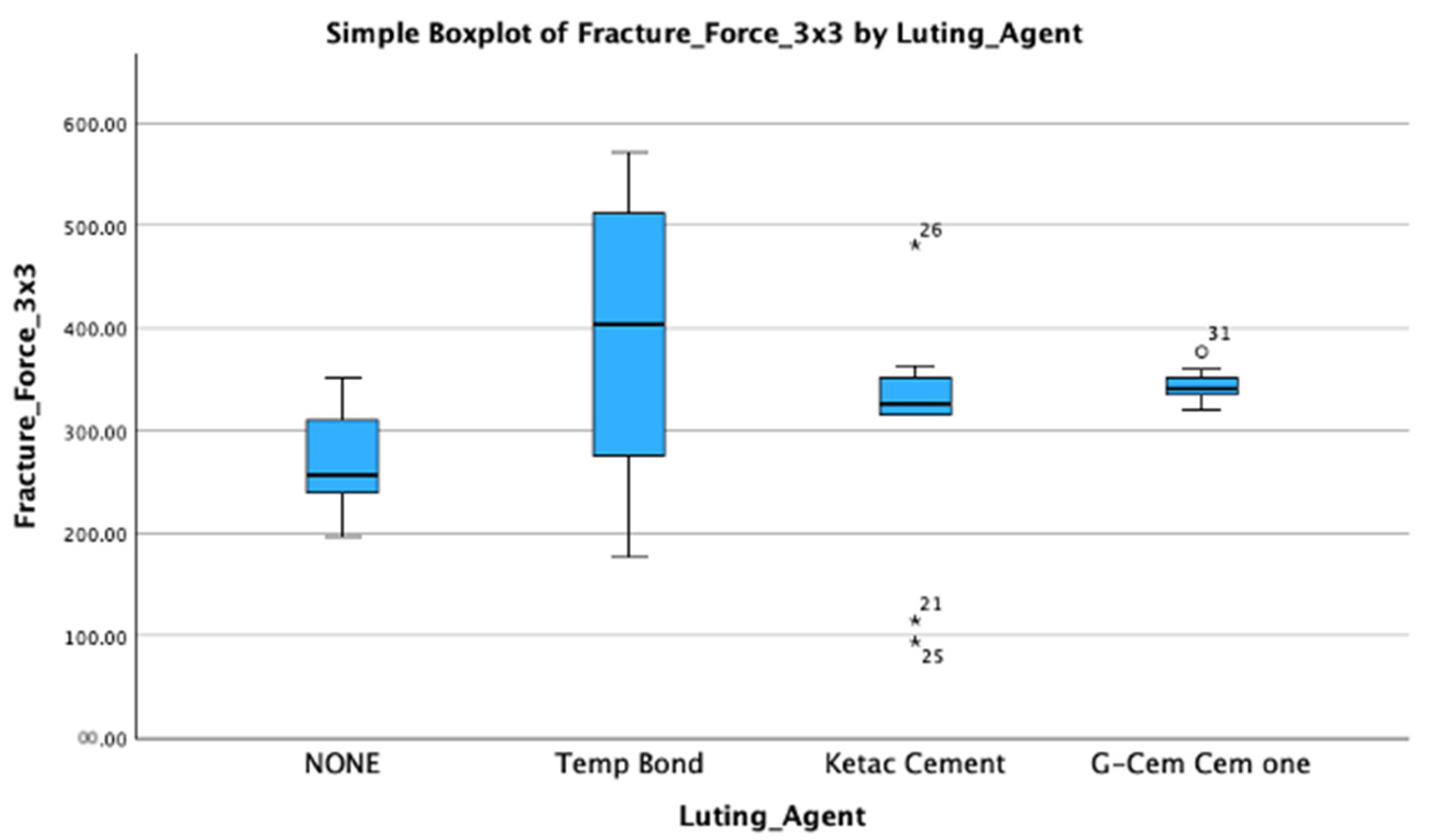
Table 3 presents the results for FDPs with a connector size of 3 × 3 mm. In this group, fracture resistance values were markedly lower than those observed in the 5 × 5 mm connector groups. Mean values ranged from 266 ± 51 N for the non-cemented control (B1) to 384 ± 132 N for TempBond (B2). Data in the 3 × 3 mm connector groups did not meet normality assumptions (Shapiro–Wilk test, p < 0.05); therefore, the Kruskal–Wallis test was used and revealed significant differences among the four subgroups (p = 0.022). Pairwise comparisons were performed using the Mann–Whitney U test following the significant Kruskal–Wallis result. These comparisons were considered exploratory and were interpreted cautiously in the context of multiple testing. TempBond (B2) and G-Cem One (B4) showed higher fracture load values compared with the non-cemented control (B1). Ketac Cem (B3, 300 ± 122 N) exhibited intermediate values, with no consistent difference from either B1 or B2. Notably, Group B2 displayed the highest mean fracture load, although its large standard deviation highlighted variability within the subgroup as shown in Figure 5.
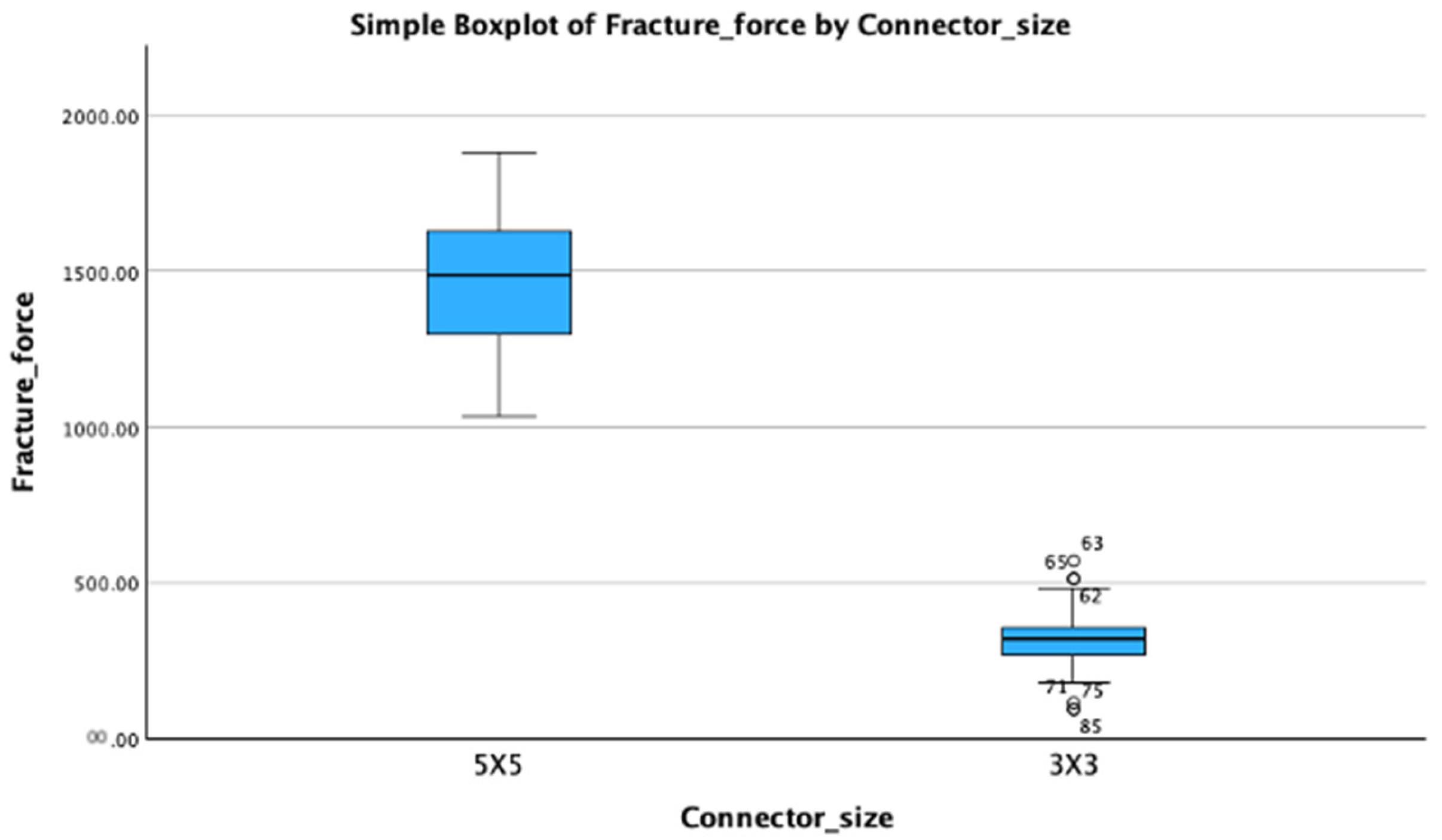
Table 4 provides an overview of all luting protocols across both connector sizes. Bridges with larger connectors (5 × 5 mm) consistently exhibited higher fracture resistance compared with those with smaller connectors (3 × 3 mm), regardless of the luting protocol. Figure 6 illustrates this overall effect, showing that an increase in connector dimension from 3 × 3 mm to 5 × 5 mm resulted in a substantial improvement in load-bearing capacity across all subgroups.

4. Discussion

The present study investigated the influence of connector size and luting protocols on the fracture resistance of 3D-printed resin-based FDPs. Connector size emerged as the most relevant factor, with 5 × 5 mm connectors exhibiting fracture resistance values nearly three times higher than those with 3 × 3 mm connectors, independent of the luting protocol. Accordingly, the first null hypothesis was rejected. These results align with our previous study, in which connector size was also identified as a key determinant of fracture behavior in printed FDPs [27]. However, the present investigation expands this evidence by demonstrating how different luting agents interact with structural design, particularly in reduced connector dimensions. Inadequate connector dimensions generate stress concentrations, early deformation, and reduced longevity of restorations, whereas larger connectors better distribute occlusal loads and withstand higher forces before failure [28,29]. From a biomechanical perspective, the enlargement of connectors (e.g., 5 × 5 mm) may improve structural reliability when anatomically feasible, although clinical decisions must also consider esthetic and biological factors.
The printable resin used in this study represents a commonly employed class of photopolymer materials for long-term interim FDPs. Its mechanical profile—moderate flexural strength and low elastic modulus—is consistent with many commercially available 3D-printed restorative resins, allowing the present findings to be interpreted within the context of routinely used printed materials [12,14]. Mechanical properties also vary substantially among printable resins, particularly in stiffness, toughness, filler content, and elastic modulus [16,18,19]. These differences may alter deformation patterns and fracture behavior at the connector level, indicating that the influence of connector size observed here could differ in other resin systems.
The second null hypothesis was only partially rejected, as the type of luting agent significantly influenced fracture resistance only in the 3 × 3 mm groups. Specimens bonded with self-adhesive resin cement (Group B4) exhibited significantly higher fracture resistance than non-cemented controls (Group B1) when connector dimensions were reduced. This result likely reflects the chemical and mechanical compatibility between resin cements and 3D-printed resin substrates, which favors a more homogenous adhesive interface and more efficient load transfer [30,31]. Previous studies have shown that shear bond strength between resin cements and 3D-printed definitive resins can be comparable to that of hybrid resin composites and polymer-infiltrated ceramics, and that self-adhesive resin cements such as G-Cem One achieve superior bonding performance even after thermal cycling [28,29]. Conversely, glass ionomer cement did not significantly affect fracture load, consistent with its lower bond strength to resin matrices [31]. Zinc-oxide–eugenol cement showed relatively high mean fracture values; however, the large variability observed within this group limits definitive interpretation [36]. Bonding effectiveness in printed FDPs is also material-dependent. Variations in surface chemistry, conversion degree, and filler composition can affect interaction with resin-based cements, leading to different adhesive performances. As such, luting behavior cannot be generalized across all printable resins.
Overall, these findings suggest that the mechanical contribution of the luting agent is conditional on connector geometry: negligible when bulk strength is sufficient, but relevant when structural resistance is reduced. Clinically, the use of resin-based cements, particularly self-adhesive formulations, may therefore be advisable when connector dimensions are constrained.
Physiological occlusal forces typically range from 400 to 800 N, with peak posterior loads occasionally reaching up to 1500 N [20]. In this study, the mean fracture loads of FDPs with 5 × 5 mm connectors fell within this range, whereas those with 3 × 3 mm connectors remained below the threshold. Although fracture loads in the 5 × 5 mm groups approached reported physiological occlusal forces, these in vitro findings should be interpreted cautiously. Laboratory fracture resistance does not directly translate into long-term clinical performance. Nevertheless, compared with conventional restorative materials such as Co-Cr alloys or zirconia, which exhibit flexural strength exceeding 800 MPa and an elastic modulus ≥200 GPa, printed resins still show inferior mechanical properties [15,16,32]. Their lower stiffness and flexural strength increase the risk of deformation, wear, and long-term instability under functional loading. Thus, although these materials may be suitable for long-term interim use, they cannot yet be considered reliable alternatives for definitive posterior FDPs. This interpretation is consistent with the findings of Hobbi et al. [37], who reported high rates of mechanical failure within three years, primarily due to cohesive fractures at the connector level.
Two main limitations should be acknowledged. First, no surface treatment was applied to the intaglio surfaces of the FDPs before cementation. Previous studies have shown that airborne-particle abrasion, silanization, or adhesive primers can improve bonding strength to resin substrates, potentially enhancing fracture resistance [38]. The present results may therefore underestimate the performance achievable with optimized bonding protocols. Second, the FDPs were cemented on standardized metal abutments, which do not replicate the mechanical or adhesive characteristics of natural dentin. Differences in elasticity, bonding interface, and stress distribution may influence the in vivo response of these restorations. In addition, only a single printing angulation and post-curing protocol was used. Evidence indicates that both parameters can substantially affect the degree of polymerization, surface quality, and mechanical properties of 3D-printed resins, which in turn may influence fracture resistance [17,18,19].
These findings should be interpreted mainly within the context of interim restorations, as current printed resins do not yet achieve the mechanical reliability required for definitive FDPs. Future studies should evaluate additional printable formulations and incorporate fatigue or thermocycling protocols to better characterize long-term performance under clinically relevant conditions. Therefore, while the present findings provide useful biomechanical insights, extrapolation to clinical longevity should be made with caution, and further fatigue and clinical studies are needed.

5. Conclusions

Within the limitations of this in vitro study, connector size was the primary factor affecting the fracture resistance of 3D-printed resin-based FDPs. Specimens with 5 × 5 mm connectors exhibited significantly higher fracture loads than those with 3 × 3 mm connectors. Resin-based cement improved fracture resistance in FDPs with reduced connector dimensions, whereas glass ionomer cement showed no significant effect.

Author Contributions

Conceptualization, A.C. and G.V.; methodology, G.V.; software, S.A.; validation, E.F.C. and M.F.; formal analysis, S.A.; investigation, S.A.; resources, M.F.; data curation, A.C.; writing—original draft preparation, G.V.; writing—review and editing, E.F.C.; visualization, A.C.; supervision, M.F.; project administration, E.F.C. All authors have read and agreed to the published version of the manuscript.

Funding

This research received no external funding.

Institutional Review Board Statement

Not applicable.

Informed Consent Statement

Not applicable.

Data Availability Statement

The data presented in this study are available on request from the corresponding author. The data are not publicly available due to university policy.

Conflicts of Interest

The authors declare no conflicts of interest.

References

  1. Sailer, I.; Makarov, N.A.; Thoma, D.S.; Zwahlen, M.; Pjetursson, B.E. All-ceramic or metal-ceramic tooth-supported fixed dental prostheses (FDPs)? A systematic review of the survival and complication rates. Part I: Single crowns (SCs). Dent. Mater. 2015, 31, 603–623. [Google Scholar] [CrossRef] [PubMed]
  2. Pjetursson, B.E.; Sailer, I.; Makarov, N.A.; Zwahlen, M.; Thoma, D.S. All-ceramic or metal-ceramic tooth-supported fixed dental prostheses (FDPs)? A systematic review of the survival and complication rates. Part II: Multiple-unit FDPs. Dent. Mater. 2015, 31, 624–639. [Google Scholar] [CrossRef] [PubMed]
  3. Layton, D. A critical appraisal of the survival and complication rates of tooth-supported all-ceramic and metal-ceramic fixed dental prostheses: The application of evidence-based dentistry. Int. J. Prosthodont. 2011, 24, 417–427. [Google Scholar] [PubMed]
  4. Saeed, F.; Muhammad, N.; Khan, A.S.; Sharif, F.; Rahim, A.; Ahmad, P.; Irfan, M. Prosthodontics dental materials: From conventional to unconventional. Mater. Sci. Eng. C Mater. Biol. Appl. 2020, 106, 110167. [Google Scholar] [CrossRef] [PubMed]
  5. Joda, T.; Zarone, F.; Ferrari, M. The complete digital workflow in fixed prosthodontics: A systematic review. BMC Oral Health 2017, 17, 124. [Google Scholar] [CrossRef] [PubMed]
  6. Abduo, J.; Lyons, K.; Swain, M. Fit of zirconia fixed partial denture: A systematic review. J. Oral Rehabil. 2010, 37, 866–876. [Google Scholar] [CrossRef] [PubMed]
  7. Duarte, S., Jr.; Phark, J.H. Advances in Dental Restorations: A Comprehensive Review of Machinable and 3D-Printed Ceramic-Reinforced Composites. J. Esthet. Restor. Dent. 2025, 37, 257–276. [Google Scholar] [PubMed]
  8. Schweiger, J.; Edelhoff, D.; Güth, J.F. 3D printing in digital prosthetic dentistry: An overview of recent developments in additive manufacturing. J. Clin. Med. 2021, 10, 2010. [Google Scholar] [CrossRef] [PubMed]
  9. Dimitrova, M.; Vlahova, A.; Kalachev, Y.; Zlatev, S.; Kazakova, R.; Capodiferro, S. Recent advances in 3D printing of polymers for application in prosthodontics. Polymers 2023, 15, 4525. [Google Scholar] [CrossRef] [PubMed]
  10. Alyami, M.H. The applications of 3D-printing technology in prosthodontics: A review of the current literature. Cureus 2024, 16, e68501. [Google Scholar] [CrossRef] [PubMed]
  11. Zhu, H.; Jiang, J.; Wang, Y.; Wang, S.; He, Y.; He, F. Additive manufacturing of dental ceramics in prosthodontics: The status quo and the future. J. Prosthodont. Res. 2024, 68, 380–399. [Google Scholar] [CrossRef] [PubMed]
  12. Sahin, Z.; Ozer, N.E.; Yıkıcı, C.; Kılıçarslan, M.A. Mechanical characteristics of composite resins produced by additive and subtractive manufacturing. Eur. J. Prosthodont. Restor. Dent. 2023, 31, 278–285. [Google Scholar] [CrossRef] [PubMed]
  13. Casucci, A.; Ferrari Cagidiaco, E.; Verniani, G.; Ferrari, M.; Borracchini, A. Digital vs conventional removable complete dentures: A retrospective study on clinical effectiveness and cost-efficiency in edentulous patients. J. Dent. 2025, 153, 105505. [Google Scholar] [CrossRef] [PubMed]
  14. Daher, R.; Ardu, S.; di Bella, E.; Krejci, I.; Duc, O. Efficiency of 3D printed composite resin restorations compared with subtractive materials: Evaluation of fatigue behavior, cost, and time of production. J. Prosthet. Dent. 2024, 131, 943–950. [Google Scholar] [CrossRef] [PubMed]
  15. Valenti, C.; Isabella Federici, M.; Masciotti, F.; Marinucci, L.; Xhimitiku, I.; Cianetti, S.; Pagano, S. Mechanical properties of 3D printed prosthetic materials compared with milled and conventional processing: A systematic review and meta-analysis of in vitro studies. J. Prosthet. Dent. 2024, 132, 381–391. [Google Scholar] [CrossRef] [PubMed]
  16. Abad-Coronel, C.; Urdiales, D.D.; Arias, M.V.B.; Córdova, A.K.; Medina, M.S.; Torres, W.B. Flexural strength, fatigue behavior, and microhardness of three-dimensional (3D)-printed resin material for indirect restorations: A systematic review. Materials 2023, 16, 4185. [Google Scholar] [CrossRef] [PubMed]
  17. Casucci, A.; Verniani, G.; Haichal, W.S.; Manfredini, D.; Ferrari, M.; Ferrari Cagidiaco, E. Influence of printing angulation on the flexural strength of 3D printed resins: An in vitro study. Appl. Sci. 2024, 14, 10067. [Google Scholar] [CrossRef]
  18. Gad, M.M.; Fouda, S.M. Factors affecting flexural strength of 3D-printed resins: A systematic review. J. Prosthodont. 2023, 32, 96–110. [Google Scholar] [CrossRef] [PubMed]
  19. Piedra-Cascón, W.; Krishnamurthy, V.R.; Att, W.; Revilla-León, M. 3D printing parameters, supporting structures, slicing, and post-processing procedures of vat-polymerization additive manufacturing technologies: A narrative review. J. Dent. 2021, 109, 103630. [Google Scholar] [CrossRef] [PubMed]
  20. Lee, S.K.Y.; Salinas, T.J.; Wiens, J.P. The effect of patient-specific factors on occlusal forces generated: Best evidence consensus statement. J. Prosthodont. 2021, 30, S52–S60. [Google Scholar] [CrossRef]
  21. Corbani, K.; Hardan, L.; Skienhe, H.; Özcan, M.; Alharbi, N.; Salameh, Z. Effect of material thickness on the fracture resistance and failure pattern of 3D-printed composite crowns. Int. J. Comput. Dent. 2020, 23, 225–233. [Google Scholar] [PubMed]
  22. Onodera, K.; Sato, T.; Nomoto, S.; Miho, O.; Yotsuya, M. Effect of connector design on fracture resistance of zirconia all-ceramic fixed partial dentures. Bull. Tokyo Dent. Coll. 2011, 52, 61–67. [Google Scholar] [CrossRef] [PubMed]
  23. Lakshmi, R.D.; Abraham, A.; Sekar, V.; Hariharan, A. Influence of Connector Dimensions on the Stress Distribution of Mono-lithic Zirconia and Lithium-Disilicate Inlay Retained Fixed Dental Prostheses—A 3D Finite Element Analysis. Tanta Dent. J. 2015, 12, 56–64. [Google Scholar]
  24. Al-Amleh, B.; Lyons, K.; Swain, M. Clinical trials in zirconia: A systematic review. J. Dent. 2010, 38, 719–724. [Google Scholar]
  25. Toksavul, S.; Uçtasli, M.B.; Ozdemir, E.; Toman, M. Influence of the connector design on the fracture strength of all-ceramic fixed partial dentures. J. Prosthet. Dent. 2006, 95, 291–297. [Google Scholar]
  26. Borba, M.; de Araújo, M.D.; de Lima, E.; Yoshimura, H.N.; Cesar, P.F. Flexural strength and failure modes of ceramic FPDs as a function of connector design. Dent. Mater. 2011, 27, 1119–1126. [Google Scholar] [PubMed]
  27. Verniani, G.; FerrariCagidiaco, E.; Alavi Tabatabaei, S.; Casucci, A. Fracture Resistance of 3D-Printed Fixed Partial Dentures: Influence of Connector Size and Materials. Materials 2025, 18, 3468. [Google Scholar] [CrossRef] [PubMed]
  28. Shah, R.; Patel, K.; Patel, M. Influence of connector design and cross-sectional shape on stress distribution in posterior fixed partial dentures: A 3D FEA and experimental study. J. Indian Prosthodont. Soc. 2014, 14, S151–S158. [Google Scholar]
  29. Oh, W.S.; Anusavice, K.J. Effect of connector design on the fracture resistance of all-ceramic fixed partial dentures. J. Prosthet. Dent. 2002, 87, 536–542. [Google Scholar] [CrossRef] [PubMed]
  30. Seaton, P. Mechanics of tensile and shear stress generation in fixed partial denture retainers. J. Prosthet. Dent. 1994, 71, 237–244. [Google Scholar] [CrossRef] [PubMed]
  31. Indergård, J.A.; Skjold, A.; Schriwer, C.; Øilo, M. Effect of cementation techniques on fracture load of monolithic zirconia crowns. Biomater. Investig. Dent. 2021, 8, 160–169. [Google Scholar] [CrossRef] [PubMed]
  32. Rosentritt, M.; Hmaidouch, R.; Behr, M.; Handel, G.; Schneider-Feyrer, S. Fracture resistance of zirconia FPDs with adhesive bonding versus conventional cementation. Int. J. Prosthodont. 2011, 24, 168–171. [Google Scholar] [PubMed]
  33. Bora, P.V.; Sayed Ahmed, A.; Alford, A.; Pitttman, K.; Thomas, V.; Lawson, N.C. Characterization of Materials Used for 3D Printing Dental Crowns and Hybrid Prostheses. J. Esthet. Restor. Dent. 2024, 36, 220–230. [Google Scholar] [PubMed]
  34. Hill, E.E. Dental cements for definitive luting: A review and practical clinical considerations. Dent. Clin. N. Am. 2007, 51, 643–658. [Google Scholar] [CrossRef] [PubMed]
  35. Muto, R.; Takamizawa, T.; Shiratsuchi, K.; Kasahara, Y.; Suda, S.; Watanabe, H.; Latta, M.A.; Miyazaki, M. Influence of luting strategies on dentin bond performance of self-adhesive resin luting cement in combination with a universal adhesive. Clin. Oral Investig. 2024, 28, 478. [Google Scholar] [CrossRef] [PubMed]
  36. Aktas, N.; Bankoglu Güngör, M. Effects of 3D-printing technology and cement type on the fracture resistance of permanent resin crowns for primary teeth. Int. J. Prosthodont. 2024, 37, 195–202. [Google Scholar] [CrossRef] [PubMed]
  37. Hobbi, P.; Ordueri, T.M.; Öztürk-Bozkurt, F.; Toz-Akalın, T.; Ateş, M.; Özcan, M. 3D-printed resin composite posterior fixed dental prosthesis: A prospective clinical trial up to 1 year. Front. Dent. Med. 2024, 5, 1390600. [Google Scholar] [CrossRef] [PubMed]
  38. Hammamy, M.; Rueda, S.R.; Pio, A.; Rizzante, F.A.P.; Lawson, N.C. Effect of air particle abrasion and primers on bond strength to 3D-printed crown materials. Materials 2025, 18, 265. [Google Scholar] [CrossRef] [PubMed]
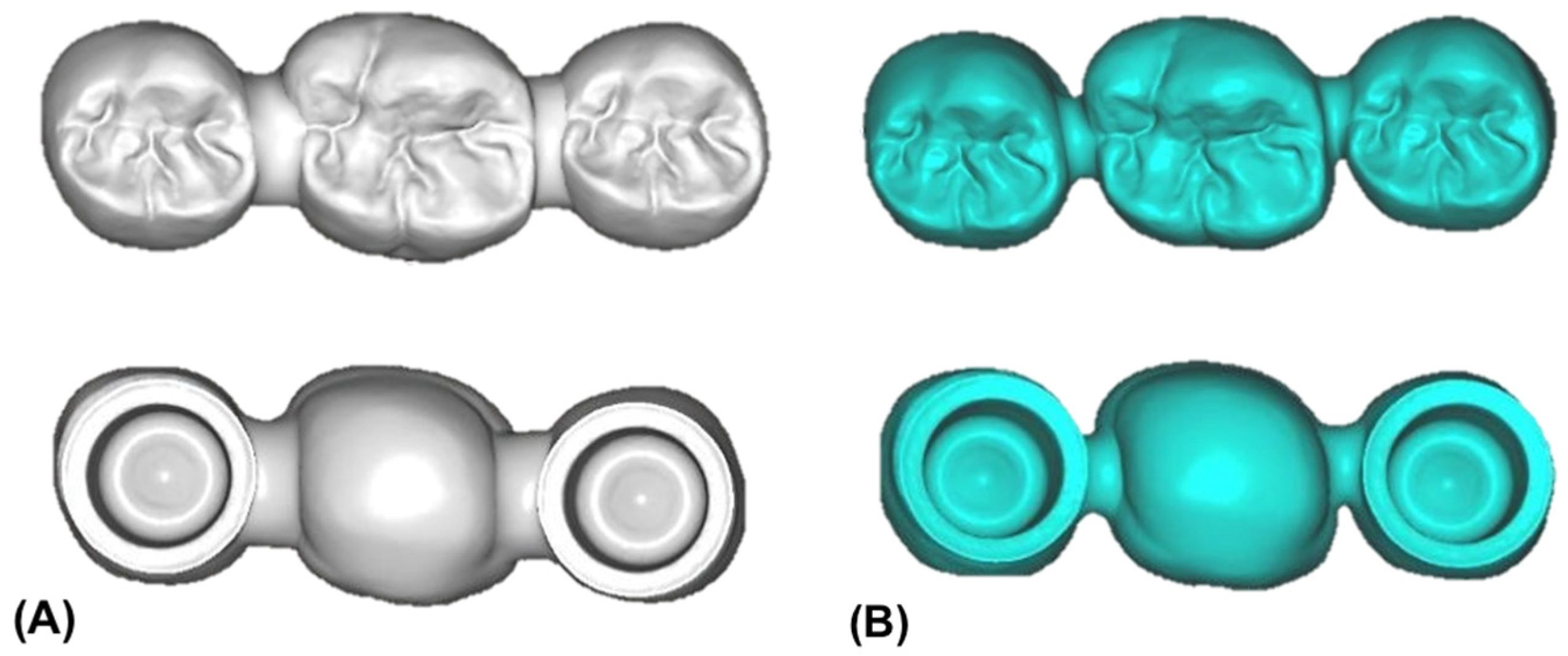
Figure 1. STL files of the FDPs after digital wax-up: (A) design for the 5 × 5 mm connector; (B) design for the 3 × 3 mm connector.
Prosthesis 08 00064 g001
Figure 2. 3D printed FDPs: (A) 5 × 5 mm; (B) 3 × 3 mm.
Prosthesis 08 00064 g002
Figure 3. Universal machine for three-point bending test with a specimen after fracture occurred.
Prosthesis 08 00064 g003
Figure 4. Fracture force [N] Group A (5 × 5): One-way ANOVA test.
Prosthesis 08 00064 g004
Figure 5. Fracture force [N] Group B (3 × 3): Kruskal–Wallis test 0.022, Mann–Whitney U test < 0.05.
Prosthesis 08 00064 g005
Figure 6. Fracture force [N] Group A (5 × 5) vs. Group B (3 × 3): Mann–Whitney U test < 0.001.
Prosthesis 08 00064 g006
Table 1. Subdivision of samples based on the type of cementation.
Connector SizeSubgroupCement
Group A (5 × 5)A1none
A2Temporary cement (Temp Bond, Kerr Corporation, Orange, CA, USA)
A3Glass ionomer cement (Ketac Cem radiopaque, 3M ESPE, Seefeld, Germany)
A4Resin adhesive cement (GCem One, GC Corporation, Tokyo, Japan)
Group B (3 × 3)B1none
B2Temporary cement (Temp Bond, Kerr Corporation, Orange, CA, USA)
B3Glass ionomer cement (Ketac Cem radiopaque, 3M ESPE, Seefeld, Germany)
B4Resin adhesive cement (GCem One, GC Corporation, Tokyo, Japan)
Table 2. Fracture force [N] Group A (5 × 5): One-way ANOVA test.
GroupCSLuting AgentMean ± SDSig. p < 0.05
A15 × 5None1534.12 ± 320.68A
A25 × 5TempBond1468.38 ± 92.25A
A35 × 5KetacCem1521.53 ± 67.63A
A45 × 5G-Cem1637.98 ± 169.29A
Legend: CS: connector size (mm), SD: standard deviation, Sig.: significant differences. A1: samples with 5 × 5 connector and no cement, A2: 5 × 5 with TempBond, A3: 5 × 5 with Ketac Cem, A4: 5 × 5 with G-Cem One. Same uppercase letters per table denote no statistically significant differences between the groups (p > 0.05).
Table 3. Fracture force [N] Group B (3 × 3): Kruskal–Wallis test 0.022, Mann–Whitney U test < 0.05.
GroupCSLuting AgentMean ± SDSig. p < 0.05
B13 × 3None266.09 ± 50.79A
B23 × 3TempBond384.42 ± 131.0BC
B33 × 3KetacCem299.71 ± 121.73AC
B43 × 3G-Cem343.54 ± 17.34BC
Legend: CS: connector size (mm), SD: standard deviation, Sig.: significant differences. B1: samples with 3 × 3 connector and no cement, B2: 3 × 3 with TempBond, B3: 3 × 3 with Ketac Cem, B4: 3 × 3 with G-Cem One. Same uppercase letters per table denote no statistically significant differences between the groups.
Table 4. Fracture load (Mean ± SD, N) according to luting agent and connector size.
Luting AgentConnector Size
Group A (5 × 5)Group B (3 × 3)
None1534.12 ± 320.68266.09 ± 50.79
TempBond1468.38 ± 92.25384.42 ± 131.8
Ketac Cem1521.53 ± 67.63299.71 ± 121.73
G-Cem One1637.98 ± 169.29343.54 ± 17.35
Legend: CS: connector size (mm), SD: standard deviation.
Disclaimer/Publisher’s Note: The statements, opinions and data contained in all publications are solely those of the individual author(s) and contributor(s) and not of MDPI and/or the editor(s). MDPI and/or the editor(s) disclaim responsibility for any injury to people or property resulting from any ideas, methods, instructions or products referred to in the content.