Accuracy of Intraoral Scanners Versus Polyvinyl Siloxane Impression in Partially Edentulous Implant Rehabilitations: An In Vitro Comparison

 , ,
, , 
Abstract
1. Introduction
2. Materials and Methods
2.1. In Vitro Procedure
- 1.
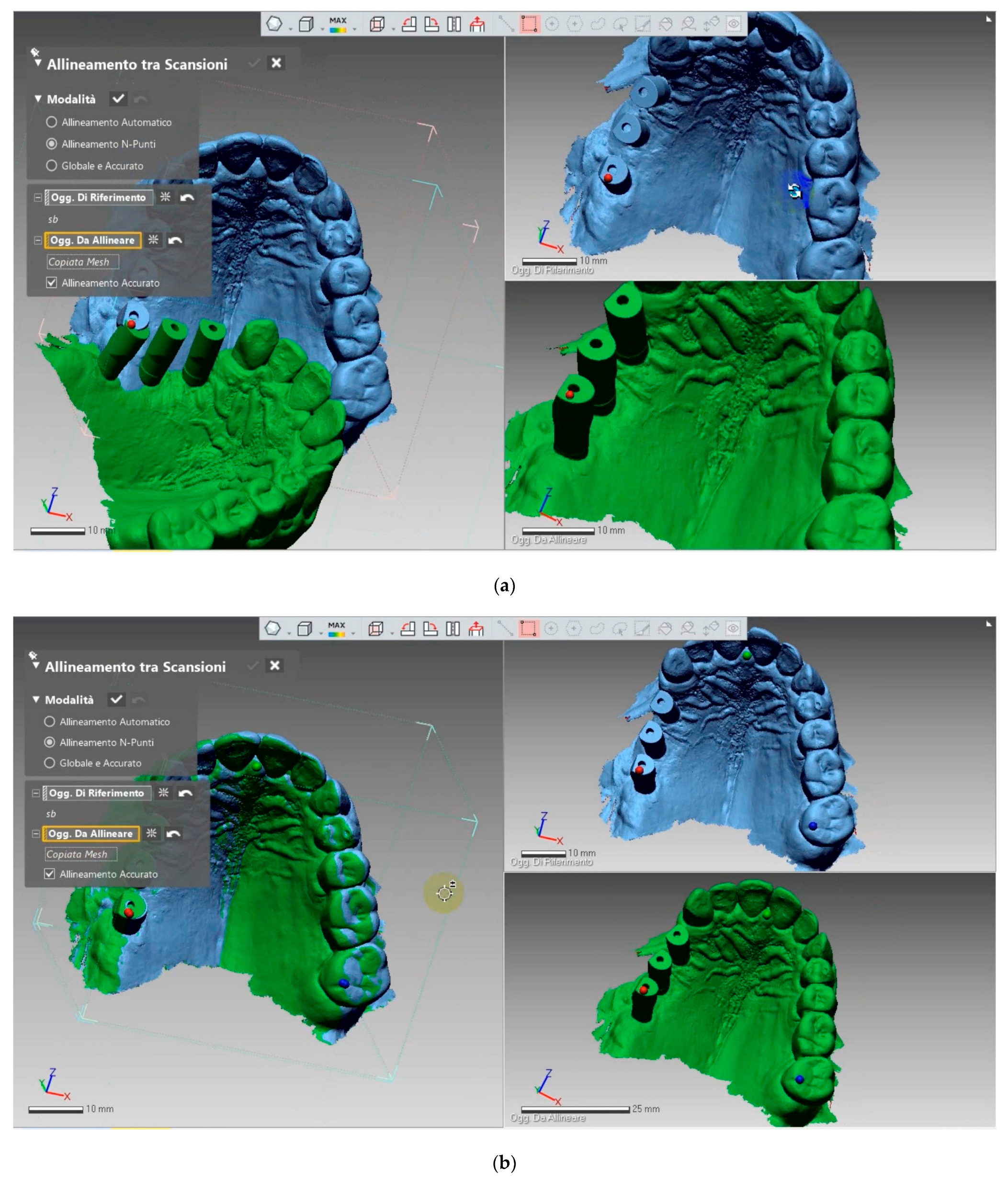
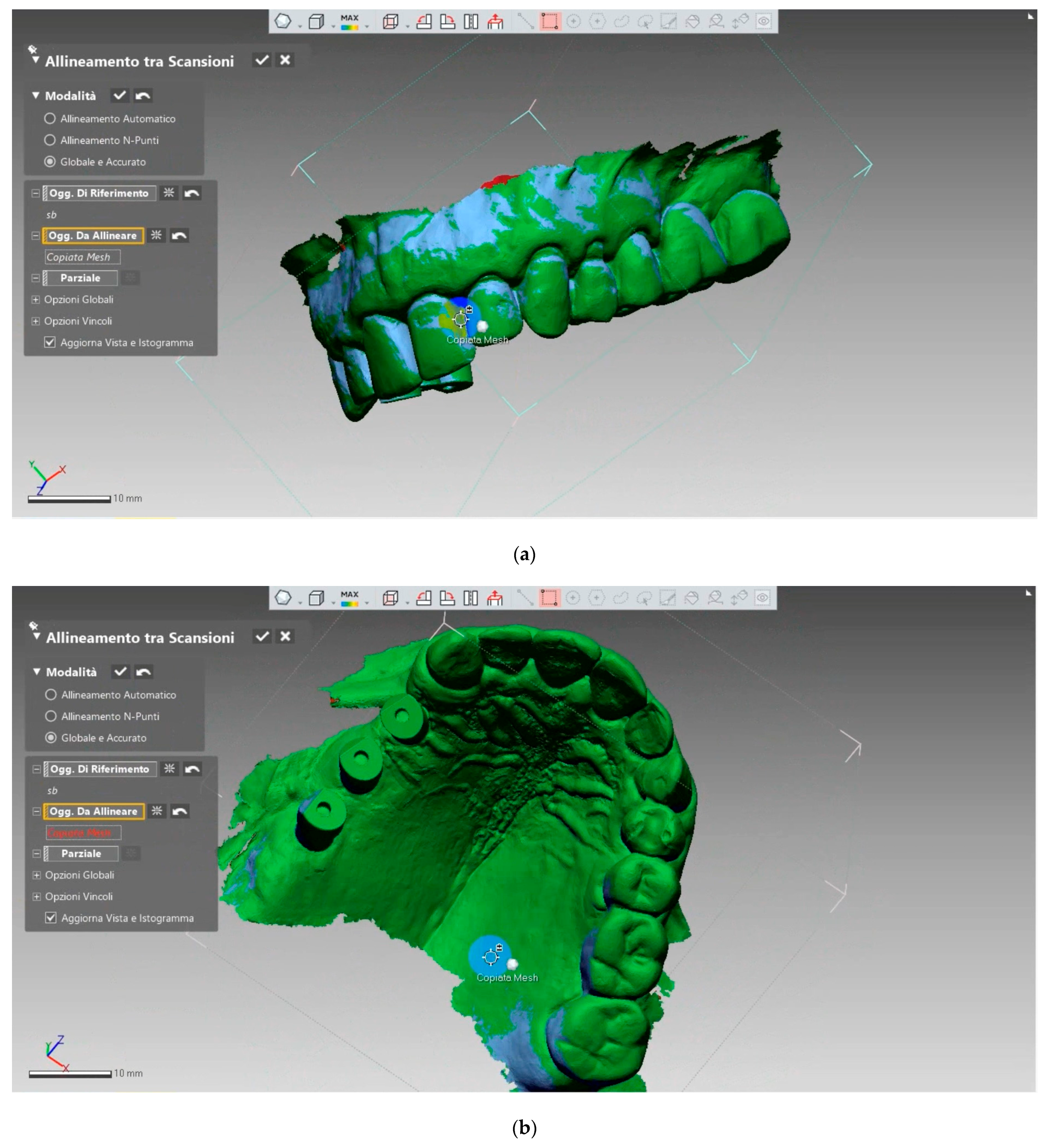
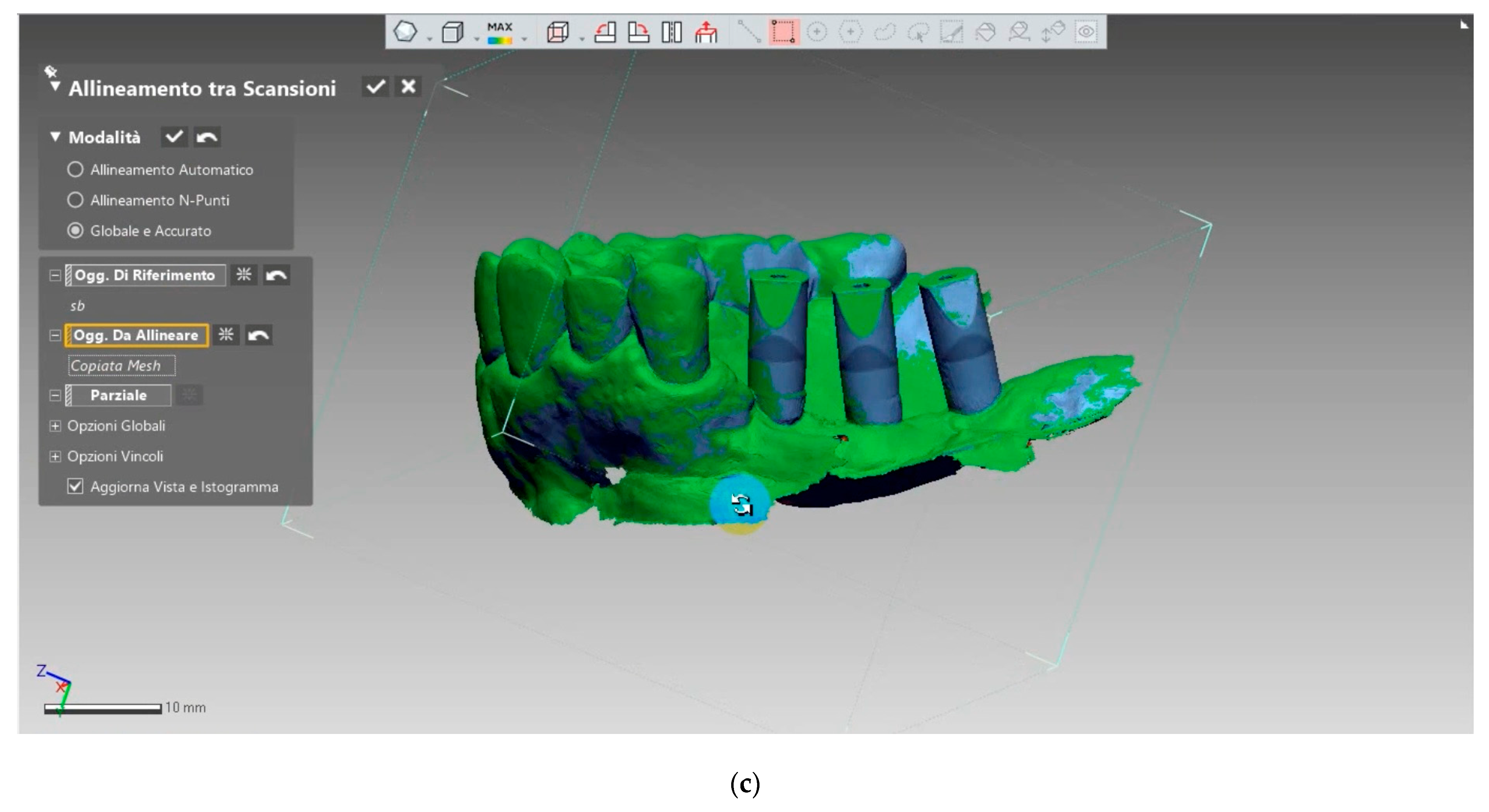
- Reference scan: Scan bodies were screwed on the master model, and a scan using a laboratory scanner (the Concept Scan Top™) was performed.
- 2.
- Trios3shape® scan: Scan bodies were screwed on the master model, and a scan using Trios3shape® scanner was performed.
- 3.
- Carestream CS 3600TM scan: Scan bodies were screwed on the master model, and a scan using Carestream CS 3600TM scanner was performed.
- 4.
- Analogical transfers were screwed on the implant analogues of the master model, a standard impression with polyvinylsiloxanes (PVS) was taken, and a dental stone model was obtained. Scan bodies were screwed on the stone model and scanned with the laboratory scanner (the Concept Scan Top™).
2.2. Statistical Analysis
3. Results
- (GROUP 1) digital impression with TRIOS®-3Shape: 13 μm with a standard deviation of 79 μm.
- (GROUP 2) digital impression with CS 3600®–Carestream Dental: 12 μm with a standard deviation of 82 μm.
- (GROUP 3) Polyvinyl Siloxane impression: 25 μm with a standard deviation of 213 μm.
- TRIOS®-3Shape shows a slightly higher prevalence of negative deviations.
- PVS shows a clear prevalence of positive deviations.
- CS 3600®–Carestream Dental exhibits an almost equal prevalence of positive and negative values.
- TRIOS 3Shape® and Carestream CS3600®: Since the Z-value is less than the critical Z, there is no statistically significant difference in accuracy between TRIOS 3Shape® and Carestream CS3600®. Additionally, there is a 60% probability that the results are due to chance. Therefore, since the p-value is greater than α, the null hypothesis is accepted.
- TRIOS 3Shape® and PVS: Since the Z-value is greater than the critical Z, there is a statistically significant difference in accuracy between TRIOS 3Shape® and PVS. Furthermore, the probability that the results are due to chance is negligible. Thus, since the p-value is less than α, the null hypothesis is rejected.
- Carestream CS3600® and PVS: Since the Z-value is greater than the critical Z, there is a statistically significant difference in accuracy between Carestream CS3600® and PVS. Similarly, the probability that the results are due to chance is negligible. Therefore, with the p-value less than α, the null hypothesis is rejected.
- TRIOS 3Shape®: 79 μm;
- Carestream CS3600®: 82 μm;
- PVS: 213 μm.
- TRIOS 3Shape® and Carestream CS3600®: Since the Z-value is less than the critical Z, there is no statistically significant difference between the standard deviations of TRIOS 3Shape® and Carestream CS3600®. Additionally, there is a 58% probability that the results are due to chance. Therefore, since the p-value is greater than α, the null hypothesis is accepted.
- TRIOS 3Shape® and PVS: Since the Z-value is greater than the critical Z, there is a statistically significant difference between the standard deviations of TRIOS 3Shape® and PVS. Moreover, the probability that the results are due to chance is negligible, so the null hypothesis is rejected.
- Carestream CS3600® and PVS: Since the Z-value is greater than the critical Z, a statistically significant difference exists between the standard deviations of Carestream CS3600® and PVS. The p-value is negligible, so the null hypothesis is rejected.
4. Discussion
5. Conclusions
Author Contributions
Funding
Institutional Review Board Statement
Informed Consent Statement
Data Availability Statement
Acknowledgments
Conflicts of Interest
References
- Khurshid, Z. Digital Dentistry: Transformation of Oral Health and Dental Education with Technology. Eur. J. Dent. 2023, 17, 943–944. [Google Scholar] [CrossRef] [PubMed] [PubMed Central]
- Widhalm, K.; Maul, L.; Durstberger, S.; Klupper, C.; Putz, P. Real-Time Digital Feedback for Exercise Therapy of Lower Extremity Functional Deficits: A Mixed Methods Study of User Requirements. Stud. Health Technol. Inform. 2023, 301, 108–114. [Google Scholar] [CrossRef] [PubMed]
- Suganna, M.; Nayakar, R.P.; Alshaya, A.A.; Khalil, R.O.; Alkhunaizi, S.T.; Kayello, K.T.; Alnassar, L.A. The Digital Era Heralds a Paradigm Shift in Dentistry: A Cross-Sectional Study. Cureus 2024, 16, e53300. [Google Scholar] [CrossRef] [PubMed] [PubMed Central]
- Davidowitz, G.; Kotick, P.G. The use of CAD/CAM in dentistry. Dent. Clin. N. Am. 2011, 55, 559–570. [Google Scholar] [CrossRef]
- Al-Hassiny, A. Intraoral Scanners: The Key to Dentistry’s Digital Revolution. Compend. Contin. Educ. Dent. 2023, 44, 154–156. [Google Scholar] [PubMed]
- Abduo, J.; Palamara, J.E.A. Accuracy of digital impressions versus conventional impressions for 2 implants: An in vitro study. Int. J. Implant. Dent. 2021, 7, 75. [Google Scholar] [CrossRef]
- Ma, J.; Zhang, B.; Song, H.; Wu, D.; Song, T. Accuracy of digital implant impressions obtained using intraoral scanners: A systematic review of in vivo studies. J. Dent. Sci. 2023, 9, 48. [Google Scholar] [CrossRef]
- Pesce, P.; Nicolini, P.; Caponio, V.C.A.; Zecca, P.A.; Canullo, L.; Isola, G.; Baldi, D.; De Angelis, N.; Menini, M. Accuracy of Full-Arch Intraoral Scans Versus Conventional Impression: Systematic review. Appl. Sci. 2024, 14, 71. [Google Scholar]
- Bi, C.; Wang, X.; Tian, F.; Qu, Z.; Zhao, J. Comparison of accuracy between digital and conventional implant impressions. J. Adv. Prosthodont. 2022, 14, 236–249. [Google Scholar] [CrossRef]
- Vitai, V.; Németh, A.; Sólyom, E.; Czumbel, L.M.; Szabó, B.; Fazekas, R.; Gerber, G.; Hegyi, P.; Hermann, P.; Borbély, J. Evaluation of the accuracy of intraoral scanners for complete-arch scanning: A network meta-analysis. J. Dent. 2023, 137, 104636. [Google Scholar] [CrossRef]
- Sanda, M.; Miyoshi, K.; Baba, K. Trueness and precision of digital implant impressions by IOS. Int. J. Implant. Dent. 2021, 7, 97. [Google Scholar] [CrossRef]
- Imburgia, M.; Logozzo, S.; Hauschild, U.; Veronesi, G.; Mangano, C.; Mangano, F.G. Accuracy of four intraoral scanners in oral implantology. BMC Oral Heal. 2017, 17, 92. [Google Scholar] [CrossRef]
- Roig, E.; Garza, L.C.; Álvarez-Maldonado, N.; Maia, P.; Costa, S.; Roig, M.; Espona, J. In vitro comparison of the accuracy of four intraoral scanners. PLoS ONE 2020, 15, e0228266. [Google Scholar] [CrossRef]
- Rutkūnas, V.; Auškalnis, L.; Pletkus, J. Intraoral scanners in implant prosthodontics: A narrative review. J. Dent. 2024, 148, 105152. [Google Scholar] [CrossRef]
- TREND Statement Checklist. Published Date: 01/01/2004. Available online: https://stacks.cdc.gov/view/cdc/149677 (accessed on 24 June 2023).
- Dogan, S.; Schwedhelm, E.R.; Heindl, H.; Mancl, L.; Raigrodski, A.J. Clinical efficacy of polyvinyl siloxane impression materials using the one-step two-viscosity impression technique. J. Prosthet. Dent. 2015, 114, 217–222. [Google Scholar] [CrossRef] [PubMed]
- Pellitteri, F.; Albertini, P.; Vogrig, A.; Spedicato, G.A.; Siciliani, G.; Lombardo, L. Comparative analysis of intraoral scanners accuracy using 3D software: An in vivo study. Prog. Orthod. 2022, 23, 21. [Google Scholar] [CrossRef] [PubMed] [PubMed Central]
- Róth, I.; Czigola, A.; Fehér, D.; Vitai, V.; Joós-Kovács, G.L.; Hermann, P.; Borbély, J.; Vecsei, B. Digital intraoral scanner devices: A validation study based on common evaluation criteria. BMC Oral Heal. 2022, 22, 140. [Google Scholar] [CrossRef] [PubMed] [PubMed Central]
- Winkler, J.; Gkantidis, N. Trueness and precision of intraoral scanners in the maxillary dental arch: An in vivo analysis. Sci. Rep. 2020, 10, 1172. [Google Scholar] [CrossRef] [PubMed] [PubMed Central]
- Klineberg, I.J.; Murray, G.M. Design of superstructures for osseointegrated fixtures. Swed. Dent. J. Suppl. 1985, 28, 63–69. [Google Scholar] [PubMed]
- Jemt, T. Failures and complications in 391 consecutively inserted fixed prostheses supported by Branemark implants in edentulous jaws: A study of treatment from the time of prosthesis placement to the first annual checkup. Int. J. Oral. Maxillofac. Implants. 1991, 6, 270–276. [Google Scholar] [PubMed]
- Rutkunas, V.; Gečiauskaitė, A.; Jegelevičius, D.; Vaitiekūnas, M. Accuracy of digital implant impressions with intraoral scanners. A systematic review. Eur. J. Oral Implantol. 2017, 10 (Suppl. S1), 101–120. [Google Scholar] [PubMed]
- Albayrak, B.; Sukotjo, C.; Wee, A.G.; Korkmaz, İ.H.; Bayındır, F. Three-Dimensional Accuracy of Conventional Versus Digital Complete Arch Implant Impressions. J. Prosthodont. 2021, 30, 163–170. [Google Scholar] [CrossRef] [PubMed]
- Nedelcu, R.; Olsson, P.; Nyström, I.; Rydén, J.; Thor, A. Thor A. Accuracy and precision of 3 intraoral scanners and accuracy of conventional impressions: A novel in vivo analysis method. J. Dent. 2018, 69, 110–118. [Google Scholar] [CrossRef] [PubMed]
- Kihara, H.; Hatakeyama, W.; Komine, F.; Takafuji, K.; Takahashi, T.; Yokota, J.; Oriso, K.; Kondo, H. Accuracy and practicality of intraoral scanner in dentistry: A literature review. J. Prosthodont. Res. 2020, 64, 109–113. [Google Scholar] [CrossRef]



| TRIOS3hape® | Carestream3600® | PVS | |||||
|---|---|---|---|---|---|---|---|
| Media | DVS | Media | DVS | Media | DVS | ||
| 0 | 0TAGI | 0.03 | 0.08 | 0.02 | 0.09 | 0.01 | 0.16 |
| 1 | 1MAFA | 0.01 | 0.06 | 0.00 | 0.05 | 0.04 | 0.13 |
| 2 | 2DESA | 0.00 | 0.07 | 0.03 | 0.10 | 0.03 | 0.14 |
| 3 | 3MOSA | 0.02 | 0.06 | 0.01 | 0.07 | 0.05 | 0.24 |
| 4 | 4ANCA | 0.02 | 0.08 | 0.01 | 0.09 | 0.05 | 0.19 |
| 5 | 5DEDO | 0.02 | 0.08 | 0.02 | 0.08 | 0.04 | 0.35 |
| 6 | 6RIMA | 0.01 | 0.09 | 0.01 | 0.10 | 0.03 | 0.24 |
| 7 | 7CATA | 0.00 | 0.08 | 0.00 | 0.08 | 0.02 | 0.20 |
| 8 | 8GIPE | 0.00 | 0.08 | 0.01 | 0.12 | 0.00 | 0.32 |
| 9 | 9NILU | 0.01 | 0.07 | 0.01 | 0.13 | 0.03 | 0.18 |
| 10 | 10ALSA | 0.00 | 0.12 | 0.02 | 0.12 | 0.01 | 0.23 |
| 11 | 11NEDA | 0.01 | 0.07 | 0.01 | 0.05 | 0.04 | 0.25 |
| 12 | 12MEYU | 0.04 | 0.13 | 0.01 | 0.08 | 0.04 | 0.24 |
| 13 | 13NAGI | 0.01 | 0.08 | 0.01 | 0.08 | 0.01 | 0.23 |
| 14 | 14SCSA | 0.00 | 0.07 | 0.00 | 0.07 | 0.02 | 0.33 |
| 15 | 15YUME | 0.04 | 0.11 | 0.01 | 0.07 | 0.01 | 0.14 |
| 16 | 16CAAN | 0.01 | 0.08 | 0.01 | 0.08 | 0.04 | 0.20 |
| 17 | 17DISA | 0.01 | 0.07 | 0.02 | 0.09 | 0.02 | 0.22 |
| 18 | 18PRPA | 0.01 | 0.06 | 0.00 | 0.07 | 0.02 | 0.24 |
| 19 | 19LOGR | 0.01 | 0.06 | 0.00 | 0.05 | 0.02 | 0.18 |
| 20 | 20PEGI | 0.01 | 0.05 | 0.02 | 0.08 | 0.03 | 0.20 |
| 21 | 21BRRO | 0.01 | 0.07 | 0.00 | 0.07 | 0.01 | 0.11 |
| 22 | 22BUMA | 0.01 | 0.08 | 0.02 | 0.09 | 0.00 | 0.13 |
| 23 | 23MOIV | 0.00 | 0.07 | 0.01 | 0.07 | 0.00 | 0.27 |
| 24 | 24POEL | 0.00 | 0.06 | 0.00 | 0.06 | 0.01 | 0.28 |
| 25 | 25LILU | 0.02 | 0.08 | 0.00 | 0.08 | 0.03 | 0.28 |
| 26 | 26FEGI | 0.03 | 0.23 | 0.02 | 0.12 | 0.03 | 0.25 |
| 27 | 27FELA | 0.02 | 0.07 | 0.03 | 0.07 | 0.05 | 0.22 |
| 28 | 28TAMA | 0.02 | 0.07 | 0.01 | 0.10 | 0.01 | 0.33 |
| 29 | 29TAPR | 0.02 | 0.09 | 0.02 | 0.09 | 0.01 | 0.25 |
| 30 | 30MALI | 0.00 | 0.07 | 0.01 | 0.06 | 0.00 | 0.15 |
| 31 | 31MARI | 0.00 | 0.07 | 0.03 | 0.08 | 0.04 | 0.17 |
| 32 | 32DARE | 0.03 | 0.11 | 0.02 | 0.10 | 0.03 | 0.30 |
| 33 | 33DEVI | 0.01 | 0.10 | 0.00 | 0.08 | 0.05 | 0.28 |
| 34 | 34BRMA | 0.02 | 0.07 | 0.01 | 0.08 | 0.05 | 0.25 |
| 35 | 35GRLO | 0.03 | 0.10 | 0.02 | 0.09 | 0.02 | 0.14 |
| 36 | 36TRCO | 0.01 | 0.07 | 0.01 | 0.06 | 0.04 | 0.17 |
| 37 | 37FRBA | 0.02 | 0.06 | 0.01 | 0.05 | 0.00 | 0.22 |
| 38 | 38FAGI | 0.02 | 0.05 | 0.00 | 0.05 | 0.02 | 0.08 |
| 39 | 39VIMA | 0.00 | 0.08 | 0.02 | 0.08 | 0.03 | 0.18 |
| 40 | 40AVDI | 0.01 | 0.08 | 0.02 | 0.07 | 0.04 | 0.19 |
| 41 | 41GUFA | 0.01 | 0.07 | 0.01 | 0.07 | 0.00 | 0.10 |
| 42 | 42DODE | 0.01 | 0.07 | 0.00 | 0.13 | 0.01 | 0.19 |
| 43 | 43FAGU | 0.01 | 0.08 | 0.01 | 0.07 | 0.00 | 0.15 |
| 44 | 44SCGE | 0.01 | 0.07 | 0.01 | 0.09 | 0.03 | 0.30 |
| 45 | 45COMC | 0.01 | 0.07 | 0.02 | 0.08 | 0.04 | 0.20 |
| 46 | 46FIGI | 0.01 | 0.06 | 0.01 | 0.06 | 0.02 | 0.19 |
| 47 | 47FAMA | 0.00 | 0.05 | 0.01 | 0.09 | 0.03 | 0.26 |
| 48 | 48PAPA | 0.03 | 0.08 | 0.02 | 0.11 | 0.04 | 0.21 |
| 49 | 49ABAL | 0.01 | 0.07 | 0.01 | 0.07 | 0.01 | 0.3 |
| 50 | 50PIFA | 0.00 | 0.08 | 0.00 | 0.09 | 0.04 | 0.12 |
| VALORE MEDIO | 0.013 | 0.079 | 0.012 | 0.082 | 0.025 | 0.213 | |
| 13 µm | 79 µm | 12 µm | 82 µm | 25 µm | 213 µm | ||
| TRIOS3hape® | Carestream3600® | PVS | |||||
|---|---|---|---|---|---|---|---|
| Media | DVS | Media | DVS | Media | DVS | ||
| 0 | 0TAGI | −0.03 | 0.08 | −0.02 | 0.09 | −0.01 | 0.16 |
| 1 | 1MAFA | 0.01 | 0.06 | 0.00 | 0.05 | 0.04 | 0.13 |
| 2 | 2DESA | 0.00 | 0.07 | 0.03 | 0.10 | 0.03 | 0.14 |
| 3 | 3MOSA | −0.02 | 0.06 | −0.01 | 0.07 | 0.05 | 0.24 |
| 4 | 4ANCA | −0.02 | 0.08 | −0.01 | 0.09 | 0.05 | 0.19 |
| 5 | 5DEDO | −0.02 | 0.08 | −0.02 | 0.08 | 0.04 | 0.35 |
| 6 | 6RIMA | −0.01 | 0.09 | −0.01 | 0.10 | −0.03 | 0.24 |
| 7 | 7CATA | 0.00 | 0.08 | 0.00 | 0.08 | 0.02 | 0.20 |
| 8 | 8GIPE | 0.00 | 0.08 | −0.01 | 0.12 | 0.00 | 0.32 |
| 9 | 9NILU | 0.01 | 0.07 | 0.01 | 0.13 | 0.03 | 0.18 |
| 10 | 10ALSA | 0.00 | 0.12 | 0.02 | 0.12 | 0.01 | 0.23 |
| 11 | 11NEDA | −0.01 | 0.07 | 0.01 | 0.05 | 0.04 | 0.25 |
| 12 | 12MEYU | −0.04 | 0.13 | −0.01 | 0.08 | 0.04 | 0.24 |
| 13 | 13NAGI | 0.01 | 0.08 | 0.01 | 0.08 | 0.01 | 0.23 |
| 14 | 14SCSA | 0.00 | 0.07 | 0.00 | 0.07 | 0.02 | 0.33 |
| 15 | 15YUME | 0.04 | 0.11 | 0.01 | 0.07 | 0.01 | 0.14 |
| 16 | 16CAAN | −0.01 | 0.08 | 0.01 | 0.08 | 0.04 | 0.20 |
| 17 | 17DISA | −0.01 | 0.07 | 0.02 | 0.09 | −0.02 | 0.22 |
| 18 | 18PRPA | −0.01 | 0.06 | 0.00 | 0.07 | 0.02 | 0.24 |
| 19 | 19LOGR | −0.01 | 0.06 | 0.00 | 0.05 | 0.02 | 0.18 |
| 20 | 20PEGI | −0.01 | 0.05 | 0.02 | 0.08 | 0.03 | 0.20 |
| 21 | 21BRRO | 0.01 | 0.07 | 0.00 | 0.07 | 0.01 | 0.11 |
| 22 | 22BUMA | −0.01 | 0.08 | −0.02 | 0.09 | 0.00 | 0.13 |
| 23 | 23MOIV | 0.00 | 0.07 | 0.01 | 0.07 | 0.00 | 0.27 |
| 24 | 24POEL | 0.00 | 0.06 | 0.00 | 0.06 | 0.01 | 0.28 |
| 25 | 25LILU | −0.02 | 0.08 | 0.00 | 0.08 | 0.03 | 0.28 |
| 26 | 26FEGI | 0.03 | 0.23 | 0.02 | 0.12 | 0.03 | 0.25 |
| 27 | 27FELA | −0.02 | 0.07 | −0.03 | 0.07 | 0.05 | 0.22 |
| 28 | 28TAMA | −0.02 | 0.07 | −0.01 | 0.10 | 0.01 | 0.33 |
| 29 | 29TAPR | −0.02 | 0.09 | 0.02 | 0.09 | 0.01 | 0.25 |
| 30 | 30MALI | 0.00 | 0.07 | −0.01 | 0.06 | 0.00 | 0.15 |
| 31 | 31MARI | 0.00 | 0.07 | 0.03 | 0.08 | 0.04 | 0.17 |
| 32 | 32DARE | 0.03 | 0.11 | 0.02 | 0.10 | 0.03 | 0.30 |
| 33 | 33DEVI | −0.01 | 0.10 | 0.00 | 0.08 | 0.05 | 0.28 |
| 34 | 34BRMA | −0.02 | 0.07 | 0.01 | 0.08 | 0.05 | 0.25 |
| 35 | 35GRLO | 0.03 | 0.10 | 0.02 | 0.09 | 0.02 | 0.14 |
| 36 | 36TRCO | 0.01 | 0.07 | 0.01 | 0.06 | 0.04 | 0.17 |
| 37 | 37FRBA | −0.02 | 0.06 | −0.01 | 0.05 | 0.00 | 0.22 |
| 38 | 38FAGI | −0.02 | 0.05 | 0.00 | 0.05 | −0.02 | 0.08 |
| 39 | 39VIMA | 0.00 | 0.08 | −0.02 | 0.08 | −0.03 | 0.18 |
| 40 | 40AVDI | 0.01 | 0.08 | 0.02 | 0.07 | 0.04 | 0.19 |
| 41 | 41GUFA | 0.01 | 0.07 | 0.01 | 0.07 | 0.00 | 0.10 |
| 42 | 42DODE | 0.01 | 0.07 | 0.00 | 0.13 | 0.01 | 0.19 |
| 43 | 43FAGU | 0.01 | 0.08 | 0.01 | 0.07 | 0.00 | 0.15 |
| 44 | 44SCGE | −0.01 | 0.07 | 0.01 | 0.09 | 0.03 | 0.30 |
| 45 | 45COMC | 0.01 | 0.07 | 0.02 | 0.08 | 0.04 | 0.20 |
| 46 | 46FIGI | −0.01 | 0.06 | −0.01 | 0.06 | 0.02 | 0.19 |
| 47 | 47FAMA | 0.00 | 0.05 | 0.01 | 0.09 | −0.03 | 0.26 |
| 48 | 48PAPA | −0.03 | 0.08 | −0.02 | 0.11 | 0.04 | 0.21 |
| 49 | 49ABAL | −0.01 | 0.07 | 0.01 | 0.07 | 0.01 | 0.3 |
| 50 | 50PIFA | 0.00 | 0.08 | 0.00 | 0.09 | 0.04 | 0.12 |
| ANOVA TEST | |||||||
|---|---|---|---|---|---|---|---|
| Source of Variation | d.f. | SS | MS | F | p-Value | Fcrit | Omega Squared (ω2) |
| Between Groups | 2 | 0.0053 | 0.00265 | 18.13015 | 8.8 × 10⁻⁸ | 3.05637 | 0.18296 |
| Within Groups | 150 | 0.02191 | 0.00015 | ||||
| Total | 152 | 0.0272 | |||||
| TEST Z | |||
|---|---|---|---|
| Z Value | p Value α = 0.05 | Critical Z-Value (Two-Tailed Distribution) | |
| TRIOS3Shape® | 0.5218 | 0.6017 | 1.9599 |
| CarestreamCS3600® | |||
| TRIOS3Shape® | 4.5018 | 0.0000067 | 1.9599 |
| PVS | |||
| CarestreamCS3600® | 5.1663 | 0.00000023 | 1.9599 |
| ANOVA TEST | |||||||
|---|---|---|---|---|---|---|---|
| Source of Variation | d.f. | SS | MS | F | p-Value | Fcrit | Omega Squared (ω2) |
| Between Groups | 2 | 0.60195 | 0.30097 | 170.19596 | 0 | 3.05637 | 0.68864 |
| Within Groups | 150 | 0.26526 | 0.00177 | ||||
| Total | 152 | 0.86721 | |||||
| TEST Z | |||
|---|---|---|---|
| Z Value | p Value α = 0.05 | Critical Z-Value (Two-Tailed Distribution) | |
| TRIOS3Shape® | 0.5391 | 0.5897 | 1.9599 |
| CarestreamCS3600® | |||
| TRIOS3Shape® | 13.7027 | 0.0000 | 1.9599 |
| PVS | |||
| CarestreamCS3600® | 13.9043 | 0.0000 | 1.9599 |
| PVS | |||
Disclaimer/Publisher’s Note: The statements, opinions and data contained in all publications are solely those of the individual author(s) and contributor(s) and not of MDPI and/or the editor(s). MDPI and/or the editor(s) disclaim responsibility for any injury to people or property resulting from any ideas, methods, instructions or products referred to in the content. |
© 2025 by the authors. Licensee MDPI, Basel, Switzerland. This article is an open access article distributed under the terms and conditions of the Creative Commons Attribution (CC BY) license (https://creativecommons.org/licenses/by/4.0/).
Share and Cite
Argenta, F.; Palazzolo, A.; Scanferla, M.; Risciotti, T.; Romeo, E.; Storelli, S. Accuracy of Intraoral Scanners Versus Polyvinyl Siloxane Impression in Partially Edentulous Implant Rehabilitations: An In Vitro Comparison. Prosthesis 2025, 7, 162. https://doi.org/10.3390/prosthesis7060162
Argenta F, Palazzolo A, Scanferla M, Risciotti T, Romeo E, Storelli S. Accuracy of Intraoral Scanners Versus Polyvinyl Siloxane Impression in Partially Edentulous Implant Rehabilitations: An In Vitro Comparison. Prosthesis. 2025; 7(6):162. https://doi.org/10.3390/prosthesis7060162
Chicago/Turabian StyleArgenta, Francesca, Antonino Palazzolo, Massimo Scanferla, Tommaso Risciotti, Eugenio Romeo, and Stefano Storelli. 2025. "Accuracy of Intraoral Scanners Versus Polyvinyl Siloxane Impression in Partially Edentulous Implant Rehabilitations: An In Vitro Comparison" Prosthesis 7, no. 6: 162. https://doi.org/10.3390/prosthesis7060162
APA StyleArgenta, F., Palazzolo, A., Scanferla, M., Risciotti, T., Romeo, E., & Storelli, S. (2025). Accuracy of Intraoral Scanners Versus Polyvinyl Siloxane Impression in Partially Edentulous Implant Rehabilitations: An In Vitro Comparison. Prosthesis, 7(6), 162. https://doi.org/10.3390/prosthesis7060162