

Reply

Reply to Vrba, A.L. A Collective Comment on “Sanctuary, B. ‘Spin Helicity and the Disproof of Bell’s Theorem’ and Sanctuary’s Bivector Spin Framework (2023–2025)”


by
Bryan Sanctuary
Chemistry Department, McGill University, Montreal, QC H3A 0G4, Canada
Retired Professor.
Quantum Rep. 2026, 8(3), 57; https://doi.org/10.3390/quantum8030057
Submission received: 14 May 2026 / Revised: 17 June 2026 / Accepted: 18 June 2026 / Published: 24 June 2026
We thank Vrba for the careful and constructive analysis of bivector spin [1]. In particular, we appreciate the recognition that the bivector framework is internally consistent and that Bell’s theorem is not directly applicable to bivector spin because the assumptions underlying Bell’s construction are not satisfied. We agree that this distinction is important. In both cases the individual events are local and Boolean, while the phase relation becomes visible only at the statistical level. Our claim is therefore not that Bell’s theorem is mathematically incorrect. We agree that Bell’s theorem is mathematically valid within its stated assumptions. Our position is that bivector spin does not belong to the class of models Bell considered and therefore lies outside the scope of the theorem. We also point out that the bivector solution to the Dirac equation is mathematically equivalent to Dirac’s matter–antimatter solution, being only a different algebra.
A further point requiring clarification concerns the relationship between bivector spin and SU(2). That relation is not restricted to quantum spin. As soon as one studies the rotor dynamics of a bivector using Euler’s equations for a rigid body, a double-cover structure analogous to SU(2) appears naturally. That is, explicitly, that the two internal blades counter-precess at twice the frequency of the torque axis. This is a geometrical example of the double cover of SU(2) over the rotation group SO(3) that carries over to the quantum domain. The SU(2) structure therefore emerges geometrically from the rotor properties of the bivector. Thus the bivector ontology is not merely a reformulation of conventional SU(2) quantum spin, but gives a deeper geometric construction from which the quantum structure arises in the appropriate limit.
We also emphasize that the bivector is not a hidden variable in Bell’s sense. It is a real local geometric object in physical Euclidean space whose correlations arise from the geometric product and quaternion structure. The central issue is not the existence of hidden variables, but the assumption that all counterfactual observables can be simultaneously defined for a single ontic state. Bell’s derivation requires the joint existence of
A ( a , λ ) , A ( a , λ ) , B ( b , λ ) , B ( b , λ )
on a common ontic domain or common probability space. In the bivector framework, measurement outcomes arise only after contextual instantiation into a specific measurement geometry. The observables associated with different analyzer settings belong to distinct instantiated domains and therefore are not jointly defined for a common ontic state.
The present framework therefore attributes the observed correlations to a common phase established at pair creation and carried locally along each worldline. Individual measurements are registered locally as Boolean events,
A , B = ± 1 ,
while the geometric phase relation associated with bivector spin emerges only statistically after many such events have been accumulated and compared. The distinction is between local detector events and the long-range geometric phase structure reconstructed from an ensemble of events.
This distinction between local Boolean events and an emergent phase relation is analogous to the author’s recent analysis of the double-slit experiment, where individual detection events are discrete and one at a time, while the interference structure appears only after the statistical accumulation of many events. Similar long-range correlation is well known in LASER properties, as well as condensed matter physics, including superfluidity and superconductivity.
The quantum limit and separation of matter from force is not introduced as an independent postulate, but arises from the parity-resolved decomposition of the bivector Dirac equation into complementary sectors corresponding to polarization and coherence, see Figure 1. In this sense the quantum limit is structural and mechanical, rather than phenomenological or postulated.
Thus the present disagreement is not over the mathematical validity of Bell’s theorem, but over whether bivector spin satisfies the assumptions required for Bell’s construction. Finally, several issues raised by Vrba, particularly concerning the quantum limit and measurement structure, deserve fuller treatment than is possible in a short reply. We nevertheless regard the present exchange as identifying the central point of agreement: Bell’s theorem remains mathematically correct, while the bivector approach proposes an ontological and contextual structure that does not satisfy the assumptions required for Bell’s construction.
We might summarize our approach by expressing spin in its quaternionic form,
Σ = σ 0 + i ϵ · σ
Σ is called the quaternion or Q-spin. Conventional formulations typically emphasize the vector (or Pauli-matrix) component associated with detector observables, while the bivector structure keeps both terms, and is, therefore, treated algebraically rather than as an ontic geometric object. Using both is the fundamental difference.
Vrba lists a number of references and these include pre-prints [2,3,4,5,6,7,8]. We prefer to defer to the papers that are published, see below, rather than unpublished and pre-published material.

Funding

This research received no external funding.

Data Availability Statement

No new data were created or analyzed in this study. Data sharing is not applicable.

Conflicts of Interest

The author declares no conflicts of interest.

References

  1. Vrba, A.L. A Collective Comment on Sanctuary, B. “Spin Helicity and the Disproof of Bell’s Theorem” and Sanctuary’s Bivector Spin Framework (2023–2025). Quantum Rep. 2026, 8, 56. [Google Scholar] [CrossRef]
  2. Sanctuary, B. Quaternion Spin. Mathematics 2024, 12, 1962. [Google Scholar] [CrossRef]
  3. Sanctuary, B. Spin Helicity and the Disproof of Bell’s Theorem. Quantum Rep. 2024, 6, 436–441. [Google Scholar] [CrossRef]
  4. Sanctuary, B. EPR Correlations Using Quaternion Spin. Quantum Rep. 2024, 6, 409–425. [Google Scholar] [CrossRef]
  5. Sanctuary, B. The Classical Origin of Spin: Vectors Versus Bivectors. Axioms 2025, 14, 668. [Google Scholar] [CrossRef]
  6. Sanctuary, B. The Fine-Structure Constant in the Bivector Standard Model. Axioms 2025, 14, 841. [Google Scholar] [CrossRef]
  7. Sanctuary, B. The Zitterbewegung in the Bivector Standard Model. Axioms 2026, 15, 116. [Google Scholar] [CrossRef]
  8. Sanctuary, B. The Double-Slit Experiment in the Bivector Standard Model. Axioms 2026, 15, 417. [Google Scholar] [CrossRef]
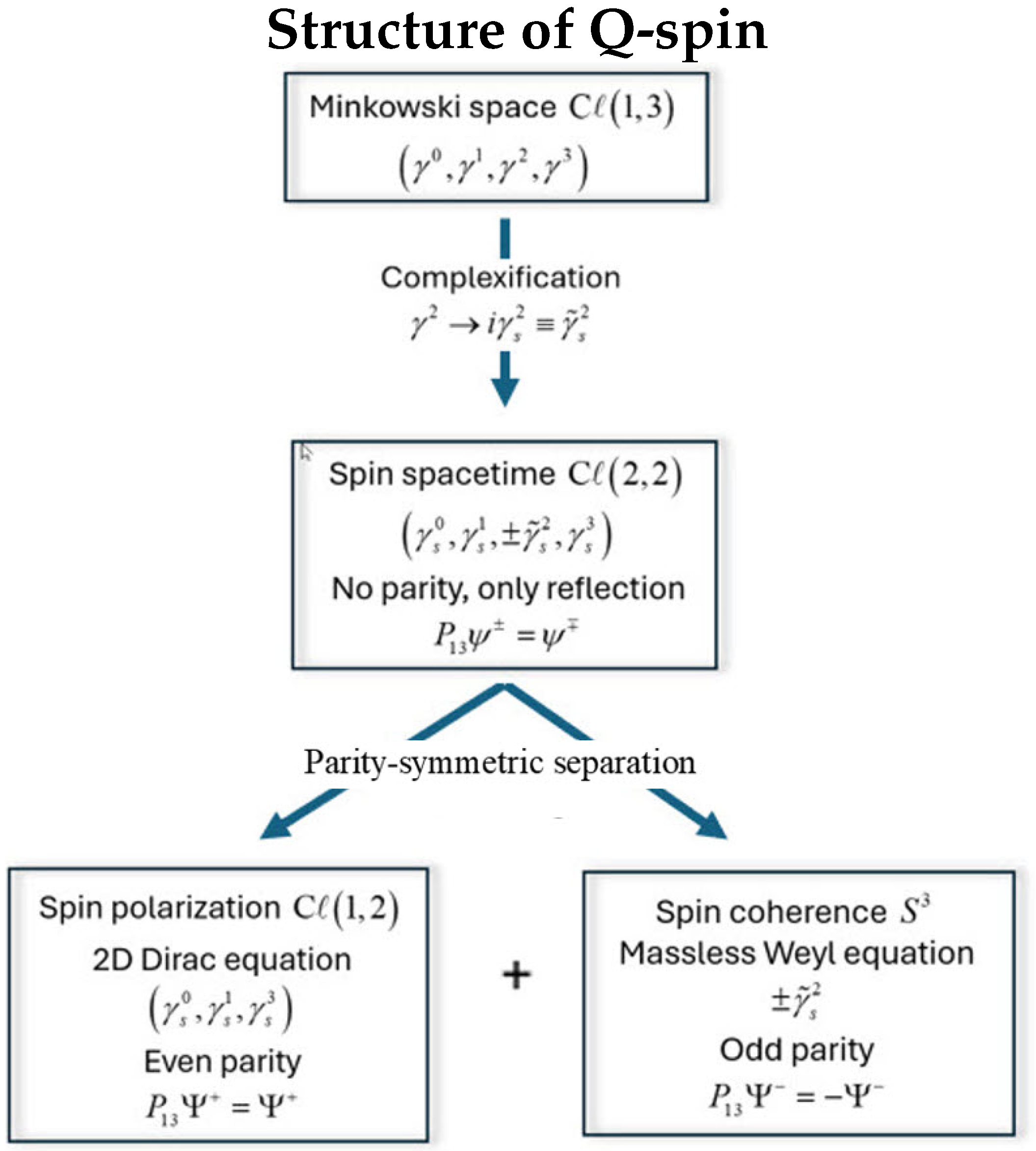
Figure 1. The structure and separation of spin spacetime into complementary spaces of polarization and coherent helicity.
Quantumrep 08 00057 g001
Disclaimer/Publisher’s Note: The statements, opinions and data contained in all publications are solely those of the individual author(s) and contributor(s) and not of MDPI and/or the editor(s). MDPI and/or the editor(s) disclaim responsibility for any injury to people or property resulting from any ideas, methods, instructions or products referred to in the content.

