
The Informational Economy Functional: A Variational Principle for Decoherence and Classical Emergence


Abstract
1. Introduction
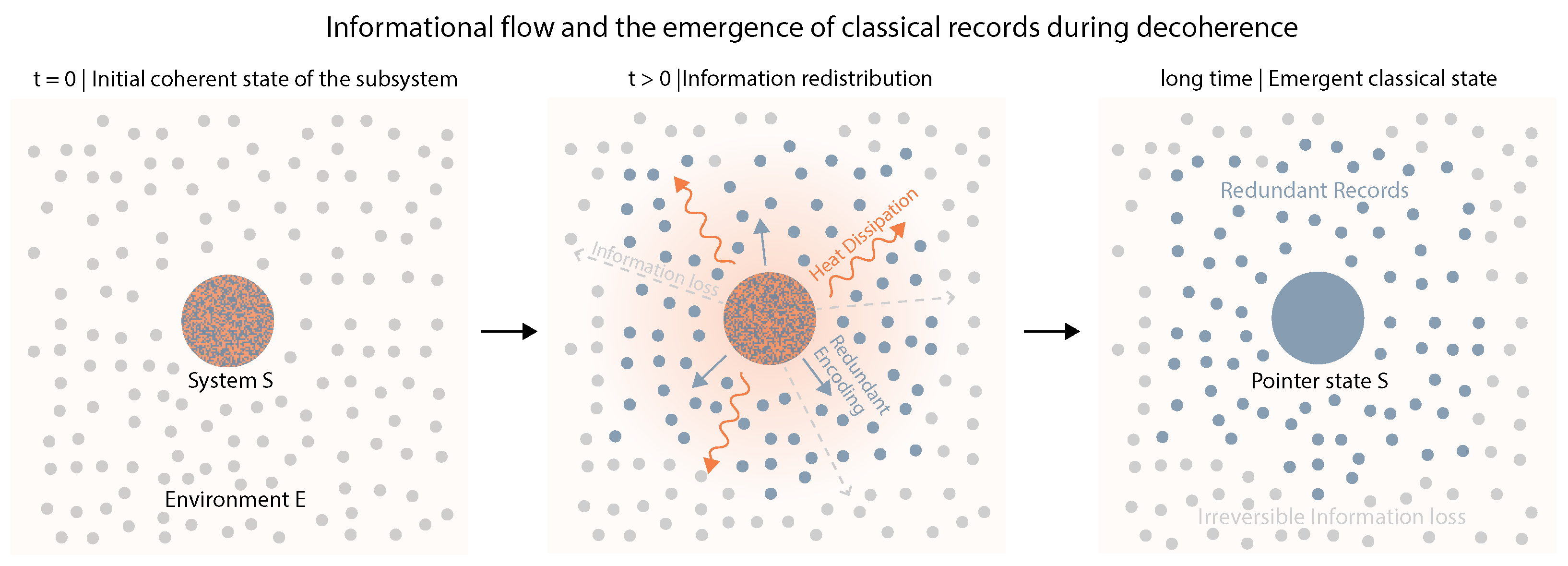
1.1. Is Quantum Decoherence Selective?
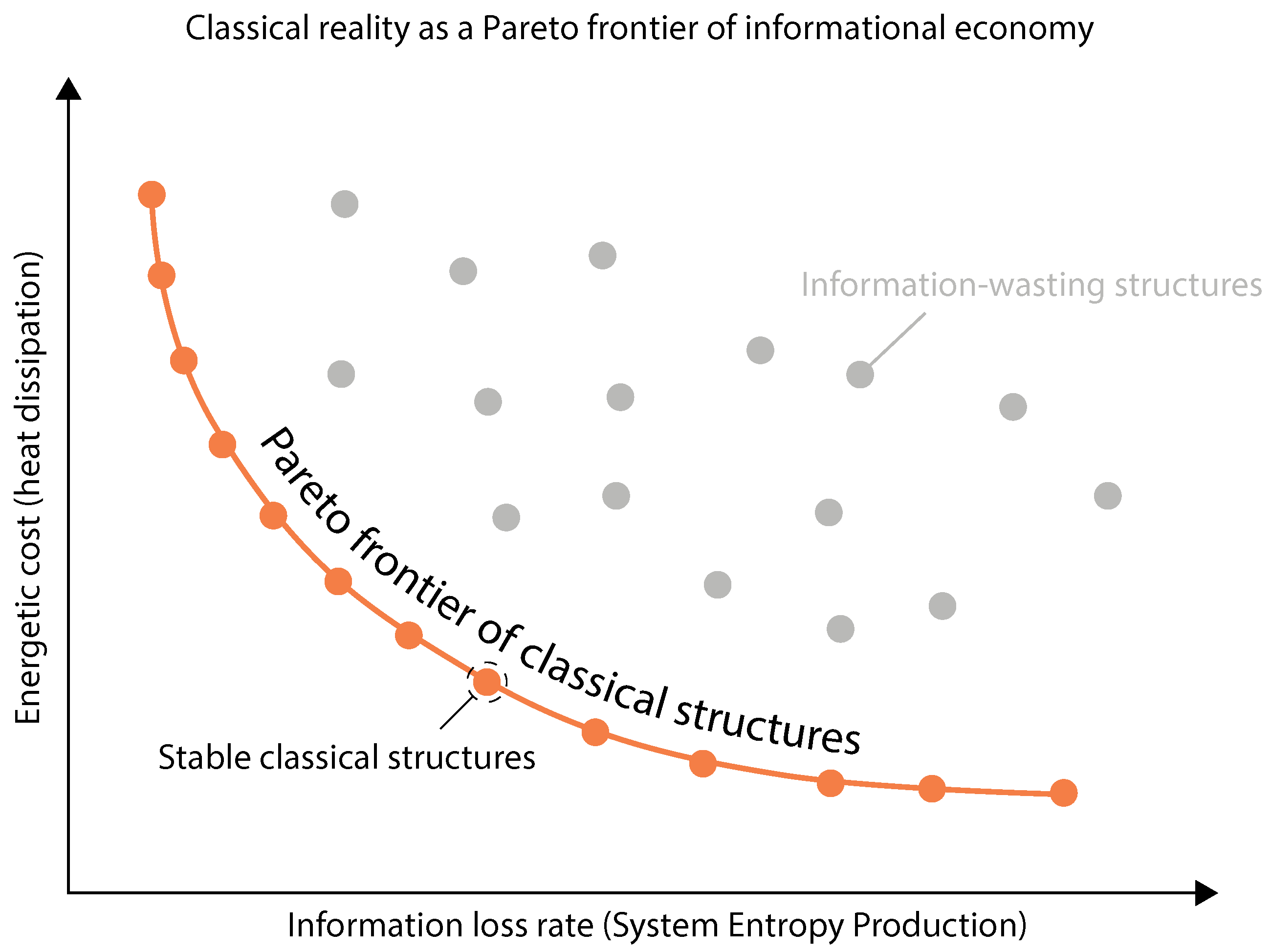
1.2. Decoherence as a Resource-Constrained Multi-Objective Selection Process
2. The Informational Economy Functional: Definition and Physical Meaning
2.1. Candidate Structures: What Is Being Selected?
2.2. The Informational Economy Functional
2.2.1. Information Loss and Structural Stability
2.2.2. Energetic Cost and Physical Feasibility
2.2.3. Information Broadcast and Objectivity
2.2.4. Balance of Physical and Informational Resources
2.3. The Principle of Informational Economy
3. From Microscopic Balance to an Effective Variational Principle
3.1. Microscopic Ingredients and Physical Assumptions
- (A1)
- Thermodynamic structure.
- (A2)
- Environment fragmentation.
- (A3)
- Implementable readout structures.
3.2. Correlation Accounting, Thermodynamic Constraints, and Information Broadcast
3.3. From Inequalities to an Effective Variational Principle
3.3.1. Objective-Record Task
- Multi-observer access: there exist disjoint environmental fragments , each accessed by a different observer;
- No communication: observers do not exchange information or coordinate their inferences;
- Reliable readout: each observer can infer the same value of with error probability at most ;
- Temporal stability: the inferred value of remains consistent throughout the time window .
- Stability constraint. If the variable drifts rapidly or is erased on timescales shorter than , different observers will obtain inconsistent readouts and the task fails. Within the present framework, stability is characterized by the persistence of distinguishability associated with the candidate structure . This is quantified by the structure-dependent stability cost , which measures the rate of loss of distinguishability between the alternatives defined by . Bounding therefore constrains the rate at which information about is degraded and ensures temporal consistency of the recorded variable.
- Energetic constraint. The formation of redundant records is not free. Broadcasting information into multiple environmental degrees of freedom necessarily involves entropy increase and heat flow. Within the Markovian/Davies/Spohn framework, irreversible dynamics obey the system-side second-law inequalitywhich provides a lower bound on the energetic cost associated with record formation. Energetic feasibility is therefore a necessary condition for completing the objective-record task.
3.3.2. Constrained Optimization Formulation
4. Towards an Informational Economics of Decoherence
5. Falsifiability and Experimental Scenarios
5.1. General Falsifiable Predictions of the IEF
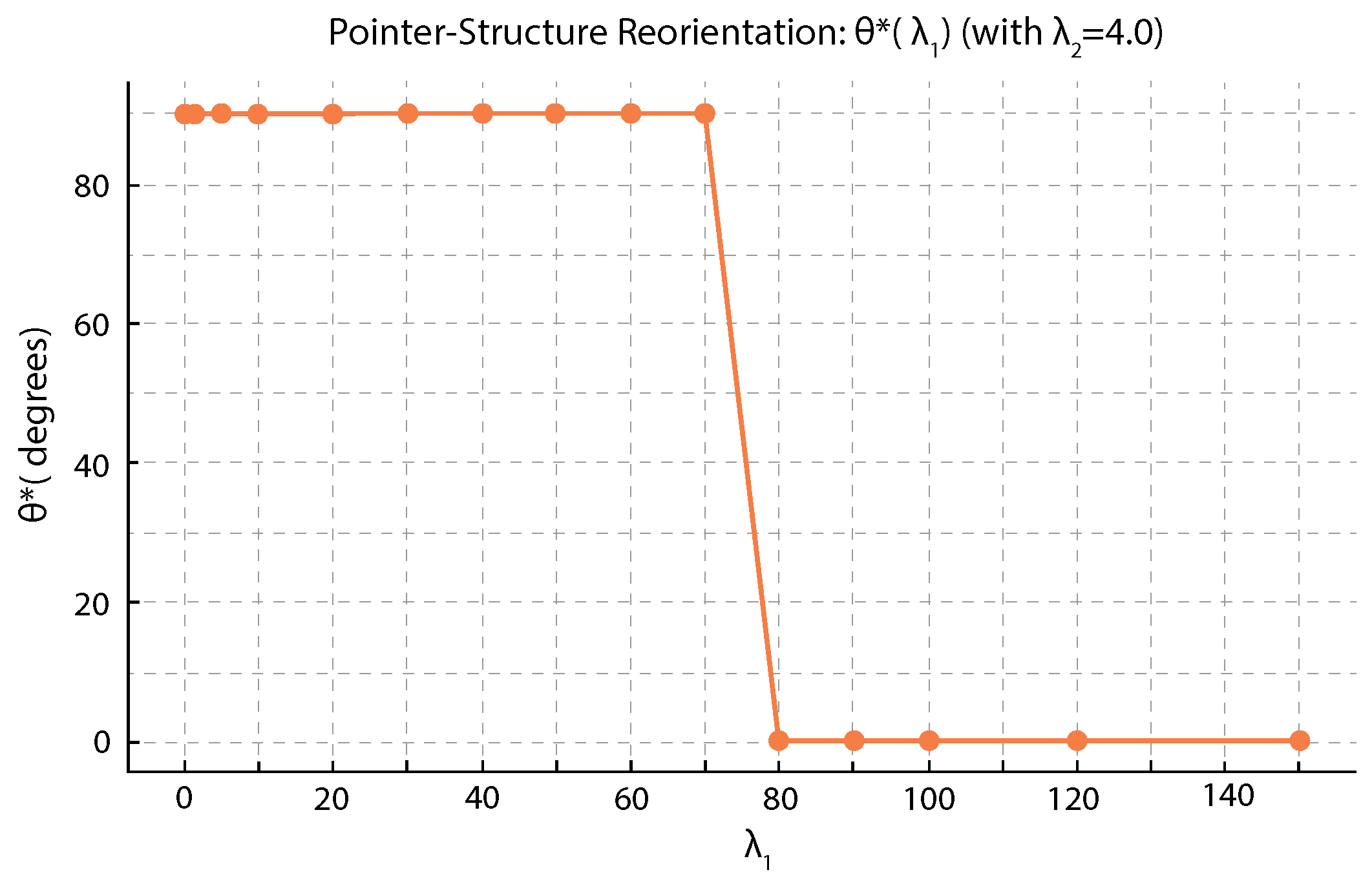
5.1.1. Prediction I: Resource-Driven Variability of the Selected Pointer Structure
5.1.2. Prediction II: Systematic Deformation of Redundancy Plateaus with Resource Prices
5.1.3. Prediction III: Price-Sensitive Trade-Offs and the Absence of Globally Dominant Structures
5.2. Candidate Experimental Platforms
- Measurement axis angle candidate structure ;
- Measurement strength k rate of information extraction and redundant record formation;
- Engineered dissipation channels or additional damping heat flow ;
- Environmental temperature T controls the effective energetic price (typically scaling with );
- Number of probes, detection efficiency, bandwidth, or fragment resolution controls the effective informational value via accessibility and redundancy capacity.
6. Conclusions
Funding
Data Availability Statement
Acknowledgments
Conflicts of Interest
Appendix A. Minimal Simulation Model for IEF-Induced Pointer Reorientation
Appendix A.1. GKLS Dynamics and Initial State
- Initial state
- The system is initialized at time in a pure superposition statewhich is unbiased with respect to both and . This choice is made for illustrative purposes, as it maximizes the sensitivity of both informational and energetic contributions to the monitoring angle . The qualitative behavior reported below—in particular the reorientation of the optimal structure under increasing energetic cost—is robust under variations of the initial state, although the precise crossover value of depends on initialization, averaging window, and proxy definitions.
Appendix A.2. Measured Quantities and Proxies
- (i)
- Stability cost proxy.
- (ii)
- Energetic cost from the thermal bath.
- (iii)
- Broadcast-information proxy.
Appendix A.3. IEF Landscape and Pointer-Structure Reorientation
- Reproducible parameter set (example).
- Observed numerical behavior (illustrative).

References
- Zurek, W.H. Decoherence, einselection, and the quantum origins of the classical. Rev. Mod. Phys. 2003, 75, 715–775. [Google Scholar] [CrossRef]
- Schlosshauer, M. Decoherence and the Quantum-to-Classical Transition; Springer: Berlin/Heidelberg, Germany, 2007. [Google Scholar]
- Zurek, W.H. Quantum Darwinism. Nat. Phys. 2009, 5, 181–188. [Google Scholar] [CrossRef]
- Riedel, C.J.; Zurek, W.H.; Zwolak, M. The quantum-to-classical transition: Suppression of quantum interference by environmental monitoring. Phys. Rev. A 2012, 85, 062110. [Google Scholar]
- Zurek, W.H. Pointer basis of quantum apparatus: Into what mixture does the wave packet collapse? Phys. Rev. D 1981, 24, 1516–1525. [Google Scholar] [CrossRef]
- Ollivier, H.; Poulin, D.; Zurek, W.H. Objective properties from subjective quantum states: Environment as a witness. Phys. Rev. Lett. 2004, 93, 220401. [Google Scholar] [CrossRef]
- Landauer, R. Irreversibility and heat generation in the computing process. IBM J. Res. Dev. 1961, 5, 183–191. [Google Scholar] [CrossRef]
- Still, S.; Sivak, D.A.; Bell, A.J.; Crooks, G.E. Thermodynamics of prediction. Phys. Rev. Lett. 2012, 109, 120604. [Google Scholar] [CrossRef]
- Parrondo, J.M.R.; Horowitz, J.M.; Sagawa, T. Thermodynamics of information. Nat. Phys. 2015, 11, 131–139. [Google Scholar] [CrossRef]
- Joos, E.; Zeh, H.D.; Kiefer, C.; Giulini, D.; Kupsch, J.; Stamatescu, I.O. Decoherence and the Appearance of a Classical World in Quantum Theory; Springer: Berlin/Heidelberg, Germany, 2003. [Google Scholar]
- Zurek, W.H. Preferred states, predictability, classicality and the environment-induced decoherence. Prog. Theor. Phys. 1993, 89, 281–312. [Google Scholar] [CrossRef]
- Seifert, U. Stochastic thermodynamics, fluctuation theorems and molecular machines. Rep. Prog. Phys. 2012, 75, 126001. [Google Scholar] [CrossRef]
- Breuer, H.P.; Petruccione, F. The Theory of Open Quantum Systems; Oxford University Press: Oxford, UK, 2002. [Google Scholar]
- Streltsov, A.; Adesso, G.; Plenio, M.B. Quantum Coherence as a Resource. Rev. Mod. Phys. 2017, 89, 041003. [Google Scholar] [CrossRef]
- Spohn, H. Entropy Production for Quantum Dynamical Semigroups. J. Math. Phys. 1978, 19, 1227–1230. [Google Scholar] [CrossRef]
- Nielsen, M.A.; Chuang, I.L. Quantum Computation and Quantum Information, 10th anniversary ed.; Cambridge University Press: Cambridge, UK, 2010. [Google Scholar]
- Cover, T.M.; Thomas, J.A. Elements of Information Theory, 2nd ed.; Wiley-Interscience: Hoboken, NJ, USA, 2006. [Google Scholar]
- Marler, R.T.; Arora, J.S. Survey of multi-objective optimization methods for engineering. Struct. Multidiscip. Optim. 2004, 26, 369–395. [Google Scholar] [CrossRef]
- Jaynes, E.T. Information Theory and Statistical Mechanics. Phys. Rev. 1957, 106, 620–630. [Google Scholar] [CrossRef]
- Clerk, A.A.; Devoret, M.H.; Girvin, S.M.; Marquardt, F.; Schoelkopf, R.J. Introduction to quantum noise, measurement, and amplification. Rev. Mod. Phys. 2010, 82, 1155–1208. [Google Scholar] [CrossRef]
- Wiseman, H.M.; Milburn, G.J. Quantum Measurement and Control; Cambridge University Press: Cambridge, UK, 2010. [Google Scholar]
- Zurek, W.H.; Paz, J.P. Decoherence, chaos, and the second law. Phys. Rev. Lett. 1994, 72, 2508–2511. [Google Scholar] [CrossRef]
- Jacobs, K. Stochastic Processes for Physicists; Cambridge University Press: Cambridge, UK, 2010. [Google Scholar]
- Riedel, C.J.; Zurek, W.H. Quantum Darwinism in an Everyday Environment. Phys. Rev. Lett. 2010, 105, 020404. [Google Scholar] [CrossRef]
- Korotkov, A.N. Continuous quantum measurement of a double dot. Phys. Rev. B 2001, 63, 115403. [Google Scholar] [CrossRef]
- Campagne-Ibarcq, P.; Six, P.; Bretheau, L.; Sarlette, A.; Mirrahimi, M.; Rouchon, P.; Huard, B. Observing Quantum State Diffusion by Heterodyne Detection of Fluorescence. Phys. Rev. X 2013, 3, 021008. [Google Scholar] [CrossRef]
- Pekola, J.P. Towards quantum thermodynamics in electronic circuits. Nat. Phys. 2015, 11, 118–123. [Google Scholar] [CrossRef]
- Elouard, C.; Herrera-Martí, D.; Huard, B.; Auffèves, A. Extracting work from quantum measurement in Maxwell’s demon engines. Phys. Rev. Lett. 2017, 118, 260603. [Google Scholar] [CrossRef] [PubMed]
- Unden, T.; Louzon, D.; Zwolak, M.; Zurek, W.H.; Jelezko, F. Revealing the Emergence of Classicality Using Nitrogen-Vacancy Centers. Phys. Rev. Lett. 2019, 123, 140402. [Google Scholar] [CrossRef] [PubMed]

Disclaimer/Publisher’s Note: The statements, opinions and data contained in all publications are solely those of the individual author(s) and contributor(s) and not of MDPI and/or the editor(s). MDPI and/or the editor(s) disclaim responsibility for any injury to people or property resulting from any ideas, methods, instructions or products referred to in the content. |
© 2026 by the author. Licensee MDPI, Basel, Switzerland. This article is an open access article distributed under the terms and conditions of the Creative Commons Attribution (CC BY) license.
Share and Cite
Zheng, W. The Informational Economy Functional: A Variational Principle for Decoherence and Classical Emergence. Quantum Rep. 2026, 8, 32. https://doi.org/10.3390/quantum8020032
Zheng W. The Informational Economy Functional: A Variational Principle for Decoherence and Classical Emergence. Quantum Reports. 2026; 8(2):32. https://doi.org/10.3390/quantum8020032
Chicago/Turabian StyleZheng, Wan. 2026. "The Informational Economy Functional: A Variational Principle for Decoherence and Classical Emergence" Quantum Reports 8, no. 2: 32. https://doi.org/10.3390/quantum8020032
APA StyleZheng, W. (2026). The Informational Economy Functional: A Variational Principle for Decoherence and Classical Emergence. Quantum Reports, 8(2), 32. https://doi.org/10.3390/quantum8020032