


Abstract
The mathematical universe of the quantum topos, which is formulated on the basis of classical Boolean snapshots, delivers a neo-realist description of quantum mechanics that preserves realism. The main contribution of this article is developing formal objectivity in physical theories beyond quantum mechanics in the topos-theory approach. It will be shown that neo-realist responses to non-perturbative structures of quantum field theory do not preserve realism. In this regard, the method of Feynman graphons is applied to reframe the task of describing objectivity in quantum field theory in terms of replacing the standard Hilbert-space/operator-algebra ontology with a new context category built from a certain family of topological Hopf subalgebras of the topological Hopf algebra of renormalization as algebraic/combinatorial data tied to non-perturbative structures. This topological-Hopf-algebra ontology, which is independent of instrumentalist probabilities, enables us to reconstruct gauge field theories on the basis of the mathematical universe of the non-perturbative topos. The non-Boolean logic of the non-perturbative topos cannot be recovered by classical Boolean snapshots, which is in contrast to the quantum-topos reformulation of quantum mechanics. The article formulates a universal version of the non-perturbative topos to show that quantum field theory is a globally and locally neo-realist theory which can be reconstructed independent of the standard Hilbert-space/operator-algebra ontology. Formal objectivity of the universal non-perturbative topos offers a new route to build objective semantics for non-perturbative structures.
1. Introduction
The concept of objective reality, as a metaphysical notion, aims to explain the existence of a world of objects governed by definite structures or rules without dependence on any particular perception, namely, mind-independent entities. Scientific methods are based on the working assumption that the universe is an objective reality which can be discovered by instruments and explained in terms of models. Scientific methods apply mathematical structures, as theoretical knowledge, to optimize designed models. This procedure improves the knowledge of prediction of a target objective reality in terms of designed models. The most important foundational challenge of modern mathematical and theoretical physics is to determine their position with respect to the universe as the target objective reality experienced and observed by instruments underlying scientific methods. The concept of objective reality has been challenged by three basic philosophical stances, namely, realism, anti-realism and neo-realism. Realism considers the existence of a mind-independent objective reality such that unobservables could be real entities and truth is located in the correspondence between theory and objective reality. Anti-realism considers observables and empirically accurate models where truth is located in practical conditions. Anti-realism argues the appearance of underdetermination issue when ontologically different theories generate equivalent empirical data. Neo-realism supports achieving a mind-independent world based on structures, relations and context-relative objective features where the global classical ontology loses its meaning and unobservables could exist. There are some fundamental factors to prioritizing the neo-realist perspective rather than other stances for the description of physical theories beyond quantum mechanics [1,2,3,4].
The concept of real objectivity asserts a certain interpretation of the claim that “objective reality exists and that it can be described by theoretical knowledge, namely, mathematical structures”. This is the area that searches for deep interconnections between physical theories, formulated by mathematical structures, and outputs of scientific methods are extended to the foundations of mathematics and mathematical logic. Real objectivity is replaced by formal objectivity in this regard. Formal objectivity is definable in terms of structures, rules and relations governed by formal systems. Formal objectivity, as the mathematical logical route toward real objectivity, structurally testifies to the candidate features of reality, where real objectivity, as the metaphysical verdict, evaluates whether or not those features actually exist independent of observers. The ability to (i) select optimal candidates and (ii) test their consistency in terms of stable mathematical structures show the impact of formal objectivity in the support of real objectivity. Mathematical universes of topos models are rich enough to (i) recover real objectivity discovered by physical theories and (ii) assign neo-realist truth values to statements about them [5,6,7,8,9,10,11,12,13,14,15,16,17,18,19,20,21,22,23,24].
This article shows the capability of the topos-theory approach in assigning formal objectivity to divergences of non-perturbative structures that appear in the working platform of quantum field theory. It will be discussed how the mathematical universe of the universal non-perturbative topos can clarify the globally and locally neo-realist nature of interacting physical theories beyond quantum mechanics.
1.1. What Is a Topos?
The category theory aims to describe properties of mathematical structures in a relative setting in terms of morphisms between objects instead of membership relations. Set-theoretic notions of (sub-)sets or spaces are replaced by (sub-)objects, elements are replaced by morphisms, bijection is replaced by isomorphism, power sets are replaced by power objects and the set of truth values is replaced by a subobject classifier. In set theory, a point a of a set A is described by a map such that its generalization to category theory is based on terminal object such that a global element of an object A is defined as a morphism . Topos theory generalizes the notions of space and logic. It deals with the challenge of replacing or generalizing the category of sets and functions with an elementary topos as a categorical generalization of a Grothendieck topos. A Grothendieck topos is addressed as a replacement for the notion of space [12,14,18,25,26].
Definition 1.
- An object A in a category is called exponentiable if for each object C there exists the exponential and the evaluation morphism such that for each map there exists the unique exponential transpose which contributes to the commutative diagram . The category is called Cartesian closed if all of its objects are exponentiable and has finite products.
- A subobject classifier or a generalized truth-value object is an object together with the true morphism in the category such that for each monic morphism there exists the unique characteristic morphism which contributes to the commutative diagram for some morphism . The subobject classifier is unique up to isomorphism.
- If is a Cartesian closed category with the subobject classifier , then for each object A its power object is the object .
- A sieve on an object B in the category is a collection S of morphisms such that
- The principal sieve on an object B, presented by , is the set of all morphisms such that [14,18,26].
Definition 2.
A topos is a category which has a terminal object, exponential objects, pullbacks, equalizers, a subobject classifier and all limits. In other words, a topos is a category which satisfies one of the following equivalent conditions: (i) it is a complete category with a subobject classifier and its power object, (ii) it is a complete category with exponentials and a subobject classifier or (iii) it is a Cartesian closed category with equalizers and a subobject classifier [14,18,25].
The category of sets and functions is a topos, and in a more general setting, for any set I, the category of I-indexed families of sets is a topos such that the constant family is its subobject classifier where is a two-element set. For any group G, the category of left G-sets is a topos such that the set with trivial G-action is its subobject classifier. For any topological space S, the category of sheaves on S is a topos, and in a more general setting, the category of sheaves over a base category equipped with a Grothendieck topology is a topos. For any topological space A with the corresponding poset of open subsets , which can be seen as a category, a presheaf on A is a contravariant functor F from to . It assigns to each open subset a set of sections over U.
Fundamental Example. The category of contravariant functors from any small category to the category is a topos. Its subobject classifier is given by
for any object a in .
Structures in a theory, modeled as objects in , are representable by set-valued functors over . Geometric morphisms are basic tools to formulate bridges between topoi to recognize differences of the interpretation of a theory in different topoi [8,14,18,25,26,27].
In a topos with subobject classifier , the subobjects of each object A is determined by
The poset is a distributive Cartesian closed lattice such that the exponential satisfies in the formula
It is actually a Heyting algebra. (A Heyting algebra is a bounded lattice equipped with an implication operator ⇒ and a negation operator such that (i) the formula is equivalent to the formula for all of its elements, and (ii) is the largest element which obeys the formula , while the formula is not valid in general.) The subobject classifier in a topos carries a bi-Heyting algebra structure. (A bounded lattice equipped with an implication operator, Heyting and co-Heyting structures is called a bi-Heyting algebra. The dual of the implication operator determines a second negation.) A Heyting algebra H is Boolean iff for any , we have
(A Boolean algebra is a certain bi-Heyting algebra such that first and second negations are the same.) In the topos of presheaves , if , then its subobject classifier is a Boolean algebra [18,25,27,28,29,30].
1.2. Previous Tasks to Resolve the Challenge of Formal Objectivity of Physical Theories
Mathematical logic enables us to study the interface between mathematical and logical foundations of physical theories. While the Boolean algebra is the approved background logic of classical mechanics, there are alternative approaches to describe the logical foundation of quantum mechanics. The one approach formulates propositional calculi on the space of propositions obtained from orthomodular lattices and Boolean algebras to describe quantum logics from the perspective of the classical logic. (An ortholattice is a bounded lattice equipped with a complementation operator which satisfies De Morgan’s laws. An orthomodular lattice is an ortholattice which obeys the law
for all of its elements.) The other approaches replace the mathematical universe of the classical logic with a new mathematical universe of non-Boolean logics. This replacement can be performed on the basis of the topos theory, where the Boolean topos is replaced by a certain non-Boolean topos known as the quantum topos. (A Boolean topos is a topos whose internal logic is classical Boolean logic. A non-Boolean topos is a topos whose internal logic is a non-Boolean Heyting algebra. In other words, the law of excluded middle is not valid in the internal logic of non-Boolean topoi.) Elements of the quantum topos are contravariant functors from the base category to the category . They encode propositions or statements about quantum systems. The internal logic of the quantum topos, which is locally Boolean but globally Heyting, determines required truth values for the formulation of a propositional calculus on the space of propositions [7,8,9,10,11,13,14,15,18,20,21,22,23,31].
The topos theory as a sub-discipline of the category theory [18,25,26,27,32] has been developed to initiate a reconstruction program for physical theories and their interfaces [5,8,9,10,11,12,13,14,15,16,17,33]. It was a foundational step toward formulating formal objectivity for physical theories with respect to the observer-independent truth. In other words, the toposification program initiated the origin of a neo-realist perspective to posit objects of the universe at the quantum scale independently of observers such that, by changing the mathematical setting, propositions find their truth values in an internal logic. The quantum topos argues for the challenge of instrumentalism in terms of replacing the standard Hilbert-space ontology with a certain topos of presheafs on the base category of classical contexts. The foundational difference between classical mechanics and quantum mechanics is represented by their separate topos models. Classical mechanics is reconstructed in the topos Set, which supports full classical global Boolean realism. Quantum mechanics is reconstructed in the quantum topos built from a certain family of commutative subalgebras as the contexts, which supports a context-dependent non-Boolean realism.
According to formal objectivity of topos models, mathematical universes of Boolean topoi are equivalent to the stance of realism, and mathematical universes of non-Boolean topoi are equivalent to the stance of neo-realism. The mathematical universe of any Boolean topos is based on the working assumption that the axiom of choice and the law of excluded middle are undoubtedly valid. The mathematical universe of any non-Boolean topos does not have full axiom of choice, and the law of excluded middle fails. Therefore a physical theory cannot be recovered by classical mechanics if its corresponding topos model is non-Boolean. These physical theories are quantum theories and their beyond theories such as non-perturbative gauge field theories formulated by the working platform of quantum field theory.
Global Neo-Realism but Local Realism
On the one hand, instrumentalism handles physical theories as tools for the study of observations such that theoretical structures do not necessarily represent some real entities. Measurement devices generate information to predict observations in this regard. On the other hand, realism seeks to assign meaningful values to physical quantities such that truth values of propositions can be recovered by classical Boolean logic. It makes sense to apply instrumentalism to achieve more accurate predictability in realism [1,2,3,4,5,8,14,15]. The challenge for both perspectives is using non-computable real or complex numbers to present the required realistic meaningful values and instrumentalist probabilities. The neo-realist nature of non-Boolean topoi addresses a new route to deal with this challenge of non-computability.
Classical mechanics is mathematically formulated on the basis of a phase space presented by a symplectic manifold M with the Poisson algebra and the Euler–Lagrange equations of motion extracted from the principle of least action. (A symplectic manifold is a smooth manifold equipped with a closed non-degenerate differential 2-form which governs the dynamics of particles in a classical physical system. The phase space M is the cotangent bundle of a fixed configuration manifold.) On the one hand, canonical quantization replaces the position and momentum as phase-space coordinates with some operators as elements of the -algebra of bounded operators on the complex Hilbert space of states of quantum mechanics. (Here is the Lebesgue measure space defined on the Borel -algebra. A -algebra is a Banach *-algebra over the field of complex numbers equipped with the involution map which is compatible with the norm structure, namely, the -identity is valid.) These operators, which obey the canonical commutation relation , represent observables as operator-valued functionals acting on states in . On the other hand, deformation quantization replaces the pointwise product of with a noncommutative star product. It encapsulates a geometric description for the route to quantum mechanics from classical mechanics in terms of deforming the Poisson bracket with respect to the deformation parameter ℏ. The value encodes quantum corrections generated as the result of a deformation of the classical algebra. Quantum mechanics works for physical systems with a finite number of quantum particles [34].
Suppose M is the phase space of states of a classical physical system . Any physical quantity A about is determined in terms of a unique real valued function . If is at a state x, then its corresponding physical quantity A has the value . Propositions about , which are determined by Lebesgue measurable subsets, can be encoded in terms of sentences such as “” for some Borel subsets . The set of propositions about together with inclusion forms a Boolean algebra. There exists a homomorphism of Boolean algebras between and , which assigns truth values to all propositions about . This setting assigns a topos model to such that (i) there is a state object, (ii) properties of the system and values of physical quantities are meaningful and (iii) propositions about the system are representable by a Boolean algebra. This topos model, which is represented by the topos , provides the realist description for the system . In this realist description, (i) any physical quantity is represented by a morphism from the state object to the quantity-value object, and (ii) propositions are represented by subobjects of the state object. [8,25,28,31]
Suppose is the complex Hilbert space of states of a quantum physical system . A space-time background should be fixed to assign definite location and time values to our observations via measurement devices. Real objectivity of is controlled by the chosen measurement devices. It means that characterizing elements of is highly related to agent-dependent devices as observers. This instrumentalist characteristic has caused several unsolved contextual and conceptual problems and paradoxes. Any physical quantity B about is encoded in terms of a self-adjoint bounded operator such that at a state means that is an eigenvector for . A proposition about a particle in with an assigned momentum and up spin or down spin is not equivalent to the proposition about the particle with an assigned momentum and up spin or an assigned momentum and down spin. Formal objectivity of this experiment is encoded by a certain orthomodular lattice structure on the space of propositions about such that the distribution of meet and join might fail with respect to each other, but the law of excluded middle is valid. The set of propositions about corresponds to the set of closed linear subspaces of or their related projection operators as elements of . The Kochen–Specker theorem shows that for , there exist some elements of recovering non-commutative observables such that it is impossible to simultaneously assign definite values to their corresponding propositions in . In other words, any effort to formulate quantum mechanics as a fully realist theory fails [16,17,19]. If we proceed toward formal objectivity of the quantum topos, then commutative von Neumann subalgebras of , as objects of the base category of contexts, generate classical snapshots of . (For a given complex Hilber space and the algebra of bounded operators on , a von Neumann subalgebra on is a unital *-subalgebra of that is closed with respect to the weak operator topology. They form a certain family of -algebras on .) Each commutative von Neumann subalgebra of is equipped with a Boolean algebraic structure. Therefore propositions in corresponding to projection operators in can be evaluated from the classical perspective of . The spectral presheaf, as the analog of the classical phase space, avoids assigning definite values to all observables at once. Physical quantities and propositions about the system find a geometric/categorical nature. Measurement outcomes are interpreted by contextual truth assignments rather than the sole source of reality in this regard. The process of replacing the orthomodular lattice method with a Heyting structure is encoded by the daseinization mapping. However, the Heyting algebra of the quantum topos contains some elements that do not correspond to any object of the orthomodular lattice method [8,9,10,11,12,13,14,15,16,17,32].
In short, formal objectivity of the quantum topos has the following properties:
- It makes observers and measurement devices secondary concepts.
- It makes the standard Hilbert-space ontology a secondary concept.
- It is dependent on the standard operator-algebra ontology.
- It assigns real numbers, either computable or non-computable, to quantities, which is in contrast to the definiteness of classical observables.
- It is globally non-Boolean, but it is locally recovered by formal objectivity of the Boolean mathematical universe.
- It is blind to the differences in the nature of physical theories when degrees of freedom tend to infinity.
- It is blind to divergences with the origin of interacting physical theories.
1.3. Essential Progress of This Research from Previous Tasks: Global and Local Neo-Realism
The method of toposification of physical theories addresses a highly precise route to real objectivity of physical theories in the context of alternative mathematical universes where internal truth values of propositions are independent of instrumentalist probabilities.
Thanks to canonical quantization and Feynman path integral, physical theories beyond quantum mechanics, as special relativistic extensions of quantum mechanics, are mathematically formulated by the platform of quantum field theory. Moving from quantum mechanics to quantum field theory changes particles to fields and increases degrees of freedom from a finite number to an infinite number where elementary particles, as excitations of fields, can be created or annihilated. This working platform led us to develop gauge field theories for the study of the physics of sub-atomic particles at high-energy scales [34,35]. Gauge field theories can be smoothly studied by perturbative techniques whenever coupling constants are small enough such that Green’s functions generate only convergent perturbative series of higher-loop-order Feynman diagrams. These perturbative series drastically diverge when coupling constants become strong, and this is the area of using non-perturbative techniques such as Dyson–Schwinger equations, large N limits and numerical approximations.
The Hilbert space of states in quantum field theory becomes an infinite tensor product of Hilbert spaces corresponding to an infinite number of particles. Commutative von Neumann subalgebras of the -algebra of bounded operators are much more complicated than quantum mechanics. In addition, when we pass from the perturbation domain to the non-perturbation domain of the physical theory, all standard computational algorithms fail because perturbative series of Green’s functions diverge to infinity. In fact, the mathematical universe of the quantum topos is totally blind to the impact of the strength of coupling constants of physical theories in generating non-perturbative structures. In other words, the Heyting algebra of the quantum topos is almost surely powerless to assign truth values to propositions about non-perturbative structures. As this stage, it is unavoidable to search for an alternative mathematical universe where alternative techniques must be devised to efficiently assign truth values to propositions about these types of divergences extracted from the physics of high-energy scales such as the problems of confinement and triviality or the “zero charge problem”. In addition, a quantum theory for gravity is a space-time background-independent theory which cannot be fully formulated under instrumentalism or local realism conditions. These evidences must be considered as the red flag in using the mathematical universe of the quantum topos for the description of real objectivity of physical theories beyond quantum mechanics.
Thanks to the recent progress in the topological enrichment of the renormalization Hopf algebra via the method of Feynman graphons, von Neumann subalgebras of can be replaced by a certain family of topological Hopf subalgebras of the topological Hopf algebra of renormalization associated with quantum motions [24,36,37,38]. They are considered as objects of the base category of contexts of a new non-Boolean topos model called non-perturbative topos. This article shows that the mathematical universe of this new topos model is rich enough to recover formal objectivity of physical phenomena in perturbative and non-perturbative structures of interacting physical theories beyond quantum mechanics. The universal version of the non-perturbative topos, formulated in this work, provides a theory-independent formal objectivity which recovers mathematical universes of gauge field theories in a neo-realist setting.
In short, formal objectivity of the universal non-perturbative topos has the following properties:
- It makes observers and measurement devices secondary concepts.
- It makes the standard Hilbert-space ontology a secondary concept.
- It makes the standard operator-algebra ontology a secondary concept.
- It is independent of the formal objectivity of the standard Hilbert-space ontology.
- It is independent of physical theories because its skeletons are defined on a certain combinatorial Hopf algebra of non-planar rooted trees as context-independent mathematical structures without the need for any measurement process.
- It recovers non-perturbative topoi of physical theories as sub-topoi.
- It makes assigning real numbers to quantities a secondary concept. In fact, stretched Feynman graphons and their renormalized values are applied to present quantities.
- It is locally non-Boolean because each topological Hopf subalgebra in the base context category can be equipped with a bi-Heyting algebra structure.
- It is globally non-Boolean because topological Hopf algebra of renormalization can be equipped with a bi-Heyting algebra structure.
- It recognizes the differences in the nature of physical theories when degrees of freedom tend to infinity.
- It handles divergences with the origin of interacting physical theories.
The immediate consequence of formal objectivity of the universal non-perturbative topos is to show that quantum field theory is describable as a globally and locally neo-realist theory. It formally supports the notion that quantum field theory, as a “neo-realist” theory, is necessarily “quantum”. In addition, this progress makes it possible to find answers to a series of fundamental questions addressed by Doring and Isham in [39] about the nature of physical theories beyond quantum mechanics. These questions, which are listed here, will be answered in Section 5.1 of Conclusions.
- Is it possible to interpret a theory in a neo-realist manner because instrumentalist theories are problematic?
- Since Hilbert-space formalism almost inevitably forces an instrumentalist interpretation, is it possible to formulate a theory of quantum gravity independent of the Hilbert-space formalism?
- Is it possible to deal with conceptual issues that any approach to quantum gravity has to confront?
- Is quantum gravity an instrumentalist theory? Or it is a realist theory?
- Is it accurate to expand concepts of quantum ideas to a theory of quantum gravity with the usual mathematical apparatus of quantum theory?
- If we aim at a realist form of theories of beyond quantum mechanics, what kind of logic should be used to evaluate no-go theorems such as the Kochen–Specker theorem?
- In an encompassing theory of the whole universe, which roles do a mathematician mathematical physicist has? Is he or she necessarily part of the description?
1.4. Achievements
This article presents the flexibility of formal objectivity derived from topo-theory approach to pass from quantum mechanics to quantum theories beyond quantum mechanics built by the working platform of quantum field theory. The appearance of a certain family of analytic graphs, called stretched Feynman graphons, in the backbone of the non-perturbative topos together with replacing commutative von Neumann subalgebras of with a certain family of topological Hopf subalgebras of the topological Hopf algebra of renormalization [24,37] furnish an alternative working candidate for the construction of formal objectivity of gauge field theories and their non-perturbative structures. The non-perturbative topos and its universal version are globally and locally non-Boolean in contrast to the quantum topos, which is globally non-Boolean but locally Boolean. In fact, the incapability of the method of the classical Boolean snapshots in the quantum topos is clarified in terms of the deviation of the Heyting algebra of the non-perturbative topos from the Heyting algebra of the quantum topos. The Heyting algebra of the non-perturbative topos cannot be locally described by classical Boolean algebra because each topological Hopf subalgebra in the base category of contexts is equipped with a certain bi-Heyting algebra structure [36].
The aim of this paper is to formulate a universal model of the non-perturbative topos independent of physical theories.
- We study the formulation of stretched Feynman graphons in Section 2.1 to explain the topological enrichment of the renormalization Hopf algebra. See Definitions 6–8, Theorem 1 and Remark 2.
- Feynman graph limits, which contribute to (1PI) Green’s functions of a gauge field theory and (non-)perturbative solutions of their fixed point equations, are represented by large Feynman diagrams. The graphon representations of these large Feynman diagrams provide stochastic models for the description of solutions of quantum motions. See Lemma 1, Remark 3, Theorem 2, Definition 10 and Corollary 2.
- Examples A, B, C, D, E, F and G present the process of passing from Feynman integrals to random graph representations of (non-)perturbative series which contribute to (1PI) Green’s functions and their fixed point equations.
- The topological Hopf algebra of renormalization of an interacting gauge field theory and its topological Hopf subalgebras associated with solutions of quantum motions are applied as the building blocks of the non-perturbative topos. This particular topos (i) recovers propositions about the physical theory and (ii) determines required truth values to evaluate propositions in a neo-realist setting. See Section 3.1.
- It will be discussed that how the internal logic of the non-perturbative topos provides the background logic of a gauge field theory where its dimensional computable Heyting algebra determines truth values for a neo-realist evaluation of propositions about quantum motions and the interface between perturbative and non-perturbative structures of their solutions. See [24] and Theorem 3.
- It will be shown that random graph representations of Feynman graph limits can be characterized by their expectation values. See Corollary 4.
- A new representation of the non-perturbative topos over a category algebra of random graphs is formulated. See Corollary 5.
- The Connes–Kreimer renormalization Hopf algebra of non-planar rooted trees provides the combinatorial representation of Feynman diagrams and a universal platform for the BPHZ renormalization process [40,41,42,43,44,45]. The topological enrichment of this particular combinatorial Hopf algebras and a certain class of its topological Hopf subalgebras are building blocks of the universal non-perturbative topos. It will be shown that the universal non-perturbative topos is non-boolean, and it includes non-perturbative topoi of gauge field theories as sub-topoi. This means that the internal logic of the universal non-perturbative topos provides the background logics of gauge field theories. See Corollary 6.
2. Topological Hopf Algebra of Renormalization
Random graphs are useful tools for assigning graph limits to sequences of finite weighted dense or sparse graphs. Fix a sequence of finite graphs with an increasing vertex number and any integer . Let be a sequence of distributions of random graphs such that for each n, is a labeled subgraph in with k vertices built by uniformly selecting distinct vertices from vertices of . When tends to infinity, the behavior of is controlled by the random graph limit of the sequence for any fixed k. There are many choices of random graph models in terms of different normalizing functions. For the normalizing function , behaves like a Cauchy sequence whenever . There is an alternative approach to assigning a metric structure on the space of graphs. The cut norm, as a semi-norm, is defined on the space of finite matrices. For any matrix A, its cut norm is given by
such that . For any finite weighted graph G with the weight collection for the edge set and the collection for the vertex set, its adjacency matrix defines a bounded Lebesgue measurable symmetric function given by
If there is no edge between vertices , then . Here is a partition of such that . The function is called a labeled graphon representation of the graph G. Its cut norm is given by
such that the supremum is with respect to Lebesgue measurable subsets of . This norm defines the pseudo-distance
on the space of finite graphs. The infimum is with respect to the invertible Lebesgue measure-preserving transformations on such that for . The weakly isomorphic relation identifies those graphons which will be equal almost everywhere after applying a suitable Lebesgue measure-preserving transformations. Up to this particular equivalence relation, defines a complete metric structure on the space of finite graphs. Graph limits of Cauchy sequences in this space are representable by graphons. The analysis of the space of graphs had been extended to spaces of stretched graphons, defined on arbitrary -finite measure spaces, with respect to -modifications of the cut-distance metric. Rescaling and stretching techniques are applied to assign non-trivial meaningful graph limits to sequences of sparse graphs [46,47,48,49,50].
The theory of graphons has been also developed for quantum mathematics and the space of Feynman diagrams as combinatorial weighted graphs which contribute to gauge field theories [36,38,51]. Since stretched Feynman graphons are fundamental elements of our new formal objectivity, here we explain in detail the procedure of formulating large Feynman diagrams as graph limits of sequences of Feynman diagrams and their graphon representations.
Physical systems of elementary particles underlying special relativity are studied in the context of interacting gauge field theories as a certain class of quantum field theories with gauge symmetries defined on -dimensional Minkowski space-time or other models of space-time. Quantum fields are operator-valued distributions which cannot be evaluated at a single point and make sense over regions of space-time. Localized measurements in regions of space-time give information of quantum fields. An interacting gauge field theory is formulated on the basis of a number of gauge fields for the presentation of elementary particles (i.e., fermions), a number of gauge fields for the presentation of force carriers (i.e., bosons) and a number of interactions among those fields which is encoded by the interaction part of the Lagrangian. For the rest of this paper, suppose is a quantum field theory on a -dimensional Minkowski space-time background with at least a strong coupling constant such that its Lagrangian has interaction terms which generate non-perturbative structures.
Definition 3.
A Feynman diagram in Φ is a decorated, oriented space-time graph which encodes interactions of a limited number of particles. (i) The collection of vertices represents interactions. (ii) The collection of internal edges (i.e., edges with beginning and ending vertices) represents virtual particles. (iii) The collection of external edges, (i.e., edges with beginning or ending vertices) represents elementary particles which can be created or annihilated. (iv) The sum of input momenta is the same as output momenta at each vertex and for the whole graph [44,52].
A Feynman diagram is called 1PI if it remains a connected graph after removing one arbitrary internal edge. The residue graph is a graph generated by shrinking all internal edges of into a single vertex such that external edges of are attached to it. A subgraph in is called a Feynman subdiagram if and such that for each , [40,52].
The interaction part of the Lagrangian of generates (1PI) Green’s functions, which are perturbative series of powers of running coupling constants such that their coefficients are given by Feynman integrals as a certain class of iterated momentum integrals. The convergence or divergence of Feynman integrals depends on the domain of the momentum parameter, which changes between zero and infinity, and the dimension of space-time. Feynman rules in introduce a dictionary between Feynman integrals and Feynman diagrams such that sub-divergences in integrals are represented by nested loops in graphs. Therefore coefficients of those perturbative series are represented in terms of higher-loop-order Feynman diagrams [53,54,55,56].
Example A. In a toy model, for , , the integrand of the functional
is represented by a -loop-order 1PI Feynman diagram which has two independent nested and -loop-order divergent 1PI Feynman subgraphs. The integrand of the functional
is represented by a -loop-order 1PI Feynman diagram which has a nested -loop-order divergent 1PI Feynman subgraph such that this subgraph has also a nested -loop-order divergent 1PI Feynman sub-subgraph. Regularization techniques, such as momentum cut-off or dimensional regularization, allow us to replace these divergent integrals with some Laurent series with finite pole parts where the minimal subtraction map projects these series onto their pole parts to extract some renormalized values [44].
Let be the collection of all types of particles and interactions in . The combinatorial presentations of (1PI) Green’s functions are given by
such that is the loop number of and , for , is a function of the bare coupling constant g generated by regularization techniques. If is small enough, then these perturbative series are convergent, but if , then these perturbative series are divergent, and we need to apply non-perturbative techniques such as Dyson–Schwinger equations to extract some finite values [36,38,40,43,52,53,55,56,57]. The method of Feynman graphons has been introduced and developed to assign a certain family of graph functions to graph limits of sequences of Feynman diagrams which contribute to solutions of fixed point equations of (1PI) Green’s functions [36,37,38].
2.1. Stretched Feynman Graphons
The Connes–Kreimer theory formulates a graded connected commutative non-cocommutative Hopf algebra over the field of rational numbers (or any field with characteristic zero) on the space of Feynman diagrams of . It is called renormalization Hopf algebra. For , and for each , is the vector space generated by 1PI Feynman diagrams with the loop number n and disjoint unions of 1PI Feynman diagrams with the overall loop number n. The coproduct of this Hopf algebra, which encodes Zimmerman’s forest formula in perturbative renormalization, is given by
such that the sum is taken over all disjoint unions of superficial divergent 1PI Feynman subgraphs [40,41,42,44].
The combinatorial version of the renormalization Hopf algebra is formulated on the polynomial algebra of non-planar rooted trees where the coproduct is reformulated by admissible cuts on rooted trees. An admissible cut c of t is a subset of edges of t such that any path in t from its root to each leaf meets at most one edge from c. Each admissible cut divides t into two separate parts , a subtree of t which contains the root, and a forest of remaining subtrees. The renormalization coproduct (13) is translated to the formula
such that the sum is taken over all non-trivial admissible cuts in t. This combinatorial Hopf algebra is called the Connes–Kreimer Hopf algebra and is presented by [40,42,43,52].
The combinatorial representation of a Feynman diagram with nested loops is a decorated non-planar rooted tree with the following properties. (i) The loop number of , as the number of independent loops in , is the cardinal of the vertex set of . (ii) Each vertex in is decorated by a primitive divergent (1PI) subgraph in . (iii) There exists an edge between vertices if their corresponding loops in are nested with respect to each other. (iv) There exists no edge between vertices if their corresponding loops in are independent with respect to each other, which means that loops do not have any mutual internal edge, (v) The rooted tree together with an embedding into the plane is called planar; otherwise, it is called non-planar [40,41,42,44].
Example B. Rooted tree representations of some 3-loop-order Feynman diagrams, which are applicable to encode Feynman integrals such as (10) and (11) in Example A, are given by Figure 1.
Figure 1.
Replacing some 3-loop order Feynman diagrams with their rooted tree representations underlying the renormalization Hopf algebra.
Example C. Rooted tree representations of some 4-loop-order Feynman diagrams are given by Figure 2.
Figure 2.
Replacing some 4-loop-order Feynman diagrams with their rooted tree representations underlying the renormalization Hopf algebra.
Remark 1.
If Γ has some overlapping loops, then , as a forest, is a linear combination of decorated non-planar rooted trees [52]. Figure 3 presents a simple example.
Figure 3.
Rooted forest representation of a Feynman diagram with an overlapping loop underlying the renormalization Hopf algebra.
For combinatorial representations of , there exists an isomorphism of non-planar rooted trees between them. There exists an injective Hopf algebra homomorphism from to given by the Formula (70). It allows us to reconstruct a Feynman diagram from its combinatorial representation where vertices of non-planar rooted trees are decorated by primitive (1PI) Feynman diagrams in [44,52].
Definition 4.
Consider a σ-finite measure space . A pixel picture presentation of Γ is a symmetric bounded μ-measurable function with and which satisfies the following conditions.
- For any pair , with respect to the adjacency matrix of ;
- For any invertible μ-measure-preserving transformation ρ on Ω together with the partition , the function is called the labeled pixel picture presentation of Γ.
Example D. Pixel picture presentations corresponding to 3-loop-order Feynman diagrams in Figure 1 are determined by graph functions in Figure 4. The permutation matrices
can be applied to translate three pixel pictures from right to left to the first one from the left in Figure 4.
Figure 4.
Required graph functions to build pixel picture presentations for finite graphs of order 3.
Example E. Pixel picture presentations corresponding to 4-loop-order Feynman diagrams in Figure 2 in Example C are determined by graph functions in Figure 5. The permutation matrices
can be applied to translate four pixel pictures from right to left to the first one from the left in Figure 5.
Figure 5.
Required graph functions to build pixel picture presentations for finite graphs of order 4.
Definition 5.
Consider a σ-finite measure space .
- A bounded symmetric μ-measurable function is weakly isomorphic to iff there exist μ-measure-preserving transformations on Ω such thatwhere .
- The equivalence classwith respect to the weakly isomorphic relation ≈ is called a stretched Feynman graphon associated with Γ.
- For any invertible μ-measure-preserving transformation ρ on Ω, is called a labeled stretched Feynman graphon.
- Feynman diagrams are called fractionally isomorphic if their corresponding pixel picture presentations and are fractionally isomorphic. This means that there exists a doubly stochastic matrix , such as permutation matrices, such that .
- Labeled stretched Feynman graphons and are called fractionally isomorphic iff pixel picture presentations and are fractionally isomorphic.
- For the Lebesgue measure space , as the ground measure space, is called a Feynman graphon.
Thanks to [58], it is observed that isomorphic Feynman diagrams are fractionally isomorphic.
2.2. Topological Enrichment of the Renormalization Hopf Algebra
Following Definition 5, the quotient space
is equipped and topologically completed with the distance function
to obtain a complete Hausdorff metric space such that inf is taken over (invertible) -measure-preserving transformations on and sup is taken over -measurable subsets of . The space is a closed subspace of the space of real valued stretched graphons. For the Lebesgue measure space , the subspace -valued Feynman graphons in is compact.
Definition 6.
- The space of Feynman diagrams of Φ can be equipped with a new pseudo-metric given by
- Following the equivalence class (18), Feynman diagrams are called weakly isomorphic iff .
- Feynman diagrams are called weakly isomorphic iff . This means that is a metric on the quotient space of weakly isomorphic classes of Feynman diagrams.
Definitions 5 and 6 show that isomorphic Feynman diagrams are weakly isomorphic and weakly isomorphic Feynman diagrams are fractionally isomorphic. This new metric space is used to define the notions of the Feynman graph limit and large Feynman diagrams.
Definition 7.
- A sequence of Feynman diagrams is called convergent when n tends to infinity iff its corresponding sequence of stretched Feynman graphons in converges with respect to the metric (20). Up to the weakly isomorphic relation, the limit of , whenever it exists, is unique.
- Forthe stretched Feynman graphon W represents the Feynman graph limit of the sequence . Following Definition 5, we have for an infinite graph X with the rooted tree or forest representation . Here X is called the large Feynman diagram or Feynman graph limit generated by the sequence such that and .
Modulo weakly isomorphic equivalence relation, the stretched Feynman graphon representation of a large Feynman diagram is unique. A certain class of continuous functionals on , known as homomorphism densities, are useful tools for the characterization of large Feynman diagrams.
Definition 8.
Consider the Lebesgue measure space and the space . For a finite Feynman diagram Γ and a large Feynman diagram X with , the probability that a random map of vertices of to the vertices of is a homomorphism is computed in terms of the homomorphism density
Definitions 5, 6 and 8 show that stretched Feynman graphons are fractionally isomorphic if for any finite Feynman diagram , and they are weakly isomorphic if for any finite and infinite Feynman diagram .
Theorem 1.
Consider the space of Feynman diagrams, large Feynman diagrams in Φ together with their stretched Feynman graphons as elements in . We present this new space as . Up to the weakly isomorphic equivalence relation, , which can be equipped with the renormalization Hopf algebra, is a separable Banach space with respect to the metric (21).
Proof.
For , its corresponding stretched Feynman graphon is given by the direct sum such that for each , is the stretched Feynman graphon associated with defined on a -measurable subset such that , for and
Thanks to [46,47], any sequence in has a Cauchy subsequence . It determines a Cauchy subsequence in such that its large Feynman diagram X, with respect to the metric (21), is represented by the stretched Feynman graphon in . In addition, the countable collection of stretched Feynman graphons corresponding to 1PI Feynman diagrams with loop numbers n, , is dense in such that as the Schauder basis, its linear combinations might be infinite. Therefore is a separable complete metric space.
Consider the Banach space with respect to the cross norm given by
The renormalization coproduct and its related antipode are defined as the Feynman graph limits of the Cauchy subsequences and with respect to the metric (21) such that for each n,
with
such that the sum is taken over all disjoint unions of superficial divergent 1PI subgraphs of .
For the Feynman graph limit X, stretched Feynman graphons are determined as the limits of some Cauchy sequences and with respect to the metric (20). The inequalities
show that linear operators and S are bounded. Therefore they are continuous maps.
Let be another Cauchy subsequence of in which converges to the Feynman graph limit X. For each , there exist orders such that for each and ,
For , we get
In other words, for , such that according to Definition 5, we get
for some -measure-preserving transformations on . This means that . In other words, the subsequences and are weakly isomorphic. Therefore, up to the weakly isomorphic relation, Feynman graph limits and their corresponding stretched Feynman graphons are independent of the chosen subsequences. □
Remark 2.
Consider the topological Hopf algebra of renormalization .
- The renormalization coproduct and its related antipode can be continuously extended to . We havesuch that the sum is taken over all stretched Feynman graphons corresponding to Feynman diagrams which contribute to the renormalization coproduct . In addition,
- There exists a grading structure on . For each n, define as the vector space generated by stretched Feynman graphons corresponding to 1PI Feynman diagrams Γ with the loop number n.
2.3. Applications of Feynman Graph Limits
Fixed point equations of (1PI) Green’s functions, known as Dyson–Schwinger equations, provide a quantized version of Euler–Lagrange equations of motion in classic mechanics, and because of that they are addressed as quantum motions in quantum field theories [35,52,53,55,56,57]. According to the Hochschild cohomology of the renormalization Hopf algebra, a combinatorial version of these equations is reformulated which enables us to apply combinatorial and topological tools in dealing with their solutions. Solutions of these fundamental equations can be interpreted by stretched Feynman graphons which represent limits of a certain family of Cauchy sequences of stretched Feynman graphons [36,37,38,40,43,51,57].
For (1PI) Green’s function given by (12), , and a family of primitive (1PI) Feynman diagrams with , the fixed point equation of is given by the recursive equation
in . It is called a combinatorial Dyson–Schwinger equation. In the formula (34), for each , is a Hochschild 1-cocycle and it sends to a linear combination of Feynman diagrams generated by the insertion of into in terms of types of vertices of and types of external edges of . Its solution is given by
such that is a collection of generators for a connected graded free commutative Hopf subalgebra of [40,43,44,53].
Lemma 1.
The space recovers the solution X of the equation .
Proof.
According to Theorem 1, the solution X can be described as the Feynman graph limit of the Cauchy sequence of partial sums,
with respect to the metric (21). For each , the stretched Feynman graphon
is the direct sum of stretched Feynman graphons with such that , . When m tends to infinity, the sequence converges to the stretched Feynman graphon
as the infinite direct sum of the stretched Feynman graphons with such that , . For each subinterval , . Therefore the Feynman graph limit X is represented by elements of the class
such that . □
Remark 3.
- It is possible to apply μ-measure-preserving and affine monotone transformations on Ω to project the stretched Feynman graphon onto its corresponding Feynman graphon on the ground measure space .
- Combinatorial Dyson–Schwinger equations with the solutions are called weakly isomorphic iff is weakly isomorphic to iff .
According to Lemma 1, it is possible to extend the metric (21) to the space of Feynman graph limits which contribute to solutions of combinatorial Dyson–Schwinger equations of . Up to the weakly isomorphic relation given by Remark 3, the distance between combinatorial Dyson–Schwinger equations with the solutions and sequences of partial sums and is given by
Therefore, up to the weakly isomorphic relation given by Remark 3, we have
Therefore we can apply the metric (40) to complete the quotient space of Feynman graph limits which contribute to solutions of combinatorial Dyson–Schwinger equations of for running coupling constants as functions of the bare coupling constant. The resulting space is a separable complete Banach subspace of . It was shown in other works of the author that the geometry of this particular Banach space has led to the development of some advanced analytic tools for the study of solutions of combinatorial Dyson–Schwinger equations.
Example F. Consider a divergent perturbative series and its rooted forest representation given by Figure 6. Thanks to [36], it likely cut-distance converges to some labeled Feynman graphon models with domains such as the one presented by Figure 7. Its non-zero Feynman graph limit is determined by some with a stretched domain such as the one given by Figure 8. Weakly isomorphic stretched Feynman graphons corresponding to defined on stretched domains are obtained by applying -measure-preserving transformations on . For instance, transformations for the case of the Lebesgue measure spaces and fractional transformations for the case of Gaussian measure spaces can be applied to generate non-zero stretched Feynman graphons on stretched domains.
Figure 6.
A (1PI) Green’s function together with its rooted forest representation underlying the renormalization Hopf algebra.
Figure 7.
The domain of a labeled Feynman graphon model for the Feynman graph limit of the divergent perturbative series presented in Figure 6.
Figure 8.
The stretched version of the domain presented in Figure 7.
Corollary 1.
Let be the solution of a combinatorial Dyson–Schwinger equation with the sequence of partial sums. For any Feynman diagram Γ, the sequence of homomorphism densities converges to when m tends to infinity.
Proof.
It is a consequence of Definition 8, Theorem 1, Lemma 1 and Theorem 11.21 in [36,37,50]. □
2.4. Stochastic Models for Feynman Graph Limits
A new application of the method of (Feynman) graphons has been found in describing the asymptotics of (divergent) perturbative series of higher-loop-order Feynman diagrams and also beta functions of the physical theories. The notion of triviality for interacting quantum theories is remodeled in terms of a certain family of discrete-time Markov chains of random operators [51]. It opens a new stochastic platform for the study of non-perturbative structures.
Definition 9.
- A random graph is a non-oriented graph with n vertices such that every two vertices are independently connected by an edge with the probability p. It is called sparse if for with sufficiently large n.
- For a given probability measure space, a stochastic process is defined by a time-dependent family of random variables, such as random graphs on the probability measure, which takes values in a state space of the process. If the family of random variables is a countable set, then the process is called a discrete time stochastic process; otherwise, it is called a continuous time stochastic process.
Theorem 2.
Feynman graph limits of Cauchy sequences of Feynman diagrams in are generated by stochastic processes.
Proof.
This follows from [36,38], Definition 4 and Theorem 1. Let X be the Feynman graph limit of a Cauchy sequence with respect to the metric (21). For each , let be stretched Feynman graphons corresponding to Feynman diagrams such that
According to the model given in [59], for each n, we explain a stochastic process to build sparse random graphs with the vertex set uniformly chosen from such that with the probability
there exists an edge between and in .
At , the process chooses no vertex. At , an arbitrary vertex is selected from such that it is independently connected by some edges to other vertices with the probability . The selected vertex is called first generated and then saturated. Define as the number of vertices in the resulting connected component. All connected vertices at this stage are called generated. At , the process chooses one of the generated but non-saturated vertices, if any, and then saturates it by independently connecting it with the probability to the vertices that either have not been generated yet or have been generated but not saturated. If there are no generated non-saturated vertices, then an arbitrary non-generated vertex is selected and then saturated by independently connecting it to other non-generated vertices. Define as the total number of vertices generated at steps . The process runs by saturating vertices until the step to generate the random graph .
When n tends to infinity, the sequence of random graphs, generated by a stochastic process, converges to an infinite random graph with the vertex set uniformly chosen from such that with the probability , there exists an edge between and in . □
Definition 10.
Let X be the Feynman graph limit of a Cauchy sequence with respect to the metric (21). For each , let be the combinatorial representation of . For any fixed integer k, define as a subtree of labeled with vertices obtained by uniformly choosing k distinct vertices . For each n, is called a random Feynman subgraph of rank n in corresponding to .
According to Theorem 2 and Definition 10, when n tends to infinity, the distribution is a discrete time stochastic process which converges to .
Corollary 2.
(Non-)perturbative solutions of quantum motions can be described by stochastic processes.
Proof.
This follows from [36,38], Lemma 1, Theorem 2 and Definition 10. Consider a combinatorial Dyson–Schwinger equation DSE with the solution and the corresponding sequence of partial sums. We have
According to the model given in [59] and modified in the proof of Theorem 2, for each m, there exists a stochastic process to build sparse random graphs with the vertex set with cardinal uniformly chosen from such that with the probability
there exists an edge between and in .
When m tends to infinity, the sequence of random graphs, generated by a stochastic process, converges to an infinite random graph with the vertex set , uniformly chosen from , such that with the probability , there exists an edge between and in .
For any fixed integer k, let be a sub-forest of labeled with vertices obtained by uniformly choosing k distinct vertices . For each , random Feynman subgraphs of rank m in corresponding to can be generated by a stochastic process, such as the one given in [59] and modified here, such that the sequence converges to when m tends to infinity. □
Example G. The stretched Feynman graphon, with the stretched domain presented in Figure 8, corresponding to the divergent perturbative series given in Figure 6 determines a certain family of random graph representations such as those given by Figure 9. These random graph representations generate processes of random graphs for the description of solutions of the fixed point equations of the divergent perturbative series given by Figure 6. One important note is that we can formulate other random graph processes for the description of a (1PI) Green’s function in terms of changing the ground measure space of stretched Feynman graphon models.
Figure 9.
Samples of random graph representations assigned to the divergent perturbative series given by Figure 6. These representations are generated by Feynman graphon models.
Corollary 3.
Weakly or fractionally isomorphic Feynman graph limits, which contribute to solutions of combinatorial Dyson–Schwinger equations, are represented by same stochastic model.
Proof.
It is a consequence of Corollaries 1 and 2 and Definitions 5 and 10. □
3. Toposification of Gauge Field Theories
Topological Hopf subalgebras of , determined by solutions of quantum motions, are assigned to space-time regions to build a new class of correlations between distinct regions. These correlations are encoded by lattices of topological Hopf subalgebras corresponding to towers of combinatorial Dyson–Schwinger equations. In fact, the standard operator-algebra ontology of commutative von Neumann subalgebras of is replaced by topological Hopf subalgebras of the topological Hopf algebra of renormalization in this regard [24,36,37].
3.1. Non-Perturbative Topos
Consider the topological Hopf algebra of renormalization of with the bare coupling constant g. Define a small category such that its objects are topological Hopf subalgebras of associated with solutions of combinatorial Dyson–Schwinger equations in , and its morphisms are homomorphisms of Hopf algebras which are continuous with respect to cut-distance topology.
Definition 11.
The non-perturbative topos of Φ is the topos of presheaves over the category . Its objects are contravariant functors from the category to the category Set of sets and functions, and its morphisms are natural transformations between these functors.
The prime spectrum is a representable contravariant functor from the category of commutative rings to the category of topological spaces. For any , its corresponding affine group scheme is a representable covariant functor from the category of commutative algebras to the category of groups. For the complex Lie group
of characters on , define the spectral presheave in given by
For , the injective morphism is lifted onto the surjective group homomorphism to determine the morphism in . The outer presheave in is given by
For , the injective morphism is lifted onto the surjective algebra homomorphism to determine the morphism in such that
where the partial order ⪯ is defined by the loop number of Feynman diagrams.
The terminal object in is given by
For any object , a sieve on is a set of morphisms such that for any , . The subobject classifier in maps each to the collection of all its sieves. For any morphism ,
For any , the inclusion introduces a poset structure on given by
such that the empty sieve is the zero element and the principal sieve
is the unit element of this poset.
An algebraic structure is computable if its domain can be determined in terms of a computable set of natural numbers and a computable set of a finite number of operations together with relations [60]. The computable dimension of a computable structure is the number of isomorphic computable copies of the structure up to computable isomorphism. (Dimensionally) computable Heyting algebras have been studied to develop a theory of computation on the basis of constructive logics [61]. The subobject classifier of , which is a Heyting algebra, provides truth values for the logical evaluation of propositions about solutions of quantum motions of formulated in terms of logical connectives of this Heyting algebra. It is shown that this new Heyting algebra is dimensionally computable [24].
3.2. Propositional Language
For a combinatorial Dyson–Schwinger equation with the solution , let be an open neighborhood around in . The Hahn–Banach theorem shows that any 1-dimensional subspace generated by any Feynman diagram has a closed complementary subspace in . In other words, there exists a bounded linear functional with value 1 at which generates a projective operator .
Definition 12.
- For any , the formula is called a primitive proposition.
- Let be the collection of all projections in . The infinitesimal characters , for any Feynman diagram , define a correspondence between and .
- Let be the collection of all projections in . The orthogonal decomposition defines a correspondence between and .
Definition 12 enables us to describe primitive propositions about Feynman graph limits, which contribute to solutions of quantum motions, in terms of projective operators in .
Definition 13.
Consider projective operators corresponding to the primitive propositions and . The extension of the partial order relation given in the Formula (49) to is given by
This new partial order relation can be extended to .
Lemma 2.
Let be set of all global elements of the outer presheaf of the non-perturbative topos. The partial order ≽ defines a poset structure on .
Proof.
For any , the assignment determines a global element of the outer presheaf to extend to the injective map
It translates the partial order ≽ to a poset structure on . □
Theorem 3.
The non-perturbative topos recovers propositional language of the background logic of Φ.
Proof.
We apply [8,9,10,25], Section 3.1 and Lemma 2. A subobject of the spectral presheaf of the non-perturbative topos is a contravariant functor such that for each ,
The set of all subobjects of the spectral presheaf carries a Heyting algebra structure.
Let be the propositional language of propositions for Feynman diagrams and Feynman graph limits which contribute to (1PI) Green’s functions in and solutions of their fixed point equations. We embed the lattice into a lattice of subobjects of for any to build a representation of in .
For a projection corresponding to the primitive proposition about the solution of the equation DSE, the set
assigns a new morphism of lattices such that
determines a subobject of the spectral presheaf of the non-perturbative topos.
Let be the collection of primitive propositions in . The map which sends each primitive proposition to the subobject is a representation. The extension of to a representation for provides a representation of in terms of subobjects of the spectral presheaf . □
3.3. Random Representations
Here we address a new correlation between the strength of running coupling constants, which governs (non-)perturbative behavior of solutions of quantum motions, and assigned expectation values to random graphs generated by stretched Feynman graphons of Feynman graph limits.
Corollary 4.
Random graphs generated by Feynman graph limits can be characterized by their expectation values.
Proof.
For a combinatorial Dyson–Schwinger equation with the solution , let be an open neighborhood around in . Thanks to [62], the deviation of any subset from with respect to can be defined by the Pompeiu–Hausdorff distance
such that
with respect to the metric (21).
The expectation value of any primitive proposition is defined by
such that is the floor function. Therefore the expectation value of any proposition is determined by
For any Feynman graph limit X and the infinite graph R on generated by , the expectation value of R from the perspective is given by
such that the inf is taken over all open neighborhoods around in . □
Given a category and a commutative ring R, the category algebra is the free R-module such that the set of morphisms of is its basis, and it is equipped with the product
A representation of a category over a commutative ring R is a covariant functor from to the category -mod of R-modules. It was shown that if is a small category with a finite number of objects, then the category of representations of is equivalent to the category of unital left -modules. The extension of this equivalent to finite category, a small category in which its morphisms is a finite set, and EI-category, a small category in which all endomorphisms are isomorphisms, are studied in [63].
Corollary 5.
The non-perturbative topos has a representation over a category algebra of random graphs.
Proof.
This follows from Corollary 2 and Definition 11. Consider as the commutative ring of stretched Feynman graphons with the unit such that each determines a random graph with the expectation value given by (64). Consider the category of -modules.
Consider the covariant functor from to to define a new small category with
together with the collection of homomorphisms of random graphs between those objects.
Any is associated with . Any morphism defines a morphism .
Consider the topos of presheaves over the base category and its corresponding category algebra with respect to the commutative ring . We apply the outer presheave in to define the covariant functor
which is a representation of over the category algebra . □
4. Universal Non-Perturbative Topos
A Hopf algebra is called combinatorial if it is a graded connected Hopf algebra such that as an algebra, it is isomorphic to a polynomial algebra where the variables which generate the polynomial algebra correspond to some combinatorial objects such as trees. The Connes–Kreimer Hopf algebra of non-planar rooted trees is a combinatorial Hopf algebra. It is a graded connected commutative non-cocommutative Hopf algebra [40,41,42,44].
Remark 4.
- For each , is the vector space generated by non-planar rooted trees of degree n or forests with the total degree n. is generated by the empty tree 1.
- The grafting operator is a homogeneous linear operator. It sends each forest to a new non-planar rooted tree t by adding a new vertex together with new edges from to the roots of .
- The coproduct (14) is reformulated recursively in terms of the equationsuch that , 1 is the unit and ε is the counit in [40,41,42,44].
The space of finite weighted graphs is a compact Hausdorff topological space completed by the space of graphons; see Chapter 8 in [50]. The collection of non-planar rooted trees, as simple graphs, is a subspace of this compact topological space such that up to the weakly isomorphic equivalence relation, we get a metric space. According to Definition 4, elements are weakly isomorphic iff such that
For , it is seen that are weakly isomorphic iff . Up to the weakly isomorphic relation, the quotient space of weakly isomorphic non-planar rooted trees equipped with the metric and completed by is a separable Banach space.
Definition 14.
Define a small category such that its objects are connected graded commutative Hopf subalgebras of completed by up to the weakly isomorphic equivalence relation, and its morphisms are homomorphisms of Hopf algebras which are continuous with respect to . The “universal non-perturbative topos” is the topos of presheaves over . Its objects are contravariant functors from the category to the category Set of sets and functions, and its morphisms are natural transformations between these functors.
Corollary 6.
The universal non-perturbative topos describes quantum field theory as a neo-realist theory.
Proof.
Step I. We show that the Banach space is embedded into the decorated version such that the vertex sets of its elements are decorated by primitive (1PI) Feynman diagrams in .
According to the Hochschild cohomology of commutative graded Hopf algebras, the pair is the universal object in a certain category of pairs of a (graded connected) commutative Hopf algebra together with a Hochschild one-cocycle L [40]. For a non-primitive 1PI Feynman diagram , with as the gluing information, its combinatorial representation is given by
such that each is a closed Hochschild one-cocycle. The map is an injective homomorphism of Hopf algebras which embeds into [52].
According to Theorem 1 and Remark 4, for any Feynman graph limit X as the limit of any sequence of Feynman diagrams, is determined by the graph limit of the sequence with respect to the metric . This means that the map can be interpreted as an injective homomorphism of Banach spaces to embed into .
It is possible to project combinatorial Dyson–Schwinger equations in to their corresponding equations in where each Hochschild one-cocycle is replaced by the grafting operator [43,53,57].
Step II. We show that combinatorial Dyson–Schwinger equations in determine topological Hopf subalgebras of .
On the one hand, for the running coupling constant and the ring of one variable formal power series over the field with characteristic zero, the group
together with the composition of formal series determine a graded commutative non-cocommutative Hopf algebra known as Faa di Bruno Hopf algebra. It is the Hopf algebra of functions on the opposite of the group defined by the polynomial ring in variables
as homogeneous functionals of degree i, with the coproduct . The element belongs to completed by the n-adic metric given by
[43].
On the other hand, the terms of the solution of any combinatorial Dyson–Schwinger equation (34) determines a connected graded commutative Hopf subalgebra of , which is isomorphic to the Faa di Bruno Hopf algebra [40,43,57].
The complex Lie group encodes Feynman rules of the physical theory [41,45,53,54]. The quotient Hopf algebra determines a Lie subgroup of [37]. This allows us to restrict the homomorphism given by Step I to a new injective homomorphism from to which is lifted onto an injective homomorphism of Banach spaces. It projects to .
Step III. We show that the universal non-perturbative topos is non-boolean. The spectral presheave in is given by
as the complex Lie group of characters on . The group structure is defined in terms of the coproduct structure of . For , the injective morphism can be lifted onto the surjective group homomorphism . It leads us to the morphism in .
The outer presheave in is given by
as the complex algebra of infinitesimal characters. The algebra structure is defined in terms of the coproduct structure of . For , the injective morphism can be lifted onto the surjective group homomorphism . It leads us to the morphism in .
The terminal object in is given by
For any , a sieve on is a set of morphisms with this property that for any , . The subobject classifier in maps each to the collection of all its sieves. For any morphism ,
For any , the inclusion introduces a poset structure on given by
such that the empty sieve is the zero element and the principal sieve
is the unit element of this poset. Define the following algebraic operations on .
According to [14,24,31,60,61], is equipped with a dimensionally computable Heyting algebra.
Step IV. We apply Definitions 11 and 14 together with [9,24,25,31,32] to show that non-perturbative topoi of gauge field theories are embedded as sub-topoi into the universal non-perturbative topos.
For the non-perturbative topos , we project objects in onto some objects in . This introduces a surjective covariant functor . For any contravariant functor , we get the contravariant functor . This means that
Therefore we can formulate a surjective functor between topoi such that is a sub-topos of .
Step V. We show that the universal non-perturbative topos has representations of non-perturbative topoi of gauge field theories over a category algebra of random graphs.
provides a representation of the propositional language of the non-perturbative topos of any gauge field theory . For any , is a bi-Heyting algebra with respect to the second negation
for all .
Therefore the dimensionally computable Heyting algebra of recovers truth values for the neo-realist evaluation of no-go theorems in quantum field theory. The propositional language of governs propositional calculi for a neo-realist reconstruction of quantum field theory independent of the standard Hilbert-space/operator-algebra ontology. This reconstruction program is also theory-independent and instrument-independent because its building blocks have no need for instrumental or measurement tools to be identified. □
5. Conclusions
This article discussed formal objectivity in gauge field theories and their non-perturbative structures in terms of the mathematical universe of the non-perturbative topos. This particular non-Boolean topos recovers a globally and locally neo-realist description of interacting physical theories beyond quantum mechanics. The universal version of the non-perturbative topos has been built to recover formal objectivity of quantum field theory. The universal non-perturbative topos, as a non-Boolean topos, is theory-independent and instrumentalist-probability-independent. Its formal objectivity encodes real objectivity of gauge field theories and their non-perturbative structures.
- The category of contexts of the non-perturbative topos and its universal version are defined by a certain family of topological Hopf subalgebras of the topological Hopf algebra of renormalization. Therefore formal objectivity of these non-Boolean topoi almost eliminates the implicit reliance on the standard Hilbert-space/operator-algebra ontology.
- Cut-distance topological subsets of Feynman diagrams and their Feynman graph limits represented by stretched Feynman graphons, as mathematical objects, are building blocks of the non-perturbative topos. No instrumentalist probabilities are needed to define or identify elements of this neo-realist framework.
- The non-perturbative renormalization built from the topological Hopf algebra of renormalization together with Heyting spaces corresponding to renormalization bi-Heyting algebra [36,38] show that the mathematical universe of the non-perturbative topos can assign definite computable, renormalized values to propositions about gauge field theories and their non-perturbative structures. In other words, the approach of the non-perturbative topos makes real numbers secondary mathematical tools.
- The deviation of the Heyting algebra of the universal non-perturbative topos from the Heyting algebra of a quantum topos show that the method of classical Boolean snapshots fails to recover non-perturbative structures. In other words, quantum field theory cannot be fully described by any formal model locally built from classical Boolean snapshots.
- Real objectivity of non-perturbative structures is describable only by neo-realist truth values determined by global and local neo-realist topos models.
5.1. Formal Objectivity of the Universal Non-Perturbative Topos Answers to Doring–Isham’s Questions
- The mathematical universe of the non-perturbative topos replaces instrumentalist probabilities with cut-distance topological regions of Feynman diagrams and their Feynman graph limits. Quantities in quantum field theory can be assigned to stretched Feynman graphons or their renormalized values as definite computable numbers. Therefore formal objectivity of the universal non-perturbative topos interprets quantum field theory in a neo-realist manner with no need for instrumentalist probabilities.
- The renormalization Hopf algebraic approach has already been formulated and developed for quantum gravity [64,65]. This allows us to formulate the non-perturbative topos for quantum gravity. Therefore the mathematical universe of the universal non-perturbative topos recovers a theory for quantum gravity independent of the standard Hilbert-space/operator-algebra ontology.
- Formal objectivity of the universal non-perturbative topos is theory-independent and instrument-independent. Therefore it seems its non-Boolean mathematical universe is rich enough to deal with conceptual issues of a theory for quantum gravity.
- Formal objectivity of the non-perturbative topos shows that a theory of quantum gravity is a globally neo-realist theory. It is shown that while the renormalization bi-Heyting algebra of quantum field theory is non-Boolean, the renormalization bi-Heyting algebra of a perturbative theory of quantum gravity is Boolean [36]. This fact tells us that there is a chance that a perturbative theory of quantum gravity becomes locally realistic with no need for instrumentalism.
- The deviation of the Heyting algebra of the universal non-perturbative topos from the Heyting algebra of the quantum topos means that concepts of quantum ideas, formulated by the usual mathematical apparatus of quantum theory, fail to be expanded to interacting physical theories beyond quantum mechanics.
- Formal objectivity of the non-perturbative topos clarifies that there is no route to a realist form of theories beyond quantum mechanics. In addition, the Heyting algebra of the non-perturbative topos recovers truth values of no-go theorems.
- A mathematician mathematical physicist has no role in real objectivity generated by formal objectivity of the universal non-perturbative topos.
5.2. Applications of This New Formal Objectivity to Real Objectivity
- Triviality or the “zero charge problem” considers the analysis of the behavior of an interacting theory beyond quantum mechanics in terms of relating it to an isolated version of the theory with no interacting. Triviality opens the possibility of switching an interacting theory and its non-interacting renormalized version whenever a regularization parameter is removed by some limiting procedures. Experimental data supported the appearance of triviality in the Landau pole of quantum electrodynamics at a high-energy scale and the Landau pole quantum chromodynamics at a low-energy scale. The Gell-Mann–Low equation encapsulates triviality by a certain integral equation with respect to the beta function of a renormalization group program. Thanks to the method of stretched (Feynman) graphons, the asymptotics of the Gell-Mann–Low equation and its corrections have been modeled in terms of discrete-time Markov chains of random operators [51]. This achievement addressed a new stochastic platform for the description of non-perturbative structures in physical theories. Thanks to the formalism of the non-perturbative topos, there exists a stochastic platform to relocate formal objectivity of the non-perturbative topos to real objectivity of physical theories. In other words, it is possible to formulate computational models for the computation of the asymptotics of non-perturbative structures of physical theories. Neo-realist truth values of intermediate algorithms are determined by the Heyting algebra of the non-perturbative topos of the physical theory.
- The non-locality of interacting theories beyond quantum mechanics has been studied in the context of the topological Hopf algebra of renormalization. Space-time regions are decorated by a certain family of topological Hopf subalgebras to explain the existence of new non-trivial correlations between those space-time regions. Quantum entanglement of particles in quantum field theory is modeled in terms of lattices of topological Hopf subalgebras in this regard [37]. This approach leads us to a new theory of computation for the extraction of data controlled by quantum entanglement of particles in non-perturbative structures [37,38]. The structure of the non-perturbative topos shows that its internal logic recovers that theory of computation. In other words, the mathematical universe of the non-perturbative topos of a gauge field theory can build consistent computational algorithms to generate meaningful data from quantum entanglement in non-perturbative structures.
Funding
This research received no external funding.
Data Availability Statement
No new data were created or analyzed in this study. Data sharing is not applicable to this article.
Acknowledgments
The author would like to thank the reviewers for their constructive comments, which were helpful in improving the presentation of this work.
Conflicts of Interest
The author declares no conflicts of interest.
References
- Gabovich, A.M.; Kuznetsov, V. Scientific realism from a polysystematic view of physical theories and their functioning. Glob. Philos. 2023, 33, 53. [Google Scholar] [CrossRef] [Scilit]
- Lenzen, V.F. The concept of reality in physical theory. Proc. Addresses Am. Philos. Assoc. 1944, 18, 321–344. [Google Scholar] [CrossRef] [Scilit]
- Ladyman, J.; Ross, D.; Spurrett, D.; Collier, J. Scientific realism, constructive empiricism, and structuralism. In Every Thing Must Go: Metaphysics Naturalized; Oxford University Press: Oxford, UK, 2007; pp. 66–129. [Google Scholar] [CrossRef] [Scilit]
- Gutting, G. Scientific Realism vs. Constructive Empiricism: A Dialogue. Monist 1982, 65, 336–349. [Google Scholar]
- Doring, A. Topos theory and “neo-realist” quantum theory. In Quantum Field Theory; Fauser, B., Tolksdorf, J., Zeidler, E., Eds.; Birkhäuser Verlag: Basel, Switzerland, 2009; pp. 25–47. [Google Scholar] [CrossRef] [Scilit]
- Dieks, D. Perspectival quantum realism. Found Phys. 2022, 52, 95. [Google Scholar] [CrossRef] [Scilit]
- Birkhoff, G.; von Neumann, J. The logic of quantum mechanics. Ann. Math. 1936, 37, 823–843. [Google Scholar] [CrossRef] [Scilit]
- Doring, A.; Isham, C. A topos foundation for theories of physics I: Formal languages for physics. J. Math. Phys. 2008, 49, 053515. [Google Scholar] [CrossRef] [Scilit]
- Doring, A.; Isham, C. A topos foundation for theories of physics II: Daseinisation and the liberation of quantum theory. J. Math. Phys. 2008, 49, 053516. [Google Scholar] [CrossRef] [Scilit]
- Doring, A.; Isham, C. A topos foundation for theories of physics III: The representation of physical quantities with arrows . J. Math. Phys. 2008, 49, 053517. [Google Scholar] [CrossRef] [Scilit]
- Doring, A.; Isham, C. A topos foundation for theories of physics IV: Categories of systems. J. Math. Phys. 2008, 49, 053518. [Google Scholar] [CrossRef] [Scilit]
- Eva, B. Topos theoretic quantum realism. British J. Philos. Sci. 2017, 68, 1149–1181. [Google Scholar] [CrossRef] [Scilit]
- Heunen, C.; Landsman, N.P.; Spitters, B. A topos for algebraic quantum theory. Commun, Math. Phys. 2009, 291, 63–110. [Google Scholar] [CrossRef] [Scilit]
- Isham, C.J. Topos theory and consistent histories: The internal logic of the set of all consistent sets. Int. J. Theor. Phys. 1997, 36, 785–814. [Google Scholar] [CrossRef] [Scilit]
- Isham, C.J. Quantum logic and the histories approach to quantum theory. J. Math. Phys. 1994, 35, 2157–2185. [Google Scholar] [CrossRef] [Scilit]
- Isham, C.J.; Butterfield, J. A topos perspective on the Kochen–Specker theorem: I. quantum states as generalised valuations. Int. J. Theor. Phys. 1998, 37, 2669–2733. [Google Scholar] [CrossRef] [Scilit]
- Isham, C.J.; Butterfield, J. A topos perspective on the Kochen–Specker theorem: II. conceptual aspects, and classical analogues. Int. J. Theor. Phys. 1999, 38, 827–859. [Google Scholar] [CrossRef] [Scilit]
- Johnstone, P.T. Sketches of an Elephant: A Topos Theory Compendium; Oxford University Press: Oxford, UK, 2002. [Google Scholar] [CrossRef] [Scilit]
- Kochen, S.; Specker, E.P. The problem of hidden variables in quantum mechanics. In The Logico-Algebraic Approach to Quantum Mechanics; D. Reidel Publishing Company: Dordrecht, The Netherlands, 1975; pp. 293–328. [Google Scholar] [CrossRef] [Scilit]
- Omnes, R. Logical reformulation of quantum mechanics. I. foundations. J. Stat. Phys. 1988, 53, 893–932. [Google Scholar] [CrossRef] [Scilit]
- Omnes, R. Logical reformulation of quantum mechanics. II. interferences and the Einstein–Podolsky–Rosen experiment. J. Stat. Phys. 1988, 53, 933–955. [Google Scholar] [CrossRef] [Scilit]
- Omnes, R. Logical reformulation of quantum mechanics. III. classical limit and irreversibility. J. Stat. Phys. 1988, 53, 957–975. [Google Scholar] [CrossRef] [Scilit]
- Omnes, R. Logical reformulation of quantum mechanics. IV. projectors in semiclassical physics. J. Stat. Phys. 1989, 57, 357–382. [Google Scholar] [CrossRef] [Scilit]
- Shojaei-Fard, A. Non-perturbative topos and its application. Rev. Roumaine Math. Pures Appl. 2023, 68, 329–345. [Google Scholar]
- Goldblatt, R. Topoi. the categorical analysis of logic. Stud. Log. Found. Math. 1984, 98, 1–551. [Google Scholar] [CrossRef] [Scilit]
- McLarty, C. Elementary Categories, Elementary Toposes; Oxford University Press: Oxford, UK, 1992. [Google Scholar] [CrossRef] [Scilit]
- Mitchell, W. Boolean topoi and the theory of sets. J. Pure Appl. Alg. 1972, 2, 261–274. [Google Scholar] [CrossRef] [Scilit]
- Stone, M.H. The theory of representations for Boolean algebras. Trans. Amer. Math. Soc. 1936, 40, 37–111. [Google Scholar] [CrossRef] [Scilit]
- Celani, S.A.; Jansana, R. Easkia duality and its extensions. In Leo Esakia on Duality in Modal and Intuitionistic Logics; Springer: Dordrecht, The Netherlands, 2014; Volume 4, pp. 63–98. [Google Scholar] [CrossRef] [Scilit]
- Esakia, L. Heyting Algebras: Duality Theory; Springer: Cham, Switzerland, 2019; Volume 50. [Google Scholar] [CrossRef] [Scilit]
- Redei, M. Quantum logic in algebraic approach. In Fundamental Theories of Physics; Springer: Dordrecht, The Netherlands, 1998; Volume 91. [Google Scholar] [CrossRef] [Scilit]
- Lane, S.M.; Moerdijk, I. Sheaves in Geometry and Logic: A First Introduction to Topos Theory; Corrected reprint of the 1992 ed.; Springer: New York, NY, USA, 1994; Universitext; Available online: https://link.springer.com/book/10.1007/978-1-4612-0927-0 (accessed on 20 October 2025).
- Adelman, M.; Corbett, J.V. A sheaf model for intuitionistic quantum mechanics. Appl. Categ. Struct. 1995, 3, 79–104. [Google Scholar] [CrossRef] [Scilit]
- Sharygin, G.I. Lectures on deformation quantisation: From Moyal product to Kontsevich’s formality theorem. In Peking University Series in Mathematics; World Scientific: Singapore, 2025; Volume 8, p. 452. [Google Scholar] [CrossRef] [Scilit]
- Dutsch, M. From classical field theory to perturbative quantum field theory. In Progress in Mathematical Physics; Birkhauser: Cham, Switzerland, 2019. [Google Scholar] [CrossRef] [Scilit]
- Shojaei-Fard, A. Renormalization bi-Heyting algebra. J. Appl. Anal. 2025, 18. Online First. [Google Scholar] [CrossRef] [Scilit]
- Shojaei-Fard, A. From Dyson–Schwinger equations to quantum entanglement. J. Math. Sci. 2022, 266, 892–916. [Google Scholar] [CrossRef] [Scilit]
- Shojaei-Fard, A. Non-perturbative graph languages, halting problem and complexity. Forum Math. 2022, 34, 1159–1185. [Google Scholar] [CrossRef] [Scilit]
- Doring, A. Some remarks on the logic of quantum gravity. arXiv 2013, arXiv:1306.3076. [Google Scholar] [CrossRef] [Scilit]
- Broadhurst, D.J.; Kreimer, D. Towards cohomology of renormalization: Bigrading the combinatorial Hopf algebra of rooted trees. Commun. Math. Phys. 2000, 215, 217–236. [Google Scholar] [CrossRef] [Scilit]
- Connes, A.; Kreimer, D. Hopf algebras, renormalization and noncommutative geometry. In Quantum Field Theory: Perspective and Prospective; DeWitt-Morette, C., Zuber, J.B., Eds.; Springer: Dordrecht, The Netherlands, 1999; pp. 59–109. [Google Scholar] [CrossRef] [Scilit]
- Connes, A.; Kreimer, D. From local perturbation theory to Hopf and Lie algebras of Feynman graphs. Lett. Math. Phys. 2001, 56, 3–15. [Google Scholar] [CrossRef] [Scilit]
- Foissy, L. Faa di Bruno subalgebras of the Hopf algebra if planar trees from combinatorial Dyson–Schwinger equations. Adv. Math. 2008, 218, 136–162. [Google Scholar] [CrossRef] [Scilit]
- Kreimer, D. On the Hopf algebra structure of perturbative quantum field theories. Adv. Theor. Math. Phys. 1998, 2, 303–334. [Google Scholar] [CrossRef] [Scilit]
- Kreimer, D.; Yeats, K. Diffeomorphisms of quantum fields. Math. Phys. Anal. Geom. 2017, 20, 36. [Google Scholar] [CrossRef] [Scilit]
- Bollobas, B.; Riordan, O. Sparse graphs: Metrics and random models. Random Struct. Algorithms 2011, 39, 1–38. [Google Scholar] [CrossRef] [Scilit]
- Borgs, C.; Chayes, J.T.; Cohn, H.; Holden, N. Sparse exchangeable graphs and their limits via graphon processes. J. Mach. Learn. Res. 2018, 18, 71. [Google Scholar]
- Borgs, C.; Chayes, J.T.; Cohn, H.; Zhao, Y. An Lp theory of sparse graph convergence I: Limits, sparse random graph models, and power law distributions. Trans. Amer. Math. Soc. 2019, 372, 3019–3062. [Google Scholar] [CrossRef] [Scilit]
- Borgs, C.; Chayes, J.T.; Cohn, H.; Zhao, Y. An Lp theory of sparse graph convergence II: LD convergence, quotients, and right convergence. Ann. Probab. 2018, 46, 337–396. [Google Scholar] [CrossRef] [Scilit]
- Lovasz, L. Large Networks and Graph Limits; AMS Colloquium Publications: Providence, RI, USA, 2012; Volume 60. [Google Scholar] [CrossRef] [Scilit]
- Shojaei-Fard, A. The “zero charge problem” via graphon processes. Complex Anal. Oper. Theory 2025, 19, 53. [Google Scholar] [CrossRef] [Scilit]
- Kreimer, D. Structures in Feynman graphs: Hopf algebras and symmetries. In Graphs and Patterns in Mathematics and Theoretical Physics, Proc. Sympos. Pure Math.; American Mathematical Society: Washington, DC, USA, 2005; Volume 73, pp. 43–78. Available online: http://www.ams.org/books/pspum/073/2131011 (accessed on 20 October 2025).
- Kruger, O. Log expansions from combinatorial Dyson–Schwinger equations. Lett. Math. Phys. 2020, 110, 2175–2202. [Google Scholar] [CrossRef] [Scilit]
- Kreimer, D.; Velenich, A. Field diffeomorphisms and the algebraic structure of perturbative expansions. Lett. Math. Phys. 2013, 103, 171–181. [Google Scholar] [CrossRef] [Scilit]
- Schenk, S. The breakdown of resummed perturbation theory at high energies. J. High Energ. Phys. 2022, 2022, 27. [Google Scholar] [CrossRef] [Scilit]
- Shabanov, S.V. Non-perturbative Green functions in quantum gauge theories. Modern Phys. Lett. A 1991, 6, 909–921. [Google Scholar] [CrossRef] [Scilit]
- Kreimer, D. Anatomy of a gauge theory. Ann. Phys. 2006, 321, 2757–2781. [Google Scholar] [CrossRef] [Scilit]
- Grebik, J.; Rocha, I. Fractional isomorphism of graphons. Combinatorica 2022, 42, 365–404. [Google Scholar] [CrossRef] [Scilit]
- Puhalskii, A.A. Stochastic processes in random graphs. Ann. Probab. 2005, 33, 337–412. [Google Scholar] [CrossRef] [Scilit]
- Madison, E.W. Computable algebraic structures and nonstandard arithmetic. Trans. Amer. Math. Soc. 1968, 130, 38–54. [Google Scholar] [CrossRef]
- Bazhenov, N. Computable Heyting algebras with distinguished atoms and coatoms. J. Log. Lang. Inf. 2023, 32, 3–18. [Google Scholar] [CrossRef] [Scilit]
- Danet, N. Some remarks on the Pompeiu–Hausdorff distance between order intervals. ROMAI J. 2012, 8, 51–60. [Google Scholar]
- Xu, F. Representations of categories and their applications. J. Alg. 2007, 317, 153–183. [Google Scholar] [CrossRef] [Scilit]
- Kreimer, D. A remark on quantum gravity. Annals Phys. 2008, 323, 49–60. [Google Scholar] [CrossRef] [Scilit]
- Tanasa, A. Algebraic structures in quantum gravity. Class. Quant. Grav. 2010, 27, 095008. [Google Scholar]
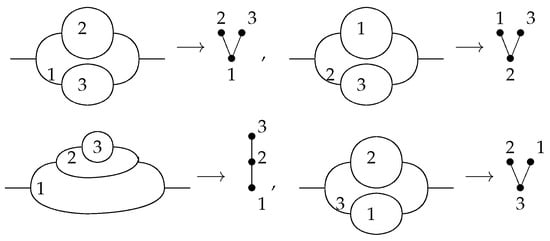
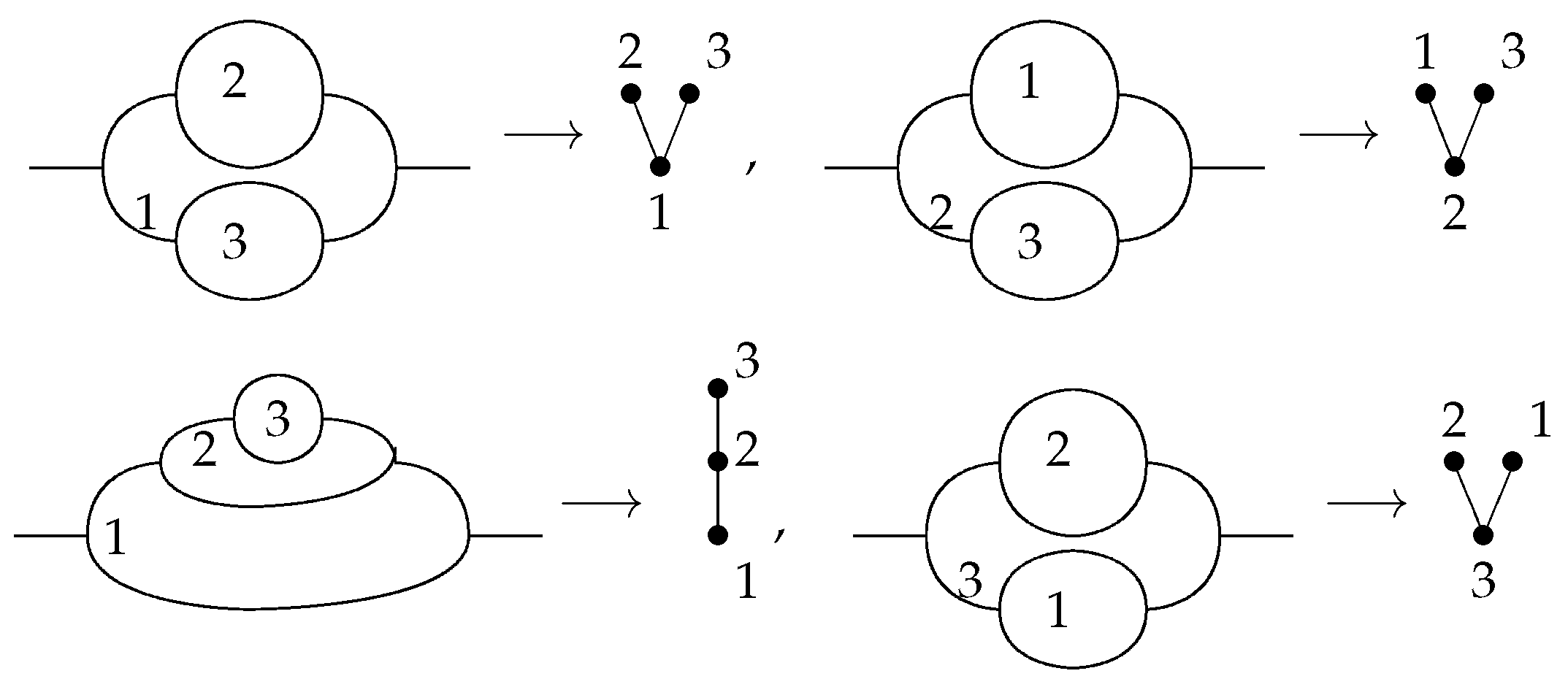
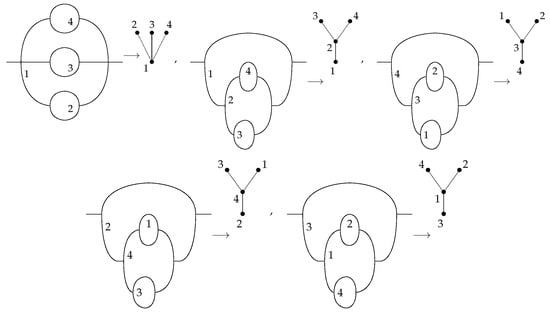
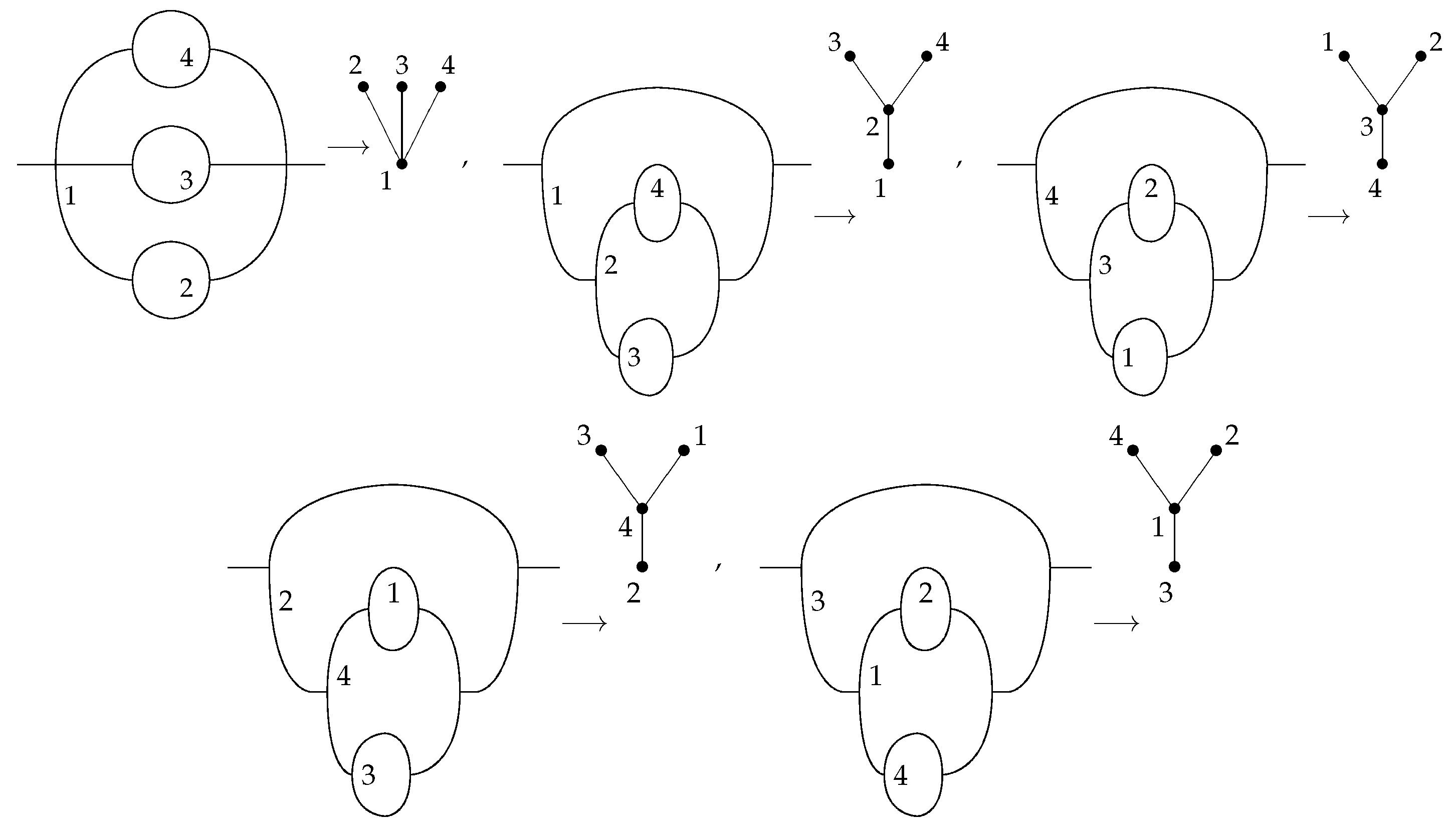
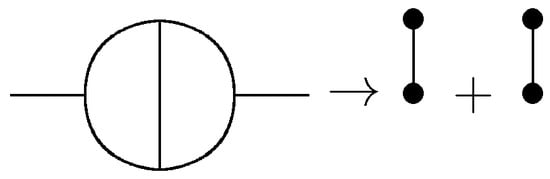
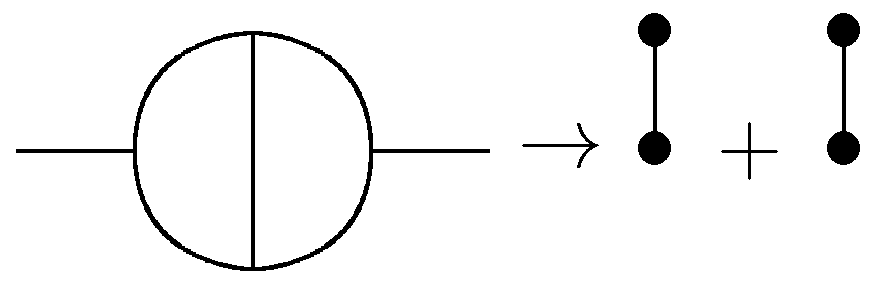




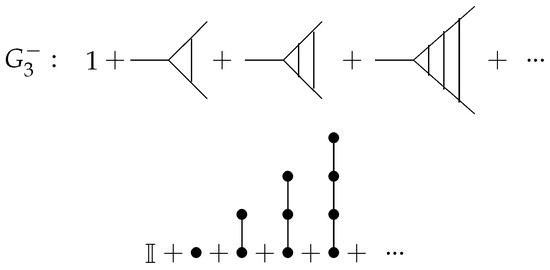
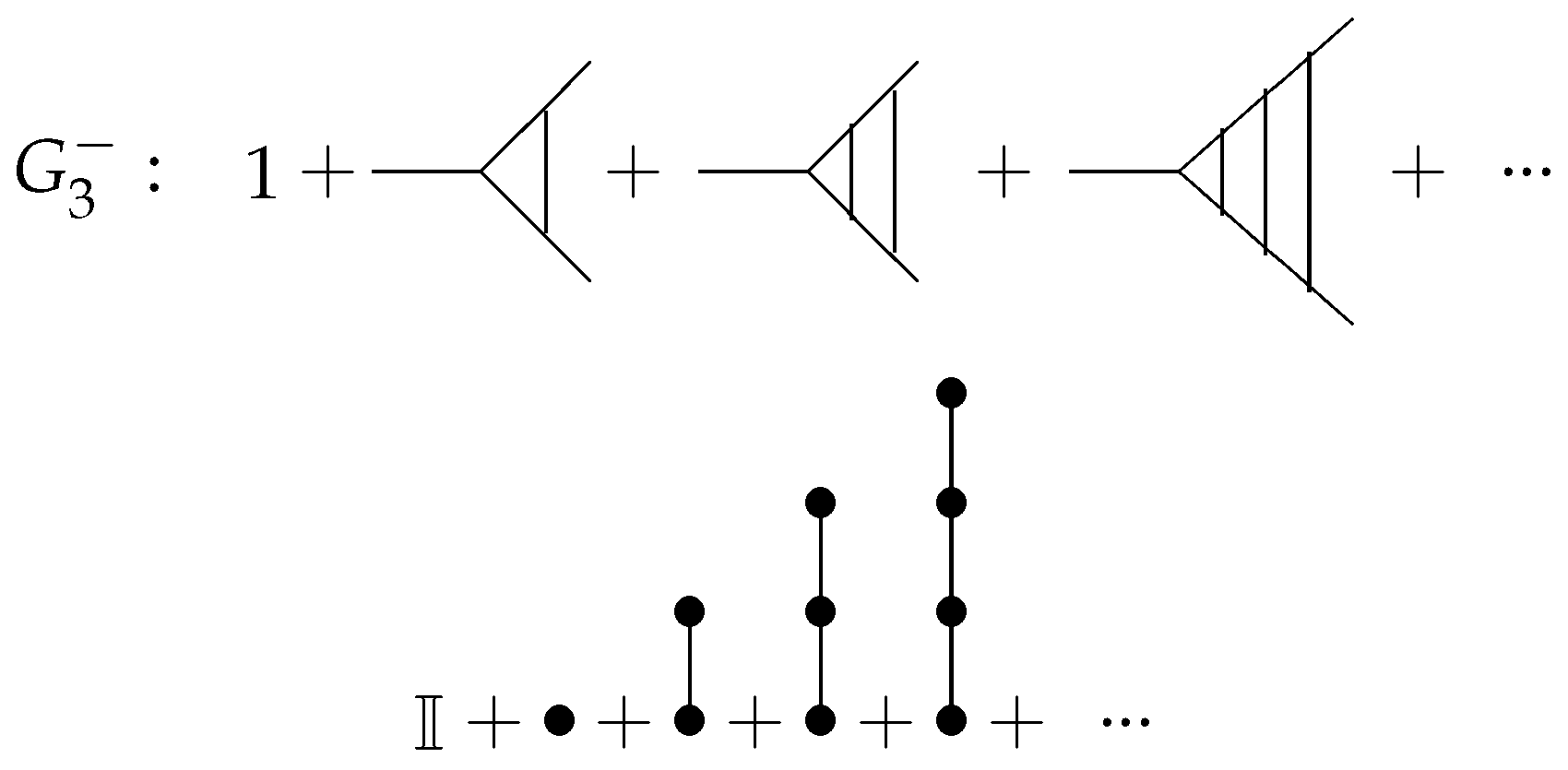
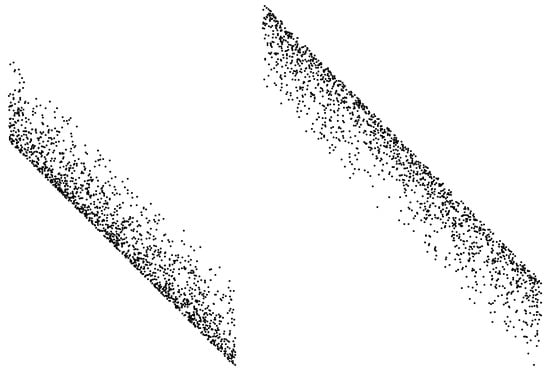
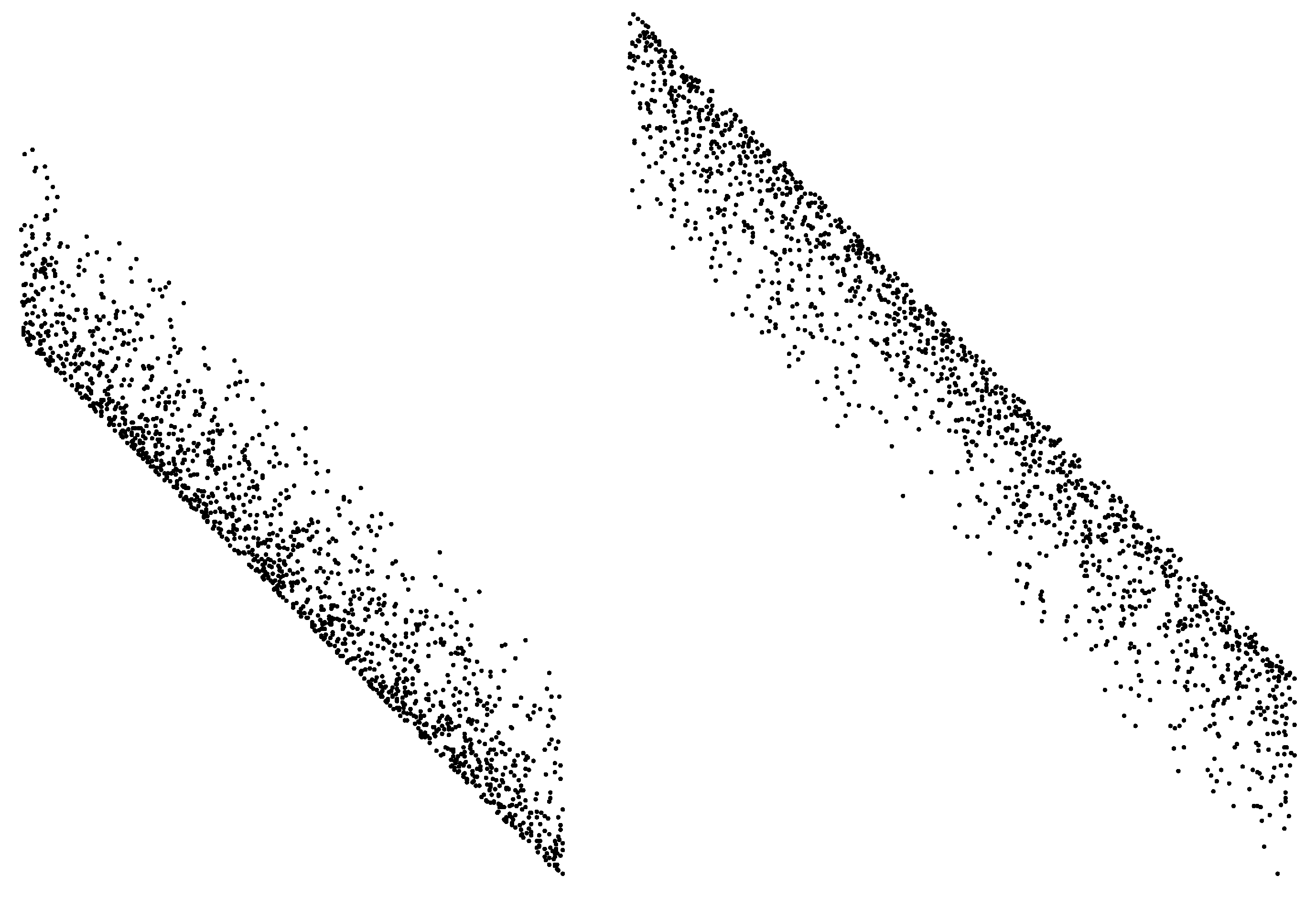
Disclaimer/Publisher’s Note: The statements, opinions and data contained in all publications are solely those of the individual author(s) and contributor(s) and not of MDPI and/or the editor(s). MDPI and/or the editor(s) disclaim responsibility for any injury to people or property resulting from any ideas, methods, instructions or products referred to in the content. |
© 2025 by the author. Licensee MDPI, Basel, Switzerland. This article is an open access article distributed under the terms and conditions of the Creative Commons Attribution (CC BY) license (https://creativecommons.org/licenses/by/4.0/).