Two-Speed AMT Shift Control Strategy Based on Vehicle Speed Prediction and Driving Style Recognition for Heavy-Duty Electric Vehicles


Abstract
1. Introduction
- (1)
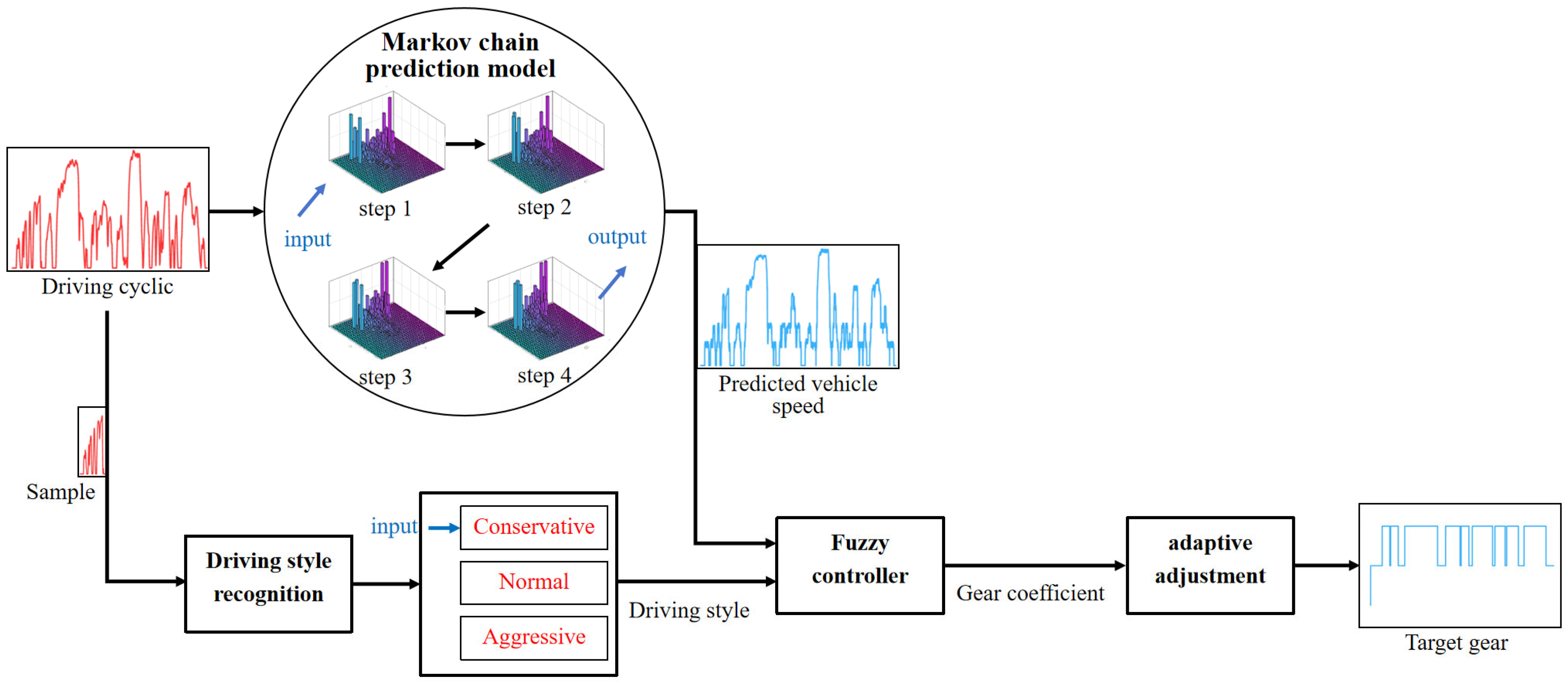
- A shift control strategy is proposed based on fuzzy control that integrates a driving style recognition model based on impact degree analysis, a Markov chain vehicle speed prediction model, and an adaptive model to avoid frequent shifting. This strategy makes real-time decisions on the gear that best meets the driver’s driving needs by considering the dynamic interaction relationship between the identified driver’s driving style and the real-time predicted future vehicle speed. It effectively compensates for the shortcomings of existing theories that focus on static analysis.
- (2)
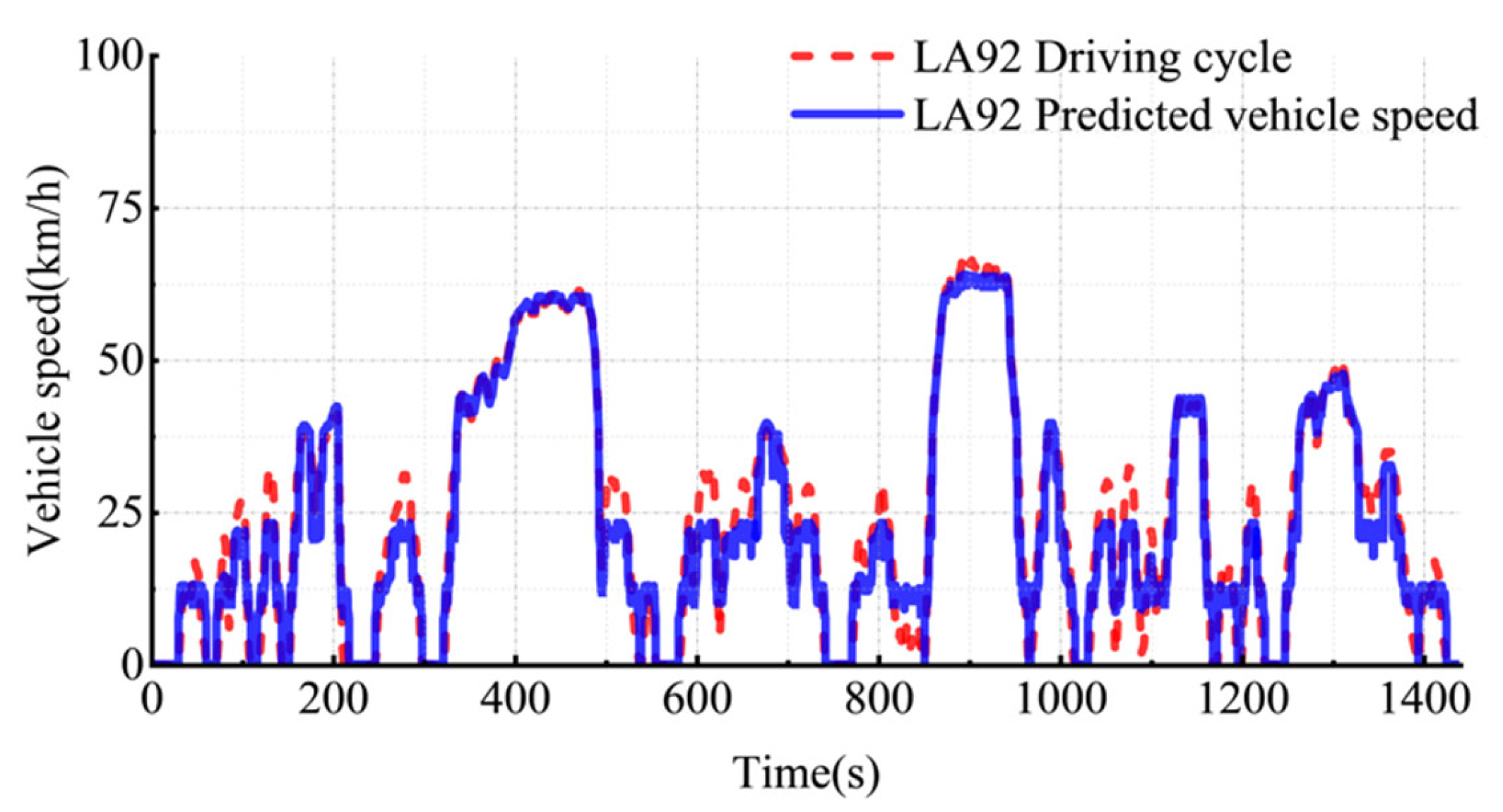
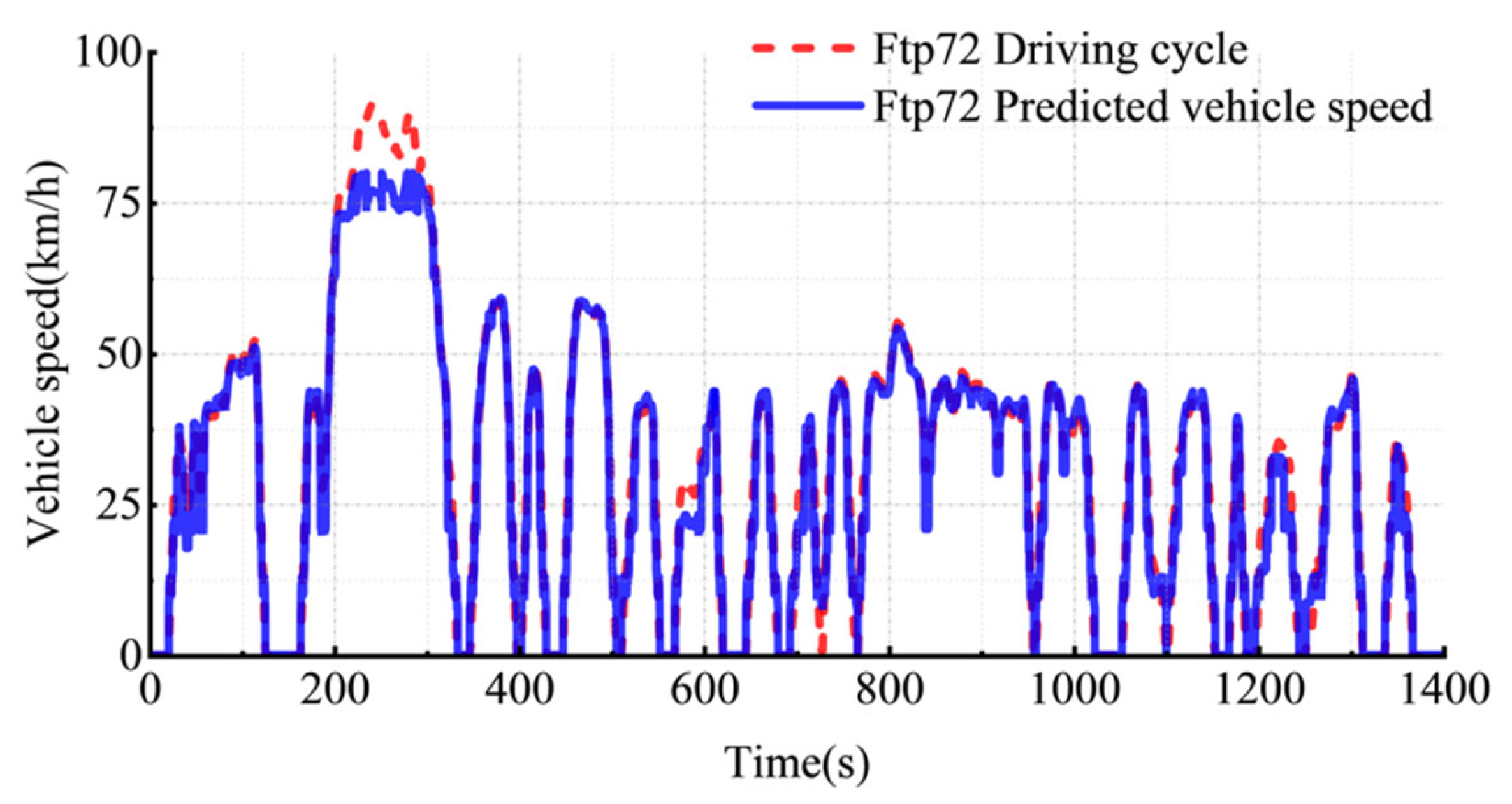
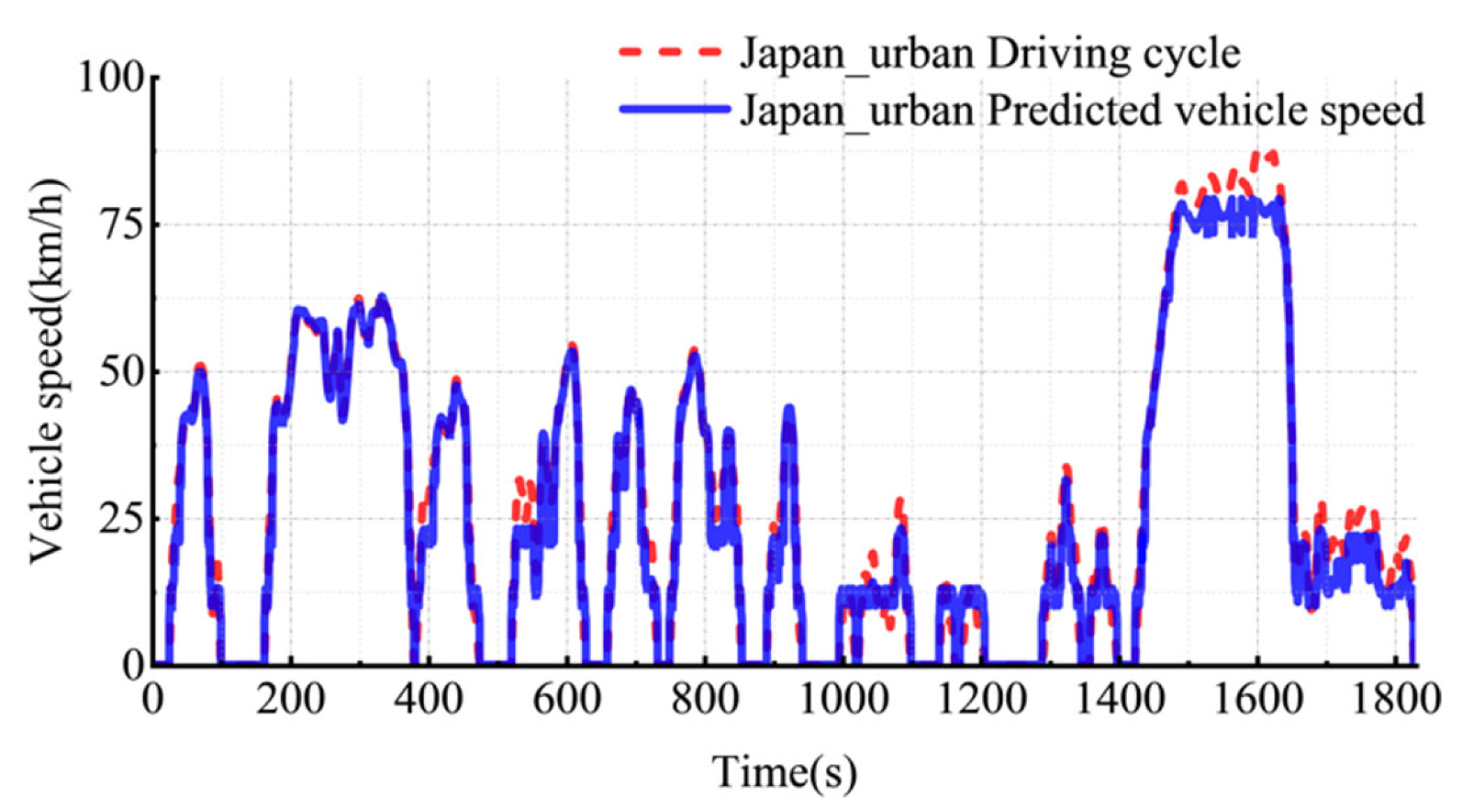
- A fourth-order probability output matrix of the Markov chain model based on the driving condition database was developed to represent the relationship between vehicle speed and acceleration. The vehicle speed prediction model based on this matrix can accurately predict the vehicle speed in the next 2 s based on the current vehicle speed.
- (3)
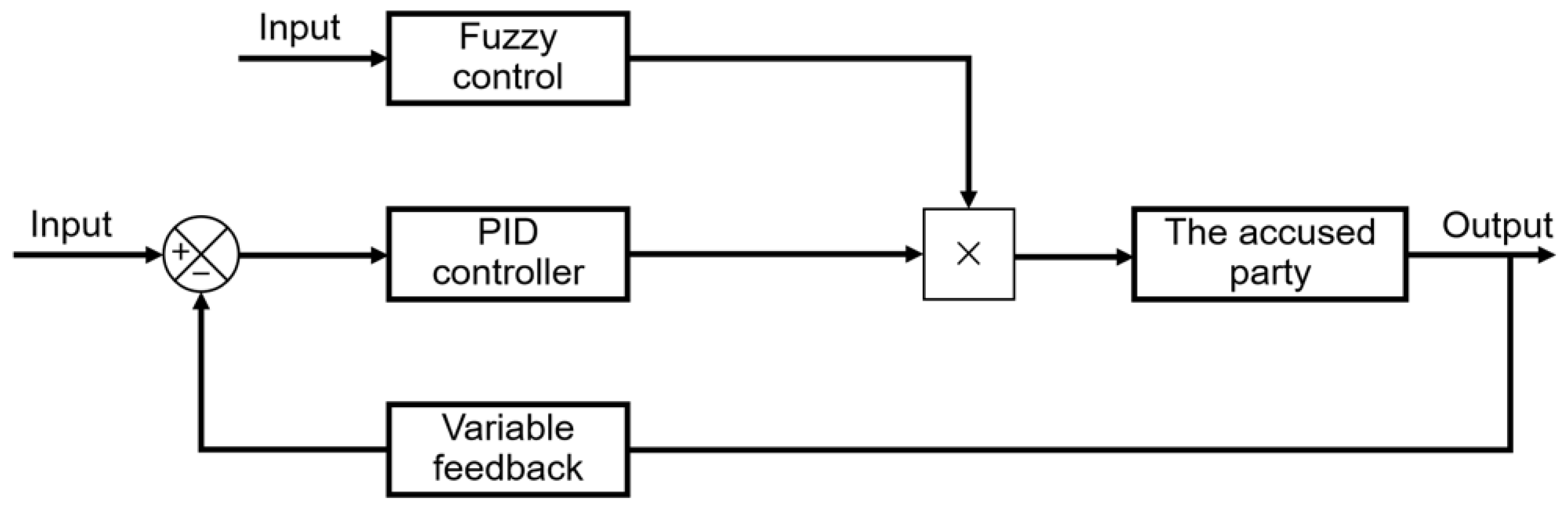
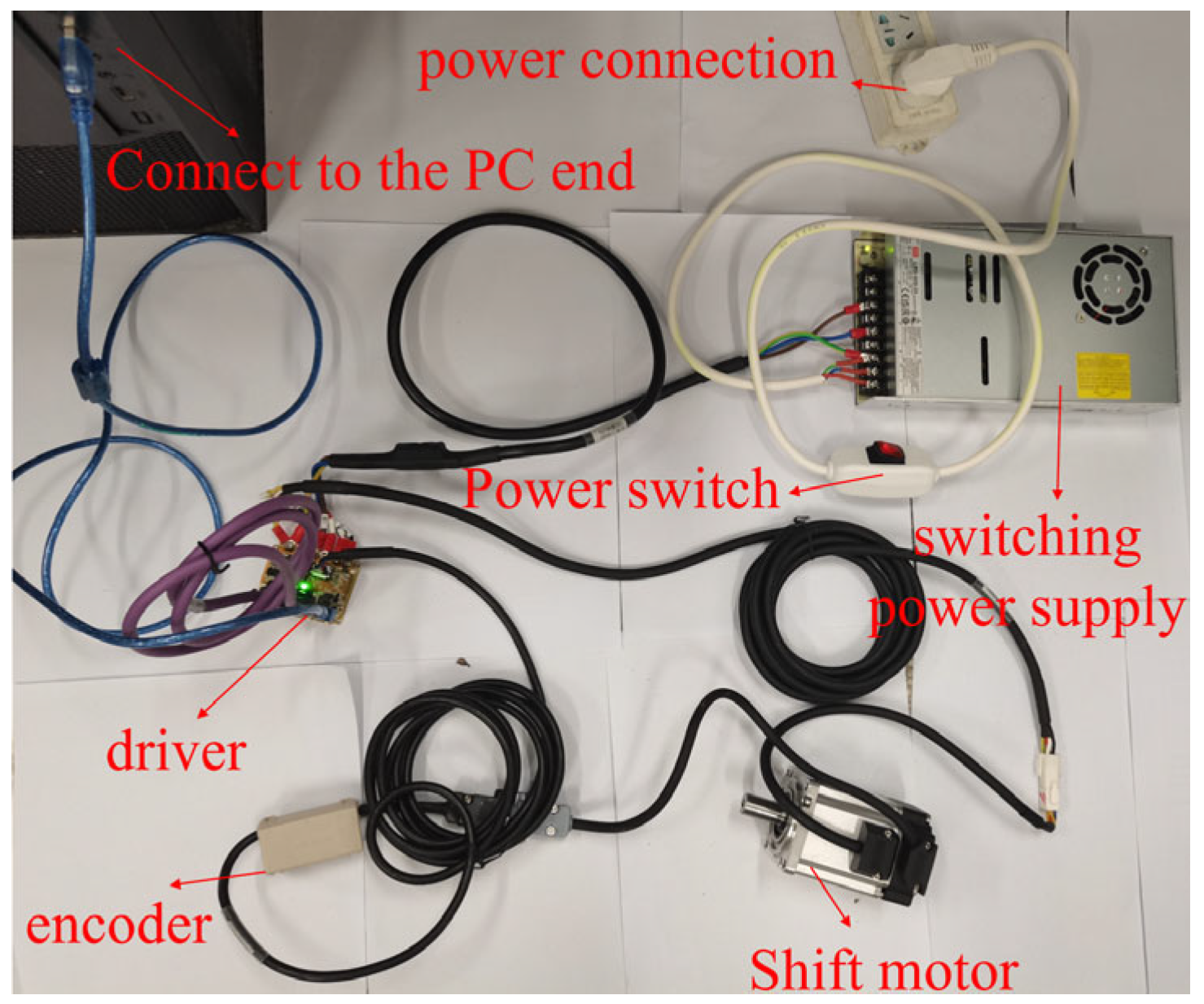
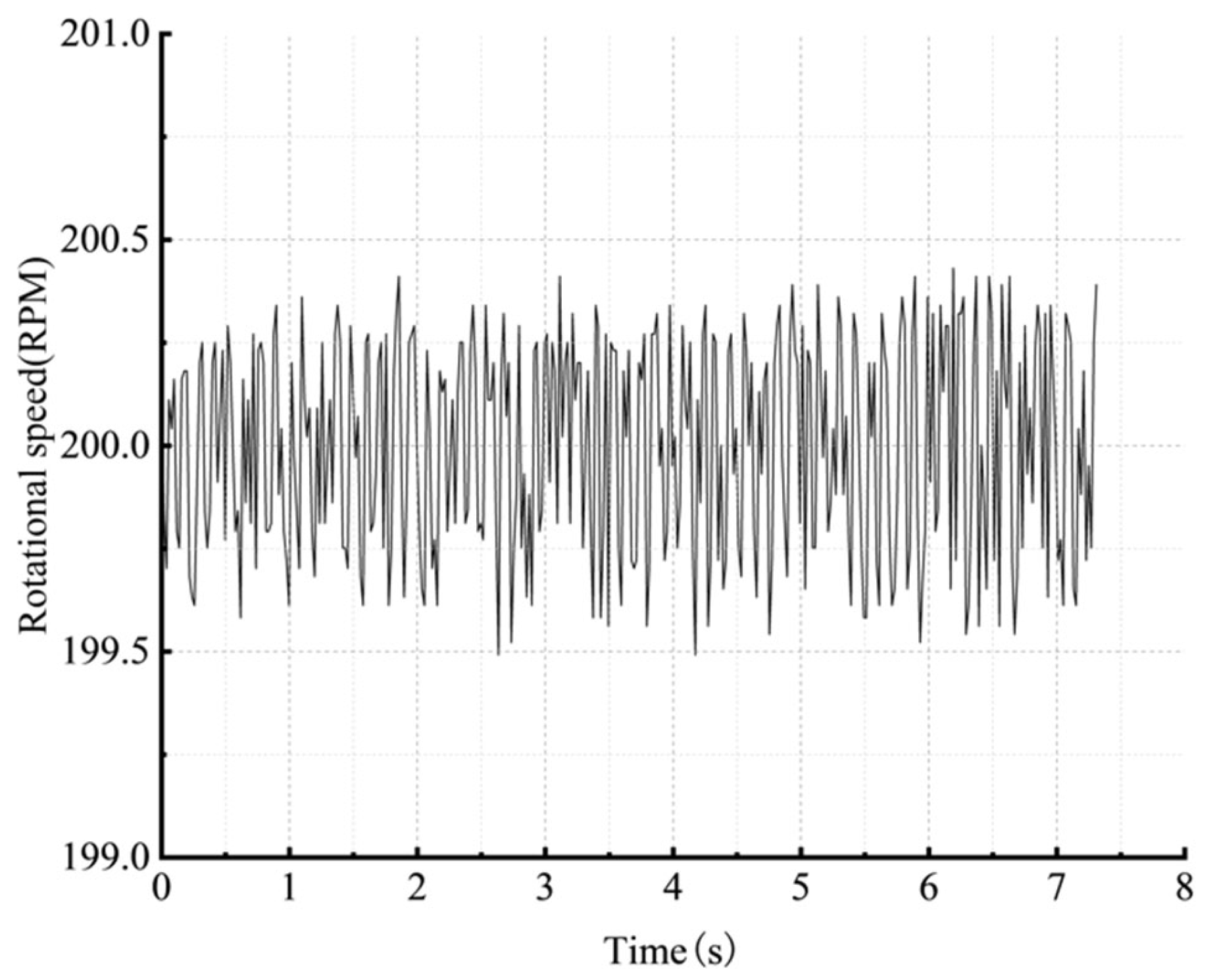
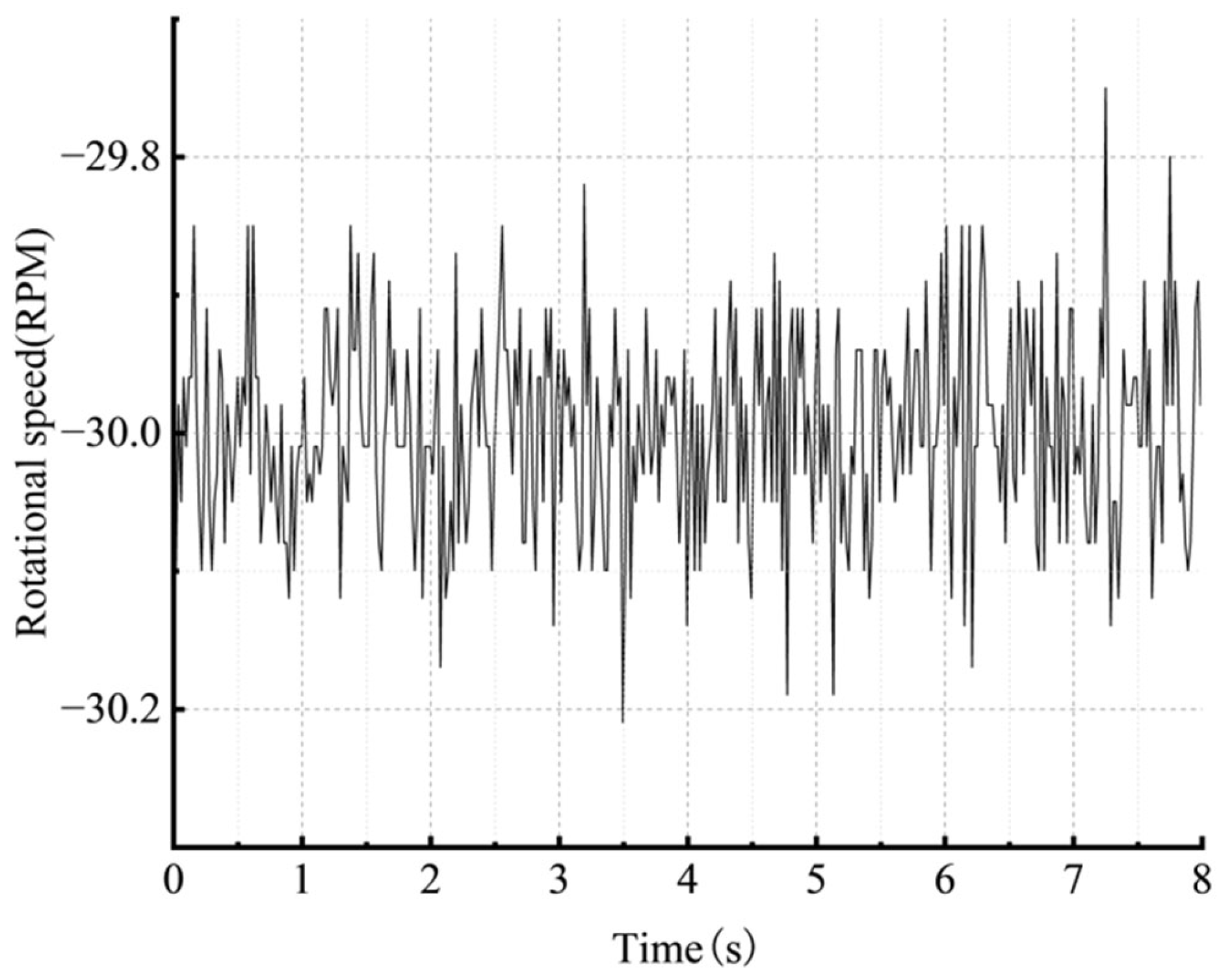
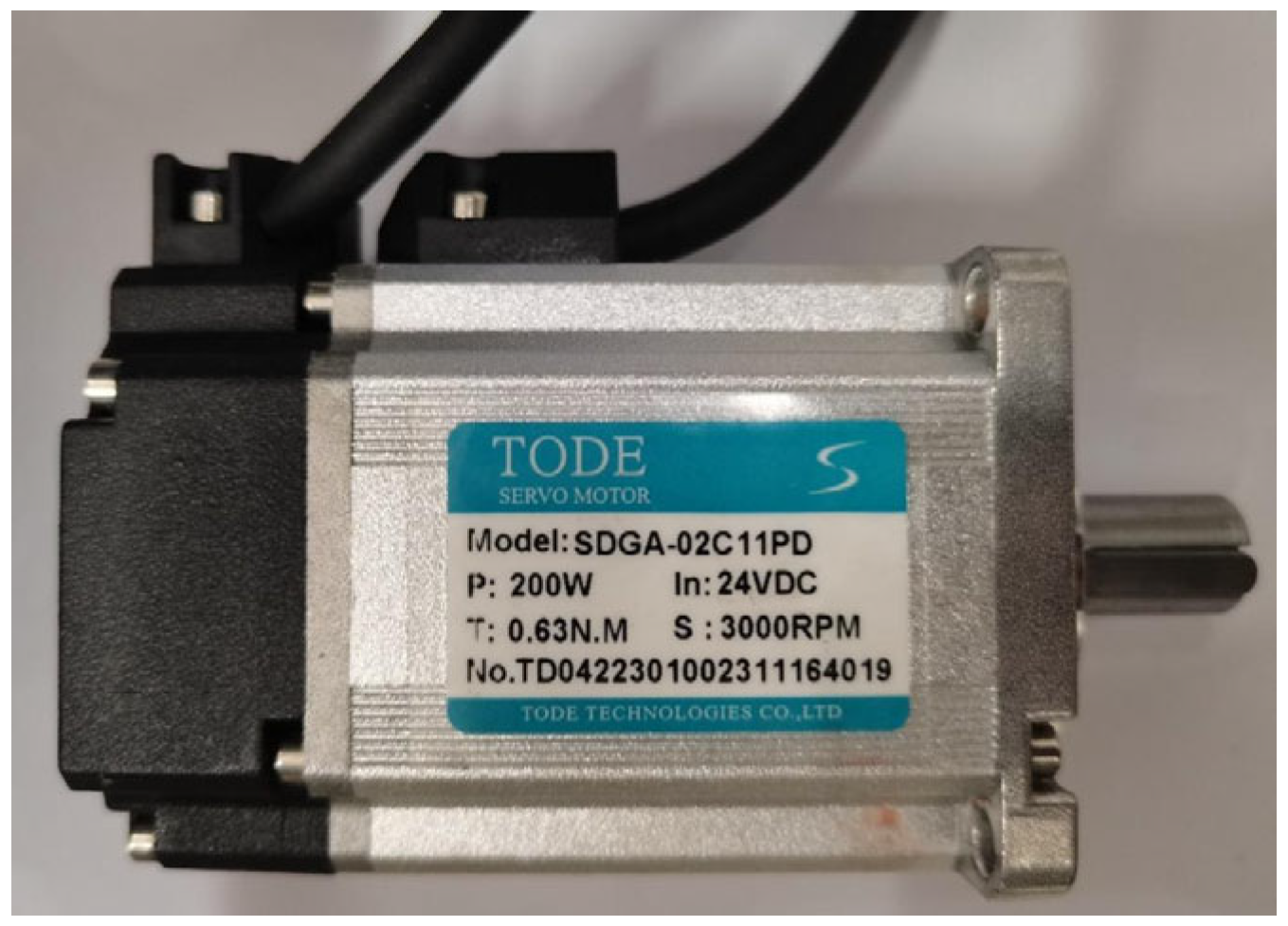
- A shift execution strategy for precisely controlling the rotational speed of the shift motor was designed to reduce the impact during shifting. By taking the rotational speed difference of the synchronizer and its rate of change into account, a fuzzy controller is designed to control the shifting speed, thereby effectively reducing the impact of shifting and improving driving smoothness.
2. System Modeling
2.1. Drive Motor Modeling
2.2. Power Battery Modeling
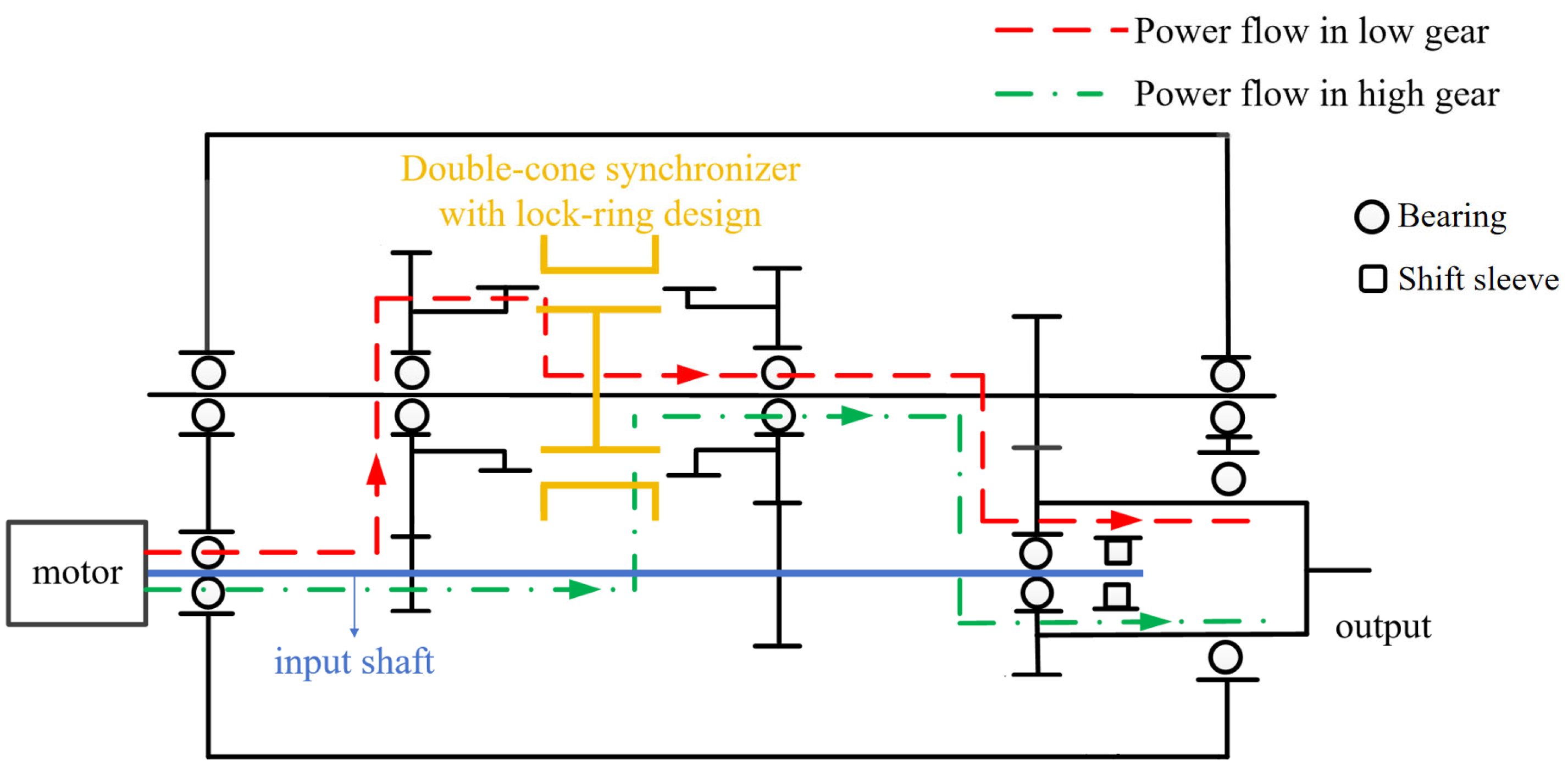
2.3. Transmission System Modeling
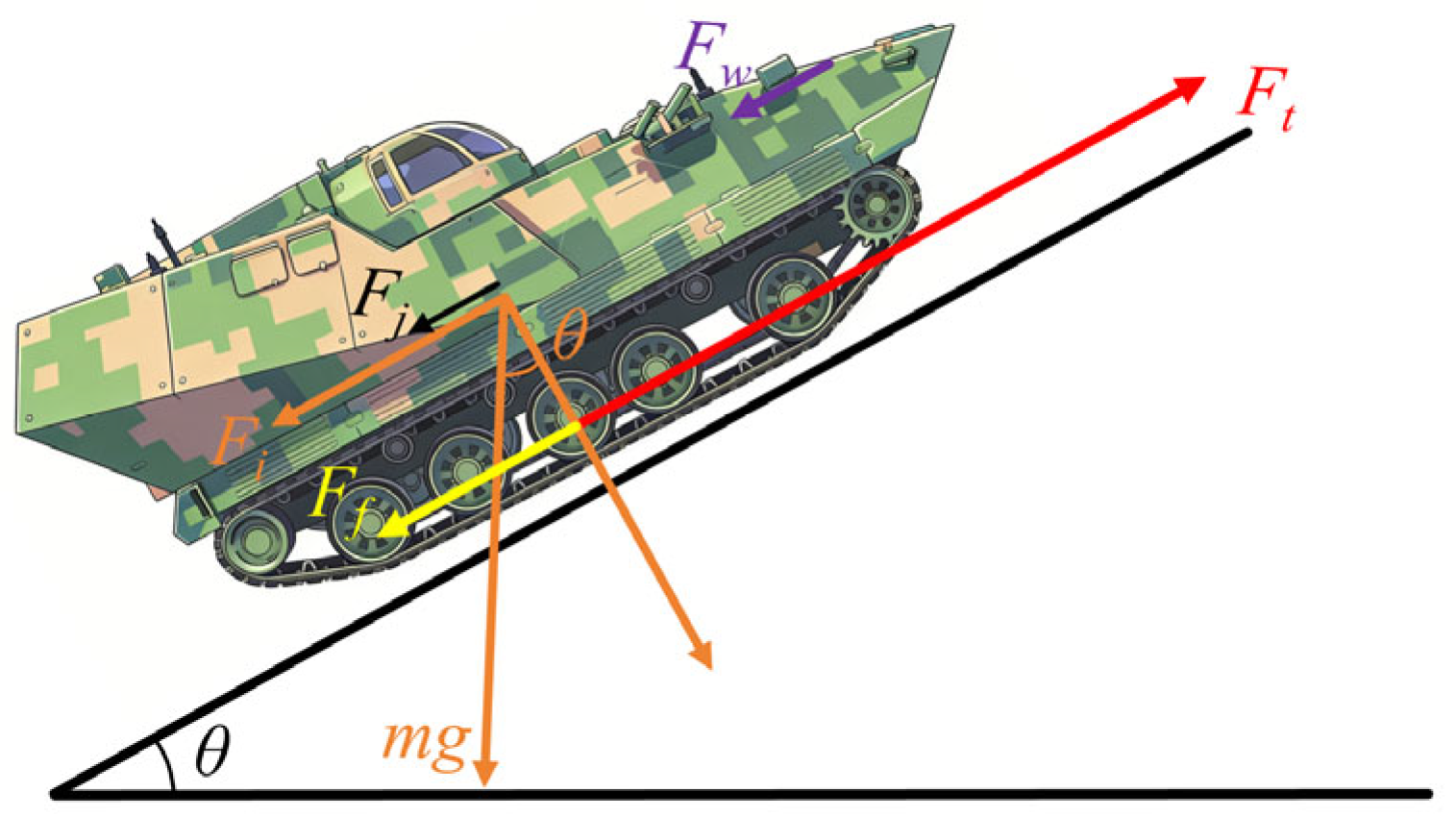
2.4. Vehicle Longitudinal Dynamics Modeling
3. Main Results
3.1. Shift Decision System Design
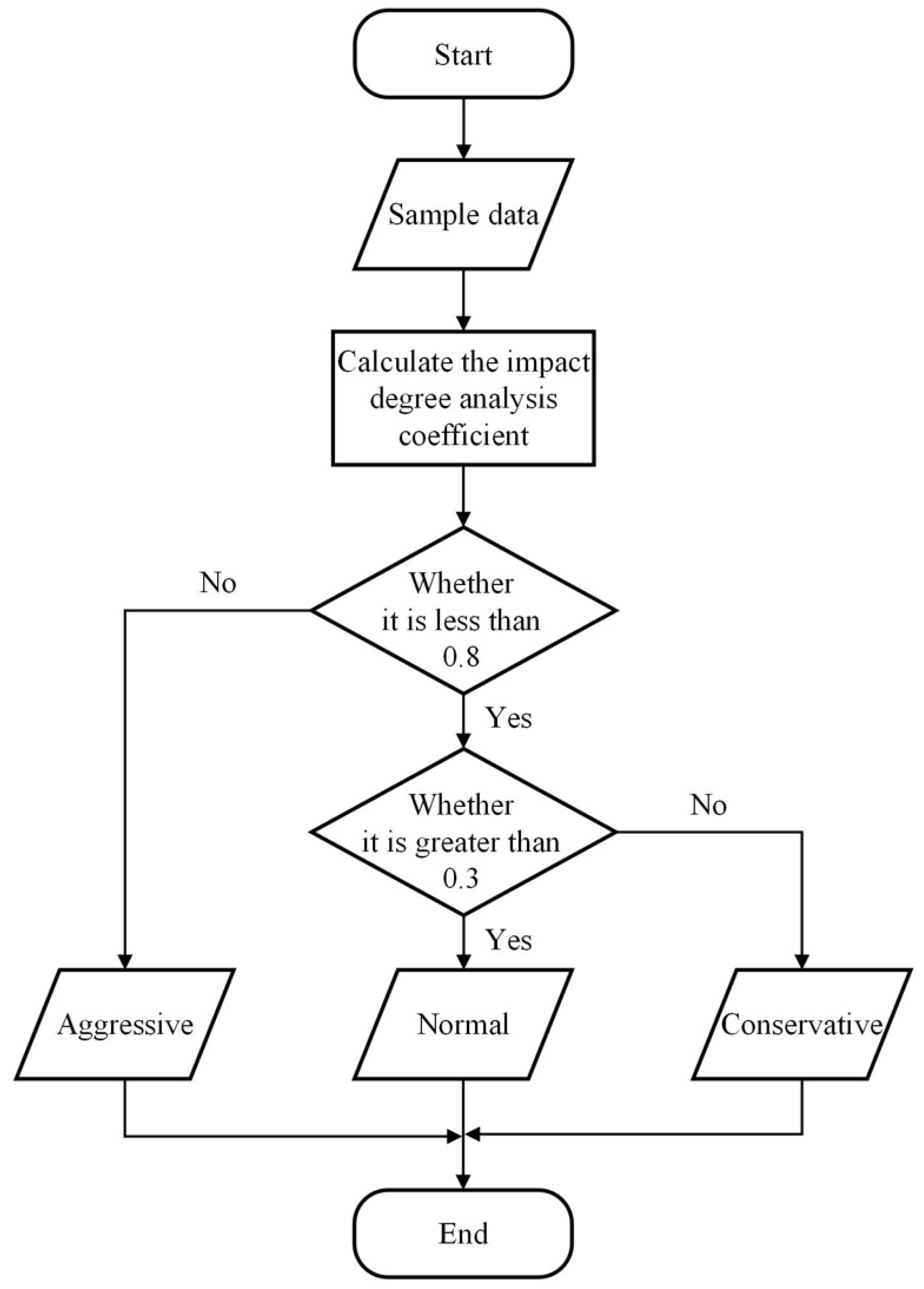
3.2. Driving Style Recognition Model Based on Impact Degree
3.3. Vehicle Speed Prediction Model Based on the Markov Chain Model
- (1)
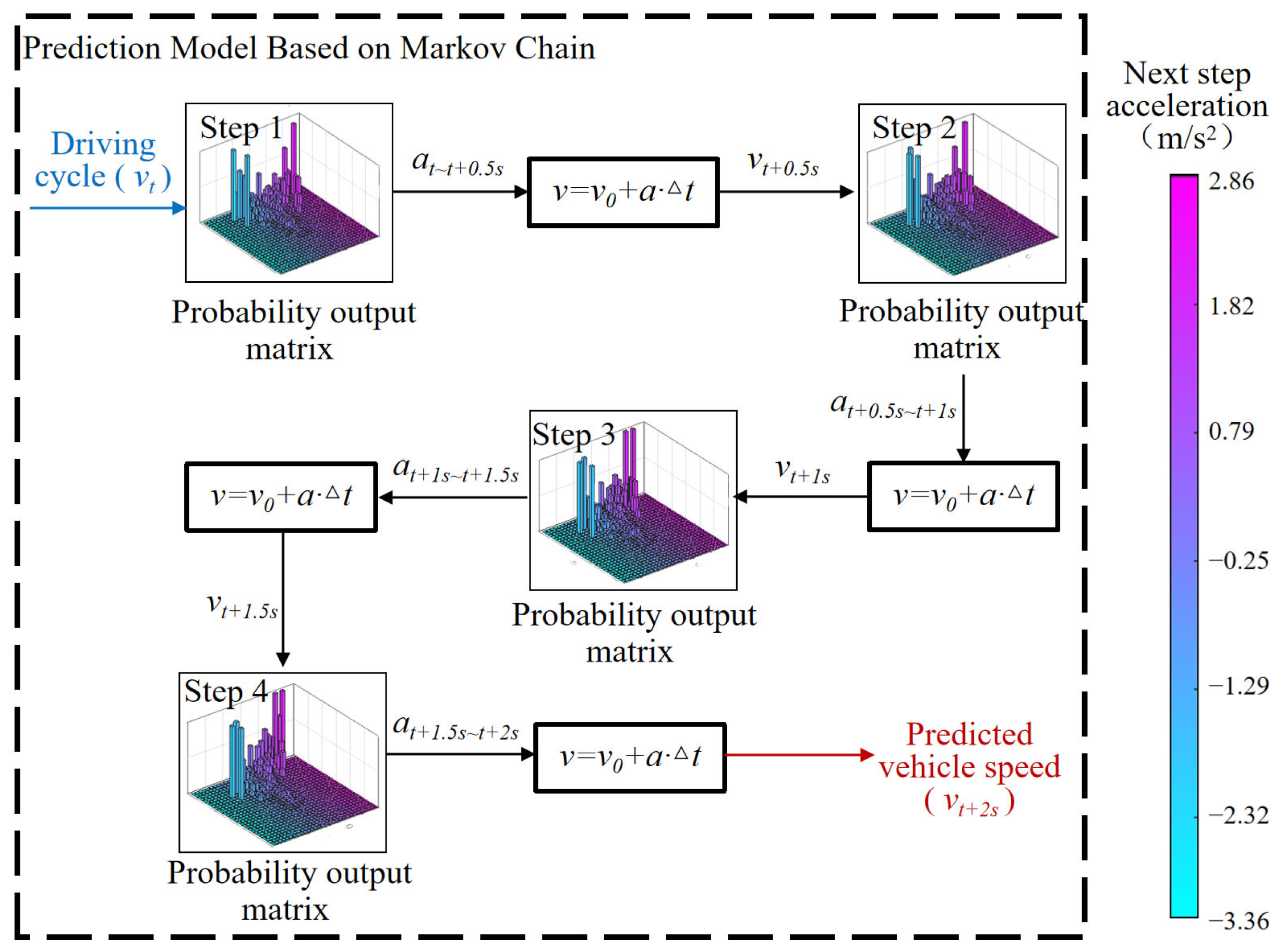
- Input the current speed vt of the driving cycle into the probability output matrix of the first-stage Markov chain model to obtain the acceleration at ~t + 0.5 s from t to t + 0.5 s. Then, substitute it into Equation (25) to predict the speed vt + 0.5 s at t + 0.5 s.
- (2)
- Input vt + 0.5 s into the probability output matrix of the second-stage Markov chain model to obtain the acceleration at +0.5 s~t + 1 s from t + 0.5 s to t + 1 s. Then, substitute it into Equation (25) to predict the speed vt + 1 s at t + 1 s.
- (3)
- Input vt + 1 s into the probability output matrix of the third-stage Markov chain model to obtain the acceleration at +1 s~t + 1.5 s from t + 1 s to t + 1.5 s. Then, substitute it into Equation (25) to predict the speed vt + 1.5 s at t + 1.5 s.
- (4)
- Input vt + 1.5 s into the probability output matrix of the fourth-stage Markov chain model to obtain the acceleration at +1.5 s~t + 2 s from t + 1.5 s to t + 2 s. Then, substitute it into Equation (25) to predict the speed vt + 2 s at t + 2 s.
- (1)
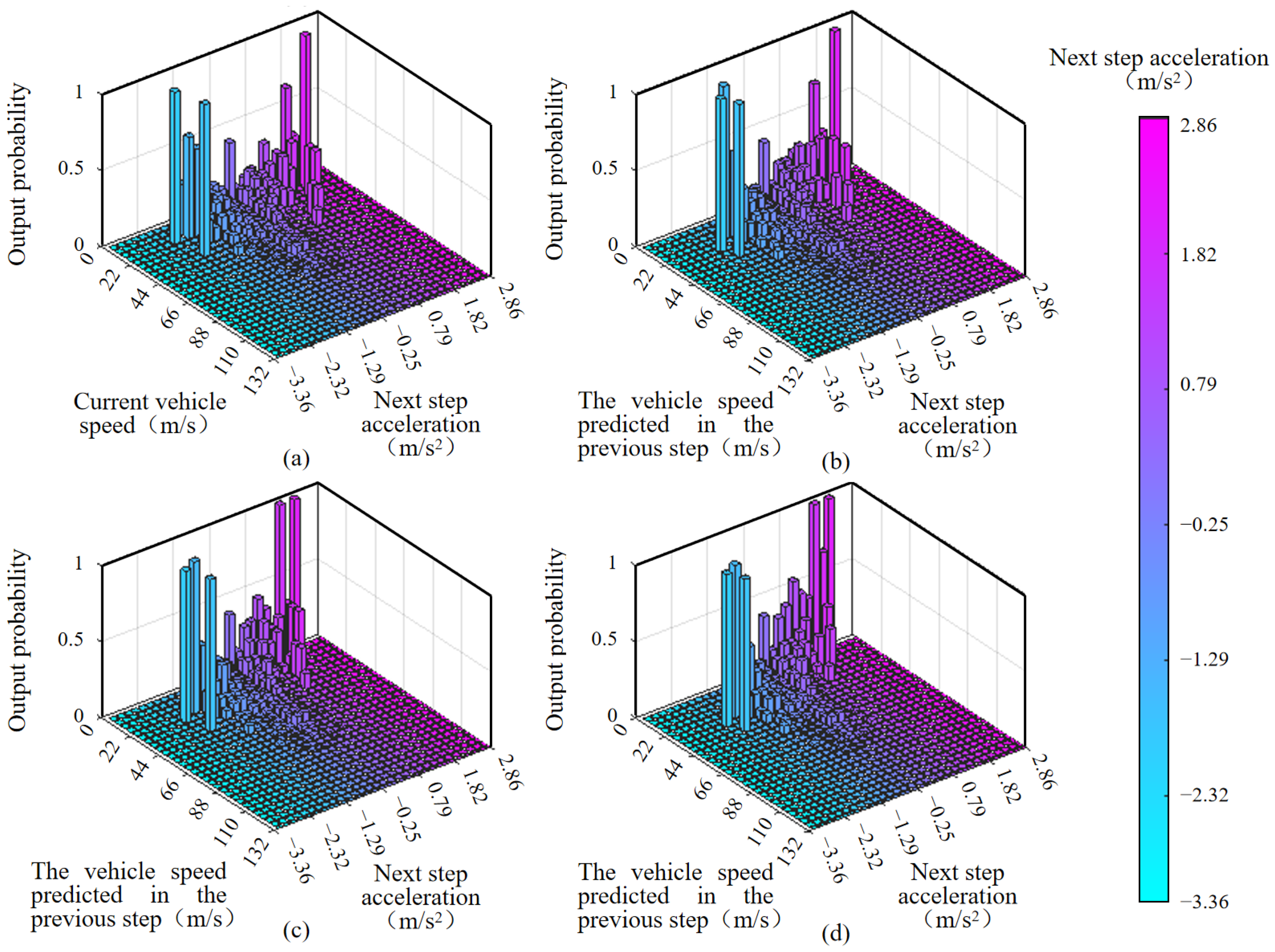
- Calculation of the probability output matrix of the first stage of the Markov chain model: The vehicle speed at time t was input based on the sample data, and then the probability distribution of acceleration from t to t + 0.5 s in the sample data was determined.
- (2)
- Calculation of the probability output matrix of the second stage of the Markov chain model: The vehicle speed at time t + 0.5 s was calculated by the probability output matrix of the first stage of the Markov chain model. The vehicle speed at time t + 0.5 s was input, and then the probability distribution of acceleration from t + 0.5 s to t + 1 s in the sample data was determined.
- (3)
- Calculation of the probability output matrix of the third stage of the Markov chain model: The vehicle speed at time t + 1 s was calculated by the probability output matrix of the second stage of the Markov chain model. Then, the vehicle speed at time t + 1 s was analyzed to find the probability distribution of acceleration from t + 1 s to t + 1.5 s in the sample data.
- (4)
- Calculation of the probability output matrix of the fourth stage of the Markov chain model: The vehicle speed at time t + 1.5 s was calculated by the probability output matrix of the second stage of the Markov chain model. Then, the vehicle speed at time t + 1.5 s was analyzed to find the probability distribution of acceleration from t + 1.5 s to t + 2 s in the sample data.
3.4. Adaptive Shift Model Based on Fuzzy Control
- (1)
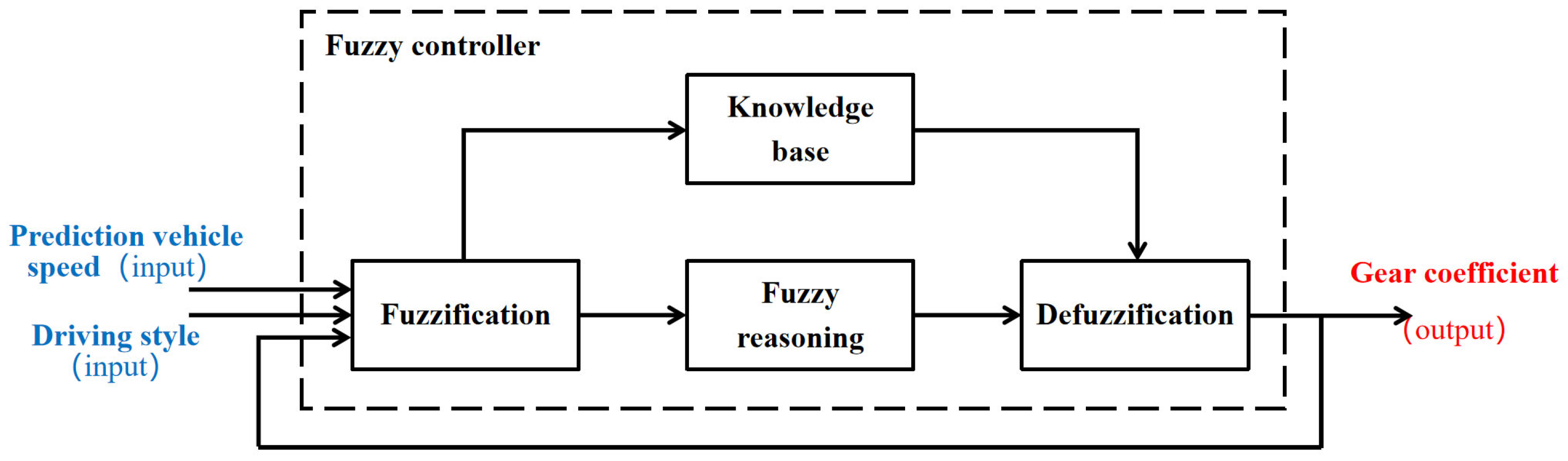
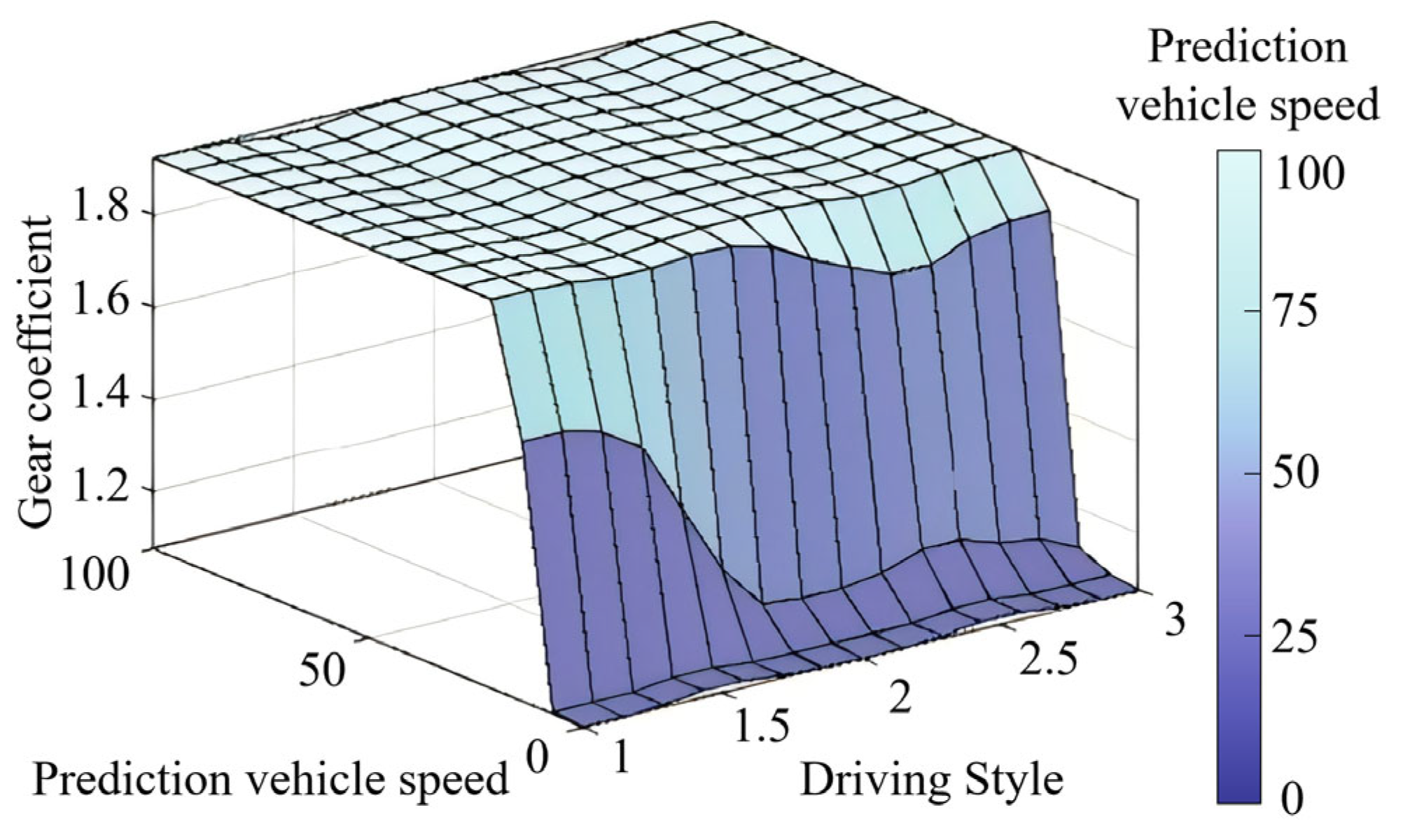
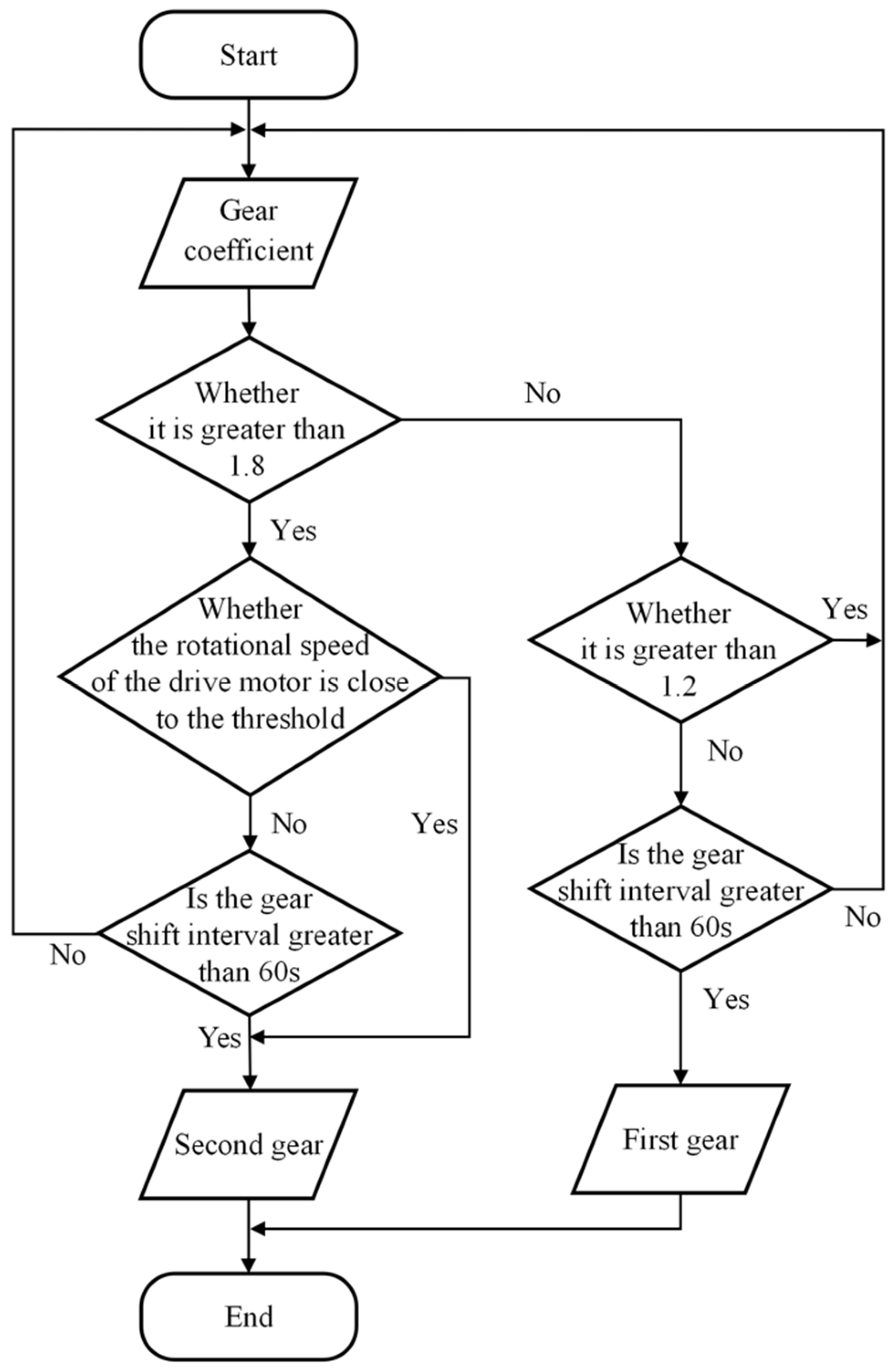
- When the gear coefficient output by the fuzzy controller is greater than 1.8 and the motor speed is close to the maximum speed, the target gear is adjusted to the second gear.
- (2)
- When the gear coefficient output by the fuzzy controller is greater than 1.8 and the shift interval is more than 60 s, the target gear is adjusted to the second gear.
- (3)
- When the gear coefficient output by the fuzzy controller is greater than 1.2 and less than 1.8, the target gear remains unchanged.
- (4)
- When the gear coefficient output by the fuzzy controller is less than 1.2 and the shift interval is more than 60 s, the target gear is adjusted to the first gear.
3.5. Shift Model Construction Based on Speed and Its Rate of Change
- (1)
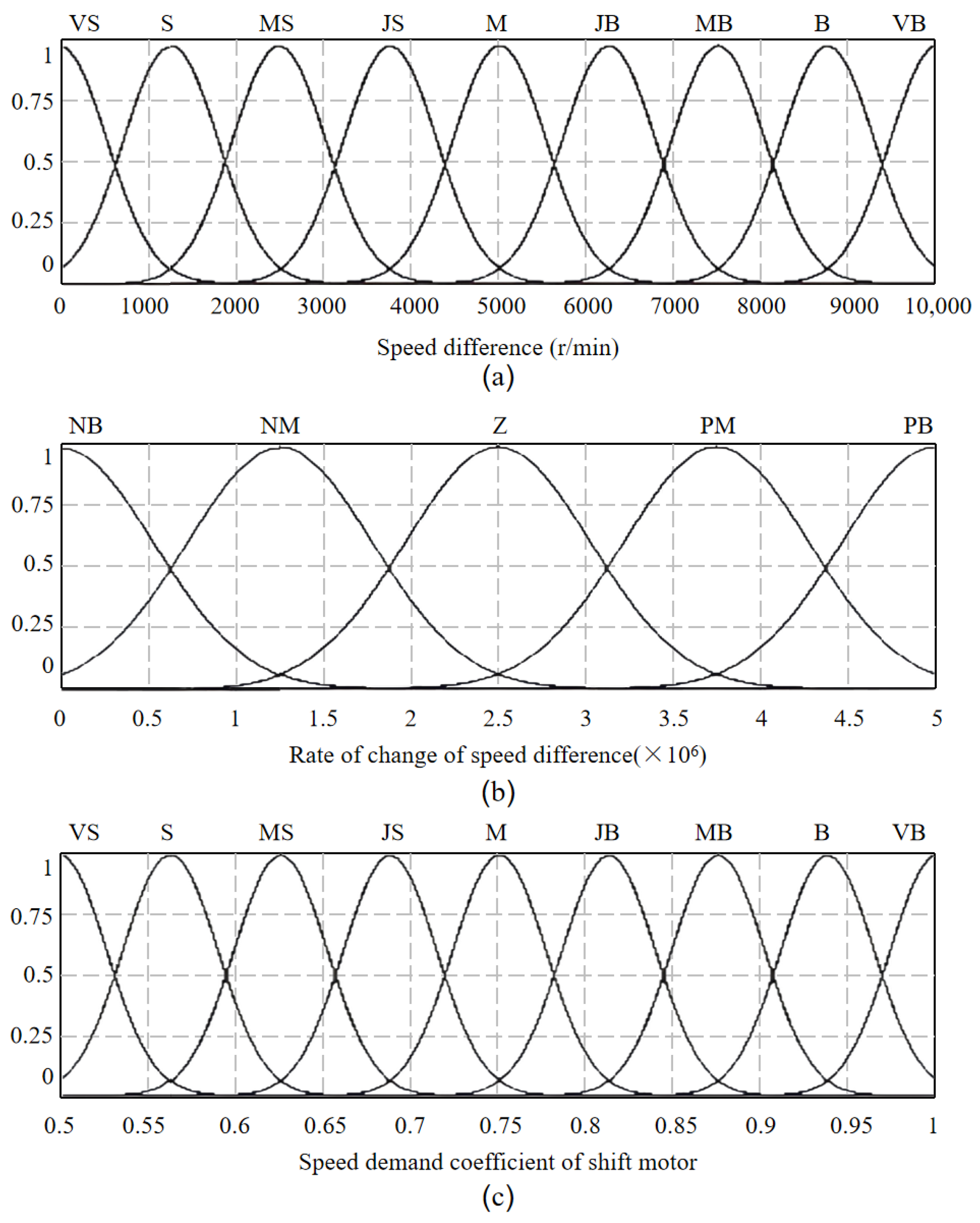
- Speed difference (0, 10,000): very small (VS), small (S), medium–small (MS), relatively small (JS), medium (M), relatively large (JB), medium–large (MB), large (B), and very large (VB)
- (2)
- Rate of change in speed difference (taking the speed change rate of 0.002 s) (0, 5,000,000): small (NB), relatively small (NM), medium (Z), relatively large (PM), and large (PB).
- (3)
- Shift motor speed demand coefficient (0.5, 1): very small (VS), small (S), medium–small (MS), relatively small (JS), medium (M), relatively large (JB), medium–large (MB), large (B), and very large (VB).
4. Simulation and HIL Testing
4.1. Simulation
4.1.1. Analysis of Vehicle Speed Prediction in Driving Cycles
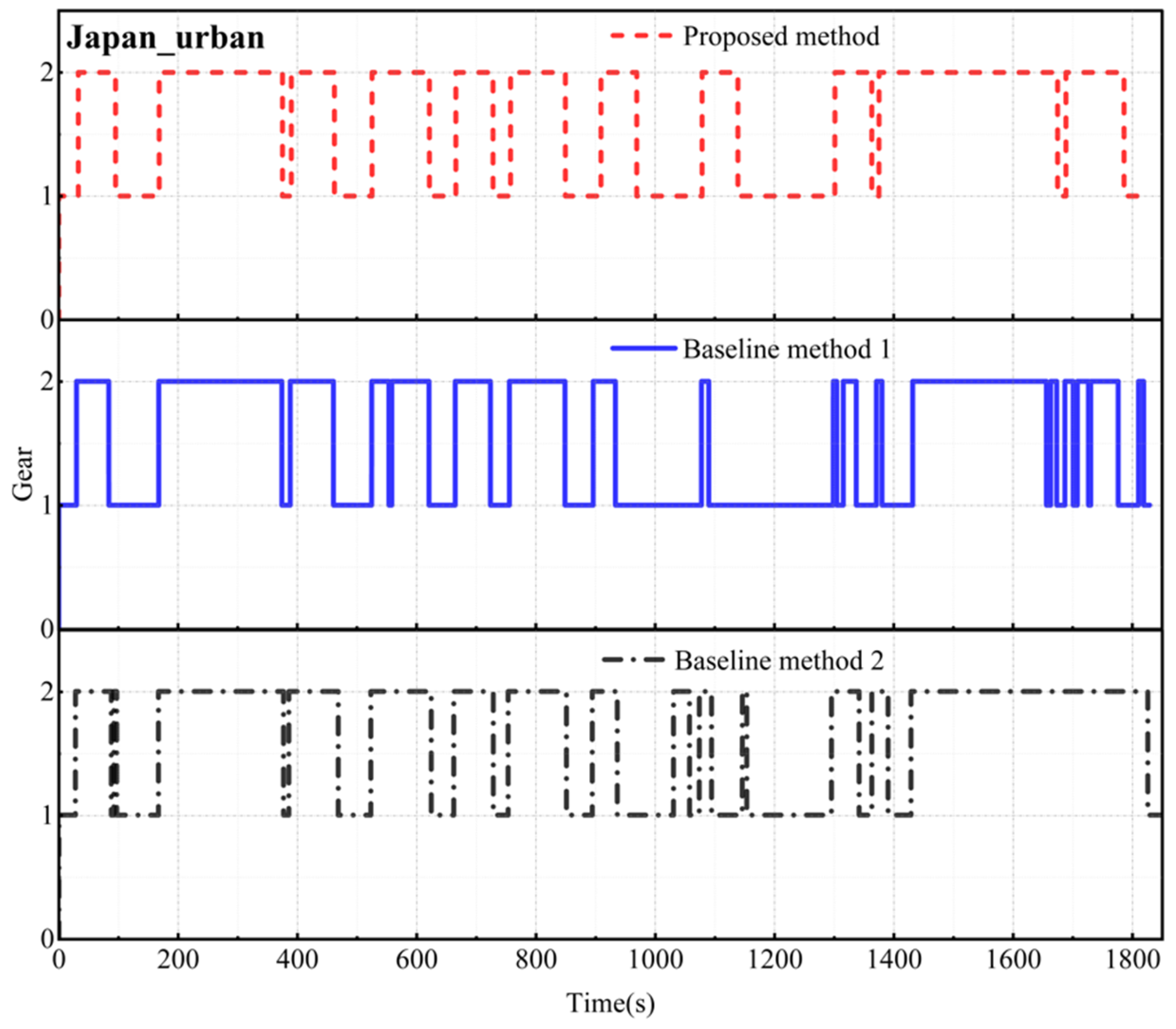
4.1.2. Shift Frequency Comparison
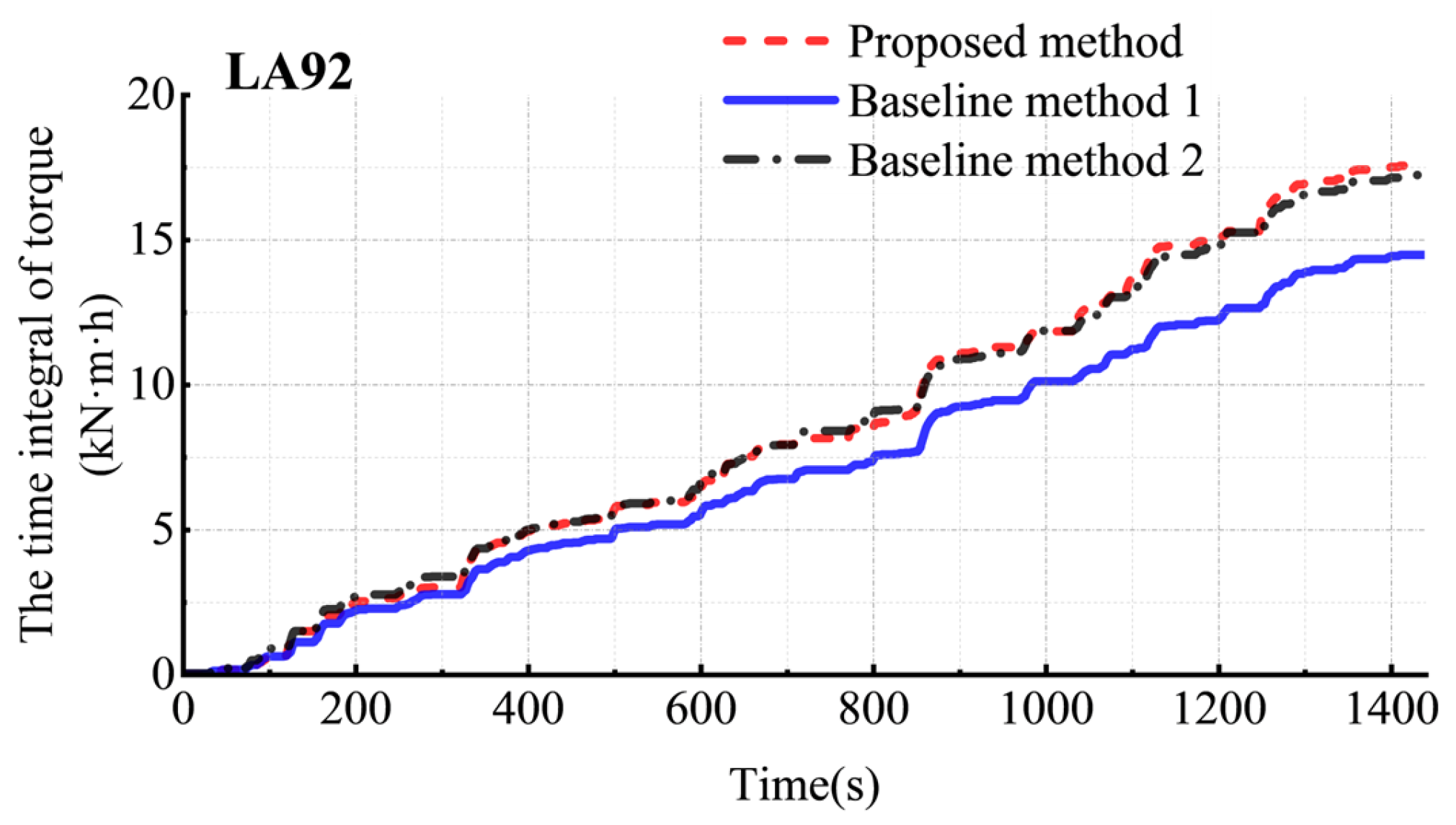
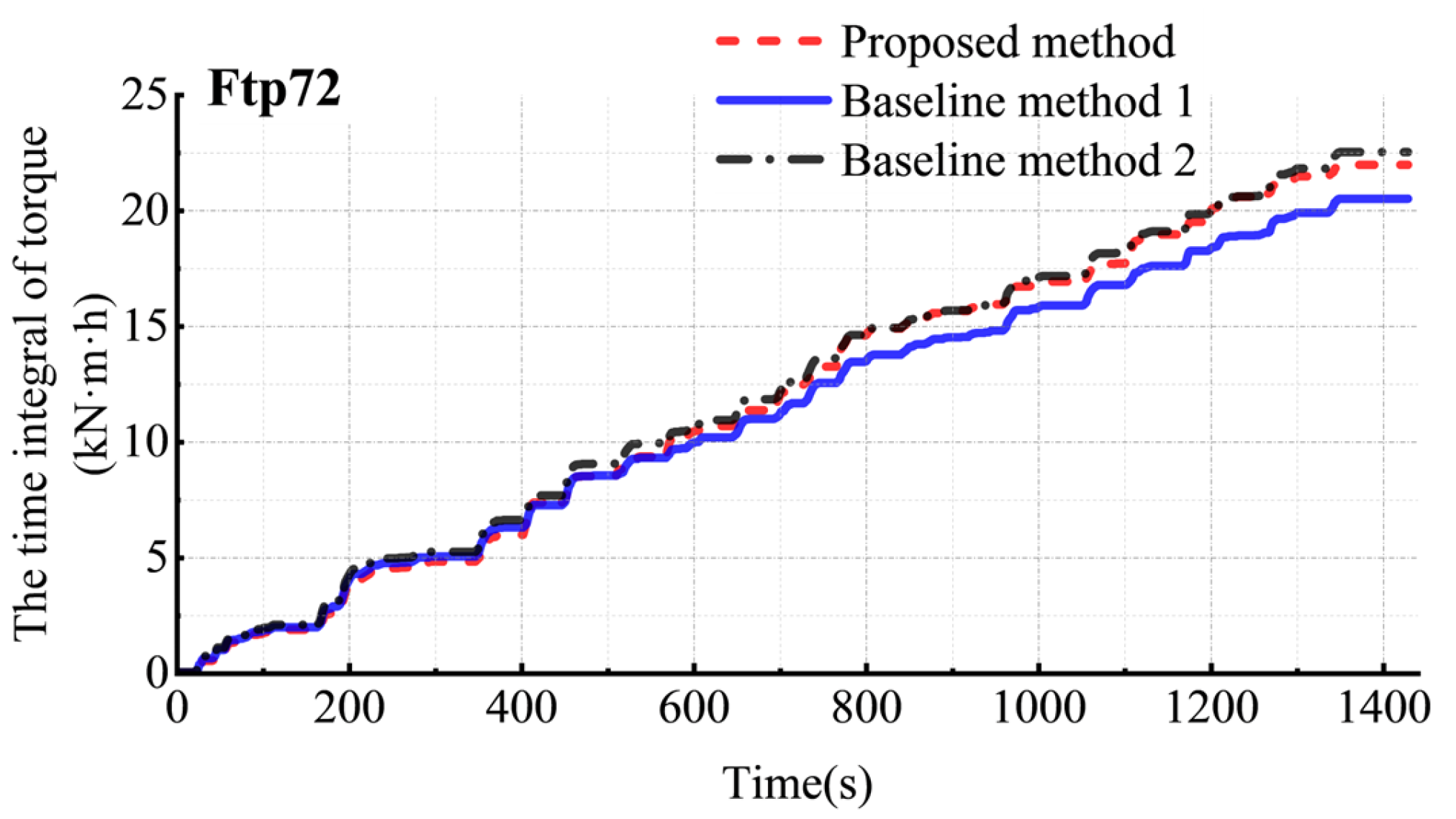
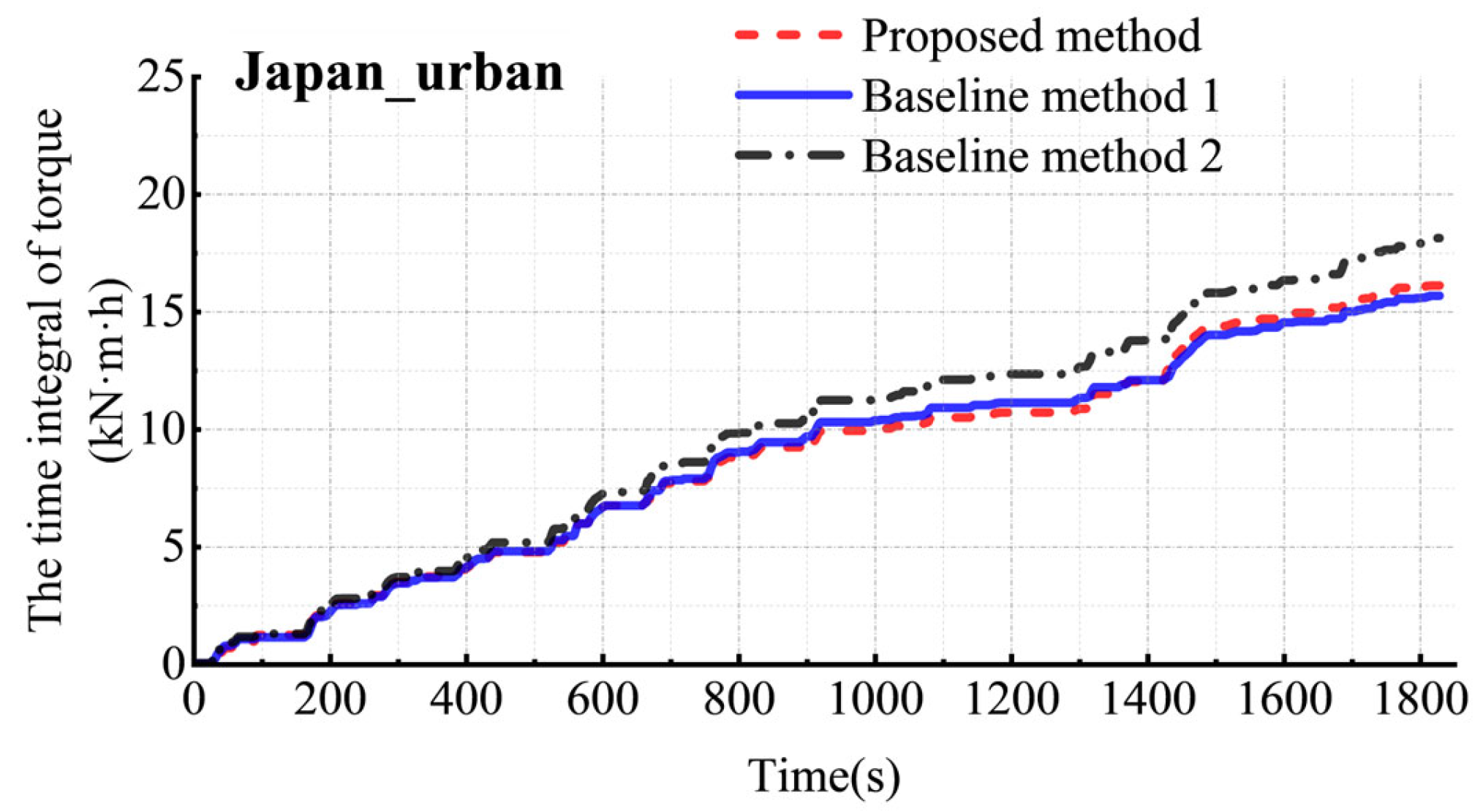
4.1.3. Dynamic Performance Comparison
4.1.4. Economic Performance Comparison
4.1.5. Smoothness Comparison
4.2. HIL: Shifting Motor Test
5. Discussion
- (1)
- The research results rely mainly on simulation. The applicability of the proposed strategy under actual operating conditions remains unverified. Real roads feature varying gradients, which differ from the simulation environment.
- (2)
- Regarding the structural design and dynamic analysis of the two-speed AMT for electric vehicles, the dynamic model designed in this paper is relatively simplified, ignoring the energy loss caused by partial heat dissipation in the transmission system and the changes in the air density and air resistance coefficient during vehicle operation.
- (3)
- In terms of the research on the two-speed AMT control strategy for electric vehicles, when calculating the condition prediction matrix based on the Markov chain model in this paper, only 10 sets of driving cycles were sampled, and the predicted speed of the next 2 s was found to be a little off based on the actual speed.
6. Conclusions
Author Contributions
Funding
Data Availability Statement
Conflicts of Interest
Abbreviations
| AMT | Automated manual transmission |
| HIL | Hardware in loop |
| EVs | Electric vehicles |
| MPC | Model predictive control |
| S-MPC | Static model-based predictive control |
| SOC | State of charge |
| PID | Proportional integral derivative |
| INDIA_URBAN_SAMPLE | Indian urban driving cycle |
| UDDS | Urban dynamometer driving schedule |
| WVUSUB | West Virginia University suburban cycle |
| MANHATTAN | Manhattan bus cycle |
| NurembergR36 | Nuremberg R36 driving cycle |
| NYCC | New York City cycle |
| WVUCITY | West Virginia University city cycle |
| HWFET | Highway fuel economy test |
| NREL2VAIL | NREL to Vail driving cycle |
| US06_HWY | US06 supplemental federal test procedure |
| LA92 | Los Angeles 92 (driving cycle) |
| Ftp72 | Federal test procedure 1972 |
| Japan_urban | Japanese urban (driving schedule) |
Appendix A

| Symbols | Meanings | Units |
|---|---|---|
| ud | Voltages along the d axes, respectively | V |
| uq | Voltages along the q axes, respectively | V |
| id | Currents along the d axes, respectively | A |
| iq | Currents along the q axes, respectively | A |
| Rs | Stator resistance | Ω |
| Ld | Inductors of the d axes, respectively | H |
| Lq | Inductors of the q axes, respectively | H |
| ωe | Electrical angular velocity | rad/s |
| ψf | Permanent magnet flux link | Wb |
| p | Number of pole pairs on the motor | / |
| Te | Electromagnetic torque | N·m |
| TL | Load torque | N·m |
| Id | Moment of inertia of the drive motor | kg·m2 |
| B | Damping coefficient | N·m·s |
| ωm | Mechanical angular velocity | rad/s |
| ESOC | Electromotive force in the current state | V |
| E0 | Fitting coefficient of the battery electric constant | V |
| RSOC | Current internal resistance | Ω |
| δ0 | Internal resistance compensation coefficient | / |
| R0 | Internal resistance constant | Ω |
| j | A polynomial exponential degree | / |
| λj | Fitting coefficient | Ω |
| t | Discrete time step | s |
| I | Current | A |
| Qbat | Capacitance | C |
| Pbat | Power | W |
| i0 | Speed ratio of the main reducer | / |
| i1 | First gear transmission ratio | / |
| i2 | Second gear transmission ratio | / |
| i3 | Speed ratio of the main reducer | / |
| iQ | Ratio of the drive motor speed to the synchronizer Speed at the current gear | / |
| r | Radius of the wheel | m |
| n0 | Wheel speed | r/s |
| n1 | Gear speed of the synchronizer | r/s |
| nQ | Output speed of the drive motor | r/s |
| v | Vehicle speed | m/s |
| P | Total energy consumption of the driving motor | kW·h |
| nQG | The ratio of the output speed of the drive motor to the speed of the synchronizer gear at the high-speed gear | / |
| nQD | The ratio of the output speed of the drive motor to the speed of the synchronizer gear at low speed | / |
| Ft | Driving force of the entire vehicle | N |
| Ff | Rolling resistance | N |
| Fw | Air resistance | N |
| Fj | Acceleration resistance | N |
| Fi | Slope resistance | N |
| Te | Output torque of the drive motor | N·m |
| inow | Current gear transmission ratio | / |
| η | Efficiency of the transmission system | / |
| r | Radius of the wheel | m |
| Cf | Rolling resistance coefficient | / |
| θ | Slope angle | ° |
| ρ | Density of air | kg/m3 |
| Cd | Coefficient of air resistance | / |
| A | Windward area of the vehicle | m2 |
| δ | Rotational mass conversion factor | / |
| ig | AMT transmission ratio | / |
| Iout | Moment of inertia of the AMT output shaft | kg·m2 |
| J | Vehicle impact degree | m/s3 |
| a | Longitudinal acceleration of the vehicle | m/s2 |
| v | The vehicle speed | m/s |
| Rdriver | The impact degree analysis coefficient | / |
| SDJ | Normal deviation of the impact degree | m/s3 |
| Average absolute value of the impact degree | m/s3 | |
| Ji | Instantaneous impact degree | m/s3 |
| Rnorm | Critical values for normal driving styles, respectively | / |
| Ragg | Critical values for aggressive driving styles, respectively | / |
| v0 | Initial speed of the vehicle | m/s |
| s | Order of the Markov chain model | / |
| m | Number of states | / |
| n | Time point in the prediction time domain | / |
| LPH | Length of the prediction time domain | / |
| vi | Speed within the discrete intervals | m/s |
| aj | Acceleration within the discrete intervals | m/s2 |
| State with the maximum probability | / | |
| nd | Drive motor speed | r/s |
| u(t) | Controller output signal | / |
| e(t) | Error between the desired setpoint and the measured process variable | / |
| Kp | Proportional gain coefficient | / |
| Ki | Integral gain coefficient | / |
| Kd | Derivative gain coefficient | / |
| θD | Rotation angle of the shift motor | ° |
| ωD | Angular velocity of the shift motor | rad/s |
| nH | Gear reduction ratio | / |
| xD | Linear shift displacement | m |
| lB | Length of the fork arm | m |
| θB | Angle between the fork arm and the vertical axis | ° |
References
- Rejeb, A.; Rejeb, K.; Süle, E.; Lahbib, M.; Simske, S. A Review of Two Decades of Academic Research on Electric Vehicle Battery Supply Chains: A Bibliometric Approach. Vehicles 2026, 8, 1. [Google Scholar]
- Teodorascu, V.; Burnete, N.; Kocsis, L.B.; Duma, I.; Burnete, N.V.; Molea, A.; Sechel, I.C. Development of the Electrical Assistance System for a Modular Attachment Demonstrator Integrated in Lightweight Cycles Used for Urban Parcel Transportation. Vehicles 2025, 7, 164. [Google Scholar] [CrossRef] [Scilit]
- Comi, A.; Crisalli, U.; Hriekova, O.; Idone, I. Analysis of the Willingness to Shift to Electric Vehicles: Critical Factors and Perspectives. Vehicles 2025, 7, 159. [Google Scholar] [CrossRef] [Scilit]
- He, Y.; Sui, S.; Wang, Q.; Jin, Y.; Zhang, L. Super-high speed AMT shifting strategy and energy consumption optimization for electric vehicle. Energy 2025, 322, 135489. [Google Scholar] [CrossRef] [Scilit]
- De Pinto, S.; Camocardi, P.; Sorniotti, A.; Gruber, P.; Perlo, P.; Viotto, F. Torque-Fill Control and Energy Management for a Four-Wheel-Drive Electric Vehicle Layout with Two-Speed Transmissions. IEEE Trans. Ind. Appl. 2017, 53, 447–458. [Google Scholar]
- Wu, J.; Zhang, N. Driving mode shift control for planetary gear based dual motor powertrain in electric vehicles. Mech. Mach. Theory 2021, 158, 104217. [Google Scholar] [CrossRef] [Scilit]
- Ivan, C.; Joško, D.; Mislav, H.; Zhang, Y.; Vladimir, I. Static Model-Based Optimization and Multi-Input Optimal Control of Automatic Transmission Upshift during Inertia Phase. Vehicles 2023, 5, 177–202. [Google Scholar]
- Ranogajec, V.; Deur, J.; Ivanović, V.; Tseng, H.E. Multi-objective Parameter Optimization of Control Profiles for Automatic Transmission Double-Transition Shifts. Control Eng. Pract. 2019, 93, 104183. [Google Scholar]
- Kihan, K.; Junhyeong, J.; Seungjae, M. Multi-Objective Gear Ratio and Shifting Pattern Optimization of Multi-Speed Transmissions for Electric Vehicles Considering Variable Transmission Efficiency. Energy 2021, 236, 121419. [Google Scholar]
- Liu, H.; Yang, K.; Sun, W.; Liu, L.; Su, Z.; Xiao, Q.; Wang, S.; Li, S. Research on Energy Management Strategy for Range-Extended Electric Vehicles Based on Eco-Driving Speed. Appl. Sci. 2025, 15, 12738. [Google Scholar]
- Xi, J.; Si, H.; Gao, J. Optimization of a Shift Control Strategy for Pure Electric Commercial Vehicles Based on Driving Intention. World Electr. Veh. J. 2024, 15, 44. [Google Scholar] [CrossRef] [Scilit]
- Chen, Z.; Xiong, R.; Wang, C.; Cao, J. An On-Line Predictive Energy Management Strategy for Plug-in Hybrid Electric Vehicles to Counter the Uncertain Prediction of the Driving Cycle. Appl. Energy 2017, 185, 1663–1672. [Google Scholar]
- Kang, M.; Gao, J. Design of an Eco-Gearshift Control Strategy under a Logic System Framework. Front. Inf. Technol. Electron. Eng. 2020, 21, 340–350. [Google Scholar] [CrossRef] [Scilit]
- Liu, X.; Du, J.; Cheng, X.; Zhu, Y.; Ma, J. An Adaptive Shift Schedule Design Method for Multi-Gear AMT Electric Vehicles Based on Dynamic Programming and Fuzzy Logical Control. Machines 2023, 11, 915. [Google Scholar] [CrossRef] [Scilit]
- Yang, C.; Jiao, X.; Li, L.; Zhang, Y.; Zhang, L.; Song, J. Robust Coordinated Control for Hybrid Electric Bus with Single-Shaft Parallel Hybrid Powertrain. IET Control Theory Appl. 2015, 9, 270–282. [Google Scholar]
- Li, L.; Zhao, X.; Xiong, R.; He, H. AMT Downshifting Strategy Design of HEV During Regenerative Braking Process for Energy Conservation. Appl. Energy 2016, 183, 914–925. [Google Scholar] [CrossRef] [Scilit]
- Jo, C.; Ko, J.; Yeo, H.; Kim, H.; Lee, K.; Yi, K. Cooperative Regenerative Braking Control Algorithm for an Automatic-Transmission-Based Hybrid Electric Vehicle During a Downshift. Proc. Inst. Mech. Eng. Part D J. Automob. Eng. 2012, 226, 457–467. [Google Scholar]
- Zhang, S.; Xiong, R.; Cao, J. Battery Durability and Longevity Based Power Management for Plug-in Hybrid Electric Vehicle with Hybrid Energy Storage System. Appl. Energy 2016, 179, 316–328. [Google Scholar] [CrossRef] [Scilit]
- Li, L.; You, S.; Yang, C.; Yan, B.; Song, J.; Chen, Z. Driving-Behavior-Aware Stochastic Model Predictive Control for Plug-in Hybrid Electric Buses. Appl. Energy 2016, 162, 868–897. [Google Scholar]
- Du, J.; Zhang, X.; Wang, S.; Liu, X.; Xing, M. A Novel ANFIS-Dynamic Programming Fusion Strategy for Real-Time Energy Management Optimization in Fuel Cell Electric Commercial Vehicles. Electronics 2025, 14, 4601. [Google Scholar]
- Wang, S.; Zhang, H.; Zhao, X.; Zheng, Z.; Song, H. Research on Lateral Stability Control Strategy for Distributed Drive Electric Vehicles Considering Driving Style. J. Frankl. Inst. 2024, 361, 106921. [Google Scholar] [CrossRef] [Scilit]
- RayniNejad, H.M.; Keynia, F.; Ahmadinia, M.; Molahosseini, A.S. A new state of charge prediction method for electric vehicles by an attention-based SAE-BiLSTM model: Analyzing driving styles and vehicle types with operational and environmental data. J. Energy Storage 2025, 133, 118049. [Google Scholar]
- Lin, X.; Li, Y.; Xia, B. An online driver behavior adaptive shift strategy for two-speed AMT electric vehicle based on dynamic corrected factor. Sustain. Energy Technol. Assess. 2021, 48, 101598. [Google Scholar] [CrossRef] [Scilit]
- Fu, Z.; Li, M.; Tao, F.; Zhu, L.; Wang, J. Predictive energy management strategy based on driving behavior identification for fuel cell hybrid electric vehicle in car-following scenario. Int. J. Hydrogen Energy 2025, 176, 151486. [Google Scholar] [CrossRef] [Scilit]
- Jawad, Y.K.; Nitulescu, M. Improving Driving Style in Connected Vehicles via Predicting Road Surface, Traffic, and Driving Style. Appl. Sci. 2024, 14, 3905. [Google Scholar] [CrossRef] [Scilit]
- Liu, G.; Guo, F.; Liu, Y.; Zhang, Y.; Liu, Y. Weighted Double Q-Learning Based Eco-Driving Control for Intelligent Connected Plug-in Hybrid Electric Vehicle Platoon with Incorporation of Driving Style Recognition. J. Energy Storage 2024, 86, 111282. [Google Scholar]
- Yuan, W.; Han, Y.; Lu, Y.; Zhang, Y.; Ge, Y. Prediction of driving energy consumption for pure electric buses using dynamic driving style recognition and speed forecasting. Energy 2025, 329, 136785. [Google Scholar] [CrossRef] [Scilit]
- Shin, J.; Sunwoo, M. Vehicle Speed Prediction Using a Markov Chain with Speed Constraints. IEEE Trans. Intell. Transp. Syst. 2019, 20, 3201–3211. [Google Scholar]
- Liu, H.; Li, X.; Wang, W.; Han, L.; Xiang, C. Markov velocity predictor and radial basis function neural network-based real-time energy management strategy for plug-in hybrid electric vehicles. Energy 2018, 152, 427–444. [Google Scholar]
- Silva, F.L.; Eckert, J.J.; Miranda, M.H.; da Silva, S.F.; Silva, L.C.; Dedini, F.G. A Comparative Analysis of Optimized Gear Shifting Controls for Minimizing Fuel Consumption and Engine Emissions Using Neural Networks, Fuzzy Logic, and Rule-Based Approaches. Eng. Appl. Artif. Intell. 2024, 135, 108777. [Google Scholar] [CrossRef] [Scilit]
- Ahmed, M.U.; Qays, M.O.; Lachowicz, S.; Mahmud, P. Optimizing EV Battery Charging Using Fuzzy Logic in the Presence of Uncertainties and Unknown Parameters. Electronics 2026, 15, 177. [Google Scholar]






| Parameter | Value | Units |
|---|---|---|
| The maximum rotational speed | 8000 | r/min |
| Peak power | 230 | kW |
| Rated power | 165 | kW |
| Peak torque | 1100 | N·m |
| Parameter | Value | Units |
|---|---|---|
| Wheel radius | 0.31 | m |
| The transmission ratio of the first gear | 2.05 | / |
| The transmission ratio of the second gear | 1.03 | / |
| The speed ratio of the main reducer | 2.45 | / |
| The reduction ratio of the side reducer | 5.05 | / |
| Drive the Motor Speed Demand Coefficient | Speed Difference | |||||||||
|---|---|---|---|---|---|---|---|---|---|---|
| VS | S | MS | JS | M | JB | MB | B | VB | ||
| Rate of change in speed difference | NB | VS | S | MS | JS | M | JB | MB | VB | VB |
| NM | VS | S | JS | M | JB | MB | B | VB | VB | |
| Z | S | MS | JS | M | JB | MB | VB | VB | VB | |
| PM | VS | S | JS | M | JB | MB | B | VB | VB | |
| PB | VS | S | MS | JS | M | JB | MB | VB | VB | |
| Proposed Method | Baseline Method 1 | Baseline Method 2 | |
|---|---|---|---|
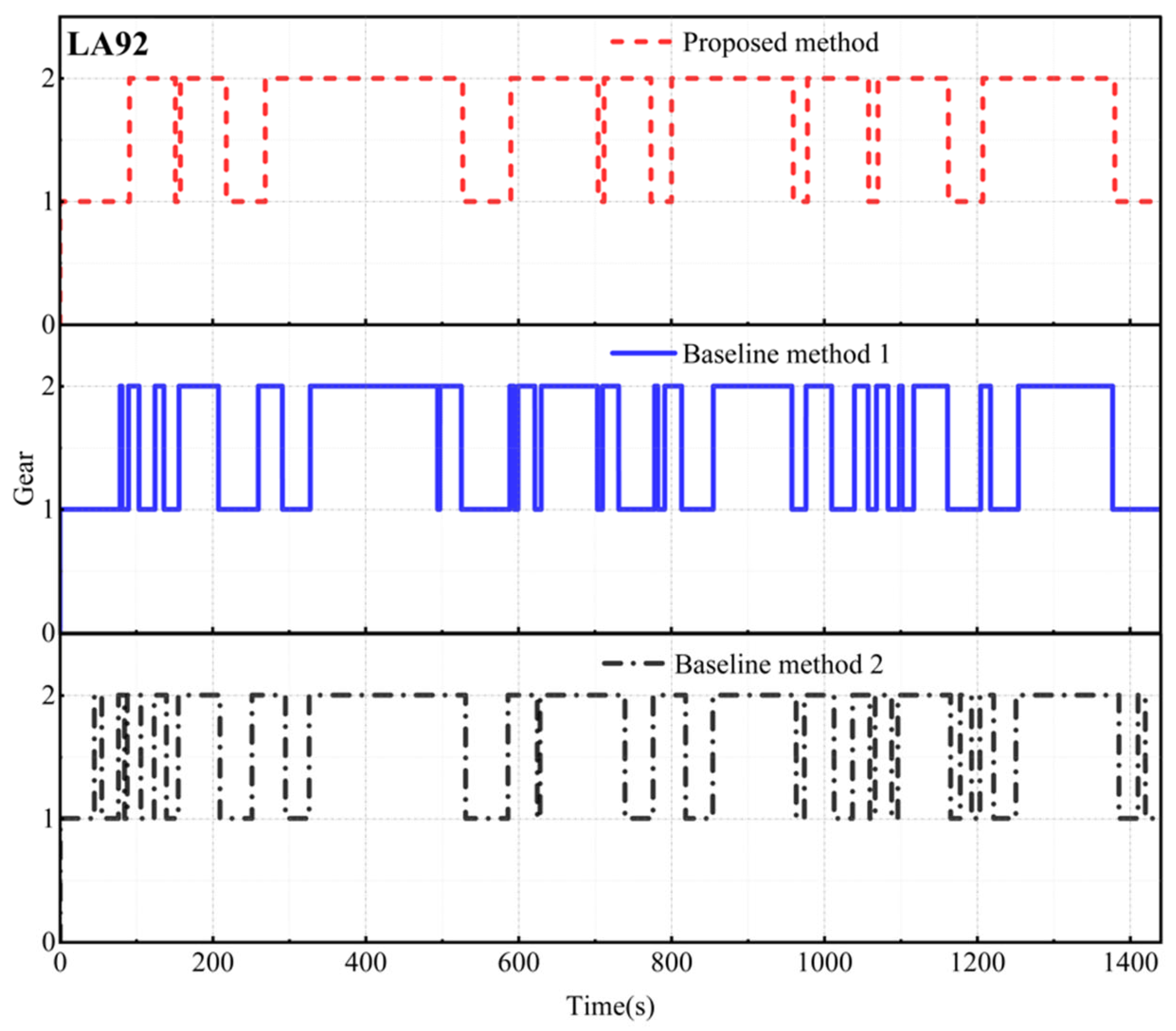
| LA92 | 18 | 42 | 38 |
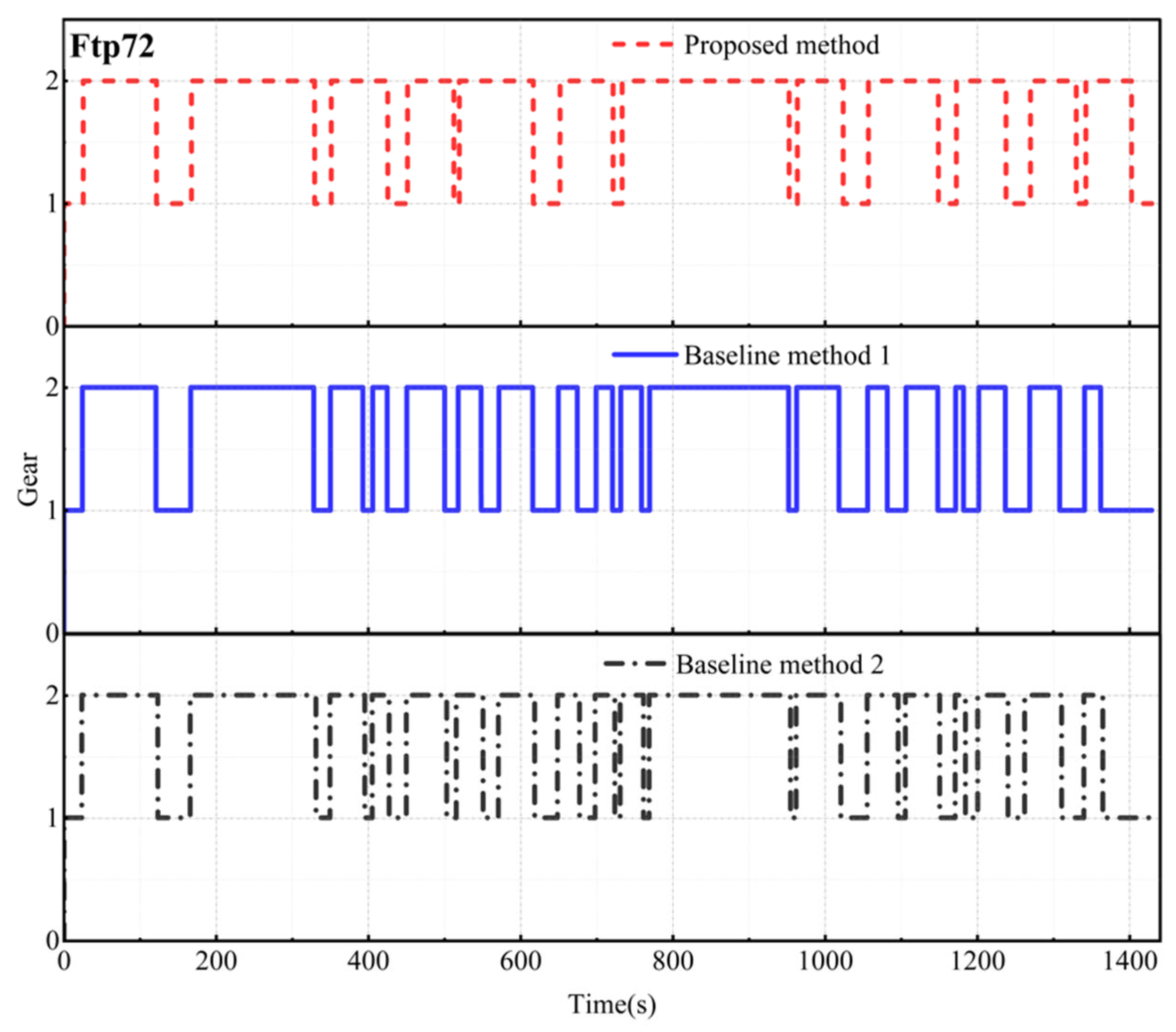
| Ftp72 | 23 | 36 | 36 |
| Japan_urban | 22 | 36 | 28 |
| Proposed Method | Baseline Method 1 | Baseline Method 2 | Units | |
|---|---|---|---|---|
| LA92 | 17.55 | 14.46 | 17.23 | kN·m·h |
| Ftp72 | 21.97 | 20.51 | 22.52 | kN·m·h |
| Japan_urban | 16.10 | 15.67 | 18.12 | kN·m·h |
| Proposed Method | Baseline Method 1 | Baseline Method 2 | Units | |
|---|---|---|---|---|
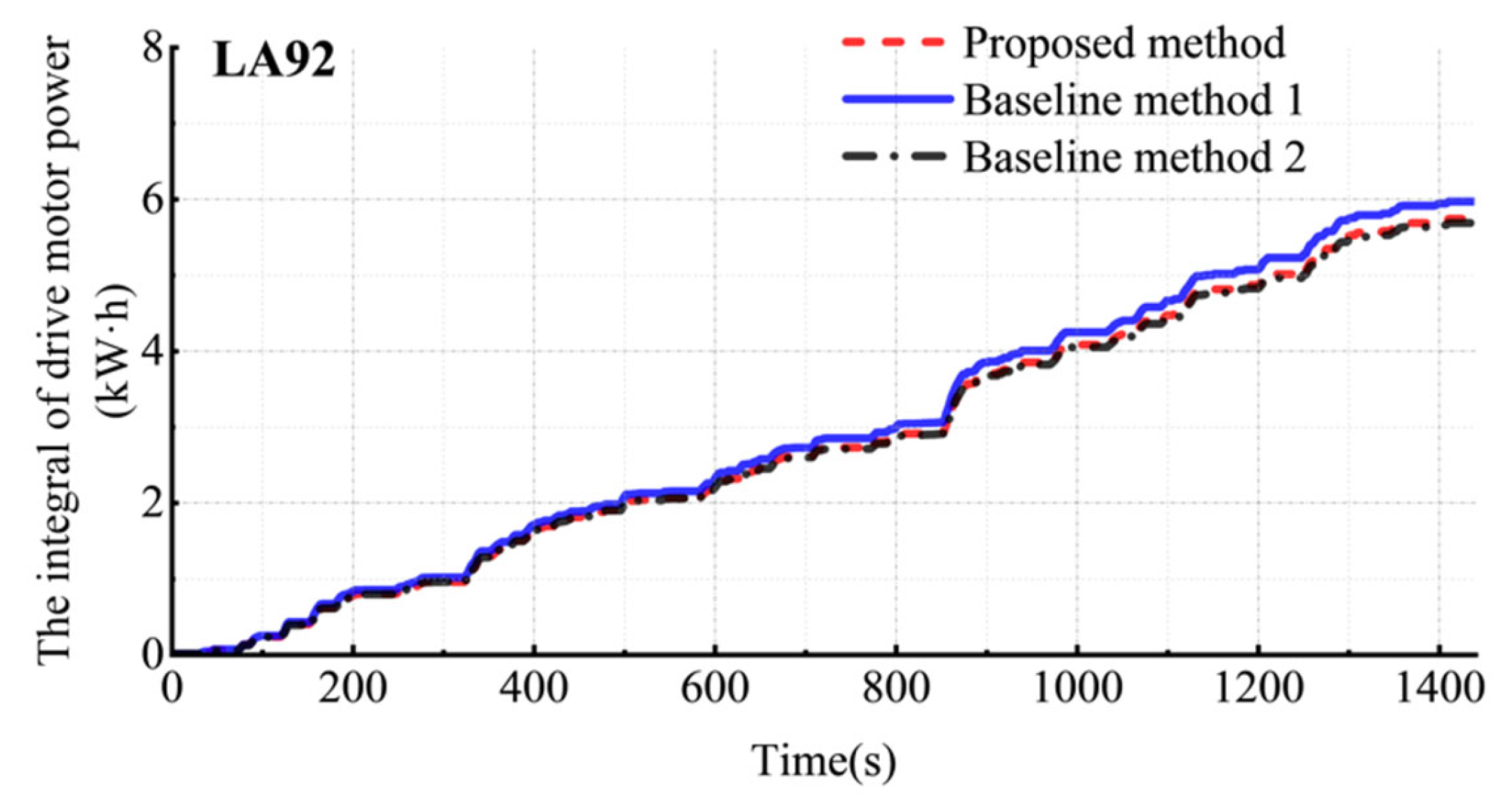
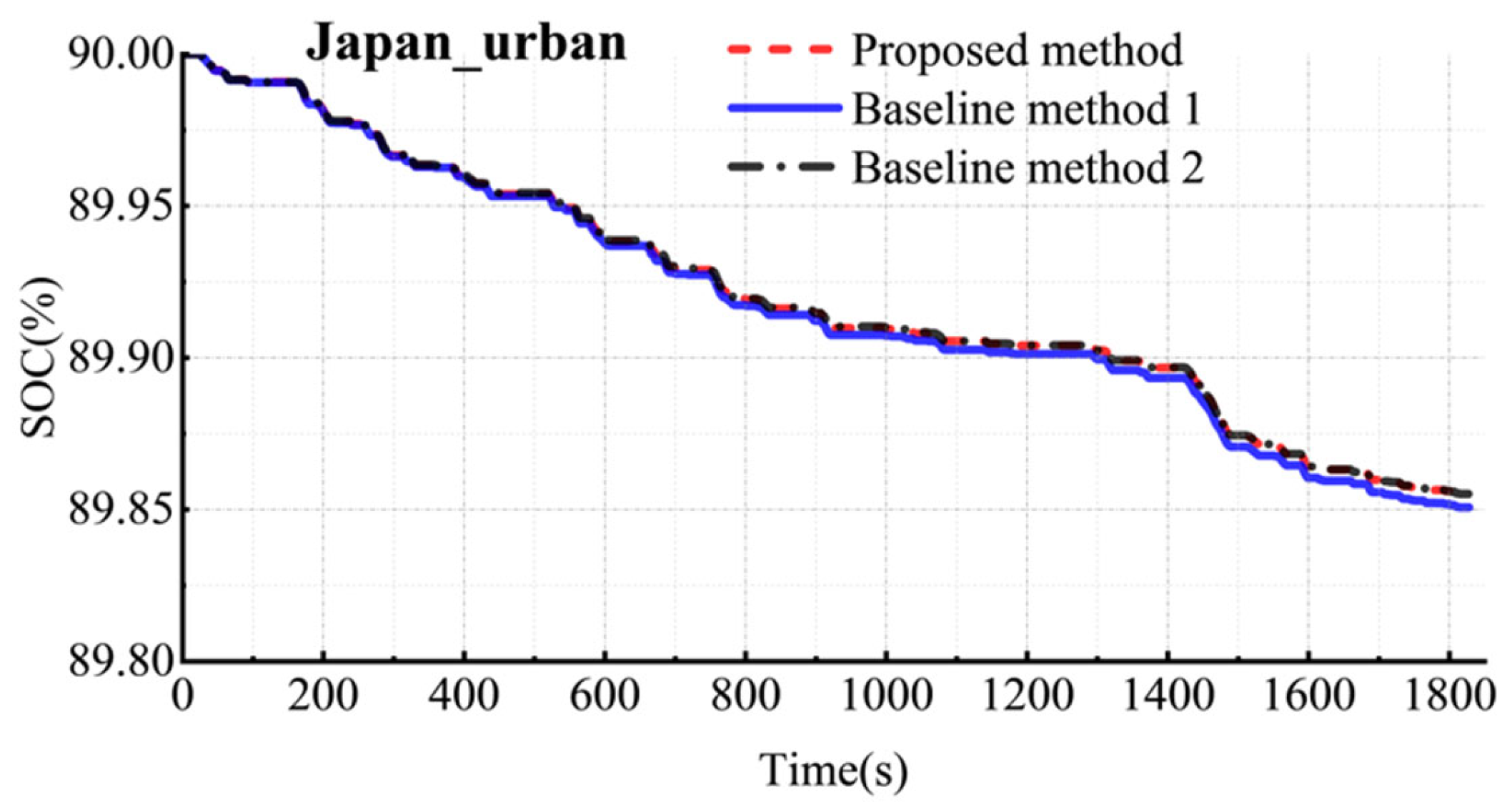
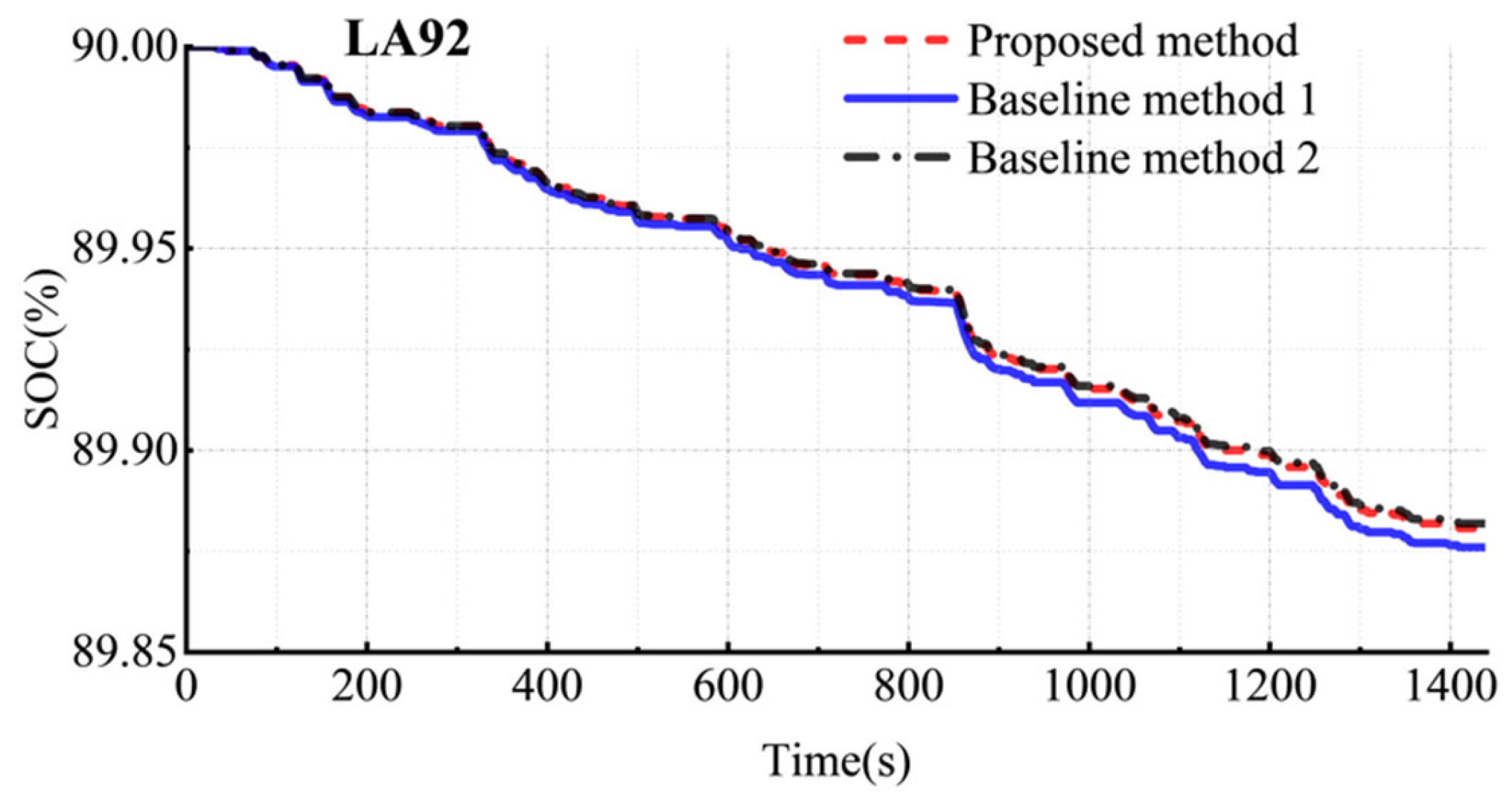
| LA92 | 5.73 | 5.97 | 5.68 | kW·h |
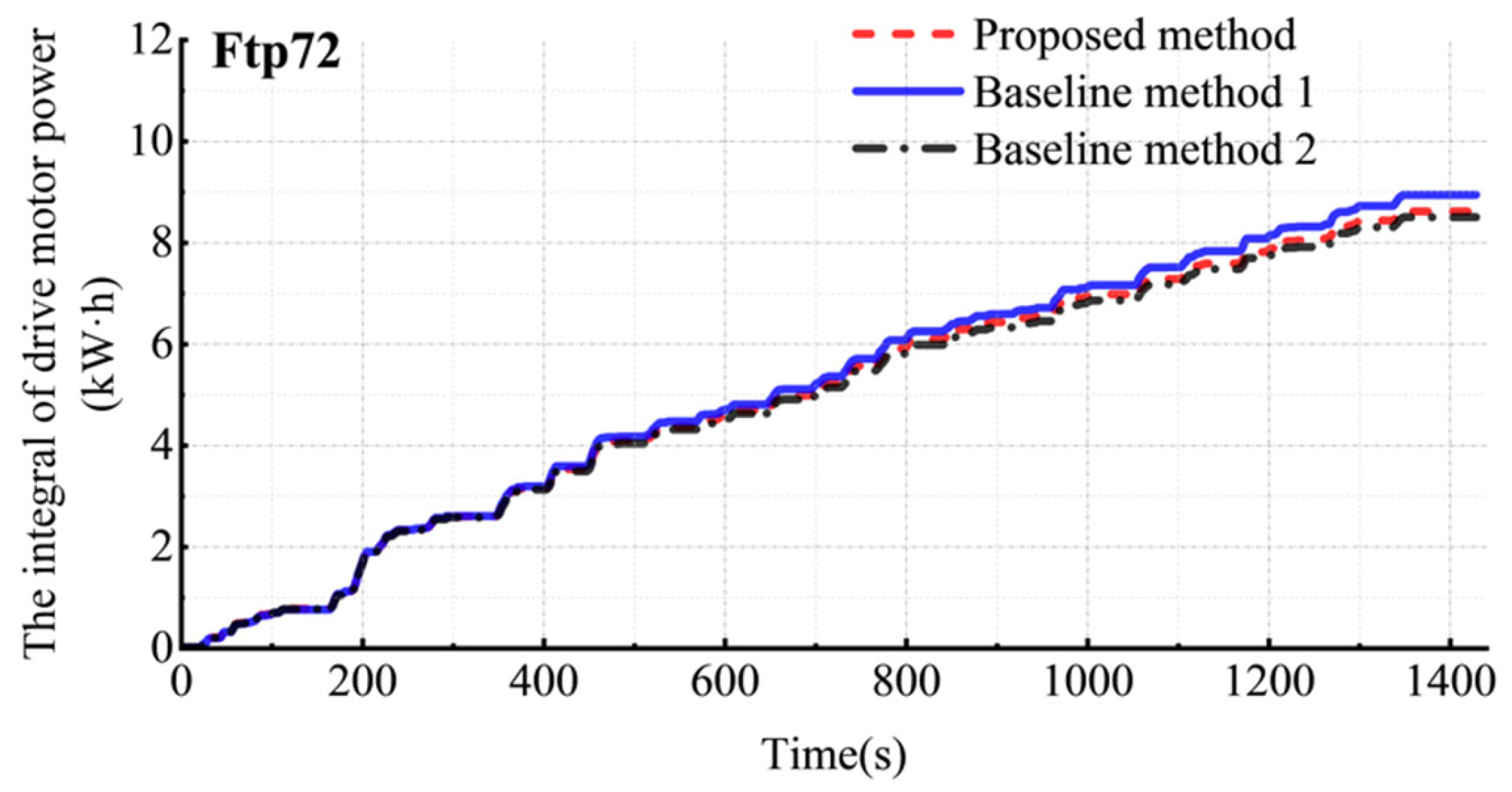
| Ftp72 | 8.61 | 8.94 | 8.50 | kW·h |
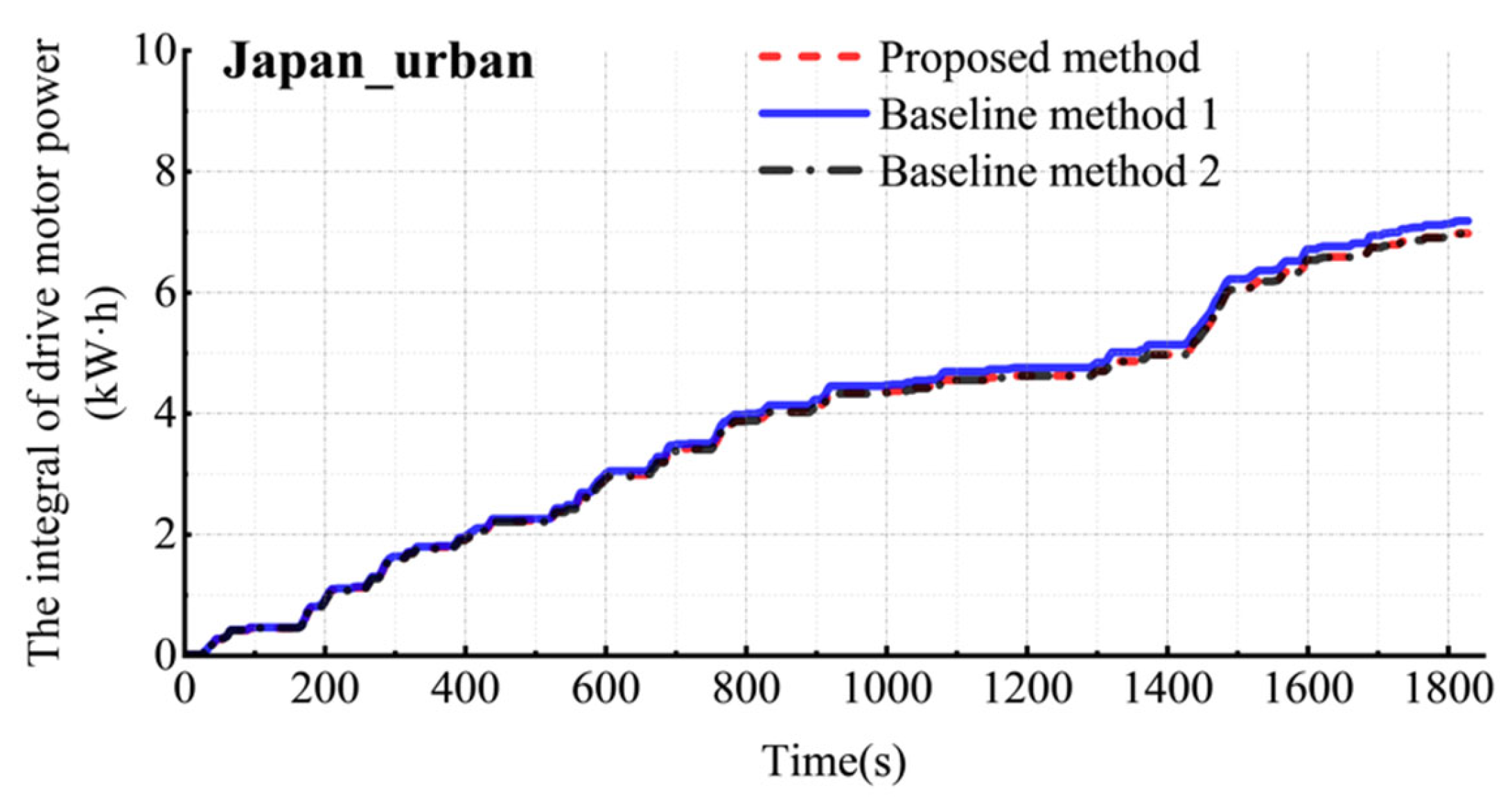
| Japan_urban | 6.97 | 7.18 | 6.96 | kW·h |
| Proposed Method | Baseline Method 1 | Baseline Method 2 | Units | |
|---|---|---|---|---|
| LA92 | 0.1195 | 0.1244 | 0.1184 | % |
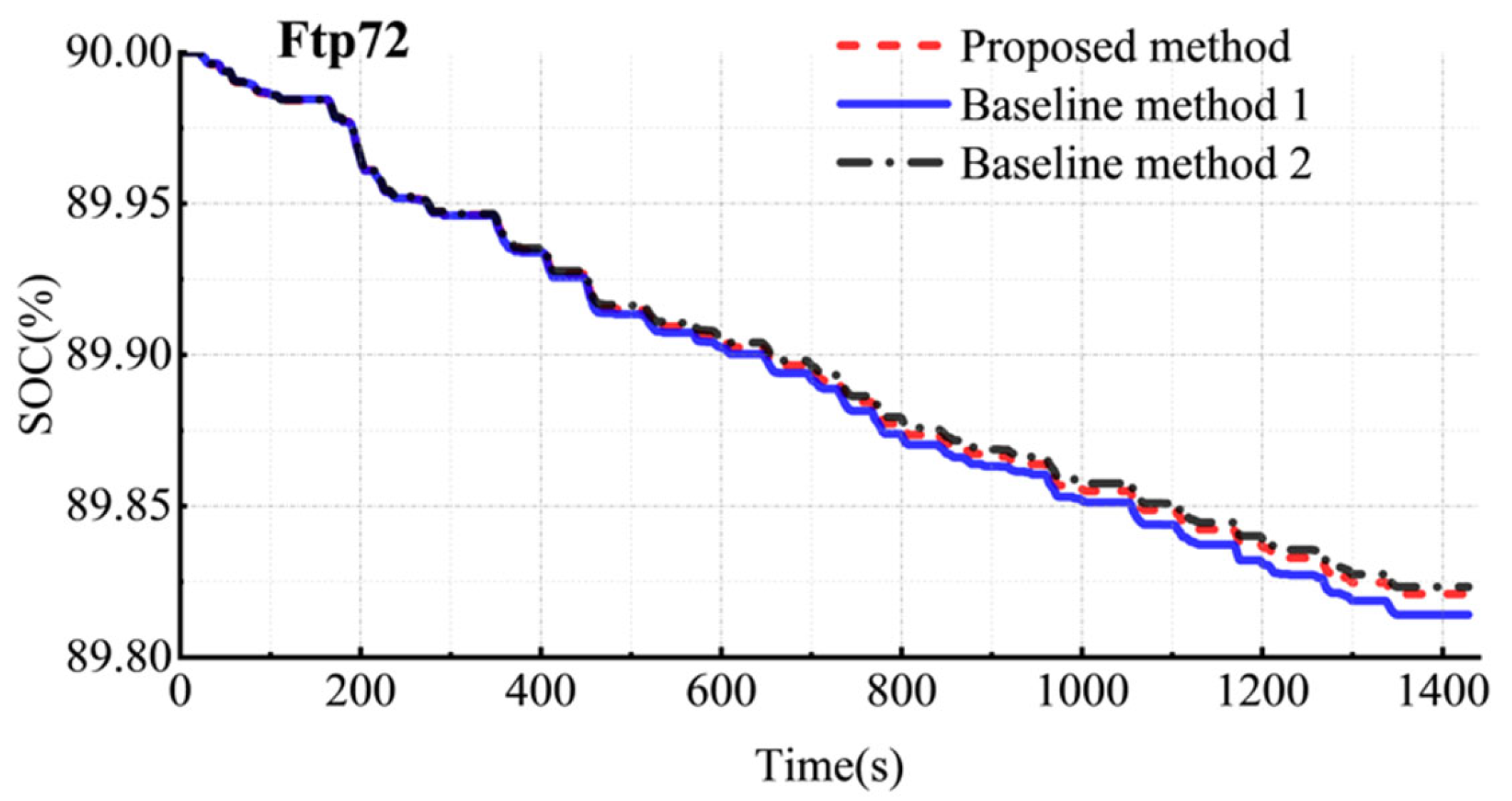
| Ftp72 | 0.1794 | 0.1863 | 0.1770 | % |
| Japan_urban | 0.1452 | 0.1496 | 0.1451 | % |
| Proposed Method | Baseline Method 1 | Baseline Method 2 | Units | |
|---|---|---|---|---|
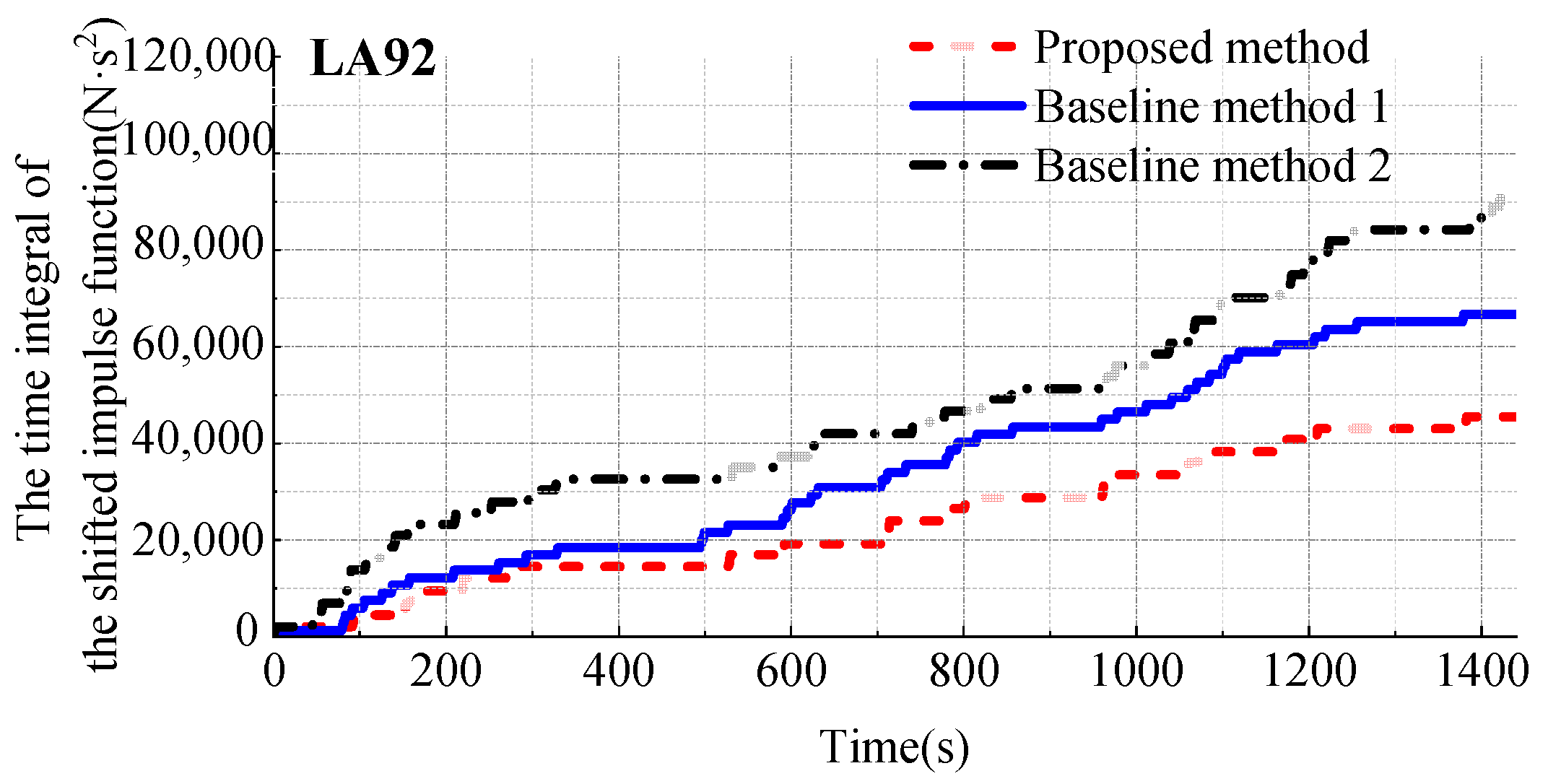
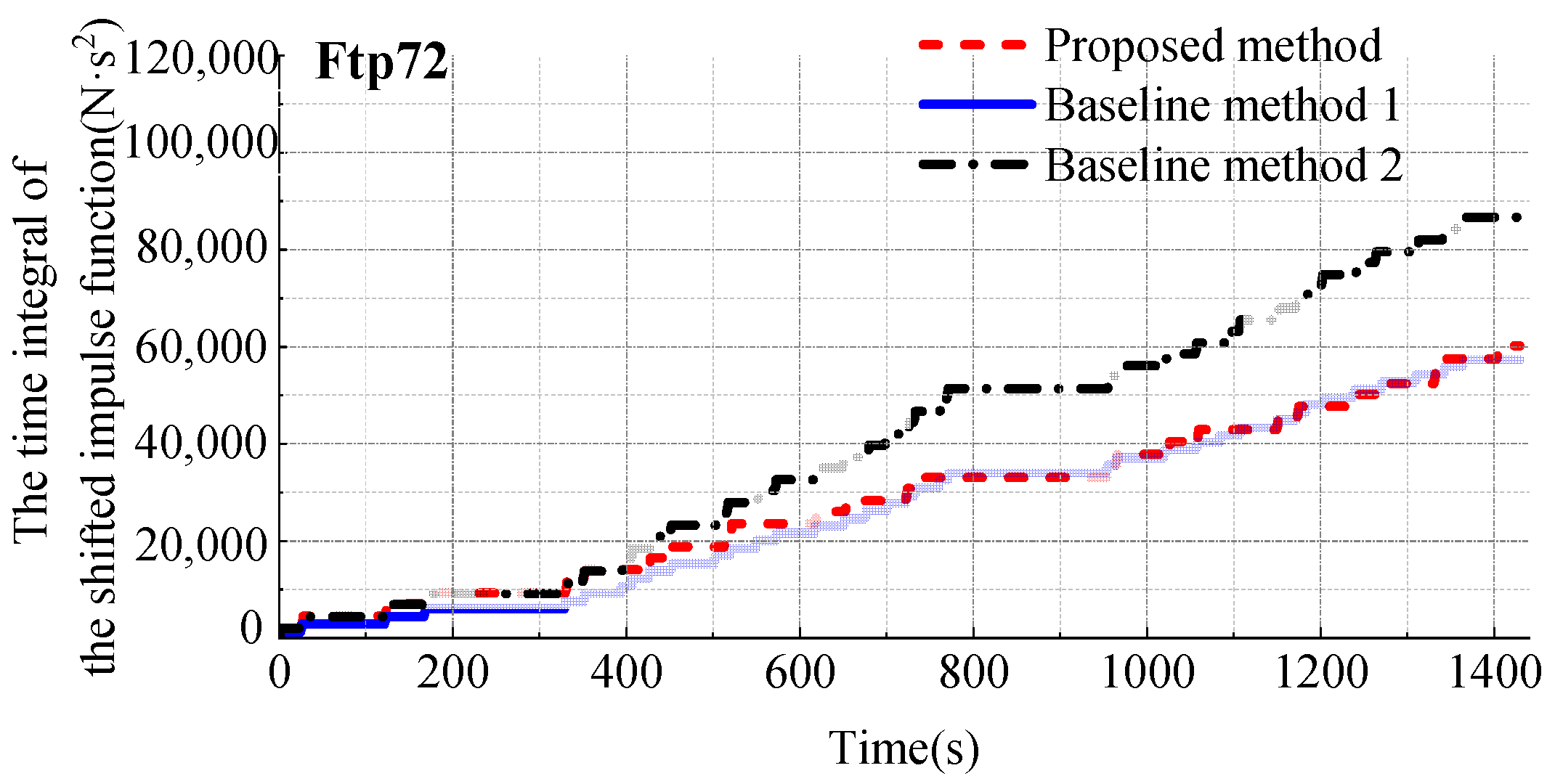
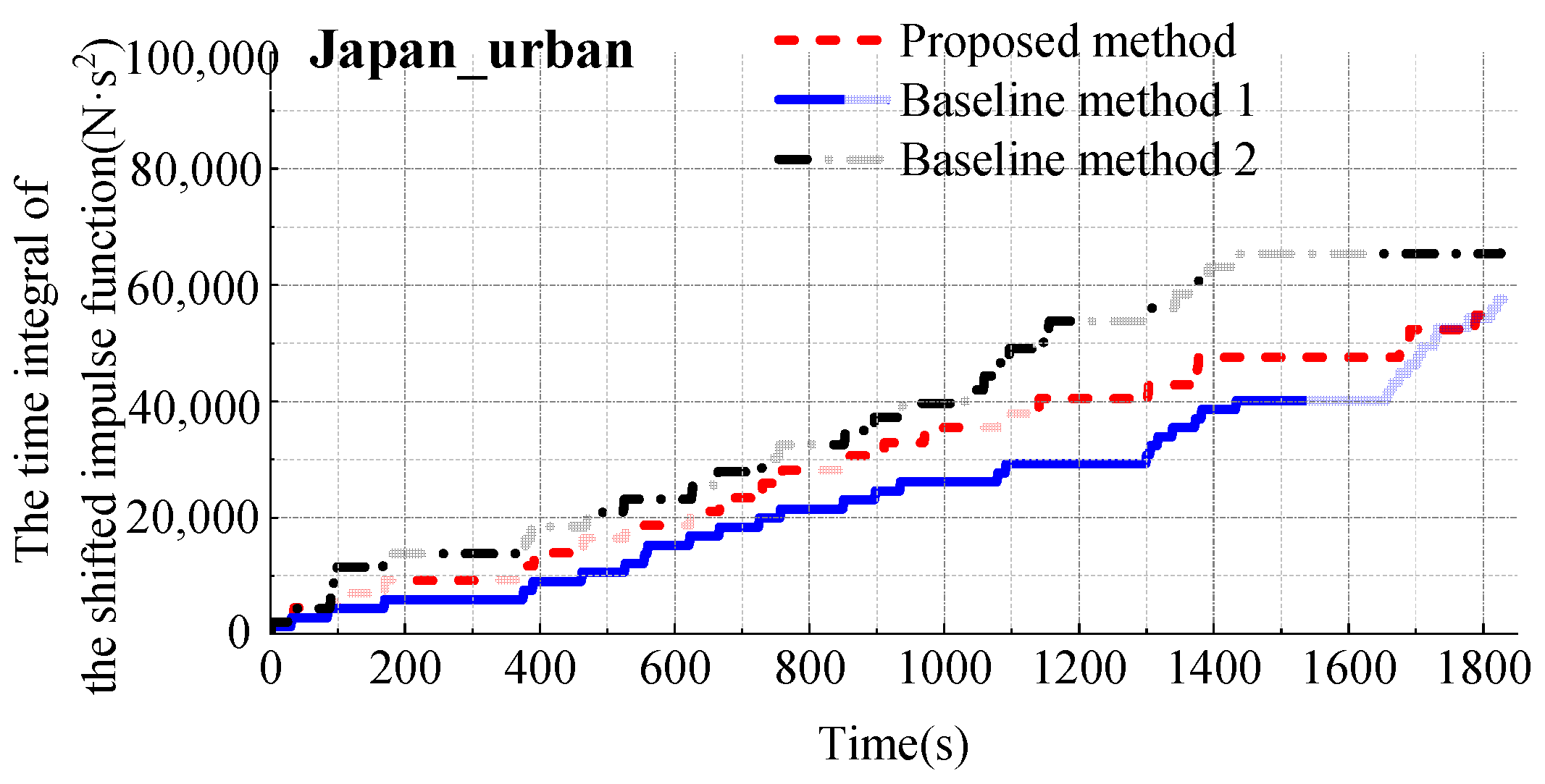
| LA92 | 45,475 | 66,687 | 91,351 | N·s2 |
| Ftp72 | 57,499 | 57,346 | 86,667 | N·s2 |
| Japan_urban | 54,858 | 57,517 | 67,865 | N·s2 |
Disclaimer/Publisher’s Note: The statements, opinions and data contained in all publications are solely those of the individual author(s) and contributor(s) and not of MDPI and/or the editor(s). MDPI and/or the editor(s) disclaim responsibility for any injury to people or property resulting from any ideas, methods, instructions or products referred to in the content. |
© 2026 by the authors. Licensee MDPI, Basel, Switzerland. This article is an open access article distributed under the terms and conditions of the Creative Commons Attribution (CC BY) license.
Share and Cite
Jiang, W.; Wang, X.; Zhang, S.; Huang, X.; Liu, J.; Cao, S.; Zhou, H.; Song, Y. Two-Speed AMT Shift Control Strategy Based on Vehicle Speed Prediction and Driving Style Recognition for Heavy-Duty Electric Vehicles. Vehicles 2026, 8, 157. https://doi.org/10.3390/vehicles8070157
Jiang W, Wang X, Zhang S, Huang X, Liu J, Cao S, Zhou H, Song Y. Two-Speed AMT Shift Control Strategy Based on Vehicle Speed Prediction and Driving Style Recognition for Heavy-Duty Electric Vehicles. Vehicles. 2026; 8(7):157. https://doi.org/10.3390/vehicles8070157
Chicago/Turabian StyleJiang, Wei, Xuan Wang, Shenggen Zhang, Xiansheng Huang, Jingang Liu, Shuai Cao, Hao Zhou, and Yunhan Song. 2026. "Two-Speed AMT Shift Control Strategy Based on Vehicle Speed Prediction and Driving Style Recognition for Heavy-Duty Electric Vehicles" Vehicles 8, no. 7: 157. https://doi.org/10.3390/vehicles8070157
APA StyleJiang, W., Wang, X., Zhang, S., Huang, X., Liu, J., Cao, S., Zhou, H., & Song, Y. (2026). Two-Speed AMT Shift Control Strategy Based on Vehicle Speed Prediction and Driving Style Recognition for Heavy-Duty Electric Vehicles. Vehicles, 8(7), 157. https://doi.org/10.3390/vehicles8070157