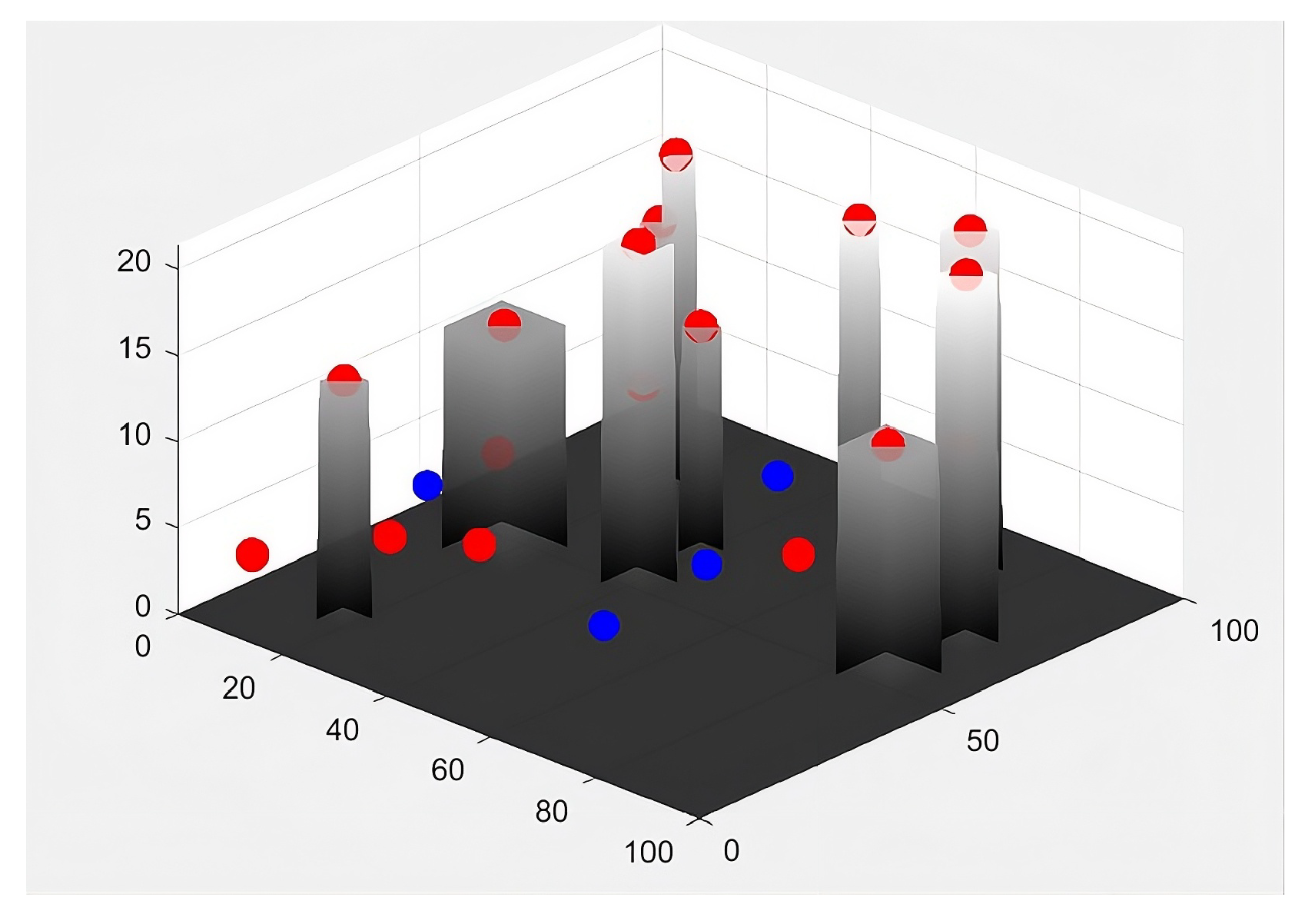
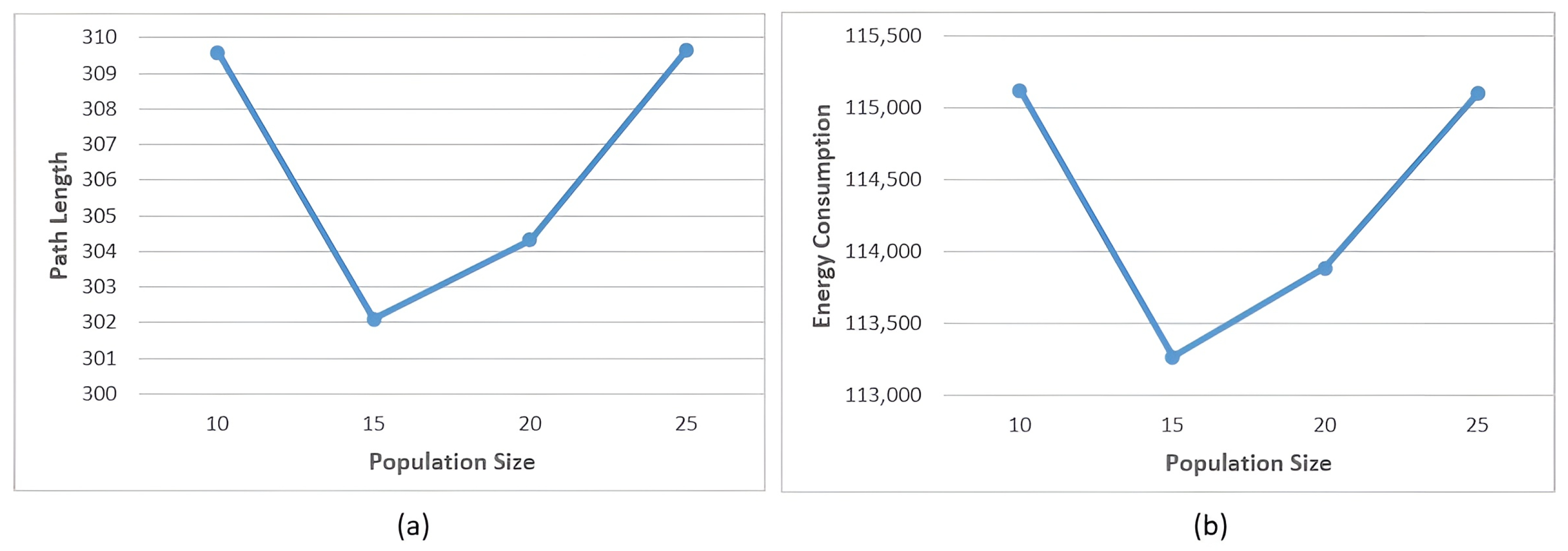
The performance of the HCTS algorithm is evaluated through two distinct sets of experiments. The first set focuses on a parameter sensitivity analysis, in which the algorithm’s behavior is examined under different configurations of tabu list size (TLS), the Lévy distribution parameter (), and the probability of abundance (). Additionally, the influence of population size on solution quality is investigated.
The second set of experiments involves a comparative analysis with the standard Cuckoo Search (CS) and the Genetic Algorithm (GA). This comparative analysis is conducted under two scenarios: in the first scenario, both the number of checkpoints and obstacles increase simultaneously, whereas in the second scenario, the number of checkpoints remains fixed while the number of obstacles increases.
5.3.3. Comparative Analysis of Scenario I: Increasing Obstacles and Checkpoints
This section provides a comprehensive evaluation of the HCTS algorithm’s performance, across varying levels of environmental complexity compared to the CS and GA baselines.
Table 3 presents a summary of the results for HCTS, CS, and GA. A comparison of the three algorithms across four levels of complexity, where both the number of obstacles and checkpoints increase progressively. Specifically, the levels are defined as follows: Level 1 with 5 checkpoints and 5 obstacles, Level 2 with 10 checkpoints and 10 obstacles, Level 3 with 15 checkpoints and 15 obstacles, and Level 4 with 20 checkpoints and 20 obstacles. The comparison considers two optimization objectives: path length and energy consumption.
As seen from
Table 3, HCTS performed better than CS and GA in terms of path length across all levels. For the first levels (5 checkpoints and 5 obstacles), HCTS and CS almost produced the same average path length (279.46 units and 279.49 units, respectively). However, in the other three test levels, HCTS showed better performance than CS. Furthermore, GA demonstrated the worst performance among the three algorithms for all test levels in terms of path length. Regarding the energy consumption objective, once again, the HCTS algorithm demonstrated the best performance among the three algorithms for all test levels.
However, the HCTS algorithm showed higher execution times for all test levels, while CS showed the lowest execution times. The higher execution time observed in HCTS can be attributed to the additional computational overhead introduced by the Tabu Search mechanism. Specifically, the processes of maintaining the tabu list and managing memory structures to avoid local optima require more processing cycles per iteration compared to the standard CS and GA.
In addition to the numerical values, the performance of the three algorithms was also evaluated using the three performance metrics, as mentioned in
Section 5.2.
Table 4 provides the statistical validation results used to determine whether the performance differences between HCTS and the baseline algorithms were statistically significant. As shown in the table, almost all
p-values are lower than the significance level of 0.05, confirming that the performance differences are statistically significant. Overall, the
p-values reported in
Table 4 indicate that HCTS produced statistically significant improvements over CS and GA for both optimization objectives. The only exception is at level 1, with 5 checkpoints and 5 obstacles, where the results of HCTS were of comparable quality to those of CS. Specifically, the
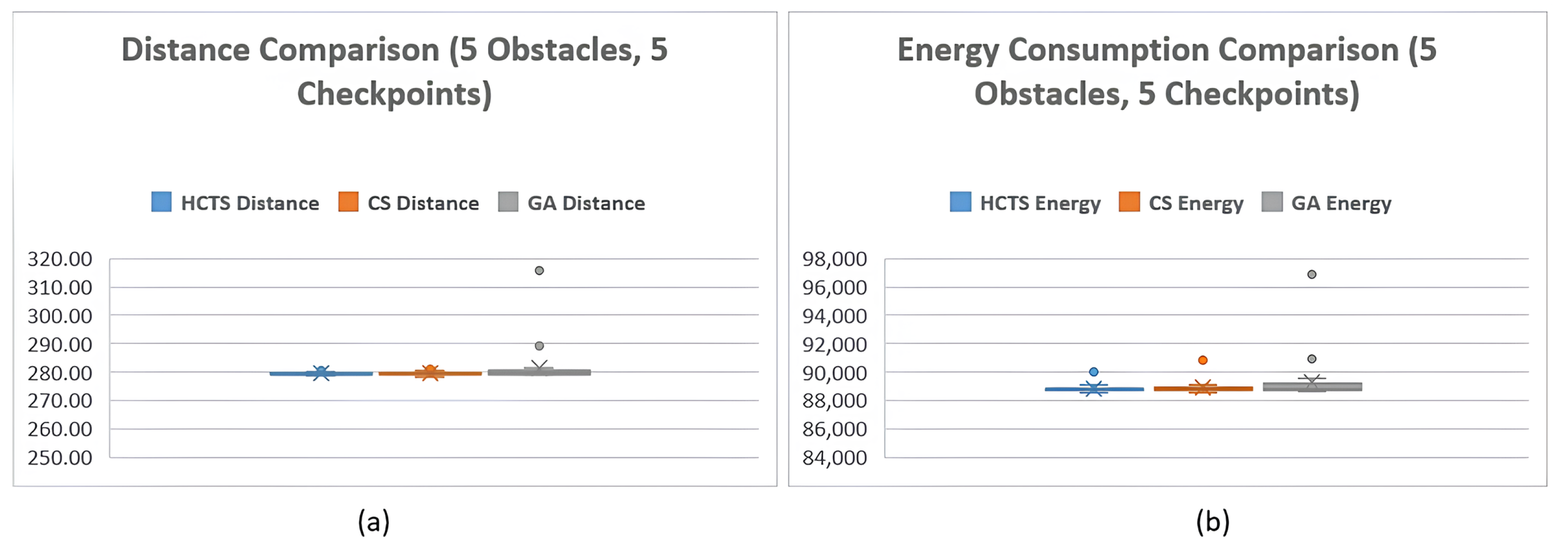
p-values for path length and energy were 0.4513 and 0.2078, respectively, both exceeding the threshold of 0.05. This indicates comparable performance in low-complexity environments, as visually confirmed by the overlapping distributions in
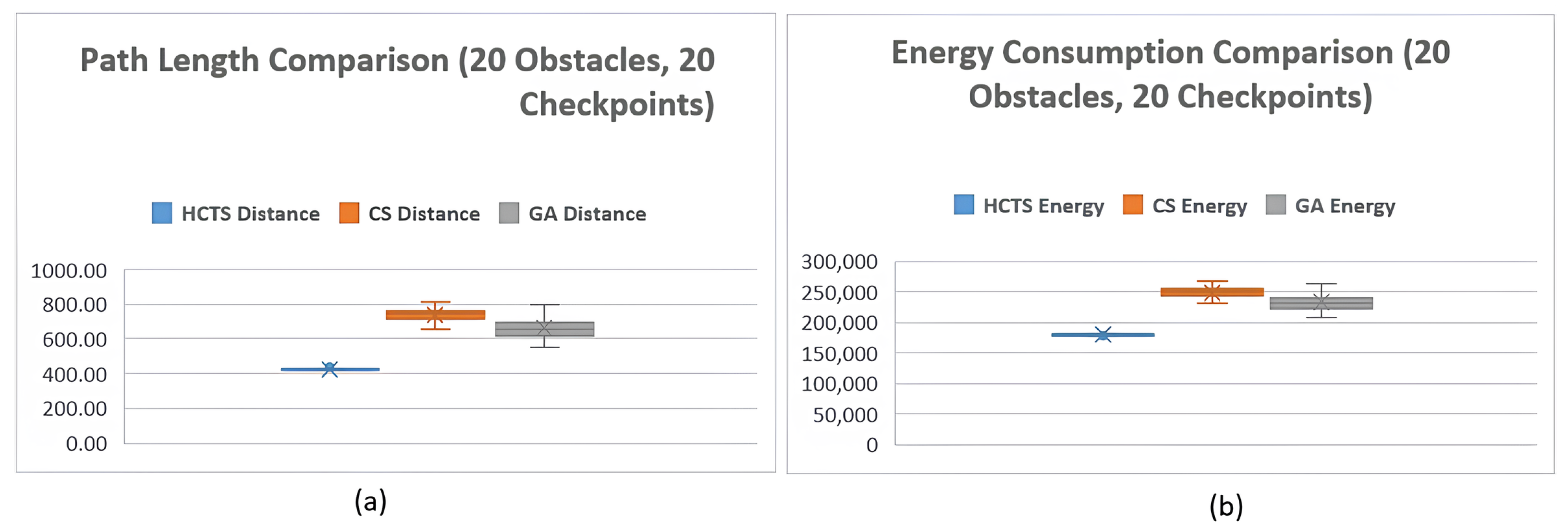
Figure 3. However, as the search space expanded, the statistical superiority of HCTS became evident. This difference in performance, along with the clear advantage of HCTS in highly complex environments, is further demonstrated by the statistical distributions shown in
Figure 4, which represents the level with 20 obstacles and 20 checkpoints.
With regard to the effectiveness measure, the results in
Table 5 clearly indicate the superior performance of the HCTS algorithm, both in terms of the path length and energy consumption. Recall from
Section 5.2 that a small value for the effectiveness measure is highly desirable. As such, the effectiveness values obtained by HCTS are below 0.6, whereas for CS and GA, these values are quite high.
For the success rate metric, the results in
Table 6 also clearly indicate the best performance of HCTS among all the three algorithms. For all four levels, HCTS almost reached the best solution. That is, for the 30 independent runs executed, the HCTS algorithm achieved success between 29 and 30 runs for the path length and energy consumption objectives. In contrast, CS and GA showed an inferior performance for almost all test levels. The only exception is the level of 5 checkpoints and 5 obstacles where both HCTS and CS had the same success rate. Furthermore, among the three algorithms, GA had the worst performance.
5.3.4. Comparative Analysis of Scenario II: Increasing Obstacles with Fixed Checkpoint Counts
In this section, the performance of the algorithms is evaluated under an environment where one factor remains fixed and another varies. Specifically, the number of checkpoints is kept constant, while the number of obstacles is gradually increased from low to high levels (5, 10, 15, and 20). This design isolates the effect of environmental complexity, ensuring that any changes in path length, energy consumption, or runtime can be attributed primarily to obstacle density rather than to changes in mission size. The 20-checkpoint setting is selected to represent a relatively complex mission, allowing the scalability of the algorithms to be examined under demanding routing conditions across different obstacle levels. In addition, the 10-checkpoint setting is considered as a balanced case that is neither overly simple nor highly complex. This intermediate level enables a clearer analysis of algorithm behavior under moderate mission difficulty, providing a more practical view of performance. Together, these two settings offer a more comprehensive understanding of how the algorithms behave under both balanced and complex tasks as obstacle density progressively increases.
Based on
Table 7, as the number of obstacles increases from 5 to 15, a general upward trend is observed across all three algorithms in terms of path length, energy consumption, and runtime, which is expected given that higher obstacle density forces longer detours and more complex replanning. However, HCTS presents a notable exception, as its path length slightly decreases at 10 obstacles (409.83) compared to 5 obstacles (412.92), before rising again at 15 obstacles (421.02). This non-monotonic behavior may suggest that HCTS benefits from a moderate level of environmental complexity, where the additional obstacles introduce structural constraints that inadvertently guide the algorithm toward more efficient routing decisions. CS and GA, by contrast, follow a more consistent increasing trend across all obstacle levels, indicating a more predictable but less adaptive response to environmental changes.
In terms of path length, HCTS consistently achieves the shortest values across all obstacle configurations. At 5 obstacles, HCTS records 412.92 compared to 720.79 for CS and 661.42 for GA, representing a substantial advantage. This gap is maintained at 10 and 15 obstacles, where HCTS records 409.83 and 421.02 respectively, while CS and GA remain considerably higher. A similar pattern is observed in energy consumption, where HCTS consistently records the lowest values across all three obstacle levels, with readings of 176,474.93, 175,883.53, and 178,195.96 at 5, 10, and 15 obstacles respectively. CS produces the highest energy consumption throughout, peaking at 246,664.01 at 15 obstacles, while GA falls in between. The relatively stable energy figures for HCTS further reinforce its efficiency under increasing environmental pressure. Regarding runtime, CS achieves the fastest execution across all configurations, while HCTS incurs the highest computational cost, as discussed in the
Section 5.3.3. Despite this, the superior path quality and energy efficiency demonstrated by HCTS reflect a meaningful performance trade-off that favors solution quality over computational efficiency.
The statistical significance of the observed performance differences is confirmed through pairwise comparisons between HCTS and each of the competing algorithms. As presented in
Table 8, for HCTS vs. CS, all
p-values for both path length and energy consumption are uniformly recorded at 1.69 × 10
−17 across all obstacle configurations (5, 10, and 15 obstacles). For HCTS vs. GA,
p-values for path length range from 3.38 × 10
−17 to 3.21 × 10
−16, and for energy consumption range from 1.69 × 10
−17 to 3.38 × 10
−17. All values fall substantially below the significance threshold of 0.05, providing strong statistical evidence that the performance advantages demonstrated by HCTS over CS and GA are not attributable to random variation but rather reflect genuine and consistent algorithmic superiority.
The relatively high standard deviation values observed in
Table 7, along with the elevated effectiveness rates reported in
Table 9, can be attributed to the stochastic nature inherent in all three algorithms under evaluation. As metaheuristic algorithms, HCTS, CS, and GA rely on probabilistic search mechanisms that introduce an element of randomness into the solution generation process across independent runs. This variability becomes particularly pronounced in the 20-checkpoint configuration, where the expanded mission size significantly enlarges the solution search space.
The effectiveness rates reported in
Table 9 reflect this variability across all obstacle levels. At 5 obstacles, HCTS records effectiveness rates of 16.35 for length and 8.08 for energy, while CS records 7.8 and 4.9, and GA records 33.6 and 18.9 respectively. At 10 obstacles, HCTS records 15.15 and 7.48, CS records 11.4 and 7.3, and GA records 17.5 and 10.4. At 15 obstacles, HCTS records 18.5 and 8.9, CS records 29.2 and 17.4, and GA records 22.8 and 13.27. Notably, GA exhibits the highest effectiveness rates at lower obstacle levels, while CS shows a considerable increase as obstacle density rises to 15, suggesting that different algorithms are affected by search space expansion in distinct ways.
As the number of required checkpoints increases, the combinatorial complexity of the routing problem grows substantially, making it increasingly difficult for stochastic algorithms to converge consistently to the same solution across repeated trials. Consequently, different runs may explore distinct regions of the search space, yielding solutions of varying quality and thus producing wider performance distributions.
Furthermore, when obstacle density is relatively low, the search space becomes less constrained, offering a greater number of feasible paths of comparable cost. This abundance of near-optimal alternatives amplifies inter-run variability, as the algorithms may converge to different locally optimal solutions without a definitive structural preference. Collectively, these factors (mission size, search space expansion, and reduced environmental constraints), provide a coherent explanation for the elevated standard deviation and effectiveness rates observed across this scenario, and are consistent with the well-documented behavioral characteristics of metaheuristic optimization under large-scale, loosely constrained problem instances.
Further insight into algorithmic consistency is provided by the success rate analysis presented in
Table 10. As outlined in
Section 5.2, the success rate criterion and its conditions have been previously defined. The results reveal uniformly low success rates across all algorithms and obstacle configurations, which is consistent with the high standard deviation values previously discussed. At 5 obstacles, HCTS achieves a success rate of 3% for both length and energy, while CS records 6% for both metrics, and GA records 3% for both. At 10 obstacles, HCTS improves to 6% for length and 10% for energy, CS maintains 6% across both metrics, and GA records 6% for length and 3% for energy. At 15 obstacles, HCTS records 6% for length and 10% for energy, CS remains at 6% for both, and GA records 6% for length and 10% for energy. The consistently low success rates observed across all configurations reflect the inherent difficulty of repeatedly converging to near-optimal solutions, particularly given the large and loosely constrained search space associated with the 20-checkpoint mission. These results further corroborate the stochastic variability discussed in the context of standard deviation and effectiveness rates, and collectively underscore the challenge that metaheuristic algorithms face in achieving stable convergence under complex, large-scale routing conditions.
This case examines algorithm performance under a balanced mission setting, where the number of checkpoints is fixed at 10 and the number of obstacles is incrementally increased from 5 to 20, providing a moderately complex evaluation environment that complements the high-demand conditions analyzed in the preceding case.
Table 11 presents the performance results for the balanced scenario comprising 10 fixed checkpoints with obstacle counts increasing from 5 to 20. Across all obstacle configurations, HCTS consistently achieves the shortest path length and lowest energy consumption. At 5 obstacles, HCTS records a path length of 308.07 and energy consumption of 114,737.9, compared to 362.8 and 126,903.9 for CS, and 354.06 and 124,933.14 for GA. At 15 obstacles, HCTS records 308.67 and 114,858.3, while CS records 370.6 and 128,547.78, and GA records 363.73 and 127,080.92. At 20 obstacles, HCTS records 306.19 and 114,299.5, CS records 361.63 and 126,580.16, and GA records 355.53 and 125,256.58.
A particularly noteworthy observation in this balanced scenario is that HCTS exhibits a non-monotonic trend in path length, where the value slightly decreases from 308.07 at 5 obstacles to 306.19 at 20 obstacles, with a marginal intermediate increase at 15 obstacles. This adaptive behavior suggests that HCTS is capable of exploiting the structural constraints introduced by higher obstacle density to identify more efficient routing solutions, even under moderate mission complexity. CS and GA, by contrast, display relatively stable but consistently higher path lengths across all obstacle levels, confirming their comparatively limited adaptability regardless of mission scale.
Regarding runtime, CS again achieves the fastest execution while HCTS incurs the highest computational cost across all obstacle levels, consistent with the trade-off observed in the preceding case and attributable to the additional overhead of the Tabu Search mechanism.
The statistical validation results for the 10-checkpoint case, presented in
Table 12, confirm that the performance advantages of HCTS over both CS and GA are statistically significant across all obstacle configurations. For HCTS vs. CS,
p-values for path length range from 1.64 × 10
−15 to 7.62 × 10
−14, and for energy consumption from 1.64 × 10
−15 to 1.98 × 10
−13. For HCTS vs. GA,
p-values for path length range from 7.96 × 10
−11 to 4.13 × 10
−10, and for energy consumption from 9.30 × 10
−11 to 4.13 × 10
−10. All
p-values fall substantially below the 0.05 significance threshold across all obstacle levels. These results are consistent with those observed in the 20-checkpoint scenario, further reinforcing that the superiority of HCTS is statistically robust and not a product of random variation, regardless of mission complexity or obstacle density.
The effectiveness rates presented in
Table 13 reveal a notably different pattern compared to those observed in the 20-checkpoint case in
Table 9. Under the 10-checkpoint configuration, HCTS records considerably lower effectiveness rates across all obstacle levels, with values of 2.04 and 1.39 at 5 obstacles, 2.39 and 1.47 at 15 obstacles, and 1.55 and 1.03 at 20 obstacles for length and energy respectively.
These values are substantially lower than those recorded in the 20-checkpoint case, where HCTS recorded rates as high as 16.35 and 18.5 for length. A similar reduction is observed for CS and GA, where effectiveness rates in the 10-checkpoint scenario are generally lower than their counterparts in the more complex mission setting. This consistent reduction in effectiveness rates across all algorithms as mission size decreases from 20 to 10 checkpoints directly supports the earlier argument regarding search space size as a primary driver of algorithmic variability. When the mission scope is reduced, the search space contracts accordingly, enabling the algorithms to converge more consistently to near-optimal solutions across independent runs. These findings collectively validate the hypothesis that metaheuristic performance stability is strongly influenced by the dimensionality of the problem, and that a more constrained search space yields more reproducible and reliable outcomes.
The success rate results presented in
Table 14 further corroborate the improvement in algorithmic consistency observed in the 10-checkpoint case compared to the 20-checkpoint case in
Table 10. HCTS demonstrates a remarkable increase in success rates, recording 56% and 60% at 5 obstacles, 73% and 73% at 15 obstacles, and 80% and 80% at 20 obstacles for length and energy respectively. These values stand in stark contrast to the success rates recorded in the 20-checkpoint case, where HCTS achieved a maximum of only 6%, highlighting the substantial impact of reduced mission complexity on convergence stability. CS and GA, however, maintain comparatively low success rates across all obstacle levels, with CS recording 6%, 6%, and 3% for length and 6%, 10%, and 3% for energy, while GA records 6%, 3%, and 6% for length and 13%, 3%, and 6% for energy across the three obstacle levels.
This divergence suggests that although the reduction in search space benefits all algorithms to some extent, HCTS gains greater advantage from the more constrained problem setting. This is likely because the TS mechanism becomes more effective in consistently identifying near-optimal visiting sequences when the solution space is less expansive. These findings reinforce the conclusion that problem dimensionality plays a critical role not only in solution quality, but also in the reproducibility and convergence reliability of metaheuristic algorithms.
This behavior also explains why HCTS outperforms standard CS and GA. In standard CS, Lévy-flight-based updates provide broad exploration; however, when CS is used alone, the generated changes may be too wide and may not sufficiently refine promising visiting orders. GA, on the other hand, relies on crossover and mutation, which may disrupt useful partial visiting sequences and delay convergence toward efficient routes. In contrast, HCTS combines the diversification ability of CS with the local refinement capability of TS. This allows promising checkpoint orders to be improved through neighborhood-based moves, reducing unnecessary detours between consecutive checkpoints and leading to shorter paths and lower energy consumption.
From a practical perspective, the above results indicate that improving the checkpoint-visiting order can directly reduce the total travel distance and energy consumption of UAV missions. This is reflected in the lower distance and energy values achieved by the proposed HCTS compared with the benchmark algorithms. Such improvement is particularly important in inspection and delivery applications, where UAVs are often constrained by limited battery capacity and need to visit multiple locations within a single mission. Therefore, HCTS can support more efficient mission planning in urban environments by producing shorter and more energy-aware visiting sequences while satisfying obstacle-avoidance constraints.