Abstract
The location of the rider centre of mass (CoM) is especially relevant in bicycles and motorcycles due to the large human-to-vehicle mass ratio. This work illustrates two alternative methods for the experimental identification of the longitudinal and lateral coordinates of the rider CoM position as a function of the posture. The first method uses a set of load cells and provides accurate and reliable results. However, riders’ must firmly hold their configuration for the time necessary to stabilise the force measurements, which may be uncomfortable in configurations such as lean-out. The second method utilises an optical system which captures the rider attitude. This information is then used to feed a multibody model, which is used to estimate the CoM coordinates.
1. Introduction
In single-track vehicles, such as bicycles and motorcycles, the posture of the rider significantly affects the location of the whole rider–vehicle CoM, due to the large human-to-vehicle mass ratio. The rider’s inertial properties are therefore of primary importance in dynamic simulations, particularly in multibody environments used for handling and stability analyses of the coupled vehicle–rider system [1,2,3,4,5,6]. Historically, vehicle–rider systems have been modelled by assuming the rider to be rigidly attached to the chassis. More recent approaches represent the rider as being ‘suspended’ on the chassis, typically by means of spring–damper elements tuned to reproduce characteristic rider natural frequencies and damping ratios, with the hands interacting with the handlebar [7,8,9,10,11,12,13,14,15,16,17,18,19,20]. Irrespective of the adopted modelling approach (i.e., fixed or suspended rider), the estimation of the rider’s inertial properties is required in both cases. Moreover, in advanced motorcycle riding simulators [21,22,23,24,25,26,27], the influence of the rider’s motion on the saddle is explicitly incorporated into the vehicle dynamics. Even in this context, accurate estimation of the rider’s inertial properties remains essential.
Several contributions related to the estimation of rider CoM are available in the literature. They can be distinguished in two main categories. The first includes indirect approaches that estimate the CoM position building upon the position of the rider on the saddle. The basic idea is that if the body segment mass and CoM are known, usually from biomechanical databases that provide the body segment inertial properties (BSIPs), then the location of the CoM can be obtained from the posture of the rider by combining the inertial contributions of different segments. The second category includes direct approaches that estimate the CoM position from direct measurements of forces. The drawback of the indirect approach is that the uncertainty on the posture estimation sums up to the uncertainty related to the BSIP databases, since the subject under consideration is not necessarily close to the average human of the database. However, the approach can easily be used in real riding scenarios. In contrast, the direct approach reduces the uncertainty of the measuring system, but it is not easily implemented onboard, since the measured forces include inertial components generated during motion, which in turn depends on the CoM being estimated. One of the earliest examples of estimation of rider motion on the saddle is [28], where the rider lean angle is measured with a rotary potentiometer rigidly mounted to the motorcycle frame at the back of the seat and driven by an arm attached to the back of the rider’s jacket. The output is interpreted as lean angle, but it is acknowledged that it is contaminated by rider lateral shifting. In [29], a complex mechanical linkage attached to the rider’s back and motorcycle frame is introduced for measuring the lateral motion and lean angle of riders in running conditions. In [30], a multi cross belts system between the rider’s back and the motorcycle is devised. The system is capable of reconstructing the relative six degrees-of-freedom motion between the rider’s back and the vehicle using wire potentiometers. Similar to the previous examples, the main drawbacks are the system intrusiveness and safety in case of falls. A non-contact measuring system able to reconstruct the position and orientation of the rider’s trunk is presented in [31]. The system is composed of an on-board vehicle digital camera and a target placed on the driver’s back. White blobs on a black background of the planar target are employed and several pose algorithms are compared. More recently, in [32], a non-contact, marker-free method that builds upon OpenPose [33] and machine learning techniques is proposed. Similarly, ref. [34] investigated rider kinematics in motocross using inertial measurement units (IMUs), enabling real-time assessment of body motion and centre of mass variations during complex manoeuvres such as jumps and cornering. Differently from the previous works, the (indirect) estimation of the rider’s CoM is explicitly included. Once the geometry is reconstructed, the mass and inertia is estimated based on rider’s total mass and height [35]. Another contactless approach is presented in [36], which relies on a camera mounted on the top case positioned behind the rider. This method specifically targets the lateral and vertical position of the rider’s CoM. After comparison against marker-free approaches in the literature, a marker-based approach is preferred for its superior robustness. The reported accuracy is 3 degree in lean angle and 1 cm in lateral offset. The CoM is not explicitly estimated. A multi-camera approach is proposed in [37] to reconstruct the three-dimensional motion of riders on the saddle of a motorcycle. The estimation of the CoM from the identified posture is not discussed. In sum, there are several approaches in the literature to estimate the rider position on the saddle of a two-wheeled vehicle, both contactless and with contact, both with markers and marker-free. However, they do not consider the estimation of the rider’s CoM, which is the most relevant quantity when it comes to vehicle dynamics, or they perform the estimation based on databases with BSIPs. In contrast, in this work the focus is on the direct measurements of the rider’s CoM, with special attention on the lateral offset, which is the most challenging and least investigated parameter. Indeed, the lateral offset of the rider’s CoM is usually much smaller than its longitudinal and vertical positions. In addition, standard testing machines featuring a scale in the front and a scale on the rear axle are clearly not suitable for the purpose. Examples of direct measurement of rider’s CoM are available in the literature, although the lateral offset is usually neglected. A classic reference is [18], which provides the longitudinal and vertical positions of the rider’s CoM in typical riding conditions. In the study, the rider’s CoM was calculated from the weight distribution measured on a mock frame simulating the rider’s posture, using the moment balance equation. In [22], an indirect approach was adopted to estimate rider’s CoM displacement. Two markers placed on the rider’s upper and lower back were tracked using a stereo camera, allowing for the calculation of translational shift and lean angle as indicators of CoM movement during simulated riding. In [35], a three-dimensional parametric biomechanical model of the motorcycle rider, designed for integration into multibody simulation environments, was proposed. The model leverages anthropometric data to accurately represent rider geometry and inertial properties, including the centre of mass and moments of inertia, across different symmetric riding postures such as sport, touring, and scooter configurations. By parametrising body segments and their relative positions, the approach enables dynamic adjustment of rider posture and mass distribution, which is critical for analysing vehicle stability, handling, and ergonomic performance. The estimated longitudinal and vertical positions of the CoM obtained using different anthropometric BSIP datasets are also compared with direct CoM measurements. The results show that the measured CoM generally falls within the range defined by the variability across datasets, with maximum discrepancies between estimated and measured values of below 5 cm. Unlike previous studies, this work provides a systematic comparison between a direct approach based on load cells and an indirect approach using motion capture, highlighting differences in accuracy and applicability. A key contribution is the explicit direct calculation of the rider’s lateral CoM coordinate during left/right leaning rider postures, a parameter often neglected in the literature (see Table 1), together with the introduction of a new biomechanical rider model, derived directly from [35], with additional degrees of freedom to separately represent trunk and hip movements, improving the fidelity of posture reconstruction during these asymmetric manoeuvres.
Table 1.
Estimation of rider posture and CoM location from the literature.
The rest of the paper is organised as follows: Section 2 provides a detailed description of the study objectives and the experimental protocol adopted during the tests; Section 3 presents the results obtained through the direct approach for measuring the rider’s longitudinal and lateral centre of mass; Section 4 introduces the model and the procedure employed for the indirect approach using a motion capture system, along with the comparative analysis of the two methods; Section 5 is devoted to the discussion of the findings; and finally, Section 6 summarises the conclusions.
2. Objective and Test Protocol
In this study, the estimation of the rider’s CoM is conducted using two distinct methodologies. The first approach involves a direct measurement technique, using four load cells symmetrically positioned in pairs with respect to the vehicle longitudinal symmetry plane. This configuration enables the precise calculation of the rider’s CoM based on the distribution of forces recorded by the load cells. The second approach adopts an indirect method, relying on optical cameras and adhesive markers affixed to the rider’s body. Through this setup, the rider’s posture and geometry are reconstructed in a virtual environment. The reconstruction is performed using four different anthropometric BSIP databases, allowing for a static simulation of the rider’s CoM. Three different riders were selected as test subjects (see Table 2). All riders were equipped with a helmet and motorcycle suit to replicate realistic riding conditions.
Table 2.
Riders mass and height.
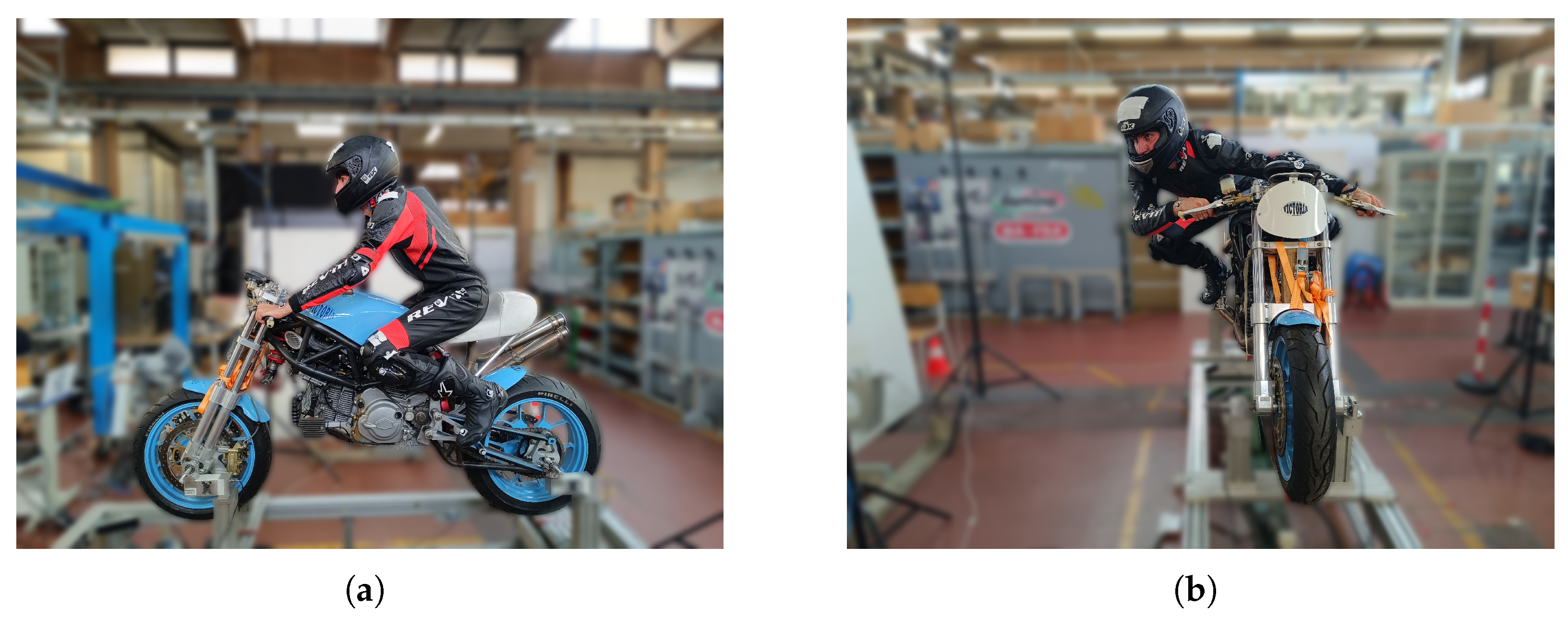
Both the load cell system and the motion capture system recorded data simultaneously during each trial, allowing for a direct comparison between the CoM estimations obtained through the two approaches. Starting from a neutral position (see Figure 1—Left), each rider reached three different postures:
- Lean forward: a tucked posture, characterised by the head oriented forward and the chest positioned close to the motorcycle tank.
- Lean left: lean left posture, characterised by a lateral inclination of the upper body toward the left side of the motorcycle. The head, the trunk and hips rotate and translate laterally while the inner knee is extended outward.
- Lean right: lean right posture, characterised by a lateral inclination of the upper body toward the right side of the motorcycle. The head, the trunk and hips rotate and translate laterally while the inner knee is extended outward (see Figure 1—Right).
Although the estimation of the CoM requires static conditions to allow the load cells to stabilise, achieving perfect static condition is not feasible when the rider is seated. Even minimal or imperceptible movements prevent the load cells from reaching a steady state. Moreover, asking the rider to maintain a precarious posture for an extended period could lead to physical discomfort or fatigue. To address these limitations, the experimental protocol was designed to allow the rider to naturally assume the leaned posture for a duration of 10 s. Within this interval, quasi-static segments were identified and extracted for analysis. This approach ensured that the rider was not forced to hold a rigid position solely for the purpose of load cell stabilisation, while still enabling reliable estimation of the CoM. The accuracy of the method is detailed in Section 3.2, where a reference body is used to ensure repeatability.
It is worth noting that human posture is not easily repeatable; even when asked to reposition themselves in the same way, riders naturally adopt slightly different configurations. This variability is further amplified when the postures under investigation are as extreme as those involving deep lean angles to the right or left. Therefore, the objective is not to evaluate the rider’s ability to reproduce an identical posture, but rather to assess the capability of the proposed procedure to accurately identify the posture.
The following sections provide a detailed description of the equipment and procedures adopted for both the direct and indirect approaches used to estimate the rider’s CoM.
Figure 1.
(a) Neutral posture: this is the starting posture assumed by the rider for each posture. (b) right lean: this is the posture maintained by the rider during lean right.
Figure 1.
(a) Neutral posture: this is the starting posture assumed by the rider for each posture. (b) right lean: this is the posture maintained by the rider during lean right.

3. Identification via Force Measurements
3.1. Experimental Setup
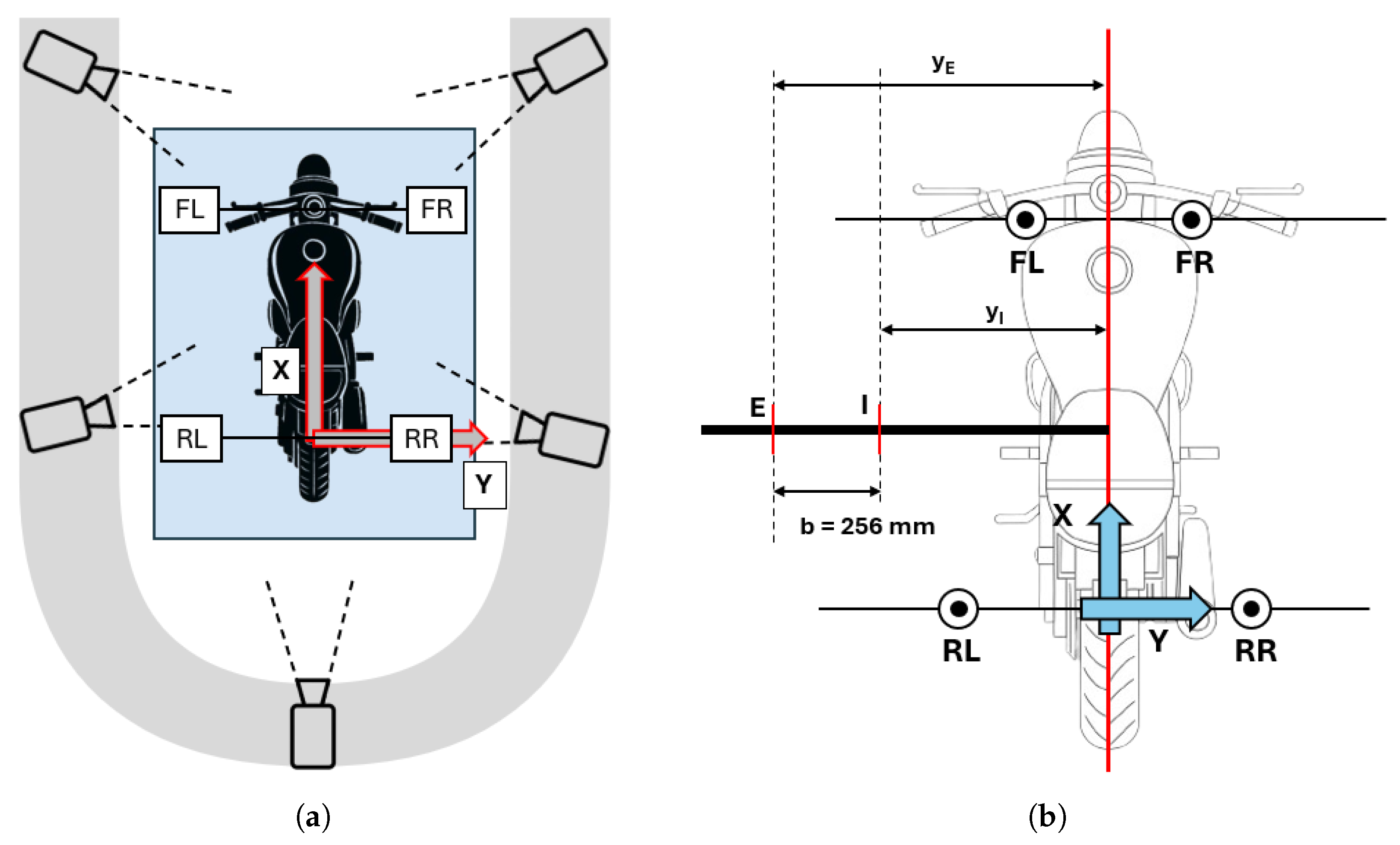
The experimental setup employed for the direct determination of the rider’s CoM is illustrated in Figure 2a: a motorcycle mounted on a CoM measurement platform equipped with four load cells (APL—Laumas, each with a 1500 N range and uncertainty ±0.3 N). The load cells were positioned at the following locations: front left (FL), front right (FR), rear left (RL), and rear right (RR), accordingly to Figure 2 and Table 3.
Figure 2.
(a) Layout sketch with position of load cells and cameras. (b) Top view sketch of the motorcycle on test rig with four load cells. The lateral bar is used only for calibration.
Table 3.
Load cells positions as in Figure 2b.
The coordinate system adopted for the calculations follows the SAE convention, with its origin at the Rear Wheel Centre (RWC). The X-axis is directed towards the Front Wheel Centre (FWC), the Y-axis points to the right-hand side of the vehicle, and the Z-axis is oriented downward. The platform, with the motorcycle firmly mounted, enables the rider to perform controlled manoeuvres aimed at safely reproducing a leaning posture typical of cornering. Two load cells are sufficient to determine the CoM position of a rider, assuming symmetry with respect to the sagittal plane [35]. However, in this case, due to the lateral movement of the rider, an additional pair of load cells was necessary to calculate the lateral displacement of the rider’s CoM.
Given the challenges in repeatability at varying inclination angles and the need to ensure rider safety, the test in this study was performed at a zero-degree lean platform angle. Consequently, only the X and Y coordinates of the CoM were determined. Raw data from the load cells were recorded at 200 Hz.
3.2. Calibration
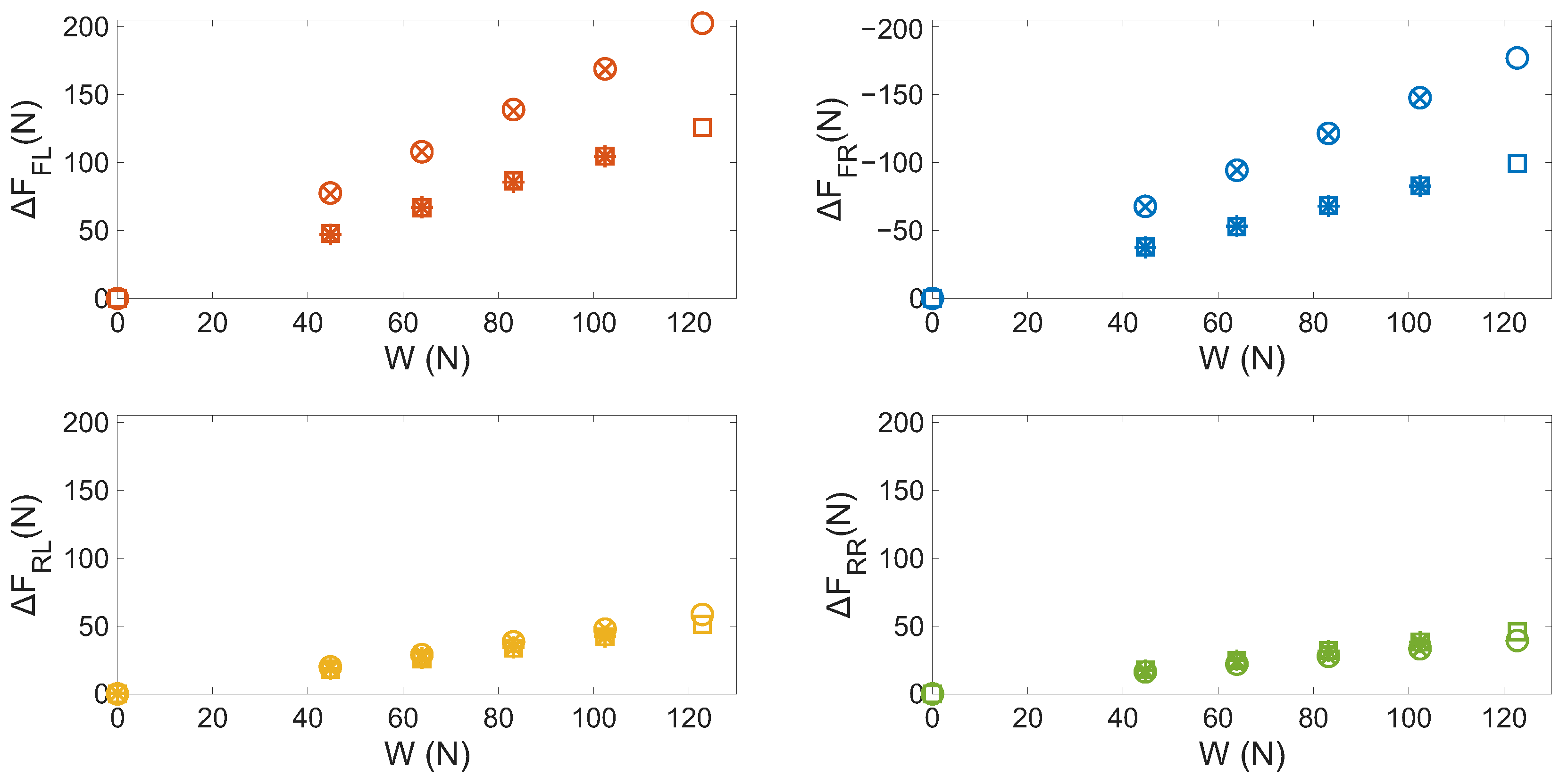
This section describes the procedure used to evaluate the measurement error. A rigid bar was mounted on the motorcycle using two distinct attachment points E (external) and I (internal), which have a lateral distance mm (Figure 2b). From this baseline, a sequence of weights was applied as follows. Firstly, the bar was progressively loaded with ballast discs attached to a hook in point E, up to a maximum weight , and load cell data were recorded. Secondly, to verify the absence of hysteresis, the bar was unloaded in the reverse order. The same procedure was repeated by loading the bar with weights on the hook in the point I. Two verification procedures were conducted to assess the reliability of the measurement system. The first involves the presence of hysteresis in the measurement procedure. Figure 3 shows that the acquired data do not exhibit any hysteresis effect between loading and unloading phases across all four load cells. The data points corresponding to loading and unloading are superimposed and thus indistinguishable. The second judges the capability of the system to correctly estimate the application point position of the ballast. Since the actual values of the hook coordinates and are difficult to measure due to the absence of an accessible physical reference for the plane on the motorcycle, their difference can instead be measured with high precision on the bar. The roll moment generated by the ballast weight W is then balanced by the reaction forces of the load cells as follows:
Figure 3.
Load cell force variations during the loading (; ) and unloading (; ) phase. Orange is for , blue is for , yellow is for and green is for . No hysteresis is visible.
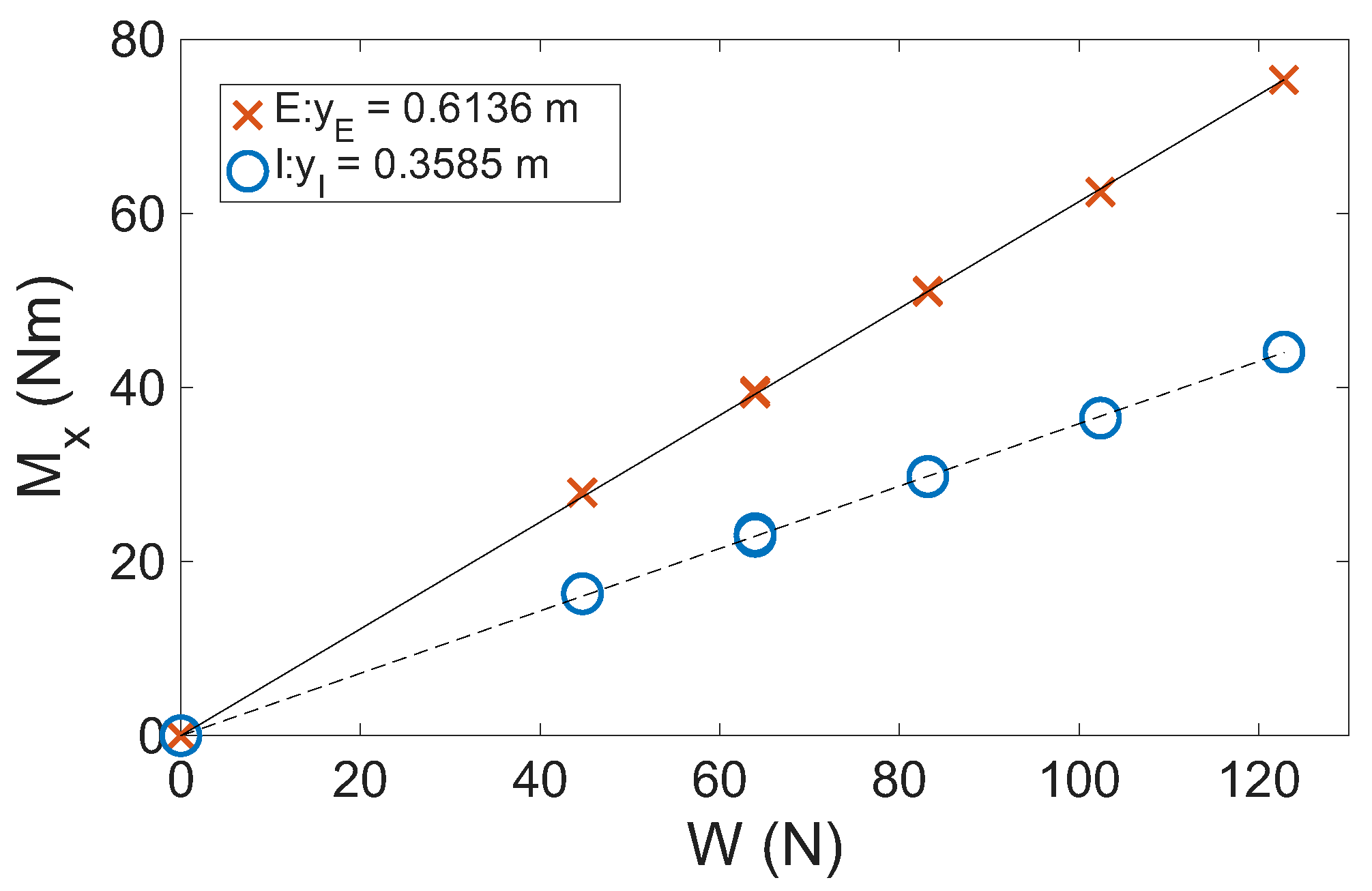
Figure 4 illustrates the linear least square fitting line for both conditions (E and I) of the roll moment calculated according to Equation (1). The slope of the fitting line corresponds to the arm . The difference in slope between the E condition ( m) and the I condition ( m) must be compared to the nominal distance between the two hooks m. The resulting difference is m, deviating from the nominal value by m, corresponding to a relative error of .
Figure 4.
Roll moment , calculated according to Equation (1). Black lines correspond to the least square linear fitting. The slope of the fitting line corresponds to the weight arm and .
3.3. Estimation of Centre of Mass Position
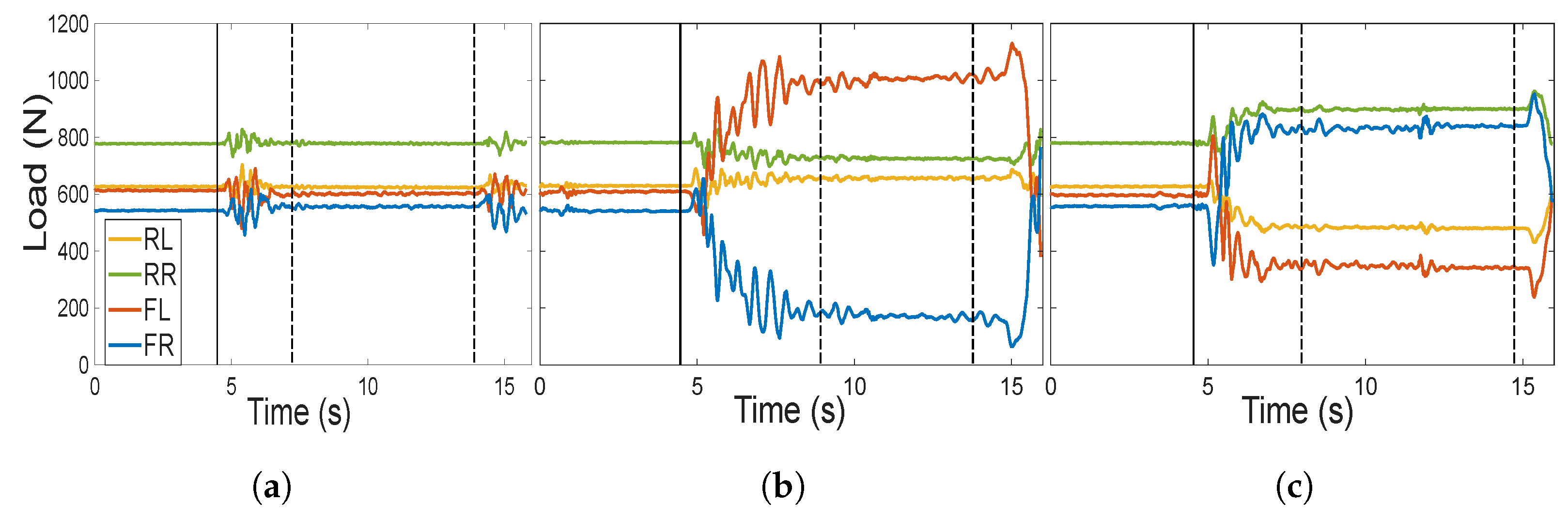
In this section, the data recorded by the load cells and subsequently post-processed to estimate the position of the rider’s CoM during the three posture tests are presented. Load cell data collected during the tests performed by Rider 2 are illustrated as an example in Figure 5. The data from the other two riders exhibit similar patterns. Initially, for approximately five seconds, the rider maintains a neutral posture, resulting in nearly constant load cell readings. At around the fifth second, the rider begins transitioning into a new posture—leaning forward, left, or right. This transition phase is characterised by oscillatory behaviour lasting approximately 3 s, after which the readings stabilise at new quasi-steady values. At around the fifteenth second, the rider returns to a neutral posture.
Figure 5.
Load cell readings during forward lean (a), left lean (b), and right lean (c) for Rider 2. First 5 s (vertical solid line): neutral position. Middle section: target posture (between vertical dashed line). Forward lean shows minimal variation. Left and right lean tests exhibit clear lateral load transfer.
Signal selection was performed using an RMSE-based criterion. The acquisition was divided into two-seconds windows, average and RMSE are calculated, then the window average with smaller RMSE is taken. In all cases RMSE was below 5 N for the neutral position and 20 N for the leaned ones.
The first four columns of Table 4 summarise for each of the three riders the measured during the neutral position and during the lean posture using the above-described criterion. The time required to reach and maintain the lean position varied between riders.
Table 4.
Load cell variations w.r.t. the baseline and rider’s weight P extracted from load cell readings. () position calculated from Equations (2) and (3), and () deviation w.r.t. the relative neutral posture of the rider’s CoM.
The CoM can be calculated with
where and P is the weight of the rider.
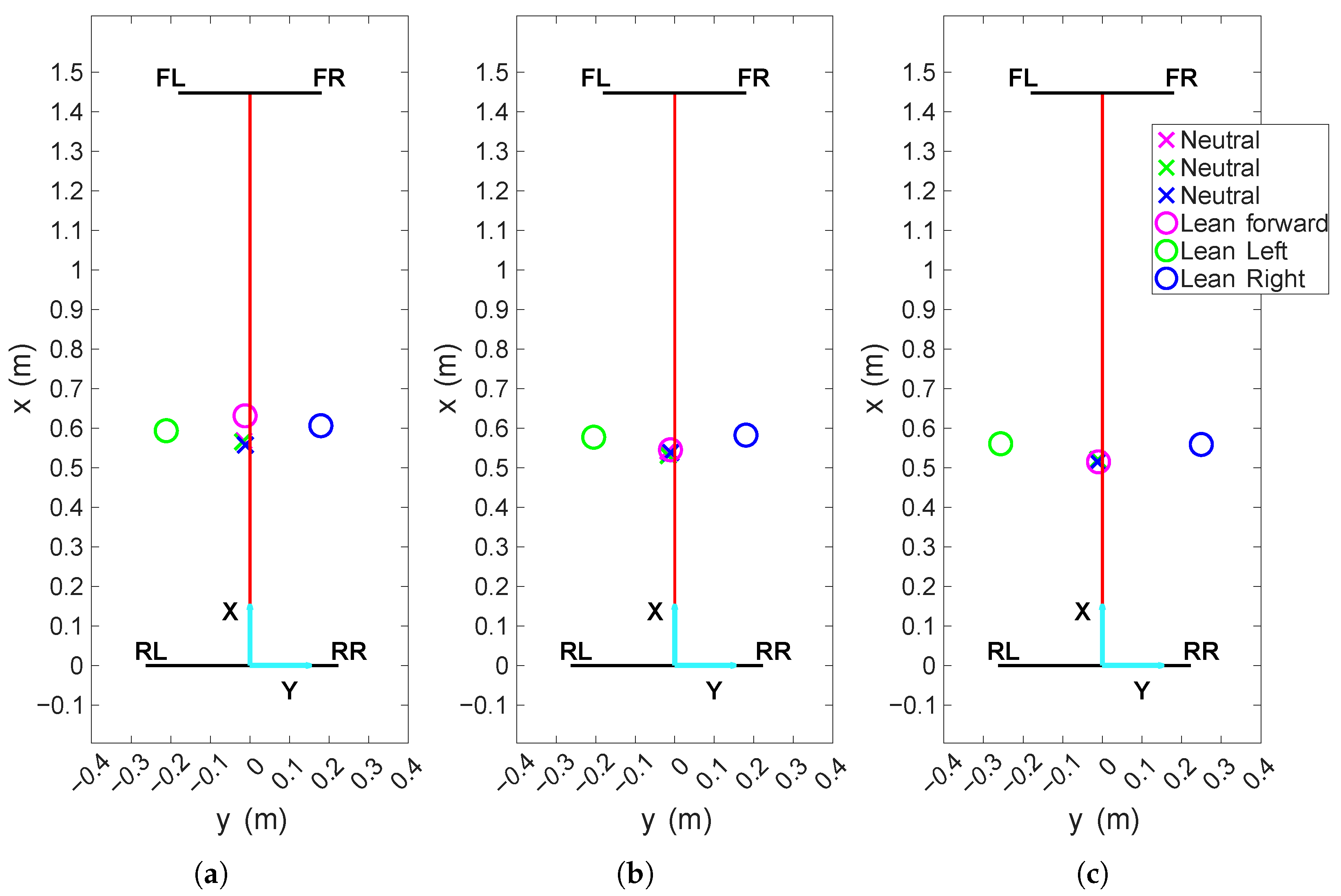
Figure 6 and the last four columns of Table 4 illustrate the longitudinal (x) and the lateral (y) coordinates of CoM, together with shifts () in the rider’s CoM across various adopted postures. During the forward lean test, both Rider 2 and Rider 3 significantly altered their posture by moving the glutes rearward, consistent with typical tucked riding manoeuvres; however, the resulting CoM position does not differ substantially from that observed in the neutral posture. For all riders, during both left and right lean conditions, the CoM is positioned ahead of the neutral posture. Throughout all tests, Rider 3 exhibited a longitudinal CoM position shifted further toward the RWC compared to the other two riders. Furthermore, Rider 3 showed the largest displacement along the Y-axis, at least 50 mm greater than that of the other two riders, with a left–right asymmetry of approximately 15 mm. This last difference may be attributable to the rider’s individual riding style.
Figure 6.
Rider’s CoM position in all postures w.r.t. RWC: (a) Rider 1, (b) Rider 2, (c) Rider 3.
To compute the combined uncertainty of CoM position, the Kline–McClintock [38] propagation of uncertainty method was applied:
where mm is the standard uncertainty related to length measure and N is the uncertainty of , which is obtained as the difference between two load cell measurements, each with an uncertainty of N. Table 5 shows the combined uncertainty for each rider and each posture. It is worth noting that the measurement error in the X-direction remains below 1.3 mm for a displacement exceeding 500 mm (i.e., less than 0.3%). Similarly, the error in the Y-direction is below 1 mm for a lateral lean of approximately 200 mm (approximately 0.5%).
Table 5.
For each rider and each posture, the combined uncertainty in the X-direction and Y-direction of the CoM is calculated using Equations (4) and (5). The last column is the mean combined uncertainty of all the three riders.
4. CoM Identification via Optical Capture
This section presents the methodology adopted to analyse rider posture using optical motion capture and to reconstruct a biomechanical model of the rider within a simulation environment. Initially, a multibody representation of the human body is introduced, designed to replicate rider kinematics within a multibody dynamics (MBD) simulation framework. The experimental setup is then described, including the configuration of infrared cameras and the protocol used to acquire the 3D positions of reflective markers placed on anatomical landmarks of the rider. Subsequently, four different body segment inertial parameter (BSIP) datasets are presented, which were used to define segment masses and inertias. Finally, the processing procedure for estimating the rider’s CoM through the virtual model is detailed and compared against experimental measurements obtained via load cells.
4.1. Multibody Model of the Human Body
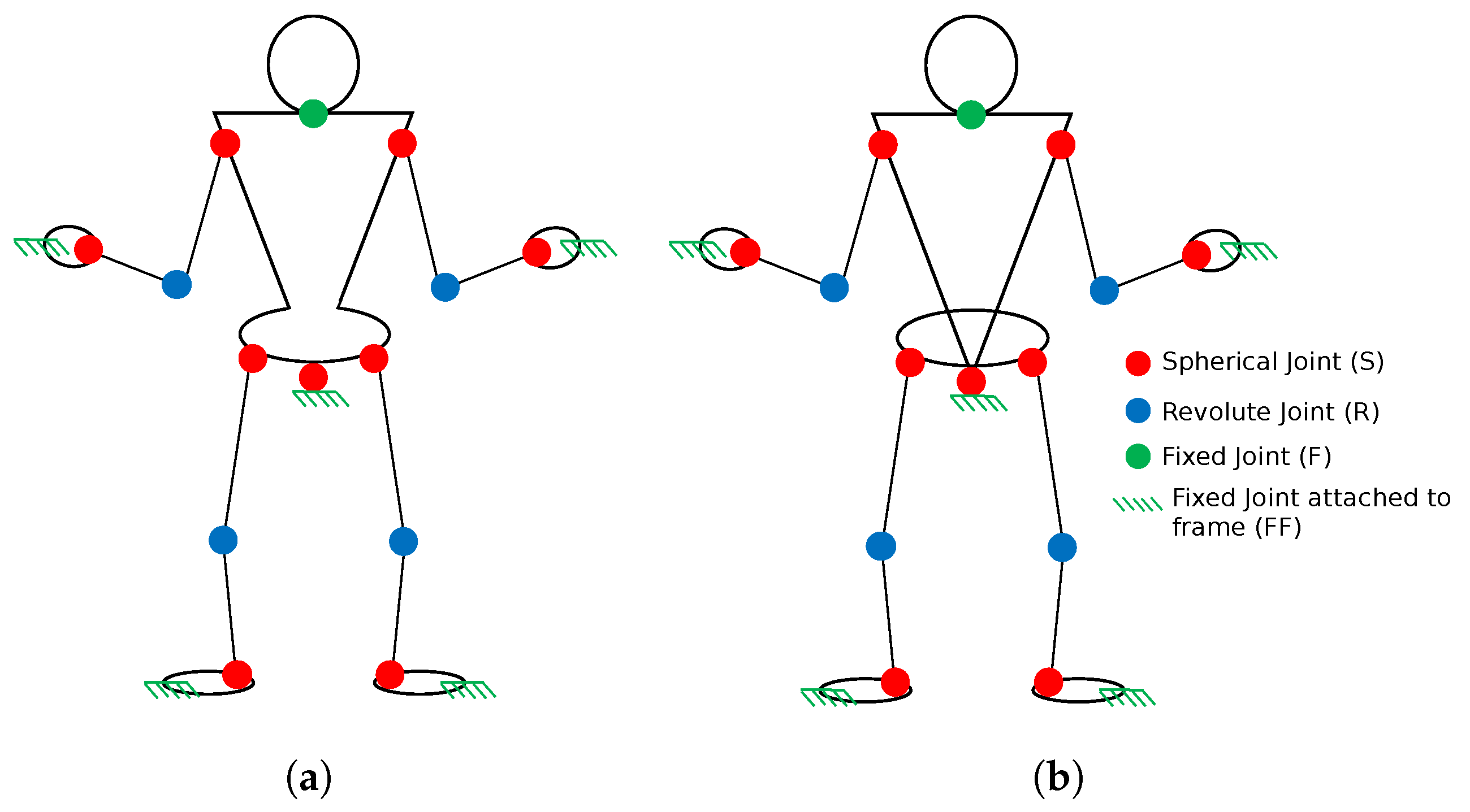
The proposed multibody rider model, developed to compare rider marker positions within a multibody dynamics (MBD) environment, is a modified version of the model presented in [35] and illustrated in Figure 7, on the left. In the original model, the rider is represented by 15 rigid bodies: head, trunk, two arms, two forearms, two hands, two thighs, two shanks, two feet, and a fixed frame. The joint configuration includes five fixed joints, four revolute joints, and nine spherical joints. To evaluate the mobility of the system, the Grübler–Kutzbach criterion for spatial mechanisms is applied:
where D is the number of degrees of freedom of the system, n is the total number of bodies including the fixed frame, j is the number of joints and is the number of degrees of freedom allowed by joint i. From Equation (6), the rider’s body has seven degrees of freedom (DOFs): three rotational DOFs of the trunk—roll, pitch, and yaw—and four translational DOFs representing the distances of the elbows and knees relative to the sagittal plane (two per limb). Unlike the model proposed in [35], where the trunk and hips are combined in a single rigid body, the present study introduces a decoupled representation of trunk and hip movements (see Figure 7, right). This modification was motivated by the analysis of rider markers during folding manoeuvres, which revealed independent movement patterns between the trunk and hips. More specifically, the torso undergoes a roll rotation that differs from that of the hips. In addition, a yaw rotation around the spine is observed, as riders adjust the position of their shoulders to refine their posture. In this new model, the rider is represented by 16 rigid bodies with five fixed joints, four revolute joints, and ten spherical joints. Differently from [35], the model has one more rigid body and one more spherical joint. From Equation (6), the rider’s body is modelled with ten DOFs: three rotational DOFs of the trunk—roll, pitch, and yaw—three rotational DOFs of the hips—roll, pitch, and yaw—and four translational DOFs representing the lateral displacements of the elbows and knees relative to the sagittal plane.
Figure 7.
(a) Rider model proposed in [35]. The trunk and the hips are considered fixed together. (b) Rider model proposed for this work. Trunk and hips are decoupled forming two distinct kinematic chains: the upper chain formed by trunk, head, upper limbs and hands and the lower chain by hips, lower limbs and feet.
To describe the inertial characteristics of each body segment, the four most used BSIP databases were employed [35]: Zatsiorsky–De Leva [39,40]; Dempster [41]; Reynolds–NASA [42,43]; and McConville–Young–Dumas [44,45,46,47]. These databases estimate segment lengths, masses, and inertial properties based on the subject’s anthropometric data, specifically body mass and height of the rider.
4.2. Experimental Setup and Test Protocol
The markers’ position data were acquired using five Vicon Bonita Motion Capture cameras (Vicon Motion Systems Ltd., Oxford, Oxfordshire, United Kingdom), managed through dedicated software Nexus (version 1.8.5). Following calibration, the cameras were used to determine the 3D positions of reflective spherical markers (diameter 15 mm) placed on both the motorcycle and the rider. The cameras were arranged in a U-shaped configuration around the CoM measurement platform, positioned at a height of over 2 m above ground level. The test layout is shown in Figure 2.
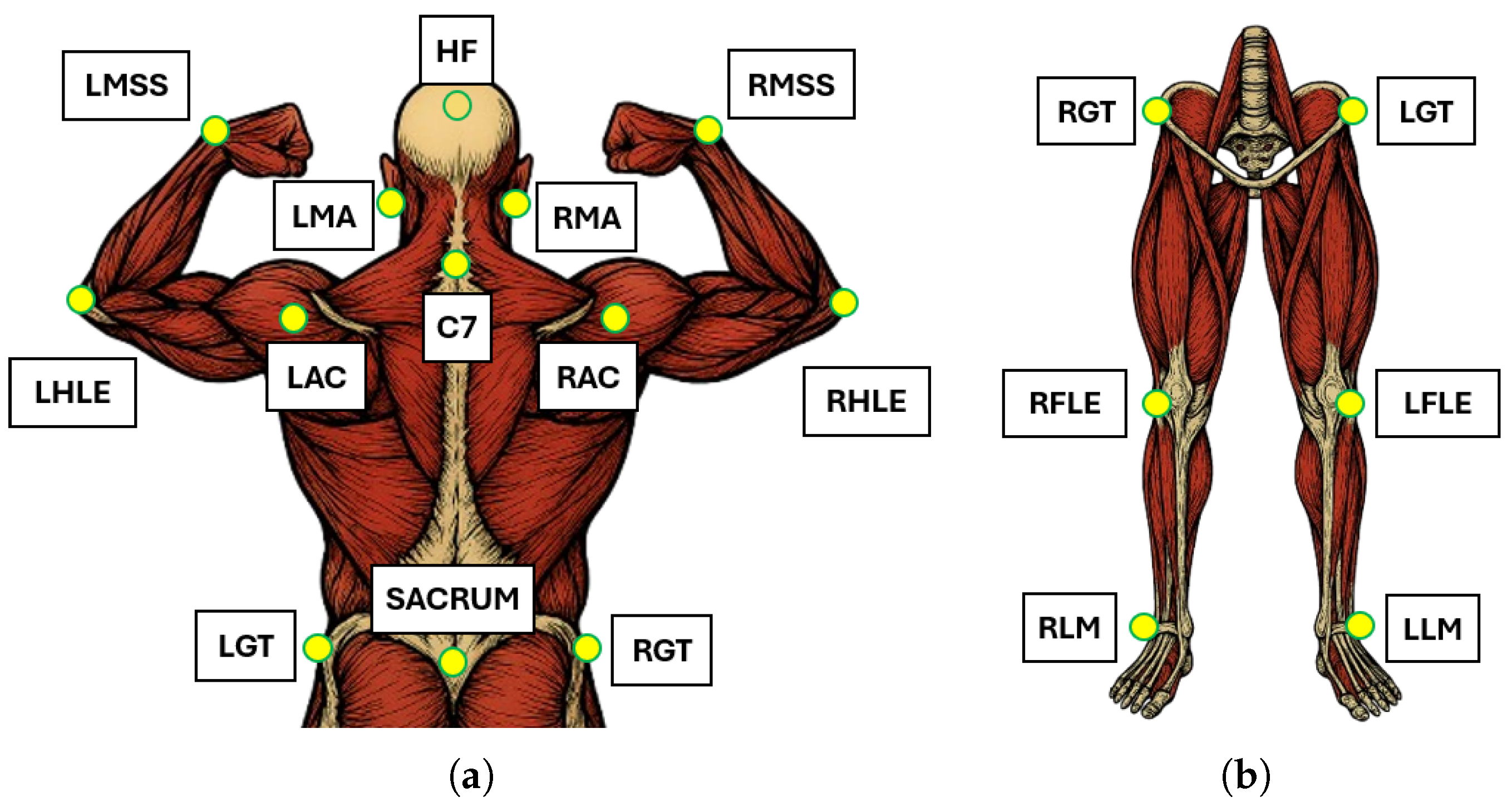
Four markers were placed on the motorbike: on the left and right extremities of the footpegs and of the handlebar. Rider markers were placed on specific anatomical landmarks, as summarised in Figure 8. The selected marker positions reflect the constraints of the anatomical model presented in Figure 7b. On the rider, markers were placed as follows:
- Head (three markers): one on the forehead (HF), and two at the left and right angles of the mandible (LMA and RMA);
- Upper limbs (four markers): two on the left and right medial styloid surfaces (LMSS and RMSS), and two on the left and right humeral lateral epicondyles (LHLE and RHLE);
- Trunk (three markers): two on the left and right acromioclavicular joints (LAC and RAC), and one on the seventh cervical vertebra (C7);
- Hips (three markers): two on the left and right greater trochanters (LGT and RGT), and one on the sacrum (SACRUM);
- Lower limbs (four markers): two on the left and right femoral lateral epicondyles (LFLE and RFLE), and two on the left and right lateral malleoli (LLM and RLM).
During the load cell acquisition tests, an optical motion capture system was employed to track the rider’s posture. Marker positions were recorded at a sampling frequency of 200 Hz. To minimise interference from reflective surfaces and reduce noise in the captured data, black opaque cloths and matte spray coatings were applied to the affected areas. Additionally, a pair of reflective markers was mounted directly onto the two rear load cells. This enabled the identification of two reference points with known x and y coordinates during the data processing phase.
Figure 8.
(a) Head, upper limbs and trunk marker positions. (b) Hips and lower limbs marker positions.
Figure 8.
(a) Head, upper limbs and trunk marker positions. (b) Hips and lower limbs marker positions.

4.3. Data Processing
As anticipated in Section 4.1, the proposed model requires ten input parameters:
- Trunk rotations: roll, pitch, and yaw (3 DOFs);
- Hip rotations: roll, pitch, and yaw (3 DOFs);
- Elbow distances: distance of the left and right elbows relative to the trunk’s sagittal plane (2 DOFs);
- Knee distances: distance of the left and right knees relative to the hip’s sagittal plane (2 DOFs).
To find all ten DOFs and place the virtual rider in position, we can extrapolate them from the rider markers. For each rider and for each posture adopted during the tests, the position of each individual marker was averaged to obtain a representative marker position for that specific posture. The averaging process considered only the frames corresponding to the steady posture, the same ones used in the direct method, obtained according to the criterion described in Section 3.3. As a result, for each test condition, a mean marker position was computed for both the ‘neutral’ and ‘lean’ postures. The origin of the rider model coordinate system was defined as the midpoint between the malleoli, based on the observation that the malleolus markers remained relatively stable throughout all test conditions.
4.3.1. Fixed Body Points
To define the position of the rider’s body within the MBD virtual environment, the first step involves attaching the rider to the fixed frame. In the proposed model shown in Figure 7b, the hands and feet are connected to the frame via four fixed joints. To simplify the model, these extremities can be removed, and the spherical joints at the wrists and malleoli can be directly attached to the fixed frame. Additionally, the head and trunk are considered as a single rigid body. This simplification preserves the original model’s DOF while reducing the number of bodies to 10 plus the fixed frame, and the total number of constraints to 50. In the simplified rider model, five points are directly connected to the fixed frame: the left and right wrists, the left and right malleoli, and the saddle contact point. These points are used to constrain the rider within the static multibody simulation, ensuring that the model is statically fixed to the frame. Their positions are computed directly from the corresponding marker data (e.g., their location in leaned configuration generally differs from the location in neutral configuration):
- Left wrist related to LMSS marker;
- Right wrist related to RMSS marker;
- Left malleolus related to LLM marker;
- Right malleolus related to RLM marker;
- Saddle point related to middle point between LGT and RGT.
Since the markers LMSS, RMSS, LLM, and RLM are placed on the rider’s suit and correspond to external anatomical landmarks of the wrist and malleolus, rather than internal virtual body points, a correction was applied. Specifically, the wrist markers were shifted by 2 cm and the malleolus markers by 3 cm along the Y-axis, toward internal direction, to better approximate their anatomical positions. These offsets were approximately measured on one rider and subsequently applied to all participants. A sensitivity analysis confirmed that combined ±1 cm perturbations on such offsets lead to maximum variations of 15 mm in the X-direction and 3 mm in the Y-direction of the overall CoM.
4.3.2. Trunk Rotations and Hip Rotations
To estimate trunk rotations, we define the origin O of the reference trunk coordinate system as the midpoint between the left greater trochanter (LGT) and right greater trochanter (RGT). The trunk body is represented by the triplet (LAC–RAC–O), where LAC and RAC denote the left and right acromion markers, respectively. The three rotational degrees of freedom of the trunk are computed by solving the well-known Wahba’s problem [48,49], which determines the optimal rotation matrix aligning two coordinate systems based on a set of vector observations. In this context, we seek the rotation that transforms a predefined virtual trunk configuration into the actual recorded trunk posture, using the origin as the fixed point of rotation. The problem is formulated as follows:
where J is the cost function to be minimised, R is the rotation matrix to be estimated, are the reference vectors, are the observed vectors, are the weighting coefficients and N is the number of vector pairs. The virtual trunk configuration is defined such that the LAC–RAC–origin triplet lies in a vertical plane, with the segment connecting LAC and RAC oriented horizontally relative to the origin. This setup ensures that the trunk is initially aligned in an upright position, with no rotation, and that LAC and RAC are symmetrically positioned along the Y-axis with respect to the origin. Wahba’s problem was solved using the Singular Value Decomposition (SVD) method [25], yielding the optimal rotation matrix R. The rotational components were then extracted from R using the Tait–Bryan angle formulation. In the MBD virtual rider model, the trunk was reconstructed by sequentially applying rotations in the following order: roll (X-axis), pitch (Y-axis), and yaw (Z-axis). The same methodology used for trunk rotation estimation was applied to identify hip rotations. The origin of the reference hip coordinate system was defined identically to that of the trunk, and the predefined virtual hip configuration was set to be fully horizontal. In this case, only the roll rotation was estimated, as both yaw and pitch angles were constrained to 0 degrees. This simplification was justified by the marker analysis, which indicated that roll was the dominant component of hip rotation during the observed motion.
4.3.3. Elbow and Knee Distances
Given the spatial coordinates of the left (LHLE) and right (RHLE) elbow markers (corrected with 1 cm Y shift towards the saddle), and the sagittal trunk plane defined to pass through the origin O and rotated according to the trunk’s roll, pitch, and yaw (in that order), the perpendicular distances from each marker to the plane were computed using the standard point-to-plane distance formula:
where A, B, C and D are the coefficients of the plane equation and are the coordinates of the point. The same procedure was applied to compute the distances from the left (LFLE) and right (RFLE) knee markers (corrected with a 4 cm Y shift towards the saddle) to the sagittal hip plane, which also passes through the origin and is rotated according to the hip’s roll angle.
4.4. Estimation of the CoM Coordinates
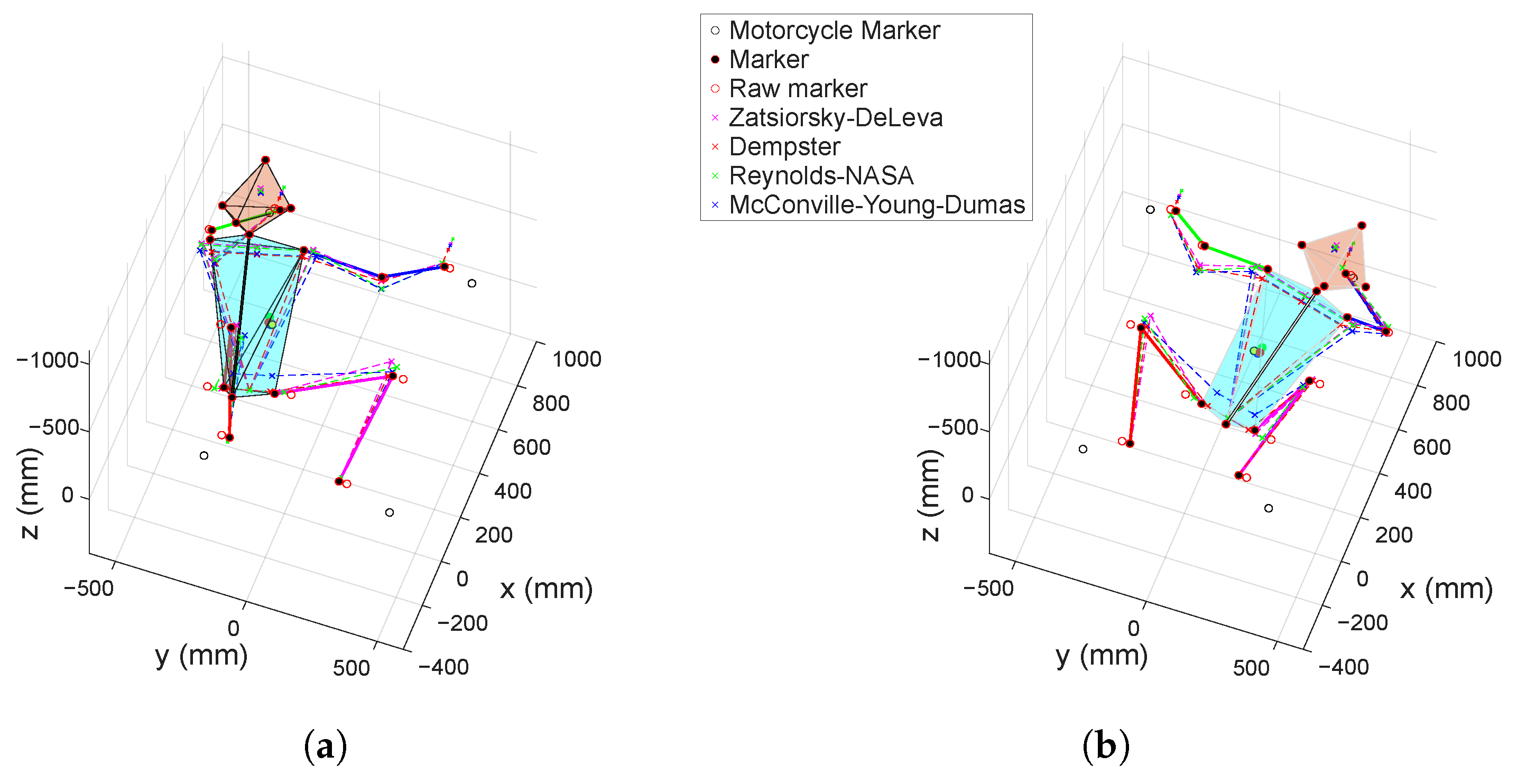
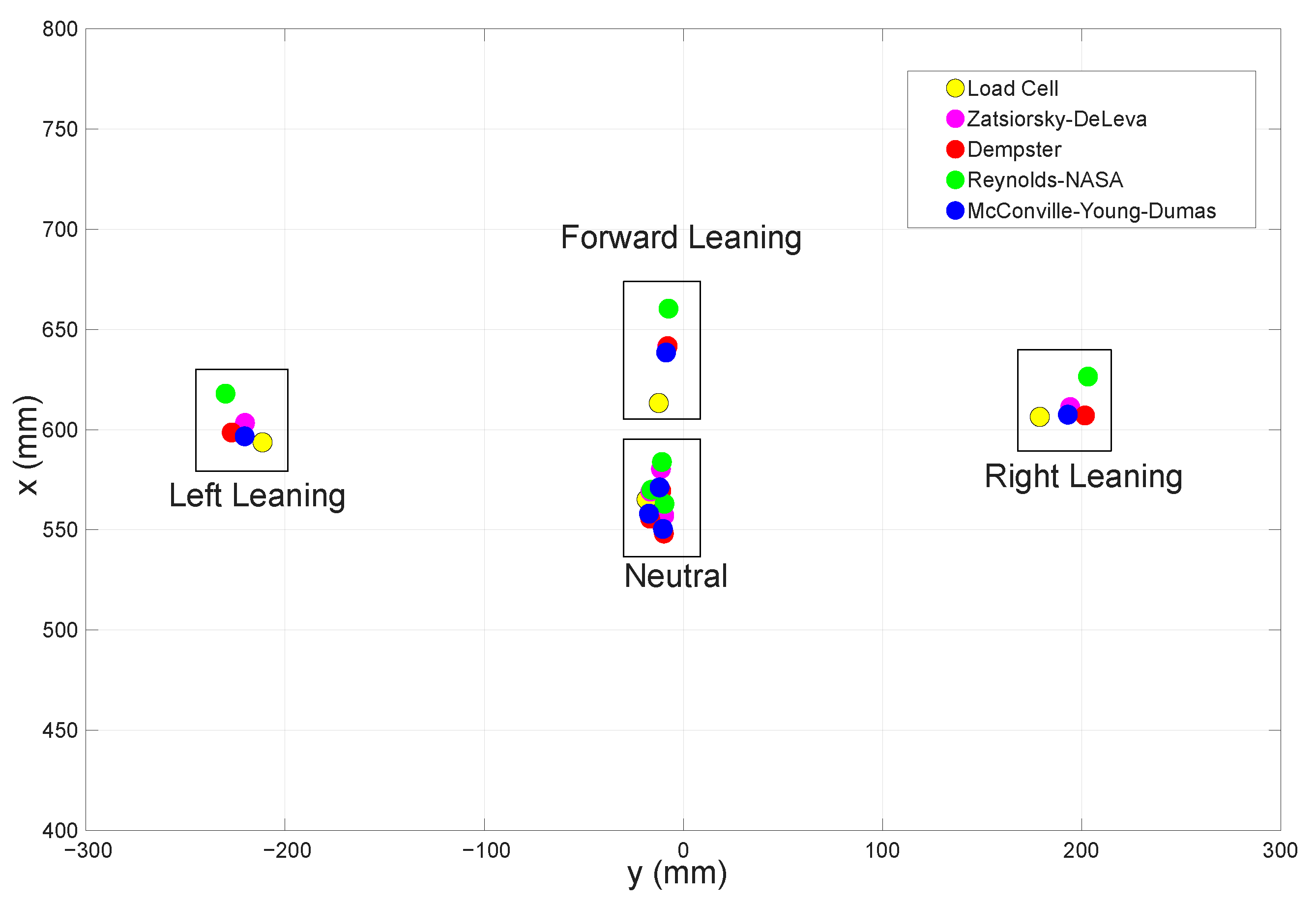
Having all the degrees of freedom required to constrain the rider model in space—derived as described in Section 4.3—the model, associated with a specific BSIP dataset and rider posture, is built. The rider’s CoM is then computed through static simulation within the virtual environment. Figure 9 illustrates a 3D reconstruction example of Rider 1. It is noteworthy how the marker positions and the reconstructed positions of the four BSIP models show a good degree of overlap. Figure 10 depicts the distribution of CoM in the SAE XY plane for all postures adopted by Rider 1. The figure also highlights the variance among the four BSIP models themselves. For each BSIP and posture configuration, Table 6 reports, for each rider, the deviation between the CoM position obtained from MBD and the CoM estimated via the load cell method, along the x and y coordinates.
Figure 9.
3D plot of all virtual rider and rider markers during left lean (a) and right lean (b) for Rider 1. Origin (0,0,0) is the midpoint between malleoli markers. Motorcycle markers (empty black circles) are at handlebar ends and footpegs. Raw markers (empty red circles) differ from corrected markers (filled black circles) due to lateral shift adjustment (Section 4.3.1 and Section 4.3.3). Solid magenta and red lines represent right and left lower limbs; solid blue and green lines represent right and left upper limbs. Light blue and orange convex shells indicate trunk and head. Coloured ‘×’ denote BSIP joints, connected by dashed lines to reconstruct the virtual rider model.
Figure 10.
CoM positions in all the postures for Rider 1.
Table 6.
Comparison of CoM of BSIP and load cell estimation for each rider. and . (*) indicates lean-angle modification.
5. Discussion
The lateral lean posture adopted by motorcycle riders involves a full extension of the arm on the outer side of the curve. This extreme condition can pose challenges for certain riders when reconstructing their posture in a virtual environment using a BSIP model. Specifically, the placement of motion capture markers may be incompatible with the limb lengths defined by the model. When such discrepancies occur, the generation of the virtual rider in the MBD software fails. This issue was particularly evident with Rider 2 and Rider 3, where the closure of the upper kinematic chain—comprising the trunk, upper arm, forearm, and wrist—could not be achieved. BSIP models underestimate the upper limb length, with an average error of 5.48% for Rider 2 and 11.35% for Rider 3, compared to an average underestimation error of 3.62% for Rider 1. To address this, the trunk of the virtual rider was pitched forward beyond the angle calculated from the marker data. The adjustment was made using the smallest integer pitch angle necessary to close the upper kinematic chain. No adjustment of trunk inclination was required for Rider 1, whereas modifications were necessary for Rider 2 and Rider 3 (up to 8 degree). Although this solution partially alters the posture of the virtual rider, it was introduced to enable the direct use of the BSIP databases without requiring any modifications to them. This correction is expected to cause an overestimation of the CoM in the longitudinal direction, i.e., the CoM moves forward as a consequence of the increased lean angle.
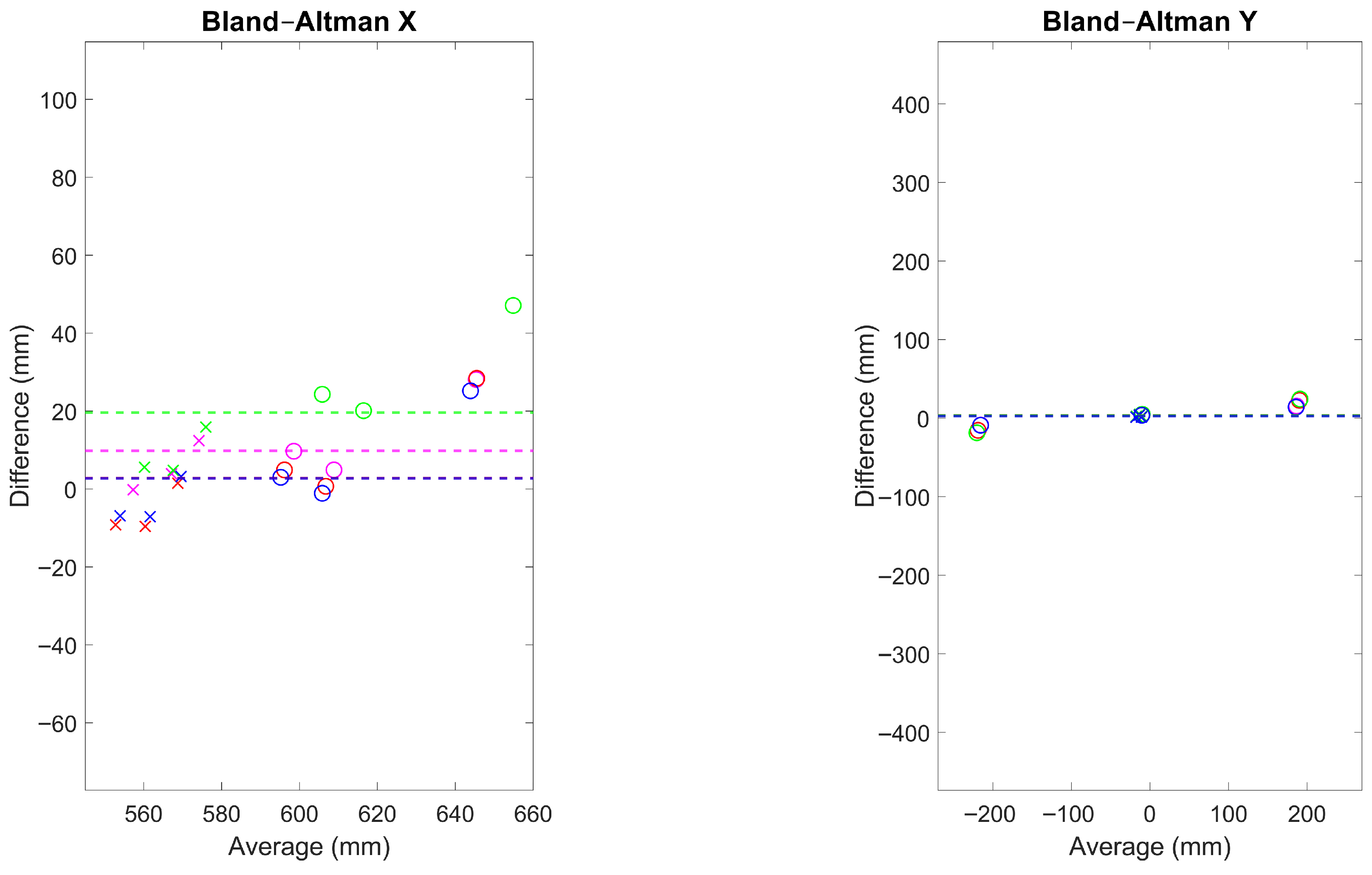
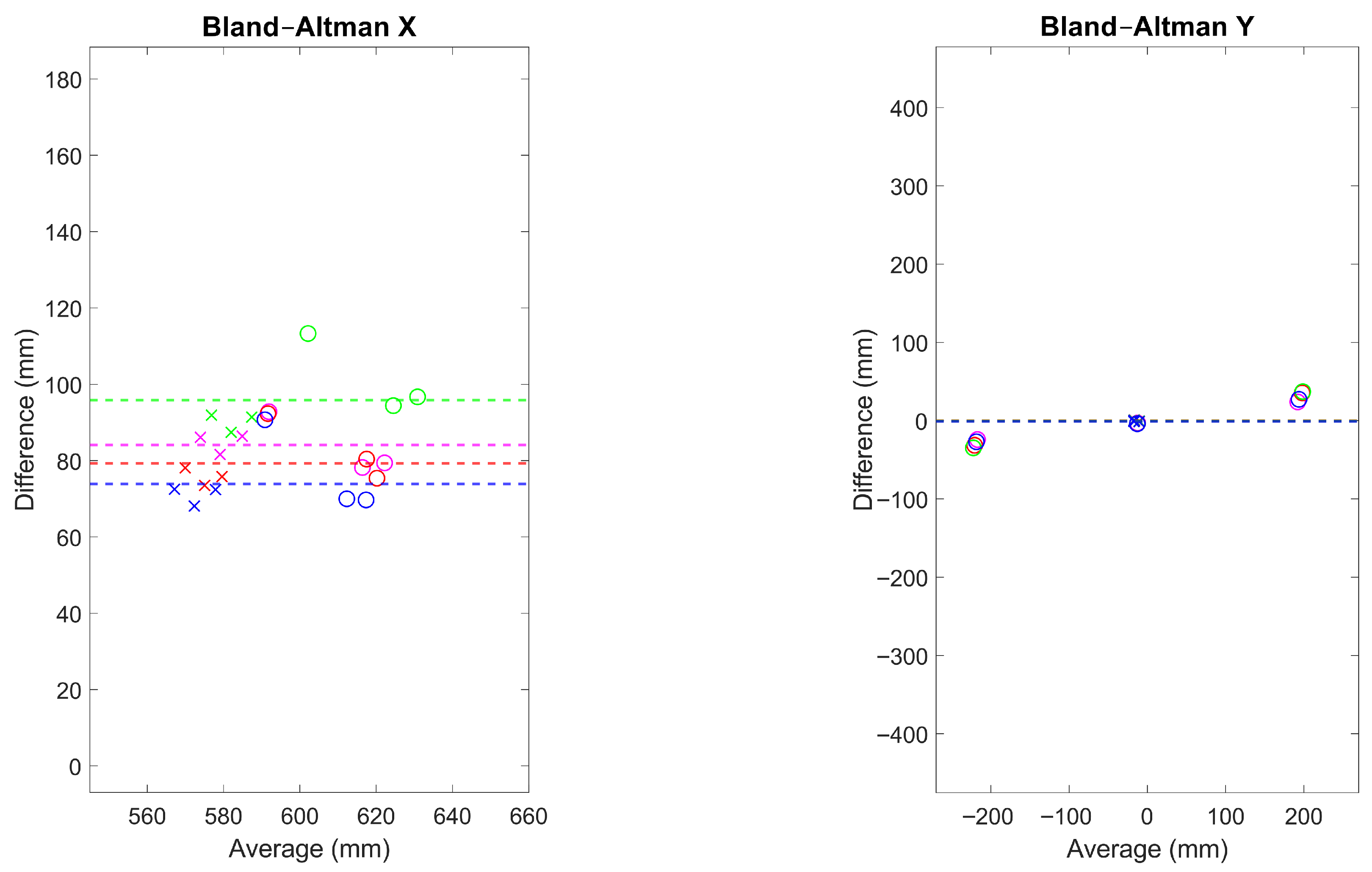
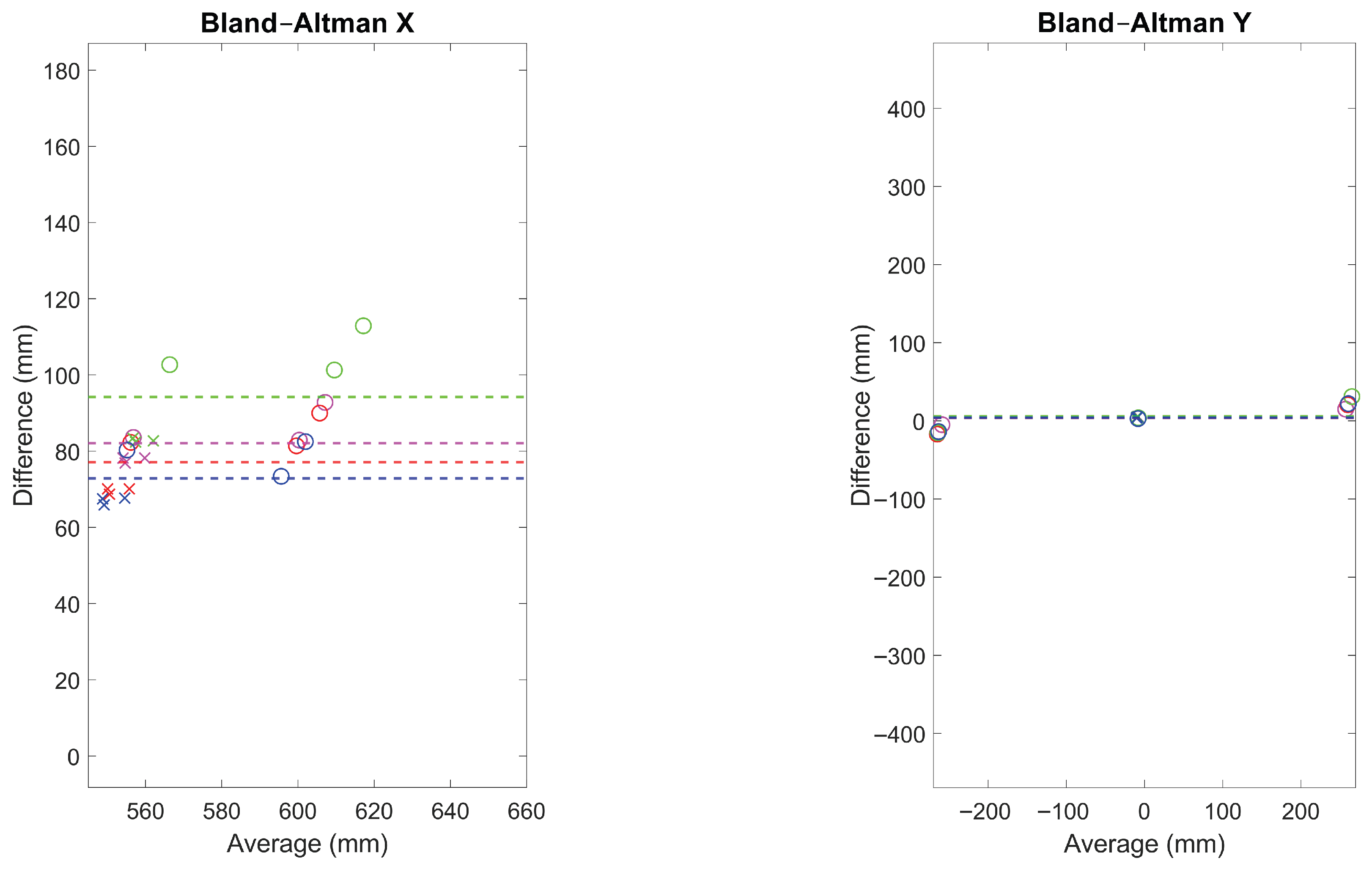
Figure 11 shows the Bland–Altman plot in X- and Y-directions for Rider 1. The four BSIP databases are represented using different colours: magenta for Zatsiorsky–De Leva, red for Dempster, green for Reynolds–NASA and blue for McConville–Young–Dumas. Neutral postures are marked with ‘x’, whereas all lean postures are indicated with ‘o’. In the X-direction, three distinct clusters can be clearly identified: the neutral positions appear on the left of the plot, the left and right lean postures occupy the central region, and the forward lean postures form a third cluster on the right. Among the four databases, the Reynolds–NASA model exhibits the largest positive bias, followed by the De Leva model, whereas the Dempster and Dumas databases show very small biases. The figure also highlights the substantial variability between the different BSIP models in this direction. In the Y-direction, the overall error is considerably smaller than in the X-direction. Here as well, three posture-dependent clusters can be clearly distinguished: left lean postures on the left side of the plot, neutral and forward lean postures grouped around the centre, and right lean postures on the right. The variability between BSIP models in the Y-direction is noticeably less pronounced than in the X-direction. Figure 12 illustrates the Bland–Altman plot for Rider 2. Two major differences compared with Rider 1 can be immediately observed. First, the error scale in the X-direction is much larger—around 80 mm—compared with approximately 10 mm for Rider 1. Second, the forward lean cluster, which appeared at the far right of the plot for Rider 1, now shifts toward the central region. This is consistent with the data acquired using the direct method, where for Rider 2, but also for Rider 3, the CoM position in the forward lean posture is almost superimposed on the neutral position. The ordering of the database biases remains consistent with that observed for Rider 1. No substantial differences are observed in the Y-direction. Figure 13 shows the corresponding diagram for Rider 3. In the X-direction, the pattern is similar to that of Rider 2, with the only differences being that the forward lean cluster lies closer to the neutral cluster and that all points are shifted toward lower abscissa values. In the Y-direction, the distribution remains comparable to that observed for the other two riders. Across all riders, and for each posture cluster, the Bland–Altman plots show a clear trend: as the mean value increases, the difference increases as well, exhibiting an approximately linear progression.
Figure 11.
Rider 1—Bland–Altman plot for X-direction and Y-direction. Each colour represents a BSIP model: magenta for Zatsiorsky–De Leva; red for Dempster; green for Reynolds–NASA and blue for McConville–Young–Dumas. Bias lines are dashed lines (‘–’). ‘Neutral’ posture points are marked with ‘x’, ‘Lean’ posture points with ‘o’. The reference values are those obtained with load cells.
Figure 12.
Rider 2 (*)—Bland–Altman plot for X-direction and Y-direction. Each colour represents a BSIP model: magenta for Zatsiorsky–De Leva; red for Dempster; green for Reynolds–NASA and blue for McConville–Young–Dumas. Bias lines are dashed lines (‘–’). ‘Neutral’ posture points are marked with ‘x’, ‘Lean’ posture points with ‘o’. The reference values are those obtained with load cells. (*) indicates lean-angle modification.
Figure 13.
Rider 3 (*)—Bland–Altman plot for X-direction and Y-direction. Each colour represents a BSIP model: magenta for Zatsiorsky–De Leva; red for Dempster; green for Reynolds–NASA and blue for McConville–Young–Dumas. Bias lines are dashed lines (‘–’). ‘Neutral’ posture points are marked with ‘x’, ‘Lean’ posture points with ‘o’. The reference values are those obtained with load cells. (*) indicates lean-angle modification.
A more detailed interpretation is provided in Table 7, where mean absolute error (MAE), BIAS, root mean squared error (RMSE), and standard deviation (STD) are computed for each rider and posture by comparing the BSIP-based estimates with the CoM reference obtained from the direct method. The results reveal that Riders 2 and 3 consistently exhibit higher error metrics than Rider 1 across most postures. Moreover, for all three riders, the error magnitude is systematically larger in the X-direction than in the Y-direction. The error indices are computed as follows:
Table 7.
Mean absolute error (MAE), bias, root mean squared error (RMSE) and standard deviation (STD) indices for each rider and each posture. Inter-subject variation is computed as standard deviation between all the three riders. (*) indicates lean-angle modification.
Here, is the number of BSIP models used, is the reference CoM coordinate in the X-direction obtained from the load cells, and is the corresponding BSIP-based estimate. The same formulas, with y replacing x, are used to compute , , and . The fourth column of Table 7 reports the standard deviation of the indices computed across the three riders, which is higher in the X-direction than in the Y-direction.
The notable discrepancies observed in Rider 2 and Rider 3 between the CoM positions derived from load cell measurements and those obtained through virtual simulation may be caused by the lean adjustment made to close the upper kinematic chain. For Rider 2 and Rider 3, the conventional use of the four BSIP databases was not sufficient to achieve a consistent model configuration, unless postural adjustments were introduced—specifically, the addition of a forward lean angle to close the model kinematic chain. A hybrid approach was therefore developed to allow the rider to maintain the target posture also in the virtual environment without critical modifications. This approach is defined as hybrid because it combines information derived directly from the rider’s motion-capture markers with selected anthropometric parameters taken from the BSIP databases. The purpose was to verify whether the observed displacement in the X-direction could indeed be attributed to the BSIP datasets, rather than to the modifications introduced to ensure kinematic closure in the virtual model. To this end, the databases were modified as follows: segment lengths were computed directly from the rider’s markers and averaged over the duration of the posture, while segment mass properties and CoM positions were retained from the original databases. Using this procedure, four subject-specific hybrid BSIP databases were generated for Rider 3. In the following analysis, we focus on Rider 3 as a representative example, as this rider needed the largest modification in lean angle to close the kinematic chain. Table 8 shows the deviation between the CoM position obtained with the new four hybrid BSIP databases and the CoM estimated with the direct method along x and y coordinates. The virtual rider assembled using the Reynolds–NASA BSIP database exhibits the largest deviation compared with the other models, which is consistent with the behaviour observed in Figure 13. A direct comparison with Table 6 (Rider 3) shows that the error in the X-direction has decreased substantially, whereas the Y-direction error has changed only marginally. Furthermore, the variability previously observed across the four BSIP models has been notably reduced as a result of using subject-specific segment lengths in the hybrid databases. Despite this improvement, the residual error in the X-direction remains considerable, indicating that Rider 3 is difficult to model accurately using these BSIP models.
Table 8.
Rider 3—comparison of CoM of hybrid BSIP and load cell estimation. and .
6. Conclusions
This study presented and compared two distinct methodologies for estimating the CoM of motorcycle riders: a direct approach based on force measurements using load cells, and an indirect approach employing optical motion capture and biomechanical modelling. The direct method demonstrated high accuracy in determining both longitudinal and lateral CoM positions. However, it required riders to maintain specific postures for a while, which may lead to discomfort and limit its applicability in dynamic scenarios. The indirect method, while more flexible than the direct approach and potentially suitable for measuring dynamic manoeuvres, faced several practical limitations. A significant issue was the virtual model’s inability to close the kinematic chain in some cases due to differing lengths in the BSIP databases compared to those of the actual rider tested. To resolve this, either the trunk’s inclination relative to the experimentally observed value could be adjusted or segment lengths from the tested rider could be used instead of those from the BSIP database. While the kinematic chain closure problem is solved in the latter case, uncertainty remains regarding segment mass proportions and CoM locations since these values are derived from anthropometric databases. Comparing the results with both direct and indirect methods reveals good agreement only in one case (Rider 1). For Rider 2 and particularly Rider 3, either a change in the trunk lean angle or segment length modification is needed to close the kinematic chain. However, the differences remain significant. A likely explanation is that the mass distribution and segmental centre of mass locations assumed by available anthropometric databases do not accurately reflect these riders’ true body characteristics, resulting in poor model fidelity. Overall, these findings suggest the direct method is the most reliable and robust technique for estimating the rider’s lateral centre of mass position.
Author Contributions
Conceptualisation, L.B., S.L., R.L., N.P. and M.M.; methodology, L.B., S.L., R.L., N.P. and M.M.; software, L.B. and S.L.; validation, L.B., R.L. and M.M.; formal analysis, L.B.; investigation, L.B., G.Z., R.L. and M.M.; writing—original draft preparation, S.L., R.L. and M.M.; writing—review and editing, L.B., S.L., R.L., N.P., M.F. and M.M.; visualisation, L.B.; supervision R.L. and M.M. All authors have read and agreed to the published version of the manuscript.
Funding
The work was partially supported by a PhD scholarship funded by Dynamotion S.r.l.
Data Availability Statement
The datasets presented in this article are not readily available because they contain sensitive information that cannot be shared publicly. Requests to access the datasets should be directed to Roberto Lot (roberto.lot@unipd.it).
Conflicts of Interest
Author Matteo Formentini was employed by the company Dynamotion S.r.l. The remaining authors declare that the research was conducted in the absence of any commercial or financial relationships that could be construed as a potential conflict of interest.
References
- Limebeer, D.J.; Massaro, M. Dynamics and Optimal Control of Road Vehicles; Oxford University Press: Oxford, UK, 2018. [Google Scholar]
- Kooijman, J.D.; Schwab, A.L. A review on bicycle and motorcycle rider control with a perspective on handling qualities. Veh. Syst. Dyn. 2013, 51, 1722–1764. [Google Scholar] [CrossRef]
- Cossalter, V. Motorcycle Dynamics; Wiley: Hobeken, NJ, USA, 2006. [Google Scholar]
- Sharp, R.; Evangelou, S.; Limebeer, D.J. Advances in the modelling of motorcycle dynamics. Multibody Syst. Dyn. 2004, 12, 251–283. [Google Scholar] [CrossRef]
- Pacejka, H. Tire and Vehicle Dynamics; Elsevier: Amsterdam, The Netherlands, 2005. [Google Scholar]
- Cossalter, V.; Lot, R.; Massaro, M. An advanced multibody code for handling and stability analysis of motorcycles. Meccanica 2011, 46, 943–958. [Google Scholar] [CrossRef]
- Doria, A.; Marconi, E.; Massaro, M. Identification of rider’s arms dynamic response and effects on bicycle stability. In Proceedings of the International Design Engineering Technical Conferences and Computers and Information in Engineering Conference; American Society of Mechanical Engineers: New York, NY, USA, 2020; Volume 83938, p. V004T04A009. [Google Scholar]
- Tomiati, N.; Colombo, A.; Magnani, G. A nonlinear model of bicycle shimmy. Veh. Syst. Dyn. 2019, 57, 315–335. [Google Scholar] [CrossRef]
- Uchiyama, H.; Tanaka, K.; Nakagawa, Y.; Kinbara, E.; Kageyama, I. Study on Weave Behavior Simulation of Motorcycles Considering Vibration Characteristics of Whole Body of Rider; Technical report, SAE Technical Paper; SAE: Warrendale, PA, USA, 2018. [Google Scholar]
- Klinger, F.; Nusime, J.; Edelmann, J.; Plöchl, M. Wobble of a racing bicycle with a rider hands on and hands off the handlebar. Veh. Syst. Dyn. 2014, 52, 51–68. [Google Scholar] [CrossRef]
- Massaro, M.; Cole, D. Neuromuscular-steering dynamics: Motorcycle riders vs. car drivers. In Dynamic Systems and Control Conference; American Society of Mechanical Engineers: New York, NY, USA, 2012; Volume 45318, pp. 217–224. [Google Scholar]
- Massaro, M.; Lot, R.; Cossalter, V.; Brendelson, J.; Sadauckas, J. Numerical and experimental investigation of passive rider effects on motorcycle weave. Veh. Syst. Dyn. 2012, 50, 215–227. [Google Scholar] [CrossRef]
- Doria, A.; Formentini, M.; Tognazzo, M. Experimental and numerical analysis of rider motion in weave conditions. Veh. Syst. Dyn. 2012, 50, 1247–1260. [Google Scholar] [CrossRef]
- Schwab, A.L.; Meijaard, J.P.; Kooijman, J.D. Lateral dynamics of a bicycle with a passive rider model: Stability and controllability. Veh. Syst. Dyn. 2012, 50, 1209–1224. [Google Scholar] [CrossRef]
- Plöchl, M.; Edelmann, J.; Angrosch, B.; Ott, C. On the wobble mode of a bicycle. Veh. Syst. Dyn. 2012, 50, 415–429. [Google Scholar] [CrossRef]
- Cossalter, V.; Doria, A.; Lot, R.; Massaro, M. The effect of rider’s passive steering impedance on motorcycle stability: Identification and analysis. Meccanica 2011, 46, 279–292. [Google Scholar] [CrossRef]
- Sharp, R.; Limebeer, D. On steering wobble oscillations of motorcycles. Proc. Inst. Mech. Eng. Part C J. Mech. Eng. Sci. 2004, 218, 1449–1456. [Google Scholar] [CrossRef]
- Katayama, T.; Aoki, A.; Nishimi, T.; Okayama, T. Measurements of structural properties of riders. In Proceedings of the 4th International Pacific Conference on Automotive Engineering; SAE: Warrendale, PA, USA, 1987. [Google Scholar]
- Nishimi, T.; Aoki, A.; Katayama, T. Analysis of Straight Running Stability of Motorcycles; Technical report, SAE Technical Paper; SAE: Warrendale, PA, USA, 1985. [Google Scholar]
- Cossalter, V.; Lot, R.; Massaro, M. The influence of frame compliance and rider mobility on the scooter stability. Veh. Syst. Dyn. 2007, 45, 313–326. [Google Scholar] [CrossRef]
- Cheng, J.; Su, H.; Chen, K. Driver posture detection method in motorcycle simulator. In Proceedings of the 2019 International Conference on Artificial Intelligence and Advanced Manufacturing (AIAM), Dublin, Ireland, 16–18 October 2019; IEEE: Piscataway, NJ, USA, 2019; pp. 622–626. [Google Scholar]
- Nagasaka, K.; Ichikawa, K.; Yamasaki, A.; Ishii, H. Development of a Riding Simulator for Motorcycles; SAE Technical Papers; SAE: Warrendale, PA, USA, 2018. [Google Scholar] [CrossRef]
- Will, S.; Schmidt, E.A. Powered two wheelers’ workload assessment with various methods using a motorcycle simulator. IET Intell. Transp. Syst. 2015, 9, 702–709. [Google Scholar] [CrossRef]
- Massaro, M.; Cossalter, V.; Lot, R.; Rota, S.; Ferrari, M.; Sartori, R.; Formentini, M. A portable driving simulator for single-track vehicles. In Proceedings of the 2013 IEEE International Conference on Mechatronics (ICM), Vicenza, Italy, 27 February–1 March 2013; IEEE: Piscataway, NJ, USA, 2013; pp. 364–369. [Google Scholar] [CrossRef]
- Stedmon, A.; Brickell, E.; Hancox, M.; Noble, J.; Rice, D. MotorcycleSim: A user-centred approach in developing a simulator for motorcycle ergonomics and rider human factors research. Adv. Transp. Stud. Int. J. 2012, A-27, 31–48. Available online: https://www.atsinternationaljournal.com/2012-issues/motorcyclesim-a-user-centred-approach-in-developing-a-simulator-for-motorcycle-ergonomics-and-rider-human-factors-research/ (accessed on 15 January 2026).
- Cossalter, V.; Lot, R.; Massaro, M.; Sartori, R. Development and validation of an advanced motorcycle riding simulator. Proc. Inst. Mech. Eng. Part D J. Automob. Eng. 2011, 225, 705–720. [Google Scholar] [CrossRef]
- Nehaoua, L.; Arioui, H.; Mammar, S. Review on single track vehicle and motorcycle simulators. In Proceedings of the 2011 19th Mediterranean Conference on Control & Automation (MED), Corfu, Greece, 20–23 June 2011; IEEE: Piscataway, NJ, USA, 2011; pp. 940–945. [Google Scholar] [CrossRef]
- Rice, R. Rider Skill Influences on Motorcycle Maneuvering; SAE Technical Paper 780312; SAE: Warrendale, PA, USA, 1978. [Google Scholar] [CrossRef]
- Katayama, T.; Aoki, A.; Nishimi, T. Control Behaviour of Motorcycle Riders. Veh. Syst. Dyn. 1988, 17, 211–229. [Google Scholar] [CrossRef]
- Bocciolone, M.; Cheli, F.; Leo, E.; Pezzola, M. Experimental identification of kinematic coupled effects between driver-motorcycle. In Proceedings of the IMAC—XXV: A Conference & Exposition on Structural Dynamics, Orlando, FL, USA, 19–22 February 2007; pp. 19–22. [Google Scholar]
- Cheli, F.; Mazzoleni, P.; Pezzola, M.; Ruspini, E.; Zappa, E. Vision-based measuring system for rider’s pose estimation during motorcycle riding. Mech. Syst. Signal Process. 2013, 38, 399–410. [Google Scholar] [CrossRef]
- Carputo, F.; D’Andrea, D.; Risitano, G.; Sakhnevych, A.; Santonocito, D.; Farroni, F. A Neural-Network-Based Methodology for the Evaluation of the Center of Gravity of a Motorcycle Rider. Vehicles 2021, 3, 377–389. [Google Scholar] [CrossRef]
- Cao, Z.; Hidalgo, G.; Simon, T.; Wei, S.E.; Sheikh, Y. OpenPose: Realtime Multi-Person 2D Pose Estimation Using Part Affinity Fields. IEEE Trans. Pattern Anal. Mach. Intell. 2021, 43, 172–186. [Google Scholar] [CrossRef] [PubMed]
- Ostermeier, M.; Sindinger, S.; Marschall, D. IMU-based Assessment of Rider Kinematics in Motocross—A pilot study. In Proceedings of the Human Factors in Design, Engineering, and Computing; Ahram, T., Karwowski, W., Eds.; AHFE Open Access: New York, NY, USA, 2024; Volume 159. [Google Scholar] [CrossRef]
- Bova, M.; Massaro, M.; Petrone, N. A Three-Dimensional Parametric Biomechanical Rider Model for Multibody Applications. Appl. Sci. 2020, 10, 4509. [Google Scholar] [CrossRef]
- Stolle, K.L.; Wahl, A.; Schmidt, S. Motorcycle rider posture measurement for on-road experiments on rider intention detection. In Proceedings of the 2022 IEEE 1st International Conference on Cognitive Mobility (CogMob), Budapest, Hungary, 12–13 October 2022; IEEE: Piscataway, NJ, USA, 2022; pp. 000051–000056. [Google Scholar] [CrossRef]
- Barberi, E.; Chillemi, M.; Cucinotta, F.; Sfravara, F. Fast Three-Dimensional Posture Reconstruction of Motorcyclists Using OpenPose and a Custom MATLAB Script. Sensors 2023, 23, 7415. [Google Scholar] [CrossRef] [PubMed]
- Kline, S.J. Describing Uncertainties in Single-Sample Experiments. Mech. Eng. 1953, 75, 3–8. [Google Scholar]
- Zatsiorsky, V.M. The Mass and Inertia Characteristics of the Main Segments of the Human Body. In Biomechanics VIII-B; Matsui, H., Kobayashi, K., Eds.; Human Kinetics Publishers: Champaign, IL, USA, 1983; pp. 1152–1159. [Google Scholar]
- de Leva, P. Adjustments to Zatsiorsky-Seluyanov’s segment inertia parameters. J. Biomech. 1996, 29, 1223–1230. [Google Scholar] [CrossRef]
- Dempster, W.T.; Gaughran, G.R. Properties of body segments based on size and weight. Am. J. Anat. 1967, 120, 33–54. [Google Scholar] [CrossRef]
- Reynolds, H.M. The inertial properties of the body and its segments. In Webb Associates Anthropometric Source Book; Webb Associates: Yellow Springs, OH, USA, 1978; Volume 1. [Google Scholar]
- NASA. Anthropometric Source Book. Volume 2: A Handbook of Anthropometric Data; Webb Associates: Yellow Springs, OH, USA, 1978; Volume 2. [Google Scholar]
- Clauser, C.E.; McConville, J.T.; Young, J.W. Weight, Volume, and Center of Mass of Segments of the Human Body; Technical Report; NASA: Brook Park, OH, USA, 1969. [Google Scholar]
- Hinrichs, R.N. Adjustments to the segment center of mass proportions of Clauser et al. (1969). J. Biomech. 1990, 23, 949–951. [Google Scholar] [CrossRef]
- Dumas, R.; Chèze, L.; Verriest, J.P. Adjustments to McConville et al. and Young et al. body segment inertial parameters. J. Biomech. 2007, 40, 543–553, Corrigendum in J. Biomech. 2007, 40, 1651–1652. https://doi.org/10.1016/j.jbiomech.2006.07.016. [Google Scholar] [CrossRef]
- Gordon, C.C.; Churchill, T.; Clauser, C.E.; Bradtmiller, B.; McConville, J.T.; Tebbetts, I.; Walker, R.A. Anthropometric Survey of US Army Personnel: Summary Statistics, Interim Report for 1988; Technical Report; DTIC: Yellow Springs, OH, USA, 1989. [Google Scholar]
- Wahba, G. A Least Squares Estimate of Satellite Attitude. SIAM Rev. 1965, 7, 409. [Google Scholar] [CrossRef]
- Shuster, M.D.; Oh, S. Three-axis attitude determination from vector observations. J. Guid. Control 1981, 4, 70–77. [Google Scholar] [CrossRef]
Disclaimer/Publisher’s Note: The statements, opinions and data contained in all publications are solely those of the individual author(s) and contributor(s) and not of MDPI and/or the editor(s). MDPI and/or the editor(s) disclaim responsibility for any injury to people or property resulting from any ideas, methods, instructions or products referred to in the content. |
© 2026 by the authors. Licensee MDPI, Basel, Switzerland. This article is an open access article distributed under the terms and conditions of the Creative Commons Attribution (CC BY) license.