1. Introduction
Autonomous vehicles (AVs) often referred to as self-driving or driverless cars [
1], represent one of the most significant technological transformations in contemporary transportation systems. By integrating advances in artificial intelligence, machine learning, robotics, and digital connectivity, AVs have the potential to fundamentally reshape road safety, traffic operations, urban mobility patterns, and the broader relationship between society and transport infrastructure [
2]. At the vehicle level, autonomy is enabled through sophisticated sensor suites such as LiDAR, radar, cameras, and global positioning systems, combined with high-definition maps and decision-making algorithms that support perception, planning, and control in complex and dynamic environments [
3]. These capabilities are commonly categorized according to the SAE International levels of driving automation (Levels 0–5), which range from basic driver assistance to full automation without human intervention [
4].
Recent pilot deployments across North America, Europe, and Asia—including robo-taxi services, autonomous shuttle operations, and automated public transport demonstrations—have illustrated both the technical feasibility and the societal relevance of AV technologies [
5,
6,
7]. While such initiatives highlight the promise of automation, they also underscore the gap between controlled operational domains and large-scale, real-world integration. As a result, AVs are no longer viewed solely as a vehicle-centric innovation, but increasingly as a component of a complex and evolving traffic ecosystem.
Road traffic injury remains a large-scale public-health and system-performance problem, with approximately 1.19 million (
https://www.who.int/teams/social-determinants-of-health/safety-and-mobility/global-status-report-on-road-safety-2023, accessed on 20 January 2026) annual fatalities reported globally. In crash causation analyses, the critical reason is attributed to the driver in an estimated 94% of investigated crashes, highlighting the potential leverage of automation while also underscoring the need to evaluate how automated behavior interacts with human driving in mixed fleets [
8]. Critical reasons for crashes investigated in the National Motor Vehicle Crash Causation Survey. (Traffic Safety Facts Crash Stats. Report No. DOT HS 812 506). Washington, DC: National Highway Traffic Safety Administration.). Congestion imposes similar material system costs. For example, recent metropolitan travel-time analyses estimate that U.S. drivers lost on average 42 h to congestion in 2023, corresponding to an average cost of
$733 per driver (
https://inrix.com/press-releases/2023-global-traffic-scorecard-us/, accessed on 20 January 2026). Importantly, the transition toward automation is expected to occur under prolonged mixed-traffic conditions, and the reviewed evidence indicates that early deployment can temporarily degrade network performance: at low-to-moderate penetration (approximately 10–50%), average network delays have been reported to increase by roughly 4–18% relative to conventional baselines, largely due to conservative automated maneuvers and interaction frictions [
9]. Consistent with broader syntheses of mixed-traffic evidence, the benefits of automation are not monotone in early deployment and can be neutral or negative at low penetration depending on demand levels, control logic, and interaction effects, with improvements typically materializing only after sufficiently high market share [
10,
11].
Recent mixed-traffic research increasingly complements scenario-based simulation with empirical analysis and pilot evaluation, shifting the central question from whether automated driving is feasible to how transition regimes behave under real interaction and governance constraints. Empirical safety analyses of interaction-critical contexts such as freeway merging indicate penetration-dependent effects, including results where low AV penetration does not improve surrogate safety and measurable improvements emerge only beyond a threshold region. He et al. (2025) report that AV penetration below 20 percent did not enhance mixed-traffic safety at merging areas, whereas safety improved when penetration exceeded 20 percent across multiple surrogate metrics [
12]. Human to AV interaction modeling has similarly moved toward explicitly representing behavioral uncertainty, with uncertainty-aware controllers and learning-based interaction models proposed to reduce risk in mixed-traffic longitudinal control settings. Finally, pilot evaluations of shared automated services operating in open mixed traffic show that safety and efficiency performance is context-dependent and sensitive to operational design, reinforcing the need to treat policy and deployment choices as endogenous to outcomes rather than as background conditions [
13,
14].
Early AV research predominantly focused on vehicle-level performance metrics, such as sensing accuracy, localization robustness, and control reliability. However, a growing body of evidence indicates that the impacts of AVs cannot be fully understood in isolation from their surrounding environment. In practice, AVs interact primarily with human-driven vehicles, traffic control systems, and roadway infrastructure, which collectively shape system-level performance in mixed traffic environments. These interactions play a decisive role in shaping system-level outcomes related to safety, traffic efficiency, equity, and public acceptance [
15,
16,
17]. For example, simulation studies and controlled experiments suggest that even limited AV penetration can smooth traffic flow and reduce congestion under certain conditions; however, these benefits are highly sensitive to human behavioral responses, infrastructure design, and the degree of vehicle connectivity [
18,
19,
20]. Conversely, poorly managed deployment scenarios may increase vehicle kilometers traveled, disrupt public transport usage, or exacerbate congestion and spatial inequities [
21,
22,
23,
24].
These mixed and sometimes contradictory findings highlight the need for a holistic, system-level perspective on AV integration. Rather than treating automation as a deterministic improvement, recent research emphasizes that AV impacts are often non-linear and context-dependent, varying with market penetration rates, control strategies, behavioral adaptation, and policy frameworks. Consequently, the success of AV deployment depends not only on technological maturity, but also on how automation is embedded within broader traffic, urban, and governance systems.
Against this backdrop, the objective of this review is to provide a comprehensive synthesis of autonomous vehicle integration from a traffic ecosystem perspective. Specifically, the review focuses on three interrelated dimensions:
- (i)
The technological foundations that enable autonomous and connected vehicle operation;
- (ii)
The system-level impacts of AVs on safety, traffic flow, and urban mobility under mixed traffic conditions;
- (iii)
The policy, governance, and planning implications associated with large-scale deployment.
By systematically reviewing recent literature across transportation engineering, urban planning, and policy domains, this study identifies areas of consensus, unresolved tensions, and critical research gaps. The primary contribution of this review lies in bridging technical and policy-oriented perspectives, thereby supporting more informed decision-making by researchers, planners, and policymakers as autonomous vehicles transition from experimental pilots to integral components of future mobility systems. While vulnerable road users (VRUs) are an important component of urban mobility systems, this review focuses primarily on vehicle–vehicle and vehicle–infrastructure interactions; VRU-related findings are considered only where they directly influence mixed-traffic operations and safety outcomes.
2. Technological Foundations Relevant to Traffic System Integration
Autonomous vehicles (AVs) integrate sensing, decision-making, control, and connectivity technologies that directly shape their behavior in traffic systems. Rather than providing a comprehensive technical survey, this section summarizes the technological elements most relevant to traffic flow, safety, and mixed traffic interactions, which underpin the system-level impacts discussed in
Section 3.
2.1. Behavioral Variables in Human–AV Mixed Traffic
We use three behavioral constructs to interpret human responses to AVs in mixed traffic, because these constructs recur across empirical, experimental, and modeling studies and directly condition control performance. Aggressiveness and strategic exploitation refer to deliberate attempts to gain advantage against an AV that is perceived as rule-compliant or defensive, operationalized by behaviors such as close cut-ins, forced merges, short headways, and failure to yield when the AV is expected to concede. In the mixed-traffic literature, this phenomenon is often discussed as ‘bullying’ or ‘taking advantage’ of AVs, and survey and experimental evidence indicates that such behavior may directed more frequently toward AVs than toward human drivers under certain conditions. Avoidance and overcautious interaction refer to a risk-averse response to AVs, operationalized by earlier braking, larger gaps, or reluctance to merge, which can reduce conflict risk while increasing disruption and delay at interfaces. Cognitive misperception and misidentification refer to incorrect inference about AV identity, driving mode, or intent, which can distort gap acceptance and yielding decisions, particularly in time-critical intersection and merging scenarios. These categories are not mutually exclusive in a given interaction, but they provide a minimal taxonomy for relating observed surrogate-safety changes and efficiency impacts to the underlying human response mechanisms.
2.2. Levels of Driving Automation
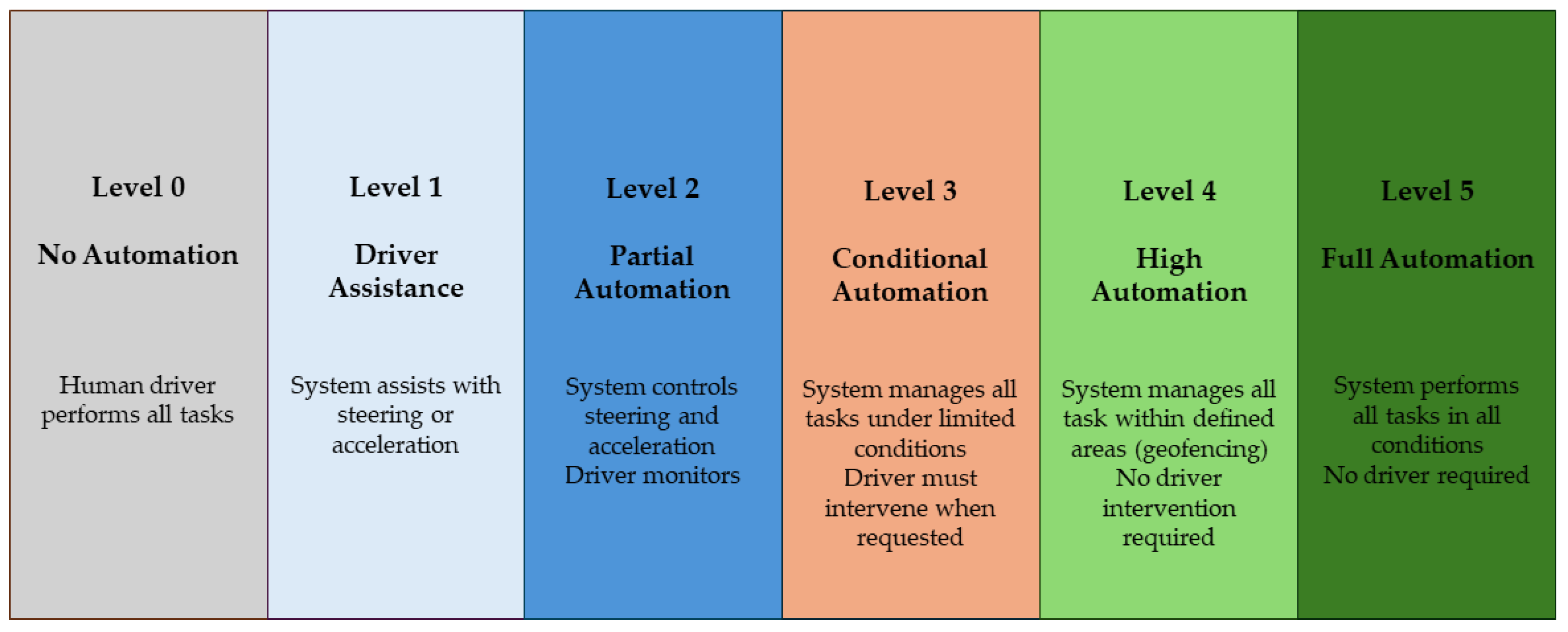
The functional capabilities of autonomous vehicles are commonly classified according to the SAE J3016 taxonomy, which defines six levels of driving automation (Levels 0–5) based on the distribution of control and responsibility between the human driver and the automated driving system. From a traffic systems and policy perspective, this classification provides a critical framework for understanding how different degrees of automation influence traffic dynamics, infrastructure requirements, and mixed-traffic interactions.
Levels 0–2 correspond to driver assistance and partial automation, in which the human driver remains continuously responsible for monitoring the driving environment and executing fallback actions. Although these systems—such as adaptive cruise control or lane-keeping assistance—may improve individual driving comfort and safety, they do not fundamentally alter traffic flow mechanisms or system-level behavior. Consequently, their impacts on network performance and traffic management remain limited.
In contrast, Levels 3–5 represent higher degrees of automation in which vehicles assume full longitudinal and lateral control under specified operational design domains (ODDs). At these levels, automated driving systems can directly influence car-following behavior, gap acceptance, reaction times, and coordination with other vehicles and infrastructure. As a result, Levels 3–5 are the primary focus of traffic-system-level analysis, as they introduce new interaction patterns between automated vehicles, human-driven vehicles, and vulnerable road users.
Most real-world deployments to date operate at Level 4 rather than full Level 5 autonomy. Examples include robo-taxi services and autonomous shuttles deployed in geo-fenced urban areas or on dedicated corridors, where environmental complexity and operational risks can be tightly controlled [
6,
25,
26]. These spatial and functional constraints are particularly relevant for traffic management, as they create heterogeneous automation landscapes in which automated and non-automated vehicles coexist across different network segments.
Figure 1 illustrates the SAE levels of driving automation and highlights their implications for driver responsibility and vehicle control.
2.3. Sensing and Perception Systems
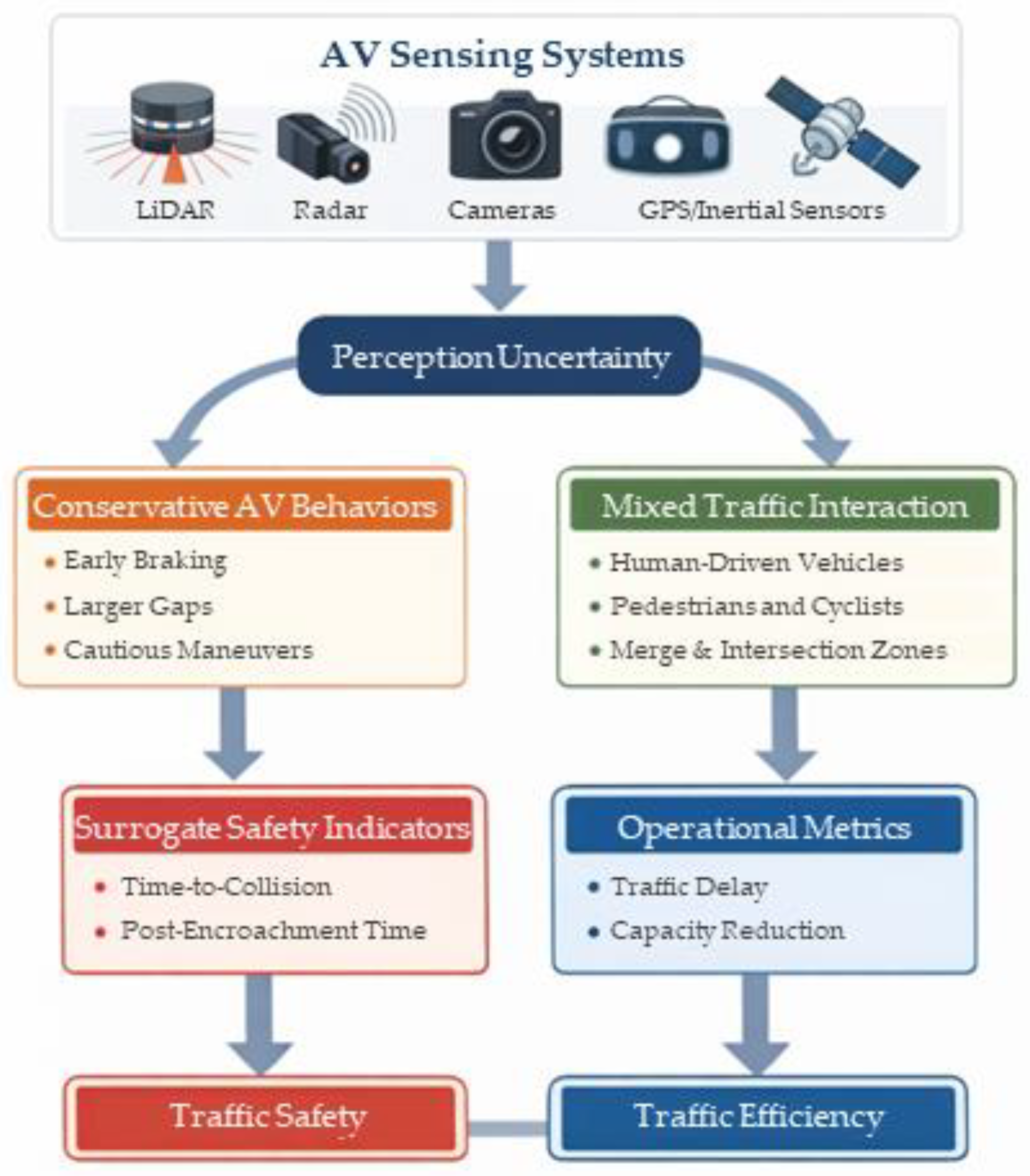
Sensing and perception systems form the foundation of AV operation by enabling vehicles to detect, interpret, and anticipate the behavior of surrounding road users and infrastructure. Contemporary AVs integrate LiDAR, radar, cameras, inertial sensors, and satellite-based positioning within sensor fusion frameworks to construct a robust real-time representation of the driving environment under varying traffic, lighting, and weather conditions [
3,
27].
From a traffic systems perspective, the key implication of AV perception lies not in achieving perfect environmental awareness, but in ensuring predictable and consistent behavior under uncertainty. Unlike human drivers, who rely on informal negotiation and intuition, AVs translate perception uncertainty into conservative algorithmic responses, such as earlier braking, larger following gaps, and cautious gap acceptance.
These perception-driven behaviors directly affect traffic safety and efficiency in mixed traffic environments. Conservative responses can reduce collision risk—particularly in interactions with vulnerable road users—but may also increase delays, lower intersection discharge rates, and raise minor conflict frequencies when AVs interact with more assertive human-driven vehicles. Such effects are most pronounced at intersections, merge areas, and lane-changing zones, where interaction complexity and perception ambiguity are highest.
Figure 2 illustrates how sensing and perception systems influence AV behavior and how these effects propagate to traffic-level safety and operational outcomes. Perception uncertainty acts as an intermediary between sensor performance and downstream impacts on surrogate safety indicators (e.g., time-to-collision and post-encroachment time) and operational metrics (e.g., delay and capacity).
Perception limitations are shaped not only by sensor technology but also by contextual factors such as adverse weather, occlusions, complex urban geometries, and dense mixed traffic. Although sensor fusion mitigates some of these challenges, residual uncertainty remains unavoidable and must be explicitly addressed in planning and control algorithms. Consequently, perception system design indirectly influences macroscopic traffic behavior by shaping the conservativeness and consistency of AV responses.
2.4. Traffic-Flow-Theoretic Foundations of Non-Linear Mixed-Traffic Effects
Many mixed-traffic findings reported in this review, including penetration-dependent capacity changes, delay amplification at intermediate penetration, and the emergence or suppression of stop-and-go waves, can be interpreted through established traffic-flow theory on phase transitions and bottleneck discharge. Phase-transition perspectives treat congestion onset as a regime shift between free flow and congested states, where traffic-state distributions can become bimodal and the transition boundary can be operationalized from observed speed and density distributions. This congestion-boundary view provides a principled basis for interpreting why small changes in behavior or control can induce discontinuous network-level changes in throughput and delay near critical operating conditions [
28]. At the microscopic level, heterogeneous car-following dynamics can generate congestion transitions on closed facilities such as ring roads through instability mechanisms that are sensitive to perception and control parameters, which helps explain why mixed fleets may exhibit non-monotone stability and oscillation patterns as automated control settings and heterogeneity vary [
29]. At bottlenecks, capacity and delay effects are further governed by dynamic discharge processes and the estimation of critical parameters from field data. Empirical bottleneck studies that estimate free-flow speed, critical speed or density, and capacity under recurring breakdown and recovery provide a reference point for interpreting whether simulated mixed-traffic capacity gains are plausible under real discharge dynamics, and they motivate reporting and comparing key assumptions such as headway policy and signal control regimes when translating simulation findings to practice [
30]. Throughout the remainder of the manuscript, we use these theoretical constructs to contextualize the reported non-linear mixed-traffic effects and to distinguish mechanisms driven by proximity to critical states from those attributable to specific automated control or operational interventions.
2.5. Decision-Making and Control Architectures
Decision-making and control architectures translate perceived environmental information into longitudinal and lateral vehicle maneuvers. From a traffic systems perspective, the most influential control parameters include desired time gaps, acceleration and deceleration limits, and responses to cut-in, merging, and intersection interactions. Conservative parameter settings improve safety and passenger comfort but may reduce effective roadway capacity when AVs interact with human-driven traffic.
Recent advances increasingly incorporate learning-based approaches, such as reinforcement learning and multi-agent control, to optimize vehicle behavior under complex and dynamic traffic conditions. When explicitly designed to balance safety, efficiency, and stability, these methods can reduce speed variability, dampen stop-and-go oscillations, and improve traffic flow consistency at both corridor and network levels. Nevertheless, safety-critical functions remain largely governed by rule-based or hybrid control structures to ensure predictability and regulatory compliance [
31,
32].
Overall, decision-making and control architectures serve as a key interface between vehicle-level intelligence and system-level traffic performance, directly shaping safety outcomes, capacity utilization, and interaction dynamics in mixed traffic environments.
2.6. Connectivity and Cooperative Systems
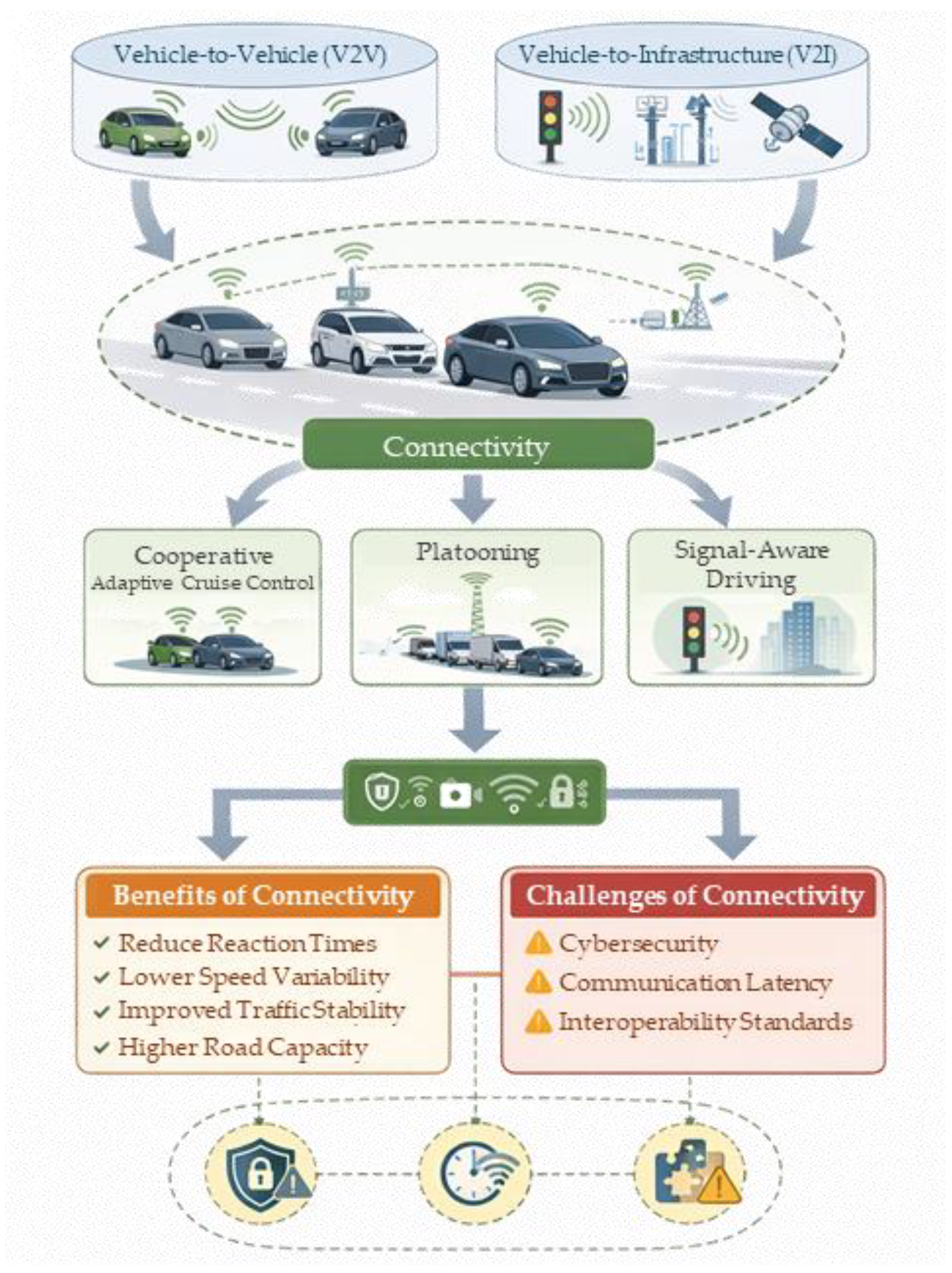
Connectivity significantly amplifies the traffic-level effects of automation by enabling coordination beyond individual vehicle perception and control. As illustrated in
Figure 3, vehicle-to-vehicle (V2V) and vehicle-to-infrastructure (V2I) communication support cooperative adaptive cruise control, platooning, and signal-aware driving, which reduce reaction times and speed variability while improving traffic stability and roadway capacity [
33,
34].
The effectiveness of cooperative systems depends strongly on market penetration rate, communication reliability, and infrastructure support. In mixed traffic environments, partial connectivity may yield uneven or localized benefits and can introduce disruptions when cooperative behaviors interact with non-connected vehicles, leading to non-linear system responses. While connectivity enables system-wide traffic optimization, it also introduces challenges related to cybersecurity, communication latency, and interoperability standards. Addressing these issues is essential to ensure that cooperative automation delivers predictable, scalable, and safe performance in heterogeneous traffic ecosystems [
35].
2.7. Synthesis Dimensions for Mixed-Traffic Evidence and Policy Evaluation
Because mixed-traffic studies differ substantially in evidence basis, operational setting, and outcome definitions, we organize the review using a small set of synthesis dimensions that recur throughout the manuscript. This approach enables consistent cross-study comparison without forcing heterogeneous designs into an overly reductive taxonomy. We characterize each contribution by its evidence basis, distinguishing analyses based on field or pilot data, controlled experiments, and simulation studies that are explicitly calibrated or validated using empirical observations. We also code the traffic context, distinguishing freeway segments and merges, arterials, signalized intersections, and network-level analyses. For transition dynamics, we record the AV and CAV penetration range examined and any reported threshold region where effects change sign or magnitude, since these threshold patterns are central to interpreting mixed-fleet performance. We additionally specify the interaction counterpart, distinguishing studies focused primarily on interactions with human-driven vehicles from studies that explicitly model or measure interactions with vulnerable road users. Where applicable, we identify the presence and type of policy or operational intervention, including infrastructure readiness, digital connectivity and data governance, institutional deployment requirements, and service design constraints that can condition observed performance in open mixed traffic [
36]. Finally, we record the outcome metrics reported, including efficiency measures such as delay and throughput, surrogate safety indicators, and environmental impacts when available. This synthesis framing is used throughout the remainder of the manuscript to make penetration-threshold and human to AV interaction claims traceable to the underlying evidence type and setting, while preserving interpretability through a structured narrative comparison rather than a single comprehensive classification table.
3. Materials and Methods
This review was conducted in accordance with the Preferred Reporting Items for Systematic Reviews and Meta-Analyses (PRISMA 2020) guidelines [
37] to ensure methodological transparency, reproducibility, and rigor.
3.1. Identification of Studies
A systematic literature search was performed across six major scientific databases: Scopus, Web of Science (WoS), ScienceDirect, IEEE Xplore, TRID, and SpringerLink. These databases were selected to capture a comprehensive range of studies spanning transportation engineering, intelligent transportation systems, urban mobility, and policy research.
Search strategies were designed to identify peer-reviewed publications addressing the integration of autonomous and connected autonomous vehicles (CAVs) within traffic ecosystems and their associated impacts. Keywords were organized into four conceptual groups:
- (1)
Autonomous vehicle technologies;
- (2)
Traffic ecosystems and mixed traffic conditions;
- (3)
Integration and deployment processes;
- (4)
Impact assessment domains, including safety, traffic flow, mobility efficiency, environmental effects, and policy implications.
An example of the search query used in Scopus is shown below:
TITLE-ABS-KEY ( ( “autonomous vehicle*” OR “self-driving car*” OR “automated vehicle*” OR
“connected autonomous vehicle*” OR “CAV” OR “AV” )
AND ( “traffic ecosystem” OR “mixed traffic” OR “urban mobility network” OR
“heterogeneous traffic” )
AND ( “integration” OR “deployment” OR “incorporation” OR “adoption” )
AND ( “impact assessment” OR “safety impact” OR “traffic flow” OR “mobility efficiency” OR
“environmental impact” OR “policy implication” OR “regulatory framework” ) )
Equivalent queries were adapted to the indexing structures of each database.
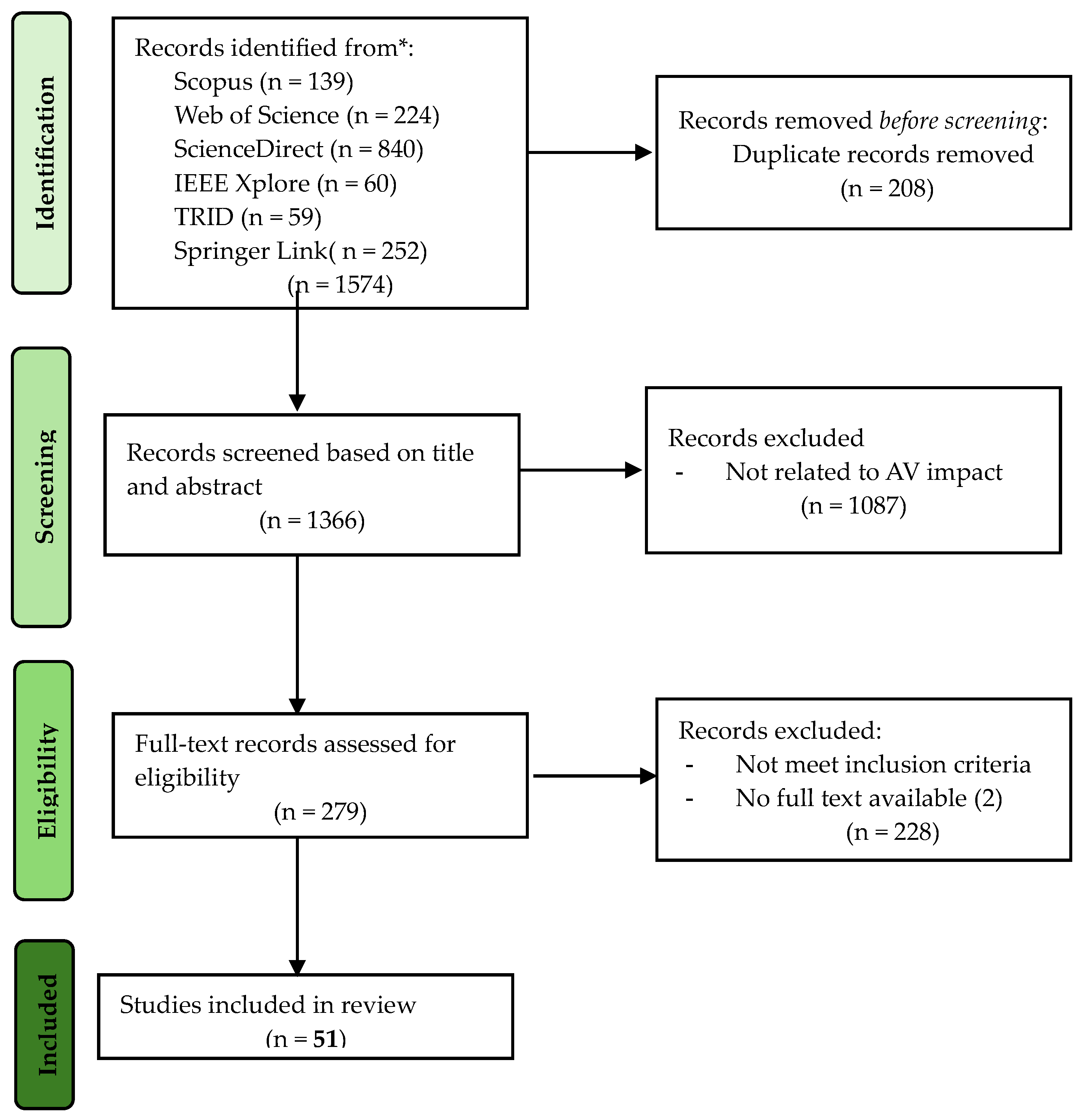
The initial search yielded 1574 records, distributed as follows: Scopus (139), Web of Science (224), ScienceDirect (840), IEEE Xplore (60), TRID (59), and SpringerLink (252).
3.2. Screening
All records were imported into a reference management system, where 208 duplicates were removed. The remaining 1366 records were screened based on titles and abstracts.
Studies were excluded if they:
Did not focus on autonomous or connected autonomous vehicles;
Were unrelated to traffic ecosystems, mixed traffic, or urban transportation networks;
Addressed vehicle-level technologies without traffic- or system-level implications.
3.3. Eligibility Assessment
Full-text versions of the remaining articles were retrieved and assessed against predefined inclusion and exclusion criteria.
Inclusion criteria were:
Publication in English;
Publication between 2016 and 2025;
Journal articles, conference papers, or review articles;
Explicit discussion of AV integration, deployment, or adoption;
Evaluation of at least one impact dimension (safety, traffic flow, mobility efficiency, environmental impact, or policy/regulatory implications).
Studies were excluded if they lacked sufficient methodological transparency or analytical rigor for system-level comparison. Specifically, simulation-based and modeling studies were excluded if any of the following minimum requirements were not met:
- (i)
A clear description of the traffic scenario design, including network type, demand assumptions, and interaction context (e.g., mixed traffic composition);
- (ii)
An explicit definition of the baseline or reference scenario against which autonomous or connected vehicle impacts were evaluated;
- (iii)
A clear specification of performance metrics (e.g., safety indicators, delay, capacity, or mobility measures) and their computation;
- (iv)
Evidence of model validation, calibration, or verification, such as sensitivity analysis, comparison with empirical data, or reference to established simulation frameworks.
Studies failing to meet these criteria were excluded to ensure analytical consistency and comparability across the reviewed literature.
3.4. Included Studies
Following full-text assessment, 51 studies met all inclusion criteria and were selected for qualitative synthesis. The final sample comprises a balanced mix of journal articles, conference papers, and review studies covering engineering, transportation planning, and policy perspectives.
To provide contextual insight into the empirical basis of the reviewed literature,
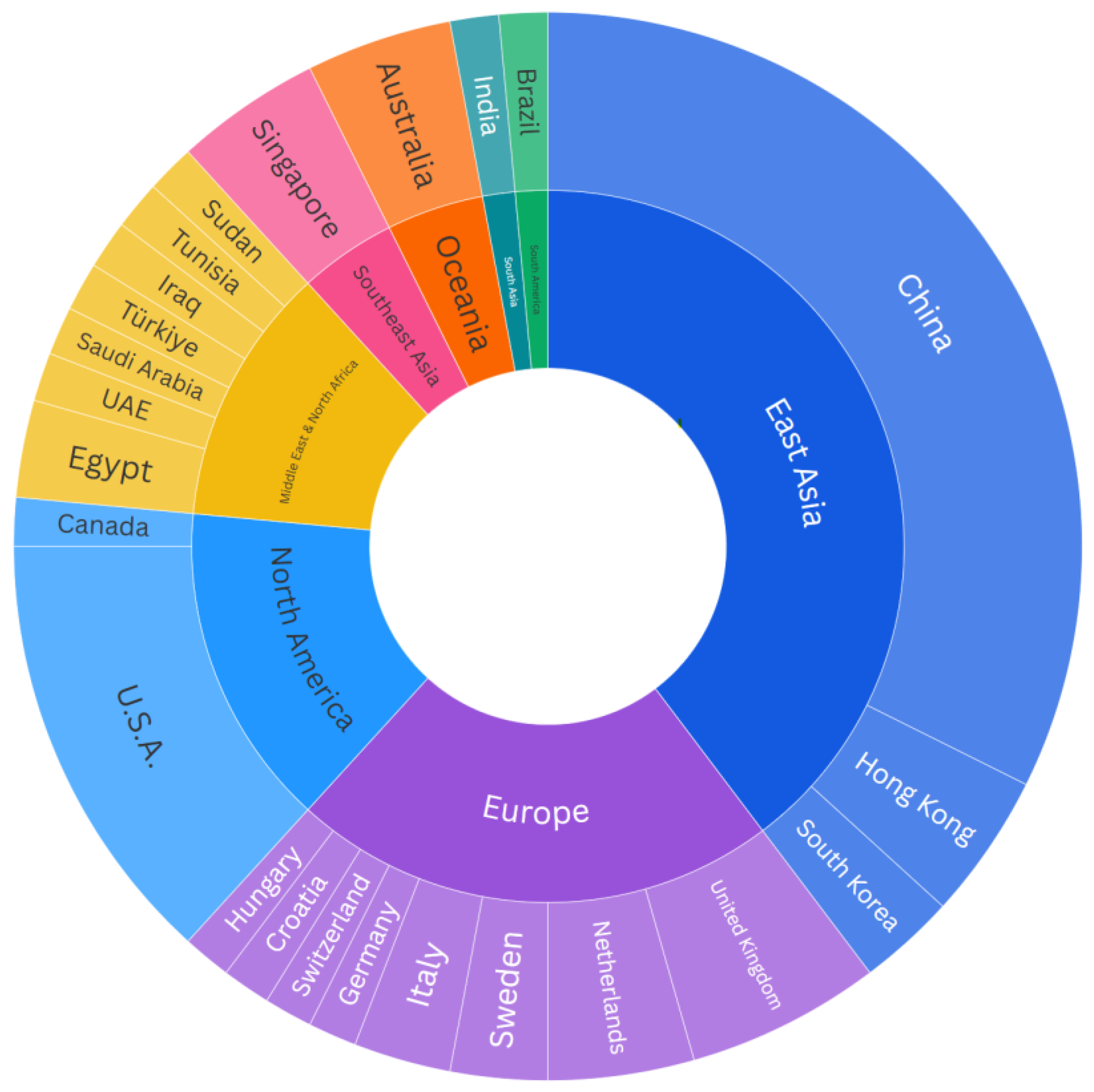
Table 1 summarizes the geographic distribution of the included studies, their dominant traffic environments, and observed regional patterns. This overview supports interpretation of reported performance thresholds and highlights potential influences of traffic culture, regulatory context, and deployment maturity on study outcomes.
Because several publications involve international collaboration, the table reflects the geographic participation of the research ecosystem rather than a mutually exclusive study classification. Consequently, regional shares should be interpreted as the proportion of total affiliations contributing to the literature, not the proportion of unique studies.
Figure 4 illustrates the geographic distribution of the reviewed studies, highlighting the concentration of research in East Asia, North America, and Europe.
3.5. Data Extraction and Synthesis
A standardized data extraction form was developed prior to data collection to ensure consistency and transparency. The form included fields for bibliographic information, research objectives, methodological approach, traffic context, assumed AV/CAV market penetration levels, performance indicators, and policy or infrastructure considerations (see
Table S2).
Data extraction was performed independently by two reviewers using this standardized template. The extracted datasets were subsequently cross-checked, and any discrepancies were resolved through discussion. When necessary, a third reviewer was consulted to reach consensus. Missing or unclear information was verified by re-examining the original publications; if relevant data could not be retrieved, the corresponding fields were recorded as “not reported” and excluded from comparative synthesis.
For qualitative synthesis, a structured thematic analysis approach was applied using a predefined coding framework developed iteratively during pilot extraction. Initial codes were derived from the review objectives and PRISMA recommendations and were refined through repeated comparison across studies. Each included article was coded independently by two reviewers with respect to technological context, traffic environment, performance indicators, and policy implications.
Codes were subsequently grouped into higher-level analytical themes, including safety impacts, traffic flow and mobility performance, mixed traffic dynamics, infrastructure and urban systems, and governance challenges. Conflicting or divergent findings across studies were integrated through comparative analysis, with explicit consideration of differences in modeling assumptions, study design, traffic context, and market penetration scenarios. Rather than averaging inconsistent results, emphasis was placed on identifying contextual moderators and explaining sources of heterogeneity.
Reported numerical ranges (e.g., capacity gains of 1–84%) represent the full spectrum of values documented in the included studies and are intended to illustrate inter-study variability. These ranges were derived by systematically compiling all comparable reported outcomes within each thematic category, rather than through statistical aggregation or meta-analysis.
For studies reporting time to collision (TTC) or post-encroachment time (PET), we additionally extracted the penetration range tested, the AV control-strategy class (for example conservative time-gap policies versus cooperative control), and whether human recognition of AVs was modeled explicitly, implicitly via kinematic cues, or not specified.
The validated thematic structure provided the basis for qualitative interpretation and cross-domain synthesis.
3.6. PRISMA Flow Diagram
A PRISMA flow diagram was developed to document the study selection process. As illustrated in
Figure 5, the initial database search identified 1574 records. After duplicate removal and screening, 51 articles were retained and included in the final qualitative synthesis.
3.7. Review Protocol and Screening Procedures
A formal review protocol was developed internally prior to the literature search; however, it was not registered in an external repository (e.g., PROSPERO).
Conference abstracts without full papers, technical reports, white papers, theses, policy briefs, preprints, and other non–peer-reviewed sources were intentionally excluded to ensure consistency, methodological transparency, and comparability of results across studies. This decision reflects the objective of synthesizing validated, peer-reviewed evidence on autonomous vehicle integration and its system-level impacts.
Title and abstract screening was conducted independently by two reviewers. Inter-reviewer agreement at this stage was 88.4%, with Cohen’s kappa = 0.534. Full-text eligibility assessment was also performed independently by the same two reviewers, achieving 92.5% agreement and Cohen’s kappa = 0.697. Disagreements at either stage were resolved through discussion; when consensus could not be reached, a third reviewer acted as an arbitrator. No automated screening tools were used.
This multi-reviewer process, together with the reported inter-reviewer agreement statistics, was adopted to reduce selection bias and enhance the reliability and reproducibility of study inclusion decisions. A completed PRISMA 2020 checklist indicating where each reporting item is addressed is provided in
Table S1.
4. Results
The synthesis of the 51 selected studies reveals that the impacts of AVs on traffic systems are highly heterogeneous and strongly dependent on deployment context, market penetration rate, and interaction dynamics with human-driven traffic. Rather than producing uniform benefits, the reviewed literature consistently reports non-linear and sometimes counterintuitive effects across safety, traffic flow, and mobility performance, particularly during transitional mixed-traffic phases. Accordingly, the results are structured around five interrelated domains: safety impacts, traffic flow and network performance, mixed traffic dynamics, infrastructure and urban systems, and policy and governance challenges, highlighting both areas of convergence and persistent uncertainty.
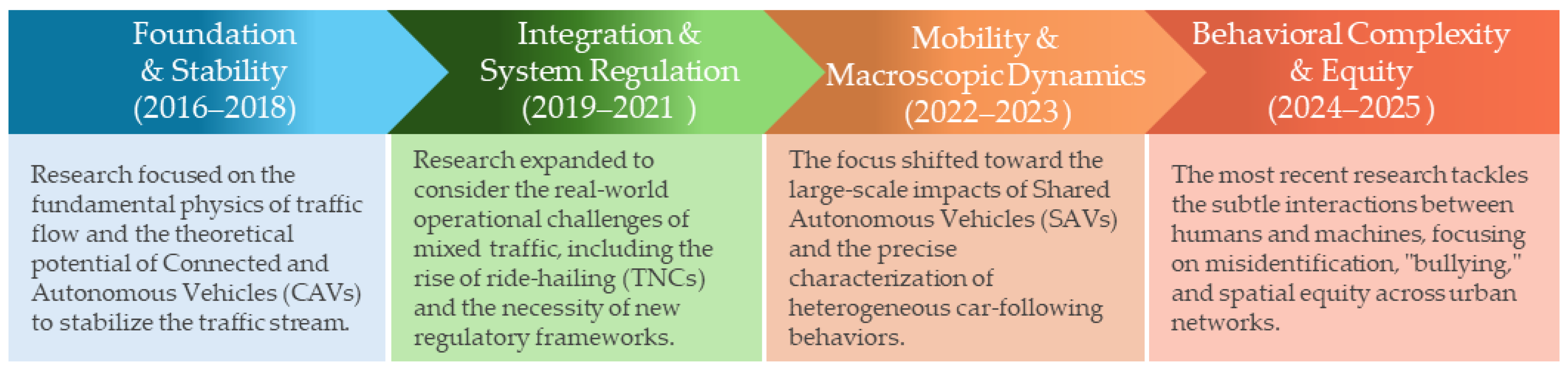
Figure 6 summarizes the temporal evolution of dominant research themes from 2016 to 2025, illustrating the shift from technical feasibility studies toward system-level, behavioral, and governance-oriented research.
Research on the impacts of AVs is generally divided into empirical and simulation-based studies, with findings strongly influenced by assumptions regarding key variables such as market penetration rate (MPR), headway, and signal control. Empirical studies rely on naturalistic datasets such as Argoverse-2, the Waymo Open Dataset, and OpenACC [
38,
39] and typically focus on localized interactions, revealing that current AVs tend to adopt more conservative driving behaviors than human drivers. In contrast, simulation-based studies use microscopic tools such as SUMO, VISSIM, and AIMSUN [
38,
40,
41] and macroscopic or mesoscopic models such as CTM and ILUTM to examine large-scale impacts, including network performance and urban sprawl [
42,
43,
44]. These studies commonly test hypothetical scenarios, such as full AV penetration or dedicated lanes, that are not yet observable in practice [
45]. Across both approaches, results are highly sensitive to parameter distributions, with capacity gains often emerging only beyond 30–60% MPR [
40,
46], assumed AV headways ranging from 0.5 to 1.5 s [
47,
48], and coordinated signal control significantly reducing delays when combined with platooning [
40,
49].
4.1. Autonomous Vehicles and Safety Impacts
Improving road safety is one of the primary motivations for the development and deployment of AVs, particularly given that approximately 94% of road traffic crashes are attributed to human [
47,
50]. By replacing or assisting human driving tasks with automated perception, decision-making, and control, AVs have the potential to substantially reduce collision frequency and severity. However, the reviewed literature consistently emphasizes that safety outcomes during the transition toward automation are complex and strongly shaped by interactions among AVs, human-driven vehicles (HVs), and VRUs in mixed traffic environments [
51,
52]. The safety analysis in this section emphasizes interactions among AVs and HVs, and, where relevant, indirect effects involving VRUs.
Because mixed traffic conditions are expected to persist for several decades, understanding safety impacts during partial and incremental deployment phases is critical. Rather than producing immediate and uniform safety improvements, AV integration often leads to non-linear and sometimes counterintuitive safety effects, particularly at low and moderate levels of market penetration.
4.1.1. Causal Framework for Surrogate Safety Measures in Mixed Traffic
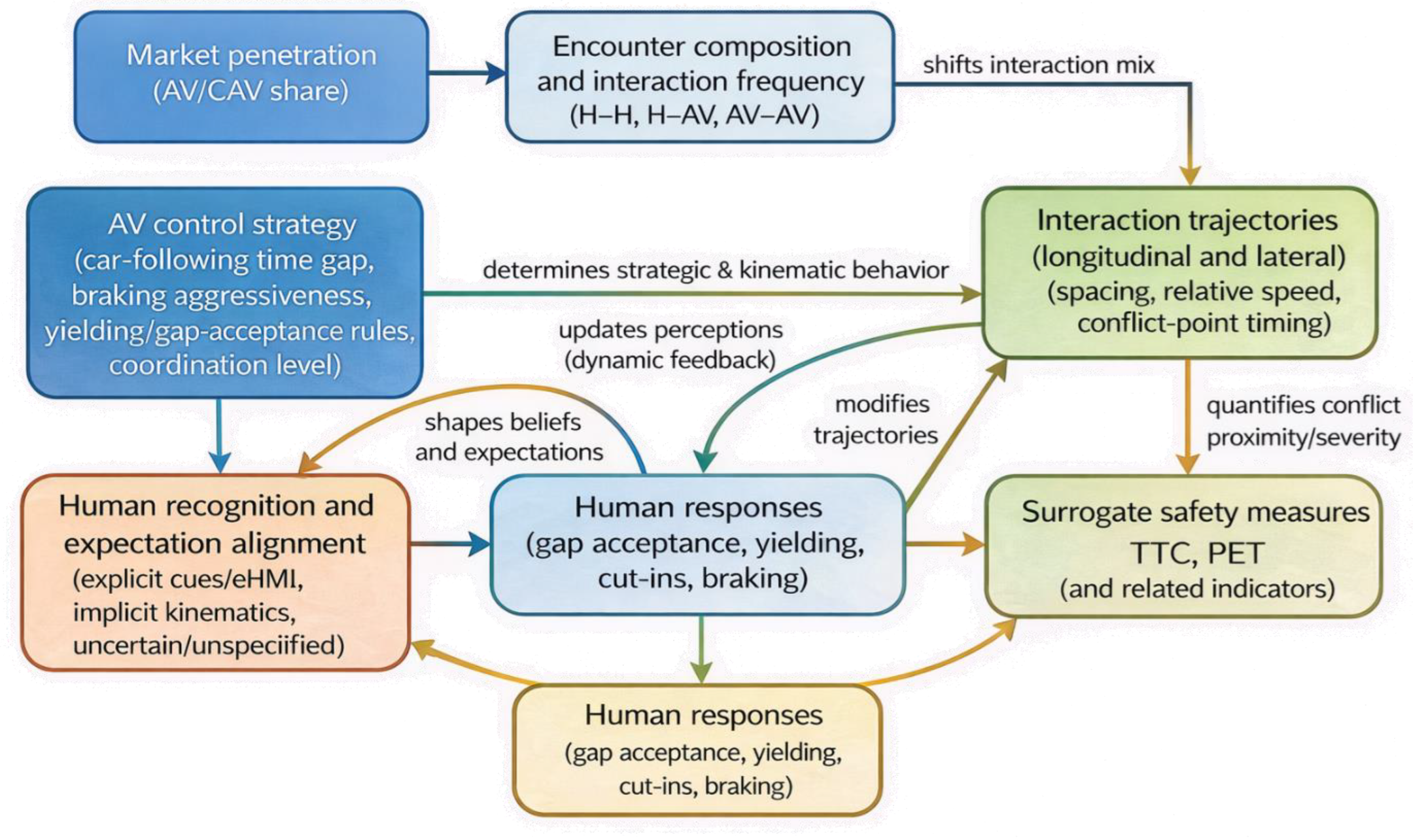
Surrogate safety measures quantify risk through interaction kinematics and therefore vary systematically with the conditions that shape vehicle trajectories. In this review, we interpret TTC and PET as downstream observables of three upstream condition variables that recur across mixed-traffic studies, namely market penetration of AVs and CAVs, the AV control strategy deployed, and human recognition of AV behavior. Penetration affects encounter composition and interaction frequency, which changes the share of human–human, human–AV, and AV–AV conflicts observed and can shift operating conditions toward or away from critical states in which small perturbations amplify. Control strategy shapes longitudinal and lateral trajectories through parameters such as desired time gap, braking aggressiveness, gap acceptance, and yielding rules, which directly affect the spacing and relative-speed terms that TTC reflects and the conflict-point timing that PET reflects. Human recognition affects the human road user’s beliefs about AV intent and capability, which can alter responses such as cut-ins, merging aggressiveness, gap acceptance, and yielding compliance, thereby changing the interaction trajectories from which TTC and PET are derived. We therefore synthesize safety evidence, including TTC and PET findings, conditionally reporting how measures change across penetration ranges and control classes and indicating whether studies model recognition explicitly, implicitly via kinematics, or leave it unspecified. This structure is intended to distinguish effects attributable to conservative automated kinematics from effects driven by expectation mismatch and interaction adaptation, which is central for interpreting mixed-traffic safety during the transition regime.
Figure 7 summarizes the causal structure used in this section to interpret surrogate safety measures in mixed traffic, organizing TTC and PET findings by market penetration, AV control strategy, and human recognition of AV behavior.
4.1.2. Impact of Market Penetration Rates (MPR)
A central finding across multiple studies is that safety benefits are highly sensitive to AV market penetration rates (MPR). At low penetration levels, typically below 40%, the frequency of traffic conflicts may increase rather than decrease [
41,
47]. This increase is primarily attributed to behavioral mismatches between AVs and HVs, which require frequent adaptation and can destabilize traffic interactions. Human drivers often struggle to anticipate the conservative or non-intuitive maneuvers of early-generation AVs, resulting in elevated conflict rates and reduced interaction efficiency [
9,
52].
In contrast, when AV penetration exceeds approximately 75–80%, safety benefits become pronounced and more consistent. Several studies (mainly 2–3 simulation-based works, notably [
47]) report conflict reductions of up to 91.77% under very high AV/CAV penetration levels (≈80–100%), assuming coordinated control and platooning. These results were primarily obtained in controlled urban and arterial network scenarios, while most other studies report more moderate reductions (typically 20–60%) under comparable conditions.
4.1.3. Conflict Resolution and Interaction Mechanics
While pedestrian and cyclist interactions with AVs are important, a comprehensive analysis of vulnerable road user behavior lies outside the primary scope of this review, which focuses on system-level vehicle interactions and traffic performance.
AVs are typically designed to adopt conservative driving strategies, including smoother acceleration profiles, earlier braking, and larger safety margins, to ensure robustness under uncertainty [
39]. While such strategies reduce crash likelihood, they may also increase delays and interaction frictions, particularly in complex scenarios such as unprotected left turns, dense urban intersections, and merging areas.
Human–AV interactions further complicate safety outcomes. Empirical and simulation-based evidence indicates that human drivers do not significantly alter their behavior once engaged in interactions with AVs at intersections, whereas pedestrians tend to behave more cautiously, often delaying crossings in the presence of AVs [
39]. A critical issue arises from the limited ability of human drivers to correctly identify AVs. Misidentification has been shown to increase average vehicle delay, while accurate recognition can reduce delay by up to 30% and collision risk by 54.4% [
53].
Several studies also document the emergence of aggressive or “bullying” behavior, whereby human drivers are more likely to cut in front of or challenge AVs than other HVs [
52]. Such behaviors undermine the conservative assumptions embedded in AV control algorithms and introduce new safety risks that are not captured by vehicle-level validation alone.
4.1.4. Platooning and Technological Factors
Platooning has emerged as a key mechanism for enhancing safety in AV-dominated traffic systems. Through vehicle-to-vehicle communication and coordinated control, platoons reduce speed variability, minimize unnecessary lane changes, and increase inter-vehicle predictability [
40].
The safety effectiveness of platooning is strongly dependent on AV penetration levels. Smaller platoons (e.g., three vehicles) are more effective at lower penetration rates (around 25%), whereas larger platoons (five vehicles or more) provide greater safety benefits at higher penetration levels by stabilizing traffic flow and reducing disruptive interactions [
47].
From a technological perspective, simulation studies indicate that realistic sensor measurement errors, such as radar noise, do not substantially increase conflict rates, suggesting that current sensing technologies are generally sufficient for safe operation under typical conditions [
47]. Moreover, advanced control approaches based on multi-agent reinforcement learning (MARL), including the MA2C algorithm, explicitly incorporate safety, efficiency, and comfort objectives. These methods promote smoother and more predictable behavior, contributing to improved safety and traffic stability in smart city contexts [
54].
4.1.5. Safety-Related Key Performance Indicators
We adopt standard surrogate-safety definitions in which time to collision is the projected time to collision under continuation of the current relative kinematics, and post-encroachment time is the temporal separation between successive road users at a shared conflict point, widely used to quantify near-conflicts in surrogate safety assessment [
55,
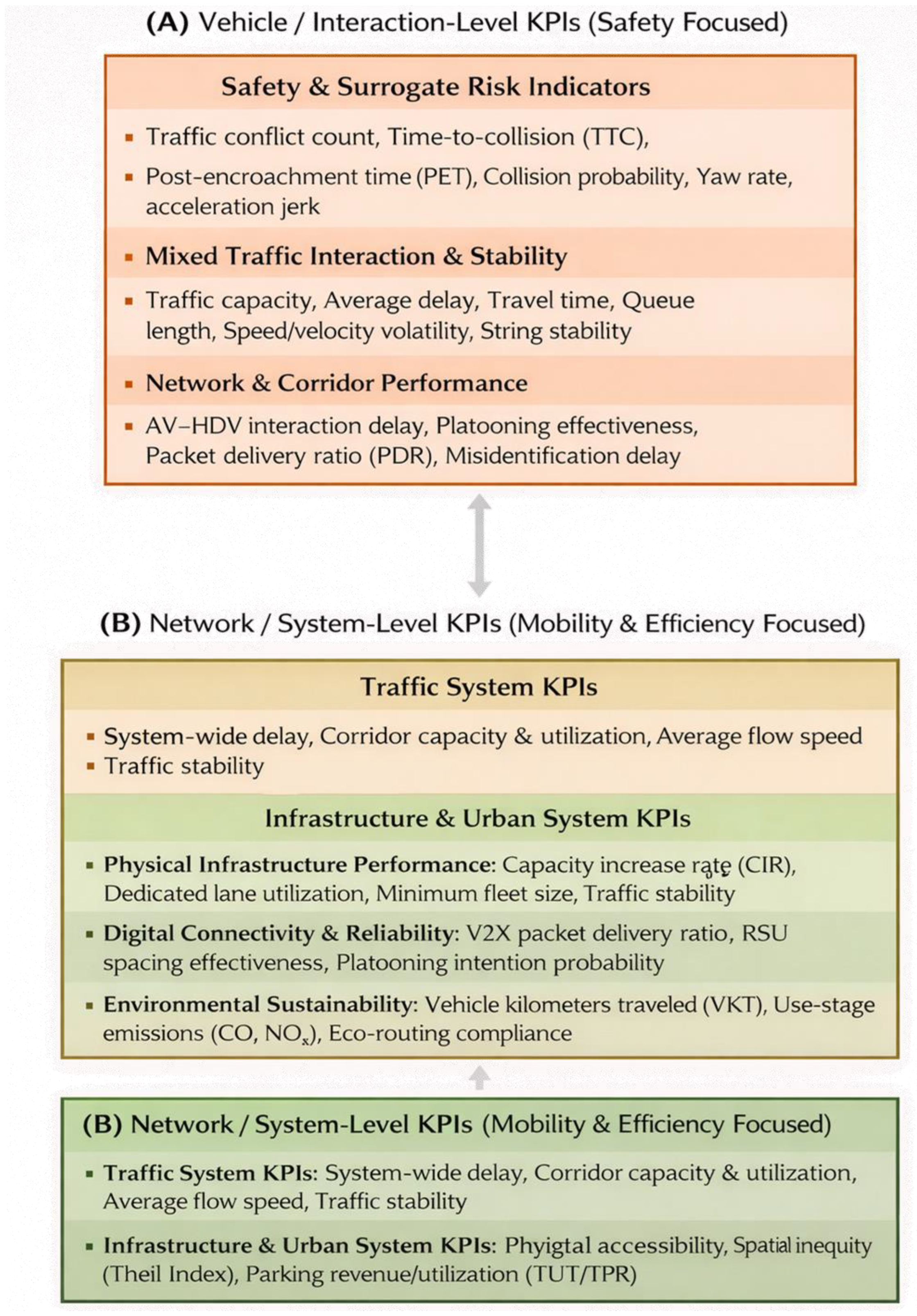
56]. Because both measures are computed from interaction trajectories, their reported values depend not only on underlying behavior but also on study-specific measurement choices such as conflict-point definition, trajectory resolution, smoothing, and event filtering. Accordingly, we interpret TTC and PET trends in light of the assumptions stated in each study and we emphasize conditional patterns rather than unconditional comparisons. Definitions and computational conventions for the principal indicators used in the reviewed literature are summarized in
Table 2.
We synthesize surrogate-safety evidence conditionally by market penetration range, AV control class, and human recognition conditions because these upstream variables jointly shape encounter composition, interaction kinematics, and behavioral adaptation in mixed traffic. Market penetration affects exposure by changing the relative frequency of human–human, human–AV, and AV–AV encounters, and it can shift operating conditions toward or away from critical traffic states where small perturbations amplify. Control strategy affects trajectories through settings such as desired time gap, braking responsiveness, gap-acceptance logic, and yielding rules, which directly influence spacing and relative speed and therefore TTC, as well as conflict-point timing and therefore PET. Human recognition and expectation alignment affect how humans anticipate AV intent and capability, which can modify cut-ins, merging aggressiveness, yielding compliance, and braking responses, thereby altering the trajectories from which surrogate measures are derived. For interpretability, when reporting TTC and PET results we label, where available, the penetration range studied, the control class, and whether recognition is modeled explicitly, implicitly via kinematics, or left unspecified, because these conditions frequently explain divergences that would otherwise appear contradictory.
PET is most informative in crossing and lateral-conflict contexts where timing at a shared conflict point governs near-miss severity. Conservative yielding and cautious gap acceptance can increase PET by increasing temporal separation at conflict points, but can also shift interaction incentives and reduce PET if human drivers respond with late acceleration or aggressive gap-taking under perceived AV caution. Recognition conditions are therefore particularly consequential for PET, because human expectations about whether an AV will yield influence both the decision to initiate a crossing or merge and the timing of that maneuver. Studies that explicitly model recognition or communicate intent typically report fewer ambiguous encroachments and a shift toward larger PET margins than studies where recognition is implicit through kinematics or unspecified, although the direction and magnitude remain scenario-dependent.
Beyond TTC and PET, the literature commonly reports conflict frequency or conflict rate as an exposure-sensitive indicator, along with collision-risk proxies, speed volatility, acceleration jerk, and vehicle-dynamics measures such as yaw rate. Conflict frequency can increase even when average TTC increases if interaction opportunities rise with penetration or demand, so conflict counts should be interpreted jointly with severity-sensitive measures such as TTC and PET and with normalization choices such as per-vehicle or per-distance rates. Speed volatility and acceleration jerk provide complementary evidence about stability and comfort-related safety, and reductions in these measures are often aligned with improved surrogate safety when they reflect suppressed oscillations and reduced abrupt braking. However, these indicators can also reflect control conservatism that improves comfort while shifting risk to specific interaction moments, so they should be interpreted alongside the maneuver context and recognition conditions described above. Overall, surrogate-safety improvements are most robust when control strategies reduce speed variance and stabilize trajectories across interaction contexts, whereas changes in TTC and PET are frequently conditional on penetration range, merging and gap-acceptance logic, and whether recognition or intent communication is modeled, and these structural assumptions should be stated explicitly when drawing mixed-traffic safety conclusions.
4.2. Traffic Flow, Mobility and Network Performance
The large-scale deployment of AVs and CAVs is widely expected to transform urban traffic operations by altering fundamental relationships between demand, capacity, and control. Existing research shows that these impacts range from substantial capacity enhancements under coordinated automation to more nuanced and sometimes adverse effects during transitional deployment phases [
40,
49,
60,
61]. In practice, urban networks are likely to operate for extended periods under mixed traffic conditions, where human-driven vehicles (HDVs), vehicles equipped with advanced driver assistance systems (ADAS), and fully automated vehicles coexist. While such heterogeneity creates opportunities for efficiency gains, it also introduces significant operational and control challenges that complicate network-level performance [
9,
41,
46,
62].
4.2.1. Network Capacity and Flow Throughput
One of the most frequently cited advantages of AV and CAV technologies is their potential to increase roadway capacity by reducing reaction times, stabilizing car-following behavior, and enabling shorter inter-vehicle headways [
45,
60,
63]. Macroscopic fundamental diagram (MFD)–based analyses indicate that AV deployment can increase overall urban network capacity by up to 19% under conservative control and limited coordination assumptions [
38]. In contrast, freeway and arterial corridor studies assuming cooperative platooning and high connectivity report substantially higher throughput gains, reaching up to 84% in a small subset of favorable simulation scenarios [
52,
63]. At the urban network scale, simulation studies report that scenarios with full AV penetration can yield maximum flow increases of 16–23% relative to conventional traffic conditions [
40]. These values therefore reflect different traffic contexts and modeling assumptions rather than a uniform system-wide effect.
Capacity improvements are further amplified through coordinated platooning enabled by vehicle-to-vehicle (V2V) and vehicle-to-infrastructure (V2I) communication. Platooning strategies have been shown to nearly double urban road throughput, while intersection capacities may increase by factors of two to three under coordinated control regimes [
40,
64,
65]. However, these benefits are highly sensitive to AV market penetration rates (MPR). Multiple studies suggest that meaningful network-wide capacity gains typically require an MPR of at least 20–30%; below this threshold, underutilization of dedicated infrastructure and localized congestion effects may offset potential benefits [
9,
45,
46].
The highest reported throughput gains (>70%) are mainly observed in corridor-based studies with coordinated control and near-ideal communication conditions (
Table 3), whereas urban network-scale analyses typically report more moderate improvements (below 25%). Conservative following-gap settings, partial connectivity, and heterogeneous traffic compositions significantly reduce achievable capacity gains in mixed urban environments.
4.2.2. Travel Time and Traffic Delays
Reported changes in travel time and delay are not directly comparable across facility types because the dominant delay-formation mechanisms differ between freeway and bottleneck-dominated operation and signal-controlled urban operation. Accordingly, we synthesize delay evidence by network type rather than pooling values across heterogeneous contexts. We distinguish freeway and bottleneck-dominated settings, where breakdown probability, discharge dynamics, and merge or weaving interactions govern effective performance, from urban arterial and signal-controlled settings, where signal density, progression quality, queue spillback, and control regime dominate delay formation. Mixed-network studies that include both bottlenecks and signalized links are treated as a separate class, and results are interpreted with the corresponding network composition and control assumptions when stated.
In freeway and bottleneck-dominated settings, early-stage AV deployment may initially increase travel times and network delays despite long-term efficiency gains at high penetration. This pattern is commonly attributed to conservative control logic, safety-oriented driving behavior, and interaction frictions with human drivers, particularly when AV policies increase desired time gaps or apply cautious merging and lane-changing behavior under uncertainty [
9,
40,
41,
51]. Within this facility class, one simulation-based study indicates that at low to moderate penetration levels (approximately 10–50%), average delays can increase by roughly 4–18% relative to HDV-dominated baselines [
9], with the direction and magnitude depending on whether the limiting mechanism is recurrent breakdown, discharge constraints, or interaction-driven turbulence near bottlenecks. Consistent with this, freeway-focused infrastructure strategies that manage interactions, such as optimized AV-dedicated lane placement and configuration on expressways, are reported to reduce total travel time primarily once AV market penetration is sufficiently high to sustain dedicated operations without inducing underutilization or disruptive merges, with more pronounced benefits reported when penetration exceeds roughly 30% [
66,
67].
In urban arterial and signal-controlled settings, delay outcomes are particularly sensitive to intersection interactions, signal control assumptions, and the extent to which human drivers correctly anticipate AV behavior. Interaction frictions are amplified in complex maneuvers, and misinterpretation of AV driving mode can substantially exacerbate delays during conflict-prone movements such as straight–left interactions at signalized intersections. Under such conditions, very large delay amplification has been reported, including increases up to 79.3% attributable to driving-mode misidentification in a two-phase signalized intersection setting [
53]. These findings highlight that urban delay impacts are not solely a function of penetration, but also of behavioral inference, yielding conventions, and the signal-control environment. Accordingly, a limited number of studies (notably [
53]) have examined misidentification-induced delays.
In mixed networks and corridor-scale studies that combine signalized links and bottleneck mechanisms, reported delay changes reflect the interaction between intersection control, queue spillback, and network-level gating of demand. In this class, network control strategies that leverage AVs as sensing and actuation elements can offset early-stage delay increases even at very low penetration. For example, perimeter control approaches that use AVs as mobile sensors report delay reductions up to 33.5% at penetration levels around 5%, indicating that network-level coordination can dominate purely local interaction frictions when appropriately designed [
64]. Across these mixed-facility contexts, policy-relevant interpretations therefore require that reported delay effects be read jointly with network composition, control architecture, and the specific interaction and recognition assumptions embedded in the study design, rather than as a single pooled range.
4.2.3. Traffic Stability and Oscillation Mitigation
Beyond capacity and delay metrics, AVs and CAVs demonstrate substantial potential to enhance traffic stability by mitigating stop-and-go oscillations that contribute to congestion, energy inefficiency, and driver discomfort [
49,
54,
59]. Connectivity enables improved string stability by allowing vehicles to respond almost instantaneously to upstream disturbances, thereby reducing amplification of speed fluctuations along traffic streams [
48,
49,
62]. Control strategies such as the FollowerStopper (FS) controller have been shown to effectively dampen traffic waves, with additional gains achieved through cooperative platoon-based driving across a wide range of traffic densities [
59].
At the macroscopic level, random walk–based analyses suggest that AVs can reduce the propagation and severity of traffic jams by adopting proactive “slow-in” strategies, whereby earlier and smoother deceleration limits the capacity drop typically induced by abrupt human braking behavior [
48]. These findings underscore that stability improvements may represent one of the earliest and most robust system-level benefits of automation, even before full capacity gains are realized
4.2.4. Mobility, Policy, and Land-Use Integration
The emergence of autonomous mobility-on-demand (AMoD) systems and shared autonomous vehicles (SAVs) is expected to induce structural changes in vehicle ownership, travel demand, and urban spatial organization [
68,
69,
70]. Simulation-based studies suggest that widespread adoption of SAVs could reduce the total number of vehicles in a city to less than 7% of current levels. However, these reductions may be offset by increases in vehicle kilometers traveled (VKT) due to empty repositioning trips, unless high levels of ride-sharing are achieved [
68]. When ride-sharing participation exceeds approximately 60%, VKT can be stabilized or reduced.
Policy and economic regulation play a decisive role in shaping these outcomes. Instruments such as minimum wage floors for human drivers, congestion pricing, and tradable credit schemes (TCS) have been shown to improve welfare outcomes and mitigate inefficient platform competition, often characterized as “wild goose chases” [
60,
69,
71,
72]. From a land-use perspective, private vehicle automation tends to encourage urban sprawl, whereas investments in autonomous public transport promote population clustering and more compact development patterns [
42,
70]. Integrated pricing strategies that combine SAV fares with congestion pricing can improve regional accessibility by up to 14%. Moreover, smart parking pricing policies are increasingly critical, as AVs’ ability to cruise or park remotely may otherwise exacerbate roadway congestion [
67] (Zhang, Zhang et al. 2025).
4.2.5. Foundational Modeling Frameworks and Simulation Tools
Advances in traffic modeling increasingly adopt cyber–physical system (CPS) perspectives that integrate communication networks, traffic flow dynamics, and vehicle-level control. Co-simulation platforms combining V2X communication modules (e.g., OMNeT++), traffic simulators (e.g., SUMO, Aimsun), and vehicle dynamics environments (e.g., Webots) enable high-fidelity evaluation of AV and CAV applications [
47,
61,
73]. These frameworks support the assessment of strategies such as eco-driving and adaptive traffic signal control (ATSC), which leverage real-time infrastructure-to-vehicle (I2V) communication to reduce emissions and optimize progression through signalized corridors [
46,
73,
74,
75].
Across these modeling frameworks, performance evaluation relies on a common set of traffic flow and mobility indicators that quantify capacity, delay, stability, and travel efficiency at corridor and network scales. A synthesized overview of these key performance indicators—together with their reported impacts under varying AV and CAV penetration levels—is provided in
Table 4. These metrics underpin the capacity, delay, and stability analyses.
4.3. Mixed Traffic (AVs and Human-Driven Vehicles)
The integration of AVs and CAVs into existing urban networks will occur through a prolonged transitional phase characterized by mixed traffic conditions, in which automated and human-driven vehicles share infrastructure and interact continuously [
9,
46,
61]. During this phase, vehicles with differing automation levels must negotiate road space, priority, and interaction protocols, creating complex dynamics that influence traffic stability, network efficiency, and user acceptance. As a result, mixed traffic represents not merely an intermediate deployment stage, but a defining operational condition that shapes the real-world impacts of automation.
Most studies reviewed in this section are based on simulations, short-term trials, or pilot deployments in which human drivers have limited prior experience with AVs; consequently, the reported effects largely reflect initial-contact conditions. A key challenge in such settings is that AVs cannot convey intent through eye contact or gestures, leading to the development of external human–machine interfaces (eHMIs) and infrastructure-based signaling (e.g., SPaT messages) to indicate yielding, stopping, or priority. Evidence suggests that these communication technologies moderate misidentification and behavioral mismatch by improving predictability and reducing hesitation and aggressive interactions. Large-scale pilots conducted by Waymo and Cruise [
69] have tested external displays and standardized yielding behaviors, showing that consistent signaling can support smoother interactions and higher user trust, although cross-manufacturer standardization remains limited.
4.3.1. Traffic Performance and Efficiency Impacts
Evidence across the reviewed studies consistently indicates that traffic performance under mixed conditions exhibits strong non-linear responses to AV and CAV market penetration rate (MPR), as well as sensitivity to behavioral and control parameters [
9,
61,
79]. At low to moderate penetration levels, the introduction of automated vehicles may degrade overall network performance despite their advanced capabilities. For example, on-ramp merging simulations report that AV penetration levels of 10%, 25%, and 50% correspond to increases in average total network delay of approximately 4%, 7%, and 18%, respectively, relative to conventional traffic. These effects are primarily attributed to conservative AV maneuvers that prioritize safety margins, thereby reducing effective capacity utilization in mixed streams [
9].
By contrast, at higher penetration levels, AVs and CAVs can substantially improve throughput and flow stability. Under favorable control assumptions, some studies report potential throughput gains exceeding 100%, with fully autonomous vehicles delivering greater benefits than connected-only vehicles at comparable market shares [
9]. Sensitivity analyses further highlight that network outcomes depend critically on the configuration of longitudinal control parameters. In particular, desired time gap has been identified as the most influential factor, followed by standstill distance and acceleration from rest, underscoring that the qualitative design of automation strategies can be as consequential as the quantitative level of deployment.
4.3.2. Strategic Management and Infrastructure
Effective management of mixed traffic typically requires coordinated operational strategies supported by targeted infrastructure interventions. Dedicated lanes for CAVs can enhance operational efficiency, particularly when integrated with adaptive intersection signal scheduling [
79]. Beyond lane allocation, vehicle occupancy emerges as a high-leverage system variable. Increasing average passenger load reduces the number of vehicles required to satisfy fixed travel demand, with simulation results indicating that doubling occupancy can halve on-road vehicle counts—an effect that may exceed the impact of certain restrictive driving policies.
Connectivity fundamentally alters sensing and control capabilities in mixed traffic environments. CAVs can operate as mobile sensors and actuators, supplying high-resolution trajectory and traffic-state data that complement or surpass fixed sensing infrastructure such as loop detectors [
46]. However, the stability benefits of connectivity are contingent on communication reliability. As communication range increases, interference effects can lead to packet loss and transmission delays, which degrade control performance and limit the effectiveness of cooperative strategies [
61]. These findings highlight that infrastructure investments must account not only for physical capacity but also for communication robustness.
4.3.3. User Adoption and Social Heterogeneity
The pace and effectiveness of the transition toward automated mobility depend not only on technical feasibility but also on user acceptance and heterogeneous travel behavior. Public intention to use AVs is shaped by perceived relative advantage, anticipated safety improvements, and compatibility with daily travel needs, while privacy concerns and perceived legal liability remain persistent barriers [
77]. Such heterogeneity influences both adoption trajectories and system-level outcomes.
User preferences also affect technology pathways, including powertrain choice. Infrastructure support measures—such as wireless charging availability and the provision of dedicated AV lanes—have been shown to increase the likelihood of purchasing electric autonomous vehicles (EAVs) relative to conventional gasoline-powered alternatives. These interactions suggest that mixed traffic performance, energy transitions, and user adoption are tightly coupled, reinforcing the need for integrated planning approaches that consider behavioral diversity alongside technological deployment.
To capture the combined operational and behavioral dimensions of mixed traffic, prior studies employ indicators that reflect not only efficiency and stability, but also communication reliability and user acceptance. The principal metrics used to evaluate these mixed-traffic outcomes—spanning traffic capacity, delay, string stability, vehicle occupancy, and intention to use AVs—are summarized in
Table 5. These indicators support the interpretation of the non-linear performance patterns.
4.4. Infrastructure, Urban Systems, and Smart Mobility
The transition toward smart cities increasingly depends on the integrated deployment of autonomous mobility-on-demand (AMoD) services, supportive physical infrastructure, and data-driven governance frameworks that jointly promote environmental sustainability and social equity. Achieving these outcomes requires a system-level perspective that captures feedback mechanisms between automated vehicle technologies, urban land use, and the digital layers used to sense, manage, and regulate mobility services. Rather than acting independently, infrastructure design, spatial development, and smart mobility governance interact to shape the realized impacts of automation on cities.
This section focuses on infrastructure implications for interactions among AVs, human-driven vehicles, and traffic control systems.
4.4.1. Infrastructure Design and Dedicated Lane Strategies
Infrastructure adaptation is a prerequisite for unlocking the operational benefits of automation, particularly in capacity-constrained urban environments. Recent research extends conventional dedicated-lane planning beyond determining the number of autonomous-vehicle dedicated lanes (AVDLs) to two-dimensional configurations that explicitly optimize directional and movement-specific functionality, such as separating left-turn and through-movement AV lanes [
80]. These formulations enable more accurate estimation of intersection delays and allow trips to be classified according to whether they traverse AVDL-only, hybrid, or general-purpose lanes, thereby improving realism in network-level performance evaluation.
On expressways, the effectiveness of lane conversion policies is strongly dependent on AV market penetration rates (MPR). In high-density metropolitan contexts such as Seoul, converting existing lanes to AV-exclusive use becomes efficient once MPR reaches approximately 20–30%; below this threshold, exclusive lanes tend to be underutilized while congestion intensifies in the remaining general-purpose lanes [
45]. Automation also affects freight operations and infrastructure utilization. On freeway networks, truck platooning—evaluated through integrated micro–macro modeling frameworks—has been shown to increase capacity when platoon size and inter-vehicle spacing are appropriately optimized [
65]. These findings underscore that infrastructure strategies must be phased and adaptive, aligning physical design decisions with evolving penetration levels.
4.4.2. Urban Spatial Dynamics and Land-Use Modeling
Smart mobility technologies are expected to reshape long-run urban form, raising fundamental challenges for integrated land use–transportation (ILUT) modeling. In particular, AV-enabled accessibility gains challenge traditional assumptions regarding whether improved access induces urban sprawl or reinforces agglomeration economies and compact development [
81]. Automation alters generalized travel costs not only through time savings, but also through changes in comfort, productivity, and reliability, complicating predictions of residential and employment location choices.
Parking dynamics represent a critical interface between automation and urban land use. AVs’ ability to park remotely or return to their origin can potentially free substantial amounts of high-value urban land currently allocated to parking supply [
67,
81]. However, these benefits are not automatic. Without appropriate policy intervention, empty vehicle repositioning may increase VKT and exacerbate congestion. As a result, pricing instruments—such as high parking fees in central areas—have been proposed to discourage excessive empty circulation by incentivizing peripheral parking or return-to-base strategies [
67].
4.4.3. Smart Mobility Governance and Policy
Sustainable smart mobility outcomes depend on proactive regulatory intervention to manage externalities and ensure equitable access. For transportation network companies (TNCs) operating mixed fleets of AVs and human-driven vehicles, governance frameworks must explicitly address spatial equity and service distribution outcomes [
72]. Policy instruments such as minimum wage floors for human drivers can reduce platform labor power and help prevent premature labor displacement before automated systems achieve operational maturity and public acceptance.
Environmental performance is shaped jointly by vehicle technology and upstream energy systems. Long-term projections of use-stage emissions through 2050 indicate that meaningful decarbonization of automated transport is contingent on parallel improvements in electricity generation to support electric autonomous vehicle (EAV) fleets [
82]. Complementarily, virtual reality–enabled digital twin platforms offer new capabilities for real-time emissions monitoring and the safe evaluation of eco-routing strategies, enabling assessment of compliance behavior and advisory effectiveness without the risks associated with large-scale field deployment [
75].
4.4.4. Technological Integrity and Human Factors
The reliability of smart mobility systems depends critically on communication robustness, cybersecurity, and the behavioral heterogeneity associated with different automation levels. Connected and automated vehicles remain vulnerable to cyberattacks targeting sensing components (e.g., radar, LiDAR, GPS) and V2X communication channels, motivating decentralized public key infrastructure solutions for real-time authentication and secure connectivity [
50]. Ensuring technological integrity is therefore a prerequisite for scaling cooperative automation.
At the traffic-flow level, mixed environments must also account for functional disparities between fully automated vehicles and semi-automated vehicles, in which human drivers retain default control and may activate automated following only under an explicit “platooning intention” state [
83]. This behavioral gating mechanism can significantly influence realized platooning rates and, consequently, network-level performance gains. These findings highlight that human factors and system design choices interact closely, reinforcing the need to integrate behavioral realism into infrastructure planning and control strategies.
Evaluating infrastructure adaptation, governance effectiveness, and environmental sustainability in smart mobility systems requires performance indicators that extend beyond conventional traffic metrics. As summarized in
Table 6, these indicators include capacity increase rates, spatial equity measures, fleet sizing metrics, communication reliability, and emissions-related variables. Collectively, they support the infrastructure and governance analyses.
Infrastructure investment decisions should be guided by cost–benefit analyses that account for uncertain AV adoption trajectories, network-wide efficiency gains, and equity impacts. The reviewed studies suggest that premature large-scale investment in V2I and dedicated AV lanes may lead to underutilization at low penetration levels, while delayed deployment can constrain performance at higher adoption rates. In many urban contexts, prioritizing public transport and shared mobility integration remains more cost-effective and socially inclusive in early deployment phases, with targeted AV infrastructure introduced progressively as market penetration increases.
4.5. Policy, Governance, and System-Level Challenges
The widespread deployment of AVs introduces policy and governance challenges that extend well beyond technical integration to encompass congestion management, urban form, labor markets, and economic regulation. Because AV adoption can generate both positive and negative externalities, the transition toward automated transport systems requires proactive and adaptive governance frameworks that safeguard equity and sustainability while improving overall social welfare [
42,
67,
70,
71,
72,
81,
84,
85,
86].
4.5.1. Urban Congestion and Infrastructure Regulation
Managing congestion remains a central governance challenge in the era of automation. While AVs may increase effective roadway capacity through reduced headways and smoother driving behavior, they simultaneously enable behavioral responses that can intensify congestion. A prominent risk is “parking on the move,” whereby unoccupied vehicles cruise to avoid parking fees, increasing traffic volumes and competing for scarce road and curb space [
84]. This prospect motivates a policy shift away from traditional fuel taxation toward road user charging mechanisms based on distance traveled, time spent in congested areas, and/or road space occupancy, thereby aligning prices more closely with congestion and space-consumption externalities.
Mixed-traffic operations further expose infrastructure constraints that are not purely technological. For example, narrow residential streets with parked vehicles or complex curbside activity may require frequent negotiation between automated and human-driven vehicles, reducing operational reliability and creating localized bottlenecks. These challenges highlight the need to align infrastructure design, curbside management, and regulatory frameworks with the functional capabilities and limitations of automated systems, rather than assuming that automation alone can resolve existing spatial constraints.
4.5.2. Spatial Equity and Urban Development
Automation has the potential to fundamentally reshape residential and employment location choices by altering the generalized cost of travel. Modeling evidence suggests that privately ridden autonomous vehicles (PAVs) may induce population dispersion and urban sprawl, as increased comfort and in-vehicle productivity reduce the perceived burden of longer commutes [
42]. In contrast, shared autonomous vehicles (SAVs) operating as high-quality, demand-responsive transit services can promote population clustering in dense urban areas, reinforcing agglomeration economies and compact development patterns.
These opposing mechanisms imply that policy assessments may be systematically biased if they consider private automation in isolation while neglecting interactions with shared and public transport systems. As a result, the literature emphasizes the importance of jointly modeling private, shared, and public automated mobility pathways when evaluating long-term land-use outcomes and spatial equity implications. Without coordinated policy intervention, automation risks amplifying spatial inequities by disproportionately benefiting higher-income users with greater access to private AV services.
The reviewed studies indicate that capacity-building measures, particularly the prioritization of AV deployment, dedicated infrastructure, and ride-hailing services in high-demand, often more affluent urban cores, may exacerbate congestion and service inequities in under-resourced or peripheral neighborhoods. Concentrated investment in central districts can displace traffic and accessibility burdens toward suburban and low-income areas, reinforcing existing spatial disparities.
They further show that vulnerable populations, including elderly users, children, low-income individuals, and persons with disabilities, experience AV-induced behavioral changes in heterogeneous ways. While automation can enhance social inclusion and mobility, these benefits are unevenly distributed, and risks related to unequal service provision, economic displacement, and interaction frictions persist. Without targeted regulatory intervention and equity-oriented planning, AV deployment may therefore amplify existing social and spatial inequalities.
4.5.3. Labor Markets and TNC Governance
The integration of AVs into transportation network companies (TNCs) raises significant distributional concerns and labor-market frictions. In mixed fleets, platforms may prioritize AV deployment in high-demand urban cores, displacing human drivers toward lower-demand suburban markets and exacerbating spatial inequities in earnings and service availability [
72]. Two primary regulatory levers emerge from the literature.
First, minimum wage floors for human drivers can curb platform monopsony power and improve welfare outcomes. A carefully calibrated wage floor may benefit drivers and passengers by stabilizing service supply and reducing generalized travel costs, with a gross hourly rate of
$27.86 cited as a potential benchmark in one analysis [
71]. However, excessively stringent labor protections may accelerate full fleet automation by increasing the relative cost of human labor, potentially undermining employment transition objectives [
72].
Second, pickup restrictions, such as limiting AV pickups in high-demand zones, have been proposed as a mechanism to protect human driver access to lucrative markets while improving service equity for passengers in underserved areas. These instruments illustrate the delicate balance policymakers must strike between efficiency, innovation, and social protection during the transition to automated mobility.
Increases in VKT associated with AV deployment (particularly from empty repositioning and cruising) may impose disproportionate environmental burdens on peripheral, low-income, and transit-dependent communities. Network optimization that prioritizes high-demand or affluent areas can displace congestion and emissions toward surrounding neighborhoods, reinforcing existing environmental inequalities. These patterns underscore the need for equity-sensitive emissions monitoring and mitigation measures, such as pricing of empty travel and targeted clean-vehicle policies, within AV governance frameworks.
4.5.4. Social Acceptance and Institutional Readiness
Policy effectiveness is ultimately conditioned by social acceptance and institutional readiness. Adoption decisions by firms and users may exhibit non-linear responses to public trust and perceived legitimacy. For example, taxi operators may delay AV adoption until social acceptance reaches moderate levels, consistent with an inverted U-shaped relationship between acceptance and adoption incentives under competitive pressure [
85]. These dynamics suggest that premature or poorly communicated deployment strategies may hinder, rather than accelerate, technological diffusion.
Institutional capacity is also shaped by innovation pathways. When AV technologies are primarily introduced through external sources rather than domestic research and development, governance dynamics may shift, strengthening the role of government as a “game leader” in standard-setting, regulation, and infrastructure coordination [
85]. In addition, widespread AV adoption may divert ridership from public transport, particularly in low-density and peripheral areas, potentially undermining transit viability and disadvantaging transit-dependent populations. Automation may also generate uneven job displacement effects, especially for older, low-income, and immigrant drivers with limited transition opportunities.
Behavioral factors such as the endowment effect (where individuals value private vehicle ownership more highly than shared-use alternatives) may further slow transitions toward shared automated mobility models even when such models are system-efficient [
81]. Together, these findings underscore that policy design must account for behavioral inertia and institutional constraints alongside technical feasibility.
To assess these system-level policy and governance effects in a comparable manner, the literature applies a set of economic, equity, accessibility, and efficiency indicators. These key performance indicators, ranging from total flow time and regional accessibility to wage floors, inequity indices, and unoccupied vehicle travel, are summarized in
Table 7. They provide the quantitative basis for the policy trade-offs and governance challenges. Reported values are context-specific and intended for comparative analysis rather than direct transferability.
To synthesize the diverse indicators used across the reviewed studies and clarify their relationships across analytical scales,
Figure 8 presents a unified KPI taxonomy for AV integration. The taxonomy illustrates how vehicle-level automation influences traffic performance and safety, which in turn shapes infrastructure requirements and system-level policy outcomes. Certain KPIs (e.g., capacity, delay, VKT) appear at multiple layers, reflecting their relevance across operational, infrastructural, and policy evaluation scales.
Effective AV governance requires real-time monitoring systems that integrate vehicle trajectories, traffic performance, safety indicators, and environmental data to track deployment impacts. Such systems enable cities to detect emerging negative effects, such as rising delays, emissions, or conflict rates, and to trigger adaptive policy responses, including pricing adjustments, operational restrictions, or infrastructure reallocation. Continuous monitoring also helps prevent technological and institutional lock-in by supporting evidence-based revisions of deployment strategies as adoption patterns and system outcomes evolve.
5. Discussion
The literature reviewed indicates that the system-level impacts of AVs and CAVs depend on three coupled conditions: (i) market penetration rate (MPR), (ii) interaction dynamics in mixed traffic, and (iii) the degree of operational and institutional coordination. As a result, automation should not be interpreted as a deterministic remedy for congestion or safety risks. Instead, it functions as a system-level intervention whose outcomes emerge from feedback between vehicle control strategies, human adaptation, infrastructure design, and governance.
A central and recurring finding across safety, traffic flow, and mobility studies is the non-linearity of AV/CAV impacts with respect to MPR. Low-penetration deployment frequently produces transitional inefficiencies, in which conservative automated driving policies and mixed-traffic frictions reduce effective capacity utilization and can elevate surrogate risk measures. As MPR increases, particularly when connectivity and cooperative control are present, system performance can shift toward positive outcomes. To consolidate threshold patterns and clarify the moderators shaping these transitions,
Table 8 summarizes the direction of impacts at low MPR, the approximate transition regions reported across studies, and the dominant mechanisms discussed in the literature.
Table 8 highlights an important asymmetry during the transition period. Design choices that increase individual-vehicle safety margins can reduce network performance and interaction efficiency when AVs remain a small minority. In the safety domain, while long-term reductions in severe crashes remain plausible, surrogate safety indicators suggest that risk can be redistributed during early deployment. Human responses, including aggressive cut-ins (“bullying”), inconsistent gap acceptance, and difficulty anticipating conservative AV maneuvers, can generate emergent conflict patterns that are not well captured by vehicle-centric validation alone. This implies that early safety assurance should extend beyond the automated driving stack and include interaction-aware assessment, behavioral monitoring, and operational design choices that reduce ambiguity in mixed traffic, such as more transparent intent communication and predictable yielding behavior.
For efficiency outcomes, the reviewed studies collectively suggest that delay and travel time can worsen at low-to-moderate MPR, whereas traffic stability improvements may appear earlier and more robustly. This distinction matters for performance evaluation and expectation management. Early benefits are more likely to be observed as smoother flow and reduced stop-and-go variability, rather than immediate throughput increases. As penetration rises, and when supported by cooperative strategies such as platooning, coordinated signal control, and network-level control, capacity and travel-time improvements become more consistently reported. From a deployment perspective, the evidence supports pairing early AV introduction with targeted traffic management measures, such as signal coordination or corridor-level control, rather than assuming that automation alone will deliver near-term network gains.
Mobility sustainability outcomes are highly policy-sensitive. The literature repeatedly notes that automation can increase travel demand and unoccupied vehicle movement through convenience effects and empty repositioning, which may offset local operational improvements. Conversely, when AVs are integrated with shared mobility models, pricing measures (including congestion and parking pricing), and coordinated land-use planning, automation may support higher accessibility and more efficient urban space utilization. This polarity reinforces that VKT/VMT is primarily an operational and policy outcome, shaped by incentives, platform governance, and constraints on empty travel, rather than a direct technology outcome.
Infrastructure implications are similarly conditional. Dedicated or managed lanes, adaptive signal control, and V2X-enabled coordination can unlock improvements, but only when deployed in step with market penetration and communication reliability. Infrastructure adaptation therefore benefits from dynamic staging. If exclusive capacity is allocated too early, underutilization and localized congestion can result. If digital coordination is deployed too late, high-MPR benefits may not materialize. A practical interpretation of the evidence is that deployment planning should align automation capability and operational design domain, communication robustness and interoperability, and traffic management policies that can be adjusted as MPR evolves.
Governance capacity and social acceptance emerge as cross-cutting determinants of transition feasibility. Regulatory uncertainty, public trust, cybersecurity, and labor displacement concerns can delay adoption or constrain operational domains, which can prolong the mixed-traffic phase where outcomes are most uncertain. The reviewed studies support an adaptive governance approach, including staged approvals, continuous monitoring, transparent reporting of safety and operational performance, and policy packages that address equity and labor impacts alongside technical deployment. In this sense, the traffic ecosystem perspective is not only descriptive but also prescriptive, since it implies that successful AV integration requires coordination across engineering, operations, and governance rather than optimization within a single layer.
The integration of AVs into urban networks requires a shift from passive observation to active regulation, with policy instruments increasingly treated as key variables shaping market and social outcomes. Labor and market regulations are particularly influential in this context. Minimum wage floors are intended to protect human drivers in mixed fleets and to curb platform market power, thereby reducing total trip costs and benefiting both drivers and passengers [
71]. However, when set above a critical threshold, they may accelerate the replacement of human labor with AVs [
72]. Similarly, vehicle and driver caps aim to mitigate congestion in urban cores by limiting fleet size, but they can depress driver earnings while allowing platforms to benefit from restricted supply. Restrictive pickup policies are designed to improve spatial equity by directing AV services toward lower-demand areas and protecting human drivers in high-demand zones, yet they may also increase deadheading as vehicles reposition after drop-offs. Overall, these findings indicate that labor and market regulations involve important trade-offs and must be designed as part of an integrated and adaptive policy framework.
The reviewed literature suggests that regulatory stringency involves trade-offs between deployment speed and long-term outcomes. Stricter safety frameworks, such as those in the EU, may slow early adoption but support higher public trust and more stable safety performance, whereas more permissive approaches, as in parts of the US, encourage rapid experimentation but increase variability in risk exposure. Although direct evidence on optimal stringency remains limited, comparative studies point to phased and adaptive regulation as a balanced strategy. Lessons from automated trading and drone regulation further emphasize the value of incremental approval, regulatory sandboxes, and continuous monitoring in managing technological transitions.
To further clarify the urban structure and land-use implications of autonomous vehicles, this discussion should be organized around three key spatial variables: commuting distance, accessibility, and parking demand. Commuting distance reflects long-term changes in residential location and travel behavior, as reduced perceived travel costs may encourage longer commutes and suburbanization under private AV use, while shared and transit-integrated services tend to support more compact development. Accessibility represents a central mechanism linking AV deployment to spatial equity and mobility outcomes, since automation can improve access to jobs and services by reducing travel time and enhancing network reliability, particularly in peripheral areas, although market-driven deployment often favors higher-income users and produces uneven benefits. Parking demand reduction forms a direct connection between AV adoption and urban land use, as remote parking and shared fleets can substantially lower central-area parking requirements and enable land reallocation to higher-value uses; however, without appropriate pricing and regulation, empty cruising may offset these gains through increased traffic and curbside congestion. These variables provide a measurable framework for linking AV deployment to urban form and strengthen the relevance of AV impact assessment for both transportation and urban planning.
Taken together, the evidence supports interpreting AVs and CAVs as catalysts of systemic change. Their societal value depends on whether deployment strategies reduce low-MPR transition risks, accelerate the conditions under which cooperative control becomes effective, and align automation with pricing, land-use, and governance mechanisms that protect equity and sustainability objectives.
6. Conclusions
This review examined autonomous vehicles (AVs) and connected autonomous vehicles (CAVs) through a traffic ecosystem lens, synthesizing evidence on integration pathways, mixed-traffic impacts, infrastructure implications, and governance requirements. Based on a systematic review of 51 peer-reviewed studies (2016–2025), the analysis indicates that AV/CAV impacts are not uniform and should not be treated as automatic consequences of technical maturity.
Across domains, the strongest and most consistent finding is that system outcomes are highly non-linear with market penetration and are mediated by control design, mixed-traffic behavior, and institutional context. During transitional phases with partial deployment, conservative automated driving and interaction frictions can increase delays and elevate surrogate conflict indicators, even when long-term safety potential remains favorable. As penetration rises, particularly when supported by connectivity, cooperative control, and adaptive traffic management, benefits in safety, capacity, and stability become more consistent.
A principal contribution of the review is to frame AVs as a system-level intervention whose impacts emerge from interactions among automated vehicles, human users, infrastructure, and governance. This framing clarifies why similar technologies can yield divergent results across contexts, and why policy and operations often determine whether technical capability translates into public benefit.
6.1. Practical Implications
The reviewed evidence suggests that phased and adaptive deployment is essential. Early deployments should be paired with targeted operational measures, including coordinated intersection control, corridor or network management, and staged lane strategies where justified, rather than relying on automation to improve traffic performance by default. To reduce transition risks, agencies and operators should prioritize predictable interaction behavior, monitoring of mixed-traffic conflict patterns, and continuous refinement of control parameters that strongly affect network outcomes, notably following-gap settings. To mitigate adverse sustainability outcomes, pricing and regulatory instruments, particularly parking and congestion pricing, curbside management, and incentives for shared rides, should be applied to limit induced demand and empty vehicle circulation. Equity and labor impacts should be addressed proactively to reduce the risk of reinforcing spatial and social inequalities during adoption.
Findings indicate that AV efficiency gains depend strongly on traffic density and operating context. In high-density urban networks, conservative driving behavior can reduce flow and speed and intensify intersection bottlenecks [
9,
38], although perimeter control using AVs as mobile sensors can mitigate delays even at low penetration levels [
64]. In lower-density suburban areas, AVs generally improve capacity and free-flow speeds, and reliable connectivity can be maintained with wider roadside unit spacing [
63,
78]. On high-speed highways, conservative designs prioritize large safety distances and string stability [
49], whereas in congested urban traffic the time gap is the key control parameter [
40], and overly cautious settings can significantly increase delays and queues. More adaptive urban control strategies are therefore needed to balance safety and efficient use of limited road space.
Overall, these regional differences indicate that AV performance and societal impacts are strongly shaped by governance priorities: the EU prioritizes sustainability and multimodal integration, the US emphasizes market competition and highway efficiency, and Asian countries focus on state-led infrastructure and strategic demand management. Consequently, the effectiveness of AV deployment depends less on technological capability alone than on how regulatory frameworks align automation with environmental, mobility, and congestion-control objectives.
6.2. Limitations and Future Research
The existing literature is dominated by simulation-based studies with simplified behavioral assumptions and limited empirical validation, which constrains real-world generalizability, particularly with respect to long-term adaptation, induced demand, and land-use feedback. As a result, many reported outcomes may not fully reflect conditions under large-scale, long-term deployment. This review may also be affected by publication bias, as peer-reviewed studies reporting positive or statistically significant impacts are more likely to be published, while null or negative findings and gray literature remain underrepresented. Consequently, some reported performance improvements may be overstated. Future reviews could mitigate this limitation by incorporating high-quality gray literature and registered study protocols.
A further limitation is the scarcity of longitudinal evidence on human behavioral adaptation to AVs. Most available findings are derived from short-term experiments and early pilot programs, which do not capture learning effects, expectation formation, or the emergence of stable interaction norms. Over time, as human drivers become more familiar with AV behavior, equilibrium traffic dynamics, safety outcomes, and efficiency levels may differ substantially from those observed in early-stage studies. In addition, many studies do not adequately account for heterogeneity among drivers, including demographic differences and professional driving roles, despite their potential influence on interaction patterns and long-term adaptation.
Reported impacts of AVs are highly sensitive to the choice and calibration of car-following models, such as the Intelligent Driver Model, Krauss, or Wiedemann, with different formulations often leading to conflicting conclusions, particularly for safety-related outcomes. In addition, studies vary in their treatment of sensing and communication, ranging from idealized assumptions in macroscopic models to explicit modeling of sensor noise and communication failures in high-fidelity simulations, which frequently show substantial performance degradation under imperfect conditions. Moreover, only about 15 of the 51 reviewed studies report rigorous validation or calibration against real-world data, limiting confidence in the transferability of many simulation-based findings.
Reported impacts of AVs and CAVs are highly sensitive to scenario selection. The literature is strongly concentrated on urban intersections, highway merging, and simplified car-following environments, which facilitates comparison but limits generalizability. Complex, large-scale, and heterogeneous settings remain under-represented. In particular, interactions with emergency vehicles, operations under adverse weather, multi-agent mixed traffic, and human misidentification scenarios have received limited systematic attention. Future research should expand empirical and simulation efforts toward these high-impact but under-studied contexts to improve the robustness of system-level conclusions.
A further limitation is the limited availability of detailed safety and traffic data from major commercial pilots, creating information asymmetry between academia and industry. Consequently, much of the evidence relies on simulations and small-scale trials, while large deployments remain only partially observable. This review therefore interprets reported benefits cautiously and highlights the need for greater data sharing and public–private collaboration.
Finally, despite the growing number of regional case studies, the literature lacks systematic cross-regional comparative analyses that jointly consider regulatory frameworks, traffic cultures, infrastructure maturity, and behavioral contexts. Most existing studies remain highly context-specific and rely on heterogeneous modeling assumptions, limiting the transferability of results. Future research should therefore prioritize coordinated multi-region comparative studies, real-world mixed-traffic experiments, longitudinal field observations, and integrated land use–transport modeling to strengthen empirical evidence and reduce uncertainty surrounding transition-phase and long-term AV impacts.
In conclusion, AVs represent a potentially transformative but uncertain evolution of urban mobility. Their successful integration depends on technological progress as well as coordinated traffic management, evidence-based governance, and long-term planning aligned with sustainability and equity objectives.





 ,
,