
The Electric Vehicle Transition in Emerging Economies

 , ,
, ,
Abstract
1. Introduction
2. Research Methodology
2.1. Research Design
2.2. Data Collection Methods
2.2.1. Policy Analysis
- ○
- Sources included national policy documents, international reports, and regulatory frameworks from organizations such as the International Energy Agency (IEA), World Bank, United Nations Environment Programme (UNEP), and national governments (e.g., Ethiopia’s EV import ban, India’s Faster Adoption and Manufacturing of Electric Vehicles scheme).
- ○
- Data encompassed EV roadmaps, fiscal incentives (e.g., tax exemptions, subsidies), import regulations, and nationally determined contributions (NDCs) under the Paris Agreement.
- ○
- Collection involved systematic review of databases like the IEA Global EV Outlook (2024–2025), UNEP’s Used Vehicles and the Environment reports, and national archives, with keywords such as “EV policy,” “electrification roadmap,” and “developing countries”.
2.2.2. Life-Cycle Assessment
- ○
- Quantitative data on environmental impacts, TCO, and emissions were derived from established LCA models and datasets.
- ○
- Sources included peer-reviewed studies (e.g., from Energies, Energy Strategy Reviews, and World Electric Vehicle Journal) and reports from the IEA, World Bank, and BloombergNEF.
- ○
- Key metrics assessed were well-to-wheel emissions, battery degradation rates, TCO comparisons (e.g., EVs vs. ICE vehicles), and depreciation factors. Data inputs incorporated regional variables such as grid carbon intensity (e.g., coal-dependent in India vs. hydropower in Ethiopia), vehicle utilization patterns, and fuel/electricity prices.
- ○
- LCA boundaries covered cradle-to-grave phases, including manufacturing, operation, and end of life (e.g., battery recycling).
2.2.3. Case Studies
- ○
- Comparative case studies were conducted across selected countries to illustrate real-world applications and variations by income level.
- ○
- Cases were chosen based on criteria such as EV market maturity, policy ambition, and data availability (e.g., Ethiopia for low-income, India for lower-middle-income, Brazil and China for upper-middle-income).
- ○
- Data sources included academic literature, media reports, and institutional analyses (e.g., World Bank’s Vietnam National Roadmap, UNEP’s Global Environment Facility projects). Qualitative narratives from stakeholder interviews in secondary sources (e.g., IEA reports) supplemented quantitative indicators like EV sales shares, charging station density, and electrification rates.
2.3. Data Analysis
2.3.1. Qualitative Analysis
- ○
- Thematic analysis was applied to policy documents and case studies using NVivo 15 software to identify recurring themes such as barriers (e.g., grid unreliability, affordability), drivers (e.g., cost savings, incentives), and success criteria (e.g., political commitment, infrastructure readiness).
- ○
- Cross-case synthesis compared income-level variations, drawing on frameworks like the World Bank’s five pillars for EV roadmaps (manufacturing, incentives, infrastructure, power readiness, workforce development).
2.3.2. Quantitative Analysis
- ○
- Descriptive statistics summarized metrics like EV market shares, TCO ratios, and emissions reductions using tools such as Excel and Python 3.14.3 (with libraries like Pandas 3.0.0 and Matplotlib 30.10.8 for visualization).
- ○
- LCA results were analyzed using standardized models (e.g., GREET or SimaPro equivalents from the literature), with sensitivity analyses testing variables like battery prices (falling ~7% annually) and grid mixes.
- ○
- Comparative metrics included affordability ratios (EV price ÷ GDP per capita), depreciation rates (e.g., 1.16% monthly for EVs vs. 0.87% for ICE vehicles), and infrastructure densities (chargers per 100,000 inhabitants).
2.3.3. Integration of Methods
- ○
- Findings from policy analysis and case studies were triangulated with LCA results to assess feasibility (e.g., linking TCO advantages to policy levers like subsidies).
- ○
- Correlations were explored (e.g., between grid reliability and EV uptake) using simple regression where data permitted, though the study prioritized interpretive synthesis over advanced statistical modeling due to data heterogeneity.
2.4. Limitations
3. Literature Review
- Low-Income Developing Countries
- Lower-Middle-Income Developing Countries
- Upper-Middle-Income Developing Countries
- High-Income Developing Contexts
- Cross-Cutting Themes in the Literature
- Income and inequality are closely linked to EV adoption rates, with greater per capita GDP often correlating with higher EV uptake, though inequities within countries can mute this effect [6].
- Policy and regulatory frameworks play a decisive role; the absence of tailored incentives in developing economies often slows private investment and limits market development [7].
- Infrastructure readiness—especially access to reliable electricity and charging networks—is a pervasive constraint across all but the most advanced developing markets [5].
3.1. Comparison of the EV Transition in Developed vs. Developing Countries
- Policy and Regulatory Frameworks
- Infrastructure and Energy Systems
- Economic and Market Conditions
- Environmental and Energy Context
- Institutional and Social Factors
3.2. Context of the Electric Vehicle Transition in Developing Countries: A Categorization by Income Levels
- Low-Income Countries
- Lower-Middle-Income Countries
- Upper-Middle-Income Countries
3.3. Global Overview
3.3.1. Context, Policy, and Conditions for a Successful Transition
- Targeted vehicle-class interventions prioritizing high-utilization segments such as buses, taxis, and two/three-wheelers.
- Demand-side incentives (tax exemptions, purchase subsidies, and public procurement) to stimulate early market growth.
- Charging strategies emphasizing spatially targeted deployment, regulation of residential charging in informal settlements, and coordination with grid reinforcement [23].
- Power-sector preparation through investments in grid automation, smart charging, and integration with distributed renewables [23].
- Industrial and workforce policies supporting local manufacturing, skills training, and battery recycling [22].
3.3.2. Conditions for Success
- Affordable TCO for priority vehicle classes to ensure market pull.
- Planned, accessible charging infrastructure aligned with travel patterns and existing distribution capacity.
- Power-sector readiness, encompassing reliable, low-carbon electricity and the integration of renewables or off-grid solutions.
- Stable policy and financing mechanisms, including blended finance and concessional loans to offset high upfront costs.
- Institutional capacity and skilled workforce, essential for vehicle maintenance, safety standards, and regulatory enforcement [21].
3.3.3. The Electricity Access Challenge
4. EV Drivers in Developing Markets
4.1. Cost of Operation as a Main Driver of EV Adoption in Developing Countries
- Lower energy cost per kilometer: electricity is generally cheaper and less price-volatile compared to gasoline or diesel.
- Reduced maintenance requirements: EVs have fewer moving parts, no oil changes, fewer mechanical failures, and less frequent servicing.
- Purchase price.
- Fuel or energy costs.
- Maintenance and repair expenses.
- Resale value.
- In markets like India or Kenya, running an EV can be 60–70% cheaper per kilometer than an ICE vehicle [30].
- Battery technology improvements and localized assembly can further reduce costs, narrowing the price gap at purchase.
- Lower running cost per trip benefits ride-hailing drivers and fleet operators.
- Regenerative braking reduces energy consumption in stop-and-go traffic.
- Government incentives, such as reduced road taxes and free parking, further enhance savings.
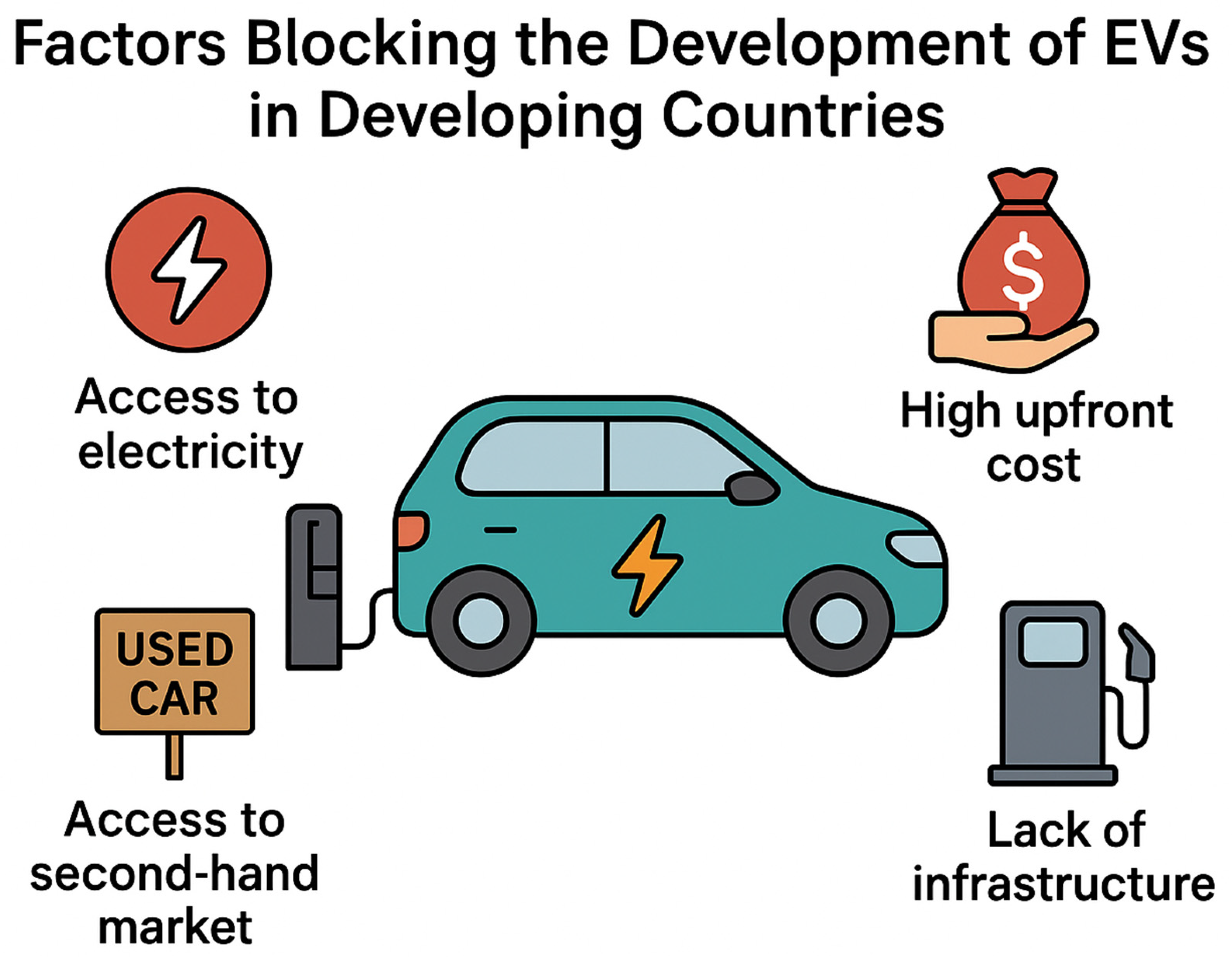
- High upfront cost due to import duties and limited local manufacturing.
- Limited charging infrastructure in rural and peri-urban areas.
- Battery replacement concerns affecting resale value.
- Import tax reductions or exemptions for EVs and components.
- Incentives for local assembly and battery manufacturing to reduce prices.
- Time-of-use electricity tariffs favoring EV charging during off-peak hours.
- Fleet electrification mandates in public transport and logistics to create economies of scale.
4.2. Affordability Challenge: High Upfront Costs

| Country (GDP per Capita in USD) | Leaf | Atto 3 | Model X |
|---|---|---|---|
| South Africa (6253) | 4.50× | 6.79× | 12.47× [8] |
| Ghana (2406) | 11.70× | 17.65× | 32.41× [9] |
| Côte d’Ivoire (2710) | 10.38× | 15.67× | 28.78 × [10] |
| Kenya (2206) | 12.76× | 19.25× | 35.35 × [11] |
| Senegal (1744) | 16.14× | 24.35× | 44.71× [12] |
| Tanzania (1186) | 23.73× | 35.82× | 65.76× [13] |
| Rwanda (~1000) | 28.14× | 42.47× | 77.99 × [14] |
| Nigeria (807) | 34.87× | 52.63× | 96.64× [15] |
| OECD members (48,454.7) | 0.58× | 0.88× | 1.61× [16] |
| Middle income (6524.3) | 4.31× | 6.51× | 11.95× [17] |
| Sub-Saharan Africa (1516.4) | 18.56× | 28.02× | 51.43× [18] |
| Least developed countries UN classification (1325.3) | 21.23× | 32.06× | 58.84× [19] |
| Heavily indebted poor countries (1272.4) | 22.11× | 33.38× | 61.29× [20] |
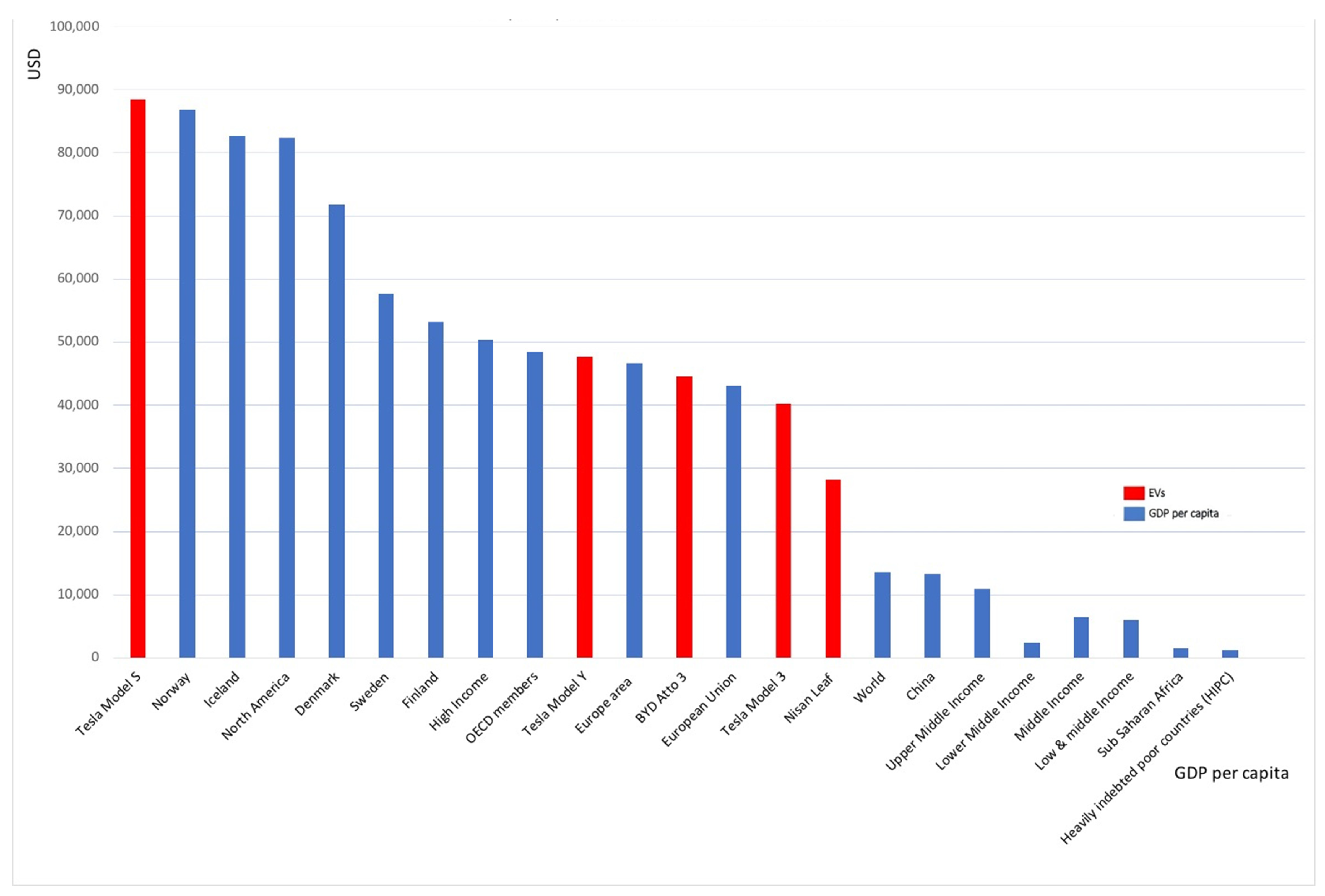
- Even in the region’s wealthiest large EV market (South Africa), a base Model 3 ≈ 6.8× GDP per capita; a Leaf ≈ 4.5×. That is with high- versus advanced-economy norms, but it is at least within reach for upper-middle-income households—especially with financing and incentives [37].
- In Ghana, Kenya, Côte d’Ivoire, and Senegal, a Leaf still runs ~10–16× GDP/pc; Atto 3 and Model 3 are ~17–24×, indicating new EVs remain premium purchases for a small slice of households [38].
- In Tanzania, Rwanda, and Nigeria, ratios of ~24–53× show that, at current price points and incomes, mass adoption of new imported EVs is structurally difficult without targeted policy or lower-cost offerings. Nigeria’s 2024 figures were especially affected by naira depreciation when expressed in USD [39].
- In least developed countries a Leaf is equivalent to over 21× the GDP per capita, the BYD Atto over 32 times GDP per capita and Tesla X almost 60.
- Affordability gateway: pre-owned EVs can cut entry prices dramatically, widening access beyond early adopters and speeding overall EV penetration [51].
- Supply is rising fast: as rich-market fleets churn and Chinese original equipment manufacturers (OEMs) expand abroad, more right-priced EVs (and parts) are flowing to emerging markets. From 2024–2025, EV sales shares in EMDEs nearly doubled (to ~4%), and Chinese brands are pushing into Africa and Latin America [52].
- Global outlook: Under stated policies, the worldwide EV fleet (ex-2/3-wheelers) could quadruple by 2030, creating a large pipeline of vehicles aging into second-hand markets [53].
- Emerging markets and developing economies momentum: The 2024 EV sales in emerging economies rose > 60% year over year (from ~2.5% to ~4% share). Latin America’s EV stock surged from 2024–2025, led by Brazil, Mexico, Uruguay, and Costa Rica [54].
- ○
- Battery uncertainty: Buyers fear degraded range and replacement costs; sellers lack standardized state-of-health (SoH) reporting and warranties [55].
- ○
- Patchy rules and tariffs: Import regimes for used EVs, age caps, and duties vary widely; some places still tax EVs like used ICE cars or lack safety/battery standards [56].
- ○
- ○
- Financing gaps: Higher upfront costs, limited residual-value data, and conservative lenders constrain credit—even when TCO can be favorable [58].
5. Blocking Factors and Opportunities: Electricity, Charging Infrastructures and the Potential of Renewable Energy
5.1. Access to Electricity Is a Major Bottleneck for the Growth of the EV Market in Developing Countries
5.1.1. Low-Income Countries: Deep Energy Deficits and EV Viability
5.1.2. Lower-Middle Income Countries: Partial Access, Persistent Gaps
5.1.3. Upper-Middle-Income Developing Countries: Transition Enablers and Remaining Barriers
5.1.4. Cross-Cutting Implications of Income-Linked Electricity Access
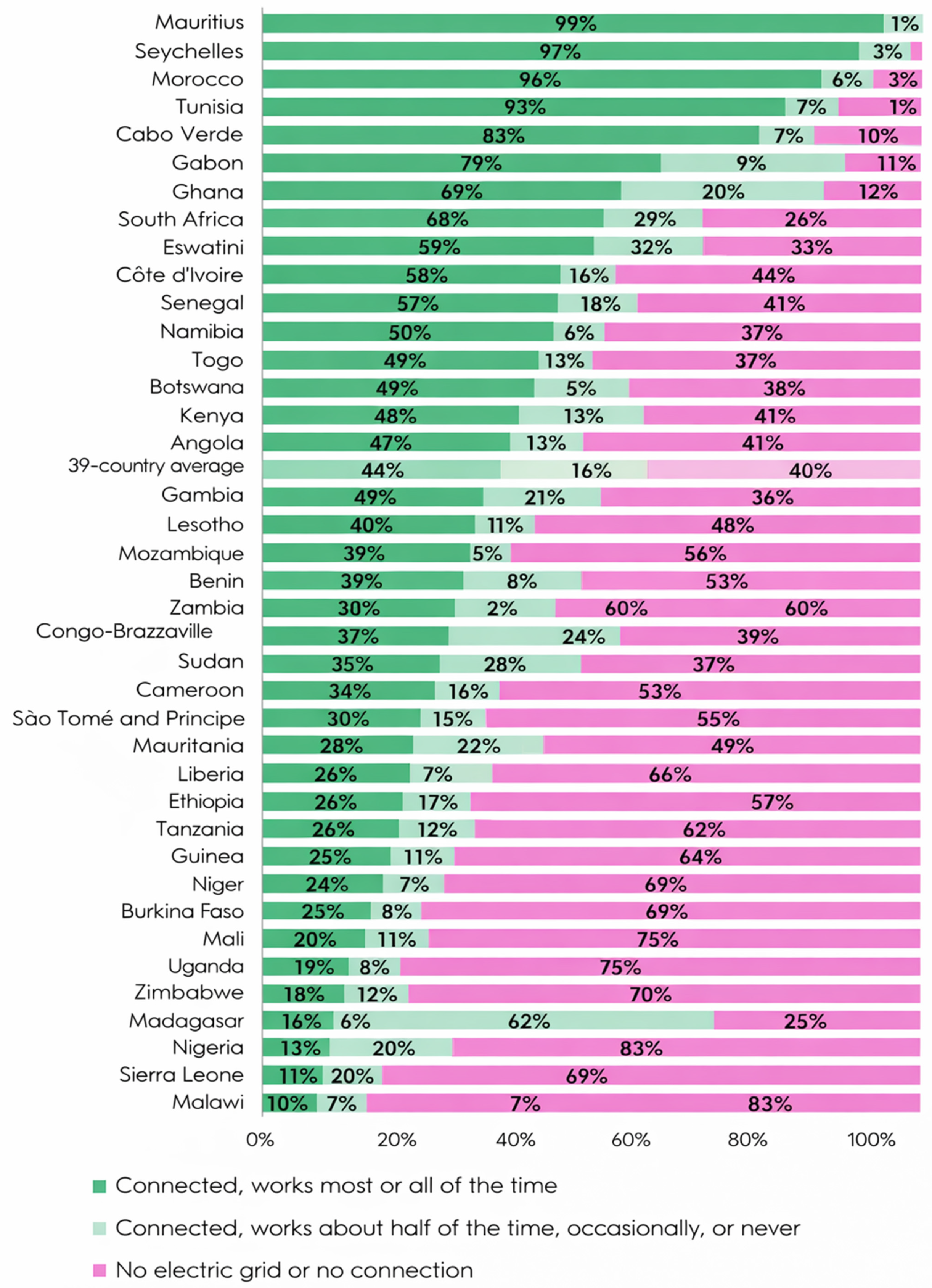
- Insufficient Grid Infrastructure (Figure 5)
- Limited Charging Infrastructure
- High Cost of Electricity
- Lack of Technical Expertise
- Urban–Rural Divide
- Policy and Regulatory Gaps
- Overdependence on Fossil-Fueled Grids
- Limited Integration with Renewable Energy
- Financing Constraints
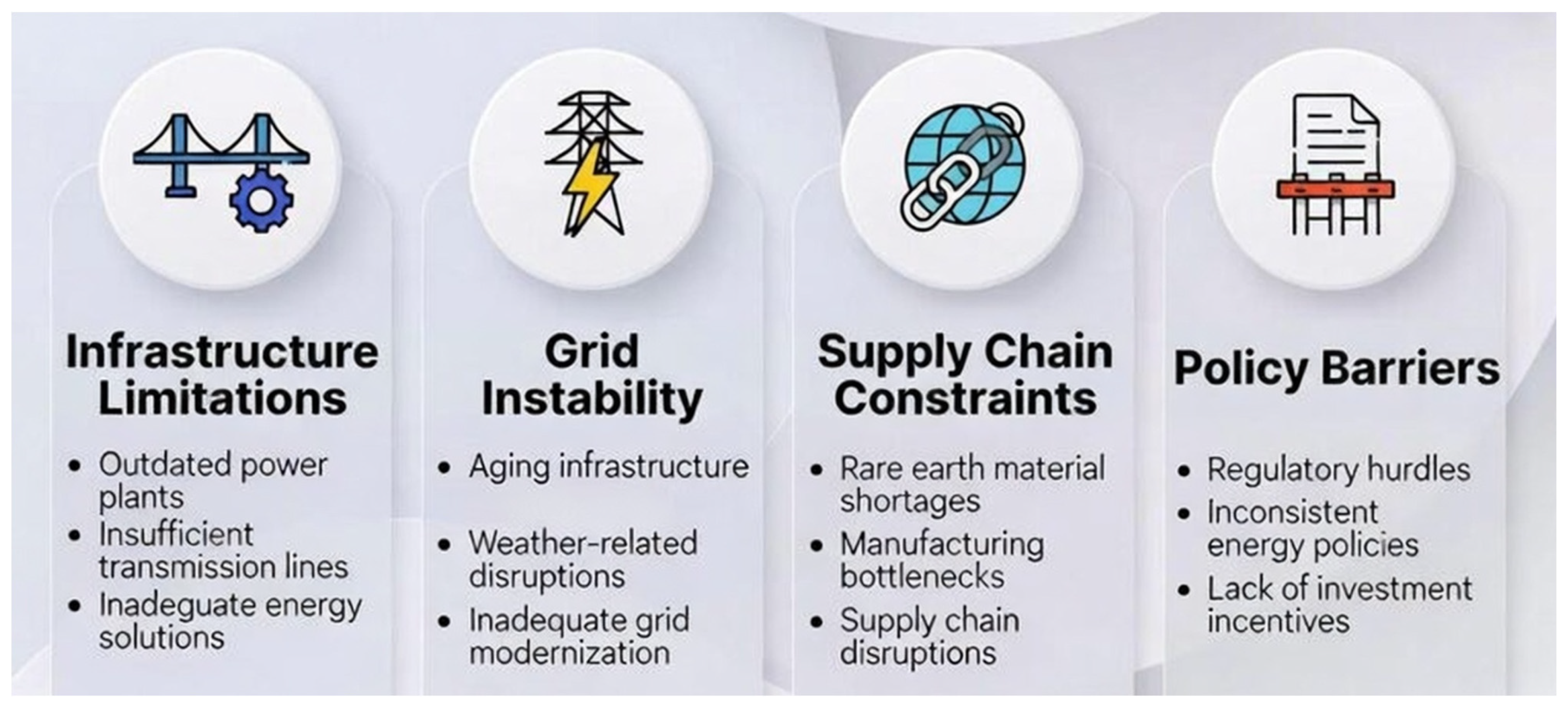
- Infrastructure Limitations
- Energy and Environmental Challenges
- Policy and Regulatory Barriers
- Social and Cultural Barriers
- Technological and Skill Gaps
- Geopolitical and Supply Chain Constraints
5.2. The Potential of Renewable Energy
5.3. Integration of Renewable Energy
- (a)
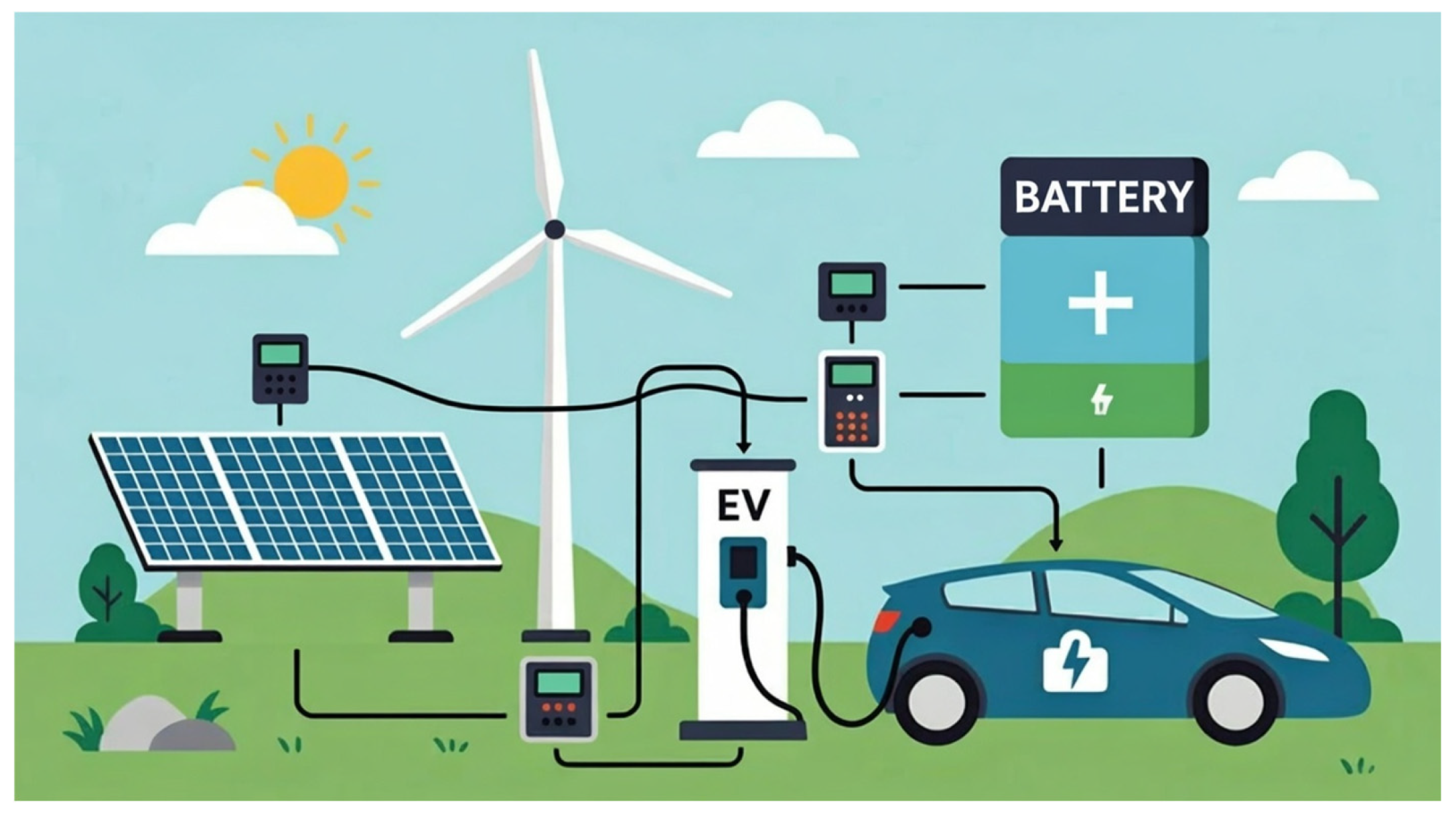
- Solar and Hybrid Charging Stations
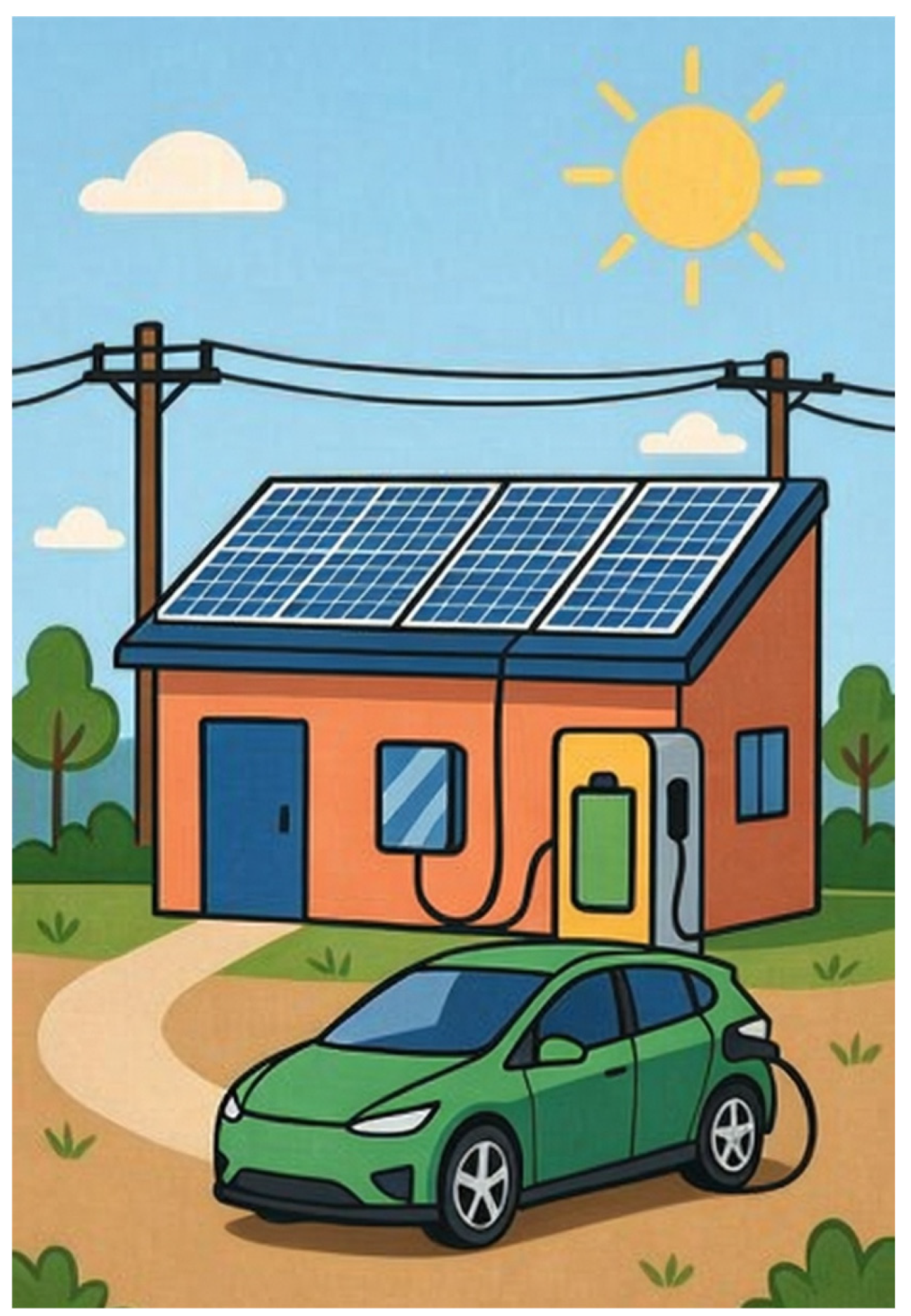
- For instance, MagicPower has implemented 100% off-grid EV charging stations in South Africa, powered by solar energy and battery storage, to bypass national grid instability [88].
- Technically, studies describe designs of bidirectional inverters to manage energy flows between PV, batteries, and charging stations, optimizing microgrid stability [89].
- The use of second-life batteries for solar-related storage is well-documented: they provide a low-cost option to smooth PV intermittency and extend EV pack utilization [90,91]. An illustrative demonstrator is the uYilo project in South Africa, combining PV panels, second-life batteries, smart energy management, and V2G capabilities.
- (b)
- Renewable-Powered Smart Microgrids and Minigrids
- A recent study proposed a DC hybrid microgrid (PV + grid + storage) with a fuzzy logic pilot to manage energy flows to charging stations, enhancing robustness by handling fluctuations in EV usage while maintaining voltage quality [92]
- Charging stations integrated into microgrids provide sustainable and reliable solutions. Eswar et al. [93] proposed a hybrid method combining the dollmaker optimization algorithm (DOA) with a spatial Bayesian neural network (SBNN) to optimize solar, wind, and storage management. This approach improves demand forecasting, stabilizes the microgrid, and enhances power quality. MATLAB/Simulink (R2024a or 2024b) simulations show substantial efficiency gains and harmonic distortion reduction compared to existing techniques.
- Renewable-powered microgrids can also employ smart meters, data platforms, and algorithms to manage flexibility, modulating charging according to solar production peaks, using dynamic pricing, or implementing pay-as-you-go models common in decentralized electrification. Flexibility is essential in contexts where public grids are unstable or expensive to reinforce [94].
- (c)
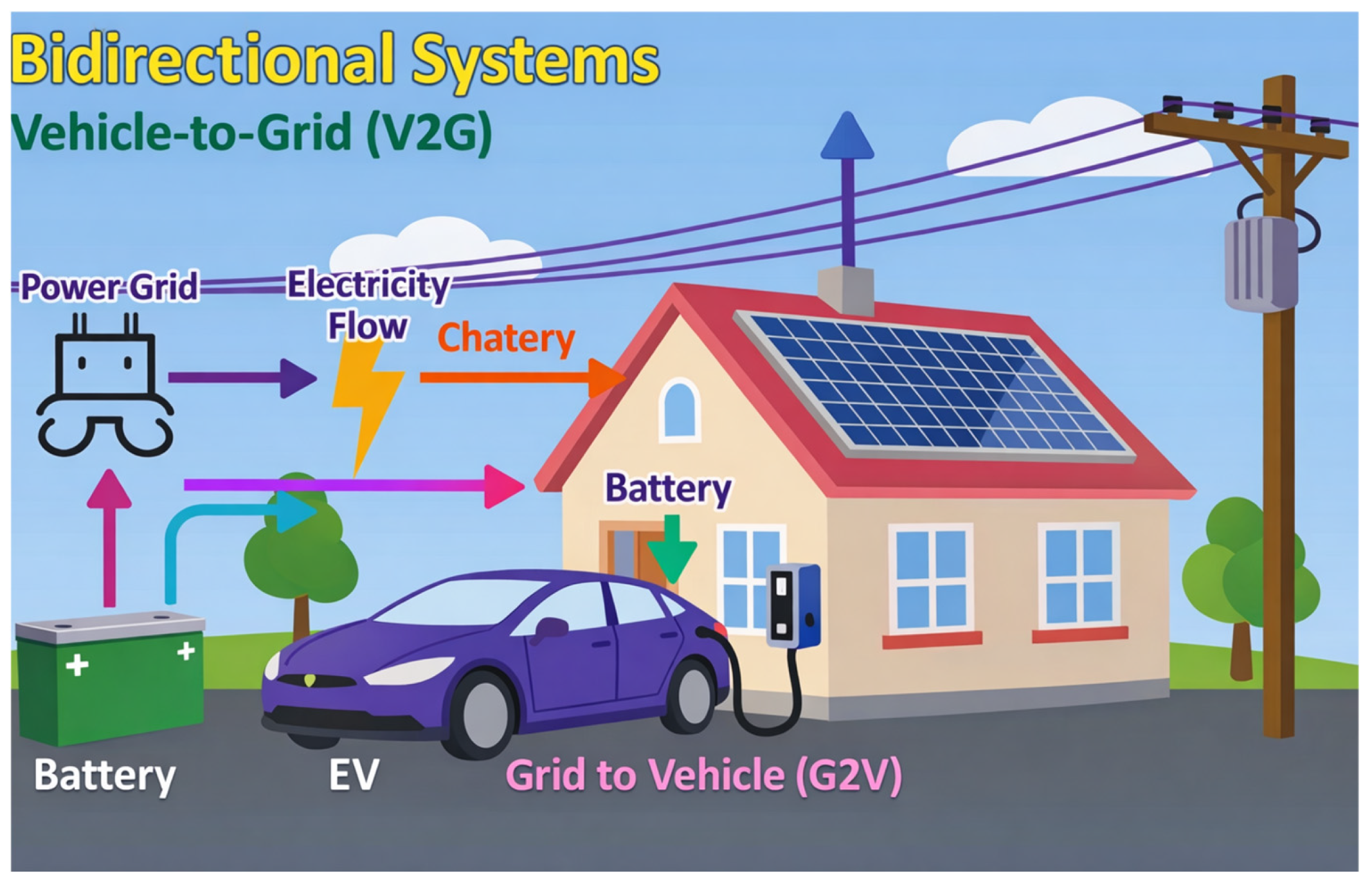
- Bidirectional Systems and Vehicle-to-Grid Technologies
- Research shows V2G can provide ancillary services such as frequency regulation, voltage management, and load balancing, especially in contexts of high RE variability [95].
- Technologically, PV–EV–grid interfacing can be achieved via bidirectional inverters and chargers, enabling charging and discharging operations [89].
- Some companies are developing V2G/vehicle-to-everything (V2X) charging stations, with rapid technological advances expected to play a key role in RE integration and microgrid stabilization in infrastructure-limited countries [96].
- Effective V2G deployment requires robust regulatory frameworks, interoperable communication protocols, and financial incentives to encourage user participation. Recent studies highlight that a suitable political and regulatory architecture is a prerequisite for functioning V2G services [97]. Moreover, integrating battery degradation into techno-economic models is recognized as crucial for ensuring fair compensation to users [98]. Innovative pricing approaches, such as menu-based schemes, are proposed to calibrate incentives according to vehicle contributions and associated costs [99].
- Battery aging: repeated V2G use accelerates battery wear, necessitating compensation strategies for EV owners [99].
- Lack of communication infrastructure: advanced energy management systems, smart meters, and standardized protocols are required.
- Regulation: legal frameworks for EV electricity resale remain underdeveloped, particularly in developing countries.
- Acceptability: users must be convinced to participate in V2G services, requiring financial incentives and transparency on battery impacts.
5.3.1. Infrastructure and Grid Stability Challenges
- Intermittency and Load Management: Solar and wind power fluctuate based on weather and time, leading to grid instability when integrated with EV charging. Uncontrolled EV charging can cause peak load surges, overwhelming grids that already experience frequent blackouts or shortages (e.g., in regions like sub-Saharan Africa and South Asia). This requires advanced storage solutions like batteries, but their deployment is limited by technical expertise and land availability.
- Inadequate Charging Networks: Many areas lack sufficient EV charging stations, particularly in rural zones, and integrating renewables (e.g., solar-powered chargers) is complicated by poor grid connectivity. Off-grid microgrids offer alternatives but struggle with scalability and inability to feed excess energy back to national grids, as seen in South Africa. Urban–rural disparities further compound this, with infrastructure concentrated in cities while rural areas in countries like Nigeria, Bangladesh, and Indonesia remain underserved.
- Increased Energy Demand Impacts: EV adoption could alter daily load curves and boost overall consumption, straining systems in developing nations where grids are often coal-dependent and inefficient. Solutions like smart charging are proposed, but implementation is slow due to outdated infrastructure.
5.3.2. Economic and Financial Challenges
- Upfront and Operational Expenses: Building renewable-powered charging infrastructure demands substantial capital for solar panels, batteries, and grid upgrades, which is challenging in liquidity-constrained governments (e.g., in Latin America). EVs themselves have high purchase prices due to import dependencies and taxes, making them unaffordable for lower-income populations in price-sensitive markets like India and Nigeria.
- Investment and Revenue Gaps: Public–private partnerships are needed to fund integration, but opportunity costs and limited returns from grid services deter investors. In off-grid setups, maintenance costs for vehicle-integrated photovoltaics (VIPV) or battery swapping stations add further burdens, with no widespread subsidies or incentives to offset them.
- Economic Disparities: Socioeconomic inequalities mean urban elites may adopt EVs, but broader integration with renewables is hampered by poverty and lack of financing options, perpetuating reliance on cheaper fossil fuel vehicles.
5.3.3. Policy and Regulatory Challenges
- Lack of Consistent Frameworks: Many developing countries have disjointed strategies, with weak incentives, subsidies, or tax breaks for renewable–EV integration. This demoralizes private investment and slows infrastructure rollout, as noted in Vietnam and sub-Saharan Africa.
- Regulatory Gaps and Silos: Energy and transport sectors often operate in isolation, with misaligned policies and unclear rules for grid connections, licensing, and taxation. Standards for battery swapping or V2G technologies are underdeveloped, leading to interoperability issues. Permitting processes for RES installations are cumbersome, and there is an absence of mandates for emission reductions or renewable mandates in EV charging.
- Global South Underrepresentation: Policies are often borrowed from developed nations without adaptation to local contexts, ignoring unique challenges like informal economies or rapid population growth in places like Kenya and Bangladesh.
5.3.4. Technological Challenges
- Integration and Standardization Issues: Renovating grids for RES-EV compatibility involves challenges in standardization, network security, and resource optimization. Smart charging and V2G systems could mitigate intermittency, but adoption is low due to cybersecurity risks and battery degradation concerns.
- Supply Chain and Innovation Gaps: Heavy reliance on imported batteries and components raises costs and supply vulnerabilities, with limited local R&D in developing countries. Adapting technologies like VIPV faces aesthetic, design, and maintenance issues.
- Awareness and Skills Deficits: Limited public knowledge about EV benefits, renewable integration, and maintenance fosters hesitancy, compounded by misconceptions about reliability in harsh climates.
5.4. Synergies Between Electromobility and the Energy Transition
- a.
- Stimulating Demand for Clean EnergyAccelerated EV deployment increases electricity demand. If coupled with flexible charging strategies (e.g., charging managed according to RE production), it can stimulate investment in renewable power plants: developers are incentivized to build more solar or wind capacity to meet rising demand. This creates a virtuous cycle: more EVs drive RE demand, and greater RE deployment makes charging more sustainable.
- b.
- Enhancing Energy Storage and Optimizing Battery Life-cycle
- Second-life batteries: After use in vehicles, batteries can serve as stationary storage, extending asset life, reducing cost per kWh stored, and reinforcing microgrid or PV system resilience.
- V2G: As mentioned, EVs can feed stored energy back to the grid, helping balance load and smooth RE fluctuations. This “storage on wheels” reduces the need for dedicated stationary storage. Studies show V2G can provide valuable ancillary services (frequency regulation, spinning reserve, etc.) [95].
- c.
- Creating New Value Chains and Employment OpportunitiesIntegrating EVs and RE can spawn local economic sectors:
- Design, installation, and maintenance of solar/hybrid charging stations.
- Development of energy management software: data platforms for microgrids, control systems, and load optimization.
- Battery recycling and reuse: second life, V2G, remanufacturing.
- Regulatory and financial services: pay-as-you-go models, dynamic pricing, V2G service remuneration, public–private partnerships.
6. The Role of the Second-Hand EV Market
- ○
- Affordability and Accessibility
7. EV Depreciation in Developing Countries
7.1. Fundamental Drivers of EV Depreciation
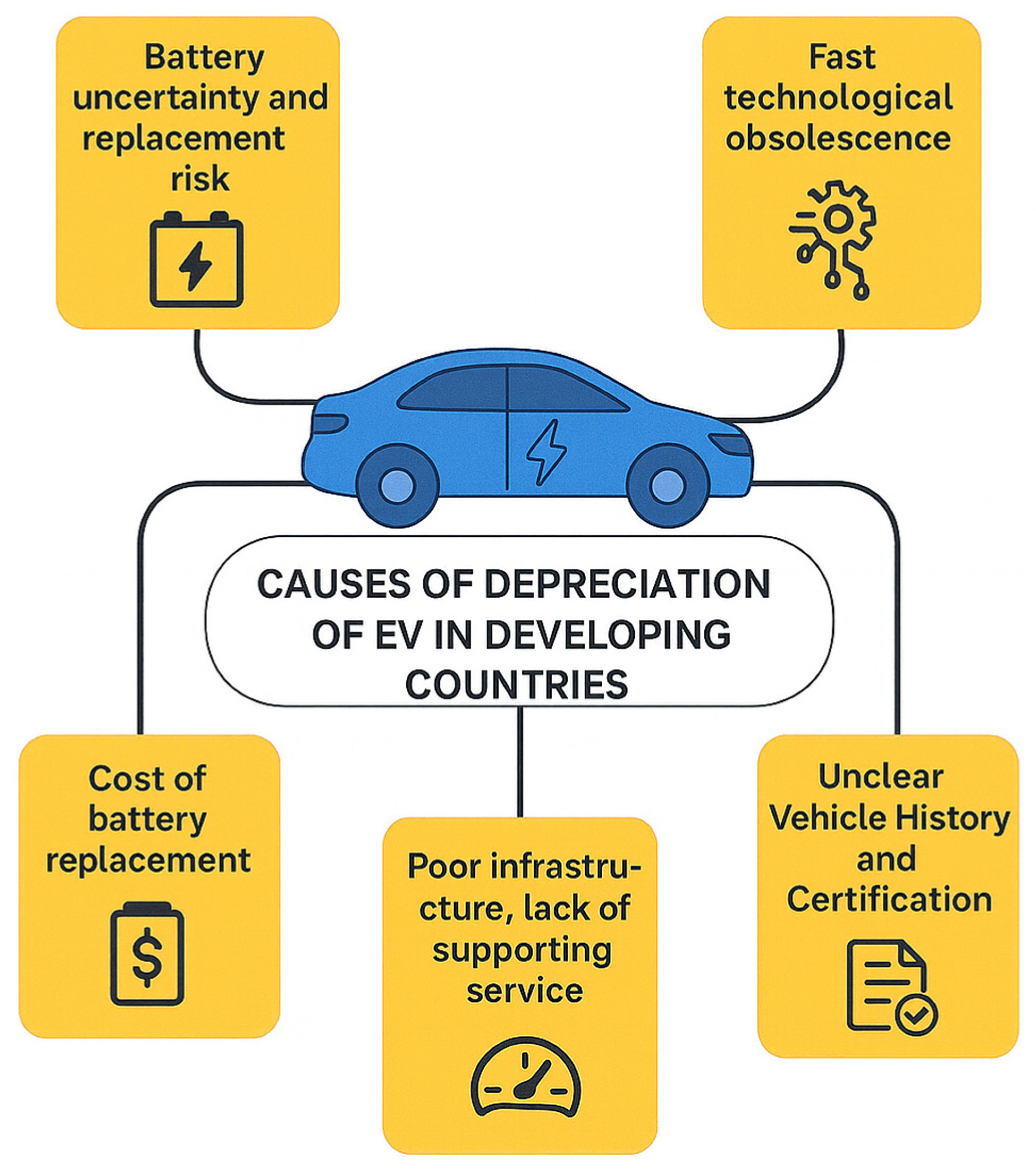
- Battery uncertainty and replacement risk. Battery capacity loss and the prospect of expensive replacement are primary drivers of buyer caution. Although battery pack costs as a share of vehicle price have fallen over the last decade, perceived replacement expense and limited local repair/rehabilitation options mean buyers in many developing markets discount EVs sharply when the battery warranty nears expiration. This effect is amplified where local battery remanufacturing, safe second-life markets, or reliable diagnostics are absent [180].
- Fast technological obsolescence. Improvements in battery range, charging speed, and software features quickly render older models less attractive. New model cycles bring substantially greater range, charging speed and features; in small markets this makes older models comparatively unattractive and accelerates real-world depreciation. Where consumers expect rapid tech-driven improvements, resale values fall more steeply [181].
- Infrastructure and electricity access. Inconsistent grid access, low charger density, and unreliable public charging increase operating risk for used-EV buyers; vehicles that require home charging are less attractive where household access to reliable electricity is limited. Poor infrastructure therefore reduces demand for second-hand EVs and increases depreciation [182].
- Unclear vehicle history and certification. Lack of standardized certification or vehicle history reports reduces confidence in used-EV quality, unlike in countries with Carfax-like services.
- Battery degradation and uncertainty. Consumers in many markets remain cautious about long-term battery performance and replacement costs.
- Policy incentives and subsidies. Generation of artificial price gaps between new and used vehicles can accelerate depreciation when incentives change [183].
7.2. Developing Countries: Distinctive Market Features
- Lower new EV penetration and reliance on used imports: Many lower-income countries lack robust domestic EV sales, resulting in fleets dominated by used vehicle imports. As developed markets electrify, depreciated EVs are increasingly exported to emerging economies, potentially creating a growing supply of second-hand EVs with uncertain residual value [183].
- Market immaturity and limited infrastructure: Weak charging networks, limited after-sales support, and uncertainty about EV servicing amplify perceived risks and downward pressure on used-EV values compared with developed regions, where infrastructure and buyer confidence are higher [184].
- Affordability constraints: In lower-income settings, affordability is a key determinant of vehicle choice. High upfront costs combined with rapid depreciation can deter both new EV purchases and secondary market activity, especially where consumers are highly price sensitive [185].
7.3. Income Levels and Depreciation Variance
- Lower-income developing economies (e.g., sub-Saharan Africa): These markets often have very small new EV fleets and rely heavily on surplus used vehicles from wealthier countries. Depreciation here may be less well-documented but is influenced by export volumes and the condition of imported units. Without robust domestic demand, used-EV prices are typically low relative to new EVs, compressing residual values further [185].
- Middle-income developing economies (e.g., India, Brazil, Southeast Asia): Here, nascent EV markets show faster depreciation than in developed countries due to infrastructure bottlenecks and buyer uncertainty. Data from India indicate that many EV models retain only 50–75% of their value after a few years, with lower-tier models on the weaker end of this range [184].
- Upper-middle-income markets (e.g., South Africa, parts of Latin America): Markets with expanding new EV sales and improving infrastructure can experience more stable used-EV values, though still typically higher depreciation than in mature OECD markets. Market segmentation (e.g., premium vs. mass market EVs) also drives differential residual values [184].
7.4. Implications for Policy and the EV Transition
- Market development strategies should include mechanisms to support second-hand EV markets—such as battery health certification and targeted subsidies—to enhance confidence and mitigate steep value declines.
- Cross-border trade policies matter: Facilitating the import of used EVs can accelerate fleet electrification in low-income countries but must be paired with standards to ensure battery safety and prevent dumping of unsound vehicles [185].
- Income-sensitive incentives could help align residual values with local affordability constraints, encouraging both new purchases and healthier used markets.
- Market structure and policy (imports, tariffs, incentives): Many developing countries import used EVs (or ICEs) from overseas; tariff structures, import duties and the regulatory treatment of battery health information influence the price at which used EVs can circulate. Policies that disincentivize used-EV trade (high duties, no battery certification) shrink the second-hand market and concentrate depreciation costs on initial purchasers [186].
- Information failures and insurance/finance gaps: Lack of standardized battery SoH diagnostics, no harmonized history reporting, and insurance tables that do not reflect EV battery specifics make valuation and lending riskier—again increasing depreciation rates [187].
- Weak warranty and certification regimes: Absence of enforceable manufacturer warranties, poor regulation of battery capacity labeling, and limited accredited service networks make buyers discount used EVs more heavily than ICE vehicles, for which repair skills and parts are more familiar.
- Informal markets and asymmetric information: Many developing countries have large informal used vehicle markets where detailed service records are rare. Information asymmetry (seller knows more than buyer) induces precautionary discounts, especially for novel technologies like EVs.
- Limited second-life and recycling infrastructure: The lack of established supply chains for second-life battery repurposing and recycling reduces salvage value. Without robust reclamation markets, spent batteries contribute little to residual vehicle value.
- Policy and regulatory uncertainty: Sudden policy shifts (e.g., changes in import tariffs, subsidies, or road taxes) can sharply affect resale prices. Market perceptions of regulatory risk are incorporated into depreciation.
- Standardize and mandate battery diagnostics and disclosures. Require (and subsidize) standardized SoH testing at point of sale/registration and mandatory disclosure of battery capacity and warranty status in vehicle sale documents. This reduces information asymmetry and stabilizes resale expectations [180].
- Promote manufacturer and third-party buy-back/certified pre-owned (CPO) programs. Encourage OEMs and large dealers to offer guaranteed buy-back or certified-pre-owned schemes (with explicit battery warranties) through tax incentives or procurement preferences. CPO schemes preserve residual values and create trust [189].
- Support local battery repair, remanufacturing and second-life markets. Invest in vocational training, safety standards, and selective subsidies to develop local battery refurbishment and testing centers—reducing replacement costs and creating viable second-life value chains for stationary storage. Public–private demonstration projects can lower technical barriers [180].
- Align tariffs and trade policy to enable efficient second-hand EV flows. Adjust import duties and regulatory barriers to allow appropriate volumes of used EVs while protecting safety and environmental standards; consider lower duties for certified-healthy batteries and for vehicles meeting local diagnostic requirements [188].
- Adapt insurance and depreciation tables for EV-specific risks. Regulators and insurance supervisors should update IDV/depreciation schedules and provide templates that reflect battery warranty coverage, documented SoH, and typical replacement costs—reducing overpenalization of EV residual values [189].
- Expand reliable charging and targeted electricity access programs. Prioritize charging infrastructure investments and targeted household electrification/solar + storage support in zones where used-EV adoption is expected, since improved electricity access directly increases used-EV demand and residual values [182].
- Promote financing products that internalize resale uncertainty. Support leasing, battery as a service (BaaS), and structured financing where battery ownership/risks are separated from vehicle financing—these instruments shift depreciation risk away from lower-income buyers and make EVs accessible without exposing households to large residual-value losses [189].
8. Policy in the EV Transition
8.1. Policy Frameworks, Industrial Commitment, and Political Commitment in the EV Transition in Developing Countries
8.1.1. Low-Income Developing Countries (LIDCs)
8.1.2. Lower-Middle-Income Developing Countries (LMICs)
8.1.3. Upper-Middle-Income Developing Countries (UMICs)
8.1.4. Comparative Policy Implications
8.1.5. Political Commitment and Governance
8.2. Drivers for the EV Transition Policy in Developing Countries
- ○
- Clear Targets and Long-Term VisionEstablishing national or sub-national EV adoption targets sends market signals, guides infrastructure investment, and improves investor and consumer confidence. Targets should reflect the country’s context (e.g., prioritizing two/three-wheelers or buses in many developing markets).Examples
- Setting EV sales goals for certain years.
- Public transit electrification benchmarks.
Clear goals reduce policy uncertainty and accelerate planning by both public and private actors. - ○
- Robust Policy and Regulatory FrameworkA coherent policy framework that aligns ministries (energy, transport, finance) and includes measurable implementation plans helps avoid fragmented approaches that hinder adoption.Key elements
- National EV roadmap with timelines.
- Interministerial coordination mechanisms.
- Performance indicators and monitoring.
It seems important to avoid standalone, short-term incentives without broader structural planning. - ○
- Financial Incentives and Market StimulusMany developing countries face high upfront EV costs compared with conventional vehicles. Targeted incentives can lower TCO and stimulate demand.Policy tools
- Tax reductions or exemptions (sales tax, import duties).
- Subsidies or rebates for EV purchase or charging stations.
- Financing mechanisms (low-interest loans, leasing support).
- Removing subsidies on fossil fuels to improve competitiveness of EVs.
Outcome: Improves affordability—critical in price-sensitive markets. - ○
- Charging and Grid Infrastructure ExpansionEVs require a reliable and accessible charging network and power systems prepared to absorb increased load. Planning must integrate EV growth with broader grid and energy planning.Infrastructure priorities
- Urban and rural charging stations.
- Integration with renewable energy.
- Grid upgrades to handle increased electricity demand.
Example: Coordination between transport and power sectors to avoid underinvestment or grid strain. - ○
- Local Manufacturing and Supply Chain DevelopmentBuilding local EV manufacturing capacity (vehicles, batteries, components) can reduce import dependency, create jobs, and lower costs over time.Focus Areas
- Incentives for assembly plants and battery manufacturing.
- Development of supply chains for critical minerals.
- Skills training and workforce development.
Benefits: Supports industrial growth while strengthening resilience. - ○
- Tailored Sector PrioritizationIn many developing countries, two- and three-wheelers (or buses) are dominant vehicle segments, offering high impact with lower costs. Policies should reflect modal priorities.Examples
- Promoting electric motorcycles first.
- Electrifying buses and public transport.
Why: Maximizes environmental and economic gains given existing travel patterns. - ○
- Public Awareness and Social AcceptanceConsumer understanding of EV benefits and practical use is uneven in many markets. Awareness campaigns, test drives, and demonstration projects can reduce skepticism and increase trust.Action Steps
- Public information campaigns.
- Inclusion of EV topics in education and training programs.
- Pilot projects showcasing performance.
- ○
- Environmental and Equity ConsiderationsPolicies should ensure that EV benefits (emission reductions, improved air quality) reach all socioeconomic groups, not just high-income adopters. Considering policies such as equitable charging access and fleet electrification in public transport enhances inclusivity.Examples
- Ensuring charging infrastructure in underserved areas.
- Preferential support for public buses and shared mobility.
- ○
- Regulatory Support for Used Vehicles and RetirementIn many developing markets, used ICE vehicles dominate. Policies encouraging retirement of old vehicles and regulating imports can accelerate turnover to EVs.Policy Options
- Age-based limitations on used ICE imports.
- Incentives for scrapping old vehicles.
- ○
- Integrated Planning Across SectorsA sustainable EV transition cannot be isolated—it must be integrated with climate, energy, urban transport and economic development planning.Cross-Sector Planning Includes
- Aligning EV plans with national climate goals.
- Synchronizing energy investment with transport needs.
9. Life-Cycle Assessment of Electric Vehicles in Developing Countries
9.1. LCA Framework for EVs in Developing Countries
9.2. Methodological Characteristics of EV LCA in Developing Countries
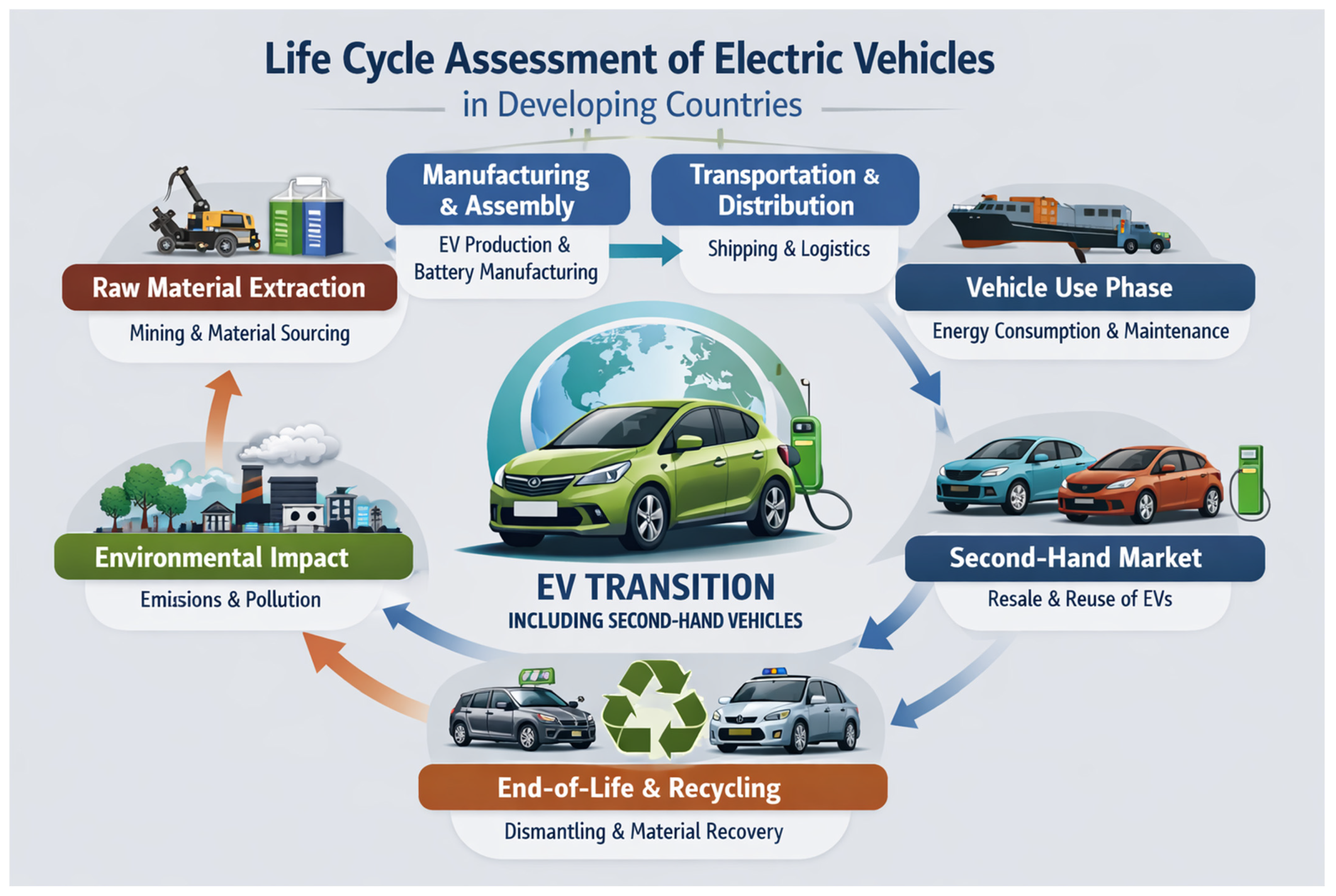
- Raw material extraction and processing.
- Vehicle and battery manufacturing (e.g., lithium-ion chemistries such as NCM and LFP).
- Transportation and logistics, often involving long-distance imports from major manufacturing hubs.
- Use-phase electricity consumption.
- End-of-life treatment (frequently excluded when estimated GWP contributions are below ~5%).
9.3. Key Findings from Comparative LCAs
9.4. Second-Hand EVs and LCA in Developing Economies
9.5. Battery End of Life, Second Life, and Recycling
9.6. Policy Implications and the Need for Integrated LCA
- Second-hand vehicle use scenarios.
- Second-life battery applications and avoided impacts.
- Realistic recycling pathways and infrastructure constraints.
9.7. Developed vs. Developing Countries: Summary of LCA Differences
10. The Paris Agreement in the Electric Vehicle Transition in Developing Countries
- Analyze how transport commitments in LIC, LMIC, and UMIC NDCs translate into differentiated EV targets, timelines, and funding requests, using the UNFCCC NDC registry as primary evidence [233].
- Quantify income-specific investment gaps for EV-related infrastructure and identify blended finance instruments that have proven effective in comparable country contexts, drawing on World Bank and multilateral development bank case studies [234].
- Assess emissions, air-quality, and health benefits from prioritizing EV segments such as two- and three-wheelers and buses versus private passenger cars to inform cost-effective and equity-sensitive policy design across income levels [55].
11. Discussion and Conclusions
11.1. EV Transition in Low-Income Countries
11.2. EV Transition in Lower-Middle-Income Countries
11.3. EV Transition in Upper-Middle-Income Countries
11.4. Cross-Cutting Challenges and Policy Implications
11.5. Implications for Future Research
- EV Adoption Trajectories and Market Penetration
- Total Cost of Ownership Improvements Increase EV Feasibility
- Charging Infrastructure Deployment and Grid Readiness
- Electricity Grid Reliability Significantly Affects EV Readiness
- Economic and Social Impact Assessment
- Environmental Outcomes and Energy Mix Implications
- Institutional Capacity and Policy Effectiveness
- Local Industry Development Creates Additional Socioeconomic Benefits
Author Contributions
Funding
Data Availability Statement
Conflicts of Interest
Nomenclature
References
- Alshahapy, H.; Bozeman, J.F., III; Carley, S. Destenie Nock and Daniel Matisoff, Modern challenges facing electric vehicle adoption: A review of barriers to adoption, supply chain challenges, and equity. Environ. Res. Lett. 2025, 20, 023002. [Google Scholar] [CrossRef]
- Zaino, R.; Ahmed, V.; Alhammadi, A.M.; Alghoush, M. Electric Vehicle Adoption: A Comprehensive Systematic Review of Technological, Environmental, Organizational and Policy Impacts. World Electr. Veh. J. 2024, 15, 375. [Google Scholar] [CrossRef]
- Hassani, A.; Khatab, O.M.E.H.; Aazami, A.; Kummer, S. Electromobility in Developing Countries: Economic, Infrastructural, and Policy Challenges. Future Transp. 2026, 6, 9. [Google Scholar] [CrossRef]
- Karamany, H.; EL Hariry, A.Z. The Future of Electric Vehicles in Developing Countries. Int. J. Sci. C Res. Manag. 2025, 13, 2168–2173. [Google Scholar] [CrossRef]
- Eakin, H.; Keele, S.; Lueck, V. Uncomfortable knowledge: Mechanisms of urban development in adaptation governance. World Dev. 2022, 159, 106056. [Google Scholar] [CrossRef]
- Law, T.H.; Yang, K.; Guo, B.; Pang, T.Y. Electric vehicle adoption: Urbanization, income, and inequality effects. Transp. Res. Part D Transp. Environ. 2025, 148, 105031. [Google Scholar] [CrossRef]
- Balassa, B.E.; Koteczki, R. Attitudes towards sustainable mobility technologies: Insights from electric vehicle adoption. Soc. Sci. Humanit. Open 2026, 13, 102379. [Google Scholar] [CrossRef]
- Most New Cars in Norway are EVs. How a Freezing Country Beat Range Anxiety. Available online: https://www.washingtonpost.com/climate-solutions/2025/05/30/norway-ev-adoption-electric-cars/ (accessed on 2 November 2025).
- Exploring EV Incentives in Developing Nations: A Comprehensive Overview. Available online: https://wordsmiths.blog/ev-incentives-in-developing-nations/ (accessed on 2 November 2025).
- Udendhran, R.; Mohan, T.R.; Babu, R.; Uthra, R.A.; Anupama, C.G.; Selvakumarasamy, S.; Dinesh, G.; Mukhopadhyay, M.; Saraswat, V.; Chakraborty, P. Transitioning to sustainable E-vehicle systems—Global perspectives on the challenges, policies, and opportunities. J. Hazard. Mater. Adv. 2025, 17, 100619. [Google Scholar] [CrossRef]
- Electric Cars in Developing Countries. Available online: https://cyberswitching.com/electric-cars-in-developing-countries/ (accessed on 2 November 2025).
- Why the Move to Electric Cars May Not Be Suitable in Africa. Available online: https://importsbyrigi.com/why-the-move-to-electric-cars-may-not-be-sustainable-in-africa/ (accessed on 2 November 2025).
- Andhra’s EV Adoption Stalls at 1.8% in 5 Years. Available online: https://timesofindia.indiatimes.com/city/vijayawada/andhras-ev-adoption-stalls-at-1-8-in-5-years/articleshow/121397955.cms (accessed on 2 November 2025).
- Mesquita, A.R.; de Abreu, V.H.S.; Poyares, C.N.; Santos, A.S. Barriers to Electric Vehicle Adoption: A Framework to Accelerate the Transition to Sustainable Mobility. Sustainability 2025, 17, 8318. [Google Scholar] [CrossRef]
- Electric Vehicle Adoption in Developing Regions: Trends and Challenges. Available online: https://wordsmiths.blog/electric-vehicle-adoption-in-developing-regions/ (accessed on 2 November 2025).
- World Bank Group: Decarbonizing Urban Transport for Development. Available online: https://www.theprif.org/sites/theprif.org/files/documents/WB%20Decarbonizing%20Urban%20Transport%20for%20Development_1.pdf (accessed on 2 November 2025).
- Nnene, O.A.; Oyelohunnu, I.I.; Zuidgeest, M.H.P. Availability of electric mobility policy and its potential for adoption in Africa. Transp. Res. Part D: Transp. Environ. 2026, 151, 105151. [Google Scholar] [CrossRef]
- Shree, V.; Edeh, F.O.; Sin, L.G.; Pandey, R.; Tiwari, S.; Onukele, A.; Gupta, H.K.; Farzan, A.K.; Tiwari, G.; Triana, A.A.; et al. Electric Vehicle (EV) markets: A comparative analysis between India, Nigeria, and Indonesia. Int. J. Account. Financ. Asia Pac. 2024, 7, 14–32. [Google Scholar] [CrossRef]
- Chandra, M.; Busch, P.; Olguín, F.P.; Tal, G. Paths of progress: Forecasting global electric vehicle demand amidst demographic and economic growth. Transp. Res. Part D Transp. Environ. 2025, 147, 104928. [Google Scholar] [CrossRef]
- Electric Mobility in Vietnam. Available online: https://www.worldbank.org/en/news/press-release/2024/11/22/world-bank-report-recommends-pathways-for-transitioning-to-electric-mobility-in-viet-nam (accessed on 2 November 2025).
- Electric Mobility. Available online: https://www.unep.org/gef/focal-areas/climate-change-mitigation/our-work/electric-mobility (accessed on 2 November 2025).
- Electric Vehicle Outlook. Available online: https://about.bnef.com/insights/clean-transport/electric-vehicle-outlook/ (accessed on 2 November 2025).
- E-Mobility and Power Systems. Available online: https://www.esmap.org/E-Mobility_and_Power_Systems (accessed on 2 November 2025).
- Global Electricity Demand. Available online: https://www.reuters.com/business/energy/global-electricity-demand-grow-by-4-through-2027-iea-says-2025-02-14/ (accessed on 2 November 2025).
- Wang, Y.; Witlox, F. Global trends in electric vehicle adoption and the impact of environmental awareness, user attributes, and barriers. Energy Rep. 2025, 13, 1125–1137. [Google Scholar] [CrossRef]
- World Bank Boosting EV Uptake in Developing Markets. Available online: https://evmagazine.com/articles/world-bank-boosting-ev-uptake-in-developing-markets (accessed on 2 November 2025).
- Is Africa Ready for the Electric Vehicle? Available online: https://www.ev24.africa/is-africa-ready-for-electric-vehicles/ (accessed on 2 November 2025).
- These Countries Are Adopting Electric Vehicles the Fastest. Available online: https://www.wri.org/insights/countries-adopting-electric-vehicles-fastest (accessed on 2 November 2025).
- Zhao, X.; Li, X.; Wang, A.; Fang, J. The impact of energy prices on electric vehicle adoption: From a perspective of consumer expectations. Sustain. Futures 2025, 9, 100437. [Google Scholar] [CrossRef]
- Gicha, B.B.; Tufa, L.T.; Lee, J. The electric vehicle revolution in Sub-Saharan Africa: Trends, challenges, and opportunities. Energy Strategy Rev. 2024, 53, 101384. [Google Scholar] [CrossRef]
- Orangi, S.; Manjong, N.; Clos, D.P.; Usai, L.; Burheim, O.S.; Strømman, A.H. Historical and prospective lithium-ion battery cost trajectories from a bottom-up production modeling perspective. J. Energy Storage 2024, 76, 109800. [Google Scholar] [CrossRef]
- World Bank. Available online: https://www.worldbank.org/en/news/press-release/2022/11/11/new-research-economic-viability-of-electric-vehicles-is-strong-and-improving-in-many-developing-countries (accessed on 2 November 2025).
- BYD Auto Belgium. Available online: https://www.bydauto.be/en/models/atto-3 (accessed on 2 November 2025).
- Auto Trader. Available online: https://www.autotrader.co.za/cars-for-sale/byd/atto-3 (accessed on 2 November 2025).
- Car Price. Available online: https://www.ccarprice.com/za/new-tesla-model-x-car-price-in-south%20africa-538#google_vignette (accessed on 2 November 2025).
- GDP by Country. Available online: https://www.worldometers.info/gdp/gdp-by-country/ (accessed on 2 November 2025).
- Federal Reserve Bank of Saint Louis. Available online: https://fred.stlouisfed.org/series/PCAGDPZAA646NWDB (accessed on 2 November 2025).
- World Bank. Available online: https://data.worldbank.org/country/cote-divoire (accessed on 2 November 2025).
- Trading Economics. Available online: https://tradingeconomics.com/rwanda/gdp-per-capita-us-dollar-wb-data.html (accessed on 2 November 2025).
- Geneva Solutions. Available online: https://genevasolutions.news/climate-environment/un-sets-standards-on-used-vehicles-shipped-to-developing-world (accessed on 2 November 2025).
- Halkos, G.; de Alba, J.M.; Todorov, V. Analyzing manufacturing sector and selected development challenges: A panel data analysis. Energy 2021, 235, 121253. [Google Scholar] [CrossRef]
- Avenyo, E.K.; Tregenna, F. Greening manufacturing: Technology intensity and carbon dioxide emissions in developing countries. Appl. Energy 2022, 324, 119726. [Google Scholar] [CrossRef]
- Pollution and Car Exports in Developing Countries. Available online: https://airqualitynews.com/cars-freight-transport/millions-of-polluting-cars-exported-to-developing-countries (accessed on 2 November 2025).
- WIRED. Available online: https://www.wired.com/story/second-hand-cars-pollution (accessed on 2 November 2025).
- Science Earth. Available online: https://earth.org/cars-developing-countries/ (accessed on 2 November 2025).
- UNEP—UN Environment Program. Available online: https://www.unep.org/news-and-stories/press-release/new-un-report-details-environmental-impacts-export-used-vehicles (accessed on 2 November 2025).
- Down to Earth. Available online: https://www.downtoearth.org.in/energy/cse-study-exposes-massive-environmental-dumping-of-old-and-used-vehicles-in-africa-south-asia-61213 (accessed on 2 November 2025).
- The Conversation. Available online: https://theconversation.com/how-dirty-old-used-cars-from-the-us-and-europe-carry-on-polluting-in-africa-podcast-204153 (accessed on 2 November 2025).
- Devex. Available online: https://www.devex.com/news/developed-countries-exporting-pollution-by-trading-second-hand-vehicles-to-poorer-countries-experts-say-89457 (accessed on 2 November 2025).
- The Business Weekly. Available online: https://businessweekly.co.bw/columns/market-research-your-business/99-6-of-imported-cars-are-used-vehicles (accessed on 2 November 2025).
- Malik, M.A.I.; Kalam, M.A.; Ikram, A.; Zeeshan, S.; Zahidi, S.Q.R. Energy transition towards electric vehicle technology: Recent advancements. Energy Rep. 2025, 13, 2958–2996. [Google Scholar] [CrossRef]
- Reuters. Available online: https://www.reuters.com/business/autos-transportation/facing-global-headwinds-chinese-automakers-make-play-africa-2025-06-26/ (accessed on 2 November 2025).
- IEA. Available online: https://www.iea.org/reports/global-ev-outlook-2025/outlook-for-electric-mobility (accessed on 2 November 2025).
- EV Info. Available online: https://evinfo.net/2025/05/ev-adoption-nearly-tripled-in-latin-america-and-the-caribbean-in-2024-growing-fast-in-2025/ (accessed on 2 November 2025).
- IEA Global EV Outlook 2024. Available online: https://iea.blob.core.windows.net/assets/a9e3544b-0b12-4e15-b407-65f5c8ce1b5f/GlobalEVOutlook2024.pdf (accessed on 2 November 2025).
- Mobility Portal Europe. Available online: https://mobilityportal.eu/countries-support-a-used-ev-market/ (accessed on 2 November 2025).
- Okoh, A.S.; Onuoha, M.C. Immediate and future challenges of using electric vehicles for promoting energy efficiency in Africa’s clean energy transition. Glob. Environ. Change 2024, 84, 102789. [Google Scholar] [CrossRef]
- World Bank Group. Available online: https://openknowledge.worldbank.org/entities/publication/6a91b1a6-63bf-424d-a34a-79e351ab1f7e (accessed on 2 November 2025).
- Kudłak, R.; Kołsut, B. The uneven geography of used car imports in Poland: The role of regional historical legacies and social ties. GeoJournal 2025, 90, 243. [Google Scholar] [CrossRef]
- UNEP—UN Environment Program. Available online: https://www.unep.org/resources/report/used-vehicles-and-environment-global-overview-used-light-duty-vehicles-flow-scale (accessed on 2 November 2025).
- IEA. Available online: https://www.iea.org/reports/global-ev-outlook-2025/trends-in-electric-car-markets-2 (accessed on 2 November 2025).
- FIA Region Used Vehicles Export. Available online: https://fiaregion1.com/wp-content/uploads/2022/02/FIA_Factsheets_import-export_02-EN.pdf (accessed on 2 November 2025).
- Economy of Burundi. Available online: https://en.wikipedia.org/wiki/Economy_of_Burundi (accessed on 2 November 2025).
- Access to Energy. Available online: https://ourworldindata.org/energy-access (accessed on 2 November 2025).
- World Bank Group. Available online: https://www.worldbank.org/en/news/press-release/2024/06/18/strong-electric-utilities-critical-to-clean-energy-for-all (accessed on 2 November 2025).
- Ndhlovu, E.; Mhlanga, D.; Duri, B. Decarbonising urban transport: An overview of electric vehicles, public transport, and sustainable infrastructure in achieving net-zero emissions. Discov. Glob. Soc. 2025, 3, 53. [Google Scholar] [CrossRef]
- Essus, Y.; Rachunok, B. Electric Vehicles Limit Equitable Access to Essential Services During Blackouts. Npj Sustain. Mobil. Transp. 2024, 1, 9. [Google Scholar] [CrossRef]
- Electricity Access. Available online: https://healthpolicy-watch.news/progress-on-energy-access-reverses-for-the-first-time-in-a-decade/ (accessed on 2 November 2025).
- IEA. Access to Electricity Stagnates, Leaving Globally 730 Million in the Dark. 2025. Available online: https://www.iea.org/commentaries/access-to-electricity-stagnates-leaving-globally-730-million-in-the-dark (accessed on 2 November 2025).
- Msafiri, D.; Adjadeh, R. Energy Gaps: Slight, Uneven Progress Still Leaves Many Africans Without Electricity. 2024. Available online: https://www.afrobarometer.org/wp-content/uploads/2024/04/AD79-PAP13-Slight-and-uneven-progress-still-leaves-many-Africans-without-electricity-Afrobarometer-8april24.pdf (accessed on 2 November 2025).
- Ayetor, G.K.; Mashele, J.; Mbonigaba, I. The progress toward the transition to electromobility in Africa. Renew. Sustain. Energy Rev. 2023, 183, 113533. [Google Scholar] [CrossRef]
- Ayetor, G.K.; Ativor, A.; Kesse, M.A.; Tawiah, P.O.; Diouf, B.; Opare, S.; Agyekum, E.B.; Andoh, P.Y. Realistic assessment of electric vehicle policies in Africa: A case study of Ghana. Case Stud. Transp. Policy 2025, 21, 101500. [Google Scholar] [CrossRef]
- Otero-Romero, T.; Castillo, C.; Calero-Jiménez, J.M.; Rollón, B.M.; Alvarez-Palau, E.J. Are we ready to transition towards e-mobility? An analysis of electric vehicle public charging infrastructure in Barcelona. Case Stud. Transp. Policy 2025, 21, 101519. [Google Scholar] [CrossRef]
- Khan, M.A.; Çelik, D.; Waseem, M.; Meral, M.E. Development of EV charging topologies and communication protocols for resilient grid integration and V2X applications in sustainable energy systems. Energy Convers. Manag. X 2025, 27, 101134. [Google Scholar] [CrossRef]
- UNECE. Dimensions of Energy Poverty in Austria. Economic Commission for Europe. In Proceedings of the Conference of European Statisticians, Geneva, Switzerland, 28–29 November 2024; p. 3. [Google Scholar]
- Omar, A. The State of EV Charging in America. 2024. Available online: https://www.hbs.edu/bigs/the-state-of-ev-charging-in-america (accessed on 2 November 2025).
- Rempel, D.; Cullen, C.; Matteson Bryan, M.; Vianna Cezar, G. Reliability of Open Public Electric Vehicle Direct Current Fast Chargers. Hum. Factors: J. Hum. Factors Ergon. Soc. 2023, 66, 2528–2538. [Google Scholar] [CrossRef]
- NEC. National Energy Compact for the Federal Republic of Nigera. 2025. Available online: https://thedocs.worldbank.org/en/doc/2340747bcba6747a15a4ff8cba935fce-0010012025/original/M300-AES-Compact-Nigeria.pdf (accessed on 2 November 2025).
- NECG. National Energy Compact for the Republic of Ghana. 2025. Available online: https://thedocs.worldbank.org/en/doc/59ef89e92a3aef70e33c42518df9a0c8-0010012025/original/Ghana-National-Energy-Compact-Mission-300.pdf (accessed on 2 November 2025).
- Tettey, G.; Ansah, E.A.; Asante, W. The politics of renewable energy transition in Ghana: Issues, obstacles and prospects. Energy Res. Soc. Sci. 2025, 120, 103939. [Google Scholar] [CrossRef]
- IEA. PV-Powered Electric Vehicle Charging Stations; International Energy Agency: Paris, France, 2025. [Google Scholar]
- Choifin, M. Integration of solar and wind energy in public grid-connected electric vehicle charging stations: A comprehensive review of technological advances, challenges, and future directions. J. Sustain. Energy 2025, 4, 48–81. [Google Scholar] [CrossRef]
- Chen, R.; Fan, R.; Wang, D.; Yao, Q. Effects of multiple incentives on electric vehicle charging infrastructure deployment in China: An evolutionary analysis in complex network. Energy 2023, 264, 125747. [Google Scholar] [CrossRef]
- Solar Photovoltaic Power by Country. Available online: https://www.worldbank.org/en/topic/energy/publication/solar-photovoltaic-power-potential-by-country (accessed on 2 November 2025).
- Abraham, C.J.; Rix, A.J.; Ndibatya, I.; Booysen, M.J. Ray of hope for sub-Saharan Africa’s paratransit: Solar charging of urban electric minibus taxis in South Africa. Energy Sustain. Dev. 2021, 64, 118–127. [Google Scholar] [CrossRef]
- Varghese, A.M.; Menon, N.; Ermagun, A. Equitable distribution of electric vehicle charging infrastructure: A systematic review. Renew. Sustain. Energy Rev. 2024, 206, 114825. [Google Scholar] [CrossRef]
- African Development Bank, Estimating Investment Needs for the Power Sector in Africa 2023–2030. 2024. Available online: https://wfdfi.org/wp-content/uploads/2024/10/144.-estimating_investment_needs_in_the_power_sector_in_africa_report.pdf (accessed on 2 November 2025).
- Oruganti, K.S.P.; Vaithilingam, C.A.; Kumaresh, S.S.; Ramasamy, A.; Happonen, A. An integrative review of standalone solar powered EV charging stations: Standards, policies, design aspects, and future directions. Energy Rep. 2025, 14, 2893–2913. [Google Scholar] [CrossRef]
- Jang, Y.; Sun, Z.; Ji, S.; Lee, C.; Jeong, D.; Choung, S.; Bae, A.S. Grid-Connected Inverter for a PV-Powered Electric Vehicle Charging Station to Enhance the Stability of a Microgrid. Sustainability 2021, 13, 14022. [Google Scholar] [CrossRef]
- Lopez, F.A.; Lauinger, D.; Vuille, F.A. On the potential of vehicle-to-grid and second-life batteries to provide energy and material security. Nat. Commun. 2024, 15, 4179. [Google Scholar] [CrossRef]
- Sarker, M.T.; Haram, M.H.; Shern, S.J.; Gobbi Ramasamy, A.F. Second-Life Electric Vehicle Batteries for Home Photovoltaic Systems: Transforming Energy Storage and Sustainability. Energies 2024, 17, 2345. [Google Scholar] [CrossRef]
- Khan, M.H. Development of DC Microgrid Integrated Electric Vehicle Charging Station With Fuzzy Logic Controller. Front. Energy Res. 2022, 10, 922384. [Google Scholar] [CrossRef]
- Eswar, K.N.; Doss, M.A.; Shorfuzzaman, M.; Elrashidi, A. Microgrid system for electric vehicle charging stations integrated with renewable energy sources using a hybrid DOA–SBNN approach. Front. Energy Res. 2024, 12, 1492243. [Google Scholar]
- Sultan, V.; Aryal, A.; Chang, H.; Kral, J. Integration of EVs into the smart grid: A systematic literature review. Energy Inform. 2022, 5, 65. [Google Scholar] [CrossRef]
- Rayid, H.M.D.; Mojumder, F.A. Electric Vehicle-to-Grid (V2G) Technologies: Impact on the Power Grid and Battery. Sustainability 2022, 14, 13856. [Google Scholar]
- Chaigneau, C. La Tribune. Available online: https://www.latribune.fr/occitanie-1161/innovation/innovation-technologique/2024-12-16/vehicules-electriques-et-energie-solaire-un-mariage-encore-complexe-1013901 (accessed on 16 December 2024).
- Goncearuc, A.; Cauwer, C.D.; Sapountzoglou, N.; Kriekinge, G.V.; Huber, D.; Messagie, M.; Coosemans, T. The barriers to widespread adoption of vehicle-to-grid: A comprehensive review. Energy Rep. 2024, 12, 27–41. [Google Scholar] [CrossRef]
- Shabani, M.; Wallin, F.; Dahlquist, E.; Yan, A.J. Techno-economic evaluation of a battery system integrated into a residential grid-connected PV system considering battery degradation. In Applied Energy Symposium; Scanditale AB: Matsue, Japan, 2021. [Google Scholar]
- Ghosh, A.; Aggarwal, V. Menu-Based Pricing for Charging of Electric Vehicles with Vehicle-to-Grid Service. IEEE Trans. Veh. Technol. 2018, 67, 10268–10280. [Google Scholar] [CrossRef]
- Diouf, B. The Electric Vehicle Transition. Environ. Sci. Adv. 2024, 3, 332. [Google Scholar] [CrossRef]
- Simwaba, D.; Qutieshat, A. EV battery swapping for developing countries: Benefits, challenges, and perspectives from a local key stakeholders study in Zambia. Energy Rep. 2026, 15, 108909. [Google Scholar] [CrossRef]
- Wróblewski, P.; Lewicki, W. A Method of Analyzing the Residual Values of Low-Emission Vehicles Based on a Selected Expert Method Taking into Account Stochastic Operational Parameters. Energies 2021, 14, 6859. [Google Scholar] [CrossRef]
- Domínguez, S.; Pedreros, S.; Delgadillo, D.; Anzola, J. A Depreciation Method Based on Perceived Information Asymmetry in the Market for Electric Vehicles in Colombia. World Electr. Veh. J. 2024, 15, 511. [Google Scholar] [CrossRef]
- Woody, M.; Adderly, S.A.; Bohra, R.; Keoleian, G.A. Electric and gasoline vehicle total cost of ownership across US cities. J. Ind. Ecol. 2024, 28, 194–215. [Google Scholar] [CrossRef]
- Alanazi, F. Electric Vehicles: Benefits, Challenges, and Potential Solutions for Widespread Adaptation. Appl. Sci. 2023, 13, 6016. [Google Scholar] [CrossRef]
- Suttakul, P.; Wongsapai, W.; Fongsamootr, T.; Mona, Y.; Poolsaat, K. Total cost of ownership of internal combustion engine and electric vehicles: A real-world comparison for the case of Thailand. Energy Rep. 2022, 8, 545–553. [Google Scholar] [CrossRef]
- Verma, S.; Dwivedi, G.; Verma, P. Life cycle assessment of electric vehicles in comparison to combustion engine vehicles: A review. Mater. Today Proc. 2022, 49, 217–222. [Google Scholar] [CrossRef]
- Joshi, A.; Sharma, R.; Baral, B. Comparative life cycle assessment of conventional combustion engine vehicle, battery electric vehicle and fuel cell electric vehicle in Nepal. J. Clean. Prod. 2022, 379, 134407. [Google Scholar] [CrossRef]
- Li, M.; Lu, J.; Chen, Z.; Amine, K. 30 years of lithium-ion batteries. Adv. Mater. 2018, 30, 1800561. [Google Scholar] [CrossRef] [PubMed]
- Manthiram, A. An outlook on lithium ion battery technology. ACS Cent. Sci. 2017, 3, 1063–1069. [Google Scholar] [CrossRef]
- Kim, T.; Song, W.; Son, D.Y.; Ono, L.K.; Qi, Y. Lithium-ion batteries: Outlook on present, future, and hybridized technologies. J. Mater. Chem. A 2019, 7, 2942–2964. [Google Scholar] [CrossRef]
- IEA. Global EV Outlook 2022, Securing Supplies for An Electric Future. 2022. Available online: https://www.iea.org/reports/global-ev-outlook-2022 (accessed on 1 June 2025).
- IEA. Evolution of Li-Ion Battery Price, 1995–2019. 2022. Available online: https://www.iea.org/data-and-statistics/charts/evolution-of-li-ion-battery-price-1995-2019 (accessed on 1 June 2025).
- Guo, Y.; Wu, S.; He, Y.-B.; Kang, F.; Chen, L.; Li, H.; Yang, Q.-H. Solid-state lithium batteries: Safety and prospects. Escience 2022, 2, 138–163. [Google Scholar] [CrossRef]
- Solid-State Li-Ion Batteries. Available online: https://www.tycorun.com/blogs/news/solid-state-lithium-battery (accessed on 1 June 2025).
- Manthiram, A.; Yu, X.; Wang, S. Lithium battery chemistries enabled by solid-state electrolytes. Nat. Rev. Mater. 2017, 2, 16103. [Google Scholar] [CrossRef]
- The Nikkei in December 2020. Available online: https://asia.nikkei.com/Spotlight/Most-read-in-2020/Toyota-s-game-changingsolid-state-battery-en-route-for-2021-debut (accessed on 1 June 2025).
- Koorata, P.K.; Panchal, S. Thermal management of large-sized LiFePO4 pouch cell using simplified mini-channel cold plates. Appl. Therm. Eng. 2023, 234, 121286. [Google Scholar]
- Farulla, G.A.; Palomba, V.; Aloisio, D.; Brunaccini, G.; Ferraro, M.; Frazzica, A.A.; Sergi, F. Optimal design of lithium-ion battery thermal management systems based on phase change material at high current and high environmental temperature. Therm. Sci. Eng. Prog. 2023, 42, 101862. [Google Scholar] [CrossRef]
- Wu, H.; Niu, M.; Shao, Y.; Wang, M.; Li, M.; Liu, X.; Li, Z. Investigations of Li-Ion Battery Thermal Management Systems Based on Heat Pipes: A Review. ACS Omega 2024, 9, 97–116. [Google Scholar] [CrossRef]
- Kiani, M.; Omiddezyani, S.; Houshfar, E.; Miremadi, S.R.; Ashjaee, M.M.; Nejad, A.M. Lithium-ion battery thermal management system with Al2O3/AgO/CuO nanofluids and phase change material. Appl. Therm. Eng. 2020, 180, 115840. [Google Scholar] [CrossRef]
- Talele, V.; Moralı, U.; Patil, M.-S.; Panchal, S.; Fraser, R.; Fowler, M.; Thorat, P.; Gokhale, Y.-P. Computational modelling and statistical evaluation of thermal runaway safety regime response on lithium-ion battery with different cathodic chemistry and varying ambient condition. Int. Commun. Heat Mass Transf. 2023, 146, 106907. [Google Scholar] [CrossRef]
- Myatezh, A.V.; Smirnov, M.A.; Malozyomov, B.V.; Shtang, A.A. Performance Increase of Lithium-Ion Batteries. Adv. Eng. Res. 2017, 133, 519–524. [Google Scholar]
- Yildiz, E.; Serpelloni, M.; Salvadori, A.; Cabras, L. A Comparative Review of Models for All-Solid-State Li-Ion Batteries. Batteries 2024, 10, 150. [Google Scholar] [CrossRef]
- Diouf, B.; Miezan, E. Unlocking the Technology Potential for Universal Access to Clean Energy in Developing Countries. Energies 2024, 17, 1488. [Google Scholar] [CrossRef]
- Lithium-ion batteries energy density. Available online: https://physicsworld.com/a/lithium-ion-batteries-break-energy-density-record/ (accessed on 1 June 2025).
- Canals Casals, L.; Etxandi-Santolaya, M.; Bibiloni-Mulet, P.A.; Corchero, C.; Trilla, L. Electric Vehicle Battery Health Expected at End of Life in the Upcoming Years Based on UK Data. Batteries 2022, 8, 164. [Google Scholar] [CrossRef]
- Chen, W.; Liang, J.; Yang, Z.; Li, G. A Review of Lithium-Ion Battery for Electric Vehicle Applications and Beyond. Energy Procedia 2019, 158, 4363–4368. [Google Scholar] [CrossRef]
- Zheng, Y.; Ouyang, M.; Lu, L.; Li, J.; Han, X.; Xu, L.; Ma, H.; Dollmeyer, T.A.; Freyermuth, V. Cell state-of-charge inconsistency estimation for LiFePO4 battery pack in hybrid EVs using mean- difference model. Appl. Energy 2013, 111, 571–580. [Google Scholar] [CrossRef]
- Pamidimukkala, A.; Kermanshachi, S.; Rosenberger, J.M.; Hladik, G. Evaluation of barriers to electric vehicle adoption: A study of technological, environmental, financial, and infrastructure factors. Transp. Res. Interdiscip. Perspect. 2023, 22, 100962. [Google Scholar] [CrossRef]
- Etxandi-Santolaya, M.; Mora-Pous, A.; Canals Casals, L.; Corchero, C.; Eichman, J. Quantifying the Impact of Battery Degradation in Electric Vehicle Driving through Key Performance Indicators. Batteries 2024, 10, 103. [Google Scholar] [CrossRef]
- Ezemobi, E.; Silvagni, M.; Mozaffari, A.; Tonoli, A.; Khajepour, A. State of Health Estimation of Lithium-Ion Batteries in Electric Vehicles under Dynamic Load Conditions. Energies 2022, 15, 1234. [Google Scholar] [CrossRef]
- Siemens White Paper—The Evolution of the Electric Vehicle Market. 2020. Available online: https://assets.new.siemens.com/siemens/assets/api/uuid:0109b0ae-c47b-4175-a331-3a3daeb64a1c/sids-m40030-00-4aus-lo-res.pdf (accessed on 2 November 2025).
- Electric Vehicles Battery. Available online: https://www.cars.com/articles/how-much-do-electric-car-batteries-cost-to-replace-465308/ (accessed on 2 November 2025).
- Nissan Leaf. Available online: https://www.mrmoneymustache.com/the-nissan-leaf-experiment/ (accessed on 2 November 2025).
- Battery Replacement. Available online: https://www.carboeurope.org/tesla-battery-replacement-cost/ (accessed on 27 November 2025).
- Nguyen-Tien, V.; Zhang, C.; Strobl, E.; Elliott, R.J.R. The closing longevity gap between battery electric vehicles and internal combustion vehicles in Great Britain. Nat. Energy 2025, 10, 354–364. [Google Scholar] [CrossRef] [PubMed]
- Used Car Market. Available online: https://www.businessresearchinsights.com/market-reports/used-car-market-118118 (accessed on 2 November 2025).
- Average Vehicles Age USA. Available online: https://www.spglobal.com/mobility/en/research-analysis/average-age-vehicles-united-states-2024.html (accessed on 2 November 2025).
- Buyers’ Market. Available online: https://www.cars.com/articles/2024-could-be-a-buyers-market-if-youre-buying-new-report-478345/ (accessed on 2 November 2025).
- Used Car News. Available online: https://www.news.market.us/used-car-market-news/ (accessed on 2 November 2025).
- Global Vehicle Sales. Available online: https://wardsintelligence.informa.com/wi967636/global-vehicle-sales-top-92-million-units-in-2023-decembervolume-up-11 (accessed on 2 November 2025).
- Global EV Outlook 2024. Available online: https://www.iea.org/reports/global-ev-outlook-2024/trends-in-electric-cars (accessed on 2 November 2025).
- E-Mobility Europe. Available online: https://statzon.com/insights/e-mobility-europe-an-overview-of-europes-latest-electric-vehicles-data (accessed on 2 November 2025).
- Diouf, B. Modeling the Used Vehicle Market Share in the Electric Vehicle Transition. World Electr. Veh. J. 2025, 16, 29. [Google Scholar] [CrossRef]
- Buhmann, K.M.; Criado, J.R. Consumers’ preferences for electric vehicles: The role of status and reputation. Transp. Res. Part D Transp. Environ. 2023, 114, 103530. [Google Scholar] [CrossRef]
- Leasing Sector in Second Hand EV Market. Available online: https://www.transportenvironment.org/articles/leasing-sector-could-flood-second-hand-market-withelectric-cars (accessed on 2 November 2025).
- Akram, M.N.; Abdul-Kader, W. Repurposing Second-Life EV Batteries to Advance Sustainable Development: A Comprehensive Review. Batteries 2024, 10, 452. [Google Scholar] [CrossRef]
- EV Bueyrs. Available online: https://www.forbes.com/sites/michaelharley/2025/04/24/carmaxs-ev-trends-report-shows-ev-searchesnearly-doubled-in-the-past-three-years/ (accessed on 2 November 2025).
- Muehlegger, E.; Rapson, D.S. Subsidizing low- and middle-income adoption of electric vehicles: Quasi-experimental evidence from California. J. Public Econ. 2022, 216, 104752. [Google Scholar] [CrossRef]
- Burra, L.T.; Sommer, S.; Vance, C. Free-ridership in subsidies for company- and private electric vehicles. Energy Econ. 2024, 131, 107333. [Google Scholar] [CrossRef]
- Azarafshar, R.; Vermeulen, W.N. Electric vehicle incentive policies in Canadian provinces. Energy Econ. 2020, 91, 104902. [Google Scholar] [CrossRef]
- Sheldon, T.L.; Dua, R. Measuring the cost-effectiveness of electric vehicle subsidies. Energy Econ. 2019, 84, 104545. [Google Scholar] [CrossRef]
- Jenn, A.; Lee, J.H.; Hardman, S.; Tal, G. An in-depth examination of electric vehicle incentives: Consumer heterogeneity and changing response over time. Transp. Res. Part A 2020, 132, 97–109. [Google Scholar] [CrossRef]
- Kautish, P.; Lavuri, R.; Roubaud, D.; Grebinevych, O. Electric vehicles’ choice behaviour: An emerging market scenario. J. Environ. Manag. 2024, 354, 120250. [Google Scholar] [CrossRef] [PubMed]
- Sikandar, A.Q.; Furkan, A.; Al-Wahedi, A.M.A.B.; Atif, I.; Amjad, A. Navigating the complex realities of electric vehicle adoption: A comprehensive study of government strategies, policies, and incentives. Energy Strategy Rev. 2024, 53, 101379. [Google Scholar]
- EV Sales by Country. Available online: https://roadgenius.com/cars/ev/statistics/sales-by-country/ (accessed on 2 November 2025).
- Global Petrol Prices. Available online: https://www.globalpetrolprices.com/gasoline_prices/ (accessed on 1 June 2025).
- Per Capita Electricity Generation. Available online: https://ourworldindata.org/grapher/per-capita-electricity-generation (accessed on 2 November 2025).
- World Bank. Available online: https://data.worldbank.org/indicator/NY.GDP.PCAP.CD (accessed on 2 November 2025).
- Countries by Density. Available online: https://worldpopulationreview.com/country-rankings/countries-by-density (accessed on 2 November 2025).
- Renewable Energy Generation. Available online: https://en.wikipedia.org/wiki/List_of_countries_by_renewable_electricity_production (accessed on 2 November 2025).
- Abraham, K.M. How Comparable Are Sodium-Ion Batteries to Lithium-Ion Counterparts? ACS Energy Lett. 2020, 5, 3544–3547. [Google Scholar] [CrossRef]
- Harmon, J.E. Cathode Innovation Makes Sodium-Ion Battery an Attractive Option for Electric Vehicles. Aragonne National Laboratory. 2024. Available online: https://www.anl.gov/article/cathode-innovation-makes-sodiumion-battery-an-attractiveoption-for-electric-vehicles (accessed on 1 June 2025).
- Rudola, A.; Sayers, R.; Wright, C.J.; Barker, J. Opportunities for moderate-range electric vehicles using sustainable sodium-ion batteries. Nat. Energy 2023, 8, 215–218. [Google Scholar] [CrossRef]
- Nissan Leaf 2011 vs. 2018. Available online: https://www.autoevolution.com/news/by-the-numbers-2011-nissan-leaf-vs-2018-nissan-leaf-comparison122189.html (accessed on 2 November 2025).
- Garikapati, D.; Shetiya, S.S. Autonomous Vehicles: Evolution of Artificial Intelligence and the Current Industry Landscape. Big Data Cogn. Comput. 2024, 8, 42. [Google Scholar] [CrossRef]
- EV Adoption. Available online: https://cleanmobilityshift.com/policy-regulation/road-to-electric-decoding-andhra-pradeshs-strategy-to-boost-ev-adoption/ (accessed on 2 November 2025).
- EV Buying Report. Available online: https://www.recurrentauto.com/research/used-electric-vehicle-buying-report (accessed on 2 November 2025).
- Ayetor, G.K.; Mbonigaba, I.; Sackey, M.N.; Andoh, P.Y. Vehicle regulations in Africa: Impact on used vehicle import and new vehicle sales. Transp. Res. Interdiscip. Perspect. 2021, 10, 100384. [Google Scholar] [CrossRef]
- UNEP. Used Heavy-Duty Vehicles and the Environment: A Global Overview of Used Heavy-Duty Vehicles: Flow, Scale and Regulation. Available online: https://wedocs.unep.org/bitstream/handle/20.500.11822/44826/HDV-Report-Feb-2024-Final.pdf?sequence=3&isAllowed=y (accessed on 2 November 2025).
- UNEP. A Global Overview of Used Light Duty Vehicles: Update and Progress 2024. Used Vehicles abd the Environment 2025. Available online: http://sustmob.org/PCFV/LightDutyVehicles_Report_June2024.pdf (accessed on 2 November 2025).
- Diouf, B. The Second-Hand Market in the Electric Vehicle Transition. World Electr. Veh. J. 2025, 16, 397. [Google Scholar] [CrossRef]
- UNDP. Market Opportunity Study on Electric Vehicle Charging Stations in Ghana. 2025. Available online: https://www.undp.org/sites/g/files/zskgke326/files/2025-04/report_on_market_opportunity_fnl_with_logos_march_26_.pdf (accessed on 27 November 2025).
- Vasileios, R.; Patricia, U. Implementing the EU Digital Battery Passport. 2024. Available online: https://circulareconomy.europa.eu/platform/sites/default/files/2024-03/1qp5rxiZ-CEPS-InDepthAnalysis-2024-05_Implementing-the-EU-digital-battery-passport.pdf (accessed on 2 November 2025).
- EU. Alternative Fuel Infrastructure Regulation, in 2023/1804, E. Union, Editor. European Union, 2023. Available online: http://data.europa.eu/eli/reg/2023/1804/oj (accessed on 2 November 2025).
- Ayetor, G.K.; Issaka, L.T.; Mashele, J. The Role of Africa in the Electric Vehicle Value Chain. Oxf. Energy Forum 2025, 144, 39–43. [Google Scholar]
- Sadik, M.S.; Labib, M.I.; Disha, A.S. Transitioning to Cleaner Transport: Evaluating the Environmental and Economic Performance of ICE, HEVs, and PHEVs in Bangladesh. World Electr. Veh. J. 2025, 16, 380. [Google Scholar] [CrossRef]
- EV Depreciation. Available online: https://www.wired.com/story/evs-are-losing-up-to-50-percent-of-their-value-in-one-year/ (accessed on 2 November 2025).
- Ngoy, K.R.; Lukong, V.T.; Yoro, K.O.; Makambo, J.B.; Chukwuati, N.C.; Ibegbulam, C.; Eterigho-Ikelegbe, O.; Ukoba, K.; Jen, T.-C. Lithium-ion batteries and the future of sustainable energy: A comprehensive review. Renew. Sustain. Energy Rev. 2025, 223, 115971. [Google Scholar] [CrossRef]
- Schloter, L. Empirical analysis of the depreciation of electric vehicles compared to gasoline vehicles. Transp. Policy 2022, 126, 268–279. [Google Scholar] [CrossRef]
- EV in Ethiopia. Available online: https://apnews.com/article/ethiopia-electric-vehicles-transport-b9478a11aa57050e3ecb6908333f0fa2 (accessed on 2 November 2025).
- Gautam, P.; Pode, G.; Pode, R.; Ayetor, G.K.; Diouf, B. Depreciation in the Electric Vehicle Transition: Sustainability of the Second-Hand Electric Vehicle Market. Vehicles 2024, 6, 2044–2074. [Google Scholar] [CrossRef]
- EV Depreciation: Winners and Losers Across Major Markets. Available online: https://evlife.world/news/ev-depreciation-winners-and-losers-across-major-markets/ (accessed on 2 November 2025).
- International Transport Forum/New but Used, The Electric Vehicle Transition and the Global Second-Hand Car Trade. Available online: https://www.oecd.org/content/dam/oecd/en/publications/reports/2023/12/new-but-used_33bd60ec/28ee4515-en.pdf (accessed on 27 November 2025).
- Bilfinger, P.; Schreiber, M.; Rosner, P.; Gamra, K.A.; Schöberl, J.; Grosu, C. Why we need a standardized state of health measurement procedure for electric vehicle battery packs—A proposal for energy- and capacity-based metrics. npj Clean Energy 2025, 1, 10. [Google Scholar] [CrossRef]
- India Used Cars. Available online: https://www.business-standard.com/industry/auto/india-used-electric-car-resale-market-battery-valuation-challenges-125102400824_1.html (accessed on 2 November 2025).
- Global EV Market. Available online: https://restofworld.org/charts/2025/MDcvV-51-billion-global-ev-market-2023 (accessed on 2 November 2025).
- EV Associated Depreciation. Available online: https://evdepreciation.com/50-evs-and-associated-depreciation-from-2020-to-2025/ (accessed on 2 November 2025).
- Global EV Outlook 2024. Available online: https://www.iea.org/reports/global-ev-outlook-2024 (accessed on 2 November 2025).
- The World Bank. The Economics of Electric Vehicles for Passenger Transportation Cecilia Briceno-Garmendia, Wenxin Qiao, and Vivien Foster. Available online: https://documents1.worldbank.org/curated/en/099330011042228036/txt/P172382084bde40090817d0db756670bd3b.txt (accessed on 2 November 2025).
- IEA: Countries and Regions. Available online: https://www.iea.org/countries (accessed on 2 November 2025).
- Shen, S.V. Political will as a source of policy innovation. Policy Stud. J. 2025, 53, 185–200. [Google Scholar] [CrossRef]
- Nshimiyimana, J.-C. Rwanda Launches E-Mobility Strategy Aiming for 20% EV Adoption by 2030. Automag.rw. Available online: https://automag.rw/2025/07/23/rwanda-launches-e-mobility-strategy-aiming-for-20-ev-adoption-by-2030/ (accessed on 6 November 2025).
- Nkosi, T. Kenya’s Draft E-Mobility Policy Boosts Electric Vehicle Uptake. EV24.Africa—Buy Electric Cars for Africa. Available online: https://www.ev24.africa/kenyas-draft-e-mobility-policy-boosts-electric-vehicle-uptake/ (accessed on 6 November 2025).
- Tam, A. Dakar, Senegal’s Electric BRT Leads the Way for African Cities. Institute for Transportation and Development Policy—Promoting Sustainable and Equitable Transportation Worldwide. Available online: https://itdp.org/2024/03/22/dakar-senegals-electric-brt-leads-the-way-for-african-cities/ (accessed on 6 November 2025).
- Sovacool, B.K.; Daniels, C.; AbdulRafiu, A. Transitioning to electrified, automated and shared mobility in an African context: A comparative review of Johannesburg, Kigali, Lagos and Nairobi. J. Transp. Geogr. 2022, 98, 103256. [Google Scholar] [CrossRef]
- IEA. GEF Global E-Mobility Programme—International Collaborations. Available online: https://www.iea.org/about/international-collaborations/gef-global-e-mobility-programme (accessed on 6 November 2025).
- Plug-in Electric Vehicles in Nepal. Available online: https://en.wikipedia.org/wiki/Plug-in_electric_vehicles_in_Nepal (accessed on 2 November 2025).
- Powering up: How Ethiopia Is Becoming and Unlikely Leader in the Electric Vehicle Revolution. Available online: https://www.theguardian.com/global-development/2025/sep/12/ethiopia-electric-vehicle-power-petrol-diesel-cars-dam-green-energy (accessed on 2 November 2025).
- Plug-in Electric Vehicles in Ghana. Available online: https://en.wikipedia.org/wiki/Plug-in_electric_vehicles_in_Ghana (accessed on 2 November 2025).
- Kumar, P.; Kumar, A.; Brewster, C. Understanding the enablers and barriers to electric bus adoption: Comparative insights from India and the Netherlands. Urban Transit. 2026, 5, 100021. [Google Scholar] [CrossRef]
- IEA. Global EV Outlook 2025; IEA: Paris, France, 2025; Available online: https://www.iea.org/reports/global-ev-outlook-2025 (accessed on 27 November 2025).
- Lesteven, G.; Diongue, M.; Pochet, P.; Cissokho, D.; Sakho, P. Dealing with public transport dissatisfaction. Mobility challenges and adaptations in Dakar, Senegal. Afr. Transp. Stud. 2025, 3, 100014. [Google Scholar] [CrossRef]
- Hidayat, R.; Cowie, J. A framework to explore policy to support the adoption of electric vehicles in developing nations: A case study of Indonesia. Transp. Res. Procedia 2023, 70, 364–371. [Google Scholar] [CrossRef]
- Cecilia, B.G.; Wenxin, Q.; Vivien, F. The Economics of Electric Vehicles for Passenger Transportation. Sustainable Infrastructure Series. © World Bank. 2023. Available online: http://hdl.handle.net/10986/39513 (accessed on 2 November 2025).
- Shamsuddoha, M.; Nasir, T. The Road Ahead for Hybrid or Electric Vehicles in Developing Countries: Market Growth, Infrastructure, and Policy Needs. World Electr. Veh. J. 2025, 16, 180. [Google Scholar] [CrossRef]
- Ugwu, M.C.; Adewusi, A.O. International EV policies: A comparative review of strategies in the United States and Nigeria for promoting electric vehicles. Int. J. Sch. Res. Rev. 2024, 4, 11–23. [Google Scholar] [CrossRef]
- Broadbent, G.H.; Drozdzewski, D.; Metternicht, G. Electric vehicle adoption: An analysis of best practice and pitfalls for policy making from experiences of Europe and the US. Geogr. Compass 2018, 12, e12358. [Google Scholar] [CrossRef]
- Munshi, T.; Dhar, S.; Painuly, J. Understanding barriers to electric vehicle adoption for personal mobility: A case study of middle income in-service residents in Hyderabad city, India. Energy Policy 2022, 167, 112956. [Google Scholar] [CrossRef]
- ISO 14044:2006; ISO 14040/14044 Standards. Environmental Management—Life Cycle Assessment—Requirements and Guidelines. ISO: London, UK, 2006. Available online: https://www.iso.org/standard/38498.html (accessed on 2 November 2025).
- Koroma, M.S.; Costa, D.; Philippot, M.; Cardellini, G.; Hosen, M.S.; Coosemans, T.; Messagie, M. Life cycle assessment of battery electric vehicles: Implications of future electricity mix and different battery end-of-life management. Sci. Total Environ. 2022, 831, 154859. [Google Scholar] [CrossRef] [PubMed] [PubMed Central]
- Aryan, Y.; CK, A.; Dikshit, A.K.; Shinde, A.M. Comparative life cycle assessment of battery electric vehicles in developing countries under current and future electricity mix scenarios. Discov. Sustain 2025, 6, 675. [Google Scholar] [CrossRef]
- GaBi (GaBi Education License). Available online: https://life-c.eu/programs/gabi-gabi-education-license/ (accessed on 2 November 2025).
- EMBER. Available online: https://ember-energy.org/data/electricity-data-explorer/ (accessed on 2 November 2025).
- IEA. Energy System of South Africa. Available online: https://www.iea.org/countries/south-africa (accessed on 2 November 2025).
- International Renewable Energy Agency. Available online: https://www.irena.org/-/media/Files/IRENA/Agency/Publication/2022/Sep/IRENA_Renewable_energy_outlook_ASEAN_2022.pdf (accessed on 2 November 2025).
- Energy Transition Institute, Carbon Emissions Assessment. April 2022. Available online: https://www.energy-transition-institute.com/documents/17779499/291199625/Carbon+Emissions+Assessment_ETI+Factbook.pdf (accessed on 2 November 2025).
- Zhang, H.; Wei, Z.; Zhen, H. Carbon Footprint Comparison and Environmental Impact Analysis of Ternary Lithium-Ion and Lithium Iron Phosphate Power Batteries. Energies 2025, 18, 4914. [Google Scholar] [CrossRef]
- Das, P.K.; Bhat, M.Y.; Sajith, S. Life cycle assessment of electric vehicles: A systematic review of literature. Environ. Sci. Pollut. Res. 2024, 31, 73–89. [Google Scholar] [CrossRef]
- Roy, H.; Roy, B.N.; Hasanuzzaman, M.; Islam, M.S.; Abdel-Khalik, A.S.; Hamad, M.S.; Ahmed, S. Global Advancements and Current Challenges of Electric Vehicle Batteries and Their Prospects: A Comprehensive Review. Sustainability 2022, 14, 16684. [Google Scholar] [CrossRef]
- Second Life Battery. Available online: https://money0070.tistory.com/80 (accessed on 2 November 2025).
- A Filed-Accessible Dataset for Second-Life Battery Diagnostics from Realistic Histories Using Multidimensional Rapid Pulse Test. Available online: https://arxiv.org/pdf/2502.16848 (accessed on 2 November 2025).
- Zhou, Y.; Cui, X.-D.; Lin, A.-J.; Dong, Y.; Duan, G.-L. Environmental life cycle assessment on the recycling processes of power batteries for new energy vehicles. J. Clean. Prod. 2025, 488, 144641. [Google Scholar] [CrossRef]
- Electric Vehicle Battery. Available online: https://en.wikipedia.org/wiki/Electric_vehicle_battery (accessed on 2 November 2025).
- Scaling up Reuse and Recycling of Electric Vehicle Batteries: Assessing Challenges and Policy Approaches. Available online: https://theicct.org/publication/recycling-electric-vehicle-batteries-feb-23/?gad_source=1&gad_campaignid=22639629046&gclid=EAIaIQobChMIzubAmuW6kgMV8iqDAx0naBziEAAYASAAEgKbAPD_BwE (accessed on 27 November 2025).
- The Economic Times, NavPrakriti Starts Operation of Lithium-ion Battery Recycling Plant in EASTERN India. Available online: https://economictimes.indiatimes.com/small-biz/sustainability/navprakriti-starts-operation-of-lithium-ion-battery-recycling-plant-in-eastern-india/articleshow/124866609.cms (accessed on 2 November 2025).
- Life-Cycle Greenhouse Gas Emissions from Passenger Cars in the European Union. Available online: https://theicct.org/wp-content/uploads/2025/07/ID-392-%E2%80%93-Life-cycle-GHG_report_final.pdf (accessed on 2 November 2025).
- Lithium-Ion Battery. Available online: https://en.wikipedia.org/wiki/Lithium-ion_battery (accessed on 2 November 2025).
- Battery Recycling. Available online: https://en.wikipedia.org/wiki/Battery_recycling (accessed on 2 November 2025).
- Life-Cycle Greenhouse Gas Emissions from Passenger Cars in the European Union: A 2025 Update and Key Factors to Consider. Available online: https://theicct.org/publication/electric-cars-life-cycle-analysis-emissions-europe-jul25/ (accessed on 2 November 2025).
- Hyundai Group. Available online: https://www.hyundaimotorgroup.com/ko/story/CONT0000000000002755 (accessed on 2 November 2025).
- Paris Agreement. Available online: https://unfccc.int/sites/default/files/english_paris_agreement.pdf (accessed on 2 November 2025).
- World Bank Group. Electric Vehicles: An Economic and Environmental Win for Developing Countries. Available online: https://www.worldbank.org/en/news/feature/2022/11/17/electric-vehicles-an-economic-and-environmental-win-for-developing-countries (accessed on 2 November 2025).
- Aponsu, M.K.D.; Bandara, S. Critical Evaluation of Transport Sector NDCs for a Low-Carbon Future. In Proceedings of the 2023 Moratuwa Engineering Research Conference (MERCon), Moratuwa, Sri Lanka, 9–11 November 2023; pp. 614–619. [Google Scholar] [CrossRef]
- Patil, G.; Pode, G.; Diouf, B.; Pode, R. Sustainable Decarbonization of Road Transport: Policies, Current Status, and Challenges of Electric Vehicles. Sustainability 2024, 16, 8058. [Google Scholar] [CrossRef]
- Green Climate Fund. 2020. Available online: https://www.greenclimate.fund/results/transport (accessed on 2 November 2025).
- International Energy Agency (IEA). Energy Technology Perspectives. 2023. Available online: https://www.iea.org/reports/energy-technology-perspectives-2023 (accessed on 2 November 2025).
- World Bank. Financing Low-Carbon Transport in Developing Countries. 2021. Available online: https://documents1.worldbank.org/curated/en/822531637309373667/pdf/Financing-Low-Carbon-Transport-Solutions-in-Developing-Countries-Discussion-Paper.pdf (accessed on 2 November 2025).
- Enhancing Transparency of Climate Finance Under the Paris Agreement: Lessons from Experience. 2016. Available online: https://www.oecd.org/content/dam/oecd/en/publications/reports/2017/05/enhancing-transparency-of-climate-finance-under-the-paris-agreement_e9795329/469d7fec-en.pdf (accessed on 2 November 2025).
- OECD. Aligning Development Finance with the Paris Agreement. 2019. Available online: https://www.oecd.org/content/dam/oecd/en/publications/reports/2019/11/aligning-development-co-operation-and-climate-action_8925a016/5099ad91-en.pdf (accessed on 2 November 2025).
- Adamashvili, N.; Thrassou, A. Towards Sustainable Decarbonization: Addressing Challenges in Electric Vehicle Adoption and Infrastructure Development. Energies 2024, 17, 5443. [Google Scholar] [CrossRef]
- Tian, X.; Wan, M.; Chen, X.; Cai, Y.; Sun, X.; Zhu, Z. Driver-Oriented Adaptive Equivalent Consumption Minimization Strategy for Plug-in Hybrid Electric Buses. Energies 2025, 18, 5033. [Google Scholar] [CrossRef]
- Shahzad, K.; Cheema, I.I. Low-carbon technologies in automotive industry and decarbonizing transport. J. Power Sources 2024, 591, 233888. [Google Scholar] [CrossRef]
- Castillo, J.C.; Uribe, A.F.; Tibaquirá, J.E.; Giraldo, M.; Idárraga, M. Hybrid Electric Vehicles as a Strategy for Reducing Fuel Consumption and Emissions in Latin America. World Electr. Veh. J. 2025, 16, 101. [Google Scholar] [CrossRef]
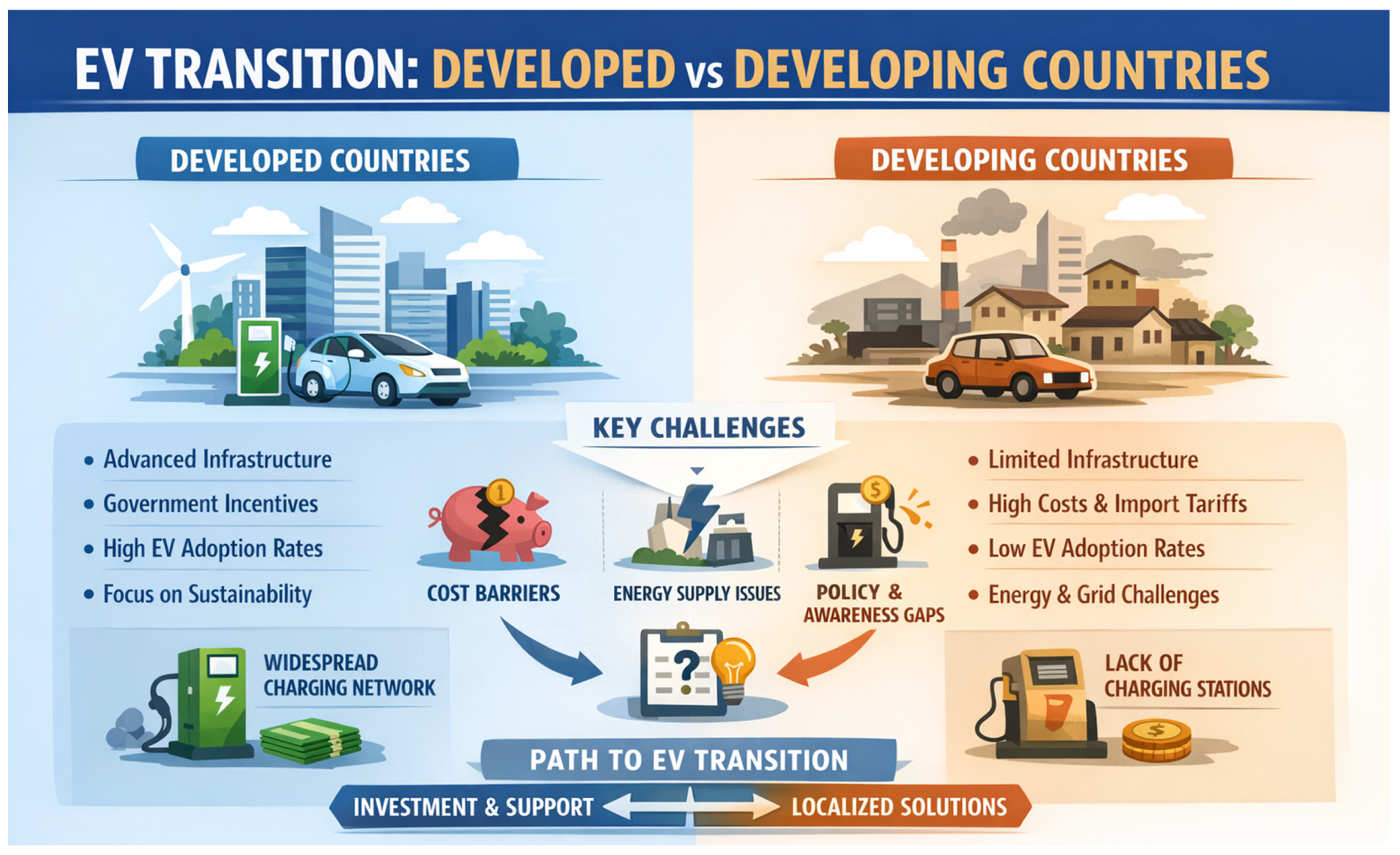


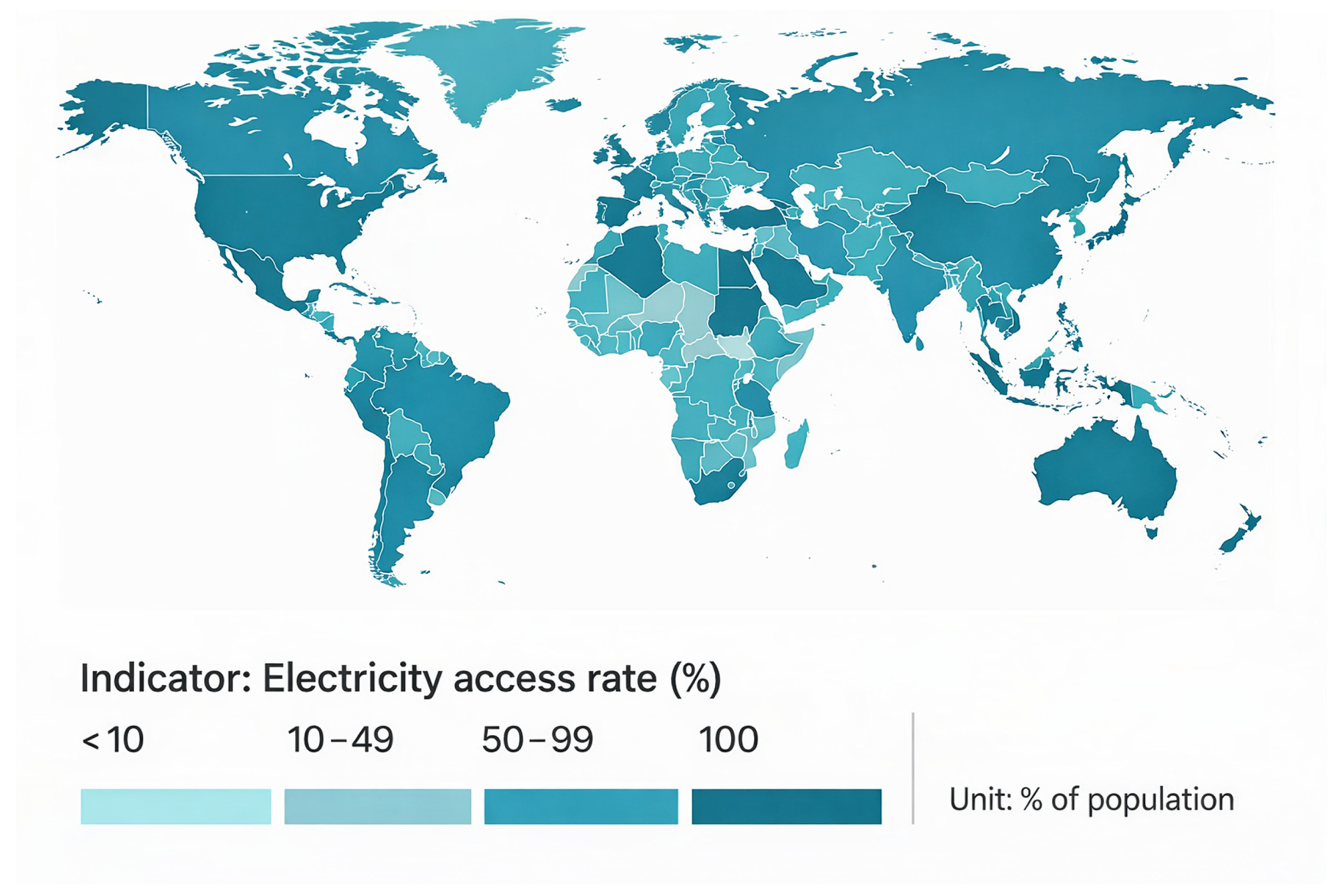


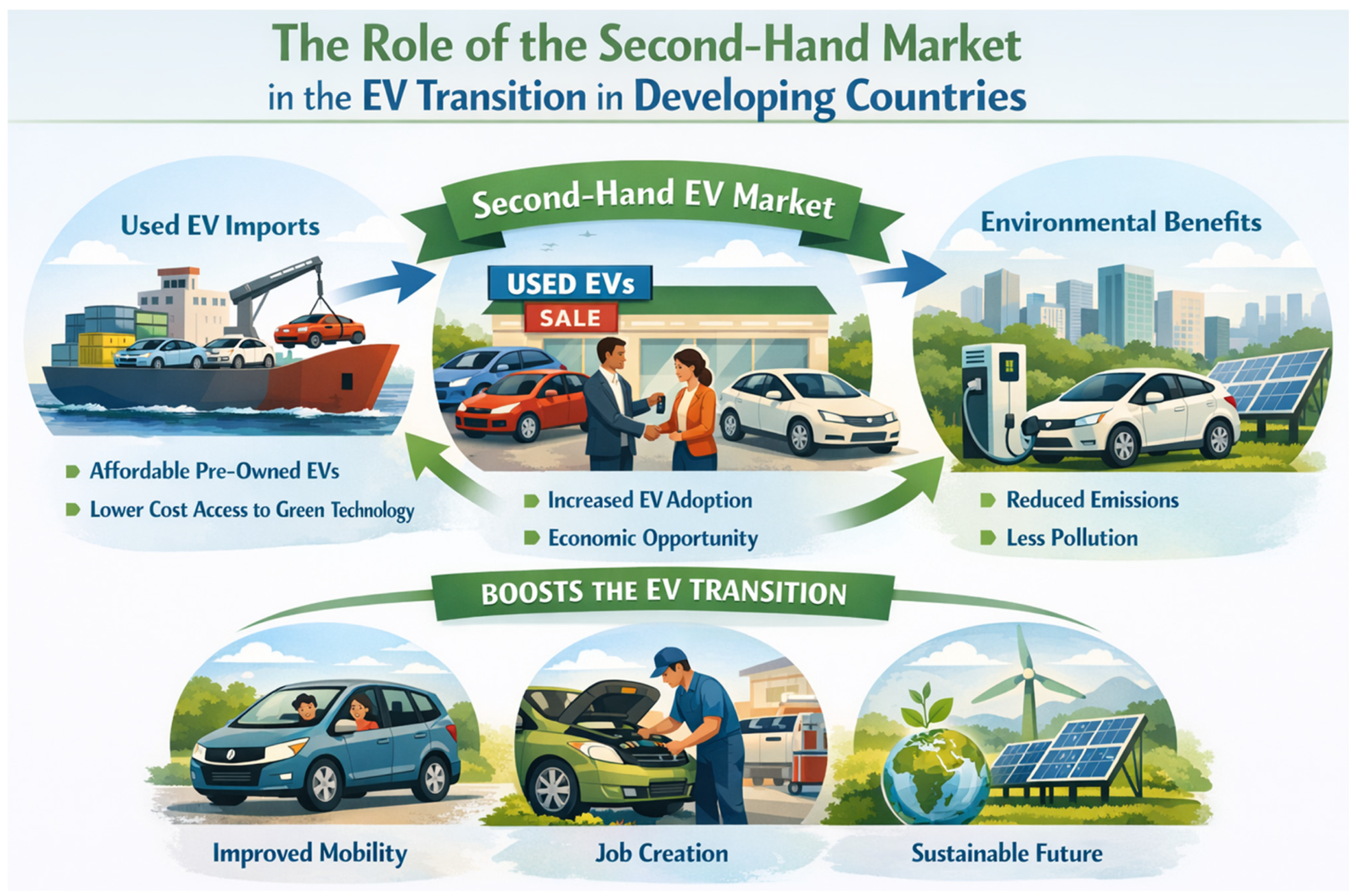


| Region/Country | Share of Used Vehicles |
|---|---|
| Developing countries (global average) | ~80% of imported light duty vehicles |
| Africa (continent-wide) | >40% of global exports of used vehicles end up here |
| Ethiopia | ~85% of all vehicles are used |
| Kenya | ~80–99% of vehicle imports are used |
| Nigeria | ~90% of vehicles are second-hand |
| Ghana | 80–90% of vehicles on road are used |
| Botswana | 99.6% of imported cars are used |
| Category | Key Barriers |
|---|---|
| Economic | High costs, lack of subsidies, weak financing |
| Infrastructure | Poor charging networks, unreliable power grid |
| Policy | Weak regulations, lack of national EV plans |
| Social | Low awareness, cultural resistance |
| Technological | Skill shortages, limited R&D |
| Environmental | Fossil-based electricity generation |
| Supply Chain | Import dependence, material access issues |
| Factor | Developed Countries | Developing Countries |
|---|---|---|
| Average 3-year depreciation | ~40% (e.g., US, EU) | Often >50% due to key factors |
| Battery resale value | Stabilizing via leasing/swap | Still volatile, few solutions |
| Infrastructure impact | Improving with networks | Major constraint |
| Criterion | Why It Matters |
|---|---|
| Clear targets | Signals market direction |
| Policy framework | Ensures coordinated implementation |
| Financial incentives | Improves affordability |
| Charging and grid investment | Enables operational feasibility |
| Local manufacturing | Builds economic resilience |
| Sector prioritization | Matches local travel patterns |
| Public awareness | Builds demand |
| Equity and environmental fairness | Maximizes societal benefits |
| Regulatory actions on vehicle turnover | Accelerates transition |
| Integrated planning | Ensures sustainability |
| Country | Key Policy Measures and Targets | Year | Category |
|---|---|---|---|
| South Africa | Convert 5% of the public and national fleet to cleaner alternative fuel and efficient technology vehicles by 2025, with annual increase of 2% thereafter. | 2018 | Bus, Multiple |
| Add 40 solar-powered public EV charging stations per annum. | EVSE | ||
| Cabo Verde | 50% share of EVs in urban bus sales by 2025, 75% by 2030 and 100% by 2040. | 2019 | Bus |
| 35% share of passenger LDV sales to be EVs by 2025, 70% by 2030 and 100% by 2035. | LDV | ||
| 25% share of EVs in heavy truck sales by 2030 and 100% by 2035. | M/HDV | ||
| 15% share of EVs in medium truck sales by 2025, 35% by 2030 and 100% by 2035. | M/HDV | ||
| 100% EVs in government LDV stock by 2030. | LDV | ||
| Gambia | Promote low-emission fuel and HEVs, introduce an age limit of a maximum of 3 years for imported vehicles. | 2022 | LDV |
| Morocco | Target of almost 30,000 charging points for LDVs, 2/3Ws, and buses by 2030. | 2022 | EVSE |
| Target of 2000 electric buses in 2030. | Bus | ||
| Target of 250,000 electric 2/3Ws in 2030. | 2/3W | ||
| Target of 258,000 electric cars in 2030. | LDV | ||
| Seychelles | 30% of new private vehicle sales to be electric by 2030. | 2022 | LDV |
| 100% of public bus stock to be electric by 2050. | Bus | ||
| Zimbabwe | Reduction of gasoline and diesel demand by ICE vehicles through the uptake of electric and hydrogen vehicles. | 2022 | Multiple |
| Criteria | Focus Area | Illustrative Indicators |
|---|---|---|
| Political Commitment | High-level leadership, policy direction, and integration of e-mobility within national development and climate strategies | Existence of a national e-mobility strategy or roadmap; political endorsement in national plans (e.g., NDCs, Vision 2050); dedicated government budget or flagship projects (e.g., Dakar BRT) |
| Institutional Readiness | Organizational capacity, coordination across ministries, and operational mechanisms for policy implementation | Establishment of a lead agency or interministerial committee for e-mobility; defined institutional mandates; data and monitoring systems for EV deployment |
| Regulatory Coherence | Harmonization of technical, fiscal, and environmental rules governing EVs and infrastructure | Adoption of EV and charging standards; fiscal and customs alignment for EV imports; type-approval procedures; battery and e-waste regulations |
| Financial Incentives | Market affordability, investment mobilization, and risk mitigation | Subsidy or tax exemption schemes; concessional credit lines or leasing programs; public–private investment models for fleets and charging networks |
| Infrastructure Readiness | Availability and integration of charging networks and power systems to support EV operations | Number and spatial distribution of charging points; renewable energy share in electricity mix; smart-grid integration; public–private partnerships for charging rollout |
| Human Capital and Industrial Ecosystem | Workforce skills, R&D capacity, and domestic manufacturing linkages | Number of training and certification programs; presence of local EV assemblers or component suppliers; university–industry R&D collaboration |
| Social and Environmental Sustainability | Public awareness, equity of access, and life-cycle environmental management | Awareness campaigns and pilot programs; inclusion of informal and low-income transport operators; policies for battery recycling and end-of-life management; measurable air-quality improvements |
| Aspect | Developed Countries | Developing Countries (LICs–UMICs) |
|---|---|---|
| Grid emissions | Generally low → strong EV benefits | Often high → benefits vary widely |
| Manufacturing impacts | Cleaner energy, stricter controls | Higher emissions, weaker regulation |
| Battery mining and recycling | Regulated, formal systems | Greater environmental and social risks |
| Policy and infrastructure | Mature incentives and standards | Mixed, rapidly evolving |
| Net LCA benefit | Clear advantage vs. ICEVs | Highly dependent on grid and policy |
Disclaimer/Publisher’s Note: The statements, opinions and data contained in all publications are solely those of the individual author(s) and contributor(s) and not of MDPI and/or the editor(s). MDPI and/or the editor(s) disclaim responsibility for any injury to people or property resulting from any ideas, methods, instructions or products referred to in the content. |
© 2026 by the authors. Licensee MDPI, Basel, Switzerland. This article is an open access article distributed under the terms and conditions of the Creative Commons Attribution (CC BY) license.
Share and Cite
Ka, I.; Djité, A.N.; Chimére Diop, S.A.; Ayetor, G.K.; Diouf, B. The Electric Vehicle Transition in Emerging Economies. Vehicles 2026, 8, 37. https://doi.org/10.3390/vehicles8020037
Ka I, Djité AN, Chimére Diop SA, Ayetor GK, Diouf B. The Electric Vehicle Transition in Emerging Economies. Vehicles. 2026; 8(2):37. https://doi.org/10.3390/vehicles8020037
Chicago/Turabian StyleKa, Ibrahima, Ansoumana Noumou Djité, Seynabou Anna Chimére Diop, Godwin Kafui Ayetor, and Boucar Diouf. 2026. "The Electric Vehicle Transition in Emerging Economies" Vehicles 8, no. 2: 37. https://doi.org/10.3390/vehicles8020037
APA StyleKa, I., Djité, A. N., Chimére Diop, S. A., Ayetor, G. K., & Diouf, B. (2026). The Electric Vehicle Transition in Emerging Economies. Vehicles, 8(2), 37. https://doi.org/10.3390/vehicles8020037