
Intelligent UAV Navigation in Smart Cities Using Phase-Field Deep Neural Networks: A Comprehensive Simulation Study

Abstract
1. Introduction

| Framework | Strengths | Limitation | Suitability for UAV Navigation |
|---|---|---|---|
| Bayesian Networks [16] | Explicit probabilistic reasoning; interpretable | Poor scalability in high-dimensional data; computationally expensive | Limited in real-time, vision-heavy UAV tasks |
| Probabilistic Graphical Models (PGMs) [17] | Structured uncertainty modeling; interpretable | Slow inference; large graphs are impractical in dynamic environments | Limited real-time adaptability |
| Attention-based DNNs [18] | Strong feature extraction; scalable | Implicit uncertainty handling; lacks physical interpretability | Good for perception, weaker for explicit navigation uncertainty |
| PFM-DNN (Proposed) | Continuous spatial uncertainty; interpretable; scalable | New integration requires cloud/DNN support | Highly suitable for dynamic UAV navigation |
- -
- Proposed PFM-DNN Framework for UAV Navigation: This study proposes an innovative framework that integrates phase-field modeling with deep neural networks (PFM-DNN) to generate continuous-field representations, enabling drones to plan smooth and collision-free trajectories and effectively avoid obstacles, thereby enhancing autonomous navigation in complex urban environments.
- -
- Adaptive and Efficient Navigation via Semantic Segmentation and Uncertainty Estimation: The proposed PFM-DNN framework enables real-time perception and adaptive decision-making by integrating semantic segmentation and obstacle classification with uncertainty estimation. This integration enhances UAV stability and safety under dynamically varying environmental conditions, such as fog, occlusions, and low illumination.
- -
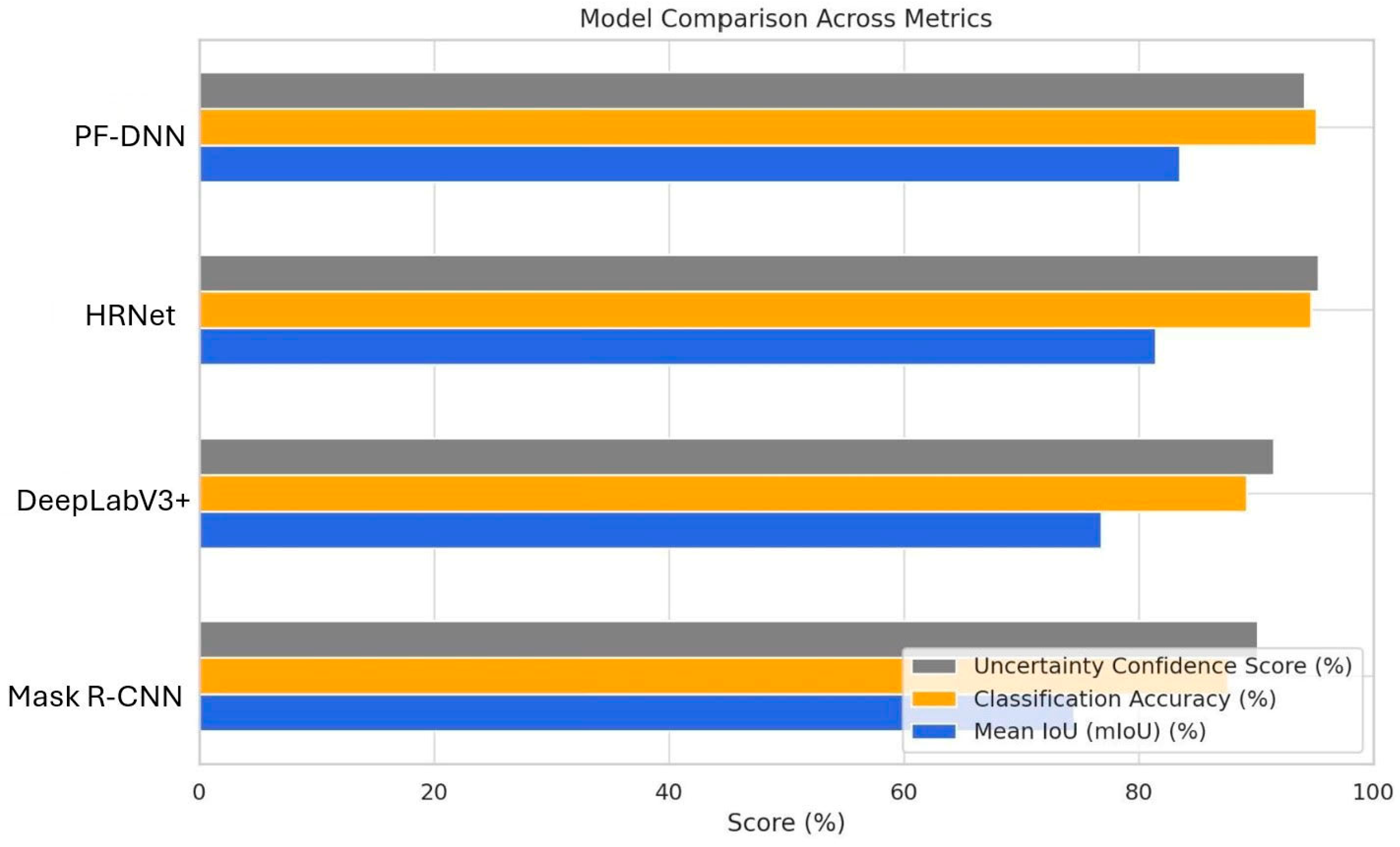
- Comprehensive Evaluation and Benchmarking against State-of-the-Art Models: Extensive simulations and quantitative analysis were conducted to validate the effectiveness of the proposed PFM-DNN framework. The results demonstrate superior performance in terms of accuracy and convergence rate (mIoU) compared to state-of-the-art models, including DeepLabV3+, Mask R-CNN, and HRNet, confirming its suitability for dynamic and complex navigation environments.
2. Literature Review
3. Design of PFM-DNN Based Navigation System
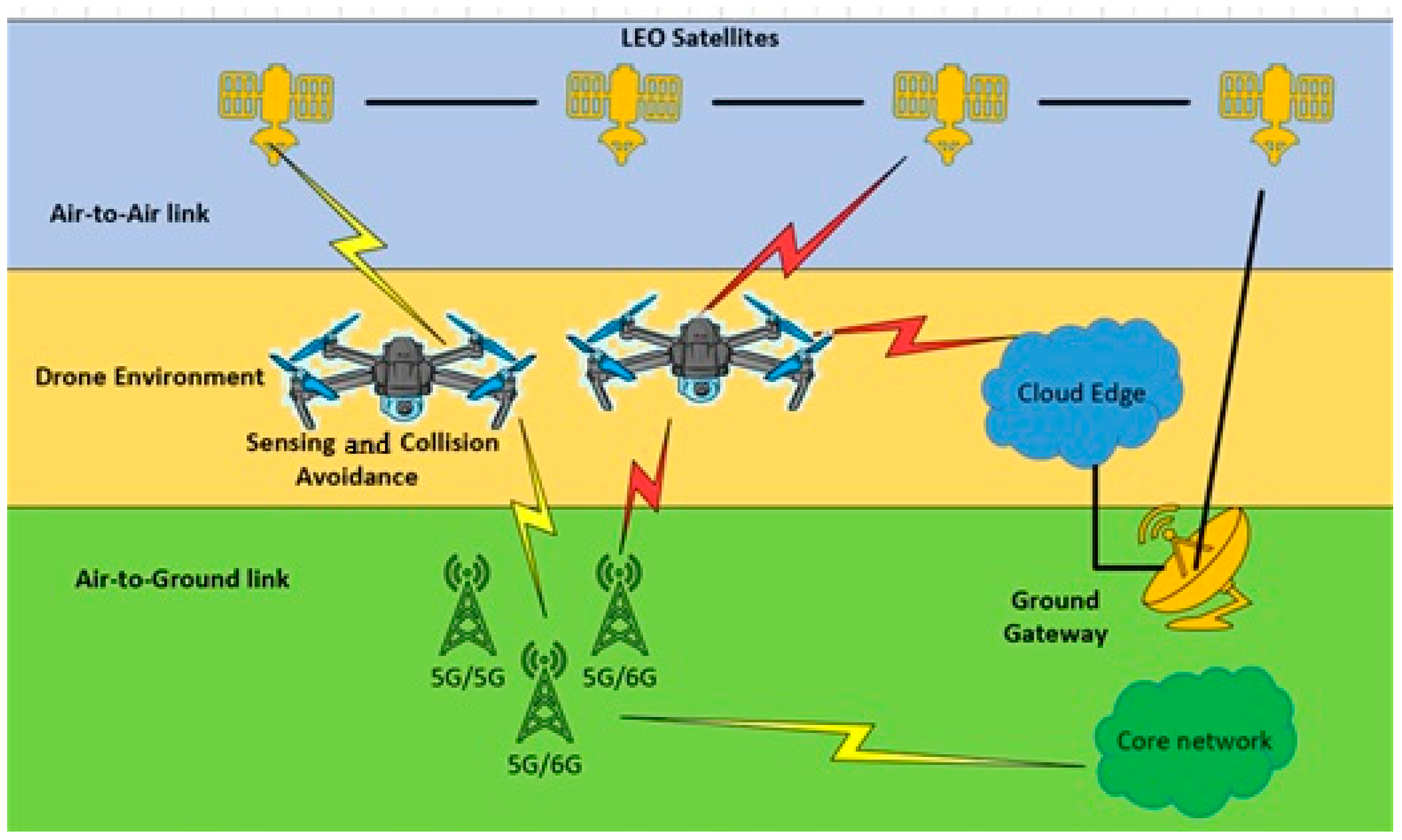
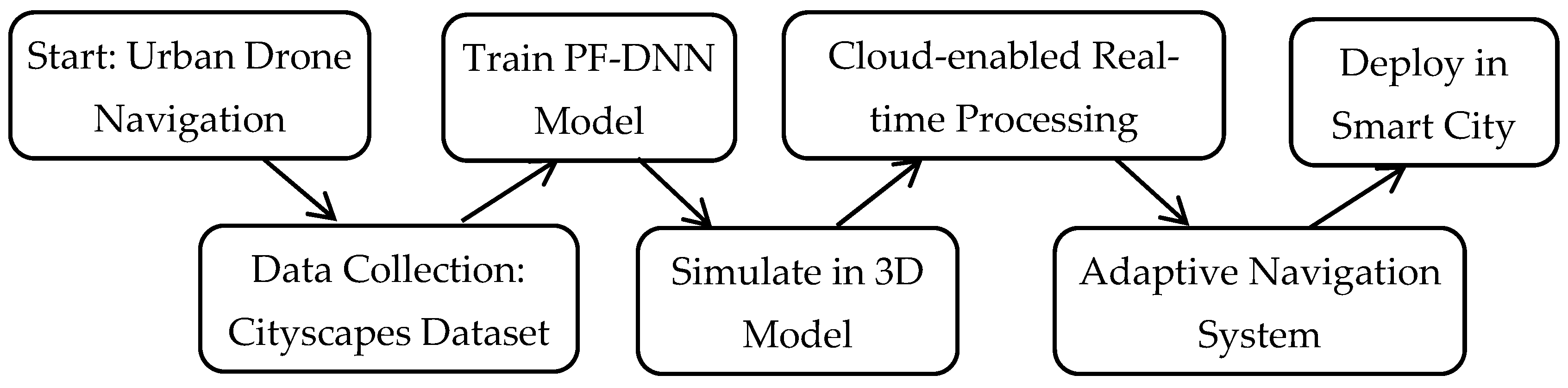
3.1. Drone Navigation System
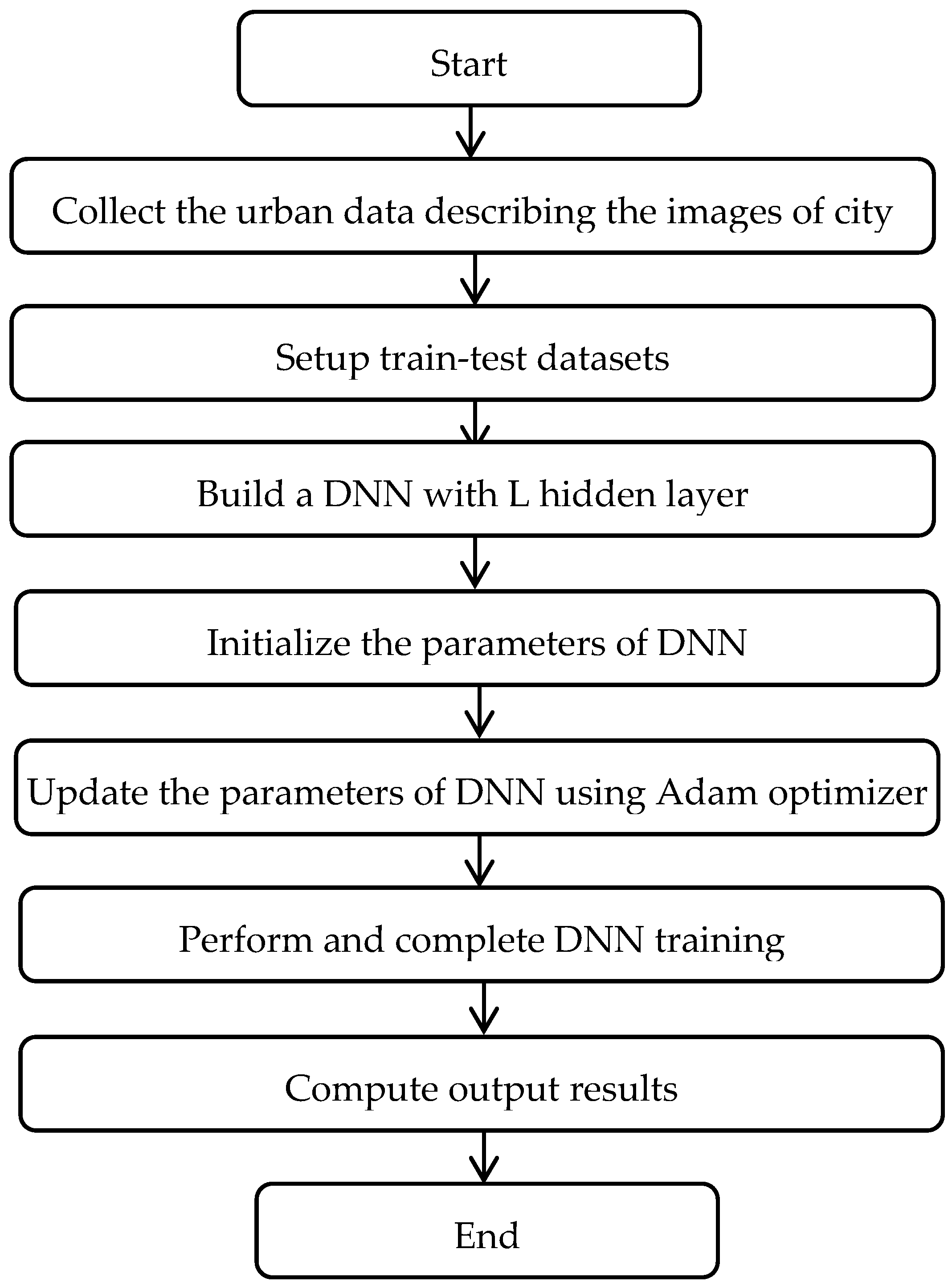
3.2. DNN Algorithm
- The model has three convolutional layers.
- Each layer utilizes of 3 × 3 filter size with padding set to “same”, which ensures the maps’ output has the same spatial dimension as the input.
- The first layer of convolutional has 16 filters, while the other layer has 64 filters.
- Both are using a stride of 1.
- The two convolutional layers are followed by applying the batch normalization and RelU activation function.
- Max pooling layers have 2 × 2 windows and with stride of 2, which is followed by a layer block to decrease the spatial resolution by half.
- Output applied from the final max-pooling, then moved to the fully connected layer for classifying.
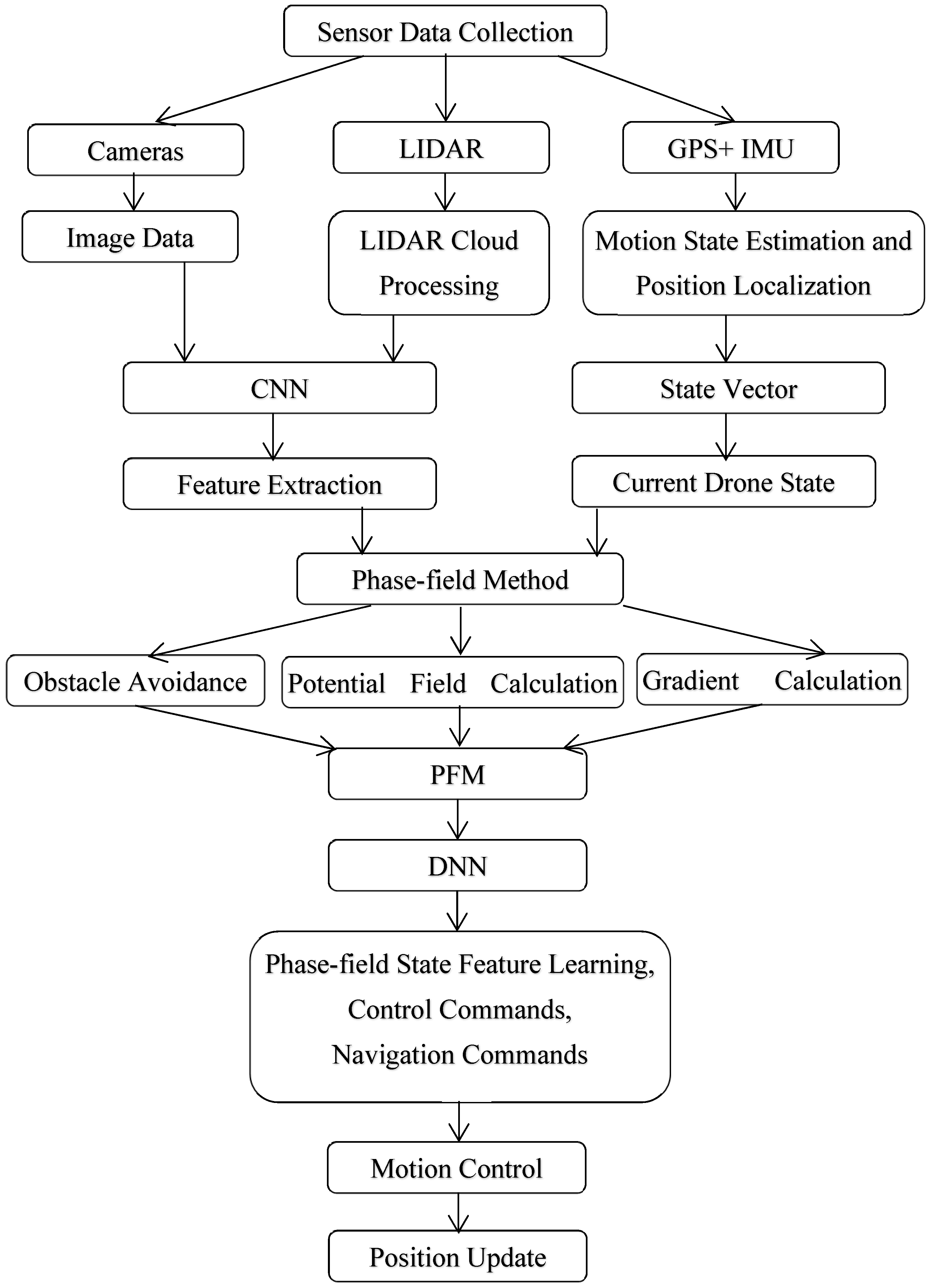
3.3. Phase-Field Deep Neural Network (PFM-DNN)
- Convolutional layers for spatial feature extraction;
- Recurrent layers for temporal sequence learning;
- Fully connected layers for control command generation.
3.4. Mathematical Models
- Feature extraction and convolutional processing.
- 2.
- Multi-scale attention mechanism.
- 3.
- Phase-field uncertainty estimation.
- 4.
- Semantic segmentation loss function.
- 5.
- Classification with softmax activation.
- (a)
- Gradient energy term.
- (b)
- Potential energy term.
- (c)
- External potential term.
4. Simulation Analysis
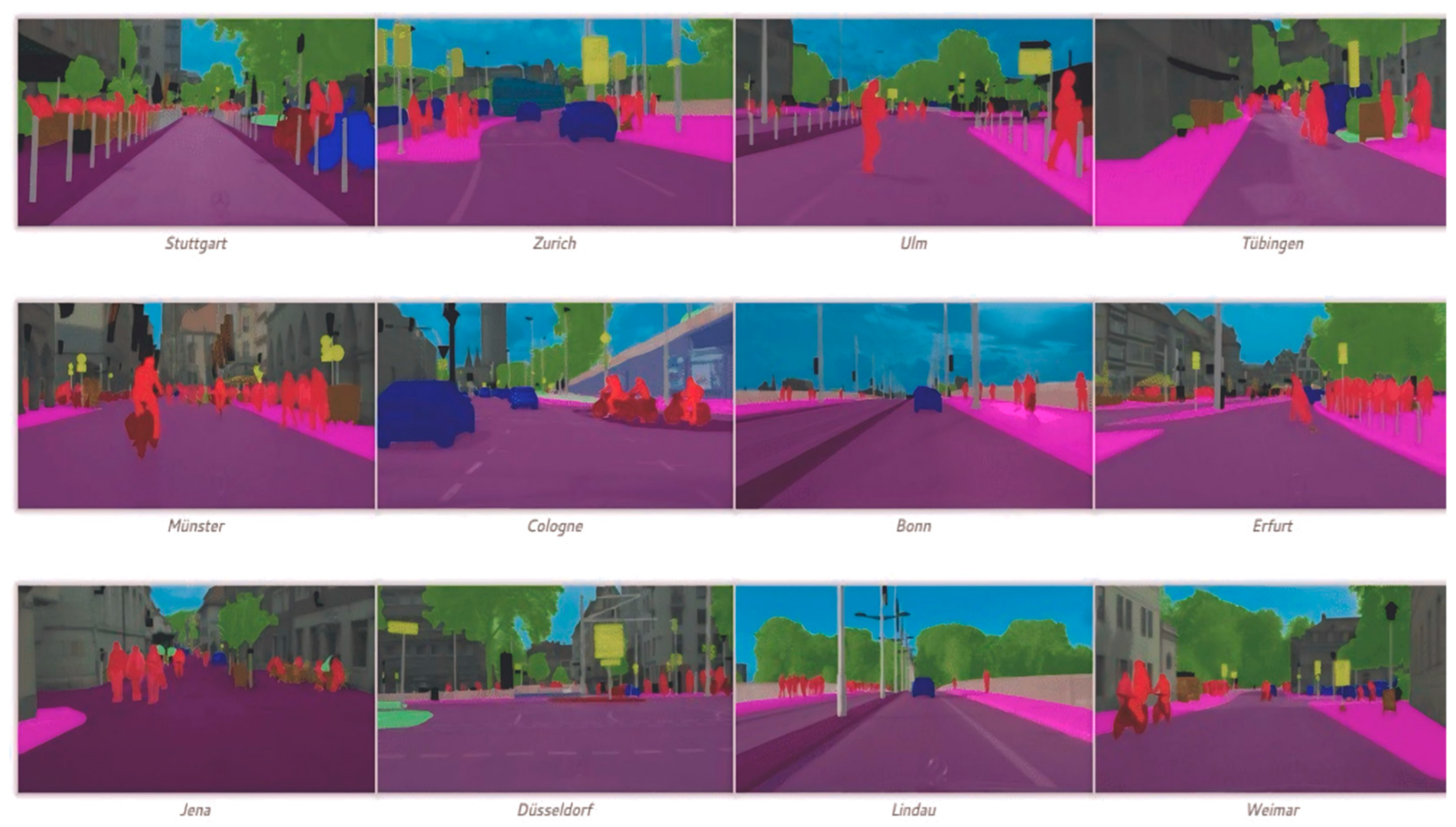
4.1. Dataset
- Normalization of Image: Pixel values are normalized in a 0–1 range to ensure that the system is stable and fast in convergence.
- Augmentation of Data: Techniques such as cropping randomly, flipping horizontally, rotations, adjusting the brightness, and injection of Gaussian noise are applied to enhance the ability of the model to generalize across diverse environmental conditions.
- Adjustment of the Resolution: The images are re-sized to 1024 × 512 pixels for balanced efficiency computation, with accurate segmentation.
- LiDAR Fusion: Deep maps and LiDAR point clouds are incorporated to use spatial 3D data and enhance the obstacles detection and path estimation.
Computing Environment
- Basic workstation: Intel Xeon E5-2699 v4 processor (22 cores, 2.2 GHZ) with 64 GB of RAM, without any hardware acceleration.
- GPU acceleration environment: NVIDIA RTX 3090 graphics card (24 GB VRAM, CUDA 11.3) for real-time inference and high-speed processing acceleration.
- Peripheral AI computing: NVIDIA Jetson AX Xavier (512 Volta cores, octa-core ARM processor, 32 GB LPDDR4x RAM) to evaluate real-time, low-power performance and deployment on peripherals.
4.2. PFM-DNN Navigation
- ✓
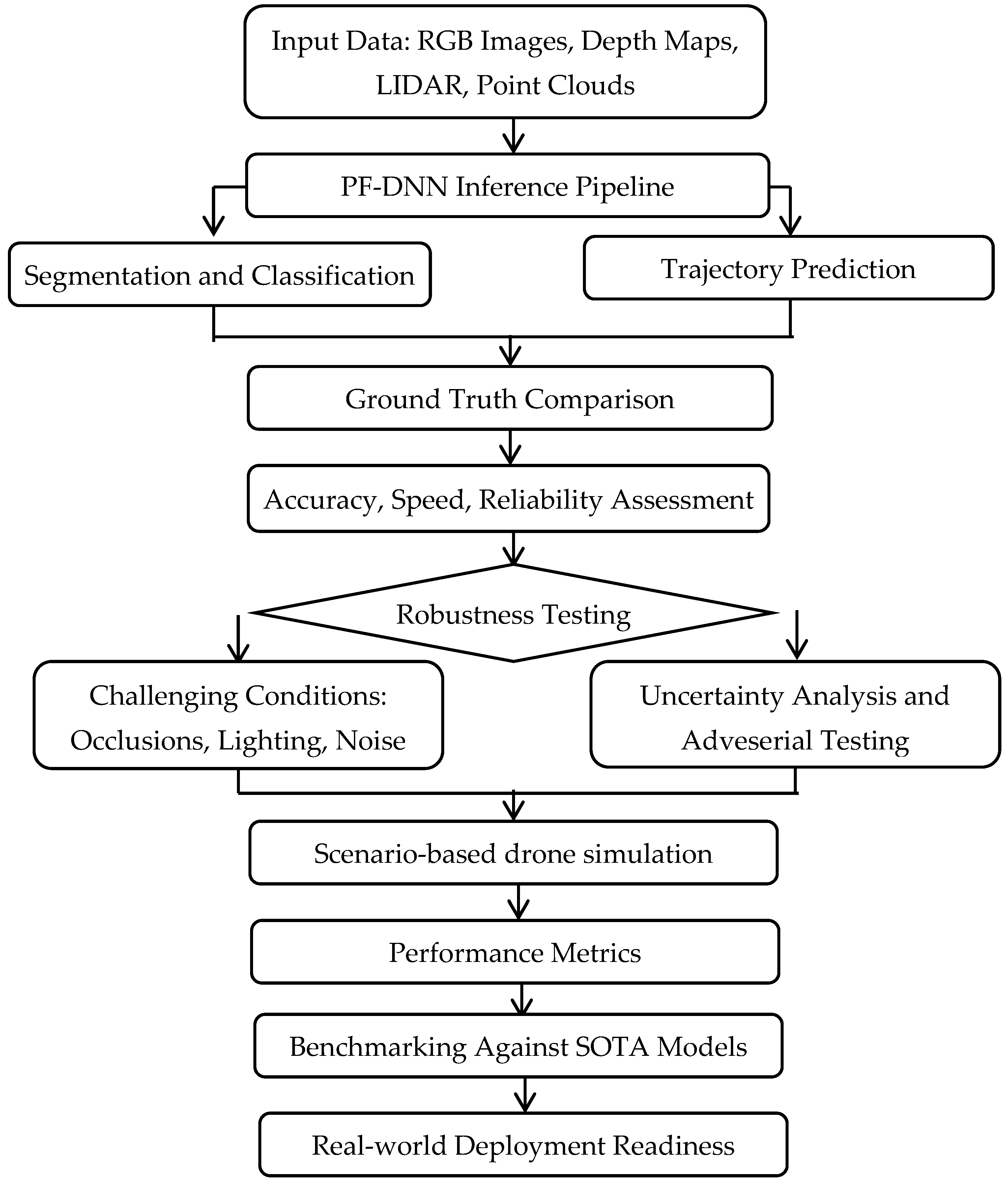
- The process begins with multiple data sources providing rich environmental information from data sources, including RGB images, depth maps, LiDAR point clouds.
- ✓
- “PFM-DNN Inference Pipeline” branches into two parallel operations:
- ✓
- The first operation is segmentation and classification—identifying and categorizing objects in the scene.
- ✓
- The second is trajectory prediction—forecasting movement paths.
- ✓
- In the “Ground Truth Comparison” module, branches are validated against known correct data.
- ✓
- In “Accuracy, Speed, Reliability Assessment”, an evaluation of the model’s performance across multiple metrics is carried out.
- ✓
- In the “Robustness Testing” module, based on the test, one of the following decisions is made:
- ✓
- The first is challenging conditions: occlusions, lighting, noise—testing the system under difficult environmental factors.
- ✓
- The second is uncertainty analysis and adversarial testing—evaluating how the system responds to edge cases and potential attacks.
- ✓
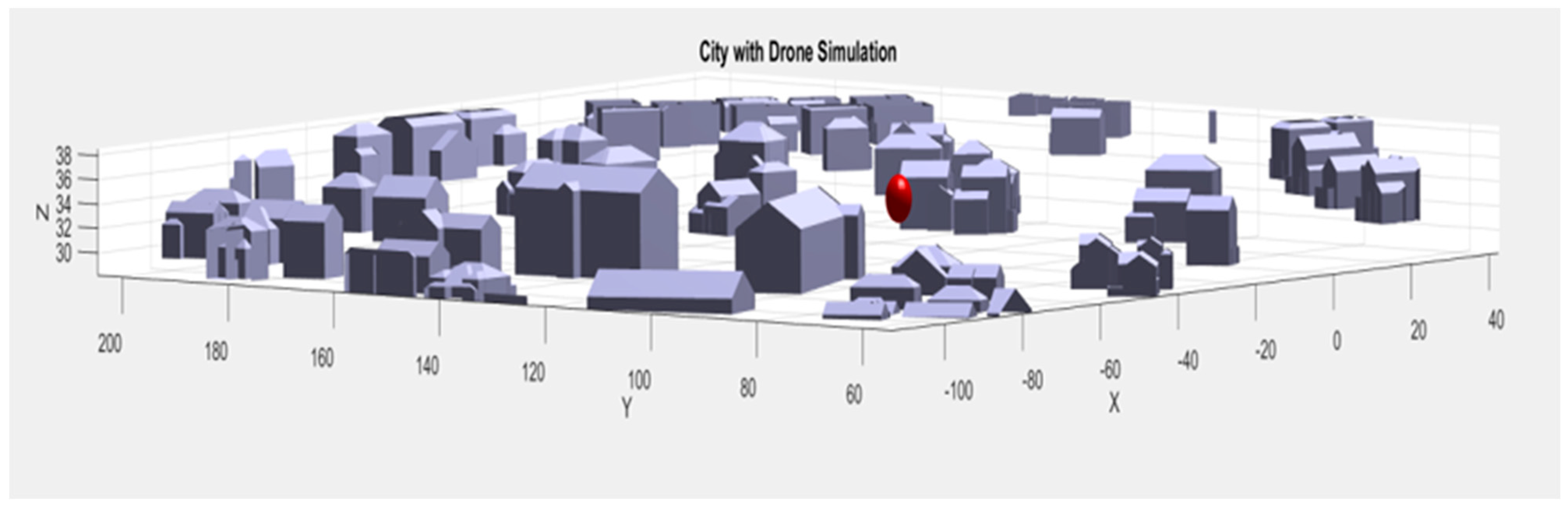
- The “Scenario-based Drone Simulation” combines the results of both testing branches to create realistic drone operation scenarios.
- ✓
- The “Performance Metrics & KPI Analysis” measures key performance indicators.
- ✓
- “Benchmarking Against SOTA Models” compares the results with state-of-the-art systems.
- ✓
- “Model Refinement & Optimization” makes iterative improvements based on test results.
- ✓
- The “Real-world Deployment Readiness” module assesses the system’s preparedness for actual deployment.
4.3. Simulation Setup
4.4. Obstacle Classification
4.5. Robustness to Environmental Conditions
4.6. Comparison with State-of-the-Art Models
4.7. Limitations
5. Conclusions
Supplementary Materials
Author Contributions
Funding
Data Availability Statement
Conflicts of Interest
References
- Abiyev, R.H.; Akkaya, N.; Aytac, E.; Ibrahim, D. Behaviour-tree Based Control for Efficient Navigation of Holonomic Robots. Int. J. Robot. Autom. 2014, 29, 44–57. [Google Scholar] [CrossRef]
- Maguire-Day, J.; Al-Rubaye, S.; Warrier, A.; Sen, M.A.; Whitworth, H.; Samie, M. Emerging Decision-Making for Transportation Safety: Collaborative Agent Performance Analysis. Vehicles 2025, 7, 4. [Google Scholar] [CrossRef]
- Xiao, J.; Zhang, R.; Zhang, Y.; Feroskhan, M. Vision-based Learning for Drones: A Survey. IEEE Trans. Neural Networks Learn. Syst. 2023, 36, 15601–15621. [Google Scholar] [CrossRef] [PubMed]
- Eldeeb, E.; Sant’Ana JMde, S.; Pérez, D.E.; Shehab, M.; Mahmood, N.H.; Alves, H. Multi-UAV Path Learning for Age and Power Optimization in IoT with UAV Battery Recharge. IEEE Trans. Veh. Technol. 2023, 72, 5356–5360. [Google Scholar] [CrossRef]
- Panico, A.; Fragonara, L.Z.; Al-Rubaye, S. Adaptive detection tracking system for autonomous UAV maritime patrolling. In Proceedings of the 2020 IEEE International Workshop on Metrology for AeroSpace, MetroAeroSpace, Pisa, Italy, 22–24 June 2020; pp. 539–544. [Google Scholar] [CrossRef]
- Zhang, Z.; Wu, J.; Dai, J.; He, C. A Novel Real-Time Penetration Path Planning Algorithm for Stealth UAV in 3D Complex Dynamic Environment. IEEE Access 2020, 8, 122757–122771. [Google Scholar] [CrossRef]
- Bahabry, A.; Wan, X.; Ghazzai, H.; Menouar, H.; Vesonder, G.; Massoud, Y. Low-Altitude Navigation for Multi-Rotor Drones in Urban Areas. IEEE Access 2019, 7, 87716–87731. [Google Scholar] [CrossRef]
- Mao, Y.; Chen, M.; Wei, X.; Chen, B. Obstacle recognition and avoidance for UAVs under resource-constrained environments. IEEE Access 2020, 8, 169408–169422. [Google Scholar] [CrossRef]
- Yang, S.; Meng, Z.; Chen, X.; Xie, R. Real-time obstacle avoidance with deep reinforcement learning. Three-Dimensional Autonomous Obstacle Avoidance for UAV. In Proceedings of the 2019 International Conference on Robotics, Intelligent Control and Artificial Intelligence; ACM International Conference Proceeding Series; ACM: New York, NY, USA, 2019; pp. 324–329. [Google Scholar] [CrossRef]
- Neapolitan, R.E. Learning Bayesian Networks; Pearson Prentice Hall: Upper Saddle River, NJ, USA, 2004; Volume 38. [Google Scholar]
- Torres, R.D.; Molina, M.; Campoy, P. Survey of Bayesian Network applications to Intelligent Autonomous Vehicles (IAVs). arXiv 2019, arXiv:1901.05517. [Google Scholar]
- de Santana, C.A.; Colombini, E.L. Attention, please! A survey of neural attention models in deep learning. Artif. Intell. Rev. 2022, 55, 6037–6124. [Google Scholar] [CrossRef]
- Li, X.; Li, Y.; Ai, J.; Shu, Z.; Xia, J.; Xia, Y. Semantic segmentation of UAV remote sensing images based on edge feature fusing and multi-level upsampling integrated with Deeplabv3. PLoS ONE 2023, 18, e0279097. [Google Scholar] [CrossRef] [PubMed] [PubMed Central]
- Yang, X.; Fan, X.; Peng, M.; Guan, Q.; Tang, L. Semantic segmentation for remote sensing images based on an AD-HRNet model. Int. J. Digit. Earth 2022, 15, 2376–2399. [Google Scholar] [CrossRef]
- Hou, T.; Li, J. Application of mask R-CNN for building detection in UAV remote sensing images. Heliyon 2024, 10, e38141. [Google Scholar] [CrossRef]
- Alali, M.; Imani, M. Bayesian reinforcement learning for navigation planning in unknown environments. Front. Artif. Intell. Gence 2024, 7, 1308031. [Google Scholar] [CrossRef]
- Huang, Y.; Xiang, X.; Yan, C.; Xu, H.; Zhou, H. Density-Based Probabilistic Graphical Models for Adaptive Multi-Target Encirclement of AAV Swarm. IEEE Robot. Autom. Lett. 2025, 10, 8228–8235. [Google Scholar] [CrossRef]
- Ren, Y.; Dong, G.; Zhang, T.; Zhang, M.; Chen, X.; Xue, M. UAVs-Based Visual Localization via Attention-Driven Image Registration Across Varying Texture Levels. Drones 2024, 8, 739. [Google Scholar] [CrossRef]
- Srivastava, S.; Narayan, S.; Mittal, S. A survey of deep learning techniques for vehicle detection from UAV images. J. Syst. Archit. 2021, 117, 102152. [Google Scholar] [CrossRef]
- Bucolo, M.; Buscarino, A.; Fortuna, L.; Gagliano, S. Bifurcation scenarios for pilot induced oscillations. Aerosp. Sci. Technol. 2020, 106, 106194. [Google Scholar] [CrossRef]
- Wang, C.; Wang, J.; Shen, Y.; Zhang, X. Autonomous Navigation of UAVs in Large-Scale Complex Environments: A Deep Reinforcement Learning Approach. IEEE Trans. Veh. Technol. 2019, 68, 2124–2136. [Google Scholar] [CrossRef]
- Fu, C.; Xu, X.; Zhang, Y.; Lyu, Y.; Xia, Y.; Zhou, Z.; Wu, W. Memory-enhanced deep reinforcement learning for UAV navigation in 3D environment. Neural Comput. Appl. 2022, 34, 14599–14607. [Google Scholar] [CrossRef]
- Javadi, S.; Dahl, M.; Pettersson, M.I. Vehicle Detection in Aerial Images Based on 3D Depth Maps and Deep Neural Networks. IEEE Access 2021, 9, 8381–8391. [Google Scholar] [CrossRef]
- Krizhevsky, A.; Sutskever, I.; Hinton, G.E. ImageNet classification with deep convolutional neural networks. Commun. ACM 2017, 60, 84–90. [Google Scholar] [CrossRef]
- He, K.; Zhang, X.; Ren, S.; Sun, J. Deep Residual Learning for Image Recognition. In Proceedings of the IEEE Computer Society Conference on Computer Vision and Pattern Recognition, Las Vegas, NV, USA, 27–30 June 2016; pp. 770–778. [Google Scholar] [CrossRef]
- Wu, X.; Li, W.; Hong, D.; Tao, R.; Du, Q. Deep Learning for Unmanned Aerial Vehicle-Based Object Detection and Tracking: A survey. IEEE Geosci. Remote Sens. Mag. 2022, 10, 91–124. [Google Scholar] [CrossRef]
- Abiyev, R.H.; Akkaya, N.; Aytac, E.; Abizada, S. Fuzzy Gain Scheduling Controller for Quadrotor. In Proceedings of the 11th International Conference on Theory and Application of Soft Computing, Computing with Words and Perceptions and Artificial Intelligence—ICSCCW 2021; Lecture Notes in Networks and Systems; Springer: Cham, Switzerland, 2022; Volume 362, pp. 375–383. [Google Scholar] [CrossRef]
- Haider, S.K.; Nauman, A.; Jamshed, M.A.; Jiang, A.; Batool, S.; Kim, S.W. Internet of Drones: Routing Algorithms, Techniques and Challenges. Mathematics 2022, 10, 1488. [Google Scholar] [CrossRef]
- Hu, J.; Shen, L.; Sun, G. Squeeze-and-Excitation Networks. In Proceedings of the IEEE Computer Society Conference on Computer Vision and Pattern Recognition, Salt Lake City, UT, USA, 18–23 June 2018; pp. 7132–7141. [Google Scholar] [CrossRef]
- Yan, W.; Chen, C.; Zhang, D. U-Net-based medical image segmentation algorithm. In Proceedings of the 13th International Conference on Wireless Communications and Signal Processing, WCSP 2021, Changsha, China, 20–22 October 2021. [Google Scholar] [CrossRef]
- Liu, Y.; Ma, G.; Lyu, Y.; Wang, P. Neural network-based reinforcement learning control for combined spacecraft attitude tracking maneuvers. Neurocomputing 2022, 484, 67–78. [Google Scholar] [CrossRef]
- El Debeiki, M.; Al-Rubaye, S.; Perrusquía, A.; Conrad, C.; Flores-Campos, J.A. An Advanced Path Planning and UAV Relay System: Enhancing Connectivity in Rural Environments. Future Internet 2024, 16, 89. [Google Scholar] [CrossRef]
- Liu, S.; Lin, Z.; Huang, W.; Yan, B. Technical development and future prospects of cooperative terminal guidance based on knowledge graph analysis: A review. J. Zhejiang Univ.-Sci. A Appl. Phys. Eng. 2025, 26, 605–634. [Google Scholar] [CrossRef]
- Shahkar, S. Cooperative Localization of Multi-Agent Autonomous Aerial Vehicle (AAV) Networks in Intelligent Transportation Systems. IEEE Open J. Intell. Transp. Syst. 2025, 6, 49–66. [Google Scholar] [CrossRef]
- Zafar, M.; Khan, R.A.; Fedoseev, A.; Jaiswal, K.K.; Sujit, P.B.; Tsetserukou, D. HetSwarm: Cooperative Navigation of Heterogeneous Swarm in Dynamic and Dense Environments Through Impedance-Based Guidance. In Proceedings of the 2025 International Conference on Unmanned Aircraft Systems (ICUAS), Charlotte, NC, USA, 14–17 May 2025; pp. 309–315. [Google Scholar] [CrossRef]
- Xing, W.; Cui, Z.; Qi, J. HRCTNet: A hybrid network with high-resolution representation for object detection in UAV image. Complex Intell. Syst. 2023, 9, 6437–6457. [Google Scholar] [CrossRef]
- Siddique, N.; Paheding, S.; Elkin, C.P.; Devabhaktuni, V. U-Net and its variants for medical image segmentation: A review of theory and applications. Int. J. Remote Sens. 2021, 42, 5510–5546. [Google Scholar] [CrossRef]
- Janai, J.; Güney, F.; Behl, A.; Geiger, A. Computer vision for autonomous vehicles: Problems, datasets and state of the art. Found. Trends Comput. Graph. Vis. 2020, 12, 1–308. [Google Scholar] [CrossRef]
- Villanueva, A.; Fajardo, A. UAV Navigation System with Obstacle Detection using Deep Reinforcement Learning with Noise Injection. In Proceedings of the 2019 International Conference on ICT for Smart Society (ICISS), Bandung, Indonesia, 19–20 November 2019; pp. 1–6. [Google Scholar] [CrossRef]
- Wang, J.; Sun, K.; Cheng, T.; Jiang, B.; Deng, C.; Zhao, Y.; Liu, D.; Mu, Y.; Tan, M.; Wang, X.; et al. Deep High-Resolution Representation Learning for Visual Recognition. IEEE Trans. Pattern Anal. Mach. Intell. 2021, 43, 3349–3364. [Google Scholar] [CrossRef]
- Chen, L.C.; Zhu, Y.; Papandreou, G.; Schroff, F.; Adam, H. Encoder-decoder with atrous separable convolution for semantic image segmentation. In Proceedings of the European Conference on Computer Vision (ECCV), Munich, Germany, 8–14 September 2018; Lecture Notes in Computer Science. Springer: Cham, Switzerland, 2018; Volume 11211. [Google Scholar] [CrossRef]
- Ozgür-Unlüakin, D.; Bilgiç, T. Predictive maintenance using dynamic probabilistic networks. In Proceedings of the 3rd European Workshop on Probabilistic Graphical Models PGM’06 2006, Prague, Czech Republic, 12–15 September 2006; pp. 141–148. [Google Scholar]
- Mousa, M.; Al-Rubaye, S.; Inalhan, G. Unmanned Aerial Vehicle Positioning using 5G New Radio Technology in Urban Environment. In Proceedings of the AIAA/IEEE Digital Avionics Systems Conference, Barcelona, Spain, 1–5 October 2023. [Google Scholar] [CrossRef]
- Wang, F.; Long, L. Event-triggered adaptive NN control for MIMO switched nonlinear systems with non-ISpS unmodeled dynamics. J. Franklin Inst. 2022, 359, 1457–1485. [Google Scholar] [CrossRef]
- Zhang, X.; Han, N.; Zhang, J. Comparative analysis of VGG, ResNet, and GoogLeNet architectures evaluating performance, computational efficiency, and convergence rates. Appl. Comput. Eng. 2024, 44, 172–181. [Google Scholar] [CrossRef]
- Huang, Q.; Yang, X.; Wang, L.; Wang, Z.; Liu, Y. Research on U-Net-based medical image segmentation method. Math. Biosci. Eng. 2020, 17, 2792–2807. [Google Scholar] [CrossRef]


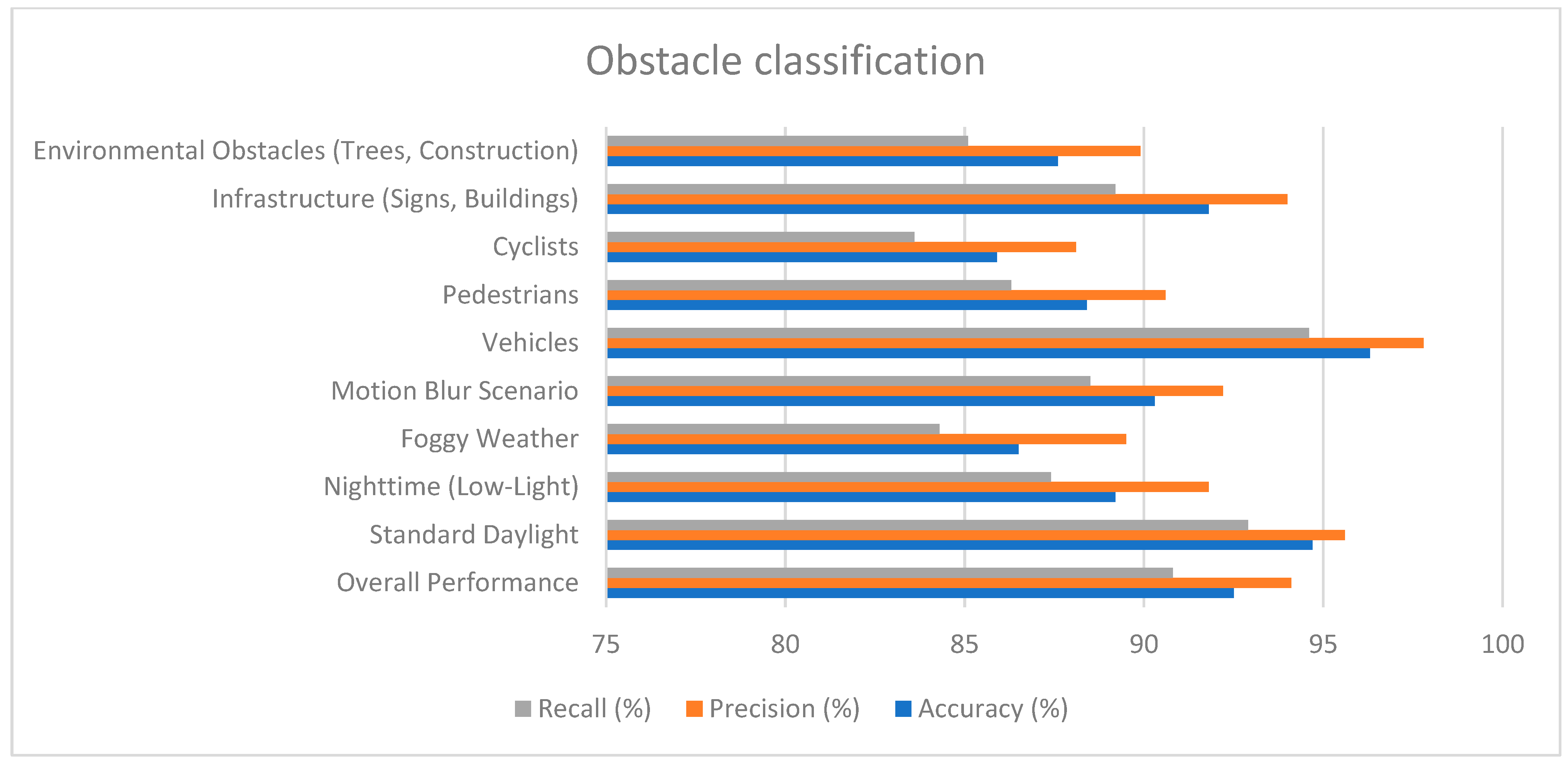
| Condition/Object Category | Accuracy (%) | Precision (%) | Recall (%) | False Negative Rate (FNR) (%) | False Positive Rate (FPR) (%) |
|---|---|---|---|---|---|
| Overall Performance | 92.5 | 94.1 | 90.8 | 9.2 | 5.8 |
| Standard Daylight | 94.7 | 95.6 | 92.9 | 7.1 | 4.5 |
| Nighttime (Low-Light) | 89.2 | 91.8 | 87.4 | 12.6 | 6.7 |
| Foggy Weather | 86.5 | 89.5 | 84.3 | 15.7 | 7.3 |
| Motion Blur Scenario | 90.3 | 92.2 | 88.5 | 11.5 | 6.1 |
| Vehicles | 96.3 | 97.8 | 94.6 | 5.4 | 3.7 |
| Pedestrians | 88.4 | 90.6 | 86.3 | 12.7 | 5.9 |
| Cyclists | 85.9 | 88.1 | 83.6 | 14.1 | 6.5 |
| Infrastructure (Signs, Buildings) | 91.8 | 94 | 89.2 | 10.8 | 5.2 |
| Environmental Obstacles (Trees, Construction) | 87.6 | 89.9 | 85.1 | 14.9 | 7.6 |
| DeepLabV3 + (Vehicles Comparison) | 82.7 | 73.3 | N/A | N/A | N/A |
| Mask R-CNN Vehicles Comparison) | 37.1 | 65 | N/A | N/A | N/A |
| HRNet Vehicles Comparison) | 54.9 | 75.1 | N/A | N/A | N/A |
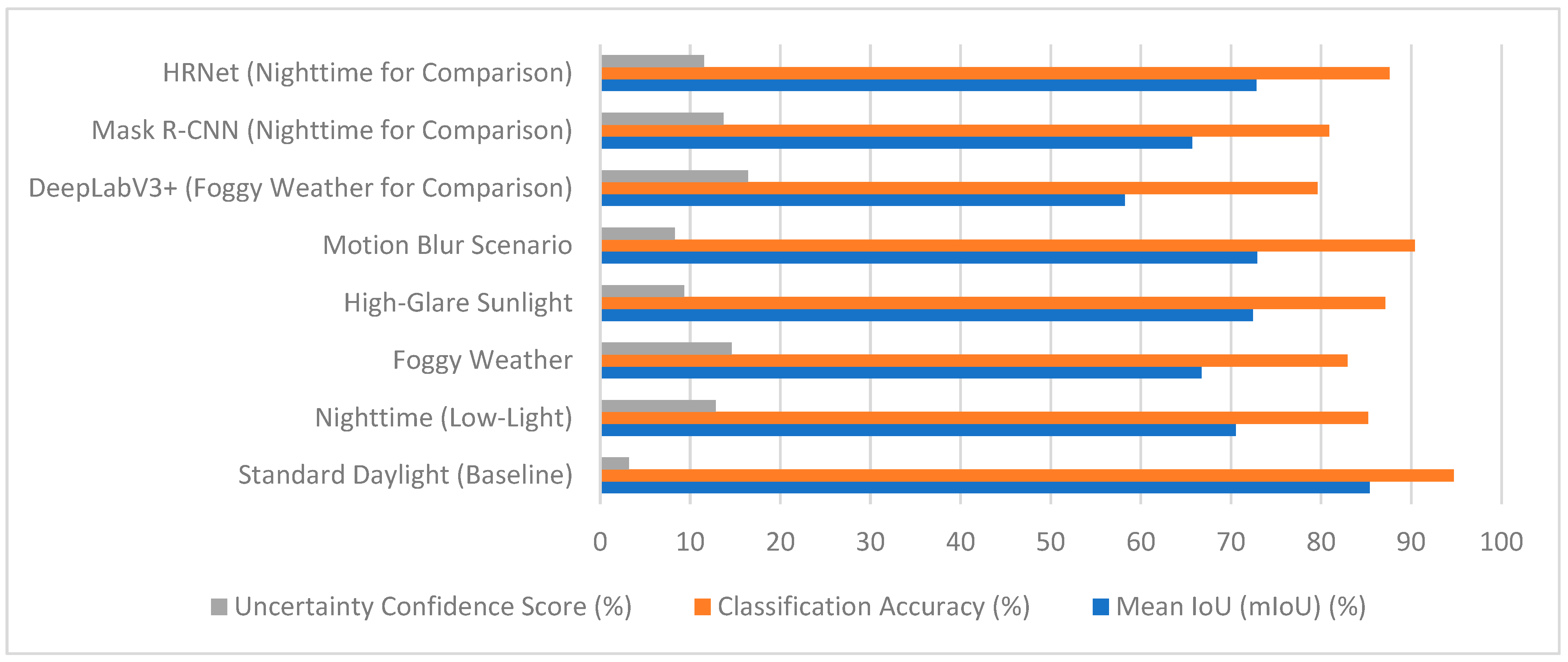
| Environmental Condition | Mean IoU (mIoU) (%) | Classification Accuracy (%) | Uncertainty Confidence Score (%) | False Positive Rate (FPR) (%) |
|---|---|---|---|---|
| PFM-DNN Standard Daylight (Baseline) | 85.4 | 94.7 | 3.2 | 4.5 |
| PFM-DNN Nighttime (Low-Light) | 70.5 | 85.2 | 12.8 | 6.7 |
| PFM-DNN Foggy Weather | 66.7 | 82.9 | 14.6 | 7.9 |
| PFM-DNN High-Glare Sunlight | 72.4 | 87.1 | 9.3 | 7.2 |
| PFM-DNN Motion Blur Scenario | 72.9 | 90.4 | 8.3 | 6.1 |
| DeepLabV3+ Foggy Weather (Comparison) | 58.2 | 79.6 | 16.4 | 9.2 |
| Mask R-CNN (Nighttime for Comparison) | 65.7 | 80.9 | 13.7 | 8.4 |
| HRNet (Nighttime for Comparison) | 72.8 | 87.6 | 11.5 | 6.2 |
Disclaimer/Publisher’s Note: The statements, opinions and data contained in all publications are solely those of the individual author(s) and contributor(s) and not of MDPI and/or the editor(s). MDPI and/or the editor(s) disclaim responsibility for any injury to people or property resulting from any ideas, methods, instructions or products referred to in the content. |
© 2026 by the authors. Licensee MDPI, Basel, Switzerland. This article is an open access article distributed under the terms and conditions of the Creative Commons Attribution (CC BY) license.
Share and Cite
Aljaburi, L.; Abiyev, R.H. Intelligent UAV Navigation in Smart Cities Using Phase-Field Deep Neural Networks: A Comprehensive Simulation Study. Vehicles 2026, 8, 6. https://doi.org/10.3390/vehicles8010006
Aljaburi L, Abiyev RH. Intelligent UAV Navigation in Smart Cities Using Phase-Field Deep Neural Networks: A Comprehensive Simulation Study. Vehicles. 2026; 8(1):6. https://doi.org/10.3390/vehicles8010006
Chicago/Turabian StyleAljaburi, Lamees, and Rahib H. Abiyev. 2026. "Intelligent UAV Navigation in Smart Cities Using Phase-Field Deep Neural Networks: A Comprehensive Simulation Study" Vehicles 8, no. 1: 6. https://doi.org/10.3390/vehicles8010006
APA StyleAljaburi, L., & Abiyev, R. H. (2026). Intelligent UAV Navigation in Smart Cities Using Phase-Field Deep Neural Networks: A Comprehensive Simulation Study. Vehicles, 8(1), 6. https://doi.org/10.3390/vehicles8010006