Multi-Task Seq2Seq Framework for Highway Incident Duration Prediction Incorporating Response Steps and Time Offsets


Abstract
1. Introduction
- (1)
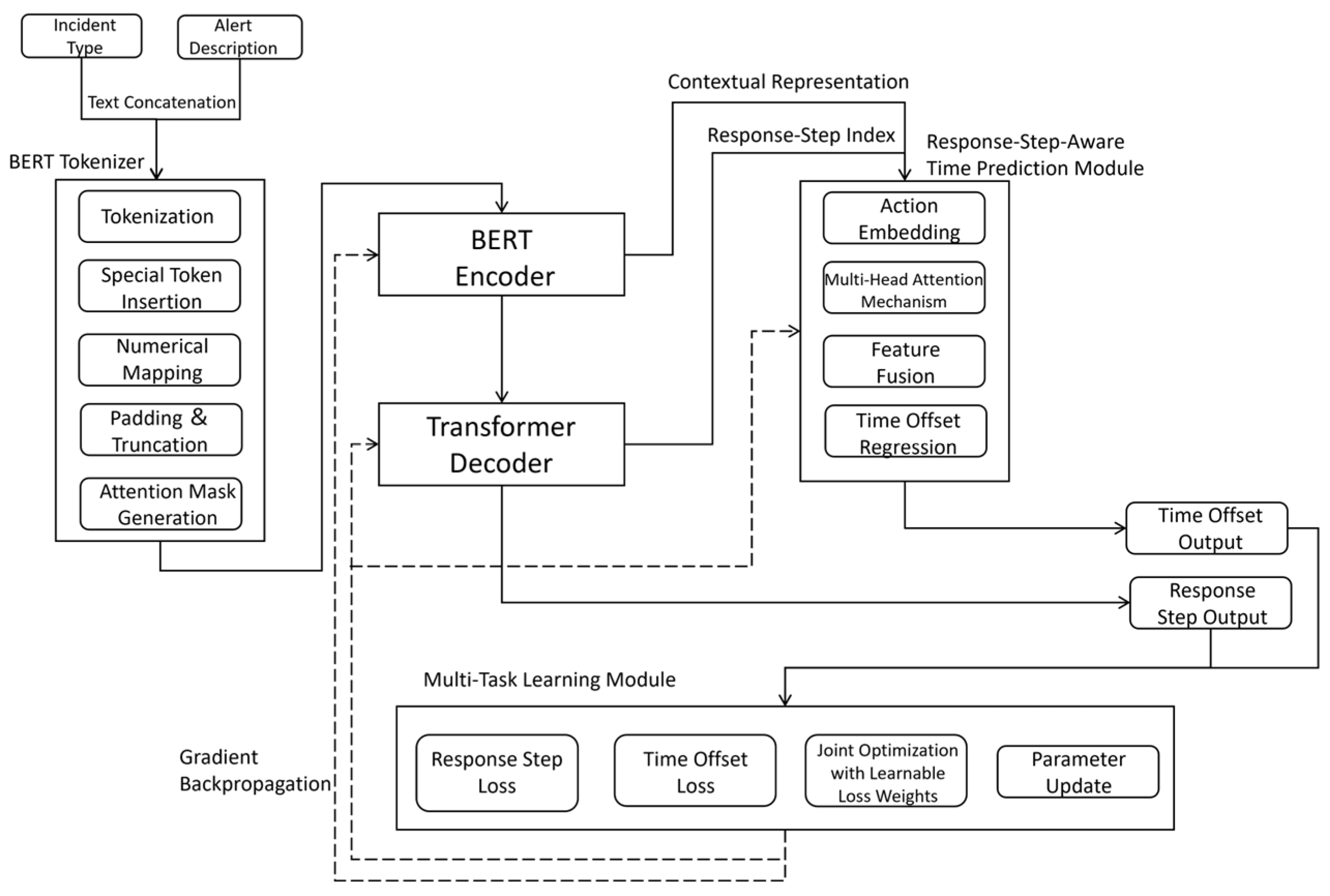
- An end-to-end multi-task Seq2Seq model is proposed to jointly predict response steps and time offsets for multiple categories of highway incidents.
- (2)
- A pretrained BERT model is utilized to deeply encode incident report text, enabling semantic transfer and enhancement.
- (3)
- A Transformer decoder-based multi-task architecture is designed to collaboratively optimize action prediction and time regression, improving incident duration prediction performance.
2. Materials and Methods
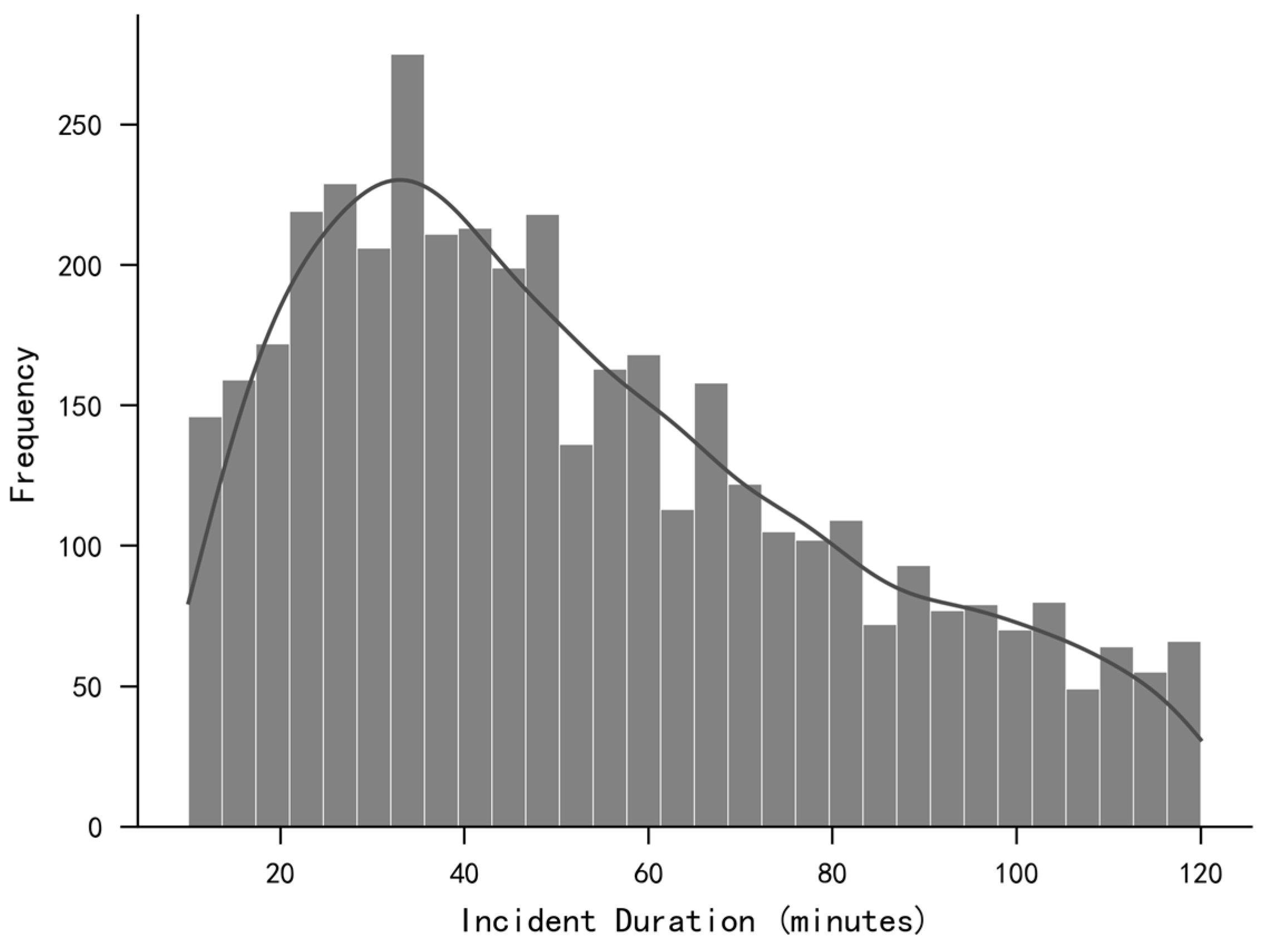
2.1. Data Description
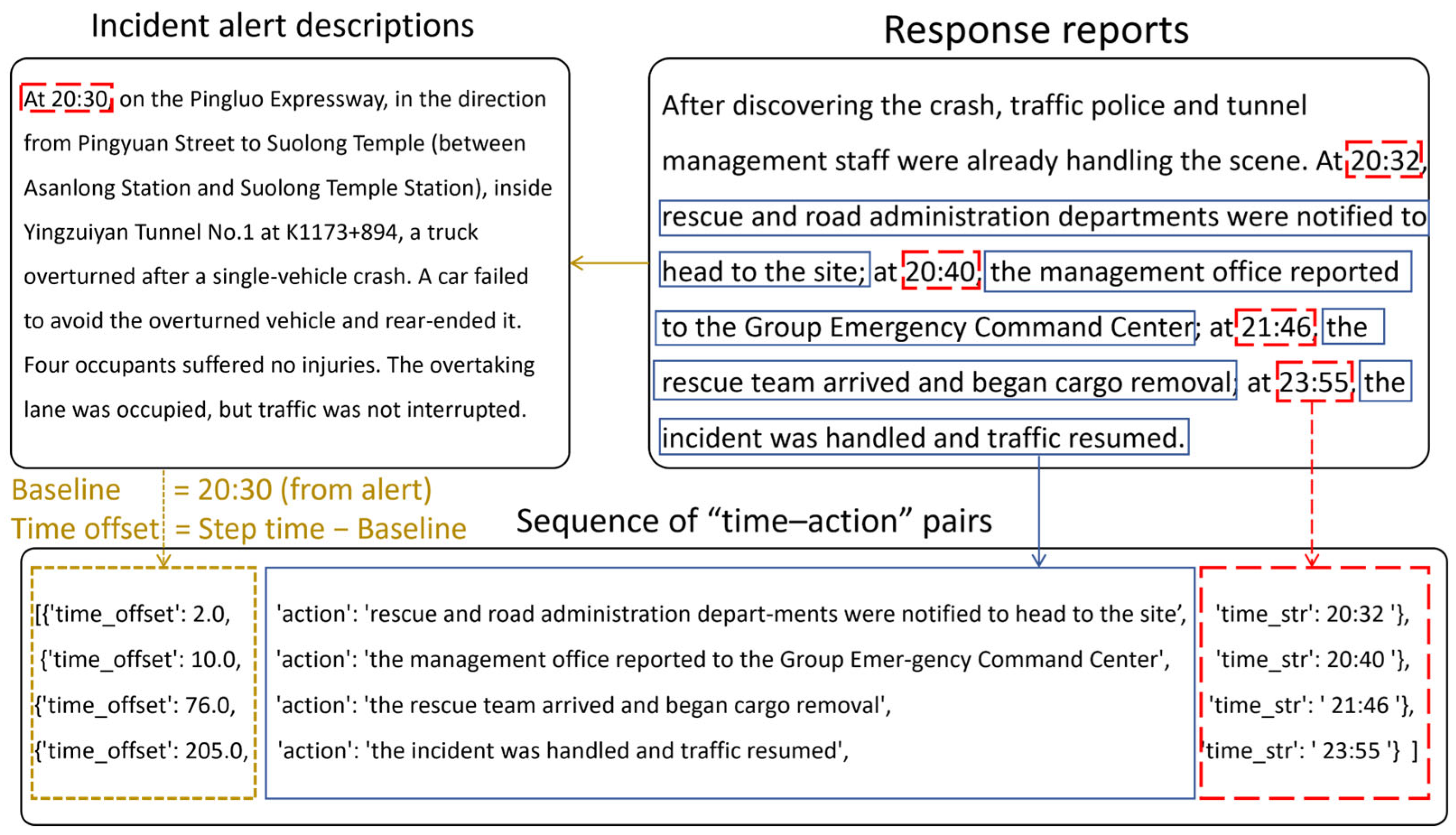
2.2. Text Data Preprocessing
2.3. Multi-Task Seq2Seq Model Architecture
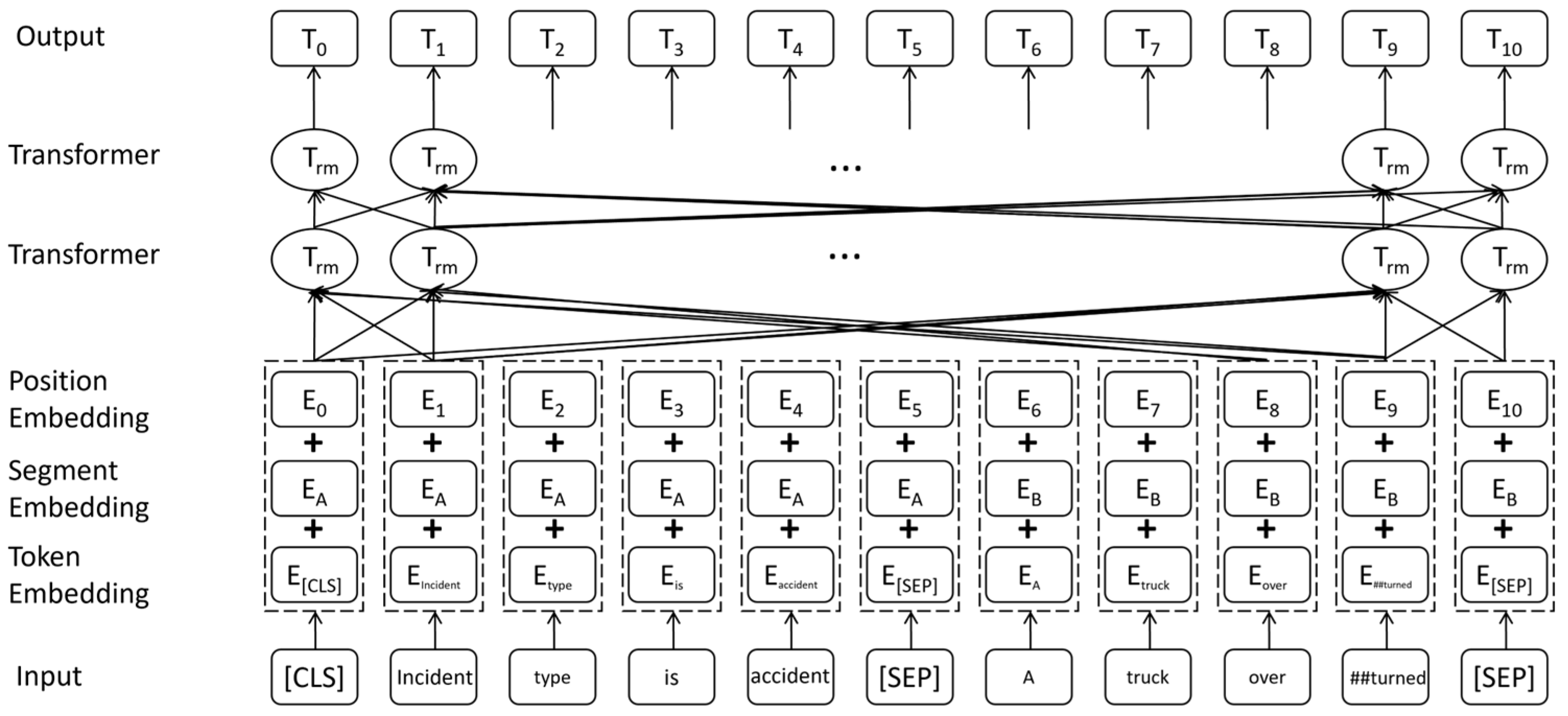
2.3.1. BERT Encoder
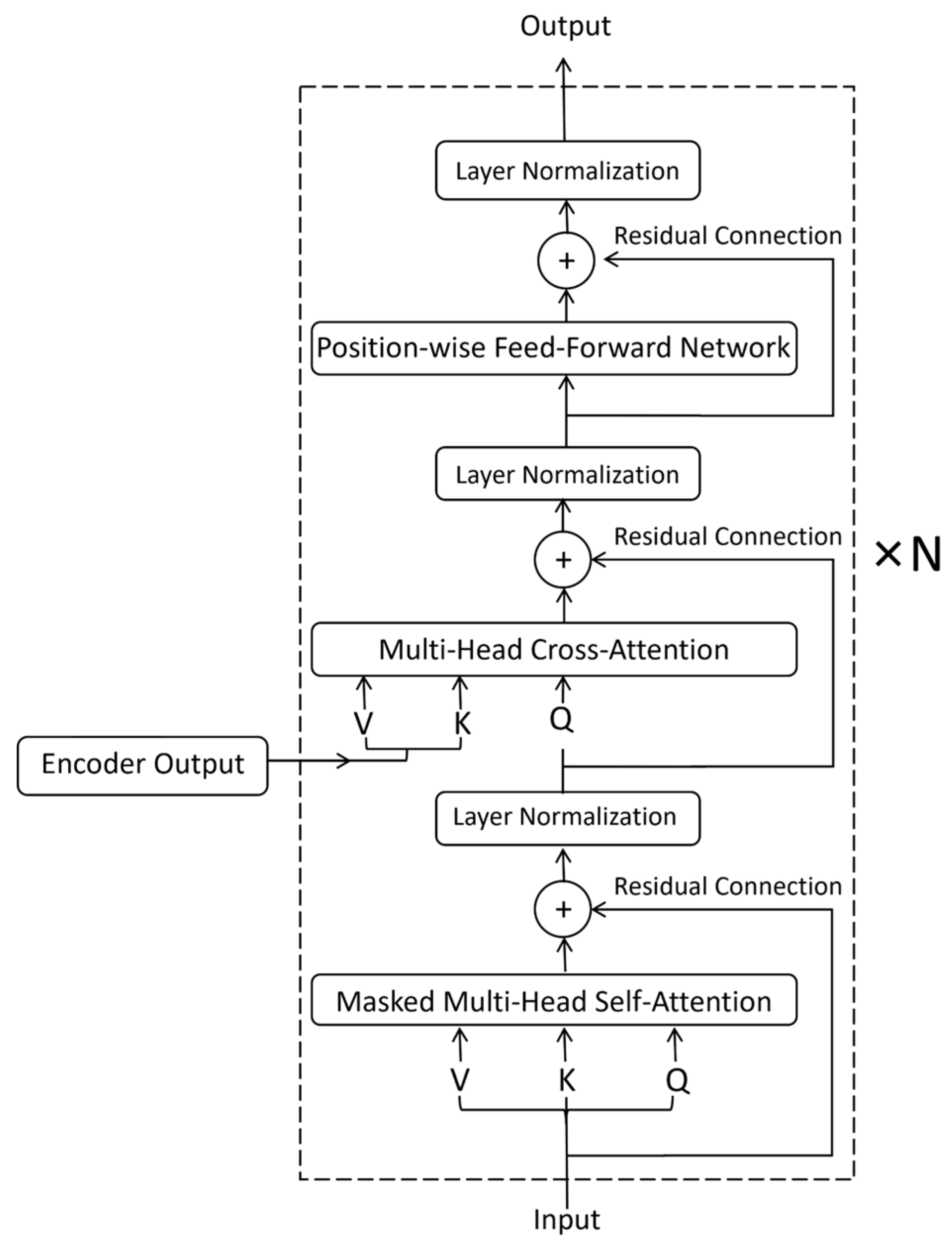
2.3.2. Transformer Decoder
- Masked multi-head self-attention explicitly captures temporal dependencies among previously generated actions, enabling inference of subsequent steps;
- Multi-head cross-attention aligns action prediction with key semantic features extracted by the BERT encoder, establishing a mapping between textual semantics and response decisions;
- A position-wise feedforward network applies nonlinear transformation to extract features relevant to the current action and provide stable representations for both action embedding and time offset prediction.
2.3.3. Multi-Task Learning for Action Prediction and Time Offset Regression
3. Results and Discussion
3.1. Experimental Environment and Configuration
- CPU: Intel(R) Xeon(R) Silver 4215R @ 3.20 GHz.
- GPU: NVIDIA GeForce RTX 3090.
- Programming Language: Python 3.12.
- Deep Learning Framework: PyTorch v2.5.
- Transformer Library: v4.46.
3.2. Performance Evaluation
- Total duration prediction paradigm: Large language model fine-tuning, pretrained regression models, and temporal gated models. These models directly learn the mapping between input text and the overall incident duration.
- Process-level prediction paradigm (ablation baseline): A standard Seq2Seq model designed to verify the effectiveness of the proposed module components.
- Low-rank adaptation (LoRA)-tuned large language model (LLM): Based on GLM4-9B-Chat, the model was fine-tuned using a corpus constructed from incident type and alert description to learn the correspondence between response steps and incident context.
- BERT-based regression model: A pretrained BERT encoder converted the concatenated incident type and alert description into a dense vector representation, followed by a regression layer to estimate incident duration.
- BERT + GRU model: Textual features extracted by BERT were combined with time offset sequences and fed into a GRU temporal module to capture sequential dependencies and generate the final regression value through a fully connected layer.
- Standard Seq2Seq model (ablation baseline): This model retained the same BERT encoder and Transformer decoder architecture as the proposed model but removed the response-step-aware time prediction module. The decoder directly regressed time offsets using hidden states at each step, without explicitly modeling the attention-based interaction between action indices and contextual representations.
3.3. Discussion
3.4. Performance Comparison Across Incident Types
4. Conclusions
5. Limitations
6. Future Work
Supplementary Materials
Author Contributions
Funding
Institutional Review Board Statement
Informed Consent Statement
Data Availability Statement
Conflicts of Interest
Appendix A. Robustness and Statistical Significance Analyses
Appendix A.1. Rationale for Baseline and Metric Selection
Appendix A.2. Stratified 5-Fold Cross-Validation Protocol

| Model | RMSE | MAE | MAPE (%) | MedAE | SMAPE (%) |
|---|---|---|---|---|---|
| BERT + GRU | 23.16 ± 0.12 | 18.87 ± 0.31 | 51.05 ± 2.99 | 16.73 ± 0.81 | 38.75 ± 0.84 |
| Standard Seq2Seq | 24.55 ± 0.97 | 19.53 ± 0.79 | 48.56 ± 2.85 | 15.57 ± 0.90 | 52.24 ± 2.78 |
| Proposed Multi-Task Model | 18.09 ± 0.46 | 14.68 ± 0.31 | 37.18 ± 0.49 | 13.35 ± 0.27 | 34.15 ± 1.28 |
Appendix A.3. Paired Bootstrap Significance Analysis
| Comparison | ΔRMSE (Mean, 95% CI) | ΔMAE (Mean, 95% CI) | ΔMAPE (Mean, 95% CI) (%) | ΔMedAE (Mean, 95% CI) | ΔSMAPE (Mean, 95% CI) (%) |
|---|---|---|---|---|---|
| BERT + GRU vs. Proposed | 5.06 [3.15,7.11] | 4.28 [2.46,6.26] | 14.82 [11.68,21.66] | 3.42 [0.89,5.68] | 4.98 [1.86,9.06] |
| Standard Seq2Seq vs. Proposed | 6.35 [5.01,7.99] | 4.68 [3.39,6.13] | 12.08 [8.67,15.70] | 2.29 [0.88,4.93] | 17.77 [14.05,21.57] |
Appendix B. Alignment-Based Step- and Sequence-Level Evaluation
Appendix B.1. Motivation
Appendix B.2. Similarity Function: ROUGE-L F1 at Step Level
Appendix B.3. Dynamic Programming Alignment
- Matching score between and : .
- Gap operation (unmatched predicted/ground-truth step): constant penalty (set to in our experiments).
Appendix B.4. Metrics Derived from Alignment
Appendix B.5. Results and Discussion
| Model | Mean_StepAccuracy (SA) | Mean_StepPrecision (SP) | Mean_StepF1 | Mean_SeqAccuracy_Strict | Avg_Pred_Len | Avg_True_Len | |
|---|---|---|---|---|---|---|---|
| Standard Seq2Seq | 1.00 | 0.555 | 0.576 | 0.560 | 0.087 | 4.583 | 4.873 |
| 0.95 | 0.569 | 0.590 | 0.574 | 0.105 | 4.583 | 4.873 | |
| 0.90 | 0.628 | 0.654 | 0.635 | 0.149 | 4.583 | 4.873 | |
| 0.85 | 0.666 | 0.692 | 0.673 | 0.174 | 4.583 | 4.873 | |
| 0.80 | 0.695 | 0.724 | 0.703 | 0.207 | 4.583 | 4.873 | |
| 0.75 | 0.724 | 0.755 | 0.733 | 0.236 | 4.583 | 4.873 | |
| 0.70 | 0.741 | 0.774 | 0.750 | 0.250 | 4.583 | 4.873 | |
| Proposed Multi-Task Model | 1.00 | 0.551 | 0.559 | 0.550 | 0.112 | 4.736 | 4.873 |
| 0.95 | 0.566 | 0.574 | 0.565 | 0.134 | 4.736 | 4.873 | |
| 0.90 | 0.625 | 0.634 | 0.624 | 0.167 | 4.736 | 4.873 | |
| 0.85 | 0.658 | 0.668 | 0.658 | 0.181 | 4.736 | 4.873 | |
| 0.80 | 0.690 | 0.701 | 0.689 | 0.199 | 4.736 | 4.873 | |
| 0.75 | 0.723 | 0.735 | 0.722 | 0.217 | 4.736 | 4.873 | |
| 0.70 | 0.747 | 0.758 | 0.746 | 0.243 | 4.736 | 4.873 |
References
- Ji, Y.; Zhang, X.; Sun, L. A Review of Traffic Incident Duration Prediction Methods. Highw. Eng. 2008, 33, 72–79, 141. (In Chinese) [Google Scholar] [CrossRef]
- Li, R.; Pereira, F.C.; Ben-Akiva, M.E. Overview of traffic incident duration analysis and prediction. Eur. Transp. Res. Rev. 2018, 10, 22. [Google Scholar] [CrossRef]
- Wang, L.; Yang, K.; Fang, T.; Li, Y. Analysis of Highway Traffic Accident Severity Based on Historical Data. Traffic Technol. 2025, 14, 642–653. (In Chinese) [Google Scholar] [CrossRef]
- Macioszek, E.; Wyderka, A.; Jurdana, I. The bicyclist safety analysis based on road incidents maps. Sci. J. Silesian Univ. Technol. Ser. Transp. 2025, 126, 129–147. [Google Scholar] [CrossRef]
- He, Q.; Liu, J.; Li, S.; Cheng, R. Highway Traffic Accident Duration Prediction Based on SO-BiLSTM. J. Chongqing Jiaotong Univ. (Nat. Sci. Ed.) 2024, 43, 97–105. (In Chinese) [Google Scholar] [CrossRef]
- Grigorev, A.; Mihaita, A.S.; Chen, F. Traffic incident duration prediction: A systematic review of techniques. J. Adv. Transp. 2024, 2024, 3748345. [Google Scholar] [CrossRef]
- Zhu, L.; Zhang, Q.; Jian, X.; Yang, Y. Graph Convolutional Network for Traffic Incidents Duration Classification. Eng. Appl. Artif. Intell. 2025, 151, 110570. [Google Scholar] [CrossRef]
- Chiang, H.S.; Liu, Q.Y. Traffic Incident Duration Prediction Based on Deep Learning Methods. Enterp. Inf. Syst. 2024, 19, 2448828. [Google Scholar] [CrossRef]
- Jia, X.; Li, S.; Yang, H.; Chen, X. Highway Traffic Incident Duration Prediction Based on ATT-LSTM Model. Traffic Inf. Secur. 2022, 40, 61–69. (In Chinese). Available online: http://www.jtxa.net/cn/article/doi/10.3963/j.jssn.1674-4861.2022.05.007 (accessed on 12 December 2025).
- Chang, H.; Chang, T. Prediction of freeway incident duration based on classification tree analysis. J. East Asia Soc. Transp. Stud. 2013, 9, 1964–1977. [Google Scholar] [CrossRef]
- Hojati, A.T.; Ferreira, L.; Washington, S.; Charles, P.; Shobeirinejad, A. Modelling Total Duration of Traffic Incidents Including Incident Detection and Recovery Time. Accid. Anal. Prev. 2014, 71, 296–305. [Google Scholar] [CrossRef]
- Tirtha, S.D.; Yasmin, S.; Eluru, N. Modeling of Incident Type and Incident Duration Using Data from Multiple Years. Anal. Methods Accid. Res. 2020, 28, 100132. [Google Scholar] [CrossRef]
- Gu, Y.; Zhang, H.; Han, L.D.; Khattak, A. Modeling Spatiotemporal Heterogeneity in Interval-Censored Traffic Incident Recovery Time Using Crowdsourced Data. Accid. Anal. Prev. 2024, 195, 107406. [Google Scholar] [CrossRef]
- Zhu, W.; Wu, J.; Fu, T.; Wang, J.; Zhang, J.; Shangguan, Q. Dynamic prediction of traffic incident duration on urban expressways: A deep learning approach based on LSTM and MLP. J. Intell. Connect. Veh. 2021, 4, 80–91. [Google Scholar] [CrossRef]
- Abdi, A.; Seyedabrishami, S.; O’Hern, S. A Two-Stage Sequential Framework for Traffic Accident Post-Impact Prediction Utilizing Real-Time Traffic, Weather, and Accident Data. J. Adv. Transp. 2023, 2023, 8737185. [Google Scholar] [CrossRef]
- Li, D.; Wu, J.; Peng, D. Online Traffic Accident Spatial-Temporal Post-Impact Prediction Model on Highways Based on Spiking Neural Networks. J. Adv. Transp. 2021, 2021, 9290921. [Google Scholar] [CrossRef]
- Ulu, M.; Türkan, Y.S.; Mengüç, K.; Namlı, E.; Küçükdeniz, T. Dynamic forecasting of traffic event duration in Istanbul: A classification approach with real-time data integration. Comput. Mater. Contin. 2024, 80, 2259–2281. [Google Scholar] [CrossRef]
- Tang, J.; Zheng, L.; Han, C.; Liu, F.; Cai, J. Traffic incident clearance time prediction and influencing factor analysis using extreme gradient boosting model. J. Adv. Transp. 2020, 2020, 6401082. [Google Scholar] [CrossRef]
- Chen, J.N.; Tao, W.J.; Zhang, X.; Ma, L. Mediating Effect Analysis on Traffic Incident Discovery Time between Influence Factors and Duration Time on Expressways. In Proceedings of the CICTP 2023: Innovation-Empowered Technology for Sustainable, Intelligent, Decarbonized, and Connected Transportation, Beijing, China, 6–9 July 2023; American Society of Civil Engineers: Reston, VA, USA; pp. 1194–1203. [Google Scholar] [CrossRef]
- Karndacharuk, A.; Hassan, A. Traffic incident management: Framework and contemporary practices. In Proceedings of the 39th Australasian Transport Research Forum (ATRF), Auckland, New Zealand, 27–29 November 2017. [Google Scholar]
- Ji, K.; Chen, J.; Xiao, S.; Wang, X.; Liu, Y.; Fu, Z. Highway Accident Duration Prediction Model Driven by Text Data. Traffic Inf. Secur. 2020, 38, 9–16. (In Chinese). Available online: http://www.jtxa.net/cn/article/doi/10.3963/j.jssn.1674-4861.2020.06.002 (accessed on 12 December 2025).
- Chen, J.; Tao, W.; Jin, Y.; Wang, P.; Zhang, J. Multimodal Text Information-Based Prediction of Highway Traffic Incident Duration. China Saf. Sci. Technol. 2023, 19, 180–186. (In Chinese). Available online: https://www.zhangqiaokeyan.com/academic-journal-cn_journal-safety-science-technology_thesis/02012101527207.html (accessed on 12 December 2025).
- Ji, Y.; Zhang, X.; Sun, L. Traffic Incident Duration Prediction and Parameter Calibration. J. Chongqing Jiaotong Univ. (Nat. Sci. Ed.) 2010, 29, 613–620. (In Chinese). Available online: http://xbzk.cqjtu.edu.cn/CN/Y2010/V29/I4/613 (accessed on 12 December 2025).
- Tong, S.; Cong, H.; Chen, Y. Fuzzy Logic Prediction Model for Highway Traffic Incident Clearance Time. J. Chongqing Jiaotong Univ. (Nat. Sci. Ed.) 2011, 30, 5–10. (In Chinese). Available online: https://d.wanfangdata.com.cn/periodical/cqjtxyxb201101021 (accessed on 12 December 2025).
- Dogan, Y.; Tuysuzoglu, G.; Kiyak, E.O.; Ghasemkhani, B.; Birant, K.U.; Utku, S.; Birant, D. A Novel Reduced Error Pruning Tree Forest with Time-Based Missing Data Imputation (REPTF-TMDI) for Traffic Flow Prediction. Comput. Model. Eng. Sci. 2025, 144, 1677–1695. [Google Scholar] [CrossRef]
- Zhou, X.; Zhou, Q.; Li, H.; Lv, X. Automatic Annotation of Temporal Information in Chinese Clinical Texts. Chin. J. Biomed. Eng. 2012, 31, 6–12. [Google Scholar] [CrossRef]
- Zhao, H.; Fu, Z.; Wang, L. Chinese Sentiment Analysis Based on Feature Fusion. J. Lanzhou Univ. Technol. 2022, 48, 94–102. (In Chinese). Available online: https://journal.lut.edu.cn/CN/Y2022/V48/I3/94 (accessed on 12 December 2025).
- Lin, T.; Huang, B.; Wu, Y.; Zhu, T. Analysis of Severe Traffic Accident Characteristics and Typical Scenarios Based on Text Data. China-Arab Sci. Technol. Forum 2025, 05, 79–83. (In Chinese). Available online: https://cstj.cqvip.com/Qikan/Article/Detail?id=7200839612 (accessed on 12 December 2025).
- Devlin, J.; Chang, M.W.; Lee, K.; Toutanova, K. BERT: Pre-Training of Deep Bidirectional Transformers for Language Understanding. In Proceedings of the 2019 Conference of the North American Chapter of the Association for Computational Linguistics: Human Language Technologies (NAACL-HLT), Minneapolis, MN, USA, 2–7 June 2019; pp. 4171–4186. [Google Scholar] [CrossRef]
- Fan, H.; Qin, J.; Sun, H.; Zhang, L.; Lu, X. Traffic Accident Text Information Extraction Model Based on BERT and BiGRU-CRF. Comput. Mod. 2022, 10–15. (In Chinese). Available online: https://www.nstl.gov.cn/paper_detail.html?id=05553678b13c51a3062c087bf1e0b3ef (accessed on 12 December 2025).
- Hu, L.; Yu, X.; Zhao, X.; Yang, Z.; Wang, X.; Hu, F.; Wu, J. Improved BERT Model-Based Method for Traffic Operation Situation Prediction. Highw. Traffic Technol. 2025, 42, 18–25. (In Chinese) [Google Scholar] [CrossRef]
- Vaswani, A.; Shazeer, N.; Parmar, N.; Uszkoreit, J.; Jones, L.; Gomez, A.N.; Kaiser, L.; Polosukhin, I. Attention Is All You Need. In Proceedings of the Advances in Neural Information Processing Systems (NeurIPS), Long Beach, CA, USA, 4–9 December 2017; Volume 30. [Google Scholar] [CrossRef]
- Gong, D.; Lee, J.; Kim, M.; Ha, S.J.; Cho, M. Future Transformer for Long-Term Action Anticipation. In Proceedings of the IEEE/CVF Conference on Computer Vision and Pattern Recognition (CVPR), New Orleans, LA, USA, 18–24 June 2022; pp. 3052–3061. [Google Scholar] [CrossRef]
- Xiong, R.; Yang, Y.; He, D.; Zheng, K.; Zheng, S.; Xing, C.; Zhang, H.; Lan, Y.; Wang, L.; Liu, T.-Y. On Layer Normalization in the Transformer Architecture. In Proceedings of the 37th International Conference on Machine Learning (ICML), Online, 13–18 July 2020. [Google Scholar] [CrossRef]
- Sheng, J.W.; Guo, S.; Yu, B.W.; Li, Q.; Hei, Y.; Wang, L.; Liu, T.; Xu, H. CasEE: A Joint Learning Framework with Cascade Decoding for Overlapping Event Extraction. In Proceedings of the Findings of the Association for Computational Linguistics: ACL-IJCNLP 2021, Online, 6–11 August 2021; pp. 164–174. [Google Scholar] [CrossRef]
- Qu, Y.; Kim, J. Efficient Multi-Task Training with Adaptive Feature Alignment for Universal Image Segmentation. Sensors 2025, 25, 359. [Google Scholar] [CrossRef]
- Gritsai, G.; Voznyuk, A.; Khabutdinov, I.; Grabovoy, A. Advacheck at GenAI Detection Task 1: AI Detection Powered by Domain-Aware Multi-Tasking. In Proceedings of the 1st Workshop on GenAI Content Detection (GenAIDetect), Abu Dhabi, United Arab Emirates, 18–21 January 2025; pp. 236–243. [Google Scholar] [CrossRef]
- Palasundram, K.; Sharef, N.M.; KasMiran, K.A.; Azman, A. SEQ2SEQ++: A Multitasking-Based seq2seq Model to Generate Meaningful and Relevant Answers. IEEE Access 2021, 9, 164949–164975. [Google Scholar] [CrossRef]
- Spathis, D.; Kawsar, F. The first step is the hardest: Pitfalls of representing and tokenizing temporal data for large language models. J. Am. Med. Inform. Assoc. 2024, 31, 2151–2158. [Google Scholar] [CrossRef]
- Schwartz, E.; Choshen, L.; Shtok, J.; Doveh, S.; Karlinsky, L.; Arbelle, A. NumeroLogic: Number encoding for enhanced LLMs’ numerical reasoning. arXiv 2024, arXiv:2404.00459. [Google Scholar] [CrossRef]
- Hyndman, R.J.; Koehler, A.B. Another look at measures of forecast accuracy. Int. J. Forecast. 2006, 22, 679–688. [Google Scholar] [CrossRef]
- Chen, J.; Zhang, J.; Wang, P.; Jin, Y. A k-nearest text similarity-BiGRU approach for duration prediction of traffic accidents on expressways. Discov. Appl. Sci. 2025, 7, 744. [Google Scholar] [CrossRef]
- Ruder, S. An overview of multi-task learning in deep neural networks. arXiv 2017, arXiv:1706.05098. [Google Scholar] [CrossRef]
- Yu, T.; Kumar, S.; Gupta, A.; Levine, S.; Hausman, K.; Finn, C. Gradient surgery for multi-task learning. Adv. Neural Inf. Process. Syst. 2020, 33, 5824–5836. Available online: https://proceedings.neurips.cc/paper/2020/hash/3fe78a8acf5fda99de95303940a2420c-Abstract.html (accessed on 12 December 2025).
- Kendall, A.; Gal, Y.; Cipolla, R. Multi-task learning using uncertainty to weigh losses for scene geometry and semantics. In Proceedings of the IEEE/CVF Conference on Computer Vision and Pattern Recognition (CVPR), Salt Lake City, UT, USA, 18–22 June 2018; pp. 7482–7491. [Google Scholar] [CrossRef]


| Subtypename | Alertdescribe | Ownerreport |
|---|---|---|
| Traffic Accident | At 20:30, on the Pingluo Expressway, in the direction from Pingyuan Street to Suolong Temple (between Asanlong Station and Suolong Temple Station), inside Yingzuiyan Tunnel No.1 at K1173+894, a truck overturned after a single-vehicle crash. A car failed to avoid the overturned vehicle and rear-ended it. Four occupants suffered no injuries. The overtaking lane was occupied, but traffic was not interrupted. | After discovering the crash, traffic police and tunnel management staff were already handling the scene. At 20:32, rescue and road administration departments were notified to head to the site; at 20:40, the management office reported to the Group Emergency Command Center; at 21:46, the rescue team arrived and began cargo removal; at 23:55, the incident was handled and traffic resumed. |
| Congestion Event | At 17:00, on the Anchang Expressway, in the direction from Chuxiong to An’ning, between K2324+000 and K2322+000 (from Dinosaur Valley to Changtian Station section), heavy traffic caused slow movement and congestion for approximately 2 km. | After congestion was detected via surveillance video, at 17:00, the traffic police were notified to implement traffic control measures; at 17:04, the management office immediately reported to the Group Emergency Command Center; at 20:25, traffic flow returned to normal. |
| Hyperparameter | Value | Hyperparameter | Value |
|---|---|---|---|
| Pretrained Model | bert-base-chinese | Teacher forcing rate | 0.5 |
| Optimizer | Adam | Max generation length | 20 |
| Learning rate | 1 × 10⁻⁴ | Encoder hidden size | 768 |
| Batch size | 8 | Decoder layers | 3 |
| Epochs | 15 | Attention heads | 8 |
| Dropout rate | 0.1 | Gradient clipping | 1.0 |
| Layer | Operation | Input Dim. | Output Dim. | Activation/Regularization |
|---|---|---|---|---|
| Feature Fusion Layer | Linear | ReLU | ||
| Hidden Layer 1 | Linear | ReLU + Dropout(0.2) | ||
| Hidden Layer 2 | Linear | ReLU + Dropout(0.1) | ||
| Output Layer | Linear | 1 | / |
| Model | RMSE | MAE | MAPE | MedAE | SMAPE | BLEU-4 | ROUGE-L |
|---|---|---|---|---|---|---|---|
| LoRA-tuned LLM | 42.31 | 33.59 | 87.24% | 30.00 | 53.98% | 60.24% | 82.22% |
| BERT-based Regression | 25.37 | 19.37 | 44.98% | 14.47 | 38.97% | N/A * | N/A * |
| BERT + GRU | 23.16 | 18.87 | 51.18% | 16.53 | 38.14% | N/A * | N/A * |
| Standard Seq2Seq | 24.29 | 19.34 | 48.65% | 15.50 | 51.25% | 64.55% | 81.11% |
| Proposed Multi-Task Model | 18.05 | 14.69 | 37.13% | 13.23 | 33.55% | 62.33% | 82.04% |
| Category | Content |
|---|---|
| Input Information | Incident Type: Traffic Accident Alert Description: At 19:35, on the Anchang Expressway in the direction from Chuxiong to Anning, at K2288000 (between Anfengying Station and Caopu Station), a truck and a car were involved in a rear-end collision, occupying the driving lane in the Chuxiong-to-Anning direction. No injuries were reported and traffic was not interrupted. |
| Ground Truth Process | 1. After discovering the crash (+0 min) 2. Notify traffic police, road administration, and rescue departments to head to the scene (+0 min) 3. The management office immediately reports to the Group Emergency Command Center (+9 min) 4. Traffic police and rescue units arrive at the scene (+35 min) 5. Towing and clearance conducted by closing the driving lane (+36 min) 6. Incident resolved and traffic resumed (+52 min) Actual Total Duration: 52 min |
| Model Prediction | 1. After discovering the crash (+0.76 min) 2. Notify traffic police, road administration, and rescue departments (+1.34 min) 3. The management office immediately reports to the Group Emergency Command Center (+7.57 min) 4. Traffic police arrive at the scene (+11.70 min) 5. Rescue units arrive at the scene (+15.89 min) 6. Towing operation by closing the overtaking lane (+26.39 min) 7. Incident resolved and traffic resumed (+56.54 min) Predicted Total Duration: 56.54 min |
| Incident Type | RMSE | MAE | MAPE | MedAE | SMAPE | BLEU-4 | ROUGE-L |
|---|---|---|---|---|---|---|---|
| Traffic Accidents | 17.00 | 13.98 | 38.24% | 13.33 | 34.53% | 64.16% | 82.23% |
| Mechanical Failures | 16.09 | 13.09 | 33.11% | 11.23 | 31.15% | 55.15% | 75.58% |
| Congestion Events | 24.54 | 20.31 | 34.85% | 18.26 | 30.42% | 87.62% | 86.11% |
| All Incident Types | 18.05 | 14.69 | 37.13% | 13.23 | 33.55% | 62.33% | 82.04% |
Disclaimer/Publisher’s Note: The statements, opinions and data contained in all publications are solely those of the individual author(s) and contributor(s) and not of MDPI and/or the editor(s). MDPI and/or the editor(s) disclaim responsibility for any injury to people or property resulting from any ideas, methods, instructions or products referred to in the content. |
© 2026 by the authors. Licensee MDPI, Basel, Switzerland. This article is an open access article distributed under the terms and conditions of the Creative Commons Attribution (CC BY) license.
Share and Cite
Fan, F.; Hao, J.; Fu, X. Multi-Task Seq2Seq Framework for Highway Incident Duration Prediction Incorporating Response Steps and Time Offsets. Vehicles 2026, 8, 5. https://doi.org/10.3390/vehicles8010005
Fan F, Hao J, Fu X. Multi-Task Seq2Seq Framework for Highway Incident Duration Prediction Incorporating Response Steps and Time Offsets. Vehicles. 2026; 8(1):5. https://doi.org/10.3390/vehicles8010005
Chicago/Turabian StyleFan, Fengze, Jianuo Hao, and Xin Fu. 2026. "Multi-Task Seq2Seq Framework for Highway Incident Duration Prediction Incorporating Response Steps and Time Offsets" Vehicles 8, no. 1: 5. https://doi.org/10.3390/vehicles8010005
APA StyleFan, F., Hao, J., & Fu, X. (2026). Multi-Task Seq2Seq Framework for Highway Incident Duration Prediction Incorporating Response Steps and Time Offsets. Vehicles, 8(1), 5. https://doi.org/10.3390/vehicles8010005