1. Introduction
GIS is a crucial tool that assists in visualizing, analyzing, and interpreting spatial data, which is used in decision-making processes in numerous fields. In the transportation engineering context, GIS has become increasingly prominent due to its ability to integrate and manage large datasets with spatial and non-spatial attributes [
1]. Through its advanced mapping and data analysis capabilities, GIS enables users to identify spatial patterns and relationships that might not be apparent in traditional data analysis methods [
2].
GIS plays a vital role in transportation analysis by providing tools that allow scholars and planners to analyze traffic flow, road usage, and accident hotspots. The key strength of GIS is its ability to overlay (layer) various datasets, such as road networks, traffic volumes, and accident records, on top of each other, facilitating an in-depth understanding of how different factors interact spatially [
3,
4,
5,
6]. GIS is utilized in traffic modeling and optimization of transportation networks due to its provision of real-time traffic data and predictive capabilities to mitigate traffic congestion and enhance road safety [
7,
8,
9].
Road safety analysis is one area where GIS has had a profound impact. By analyzing the spatial distribution of accidents, scholars can identify high-risk areas and focus intervention where they are most needed [
10]. Furthermore, GIS is used to integrate weather conditions, road geometry, and traffic signals to understand accident causality [
11]. This spatial analysis capability enables transportation agencies to target their road safety strategies more effectively, improving both efficiency and effectiveness of safety interventions [
12,
13].
One of the key features of GIS is its capacity to visually represent complex data in the form of a map, which makes it easier to comprehend the spatial relationship between parameters [
14,
15,
16]. In road traffic accident analysis, the map prepared using GIS gives an intuitive way to visualize accident hotspots and other risk factors [
5]. This visualization usually indicates a spatial trend, which is difficult to identify using traditional tabular data analysis methods [
17]. Furthermore, GIS mapping techniques allow interactive exploration, which helps decision-makers to view crash data in relation to environmental and infrastructural factors [
18,
19].
Beyond basic mapping, GIS incorporates advanced spatial analysis techniques such as KDE, spatial autocorrelation, and clustering methods, which are widely used in road traffic accident analysis [
20,
21]. These techniques are used to specify patterns in the accident locations and frequencies, facilitating the identification of risk areas with high precision [
22]. GIS can also be integrated with a machine learning algorithm to develop a predictive model, which anticipates accident hotspots based on historical data and changing road conditions [
11,
17].
GIS is also at the forefront of the development of a decision support system for transportation safety. By offering a platform where different types of spatial and non-spatial data are integrated, GIS-based decision support systems help transportation authorities and planners make informed decisions regarding infrastructure improvements and safety interventions [
23]. This system facilitates scenario testing, allowing planners to assess the potential impact of various safety measures before they are implemented [
4]. In this way, GIS plays a critical role in reducing crashes and improving overall road safety. The mapping of road incidents is used for identifying high-risk locations and patterns of cyclist accidents, helping authorities implement preventive measures and improve infrastructure. The analysis of data from the Małopolskie Voivodeship between 2012 and 2019 showed that although the number of incidents increased, their severity decreased, indicating the effectiveness of targeted safety initiatives. Overall, road traffic accident maps serve as essential analytical tools for enhancing cyclist safety and supporting urban traffic management [
24].
2. Background
The complexity in analyzing road accident data is due to its diffuse nature, with factors contributing differently at road segments and junctions. The investigation performed in Jordan identified 75 accident hotspots, emphasizing the significant impact of horizontal alignment and intersection on accident occurrence [
25]. Similarly, the analysis of accident rates in various road categories showed that the accident rate differs significantly across road types, with lower design standards indicating a higher risk [
26,
27,
28]. A Japanese study on road intersection configuration revealed that elements like intersection angle and junction interval had a major impact on accident severity, specifying the necessity of customized safety measures at intersections [
29].
Recent research has broadened the application of GIS in traffic accident evaluation. For instance, construction-related spatial changes have been linked to crash frequencies in Jinan, China, revealing the influence of engineering development on spatial accident risk [
30]. Similarly, spatial-temporal analysis of tunnel accidents across China (2001 to present) highlighted that infrastructure type significantly modifies accident clustering over time [
31]. Beyond China, literature on teenage driver crashes in the United States underscores behavioral and demographic risk factors, which can be spatially integrated into GIS-based crash models [
32]. Furthermore, studies on heterogeneous sensor reallocation in road networks demonstrate how real-time spatial sensing and GIS integration can improve detection and prediction accuracy of accidents [
33].
2.1. Crash Data Source
For more than two decades, scholars from various areas have applied numerous GIS-based methods to analyze road traffic crashes, as shown in
Table 1. These methods include observing accident patterns, analyzing their geographical distribution, and identifying high-risk areas prone to accidents.
Analyzing road crash records is essential for ensuring effective safety measures. To identify the common factors contributing to road crashes, the data must be accurate, reliable, and of high quality. As shown in
Table 2, four studies gathered information from the highway, rural, metropolitan, motorway, and suburban areas, while six investigations focused exclusively on metropolitan zones. Road crash datasets employed across the reviewed studies varied substantially in terms of data volume, spatial coverage, and reporting quality. Among the ten representative studies analyzed, four incorporated mixed-area data encompassing highways, rural corridors, and metropolitan regions, whereas six were exclusively concentrated in metropolitan areas. The metropolitan dataset, typically containing between 15,000 and 45,000 crash records, is often obtained from police departments or transportation authorities and is characterized by high spatial precision at the street segment or intersection level, with a resolution of less than or equal to 10 meters.
In contrast, rural and highway datasets were considerably smaller, ranging from 2000 to 8000 records and frequently lacked detailed geolocation attributes, vehicle classifications, or environmental descriptors. To evaluate the reliability of these datasets, three quality assessment dimensions were considered across the reviewed literature: data completeness, referring to the proportion of crash records containing both spatial and temporal attributes, generally 70 to 98%; spatial accuracy, measured through comparison with base maps or GPS coordinates (average error less than 20 m; and data consistency, validated by cross-referencing official annual statistics with GIS-encoded crash layers. Marked disparities were observed between urban and rural datasets. Urban crash data, commonly derived from the automated collection systems, CCTV networks, or connected vehicle technologies, provides dense and near real-time coverage, while rural datasets, mostly based on manual police reporting, suffer from underrepresentation of minor incidents and delayed data entry. Such variations in data quantity and quality have direct implications for GIS-based hotspot detection. In densely populated urban areas, techniques such as KDE tend to indicate highly localized crash clusters, whereas sparse or incomplete rural datasets produce broader and less statistically significant hotspot zones when analyzed using Moran’s I or Getis-Ord Gi* statistics.
Consequently, regional disparities in data completeness and spatial precision may introduce bias in comparative analyses and in the delineation of high-risk zones. To enhance transparency and reproducibility, future studies are encouraged to report explicit information on data volume, coverage, and accuracy metrics, and to apply stratified analyses that distinguish between urban and rural networks when conducting spatial crash evaluations.
Table 1.
Comparison of Major GIS-based Spatial Analysis Techniques for Road-Crash Evaluation.
Table 1.
Comparison of Major GIS-based Spatial Analysis Techniques for Road-Crash Evaluation.
| Technique | Application | Benefit | Drawback | Source | Integration |
|---|
| Planar KDE | Continuous, large-area analysis (urban regions, open networks) | Simple, intuitive visualization; easy implementation | Ignores network constraints; may over-smooth | [19,34] | Can serve as input to Local Moran’s I for hotspot validation |
| Network KDE | Road or linear network analysis (streets, highways) | Captures event intensity along networks; higher spatial precision | Computationally intensive; sensitive to bandwidth choice | [35,36] | Useful precursor to Getis-Ord Gi* for significance testing |
| Getis-Ord Gi* | Detecting statistically significant high- and low-value clusters | Provides z-score significance; complements KDE visualization | Requires adequate sample density; not ideal for sparse data | [21] | Best paired with KDE or NKDE to confirm hotspots |
| Moran’s I (Global & Local) | Assessing spatial autocorrelation in crash severity or frequency | Quantifies clustering tendency; reveals local outliers | Global I masks local variation; Local I is sensitive to spatial weights | [37,38] | Combined with KDE (KDE & Moran’s I) improves hotspot validity |
2.2. GIS Road Crash Evaluation
GIS has become increasingly popular in the analysis of traffic accidents, providing critical spatial and temporal insights that bolster road safety and urban planning. Current studies deployed a variety of GIS-based methodologies, such as KDE, emerging hot-spot analysis, space-time cubes, and Getis-Ord Gi* statistics, to detect accident hotspots, examine their evolution over time, and correlate crash occurrences with infrastructure, traffic flow, and environmental conditions. A study conducted in Wales utilized GIS to examine urban traffic accidents, indicating the significance of spatial-temporal distribution in traffic safety management [
5,
25,
39]. For instance, a 2023 study in Qatar applied Time-Space Cube analysis alongside Moran’s I and Getis-Ord Gi* to pinpoint and compare high-risk road segments from 2015-2019 [
1]. Meanwhile, the 2024 review highlighted how GIS not only integrates crash data with traffic volumes, road geometry, and environmental factors but also supports urban planning by visualizing network-wide risk patterns and informing targeted interventions [
5]. Collectively, these works reinforce that GIS isn’t merely a mapping tool; it is a strategic asset for traffic safety management, enabling evidence-based responses in infrastructure design, enforcement prioritization, and real-time monitoring [
39].
In Saudi Arabia, scholars applied GIS techniques to analyze traffic crash hotspots in Abha and Bisha cities. They employed spatial analysis tools, like mean center, standard distance, and directional distribution, to measure the spatial distribution of accidents. The study specified a clustered pattern of crashes, particularly along major arterial roads, emphasizing the need for targeted safety intervention in the area [
12,
40,
41].
Emergency response and real-time traffic crash prediction have improved through the integration of GIS and artificial intelligence. A framework established in 2024 has predicted the locations of accident-prone areas in high-risk metropolitan areas by combining GIS and artificial intelligence algorithms. By offering a spatially accurate visualization of potential accident sites, this integration has enhanced urban traffic safety and expedited emergency response [
4,
34,
42].
Furthermore, the use of connected vehicle technology has introduced new avenues for traffic accident analysis. Scholars at Michigan State University utilized connected vehicle data to study driver behavior, like hard braking and swerving. By mapping these near-miss incidents, they identified locations with high potential for crashes, enabling proactive safety measures [
4,
17].
In recent studies, the application of spatial analytic methods like KDE and Moran’s I was common. These techniques facilitate a better understanding of accident distribution patterns, enabling the detection and visualization of accident hotspots. Research conducted in Mashhad in Iran identified urban road crash blackspots employing GIS-driven spatial evaluation, offering important information for enhancing road safety [
1,
41,
43].
2.3. Statistical Accident Assessment
To reduce accidents in various areas, predictive modeling and risk assessment were emphasized in recent advancements of transportation safety research. Scientists [
44] clarified the role of a probabilistic framework in assessing ship hull girder failure due to corrosion and accidental damage, underscoring the importance of reliability assessment in maritime safety. It also involves heuristic learning algorithms and scenario analysis to enhance risk assessment in the Bohai Strait. To determine the cause of accidents in Taiwan, [
45] used a fuzzy logic model, human factor evaluation, and categorization with a human factor intervention matrix.
Scholars [
46] examined the effect of data segmentation on crash injury severity models in road traffic safety and found that sample size alone could not predict model accuracy, emphasizing the requirement for strong statistical testing. To evaluate collision risks, especially for autonomous driving technologies, [
47] suggested a unified probabilistic model for traffic conflict detection that integrates interaction contexts, mobility states, and ambient factors. According to a study [
13] investigation on heavy goods truck safety in Sweden, active and passive technology have the potential to save up to 59% of fatalities among vulnerable road users. Although PTW-related incidents continue to be difficult because of high-speed hits, the study concludes that enhanced driver vision systems, sophisticated emergency braking, and blind-spot information systems provide substantial advantages. These findings support the need for an adaptive framework and improved statistical methods for proactive accident prevention [
13,
46,
47].
Transportation safety research has examined vehicle inspection policies and their efficacy. According to a particular study [
48], analysis of periodic vehicle inspections in Denmark, increasing the frequency of inspections does not substantially lower the probability of crashes. According to the report, cars covered by the current inspection program are typically kept up well, and flaws rarely cause many accidents. Similarly, a different report [
49] uses probabilistic flow network models and system theoretical process analysis to evaluate how well safety barriers reduce operational risks, ultimately suggesting optimization techniques for improved risk management. These studies support focused interventions over extensive regulatory expansions, stressing the significance of evidence-based policymaking in transportation safety [
48,
49].
Another important factor in lowering road deaths is the development of emergency response systems. Advanced Automatic Collision Notification systems [
50] have suggested an enhanced injury prediction algorithm that considers emergency transport time as a significant risk factor. According to the study, postponing medical care dramatically raises the risk of serious harm or death, emphasizing the need for quick reaction tactics. In the meantime, a new investigation [
51] analyzed traffic collision risk indicators during various stages of the COVID-19 epidemic using a hybrid machine learning technique that combines XGBoost and SHapley Additive Explanation drivers. The report highlights important risk factors, including driving at night and disregarding traffic signals, and it suggests. The study identifies key risk factors such as nighttime driving and traffic signal violations and proposes countermeasures, including driver assessments, flexible work hours, and fatigue monitoring systems. Study [
52] differentiates the risk of driving on urban collectors and arterial roads, employing machine learning methods to develop a risk assessment matrix based on factors like road landscape, lateral acceleration, and speed variability. These studies highlighted the need for demographic-specific safety interventions and regionally tailored road safety policies [
52,
53].
Another area of study is the development of technology in vehicle safety. An investigation [
54] examined the efficacy of autonomous emergency braking systems in Sweden and discovered that although they greatly lower the danger of collisions for cyclists and pedestrians, they operate poorly in real-world situations, where there is little visibility or high speed. Using drone-based photography to assess near-crash conflict with high accuracy [
55] presented a unique surrogate measure for traffic safety analysis termed the additional brake necessary to avoid a crash. The results demonstrated the potential of automated safety systems to reduce traffic accidents, but they also highlighted the importance of ongoing improvement to enhance their efficacy in practical situations [
54,
55].
2.4. Aim of the Review
This assessment is intended to achieve two key objectives. First, it introduces a technique for examining road crashes. Second, it presents a GIS-based approach to identify and prevent such incidents. GIS enables the visualization of statistical data in a geographic format, making it a powerful tool for detecting road crash hotspots. The study explores four GIS techniques for examining crash patterns, with a particular focus on the combined use of Getis-Ord and KDE methods. These techniques enhance analysis by identifying densely affected areas, extracting new variables, and pinpointing crash hotspots more efficiently, capabilities that are not extensively covered in existing research. Ultimately, this review contributes to road safety enhancement in numerous areas around the globe.
3. Methodology
Searching, Screening, and Inclusion Criteria
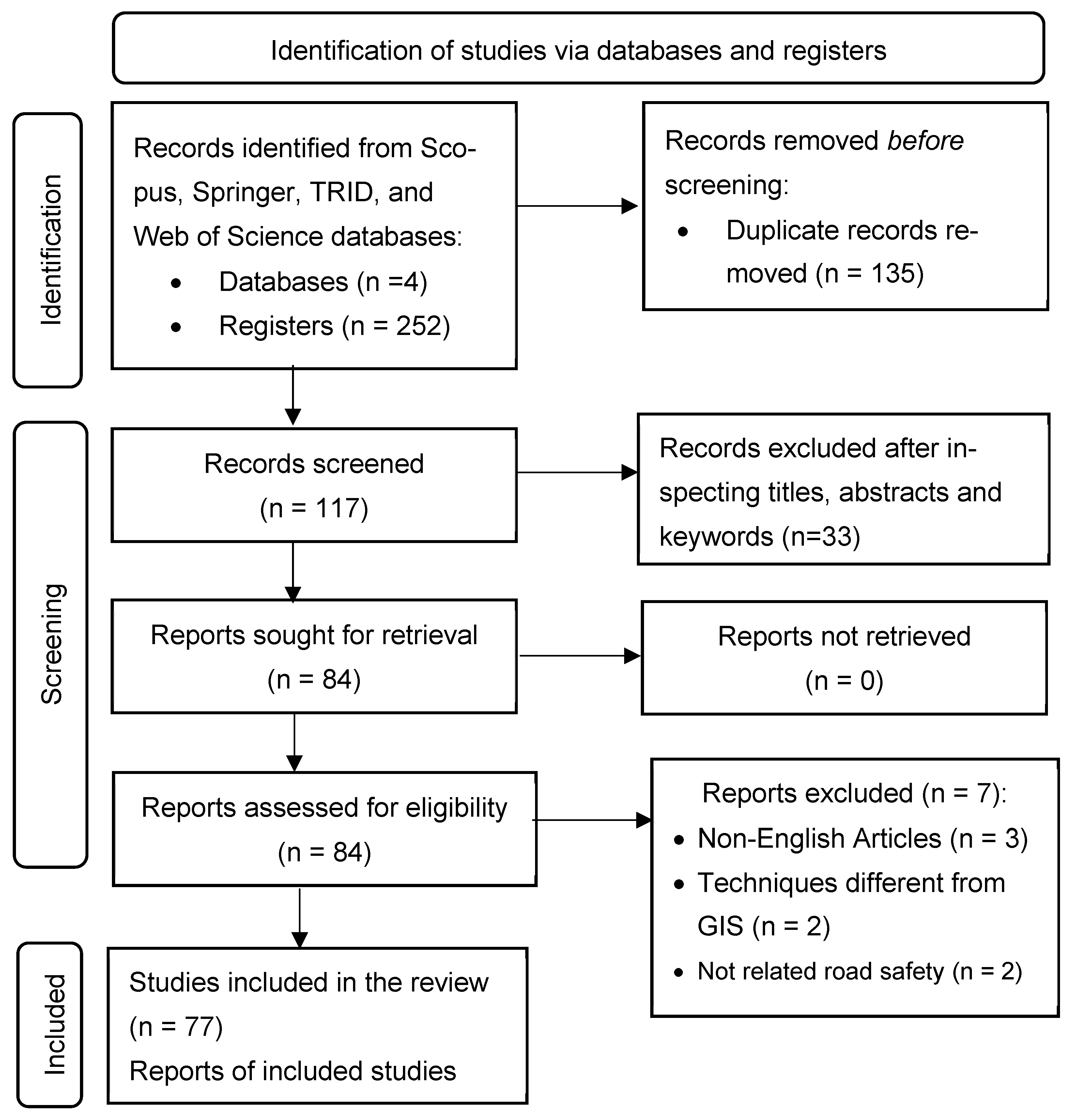
A comprehensive literature search was performed on road traffic crash analysis. Relevant studies have been collected from Scopus, Springer, TRID, and Web of Science databases. Carefully selected keywords, including GIS, accident analysis, and road accident, were used to identify pertinent journals. The screening pipeline depends on the desired presentation Items for the PRISMA approach, as illustrated in
Figure 1. A total of 252 papers matching the search criteria were identified across both databases. After removing duplicate documents, 117 articles have been identified for primary evaluation. Depending on keywords found in the topics, abstracts, and keywords, 84 articles were selected for the first round of assessment.
In the second stage, abstracts were evaluated based on key titles such as transportation, road safety, road analysis, and geography, with articles unrelated to these topics omitted. Selection criteria: studies utilized GIS techniques, methods used involved overall impact on spatial planning, open-source articles, and English versions of articles were considered. After screening, 77 research articles have been finalized for detailed analysis.
A summary list was then made by categorizing these articles based on publication period, country of origin, numerical methods used, evaluated crash type, and key outcomes. These 77 studies have been thoroughly assessed to examine the application of GIS techniques in road accident analysis and their role in spatial development. The distributions of these investigations are presented in
Figure 2. This systematic review was accordingly registered on an International Prospective Register of Systematic Reviews (PROSPERO) with the title “A Systematic Review of GIS-Driven Road Traffic Accident Evaluation.” The registration is an open-access online database of systematic review protocols, and is available at
https://www.crd.york.ac.uk/PROSPERO/view/CRD420251236133 (accessed on 16 November 2025).
4. Techniques for Geospatial Evaluation
Geographical research typically utilizes GIS spatial methods to examine road crashes. These techniques help to highlight crash locations geographically and assess map visualizations via distribution patterns. The widely employed GIS techniques evaluated in this review are explained below.
4.1. KDE
Many scholars have been applying the integration of statistical evaluation and GIS for examining traffic crashes. KDE is a well-known technique that depends on density and has been extensively applied to identify serious road sections [
35]. It is a spatial statistical technique that identifies high-density accident locations in two-dimensional Euclidean space. It is widely used due to its simplicity, ease of implementation, and ability to capture local spatial characteristics. While both planar KDE and Network KDE are effective for hotspot detection, network KDE is superior as it precisely defines hazardous street segments, leading to more accurate results. It also identifies road crash hotspots due to its effective visualization. It splits the area under investigation into predefined parcels and applies a curve with a smooth surface over individual crash locations. Density is calculated based on distance from the crash points to relative position using the kernel formula, summing values within a set search radius [
21].
4.1.1. Network KDE
Remarkably, the temporal aspect is rarely considered in existing studies when estimating the density of events on a network [
36]. The spNetwork is a package used to enable Network KDE, the extension of traditional KDE [
56]. This technique offers a non-parametric way to quantify event intensity along networks by adapting KDE for network-restricted spatial analysis [
57,
58]. One of the most important KDE parameters is bandwidth. It is easily adaptable to multivariate kernels, such as those utilized in spatiotemporal KDE, as a data-driven technique. The fundamental idea is to maximize the overall log-density at each event site in the absence of the event itself [
59].
4.1.2. Planar KDE
Crash hotspots have long been identified using the Planar KDE approach [
19,
34]. For every crash, a kernel function determines a circular searching area. This creates a smooth surface. The study area is then covered with a network of cells. After that, a kernel function is applied, which ranges from 1 at the incident’s mid-point to 0 at the searching area’s radius. Mathematically, Equation (1) is used to determine the intensity at a specific position.
where
f (
s)—intensity at specific location,
r—searching radius,
k—kernel function,
dis—distance between
s and
ith.
4.2. Getis-Ord Gi*
Detection of crashes in blackspots is a major concern in effective traffic safety management. A recent study examined blackspots applying KDE for visual representation and Getis-Ord for the evaluation of statistical significance [
21].
4.3. Statistics of Moran’s I
Moran’s I is one of the convincing spatial autocorrelation techniques used to identify whether the severity of road crashes is dispersed at random throughout the study area or when high or low severity rates occur [
38]. Global and Local are the two statistical kinds of Moran’s I. While Global examines the general spatial autocorrelation, Local evaluates the data in depth, detecting locations of high or low rates of severity occurrence [
37].
4.3.1. Statistics of Global Moran I
Examining the geo-spatial autocorrelation of location incidents was the first step in a statistically relevant examination of the areas of concern. The stochastic distribution of crashes must be examined. This process comes to an end if crashes are dispersed at random. On the other hand, the procedure is repetitive. The global Moran’s I concurrently examines geo-spatial autocorrelation based on feature placements and properties [
60]. Equation (2) is used to determine the index of global Moran’s I.
4.3.2. Statistics of Local Moran I
The degrees of spatial autocorrelation of each specific site are investigated by a local indicator of spatial association, whereas the global Moran’s I evaluates the spatial autocorrelation overall [
61]. It is the 2nd technique of identifying outliers and clusters. Moreover, a map may be used to visualize local indicators of spatial association. The local Moran I index is estimated by using Equation (3).
4.4. Comparative Analysis and Method Selection Framework
As summarized in
Table 1, each GIS-based technique serves distinct spatial contexts; selecting KDE, Network KDE, Moran’s I, or Getis-Ord Gi* depends on network type, data density, and analytical purpose. KDE is suitable for identifying overall crash densities in continuous urban spaces, whereas Network KDE is more appropriate for constrained road networks. Getis-Ord Gi* and Moran’s I are complementary inferential tools; Gi* tests hotspot significance, while Moran’s I evaluates spatial autocorrelation and clustering strength. Integrated applications, for instance, KDE & Moran’s I, yield more robust identification of statistically meaningful hotspots. Accordingly, method selection should depend on spatial scale, data resolution, and network structure.
5. Review Results
Case Study
GIS executed several high-risk crashes at various locations of the spot. So far, accident hotspots have been linearly analyzed using road crash data. However, this is not the sole criterion to assess road crashes; besides, KDE-based hotspots categorization based on equal intervals was considered for this study. The hotspots are very high, high, medium, low, and very low density based on road crash interaction [
34].
Researchers [
23] investigated the temporal and spatial spread of road crashes by GIS statistics, focusing on both the frequency and severity of the incidents. The crash statistics from 2016–2018 in Harbin, China, have been used for evaluation. The data were first geocoded for spatial localization of accidents and for seasonal classification. Two analysis methods were considered, namely density analysis and cluster analysis. Density analysis is utilized without and with a density road network. The outcomes indicated that if the road network density is of concern, crashes are mainly concentrated at the center of the city, and if it is not of concern, crashes are more concentrated elsewhere. Also, cluster evaluation has been performed for crash severity and indicated that the clusters of low-severity crashes occur mainly downtown. The clusters of high-severity crashes are mostly prevalent in peripheral cities.
A recent study [
62] utilized spatial analysis techniques such as Global Moran’s I, average nearest neighbors, and Getis-Ord, and mapping cluster techniques (KDE, Mean Center) for traffic accident hotspot detection. The database contains 44,724 crash records from 2014 and 40,098 from 2015, obtained from the police offices of Mashhad, Iran. Performance was evaluated using hit rate, recapture rate index, and predictive accuracy index. Results from Moran’s I showed that the highest accuracy, which is the most effective for hotspot detection in general. Although Getis-Ord was the most reliable, it had lower accuracy, suggesting that Moran’s I offers the best balance of precision and reliability.
Lee’s work [
20] associated KDE with the evaluation of spatial autocorrelation to identify traffic accident hotspots and assess their statistical significance in Hanoi, Vietnam, using data from 2015 to 2017. KDE was employed to locate the hotspot, while Moran’s I was used to evaluate the significance of the hotspot cluster. To confirm outcomes, Getis-Ord verified high-high clusters, and the comparable method of PDO has been used to rank hotspots. This integrated approach addressed the limitations of KDE by reducing the identification of statistically insignificant or non-critical clusters.
A cross-case comparison between Harbin in China and Mashhad in Iran illustrates the influence of local transport geography on hotspot patterns. Harbin, characterized by a dense urban core with a high-capacity arterial network and significant winter weather effects, shows hotspot clustering along central radial roads where traffic density and intersection frequency are highest. In contrast, Mashhad’s broader arterial grid and dispersed suburban development produce linear hotspot patterns along ring roads and main access corridors. Despite these contextual differences, both cases exhibit concentration near high-flow intersections, suggesting that crash risk intensifies at nodes of high connectivity and network convergence. This indicates a recurring spatial regularity where dense network structures and mixed land-use zones coincide with elevated crash densities [
23,
62].
Table 2.
Evaluation of studies conducted on traffic accidents using GIS.
Table 2.
Evaluation of studies conducted on traffic accidents using GIS.
| Authors | Source | Contribution & Weakness | Method & Summary |
|---|
| [34] | Metropolitan | GIS techniques and statistical tool integration accurately identified accident hotspots. It might not change with traffic patterns over a longer period. | GIS to map accident hotspots and detect spatial patterns. Getis-Ord and Moran’s I for clustering. KDE visualizes crash density to identify a hotspot. |
| [63] | Metropolitan | Social equity has been integrated into the analysis, guaranteeing that safety measures take vulnerable groups into account. It may be limited by the quality or comprehensiveness of the available crash data. | Used GIS to map and analyze crash data. Used regression analysis to evaluate the association between vulnerable communities and crash data. There is a need for safety interventions that consider both traffic safety and equity in transportation planning. |
| [1] | Mixed | It has integrated spatial and temporal variation to improve the accuracy of identifying high-risk areas. Does not explore the impact of real-time data, which could enhance predictive capabilities. | Spatial and temporal analysis using GIS technology. Data clustering and hotspot identification to determine accident-prone zones. Statistical modeling to explore crash patterns and risk factors. Road traffic crashes in Qatar are primarily attributed to driver behavior. |
| [64] | Metropolitan | Consider road characteristics and traffic conditions to predict accident frequency. Potential biases might occur due to the data collection method. | Poisson regression was used. Identified key factors influencing accident occurrence and provided insights for improving road safety policies. |
| [65] | Metropolitan | Integrate GIS with HDBSCAN to improve black spot identification. But it needs high computational resources for large datasets. | GIS-based preprocessing to clean and structure traffic accident data. HDBSCAN to detect accident clusters. Overcomes limitations of traditional methods by ensuring flexible and accurate identification of high-risk locations. |
| [66] | Mixed | The study applied a network screening approach to identify high-risk derailment hotspots, allowing for targeted safety improvements. However, the study data had inconsistent and incomplete information in the rail occurrence database system, reliance on third-party accident reports, and a lack of certain segment-related variables. | Negative binomial regression is applied for estimating the number of crashes for a separate road section.
R language is utilized for quantifying the elements of NB prediction. Empirical Bayes was applied to identify derailment hotspots, enabling targeted safety improvements. The importance of proactive safety measures and strategic resource allocation for rail network safety. |
| [4] | Metropolitan | Provides a detailed GIS-based spatial-temporal analysis of traffic accidents, compares two analytical methods, and offers insight for urban traffic safety management. Limited to 2017 Wales data, lacks real-time accident prediction, and does not explore underlying causes beyond spatial distribution. | Density analysis for accident frequency, spatial clustering methods for high-risk areas, and temporal distribution analysis by time periods. The density analysis is simple and visual, while cluster analysis provides precise accident clustering details. |
| [62] | Metropolitan | Compares several hotspot identification techniques, evaluates accuracy and reliability using performance measures, and provides insights for effective road safety planning. Complexity in identifying crash-prone areas, variation in accuracy and reliability among methods, and potential data limitations. | Blackspot detection methods like Getis-Ord, Global Moran’s I, mean center, KDE, and average nearest neighbor were assessed using hit rate, predictive accuracy index, and recapture rate index. The findings help in selecting the best approach for identifying high-risk crash areas. |
| [67] | Mixed | Enhance objectivity in association rule mining by optimizing parameter thresholds, integrating GIS for spatial analysis, and providing practical intuition for policymakers. Limited to motorcycle accidents in Victoria, Australia; may require adaptation for other accident types and regions; potential data constraints. | ARM-focused context element optimization and GIS-focused spatial evaluation of crash severity. The context enhances severity analysis and offers practical applications for road safety policymaking. |
6. Cross-Case Pattern Extraction
Across diverse urban contexts (e.g., Harbin, Mashhad, Hanoi), recurrent spatial regularities were observed. First, crash hotspots tend to align with high road network density and mixed land-use zones. Second, intersections and arterial corridors repeatedly emerge as risk clusters due to the complex turning movements and traffic volume. Third, peripheral or suburban areas show higher severity levels, likely due to higher vehicle speeds and limited pedestrian infrastructure. These regularities suggest that while local conditions differ, hotspot formation is consistently associated with network connectivity intensity and traffic exposure levels.
This comparative synthesis enhances the interpretability of case results by linking hotspot distributions to structural characteristics of urban transport systems. Integrating cross-case comparisons into GIS-based analysis supports the extraction of generalizable regularities, addressing the current limitation of isolated case evaluation noted in prior studies (e.g., [
20,
66]). The cross-case pattern extraction from the comparative analysis is presented in
Table 3.
7. Review Analysis
A comprehensive review of current literature was conducted to obtain accurate and reliable findings. Researchers primarily employed GIS tools, including KDE, Moran’s I, Getis-Ord, and the spNetwork package, in their studies. As shown in
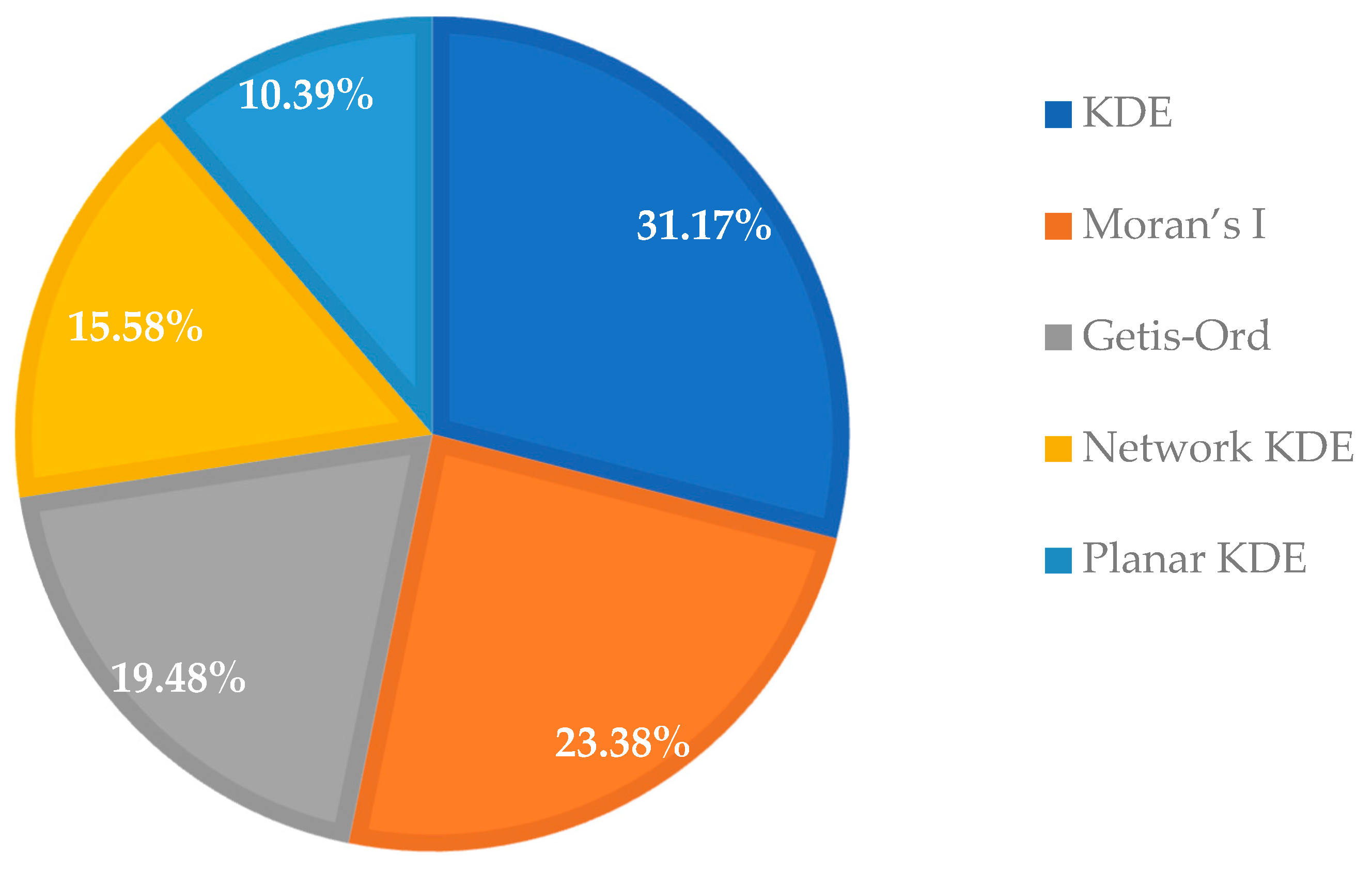
Figure 3, the adoption rates of various GIS techniques indicate that KDE and Moran’s I were the most frequently applied, with usage rates of 31.17% and 23.38%, respectively. Getis-Ord accounted for 19.48% of the applications, while Network KDE techniques represented 15.58%. Notably, planar KDE had the lowest adoption rate at just 10.39%.
Additionally,
Table 4 indicates a spatial evaluation technique scattered across 77 assessed investigations. KDE was applied 24 times, while Getis-Ord and Moran’s I were utilized 15 and 18 times, respectively, across the reviewed literature. Thus, it is evident that Moran’s I and KDE techniques were more commonly employed by GIS users and are best applied in combination.
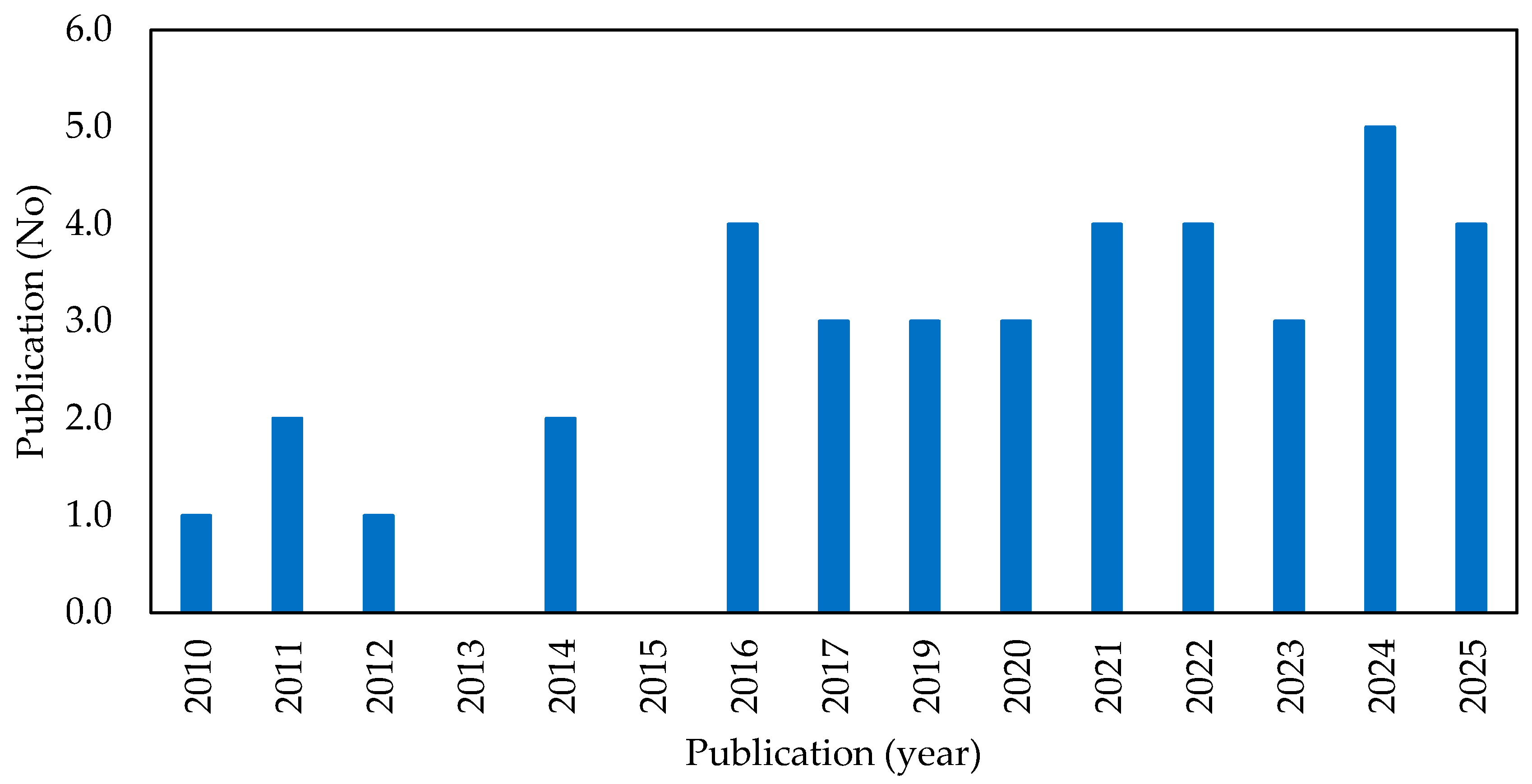
Figure 3 demonstrates the annual distribution of publications related to GIS applications in traffic accident analysis from 2010 to 2025. The trend shown in the figure demonstrates a gradual but consistent increase in research activity over the 15 years, illustrating the growing academic and practical interest in utilizing GIS for analyzing and managing road traffic accidents.
In the early years (2010-2014) of the period under review, publication activity remained relatively low, with one to two studies published per year. This suggests that the application of GIS in road safety analysis is still in its infancy, possibly limited by the availability of geospatial data, technical expertise, and awareness of GIS capabilities in traffic management. However, beginning in 2015, a noticeable increase in publication frequency is observed, indicating a period of methodological development and expansion in the field. The number of publications peaked at four in 2016, suggesting a surge in scholarly engagement and possibly the emergence of improved GIS tools and data accessibility that made spatial analysis of traffic incidents more feasible and attractive to researchers.
From 2017 to 2022, the number of publications stabilized, maintaining a steady output of around 3-4 studies per year. This period showed a phase of consolidation, where researchers built upon foundational work and began to apply GIS methods more routinely in accident mapping, spatial correlation analysis, and risk prediction. The stability in publication output implies that GIS had become an established tool for traffic accident analysis during this time.
A further increase is evident in 2024, where publications reached a maximum of five, marking the highest level of research activity across the studied period. This recent peak signifies renewed scholarly momentum, likely influenced by technological advancements such as improved satellite imaging, integration of real-time traffic data, and the adoption of machine learning techniques for spatial accident prediction. The slight decline observed in 2025 may not necessarily indicate reduced interest but rather reflect incomplete data for the ongoing year.
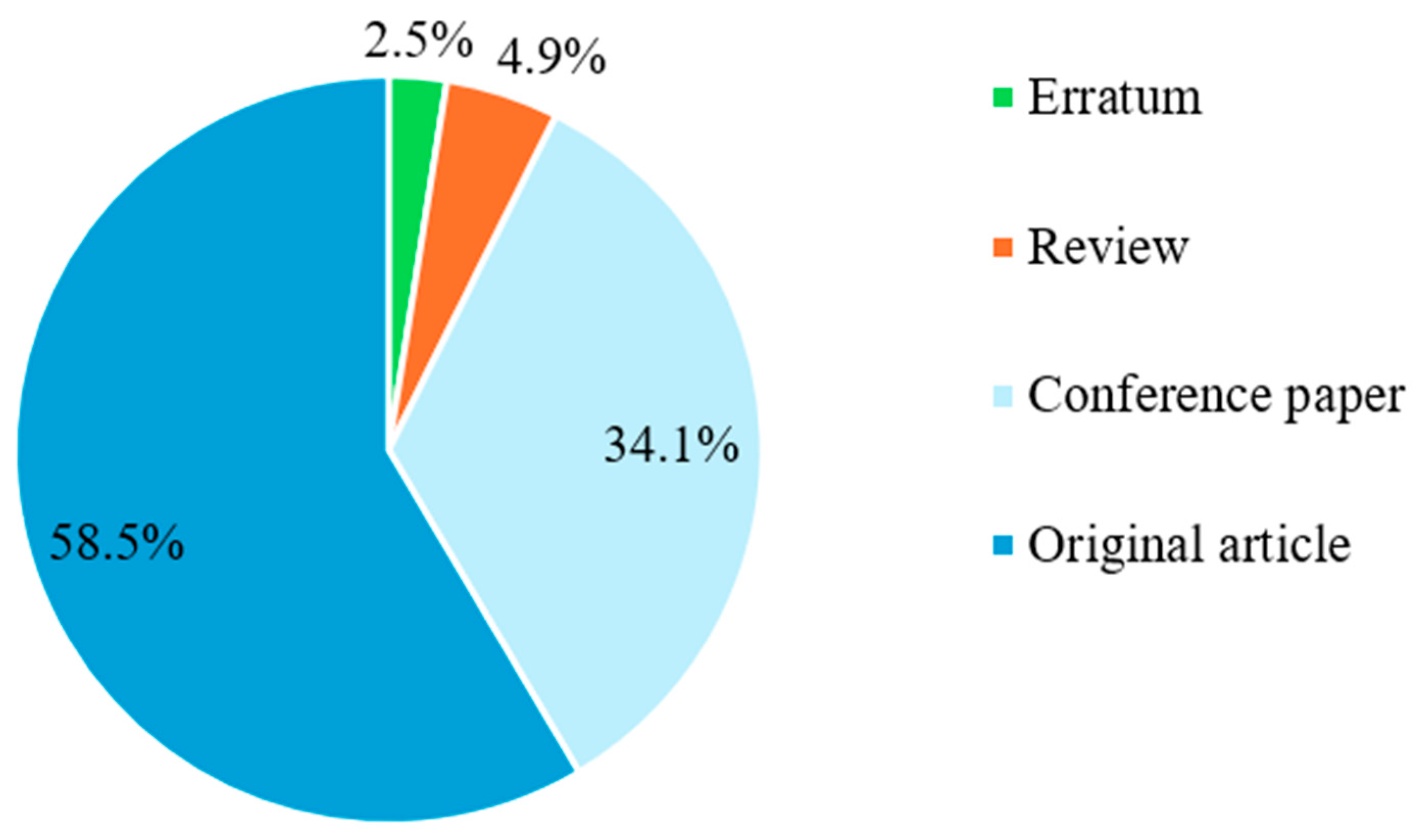
The distribution of publication types related to GIS applications in road traffic accident studies is illustrated in
Figure 4. It indicated that original research articles constitute the majority, accounting for 58.5% of the total publications considered for this review. This dominance suggests that the field is primarily research-oriented and driven by empirical investigations aimed at developing and testing new GIS methodologies, models, and applications in traffic accident analysis. The prevalence of original studies indicates a dynamic and evolving research domain that continues to generate novel insights rather than merely consolidating existing knowledge.
Conference papers account for 34.1% of the publications, indicating the active dissemination of preliminary results and methodological advancements within professional and academic forums. This substantial proportion highlighted the interdisciplinary nature of the field, where researchers from diverse areas, such as transportation engineering, geography, and data science, frequently share emerging techniques and findings. In contrast, review papers make up only 4.9% of the total, indicating a notable gap in the systematic synthesis of prior research. The scarcity of reviews suggests that the field still lacks comprehensive evaluations that integrate and assess the wide range of GIS-based approaches used in traffic accident analysis. This underlines the need for more critical analyses and meta-studies that could guide future research directions and standardize methodologies.
Lastly, errata constitute just 2.5% of the publications, suggesting a relatively low rate of post-publication corrections. While this may reflect overall data reliability and editorial rigor, it could also point to limited post-publication scrutiny and replication efforts. Overall, the data indicate that GIS-driven traffic accident research is in an expansive and exploratory stage, characterized by a strong focus on original investigations and ongoing methodological innovation, yet it would benefit from increased synthesis, standardization, and critical evaluation of existing studies.
The data show the inherently interdisciplinary nature of GIS-driven road traffic accident research, where engineering (26), computer science (11), and social science (13) converge to address complex safety issues, as shown in
Table 5. The prominence of social science highlights a strong focus on human behavior, socio-economic conditions, and policy interventions, while the substantial contributions from engineering and computer science emphasize the integration of technological innovation, spatial modeling, and data analytics. Together, these disciplines demonstrate how modern traffic accident studies increasingly rely on both human-centered and computational approaches to enhance understanding and prevention strategies.
Despite this diversity, notable research gaps persist. The comparatively low representation of medical, mathematical, and physical sciences suggests limited exploration of injury dynamics, biomechanical modeling, and quantitative simulation within GIS frameworks. Likewise, environmental and material sciences, though relevant, remain peripheral. These gaps underscore the need for stronger interdisciplinary collaboration that unites technical modeling with health, environmental, and behavioral data, an approach that could yield more comprehensive and predictive insights into road accident causes and mitigation.
To illustrate how the preference for various GIS-based spatial analysis techniques evolved between 2010 and 2025, a temporal trend analysis was performed by mapping the appearance frequency of each method against publication years. As shown in
Figure 5, early studies (2010–2015) predominantly relied on KDE and Global Moran’s I due to their simplicity and availability in commercial GIS packages. From 2016 onward, the use of Network KDE and Getis-Ord Gi* increased, driven by advances in network-based spatial modeling and improved computational capacity. The most recent period (2021-2025) shows growing adoption of hybrid and AI-integrated GIS methods, where spatial statistics are combined with predictive modeling. This trend reflects the field’s gradual transition from descriptive hotspot mapping to predictive and real-time spatial analytics, indicating methodological maturation and a stronger focus on data-driven road-safety management.
8. Thematic Synthesis of Reviewed Studies
The reviewed literature reveals diverse research objectives and thematic orientations in the application of GIS to road traffic accident analysis. While earlier sections categorized the studies based on specific GIS techniques such as KDE, Moran’s I, Getis-Ord Gi*, and Network KDE, a thematic synthesis provides deeper insight into how these methods have been employed to pursue different analytical goals. Overall, five major thematic directions can be identified: hotspot detection and visualization, predictive crash modeling, integration of GIS with emerging technologies, equity and policy-oriented safety analysis, and infrastructure-related investigations.
A substantial proportion of the reviewed studies, accounting for nearly half of the total, focused primarily on hotspot detection and spatial visualization of crash-prone areas. These works, such as those by [
1,
21,
36,
60], applied KDE, Moran’s I, and Getis-Ord Gi* to map and statistically verify areas with high crash concentrations. Their main goal was to enhance road safety management by identifying critical zones requiring intervention. These studies collectively demonstrate the robustness of GIS in producing intuitive and spatially explicit visualizations of accident clusters that assist urban planners and policymakers in prioritizing road safety improvements.
A second group of studies concentrated on predictive modeling and risk assessment. Researchers in this category sought to move beyond static mapping toward anticipating future crash occurrences and understanding the underlying causal mechanisms. For instance, studies [
11,
43] employed GIS-integrated statistical and probabilistic frameworks to model crash risk, while research [
49] developed data-driven matrices that quantified roadway risks under varying environmental and behavioral conditions. This theme reflects a growing trend toward proactive rather than reactive safety management, enabling the formulation of preventive strategies based on model-based evidence.
Another emerging theme involves the integration of GIS with artificial intelligence and machine learning (ML). Recent studies, particularly those by [
17,
41,
67] combined GIS spatial analytics with ML algorithms such as XGBoost, neural networks, and hybrid explainable AI models to predict crash hotspots and support real-time decision-making. These works highlighted a paradigm shift in traffic safety analysis from traditional descriptive methods to intelligent, adaptive systems capable of processing large-scale, dynamic spatial data. This integration enhances predictive accuracy, supports early warning systems, and facilitates rapid emergency responses.
However, the integration of GIS spatial data with AI and ML presents several technical bottlenecks that constrain its full potential. First, the heterogeneity and scale of spatial data pose major challenges. GIS data often comprises multiple layers, such as road networks, land use, topography, and traffic flow-collected at varying spatial resolutions, temporal frequencies, and formats. This diversity complicates data preprocessing, normalization, and spatial alignment, making integration computationally intensive and error-prone [
42,
51,
68].
Second, spatial autocorrelation and spatial non-stationarity complicate ML model training. Unlike traditional datasets that assume independence among observations, GIS data exhibit spatial dependence, where nearby locations influence each other’s characteristics. Standard ML models may misinterpret this dependence, leading to biased or unstable predictions unless spatially aware algorithms, such as geographically weighted regression or spatial deep learning, are applied [
69].
Third, feature extraction and representation from high-dimensional spatial data remain technically demanding. Transforming raw geospatial layers into structured features that retain spatial context, such as network connectivity, proximity indices, or spatial-temporal interactions, requires advanced techniques like spatial embeddings, graph neural networks, or tensor-based representations [
70]. The lack of standardized methods for representing complex spatial relationships limits the generalizability and reproducibility of GIS-ML integration frameworks. Additionally, computational constraints emerge when processing high-resolution or real-time spatial data streams, especially in dynamic applications such as crash prediction or emergency response. The integration of AI models with spatial databases often demands distributed computing infrastructures, GPU acceleration, or cloud-based geoprocessing pipelines [
71].
Finally, model interpretability and explainability represent another persistent bottleneck. While GIS-based decision systems often inform public policy and safety planning, many ML models function as black boxes [
72]. Achieving transparency requires explainable AI approaches capable of spatially visualizing model outputs, such as risk probability maps or feature attribution layers, to support trust and accountability in decision-making [
73].
A fourth thematic category centers on equity and policy-oriented analysis, wherein GIS is employed to evaluate how road safety outcomes intersect with social and demographic factors. For example, a recent study [
74] used GIS to explore spatial inequalities in traffic risk exposure among vulnerable population groups. Such studies contribute to the emerging discourse on equitable transportation systems by linking spatial safety analysis with socioeconomic and demographic data, thereby informing policies that prioritize inclusive and socially just safety interventions.
The fifth theme focuses on infrastructure and geometric design factors affecting accident occurrence and severity. Investigation by various researchers [
25,
27,
29] examined how intersection geometry, road curvature, slope, and design standards influence crash frequencies. These studies underscore the importance of integrating detailed roadway geometry and engineering parameters within GIS-based models to better understand risk spatial variability. However, despite their importance, such factors remain underrepresented due to the scarcity of reliable geometric datasets, especially in developing countries.
In addition to these major themes, several cross-cutting trends and challenges emerged from the synthesis. Recent publications (2023–2025) indicate a strong emphasis on real-time analytics, automation, and the incorporation of connected vehicle data, as demonstrated by studies utilizing drone imagery and sensor-based data fusion. However, consistent challenges persist across themes, including data quality limitations, heterogeneity in data sources, lack of standardization in spatial methods, and insufficient temporal analysis within GIS frameworks. Thematic comparisons further reveal disparities between developed and developing nations, where the latter often face obstacles related to data accessibility and computational infrastructure.
Overall, the thematic synthesis demonstrates that GIS-based road traffic accident research has evolved from simple spatial visualization toward integrated, multi-dimensional frameworks that combine spatial statistics, predictive modeling, and intelligent systems. The literature reflects a field in transition, advancing from descriptive mapping of crash patterns to dynamic, data-driven analytics that support evidence-based transportation safety policies. Future research should therefore focus on bridging methodological sophistication with practical implementation, ensuring that advanced GIS models contribute meaningfully to real-world road safety improvements.
9. Review Discussions
The literature reviewed in this study examined key aspects of the spatial analysis of road crashes. Among various techniques, Moran’s I and kernel density emerged as the most repeatedly utilized, offering precise tools not typically available in traditional statistical analyses. However, these methods have limitations in comparing diverse outcomes, unlike conventional models like the generalized linear model, which, although straightforward, lack the advanced interpolation capabilities demonstrated by newer spatial methods.
Hotspot identification is another major outcome of spatial analysis. Researchers found that hotspots vary significantly based on vehicle type and newly introduced features in the analysis, which can greatly shift spatial patterns. This underlines the importance of selecting an appropriate method and accounting for hidden factors to ensure accuracy and meaningful hotspot mapping. GIS remains a central tool due to its strong data processing capabilities, supporting accurate data collection and spatial result analysis [
75].
Geospatial studies are more common in developed countries like the US and China, while less frequent in developing nations. Researchers have used variables like road size, travel distance, and vehicle speed, even when data were limited, producing valuable insights. However, the key road geometry factors, such as slope and width, remain underused due to data unavailability. The lack of reliable and timely data has remained a major obstacle in spatial crash analysis. Future research should explore overlooked variables, such as detailed road characteristics, to improve understanding and intervention strategies.
Over time, the evolution of GIS techniques in road safety analysis indicates methodological progression. Initially, studies favored KDE and Moran’s I for hotspot identification and spatial clustering. The subsequent introduction of network-based density methods and Getis-Ord Gi* improved statistical robustness by quantifying spatial significance. The current trend demonstrates an increasing preference for integrating GIS with artificial intelligence and machine learning to support predictive and real-time applications. This evolution highlights the field’s shift from static mapping toward proactive decision-support systems.
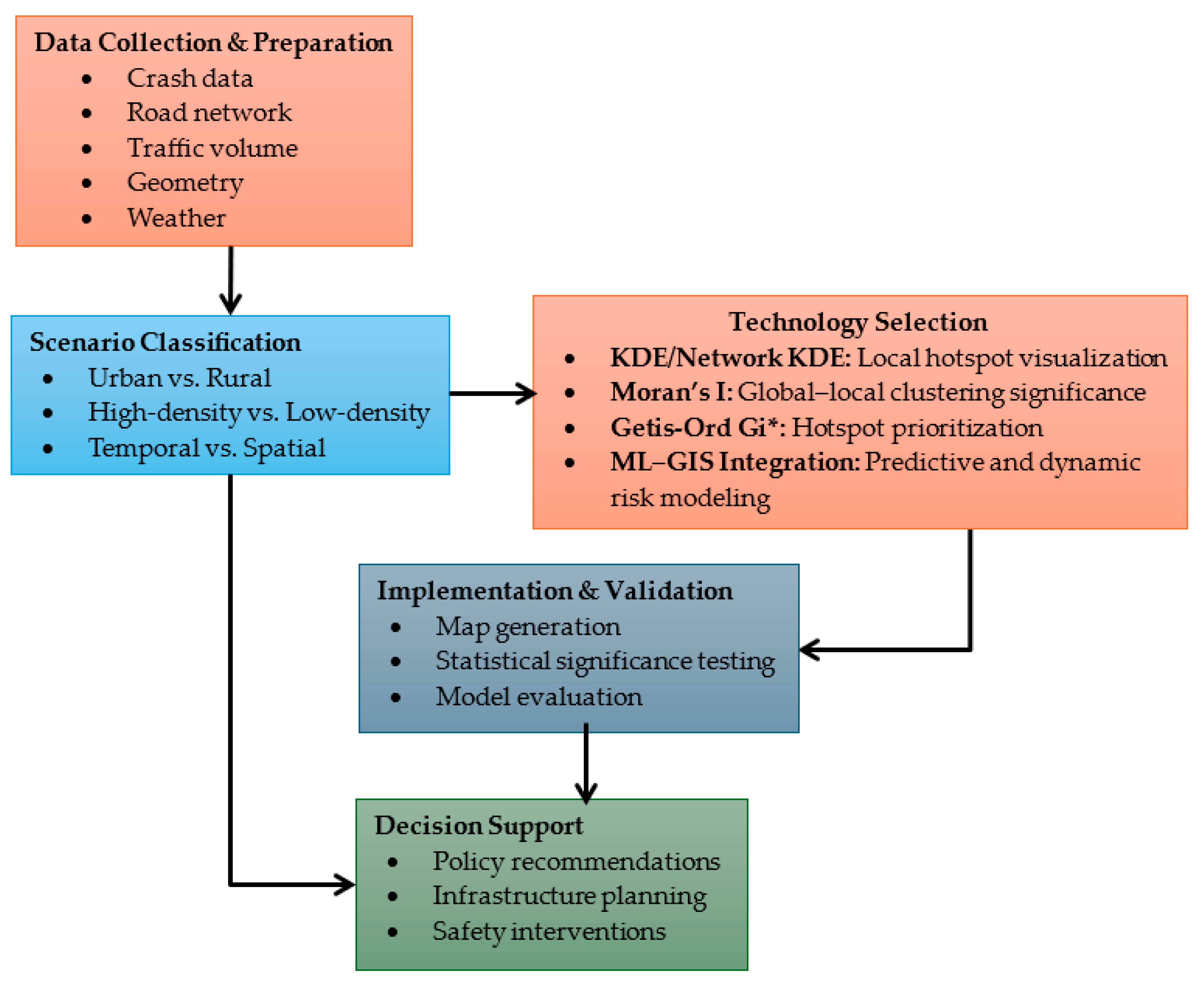
10. Scenario Technology Matching and GIS Application Framework
The choice of GIS techniques for road traffic crash analysis is influenced by the study’s objectives, data characteristics, and the spatial scale of investigation. Drawing from the reviewed literature, a structured framework is proposed to assist scholars and practitioners in selecting the most appropriate GIS approach for different analytical scenarios, as shown in
Figure 5. For detecting hotspots in dense urban road networks, KDE and Network KDE are the most suitable techniques, as they effectively reveal localized clusters of crashes and visualize their spatial intensity along intricate road systems. In contrast, Moran’s I, both in its Global and Local forms, is best applied for assessing spatial autocorrelation and regional risk patterns, providing statistical insight into high and low risk zones. When prioritizing intervention areas, the Getis-Ord Gi* method serves as a powerful tool to identify statistically significant hot and cold spots, guiding decision-makers in allocating safety resources efficiently. Moreover, for advanced scenario testing and predictive modeling, integrating GIS with Machine Learning and Artificial Intelligence algorithms such as Random Forest and XGBoost enhances analytical precision, enabling simulation of intervention outcomes and real-time prediction of crash risks. This framework not only bridges the methodological gap between spatial analysis and decision-making but also supports the development of data-driven strategies for improving road safety.
11. Limitations of the Review
This review identified the few methods that were effective in the most recent literature. In the literature, 80 articles from 2010 to 2025 were thoroughly reviewed in the literature. Only peer-reviewed, English-language journal articles were included in the database search. GPS is a useful tool for pinpointing the precise sites of crashes [
76]. But, given the explicit structure of the framework, other notable approaches, like the deep learning technique, could be further beneficial in the future for a certain range of road crash characteristics. However, it ended up replacing traditional regression approaches since the Support Vector Algorithm model in deep learning technique is successfully employed in assessing the accident severity index [
77]. Researchers hardly ever apply the machine learning technique in their study. The idea of machine learning can produce more accurate and productive outcomes due to its sophisticated programming capabilities.
Several studies explicitly illustrate these limitations. In Mashhad, Iran, [
41] reported that inconsistent and incomplete crash records constrained the accuracy of KDE and Getis-Ord hotspot mapping, leading to under-representation of minor crashes. Similarly, a researcher [
64] noted that GIS-HDBSCAN integration improved hotspot identification but demanded extensive computational resources, especially when processing large metropolitan datasets. Furthermore, [
25] in Jordan highlighted that omission of road geometric variables such as curvature and gradient reduced the explanatory power of spatial models, despite geometry being a significant contributor to crash risk. These cases confirm that data inconsistency, computational intensity, and incomplete geometric representation are not merely theoretical drawbacks but have demonstrable consequences for the robustness of GIS-based safety analyses.
12. Conclusions
The systematic review demonstrates that GIS plays a transformative role in enhancing road traffic safety through the integration of spatial and non-spatial data for in-depth crash pattern analysis. The review analysis revealed that among 77 evaluated studies from 2010 to 2025, KDE and Moran’s I emerged as the most frequently adopted GIS techniques, accounting for 31.17% and 23.38% of applications, respectively, followed by Getis-Ord Gi* and Network KDE. The publication trend indicated steady growth in GIS-based traffic research, reflecting methodological maturity and increasing global recognition of GIS as an essential analytical framework for transport safety. Moreover, the studies highlighted the inherently interdisciplinary nature of the field, where engineering, computer science, and social sciences intersect to address complex spatial and behavioral aspects of road safety. The review discussion underscored that while spatial tools such as Moran’s I and KDE offer precision in hotspot identification and cluster analysis, their performance depends on data quality, scale, and contextual adaptation. These techniques outperform traditional statistical models by capturing spatial dependencies and visualizing crash-prone areas more intuitively. However, persistent challenges remain, such as inconsistent and incomplete datasets, underutilization of geometric variables (slope and curvature), and limited application of real-time analytics. The discussion also noted that GIS-based studies are predominantly concentrated in developed nations, whereas data scarcity and computational limitations restrict broader adoption in developing regions. Addressing these disparities requires standardization of spatial methodologies, improved data acquisition, and integration of local road geometry and environmental factors. Over time, GIS research in traffic safety has evolved from static mapping to advanced predictive and real-time spatial analytics. The integration of GIS with artificial intelligence and machine learning, as observed in recent studies, marks a pivotal shift toward proactive crash risk modeling and intelligent decision-support systems. This fusion enables early detection of hazardous locations, predictive accident forecasting, and optimized emergency responses. Overall, the review establishes that GIS not only facilitates descriptive spatial analysis but also empowers evidence-based policymaking and targeted safety interventions. By bridging analytical precision with decision-making, GIS offers a powerful framework for designing safer transport networks, prioritizing high-risk zones, and formulating equitable road safety strategies. Future research should focus on harmonizing spatial data standards, expanding interdisciplinary collaboration, and applying real-time, AI-enhanced GIS systems to ensure sustainable and inclusive global road safety management.



 ,
,