
Article

Optimization of Milk-Clotting Conditions and Rheological Properties Characterization of a Plant-Based Coagulant from Onopordum platylepis Murb. in Ewe’s Milk

1
Faculty of Pharmacy and Nutrition, Universidad Católica de Murcia-UCAM, Campus de los Jerónimos, 30107 Murcia, Spain
2
Milk Technology Station (ETL), Agricultural Technological Institute of Castilla y León (ITACyL), Viñalta Avenue, 34071 Palencia, Spain
3
Department of Food Hygiene and Technology, León University, 24071 León, Spain
4
Department of Agricultural, Food and Environmental Sciences, Università Politecnica delle Marche, Via Brecce Bianche, 60131 Ancona, Italy
*
Author to whom correspondence should be addressed.
This article is part of the PhD thesis of Cindy Bande De-León.
Dairy 2026, 7(3), 34; https://doi.org/10.3390/dairy7030034
Submission received: 13 March 2026 / Revised: 16 April 2026 / Accepted: 25 April 2026 / Published: 28 April 2026
(This article belongs to the Section Milk Processing)

Abstract

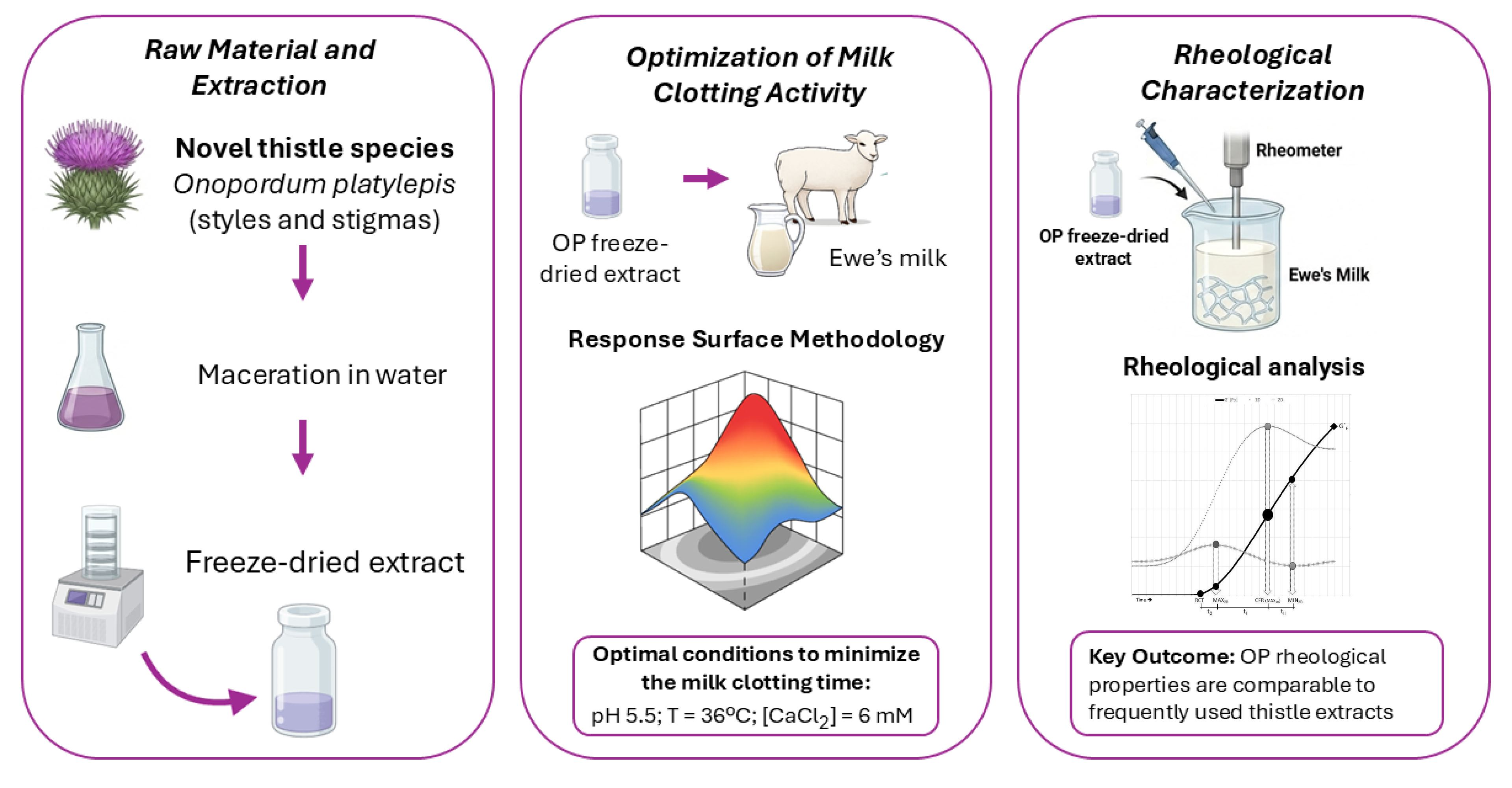
Plant-derived coagulants are increasingly explored as alternatives to animal rennet. This study provides the first evaluation of the coagulation kinetics and technological properties of Onopordum platylepis Murb. in ewe’s milk. Response surface methodology was applied to optimize temperature (30, 33, and 36 °C), pH (5.5, 6.0, and 6.5), and calcium chloride concentration (2, 4, and 6 mM). The optimal conditions for minimizing milk-clotting time were 36 °C, pH 5.5, and 6 mM CaCl2. Under standardized activity (50 IMCU/L), the Rheological properties of gels produced by Onopordum platylepis were compared with Cynara cardunculus, Cynara humilis, animal rennet, a commercial plant coagulant, and fermentation-produced chymosin. Onopordum platylepis showed slower curd-firming rates than animal rennet and Cynara cardunculus, but similar behavior to Cynara humilis. Gels produced with Onopordum platylepis exhibited firmness comparable to commercial plant coagulants. The water-holding capacity was similar to other coagulants, though protein losses were higher for Onopordum platylepis, Cynara humilis, and Cynara cardunculus than animal rennet. Overall, Onopordum platylepis demonstrates potential for ewe’s milk cheese production, in which highly proteolytic coagulants are used.

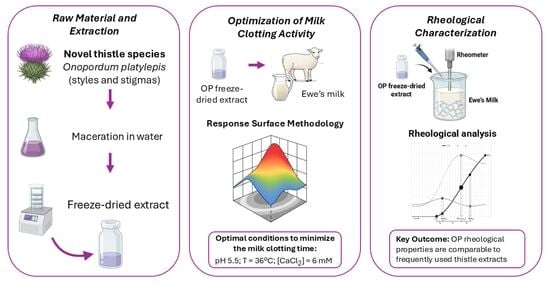
Graphical Abstract

1. Introduction

The search for new coagulants for cheese production has intensified due to various factors impacting the availability and acceptability of animal rennet. These factors include the rising global demand for cheese, which has increased production and, consequently, the price of animal rennet [1,2]. Additionally, various constraints on the use of animal rennet, such as religious dietary restrictions and vegetarianism, have contributed to the search for alternative coagulants. Concerns related to genetically modified products have also influenced consumer perception; however, it should be noted that fermentation-produced chymosin, obtained through modern biotechnology, is widely used in the dairy industry and has been broadly accepted due to its high purity, consistency, and safety. Therefore, the demand for alternative coagulants is driven not only by technological limitations but also by cultural, ethical, and market-related factors [3,4,5,6].
In this context, coagulants derived from plant proteases have emerged as prominent substitutes for animal rennet and have been extensively studied in recent years [7]. Aqueous extracts of proteases from the Asteraceae family, particularly from Cynara species thistles, have been used since ancient times in cheese production. These include Protected Designation of Origin cheeses made from raw ewes’ milk in Portugal (Serra da Estrela and Serpa cheeses) and Spain (Torta del Casar, La Serena, and Los Pedroches cheeses) [8,9].
The current exploration of new plant-based coagulants is primarily driven by the limitations of existing rennet substitutes. Despite the availability of alternatives, many cheese manufacturers continue to favor traditional calf rennet due to challenges such as higher protein losses, which reduce cheese yield, and potential negative impacts on the ripening process that can lead to off-flavors and texture issues. Therefore, the search for new plant coagulant species is aimed at addressing these challenges and providing more effective and acceptable alternatives for the industry [10,11].
A crucial step in cheesemaking is the gelation of the milk; thus, it is essential to evaluate the physical evolution of the gel during milk curdling [12,13]. Studying the kinetics of milk coagulation can enhance cheese yield while simultaneously improving the quality of the final product. In particular, the kinetics of enzymatic coagulation and the subsequent development of the gel network directly influence key technological parameters such as curd firmness, syneresis, and moisture retention, which ultimately determine cheese yield and texture. Rheological properties of the forming gel, including its viscoelastic behavior, provide valuable information on the structure and stability of the casein network, and are therefore closely related to the sensory and functional characteristics of the final cheese [14].
To our knowledge, existing studies on the characterization and utilization of plant coagulants from thistle flowers primarily focus on the genus Cynara L. [2,3,15]. Moreover, investigations into the rheological properties of milk gels produced with plant coagulants have mainly been conducted on Cynara cardunculus L. and Cynara humilis L. species [12,16,17].
Very few studies, most of them recently published, have evaluated the technological and chemical properties of other thistle species that may be suitable for cheese production [7,18,19]. Some species from the genus Onopordum L. have been researched as potential sources of milk-clotting enzyme extracts [10,11]; however, the literature on this topic remains limited. In our previous study on freeze-dried plant coagulants, we explored the potential of a novel thistle species, Onopordum platylepis Murb., for milk coagulation and its caseinolytic activity, providing a detailed characterization of its milk-clotting ability [20]. However, the gelation properties of milk gels produced with Onopordum platylepis Murb. have not yet been investigated.
When assessing the technological properties of a coagulant, determining the optimal working conditions for its activity is crucial to maximize its effectiveness in cheese production. Several factors influence cheesemaking simultaneously; therefore, response surface methodology (RSM) is employed to analyze how multiple factors affect a particular response, optimizing processes through the combination of mathematical and statistical techniques. This approach is particularly suitable for milk coagulation systems, where variables such as temperature, pH, and calcium concentration interact and jointly influence both enzymatic activity and casein micelle aggregation. RSM allows not only for the evaluation of individual effects but also the identification of interaction effects between variables, providing a more comprehensive understanding of the coagulation process and enabling the determination of optimal conditions. The “one-factor-at-a-time” method, in contrast, allows only for variation in one factor, while keeping all other variables constant [13,18].
This study aims to establish the optimal conditions of temperature, pH, and calcium chloride concentration for the coagulation of ewe’s milk using a freeze-dried extract from Onopordum platylepis Murb. This approach may facilitate the production of new lacto-vegetarian cheese versions. Additionally, the coagulation kinetics and rheological characteristics of the resulting gels will be evaluated and compared with those of other coagulants.

2. Materials and Methods

2.1. Plant Extracts and Milk Substrate

Freeze-dried extracts prepared from flowers of Cynara cardunculus L. (CC), Cynara humilis L. (CH), and Onopordum platylepis Murb. (OP) were used in this study. Flowers were obtained from spontaneously grown plants and collected at the full-bloom stage of maturity between May and July 2020. Flowers of Cynara cardunculus L. and Cynara humilis L. were collected in Cáceres, Spain (39°26′19.40″ N, 6°22′52.95″ W), whereas Onopordum platylepis Murb. flowers were collected in Sousse, Tunisia (36°31′6.738″ N, 10°56′2.078″ E). At least 100 plants from each species were harvested.
Flower styles and stigmas were manually separated immediately after harvesting and finally used to prepare the freeze-dried extracts obtained as described by Tejada and Fernández-Salguero [21]. First, styles and stigmas were macerated in distilled water using a weight-to-volume ratio of 1:10 for 24 h at 25 °C. The resulting aqueous extract was sieved, and the filtrate was then subjected to centrifugation at 3000× g for 5 min. The supernatant collected was further filtered using Whatman No. 1 paper. This filtrate was subsequently frozen at −32 °C for 24 h and later freeze-dried using an Alpha 1-2LD plus freeze dryer (Christ, Osterode am Harz, Germany) with a pressure range of 4 to 13 Pa. After freeze-drying, the powdered extract was frozen at −20 °C for storage until use.
Raw milk from Churra ewes was collected in spring, specifically in the month of May, from the Viñalta Integrated Vocational Training Center (Junta de Castilla y León, Palencia, Spain), within a single day, from a milk tank. The milk samples were immediately refrigerated at 5 °C for up to 4 h without preservatives and were used on the same day of collection for coagulation and rheological analyses. The raw milk sample was analyzed for fat (7.05%), protein (4.97%), lactose (4.66%), urea (607 mg/Kg), and dry matter (17.59%) content using a MilkoScan FT+ (FOSS, Hilleroed, Denmark). Azidiol (3 mL/L) was added to the raw milk aliquots used for compositional analysis to prevent microbial growth.

2.2. Determination of Milk-Clotting Activity

The total milk-clotting activity (MCA) was evaluated using response surface methodology (RSM) to assess the combined effects of temperature (30, 33, and 36 °C), pH (5.5, 6.0, and 6.5), and calcium chloride concentration (2, 4, and 6 mM), selected based on preliminary trials and previous studies on milk coagulation and cheesemaking conditions.
The selected temperature range was based on typical cheesemaking conditions, where milk coagulation is commonly performed between 30 and 36 °C depending on the cheese type, despite higher optimal temperatures reported for enzymatic activity [12,22,23].
Similarly, the calcium chloride concentrations were selected within ranges commonly used in dairy processing, considering their role in enhancing casein micelle aggregation and reducing milk-clotting time [24,25].
The pH range was chosen to include values close to the natural pH of ewe’s milk, as well as more acidic conditions approaching the isoelectric point of caseins, allowing the evaluation of both enzymatic coagulation and acid-induced aggregation mechanisms. These conditions are also consistent with previous studies on thistle-derived coagulants, where similar pH ranges have been explored to optimize milk-clotting activity [15,17,18,19,26].
As shown in Table 1, a D-optimal design consisting of 12 randomized experiments was applied, each performed in triplicate, and the results were compared with the predicted responses to confirm the validity of the RSM model.
MCA was performed according to the method described by Foligni et al. [19], but with the following modifications: raw milk aliquots were skimmed by centrifugation (5000× g and 4 °C for 20 min) for better visualization of the beginning of flocculation and freeze-dried (at a working pressure between 4 and 13 Pa) and frozen (−20 °C) for conservation purposes. The freeze-dried skimmed milk was reconstituted according to its dry-matter content (17.59% w/w) in different buffer solutions. This approach was adopted to ensure better control of milk composition and experimental reproducibility, as commonly reported in milk coagulation studies [11,12,13], although it may partially affect the native structure of milk proteins; therefore, the results should be interpreted as comparative trends under controlled conditions. To prepare the buffers, a 100 mM sodium acetate solution was adjusted to the target pH values (5.5, 6.0, and 6.5) using concentrated acetic acid. The pH of the reconstituted milk was verified with a glass electrode pH meter (Hanna Instruments, Padova, Italy), calibrated daily at room temperature using standard buffer solutions at pH 4.00, 7.00, and 10.00 prior to measurements. A 500 g/L calcium chloride solution (Sigma-Aldrich, Milan, Italy) was added to the milk to achieve final concentrations of 2, 4, and 6 mM, as established in the experimental design.
A volume of 10 mL of the different reconstituted milk solutions was transferred into a test tube and kept in a thermostatic bath until the milk reached the desired temperature. After the target temperature was reached, the plant coagulants and animal rennet were added, and the milk-clotting time (MCT) was determined. The MCT was measured as the time required for 1 mL of the diluted enzyme to clot 10 mL of milk. To assess clotting, the test tube containing the milk was gently rotated, allowing a thin film of milk to flow down the inner wall of the tube. Coagulation was considered to occur when this film broke into discrete white particles. The MCA of the freeze-dried plant coagulants were compared with a commercial liquid Lamb rennet (75 rennet units) provided by Cuajos Caporal (Valladolid, Spain). The freeze-dried plant extracts obtained from Cynara cardunculus (CC), Cynara humilis (CH), and Onopordum platylepis (OP) were reconstituted in distilled water at a concentration of 20 mg/mL, and 1 mL was added following the methodology described by Berridge [27]. In the case of animal rennet (AR), following the manufacturer’s instructions, 2.5 µL of rennet was added.

2.3. Rheological and Gel Characterization

2.3.1. Milk Coagulation Kinetics Assay

Firstly, 200 g of milk was weighed and heated to the test temperature (32 °C) in a thermostatic bath. Once the temperature was reached, 2.3 mM calcium chloride was added, this concentration being selected to ensure standardized conditions and to remain within the range commonly used in cheesemaking. And after homogenization by continuous stirring, the milk coagulants were added. Subsequently, the coagulation kinetics of the freeze-dried plant coagulant OP was compared with that of freeze-dried plant coagulants CH and CC, and with three commercial coagulants: (i) fermentation-produced chymosin, supplied as Chymax M (200 International Milk-Clotting Unit per mL, Chr Hansen, Hørsholm, Denmark); (ii) animal rennet (75 rennet units, Cuajos Caporal, Valladolid, Spain); and (iii) a liquid commercial plant coagulant from Cynara cardunculus (1:15,000, Laboratorios Arroyo, Santander, Spain), hereafter referred to as FC, AR, and CV, respectively.
Prior to the rheological assays, the milk-clotting activity (MCA) of each coagulant was determined and expressed as International Milk-Clotting Unit (IMCU) per gram of coagulant, taking FC as the reference. Based on these values, the amount of each coagulant required to achieve a standardized activity of 50 IMCU/L of milk was calculated.
Coagulants were evaluated at a standardized dose of 50 IMCU/L of milk to allow for direct comparison among samples with different activities. In the case of animal rennet, activity expressed in rennet units (RU) was converted to equivalent clotting activity according to the manufacturer’s specifications. The amount of each coagulant was experimentally adjusted to obtain a milk-clotting time equivalent to that of the reference coagulant [16]. The final concentrations of the coagulants (expressed in grams per liter of milk), added to the milk, were as follows: OP at 5.35 g/L, CH at 0.51 g/L, CC at 0.35 g/L, CV at 0.28 g/L, FC at 0.25 g/L, and AR at 0.24 g/L.
Taking the commercial activity of the coagulant FC as a reference, the MCA (IMCU/g of coagulant) of each coagulant tested was calculated, working at pH 6.5, according to international standards [28]. After the addition of the different enzymatic coagulants under study at the reference dose (50 IMCU/L) and pH 6.5, a light agitation was carried out for 30 s to ensure complete mixing. Subsequently, 18 mL was taken and introduced into the cup/cylinder system (CC27/T200/AL, Anton Paar, Graz, Austria) of the rheometer (Physica MCR 301, Anton Paar, Austria) at a controlled T of 32 °C to carry out the milk-clotting test. A constant oscillation was applied to the sample at a 0.5% strain rate and a frequency of 1 Hz [14]. The elastic modulus (G′) and viscous modulus (G″) were monitored for 30 min, working in the viscoelastic region of the gels. The analysis of the firmness curve (G′ vs. time) and its first and second derivative was performed to obtain the coagulation parameters, following the method of Federiksen et al. [29], using the Rheometer software (Rheoplus 3.62, Anton Paar, Austria). The coagulation curve parameters analyzed (Figure 1) were as follows:
  • RCT, the time at which the first flocs are reached, is calculated as the cut-off point between the G′ and G″ curves.
  • The maximum curd-firming rate (CFR), calculated as the slope of the curve G′ vs. t at the maximum of the first derivative (1D). The time (MAX1D) and firmness (G′CFR) coordinates were calculated at this point.
  • Firmness of the gel at the end of the test (G′F).
Locating the maximum and minimum of the second derivative, the zone of maximum variation in CFR is delimited, which is directly related to curd cutting time and gel firmness, both key parameters for cheese yield and quality [30]. To better understand the changes experienced, this zone was divided into three time intervals: (0) start of aggregation after hydrolysis (t0), defined as t0 = MAX2D − RCT; (I) interval of increasing aggregation rate (tI) or primary aggregation zone, calculated as tI = MAX1D − MAX2D; and (II) interval of decreasing aggregation rate (tII) or secondary aggregation zone, calculated as tII = MIN2D − MAX1D. This approach facilitates the identification of key technological parameters and can be applied to optimize cutting time and improve process control in the dairy industry.
These intervals were calculated from RCT and the times at which the maximum of the first derivative (MAX1D) and the maximum (MAX2D) and minimum (MIN2D) of the second derivative (2D) of the G′ vs. t curve were reached.

2.3.2. Analysis of Water-Holding Capacity (WHC) and Whey Composition

In order to carry out these analyses, the method described by Muñoz et al. [14] was followed. Aliquots of 50 mL of milk were taken after the addition of the different coagulants to the milk and kept at a T of 32 °C in a thermostatic bath until gels were formed with a firmness of 170 Pa. This firmness value was chosen because preliminary studies consistently showed that it is well past the point of maximum curd-firming rate (G’CFR), which we calculated as the maximum of the first derivative of the G′ vs. time curve. This ensured that the point of maximum gel strengthening was always captured within the measured curve. The aliquots were kept for 24 h under refrigerated conditions (4 °C), after which the curd was weighed, centrifuged at 4000× g for 10 min at 5 °C, and the resulting supernatant was subsequently weighed.
The water-holding capacity (WHC) was calculated according to Vianna et al. [31], as shown in Equation (1):
W H C % = 100 ( Y D W ) Y
where Y is the total curd weight; and DW is the whey weight.
The whey obtained from the centrifugation was analyzed for fat, total protein, and urea content using a CombiFoss7 instrument (FOSS, Hilleroed, Denmark).

2.4. Statistical Analysis

RSM data were analyzed using JMP software (Version 17.0, SAS Institute Inc., Cary, NC, USA). A second-order polynomial model was fitted, and analysis of variance (ANOVA) was used to assess model significance. Model adequacy was evaluated using R2 and adjusted R2 values. The RSM model was validated further by comparing the predicted versus experimental responses.
Rheological and WHC data were analyzed by one-way ANOVA using SPSS 9.0 (IBM, New York, NY, USA). Four coagulation trials were performed with each of the coagulants. Significant differences (p < 0.05) were determined using Tukey’s test. Principal component analysis (PCA) was performed using XLSTAT Pro 2007 (Lumivero, Bordeaux, France).

3. Results and Discussion

3.1. Milk-Clotting Activity (MCA) Assay by Response Surface Methodology (RSM)

Table 1 shows the experimental design and the results obtained for the three-level/three-factor response surface analysis. The results of the ANOVA and Fisher’s F-test of the second-order model coefficients are summarized in Table 2. The linear factors of temperature and calcium chloride concentration significantly influenced (p < 0.05) the MCT of all coagulant types. Furthermore, the linear pH factor significantly affected the MCT of AR and OP.
The quadratic effect of the variable temperature had a significant impact (p < 0.05) on the MCT of AR, CC, and CH. The MCT of AR was significantly affected by the quadratic effect of calcium chloride concentration. However, the pH quadratic effect did not significantly affect the MCT of any of the coagulants. The interaction between pH and calcium chloride concentration significantly affected the MCT of AR and OP. Only the MCT of OP was significantly affected by the interaction effect between the variables of temperature and calcium chloride concentration. On the other hand, the MCT was not significantly affected by the interactive effect of the temperature and pH variables (Table 2).
Similarly, our previous work [20] showed that the OP coagulant enhanced its MCA the most by increasing temperature and calcium chloride concentration in bovine milk compared to the CC and CH coagulants.
The polynomial model describing the correlation between the three variables and milk-clotting activity for AR, CC, CH, and OP is presented in Table 3. The ANOVA results of the model equations suggest that the model was highly significant (p < 0.0001) in all cases, attesting to a good model fit. The coefficient of determination (R2) parameter is a measure of the quality of fit that guarantees the model’s performance. Similarly, the adjusted R2 indicates the contribution of factors (temperature, pH, and calcium chloride concentration) that significantly affect the MCT. A good fit is considered when R2 approaches unity.
To minimize the MCT, the optimal conditions of temperature, pH, and calcium chloride concentration for each coagulant are specified in Table 4. The presented results demonstrate the accuracy and reliability of the models developed since the results obtained in the MCA test are consistent with the results predicted by the response equations.
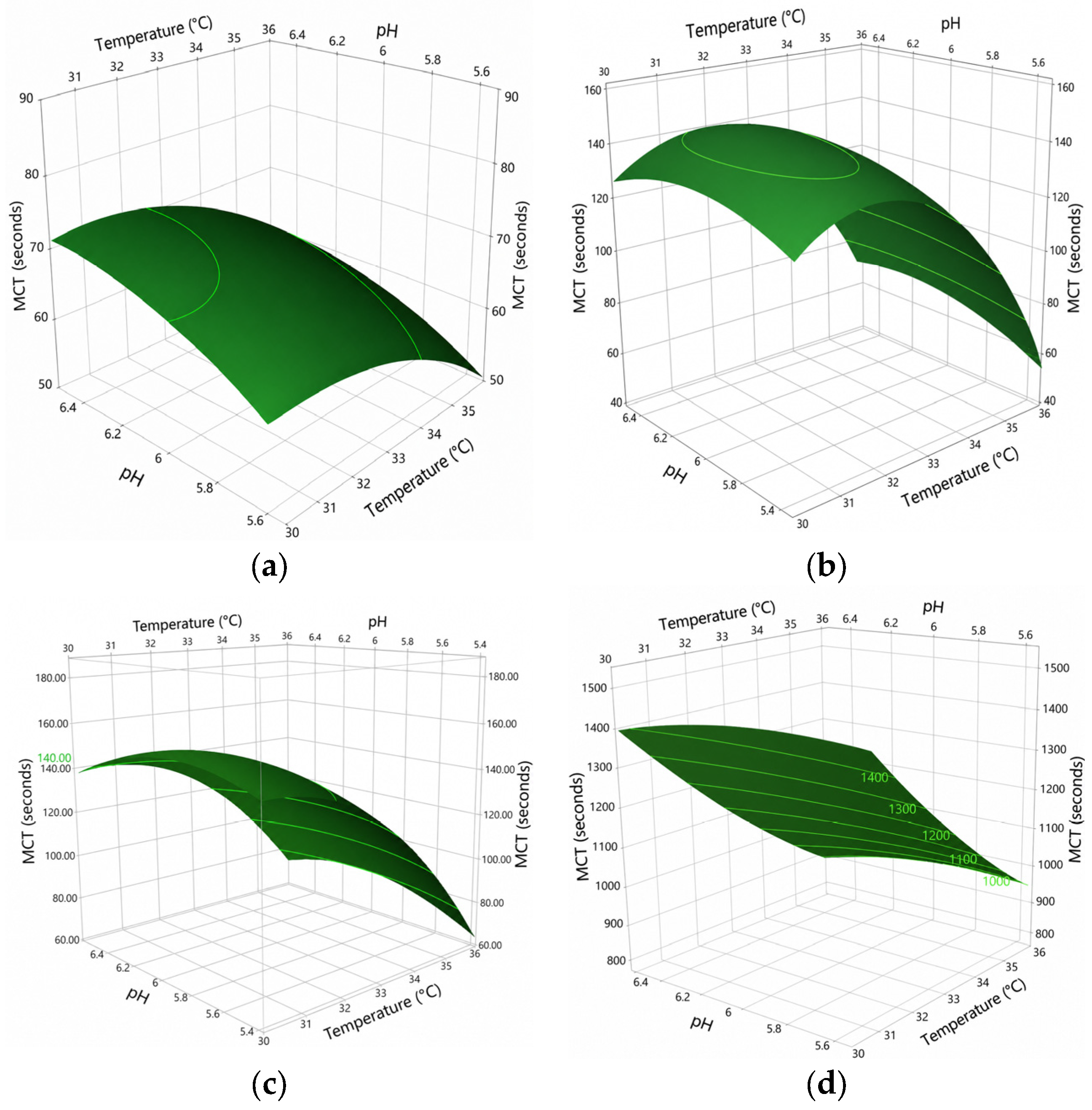
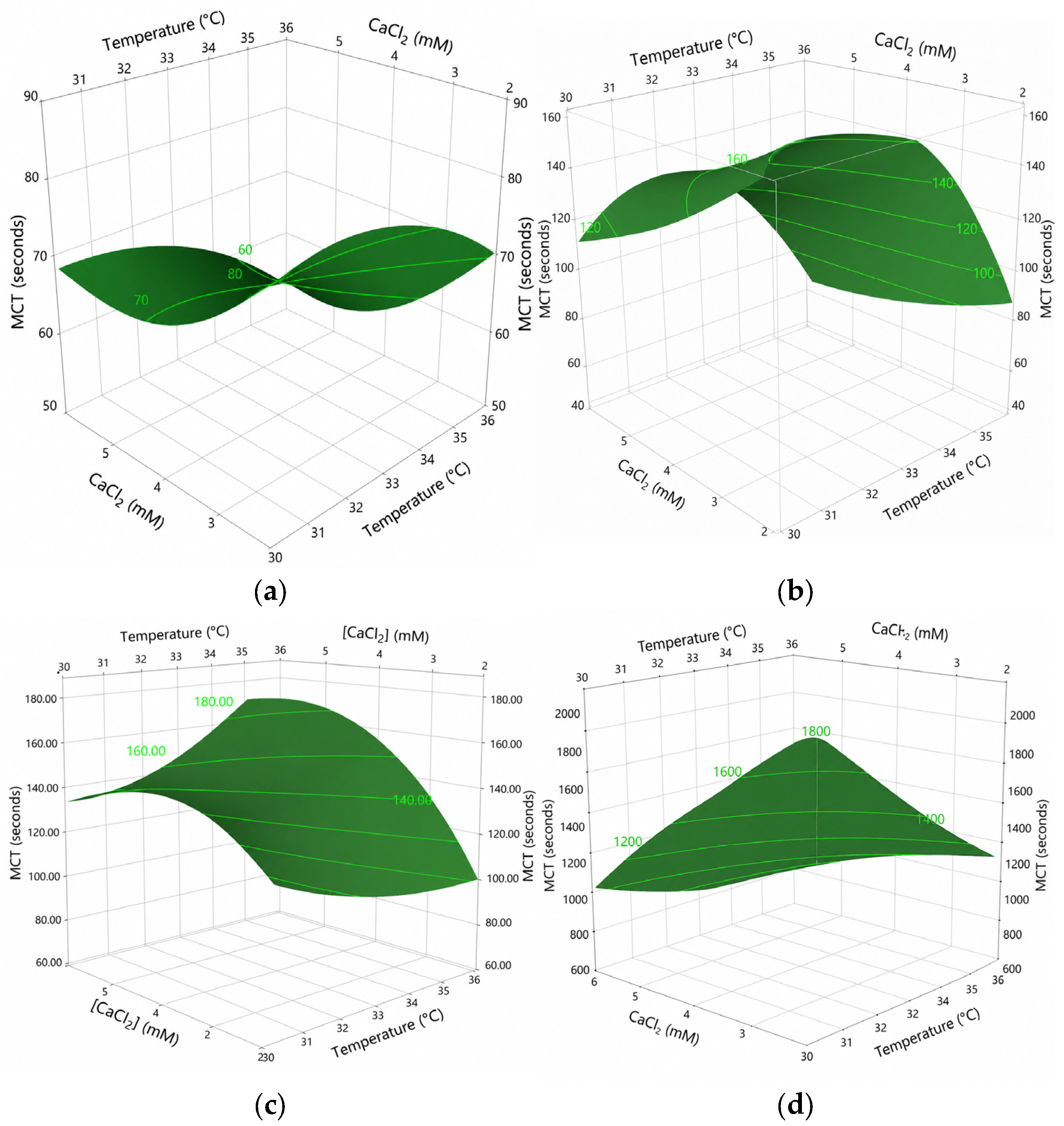
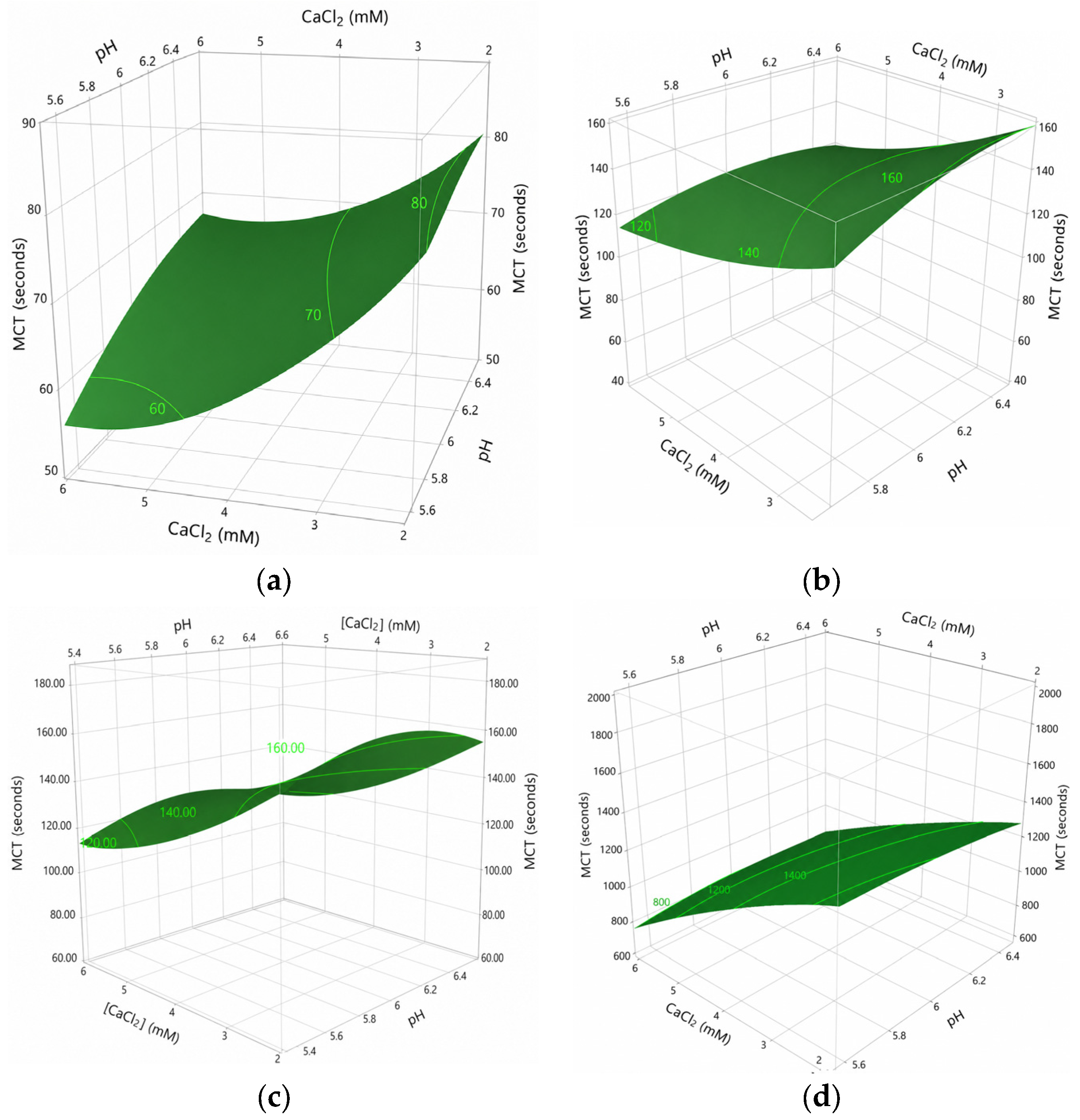
Figure 2, Figure 3 and Figure 4 show the response Surface 3D plots for the linear, quadratic effect and interactions among factors affecting the MCT of the four coagulants studied. It is shown that the MCT of AR, CC, CH, and OP is sensitive to the linear effect of temperature variation (Figure 2 and Figure 3); more specifically, the increase in temperature decreases the MCT of all tested coagulants. Meanwhile, only the MCT of AR and OP is influenced by the linear effect of calcium chloride concentration with a decrease in MCT after increasing the calcium chloride concentration. It is observed that at low pH levels, the MCT decreases; nevertheless, no significant effect of pH on the MCT of the coagulants is evident (Figure 2 and Figure 4).
The conditions under which the lowest MCT was achieved were the same for all coagulants: temperature = 36 °C, pH 5.5, and calcium chloride concentration = 6 mM. The optimal levels of the factors temperature and calcium chloride concentration were the highest within the ranges evaluated, (30–36 °C) and (2–6 mM), respectively. However, in the case of pH, the optimal level was the lowest within the range explored (5.5–6.5). These coagulants’ technological parameters (temperature, pH, and calcium chloride concentration) may be useful as a reference for ewe’s milk coagulation under controlled conditions, although further studies at pilot or industrial scale are required to confirm their applicability.
It should be noted that the use of reconstituted milk in this study allowed for better control of compositional variability and improved experimental reproducibility, as commonly reported in controlled milk coagulation studies [8,11,12,13,15,17]. However, this approach may not fully reflect the behavior of raw milk under real cheesemaking conditions, and therefore the results should be interpreted within the context of the experimental system employed.
These results are consistent with those found in previous research [19,20,32] showing that in the optimum values for improving the MCA, both in plant enzymes and those from animal rennet, the pH coincides with the lowest value of the ranges explored, and the value of the calcium chloride concentration is the highest of the ranges explored. An increase in temperature led to a reduction in milk-clotting time (MCT) for all coagulants, which can be attributed to enhanced enzymatic activity and faster casein micelle aggregation. This behavior is consistent with previous studies reporting that moderate increases in temperature accelerate both the primary enzymatic phase (κ-casein hydrolysis) and the secondary aggregation phase of milk coagulation.
Milk coagulation is a temperature-dependent process involving two main steps: enzymatic hydrolysis of κ-casein and subsequent aggregation of destabilized casein micelles. These two reactions respond differently to temperature, with micellar aggregation being particularly sensitive to thermal changes. As temperature increases, the mobility of casein particles and the rate of their interactions increase, resulting in faster gel formation. However, excessively high temperatures may promote rapid aggregation accompanied by structural rearrangements, leading to less interconnected protein networks and potentially affecting final gel properties.
In the case of temperature, for plant-derived proteases, the optimum temperature value coincides with the highest value studied due to their thermophilic nature [33,34]. However, for animal rennet-derived enzymes, the optimum temperature values are typically reported to be between 40 and 45 °C because higher values (50–65 °C) can lead to enzymatic thermal denaturation [35].
From a technological perspective, the selection of coagulation temperature in cheesemaking must balance the acceleration of coagulation kinetics with the development of desirable gel structure and curd properties, as the fastest coagulation does not necessarily result in the best texture or yield.
The effect of temperature and pH during the milk coagulation process has been studied many times with different types of milk and coagulants, and it has been concluded that both factors influence the enzymatic hydrolysis and aggregation reactions [12,17,26]. Regarding pH, lower values (pH 5.5) resulted in shorter MCT, although the effect was less pronounced compared to temperature and calcium concentration. At this pH, which is still above the isoelectric point of caseins (pI ≈ 4.6), coagulation is primarily driven by enzymatic hydrolysis of κ-casein, while the decrease in pH enhances micellar aggregation.
Milk coagulation induced by enzymatic coagulants is generally described as a two-step process involving the primary hydrolysis of κ-casein, which destabilizes the casein micelles, followed by their aggregation into a three-dimensional network [36]. In this context, decreasing pH does not directly induce coagulation but accelerates the aggregation phase by reducing the electrostatic repulsion between micelles and promoting hydrophobic interactions.
This behavior can be explained by the proximity to the isoelectric point of caseins, which reduces their net-negative charge and favors aggregation. In addition, decreasing pH increases the level of ionic calcium in the serum phase, further promoting casein micelle aggregation and accelerating gel formation.
Previous studies have shown that reducing milk pH leads to faster gelation kinetics and more rapid development of the gel network, due to decreased colloidal stability of casein micelles and partial solubilization of colloidal calcium phosphate, which increases calcium availability in the serum phase [17]. However, lower pH values may also enhance proteolysis, particularly in plant coagulants, leading to structural rearrangements and potentially affecting gel stability and final cheese quality.
In this context, the relatively limited effect of pH observed in some coagulants suggests that enzymatic activity remains the dominant factor controlling coagulation under the conditions studied. This indicates that, while acidification enhances micellar aggregation, the rate of κ-casein hydrolysis remains a key limiting step in the overall coagulation process. Both animal rennet proteases and proteases from thistle flowers have been shown to have an acidic character, which also explains the increase in their activity when approaching acidic conditions [37,38].
Therefore, the combined effect of increased enzymatic activity and enhanced micelle aggregation at lower pH contributes to the observed reduction in milk-clotting time, highlighting the importance of considering both biochemical and physicochemical factors in process optimization.
The variation calcium chloride affects the MCA since an increase in its concentration promotes the aggregation of caseins by acting on the conformation of the substrate and as an enzymatic catalyst. Increasing CaCl2 concentration significantly decreased MCT. This effect is related to the increase in ionic calcium availability, which promotes casein aggregation by reducing electrostatic repulsion between micelles and facilitating the formation of a three-dimensional protein network. The role of calcium ions in enhancing coagulation efficiency has been widely described in the literature and is considered a key technological parameter in cheesemaking. Furthermore, this effect is enhanced by decreased pH due to the exchange of Ca2+ and H+ during the process [39,40,41].
From a technological perspective, calcium chloride is commonly added in cheesemaking to improve curd firmness, reduce coagulation time, and enhance cheese yield. Previous studies have reported that the addition of approximately 1.8 mM CaCl2 can significantly increase curd firmness, while higher concentrations may further enhance gel strength, although excessive calcium levels can negatively affect curd structure [24,25]. The results obtained in this study are consistent with these findings, as the highest CaCl2 concentration evaluated (6 mM) led to the lowest MCT values for all coagulants, confirming the key role of ionic calcium in coagulation efficiency. However, excessively high calcium concentrations may lead to overly firm or brittle gels, which could negatively affect curd handling and final cheese texture. Therefore, the selection of CaCl2 concentration should consider not only coagulation kinetics but also the desired technological properties of the final product.
Comparing plant coagulants under optimal conditions, CC was the coagulant with the best performance in milk clotting, and CH showed similar activity to CC. On the other hand, OP obtained the highest MCT, resulting in lower clotting activity. These results are consistent with previous research in which, under conditions similar to those herein tested, the MCA of OP was lower than CC and CH; however, under certain conditions, OP showed higher performance and demonstrated a proteolytic activity comparable to CC and CH [20]. From a technological perspective, the higher MCT observed for O. platylepis suggests a slower coagulation process, which may influence curd structure and cheese yield. However, this limitation could be compensated under optimized processing conditions, supporting its potential application in specific cheese types where slower coagulation or higher proteolysis is desirable.
The potential application of Onopordum platylepis as a milk coagulant has also been recently explored in cheesemaking, where its use in the production of traditional ewe’s milk cheese did not negatively affect yield or overall composition, although differences in proteolysis and volatile profile were observed [42].

3.2. Coagulation Kinetics and Rheological Properties of Gels

Table 5 shows the results of coagulation kinetics in sheep milk using the different milk coagulants under study.
The standardization of coagulant activity (50 IMCU/L) allowed for a direct comparison of coagulation kinetics among samples with different enzymatic strengths, ensuring that the observed differences were mainly associated with the intrinsic properties of each coagulant. This approach allows the effect of coagulant type to be evaluated independently of dosage differences.
Milk-clotting activity expressed as IMCU/g represents the enzymatic strength per unit mass of coagulant, i.e., the ability of one gram of coagulant to clot a standard milk substrate under defined conditions. As shown in Table 5, the coagulants exhibited different IMCU/g values, reflecting differences in their intrinsic enzymatic potency. Therefore, the amount of each coagulant added (g/L of milk) was adjusted according to its IMCU/g value to achieve the same overall activity in milk (50 IMCU/L). In this way, coagulants with lower IMCU/g required higher doses, whereas more active coagulants required lower amounts. Consequently, the coagulation parameters obtained are directly comparable, as they correspond to equivalent enzymatic activity rather than equal mass addition.
The commercial coagulants (AR, FC, and CV) presented a higher MCA than those obtained from freeze-dried extracts from thistle flowers (CC, CH, and OP). More specifically, OP showed a 95% lower MCA than the chymosin used as reference (FC), while CH and CC activity were, respectively, 50% and 29% lower than the MCA of FC. Regarding commercial coagulants, no significant differences (p > 0.05) were found between AR and FC, while CV activity was 12% lower than FC (p < 0.05).
These differences in MCA (IMCU/g) were directly reflected in the amount of coagulant required to reach the standardized activity of 50 IMCU/L. Coagulants with lower enzymatic activity, such as OP (9.07 IMCU/g), required substantially higher concentrations (5.35 g/L) compared to highly active coagulants such as FC (200.00 IMCU/g) and AR (205.76 IMCU/g), which were applied at much lower levels (0.25 and 0.24 g/L, respectively). This inverse relationship between enzymatic activity (IMCU/g) and the required dose (g/L) highlights the differences in intrinsic coagulant efficiency and confirms that the standardization approach allowed for a fair comparison of coagulation performance among coagulants with markedly different activities.
This difference in milk-clotting activity can be attributed to the higher specificity of chymosin towards κ-casein, which results in a more efficient and controlled destabilization of casein micelles compared to plant proteases, which generally exhibit broader proteolytic activity.
Due to the adjustment of the coagulant dosage to 50 IMCU/L of milk, no significant differences (p > 0.05) were observed for the coagulation times (RCT) between the different coagulants used, which is taken as an ideal starting point for the comparison of the coagulation kinetics of the six coagulants at the same strength. The average RCT time was 11 min, representing a normal time used during the production of both pressed and soft cheeses made from ewe’s milk. This standardization ensures that differences observed in subsequent rheological parameters are primarily associated with differences in aggregation kinetics and gel structuring rather than enzymatic strength.
According to the analysis of the curd-firming rate (CFR), the commercial coagulant FC obtained a higher CFR (p < 0.05) due to its higher specificity (100% chymosin), followed by the commercial coagulant AR and the freeze-dried plant coagulant CC, with no significant differences between them. The CFR of OP was significantly lower than FC, AR, and CC (p < 0.05) but did not differ significantly from CH. The coagulant OP showed a good capacity to curdle ewe’s milk; this result is in agreement with previous research that demonstrates its milk-clotting capacity in bovine milk [20]. Finally, the commercial plant coagulant CV presented a significantly (p < 0.05) inferior CFR than the rest of the coagulants.
The firmness value at the maximum velocity point (G′CFR) was significantly (p < 0.05) higher for the coagulant CV, followed by FC, AR, and CC. The lowest values were obtained for the freeze-dried plant coagulants CH and OP. After 30 min of coagulation, significant differences (p < 0.05) were again observed in the firmness of the gels (G′F), with FC being the coagulant with the highest firmness, in agreement with the results of CFR, followed by AR and CC. The coagulant CH presented intermediate values that did not differ significantly from CC. In contrast, significantly lower values (p < 0.05) were achieved by CV and OP, demonstrating that OP can be an alternative to commercial plant coagulants commonly extracted from the flowers of the thistle species Cynara cardunculus L. [6]. The kinetic results show that the plant coagulant OP has a lower CFR and final gel firmness than chymosin, behaving in the same way as the plant coagulants from CC and CH, which have been extensively studied [12,16,17]. This suggests the formation of stable yet more flexible protein networks, which have been associated with softer gel structures and may be suitable for the production of soft or spreadable cheeses, although further validation through cheesemaking trials is required.
To better understand the differences between the kinetic parameters CFR, G′CFR, and G′F, the kinetic intervals t0, tI, and tII shown in Table 6 were studied. The commercial coagulant FC was the first to start aggregation, with a t0 value significantly (p < 0.05) lower than the rest. The greatest differences were found with the commercial coagulant CV, which presented a value significantly (p < 0.05) higher than the rest of both t0 and tI, as well as a significantly (p < 0. 05) lower value of tII, due to slower aggregation kinetics, as shown by its lower CFR. This lower speed, added to a longer time (t0 and tI) in starting aggregation, makes the time to reach CFR much higher, and therefore the firmness at its maximum speed was significantly higher (p < 0.05) than the rest of the coagulants. On the other hand, the plant coagulants (CH, CC, and OP) presented a time spectrum similar to the commercial coagulants composed of chymosin, with t0 values similar to AR and tI, and tII values similar to AR and FC, except for OP, which has a secondary aggregation time lower than theirs.

3.3. Water-Holding Capacity (WHC) of Gels and Whey Composition

Table 7 shows the data obtained for the water-holding capacity of the gels (WHC) and whey composition produced during the coagulation of ewe’s milk with different coagulants.
The WHC of the plant coagulant OP did not differ significantly (p > 0.05) from the other coagulants. It could be observed how the main differences (p < 0.05) appeared between the plant coagulants CH and CC; these coagulants presented the lowest WHC values with respect to the coagulant FC, which showed the highest WHC percentages. Ben Amira et al. [13] found that a CC coagulant showed lower values of WHC than chymosin and attributed this to the differences between coagulants in optimum milk-clotting temperature. No significant differences in fat content were found in the composition of the whey released by the different curds after centrifugation. However, for nitrogenous compounds, the total protein lost in whey was significantly higher (p < 0.05) for the three plant coagulants (CC, CH, and OP). The FC coagulant was the most effective in terms of protein retention, being the one that lost the least amount through the whey, while AR and CV showed moderate protein loss.
Concerning non-protein nitrogen in the urea form, significant differences (p < 0.05) were found between coagulants. FC presented the minimum loss, while plant coagulants CC and OP presented the highest urea values, followed by CH coagulant. These higher losses of nitrogen compounds when using plant coagulants are due to their higher proteolytic activity and are related to lower cheese yields [43]. Commercial coagulants AR and CV produced values of urea losses between FC and plant coagulants, with significantly higher (p < 0.05) urea loss found when using CV than AR.
From a technological perspective, these increased protein losses may represent a limitation, as they can negatively affect cheese yield and, consequently, the economic efficiency of the cheesemaking process. Higher losses of soluble nitrogen in whey reduce the recovery of milk solids, which are key determinants of industrial profitability. However, the greater proteolytic activity associated with plant coagulants may also contribute to enhanced proteolysis during ripening, potentially improving texture and flavor development in certain cheese varieties. Therefore, the balance between yield loss and functional or sensory advantages should be considered depending on the targeted cheese type.
Given the large differences in genotype, production, and method of obtaining the plant coagulants, significant differences were found in the proteolytic activity and losses of nitrogenous compounds between CC and CV, both plant coagulants from Cynara cardunculus L. [44].

3.4. Multivariate Analysis: Principal Component Analysis

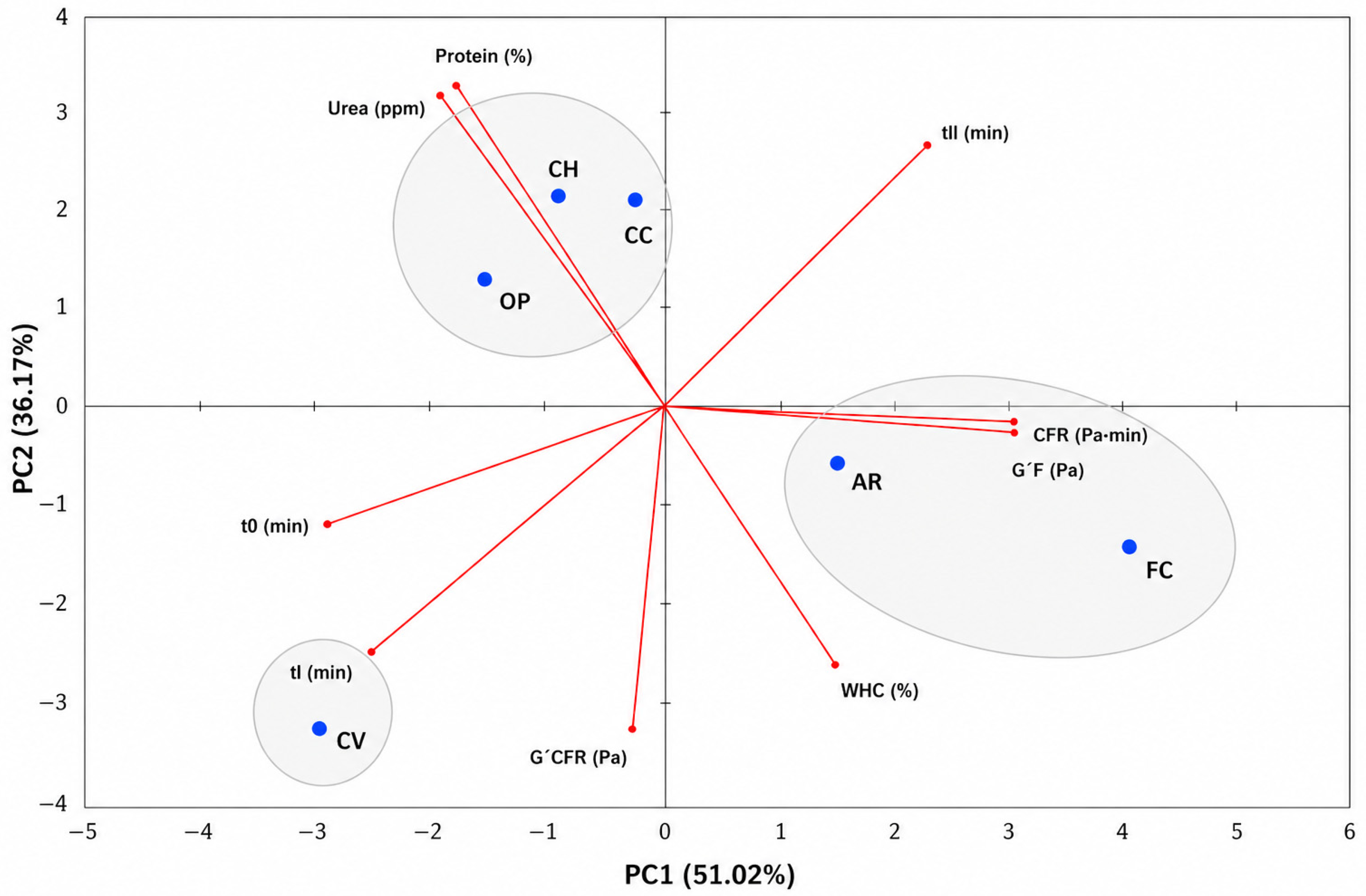
The results of the principal component (PC) analysis are shown in Figure 5. The analysis was carried out with the significant variables of the kinetic studies, WHC and whey composition. Two components explain 87.19% of the coagulants’ variability; 51.02% corresponds to PC1, and 36.17% to PC2. Through PC1, the coagulants were perfectly separated according to their origin. With negative PC1 values, there were the plant coagulants, CC, CH and OP coagulants, and the commercial coagulant CV, due to their start (t0) and primary (tI) aggregation times. At the other extreme, with positive PC1 values, were FC and AR, coagulants whose main enzyme is chymosin, which presented higher values of the kinetic parameters CFR and G′F.
PC2 separates commercial coagulants from freeze-dried plant coagulants. On the one hand, OP, CH, and CC coagulants have positive PC2 values due to the higher losses of urea and total protein in the whey obtained in the WHC analysis. On the other hand, CV presented negative PC2 values due to its higher G’CFR value, which is related to the t0 and tI intervals, and the commercial coagulants AR and FC also presented negative PC2 values due to their water-retention capacity or lower losses of nitrogen compounds in whey. Overall, three well-differentiated groups were obtained: CC, CH, and OP, with higher losses of nitrogen compounds in whey; CV, with a slower and weaker aggregation phase; and AR and FC, with the best kinetic values of speed and final firmness.

4. Conclusions

This study established the optimal conditions for the milk-clotting activity of freeze-dried plant-based coagulant from Onopordum platylepis Murb. in ewe’s milk. A temperature of 36 °C, pH 5.5, and 6 mM CaCl2 were identified as the most effective combination for maximizing milk-clotting performance, with identical optimal conditions observed for the freeze-dried plant-based coagulants obtained from Cynara cardunculus and Cynara humilis.
These optimal conditions reflect the combined effect of enzymatic activity and physicochemical factors governing casein micelle aggregation, highlighting the importance of considering the interaction between temperature, pH, and calcium availability in milk coagulation.
Likewise, the Onopordum platylepis coagulant exhibited coagulation kinetics comparable to those of Cynara cardunculus and Cynara humilis coagulants, as well as to commercial plant coagulant, yielding gels with similar firmness. However, its use resulted in higher protein losses in whey, likely due to its pronounced proteolytic activity, which may negatively affect curd structure and cheese yield.
From a technological perspective, these results suggest that the selection of coagulation conditions should not be based solely on minimizing clotting time, but also on achieving an appropriate balance between coagulation efficiency, gel structure, and protein retention.
Therefore, although Onopordum platylepis shows potential as a plant coagulant, its application may be more suitable for specific cheese types in which highly proteolytic coagulants are desirable. Furthermore, the optimal conditions identified in this study should be interpreted within the experimental framework employed, particularly considering the controlled model system used, and their applicability to cheesemaking processes should be validated under pilot or industrial conditions.

Author Contributions

Conceptualization, M.M. and L.T.; methodology, C.B.-D.L., M.M., D.D. and D.F.; formal analysis, C.B.-D.L., D.D. and D.F.; investigation, C.B.-D.L., D.D. and D.F.; writing—original draft preparation, C.B.-D.L., D.D. and D.F.; writing—review and editing, C.B.-D.L., A.A. and L.T.; visualization, C.B.-D.L.; supervision, L.A. and L.T.; project administration, L.A.; funding acquisition, L.A. and L.T. All authors have read and agreed to the published version of the manuscript.

Funding

This work is supported by the Ministry of Economy, Industry, and Competitiveness through the Agencia Estatal de Investigación (AEI-MINECO, Spain) under grant PCI2019-103551, and by the Italian Ministry of Education, University, and Research (MIUR, Italy) under grant I34D18000140005. This research is part of the PRIMA program supported by the European Union (Project: “Valorisation of thistle-curdled CHEESEs in MEDiterranean marginal areas” (https://veggiemedcheeses.com/).

Institutional Review Board Statement

Not applicable.

Informed Consent Statement

Not applicable.

Data Availability Statement

The original contributions presented in this study are included in this article. Further inquiries can be directed to the corresponding author.

Conflicts of Interest

The authors declare no conflicts of interest. The funders had no role in the design of this study; in the collection, analyses, or interpretation of data; in the writing of the manuscript; or in the decision to publish the results.

References

  1. Bande-De León, C. Utilización de Nuevos Coagulantes Vegetales para la Obtención de Versiones Vegetarianas de Quesos. Ph.D. Thesis, Universidad Católica San Antonio de Murcia, Murcia, Spain, 2023. [Google Scholar]
  2. Vioque, M.; Gómez, R.; Sánchez, E.; Mata, C.; Tejada, L.; Fernández-Salguero, J. Chemical and microbiological characteristics of ewes’ milk cheese manufactured with extracts from flowers of Cynara cardunculus and Cynara humilis as coagulants. J. Agric. Food Chem. 2000, 48, 451–456. [Google Scholar] [CrossRef]
  3. Roseiro, L.B.; Barbosa, M.; Ames, J.M.; Wilbey, R.A. Cheesemaking with vegetable coagulants—The use of Cynara L. for the production of ovine milk cheeses. Int. J. Dairy Technol. 2003, 56, 76–85. [Google Scholar] [CrossRef]
  4. Nicosia, F.D.; Puglisi, I.; Pino, A.; Caggia, C.; Randazzo, C.L. Plant milk-clotting enzymes for cheesemaking. Foods 2022, 11, 871. [Google Scholar] [CrossRef] [PubMed]
  5. Alavi, F.; Momen, S. Aspartic proteases from thistle flowers: Traditional coagulants used in the modern cheese industry. Int. Dairy J. 2020, 107, 104709. [Google Scholar] [CrossRef]
  6. Jacob, M.; Jaros, D.; Rohm, H. Recent advances in milk clotting enzymes. Int. J. Dairy Technol. 2011, 64, 14–33. [Google Scholar] [CrossRef]
  7. Rampanti, G.; Belleggia, L.; Cardinali, F.; Milanović, V.; Osimani, A.; Garofalo, C.; Ferrocino, I.; Aquilanti, L. Microbial dynamics of a specialty italian raw ewe’s milk cheese curdled with extracts from spontaneous and cultivated Onopordum tauricum Willd. Microorganisms 2023, 11, 219. [Google Scholar] [CrossRef]
  8. Ordiales, E.; Martín, A.; Benito, M.J.; Ruiz-Moyano, S.; Gallardo, G.; Córdoba, M.D. Characterisation of the vegetable rennets used for ‘Torta del Casar’ cheesemaking by a protein profile method. Int. J. Dairy Technol. 2016, 69, 272–281. [Google Scholar] [CrossRef]
  9. Fernández-Salguero, J.; Sanjuán, E. Influence of vegetable and animal rennet on proteolysis during ripening in ewe’s milk cheese. Food Chem. 1999, 64, 177–183. [Google Scholar] [CrossRef]
  10. Tamer, I.M. Identification and partial purification of a novel milk clotting enzyme from Onopordum turcicum. Biotechnol. Lett. 1993, 15, 427–432. [Google Scholar] [CrossRef]
  11. Brutti, C.B.; Pardo, M.F.; Caffini, N.O.; Natalucci, C.L. Onopordum acanthium L. (Asteraceae) flowers as coagulating agent for cheesemaking. LWT 2012, 45, 172–179. [Google Scholar] [CrossRef]
  12. Esteves, C.L.C.; Lucey, J.A.; Hyslop, D.B.; Pires, E.M.V. Effect of gelation temperature on the properties of skim milk gels made from plant coagulants and chymosin. Int. Dairy J. 2003, 13, 877–885. [Google Scholar] [CrossRef]
  13. Ben Amira, A.; Mokni, A.; Yaich, H.; Chaabouni, M.; Besbes, S.; Blecker, C.; Attia, H. Technological properties of milk gels produced by chymosin and wild cardoon rennet optimized by response surface methodology. Food Chem. 2017, 237, 150–158. [Google Scholar] [CrossRef]
  14. Muñoz, M.; Fernández, D.; Fresno, J.M.; Delgado, D. Effect of high hydrostatic pressure processing on the rennet coagulation kinetics and physicochemical properties of sheep milk rennet-induced gels. J. Dairy Sci. 2023, 106, 2314–2325. [Google Scholar] [CrossRef]
  15. Chazarra, S.; Sidrach, L.; López-Molina, D.; Rodríguez-López, J.N. Characterization of the milk-clotting properties of extracts from artichoke (Cynara scolymus, L.) flowers. Int. Dairy J. 2007, 17, 1393–1400. [Google Scholar] [CrossRef]
  16. Esteves, C.L.C.; Lucey, J.A.; Pires, E.M.V. Rheological properties of milk gels made with coagulants of plant origin and chymosin. Int. Dairy J. 2002, 12, 427–434. [Google Scholar] [CrossRef]
  17. Esteves, C.L.C.; Lucey, J.A.; Wang, T.; Pires, E.M.V. Effect of pH on the gelation properties of skim milk gels made from plant coagulants and chymosin. J. Dairy Sci. 2003, 86, 2558–2567. [Google Scholar] [CrossRef]
  18. Mozzon, M.; Foligni, R.; Mannozzi, C.; Zamporlini, F.; Raffaelli, N.; Aquilanti, L. Clotting properties of Onopordum tauricum (Willd.) aqueous extract in milk of different species. Foods 2020, 9, 692. [Google Scholar] [CrossRef]
  19. Foligni, R.; Mannozzi, C.; Gasparrini, M.; Raffaelli, N.; Zamporlini, F.; Tejada, L.; Bande-De León, C.; Orsini, R.; Manzi, P.; Di Costanzo, M.G.; et al. Potentialities of aqueous extract from cultivated Onopordum tauricum (Willd.) as milk clotting agent for cheesemaking. Food Res. Int. 2022, 158, 111592. [Google Scholar] [CrossRef] [PubMed]
  20. Bande-De León, C.; Buendía-Moreno, L.; Abellán, A.; Manzi, P.; Al Mohandes Dridi, B.; Essaidi, I.; Aquilanti, L.; Tejada, L. Clotting and Proteolytic Activity of Freeze-Dried Crude Extracts Obtained from Wild Thistles Cynara humilis L. and Onopordum platylepis Murb. Foods 2023, 12, 2325. [Google Scholar] [CrossRef]
  21. Tejada, L.; Fernández-Salguero, J. Chemical and microbiological characteristics of ewe milk cheese (Los Pedroches) made with a powdered vegetable coagulant or calf rennet. Ital. J. Food Sci. 2003, 15, 125–131. [Google Scholar]
  22. Hovjecki, M.; Miloradovic, Z.; Barukčić, I.; Blažić, M.; Miocinovic, J. Rheological Properties of Goat Milk Coagulation as Affected by Rennet Concentration, pH and Temperature. Fermentation 2022, 8, 291. [Google Scholar] [CrossRef]
  23. Panthi, R.; Kelly, A.; Sheehan, J.; Bulbul, K.; Vollmer, A.; McMahon, D. Influence of protein concentration and coagulation temperature on rennet-induced gelation characteristics and curd microstructure. J. Dairy Sci. 2018, 102, 177–189. [Google Scholar] [CrossRef] [PubMed]
  24. Ustunol, Z.; Hicks, C.L. Effect of calcium addition on yield of cheese manufactured with Endothia parasitica protease. J. Dairy Sci. 1990, 73, 17–25. [Google Scholar] [CrossRef]
  25. Ong, L.; Dagastine, R.R.; Kentish, S.E.; Gras, S.L. The effect of calcium chloride addition on the microstructure and composition of Cheddar cheese. Int. Dairy J. 2015, 33, 135–141. [Google Scholar] [CrossRef]
  26. Castillo, M.; Payne, F.A.; Hicks, C.L.; Lopez, M.B. Predicting cutting and clotting time of coagulating goat’s milk using diffuse reflectance: Effect of pH, temperature and enzyme concentration. Int. Dairy J. 2000, 10, 551–562. [Google Scholar] [CrossRef]
  27. Berridge, N.J. The purification and crystallization of rennin. Biochem. J. 1945, 39, 179–187. [Google Scholar] [CrossRef] [PubMed]
  28. ISO 11815/IDF 157; Milk—Determination of Total Milk-Clotting Activity of Bovine Rennets. International Dairy Federation: Brussels, Belgium, 2007.
  29. Frederiksen, P.D.; Andersen, K.K.; Hammershøj, M.; Poulsen, H.D.; Sørensen, J.; Bakman, M.; Qvist, K.B.; Larsen, L.B. Composition and effect of blending of noncoagulating, poorly coagulating, and well-coagulating bovine milk from individual Danish Holstein cows. J. Dairy Sci. 2011, 94, 4787–4799. [Google Scholar] [CrossRef]
  30. Arango, O.; Trujillo, A.J.; Castillo, M. Predicting coagulation and syneresis parameters of milk gels when inulin is added as fat substitute using infrared light backscatter. J. Food Eng. 2015, 157, 63–69. [Google Scholar] [CrossRef]
  31. Vianna, F.S.; Canto, A.C.V.C.S.; da Costa-Lima, B.R.C.; Salim, A.P.A.A.; Costa, M.P.; Balthazar, C.F.; Oliveira, B.R.; Rachid, R.P.; Franco, R.M.; Conte-Junior, C.A.; et al. Development of new probiotic yoghurt with a mixture of cow and sheep milk: Effects on physicochemical, textural and sensory analysis. Small Rumin. Res. 2017, 149, 154–162. [Google Scholar] [CrossRef]
  32. Slamani, R.; Labadi, R.; Errahmani, M.B.; Bellal, M.M. Purification and characterisation of milk-clotting and caseinolytic activities of pepsin isolated from adult sheep abomasa. Int. J. Dairy Tech. 2018, 71, 764–770. [Google Scholar] [CrossRef]
  33. Christen, C.; Virasoro, E. Présures végétales. Extraction et propriétés. Le Lait 1935, 15, 354–363. [Google Scholar] [CrossRef]
  34. Marcos, A.; Esteban, M.A.; Martínez, E.; Alcala, M.; Fernández-Salguero, J. Thermal inactivation of proteinases from the flowers of the cardoon Cynara humilis L.: Kinetic and thermodynamic parameters. Arch. Zootec. 1980, 29, 283–294. [Google Scholar]
  35. Martínez, E.; Esteban, M.A. Clotting activity of an extract from the flowers of the cardon Cynara humilis. Arch. Zootec. 1980, 29, 107–116. [Google Scholar]
  36. Yang, M.; Ye, A.; Yang, Z.; Everett, D.W.; Gilbert, E.P.; Singh, H. Kinetics of pepsin-induced hydrolysis and the coagulation of milk proteins. J. Dairy Sci. 2022, 105, 990–1003. [Google Scholar] [CrossRef]
  37. Anema, S.G.; Lee, S.K.; Klostermeyer, H. Effect of pH at heat treatment on the hydrolysis of κ-casein and the gelation of skim milk by chymosin. LWT 2007, 40, 99–106. [Google Scholar] [CrossRef]
  38. Ben Amira, A.; Makhlouf, I.; Petrut, R.F.; Francis, F.; Bauwens, J.; Attia, H.; Besbes, S.; Blecker, C. Effect of extraction pH on techno-functional properties of crude extracts from wild cardoon (Cynara cardunculus L.) flowers. Food Chem. 2017, 225, 258–266. [Google Scholar] [CrossRef]
  39. Nájera, A.I.; de Renobales, M.; Barron, L.J.R. Effects of pH, temperature, CaCl2 and enzyme concentrations on the rennet-clotting properties of milk: A multifactorial study. Food Chem. 2003, 80, 345–352. [Google Scholar] [CrossRef]
  40. Zikiou, A.; Zidoune, M.N. Enzymatic extract from flowers of Algerian spontaneous Cynara cardunculus: Milk-clotting properties and use in the manufacture of a Camembert-type cheese. Int. J. Dairy Technol. 2019, 72, 89–99. [Google Scholar] [CrossRef]
  41. Mohamed Ahmed, I.A.; Babiker, E.E.; Mori, N. pH stability and influence of salts on activity of a milk-clotting enzyme from Solanum dubium seeds and its enzymatic action on bovine caseins. LWT 2010, 43, 759–764. [Google Scholar] [CrossRef]
  42. Rampanti, G.; Cardinali, F.; Bande-De León, C.; Ferrocino, I.; Franciosa, I.; Milanovic, V.; Foligni, R.; Tejada Portero, L.; Garofalo, C.; Osimani, A.; et al. Onopordum platylepis (Murb.) Murb. as a novel source of thistle rennet: First application to the manufacture of traditional Italian raw ewe’s milk cheese. Food Res. Int. 2024, 192, 114838. [Google Scholar] [CrossRef]
  43. Jacob, M.; Jaros, D.; Rohm, H. The effect of coagulant type on yield and sensory properties of semihard cheese from laboratory-, pilot- and comercial-scale productions. Int. J. Dairy Technol. 2010, 63, 370–380. [Google Scholar] [CrossRef]
  44. Gomes, S.; Belo, A.T.; Alvarenga, N.; Días, J.; Lage, P.; Pinheiro, C.; Pinto-Cruz, C.; Brás, T.; Duarte, M.F.; Martins, A.P.L. Characterization of Cynara cardunculus L. flower from Alentejo as a coagulant agent for cheesemaking. Int. Dairy J. 2019, 91, 178–184. [Google Scholar] [CrossRef]
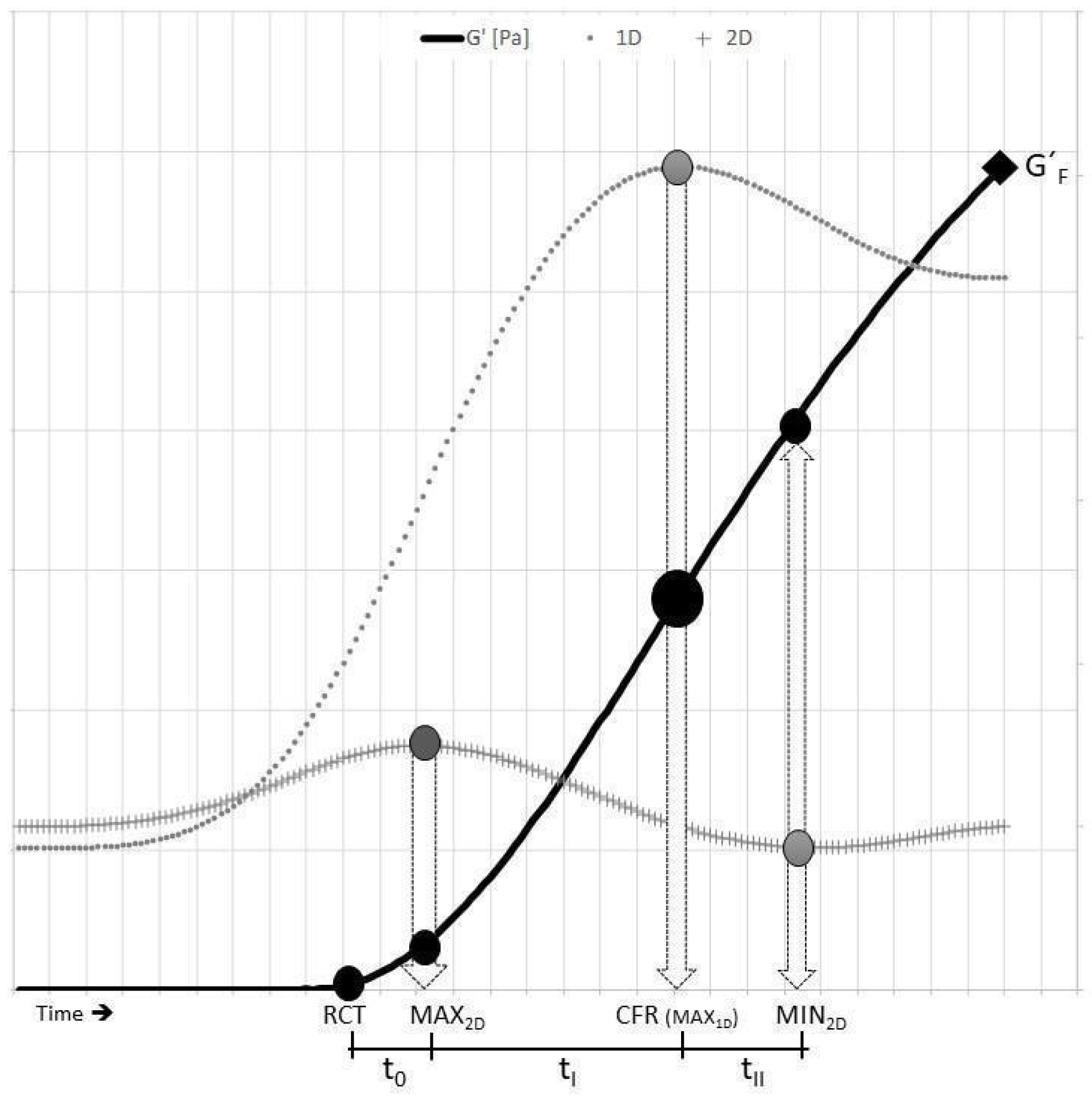
Figure 1. Representation of the coagulation kinetics by monitoring the elastic modulus (G’) over time and calculating RCT, rennet-clotting time; MAX2D, maximum of the second derivative; CFR(MAX1D), curd-firming rate; G′F, elastic modulus after 40 min; t0, time to initiate aggregation; tI, primary aggregation time; tII, secondary aggregation time; and MIN2D, minimum of the second derivative. The solid line represents G′, while the grey curves correspond to the first (1D) and second (2D) derivatives, shown as dashed and dotted lines, respectively.
Dairy 07 00034 g001
Figure 2. Response Surface plots for the effect of temperature (T) and pH on the milk-clotting time (MCT) of (a) animal rennet, (b) Cynara cardunculus L., (c) Cynara humilis L., and (d) Onopordum platylepis Murb. in ewe’s milk.
Dairy 07 00034 g002
Figure 3. Response Surface plots for the effect of temperature (T) and calcium chloride concentration ([CaCl2]) on the milk-clotting time (MCT) of (a) animal rennet, (b) Cynara cardunculus L., (c) Cynara humilis L., and (d) Onopordum platylepis Murb. in ewe’s milk.
Dairy 07 00034 g003
Figure 4. Response Surface plots for the effect of pH and calcium chloride concentration ([CaCl2]) on the milk-clotting time (MCT) of (a) animal rennet, (b) Cynara cardunculus L., (c) Cynara humilis L., and (d) Onopordum platylepis Murb. in ewe’s milk.
Dairy 07 00034 g004
Figure 5. Principal component analysis biplot of the main components of whey composition and water-holding capacity (WHC) of gels and coagulation kinetics characteristics evaluated in ewe’s milk using fermentation-produced chymosin (FC), animal rennet (AR), Cynara cardunculus L. (CC), Cynara humilis L. (CH), Onopordum platylepis Murb. (OP), and commercial plant coagulant from Cynara cardunculus (CV). CFR = curd-firming rate; G′CFR = value of elastic modulus in CFR; G′F = elastic modulus after 40 min; t0 = time to initiate aggregation; tI = primary aggregation time; tII = secondary aggregation time.
Dairy 07 00034 g005
Table 1. Experimental design and milk-clotting time for the evaluation of the effect of temperature (T), pH, and calcium chloride concentration ([CaCl2]) on the milk-clotting time (MCT) of animal rennet (AR) and plant coagulants Cynara cardunculus L. (CC), Cynara humilis L. (CH), and Onopordum platylepis Murb (OP).
VariablesMilk-Clotting Time 1
RunT (°C)pH (Units)[CaCl2] (mM)ARCCCHOP
1335.5658.0 ± 0.5899.7 ± 0.3103.7 ± 0.7729.7 ± 9.0
2365.5268.3 ± 0.372.7 ± 1.589.0 ± 0.61100.7 ± 21.4
3366.5656.3 ± 0.361.7 ± 1.266.3 ± 0.3582.0 ± 10.7
4306.0470.7 ± 0.3125.0 ± 2.3146.3 ± 2.31449.3 ± 30.0
5336.5469.0 ± 0.58144.0 ± 0.6137.0 ± 0.61066.7 ± 5.2
6306.5285.3 ± 0.7158.0 ± 7.8173.3 ± 0.91651.7 ± 10.4
7305.5664.3 ± 0.7118.7 ± 0.9140.3 ± 1.8963.3 ± 11.0
8336.0282.3 ± 2.3170.7 ± 1.2172.7 ± 4.31403.0 ± 6.7
9306.5669.7 ± 0.3100.3 ± 2.6121.0 ± 11028.3 ± 4.6
10365.5643.3 ± 1.256.0 ± 1.067.0 ± 0.6673.0 ± 17.0
11366.5269.7 ± 0.781.7 ± 0.993.3 ± 0.7987.0 ± 30.6
12305.5279.3 ± 0.3149.3 ± 6.4180.7 ± 15.61924.7 ± 2.6
1 Results are mean of three experiments expressed in seconds ± standard error of mean (SEM).
Table 2. Regression coefficients and analysis of variance of response surface for the effect of temperature (T), pH, and calcium chloride concentration ([CaCl2]) on milk-clotting time (MCT) of animal rennet and plant coagulants Cynara cardunculus L., Cynara humilis L., and Onopordum platylepis Murb.
TermAnimal RennetCynara cardunculus L.Cynara humilis L.Onopordum platylepis Murb.
EstimatesF Ratiop-ValueEstimatesF Ratiop-ValueEstimatesF Ratiop-ValueEstimatesF Ratiop-Value
Intercept67.5531 <0.0001 *139.9406 <0.0001 *138.1563 <0.0001 *1130.0719 <0.0001 *
Linear
T−7.4984145.7568<0.0001 *−30.729797.3641<0.0001 *−36.7031117.7154<0.0001 *−276.5328378.0141<0.0001 *
pH3.254730.5545<0.0001 *3.81091.6662 0.2177−0.23440.00530.9428−47.348412.33090.0035 *
[CaCl2]−8.7547221.0739<0.0001 *−18.560939.5231<0.0001 *−20.265639.9315<0.0001 *−306.4016516.3752<0.0001 *
Quadratic
T × T−4.539112.59510.0032 *−37.507834.2065<0.0001 *−21.98449.95950.0070 *53.63283.35320.0884
pH × pH−1.82031.26840.2790−7.91410.95360.3454−7.79690.78440.3908−26.96090.53060.4784
[CaCl2] × [CaCl2]5.679712.34840.0034 *4.33590.28620.60107.20310.66950.4269−44.21091.42670.2521
Interactions
T × pH0.37500.36000.55812.87500.84160.37453.68751.17340.29700.31250.00050.9829
T × [CaCl2]−1.12503.23990.09346.62504.46880.05295.56252.67000.124594.187543.3050<0.0001 *
pH × [CaCl2]1.37815.11770.0401 *−1.83440.36060.5577−0.21880.00430.948447.871911.77580.0041 *
* Level of significance, p < 0.05.
Table 3. Polynomial model equation for the milk-clotting time.
Models for Milk-Clotting TimeR2Adjusted R2F Ratiop-Value *
Animal rennet
−602.3188 + (−17.8180([CaCl2]) + 80.1219(pH) + 30.0370(T) + 1.4199([CaCl2])2 + (−7.2813)(pH)2
+(−0.5043(T)2 + 1.3781([CaCl2])(pH) + (−0.1875)([CaCl2])(T) + 0.25(pH)(T)
0.97140.953052.8536<0.0001
Cynara cardunculus L.
−4710.1438 + (−43.3836([CaCl2]) + 331.5844(pH) + 248.8974(T) + 1.0840([CaCl2])2 + (−31.6563)(pH)2 + (−4.1675)(T)2
+(−1.8344)([CaCl2])(pH) + (1.1042([CaCl2])(T) + 1.9167(pH)(T)
0.93520.893522.4364<0.0001
Cynara humilis L.
−2564.9375 + (−53.8203)([CaCl2]) + 293.5313(pH) + 130.5260(T) + 1.8008([CaCl2])2 + (−31.1875)(pH)2 + (−2.4427)(T)2
+(−0.2188)([CaCl2])(pH) + 0.9271([CaCl2])(T) + 2.4583(pH)(T)
0.93140.887321.1284<0.0001
Onopordum platylepis Murb.
11045.5688 + (−870.0414)([CaCl2]) + 1001.0656(pH) + (−549.5266)(T) + (−11.0527)([CaCl2])2 + (−107.8438)(pH)2
+5.9592(T)2 + 47.8719([CaCl2])(pH) + 15.6979([CaCl2])(T) + 0.2083(pH)(T)
0.98740.9793121.9524<0.0001
T, temperature; [CaCl2], calcium chloride concentration. * Level of significance, p < 0.05.
Table 4. Optimum conditions to minimize the milk-clotting time of animal rennet (AR) and plant coagulants Cynara cardunculus L. (CC), Cynara humilis L. (CH), and Onopordum platylepis Murb (OP).
Milk CoagulantT (°C)pH (Units)[CaCl2] (mM)Predicted MCT 1DesirabilityMeasured MCT 1
AR365.5644.48750.876143
CC365.5651.33750.974056.5
CH365.5660.93750.978067
OP365.56622.95000.9080673.5
T, temperature; [CaCl2], calcium chloride concentration; MCT, milk-clotting time. 1 Results are expressed in seconds.
Table 5. Effect of the type of coagulant on coagulation parameters in ewe’s milk.
Milk
Coagulant
MCA
(IMCU/g)
RCT (min)CFR (Pa/min)G′CFR (Pa)G′F (Pa)
FC200.00 ± 6.70 e11.09 ± 0.39 a21.03 ± 0.28 d142.94 ± 1.28 b301.89 ± 9.63 d
AR205.76 ± 8.02 e10.77 ± 0.33 a18.74 ± 0.73 c140.41 ± 5.56 b273.90 ± 13.99 c
CC143.37 ± 3.97 c11.07 ± 0.30 a17.71 ± 0.59 c142.70 ± 7.09 b253.12 ± 4.58 bc
CH101.28 ± 5.08 b10.75 ± 0.52 a15.24 ± 0.21 b120.43 ± 4.74 a225.82 ± 5.68 b
OP9.07 ± 0.02 a11.00 ± 0.02 a15.56 ± 0.09 b127.44 ± 2.11 a198.50 ± 16.93 a
CV177.53 ± 7.94 d11.20 ± 0.50 a14.20 ± 0.66 a159.55 ± 5.44 c201.05 ± 11.99 a
MCA, milk-clotting activity expressed as International Milk-Clotting Units per gram of coagulant; RCT, rennet-clotting time; CFR, curd-firming rate; G′CFR, static modulus value in CFR; G′F, gel firmness after 30 min; FC, fermentation-produced chymosin; AR, animal rennet; CC, Cynara cardunculus L.; CH, Cynara humilis L.; OP, Onopordum platylepis Murb.; CV, commercial plant coagulant from Cynara cardunculus. Results are mean ± standard deviation (SD). a–e Different superscript letters in a column mean significant differences at p < 0.05 (Tukey’s test).
Table 6. Effect of the type of coagulant on kinetic time intervals of ewe’s milk gels.
Milk Coagulantt0 (min)tI (min)tII (min)
FC2.67 ± 0.14 a7.02 ± 0.13 a3.86 ± 0.30 c
AR3.28 ± 0.16 bc7.81 ± 0.52 a3.39 ± 0.34 c
CC3.56 ± 0.17 c7.17 ± 0.86 a4.02 ± 0.71 c
CH3.14 ± 0.14 b8.40 ± 0.43 a3.32 ± 0.30 c
OP3.46 ± 0.24 bc8.52 ± 0.17 a2.84 ± 0.17 b
CV4.16 ± 0.25 d11.81 ± 0.88 b1.11 ± 0.44 a
t0, aggregation start time; tI, primary aggregation time; tII, secondary aggregation time; FC, fermentation-produced chymosin; AR, animal rennet; CC, Cynara cardunculus L.; CH, Cynara humilis L.; OP, Onopordum platylepis Murb.; CV, commercial plant coagulant from Cynara cardunculus. Results are mean expressed in minutes ± standard deviation (SD). a–d Different superscript letters in a column mean significant differences at p < 0.05 (Tukey’s test).
Table 7. Effect of the type of coagulant on the chemical composition of the whey and water-holding capacity (WHC) of ewe’s milk gels.
Milk CoagulantWhey Composition
1 WHC (%)1 Fat (%)1 Protein (%)Urea (ppm)
FC93.68 ± 1.03 b0.25 ± 0.10 a1.80 ± 0.01 a507 ± 30 a
AR89.21 ± 1.04 ab0.25 ± 0.08 a1.98 ± 0.04 b625 ± 22 b
CC86.44 ± 3.32 a0.25 ± 0.03 a2.61 ± 0.08 c999 ± 15 e
CH87.38 ± 1.86 a0.25 ± 0.05 a2.49 ± 0.03 c938 ± 28 d
OP90.70 ± 2.01 ab0.24 ± 0.01 a2.57 ± 0.02 c976 ± 41 e
CV90.38 ± 0.88 ab0.25 ± 0.09 a2.04 ± 0.01 b687 ± 34 c
FC, fermentation-produced chymosin; AR, animal rennet; CC, Cynara cardunculus L.; CH, Cynara humilis L.; OP, Onopordum platylepis Murb.; CV, commercial plant coagulant from Cynara cardunculus. 1 Results are mean expressed as grams/100 g of whey. Results are mean ± standard deviation (SD). a–e Different superscript letters in a column mean significant differences at p < 0.05 (Tukey’s test).
Disclaimer/Publisher’s Note: The statements, opinions and data contained in all publications are solely those of the individual author(s) and contributor(s) and not of MDPI and/or the editor(s). MDPI and/or the editor(s) disclaim responsibility for any injury to people or property resulting from any ideas, methods, instructions or products referred to in the content.