Article

Relationships Among Milk Lactoferrin Content, Metabolic Profiles and Milk Composition During Early Lactation in Holstein Cows


1
Department of Animal Husbandry Sciences, Faculty of Agriculture and Technology, University of South Bohemia in České Budějovice, Studentská 1668, 370 05 České Budějovice, Czech Republic
2
Department of Food Biotechnologies and Agricultural Products’ Quality, Faculty of Agriculture and Technology, University of South Bohemia in České Budějovice, Studentská 1668, 370 05 České Budějovice, Czech Republic
3
Dairy Research Institute Ltd., Ke Dvoru 12a, 160 00 Prague, Czech Republic
4
Department of Animal Origin Food and Gastronomic Sciences, Faculty of Veterinary Hygiene and Ecology, University of Veterinary Sciences Brno, Palackého tř. 1946/1, 612 42 Brno, Czech Republic
*
Authors to whom correspondence should be addressed.
Submission received: 26 November 2025 / Revised: 14 January 2026 / Accepted: 16 January 2026 / Published: 20 January 2026
(This article belongs to the Special Issue Farm Management Practices to Improve Milk Quality and Yield)

Abstract

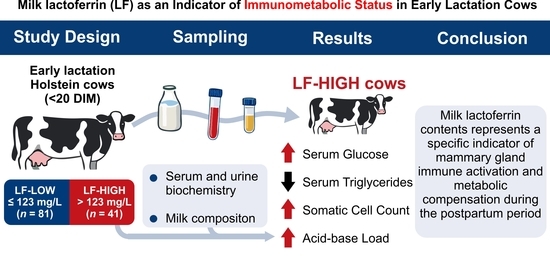
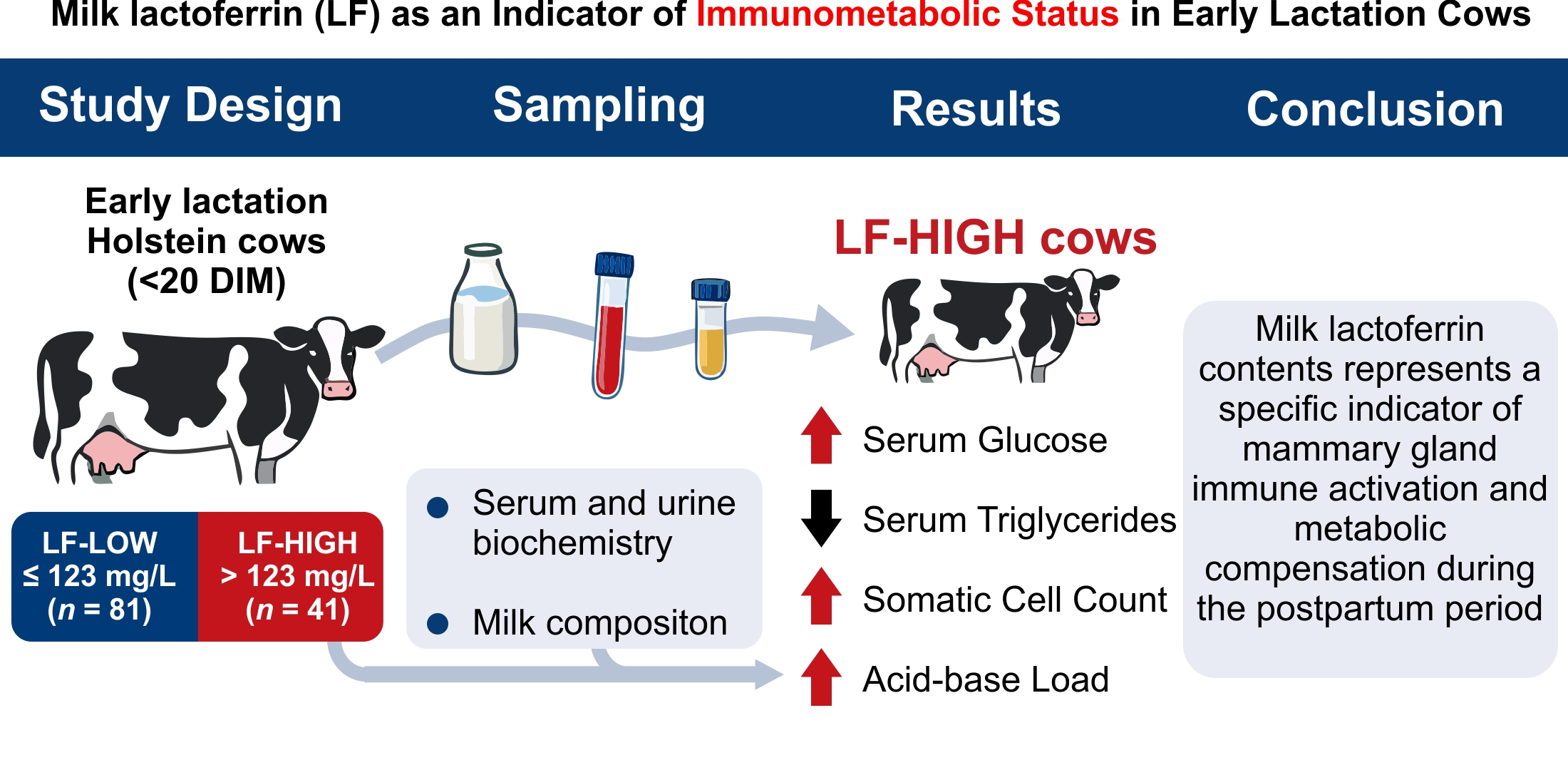
Lactoferrin (LF) is an iron-binding immunoprotein of the mammary gland whose levels increase during mastitis and may be influenced by the metabolic status of the cow. During early lactation, dairy cows are exposed to a negative energy balance (NEB) and the associated increase in susceptibility to mastitis. However, the extent to which the metabolic profile influences LF secretion in milk during the postpartum period remains unclear. The objective of this study was to assess the associations between metabolic status and milk LF contents in Holstein cows (n = 122) in the first twenty days of lactation. Based on the milk LF contents, the cows were categorized into two groups: LF-LOW (≤123 mg/L; n = 81) and LF-HIGH (>123 mg/L; n = 41). Serum indicators of energy and nitrogen metabolism, hepatic function, and selected macro-/microelements were measured; urine electrolytes and net acid–base excretion (U-ABB) were assessed; and milk composition, including somatic cell count (SCC), was determined. LF-HIGH cows showed higher SCC (p = 0.0516) and serum glucose (p < 0.001), together with lower serum triglycerides (p = 0.0101) versus LF-LOW cows. Milk beta-hydroxybutyric acid (BHB) content was lower in the LF-HIGH group (trend, p ≈ 0.062). LF-HIGH also exhibited significantly greater natriuresis (p = 0.0078) and a more negative U-ABB (p < 0.001), indicating higher acid–base load. In conclusion, elevated LF contents during the postpartum period were associated with the activation of local mammary gland immune defence and concurrent compensatory metabolic processes related to NEB, rather than with pronounced alterations in basic milk composition. Milk LF content may therefore be considered as a specific indicator of immunometabolic compensation during the early postpartum period, rather than as a general marker of overall cow health.

Graphical Abstract

1. Introduction

Lactoferrin (LF) is a multifunctional iron-binding glycoprotein first isolated from cow’s milk in 1939 [1]. The name of this protein is derived from the Latin words lac (milk) and ferrum (iron). LF belongs to the transferrin family of proteins [2]. It is constitutively synthesised by epithelial cells of mammalian mucosa and by neutrophils after their activation [3]. LF has been detected in blood plasma, cervicovaginal mucus, seminal plasma, tears, saliva, nasal and bronchial secretions, gastrointestinal fluid, bile, and urine [4,5]. However, it is predominantly found in secondary neutrophil granulocyte granules and in mammary gland secretions (especially in colostrum and transitional milk) [3]. Bovine LF has a wide range of biological functions, including iron transport, antimicrobial, antiviral, immunomodulatory, antioxidant, antitumour, and prebiotic activities, making it an important protein with potential biomedical applications [6,7].
According to Puppel et al. [8], the LF contents in bovine colostrum range from 340 to 1960 mg/L. In mature milk, the LF contents are lower, ranging from 200 to 350 mg/L [9,10]. The LF contents in milk are influenced by several factors, including farm management practices, nutrition, lactation stage, milk yield, and, in particular, the somatic cell count (SCC) [4]. Somatic cells, including macrophages, lymphocytes, and neutrophils, are the first cells to migrate from the circulation to the mammary gland, and some of these cells produce large amounts of LF after induction [11,12]. During inflammatory conditions, mammary epithelial cells also contribute to increased LF secretion [4,13]. Previous studies have demonstrated a positive association (r = 0.40) between SCC and milk LF contents; therefore, LF has been proposed as a complementary indicator to SCC for the detection of subclinical and clinical mastitis [14,15,16].
The risk of clinical mastitis is highest during the first weeks of lactation [17,18,19,20]. During this period, the incidence of metabolic disorders, including subclinical and clinical ketosis, increases [21], which is a consequence of negative energy balance (NEB). NEB leads to lipid mobilization and increased production of ketone bodies, such as β-hydroxybutyric acid (BHB) and acetone [22,23,24,25]. Additionally, ketosis is associated with impaired immune function, which increases the susceptibility to infections [26,27]. Recent studies have shown that elevated BHB levels impair bactericidal activity and neutrophil functionality (phagocytic activity and viability) [28,29,30,31,32]. BHB also negatively affects lymphocyte function [33,34]. On the other hand, some studies (e.g., [35]) have shown that in dairy cows with experimentally induced hyperketonaemia by BHB infusion, an increase in SCCs was observed after intramammary application of lipopolysaccharide. However, this increase was less pronounced than in the control group. These findings suggest that elevated BHB levels may modify the migration of immune cells into the mammary gland [35].
Mastitis and ketosis represent major health risks during early lactation and significantly affect metabolic parameters and milk composition. However, the relationships between the metabolic state of cows during this period and LF production in milk have not yet been clearly determined.
Given that both diseases mentioned above affect metabolic pathways and the immune response of the mammary gland, the aim of this study was to monitor the LF contents in a selected group of Holstein dairy cows in the first twenty days postpartum and to examine their relationship to selected metabolic parameters.
It was hypothesised that, during the postpartum period, dairy cows with higher milk LF contents would exhibit increased indicators of mammary gland immune activation, primarily higher SCC, and simultaneously a distinct metabolic profile, reflecting a different adaptation to NEB compared to dairy cows with lower milk LF content.

2. Materials and Methods

All animal procedures, sample collections, and handling were carried out in accordance with the valid legislation of the Czech Republic (Act No. 246/1992 Coll., on the Protection of Animals Against Cruelty, as amended, e.g., Amendment No. 501/2020 Coll.). Blood, milk, and urine samples were collected as part of routine veterinary examinations by a veterinarian and milk performance testing.

2.1. Animals

The samples for this study were collected at a dairy farm in the Vysočina Region, Czech Republic, from July to November. The farm is located at an altitude of 485 m, with an average annual temperature of 7.4 °C. Holstein dairy cows (n = 122) were housed in free-stall barns and fed a total mixed ration throughout the year. The average milk yield at the farm was 11,553 kg per lactation (305 days) per dairy cow.
The dairy cows (n = 122) were divided into two groups based on LF threshold values of 123 mg/L: LF-LOW (n = 81) and LF-HIGH (n = 41). These thresholds were derived from an analysis of 211 paired measurements of LF contents, as determined by the reference HPLC method, and the corresponding linear SCC scores (LS SCCs). The LS SCC was used as a criterion to identify cows suspected of having subclinical mastitis (according to the Minnesota Mastitis Control Program [36]); the established thresholds simultaneously represent the intersection points of the frequency distribution curves of the respective values.
Table 1 presents the characteristics of the groups at the time of sampling, as well as information regarding their first lactation.

2.2. Blood Sampling and Analysis

Blood samples were collected from the tail vein (V. coccygeal, syn. V. caudalis mediana) in the morning before milk sampling. Blood intended for biochemical analyses was collected in tubes with separation gel (Vacuette Serum/gel, Greiner Bio-One GmbH, Kremsmünster, Austria). After being incubated at room temperature for one hour, the samples were centrifuged (3000× g, 15 min). The blood serum obtained was stored at −80 °C until analysis. Biochemical parameters were analysed using an ELLIPSE automatic analyser (Dialab, Radotín, Czech Republic). Blood serum samples were analysed to determine the following biochemical parameters: total protein, urea, total cholesterol, glucose, triglyceride, gamma-glutamyl transferase (GGT), and minerals (phosphorus (P), calcium (Ca), magnesium (Mg), zinc (Zn), and copper (Cu)).
Blood samples that were used for determining haematological parameters were collected in tubes containing the anticoagulant K3EDTA (Vacuette K3EDTA, Greiner Bio-One GmbH, Kremsmünster, Austria). Haematological parameters were determined using an EXIGO automatic haematology analyser (Labtechnik, Brno, Czech Republic). The following indices were evaluated: red blood cells, haemoglobin, haematocrit, mean corpuscular volume, mean corpuscular haemoglobin, mean corpuscular haemoglobin concentration, red cell distribution width, white blood cells, lymphocytes, monocytes, granulocytes, and thrombocytes.

2.3. Urine Sampling and Analysis

Urine samples were collected aseptically from the urinary bladder using a sterile catheter into 50 mL sterile, sealable sampling containers. Until analysis, the urine samples were stored at 4 °C. The contents of P, Ca, Mg, and urea were determined using an automatic ELLIPSE biochemical analyser (Dialab, Radotín, Czech Republic). The sodium (Na) and potassium (K) concentrations were measured by atomic absorption spectrophotometry using a Unicam 969 spectrophotometer (Unicam Limited, Cambridge, UK). Acid–base excretion (U-ABB) was determined volumetrically by titration.

2.4. Milk Sampling and Analysis

Milk samples were collected during the morning milking, in accordance with the official guidelines and regulations for milk recording, as recommended by the Ministry of Agriculture of the Czech Republic, which required adherence to animal health protection. Only cows without visible milk abnormalities and without clinical signs of mastitis were included in the sampling. After sampling, the samples were immediately cooled to a temperature of ≤6 °C and transported to the laboratory, where they were stored at this temperature until analysis (within 24 h of collection). A milk sample was taken from each dairy cow and then divided into two separate sample containers: 50 mL for analysis of chemical composition and SCC, and 200 mL (with preservative Bronopol (2-bromo-2-nitropropan-1.3-diol)) for LF analysis.
Analyses of the milk samples were carried out in an accredited laboratory according to CSN EN ISO/IEC 17025 [37] by the Czech Institute for Accreditation as the national authority and by the International Committee for Animal Recording of the Czech-Moravian Breeders Corporation for milk recording in Brno-Tuřany on the CombiFoss FT+ device (FOSS—FOSS Electric A/S, Hillerød, Denmark). CombiFoss is based on infrared spectroscopy in the central region, utilizing a Michelson interferometer and data processing through Fourier transform (FT-MIR) and flow cytometry. The following milk indicators were determined: fat, protein, casein, lactose, and solids-not-fat contents, ratios of fat to protein, acetone, citric acid, BHB, urea, free fatty acids (FFAs), and SCCs.

2.5. LF Analysis

High-performance ion-pair reversed-phase liquid chromatography (HPLC) was used as the reference method for LF determinations in milk. The samples were subsequently centrifuged (3000× g, 15 min, 5 °C) to remove fat from the surface. For whey separation, precipitation with 10% acetic acid to a pH of 4.6 was used. After centrifugation, the whey was separated and frozen at −18 °C. Before the analysis, the whey samples were thawed and filtered through a nylon membrane filter (0.22 μm) into vials for HPLC determinations. LF from bovine milk (Sigma Aldrich, St. Louis, MO, USA) was used as a reference standard. 10 mg was weighed into a 10 mL volumetric flask and brought to 10 mL with a mobile phase (water/acetonitrile/trifluoroacetic acid). LF determinations were performed with an Alliance 2695 liquid chromatograph with a PDA 2996 detector (Waters, Milford, MA, USA) and a Poroshell 300SB-C8 column. 2.1 × 75 mm, 5 μm (Agilent Technologies, Santa Clara, CA, USA). A gradient elution and mobile phase flow rate of 1.0 mL/min (water/acetonitrile/trifluoroacetic acid) were used. The column temperature was 50 °C, and the injection volume was 5 µL. Analytes were detected at 205 nm. To collect and evaluate the data, Empower 2 software (Waters, Milford, CA, USA) was used.

2.6. Statistical Analysis

Data were evaluated using Statistica CZ 12 software (StatSoft CR Ltd., Prague, Czech Republic). The statistical analyses were designed to be descriptive and exploratory, focusing on the identification of associations rather than causal relationships or predictive modelling. The assumptions for the use of parametric methods (e.g., normality of data and homogeneity of variances) were verified prior to analysis.
The SCC values were logarithmically transformed to ensure a normal distribution.
The unpaired Student’s t-tests were used to compare two independent groups (LF-LOW, the value of LF ≤ 123 mg/L; LF-HIGH, the value of LF > 123 mg/L) for variables meeting parametric assumptions.
Correlation analysis was used to assess the relationships between selected parameters. Pearson correlation coefficients (r) were used at the usual levels of significance (i.e., 0.05, 0.01, and 0.001).

3. Results and Discussion

The early lactation is associated with an increased risk of mastitis [17,18,20] and metabolic syndromes, particularly ketosis [21,22,23], which can significantly impact the production and concentration of LF in milk [13,14].

3.1. LF, Mammary Gland Health, and Energy Metabolism Indicators

Based on the LF threshold value of 123 mg/L for milk, the LF content was 62.7 ± 26.0 mg/L in the LF-LOW group, and 209.7 ± 119.6 mg/L in the LF-HIGH group—data not given in the table. The average LF content in the LF-HIGH group exceeded the values reported for both healthy (130.3 mg/L) and cows with mastitis (179.1 mg/L) according to Niero et al. [14]. However, Cheng et al. [4] reported a wider range of LF contents in normal animals (31.8–485.6 mg/L). The broader range described by Cheng et al. [4] may be attributed to the inclusion of cows in later lactation stages, when LF contents can reach very high levels (up to 20,000 mg/L) [9,10].
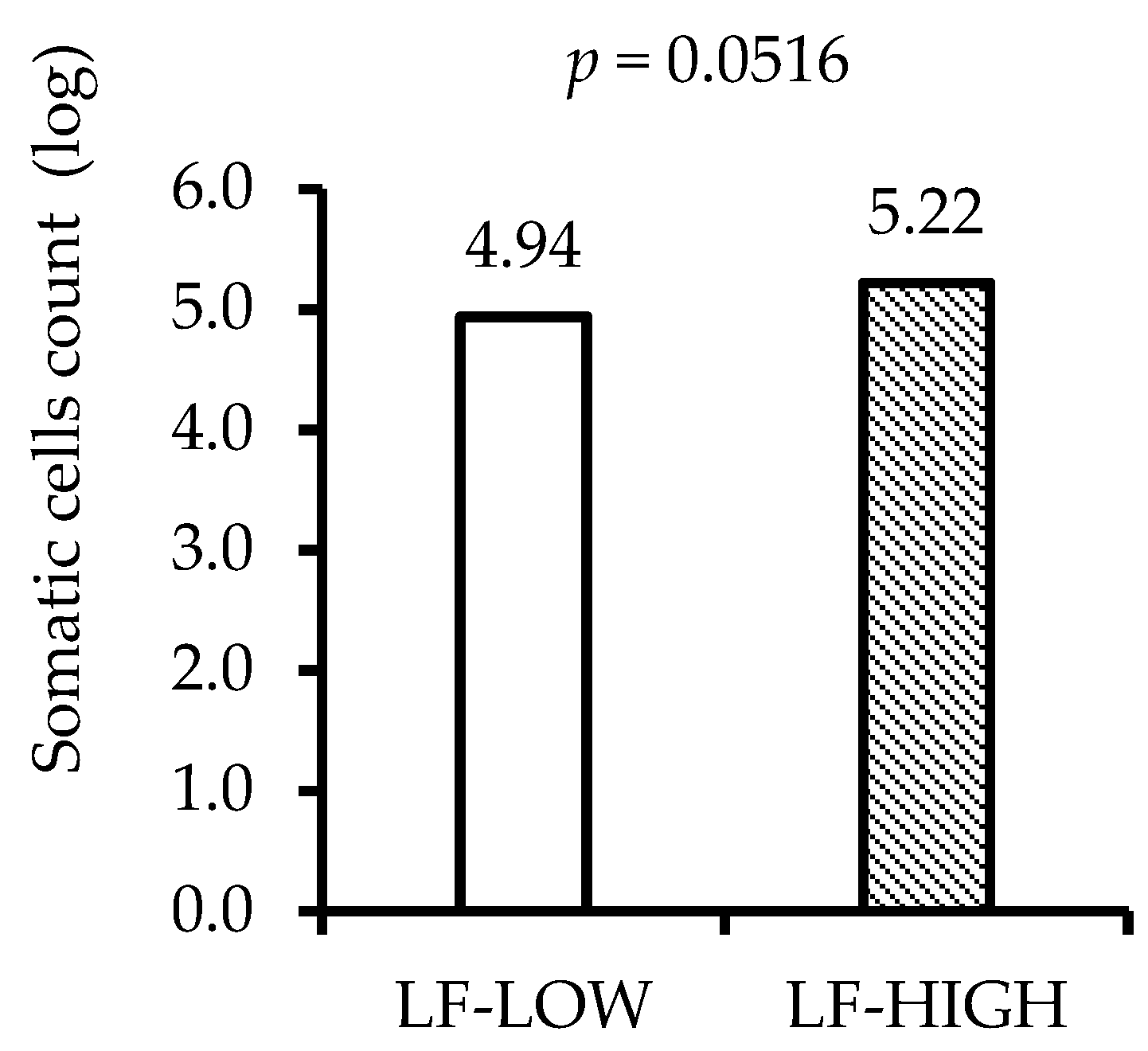
The SCCs, as important markers of mammary gland health status, tended to be higher in the LF-HIGH group than in the LF-LOW group (5.22 vs. 4.94; p = 0.0516)—Figure 1. These findings are consistent with the observations of Ujita et al. [38], who reported a similar trend in the dynamics of LF and SCC during lactation. Comparable results were also described by Hagiwara et al. [15] and Litwińczuk et al. [39], who reported that increased SCCs were associated with higher LF contents.
Cheng et al. [4] and Niero et al. [14] reported a moderate positive correlation between the LF content and SCC (r = +0.40 and r = +0.38, respectively). After the SCCs were transformed to a logarithmic scale (log10(SCC)), a similar moderate correlation between LF content and log10(SCC) was observed in our dataset (r = +0.4384; p < 0.001), with an even stronger correlation in the LF-HIGH group (r = +0.5600; p < 0.01)—Table 2.
High LF levels may be influenced not only by the local defence mechanisms of the mammary gland but also by physiological and metabolic factors that are associated with the postpartum period. After calving, dairy cows undergo complex metabolic changes that lead to the development of NEB. When this condition worsens (severe NEB), pronounced body tissue mobilization occurs, characterized by elevated concentrations of nonesterified fatty acids (NEFAs) (1.41 ± 0.14 mmol/L), BHB (3.71 ± 0.20 mmol/L), and urea (5.1 ± 0.31 mmol/L), together with reduced levels of glucose (2.7 ± 0.15 mmol/L) and insulin-like growth factor-1 (11 ± 1.1 ng/mL) in blood serum [40].
These alterations are also reflected in milk compositions, particularly by increased levels of ketone bodies and changes in the fat-to-protein ratio [24,41,42]. Although the threshold values for milk metabolites indicating severe NEB have not been clearly established in the literature, Denis-Robichaud [43] reported that cows with milk BHB concentrations ≥ 0.20 mmol/L and/or acetone concentrations ≥ 0.12 mmol/L are at an increased risk of subclinical hyperketonaemia, which is a direct result of deep NEB. Similarly, van Knegsel et al. [44] reported that fat-to-protein ratios of 1.5 and higher are also predictive of hyperketonaemia. The combination of these indicators, therefore, appears to be a reliable marker of severe NEB.
The consequences of severe NEB include metabolic disorders such as ketosis, immune suppression, and decreased milk yield and fertility [45,46]. The metabolic stress related to these disorders may lead to increased secretion of defence proteins, including LF, into milk [47]. Hiss et al. [47] demonstrated that, compared to more metabolically stable individuals, cows experiencing severe NEB had higher LF contents in milk. In contrast, Sartorelli et al. [48] reported that NEFAs, together with BHB, reduced neutrophil function, which in cases of severe ketosis may result in decreased LF secretion and consequently lower levels in milk.
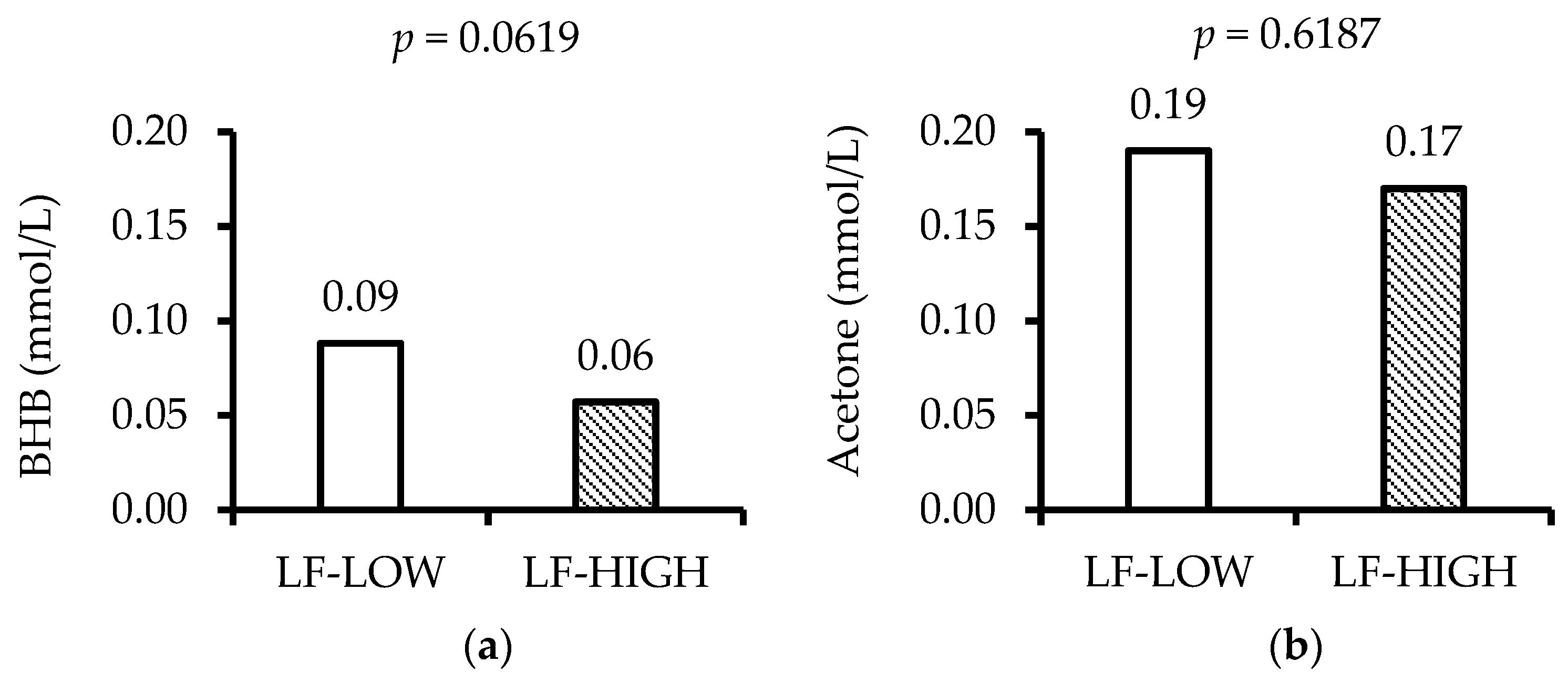
In line with these findings, the present study assessed the concentrations of ketone bodies in milk, specifically BHB and acetone (Figure 2a,b). In the LF-HIGH group, the BHB concentration was 35% lower than that in the LF-LOW group (0.06 ± 0.05 vs. 0.09 ± 0.07 mmol/L). This difference tended towards significance only (p = 0.0619), suggesting a possibly more favourable energy status in cows with higher LF contents. Similarly, the acetone concentration in this group was 9.6% lower (0.17 ± 0.23 vs. 0.19 ± 0.12 mmol/L), although this difference was not statistically significant (p = 0.6187).
In both groups, the BHB concentrations were below the threshold reported for hyperketonaemic cows [43,49]. In contrast, the acetone concentrations in both groups were slightly above the threshold for hyperketonaemia but remained far below the critical range of 0.4–1.4 mmol/L [50].
From the perspective of energy metabolism, the LF-HIGH group surprisingly exhibited a more favourable energy status. These findings support the hypothesis that elevated milk LF contents are associated not only with the immune response to infection but also reflect a compensatory metabolic phenomenon during the postpartum period. Although the LF-HIGH group had lower ketone bodies in milk than the LF-LOW group did, it simultaneously had higher log SCC values. Within this group, significant positive correlations were detected between LF and acetone concentrations (r = 0.54; p < 0.01) as well as between LF and BHB concentrations (r = 0.54; p < 0.01). These associations suggest that increased LF secretion is linked to the activation of metabolic pathways characteristic of the transitional NEB period. In the LF-LOW group and in the overall dataset, no statistically significant correlations were observed.
These results suggest that LF can be considered a multifactorial biomarker, whose concentrations are influenced not only by the immune response of the mammary gland but also by the energy load during the periparturient period.

3.2. LF and Biochemical Parameters

One of the key prerequisites for the early identification of metabolic disorders and related subclinical diseases is the establishment of physiological reference ranges for biochemical indicators in clinically healthy herds [51,52,53,54]. Therefore, serum biochemical parameters were analysed to verify whether differences in milk LF contents reflect the metabolic status of dairy cows or, conversely, whether different metabolic states are manifested in LF production.
As shown in Table 3, compared with the LF-LOW group, the LF-HIGH group had significantly higher serum glucose concentrations (3.37 ± 0.79 vs. 2.30 ± 0.86 mmol/L; p < 0.001) and significantly lower triglycerides (0.10 ± 0.06 vs. 0.13 ± 0.07 mmol/L; p = 0.0101). These results suggest that the cows in the LF-HIGH group were better able to compensate for NEB, supporting the notion that a favourable energy status promotes immunoprotein synthesis, whereas deep NEB suppresses it [48].
Danowski et al. [55] reported a significant decrease in the LF contents in milk from dairy cows that were subjected to feed restriction–induced energy deficits. NEB during early lactation leads to intense lipid mobilization and elevated blood levels of NEFA. When the influx of NEFAs exceeds their metabolic utilization, they undergo re-esterification into triglycerides, resulting in their accumulation within hepatocytes. This condition may lead to hepatic lipidosis [56,57,58], which can impair normal liver function [59].
One of the biochemical indicators of liver damage is the enzyme GGT [60]. Increased GGT activity is typically associated with intensive lipid mobilization or inflammatory infiltration as a consequence of NEB [57]. In the LF-HIGH group, GGT activity was significantly lower (0.48 ± 0.21 vs. 0.59 ± 0.27 µkat/L; p = 0.0319), indicating a reduced hepatocellular burden. This may suggest a greater capacity for protein synthesis, which is consistent with the lower levels of serum triglycerides and milk ketone bodies (e.g., BHB and acetone). Interestingly, the serum total protein concentrations (69.7 ± 9.6 vs. 75.1 ± 9.0 g/L; p = 0.0028) and urea concentrations (3.49 ± 0.77 vs. 4.00 ± 1.08 g/L; p = 0.0084) were significantly lower in the LF-HIGH group. These findings may indicate more efficient utilization of amino acids and nitrogen compounds for the synthesis of whey proteins, including LF.
In both groups, the serum Ca concentrations exceeded the values reported for subclinical hypocalcaemia (1.4–2.0 mmol/L) by Reinhardt et al. [61], a condition frequently affecting cows during the postpartum period. No effect of milk LF contents on serum Ca concentrations was observed, and no statistically significant difference was detected between groups. In contrast, compared with the LF-LOW group, the LF-HIGH group had significantly higher serum Zn (+16%, 1.02 ± 0.42 mg/L; p = 0.0140) and Cu (+12%, 0.92 ± 0.13 mg/L; p = 0.0001) concentrations. Conversely, the serum P (−18%, 1.95 ± 1.02 mmol/L; p = 0.0044) and Mg (−16%, 0.82 ± 0.23 mmol/L; p = 0.0006) concentrations were significantly lower in the LF-HIGH group.
These differences were also reflected in the correlation analysis (see Table 2). LF content correlated positively with Zn (r = +0.2046; p < 0.05) and Cu (r = +0.3266; p < 0.001) but negatively with P (r = −0.2720; p < 0.01) and Mg (r = −0.3023; p < 0.01). The higher serum Zn and Cu concentrations in the LF-HIGH group may indicate improved availability of these trace elements for immune system function, which is consistent with previous findings [62,63,64,65,66]. The supplementation of chelated forms of Zn/Cu/Mn in early-lactation cows has been shown to improve their antioxidant status and immune response [66]. At the same time, deficiencies in these elements increase their susceptibility to mastitis [67].
LF is known for its high affinity not only for Fe2+ and Fe3+ but also for other divalent and trivalent cations, including Zn2+ and Cu2+ [68,69,70]. Through chelation, LF prevents the uncontrolled reactivity of free metal ions (reducing the formation of potentially toxic hydroxyl radicals) and limits the availability of free Fe to pathogenic bacteria [71,72,73]. Analogously, the binding of Zn and Cu ions to LF likely mitigates the pro-oxidative effects of their free forms in the surrounding environment [74]. Moreover, Zn and Cu binding may modulate the biological activity of LF itself [75,76].
The increased availability of these two trace elements in the LF-HIGH group may, therefore, increase the activity of immune cells such as superoxide dismutase in neutrophils, which require Zn and Cu as cofactors [77,78]. The significantly lower serum P and Mg concentrations observed in the LF-HIGH group suggest a potential redistribution of these minerals. Lower P levels may be related to its increased demand during enhanced energy metabolism, whereas reduced Mg may reflect its utilization as a cofactor in numerous enzymatic reactions and its key role in immune function (acute-phase regulation and macrophage activity) [79].
The detected differences in serum mineral compositions indicate a relationship between metabolic status, immune function, and LF secretion; however, these associations require verification in targeted studies.

3.3. LF and Haematological Parameters

Changes in metabolic status are often accompanied by alterations in haematological parameters. The haematological parameters for both groups are summarized in Table 4. All measured parameters were within the physiological ranges described for the early postpartum period [80]. No differences in red blood cells or haemoglobin concentration were detected between the groups. However, the LF-HIGH group had significantly lower haematocrit concentrations (0.26 ± 0.02; p = 0.0488) and mean corpuscular volume (47.68 ± 3.42 fL; p = 0.0003) but a significantly greater red cell distribution width (18.36 ± 1.06%; p < 0.001) and mean corpuscular haemoglobin concentration (362.51 ± 15.21 g/dL; p < 0.001). Although all red blood cell parameters remained within their reference ranges [80], the combination of microcytosis, increased haemoglobin concentration in erythrocytes, and greater variability in erythrocyte width may reflect enhanced metabolic and inflammatory stress, as described in cows experiencing severe NEB [81,82].
The postpartum period in dairy cows is characterized by physiological changes in white blood cell profiles due to metabolic demands, hormonal fluctuations, stress, and inflammatory processes associated with uterine involution, the onset of lactation, or mammary gland inflammation [51,53,54,83,84]. For instance, Marutsova et al. [85] reported increased total leukocyte counts in cows with subclinical ketosis, whereas Ford et al. [86] reported lower leukocyte counts. The authors of these studies explained the differing findings as potentially related to subclinical mastitis or metritis, and this interpretation does not refer to the cows included in the present study.
In the present study, neither total leukocyte counts nor differential leukocyte distributions showed significant differences between the LF-LOW and LF-HIGH groups. Both groups remained within the midranges of the physiological values reported by Moretti et al. [51] and Tsiamadis et al. [54]. These findings support the hypothesis that the increased LF contents and SCCs observed in the LF-HIGH group (see Section 3.1) were primarily associated with a localized inflammatory response in the mammary gland and increased the secretory activity of mammary epithelial cells rather than systemic leucocytosis.
Matsumura-Takeda et al. [87] demonstrated in an in vitro study that LF can act directly on megakaryocytes and suppress thrombocyte production. In the present dataset, no relationship was found between the milk LF contents and thrombocyte counts in blood. The thrombocyte counts in both groups were within the normal range for the early postpartum period [53]. Although the LF-HIGH group had 13.6% greater thrombocyte counts than the LF-LOW group did, this difference was not statistically significant (p = 0.1934), probably because of the high variability.

3.4. LF and Milk Parameters

Table 5 presents selected indicators for milk compositions. The results revealed that the milk LF contents were not strongly related to the main milk components. The milk fat contents in both groups exceeded 5%, which is relatively high at the beginning of lactation but typical for this period [88,89]. The relationship between LF and milk fat was examined by Cheng et al. [4], who reported no correlation between LF and milk fat content in normal milk.
Because elevated LF levels are associated with mammary gland inflammation and, as noted earlier, correlate positively with SCC (see Table 2), the relationship between milk fat and SCC was also evaluated. Previous studies report inconsistent associations between SCC and milk fat content, with effects mainly observed at very high SCC levels [12,13,14,15,16,17,18,19,20,21,22,23,24,25,26,27,28,29,30,31,32,33,34,35,36,37,38,39,40,41,42,43,44,45,46,47,48,49,50,51,52,53,54,55,56,57,58,59,60,61,62,63,64,65,66,67,68,69,70,71,72,73,74,75,76,77,78,79,80,81,82,83,84,85,86,87,88,89,90,91,92,93,94]. Dairy cows with higher SCCs (LF-HIGH) had slightly lower milk fat content, but the difference was not statistically significant (Table 3), as well as the correlation between milk fat content and SCCs (r = 0.2022 for LF-LOW and r = −0.0596 for LF-HIGH). This discrepancy may be explained by the fact that even in the LF-HIGH group, the SCCs did not reach extremely high levels, and the overall milk fat content remained relatively high.
The milk lactose contents did not differ between groups, indicating that milk LF contents did not affect the lactose content. This finding is consistent with the relatively low SCC values observed, as reductions in lactose content are typically associated with impaired secretory function of the mammary gland during advanced stages of mastitis [91,95]. The SCCs, even in the LF-HIGH group, did not exceed the subclinical mastitis threshold (>200,000 cells/mL; [96]).
The total protein and casein contents did not differ significantly between groups. However, the LF-HIGH group had 4.06% higher total protein and casein contents. This trend may reflect the contribution of LF itself as a non-casein fraction [38] as well as the absence of increased proteolytic enzyme activity typically associated with clinical and subclinical mastitis [97,98,99,100,101,102]. This is supported by the findings of previous studies—Cheng et al. [4] reported a positive correlation between LF and total milk protein (r = 0.482; p < 0.001), and Ujita et al. [38] reported a similar relationship. According to Ujita et al. [38], this strong positive correlation may be explained by the fact that LF itself is a protein (a non-casein fraction), and its elevated concentration contributes to the total protein content. Additionally, an increased total protein content may also reflect leakage of serum proteins into the mammary gland during inflammation [97]. Conversely, other studies have reported a decrease in total milk protein in cows with subclinical or clinical mastitis [98,99,100,101]. During mastitis, proteolytic enzymes are activated, degrading casein [100,102], resulting in a reduced milk casein content. In the present dataset, however, the LF-HIGH group had 4.1% greater casein content compared with the LF-LOW group. This discrepancy likely reflects the lower SCC and moderate LF levels in this group. It is also possible that the lower In addition, the differences in protein content may be partly related to metabolic status, as impaired energy balance and increased ketone body load have been reported to influence milk protein synthesis [42].
Malek dos Reis et al. [103] reported that cows with subclinical mastitis (accompanied by elevated LF levels; [15]) also have reduced milk solid-not-fat (SNF) contents, indicating a negative relationship between SCC and SNF. No significant difference in SNF contents was detected between the LF-HIGH and LF-LOW groups (8.99 ± 0.50% vs. 9.15 ± 0.37%; p = 0.1574). The SNF contents followed similar trends to those of protein and lactose, and elevated LF contents had no apparent effect on this parameter. The slightly higher SNF in the LF-HIGH group may be attributed to the relatively low SCCs, which did not reach the threshold necessary to elicit the effect described.
The milk urea concentrations were 19.50 ± 4.16 mmol/L in the LF-HIGH group and 21.36 ± 5.99 mmol/L in the LF-LOW group, with no statistically significant difference (p = 0.1668). These results indicate that the milk LF content is not directly related to the milk urea concentration, as these parameters reflect distinct physiological states [104]. No data are available in the literature regarding a direct relationship between LF and urea in milk. However, a possible connection between milk urea and SCC has been discussed. Kananub et al. [105] and Timkovičová-Lacková et al. [106] reported a negative trend between SCC and milk urea concentration, although they described this relationship as unclear, given that the underlying physiological processes are not directly linked. The present results are partly consistent with these observations: the group with higher SCCs (and higher LF) had lower milk urea levels, although the difference was not statistically significant. On the other hand, Silva et al. [107] described the opposite trend, namely, higher milk urea concentrations during mastitis, and attributed this to increased permeability of mammary epithelial cells during inflammation [108].
No statistically significant differences were also found for FFA concentrations (LF-LOW: 4.05 ± 1.98 vs. LF-HIGH: 4.23 ± 1.87 mmol/100 g fat; p = 0.6966). FFA levels reflect the extent of body fat mobilization and NEB after calving. The values observed in this study suggest that neither group of cows had pronounced NEB. To date, no direct relationship between milk FFA and LF contents in dairy cows has been reported in the literature.

3.5. LF and Urine Parameters

The LF-HIGH group had significantly higher urinary sodium concentrations (natriuresis) and markedly lower values of the U-ABB indicator (net acid excretion, mmol/L) (Table 6). It suggests that cows with higher milk LF contents were exposed to greater acid–base stress [109,110,111,112]. This conclusion is further supported by the elevated urinary concentrations of Ca (+21.0%) and K (+11.7%) observed in the LF-HIGH group, as these elements are excreted in greater amounts as part of compensatory buffering mechanisms in response to acid–base load [112].
The question remains as to why cows with higher milk LF contents exhibited signs of acid–base load. A possible explanation may lie in ongoing ketogenesis, increased protein metabolism, and immune activation, all of which contribute to enhanced proton production and thereby increase the buffering load of the organism [113].
Cows in the LF-HIGH group also had 15.3% higher urinary urea concentrations (43.33 ± 14.60 mmol/L) than those in the LF-LOW group did. In contrast, the serum urea concentrations in this group were 12.8% lower (3.49 ± 0.77 vs. 4.00 ± 1.08 mmol/L; p = 0.0084), and the milk urea concentrations were 8.7% lower (19.50 ± 4.16 vs. 21.36 ± 5.99 mmol/L; p = 0.1668)—see Section 3.2 and Section 3.4. These differences suggest the redistribution of nitrogenous compounds among body fluids, where part of the available nitrogen may have been utilized for the synthesis of protective proteins (including LF), while the excess nitrogen was efficiently excreted by the kidneys.
Furthermore, compared with the LF-LOW group, the LF-HIGH group had slightly lower urinary phosphorus (−3.6%) and magnesium (−4.6%) concentrations. Although the differences (up to 5%) were not statistically significant, they may indicate enhanced tissue retention of both elements, which are essential for energy metabolism and immune cell function [114,115,116,117].

3.6. Limitations of the Study

This study was conducted on a single dairy herd, which may, to some extent, limit the generalizability of the findings to different farm management or environmental conditions. In addition, one biological sample per cow was collected at a single time point during the postpartum period, which does not allow the assessment of temporal dynamics within individual animals. Nevertheless, the sample size (n = 122) and distribution between the LF-LOW (n = 81) and LF-HIGH (n = 41) groups provided sufficient statistical power to detect relevant differences. Validation of the proposed threshold value would be advisable in future studies that include multiple herds with diverse management systems.

4. Conclusions

During the first 20 days after calving, cows with higher milk lactoferrin (LF) contents exhibited signs of a more favourable metabolic profile, accompanied by mild activation of the mammary gland immune system. Elevated milk LF contents were closely associated with higher somatic cell counts, indicating enhanced local immune defence of the mammary gland consistent with subclinical inflammatory activity. Compared with LF-LOW cows, LF-HIGH cows presented lower levels of ketone bodies (β-hydroxybutyric acid and acetone) in milk and a more favourable blood metabolic profile, characterized by higher glucose and lower triglyceride concentrations and lower gamma-glutamyl transferase activity. These findings suggest that more effective metabolic compensation occurs during negative energy balance in the postpartum period rather than with pronounced metabolic impairment.
Furthermore, urine analysis revealed that the LF-HIGH cows exhibited a more pronounced acid–base load, reflected by higher urinary sodium excretion and more negative urinary acid–base balance, likely associated with ongoing metabolic processes during the transition period. The observed positive correlation between milk LF content and milk ketone bodies within this group further supports the link between LF secretion and the metabolic processes accompanying the postpartum period.
Importantly, milk LF content was not associated with the basic milk components, indicating that variation in LF primarily reflects immunometabolic compensatory processes rather than changes in gross milk composition.
Overall, the results indicate that milk LF content represents a specific indicator of mammary gland immune activation and metabolic compensation during the postpartum period, rather than a general marker of overall cow health status.
These findings are based on a single time-point measurement in one herd and should therefore be interpreted as associative rather than predictive. Validation in multi-herd and longitudinal studies is required before any practical application can be considered.

Author Contributions

Conceptualization, R.K., M.H. and E.S.; methodology, R.K., E.S. and O.H.; investigation, R.K., M.H., M.K., L.H., E.S., H.N. and K.B.; data curation, M.H., E.S., O.H. and K.B.; writing—original draft preparation, R.K., M.K., L.H. and E.S.; writing—review and editing, R.K., M.H., L.H., E.S., H.N., O.H. and K.B.; visualization, R.K., M.H. and E.S.; supervision, E.S.; funding acquisition, E.S. and M.K. All authors have read and agreed to the published version of the manuscript.

Funding

This research was funded by the Ministry of Agriculture of the Czech Republic, Project No. QK21010326, and by the University of South Bohemia, Project No. GAJU 023/2025/Z.

Institutional Review Board Statement

All procedures were approved and supervised by the Animal Use Ethical Committee of the University of South Bohemia in České Budějovice and The Ministry of Education, Youth and Sports, Czech Republic (MSMT-25606/2022-4).

Informed Consent Statement

Not applicable.

Data Availability Statement

The original contributions presented in this study are included in the article. Further inquiries can be directed to the corresponding author(s).

Conflicts of Interest

Author Oto Hanuš was employed by the Dairy Research Institute Ltd. The remaining authors declare that the research was conducted in the absence of any commercial or financial relationships that could be construed as a potential conflict of interest.

Abbreviations

The following abbreviations are used in this manuscript:
BHBBeta-hydroxybutyric acid
FFAsFree fatty acids
GGTGamma-glutamyl transferase
HPLCHigh-performance liquid chromatography
LFLactoferrin
LF-HIGHGroup of dairy cows with lactoferrin content > 123 mg/L
LF-LOWGroup of dairy cows with lactoferrin content ≤ 123 mg/L
LS SCCLinear somatic cell count score
NEBNegative energy balance
NEFAsNon-esterified fatty acids
SCCSomatic cell count
U-ABBUrine acid–base excretion

References

  1. Sorensen, M.; Sorensen, S. The proteins in whey. Comptes Rendus Trav. Lab. Carlsberg 1939, 23, 55–99. [Google Scholar]
  2. González-Chávez, S.A.; Arévalo-Gallegos, S.; Rascón-Cruz, Q. Lactoferrin: Structure, function and applications. Int. J. Antimicrob. Agents 2009, 33, 301.e1–301.e8. [Google Scholar] [CrossRef]
  3. Rosa, L.; Cutone, A.; Lepanto, M.S.; Paesano, R.; Valenti, P. Lactoferrin: A natural glycoprotein involved in iron and inflammatory homeostasis. Int. J. Mol. Sci. 2017, 18, 1985. [Google Scholar] [CrossRef] [PubMed]
  4. Cheng, J.B.; Wang, J.Q.; Bu, D.P.; Liu, G.L.; Zhang, C.G.; Wei, H.Y.; Zhou, L.Y.; Wang, J.Z. Factors affecting the lactoferrin concentration in bovine milk. J. Dairy Sci. 2008, 91, 970–976. [Google Scholar] [CrossRef]
  5. Levay, P.F.; Viljoen, M. Lactoferrin—A general-review. Haematologica 1995, 80, 252–267. [Google Scholar]
  6. Dyrda-Terniuk, T.; Pomastowski, P. The multifaceted roles of bovine lactoferrin: Molecular structure, isolation methods, analytical characteristics, and biological properties. J. Agric. Food Chem. 2023, 71, 20500–20531. [Google Scholar] [CrossRef]
  7. Iglesias-Figueroa, B.F.; Espinoza-Sánchez, E.A.; Siqueiros-Cendón, T.S.; Rascón-Cruz, Q. Lactoferrin as a nutraceutical protein from milk, an overview. Int. Dairy J. 2019, 89, 37–41. [Google Scholar] [CrossRef]
  8. Puppel, K.; Golebiewski, M.; Grodkowski, G.; Slósarz, J.; Kunowska-Slósarz, M.; Solarczyk, P.; Lukasiewicz, M.; Balcerak, M.; Przysucha, T. Composition and factors affecting quality of bovine colostrum: A review. Animals 2019, 9, 1070. [Google Scholar] [CrossRef]
  9. Schanbacher, F.L.; Talhouk, R.S.; Murray, F.A. Biology and origin of bioactive peptides in milk. Livest. Prod. Sci. 1997, 50, 105–123. [Google Scholar] [CrossRef]
  10. Welty, F.K.; Smith, K.L.; Schanbacher, F.L. Lactoferrin concentration during involution of the bovine mammary gland. J. Dairy Sci. 1976, 59, 224–231. [Google Scholar] [CrossRef]
  11. Bekuma, A.; Ulfina, G. Combating negative effect of negative energy balance in dairy cows. Approaches Poult. Dairy. Vet. Sci. 2019, 6, 1–4. [Google Scholar] [CrossRef]
  12. Lindmark-Månsson, H.; Svensson, U.; Paulsson, M.; Aldén, G.; Frank, B.; Johnsson, G. Influence of milk components, somatic cells and supplemental zinc on milk processability. Int. Dairy J. 2000, 10, 423–433. [Google Scholar] [CrossRef]
  13. Huang, Y.Q.; Morimoto, K.; Hosoda, K.; Yoshimura, Y.; Isobe, N. Differential immunolocalization between lingual antimicrobial peptide and lactoferrin in mammary gland of dairy cows. Vet. Immunol. Immunopathol. 2012, 145, 499–504. [Google Scholar] [CrossRef] [PubMed]
  14. Niero, G.; Thomas, S.A.; Mouratidou, K.; Visentin, G.; De Marchi, M.; Penasa, M.; Cassandro, M. Lactoferrin concentration in bovine milk: Validation of radial immunodiffusion technique, sources of variation, and association to udder health status. Ital. J. Anim. Sci. 2023, 22, 230–238. [Google Scholar] [CrossRef]
  15. Hagiwara, S.; Kawai, K.; Anri, A.; Nagahata, H. Lactoferrin concentrations in milk from normal and subclinical mastitic cows. J. Vet. Med. Sci. 2003, 65, 319–323. [Google Scholar] [CrossRef]
  16. Farkaš, V.; Beletić, A.; Kuleš, J.; Thomas, F.C.; Rešetar Maslov, D.; Rubić, I.; Benić, M.; Bačić, G.; Mačešić, N.; Jović, I.; et al. Biomarkers for subclinical bovine mastitis: A high throughput TMT-based proteomic investigation. Vet. Res. Commun. 2024, 48, 2069–2082. [Google Scholar] [CrossRef]
  17. Gonçalves, J.L.; de Campos, J.L.; Steinberger, A.J.; Safdar, N.; Kates, A.; Sethi, A.; Shutske, J.; Suen, G.; Goldberg, T.; Cue, R.I.; et al. Incidence and treatments of bovine mastitis and other diseases on 37 dairy farms in Wisconsin. Pathogens 2022, 11, 1282. [Google Scholar] [CrossRef]
  18. Hammer, J.F.; Morton, J.M.; Kerrisk, K.L. Quarter-milking-, quarter-, udder- and lactation-level risk factors and indicators for clinical mastitis during lactation in pasture-fed dairy cows managed in an automatic milking system. Aust. Vet. J. 2012, 90, 167–174. [Google Scholar] [CrossRef]
  19. Jamali, H.; Barkema, H.W.; Jacques, M.; Lavallée-Bourget, E.M.; Malouin, F.; Saini, V.; Stryhn, H.; Dufour, S. Invited review: Incidence, risk factors, and effects of clinical mastitis recurrence in dairy cows. J. Dairy Sci. 2018, 101, 4729–4746. [Google Scholar] [CrossRef]
  20. van den Borne, B.H.P.; van Schaik, G.; Lam, T.J.G.M.; Nielen, M. Variation in herd level mastitis indicators between primi- and multiparae in Dutch dairy herds. Prev. Vet. Med. 2010, 96, 49–55. [Google Scholar] [CrossRef]
  21. Vergara, C.F.; Döpfer, D.; Cook, N.B.; Nordlund, K.V.; McArt, J.A.A.; Nydam, D.V.; Oetzel, G.R. Risk factors for postpartum problems in dairy cows: Explanatory and predictive modeling. J. Dairy Sci. 2014, 97, 4127–4140. [Google Scholar] [CrossRef]
  22. Bruckmaier, R.M.; Gross, J.J. Lactational challenges in transition dairy cows. Anim. Prod. Sci. 2017, 57, 1471–1481. [Google Scholar] [CrossRef]
  23. Cincović, M.; Đoković, R.; Belić, B.; Lakić, I.; Stojanac, N.; Stevancevic, O.; Staničkov, N. Insulin resistance in cows during the periparturient period (review). Acta Agric. Serbica 2018, 23, 233–245. [Google Scholar] [CrossRef]
  24. Reindl, K.; Hasoňová, L.; Konečný, R.; Horčičková, M.; Trávníček, J.; Climova, N.; Janoušek Honesová, S.; Kváč, M.; Čítek, J.; Hanuš, O.; et al. Relationships between milk ketone bodies and selected milk indicators during conventional and extended lactation. J. Cent. Eur. Agric. 2024, 25, 1–12. [Google Scholar] [CrossRef]
  25. Thorup, V.M.; Chagunda, M.G.G.; Fischer, A.; Weisbjerg, M.R.; Friggens, N.C. Robustness and sensitivity of a blueprint for on-farm estimation of dairy cow energy balance. J. Dairy Sci. 2018, 101, 6002–6018. [Google Scholar] [CrossRef] [PubMed]
  26. Bradford, B.J.; Yuan, K.; Farney, J.K.; Mamedova, L.K.; Carpenter, A.J. Invited review: Inflammation during the transition to lactation: New adventures with an old flame. J. Dairy Sci. 2015, 98, 6631–6650. [Google Scholar] [CrossRef]
  27. Sordillo, L.M.; Contreras, G.; Aitken, S.L. Metabolic factors affecting the inflammatory response of periparturient dairy cows. Anim. Health Res. Rev. 2009, 10, 53–63. [Google Scholar] [CrossRef]
  28. Crookenden, M.A.; Moyes, K.M.; Kuhn-Sherlock, B.; Lehnert, K.; Walker, C.G.; Loor, J.J.; Mitchell, M.D.; Murray, A.; Dukkipati, V.S.R.; Vailati-Riboni, M.; et al. Transcriptomic analysis of circulating neutrophils in metabolically stressed peripartal grazing dairy cows. J. Dairy Sci. 2019, 102, 7408–7420. [Google Scholar] [CrossRef]
  29. Grinberg, N.; Elazar, S.; Rosenshine, I.; Shpigel, N.Y. Beta-hydroxybutyrate abrogates formation of bovine neutrophil extracellular traps and bactericidal activity against mammary pathogenic Escherichia coli. Infect. Immun. 2008, 76, 2802–2807. [Google Scholar] [CrossRef]
  30. LeBlanc, S.J. Review: Relationships between metabolism and neutrophil function in dairy cows in the peripartum period. Animal 2020, 14, S44–S54. [Google Scholar] [CrossRef]
  31. Suriyasathaporn, W.; Heuer, C.; Noordhuizen-Stassen, E.N.; Schukken, Y.H. Hyperketonemia and the impairment of udder defense: A review. Vet. Res. 2000, 31, 397–412. [Google Scholar] [CrossRef]
  32. Swartz, T.H.; Bradford, B.J.; Mamedova, L.K. Connecting metabolism to mastitis: Hyperketonemia impaired mammary gland defenses during a challenge in dairy cattle. Front. Immunol. 2021, 12, 700278. [Google Scholar] [CrossRef] [PubMed]
  33. Franklin, S.T.; Young, J.W.; Nonnecke, B.J. Effects of ketones, acetate, butyrate, and glucose on bovine lymphocyte-proliferation. J. Dairy Sci. 1991, 74, 2507–2514. [Google Scholar] [CrossRef] [PubMed]
  34. Nonnecke, B.J.; Franklin, S.T.; Young, J.W. Effects of ketones, acetate, and glucose on invitro immunoglobulin secretion by bovine lymphocytes. J. Dairy Sci. 1992, 75, 982–990. [Google Scholar] [CrossRef] [PubMed]
  35. Zarrin, M.; Wellnitz, O.; van Dorland, H.A.; Bruckmaier, R.M. Induced hyperketonemia affects the mammary immune response during lipopolysaccharide challenge in dairy cows. J. Dairy Sci. 2014, 97, 330–339. [Google Scholar] [CrossRef]
  36. Reneau, J.K. Somatic Cell Count: An Effective Tool in Controlling Mastitis; Agricultural Extension Service, University of Minnesota: Minneapolis, MN, USA, 1983. [Google Scholar]
  37. ČSN EN ISO/IEC 17025; General Requirements for the Competence of Testing and Calibration Laboratories. Czech Normalization Institute: Prague, Czech Republic, 2018. (In Czech)
  38. Ujita, A.; Negrao, J.A.; Vercesi, A.E.; Fernandes, A.R.; El Faro, L. Milk lactoferrin and milk constituents in dairy Gyr heifers. Livest. Sci. 2019, 226, 87–92. [Google Scholar] [CrossRef]
  39. Litwińczuk, Z.; Król, J.; Brodziak, A.; Barłowska, J. Changes of protein content and its fractions in bovine milk from different breeds subject to somatic cell count. J. Dairy Sci. 2011, 94, 684–691. [Google Scholar] [CrossRef]
  40. Fenwick, M.A.; Llewellyn, S.; Fitzpatrick, R.; Kenny, D.A.; Murphy, J.J.; Patton, J.; Wathes, D.C. Negative energy balance in dairy cows is associated with specific changes in IGF-binding protein expression in the oviduct. Reproduction 2008, 135, 63–75. [Google Scholar] [CrossRef]
  41. Enjalbert, F.; Nicot, M.C.; Baourthe, C.; Moncoulon, R. Ketone bodies in milk and blood of dairy cows: Relationship between concentrations and utilization for detection of subclinical ketosis. J. Dairy Sci. 2001, 84, 583–589. [Google Scholar] [CrossRef]
  42. Guliński, P. Ketone bodies—Causes and effects of their increased presence in cows’ body fluids: A review. Vet. World 2021, 14, 1492–1503. [Google Scholar] [CrossRef]
  43. Denis-Robichaud, J.; Dubuc, J.; Lefebvre, D.; DesCoteaux, L. Accuracy of milk ketone bodies from flow-injection analysis for the diagnosis of hyperketonemia in dairy cows. J. Dairy Sci. 2014, 97, 3364–3370. [Google Scholar] [CrossRef] [PubMed]
  44. van Knegsel, A.T.M.; van der Drift, S.G.A.; Horneman, M.; de Roos, A.P.W.; Kemp, B.; Graat, E.A.M. Short communication: Ketone body concentration in milk determined by Fourier transform infrared spectroscopy: Value for the detection of hyperketonemia in dairy cows. J. Dairy Sci. 2010, 93, 3065–3069. [Google Scholar] [CrossRef] [PubMed]
  45. Melendez, P.; Marin, M.P.; Robles, J.; Rios, C.; Duchens, M.; Archbald, L. Relationship between serum nonesterified fatty acids at calving and the incidence of periparturient diseases in Holstein dairy cows. Theriogenology 2009, 72, 826–833. [Google Scholar] [CrossRef] [PubMed]
  46. Ospina, P.A.; Nydam, D.V.; Stokol, T.; Overton, T.R. Evaluation of nonesterified fatty acids and β-hydroxybutyrate in transition dairy cattle in the northeastern United States: Critical thresholds for prediction of clinical diseases. J. Dairy Sci. 2010, 93, 546–554. [Google Scholar] [CrossRef]
  47. Hiss, S.; Weinkauf, C.; Hachenberg, S.; Sauerwein, H. Relationship between metabolic status and the milk concentrations of haptoglobin and lactoferrin in dairy cows during early lactation. J. Dairy Sci. 2009, 92, 4439–4443. [Google Scholar] [CrossRef]
  48. Sartorelli, P.; Paltrinieri, S.; Agnes, F. Non-specific immunity and ketone bodies. I: In vitro studies on chemotaxis and phagocytosis in ovine neutrophils. J. Vet. Med. A 1999, 46, 613–619. [Google Scholar] [CrossRef]
  49. de Roos, A.P.W.; van den Bijgaart, H.J.C.M.; Horlyk, J.; de Jong, G. Screening for subclinical ketosis in dairy cattle by Fourier transform infrared spectrometry. J. Dairy Sci. 2007, 90, 1761–1766. [Google Scholar] [CrossRef]
  50. Gustafsson, A.H.; Emanuelson, U. Milk acetone concentration as an indicator of hyperketonaemia in dairy cows: The critical value revised. Anim. Sci. 1996, 63, 183–188. [Google Scholar] [CrossRef]
  51. Moretti, P.; Paltrinieri, S.; Trevisi, E.; Probo, M.; Ferrari, A.; Minuti, A.; Giordano, A. Reference intervals for hematological and biochemical parameters, acute phase proteins and markers of oxidation in Holstein dairy cows around 3 and 30 days after calving. Res. Vet. Sci. 2017, 114, 322–331. [Google Scholar] [CrossRef]
  52. Pires, J.A.A.; Larsen, T.; Leroux, C. Milk metabolites and fatty acids as noninvasive biomarkers of metabolic status and energy balance in early-lactation cows. J. Dairy Sci. 2022, 105, 201–220. [Google Scholar] [CrossRef]
  53. Roland, L.; Drillich, M.; Iwersen, M. Hematology as a diagnostic tool in bovine medicine. J. Vet. Diagn. Investig. 2014, 26, 592–598. [Google Scholar] [CrossRef]
  54. Tsiamadis, V.; Kougioumtzis, A.; Siachos, N.; Panousis, N.; Kritsepi-Konstantinou, M.; Valergakis, G.E. Hematology reference intervals during the prepartum period, first week after calving, and peak lactation in clinically healthy Holstein cows. Vet. Clin. Pathol. 2022, 51, 134–145. [Google Scholar] [CrossRef]
  55. Danowski, K.; Gross, J.J.; Meyer, H.H.D.; Kliem, H. Effects of induced energy deficiency on lactoferrin concentration in milk and the lactoferrin reaction of primary bovine mammary epithelial cells. J. Anim. Physiol. Anim. Nutr. 2013, 97, 647–655. [Google Scholar] [CrossRef] [PubMed]
  56. Drackley, J.K. Biology of dairy cows during the transition period: The final frontier? J. Dairy Sci. 1999, 82, 2259–2273. [Google Scholar] [CrossRef] [PubMed]
  57. Bobe, G.; Young, J.W.; Beitz, D.C. Invited review: Pathology, etiology, prevention, and treatment of fatty liver in dairy cows. J. Dairy Sci. 2004, 87, 3105–3124. [Google Scholar] [CrossRef] [PubMed]
  58. Grummer, R.R. Impact of changes in organic nutrient metabolism on feeding the transition dairy cow. J. Anim. Sci. 1995, 73, 2820–2833. [Google Scholar] [CrossRef]
  59. Murondoti, A.; Jorritsma, R.; Beynen, A.C.; Wensing, T.; Geelen, M.J.H. Activities of the enzymes of hepatic gluconeogenesis in periparturient dairy cows with induced fatty liver. J. Dairy Res. 2004, 71, 129–134. [Google Scholar] [CrossRef]
  60. González, F.D.; Muiño, R.; Pereira, V.; Campos, R.; Benedito, J.L. Relationship among blood indicators of lipomobilization and hepatic function during early lactation in high-yielding dairy cows. J. Vet. Sci. 2011, 12, 251–255. [Google Scholar] [CrossRef]
  61. Reinhardt, T.A.; Lippolis, J.D.; McCluskey, B.J.; Goff, J.P.; Horst, R.L. Prevalence of subclinical hypocalcemia in dairy herds. Vet. J. 2011, 188, 122–124. [Google Scholar] [CrossRef]
  62. Djoko, K.Y.; Ong, C.L.Y.; Walker, M.J.; McEwan, A.G. The role of copper and zinc toxicity in innate immune defense against bacterial pathogens. J. Biol. Chem. 2015, 290, 18954–18961. [Google Scholar] [CrossRef]
  63. Griffiths, L.M.; Loeffler, S.H.; Socha, M.T.; Tomlinson, D.J.; Johnson, A.B. Effects of supplementing complexed zinc, manganese, copper and cobalt on lactation and reproductive performance of intensively grazed lactating dairy cattle on the South Island of New Zealand. Anim. Feed Sci. Technol. 2007, 137, 69–83. [Google Scholar] [CrossRef]
  64. Khan, M.Z.; Huang, B.J.; Kou, X.Y.; Chen, Y.H.; Liang, H.L.; Ullah, Q.; Khan, I.M.; Khan, A.; Chai, W.Q.; Wang, C.F. Enhancing bovine immune, antioxidant and anti-inflammatory responses with vitamins, rumen-protected amino acids, and trace minerals to prevent periparturient mastitis. Front. Immunol. 2024, 14, 1290044. [Google Scholar] [CrossRef] [PubMed]
  65. Prasad, A.S. Discovery of human zinc deficiency: Its impact on human health and disease. Adv. Nutr. 2013, 4, 176–190. [Google Scholar] [CrossRef] [PubMed]
  66. Zhao, X.J.; Li, Z.P.; Wang, J.H.; Xing, X.M.; Wang, Z.Y.; Wang, L.; Wang, Z.H. Effects of chelated Zn/Cu/Mn on redox status, immune responses and hoof health in lactating Holstein cows. J. Vet. Sci. 2015, 16, 439–446. [Google Scholar] [CrossRef]
  67. Li, X.; Wang, J.F.; Jiang, M.C.; Huo, Y.J.; Zhan, K. Effects of zinc (Zn) from different sources on production performance, health status, antioxidant properties and immune regulation of dairy cows in early lactation. Vet. Sci. 2025, 12, 545. [Google Scholar] [CrossRef]
  68. Blakeborough, P.; Salter, D.N.; Gurr, M.I. Zinc binding in cow’s milk and human milk. Biochem. J. 1983, 209, 505–512. [Google Scholar] [CrossRef]
  69. Redwan, E.M.; Uversky, V.N.; El-Fakharany, E.M.; Al-Mehdar, H. Potential lactoferrin activity against pathogenic viruses. Comptes Rendus Biol. 2014, 337, 581–595. [Google Scholar] [CrossRef]
  70. Davidson, L.A.; Lonnerdal, B. Fe-saturation and proteolysis of human lactoferrin: Effect on brush-border receptor-mediated uptake of Fe and Mn. Am. J. Physiol. 1989, 257, G930–G934. [Google Scholar] [CrossRef]
  71. Kell, D.B.; Heyden, E.L.; Pretorius, E. The biology of lactoferrin, an iron-binding protein that can help defend against viruses and bacteria. Front. Immunol. 2020, 11, 1221. [Google Scholar] [CrossRef]
  72. Kell, D.B.; Pretorius, E. No effects without causes: The Iron Dysregulation and Dormant Microbes hypothesis for chronic, inflammatory diseases. Biol. Rev. 2018, 93, 1518–1557. [Google Scholar] [CrossRef]
  73. White, K.N.; Conesa, C.; Sánchez, L.; Amini, M.; Farnaud, S.; Lorvoralak, C.; Evans, R.W. The transfer of iron between ceruloplasmin and transferrins. Biochim. Biophys. Acta Gen. Subj. 2012, 1820, 411–416. [Google Scholar] [CrossRef]
  74. Kowalczyk, P.; Kaczyńska, K.; Kleczkowska, P.; Bukowska-Ośko, I.; Kramkowski, K.; Sulejczak, D. The lactoferrin phenomenon-a miracle molecule. Molecules 2022, 27, 2941. [Google Scholar] [CrossRef] [PubMed]
  75. Marchetti, M.; Superti, F.; Ammendolia, M.G.; Rossi, P.; Valenti, P.; Seganti, L. Inhibition of poliovirus type 1 infection by iron-, manganese and zinc-saturated lactoferrin. Med. Microbiol. Immun. 1999, 187, 199–204. [Google Scholar] [CrossRef]
  76. Zhao, H.J.; Zhao, X.H. Modulatory effect of the supplemented copper ion on in vitro activity of bovine lactoferrin to murine splenocytes and RAW264.7 macrophages. Biol. Trace Elem. Res. 2019, 189, 519–528. [Google Scholar] [CrossRef] [PubMed]
  77. Wang, Y.; Branicky, R.; Noë, A.; Hekimi, S. Superoxide dismutases: Dual roles in controlling ROS damage and regulating ROS signaling. J. Cell Biol. 2018, 217, 1915–1928. [Google Scholar] [CrossRef] [PubMed]
  78. Zheng, M.L.; Liu, Y.T.; Zhang, G.F.; Yang, Z.K.; Xu, W.W.; Chen, Q.H. The applications and mechanisms of superoxide dismutase in medicine, food, and cosmetics. Antioxidants 2023, 12, 1675. [Google Scholar] [CrossRef]
  79. Ashique, S.; Kumar, S.; Hussain, A.; Mishra, N.; Garg, A.; Gowda, B.H.J.; Farid, A.; Gupta, G.; Dua, K.; Taghizadeh-Hesary, F. A narrative review on the role of magnesium in immune regulation, inflammation, infectious diseases, and cancer. J. Health Popul. Nutr. 2023, 42, 74. [Google Scholar] [CrossRef]
  80. Nazifi, S.; Ahmadi, M.R.; Gheisari, H.R. Hematological changes of dairy cows in postpartum period and early pregnancy. Comp. Clin. Pathol. 2008, 17, 157–163. [Google Scholar] [CrossRef]
  81. Grubač, S.; Cincović, M.; Djoković, R.; Majkić, M.; Marinković, M.D.; Petrović, M.; Nikolić, S.; Starič, J.; Radulović, J.P. Blood iron status in dairy cows during early lactation—Relationship with hematological, biochemical, endocrine and inflammatory response. Acta Sci. Vet. 2023, 51, 1933. [Google Scholar] [CrossRef]
  82. Wathes, D.C.; Cheng, Z.R.; Chowdhury, W.; Fenwick, M.A.; Fitzpatrick, R.; Morris, D.G.; Patton, J.; Murphy, J.J. Negative energy balance alters global gene expression and immune responses in the uterus of postpartum dairy cows. Physiol. Genom. 2009, 39, 1–13. [Google Scholar] [CrossRef]
  83. Detilleux, J.C.; Kehrli, M.E.; Stabel, J.R.; Freeman, A.E.; Kelley, D.H. Study of immunological dysfunction in periparturient holstein cattle selected for high and average milk-production. Vet. Immunol. Immunopathol. 1995, 44, 251–267. [Google Scholar] [CrossRef] [PubMed]
  84. Kim, S.B.; Jung, S.H.; Do, Y.J.; Jung, Y.H.; Choe, C.; Ha, S.; Jeong, H.Y.; Cho, A.; Oh, S.I.; Kim, E.; et al. Haemato-chemical and immune variations in Holstein cows at different stages of lactation, parity, and age. Vet. Med. Czech 2020, 65, 95–103. [Google Scholar] [CrossRef]
  85. Marutsova, V.; Binev, R.; Marutsov, P. Comparative clinical and haematological investigations in lactating cows with subclinical and clinical ketosis. Maced. Vet. Rev. 2015, 38, 159–166. [Google Scholar] [CrossRef]
  86. Ford, H.R.; Mitchell, T.M.; Scull, T.; Benitez, O.J.; Strieder-Barboza, C. The effect of subclinical ketosis on the peripheral blood mononuclear cell inflammatory response and its crosstalk with depot-specific preadipocyte function in dairy cows. Animals 2024, 14, 1995. [Google Scholar] [CrossRef]
  87. Matsumura-Takeda, K.; Ishida, T.; Sogo, S.; Isakari, Y.; Taki, T.; Sudo, T.; Kiwada, H. Lactoferrin inhibits platelet production from human megakaryocytes. Biol. Pharm. Bull. 2008, 31, 569–573. [Google Scholar] [CrossRef]
  88. Kovacikova, E.; Kovacik, A.; Harangozo, L.; Tokarova, K.; Knazicka, Z.; Tvrda, E.; Jambor, T.; Tomka, M.; Massanyi, P.; Lukac, N. Canonical correlation of milk composition parameters and blood biomarkers in high-producing dairy cows during different lactation stages. Animals 2024, 14, 3294. [Google Scholar] [CrossRef]
  89. Ducháček, J.; Stádník, L.; Beran, J.; Okrouhlá, M.; Vacek, M.; Doležalová, M. Body condition score and milk fatty acid composition in early lactation of Czech Fleckvieh cows. Acta Univ. Agric. Silv. Silvic. Mendel. Brun. 2013, 61, 1621–1628. [Google Scholar]
  90. Fernandes, A.; Oliveira, P.; Tavolaro, P. Relationship between somatic cell counts and composition of milk from individual Holstein cows. Arq. Inst. Biol. 2004, 71, 163–166. [Google Scholar] [CrossRef]
  91. Korhonen, H.; Kaartinen, L. Changes in the Composition of Milk Induced by Mastitis. In The Bovine Udder and Mastitis; Sandholm, M., Honkanen-Buzalski, T., Kaartinen, L., Pyörälä, S., Eds.; Gummerus: Jyväskylä, Finland, 1995; pp. 76–82. [Google Scholar]
  92. Cinar, M.; Serbester, U.; Ceyhan, A.; Gorgulu, M. Effect of somatic cell count on milk yield and composition of first and second lactation dairy cows. Ital. J. Anim. Sci. 2015, 14, 3646. [Google Scholar] [CrossRef]
  93. Guo, J.Z.; Liu, X.L.; Xu, A.J.; Xia, Z. Relationship of somatic cell count with milk yield and composition in Chinese Holstein population. Agric. Sci. China 2010, 9, 1492–1496. [Google Scholar] [CrossRef]
  94. Bruckmaier, R.M.; Ontsouka, C.E.; Blum, J.W. Fractionized milk composition in dairy cows with subclinical mastitis. Vet. Med. Czechoslov. 2004, 49, 283–290. [Google Scholar] [CrossRef]
  95. Lindmark-Månsson, H.; Bränning, C.; Aldén, G.; Paulsson, M. Relationship between somatic cell count, individual leukocyte populations and milk components in bovine udder quarter milk. Int. Dairy J. 2006, 16, 717–727. [Google Scholar] [CrossRef]
  96. Fernandes, L.; Guimaraes, I.; Noyes, N.R.; Caixeta, L.S.; Machado, V.S. Effect of subclinical mastitis detected in the first month of lactation on somatic cell count linear scores, milk yield, fertility, and culling of dairy cows in certified organic herds. J. Dairy Sci. 2021, 104, 2140–2150. [Google Scholar] [CrossRef] [PubMed]
  97. Leroux, Y.; Colin, O.; Laurent, F. Proteolysis in samples of quarter milk with varying somatic-cell counts. 1. comparison of some indicators of endogenous proteolysis in milk. J. Dairy Sci. 1995, 78, 1289–1297. [Google Scholar] [CrossRef]
  98. Hortet, P.; Seegers, H. Loss in milk yield and related composition changes resulting from clinical mastitis in dairy cows. Prev. Vet. Med. 1998, 37, 1–20. [Google Scholar] [CrossRef]
  99. Uallah, S.; Ahmad, T.; Bilal, M.; Zia-ur-Rahman, Z.-u.-R.; Muhammad, G.; Rahman, S. The effect of severity of mastitis on protein and fat contents of buffalo milk. Pak. Vet. J. 2005, 25, 1–4. [Google Scholar]
  100. Urech, E.; Puhan, Z.; Schällibaum, M. Changes in milk protein fraction as affected by subclinical mastitis. J. Dairy Sci. 1999, 82, 2402–2411. [Google Scholar] [CrossRef]
  101. Bochniarz, M.; Błaszczyk, P.; Szczubiał, M.; Vasiu, I.; Adaszek, Ł.; Michalak, K.; Pietras-Ożga, D.; Wochnik, M.; Dąbrowski, R. Comparative analysis of total protein, casein, lactose, and fat content in milk of cows suffering from subclinical and clinical mastitis caused by Streptococcus spp. J. Vet. Res. 2023, 67, 251–257. [Google Scholar] [CrossRef]
  102. Batavani, R.A.; Asri, S.; Naebzadeh, H. The effect of subclinical mastitis on milk composition in dairy cows. Iran. J. Vet. Res. 2007, 8, 205–211. [Google Scholar]
  103. Malek dos Reis, C.B.; Barreiro, J.R.; Mestieri, L.; Porcionato, M.A.; dos Santos, M.V. Effect of somatic cell count and mastitis pathogens on milk composition in Gyr cows. BMC Vet. Res. 2013, 9, 67. [Google Scholar] [CrossRef]
  104. Zhang, H.M.; Wang, M.Q.; Jiang, H.R.; Cui, Y.; Xia, H.L.; Ni, W.; Li, M.X.; Karrow, N.A.; Yang, Z.P.; Mao, Y.J. Factors affecting the milk urea nitrogen concentration in Chinese Holstein cows. Anim. Biol. 2018, 68, 193–211. [Google Scholar] [CrossRef]
  105. Kananub, S.; Jawjaroensri, W.; VanLeeuwen, J.; Stryhn, H.; Arunvipas, P. Exploring factors associated with bulk tank milk urea nitrogen in Central Thailand. Vet. World 2018, 11, 642–648. [Google Scholar] [CrossRef]
  106. Timkovičová Lacková, P.; Maskal’ová, I.; Vajda, V. Evaluation of the milk urea content in relation to milk production and composition in dairy cows. Acta Vet. Brno 2019, 88, 277–285. [Google Scholar] [CrossRef]
  107. Silva, V.N.; Rangel, A.H.N.; Galvão Júnior, J.G.B.; Urbano, S.A.; Borba, L.H.F.; Novaes, L.P.; Lima Júnior, D.M. Influence of somatic cell count in the composition of Girolando cow’s milk in tropical zone. Trop. Subtrop. Agroecosyst. 2016, 19, 101–107. [Google Scholar] [CrossRef]
  108. Rysanek, D.; Babak, V. Bulk tank milk somatic cell count as an indicator of the hygiene status of primary milk production. J. Dairy Res. 2005, 72, 400–405. [Google Scholar] [CrossRef] [PubMed]
  109. Constable, P.D.; Gelfert, C.C.; Fürll, M.; Staufenbiel, R.; Stämpfli, H.R. Application of strong ion difference theory to urine and the relationship between urine pH and net acid excretion in cattle. Am. J. Vet. Res. 2009, 70, 915–925. [Google Scholar] [CrossRef] [PubMed]
  110. Constable, P.D.; Megahed, A.A.; Hiew, M.W.H. Measurement of urine pH and net acid excretion and their association with urine calcium excretion in periparturient dairy cows. J. Dairy Sci. 2019, 102, 11370–11383. [Google Scholar] [CrossRef]
  111. Gärtner, T.; Zoche-Golob, V.; Redlberger, S.; Reinhold, P.; Donat, K. Acid-base assessment of post-parturient German Holstein dairy cows from jugular venous blood and urine: A comparison of the strong ion approach and traditional blood gas analysis. PLoS ONE 2019, 14, e0210948. [Google Scholar] [CrossRef]
  112. Spanghero, M. Urinary pH and mineral excretion of cows fed four different forages supplemented with increasing levels of an anionic compound feed. Anim. Feed Sci. Technol. 2002, 98, 153–165. [Google Scholar] [CrossRef]
  113. Constable, P.D.; Hinchcliff, K.W.; Done, S.H.; Grünberg, W. (Eds.) Diseases of the Urinary System. In Veterinary Medicine, 11th ed.; W.B. Saunders: Philadelphia, PA, USA, 2017; pp. 1095–1154. [Google Scholar]
  114. National Research Council. Nutrient Requirements of Dairy Cattle, 7th rev. ed.; The National Academies Press: Washington, DC, USA, 2001; pp. 405. [Google Scholar]
  115. Li, F.Y.; Chaigne-Delalande, B.; Kanellopoulou, C.; Davis, J.C.; Matthews, H.F.; Douek, D.C.; Cohen, J.I.; Uzel, G.; Su, H.C.; Lenardo, M.J. Second messenger role for Mg2+ revealed by human T-cell immunodeficiency. Nature 2011, 475, 471–476. [Google Scholar] [CrossRef]
  116. Libera, K.; Konieczny, K.; Witkowska, K.; Żurek, K.; Szumacher-Strabel, M.; Cieslak, A.; Smulski, S. The association between selected dietary minerals and mastitis in dairy cows-a review. Animals 2021, 11, 2330. [Google Scholar] [CrossRef]
  117. Weiss, W.P. A 100-Year Review: From ascorbic acid to zinc-Mineral and vitamin nutrition of dairy cows. J. Dairy Sci. 2017, 100, 10045–10060. [Google Scholar] [CrossRef]
Figure 1. Somatic cell counts in LF-LOW (≤123 mg lactoferrin/L) and LF-HIGH (>123 mg lactoferrin/L) groups of dairy cows.
Dairy 07 00009 g001
Figure 2. Acetone (a) and β-hydroxybutyric acid (BHB) (b) concentrations in LF-LOW (≤123 mg lactoferrin/L) and LF-HIGH (>123 mg lactoferrin/L) groups of dairy cows.
Dairy 07 00009 g002
Table 1. Characteristics of LF-LOW (≤123 mg lactoferrin/L) and LF-HIGH (>123 mg lactoferrin/L) groups of dairy cows at the sampling time and during the first lactation.
LF-LOW (n = 81)LF-HIGH (n = 41)p-Value
MeanSDMin.Max.MeanSDMin.Max.
Data at sampling
Parity2.471.23162.511.42160.8623
Days in milk12.23.551912.44.36190.7920
Daily milk yield (kg)37.59.315.955.532.410.216.144.50.1074
Age at first calving754776639457487466710220.6741
First lactation
- length (days)304229530530422953050.2937
- milk yield (kg)11,3201441850415,24011,2421570783716,8430.7869
- fat content (g/100 g)4.200.512.925.394.160.363.484.870.6596
- fat yield (kg)47066350580466713427080.7209
- protein content (g/100 g)3.390.232.913.923.340.192.953.770.2740
- protein yield (kg)38238307512375462805320.3737
SD—standard deviation.
Table 2. Correlations between milk lactoferrin content and selected blood biochemical and milk parameters in LF-LOW (≤123 mg lactoferrin/L) and LF-HIGH (>123 mg lactoferrin/L) groups of dairy cows.
ParametersTotalGroups
LF-LOW
(Min.–Max.)
LF-HIGH
(Min.–Max.)
Lactoferrin (log; milk) vs. 1.33–2.092.09–2.85
Protein (g/L; blood serum) 1−0.2104 *−0.17960.3874 *
Glucose (mmol/L; blood serum) 10.4883 ***0.17350.0266
Phosphorus (mmol/L; blood serum) 1−0.2720 **−0.1327−0.0463
Calcium (mmol/L; blood serum) 1−0.10760.0092−0.1173
Magnesium (mmol/L; blood serum) 1−0.3023 ***−0.11890.0457
Zinc (mg/L; blood serum) 10.2046 *0.2178−0.0864
Copper (mg/L; blood serum) 10.3266 ***0.14110.0073
Somatic cell count (log; milk) 20.4384 ***0.4200 ***0.5600 **
Acetone (mmol/L; milk) 20.16900.16580.5411 **
β-hydroxybutyric acid (mmol/L; milk) 2−0.02990.10720.5381 **
* Significant at p < 0.05; ** significant at p < 0.01; *** significant at p < 0.001. 1 n = 79 (LF-LOW); 39 (LF-HIGH); 2 n = 76 (LF-LOW); 23 (LF-HIGH).
Table 3. Serum biochemical parameters (mean ± SD) in LF-LOW (≤123 mg lactoferrin/L) and LF-HIGH (>123 mg lactoferrin/L) groups of dairy cows.
ParameterGroupp-Value
LF-LOW (n = 81)LF-HIGH (n = 41)
Total proteins (g/L)75.1 ± 9.069.7 ± 9.60.0028
Urea (mmol/L)4.00 ± 1.083.49 ± 0.770.0084
Total cholesterol (mmol/L)3.17 ± 0.983.03 ± 0.950.4396
Glucose (mmol/L)2.30 ± 0.863.37 ± 0.79<0.001
Triglycerides (mmol/L)0.13 ± 0.070.10 ± 0.060.0101
Gamma-glutamyl transferase (µkat/L)0.59 ± 0.270.48 ± 0.210.0319
Phosphorus (mmol/L)2.38 ± 0.621.95 ± 1.020.0044
Calcium (mmol/L)2.36 ± 0.272.31 ± 0.210.2978
Magnesium (mmol/L)0.98 ± 0.240.82 ± 0.230.0006
Zinc (mg/L)0.88 ± 0.181.02 ± 0.420.0140
Copper (mg/L)0.82 ± 0.120.92 ± 0.130.0001
Table 4. Haematological parameters (mean ± SD) in LF-LOW (≤123 mg lactoferrin/L) and LF-HIGH (>123 mg lactoferrin/L) groups of dairy cows.
ParameterGroup p-Value
LF-LOW (n = 81)LF-HIGH (n = 41)
Red blood cells (1012/L)5.38 ± 0.515.46 ± 0.600.4335
Haemoglobin (g/L)91.68 ± 7.2693.18 ± 8.870.3417
Haematocrit (L/L)0.27 ± 0.020.26 ± 0.020.0488
Mean corpuscular (MC) volume (fL)50.13 ± 3.3847.68 ± 3.420.0003
MC haemoglobin (pg)17.32 ± 1.0317.25 ± 1.070.7310
MC haemoglobin concentration (g/dL)346.1 ± 12.8362.5 ± 15.2<0.001
Red cell distribution width (%)17.54 ± 0.9218.36 ± 1.06<0.001
White blood cells (109/L)7.14 ± 3.577.77 ± 2.410.3141
Lymphocytes (%) 51.41 ± 14.7050.53 ± 13.370.7514
Monocytes (%) 11.41 ± 3.0612.29 ± 3.030.1371
Granulocytes (%) 37.19 ± 15.7437.18 ± 14.930.9979
Thrombocytes (109/L) 383.9 ± 225.4436.2 ± 165.50.1934
Table 5. Milk composition parameters and selected indicators of energy metabolism (mean ± SD) in LF-LOW (≤123 mg lactoferrin/L) and LF-HIGH (>123 mg lactoferrin/L) groups of dairy cows.
ParameterGroupp-Value
LF-LOW (n = 81)LF-HIGH (n = 41)
Fat (g/100 g)5.19 ± 0.955.02 ± 1.060.4463
Protein (g/100 g)3.45 ± 0.413.59 ± 0.370.1332
Lactose (g/100 g)4.82 ± 0.214.87 ± 0.300.3785
Fat/Protein1.52 ± 0.311.40 ± 0.280.0995
Fat/Lactose1.08 ± 0.221.03 ± 0.230.3633
Casein (g/100 g)2.71 ± 0.332.82 ± 0.290.1295
Solids-not-fat (g/100 g)8.99 ± 0.509.15 ± 0.370.1574
Urea (mmol/L)21.36 ± 5.9919.50 ± 4.160.1668
Free fatty acids (mmol/100 g of fat)4.05 ± 1.984.23 ± 1.870.6966
Table 6. Urinary biochemical and acid–base parameters (mean ± SD) in LF-LOW (≤123 mg lactoferrin/L) and LF-HIGH (>123 mg lactoferrin/L) groups of dairy cows.
ParameterGroupp-Value
LF-LOW (n = 81)LF-HIGH (n = 41)
Phosphorus (mmol/L)2.80 ± 2.542.70 ± 3.150.8567
Calcium (mmol/L)0.62 ± 0.470.75 ± 1.010.3508
Magnesium (mmol/L)4.39 ± 0.914.19 ± 0.920.2568
Sodium (mmol/L)59.37 ± 30.4275.42 ± 32.020.0078
Potassium (mmol/L)291.0 ± 102.4325.0 ± 133.10.1206
Urea (mmol/L)37.58 ± 23.5443.33 ± 14.600.1549
Urinary Acid–Base Balance (mmol/L)–214.5 ± 103.2–378.2 ± 159.8<0.001
Disclaimer/Publisher’s Note: The statements, opinions and data contained in all publications are solely those of the individual author(s) and contributor(s) and not of MDPI and/or the editor(s). MDPI and/or the editor(s) disclaim responsibility for any injury to people or property resulting from any ideas, methods, instructions or products referred to in the content.