
Article

Photo-Triggered Directional Movement of a Water Droplet on Surfaces by Liquid Crystal Elastomers
1
School of Chemistry, South China Normal University, Guangzhou 510006, China
2
School of Materials and New Energy, South China Normal University, Shanwei 516600, China
*
Authors to whom correspondence should be addressed.
Chemistry 2026, 8(9), 116; https://doi.org/10.3390/chemistry8090116
Submission received: 20 July 2026 / Revised: 13 August 2026 / Accepted: 23 August 2026 / Published: 26 August 2026

Abstract

The precise control of droplet movement on surfaces remains a major challenge in the field of smart surfaces. Conventional systems based on light, electric, or magnetic stimuli often require the addition of corresponding photothermal, conductive, or magnetic particles into the droplets, which may lead to droplet contamination and hinder encapsulation of drugs or cells for practical application. In the present study, a photo-responsive composite functional surface was designed and prepared. The functional surface contains a liquid crystal elastomer (LCE) layer which is placed underneath a pre-lubricated polydimethylsiloxane surface. Taking advantage of the photo-induced thermal response of the cross-linked LCE network, upon local irradiation with ultraviolet light, the illuminated region of the LCE layer rapidly generates dynamic heating, creating a temperature gradient across the droplet. This gradient alters the surface tension of the solid surface, disrupts the symmetry of contact angles of the droplet, thereby inducing directional droplet movement along the surfaces. The present study provides a non-contact and fast approach for the fabrication of smart surfaces towards more complex droplet manipulation.

1. Introduction

Droplets are defined as independent and discrete micro-scale spheres or hemispheres formed by interfacial tension between a small volume of liquid and an immiscible medium. Due to the confined environment created by their relatively independent volume and uniform medium, droplets are widely considered as ideal “microreactors” or “transport carriers” for the encapsulation of drugs [1,2,3], cells [4,5,6], and various chemical reagents [7,8]. Consequently, the precise manipulation of droplet movement, including transport and coalescence, is of paramount importance. In recent years, droplet manipulation technologies have been widely implemented in fields such as microfluidics [9,10], biochemical analysis [11,12], and materials synthesis [13,14]. In addition, the design of functional surfaces [15,16] and application of external stimuli [17,18] have further enabled more complex and advanced behaviors, such as droplet collection, merging, and separation.
Current droplet manipulation methods can be primarily categorized into two strategies: passive and active. Passive strategies focus on the anisotropic treatment of the surfaces on which droplets move, including three main types: geometrically anisotropic surfaces [19,20], wetting anisotropic surfaces [21,22], and synergistically anisotropic surfaces [23]. Geometrically anisotropic surfaces utilize asymmetric structures to generate a Laplace pressure gradient, thereby driving droplets to migrate from regions of small curvature radius to those of large curvature radius [19,20]. Surfaces with wetting anisotropy [21,22] rely on the difference in wettability between hydrophilic and hydrophobic regions to regulate droplet behavior by modulating channel configurations [21] or spatially differentiated surface tension [22], enabling droplet pinning, sliding, and continuous transport. Synergistic anisotropic surfaces [23] combine geometrical structural gradients with wettability gradients, enhancing the driving force through the cooperative effect of Laplace pressure difference and surface tension difference.
On the other hand, active regulation strategies employ external fields such as electric [24,25], magnetic [26,27], and light [28] to control droplet motion. Among these, electric fields drive droplets via Coulomb forces and dielectrophoretic forces on charged or polarized droplets [24,25]. Magnetic fields can either actuate droplets containing magnetic particles or manipulate droplets through reversible wettability switching of magneto-responsive substrates [26,27]. Photo-driven systems usually utilize the photothermal effect to generate localized temperature gradients, inducing thermocapillary flow or surface tension gradients to drive droplet motion [28]. These active methods usually require the addition of responsive materials to the droplets or substrates, which poses risks of sample contamination and requires relatively complex systems. Meanwhile, passive regulation methods typically rely on laser processing to construct micro/nanostructures on substrate surfaces [29,30], involving complicated fabrication procedures and high costs.
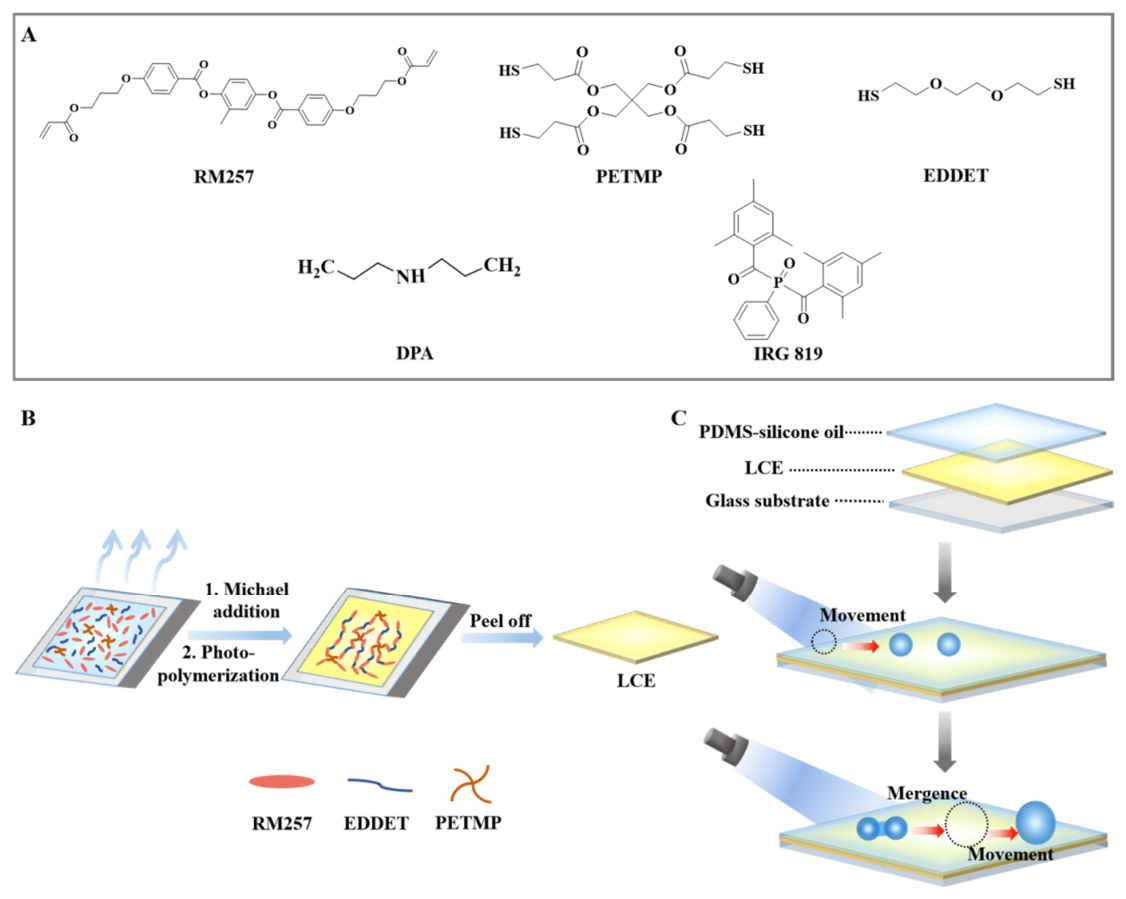
The photo-induced approach has attracted significant attention due to its advantages of non-contact operation and high spatio-temporal resolution. Nevertheless, existing photo-driven strategies typically incorporate photothermal agents directly into the droplets [31] or into composite surface substrates [32]. The former generates Marangoni forces via internal temperature gradients under direct irradiation but suffers from limited driving force, reactant contamination, and poor versatility. The latter, involving composite substrates, again remains constrained by complex fabrication process for micro-nanostructures. Liquid crystal elastomers (LCEs) are polymers that combine the molecular ordering of liquid crystals with the elasticity of cross-linked networks [33,34,35]. Their physical properties can change dynamically in response to external stimuli such as electricity, light, magnetism, or solvents, offering a promising solution for efficient, low-contamination droplet manipulation on open surfaces. As demonstrated by Jin et al. [36], undoped LCE exhibits a pronounced photothermal heating effect under moderate light intensity, indicating its excellent light-induced thermal responsiveness. In another approach, Gao et al. [15] achieved photothermally driven droplet motion on a photo-responsive organogel surface (POS) by doping PDMS with Fe3O4 nanoparticles as photothermal agents and constructing micro/nanostructured surfaces. In the present work, we take advantage of the light-induced thermal response of LCE to generate a sufficient temperature gradient across the droplet, which in turn alters the surface tension and drives droplet movement. In the present study, we take advantage of the intrinsic photothermal effect of LCEs. Under UV irradiation, the surface exhibits a significant temperature rise without the need for additional photothermal additives. By generating localized thermal gradients, the resulting asymmetric contact angles of the droplet enable non-contact and rapid directional water droplet transport on a pre-lubricated polydimethylsiloxane (PDMS) surface (Figure 1), demonstrating a versatile approach for the development of advanced smart surfaces.

2. Materials and Methods

2.1. Materials and General Measurement

1,4-Bis-[4-(3-acryloyloxypropyloxy)benzoyloxy]-2-methylbenzene (RM257) was purchased from Henan Dakeng Chemical Products Co., Ltd. (Zhengzhou, China) 3,6-dioxo-1,8-octanedisulfide (EDDET, 95%), pentaerythritol tetra-3-mercaptopropionate (PETMP, 98%), dichloromethane (DCM, 99.5%) and n-propylamine (DPA, 99%) were sourced from Energy Chemical and used in their original form (Shanghai, China). The photoinitiator IRG819 was obtained from Tianjin Xiansheng Biochemical Technology Co., Ltd. (Tianjin, China). Silicone oil (5 cSt) was supplied by Dow Corning (Midland, MI, USA). PDMS precursors and curing agents (Sylgard 184) were also sourced from Dow Corning. Infrared thermal imaging videos were captured using an FLIR ONE PRO thermal imaging camera (FLIR Systems, Wilsonville, OR, USA) equipped with FLIR ONE software (version 3.1.0, FLIR Systems, Wilsonville, OR, USA). Differential scanning calorimetry (DSC) thermograms were recorded on a DSC 300 Caliris Classic instrument (NETZSCH, Selb, Germany) at a heating/cooling rate of 5 °C/min under a nitrogen atmosphere. Thermogravimetric analysis (TGA) was performed on a TG 309 Libra instrument (NETZSCH, Selb, Germany). Sliding angles (SAs) and water contact angles (WCAs) were measured using a Dataphysics OCA20 instrument (Dataphysics, Filderstadt, Germany). Fourier transform infrared (FTIR) spectra were obtained on a Nicolet iS50 spectrometer (Thermo Fisher Scientific, Waltham, MA, USA).

2.2. The Preparation of LCE

2.2.1. Preparation of LCE (PETMP-0, PETMP-20, PETMP-40)

The preparation of LCE was conducted according as the initial experiments [37]. To investigate the effect of PETMP content, LCE samples with thiol mole fractions from PETMP of 0%, 20%, and 40% relative to the total thiol groups were prepared, denoted as PETMP-0, PETMP-20, and PETMP-40, respectively. The feed amounts of EDDET and PETMP were correspondingly adjusted to maintain a constant total molar amount of thiol groups. The detailed compositions of each formulation are listed in Table S1. RM257, EDDET, PETMP, and the catalyst DPA (10 μL) were dissolved in DCM (4 mL), and the mixture was ultrasonicated at room temperature for 10 min. The resulting solution was then transferred into a polytetrafluoroethylene (PTFE) mold (groove dimensions: 4.0 cm × 4.0 cm × 1.3 cm) and allowed to stand at room temperature for 24 h to enable the Michael addition reaction to proceed fully, during which the solvent was slowly evaporated, yielding a flat gel-state film. The obtained film was subsequently dried in a vacuum oven at 30 °C for 24 h to remove residual solvent, affording the final LCE films.

2.2.2. Preparation of LCE (PETMP-40-IRG819)

A mixture of RM257 (0.7032 g, 1.19 mmol), EDDET (0.1268 g, 0.70 mmol), PETMP (0.1134 g, 0.23 mmol), Irgacure 819 (1 wt%), DPA (10 μL), and DCM (4 mL) was uniformly dispersed by ultrasonication at room temperature for 10 min. The uniformly dispersed mixture was then transferred into a square polytetrafluoroethylene (PTFE) mold (with a groove dimension of 4 cm long × 4.0 cm wide × 1.3 cm high). The sample was pre-cross-linked at room temperature for 24 h to obtain a smooth film. Subsequently, the film was polymerized under ultraviolet light for 15 min. After photopolymerization, the obtained LCE films were thoroughly washed with anhydrous ethanol to extract residual Irgacure 819 photoinitiator, and then dried under vacuum at room temperature to constant weight. The resulting LCE films, with a thickness of approximately 2 mm (Figure S3), were designated as PETMP-40-IRG819.

2.3. The Preparation of PDMS-Silicone Oil and PDMS-Silicone Oil/LCE

The PDMS precursor and curing agent are thoroughly mixed in a 10:1 mass ratio to form a PDMS prepolymer. This prepolymer is then poured into a square PTFE mold. After defoaming, the mold is placed on a 70 °C heating platform and heated for 1 h. Once the PDMS prepolymer has fully polymerized, it is demolded to yield the PDMS film. Silicone oil was added to a Petri dish to completely immerse the PDMS film for 24 h. The film was then placed vertically to remove excess silicone oil, affording a PDMS film with a lubricating surface layer and a thickness of approximately 1.5 mm (Figure S3), designated as PDMS-silicone oil. A simple composite of LCE and PDMS-silicone oil forms a light-responsive surface capable of driving droplet movement, hereafter referred to as PDMS-silicone oil/LCE.

2.4. Photo-Controlled Droplet Movement

A 5 μL droplet of deionized water was deposited onto the PDMS-silicone oil/LCE composite surface. The left side of the droplet was then exposed to UV light (365 nm, 250 mW/cm2) to generate a wetting gradient on the surface, which drove the droplet to move toward the non-irradiated region.

3. Results and Discussion

3.1. Preparation of Photo-Responsive Liquid Crystal Elastomers

Preparation of the LCE is key to the photo-responsive system. We employed a series of liquid crystal monomers [37] as the initial experiments. The preparation of the LCE involves two main steps (Figure 1): (1) the first step is a thiol-acrylate Michael addition reaction in the presence of catalyst di-propyl amine to extend the polymer chain; (2) the second step is photopolymerization of the excess acrylate after all the solvent evaporates to generate the targeted LCE film. Detailed procedures are illustrated in Section 2.
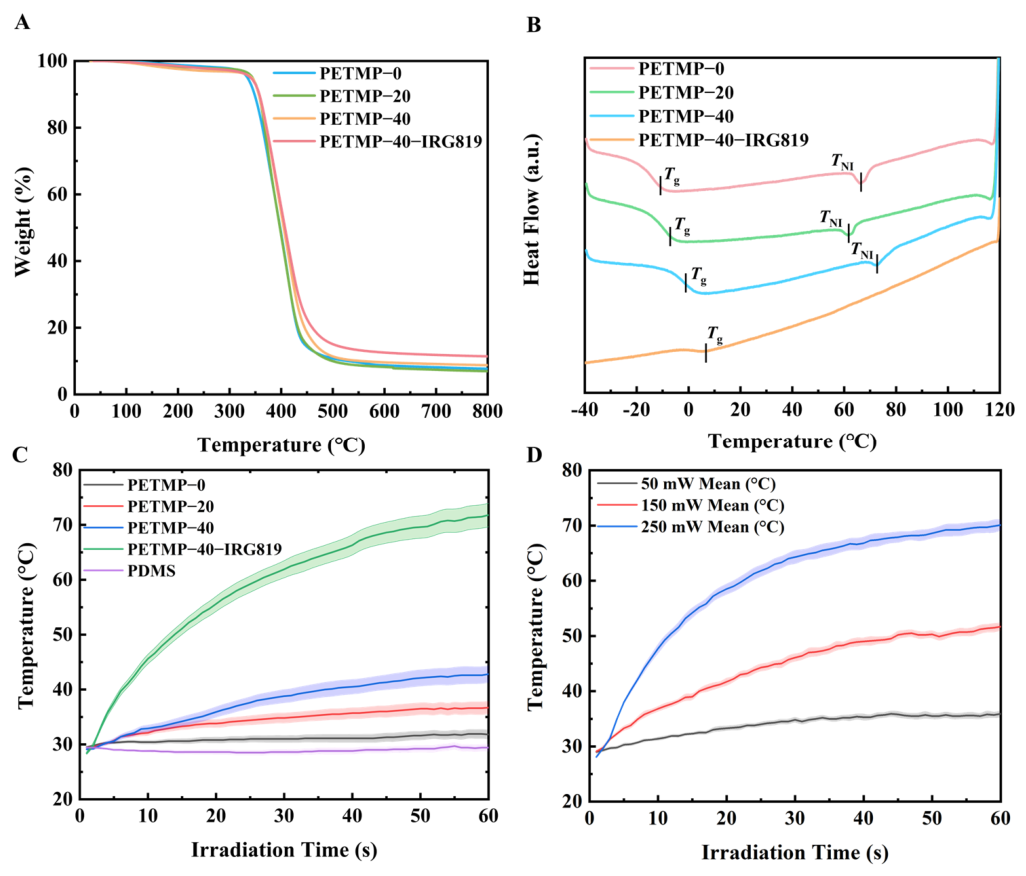
After obtaining the LCE film, we screened the amount of cross-linker pentaerythritol tetrakis(3-mercaptopropionate) (PETMP). Three samples were prepared, in which the molar ratio of thiol groups in PETMP relative to the total thiol groups was 0% (PETMP-0), 20% (PETMP-20), and 40% (PETMP-40), respectively. Fourier transform infrared spectroscopy (FTIR) was used to monitor the completion of the Michael addition reaction in the samples. The peak at 2560 cm−1 corresponds to the stretching vibration of the S-H bond in EDDET and PETMP (Figure S1A). The disappearance of the S-H peak indicates the occurrence of a Michael addition reaction between the S-H bond and the acrylate group. As shown in the thermogravimetric analysis (TGA) curves in Figure 2A, all three samples remained stable below approximately 300 °C, indicating excellent thermal stability. Differential scanning calorimetry (DSC) results revealed two distinct thermal transitions for the three samples with varying PETMP contents. As illustrated in Figure 2B, PETMP-0 exhibits a glass transition temperature (Tg) of approximately −12.07 °C and a nematic-to-isotropic phase transition temperature (TNI) of about 66.13 °C. For the PETMP-20, and PETMP-40 samples, the Tg values were −8.75 °C, and −1.35 °C, respectively. The Tg values shifted toward higher temperatures with increasing amount of PETMP, suggesting that the addition of PETMP restricts polymeric chain mobility and increases the cross-linking density of the LCEs [38]. Furthermore, the TNI of PETMP-40 (72.86 °C) was higher than that of PETMP-20 (62.23 °C). These variations are attributed to the increased cross-linking points formed by the tetrafunctional thiol PETMP, which affects the cross-linking density and the energy required for chain disordering [39], thereby influencing the phase transition characteristics of the LCEs. These shifts in thermal transition temperatures demonstrate that the amount of PETMP significantly modulates the cross-linking density of the samples.
The photothermal properties of the above three samples under UV irradiation (l = 365 nm) were evaluated. As captured by infrared (IR) thermal imaging (Movies S1–S3), PETMP-40 displayed the superior photothermal response compared to other compositions under identical irradiation conditions, highlighting the correlation between amount of PETMP and the LCE’s photothermal efficiency. Furthermore, sample PETMP-40-IRG819 was prepared by introducing a photoinitiator into the PETMP-40 system to further complete the polymerization of any remaining free acrylate groups to enhance the cross-linking density of the polymeric chains. As illustrated by the DSC curves in Figure 2B, the glass transition temperature (Tg) of PETMP-40-IRG819 (7.45 °C) is higher than that of PETMP-40 (−1.35 °C). The increase in cross-linking density within the network hampers the chain mobility and increases segmental movement resistance. As a result, the TNI peak of PETMP-40-IRG819 broadens and weakens, eventually disappearing.
The rapid temperature increasing observed in PETMP-40-IRG819 (Figure 2C and Movie S4) under UV irradiation confirms that addition of the photoinitiator contributes to the photothermal behavior of LCEs. The intensity-dependent photothermal response is depicted in Figure 2D, showing a positive correlation between UV intensity and heat generation (Movie S5). These results unambiguously indicate that our prepared LCE system possesses intrinsic photothermal capabilities under UV exposure, without the need for additional photothermal conversion particles. As the sample PETMP-40-IRG819 showed the optimal photothermal efficiency, it was used as the LCE layer for the rest of the present study.

3.2. Preparation of Surfaces for Droplet Movement

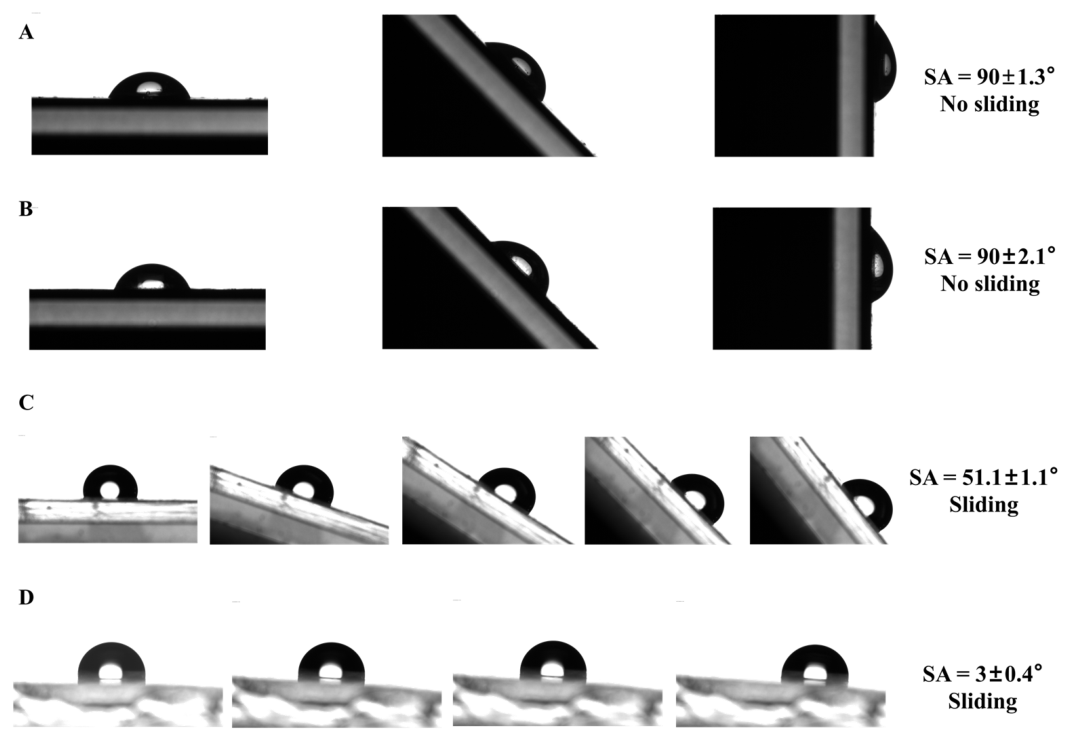
Reducing surface friction through increased smoothness is essential for minimizing droplet transport resistance and achieving efficient manipulation. Sliding angles (SAs) were used to provide a quantitative basis for selecting optimal surfaces. Initially, a water droplet was placed directly on the surface of the prepared LCE film and high SAs (90°) were found, indicating significant adhesion and resistance. The droplets remained stationary even at a tilt angle of 90° (Figure 3A and Movie S6). Furthermore, treating the LCE surface with silicone oil failed to yield substantial improvements (Figure 3B). Instead, polydimethylsiloxane (PDMS) was employed as the contact interface to further mitigate adhesion. The pure PDMS surface yielded an SA of 51.1°, with droplets sliding spontaneously at a 51.1° incline (Figure 3C). To further optimize the performance, the PDMS was infused with silicone oil to form a more lubricating layer. The SA of the PDMS-silicone-oil surface decreased to 3°, enabling droplet movement at a tilt of only 3° (Figure 3D). Therefore, the PDMS-silicone-oil layer was selected as the surface for droplet movement. It is expected that by integrating the LCE underneath the PDMS-silicone-oil surface, the photothermal effect induced by LCE generates a temperature gradient that drives directional droplet migration. As a control experiment, PDMS showed negligible temperature variation under the same irradiation conditions when compared to that of LCE (Movie S7), indicating the photothermal effect was solely provided by LCE layer.
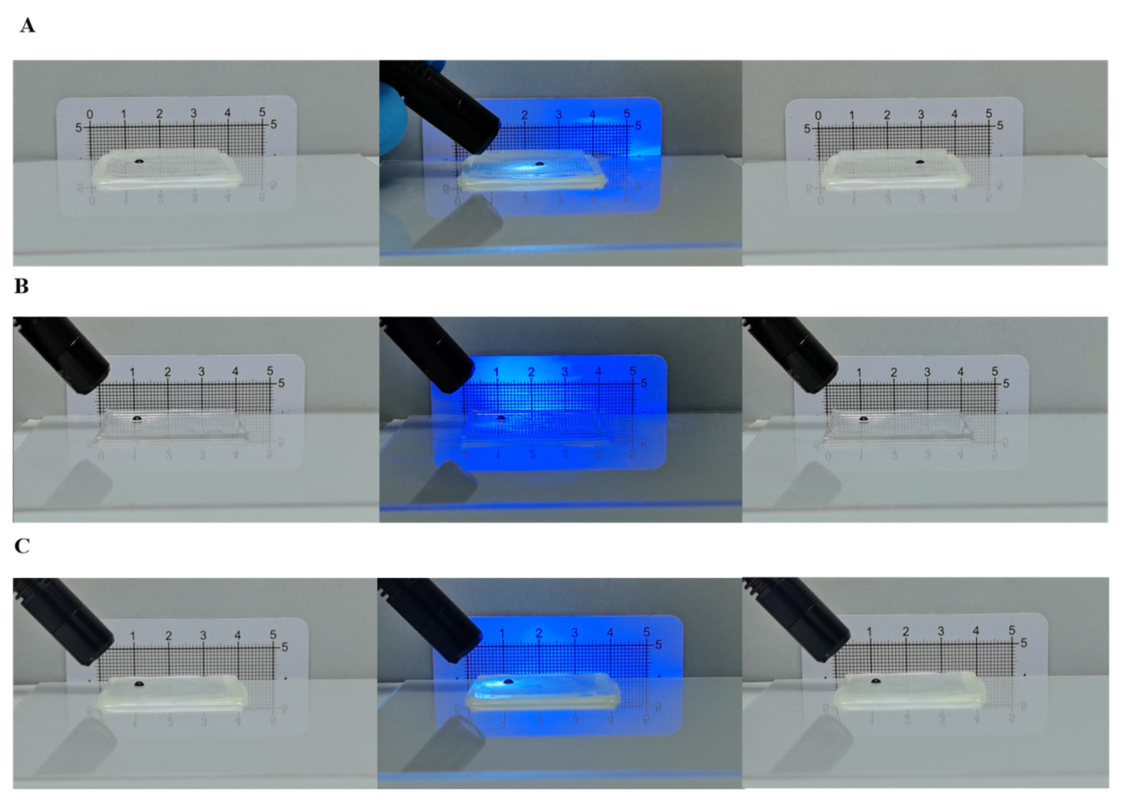
An LCE layer was then positioned underneath the PDMS-silicone-oil surface to form a PDMS-silicone oil/LCE composite (Figure 1C). To facilitate optical imaging and observation, a droplet (5 μL) placed onto the surface was dyed with a black pigment (Figure 4A). It was observed that upon local irradiation on the left side of the droplet, the temperature in that region rose significantly, triggering a transition from a stationary to a mobile state (Movie S8). Specifically, the droplet traveled 16 mm within approximately 34 s, yielding an average velocity of 0.47 mm/s. Notably, the droplet motion ceased promptly once the light source was switched off (Figure 4A). For comparison, control experiments were conducted by placing droplets on surfaces of PDMS, PDMS-silicone-oil, PDMS/LCE and LCE-silicone-oil under identical irradiation conditions, respectively (Movies S9–S12). While the PDMS and PDMS-silicone-oil samples exhibited a slight temperature increase, no droplet movement was detected (Figure S2A and Figure 4B). For the PDMS/LCE and LCE-silicone-oil samples, despite a significant temperature elevation (Movies S11 and S12) under UV irradiation, the droplets remained immobile (Figure 4C and Figure S2B). These findings underscore that the synergy between the photothermal-induced temperature gradient from the LCE and the low-friction provided by PDMS-silicone-oil surface is essential for successful droplet transport.
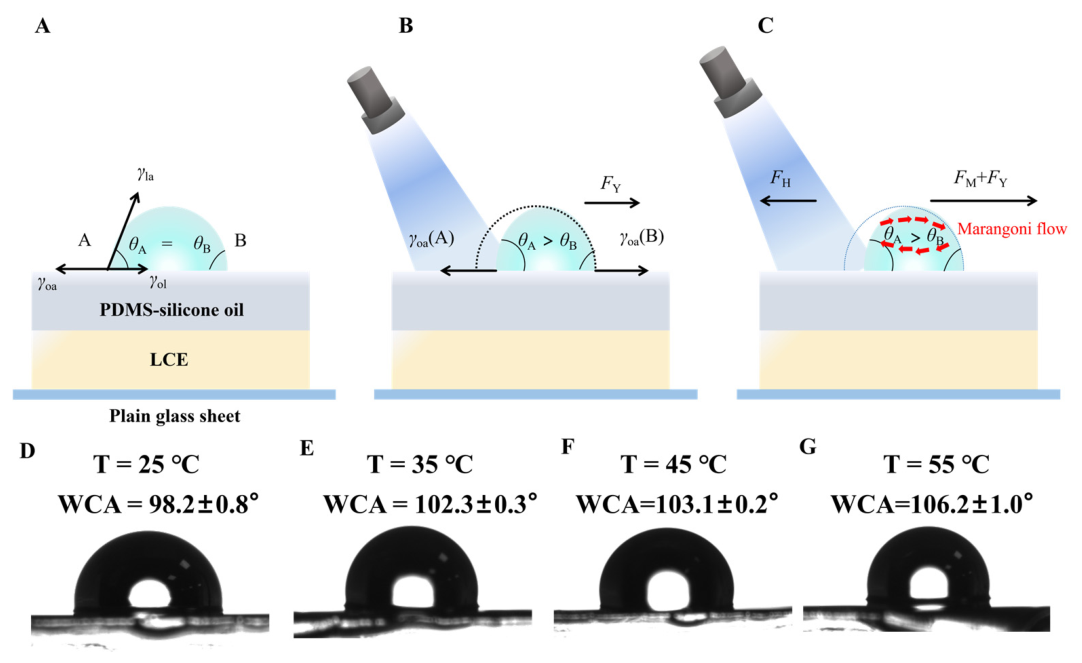
Further investigations were conducted to elucidate the mechanism underlying the photo-triggered movement of the droplet. In the absence of UV irradiation, the droplet remains in an equilibrium state (Figure 5A), where the contact angles on both sides are equal (θA = θB). The relationship between the contact angle and the interfacial tension can be described by Young‘s equation [40]:
γ ol + γ la cos θ = γ oa
where γla, γoa and γol represent the interfacial tensions of the liquid–air, oil–air, and oil–liquid interfaces, respectively. As illustrated in Figure 5B, when UV light was applied to side A of the droplet, the LCE layer in the substrate generates a photothermal effect, leading to a rapid localized temperature increase. According to Young’s equation, this temperature rise induces a decrease in the interfacial tension γoa (A) in the localized region, causing θA to increase. Consequently, the condition θA > θB disrupts the original equilibrium of the contact angles, generating a wetting gradient force, referred to as FY (Young‘s force), which drives the droplet [41]. Furthermore, the droplet is also subject to the Marangoni force (FM) arising from the variation in surface tension [42]. The Marangoni force (FM) arises from the temperature gradient at the gas–liquid interface, as illustrated in Figure 5C. Owing to heat transfer between the composite surface and the droplet, a significant dynamic heat source is established on side A of the droplet, whereas no such heat source appears on side B. The resulting spatial distribution of surface tension, induced by the temperature gradient at the gas–liquid interface, generates an additional tangential stress (FM) directed from the higher-temperature side toward the lower-temperature side. Based on the force analysis, the droplet initiates rightward movement when the sum of FY + FM exceeds the surface resistance force (FH) (Figure 5C). The expressions for FY and FM are given by Equation (2) and Equation (3), respectively [42]:
F Y 2 R ( cos θ B cos θ A ) γ la
F M π R 2 d γ la d T dT dx
The temperature-dependent variation in water contact angle (WCA) for droplets on the PDMS-silicone-oil surface is illustrated in Figure 5D–F. It was observed that the contact angle is 98.2° at room temperature, and increases to 102.3°, 103.1°, and 106.2° at 35 °C, 45 °C, and 55 °C, respectively (Figure 5D–F). The water contact angle exhibits an upward trend with increasing temperature. These results validate that the temperature rise induced by the photothermal effect of the LCE layer can modulate the contact angle on the lubricant-infused PDMS-silicone-oil surface, thereby driving the directional transport of the water droplet. Furthermore, to validate the existence of the Marangoni force within the droplet, a dye droplet was incorporated as tracers. Upon UV irradiation on the left side of the droplet, a distinct flow of the dye was observed (Movie S13). This observation confirms that during photo-induced transport, the droplet is indeed subjected to the Marangoni force (FM), which arises from surface tension variations induced by the temperature gradient across the droplet.
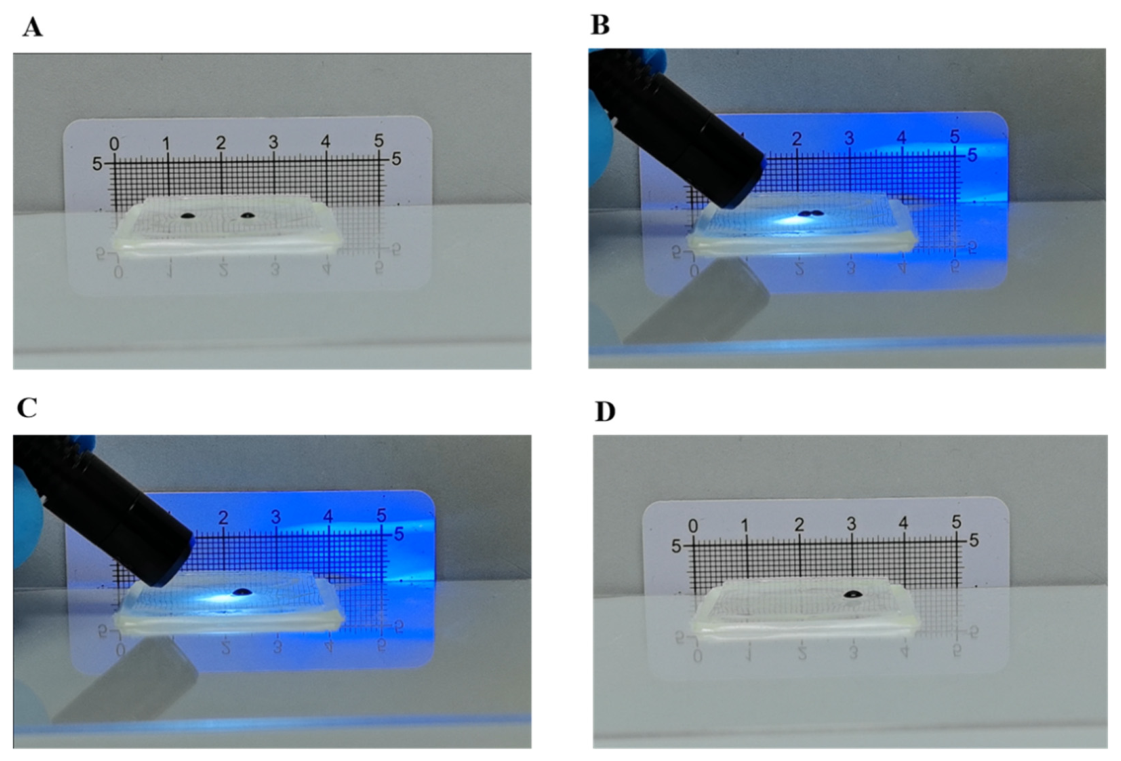
In this study, instead of introducing photothermal nanoparticles into either the droplet or the functional surface, we harnessed the light-induced thermal response of the cross-linked LCE network as the driving force source, combined with a low-friction, smooth PDMS-silicone-oil surface as the direct contact interface for the droplet. Upon light irradiation, the localized temperature rise generated in the LCE layer of the composite surface alters the oil–water interfacial tension on one side of the droplet through heat transfer, thereby creating a differential interfacial tension across the two sides of the droplet. This disrupts the equilibrium of the droplet contact angle, giving rise to the wetting gradient driving force and the Marangoni force resulting from the surface tension gradient. Together, these two forces break the original force balance of the droplet, enabling its directional movement on the surface. In addition to transporting single droplets with UV light, we employed the same conditions to drive a 5 μL droplet to merge with another 5 μL droplet (Figure 6 and Movie S14). The coalesced 10 μL droplet (Figure 6C,D) was able to continued its movement under UV irradiation, covering a distance of 7 mm in 25 s at a rate of ~0.28 mm/s, reflecting the influence of droplet volume on transport speed. This result indicates that our prepared composite system is capable of driving droplets with different volumes, thereby confirming the versatility of our approach.

4. Conclusions

We have successfully developed a composite system consisting of an LCE layer and a pre-lubricant PDMS-silicone-oil layer. Without the need for additional photothermal nanoparticles in either the droplets or the functional surface, this system exploits the light-induced thermal response of the cross-linked LCE network under ultraviolet irradiation to disrupt the contact angle equilibrium of a water droplet, thereby enabling rapid and directional droplet motion on the surface. This approach enables non-contact and rapid manipulation of droplets of various sizes on open surfaces. The underlying mechanism governing droplet transport was systematically elucidated through infrared thermal imaging, contact angle measurements, and control experiments. In the future, by leveraging the stimuli-responsiveness and programmable deformation capability of LCEs, we envision that the dynamic regulation of surface topography can be synergistically combined with photothermally induced wetting gradients to enable precise, on-demand control over the direction and trajectory of droplet motion. Coupled with localized patterned illumination, this strategy holds promise for parallel manipulation of multiple droplets on a single surface. Furthermore, it also shows broad application prospects in bioinspired interfacial fields such as fog harvesting, self-cleaning, and anti-icing.

Supplementary Materials

The following supporting information can be downloaded at https://www.mdpi.com/article/10.3390/chemistry8090116/s1. Figure S1. (A) Infrared spectra of RM257, EDDET, PETMP, PETMP-0, PETMP-20, and PETMP-40. (B) Infrared spectrum of PETMP-40-IRG819; Figure S2. (A) The motion of droplets on PDMS surface. (B) The motion of droplets on LCE-silicone-oil surface; Figure S3. (A) LCE thickness. (B) PDMS thickness; Movie S1. Photothermal response of PETMP-0 (IR); Movie S2. Photothermal response of PETMP-20 (IR); Movie S3. Photothermal response of PETMP-40 (IR); Movie S4. Photothermal response of PETMP-40-IRG819 (IR); Movie S5. Photothermal response of PETMP-40-IRG819 under different light intensities; Movie S6. Sliding angles on different surfaces; Movie S7. Photothermal response of PDMS (IR); Movie S8. Single droplet movement; Movie S9. The motion state of droplets on PDMS surface; Movie S10. The motion state of droplets on PDMS-silicone-oil surface; Movie S11. The motion state of droplets on PDMS/LCE surface; Movie S12. The motion state of droplets on LCE-silicone-oil surface; Movie S13. The Marangoni flow inside the droplet; Movie S14. The merging and movement of 5 μL droplets; Table S1. Composition of PETMP-0, PETMP-20, and PETMP-40.

Author Contributions

S.L.: experimental design, experimental implementation, data acquisition, and writing the first draft. Y.L.: partial experimental implementation and data acquisition. Y.D.: review and editing. J.C.: writing, review, and finalization of the manuscript. All authors have read and agreed to the published version of the manuscript.

Funding

This work was supported financially by the National Key R&D Program of China (2020YFE0100200) and Guangdong Basic and Applied Basic Research Foundation (2025A1515011287).

Data Availability Statement

The data that support the findings of this study are available from the corresponding author upon reasonable request.

Conflicts of Interest

The authors declare no conflicts of interest.

References

  1. Courtney, M.; Chen, X.; Chan, S.; Mohamed, T.; Rao, P.P.N.; Ren, C.L. Droplet Microfluidic System with On-Demand Trapping and Releasing of Droplet for Drug Screening Applications. Anal. Chem. 2016, 89, 910–915. [Google Scholar] [CrossRef] [Scilit]
  2. Kichatov, B.; Korshunov, A.; Sudakov, V.; Golubkov, A.; Ryapolov, P. Droplet manipulation in liquid flow using of magnetic micromotors for drug delivery and microfluidic systems. Colloids Surf. A 2024, 691, 133891. [Google Scholar] [CrossRef] [Scilit]
  3. Lea-Banks, H.; O’Reilly, M.A.; Hynynen, K. Ultrasound-responsive droplets for therapy: A review. J. Control. Release 2019, 293, 144–154. [Google Scholar] [CrossRef] [Scilit]
  4. Han, S.-I.; Kim, H.S.; Han, A. In-droplet cell concentration using dielectrophoresis. Biosens. Bioelectron. 2017, 97, 41–45. [Google Scholar] [CrossRef] [Scilit]
  5. Sun, G.; Teng, Y.; Zhao, Z.; Cheow, L.F.; Yu, H.; Chen, C.-H. Functional Stem Cell Sorting via Integrative Droplet Synchronization. Anal. Chem. 2020, 92, 7915–7923. [Google Scholar] [CrossRef] [Scilit]
  6. Hu, R.; Liu, P.; Chen, P.; Wu, L.; Wang, Y.; Feng, X.; Liu, B.-F. Encapsulation of single cells into monodisperse droplets by fluorescence-activated droplet formation on a microfluidic chip. Talanta 2016, 153, 253–259. [Google Scholar] [CrossRef] [Scilit]
  7. Jiao, L.; Li, D.; Li, W.; Chen, R.; Zhu, X.; Liao, Q.; Ye, D.; Zhang, B.; Wang, H. Light-actuated droplets coalescence and ion detection on the CAHTs-assisted superhydrophobic surface. Sens. Actuators B-Chem. 2019, 282, 469–481. [Google Scholar] [CrossRef] [Scilit]
  8. Schwartz, J.A.; Vykoukal, J.V.; Gascoyne, P.R.C. Droplet-based chemistry on a programmable micro-chip. Lab Chip 2004, 4, 11–17. [Google Scholar] [CrossRef] [Scilit]
  9. Shang, L.; Cheng, Y.; Zhao, Y. Emerging Droplet Microfluidics. Chem. Rev. 2017, 117, 7964–8040. [Google Scholar] [CrossRef] [Scilit]
  10. Amirifar, L.; Besanjideh, M.; Nasiri, R.; Shamloo, A.; Nasrollahi, F.; de Barros, N.R.; Davoodi, E.; Erdem, A.; Mahmoodi, M.; Hosseini, V.; et al. Droplet-based microfluidics in biomedical applications. Biofabrication 2022, 14, 022001. [Google Scholar] [CrossRef] [Scilit]
  11. Xu, Y.; Zeng, Y.; Hou, Z.; Li, M.; Wu, X.; Qiu, Y.; Mou, Y.; Luo, S.; Lu, D. Programmable Triboelectric Wetting Interface for Multifunctional Droplet Manipulation on Tracks. Adv. Funct. Mater. 2025, 36, e07045. [Google Scholar] [CrossRef] [Scilit]
  12. Chen, G.; Dai, Z.; Li, S.; Huang, Y.; Xu, Y.; She, J.; Zhou, B. Magnetically Responsive Film Decorated with Microcilia for Robust and Controllable Manipulation of Droplets. ACS Appl. Mater. Interfaces 2021, 13, 1754–1765. [Google Scholar] [CrossRef] [Scilit]
  13. Jung, S.; Song, R.; Kim, J.; Ko, J.H.; Lee, J. Controlling the Release of Amphiphilic Liposomes from Alginate Hydrogel Particles for Antifouling Paint. Langmuir 2020, 36, 1515–1522. [Google Scholar] [CrossRef] [Scilit]
  14. Zhang, K.; Cai, C.; Sun, H.; Wu, Y.; Xie, Z. Flexible modulation of droplet concentrations via AC electrothermal flow for fabrication of crystalline drug particles. Sens. Actuators B-Chem. 2025, 444, 138486. [Google Scholar] [CrossRef] [Scilit]
  15. Gao, C.; Wang, L.; Lin, Y.; Li, J.; Liu, Y.; Li, X.; Feng, S.; Zheng, Y. Droplets Manipulated on Photothermal Organogel Surfaces. Adv. Funct. Mater. 2018, 28, 1803072. [Google Scholar] [CrossRef] [Scilit]
  16. Wen, G.; Qiao, D.; Fan, Y.; Zhong, Z.; Tian, X.; Huang, S. Chemically grafted perfluoropolyether liquid-like coating enhances droplet transport under surface acoustic wave actuation. Chin. Chem. Lett. 2025, 112241. [Google Scholar] [CrossRef] [Scilit]
  17. Liu, C.; Sun, Y.; Huanng, J.; Guo, Z.; Liu, W. External-field-induced directional droplet transport: A review. Adv. Colloid Interface Sci. 2021, 295, 102502. [Google Scholar] [CrossRef] [Scilit]
  18. Hou, Y.; Xu, J.; Lian, Z.; Sun, L.; Lv, Y.; Wang, J.; Chen, G.; Yu, H. Superhydrophobic NiTi shape memory alloy arrays with switchable controlled anisotropic droplet sliding. Surf. Coat. Technol. 2024, 478, 130453. [Google Scholar] [CrossRef] [Scilit]
  19. Chen, Y.; Li, K.; Zhang, S.; Qin, L.; Deng, S.; Ge, L.; Xu, L.-P.; Ma, L.; Wang, S.; Zhang, X. Bioinspired Superwettable Microspine Chips with Directional Droplet Transportation for Biosensing. ACS Nano 2020, 14, 4654–4661. [Google Scholar] [CrossRef] [Scilit]
  20. Zhang, L.; Zhao, J.; Xu, J.; Zhao, J.; Zhu, Y.; Li, Y.; You, J. Switchable Isotropic/Anisotropic Wettability and Programmable Droplet Transportation on a Shape-Memory Honeycomb. ACS Appl. Mater. Interfaces 2020, 12, 42314–42320. [Google Scholar] [CrossRef] [Scilit]
  21. Liang, X.; Guo, Z. Mechano-adjusted anisotropic surface for manipulating water droplets. Chem. Eng. J. 2020, 395, 125110. [Google Scholar] [CrossRef] [Scilit]
  22. Huang, S.; Li, M.; Shu, C.; Su, Q.; Lu, Y.; Feng, K. Bamboo-shaped pumpless platform for long-distance and lossless droplet transport. Appl. Surf. Sci. 2023, 609, 155212. [Google Scholar] [CrossRef] [Scilit]
  23. Sun, X.; Wang, X.; Guo, P.; Jiang, L.; Heng, L. Photoelectric synergistic anisotropic slippery interface for directional droplets manipulation. Nanoscale 2023, 15, 14523–14530. [Google Scholar] [CrossRef] [Scilit]
  24. Kim, J.G.; Im, D.J.; Jung, Y.M.; Kang, I.S. Deformation and motion of a charged conducting drop in a dielectric liquid under a nonuniform electric field. J. Colloid Interface Sci. 2007, 310, 599–606. [Google Scholar] [CrossRef] [Scilit]
  25. Mhatre, S. Dielectrophoretic motion and deformation of a liquid drop in an axisymmetric non-uniform AC electric field. Sens. Actuators B-Chem. 2017, 239, 1098–1108. [Google Scholar] [CrossRef] [Scilit]
  26. Yang, C.; Wu, L.; Li, G. Magnetically Responsive Superhydrophobic Surface: In Situ Reversible Switching of Water Droplet Wettability and Adhesion for Droplet Manipulation. ACS Appl. Mater. Interfaces 2018, 10, 20150–20158. [Google Scholar] [CrossRef] [Scilit]
  27. Yang, C.; Ning, Y.; Ku, X.; Zhuang, G.; Li, G. Automatic magnetic manipulation of droplets on an open surface using a superhydrophobic electromagnet needle. Sens. Actuators B-Chem. 2018, 257, 409–418. [Google Scholar] [CrossRef] [Scilit]
  28. Yang, Y.; Chen, R.; Zhu, X.; Ye, D.; Yang, Y.; Li, W.; Li, D.; Li, H.; Liao, Q. Light-Fueled Submarine-Like Droplet. Adv. Sci. 2022, 9, 2201341. [Google Scholar] [CrossRef] [Scilit]
  29. Liu, Y.; Gao, H.; Li, S.; Han, Z.; Ren, L. Bioinspired platform with reversibly switchable wettability for transfer and storage of droplets. Chem. Eng. J. 2018, 337, 697–708. [Google Scholar] [CrossRef] [Scilit]
  30. Yang, X.; Zhuang, K.; Lu, Y.; Wang, X. Creation of Topological Ultraslippery Surfaces for Droplet Motion Control. ACS Nano 2020, 15, 2589–2599. [Google Scholar] [CrossRef] [Scilit]
  31. Hwang, H.; Papadopoulos, P.; Fujii, S.; Wooh, S. Driving Droplets on Liquid Repellent Surfaces via Light-Driven Marangoni Propulsion. Adv. Funct. Mater. 2022, 32, 2111311. [Google Scholar] [CrossRef] [Scilit]
  32. Wang, Y.; Sun, Y.; Xue, Y.; Wang, F.; Liang, W.; Wang, Y.; Zhu, D.; Zhao, H. Near-infrared light-responsive functionalised surfaces with shape memory microstructure for droplet manipulation and anti-icing/de-icing. Surf. Interfaces 2023, 40, 103056. [Google Scholar] [CrossRef] [Scilit]
  33. Wu, M.-Z.; Zhou, Z.-H.; Hao, T.-T.; Liu, D.-P.; Duan, L.-L.; Qi, J.-W.; Xie, H.-L. Conductive Liquid Crystal Elastomers Enabled by Deep Eutectic Solvent for Temperature Warning Systems. ACS Appl. Mater. Interfaces 2025, 17, 58648–58658. [Google Scholar] [CrossRef] [Scilit]
  34. Hussain, M.; Jull, E.I.L.; Mandle, R.J.; Raistrick, T.; Hine, P.J.; Gleeson, H.F. Liquid Crystal Elastomers for Biological Applications. Nanomaterials 2021, 11, 813. [Google Scholar] [CrossRef] [Scilit]
  35. Kularatne, R.S.; Kim, H.; Boothby, J.M.; Ware, T.H. Liquid crystal elastomer actuators: Synthesis, alignment, and applications. J. Polym. Sci. Part B Polym. Phys. 2017, 55, 395–411. [Google Scholar] [CrossRef] [Scilit]
  36. Jin, B.; Chen, G.; Chen, Y.; Yang, C.; Zhu, Z.; Weng, Y.; Zhao, Q.; Xie, T. Reprogramming Photoresponsive Liquid Crystalline Elastomer via Force-Directed Evaporation. ACS Appl. Mater. Interfaces 2024, 16, 16844–16852. [Google Scholar] [CrossRef] [Scilit]
  37. Wang, M.; Cheng, Z.-W.; Zuo, B.; Chen, X.-M.; Huang, S.; Yang, H. Liquid Crystal Elastomer Electric Locomotives. ACS Macro Lett. 2020, 9, 860–865. [Google Scholar] [CrossRef] [Scilit]
  38. Zhang, Y.; Song, C.; Bao, J.; Li, Z.; Wang, Z.; Xiao, J.; Yu, M.; Gao, Y.; Zhang, L.; Lan, R.; et al. Near-infrared light-driven liquid crystalline elastomers with simultaneously enhanced actuation strain and stress. Sci. China Mater. 2023, 66, 4803–4813. [Google Scholar] [CrossRef] [Scilit]
  39. Liu, H.; He, Y.; Luo, J.; Li, N.; Wang, T.; Song, E.; Guo, Q.; Ma, Z.; Yang, Z.; Gan, J.; et al. Multimodal Actuation and Precise Control in Liquid Crystal Elastomer Optical Fiber Artificial Muscles. Adv. Mater. 2025, 37, e05776. [Google Scholar] [CrossRef] [Scilit]
  40. Smith, J.D.; Dhiman, R.; Anand, S.; Reza-Garduno, E.; Cohen, R.E.; McKinley, G.H.; Varanasi, K.K. Droplet mobility on lubricant-impregnated surfaces. Soft Matter 2013, 9, 1772–1780. [Google Scholar] [CrossRef] [Scilit]
  41. Brzoska, J.B.; Brochard-Wyart, F.; Rondelez, F. Motions of droplets on hydrophobic model surfaces induced by thermal gradients. Langmuir 1993, 9, 2220–2224. [Google Scholar] [CrossRef] [Scilit]
  42. Nikolov, A.D.; Wasan, D.T.; Chengara, A.; Koczo, K.; Policello, G.A.; Kolossvary, I. Superspreading driven by Marangoni flow. Adv. Colloid Interface Sci. 2002, 96, 325–338. [Google Scholar] [CrossRef] [Scilit]
Figure 1. (A) Components of liquid crystal elastomers. (B) Preparation of liquid crystal elastomers. (C) Schematic diagram of photo-triggered directional movement of water droplets on surfaces.
Chemistry 08 00116 g001
Figure 2. Characterization of PETMP-0, PETMP-20, PETMP-40, and PETMP-40-IRG819. (A) TGA curve. (B) DSC curve. (C) Temperature versus time under UV (λ = 365 nm) irradiation (250 mW/cm2). (D) Temperature changes in PETMP-40-IRG819 under irradiation with different UV light intensity. Solid lines represent the mean values, and the surrounding shaded areas denote the standard deviation (SD) of three independent measurements.
Chemistry 08 00116 g002
Figure 3. Sliding angle. (A) Droplet on LCE surface. (B) Droplet on LCE surface treated with silicone oil (LCE-silicone oil). (C) Droplet on PDMS surface. (D) Droplet on PDMS surface treated with silicone oil (PDMS-silicone oil).
Chemistry 08 00116 g003
Figure 4. Photo-triggered directional movement of droplets on different surfaces. (A) Droplets on the PDMS-silicone-oil/LCE surface. (B) Droplets on the PDMS-silicone-oil surface. (C) Droplets on the PDMS/LCE surface. (Light intensity: 250 mW/cm2.)
Chemistry 08 00116 g004
Figure 5. Proposed mechanism of photo-triggered droplet motion. (A) Droplet in equilibrium state. (B) Force driven by photothermal-induced wetting gradient. (C) Force analysis of droplet. Static water contact angle (WCA) of droplet at different temperatures. (D) The static contact angle at a temperature of 25 °C. (E) The static contact angle at a temperature of 35 °C. (F) The static contact angle at a temperature of 45 °C. (G) The static contact angle at a temperature of 55 °C.
Chemistry 08 00116 g005
Figure 6. Photo-triggered liquid droplet merging and movement. (A) Without irradiation, two 5 μL droplets remain stationary. (B) Irradiation drives the first droplet, causing droplets to meet and initiate merging. (C) The resulting large droplet continues to move under irradiation. (D) When irradiation is ceased, the large droplet stops moving.
Chemistry 08 00116 g006
Disclaimer/Publisher’s Note: The statements, opinions and data contained in all publications are solely those of the individual author(s) and contributor(s) and not of MDPI and/or the editor(s). MDPI and/or the editor(s) disclaim responsibility for any injury to people or property resulting from any ideas, methods, instructions or products referred to in the content.