
Skip to Content
ChemistryChemistry
  • Article
  • Open Access

3 March 2026

Effects of Vibrationally Treated Aqueous Media on the Kinetics of Methylene Blue Reduction by Ascorbic Acid

,
,
,
and
OOO “NPF “Materia Medica Holding”, 47-1, Trifonovskaya St., 129272 Moscow, Russia
*
Author to whom correspondence should be addressed.

Abstract

As a primary reaction medium, water profoundly influences the kinetics and mechanisms of chemical processes. External physical treatments, such as vibration, can alter the physicochemical properties of water, thereby modifying reaction outcomes. This study aimed to investigate the effect of vibrational iterations (I0–I7) prepared using the “crossing” technology on the kinetics of the oxidation–reduction reaction between methylene blue and ascorbic acid, a standard model for evaluating external influences. Initial characterization revealed that while pH remained stable across all samples, electrical conductivity and dissolved oxygen levels deviated significantly from the control (intact water), with oxygen concentrations measuring either higher or lower than the control. Following the dissolution of methylene blue in these iterations, absorption spectroscopy was used to monitor decolorization kinetics. Different vibrational iterations influenced distinct kinetic parameters, including the rate constant, half-reaction time, and average reaction rate. Depending on the number of processing steps used to prepare the iterations, these parameters exhibited deviations ranging from 3% to 9% compared to the control. This suggests a complex relationship between the aqueous medium’s structural–dynamic properties and the reactants’ supramolecular organization. These findings underscore the potential of vibrational iterations as a tool for modulating chemical reaction kinetics through aqueous medium engineering. Further research is needed to elucidate the underlying mechanisms and expand the applicability of this approach to other systems.

1. Introduction

Water is the most common medium in which various substances interact, and its importance to nature is difficult to overestimate. The physicochemical properties, composition, and structure of the aqueous medium have a significant impact on the processes and chemical reactions. Specifically, the aqueous environment determines reagent conformation, supramolecular organization, and subsequent reactivity, influencing the formation of intermediate and final products [1,2,3,4,5,6]. This role is critical across various processes, including salt metathesis, acid–base and oxidation–reduction reactions, gelation, crystallization, and coordination interactions [7]. External physical treatments can significantly modulate internal structure and physicochemical properties of water [7,8,9,10,11,12,13]. For instance, vibrational treatment has been shown to alter pH, dissolved oxygen, hydrogen peroxide levels, and the distribution of optical heterogeneities [9,10,14,15]. Consequently, such external treatments directly impact both the reaction rate and thermodynamic efficiency. A notable example is the decomposition of sodium thiosulfate by sulfuric acid, where the reaction rate varies depending on the physicochemical properties of water, which had been subjected to vibration treatment and used to dissolve the reaction components [16].
Beyond solvent composition and structure, reaction yield is significantly influenced by the reagent mixing method [17]. For example, in glycosylation reactions, the component mixing technique has been shown to be more important than the nature of the glycosyl donor [18]. This observation is further supported by studies on the effect of the mixing method on the result of sialylation under phase-transfer catalysis [19,20]. It has been proposed that chemical reactions involve supramolecular aggregates (supramers) rather than isolated molecules, with the spatial orientation of reaction centers on these supramers determining the process outcome [21,22]. Moreover, the structure of these supramers is sensitive to external factors, including relatively “soft” effects such as mixing methodology [22]. Consequently, any external effects on the reaction medium, even seemingly subtle ones, can modulate the kinetics and mechanisms of chemical reactions through changes in the structure and properties of the solution.
Extensive research has demonstrated that solutions subjected to successive serial dilutions (where the calculated concentration of the solute approaches zero) exhibit physicochemical properties distinct from those of the solvent [15,23,24]. Such systems have been shown to contain nanoscale optical heterogeneities [8,25]. Furthermore, it is established that these highly diluted systems can modulate the physicochemical characteristics and functional capacities of substances at conventional concentrations [23,24,26,27,28].
A similar phenomenon, involving the alteration of a substance’s functional activity via a novel water treatment method termed “crossing technology,” was previously reported [16]. This technology involves simultaneous vibration treatment of the initial substance and the neutral carrier (ultrapure water) contained in adjacent, isolated vials. At this step, the initial substance exerts a “distant” effect on water, yielding a product designated as “iteration zero” (I0). Subsequent iterations are produced by subjecting a new portion of the neutral carrier to the same treatment in the presence of the preceding iteration; for instance, I0 acts upon untreated water to produce iteration No. 1 (I1). The resulting samples exhibit distinct physicochemical properties depending on the iteration number. Furthermore, these iterations demonstrate a “modifying effect” of varying magnitudes, significantly altering the physicochemical characteristics of the initial substance solution [16]. Similar distant influences of solutions subjected to successive serial dilutions on an aqueous medium have been independently demonstrated in multiple laboratories [24,29,30,31,32,33,34,35].
However, whether this phenomenon is universal across different chemical systems remains to be elucidated. The decolorization of methylene blue by ascorbic acid, a well-established model for investigating external influences on chemical reaction kinetics [36,37,38,39], was employed in this study. While previous research has thoroughly documented its dependence on factors such as temperature [40,41,42], ionic strength, pH [41,42,43], dissolved oxygen levels [39,43,44,45], and the presence of transition metals or catalysts [41,45], the role of the solvent’s preparation remains less explored. Therefore, this work focuses on evaluating the kinetic parameters of the reaction when vibrational iterations are utilized as the solvent medium. Specifically, we aimed to determine how the vibrational iterations of one reactant modulate the kinetics of this model chemical process.

2. Materials and Methods

2.1. Materials

The following reagents were used in the study: methylene blue (OOO KhimMiks, Ufa, Russia), ascorbic acid (Sigma-Aldrich, St. Louis, MO, USA), sodium hydroxide (AppliChem Panreac, Chicago, IL, USA), and sodium sulfate (Kupavna-Reaktiv, Moscow, Russia).

2.2. Sample Preparation

Vibrational iterations of methylene blue (I0–I7) were prepared using the previously described crossing technology [16]. In this study, an aqueous solution of methylene blue at a concentration of 0.35 mM, prepared from a weighed portion of the dry substance (OOO KhimMiks, Ufa, Russia), was used as the initial substance. Ultrapure water type 1 with a specific resistance of 18.2 MOhm × cm, obtained from PURELAB Option-Q (Elga LabWater, High Wycombe, UK), was used for the preparation of vibrational iterations and served as a diluent for all solutions. Vibrational iterations were prepared in vials made of transparent borosilicate glass (5 mL and 40 mL, Glastechnik Grafenroda, Grafenroda, Germany).
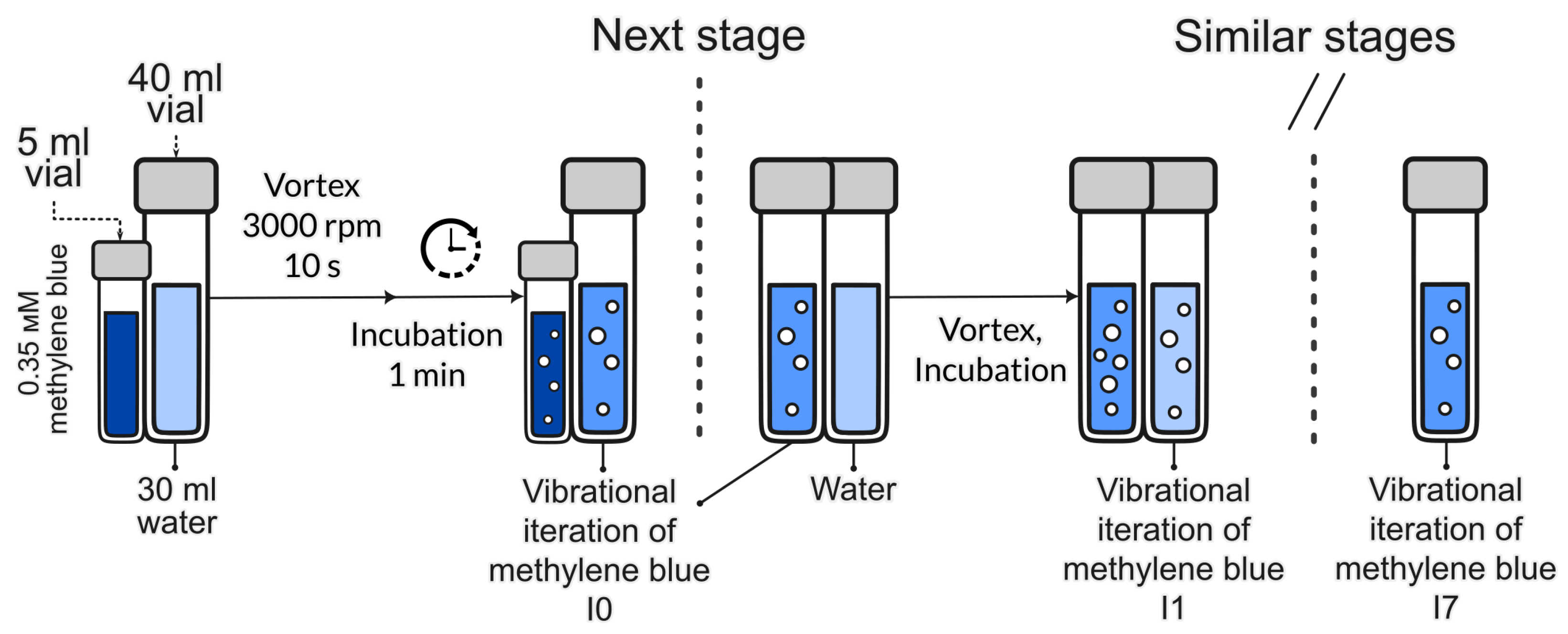
Vibrational iterations were prepared in several sequential stages as illustrated in Figure 1. To generate iteration I0, a sealed 5 mL transparent borosilicate glass vial containing 0.35 mM methylene blue solution was placed in direct contact with a sealed 40 mL vial containing 30 mL of ultrapure water. Both vials were vortexed using an IKA-Werke MS 3 basic mixer (Sigma-Aldrich, St. Louis, MO, USA) with an MS 1.21 platform at 3000 rpm for 10 s, then left in close proximity for 1 min. The treated water was then designated as “vibrational iteration I0”, and the source vial was removed. Vibrational iteration I1 was subsequently obtained by placing a 40 mL vial containing 30 mL of I0 next to another 40 mL vial containing 30 mL of fresh ultrapure water, repeating the same 10 s vortexing and 1 min co-incubation protocol. This repetitive process was continued to prepare the remaining vibrational iterations (I2 through I7), with each successive sample derived using the one immediately preceding it.
Figure 1. Schematic representation of the process of obtaining vibrational iterations of methylene blue.
Environmental conditions during sample preparation and subsequent measurements were monitored using a verified thermohygrometer IVA-6N (Microfor, Moscow, Russia) with the temperature maintained at 22 ± 3 °C and humidity ranging between 20% and 70%. Liquid handling was performed using various automatic pipettes (Eppendorf, Hamburg, Germany; Socorex, Ecublens, Switzerland) and Class A volumetric glassware (Borosil, Mumbai, India; Steklopribor, Zavodske, Ukraine). To ensure consistency, all samples were prepared by a single operator and tested on the same day of preparation. Intact ultrapure water used for the preparation of vibrational iterations served as the control.

2.3. Study of Physicochemical Parameters of Vibrational Iterations

Analytical measurements were performed using Mettler Toledo (Greifensee, Switzerland) equipment: pH values were determined with a SevenCompact S220 meter, while electrical conductivity was measured using a SevenCompact S230 conductometer, both featuring automatic temperature compensation. Additionally, dissolved oxygen concentrations were recorded at 21 °C using an Expert-001-4.0.1 liquid analyzer (Econix-Expert, Moscow, Russia).
To reduce the impact of fluctuating environmental conditions throughout the day, measurements were conducted sequentially. Each sample underwent its first round of testing before the sequence was repeated for subsequent measurements.

2.4. Study of the Kinetics of Methylene Blue Decolorization Reaction

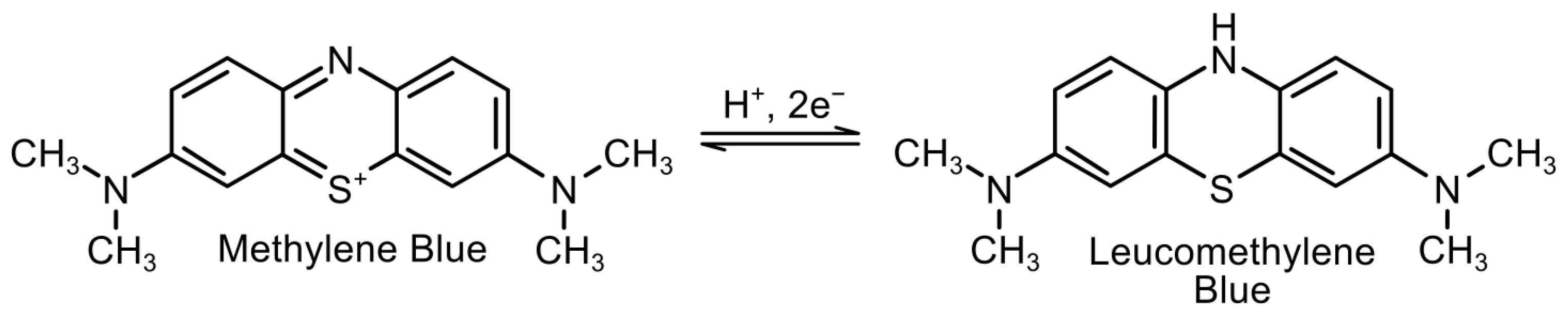
The reduction of methylene blue by ascorbic acid results in the decolorization of the solution due to the formation of colorless leucomethylene blue (Figure 2). While this reaction is highly reproducible under constant parameters, it remains extremely sensitive to the properties of the aqueous medium, including temperature [40,41,42], ionic strength, pH [41,42,43], dissolved oxygen concentration [39,43,44,45], and the presence of transition metals or catalysts [41,45]. Consequently, all reactions in this study were performed under strictly identical conditions following a procedure adapted from [41].
Figure 2. Reaction scheme for the reduction of methylene blue to leucomethylene blue by ascorbic acid.
The decolorization of methylene blue by ascorbic acid was monitored spectrophotometrically, following established methods [36,37,38,39]. Methylene blue was dissolved in the test samples (vibrational iterations or control) to a final concentration of 4.5 × 10⁻⁵ M. Separately, a stock solution of ascorbic acid (Sigma-Aldrich, St. Louis, MO, USA) was prepared in intact water at a concentration of 0.055 M (solution B).
Then, solution A was prepared by combining 1200 μL of methylene blue solution in the respective test sample (4.5 × 10⁻⁵ M) with 195 μL of sodium hydroxide (AppliChem Panreac, USA) with a concentration of 0.001 M and 195 μL of sodium sulfate (Kupavna-Reaktiv, Russia) with a concentration of 0.1 M. The mixture was vortexed at 3000 rpm for 10 s. For each sample (vibrational iteration or control), 6 identical aliquots of solution A were prepared, and each aliquot was used for one reaction (6 reactions in total).
Given that the reaction kinetics are highly sensitive to pH and ionic strength [41,42,43], these parameters in solution A were precisely adjusted to ensure that the reaction rate remained within a range suitable for reliable spectrophotometric recording using the current experimental setup.
To record the kinetics of the methylene blue decolorization reaction, 800 μL of solution A and 1200 μL of solution B (both equilibrated at 20 °C) were added to a quartz cuvette with an optical path of 10 mm (Hellma Analytics, Mullheim, Germany). Temperature stability of the reaction mixture was ensured by a TCC-100 thermoelectrically temperature-controlled cell holder (Shimadzu, Kyoto, Japan). Nine seconds after mixing solutions A and B, the time course of the absorbance was monitored at λ = 665 nm for 200 s using a UV-1800 spectrophotometer (Shimadzu, Kyoto, Japan) in the kinetic mode. The kinetic characteristics of the chemical reaction were calculated in the range from 0 to 150 s, since the pseudo-first-order dependence was observed in this range.
The following parameters of the kinetics of the chemical reaction were determined:
The speed constant ( k ) for a pseudo-first-order reaction was calculated using the following equation:
l n A = l n A 0 k τ
where A0 is the initial absorbance of the solution at λ = 665 nm, and A is the absorbance of the solution during the reaction, and τ is the reaction time.
Half-reaction time ( τ 1 / 2 )   w a s calculated using the following equation:
τ 1 / 2 = l n 2 k
where k is the reaction speed constant.
The average reaction rate was determined as the change in absorbance at λ = 665 nm or in methylene blue concentration over the given period of time (vA or vC, respectively).

2.5. Statistical Analysis

Statistical analysis was performed using R version 4.2.2 (R Foundation for Statistical Computing, Vienna, Austria). The normality of the distribution was assessed using the Shapiro–Wilk test, and the homogeneity of variances was examined using the Bartlett test. Outliers were identified using the interquartile range (IQR) method. To compare vibrational iterations with the control group, a one-way ANOVA followed by Student’s t-test with Holm’s correction was applied for normally distributed data. When the assumption of normality was violated, the Kruskal–Wallis test was used instead, followed by the Dunn test with Holm’s correction for multiple comparisons. Differences between groups were considered significant at p < 0.05. For pairs of groups that showed statistically significant differences, Cohen’s d effect size was calculated.
The number of measurements performed per sample was as follows: pH (6), electrical conductivity (9), dissolved oxygen concentration (6), and methylene blue decolorization kinetics (6).

3. Results

In the initial stage of the study, we characterized the physicochemical properties (specifically pH, electrical conductivity, and dissolved oxygen concentration) of vibrational iterations compared to the control (intact water). The results are summarized in Table 1.
Table 1. Physicochemical properties of vibrational iterations.
Vibration treatment typically induces an increase in pH and electrical conductivity while reducing dissolved O2 levels [10,12], with the magnitude of these effects depending on shaking frequency and duration. Notably, despite all vibrational iterations being prepared under identical conditions, i.e., by using the same ultrapure water, glass vials, and shaking parameters (10 s at 3000 rpm), they exhibit distinct physicochemical properties compared to the control (intact water). The measured values are in the range of 5.11–5.24 for pH, 0.86–0.93 μS/cm for conductivity, and 7.28–8.07 mg/mL for O2 concentration. Only the pH values of the vibrational iterations remained relatively the same as in the control. In contrast, both the electrical conductivity and the concentration of dissolved O2 exhibited significant deviations.
Among the vibrational iterations, a statistically significant increase in electrical conductivity compared to the control was observed only in I6 (p < 0.05). The dissolved O2 concentration decreased significantly in I0, I1, and I4–I7 (p < 0.05), while an increase was recorded in I3 (p < 0.05). Notably, following established criteria where d indicates a large effect size [46,47], all parameters in Table 1 marked with an asterisk represent statistically significant differences with a large effect compared to the control.
Such heterogeneity in the physicochemical properties of these vibrational iterations suggests that the contents of the adjacent vial play a critical role during the shaking process. It is probable that the aqueous solution within the adjacent vial influences the water through electromagnetic emissions originating from structural heterogeneities, such as supramolecular systems or nanobubbles [48,49].
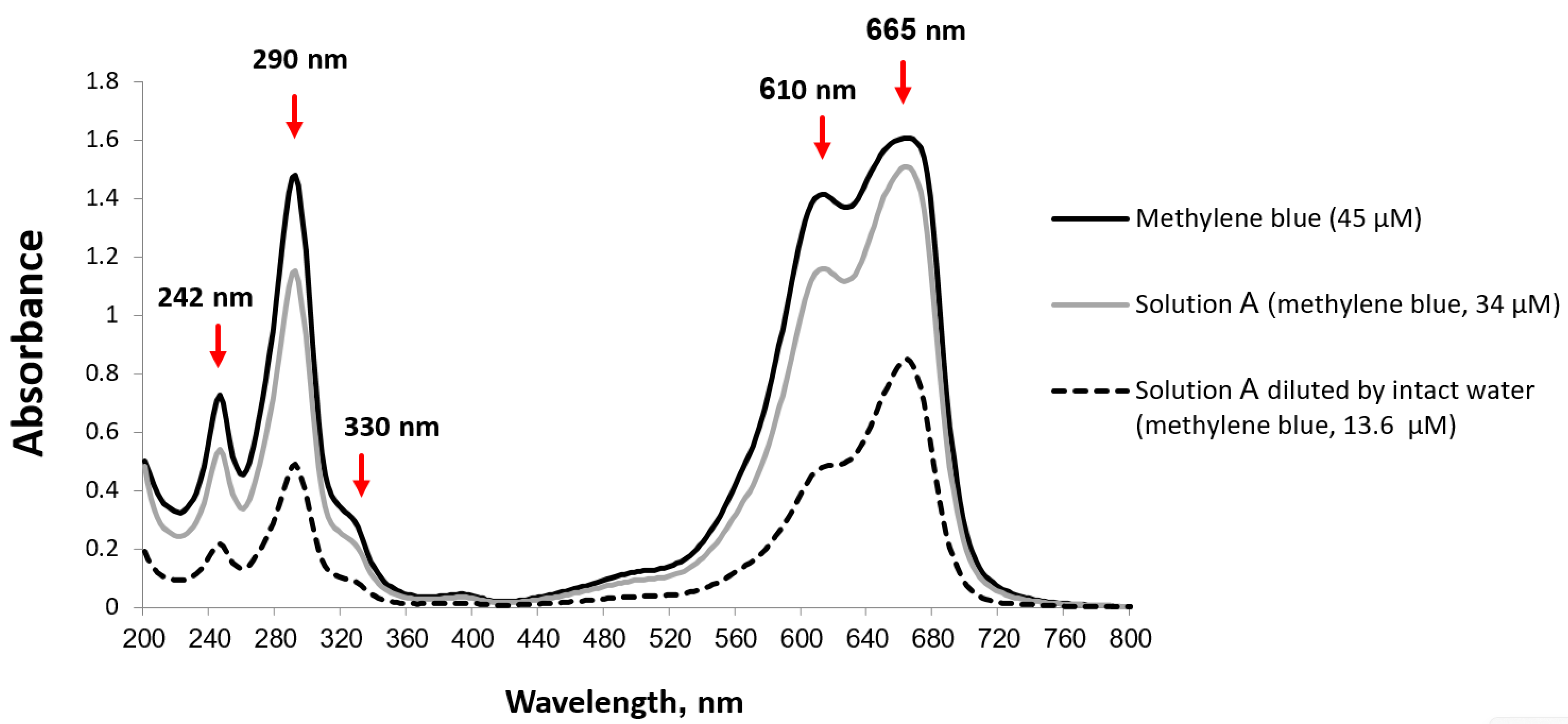
Next, we studied the effect of vibrational iterations (I0–I7) on the kinetics of methylene blue reduction by ascorbic acid using absorption spectroscopy. As a preliminary step, we obtained the absorption spectra of aqueous solutions of methylene blue across the concentration range employed in the study. These spectra are shown in Figure 3.
Figure 3. Concentration-dependent absorption spectra of aqueous methylene blue solutions at 20 °C.
The recorded spectra exhibit distinct absorption bands at 242, 290, 330, 610, and 665 nm. Methylene blue is a thiazine dye characterized by a phenothiazine core. By analogy with the electronic absorption spectra of phenothiazine solutions [50], the peaks near 242 nm and 330 nm in the methylene blue spectrum are assigned to local π–π* transitions (S0–S2) within benzene rings modified by substituents. The peak at 290 nm also corresponds to π–π* transitions characteristic of molecules with conjugated bonds [51,52,53] and/or n–π* transitions (S0–S1) on heteroatoms (N, S) [50]. The peak at 665 nm corresponds to n–π* transitions [51,52,53]. The peak at 610 nm corresponds to the 0–1 vibronic component of the 665 nm methylene blue absorption [52,54,55].
In aqueous solutions, methylene blue exists as a monomer–dimer equilibrium. The absorption spectrum of methylene blue exhibits a band at 665 nm (A665) corresponding to the absorption of the monomers and a band at 610 nm (A610) reflecting the absorption of the dimers [56]. In accordance with the law of mass action, increasing the methylene blue concentration shifts this equilibrium toward the formation of dimers. This is manifested in a decrease in the A664/A610 ratio (Figure 3), which aligns with previously reported data [56].
At a methylene blue concentration of 1.36 × 10⁻⁵ M, the absorption band of the dimer significantly overlaps with the more intense and distinct band of the monomer. Therefore, the absorbance at 665 nm was selected as a more reliable and selective parameter for monitoring the kinetics of the reaction of decolorization of methylene blue by ascorbic acid.
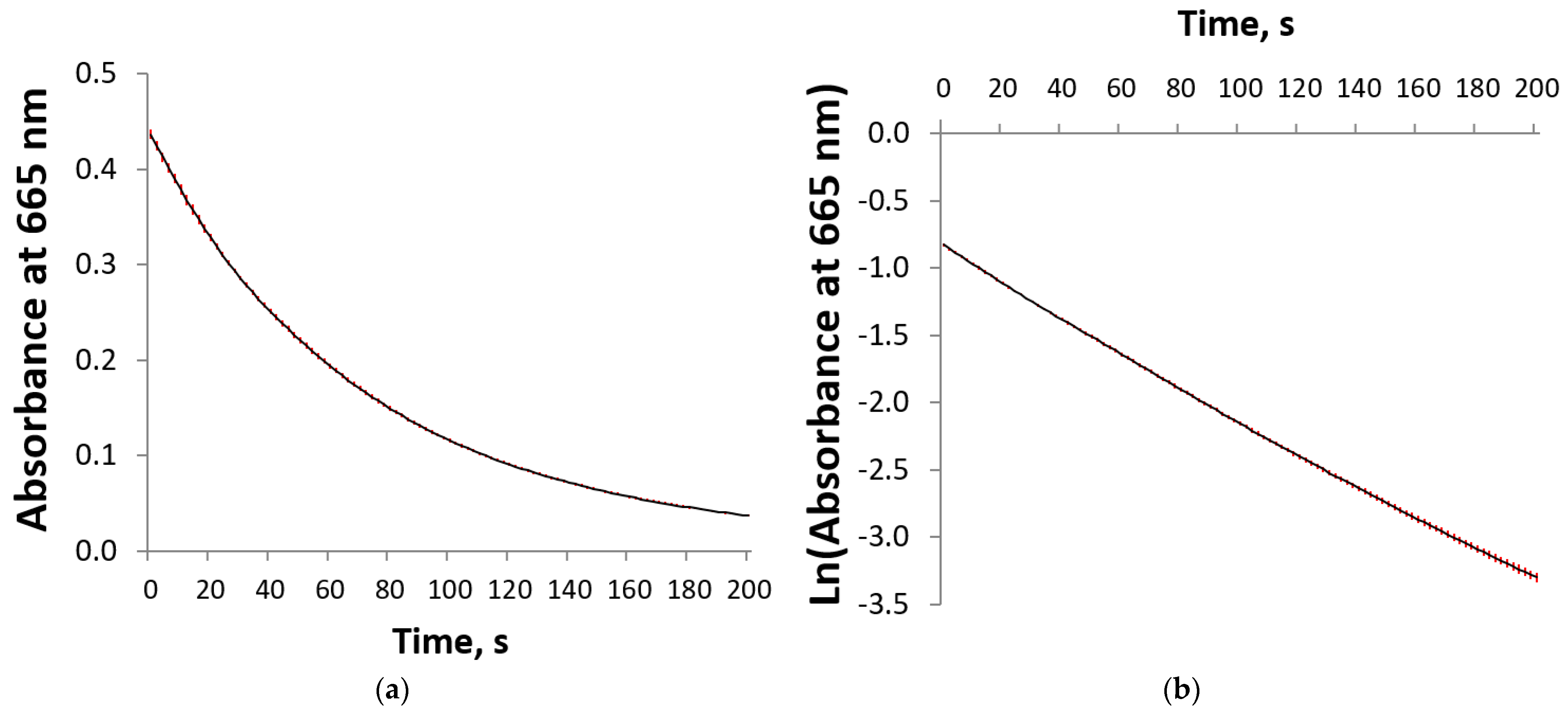
Figure 4 illustrates the decolorization kinetics of methylene blue when using intact water to prepare all reagents, plotted in linear (Figure 4a) or semilogarithmic (Figure 4b) scales. Data are presented as mean ± SD. In the time interval of 0–150 s (Figure 4b), the semilogarithmic plot appears as a nearly straight line, with SD values (from 0.01 to 0.02) largely obscured by the line width. On the one hand, this indicates that the data are of good quality and reproducible. On the other hand, it proves that the reaction follows pseudo-first-order kinetics. However, beyond 150 s, the SD values become more noticeable (reaching 0.03 by 200 s), i.e., the results of repeated experiments begin to diverge more strongly, which indicates that other processes start to contribute to the reaction, and the pseudo-first-order model gradually ceases. Consequently, when conducting subsequent studies, we recorded and analyzed the kinetics of methylene blue reduction by ascorbic acid up to 150 s.
Figure 4. Methylene blue absorbance decay at 665 nm during reaction with ascorbic acid. All reagents were prepared using intact water. Data are expressed as mean ± SD (SD indicated by red error bars), n = 6, plotted on (a) linear and (b) semilogarithmic scales. In (b), SD values become more prominent after 150 s.
The quantitative parameters of the kinetics of methylene blue reduction by ascorbic acid in the presence of vibrational iterations and the control are provided in Table 2. Data are presented as mean ± SD. Statistical significance was determined by either the Kruskal–Wallis test followed by Dunn’s test or a one-way ANOVA followed by Student’s t-test with a pooled standard deviation, depending on the data distribution. To control the family-wise error rate (FWER) for multiple comparisons, p-values were adjusted using Holm’s method. For any pair of groups showing a significant difference, the effect size (Cohen’s d) is reported.
Table 2. Kinetic parameters of methylene blue decolorization by ascorbic acid.
As shown in Table 2, the dissolution of methylene blue in any vibrational iteration resulted in a statistically significant decrease in the reaction rate constant. Since this effect was independent of the vibration iteration number, it is likely attributable to the vibration treatment itself during sample preparation. Furthermore, while all iterations led to an increase in the mean half-reaction time, statistically significant differences were observed only for I0, I2, I4, and I5, where values increased by 2–4% relative to the control. This effect may also be attributed to the vibration treatment of the methylene blue solvent.
However, the impact of vibrational iterations on reaction kinetics varies not only in magnitude but also in the nature of the effect. The average reaction rate (both vA and vC) depends on the vibrational iteration number used as the methylene blue solvent. Furthermore, vibrational iterations exert several different effects on the reaction kinetics parameters. For example, vibrational iterations I3 and I6 deviate from the general pattern: while they significantly decrease the rate constant (consistent with all other iterations), their effects do not reach statistical significance regarding the average rate or half-reaction time, exhibiting only a trend. Vibrational iterations I0, I4, and I5 had no significant effect on the average reaction rate, yet they statistically significantly increased the half-reaction time (by 3–4%).
Vibrational iterations I1 and I7 statistically significantly increased the average reaction rate by 6% compared to the control, accompanied by a modest, though non-significant, increase in the half-reaction time. The effect of I2 was more pronounced, yielding a statistically significant increase in the average reaction rate by 9%, alongside a statistically significant increase in half-reaction time (compared to the control). The observed concurrent decrease in the reaction rate constant and an increase in the average reaction rate (shown for I2) likely stem from a change in the activity of the reagents induced by changes in the reaction medium properties. Specifically, these changes may affect the accessibility of reaction centers, a phenomenon well-documented in various chemical models [57,58,59].

4. Discussion

The observed differences in the kinetics of the reduction of methylene blue dissolved in various vibrational iterations likely reflect differences in their physicochemical and/or structural–dynamic properties. For example, it is known that the kinetics of methylene blue reduction by ascorbic acid are sensitive to dissolved oxygen concentration, which serves as an inhibitor [56]. However, our data suggest that oxygen level is not the sole factor determining the effect of vibrational iterations on the reaction kinetics. This is demonstrated by vibrational iteration I2, which significantly altered the kinetics despite having an oxygen level identical to the control. Conversely, vibrational iteration I3, which contained a higher oxygen level than the control, had no significant effect on the average reaction rate. However, no direct correlation was found between changes in these physicochemical properties and the resulting alterations of chemical reaction kinetics. This suggests that the effects of vibrational iterations on reaction kinetics are not solely determined by pH, electrical conductivity, and dissolved O2 concentration but also involve additional factors that remain to be identified in future research. Furthermore, the general effects of fractions are reproducible, but the iteration number does not reliably predict their properties or effects.
By analogy with previous studies [22], we hypothesize that the reaction of methylene blue reduction by ascorbic acid involves the formation of supramolecular aggregates (supramers), which serve as the primary reaction centers. The assembly and configuration of these supramers may be uniquely modulated when vibrational iterations are used as solvents, likely due to variations in the hydrogen-bond energy within each vibrational iteration. It is well established that the aqueous microenvironment (including the degree of solvation and the stereochemical properties of the solvent) can radically alter the reaction mechanism [60,61,62,63].
The non-uniformity of the properties of vibrational iterations has been previously documented [16]. Specifically, it was reported that these iterations can be categorized into groups, or ‘fractions,’ based on their physicochemical properties and their capacity to modify the initial substance. For instance, vibrational iterations of sodium thiosulfate were shown to alter its reaction kinetics with sulfuric acid. Our findings corroborate the existence of such fractions: different iterations used to dissolve methylene blue exert distinct effects on its decolorization kinetics.
This is an unexpected observation, because, from a conventional chemical perspective, each vibrational iteration represents ultrapure water subjected solely to mechanical treatment. The observation that water samples, differing only in the number of crossing technology steps (i.e., the number of vibrational iterations, see Figure 1), change chemical reaction kinetics variably merits close attention. The reasons for this phenomenon have not yet been fully clarified, but we assume that the main role is played by distant interaction during the crossing procedure, described, for example, in [48]. Other researchers have previously observed similar distant interactions. For example, Penkov and Penkova [24] showed that highly diluted aqueous solutions can remotely change the physicochemical properties of interferon-gamma (IFNγ) solution via intrinsic emission in the infrared range. Subsequent studies revealed that lactose saturated with highly diluted antibodies to IFNγ remotely changed the structural and dynamic properties of IFNγ solution [29]. More recently, Jerman et al. [33,34] observed that high dilutions of antibodies to IFNγ influenced adjacent water containing trace amounts of hydrogen peroxide and bicarbonate. Novikov et al. [30,35] reported the distant effect of high dilutions of antibodies to IFNγ or phorbol myristate acetate on the production of reactive oxygen species by neutrophils. Collectively, these findings provide a robust framework that supports our observation of distant influence during vibrational processing.
Our findings demonstrate that the physicochemical (and potentially stereochemical) characteristics of a reactant can be effectively modified through vibrational iterations prepared using that same substance as an initial substance. This approach introduces a novel strategy for the targeted control of chemical processes by selecting specific vibrational iterations for dissolving reactants to modulate the structural–dynamic properties of the reaction medium. Future studies will assess the specificity of the effects of vibrational iterations of methylene blue, along with a detailed analysis of their physicochemical properties and the mechanisms of their influence on the parameters of the reaction of methylene blue reduction by ascorbic acid.

5. Conclusions

Vibrational iterations prepared using methylene blue as the initial substance exhibit distinct physicochemical properties. When used as solvents for methylene blue, these iterations variably affect the kinetics of its reduction by ascorbic acid: either uniformly by decreasing the rate constant or iteration-number-dependently by altering average reaction rates. These effects suggest a complex underlying mechanism influenced by multiple parameters, likely involving modifications to the aqueous medium’s structural–dynamic properties and the supramolecular organization of reaction components (particularly within the methylene blue solution). This opens up the possibility of targeted control of chemical processes by selecting certain vibrational iterations for dissolving reactants. Further research is essential to elucidate these mechanisms, including analyses of impurities, solution structuring, and the development of theoretical models of “vibrational iteration–reagent” interactions.

Author Contributions

Conceptualization, N.R., A.P. and S.T.; Data curation, N.R. and E.N.; Formal analysis, N.R., G.S. and S.T.; Funding acquisition, N.R., E.N., G.S. and S.T.; Investigation, E.N.; Methodology, E.N. and A.P.; Project administration, N.R. and E.N.; Resources, S.T.; Supervision, S.T.; Validation, E.N. and A.P.; Visualization, N.R.; Writing—original draft, N.R., G.S. and S.T.; Writing—review and editing, N.R., G.S. and A.P. All authors have read and agreed to the published version of the manuscript.

Funding

This research received no external funding. OOO NPF “MATERIA MEDICA HOLDING” sponsored this study and covered the current APC.

Institutional Review Board Statement

Not applicable.

Data Availability Statement

Data are contained within the article; further inquiries can be directed to the corresponding author.

Conflicts of Interest

The authors declare the following potential conflicts of interest with respect to the research, authorship and/or publication of this article: the authors are employees of OOO NPF “MATERIA MEDICA HOLDING” (fully or partly). OOO NPF “MATERIA MEDICA HOLDING” sponsored this study, performed statistical analysis, decided to publish this work, covered the current APC, and took part in the design of the experiments and the manuscript writing.

Abbreviations

The following abbreviations are used in this manuscript:
IFNγInterferon-gamma
I nVibrational iteration #n

References

  1. Dargaville, B.L.; Hutmacher, D.W. Water as the Often Neglected Medium at the Interface between Materials and Biology. Nat. Commun. 2022, 13, 4222. [Google Scholar] [CrossRef] [PubMed]
  2. Cortes-Clerget, M.; Yu, J.; Kincaid, J.R.A.; Walde, P.; Gallou, F.; Lipshutz, B.H. Water as the Reaction Medium in Organic Chemistry: From Our Worst Enemy to Our Best Friend. Chem. Sci. 2021, 12, 4237–4266. [Google Scholar] [CrossRef] [PubMed]
  3. Ball, P. Water Is an Active Matrix of Life for Cell and Molecular Biology. Proc. Natl. Acad. Sci. USA 2017, 114, 13327–13335. [Google Scholar] [CrossRef] [PubMed]
  4. Brini, E.; Fennell, C.J.; Fernandez-Serra, M.; Hribar-Lee, B.; Lukšič, M.; Dill, K.A. How Water’s Properties Are Encoded in Its Molecular Structure and Energies. Chem. Rev. 2017, 117, 12385–12414. [Google Scholar] [CrossRef]
  5. Lang, X.; Shi, L.; Zhao, Z.; Min, W. Probing the Structure of Water in Individual Living Cells. Nat. Commun. 2024, 15, 5271. [Google Scholar] [CrossRef]
  6. Tanaka, M.; Morita, S.; Hayashi, T. Interfacial Water States and the Biocompatibility of Biomaterials: The Role of Intermediate Water. Polym. J. 2026. [Google Scholar] [CrossRef]
  7. Yan, W.; Xu, R. Chemical Reactions in Aqueous Solutions with Condensed Liquid State. In Introduction to Condensed Matter Chemistry; Elsevier: Amsterdam, The Netherlands, 2024; pp. 141–175. [Google Scholar]
  8. Domrachev, G.A.; Selivanovskii, D.A.; Domracheva, E.G.; Domracheva, L.G.; Lazarev, A.I.; Stunzhas, P.A.; Shishkanov, S.F.; Vaks, V.L. The Role of Neutral Defects in the Structural Chemistry of Liquid Water. J. Struct. Chem. 2004, 45, 636–642. [Google Scholar] [CrossRef]
  9. Penkov, N.V. Temporal Dynamics of the Scattering Properties of Deionized Water. Phys. Wave Phenom. 2020, 28, 135–139. [Google Scholar] [CrossRef]
  10. Gudkov, S.V.; Penkov, N.V.; Baimler, I.V.; Lyakhov, G.A.; Pustovoy, V.I.; Simakin, A.V.; Sarimov, R.M.; Scherbakov, I.A. Effect of Mechanical Shaking on the Physicochemical Properties of Aqueous Solutions. Int. J. Mol. Sci. 2020, 21, 8033. [Google Scholar] [CrossRef]
  11. Astashev, M.E.; Serov, D.A.; Sarimov, R.M.; Gudkov, S.V. Influence of the Vibration Impact Mode on the Spontaneous Chemiluminescence of Aqueous Protein Solutions. Phys. Wave Phenom. 2023, 31, 189–199. [Google Scholar] [CrossRef]
  12. Nagaev, E.I.; Molkova, E.A.; Pustovoy, V.I.; Matveeva, T.A.; Zakharov, D.A.; Simakin, A.V.; Stepanova, E.V.; Semenova, N.A.; Reut, V.E.; Kalinitchenko, V.P.; et al. Possible Approaches to Studying the Influence of Magnetic Fields and Mechanical Effects on the Physicochemical Properties of Aqueous IgG Colloids. Appl. Sci. 2023, 13, 13055. [Google Scholar] [CrossRef]
  13. Gudkov, S.V.; Ivanov, V.E.; Matveeva, T.A.; Sarimov, R.M.; Lomonosov, A.M.; Astashev, M.E.; Baimler, I.V.; Simakin, A.V.; Bunkin, N.F.; Pustovoy, V.I.; et al. Physical and Chemical Changes That Occur in Water When Drops Fall on a Hard Surface (Rain, Waterfall, Shower). J. Mol. Liq. 2024, 401, 124686. [Google Scholar] [CrossRef]
  14. Ryzhkina, I.S.; Murtazina, L.I.; Kiseleva, Y.V.; Konovalov, A.I. Self-Organization and Physicochemical Properties of Aqueous Solutions of the Antibodies to Interferon Gamma at Ultrahigh Dilution. Dokl. Phys. Chem. 2015, 462, 110–114. [Google Scholar] [CrossRef]
  15. Slatinskaya, O.V.; Pyrkov, Y.N.; Filatova, S.A.; Guryev, D.A.; Penkov, N.V. Study of the Effect of Europium Acetate on the Intermolecular Properties of Water. Front. Phys. 2021, 9, 641110. [Google Scholar] [CrossRef]
  16. Petrova, A.; Tarasov, S.; Gorbunov, E.; Stepanov, G.; Fartushnaya, O.; Zubkov, E.; Molodtsova, I.; Boriskin, V.; Zatykina, A.; Smirnov, A.; et al. Phenomenon of Post-Vibration Interactions. Symmetry 2024, 16, 958. [Google Scholar] [CrossRef]
  17. Camarri, S.; Mariotti, A.; Galletti, C.; Brunazzi, E.; Mauri, R.; Salvetti, M.V. An Overview of Flow Features and Mixing in Micro T and Arrow Mixers. Ind. Eng. Chem. Res. 2020, 59, 3669–3686. [Google Scholar] [CrossRef]
  18. Uchinashi, Y.; Nagasaki, M.; Zhou, J.; Tanaka, K.; Fukase, K. Reinvestigation of the C5-Acetamide Sialic Acid Donor for α-Selective Sialylation: Practical Procedure under Microfluidic Conditions. Org. Biomol. Chem. 2011, 9, 7243. [Google Scholar] [CrossRef]
  19. Myachin, I.V.; Mamirgova, Z.Z.; Stepanova, E.V.; Zinin, A.I.; Chizhov, A.O.; Kononov, L.O. Black Swan in Phase Transfer Catalysis: Influence of Mixing Mode on the Stereoselectivity of Glycosylation. Eur. J. Org. Chem. 2022, 2022, e202101377. [Google Scholar] [CrossRef]
  20. Roy, R. Phase Transfer Catalysis in Carbohydrate Chemistry. In Handbook of Phase Transfer Catalysis; Sasson, Y., Neumann, R., Eds.; Springer: Dordrecht, The Netherlands, 1997; pp. 244–275. [Google Scholar]
  21. Myachin, I.V.; Kononov, L.O. Mixer Design and Flow Rate as Critical Variables in Flow Chemistry Affecting the Outcome of a Chemical Reaction: A Review. Inventions 2023, 8, 128. [Google Scholar] [CrossRef]
  22. Myachin, I.V.; Kononov, L.O. Phase-Transfer Catalyzed Microfluidic Glycosylation: A Small Change in Concentration Results in a Dramatic Increase in Stereoselectivity. Catalysts 2023, 13, 313. [Google Scholar] [CrossRef]
  23. Ryzhkina, I.; Murtazina, L.; Gainutdinov, K.; Konovalov, A. Diluted Aqueous Dispersed Systems of 4-Aminopyridine: The Relationship of Self-Organization, Physicochemical Properties, and Influence on the Electrical Characteristics of Neurons. Front. Chem. 2021, 9, 623860. [Google Scholar] [CrossRef] [PubMed]
  24. Penkov, N.; Penkova, N. Analysis of Emission Infrared Spectra of Protein Solutions in Low Concentrations. Front. Phys. 2020, 8, 624779. [Google Scholar] [CrossRef]
  25. Bunkin, N.F.; Shkirin, A.V.; Ninham, B.W.; Chirikov, S.N.; Chaikov, L.L.; Penkov, N.V.; Kozlov, V.A.; Gudkov, S.V. Shaking-Induced Aggregation and Flotation in Immunoglobulin Dispersions: Differences between Water and Water–Ethanol Mixtures. ACS Omega 2020, 5, 14689–14701. [Google Scholar] [CrossRef]
  26. Likhachev, I.G.; Pustovoy, V.I.; Usievich, B.A. Spectrally Resolved White Light Interferometry for NaCl Aqueous Solutions Refractive Index Measurement. Front. Phys. 2021, 9, 642096. [Google Scholar] [CrossRef]
  27. Shishkina, A.V.; Ksenofontov, A.A.; Penkov, N.V.; Vener, M.V. Diclofenac Ion Hydration: Experimental and Theoretical Search for Anion Pairs. Molecules 2022, 27, 3350. [Google Scholar] [CrossRef]
  28. Molodtsova, I.V.; Khimich, E.O.; Sosnenko, E.S.; Petrova, A.O.; Stepanov, G.O.; Don, E.S. Study of the Effects of Highly Diluted Sodium Sulfate and Interferon-Gamma. Bull. Exp. Biol. Med. 2023, 175, 327–330. [Google Scholar] [CrossRef]
  29. Penkov, N. Antibodies Processed Using High Dilution Technology Distantly Change Structural Properties of IFNγ Aqueous Solution. Pharmaceutics 2021, 13, 1864. [Google Scholar] [CrossRef]
  30. Novikov, V.V.; Yablokova, E.V. Interaction between Highly Diluted Samples, Protein Solutions and Water in a Controlled Magnetic Field. Appl. Sci. 2022, 12, 5185. [Google Scholar] [CrossRef]
  31. Penkov, N.V. Influence of the Combined Magnetic Field and High Dilution Technology on the Intrinsic Emission of Aqueous Solutions. Water 2023, 15, 599. [Google Scholar] [CrossRef]
  32. Alinkina, E.S.; Molodtsova, I.V.; Petrova, A.O.; Stepanov, G.O.; Don, E.S. Modifying Distant Effect of High Dilutions of Inorganic and Biological Substances. Bull. Exp. Biol. Med. 2023, 175, 331–334. [Google Scholar] [CrossRef]
  33. Jerman, I.; Ogrizek, L.; Periček Krapež, V.; Jan, L. Physicochemical Study of the Molecular Signal Transfer of Ultra-High Diluted Antibodies to Interferon-Gamma. Int. J. Mol. Sci. 2023, 24, 11961. [Google Scholar] [CrossRef] [PubMed]
  34. Jerman, I.; Ogrizek, L.; Krapež, V.P.; Jan, L. Molecular Signal Transfer of Highly Diluted Antibodies to Interferon-Gamma Regarding Kind, Time, and Distance of Exposure. Int. J. Mol. Sci. 2024, 25, 656. [Google Scholar] [CrossRef] [PubMed]
  35. Novikov, V.V.; Yablokova, E.V.; Stepanov, G.O.; Rodionova, N.N.; Tarasov, S.A.; Buravleva, E.V.; Yablonskaya, O.I.; Voeikov, V.L. Non-Contact Interaction Between Phorbol Myristate Acetate and Aqueous Alcohol Solutions Under Combined Magnetic Fields. Molecules 2024, 29, 5814. [Google Scholar] [CrossRef] [PubMed]
  36. Lee, S.-K.; Mills, A. Novel Photochemistry of Leuco-Methylene Blue. Chem. Commun. 2003, 18, 2366–2367. [Google Scholar] [CrossRef]
  37. Bogatov, N.A.; Savina, A.S. Peculiarities of the Methylene Blue Monomeric Form Redox Process in the Field of Low-Frequency Exposure. In Proceedings of the AIP Conference, Surabaya, Indonesia, 9 December 2020. [Google Scholar]
  38. Bogatov, N.A.; Boldyrev, V.S.; Fadeev, G.N.; Savina, A.S.; Zotkin, A.P.; Pentyukhin, E.I. Features of methylene blue redox reaction with ascorbic acid in an oxygen-saturated environment. Modern Sci.-Intensive Technol. Mod. High Technol. 2022, 9, 39–43. [Google Scholar] [CrossRef]
  39. Morozov, A.N.; Fadeev, G.N.; Bogatov, N.A.; Boldyrev, V.S.; Zadorozhny, N.A.; Timchenko, S.L. Influence of Low-Frequency Vibrations on Methylene Blue Reduction Process. Her. Bauman Mosc. State Tech. Univ. Ser. Nat. Sci. 2022, 1, 141–156. [Google Scholar] [CrossRef]
  40. El-Aila, H.J. Reduction of Methylene Blue by Ascorbic Acid: Kinetic and Thermodynamic Aspects. Tenside Surfactants Deterg. 2012, 49, 26–31. [Google Scholar] [CrossRef]
  41. Khan, M.N.; Sarwar, A. The Influence of Transition Metal Ions on the Kinetics of Ascorbic Acid Oxidation by Methylene Blue in Strongly Acidic Media. Turk. J. Chem. 2001, 25, 433–440. [Google Scholar]
  42. Snehalatha, T.; Rajanna, K.C.; Saiprakash, P.K. Methylene Blue—Ascorbic Acid: An Undergraduate Experiment in Kinetics. J. Chem. Educ. 1997, 74, 228. [Google Scholar] [CrossRef]
  43. Mowry, S.; Ogren, P.J. Kinetics of Methylene Blue Reduction by Ascorbic Acid. J. Chem. Educ. 1999, 76, 970. [Google Scholar] [CrossRef]
  44. Hallock, A.J.; Berman, E.S.F.; Zare, R.N. Ultratrace Kinetic Measurements of the Reduction of Methylene Blue. J. Am. Chem. Soc. 2003, 125, 1158–1159. [Google Scholar] [CrossRef] [PubMed]
  45. Savel, J. Fenton Reaction Acceleration Using Maltose and Ascorbic Acid. BrewingScience 2003, 56, 4–9. [Google Scholar]
  46. Cohen, J. Statistical Power Analysis for the Behavioral Sciences, 2nd ed.; Routledge: New York, NY, USA, 2013. [Google Scholar]
  47. Goulet-Pelletier, J.-C.; Cousineau, D. A Review of Effect Sizes and Their Confidence Intervals, Part I: The Cohen’s d Family. Quant. Methods Psychol. 2018, 14, 242–265. [Google Scholar] [CrossRef]
  48. Gorovoy, Y.; Rodionova, N.; Stepanov, G.; Petrova, A.; Penkova, N.; Penkov, N. Theoretical Description of Changes in Conformation and Symmetry of Supramolecular Systems During the Reception of a Molecular Signal. Int. J. Mol. Sci. 2025, 26, 6411. [Google Scholar] [CrossRef]
  49. Bunkin, N.F.; Novakovskaya, Y.V.; Gerasimov, R.Y.; Ninham, B.W.; Tarasov, S.A.; Rodionova, N.N.; Stepanov, G.O. Resonant Oscillations of Ion-Stabilized Nanobubbles in Water as a Possible Source of Electromagnetic Radiation in the Gigahertz Range. Int. J. Mol. Sci. 2025, 26, 6811. [Google Scholar] [CrossRef]
  50. Tchaikovskaya, O.N.; Krayukhina, V.S.; Pomogaev, V.A.; Chaidonov, A.I. Experimental and Theoretical Investigation of Optical Spectra of Methylene Green in Solutions. Russ. Phys. J. 2019, 61, 1752–1758. [Google Scholar] [CrossRef]
  51. Párkányi, C.; Boniface, C.; Aaron, J.J.; Maafi, M. A Quantitative Study of the Effect of Solvent on the Electronic Absorption and Fluorescence Spectra of Substituted Phenothiazines: Evaluation of Their Ground and Excited Singlet-State Dipole Moments. Spectrochim. Acta Part Mol. Spectrosc. 1993, 49, 1715–1725. [Google Scholar] [CrossRef]
  52. Heger, D.; Jirkovský, J.; Klán, P. Aggregation of Methylene Blue in Frozen Aqueous Solutions Studied by Absorption Spectroscopy. J. Phys. Chem. A 2005, 109, 6702–6709. [Google Scholar] [CrossRef]
  53. Sáenz-Trevizo, A.; Pizá-Ruiz, P.; Chávez-Flores, D.; Ogaz-Parada, J.; Amézaga-Madrid, P.; Vega-Ríos, A.; Miki-Yoshida, M. On the Discoloration of Methylene Blue by Visible Light. J. Fluoresc. 2019, 29, 15–25. [Google Scholar] [CrossRef]
  54. Lewis, G.N.; Goldschmid, O.; Magel, T.T.; Bigeleisen, J. Dimeric and Other Forms of Methylene Blue: Absorption and Fluorescence of the Pure Monomer1. J. Am. Chem. Soc. 1943, 65, 1150–1154. [Google Scholar] [CrossRef]
  55. Cenens, J.; Schoonheydt, R.A. Visible Spectroscopy of Methylene Blue on Hectorite, Laponite B, and Barasym in Aqueous Suspension. Clays Clay Miner. 1988, 36, 214–224. [Google Scholar] [CrossRef]
  56. Fernández-Pérez, A.; Valdés-Solís, T.; Marbán, G. Visible Light Spectroscopic Analysis of Methylene Blue in Water; the Resonance Virtual Equilibrium Hypothesis. Dyes Pigments 2019, 161, 448–456. [Google Scholar] [CrossRef]
  57. Plauck, A.; Stangland, E.E.; Dumesic, J.A.; Mavrikakis, M. Active Sites and Mechanisms for H2O2 Decomposition over Pd Catalysts. Proc. Natl. Acad. Sci. USA 2016, 113, E1973–E1982. [Google Scholar] [CrossRef] [PubMed]
  58. Liu, C.-P.; Chen, K.-C.; Su, C.-F.; Yu, P.-Y.; Lee, P.-W. Revealing the Active Site of Gold Nanoparticles for the Peroxidase-Like Activity: The Determination of Surface Accessibility. Catalysts 2019, 9, 517. [Google Scholar] [CrossRef]
  59. Mofidi Najjar, F.; Taghavi, F.; Ghadari, R.; Sheibani, N.; Moosavi-Movahedi, A.A. Destructive Effect of Non-Enzymatic Glycation on Catalase and Remediation via Curcumin. Arch. Biochem. Biophys. 2017, 630, 81–90. [Google Scholar] [CrossRef]
  60. Berezhkovskii, A.M.; Dudko, S.A. Solvent Dynamics Influence on Chemical Reaction Dynamics. J. Chem. Phys. 1994, 100, 5949–5955. [Google Scholar] [CrossRef]
  61. Otto, R.; Brox, J.; Trippel, S.; Stei, M.; Best, T.; Wester, R. Single Solvent Molecules Can Affect the Dynamics of Substitution Reactions. Nat. Chem. 2012, 4, 534–538. [Google Scholar] [CrossRef]
  62. Orr-Ewing, A.J. Taking the Plunge: Chemical Reaction Dynamics in Liquids. Chem. Soc. Rev. 2017, 46, 7597–7614. [Google Scholar] [CrossRef]
  63. Stepanov, G.O.; Penkov, N.V.; Rodionova, N.N.; Petrova, A.O.; Kozachenko, A.E.; Kovalchuk, A.L.; Tarasov, S.A.; Tverdislov, V.A.; Uvarov, A.V. The Heterogeneity of Aqueous Solutions: The Current Situation in the Context of Experiment and Theory. Front. Chem. 2024, 12, 1456533. [Google Scholar] [CrossRef]
Disclaimer/Publisher’s Note: The statements, opinions and data contained in all publications are solely those of the individual author(s) and contributor(s) and not of MDPI and/or the editor(s). MDPI and/or the editor(s) disclaim responsibility for any injury to people or property resulting from any ideas, methods, instructions or products referred to in the content.

Article Metrics

Citations

Article Access Statistics

Multiple requests from the same IP address are counted as one view.