3.1. Numerical Algebra
The numerical algebraic approach has been applied to the two azide intermediate syntheses concerning the oseltamivir case study, specifically in the analysis of extrapolated kinetic data from an experimental dataset deriving from the azidation reaction conversion plot [
26]. The evaluation of experimental results has been drawn directly from a continuous-flow process instead of the classical batch approach. Theoretical details are reported in the
Supporting Information file (Section S1).
This approach prescribes that the process designer retrieve from the literature homogeneous subsets of data, collected under the same conditions, to allow regression through the variation of 1 or more variables at a time. Some papers report clearly and systematically such data (as the example reported here). The main detrimental aspect is that the experimental data refer to high conversions, and this is not optimal for kinetic study investigation, since at medium-high values of conversion, the reaction is almost done, and key kinetic information is partially lost. Furthermore, no preliminary test to ensure kinetic control (i.e., excluding transport limitations) is usually reported. This is an intrinsic bias that imposes a careful assessment of the results for their physical meaning.
Kinetic data regression often relies on linear regression, and the integral method is normally used to find the kinetic constant
k when the reaction order is known [
27]. Here, regression has been carried out considering the differentiation method, in order to find the reaction orders
,
and the kinetic constant
k as parameter to be approximately estimated (see Equation (1)). This avoided the arrangement of the data in a forced linear correlation and forced a priori postulated (linear) model to fit data that might not have a linear nature (integral method) [
28].
In some entries, the reagents were mixed in a stechiometric or quasi-stechiometric ratio. Such conditions prevent the use of some well-known kinetic equations. Moreover, the customary method for analyzing a pre-defined kinetic order (i.e., 1st or 2nd order reaction, etc.) leads to a deficiency in terms of representative goodness of output values since they are not equally reliable. The concentration is measured with a constant error, whereas the error in the linearization procedure does not have a constant value (propagation of errors) across the range, and this means that the data are heteroskedastic [
28].
Non-linear regression has also been taken into consideration in order to evaluate and highlight a possible improvement in finding the kinetic parameters.
These two different approaches remarked their difference, and their careful management allowed for building up a stronger robustness and wider replicability. Non-linear regression revealed a better choice. The iterative approach has allowed us to obtain the same kinetic parameters, but with a different perspective in terms of error evaluation (non-linear least-squares), leading to a different awareness for data analysis [
28].
The estimated kinetic parameters and complete list of algorithms used are collected in
Table S6, while
Tables S7–S13 report the calculated values of the pre-exponential factor (A) and activation energy (E), the latter retrieved by Arrhenius regression of groups of data at variable temperature, keeping fixed the other conditions (Equation (1)).
Two kinetic models have been compared:
The former is able to represent the continuous-flow C-3 mesyl shikimate azidation using different azidating agents, since it takes into account that the shikimate and the azidating reagent have approximately the same concentration in the available dataset. Moreover, in order to simplify the model and lead to a first hit approach, the presence of the base (where present) has been neglected.
The second model proposed is able to represent the continuous-flow C-5 intermediate acetamide azidation using sodium azide under different temperature conditions. In this case, the azidating agent is present in excess (3eq). This is one of the biases usually found in datasets not collected for kinetic modeling purposes, since a systematic and incremental variation of all the variables is usually not reported.
The two models are non-linear, and a partial linearization has been applied. Partial linearization is a common approach to move into a linear domain by a suitable transformation of the model. However, use of a non-linear transformation requires caution. The influences of the data values will change, as will the error structure of the model and the interpretation of any inferential result [
28,
29]. This method of data analysis is also useful to determine the best values of the rate parameters from a series of measurements when three or more parameters are involved (e.g., reaction order, frequency factor, and activation energy) [
27].
Since the linear regression is evaluated through a system of linear equations, an iterative algorithm methodology for determining the solution vector and the corresponding parameter(s) has been applied. The Jacobi and Gauss-Seidel algorithms could be used to evaluate the convergence, robustness, and effective applicability. These methods have been applied to the C-5 intermediate acetamide azidation dataset in opposition to the direct solving method (e.g., Gauss elimination), in order to address the case study in a more robust way, with the aim of finding a more reliable and consistent solution.
The C-5 acetamide azidation dataset offers the widest range of data (i.e., temperatures and conversion values): four out of five groups of data have almost all of the initial data points below the 70% conversion.
The application of these two methods to the C-3 mesyl shikimate azidation using different azidating agents has been ruled out due to little practical use. The application of a pure non-linear model (linearized) has instead been done for this dataset, through the application of the Levenberg–Marquardt algorithm.
In addition to the searched parameters, all the datasets have been evaluated in order to assess the goodness of the dataset itself and a possible correlation. An interesting point could be the application of Bayesian Analysis of composite datasets deriving from multiple sources [
30]. For this reason, and according to the theoretical background (see
Section S1.1 in Supporting Information), the following key indicators have been calculated: the coefficient of determination, the condition number, and the matrix convergence. It was not always possible to calculate all the parameters as reported in
Table S6.
The results were quite internally consistent, with some algorithms applied to different datasets, demonstrating reliability also for different conditions.
Table S6 entries 23–26 for the Jacobi method returned the same order of magnitude of the parameters as well as the positive/negative sign of the parameters. Other methods did not ensure this consistency because the results varied widely.
An interesting case reported in
Table S6 is that for the application of a row-reduced method such as the Gauss algorithm with pivoting (entry 13) and for the application of the Levenberg–Marquardt algorithm (entry 32) for the C-5 acetamide azidation at 80 °C, returned both the same results (i.e., kinetic constant, orders of reaction), but they diverged for the
value. Additionally, the Levenberg–Marquardt algorithm also returned a warning message (vide infra).
Another detrimental aspect concerned the condition number of the original and/or the matrix. All these matrices were ill-conditioned. At this point, and according to the theory, this is the worst scenario possible since all the data estimated from the application of these algorithms cannot be considered as robustly estimated solution parameters for a certain chemical kinetic model dataset. The values of the condition number were indeed very high (e.g., ).
The final convergence parameter value (applicable in the iterative method) failed. Almost all of the algorithms applied to the system reported in
Table S6 did not converge (sufficient and necessary condition). The convergence was guaranteed just in the case of entries 29 and 31 reported in
Table S6 and related to the application of the Gauss-Seidel algorithm, despite the condition number being very high (
).
Referring to the C-3 mesyl shikimate azidation dataset, the kinetic constant values were of decimal or unit magnitude, whereas the reaction order parameter
was close to 1. This final value was quite unexpected, since according to the literature, the reaction follows a bimolecular
mechanism [
31] with the participation of both reagents (added in equal amounts in the reaction dataset). Despite the values of
were sufficiently good, the condition number matrix was not satisfactory (
).
Considering the C-5 acetamide azidation dataset, the most acceptable results were the ones deriving from the application of the simplest kinetic model, r = kCA2, as for the C-3 mesyl shikimate azidation dataset. It returned the highest, but still acceptable, values of condition number. However, when applying the second-order model r = kCACB, a lot of issues became apparent. Of particular interest is the application of the iterative Jacobi algorithm. The Jacobi method is used to find the eigenvalues and eigenvectors of a symmetric matrix. If a matrix is not symmetric, then the eigenvectors are not guaranteed to be orthogonal, which is a key assumption of the Jacobi method. Additionally, the eigenvalues of a non-symmetric matrix are not guaranteed to be real numbers, while this is required in the Jacobi method. Therefore, this method does not work with a non-quadratic matrix, and thus the dataset has been relaxed to a matrix of dimension 3 × 3 in order to have the same dimension as the initial guess vector (transposed vector). The refining data points process has been settled in order to take into consideration the early stage of reaction—the beginning of reactions themselves (i.e., low conversion). In this way, it was possible to address both the chemical kinetic reaction and computational method (quadratic matrix) demands.
To overcome this issue, it is advisable to apply the singular value decomposition (SVD) approach. The order of reaction should also be considered from the chemical point of view, since the most acceptable data points were the ones retrieved at low temperature, and the order was suggested between 1 and 2. On the contrary, when regressing data collected at higher temperatures, the order of reaction reached unreliable values (i.e., 5 and 7).
A warning message was returned during the application of the Levenberg–Marquardt algorithm in all cases, indicating that the model was overparameterized and there was no solution, implying the use of a simpler model or getting more data.
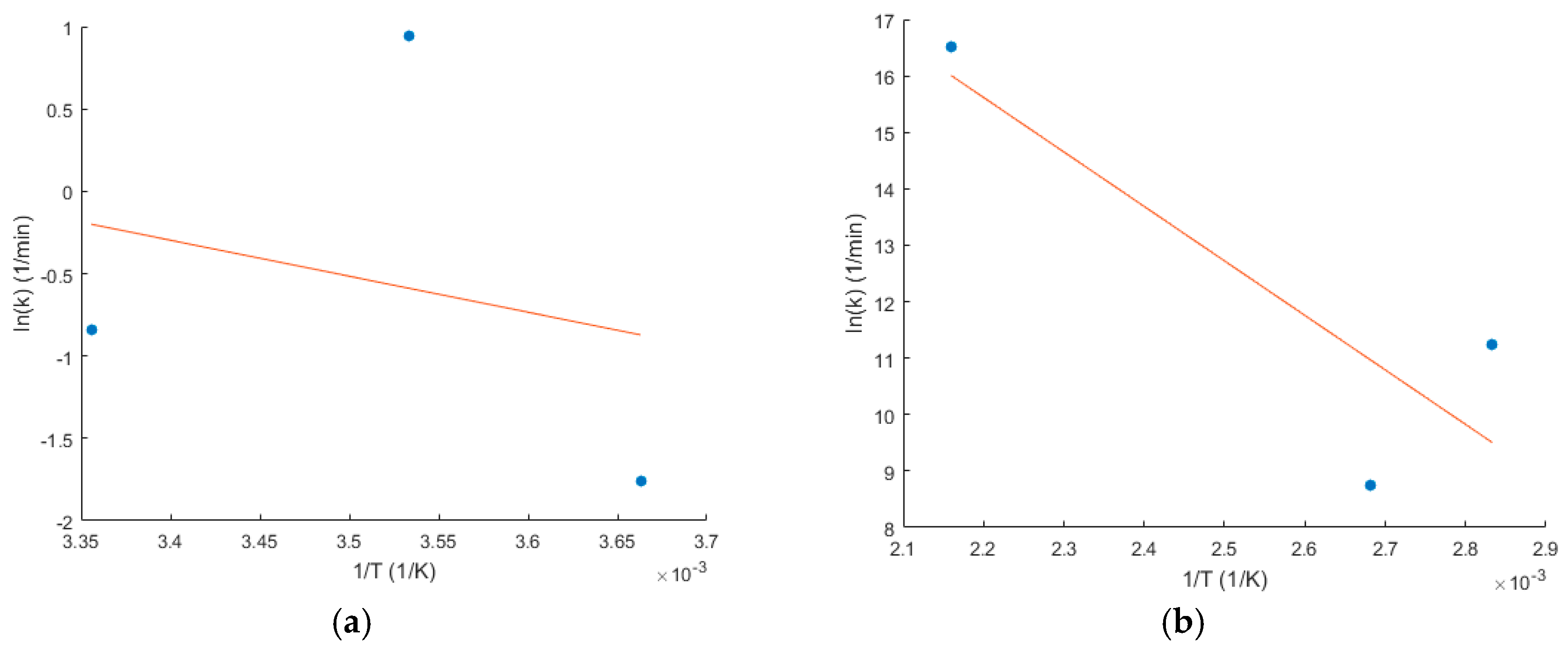
Arrhenius regression was done for every regressed solution, for the moment remaining blind to the physical meaningfulness, and the activation energy and frequency factor have been calculated based on the
k values reported in
Table S6. The most significant examples are reported in
Table 1 for the C-3 azidation with NaN
3 (
Table S6, rows 1–3) and
Table 2 for the C-5 azidation with NaN
3 (
Table S6, rows 8–12). All the other cases are reported in
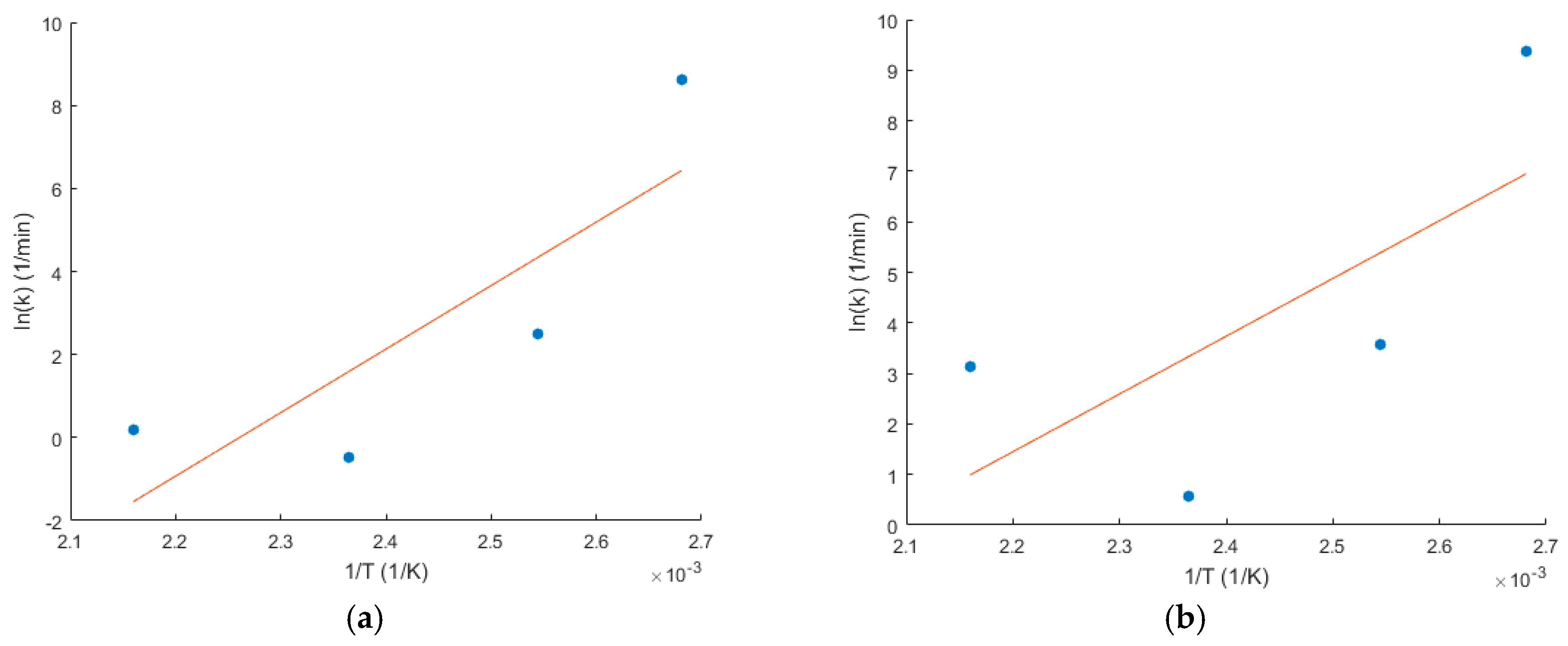
Supporting Information Section S2.3—Tables S7–S13. Examples of Arrhenius regression are reported in
Figure 2 and
Figure 3.
The discussion is indeed finalized to prove that using the whole dataset does not lead to reliable conclusions, thus manipulation of the dataset would be needed, with consequent unreliable results and conclusions. The refinement of the dataset was not performed to “improve the fit,” but to explicitly diagnose numerical instability and parameter non-identifiability. Data points were excluded only when they were demonstrably associated with extreme condition numbers, non-convergence of iterative solvers, or physically inconsistent regression outputs. The objective was not to bias the result toward positive activation energies, but to evaluate how regression stability depends on dataset conditioning.
Regarding the use of the Jacobi algorithm, its inclusion was exploratory and comparative, intended to test the sensitivity of iterative solvers to ill-conditioned matrices. We agree that reducing the dataset to a 3 × 3 system is not a statistically rigorous regression strategy; this step was meant to illustrate computational constraints rather than to establish definitive kinetic parameters.
The estimated values of activation energy were too low to have physical meaning. This is due to inaccurate regression, and a possible further explanation can reside in some diffusive limitations, which do not allow for drawing even qualitative conclusions on the temperature effect. Indeed, during a kinetic testing campaign, the preliminary checks should be devoted to carefully eliminating any possible interference from diffusion and mass/heat transfer. This was not possible here since, as stated, the scope was to use the huge dataset of organic synthesis data to check their possible application for kinetic data extraction [
32]. However, alternative explanations (e.g., mechanistic shifts or equilibrium effects) are possible to justify negative activation energies, besides diffusion limitations.
In complex systems with multiple competing processes, diffusional limitations can induce deviations from the expected temperature dependence (non-Arrhenius behavior) [
33]. The main issue was related to negative values of activation energy, which is contrary to normal expectations, since an increment of reaction rate with temperature is conventionally expected [
34]. They could be considered, in principle, a mistake deriving from the computational approach used or from the intrinsic nature of the experimental results and their manipulation. Moreover, in case of a negative temperature dependence of the reaction rate, great caution must be exercised when their explanation is applied to chemical reactions under harsh conditions [
35], and statistical thermodynamics functions may be ill-defined [
36].
Since the negative activation energy values have been found for the dataset elements having a matrix condition number that is very high, a dataset refining procedure was done, leading to positive values only. The approach was as follows:
Arrhenius activation parameters regression was done using kinetic constants coming only from the dataset points having condition number strictly equal to
Refining the kinetic constant dataset from the outlier values.
As a first hint, the refining process was based on ruling out the data that led to a high condition number.
The nature of the dataset handled (i.e., a small experimental data source with alleged error bias affected) did not allow the application of a robust statistical method for outlier identification. Hence, they have been identified as the variable couple leading to reduced quality of linear regression fitting.
It should be remarked that the datasets were included based on three primary criteria: availability of time-resolved concentration or conversion data, consistent operating conditions within homogeneous subsets, and sufficient variation of at least one independent variable. High-conversion points were retained initially to reflect the real structure of exploratory synthetic datasets, but their impact on parameter identifiability was subsequently assessed through condition number analysis and regression stability.
Outliers were not removed arbitrarily; instead, entries associated with extreme condition numbers, non-convergence of iterative algorithms, or physically unrealistic parameter values (e.g., negative apparent activation energies under otherwise monotonic trends) were flagged as numerically unstable. Dataset refinement consisted of excluding only those subsets demonstrably responsible for ill-conditioning or regression breakdown. We will revise the manuscript to explicitly summarize these criteria and to clarify how each methodological approach (linear regression, Bayesian inference, ML) responds differently to data sparsity, heteroskedasticity, and structural bias.
The values of Arrhenius activation energy showed a positive value, even if the regression was not very accurate, as shown in
Figure 2, for C-3 azidation with
(rows 1–3,
Table S6) and the refined C-5 azidation with
(rows 8–12,
Table S6). The Arrhenius plots returning negative activation energy are instead exemplified in
Figure 3, concerning the C-5 azidation with
(rows 13–17 and 32–36,
Table S6).
In conclusion, it is reasonable to assume that the negative activation energy values were more related to an inappropriate intrinsic nature of the experimental data collected than to the computational algorithm. This is a pivotal aspect that should be considered for future development: the proper experimental data collection at the time of laboratory-scale trials plays a key role in the subsequent data handling.
Reasonable kinetic parameters were retrieved for the C-5 azidation reaction, as reported in
Table 2. These may be used (with caution) to make a preliminary feasibility assessment for a continuous-flow plant for the production of the selected API. On the contrary, too low A and E have been found in the best cases for the C-3 reaction (
Table 1).
To summarize, the numerical algebra approach was applied to the oseltamivir azidation steps using literature data derived from continuous-flow conversion plots. The objective was not to perform a rigorous kinetic study, but to evaluate whether exploratory synthetic datasets can be exploited for preliminary parameter estimation in process design.
Linearization (with both linear and non-linear regression) allowed rapid parameter estimation but amplified heteroskedasticity and error propagation effects. Non-linear regression, particularly using the Levenberg–Marquardt algorithm, provided more consistent solutions, although convergence warnings frequently appeared, indicating overparameterization or rank deficiency.
A major limitation emerged from the intrinsic structure of the datasets. Most data points correspond to high conversion values, where kinetic sensitivity is reduced, and no information is available regarding transport limitations. As a result, several regression matrices were ill-conditioned, and iterative methods did not systematically converge. Full numerical details and algorithmic comparisons are reported in the
Supporting Information.
For the C-3 azidation, reaction orders close to unity were obtained, despite literature evidence suggesting bimolecular behavior. For the C-5 reaction, higher-order models generated unstable and physically unrealistic parameters. Arrhenius analysis frequently led to low or even negative apparent activation energies. After refining the dataset by excluding entries associated with extreme condition numbers, positive activation energies were obtained, although still affected by significant uncertainty.
These findings highlight that conventional regression techniques, even when computationally robust, cannot compensate for datasets not originally designed for kinetic modeling. The exercise, therefore, serves as a methodological stress test, demonstrating that process-relevant kinetic parameters require appropriately structured experimental campaigns. Thus, the numerical inconsistencies observed should not be interpreted as methodological failure, but as quantitative evidence of the structural mismatch between synthetic optimization datasets and process design requirements.
3.2. Bayesian Statistics
The kinetic parameter estimation related to the ibuprofen case study has been reported in some selected papers [
37,
38,
39]. In our previous work [
39], a simple algebraic approach was applied, taking into consideration two different second-order kinetic models to estimate the desired kinetic parameters to be used in a preliminary Aspen Plus flowsheet (as in
Section 3.1). Here, the intention is to broaden the investigation on the available dataset, exploring the potential of statistical methods for kinetic modeling.
The original experimental dataset was readapted from ref. [
22] is summarized in
Supporting information Section S3.1—Tables S14 and S15, whereas in
Table S16, it is possible to find the two different kinetic models previously considered in [
39]. Also in this case, the original experimental data were not derived from a kinetic study: they are a collection of data retrieved under different reaction conditions to compare yields and conversions for the purposes of empirical optimization in organic synthesis. Therefore, all the discussed biases also apply here.
This case history will exemplify the use of Bayesian statistics and, in particular, the application of the Markov Chain Monte Carlo algorithm (MCMC). The theoretical basis is discussed in
Supplementary Information Section S2.1.
The MCMC algorithm has been used to test some hypotheses related to the problem class of optimization. This choice was proposed to highlight the possibility of disengaging from a cultural scientific bias that can affect the way in which the data are handled and processed [
6,
7,
28].
The first step was to perform a least-squares fit of the kinetic parameters and generate confidence intervals (95% confidence interval half-widths) for the non-linear model reported in Equation (2) from single response data, using the approximate posterior density function (3):
Equation (2) describes the case study capturing the chemistry behind the subsequent computational approach.
Non-linear regression was done by returning the vector containing the estimated kinetic parameters , which in turn was followed by the generation of the confidence intervals of the non-linear regression parameters.
The results obtained have been tested more rigorously using MCMC simulation with the exact marginal posterior and confidence (credible) intervals. In this way, the 1-D marginal posterior density
and
has been evaluated. The 1-D marginal posterior density gives information about the probability of obtaining a certain
or
knowing the experimental value
.
The 1-D marginal posterior density requires applying Equation (3) and integrating the mutually exclusive parameters one at a time. In this way, the other variables in the subset of variables are retained. The use of the 2-D marginal posterior density It is also possible since it gives important information about the probability of obtaining a certain AND value, knowing (conditioned |) the experimental (predictor). The 2-D marginal posterior density has not been computed in this case study.
A reduced ibuprofen dataset was used, since not all of the original entries were useful for kinetic data extrapolation. The non-linear regression has been applied to the dataset R1 reported in
Supporting Information Section S3.2—Table S16. The results were not consistent with elementary reactions. Moreover, Jac parameters, representing the Jacobian of the model functions (i.e., the linearized design matrix), led to a warning message, indicating that the problem was overparameterized and model parameters were not identifiable. The overparameterization may take place on small datasets such as those managed by us. The intrinsic nature of ‘primitive data not developed for built-in kinetic studies’ drawn from literature, limited us in resolving the issue—this led us once again to declare the importance of having a very large dataset built in a proper way. The Matlab script returned several
solution vectors, including the following one:
This
vector has been chosen from all the other possible vectors since deriving from the fullest and most complete dataset (
Supporting Information Section S3.2—Table S16). The data computed were the ones valid for Reactor R1, entries from 1 to 3, and it returned a set of kinetic parameters suitable to be used as retained (marginal) variables. The parameters
and
were the parameters subjected to MCMC for testing the hypothesis, though, looking at the numerical values, it was not meaningful from the physical point of view—the unrealistic reaction order values are related to the kinetic model adopted and reasonably able to describe the classic ibuprofen reaction [
5]. This was, anyway, a good candidate for testing this statistical method due to the blindness to exact solutions that accompanies this kind of approach.
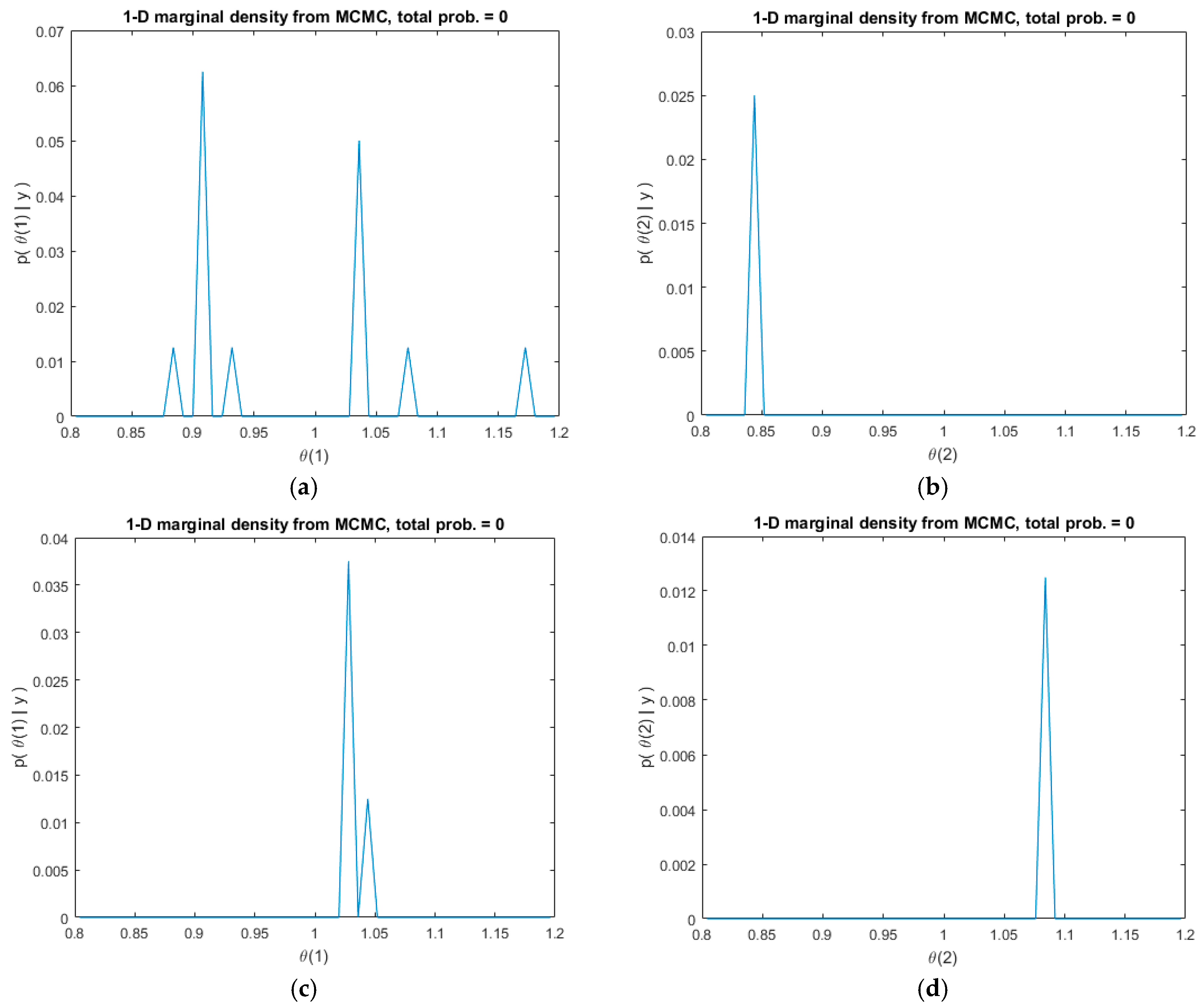
According to these computational results, the MCMC simulation for the testing hypothesis through the 1-D marginal posterior density has been performed using the parameter values as a new initial guess. Several attempts have been tested, e.g., varying the initial guess of the parameters. These tests were necessary to rationalize the output
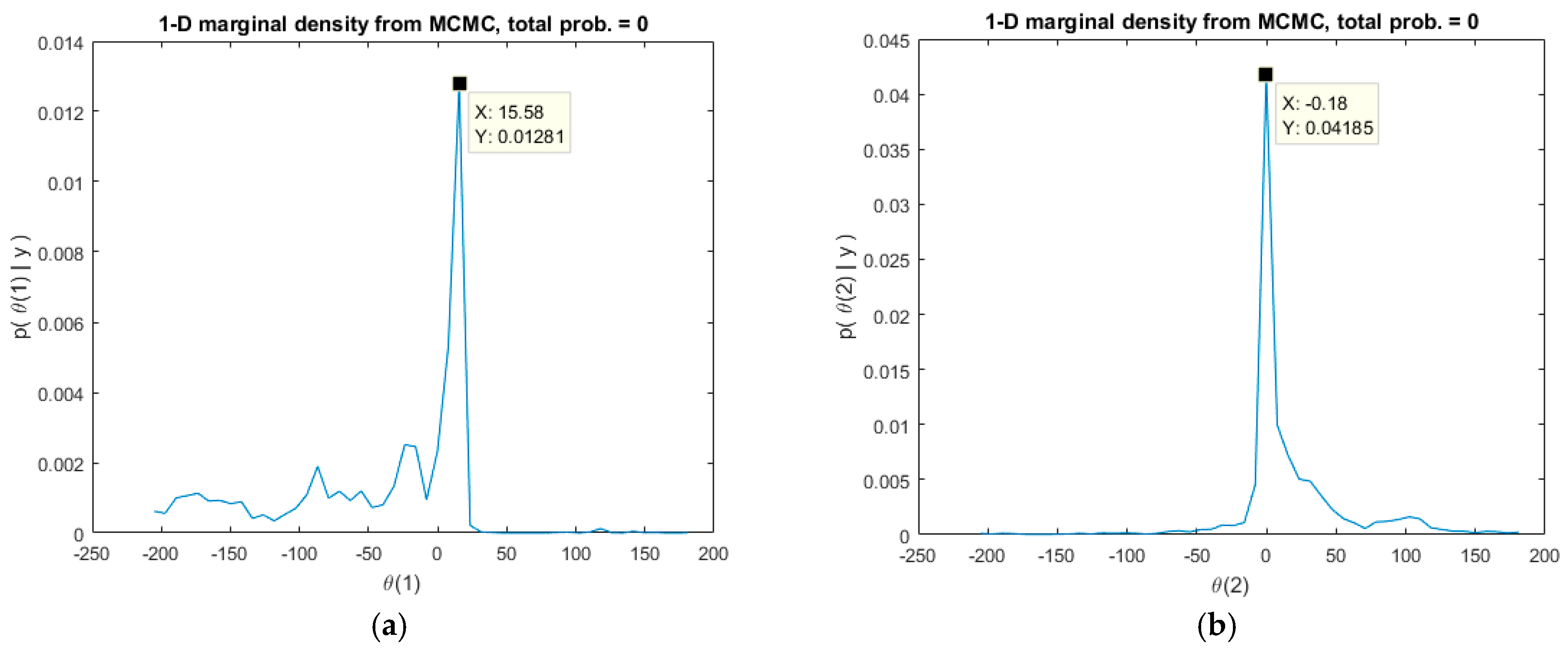
The MCMC simulation for 1-D marginal posterior density using the vector as an initial guess
and fixing the kinetic constant parameter at a value of 3, led to the results reported in
Figure 4 (for the complete results, refer to
Supporting Information Section S3.2—Figure S14).
The outcome was not satisfactory. When trying to force constraints to the parameters search space (partial reaction orders ca. 1), the axis interval was set from 0.8 to 1.2. This aspect highlights how forcing a priori an interval for the search for the solution may lead to poor results. Application of space constraints to the set may affect the solution of a system; the system solution may not be found in that reduced subset, and for this reason, it is advisable to consider a wider interval. On the other hand, a too large interval may be dispersive in terms of computational efficiency as well as in terms of chemically meaningfulness of the solution space.
Moreover, the curve shapes were not regular and varied widely. This last feature could be related to a sub-optimal coding structure, as well as to the nature of the data or to the default values [1.0 1.0] chosen as an initial guess. Anyway, the values of 1D-marginal probability (intensity of the main peaks) on the axis were too low to consider the outcome as at least approximately suitable to represent the proposed kinetic model.
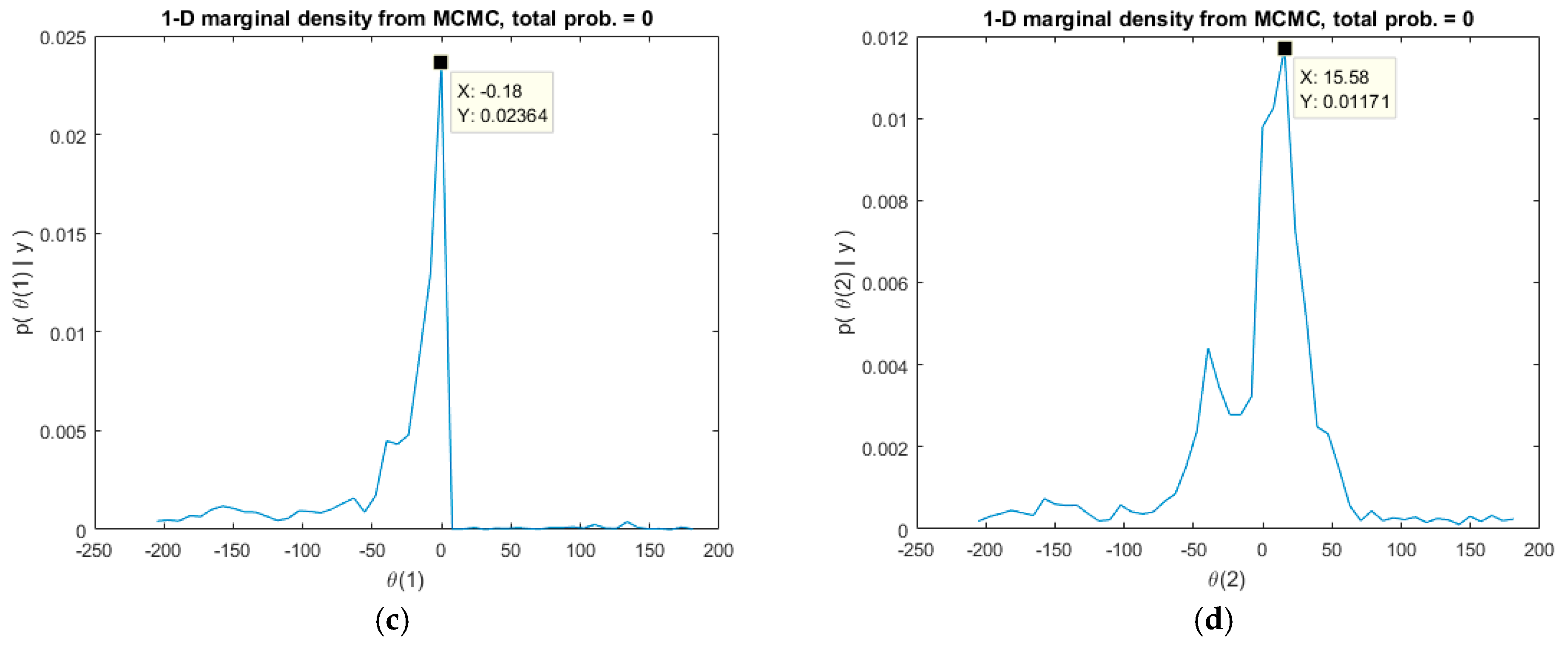
The axis interval considered in the second trial actually included the and values obtained in the first approximate posterior density computational solution [−209 185]. The interval considered in MCMC has been settled according to the ones obtained previously, so the subsequent density curve was reasonably assumed in a certain expected (desired/not desired) region of the space. The curve shapes were more reliable, although the probability values in terms of were still small, far from reaching the maximum value (1)—this means that the posterior density is less plausible given the data and prior. A lack of posterior density should be sought in the quality of the data.
Additional comments should be related to the values assumed by the parameters.
and
. As shown in
Figure 5, there are some values commonly shared and interchangeable with each other. This means that the
or
is the same and
and
could assume the same values, but not at the same time (see
Supporting Information Section S3.3 for more plots describing the several trials evaluated). To further analyze this aspect, the 2D-marginal posterior density should be taken into consideration, because, as already introduced, it considers the probability of obtaining a certain
and
value, knowing (conditioned |) the experimental
(predictor). So, in the 2D-marginal posterior density, the fixed
and
are able to explain the probability of having both such exact values, having the experimental datum
. However, since the 1-D marginal posterior density evaluation was insufficiently meaningful, in terms of results and reliability of the computational part, the 2D-marginal posterior density has not been computed.
To summarize, Bayesian statistics applied to the ibuprofen dataset was not successful in retrieving a reasonable set of kinetic parameters, at least not more than simplified numerical regression. This is ascribed to the nature of the dataset, likely insufficiently rich for a genuine statistical approach, besides the already mentioned limits of using data not derived for this purpose. The intention was not to present a fully validated Bayesian kinetic model, but rather to explore the behavior of probabilistic inference when applied to non-ideal literature datasets. The inconclusive outcome primarily arises from structural limitations of the dataset: the number of experimental points is small, the explored variable space is narrow, and the data were not originally generated for kinetic parameter identification.
These features lead to weak parameter identifiability and practical non-identifiability, which in turn produce flat or irregular posterior distributions. Model overparameterization further amplifies this issue, as the available data do not sufficiently constrain the reaction orders. The MCMC algorithm itself did not fail computationally; rather, it correctly reflected the lack of information content in the likelihood function. In this sense, the Bayesian framework functioned diagnostically, revealing the intrinsic limitations of the dataset.
Overall, this Bayesian analysis serves to demonstrate how advanced statistical tools cannot compensate for insufficient or poorly structured experimental data, thereby reinforcing the central aim of this study.
3.3. Artificial Intelligence and Machine Learning
The third approach used for kinetic parameters estimation has been based on machine learning. Part of a manually-pre-compiled dataset of kinetic constants was used as a training algorithm. This dataset has been built in-house, collecting a total of more than 500 kinetic constant values concerning the reaction of interest for the synthesis of Pregabalin and Rolipram. In particular, the focus has been devoted to the intermediate steps discussed above (i.e., Knovenagel, 1,4-Michael addition, Horner-Emmons reaction, and Michael addition), since these types of reactions are the bottleneck to achieving the final product. Data mining consisted of the collection of all the kinetic constants related to the selected reactions from the Herbert Mayr database [
25,
40], which was developed for the possibility of the existence of a general nucleophilicity and electrophilicity reactivity scale [
41,
42,
43,
44] (
Supporting Information, Section S4.1). Among the two electrophiles and nucleophiles macro categories, several different classes of molecules have been chosen according to the intermediates present in the Pregabalin and Rolipram synthesis (e.g., phosphorous ylide, Michael acceptor, malonate derivatives, etc.).
A comprehensive list of molecules considered, extracted from our developed database, is reported in
Supporting Information Section S4.2. For each class of molecules, several references have been considered in order to retrieve the kinetic constants [
45,
46,
47,
48,
49,
50,
51,
52,
53,
54,
55,
56]. All the kinetic parameters (e.g., kinetic constant, electrophile/nucleophile parameters) mined have been collected into our in-house developed database called T-ReX. For a quite exhaustive example of this database, refer to
Supporting Information, Table S17. The construction of the database had to take into consideration some features in order to optimize the progressive implementation and make the approach simpler and more usable.
The temperature was 20 °C in all reaction cases considered, so this variable has been removed. The solvent has also been removed from the T-ReX database as a first instance, in order to reduce the complexity of the computational aspects, reducing the number of correlations and classifiers. The nature of the solvent (e.g., non-polar/polar) plays a pivotal role in polar reactions (e.g., SN2), and appropriate consideration should be taken into account in the future. In the present case, the choice was to focus on the correlation between the electrophile/nucleophile character of the selected molecule pair and the resulting kinetic constant. The solvents reported in literature (i.e., DMSO, DCM, H2O, MeOH/CH3CN) did not give us additional helpful information in handling the data. The parameter’s data values collected are naturally derived from the use of a certain solvent—in other words, the solvent accounting is redundant. The present work is not related to mechanistic insight for the development of a kinetic model, but rather highlights the possibility of drawing useful kinetic information from non-tailored experimental kinetics results. Solvent effects can significantly influence polar reaction kinetics, and here, the deliberate omission was a dimensionality-reduction choice aimed at isolating intrinsic electrophile–nucleophile reactivity in a first-order approximation. Of course, this limits direct physical interpretability of the predicted rate constants, so that the reported values should be interpreted as solvent-implicit estimates tied to the original experimental conditions.
The robustness of this database has been checked thanks to the cross-match of a certain molecule in different references (e.g., a benzhydrylium ion has been found in several publications as a substrate to evaluate its reactivity as an electrophile with different nucleophiles). No redundant investigation was included.
The T-ReX database is an advancement with respect to the original set of data, which constitutes an unstructured database where large volumes of data are stored in an unstructured format [
7] or at least as a semi-structured data lake in which a certain dataset structure provides a better representation of the chemical space for the reaction [
40].
On the contrary, the T-ReX database is structured and thus suitable for a supervised machine learning approach. It includes more than five hundred kinetic constants (entries), assigning the class to each electrophile/nucleophile involved in a certain reaction. This approach proved winning, especially in the use of -Nearest Neighbor algorithm for easy classification and pattern recognition.
The parameter able to differentiate the two different categories of compounds was selected as the Linear Free-Energy Relationship (LFERs) for Substituent Effects, in order to quantify the correlation between substituent groups and resulting chemical properties (as electrophile or nucleophile).
In many cases, structure-reactivity relationships can be expressed quantitatively in ways that are useful both for the interpretation of reaction mechanisms and for the prediction of reaction rates [
57]. The most widely applied of these relationships is the Hammett equation, which correlates rates and equilibria for many reactions [
57]. The
parameters able to describe the influence of substituents on a molecule, were unfortunately not useful and reproducible in the present case, since they are strictly correlated to the substituted phenyl group. The Hammet
approach has been ruled out, and the focus was driven toward two more accessible and closer case-study parameters: the experimental
E and
N parameters found in Herbert Mayr’s linear relationship among the electrophiles/nucleophiles and the resulting kinetic constant of their reaction as reported below:
The choice to consider just E and N relies on the fact that with just these two parameters, it was possible to perform pattern recognition using the -Nearest Neighbor algorithm.
The covered nucleophilicity range is −8.80
N 31.92, whereas the electrophilicity range is −29.60
E 8.02. These are the values reported in [
25] and covering all of the 1273 nucleophiles and 1344 electrophiles. In the present case, the interval was set narrower and covers a symmetrical overlapped interval of −30.0
N/E
30.0. Herbert Mayr’s equation could be considered as belonging to a primordial work in the development of data-driven science in organic chemistry, and these strategies are still rooted in LFERs, of which the Hammett relationship (and the modified Taft equation) is the paradigmatic example [
7].
The final step was to develop a suitable approach for the evaluation of the dataset and application of a machine learning technique for kinetic constant extraction. The Principal Component Analysis (PCA) approach (
Supporting information Section S1) has also been applied as a bridge between the classical methods and the ones belonging to the machine learning field, among which the
-Nearest Neighbor (
-NN) was selected.
The regular expressions have been applied to the SMILE notation. The SMILE string notation has been chosen according to natural language processing tasks and widely used in the literature [
8,
10,
11]. The regular expression is able to address the readiness of the SMILE string in case-sensitive mode, avoiding misleading interpretation (e.g., uppercase/lowercase topic).
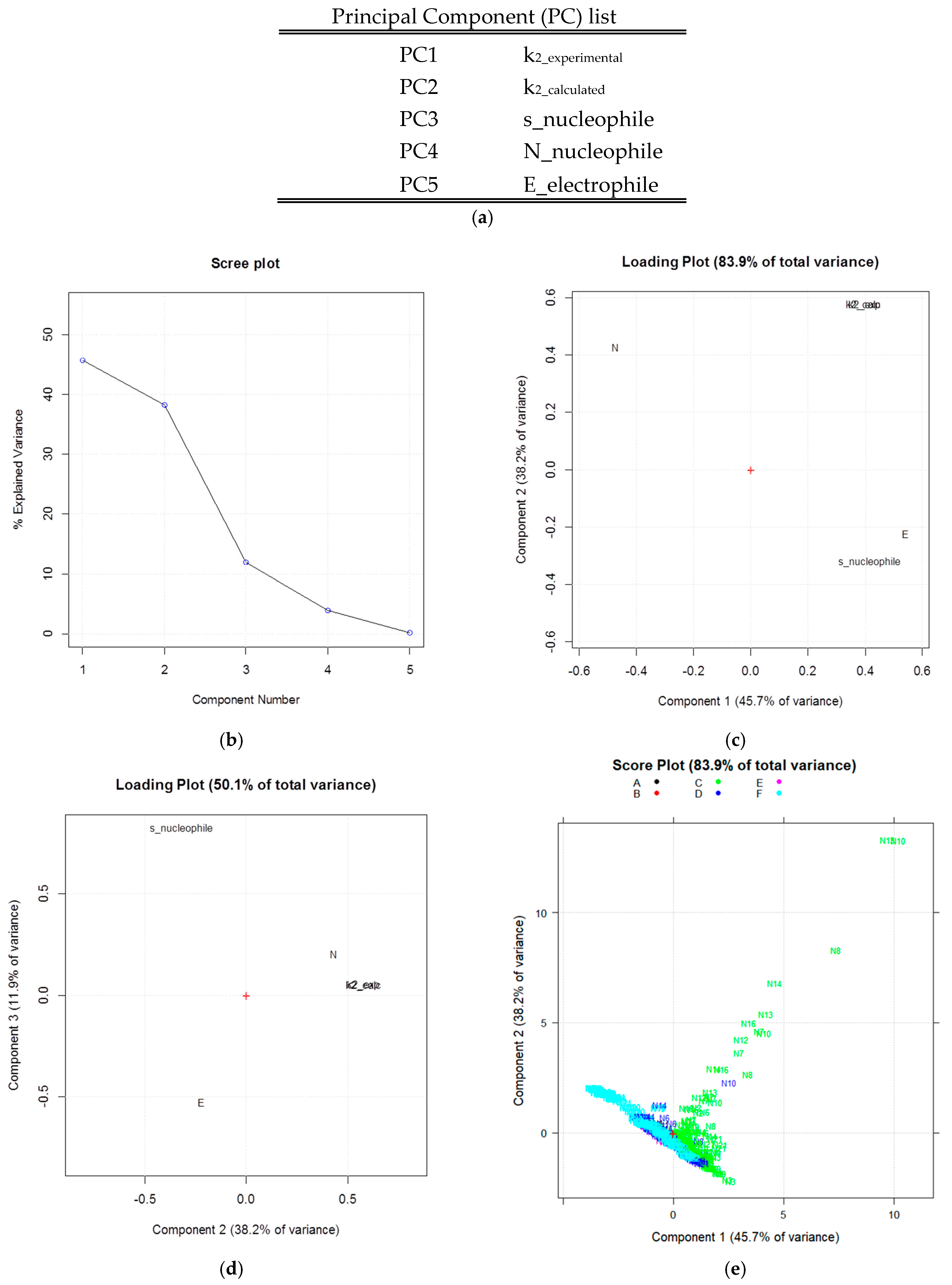
The results derived from the application of the PCA technique to the T-ReX database are listed below and plotted in
Figure 6.
The first diagram is the Scree Plot, also called the Elbow Plot, and gives the principal components (
Figure 6b), which are listed for convenience in
Figure 6a. According to the scree test, the elbow of the graph where the eigenvalues (K1 or Kaiser criterion) seem to level off is found, and factors or components to the left of this point should be retained as significant. According to these definitions, the variance is explained by 5 components, but mainly depends on the components one and two, which, following the dataset structure, represent the kinetic parameters.
The loading plot reports the spatial disposition of the five components, evaluating the goodness of the spatial positioning of the variables. Moreover, the component PC1 (
axis) and PC2 (
axis) were able to explain the 45.7% and 38.2% of the variance, respectively, for a total 83.9% of the variance (
Figure 6c). This means that these two components have a high weight in explaining data dispersion, since the idea is to have as much variance explained, with as few principal components as possible.
The loading plot reports the spatial location of all five components, evaluating the goodness of the spatial distribution of the variables. Moreover, the component PC2 (
axis) and PC3 (
axis) were able to explain respectively the 38.2% and the 11.9% of the variance, respectively, for a total 50.1% (
Figure 6d).
The PC1 vs. PC2 score plot highlights which samples are majorly influenced and by which other variables. In the present case, the green points (electrophile, i.e., benzhydrylium ions) were predominantly influenced by
and negatively influenced by the electrophile parameter E. The top right corner was influenced by
and
. The other labeled and colored points were all the other classes of electrophiles that showed their relationship with the corresponding nucleophile (
Figure 6e).
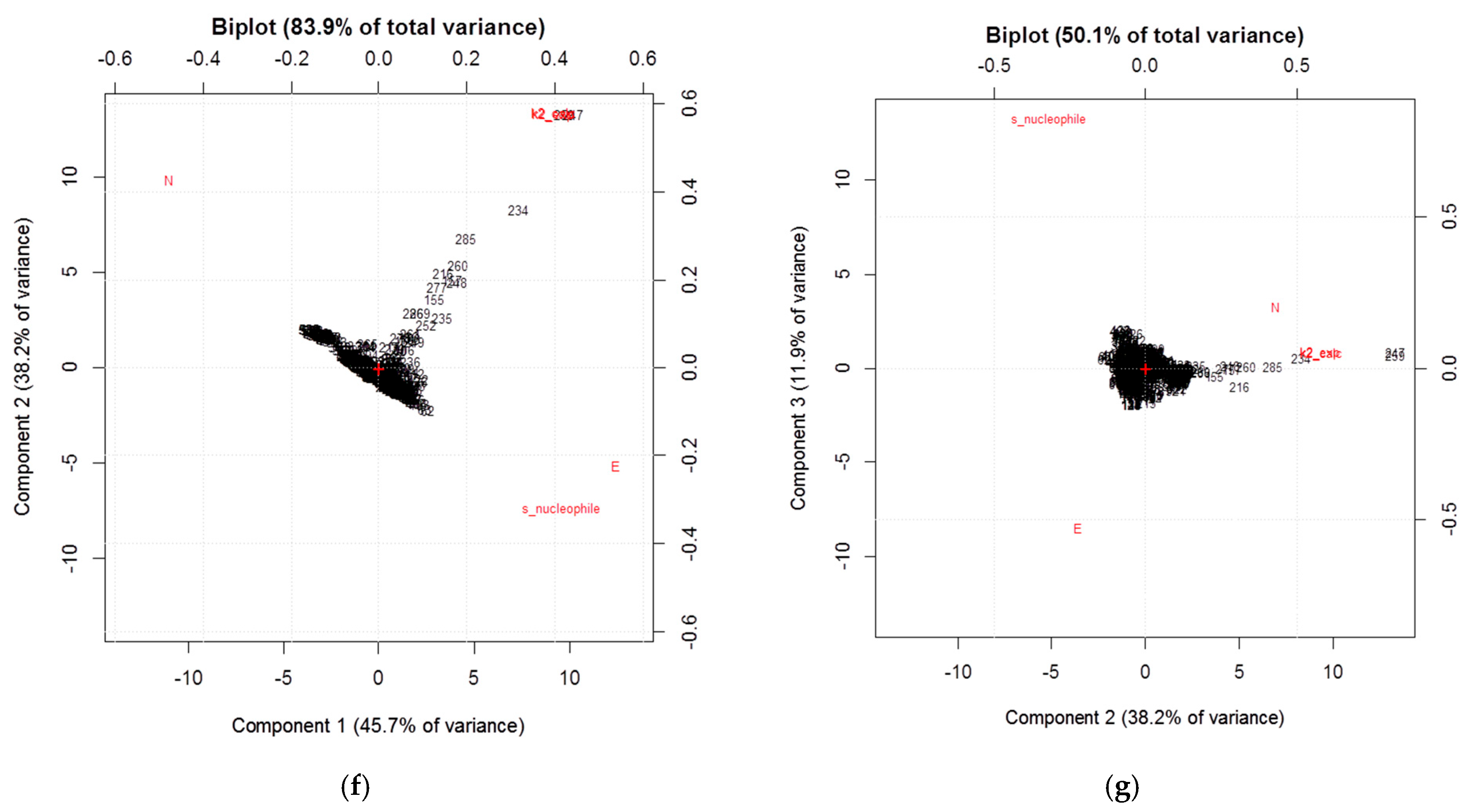
The biplot for PC1 vs. PC2 could be considered as a merged diagram. It highlights the original samples (in red) and the variables with their own influence on the samples (black) (
Figure 6f).
The biplot for PC2 vs. PC3 is analogous to the previous one, but the two principal components are obviously different (
Figure 6f).
The k-NN approach has been applied for pattern recognition in order to classify different classes of molecules belonging to two different categories (electrophile/nucleophile) on the basis of different parameter values (E/N) and . The k-NN algorithm has been chosen for its own simplicity (implementation and explanation), to a lazy learner, high memory storage for the full training set, and is applicable to small datasets. The k-value applied (k = 3) allows the algorithm to look at the three (E/N and ) closest parameters with respect to the new one. In the present study, the k-value selected for the k-NN algorithm was k = 3. This choice reflects a balance between local sensitivity and robustness, given the moderate size of the T-ReX dataset (ca. 500 entries). Lower values (k = 1) led to excessive sensitivity to single-point variability, whereas higher values reduced chemical specificity in classification.
The selection of the k-NN algorithm was mainly driven by the specific nature of our dataset and objectives. The T-ReX database is relatively small (ca. 500 entries), structured, and chemically interpretable; therefore, a non-parametric, instance-based method was preferred over more complex models (e.g., neural networks or ensemble methods) that would require significantly larger datasets to avoid overfitting. Moreover, k-NN provides local, similarity-based predictions that are directly aligned with the chemical intuition underlying Mayr’s reactivity parameters (E and N), preserving interpretability—an essential aspect for process design applications.
Regarding performance assessment, a benchmark validation was performed using an independent set of entries of the dataset not included in the training phase, verifying the algorithm’s ability to correctly classify electrophile/nucleophile categories and to assign a realistic kinetic constant range. More extensive validation metrics (e.g., cross-validation or error quantification) could further strengthen the approach and will be considered in future developments.
Solvent and temperature effects exclusion was a deliberate dimensionality-reduction strategy aimed at isolating intrinsic electrophile/nucleophile reactivity as a first-order approximation. We recognize that solvent polarity and temperature can significantly influence polar reaction kinetics; however, incorporating these variables at this stage would have introduced sparsity and multicollinearity issues in the dataset. Future extensions of the T-ReX framework will explicitly include solvent descriptors and temperature dependence to enhance chemical realism and broaden applicability.
The choice of as shareable classification parameter, both for electrophile/nucleophile have been found useful in better sorting among the different classes of electrophile/nucleophile. Since the values were not present in almost all the references used; a value has been assigned according to the nature of the substituent (resonance/mesomeric effect) directly bonded to the methylene group of functional groups (e.g., aldehyde, Michael acceptor, etc.), referring to the so-called -hydrogen. The values assigned in this way potentially cover a very broad range of molecules. This means that we do not have to limit ourselves to a specific evaluation in the screening phase, but rather speed up the evaluation process so as to make it support a subsequent refinement phase where necessary.
In the abscissa, the merged scale values for E and N parameters (−30 E/N +30) were reported, while in the Y-Axis the scale values for electrophiles and nucleophiles.
The benchmark validation was done using an independent set of literature values not used for training in order to evaluate the goodness of the classification. This approach highlights how it is possible to assign a molecule to the same category as the ones used in training (e.g., aldehyde, Michael acceptor, etc.), considering a handful of values available. The results confirmed the success of the implementation of this method.
Regular Expression
The kinetic data extraction was possible thanks to a synergistic approach between the -Nearest Neighbor algorithm and the regular expression. The supervised -NN algorithm showed its ability to classify several different classes of molecules belonging to the two categories of electrophile/nucleophile. The regular expression was able to read the molecules expressed in SMILE notation (not present in the trained database) and to classify them as electrophile or nucleophile. In this way, it was possible to correlate the new molecule(s) to a set of E/N pairs having a certain kinetic constant value.
To better detail, the regular expression algorithm was able to read a certain portion of text and recognize that pattern among other ones: a certain portion of a molecule (e.g., the carbonyl group or the phosphonium ylides group) is literally read by the algorithm. This approach has been addressed by the conversion of molecular formula into SMILE notation [
8]. The benchmark process has also been addressed in this way using an already known molecule, confirming the goodness of the algorithm approach.
Once the command-line -egrep has been invoked, the regular expression algorithm was able to read the molecule(s) in SMILE notation, recognizing and highlighting where that pattern (in terms of string) was already present in the list of SMILE molecules format. Hence, it was possible to assign the new molecule to a reduced list of possible candidate classes of molecules, having that specific recursive pattern. The forecasting step takes place at this point: the new molecules expressed in SMILE notation are classified as potential candidates belonging to the binomial category of electrophile/nucleophile—this allows us to foresee which possible E/N combinations are possible and what will be the related kinetic constant.
About these aspects, some considerations are necessary in order to better understand how the regular expression approach has been conceived and applied.
- (a)
Electrophile.
About the electrophiles, benzaldehyde has been chosen as a benchmark example in order to evaluate the goodness of the algorithm implementation, exploiting the regular expression approach. As it is possible to appreciate in the following bullet list, the benzaldehyde molecule has been translated into SMILE notation, and the original pattern (=O)=C has been converted into the string format by invoking the -egrep command. The algorithm was able to recognize the specific pattern declared initially, and it was able to identify all the molecules having that certain pattern, including the aldehyde molecule.
smile notation \texttt{O=Cc1ccccc1}–Benzaldehyde
original\_pattern = r″(=O)=C″
original\_pattern = r″[\\(]=O[\\)]=C″} -egrep
O=Cc1ccccc1}
- (b)
Nucleophile
About the nucleophile, triethyl phosphonoacetate has been chosen as a benchmark example in order to evaluate the goodness of the algorithm implementation, exploiting the regular expression approach. As it is possible to appreciate in the following bullet list, the Phosphoryl-Stabilized Carbanion molecule has been translated into SMILE notation, and the original pattern (=O)C has been converted into the string format by the -egrep command. The merged approach was able to recognize the specific pattern declared initially and identify all the molecules having that certain pattern, including the phosphonoacetate molecule.
smile notation for \texttt{CCOC(=O)CP(=O)(OCC)OCC}
original\_pattern = r″CCOC(=O)CP(=O)(OCC)OCC”
original\_pattern = r″[\\(]=O[\\)]=C″} - \texttt{egrep}
CCOC (=O)CP (=O)(OCC)OCC
- (c)
Supervised algorithm implementation
It is important to highlight how the pattern recognition toward the regular expression was able to recognize all the molecules having a certain pattern within their own structure in SMILES notation. This leads to possible side-effects since, as listed below, certain molecules could in principle have the same pattern but cannot be considered as electrophile/nucleophile for the purpose of APIs synthesis (e.g.,
). Moreover, another aspect that must be taken into account is the way in which these regular expressions read the molecule. The molecules translated into SMILE notation must have the same encoding structure to be read in a unique way by the regular expression algorithm. A SMILE database must be built following unambiguous and commonly accepted encoding rules [
8,
10,
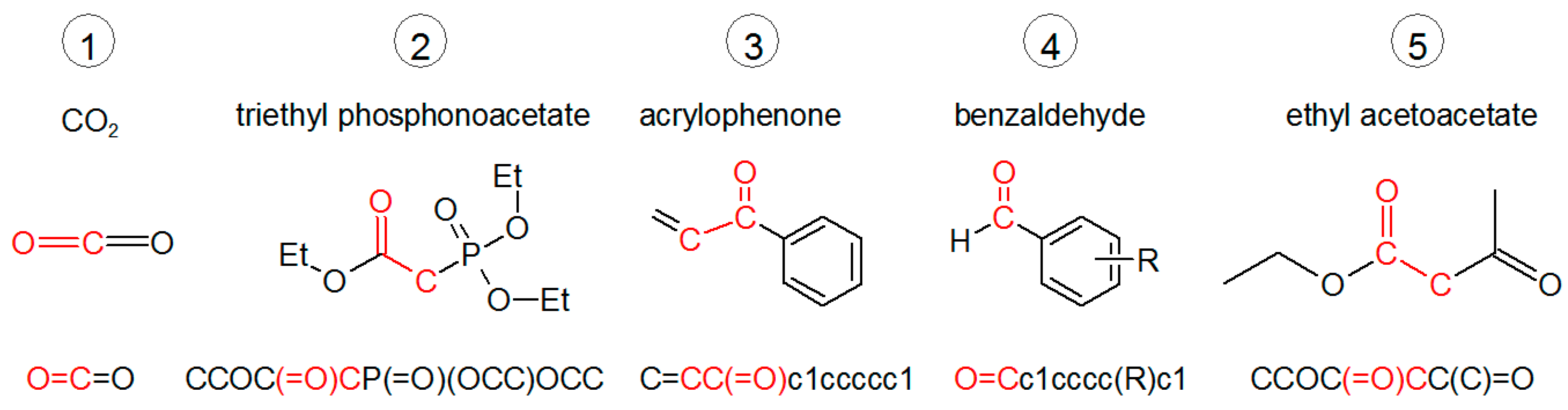
11]. On the contrary, the application of different encoder tools leads to a miscellaneous approach and failure in terms of recognition of characters reported in the two different translated SMILE (e.g., acrylophenone, benzaldehyde (subst.), ethyl acetoacetate vs. triethyl phosphonoacetate).
A general approach for SMILE encoding should be addressed within the scientific community. Listed below are some issues that could take place and that suggest a better understanding of the reason why the -NN algorithm is defined as belonging to supervised learning.
O=C=O as not as carbonyl compounds
CCOC(=O)CP(=O)(OCC)OCC} triethyl phosphonoacetate
CCOC(=O)CP(=O)(OCC)OCC} triethyl phosphonoacetate vs. C=CC (=O)c1ccccc1 for acrylophenone (E)
O=Cc1cccc(Cl)c1 for subst. benzaldehyde (E)
CCOC(=O)CC(C)=O for ethyl acetoacetate (N)
As appreciated, the application of a supervised algorithm is useful in this case, since it gives the possibility to consider or rule out a set of molecules that cannot belong to the electrophile/nucleophile class for the scope aimed. In this way, machine learning becomes an important tool that helps the chemist in reducing a half-thousand kinetic constant values dataset, supporting the final decision on which electrophile/nucleophile couple of molecules are the best ones to use and test in the laboratory for further experimental validation of kinetic studies, or directly implement that specific kinetic constant in process simulation software as first approximation value.
Moreover, an example is shown in
Figure 7, concerning the application of regular expressions in order to differentiate some functional groups (F.G.) among different classes of molecules.
In the example proposed, it was possible to differentiate the carbonyl F.G. The carbonyl compound belonging to carbon dioxide is the same in terms of SMILE notation of substituted benzaldehyde. Furthermore, the outcome must be checked in order to rule out false positive results.
Another remark is related to the comparison of triethyl phosphonoacetate and the acrylophenone: in principle, the carbonyl F.G. is bonded with a methylene carbon atom, and no difference would be recognizable from the organic chemistry point of view. Actually, thanks to the application of regular expression and, in particular, invoking the -egrep command-line, it is possible to differentiate these two carbonyl compounds so that also the molecules themselves can be differentiated: the triethyl phosphonoacetate works as nucleophile at the methylene carbon (i.e., in Horne-Hemmons reaction as nucleophile source), whereas the acrylophenone works as electrophile (i.e., Michael acceptor). Moreover, the regular expression -egrep command line is capable of differentiating uppercase from lowercase: (=O)C vs. (=O)c (i.e., case sensitive) as a great advantage.
Analogously to the previous point, another aspect is the ability of the -egrep command line to recognize the parentheses present in the pattern searched (here not reported): (=O)=C vs. O=C (i.e., case sensitive).
A last point is related to the way in which the SMILE notation is read. The correct way in which the molecule is encoded and the way in which the pattern is declared in the programming script must be the same. C(=O) is different by definition from (=O)C due to the order of pattern declared, as well as C(=O)C in ethyl acetoacetate, highlighting the methylene carbon instead of C(=O)C since this last one would define just the carbonyl group (avoiding the methylene).
The attention is selectively focused on the carbonyl group due to its main role as F.G. in defining the electrophile compounds and on the methylene carbon for the nucleophile ones. Other classes of compounds would be in principle investigated (e.g., enammine vs. immine) in order to better point out the potential of the application of regular expression to the chemical SMILE notation.
Therefore, the following hints can be summarized.
The assigned molecule must be checked and confirmed to effectively belong to that class (and also category), i.e., strictly supervised learning algorithms should be preferred, such as the k-NN.
The reduced dataset is now constituted of the new molecule and all the other possible corresponding polar partners (i.e., E/N or N/E) with whom the new molecule could, in principle, react. The pattern feature, as an expression of a specific organic F.G. able to describe a certain class of molecules (e.g., imine group, carbonyl group, etc.), allows for the identification in a unique way of the class to which the new molecule belongs and links itself to all the corresponding polar partner class of molecules. This mutual relationship allows us to identify all the possible combinations available.
The most important result is that for each combination in terms of electrophile/nucleophile reagent couple among all the possible ones, the kinetic constant is made available through the application of a k-NN machine learning technique, trained with the T-ReX database: i.e., by correlating a new molecule labeled as SMILE pattern to an estimated kinetic constant value. This means that a subset of kinetic constant parameters has been found as possible values for that certain specific combination of polar partners and the corresponding reaction. This approach, though time-consuming in the definition of homogeneous labeled datasets from literature available information, is promising to build first estimates of kinetic constants for preliminary process design and feasibility assessment. Even considering a large approximation in kinetics and the relative design, this can anyway save huge experimental efforts and the relative investment, ruling out ineffective routes and leaving the experimental validation needs only to the most promising alternatives after a preliminary screening.
Overall, SMILES representations are not unique and may vary depending on encoding. Nevertheless, in this workflow, molecules were standardized prior to pattern matching using a consistent canonical SMILES generation procedure to reduce ambiguity. The regular expression step was not intended to replace graph-based cheminformatics methods, but to provide a lightweight, interpretable pre-classification filter within a supervised framework. More robust graph-based approaches (e.g., canonicalization and substructure search via cheminformatics toolkits) represent a natural extension of the method.