
Review

Modernizing Asthma Diagnostics: Biosensors Enhanced by Nanomaterials and Artificial Intelligence


1
Department of Biotechnology, Jamia Hamdard, New Delhi 110062, India
2
Department of Biotechnology & Bioengineering, Galgotias University, Greater Noida 203201, India
3
Department of Biotechnology, Jamia Millia Islamia, New Delhi 110025, India
*
Author to whom correspondence should be addressed.
These authors contributed equally to this work.
J. Nanotheranostics 2026, 7(3), 16; https://doi.org/10.3390/jnt7030016
Submission received: 3 June 2026 / Revised: 26 June 2026 / Accepted: 30 June 2026 / Published: 2 July 2026
(This article belongs to the Special Issue Advances in Nanoscale Drug Delivery Technologies and Theranostics)

Abstract

Asthma is a prevalent, long-term inflammatory airway condition that is difficult to diagnose and treat because there is no single reliable diagnostic test. Misdiagnosis is therefore common, with rates as high as 73% in juvenile groups and up to 35% in adult populations. This ultimately exacerbates their illness by postponing therapy for some people and administering needless medication to others. Although well-known biomarkers such as blood eosinophils and fractional exhaled nitric oxide, as well as conventional diagnostic techniques such as spirometry, have improved clinical assessment, they are nevertheless constrained in many healthcare settings by limited availability, high cost, and inconsistent use. Furthermore, these indicators primarily reflect type-2 inflammation and are less useful for non-type-2 asthma, highlighting the need for more comprehensive, readily accessible diagnostic techniques. Identifying novel biomarkers of oxidative stress, metabolic alterations, and airway inflammation, including volatile organic compounds and redox-related chemicals, has been the focus of recent studies. These biomarkers offer opportunities for improved disease phenotyping and non-invasive detection. Simultaneously, advances in biosensor technology have enabled highly sensitive platforms to rapidly detect these biomarkers at low concentrations. In particular, optical biosensors are becoming more and more popular due to their ability to do real-time detection without the need for labels and their ease of miniaturization for point-of-care devices. This work summarizes traditional diagnostic tools alongside existing information on asthma phenotypes and clinically important biomarkers, and discusses advanced biosensors ranging from electrochemical to optical systems, including recent developments in nanomaterial-enhanced optical biosensing techniques. The importance of artificial intelligence and smartphone-integrated hardware is also covered, along with the main challenges that need to be overcome for these technologies to become useful clinical tools for asthma diagnosis and monitoring.

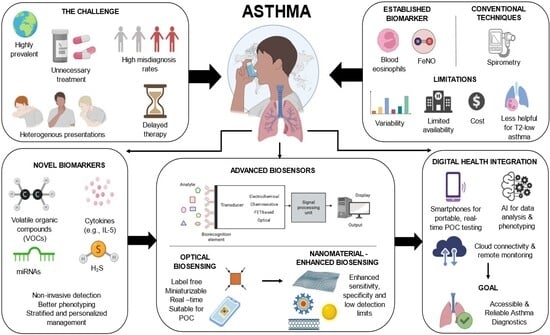
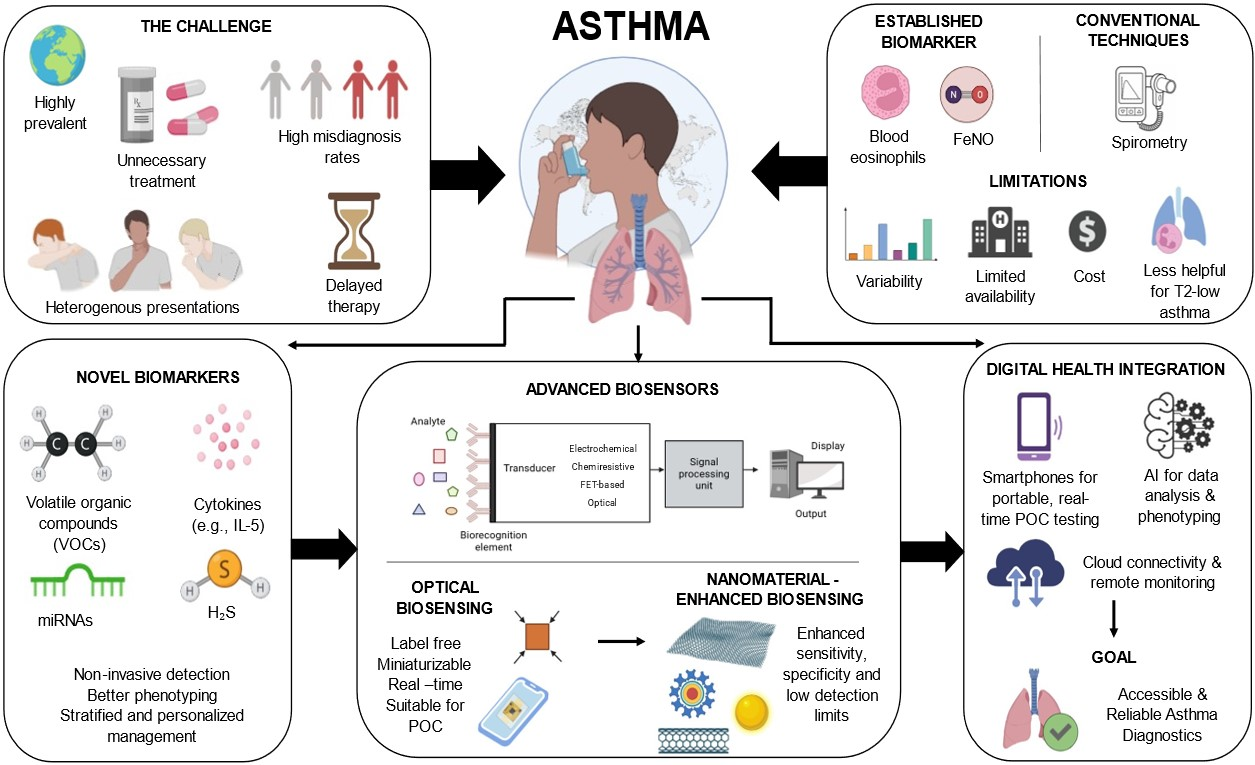
Graphical Abstract

1. Introduction

Asthma is a non-communicable chronic inflammatory airway disease impacting about 300 million people globally, with an estimated 461,000 fatalities recorded in 2019, underscoring its significant contribution to morbidity and mortality worldwide [1]. The lack of a definitive gold-standard test and the challenges of obtaining an accurate diagnosis due to non-specific symptoms exacerbate this problem. According to recent population-based research, about 20–73% of people with current asthma remain undetected, delaying medication and airway remodelling, while about 30–35% of adults are over-diagnosed and undergoing needless treatment. These errors raise healthcare expenses, expose patients to needless corticosteroids, and delay the diagnosis of other cardio-respiratory disorders, including coronary artery disease [2,3,4]. Similar challenges are observed in the pediatric population, where studies have reported that approximately 53.5% of children diagnosed with asthma are over-diagnosed, whereas 50–68% of true asthma cases remain undetected [5,6,7]. Due to poor cooperation, sporadic symptoms, and the heterogeneous nature of asthma, traditional diagnostic tools, such as spirometry paired with clinical history, frequently fail to accurately identify asthma, particularly in children [8]. Spirometry may be normal despite underlying asthma and requires patient cooperation, trained personnel, and specialized equipment, whereas peak expiratory flow, bronchoprovocation, and fractional exhaled nitric oxide (FeNO) testing are constrained by variable accuracy, biological and environmental variability, interpretation challenges, cost, and limited accessibility, which further delays proper diagnosis and exacerbates global health inequities [9,10,11]. These shortcomings highlight the pressing need for accessible, objective, and non-invasive point-of-care diagnostic techniques to enhance disease classification and early diagnosis. Asthma is increasingly viewed as a heterogeneous condition encompassing several phenotypes, including T2-high and T2-low endotypes, which are influenced by distinct inflammatory pathways. Particularly for biologic treatments targeting inflammatory pathways such as interleukin (IL)-5 and interleukin (IL)-4/IL-13, biomarkers including immunoglobulin E (IgE), FeNO, blood eosinophils and sputum eosinophils have enhanced phenotypic classification and therapeutic stratification. However, high prices, the requirement for specialized equipment and knowledge, variations in sample collection and examination techniques, and overlapping biological data limit the therapeutic use of many biomarkers [12,13]. Biosensors have been identified as a promising substitute to traditional diagnostic methods, enabling rapid, sensitive, on-site detection of disease biomarkers while reducing reliance on complex laboratory procedures, trained staff, and expensive analytical instruments [14]. By leveraging various sensing modalities, including electrochemical, piezoelectric, and optical platforms, recent technical developments now enable the objective detection of asthma-related liquid or gaseous biomarkers at parts-per-billion levels [15,16]. Among these, optical biosensors have drawn particular attention because of their label-free detection capability, high sensitivity, and compatibility with miniaturized and portable platforms. Transduction techniques such as Raman spectroscopy, surface plasmon resonance, and fluorescence quenching allow real-time monitoring of biomarkers, such as volatile organic compounds (VOCs), associated with airway inflammation [17,18]. Nanomaterials such as graphene, quantum dots, carbon nanotubes and metal nanoparticles have high surface area, better signal amplification, and improved optical properties, which are very useful for further improving the performance of these biosensors by lowering detection limits, increasing sensitivity, and helping achieve faster response times [19]. The use of these sensors with smartphones and artificial intelligence/machine learning (AI/ML) algorithms supports decentralized testing and allows automated analysis of obtained data, making mobile devices useful diagnostic tools that can assist in the precise identification of specific biomarkers and disease monitoring [20,21]. Although there is scientific literature on asthma biomarkers, biosensing platforms for lung diseases, AI-based asthma management, and nanoparticle theranostics for respiratory disorders, little has been done to integrate these areas into a coherent framework [22,23,24,25]. The current paper seeks to address this knowledge gap by providing an extensive review of asthma phenotypes and emerging biomarkers for the diagnosis and management of asthma, while highlighting the shortcomings of existing diagnostic modalities. Moreover, the paper discusses how various biosensors, such as electrochemical and optical systems, are transforming non-invasive diagnostics. By emphasising the integration of nanomaterials with optical platforms, smartphones, and AI, the review underscores the translational strategies required to design the next generation of asthma-monitoring devices.

2. Conventional Test for Asthma

The primary factors used to diagnose asthma are symptoms, including coughing, shortness of breath, episodic wheezing, and chest tightness, which indicate varying airflow obstruction. Objective testing, a physical examination, and a clinical history are required to confirm airflow limitation [26]. Standard diagnostic techniques used to identify airflow obstruction or airway hyperresponsiveness include spirometry, bronchodilator reversibility testing, peak expiratory flow variation, and bronchial provocation testing. Given the heterogeneous nature of asthma, diagnosis depends on a combination of clinical assessment and these tests to reduce the risk of misdiagnosis, as no single gold-standard test exists [27].

2.1. Initial Evaluation—History and Physical Examination

For all age groups, a careful clinical history and physical examination form the foundation of asthma diagnosis. Asthma symptoms, such as wheezing, dyspnea, and coughing, often change over time and may worsen at night or in response to stimuli such as allergens and exercise. While these symptoms provide important clues, their diagnostic value is limited because patient-reported symptoms can be inconsistent and nonspecific. Therefore, diagnosis requires physician observation, often supported by standardized questionnaires to confirm symptoms, their pattern, and probable triggers, such as exposure to dust, pollen, and smoke. The likelihood of asthma is further supported by the existence of allergic disorders such as eczema, allergic rhinitis, or food allergies, together with a family history of asthma [28,29]. A physical examination includes assessing vital signs and performing head, neck, and pulmonary assessments. While an examination may be normal in between episodes, patients may exhibit wheezing, hyperresonance, prolonged expiration, and hyperinflation. Tachycardia, tachypnea, pulsus paradoxus, and trouble speaking can occur during severe episodes. The diagnosis may also be supported by atopic features, such as allergic rhinitis, eczema, atopic dermatitis, nasal polyps, pale nasal mucosa, and pharyngeal cobblestoning [30,31,32].

2.2. Spirometry

Spirometry is the preferred objective test for suspected asthma as it accurately measures airflow limitation. It determines lung function by measuring forced expiratory volume in one second (FEV1) and forced vital capacity (FVC). A decline in the FEV1/FVC ratio, usually less than 0.70 in adults, indicates airflow obstruction. Improvements in lung function following bronchodilator usage, with an increase in FEV1 of >12% and >200 mL, demonstrate reversibility [33]. Variability in airway obstruction is another characteristic of asthma, as shown by serial spirometry, which shows variations in FEV1 over time, either an increase or a reduction of >12% and >200 mL from baseline. However, in those with suspected asthma, especially if there are no symptoms, spirometry may seem normal because of the heterogeneous nature of asthma and its variable, often sporadic airflow limitation. Over time, airway obstruction may change and resolve spontaneously, after treatment, or during well-controlled periods. As a result, despite underlying bronchial hyperresponsiveness and airway inflammation, normal spirometric readings may be observed. Therefore, asthma cannot be ruled out by normal spirometry, and more testing may still be required [34]. In addition, obtaining accurate spirometry requires compliant patients who can perform the technique correctly, well-trained operators, and properly maintained and calibrated equipment. Interpretation of spirometric values also requires experience and consideration of factors such as age, sex, height, and ethnicity, which can limit its practical use in some clinical settings [9]. Even though conventional spirometry is often used to evaluate lung function, its routine use in primary care settings may be limited by equipment, staffing, and clinical resource requirements. To address these limitations, home spirometry has been proposed as an alternative that enables patients to repeatedly measure lung function in their normal daily environment. There is limited information available concerning the use of home spirometry as a component of the standard primary care diagnostic process. Specifically, the accuracy, adherence to periodic testing, and detection of daily variations in lung function, which are commonly overlooked in a single-visit spirometry test, remain undetermined [35].

2.3. Bronchoprovocation Testing

Bronchial hyperresponsiveness (BHR) is an exaggerated airway constriction in response to a stimulus and is a key feature of asthma, though it can also occur in other diseases and even in healthy individuals. Bronchoprovocation tests are used to assess BHR, especially when asthma is suspected despite normal routine spirometry results. They are more helpful for excluding asthma than for confirming it [36]. These tests fall into two categories, selective (e.g., chemical sensitizers, allergens or aspirin) and non-selective, which include stimuli such as histamine, methacholine, exercise, or mannitol. Non-selective stimuli are further divided into direct and indirect challenges. Direct bronchial challenge tests, such as methacholine and histamine, induce bronchoconstriction by acting on airway effector cells, like smooth muscle cells, mucus-producing cells and vascular endothelial cells, resulting in airway narrowing. These tests are highly sensitive in identifying airway hyperresponsiveness, but their specificity for asthma is limited, as positive responses may also occur in healthy individuals and patients with other respiratory conditions. Consequently, direct challenges are primarily used to rule out asthma when test results are negative [37,38]. In contrast, indirect challenges, including exercise, hypertonic saline, eucapnic voluntary hyperpnea (EVH), cold air, mannitol, and adenosine monophosphate (AMP), provoke bronchoconstriction indirectly by increasing airway surface osmolarity and stimulating inflammatory cells and neuronal cells to release mediators such as histamine, prostaglandins, neuropeptides and leukotrienes [39]. These mediators subsequently act on airway smooth muscle receptors, resulting in bronchoconstriction and a transient drop in FEV1. Indirect tests are often more specific for identifying active asthma and are especially helpful for diagnosing exercise-induced bronchoconstriction because they more precisely represent the underlying airway inflammation. However, routine clinical use of many indirect challenge tests is limited by their time-consuming nature and need for specialized equipment [40]. Airway responses are evaluated by measuring the fall in FEV1, and results are expressed as the dose required to cause this fall, known as PC20/PD20 (provocative concentration/dose causing a 20% fall in FEV1). Bronchoprovocation testing has contributed significantly to understanding the pathophysiology of asthma and the relationship between airway inflammation and bronchial responsiveness. However, BHR is nonspecific, variable, overlaps between healthy and diseased individuals, and may persist despite treatment, making interpretation difficult [41].

2.4. Peak Expiratory Flow Monitoring

Peak expiratory flow (PEF) monitoring is one of the most common practices in diagnosing and treating asthma because it provides a quick and easy way to measure airway function. PEF reflects the extent of airway narrowing and represents the maximum airflow achieved after a forceful exhale following full inspiration; however, because it is a highly effort-dependent measure, poor patient cooperation, incorrect technique, or coughing during the maneuver can affect its accuracy. The measured value is also influenced by several physiological and demographic parameters. Demographic factors such as height, age, and sex affect lung size and airway calibre, while physiological factors, including lung elastic recoil, airway resistance, chest wall mechanics, and respiratory muscle strength, further determine airflow, particularly during bronchospasm or airway inflammation. Measurement of PEF is commonly performed using peak expiratory flow meters, which are easy to use, inexpensive, and suitable for home use as well as for use in primary care and emergency settings where spirometry may not be available [42,43]. Serial measurements of peak expiratory flow rate (PEFR) over 1 to 2 weeks can be used to evaluate airflow obstruction and provide a simple and practical approach for both asthma diagnosis and follow-up. Serial PEFR recordings may also show reversible airflow limitation through diurnal fluctuations, a fall following exercise, daily or visit-to-visit fluctuation or improvement after use of a fast-acting bronchodilator. Since variability in airway obstruction is a key feature of asthma, a day-to-day PEF variability greater than 10% supports the diagnosis [33]. For self-management, PEF values are commonly incorporated into asthma action plans using a three-zone traffic-light system based on the patient’s personal best PEF value, where the green zone (80–100%) indicates good asthma control, the yellow zone (50–80%) signals worsening symptoms and the need for treatment adjustment, and the red zone (<50%) indicates severe airflow limitation requiring urgent medical attention. A peak expiratory flow below 200 L/min is generally considered indicative of severe airflow obstruction in most adults under 65 years of age [44]. However, the utility of PEF monitoring in the long run is limited by its dependence on patients’ effort and proper technique, poor adherence to regular monitoring, device variability, and concerns about the accuracy of some home-based devices. In addition, PEF values are influenced by factors such as age, sex, and height and are less sensitive than spirometry for identifying mild airflow obstruction and small-airway dysfunction; therefore, results should be interpreted carefully and used as an adjunct rather than a replacement for spirometry [11,28,45]. These conventional methods are useful for diagnosing asthma, but they have significant disadvantages that highlight the need for biomarker-based approaches that can increase precision and help identify disease subtypes and guide treatment [46].

3. Asthma Phenotypes and Emerging Biomarkers

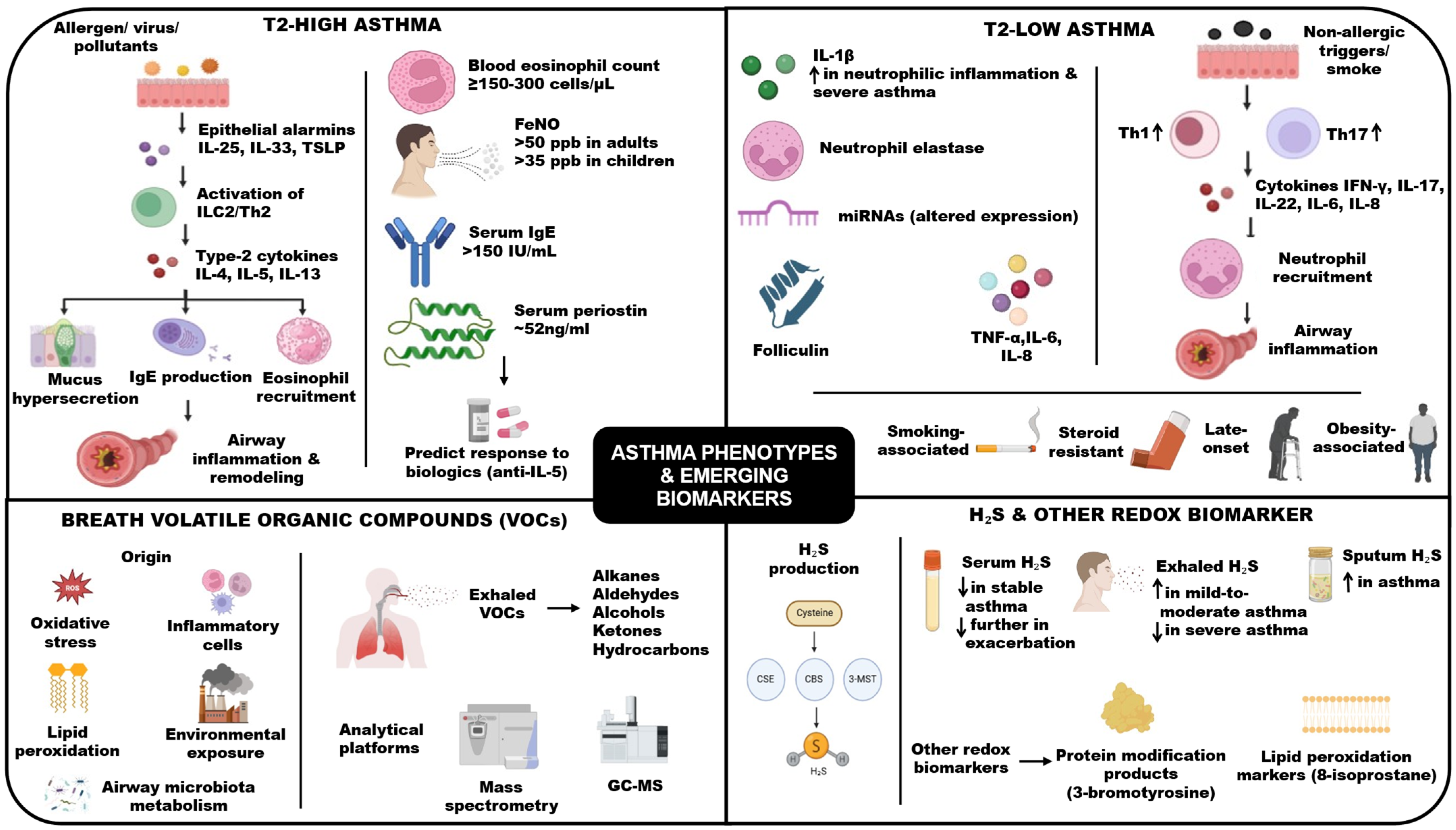
Asthma is a multifaceted disease having a broad range of clinical manifestations, severity, natural history, underlying pathophysiological causes, and treatment responses. Although asthma is typically classified into allergic (extrinsic) and non-allergic (intrinsic) forms, contemporary methods such as supervised clinical classification, unsupervised data-driven clustering, and systems biology have increased our understanding of asthma heterogeneity and allowed for the identification of unique phenotypes based on physiological, clinical, and biological traits [47,48]. Asthma phenotypes can be categorized based on clinical features such as early- or late-onset, obesity-related, smoking-associated, cough-variant, and exacerbation-prone asthma, as well as by etiology, such as allergic, non-allergic, aspirin-exacerbated respiratory disease (AERD), exercise-induced, and occupational asthma. Other classifications are based on pulmonary function patterns (reversible airflow limitation, airway hyperresponsiveness and fixed airway obstruction), treatment response or disease severity (mild, severe, steroid-resistant, and difficult-to-treat asthma), and airway inflammatory profiles (eosinophilic, neutrophilic, paucigranulocytic and mixed granulocytic) [49]. Collectively, asthma phenotypes represent the clinically observable expression of the disease, combining diverse characteristics that do not necessarily directly relate to the underlying molecular or immunological mechanisms driving the condition. In contrast, asthma endotypes are biologically and mechanistically distinct subtypes of the disease, defined by specific underlying molecular and immunological pathways that drive airway inflammation and remodelling. Thus, while phenotypes describe how the disease appears clinically, endotypes explain what is causing the disease at the molecular level. These mechanisms allow for the general classification of asthma into two primary endotypes, Type-2 and non-Type-2, as shown in Figure 1, which can be further described using different biomarkers [50].

3.1. Type-2 (T2-High) Eosinophilic Asthma Biomarkers

T2-high asthma is a common inflammatory endotype characterized by eosinophilic airway inflammation caused by T helper 2 (TH2)-mediated immune responses and associated cytokines, including IL-4, IL-5, and IL-13. The pathophysiological process is initiated by exposure to allergens, pollutants and pathogens, which activate pattern recognition receptors (PRRs) on airway epithelial cells. This activation causes epithelial damage and the release of alarmin cytokines, including thymic stromal lymphopoietin (TSLP), IL-25, and IL-33, as well as chemokines such as CCL2 (C–C motif chemokine ligand 2) and CCL20 (C–C motif chemokine ligand 20). These mediators are very important for triggering and amplifying type 2 immune responses by activating dendritic cells (DCs), type 2 innate lymphoid cells (ILC2s), and promoting TH2 cell differentiation [51,52,53]. Activated dendritic cells promote naïve CD4+ T-cell polarization toward a TH2 phenotype, while ILC2s help mediate the early, antigen-independent production of type 2 cytokines and thus maintain inflammation. The resulting cytokine environment is dominated by IL-4, which promotes TH2 differentiation and IgE class switching in B cells, IL-5, which regulates eosinophil maturation in the bone marrow and prolongs their survival in peripheral blood and airway tissues and IL-13, which contributes to goblet cell metaplasia, mucus hypersecretion, airway hyperresponsiveness, and structural airway remodelling [54,55]. These pathways promote recruitment of eosinophils into the airways via adhesion and transmigration involving P-selectin glycoprotein ligand-1 (PSGL-1), vascular cell adhesion molecule-1 (VCAM-1), and integrins. Within airway tissue, eosinophils become activated and degranulate, releasing cytotoxic proteins such as eosinophil peroxidase and major basic protein, thereby perpetuating type 2 inflammation by causing epithelial injury, airway hyperresponsiveness, and chronic inflammation. Both allergic and non-allergic asthma fall under this endotype, which is frequently associated with eosinophilia and elevated IgE levels [56]. A convenient and less invasive biomarker of eosinophilic inflammation is the blood eosinophil count (B-EOC). Eosinophilia is classified into lower (<1500 cells/µL), moderate (1500–5000 cells/µL), or high (>5000 cells/µL) categories and is usually considered when the count exceeds 500 cells/µL [57]. Inconsistencies were reported in the diagnostic performance of blood eosinophils for asthma, with sensitivity ranging from 0.15 to 0.79 and specificity from 0.39 to 0.91, depending on cutoffs and populations. Even when thresholds are set near or above the upper limit of normal, accuracy would still be inadequate for use as a sole diagnostic tool, although specificity increases with higher cut-offs [58]. Several studies report a moderate correlation between blood eosinophils (B-EOS) and sputum eosinophils (S-EOS). For example, B-EOS >220 cells/µL predicts S-EOS ≥3% with 70% specificity and 77% sensitivity, whereas a cut-off of ≥0.27 × 10⁹/L yields 91% specificity and 78% sensitivity [59,60]. Despite having moderate overall diagnostic performance (AUC ≈ 0.78), B-EOC demonstrates poor reproducibility across studies, and its discriminative ability remains limited. It is affected by numerous clinical and demographic factors, including sex, age, race, smoking, obesity, metabolic syndrome, atopy, allergic rhinitis, and body mass index, and can vary widely even in stable asthma [61,62]. Studies conducted over time intervals have found considerable intra-individual variability: only approximately 22% of patients showed levels above 300 cells/µL for five years, making it unsuitable for stable phenotyping [62]. Moreover, eosinophils are pleiotropic and heterogeneous, with different phenotypes and activation states, making it difficult to rely on a single blood measurement to accurately assess airway inflammation. Therefore, a patient may have a low B-EOC level even with airway eosinophilia (false negatives), or a high B-EOC level even without sputum eosinophilia (false positives). In contrast, sputum eosinophil measurement provides a direct measure of airway inflammation and represents the scientific gold standard, even though it is less practical in everyday practice. Thus, while B-EOC is a convenient surrogate marker of eosinophilic airway inflammation, it cannot be regarded as a reliable substitute for sputum eosinophil assessment [46,61,63]. Fractional exhaled nitric oxide (FeNO) is a non-invasive biomarker used to assess airway inflammation by measuring the concentration of nitric oxide (NO) in exhaled breath. The production of NO in the respiratory tract is mediated by airway epithelial cells, neurons, vascular endothelial cells, and even immune cells such as neutrophils and macrophages. The synthesis involves the conversion of the amino acid L-arginine into nitric oxide through the action of nitric oxide synthase (NOS) enzymes, which include constitutive forms, neuronal NOS (nNOS) and endothelial NOS (eNOS), producing low levels of NO for airway homeostasis, and inducible NOS (iNOS), which is transcriptionally activated and produces large amounts of NO during inflammation. Under normal conditions, constitutive NO promotes bronchodilation via cyclic guanosine monophosphate (cGMP)-mediated smooth muscle relaxation and plays a role in normal airway defence and function [64,65]. In type 2 airway inflammation, cytokines, particularly IL-4 and IL-13, increase NO production by activating STAT6 (signal transducer and activator of transcription 6)-dependent pathways that increase iNOS expression in airway epithelial cells. This is further influenced by reduced L-arginine availability due to arginase inhibition and the action of asymmetric dimethylarginine (ADMA), which disrupts normal nitric oxide homeostasis. Excess NO can react with superoxide to form reactive nitrogen species such as peroxynitrite, which contribute to airway damage and inflammation. The NO generated in the airway diffuses into exhaled breath, where it is measured as FeNO as an indirect marker of iNOS-mediated type 2 airway inflammation [66,67]. The American Thoracic Society recognizes elevated FeNO levels, above 50 ppb in adults and above 35 ppb in children, as a marker of substantial T2-mediated inflammation. Likewise, Global Initiative for Asthma (GINA) considers a threshold of >50 ppb to support a diagnosis of T2 asthma [68,69]. The diagnostic performance of FeNO varies depending on the chosen cutoff value. At a cutoff level of 25 ppb, the sensitivity and specificity of FeNO were 75.4% and 47.9%, respectively. Conversely, at a higher cutoff of >50 ppb, FeNO exhibited high specificity (99%) but low sensitivity (24%), suggesting FeNO is better for confirming asthma when values are high rather than ruling out the condition when results are low [70,71]. Serum periostin is a protein found in the extracellular matrix that indicates T2 inflammation and airway remodelling, and its production is induced by IL-4 and IL-13. According to a logistic regression analysis of 59 patients, the most reliable indicator of airway eosinophilia was serum periostin (p = 0.007) [51,72]. Immunoglobulin E (IgE) is another biomarker of eosinophilic inflammation and atopy that promotes allergen-induced asthma by activating mast cells and basophils and recruiting eosinophils. Its elevated level is linked to allergen sensitisation, airway hyperresponsiveness, and decreased lung function [73]. The IgE POCT (Niji™) point-of-care diagnostic tool has recently made it possible to detect IgE-mediated allergy reactions in-office by quantitatively measuring total IgE from finger-stick blood in around 12 min [74]. Integration of these biomarkers allows precision medicine in asthma by detecting specific inflammatory endotypes and predicting responsiveness to targeted biologics (anti-IL-5, anti-IL-4/IL-13 and anti-IgE). This approach improves treatment outcomes while lowering severe exacerbations and needless corticosteroid use by allowing biologics to be prescribed to patients most likely to benefit [75].

3.2. Non-Type-2 (T2-Low) Asthma

T2-low asthma is marked by the lack of classical T2-high markers, like eosinophilia, due to non-Type 2 immune responses which are distinct from the IL-4/IL-5/IL-13-driven response central to T2-high asthma, and is usually linked with paucigranulocytic or neutrophilic airway inflammation, along with reduced responsiveness to corticosteroids. Neutrophilic asthma is characterized by a preponderance of airway neutrophils, greater disease severity and exacerbations, and reduced bronchodilator responsiveness. Paucigranulocytic asthma, on the other hand, is defined by minimal airway infiltration by both eosinophils and neutrophils, yet patients still exhibit typical asthma features such as reversible airflow obstruction and airway hyperresponsiveness [76]. The T helper 1 (Th1) and T helper 17 (Th17) immune pathways are the primary drivers of T2-low asthma. Airway epithelial injury triggered by pathogens and irritants initiates the release of alarmins such as IL-33 and thymic stromal lymphopoietin (TSLP), which activate dendritic cells and promote the production of IL-23 and IL-6, thereby driving Th17 differentiation [77]. As a result, IL-17A produced by Th17 cells along with CD8+ T cells, γδ T cells, natural killer cells (NKT) cells, and type 3 ILCs (ILC3s) induces epithelial production of neutrophil-attracting chemokines such as CXCL1 (C–X–C motif chemokine ligand 1) and IL-8, leading to recruitment and accumulation of neutrophils in the airways, a key feature of this endotype. These neutrophils contribute to airway injury through proteases, oxidative stress, degranulation, and the formation of neutrophil extracellular traps (NETs), which further amplify epithelial damage and inflammatory signalling (including IL-1β, IL-6, and IL-8). IL-17 also contributes to structural airway changes by enhancing goblet cell overgrowth and stimulating proliferation of airway smooth muscle cells, thereby promoting airway remodelling. In addition, IL-17 and IL-23 contribute to corticosteroid resistance by suppressing glucocorticoid receptor (GR)-α activity while increasing expression of the inhibitory GRβ, a receptor isoform that blocks GRα function. As a result, the anti-inflammatory effects of corticosteroids become weak, contributing to steroid resistance [78,79,80]. Th1 immunity, driven by interferon (IFN)-γ–producing T cells and ILCs, shows a dual pattern in asthma. Some patients show reduced epithelial interferon responses, increasing susceptibility to viral infections and exacerbations, while others show excessive IFN-γ activity along with increased CXCL10 and IFN regulatory factor 5, which is linked to steroid resistance and more severe airway inflammation [77,80,81]. Clinically, T2-low asthma is often linked with phenotypes such as obesity-associated, very late-onset, and smoking-associated asthma, although its exact mechanisms and reliable biomarkers remain poorly understood [47]. Unlike T2-high asthma, it lacks a validated diagnostic biomarker and is typically identified by low levels of classical T2 markers (blood eosinophils, FeNO, and IgE) together with neutrophilic or paucigranulocytic airway inflammation. Elevated sputum neutrophil counts remain one of the most widely used markers of neutrophilic airway inflammation; while blood neutrophil counts may provide supportive evidence, their association is less consistent [82]. Several other biomarkers also reflect neutrophilic inflammation, including IL-8 (CXCL8), a key mediator of neutrophil recruitment, as well as myeloperoxidase (MPO) and neutrophil elastase that indicate ongoing airway injury [81]. Elevated levels of IL-17 and IL-1β have also been linked to neutrophilic inflammation, disease severity, and corticosteroid resistance through their roles in Th17-driven immune responses [83]. In addition, new findings have identified microRNAs (miRNAs) as potential biomarkers because they regulate gene expression and exhibit altered patterns in immune cells, airway epithelium and smooth muscle cells. Some miRNAs are also associated with steroid resistance and impaired lung function in neutrophilic asthma [49]. Other candidate markers include tumor necrosis factor (TNF)-α, YKL-40 (Chitinase 3-like protein 1), S100 calcium-binding protein A9 (S100A9), serum amyloid A1 (SAA1), folliculin and NET-associated products (e.g., extracellular DNA) [77]. However, none of these have yet been clinically validated as non-invasive biomarkers, underscoring a major research gap in the diagnosis and treatment of T2-low asthma.

3.3. Breath Volatile Organic Compounds (VOCs)

Volatile organic compounds (VOCs) in exhaled breath are promising non-invasive biomarkers for asthma because they represent airway inflammation, oxidative stress, and metabolic alterations associated with the disease. These compounds arise from both external environmental exposures and endogenous mechanisms such as inflammatory cell activation, lipid peroxidation of polyunsaturated fatty acids and airway microbiota metabolism [84,85]. During airway inflammation, activated inflammatory cells such as eosinophils, neutrophils, and macrophages produce excessive reactive oxygen species (ROS), including superoxide radicals, hydroxyl radicals, and hydrogen peroxide. These ROS attack polyunsaturated fatty acids present in cell membrane phospholipids, initiating lipid peroxidation. During this process, lipid radicals react with oxygen to form lipid peroxyl radicals and lipid hydroperoxides, which subsequently decompose into secondary oxidation products such as malondialdehyde (MDA), isoprostanes, and 4-hydroxy-2-nonenal (4-HNE). Further breakdown of oxidized lipids generates volatile compounds that can be detected in exhaled breath [86,87]. These VOCs primarily belong to five major categories that include hydrocarbons (alkanes, e.g., ethane and pentane), aldehydes (e.g., hexanal, nonanal), ketones, alcohols, and aromatic compounds. The potential of breath VOC profiling for diagnosis, phenotyping, and monitoring is highlighted by its ability to differentiate eosinophilic and neutrophilic phenotypes, identify atopic versus non-atopic asthma, and predict corticosteroid responsiveness, disease control, and exacerbations [85,88]. Platforms such as electronic noses (e-Noses), gas chromatography (GC), ion mobility spectrometry (IMS), mass spectrometry (MS) and hybrid platforms such as GC–MS and GC–IMS are frequently used to analyze VOCs. While chromatographic and spectrometric techniques separate and identify individual compounds for qualitative and quantitative analysis, sensor-array systems like the e-Nose detect overall breath fingerprints [89,90]. A systematic review and meta-analysis reported that exhaled VOC profiling has high diagnostic accuracy for asthma, with sensitivities, specificities, and area under the curve (AUC) of 87%, 86%, and 0.94, respectively [88]. Furthermore, it has been demonstrated that a portable gas chromatography system can do real-time breath VOC analysis in around 30 min, facilitating the rapid detection of biomarkers linked to asthma [91]. However, contributions from exogenous factors complicate the interpretation of exhaled VOCs, as these compounds may arise from environmental pollutants, smoking, diet, medications, physical activity, or microbial metabolism in the gut and airways rather than solely from endogenous disease processes. VOCs present in the surrounding air or introduced during sample collection may also appear in exhaled breath, making it challenging to determine whether they originate from the disease process or external sources [88,92]. To reduce such interference, ambient VOC levels are measured and subtracted from exhaled concentrations using the alveolar gradient approach, while inhalation of VOC-filtered air before sampling and standardization of pre-test conditions, including avoidance of smoking, food, beverages, and exercise, are commonly employed to improve the reliability of breath VOC analysis [92].

3.4. Hydrogen Sulfide (H2S) and Other Redox Biomarkers

Hydrogen sulfide (H2S) has gained recognition as a potential biomarker in asthma due to its roles in airway inflammation, oxidative stress, and redox regulation. Enzymes like cystathionine-β-synthase (CBS), cystathionine-γ-lyase (CSE) and 3-mercaptopyruvate sulfurtransferase (3-MST) in tissues like primary lung fibroblasts and airway smooth muscle cells produce endogenous H2S in the circulation, which is thought to function as an antioxidant and anti-inflammatory signalling molecule that controls reactive oxygen species and inflammatory pathways [93]. According to clinical studies, serum H2S levels are generally lower in people with asthma, with adults exhibiting lower levels in stable asthma (55.8 ± 13.6 μM) compared to healthy controls (75.2 ± 13.0 μM), which further decreases during exacerbations, while asthmatic children also showed reduced levels (44.2 ± 11.0 μM) that correlated with lung function indices [94,95]. On the other hand, sputum H2S levels are higher in asthmatic patients and are negatively associated with predicted FEV1% and positively correlated with sputum neutrophil counts, indicating a neutrophilic airway [96]. Dysregulation of the redox system contributes to altered H2S levels across asthma severity, with recent clinical studies showing a biphasic pattern: individuals with severe asthma exhibit lower exhaled H2S levels (149.3 ± 70.7 ppb) than those with mild-to-moderate asthma (192.4 ± 57.1 ppb). [97]. Elevated H2S in the early stage likely reflects a compensatory antioxidant, anti-inflammatory, and bronchodilatory response to airway inflammation. However, as asthma progresses, persistent oxidative stress, chronic inflammation, and airway remodelling may impair the activity of H2S-producing enzymes, resulting in reduced H2S production and loss of this protective mechanism, thereby contributing to progressive airway damage [98,99]. Differences in H2S concentrations have also been reported between biological compartments. Sputum H2S correlates with sputum neutrophils and IL-8 concentrations and primarily reflects local airway production and is therefore more closely linked to airway inflammation, whereas serum H2S levels exhibit distinct changes during stable and exacerbated disease states. The opposite patterns observed in sputum and serum indicate that these compartments may reflect different aspects of H2S regulation, with sputum H2S appearing to be a more direct indicator of airway inflammatory processes. Consequently, the sputum-to-serum H2S ratio has been proposed as a potentially useful biomarker for identifying ongoing asthma exacerbations and predicting future exacerbation risk [93,96]. Apart from H2S, several redox biomarkers indicative of increased oxidative and nitrative stress are associated with asthma. These include lipid peroxidation markers (8-isoprostane, malondialdehyde) and protein modification products (3-bromotyrosine, chlorotyrosine) [100]. A range of established and emerging biomarkers, including their diagnostic accuracy, clinical applications, sample sources, and applicability to T2-low asthma, are summarized in Table 1.

4. Biosensors

A biosensor is an analytical tool that detects a specific substance by combining a biological recognition element with a signal-generating system. Once the analyte interacts with a bioreceptor, such as an aptamer, enzyme, or antibody, a physicochemical phenomenon occurs, including changes in charge, colour, temperature, or weight. This change is then transformed into an electrical signal by a transducer. The signal is then processed by electronic components and presented in a user-friendly form [119,120]. Biosensors use different transducers and can be classified as electrochemical (measuring current, potential, or impedance), optical (using fluorescence or surface plasmon resonance), thermal (detecting reaction heat), and gravimetric/piezoelectric (tracking mass changes), each offering distinct benefits, from high sensitivity to affordability and scalability [121]. They are employed in many different fields, including health assessment, pharmaceutical research, monitoring of environmental contaminants or microorganisms, and detection of biomarkers [119].

Asthma Biosensors

Determining biomarkers associated with oxidative stress, immunological response, and airway inflammation, biosensors are crucial to the treatment of asthma. Electrochemical biosensors are particularly noteworthy among the various varieties because of their great sensitivity, real-time results, low sample requirements, and ease of integration into portable equipment. They function by converting biological interactions into electrical signals at biorecognition elements, typically enzymes. Depending on the function, additional components such as nucleic acids, antibodies, or even entire cells may be employed. These devices detect changes in impedance (impedimetric), voltage or potential (potentiometric), and current (amperometric); voltammetry and field-effect transistor (FET)-based sensing are more sophisticated techniques.
Electrochemical biosensors usually employ a three-electrode configuration comprising a reference, working, and counter electrode, and their performance depends on the material composition, surface area, and electron transfer rates. The use of nanomaterials like nanoparticles and nanowires makes it more sensitive and effective in terms of target capture because of a higher surface area to volume ratio [122,123]. More recently, metal single-atom (SA) nanoenzymes have been shown as excellent candidates for sensing materials because of their atomically dispersed active sites along with heteroatom coordination, which allows better electron transfer, high catalytic activity, and increased interaction with analytes. In contrast to conventional metal nanoparticles, the use of SA nanoenzymes (e.g., Fe single atoms) allows for optimized metal atom usage and provides highly accessible catalytic sites, resulting in enhanced sensitivity, selectivity, and overall electrochemical sensing performance [124]. Based on the principles of electrochemical biosensing, recently developed biosensors have demonstrated the ability to detect biomarkers associated with asthma. For example, the HexaPie sensor uses a label-free, non-faradaic impedance method to detect IL-8, IL-10, and IP-10 (interferon gamma–induced protein 10) directly in saliva. Limitations of detection (LOD) of 1.17 ng/mL (IL-8), 12.5 pg/mL (IL-10), and 0.20 ng/mL (IP-10) were achieved, with very little interference from components present in saliva. Its validation using ELISA and Luminex xMAP immunoassays confirmed a strong correlation for both IL-8 and IP-10, emphasizing its reliability as a small, reagent-free, point-of-care device for non-invasive immune analysis of asthma [125]. In another study, the researchers demonstrated the potential of a Ti3C2Tx MXene-based biofuel cell self-powered sensor (M-BSPS) for detecting the asthma marker MUC1 in saliva. This sensor has been fabricated with a CoNi-LDH/MXene anode and an Ag-NWs/MXene cathode, providing efficient ion diffusion, electron transfer, and charge storage for accurate electrochemical detection of target biomarkers. With a LOD of 65 pg/mL and a detection range of 0.1–750 ng/mL, the sensor showed good stability, selectivity, and reproducibility, proving its applicability for use in point-of-care asthma monitoring [126]. However, the long-term reliability of MXene-based sensors is a concern since oxidation and layer-restacking of the MXene can lead to a reduced active surface area, affecting the sensing performance. Thus, it is crucial to design oxidation-resistant MXene structures and develop cost-effective, scalable fabrication methods for their eventual clinical application in asthma monitoring [127].
Chemiresistive biosensors measure changes in the electrical resistance of the sensing material when a target binds to a sensing layer between interdigitated electrodes. They are simple, low-power devices that work well for wearable and point-of-care testing. Still, many of the conventional systems struggle with selectivity and slow response because they rely mostly on basic adsorption and weak or missing biorecognition elements. These limitations can be improved by using enzyme-functionalized nanomaterials along with light activation. When exposed to UV or visible light, the material produces charge carriers that boost conductivity and speed up the sensing process. ZnO nanorods are commonly used since they offer a large surface area, good biocompatibility, and enzyme immobilization, which helps improve electron transfer. Although this approach has been shown for lactate and glucose, the same idea could be used for asthma monitoring through biomarkers in exhaled breath [128,129]. A miRNA-21 sensing platform has been developed using a chemiresistive biosensor consisting of bilayer graphene (BLGR) interdigitated electrodes grown through direct chemical vapor deposition (CVD). It works by measuring the change in resistance due to hybridization of miRNA-21 with immobilized probe DNA, leading to decreased charge carriers’ mobility within the graphene channel. This improved response is mainly linked with increased interlayer coupling in directly grown BLGR compared with stacked graphene structures. Although the sensor shows high sensitivity and a low detection limit (5.2 fM), the manufacturing process includes multiple stages, including CVD growth, plasma treatment for surface modification, and fairly long DNA immobilization and hybridization times [130]. These steps make the overall process more complex and may need to be considered when thinking about reproducibility or scaling up for practical use.
Field-effect transistor (FET)-based biosensors use a semiconductor channel whose electrical behaviour changes when biological molecules bind to receptors on its surface, altering charge density and carrier mobility. This interaction affects signals such as drain current, threshold voltage, and conductivity, enabling real-time, label-free detection of biomolecules, including proteins, DNA, and cytokines. They are potential tools for early, non-invasive disease diagnosis because of their ability to detect low-level biomarkers even in complex samples like saliva and breath, along with their miniaturized and integrable design, making them well-suited for portable and lab-on-a-chip diagnostic applications [15,131]. However, FET-based biosensors face several challenges. In physiological fluids, the Debye screening effect can reduce the electrical signal generated by biomarker binding because surrounding ions partially shield the target charges from the sensor surface. In addition, variations in surface functionalization may affect reproducibility and long-term stability, limiting clinical translation [132]. In a study by Zhuang Hao et al., a portable graphene-based FET nanosensing system was developed to detect the cytokine biomarker interleukin-6 (IL-6) in saliva [133]. The device used an aptamer-functionalized graphene channel, in which IL-6 binding altered surface charge, resulting in measurable changes in electrical current. The technology responded rapidly within 400 s and achieved a detection limit of 12 pM, suggesting its potential for early, non-invasive monitoring of asthma-related inflammation. However, the authors noted signal variations among saliva samples from different individuals, which indicates that non-target components present in real biological samples can compromise sensing performance. Therefore, before the widespread routine usage in clinical practice, it is necessary to further improve sensor stability and carry out larger clinical validation.
Photoelectrochemical (PEC) biosensors are new-generation analytical platforms in which optical excitation, along with electrochemical sensing, has been applied to achieve high sensitivity and selectivity of biomarker detection through photocurrent production in photoactive materials. Nanomaterials, including quantum dots, graphene derivatives, metal–organic frameworks (MOFs), and semiconductor heterojunctions, have played a critical role in improving the PEC system performance via increasing light absorption, charge separation, and signal amplification. Multiplexed PEC biosensors reduce the amount of sample needed and analysis time while concurrently detecting different biomarkers. Their low background noise, rapid response, and compatibility with portable devices further add to their suitability for point-of-care applications [134]. In addition, the capability to multiplex detection of regulatory microRNAs, which appear to be very promising as markers of asthma-related airway inflammation and immunological disorders, has been illustrated by PEC biosensors. Considering the heterogeneity of asthma and involvement of multiple inflammatory pathways, such an approach may help in a more comprehensive estimation of disease phenotype, severity, and treatment response, highlighting that PEC biosensors offer considerable potential for asthma diagnostics and disease monitoring [135,136].

5. Optical Biosensors for Asthma

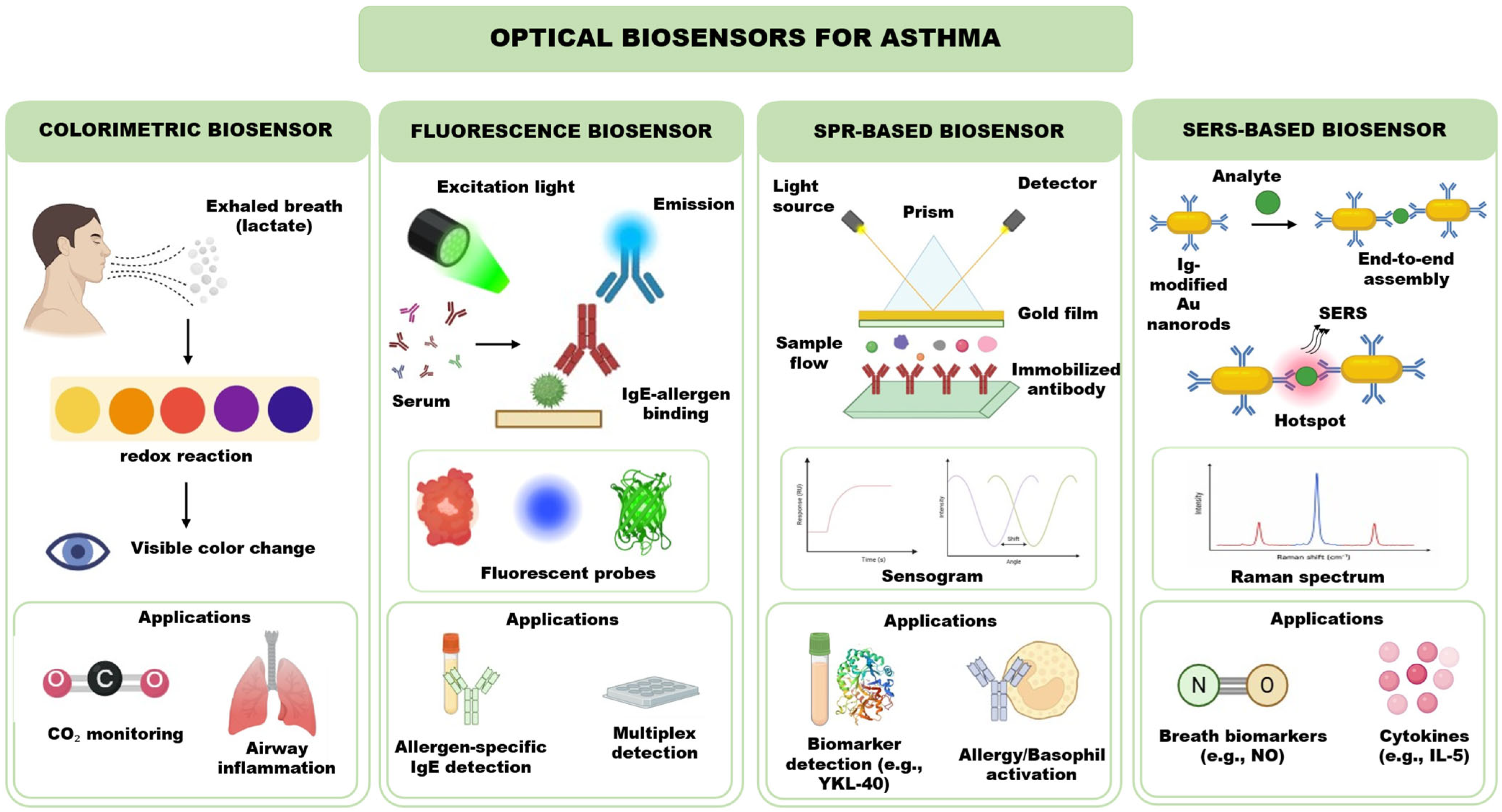
Optical biosensors are platforms that use light-based phenomena to detect and measure analyte concentrations in a sample. These biosensors detect interactions between two biological molecules, such as antigen–antibody binding or ligand-receptor interactions, to generate optical signals that can be measured and evaluated. Optical signals are observed as changes in physical properties, such as light intensity, wavelength, fluorescence, and the refractive index of the medium through which light passes. Such biosensors offer fast analysis, high sensitivity, and minimal interference from external electromagnetic radiation. For this reason, they are widely used in modern analytical systems and clinical diagnostics, including the detection of food toxins, environmental pollutants, and disease markers. Also, their compatibility with miniaturized platforms helps in the development of compact and user-friendly diagnostic devices [137,138]. Principles and applications of colorimetric, fluorescence, SPR (surface plasmon resonance), and SERS (surface-enhanced Raman scattering)-based biosensors for the detection and monitoring of asthma have been presented in Figure 2.

5.1. Colorimetric Biosensors

Colorimetric biosensors can be used for detecting a variety of analytes, including metal ions, biomolecules, nucleic acids, microorganisms, and clinical biomarkers. These biosensors operate based on the interaction of a particular target analyte with the sensing material that causes a visible color change, which makes detection fast and easy without necessarily using complicated equipment [139]. This color change occurs as a result of optical changes in metal nanoparticles (e.g., gold and silver) by localized surface plasmon resonance (LSPR), wherein the absorption properties of the particles change due to factors like nanoparticle aggregation or variations in the refractive index of the surrounding medium. In addition, colorimetric signals may also arise from chemical reactions, such as oxidation-reduction, enzymatic reactions, pH changes, or interactions with other ions and biomolecules. These sensors have been widely used for point-of-care and on-site analysis due to the ease in detecting the results visually, low cost, and fast responses [140,141]. A colorimetric biosensor based on enzyme-functionalized nylon–poly (allylamine hydrochloride) (PAH) nanofiber mats has been developed for the non-invasive detection of lactate, a potential biomarker of airway inflammation in asthma. The sensor captures lactate from breath aerosols and employs a lactate oxidase (LOx)–horseradish peroxidase (HRP)/TMB (3,3′,5,5′-Tetramethylbenzidine) assay to generate a visible color change. The platform showed detection limits of 5 μmol L−1 (solution) and 20 μmol L−1 (hydrogel), with a working range of 5–150 μmol L−1 covering physiologically relevant breath lactate levels. Its simple visual readout and portability make it suitable for point-of-care monitoring of airway inflammation [142]. Despite the advantages, there have been a few reports of colorimetric biosensors which use asthma markers as targets. Although the biosensors are favourable for use at point-of-care due to their fast visual read-out without requiring any sophisticated instrumentation, their sensitivity may be inadequate in detecting asthma markers that are present in extremely low concentrations. In addition, the complexity of the biological samples can influence colour development, which affects the analytical accuracy and reproducibility, while interference from non-target species may cause false-positive results [143]. Although the described lactate sensor showed positive results, routine clinical adoption will not be possible unless sensitivity, stability, selectivity, and clinical validation are further improved. Nevertheless, the broader field of colorimetric respiratory sensing continues to progress. For example, dye-based platforms for monitoring exhaled CO2 and multi-dye systems for detecting H2O2 in breath have demonstrated sensitive visual detection capabilities [144,145]. However, it should be noted that these devices cannot be considered true biosensors since they do not use specific biorecognition units, but they may inspire the development of colorimetric biosensors aimed at detecting asthma-specific biomarkers.

5.2. Fluorescence-Based Biosensors

Fluorescence-based biosensors work on the principle that certain molecules can absorb light at one wavelength and emit light at a longer wavelength, producing fluorescence. This technology combines the advantages of high sensitivity offered by the fluorescence technique with the selectivity provided by the molecular recognition element of fluorescence-based biosensors, which may consist of antibodies, ligand-binding proteins, or aptamers, to identify specific analytes. Various types of fluorescent probes, such as dyes, fluorescent proteins, and nanoparticles, such as quantum dots, can be used to improve detection outcomes. Fluorescence-based biosensors use different techniques, such as measuring fluorescence intensity, Förster resonance energy transfer (FRET), fluorescence polarization, and fluorescence correlation spectroscopy, to study molecular interactions, binding events, and diffusion processes [146,147]. Near-infrared (NIR) fluorescent probes can also be used to achieve improved sensing because NIR light can easily penetrate biological tissues and causes less background interference [148]. Overall, these biosensors are very sensitive, rapid, and affordable and have a wide range of applications in the detection of food contaminants, monitoring environments, and medical diagnostics [149]. An optical fibre-based multiplex biosensor with fluorescence detection has been reported to simultaneously detect the pro-inflammatory cytokines IL-6, IL-1β, and TNF-α via antibody sandwich immunoassay and fluorescence magnetic bead detection. This biosensor showed a detection range of 12.5–200 pg mL−1 with a LOD of 12.5 pg mL−1 for each cytokine. It has also exhibited excellent selectivity and performance similar to that of conventional ELISA. With the ability to detect multiple biomarkers at one time, this method may be able to offer a more complete analysis of airway inflammation compared to assays that measure a single biomarker, considering the complex cytokine networks involved in asthma pathogenesis. Though it can accommodate multiplexing, the assay involves many antibody-labelling and incubation steps and has mainly been validated in cell-culture samples [150,151]. In comparison with the multiplex optical fibre system, an aptasensor using FRET based on gold nanoparticles and nitrogen-doped carbon quantum dots achieved a significantly lower LOD of 0.82 pg mL−1 for IL-6 detection, which reflects its high sensitivity. However, unlike the multiplex biosensor, it was limited to a single biomarker and showed a relatively narrow detection range [152]. To detect allergen-specific IgE involved in allergic asthma rapidly, a miniature biosensor based on fluorescence technology has been developed. This biosensor utilizes fluorescence-tagged antibodies to produce quantitative signals from the binding of IgE and allergens on microarrays, allowing multiplexed detection. With a portable fluorescence reader, it can analyze multiple allergens from a small serum sample (~80 μL) in about an hour, offering a compact and efficient approach for point-of-care identification of asthma-related allergic triggers [153]. Chai-Gao et al. also developed a fluorescence-based biosensor for multiplexed detection of allergen-specific IgE using a microfluidic platform and portable reader for rapid point-of-care analysis [154]. In these platforms, the portable readers used were less sensitive than commercial microarrays, and the validation process involved only a small number of control samples, highlighting the need for larger clinical studies to validate the tests further.

5.3. Surface Plasmon Resonance (SPR)-Based Biosensors

SPR-based optical biosensors are often used for label-free detection of biomolecular interactions. The method is usually applied in a Kretschmann configuration, in which a glass prism is coated with a thin layer of metal, usually gold, and exposed to monochromatic light from an LED or other light source. The SPR phenomenon occurs when polarized light strikes the thin metal surface at a specific angle at the interface of two media, such as glass and a liquid sample. At a specific angle, known as the resonance or SPR angle, this interaction reduces the intensity of the reflected light by transferring energy from incoming photons to free electrons on the metal surface, creating collective oscillations known as surface plasmons [17,155]. The principle of SPR is based on attenuated total reflection, where these plasmonic oscillations are highly sensitive to changes in the local dielectric environment. When biorecognition elements such as antibodies or enzymes are immobilized on the sensor surface and interact with target analytes, the resulting mass accumulation alters the refractive index at the interface. This results in a measurable shift in the SPR angle or resonance condition, which is detected using a photodiode array or similar detector system. The sensor creates a response curve, also known as a sensorgram, that depicts the interaction between molecules by tracking these changes over time [156]. A representative application of SPR-based biosensing in asthma involves detecting the inflammatory biomarker YKL-40 in patient serum. In a study by Naglot et al., YKL-40 levels were measured using a real-time SPR platform (BIAcore system), eliminating the need for labelling by immobilising specific antibodies onto a gold-coated sensor chip and tracking biomolecular binding via changes in refractive index [157]. With a detection limit of 0.33 ng/mL, the method demonstrated excellent sensitivity and enabled distinction between mild and severe asthma based on progressively rising YKL-40 concentrations. In addition to conventional single-marker SPR tests, a variety of SPRi-based arrays have been developed for highly sensitive biomarker multiplex analysis in complex biological samples. For instance, an SPRi biosensor for IL-6 in human plasma achieved highly sensitive, label-free analysis in the pg mL−1 range (LOD ~ 0.3–0.9 pg mL−1 depending on the recognition element). This platform was based on either antibody-functionalized or inhibitor-based receptors and had very good correlation with electrochemiluminescence assays (R2 ~ 0.99), which means that results obtained with both techniques were almost identical across samples. It also provided very high selectivity against highly interfering substances in serum samples; however, the SPRi performance is critically dependent on surface chemistry and immobilization of receptors [158]. Another study used SPR-based biosensing to detect allergy-related asthma by monitoring both basophil activation and IgE-mediated responses in a label-free manner. This method uses FcεRI-expressing cells sensitised with patient serum to quantify IgE activity, while SPR imaging detects changes in refractive index resulting from basophil activation during allergen exposure. These combined strategies enable rapid, highly sensitive, label-free monitoring of IgE-driven basophil activation, but their clinical application is limited due to complex ex vivo processing of cells, surface-chemistry-dependent variability and relatively small-scale validation studies [159].

5.4. Surface-Enhanced Raman Spectroscopy (Sers)-Based Biosensors

Raman scattering occurs when incident light falling on molecules is scattered, with some of the scattered photons experiencing an energy shift due to molecular vibrations. This change in energy levels results in a Raman spectrum, which serves as a distinctive molecular identifier for the substance being analyzed. However, because only a small fraction of light undergoes inelastic scattering, the process generates a weak signal. To address this limitation, SERS has been developed as a highly sensitive biosensing technique. In SERS, molecules are adsorbed onto nanostructured metallic surfaces such as gold or silver, where localized surface plasmon resonance (LSPR) significantly strengthens the electromagnetic field and amplifies the Raman signal. This improvement makes it possible to detect biomolecules and volatile organic compounds at extremely low concentrations, allowing rapid and sensitive identification of specific analytes and disease-related biomarkers [160,161]. Although metal-based SERS substrates are highly sensitive, they usually lack uniform hotspot distribution, signal reproducibility, and dynamic tunability of optical properties after fabrication. Recent research is oriented towards designing novel nanostructured substrates which would allow improving the performance and reliability of SERS sensors [162]. Deng et al. proposed an innovative Ag/BaTiO3 hollow microsphere array substrate, where plasmonic effects were complemented by pyroelectric field-induced charge transfer that resulted in improved signal uniformity and ultralow detection limits [163]. Even though this concept was proven using model compounds instead of biomarkers of asthma, the potential of dynamically tunable SERS platforms in future respiratory disease diagnostics seems promising. Nevertheless, the fabrication of such complex nanostructures remains challenging, and further studies are required to evaluate their long-term stability, scalability, and performance in real biological samples. In certain biosensing systems, antibody-modified gold nanorods are used to detect inflammatory cytokines, such as IL-5, in sputum samples. The nanorods assemble end-to-end upon IL-5 binding to the antibodies, forming nanoscale hot spots that significantly enhance Raman signal via SERS, enabling sensitive detection of IL-5 at extremely low concentrations. With a good correlation coefficient (R2 = 0.994) and an enhancement factor of around 1.39 × 101, the biosensor showed a linear response in the 0.1–50 pg/mL range. The clinical study so far was conducted using a very limited number of patient samples, and there are insufficient comparisons with routinely used asthma diagnostic markers, which makes it difficult to fully establish its clinical applicability [164]. In comparison, the multiplex SERS–microfluidic immunoassay developed by Wang et al. represents an advancement in terms of analytical performance since it allows parallel measurement of several inflammatory interleukins (IL-6, IL-8, and IL-18) in complex blood plasma samples, rather than a single analyte identification [165]. The use of distinct Raman reporter molecules allowed each cytokine to be selectively encoded and quantified with low detection limits in the pg mL−1 range and good reproducibility (RSD < ~8.5%), while also showing strong agreement with ELISA-based reference methods. Importantly, in contrast to the IL-5 nanorod system, this platform integrates a microfluidic architecture and chemometric (PCA) analysis, improving signal separation and robustness in multiplex biological detection. However, both approaches share common limitations, including strong dependence on surface chemistry, antibody immobilization, and non-specific binding control in complex samples. Moreover, although the multiplex SERS system provides more depth of analysis in terms of multi-biomarker identification, both systems are limited by small clinical data sets and require larger validation before routine asthma diagnosis. In addition, SERS has also been explored for breath-based diagnostics of respiratory diseases. For example, SERS platforms have been used to detect gaseous biomarkers such as nitric oxide in exhaled breath, which is associated with airway inflammation in asthma. In these devices, trace gas molecules in breath are captured by functionalized plasmonic substrates, and the resulting Raman spectral changes enable their sensitive detection even at extremely low concentrations. Additionally, wearable or breathalyzer-style SERS devices have been investigated for the analysis of breath aerosols and volatile biomarkers [166].
Collectively, these developments show that SPR and SERS biosensors have strong potential for rapid, sensitive, and non-invasive detection of disease biomarkers and real-time monitoring of respiratory disorders. However, their implementation for clinical purposes faces several limitations. SPR is relatively more established but is limited by its expensive instrumentation and system complexity, making it less suitable for routine or point-of-care use. Its performance depends greatly on external factors, including variations in refractive index, temperature and nonspecific adsorption affecting the reliability of signals in real samples. SPR biosensors also demonstrate relatively lower sensitivity than SERS. While SERS demonstrates greater sensitivity, the major challenge associated with it is reproducibility because of dependence on unpredictable hot spots and inconsistencies in nanostructure fabrication [167,168]. In complex biological samples, its application is subject to problems of biofouling, background interference, reduced signal-to-noise ratios, nanoparticle aggregation, coffee-ring effects, and non-uniform analyte distribution, thereby limiting measurement accuracy. In practice, in the case of SERS, sample dilution or preparation is necessary in order to avoid fouling issues, increasing the time and costs associated with analysis; moreover, anti-fouling approaches are hindered by their poor stability, incomplete coverage and insufficient reusability. As previously stated, in both cases, the lack of large-scale validation studies and standardized protocols is one of the main reasons why these methods have not been widely used yet in clinics, despite many years of research [169].
Selecting the optimal optical transduction mechanism among these emerging platforms is largely dependent upon the physical state and concentration of the asthma biomarker. Biomarkers that exist in gaseous form, such as FeNO and VOCs, are typically present in trace amounts and therefore can be detected using highly sensitive techniques such as SERS, which allow for molecular fingerprinting and detection of analytes at very low concentrations [170]. On the other hand, biomarkers in liquid-phase, including interleukins, YKL-40 and IgE, are commonly detected using SPR- and fluorescence-based biosensors. SPR is preferred for label-free, real-time detection of biomolecular interactions, whereas fluorescence-based biosensors are particularly useful for highly sensitive multiplex detection [150,155]. Comparison of optical biosensing platforms developed for asthma-related biomarker detection with an emphasis on biomarkers, sample types, principles of sensing, performance metrics, and other important aspects is summarised in Table 2.

6. Next-Gen Biosensor Technologies

The progress made in recent years regarding biosensors has led to the emergence of next-generation platforms with increased sensitivity, rapid response time, and improved analytical capabilities for disease diagnosis. To improve signal transduction and facilitate the quick identification of low-abundance biomarkers, these technologies use innovations such as nanotechnology, microfluidics, artificial intelligence, wearable technology, and miniaturisation. As a result, next-generation biosensors are progressively being explored for non-invasive, real-time, and point-of-care monitoring of various diseases, including respiratory diseases [176].

6.1. Nanomaterial Enhancement of Optical Sensors

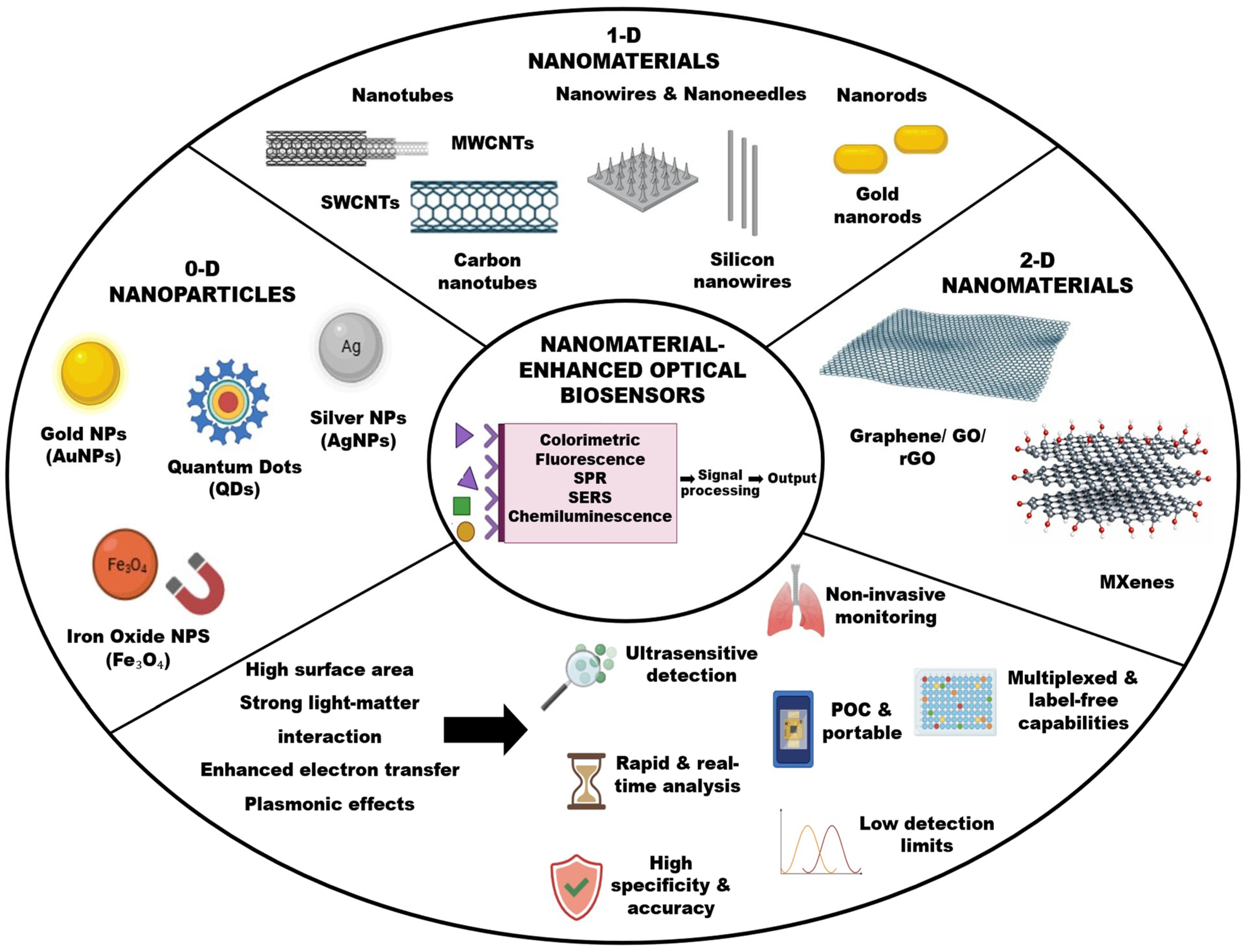
Nanomaterial integration has substantially accelerated the development of next-generation optical biosensors by improving sensitivity, selectivity, signal amplification, and overall analytical performance. Various nanomaterials, including metallic nanoparticles, quantum dots, and carbon nanomaterials, have been incorporated into optical sensing platforms to improve biomarker detection and support portable, real-time, and point-of-care diagnostic applications [177,178]. Apart from these, UCNPs have attracted considerable interest because their anti-Stokes emission enables near-infrared excitation with visible or ultraviolet emission, thereby reducing background autofluorescence and improving signal-to-noise ratios in biological samples. high photostability, tunable multicolour luminescence, and long emission lifetimes. The conversion of near-infrared excitation into visible or ultraviolet emission significantly reduces the effect of autofluorescence and improves signal-to-noise ratios in biological samples. However, the broader use of UCNPs in biosensing is limited due to low upconversion efficiency under mild excitation conditions, complicated synthesis methods, and the need for further studies on their long-term biocompatibility and safety [179,180]. The major types of nanomaterials used in optical biosensors and their role in sensing are illustrated in Figure 3.

6.1.1. One-Dimensional Nanomaterials

One-dimensional (1D) nanomaterials are nanoscale structures with one dimension significantly larger than the other two (1–100 nm). These materials, which include nanowires, nanotubes, and nanorods, have an anisotropic structure that allows tunable LSPR by varying their aspect ratio. This property supports strong optical absorption across the visible-to-near-infrared region, improving signal transduction in multicolorimetric and SERS sensing and increasing sensitivity for biomolecular detection [177]. Carbon nanotubes (CNTs), particularly single-walled carbon nanotubes (SWCNTs), have a quasi-one-dimensional cylindrical structure, a high surface-to-volume ratio, a large aspect ratio, and high chemical stability, which makes them ideal for optical biosensors. Because of these features, their optical properties are extremely sensitive to even minute changes in their surroundings.
Semiconducting SWCNTs provide highly sensitive optical detection through their inherent near-infrared (NIR) photoluminescence (650–1400 nm), which undergoes measurable shifts or quenching upon target binding. Multiplexed detection is made possible by their chirality-dependent properties, which also allow them to efficiently quench fluorescence via Förster resonance energy transfer (FRET) [181,182,183]. The optical properties of SWCNTs are highly dependent on their chirality, as the chiral index (n, m) determines the wavelength of the near-infrared fluorescent emissions. Therefore, different kinds of SWCNTs will have their own characteristic spectra, which can facilitate multiplex detection of biomarkers without any significant cross-talk [184]. The strong and broad absorption properties and sustained fluorescence in the NIR-II band linked to low biological autofluorescence further improve their potential for optical biosensing and increase detection sensitivity. The fluorescence emitted by SWCNTs remains highly stable during long measurement periods with negligible photobleaching and blinking. Besides their use in FRET-based systems, SWCNTs also effectively immobilize biomolecules and enhance the refractive index changes, making them suitable for SPR and SERS platforms [185,186,187].
Similarly, high-aspect-ratio nanowires and nanoneedles enhance the performance of optical biosensors through their large surface areas and strong light–matter interactions. Through waveguiding, light scattering, and plasmonic coupling, nanowires (such as ZnO, Si, and GaN) provide quick, label-free biomolecule identification. In the meantime, nanoneedles can gently penetrate cells to monitor the unperturbed intracellular environment. These structures are ideal for single-cell analysis, wearable biosensors, and ultrasensitive nanoscale diagnostics because they serve as subwavelength waveguides and plasmonic antennas, amplifying fluorescence, FRET, and SERS signals to map intracellular pH, enzymatic activity, and biomarkers [188,189,190]. These distinctive optical properties have enabled the use of 1-D nanomaterials for ultrasensitive optical detection of disease biomarkers, including those related to asthma. For example, SiO2-coated gallium phosphide (GaP) nanowires have been studied for the detection of the asthma biomarker IL-5 due to their effective light-guiding properties. With their ability to guide fluorescence to their ends, these nanowires produce signals that are more intense and show better contrast and signal-to-noise ratios compared to those produced by the conventional flat substrates and maintain detectable signals even at low serum concentrations. Compared with plasmonic gold nanorod-based sensors, which rely on SERS hot-spot formation, GaP nanowires may offer better signal uniformity and reproducibility because their performance is less dependent on nanoparticle aggregation. However, nanowire-based assays usually demand fluorescent labelling and specialized fabrication, whereas plasmonic SERS platforms often produce enhanced signals and lower detection limits. These observations emphasize the balance between reproducibility and sensitivity in the design of one-dimensional optical biosensors [164,191].

6.1.2. Two-Dimensional Nanomaterials

Two-dimensional (2D) nanomaterials are ultrathin materials with a single nanoscale dimension and large lateral dimensions. An exemplary case is graphene, a one-atom-thick honeycomb lattice of sp2-bonded carbon. Graphene possesses remarkable optoelectronic properties, in addition to its extraordinary mechanical strength and thermal conductivity. It is an ideal choice for the non-destructive detection, since it has the potential to increase the sensitivity of optical biosensors through improved large surface area, high electron mobility, broadband and adjustable absorption [192,193]. Another advantage of graphene (including its derivatives, such as graphene oxide (GO) and reduced graphene oxide (rGO)) is associated with its excellent fluorescence quenching capability that can be used for label-free detection of biomarkers using the FRET technique [193]. In addition, graphene is a versatile foundation material for the construction of two-dimensional (2D) heterostructures, as its single-atom thickness and van der Waals interactions enable the stacking or integration of other 2D materials without lattice-matching constraints. By combining complementary layered materials, it is possible to overcome limitations such as the lack of a bandgap and to create multifunctional biosensors [194]. A representative example is a GO-based immunosensor for asthma biomarker IL-5, where quenching of GO’s intrinsic fluorescence was achieved by HRP-catalyzed DAB (3,3′-diaminobenzidine) polymerization. Anti-IL-5 antibodies immobilized on GO formed a sandwich complex with IL-5 and HRP-conjugates, with fluorescence quenching proportional to IL-5 concentration (~10 pg/mL LOD) in human serum, demonstrating high sensitivity and specificity. Though this platform has the advantage of strong signal amplification through enzymes, the use of the sandwich immunoassay principle and multiple enzymatic and incubation steps during the assays makes it difficult to achieve simplicity and point-of-care application [195]. Likewise, a GO-based aptasensor detected asthma-related IgE via FRET. In this system, a fluorescein isothiocyanate (FITC) labelled aptamer was initially quenched by GO, while fluorescence was restored after binding with IgE. In human serum, the sensor demonstrated high sensitivity with a detection limit of 22 pM and good selectivity. Compared with antibody-based systems, aptamer-based sensors are simpler and easier to modify without the need for enzyme-mediated signal amplification, but then again, the efficiency of aptamers may differ depending on the sequence design and experimental conditions, affecting reproducibility [196].
Another example is the family of transition metal carbides and nitrides known as MXenes, which have the general formula Mn+1XnTx (where M is a transition metal, X is C or N, and Tx represents surface terminations like –O, –OH, or –F). Because of their surface functional groups, these compounds have exceptional metallic conductivity, mechanical flexibility, and hydrophilicity, as well as the ability to transfer electrons rapidly [197]. These functional groups also promote dipole and interfacial polarization that contribute to their tunable electrical and dielectric properties and further improve signal transduction. Their layered structure and tunable thickness also provide abundant sites for surface functionalization and biomolecule conjugation. Among its unique optical properties are broad UV-to-near-infrared absorption, high optical transparency, intrinsic photoluminescence, fluorescence-quenching capability, and high refractive index sensitivity, all of which help in sensitive biomarker detection. Their charge-transfer-enabled electronic structure and abundant surface functional groups improve SPR and SERS-based sensing [198,199]. In addition, their strong light–matter interactions, intrinsic peroxidase-like nanozyme activity and fluorescence-quenching capability allow biomarker detection on SPR, SERS, colorimetric, electrochemiluminescence and FRET-based platforms. These characteristics, along with their strong physicochemical stability and biocompatibility, make MXenes highly attractive for advanced optical biosensing applications [198,200].

6.1.3. Nanoparticle-Based Systems

Gold nanoparticles (AuNPs) are widely used in biosensors because of their strong plasmonic properties, high electrochemical sensitivity, versatile surface functionalization, and excellent biocompatibility. Their ability to enhance optical signals has made them valuable components of SPR- and SERS-based biosensing platforms, enabling highly sensitive biomarker detection [188,201]. In particular, AuNPs serve as efficient substrates for SERS assays, where Raman-active substances like 2-naphthalenethiol (2-NT) and 4-acetamidothiophenol (4-AATP) are frequently utilized as reporter probes, utilizing strong thiol-gold adsorption and distinctive vibrational signatures to provide long-lasting, ultrasensitive, and multiplexed biosensing [202]. Apart from AuNPs, the potential use of silver nanoparticles (AgNPs) in biosensing has been recognized due to their electrical conductivity and rapid electron transfer rate, which improve electrochemical sensors’ performance [203]. Their strong plasmonic properties support colorimetric, SPR-, and SERS-based sensing, and offer better signal amplification since they have sharper LSPR bands and lower energy losses than AuNPs. Furthermore, their high molar absorptivity and fluorescence-quenching ability have facilitated their application in FRET-based and metal-enhanced fluorescence (MEF)-based sensing platforms [201,204].
Iron oxide nanoparticles (IONPs), especially Fe3O4, exhibit superparamagnetism and catalytic behaviour, providing more advantages for optical biosensors. The adjustable surface chemistry, along with high surface area, makes them ideal candidates for enzyme immobilization without compromising biomolecular stability and while also preventing the formation of insulating bilayers. In optical-based sensors, IONPs enhance detection sensitivity by increasing the refractive index effect in SPR and can also be coupled with gold nanoparticles or quantum dots for SERS and fluorescence applications. In addition, they help separate particles from sample matrices more quickly while also promoting faster electron transfer. These combined magnetic and optoelectronic characteristics contribute to making IONP-based sensors ultrasensitive in detecting target molecules at femtomolar concentrations with high signal-to-noise ratios [205,206]. For example, one study utilized FRET-based fluorescence biosensing platform using Fe/Fe3O4 core–shell nanoparticles with peptide-aptamer recognition sequences for detecting asthma-associated biomarkers, including IL-6 and CCL20, in exhaled breath condensates (EBC). This platform achieved femtomolar-level limits of detection. The measured concentration ranges clearly distinguished healthy individuals from asthma patients, with significantly increased cytokine levels observed in diseased samples. IL-6 concentration level was not detected or was lower than ~10−15 mol L−1 in healthy samples, whereas asthma patients showed significantly high concentrations ranging from approximately 1.5 × 10⁻¹⁰ to 5.0 × 10⁻⁹ mol L−1. Although the capability of detecting biomarkers without the need for invasive procedures constitutes one major benefit offered by EBC over other techniques, the effectiveness of the system still needs to be proven through additional studies using large populations [207].
In addition to these platforms, quantum dots (QDs) are a useful class of nanoscale semiconductor materials due to their specific properties, including size-dependent fluorescence, high quantum yields, broad absorption, and excellent photostability. Quantum dots exhibit quantum confinement, resulting in discrete energy levels and tunable band gaps that enable precise control over sensing performance. QDs are also suitable for point-of-care testing (POCT) and resource-constrained settings due to low detection limits, portability, and potential for miniaturization [208]. They can be used as sensitive probes in biosensors due to their capacity to absorb broad-spectrum light and emit narrow, size-dependent spectra, operating through mechanisms like FRET, bioluminescence resonance energy transfer (BRET), chemiluminescence resonance energy transfer (CRET), photo-induced electron transfer (PET), and internal filtration effects (IFE) [192,209]. Many studies have shown that QDs can be used to identify various biomarkers. For example, a CdSe@ZnS quantum dot-based fluorescent immunochromatographic test strip was created to detect the asthma-related cytokine IL-6 at the point of care. The strip allows for detection in less than 20 min and may be analysed using a variety of methods, including a portable immunoanalyzer, a commercial immunoanalyzer, smartphone photography with ImageJ 1.x, or a dedicated smartphone application. The assay demonstrated high sensitivity (LOD: 2.65 pg mL−1) and good specificity toward IL-6, while smartphone-based analysis improved portability and accessibility for point-of-care testing. However, the smartphone application produced less consistent results and lower sensitivity than ImageJ and commercial analyzers suggesting that further optimization of image-processing algorithms and calibration process may help improve its performance [210]. Advanced SnS2 QD–MXene platforms have also been shown to enhance signal amplification, allowing detection of salivary exosomes for asthma diagnosis [211]. The major nanomaterial classes, their optical sensing mechanisms, advantages, and reported applications for asthma biomarker detection are compiled in Table 3.

6.2. AI Integration Biosensor

Artificial intelligence (AI) can be integrated with a biosensor for automated interpretation of complex multidimensional sensing data and enhancing sensitivity, specificity, and real-time disease detection. AI also contributes to better biosensor performance and clinical decision-making by optimizing data acquisition, noise filtering, pattern recognition, predictive diagnostics and continuous monitoring through wearable or implantable devices for early disease prediction and progression assessment. AI approaches that include machine learning and deep learning algorithms like support vector machines (SVM), random forest, K-nearest neighbor (KNN), naïve Bayes, convolutional neural networks (CNN), and recurrent neural networks (RNN) help in identifying patterns, classifying disease states, measuring biomarkers, and improving the accuracy of analysis [219,220,221]. SVMs use kernel functions to map the input biosensor features into a high-dimensional space, whereby the support vectors define the boundary that separates the two classes, and an optimal hyperplane is created to maximize the margin between the two [222]. Random Forest improves predictive performance using a combination of decision trees and making final recommendations by majority vote, which helps reduce overfitting and makes it more resistant to noise. K-nearest neighbors (k-NN) is a simple distance-based machine learning algorithm that classifies unknown biosensor samples by calculating distances between the samples in feature space and finding the closest training samples. The sample is then assigned to the class that appears most often in the k nearest neighbors [223]. Naïve Bayes uses probabilistic reasoning based on Bayes’ theorem for predicting the probability that a sample belongs to a particular class. It assumes the features of input to be conditionally independent of each other, which simplifies computation and allows efficient classification of biosensor data [224]. CNNs are capable of analyzing biosensor signals by using convolutional filters that scan small parts of the input in order to find useful patterns in the signal. Using multiple convolutional layers, CNNs learn hierarchical feature representations from simple signal patterns at shallow layers to more complex biomarker patterns at deeper layers. Pooling reduces the dimensionality of the signals but retains important features and increases noise tolerance, thus achieving efficient pattern recognition and classification. Whereas RNNs handle sequential biosensor data by remembering the hidden states containing the information from previous time steps. Due to their gated architecture, RNNs can control the flow of information in terms of what to retain, update, or ignore, hence making it possible to learn long-term temporal dependencies, which would help in modelling the time-varying changes in signal intensity and biological marker concentrations [225,226].
AI is used not only to interpret the data obtained as output, but also at various stages of biosensor design and development. It can assist in choosing appropriate analytes by identifying biomarkers using omics data and machine learning methods, and in designing recognition elements, such as antibodies and aptamers that have higher sensitivity and specificity, while also supporting material selection, transducer optimization, and sensor miniaturization [21,220]. At the material level, AI algorithms can establish structure-property-performance relationships and predict how biomolecules and sensing materials will behave under varying environmental conditions, including changes in pH and temperature [220]. As the performance of sensors relies on the complex interplay among materials used, nanostructure architecture, fabrication processes, environmental factors, and immobilization strategies, conventional trial-and-error optimization can be time-consuming and resource-intensive. To address this challenge, AI technology can simultaneously evaluate multiple design and fabrication variables, including nanomaterial concentration, incubation conditions, probe loading and signal-enhancement treatments to determine the best sensor design. Additionally, genetic algorithms have been used to optimize plasmonic nanostructures, improving sensitivity, detection range, and operational flexibility. Optimal conditions for biorecognition element immobilization such as pH, temperature, interfacial conditions and incubation time, can be selected with the help of AI to enhance the performance of biosensors by maximising binding efficiency, signal stability, and reproducibility [227,228].
In the context of optical biosensors, AI allows automated analysis of fluorescence, colorimetric, SPR, Raman, and photonic crystal signals. Machine learning algorithms correlate optical responses with analyte concentration and classify disease conditions. For example, in fluorescence-based biosensors, AI models analyze emission intensity, spectral shifts, and imaging data to allow sensitive and multiplex biomarker detection. Integration with smartphone platforms and cloud computing further enables real-time, sensitive, and reliable optical biosensing for disease biomarker detection [229]. Al-Khamees et al. proposed an AI-based asthma detection framework that combined respiratory sounds, wearable sensor data, environmental factors, and patient information using CNN, LSTM, and hybrid CNN–RNN models [230]. The system achieved 87.5% accuracy, with an F1-score of 86.5%, indicating that multimodal AI approaches can support monitoring and early detection. One of the major advantages of this study is that the researchers considered various physiological and environmental parameters that better represent the complex nature of asthma and support real-time monitoring through IoT-enabled wearable devices. With an AUC of 0.76 and both false-positive and false-negative predictions, the reported performance is still moderate, which may restrict its clinical reliability, particularly in missed asthma cases. Similarly, CNN-RNN-based pediatric monitoring systems indicated a diagnosis accuracy of roughly 94–95% for identifying irregular breathing patterns [231]. Breathomics-based nanosensor platforms also demonstrated positive results. For example, Ag-decorated ZnO chemiresistive nanosensors integrated with SVM-based pattern recognition enabled the detection of exhaled NO and H2S for asthma diagnosis, achieving ppb-level sensitivity and approximately 81% classification accuracy in clinical breath samples [16]. By examining NO2-related breath patterns, Cu3(HHTP)2-decorated Ti-MXene-based wearable nanosensors, combined with CNN, achieved about 97.6% recognition accuracy for asthma risk detection. The incorporation of CNNs facilitates automated identification of complex sensing patterns that may not be easy to detect using traditional analytical techniques, thereby improving classification performance. However, the current study has been conducted mainly in laboratory conditions, and the effectiveness of the proposed system in case of real environmental conditions, including various levels of humidity, temperature and breath contaminants, still requires further investigation [232]. Despite the advantages, several challenges remain significant for the clinical translation of AI-integrated biosensors, including low-quality or variable datasets, limited model adaptability, high computational demands, real-time processing constraints, and privacy and ethical concerns [219,233].

6.3. Smartphone-Based Biosensors

Smartphone-based biosensors combine biological sensing elements such as antibodies or enzymes with mobile technology to provide rapid, real-time, and low-cost diagnostics. In these devices, sensing may be done using optical or electrochemical methods, while the smartphone acts as a platform for signal processing, display, and wireless communication. To make them more sensitive and portable, approaches like wearable integration, nanomaterials, microfluidics, and AI-based mobile apps are being used that also support decentralized and point-of-care diagnostics [234]. In the case of smartphone-based optical biosensors, the built-in camera, light sources, and computing power of smartphones are used to record and analyze optical signals produced during sensing reactions. The detection can be done based on changes in absorbance, reflectance, fluorescence, luminescence, or surface plasmon resonance, which is then processed using smartphone applications to measure the quantity of the sample, often using color models such as RGB (Red, Green, Blue) or HSV (Hue, Saturation, Value). Additional components, such as LEDs, filters, or a dark box, can be attached to improve signal quality. Although fluorescence and chemiluminescence offer better sensitivity, colorimetric techniques are easy to perform, but are more dependent on ambient lighting conditions [235,236]. Sha et al. reported a smartphone-based optical sensor that detects hydrogen peroxide (H2O2) in exhaled breath, an indicator of airway inflammation in asthma [144]. This system uses a 3D-printed sensing device with controlled illumination and dye-based colorimetric reactions, where color shifts are captured by the smartphone camera, which then transforms them into RGB values for quantitative analysis. In order to estimate H2O2 concentrations, these signals are analysed via a mobile interface and integrated with machine-learning algorithms, allowing for quick and non-invasive breath monitoring. The performance is highly dependent on controlled lighting and camera conditions, which could make it harder to reproduce the same results outside a laboratory setup. At the same time, the machine-learning model is built on a relatively small dataset, so its behaviour across more diverse samples or patient groups is still uncertain. Multiple studies have also presented optical fibre–based wearable respiratory monitoring systems for continuous health assessment, underscoring their potential for affordable, flexible, and real-time health assessment. A smartphone-interfaced polymer optical fibre (POF) sensor system with IoT/cloud integration has been developed for respiratory rate monitoring, enabling real-time measurement and remote access via mobile-based signal processing. Experimental validation revealed respiration rates of 30.36, 35.88, and 41.4 BPM in comparison to reference metronome-controlled values, demonstrating the system’s great accuracy with errors of less than 2% [20]. Similarly, a textile-embedded multi-core fibre sensor has shown stable functionality irrespective of varied breathing styles and bodily states, with a Pearson correlation coefficient exceeding 0.9 against commercial systems [237]. Furthermore, a completely textile-integrated optical fibre sensor based on intensity modulation has been created to track respiration and differentiate between various breathing patterns based on the location of the sensor on the human body, supporting long-term wearable monitoring [238]. Even though all platforms use data collected and processed through smartphones, there is variability in how effectively they work based on the method of transduction used. Fibre- and textile-deformation systems tend to produce more reliable results because of the direct mechanical coupling with respiration, whereas intensity-based methods are more sensitive to attachment conditions and motion-induced variations. Smartphones are also being incorporated into asthma management systems, such as Asthma Attack Monitoring Devices (AAMD), enabling remote data exchange with healthcare providers, continuous monitoring, and real-time alarms. These examples show how smartphone-based biosensing can help with early detection and prompt treatment in asthma care [239].

7. Clinical Translation Barriers

The translation of biosensor technologies into clinical practice may face obstacles due to financial barriers and poor accessibility to healthcare services. Even low-cost biosensors will be unaffordable in resource-limited settings. Besides the price factor, economic viability also depends on disease occurrence, medical costs, and increased diagnostic accuracy [240]. The laser-based devices can cost more than EUR 100,000, which makes it impossible to use them in everyday practice or point-of-care facilities, while chemiluminescence analyzers can cost between USD 20,000 and USD 45,000. Although electrochemical sensors such as NIOX MINO are comparatively portable and cheap, they require frequent replacement, which raises maintenance costs [241]. Despite lower prices for wearable sensors, the total expenses also cover hardware and software integration within healthcare infrastructures and user training. Therefore, evidence of their cost-effectiveness in the long run remains limited, calling for further study [242,243]. The process of translating biosensors from the lab bench to clinical practice often takes time because of retrospective and prospective clinical studies (involving a large number of patients and lasting for years), multi-site trials, large-scale manufacturing, and regulatory approvals [238,244]. Depending on the market segment, devices must comply with different regulatory frameworks such as the U.S. Food and Drug Administration (FDA), the European Medical Device Regulation (MDR) and In Vitro Diagnostic Regulation (IVDR), India’s Medical Device Rules (MDR 2017), and the Therapeutic Goods Administration (TGA) in Australia. The process of obtaining approval involves presenting comprehensive proof of scientific validity, analytical and clinical performance, reproducibility, safety, clinical usefulness, and manufacturing quality. In addition, the differences in regulatory pathways between countries, as well as the need for risk-based classification, quality management systems, and post-market surveillance, might add considerably to the time and resources needed for regulatory approval [244,245,246]. Thus, despite years of intensive research and success in laboratory studies, many biosensors have not yet been accepted into clinical practice and commercial markets. Although some asthma-related biosensors, mostly FeNO monitoring devices such as NIOX VERO, NIOX MINO, NObreath, NOA 280i, and HypAir FeNO, have achieved commercial success and clinical adoption, the majority of emerging biosensor platforms remain at the research or validation stage [241]. Apart from these limitations, the lack of validation across various patient populations represents another substantial research gap that obstructs the practical utilization of biosensors in the medical setting. Although many new technologies have shown excellent sensitivity in controlled lab conditions, how well they work in different real-world environments has yet to be assessed. This lack of validation in different age groups and environments hampers the development of equitable, broadly applicable diagnostic tools [247]. One area where this problem occurs most often is paediatrics, where physiological and behavioural differences may affect biomarker detection. For example, pediatric populations, especially those in the preschool age range, often have difficulty maintaining constant breathing effort or volume, which makes it challenging to obtain uniform exhalation. Consequently, VOCs may get diluted or modified while collecting the sample, thus resulting in low sample quality and reduced reproducibility, limiting diagnostic reliability in clinical settings [248]. Similarly, the adoption of these biosensors is also determined by patient acceptance and product usability. They must be user-friendly, well-designed, and accessible to diverse users. The implementation of user-centred design, where patients and healthcare professionals participate in the development process, can improve correct usage, reliability, and confidence in the biosensor-based diagnostic tools [244]. The above aspects are especially important for wearable biosensors intended for long-term use in clinical and home-monitoring settings. While these devices are already in practice, prolonged use can cause skin irritation, and biofouling, environmental interference, and signal drift can affect their precision over time. The limited battery power and the lack of data security may also impede the device’s performance and its widespread acceptance because of poor user experience [249].
These barriers can be mitigated through a multidisciplinary approach that combines technical innovation with improvements to the healthcare system. It is important to note that the way forward to ensuring the success of biosensor devices in low-resource countries is through the adoption of low-cost, bottom-up design approaches using affordable materials and open-source components, along with public–private funding, value-based policies, streamlined regulations, expandable production, and trained healthcare personnel [240]. Additionally, new developments in semiconductor and microelectronics technology allow the making of compact, affordable, and low-power medical sensors. These technical leaps are increasingly supported by strategic partnerships, such as the Indo-German collaboration aimed at strengthening semiconductor manufacturing, which can support large-scale fabrication and commercialization of biosensors [250]. The successful incorporation of biosensor technologies into regular clinical practice will require strong data management systems, interoperability with existing healthcare infrastructures, and standardized protocols for data interpretation and reporting [251]. Ultimately, these limitations show the importance of clinical validation and technical optimization in order to connect laboratory research and clinical application in the field of asthma care.

8. Conclusions and Future Directions

The management of asthma is moving towards precise and rapid biomarker-based approaches due to the necessity to address the problem of disease heterogeneity and inflammatory endotypes, which cannot be identified using traditional diagnostic methods. While traditional diagnostics are still the foundation for diagnosing asthma, the lack of specificity and incapacity to capture the underlying biological complexity emphasize the need for more innovative alternatives. Current technological advancements in optical biosensors, supported by nanomaterial-based signal enhancement, offer promising routes for sensitive and non-invasive detection of asthma-related biomarkers in samples like breath and saliva. Alongside optical systems, electrochemical, chemiresistive, FET-based, and piezoelectric biosensors are also quite promising for rapid, low-level detection suitable for point-of-care applications. However, most current systems are only in the early stages of development and have to be validated before clinical translation. The main challenges to the success of these platforms include limited stability in real biological environments, biofouling, and the absence of large-scale, multi-centre validation across diverse asthma phenotypes, particularly non-type-2 asthma. Moreover, reproducibility problems associated with the synthesis of nanomaterials and the lack of robustness of the AI algorithms trained on small datasets further constrains its real-world applicability. Future work should prioritise systematic validation of biomarkers for non-type-2 asthma, the poorly characterized and often misdiagnosed form of asthma, improving sensor stability and reproducibility under real-world conditions. Standardisation of fabrication and testing protocols will be essential to improve reproducibility across different sensing platforms. Parallel to this, large-scale clinical trials with different populations are necessary for the successful transition from prototypes in the laboratory to clinical devices. The use of biosensors with AI technologies that are already proven to work clinically can help in continuous and personalized disease monitoring. The cost and scalability of the platform will also determine how this technology is used in low-income nations and low-resource environments. Therefore, coordinated progress in materials science, clinical validation, and data analysis would be necessary for the successful development and implementation of optical biosensors into reliable tools for routine asthma diagnosis and management.

Author Contributions

All authors contributed to the preparation of this manuscript. H.F. conceived the original idea, designed the review format, supervised the overall project, and formally analyzed it. A.N., M.R.H. and S.K. (Sana Khan) wrote the MS, while S.K. (Saima Kamal), M.N., A.K. (Atul Kumar), O.A. and A.K. (Adib Khan) drew the figures, and J.N. checked for plagiarism. All authors have read and agreed to the published version of the manuscript.

Funding

This research received no external funding.

Data Availability Statement

Data will be available on request.

Conflicts of Interest

The authors declare no conflict of interest.

References

  1. GAR 2022. Available online: https://globalasthmareport.org/gar2022.html (accessed on 9 March 2026).
  2. Kavanagh, J.; Jackson, D.J.; Kent, B.D. Over- and under-diagnosis in asthma. Breathe 2019, 15, e20–e27. [Google Scholar] [CrossRef] [PubMed]
  3. Aaron, S.D.; Vandemheen, K.L.; FitzGerald, J.M.; Ainslie, M.; Gupta, S.; Lemière, C.; Field, S.K.; McIvor, R.A.; Hernandez, P.; Mayers, I. Reevaluation of diagnosis in adults with physician-diagnosed asthma. JAMA 2017, 317, 269–279. [Google Scholar] [CrossRef] [PubMed]
  4. Aaron, S.D.; Boulet, L.P.; Reddel, H.K.; Gershon, A.S. Underdiagnosis and overdiagnosis of asthma. Am. J. Respir. Crit. Care Med. 2018, 198, 1012–1020. [Google Scholar] [CrossRef] [PubMed]
  5. Looijmans-Van den Akker, I.; van Luijn, K.; Verheij, T. Overdiagnosis of asthma in children in primary care: A retrospective analysis. Br. J. Gen. Pract. 2016, 66, e152. [Google Scholar] [CrossRef] [PubMed]
  6. Brożek, G.M.; Farnik, M.; Lawson, J.; Zejda, J.E. Underdiagnosis of childhood asthma: A comparison of survey estimates to clinical evaluation. Int. J. Occup. Med. Environ. Health 2013, 26, 900–909. [Google Scholar] [CrossRef] [PubMed]
  7. Crispín-Cruz, D.; Casas-Herrera, A.; Rojas-Báez, C.; Torres-Duque, C.; González-García, M. Asthma underdiagnosis in children: A school-based screening in a low socioeconomic status population. Biomédica 2025, 45, 277–285. [Google Scholar] [CrossRef] [PubMed]
  8. Miculinić, A.; Mrkić Kobal, I.; Kušan, T.; Turkalj, M.; Plavec, D. Current challenges in pediatric asthma. Children 2024, 11, 632. [Google Scholar] [CrossRef] [PubMed]
  9. Levy, M.L. Is spirometry essential in diagnosing asthma? No. Br. J. Gen. Pract. 2016, 66, 485. [Google Scholar] [CrossRef] [PubMed][Green Version]
  10. Idzko, M.; Bal, C.; Schiffers, C.; Van Herck, M.; Zehetmayer, S.; Breyer, M.-K.; Hartl, S.; Breyer-Kohansal, R. Comparison of usability and user-friendliness of three FeNO analyzers in a general population cohort of the LEAD study. Sci. Rep. 2025, 15, 8255. [Google Scholar] [CrossRef] [PubMed]
  11. Xepapadaki, P.; Adachi, Y.; Beltrán, C.F.P.; El-Sayed, Z.A.; Gómez, R.M.; Hossny, E.; Filipovic, I.; Le Souef, P.; Morais-Almeida, M.; Miligkos, M. Utility of biomarkers in the diagnosis and monitoring of asthmatic children. World Allergy Organ. J. 2022, 16, 100727. [Google Scholar] [CrossRef] [PubMed]
  12. Agache, I.; Li, S.; Zheng, Y.; Gao, Y. Asthma endotypes and theratypes. Chin. Med. J. Pulm. Crit. Care Med. 2026, 4, 19–38. [Google Scholar] [CrossRef] [PubMed]
  13. Chiappori, A.; De Ferrari, L.; Folli, C.; Mauri, P.; Riccio, A.M.; Canonica, G.W. Biomarkers and severe asthma: A critical appraisal. Clin. Mol. Allergy 2015, 13, 20. [Google Scholar] [CrossRef] [PubMed]
  14. Wasilewski, T.; Kamysz, W.; Gębicki, J. AI-assisted detection of biomarkers by sensors and biosensors for early diagnosis and monitoring. Biosensors 2024, 14, 356. [Google Scholar] [CrossRef] [PubMed]
  15. Xiong, H.; Zhang, X.; Sun, J.; Xue, Y.; Yu, W.; Mou, S.; Hsia, K.J.; Wan, H.; Wang, P. Recent advances in biosensors detecting biomarkers from exhaled breath and saliva for respiratory disease diagnosis. Biosens. Bioelectron. 2025, 267, 116820. [Google Scholar] [CrossRef] [PubMed]
  16. Yin, P.; You, X.; Cui, X.; Tang, Z.; Yu, S.; Fu, H.; Song, F.; Zhang, K.; Zhao, X.; Wang, L. Clinically diagnose asthma and monitor its severity using an ultrasensitive chemiresistive nitric oxide (NO) gas sensor via exhaled breath analysis assisted by pattern recognition. ACS Sens. 2025, 10, 4491–4505. [Google Scholar] [CrossRef] [PubMed]
  17. Damborský, P.; Švitel, J.; Katrlík, J. Optical biosensors. Essays Biochem. 2016, 60, 91–100. [Google Scholar] [CrossRef] [PubMed]
  18. Qu, X.; Hu, Y.; Xu, C.; Li, Y.; Zhang, L.; Huang, Q.; Moshirian-Farahi, S.S.; Zhang, J.; Xu, X.; Liao, M. Optical sensors of volatile organic compounds for non-invasive diagnosis of diseases. Chem. Eng. J. 2024, 485, 149804. [Google Scholar] [CrossRef]
  19. Kumar, S.; Wang, Z.; Zhang, W.; Liu, X.; Li, M.; Li, G.; Zhang, B.; Singh, R. Optically active nanomaterials and its biosensing applications—A review. Biosensors 2023, 13, 85. [Google Scholar] [CrossRef] [PubMed]
  20. Gomes, L.G.; de Mello, R.; Leal-Junior, A. Respiration frequency rate monitoring using smartphone-integrated polymer optical fibers sensors with cloud connectivity. Opt. Fiber Technol. 2023, 78, 103313. [Google Scholar] [CrossRef]
  21. Flynn, C.D.; Chang, D. Artificial intelligence in point-of-care biosensing: Challenges and opportunities. Diagnostics 2024, 14, 1100. [Google Scholar] [CrossRef] [PubMed]
  22. Feyzbakhsh, H. Nanoparticle theranostics for respiratory diseases: Advances and challenges in asthma, lung cancer, and tuberculosis. Egypt. J. Bronchol. 2025, 19, 144. [Google Scholar] [CrossRef]
  23. Tan, L.D.; Nguyen, N.; Lopez, E.; Peverini, D.; Shedd, M.; Alismail, A.; Nguyen, H.B. Artificial intelligence in the management of asthma: A review of a new frontier in patient care. J. Asthma Allergy 2025, 18, 1179–1191. [Google Scholar] [CrossRef] [PubMed]
  24. Pandey, R.; Parkash, V.; Kant, S.; Verma, A.K.; Sankhwar, S.; Agrawal, A.; Parmar, D.; Verma, S.; Ahmad, M.K. An update on the diagnostic biomarkers for asthma. J. Fam. Med. Prim. Care 2021, 10, 1139–1148. [Google Scholar] [CrossRef] [PubMed]
  25. Sharma, A.; James, A.; Kapoor, D.N.; Kaurav, H.; Sharma, A.K.; Nagraik, R. An insight into biosensing platforms used for the diagnosis of various lung diseases: A review. Biotechnol. Bioeng. 2024, 121, 71–81. [Google Scholar] [CrossRef] [PubMed]
  26. Quirt, J.; Hildebrand, K.J.; Mazza, J.; Noya, F.; Kim, H. Asthma. Allergy Asthma Clin. Immunol. 2018, 14, 50. [Google Scholar] [CrossRef] [PubMed]
  27. Drake, S.M.; Simpson, A.; Fowler, S.J. Asthma diagnosis: The changing face of guidelines. Pulm. Ther. 2019, 5, 103–115. [Google Scholar] [CrossRef] [PubMed]
  28. Saglani, S.; Menzie-Gow, A.N. Approaches to asthma diagnosis in children and adults. Front. Pediatr. 2019, 7, 148. [Google Scholar] [CrossRef] [PubMed]
  29. PRIMARY HEALTH CARE SERVICE DELIVERY IRAQ 2013 Guidelines Diagnosis and Management of Asthma. 2013. Available online: https://extranet.who.int/ncdccs/Data/IRQ_D1_Asthma%20Guideline.pdf (accessed on 5 April 2026).
  30. Tarasidis, G.S.; Wilson, K.F. Diagnosis of Asthma: Clinical Assessment; Wiley Online Library: Hoboken, NJ, USA, 2015; Volume 5, pp. S23–S26. [Google Scholar]
  31. Papiris, S.; Kotanidou, A.; Malagari, K.; Roussos, C. Clinical review: Severe asthma. Crit. Care 2001, 6, 30. [Google Scholar] [CrossRef] [PubMed]
  32. Goldin, J.; Cataletto, M.E. Asthma; StatPearls Publishing: Treasure Island, FL, USA, 2025. [Google Scholar]
  33. Cheung Wong, E.H.; Farne, H.A. Asthma: Diagnosis and management in adults. Medicine 2020, 48, 303–313. [Google Scholar] [CrossRef]
  34. Chhabra, S.K. Clinical application of spirometry in asthma: Why, when and how often? Lung India 2015, 32, 635–637. [Google Scholar] [CrossRef] [PubMed]
  35. van der Kamp, M.R.; Hengeveld, V.S.; Brusse-Keizer, M.G.; Thio, B.J.; Tabak, M. eHealth technologies for monitoring pediatric asthma at home: Scoping review. J. Med. Internet Res. 2023, 25, e45896. [Google Scholar] [CrossRef] [PubMed]
  36. Comberiati, P.; Katial, R.K.; Covar, R.A. Bronchoprovocation testing in asthma: An update. Immunol. Allergy Clin. 2018, 38, 545–571. [Google Scholar] [CrossRef] [PubMed]
  37. Cockcroft, D.W.; Davis, B.E.; Blais, C.M. Direct bronchoprovocation test methods: History 1945–2018. Expert Rev. Respir. Med. 2019, 13, 279–289. [Google Scholar] [CrossRef] [PubMed]
  38. Borges, M.d.C.; Ferraz, E.; Vianna, E.O. Bronchial provocation tests in clinical practice. Sao Paulo Med. J. 2011, 129, 243–249. [Google Scholar] [CrossRef] [PubMed]
  39. Van Schoor, J.; Joos, G.; Pauwels, R. Indirect bronchial hyperresponsiveness in asthma: Mechanisms, pharmacology and implications for clinical research. Eur. Respir. J. 2000, 16, 514–533. [Google Scholar] [CrossRef] [PubMed]
  40. Leuppi, J.D. Bronchoprovocation tests in asthma: Direct versus indirect challenges. Curr. Opin. Pulm. Med. 2014, 20, 31–36. [Google Scholar] [CrossRef] [PubMed]
  41. Covar, R.A. Bronchoprovocation testing in asthma. Immunol. Allergy Clin. North. Am. 2007, 27, 633–649. [Google Scholar] [CrossRef] [PubMed]
  42. Paz, C.; Suárez, E.; Fernández-Villar, A.; Puga, E. Experimental verification and comparative analysis of peak expiratory flow measuring devices. Sci. Rep. 2025, 15, 40315. [Google Scholar] [CrossRef] [PubMed]
  43. Sylvester, K.P.; Clayton, N.; Cliff, I.; Hepple, M.; Kendrick, A.; Kirkby, J.; Miller, M.; Moore, A.; Rafferty, G.F.; O’Reilly, L. ARTP statement on pulmonary function testing 2020. BMJ Open Respir. Res. 2020, 7, e000575. [Google Scholar] [CrossRef] [PubMed]
  44. DeVrieze, B.W.; Goldin, J.; Giwa, A.O. Peak flow rate measurement. In StatPearls; StatPearls Publishing: Treasure Island, FL, USA, 2024. [Google Scholar]
  45. Jain, P.; Kavuru, M.S. A practical guide for peak expiratory flow monitoring in asthma patients. Clevel. Clin. J. Med. 1997, 64, 195–202. [Google Scholar] [CrossRef] [PubMed]
  46. Guida, G.; Bagnasco, D.; Carriero, V.; Bertolini, F.; Ricciardolo, F.L.M.; Nicola, S.; Brussino, L.; Nappi, E.; Paoletti, G.; Canonica, G.W.; et al. Critical evaluation of asthma biomarkers in clinical practice. Front. Med. 2022, 9, 969243. [Google Scholar] [CrossRef] [PubMed]
  47. Kuruvilla, M.E.; Lee, F.E.-H.; Lee, G.B. Understanding asthma phenotypes, endotypes, and mechanisms of disease. Clin. Rev. Allergy Immunol. 2019, 56, 219–233. [Google Scholar] [CrossRef] [PubMed]
  48. Grunwell, J.R.; Fitzpatrick, A.M. Asthma Phenotypes and Biomarkers. Respir. Care 2025, 70, 649–674. [Google Scholar] [CrossRef] [PubMed]
  49. Popović-Grle, S.; Štajduhar, A.; Lampalo, M.; Rnjak, D. Biomarkers in Different Asthma Phenotypes. Genes 2021, 12, 801. [Google Scholar] [CrossRef] [PubMed]
  50. Porpodis, K.; Tsiouprou, I.; Apostolopoulos, A.; Ntontsi, P.; Fouka, E.; Papakosta, D.; Vliagoftis, H.; Domvri, K. Eosinophilic Asthma, Phenotypes-Endotypes and Current Biomarkers of Choice. J. Pers. Med. 2022, 12, 1093. [Google Scholar] [CrossRef] [PubMed]
  51. Sim, S.; Choi, Y.; Park, H.-S. Update on Inflammatory Biomarkers for Defining Asthma Phenotype. Allergy Asthma Immunol. Res. 2024, 16, 462–472. [Google Scholar] [CrossRef] [PubMed]
  52. Ricciardolo, F.L.; Sprio, A.E.; Baroso, A.; Gallo, F.; Riccardi, E.; Bertolini, F.; Carriero, V.; Arrigo, E.; Ciprandi, G. Characterization of T2-Low and T2-High Asthma Phenotypes in Real-Life. Biomedicines 2021, 9, 1684. [Google Scholar] [CrossRef] [PubMed]
  53. Cheng, L.; Sun, L. The Major Role of Type 2 Inflammation in Asthma: From the Perspective of Immunological Mechanism. BioMed Res. Int. 2026, 2026, 5663596. [Google Scholar] [CrossRef] [PubMed]
  54. Hussain, M.; Liu, G. Eosinophilic asthma: Pathophysiology and therapeutic horizons. Cells 2024, 13, 384. [Google Scholar] [CrossRef] [PubMed]
  55. Khan, M.; Fuhrmann, V.; Cavanagh, L.L.; Boucheron, N. Molecular requirements of pathogenic Th2 cell differentiation in allergic airway disease. Immunol. Lett. 2026, 279, 107143. [Google Scholar] [CrossRef] [PubMed]
  56. Vatrella, A.; Maglio, A.; Pelaia, C.; Ciampo, L.; Pelaia, G.; Vitale, C. Eosinophilic inflammation: An appealing target for pharmacologic treatments in severe asthma. Biomedicines 2022, 10, 2181. [Google Scholar] [CrossRef] [PubMed]
  57. Malaya, E.; Marszałek, K.; Kuna, P.; Kupczyk, M.; Panek, M. Th2-High Severe Asthma with Hypereosinophilia in the Spectrum of Type 2 Inflammatory Diseases. Int. J. Mol. Sci. 2025, 26, 5342. [Google Scholar] [CrossRef] [PubMed]
  58. Evidence Reviews for Diagnostic Accuracy of Eosinophil Blood Count Measures in the Diagnosis of Asthma: Asthma: Diagnosis, Monitoring and Chronic Asthma Management (Update): Evidence Review G; (NICE Guideline, No. 245); National Institute for Health and Care Excellence (NICE): London, UK, 2024. Available online: http://www.ncbi.nlm.nih.gov/books/NBK611962/ (accessed on 26 March 2026).
  59. Schleich, F.N.; Manise, M.; Sele, J.; Henket, M.; Seidel, L.; Louis, R. Distribution of sputum cellular phenotype in a large asthma cohort: Predicting factors for eosinophilic vs. neutrophilic inflammation. BMC Pulm. Med. 2013, 13, 11. [Google Scholar] [CrossRef] [PubMed]
  60. Wagener, A.H.; de Nijs, S.B.; Lutter, R.; Sousa, A.R.; Weersink, E.J.; Bel, E.H.; Sterk, P.J. External validation of blood eosinophils, FENO and serum periostin as surrogates for sputum eosinophils in asthma. Thorax 2015, 70, 115–120. [Google Scholar] [CrossRef] [PubMed]
  61. Korevaar, D.A.; Westerhof, G.A.; Wang, J.; Cohen, J.F.; Spijker, R.; Sterk, P.J.; Bel, E.H.; Bossuyt, P.M. Diagnostic accuracy of minimally invasive markers for detection of airway eosinophilia in asthma: A systematic review and meta-analysis. Lancet Respir. Med. 2015, 3, 290–300. [Google Scholar] [CrossRef] [PubMed]
  62. Li, H.; Zhang, Q.; Wang, J.; Gao, S.; Li, C.; Wang, J.; Zhang, S.; Lin, J. Variability of Type 2 inflammatory markers guiding biologic therapy of severe asthma: A 5-year retrospective study from a single tertiary hospital. World Allergy Organ. J. 2021, 14, 100547. [Google Scholar] [CrossRef] [PubMed]
  63. Hirano, T.; Matsunaga, K. Measurement of blood eosinophils in asthma and chronic obstructive pulmonary disease. Intern. Med. 2023, 62, 21–25. [Google Scholar] [CrossRef] [PubMed]
  64. Murugesan, N.; Saxena, D.; Dileep, A.; Adrish, M.; Hanania, N.A. Update on the role of FeNO in asthma management. Diagnostics 2023, 13, 1428. [Google Scholar] [CrossRef] [PubMed]
  65. Escamilla-Gil, J.M.; Fernandez-Nieto, M.; Acevedo, N. Understanding the cellular sources of the fractional exhaled nitric oxide (FeNO) and its role as a biomarker of type 2 inflammation in asthma. BioMed Res. Int. 2022, 2022, 5753524. [Google Scholar] [CrossRef] [PubMed]
  66. Maniscalco, M.; Candia, C.; Ambrosino, P.; Matera, M.G.; Cazzola, M. Fractional Exhaled Nitric Oxide in Monitoring Biological Treatment for Severe Asthma in Adults: Clinical Implications and Future Perspectives. Respir. Med. 2026, 252, 108647. [Google Scholar] [CrossRef] [PubMed]
  67. Ricciardolo, F.L.; Sorbello, V.; Ciprandi, G. A pathophysiological approach for FeNO: A biomarker for asthma. Allergol. Immunopathol. 2015, 43, 609–616. [Google Scholar] [CrossRef] [PubMed]
  68. Dweik, R.A.; Boggs, P.B.; Erzurum, S.C.; Irvin, C.G.; Leigh, M.W.; Lundberg, J.O.; Olin, A.-C.; Plummer, A.L.; Taylor, D.R. An official ATS clinical practice guideline: Interpretation of exhaled nitric oxide levels (FENO) for clinical applications. Am. J. Respir. Crit. Care Med. 2011, 184, 602–615. [Google Scholar] [CrossRef] [PubMed]
  69. Global Initiative for Asthma. Global Strategy for Asthma Management and Prevention. 2023. Available online: https://ginasthma.org/ (accessed on 10 March 2026).
  70. Karamarkovic Lazarusic, N.; Kasap Basioli, E.; Tolic, E.; Dokoza, M.; Pavlisa, G. Value of Fractional Exhaled Nitric Oxide in Diagnosing Mild Asthma Responsive to Inhaled Corticosteroids. J. Clin. Med. 2023, 12, 3330. [Google Scholar] [CrossRef] [PubMed]
  71. Schneider, A.; Brunn, B.; Hapfelmeier, A.; Schultz, K.; Kellerer, C.; Jörres, R.A. Diagnostic accuracy of FeNO in asthma and predictive value for inhaled corticosteroid responsiveness: A prospective, multicentre study. EClinicalMedicine 2022, 50, 101533. [Google Scholar] [CrossRef] [PubMed]
  72. Jia, G.; Erickson, R.W.; Choy, D.F.; Mosesova, S.; Wu, L.C.; Solberg, O.D.; Shikotra, A.; Carter, R.; Audusseau, S.; Hamid, Q.; et al. Periostin is a systemic biomarker of eosinophilic airway inflammation in asthmatic patients. J. Allergy Clin. Immunol. 2012, 130, 647–654.e10. [Google Scholar] [CrossRef] [PubMed]
  73. Rath, N.; Raje, N.; Rosenwasser, L. Immunoglobulin E as a Biomarker in Asthma. Immunol. Allergy Clin. North Am. 2018, 38, 587–597. [Google Scholar] [CrossRef] [PubMed]
  74. Sultana, S.; Karpov, A.; Singh, D.; Laurencin, M.; Hawkins, G.; Hassard, G.; Scholes, H.; Jankowska, A.; Tur Garcia, E.; Richards, J.; et al. Performance evaluation of a novel point-of-care total IgE assay system in atopic patients. Eur. Respir. J. 2016, 48, PA1089. [Google Scholar] [CrossRef]
  75. Pavord, I.D.; Beasley, R.; Agusti, A.; Anderson, G.P.; Bel, E.; Brusselle, G.; Cullinan, P.; Custovic, A.; Ducharme, F.M.; Fahy, J.V.; et al. After asthma: Redefining airways diseases. Lancet 2018, 391, 350–400. [Google Scholar] [CrossRef] [PubMed]
  76. Liu, T.; Woodruff, P.G.; Zhou, X. Advances in non-type 2 severe asthma: From molecular insights to novel treatment strategies. Eur. Respir. J. 2024, 64, 2300826. [Google Scholar] [CrossRef] [PubMed]
  77. Garg, R. Breaking the steroid barrier: Emerging biomarkers and targeted therapies for type 2-low asthma. Ann. Natl. Acad. Med. Sci. 2025, 61, 329. [Google Scholar] [CrossRef]
  78. Esteban-Gorgojo, I.; Antolín-Amérigo, D.; Domínguez-Ortega, J.; Quirce, S. Non-eosinophilic asthma: Current perspectives. J. Asthma Allergy 2018, 11, 267–281. [Google Scholar] [CrossRef] [PubMed]
  79. Olsthoorn, S.E.; van Krimpen, A.; Hendriks, R.W.; Stadhouders, R. Chronic inflammation in asthma: Looking beyond the Th2 cell. Immunol. Rev. 2025, 330, e70010. [Google Scholar] [CrossRef] [PubMed]
  80. Fitzpatrick, A.M.; Chipps, B.E.; Holguin, F.; Woodruff, P.G. T2-“low” asthma: Overview and management strategies. J. Allergy Clin. Immunol. Pract. 2020, 8, 452–463. [Google Scholar] [CrossRef] [PubMed]
  81. Samitas, K.; Zervas, E.; Gaga, M. T2-low asthma: Current approach to diagnosis and therapy. Curr. Opin. Pulm. Med. 2017, 23, 48–55. [Google Scholar] [CrossRef] [PubMed]
  82. Quoc, Q.L.; Choi, Y.; Hur, G.-Y.; Park, H.-S. New targets for type 2-low asthma. Korean J. Intern. Med. 2024, 39, 215. [Google Scholar] [CrossRef] [PubMed]
  83. Kim, R.; Pinkerton, J.; Essilfie, A.-T.; Robertson, A.; Baines, K.; Brown, A.; Mayall, J.; Ali, M.K.; Starkey, M.; Hansbro, N.; et al. Role for NLRP3 Inflammasome-mediated, IL-1β-Dependent Responses in Severe, Steroid-Resistant Asthma. Am. J. Respir. Crit. Care Med. 2017, 196, 283–297. [Google Scholar] [CrossRef] [PubMed]
  84. Mustafina, M.; Silantyev, A.; Suvorov, A.; Chernyak, A.; Suvorova, O.; Shmidt, A.; Gordeeva, A.; Vergun, M.; Gognieva, D.; Avdeev, S.; et al. Integrated Exhaled VOC and Clinical Biomarker Profiling for Predicting Bronchodilator Responsiveness in Asthma and COPD Patients. Diagnostics 2025, 15, 2738. [Google Scholar] [CrossRef] [PubMed]
  85. Savito, L.; Scarlata, S.; Bikov, A.; Carratù, P.; Carpagnano, G.E.; Dragonieri, S. Exhaled volatile organic compounds for diagnosis and monitoring of asthma. World J. Clin. Cases 2023, 11, 4996–5013. [Google Scholar] [CrossRef] [PubMed]
  86. Wood, L.; Gibson, P.; Garg, M. Biomarkers of lipid peroxidation, airway inflammation and asthma. Eur. Respir. J. 2003, 21, 177–186. [Google Scholar] [CrossRef] [PubMed]
  87. Su, L.-J.; Zhang, J.-H.; Gomez, H.; Murugan, R.; Hong, X.; Xu, D.; Jiang, F.; Peng, Z.-Y. Reactive oxygen species-induced lipid peroxidation in apoptosis, autophagy, and ferroptosis. Oxidative Med. Cell. Longev. 2019, 2019, 5080843. [Google Scholar] [CrossRef] [PubMed]
  88. Cavaleiro Rufo, J.; Madureira, J.; Oliveira Fernandes, E.; Moreira, A. Volatile organic compounds in asthma diagnosis: A systematic review and meta-analysis. Allergy 2016, 71, 175–188. [Google Scholar] [CrossRef] [PubMed]
  89. Moura, P.C.; Raposo, M.; Vassilenko, V. Breath volatile organic compounds (VOCs) as biomarkers for the diagnosis of pathological conditions: A review. Biomed. J. 2023, 46, 100623. [Google Scholar] [CrossRef] [PubMed]
  90. Xie, Y.; Liu, C.; Hua, L.; Zhang, Z.; Jiang, J.; Cang, H.; Li, Q.; Wang, W.; Li, H.; Li, H.; et al. Rapid diagnosis of asthma via metabolomic analysis of exhaled volatile organic compounds using high-pressure photoionization time-of-flight mass spectrometry. Talanta 2026, 301, 129249. [Google Scholar] [CrossRef] [PubMed]
  91. Sharma, R.; Zang, W.; Zhou, M.; Schafer, N.; Begley, L.; Huang, Y.; Fan, X. Real Time Breath Analysis Using Portable Gas Chromatography for Adult Asthma Phenotypes. Metabolites 2021, 11, 265. [Google Scholar] [CrossRef] [PubMed]
  92. Horváth, I.; Barnes, P.J.; Loukides, S.; Sterk, P.J.; Högman, M.; Olin, A.-C.; Amann, A.; Antus, B.; Baraldi, E.; Bikov, A. A European Respiratory Society technical standard: Exhaled biomarkers in lung disease. Eur. Respir. J. 2017, 49, 1600965. [Google Scholar] [CrossRef] [PubMed]
  93. Suzuki, Y.; Saito, J.; Munakata, M.; Shibata, Y. Hydrogen sulfide as a novel biomarker of asthma and chronic obstructive pulmonary disease. Allergol. Int. 2021, 70, 181–189. [Google Scholar] [CrossRef] [PubMed]
  94. Wu, R.; Yao, W.-Z.; Chen, Y.-H.; Geng, B.; Tang, C.-S. Plasma level of endogenous hydrogen sulfide in patients with acute asthma. Beijing Da Xue Xue Bao Yi Xue Ban 2008, 40, 505–508. [Google Scholar] [PubMed]
  95. Tian, M.; Wang, Y.; Lu, Y.-Q.; Yan, M.; Jiang, Y.-H.; Zhao, D.-Y. Correlation between serum H2S and pulmonary function in children with bronchial asthma. Mol. Med. Rep. 2012, 6, 335–338. [Google Scholar] [CrossRef] [PubMed]
  96. Suzuki, Y.; Saito, J.; Kikuchi, M.; Uematsu, M.; Fukuhara, A.; Sato, S.; Munakata, M. Sputum-to-serum hydrogen sulphide ratio as a novel biomarker of predicting future risks of asthma exacerbation. Clin. Exp. Allergy 2018, 48, 1155–1163. [Google Scholar] [CrossRef] [PubMed]
  97. Germinario, R.; Andriani, E.; Tondo, P.; Soccio, P.; la Grasta, A.; Cafagna, I.; Lacedonia, D.; Dell’Olio, F.; Scioscia, G. Breath-based stratification of asthma severity using the MISTRAL platform with integrated H2S sensor and clinical validation. Sci. Rep. 2025, 16, 3233. [Google Scholar] [CrossRef] [PubMed]
  98. Chung, K.F. Hydrogen sulfide as a potential biomarker of asthma. Expert Rev. Respir. Med. 2014, 8, 5–13. [Google Scholar] [CrossRef] [PubMed]
  99. Khattak, S.; Zhang, Q.-Q.; Sarfraz, M.; Muhammad, P.; Ngowi, E.E.; Khan, N.H.; Rauf, S.; Wang, Y.-Z.; Qi, H.-W.; Wang, D. The role of hydrogen sulfide in respiratory diseases. Biomolecules 2021, 11, 682. [Google Scholar] [CrossRef] [PubMed]
  100. Comhair, S.A.A.; Erzurum, S.C. Redox control of asthma: Molecular mechanisms and therapeutic opportunities. Antioxid. Redox Signal. 2010, 12, 93–124. [Google Scholar] [CrossRef] [PubMed]
  101. Yi, F.; Fang, Z.; Liang, H.; Huang, L.; Jiang, M.; Feng, Z.; Xiang, K.; Chen, Z.; Luo, W.; Lai, K. Diagnostic accuracy of blood eosinophils in comparison to other common biomarkers for identifying sputum eosinophilia in patients with chronic cough. World Allergy Organ. J. 2023, 16, 100819. [Google Scholar] [CrossRef] [PubMed]
  102. Porpodis, K.; Zias, N.; Kostikas, K.; Tzouvelekis, A.; Makris, M.; Konstantinou, G.N.; Zervas, E.; Loukides, S.; Steiropoulos, P.; Katsoulis, K.; et al. T2-low severe asthma clinical spectrum and impact: The Greek PHOLLOW cross-sectional study. Clin. Transl. Allergy 2025, 15, e70035. [Google Scholar] [CrossRef] [PubMed]
  103. Fortuna, A.M.; Feixas, T.; González, M.; Casan, P. Diagnostic utility of inflammatory biomarkers in asthma: Exhaled nitric oxide and induced sputum eosinophil count. Respir. Med. 2007, 101, 2416–2421. [Google Scholar] [CrossRef] [PubMed]
  104. Hunter, C.J.; Brightling, C.E.; Woltmann, G.; Wardlaw, A.J.; Pavord, I.D. A comparison of the validity of different diagnostic tests in adults with asthma. Chest 2002, 121, 1051–1057. [Google Scholar] [CrossRef] [PubMed]
  105. Papaioannou, A.I.; Fouka, E.; Ntontsi, P.; Stratakos, G.; Papiris, S. Paucigranulocytic Asthma: Potential Pathogenetic Mechanisms, Clinical Features and Therapeutic Management. J. Pers. Med. 2022, 12, 850. [Google Scholar] [CrossRef] [PubMed]
  106. Hoggins, R.; Velpula, M.; Woodward, S.; Tighe, M.P. How to use the fractional exhaled nitric oxide test. Arch. Dis. Child. Educ. Pract. 2022, 107, 133–140. [Google Scholar] [CrossRef] [PubMed]
  107. Badar, A.; Salem, A.M.; Bamosa, A.O.; Qutub, H.O.; Gupta, R.K.; Siddiqui, I.A. Association Between FeNO, Total Blood IgE, Peripheral Blood Eosinophil and Inflammatory Cytokines in Partly Controlled Asthma. J. Asthma Allergy 2020, 13, 533–543. [Google Scholar] [CrossRef] [PubMed]
  108. Lee, J.-H.; Lin, Y.-T.; Wang, L.-C.; Yu, H.-H.; Hu, Y.-C.; Yang, Y.-H.; Chiang, B.-L. Low IgE and absence of sensitization in non-T2 asthma: A transcriptomic and cytokine study. Front. Immunol. 2026, 16, 1711616. [Google Scholar] [CrossRef] [PubMed]
  109. Al-Karkhy, M.A.; Abdullah, S.F.; Nema, M. Serum level of periostin among adult asthmatic patients. Res. J. Pharm. Technol. 2020, 13, 3103. [Google Scholar] [CrossRef]
  110. Ravindran, S.; Kaleem Ullah, M.; Karnik, M.; Greeshma, M.V.; Bansal, N.; Kulkarni, S.; ShankaraSetty, R.V.; Madhunapantula, S.V.; Siddaiah, J.B.; Chaya, S.K.; et al. Unsupervised phenotyping of asthma: Integrating serum periostin with clinical and inflammatory profiles. Diagnostics 2025, 15, 3028. [Google Scholar] [CrossRef] [PubMed]
  111. Yavuz, S.T.; Bagci, S.; Bolat, A.; Akin, O.; Ganschow, R. Association of serum periostin levels with clinical features in children with asthma. Pediatr. Allergy Immunol. 2021, 32, 937–944. [Google Scholar] [CrossRef] [PubMed]
  112. Meyer, N.; Dallinga, J.W.; Nuss, S.J.; Moonen, E.J.; van Berkel, J.J.; Akdis, C.; van Schooten, F.J.; Menz, G. Defining adult asthma endotypes by clinical features and patterns of volatile organic compounds in exhaled air. Respir. Res. 2014, 15, 136. [Google Scholar] [CrossRef] [PubMed]
  113. Ibrahim, B.; Basanta, M.; Cadden, P.; Singh, D.; Douce, D.; Woodcock, A.; Fowler, S.J. Non-invasive phenotyping using exhaled volatile organic compounds in asthma. Thorax 2011, 66, 804–809. [Google Scholar] [CrossRef] [PubMed]
  114. Schleich, F.N.; Zanella, D.; Stefanuto, P.-H.; Bessonov, K.; Smolinska, A.; Dallinga, J.W.; Henket, M.; Paulus, V.; Guissard, F.; Graff, S.; et al. Exhaled volatile organic compounds are able to discriminate between neutrophilic and eosinophilic asthma. Am. J. Respir. Crit. Care Med. 2019, 200, 444–453. [Google Scholar] [CrossRef] [PubMed]
  115. Chen, D.; Zhang, Y.; Yao, C.; Li, B.; Li, S.; Liu, W.; Chen, R.; Shi, F. Increased levels of serum IL-17 and induced sputum neutrophil percentage are associated with severe early-onset asthma in adults. Allergy Asthma Clin. Immunol. 2021, 17, 64. [Google Scholar] [CrossRef] [PubMed]
  116. Iwaszko, I.; Specjalski, K.; Chełmińska, M.; Niedoszytko, M. Neutrophilic asthma-from mechanisms to new perspectives of therapy. J. Clin. Med. 2025, 14, 7137. [Google Scholar] [CrossRef] [PubMed]
  117. Specjalski, K.; Romantowski, J.; Niedoszytko, M. YKL-40 as a possible marker of neutrophilic asthma. Front. Med. 2023, 193, 189–194. [Google Scholar] [CrossRef] [PubMed]
  118. Alsharkawy, A.; Ali, A.; Yousef, R.; Mostafa, D.; Zaki, D.; Monir, R.; Elsheikh, M. Serum YKL-40 as a Potential Diagnostic and Prognostic Biomarker in Asthma: Correlations with Exacerbation, Inflammatory Markers, and Disease Severity. Egypt. J. Hosp. Med. 2024, 94, 215–223. [Google Scholar] [CrossRef]
  119. Bhalla, N.; Jolly, P.; Formisano, N.; Estrela, P. Introduction to biosensors. Essays Biochem. 2016, 60, 1–8. [Google Scholar] [CrossRef] [PubMed]
  120. Naresh, V.; Lee, N. A review on biosensors and recent development of nanostructured materials-enabled biosensors. Sensors 2021, 21, 1109. [Google Scholar] [CrossRef] [PubMed]
  121. Polat, E.O.; Cetin, M.M.; Tabak, A.F.; Bilget Güven, E.; Uysal, B.Ö.; Arsan, T.; Kabbani, A.; Hamed, H.; Gül, S.B. Transducer technologies for biosensors and their wearable applications. Biosensors 2022, 12, 385. [Google Scholar] [CrossRef] [PubMed]
  122. Singh, A.; Sharma, A.; Ahmed, A.; Sundramoorthy, A.K.; Furukawa, H.; Arya, S.; Khosla, A. Recent advances in electrochemical biosensors: Applications, challenges, and future scope. Biosensors 2021, 11, 336. [Google Scholar] [CrossRef] [PubMed]
  123. Grieshaber, D.; MacKenzie, R.; Vörös, J.; Reimhult, E. Electrochemical biosensors-sensor principles and architectures. Sensors 2008, 8, 1400–1458. [Google Scholar] [CrossRef] [PubMed]
  124. Qi, C.; Kong, Y.; Yang, Z. Constructing high-accessibility Fe single-atoms via directional anchoring strategy for boosting electrochemical sensing. Chem. Eng. J. 2025, 505, 159479. [Google Scholar] [CrossRef]
  125. Churcher, N.K.M.; Rizvi, F.Z.; Qureshi, A.; Aziz, S.; Madhurantakam, S.; Ayisi-Boateng, N.K.; Adankwah, E.; Ansah, M.K.; Phillips, R.O.; Prasad, S. Point-of-care multiplexed detection of cytokines using a HexaPie electrode array for asthma endotyping. npj Biosens. 2026, 3, 16. [Google Scholar] [CrossRef]
  126. Sun, T.; Ji, K.; Li, Z.; Wang, P.; Ma, Q. A novel MXene-based biofuel cell self-powered sensor for MUC1 detection in asthma diagnosis. Sens. Actuators B Chem. 2025, 449, 139198. [Google Scholar] [CrossRef]
  127. Nahirniak, S.; Ray, A.; Saruhan, B. Challenges and future prospects of the MXene-based materials for energy storage applications. Batteries 2023, 9, 126. [Google Scholar] [CrossRef]
  128. Shetty, S.S.; Jayarama, A.; Karunasagar, I.; Pinto, R. A review on chemi-resistive human exhaled breath biosensors for early diagnosis of disease. Mater. Today Proc. 2022, 55, 122–126. [Google Scholar] [CrossRef]
  129. Taleghani, N.; Aleaziz, F.; Taghipour, F. Photo-induced chemiresistive sensor for lactate and glucose monitoring. Sens. Actuators Rep. 2025, 10, 100401. [Google Scholar] [CrossRef]
  130. Govindasamy, M.; Jian, C.-R.; Kuo, C.-F.; Hsieh, A.-H.; Sie, J.-L.; Huang, C.-H. A chemiresistive biosensor for detection of cancer biomarker in biological fluids using CVD-grown bilayer graphene. Microchim. Acta 2022, 189, 374. [Google Scholar] [CrossRef] [PubMed]
  131. Hao, R.; Liu, L.; Yuan, J.; Wu, L.; Lei, S. Recent advances in field effect transistor biosensors: Designing strategies and applications for sensitive assay. Biosensors 2023, 13, 426. [Google Scholar] [CrossRef] [PubMed]
  132. Thriveni, G.; Ghosh, K. Advancement and challenges of biosensing using field effect transistors. Biosensors 2022, 12, 647. [Google Scholar] [CrossRef] [PubMed]
  133. Hao, Z.; Pan, Y.; Shao, W.; Lin, Q.; Zhao, X. Graphene-based fully integrated portable nanosensing system for on-line detection of cytokine biomarkers in saliva. Biosens. Bioelectron. 2019, 134, 16–23. [Google Scholar] [CrossRef] [PubMed]
  134. Ding, L.; Zhong, Z.; Chen, C.; Liu, B.; Chen, Z.; Zhang, L.; Mao, J.; Zhang, M.; Su, Q.P.; Cheng, F. Advances in multiplexed photoelectrochemical sensors for multiple components. Chem. Eng. J. 2025, 505, 159319. [Google Scholar] [CrossRef]
  135. Hao, N.; Lu, J.; Chi, M.; Xiong, M.; Zhang, Y.; Hua, R.; Wang, K. A universal photoelectrochemical biosensor for dual microRNA detection based on two CdTe nanocomposites. J. Mater. Chem. B 2019, 7, 1133–1141. [Google Scholar] [CrossRef] [PubMed]
  136. Kyyaly, M.A.; Vorobeva, E.V.; Kothalawala, D.M.; Fong, W.C.G.; He, P.; Sones, C.L.; Al-Zahrani, M.; Sanchez-Elsner, T.; Arshad, S.H.; Kurukulaaratchy, R.J. MicroRNAs—A promising tool for asthma diagnosis and severity assessment: A systematic review. J. Pers. Med. 2022, 12, 543. [Google Scholar] [CrossRef] [PubMed]
  137. Mostufa, S.; Rezaei, B.; Ciannella, S.; Yari, P.; Gómez-Pastora, J.; He, R.; Wu, K. Advancements and perspectives in optical biosensors. ACS Omega 2024, 9, 24181–24202. [Google Scholar] [CrossRef] [PubMed]
  138. Heydari, E.; Zare-Behtash, H. Optical Biosensors and Applications. Sensors 2026, 26, 1104. [Google Scholar] [CrossRef] [PubMed]
  139. Yang, F.-Q.; Ge, L. Colorimetric sensors: Methods and applications. Sensors 2023, 23, 9887. [Google Scholar] [CrossRef] [PubMed]
  140. Lee, Y.; Haizan, I.; Sim, S.B.; Choi, J.-H. Colorimetric Biosensors: Advancements in Nanomaterials and Cutting-Edge Detection Strategies. Biosensors 2025, 15, 362. [Google Scholar] [CrossRef] [PubMed]
  141. Zhou, J.; Liu, Y.; Du, X.; Gui, Y.; He, J.; Xie, F.; Cai, J. Recent Advances in Design and Application of Nanomaterials-Based Colorimetric Biosensors for Agri-food Safety Analysis. ACS Omega 2023, 8, 46346–46361. [Google Scholar] [CrossRef] [PubMed]
  142. Grotz, B.V.; Rogalla von Bieberstein, K.; Wongkaew, N.; Duerkop, A.; Frey, M.W.; Baeumner, A.J. Engineered Nanofiber-Hydrogel Systems for Colorimetric Lactate Sensing from Breath. ACS Appl. Mater. Interfaces 2025, 17, 63009–63019. [Google Scholar] [CrossRef] [PubMed]
  143. Wu, Y.; Feng, J.; Hu, G.; Zhang, E.; Yu, H.-H. Colorimetric sensors for chemical and biological sensing applications. Sensors 2023, 23, 2749. [Google Scholar] [CrossRef] [PubMed]
  144. Sha, M.S.; Maurya, M.R.; Chowdhury, M.E.H.; Muthalif, A.G.A.; Al-Maadeed, S.; Sadasivuni, K.K. A smartphone-interfaced, low-cost colorimetry biosensor for selective detection of bronchiectasis via an artificial neural network. RSC Adv. 2022, 12, 23946–23955. [Google Scholar] [CrossRef] [PubMed]
  145. Shahid, S.; Geetha, M.; Sadasivuni, K.K.; Remani, D.; Muthusamy, S.; Muthalif, A.G.A.; Al-maadeed, S. Highly sensitive and selective colorimetric sensing of CO2 for biomedical applications. 3 Biotech 2022, 12, 334. [Google Scholar] [CrossRef] [PubMed]
  146. Camarca, A.; Varriale, A.; Capo, A.; Pennacchio, A.; Calabrese, A.; Giannattasio, C.; Murillo Almuzara, C.; D’Auria, S.; Staiano, M. Emergent Biosensing Technologies Based on Fluorescence Spectroscopy and Surface Plasmon Resonance. Sensors 2021, 21, 906. [Google Scholar] [CrossRef] [PubMed]
  147. Strianese, M.; Staiano, M.; Ruggiero, G.; Labella, T.; Pellecchia, C.; D’Auria, S. Fluorescence-based biosensors. Methods Mol. Biol. 2012, 875, 193–216. [Google Scholar] [CrossRef] [PubMed]
  148. Shi, W.; Feng, S.; Chen, Z.; Yu, Q.; Sun, H. Development and application of near-infrared fluorescent probes for lipid droplet imaging in disease detection. Dye. Pigment. 2026, 244, 113108. [Google Scholar] [CrossRef]
  149. Das, J.; Mishra, H.N. Recent advances in sensors for detecting food pathogens, contaminants, and toxins: A review. Eur. Food Res. Technol. 2022, 248, 1125–1148. [Google Scholar] [CrossRef]
  150. Deng, F.; Qiao, L.; Li, Y. A fluorescent immunosensor on optical fibre for the multiplex detection of proinflammatory cytokines. Sens. Bio-Sens. Res. 2022, 37, 100501. [Google Scholar] [CrossRef]
  151. Barnes, P.J. The cytokine network in asthma and chronic obstructive pulmonary disease. J. Clin. Investig. 2008, 118, 3546–3556. [Google Scholar] [CrossRef] [PubMed]
  152. Mahani, M.; Faghihi-Fard, M.; Divsar, F.; Torkzadeh-Mahani, M.; Khakbaz, F. Ultrasensitive FRET-based aptasensor for interleukin-6 as a biomarker for COVID-19 progression using nitrogen-doped carbon quantum dots and gold nanoparticles. Microchim. Acta 2022, 189, 472. [Google Scholar] [CrossRef] [PubMed]
  153. Demuru, S.; Chai-Gao, H.; Shynkarenko, Y.; Hermann, N.; Boia, P.-D.; Cristofolini, P.; Petkus, B.; Generelli, S.; Paoletti, S.; Cattaneo, S.; et al. Point-of-Care Fluorescence Biosensing System for Rapid Multi-Allergen Screening. Sensors 2024, 24, 3280. [Google Scholar] [CrossRef] [PubMed]
  154. Chai-Gao, H.; Shynkarenko, Y.; Demuru, S.; Hermann, N.; Boia, P.-D.; Cristofolini, P.; Petkus, B.; Generelli, S.; Cattaneo, S.; Burr, L. Portable Fluorescence Biosensing System for Low-Cost, Quantitative, and Multiplexed Allergen Screening. Proceedings 2024, 97, 173. [Google Scholar] [CrossRef]
  155. Vachali, P.P.; Li, B.; Bartschi, A.; Bernstein, P.S. Surface plasmon resonance (SPR)-based biosensor technology for the quantitative characterization of protein–carotenoid interactions. Arch. Biochem. Biophys. 2015, 572, 66–72. [Google Scholar] [CrossRef] [PubMed]
  156. Chirco, A.; Meacci, E.; Margheri, G. A Tutorial Review on Surface Plasmon Resonance Biosensors: Applications in Biomedicine. ACS Bio. Med. Chem. Au 2025, 5, 922–946. [Google Scholar] [CrossRef] [PubMed]
  157. Naglot, S.; Aggarwal, P.; Dey, S.; Dalal, K. Estimation of serum YKL-40 by real-time surface plasmon resonance technology in north-Indian asthma patients. J. Clin. Lab. Anal. 2017, 31, e22028. [Google Scholar] [CrossRef] [PubMed]
  158. Szymanska, B.; Lukaszewski, Z.; Oldak, L.; Zelazowska-Rutkowska, B.; Hermanowicz-Szamatowicz, K.; Gorodkiewicz, E. Two biosensors for the determination of interleukin-6 in blood plasma by array SPRi. Biosensors 2022, 12, 412. [Google Scholar] [CrossRef] [PubMed]
  159. Yanase, Y.; Sakamoto, K.; Kobayashi, K.; Hide, M. Diagnosis of immediate-type allergy using surface plasmon resonance. Opt. Mater. Express 2016, 6, 1339–1348. [Google Scholar] [CrossRef]
  160. Fernández-Lodeiro, A.; Constantinou, M.; Panteli, C.; Agapiou, A.; Andreou, C. Breath Analysis via Surface Enhanced Raman Spectroscopy. ACS Sens. 2025, 10, 602–621. [Google Scholar] [CrossRef] [PubMed]
  161. Serebrennikova, K.V.; Berlina, A.N.; Sotnikov, D.V.; Zherdev, A.V.; Dzantiev, B.B. Raman Scattering-Based Biosensing: New Prospects and Opportunities. Biosensors 2021, 11, 512. [Google Scholar] [CrossRef] [PubMed]
  162. Siddhanta, S.; Thakur, V.; Narayana, C.; Shivaprasad, S. Universal metal-semiconductor hybrid nanostructured SERS substrate for biosensing. ACS Appl. Mater. Interfaces 2012, 4, 5807–5812. [Google Scholar] [CrossRef] [PubMed]
  163. Deng, S.; Dou, W.; Wu, Y.; Shao, M.; Ji, C.; Yu, J.; Zhang, C.; Xu, S.; Man, B.; Li, Z. Dual-tunable SERS substrate: Synergistic enhancement via plasmonic resonance tailoring and pyroelectric field modulation in Ag/BTO hybrid arrays. Opt. Laser Technol. 2026, 203, 115468. [Google Scholar] [CrossRef]
  164. Yang, A.; Zheng, W.; Chen, X.; Wang, J.; Zhou, S.; Gao, H. Au nanorod assembly for sensitive SERS detection of airway inflammatory factors in sputum. Front. Bioeng. Biotechnol. 2023, 11, 1256340. [Google Scholar] [CrossRef] [PubMed]
  165. Kamińska, A.; Winkler, K.; Kowalska, A.; Witkowska, E.; Szymborski, T.; Janeczek, A.; Waluk, J. SERS-based immunoassay in a microfluidic system for the multiplexed recognition of interleukins from blood plasma: Towards picogram detection. Sci. Rep. 2017, 7, 10656. [Google Scholar] [CrossRef] [PubMed]
  166. Lujan-Cabrera, I.A.; Morales-Narváez, E. Harnessing Surface-Enhanced Raman Spectroscopy for Breath-Based Diagnostics. Anal. Chem. 2025, 97, 10099–10109. [Google Scholar] [CrossRef] [PubMed]
  167. Song, C.; Zhang, J.; Jiang, X.; Gan, H.; Zhu, Y.; Peng, Q.; Fang, X.; Guo, Y.; Wang, L. SPR/SERS dual-mode plasmonic biosensor via catalytic hairpin assembly-induced AuNP network. Biosens. Bioelectron. 2021, 190, 113376. [Google Scholar] [CrossRef] [PubMed]
  168. Shrivastav, A.M.; Cvelbar, U.; Abdulhalim, I. A comprehensive review on plasmonic-based biosensors used in viral diagnostics. Commun. Biol. 2021, 4, 70. [Google Scholar] [CrossRef] [PubMed]
  169. Panikar, S.S.; Cialla-May, D.; De la Rosa, E.; Salas, P.; Popp, J. Towards translation of surface-enhanced Raman spectroscopy (SERS) to clinical practice: Progress and trends. TrAC Trends Anal. Chem. 2021, 134, 116122. [Google Scholar] [CrossRef]
  170. Cialla-May, D.; Bonifacio, A.; Markin, A.; Markina, N.; Fornasaro, S.; Dwivedi, A.; Dib, T.; Farnesi, E.; Liu, C.; Ghosh, A. Recent advances of surface enhanced Raman spectroscopy (SERS) in optical biosensing. TrAC Trends Anal. Chem. 2024, 181, 117990. [Google Scholar] [CrossRef]
  171. Zheng, X.; Gao, S.; Wu, J.; Hu, X. A Fluorescent Aptasensor Based on Assembled G-Quadruplex and Thioflavin T for the Detection of Biomarker VEGF165. Front. Bioeng. Biotechnol. 2021, 9, 764123. [Google Scholar] [CrossRef] [PubMed]
  172. Erkek, M.; Akgönüllü, S.; Denizli, A.; Bereli, N. Surface Plasmon Resonance Biosensors for Detection of Allergen-Specific Immunoglobulin E. IEEE Sens. J. 2024, 24, 17410–17417. [Google Scholar] [CrossRef]
  173. Zhang, X.; Cai, X.; Yin, N.; Che, Y.; Jiao, Y.; Zhang, C.; Yu, J.; Liu, C. Hierarchical PVDF/ZnO/Ag/ZIF-8 nanofiber membrane used in trace-level Raman detection of H2S. J. Hazard. Mater. 2024, 471, 134441. [Google Scholar] [CrossRef] [PubMed]
  174. Li, Z.; Wang, P.; Liang, Z.; Wang, D.; Ma, Q. Cu NCs@MXene-luminescent Faraday cage and Cu Nanocone/Bi NPs array-based saliva exosome assay for asthma evaluation. Chem. Eng. J. 2024, 493, 152650. [Google Scholar] [CrossRef]
  175. Ju, Y.; Li, Z.; Li, W.; Wang, P.; Ma, Q.; Li, Y. Novel Ti NCs-self-assembled superparticle/goldene-based ECL sensor to detect miRNA-126 in extracellular vesicles for childhood asthma diagnosis. Sens. Actuators B Chem. 2025, 443, 138215. [Google Scholar] [CrossRef]
  176. Hemdan, M.; Ali, M.A.; Doghish, A.S.; Mageed, S.S.A.; Elazab, I.M.; Khalil, M.M.; Mabrouk, M.; Das, D.B.; Amin, A.S. Innovations in biosensor technologies for healthcare diagnostics and therapeutic drug monitoring: Applications, recent progress, and future research challenges. Sensors 2024, 24, 5143. [Google Scholar] [CrossRef] [PubMed]
  177. Xu, M.; Nahar, L.; Ritchie, K.J.; Wang, C.; Cheng, L.; Wu, Z.; Sarker, S.D.; Guo, M. Recent advances in nanomaterial-based optical biosensors and their biomedical and biopharmaceutical applications. J. Pharm. Anal. 2026, 16, 101349. [Google Scholar] [CrossRef] [PubMed]
  178. Wang, X.; Hei, J.; Zhao, T.; Liu, X.; Huang, Y. Nanomaterial-mediated electrochemical and optical biosensors and their application in tumour marker detection. Sensors 2025, 25, 5902. [Google Scholar] [CrossRef] [PubMed]
  179. Liu, S.; An, Z.; Zhou, B. Optical multiplexing of upconversion in nanoparticles towards emerging applications. Chem. Eng. J. 2023, 452, 139649. [Google Scholar] [CrossRef]
  180. Kakkar, P.; Kakkar, T.; Nampi, P.P.; Jose, G.; Saha, S. Upconversion nanoparticle-based optical biosensor for early diagnosis of stroke. Biosens. Bioelectron. 2025, 275, 117227. [Google Scholar] [CrossRef] [PubMed]
  181. Ferrier, D.C.; Honeychurch, K.C. Carbon nanotube (CNT)-based biosensors. Biosensors 2021, 11, 486. [Google Scholar] [CrossRef] [PubMed]
  182. Tîlmaciu, C.-M.; Morris, M.C. Carbon nanotube biosensors. Front. Chem. 2015, 3, 59. [Google Scholar] [CrossRef] [PubMed]
  183. Kruss, S.; Hilmer, A.J.; Zhang, J.; Reuel, N.F.; Mu, B.; Strano, M.S. Carbon nanotubes as optical biomedical sensors. Adv. Drug Deliv. Rev. 2013, 65, 1933–1950. [Google Scholar] [CrossRef] [PubMed]
  184. Nißler, R.; Ackermann, J.; Ma, C.; Kruss, S. Prospects of fluorescent single-chirality carbon nanotube-based biosensors. Anal. Chem. 2022, 94, 9941–9951. [Google Scholar] [CrossRef] [PubMed]
  185. Chen, X.; Wang, D.; Ding, W.; Zang, H.; Li, L. Single-walled carbon nanotubes sensors: Preparation and bio-application advances. Pharm. Sci. Adv. 2025, 3, 100064. [Google Scholar] [CrossRef] [PubMed]
  186. Basu, S.; Bisker, G. Near-Infrared Fluorescent Single-Walled Carbon Nanotubes for Biosensing. Small 2025, 21, 2502542. [Google Scholar] [CrossRef] [PubMed]
  187. Tang, J.; Li, R.; Mahmood, S.; Li, J.; Yao, S. Carbon nanotube-based chemical sensors: Sensing mechanism, functionalization and applications. Chemosensors 2025, 13, 367. [Google Scholar] [CrossRef]
  188. Cho, Y.; Choi, Y.; Jang, Y.; Seong, H. Nanomaterial-enhanced biosensing: Mechanisms and emerging applications. Adv. Healthc. Mater. 2025, 14, e2500189. [Google Scholar] [CrossRef] [PubMed]
  189. Hsu, C.Y.; Rheima, A.M.; sabri Abbas, Z.; Faryad, M.U.; Kadhim, M.M.; Altimari, U.S.; Dawood, A.H.; Abed, Z.T.; Radhi, R.S.; Jaber, A.S.; et al. Nanowires Properties and Applications: A Review Study. S. Afr. J. Chem. Eng. 2023, 46, 286–311. [Google Scholar] [CrossRef]
  190. Chiappini, C. Nanoneedle-Based Sensing in Biological Systems. ACS Sens. 2017, 2, 1086–1102. [Google Scholar] [CrossRef] [PubMed]
  191. Verardo, D.; Liljedahl, L.; Richter, C.; Agnarsson, B.; Axelsson, U.; Prinz, C.N.; Höök, F.; Borrebaeck, C.A.K.; Linke, H. Fluorescence signal enhancement in antibody microarrays using lightguiding nanowires. Nanomaterials 2021, 11, 227. [Google Scholar] [CrossRef] [PubMed]
  192. Fu, Y.; Liu, T.; Wang, H.; Wang, Z.; Hou, L.; Jiang, J.; Xu, T. Applications of nanomaterial technology in biosensing. J. Sci. Adv. Mater. Devices 2024, 9, 100694. [Google Scholar] [CrossRef]
  193. Ji, G.; Tian, J.; Xing, F.; Feng, Y. Optical biosensor based on graphene and its derivatives for detecting biomolecules. Int. J. Mol. Sci. 2022, 23, 10838. [Google Scholar] [CrossRef] [PubMed]
  194. Solís-Fernández, P.; Bissett, M.; Ago, H. Synthesis, structure and applications of graphene-based 2D heterostructures. Chem. Soc. Rev. 2017, 46, 4572–4613. [Google Scholar] [CrossRef] [PubMed]
  195. Lim, S.Y.; Ahn, J.; Lee, J.S.; Kim, M.-G.; Park, C.B. Graphene-oxide-based immunosensing through fluorescence quenching by peroxidase-catalyzed polymerization. Small 2012, 8, 1994–1999. [Google Scholar] [CrossRef] [PubMed]
  196. Hu, K.; Yang, H.; Zhou, J.; Zhao, S.; Tian, J. Aptasensor for amplified IgE sensing based on fluorescence quenching by graphene oxide. Luminescence 2013, 28, 662–666. [Google Scholar] [CrossRef] [PubMed]
  197. Li, N.; Huo, J.; Zhang, Y.; Ye, B.; Chen, X.; Li, X.; Xu, S.; He, J.; Chen, X.; Tang, Y.; et al. Transition metal Carbides/Nitrides (MXenes): Properties, synthesis, functional modification and photocatalytic application. Sep. Purif. Technol. 2024, 330, 125325. [Google Scholar] [CrossRef]
  198. Bhardwaj, S.K.; Singh, H.; Khatri, M.; Kim, K.-H.; Bhardwaj, N. Advances in MXenes-based optical biosensors: A review. Biosens. Bioelectron. 2022, 202, 113995. [Google Scholar] [CrossRef] [PubMed]
  199. Phuong, N.T.T.; Nguyen, T.T.; Nam, N.N.; Trinh, K.T.L. Application of Mxenes and their composites in plasmon-enhanced optical sensors. Sens. Actuators A Phys. 2023, 363, 114714. [Google Scholar] [CrossRef]
  200. Lu, D.; Zhao, H.; Zhang, X.; Chen, Y.; Feng, L. New horizons for MXenes in biosensing applications. Biosensors 2022, 12, 820. [Google Scholar] [CrossRef]
  201. Ibrahim, N.; Jamaluddin, N.D.; Tan, L.L.; Mohd Yusof, N.Y. A Review on the Development of Gold and Silver Nanoparticles-Based Biosensor as a Detection Strategy of Emerging and Pathogenic RNA Virus. Sensors 2021, 21, 5114. [Google Scholar] [CrossRef] [PubMed]
  202. Aldosari, F.M.M. Characterization of Labeled Gold Nanoparticles for Surface-Enhanced Raman Scattering. Molecules 2022, 27, 892. [Google Scholar] [CrossRef] [PubMed]
  203. Ali, W.; Shabani, V.; Linke, M.; Sayin, S.; Gebert, B.; Altinpinar, S.; Hildebrandt, M.; Gutmann, J.S.; Mayer-Gall, T. Electrical conductivity of silver nanoparticle doped carbon nanofibres measured by CS-AFM. RSC Adv. 2019, 9, 4553–4562. [Google Scholar] [CrossRef] [PubMed]
  204. Beck, F.; Loessl, M.; Baeumner, A.J. Signaling strategies of silver nanoparticles in optical and electrochemical biosensors: Considering their potential for the point-of-care. Microchim. Acta 2023, 190, 91. [Google Scholar] [CrossRef] [PubMed]
  205. Baabu, P.R.S.; Kumar, H.K.; Gumpu, M.B.; Babu, K.J.; Kulandaisamy, A.J.; Rayappan, J.B.B. Iron oxide nanoparticles: A review on the province of its compounds, properties and biological applications. Materials 2022, 16, 59. [Google Scholar] [CrossRef] [PubMed]
  206. Salehirozveh, M.; Dehghani, P.; Mijakovic, I. Synthesis, functionalization, and biomedical applications of iron oxide nanoparticles (IONPs). J. Funct. Biomater. 2024, 15, 340. [Google Scholar] [CrossRef] [PubMed]
  207. Covarrubias-Zambrano, O.; Motamedi, M.; Ameredes, B.T.; Tian, B.; Calhoun, W.J.; Zhao, Y.; Brasier, A.R.; Kalubowilage, M.; Malalasekera, A.P.; Yapa, A.S.; et al. Optical biosensing of markers of mucosal inflammation. Nanomed. Nanotechnol. Biol. Med. 2022, 40, 102476. [Google Scholar] [CrossRef] [PubMed]
  208. Singh, S.; Dhawan, A.; Karhana, S.; Bhat, M.; Dinda, A.K. Quantum dots: An emerging tool for point-of-care testing. Micromachines 2020, 11, 1058. [Google Scholar] [CrossRef] [PubMed]
  209. Wang, Z.; Yao, B.; Xiao, Y.; Tian, X.; Wang, Y. Fluorescent Quantum Dots and Its Composites for Highly Sensitive Detection of Heavy Metal Ions and Pesticide Residues: A Review. Chemosensors 2023, 11, 405. [Google Scholar] [CrossRef]
  210. Zhong, T.; Li, J.; Zhang, S.; Pan, H. Point-of-Care Detection of Interleukin-6 using Quantum Dot-based Immunochromatographic Test Strips. Appl. Biochem. Microbiol. 2023, 59, 946–958. [Google Scholar] [CrossRef]
  211. Li, Z.; Liang, Z.; Wang, P.; Li, W.; Li, Y.; Liu, N.; Ma, Q. SnS2 QDs@MXene Ohmic Junction-Based Surface Plasmon Coupling ECL Sensor to Detect Saliva Exosome for the Diagnosis of Childhood Asthma. Nano Lett. 2024, 24, 15878–15885. [Google Scholar] [CrossRef] [PubMed]
  212. Li, M.; Singh, R.; Wang, Y.; Marques, C.; Zhang, B.; Kumar, S. Advances in Novel Nanomaterial-Based Optical Fiber Biosensors—A Review. Biosensors 2022, 12, 843. [Google Scholar] [CrossRef] [PubMed]
  213. Lei, Z.-L.; Guo, B. 2D material-based optical biosensor: Status and prospect. Adv. Sci. 2022, 9, e2102924. [Google Scholar] [CrossRef] [PubMed]
  214. Giorgi-Coll, S.; Marín, M.J.; Sule, O.; Hutchinson, P.J.; Carpenter, K.L.H. Aptamer-modified gold nanoparticles for rapid aggregation-based detection of inflammation: An optical assay for interleukin-6. Microchim. Acta 2019, 187, 13. [Google Scholar] [CrossRef] [PubMed]
  215. Malekzad, H.; Zangabad, P.S.; Mirshekari, H.; Karimi, M.; Hamblin, M.R. Noble metal nanoparticles in biosensors: Recent studies and applications. Nanotechnol. Rev. 2017, 6, 301–329. [Google Scholar] [CrossRef] [PubMed]
  216. Liu, Y.-F.; Tsai, J.-J.; Chin, Y.-T.; Liao, E.-C.; Wu, C.-C.; Wang, G.-J. Detection of allergies using a silver nanoparticle modified nanostructured biosensor. Sens. Actuators B Chem. 2012, 171–172, 1095–1100. [Google Scholar] [CrossRef]
  217. Rocha-Santos, T.A.P. Sensors and biosensors based on magnetic nanoparticles. TrAC Trends Anal. Chem. 2014, 62, 28–36. [Google Scholar] [CrossRef]
  218. Quesada-González, D.; Merkoçi, A. Quantum dots for biosensing: Classification and applications. Biosens. Bioelectron. 2025, 273, 117180. [Google Scholar] [CrossRef] [PubMed]
  219. Baluta, S.; Suresh, V.; Chmielowska, M.; Smeesters, L.; Cabaj, J. Improving Clinical Diagnostics and Patient Care through Artificial Intelligence and Biosensor Technologies. ACS Omega 2026, 11, 82–99. [Google Scholar] [CrossRef] [PubMed]
  220. Goumas, G.; Vlachothanasi, E.N.; Fradelos, E.C.; Mouliou, D.S. Biosensors, Artificial Intelligence biosensors, false results and novel future perspectives. Diagnostics 2025, 15, 1037. [Google Scholar] [CrossRef] [PubMed]
  221. Jin, X.; Liu, C.; Xu, T.; Su, L.; Zhang, X. Artificial intelligence biosensors: Challenges and prospects. Biosens. Bioelectron. 2020, 165, 112412. [Google Scholar] [CrossRef] [PubMed]
  222. Raji, H.; Tayyab, M.; Sui, J.; Mahmoodi, S.R.; Javanmard, M. Biosensors and machine learning for enhanced detection, stratification, and classification of cells: A review. Biomed. Microdevices 2022, 24, 26. [Google Scholar] [CrossRef] [PubMed]
  223. Bocan, A.; Siavash Moakhar, R.; del Real Mata, C.; Petkun, M.; De Iure-Grimmel, T.; Yedire, S.G.; Shieh, H.; Khorrami Jahromi, A.; Mahshid, S.S.; Mahshid, S. Machine-Learning-Aided Advanced Electrochemical Biosensors. Adv. Mater. 2025, 37, 2417520. [Google Scholar] [CrossRef] [PubMed]
  224. Bhaiyya, M.; Panigrahi, D.; Rewatkar, P.; Haick, H. Role of machine learning assisted biosensors in point-of-care-testing for clinical decisions. ACS Sens. 2024, 9, 4495–4519. [Google Scholar] [CrossRef] [PubMed]
  225. Leuprech, A.; Balachandran, A.; Deen, A.R.; Bhat, S.M.; Ting, W.-T.; Tharmarasa, R.; Deen, M.J.; Howlader, M.M. Artificial neural network-based biosensors for chronic diseases: Advances, challenges, and future directions. Eng. Appl. Artif. Intell. 2026, 181, 115359. [Google Scholar] [CrossRef]
  226. Prasad, C.G.V.N.; Sravani, N.; Bhavana, T. A Comparative Study of CNN and RNN Architectures For Human Activity Recognition Using Wearable Sensors. Glob. J. Eng. Innov. Interdiscip. Res. 2025, 5, 20. [Google Scholar] [CrossRef]
  227. Zhao, Y.; Sun, T.; Zhang, H.; Li, W.; Lian, C.; Jiang, Y.; Qu, M.; Zhao, Z.; Wang, Y.; Sun, Y. AI-enhanced electrochemical sensing systems: A paradigm shift for intelligent food safety monitoring. Biosensors 2025, 15, 565. [Google Scholar] [CrossRef] [PubMed]
  228. Geddis, A.; Williams, H.; Bashir, S.; Malenfant, J.; Dubois, C.; Hamlet, L.; Masson, J.-F. Artificial intelligence and machine learning for plasmonic and surface-enhanced sensing. Chem. Soc. Rev. 2026, 55, 3599–3644. [Google Scholar] [CrossRef] [PubMed]
  229. Subburaj, S.; Liu, C.; Xu, T. Emerging trends in AI-integrated optical biosensors for point-of-care diagnostics: Current status and future prospects. Chem. Commun. 2025, 61, 18464–18489. [Google Scholar] [CrossRef] [PubMed]
  230. Al-Khamees, H.A.A.; Sanjay, V.; Obaid, A.J.; Hatem, R.M.; Almihi, A.J.M. AI-powered respiratory health monitoring: A focus on asthma detection. In Lecture Notes in Networks and Systems; Springer Nature: Berlin/Heidelberg, Germany, 2026; pp. 349–373. ISBN 978-981-96-8106-8. [Google Scholar]
  231. Lin, J.; Tan, Y.; Lin, Y.; Qiu, X. Artificial intelligence-enhanced diagnostics for pediatric asthma and respiratory irregularities using deep learning and wearable sensors. PeerJ Comput. Sci. 2026, 12, e3382. [Google Scholar] [CrossRef]
  232. Zhou, Q.; Ding, Q.; Geng, Z.; Hu, C.; Yang, L.; Kan, Z.; Dong, B.; Won, M.; Song, H.; Xu, L.; et al. A Flexible Smart Healthcare Platform Conjugated with Artificial Epidermis Assembled by Three-Dimensionally Conductive MOF Network for Gas and Pressure Sensing. Nano-Micro Lett. 2024, 17, 50. [Google Scholar] [CrossRef] [PubMed]
  233. Akkaş, T.; Reshadsedghi, M.; Şen, M.; Kılıç, V.; Horzum, N. The Role of Artificial Intelligence in Advancing Biosensor Technology: Past, Present, and Future Perspectives. Adv. Mater. 2025, 37, 2504796. [Google Scholar] [CrossRef] [PubMed]
  234. Azodo, A.P.; Mezue, T.C.; Omokaro, I. Smartphone-Based Biosensors: Current Trends, Challenges, and Future Prospects. Eng. Proc. 2025, 106, 10. [Google Scholar] [CrossRef]
  235. Zhang, M.; Cui, X.; Li, N. Smartphone-based mobile biosensors for the point-of-care testing of human metabolites. Mater. Today Bio 2022, 14, 100254. [Google Scholar] [CrossRef] [PubMed]
  236. Roda, A.; Michelini, E.; Zangheri, M.; Di Fusco, M.; Calabria, D.; Simoni, P. Smartphone-based biosensors: A critical review and perspectives. TrAC Trends Anal. Chem. 2016, 79, 317–325. [Google Scholar] [CrossRef]
  237. Shao, M.; Yuan, Y.; Wang, M.; Liu, Y.; Qiao, X. Optical fiber sensor for wearable and accurate human respiratory monitoring. Biomed. Opt. Express 2024, 15, 4132–4146. [Google Scholar] [CrossRef] [PubMed]
  238. Krehel, M.; Schmid, M.; Rossi, R.M.; Boesel, L.F.; Bona, G.-L.; Scherer, L.J. An Optical Fibre-Based Sensor for Respiratory Monitoring. Sensors 2014, 14, 13088–13101. [Google Scholar] [CrossRef] [PubMed]
  239. Fakhrulddin, S.S.; Bhatt, V.; Gharghan, S.K. A novel predictive algorithm for integrating asthma attack monitor device with smartphone. Measurement 2025, 248, 116949. [Google Scholar] [CrossRef]
  240. Migliozzi, D.; Guibentif, T. Assessing the Potential Deployment of Biosensors for Point-of-Care Diagnostics in Developing Countries: Technological, Economic and Regulatory Aspects. Biosensors 2018, 8, 119. [Google Scholar] [CrossRef] [PubMed]
  241. Maniscalco, M.; Vitale, C.; Vatrella, A.; Molino, A.; Bianco, A.; Mazzarella, G. Fractional exhaled nitric oxide-measuring devices: Technology update. Med. Devices 2016, 9, 151–160. [Google Scholar] [CrossRef] [PubMed]
  242. Jafleh, E.A.; Alnaqbi, F.A.; Almaeeni, H.A.; Faqeeh, S.; Alzaabi, M.A.; Al Zaman, K. The role of wearable devices in chronic disease monitoring and patient care: A comprehensive review. Cureus 2024, 16, e68921. [Google Scholar] [CrossRef] [PubMed]
  243. Virgillito, D.; Catalfo, P.; Ledda, C. Wearables in Healthcare Organizations: Implications for Occupational Health, Organizational Performance, and Economic Outcomes. Healthcare 2025, 13, 2289. [Google Scholar] [CrossRef] [PubMed]
  244. D’Alton, L.; Souto, D.E.P.; Punyadeera, C.; Abbey, B.; Voelcker, N.H.; Hogan, C.; Silva, S.M. A holistic pathway to biosensor translation. Sens. Diagn. 2024, 3, 1234–1246. [Google Scholar] [CrossRef]
  245. Ravizza, A.; De Maria, C.; Di Pietro, L.; Sternini, F.; Audenino, A.L.; Bignardi, C. Comprehensive review on current and future regulatory requirements on wearable sensors in preclinical and clinical testing. Front. Bioeng. Biotechnol. 2019, 7, 313. [Google Scholar] [CrossRef] [PubMed]
  246. Pawnikar, V.; Patel, M. Biosensors in Wearable Medical Devices: Regulatory Framework and Compliance Across US, EU, and Indian Markets; Elsevier: Amsterdam, The Netherlands, 2025; Volume 83, pp. 637–648. [Google Scholar]
  247. Pathak, S.; Bazazordeh, S.; Çamlıca, B.; Tzouvadaki, I. Multianalyte nano-biosensor diagnostics: Advances through microfluidic and AI integration. Front. Bioeng. Biotechnol. 2026, 13, 1715719. [Google Scholar] [CrossRef] [PubMed]
  248. Houssni, L.; Srdjan, M.; Tobias, B.; Yvette, B.; Fabio, D.F.; Patricia, K.; Tommaso, L.; André, P.; Tiwari, P.; Serena, R.; et al. Breath profiles in paediatric allergic asthma by proton transfer reaction mass spectrometry. BMJ Open Respir. Res. 2025, 12, e003223. [Google Scholar] [CrossRef] [PubMed]
  249. Tarasov, S.; Plekhanova, Y.; Reshetilov, A.; Melenkov, S.; Saltanov, I. Challenges of Wearable Biosensors and Ways to Overcome Them. Biosensors 2026, 16, 159. [Google Scholar] [CrossRef] [PubMed]
  250. Fraunhofer Innovation and Technology Platform. Available online: https://www.fraunhofer.in/en/Events/fraunhofer-innovation-and-technology-plattform.html (accessed on 31 March 2026).
  251. Bocian, I.Y.; Chin, A.R.; Rodriguez, A.; Collins, W.; Sindher, S.B.; Chinthrajah, R.S. Asthma management in the digital age. Front. Allergy 2024, 5, 1451768. [Google Scholar] [CrossRef] [PubMed]
Figure 1. Asthma phenotypes and emerging biomarkers. This diagram illustrates T2-high and T2-low asthma pathways and their associated biomarkers. T2-high asthma involves epithelial alarmins TSLP, IL-25 and IL-33, which activate Th2 responses, and is characterized by biomarkers like IgE, FeNO, blood eosinophils, and periostin. T2-low asthma is linked to Th1 and Th17 inflammation, with cytokines including IFN-γ, TNF-α, IL-6, IL-17, and IL-8. The figure also highlights emerging biomarkers such as VOCs and H2S that are associated with airway inflammation as well as oxidative stress. IL, Interleukin; TSLP, Thymic Stromal Lymphopoietin; ILC2, innate lymphoid cells 2; Th, T helper; IgE, Immunoglobulin E; FeNO, fractional exhaled nitric oxide; IFN-γ, interferon-gamma; TNF-α, tumor necrosis factor-alpha; miRNAs, MicroRNAs; VOCs, Volatile Organic Compounds; H2S, hydrogen sulfide; GC-MS, Gas Chromatography–Mass Spectrometry.
Jnt 07 00016 g001
Figure 2. Optical biosensors for asthma detection and monitoring. The above diagram represents different optical biosensing strategies applied in the detection of asthma biomarkers, including colorimetric, fluorescence, surface plasmon resonance (SPR), and surface-enhanced Raman scattering (SERS) biosensors. These techniques use optical signal changes like color fluctuation, fluorescence emission, refractive index shift, or Raman signal augmentation to identify biomarkers from samples like serum or exhaled air. Breath gas detection, allergen-specific antibodies, inflammatory biomarkers, and cytokines related to asthma diagnosis and tracking are among the applications. CO2, carbon dioxide; IgE, Immunoglobulin E; SPR, Surface Plasmon Resonance; SERS, Surface-Enhanced Raman Scattering; YKL, Tyrosine (Y), Lysine (K), and Leucine (L) 40 kDa glycoprotein; NO, Nitric Oxide; IL-5, Interleukin-5.
Jnt 07 00016 g002
Figure 3. Nanomaterial-enhanced optical biosensors for asthma detection. This illustration shows the role of different nanomaterials in improving the performance of optical biosensors for asthma biomarker detection. It highlights 0-D nanoparticles, 1-D nanomaterials, and 2-D nanomaterials integrated with optical sensing platforms such as colorimetric, fluorescence, SPR, and SERS biosensors. These nanomaterials enhance sensing through high surface area, strong light–matter interaction, plasmonic effects, and improved electron transfer, enabling ultrasensitive, rapid, and portable detection. AuNPs, gold nanoparticles; AgNPs, silver nanoparticles; QDs, quantum dots; Fe3O4, magnetite nanoparticles; SWCNTs, single-walled carbon nanotubes; MWCNTs, multi-walled carbon nanotubes; GO, graphene oxide; rGO, reduced graphene oxide; SPR, surface plasmon resonance; SERS, surface-enhanced Raman scattering; POC, point-of-care.
Jnt 07 00016 g003
Table 1. Comparison of asthma biomarkers according to diagnostic performance, sample source, clinical application, and utility in T2-low asthma.
S. NoBiomarkersDiagnostic Sensitivity (%)Diagnostic Specificity (%)Clinical UseSample TypeT2-Low UtilityReferences
1Blood eosinophils (≥150–300 cells/μL)~60–79%~70–90%Surrogate marker of eosinophilic airway inflammation, predicts exacerbations and response to corticosteroids and anti-IL-5 biologic therapyPeripheral bloodLimited (typically <150 cells/μL)[63,101,102]
2Sputum eosinophils (≥3%)~40–72%~80–82%The gold standard biomarker for airway eosinophilia and asthma severity stratification predicts corticosteroid responsivenessInduced sputumModerate (<2% eosinophils + low neutrophils define the T2-low paucigranulocytic phenotype)[103,104,105]
3Fractional exhaled nitric oxide (FeNO) (>50 ppb in adults or >35 ppb in children) ~43–88%~60–92%Non-invasive marker of eosinophilic airway inflammation predicts inhaled corticosteroids (ICS) responseExhaled breathLimited (typically <25 ppb) [46,102,106]
4Total serum IgE (>150 IU/mL)~33–89%~20–82%Identify allergen sensitization and T2 inflammation, determine eligibility and dosing of anti-IgE therapy (omalizumab)SerumLimited (Normal or low levels)[46,107,108]
5Serum periostin
(~52 ng/mL)
~81.3–100% ~50–100%Marker of IL-13-driven inflammation and airway remodelling/fibrosis, assesses disease severity, predicts anti-IL-13 responseSerumLow (Generally elevated only in T2-high eosinophilic asthma)[109,110,111]
6Exhaled VOCs (breathomics~75–91%~86–100%Promising non-invasive biomarker for asthma diagnosis and phenotyping via metabolic signatures. Exhaled breathHigh Potential (VOCs such as nonanal and hexane can identify T2-low/neutrophilic asthma endotypes)[88,112,113,114]
7Sputum Neutrophils66.7%73.3%Identify neutrophilic asthma, often severe, associated with poor response to ICS, linked to airway remodelling, and may guide non-T2-targeted therapies (tezepelumab)Induced sputumHigh (identify T2-low asthma-neutrophilic asthma with >40% to >76% neutrophils and <2% eosinophils, and paucigranulocytic asthma with very low levels of both neutrophils and eosinophils).[115,116]
8Serum YKL-40 (Chitinase-3-like protein 1)~100%~98%Biomarker of airway inflammation and remodelling, associated with asthma severity, exacerbations, and lower FEV1SerumHigh (Elevated levels are observed in neutrophilic and obesity-related asthma and are associated with T2-low inflammatory responses)[117,118]
Table 2. Representative optical biosensors designed to detect asthma-related biomarkers in different biological samples.
S. No.Optical Biosensor TypeTarget BiomarkerSample TypeSensing MechanismAnalytical PerformanceKey FeaturesReferences
1.Colorimetric biosensor (nanofiber mask platform)Lactate (airway inflammation biomarker)Exhaled breath aerosolNylon-PAH nanofibers capture lactate, followed by LOx/HRP–TMB enzymatic colorimetric reactionLOD-5 μmol L−1 (solution), ~20 μmol L−1 (hydrogel)
Range- 5–150 μmol L−1
Wearable face-mask platform enabling non-invasive breath biomarker monitoring[142]
2.Fluorescence-based biosensor (microfluidic microarray)Allergen-specific IgE (allergic asthma biomarker)SerumMicrofluidic allergen-functionalized micropillar array with fluorescence-labelled antibodies and optical readerDetection sensitivity ~500 dye molecules/μm2
Spatial resolution ~50–100 μm
Rapid readout (~1 s)
A portable fluorescence reader enabling multiplex detection of up to 88 allergens for allergy profiling[154]
3.Fluorescence-based aptasensorVEGF165 (angiogenesis biomarker associated with bronchial asthma)SerumG-quadruplex aptamer–Thioflavin T fluorescence system, VEGF165 binding disrupts the G-quadruplex and reduces fluorescence intensityLOD-0.138 nM
Linear range-1.56–25 nM
Label-free aptamer-based fluorescent detection with good specificity and serum sample applicability[171]
4.SPR-based biosensorAllergen-specific IgE SerumGold SPR chip functionalized with 3-mercaptopropionic acid, followed by EDC/NHS coupling for immobilization of anti-IgE antibodiesDetection range-1–1000 ng/mL
LOD-0.051 ng/mL
LOQ-0.153 ng/mL
Label-free, highly selective detection with strong discrimination against BSA, IgG, and myoglobin[172]
5.SERS-based gas sensorHydrogen sulfide (H2S)Exhaled breathZnO nanowire/Ag nanostructure coated with ZIF-8 metal–organic framework enriches H2S molecules and enhances Raman signal for detectionLOD-1 × 10⁻¹⁰ v/v
RSD ≈ 7.13%
Flexible PVDF nanofiber membrane integrated into wearable SERS face mask for breath monitoring[173]
6.Electrochemiluminescence (ECL) biosensormiRNA-221-5p (asthma-associated microRNA)Saliva exosomesCapture DNA hybridizes with miRNA-221-5p in saliva exosomes, generating an amplified ECL signal via Cu nanocluster@MXene.LOD-34 aM
Detection range-1.0 × 10⁻¹⁶ ∼1.0 × 10⁻⁸ M
Non-invasive saliva analysis with ultra-high sensitivity [174]
7.Electrochemiluminescence (ECL) biosensormiRNA-126 (biomarker associated with asthma inflammation)Saliva extracellular vesiclesTi NC-SP ECL emitter on goldene interface with miRNA-126/DNA hybridization-based signal amplification.Detection range-10−12–10 µMNon-invasive saliva sampling, high sensitivity and signal stability, suitable for childhood asthma diagnosis [175]
Table 3. Nanomaterial-Enhanced Optical Biosensing Platforms for Asthma Biomarkers.
S. No.Nanomaterial ClassRepresentative MaterialsPrimary Optical MechanismAdvantagesDemonstrated Asthma Biomarker ApplicationLODReferences
11D nanomaterialCNTs, Nanorods, NanowiresTunable LSPR, SERS Signal Amplification via shape-controlled hot spots, NIR photoluminescencePhotostable, allows multifunctional sensing, functionalizable, biocompatible, high sensitivity, label-free detection IL-50.1–50 pg/mL[164,177,182,212]
22D nanomaterialsGraphene, GO, rGO, MXenesFRET quenching, SERS enhancement, and SPR refractive index change excellent biocompatibility, versatility across multiple light ranges (UV–NIR), multiplexing possible, rapid and low-cost detectionIL-5~10 pg/mL[193,195,211,213]
IgE22 pM
Exosomes (salivary)2.5 × 10⁻¹⁴ g mL−1
3Nanoparticle (NP) based systemNoble metal NPs-Gold (AuNPs), Silver (AgNPs)LSPR, FRET quenching, ECL/CL catalysis, metal-enhanced fluorescenceBiocompatibility, easy functionalization, high Sensitivity, Simple color change for rapid testing without heavy equipmentIL-61.95 μg·mL−1[214,215,216]
IgE10 pg/mL
Magentic NPs- Iron Oxide (Fe3O4)SPR, fluorescence with refractive index enhancementHigh sensitivity, magnetic enrichment of analytes, reduced background interferenceIL-6 ~<1 × 10⁻¹⁵ mol L−1[207,217]
Quantum DotsFRET, BRET, CRETHigh fluorescence intensity, photostability, tunable emission and multiplexingIL-62.65 to 50 pg/mL[192,210,218]
Disclaimer/Publisher’s Note: The statements, opinions and data contained in all publications are solely those of the individual author(s) and contributor(s) and not of MDPI and/or the editor(s). MDPI and/or the editor(s) disclaim responsibility for any injury to people or property resulting from any ideas, methods, instructions or products referred to in the content.