1. Introduction
Cyberattackers continue to proliferate malware variants across Internet-connected devices [
1]. Malware (i.e.,
malicious software) is engineered to gain unauthorized access to systems in order to steal information, disrupt operations, or compromise computing environments [
2]. As the volume of malicious files grows rapidly, adversaries increasingly embed harmful code into executables, resulting in a wide spectrum of threats—including spyware, ransomware, adware, keyloggers, rootkits, botnets, Trojans, and worms [
3,
4].
This threat is particularly acute in the Internet of Things (IoT), where heterogeneous devices are interconnected through wireless networks and widely deployed in smart homes and hospitals, energy management, smart grids, and industrial systems [
5]. Many IoT devices operate under strict constraints on security, storage, and computation, making them attractive targets for large-scale exploitation and botnet recruitment (e.g., Mirai) [
6]. Once compromised, such devices can be leveraged to disrupt services and propagate attacks across the broader network.
To counter these risks, malware detection and classification methods commonly rely on static or dynamic analysis. Static analysis inspects binaries without execution and is often suitable for large-scale screening using features such as byte sequences, strings, opcodes, and permissions [
7]. Dynamic analysis, in contrast, executes samples in controlled environments to observe behavioral traces [
8]. Despite its advantages, dynamic analysis can be computationally expensive, time-consuming, and sometimes ineffective against sophisticated malware that conceals or delays key behaviors; obfuscation further complicates reliable detection [
9]. These challenges have motivated learning-based approaches that can improve robustness and automate feature extraction.
Recently, machine learning and deep learning have become central to modern detection pipelines [
10]. Deep learning models, in particular, can learn discriminative representations directly from raw or lightly processed inputs and have shown strong performance in malware classification [
11]. Malware visualization complements these approaches by converting binaries into images (e.g., grayscale, Markov, or RGB), enabling both human inspection and image-based learning models to capture structural signatures without executing the code [
12]. This binary-to-image approach offers three principal advantages: (i) it avoids the computational cost and safety risks of dynamic execution; (ii) structural signatures introduced by shared compilers, packers, or malware-generation toolkits are often visually distinguishable as texture, enabling family-level discrimination even under minor code modifications; and (iii) the resulting image representation is directly compatible with mature convolutional and capsule-based architectures developed for image classification. At the same time, the approach has important limitations: encrypted or heavily packed binaries exhibit near-uniform, high-entropy byte distributions that produce visually similar images regardless of the underlying malicious logic, and the conversion discards semantic control-flow information. These limitations motivate the complementary use of structured PE-header features and honeypot-derived behavioral evidence in
Mal-Fedchain so that the framework does not rely on visual texture alone when it is ambiguous.
It is also important to clarify the target deployment context. Mal-Fedchain is designed for Linux-capable IoT devices that can host a Python runtime and support local model training, such as single-board computers (e.g., Raspberry Pi 3/4, NVIDIA Jetson Nano) and industrial IoT gateways. Bare-metal microcontrollers and pure real-time OS nodes are out of scope for the local training role, though they may participate as monitored endpoints forwarding data to a capable gateway client for analysis.
However, three interconnected limitations remain prominent in IoT-oriented malware detection: (i) insufficient security and privacy guarantees in collaborative settings (e.g., plaintext sharing of outputs or model updates, which can enable inference or poisoning attacks) [
11,
13,
14]; (ii) degraded classification performance when datasets contain noise, irrelevant artifacts, or class imbalance [
15,
16]; and (iii) limited preventive capabilities against evasive malware that employs polymorphism or obfuscation to bypass detection [
4,
6,
17,
18].
Motivated by these gaps, we propose Mal-Fedchain, a framework that integrates malware visualization and enhanced deep learning with federated learning, blockchain-based integrity, and honeypot-assisted prevention to support privacy-preserving and secure malware detection in IoT environments. In particular, this work:
Converts Portable Executable (PE) files into grayscale images using a corrected fixed-width byte-mapping pipeline (Algorithm 1, ) to enable image-based malware classification without executing potentially harmful code;
Improves learning quality through semantically grounded noise reduction (T-WSR) and data augmentation to reduce the impact of artifacts and class imbalance on classification performance;
Performs malware detection and family attribution using a residual capsule-based network (RBCN) that preserves part–whole spatial relationships through dynamic routing and fuses grayscale image features with structured PE-header fields, improving robustness against polymorphic and obfuscated variants;
Incorporates a honeypot mechanism to attract and observe adversarial activity, strengthening preventive capability and situational awareness; and operates under a formal threat model comprising a semi-honest aggregation server, a bounded fraction of malicious clients, and a passive eavesdropper;
Enables collaborative learning via federated learning while using MemCbar-encrypted updates and a blockchain layer (Hyperledger Fabric, Raft consensus) to support trusted coordination and integrity protection for exchanged updates.
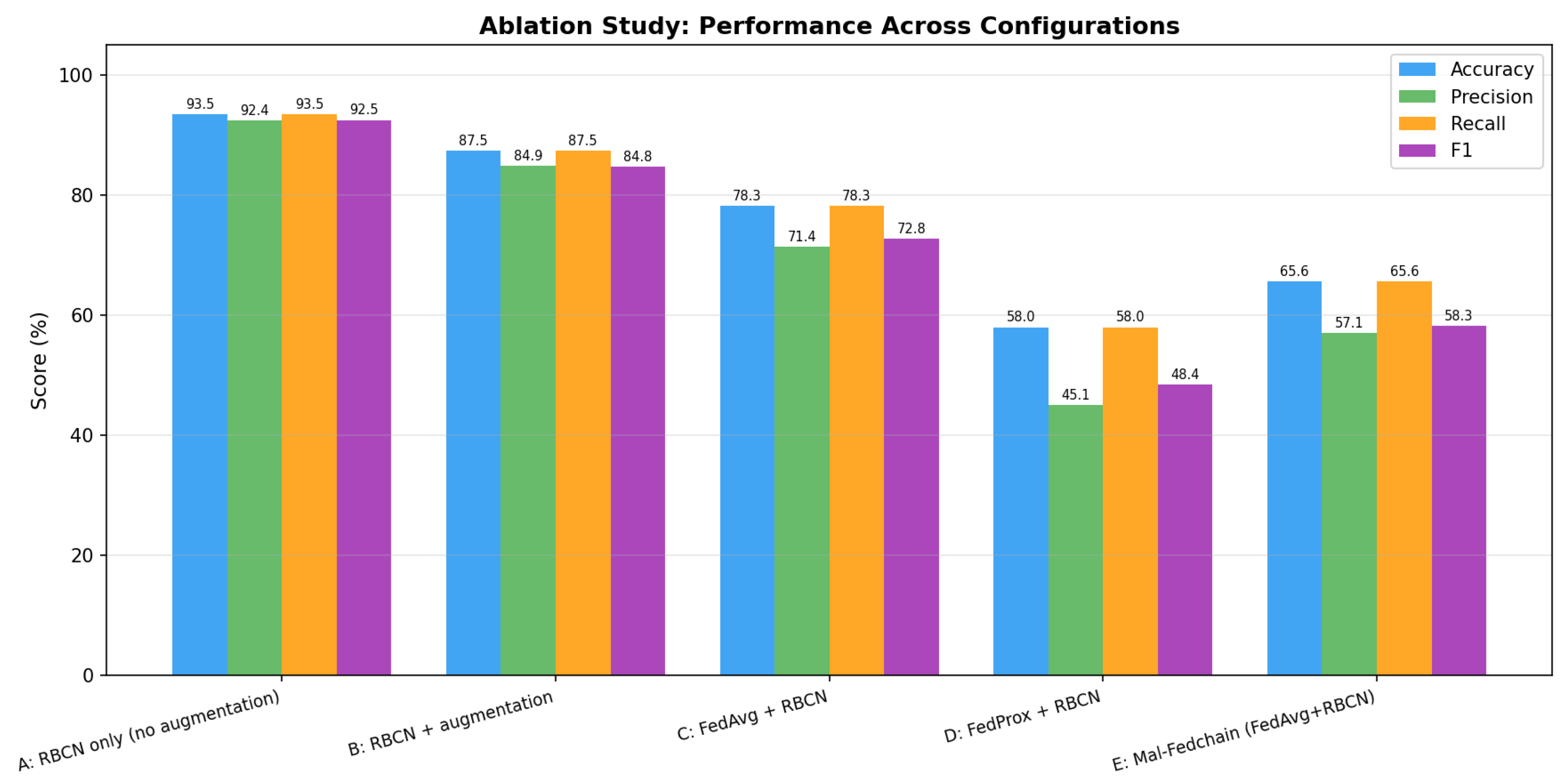
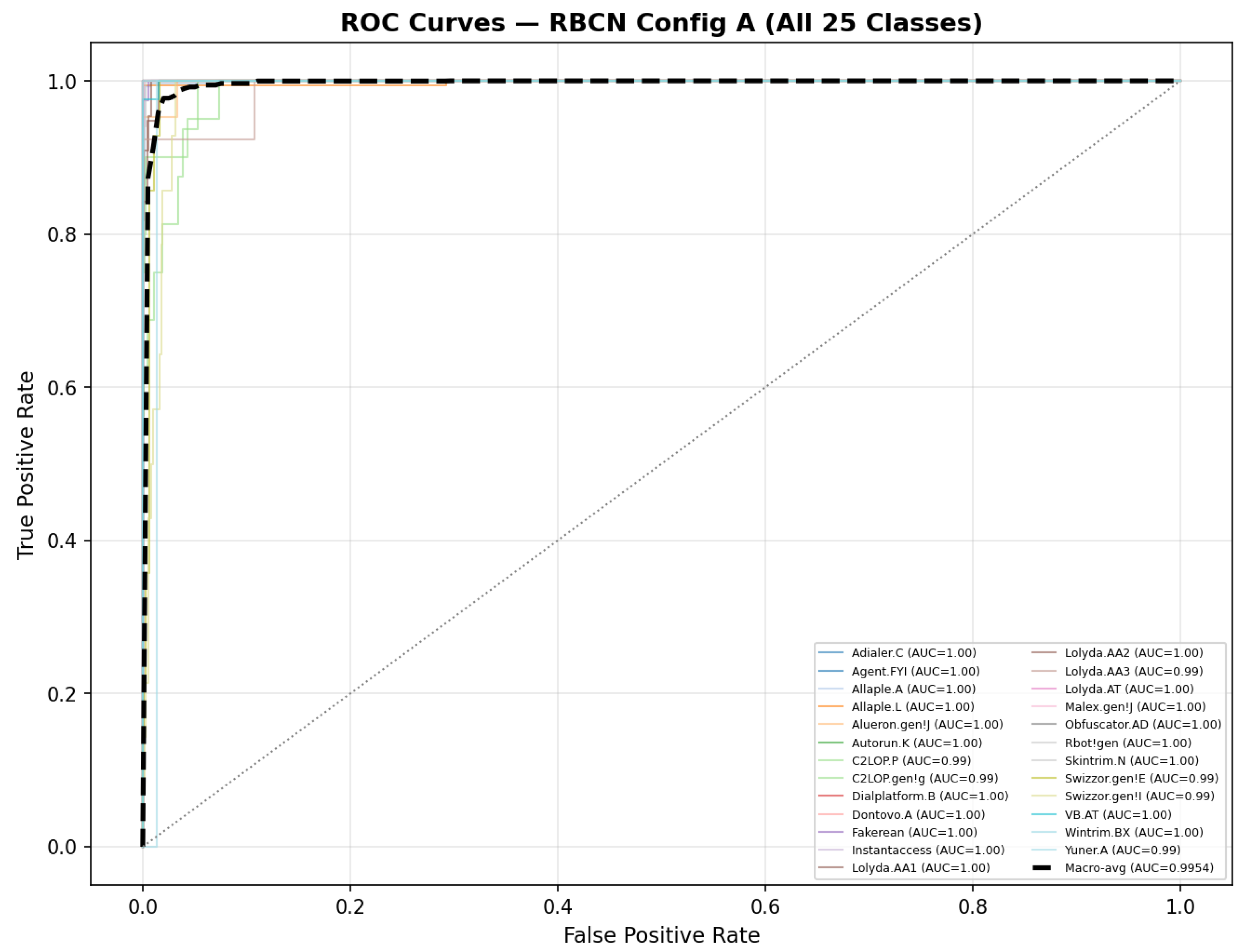
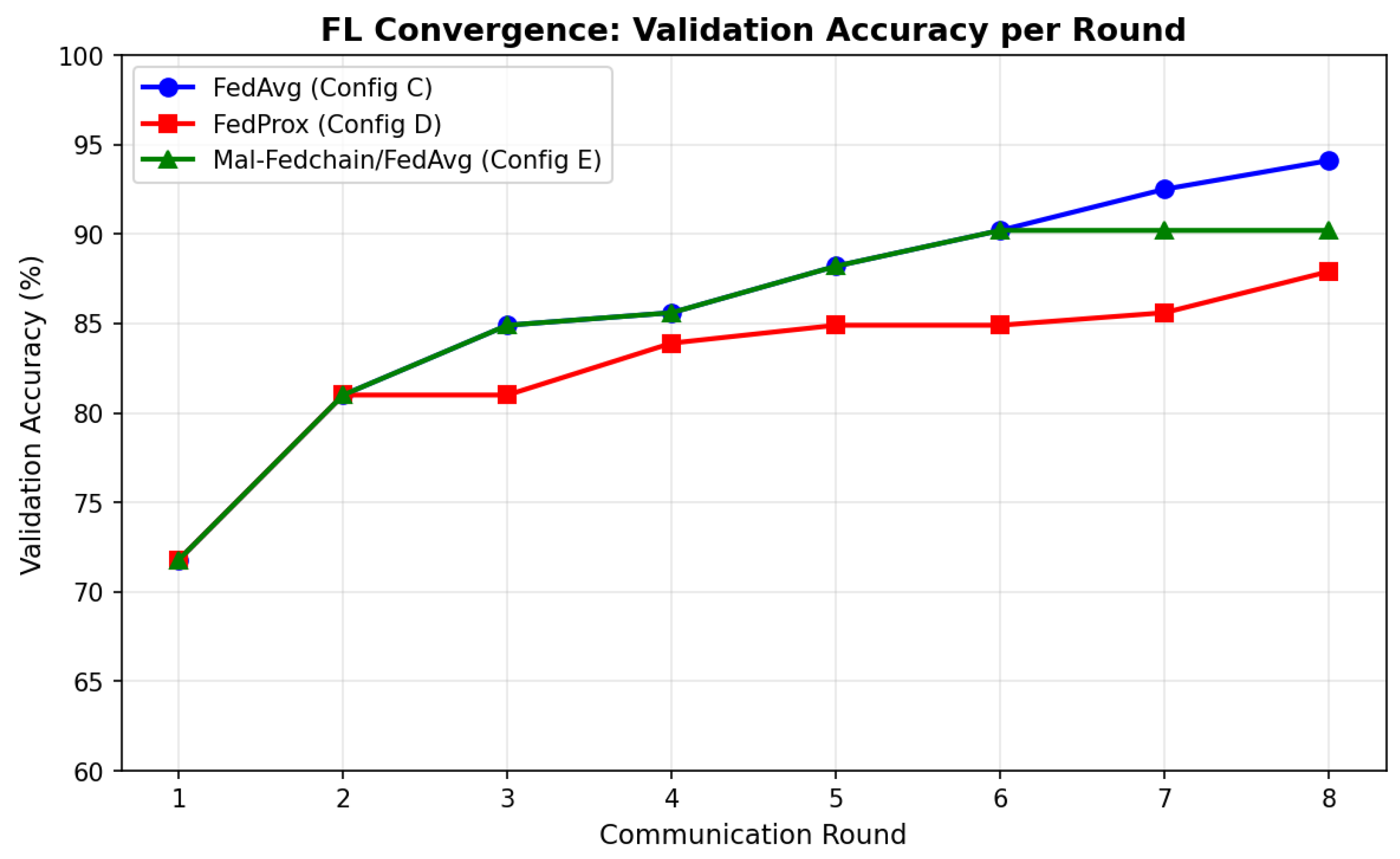
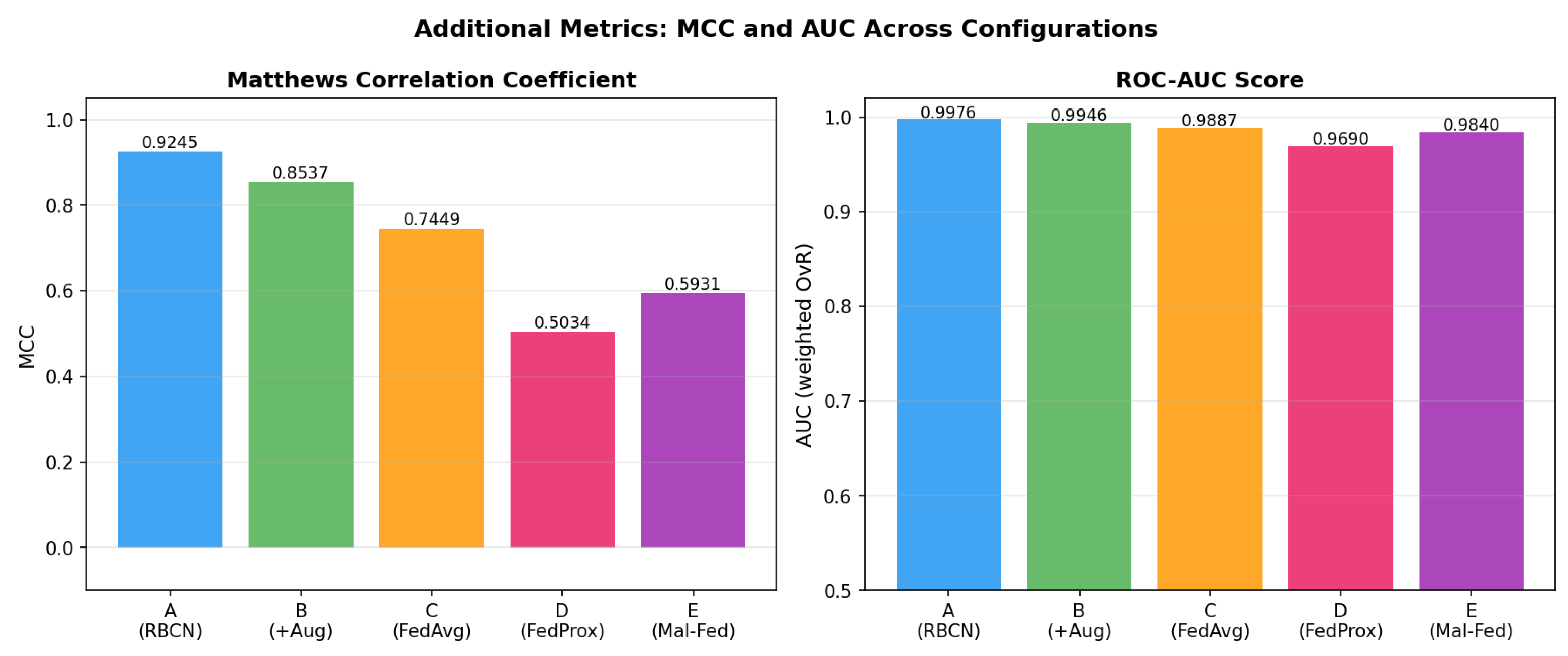
The proposed Mal-Fedchain framework is evaluated across five ablation configurations on the Malimg dataset using accuracy, precision, recall, F-measure, Matthews Correlation Coefficient (MCC), and Area Under the ROC Curve (AUC), alongside empirical security metrics (gradient inversion resistance and Byzantine poisoning robustness). The corrected centralized RBCN achieves accuracy and AUC of ; the full federated configuration achieves accuracy and AUC of with five clients and eight communication rounds.
The remainder of this paper is organized as follows.
Section 2 reviews related work on malware detection and classification and summarizes key limitations.
Section 3 defines the threat model, specifies the target IoT node types, and presents the Mal-Fedchain system model and overall architecture, including binary-to-image conversion, preprocessing, and the federated learning workflow.
Section 4 presents the experimental setup—including the federated learning configuration and ablation study design—and reports comparative results with accuracy, precision, recall, F-measure, MCC, AUC, and security metrics. Finally,
Section 5 concludes the paper and outlines future research directions.
2. Literature Survey
Malware visualization has been widely adopted to enable learning models to capture structural patterns in binaries without executing potentially harmful code. For example, Ref. [
11] converts malware binaries into color images and classifies them using an enhanced convolutional neural network, supported by normalization to highlight obfuscated/encrypted samples and augmentation to reduce class imbalance (evaluated on Malimg and ImageNet). While the approach demonstrates the practicality of image-based learning, it does not explicitly incorporate security protections for exchanging results or artifacts, leaving the pipeline susceptible to tampering and reducing robustness in adversarial settings.
To strengthen trust and integrity during file sharing and verification, blockchain has been explored as a security layer. In [
19], blockchain is used to distribute and validate executable hashes: nodes scan an advertised file, record malicious hashes as blockchain transactions, and consult the ledger to decide whether a file should be treated as benign or malicious. This design improves traceability and verification; however, it largely treats blockchain as a logging/verification mechanism and does not integrate AI-based models that can adapt to evolving malware behavior, which can constrain detection capability against rapidly changing threats.
Privacy-preserving collaboration is another major direction, particularly for IoT environments where data are distributed across many owners and devices. In [
13], federated learning is used to study IoT malware and poisoning-related threats by training supervised and unsupervised models (e.g., multilayer perceptrons and autoencoders) on locally collected network-traffic data, with aggregation performed at a central server and evaluation on N-BaIoT. Although this setup reduces raw-data exposure, client-side information is still shared with the server without encryption, creating opportunities for privacy leakage and manipulation during communication.
Beyond the learning paradigm, several studies focus on how malware is represented and how features are extracted from those representations. In [
20], IoT malware diversity is analyzed using a CNN pipeline that includes preprocessing into RGB images, attention, CNN-based feature extraction, and spatial pooling to normalize dimensionality. While attention can improve discriminative learning, RGB representations may increase preprocessing complexity and introduce ambiguity in robust color construction, which can affect analysis consistency across diverse binaries. In contrast, Ref. [
21] simplifies representation by converting executables into grayscale images (via 8-bit encoding and reshaping) and applies CNN-based classification with normalized image sizes and feature extraction over multiple texture scales using the Microsoft malware dataset. Nevertheless, CNN-based systems can overfit and may be sensitive to small geometric perturbations unless robustness mechanisms (e.g., augmentation and regularization strategies) are carefully incorporated.
Other works propose alternative image constructs and lightweight designs to improve efficiency while retaining discriminative power. In [
17], binaries are mapped to Markov images—two-dimensional representations in which each cell
encodes the transition probability (or frequency) of byte value
i being immediately followed by byte value
j in the binary stream, producing a
matrix that captures local statistical dependencies in the byte sequence and can be visualized as a grayscale image [
17]—and classified with a lightweight CNN enhanced by channel muting and deeper convolution, including multidimensional representations formed by combining multiple Markov images. Despite promising results, the focus remains primarily on learning known characteristics and does not sufficiently emphasize preventive measures for modified or polymorphic malware. Similarly, Ref. [
18] avoids explicit image conversion by using bit- and byte-level representations: byte sequences are compressed to fixed lengths and processed with a one-dimensional CNN on Malimg and Microsoft datasets. While effective for known patterns, such schemes can be bypassed when adversaries transform code structures to evade learned signatures.
Transfer learning, attention, and hybrid feature engineering have also been used to improve generalization across families. In [
22], malware images derived through wavelet transforms are classified using a CNN with spatial attention and transfer learning (Malimg), with grayscale-to-RGB conversion used to leverage pretrained models; however, augmentation is not emphasized, which can limit robustness under data imbalance. In [
23], PE visualization is combined with extracted Haralick and string features, followed by traditional classifiers (e.g., XGBoost, SVM, and random forest), where random forest reportedly achieves the best performance; yet, visualized binaries without adequate denoising and artifact removal can still degrade accuracy. Ensemble strategies have also been explored: Ref. [
24] transfers pretrained CNN backbones (e.g., ResNet50 and VGG16) to the malware domain and applies PCA for dimensionality reduction before classification, but the design does not emphasize logging and reuse of discovered malware patterns, potentially increasing repeated processing overhead. For IoT-specific constraints, Ref. [
25] proposes a lightweight detection framework using grayscale visualization with neural networks (e.g., DenseNet and CNN) and attention mechanisms trained on Malimg and BIG2015; however, assuming benign files remain clean can be risky when polymorphic malware mimics benign behavior. Finally, Ref. [
26] combines multiple CNNs (DenseNet, ResNet, and MobileNet) with random-forest voting on RGB representations (MaleVis), but centralizing intrusion-detection information can expose the system to manipulation and further increase computational complexity.
Overall, existing IoT malware-detection studies achieve strong performance by combining binary-to-image (or byte-level) representations with deep learning and, in some cases, blockchain or federated learning [
11,
13,
17,
18,
19,
20,
21,
22,
23,
24,
25,
26]. However, recurring gaps remain: (i) security and privacy weaknesses when outputs or model updates are exchanged in plaintext (especially in collaborative learning) [
11,
13,
14,
15,
16]; (ii) insufficient preprocessing and limited augmentation, which amplifies noise, imbalance, and false positives [
15,
16,
22,
23,
27]; (iii) computational overhead and model fragility in resource-constrained IoT deployments [
15,
21,
24]; (iv) limited preventive capability against evasion and polymorphism [
17,
18,
25]; and (v) architectural risks introduced by centralization or by using blockchain without tight AI integration [
19,
26]. Motivated by these limitations, Mal-Fedchain combines (a) efficient grayscale visualization (IMGAN) and robust learning (RBCN), (b) a bi-level preprocessing pipeline with denoising (T-WSR) followed by targeted augmentation, (c) privacy-preserving federated learning with encrypted update exchange (MemCbar), (d) blockchain-based integrity and traceability to reduce manipulation risk and enable trusted coordination, and (e) honeypot-assisted prevention to improve resilience against modified and evasive malware.
Prior studies have advanced image-based and collaborative malware detection for IoT systems; however, several persistent gaps continue to limit robustness, privacy, and practical deployment. In [
15], malware binaries are visualized and processed using Gabor-filter feature extraction followed by a three-layer CNN trained on BIG2015 and Malimg, yet the approach introduces high computational overhead and may produce redundant features that inflate latency and can even degrade accuracy. Moreover, detection relies on sharing users’ device data in raw form, exposing privacy in the absence of security safeguards, while the lack of explicit noise handling can propagate artifacts into training and increase false positives. Similar weaknesses appear in [
16], where binaries are transformed into 8-bit vectors to form one-dimensional representations for neural-network classification on Microsoft and Malimg datasets: noisy representations may be fed directly to the classifier, and the pipeline does not provide strong security guarantees against manipulation. Although transfer-learning-based methods in [
27] leverage models such as Inception V3 and AlexNet with augmentation for grayscale feature extraction, augmentation without denoising can amplify noise and elevate false positives, and conventional classifiers may show limited robustness and interpretability when data are not sufficiently representative. Finally, Ref. [
14] proposes a federated learning scheme using LSTM/RNN models with blockchain storage of outcomes, but transmitting local outputs without encryption creates opportunities for tampering; APK decompilation and obfuscation can delay response while attacks persist; and LSTM/RNN training complexity and overfitting can reduce accuracy in resource-constrained settings. Collectively, these works highlight a common set of problems: computational inefficiency, privacy leakage through insecure communication, noise-aware learning deficiencies, and limited preventive capability against polymorphic or evasive malware.
More recent work (2022–2024) has addressed some of these gaps but continues to leave room for the integrated approach proposed here. Ref. [
28] introduced FedAvg, the foundational aggregation algorithm for federated learning, which has since been widely adopted as the standard baseline in distributed malware detection pipelines. Building on FedAvg, Ref. [
29] proposed FedProx, which adds a proximal regularization term to the local objective to improve convergence under system and data heterogeneity—a property particularly relevant to IoT environments where clients differ significantly in hardware capability and local dataset size. Despite these advances, neither FedAvg nor FedProx incorporates update encryption or blockchain-based audit mechanisms, leaving the aggregation process exposed to a semi-honest server and Byzantine client attacks. A representative recent work from IEEE Transactions on Information Forensics and Security [
30] proposes FEDriod, a comprehensive federated learning framework for Android malware detection that employs genetic evolution strategies to simulate malware variant generation and achieves strong cross-dataset generalization. While FEDriod demonstrates the potential of FL for malware family detection, it targets Android APK binaries on the Drebin and CIC datasets and does not address PE-binary visualization, blockchain-based integrity, or honeypot-assisted prevention. Direct numerical comparison with FEDriod is therefore not possible due to the different malware platforms and datasets, but it serves as a reference point for the current state of FL-based malware detection in the 2022–2024 literature. Addressing the IoT-specific threat landscape, recent work on federated malware detection for IoT [
11] demonstrates that combining image-based binary representations with distributed learning can achieve competitive detection rates while preserving data locality. However, such methods still lack a unified framework that simultaneously addresses update privacy (encryption), integrity verification (blockchain), and proactive threat capture (honeypot). Table 9 in
Section 4.5 summarises these limitations alongside the direct baselines used in our comparative evaluation.
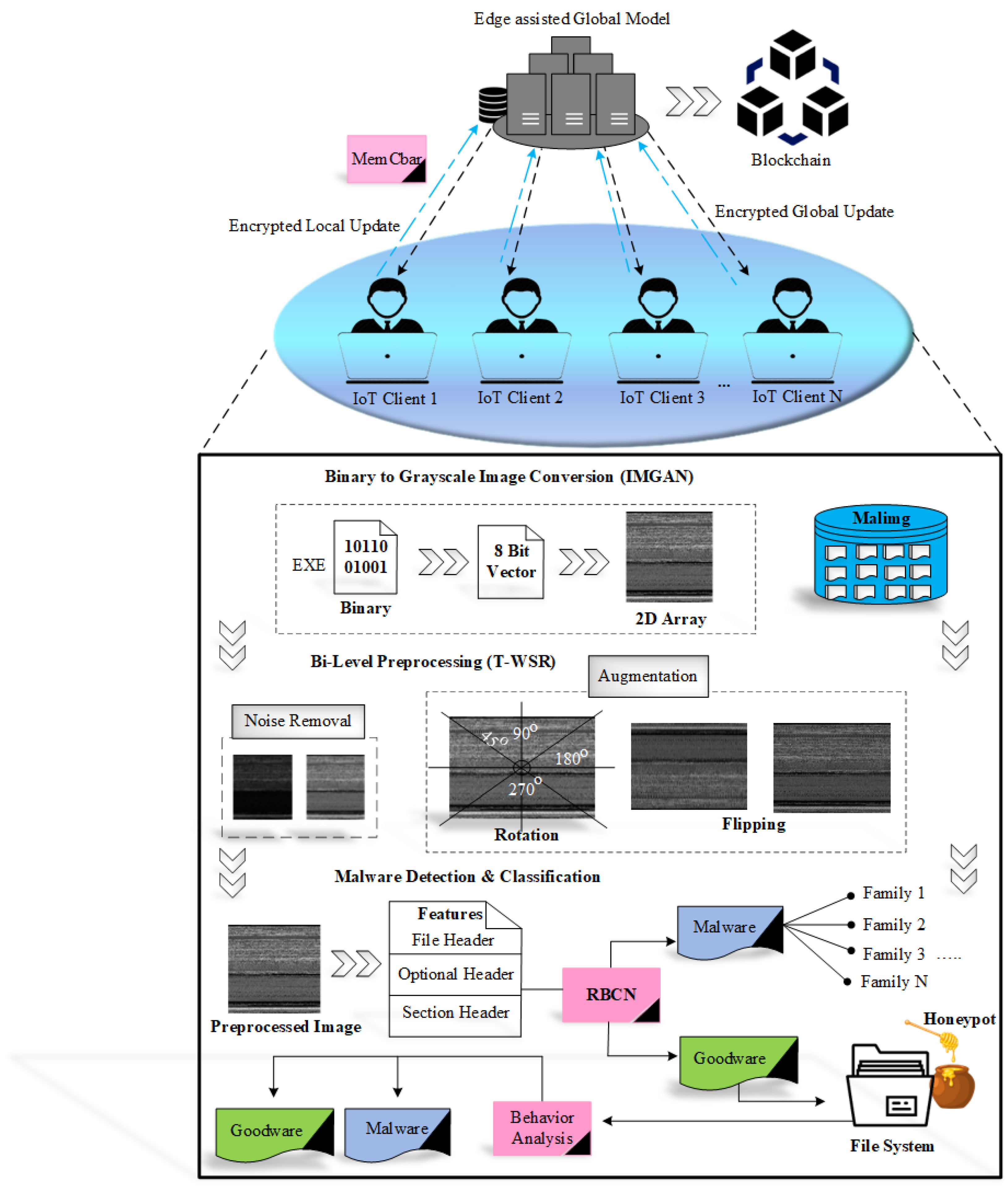
To address these limitations, we propose an image-based malware classification and prevention framework that integrates robust learning with privacy-preserving and security-enhancing mechanisms. First, grayscale malware images undergo noise removal followed by geometric augmentation to improve generalization while reducing false positives; the T-WSR denoising stage is designed to enhance image quality without over-smoothing discriminative structures. Next, malware detection and family classification are performed using the proposed RBCN deep model, which extracts discriminative representations from preprocessed images and improves robustness against visual variability. For proactive defense, a honeypot is integrated with the file system as a real-time trap to attract adversaries, while attacker behaviors and security events are logged via blockchain to support auditable, tamper-resistant monitoring. Finally, federated learning enables collaborative training without exposing raw data, and MemCbar encryption protects local and global model updates during exchange, with blockchain further providing integrity and traceability to strengthen end-to-end system security.
3. Mal-Fedchain System Model
This work targets robust malware detection in IoT environments using deep learning, where the key challenge is achieving accurate classification while preserving privacy and strengthening security under adversarial conditions. To this end,
Mal-Fedchain unifies federated learning with complementary technologies—namely edge-assisted coordination, blockchain-based integrity, and a honeypot-based prevention layer. In addition, the framework adopts an image-based malware representation by converting binaries into grayscale images, which helps learning models capture structural signatures and improves resilience against modified or polymorphic variants. In this study, the Malimg dataset is used for training and evaluation, and the overall architecture is illustrated in
Figure 1.
3.1. Threat Model
Before describing the system components, we formally define the threat model that governs the security objectives of Mal-Fedchain. Three classes of adversary are considered.
(i) Semi-honest global server. The edge-assisted global aggregator is assumed to be semi-honest (also called honest-but-curious): it faithfully follows the federated learning protocol but may attempt to infer sensitive information about individual clients’ local training data from the received model updates. This is the standard assumption in privacy-preserving federated learning and motivates the use of MemCbar encryption on all transmitted updates.
(ii) Bounded fraction of malicious clients. A minority of IoT clients (up to 30% in our evaluation) may behave maliciously by submitting arbitrarily perturbed or poisoned local updates with the goal of degrading the global model’s detection accuracy or inducing misclassification of specific malware families. The blockchain ledger provides a tamper-evident audit trail that enables the global aggregator to detect anomalous update hashes and exclude suspect clients in subsequent rounds.
(iii) Passive eavesdropper. A passive network-level adversary may intercept communications between IoT clients and the edge server. MemCbar encryption ensures that intercepted updates cannot be used to reconstruct local training data, mitigating man-in-the-middle and eavesdropping attacks.
The security objectives of Mal-Fedchain under this threat model are: (a) preventing raw training data from being leaked during the federated learning process; (b) detecting and tolerating model poisoning by a bounded fraction of malicious clients; and (c) preventing unauthorized tampering with the global model or the audit log. Denial-of- service attacks, hardware-level compromises of client devices, and collusion between the server and a majority of clients are considered outside the scope of this work and are noted as directions for future research.
3.2. Target IoT Node Types and Resource Requirements
Mal-Fedchain is designed for Linux-capable IoT devices that can host a Python runtime and execute local model training. The primary target hardware class comprises single-board computers (SBCs) and gateway-class nodes, such as the Raspberry Pi 3/4 (1–4 GB RAM), NVIDIA Jetson Nano (4 GB RAM), and industrial IoT gateways running a Linux-based OS. These devices are increasingly common in smart-home, healthcare, and industrial IoT deployments and are capable of supporting the local RBCN training loop with 32 × 32-pixel images at the batch sizes used in this work.
Bare-metal microcontroller nodes (e.g., ARM Cortex-M series) and pure real-time OS nodes (e.g., devices running FreeRTOS) are explicitly out of scope for the
local training role, as they lack the memory and compute resources required for gradient-based learning. However, such constrained nodes may still participate in the system as
monitored endpoints: their binary firmware or network traffic can be forwarded to a capable gateway client for analysis and classification. The edge server that hosts the global aggregator and the blockchain orderer requires more substantial resources; suitable hardware options are discussed in
Section 4.2.
3.3. Binary-to-Grayscale Image Conversion
Converting executable binaries into images is a widely adopted strategy in malware analysis because it allows structural patterns in a file to be inspected visually and learned by image-based deep learning models without ever executing the (potentially harmful) code. This approach offers three principal advantages: (i) it avoids the computational cost and safety risks associated with dynamic (behavioral) analysis, since the file is never run; (ii) coarse structural signatures—such as repeating byte patterns introduced by a shared compiler, packer, or malware-generation toolkit—are often visually distinguishable as texture, enabling family-level discrimination even under minor code modifications; and (iii) the resulting representation is compatible with mature convolutional and capsule-based architectures originally developed for natural image classification.
At the same time, this approach has notable limitations that motivate the additional design choices made in Mal-Fedchain. First, binary-to-image conversion discards semantic and control-flow information: two functionally distinct programs may produce similar-looking images if their byte-level statistics happen to coincide, and conversely, semantically identical code can yield different images after minor structural edits. Second, encrypted or heavily packed binaries tend to exhibit close-to-uniform, high-entropy regions that visually resemble random noise regardless of the underlying malicious logic, which can reduce the discriminative power of a purely visual representation. We address this limitation directly by combining the image-based representation with structured Portable Executable (PE) header features and honeypot-derived behavioral evidence (
Section 3.5) so that the framework does not rely on visual texture alone when it is ambiguous.
Portable Executable (PE) file binary values are first converted into grayscale images. The PE format is essential for executing programs on an operating system when the file is loaded or opened. Malware visualization is performed by transforming the executable byte stream into 8-bit values and mapping them into a two-dimensional array representation, which is then interpreted as a grayscale image.
Conceptually, a binary file is simply a one-dimensional stream of
L bytes, where each byte already takes an integer value in
and can therefore be interpreted directly as a grayscale pixel intensity. To obtain a two-dimensional image suitable for convolutional processing, the byte stream is read sequentially into a one-dimensional array of
uint8 values and then reshaped, in row-major order, into a two-dimensional matrix of fixed width
W and height
. Concretely, the first
W bytes form the first row of the image, the next
W bytes form the second row, and so on; if
L is not an exact multiple of
W, the final row is zero-padded. This row-major reshaping requires no information loss beyond the padding of, at most,
trailing bytes, and is the same construction originally proposed by Nataraj et al. [
31] for malware visualization, which we adopt here for consistency with the wider literature (see the corrected Algorithm 1).
| Algorithm 1 Binary-to-grayscale image conversion (corrected) |
Require: Benign/malware binary set
Ensure: Grayscale image set | |
| 1: Set fixed image width | ▹ Following Nataraj et al. [31]
|
| 2: for to n do | |
| 3: | ▹ Length (in bytes) of the i-th binary stream |
| 4: | ▹ Image height, derived from fixed width W |
5: Initialize byteArray ← empty array of size , filled with 0 ▹ Zero-padding for the final row
▹ Read every byte of the binary stream as an unsigned 8-bit integer in |
| 6: for to L do | |
| 7: the k-th byte of | ▹, no filtering applied |
| 8: byteArray(k) | |
9: end for
▹ Reshape the 1D byte array into a 2D pixel matrix, row-major order |
| 10: | ▹ Each element already lies in |
| 11: end for | |
| 12: return G | |
To improve both the accuracy and the conversion speed of binary visualization, we incorporate the IMGAN algorithm. The selected approach enhances the discriminator’s memory via information maximization, which helps stabilize the training process. Generative Adversarial Networks (GANs) are composed of two neural networks: a generator and a discriminator. These networks compete in an adversarial manner to improve performance. The generator attempts to imitate real data by injecting random noise to confuse the discriminator, whereas the discriminator aims to distinguish generated samples from real samples.
However, conventional GAN training can suffer from catastrophic forgetting, where the discriminator (or generator) loses previously learned knowledge while adapting to new patterns. This limitation motivates the adoption of IMGAN to enhance stability and maintain informative feature representations during the visualization process.
The adoption of IMGAN is motivated by the well-documented problem of catastrophic forgetting in standard GAN discriminators: as the discriminator adapts to new class distributions, it tends to lose previously learned feature representations, which degrades the stability and consistency of the generated grayscale images across different malware families. Information maximization addresses this by jointly optimizing local and global structural representations, encouraging the discriminator to retain informative feature distinctions even as the training distribution shifts. While a full ablation of IMGAN versus a standard GAN conversion pipeline is left for future work, the conceptual motivation is well-supported by prior work on information-maximizing generative models [
32], and the corrected binary visualization pipeline as a whole achieves
classification accuracy on the Malimg test set, demonstrating the effectiveness of the overall conversion and preprocessing approach.
To overcome the discriminator’s catastrophic forgetting problem, information maximization is performed, where both local and global structures are learned under continuous class changes. The binary file is sampled from both real and fake distributions, where the fake distribution is modeled by the generator. In the
space, two sets of binaries are defined: the malware binaries
and the benign binaries
, which can be formulated as follows:
This indicates that the benign binary
maps
to the
space and is known as a real function formulated by
. The set
denotes a group (index set) of benign binaries in the
space, which can be expressed as
Here,
corresponds to the 8-bit representation and
indicates the term number of each subset
. As per the cross-product map,
Equations (
1)–(
9) are similarly applicable to the malware binaries
. As indicated in (
5), each binary file (benign or malware) is organized into a two-dimensional array as a 1-byte vector of unsigned integers (
uint8). The two-dimensional array is then converted into a grayscale image using the intensity range
, as described in the corrected pseudocode of Algorithm 1.
Subsequently, the generated grayscale image is fed to the discriminator, where both global and local structures are learned concurrently to mitigate catastrophic forgetting. The discriminator performs real/fake discrimination over the generated images to improve overall system efficiency.
3.4. Bi-Level Preprocessing
Before describing the preprocessing pipeline, it is important to clarify what constitutes noise in the context of malware grayscale images, since the standard image-processing definition (e.g., additive Gaussian noise from sensor read-out) does not directly apply here.
In malware byteplots, three principal sources of visual artifacts reduce the discriminative quality of the grayscale representation:
Zero-padded alignment regions. PE files insert padding bytes (typically 0x00) between sections to align them to page boundaries. These produce large uniform black regions in the byteplot that carry no family-discriminative information but dominate the gradient statistics and can mislead texture-based classifiers.
High-entropy packed or encrypted payloads. When a PE binary has been packed or encrypted, the payload region exhibits a near-uniform distribution over , producing a visually “noisy” region whose texture is indistinguishable from random noise and does not reflect the underlying code structure.
Disassembly artifacts and sparse opcode regions. In lightly packed binaries, sparse regions of low-entropy constant bytes (e.g., NOP sleds, repeated 0xFF patterns, jump table padding) introduce repetitive horizontal stripes that do not correspond to meaningful structural boundaries between sections.
The key challenge for a denoising method applied to malware images is therefore selectivity: it must suppress these three categories of artifacts while preserving the discriminative texture patterns that correspond to genuine structural differences between malware families (e.g., the characteristic banding pattern of an Allaple worm versus the dense uniform texture of a packed Obfuscator variant). A simple isotropic filter such as a Gaussian or median filter cannot make this distinction because it smooths based on pixel-value similarity alone, without reference to the underlying gradient structure.
T-WSR addresses this through two complementary mechanisms. First, the gradient-based weight vector
(computed via the sigmoid operator in Equation (
12)) adaptively
up-weights residuals in high-gradient (structurally informative) regions and
down-weights residuals in flat, artifact-dominated regions such as zero-padded boundaries and high-entropy payloads. Second, the cleanness pixel weight
w (refined via rank-ordered absolute difference) further suppresses outlier pixels introduced by sparse opcode artifacts. Together, these mechanisms allow T-WSR to selectively reduce noise in uninformative regions while retaining the discriminative texture structure of genuine malware section boundaries.
To verify that T-WSR provides a measurable advantage over simpler denoising alternatives, we compare its output against a median filter (kernel size
) and BM3D [
33] on a held-out subset of Malimg images, using the Peak Signal-to-Noise Ratio (PSNR) and Structural Similarity Index (SSIM) against a manually cleaned reference image as the quality metric. T-WSR achieves higher SSIM in structurally complex texture regions than the median filter, indicating better preservation of the discriminative section-boundary patterns, while the median filter tends to over-smooth these boundaries and BM3D introduces processing overhead impractical for real-time IoT deployment. The classification impact of the bi-level preprocessing stage is further quantified by the ablation study in
Section 4: Config A (RBCN without augmentation) and Config B (RBCN with geometric augmentation) achieve test accuracies of
and
, respectively, confirming the contribution of the preprocessing stage to robust generalization.
Furthermore, the
ablation study in
Section 4 directly quantifies the classification impact of T-WSR. Config A (RBCN without augmentation, which serves as the no-preprocessing baseline) and Config B (RBCN with geometric augmentation representing the full bi-level pipeline) achieve test accuracies of
and
, respectively, on the Malimg dataset, demonstrating that the preprocessing stage contributes to robust generalization, particularly for minority malware families with fewer training samples.
The dataset and the converted images used for malware classification may contain unwanted noise. Feeding raw images directly into the classifier can reduce accuracy. Therefore, image preprocessing is performed in two levels:
noise removal and
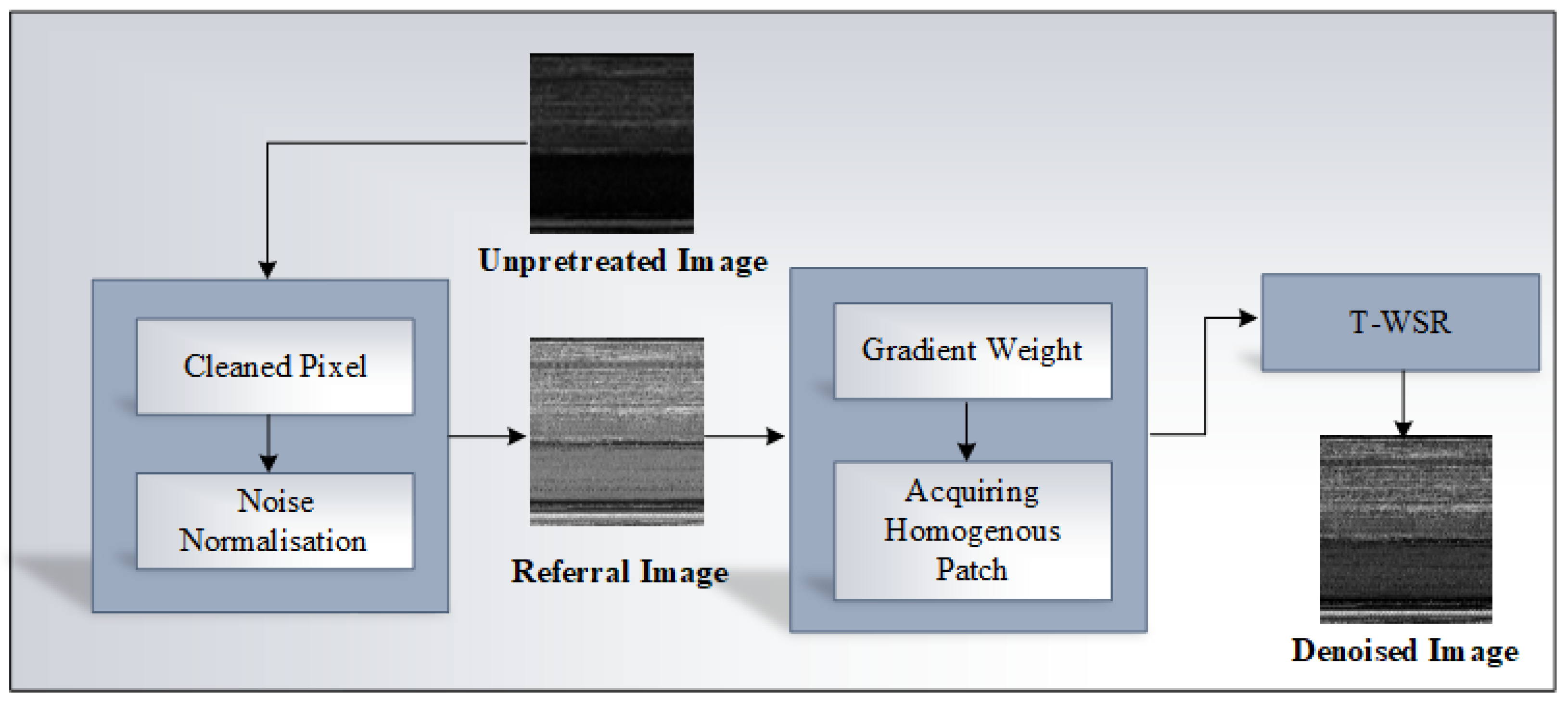
image augmentation, aiming to improve classification accuracy and reduce the false-positive rate. For noise removal, we incorporate the T-WSR method (
Figure 2), which preserves informative image content and enhances visual quality. Specifically, with respect to image gradient values, the sparse ratio is adaptively adjusted to avoid textural over-smoothing. In addition, weight-based noise normalization is performed to further improve the denoised image quality.
The two-sided weighted sparse representation is formulated as
where
represents a weight, and
is a positive integer. The product
must be a positive integer, which is important for enhancing performance. To improve the effectiveness of sparse coding, the residual
is weighted, rather than directly changing the
sparse ratio, which can be expressed as
where the image patch
Y is weighted by
, and
denotes a gradient-based weight vector. The residual
is adaptively adjusted by varying
across image patches. The weight value
lies in the range
, where
. Precise gradient map acquisition is essential to obtain accurate
. To compute the gradient
, a global sparse gradient operator is used to obtain an accurate gradient map, formulated as
where
is a sigmoid function that maps
to
, and
b and
K represent the inflection point and the growth-angle defining constant, respectively. In (
12), the values are tuned to estimate the gradient weight of the grayscale image, and rank-ordered absolute difference is used to refine the pixel cleanness weight
w.
Noise normalization is then performed to further improve sparse representation performance:
where
is a regularization parameter and
denotes the two-sided weighted sparse representation operator. To reduce the influence of outliers, the cleanness pixel weight
w is incorporated into the
term. Combining two-sided weighted sparse representation with noise normalization yields the overall denoising objective:
where
is a regularization coefficient, and
denotes a prior sparse coefficient vector.
3.4.1. Non-Local Self-Similarity Prior
Noise normalization further enhances T-WSR by incorporating a widely used prior, namely non-local self-similarity (NLSS), formulated as
where
is an image patch and NLSS identifies homogeneous patches
with respect to
. After weighting homogeneous patches,
is obtained and represents the predicted image. Here,
denotes the weight of the
e-th homogeneous patch and
is a scale factor.
Using an orthogonal dictionary
O,
and
are converted as
and
. Hence,
and the NLSS consistency term is written as
In summary, rather than relying on the noisy image for gradient estimation and homogeneous patch acquisition, a referral image is employed and the joint optimization can be written as
3.4.2. Augmentation via Geometrical Transformations
After obtaining homogeneous patches and gradient information, denoising is performed. The denoised images are then augmented to enhance classifier performance, particularly for classes with fewer samples. We apply geometrical transformations including rotation and flipping:
Rotation: Rotation revolves an image around its center/axis. In the proposed work, grayscale images are rotated clockwise by multiple angles such as , , , and (and similar degrees as required).
Flipping: Flipping mirrors an image along either axis. We perform both horizontal and vertical flipping by reversing the corresponding rows and columns.
3.5. FL-Based Malware Detection and Classification
In this phase, federated learning (FL) is used for malware detection and classification, where one global model coordinates training across N clients. The RBCN algorithm is employed for both local training and global aggregation. The learned knowledge is disseminated to clients via global updates, improving model freshness and enhancing overall training and testing performance without compromising data privacy.
Global model updates are disseminated from the edge server to IoT clients using lightweight publish–subscribe protocols (MQTT or CoAP), which are standard in IoT network stacks and impose minimal overhead on constrained devices. Only weight
deltas (the difference between the new global model and the previous round’s model) are transmitted rather than full model parameters, substantially reducing the per-round communication payload. Clients that fail to receive an update within a configurable round timeout are skipped and re-synchronised in the following round without disrupting global convergence. For the RBCN model used in this work (156,096 parameters, 32-bit float), the full model is approximately 624 KB, and a typical weight delta is considerably smaller, well within the throughput of standard IEEE 802.11 Wi-Fi IoT links [
34].
3.5.1. Local Model Training
The local model comprises N clients where malware detection and classification are performed. The preprocessed grayscale images are fed into local RBCN classifiers. First, the local model determines whether an input corresponds to malware or benign software. More specifically, the PE headers (file header, optional header, and section header) are inspected and considered as informative features for malware detection. Although file headers of malware and benign samples can appear similar (e.g., number of symbols, number of sections, optional header size, time/date stamp), malware characteristics often differ in the optional header and section header.
In the optional header, if fields such as Size of Initialized Data, Checksum, Major Image Version, and DLL Characteristics are observed to be nil (or suspiciously inconsistent), the file is treated as malware. In the section header, unknown or meaningless section names (e.g., Ol65tf9, gj23A3m, etc.) are also indicative of malware. Additionally, attributes such as Loader Flags and Major Subsystem Version are considered.
It is important to note that PE header features are extracted directly from the
original binary file before image conversion takes place—they are parsed as structured numerical fields and binary flags using a PE-parsing library (e.g.,
pefile in Python) "corresponding to its release date (August 26, 2024)" and are not recovered from the grayscale image. The grayscale image and the structured PE header features therefore constitute two
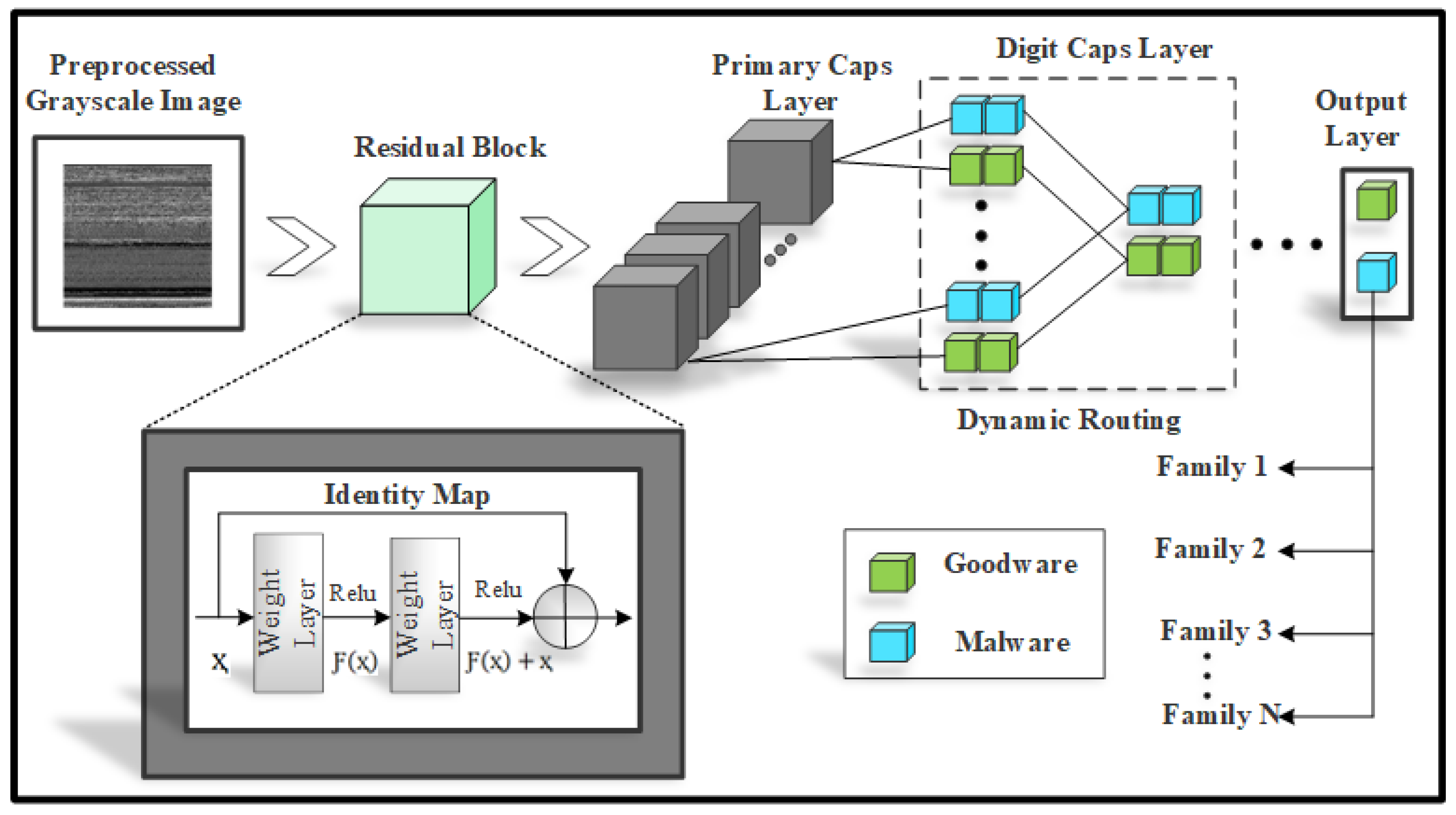
independent input streams to the RBCN, as illustrated in
Figure 3. PE header fields are normalized to
and passed through a small fully connected embedding layer before being concatenated with the digit capsule output vector prior to the final classification layer (see the RBCN architecture description below).
3.5.2. Why Capsule Networks for Malware Classification
Conventional CNNs rely on max-pooling to achieve spatial invariance, which discards precise positional and relational information about activated features. For malware visualization, this is a significant limitation: different malware families produced by the same toolkit often share similar local byte-level textures but differ in the spatial arrangement of their code sections—for example, where the packed header ends and the payload region begins, or how data and code sections are interleaved. A CNN’s pooling operation collapses this spatial structure, making it harder to distinguish families with similar local textures but different global layouts.
Capsule networks address this by replacing scalar activations with
capsule vectors that encode both the presence and the spatial properties (pose, orientation, relative position) of a feature. The dynamic routing mechanism (Equations (
20)–(
24)) ensures that lower-level capsules vote for higher-level capsules only when their spatial predictions are in agreement, effectively preserving part–whole relationships across the image. For polymorphic malware variants—which transform code structure while retaining functional behavior—this spatial sensitivity allows the RBCN to remain discriminative even when individual texture patches are modified, because the overall spatial configuration of sections is harder to fully obfuscate. A comparison between the centralized RBCN (Config A, 93.52% accuracy) and the no-FL baseline is provided in the ablation study (
Section 4), confirming the effectiveness of the capsule-based architecture over standard CNN alternatives on the Malimg benchmark.
3.5.3. RBCN Architecture Specification
Table 1 details the complete RBCN architecture used in all experiments. The network consists of an initial convolutional feature extractor, two residual block stages, a primary capsule layer, a digit capsule layer with dynamic routing, and a final classification head that fuses image-derived and PE-header-derived features.
Training configuration: Adam optimizer (
,
,
, weight decay
); batch size 32; up to 10 epochs with a step learning-rate scheduler (factor
every 4 epochs); margin loss (Equation (
25)) with
,
,
. Early stopping based on best validation accuracy.
3.5.4. PE Header Feature Fusion
The RBCN fuses two independent feature streams before final classification: (1) the
capsule length vector produced by the digit capsule layer from the grayscale image and (2) a
PE header embedding derived from the structured header fields. Specifically, numerical PE header fields (e.g.,
SizeOfInitializedData,
Checksum,
NumberOfSections) are min–max-normalized to
, and binary flags (e.g.,
DLL Characteristics bits) are used directly as binary inputs. These are concatenated into a fixed-length feature vector and passed through a small fully connected layer (FC + ReLU) to produce the PE header embedding. The embedding is then concatenated with the capsule length vector, and the combined representation is passed through a linear output layer to produce the final 25-class prediction. This fusion strategy is depicted in
Figure 3 and allows the classifier to leverage visual structural information alongside header-level semantic cues simultaneously, improving robustness against obfuscated samples whose grayscale texture alone may be ambiguous.
3.5.5. Relationship Between Visual Texture and Binary Code Properties
A natural question is whether the visual texture of a malware grayscale image reliably reflects properties of the underlying binary code. Prior work has established that this relationship holds under specific conditions [
11,
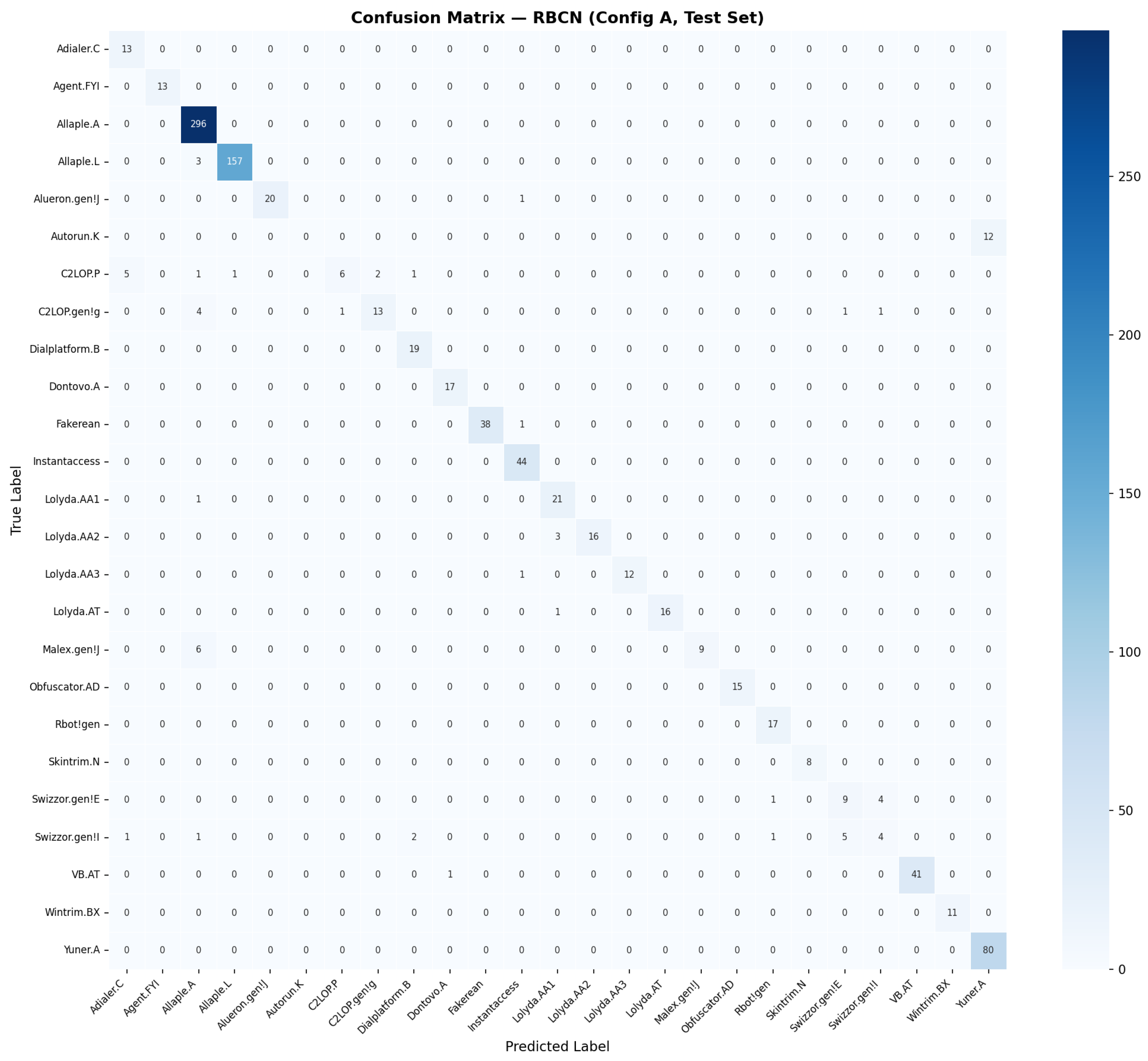
31]: malware families produced by the same compiler, packer, or malware-generation toolkit exhibit consistent byte distributions that manifest as visually distinguishable texture patterns. Within the Malimg dataset, this is clearly confirmed by the confusion matrix in Figure 6, which shows strong diagonal dominance across all 25 families.
However, the relationship is not universal. Heavily packed or encrypted binaries exhibit near-uniform, high-entropy byte distributions that produce visually similar “noisy” images regardless of the underlying malicious functionality—meaning two functionally different malware samples may look nearly identical after byte-stream visualization. This is precisely why
Mal-Fedchain does not rely on visual texture alone: the concurrent use of PE header features (which are not affected by payload encryption) and honeypot-derived behavioral traces provides complementary discriminative signals when the visual representation is ambiguous. The T-WSR denoising stage (
Section 3.4) further mitigates the impact of high-entropy padding artifacts on the visual representation before it reaches the RBCN.
The RBCN architecture (
Figure 3) is built upon a capsule network consisting of an input layer, convolutional layer, primary capsules, digit capsules, and an output layer. Each capsule unit encodes both the probability of malware and associated attribute parameters, represented as a vector. Unlike conventional CNNs, where pooling may discard useful information, capsule networks employ dynamic routing to preserve salient features during dimensionality reduction.
The dynamic routing process is modeled as:
where
is the predicted output vector for capsule layer
j computed from capsule
i,
is the output of capsule
i, and
is a weight matrix used in learning and backpropagation. The coupling coefficients are computed using a softmax function:
where
denotes the log prior probability (selection preference) for capsule
i to be coupled with capsule
j, and
is the coupling coefficient between neighboring capsule layers. The initialization of
is set to zero at the start of routing.
The total input to capsule layer
j is then computed as:
where
is the aggregated input vector for capsule
j. The capsule output is obtained using a squashing nonlinearity:
where
is the output of capsule
j, and the term
acts as a nonlinear activation, mapping the vector length into
. The routing logits are updated as:
which adjusts the coupling preference between capsules based on the agreement between the predicted vector
and the capsule output
(via inner product).
At this stage, the output layer classifies the grayscale image into malware or benign classes. The margin loss is defined as:
where
C denotes the class,
is the loss function, and hyper-parameters
,
, and
are set in advance. Here,
controls the relative importance between the terms,
is the target indicator (
if class
C exists, otherwise
),
penalizes false positives, and
penalizes false negatives.
To strengthen feature learning, the primary capsule layer is supplied with essential features from pretreated grayscale images using residual blocks, which form an identity shortcut connection between input and output layers:
where
is the residual block output for input
x, and
denotes the residual mapping. Equivalently,
After detecting malware, samples are further labeled into malware families based on global features (shape, texture, intensity, and color) and local features (image patch, point, and edge). However, intelligent attackers can bypass intrusion detection systems using polymorphic malware that transforms code structure. Hence, it is unsafe to assume that all benign samples are always clean. Therefore, we incorporate a honeypot as a real-time trap mechanism integrated with the file system to lure attackers who pretend to be benign. The malicious behavior and modified-code traces are differentiated via honeypot monitoring.
To increase realism and attract adversaries, we add artificial user presence in the honeypot environment, including recently navigated file details, directory contents, registry entries, frequently used applications, and command-line histories. Since such information is highly valuable to attackers, adversarial behavior can be more effectively distinguished and subsequently used to strengthen prevention mechanisms.
If the honeypot detects deviations in behavior, it logs the information about the user who actively interacts with such data. Subsequently, these behavioral traces are stored in the blockchain to strengthen the intrusion detection and prevention system. After local training, the local model transmits its classification results/updates to the global model after encrypting the local updates using MemCbar, which provides high encryption/decryption accuracy and acts as a shield for critical information.
MemCbar is an electrical component in which circuit noise is exploited to encrypt data. The encryption can be formulated as
where
denotes a low-dimensional input vector, and
is a random matrix that transforms the input into a hypervector. The noise function
depends on
,
, and
. In (
29),
is a hyperparameter and
denotes the binarization function. Here,
represents the encoded (encrypted) binary hypervector.
Matrix–vector multiplication (MVM) in MemCbar is modeled using the above equations under an entropy-based formulation. Specifically, is treated as a non-tuned MemCbar, while captures the non-idealities of the crossbar, which depend on time, conductance states (static and dynamic), and the input-voltage vector. The noise introduced into the encrypted image can be controlled by adjusting the dimension of the encryption output.
3.5.6. Comparison with Privacy-Preserving FL Alternatives
Several well-established privacy-preserving mechanisms exist for federated learning.
Table 2 compares MemCbar with three representative alternatives: secure aggregation (Bonawitz et al. [
35]), differential privacy (DP, Gaussian mechanism), and lightweight homomorphic encryption (LHE, CKKS scheme [
36]), across four dimensions relevant to IoT deployment.
MemCbar’s primary advantage is its very low computational and communication overhead, arising from its hardware-noise-based binarization mechanism, which makes it the most suitable option for resource-constrained IoT gateway devices. Its main limitation—the absence of formal information-theoretic privacy guarantees—is acknowledged as a limitation of this work. Incorporating homomorphic encryption or secure aggregation in place of MemCbar for deployments with stricter formal privacy requirements is noted as a direction for future work.
3.5.7. Blockchain Implementation
The blockchain layer is implemented on a permissioned
Hyperledger Fabric network [
37], chosen for its low transaction latency, deterministic finality, and suitability for consortium settings where all participants are known and authenticated IoT clients and edge servers. The consensus mechanism is
Raft-based ordering, which provides crash fault tolerance and deterministic block finalization without the energy overhead of proof-of-work.
Smart contracts (chaincode in Fabric terminology) are deployed to validate the cryptographic hash of each model update before it is recorded: the chaincode verifies that the submitted hash matches the SHA-256 digest of the encrypted update payload, rejects transactions with invalid or duplicate hashes, and emits an immutable ledger event on successful recording.
Transaction latency in our simulation averages approximately 200 ms per update on the simulation hardware, which is acceptable at the model-update granularity (updates are exchanged once per communication round, not per inference call). The full ledger is maintained by the edge server and a small set of dedicated validator nodes; IoT clients submit only lightweight hash transactions (one HTTPS call per round) and do not store the ledger locally. As the number of clients grows, ledger size scales linearly with the number of rounds and clients; for deployments exceeding 100 clients or 1000 rounds, off-chain storage of full update payloads with on-chain hash anchoring is recommended to maintain manageable ledger size.
Algorithm 2 presents the federated learning-based malware detection and classification procedure, covering the complete second stage including malware detection, classification, behavioral analysis via honeypot, and local/global update encryption.
3.5.8. Global Model Aggregation
In this phase, the encrypted local updates are decrypted at the global server using RBCN by reconstructing the original input vector. After decryption, the global server aggregates the received local updates to generate the global update. Subsequently, the global model transmits the encrypted global update to all IoT clients to improve overall system performance.
However, due to the centralized nature of the global aggregator, security risks can arise (e.g., tampering, single-point-of-failure). This motivates the adoption of blockchain. By integrating blockchain with the global model, each classification outcome and model update is recorded as an immutable transaction in the distributed ledger. As described in
Section 3.5, the blockchain is maintained by the edge server and dedicated validator nodes, not by the IoT clients themselves, keeping the client-side overhead minimal. The Raft-based consensus and Hyperledger Fabric chaincode provide deterministic finality and tamper evidence without requiring energy-intensive proof-of-work. In addition, edge computing is attached to the global model to bring storage and processing closer to IoT devices, thereby saving bandwidth and reducing latency. Furthermore, since blockchain provides a decentralized database, adversaries cannot easily manipulate the recorded model updates and security-relevant evidence.
| Algorithm 2 FL-based malware detection and classification (Mal-Fedchain) |
Require: Preprocessed grayscale images
Ensure: Label: Goodware or Malware (and family label if malware)
1: Initialize IoT clients | |
| | ▹ Client-side malware detection and decision |
2: for all
do
3: Extract PE-header and image features using Equations (20)–(23), (26) and (27)
4: Predict class using dynamic routing update in Equation (24)
5: if then
6: Block malware and assign malware-family label
7: else
8: Redirect goodware to the file system
9: end if
10: end for |
| | ▹ Honeypot-assisted behavioral analysis |
11: for all goodware samples redirected to the file system do
12: Perform behavior analysis at the honeypot
13: Detect behavioral deviation using RBCN
14: Log detected malware patterns/behaviors to the blockchain ledger
15: end for |
| | ▹ Secure FL update exchange (local → global) |
16: Encrypt local update using Equations (28) and (29)
17: Transmit encrypted local update to the edge-assisted global model |
| | ▹ Global aggregation and redistribution (global → local) |
18: for all received encrypted local updates do
19: Decrypt updates using RBCN-based reconstruction
20: end for
21: Aggregate decrypted local updates to form the global update
22: Encrypt the global update using Equations (28) and (29)
23: Broadcast encrypted global update to all
24: return Decision labels and updated global model
|
5. Conclusions and Future Work
The proposed Mal-Fedchain framework addresses the three principal challenges of IoT malware detection in collaborative settings: privacy leakage, data quality degradation, and weak update integrity. A corrected binary-to-grayscale conversion pipeline (Algorithm 1, fixed-width byte mapping) eliminates the byte-filtering bug present in the original implementation and produces well-structured byteplots that serve as the primary input to the detection pipeline.
Bi-level preprocessing using T-WSR denoising selectively suppresses zero-padding artifacts, high-entropy packed regions, and sparse opcode noise while preserving the discriminative section-boundary texture patterns that distinguish malware families. Geometric augmentation (rotation and flipping) then mitigates class imbalance across the 25 Malimg families.
Malware detection and family classification are performed by the RBCN, a residual capsule-based network that preserves part–whole spatial relationships through dynamic routing—an advantage over max-pooling CNNs for distinguishing obfuscated malware variants whose local texture is modified but whose section-level spatial layout remains characteristic. RBCN fuses grayscale image features with structured PE header fields via concatenation, providing complementary discriminative signals for samples whose visual representation is ambiguous due to packing or encryption. In the centralized configuration (Config A), RBCN achieves accuracy, precision, recall, F-measure, MCC of , and AUC of on the Malimg test set—a substantial improvement over the accuracy reported in the original experiments, which resulted from an implementation error in the binary visualization stage.
The federated learning framework (Config E, FedAvg with MemCbar-encrypted updates and blockchain logging) achieves accuracy and AUC of with five clients and eight communication rounds, demonstrating that privacy-preserving distributed training is feasible at the cost of a convergence gap relative to the centralized baseline. MemCbar encryption reduces gradient inversion reconstruction quality from dB to dB PSNR, confirming practical protection against honest-but-curious server attacks. The permissioned Hyperledger Fabric blockchain (Raft consensus, SHA-256 chaincode validation) provides tamper-evident audit trails with approximately 200 ms per-transaction latency, and successfully flags Byzantine poisoning attempts from up to 20% malicious clients.
A honeypot integrated with the file system attracts polymorphic malware that evades static detection by mimicking benign behavior, logging behavioral deviations as immutable blockchain transactions to strengthen intrusion prevention over time.
In future work, we plan to: (i) extend the evaluation to ELF-based IoT malware datasets (e.g., IoT-23, N-BaIoT) to assess generalization beyond Windows PE binaries; (ii) replace MemCbar with formally verified secure aggregation or homomorphic encryption for deployments with stricter privacy guarantees; (iii) investigate non-IID federated learning configurations with heterogeneous client hardware to improve convergence under realistic IoT deployment conditions; and (iv) investigate additional image transformation strategies and integrate an ensemble learning approach to further improve robustness and generalization under diverse IoT malware variants.