Article

Piezoelectric and Thermoelectric Analysis of a Multilayer Structure for a Hybrid Energy-Harvesting Application


1
National School of Applied Sciences, Chouaib Doukkali University, El Jadida 24000, Morocco
2
Faculty of Sciences, Chouaib Doukkali University, El Jadida 24000, Morocco
3
National Institute of Applied Sciences of Lyon, 69621 Villeurbanne, France
*
Author to whom correspondence should be addressed.
Physics 2026, 8(3), 56; https://doi.org/10.3390/physics8030056
Submission received: 12 April 2026 / Revised: 9 June 2026 / Accepted: 18 June 2026 / Published: 3 July 2026
(This article belongs to the Section Applied Physics)

Abstract

A significant amount of mechanical and thermal energy is lost when typing on a laptop keyboard. To address this, hybrid energy harvesters must increase the generated power density and mitigate energy fluctuation issues. This paper explores the potential enhancement of energy harvesting by combining thermoelectric and piezoelectric effects within a multilayered structure integrated into a laptop keyboard button. Through numerical simulation, the study assesses how these two behaviors can synergistically increase the power density generated by the hybrid device. The focus is on optimizing energy efficiency by harnessing the heat losses from integrated circuits and the mechanical stresses due to the act of typing. The point is to refine the design of such a system to maximize the conversion of ambient energy into electricity. The findings indicate that the hybrid structure combining both piezoelectric and thermoelectric effects, effectively captures energy from a laptop keyboard, producing a substantial amount of electricity. This investigation shows that the generator can produce up to 2.07 mW of power using PU-40%PZT as piezoelectric material and an additional 71.93 μW through the PEDOT: PSS as thermoelectric material from a single keystroke when pressed and heated. This study underscores the potential for improving energy-harvesting efficiency in laptop keyboards, contributing to more sustainable and energy-efficient electronic devices.

1. Introduction

Energy concerns have become increasingly relevant in recent decades as global energy consumption has significantly grown. In addition, climate change pushes countries to reduce greenhouse gas emissions associated with energy production, which has historically relied heavily on hydrocarbons. One way of optimizing energy consumption and reducing the environmental impact is to improve the performance of our electrical appliances [1,2,3,4]. In this context, harvesting the available energy from a device’s surroundings presents an interesting approach. The recovery of just a few micro-watts has garnered high attention, particularly in the two key areass such as wireless technology and low-power electronics. Both areas are dedicated to minimizing the energy consumption of electronic devices, with a particular focus on micro-electro-mechanical systems (MEMS), such as wireless sensors [5,6], micro-generators [7], and ambient lighting [8]. The intricate architecture of these devices makes their design challenging, and their reliability depends on the quality of the power supply The objective was to utilize ambient energy sources, despite their low energy density, for MEMS self-powering.
Nevertheless, the trade-off between reducing the power consumption of MEMS and the rapid growth of mobile devices has promoted the development of micro sources based on ambient energy-harvesting systems. These systems are typically designed to use a single-energy source. Nevertheless, it is worth to note that most ambient energy sources in the environment are not consistently stable or readily available. Since energy production from a single source is highly dependent on availability, it cannot always meet the needs of electronic devices. For instance, solar energy has emerged as one of the most commonly accessible and clean sources. However, photovoltaic systems face limitations, as they cannot operate effectively at night, during rainy or overcast days, or in dark environments [9]. Mechanical energy, present in various forms within our ambient environment, including human activities [10,11], vibrations from structures and machinery [12,13,14], wind [15], and waves [16], is another potential source. Nevertheless, mechanical energy is subject to fluctuations and may not always be sufficient, as workers need rest, machinery may not run continuously, and natural phenomena like wind or waves are intermittent. These challenges also extend to thermal energy systems, which can be affected by unpredictable temperature changes or gradients [17].
To overcome these challenges and to develop high-performance multi-source generators, it has become understandable that mechanical, solar, and thermal energy-harvesting systems need to coexist and to produce energy continuously. The concept of harnessing or coupling several energy sources in a single unit, refferd as a hybrid energy harvester (HEH), serves to increase the reliability and availability of these devices [18]. The coupling of mechanical and solar energies [19,20,21], thermal and solar energies [22,23], and mechanical and thermal energies [24,25] are representative demonstrations of successful HEHs.
In recent years, numerous studies have presented reliable and innovative studies on single-source and multi-source hybrid systems [3,26,27].
Among these, MEMS have experienced significant growth. Since 2017, there has been a concerted effort to develop collectors that address the power density and energy fluctuation issues inherent in single-source systems. To ensure reliable and autonomous operation amid increasing energy demands, hybrid energy collectors must enhance the power density they generate. Recent advancements in vibration energy harvesting have introduced novel approaches based on nonlinear, multi-stable, and hybrid stiffness mechanisms. A quad-stable piezoelectric harvester with piecewise stiffness has been developed and it was demonstrated a broadband response with an RMS voltage exceeding 16 V and a peak power density of 11.36 mW/g, suitable for wearable microelectronics [28]. Similarly, a magnetoelastic bi-stable harvester integrating vibration suppression and energy harvesting has been proposed, achieving broadband energy conversion from weak ambient vibrations [29]. Further vibration mitigation was enhanced through a hybrid dynamic absorber with multi-stiffness configurations capable of energy harvesting under transient and harmonic excitation [30]. In another innovation, a tri-stable harvester with elastic boundaries was introduced, improving the bandwidth and output voltage significantly compared to rigid-boundary designs [31]. These recent contributions not only address the limitations of traditional linear designs but also offer valuable solutions for future MEMS and IoT power sources. In addition to these developments. Then, a triboelectric nanogenerator-sensor-based system was introduced designed for high-performance motion monitoring in bioinspired vehicles operating across different media [32]. The system integrates multiple triboelectric sensors capable of detecting motion, orientation, and environmental transitions with high stability and adaptability. This study demonstrated how triboelectric energy harvesting can be extended beyond power generation into sensing applications, with promising implications for digital twin technologies and autonomous systems. Another significant advancement was presented in Ref. [33] with a nonlinear tunable bistable energy harvester (TBEH) optimized for impulsive excitations. Using buckling beam theory, the study showed that adjusting system parameters, such as mass ratio and buckling factor, enables effective vibration suppression and energy harvesting from both single and repeated impulses. Compared to traditional cubic-stiffness designs, the tunable TBEH exhibited significantly broader energy absorption and conversion capabilities, making it a strong candidate for powering wireless sensor networks in dynamic environments.
Reference [34] evaluates the energy conversion efficiency and design strategies of pyroelectric, thermomagnetic, and thermogalvanic systems for harvesting low-grade waste heat. Pyroelectric systems can exceed 500 W/cm3 using optimized cycles, thermomagnetic generators achieve up to 1.3 mW with efficiencies near 2%, and thermogalvanic cells offer up to 17 mV/K thermopower. The study emphasizes innovations like flexible PVDF-TrFE devices, nanofiber membranes, and hybrid structures aimed at miniaturization and adaptability for IoT and biomedical uses. Reference [35] introduces a hybrid energy harvester combining thermoelectric and piezoelectric mechanisms. A vibrating piezoelectric cantilever enhances thermoelectric cooling and efficiency, with a power output increase over 50%, reaching 7.619 mW. Both experiments and simulations validate its potential for Internet of Things (IoT) and automotive applications. Reference [36] has developed a novel energy harvester that combines electromagnetic and piezoelectric mechanisms. This device, designed primarily for computer keyboards, has yet to achieve high efficiency as its output power is rather minimal, reaching just a few picowatts. Despite advancements in the field of compact energy harvesters, there is a pressing need to augment the power output to satisfy the energy demands of electronic devices and IoT technologies. To harvest energy from keyboard dynamics, a triboelectric cover that adapts to a keyboard has been designed, serving as both a motion energy sensor and an interface for human–computer interaction powered by the user himself [37,38]. However, this approach comes with its own set of challenges, as the added cover may not be attractive to all users due to the potential discomfort it provides. Reference [39] has introduced an innovative hybrid sensor that merges electromagnetic and triboelectric technologies and can be embedded within a keyboard to observe mechanical movements. This smart enough sensor is capable of recognizing variations in mechanical pressure, including different forces and speeds, through its dual-signal output. Despite these promising developments, there is still a gap in the research; the practical application and performance evaluation of this sensor in capturing energy from keyboard use remain uncharted territories. Furthermore, a nanogenerator has been developed that harnesses the biomechanical energy generated from typing on a keyboard and converts it into electrical power [40]. This innovative device utilizes both electromagnetic induction and triboelectric contact electrification to effectively capture the energy from keystrokes and produce a considerable amount of electricity. The results obtained from this nanogenerator are capable of producing up to 7.04 mW of power by electromagnetic induction and a further 1.8 mW by triboelectric effect for each key pressed.
In this paper, we present a numerical simulation of both thermoelectric and piezoelectric effects to estimate the power harvested by a multilayer structure. Piezoelectric harvesting exploits mechanical deformations to generate electricity from piezoelectric material PU-40%PZT. Whereas, thermoelectric harvesting relies on the conversion of temperature differences into electrical energy using the thermoelectric material PEDOT:PSS. By combining these two mechanisms, the overall power and efficiency of energy harvesting for MEMS is enhanced. As a practical application, we explore the potential of using a laptop keyboard as an energy hybrid harvester. The mechanical deformations caused by key pressing and the heat dissipated by integrated circuits can serve as viable sources of energy. By incorporating energy-harvesting elements into the keyboard, one captures and utilizes the otherwise wasted energy to power the laptop. Our study contributes to the growing body of studies of hybrid energy harvesters and their potential for powering MEMS devices. The combination of thermoelectric and piezoelectric effects has the potential to revolutionize the way one thinks about energy harvesting and may lead to more sustainable and efficient solutions for powering electronic devices. With the ongoing advancements in material science and energy conversion technologies, the future of hybrid energy harvesters is considered highly promising.
The novelty of the present study lies in:
(i)
the design of a flexible multilayer architecture combining PU-40%PZT and PEDOT:PSS;
(ii)
the simultaneous thermo-mechanical coupling at the microscale using FEM; and
(iii)
the evaluation of hybrid energy generation under realistic geometric constraints of laptop keyboards.

2. Multilayer Structure of the Keyboard Button

The novel approach takes advantage of the natural movements and heat generated by a user’s fingers while typing on a laptop keyboard. As the user types, the mechanical pressure applied to the keys generates a piezoelectric effect in the middle layer of the multilayer structure. At the same time, the heat generated by the user’s fingers and the laptop itself creates a thermoelectric effect in the outer layers. By combining these two effects within a single multilayer structure, the hybrid energy harvester can generate a higher output than either effect alone. In addition, the multilayer structure also offers flexibility and durability. The use of flexible materials such as PU-40%PZT allows the structure to conform to the shape of the laptop keyboard without breaking or losing its energy generating capabilities. This means that the harvester can be integrated seamlessly into the design of the laptop without adding bulk or weight.
The potential applications for this hybrid energy-harvesting technology are vast. By integrating the multilayer structure into laptop keyboards, manufacturers can create devices that are more energy-efficient and environmentally friendly. The harvested energy can be employed to power the laptop’s internal components or even charge the battery, reducing the need for external power sources. This technology could also be applied to other electronic devices, such as smartphones and tablets, further reducing their environmental impact.
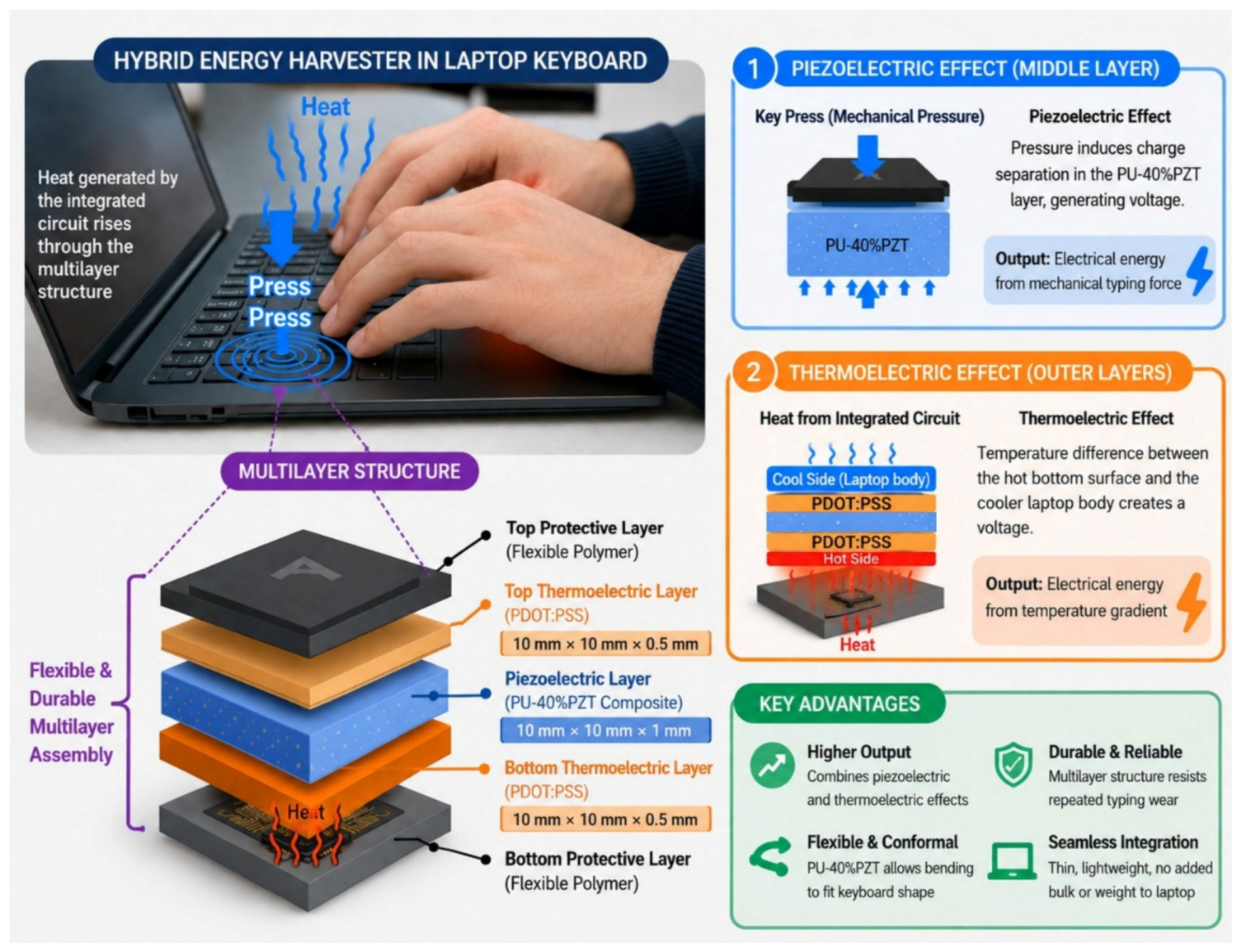
Altogether, the innovative approach of combining thermoelectric and piezoelectric effects within a multilayer structure offers an exciting new way of exploiting the energy of everyday activities. Moreover, with its potential for integration into a range of electronic devices, this technology can play a significant role in the development of more sustainable and energy-efficient electronics. The proposed multilayer structure consists of a central PU-40%PZT piezoelectric layer sandwiched between two PEDOT: PSS thermoelectric layers. The simplified representation in Figure 1 illustrates the operating principle of the hybrid harvesting mechanism.

3. Theoretical Modeling

3.1. Piezoelectric Generation

Piezoelectric generation is a phenomenon where certain materials produce an electric charge in response to applied mechanical stress. However, the piezoelectric effect in materials is typically analyzed within a three-dimensional (3D) Cartesian coordinate system. The Z-axis is generally chosen as the initial polarization direction for piezoelectric materials. This is because the piezoelectric properties of a material are generally aligned with a specific crystallographic axis, and for consistency in analysis, the Z-axis is taken as this direction.
In materials science, the term “orthotropic” refers to a material whose properties differ along three mutually perpendicular twofold axes of rotational symmetry. When one says that a piezoelectric material is “orthotropic,” this signifies that the material exhibits different properties, such as elasticity, permittivity, and piezoelectricity, along three orthogonal axes (X, Y, and Z). This behavior markedly differs from that along directions within the XY-plane, which is the plane perpendicular to the piezo polarization direction (Z-axis). Within the XY-plane, the properties of the material are considered “isotropic,” implying the properties are the same in all directions. The constitutive relation for a piezoelectric generator can be formulated as follows:
S = s   σ + d E + χ   T ,
where s is the compliance matrix for the material that defines the strain resulting from an applied constraint σ, d is the piezoelectric constant matrix that relates the mechanical strain to the applied electric field, E is the electric field strength, χ is the coefficient of thermal expansion and ∆T represents the change in temperature, which can induce thermal strain.
The mechanical strain part of Equation (1) (s, σ) captures the deformation due to externally applied forces, while the thermal strain term (χ, ∆T) accounts for deformation due to temperature changes. The electric field-induced strain (d, E) reflects the materials deformation caused by an applied electric field, illustrating the direct piezoelectric effect, wherein the material deforms when an electric field is applied across it.
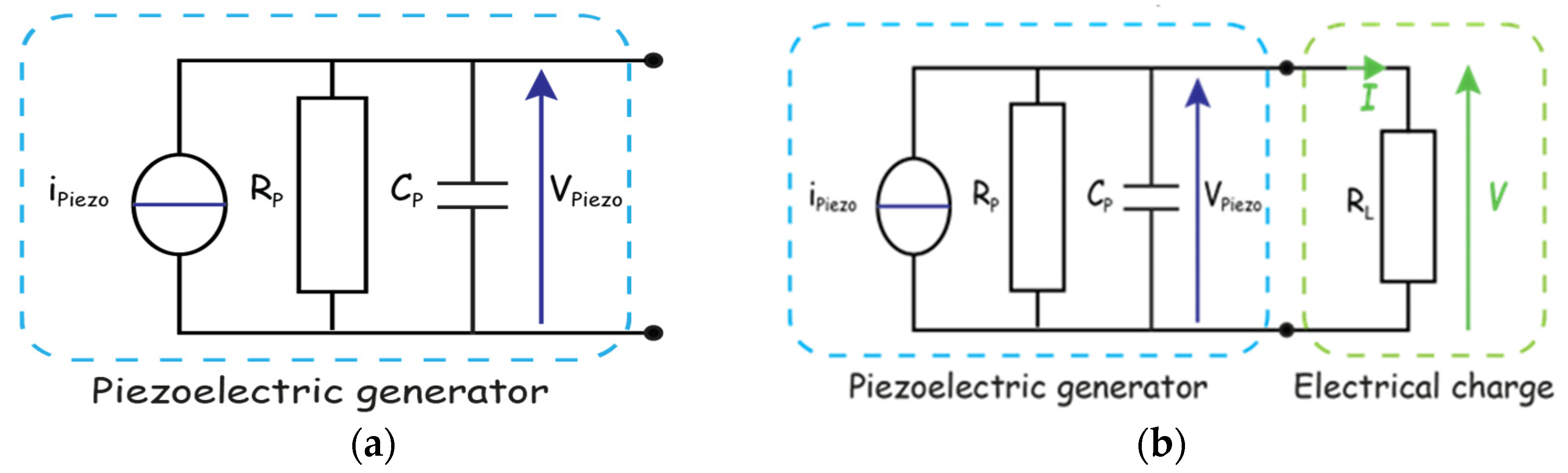
Theoretically, the model employed to describe the piezoelectric circuits behavior as shown in Figure 2. In piezoelectric material circuit (Figure 2a), an equivalent electrical circuit often represents the piezoelectric material. The circuit for the piezoelectric material typically includes a voltage source (Vpiezo), which represents the generated voltage due to mechanical stress, a capacitor (Cp) representing the capacitance of the piezoelectric material, and a resistor (Rp) modeling the internal losses or damping in the material. However, in mechanical energy-harvesting circuit in Figure 2b, the piezoelectric generator is connected to external components for storing or using the generated electrical energy. This circuit includes the same elements as the piezoelectric material circuit, with the addition of an electrical charge with the load resistance (RL), which can be a storage capacitor, a battery, or an external circuit representing the load where the energy will be utilized.

3.2. Piezoelectric Material PU-40%PZT Analysis

To facilitate the theoretical consideration of this study, the point of application of the external excitation force F is assumed to be perpendicular to the surface of the piezoelectric material, as shown in Figure 1. Piezoelectric behavior can be classified into two main modes: piezoelectric modes d31 and d33. In the d31 mode, piezoelectricity is generated by the bending deformation of the material. Conversely, in the d33 mode, electricity is generated as a result of compression deformation. In this case, the piezoelectric materials mounted horizontally and subjected to a compressive force that causes deformation and subsequent electricity generation, thus using the d33 piezoelectric mode. When a vertical force strikes the piezoelectric material, it emits an electrical charge. At this point, the relevant piezoelectric characteristic equation
Q = d 33 F
is utilized, where Q is electric charge, and d33 is piezoelectric coefficient.
The piezoelectric material can be considered as depicted in Figure 2; the relationship between its related parameters can be expressed as follows:
Q = C V p i e z o ,
C = ϵ 0 ϵ r S e   ,
V p i e z o = Q e ϵ 0 ϵ r S   ,
where S and e represent the surface area and thickness of the piezoelectric material, respectively, C is the capacitance, ϵ r   is the relative permittivity, and ϵ 0   is the permittivity of free space.
As a result, the electrical energy produced is proportional to the square of the piezoelectric charge coefficient and the applied stress. The power Pe,piezo can be calculated using Equation (6), based on the resistance RL:
P e , p i e z o = e R L d 33 F 2 ϵ 0 ϵ r .

3.3. Thermoelectric Generation

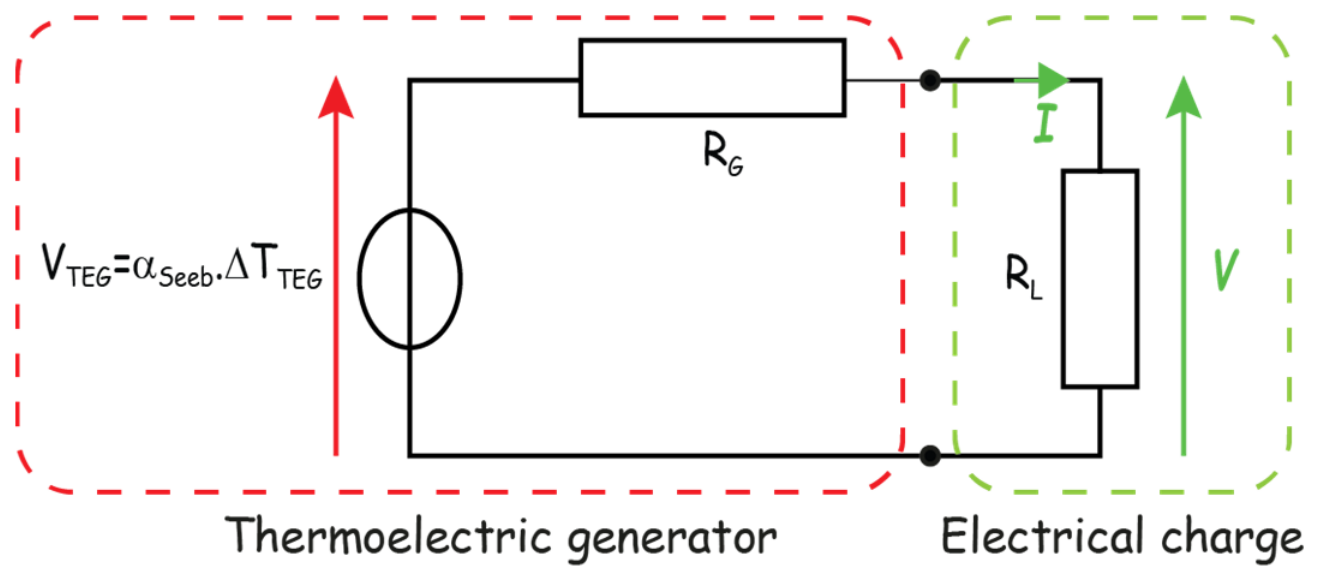
Thermoelectric generation relies on the thermoelectric effect, which is the direct conversion of temperature differences to electric voltage and vice versa. A thermoelectric device creates a voltage when there is a different temperature on each side. Figure 3 illustrates a thermoelectric energy-harvesting electrical circuit. built of the following elements.
-
Thermoelectric generator (TEG). This component directly converts the heat difference between its two sides into electrical energy through the Seebeck effect. The TEG is represented by a voltage source where
V T E G = α S e e b . T T E G ,
where V T E G is the voltage generated by the thermoelectric effect, α S e e b is the Seebeck coefficient and T T E G is the temperature difference across the TEG, between the hot and cold sources of the temperatures T H and T C , respectively.
-
Internal resistance R G . This resistance is inherent to the thermoelectric generator. It models the internal losses within the TEG that can affect its efficiency and output voltage.
-
Load resistance R L . This resistive element represents the load on the circuit, where the electrical energy harvested by the TEG is intended to be utilized. It could signify a storage device, such as a battery, or a directly powered electronic device.
The power harvested through the resistor R L by thermoelectric effect can be given by the following formula:
P e , T E G = R L α S e e b . T T E G 2 R G + R L 2 = R L α S e e b . ( T H   T C ) 2 R G + R L 2 .
where T H represent the hot sources and T H is the cold sources of the temperatures.

3.4. Thermoelectric and Piezoelectric Materials

The thermoelectric and piezoelectric materials employed in this study are polymer and composite polymer, primarily selected for their natural flexibility, low enough weight and common availability. These properties make them suitable for integration into portable and embedded energy-harvesting systems.
Currently, PEDOT: PSS is the most promising thermoelectric polymer designed to operate at moderate temperature. It is therefore the most studied conductive polymer due to its low thermal conductivity and good thermal and environmental stability [41]. Furthermore, Ref. [42] reported a figure of merit (PZT) of 0.4 in a recent study, highlighting its potential as an effective organic based thermoelectric material for practical applications.
For the piezoelectric material, a flexible composite is employed. It consists of piezoelectric fillers inside a polymer matrix. The matrix, often an electroactive polymer, serves to maintain structural integrity, transfer mechanical loads and define the shape of the composite. The most utilized is polyurethane elastomer (PU). PZT ceramic particles generate the electric charge under mechanical stress, while enhancing its rigidity. However, by optimizing the volume fraction of matrix and fillers, studies have demonstrated improved piezoelectric performance while preserving flexibility. This has been particularly confirmed for PU-40%PZT [43].

4. Design and Simulation Analysis

In this investigation, we focus on the energy-harvesting potential of a laptop’s single keyboard key, which experiences varying mechanical pressures and temperature gradients during normal use. To capture the typing dynamics of an average user, simulations span 100 milliseconds per keystroke. A 3D FEM, established in COMSOL Multiphysics software (version 6.2), allows the analysis of both piezoelectric and thermoelectric phenomena within the keyboard structure, shedding light on the electrical performance of the hybrid setup. The numerical model was developed to provide a preliminary feasibility assessment of the proposed hybrid harvesting concept before fabrication. The simulation combines structural mechanics, electrostatics, heat transfer, and thermoelectric coupling to evaluate the interaction between mechanical loading and thermal gradients in the multilayer structure.
To ensure practical integration, the multilayer structure of the hybrid energy harvester was designed with dimensions compatible with commercial laptop keyboards. The standard key size was set to 10 mm × 10 mm, reflecting typical keyboard layouts. The multilayer stack included a PU-40%PZT piezoelectric layer with a thickness of 1 mm, and a PEDOT: PSS thermoelectric layer with a thickness of 0.5 mm. A detailed layer-by-layer configuration was implemented in the model, incorporating conductive electrodes and necessary dielectric insulation to accurately represent the physical structure of the device.
The research utilizes materials that exhibit uniform elastic qualities, with mechanical and thermal characteristics detailed in Table 1. Some simulation parameters are derived from prior studies cited in [44,45], while the other missing parameters are taken from the [46,47,48]. The thermo-mechanical response of the multilayer structure determines its electrical response. As a result of typing the key, the hybrid structure undergoes a deformation due to mechanical and thermal loads and the materials response is determined by its electrical voltage and power output.
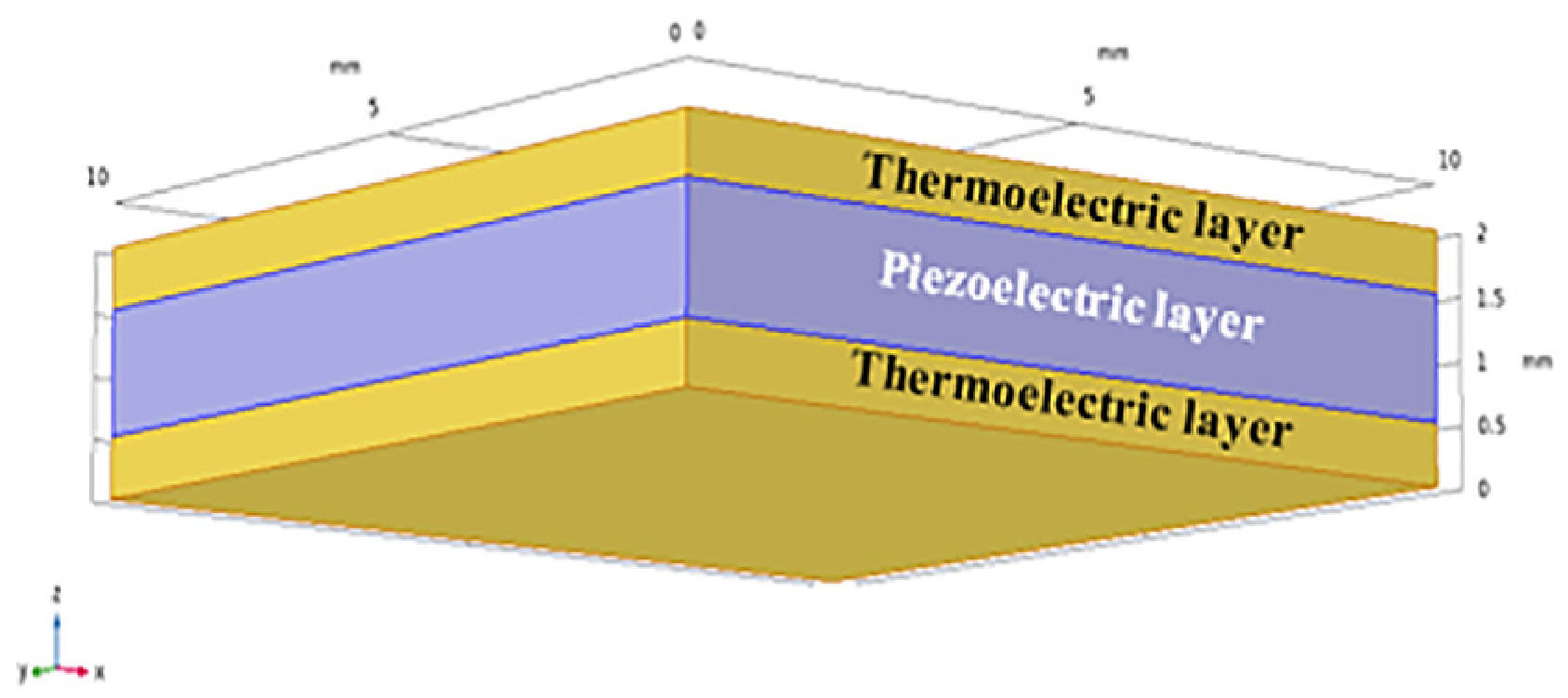
The simulation process initiates by constructing a layered composition. A piezoelectric layer is placed between two thermoelectric layers, configuring the hybrid structure (Figure 4).
It should be noted that the present model is based on steady-state thermal conditions and quasi-static mechanical loading, which allow isolating the fundamental energy-harvesting mechanisms. The adopted assumptions provide a first-order approximation and an upper-bound estimation of system performance, which is commonly employed in early-stage design studies.
An initial static analysis of the piezoelectric effect evaluates the interplay between the structural elements and their electrical responses. A spatial temperature gradient is instituted across the structure, accompanied by oscillating mechanical pressures with differing intensities on the uppermost layer, while the opposite side remains anchored.
The following statements summarize the boundary conditions employed in this numerical simulation.:
  • A sinusoidal boundary load was applied, with force amplitudes of 0.5 N, 1 N, 1.5 N, 8 N, 9 N, 10 N, and 16 N.
  • A fixed constraint was imposed on the opposite side of the structure to simulate mechanical anchoring.
  • Thermal conditions were set to 295 K, 296 K, and 297 K, based on the assumption that the computer is equipped with an active cooling system, which dissipates heat before it reaches the keyboard surface.
  • On the electrical side, an external resistive load was introduced in the circuit, varying from 0 Ω to 16 KΩ.
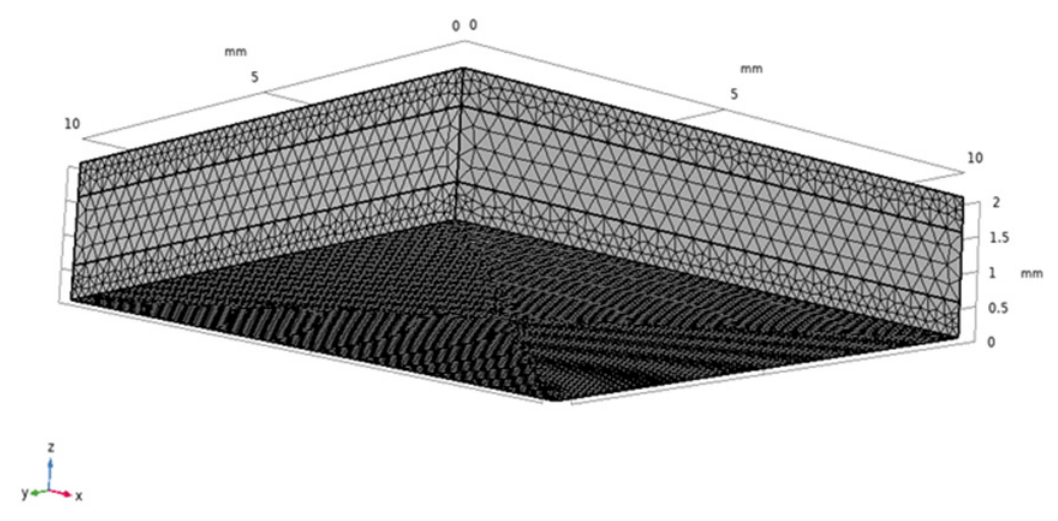
Figure 5 shows the finite element mesh properties of the hybrid structure. This model consists of a refined meshing for each layer, as shown in Table 2. A fine mesh was employed for the piezoelectric layer, while an extra fine mesh was applied to the thermoelectric layer. This choice was based by the fact that the piezoelectric layer is significantly thicker than the thermoelectric layer. It is also worth noting that the results obtained using a fine mesh for the piezoelectric layer remain the same even when an extra fine mesh is applied. This indicates that a fine mesh is sufficient for the piezoelectric layer. Additionally, the extra fine mesh in the thermoelectric layer provides more accurate and reliable results compared to a fine mesh applied to the same layer.
This current model relies on several simplifying assumptions. These are the model limitations.
  • Steady-state thermal analysis. The model assumes a fixed temperature boundary, whereas real laptop keyboard temperatures fluctuate with processor load. Transient thermal simulations will be elaborated in future study.
  • Quasi-static mechanical loading. Keystroke dynamics are inherently impulsive and time-dependent. The quasi-static assumption provides an upper-bound estimate, which is explicitly stated.
  • No electrical coupling between layers. The piezoelectric and thermoelectric electric contributions are analyzed independently. A combined coupled model is identified as future study.
  • No mechanical fatigue or nonlinear material effects are modeled. The linear elastic assumption holds within the small-strain regime confirmed by the simulation results (maximum displacement of about 1.52 × 10⁻³ mm).

5. Results and Discussion

5.1. Piezoelectric Energy Harvesting

Multilayer hybrid structure of a laptop keyboard is designed to harvest both the heat dissipated by the laptop’s integrated circuits and the mechanical energy generated by the deformation caused by keystrokes. Both thermal and mechanical energy-harvesting methods are proposed to enhancing energy recovery efficiency and to extending battery life and reducing its reliance on external power sources. The forces applied to the keyboard keys with different fingers of the human hand, is given in Table 3 [49,50]. They correspond to peak loading conditions rather than average typing forces.
Based on the actual dimensions of the PU-40%PZT piezoelectric material, a 3D geometric model was constructed using COMSOL Multiphysics software to analyze the von Mises stress and displacement under various load forces applied to the keyboard keys by different fingers of the human hand. Initially, a mesh generation of the piezoelectric material was conducted, as depicted in Figure 5. Subsequently, the load force was applied to the top surface of the piezoelectric material, with the bottom surface being fixed, as illustrated in Figure 4.
According to the statistical measurements of the force exerted by each fingertip reported in Refs. [49,50], the load forces employed in the simulation were selected from two force intervals: 0.5–1.5 N and 8–16 N, representing low-force and maximum-force fingertip loading conditions, respectively (Table 3).
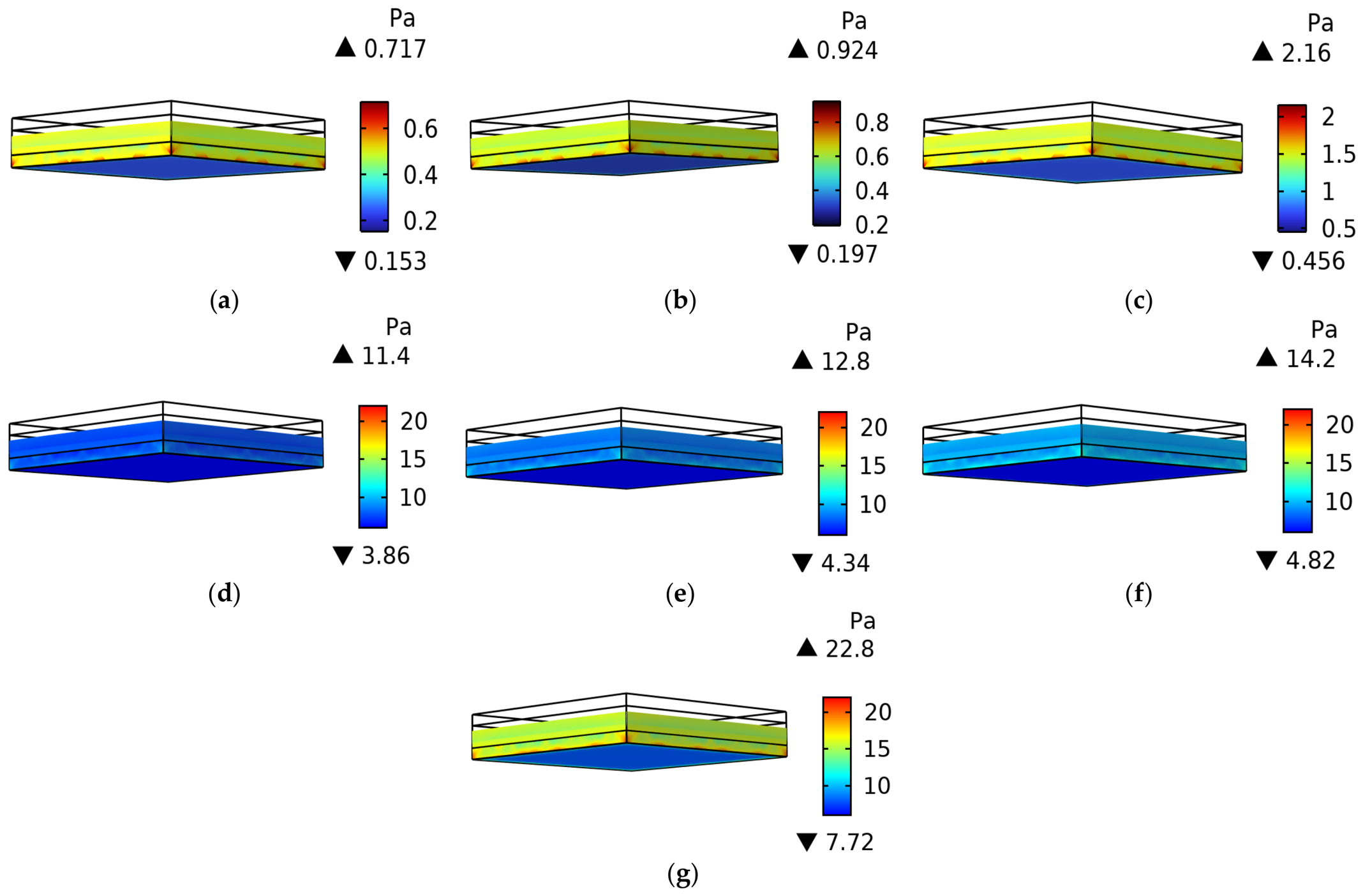
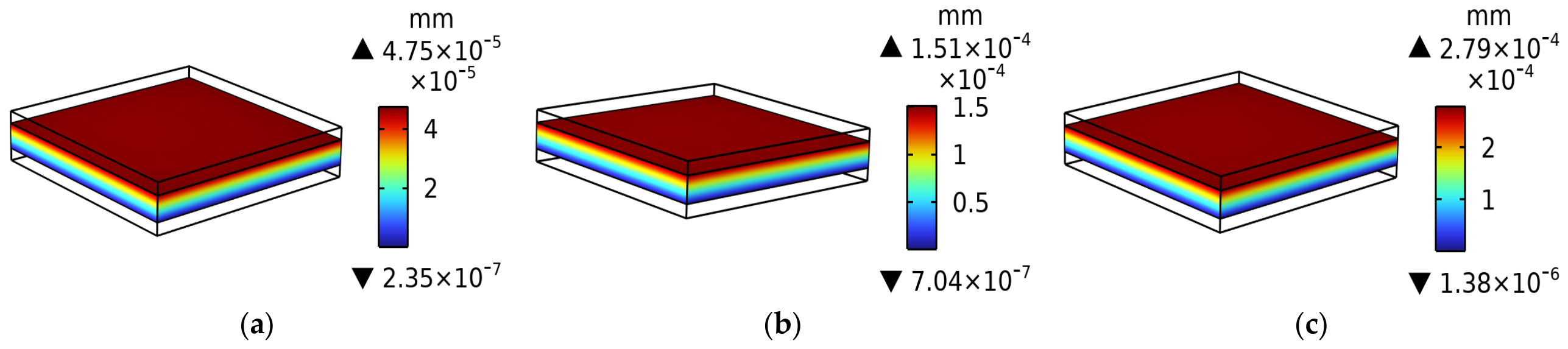
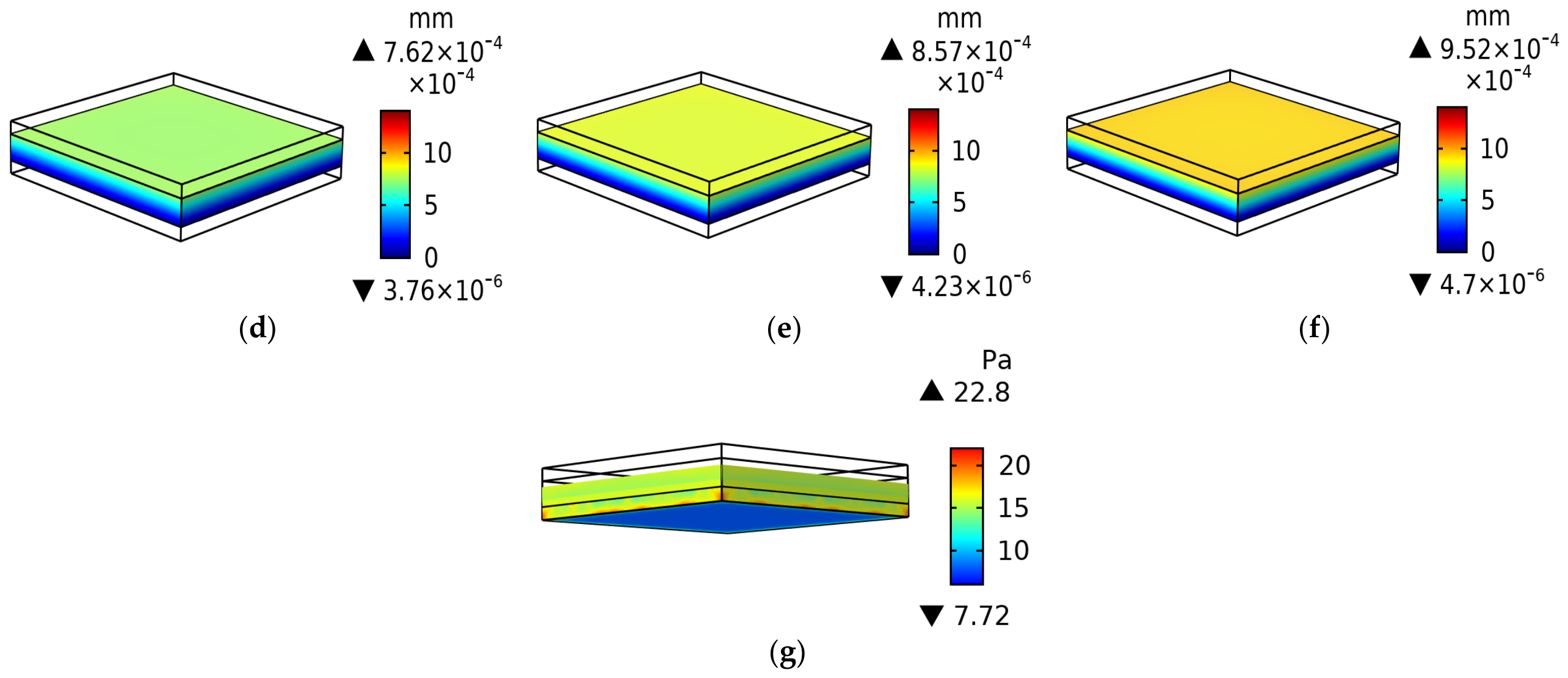
Figure 6 and Figure 7 demonstrate, respectively, the von Mises stress distribution and displacement of the piezoelectric material under these four load forces. The simulation results reveal that when the impact load force reaches 16 N, the maximum displacement observed is 14 × 10−4 mm, and the maximum stress, which concentrates on the bottom of the piezoelectric material, is 22 Pa. These findings indicate that the piezoelectric material experiences significant stress and displacement under higher load forces, which is crucial for the design and optimization of energy-harvesting systems in keyboards.
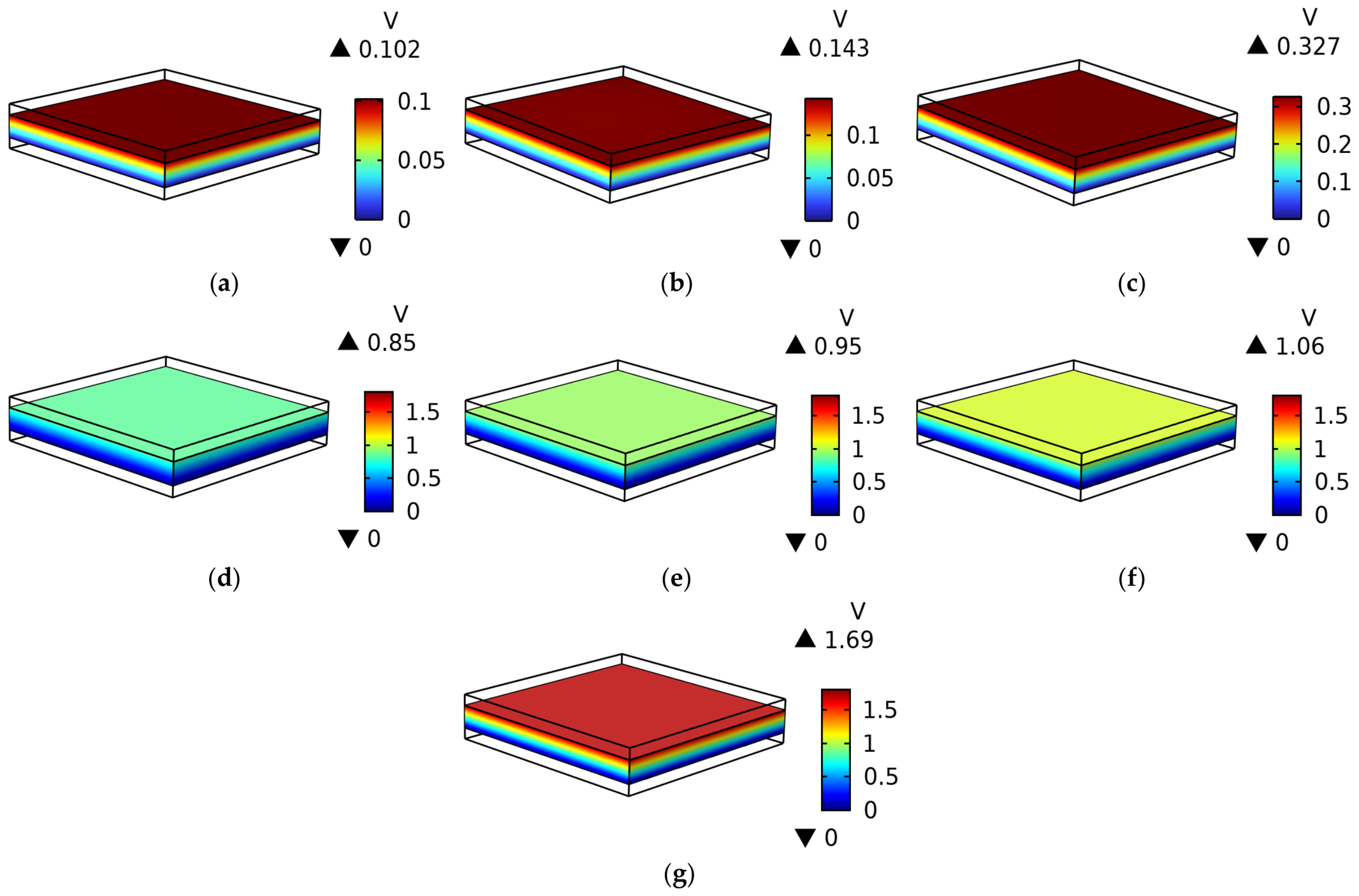
Figure 8 illustrates the electrical voltage distribution produced by piezoelectric material subjected to various mechanical stresses of 0.5 N to 16 N. The simulation results indicate that the generated piezoelectric voltage and output power increase with the applied mechanical force. This behavior is consistent with the constitutive piezoelectric relation, where the induced electric displacement is proportional to the applied mechanical stress. As the typing force increases, the mechanical deformation of the PU-40%PZT layer becomes more pronounced, resulting in higher polarization and enhanced electrical output. Under a force of 0.5 N (Figure 8a), the voltage distribution shows lower voltage levels of about 0.102 V. This suggests that the piezoelectric material generates a relatively modest electrical voltage at this load, maintaining a coherent and uniform output. This behavior implies that the material is subjected to minimal stress. When the load increases to 9 N (Figure 8e), there is a noticeable rise in voltage levels. This increase indicates enhanced voltage generation capabilities of the piezoelectric material under slightly higher forces. The voltage output remains uniform and around, demonstrating that the material can handle this load without significant performance degradation or stress. At a 10 N force (Figure 8f), the voltage distribution continues to improve. The material generates higher electrical voltages, reflecting better energy-harvesting performance at this load. The distribution remains fairly uniform, suggesting the material is within its optimal operating range, balancing efficient energy conversion with manageable stress levels. However, when the force reaches 16 N (Figure 8g), the voltage levels increase substantially. This indicates that the piezoelectric material is producing its highest electrical voltage under this load. Despite the higher output, the voltage distribution starts to show non-uniformity, hinting at potential stress concentrations and material strain under such high forces. Prolonged exposure to these conditions could lead to material fatigue and eventual failure, underscoring the need for careful management of load forces in practical applications.
In conclusion, the obtained results demonstrate an approximately proportional relationship between the applied force and the generated piezoelectric response within the investigated operating range. This trend confirms the suitability of the proposed flexible PU-40%PZT composite structure for recovering low-frequency mechanical energy produced during keyboard operation. Furthermore, operating within the 0.5–1.5 N and 8–16 N force range appears to provide a reasonable compromise between energy-harvesting efficiency and structural reliability, which is essential for the development of durable and efficient self-powered keyboard-integrated energy-harvesting systems.

5.2. Thermoelectric Energy Harvesting

5.2.1. Temperature Evolution in PEDOT:PSS

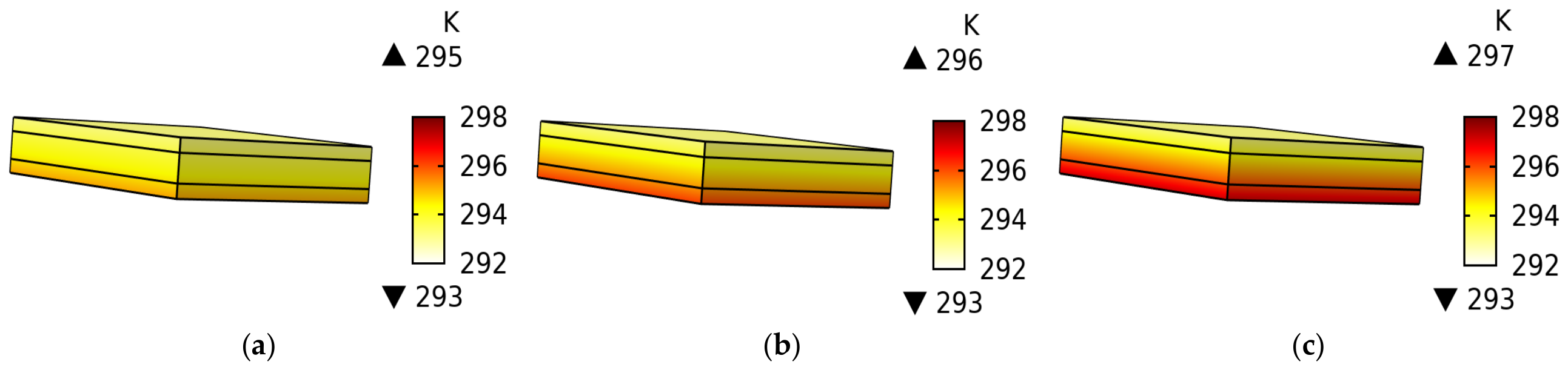
Harvesting thermal energy from the integrated circuits of computer keyboards using the thermoelectric effect involves employing TEGs. Integrating TEGs into a keyboard system can effectively harness the waste heat generated by the integrated circuits, transforming it into useful electrical power. For this purpose, a thermoelectric material PEDOT:PSS is embedding into the keyboard design, specifically near the heat-emitting integrated circuits and above piezoelectric material as shown in Figure 1 and Figure 4, a temperature gradient is established between the heat source and the ambient environment. This gradient is crucial for generating electricity, as the efficiency of TEGs is directly proportional to the magnitude of the temperature difference between the hot and cold sides. Three temperature gradients were simulated in COMSOL Multiphysics software. Figure 9 illustrates the temperature distribution within a multilayer structure subjected to three different heat source temperature: TH = 295 K, 296 K, and 297 K.
In the first stage, with a heat source temperature of TH = 295 K (Figure 9a), the temperature distribution appears relatively uniform across the multilayer structure. The gradient indicates minimal temperature variation within the layers, suggesting that the system is dissipating heat efficiently. The upper part of the structure remains closer to ambient temperature, while the lower part shows a slight increase, probably due to the accumulation of heat from the integrated circuits. As the heat source temperature increases up to TH = 296 K (Figure 9b), the temperature distribution becomes more varied. The transition shows a greater increase in temperature between the lower and upper layers. This suggests that the system is under greater thermal stress, which could have an impact on heat dissipation efficiency and thermoelectric material performance. At the highest heat source temperature of TH = 297 K (Figure 9c), the temperature distribution becomes even more pronounced, with a pronounced shift towards higher temperatures in the upper layers. This transition signifies substantial thermal stress, indicating that the system is close to its thermal management limits. This high gradient could lead to overheating, which may affect the reliability and longevity of the integrated circuits and the overall system.
These remarks highlight the importance of efficient thermal management in multilayer structures. As the temperature gradient increases, the challenge of efficient heat dissipation becomes more significant. It should be noted that the current thermal simulation assumes a steady-state heat source with fixed temperature boundaries. However, in real laptop usage, thermal input from integrated circuits is time-dependent and subject to fluctuating loads and heat dissipation into surrounding materials. This introduces thermal transients that delay the establishment of a stable temperature gradient across the thermoelectric material. As a result, the effective temperature difference—and thus the Seebeck voltage—varies dynamically. These fluctuations may significantly reduce the average power output compared to that predicted under steady-state assumptions. Future modeling will incorporate transient thermal boundary conditions and realistic duty cycles of laptop usage to better estimate the temporal evolution of thermal gradients and the impact on harvesting efficiency.

5.2.2. Thermoelectric Generation Voltage in PEDOT: PSS

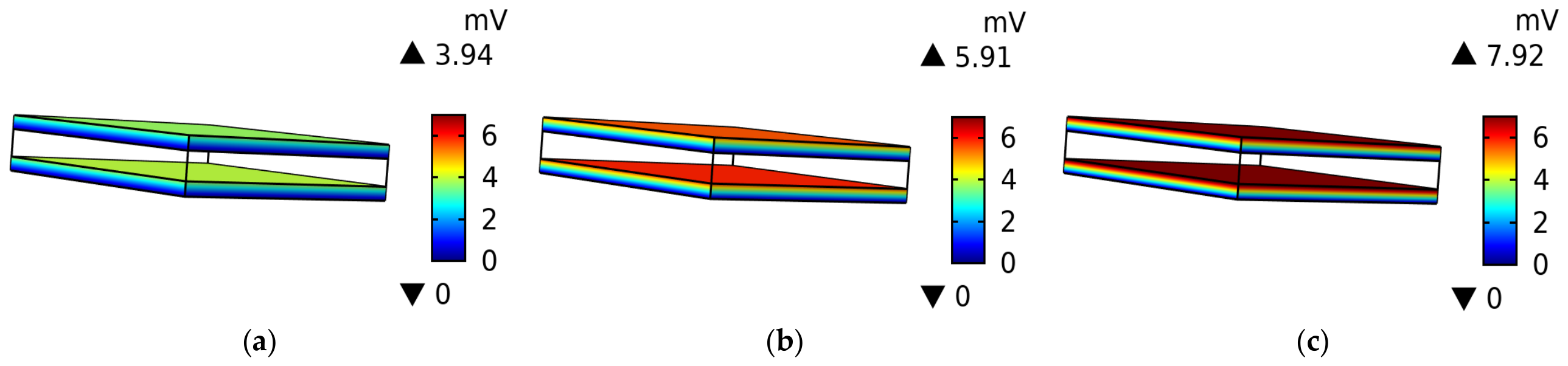
Figure 10 illustrates the voltage generation process of the TEG. The voltage is produced due to the temperature difference (ΔTTEG) between the cold and hot sides of each layer. This temperature gradient is critical for inducing the Seebeck effect, which is responsible for converting thermal energy into electrical energy. As demonstrated in Equation (7), the Seebeck voltage is determined by ΔTTEG and the Seebeck coefficient (S) of the thermoelectric material. Therefore, an increase in the temperature difference results in higher Seebeck voltages. Although the imposed temperature difference in this study remains relatively small (295–297 K), the simulations still predict measurable thermoelectric voltages due to the conductive polymer properties of PEDOT:PSS. The results also show that the thermoelectric contribution increases proportionally with the thermal gradient, suggesting that higher thermal differences generated during intensive laptop operation could significantly improve the harvested thermal energy. Additionally, in Figure 10a, where the heat source temperature is TH = 295 K, the voltage generated by the TEG is relatively low. When the heat source temperature increases slightly to TH = 296 K, as seen in Figure 10b, the voltage generated by the TEG shows a noticeable increase, signifying higher voltage levels. This improvement underscores the TEG’s sensitivity to even slight changes in temperature difference, demonstrating enhanced efficiency in energy conversion under more favorable thermal conditions. At the highest heat source temperature of TH = 297 K, depicted in Figure 10c, the TEG produces the maximum voltage. The significant increase in voltage generation illustrates the direct relationship between the temperature difference and the voltage output in thermoelectric materials. The higher voltage output suggests that the TEG operates near optimal efficiency at this gradient, generating sufficient power for relatively small electronic devices or contributing effectively to larger energy-harvesting systems.

5.3. Energy-Harvesting Performances for Hybrid Energy Harvester

Figure 1 presents a schematic of the designed hybrid energy harvester for laptop keyboards, incorporating both piezoelectric and thermoelectric generators. The device is designed to simultaneously capture energy from two distinct sources. The piezoelectric generator is responsible for converting mechanical stresses caused by typing into electrical energy. Each keystroke induces a mechanical strain in the piezoelectric material, which generates piezoelectric energy (Figure 1(1)). Meanwhile, the thermoelectric generator leverages the heat dissipated by the integrated circuits of the laptop (Figure 1(2)). This waste heat creates a temperature gradient across the thermoelectric material, enabling it to produce electrical energy (Figure 3). By integrating these two mechanisms, the hybrid harvester maximizes energy recovery from both mechanical and thermal sources, enhancing the overall energy efficiency of the laptop keyboard system. Therefore, in order to obtain the maximum output power of piezoelectric and thermoelectric generators, the harvested output powers were handled over a broad range of load resistances.
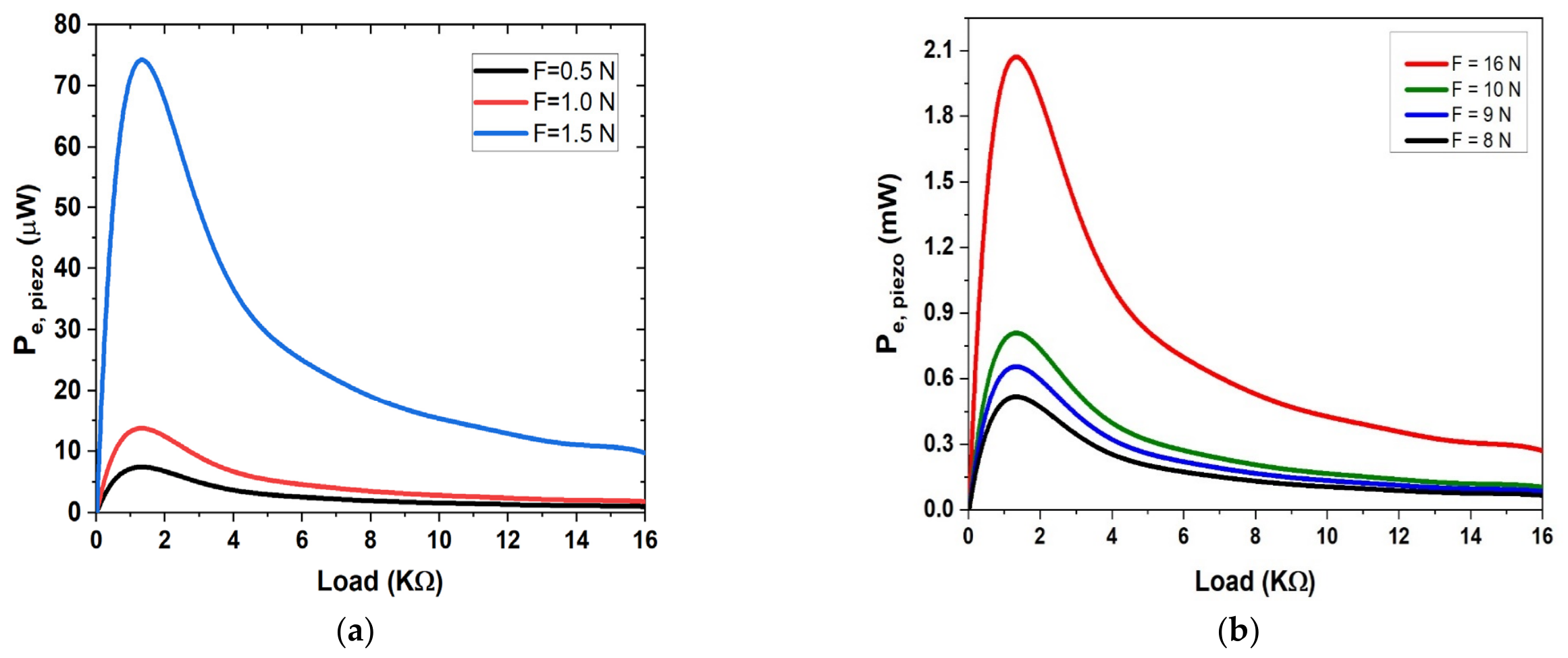
Figure 11 depicts the variations in output power for different typing forces. In addition to the initially investigated forces (8 N to 16 N), lower force values representative of conventional typing conditions (0.5 N, 1 N, and 1.5 N) were also examined. The results indicate that the peak power output occurs at an optimal resistance of 1.37 kΩ. For the lower force values of 0.5 N, 1 N, and 1.5 N (Figure 11a), the piezoelectric unit generates maximum power outputs of 7.3 µW, 14.3 µW, and 74.7 µW, respectively. For the higher forces of 8 N, 9 N, 10 N, and 16 N (Figure 11b), the corresponding maximum power outputs are 0.51 mW, 0.65 mW, 0.81 mW, and 2.07 mW, respectively.
As expected, the harvested power increases with the applied typing force due to the enhanced mechanical deformation of the piezoelectric layer, which generates a larger electric potential and higher electrical output. Although the power levels obtained under realistic typing forces (0.5–1.5 N) are significantly lower than those obtained under intensive loading conditions, they remain measurable and demonstrate the capability of the proposed structure to harvest energy from everyday keyboard interactions. In particular, increasing the force from 0.5 N to 1.5 N results in an increase in harvested power by approximately one order of magnitude, highlighting the strong dependence of piezoelectric energy conversion on the applied mechanical stimulus.
Furthermore, the harvested electrical power strongly depends on the external load resistance due to impedance matching effects between the energy harvester and the electrical load. The simulation results show that the output power initially increases with load resistance, reaches a maximum value near the internal resistance of the generator, and then decreases for larger resistance values. This behavior is consistent with the maximum power transfer principle, which predicts that optimal energy extraction occurs when the load resistance approaches the equivalent internal resistance of the harvesting system. Consequently, appropriate impedance matching and power management circuitry are essential to maximize the efficiency of the proposed hybrid piezoelectric–thermoelectric energy harvester.
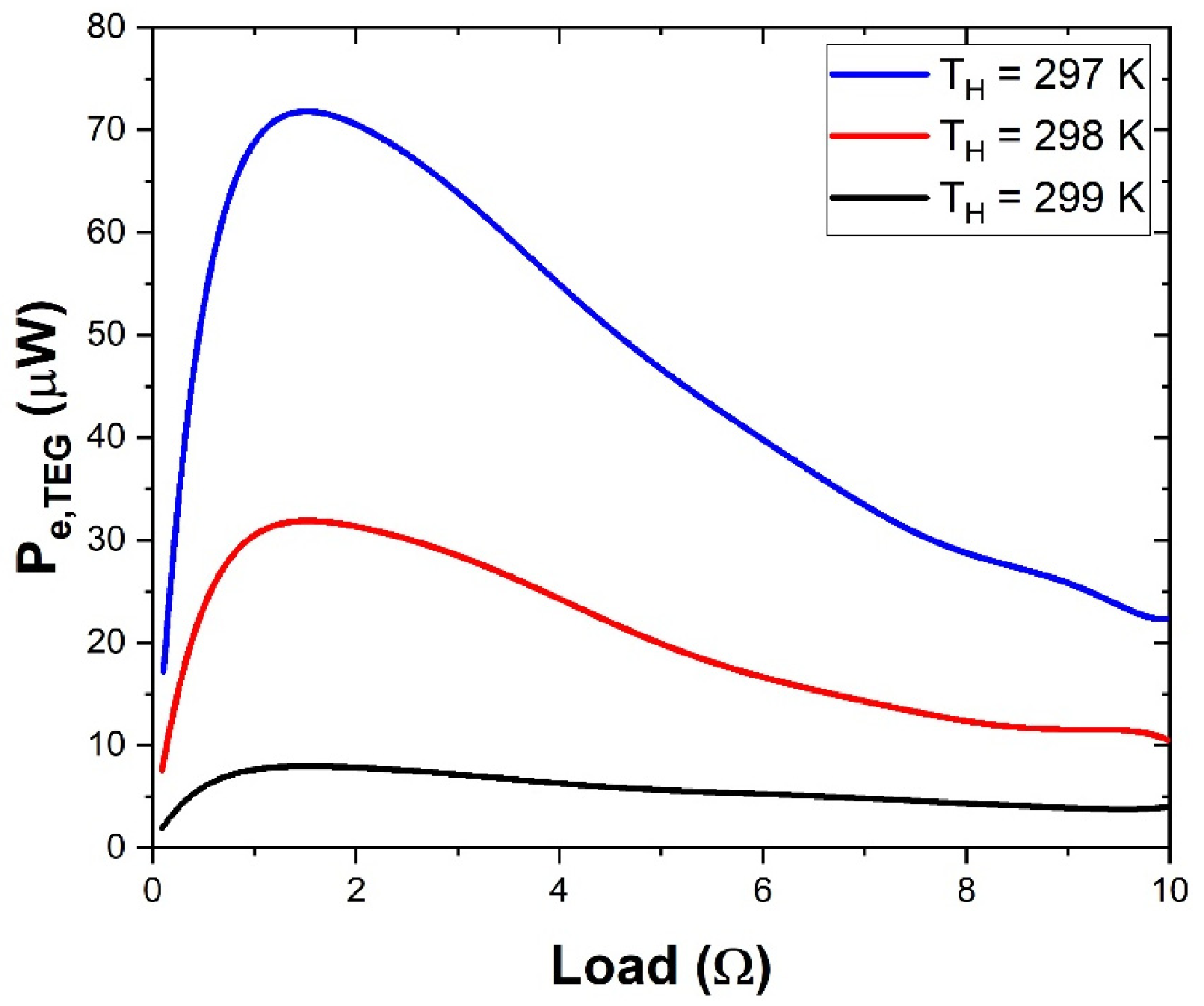
Typing force and the thermal energy generated from integrated circuits are critical factors impacting the performance of a multilayer structure in hybrid energy-harvesting applications. To assess the thermoelectric effect’s capability for energy harvesting, the output power was analyzed for different simulated heat source temperatures of PEDOT: PSS, as shown in Figure 12. When the heat source temperature is TH = 295 K, the power harvested by the TEG is approximately 7.94 µW. With a slight increase in the heat source temperature to TH = 296 K, the power harvested remains around 31.86 µW. At the highest heat source temperature of TH = 297 K, the TEG produces a maximum power of about 71.93 µW. This significant improvement demonstrates the efficiency of thermoelectric energy conversion under varying thermal conditions.
To evaluate the energy-harvesting efficiency of laptop keyboards, a comparison of the earlier studies with the proposed study is presented in Table 4.
The results presented in this paper fall within a reasonable range of values for laptop keyboards. This comparison indicates that our findings are consistent with the results from the existing studies, validating the effectiveness of our hybrid energy-harvesting approach. In addition to that, we estimated the energy conversion efficiency for both layers. The results show that the efficiency is about 8.4% for the piezoelectric layer, and around 2.3% for the thermoelectric layer.
The obtained results show that the electrical power generated by the piezoelectric transducer is significantly higher than that produced by the thermoelectric layer. This difference is mainly attributed to the nature of the available energy sources: mechanical energy from keystrokes is highly dynamic and localized, while thermal energy is limited by the small temperature gradient that can be established within the confined geometry of a laptop keyboard. Despite this disparity, the inclusion of a thermoelectric layer remains relevant because it enables the harvesting of continuous low-grade thermal energy from laptop operation, whereas the piezoelectric response is inherently intermittent. Therefore, the hybrid architecture is not intended to maximize each transduction mechanism independently, but rather to combine complementary energy sources to improve overall energy availability and system robustness.
Furthermore, the electrical energy harvested from the piezoelectric and thermoelectric layers is evaluated separately in order to independently characterize the performance of each energy conversion mechanism. No electrical interconnection or combined power management circuit is implemented in the current model. This approach allows a straightforward assessment of the contribution of each transduction process under identical operating conditions.
With future advancements in efficiency, a hybrid piezoelectric and thermoelectric structure of a keyboard could be effectively applied to recharge the batteries of a wireless keyboard. The hybrid structure keyboard discussed in this study has the ability to remain inactive and wait until a key is pressed or the integrated circuits generate heat before switching to operational power. This feature makes the study one of the mostly appropriate applications for the presented systems. By incorporating such a hybrid system, the keyboard can maximize energy efficiency by harvesting mechanical energy from keystrokes and thermal energy from the heat dissipated by the keyboard’s internal components. In practical implementations, however, these two energy sources exhibit different electrical characteristics, including voltage levels, internal resistances, and temporal response behaviors. Therefore, appropriate energy management strategies would be required to ensure efficient system-level integration. This dual energy-harvesting capability not only prolongs the operational life of wireless keyboards but also supports sustainable energy practices in electronic devices. As a result, users can enjoy a longer battery life and reduced need for frequent recharging, enhancing the overall user experience and contributing to energy conservation efforts.
To assess the practical relevance of the proposed hybrid energy-harvesting system, the simulated output power was compared with the typical power requirements of modern keyboard electronics. The maximum harvested power obtained from piezoelectric and thermoelectric in this study reaches approximately 2.14 mW under the considered operating conditions. This power level is comparable to or exceeds the consumption of several low-power electronic functions commonly integrated into modern keyboards, such as microcontrollers operating in low-power modes, wireless communication modules with duty-cycled transmission, and auxiliary sensing circuits.
Although the harvested power may not continuously satisfy the total energy demand of a fully functional wireless keyboard under all operating conditions, the obtained results demonstrate that the proposed hybrid piezoelectric–thermoelectric structure can provide a meaningful supplementary energy source. The harvested energy can contribute to reducing battery consumption, extending device lifetime, or supporting partial self-powered operation. These findings highlight the potential of hybrid energy-harvesting technologies for future low-power human–machine interface devices.
It should be noted that the reported value represents an idealized simulation result obtained under the assumptions described in the paper. Therefore, experimental validation and the incorporation of more realistic operating conditions will be necessary in future study to accurately determine the practical energy-harvesting capability of the proposed system.
While the current simulations focus on the instantaneous peak power output under simplified and controlled conditions, it is worth to recognize that real-world energy harvesting during keyboard operation is inherently dynamic. In the numerical model, each keystroke was considered as an individual mechanical excitation event generating a transient peak electrical response from the piezoelectric layer, whereas the thermoelectric contribution was treated as a slower and quasi-continuous energy source resulting from the imposed thermal gradient across the multilayer structure. A representative typing frequency of approximately 2–3 keystrokes per second was assumed based on typical keyboard usage conditions reported in the literature.
It is worth to distinguish between instantaneous peak power and average harvested power. The simulated values correspond to short-duration peak responses obtained during a single keystroke event and do not represent continuous electrical power delivered over time. In practical operation, the average harvested power is significantly lower because keyboard excitation depends on typing activity and user behavior. Furthermore, the thermoelectric response strongly depends on the thermal conditions inside the laptop, including processor activity, operating duration, and ambient cooling conditions. Consequently, thermal energy harvesting may become more effective during intensive laptop usage where larger thermal gradients are generated. These time-dependent variations highlight the importance of transient multiphysics simulations, which will be investigated in future study to provide more realistic operating conditions and energy-harvesting estimations.

6. Conclusions

This study proposed a hybrid energy-harvesting system combining piezoelectric and thermoelectric effects within a laptop keyboard to recover mechanical and thermal energy during typing. A 3D FEM using COMSOL Multiphysics was developed to simulate a single key’s behavior under typical user conditions. The model analyzed pressure-induced piezoelectric generation and heat-induced thermoelectric conversion, revealing a power output of 2.07 mW from PU-40%PZT and 71.93 μW from PEDOT: PSS per keystroke. The results confirm that combining both mechanisms significantly improves energy-harvesting potential in compact electronics, making it feasible for use in self-powered keyboards or typing-monitoring systems. The model provides valuable insight into mechanical stress distribution, heat transfer paths, and electrical output across the keyboard structure. However, this paper assumes steady state analysis under ideal operating parameters, which limits its validity to real-world scenarios. To overcome this limitations, future study is considered to include time-dependent simulations that reflect real user typing behavior and the evolution of heat during laptop usage. These improvements will enable a more accurate evaluation of the harvested power density.

Author Contributions

Conceptualization, I.S. and Y.T.; methodology, I.S. and Y.T.; software, A.M. and H.R.; validation, F.B.; formal analysis, I.S., Y.T. and A.M.; investigation, I.S. and Y.T.; data curation, I.S. and Y.T.; writing—original draft preparation, I.S.; writing—review and editing, I.S. and Y.T.; visualization, A.M.; supervision, A.H. All authors have read and agreed to the published version of the manuscript.

Funding

This research received no external funding.

Data Availability Statement

The original contributions presented in this study are included in the article.

Acknowledgments

This paper is dedicated to the late Jacques Jay whose significant contributions to this paper continue to inspire us. Jay was not only a remarkable researcher but also served as a great mentor, imparting invaluable knowledge and wisdom to those fortunate enough to paper alongside him.

Conflicts of Interest

The authors declare no conflicts of interest.

Abbreviations

The following abbreviations are used in this manuscript:
EMelectromagnetic
HEHhybrid energy harvester
FEMfinite element method
MEMSmicro-electro-mechanical systems
PEpiezoelectric
PEDOTpoly-3,4-ethylendioxythiophen
PEDOT:PSSpolymer composite which blends PEDOT and PSS
PEDOT:PSS-PU-xPZTcomposites which blend conductive polymers with PU and xPZT
PSSsoluble polystyrene sulfonate
PUpolyurethane
PU-40%PZTa tri-phase 40% PZT-polyurethane composite
PVDHpolyvinylidene fluoride
PZTlead zirconate titanate
RMSroot mean square
TBEHturnambel bistable energy harvester
TEGtermoelectric generator
TENGtriboelectric nanogenerator
TrFEpolytrifluoroethylene
xPZTpezoelectric particles
3Dthree-dimensional

References

  1. Aslan, M.; Zurel, E.N. An efficient hybrid model for appliances classification based on time series features. Energy Build. 2022, 266, 112087. [Google Scholar] [CrossRef]
  2. Sankarkumar, R.S.; Natarajan, R. Energy management techniques and topologies suitable for hybrid energy storage system powered electric vehicles: An overview. Int. Trans. Electr. Energy Syst. 2021, 31, e12819. [Google Scholar] [CrossRef]
  3. Liu, H.; Fu, H.; Sun, L.; Lee, C.; Yeatman, E.M. Hybrid energy harvesting technology: From materials, structural design, system integration to applications. Renew. Sustain. Energy Rev. 2021, 137, 110473. [Google Scholar] [CrossRef]
  4. Schirmer, P.A.; Mporas, I. Statistical and electrical features evaluation for electrical appliances energy disaggregation. Sustainability 2019, 11, 3222. [Google Scholar] [CrossRef]
  5. Aderibigbe, A.O.; Ohenhen, P.E.; Nwaobia, N.K.; Gidiagba, J.O.; Ani, E.C. Advanced sensing techniques in electro-mechanical systems: Surveying the rise of smart sensors and their implications for system robustness. Engin. Sci. Technol. J. 2023, 4, 323–340. [Google Scholar] [CrossRef]
  6. Faudzi, A.A.M.; Sabzehmeidani, Y.; Suzumori, K. Application of micro-electro-mechanical systems (MEMS) as sensors: A review. J. Robot. Mechatron. 2020, 32, 281–288. [Google Scholar] [CrossRef]
  7. Ralib, A.A.M.; Nordin, A.N.; Salleh, H. A comparative study on MEMS piezoelectric microgenerators. Microsyst. Technol. 2010, 16, 1673–1681. [Google Scholar] [CrossRef]
  8. Yu, H.; Yue, Q.; Zhou, J.; Wang, W. A hybrid indoor ambient light and vibration energy harvester for wireless sensor nodes. Sensors 2014, 14, 8740–8755. [Google Scholar] [CrossRef] [PubMed]
  9. Ryu, H.; Yoon, H.; Kim, S. Hybrid energy harvesters: Toward sustainable energy harvesting. Adv. Mater. 2019, 31, 1802898. [Google Scholar] [CrossRef] [PubMed]
  10. Lifi, H.; Alaoui-Belghiti, A.; Lifi, M.; Khrissi, S.; Nossir, N.; Tabbai, Y.; Benjellοun, M. Mechanical energy harvesting system from the human arm movement for continuous blood pressure measurement. Int. J. Sens. Wirel. Commun. Control 2022, 12, 352–368. [Google Scholar] [CrossRef]
  11. Lifi, H.; Khrissi, S.; Nossir, N.; Lifi, M.; Hnawi, S.K.; Tabbai, Y.; Zouhair, S.; Anoua, R.; Ali, M.A.; Benkhouja, K. New analytical model of human body arm movements under various solicitations by the finite element analysis. Eur. Phys. J. Appl. Phys. 2023, 98, 28. [Google Scholar] [CrossRef]
  12. Han, B.; Vassilaras, S.; Papadias, C.B.; Soman, R.; Kyriakides, M.A.; Onoufriou, T.; Nielsen, R.H.; Prasad, R. Harvesting energy from vibrations of the underlying structure. J. Vib. Control 2013, 19, 2255–2269. [Google Scholar] [CrossRef]
  13. Zhu, D. Vibration energy harvesting: Machinery vibration, human movement and flow induced vibration. In Sustainable Energy Harvesting Technologies: Past, Present and Future; Kheng, T.Y., Ed.; IntechOpen Limited: London, UK, 2011; pp. 25–54. [Google Scholar] [CrossRef] [PubMed]
  14. Tabbai, Y.; Sarah, A.; Rjafallah, A.; Alaoui-Belghiti, A.; Hajjaji, A.; El Moznine, R.; Belhora, F.; El Ballouti, A. Pyroelectric generators to harvest energy from disc brake pads for wireless sensors in electric vehicles. Eur. Phys. J.-Appl. Phys. 2022, 97, 89. [Google Scholar] [CrossRef]
  15. Tao, J.X.; Viet, N.V.; Carpinteri, A.; Wang, Q. Energy harvesting from wind by a piezoelectric harvester. Eng. Struct. 2017, 133, 74–80. [Google Scholar] [CrossRef]
  16. Viet, N.V.; Xie, X.D.; Liew, K.M.; Banthia, N.; Wang, Q. Energy harvesting from ocean waves by a floating energy harvester. Energy 2016, 112, 1219–1226. [Google Scholar] [CrossRef]
  17. Xu, C.; Wang, X.; Wang, Z.L. Nanowire structured hybrid cell for concurrently scavenging solar and mechanical energies. J. Am. Chem. Soc. 2009, 131, 5866–5872. [Google Scholar] [CrossRef] [PubMed]
  18. Lee, D.Y.; Kim, H.; Li, H.M.; Jang, A.R.; Lim, Y.D.; Cha, S.N.; Park, Y.J.; Kang, D.J.; Yoo, W.J. Hybrid energy harvester based on nanopillar solar cells and PVDF nanogenerator. Nanotechnology 2013, 24, 175402. [Google Scholar] [CrossRef] [PubMed]
  19. Ji, Y.; Zhang, K.; Yang, Y. A One-structure-based multieffects coupled nanogenerator for simultaneously scavenging thermal, solar, and mechanical energies. Adv. Sci. 2018, 5, 1700622. [Google Scholar] [CrossRef] [PubMed]
  20. Zhao, X.; Li, C.; Wang, Y.; Han, W.; Yang, Y. Hybridized nanogenerators for effectively scavenging mechanical and solar energies. iScience 2021, 24, 102415. [Google Scholar] [CrossRef] [PubMed]
  21. Yoon, G.C.; Shin, K.-S.; Gupta, M.K.; Lee, K.Y.; Lee, J.-H.; Wang, Z.L.; Kim, S.-W. High-performance hybrid cell based on an organic photovoltaic device and a direct current piezoelectric nanogenerator. Nano Energy 2015, 12, 547–555. [Google Scholar] [CrossRef]
  22. Afzal, A.; Buradi, A.; Jilte, R.; Shaik, S.; Kaladgi, A.R.; Arıcı, M.; Lee, C.T.; Nižetić, S. Optimizing the thermal performance of solar energy devices using meta-heuristic algorithms: A critical review. Renew. Sustain. Energy Rev. 2023, 173, 112903. [Google Scholar] [CrossRef]
  23. Liu, L.; Wang, R.; Wang, Y.; Li, W.; Sun, J.; Guo, Y.; Qu, W.; Li, W.; Zhao, C. Comprehensive analysis and optimization of combined cooling heating and power system integrated with solar thermal energy and thermal energy storage. Energy Convers. Manag. 2023, 275, 116464. [Google Scholar] [CrossRef]
  24. Zhou, Y.; Zhang, S.; Xu, X.; Liu, W.; Zhang, S.; Li, G.; He, J. Dynamic piezo-thermoelectric generator for simultaneously harvesting mechanical and thermal energies. Nano Energy 2020, 69, 104397. [Google Scholar] [CrossRef]
  25. Wang, X.; Wang, Z.L.; Yang, Y. Hybridized nanogenerator for simultaneously scavenging mechanical and thermal energies by electromagnetic-triboelectric-thermoelectric effects. Nano Energy 2016, 26, 164–171. [Google Scholar]
  26. Bai, Y.; Jantunen, H.; Juuti, J. Hybrid, multi-source, and integrated energy harvesters. Front. Mater. 2018, 5, 65. [Google Scholar] [CrossRef]
  27. Kumar, S.; Singh, H.H.; Khare, N. Flexible hybrid piezoelectric-thermoelectric generator for harnessing electrical energy from mechanical and thermal energy. Energy Convers. Manag. 2019, 198, 111783. [Google Scholar] [CrossRef]
  28. Zhang, X.; Huang, X.; Wang, B. A quad-stable nonlinear piezoelectric energy harvester with piecewise stiffness for broadband energy harvesting. Nonlinear Dyn. 2024, 112, 19633–19652. [Google Scholar] [CrossRef]
  29. Huang, X.; Hua, X.; Chen, Z. Exploiting a novel magnetoelastic tunable bi-stable energy converter for vibration energy mitigation. Nonlinear Dyn. 2025, 113, 2017–2043. [Google Scholar] [CrossRef]
  30. Huang, X. Exploiting multi-stiffness combination inspired absorbers for simultaneous energy harvesting and vibration mitigation. Appl. Energy 2024, 364, 123124. [Google Scholar] [CrossRef]
  31. Zhi, Y.; Li, X.; Zhang, J.; Zhang, L.; Li, J.; Zhao, W.; Yang, K.; Hu, N.; Wang, B. A novel tri-stable piezoelectric vibration energy harvester with an elastic boundary. Mech. Syst. Signal Process. 2025, 228, 112504. [Google Scholar] [CrossRef]
  32. Hou, X.; Zhou, J.; Shi, R.; Liu, H.; Zhang, M.; Guo, Z.; Bai, Y.; Li, X.; Gao, X.; Guo, J.; et al. Triboelectric nanogenerator sensors-based trans-media motion monitoring system for Gannet-inspired vehicle aiming at digital twin applications. Nano Energy 2025, 136, 110763. [Google Scholar]
  33. Huang, X.; Yang, B. Improving energy harvesting from impulsive excitations by a nonlinear tunable bistable energy harvester. Mech. Syst. Signal Process. 2021, 158, 107797. [Google Scholar] [CrossRef]
  34. Hur, S.; Kim, S.; Kim, H.-S.; Kumar, A.; Kwon, C.; Shin, J.; Kang, H.; Sung, T.H.; Ryu, J.; Baik, J.M.; et al. Low-grade waste heat recovery scenarios: Pyroelectric, thermomagnetic, and thermogalvanic thermal energy harvesting. Nano Energy 2023, 114, 108596. [Google Scholar] [CrossRef]
  35. Kim, S.-B.; Shin, J.; Kim, H.-S.; Lee, D.-G.; Park, J.-C.; Baik, J.M.; Kim, S.Y.; Kang, S.-Y.; Choi, W.; Song, H.-C.; et al. A synergetic effect of piezoelectric energy harvester to enhance thermoelectric Power: An effective hybrid energy harvesting method. Energy Convers. Manag. 2023, 298, 117774. [Google Scholar] [CrossRef]
  36. Wacharasindhu, T.; Kwon, J.W. A micromachined energy harvester from a keyboard using combined electromagnetic and piezoelectric conversion. J. Micromech. Microeng. 2008, 18, 104016. [Google Scholar] [CrossRef]
  37. Chen, J.; Zhu, G.; Yang, J.; Jing, Q.; Bai, P.; Yang, W.; Qi, X.; Su, Y.; Wang, Z.L. Personalized keystroke dynamics for self-powered human–machine interfacing. ACS Nano 2015, 9, 105–116. [Google Scholar] [CrossRef] [PubMed]
  38. Li, S.; Peng, W.; Wang, J.; Lin, L.; Zi, Y.; Zhang, G.; Wang, Z.L. All-elastomer-based triboelectric nanogenerator as a keyboard cover to harvest typing energy. ACS Nano 2016, 10, 7973–7981. [Google Scholar] [CrossRef] [PubMed]
  39. Wang, P.; Liu, R.; Ding, W.; Zhang, P.; Pan, L.; Dai, G.; Zou, H.; Dong, K.; Xu, C.; Wang, Z.L. Complementary electromagnetic-triboelectric active sensor for detecting multiple mechanical triggering. Adv. Funct. Mater. 2018, 28, 1705808. [Google Scholar] [CrossRef]
  40. Maharjan, P.; Bhatta, T.; Park, C.; Cho, H.; Shrestha, K.; Lee, S.; Salauddin, M.; Rahman, M.T.; Rana, S.S.; Park, J.Y. High-performance keyboard typing motion driven hybrid nanogenerator. Nano Energy 2021, 88, 106232. [Google Scholar] [CrossRef]
  41. Jiang, F.-X.; Xu, J.-K.; Lu, B.-Y.; Xie, Y.; Huang, R.-J.; Li, L.-F. Thermoelectric performance of poly (3,4-ethylenedioxythiophene): Poly (styrenesulfonate). Chin. Phys. Lett. 2008, 25, 2202. [Google Scholar] [CrossRef]
  42. Kim, G.-H.; Shao, L.; Zhang, K.; Pipe, K.P. Engineered doping of organic semiconductors for enhanced thermoelectric efficiency. Nat. Mater. 2013, 12, 719–723. [Google Scholar] [CrossRef] [PubMed]
  43. Touhtouh, S.; Rguiti, M.; Courtois, C.; Belhora, F.; Arbaoui, A.; Dastorg, S.; Rachek, A.; Hajjaji, A. PU/PZT composites for vibratory energy harvesting. Opt. Quantum Electron. 2016, 48, 246. [Google Scholar] [CrossRef]
  44. Salhi, I.; Belhora, F.; Hajjaji, A.; Seveyrat, L.; Jay, J.; Boughaleb, Y. PZT volume fraction’s impact on electrical and thermal characterization of the piezoelectric composite PU/PZT. Sens. Actuators A Phys. 2021, 322, 112613. [Google Scholar] [CrossRef]
  45. Salhi, I.; Jay, J.; Belhora, F.; Hajjaji, A. Measurement experimental set-up for thermal characterization of low thickness polymers. Polym. Adv. Technol. 2023, 34, 559–567. [Google Scholar] [CrossRef]
  46. Rjafallah, A.; Hajjaji, A.; Guyomar, D.; Kandoussi, K.; Belhora, F.; Boughaleb, Y. Modeling of polyurethane/lead zirconate titanate composites for vibration energy harvesting. J. Compos. Mater. 2019, 53, 613–623. [Google Scholar]
  47. Rjafallah, A.; Hajjaji, A.; Belhora, F.; Guyomar, D.; Seveyrat, L.; El Otmani, R.; Boughaleb, Y. Mechanical energy harvesting using polyurethane/lead zirconate titanate composites. J. Compos. Mater. 2018, 52, 1171–1182. [Google Scholar]
  48. Tabbai, Y.; Belhora, F.; El Moznine, R.; Hajjaji, A.; El Ballouti, A. Pyroelectric effect in lead zirconate titanate/polyurethane composite for thermal energy harvesting. Eur. Phys. J. Appl. Phys. 2019, 86, 10902. [Google Scholar] [CrossRef]
  49. Beker, L.; Muhtaroglu, A.; Külah, H. A novel method for piezoelectric energy harvesting from keyboard. SPIE Procced. 2012, 8341, 729–736. [Google Scholar] [CrossRef]
  50. Hong, H.S.; Minh, N.D.; Thuan, N.D.; Hai, N.T.; Duc, D.X.T.; Toan, L.V. Designing a partly self-powered keyboard based on triboelectric effect. JST Smart Syst. Devices 2021, 31, 35–42. [Google Scholar] [CrossRef]
  51. Tanaka, H.; Ono, G.; Nagano, T.; Ohkubo, N. Electric power generation using piezoelectric resonator for power-free sensor node. In IEEE 2005 Custom Integrated Circuits Conference; Stetzler, T., Ed.; Institute of Electrical and Electronics Engineers (IEEE): New York, NY, USA, 2005; pp. 97–100. [Google Scholar] [CrossRef]
Figure 1. Illustration of the proposed hybrid multilayer structure of PEDOT:PSS-PU-xPZT integrated into a laptop keyboard key.
Physics 08 00056 g001
Figure 2. Electrical circuit model: (a) piezoelectric material circuit; (b) mechanical energy-harvesting circuit. See text for details.
Physics 08 00056 g002
Figure 3. Thermoelectric energy-harvesting circuit. See text for details.
Physics 08 00056 g003
Figure 4. Geometry implementation for piezoelectric and thermoelectric layers.
Physics 08 00056 g004
Figure 5. Mesh view assemblies for piezoelectric and thermoelectric layers.
Physics 08 00056 g005
Figure 6. von Mises stress of the hybrid structure under the load forces of different values: F = 0.5 N (a), 1 N (b), 1.5 N (c), 8 N (d), 9 N (e), 10 N (f), and 16 N (g).
Physics 08 00056 g006
Figure 7. The maximum displacement under the load force of different values: F = 0.5 N (a), 1 N (b), 1.5 N (c), 8 N (d), 9 N (e), 10 N (f), and 16 N (g).
Physics 08 00056 g007aPhysics 08 00056 g007b
Figure 8. The electric voltage degenerated under the load force of different values: F = 0.5 N (a), 1 N (b), 1.5 N (c), 8 N (d), 9 N (e), 10 N (f), and 16 N (g).
Physics 08 00056 g008
Figure 9. Temperature evolution in the multilayer structure for three-temperature heat source temperatures: TH = 295 K (a), 296 K (b), and 297 K (c).
Physics 08 00056 g009
Figure 10. Thermoelectric generated voltage at different temperature heat sources: TH = 295 K (a), 296 K (b), and 297 K (c).
Physics 08 00056 g010
Figure 11. Variations in output power for different typing forces of 0.5–1.5 N (a) and 8–16 N (b).
Physics 08 00056 g011
Figure 12. Variations in output power for different simulated heat source temperatures.
Physics 08 00056 g012
Table 1. Materials parameters of different layers.
Material ParameterPU-40%PZTPEDOT:PSS
Young module (GPa)0.010.7
Density (kg/m3)2053985
Thermal capacity at constant pressure (J/kg K) 6101210
Piezoelectric coefficient (pC/N)21
Seebeck coefficient (µV/K)70
Electrical conductivity (S/m)0.0198,000
Thermal conductivity (W/mK)0.240.2
Relative permittivity12837
Poisson coefficient0.340.33
Table 2. Finite element mesh properties.
Mesh MethodNo. of EdgeNo. of Boundary ElementsNo. of Domain Elements
Middle layerFine11210282788
Sided layersExtra-fine360578010,822
Table 3. Statistical measure of the force exerted by each fingertip.
IndexThumbFinger MiddleRingPinky
Force (N)0.511.516101098
Table 4. Comparison of the proposed hybrid piezoelectric–thermoelectric energy-harvesting system with earlier studies.
ReferenceMechanismForce/ΔTOutput Power
[36]Piezoelectric plus Electromagnetic~1–2 N40.8 μW (PE) + 1.15 μW (EM)
[49]Piezoelectric~1–5 N16.95 µW
[50]TriboelectricTyping (~1 N)~0.32 µW
[51]Piezoelectric resonatorTyping30 mW
[40]Electromagnetic plus TriboelectricTyping7.04 mW (EM) + 1.8 mW (TENG)
This paperPiezoelectric (FEM)0.5–16 N7.3–2.07 mW
This paperThermoelectric (FEM)ΔT = 2–4 K7.94–71.93 µW
Disclaimer/Publisher’s Note: The statements, opinions and data contained in all publications are solely those of the individual author(s) and contributor(s) and not of MDPI and/or the editor(s). MDPI and/or the editor(s) disclaim responsibility for any injury to people or property resulting from any ideas, methods, instructions or products referred to in the content.