1. Introduction
Deep gas discharge in volcanic and tectonic environments is often described as the surface expression of a localized deep source. Although this representation can be adequate for initial description, it is physically incomplete. In most natural systems, the relevant object is not a point emitter but a coupled source–storage–pathway system in which volatile generation, compressible accumulation, thermal state, and the transmissivity of the surrounding crust evolve together rather than independently [
1,
2,
3,
4,
5,
6]. In volcanic environments, the source term may arise from decompression-driven exsolution, crystallization-driven volatile concentration, and open-system outgassing of shallow reservoirs or crystal-rich mush zones [
1,
2,
3,
7]. In tectonic environments, it may arise from metamorphic devolatilization and decarbonation reactions that generate fluids rich in carbon dioxide (
) at depth, often in coexistence with denser hydrosaline brines of markedly different mobility [
5,
6]. In both settings, the observable surface flux is therefore not controlled by source strength alone, but by the competition between volatile production, compressible storage, and leakance through a permeability architecture that evolves under the action of stress, heating, alteration, and failure [
4,
8,
9,
10]. Recent work on conduit-flow evolution, volcano deformation, and the broader physics of deformable granular and porous ground further emphasizes that volcanic and near-surface geological systems are intrinsically dynamic, multiscale media rather than static containers for fluids [
11,
12,
13].
This broader framing follows from the structure of the governing equations. The equations used to describe deep gas release are not intrinsically volcanic; they belong more generally to the physics of deformable porous–fractured media, for which volcanic and tectonic terrains provide representative geophysical realizations. This perspective clarifies the meaning of a deep source, because what is generated at depth is often not a fully segregated free gas phase already detached from its host, but a volatile inventory that may remain dissolved, partially exsolve, partition between aqueous and gaseous phases, segregate buoyantly, or evolve into superheated or supercritical water–carbon dioxide (
O–CO
2) fluids before any shallow manifestation appears [
3,
4,
7,
14]. In volcanic systems, this implies that reservoir overpressure and surface degassing are jointly controlled by volatile loss, host-rock permeability, and thermo-poroelastic response of the surrounding crust [
1,
4,
7]. In tectonic systems, it implies that deep
production is strongly modulated by the structural state of the crust, because faults and fracture networks may either drain the system or compartmentalize it and, thereby, promote overpressure; this role of fault architecture has long been emphasized in studies of fault-zone permeability structure and fault-controlled fluid flow [
5,
6,
9,
10,
15,
16,
17]. The documented global association between
discharge and extensional tectonics, the generation of immiscible
-rich vapors and brines during hot collisional metamorphism, the structural focusing of hydrothermal upflow at fault damage zones and intersections, the effective-stress dependence of volcanic-rock permeability, and the orders-of-magnitude permeability contrasts measured within single fault-zone architectures all indicate that pathway transmissivity is a state-dependent property rather than a fixed conduit parameter [
5,
6,
8,
9,
17,
18].
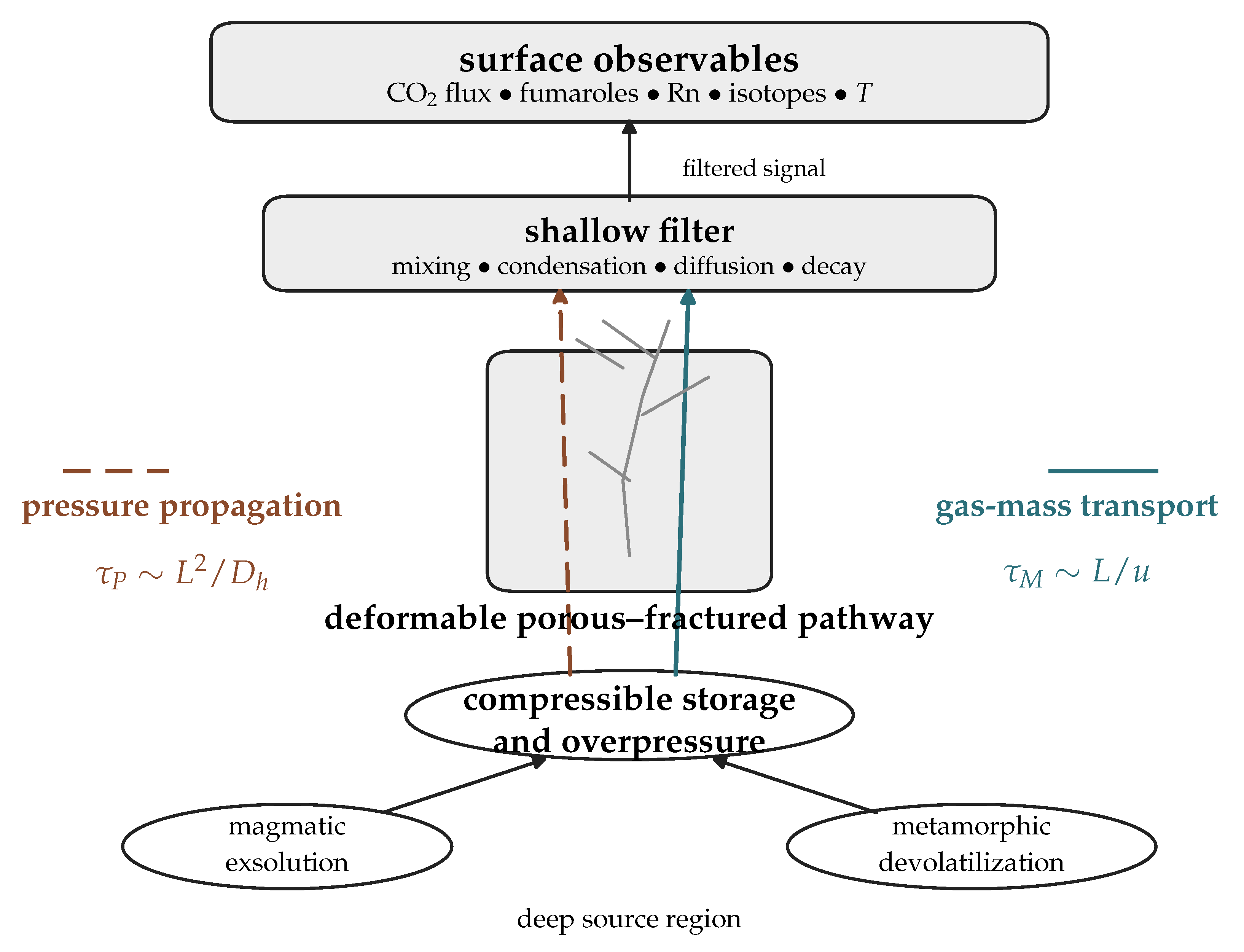
A key physical distinction in the analysis developed here is the separation between gas-mass propagation and pressure propagation. A newly generated gas phase migrates according to advection, effective diffusion, buoyancy, capillarity, and phase segregation [
14,
19]. Pressure, by contrast, propagates as a hydraulic and poro-thermo-mechanical disturbance [
10,
14,
20]. These two processes therefore possess different characteristic timescales, which helps explain why shallow degassing anomalies may record a deep perturbation before the corresponding parcel of newly generated gas reaches the surface [
10,
19,
20,
21]. The signal is then further filtered in the shallow domain by advective–diffusive transport in soils, by atmospheric forcing, by boiling and condensation, and by gas–liquid interaction in shallow hydrothermal zones [
19,
22,
23,
24]. Several studies have demonstrated this filtering in complementary ways: advective–diffusive soil-gas models show that concentration and isotopic profiles depend strongly on Darcy velocity and on the imposed pressure gradient [
19]; thermo-poro-viscoelastic models of mush transport show that pressure and heat may propagate asymmetrically in the presence of thermal gradients [
20]; multiphysics reconstructions of fumarolic systems show that two fumaroles supplied by the same reservoir may nonetheless acquire distinct compositions through near-surface mixing with condensed steam [
22]; and combined
–radon inversions show that even source depth can only be constrained after transport and radioactive decay are modeled explicitly [
24].
This study pursues three connected objectives. First, it develops a unified continuum framework for deep gas sources in deformable porous–fractured media by deriving reduced equations for gas transport, pressure diffusion, and thermo-poro-mechanical coupling. Second, it introduces a minimal analytical source–storage–pathway model that makes the onset of valve-like behavior, the associated charging and discharge times, and the separation between pressure transmission and mass transport explicit. Third, it organizes volcanic and tectonic systems into a limited set of source archetypes and transport regimes and examines which combinations of observables can and cannot identify those regimes. The emphasis throughout is on constitutive structure: source strength, storage, transmissivity, and shallow filtering are treated as coupled components of a single inverse problem rather than as independent descriptors.
Figure 1 summarizes the physical source–storage–pathway architecture,
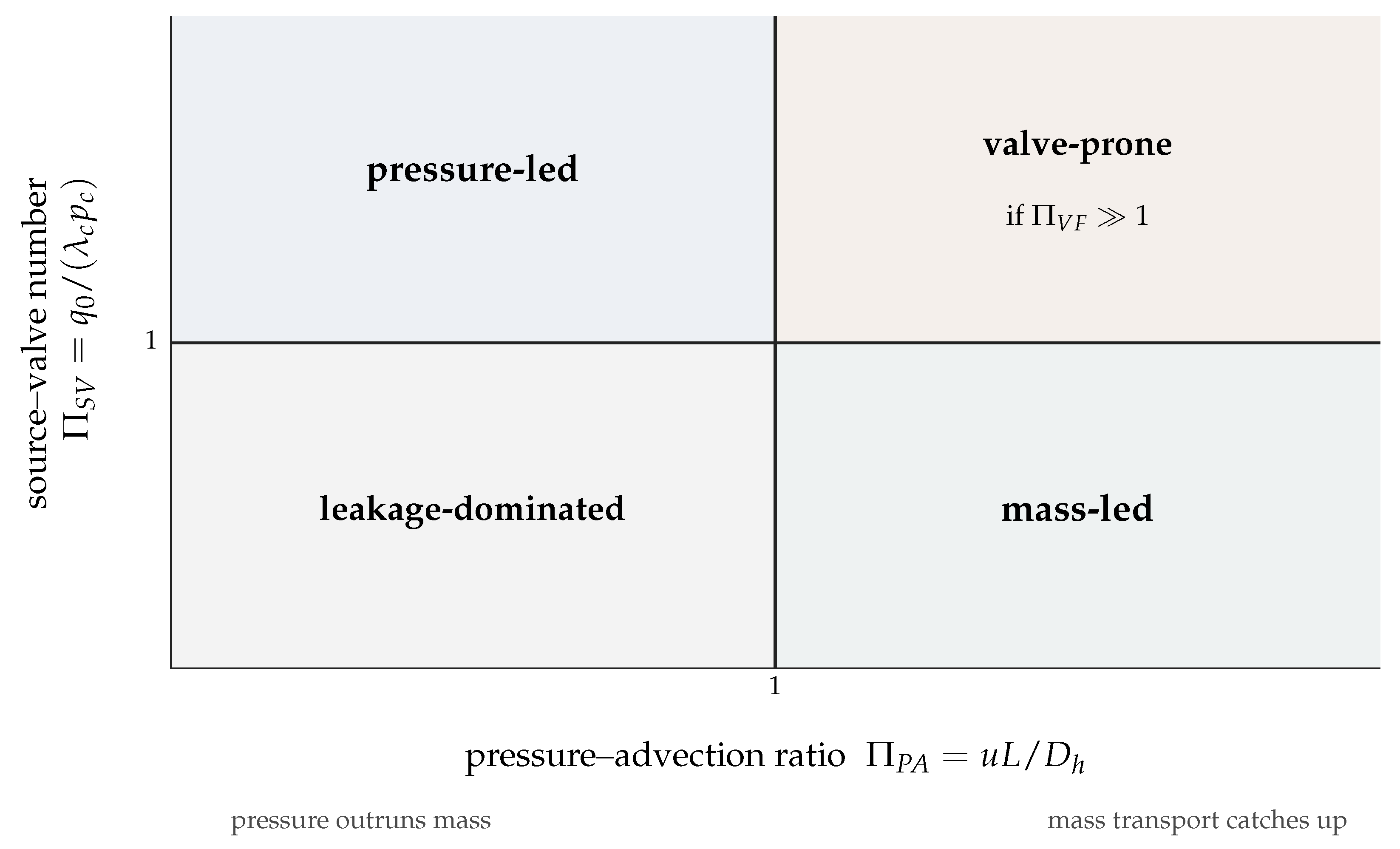
Figure 2 summarizes the associated regime language, and
Table 1 summarizes the principal symbols used throughout.
2. Continuum Description of Deep Gas Sources in Deformable Porous–Fractured Media
A continuum description requires a scale choice. Let the representative elementary volume be large enough to average pore-scale and fracture-scale heterogeneity, yet small enough to preserve gradients in pressure, saturation, temperature, and composition. In practice, this immediately produces three distinct modeling languages: an equivalent porous-medium description, a dual-permeability or dual-porosity description, and a discrete-fracture description. The first is appropriate when the dominant transport pathways are sufficiently dense to be homogenized; the second when matrix storage and fracture transmissivity must be retained separately; and the third when a limited number of faults or fractures carry a disproportionate fraction of the flow [
14,
17,
25,
26,
27,
28,
29]. In volcanic edifices and hydrothermal terrains, all three regimes may coexist across scales.
In all three descriptions, the basic variables are phase saturation, phase pressure, temperature, porosity, composition, and a mechanical state variable that controls deformation or effective stress. At the phase level, the local balance law reads
where
denotes externally imposed inflow and
denotes local generation or destruction by exsolution, devolatilization, condensation, boiling, or reaction. At representative-element scale, the phase flux is closed by Darcy’s law,
with
k the intrinsic permeability,
the relative permeability,
the dynamic viscosity,
the phase pressure, and
the gravitational acceleration [
8,
14,
19]. For gas–liquid mixtures,
and
depend on capillary pressure and saturation history, and common retention and relative-permeability closures descend from classical unsaturated-flow formulations [
30,
31];
must generally be closed with a real-fluid equation of state rather than an ideal-gas approximation once near-critical or supercritical conditions are approached [
4,
14].
The mechanical closure enters through effective stress. In an isotropic Biot-type description, the pore-pressure contribution to total stress can be written
where
is total stress,
is effective stress,
is the Biot coefficient,
is an appropriate fluid or mixture pressure, and
is the identity tensor [
32,
33,
34,
35]. Throughout the mechanical discussion below, compressive normal stress is taken as positive so that increases in
reduce effective compression. Equation (
3) expresses the coupling through which pressure modifies permeability and failure thresholds, and therefore, through which source strength, storage, and transmissivity become dynamically coupled.
Three assumptions must be stated explicitly at the outset. First, the treatment below is quasi-static in the hydromechanical sense: inertial terms are neglected in the transport balance, although they may remain relevant for short-timescale wave propagation and for fully dynamic hydromechanical coupling [
29,
33,
34]. Second, the constitutive reductions are local in time and written around a reference state; they are therefore most reliable when state variables evolve continuously over the time window of interest. Third, local thermodynamic equilibrium is assumed at the representative-element scale unless otherwise noted. These assumptions do not trivialize the problem; rather, they define the mesoscale regime in which the dominant geological observables are usually interpreted. The assumptions also delimit the applicability of the reduced model: highly dynamic explosive unrest, fast fragmentation, inertially dominated conduit flow, or strong thermo-chemical disequilibrium would require a different formulation retaining inertia, non-equilibrium kinetics, and explicit fracture propagation.
3. Reduced Equations for Gas Transport, Pressure Diffusion, and Thermo-Poro-Mechanical Coupling
Because the physical distinction between gas-mass transport and pressure propagation is central, it is useful to isolate a reduced pressure equation from the general phase balance. Restricting attention, for clarity, to the gas phase, define the gas mass per unit bulk volume as
A first-order thermodynamic and mechanical linearization about a reference state gives
where
is volumetric strain, positive in dilation. Expanding the total differential yields
with
Introducing the reduced coefficients
and defining the gas transport conductivity coefficient as
substitution of Darcy’s law into the gas-phase mass balance leads to
Equation (
14) is the core reduced equation of the study. Gas pressure rises when mass is added locally, when heating expands the fluid more efficiently than the pore volume, or when compaction reduces storage; it relaxes when transmissivity is sufficiently large for hydraulic gradients to dissipate [
4,
7,
14,
20]. Equations (
1)–(
14) are derived under local thermodynamic equilibrium at the representative-element scale, small perturbations about a reference state, negligible inertial terms in the transport balance, and a quasi-static hydromechanical limit. The reduction to the diffusion form below further assumes weak density gradients, modest buoyancy variations over the representative scale, and transport coefficients that vary slowly over the characteristic scale of interest. The algebraic derivation of Equation (
14) is given in
Appendix A.
In the isothermal, weakly deforming limit, one obtains
which implies the characteristic pressure-propagation time
over a length scale
L. Two further reductions follow immediately. Under undrained conditions at fixed bulk strain,
gives
whereas at fixed temperature and gas mass, one finds
so that dilation lowers pore pressure and compaction raises it [
4,
14,
20].
Pressure propagation, however, is not equivalent to gas transport. To describe the migration of a compositional anomaly or tracer species
i, a separate advection–diffusion balance is required,
where
is the gas-phase concentration of species
i,
an effective diffusivity, and
a source, sink, or phase-partition term [
19,
22,
24]. Thermal evolution may be represented, at the same level of reduction, by
where
is an effective volumetric heat capacity,
is thermal conductivity, and
is a volumetric heat source. The combination of Equations (
14), (
19) and (
20) defines the minimal dynamic core of the problem. It also shows why the same deep perturbation may generate multiple observational time signatures: pressure may respond first, gas composition later, and temperature later still.
4. Dimensionless Groups and Transport Regimes
The framework becomes predictive when a small number of dimensionless groups is used to separate the principal dynamical regimes. Let
be the interstitial gas speed,
L a characteristic transport length,
D an effective species diffusivity, and
a representative pressure scale. The characteristic advection and diffusion times are
from which the Péclet number follows as
The ratio between the pressure-propagation time and gas-advection time is
A source-to-leakance number can be defined as
where
is a characteristic source mass flux (mass per unit time), and
an effective leakance. Thermal pressurization may be summarized by
and the permeability contrast associated with valve-like behavior by
where
and
are the closed and open permeabilities, respectively.
The Péclet number distinguishes advective from diffusive species transport. The ratio
compares pressure propagation with gas advection. When
, the system is pressure led: hydraulic reorganization, shallow flux transients, and even permeability changes may occur before a newly generated gas parcel has traversed the transport domain [
10,
20,
21]. When
, mass transfer and pressure transfer occur on comparable timescales. The quantity
compares source loading with drainage capacity, while
measures the importance of thermal expansion relative to pressure storage. Finally,
quantifies how dramatically the transport operator changes when a sealing threshold is crossed.
The connection with natural geological scales is made through ratios rather than universal parameter values because permeability and storage vary over many orders of magnitude in crustal porous–fractured media [
9,
26,
29]. For shallow hydrothermal and fault-controlled pathways, characteristic lengths of hundreds of meters to kilometers, hydraulic diffusivities controlled by fracture transmissivity, and interstitial gas speeds inferred from site-specific fluxes may place the same system in different regions of the regime map during different phases of unrest. Thus
is to be interpreted as a diagnostic measure of whether the observed signal is expected to be pressure led or mass led, whereas
and
measure whether source loading is likely to remain below drainage capacity or cross a threshold for rapid discharge. This scaling interpretation is particularly important when comparing field sites, because the same
output can correspond to a high-source/low-leakance system or to a moderate-source/high-transmissivity pathway.
A further useful quantity is a reaction-to-transport ratio. If
denotes a characteristic timescale for reaction, including exsolution or devolatilization, one may define a Damkohler-like number,
Large
indicates that volatile generation is locally fast compared with transport and that source zones are reaction controlled; small
indicates that volatile generation is slow and that migration dominates over in situ production. This dimensionless perspective, with additional scaling details given in
Appendix B, clarifies what is, and is not, diagnostic in surface observations. A sudden increase in
flux can reflect an increase in source strength, a decrease in leakance followed by delayed breakthrough, or a transient jump in permeability; without an independent constraint on at least one of the governing dimensionless groups, these alternatives remain non-unique.
The regime classification is summarized by the two-parameter sketch in
Figure 2, in which
and the source–valve number
introduced below define the primary separation between pressure-led, leakage-dominated, mass-led, and valve-prone behavior, with
entering as a secondary condition for strong threshold contrast. Low
and high
identify systems in which rapid pressure communication coexists with threshold-controlled source loading, a combination characteristic of hydrothermal systems above volatile-rich reservoirs. High
indicates strong valve contrast and, therefore, susceptibility to pulsed discharge, whereas low
is characteristic of systems whose permeability evolves more continuously. This representation summarizes the asymptotic structure of the governing equations and illustrates why similar surface signals may arise from physically distinct deep states. The reduced analytical model developed next makes the onset condition for threshold-controlled discharge and the separation between pressure transmission and mass transport explicit. The dimensionless reduction and limiting regimes are summarized in
Appendix B.
5. A Minimal Analytical Source–Storage–Pathway Model
The regime classification introduced above can be made explicit by deriving a minimal analytical model in which source accumulation, threshold opening, and pathway transmission can all be written in closed form. Let
denote the source overpressure relative to the shallow hydraulic reference pressure
, and let
denote the net integrated mass supply to the source region, including deep inflow and internally generated volatiles. The reduced source-storage balance can then be written as
with a threshold-controlled leakance
where
is the effective source storage,
and
are the closed- and open-state leakances,
is the opening threshold, and
denotes the Heaviside step function. This minimal model is not intended to replace full multiphase formulations; its purpose is to isolate the smallest analytical structure capable of representing long-timescale charging, short-timescale discharge, and threshold-controlled transmissivity in the sense long associated with fault-valve behavior [
10,
36,
37,
38].
For constant forcing
and subcritical storage
, Equations (
28) and (
29) reduce to a linear charging problem with solution
where
is the initial overpressure. The system reaches the opening threshold only if the closed-state equilibrium pressure exceeds
; that is,
This suggests a source–valve number,
for which
is the necessary condition for threshold opening. If
and
, the charging time required to reach the threshold is
Once the pathway opens, the same balance evolves with the larger leakance
. If reclosing occurs at a lower threshold
, the open-state relaxation is
with discharge duration
provided
. The inequality
, therefore, implies
: the same system charges slowly and discharges over a short timescale without any change in the deep forcing itself. This provides a compact reduced expression of valve-like behavior and shows explicitly that episodic degassing need not require episodic volatile production.
Appendix C gives the corresponding analytical charging and discharge solutions.
The pathway can be treated analytically as well. Let
denote distance from the deep source to the shallow observation level. A minimal pressure-transmission problem is
with boundary conditions
where
is a shallow leakage coefficient representing the hydraulic conductance of the upper boundary, including soil–air interface resistance, shallow hydrothermal drainage, and atmospheric coupling. The limit
corresponds to an effectively sealed or no-flux boundary, whereas
approaches a drained or fixed-pressure boundary. For harmonic forcing
, the pressure amplitude at the observation level is
with
denoting the frequency. Equation (
38) is a hydraulic transfer function: pressure variations are transmitted quasi-statically for
and strongly attenuated for
.
A compositional anomaly or conservative tracer obeys a different transfer law. If the concentration
satisfies
with
the effective compositional diffusivity and
a first-order compositional loss or decay coefficient, then, retaining the decaying branch of the harmonic solution for forcing
, one obtains
where a hat denotes a complex amplitude,
is the source concentration amplitude at
, and
u denotes the interstitial transport speed. In the advective limit
, Equation (
40) reduces to
which identifies a mass-transport lag
and an attenuation factor
. The corresponding pressure timescale is
, so the pressure-led criterion becomes
The analytical model, therefore, supplies two explicit thresholds that are only implicit in the general discussion above:
for threshold opening and
for pressure-led surface response. Together, they form a compact bridge between source mechanics, pathway transmission, and observable timing; the corresponding analytical steps are summarized in
Appendix C.
6. Deep Source Archetypes
The dimensionless framework motivates a classification of deep gas sources into a small set of archetypes, summarized in
Table 2. The first is the distributed reactive source. In this case gas is generated throughout a finite volume
and the local generation term can be represented as
where
is the indicator function of the source volume and
is the total generation rate integrated over
. This archetype is physically appropriate for crystal-rich mush zones, devolatilizing metamorphic aureoles, or laterally extensive crustal domains in which volatile generation is volumetrically distributed rather than localized [
2,
6].
The second archetype is the leaky pressurized reservoir. Here a compressible source region accumulates fluid mass and releases it through one or more transmissive pathways. If
is source pressure and
the pressure of the overlying domain, the governing balance is
where
is the effective storage,
denotes imposed mass inflow and
is the source temperature,
is the thermal storage coupling, and
is an effective leakance. This archetype is the natural representation of a magmatic–hydrothermal system in which volatile supply from depth feeds a shallower, storage-dominated reservoir [
4,
7].
The third archetype is the threshold-valve source. In this case the storage equation alone is insufficient because the transport operator changes when pore pressure reaches a critical value. The minimal constitutive expression is
where
is the relevant fluid overpressure,
is the critical opening threshold. The threshold may represent shear reactivation, tensile opening, or both. Physically, this archetype describes systems in which transmissivity is not merely pressure sensitive, but discontinuously reorganized by failure [
10,
36,
37,
38].
The fourth archetype is the multi-reservoir or multi-pathway system. Here, neither source nor pathway can be represented by a single compartment. Instead, deep generation, intermediate storage, shallow phase partitioning, and multiple outlets interact to produce composite signals. This class is common in active volcanic systems, where deep magmatic volatiles, hydrothermal reservoirs, condensed steam, and structurally distinct fumarolic outlets all contribute to the observed signal [
4,
22]. It is also common in tectonic settings where compartmentalized faults, relay zones, and connectivity changes generate multiple effective storage levels [
9,
17,
18].
7. Pressure Buildup, Leakance, and Evolving Permeability
The origin of overpressure can now be written explicitly in terms of source generation and leakance. In volcanic systems, the most natural source term is thermodynamic. Let
denote magma mass,
the total volatile mass fraction, and
the volatile concentration at saturation, where
denotes composition, crystallinity, and other state variables. The exsolved volatile inventory is then
and differentiation in the oversaturated regime gives
Equation (
47) makes the principal volcanic source mechanisms transparent. Because volatile solubility generally increases with pressure, decompression implies
and therefore
[
1,
2,
3,
7]. Crystallization modifies
and concentrates volatiles in the residual melt, thereby driving second-boiling behavior [
2,
3]. Recharge, heating, and mixing perturb both temperature and composition and may shift the system abruptly toward vigorous gas release [
1,
3,
7]. In physical terms, critical degassing, mush outgassing, and volatile-overpressure coupling are all special realizations of Equation (
47).
In tectonic settings, the deep source term is more naturally reaction driven. If
denotes the rate of metamorphic devolatilization or decarbonation reaction
j, with stoichiometric volatile yield
, the bulk generation term can be written as
The source may therefore occupy an extended crustal volume rather than a geometrically simple cavity [
5,
6,
38]. Once magmatic exsolution or metamorphic devolatilization is embedded in a source region
, the appropriate reduced description is again the source-storage balance of Equation (
44). Here,
,
, and
are all expressed consistently in mass units,
denotes net volatile generation within
, and
has dimension of mass ·
·
.
For a pathway of length
L, cross-sectional area
A, permeability
, density
, and viscosity
, the effective leakance scales as
so that the source overpressure obeys the leading-order estimate
Deep pressure gradients therefore arise whenever volatile supply and thermal pressurization exceed pathway leakance [
4,
5,
6,
26,
27]. Although Equation (
50) is deliberately reduced, it shows that any decrease in
amplifies overpressure, even if the deep source term itself remains unchanged.
Permeability evolution is therefore a primary constitutive component. Laboratory studies on volcanic rocks show that transmissivity depends strongly on porosity, fracture state, confining pressure, and damage history; field observations and geophysical inversions likewise indicate that permeability can vary by orders of magnitude during transient stress perturbations [
8,
28,
39,
40]. This history dependence shows that pressure-threshold models are limiting approximations to valve dynamics. A real system may display hysteresis between opening and closing, delayed sealing by mineral precipitation, and connectivity changes not captured by a single scalar threshold [
9,
10]. A minimal continuous representation can be written in terms of a damage or connectivity variable
,
with loading–unloading hysteresis represented by
Here,
and
are opening and resealing timescales. The condition
makes the unloading path different from the loading path, so that permeability remains elevated until pressure has fallen below a lower reclosing threshold. Equations (
51) and (
52) reduce to the Heaviside valve model in the limit of instantaneous opening and sealing, but they also allow gradual damage accumulation, delayed healing, and partial connectivity.
Capillarity and relative permeability further complicate the picture. In two-phase O–CO2 systems, permeability evolution is not only a matter of fracture aperture or connected porosity, but also of saturation state and the mobility contrast between wetting and non-wetting phases. In such cases, storage is shared between elastic pore-volume change and phase redistribution, and the pathway cannot be separated cleanly from the fluid’s thermodynamic state. This contributes to the pronounced nonlinearity observed in volcanic and hydrothermal systems, even where the geometry is geometrically simple.
8. Surface Observables, Filtering, and the Inverse Problem
Once deep gas sources are formulated in this way, the interpretation of surface measurements becomes a forward problem rather than a direct reading of depth. Let
denote the model vector containing source pressure
, integrated generation rate
, effective source depth
H, permeability field
, thermal field
, pathway geometry, and the parameters governing shallow filtering. Let
denote the vector of observables, including diffuse
flux, fumarolic composition,
C, radon flux, temperature, and structural or geophysical constraints. The observation equation may be written abstractly as
where
is the forward transport operator and
collects measurement and model error [
22,
23,
24]. Equation (
53) formalizes a fundamental filtering property: the surface signal is filtered by transport, phase partitioning, and mixing. Two fumaroles may therefore be supplied by the same shallow reservoir and yet acquire different compositions because they interact differently with condensed steam or liquid-dominated zones near the surface [
22]. Diffuse soil emissions may contain both deep and shallow contributions, and the shallow component may vary seasonally enough to obscure the deep one unless additional tracers are used [
23].
The shallow domain acts as a physical filter because it modifies different species in different ways. Consider one-dimensional steady upward transport in the vadose zone with constant gas-filled porosity
, constant upward interstitial speed
u, effective diffusivity
, and vertical coordinate
z positive upward. After division of the steady bulk balance by
, and with reaction terms expressed per unit gas-filled volume, the transport equation for species
i becomes
For nearly conservative
in a strongly degassing domain, one may approximate
, whereas for radon-222 (
222Rn) radioactive decay must be retained, so that
For definiteness, Equations (
54) and (
55) are interpreted under prescribed concentration or flux at the deep entry level
and mixed or prescribed boundary conditions at the ground surface
. The corresponding characteristic roots are
and the flux per unit bulk surface area is therefore
These relations explain the diagnostic value of
–radon pairing [
19,
24].
may be transported advectively over considerable depth ranges with limited attenuation, whereas radon experiences a strong depth penalty governed by advection, diffusion, and radioactive decay. Surface radon can therefore constrain effective source depth only when the transport model is explicitly included.
The inverse problem follows by linearization about a reference model
,
and a regularized objective function can be written as
Here,
is the sensitivity matrix,
and
weight the data and prior information, and
controls regularization strength [
22,
23,
24]. Non-uniqueness arises because source depth, pathway permeability, upward velocity, source strength, and shallow mixing parameters can all trade off against one another in the production of similar surface fluxes or concentrations. Flux alone does not determine source depth, composition alone does not determine pathway geometry, and even isotopes alone may not uniquely discriminate deep and shallow components if transport fractionation and mixing are left unconstrained. Recent reduced-inference work on radon–thoron observations has formalized a similar source-to-observable cascade, distinguishing anomaly reporting, mechanism discrimination, and local inversion according to the information content of the observation package [
41].
The practical treatment of this non-uniqueness requires probabilistic or sequential data-assimilation approaches rather than deterministic fitting alone. Bayesian Markov Chain Monte Carlo methods are well suited to sampling the posterior distribution of source, storage, and transmissivity parameters when the forward model is moderately expensive but explicit [
42]. Ensemble Kalman filtering and related ensemble smoothers are natural alternatives when the objective is to assimilate transient observations, such as repeated flux surveys, deformation, pressure proxies, or seismicity, into an evolving state vector [
43]. In either case, the role of the reduced framework is to constrain the parameterization: it identifies which quantities should be treated as state variables, which quantities should be treated as transfer variables, and which trade-offs are structurally unavoidable.
The inverse problem is therefore a central test of the physical formulation. A deep-source theory that does not predict which parameters are identifiable from which observables remains incomplete. From an observational perspective, it is practical to distinguish between state variables and transfer variables. Pressure, saturation, and permeability are internal state variables that are rarely observed directly. Flux, composition, temperature, radon, and transient response are transfer variables that carry indirect information about those internal states. A model must not only reproduce these observables, but also identify which combinations of them constrain source strength, storage, and transmissivity independently.
9. Illustrative Application to the Campi Flegrei Degassing Record
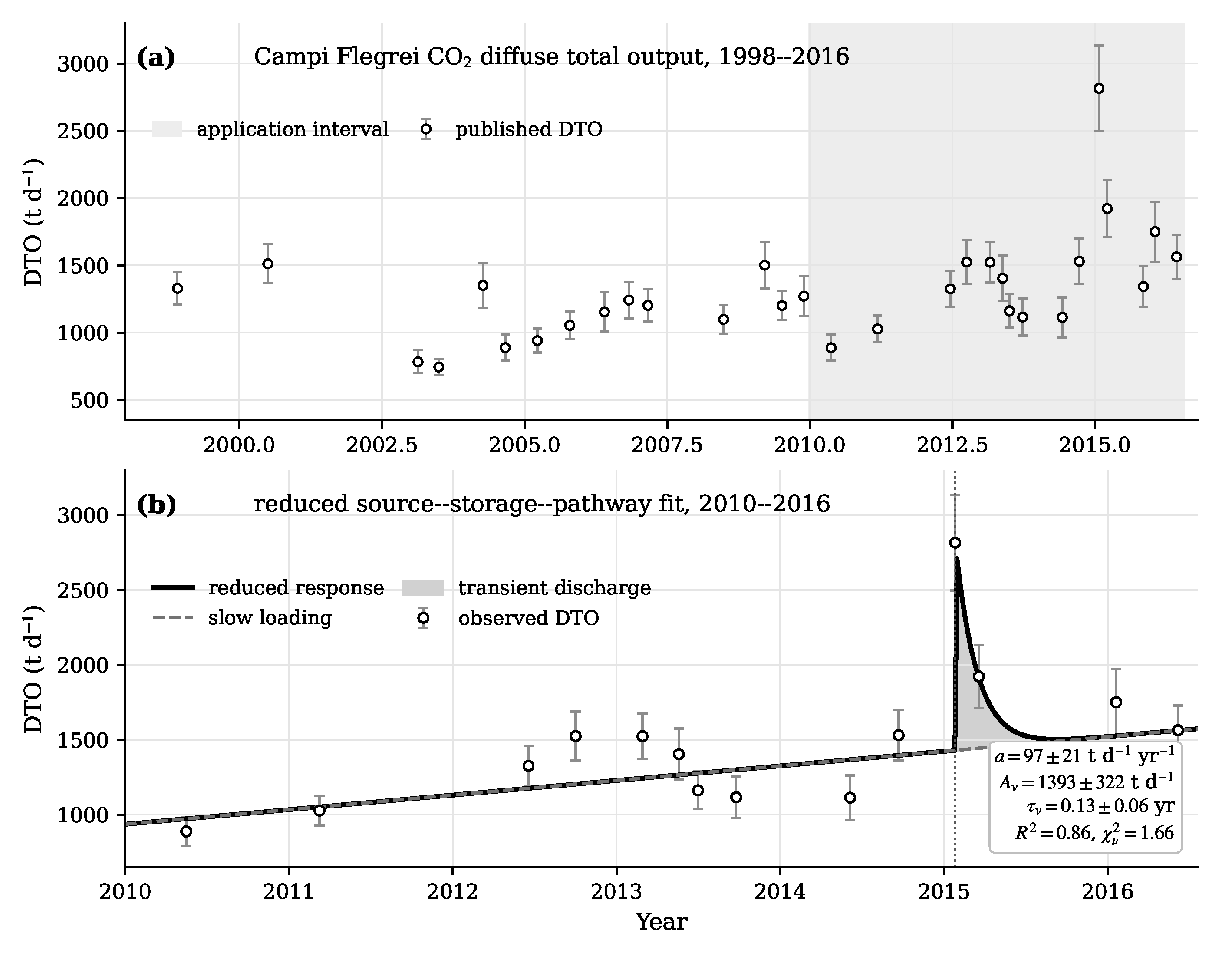
The preceding sections develop a reduced analytical framework rather than a site-specific numerical simulator. To demonstrate its use with observations, the framework is applied to a published degassing record from Campi Flegrei (Campania, Italy). The aim is not to perform a complete inversion of the caldera, nor to claim uniqueness of the inferred parameters. The objective is limited and testable: to show how a filtered surface observable can be decomposed into slow source–storage loading and faster transient discharge within the same analytical language used above.
The application uses the carbon dioxide (
) diffuse total output (DTO) estimates reported by Carlo Cardellini and colleagues [
44] for the Solfatara–Pisciarelli degassing structure. That study provides thirty diffuse
surveys between 1998 and 2016, based on 13,158 accumulation-chamber measurements and geostatistical estimation of the total diffuse output. The published DTO spans approximately 745–2815 t
, with survey-dependent uncertainty. The DTO is not a direct measurement of source pressure; in the terminology of
Section 8, it is a filtered observable that depends on source strength, storage, leakance, shallow mixing, and the active area of degassing. It is nevertheless an appropriate quantity for illustrating the forward operator because it integrates the surface expression of the Solfatara–Pisciarelli pathway.
For the application interval 2010–2016, when the record is sufficiently dense for a time-domain illustration, the observed DTO is represented as
where
is the leading-order response of a leaky storage system to slowly increasing effective source input or leakance-weighted supply, and the exponential term is the open-state relaxation associated with a short transient discharge episode. Equation (
60) is the observable-space counterpart of the source balance in Equation (
28): the first term captures multi-year loading, while
and
(where the subscript
v denotes the transient valve-like discharge component) represent the amplitude and relaxation time of a rapid transmissivity or discharge perturbation. The parameter
is fixed at 2010 and
is set to the date of the maximum observed DTO in the application interval. The parameters
,
a,
, and
are then estimated by weighted least squares using the published DTO uncertainties.
The fit gives
t
, a slow-loading coefficient
t
, a transient amplitude
t
, and a relaxation time
yr, with the goodness-of-fit
and reduced statistic
(with
degrees of freedom) for the 2010–2016 subset (
Figure 3). The physical significance of the illustrative calculation lies in the short value of
relative to the multi-year growth of the background DTO. It indicates that the 2015 high-output episode can be represented as a rapid discharge or transmissivity perturbation superposed on slower storage loading, rather than as a uniformly increasing trend in deep volatile production. In the language of the reduced model, this is a pressure- and leakance-sensitive response, not a unique measurement of new gas mass arriving from depth.
This interpretation is consistent with independent Campi Flegrei studies showing that hydrothermal pressure,
emission, and seismicity share closely related temporal evolutions during the 2010–2020 unrest [
45]. It is also compatible with recent geochemical reconstruction of the Solfatara magmatic–hydrothermal system, in which shallow, intermediate, and deep reservoirs are connected through a deep fault–fracture zone and the intermediate to deep reservoirs undergo marked pressure–temperature evolution through time [
46]. The purpose of this calculation is not to present Equation (
60) as a complete Campi Flegrei model. Its diagnostic role is to show that the same data can be described in terms of a slow loading branch and a short transient discharge branch, making explicit which part of the signal is attributed to storage and which part to pathway transmissivity.
10. Discussion
Several implications follow from the framework assembled above. First, deep degassing is more consistently described through the triplet source–storage–transmissivity than through the notion of a deep emitter alone. The source term by itself does not determine the surface signal. Storage delays and smooths transmission; permeability focuses, redistributes, or intermittently suppresses it; and the shallow domain modifies the signal once more before it is observed. This layered structure explains why surface gas anomalies may precede, lag, or even decouple from geodetic or seismic indicators, depending on which part of the coupled system is perturbed first. The reduced analytical model makes this statement quantitative: is the threshold for valve-like opening under constant forcing, whereas is the criterion for pressure transmission to outrun mass transport. The Campi Flegrei application illustrates the same point with a real degassing record: the DTO time series can be represented as slow storage loading plus a short transient discharge episode, rather than as a single undifferentiated increase in source flux.
Second, volcanic and tectonic systems must not be treated as physically disjoint categories. Volcanic terrains emphasize exsolution, multiphase thermodynamics, and hydrothermal mediation, whereas tectonic terrains emphasize structural focusing, compartmentalization, and reaction-driven fluid production. Yet the reduced equations, constitutive couplings, and dimensionless groups required to describe the two are fundamentally the same. This commonality supports the porous–fractured-media framing: it does not erase geological differences, but expresses them through source terms, storage laws, and transmissivity evolution rather than through unrelated vocabularies.
Third, permeability is the least constrained constitutive quantity in the problem. Source terms can often be parameterized to first order from thermodynamics or reaction stoichiometry, whereas permeability depends on stress path, fracture geometry, sealing, capillarity, hysteresis, and connectivity in ways that remain only partially constrained [
26,
27,
28,
39,
40]. This explains why different models with similar source terms may still predict substantially different shallow responses.
A final implication concerns model design. Excessively simplified models collapse source, storage, and permeability into a single effective flux and therefore risk interpretive overreach; excessively complex models become weakly identifiable and difficult to falsify. Suitable reduced models should preserve the source–storage–pathway distinction while retaining diagnostic links to observable quantities.
11. Conclusions and Future Directions
Deep gas sources in volcanic and tectonic systems can be represented as coupled source–storage–pathway systems in deformable porous–fractured media. Gas mass propagates by advection, diffusion, buoyancy, and phase segregation; pressure propagates by hydraulic diffusion and poro-thermo-mechanical coupling; and deep pressure gradients arise whenever volatile supply exceeds pathway leakance. Once this distinction is recognized, critical magmatic degassing, hydrothermal pressurization, metamorphic release, fault-valve behavior, and transient surface emissions above reinjection or tectonic perturbations can all be treated within a common theoretical class.
The framework developed here contributes five elements relevant to future work. First, it provides a regime classification based on dimensionless groups that separate pressure-led, mass-led, valve-dominated, and shallow-filter-dominated behavior. Second, it provides a minimal analytical source–storage–pathway model yielding explicit criteria for valve onset (), charging and discharge times, and pressure-led response (). Third, this framework provides a compact classification of source archetypes into distributed, leaky, threshold, and multi-reservoir systems. Fourth, it provides an inversion framework that clarifies why source depth, permeability architecture, and shallow mixing remain non-unique unless multiple observables are combined. Fifth, it provides a real-data illustration at Campi Flegrei, showing how the reduced model decomposes a published output record into slow loading and rapid transient discharge components.
Future progress will require both additional site characterization and refinement of the constitutive laws. In particular, future work should incorporate better real-fluid closure for O–CO2 systems, more realistic history-dependent permeability laws, and joint assimilation strategies that combine gas geochemistry, thermal observations, structural data, transient response, and uncertainty-aware inversion tools such as Bayesian sampling and ensemble filtering. A primary objective is to derive parsimonious, testable laws through which deep volatile production, storage, and transmissivity can be inferred from filtered surface observables.
The detailed algebraic derivation of the reduced pressure equation, the nondimensional scaling, and the analytical solutions of the minimal source–storage–pathway model are provided in
Appendix A,
Appendix B and
Appendix C.