Article

Selenium Quantification in Soil by LIBS


by
Alexandra V. Rogachevskaya
1,
Vasily N. Lednev
1,*,
Pavel A. Sdvizhenskii
1,
Igor Y. Savin
2,
Sergey V. Gudkov
1,3,4,
Alexey S. Dorohov
3 and
Andrey Y. Izmaylov
3
1
Prokhorov General Physics Institute, Russian Academy of Sciences, Vavilova Street, 119991 Moscow, Russia
2
V.V. Dokuchaev Soil Science Institute, Pyzhyovskiy Lane, 119017 Moscow, Russia
3
FSBSI “Federal Scientific Agroengineering Center VIM”, 1st Institutsky Proezd, 109428 Moscow, Russia
4
Department of Fundamental Sciences, Bauman Moscow State Technical University, 5 2nd Baumanskaya St., 105005 Moscow, Russia
*
Author to whom correspondence should be addressed.
Submission received: 9 September 2025 / Revised: 1 November 2025 / Accepted: 6 November 2025 / Published: 16 January 2026
(This article belongs to the Section Applied Physics)

Abstract

Laser-induced breakdown spectrometry (LIBS), known as an express analysis technique, is for the first time applied in this study for determining selenium in soil. Modern agriculture requires elemental analysis methods to perform the continuous automated online control of microelement content in soil. However, selenium has never been quantitatively determined in soil by LIBS so far. Different sample preparation techniques (loose soil powder, mounted on adhesive tape and tableted soil) are employed here for LIBS determination of selenium in soil. The optimal choice of analytical line is challenging for selenium because of spectral interference with the minor and major soil components (Fe, Si, Zn, Al, Sb), but the Se I 196.09 nm line has the lowest spectral interference. A limit of detection of 3 mg/kg for selenium in soil is achieved in the present study using LIBS. The analytical performance of tape-mounted and loose soil powder samples with appropriate data averaging is found to be comparable to that achieved for tablets.

1. Introduction

Selenium (Se) is an essential nutrient for human and animal health. This is mainly because selenium is one of the key elements in terms of antioxidant activity in cancer therapy [1]. However, high-quality food products [2] and cattle feed crops may be selenium-deficient because agricultural soils lack its water-soluble, readily bioavailable form [3]. As a result, an agricultural holding is exposed to the risk of crop and food quality deterioration, hence decreasing cost efficiency. To avoid this and grow crops with optimal selenium content, it is necessary to control selenium in soil [4]. Soils typically contain between 0.01 and 2.0 mg/kg of selenium [5], with an average of 0.4 mg/kg [6], while seleniferous soils contain between 1 and 80 mg/kg of selenium [7]. It is known that selenium fertilizers are not fully assimilated by crops and enter surface waters, causing pollution if applied on a large scale. Contrarily, in areas near chemical plants, different approaches for reducing contaminants, such as air pollution regulation, are the reason for the selenium decrease in soils and nutrient deficiency risk [8]. This enhances the need for precision soil fertilization. The ability to accumulate different selenium forms varies in different plant species [3], which determines fertilization. Sulfides, selenides, and elemental Se are not available to crops due to their insolubility [9]. Soluble selenium forms’ bioavailability is not generally high in plants and depends on the soil oxidation state and environmental conditions, yet Se6+ and Se4+ soluble additions are used for fertilization [10], partly due to their relatively high solubility in aerobic environments [11]. Selenate and selenite are often used in low-selenium areas [12]. They are also known to affect other nutrients’ accumulation by plants [13].
In recent years, numerous studies have focused on nanoparticle-based fertilizers, which are sources of growth-aiding macro- and microelements for plants [14]. This is why the number of publications on selenium nanoparticles has also increased significantly, especially in the last five years [15]. Some studies show an excess of selenium nanoparticles poisons plants and has a negative impact on the environment [12]. Nevertheless, the method of fertilization using selenium nanoparticles becomes promising and relevant due to its lower toxicity than when using selenides and selenates [16] and its effective prevention of selenium losses in agricultural systems [12]. For example, in Ref. [17], it was demonstrated that soil fertilization with selenium nanoparticles improves fruit quality. Although foliar treatment is the main application method of nanoparticles, the latter can also be added to the soil at the base of the stem, to the substrate, and to the growth nutrient medium [15]. Depending on the plant type, treatment method, and fertilization purpose, selenium nanoparticles can be added to the soil at a concentration from 2 to 100 mg/L [18,19,20,21,22]. Thus, selenium concentration in soil increases significantly after fertilization relative to its typical average value. To prevent environmental pollution through selenium application, it is necessary to control its amount in soil. Therefore, the development of analytical methods for agricultural needs in selenium definition and preservation in soil is of significant scientific interest.
The total selenium content in soil can be determined by various analytical techniques. Typically, soil is analyzed by instrumental laboratory-based techniques, such as the HG-AAS (hydride generation atomic absorption spectrometry), GF-AAS (graphite furnace atomic absorption spectrometry), ICP-AES (inductively coupled plasma atomic emission spectroscopy), among others [9]. Although a primary goal of soil analysis studies are heavy metals and radionuclides, monitoring of microelements such as selenium has been of growing interest in recent years. Thus, several studies have focused on the GF-AAS [23], HG-AFS (hydride generation atomic fluorescence spectrometry) [24], and LA-ICP-MS (laser ablation inductively coupled plasma mass spectrometry) [6] application to control selenium content in soil. These conventional methods provide appropriate analytical results, but require a time-consuming sample preparation (up to few hours for soil dissolving in acids), as well as experienced enough contributors and quite high equipment exploitation costs. Nowadays, express and onsite analysis in agriculture is of quite high demand but the above-mentioned laboratory-based methods cannot be utilized for field measurements [2].
Field express measurements can be performed using portable analyzers, which must be compact and simple to use by non-specialized personnel. Currently, commercially available handheld elemental analyzers are based on X-ray fluorescence (XRF) spectrometry and laser-induced breakdown spectrometry (LIBS) [25,26,27]. The XRF spectrometry is an appropriate, non-destructive analytical technique to determine the soil composition in the field. However, portable XRF spectrometry provided quite low sensitivity for selenium in soil with 60 mg/kg limit of detection (LOD) [28]. It is worth to mention that due to X-ray radiation, XRF instrument requires special training in the safe operation of the analyzer. In contrast, laser-induced breakdown spectrometry is much safer; the staff only needs to protect themselves from a laser emission that can be easily organized by proper instrument design. Another advantage of LIBS is its high enough sensitivity to quite low atomic mass elements and impurity [29,30,31]. Thus, LIBS was successfully employed to determine quite a wide range of elements in soil (for example, Ba, Ca, Cr, Cu, Fe, Li, Mg, Mn, Pb, Sr, Ti, V, or Zr) and the analysis accuracy is comparable to that achieved by LA-ICP-MS [32]. In addition, the literature contains studies demonstrating further improvement of LIBS analysis achieved through the use of a double-pulse technique [33,34] or mathematical approaches [29,35,36]. For example, recently, a possibility to reduce matrix effects was demonstrated and reproducibility was improved in LIBS system optimization for different matrix including soils [37]. To conclude, LIBS is considered a promising technique to determine soil elemental composition under field conditions.
Though no sample preparation is declared for LIBS measurements, the soil analysis generally requires some sample treatment stages to improve the analysis results [38]: homogenization by milling and mixing, sieving, soil pelleting, or fixing on an adhesive surface. For example, in Ref. [32] I was demonstrated that LIBS analysis provides precision comparable to LA-ICP-MS if soil samples were pelleted. They also found that the accuracy and precision of these methods were similar for both tape-mounted and pellet sample preparation techniques. As to our best knowledge, LIBS has never been applied to determine selenium in soil. In the 1990s, when the LIBS method was in its early stages of development, an attempt was made to detect selenium in a soil but with no success in detecting any selenium line for its concentration up to 1002 mg/kg [39]. This happened because the most intensive Se I 203.98 nm line was in spectral interference with Sb I 203.98 nm, while the Se I 196 nm line cannot be detected sue to hardware limitations. Twenty years later, 0.6 mg/L LIBS detection Se limit was achieved in gases with a sophisticated technique of hydrogen selenide generation [40]. Recently, a LIBS technique was utilized for selenium analysis in water; with Se I 203.93 nm line, which allow to achieve 11 mg/kg limit of detection [41]. The present study focuses on optimizing LIBS for selenium determination in soil. Given the requirement for future online soil analysis by LIBS, here we compare LIBS analytical performance for loose soil powder samples as well as pressed tablets and soil fixed with an adhesive tape.

2. Materials and Methods

2.1. LIBS Setup

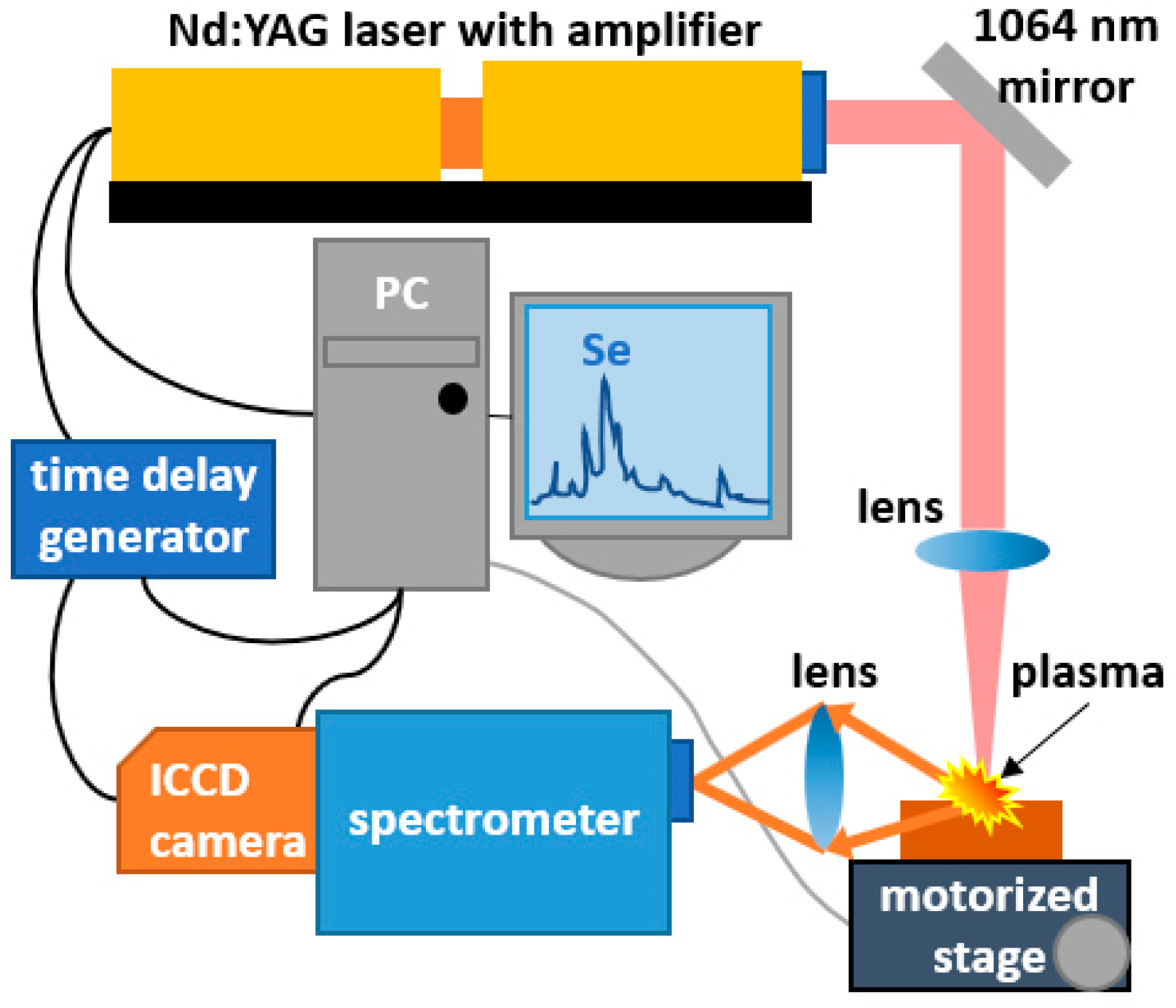
The experiment was carried out on a laboratory LIBS system (Figure 1) with a pulsed Q-switched Nd:YAG laser, the spectrograph (Shamrock 303i, Andor, Belfast, UK) equipped with ICCD camera (iStar, Andor). Mirrors and focusing lens (with focus F = 100 mm) directed a laser beam (1064 nm wave length, 10 ns periodicity, 50 ± 2 mJ/pulse, 1 Hz frequency, laser beam quality product M2 = 90) orthogonally to the sample surface. The laser spot diameter was measured as 300 µm, resulting in a 70 J/cm2 energy density. Quartz lens (F = 50 mm) collects plasma emission and transmits it to the spectrometer input slit at 1:1 scale. Pulse digital delay generator (DG535) synchronized the laser pulse and the gated camera acquisition. The sample holder was installed at a two-dimensional motorized stage so mapping measurements can be performed. Control of the equipment was performed with a personal computer via a custom software developed in the LabVIEW environment. All the measurements were carried out in air at standard temperature and pressure conditions.

2.2. Soil Samples

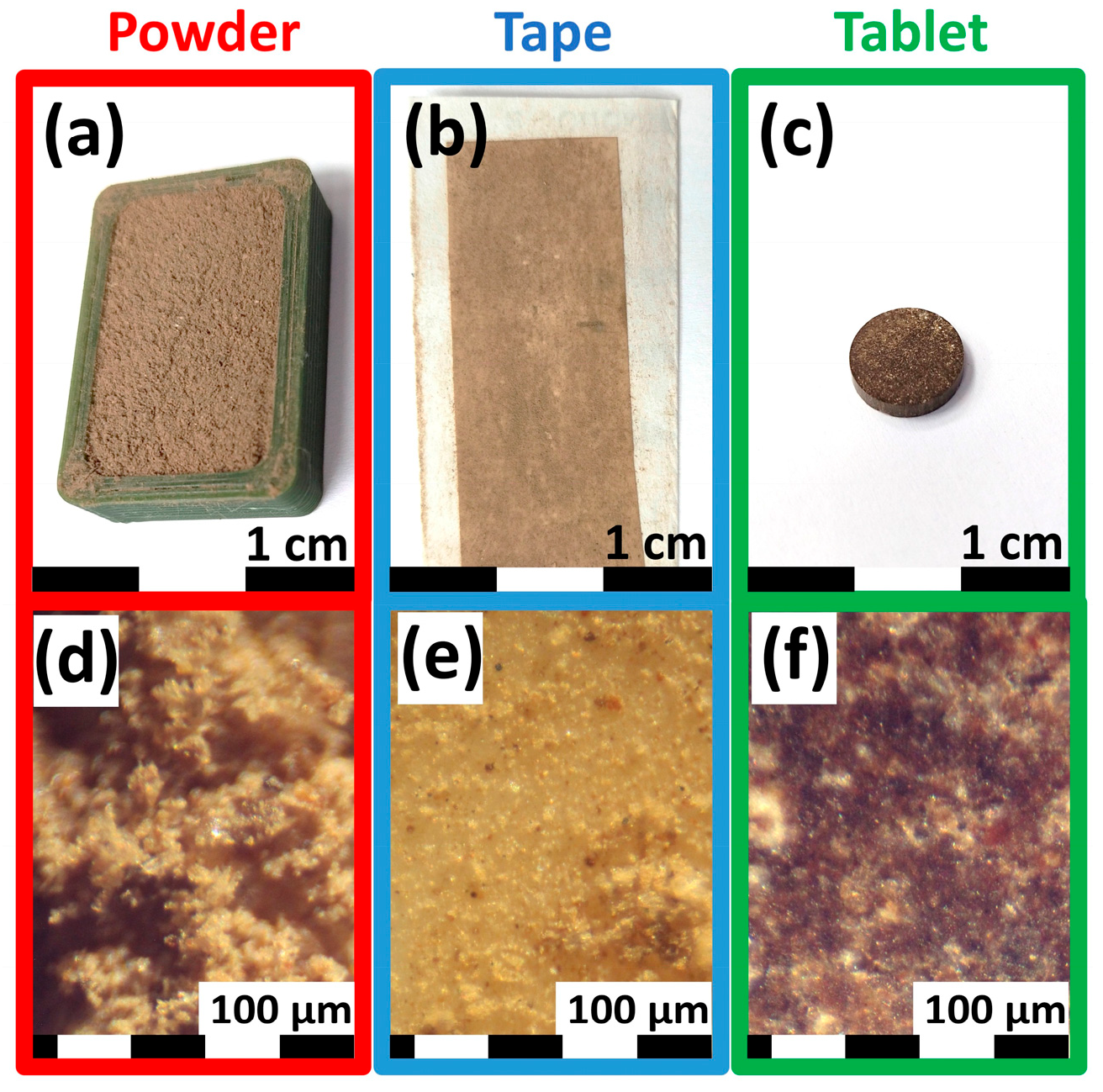
Soil was collected from the middle part of the Ramensky extension of the Moscow River (Russia) floodplain from a 0 to 30 cm depth layer of alluvial dark humic soil (Fluvisols Eutric [42]) of heavy loamy granulometric composition with high humus content (4–5%) and high enough cation exchange capacity. A 400 g portion of the collected soil was sent to a commercial soil and water analysis laboratory (LLC Main Testing Center for Drinking Water “GIC PV”, Moscow, Russia), where the selenium content was controlled by ICP-AES and was found to be below the instrument sensitivity (less than 0.5 mg/kg). This soil was milled into powder with a particle size of about 10 µm (Figure 2d–f). To prepare soil samples with the selenium, we used a sodium selenite (Na2SeO3) since it is a conventional component of fertilizers. Pure Na2SeO3 powder (98%) was dissolved in distilled water at 50 g/L concentration. Then, 100 mL of this solution was added to the 99.3 g of soil to obtain a contaminated sample with 23,000 mg/kg selenium. The mixture was dried for 70 h in room conditions. The contaminated soil was mixed with the original one to prepare samples with selenium concentration of 4600, 460, 230, 115, 40, 15, and 5 mg/kg. We chose a significantly high concentration of 23,000 mg/kg in our studies so that we may definitely detect selenium, because earlier studies determining selenium in soil by LIBS were not detecting selenium at 1002 mg/kg concentration (see, e.g., Ref. [39]).
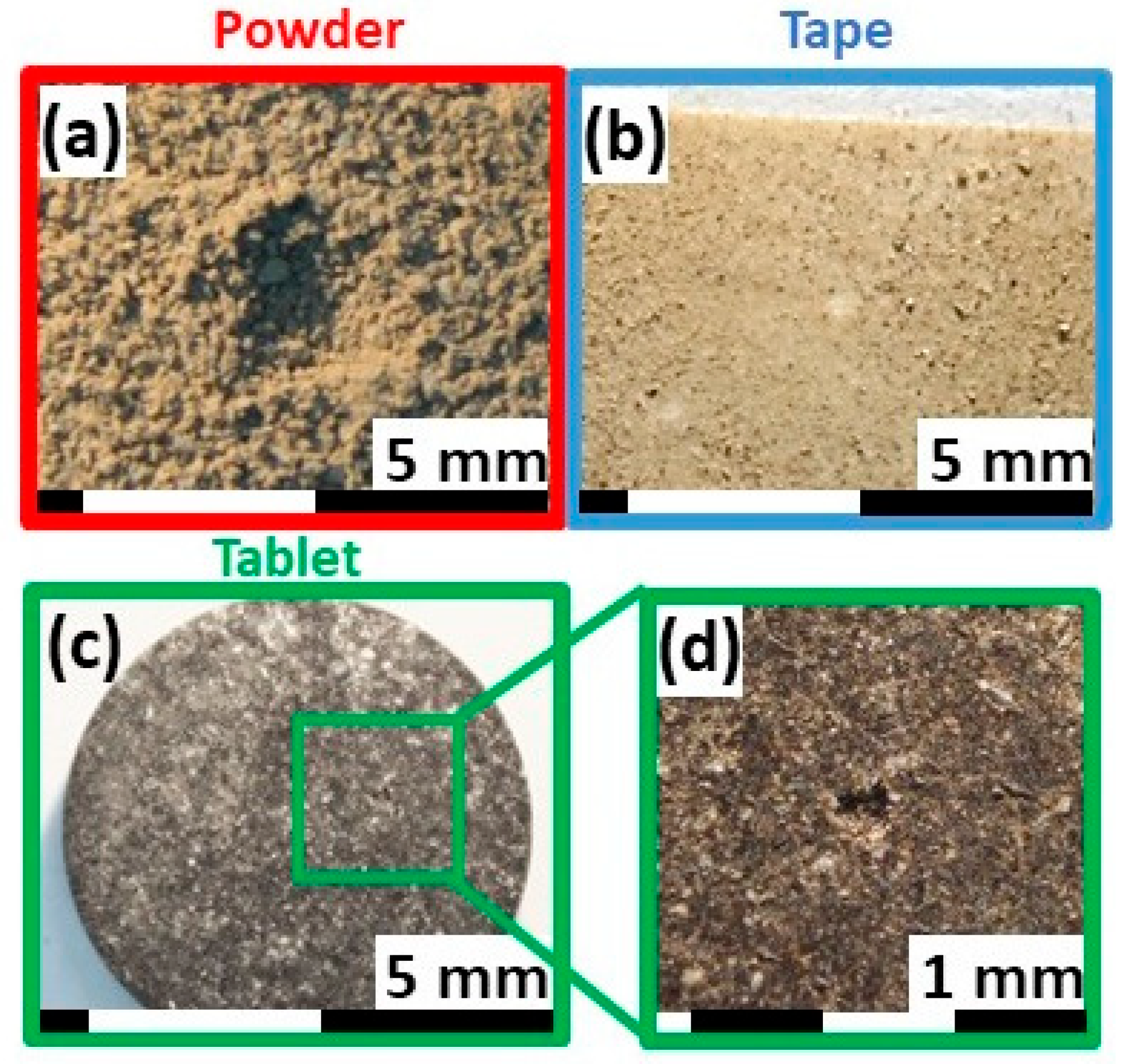
The loose soil powder was placed inside the relatively small plastic containers (of width × length × depth 2 × 3 × 0.6 cm) and leveled to obtain a flat enough surface (Figure 2a,d). To prepare ape adhesive-mounted samples (Figure 2b,e), 50 × 15 mm piece of double-sided tape was adhered to 60 × 30 piece of cartridge-paper, leaving the tape liner on. To mount soil powder on the tape, liner was folded back and some of each soil selenium powder compound (about 50 mg) were deposited onto the tape, shaken for even distribution, and tapped gently to remove any unglued excess. Finally, 2 g of each soil sample was pressed (2.6 ton/cm2) into tablets of 1 cm in diameter (Figure 2c,f) without any binder addition.

3. Results and Discussion

3.1. Selenium LIBS Spectrum

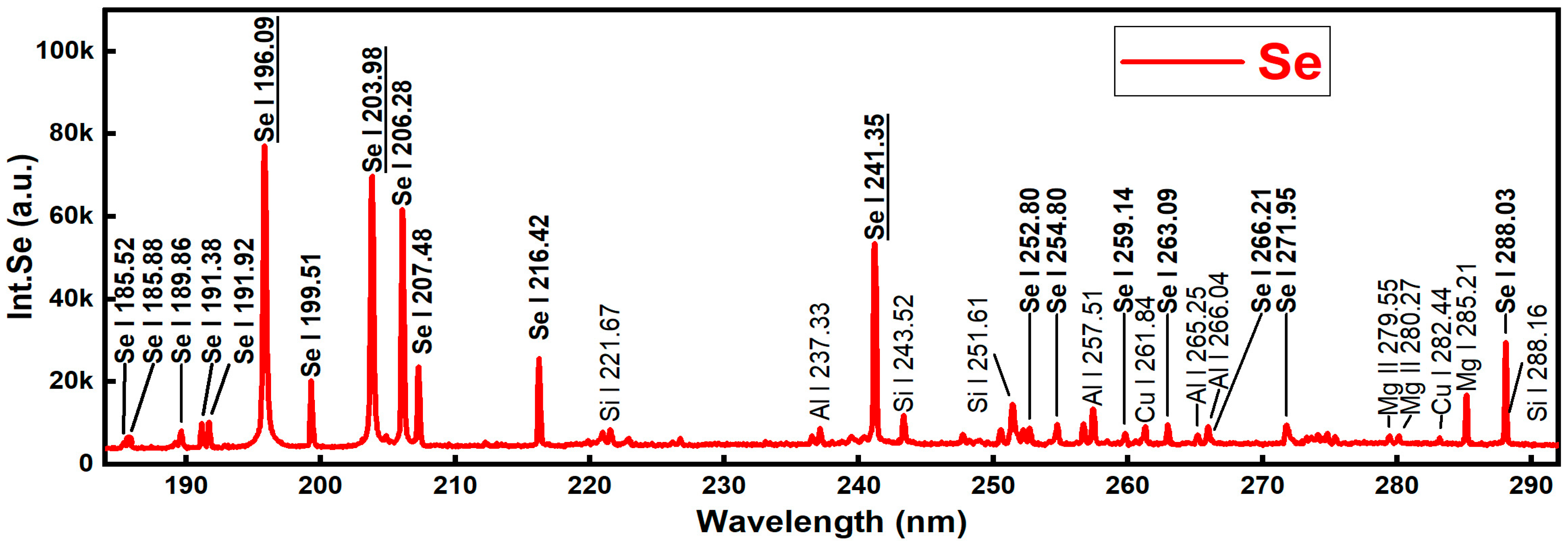
The spectral analytical line choice is challenging in LIBS due to the following: a relatively high signal-to-noise ratio, absence of spectral interference, and self-absorption for the analytical line [43]. Selenium atomic and ionic lines can be observed in the 140–2515 nm spectral range according to spectral databases [44,45]. However, these selenium lines were observed for electric spark and arc sources, and no any laser plasma spectrum were found in the literature. In order to choose analytical line candidates, it was convenient to measure the laser plasma spectrum for the pure selenium sample. In Figure 3, the LIBS selenium spectrum in the 185–290 nm range is shown for the strongest atomic lines: Se I 196.09, Se I 203.98, Se I 206.28, Se I 241.35, and Se I 288.03 nm (the full spectrum file in 185–850 nm range is shown in Supplementary Materials, Figure S1, and the list of recorded and determined selenium lines is given in Supplementary Materials, Table S1) [46]. The range of the recorded spectrum was limited by the spectral sensitivity range of the ICCD camera.

3.2. Analytical Line Choice for Selenium Quantification in Soil

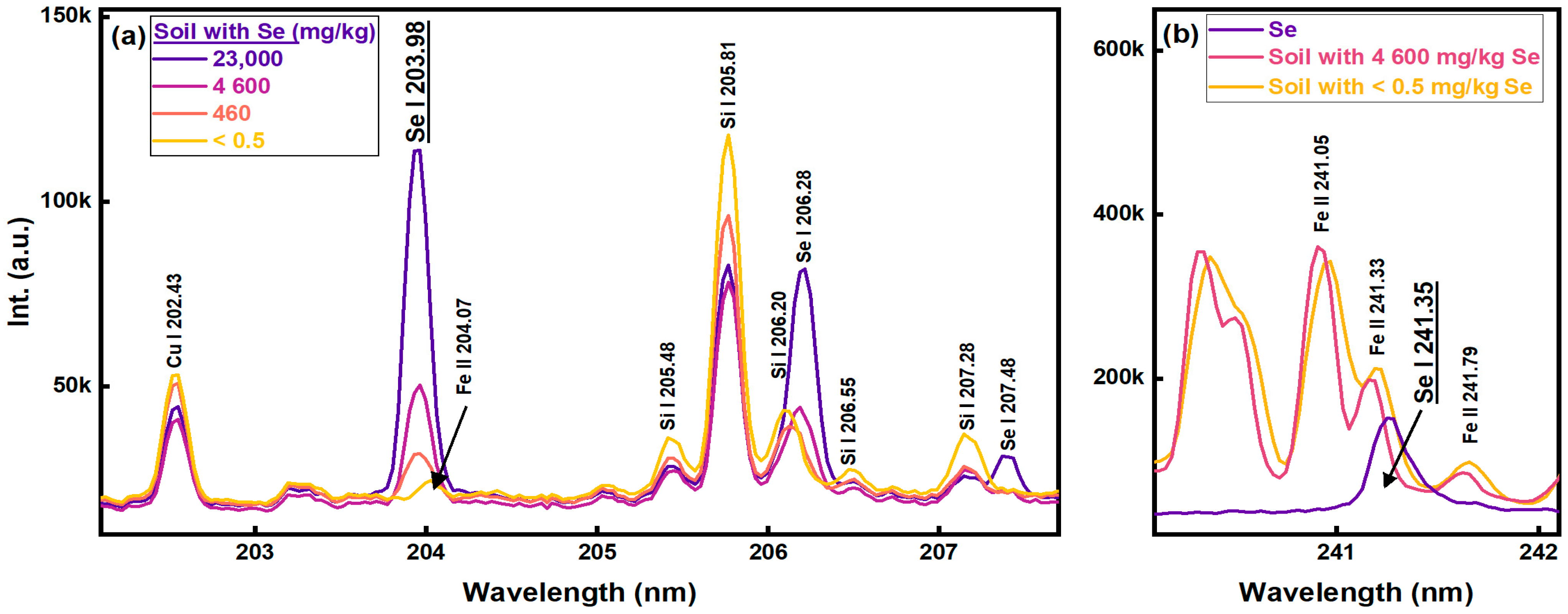
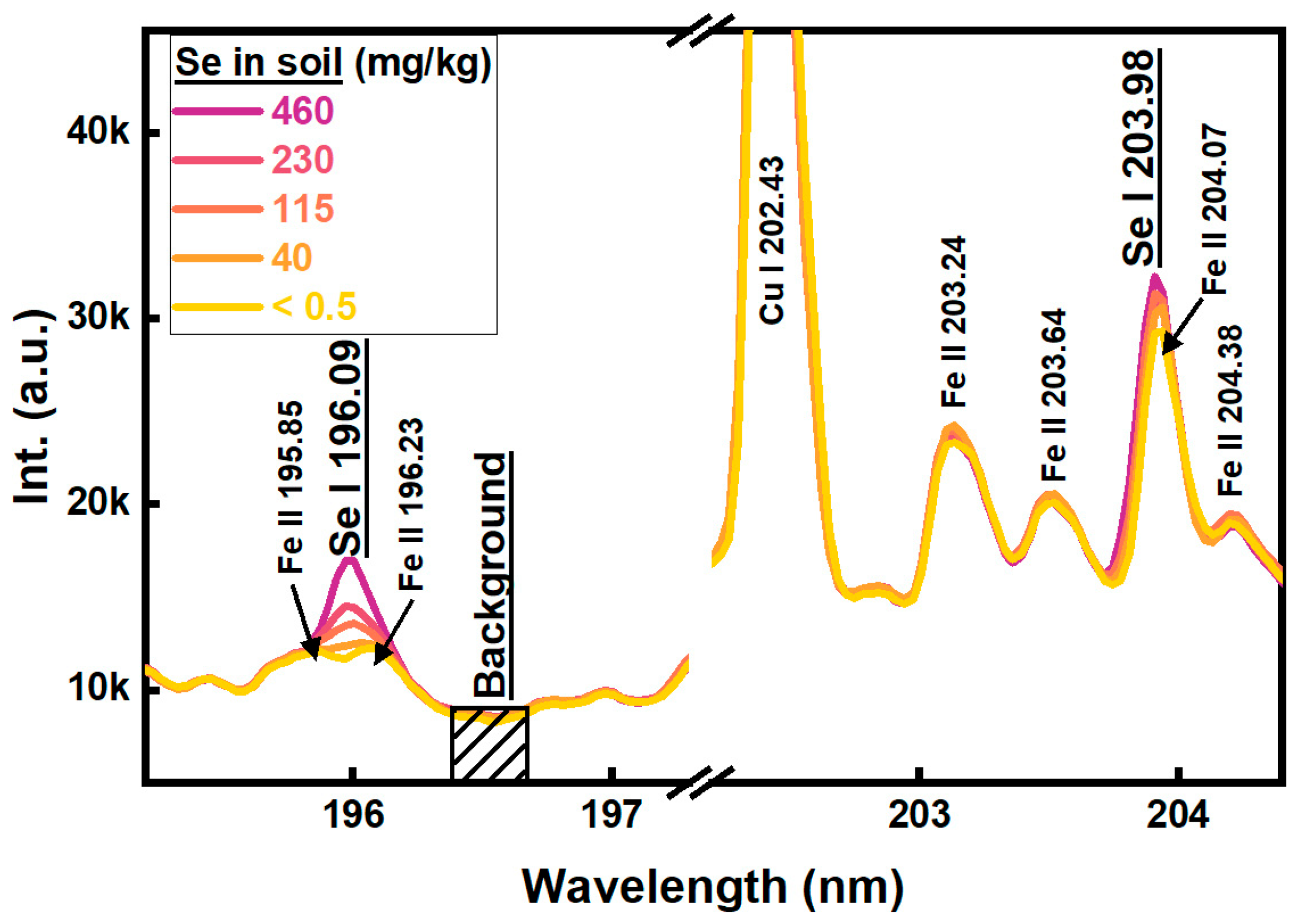
The analytical line choice is challenging for soil analysis since matrix effects and other soil properties complicate the analysis [47,48]. In LIBS literature, selenium in soil or other environments is commonly determined with the following emission lines [39]: Se I 196.09, Se I 203.98, and Se I 241.35 nm. A good enough correlation of the Se I 203.98 nm line with the selenium concentration is observed on Figure 4a, but this line is also spectrally interfered with Fe II 204.07 nm as the selenium concentration drops down below 200 mg/kg (Figure 5). Other soil elements (Zn, Al, Sb) may also contribute to the spectral interference with Se I 203.98 nm. The nearest Se I 206.28 and Se I 207.48 nm lines are not valid for detecting selenium because of their quite low intensity and spectral interference with silicon and other elements lines. The intensive Se I 241.35 nm line cannot be chosen as an analytical line due to spectral interference with the ionic iron lines (Figure 4b). The last candidate Se I 196.09 nm line is traced in the spectrum for concentrations of 40 mg/kg (Figure 5). Still, Fe II 195.85 and Fe II 196.23 nm lines are observed on both sides of Se I 196.09 nm line profile. But ionic iron lines were rather reproducible in the measurements, so the integral of the Se I 196.09 nm line with background correction was an optimal choice for the analytical signal. The background signal was defined as continuous wave plasma emission with the same spectral width as the analyte line at FWHM (full width at half maximum) shifted toward the free-of-lines spectral region.
Due to significant variability in major and minor components in different agricultural soils, some d-elements can spectrally interfere with the Se I 196.09 nm line. In the spectral range of interest, at around 196 nm, the most significant problem is brought by iron. Spectral interference of selenium and iron lines may be a challenge when analyzing iron-rich soils. The soils in our study do not contain much iron, but we can still estimate the potential for distinguishing selenium and iron lines in case of iron-rich samples. The ionic Fe II 195.56 and Fe II 196.23 lines have 13.07 and 13.43 eV upper energy levels, respectively, while atomic Se I 196.09 nm line upper energy level is 6.32 eV. Thanks to this difference in upper energy levels, the Se and Fe lines in different periods of plasma expansion can be distinguished as soon as plasma temperature changes. Thus, one can maximize the Se-to-Fe lines ratio and so to improve the analysis by choosing the correct ablation and detection parameters (for example, the detection gate).

3.3. Laser Sampling and Analytical Performance Comparison

The density of the material influences laser ablation and plasma properties, so LIBS measurements become rather different for loose, fixed, and tableted powder [49]. Single-shot laser craters are compared for different targets in Figure 6. The single pulse ablation of the loose soil powder resulted in a 2 mm deep and 3 mm wide crater (Figure 6a), but the next laser pulse plasma in the same spot had quite low intensity due to uncertainty in lens-to-sample distance. In the case of tape-mounted soil sample laser ablation, the crater diameter was about 0.5 mm (Figure 6b). The second pulse plasma brightness was “weak” since all the material was removed by the first pulse. Consequently, only single pulse per spot LIBS measurements to be made for loose powder and soil mounted on adhesive tape. Tableted soil surface LIBS crater had a diameter of 0.35 mm and a depth of 0.1 mm (Figure 6c,d), and several repeated laser pulses induced rather intensive plasma emission.
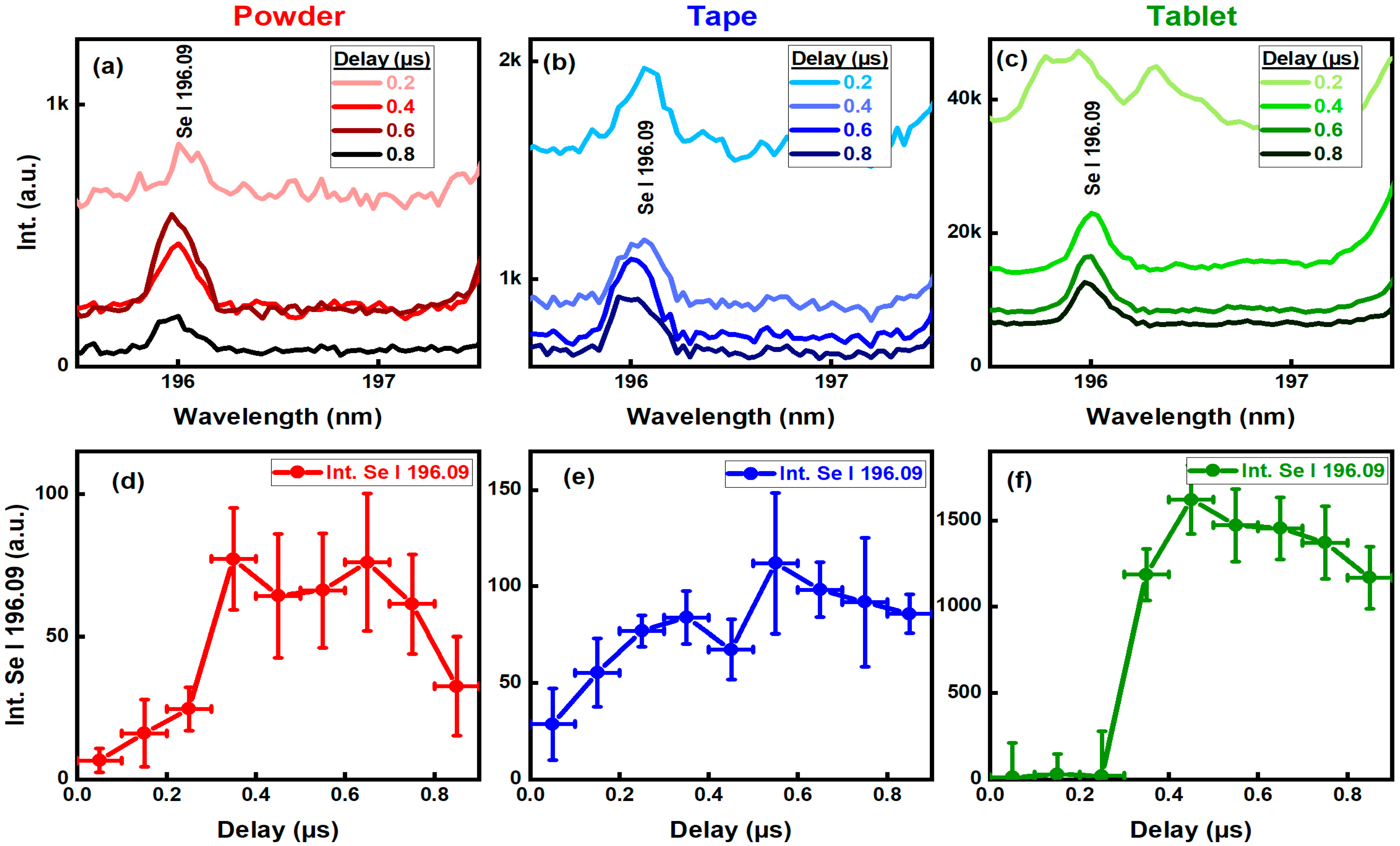
In LIBS, optimal gating is crucial to obtain spectra with quite narrow lines and suitable signal-to-noise ratio [50]. We studied plasma kinetics for different samples to find optimal spectrum capturing time (delays from 0.1 to 2.5 µs) as shown in Figure 7. The analytical signal intensity was quantified as the background-subtracted area under the Se I 196.09 nm line, which actually shows the sum of Se I 196.09, Fe II 195.85, and Fe II 196.23 nm lines. We have approximate the interfered lines by decomposing them into three components (selenium and iron lines), but because of the close lines’ locations and quite wide spectral lines, the fit’s quality was found to be unsatisfactorily low. Since it was not possible to separate these lines by fitting, we chose gating to increase selenium line amplitude. To calculate the background, we quantified intensity near 196.50 nm (the average of 10 data points from 196.39 to 196.68 nm) where no emissions lines were observed. Such a choice can provide some bias for 0.2 μs delay when ionic iron lines are presented, but for longer delays, no lines can be traced in the spectrum, so it was an acceptable choice. The Se I 196.09 nm line signal-to-background ratio was comparable to that for the loose powder and tape-mounted soil samples (Figure 7a,b). The tableted samples spectrum was about 20 times more intense (Figure 7c); it is quite a common approach to improve LIBS powder analysis performance [51]. However, we observed strong spectral interference with iron lines at the delays as low as of about 0.2 µs for the tablet sample. The graphs show that the highest line intensity occurs at different delays for different sample types: 0.3 and 0.6 µs for loose soil powder (Figure 7d), 0.5 µs for tape adhesive-mounted soil (Figure 7e), and 0.4 µs for tableted soil (Figure 7f). Since Se I 196.09 nm line signal quite slowly decreases after its maximum value, then a 0.6 µs delay was a suitable choice to construct calibration curves for all the sample types.
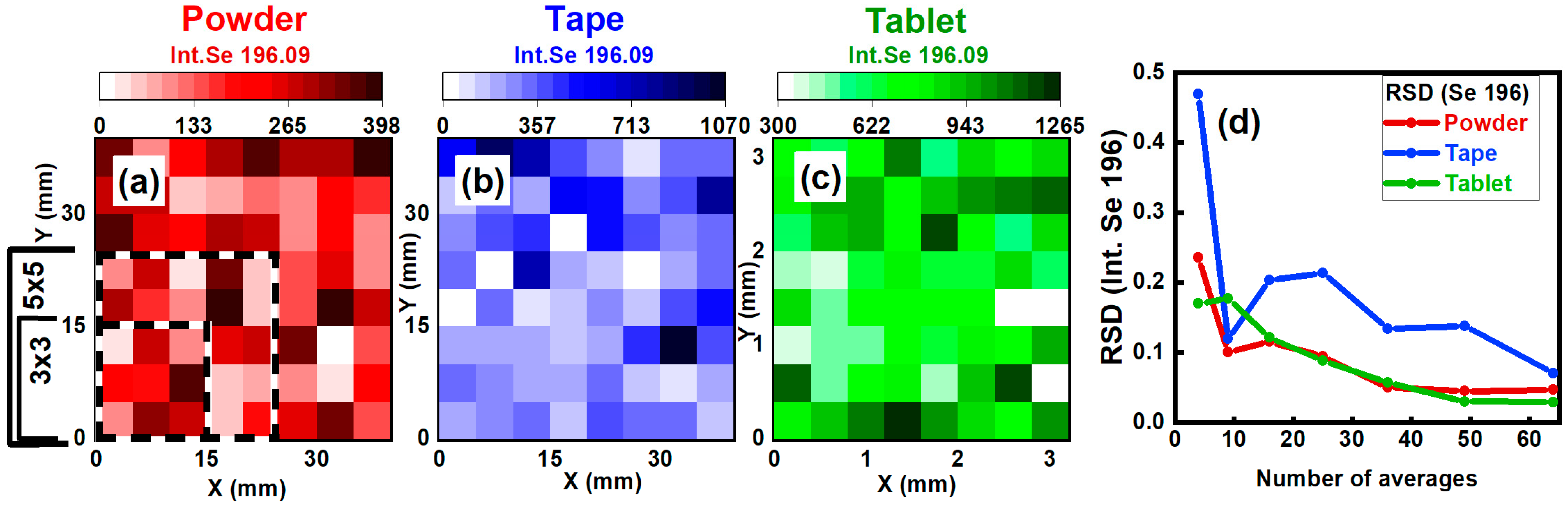
It is known that the sampling area must be significantly larger than the average particle size in the sample for LIBS analysis in order for the sample to be considered homogeneous [52]. In the case under study here, the laser spot size was 350 µm, and the average particle size was 10 µm, so several hundred particles were analyzed. To verify sample homogeneity, we mapped the surface and plotted Se I 196.09 nm signal 8 × 8 spots maps for loose powder, tape-mounted, and tableted soil samples (Figure 8). Given the difference in craters (see the discussion of Figure 6), various steps for mapping were chosen to prevent cratering effect on the LIBS signal: tablet—400 µm step, mounted on tape and loose soil powder—5 mm step (“powder” crater 3 mm in diameter, tape adhesive-mounted powder was scattered by the shot and settled a few mm around a 0.5 mm crater). The show that selenium distribution is not uniform on both 1 and 100 mm2 area, and so a single 350 µm spot analysis, which includes hundreds of soil particles, cannot provide reliable results. To improve LIBS measurement reproducibility, it is convenient to average spectra obtained from a number of different analysis spots. Relative standard deviation (RSD) is an instructive metric to choose an optimal number for averaging. A signal reproducibility of 5–15% is typical for different elements in LIBS analysis [53]. Therefore, in Figure 8d, RSD is plotted as a function of the number of average spectra from different sampling spots. Map points are averaged by squares for convenience, for example, average of 9 measurements in 3 × 3 square, average of 25 in 5 × 5 square (as indicated in Figure 8a), and so on, up to the average of 64 measurements. As Figure 8d shows, RSD, in general, decreases with an increase of the number of averaged spectra. The signal reproducibility for tableted and loose soil powder are comparable with an average of 16 and more spots. In this case, when averaging 25 and more spectra stabilized the LIBS signal, RSD is constantly less than 10%. Signal fluctuations are rather significant for tape-mounted samples, while its RSD is less than 10% only if 64 spectra are averaged.
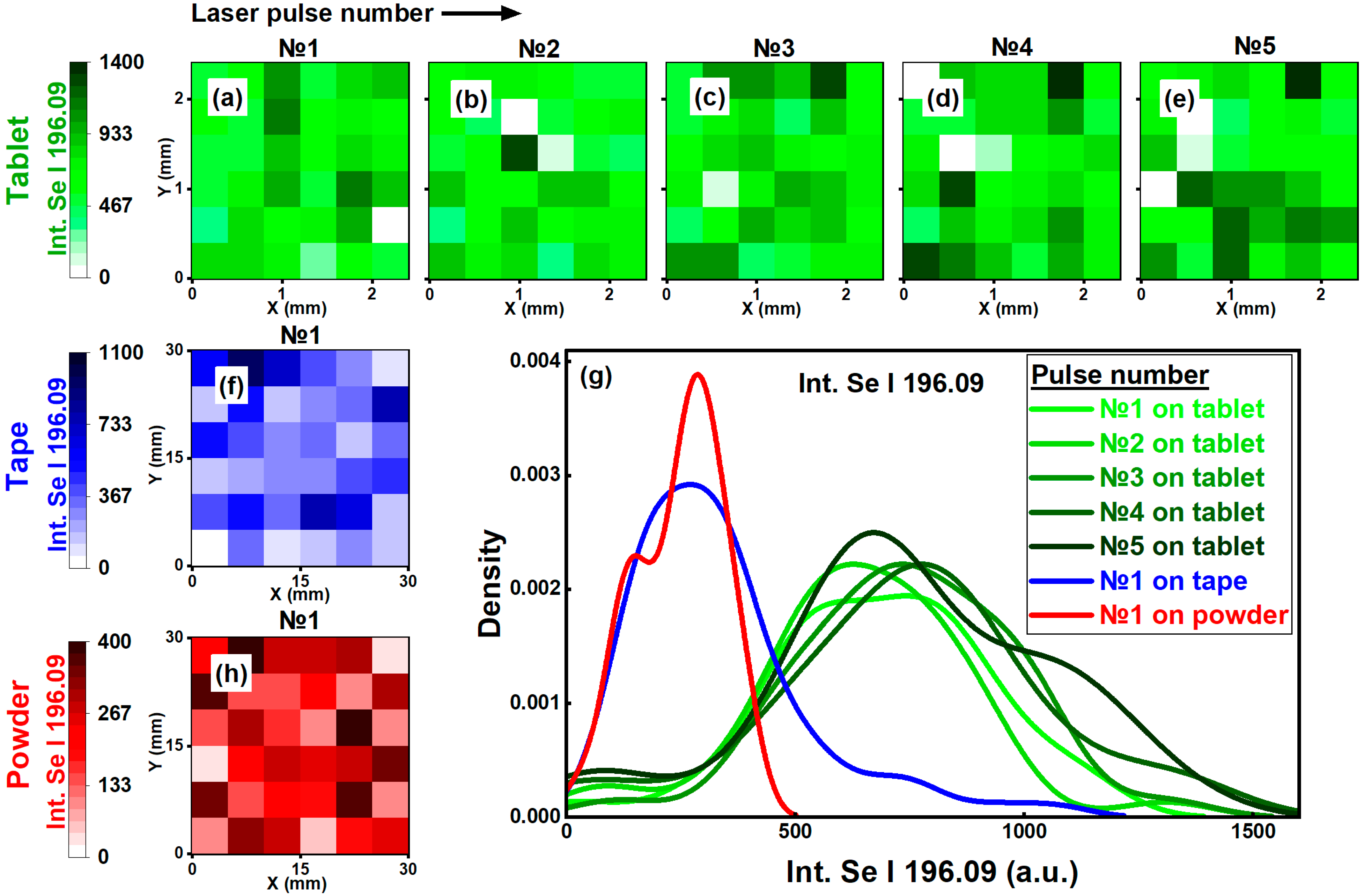
Assuming that the sample surface may potentially be contaminated during tableting, we measured LIBS signal maps for first, second, third, fourth, and fifth ablation pulse per laser spot. One can see that the maps for all laser pulses (Figure 9a–e) differ one from another. This shows the selenium inhomogeneity by depth in the sample. To detect surface contamination, we plot Se I 196.09 nm signal distributions in Figure 9g. The first pulse on the tablet does not differ from other tablet pulses; therefore, no contamination of the sample during tablet preparation can be confirmed. Nevertheless, we plot calibration curves for each pulse number separately and observed quite low correlation of atomic line intensity and selenium concentration for the first pulse, unlike with other pulses (see Figure S1 in Supplementary Materials). This may be caused by both the sample surface contamination and the plasma properties at the tableted sample surface. That is why we discard the first pulse on tablet when constructing calibration curves.
In Figure 9, we also show the first laser pulse maps and Se I 196.09 nm signal distribution for tape adhesive-mounted soil and loose soil powder. One can see that their signal distribution function is much narrower than for tableted samples. This may be explained by the feature that the plasma properties fluctuate for the tablet sample due to the influence of redeposited particles from the previous neighboring craters. Craters on tableted samples were placed quite close to each other because of the need to fit the required number of measurement points onto a 10 mm diameter sample, which is produced in a standard press. Whereas for tape-mounted and powder samples, a distance between the craters was considerably large relative to size of the samples, then, there was minimum of redeposited particle influence.
In addition, the aerosol particles levitated above sample surface may be a significant problem for reproducible LIBS measurements. In the case of soil tablets, the compacted material laser ablation resulted in a 20-fold increase in atomic lines emission in the plasma but induced aerosol, which was stable for seconds and more. The laser plasma can be induced by a levitated particle rather than a sample surface for such stable aerosol. In this case, the plasma absorbs the incoming laser irradiation effectively for 1064 nm and no energy reaches the sample surface. Thus, a relatively low intensity plasma spectrum is captured by the LIBS system. The probability of plasma induction at levitated particles was nearly 40% for tableted soil but decreased to 30% for tape-mounted soil and became 10% for loose powder ablation. The higher probability of bulk materials sampling resulted in reproducible LIBS signals or the narrowest distribution function for loose powder (Figure 9g). In summary, we conclude that if the surface of a loose soil powder sample is leveled well enough and craters are made at a sufficient distance from each other, it is possible to obtain a higher signal repeatability and lower errors than those to be found for pressed tablets and tape-mounted soil.
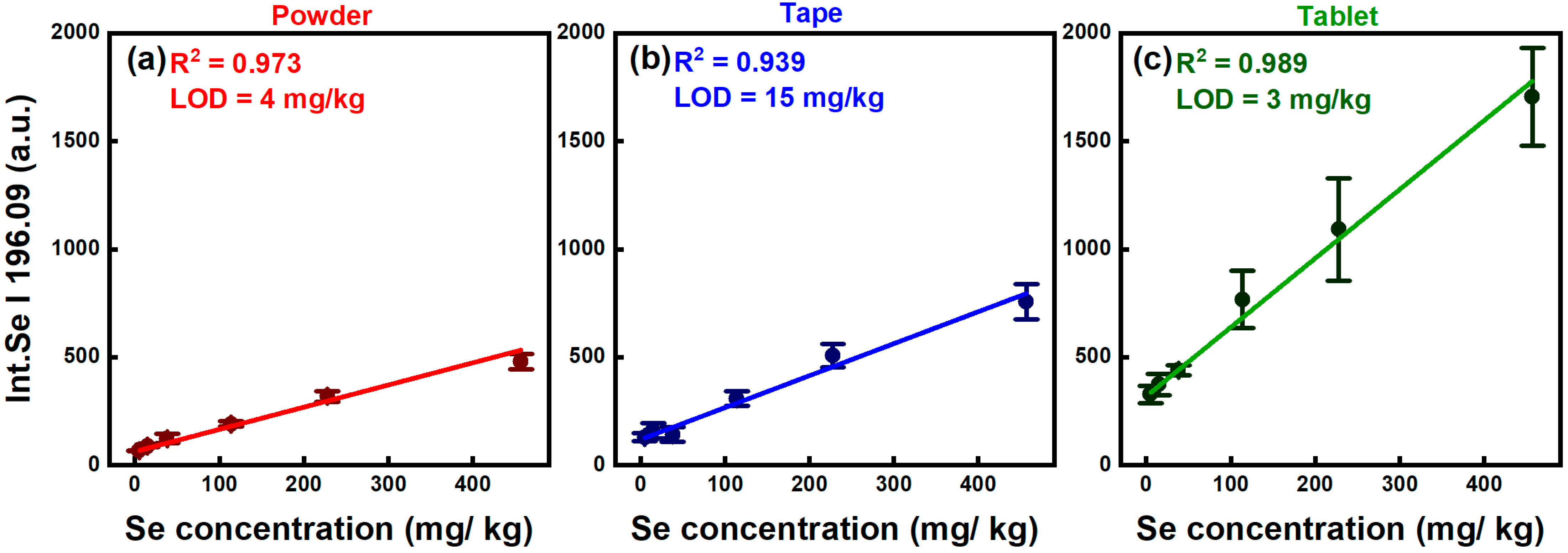
Figure 10 shows the calibration curves (fits) for Se I 196.09 nm line for the selenium concentrations of 5, 15, 40, 115, 230, and 460 mg/kg [54]. To this end, we have obtained 3 points of 18 averaged spectra for each concentration, and then calculated Se I 196.09 nm line signal’s mean value and the corresponding error. A linear correlation between line intensity and selenium concentration in soil is established. The Se I 196.09 nm line is a resonance line, but according to Figure 10, no a self-absorption is observed.
To quantify the impact of the spectra averaging on LIBS analysis, we averaged 3, 9, and 18 spectra and plotted calibration curves to estimate curve’s linearity (the coefficient of determination R2), LOD, and root mean square error of cross validation (RMSECV), which is used to evaluate the accuracy of chemical analysis (Table 1). The calibration linearity (R2) is rather satisfactory (0.912 to 0.989) for tableted and loose soil powder samples, but in the case of tape-mounted samples, R2 decreased down to 0.786. LODs were calculated in accordance with the International Union of Pure and Applied Chemistry (IUPAC) recommendations [55] as
LOD = 3σ/s,
where σ denotes a standard deviation for the background for sample with lowest analyte content, s denotes sensitivity (calibration curve slope). It is worth to note that the LOD value depends on the background reproducibility, but accurate estimate needs to be based on LIBS signal distribution functions as shown recently [56,57,58]. However, accurate LOD estimate required large datasets (more than 100 data points) [57]. Given future express field LIBS analyses, it is practical to choose at least ten sampling spots. Thus, “3-σ rule” is appropriate and commonly accepted for LOD estimate. The background signal standard deviation was derived from 18 replicate measurements of blank soil sample (Se of less than 0.5 mg/kg content). We achieved 3 and 4 mg/kg LOD for 18 averaged spectra on tableted and loose powder samples, respectively. As shown in Table 1 for all types of samples, the reproducibility improves with increased averaging. For soil samples mounted on tape, LOD values become similar to that for tableted samples (15 mg/kg) with sufficient signal averaging. This believed to be the main reason for quite poor LOD in the case of tape-mounted soil analysis (Figure 10b), unlike loose soil powder measurements (Figure 10a). Despite the lower plasma intensity, the signal distribution function of the powder sample is the narrowest (Figure 9g), which also applies to its background. RMSECV has a narrower range of values for tableted samples (29–64 mg/kg), is somewhat wider for loose powder samples (40–89 mg/kg) and is in the widest range for tape-mounted soil (43–101 mg/kg). As a result, due to better signal reproducibility for loose powder ablation, one can achieve LIBS analytical performance comparable to that of tablets if an appropriately large amount of data are averaged. This result approaches us to the future application of LIBS for online and automated remote chemical analysis and mapping of agricultural fields by the compact instrument installed at tractor during plowing or land cultivation.
While selenium LOD of a few ppm in soils have been determined for the first time by LIBS technique in this paper, the current research has to be continued to reach sensitivity at a sub-ppm level. Consideration of the in-filed measurements suggests a few ways to improve the selenium analysis sensitivity by LIBS. First, we consider to perform double-pulse LIBS measurements, which are known to enhance signals of an order of magnitude [59]. Another way is to utilize an external magnetic field to enhance the signal-to-noise ratio for plasma emission [60]. Then, multivariate calibration with all the selenium lines in the plasma spectrum may be a suitable to improve LIBS analysis [59]. Finally, one can perform LIBS spectral data processing by employing chemometrics and artificial intelligence techniques [61,62].

4. Conclusions

For the first time, selenium was quantitatively determined in soil by LIBS. The Se I 196.09 nm line has proven to be the optimal choice for the analytical signal, due to minor spectral interference with other soil elements emission lines. The influence of different sample preparation methods was studied for soil LIBS analysis. Various sample types (loose soil powder, mounted on adhesive tape and tableted soil) were found to provide different LIBS spectra, but signal reproducibility for tablet and loose powder was obtained to be equal and having nearly the same atomic line reproducibility of less that 10% when averaging 25 or more spectra. LIBS sampling of tape-mounted samples required averaging 64 spectra or more to obtain a reproducibility of 10%. Selenium calibration curves for tableted and loose soil powder samples had similar linearity (R2 spanning 0.912 to 0.989) for averaging different numbers of spectra, in contrast to tape-mounted samples with an average of 3 and 9 spectra (R2 = 0.786 and 0.854, respectively). The best sensitivity was achieved for tablet samples with 18 and 9 averaged spectra (LOD = 3 and 15 mg/kg, respectively); loose soil powder showed a similar result (LOD = 4 and 23 mg/kg, respectively), while LOD for soil mounted on tape was only the same if more signal accumulated and a sufficient number of points were summed up (LOD = 15 mg/kg if 18 were averaged). Despite the best limit of detection being obtained from the tableted sample, loose powder may provide a similar result if the sample is well-prepared and sufficient amount of data is processed. The results obtained bring us closer towards the development of an online automatic LIBS system for a continuous soil control integrated into agriculture machinery.

Supplementary Materials

The following supporting information can be downloaded at https://www.mdpi.com/article/10.3390/physics8010009/s1, Figure S1: Se calibration curves for first, third, and fifth ablating pulses per spot for tableted soil samples. Table S1: Observed selenium lines in our LIBS spectrum of pure selenium.

Author Contributions

Conceptualization, V.N.L.; software, P.A.S.; investigation, A.V.R., V.N.L., and P.A.S.; resources, A.Y.I. and S.V.G.; data curation, A.V.R.; writing—original draft preparation, A.V.R.; writing—review and editing, V.N.L., P.A.S. and I.Y.S.; visualization, A.V.R. and P.A.S.; supervision, V.N.L. and S.V.G.; project administration, A.Y.I. and A.S.D.; funding acquisition, A.Y.I. and A.S.D. All authors have read and agreed to the published version of the manuscript.

Funding

This research was funded by a grant from the Ministry of Science and Higher Education of the Russian Federation for large scientific projects in priority areas of scientific and technological development (subsidy identifier 075-15-2024-540).

Data Availability Statement

The data used in the article are available from Ref. [54].

Acknowledgments

Authors acknowledge Sergey V. Kuznetsov for assistance in sample preparation.

Conflicts of Interest

The authors declare no conflicts of interest.

Abbreviations

The following abbreviations are used in this manuscript:
AASatomic absorption spectrometry
AESatomic emission spectrometry
AFSatomic fluorescence spectrometry
DGdigital generator
FWHMfull width at half maximum
GFgraphite furnace
“GIC PV”Main Testing Center for Drinking Water (abbreviated in Russian)
HGhydride generation
ICCDintensified charge-coupled device
ICPinductively coupled plasma
Int.intensity
IUPACInternational Union of Pure and Applied Chemistry
LAlaser ablation
LIBSlaser-induced breakdown spectrometry
LLCLimited Liability Company
LODlimit of detection
MSmass spectrometry
Ndneodymium-doped
PCpersonal computer
RMSECVroot mean square error of cross-alidation
RSDrelative standard deviation
XRFX-ray fluorescence
YAGyttrium aluminum garnet

References

  1. Kuršvietienė, L.; Mongirdienė, A.; Bernatonienė, J.; Šulinskienė, J.; Stanevičienė, I. Selenium anticancer properties and impact on cellular redox status. Antioxidants 2020, 9, 80. [Google Scholar] [CrossRef]
  2. Gebbers, R.; Adamchuk, V.I. Precision agriculture and food security. Science 2010, 327, 828–831. [Google Scholar] [CrossRef]
  3. Fordyce, F.M. Selenium deficiency and toxicity in the environment. In Essentials of Medical Geology; Selinus, O., Alloway, B., Centeno, J.A., Finkelman, R.B., Fuge, R., Lindh, U., Smedley, P., Eds.; Springer Science+Business Media: Dordrecht, The Netherlands, 2013; pp. 375–416. [Google Scholar] [CrossRef]
  4. Gudkov, S.V.; Sarimov, R.M.; Astashev, M.E.; Pishchalnikov, R.Y.; Yanykin, D.V.; Simakin, A.V.; Shkirin, A.V.; Serov, D.A.; Konchekov, E.M.; Gusein-zade, N.G.; et al. Modern physical methods and technologies in agriculture. Phys. Uspekhi 2024, 67, 194–210. [Google Scholar] [CrossRef]
  5. Favorito, J.E.; Grossl, P.R.; Davis, T.Z.; Eick, M.J.; Hankes, N. Soil–plant–animal relationships and geochemistry of selenium in the Western Phosphate Resource Area (United States): A review. Chemosphere 2021, 266, 128959. [Google Scholar] [CrossRef] [PubMed]
  6. Perkins, W.T. Extreme selenium and tellurium contamination in soils—An eighty year-old industrial legacy surrounding a Ni refinery in the Swansea Valley. Sci. Total Environ. 2011, 412–413, 162–169. [Google Scholar] [CrossRef] [PubMed]
  7. McNeal, J.M.; Balistrieri, L.S. Geochemistry and occurrence of selenium: An overview. In Selenium in Agricuture and the Environment; Jacobs, L.W., Chang, A.C., Dowdy, R.H., Severson, R.C., Sommers, L.E., Volk, V.V., Eds.; American Society of Agronomy, Inc.: Madison, WI, USA; Soil Science Society of America, Inc.: Madison, WI, USA, 1989; pp. 1–13. [Google Scholar] [CrossRef]
  8. Feinberg, A.; Stenke, A.; Peter, T.; Hinckley, E.-L.S.; Driscoll, C.T.; Winkel, L.H.E. Reductions in the deposition of sulfur and selenium to agricultural soils pose risk of future nutrient deficiencies. Commun. Earth Environ. 2021, 2, 101. [Google Scholar] [CrossRef]
  9. Soil Sampling and Methods of Analysis; Carter, M.R., Gregorich, E.G., Eds.; Canadian Society of Soil Science: Pinawa, MB, Canada; CRC Press/Taylor & Francis Group: Boca Raton, FL, USA, 2008. [Google Scholar] [CrossRef]
  10. Mikkelsen, R.L.; Page, A.L.; Bingham, F.T. Factors affecting selenium accumulation by agricultural crops. In Selenium in Agricuture and the Environment; Jacobs, L.W., Chang, A.C., Dowdy, R.H., Severson, R.C., Sommers, L.E., Volk, V.V., Eds.; American Society of Agronomy, Inc.: Madison, WI, USA; Soil Science Society of America, Inc.: Madison, WI, USA, 1989; pp. 65–94. [Google Scholar] [CrossRef]
  11. White, P.J. Selenium metabolism in plants. Biochim. Biophys. Acta Gen. Subj. 2018, 1862, 2333–2342. [Google Scholar] [CrossRef] [PubMed]
  12. Schiavon, M.; Nardi, S.; Dalla Vecchia, F.; Ertani, A. Selenium biofortification in the 21st century: Status and challenges for healthy human nutrition. Plant Soil 2020, 453, 245–270. [Google Scholar] [CrossRef]
  13. Teixeira, L.S.; Pimenta, T.M.; Brito, F.A.L.; Malheiros, R.S.P.; Arruda, R.S.; Araújo, W.L.; Ribeiro, D.M. Selenium uptake and grain nutritional quality are affected by nitrogen fertilization in rice (Oryza sativa L.). Plant Cell Rep. 2021, 40, 871–880. [Google Scholar] [CrossRef]
  14. Semenova, N.A.; Burmistrov, D.E.; Shumeyko, S.A.; Gudkov, S.V. Fertilizers based on nanoparticles as sources of macro- and microelements for plant crop growth: A review. Agronomy 2024, 14, 1646. [Google Scholar] [CrossRef]
  15. Burmistrov, D.E.; Shumeyko, S.A.; Semenova, N.A.; Dorokhov, A.S.; Gudkov, S.V. Selenium nanoparticles (Se NPs) as agents for agriculture crops with multiple activity: A review. Agronomy 2025, 15, 1591. [Google Scholar] [CrossRef]
  16. Ferro, C.; Florindo, H.F.; Santos, H.A. Selenium nanoparticles for biomedical applications: From development and characterization to therapeutics. Adv. Healthc. Mater. 2021, 10, 2100598. [Google Scholar] [CrossRef]
  17. Gudkov, S.V.; Shafeev, G.A.; Glinushkin, A.P.; Shkirin, A.V.; Barmina, E.V.; Rakov, I.I.; Simakin, A.V.; Kislov, A.V.; Astashev, M.E.; Vodeneev, V.A.; et al. Production and use of selenium nanoparticles as fertilizers. ACS Omega 2020, 5, 17767–17774. [Google Scholar] [CrossRef] [PubMed]
  18. Sariñana-Navarrete, M.D.L.Á.; Morelos-Moreno, Á.; Sánchez, E.; Cadenas-Pliego, G.; Benavides-Mendoza, A.; Preciado-Rangel, P. Selenium nanoparticles improve quality, bioactive compounds and enzymatic activity in Jalapeño pepper fruits. Agronomy 2023, 13, 652. [Google Scholar] [CrossRef]
  19. Sardari, M.; Rezayian, M.; Niknam, V. Comparative study for the effect of selenium and nano-selenium on wheat plants grown under drought stress. Russ. J. Plant Physiol. 2022, 69, 127. [Google Scholar] [CrossRef]
  20. Morales-Espinoza, M.C.; Cadenas-Pliego, G.; Pérez-Alvarez, M.; Hernández-Fuentes, A.D.; Cabrera De La Fuente, M.; Benavides-Mendoza, A.; Valdés-Reyna, J.; Juárez-Maldonado, A. Se Nanoparticles induce changes in the growth, antioxidant responses, and fruit quality of tomato developed under NaCl stress. Molecules 2019, 24, 3030. [Google Scholar] [CrossRef]
  21. Ahmad, A.; Javad, S.; Iqbal, S.; Shahzadi, K.; Gatasheh, M.K.; Javed, T. Alleviation potential of green-synthesized selenium nanoparticles for cadmium stress in Solanum lycopersicum L: Modulation of secondary metabolites and physiochemical attributes. Plant Cell Rep. 2024, 43, 113. [Google Scholar] [CrossRef] [PubMed]
  22. Farooq, M.A.; Islam, F.; Ayyaz, A.; Chen, W.; Noor, Y.; Hu, W.; Hannan, F.; Zhou, W. Mitigation effects of exogenous melatonin-selenium nanoparticles on arsenic-induced stress in Brassica napus. Environ. Pollut. 2022, 292, 118473. [Google Scholar] [CrossRef] [PubMed]
  23. Antanaitis, A.; Lubyte, J.; Antanaitis, S.; Staugaitis, G.; Viskelis, P. Selenium concentration dependence on soil properties. J. Food Agric. Environ. 2008, 6, 163–167. [Google Scholar]
  24. Roca-Perez, L.; Gil, C.; Cervera, M.L.; Gonzálvez, A.; Ramos-Miras, J.; Pons, V.; Bech, J.; Boluda, R. Selenium and heavy metals content in some Mediterranean soils. J. Geochem. Explor. 2010, 107, 110–116. [Google Scholar] [CrossRef]
  25. Senesi, G.S.; Harmon, R.S.; Hark, R.R. Field-portable and handheld laser-induced breakdown spectroscopy: Historical review, current status and future prospects. Spectrochim. Acta B At. Spectrosc. 2021, 175, 106013. [Google Scholar] [CrossRef]
  26. Basler, C.; Brandenburg, A.; Michalik, K.; Mory, D. Comparison of laser pulse duration for the spatially resolved measurement of coating thickness with laser-induced breakdown spectroscopy. Sensors 2019, 19, 4133. [Google Scholar] [CrossRef] [PubMed]
  27. Lazic, V.; Andreoli, F.; Almaviva, S.; Pistilli, M.; Menicucci, I.; Ulrich, C.; Schnürer, F.; Chirico, R. A Novel LIBS sensor for sample examinations on a crime scene. Sensors 2024, 24, 1469. [Google Scholar] [CrossRef]
  28. Kalnicky, D.J.; Singhvi, R. Field portable XRF analysis of environmental samples. J. Hazard. Mater. 2001, 83, 93–122. [Google Scholar] [CrossRef]
  29. Hahn, D.W.; Omenetto, N. Laser-induced breakdown spectroscopy (LIBS). Part II: Review of instrumental and methodological approaches to material analysis and applications to different fields. Appl. Spectrosc. 2012, 66, 347–419. [Google Scholar] [CrossRef]
  30. Skrabatun, A.V.; Umanskaya, S.F.; Shevchenko, M.A.; Matrokhin, A.A.; Maresev, A.N.; Tcherniega, N.V. Synthetic opals in laser-induced breakdown spectroscopy problems. Phys. Wave Phenom. 2023, 31, 51–58. [Google Scholar] [CrossRef]
  31. Maresev, A.N.; Shevchenko, M.A.; Tcherniega, N.V.; Umanskaya, S.F.; Karpov, M.A.; Kudryavtseva, A.D.; Voronova, V.V.; Lisichkin, G.V. LIBS efficiency increase via plasmonic nanoparticles in the study of synthetic opal matrices. Phys. Wave Phenom. 2024, 32, 164–170. [Google Scholar] [CrossRef]
  32. Jantzi, S.C.; Almirall, J.R. Elemental analysis of soils using laser ablation inductively coupled plasma mass spectrometry (LA-ICP-MS) and laser-induced breakdown spectroscopy (LIBS) with multivariate discrimination: Tape mounting as an alternative to pellets for small forensic transfer specimens. Appl. Spectrosc. 2014, 68, 963–974. [Google Scholar] [CrossRef]
  33. Almaviva, S.; Colao, F.; Menicucci, I.; Pistilli, M. Double pulse LIBS analysis of metallic coatings of fusionistic interest: Depth profiling and semi-quantitative elemental composition by applying the calibration free technique. J. Nucl. Eng. 2023, 4, 193–203. [Google Scholar] [CrossRef]
  34. Menegatti, C.R.; Nicolodelli, G.; Senesi, G.S.; Da Silva, O.A.; Filho, H.J.I.; Villas Boas, P.R.; Marangoni, B.S.; Milori, D.M.B.P. Semiquantitative analysis of mercury in landfill leachates using double-pulse laser-induced breakdown spectroscopy. Appl. Opt. 2017, 56, 3730–3735. [Google Scholar] [CrossRef] [PubMed]
  35. El Haddad, J.; Villot-Kadri, M.; Ismaël, A.; Gallou, G.; Michel, K.; Bruyère, D.; Laperche, V.; Canioni, L.; Bousquet, B. Artificial neural network for on-site quantitative analysis of soils using laser induced breakdown spectroscopy. Spectrochim. Acta. B At. Spectrosc. 2013, 79–80, 51–57. [Google Scholar] [CrossRef]
  36. Martin, M.Z.; Labbé, N.; André, N.; Wullschleger, S.D.; Harris, R.D.; Ebinger, M.H. Novel multivariate analysis for soil carbon measurements using laser-induced breakdown spectroscopy. Soil Sci. Soc. Am. J. 2010, 74, 87–93. [Google Scholar] [CrossRef]
  37. Leva Borduchi, L.C.; Menegatti, C.R.; Bastos Pereira Milori, D.M.; Izário Filho, H.J.; Villas-Boas, P.R. Application of one-point calibration LIBS for quantification of analytes in samples with distinct matrix characteristics: A case study with Hg. J. Anal. At. Spectrom. 2023, 38, 1155–1163. [Google Scholar] [CrossRef]
  38. Jantzi, S.C.; Motto-Ros, V.; Trichard, F.; Markushin, Y.; Melikechi, N.; De Giacomo, A. Sample treatment and preparation for laser-induced breakdown spectroscopy. Spectrochim. Acta B At. Spectrosc. 2016, 115, 52–63. [Google Scholar] [CrossRef]
  39. Koskelo, A.; Cremers, D.A. RCRA Materials Analysis by Laser-Induced Breakdown Spectroscopy: Detection Limits in Soils; Technical Report LA–UR 94–1544; Los Alamos National Laboratory: Los Alamos, NM, USA, 1994. [CrossRef][Green Version]
  40. Simeonsson, J.B.; Williamson, L.J. Characterization of laser induced breakdown plasmas used for measurements of arsenic, antimony and selenium hydrides. Spectrochim. Acta B At. Spectrosc. 2011, 66, 754–760. [Google Scholar] [CrossRef]
  41. Lee, S.H.; Kwon, S.-W.; Lee, Y.; Nam, S.-H. Fast and simple selenium speciation by solid phase extraction and laser-induced breakdown spectroscopy. J. Anal. Sci. Technol. 2020, 11, 27. [Google Scholar] [CrossRef]
  42. IUSS Working Group WRB. World Reference Base for Soil Resources: International Soil Classification System for Naming Soils and Creating Legends for Soil Maps, 4th ed.; International Union of Soil Sciences (IUSS): Vienna, Austria, 2024; Available online: https://wrb.isric.org/documents/ (accessed on 2 November 2025).
  43. Wang, Z.; Afgan, M.S.; Gu, W.; Song, Y.; Wang, Y.; Hou, Z.; Song, W.; Li, Z. Recent advances in laser-induced breakdown spectroscopy quantification: From fundamental understanding to data processing. Trends Anal. Chem. (TrAC) 2021, 143, 116385. [Google Scholar] [CrossRef]
  44. NIST ASD Team. Atomic Spectra Database: NIST Standard Reference Database 78, Version 5.12; National Institute of Standards and Technology (NIST): Gaithersburg, MD, USA, 2024. [CrossRef]
  45. Zaidel’, A.N.; Prokof’ev, V.K.; Raiskii, S.M.; Slavnyi, V.A.; Shreider, E.Y. Tables of Spectral Lines; Plenum Publishing Corporation/Springer Science+Business Media, LLC: New York, NY, USA, 1970. [Google Scholar] [CrossRef]
  46. Atomic Spectral Line Database from CD-ROM 23 of R. L. Kurucz. Available online: https://lweb.cfa.harvard.edu/amp/ampdata/kurucz23/sekur.html (accessed on 2 November 2025).
  47. Popov, A.M.; Zaytsev, S.M.; Seliverstova, I.V.; Zakuskin, A.S.; Labutin, T.A. Matrix effects on laser-induced plasma parameters for soils and ores. Spectrochim. Acta B At. Spectrosc. 2018, 148, 205–210. [Google Scholar] [CrossRef]
  48. Popov, A.M.; Labutin, T.A.; Zaytsev, S.M.; Seliverstova, I.V.; Zorov, N.B.; Kal’ko, I.A.; Sidorina, Y.N.; Bugaev, I.A.; Nikolaev, Y.N. Determination of Ag, Cu, Mo and Pb in soils and ores by laser-induced breakdown spectrometry. J. Anal. At. Spectrom. 2014, 29, 1925–1933. [Google Scholar] [CrossRef]
  49. Shi, L.; Lin, Q.; Duan, Y. A novel specimen-preparing method using epoxy resin as binding material for LIBS analysis of powder samples. Talanta 2015, 144, 1370–1376. [Google Scholar] [CrossRef]
  50. Yalçın, Ş.; Örer, S.; Turan, R. 2-D analysis of Ge implanted SiO2 surfaces by laser-induced breakdown spectroscopy. Spectrochim. Acta B At. Spectrosc. 2008, 63, 1130–1138. [Google Scholar] [CrossRef][Green Version]
  51. Lednev, V.N.; Sdvizhenskii, P.A.; Grishin, M.Y.; Nikitin, E.A.; Gudkov, S.V.; Pershin, S.M. Improving calibration strategy for LIBS heavy metals analysis in agriculture applications. Photonics 2021, 8, 563. [Google Scholar] [CrossRef]
  52. Lednev, V.N.; Sdvizhenskii, P.A.; Grishin, M.Y.; Gudkov, S.V.; Dorokhov, A.S.; Bunkin, A.F.; Pershin, S.M. Improving the LIBS analysis of heavy metals in heterogeneous agricultural samples utilizing large laser spotting. J. Anal. At. Spectrom. 2022, 37, 2563–2572. [Google Scholar] [CrossRef]
  53. Ren, J.; Zhao, Y.; Yu, K. LIBS in agriculture: A review focusing on revealing nutritional and toxic elements in soil, water, and crops. Comput. Electron. Agric. 2022, 197, 106986. [Google Scholar] [CrossRef]
  54. Rogachevskaya, A. Se in Soil by LIBS Calibration; Elsevier Inc. (Mendeley Data): Amsterdam, The Netherlands, 2025. [Google Scholar] [CrossRef]
  55. Currie, L.A. Nomenclature in evaluation of analytical methods including detection and quantification capabilities (IUPAC Recommendations 1995). Pure Appl. Chem. 1995, 67, 1699–1723. [Google Scholar] [CrossRef]
  56. Poggialini, F.; Legnaioli, S.; Campanella, B.; Cocciaro, B.; Lorenzetti, G.; Raneri, S.; Palleschi, V. Calculating the limits of detection in laser-induced breakdown spectroscopy: Not as easy as it might seem. Appl. Sci. 2023, 13, 3642. [Google Scholar] [CrossRef]
  57. Lednev, V.N.; Sdvizhenskii, P.A.; Liu, D.S.; Gorudko, I.V.; Pershin, S.M.; Bunkin, A.F. Signal distribution impact on limit of detection in laser-induced breakdown spectroscopy. Spectrochim. Acta B At. Spectrosc. 2024, 213, 106864. [Google Scholar] [CrossRef]
  58. Lednev, V.N.; Sdvizhenskii, P.A.; Liu, D.; Gudkov, S.V.; Pershin, S.M. Non-Gaussian Signal Statistics’ Impact on LIBS Analysis. Photonics 2023, 11, 23. [Google Scholar] [CrossRef]
  59. Safi, A.; Campanella, B.; Grifoni, E.; Legnaioli, S.; Lorenzetti, G.; Pagnotta, S.; Poggialini, F.; Ripoll-Seguer, L.; Hidalgo, M.; Palleschi, V. Multivariate calibration in Laser-Induced Breakdown Spectroscopy quantitative analysis: The dangers of a ‘black box’ approach and how to avoid them. Spectrochim. Acta B At. Spectrosc. 2018, 144, 46–54. [Google Scholar] [CrossRef]
  60. Khan, M.R.; Haq, S.U.; Abbas, Q.; Nadeem, A. Magnetic field confined laser-induced plasma: Improvement in sensitivity and repeatability. Spectrochim. Acta B At. Spectrosc. 2023, 200, 106612. [Google Scholar] [CrossRef]
  61. Zhang, T.; Tang, H.; Li, H. Chemometrics in laser-induced breakdown spectroscopy. J. Chemom. 2018, 32, e2983. [Google Scholar] [CrossRef]
  62. Zhang, C.; Zhou, L.; Liu, F.; Huang, J.; Peng, J. Application of deep learning in laser-induced breakdown spectroscopy: A review. Artif. Intell. Rev. 2023, 56, 2789–2823. [Google Scholar] [CrossRef]
Figure 1. Experimental setup scheme for soil analysis by laser-induced breakdown spectrometry (LIBS). Nd:YAG—neodymium-doped yttrium aluminum garnet, PC—personal computer, ICCD—intensified charge-coupled device camera.
Physics 08 00009 g001
Figure 2. Soil samples: (a) loose soil powder in a container, (b) tape adhesive-mounted soil powder, and (c) soil powder pressed into a tablet, and the corresponding close-up views of surfaces of the samples (d), (e) and (f), respectively as determined by box colors. The values shown in the bottom of the boxes denote the scale corresponding to white interval.
Physics 08 00009 g002
Figure 3. LIBS spectrum of pure selenium in 185–295 nm spectral range (gate 10 µs, delay 4 µs). The notations of the selenium lines used in the study are underlined.
Physics 08 00009 g003
Figure 4. LIBS spectra of tableted soil with (a) 0.5–23,000 mg/kg Se in the range of 200–208 nm (gate 2 µs, delay 2.5 µs) and (b) 4600 mg/kg Se in the range of 240–242 nm (gate 0.1 µs, delay 2 µs). The notations of selenium lines used in this study are underlined.
Physics 08 00009 g004
Figure 5. LIBS spectra of tableted soil samples with 0.5–460 mg/kg Se (gate 10 µs, delay 0.8 µs). The notations of selenium lines used in this study are underlined. Background signal (the hatched area) was defined as an area without any spectral line.
Physics 08 00009 g005
Figure 6. LIBS spots on soil samples surface: (a) loose soil powder, (b) tape adhesive-mounted soil powder, and (c) pressed soil powder (c) with a close-up view (d). The spot size is of 3 mm on loose soil, 0.5 mm on tape, and 0.35 mm on tablet. The values show the scale denoting by the white interval.
Physics 08 00009 g006
Figure 7. LIBS spectra (ac) and Se I 196.09 nm signal evolution (df) for loose soil powder ((a,d), red), tape adhesive-mounted ((b,e), blue), and tableted soil ((c,f), green). Soil with 460 mg/kg Se, gate 10 µs, delay step 0.1 µs was used.
Physics 08 00009 g007
Figure 8. Se I 196.09 nm line intensity maps (ac) for loose soil powder ((a), red), tape adhesive-mounted ((b), blue), and tableted soil ((c), green). Relative standard deviation (RSD) of Se I 196.09 nm line integral (d) dependence on the sampling area increase (square of 3 × 3 representing averages of 9 spots, 5 × 5 representing averages of 25 spots and so on). Soil with 115 mg/kg Se, gate 10 µs, delay 0.6 μs was used.
Physics 08 00009 g008
Figure 9. Se I 196.09 nm line intensity maps for tableted ((ae), green), tape adhesive-mounted ((f), blue), and loose soil powder ((h), red) samples per laser pulse and its distribution function (g) for first (a,f,h), second (b), third (c), fourth (d), and fifth (e) pulse in a spot. Tableted soil with 115 mg/kg Se, gate 10 µs, delay 0.8 µs was used.
Physics 08 00009 g009
Figure 10. Selenium calibration curves (fits) for (a) loose soil powder (red); (b) tape adhesive-mounted soil (blue) and (c) tableted soil (green). The points represent intensity (Int.) of Se I 196.09 nm line of 18 averaged spectra each. R2 is the coefficient of determination and LOD is the limit of detection (1).
Physics 08 00009 g010
Table 1. Analytical performance of selenium analysis by LIBS (see text for details).
Sample TypeNumber of Averaged Sampling PointsR2LODRMSECV
Loose soil powder30.9262789
90.9662359
180.973440
Tape adhesive-mounted soil powder30.78695101
90.8543055
180.9751543
Tableted soil powder30.9123950
90.9471564
180.989329
Disclaimer/Publisher’s Note: The statements, opinions and data contained in all publications are solely those of the individual author(s) and contributor(s) and not of MDPI and/or the editor(s). MDPI and/or the editor(s) disclaim responsibility for any injury to people or property resulting from any ideas, methods, instructions or products referred to in the content.