Article

Shortcuts to Adiabaticity, Unexciting Backgrounds, and Reflectionless Potentials


by
Fernando C. Lombardo
1,2 and
Francisco D. Mazzitelli
3,*
1
Departamento de Física, Facultad de Ciencias Exactas y Naturales, Universidad de Buenos Aires, Buenos Aires 1428, Argentina
2
Instituto de Física de Buenos Aires (IFIBA), Consejo Nacional de Investigaciones Cientíicas y Técnicas, Universidad de Buenos Aires, Buenos Aires 1428, Argentina
3
Centro Atómico Bariloche and Instituto Balseiro, Comisión Nacional de Energía Atómica, Bariloche 8400, Argentina
*
Author to whom correspondence should be addressed.
Physics 2026, 8(1), 10; https://doi.org/10.3390/physics8010010

Submission received: 30 September 2025 / Revised: 15 December 2025 / Accepted: 19 December 2025 / Published: 16 January 2026

Abstract

We analyze shortcuts to adiabaticity (STA) and their completions for the quantum harmonic oscillator (QHO) with time-dependent frequency, as well as for quantum field theory (QFT) in non-stationary backgrounds. We exploit the analogy with one-dimensional quantum mechanics, and the known correspondence between Bogoliubov coefficients in the QHO and transmission/reflection amplitudes in scattering theory. Within this framework, STA protocols for the QHO are equivalent to transmission resonances, while STA in QFT with homogeneous backgrounds correspond to reflectionless potentials. Moreover, using the connection between particle creation and squeezed states, we show how STA completions can be understood in terms of the anti-squeezing operator.

1. Introduction

The quantum harmonic oscillator (QHO) with time-dependent frequency [1] is not only a fundamental theoretical model but also a versatile tool that continues to inspire modern research. It captures essential features of quantum control protocols, underlies the design of shortcuts to adiabaticity (STA) in atomic and optical systems [2], and provides a framework to study particle creation processes in curved spacetime and non-stationary backgrounds [3]. In particular, systems of coupled QHO with time-dependent frequencies play a crucial role in the description of the dynamical Casimir effect (DCE) [4,5,6,7,8]. Simplicity and universality of QHO make it a bridge between elementary quantum mechanics and practical implementations in contemporary quantum technologies.
With this paper, we honor Victor Dodonov, whose numerous contributions to quantum optics and quantum electrodynamics have placed this model at the center of essential developments. From his early studies of coherent states [9] to later explorations of nonclassical states [10], and his more recent studies on the dynamics of energy evolution [11] and the analysis of adiabatic versus non-adiabatic regimes [12], Dodonov has consistently shown how much insight can be extracted from this paradigmatic system, not to mention his influential work on the DCE [4,5,6,13].
In this paper, we reconsider the time-dependent QHO, with particular emphasis on the construction and characterization of STA and STA completions [14,15] The point is to clarify the role of these techniques in preventing particle excitations and to establish a link between seemingly distinct areas: (i) the conditions under which non-exciting backgrounds arise in quantum field theory [15,16,17], and (ii) the appearance of transmission resonances and reflectionless potentials [18] in one-dimensional quantum mechanics. These correspondences provide both a unifying perspective and practical tools to analyze dynamical quantum systems, where adiabatic control and excitation suppression are central issues.
The paper is organized as follows. Section 2 discusses STA within the framework of the Lewis–Riesenfeld invariant theory [19]. In Section 3, we analyze squeezed states, their relation to particle creation, and the role of the anti-squeezing operator, establishing a connection with the Lewis–Riesenfeld approach. Section 4 gives a brief review of the analogy between the time-dependent QHO and the scattering problem in one-dimensional quantum mechanics, connecting STA with transmission resonances. Section 5 discusses STA in the context of quantum field theory (QFT) in homogeneous backgrounds, showing their relationship with the existence of reflectionless potentials in non-relativistic quantum mechanics. Section 6 gives concluding remarks.

2. STA for the Harmonic Oscillator with Time-Dependent Frequency

In this Section, we discuss the existence of STA and STA completions for the QHO with time-dependent frequency. As shown, in the Lewis–Riesenfeld approach, the consideration of STA can naturally be formulated in terms of the Ermakov function. Throughout this Section, we closely follow our previous paper [15].
The dynamical equation for the harmonic oscillator with a time-dependent frequency ω is given by
q ¨ + ω 2 ( t ) q = 0 ,
where q ( t ) represents the position of the oscillator and the dot on top denotes the time (t) derivative. At the operator level, the position operator q ^ , in the Heisenberg picture, can be written in terms of the annihilation and creation operators a ^ and a ^ as
q ^ ( t ) = q ( t ) a ^ + q * ( t ) a ^ ,
where, in this case, q ( t ) is any complex solution of Equation (1) properly normalized. The asterisk (*) and dagger (†) denote the complex and Hermitian conjugates, respectively.
Assuming that the frequency tends to constant values ω in (initial) and ω out (final) as t and + , repectively, and that the oscillator is initially in the ground state | 0 in for t , the system is, in general, excited as t + , if the evolution is non-adiabatic. In this case, the ‘in’ and ‘out’ vacua are different, and the vacuum persistence probability isstrictly less than 1, | 0 out | 0 in | 2 < 1 .
The ‘in’ and ‘out’ states correspond to solutions of Equation (1) with the asymptotics
q in , out ( t ) t ± 1 2 ω in , out e i ω in , out t .
The Bogoliubov transformation connecting the ‘in’ and ‘out’ bases, as well as the corresponding Fock spaces, reads
q out = α q in + β q in , a ^ out = α * a ^ in β * a ^ in .
As is demonstrated in Section 2.2 below, the ‘in’ vacuum can be written as a squeezed state with respect to the ‘out’ states.
A frequency protocol ω ( t ) that results in an evolution where the system does not get excited is identified as an STA. It is worthy emphasizing that, although the evolution in an STA is non-adiabatic at intermediate times, the system eventually returns to its initial state once the effective frequency becomes constant as t + . That is, the system undergoes transient excitations during the non-adiabatic stage but relaxes to the ground state asymptotically.

2.1. The Ermakov Equation

In the context of the Lewis–Riesenfeld approach [19], the solutions to Equation (1) are conveniently expressed in terms of the Ermakov function. The normalization of the mode functions is fixed by the Wronskian condition q ˙ q * q ˙ * q = i , which allows parametrizing the solution as
q ( t ) = 1 2 W ( t ) e i t W ( t ) d t .
Here W ( t ) is a real function that satisfies
ω 2 = W 2 + 1 2 W ¨ W 3 4 W ˙ W 2 ,
which is equivalent to Equation (1).
For quite slowly varying frequencies ω ( t ) , one can approximate W ω , and then Equation (5) reduces to the standard Wentzel–Kramers–Brillouin (WKB) solution at leading order. Higher-order corrections can be obtained by solving Equation (6) recursively, or alternatively, one may use an inverse-engineering approach: given a function W ( t ) , Equation (5) is the exact solution for the harmonic oscillator with frequency ω ( t ) determined by Equation (6).
By defining the Ermakov function as
ρ = 1 W ,
one finds that the function (7) satisfies the Ermakov equation
ρ ¨ + ω 2 ( t ) ρ 1 ρ 3 = 0 ,
which gives a compact formulation of the dynamics.
It can be shown that, for a constant frequency ω 0 , the general solution to the Ermakov equation (8) is [20]
ρ 2 ( t ) = 1 ω 0 cosh δ sinh δ sin ( 2 ω 0 t + φ ) ,
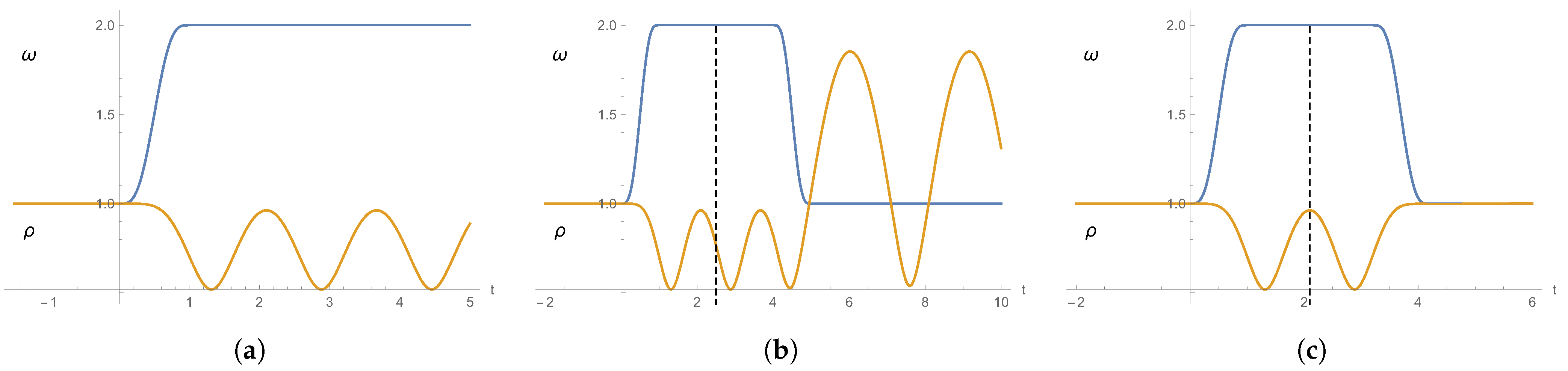
where δ and φ are constants. For δ = 0 , one recovers the standard solution of the harmonic oscillator with frequency ω 0 . Consider now the following time-dependent situation: the frequency is ω 0 for t < 0 , time-dependent in the interval 0 < t < τ , and then takes a constant value ω 1 . In this case, one has ρ 2 = 1 / ω 0 for t < 0 , and, for t > τ , ρ 2 takes the form of that in Equation (9) with ω 0 ω 1 , that is, an oscillatory function. This behavior is illustrated in Figure 1a,b. As shown in Section 2.2, this leads to a squeezed state. However, for time-dependent frequencies such that ρ remains constant after the frequency becomes constant, one gets an unexciting evolution, i.e., | 0 out | 0 in | 2 = 1 . This is illustrated in Figure 1c.
This observation allows using of reverse engineering to construct effective unexciting evolutions ω eff 2 ( t ) . This can be acheived by choosing a reference function ρ ref ( t ) that is constant both for t < 0 and t > τ , and time-dependent in the interval 0 < t < τ . By substituting the reference function into Equation (8), one finds
ω eff 2 = 1 ρ ref 4 ρ ¨ ref ρ ref .
For the effective evolution (10), the solution q ( t ) follows the adiabatic form of Equation (5) corresponding to the reference frequency ω ref = 1 / ρ ref 2 in a finite amount of time.

2.2. STA Completions from the Ermakov Function

Let us now discuss whether the excitations generated by a given frequency evolution can be undone. We refer to this process as STA completion. Suppose that the oscillator has frequency ω for t < 0 , and evolves from ω to ω + within the interval 0 < t < τ 1 , generating excitations. Let us denote this interpolating function by ω I ( t ) and the corresponding ground states by | 0 (for t < 0 ) and | 0 + (for t > τ 1 ). After this first stage, for t > τ 1 , the system is in a squeezed state with respect to the new basis. Indeed, from the Bogoliubov transformation one can show that [21,22,23]
| 0 = c 0 n 0 β * α n ( 2 n ) ! 2 n n ! | 2 n + ,
where α and β are the Bogoliubov coefficients and n counts the occupation number of the ‘+’ states. The mean occupation number of the ‘+’ states in the initial vacuum is
0 | a ^ + a ^ + | 0 = | β | 2 .
In terms of the Ermakov function, the first part of the evolution determines ρ ( t ) via Equation (8). For 0 < t < τ 1 , ρ ( t ) is fixed by ω I ( t ) , and for τ 1 < t < t 1 it oscillates according to the asymptotic form (9). Thus, the squeezed state generated after the first stage is entirelycharacterized by the corresponding Ermakov function.
To achieve de-excitation, one must design a second frequency evolution, ω II ( t ) , acting during the time interval t 1 < t < t 1 + τ 2 . The point is to extend ρ ( t ) smoothly so that
ρ 2 ( t ) = 1 ω + + for t > t 1 + τ 2 .
From the continuation (13) of ρ ( t ) , the corresponding frequency follows from Equation (10). In this way, the complete evolution, given by
ω eff ( t ) = ω for t < 0 , ω I ( t ) for 0 < t < τ 1 , ω + for τ 1 < t < t 1 , ω II ( t ) for t 1 < t < t 1 + τ 2 , ω + + for t 1 + τ 2 < t ,
implements an STA completion.
A simpler scenario occurs when ω = ω + + . In this case, one can choose the second stage as the time-reversal of the first: ω II ( t ) = ω I ( 2 t n t ) , where t n corresponds to a maximum or minimum of the oscillatory solution (9). By symmetry of the Ermakov equation (8), this continuation guarantees that the complete protocol is time-symmetric around t n . The symmetric trajectory always exists and restores the system to the ground state. An example of this type of protocol is illustrated in Figure 1c.
Finally, let us remark that the time-reversal of an STA is itself an STA, as immediately follows from the Ermakov equation (8).

3. STA Completions and Anti-Squeezing

As discussed in Section 2.2 above, in the ‘out’ basis the ‘in’ vacuum is represented as a squeezed state (11). The de-excitation of the QHO then corresponds to a process in which, starting from this particular state, the subsequent evolution may drive the system back to the vacuum state.
For a general state, unfolding the evolution might not be possible. An arbitrary state with the same | β | 2 does not necessarily lead to the vacuum state after unitary evolution. A given value of | β | 2 gives only the mean occupation number but does not provide all information about the quantum state of the oscillator.
The results of Section 2 can be reproduced in terms of squeezing and anti-squeezing operators. Indeed, consider the vacuum state | 0 of a quantum harmonic oscillator. We perform the following steps: first apply a squeezing operator S ( r , θ ) = exp ( r / 2 ( e i θ a ^ 2 e i θ a ^ 2 ) ) at time t = 0 (where r denotes the squeezing parameter and θ an arbitrary squeezing angle, which is omitted in the following without loss of generality). Then let the system evolve freely under the harmonic oscillator Hamiltonian until time t = τ . Finally, apply the anti-squeezing operator S ( r ) at time τ . The final state then is
| ψ final = S ( r ) U ( τ ) S ( r ) | 0 ,
where the free evolution operator is
U ( τ ) = e i H τ / , with H = ω a ^ a ^ + 1 2 ,
where is the reduced Planck constant. If S ( r ) is applied immediately after S ( r ) , the vacuum state | 0 is recovered:
| ψ final = S ( r ) S ( r ) | 0 = | 0 ,
due to the unitarity of S ( r ) . However, if there is a free evolution between S and S , the final state reads
| ψ final = S ( r ) e i H τ / S ( r ) | 0
(note that the free evolution corresponds to the third step in the frequency evolution of Equation (14)). In this case, the final state is not generally equal to | 0 because S ( r ) U ( τ ) S ( r ) I , where I is the identity matrix. This is due to the fact that U ( τ ) and S ( r ) do not commute. Although S ( r ) formally undoes the squeezing, it does not reverse the intermediate time evolution.
This result can be understood in terms of the quadrature operators q ^ and p ^ :
q ^ = 1 2 ( a ^ + a ^ ) and p ^ = 1 2 i ( a ^ a ^ ) .
The squeezing operator S ( r ) compresses the uncertainty ellipse in one direction of phase space. Then, the free evolution operator U ( τ ) performs a rotation of that ellipse by an angle ω τ . Finally, the anti-squeezing S ( r ) attempts to apply the inverse squeezing along the original axis, but the ellipse has been rotated, so it does not recover the original circular vacuum uncertainty. Therefore, one can conclude that, if there is free evolution between the squeezing and anti-squeezing operations, in general the final state will not be the vacuum state. The result depends on the time interval τ , due to the rotation in phase space induced by the harmonic oscillator dynamics. However, if the evolution time τ is chosen such that the rotation corresponds to an integer multiple of full rotations, i.e., τ n = 2 π n / ω , n Z , then the phase space rotation satisfies R ( θ ) = R ( 2 π n ) = I . In this case, the squeezed state’s orientation returns to its original configuration, and the inverse squeezing operator perfectly cancels the initial squeezing, up to a global phase factor. More explicitly, for the vacuum state,
| ψ final = S ( r ) U 2 π n ω S ( r ) | 0 = S ( r ) S ( r ) e i ϕ | 0 = e i ϕ | 0 ,
where e i ϕ is a global phase.
By choosing the evolution time to be an integer multiple of the oscillator period, one can compensate the rotation in phase space caused by free evolution, allowing the inverse squeezing operator to perfectly reverse the squeezing operation and recover the initial state. These results are connected with the construction of STA completions using the Ermakov function: it was shown in Section 2 that the time reversal symmetric STA completions can be implemented only at the particular times t n where the Ermakov function (7) has minima or maxima during the intermediate free evolution. This corresponds to the anti-squeezing operator being applied at times τ n . Non symmetric STA completions are also possible but do not correspond to anti-squeezing.
The excitation of the harmonic oscillator corresponds, in the framework of QFT, to the phenomenon of “particle creation”, which is discussed in Section 5 below.

4. The Analogous Scattering Problem in Quantum Mechanics

The dynamics of a QHO with time-dependent frequency is governed, at the classical level, by Equation (1). On the other hand, the stationary Schrödinger equation in one-dimensional quantum mechanics is
d 2 d x 2 ψ ( x ) + V ( x ) ψ ( x ) = E ψ ( x ) ,
with ψ ( x ) being the wave function, V ( x ) the potential, and E the energy (we set ℏ2/2m = 1, where m is the particle mass).
A direct correspondence between Equations (1) and (16) is obtained by the identifications
q ( t ) ψ ( x ) , t x , ω 2 ( t ) E V ( x ) .
In the mapping (17), the evolution of the QHO with time-dependent frequency is mathematically equivalent to a one-dimensional scattering problem for a particle of energy E in the potential V ( x ) . The analogy between the time-dependent frequency QHO and the one-dimensional Schrödinger equation (16) has been pointed out long time ago in ref. [24], when analyzing pair creation induced by a time-dependent electric field. It was also described in ref. [25] in the context of QFT in curved spacetime (for more recent papers, see [26,27]). As is shown below in this Section, there is a direct connection between the Bogoliubov transformation (4) for the QHO and the reflection and transmission coefficients in one-dimensional quantum mechanics.
In what follows, we assume that ω in 2 = ω out 2 = ω 0 2 so the conditions E = ω 0 2 and V ( x ) 0 at x = ± may be chosen. The general solution of Equation (1) at asymptotical times is given by Equation (3), and the ‘in’ and ‘out’ solutions are connected by the Bogoliubov transformation (4). Similarly, in the scattering problem (16), the positive energy solutions satisfy, asymptotically,
ψ ( x + ) = t ¯ e i k x ,
where t ¯ is the transmission amplitude, while at x the wave function is of the form
ψ ( x ) = e i k x + r ¯ e i k x ,
with r ¯ the reflection amplitude and k = E . The corresponding probabilities satisfy
| r ¯ | 2 + | t ¯ | 2 = R + T = 1 .
The analogy implies a direct relation between Bogoliubov coefficients in Equation (4) and scattering probabilities in Equation (20) [25,26,28]:
| β | 2 R T , | α | 2 1 T .
That is, the presence of particle creation in the QHO corresponds to a non-vanishing reflection coefficient in the scattering problem, while the existence of an STA (absence of excitations, β = 0 ) is equivalent to a transmission resonance (i.e., T = 1 , R = 0 ) in one-dimensional quantum mechanics.
The analog to STA completions for the QHO is, in the scattering theory, the construction of a potential such that, for a given energy, R = 0 and T = 1 . The simplest example is that of a square potential well: the first step is a jump from V = 0 to V = V 0 and the second step the reversed jump from V = V 0 to V = 0 . If the first step is at x = 0 , by choosing a particular value of the position of the second step (for example, x = a ), R = 0 and T = 1 may be forced. This is a known textbook result: there are resonances in the transmission coefficient, and one has complete transmission T = 1 when a E + V 0 = n π / 2 , where n is a positive integer.
The “symmetric” construction with the Ermakov function (7) generates this type of effect: | β | 2 = 0 for an effective trajectory that has a particular temporal duration. Therefore, for the analogous scattering problem, one should be able to prove that, due to interference effects, R = 0 for symmetric potentials that have a particular length. We can prove that this is indeed the case, although the condition on the length a is not as straightforward as just above, since the condition depends now on the form of the potential.
Assume the potential is
V ( x ) = U ( x ) , < x a ( region I ) ; V 0 , a x a ( region II ) ; U ( x ) , a x < ( region III ) .
Here, U ( x ) 0 , and a positive energy E is assumed. The solution of the Schrödinger equation (16) in region I is
ψ I ( x ) = A φ ( x ) ,
where φ ( x ) is the solution of the Schrödinger equation (16) such that φ ( x ) exp ( i k x ) as x . In region II,
ψ II ( x ) = C e i γ x + D e i γ x ,
with γ 2 = E + V 0 . In region III,
ψ III ( x ) = F φ * ( x ) .
The conditions at x = a and x = a read
A φ ( a ) = C e i γ a + D e i γ a , A φ ( a ) = i γ ( C e i γ a D e i γ a ) , F φ * ( a ) = C e i γ a + D e i γ a , F φ * ( a ) = i γ ( C e i γ a D e i γ a ) .
The system of Equation (25) has a nontrivial solution if the determinant of the 4 × 4 matrix vanishes. By carrying out the calculation, one obtains
e 4 i γ a = f ( γ ) f * ( γ ) e i ζ ( γ ) ,
with
f ( γ ) = | φ ( a ) | 2 γ 2 | φ ( a ) | 2 2 i γ [ φ ( a ) φ * ( a ) ] ,
where the prime denotes the space coordinate (x) derivative and denotes the real part of the argument.
In the particular case in which U ( x ) = const , f ( γ ) is real, ζ ( γ ) = 0 , and the condition for resonant transmission reads γ a = n π / 2 , that is, n λ / 2 = 2 a . This is the known textbook example. In the general case, the condition (26) gives
γ a = n π 2 + 1 4 ζ ( γ ) .
This is the scattering analog of the anti-squeezing situation described above, with the region II playing the role of the free evolution between time-dependent frequency evolutions of Section 2.2.

5. Unexciting Backgrounds in Quantum Field Theory and Reflectionless Potentials

In homogeneous backgrounds, the Fourier modes with momentum k of a scalar field satisfy a set of uncoupled equations, which in many cases (including a scalar field in a Robertson–Walker metric or a Yukawa-coupled scalar) take the form
χ ¨ k + ω k 2 ( t ) χ k = 0 ,
where k = | k | . For instance, for massive and conformally coupled scalar fields in a Robertson–Walker metric, one has ω k 2 = k 2 + m 2 a 2 ( t ) where a ( t ) is the scale factor for cosmological backgrounds [3]. On the other hand, in scalar QED the frequency reads ω k 2 ( t ) = ( k A ( t ) ) 2 + k 2 + m 2 , where A ( t ) is a time-dependent component of the vector potential in the case of an external electric field. If the quantum field is coupled to a classical field σ ( t ) via Yukawa coupling, the squared frequency reads ω k 2 ( t ) = k 2 + m 2 + λ σ 2 ( t ) .
In general, due to k-dependence, the construction of STA via the Ermakov function (7) works only for individual modes, and no global STA seems to exist unless the frequency becomes time-independent (for example, for massless conformally coupled fields in the cosmological case). However, when ω 2 ( t ) const as t ± , unexciting backgrounds do arise, and correspond to reflectionless potentials in the analogous one-dimensional scattering problem [18]. Hence, for homogeneous backgrounds in QFT, one can construct evolutions that produce no particle excitations, i.e., unexciting backgrounds. This has been unnoticed in the earlier studies on the subject [14,16].

Construction of Unexciting Evolutions

In standard quantum mechanics, the reflectionless potentials can be constructed by fixing the number and values of the energies of the bound states (assuming V ( x ) < 0 and V ( x ) 0 for x ± ). The Kay–Moses method, adapted for the QHO with time-dependent frequency, can be summarized as follows [18,29]:
  • select N positive numbers κ 1 > κ 2 > > κ N ;
  • compute the positive numbers c n :
    c n 2 = 2 κ n m = 1 , m n N κ n + κ m | κ n κ m | ;
  • compute the elements C i j of a matrix C :
    C i j = c i c j κ i + κ j e ( κ i + κ j ) t ;
  • compute the frequency
    ω k 2 ( t ) = ω 0 2 ( k ) + 2 d 2 d t 2 log det ( I + C ) .
In the scattering problem in quantum mechanics, the N numbers κ n are the eigenvalues of the bound states. For the unexciting backgrounds, the κ n are just N parameters describing the freedom in the choice of the background. The simplest and most known example is the potential obtained by choosing κ n = κ 2 n 2 , n = 1 , 2 , , N which gives
ω k 2 ( t ) = ω 0 2 ( k ) + N ( N + 1 ) κ 2 cosh 2 ( κ t )
representing the Poschl–Teller potential.
This consideration can been applied, for example, to particle creation in external time-dependent electric fields [30,31], where particular profiles of A ( t ) can prevent particle production for selected values of k , independently of k and m 2 . The results of those studies can be generalized by considering other profiles for the potential vector that produce a time-dependent frequency of the form Equation (32).
Another interesting example is the case of a massive field in the d-dimensional de Sitter background
d s 2 = 2 ( d t 2 + cosh 2 t d Ω d 1 ) .
Here, d Ω d 1 is the metric on the sphere S d 1 and is related with the cosmological constant Λ = ( d 2 ) ( d 1 ) / ( 2 2 ) . When expanding the modes of the field in generalized spherical harmonics, the field equation becomes
t 2 + ( 2 l + n 3 ) 2 ( 2 l + n 1 ) 2 1 cosh 2 t + m 2 ( n 1 ) 2 4 u l ( t ) = 0 ,
where l is a non-negative integer. The time-dependent part of the frequency coincides with the Poschl–Teller potential if ( 2 l + d 3 ) / 2 is a positive integer, and this is the case in odd dimensions. This is another non-trivial example of an unexciting gravitational background, which has been pointed out in refs. [32,33].
These discussion highlights the connection between STA in QFT and reflectionless potentials in standard quantum mechanics, providing a unifying perspective on excitation-free evolutions in diverse quantum systems.

6. Conclusions

In this paper, we have analyzed the existence of STA and STA completions for the QHO with time-dependent frequency, as well as for QFT in non-stationary backgrounds. A central outcome of our analysis is based on the known analogy with one-dimensional Schrödinger equation [24,25]: the implementation of STA in the QHO provides direct analogy with transmission resonances in scattering problems, while the realization of STA in QFT with homogeneous backgrounds corresponds to the existence of reflectionless potentials.
We have also exploited the connection between particle creation and squeezed states to show that STA completions naturally give rise to the notion of an anti-squeezing operator. This perspective provides a unified framework in which excitation suppression, particle creation, and squeezing transformations are seen as deeply interconnected features of time-dependent quantum systems.
Beyond the specific results, our analysis underscores the value of the time-dependent QHO as a bridge between different areas of physics. The analogies identified here suggest possible extensions, from the design of STA protocols in quantum technologies to the study of excitation-free backgrounds in cosmology and gravitational physics. In this sense, STA and their completions may offer both conceptual insight and practical tools for controlling dynamical quantum processes in a broad variety of contexts.
In particular, the study of STA and their completions holds significant promise for applications in quantum thermodynamics, such as the design and implementation of quantum heat engines and quantum batteries. These systems inherently rely on the controlled manipulation of quantum states within finite-time protocols, where minimizing excitations and dissipation is crucial for optimal performance. STA techniques offer a systematic way to achieve such control, while STA completions ensure that the system returns to a ground or target state at the end of the process, even in nonadiabatic regimes. Notably, the working medium in these devices can, actually, be a quantum field, opening the door to novel thermodynamic regimes where field-theoretic effects play a central role. Furthermore, platforms like circuit quantum electrodynamics (cQED), which provide a highly tunable and coherent environment, are particularly well-suited for realizing these protocols experimentally. As such, exploring STA in this context not only advances the theoretical understanding but also paves the way for practical implementations of efficient and scalable quantum thermal machines.

Author Contributions

All authors contributed equally to this work. All authors have read and agreed to the published version of the manuscript.

Funding

This research was funded by Consejo Nacional de Investigaciones Científicas y Técnicas (CONICET), Universidad de Buenos Aires (UBA) and Universidad Nacional de Cuyo (UNCuyo).

Data Availability Statement

The original contributions presented in this study are included in the article. Further inquiries can be directed to the corresponding author.

Conflicts of Interest

The authors declare no conflicts of interest.

References

  1. Husimi, K. Miscellanea in elementary quantum mechanics, II. Prog. Theor. Phys. 1953, 9, 381–402. [Google Scholar] [CrossRef]
  2. Guéry-Odelin, D.; Ruschhaupt, A.; Kiely, A.; Torrontegui, E.; Martínez-Garaot, S.; Muga, J.G. Shortcuts to adiabaticity: Concepts, methods, and applications. Rev. Mod. Phys. 2019, 91, 045001. [Google Scholar] [CrossRef]
  3. Birrell, N.D.; Davies, P.C.W. Quantum Fields in Curved Space; Cambridge University Press: Cambridge, UK, 1984. [Google Scholar] [CrossRef]
  4. Dodonov, V.V. Nonstationary Casimir effect and analytical solutions for quantum fields in cavities with moving boundaries. Mod. Nonlinear Opt. 2001, 119, 309–394. [Google Scholar]
  5. Dodonov, V.V. Fifty years of the dynamical Casimir effect. Physics 2020, 2, 67–104. [Google Scholar] [CrossRef]
  6. Dodonov, V.V. Dynamical Casimir Effect: 55 years later. Physics 2025, 7, 10. [Google Scholar] [CrossRef]
  7. Dalvit, D.A.R.; Maia Neto, P.A.; Mazzitelli, F.D. Fluctuations, dissipation and the dynamical Casimir effect. In Casimir Physics; Dalvit, D., Milonni, P., Roberts, D., Rosa, F., Eds.; Springer: Berlin/Heidelberg, Germany, 2011; pp. 419–457. [Google Scholar] [CrossRef]
  8. Nation, P.D.; Johansson, J.R.; Blencowe, M.P.; Nori, F. Stimulating uncertainty: Amplifying the quantum vacuum with superconducting circuits. Rev. Mod. Phys. 2014, 84, 1–24. [Google Scholar] [CrossRef]
  9. Dodonov, V.V.; Malkin, I.A.; Man’ko, V.I. Even and odd coherent states and excitations of a singular oscillator. Physica 1974, 72, 597–615. [Google Scholar] [CrossRef]
  10. Dodonov, V.V. ‘Nonclassical’ states in quantum optics: A ‘squeezed’ review of the first 75 years. J. Opt. B Quantum Semiclass. Opt. 2002, 4, R1–R33. [Google Scholar] [CrossRef]
  11. Dodonov, V.V.; Dodonov, V.A. Energy evolution of a general one-dimensional oscillator with a quadratic time-dependent stiffness and a linear time-dependent correlation parameter. J. Math. Phys. 2025, 66, 012101. [Google Scholar] [CrossRef]
  12. Dodonov, V.V.; Dodonov, A.V. Adiabatic versus instantaneous transitions from a harmonic oscillator to an inverted oscillator. In Second International Workshop on Quantum Nonstationary System. Proceedings; Dodonov, A., Riberio, C.C.H., Eds.; LF Editorial: São Paulo, Brazil, 2024; pp. 21–42. [Google Scholar] [CrossRef]
  13. Dodonov, V.V.; Klimov, A.B. Generation and detection of photons in a cavity with a resonantly oscillating boundary. Phys. Rev. A 1996, 53, 2664–2682. [Google Scholar] [CrossRef] [PubMed]
  14. Del Grosso, N.F.; Lombardo, F.C.; Mazzitelli, F.D.; Villar, P.I. Shortcuts to adiabaticity in quantum field theory. Phys. Rev. A 2022, 105, 052217. [Google Scholar] [CrossRef]
  15. Del Grosso, N.F.; Lombardo, F.C.; Mazzitelli, F.D.; Villar, P.I. Adiabatic shortcuts completion in quantum field theory: Annihilation of created particles. Entropy 2023, 25, 1249. [Google Scholar] [CrossRef] [PubMed]
  16. Vachaspati, T. Unexciting classical backgrounds. Phys. Rev. D 2022, 105, 056008. [Google Scholar] [CrossRef]
  17. Vachaspati, T. Unexciting non-Abelian electric fields. Phys. Rev. D 2022, 105, 105011. [Google Scholar] [CrossRef]
  18. Kay, I.; Moses, H.E. Reflectionless transmission through dielectrics and scattering potentials. J. Appl. Phys. 1956, 27, 1503–1508. [Google Scholar] [CrossRef]
  19. Lewis, H.R., Jr.; Riesenfeld, W.B. An exact quantum theory of the time-dependent harmonic oscillator and of a charged particle in a time-dependent electromagnetic field. J. Math. Phys. 1969, 10, 1458–1473. [Google Scholar] [CrossRef]
  20. Gjaja, I.; Bhattacharjee, A. Asymptotics of reflectionless potentials. Phys. Rev. Lett. 1992, 68, 2413–2416. [Google Scholar] [CrossRef] [PubMed]
  21. Hu, B.L.; Kang, G.; Matacz, A. Squeezed vacua and the quantum statistics of cosmological particle creation. Int. J. Mod. Phys. A 1994, 9, 991–1007. [Google Scholar] [CrossRef]
  22. Calzetta, E.; Hu, B.L. Noise and fluctuations in semiclassical gravity. Phys. Rev. D 1994, 49, 6636–6655. [Google Scholar] [CrossRef]
  23. Lin, Z.-J.; Li, N.; Wei, M.-S.; Liao, M.-J.; Liang, Y.-B.; Xu, J.; Yang, Y.-P. Squeezing characteristics of cavity field in dynamic Casimir effect. Phys. Lett. A 2024, 525, 129852. [Google Scholar] [CrossRef]
  24. Marinov, M.S.; Popov, V.S. Electron–positron pair creation from vacuum induced by variable electric field. Fortsch. Phys./Prog. Phys. 1977, 25, 373–400. [Google Scholar] [CrossRef]
  25. Audretsch, J. Cosmological particle creation as above-barrier reflection: Approximation method and applications. J. Phys. A 1979, 12, 1189–1203. [Google Scholar] [CrossRef]
  26. Amin, M.A.; Baumann, D. From wires to cosmology. J. Cosmol. Astropart. Phys. 2016, 2, 045. [Google Scholar] [CrossRef]
  27. Schmidt, C.F.; Parra-López, Á.; Tolosa-Simeón, M.; Sparn, M.; Kath, E.; Liebster, N.; Duchene, J.; Strobel, H.; Oberthaler, M.K.; Floerchinger, S. Cosmological particle production in a quantum field simulator as a quantum mechanical scattering problem. Phys. Rev. D 2024, 110, 123523. [Google Scholar] [CrossRef]
  28. Dodonov, A.V.; Dodonov, E.V.; Dodonov, V.V. Photon generation from vacuum in nondegenerate cavities with regular and random periodic displacements of boundaries. Phys. Lett. A 2003, 317, 378–388. [Google Scholar] [CrossRef][Green Version]
  29. Gutierrez, T.D. An introduction to the inverse quantum bound-state problem in one dimension. Am. J. Phys. 2014, 82, 674–680. [Google Scholar] [CrossRef]
  30. Kim, S.P.; Schubert, C. Nonadiabatic quantum Vlasov equation for Schwinger pair production. Phys. Rev. D 2011, 84, 125028. [Google Scholar] [CrossRef]
  31. Ahmadiniaz, N.; Kim, S.P.; Schubert, C. Generalized Gelfand–Dikii equation for fermionic Schwinger pair production. J. Phys. Conf. Ser. 2022, 2249, 012020. [Google Scholar] [CrossRef]
  32. Lagogiannis, P.; Maloney, A.; Wang, Y. Odd-dimensional de Sitter space is transparent. arXiv 2011, arXiv:1106.2846. [Google Scholar] [CrossRef]
  33. Compton, G.; Morrison, I.A. Hidden symmetries for transparent de Sitter space. Class. Quant. Grav. 2020, 37, 125001. [Google Scholar] [CrossRef]
Figure 1. Time-dependent frequency ω ( t ) (blue curve) and the Ermakov function (9) (orange curve) when: (a) the frequency follows a (soft) “step-like” evolution; the Ermakov function is initially constant and then oscillates, indicating an excited final state; (b) the frequency follows a “barrier-like” evolution; here, the vertical dash black line indicates the center of the barrier; and (c) the barrier is centered on an extremum of the Ermakov function (vertical dashed black line); in this case, the Ermakov function becomes constant, indicating an STA completion.
Physics 08 00010 g001
Disclaimer/Publisher’s Note: The statements, opinions and data contained in all publications are solely those of the individual author(s) and contributor(s) and not of MDPI and/or the editor(s). MDPI and/or the editor(s) disclaim responsibility for any injury to people or property resulting from any ideas, methods, instructions or products referred to in the content.