1. Introduction
The quest to understand the nature of dark energy, observed to be consistent with a small, positive cosmological constant (CC,
), has led to one of the most persistent challenges in fundamental physics: the CC problem. Quantum field theory suggests that the vacuum energy of the Standard Model (SM) contributes to the CC on scales as high as the Planck scale
, resulting in a discrepancy with the observed value of approximately
[
1]. Traditional approaches, which attempt to fine-tune away these radiative corrections, are widely regarded as unsatisfactory, especially in light of Weinberg’s no-go theorem [
1,
2].
A transformative perspective emerges from the holographic principle and gravitational thermodynamics. The entropy of a de Sitter (dS) universe, given by
, with
G the Newtonian constant, is both finite and large (about
for the observed value of the CC). This entropy counts the number of fundamental quantum degrees of freedom on the cosmological horizon. The holographic naturalness (HN) paradigm [
3,
4,
5] leverages this insight by re-framing the problem. It argues that a transition from a state with a small CC (large entropy
with
N the number of qubits) to a state with a Planckian CC (unit entropy) is not just a loop correction but a quantum process that must overcome an exceptionally high entropic barrier. The amplitude for such a decay is exponentially suppressed,
(where
is the CC of an ultraviolet (UV) completion of gravity and the angular brackets denote the scalar product of the Hilbert space), thus inherently protecting the small value of the CC. From this viewpoint, one can assert that the standard computation of vacuum bubbles is incomplete, as it fails to account for the thermal, information-rich environment of the de Sitter horizon.
While HN explains the stability of the CC, it does not, by itself, explain its initial smallness. This is where the second pillar of our framework, pre-geometric gravity (PGG), enters. Pioneered by Samuel MacDowell and Frýdoon Mansouri [
6] and Frank Wilczek [
7], PGG is based on the approach that the spacetime metric and Einstein’s equations are not fundamental. Instead, they emerge from a more primitive, pre-geometric phase described by a gauge theory for a group like SO(
) or SO(
), devoid of a traditional metric. Formally, the dynamics of this phase is constructed using only the Levi-Civita symbol
, which is a tensor density of weight
and the only intrinsically available object for defining covariant actions [
8,
9] (the Greek letter indices take the values 0 (for time) and 1, 2 or 3 (for spatial coordinates). See also [
10,
11,
12,
13,
14,
15,
16,
17,
18,
19,
20,
21,
22,
23,
24,
25,
26,
27,
28,
29,
30,
31,
32,
33] for other relevant studies and approaches on the subject.
The key mechanism for PGG is spontaneous symmetry breaking (SSB). A scalar field acquires a vacuum expectation value (VEV) , thereby breaking the gauge group down to the Lorentz group SO(). Through this Higgs mechanism, the components of the gauge field of the initial group, either SO() or SO(), are identified with the spin connection () and the tetrads (); the capital Latin letter indices take the values 0 to 4 for internal-space coordinates in the unbroken phase, and the lower-case Latin letter indices take the values 0 to 3 for internal-space coordinates in the spontaneously broken phase. Remarkably, the effective actions, i.e., the MacDowell–Mansouri (MM) action or the Wilczek (W) action, yield the Einstein–Hilbert term, a CC term, and in one case (MM) also a Gauss–Bonnet term. The emergent Planck mass and the emergent CC are given, respectively, as follows:
- (i)
in the MM model: and ;
- (ii)
in the W model: and .
Here,
and
are the fundamental coupling constants of the PGG Lagrangians, while
m is a mass parameter introduced for defining the tetrad fields as dimensionless. Therefore, a larger VEV
v naturally leads to a smaller effective
, implementing a see-saw mechanism. Furthermore, a complete dictionary can be established to reconstruct the inverse metric
and the volume element
from pre-geometric quantities [
8], which proves the full emergence of Riemannian geometry in the spontaneously broken phase.
It is possible to perform a self-consistent and background-independent Hamiltonian analysis of theories of PGG [
9]. Using the ADM formalism, it was demonstrated that the infrared limit of the spontaneously broken phase correctly reproduces all results of canonical general relativity. The constraint algebra was analyzed by employing Dirac’s algorithm, which also allows us to count the degrees of freedom in the ultraviolet limit of the unbroken phase. This approach may lead to promising pathways for a UV completion of gravity, including a pre-geometric generalization of the Wheeler–DeWitt equation, a connection with Ashtekar variables, an extended BF theory and a generalized Plebanski gravity formulation. In addition, it was shown that, when the fundamental symmetry of spacetime is restored, W-gravity may admit an ultraviolet fixed point where it becomes a topological theory, thus enabling its complete quantization [
9]. The first exact solution to the pre-geometric field equations for a de Sitter-like universe was presented in Ref. [
34], providing a potential resolution for the Big Bang singularity.
The central synthesis presented in this paper is the identification of the pre-geometric Higgs VEV v with the source of the de Sitter entropy: (or ). This creates a powerful synergy:
- (i)
PGG explains the origin of the smallness of the CC via a see-saw mechanism requiring a correspondingly large v;
- (ii)
HN explains the stability of such a small CC, as the large v (and thus large ) imposes an exponential suppression on potentially ‘dangerous’ transitions.
Here, we further develop this model by revealing that new pseudo-Nambu–Goldstone bosons, which we call “hairons” (
), dynamically emerge from pre-geometric Wilson lines and instantons. These hairons, with mass
, are identified as the fundamental quanta of information on the horizon. It is shown that, as dynamical fields, hairons provide a concrete realization of the quantum hairs of spacetime proposed by Gabriele Veneziano [
35], Sidney Coleman, John Preskill and Wilczek [
36]. Hairons interact with matter and gravity to thermalize vacuum fluctuations, providing an explanation for the naturalness of the CC. Furthermore, it is found that a condensate of hairons can not only account for the dS entropy but also, through its slow cosmological evolution, drive a dynamical form of dark energy.
This paper is structured as follows. In
Section 2, we review the HN argument for the stability of the CC.
Section 3 details the framework of PGG and the emergence of geometry through a mechanism of SSB. In
Section 4 we perform the crucial synthesis, linking the Higgs VEV
v to the de Sitter entropy
, as well as exploring the nature of hairons.
Section 5 confirms the consistency of the framework through a Hamiltonian analysis. Some remarks on HN phenomenology are then sketched out in
Section 6. Finally, we discuss the main implications and draw our conclusions in
Section 7.
2. HN and CC
The holographic principle suggests that, in the case of the dS spacetime, the entropy is given by
where
is the area corresponding to the Hubble horizon and
N is the number of qubits of information holographically stored in spacetime. Equation (
1) suggests several essential insights.
The amount of information in vacuo is tremendously larger than that contained in baryonic matter and radiation. For instance, the CMB radiation entropy is approximately
, while Equation (
1) corresponds to a value of
for the known value of the CC.
From a thermodynamic perspective, is interpreted as a temperature in vacuo, that is . Specifically, it is set by the Gibbons–Hawking temperature of the de Sitter horizon, namely , where is the Hubble parameter in the de Sitter space.
The hierarchy between the CC and the Planck scale,
, scales as the inverse of the spacetime entropy (
1).
These points suggest a novel reinterpretation of the CC problem. Actually, a quantum transition from a state having a CC equal to the observed value
to a state with a UV vacuum energy
, i.e.,
or
corresponds to a transition from a relatively large to a unit entropy, bearing in mind that
. Certainly, such a process is exponentially suppressed by the entropic barrier:
From Equation (
1), Equation (
4) corresponds to
or, reinterpreted as a transition from
to
, to
An amplitude (
6) is associated with a quantum tunneling process which destroys
qubits, so indeed the annihilation cost has to be an exponential suppression.
Equations (
4) and (
5) are consistent with the instantonic approach: the suppression, actually, corresponds to the quantum tunneling mechanism controlled by the gravitational Euclidean action,
:
where
is the gravitational coupling constant at the energy scale
. As is known, the
instantonic suppression is universal; for instance, in Yang–Mills theories it is
, with the difference with gravity lying in the nature of the coupling and the renormalizability procedure. The gravitational interaction, in this sense, appears to be special since the inverse of the gravitational coupling constant
scales as the dS entropy and, therefore, as the inverse of the number of qubits:
The quantum field theory computations of radiative corrections to the CC commonly found in the literature do not consider the entropy/quantum-information side of the CC problem. Thus, we reject them as incomplete and illusive. As discussed in Ref. [
3], in order to perform bubble diagram computations including vacuum thermal effects, one can introduce new background fields sustaining quantum hairs, the so-called hairon field. Hairons ‘decorate’ the de Sitter horizon with hairy qubits. The term “hairon” evokes the concept of quantum hairs on horizons [
35,
36,
37]. While here we concretely realize this for the dS horizon, the same mechanism may be extendable to black hole horizons to address the information paradox—a promising direction for future investigations. The hairon fields are denoted by
, with
being space coordinates on the dS boundary, and hairons possess an average thermal energy
. In the hairon dictionary, the dS spacetime then corresponds to a state of
N hairons, namely
. Actually, hairons can be thought of as a Bose–Einstein coherent condensate in case their self-interactions are negligible, with coherent fluctuations around the expectation value. It is worthy to note that such hairons are in a gapped phase with a degenerate ground state. In other words, hairons are in a state with a mass gap
, while the expectation value
of such states is considerably large. The bubble diagrams of the SM receive the thermal insertions of hairons as background fields [
3,
4,
5]. Such an effective field theory approach renders comprehensible the CC stabilization from a quantum field theory prospective. Moreover, such an approach leads to cosmological implications too, like the metastability of dark energy that is discussed in
Section 3. In
Section 4,
Section 5 and
Section 6, we then discuss how hairons naturally arise as modulus fields associated with orbifold gravitational instantons, rather than being particles introduced ad hoc.
4. HN and PGG
Under the perspective adopted in this study, it is an intriguing possibility to connect HN with a theory of PGG [
8]. Actually, the two proposals appear to be complementary. On one hand, HN cannot explain the smallness of the CC but, assuming it, can explain its stabilization, while on the other hand, PGG can explain the emergence of a positive CC via a symmetry-breaking pattern SO(
)→SO(
).
As remarked in
Section 1 and
Section 3, in both the MM and the W models of PGG, the Planck scale and the CC are emergent, with different parametrizations:
Interestingly, in the MM model, the VEV
v is inversely proportional to the gravitational coupling at an energy scale corresponding to the CC; in W-gravity, instead, it is the cubic power which is involved in the same relation, namely:
However, as seen in
Section 2, the entropy of a dS universe is the inverse of the gravitational coupling (
8)). Therefore, the dS entropy can be suggestively related to the new VEV scale of PGG:
Note that, if the field
has a non-canonical mass dimension
as proposed by Wilczek [
7], then the VEV is just a considerably large number. It may be significant to observe that the information contained in the dS vacuum here acquires a pre-geometric meaning as the VEV of the new Higgs-like field. Therefore, the SSB mechanism of PGG generates not only the spacetime metric, its relativistic dynamics, the fundamental gravitational energy scales (the Planck mass and the CC) and diffeomorphism invariance, but also the dS entropy.
This result suggests that the new
field can serve as an information field, or in other words, it sustains the spacetime qubits when it is in this spontaneously broken phase. In this sense, the hairon field, which is related to the square root of the entropy, may be reinterpreted as a mean field originating from the pre-geometric Higgs-like field. Moreover, as a consequence of Equation (
5), the combined framework of HN plus PGG entails that the comparably small value of the CC is protected since any destabilization due to quantum effects is exponentially suppressed as
The pre-geometric phase (
) is a state of no geometry and minimal entropy, i.e., no quantum information. The Higgs phase (
) is a state that has spontaneously generated both the spacetime geometry and a quite large amount of entropy/quantum information, as
in the MM model (or
in the W model). This makes the smallness of
a consequence of the vastness of the quantum-information content of the universe.
Let us now scrutinize and better understand the correspondence between the VEV of and the dS entropy from multiple perspectives. The emergence of N qubits of information has been understood in light of a discretization of the dS boundary into Planckian-sized pixels, as a consequence of the emergence of the Planck length itself after the SSB. Nevertheless, so far it is not quite understandable if fields like hairons can also naturally emerge within the context of a theory of PGG.
One possibility is that hairons are related to moduli of non-perturbative effects such as gravitational instantons in orbifolds. We argue that a
symmetry, with
N related to the dS entropy, can be obtained from the evaluation of Wilson loops wrapping around a dS instanton. It is known that the dS spacetime corresponds to a gravitational instanton solution which is just the Euclidean dS with an
topology (hypersphere-equivalent) of radius
[
39]. This solution is obtained after a Wick rotation for time,
, and the period of this coordinate is found to be
, i.e., the inverse of the Gibbons–Hawking temperature [
40,
41] (see also [
42,
43,
44]).
In gauge theories, the Wilson loop expectation value in the presence of an instanton is expressed as a path integral:
Here,
is the Yang–Mills action and the
term enforces the self-duality condition
for the instanton configuration, with
being the Dirac delta function. For an instanton of charge
, with
K being the topological number and
N the rank of the gauge group, the classical action
is proportional to
Q,
as obtained from imposing the self-duality constraint and using the definition of the topological number
K. For relatively large Wilson loops, the phase (
38) is given by
The factor
arises because the instanton modifies the holonomy of the gauge field around the loop, introducing a phase due to the non-trivial topological charge. The solutions are known in the literature as fractional gauge instantons [
45,
46,
47,
48,
49,
50,
51,
52,
53,
54,
55,
56] and are typically obtained on manifolds with twisted boundary conditions. The residual central symmetry of SU(
N) is, in this case,
.
This consideration can suggest the existence of a new gravitational instanton, on top of the standard Euclidean dS instanton, which can be obtained as the orbifold of the hypersphere O
4,N =
. O
4,N is a hypersphere with
N conical singularities on the surface, which in turn correspond topologically to a set of two-surface
. This new class of instantons can be related to the known asymptotically locally Euclidean (ALE) instantons [
57,
58,
59,
60,
61]. The connection between
orbifolds and ALE instantons emerges through a local analysis in the vicinity of the orbifold singularities. While
constitutes a compact orbifold, the geometry in the immediate vicinity of each singularity is locally modeled by
. Instantons on
, when lifted to the covering space
and projected to
via a stereographic projection, yield
-symmetric instanton configurations on
. The local behavior in the vicinity of a fixed point precisely defines an orbifold instanton on
, which in turn represents the singular limit of a smooth, hyper-Kähler ALE instanton upon resolution of the singularity. Consequently, the global
instanton solution can be interpreted as a compact framework that encapsulates the local data of
-type ALE instantons situated at singular points of this framework, with the fractional instanton numbers being characteristic of the orbifold that is accounted for by the Kronheimer–Nakajima construction upon desingularization [
57,
60,
61].
The main difference between instanton spacetime and is in the modulus space. instantons have a modulus space trivially corresponding to the center of the instantons, i.e., , which in turn corresponds to the dimension of the coset SO(5)/SO(4), with SO(5) being the group of isometries. This does not match the number of moduli for , which scales as N. More precisely, has the same modulus space dimension of ALE instantons, which corresponds to in the case the instanton winding number being , counting the position of the fixed orbifold singularities. Indeed, there is a corresponding number of Nambu–Goldstone bosons related to the spontaneous symmetry breaking of the isometries, scaling as N.
Let us note that
is equivalent to the geometry of
N conic singularities with
where
and
are the deficit and opening angles, respectively, while
is the Euclidean string tension which sustains the conic singular geometry. In the case of the dS geometry, Euclidean strings have a tension which is proportional to
,
. In particular, in the limit of
, the Euclidean dS geometry is exactly obtained. Indeed,
reflects the periodicity of the dS time in Euclidean spacetime. Let us also notice that Equation (
41) implies that
which can be interpreted as an uncertainty relation between the deficit angle and the entropy or between the angle and the number
N of qubits.
The metric for the
-dimensional Euclidean de Sitter space is
with
,
the line element of a 2-sphere and
. A coordinate transformation
then allows us to rewrite the Euclidean dS space as the metric of a 4-sphere:
To accommodate a conical singularity at
, the value of
must be adjusted in order to ensure that the metric remains regular (non-singular) at the boundary
. The periodicity condition on
is replaced with
corresponding to the
symmetry shift. In the limit of
, the periodicity converges to 0. The replacement
, where
is the partition function and
is the free energy, implies that the partition function of each cone corresponds to a
-power of the dS one:
where
. Therefore, the dS spacetime and entropy emerge as a superposition of a large number of gravitational conic instantons. Let us note that these considerations are actually sustained in the lower-dimensional space
, where the correspondence among conic instantons and the dS spacetime entropy was proven with exact computations and confirmed with the dual two-dimensional conformal field theory (CFT
2) [
62]. Moreover, this conclusion is believed to be in agreement also with wave functions that promote the Wald entropy and the opening angle to quantum operators [
63]. Following this consideration, the number of hairons scales as the number of singular points of the orbifold, that is
As is known, modulus fields are Nambu–Goldstone bosons. Hence, it is considered to be natural in this picture to identify these moduli with hairons , with . It is crucial to notice that the N hairons are distinguishable as flavored under . This aspect also gives the correct entropy count, which may otherwise be affected by factorial permutation factors. In the picture under consideration here, quantum qubits contained in the de Sitter spacetime correspond to quantum hairs and hairons/moduli. The mass of hairons is determined by the instanton curvature, which in the case considered is . Theoretically, the mass spectrum of metric fluctuations (which include the moduli) around an instanton background is determined by the Lichnerowicz operator. The eigenvalues of this operator on an orbifold sphere are proportional to the inverse of the Hubble radius. The mutual interactions of the fluctuations is, in a semi-classical or instanton gas approximation, negligible, and therefore those fluctuations may form a coherent state with characteristic wavelength . Actually, there may exist contributions from orbifold instantons with arbitrary large masses. However, these correspond to moduli with a relatively short wavelength, which do not contribute to cosmological infrared dynamics. In other words, the number of degrees of freedom scales holographically, as expected.
Hairons, as gravitational modulus scalars, are typically described via sigma models, with the kinetic term of a Nambu–Goldstone boson scalar field. They have a proper energy-momentum tensor
, and therefore are coupled to the gravitational field. Thus, hairons can interact with SM matter through gravitational interactions in
terms. In general, hairons may also have a Planck suppressed non-minimal coupling with the Ricci scalar, such as
the newly introduced term
has a Planck mass suppression which is elided by the Newtonian constant of the Einstein–Hilbert Lagrangian.
Let us now discuss why the couplings with the gravitational and matter sectors in Equation (
47) are fundamental for the HN mechanism. The unnatural radiative loops receive the insertion of
N hairons through
gravitons. As mentioned above in this Section, HN starts with noticing that the evaluation of bubble diagrams in the SM in the true large-
N vacuum state is exponentially suppressed. Nevertheless, there is a diagram which in the large-
N state may dominate over all radiative corrections. This diagram can be built considering the insertion of
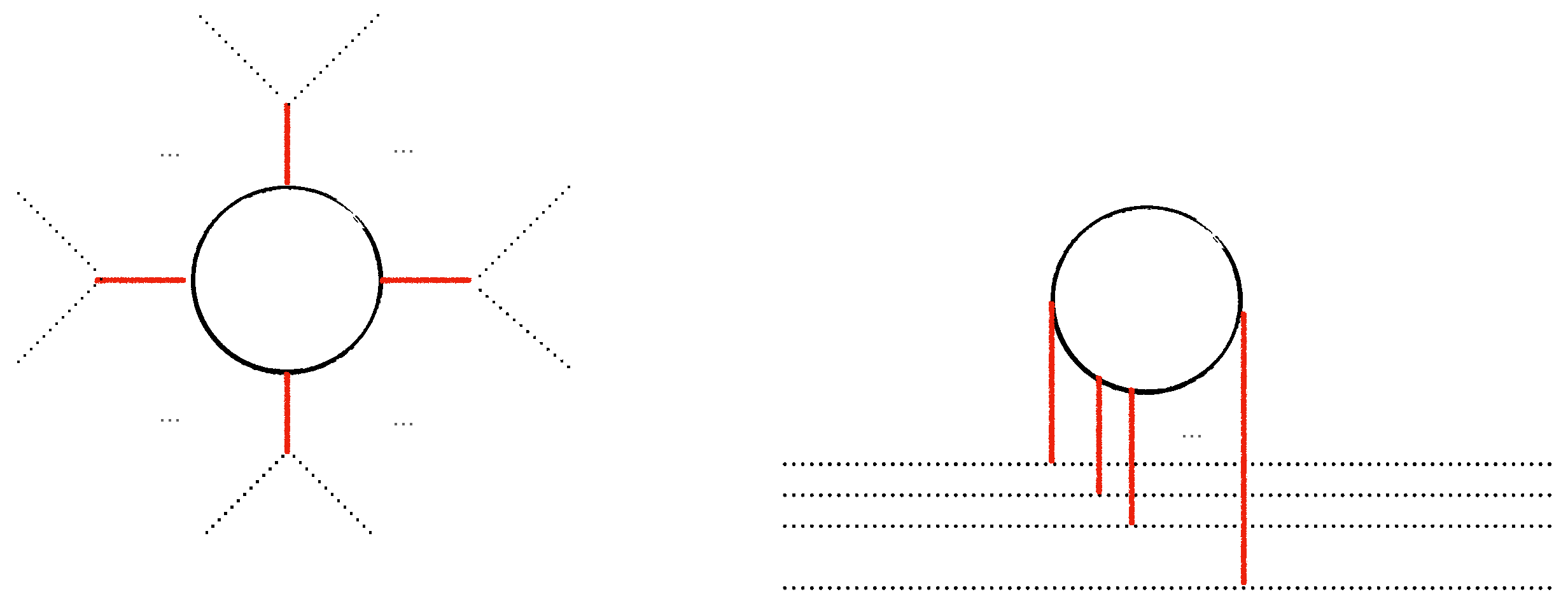
gravitons within the bubble propagator line of any SM field (see
Figure 1). Moreover, Equation (
47) implies that these gravitons can be non-minimally coupled with hairons, which are in turn in a cosmological condensate (actually, gravitons are also coupled to hairons as standard matter, but in that case the same diagram receives a significant suppression from the extra gravitational coupling of each insertion). The average energy of each hairon is then
. Taking into account the presence of the background condensate, the
N-insertion diagram is
not exponentially suppressed, since the number of couplings coming from graviton insertions is compensated by a stimulated emission factor (which is typically linear with respect to the number of each insertion):
where
is the stimulated emission enhancement stemming from the presence of a background condensate of hairons. This does not imply that such a diagram has, again, UV divergences, since now it is cut off by the effect of the average temperature of the condensate:
where
is the number of bosons or fermions. These corrections are natural, in the technical sense, because in the limit of bare coupling,
, the corrections vanish. Therefore, when an SM particle is localized on the dS horizon, the particle interacts with this “atmosphere” of hairons. The Feynman diagrams with hairon loops represent how the particle’s properties (like its contribution to the vacuum energy) are “thermalized” or “dissipated” into the horizon’s degrees of freedom, preventing a catastrophic feedback loop.
As a consequence of this process of stimulated emission, matter and radiation in the universe can also spontaneously emit soft (low-momentum) gravitons, adding more hairons to the background hairon condensate which constitutes dark energy. This phenomenon leads to an amplification of the emission probability, which scales as
N for every emission. That is,
N dynamically increases with the cosmological time, corresponding to a dynamical decrease in
and a dynamical increase in entropy:
The process (
50) has the following asymptotic behavior:
,
,
. Indeed, this is an emission instability, predicting that a dS state with constant CC cannot exist in this model if not as a secularly growing steady approximation in time. This picture also suggests that if one starts with a small amount of hairons
–10 corresponding to a considerably large CC, its value spontaneously decreases after a certain relaxation time. However, in the case of W-gravity one can start directly from a small enough value of
obtained from a see-saw mechanism, with the HN paradigm guaranteeing its stability against quantum effects. Note that in the case of
, as in the case of the CC, the time scale for a first transition is of the order
, i.e., much larger than the age of the universe. However, if one considers a transition
, the corresponding change
suggests that such a transition is almost instantaneous, taking only a Planckian time to happen. While this result can be considered as another way to solve the CC problem through dynamical relaxation, one has to be cautious and ponder the meaning of a stimulated emission starting from a universe with only few initial qubits.
One may conceive the dS spacetime starting with an exceptionally large value of the CC and understand the relaxation process as exponentially efficient in cosmological time. Then, naturally, in a pre-geometric scenario, this dynamic is considered to start only after the fundamental SSB. This perspective can solve one of the major theoretical problems of the PGG approach: why such a large value of the gravitational Higgs VEV v is to be chosen? One unsatisfactory answer may come from invoking the anthropic principle, which is often seen as a last resort. The pre-geometric phase transition may produce a multiverse of domains with different values of v. Domains with a relatively small v (large ) have insufficient entropy and an exceptionally large value of the CC to form complex structures or intelligent observers. Nevertheless, the stimulated emission mechanism provides a way to completely avoid engaging in anthropic arguments. In general, one can imagine the universe having been originated with an arbitrary value of v, which in general, can also be as small as (with for MM- or W-gravity respectively). This then corresponds to less qubits of information and less nonzero entropy, as well as a much larger Hubble rate than the currently observed one. As N increases because of the mechanism of stimulated emission, decreases and v increases. This picture may be dubbed walking gravitational vacuum. Though one has to be cautious in extending these considerations for regimes with and Planckian CC, these regimes can be safely considered in the case . Following this argument, we conclude that the VEV of the pre-geometric field may possibly never be stable, deforming its sombrero potential in secularly growing minimal dynamics. We are then tempted to suggest that this may also naturally solve the problem of the arrow of time: after the SSB, the spacetime metric is generated and the concept of clocks can be defined; in addition, the stimulated emission is an irreversible process since the probability of emitting N hairons to enrich the condensate is higher than the re-absorption process. Therefore, the increase in entropy from stimulated emission, which is related to the dynamical increase in the VEV, may naturally provide the physical foundation behind the common perception of the arrow of time.
5. Hamiltonian Analysis, Hairons and Emergent Degrees of Freedom
In this Section, we proceed to remark the Hamiltonian structure of theories of PGG, these theories’ degrees of freedom and the consistency with the existence of the hairon condensate. The Lagrangian density of pre-geometric theories (see
Section 3) exhibits a degenerate structure, as it is linear in the temporal derivatives (velocities) of the pre-geometric fields. To this end, for carrying out the Hamiltonian analysis it is necessary to employ Dirac’s systematic procedure for constrained Hamiltonian systems [
64].
For the W model, the complete Hamiltonian density [
9] takes the form
where
,
and
represent Lagrange multipliers and
. The conjugate momenta
to
and
to
, evaluated on the constraint surface, are defined as
and
respectively.
Specifically, the spatial and temporal components of the latter are given by
Dirac’s procedure then leads to three primary constraints:
where “≈” denotes a ‘weak’ equality on the constraint surface.
The preservation of the primary constraint
under time evolution generates a secondary constraint:
where the dot denotes the time derivative and “
” the spatial ones. The total Hamiltonian density (
51) then takes on a simplified form:
where terms proportional to
are re-absorbed through a redefinition of the Lagrange multiplier
. The field
no longer appears explicitly in the expression (
57): this reveals its status as an exclusively gauge degree of freedom, and hence the Lagrange multiplier
remains arbitrary.
The phase space of the theory is described by ninety dynamical variables [
9], namely the fields
and their corresponding conjugate momenta
. Gauge freedom is characterized by twenty gauge-fixing conditions, which eliminate the unphysical degrees of freedom associated with
and
. The constraint structure consists of ten first-class constraints (
), which generate gauge transformations, and forty-four second-class constraints (combinations of
,
and
). The number of physical degrees of freedom is thus given by
yielding
. This count corresponds to a massless spin-2 graviton (2 degrees of freedom) and a massive scalar field
(one degree of freedom), in an analogy to scalar-tensor theories of gravity. This result is background-independent and valid for the MM model too.
After the SSB, the pre-geometric Hamiltonians reduce to the Einstein–Hilbert form of the ADM formalism, with the addition of the extra scalar field
whose mass is expected to be close to the Planck scale [
9]. This result establishes a compatibility with the loop quantum gravity framework too, in particular through the natural emergence of Ashtekar’s electric field variables from the components of
post-SSB.
The Hamiltonian analysis in this Section is crucial and unambiguous: pre-geometric theories contain three physical degrees of freedom, that is the two polarizations of the graviton and a massive scalar mode . This may initially appear to be at odds with the prior discussion of the hairon field as a new entity. However, this is not a contradiction but a refinement of its nature. Actually, the hairon field does not constitute a new, independent degree of freedom. It is an emergent composite quasi-particle that manifests itself after the SSB as a specific collective excitation of the pre-geometric condensate. Indeed, hairons are Nambu–Goldstone boson modulus fields that characterize the orbifold gravitational instantons—and these are to be seen as semi-classical quantum effects, rather than fundamental building blocks of the theoretical framework under examination.
A tempting but ultimately misleading analogy may be considering as a bound state of and quanta, akin to the proton in quantum chromodynamics. This picture, actually, fails to explain the hairons’ light mass, as the mass of such a bound state is expected to be at least of the order of the mass of its heaviest constituent, that is . Instead, a correct analogy is drawn not from high-energy physics but from condensed matter physics. In a crystal lattice, the fundamental constituents are atoms with a comparably large mass. Yet the collective vibrational modes of the lattice—called phonons—are massless (acoustic phonons) or have an exceptionally small mass gap (optical phonons), with energies determined by the lattice spacing and bond strengths, not by the atomic mass scale. Similarly, in a ferromagnet, the fundamental electron mass is quite large, but the relatively low-energy spin-wave excitations—called magnons—have a dispersion relation governed by a comparably small stiffness constant D. The analogy with magnets and spin waves can further elucidate the relationship between pre-geometric fields and hairons. is akin to the magnetization field of a ferromagnet. Before the phase transition, its spins are disordered (). Below the Curie temperature, the spins can spontaneously align, leading the field M to acquire a nonzero VEV that breaks the rotational symmetry of the system. This value is a macroscopic, static order parameter. In this sense, is then similar to a spin wave (a magnon) in the ferromagnet. A magnon, actually, is a quantum excitation of the condensed ground state defined by —it is a ‘ripple’ in the order parameter. One cannot have magnons without the underlying magnetic order, because they are perturbations thereof. The condensation of is thus what sets up the “geometric order” of the universe as . A hairon is an excitation or a fluctuation of this order parameter on the dS horizon. Indeed, pseudo-particles in condensed matter systems are Nambu–Goldstone bosons just like the hairons. The key distinction lies in their origin: in condensed matter physics, Nambu–Goldstone bosons arise from symmetries that are spontaneously broken by the crystalline structure of the material itself. Hairons, conversely, originate from symmetries broken by instantons together with the Higgs phase of spacetime induced by . Consequently, hairons only emerge at a semi-classical level alongside those instantons, whereas condensed matter systems and their Nambu–Goldstone bosons are already present at the classical level.
The key to understanding the hairons’ comparably light mass lies in the structure of the effective action of the theory. After the SSB, a term
emerges not from the fundamental mass of
but from the interplay between the comparably large VEV
v and the relatively small pre-geometric coupling constant
(or
, for MM-gravity). This is why the resulting mass scale is eventually set by the CC:
The largeness of
v is precisely compensated by the smallness of the effective coupling
, leading to a hierarchically small mass
. The hairon mass is therefore a derived, emergent property of the condensed vacuum state, not a parameter of the fundamental Lagrangian of PGG. It is light because it is the pseudo-Nambu–Goldstone boson of symmetries which are broken by orbifold instantons, and its value is protected by the exceptionally high entropy
of the dS vacuum.